What You Need to Know to Stay Up to Date With Atlanta and Georgia Education
Gwinnett Students Design Games for Kids With Autism Students from the Computer Science Club at Gwinnett County’s Mill Creek High School recently created MakingGS, a series of educational video games for young people with autism. The games are designed to help students with autism work together in a safe and welcoming environment.
Woodward Senior Receives Science Honor
Woodward Academy senior Samuel Jung was named a top 300 scholar in the 81st annual Regeneron Science Talent Search in January. This 1,900-entrant science and mathematics competition recognizes the country’s most promising high school seniors who are creating scientific solutions to our most pressing challenges.
Ansley
School Hosts Fundraising Gala
The Ansley School hosted its inaugural Our Kids Gala at Clark Atlanta University on March 26. The event, hosted by Cara Kneer of WXIA-TV’s “Atlanta & Company,” was a fundraiser for the private, tuition-free school, which serves children whose families have experienced homelessness.
Atlanta Business Chronicle Lists Top Independent Schools
The Atlanta Business Chronicle compiled a list of the city’s 50 largest independent schools in January, based on total enrollment for the 2021-22 school year. Woodward Academy topped the list with an enrollment of 2,525 students. The Westminster Schools, Greater Atlanta Christian, The Lovett School and Holy Innocents’ Episcopal School rounded out the top 5.
Student Artwork Showcased at the Dogwood Festival
The Atlanta High School Art Exhibition showcased nearly 200 works of art from metro Atlanta high school students in early April. The juried exhibition, part of the annual Atlanta Dogwood Festival, received over 700 entries from 84 schools. “Coral,” a work by Riverwood senior Olivia Pryor, won Best of Show.
DeKalb Teacher Gets $1,000 Grant
Kendall Xides, a STEM teacher at Oak Grove Elementary, is the latest recipient of the Georgia Department of Natural Resources’ Conservation Teacher of the Year Grant. The $1,000 grant will go toward restoring the Birdsong Nature Trail.
Mount Paran Unveils Innovation Center
Mount Paran Christian School opened its brand-
new Murray Innovation Center in January. The center features more than 23,000 square feet of space designed to encourage learning, testing, collaboration and outside-the-box thinking to help Mount Paran students prepare for careers in the fast-growing field of STEAM (science, technology, engineering, arts and mathematics).
Fulton School to Offer “Option B” Diploma
McClarin High School in Fulton County is undergoing a $25 million renovation to update classrooms and add lab spaces. It will reopen as a “middle college” offering job training through a technical col-
lege as an alternative way for students to earn a high school diploma.
Capstone Featured on Lifetime Channel
Capstone Academy, an Atlanta independent school for grades 5-12, was featured in a December episode of Lifetime Channel’s morning show “The Balancing Act.” The school appeared in a local segment spotlighting its untraditional schedule, smaller class sizes and other innovations.
Atlanta Earmarks $5M for Early Education
Newly elected Atlanta Mayor Andre Dickens recently announced that the
city is investing $5 million in early childhood education to help ensure that children begin school on a level playing field. The mayor challenged Atlanta Public Schools and private philanthropists to match the city’s investment.
CIS Atlanta Receives $4 Million Gift
Communities in Schools of Atlanta, a nonprofit organization that works to help students overcome learning obstacles, recently received a $4 million gift from philanthropist MacKenzie Scott. The gift will go toward its efforts to improve graduation rates in 62 metro-area public schools.
Education 101
Terms to Know in Your Search for the Right Educational Experience for Your Child
CHARTER SCHOOL A tax-supported public school that is independently run, allowing for greater educational choice for parents in the community.
EXPERIENTIAL LEARNING An educational approach using applied, hands-on methods of learning.
INTERNATIONAL BACCALAUREATE (IB) A specifically designed comprehensive academic program emphasizing traditional disciplines while instilling a global perspective in its students.
MAGNET SCHOOL A public school that offers a specific or enhanced curriculum designed for students of special interest or ability.
MONTESSORI A school following the principles developed by Dr. Maria Montessori focusing on the unique individuality, self-reliance and independence of children.
SPECIAL NEEDS A school or program for children who have mild to moderate learning differences. It usually features smaller class sizes, individualized attention and multisensory learning methods.
ACCREDITATION Official certification that guarantees a school provides an education of a reasonably high quality. Schools must prove levels of quality and maintain continuous standards of improvement.
ACT An alternative to the SAT, this national college admissions examination consists of subject area tests in English, Mathematics, Reading and Science, with an optional 40-minute writing test.
COLLEGE AND CAREER READY PERFORMANCE INDEX (CCRPI) Georgia’s annual tool for measuring how well its schools, districts, and the state are preparing students for the next educational level.
EARLY CHILDHOOD EDUCATION
Education that applies to children from birth to age 8, focusing specifically on their development, including physical, emotional, sensory, communicative, cognitive and social needs.
GEORGIA MILESTONES Tests
designed to measure how well students in grades 3 through 12 acquire the skills and knowledge outlined in the state-adopted content standards.
A scholarship in Georgia, funded by the Georgia Lottery, that rewards academically achieving students with financial assistance to attend a degree, diploma, or certificate program at eligible public and private Georgia colleges and universities.
EVERY STUDENT SUCCEEDS ACT
(ESSA) A federal law passed in 2015 replacing the No Child Left Behind Act, designed to ensure that all children have a fair and equal opportunity to obtain a quality education and meet state academic proficiency standards.
PSAT A standardized test that offers students practice for the SAT Reasoning Test and allows them to qualify for the National Merit Scholarship Program
SAT This standardized test measures the writing and language, reading and mathematical reasoning skills of students planning to attend college.
SECONDARY SCHOOL ADMISSIONS
TEST (SSAT) Assesses the verbal, math, and reading abilities of students seeking to enroll in an independent school.
Communication
Deciphering Associations and Organizations
Many local and national organizations work to bring out the best in summer camps and public, private and boarding schools by identifying schools that meet certain standards through accreditation. These groups also set policies, research educational advancements and offer services to the educational communities both in Atlanta and in Georgia. The following are just some of the associations and organizations you should know in your search for the best educational experience for your child.
The Association of Boarding Schools (TABS) boardingschools.com
This organization of 250 boarding schools serves the professional development needs of boarding schools and provides information to potential students and their families.
Association Montessori Internationale (AMI) ami-global.org
Recognizes and provides
support, training and development to schools that strongly adhere to Montessori method principles and practices.
Atlanta Area Association of Independent Schools (AAAIS) aaais.org Promotes the highest standards and best administrative practices for accredited independent schools in the metro Atlanta area.
Cognia cognia.org
Formed from the merger of two organizations (AdvancED and Measured Progress), it advances education excellence through accreditation and school improvement initiatives. Department of Education (DOE) gadoe.org
A statewide, policy-driven organization governing the public school system of education in Georgia for grades K-12.
Georgia Association of Christian Schools (GACS) gacs.org
Uses generally accepted indicators of quality, voluntary self-improvement and peer review to measure Christian schools.
Georgia Association of Private Schools for Exceptional Children (GAPSEC) gapsec.org
This state organization of independent schools for students with learning disabilities maintains a code of ethics and shares information about programs at member schools.
Georgia Independent School Association (GISA) gisaschools.org
An association of Georgia’s private, independent and parochial schools, dedicated
to serving the professional growth, advocacy and interscholastic needs of member schools.
National Association for the Education of Young Children (NAEYC) naeyc.org
A professional membership organization working to promote high-quality early learning for all young children, birth through age 8, by connecting early childhood practice, policy, and research.
National Association of Independent Schools (NAIS) nais.org
A membership association
providing research, leadership and governance guidance and professional development opportunities for school and board leaders in U.S. independent schools.
National Association of Private Special Education Centers (NAPSEC) napsec.org
Represents private specialized education programs by promoting quality programs and services for individuals with disabilities and their families.
Southern Association of Colleges and Schools (SACS) sacs.org
The recognized regional accrediting body for both public and private schools in the 11 U.S. Southern states.
Southern Association of Independent Schools (SAIS) sais.org
Provides accreditation services, professional growth opportunities and leadership development programs for 375 independent U.S. schools.
For more information about these and other organizations and associations that ensure quality education among camps and schools, visit the websites of the Georgia Department of Education (gadoe.org) or the U.S. Department of Education (ed.gov).
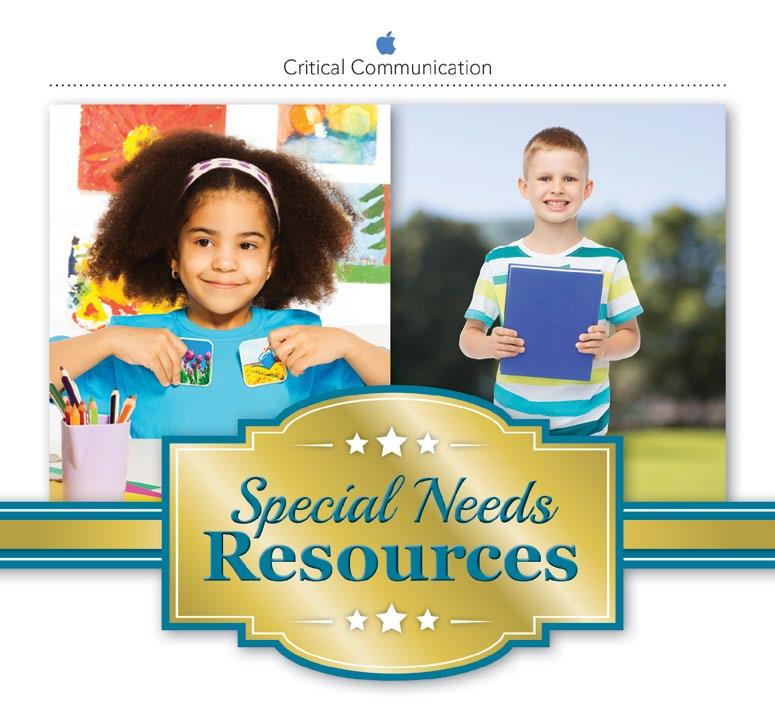
Special Needs Resources
Information on Learning Disabilities, Education Options and More
What is a Learning Disability?
A learning disability is a neurological disorder that affects how your child processes certain information. Children with learning disabilities are as smart as or even smarter than other children, but may face challenges with reading, writing, spelling, reasoning and other functions. As a result, they often struggle to achieve in traditional classrooms. There are many types of learning disabilities, from Attention Deficit Hyperactivity Disorder (ADHD) and dyslexia to more serious forms such as autism.
What is a Special Needs School?
Special needs schools are those that serve children who struggle with learning disabilities or don’t perform well in a conventional school environment. These schools use alternative approaches to instruction in order to help children learn more effectively and also achieve success in the classroom and in social settings. Other schools don’t specifically target those with learning disabilities, but may teach different kinds of students who have had difficulty learning in a typical class-
room setting. Others may teach average or even above-average learners while also offering additional programs and classes for students with learning differences.
How to Tell if Your Child Has a Special Needs Situation
First, it’s important to identify your child’s specific challenges. Students who exhibit average or above-average intelligence but often seem distracted and don’t perform well in a traditional classroom setting may be struggling with dyslexia, Asperger’s syndrome, ADHD or some other disorder that affects their ability to learn effectively. Also, disruptive or aggressive children may be exhibiting frustration brought on by a learning disability.
If you suspect your child may have a learning dis-
ability, it’s critical to have him or her evaluated by a mental health professional. A diagnosis is necessary in order to address the child’s educational needs.
After a Diagnosis: What’s Next?
A professional evaluation is crucial in order to evaluate your child’s educational needs.
If your child is diagnosed with a learning disability and attends public school, talk with the principal, school counselor or another administrator about developing an Individualized Education Program (IEP). All public schools are required to create an IEP for students with learning disabilities who meet special education requirements. An IEP is a document that specifies your child’s learning situation and educational needs and outlines a course of action for teachers and other professionals to follow to help make sure your child learns to the best of his or her ability. u
If you feel your local public school isn’t the right environment for your child or simply want to explore all your options, there are many quality independent schools in metro Atlanta devoted to helping children with special needs and learning issues. Visit the Georgia Association of Private Schools for Exceptional Children’s website (gapsec.org) or our listings for special needs schools on page 90 to help you with your search.
How Do I Find the Right School?
All special needs schools are not the same. The first step is to identify those schools that can address your child’s specific learning difficulty, and offer the level of special needs instruction that you (and perhaps a professional) feel is best for your child.
You may be more comfortable enrolling your child in a school that focuses specifically on his or her needs, or you may want a more diverse environment where he or she can interact with many different kinds of students. Familiarize yourself with the different options offered by each kind of school.
Traditional independent schools that offer special needs programs as part of a larger curriculum can offer that kind of environment, but may have larger class sizes than schools that specialize in specific learning disabilities. These kinds of schools may also focus more on academics than on the therapeutic aspects of special
needs education. Independent special needs schools can offer more individualized instruction and a more structured and predictable environment, and are likely to address nonacademic issues such as social skills and self-esteem.
As you begin searching for the right school for your child’s situation, here are some questions to keep in mind:
• Will your child fare better in a school that focuses on his or her specific learning disability, or would you rather that he or she be able to interact with students with a wide range of learning capabilities?
• Does the school serve a specific age range or work with students on all grade levels? Many students with learning disabilities have trouble transitioning to new schools.
Continued on page 18 u
Identify those schools that can best address your child’s specific learning difficulty.
COMMON SPECIAL NEEDS TERMS
Asperger’s Syndrome: A developmental disorder on the autism spectrum, characterized by high intelligence, impaired social skills and repetitive patterns of behavior and interest.
Attention Deficit Disorder (ADD): A strain of ADHD (see below) marked by a difficulty maintaining focus or concentration and frequent or consistent fatigue. ADD differs from ADHD in that hyperactivity or impulse-control issues are markedly decreased.
Attention Deficit Hyperactivity
Disorder (ADHD): A chronic condition that includes hyperactivity, impulsive behavior and difficulty keeping one’s attention focused.
Autism: A developmental disorder that affects the ability to communicate and interact with others, accompanied by rigid, repetitive behavior patterns.
Dyslexia: A learning disability that impairs one’s ability to read.
Georgia Association of Private Schools for Exceptional Children (GAPSEC): An organization of independent schools serving students with learning disabilities and differences.
Georgia Special Needs Scholarship (GSNS): A school-choice scholarship program for special needs students being served by an IEP in Georgia public schools.
Individualized Educational Program (IEP): A written statement that outlines the needs of a public school student with learning disabilities and creates a customized plan for meeting those needs.
Individuals With Disabilities
Education Act (IDEA): The federal law that governs how states and public education agencies that accept funding under the law address the educational needs of students with disabilities.
Learning Disability: A neurological condition that affects how one processes information.
• Does the school offer a variety of extracurricular activities, including arts and sports programs?
• Is the school accredited? If so, by which organizations?
• Is the staff certified to instruct special needs children or those with your child’s specific learning difficulty?
• Does the school focus more on academics or on addressing the child’s therapeutic needs?
Financial Assistance
Many independent special needs schools participate in the Georgia Special Needs Scholarship program (GSNS), a school choice program available to special needs students attending Georgia public schools. It offers funds to offset tuition and
fees at participating private schools authorized by the State Board of Education. According to the Georgia Department of Education, scholarship amounts range from $2,500 to $13,500, with an average amount of around $6,000.
The Qualified Education Expense Tax Credit program provides another scholarship option. Donations are made to an organization known as a Georgia Student Scholarship Organization (GaSSO), which uses the money to award scholarships to students in pre-K through grade 12. Many schools also offer their own scholarships or tuition assistance programs as well. Contact individual schools for details.
For more information on special needs schools and resources, please see our listings on page 90.
Timothy Wiens
Head of School, Mount Paran Christian School
Head of School of MPCS since July 2018, Dr. Timothy Wiens has 28 years of experience as an educator and administrator in K-12 and postsecondary education. He holds a Master’s degree in Education from Bethel University, a Doctorate in Education from Saint Mary’s University of Minnesota, and a MBA from the University of Oxford’s Saïd Business School in England.
What is your educational philosophy?
I believe the purpose of education is to prepare students to flourish in this world. A K-12 education is meant to prepare students broadly, to understand the world around them, to engage the world in its many forms and functions and to understand the complexities of a rapidly changing world.
What do you love most about your job?
I love being around students and seeing the impact their teachers have upon their thinking and their lives in general. A teacher’s impact is profound and can never be underestimated.
How is the field of education changing? Technology has dramatically changed education. I believe education is inherently relational. Educators need to find the right balance between the personal and the technical, knowing both are important, but also understanding the importance of community and relationships.
How can parents best contribute to the education process?
The more/better we can engage them in the life of the school and communicate clearly together, the better the education we as a school can provide.
What advice would you offer parents about their children’s education?
Find a school that meets their children’s particular needs, not simply their desires. Find a school that can truly help your child flourish.
THE ESSENTIALS: MOUNT PARAN CHRISTIAN SCHOOL
Emphasis: MPCS is a college-preparatory Christian school that seeks to prepare servantleaders to honor God.
Year Founded: 1976
Grades: PK3-12
Students: 1,255
Avg. Class Size: 14-20
Tuition Range: $4,378-$22,184
Accreditations or Affiliations: Cognia, SAIS, CESA, NAIS, SACS, GISA, GHSA
Location: 1275 Stanley Road, Kennesaw, GA 30152
Contact: 770-578-0182, mtparanschool.com
School wrote their state senator, proposing a “Georgia Day” to honor character and good choices. Gov. Nathan Deal extended the idea to a whole month spotlighting state history and the positive character traits of Georgians past and present. In March 2012, Georgia became the first state to recognize and dedicate an entire month to history and character.
Georgia maintains this focus throughout the school year in its public-school curriculum. The Georgia Department of Education mandates character education as part of its Georgia Quality Core Curriculum Standards, required in elementary, middle and high schools throughout the state. This “character curriculum” focuses on citizenship, respect for others and respect for oneself.
The citizenship portion stresses the importance of such values as democracy, respect for authority, equality, justice, liberty, patriotism and respect for the natural environment. Students learn to respect others with an emphasis on altruism, honesty and integrity, and are taught to respect themselves through self-esteem, accountability and a strong work ethic.
The Cobb County School District boasts its own focus on character development, with a calendar that emphasizes different character traits on a rotating basis throughout the school year, including respect, integrity and responsibility, among others. Instead of students receiving a separate lecture on self-respect, that lesson is incorporated into the regular curriculum, across all disciplines. As students reach high school, a leadership development class called Principled Thinking focuses on developing character-driven skills to enable young adults to become positive leaders in their schools and communities.
A LARGER PERSPECTIVE
That approach is similar to the one taken by the Atlanta International School (AIS), an independent school in Buckhead that uses the framework of the International Baccalaureate (IB) program to instill positive character traits in its students. At the core of this program is the goal of developing students who will be ready to create a better world through intercultural understanding and respect.
At AIS, the foundation is laid early: The Personal Social Education component of its Early Years program gives young learners models, methods and a vocabulary for handling social and emotional issues in a constructive way. As students continue, each grade’s IB program focuses on several distinct traits such as communication, open-mindedness and risk-taking. At the beginning of each year, teachers work these principles into their lesson plans with an eye to shaping students into ideal global citizens
who will use their knowledge to make a difference in the world and in their community.
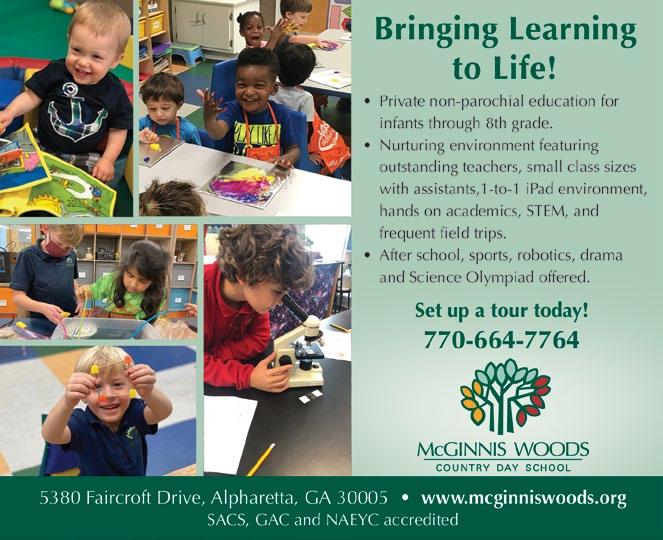
At McGinnis Woods Country Day School in Alpharetta, which has infants through eighth-graders, students have character education classes with a counselor each week, from pre-kindergarten through the eighth grade. The classes start in pre-K with teaching subjects such as how to be kind, how to resolve an issue and how to deal with others who are not kind, says Principal Mary Johnson.
“With our older children … we’ll go into things like digital safety so they will not say things on Twitter or Snapchat that are rude to others or inappropriate, being mindful of those things because they can stay there forever.” she says. “We do things like exploring careers.”
The school also promotes character
education through its morning announcements, which include the character word of the month, and by honoring a student as a Citizen of the Month for exhibiting strong character traits.
RESPECTING DIFFERENCES
Along with thinking for oneself and learning from failure, learning to respect the viewpoints of others is a key component of character-based education. At AIS, students are exposed to other cultures and different viewpoints, and learn to value others’ opinions, even when they don’t agree with them. Diversity is a core value at other schools, including Woodward Academy in College Park and The Galloway School in Atlanta.
LEARNING FROM MISTAKES
Lynn Mandelbaum, Galloway’s early learn-
ing counselor, says she’s seen a change in the way character education has been taught in the past 10 to 20 years. “There’s much more of a focus on other people’s points of view and diverse thought. Understanding how different people’s cultures will have an impact or express an emotion or how they celebrate and recognize and interact with others,” she says, adding children have more power in today’s program.
Galloway’s program focuses on social emotional learning (SEL), the field within education that promotes social and emotional skills as essential to learning and life outcomes, to encourage students to come up with their own ideas and learn from their mistakes. It’s taught in pre-kindergarten through the fourth grade, both through a separate class and embedded into other class curricula. Starting in the fifth grade, it’s included in the school’s advisory program within each class.
Woodward takes SEL one step further with its social, emotional and ethical learn-
ing program, which includes an ethics component. The program is taught as a separate class in pre-K and the eighth grade (with plans to add a fourth-grade class starting this fall) and integrated into the curriculum of other classes in all other grades. That includes a year-long curriculum as part of a capstone course for the upper school, says Jennifer Knox, Woodward’s director of character education and the Ron M. Brill chair of ethical leadership.
The program asks students to look at themselves and try to remain calm in highstress situations. “What’s going on that relates to emotions ... to navigating those emotions? How do we recognize those? How do we respond when an emotion becomes difficult?” Knox says, adding it’s about making informed decisions.
FOR MORE INFORMATION
For a look at the Georgia Department of Education’s Quality Core Curriculum materials, including information on its Character Education program, visit georgiastandards.org/ standards/pages/qcc.aspx.
For information on the Georgia Community Foundation’s history of character education in the state’s public schools, visit https://www.georgiacf.org/ educational_freedom/page/ character-education.
For more information about the Character.org 11 principles and program, visit the website.
SpecialSchoolNeeds
BY DONNA NEALE
SELECTING THE RIGHT FIT FOR CHILDREN WITH LEARNING DIFFICULTIES
Choosing a school for your child can be a complex process for any family, but it’s especially true if your son or daughter has a learning disability or struggles to learn effectively in a conventional school setting. Identifying the nature of your child’s difficulties and sorting through available educational options can be daunting tasks.
Fortunately, the Atlanta area boasts a large number of public and independent schools equipped to address the challenges that these students can face, from specific disabilities such as autism, dyslexia and speech and hearing difficulties to emotional and behavior disorders.
IDENTIFYING THE ISSUE
The first step to securing the best education for your struggling child is to pinpoint his or her issues. If your student exhibits average or above-average intelligence but doesn’t perform well in a traditional classroom setting, there may be a diagnosable reason such as dyslexia, attention deficit hyperactivity disorder (ADHD), Asperger’s syndrome or vision or hearing difficulties. Don’t be afraid to request a professional evaluation. If parents and teachers are worried about a smart child who is struggling to learn or gain skills, a psycho-educational evaluation, which can provide a path to discovering what his or her learning disability is,
may be needed. However, “the first thing parents need to do, and surprisingly often don’t do, is have a conversation with their child’s teacher, a very specific conversation to gauge what the teacher is seeing in the classroom,” says Amy Zaring, director of Woodward Academy’s Transition Learning Support Program, which works with grades 2-8 students with complex learning profiles and diagnosed learning differences. “It’s also important to pay attention to their child’s state and standardized test results.”
When choosing an evaluator, Catherine Trapani, Ph.D., head of The Piedmont School of Atlanta, advocates thoughtful decision-making. “Take the time to find out about the professional’s credentials, including where the professional received education and training, the kind of childhood disorders they were particularly trained to evaluate, and how long they have been working in the field,” she says.
If your child’s testing results in the diagnosis of an eligible special education disability, and your child is currently enrolled in a public school, an Individualized Education Program (IEP) statement will be developed. The Individuals with Disabilities Education Act requires all U.S. public schools to provide an IEP for learning-disabled students who meet special education requirements. Working with the parents, the educational system creates an IEP that details how the child learns, sets measurable goals and outlines what teachers and other professionals can do to help the student learn more successfully.
SEARCHING FOR THE RIGHT SCHOOL
When interviewing potential schools, ask questions about learning techniques, environment and focus. “Is the school more geared for students with strong academics and poor social skills, or is it more for
students with learning disabilities who learn in different ways?” asks Betsy Box, admissions director and director emeritus of The Bedford School.
For instance, some schools are tailored to a specific disability. The Schenck School serves students with dyslexia, while Piedmont serves typical and bright children with autism, learning disabilities and attention deficits. Mill Springs Academy and The Howard School cater to students with learning difficulties who plan go to college. The Cottage School focuses on overall adult success, providing a comprehensive collegepreparatory curriculum as well as vocational and special “hands-on” classes for students with mild to moderate learning difficulties.
Other schools don’t specifically target those with learning disabilities, but have programs in place to help those students. Woodward, for example, provides a unique learning environment for students with mild to moderate dyslexia, dysgraphia and dyscalculia (among other diagnoses) within a conventional college-preparatory school setting. Its Transition Learning Support Program allows younger students to learn
the same curriculum as other Woodward students, but the material is taught in ways that suit their individual needs and learning styles. The program aims to equip these students to merge into the traditional classroom for high school.
Parents will want to take other factors into consideration, as well. Are the teachers certified to instruct special education or specialneeds children? Is the school accredited? If so, by which organizations? Does the school offer financial assistance or scholarships? Are there a variety of sports, after-school activities and/or arts programs? Are there summer programs? Does the school serve a specific age range, or work with students on all grade levels?
As you begin compiling your short list of potential schools, don’t be shy about consulting with professionals. Your child’s doctor, counselor or specialized tutor may have advice about school programs that relate to your child’s needs. Look into foundations or local support groups for your child’s disabilities and make connections with others who have traveled your path. Their experiences
can prove invaluable.
“Go deeper and consider the lifelong goals of the family,” says Trapani.
MAKING A DECISION
Visiting the schools you’re interested in is a crucial step, as talking to the staff will give you a sense of how they interact with students.
Make an appointment, and come prepared. In addition to the results of a psychological exam or an IEP, bring a sample of the child’s schoolwork and a willingness to candidly discuss your child’s needs.
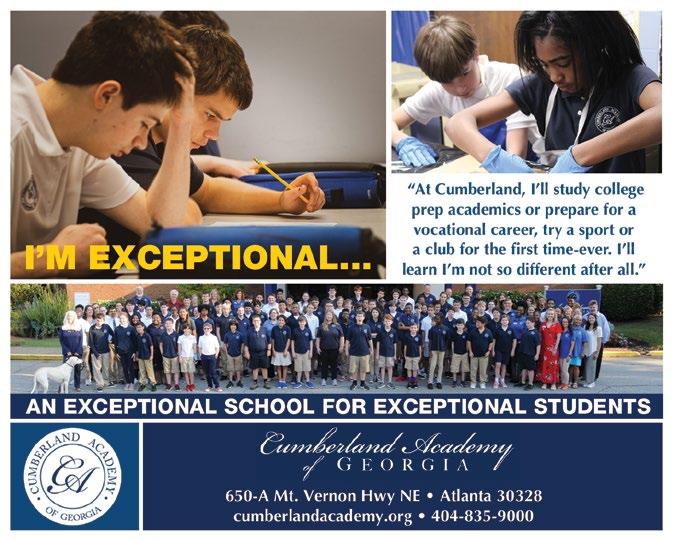
Ask questions. Take notes. See for yourself if the physical setting and overall atmosphere make you and your child feel comfortable. “Parents can tour the school and see the learning taking place,” says Debbi Scarborough, co-founder and headmaster of the Cumberland Academy of Georgia. “They know their child and will get a sense of if the child’s going to fit in.”
Zaring agrees. “I believe it’s important for a child to experience the culture of the school while also creating some enthusiasm in the child for the co-curriculars the school offers.”
Once parents have done the work and gone through these important steps, the final choice may be easier than they think.
“Parents know their children better than anyone,” says Box of The Bedford School. “There may be more than one school that could be appropriate for your child. Go with the school that you think will work best for your child. Go with your gut.”
For additional information on learning disabilities and special needs resources, including financial assistance options and a list of schools, please see our Special Needs section on page 14, and a list of special needs advertisers in this issue on page 90.
ABLE KIDS
Since 2016, ABLE Kids has been dedicated to helping children with autism Achieve Beyond Life’s Expectations. They primarily serve children between 2 and 6 years old who have been diagnosed with Autism Spectrum Disorder and need 30 or more hours a
THE SCHENCK SCHOOL
week of Applied Behavior Analysis (ABA) Services. In order to meet all of your child’s needs, they also offer Occupational Therapy, Speech Therapy and Psychological Evaluation Services. ABLE Kids currently has locations in Roswell, Tucker and Chamblee and is still growing in the Atlanta region.
ABLE Kids will walk your family through every step of the journey! Call today for a free consultation: 404-905-7220. For more information visit ablekids.com.
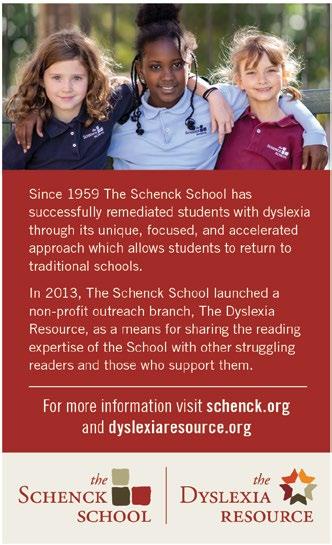
The Schenck School builds a solid educational foundation for students with dyslexia and helps its students develop their rich potential. Founded by David Schenck in 1959, it is regarded as one of the top elementary schools in the U.S. for dyslexic students. The school focuses on accelerated remediation of dyslexia using The Schenck School Reading Model, a highly diagnostic and prescriptive application of the Orton-Gillingham Approach with small group instruction
across all subjects. Critical to student success is a specialized, intensive yet nurturing learning environment for students to take risks, read and succeed. While at the school, students learn to advocate for themselves and to celebrate their dyslexia. The Schenck School is located at 282 Mt. Paran Rd., Atlanta, GA 30327. For more information, call 404-2522591 or visit schenck.org.
OFFERING PARENTS BETTER EDUCATION OPTIONS
BY KEVIN FOREST MOREAU
arents searching for a school for their child used to have just two options: independent schools and public schools. While each model has its strengths, many parents found themselves wishing for a third option: one with the flexibility of an independent school, but open to any student, free of charge.
These days, parents have more options than ever before. Charter schools are one such option, offering the best of both worlds. These schools are becoming more common throughout Georgia, and they offer a variety of educational approaches to fit a child’s individual learning needs.
WHAT IS A CHARTER SCHOOL, EXACTLY?
A charter school is a publicly funded school with the freedom to develop its own curriculum and guidelines. Instead of a local board of education, the school is governed by an independent board, which usually includes parents.
Some charter schools operate within a public school district, while others are part of a special charter school district, like City Schools of Decatur or Gainesville City Schools, that operate under a charter between the state board of education and the local school district.
“Charter schools are public schools of choice, governed by an autonomous board of directors.”
—Tanya Parker, International Charter School of Atlanta
In fact, one common misconception about charter schools is that they aren’t public schools, says Tanya Parker, executive director of the International Charter School of Atlanta (ICSAtlanta). “Charter schools are public schools of choice, governed by an autonomous board of directors,” she says.
Another misconception parents often have is the idea “that there is a cost, or tuition, for students to attend a charter school,” says Lisa Simon, communications director for The Main Street Academy.
Charter schools get their name from the fact that they operate according to an agreement, or “charter”—a contract between the school and an entity such as the state or a local school district.
As a result, charter schools often feature smaller classroom sizes, and in general provide more personalized instruction and attention that a child might receive in a larger, more traditional public-school setting.
“Charter schools are special in that we have greater flexibility to provide a framework appealing to varying educational needs,” says Parker.
In return for this freedom, the school takes on more accountability with parents and the school board that authorized the charter. Unlike traditional public schools, if a charter school doesn’t meet the goals stated in its charter, it faces the prospect of its charter not being renewed.
DIFFERENT WAYS OF LEARNING
Choice—having more schools and more ways of learning to choose from—is the core of the charter school concept.
A school’s charter gives it more flexibility in how it instructs students. Charter schools can employ different teaching methods and educational formats, including single-gender schooling, project-based learning or Montessori education.
The International Charter School of Atlanta, for example, features a dual-language immersion program.
“By operating as a charter school, ICSAtlanta is able to provide students with an immersive curriculum in French, German, Mandarin or Spanish, and English, ensuring students graduate bilingual and biliterate,” says Parker. “We utilize both dual-language and cultural immersion to nurture student curiosity into compassion for others and a commitment to improving our world.”
The Main Street Academy in College Park, meanwhile, employs the Renzulli Schoolwide Enrichment Model (SEM), developed by educational psychologist Joseph Renzulli.
“SEM enriches our core curriculum by bringing students in contact with experts and community leaders who explain how education connects to real-life experiences, and by sponsoring student projects that explore how academic research impacts
the outside world,” says Simon. “The Main Street Academy is one of only a few schools in the Fulton County Schools district that incorporates SEM into its curriculum.”
Amana Academy, with a campus in Alpharetta and a new location in Mableton, uses the Harvard-based EL (Expeditionary Learning) Education model, in which students learn by going on “learning expeditions” instead of sitting in a classroom. The school also has a strong focus on STEM (science, technology, engineering and mathematics) instruction.
“Amana Academy’s approach to learning has created an environment where my son
can thrive,” says Chad Cunningham, parent of an Amana student. “The Expeditionary Learning model is focused on education equity and expects students to reach their full potential.”
GETTING INTO A CHARTER SCHOOL
Unlike independent schools, charter schools, since they are public schools, cannot charge tuition, and must follow the same open admission and enrollment standards as other public schools.
According to the Georgia Charter Schools Association, a charter school is required to conduct a lottery when there are more applicants than there are seats available in the school. The lottery is conducted through random selection and the results are made public.
Open enrollment at The Main Street Academy is held each February. Prospective families must complete and submit an online application found on the school’s website.
At ICSAtlanta, “our application process opens in late fall with our information session and tour season,” says Parker. “The applica-
Unlike independent schools, charter schools, since they are public schools, cannot charge tuition, and must follow the same open admission and enrollment standards as other public schools.
tion is available on our website in early January, with our lottery taking place in early February. We continue admitting and enrolling new students as spaces permit until enrollment closes in late September.”
Different schools may have restrictions based on grade levels and where the student lives. The Main Street Academy is open to all K-8 students who are zoned in the Fulton County Schools district, while ICSAtlanta is a statewide charter school open to any Georgia resident, and accepts new student applications for kindergarten and first grade.
IS CHARTER THE RIGHT CHOICE?
The decision to place your child in a charter school depends on your goals for your child’s education. If you think your child would benefit from a specific learning style not found in most public schools—or if you think they’re more likely to flourish in an intimate setting with smaller classrooms and more personal interaction between students and teachers—a charter school just may offer the perfect learning experience.
FINDING A CHARTER SCHOOL
The website of the Georgia Charter Schools Association (gacharters.org) has a school locator to help you find charter schools in your area, along with information on each school to help you decide where to start your search.
area map
REGIONS FOR INDEPENDENT SCHOOLS N
For features of independent schools, turn to Education At a Glance on pg. 34. For public school system information by county, turn to pg. 74.
3 3
2
2
1 1
5 5
Boarding Schools Florida, Georgia, North Carolina, Pennsylvania, Tennessee, Texas
Public School County Guide
REGION 4: Atlanta South/ Southeast/Southwest Eagles Landing, Fairburn, Fayetteville, Locust Grove, McDonough, Metro-Atlanta, Newnan, Sharpsburg/Peachtree City p.61
REGION 1: Atlanta North/Northwest
Educational Resources Tutoring, Summer Camps and Activities, Field Trips and Education Programs.
REGION 5: Atlanta West Acworth, Buckhead, Kennesaw, Smyrna/Vinings
REGION 2: Atlanta North/Northeast Alpharetta, Brookhaven, Duluth, Dunwoody, Johns Creek, Peachtree Corners, Roswell p.50 p.56
Buckhead, Chastain Park, Crabapple, Holly Springs, Marietta, Roswell p.45
REGION 3: Atlanta East Ansley Park, Athens, Dacula, Decatur, Midtown, Morningside, Northeast Atlanta
REGION 3: Atlanta East Athens, Bethlehem, Brookhaven, Collins Hill, Decatur, Loganville, Norcross, Watkinsville
Education At a Glance
INDEPENDENT SCHOOLS
37
REGION 1: ATLANTA NORTH/NORTHWEST
2: ATLANTA NORTH/NORTHEAST
Education At a Glance
This information reflects the latest available data at publication time. Please confirm with each individual school.
INDEPENDENT SCHOOLS
50
REGION 3: ATLANTA EAST
4: ATLANTA SOUTH/SOUTHEAST/SOUTHWEST
*KEY:
Education At a Glance
INDEPENDENT SCHOOLS
Religious Affiliation: CC = Catholic C = Christian E = Episcopal J = Jewish JC = Judeo-Christian ND = Non-denominational P = Presbyterian Q = Quaker 10000 Avalon Blvd Suite 150 Alpharetta, Ga 30009 470-339-7224
BOARDING SCHOOLS
1:1 Private School Grades 6-12
3414 Peachtree Rd NE Suite 200
GA 30326 678- 335-2382
BUCKHEAD
ROSWELL • CRABAPPLE
HOLLY SPRINGS
ROSWELL
Independent Schools
REGION
NEIGHBORHOODS OF NOTE
Norcross Founded in the late 1800s as a resort town for wealthy Atlantans, Norcross is Gwinnett County’s second oldest city. Today, with over 8,000 residents, it is a quiet city filled with upscale yet charming residential and retail developments.
Cumming Called the “Gateway to Leisure Living,” Cumming offers the best of small-town living, but in recent years, it has seen rapid commercial and residential development, attracting many new residents with its prime location near the magnificent Lake Lanier.
Serving children in grades Kindergarten to High School with language, learning and social challenges.
Call for a private tour!!!
Certified masters-level teachers deliver a regular-education curriculum combining:
• Georgia Standards and National Core
• Differentiated Instruction
• PE, Art, Foreign Language, Theatre and Culinary Arts
• Technology in every classroom
Rolling Admissions. Fully Accredited GAC! 2022-2023
DULUTH • DUNWOODY
JOHNS CREEK
C u r i o s i t y S p a r k e d . N o L i m i t s .
N O W E N R O L L I N G P R E S C H O O L8 T H G R A D E
ATLANTA EAST
3
Independent Schools
NEIGHBORHOODS OF NOTE
Stone Mountain More than just a mountain park, Stone Mountain also refers to a charming community of antique shops, art galleries and restaurants. Residents of Stone Mountain enjoy natural scenery and miles of walking and biking paths available in the nearby park.
Lawrenceville Strolling the brick-paved sidewalks in the revitalized historic downtown of Lawrenceville, you’ll feel instantly at home. Chartered in 1821, the city has gone through many changes over the years but has maintained its gracious small-town Southern charm.
COLLINS HILL • DECATUR
Independent Schools
NEIGHBORHOODS OF NOTE
Newnan Established in 1828 and home to more than 30,000 residents, Newnan is one of the fastest-growing cities in Georgia. It has many new residential developments and boasts six historic districts on the national register filled with stately Southern homes.
College Park College Park is home to a small-town main street and the busiest airport in the world—Hartsfield-Jackson Atlanta International Airport. The city is attracting young professionals and families by combining the historic elements with new developments.
DEKALB
EAGLES LANDING • FAIRBURN
LOCUST GROVE •
SHARPSBURG/PEACHTREE
Independent Schools
FULTON
NEIGHBORHOODS OF NOTE
Kennesaw Home to the popular Kennesaw Mountain National Battlefield Park, the city of Kennesaw takes pride in its excellent recreation opportunities and parks, rich history and thriving downtown. Kennesaw State University is well known for academic programs in business, education, and nursing.
Smyrna With its unique charm, the city of Smyrna offers many fresh, trendy lifestyle options, and the Market Village plays host to numerous restaurants, bars and upscale shops. Known as the “Jonquil City,” because of the thousands of jonquils that flourish in gardens and along the streets in early spring.
ATLANTA WEST
BUCKHEAD • ACWORTH
There are many benefits of a boarding school education. Boarding schools are an option for students seeking a more independent learning experience. Because students generally live on campus, learning takes place in and out of the classroom almost on a 24-hour basis.
When selecting a boarding school, it is important to visit the school campus, but representatives from many boarding schools visit Metro Atlanta throughout the year—contact each school for specific dates.
Boarding Schools
GEORGIA
NORTH CAROLINA
GEORGE SCHOOL
Newtown, PA
A global school with local roots, George School is a Quaker, co-ed boarding and day high school in Newtown, Pennsylvania. Convenient to New York City and Philadelphia, the school is located on a picturesque campus of open lawns and beautiful woods.
George students treasure learning for its own sake and use it to benefit a diverse world. Students are immersed in learning across all disciplines through a Signature Academic Program that is customizable to each student, where they are encouraged to pursue their passions and discover new talents. Students participate in 25 different team sports and take physical wellness classes in state-of-theart facilities. George is also one of a few US boarding schools offering the International Baccalaureate (IB) Diploma Program. George graduates attend the most selective
colleges and universities worldwide, and become confident and capable leaders rooted in self-awareness, self-sufficiency and the ability to listen deeply to others. At the school, students learn about the world from peers who hail from more than 40 countries and 20 states and learn to “let their lives speak.” For more information, call 215-5796547 or visit georgeschool.org
TENNESSEE
TENNESSEE
TENNESSEE
THE WEBB SCHOOL
Bell Buckle, TN
Guided by core values of honor, integrity and civility, the goal of The Webb School is to motivate young men and women to fulfill their promise. The community of 405 students is small by design, to create lifelong connections while fostering greater involvement and individual growth.
WHAT IS THE WEBB DIFFERENCE?
Honor and Character
The hallmark of a Webb education is its emphasis on honor and personal integrity. Its 152 year-old Honor Code, the inspiration for the Honor Code at Princeton, is the framework in which students grow into principled young adults. Webb’s students take pride in upholding this tradition by signing the pledge book each year and electing members of a studentled Honor Council.
Emerging Voices Program
Writing across the curriculum and public speaking are major emphases at Webb. Through its Emerging Voices Program, students learn to create original ideas, assemble a body of research and communicate those
ideas effectively through writing and public speaking. Students showcase their skills each year by performing declamations, orations, performance creations and senior paper presentations. These exhibitions are developed and completed under the mentorship of the students' advisors and other members of the community. The school’s goal is to create confident contributors in the classroom and beyond.
WILD Outdoor Program
Webb’s Outerlimits and Wilderness Instruction and Leadership Development (WILD) programs combine the classroom with the outdoors. Its 150-acre campus is thriving with the spirit of a well-rounded education. Students develop leadership skills and confidence as they navigate the high ropes course and lead trips into the surrounding area. Rock climbing, caving, backpacking, kayaking and rafting are just some of the activities students can master during their tenure at Webb.
Webb offers more than $4 million in financial aid and scholarships each year, and 60% of its student body receives an award. The school encourages children and their parents to experience The Webb School Difference for themselves. To schedule a campus tour, call 931-389-6003. For more information, visit thewebbschool.com.
SPOTLIGHT ON METRO ATLANTA’S SCHOOL SYSTEMS
Avariety of improvements and innovative programs in Georgia’s public school systems have resulted in many stellar elementary, middle and high schools across the metro area. Different school systems feature specialized programs and academic opportunities, such as magnet, charter, vocational or alternative schools, to suit their respective students, parents and communities. However, despite variations in programming and academic offerings, all public schools must offer the core curriculum as determined by the Georgia Board of Education. Here is a county-by-county guide to metro Atlanta’s public school systems. For more information about the Georgia Department of Education, call 404-656-2800 or visit gadoe.org. u
CHARTER SCHOOLS
CHARTER SCHOOLS
TOP CHARTER SCHOOLS
THE MAIN STREET ACADEMY
College Park, GA
Established in 2010, The Main Street Academy (TMSA) is a longstanding, tuitionfree Fulton County Schools public charter school that serves and educates students in grades K-8.
The school’s mission focuses on providing a challenging and enriching curriculum that centers on developing the whole child—intellectual, artistic, character, and health. Led by highly qualified teachers, students receive a unique and rigorous learning curriculum. TMSA’s innovative project-based learning approach with an integrated STEAM (science, technology, engineering, arts, and mathematics) framework helps its diverse base of students become 21st-century leaders.
TMSA is also a community for committed families who want their students to be grounded in character and inspired by academic
advancements to thrive in a competitive, evolving world.
Nestled in a historic College Park neighborhood amongst tall oak and magnolia trees, TMSA’s 28-acre campus encompasses a 110,000-square-foot educational building with a media center, art and music rooms, and a gymnasium. A newly expanded STEAM educational center for students opens in June.
TMSA is currently accepting applications for the 2022-23 school year. For additional information, visit tmsa.org or call 404-768-0081.
PUBLIC SCHOOL COUNTY GUIDE
BARTOW
Board of Education
770-606-5800
bartow.k12.ga.us
CHEROKEE
Number of Schools Elementary 12
Total # of Students: 12,849
Student Spending: $10,399
2021 Mean Georgia Milestone Scores:
3rd: (ELA) 493 (M) 512
5th: (ELA) 511 (M) 512
8th: (ELA) 508 (M) 508
2021 Average SAT: 1053
Top 3 Schools by Average 2021 SAT Score
Woodland 1062
Adairsville High 1057
Cass High 1043
What’s New: Three Bartow County seniors have been named 2022 Georgia Scholars by the Georgia Department of Education: Ashton Phillips and Mark Brunson of Adairsville High School and Rylee Evans of Woodland High. Only 216 graduating seniors from across the state were awarded this prestigious title.
2021 Mean Georgia Milestone Scores:
3rd: (ELA) 515 (M) 533
5th: (ELA) 519 (M) 532
8th: (ELA) 521 (M) 518
2021 Average SAT: 1125
Top 6 Schools by Average
Board of Education
770-479-1871
cherokeek12.net
CLAYTON
Total # of Students: 40,807
Student Spending: $10,215
2021 SAT Score
River Ridge High 1140
Sequoyah High 1134
Woodstock High 1127
Etowah High 1121
Cherokee High 1116
Creekview High 1116
What’s New: The Georgia School Boards Association has awarded the Cherokee County Board of Education its Leading Edge Award in the Culture, Climate & Organizational Efficacy category.
2021 Mean Georgia Milestone Scores:
3rd: (ELA) 459 (M) 473
5th: (ELA) 478 (M) 460
8th: (ELA) 485 (M) 466
2021 Average SAT: 946
Top 5 Schools by Average 2021 SAT Score
Elite Scholars Academy 1085
Morrow High School 1056
M. E. Stilwell School of the Arts 1014
Board of Education
770-473-2700
Total # of
North Clayton High School 963
Lovejoy High School 948
What’s New: Clayton County Public Schools (CCPS) has been selected to benefit from a new education equity initiative funded by Georgia Power.
Board of Education
770-426-3300
cobbk12.org
COWETA
Board of Education
770-254-2800 cowetaschools.net
DEKALB
Board of Education
678-676-1200 dekalbschoolsga.org
2021 Mean Georgia Milestone Scores:
3rd: (ELA) 509 (M) 515
5th: (ELA) 518 (M) 510
8th: (ELA) 517 (M) 513
2021 Average SAT: 1150
Top 5 Schools by Average
2021 SAT Score
Walton High School 1275
Wheeler High School 1233
Alan C. Pope High School 1205
Lassiter High School 1176
Sprayberry High School 1104
What’s New: Brumby Elementary and the district partnered with Paint Love and Muhammad Yungui on a retaining wall project.
2021 Mean Georgia Milestone Scores:
3rd: (ELA) 513 (M) 522
5th: (ELA) 517 (M) 510
8th: (ELA) 515 (M) 501
2021 Average SAT: 1110
Top 3 Schools by Average
2021 SAT Score
Northgate High 1129
Newnan High 1112
Total # of Students: 21,693 Student
East Coweta High 1095
What’s New: The Senoia City Council approved an agreement between the city and Coweta Charter Academy to appoint a school resource officer.
2021 Mean Georgia Milestone Scores:
3rd: (ELA) 476 (M) 487
5th: (ELA) 492 (M) 474
8th: (ELA) 495 (M) 482
2021 Average SAT: 1037
Top 5 Schools by Average
2021 SAT Score
Total # of Students:
DeKalb Early College Academy 1249
Chamblee Charter High 1208
DeKalb School of the Arts 1203
Lakeside High 1189
Dunwoody High 1182
What’s New: The DeKalb County School District has partnered with the Latin American Association (LAA) of Atlanta to open a new learning hub at LAA. It’s equipped with computers, information about postsecondary schools and more.
DOUGLAS
Board of Education 770-651-2000 dcssga.org
PUBLIC
Board of Education
770-460-3990 fcboe.org
FORSYTH
Number of Schools
Elementary 20 Middle 8 High 5 Centers 3 Charter 1 Virtual 1
Total # of Students: 25,685
Student Spending: $10,216
2021 Mean Georgia Milestone Scores:
3rd: (ELA) 490 (M) 499
5th: (ELA) 508 (M) 494
8th: (ELA) 510 (M) 493
2021 Average SAT: 1036
Top 5 Schools by Average 2021 SAT Score
Douglas County High 1070
Chapel Hill High 1061
Alexander High 1044
New Manchester High 971
Lithia Springs High 960
What’s New: At New Manchester High, juniors and seniors in the Advancement Via Individual Determination program took personal responsibility for the costs of taking their SAT and ACT tests. They sold baking mixes to family, friends and teachers, earning over $900.
2021 Mean Georgia Milestone Scores:
3rd: (ELA) 531 (M) 536
5th: (ELA) 532 (M) 530
8th: (ELA) 544 (M) 540
2021 Average SAT: 1152
Total # of Students: 19,552
Student Spending: $11,687
Top 5 Schools by Average 2021 SAT Score
McIntosh High 1226
Starr’s Mill High 1156
Whitewater High 1152
Sandy Creek High 1066
Fayette County High 1042
What’s New: Flat Rock Middle School’s STEAM Careers students researched, designed, planned, and installed a pollinator habitat for butterflies at the Flat Rock Food Forest.
Number of Schools
2021 Mean Georgia Milestone Scores:
3rd: (ELA) 537 (M) 552
5th: (ELA) 542 (M) 558
8th: (ELA) 539 (M) 534
2021 Average SAT: 1193
Top 5 Schools by Average 2021 SAT Score
Board of Education
770-887-2461
forsyth.k12.ga.us
Total # of Students:
Lambert High 1251
South Forsyth High 1241
Alliance Academy 1226
Denmark High 1205
Forsyth Central 1152
What’s New: Whitlow Elementary’s fourth- and fifth-graders are the first in the Forsyth County School District to use Unruly Splats, programmable floor buttons that students can code to create games like relay races and whack-a-mole, to combine PE and STEM learning activities.
DOUGLAS
Board of Education
470-254-3600 fultonschools.org
Board of Education
770-229-3700
spalding.k12.ga.us
Board of Education
678-301-6000
gcpsk12.org
Total # of Students: 88,390
Student Spending: $11,746
2021 Mean Georgia Milestone Scores:
3rd: (ELA) 527 (M) 535
5th: (ELA) 530 (M) 526
8th: (ELA) 521 (M) 519
2021 Average SAT: 1128
Top 5 Schools by Average
2021 SAT Score
Northview High 1301
Alpharetta High 1265
Chattahoochee High 1249
Johns Creek High 1241
Milton High 1201
What’s New: The United Way’s Bridge pre-apprenticeship program has been relaunched. It is facilitated by Fulton County Schools Career, Technical and Agriculture Education (CTAE) Work-Based Learning staff.
2021 Mean Georgia Milestone Scores:
3rd: (ELA) 458 (M) 479
5th: (ELA) 480 (M) 470
8th: (ELA) 488 (M) 474
2021 Average SAT: 983
Total
Top 2 Schools by Average
2021 SAT Score
Spalding High 1040
Griffin High 931
What’s New: The Griffin-Spalding County School System (GSCS) Nutrition Department has received $100,000 in grant funding to help feed more children in the community. GSCS has 18 foodservice sites that provide healthy and nutritious meals to 9,500 students at no cost. The grant funds will allow the district to replace kitchen equipment and buy new nutrition software.
2021 Mean Georgia Milestone Scores:
3rd: (ELA) 511 (M) 520
5th: (ELA) 518 (M) 514
8th: (ELA) 509 (M) 504
2021 Average SAT: 1132
Top 5 Schools by Average
2021 SAT Score
Gwinnett School of Math, Science, and Technology 1378
North Gwinnett High 1210
Peachtree Ridge High 1155
Brookwood High 1152
Parkview High 1142
What’s New: Brookwood High’s School’s Stella Kwon has been named a 2022 Coca-Cola Scholar. Kwon is one of 150 Scholars who will receive a $20,000 college scholarship.
Board of Education
770-534-1080 hallco.org
HENRY
Board of Education
770-957-6601
schoolwires.henry.k12.ga.us
PAULDING
Total # of Students: 26,558
Student Spending:
$9,934
2021 Mean Georgia Milestone Scores:
3rd: (ELA) 492 (M) 507
5th: (ELA) 504 (M) 497
8th: (ELA) 499 (M) 501
2021 Average SAT: 1086
Top 5 Schools by Average
2021 SAT Score
Flowery Branch High 1123
Chestatee High 1121
North Hall High 1116
Johnson High 1087
East Hall High 1042
What’s New: Hall Country School District Superintendent Will Schofield has obtained $2.5 million from the state to help fund a meat processing plant at the district’s Agribusiness Center.
2021 Mean Georgia Milestone Scores:
3rd: (ELA) 489 (M) 501
5th: (ELA) 502 (M) 490
8th: (ELA) 511 (M) 496
2021 Average SAT: 1029
Top 5 Schools by Average
2021 SAT Score
Total # of Students: 42,048
Student Spending: $9,638
Union Grove High 1097
Ola High 1086
Eagles Landing High 1053
Dutchtown High 1033
Locust Grove High 1027
What’s New: The Henry County Board of Education has approved the site for Henry County Schools’ first STEM high school. The campus will sit adjacent to the current Stockbridge Elementary.
of Schools
2021 Mean Georgia Milestone Scores:
3rd: (ELA) 512 (M) 522
5th: (ELA) 513 (M) 514
8th: (ELA) 520 (M) 509
2021 Average SAT: 1053
Board of Education
770-443-8000
paulding.k12.ga.us
Total # of Students:
Top 5 Schools by Average 2021 SAT Score
Paulding County High 1078
North Paulding High 1077
East Paulding High 1034
Hiram High 1030
South Paulding High 1024
What’s New: The Paulding County Board of Education has voted unanimously to confirm Steve Barnette as superintendent of the Paulding County School District. Barnette has been interim superintendent since June 2021, and was previously the school district’s CFO. Before serving in public education, he was a senior leader with several industry-leading technology companies.
HENRY
HALL
ROCKDALE
ROCKDALE
Board of Education
770-483-4713
rockdaleschools.org
ATLANTA PUBLIC SCHOOLS
Total # of Students: 15,334
Student Spending: $11,236
2021 Mean Georgia Milestone Scores:
3rd: (ELA) 481 (M) 486
5th: (ELA) 494 (M) 471
8th: (ELA) 509 (M) 482
2021 Average SAT: 1057
Top 3 Schools by Average 2021 SAT Score
Rockdale High 1106
Heritage High 1019
Salem High 998
What’s New: Rockdale County Public Schools and Tutor.com have partnered to provide live, online tutoring services for its students. Services will help quarantined students in grades 6-12 and on-campus students in grades K-12.
Board of Education
atlantapublicschools.us
BUFORD CITY SCHOOLS
Total # of Students:
49,811
Student Spending: $17,725
2021 Mean Georgia Milestone Scores:
3rd: (ELA) 490 (M) 497
5th: (ELA) 500 (M) 488
8th: (ELA) 502 (M) 489
2021 Average SAT: 927
Top 5 Schools by Average
2021 SAT Score
Midtown High 1082
Atlanta Classical Academy 1068
KIPP Atlanta Collegiate Academy 1034
North Atlanta High 1021
Charles R. Drew Charter High 946
What’s New: The foreign language program at Coretta Scott King Young Women’s Leadership Academy got a boost when the consul general of Japan in Atlanta donated $30,000 to help bolster its Japanese language program. The funds will be used to support a Japanese teacher’s salary.
Board of Education
770-945-5035
bufordcityschools.org
Number of Schools
Total # of Students: 5,447
Student Spending: $11,241
2021 Mean Georgia Milestone Scores:
3rd: (ELA) 543 (M) 556
5th: (ELA) 531 (M) 536
8th: (ELA) 554 (M) 558
2021 Average SAT: 1162
What’s New: Construction projects over the next three years are geared to meet growing student body needs. Projects at Buford Middle include a visitor’s fieldhouse at Tom Riden Stadium and renovations providing 20 new classrooms.
CITY SCHOOLS OF DECATUR
Board of Education
404-371-3601
csdecatur.net
Total # of Students: 5,620
Student Spending: $14,521
2021 Mean Georgia Milestone Scores:
3rd: (ELA) 550 (M) 550
5th: (ELA) 547 (M) 543
8th: (ELA) 547 (M) 530
2021 Average SAT: 1227
What’s New: The PAGE Student Teacher Achievement Recognition (STAR) program honors Georgia’s highest achieving high school seniors and the teachers who have been most instrumental in their academic development. Decatur High senior Lydia Witter has been honored as a 2022 STAR Student, and her STAR Teacher is Shelby Coffin.
GAINESVILLE CITY SCHOOLS
Board of Education
770-536-5275
Total # of Students:
7,469
Student Spending: $10,842
2021 Mean Georgia Milestone Scores:
3rd: (ELA) 470 (M) 500
5th: (ELA) 494 (M) 495
8th: (ELA) 496 (M) 494
2021 Average SAT: 1055
What’s New: The new Gainesville Middle School West is scheduled to open for the 2022-23 school year, and Gainesville High School can expect to begin using its new Student Activities Center as well. As these projects come to completion, the district looks ahead to future projects, including full-sized gymnasiums at three elementary schools that don’t have them — Centennial, Gainesville and New Holland.
MARIETTA CITY SCHOOLS
Board of Education
770-422-3500
marietta-city.org
Total # of Students: 8,471
Student Spending: $13,426
2021 Mean Georgia Milestone Scores:
3rd: (ELA) 503 (M) 517
5th: (ELA) 517 (M) 512
8th: (ELA) 507 (M) 509
2021 Average SAT: 1073
What’s New: Marietta City Schools will not offer a full-time virtual schooling option in the 2022-23 school year. Students can make use, however, of a state-run virtual option for grades 6-12, Georgia Virtual, an online school program through the Georgia Department of Education.
EDUCATIONAL RESOURCES
FIELD TRIPS & EDUCATION PROGRAMS
THE CENTER FOR PUPPETRY ARTS
Atlanta, GA
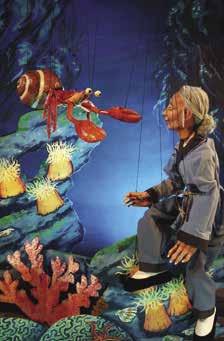
The Center for Puppetry Arts has been part of the Atlanta community for over 40 years, providing families and schools with curriculum-based, arts-infused educational programming. It understands the need to address learning loss and the emotional impact of COVID-19, and it believes puppetry can be an invaluable teaching tool for parents and educators.
In addition to summer shows, the center is offering Puppet Theatre Camp for ages 10-12. In this immersive, weeklong camp, children design, build, write for and perform with their own puppets. Brand new this year is Puppet Discovery Camp for ages 8 and 9. Students explore a wide variety of puppetry styles and cultural traditions, receive guided tours of the center and its museum exhibitions and see live puppetry.
This season's performances include the world premiere of Tesla vs. Edison, focusing on the life and work of two legendary inventors
with very different visions of the future. Family Series performances this season feature classics like Charlotte’s Web and Rudolph the Red-Nosed Reindeer along with a tapestry of cross-cultural storytelling including the bilingual La Cucarachita Martina (Martina, the Little Roach), The Dragon King, Animal Amigos and the center’s award-winning production of Duke Ellington’s Cat. A Family Series performance ticket for families includes admission to the performance, admission to Worlds of Puppetry Museum and entry into the Create-A-Puppet Workshop.
While a visit to the center offers the most immersive experience for students, it offers other ways to use puppetry as a teaching tool. Through its outreach and digital learning programs, the center can come to you—physically or digitally. Outreach programs available in one’s classroom are customizable for one’s needs. The center’s award-winning digital learning team, with 20-plus years of online teaching experience, offers educational workshops and puppet shows that are both live AND interactive with one’s students. The center is confident that if one chooses a field trip, educational outreach, or digital learning program, using puppetry as a teaching tool will enrich and enhance the learning experience for one’s students. For more information, call 404-873-3391 or visit puppet.org.