The Cornerstones of Compression series has highlighted many significant products over more than 160 years of continuous progress. This is the sixth of seven (formerly six) Cornerstones of Compression corollary articles that provide a look the evolution of natural gas pipelines and compressor stations. By Norm Shade
Recent issues of Cornerstones of Compression articles described the gas engines and compressors at sixteen early compressor stations of the Ohio Fuel Gas Company, which was organized in 1902. The equipment covered a wide range of ratings and was provided by a number of manufacturers primarily from Ohio and western Pennsylvania, which is where oil and gas production boomed at the time.
up to that time. The stations included gas gathering and boosting, natural gasoline production, and gas transmission services, ranging in size from 50 to 22,025 hp (37 to 16,424 kW).
The largest early natural gas pipeline company, Hope Natural Gas Company, was organized in 1899, operating in West Virginia and western Pennsylvania. Among the archives at the Coolspring Power Museum is a 1930 notebook that documents the history and the engine and compressor inventory of each of the 86 compressor stations that made up the Hope Natural Gas Company and their subsidiaries Reserve Gas Company and Hope Construction & Refining Company Xxxxxxxxxxxxxxxxxx
There were 411 units in total, and the variation in equipment was impressive. The majority of the engines and compressors were produced by companies located in Pennsylvania or New York, which were prevalent in early air compressor and gas engine and compressor manufacture. The rest came from companies in the industrial midwestern states of Ohio and Wisconsin.
Xxxxxxxxxxxxxxxxxxxx
The entire inventory by manufacturer and type of equipment is shown in Table 1. The earliest machines were 85 belt-driven horizontal compressors. The majority, 52, were manufactured by Ingersoll-Rand, which adapted their extensive line of air compressors for natural gas and oil field applications. Bessemer manufactured 12 of these units, with the rest supplied by six other companies as shown in Table 1.
Most of these horizontal compressors were belt-driven by 62 Bessemer horizontal gas engines. In addition, 18 were belt-driven by vertical gas engines manufactured by Waukesha, Westinghouse and several other companies. Interestingly, one large IngersollRand horizontal reciprocating compressor was belt-driven by a Westinghouse steam
14269 N 87th Street, Suite 205, Scottsdale, AZ 85260. americas@khl.com
A market behemoth stakes its claim
ExxonMobil’s announcement in December that it was raising its 2030 earnings and cash flow outlook without increasing capital spending was more than a corporate milestone—it was a signal about how the company sees risk, value and durability shaping the energy market through the end of the decade. For natural gas stakeholders, the updated plan underscored a widening strategic shift: gas and LNG are becoming the company’s anchor for longterm value, with implications for pricing, supply stability and project momentum as the industry moves into 2026.
The most significant takeaway is ExxonMobil’s conviction in a structurally tighter global LNG balance. By projecting that advantaged assets—Permian, Guyana and LNG—will account for nearly two-thirds of upstream production by 2030, ExxonMobil is effectively betting that LNG demand growth in Asia and Europe will outpace new supply additions. That expectation aligns with outlooks from the International Energy Agency and multiple market consultancies, which anticipate a mid-decade inflection as post-FID project flow tapers and gas-fired power retains a durable foothold in emerging markets.
Recent project delays and execution challenges in Papua New Guinea and Mozambique reinforce that view. Even under conservative price assumptions, LNG timelines are stretching, not compressing. Against that backdrop, ExxonMobil’s confidence reflects less a bullish price call than a belief that reliable, low-cost LNG supply will remain scarce relative to demand growth later this decade.
The Permian Basin plays a central role in that equation. ExxonMobil’s plan to roughly double production by 2030 feeds directly into the United States’ role as the world’s largest LNG exporter. Incremental associated gas will continue flowing toward the Gulf Coast, supporting liquefaction expansions at a time when U.S. supply flexibility is becoming a competitive differentiator. Production discipline in basins such as the Haynesville and Appalachia only heightens the Permian’s relevance heading into 2026, as operators balance drilling efficiency against softer forward pricing.
What sets ExxonMobil apart, however, is not just scale, but integration. The company’s incorporation of carbon capture and storage into its gas strategy signals that natural gas is being positioned not as a transitional fuel with an expiration date, but as a long-term, decarbonized energy source. Securing contracts for roughly 9 million metric tons of CO2 per year and advancing its first Gulf Coast CCS project suggests ExxonMobil is laying the groundwork for gas supply chains that can meet tightening emissions scrutiny from LNG buyers and industrial customers alike.
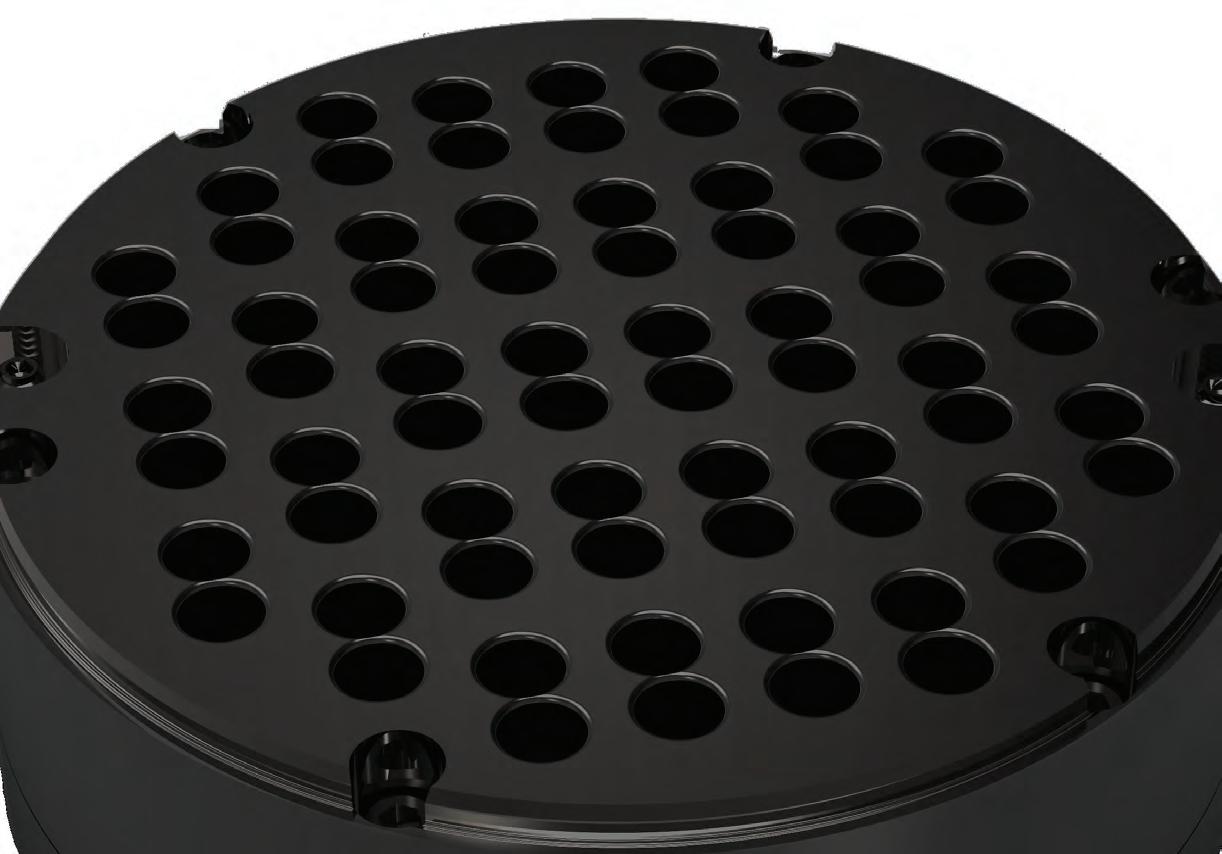
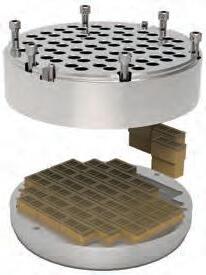
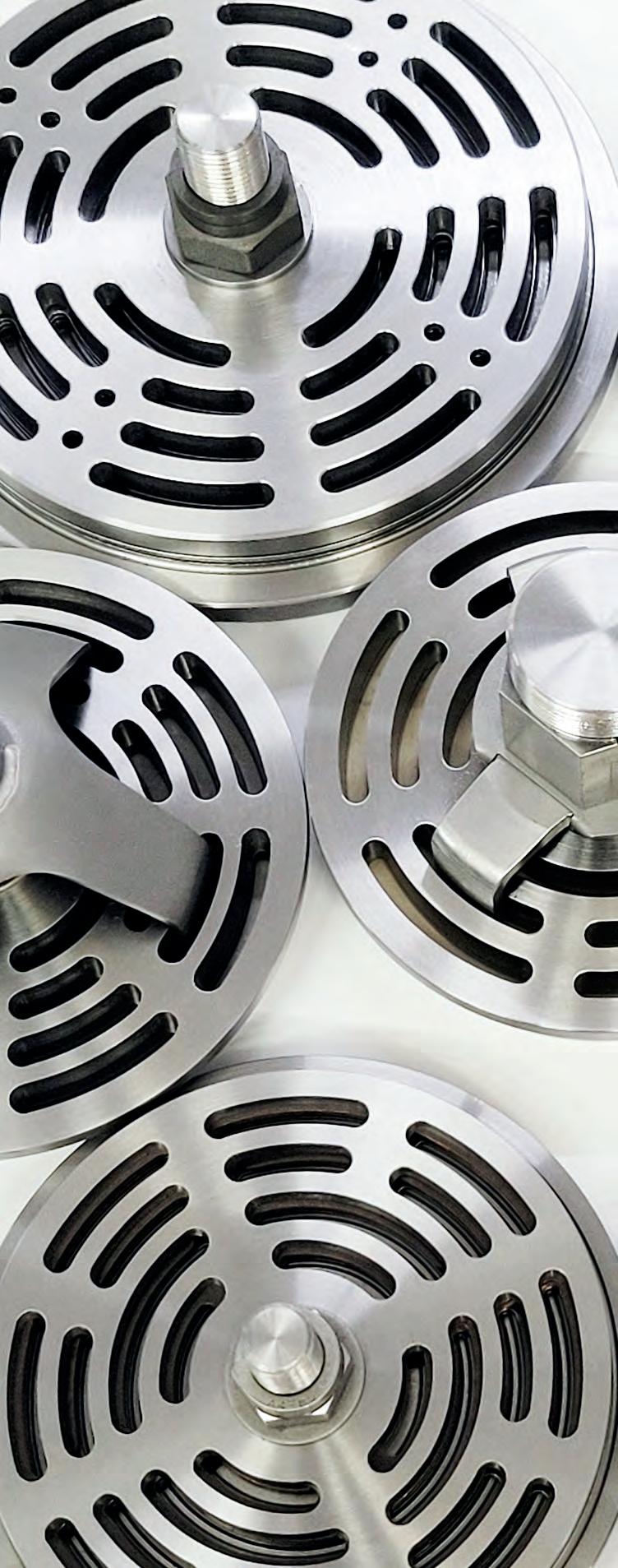
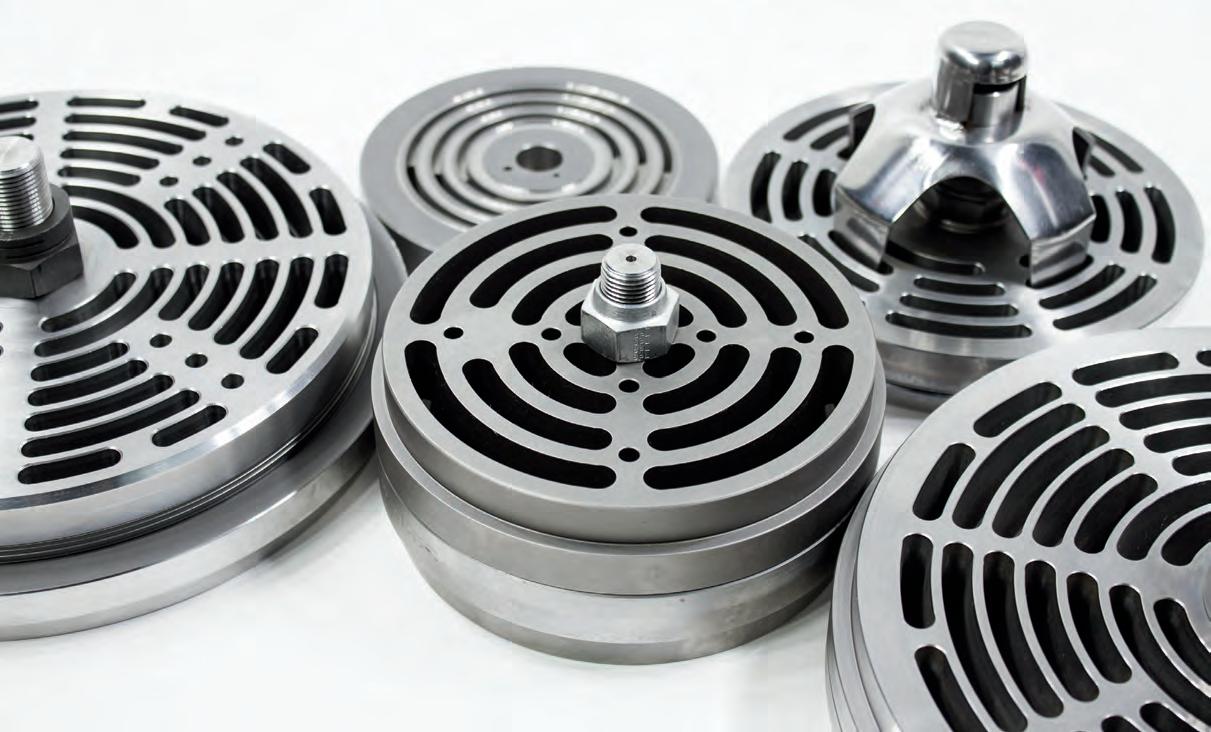
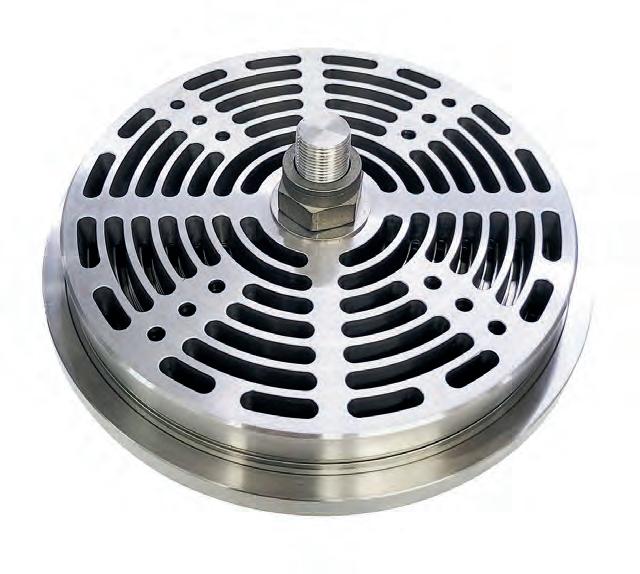
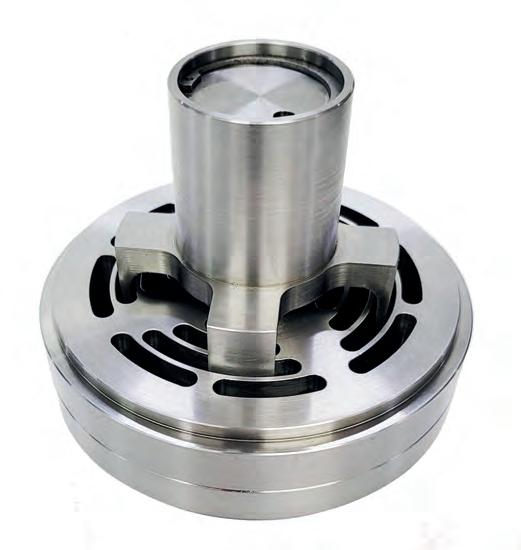
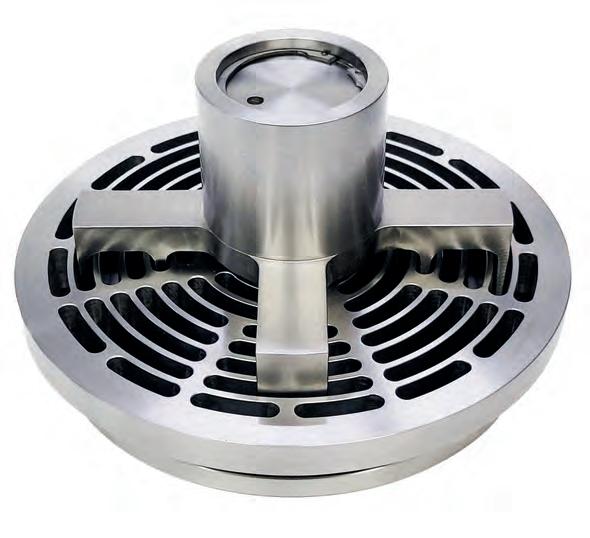
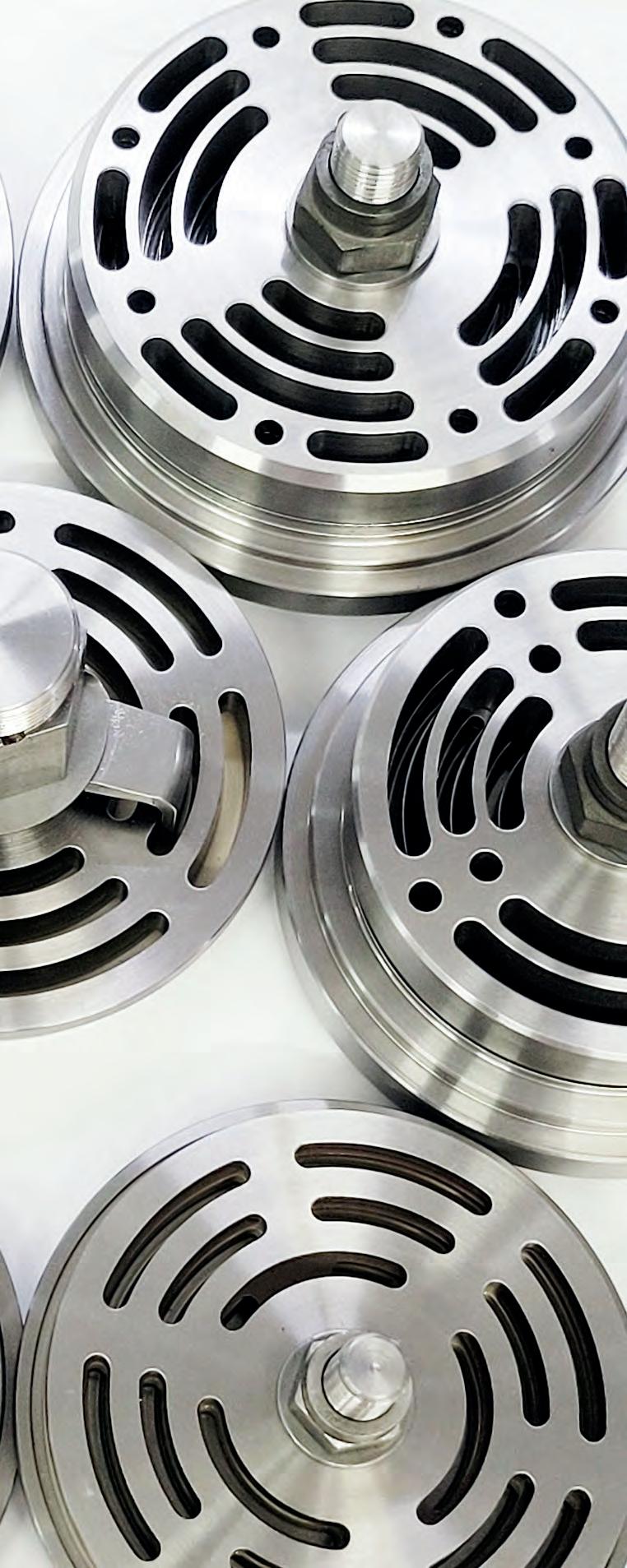
Over the life cycle of a reciprocating compressor valve, your highest cost—by far—will be energy consumption. Spend less with StraightFlo™ valves.
Conventional valves force gas to turn sharp corners, adding turbulence, increasing pressure drop, and wasting power.
But StraightFlo™ valves have a linear flow path. Gas moves cleanly with less resistance and pressure drop. So your compressor does less work for the same throughput. That means lower brake horsepower and real savings on fuel or electricity.
Switch to StraightFlo™ and save. Get a quote at straightflo-sales@atlascopco.com.
COMPRESSORTECH2 ISSN 1085-2468, is published monthly with combined issues of January/February and August/September by KHL Group Americas LLC, 14269 N 87th, Suite 205, Scottsdale, Arizona, 85260, USA. Periodicals postage is paid at Phoenix, AZ, and additional mailing offices (if applicable).
POSTMASTER
Send address changes to KHL Group Americas LLC, 11811 N. Tatum Blvd, Suite P118, Phoenix, AZ 85028, USA.
READER SURVEY
INDUSTRY NEWS
Regal Rexnord enhances recertification network
DEPARTMENTS
Industry News: MHI, Worley start carbon capture project
Gas Lines: XBrazil’s LNG regasification
Targa to acquire Stakeholder Midstream in $1.25 billion Permian deal
Targa Resources Corp. agreed to acquire Stakeholder Midstream for $1.25 billion in cash, a move that will expand the company’s gathering and processing position in the Permian Basin.
The acquisition brings Targa roughly 480 miles of natural gas gathering lines, 180 MMcf/d of cryogenic processing and sour-gas treating capacity, a small crude gathering system and ongoing carbon capture activities that generate federal 45Q tax credits.
Stakeholder’s system is anchored by contracts across about 170,000 dedicated acres, with production that has shown low decline rates — a feature Targa highlighted.
“This acquisition is a nice bolt-on asset that has meaningful free cash flow supported by a stable to modestly growing volume profile with minimal capital needs and executed at an attractive valuation,” said Matt Meloy, Targa’s chief executive officer.
MHI and Worley start carbon capture project
Mitsubishi Heavy Industries and Worley have begun delivering a full-scale carbon capture facility for Heidelberg Materials’ Padeswood cement works in North Wales, marking the first commercial CCS project in the United Kingdom’s cement sector and the first European deployment of MHI’s Advanced KM CDR Process.
The project follows Heidelberg Materials’ final investment decision in September, reached in partnership with the UK Government under Track-1 of its CCUS cluster program. Once operational in 2029, the system will capture about 800,000 tons of CO2 per year from clinker production at the Padeswood plant. The captured CO2 will
Aramco announces more than $30 billion in U.S. MoUs and agreements
Aramco has signed 17 new memoranda of understanding (MoUs) and agreements with U.S. companies that carry a potential value of more than $30 billion. The announcement builds on 34 MoUs unveiled in May with an estimated potential value of roughly $90 billion, bringing the total pool of possible collaboration opportunities to around $120 billion. The new agreements span liquefied natural gas (LNG), materials and services procurement, advanced materials manufacturing and financial services.
In LNG, Aramco signed an MoU with MidOcean Energy related to potential investment in the Lake Charles LNG project, as well as an agreement with Commonwealth LNG tied to a liquefaction project in Louisiana and potential LNG and gas purchases by Aramco Trading.
be transported via pipeline into the HyNet North West cluster for permanent geological storage in depleted gas fields beneath Liverpool Bay.
The new facility advances a FEED study developed by MHI and Worley in 2024. In the execution phase, MHI and its regional arm, MHI-EMEA, will provide engineering and procurement for the CO2 capture plant using the Advanced KM CDR Process and KS-21 solvent system. The scope also includes compression and other associated equipment. Worley will manage engineering, procurement and construction for the balance of plant.
For MHI, the Padeswood contract adds to a growing pipeline of CCS projects based on its Advanced KM CDR Process, which has been developed with Kansai Electric Power since 1990. As of December 2025, 18 plants using the technology have been delivered worldwide, with two additional facilities under execution.
Aramco has signed 17 new memoranda of understanding (MoUs) and agreements with U.S. companies. IMAGE: ARAMCO
CT2
BP P.L.C. has appointed Meg O’Neill as its next chief executive officer, effective April 1, 2026, marking a significant leadership transition for the global energy major as it seeks to accelerate strategic and financial performance.
O’Neill, who was chief executive officer of Woodside Energy, succeeds Murray Auchincloss, who has decided to step down as CEO and board director effective Dec. 18. Carol Howle, bp’s executive vice president of supply, trading and shipping, will serve
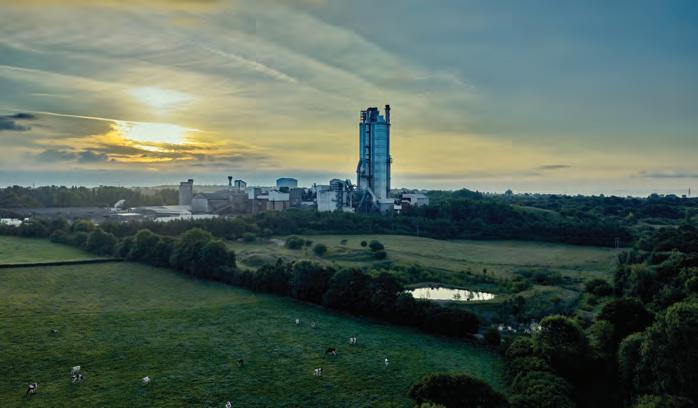
The Padeswood Cement Works in Flintshire, Wales, United Kingdom.
Cooper Machinery Services opens Oklahoma City service facility
Cooper Machinery Services has established new operations in Oklahoma City to expand service and technical support for a large installed base of reciprocating compression equipment across the Mid-Continent.
The new facility at 3605 S. Byers Ave. is designed to strengthen Cooper’s original equipment manufacturer (OEM) service capabilities for AJAX, Gemini and Superior equipment, improving response times and placing additional technical expertise closer to customers in Oklahoma and surrounding states. The region represents one of the largest concentrations of AJAX and other reciprocating compression units in North America.
As part of the expansion, L&L Engine & Compressor Service has been integrated into Cooper Machinery Services, adding local knowledge and customer relationships to the organization. The move also brings Markham “Hooch” Cobb to Cooper.
Cobb has 35 years of experience supporting customers throughout Oklahoma and the surrounding region and joins Cooper following the integration of L&L.
as interim CEO until O’Neill formally assumes the role. Auchincloss will remain in an advisory capacity through December 2026 to support a smooth transition.
Albert Manifold, chair of bp, said the board’s decision followed a comprehensive succession planning process and reflects the company’s desire to move faster in reshaping its portfolio and operating model.
The appointment follows a search led by a board committee and supported by an independent
ExxonMobil to boost NGL takeaway with Bahia
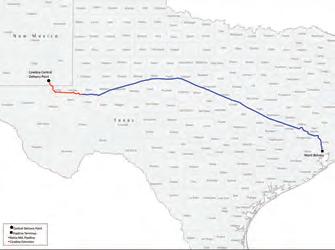
ExxonMobil plans to expand the Enterprise Products Bahia natural gas liquids (NGL) pipeline, increasing its capacity by 400,000 barrels per day and bringing total throughput to 1 million barrels per day. The project is designed to provide additional takeaway for rising NGL volumes from the Permian Basin and improve access to the U.S. Gulf Coast refining and petrochemical complex.
As part of the investment, ExxonMobil will add a new extension from its Cowboy Central Delivery Point in Eddy County, New Mexico. The new segment, known as the Cowboy Connector Pipeline, will transport NGLs from the Delaware and Midland basins into the Bahia system for fractionation and downstream processing.
According to the company, the project
is expected to strengthen logistics for ExxonMobil’s growing Permian operations and support long-term development plans in the basin. The transaction remains subject to regulatory approvals. ExxonMobil and Enterprise Products expect the expansion to enter service by late 2027 following a targeted closing in early 2026. CT2
USA Compression completes $860 million acquisition of J-W Power Company
USA Compression Partners completed its $860 million acquisition of J-W Power Co. on Jan. 12.
The deal adds more than 800,000 HP to USAC’s operating fleet, bringing the combined total to roughly 4.4 million active HP. J-W Power Co.’s assets extend USAC’s reach across several key regions—including
recruitment firm, as part of bp’s long-term succession planning process. bp said there is no additional information required to be disclosed under UK Listing Rule 6.4.8.
Jacques Sanche will assume the role of chair of the board of directors at BURCKHARDT COMPRESSION, completing a leadership transition outlined in the company’s succession plan announced in June 2025. He succeeds Ton Büchner
the Northeast, Midcontinent, Rockies, Gulf Coast, Bakken and Permian.
“By adding J-W Power Co.’s highquality fleet and expanding our presence in key basins, we are excited to expand our position as a leading provider of compression services,” said Clint Green, the partnership’s president and CEO. CT2
following a planned transition period.
Sanche was elected as an independent member of Burckhardt Compression’s board in July 2025 and brings decades of international industrial leadership experience.
He has previously served as CEO of major global Swiss companies and is recognized for his strategic and operational expertise. The company said his background aligns closely with Burckhardt Compression’s long-term priorities, including innovation, sustainability and global growth.
GAS LINES
Brazil doubles LNG regasification
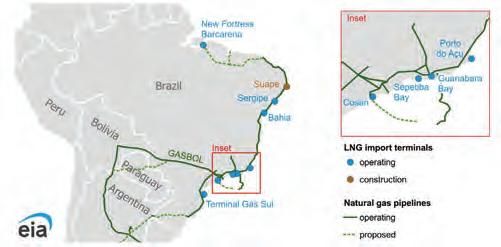
New terminals are supporting the LNGto-power strategy amid renewableheavy grid and hydropower risks. Companies operating in Brazil have expanded the nation’s liquefied natural gas (LNG) regasification infrastructure since 2020, more than doubling import capacity as part of a broader effort to diversify energy supplies and enhance energy security. Brazil’s regasification capacity grew from 2.5 billion cubic feet per day (Bcf/d) in 2020 to 5.1 Bcf/d as of August 2025.
In 2024 alone, three new terminals added an estimated 1.74 Bcf/d of capacity: New Fortress Energy’s Barcarena Floating Storage and Regasification Unit (FSRU) at 0.75 Bcf/d, Terminal Gás Sul FSRU at 0.50 Bcf/d, and Compass Gás & Energia’s Cosan terminal at 0.50 Bcf/d. Earlier installations include the Sepetiba Bay FSRU (0.36 Bcf/d), Porto do Açu FSRU (0.74 Bcf/d), Sergipe FSRU (0.74 Bcf/d), Bahia FSRU (0.71 Bcf/d), and Guanabara Bay FSRU (0.80 Bcf/d).
The Suape FSRU terminal in Pernambuco
BRAZIL LNG TERMINALS AND SELECT NATURAL GAS PIPELINES
remains under development and is scheduled for completion in early 2026, with an expected capacity of 0.7 Bcf/d.
Brazil’s rapid expansion of regasification capacity reflects a deliberate integrated LNG-to-power approach. Each new import facility is paired with large natural gas-fired power plants designed to ensure system reliability and balance variable renewable generation.
At Barcarena, developers are constructing the 2.2-gigawatt (GW) Novo
Tempo Barcarena power complex, which includes the CELBA 2 Power Plant that began earlystage operations in October. The Port of Açu LNG terminal, meanwhile, is associated with the 1.7 GW GNA II power plant, which entered service in May.
Regulatory reforms have accelerated LNG infrastructure development. Federal Law 14,182/2021, which included the privatization of Eletrobras, mandated the addition of 8 GW of new regionalized natural gas power generation capacity. The New Gas Law (14,134/2021) ended Petrobras’s monopoly over natural gas production, transportation, and distribution, opening the market to private developers. CT2
THE SPECIALISTS IN GLOBAL CONSTRUCTION EQUIPMENT RESEARCH
Off-Highway Research specialises in the research and analysis of international construction and agricultural equipment markets. Since 1981 clients have leveraged our reports, databases and expertise to understand global markets, identify trends & opportunities, analyse the competitive landscape and grow their businesses profitably.
With an emphasis on primary research and with six offices on three continents, we can provide unrivalled insights to clients anywhere in the world.
For further information contact: mail@offhighwayresearch.com
Greene Tweed touts benchmark in hydrogen compression technology
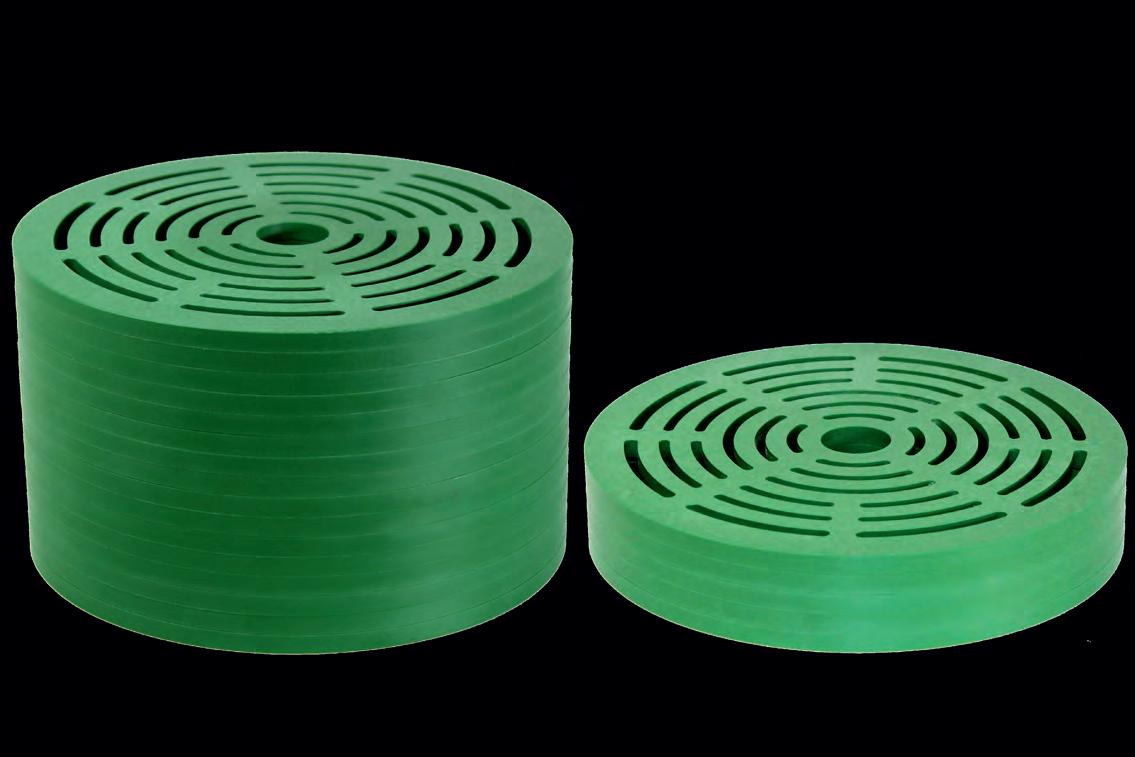
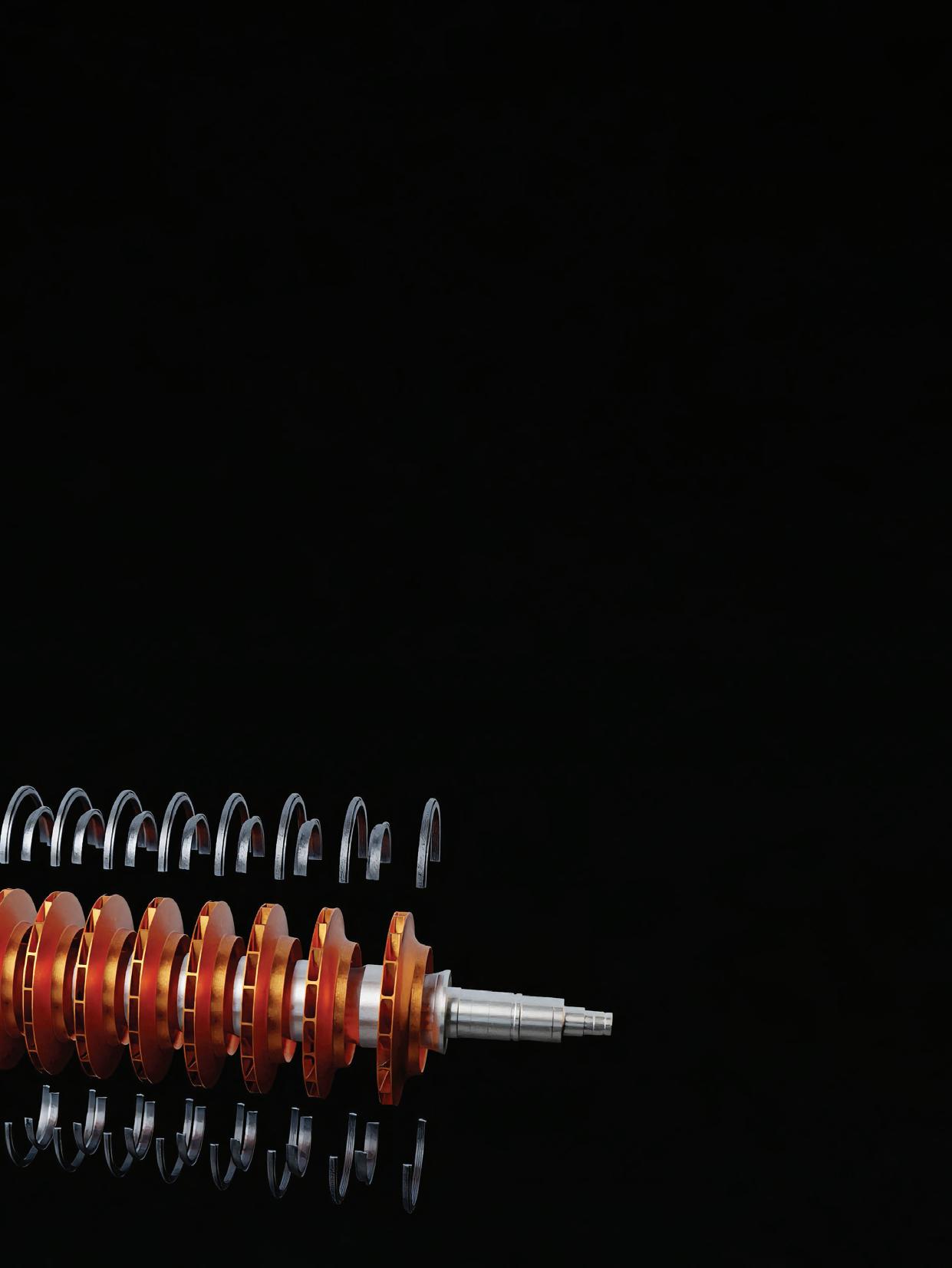
Greene Tweed has developed a composite closed impeller capable of reaching a record-breaking tip speed of 688 meters per second—nearly double the operational limits of conventional metallic impellers—marking a major advancement in hydrogen compression technology.
The company said the breakthrough demonstrates how engineered composite materials can improve efficiency, durability and cost competitiveness as hydrogen pipeline networks expand. Europe alone is targeting tens of thousands of kilometers of hydrogen pipelines by 2040, a buildout that will require higher-performing centrifugal
Burckhardt Compression to supply tech for ammonia bunkering vessel
Burckhardt Compression has secured a contract to supply its Laby compressor technology for what is expected to be the world’s first vessel built specifically to bunker ammonia as a marine fuel.
The ship, commissioned by Itochu Corp. and its Singapore-based subsidiary Clean Ammonia Bunkering Shipping Pte. Ltd., will be constructed by Sasaki Shipbuilding Co. The 5,000-cubic-meter vessel is scheduled for delivery in 2027 and is designed to support emerging ammonia supply chains.
Burckhardt’s Laby compressor will be part of the vessel’s fuel-handling system, enabling the safe transfer of ammonia during bunkering. The technology is known for its hermetically sealed, oil-free design aimed at preventing leakage and enhancing safety when handling toxic or corrosive gases.
COOPER MACHINERY SERVICES
has appointed Madison Sims as director of regional sales –Gulf Coast, strengthening the company’s commercial leadership across one of its core markets.
Cooper Machinery Services said Sims will lead a team of outside account managers supporting customers throughout the Gulf Coast region, with a focus on aftermarket growth and long-term customer relationships.
Sims brings nearly a decade of experience in the oil and gas sector, with deep expertise in Caterpillar aftermarket parts and service sales. In her new role, Sims will focus on expanding aftermarket sales for Cooper’s OEM products as well as other equipment serviced by the organization, helping drive continued growth across the Gulf Coast.
NOV INC. Chairman and CEO Clay Williams retired at the end of 2025
demands high-speed compression. Traditional metallic impellers typically reach burst limits near 360 m/s for closed designs and approximately 500 m/s for open designs, constraining the achievable compression ratio and often requiring additional compressor stages. More stages translate to larger equipment footprints, higher capital costs and increased maintenance.
Greene Tweed began developing the composite impeller in 2020 using carbon fiber–reinforced PEEK (C/PEEK), aiming to surpass 600 m/s to better handle light gases. After three development and testing cycles, the prototype exceeded expectations.
“Our goal was to create a design that could exceed 600 m/s tip speed for compressing light gases like hydrogen,” said Samuel Stutz, technology manager at Greene Tweed. “The impeller achieved a tip speed of 688 m/s, far exceeding the project’s original target and setting a new industry benchmark.”
The composite impeller is up to five times lighter than metal while offering triple the strength-to-weight ratio. In addition to safety and durability gains, lighter and faster impellers can improve compression efficiency, the company said. CT2
and President and Chief Operating Officer Jose Bayardo assumed the roles of chairman, president and CEO on Jan. 1. The company said the move reflects the board’s focus on long-term succession planning and leadership continuity.
Williams has spent more than 30 years with NOV, including more than a decade as CEO. NOV is a global provider of equipment, components, and technology-driven solutions
compressors to move low-density gases at scale.
Transporting hydrogen through pipelines
Greene
Tweed touts hydrogen tech development.
Venture Global has asked the federal government to advance its Plaquemines LNG brownfield expansion.
Venture Global advances Plaquemines LNG
Venture Global has filed applications with the Federal Energy Regulatory Commission and the U.S. Department of Energy to advance its planned Plaquemines LNG brownfield expansion, a major build-out that would add more than 30 million tonnes per annum (MTPA) of peak liquefaction capacity to the company’s export complex in Plaquemines Parish, Louisiana.
The filings mark the formal start of federal permitting for the project. Since that announcement, the company has increased its expected output by nearly 40 percent through continued optimization of its modular liquefaction train design and in response to strong market demand for U.S. LNG.
The expansion will be developed in three phases and include 32 modular liquefaction trains. When complete, the addition would bring total peak production across the Plaquemines LNG complex to more than 58 MTPA. Venture Global said the commercial operations timelines for the existing Phase I and Phase II projects remain unchanged.
“Incrementally expanding Plaquemines is a logical and economically efficient opportunity to build on our strong existing infrastructure,” said Mike Sabel, CEO of Venture Global. He said the increased permitted capacity reflects continued global demand for LNG and positions the company to deliver additional supply as markets evolve.
Infinity expands Utica footprint with Antero acquisitions
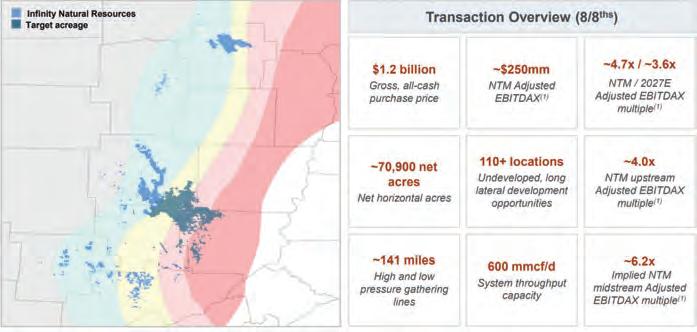
Infinity Natural Resources is making its largest move yet in the Appalachian Basin, agreeing to acquire a broad package of upstream and midstream assets in eastern Ohio from Antero Resources and Antero Midstream. The assets, which span Guernsey, Belmont and Harrison counties, significantly expand Infinity’s Utica Shale position and give the operator greater control over development planning, gathering and water handling.
Northern Oil and Gas will take a 49% undivided interest in the acquired properties, entering the venture as a nonoperating partner, while Infinity will hold 51% and remain operator.
The transaction extends Infinity’s contiguous acreage position to roughly 102,000 net acres and adds an estimated 110
for the energy industry, including oil and gas drilling and production operations.
Bayardo joined NOV in 2015 as senior vice president and chief financial officer and was promoted to president and COO earlier this year. In his current role, he oversees global operations and supports strategic alignment across the organization.
COOPER MACHINERY SERVICES has appointed Amy Roddy as chief human resources officer, adding an experienced HR leader as the
undeveloped drilling locations across volatileoil, rich-gas and dry-gas windows. Those locations total more than 1.6 million feet of potential lateral length, giving the company diverse options for capital allocation and long-term development pacing.
A major component of the deal is the midstream system tied to the acreage. That system includes roughly 141 miles of gathering lines with capacity of about 600 MMcf per day and 90 miles of water lines. Infinity said the gathering network will allow it to capture operational efficiencies, reduce dependence on third parties and exert more control over gas flow, takeaway options and field-level costs. A marketing contract associated with the assets provides additional flexibility around pricing and transportation.
CT2
company continues to expand its operations and capabilities across the energy and industrial sectors.
Roddy joins Cooper from Diamond Offshore, where she served as senior vice president of human resources. At Cooper, Roddy will oversee enterprise HR functions, including talent development, total rewards, organizational design and culture initiatives. She will work closely with the executive leadership team.
IMAGE: VENTURE GLOBAL
U.S. house sees need for SPEED with regulatory overhaul bill
To the fanfare of natural gas advocacy groups and a host of other industry organizations, the U.S. House of Representatives passed a bill in December that aims to streamline and expedite the federal permitting process for energyrelated projects. The House on December 17 voted 221-196 to pass the Standardizing Permitting and Expediting Economic Development (SPEED) Act.
The measure would update the National Environmental Policy Act (NEPA), which became law in 1970. The bedrock environmental law requires federal agencies to assess the environmental effects of their proposed actions prior to making decisions, It’s now up to the Senate to decide what to do with the SPEED Act. As of early January, there was no companion bill in the Senate.
Critics of NEPA maintain that over the years, it has grown into an increasingly complex impediment to the development of projects ranging from oil and gas pipelines to interstate power transmission lines.
Following the House passage of the bill, American Gas Association (AGA) President and Chief Executive Officer Karen Harbert said, “The SPEED Act is essential to depoliticizing the environmental review process and allowing for thoughtful and timely review of critical infrastructure projects.”
House Committee on Natural Resources Chairman Bruce Westerman (R-Arkansas), who sponsored the SPEED Act along with Representative Jared Golden (D-Maine), said, “With commonsense upgrades,
we can cut red tape and enable the United States to build once again while setting the standard for environmental stewardship.”
What’s in the bill?
According to the Congressional Research Service (CRS), the bill limits the scope of NEPA and modifies the environmental review of major federal actions to generally limit the number of federal actions that trigger NEPA review and to expedite the review process.
“For example, the bill redefines major federal actions, including to specify that an agency may not determine that an action is a major federal action based solely on the provision of federal funds,” the CRS said.
The SPEED Act also “excludes from the requirement for NEPA review certain proposed agency actions that have already been reviewed under another federal, state, or tribal environmental review statute that meets the requirements of NEPA,” the CRS continued.
On top of that, the bill directs an agency, when preparing an environmental document for a proposed agency action, to consider only those effects proximately caused by the immediate project or action under consideration.
“Agencies may not consider effects that are speculative, attenuated from the project or action, separate in time or place from the project or action, or in relation to separate projects or actions,” according to the CRS.
According to the Natural Gas Council, the bill would codify a key decision made by the U.S. Supreme Court in 2025 limiting the scope of environmental reviews by federal agencies. Seven County Infrastructure Coalition v. Eagle County involved environmental challenges to a proposed railway in Utah allowing the export of highwax crude oil to refineries on the Gulf Coast. The Supreme Court unanimously ruled to limit NEPA reviews to the environmental effects directly tied to the project under review and to focus on the potential impact
that an agency has the power to influence.
In addition, the bill limits judicial review of NEPA cases. According to Inside Climate News, it would greatly shorten the deadline to sue a federal agency over its permitting decision and constrain who is eligible to file suit. Current law provides a six-year statute of limitations on agency decisions for permitting energy infrastructure, and two years for transportation project permits. Under the SPEED Act, those deadlines would be “shortened to a mere 150 days and only allow lawsuits to be filed by plaintiffs who demonstrated in public comment periods that they would be directly and negatively impacted by the project.”
Support erodes
Of course, not everybody is happy with the bill. It lost the support of some moderate House Democrats when Republicans amended the measure at the last minute to allow the Trump administration to exclude any project from the bill’s reforms that the administration had flagged for reconsideration, such as offshore wind and other renewable energy projects, according to Inside Climate News
Said Southern Environmental Law Center Director of Federal Affairs Nat Mund: “This is the worst possible time to relax guardrails. This bill is another way for the Trump administration to allow polluters to write their own ticket to pollute while disregarding the people who are impacted by their actions.”
On the other hand, American Petroleum Institute President and Chief Executive Officer Mike Sommers applauded the SPEED Act as a “bipartisan, commonsense step toward fixing a federal permitting system that’s long been broken. By modernizing NEPA and reducing duplicative reviews and litigation, this bill restores certainty and helps unlock the infrastructure needed to deliver affordable, reliable energy and meet growing demand.” CT2
BRIAN FORD is editor in chief for Industrial Info Resources, which provides up-to-date project information on a wide range of industries across the globe. He has worked as a reporter and editor for newspapers and other publications since 1979.
BAKKEN/WILLISTON
Hess Midstream issues 2026 guidance
Hess Midstream forecasts 2026 gas gathering volumes of 450–460 MMcf/d and processing volumes of 435–445 MMcf/d, driven by Chevron’s Bakken development. Capital spending is set at $150 million, focused on compression and pipeline expansion.
Targa fined for Clean Air Act violations
Targa Badlands was fined $500,000 and ordered to complete 500 hours of community service for air monitoring violations at its Johnson Compressor Station on the Fort Berthold Reservation.
36-inch pipeline advances in North Dakota
Intensity Infrastructure and Rainbow Energy are advancing a 36-inch gas pipeline with 1.1 million dekatherms per day of capacity, targeting 2029 service to, in part, support data centers.
HAYNESVILLE
Western Haynesville wells outperform
New Western Haynesville wells are delivering initial production rates of 20–35 MMcf/d, nearly double legacy wells.
However, drilling costs averaging $35 million per well remain a challenge, with breakeven economics requiring further cost reductions, according to analysis.
MARCELLUS/UTICA
Antero Resources acquires HG Energy for $3.9 billion
Antero Resources, the nation’s fifth-largest natural gas producer and the largest in West Virginia, is expanding its core Marcellus position through the $3.9 billion acquisition of privately held HG Energy II. The combined upstream and midstream deal adds 385,000 net acres to Antero’s roughly 475,000 net core Marcellus acres and approximately 850 MMcfe/d of production. The upstream
APEX expands Haynesville footprint
APEX Natural Gas, backed by Citadel, has invested more than $430 million in Haynesville acreage, outpacing larger peers in drilling activity across northwest Louisiana.
Black Stone, Caturus sign
Shelby Trough deal
Black Stone Minerals reached a multi-year
James Willis highlights the latest news from the major North American shale plays
assets are valued at $2.8 billion, with the midstream business valued at $1.1 billion. HG Energy is headquartered in Parkersburg, West Virginia.
Bidding war emerges for Ascent Resources
A competitive bidding process is underway for privately held Ascent Resources, Ohio’s largest natural gas producer, following a disputed $5.5 billion internal valuation by Energy & Minerals Group. The valuation
drilling agreement with Caturus Energy covering 220,000 gross acres in the Shelby Trough and Haynesville Expansion. The program ramps from two wells in 2026 to twelve annually.
Trinity Gas Storage reaches Phase II FID
Trinity Gas Storage approved a Phase II expansion adding 13 Bcf of working gas
PERMIAN
SM Energy, Civitas outline merger strategy
SM Energy and Civitas Resources detailed plans for their $12.8 billion all-stock merger, which will be led by a combined management team under SM CFO Beth McDonald and governed by an 11-member board. The companies plan at least $1 billion in divestitures within the first year to strengthen the balance sheet and expect $200–$300 million in annual synergies, primarily from Permian operational efficiencies and reduced corporate overhead.
CPV breaks ground on Basin Ranch power plant
Competitive Power Ventures began construction on the 1,350-MW CPV Basin Ranch Energy Center in Ward County, Texas. The $2 billion combined-cycle natural gas facility is backed by a $1.1 billion Texas Energy Fund loan and is scheduled for commercial service in 2029. The plant is designed to power roughly 850,000 homes and accommodate future carbon capture retrofits.
Enterprise expands Bahia NGL system
Enterprise Products Partners granted ExxonMobil a 40% interest in the 550-mile Bahia NGL pipeline, now commissioning at 600,000 bpd. Plans call for expanding capacity to 1 million bpd and adding a 92-mile extension to ExxonMobil’s Cowboy plant in New Mexico by late 2027.
Eiger Express upsized to 3.7
Bcf/d
WhiteWater increased planned capacity on the Eiger Express Pipeline from 2.5 Bcf/d to 3.7 Bcf/d, upsizing the mainline to 48 inches. The joint venture pipeline will move Permian gas to the Katy area with LNG market access and remains targeted for mid-2028 service.
EAGLE FORD
Iron Oak doubles Eagle Ford sand capacity
Iron Oak Energy Solutions acquired Superior Silica Sands, adding 3 million tons of annual capacity and solidifying its position as the largest Eagle Ford proppant supplier.
prompted litigation from the Abu Dhabi Investment Council and a competing offer from Mason Capital Management. Activist investor Kimmeridge Energy subsequently submitted a $6 billion takeover bid,
capacity and two pipeline interconnects, with operations beginning August 2026.
Gillis Treating Plant expansion nears completion
Momentum Midstream’s Gillis Treating Plant expansion will raise capacity to about 2.3 Bcf/d through added compression and CO2/H2S treating, supporting carbon sequestration plans.
intensifying competition for the asset.
Northern Utica oil well posts strong results
An EOG Resources-operated well in Ellsworth, Ohio, produced 40,489 barrels of oil in its first quarter, outperforming nearby wells and reinforcing expectations of oilprone Utica development along the play’s northern edge. The result has renewed interest in Mahoning County and supported additional regional investment, including Vallourec’s $48 million pipe mill expansion.
Rover Pipeline challenges Ohio
tax
assessment
Rover Pipeline filed suit against the Ohio Tax Commissioner, disputing a property
ROCKIES
USGS highlights Wyoming gas potential
USGS estimates 4.7 Tcf of undiscovered gas in southwest Wyoming, contributing to a total regional estimate of 49.2 Tcf across the Mesaverde and Lance formations.
Crescent sells non-core DJ assets
Crescent Energy sold non-operated DJ Basin assets for $90 million as part of a broader divestment program nearing $1 billion.
JAPEX enters U.S. shale via DJ acquisition
Japan Petroleum Exploration agreed to acquire Verdad Resources’ DJ Basin assets for $1.3 billion, marking its first U.S. shale entry.
tax assessment that treats $2.2 billion in weather-related construction overruns and an assumed “infinite lifespan” as taxable value. Rover argues the approach overstates fair-market value and violates constitutional assessment standards.
FERC approves revised MVP Southgate route
Federal regulators approved a revised route for the Mountain Valley Pipeline Southgate extension, shortening the project from 75 miles to about 31 miles and terminating it in Rockingham County, North Carolina. Despite the reduced length, capacity will increase to 550,000 dekatherms per day using 30-inch pipe. CT2
MIDCONTINENT
Epsilon exits Anadarko Basin
Epsilon Energy sold its Western Anadarko assets for $2.5 million, retaining positions in other U.S. basins.
ONE Gas starts pipeline project
ONE Gas plans a 43-mile pipeline linking the Bennington Hub to the Hugo power plant.
Want to achieve faster and more precise process control at lower gas temperatures?
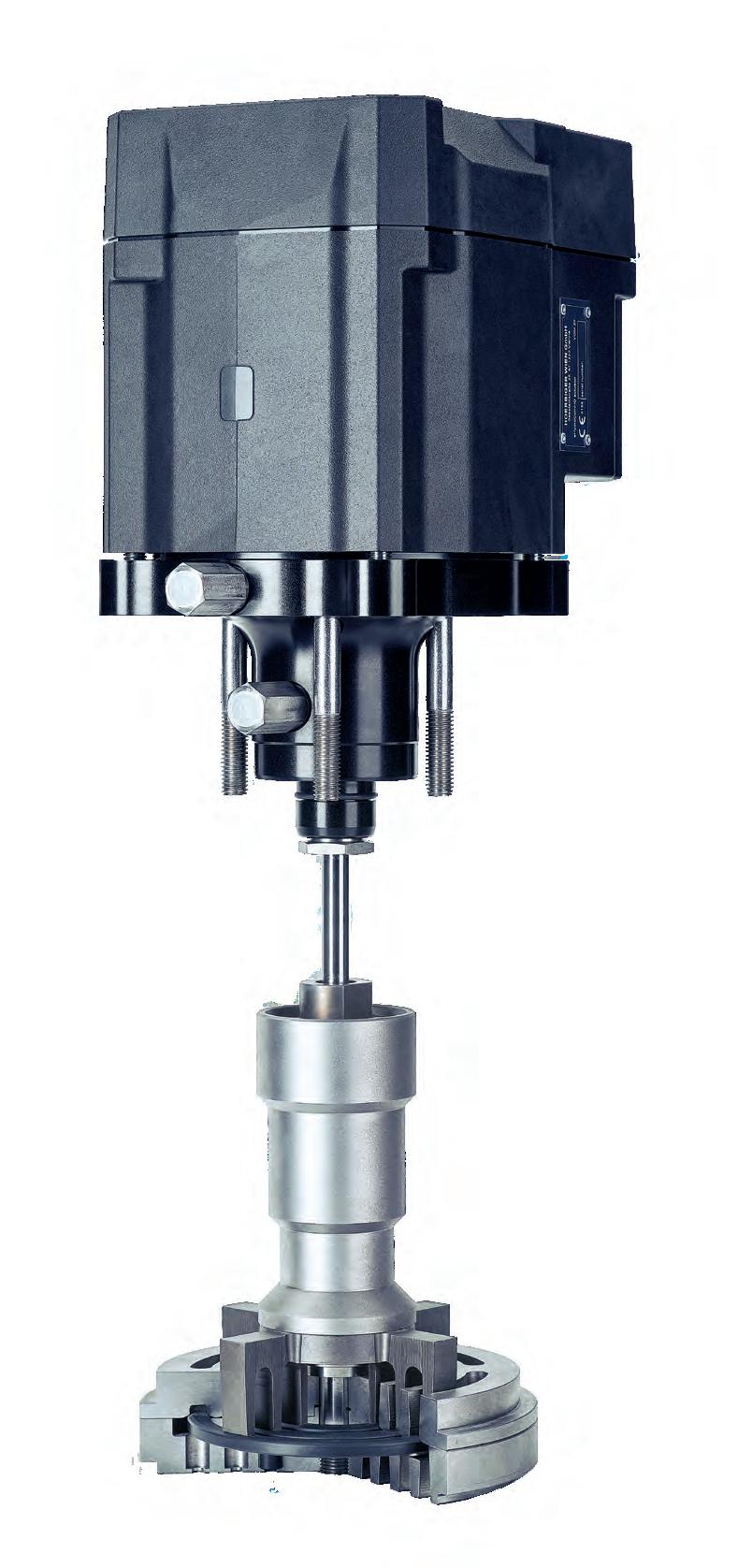
eHydroCOM Electric Stepless Capacity Control System
Boil-off gas flow rates can vary significantly due to ambient temperature fluctuations or tank filling/emptying operations. In these harsh environments, the compressor is operating at very low gas temperatures (especially in the first stage), and the boil-off gas tends to have much higher amounts of methane.
A certified low temperature adapter, specifically developed for this application, allows the use of the proven eHydroCOM control system at gas temperatures as low as -160 °C. With eHydroCOM, the compressor’s delivery rate adjusts steplessly and continuously to meet process requirements. This allows for both faster and more precise process control and also improves efficiency while saving energy and reducing emissions. Enabling change. For a better tomorrow.
Learn more by visiting www.hoerbiger.com/ehydrocom today!
NORWAY
Equinor pushes back Snøhvit Future start-up date, raises cost estimate
Equinor said in late December that start-up of its Snøhvit Future project at the Melkøya LNG facility in Hammerfest has been delayed and costs have increased.
The project includes onshore compression and electrification of the LNG facility using power from the mainland. Onshore compression is intended to sustain peak production as reservoir pressure declines, while electrification is expected to reduce CO2 emissions by about 850,000 tonnes/year—roughly 2% of Norway’s annual emissions. The facility is currently powered by gas turbines.
The project involves installation of three large modules—a compressor, a transformer station and electrode steam
ANNA KACHKOVA is an independent oil and gas writer based in Edinburgh, Scotland. She has over 17 years’ experience of covering the energy industry, including five years in Houston, Texas, as NewsBase’s North America editor. Her email address is: aikachkova@gmail.com
boilers—along with extensive facility modifications. New power lines and a tunnel to house them are also required.
Equinor senior vice president for project development Trond Bokn said the project is about halfway complete but noted that execution complexity had been underestimated. Progress was slowed by an extended plant turnaround in 2025, extreme winter weather in 2024–25, and higher equipment costs driven by inflation.
Onshore compression is now expected to start in 2029, one year later than planned. The cost estimate has been revised to NOK20 billion ($2.0 billion), up from NOK13.2 billion ($1.3 billion), or NOK14.7 billion ($1.5 billion) when adjusted for inflation.
ROMANIA
Delgaz Grid’s Romanian gas network fully ready for biomethane, largely hydrogen-ready
Delgaz Grid said in early December that its 26,000-km (16,156-mile) gas distribution network in northern and western Romania is fully ready to handle biomethane. About 70% of the system is made up of polyethylene pipelines, which are also
SOUTHERN EUROPE
TAP expands capacity with completion of compressor station work
The Trans Adriatic Pipeline (TAP) has expanded its capacity following completion of work at the Kipoi compressor station in Greece. TAP told Azerbaijan’s state news agency Azertac that the project added 42.4 Bcf/y (1.2 bcm/y) of long-term capacity as of Jan. 1, 2026.
The work included installation of a new compressor unit with a capacity of about 15 MW, along with upgrades to existing facilities. The expansion began in January 2024 and was completed ahead of schedule and within budget, with no interruption to gas flows.
Anna Kachkova provides information on the latest gas compression news from Europe
suitable for hydrogen blends.
Romania’s National Energy Strategy targets biomethane reaching a 5% share of the gas network by 2030 and 10% by 2050. Under the National Hydrogen Strategy, the country aims to produce 49 kt/y of
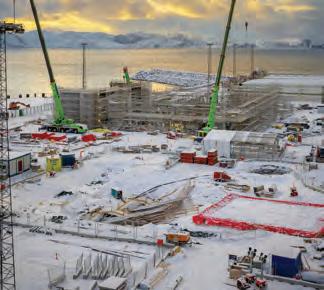
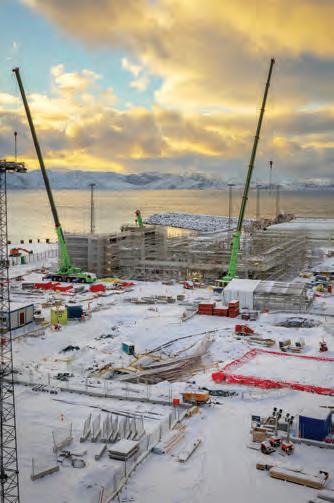
Construction work at Hammerfest LNG, Melkøya. IMAGE: JONNY ENGELSVOLL FOR EQUINOR)
GERMANY, NETHERLANDS
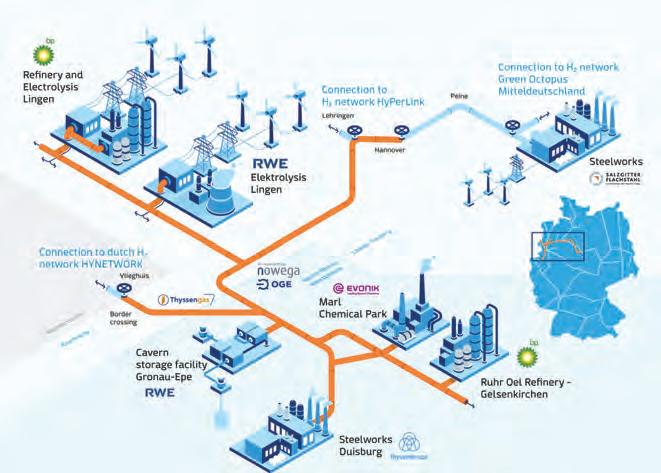
Thyssengas, Gasunie agree to develop cross-border hydrogen transport infrastructure
Transmission system operators Thyssengas and Gasunie have signed an agreement to jointly develop cross-border hydrogen transport infrastructure linking the Netherlands and Germany. The agreement involves Gasunie subsidiaries Hynetwork (Netherlands) and Gasunie Deutschland, along with Thyssengas H2.
The planned system will primarily convert existing natural gas pipelines to hydrogen service. Border points at Oude Statenzijl (Groningen) and Vlieghuis (Drenthe) are expected to form a key connection between Dutch industrial regions, import routes, storage and production facilities, and industrial centers in Germany and north-western Europe.
Thyssengas said it will contribute its existing natural gas pipeline between Vlieghuis and Ochtrup in North Rhine-Westphalia. The line is part of Germany’s hydrogen core network and the GET H2 initiative. Conversion work began in summer 2025.
Gasunie said the agreements define technical and organizational parameters for development, including schedule, location, capacity and operating pressure.
“The agreements we’ve made enable transport not only between the Netherlands and Germany’s Ruhr region, but also to and from Denmark,” said Helmie Botter, Gasunie’s director of hydrogen transport. “Our goal is to create an integrated hydrogen market and make cross-border transport as seamless as possible.”
hydrogen by 2027 and 153 kt/y by 2030.
Delgaz Grid, a subsidiary of E.ON, has already tested hydrogen blending through the 20HyGrid project, completed in 2024. The project found that blending up to 20% hydrogen with natural gas in distribution
Capacity of the Trans Adriatic Pipeline (TAP) has been expanded following the completion of work at the Kipoi compressor station in Greece. IMAGE: TAP
networks is technically feasible without added risk.
The company plans to validate those results through a new pilot using different hydrogen concentrations, while a second pilot will test 100% hydrogen on
a polyethylene pipeline segment. A third pilot will focus on biomethane production by upgrading biogas from wastewater treatment plants and injecting it into the gas network.
UK
National Gas announced East of England infrastructure investment
National Gas said in early January it will invest GBP870 million ($1.2 billion) in the East of England over the next five years as part of a GBP3.2 billion ($4.3 billion) investment package approved by energy regulator Ofgem for the 2026–31 period.
The East Region investment includes upgrades to control systems at the King’s Lynn and Diss compressor stations.
The announcement follows an April 2025 decision to invest more than GBP350 million ($469 million) in upgrading compressors at three UK sites—St Fergus, Wormington and Peterborough. The program represents National Gas’ largest-ever investment in compressor upgrades and includes new equipment supplied by Siemens Energy, Baker Hughes and Solar Turbines.
National Gas said two new compressors at Peterborough are fully installed and operational, with a third under construction. The compressors are compatible with methane and hydrogen blends.
Separately, local media reported in November 2025 that National Gas was preparing to submit a planning application for upgrades at Wormington in southwest England. As of early January, the application had not yet been submitted. If approvals are granted on schedule, construction could begin in late 2026, with completion targeted for late 2029. CT2
This marks the first phase of expansion for the pipeline, which transports natural gas from Azerbaijan to Europe as part of the Southern Gas Corridor. The 877-km (545-mile) pipeline entered service in December 2020 with an initial capacity of 353 Bcf/y (10 bcm/y). TAP’s capacity could ultimately be doubled to 706 Bcf/y (20 bcm/y) through the addition of two new compressor stations and upgrades to existing stations. In early 2025, the TAP consortium said it was considering the use of electric compressors at both existing and future stations.
TAP also reported that more than 1.9 Tcf (54 bcm) of gas has been delivered to Europe since the pipeline began operations five years ago.
READERSHIP SURVEY
Reader survey highlights steady market expectations, persistent regulatory concerns and emerging roles for hydrogen, electrification and AI. By
Jack Burke
Results from the COMPRESSORTech2 Reader Survey 2026 point to a cautiously optimistic outlook for the global gas compression industry in 2026, tempered by ongoing concerns around regulation, staffing shortages and trade policy uncertainty. We began reaching out to readers in late fall and wrapped up our survey the first week of January.
When asked to compare
Readership
Gas production, gas gathering, gas processing and refining and gas transmission pipeline operators
Compressor manufacturers and compressor set packagers
Consulting engineers or contractors
Manufacturers of compressor components, power transmission products, controls and instrumentation, lubrication,emissions, testing and analysing equipment
Distribution, service and overhaul of compressors and engines
Reciprocating engine and electric motor manufacturers
R&D, technical support organizations, technical universities and libraries, students
Gas turbine, steam turbine and turbomachinery manufacturers
industry conditions in 2026 with those of 2025, respondents were evenly split. About 48.4% expect conditions to be better, while an identical 48.4% anticipate the market will remain about the same. Only 3.1% foresee a deterioration in
industry conditions. Comments suggest confidence in longterm natural gas fundamentals, particularly driven by LNG development, power generation demand and data center growth, even as near-term policy uncertainty clouds investment decisions.
Regulation and staffing top industry challenges
supply chain issues, though still relevant, ranked lower at 7.8%.
Several respondents noted that regulatory uncertainty and shifting trade policies are having a cascading effect, complicating capital planning, procurement decisions and workforce development across the sector.
shortages
Regulation emerged as the most frequently cited challenge facing the gas compression industry, selected by 39.1% of respondents. Staffing and skills shortages followed closely at 34.4%, underscoring concerns about an aging workforce and difficulties attracting younger talent into technical and fieldbased roles. Economic volatility accounted for 18.8%, while
Capital spending largely steady in 2026
Looking at capital spending plans, 41.5% of respondents expect spending in 2026 to remain about the same as in 2025. Nearly 29.2% anticipate higher capital expenditures, while 9.2% expect spending to decline. Another 20% said they were not yet sure. Comments suggest
survey
Executive management
Engineering & design
Designer influencer
Purchaser or purchasing influencer Sales & marketing
that replacement of aging equipment, automation investments and selective regional expansion are supporting spending, while macroeconomic uncertainty and geopolitical risks continue to constrain larger commitments.
North America leads growth expectations
North America was identified as the region offering the greatest growth opportunity over the next five years, selected by 40% of respondents. The Middle East followed at 26.2%, reflecting continued infrastructure buildout and production growth. Europe accounted for 4.6%, while Asia, including China, drew a combined 16.9%. About 10.8% said they were unsure.
Trade policy and tariffs weigh on sentiment
Trade policy remains a significant factor shaping business conditions. While 56.3% described the impact of the Trump administration on oil and gas as somewhat important but not decisive, 32.8% characterized it as crucial. Only 10.9% said it was not significant.
Tariffs, in particular, continue to affect the industry. About 43.8% reported that tariffs have negatively impacted their businesses by increasing costs or delaying equipment deliveries. Roughly 32.8% said tariffs had no significant impact, while smaller shares cited positive effects on domestic competitiveness or said it was too early to tell.
What readers are saying
“The outlook is good for the natural gas industry.”
“Overall demand for natural gas is very bullish, driven by data center growth. There will be more gas needed to fulfill massive power demands.”
“We have more gas compression projects in the queue over the next two years than we had in 2024–25.”
“Upstream business will remain strong. Midstream is supposed to remain at the same level, while downstream may be lower or even par.”
“The underlying reason for the flat-to-downward trend is the unpredictability of government policies and tariff rhetoric. End users are constantly updating ROI models, which impacts heavy-duty rotating equipment purchasing decisions.”
“Rules and regulations are real hangups. Hopefully next year will be better.”
“Pipeline construction has not yet had the politics settled.”
“Young people don’t want to enter this industry. There is a real shortage of tradespeople and technical staff.”
“Many experienced workers will retire soon, and there still isn’t enough new talent coming in.”
“Gas use is increasing, and LNG terminals are coming online or are under construction.”
“Long term, I am very bullish on natural gas because of the buildout of manufacturing I believe the U.S. will see.”
What changed from ‘25 to ‘26?
A comparison of COMPRESSORTech2’s 2025 and 2026 reader surveys shows a market that remains fundamentally confident in natural gas and compression, but increasingly shaped by policy uncertainty, workforce constraints and a more cautious view of emerging technologies.
Regulation overtakes staffing as top concern
In 2025, staffing and skills shortages (32.7%) narrowly ranked above regulation (29.5%) as the industry’s biggest challenge. In 2026, regulation moved decisively into the top spot at 39.1%, while staffing concerns remained elevated at 34.4%. The change reflects heightened sensitivity to permitting, trade policy and regulatory volatility rather than operational labor issues alone.
Capital spending expectations steady year over year
Capital spending expectations showed little change. In 2025, 39.8% expected higher spending, compared with 29.2% in 2026. Meanwhile, expectations for flat spending rose from 34.2% in 2025 to 41.5% in 2026, indicating a more cautious investment posture amid macroeconomic and geopolitical uncertainty.
LNG strengthens its lead over hydrogen
While both surveys identified LNG and hydrogen as key growth fuels, LNG widened its lead in 2026. In 2025, LNG and hydrogen were nearly tied at 43.1% and 43.9%, respectively. In 2026, LNG surged to 66.7%, while hydrogen fell to 31.8%
Trade policy shifts from expectation to impact
In 2025, respondents focused on what a Trump administration might do, with 40.2% citing trade policy as the biggest expected impact. By 2026, attention shifted to lived experience: 43.8% reported tariffs were already negatively affecting costs or equipment delivery, signaling a transition from anticipation to operational consequence.
AI moves from concept to execution AI adoption accelerated markedly. In 2025, AI was discussed largely in conceptual terms. In 2026, 33.9% reported AI tools already in active use, with predictive maintenance emerging as the dominant application. The change highlights a broader industry shift toward data-driven asset management and reliability.
Calls for greater policy stability were a recurring theme, with many respondents emphasizing the need for predictable trade frameworks to support long-term planning.
LNG leads alternative fuel outlook, hydrogen still uncertain Among natural gas–based alternative fuels, LNG was seen as offering the strongest growth potential over the next five years, selected by 66.7% of respondents. Hydrogen followed at 31.8%, while CNG and LPG together accounted for less than 2%.
Despite growing interest, sentiment around hydrogen blending remains cautious. Nearly 47.6% said it is too early to tell whether hydrogen-natural gas blending will become a major market. About 22.2% view it as the next big thing, while
30.2% believe it will remain a niche market at most. Currently, 31.3% of companies report they are watching and waiting on hydrogen, while 28.1% are discussing it without significant spending. About 20.3% said they have no current involvement, and 20.3% indicated they are investing heavily.
AI adoption accelerates, with maintenance leading use cases Artificial intelligence is expected to play a growing role in gas compression operations. More than 36.5% of respondents expect AI to improve operational efficiency and maintenance, while 20.6% see benefits in customer service and analytics. About 14.3% anticipate workforce reductions through automation,
and 12.7% flagged increased cybersecurity or data management risks. Roughly 15.9% expect no major impact.
AI adoption is already underway. About 33.9% said AI or machine-learning tools are in active use, while 23.1% are in testing or pilot stages. Another 21.5% have discussed AI but not implemented it, and 21.5% are not currently considering it.
Predictive maintenance and diagnostics were identified as the most promising AI application area, selected by 54.1% of respondents, followed by supply chain optimization, emissions monitoring and workforce planning.
Midstream demand expected to remain firm
Expectations for midstream compression demand in 2026 were broadly positive. About 20.6% expect demand to increase significantly, while 34.9% anticipate moderate growth. Another 42.9% expect demand to remain stable. Fewer than 2% foresee any decline.
LNG feed gas and export infrastructure was identified as the strongest midstream growth opportunity over the next three years, selected by 34.4% of respondents, followed by gas gathering and field compression at 26.2% and gas processing and treating at 21.3%.
Electrification gains interest but gas drive remains dominant
Electrification is gaining traction, though gas-driven compression remains prevalent. About 35.1% said they are expanding electric-drive compression capacity, while 36.8% are evaluating hybrid or dual-drive systems. Roughly 21.1% continue to rely primarily on gas-driven compression, and 7% have no current electrification plans.
Editorial priorities align with industry transition
Respondents expressed strong interest in editorial coverage of hydrogen and alternative fuels, electrification, emissions
THE 275GL+ IS
Yes — in active use
In testing or pilot stages Discussed, but not implemented Not currently under consideration
reduction and regulatory developments, alongside workforce development and digital technologies. Technology case studies and in-depth company profiles ranked
among preferred content formats, reinforcing demand for practical, experience-based insight as the industry navigates a period of transition.
READY TO WORK.
MEET THE MORE POWERFUL, MORE RELIABLE
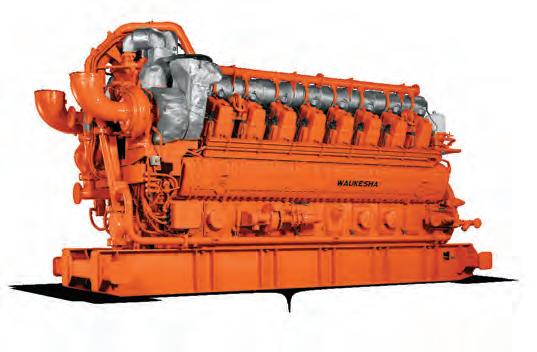
275GL+ NATURAL GAS ENGINE
Our biggest natural gas engine is among the industry’s most efficient and can be on your site quickly and affordably. Continuous updates and breakthrough features have lengthened service intervals and increased runtimes while maintaining that legendary Waukesha fuel efficiency and low emissions.
Regal Rexnord expands recertification network
New center a model for high-performance coupling refurbishment.
By Jack Burke
Regal Rexnord is taking a major step to improve service and reliability for its industrial coupling customers with the launch of a new recertification center in Florence, Kentucky. The facility, which began by servicing Kop-Flex couplings, is now being developed into a full recertification hub for all of the company’s highperformance coupling brands — including Kop-Flex, Ameridrives, Euroflex and Bibby.
The expansion represents both a customer-service enhancement and a strategic investment in the company’s growing installed base of API 671-compliant couplings, which are designed for long life in demanding turbomachinery applications such as compressors, pumps and gas turbines, said Tyler Courtney, sales director, Global Energy Sales for Regal Rexnord.
Extending coupling life through precision recertification
The new program targets couplings that have already been in service for years and are due for overhaul during scheduled maintenance turnarounds. Instead of replacing these high-value components with new units, Regal Rexnord said it offers a factory recertification process that restores them to like-new condition — faster and at a fraction of the cost.
“These high-performance couplings are expected to last for very long periods of time,” Courtney said. “When end users have a scheduled shutdown, they’ll send a coupling back to us that’s been in service
for a while. We disassemble it, inspect it, and replace all the disc packs and fasteners — the only parts that typically wear — and replace any other parts that may have been damaged.”
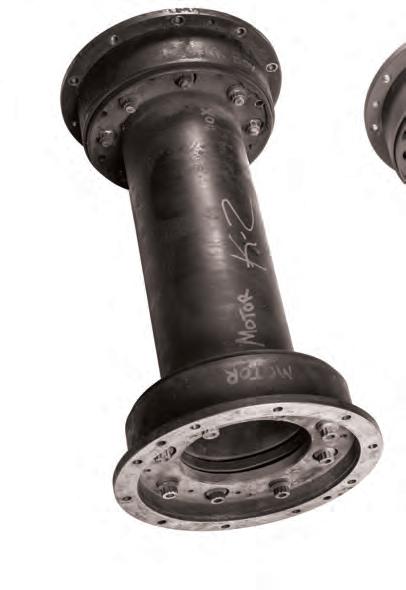
The process begins with a complete teardown and cleaning, said Valerie Jeffrey, coupling specialist at Regal Rexnord. Any surface rust that may have developed during service is removed to prevent further degradation. Dimensional measurements are taken to ensure the coupling has not experienced deformation or misalignment during operation. Each major component — including the spacer, sleeves and hub — then undergoes magnetic particle inspection (MPI) to identify any cracks or imperfections invisible to the naked eye, she said
“Inspection goes far beyond visual checks,” Jeffrey said. “We take precise measurements, perform nondestructive testing, and verify every critical tolerance. The goal is to make sure the coupling is just as strong and reliable as when it first left the factory.”
After inspection and refurbishment, new disc packs and fasteners are installed, and the coupling is dynamically rebalanced — an essential step for today’s high-speed applications. “Even if a coupling has been handled carefully, just removing it from service or dropping it slightly can change its balance,” Jeffrey added. “Rebalancing ensures smooth operation and aids in protecting the connected equipment.”
The result, according to Regal Rexnord, is a coupling restored to original factory specifications. “For all intents and purposes, it’s back to its original condition,” Jeffrey said. “And we can do all of that at a fraction of the cost and delivery time of a new coupling — and in half the time or less.”
Speed and predictability amid long lead times
The ability to turn around refurbished
couplings quickly is becoming more valuable as global supply chains stretch lead times for new components. “It takes time to get a new coupling, and that’s just the way the industry is right now,” Courtney said.
Regal Rexnord’s recertification program helps customers minimize downtime. Advance planning further shortens lead times: “If we know in advance that a particular coupling is coming in, we can order the replacement disc packs and fasteners before it arrives,” Courtney said. “Those are the parts we have to wait for if they’re not already in stock. By ordering early, we can compress turnaround time even further.”
Turnaround schedules in many plants are measured in weeks, not months, so early coordination between operators and Regal Rexnord’s service team is key. “With a little planning, we can drastically reduce lead times,” Courtney said. “If an end user has a four- to six-week maintenance window, we can make sure the parts are ready, get the coupling in and out, and have several weeks left to do the work.”
Courtney said the ideal scenario is when customers maintain a spare coupling to minimize downtime. “The ideal situation is one where the customer has a spare coupling, can put it into service, and send the old coupling back to us for repair and recertification,” he said. “That eliminates time constraints and ensures that we can make all required repairs before returning it to the customer.”
At the same time, he emphasized that having a spare is not a requirement. “We don’t want customers to think they can only use the repair or recert service if they have a spare,” he said. “It just limits the amount of
A growing service network
Florence, Ky., is the centerpiece of Regal Rexnord’s expanding global service and recertification network. The facility has long been associated with Kop-Flex, but it now serves all of the company’s highperformance coupling lines.
“Florence is our recertification center for Kop-Flex, Ameridrives, Euroflex and Bibby,” Jeffrey said. “We have the capabilities to recertify all of our high-performance coupling brands there.”
The company plans to replicate the Florence model in other regions where large installed bases exist. “We’re in two major regions right now — the U.S. and Europe — and we already have capabilities in Slovakia,” Courtney said. “Next, we want to expand to regions like China and Brazil. Brazil, especially, is a big one because of all the offshore equipment there. We know where our installed base is, and we’re investing where our customers need us.”
Beyond geographic reach, Regal Rexnord is implementing a standardized, uniform process across all its brands. “We’ve developed a consistent recertification procedure that applies to every coupling family,” Courtney said. “That helps streamline operations, reduce variation and ensure that customers get the same level of quality no matter where the work is done.”
Why recertification matters
High-performance disc couplings are engineered for precision and durability, but after years of continuous operation under high loads and temperatures, even
he best designs require inspection. A failure in a critical rotating connection can cause significant equipment damage and downtime. Recertification mitigates that risk by restoring the coupling to OEM specifications and verifying its integrity through testing and balance procedures.
In addition to reliability, recertification provides sustainability benefits by reusing most of the original materials and components. Only wear items — disc packs and fasteners — are replaced. “It’s not only economical, it’s environmentally responsible,” Courtney said. “We’re extending the life of high-value components instead of scrapping them.”
The new program emerged from direct customer feedback. “What we were hearing from end users was that they wanted the ability to service these couplings locally,” Courtney said. “Historically, Kop-Flex handled this work in Florence, and Ameridrives did a little bit of it in Erie, Pennsylvania. But customers wanted a consistent process and faster turnaround — and they didn’t want to have to ship equipment halfway around the world.”
Those requests helped shape the company’s service roadmap. “This is a growth opportunity for us,” Courtney said. “We’re not afraid to make the investment because we know the market demands it. Our customers are operating critical equipment that can’t be down for long, and recertification is a value-added service that helps them manage uptime.”
Standardizing for efficiency
By applying uniform procedures across its brands, Regal Rexnord expects to improve throughput and reduce costs. “Standardizing those processes certainly streamlines the work through the plant,” Jeffrey said. “Every technician follows the same steps, every part is inspected the same way, and every coupling gets the same level of attention. That consistency is a big advantage.”
The company is also aligning documentation, inspection records and certification standards across brands, giving customers greater confidence in traceability and quality control. “When a coupling comes
back, customers get a complete record of what was done — from inspection data to balance results,” Jeffrey said. “They can see exactly how the coupling was restored.”
API 671, the industry standard for specialpurpose couplings for petroleum, chemical and gas service, requires strict performance, balance and traceability criteria. Regal Rexnord’s recertification program ensures that refurbished couplings continue to meet those specifications.
“These are high-speed, highperformance applications,” Jeffrey said. “Rebalancing is critical because even a small imbalance can cause vibration and stress on connected equipment. When we’re done, the coupling meets all the same API requirements it did when it was new.”
Looking ahead
While Florence serves as the flagship facility, Regal Rexnord’s long-term vision includes establishing additional regional centers to support global customers more efficiently. “We want to be where our customers are,” Courtney said. “China is a big opportunity, as is Brazil. The U.S. Gulf Coast, with its concentration of refineries and petrochemical plants, will always be a major hub, but we see demand everywhere our equipment runs.”
The investment reflects the company’s confidence in both the market and its own portfolio. “Let’s not kid ourselves — this is a growth opportunity,” Courtney said. “The business case is there, and the demand is growing. Our customers are asking for it.”
In an era when new component lead times can stretch for months, the ability to recertify and return a coupling to service in weeks offers a compelling advantage. The program gives operators flexibility to plan maintenance, reduce downtime and control costs — all while maintaining OEM-level performance.
“Ultimately, it comes down to reliability,” Jeffrey said. “Our customers depend on these couplings to keep critical equipment running safely and efficiently. With recertification, they get the same performance as new, backed by the same factory standards, but faster and at lower cost.”
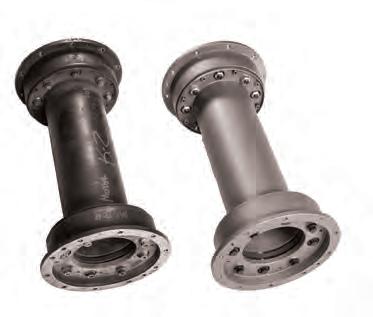
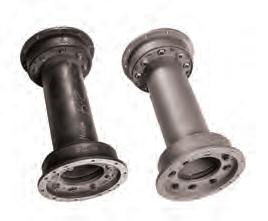
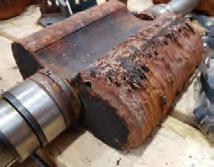
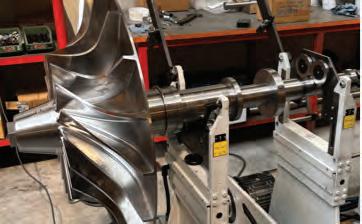
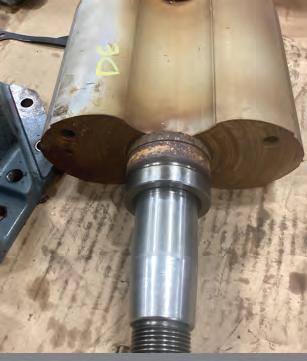
An example of a coupling before and after treatment.
Engineers probe real-world hurdles to scaling carbon capture and storage
COMPRESSORTech2 hosted a webinar that brought together experts from Baker Hughes and Caterpillar Oil & Gas to tackle a question many midstream, power and industrial operators are asking: how do you make carbon capture and storage (CCS) work at scale, in the real world, with the equipment and markets that exist today?
Speaking to an audience of engineers, project managers and decarbonization specialists, Gianluca di Federico, CCUS demand generation leader for Baker Hughes’ Industrial & Energy Technology segment, and Garett Lambert, low carbon solutions process engineer with Caterpillar Oil & Gas, walked through practical strategies for moving CCS from feasibility studies to operating assets.
Baker Hughes and Caterpillar spotlight compression, transport and cost innovations aimed at moving CCS from pilots to portfolios.
By Jack Burke
reality, combined with limited CO2 transport infrastructure and lingering concerns about long-term storage liability and public perception, still delays investment decisions.
For di Federico, the most underappreciated step is the early options phase.
many different types of emitters to join the infrastructure, leveraging the volume and reducing their costs,” he said.
CCS is not a cookie-cutter project Di Federico opened by pushing back on the notion that CCS is a simple bolt-on.
“Each project is different. Each opportunity has its own peculiar characteristics, and we need to find the right fit for them,” he said. “There is no one fix that supports all the projects in the same way.”
On the cost side, he highlighted three major categories operators must contend with:
■ Capital cost for capture plants, CO2 compression and transport infrastructure
■ Operating costs, including the substantial energy needed to run capture and compression systems
■ Maintenance and lifecycle costs across the value chain
“These are additional costs that weigh on the balance sheet of the emitter or infrastructure operator,” he said. That
“Every investment we make today in consultancy or evaluating 10–15 options at the beginning of a project is well-invested time and money,” he said. Only by looking across the full spectrum of capture technologies, compression schemes, transport options and storage routes can operators define a viable path forward for their specific site, he argued.
Anchor projects
Despite the hurdles, di Federico said large, shared CCS systems are beginning to take shape—especially in Europe and the UK—built around what he called “anchor projects.”
The first large emitter in a region often carries the burden of oversizing initial transport and storage infrastructure. That anchor project builds out the pipeline or shipping corridor and storage hub. Once that backbone is in place, smaller and more remote emitters can connect later at lower cost.
“This is very important, because it allows
He pointed to emerging UK cluster projects and the Northern Lights development in Norway as examples of this hub-and-spoke model. In the Northern Lights case, emitters capture, compress and liquefy their CO2, send it by ship to a coastal hub, then inject it into offshore storage formations tied to the common system.
Standard specifications for contaminants and moisture are essential to avoid
Gianluca di Federico
corrosion, phase issues and operational problems downstream. “It’s a very important topic,” he said, because poor CO2 quality at the inlet can cascade into failures throughout the chain.
Compression, pipeline
Moving from the conceptual to the mechanical, di Federico drilled down into compression and transport.
On the flue gas side, large compressors are used to boost low-pressure exhaust streams to the conditions required by certain capture technologies—especially cryogenic systems or high-pressure chemical processes. These machines consume significant power, making energy recovery a key design consideration.
On the CO2 side, he outlined two main transport paths: dense-phase pipeline and liquefied CO2 shipping. Pipelines are typically used for shorter distances and onshore storage, while shipping becomes attractive for longer hauls and international storage or utilization schemes.
“There is no one solution that addresses all concerns,” he said. “We always need to look specifically at which combination of solutions offers the best value for money.”
Baker Hughes is positioning its portfolio across that chain with reciprocating and centrifugal compressors for both flue gas
and CO2 service, high-pressure pumps for liquid CO2, and engineering support for both open-loop and closed-loop liquefaction schemes.
The company is also advancing a nonmetallic, spoolable pipeline solution for corrosive CO2 service. The flexible pipe uses a corrosion-resistant inner layer, a composite structural layer and a protective outer layer. According to di Federico, the design offers two main benefits: improved corrosion resistance in the presence of water and much faster installation, since long spools can be deployed without welding.
Caterpillar’s focus
value from waste heat. After a CO2 TSA bed is heated to release CO2, it still contains a large amount of stored heat. Caterpillar’s system routes a cold, depleted exhaust stream through the hot bed to pick up that heat and reuse it—such as for regenerating the upstream dehydration beds.
“You get to effectively use the exhaust heat twice,” Lambert said. “That really sets us apart from other competitors,” many of whom must add electric heaters or other external energy sources.
Where Baker Hughes focused largely on the broader CCS value chain, Caterpillar’s Lambert drilled deep into one segment: carbon capture on gas engines and turbines used in gas compression and power generation.
Lambert framed Caterpillar’s work as an extension of its core engine business.
“When you think of Caterpillar, you think about machines on the highway or maybe power generation or gas compression,” he said. “But Caterpillar wants to offer a full integrated solution. Carbon capture is one of those areas that we went after because we see it as required—or potentially required— for our customers in the future.”
Caterpillar’s goal was to bring capture cost down to roughly $40 per ton, leaving headroom under U.S. incentives to make projects viable after factoring in capital and
To get there, Lambert’s group developed a modular, temperature swing adsorption (TSA) system tailored to engine exhaust.
A key innovation is the use of radial-flow vessels for both dehydration and CO2 capture. Instead of gas flowing top-to-bottom through a deep bed with high pressure drop, gas flows radially through a relatively thin bed from the outer diameter to the inner.
Another focus is squeezing maximum
From pilot to commercial skid Caterpillar’s early pilot, a co-adsorption system that removed both CO2 and water in one step, proved too costly and inefficient. It also lacked a dedicated dehydration step, and the team found that residual moisture significantly degraded performance.
Subsequent generations separated water and CO2 removal, integrated the dehydration TSA with the capture TSA, and added an absorption chiller and small onsite power generation. Those steps pushed capture cost down to the company’s $40-per-ton target.
The current design is skid-mounted and modular. Lambert described one recent project on a Taurus 70 gas turbine, roughly an 8 MW system, configured to capture about 150 metric tons per day. Cooling can be provided by site water if available, or by air-cooled equipment at the cost of some additional footprint and capex.
The package is designed to scale: up to about 300 tons per day, Caterpillar simply increases vessel diameters. Beyond that, additional parallel trains—each with their own dehydration and capture beds—are added to reach 600, 900 tons per day or more.
Lambert said the technology is commercially available today. Lead time is largely driven by the CO2 compressor, which he estimated at roughly one to one and a half years, in line with what many compression customers already experience.
Although naturally optimized for Cat engines, the system can be adapted to other OEMs. CT2
Garett Lambert
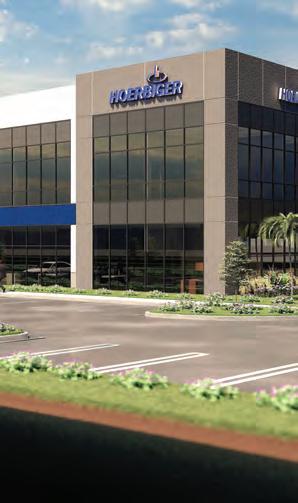
A conversation with Arek Dyrdol, head of Hoerbiger Corporation of America
Hoerbiger’s North America leader discusses life extension, emissions reduction and workforce preparedness
Arek Dyrdol has led Hoerbiger Corporation of America since December 2020 and oversees the company’s activities across the North America region. In this interview, he discusses how operators are approaching asset life extension, how methane intensity is reshaping service strategies, and how Hoerbiger is adapting its workforce and sourcing strategy to shifting market conditions.
MANY OPERATORS ARE UPGRADING EXISTING ASSETS RATHER THAN INVESTING IN NEW ONES. HOW DOES HOERBIGER’S WORK IN RETROFITS AND COMPONENT OPTIMIZATION ALIGN WITH THIS SHIFT TOWARD LIFE EXTENSION?
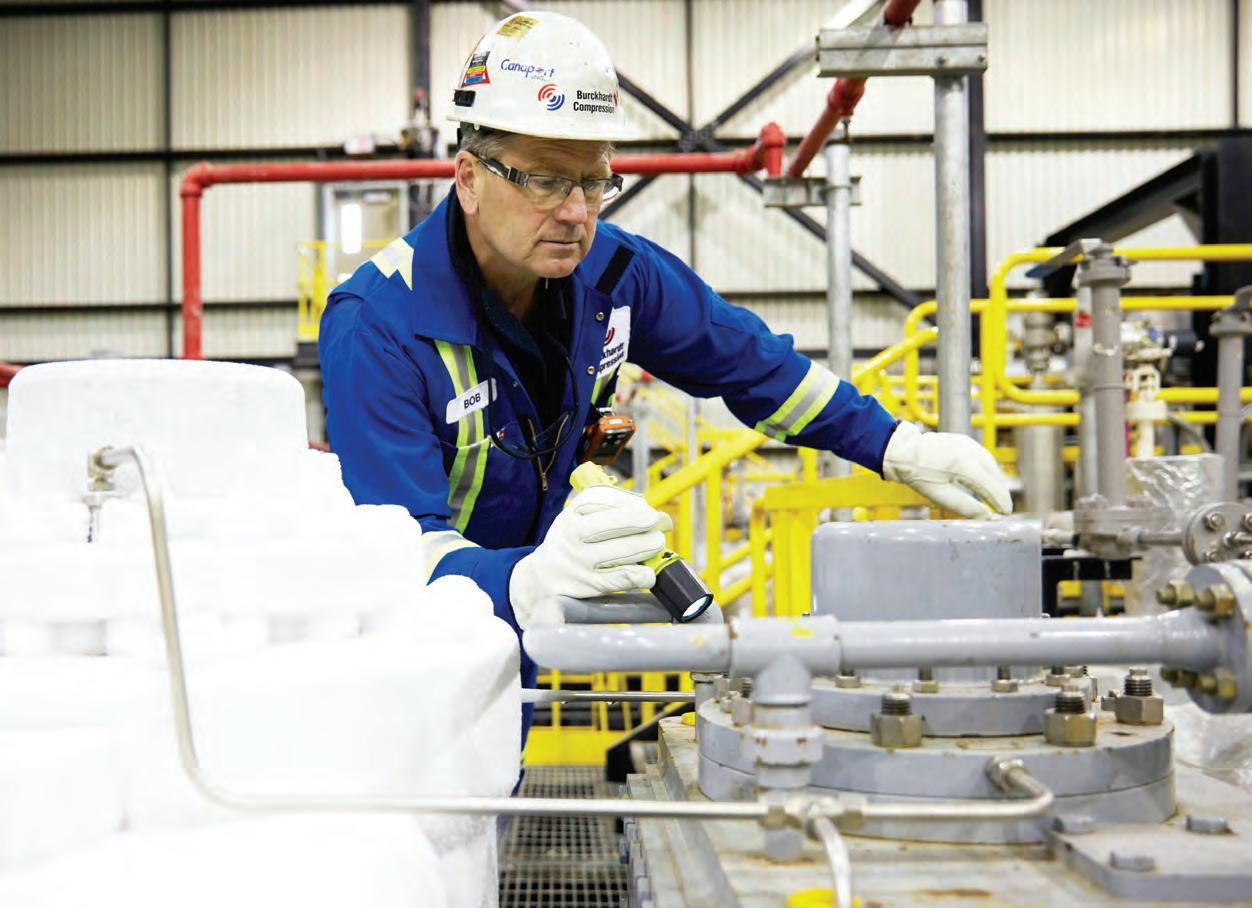
Our customers today are focused on getting the most out of their existing equipment. Hoerbiger’s retrofit and component upgrade programs enhance legacy compressors
Hoerbiger in North America
■ Led by Arek Dyrdol since December 2020, Hoerbiger Corporation of America oversees the company’s operations across the U.S., Canada and Mexico.
■ Hoerbiger supports a large installed base of reciprocating compressors across upstream, midstream and downstream markets, with service centers strategically located throughout North America.
by improving reliability, efficiency and environmental performance at a fraction of the cost of new units.
On the field service side, we leverage decades of experience and data-driven insights to extend the operating life of assets. If we look at our core capabilities, one side is performance — offering best-in-class critical wear components and continually investing in R&D for reciprocating compression. The other side is service — we have strategically located service centers across North America and globally, supporting everything from valve and case repair to full unit overhauls.
METHANE INTENSITY AND COMPRESSOR LEAKS ARE UNDER GREATER SCRUTINY FROM REGULATORS AND INVESTORS. WHAT SOLUTIONS IS HOERBIGER OFFERING TO HELP OPERATORS MANAGE EMISSIONS?
We try to address methane emissions at the source. We offer two key systems: our
■ Natural gas compression remains the largest share of Hoerbiger’s regional activity, driven by midstream transport, gathering and storage assets focused on reliability, life extension and emissions reduction.
■ Key retrofit solutions include Emission Shield packing case technology to prevent methane leakage and the Emission Recovery System (ERS), which captures and recompresses vent gas back into compressor suction.
A rendering of Hoerbiger’s North American headquarters.
■ The company’s REE program—reliability, efficiency and environmental—provides fleet-level assessments that integrate performance optimization, maintenance strategy and methane intensity reduction.
■ Hoerbiger’s digital VISTRA ecosystem supports predictive maintenance, guided field service and remote collaboration, helping operators manage aging assets amid workforce constraints.
■ In the U.S., Hoerbiger has expanded service operations in Houston and is
Hoerbiger Corporation of America is one of six lead manufacturing facilities for the Compression Technology Strategic Business unit of Hoerbiger Group.
developing a new 200,000-squarefoot South Florida campus scheduled to consolidate operations by the end of 2026.
■ A “local-for-local” manufacturing and sourcing strategy is being deployed to reduce lead times, mitigate tariff exposure and improve supply chain resilience.
■ Beyond natural gas, Hoerbiger is active in hydrogen compression and CO2 transport applications
“Our customers today are focused on getting the most of their existing equipment.”
AREK DYRDOL head of Hoerbiger Corporation of America
Emission Shield packing case solution, which prevents leakage, and our Emission Recovery System (ERS), which captures and recompresses vent gas back into suction. Together, these solutions give operators retrofit-ready options to lower methane intensity without sacrificing uptime or throughput.
We also recognize that methane performance is now a KPI for many midstream companies. So, beyond equipment, we offer our REE program — reliability, efficiency, environmental — which includes a comprehensive analysis of compressor performance and system behavior. From that, we build a technical roadmap tailored to the operator’s fleet objectives.
YOUR REE PROGRAM INVOLVES SITE EVALUATION AND FLEET STRATEGY. WHAT ARE CUSTOMERS SEEKING WHEN THEY ASK HOERBIGER TO CONDUCT THIS WORK?
The motivations usually fall into three areas: lowering costs and extending unit lifespan, improving performance, and reducing emissions. Many operators want solutions that address all three. With the REE audit, we evaluate the system as a whole and recommend which component upgrades, field practices and emissions solutions will deliver the desired outcome. It’s more strategic than a standard service call.
THE MIDSTREAM WORKFORCE IS AGING, AND MANY OPERATORS FACE SHORTAGES OF EXPERIENCED COMPRESSOR TECHNICIANS. HOW IS HOERBIGER ADDRESSING THE SKILLS GAP?
We recognized this challenge several years ago. As the workforce ages, the industry loses “tribal knowledge.” To support customers, we developed digital tools aimed at enhancing training, troubleshooting and remote support. This led to the creation of the Hoerbiger New Venture Lab in Vienna, which focuses on digital enablement. In 2020, we launched the first pilot of our VISTRA digital ecosystem. Today, there are multiple active platforms >
supporting predictive maintenance, remote collaboration and field guidance. COVID-19 accelerated adoption; what was once seen as optional quickly became essential. Digital tools are now a core part of maintaining service quality.
ECONOMIC HEADWINDS — TARIFFS, SUPPLY CHAIN CONSTRAINTS, INFLATION — CONTINUE TO AFFECT THE SECTOR. HOW HAS HOERBIGER ADAPTED ITS NORTH AMERICAN OPERATIONS?
We have focused on two key adjustments: further localizing production and localizing sourcing. The goal is to reduce exposure to import risks, freight costs and lead-time delays.
In the United States, we recently expanded service operations in Houston and are building a new 200,000-square-foot South Florida campus that will consolidate operations under one roof by the end of 2026. We have also adopted a “local-forlocal” sourcing strategy to strengthen supply chain resilience and delivery
reliability. For our customers, short lead times and stable availability are critical.
HOW DOES HOERBIGER VIEW THE ROLE OF COMPRESSION IN THE ENERGY TRANSITION?
Compression remains essential across the transition — from low-carbon natural gas to CO2 transport to hydrogen fueling. Compression is the bridge to a lower-carbon future.
In hydrogen, we are active in Europe, where we operate a hydrogen compressor packaging facility and collaborate closely with Ariel on compressor technology. Hydrogen development has slowed somewhat due to economic conditions, but it has not stopped. Delays are schedulerelated, not structural.
LOOKING AHEAD, WHAT DO YOU SEE AS THE BIGGEST OPPORTUNITY — AND THE BIGGEST CHALLENGE — FOR HOERBIGER IN NORTH AMERICA?
The opportunity is in localization. The U.S.
For more than 60 years, Hoerbiger Corporation of America has provided North and Latin American customers with products and services.
commitment to energy security and resilient manufacturing aligns with our recent investments in production capacity and supply chain capability. That positions us well for future growth.
The biggest challenges are supply chain stability and workforce development. To address the workforce gap, we are partnering with universities and technical schools to rebuild strong vocational training pathways. That is essential for the long-term health of the compression industry.
WHEN IT MATTERS MOST.
A century in business has taught us that you can never go wrong when you focus on the needs of the customer and the importance of getting every project right the first time. We know that committing to innovation and quality are the best paths to reduced lubricant consumption, gas stream contamination and downtime. Our focus on reliable, dependable service is invaluable to earning trust and building long-term relationships. It’s not a gimmick. It’s just the way we do business and why we’re the first name in compressor lubrication.
Empowering customer
The Parts Liberty approach to feasibility, validation, engineering, predictability, and lifecycle support.
By Luciano Roppo
Abstract
As process industries aim to extend the operating life of legacy rotating equipment, challenges such as component obsolescence, variations in facility operating conditions, OEM dependency, and declining support have become increasingly common.
The Parts Liberty framework introduces a structured retrofit pathway that not only restores operability but elevates reliability, predictability, and strategic control.
This article outlines the feasibility, validation, engineering, and lifecycle methods that give operators confidence in retrofitted rotating equipment, with an emphasis on predictability: how performance, risk, and lifecycle outcomes can be modeled, forecasted, and controlled using modern analytical tools and data-driven methodologies.
LUCIANO is a Mechanical Engineer/Project Manager/Technical Advisor with 30 years of experience with rotating equipment (aeroderivative, heavy frame gas turbines, and reciprocating engines) for power generation. In addition, he has executed projects related to Renewable Natural Gas (RNG), Combined Heat and Power (CHP), & Remote Power Generation with associated electrical and waste heat interfaces.
When he has free time, Luciano enjoys the mountains, golfing (fun fact, Luciano worked at a golf course for 20 years), and just getting outdoors with his family.
1 The new reality of equipment obsolescence
Industrial facilities continue to operate rotating equipment that is decades old. Original suppliers support often decreases over time, parts become unavailable, documentation is incomplete, and replacement solutions become too costly.
This environment introduces significant equipment uncertainty with unpredictable lead times, costs, and performance after degradation.
The Parts Liberty approach mitigates these uncertainties by replacing reactive, vendor-dependent repair cycles with structured engineering predictability, offering operators clarity with respect to equipment lifecycle instead of guesswork.
Blackstone said Parts Liberty is designed to free operators from constrained supply chains, orphaned equipment, and long OEM lead times by delivering high-quality, engineered spare parts for mature rotating equipment. In partnership with Compression Service Technology (CST), Blackstone re-engineers rare or obsolete components and manufactures them locally to meet or exceed OEM specifications, often without access to original drawings. By combining deep field experience with advanced engineering and manufacturing capabilities, Parts Liberty reduces downtime, production loss, and replacement costs while giving customers greater independence from OEM pricing and lead-time constraints.”
Instead of accepting unpredictable timelines and costly full-train replacements, the customer engaged in the Parts Liberty process receives a validated, uprated (if selected), and engineered solution delivered to align with their predefined expectations.
2 Defining “LIBERTY”: independence through engineering predictability
“Liberty” represents more than supplychain independence; it encompasses total predictability across performance, scheduling, and lifecycle behavior.
PREDICTABILITY within the parts liberty framework
Dimensional integrity:
■ Achieved through precision digital capture -including 3D scanning and metrologyduring field service, disassembly (Clean & Inspect), quality assurance (ITP), and spare parts evaluation.
Performance assurance:
■ Verified through CFD (Computational Fluid Dynamics) and FEM (Finite Element Method) analysis, utilizing thermodynamic models tuned to OEM performance curves and validated against real-world operational data.
Risk management:
■ Executed through structured phase gates and API/ASME compliance, utilizing contingency parts and maintaining full transparency regarding risk acceptance, transfer, and mitigation.
Supply-chain stability:
■ Secured via a network of qualified alternative vendors, strictly defined tolerances, and comprehensive technical data packages.
Collectively, these elements transform retrofit projects from uncertain undertakings into controlled, forecastable engineering programs.
3
Retrofit pathways: Structured choices with predictable outcomes
Each Parts Liberty pathwaywhether focused on optimization, debottlenecking, Replace-in-Kind (RIK), revamps, or commercial independence - is anchored by a predictable engineering and validation framework.
Depending on the selected path, the framework guarantees specific outcomes: Replace-in-kind (RIK):
■ Delivers predictable replication of original OEM performance and fit.
choice in the retrofit journey
Revamps & upgrades:
■ Provide quantifiable improvements in efficiency, mechanical reliability, and fatigue life.
Debottlenecking:
■ Utilizes modern simulation to establish predictable performance limits and operational guardrails.
Operational alignment:
■ Ensures new equipment and components are precisely aligned to meet updated operating conditions.
By selecting their desired pathway, customers leverage the Parts Liberty system to align engineering rigor with their specific performance and business objectives.
4 Process framework: From legacy to liberty with predictability built in PHASE 1: FEASIBILITY: Establishing predictable technical boundaries
Predictive Feasibility ensures informed business decisions by converting design uncertainty into forecastable possibilities through five key steps:
■ Review historical data: Utilizes past inspection/repair data to highlight lifecycle timelines and areas of concern.
■ Collaborate on assumptions: Validates all design inputs and assumptions with end-users.
■ Model baseline performance: Establishes realistic and quantified expectations through initial modeling.
■ Identify constraints: Defines fixed versus flexible constraints to enable predictable design envelopes.
■ Model scenarios: Covers all feasible versus non-feasible upgrade options through scenario modeling. This phase converts uncertainty into forecastable engineering possibilities, enabling informed business decisions.
PHASE 2: VALIDATION: Engineering assurance through advanced modelling
2.1 Digital capture and predictable geometry control
Metrology establishes the precise “asfound” geometry of legacy components and associated housings, eliminating the guesswork inherent in manual measurement. This foundational data ensures predictable fitup, accurate machining tolerances, and a clearly defined manufacturing scope, all governed by rigorous quality control.
2.2 Simulation-based predictability
Advanced modeling
Blackstone can re-engineer rare or obsolete components and manufacture them.
tools provide high-confidence forecasts of component behavior, allowing for virtual validation before production begins:
■ CFD (Computational Fluid Dynamics): Simulates the complex interaction between the process media (fluids or gases) and rotating componentssuch as impellers, rotors, and blades - to maximize hydraulic efficiency and eliminate performance losses.
■ FEM (Finite Element Method): Predicts precise stress profiles and fatigue life under operational loads, ensuring structural integrity and the application of appropriate safety factors.
■ Modal and rotordynamic analysis: Forecasts operational stability by identifying natural frequencies and vibration characteristics (amplitudes and frequencies), ensuring the equipment operates safely away from critical speeds.
■ Dynamic System Analysis (DSA): Predicts network-level transient behavior, providing insight into how equipment responds to fluctuating system conditions or emergency shutdowns. By integrating these analyses, legacy equipment is transformed into a high-fidelity Digital Model, enabling predictive engineering and performance optimization long before a single component is manufactured.
PHASE 3: ENGINEERING: Replace-in-kind vs. revamp with predictable outcomes Predictability through structured engineering
■ In RIK designs, predictability ensures exact dimensional, material, and performance equivalence while guaranteeing seamless integration and zero negative impact on the existing system.
■ In Revamp designs, predictability guarantees targeted performance gains and reliability improvements through controlled upgrades that utilize proven solution suite(s) to meet specific safety, environmental, and operational requirements By implementing repeatable modeling
RETROFITS
and standardized procedures, engineering transforms from a series of estimations into a controlled, provable, and data-driven process.
PHASE 4; MANUFACTURING:
Predictable quality and repeatability
Quality predictability enabled by modern manufacturing controls
■ Validated IFC drawings
■ Dimensional inspection using CMM and laser scanners
■ Controlled vendor matrix and ITPs (Inspection Test Protocols/Package)
■ Traceable materials and NDE This creates not only a compliant part, but a repeatable manufacturing blueprint for future spares.
PHASE 5: INSTALLATION & COMMISSIONING:
Predictable installation, startup, and ramp-Up
Predictability extends through field execution:
■ Proactive found-work planning and riskmitigation strategies are established (e.g., spare parts provisioning, redundancy, contingency planning).
■ Alignment and balance checks confirm outcomes predicted through digital assembly and analytical modeling.
■ Collaborative, cross-functional planning improves installation accuracy and execution discipline.
■ Virtual assembly techniques reduce installation variability and rework risk.
■ Where required, Performance Test Code (PTC) testing verifies compliance with predicted performance.
PHASE 6: LIFECYCLE SUPPORT: Data-driven confidence and control systems principle
Modern analytics–enabled asset management
Modern process plants increasingly rely on advanced analytics, digital engineering, and integrated control systems to improve uptime, manage risk, and extend asset life.
Parts Liberty is aligned with these realities, enabling higher certainty across the entire asset lifecycle by embedding predictability
into design data, maintenance strategy, and spare-parts execution.
6.1 Data-driven lifecycle insight
Digital engineering artifacts generated during design and upgrade activities become enduring lifecycle assets rather than static deliverables. These datasets form the foundation for future analysis, simulation, and optimization activities.
■ Authoritative digital engineering files (CAD, FEA, CFD, rotordynamic, and performance models) provide a validated baseline for future simulations, uprates, and operating-envelope assessments.
■ Wear and degradation tracking, enabled through periodic scans and inspections, supports trend-based condition assessment and proactive maintenance planning.
■ Centralized and curated data libraries eliminate repeated reverse-engineering efforts and reduce spare-part lead times. This approach transforms historical data into actionable insight, reducing uncertainty over time rather than accumulating it.
6.2 Predictive maintenance and modern controls integration
■ Replacement and upgraded components are engineered to integrate seamlessly with modern plant monitoring and control architectures, including:
■ Condition-monitoring systems
■ Advanced vibration analytics and diagnostics
■ Automated shutdown and protection logic
■ Predictive algorithms and AI/ML frameworks (where implemented by the operator) By aligning mechanical design with
< 6 months in operation
2 years in operation
digital monitoring capabilities, operators can transition from reactive and timebased maintenance to condition-based and predictive maintenance strategies, improving reliability, extending run length, and reducing unplanned outages.
6.3 Predictable spare-parts strategy
Because the client retains ownership (subject to agreed licensing terms) of validated design models, material specifications, and engineering data, the spare-parts strategy becomes structured and repeatable rather than reactive. This delivers predictability in:
■ Cost, through reduced re-engineering and competitive sourcing
■ Lead time, enabled by pre-validated designs and qualified manufacturing routes
■ Sourcing options, avoiding single-supplier dependency and obsolescence risk Spare-parts planning shifts from emergency procurement to a controlled, forecastable lifecycle activity.
6.4 Proactive risk management through predictability
Modern digital systems enable risks to be identified, classified, quantified, mitigated, and continuously monitored throughout the asset lifecycle. Parts Liberty embeds this capability directly into engineering and operational workflows.
Examples include:
■ Predictable and consistent surge-margin behavior across operating conditions
■ Quantified and extended fatigue-life margins following upgrades
■ Clearly defined and validated operational envelopes post-revamp
■ Predictable supply-chain timelines aligned with maintenance and outage planning
Predictability as a design principle
Predictability is not merely a by-product of good engineering- it is a deliberate outcome. Confidence in performance, cost, and risk is not achieved by chance; it is engineered.
A REVAMP lobe supplied utilizing Liberty principles with upgraded materials for extended lifecycle.
IMAGES: BLACKSTONE
An RIK overhung rotor supplied utilizing Liberty principles with feasibility on material upgrade evaluated. IMAGE: BLACKSTONE
Parts Liberty applies forward predictability as a core design principle, enabling operators to plan, operate, and maintain critical rotating equipment with confidence across the full asset lifecycle.
Beyond the part: Predictability as a platform for long-term asset strategy
The Parts Liberty methodology extends well beyond the supply of individual components. It provides operators with a forward-looking asset-management platform designed to support long-term planning, risk-informed decision-making, and sustained performance improvement across the asset lifecycle.
Through this approach, customers gain the ability to move from reactive decisions to forecast-driven asset strategies, including:
■ Forecasting capability for future upgrades and revamps, based on validated engineering models and operational data.
■ Predictable lifecycle cost modeling, enabling accurate capital and
maintenance planning.
■ Quantified reliability improvements, supported by analytics, monitoring, and validated design margins.
■ Defined performance roadmaps, aligning future uprates, efficiency improvements, and operating envelope expansion with business objectives.
■ Seamless integration with plant analytics, ensuring design intent remains connected to operational reality.
The initial retrofit establishes a robust and traceable technical baseline validated through digital engineering, field execution, and operational feedback. This baseline becomes the foundation for continuous improvement, enabling future upgrades, optimizations, and maintenance decisions to be executed with increasing confidence
In this way, Parts Liberty transforms individual retrofit events into a repeatable, scalable framework for long-term asset optimization, where predictability is embedded as a core strategic capability. CT2
Conclusion
The Parts Liberty approach transforms retrofit work from a reactive and uncertain activity to a predictable, disciplined and engineering-led strategy.
By integrating feasibility analyses, simulation-driven validation, structured engineering, controlled manufacturing, and data-enabled lifecycle support, this method delivers:
■ Predictable performance and reliability, stronger risk management, supplychain independence, and confidence in long-term asset planning.
■ Comprehensive 360° support built on deep expertise across installation, repair, parts, and engineering services, delivered in multiple regions. For plants operating legacy rotating equipment, the path forward is clear. Greater control and long-term reliability are within reach, and a Parts Liberty retrofit can be the first strategic step toward a controlled equipment lifecycle.
Models available for all common gas engines.
Rugged, compact, proven design.
Dual port versions for continuous monitoring and auto-balance systems.
ASK US ABOUT SPECIALS TO MEET YOUR REQUIREMENTS. WE DO THEM ALL OF THE TIMEANY QUANTITY!
ANNUAL EXPO & CONFERENCE
Monday, March 23rd - Thursday, March 26th, 2026
Moody Gardens Convention Center | Galveston, TX
Explore cutting-edge technologies and advancements in gas compression
Network with industry experts, suppliers, and fellow professionals
Gain valuable knowledge through informative sessions and workshops
Register TODAY!
Learn more about the expo, view the agenda, and register, all in one place! Scan the QR Code to get started!
MARCH
GCA CONFERENCE & EXPO
March 23-26
Galveston, Texas
Gascompressor.org
OTC Asia
March 31-April 2 Kuala Lumpur, Malaysia Otcasia.org
BOLDFACE indicates shows and conferences in which COMPRESSORTECH2 is participating
APRIL
HANNOVER MESSE
April 20-24
Hannover, Germany
www.hannovermesse.de
MAY
Sensor+Test
May 9-11
Nuremburg, Germany
Sensor-test.de
EASTERN GAS COMPRESSION ROUNDTABLE
May 12-14
Pittsburgh, Penn. www.egcr.org
JUNE
ASME Turbo Expo
June 15-19
Milan, Italy
Asme.org
RNG Works
Sept. 15-17
Milwaukee, Wis. Rngcoalition.com/rng-works
GPA MIDSTREAM
Sept. 20-23
San Antonio, Texas www.gpamidstream.org
TPS 2026
Sept. 22-24
Houston, Texas
Tps.tamu.edu
GMRC
Oct.4-7
Indianapolis, IN www.gmrc.org For a complete listing of upcoming events, please visit our website: www.compressortech2.com/events
Advertise where the sourcing decisions begin. The CTSG is the go-to reference for gas compression professionals.
Distributed with the April issue and at global trade shows, it connects your products with engineers, operators and service teams.
Machine protection through focused instrumentation and automated analysis
Case study of minimizing the economical and machinery impact at a rapidly arising damage.
By Christian Hoffrogge and Sven Wolter
.
Abstract
In addition to proper initial setup, continuous supervision during operations is essential. This includes maintaining hardware and software, regularly reviewing and adjusting condition monitoring, and setting machine protection limits.
Regular hardware maintenance involves checking and replacing worn components, while software updates ensure accurate anomaly detection. Continuous review of monitoring limits, based on data analysis, helps prevent failures and minimize downtime. Overall, combining proper setup, regular maintenance, and continuous monitoring ensures long-term efficiency and reliability, contributing to the facility’s productivity and safety.
Dipl.-Ing. (FH)
CHRISTIAN HOFFROGGE
Machinery Diagnostic Consultant
PROGNOST Systems GmbH, Rheine (Germany) christian.hoffrogge@prognost.com
SVEN WOLTER
Mechanical Engineering, RWE Gas Storage West GmbH, Staßfurt (Germany) sven.wolter@rwe.com
1 Introduction
Operating an underground gas storage facility typically involves compressors running in short-term cycles, characterized by infrequent on/off operations that last for a few hours or days. Due to the limited operational time, it is essential to implement well-adjusted machine protection and monitoring solutions. This approach not only maximizes economic efficiency but also plays a vital role in ensuring the security of the energy supply.
In this case study, the compressors at a German underground gas storage facility operated smoothly for an extended period of over 15 years without experiencing significant damage. This success was attributed to frequent reviews of the machinery’s condition, which included regular adjustments to machine protection limits and condition monitoring parameters. These proactive measures ensured the longevity and reliability of the compressors, contributing to the overall efficiency and safety of the facility.
On a bank holiday in 2022, a rapid issue emerged, leading to an automated machine shutdown in less than a minute from the onset of failure to its detection. Automation played a crucial role in this scenario, given the limited reaction time available. By utilizing pattern recognition algorithms, the potentially damaged component was swiftly identified, enabling an assessment of the risks associated with continuing operation.
Following the automated shutdown, a decision was made to restart the machine. However, due to the still-active machine protection measures, the machine was shut down again before it could return to production mode.
The following day, an in-depth analysis of the gathered data was conducted, leading to specific instructions for inspecting the compressor. During the inspection, a part of a piston bolt was discovered in one of the compression chambers, completely sheared off. The deflection of the piston rod while moving back and forth, particularly at the crank-end dead center, had caused the compressor to shut down. This detailed analysis and subsequent inspection highlighted the importance of thorough condition monitoring and timely maintenance to classify such issues. The automated shutdown effectively prevented more severe secondary damage to the compressor. As a result, both downtime and the economic impact were minimized. The machine was back in operation after a 32-day period, demonstrating the effectiveness of the implemented machine protection measures and the importance of advanced monitoring systems in maintaining operational efficiency.
2
Machine and monitoring system
2.1 Machine details
The horizontal piston compressor was
Machine protection limits are independent of operation conditions, while warning thresholds for condition monitoring purpose are set specifically for those different operational conditions. This ensures early warnings in case of emerging issues and minimizes false warnings as much as possible.
For this compressor application, discharge pressure, along with rotational speed and the number of active stages, were used to categorize the operational conditions as subsequent:
■ Basic (speed at 0 rpm or not available)
■ 0-70 bar a / 1 stage
■ 70-95 bar a / 1 stage
■ 80-110 bar a / 2 stages
■ 110-140 bar a / 2 stages
■ 140-170 bar a / 2 stages
constructed in 1998. It is a four-crank machine, featuring double-acting cylinders at each crank. Operating at up to 320 rpm in two stages, this compressor is utilized to store natural gas in an underground cavern located in Germany. For capacity control, plug unloaders were employed in the initial build of the machine. They were allowing adjustments at 25%, 50%, 75%, and 100% capacity. During a revamp in 2015 an electrohydraulic stepless flow control system has been installed. The compressor can achieve a discharge pressure of up to 180 bar a.
2.2 Monitoring system details
The concerning monitoring system is utilizing the data that is gathered by the following sensors:
■ Trigger (1)
■ Vibration Acceleration:
■ Crosshead (4)
■ Cylinder (4)
■ Vibration Velocity
■ Bearing/Frame (4)
■ Proximity
■ Piston rod (4)
■ Dynamic Pressure
■ Crank end (4)
■ Head end (4)
The initial version of the monitoring system was installed in 1998, right with the initial start-up of the compressor itself. General
Over the years, the system has undergone significant improvements to enhance its functionality and reliability. Major updates to the monitoring hardware were carried out in 2008 and again in 2015, incorporating the latest technological advancements to ensure highest performance and accuracy in monitoring machine conditions.
2.3 Monitoring system setting
Each monitoring system is configured with default values for warning thresholds and machine protection when it is delivered and commissioned. The values for both categories base on the experiences made with compressor systems in the past and should provide a basic protection for the machine to avoid catastrophic failures. Furthermore, it needs to be considered that the settings in that stage are not yet customized to the related compressor. After the compressor has been brought into operation, the first few months build the data base that is used to set the parameters for warning thresholds and machine protection. This period should cover at least 3 months run time and include relevant data that covers all operational conditions the compressor will face during its lifetime.
The following topics should be considered when defining parameters for warning thresholds and machine protection:
■ Minimum level to ensure a proper signalto-noise ratio and to avoid false positives
■ Maximum level to avoid undetected machinery damage and to avoid false negatives
■ Compliant to machine OEM values
■ Comply to values defined by plant or process engineering
■ A reasonable relationship between warning threshold levels and machine protection, ensuring a logical flow down can happen in case of an event
■ Aligning to internal knowledge from comparable machines
To derive warning thresholds and machine protection setting the relevant data is statistically analysed. A semi-automized approach is in place, which partially supports the Machinery Diagnostic Engineers with this process
Selective parameters derived utilizing Student t-distribution along with different multiplication factors finally determine:
■ 1st warning threshold
■ 2nd warning threshold
■ 3rd warning threshold (if applicable)
■ Machine protection - Alert
■ Machine protection - Shutdown
Final validation is done for all values by the responsible Machinery Diagnostic Engineer.
FIGURE 1 Sketch of compressor including sensor types, status and locations.
3
Case study
3.1 Relevant instrumentation
As the piston rod is a critical link in the reciprocating drive train from crankshaft to piston, a thoroughly monitoring is required.
A deflection sensor with a total measurement range of usually 4 mm is installed at the top position of the piston rod to measure the vertical movement.
It shall ensure the mechanical integrity of the drivetrain regarding incipient fractures and for foreign materials in the compression chambers in solid or fluid state.
3.2 Relevant analysis
The results of the analysis serve both, the machine protection and the condition monitoring purpose.
At every single revolution of the crank, the following analyses are carried out for a piston rod deflection sensor, with the first two entries being relevant for machine protection purposes:
■ Peak-to-Peak deflection in 1 segment (entire revolution)
The values for warning thresholds and machine protection have undergone some
changes over time. Those were driven for example by:
■ Component changes on the related compressor
■ Technology evolution of the monitoring and protection system
■ Gained experience in machinery diagnostics
■ Aging effect of the machine with operational time.
3.3.1 Initial delivery
In the initial delivery of the condition
monitoring system in 1998, no machine protection measures were in place yet for the movement of the piston rods.
The initial analysis, conducted in 36 segments of 10° crank angle each, contradicted the current solution. This analysis was crucial in understanding the system's limitations and areas for improvement. The warning thresholds (WT) were set to:
FIGURE 2 Exemplary set up for piston rod deflection sensor1.
FIGURE 3 Piston rod deflection sensor: Exemplary raw signal along with an analysis plot of the peak-to-peak analysis in 8 segments1.
■ 1st WT: 100 µm (all 36 segments)
■ 2nd WT: 100 µm (all 36 segments)
Despite the monitoring system being prepared for a 3-level warning level approach, values were set to configure the system with one single warning threshold level.
3.3.2 Adaptions with upgrade 1
In 2009, the monitoring system was updated now including machine protection (MP) methods. The approach was changed from a 36-segment analysis to an 8-segment one. Experience with monitoring systems over multiple years showed that a 45° crank angle split is more effective for analyzing piston rod movement.
■ 1st WT: 150 µm (all 8 segments)
■ 2nd WT: 200 µm (all 8 segments)
■ MP: 300 µm (all 8 segments)
3.3.3 Adaptions with upgrade 2
In 2015, another hardware upgrade installed state-of-the-art systems for compressor monitoring. Several years of compressor monitoring experience, along with the operational time of the specific machine, contributed to updating the values for warning thresholds and machine protection.
■ 1st WT: 130 µm (all 8 segments)
FIGURE 3 Piston rod deflection
– peak-to-peak in 8 segments 01-Jan-22 to 01May-22 compared to warning thresholds (yellow, orange) and to machine protection limits (magenta).
■ 2nd WT: 180 µm (all 8 segments)
■ MP: 250 µm (all 8 segments)
3.3.4 Continuous maintenance
One topic in the Service Level Agreement (SLA) is the regular review of operational conditions and the values for warning thresholds and machine protection. In addition to the regular variance observed during normal compressor operation, knowledge of compressor part exchanges or modification in capacity control are crucial for such reviews.
For example, the installation of an electro-hydraulic stepless flow control system in 2015 was analyzed in depth after one year of operational experience. The values for piston rod movements finally did not require changes.
FIGURE 4 Online data cylinder 1 including peak-to-peak analysis for the rod drop sensor (01-May-22 09:37:56).
3.4 Machine shutdown incident
3.4.1 Pre-incident condition
The incident occurred on 01-May-22. In the operational period before that date the behaviour could be defined as normal without any abnormalities.
The following figure shows the data of the related analysis during 4 months before the incident in comparison with the warning thresholds and machine protection limits.
3.4.2 Sequence of the incident
On the morning of 01-May-22, the operational behavior of the compressor was at a usual level, with no incidents to be anticipated.
Within less than a minute, the behavior changed significantly. The peak-to-peak displacement at cylinder 1 showed high values in segments 4 and 5, which corresponds to the time when the piston is closest to the bottom dead center (BDC).
The peak-to-peak deflection values reached up to 1200 µm, exceeding the implemented limits for machine protection in affected segments.
The compressor does not stop immediately upon the first violation of machine protection limits. When a limit violation occurs, subsequent revolutions are checked, and the protection algorithm determines whether to trigger an ALERT or a SHUTDOWN.
In this case, as the limits were violated for more than 10 revolutions, a SHUTDOWN signal was sent out by the machine protection system, leading to an immediate shutdown of the compressor.
A review of the situation was conducted on-site. No external indications of damage
MACHINE PROTECTION NUNBER OF SEGMENTS
NUMBER OF CONSECUTIVE REVOLUTIONS
ALERT 1 5 SHUTDOWN 1 10
TABLE 1 Machine protection logic for piston rod deflection analysis peak-to-peak in 8 segments.
were found, so a restart was agreed upon approximately half an hour after the stop. However, as the compressor reached its usual operational speed and pressurized condition, the high deflection values for the piston rod persisted. These values again violated the machine protection limits, resulting in another SHUTDOWN.
FIGURE 5 Online data cylinder 1 including peakto-peak analysis for the rod drop sensor (01-May22 09:38:56).
In addition to the signal analysis in the online data, the waterfall diagrams for piston rod deflection and crosshead vibration confirmed the presence of a failure. Both analyses showed increased values around the BDC area, indicating the presence of foreign material in the crank end (CE) sided compression chamber. These foreign parts could be metallic (e.g., valve fractures) or liquid (e.g., condensation or penetrated fluids).
3.4.3 Incident assessment
Upon inspecting the CE-sided compression chamber, fragments of a sheared piston bolt were discovered. The piston exhibited
FIGURE 6 Online data cylinder 1 including peak-to-peak analysis for the rod drop sensor (01-May-22 09:56:00).
clear marks on the CE-sided surface, caused by the compression of the bolt head over several revolutions.
The affected piston from cylinder 1 was removed, and repairs were carried out using standard equipment available in stock. The compressor was back in service after 32 days, with no further unavailability.
3.4.4 Post-incident condition
At the first restart of the compressor and its associated pressurization the data has been monitored closely to ensure an operation back at usual level. That did happen, so the repair can be valued as successful, and a further utilization of the compressor can be planned.
After some run time the values for warning thresholds and machine protection were checked. There was no change required, as the compressor behavior was very comparable to the time before the incident.
5 Conclusion
Throughout the lifespan of a compressor, various changes, whether in construction, operation, or process, can significantly impact its operational behavior. These changes necessitate a continuous and thorough review of the data generated by monitoring systems. Regularly analyzing this data is essential to ensure that warning thresholds and machine protection limits are maintained at optimal levels.
Failures in reciprocating machines can escalate rapidly, potentially leading to severe conditions within a short period. Therefore, implementing automated shutdown mechanisms is crucial to prevent extensive consequential damage. These mechanisms help to minimize operational downtime and reduce the associated repair costs, which is a vital component of efficient asset management.
Moreover, well-designed monitoring systems play a pivotal role in achieving key operational goals. By ensuring high machine availability and optimizing operational expenditure (OPEX) costs, these systems contribute to the overall efficiency and reliability of the compressor. Effective monitoring not only safeguards the equipment but also enhances
Waterfall
peak-to-peak in 8 segments analysis of the rod drop sensor from cylinder 1 (01-May-22 09:30 to 10:00).
Waterfall diagram RMS analysis in 36 segments of the crosshead vibration sensor from cylinder 1 (01-May-22 09:30 to 10:00).
FIGURE 10 Inspection picture of piston bolts that got sheared off at cylinder 1 .
FIGURE 9 Inspection picture of affected cylinder1
FIGURE 7
diagram
FIGURE 8
Abbreviations
Following product specific abbreviations were used in the document text.
BDC Bottom dead center
CE Crank end
HE Head end
MP Machine protection
OPEX Operational expenditures
TDC Top dead center
WT Warning threshold
its performance, leading to improved productivity and cost savings over time. In conclusion, the integration of robust monitoring systems and automated shutdown protocols is indispensable for maintaining the health and efficiency of compressors. This proactive approach ensures that the equipment operates within safe parameters, thereby extending its lifespan and maximizing its value to the organization. CT2
GAS COMPRESSION INDUSTRY: WE KEEP IT UP AND RUNNING.
FIGURE 11 Piston rod deflection –peak-to-peak in 8 segments 01-Jun-22 to 01-Oct-22 compared to warning thresholds (yellow, orange) and to machine protection limits (magenta).
REFERENCE:
1 1 PROGNOST Systems GmbH (2025): Training materials (TMP Presentation-User Seminar-SILver2 EN)
HOERBIGER Training Catalog 2026
Our customer calendar for 2026 training sessions is now updated and available online. We offer a wide range of topics to address your challenges, as well as flexible attendance options to fit your needs!
CORNERSTONES COROLLARY: EVOLUTION OF PIPELINES AND COMPRESSOR STATIONS
The Cornerstones of Compression series has highlighted many significant products over more than 160 years of continuous progress. This is the sixth of seven (formerly six) Cornerstones of Compression corollary articles that provide a look the evolution of natural gas pipelines and compressor stations. By Norm Shade
Hope Natural Gas Co.
Recent issues of Cornerstones of Compression articles described the gas engines and compressors at sixteen early compressor stations of the Ohio Fuel Gas Company, which was organized in 1902. The equipment covered a wide range of ratings and was provided by a number of manufacturers primarily from Ohio and western Pennsylvania, which is where oil and gas production boomed at the time.
The largest early natural gas pipeline company, Hope Natural Gas Company, was organized in 1899, operating in West Virginia and western Pennsylvania. Among the archives at the Coolspring Power Museum is a 1930 notebook that documents the history and the engine and compressor inventory of each of the 86 compressor stations that made up the Hope Natural Gas Company and their subsidiaries Reserve Gas Company and Hope Construction & Refining Company
up to that time. The stations included gas gathering and boosting, natural gasoline production, and gas transmission services, ranging in size from 50 to 22,025 hp (37 to 16,424 kW).
There were 411 units in total, and the variation in equipment was impressive. The majority of the engines and compressors were produced by companies located in Pennsylvania or New York, which were prevalent in early air compressor and gas engine and compressor manufacture. The rest came from companies in the industrial midwestern states of Ohio and Wisconsin.
Early inventory
The entire inventory by manufacturer and type of equipment is shown in Table 1. The earliest machines were 85 belt-driven horizontal compressors. The majority, 52, were manufactured by Ingersoll-Rand, which adapted their extensive line of air compressors for natural gas and oil field applications. Bessemer manufactured 12 of these units, with the rest supplied by six other companies as shown in Table 1.
Most of these horizontal compressors were belt-driven by 62 Bessemer horizontal gas engines. In addition, 18 were belt-driven by vertical gas engines manufactured by Waukesha, Westinghouse and several other companies. Interestingly, one large IngersollRand horizontal reciprocating compressor was belt-driven by a Westinghouse steam turbine.
As indicated in Table 1, over half of Hope’s fleet were horizontal gas engine
TABLE 2 Hope Natural Gas Co. Horizontal Engine-Compressors By Manufacturer.
compressors, and a significant number were horizontal steam engine compressors. The horizontal gas and steam enginecompressors are listed in Table 2.
There were 217 horizontal gas enginecompressors. The rated power ranged from 50 to 4500 hp (37 to 3356 kW), with an average of 335 hp (250 kW). But the rating numbers are skewed by two 4500 (3356 kW) Snow units that were actually National Transit designs that were later modified into four smaller units. The majority of the horizontal gas engine-compressors were manufactured by National Transit (76) and Clark (70), followed by Bessemer (20), Westinghouse (19), Snow (19), Cooper (11), Allis-Chalmers (1) and Strait (1).
Steam engine gas compressors
There were also 26 large horizontal steam engine gas compressors with an average rating of 1088 hp (811 kW). These were manufactured by National Transit (9), Worthington (7), Hamilton (6), Ingersoll-Rand (3) and Nordberg (1).
In the early days of compressor development, many companies made engines and many made compressors. It was common practice for enginecompressor manufacturers to use their own or another manufacturer’s compressor cylinders. In the early days of gas compressors, Ingersoll-Rand, which was the dominant manufacturer of reciprocating air compressors, also dominated the gas compressor cylinder market. Other cylinder manufacturers used in the Hope Natural Gas fleet included Clark, Bessemer, Cooper, Mesta Machine, Laidlaw-Dunn-Gordon, Hall, Bury, Snow, Worthington and Hope Engineering Company.
Early pioneers
As time marched on, engine and compressor manufacturers merged, went out of business or focused on other industries. Today, only a few of those early manufacturers’ names prevail in the marketplace, and most have been long forgotten. Yet, these early pioneers contributed to the birthing of the vast North American natural gas industry that exists today.
ENGINEERED-TO-ORDER VALVES A 50-year track record of success
Compressor valve failure is the #1 cause of unscheduled shutdowns, and no single valve design works in all operating environments.
Cook Compression has the depth of experience, engineering know-how, and a toolbox of proven technology to assess your equipment and offer the best solution to increase reliability and uptime – even in the most demanding conditions.
Read how Cook Compression engineered-to-order valves can boost productivity and put an end to unscheduled shutdowns at cookcompression.com/valves.