SOCIAL RESPONSIBILITY
Where to find socially responsible funds that go beyond a negative screen
REACHING RELUCTANT CONSUMERS WWW.WEALTHPROFESSIONAL.CA
Can technology help convince more people they need life insurance?
ISSUE 5.08 | $12.95
THE UPSIDE OF M&A
How investors can take advantage of consolidation in the energy sector
WOMEN OF INFLUENCE Is wealth management making headway toward gender diversity? WPC spoke with 26 of the industry’s top female leaders to find out
00_Spine-OFC-FINAL.indd 2
9/22/2017 7:35:19 AM
Go beyond ordinary income.
More asset classes. More regions. Meet the challenge of today’s income environment with a global approach and a broader range of income-producing asset classes.
Look to our full range of actively managed income-oriented funds, including: • IA Clarington Emerging Markets Bond Fund • IA Clarington Global Bond Fund • IA Clarington Global Yield Opportunities Fund
Speak with your iA Clarington representative or visit iaclarington.com/gobeyond The information provided herein does not constitute financial advice. Always consult with a qualified advisor prior to making any investment decision. The opinions expressed herein are those of iA Clarington. Commissions, trailing commissions, management fees and expenses all may be associated with mutual fund investments. Please read the prospectus before investing. Mutual funds are not guaranteed, their values change frequently and past performance may not be repeated. The iA Clarington Funds are managed by IA Clarington Investments Inc. iA Clarington and the iA Clarington logo are trademarks of Industrial Alliance Insurance and Financial Services Inc. and are used under license.
IFC-01_Contents-SUBBED.indd 2
9/21/2017 11:35:52 PM
CONTENTS 2017
WOMEN OF INFLUENCE
ISSUE 5.08
22
SPECIAL REPORT
Is the wealth management industry well on its way to achieving gender parity, or is it still lagging behind? Twenty-six of the industry’s top female leaders weigh in on this and other pressing issues
See which multi-asset solution you can grow with... ...by looking at their roots. Our multi-asset solutions are deeply rooted in our heritage, providing tactical diversification across asset classes, styles, geographies and managers. Your outcome matters.
Dig into our Multi-Asset Solutions. Download your guide at russellinvestments.com/ca/multi-asset Commissions, trailing commissions, management fees, and expenses all may be associated with mutual fund investments. Please read the prospectus before investing. Mutual funds are not guaranteed, their values change frequently and past performance may not be repeated. Russell Investments is the operating name of a group of companies under common management, including Russell Investments Canada Limited. Russell Investments’ ownership is composed of a majority stake held by funds managed by TA Associates with minority stakes held by funds managed by Reverence Capital Partners and Russell Investments’ management. Frank Russell Company is the owner of the Russell trademarks contained in this material and all trademark rights related to the Russell trademarks, which the members of the Russell Investments group of companies are permitted to use under license from Frank Russell Company. The members of the Russell Investments group of companies are not affiliated in any manner with Frank Russell Company or any entity operating under the “FTSE RUSSELL” brand. Copyright © Russell Investments Canada Limited 2017. All rights reserved.
www.wealthprofessional.ca
IFC-01_Contents-SUBBED.indd 1
1
9/22/2017 7:36:07 AM
CONNECT WITH US Got a story or suggestion, or just want to find out some more information?
CONTENTS
twitter.com/wealth_proca plus.google.com/+WealthprofessionalCa facebook.com/WealthProfessional Canada
UPFRONT 04 Editorial
Lessons for regulators from the UK’s commission ban
12 48 UPFRONT
FEATURES
50
FINDING ALPHA IN AN M&A BOOM
Mergers and acquisitions are on the rise in Canada – especially in the energy sector. So how can investors cash in?
ALTERNATIVE INVESTMENT UPDATE
How one company is converting fine art into short-term cash
INDUSTRY ICON
06 Statistics
Should investors look abroad to find returns in mutual funds?
08 News analysis
Advisors speak out against the government’s proposed tax changes
10 Intelligence
This month’s big movers, shakers and new products Evolve Funds mines the zeitgeist for its ETF offerings
16 Opinion
44
GOING THE EXTRA MILE
What should advisors look for in socially responsible funds?
Fiera Capital’s JeanPhilippe Lemay reveals the key elements of the firm’s growth strategy for the coming years
18
Robo-advisors: threat or tool?
14 ETF update
FEATURES PEOPLE
05 Head to head
Why advisors should take a stand against embedded commissions
FEATURES 48 Reversing the trend
How life insurance providers are using technology to combat consumers’ reluctance to buy in
PEOPLE 55 Career path
John Nicola realized early on the importance of getting out of his comfort zone – and he’s never looked back
46
56 Other life
Armineh Keshishian uses dance to bring stories to life
FEATURES
ADVISOR PROFILE
Jason Nakhoul explains why good old-fashioned cold-calling is still the best way to find clients
WEALTHPROFESSIONAL.CA CHECK IT OUT ONLINE
2 www.wealthprofessional.ca
IFC-01_Contents-SUBBED.indd 2
9/21/2017 11:36:23 PM
INNOVATION ADVOCACY ACTIVE
THIS IS DYNAMIC LEADERSHIP.™
Dynamic leadership is the courage to step forward and innovate, the resolve to overcome with advocacy and the determination to lead when it comes to active investing.
See what makes Dynamic Funds a leader.
dynamic.ca/leadership
Commissions, trailing commissions, management fees and expenses all may be associated with mutual fund investments. Please read the prospectus before investing. Mutual funds are not guaranteed, their values change frequently and past performance may not be repeated. Dynamic Funds® is a registered trademark of its owner, used under license, and a division of 1832 Asset Management L.P. ™Trademark of its owner, used under license.
IFC-01_Contents-SUBBED.indd 3
9/21/2017 11:36:25 PM
UPFRONT
EDITORIAL
Lessons from across the pond
T
he introduction of CRM2 last year was meant to signal a new day for financial advice in Canada. Greater transparency on fees would empower the consumer to make more informed investment decisions. That was the intention, but according to a new study by market researcher J.D. Power, many investors remain largely in the dark regarding how they pay their advisor. The firm’s 2017 Canadian Full Service Investor Satisfaction Study revealed that more than 75% of investors do not have a complete understanding of the fees they pay to their advisor. The introduction of CRM2 is part of an ongoing push by regulators toward a fee-based model. Old habits die hard, however, and commissions are still the dominant compensation model in the industry. The United Kingdom, which banned commissions in 2013, offers a guide Canada shouldn’t ignore. The UK’s Retail Distribution Review [RDR], which mandated a fee-forservice model, has proven unpopular with many advisors – and, it seems,
“We still have some way to go as an industry to get the idea of fee-based advice across to the man in the street” consumers too. According to a report by advisory firm Drewberry, almost a quarter of investors want to return to traditional commissions. Responding to the findings, Drewberry director Tom Conner revealed why banning commissions has not had the effect regulators expected. “We still have some way to go as an industry to get the idea of fee-based advice across to the man in the street,” he said. “Our results suggest that, by and large, Britons tend to lean toward the options that are easiest to understand.” That’s because Britons – like Canadians, Americans or pretty much any other nationality – want convenience. Investing can be a complex and timeconsuming process, so anything that makes it easier is welcomed. It’s why many people make the decision to pay an expert for guidance on financial planning or investment strategy. Whether they do so via a commission or a fee is not a critical factor for them, which is something Canada’s regulatory bodies need to consider before drafting any new legislation for the industry. The team at Wealth Professional Canada
wealthprofessional.ca ISSUE 5.08 EDITORIAL
SALES & MARKETING
Editor David Keelaghan
National Accounts Manager Dane Taylor
Writers Libby Macdonald Leo Almazora Joe Rosengarten
Associate Publisher Trevor Biggs
Executive Editor – Special Features Ryan Smith
Project Coordinator Jessica Duce
Copy Editor Clare Alexander
CONTRIBUTORS Greg Pollock
ART & PRODUCTION Design Manager Daniel Williams Designers Marla Morelos Joenel Salvador Loiza Caguiat Cess Rodriguez Production Manager Alicia Chin
General Manager, Sales John Mackenzie
CORPORATE President & CEO Tim Duce Office/Traffic Manager Marni Parker Events and Conference Manager Chris Davis Chief Information Officer Colin Chan Human Resources Manager Julia Bookallil Global COO George Walmsley Global CEO Mike Shipley
Traffic Manager Ella Dayandante
EDITORIAL INQUIRIES
david.keelaghan@kmimedia.ca
SUBSCRIPTION INQUIRIES
tel: 416 644 8740 • fax: 416 203 8940 subscriptions@kmimedia.ca
ADVERTISING INQUIRIES dane.taylor@kmimedia.ca
KMI Media 312 Adelaide Street West, Suite 800 Toronto, Ontario M5V 1R2 tel: +1 416 644 8740 www.keymedia.com Offices in Toronto, London, Sydney, Denver, Auckland, Manila, Singapore, Bengaluru
Wealth Professional Canada is part of an international family of B2B publications and websites for the finance and insurance industries LIFE HEALTH PROFESSIONAL david.keelaghan@kmimedia.ca T +1 416 644 874O
INSURANCE BUSINESS CANADA john.mackenzie@kmimedia.ca T +1 416 644 874O
INSURANCE BUSINESS AMERICA cathy.masek@keymedia.com T +1 720 316 0154
4
www.wealthprofessional.ca
04_Editorial-SUBBED.indd 4
Copyright is reserved throughout. No part of this publication can be reproduced in whole or part without the express permission of the editor. Contributions are invited, but copies of work should be kept, as the magazine can accept no responsibility for loss
21/09/2017 9:47:52 PM
UPFRONT
HEAD TO HEAD
Are robo-advisors a tool or threat for advisors? Automated investment platforms appeal to younger investors – but not necessarily at the expense of the human element
Nauvzer Babul
Chris Ambridge
“We are seeing an emerging trend of a hybrid model: one in which traditional advisors are working with online investment advisors – aka robo-advisors – to better serve their clients’ needs. Leaving the portfolio management and associated operational responsibilities to a robo-advisor frees up more of their time to focus on providing the human interaction clients seek. The industry is changing. Advisors and firms have started to accept that embracing robo-advice as a tool can and will greatly increase their business. For our part, we have positioned ourselves to be a tool for advisors rather than a threat.”
“Currently, Canadian robo-advisors are no threat to advisors. It’s a great concept for investors who want a low-cost, low-touch investment solution, but it’s not going to replace human advisors. While the roboadvisor trend will morph in the future, it’s still basically a commodity. Robo-advisors are striving to earn brand recognition and hopefully profits someday. Ultimately, the value they deliver has to be based upon more than being cheap. A novel approach only goes so far – getting people to flock to the flavour of the month requires offering clients a quality, engaging and rewarding service, not just a slick interface.”
CEO Smart Money Capital Management
President Transcend
Cary List
President and CEO Financial Planning Standards Council “The answer to this question is: it depends. The thousands of financial advisors who have based their value proposition primarily on investment product selection may want to rethink their value or find another business. However, there’s great opportunity for those who are willing or able to embrace technology to supplant the client experience. Those advisors who will prosper are the ones who embrace technology to add value to their offering and to focus either on deep specialization or a more comprehensive approach to their clients through financial planning.”
RISE OF THE MACHINES Robo-advisors have come a long way since Betterment – now the largest online investment advisor south of the border – was founded almost a decade ago. Now that such high-profile brands as Charles Schwab have jumped aboard, it’s estimated that robo-advisors will manage $1 out of every $10 under management by 2020. Software that evaluates such factors as a customer’s goals, financial situation and risk tolerance offers a particular appeal to younger investors, who have grown up with unfettered access to information via the internet, and whose expectations have been formed by the ubiquitous nature of mobile technology.
www.wealthprofessional.ca
05_Head to Head-SUBBED.indd 5
5
21/09/2017 9:57:40 PM
UPFRONT
STATISTICS
Mutual funds bouncing back
MUTUAL FUND PERFORMERS The top five Canadian mutual funds in terms of one-year returns includes a selection of sector-based offerings and global equities. The North American bull market is well represented in the mutual fund space in Canada.
Canadian investors are deciding there’s no need to break from tradition when it comes to asset allocation THERE HAS never been more choice for Canadian investors. From low-cost ETFs to complex alternative offerings, the traditional mutual fund has plenty of competition. Regardless, mutual funds are still the investment of choice for most Canadians – they claim $1.42 trillion in assets, an amount that has increased by more than 11% over the past year. Canadian mutual fund providers in Canada have been accused of delivering subpar returns
$69.1 trillion Global mutual fund assets under management (in USD)
48%
The United States’ share of global mutual fund AUM
when management costs are taken into account, but the industry has responded to the criticism. Fees have come down across the board, and returns are there too, if you know where to look. The top-performing fund in Canada currently is CI’s Signature Global Science & Technology Corporate Class, with a one-year return of 38.27%. Made up primarily of US and international tech equities, it’s a fine example of the rewards still available through mutual funds.
$1.42 trillion Mutual fund assets under management in Canada
11.7%
Increase in Canada’s mutual fund assets between June 2016 and June 2017
Source: Boston Consulting Group: Global Asset Management 2017; IFIC Industry Overview, June 2017
ASSET CLASSES OF CHOICE
BEST-PERFORMING EQUITY FUNDS
Mutual funds in Canada are dominated by equity and balanced funds, but with yields rising for fixed income, more investors could turn to bond funds in the second half of the year.
In the Canadian equity class, EdgePoint stood apart from the rest with four of the top 10 performers for three-year returns. Investors Group fund managers also proved their worth; two of the firm’s funds ranked second and third. THREE-YEAR RETURN
Balanced funds 52%
EdgePoint Canadian Portfolio Series I
Investors Quebec Enterprise Fund Series U
Investors Quebec Enterprise Class Series U
8.55%
8.47%
8.46%
EdgePoint Canadian Portfolio Series F(N) non-HST
Equity funds 32%
EdgePoint Canadian Portfolio Series F
Short-term funds 2%
Manulife Canadian Investment Class Series I
Speciality funds 1%
Mawer Canadian Equity Fund Series O
Bond funds 13%
RBC QUBE Low Volatility Canadian Equity Fund O
Source: IFIC Industry Overview, June 2017
6
9.46%
EdgePoint Canadian Portfolio Series A(N) non-HST
8.22% 7.97%
PowerShares Canadian Low Volatility Index Class F
8.38%
7.95% 7.47% 7.32% Source: FUNDATA, August 2017
www.wealthprofessional.ca
06-07_Statistics-SUBBED2.indd 6
23/09/2017 12:22:53 AM
GROWTH OF $10,000 (FROM FUND INCEPTION THROUGH AUGUST 31, 2017)
$30,000
$25,000
$20,000
$15,000
$10,000
$5,000 2008
2009
2010
2011
2012
2013
2014
2015
2016
CI Signature Global Science & Technology Corporate Class Series A
Dynamic Power Global Growth Class Series IP
CI Signature Global Science & Technology Corporate Class Series F
TD Science & Technology Fund Series D
Dynamic Power Global Growth Class Series F
S&P/TSX Composite Index
2017
Source: FUNDATA; all figures in US$
BEST-PERFORMING FIXED-INCOME FUNDS
INFLOWS ARE UP
As Canada enters a new interest-rate environment, Dynamic Funds is excelling in the fixed-income space – the firm had six of the top 10 funds in terms of thee-year returns. Franklin Templeton, RBC and Renaissance rounded out the list of solid bond offerings. THREE-YEAR RETURN
Despite $600 million in short-term redemptions, Canada’s mutual fund industry has generated inflows of $31 billion so far in 2017 – a significant improvement on the $16 billion during the same period last year.
Dynamic Aurion Total Return Bond Class Series IT
4.79%
$20bn
Dynamic Aurion Total Return Bond Class Series I
4.77%
$18bn
$18.18 billion
$16bn
4.63%
Dynamic Aurion Total Return Bond Fund Series I
$14bn $12bn
4.06%
Franklin Bissett Corporate Bond Fund Series O
$10bn
Dynamic Aurion Total Return Bond Class Series F 3.89%
$8bn
3.89%
Franklin Bissett Core Plus Bond Fund Series O
$6bn $4bn
Dynamic Aurion Total Return Bond Class Series FT 3.87%
$0
Dynamic Aurion Total Return Bond Fund Series F 3.78%
-$2bn
Renaissance Corporate Bond Fund F-Prem
$4.42
$1.57 billion
$2bn billion
3.82%
RBC Bond Fund Series O
$7.56 billion
Equity funds
3.71% Source: FUNDATA, August 2017
Balanced funds
Bond funds
-$605 million
Specialty Short-term funds funds Source: IFIC Industry Overview, June 2017
www.wealthprofessional.ca
1 06-07_Statistics-SUBBED2.indd 7
2
3
4
5
6
7
8
9
10
7
23/09/2017 12:22:59 AM
UPFRONT
NEWS ANALYSIS
A bridge too far? Tax reform proposed by the federal government has proven far from popular with financial advisors
WHILE JUSTIN TRUDEAU enjoys a pristine reputation on the international stage, on the home front, he’s now facing his first major backlash. On July 18, the federal government announced its intention to close tax loopholes being used by incorporated businesses. The plan identifies three main areas in need of reform: income-splitting, passive investment portfolios and converting regular income into capital gains. Explaining his reasoning, Finance Minister Bill Morneau said, “I don’t want to see one small subset of the population advantaged because of our tax code, so it is about creating fairness.” While few Canadians would argue against the need for a more equitable tax system, there are many opposed to these proposals. According to the Finance Department, the number of Canadian-controlled private corporations grew from 1.2 million in 2001 to 1.8 million in 2014. In addition, between 2000 and 2016, the proportion of incorporated
Among financial advisors, many of whom count private business owners as a major part of their practice, reaction has been largely negative. Jason Pereira, a partner and senior financial consultant with Woodgate Financial, says that while he recognizes some merit in the government’s plan, it’s a massive case of overreaching. “The three areas they want to attack, I’m actually in agreement on one of them: the conversion of private business income into capital gains,” Pereira says. “To me, that is just chicanery, so I have zero issue with that being changed.” On the measures preventing incomesplitting and using passive investment portfolios for retirement savings, however, Pereira is totally opposed. He believes the proposals will make entrepreneurship not worth the considerable risk involved. “They are taking a very broad approach to what they consider income-splitting,” he says.
“This will be one of the most unbelievably punitive pieces of tax legislation I have seen” Jason Pereira, Woodgate Financial self-employed individuals almost doubled. That’s a considerable number of people – and a vital part of the economy – so this move could prove damaging to the Liberals by the time the next election rolls around.
8
“There is a reasonableness test that is open to interpretation and is based on actual work done for the firm, or capital contributions if you are receiving dividends. This will basically handcuff anyone from income-splitting
with a spouse.” Another change would involve the so-called ‘kiddie tax.’ Presently, if children under the age of 18 receive a dividend, it is taxed at the highest marginal rate. This would be extended to age 25 under the new proposals. At a time when the Canadian economy is performing well, Pereira believes the proposed changes go too far and will ultimately be damaging to the nation’s finances. “It’s a kick in the teeth to anyone who owns a corporation,” he says. “I think Morneau and Trudeau have shown they could care less about anyone making over $100,000. This will be one of the most unbelievably punitive pieces of tax legislation I have seen.” It’s an opinion shared by Arthur Salzer, CEO and chief investment officer at Northland Wealth Management. In particular, he
www.wealthprofessional.ca
08-09_News Analysis-SUBBED.indd 8
21/09/2017 10:09:19 PM
PROPOSED TAX REFORM On July 18, 2017, the Government of Canada released its proposed amendments to the Income Tax Act, focusing on three issues identified in the 2017 budget: Sprinkling income using private corporations This can reduce income taxes by causing income that would otherwise be realized by a high-income individual to instead be realized (via dividends or capital gains) by family members who are subject to lower personal tax rates. Holding a passive investment portfolio inside a private corporation This may be financially advantageous for owners of private corporations compared to other investors. This is mainly due to the fact that corporate income tax rates, which are generally much lower than personal rates, facilitate the accumulation of earnings that can be invested in a passive portfolio.
takes issue with the finance minister’s view that these changes are all about fairness. “If you have a family business, you don’t have a pension plan,” he says. “You have to provide personal guarantees – maybe put your house up with the bank to get working capital.
practices, and if that loses its appeal, Salzer predicts there will be some unintended consequences. “A typical doctor will look after 3,000 to 4,000 people; that’s an average case load,” he says. “If they are semi-retired, they would
“It’s death by 1,000 cuts ... You will end up with a lot of people shutting businesses, and you will lose job creation” Arthur Salzer, Northland Wealth Management Employees don’t have to take risks like that.” There’s one profession in particular that will face a much higher tax bill if these proposals make it into law: doctors. It’s common for doctors to incorporate their
probably look after something like 1,500. So if you average it out, a doctor will look after 2,500 patients. If one doctor leaves the profession because of these tax policies, that’s 2,500 Canadians without a doctor.”
Converting a private corporation’s regular income into capital gains This can reduce income taxes by taking advantage of the lower tax rates on capital gains. Income is normally paid out of a private corporation in the form of salary or dividends to the principals, who are taxed at their personal income tax rate. In contrast, only one-half of capital gains is included in income, resulting in a significantly lower tax rate on income that is converted from dividends to capital gains. That’s not an outcome that will prove popular with voters, many of whom are self-employed themselves. It’s a risky strategy for the government, Salzer says, and one it badly needs to reconsider. “It’s death by 1,000 cuts,” he says. “Small family businesses create 65% to 70% of all jobs in Canada. These people are taking a lot of risks and putting their family’s future on the line, and governments want to make it even more difficult. You will end up with a lot of people shutting businesses, and you will lose job creation.”
www.wealthprofessional.ca
08-09_News Analysis-SUBBED.indd 9
9
21/09/2017 10:09:35 PM
UPFRONT
INTELLIGENCE CORPORATE ACQUIRER
TARGET
PRODUCTS COMMENTS
CI Financial
Sentry Investments
The $780 million deal gives CI Financial access to more than 45 mutual fund mandates and other investment products
CIBC
Geneva Advisors
Chicago-based Geneva Advisors manages US$8.6 billion worth of private wealth assets
Invesco
Guggenheim Funds
Guggenheim’s ETF business is expected to add valuable scale to Invesco’s stable of funds
PARTNER ONE
PARTNER TWO
COMMENTS
Aberdeen Asset Management
Standard Life
The merger has created Standard Life Aberdeen, one of the world’s largest investment companies, managing assets worth US$871 billion
Namakor Holdings
Caisse de dépôt et placement du Quebec
In partnership with the Quebec Manufacturing Fund, Namakor and CDPQ have acquired packaging manufacturer Gelpac
Gestion Férique funds get new portfolio managers
Gestion Férique has announced changes to the portfolio managers for its Férique Equity Fund and Férique Dividend Fund. Franklin Templeton Investments has taken over portfolio management for 40% of the Férique Equity Fund, which has more than $515 million in assets. The remaining 60% will be managed by the current portfolio manager, Connor, Clark and Lunn Investment Management. For the Férique Dividend Fund, Lincluden Investment Management has replaced CIBC Asset Management as sole portfolio manager of the fund, which has almost $240 million in assets.
CIBC acquires US wealth management firm
CIBC has completed its acquisition of Geneva Advisors, a private wealth firm based in Chicago. The deal was originally announced shortly after CIBC finalized its purchase of PrivateBancorp. With US$8.6 billion in assets under management and around 100 employees, Geneva Advisors brings CIBC’s AUM in the US to almost $50 billion. CIBC paid an estimated US$200 million for Geneva Advisors, including US$135 million paid on closing. CIBC anticipates that the deal will become accretive to its earnings per share in fiscal 2019. “The combined strengths of our teams, shared client-first approach and high-touch service will further strengthen and position us to grow our private wealth management business in the US, and in particular our Chicago market,” said Larry D. Richman, PrivateBancorp president and CEO and head of CIBC in the US.
10
National Bank Investments announces risk level change
National Bank Investments, the manager of the Meritage Portfolios, has announced a risk rating change to its Meritage Global Conservative Portfolio. Following the introduction of the new risk classification methodology by the CSA, NBI has lowered the portfolio’s risk rating from ‘low to medium’ to ‘low.’ No changes have been made to the portfolio’s investment objective or strategy; it still aims for a steady rate of return and long-term capital appreciation by investing in a diverse mix of global equity and fixed-income funds.
www.wealthprofessional.ca
10-11_Intelligence-SUBBED.indd 10
21/09/2017 10:11:09 PM
PEOPLE BMO unveils new international funds
BMO Investments has introduced two new ways for Canadian investors to diversify. The BMO International Equity Fund provides exposure to an anticipated continuing rebound in international equity markets, which are diversified across more sectors than Canada. The BMO Japan Fund provides access to Japanese equity markets, which can benefit from increased export-stimulated economic growth and greater exposure to industrial and consumer companies. “[These funds] help build better portfolios by adding exposure to international markets that have different return drivers than Canadian markets,” said BMO GAM’s Kevin Gopaul.
CI Investments looks to merge mutual funds
CI Investments has announced plans to streamline its mutual fund lineup and create larger asset bases by merging six of its funds: the Signature High Yield Bond Fund, Synergy Tactical Asset Allocation Fund, CI International Fund, CI International Corporate Class, Marret Strategic Yield Fund and CI Global Managers Corporate Class. The first two funds will be merged into the Signature High Yield Bond II Fund and the Signature Income and Growth Fund, respectively, by November 3; the remaining four mergers require a securityholder vote, which is scheduled for October 26.
NAME
LEAVING
JOINING
NEW POSITION
Frank Allen
N/A
FAIR Canada
Executive director
John Lutrin
HUB Financial
ZLC Financial
President
Jennifer Reynolds
Women in Capital Markets
Toronto Financial Services Alliance
CEO
Michelle Seitz
William Blair Investment Management
Russell Investments
CEO
Russell Investments names new CEO
Russell Investments has appointed industry veteran Michelle Seitz to succeed Len Brennan as its new CEO. Seitz comes to Russell with more than 30 years of asset management experience, most recently leading William Blair Investment Management [WBIM] for 16 years. Under her guidance, WBIM grew from a regional highnet-worth franchise into a global asset management business. The firm’s AUM also grew from US$2.3 billion to US$65 billion during that time. Seitz has actively participated in a number of industry groups; she is currently a member of the US Institute and actively involved in the European Institute. She has also held several leadership positions with the Financial Accounting Foundation.
ZLC Financial appoints new president
Desjardins fund gets new portfolio manager
Desjardins Investments has appointed Desjardins Global Asset Management [DGAM] as the new portfolio manager for the Desjardins Canadian Equity Growth Fund. In line with DGAM’s active investment philosophy, Desjardins Investments has approved investment strategy changes for the fund, as well as for the Desjardins Canadian Equity Growth Corporate Class, although the funds’ investment objectives will stay the same. As of July 31, the Canadian Equity Growth Fund had a total value of around $854 million.
ZLC Financial has named John Lutrin as its new president. In his 25 years in the financial services sector, Lutrin has gained experience in wealth management and insurance, with some exposure to group benefits. He was most recently executive vice-president of HUB Financial’s wealth management division. He has also been active on numerous boards and a keynote speaker and panellist at various industry events. “We are thrilled to have John come on board,” said Garry Zlotnik, chairman and CEO of ZLC Financial. “His experience, passion and deep industry knowledge will be invaluable to the continued growth and strategic direction of ZLC Financial.”
www.wealthprofessional.ca
10-11_Intelligence-SUBBED.indd 11
11
21/09/2017 10:11:23 PM
UPFRONT
ALTERNATIVE INVESTMENT UPDATE
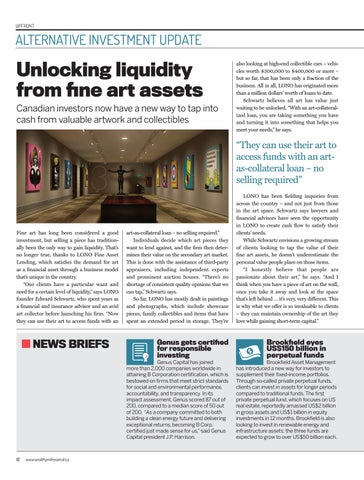
Unlocking liquidity from fine art assets Canadian investors now have a new way to tap into cash from valuable artwork and collectibles
also looking at high-end collectible cars – vehicles worth $300,000 to $400,000 or more – but so far, that has been only a fraction of the business. All in all, LONO has originated more than a million dollars’ worth of loans to date. Schwartz believes all art has value just waiting to be unlocked. “With an art-collateralized loan, you are taking something you have and turning it into something that helps you meet your needs,” he says.
“They can use their art to access funds with an artas-collateral loan – no selling required”
Fine art has long been considered a good investment, but selling a piece has traditionally been the only way to gain liquidity. That’s no longer true, thanks to LONO Fine Asset Lending, which satisfies the demand for art as a financial asset through a business model that’s unique in the country. “Our clients have a particular want and need for a certain level of liquidity,” says LONO founder Edward Schwartz, who spent years as a financial and insurance advisor and an avid art collector before launching his firm. “Now they can use their art to access funds with an
NEWS BRIEFS
art-as-collateral loan – no selling required.” Individuals decide which art pieces they want to lend against, and the firm then determines their value on the secondary art market. This is done with the assistance of third-party appraisers, including independent experts and prominent auction houses. “There’s no shortage of consistent quality opinions that we can tap,” Schwartz says. So far, LONO has mostly dealt in paintings and photographs, which include showcase pieces, family collectibles and items that have spent an extended period in storage. They’re
Genus gets certified for responsible investing
Genus Capital has joined more than 2,000 companies worldwide in attaining B Corporation certification, which is bestowed on firms that meet strict standards for social and environmental performance, accountability, and transparency. In its impact assessment, Genus scored 87 out of 200, compared to a median score of 50 out of 200. “As a company committed to both building a clean energy future and delivering exceptional returns, becoming B Corp. certified just made sense for us,” said Genus Capital president J.P. Harrison.
12
LONO has been fielding inquiries from across the country – and not just from those in the art space. Schwartz says lawyers and financial advisors have seen the opportunity in LONO to create cash flow to satisfy their clients’ needs. While Schwartz envisions a growing stream of clients looking to tap the value of their fine art assets, he doesn’t underestimate the personal value people place on those items. “I honestly believe that people are passionate about their art,” he says. “And I think when you have a piece of art on the wall, once you take it away and look at the space that’s left behind … it’s very, very different. This is why what we offer is so invaluable to clients – they can maintain ownership of the art they love while gaining short-term capital.”
Brookfield eyes US$150 billion in perpetual funds
Brookfield Asset Management has introduced a new way for investors to supplement their fixed-income portfolios. Through so-called private perpetual funds, clients can invest in assets for longer periods compared to traditional funds. The first private perpetual fund, which focuses on US real estate, reportedly amassed US$2 billion in gross assets and US$1 billion in equity investments in 12 months. Brookfield is also looking to invest in renewable energy and infrastructure assets; the three funds are expected to grow to over US$50 billion each.
www.wealthprofessional.ca
12-13_Update ALT-SUBBED.indd 12
21/09/2017 10:13:14 PM
Q&A
Mark Lustig
Opening opportunities in the cannabis market
CEO CANNAROYALTY CORPORATION
Years in the industry 16 Fast fact CannaRoyalty recently closed a $12 million debt-financing agreement with Sprott that will allow CannaRoyalty to continue building its portfolio of cannabis assets
What unique or lucrative investment opportunities have you managed to find in the cannabis space for investors? The largest opportunity that we have unlocked for investors has been our investments – ongoing and future – in the creation of CR brands. To us, this is all about creating, manufacturing and distributing the highest-quality, most consistent and most reliable products for patients and consumers. Currently, these brands are in the US, and the window for products in Canada won’t open until July 1 next year, when the full adult-use market opens.
What unique or lucrative investment opportunities have you managed to find in the cannabis space for investors? We have. At one point in our history, we had some discussions with the TSX about becoming a listed company, but they were not willing to list us due to their concerns about Canadian companies that have investments in the US cannabis market, where federallevel legalization is still pending. What’s happened since then is that the Canadian Stock Exchange has listed companies like ours that have US exposure, and the TSX now also has some names with US exposure. We believe there will be a unification of the policies that will clarify this in the future.
Wealthsimple offers multi-asset portfolios
Shaunessy Investment Counsel [SIC] has partnered with Wealthsimple to make its premium, multi-asset global portfolio accessible to the public. The portfolio was previously open only to four First Nation trusts and 23 families. Through the Wealthsimple for Advisors platform, investors can access to SIC’s principal investment strategy, which aims for longterm growth with limited risk through globally diversified exposure to stocks, bonds and alternative investments, with no minimum account size requirement.
How have these investments have been growing in terms of both returns and demand? We’ve had 20 different investments that we’ve made into our assets. Happily, all of those have either stayed the same or increased in value – in some cases dramatically. In terms of demand for our products, it’s clear that demand for cannabis products is going to be extremely high. Drilling down into our products, I believe we happen to have great brands that are made properly with the right procedures. I think our brands are going to stick out versus the rest of the sector because of our commitment to quality and consistency. You have to invest in these products to make them effective, and I think a lot of people tend to cut corners and put products out because they’re easy to make.
How will your recent debt-financing arrangement with Sprott affect your current and future investors? I think it’s going to affect them very positively. Sprott is a great partner for us on a strategic level. On a financial level, having access to debenture financing entails lower capital costs for us, compared to issuing common equity and diluting our shareholders. We’re looking at a half-dozen new investment opportunities in Canada with our Sprott fund; in the US, we have the same number in some new markets and across some new product lines.
Developers see opportunity in old malls
Dormant malls in the US are starting to see new life as e-commerce warehouses. According to analysts, 400 out of roughly 1,100 malls in the US will shut down in the coming years. Meanwhile, the demand for fast online package delivery has companies searching for distribution facilities closer to residential areas or highways, and developers are responding by refurbishing former department stores. Local communities are receptive, hoping such new distribution centres can drive commerce and employment growth.
RBC GAM unveils fossil-fuel-free fund
RBC Global Asset Manage ment has launched the RBC Vision Fossil Fuel Free Global Equity Fund, which seeks long-term capital growth from global equity securities. The fund excludes companies based on their direct involvement in the coal, oil or natural gas industries, as well as inclusion on the Carbon Underground 200, a global ranking of companies with the highest carbon-emission potential. Five series (A, F, ISC, LL, D) are available to individual investors; series O units are reserved for institutional clients.
www.wealthprofessional.ca
12-13_Update ALT-SUBBED.indd 13
13
21/09/2017 10:13:25 PM
UPFRONT
ETF UPDATE NEWS BRIEFS Study warns against focusing on dividend yield ETFs
Not all dividend yield ETFs are equally lucrative. A recent study from Morningstar found several cases where yield-focused funds ended up overexposed to the financial and energy sectors, making them vulnerable during collapses in those segments. Certain funds also fail to screen against companies that finance dividends through debt. To avoid this, Morningstar recommends investors seek funds with additional filters for profitability, market capitalization and a history of decent dividend payments, as well as a cap on weightings toward any one sector.
Redwood Asset Management delves into emerging markets
Redwood Asset Management has launched its seventh ETF on the NEO Exchange: the Redwood Emerging Markets Dividend ETF (REM). Designed to provide exposure to the long-term growth of emerging markets, the fund aims to mitigate volatility and provide current income. With a value-oriented approach, it provides exposure to highquality, income-generating companies in developing countries while focusing on downside protection. As of July 31, the fund had holdings of $54.5 million and a management fee of 0.9%.
First Asset Management offers lower-risk international ETF
First Asset Management has introduced a new addition to its suite of MSCI index-based ETFs. The First Asset MSCI International Low Risk Weighted ETF is available in Canadian dollar-hedged (RWX) and unhedged (RWX.B) units. The ETF is designed to replicate the performance of the MSCI EAFE Index,
14
which includes large and mid-cap stocks within developed markets outside of North America, which have been reweighted to give greater exposure to stocks with lower risk. By doing so, the ETF’s underlying indices aim to put greater emphasis on stocks with lower volatility while maintaining reasonable liquidity and capacity.
WisdomTree European ETF now includes unhedged units
WisdomTree has introduced a new investment option for its Europe Hedged Equity Index ETF (EHE). While the original units of the fund provide Canadian-dollar-hedged exposure to dividend-paying European equities, the new units will not be hedged to the Canadian dollar. The underlying index is composed of European companies with market capitalization of at least US$1 billion, which derive at least 50% of their revenue from countries outside of Europe. WisdomTree’s Canadian suite now consists of eight ETFs, including hedged, non-hedged and variably hedged unit classes.
New Hamilton Capital ETF targets US financial sector
Hamilton Capital Partners has launched its third ETF for Canadian investors. The Hamilton Capital US Mid-Cap Financials ETF (HFMU.U) is designed to generate long-term returns in US dollars through an actively managed portfolio of USbased mid-cap financial stocks. The fund seeks returns in the form of capital growth and dividend payments. “We believe HFMU.U’s combination of US mid-cap financials stand to benefit from rising rates, improving GDP, ongoing sector consolidation, and exposure to faster-growing states and regions,” said Rob Wessel, managing partner of Hamilton Capital Partners.
Bringing innovation to the ETF market Evolve Funds has exploded into the Canadian ETF space with forward-looking products With more than 500 ETFs currently competing in Canada, some might assume the industry is getting saturated. But one industry veteran has a different view: “I think that there are a lot of opportunities if you develop innovative products for Canadian investors,” says Raj Lala, president and CEO of Evolve Funds. “I believe that the ETF industry is going to continue to flourish, given all of the different drivers and the way advisors are gravitating more toward efficient, lower-cost products for their clients.” That thinking inspired Lala – an industry veteran who has launched two investment product businesses and previously served as the Canadian head of WisdomTree – to launch Evolve Funds. He started by doing a deep dive to find gaps in the industry. “I saw that there was still an opportunity in the active ETF space,” he says. “I felt that it would most likely be easier for advisors migrating their books from actively managed mutual funds to shift towards actively managed ETFs versus going all the way to pure passives.” Lala looked for specific segments where active managers had generated better riskadjusted returns than their benchmark, and then determined where there would be investor interest. He eventually uncovered themes in the passive space that were either unserved or underserved. The Evolve North American Gender Diversity Index ETF (HERS) is focused on investing in large-cap North American
www.wealthprofessional.ca
14-15_Update ETF-SUBBED.indd 14
21/09/2017 10:14:23 PM
companies that have proactive gender diversity policies. The Evolve Cyber Security Index ETF (CYBR) is geared toward companies involved in hardware and software protection against cybercrime. The Evolve Automobile Innovation Index ETF (CARS) is built around
“Some of the ETFs encompass topics that many of us are talking about at the dinner table” innovations in the automobile space, particularly autonomous driving, electric drivetrains and network-connected services. The Evolve US Banks Enhanced Yield ETF (CALL) invests in large US banks, while the Evolve Global Healthcare Enhanced Yield ETF (LIFE) invests in large healthcare companies; both use covered calls to protect against downside risk. Lala and his team also identified worldclass portfolio managers to run each segment – managers that Canadians typically don’t have access to. “Most active ETF managers tend to select from their internal stable of portfolio managers,” Lala says. “Because we’re independent, we can take a more unlimited view in selecting those managers.” As a seasoned developer and promoter of investment products, Lala understands the importance of looking at themes that are topical and relevant in the world. “I think sometimes in the investment world, we tend to make things a little bit more complicated than they need to be,” he says. “Some of the ETFs we are launching encompass themes that intersect in people’s daily lives and topics that many of us are talking about at the dinner table.”
Q&A
Christina Ashmore Managing director IFSE INSTITUTE
Years in the industry 20 Fast fact The IFSE Institute offers 22 courses for Canadian financial professionals on topics that include ETFs, exempt markets and CRM2
New course promotes ETF proficiency Why is taking an ETF proficiency course is essential for those working in the Canadian investment industry? We believe that education is the cornerstone of a strong industry; the greater the proficiency and knowledge of those giving advice, the better they can serve the investment public. With regard to ETF proficiency, we’re confident that our course provides advisors in the ETF space with a greater understanding of the unique features of the products, how they work, the risks involved and other aspects. We equip our students with the knowledge to, in turn, give their clients the knowledge and confidence to make better financial decisions. IIROC registrants are not required to take an additional proficiency course specifically for ETFs, but they must still operate under the ‘know your product’ requirement that applies to everybody who gives advice on ETFs. MFDA registrants are able to sell ETFs with their registration, but they’re required to have an additional proficiency because ETFs are different from traditional mutual funds. They have to understand ETFs, especially when it comes to trading on the stock exchange; our course teaches them how the stock exchange operates and the rules that guide it.
What resources and material did you draw from in formulating the ETF proficiency course? We really wanted to put out a high-quality product for the industry, so we reached out to several leaders on the ETF side of the business, including product manufacturers and industry experts. They contributed their knowledge and expertise to help us create a robust and practical course. When we designed the course, not only did we address all the topics that the MFDA outlined in its Policy No. 8, but we also incorporated a case study that walks the student through a due diligence exercise. If there are changes in the ETF space, then we would reach out to subject-matter experts.
Are there any prerequisite courses for advisors who are thinking about enrolling in the course? For advisors to give advice on ETFs, they have to complete the underlying proficiency related to their registration. For instance, MFDA advisors have to successfully pass a licensing exam, such as the Canadian Investment Funds Course exam. At the same time, we encourage those who work in the industry to think of their careers holistically. IFSE offers a wide range of courses to help people advance their careers. It comes down to our fundamental commitment to strengthening the industry by helping individuals improve their knowledge and professionalism, which we believe leads to better outcomes for investors. At the end of the day, we’re all here to serve the investment public and provide the best advice possible.
www.wealthprofessional.ca
14-15_Update ETF-SUBBED.indd 15
15
21/09/2017 10:14:32 PM
UPFRONT
OPINION
GOT AN OPINION THAT COUNTS? Email wealthprofessional@kmimedia.ca
Advisors: fight the ban Advisors can help keep financial advice accessible to all Canadians, writes Advocis president Greg Pollock, by opposing the proposal banning embedded commissions CAN YOU imagine a world where the only people who can afford quality financial advice are the wealthy? Where countless average Canadians simply wouldn’t have access to financial advice from a qualified financial advisor because they can’t afford the direct fees? That scenario may soon become a reality if the CSA’s proposed ban on embedded commissions goes through. If you work in the financial advice or financial planning business in Canada, you’re likely aware of this issue. But to recap, in January 2017, the Canadian Securities Administrators issued a consultation paper proposing a ban on mutual fund embedded commissions, with the general idea that such a ban would protect consumers from being misled by advisors. The CSA opened up a 150-day consultation period, ending June 9, in which thoughts on the issue could be submitted for consideration. Advocis, the Financial Advisors Association of Canada, immediately took an aggressive stand against a ban and began to spread the word that eliminating embedded commissions would be a massive mistake. We believe people deserve a choice in how they pay for financial advice – whether through commissions or direct fees – and we think that as long as those options are transparent, there should be no issue. Taking away that choice is just not right. Such a ban would severely limit access to financial advice for the average Canadian. Someone living on a tight budget might not have extra cash in their wallet to pay direct fees to a financial advisor – so they may opt out
16
of seeking professional financial advice altogether. And as an oft-cited independent Cirano study has shown, using an advisor has clear benefits: Working with a financial advisor can increase the value of assets to nearly four times
do so. And we strongly urge you to encourage all your clients to do so. The future of your profession is at stake. When the CSA’s consultation period ended on June 9, Advocis made sure to get all of these important points across in our official submission. We made all the perils of a ban very clear, but we also proposed a better solution: professionalization of financial advice. Right now, anyone can call themselves a financial advisor. Unlike doctors, accountants and lawyers, financial advisors don’t have one professional body overseeing and regulating the profession. That’s why Advocis is pushing for a ‘professions model,’ which would replace any need for a ban on embedded commissions and allow Canadians to retain a choice in how they pay for financial advice. A self-regulating professional body would ensure that everyone who calls themselves a financial advisor or financial planner would have to meet ongoing proficiency standards,
“We believe people deserve a choice in how they pay for financial advice – whether through commissions or direct fees – and we think that as long as those options are transparent, there should be no issue” more than those who don’t use an advisor. The more we can do to increase the wealth of the country as a whole, the better. But would having to pay direct fees really deter people from using an advisor? Recent research from the Gandalf Group says yes: 24% of all investors surveyed said having to pay a direct fee for financial advice would indeed be a disincentive for them to seek advice. To fight the CSA’s proposed ban, Advocis embarked on our Financial Advice for All campaign in early 2017. As part of the campaign, Canadians can sign up on Financial AdviceForAll.com and, through the website, send a letter to their local provincial politician, letting them know that a ban on embedded commissions would be a devastating mistake. If you’re an advisor and you haven’t visited the site and sent a letter yet, we strongly urge you
satisfy continuing education requirements and adhere to an enforceable code of professional and ethical conduct. This quote from our submission to the CSA sums it up nicely: “Professional advisors must be involved in their own regulation and, as professionals, must be subject to the highest of standards – including a duty to act in their clients’ best interests. In doing so, we can preserve choice and access to advice for all investors, regardless of their wealth, while increasing the quality of the advisory relationship that is so critical to achieving financial independence.” Greg Pollock is the president and CEO of Advocis, which advocates for professionalism and consumer protection, and has more than 12,000 members in 40 chapters nationwide.
www.wealthprofessional.ca
16-17_Opinion-SUBBED.indd 16
21/09/2017 10:15:58 PM
Indulge in responsibility Many investors believe that being a responsible investor comes at the cost of financial returns With the IA Clarington Inhance SRI Funds you can have your cake and eat it too. The goal of the IA Clarington Inhance SRI Funds is to combine financial return and positive societal impact. These funds are solely invested in companies with a strong record of environmental policies, corporate governance and human rights. Talk to your financial advisor about how the IA Clarington Inhance SRI Funds can make a difference in the world around you – and your portfolio. IA CLARINGTON INHANCE SRI FUND LINEUP: IA Clarington Inhance Bond SRI Fund NEW IA Clarington Inhance Monthly Income SRI Fund IA Clarington Inhance Canadian Equity SRI Class IA Clarington Inhance Global Equity SRI Class
IA Clarington Inhance Conservative SRI Portfolio IA Clarington Inhance Balanced SRI Portfolio IA Clarington Inhance Growth SRI Portfolio
Learn more at iaclarington.com/inhance
Commissions, trailing commissions, management fees and expenses all may be associated with mutual fund investments. Please read the prospectus before investing. Mutual funds are not guaranteed, their values change frequently and past performance may not be repeated. The iA Clarington Funds are managed by IA Clarington Investments Inc. iA Clarington and the iA Clarington logo are trademarks of Industrial Alliance Insurance and Financial Services Inc. and are used under license.
16-17_Opinion-SUBBED.indd 17
21/09/2017 10:16:25 PM
PEOPLE
INDUSTRY ICON
PROMOTING FROM WITHIN Jean-Philippe Lemay outlines his expectations following his appointment as president and COO of Fiera Capital’s Canadian operations
WHEN SEARCHING for a successor to outgoing president and COO Sylvain Roy earlier this year, Fiera Capital didn’t have to look far. Jean-Philippe Lemay had already distinguished himself as Fiera’s chief investment officer in Canada, having joined the firm after its acquisition of Natcan Investment Management in 2012. Now Lemay will combine the roles of CIO and COO, at least temporarily. It’s a challenging position, but he’s confident that his career so far has given him the right preparation to succeed in his new dual role. “My background is as a portfolio mana ger, so I was close to the clientele,” Lemay says. “Over the past seven years, I think the clients have become much more demanding in terms of firms listening to their actual investment needs and being able to build solutions that are targeted at specific investment outcomes.” In that respect, Lemay believes his firm is among the best in the industry. Fiera Capital offers a variety of different investment products, ranging from traditional equity mutual funds to more specialized alternatives, covering hedge funds, real estate and infrastructure. “Whether it’s an institutional client or an investment fund, our ability to construct a specific solution for a particular objective is really something that has trended in the
18
past few years and will become even more present in terms of the value we bring to the table,” he says.
Product innovation Now overseeing the Canadian operations for one of the country’s most successful independent asset managers, Lemay has had a steady ascent in the investment
in a portfolio is key in being able to sustain one of these storms.” Having a variety of different strategies available for its clients is a point of pride for Fiera Capital. Lemay identifies examples in both traditional and alternative funds that have provided impressive returns in recent years. “Our global equity strategy has been
“The financial crisis really highlighted the need to maintain a certain level of liquidity and to have different solutions in portfolios. The liquidity that you build in a portfolio is key in being able to sustain one of these storms” space. A student of actuarial science, he brought that expertise to major institutions like Aon, Caisse de dépôt et placement du Quebec and Standard Life Investments. It was during his time at Standard Life that he learned some important lessons regarding portfolio construction. “With Standard Life, I was working mainly in fixed-income securities,” Lemay says. “The financial crisis really highlighted the need to maintain a certain level of liquidity and to have different solutions in portfolios. The liquidity that you build
named as one of the best-performing managers in the world, and our US equity strategy has also delivered strong returns,” he says. “On the alternative side, our market-neutral and long-short funds have also delivered very strong performance, with a real focus on the resource sector in Canada.” The alternative space is where Fiera has really set its sights on driving business in the years ahead. In its most recent earnings report, company chairman and CEO Jean-Guy Desjardins announced “strong
www.wealthprofessional.ca
18-21_Industry Icon-SUBBED.indd 18
21/09/2017 10:17:26 PM
PROFILE Name: Jean-Philippe Lemay Title: President, chief operating officer and chief investment officer Company: Fiera Capital Canada Based in: Montreal Years in the industry: 14 Fast fact: Lemay has a bachelor’s degree in actuarial sciences from Université Laval, as well as a master’s in financial mathematics from Stanford University. He began his career as a financial risk management consultant with Aon
www.wealthprofessional.ca
18-21_Industry Icon-SUBBED.indd 19
19
21/09/2017 10:17:45 PM
PEOPLE
INDUSTRY ICON
revenue growth, driven primarily from our US division, as well as from our newly established private alternative investments division.” It’s now Lemay’s responsibility to ensure that Fiera’s Canadian business can keep up that pace, and alternative strategies will be key to achieving that goal. “The way we are looking to grow in the
Global reach Fiera, founded in 2002, has clearly outgrown its Quebec roots and today is a true international operation. The firm has offices in major financial centres like Toronto, New York, Frankfurt and London, and Lemay credits its expansion to vision in the boardroom. “I would like to raise my hat to Jean-Guy
“To be a strong player in the industry, you need to have a footprint across the globe. Right now we are really focused on developing our capabilities in the US, as well as Canada. We also have an operation on the emerging markets side based in London” future is really focusing on alternatives,” he says. “We are present in the hedge fund space and even more present in private alternatives – real estate, infrastructure and agriculture. In the private debt space, we are also building capabilities as well.” In addition, Fiera is developing more niche products that target specific sectors. In June, it launched an agriculture solution through subsidiary Fiera Comox. Fiera describes the strategy as “offering investors access to high-quality agriculture and private land equity with attractive investment features, particularly low correlation to other asset classes and effective inflation hedge.” “We are partnering with different operators across the world, but mainly in New Zealand and Australia, as well as North and South America,” Lemay says. “We partner on agriculture projects and land operations, whether it is crops, cattle or other traditional farming operations.”
20
Desjardins, our chairman – to be a strong player in the industry, you need to have a footprint across the globe,” he says. “Right now we are really focused on developing our capabilities in the US, as well as Canada. We also have an operation on the emerging markets side based in London, and we are looking to expand in that segment and geography as well.” While the firm has lofty ambitions for the international market, Canada is its home base and will remain a major part of its business. In that respect, Lemay will play a pivotal role in the overall success of Fiera Capital in the future. “If I look at our Canadian business, we will continue to expand on our wealth presence – that’s on the distribution side,” he says. “From the manufacturing side, we want to give more access to the best alternatives strategies we have to offer. Those two will be key for us in the years ahead.”
FIERA CAPITAL AT A GLANCE
PRESENCE Headquartered in Montreal, Fiera Capital has offices throughout North America and Europe
ASSETS The firm reported AUM of $125.7 billion in its Q2 2017 earnings – a 15% year-over-year increase
DIVIDENDS Fiera’s growth over the past year also resulted in a 6% increase in its quarterly dividend to shareholders
VISION The firm has set a goal of $200 billion in AUM by the end of 2020
SOUTH OF THE BORDER In the US, asset management services are provided by its US affiliates, Bel Air Investment Advisors and Fiera Capital
www.wealthprofessional.ca
18-21_Industry Icon-SUBBED.indd 20
21/09/2017 10:18:00 PM
PSB
PIB
Bad timing can hurt bond performance. PowerShares laddered corporate bond ETFs help reduce reinvestment risk, with potentially higher yields than similarly rated government debt.
You have the power. Visit powershares.ca.
Commissions, management fees and expenses may all be associated with investments in exchange-traded funds (ETFs). ETFs are not guaranteed, their values change frequently and past performance may not be repeated. Please read the prospectus before investing. Copies are available from Invesco Canada Ltd. at powershares.ca. There are risks involved with investing in ETFs. Please read the prospectus for a complete description of risks relevant to the ETF. Ordinary brokerage commissions apply to purchases and sales of ETF units. Most PowerShares ETFs seek to replicate, before fees and expenses, the performance of the applicable index, and are not actively managed. This means that the sub-advisor will not attempt to take defensive positions in declining markets and the ETF will continue to provide exposure to each of the securities in the index regardless of whether the financial condition of one or more issuers of securities in the index deteriorates. In contrast, if a PowerShares ETF is actively managed, then the sub-advisor has discretion to adjust that PowerShares ETF’s holdings in accordance with the ETF’s investment objectives and strategies. PowerShares is a registered business name of Invesco Canada Ltd. Invesco® and all associated trademarks are trademarks of Invesco Holding Company Limited, used under licence. PowerShares® and all associated trademarks are trademarks of Invesco PowerShares Capital Management LLC (Invesco PowerShares), used under licence. © Invesco Canada Ltd., 2017
18-21_Industry Icon-SUBBED.indd 21
21/09/2017 10:18:11 PM
FEATURES
SPECIAL REPORT
When it comes to gender diversity in leadership positions, Canada is an international laggard. The 26 women on this year’s Women of Influence list are set to change that
22
www.wealthprofessional.ca
22-43_Women of Influence-SUBBED Final.indd 22
23/09/2017 12:19:34 AM
WOMEN OF INFLUENCE INDEX
CANADA HAS developed a reputation as a progressive force on the international stage. When Justin Trudeau named a gender-balanced cabinet, it attracted a lot of headlines worldwide, but a closer look at the data paints a different picture of the Great White North. In the 2017 edition of Deloitte Global’s Women in the Boardroom report, it was revealed that Canadian women hold only 18% of board seats nationwide. This represented a 5% increase since 2015, but Canada is still far from being a global leader on diversity – in Norway, for example, 42% of board seats are held by women. One positive is financial services, where gender diversity in C-suite positions is consistently trending higher, thanks in large part to organizations like Women in Capital Markets. There’s still a long road ahead before gender balance is realized in the top jobs, but progress is clearly being made. Wealth Professional Canada’s Women of Influence list is reflective of the fact that more and more firms are realizing the value of greater diversity in the workplace. The European Institute for Gender Equality [EIGE] reported earlier this year that gender equality creates more jobs, increases GDP per capita and can better prepare society to adapt to the challenges related to the aging population. All of those issues are relevant to Canada in general, as well as the wealth management business. While this year’s Women of Influence hold different opinions regarding how the industry is faring in terms of its gender balance, all agree that better female representation can only benefit everyone concerned.
NAME
COMPANY
Apollinaro, Michelle Bast, Esther Birenbaum, Rona Black, Jennifer Bonten, Laurie Connolly, Michelle Dolan, Patti Eull-Schultz, Dona Hastings, Léony deGraaf Hicks, Millicent Horwood, Alexandra Horwood, Rosemary Kanji, Yasmin Keehn, Kelley Lebrun-Reid, Damienne Lemieux, Jennifer Moffatt, Marcia Morphet, Gaelen Murray, Sheila Porter, Jackie Puffer, Marlene Reynolds, Jennifer Simmons, Shannon Lee Stewart, Barbara Thompson, Kim Weismann, Monica
B&A Financial/HollisWealth Investors Group Caring For Clients DFS Private Wealth Wellington-Altus Private Wealth CI Investments SAGE Investment Advisors/Raymond James Leon Frazer & Associates deGraaf Financial Strategies ScotiaMcLeod Alexandra Horwood & Partners/Richardson GMP Rosemary Horwood Wealth/Richardson GMP Echelon Wealth Partners Financial Planning Standards Council Financial Planning Standards Council RBC Dominion Securities BlackRock Canada Sentry Investments CI Financial Carte Wealth Management Alignvest Investment Management Toronto Financial Services Alliance New School of Finance Rich Thinking Credential Financial Manulife Securities
PAGE 32 32 30 31 30 34 38 34 37 36 42 39 35 33 40 40 41 25 38 36 27 26 26 25 42 28
ABOUT THE SPONSOR Mackenzie Investments has been helping Canadians since 1967, when we started with one person managing investments for one investor in Toronto. Today, we’re a holistic asset management partner for thousands of Canadian financial advisors and the investors they support across the country. Our commitment to them is to help investors achieve financial success and feel confident about the future. We partner with advisors and the investors they work with by bringing them innovative investment solutions, excellent asset management and superb service. Our team delivers innovation and expertise through mutual funds, ETFs, alternative investments, private wealth pools and managed solutions. We also offer a charitable giving program, as well as solutions for saving for a child’s education and giving financial assistance to people with disabilities. We strive to bring insights, data and tools to advisors to help them support their clients. Helping investors and advisors – that’s where everything starts for us. Always.
www.wealthprofessional.ca
22-43_Women of Influence-SUBBED Final.indd 23
23
23/09/2017 12:19:34 AM
FEATURES
SPECIAL REPORT WOMEN IN LEADERSHIP BY THE NUMBERS
WOMEN STILL UNDER-REPRESENTED AT SENIOR LEVELS
CEOs/heads 5.1%
Top earners 6.9%
Nearly 50% of Canada’s boards and 41% of executive teams still have no women
Board directors 15.9%
Senior officers 18.1%
Only 15% of 521 board seats open in 2016 were filled by women
Canadian labour force 47.3%
Fewer TSX-listed companies added at least one woman to the board in 2016 (10% in 2016 versus 15% in 2015)
Management occupations 35.7%
Source: CFA Society Toronto 2017 Annual Pension Conference
Source: Women in Capital Markets
WOMEN IN THE BOARDROOM: A GLOBAL PERSPECTIVE 45% 40%
40%
35%
34%
On Canada’s corporate boards, only 12% of directors are female
33% 29%
30%
29% 26%
25%
24%
23%
22%
21% 20%
20%
19% 16%
15%
13%
12%
10% 5% 0%
ay rw No
nce Fra
n ede Sw
d lan Fin
m giu Bel
UK
nds rla the e N
X60 a TS d a Can
lia tra Aus
ny ma Ger
in Spa
US
tria Aus
d lan Ire ada Can
e) tur ven n (no
Source: Women in Capital Markets
24
www.wealthprofessional.ca
22-43_Women of Influence-SUBBED Final.indd 24
23/09/2017 12:19:38 AM
reading for those searching for insight on how women’s place in the corporate sector has evolved. In a recent white paper, Stewart investigated the positive changes
reach a target market that has so far proven pretty elusive. “New communication styles may be more effective in connecting with non-Western cultures and those under 35
“I work with many strong, capable female clients, but this type of woman is not being shown”
BARBARA STEWART Independent researcher and author Rich Thinking Years in the industry: 25
Formerly a partner and portfolio manager with Cumberland Private Wealth Management, Barbara Stewart’s Rich Thinking series of monographs is essential
GAELEN MORPHET Chief investment officer Sentry Investments Years in the industry: 33
Since making her start as a financial analyst with McLeod Young Weir in 1984, Gaelen Morphet has worked with some of North America’s largest financial institutions:
being brought on by greater female representation in the boardroom. “I predict that the financial industry will begin to encourage and embrace the feminine style of communication, including real-life stories, nuance and feeling,” Stewart wrote. “That may not appeal to 100% of women, but it is likely to be welcomed by the majority. Interestingly, it is also likely to be more useful in reaching men – especially those who are turned off by traditional forms of financial marketing.” According to Stewart’s research, greater diversity will also allow financial advisors to
Scotiabank, Merrill Lynch, CIBC, Empire Life and now Sentry Investments. If a glass ceiling exists for women in financial services, it has not hindered her ascent. As an executive herself, Morphet believes progress has been made on female representation in the boardroom. “I have been on a number of boards, and I know there is a real impetus to improve diversity on boards,” she says. “Improvements have been made, but there is still a ways to go.” In Morphet’s opinion, while firms are keen to have more women in leadership positions, a quest for gender diversity shouldn’t supersede common sense. A CEO needs to be the best qualified person, regardless of sex, which has to be taken into account when assessing whether companies are being progressive on this issue. “A lot of boards want women in CEO or CFO positions, but there are a limited number of those type of positions,” she says. “I don’t think boards are choosing not to have women in those positions, but there
(of both genders) who already tend to think and speak in gender-neutral ways.” A CFA charterholder, Stewart regularly writes for the CFA website, including an article in which she discussed media misrepresentation of women in the workplace. “I started Rich Thinking research in 2011 because I knew that the subject of women and finance was not being portrayed accurately by the media or in the financial industry,” she wrote. “In my daily dealings as a portfolio manager, I work with many strong, capable female clients, but this type of woman is not being shown.”
“I have been on a number of boards, and I know there is a real impetus to improve diversity” is a limited pool of those who meet the standards required.” While some countries have introduced quotas for female representation on boards, Morphet believes reform should come from within companies. Financial services is already one of the more progressive sectors in Canada on this issue, so she believes the motivation is there to improve. “There are different provinces in Canada that advocate differently for women on boards,” she says. “I think companies should be encouraged, but not forced into having quotas. “
www.wealthprofessional.ca
22-43_Women of Influence-SUBBED Final.indd 25
25
23/09/2017 12:19:43 AM
FEATURES
SPECIAL REPORT
JENNIFER REYNOLDS CEO Toronto Financial Services Alliance Years in the industry: 17
Fresh from a four-year stint as president and CEO of advocacy group Women in Capital Markets, Jennifer Reynolds has been named the new head of the Toronto Financial Services Alliance, and she has a lot of confidence that Canada’s largest
city can become an even greater force on the world stage. “I think there are a lot of opportunities to grow our financial sector, make sure our global profile is recognized and really attract top talent,” she says. During her time with Women in Capital Markets, Reynolds dedicated herself to improving diversity in the financial sector. “I know that in the financial sector, our numbers are much better than other industries – board representation is, on average, around 25%,” she says. “If you look at our OECD peers, you would find that we are at the bottom of the barrel. So we have some work to do, but I think the financial sector is leading and will continue to lead.” In the wealth management space, the gender balance is still heavily skewed toward men, but Reynolds has noticed a change in recent years. “There is a massive transfer of wealth to women taking place – in Canada, women control about 40%
SHANNON LEE SIMMONS Founder New School of Finance Years in the industry: 10
The founder of the New School of Finance, Shannon Lee Simmons believes the industry is becoming more diverse, but there remains much to be done. “Over the past decade, I have noticed more women choosing to work in the wealth management industry, primarily in clientfacing, management and client care roles,” she says. “As positive as this is, I would still like to see more female representation in analytical, technical, executive and C-suite roles, all of which are still male-dominated.” In Simmons’ opinion, one way to change this imbalance is to ensure that starting a family doesn’t harm a woman’s career. “In order to improve gender diversity, I think that encouraging male employees to take advantage of paternity leave is an important change wealth
26
of investment assets,” she says. “There are two things happening: Women are making more of their own money, and they also tend to live longer than their
“There is a massive transfer of wealth to women taking place – in Canada, women control about 40% of investment assets” spouses. When a spouse passes away, in about 75% to 80% of instances, women will change their investment advisor. That’s not to say that every female client wants a female advisor, but I do think having better diversity will change the tone and culture.”
management companies can make,” she says. “The more normalized paternity leave becomes, the more level the employment playing field will be for young women in this industry.” However, Simmons adds that family matters aren’t the only thing holding women back from reaching the same heights as their male counterparts. “Women in this industry must work harder to be taken seriously without being seen as bossy or aggressive,” she says. “In the last year alone, while being interviewed for my work in the financial field, I have been asked to pose for photos while peeking out from behind a tree, putting on lipstick and jumping in the air. Can you imagine a man being asked to pose that way? While everyone was well intentioned, this is a great example of how being a woman automatically meant I should present myself as fun, lighthearted and non-threatening. Unconscious sexism helps keep the glass ceiling firmly in place.”
www.wealthprofessional.ca
22-43_Women of Influence-SUBBED Final.indd 26
23/09/2017 12:19:48 AM
MARLENE PUFFER Partner Alignvest Investment Management Years in the industry: 27
Marlene Puffer’s career began in academia: The holder of a PhD in finance and applied statistics, Puffer taught finance at the University of Toronto’s Rotman School of Management. After leaving the education field, she brought her skills to the investment space, working for RBC Capital Markets, BMO Nesbitt Burns and PIMCO Canada before going on to start her own firm, Twist Financial, in 2005. In 2014, Puffer became a partner with the newly formed Alignvest Investment Management, and she also sits on the board of the Healthcare of Ontario Pension Plan. It’s an impressive CV, and Puffer is confident there are many more women who can follow in her footsteps. “Out of undergraduate commerce programs, more than half are women,” she says. “Where we see some bottleneck is with CFA and MBA candidates, where a minority are women – around the 25% to 30% level – so there is a challenge there. Overall, though, the talent pool coming out of undergraduate programs is plenty diverse.” In Puffer’s opinion, however, there has been a distinct lack of progress on gender diversity, especially in leadership positions, since she began her career. “On the wealth management side, when it comes to portfolio management and the actual decision-making on investments, there has been very little change,” she says. “Diverse candidates are small in number, and they tend to be in the non-revenue-generating roles – support functions like HR and marketing.” There are a number of factors that contribute to this disparity, she says, and companies aren’t entirely to blame. Clients have the power to influence change, too. “There are a lot
“It is only now happening that investors are beginning to pressure investment management firms to explain their diversity policies” of possible explanations, including hiring practices with a lack of mentoring and networking, which means women are not aware of opportunities,” she says. “There has been a lack of focus on the part of clients; it is only now happening that investors are beginning to pressure investment management firms to explain their diversity policies.” Both the regulators and the government have made efforts to
improve female representation in the boardroom; in 2015, the OSC introduced its ‘comply or explain’ model for all non-venture issuers, which requires them to make annual disclosures about women on boards and in executive officer positions. It was a step in the right direction, Puffer says, but it should be one of many. “In corporate Canada, the numbers are staggeringly disappointing,” she says. “The big banks and insurance companies have been leaders in this area, but when you get below the top handful of publicly listed companies, more than half of companies on the TSX don’t have a diversity policy, and around half have no female board members at all.” That’s not to say this issue is being ignored – organizations like The 30% Club, the Canadian Coalition for Good Governance, Catalyst and Women in Capital Markets are all working to address the problem. As such, Puffer is confident that change is happening, albeit belatedly. “There is an event coming up in the fall that will involve all those organizations, and the government is releasing a combined set of action points,” she says. “We are moving from talk to action in a very concrete way.”
www.wealthprofessional.ca
27
FEATURES
SPECIAL REPORT
“I personally have mentored a number of female advisors, and I wish there were more doing it”
MONICA J. WEISSMANN Financial advisor Manulife Securities Years in the industry: 17
Like many of her peers, Monica Weissmann believes recent regulatory efforts to improve transparency and protect consumers have not been entirely positive for the industry. “It would be better to create a more demanding process at the awarding of licenses and be sure that the people who get the title of ‘financial advisor’ are worthy of the title in knowledge and ethics,” she says. A 17-year industry veteran, Weismann is confident that the advisory business will be around for some time yet. The emergence of robo-advisors has some in the industry concerned,
28
but Weissmann isn’t one of them. “I personally do not think DIY is a solution or will go very far,” she says. “We use doctors; we use accountants and lawyers, and it should be the same with financial advisors. I do not believe a robo-advisor can read my clients better than me.” Working with one of Canada’s financial giants in Manulife Securities, Weissmann has observed many changes in the industry. Unfortunately, greater gender balance is not one of them, but this is something she has sought to address. “I personally have mentored a number of female advisors, and I wish there were more doing it with the purpose of growing the next generation,” she says. “It is not an easy job or an easy industry to get established in, and it requires a real strong personality and lots of determination to succeed.”
www.wealthprofessional.ca
22-43_Women of Influence-SUBBED Final.indd 28
23/09/2017 12:20:00 AM
THE SOLUTION TO VOLATILITY: ADAPT-ABILITY Today’s rapidly changing market can be volatile. But for those able to adapt, changing conditions also present new opportunities. It’s why we employ a flexible approach, adjusting the fund’s allocation to capitalize on equity and fixed income opportunities worldwide, while at the same time mitigating risk.
TEMPLETON GLOBAL BALANCED FUND
HHHHH Morningstar Rated Fund1
Find out more at franklintempleton.ca/globalbalanced
1. As of August 31, 2017. The Morningstar Rating™ for funds, or “star rating”, is calculated for managed products (including mutual funds, variable annuity and variable life subaccounts, exchange-traded funds, closed-end funds, and separate accounts) with at least a 3-year history. Exchange-traded funds and open-ended mutual funds are considered a single population for comparative purposes. It is calculated based on a Morningstar Risk-Adjusted Return measure that accounts for variation in a managed product’s monthly excess performance, placing more emphasis on downward variations and rewarding consistent performance. The top 10% of products in each product category receive 5 stars, the next 22.5% receive 4 stars, the next 35% receive 3 stars, the next 22.5% receive 2 stars, and the bottom 10% receive 1 star. The Overall Morningstar Rating for a managed product is derived from a weighted average of the performance figures associated with its 3-, 5- and 10-year (if applicable) Morningstar Ratings metrics. The weights are 100% 3-year rating for 36–59 months of total returns, 60% 5-year rating/40% 3-year rating for 60–119 months of total returns, and 50% 10-year rating/30% 5-year rating/20% 3-year rating for 120 or more months of total returns. While the 10-year overall star rating formula seems to give the most weight to the 10-year period, the most recent 3-year period actually has the greatest impact because it is included in all three rating periods. Templeton Global Balanced Fund is rated within the Morningstar Tactical Balanced category. All performance data refers to Series F units. Please refer to www.morningstar.ca for more details on the calculation of Morningstar Risk-Adjusted Ratings. For each of the 3-, 5- and 10-year performance periods, there were in total 228, 161 and 28 funds, respectively, in the Morningstar Tactical Balanced category. Please refer to www.morningstar.com for the 1-year information. The historical annual compound rates of return for Series F units of Templeton Global Balanced Fund as of August 31, 2017 are: 1 year 6.56%; 3 years 5.83%; 5 years 10.54%; 10 years 6.05%, and 6.58% since inception (December 12, 2005). The indicated rates of return are historical annual compounded total returns including changes in unit or share value and reinvestment of all distributions and dividends and do not take into account sales, redemption, distribution or optional charges or income taxes payable by any security holder that would have reduced returns. Commissions, trailing commissions, management fees and expenses all may be associated with mutual fund investments. Please read the prospectus or fund fact document before investing. Mutual funds are not guaranteed, their values change frequently and past performance may not be repeated. © 2017 Franklin Templeton Investments Corp. All rights reserved.
22-43_Women of Influence-SUBBED Final.indd 29
23/09/2017 12:20:01 AM
FEATURES
SPECIAL REPORT “The more the industry becomes servicefocused rather than income-focused, the more women it will attract”
RONA BIRENBAUM Founder Caring for Clients Years in the industry: 25
LAURIE BONTEN Senior vice-president and senior investment advisor Wellington-Altus Private Wealth Years in the industry: 35
With more than three decades as a financial advisor to her name, Laurie Bonten is
30
Rona Birenbaum is a perfect example of the progress women have made in wealth management. She started her career 25 years ago and now operates her own firm, Caring for Clients. “When I entered the field in 1996, there were only a handful of women at industry events,” she says. “Now I see about 20% to 30% representation – so by no means half, but material progress has been made over the years.” However, there are still plenty of impediments to achieving true gender balance, Birenbaum says. “The more the industry becomes service-focused rather than income-focused, the more women it will attract,” she says. “Current compensation models are not still not supportive in this regard.”
well placed to comment on how female representation in wealth management has changed. The answer, unfortunately, seems to be not much – or at least not enough. “Sadly, I do not feel that female representation is improving at the advisor level,” she says. “I don’t think it’s because no one wants to hire women; rather, I believe it’s likely a lack of knowledge of university grads or the willingness to devote yourself to the career choice.” The advisory business is not particularly welcoming for new recruits, and success requires years of long hours and hard work to build a solid book of business. In Bonten’s opinion, this explains the dearth of female advisors. “This career is very time-consuming, and to create a balance in life, it’s difficult for a female to make that choice,” she says. “I think that firms understand women make great advisors, and the ones who are hired are often top in their class, but we need to educate young women that there are firms are making it
While Birenbaum considers the shift toward a fee-based business model as a positive for women, consolidation in the industry is not a development that favours diversity, especially when it comes to executive positions. Fewer firms in the space means there will be fewer leadership roles for women. For that reason, Birenbaum hopes the independent channel can survive in the years to come. “Increased compliance costs have forced many independent dealers across Canada to merge or sell to larger financial institutions,” she says. “I believe the independent channel offers aspects of the business that appeal to women, such as independence, fewer conflicts of interest, less pressure to sell and greater flexibility.”
easier to find that work/home balance.” Striking a balance between work and home is a challenge for every advisor, but especially for those planning to start a family. It’s the nature of the business, in Bonten’s view, and there’s nothing the government, regulators or the firms themselves can do in this respect. “The reality is that adding in a maternity program really doesn’t change [the fact] that if you leave your clients for a year, it’s going to be difficult to keep those clients,” she says. “Clients’ finances don’t wait while someone is on maternity leave. The only thing we can do is find associates or junior partners to help with time off. “Since I started as an advisor in 1986,” she adds, “I have never known any female to take more than a few weeks off, and/or work from home during the maternity leave. Truthfully, our industry has a lot of females who decided not to have children – not necessarily because of the job, but the job does attract women who make that choice.”
www.wealthprofessional.ca
22-43_Women of Influence-SUBBED Final.indd 30
23/09/2017 12:20:07 AM
JENNIFER BLACK Private wealth manager and portfolio manager DFS Private Wealth Years in the industry: 15
Winner of the Multi-Service Advisor of the Year Award at the 2017 Wealth Professional Awards, Jennifer Black believes diversity issues are tied to hiring difficulties – specifically, the fact that fewer graduates consider financial advice as a career. “If the school system and our culture recognized financial planning as a profession like a doctor, dentist or accountant,” she says, “more young people would consider it.” This view is reflective of the population in general. Advisors have some way to go to improve their reputation, and when that happens, Black believes wealth management will become younger
and more diverse. “Even adults don’t understand what we do,” she says, “so the industry needs to raise awareness in other cultures and in the school system.” Another factor to consider is the rise of digital advice. Millennials have a natural proclivity for online options, but in Black’s opinion, an advisor still has great worth for a client. “The industry is changing a lot, and more and more we are seeing younger generations trying to do it on their own,” she says, “[but] statistics have proven that emotions often corrode the plan and framework, leading to bad decisions when investing. Using an advisor will help a client stay on track and to remember their ultimate goals during difficult times. The ability for the investor to receive additional planning and wealth management over their lifetime and the lifetime of their family is also something that is not considered early enough.”
www.wealthprofessional.ca
22-43_Women of Influence-SUBBED Final.indd 31
31
23/09/2017 12:20:12 AM
FEATURES
SPECIAL REPORT ESTHER BAST President, Investors Group Securities Investors Group Years in the industry: 27
While some of this year’s Women of Influence feel that a career in wealth management doesn’t provide the best work-life balance, Esther Bast believes being a successful financial planner and having a good family life are not mutually exclusive. “More and more women are considering financial planning as a career,” she says. “We’re seeing more female university graduates from commerce and business programs. I think it’s because women value the flexibility this career presents while building a successful practice.” More female advisors will increase the likelihood of women seeking financial advice, Bast adds, which will be to the
MICHELLE APOLLINARO Financial advisor B&A Financial/HollisWealth Years in the industry: 20
Although many feel women haven’t made great strides in terms of gender equality in the workplace, Michelle Apollinaro has a more positive view. She believes the business reflects society, and as women hold more assets, the advisors serving them will change. “With diversity in family households, where men and women are both working in a professional industry, it is taking time away from taking care of their own finances,” Apollinaro says. “Women are finding an interest in their finances, which is leading to more women going into the wealth management industry to assist other women.” Investment firms have a role to play to help facilitate change, Apollinaro says, by creating awareness that the industry is no longer dominated by older white men. “To improve diversity, fund companies should provide more training and/or more exposure to women so that the awareness of women advisors or fund managers is available to potential clients,” she says. While companies can influence gender diversity within their ranks, when it comes to increasing the number of women in
32
ultimate benefit of the industry in general. “My hope is this increase in female representation will help educate more Canadian women about the importance of financial planning,” she says. “With more wealth than ever being held by women, there will be a natural gravitation to seek other women as their financial advisors. As more women become clients, there will be additional opportunity for them to see financial planning as a career option.” The more Canadians – men or women – who follow a financial plan, the better it will be for the economy and the country overall, Bast says. “National data shows the true impact financial advice has on Canadians of any age and income level. Net worth can be as much as five times higher than that of people of similar age and income level who don’t have a financial advisor.”
leadership positions, Apollinaro says the responsibility ultimately rests with the individual. “I believe that the glass ceiling is an outdated concept,” she says. “Both men and women create their own limitations in any sector. Everyone creates their own success, and the hurdles are conquered by their own versatility to change.” In terms of the industry in general, Apollinaro is concerned that clients outside of the high-net-worth segment are being neglected. Most people do not have upwards of $1 million in investable assets, she points out, but that doesn’t mean their
“I believe that the glass ceiling is an outdated concept. Everyone creates their own success, and the hurdles are conquered by their own versatility to change” financial planning needs should be passed off to a robo-advisor. “Our industry is becoming too focused on the larger clients and compliance, which is not allowing us to utilize our time properly so we can also take care of smaller clients,” she says. “The smaller clients are not receiving the same amount of time, which in turn does not provide them with the extra advice or guidance they require to build up their portfolio.”
www.wealthprofessional.ca
22-43_Women of Influence-SUBBED Final.indd 32
23/09/2017 12:20:15 AM
KELLEY KEEHN Personal finance educator, author and consumer advocate Financial Planning Standards Council Years in the industry: 24
Kelley Keehn worked in financial services for 12 years before dedicating the next 12 years of her career to education, working with the Financial Planning Standards Council to improve the standing of advisors in the industry. While earning certifications is one way for women to advance in the industry, Keehn also believes firms should introduce internal training. “I think mentorship and having an advocate in financial institutions can support women not only getting into a company, but also navigating what can be a male-dominated office,” she says. While getting started in this industry is a challenge in itself, rising to the top is another matter entirely – but Keehn foresees
plenty of opportunities for women. “I’m not sure if a glass ceiling still exists in this sector or not,” she says. “What I do know is that it’s estimated that at the end of 2024, women will control approximately $3 trillion, or 46%, of total personal wealth – that’s up from 33% in 2015.” Combined with the current dissatisfaction among women for financial services, it’s a perfect storm for significant changes. “The Boston Consulting Group identified that 73% of women [are] unhappy with the financial industry,” Keehn says. “There are huge opportunities for women in the financial services.” While progress in gender diversity has been slow, Keehn is confident the conversation will be very different in 10 years’ time. “I think demand will force the industry to change,” she says. “It’s an industry focused on money, so as you follow the money – women controlling more of it, becoming the breadwinner, living longer – there will be a shift to employ more women.”
www.wealthprofessional.ca
22-43_Women of Influence-SUBBED Final.indd 33
33
23/09/2017 12:47:30 AM
FEATURES
SPECIAL REPORT
MICHELLE CONNOLLY Vice-president, tax, retirement and estate planning CI Investments Years in the industry: 9
Overseeing tax, retirement and estate planning for CI Investments, Michelle Connolly always has Canada’s demographic shift close to mind. She
meets families and households of various types, which drives home the fact that there’s no such thing as a ‘regular family’ anymore. “Families are not defined as husband, wife and 2.2 children anymore – there are same-sex couples, second marriages and step-families,” she says. “Thus, any and all who make wealth decisions have to have their needs heard and addressed.” Increasingly, the advisors families seek counsel from are women. Recruiting more female advisors in an attempt to create greater gender diversity in wealth management is still a problem, but, Connolly says, it’s one that is being addressed. “Over the last 18 months, I have been involved in several focus groups to assist wealth advisors in identifying the nuances that come with recognizing diversity,” she says. “One of my favourite advisor events is Women, Wealth and Wisdom. We have hosted 12 of these events across the country, and the feedback from attendees was loud, clear
DONA EULL-SCHULTZ President, Leon Frazer & Associates Years in the industry: 35
President of portfolio manager Leon Frazer & Associates, Dona Eull-Schultz has been in the wealth management industry for 35 years, and in her view, the industry is much more diverse now than when she started her career in the 1980s. She ties this to different attitudes toward money, specifically how it is managed within households. “A March 2017 CIBC poll among Canadian women who hold investments found that 92% say they are either the primary or joint financial decision-maker in their household,” she says. “Investment firms recognize this demographic and have smartly encouraged female representation in their workforces.” While both the government and the
34
“Families are not defined as husband, wife and 2.2 children anymore. Any and all who make wealth decisions have to have their needs heard” and resoundingly positive.” These events involve a select group of female advisors spending the afternoon together, discussing technical and market topics, imparting best-practice tips, and sharing how they dealt with particular client situations. “Female advisors who were direct competitors with each other from a geographical perspective were sharing with each other,” Connolly says. “The only request from attendees was, ‘When is the next one?’”
regulators have introduced measures to encourage diversity, in Eull-Schultz’s opinion, positive changes must happen naturally. If the market dictates the need for more female advisors, then companies will respond in kind. “It is about good business practices,” she says. “Companies need to formalize goals in hiring practices, provide mentoring, have flexible work hours to accommodate families and provide clear paths for advancement.” While wealth management is going through a transition at the moment, Eull-Schultz is confident about the future. She believes that as long as there are Canadians with assets, there will be a place for experts who know how to manage those assets. “Clients will increasingly value and rely upon the judgment, experience and long-term strategic thinking in their investment advisors,” she says.
www.wealthprofessional.ca
22-43_Women of Influence-SUBBED Final.indd 34
23/09/2017 12:20:24 AM
YASMIN KANJI Senior vice-president, investment advisor Echelon Wealth Partners Years in the industry: 40
For Echelon Wealth Partners’ Yasmin Kanji, a 40-year veteran of the business, the issue of gender diversity is a complex one. While more men tend to be advisors, she points to other areas where women dominate. “It is clear to me that the support roles of the industry showcase many females,” she says. “Women run practices, take care of clients, manage process and drive strategy. As associates, assistants and in head offices, I see women truly shaping this industry.” Overall, wealth management compares favourably to other industries when it comes to gender diversity. For that reason, Kanji believes firms should be able to chart their own path. “Instead
of taking external measures to improve diversity in the advisor population, starting internally with advisors as ambassadors is the best approach,” she says. “It is our responsibility to truly understand different cultures, genders and generations in order to serve Canadians better. This will showcase the industry in a more diverse and welcoming light.” However, Kanji does have some concerns about other aspects of the business. “I see a fracture in our industry as advisors currently condition their advice to the financial assets of potential clients,” she says. “What really concerns me is that Canadian families cannot fundamentally make progress under this model. I believe every Canadian deserves an equitable footing in life.”
“As associates, assistants and in head offices, I see women truly shaping this industry”
A business plan for financial success
Offer clients two pathways with participating whole life insurance • Estate Enhancer • Accelerated Growth Discover the opportunities of life insurance with access to fast building cash values and increasing amounts of insurance for business owners. Visit webi.ca/PARlife
Desjardins Insurance refers to Desjardins Financial Security Life Assurance Company.
www.wealthprofessional.ca
22-43_Women of Influence-SUBBED Final.indd 35
35
23/09/2017 12:20:28 AM
FEATURES
SPECIAL REPORT
36
MILLICENT HICKS
JACKIE PORTER
Wealth advisor ScotiaMcLeod
Senior financial planner Carte Wealth Management
Years in the industry: 11
Years in the industry: 18
Winner of the Young Gun of the Year Award at the 2017 Wealth Professional Awards, Millicent Hicks believes the wealth management industry has changed little in terms of diversity during her relatively short time in it – especially in her home base. “There are currently only seven female IIROC-licensed advisors in the whole province of Newfoundland & Labrador,” she says. “That number has not changed in my 11 years in the industry.” It’s far from a localized problem, though. Hicks cites a recent report by BMO that showed a 15% representation of female advisors – a one-point increase since 2012. When it comes to women in leadership positions, it’s a similar story. “Women hold one in five corporate board seats in Canada, but only 15% of board seats of the largest 500 companies by revenue,” she says. “Norway and France both have mandated quotas for female board representation. The statistics of having women on boards and the increase in productivity and profit are undeniable.” As for her own practice, Hicks has decided to move away from targeting the mass market, where she would have to compete with robo-advisors, and instead focus on the high-networth segment, where there’s greater opportunity to increase her value proposition. “The bank-owned firms are migrating toward an upscale model of higher-net-worth clients and a lower number of households, and fully engaging in the holistic type of wealth management with each client,” she says. “I feel this is the only way to grow your business if you still want to have a business in the next decade.”
When she entered wealth management in the 1990s, Jackie Porter found a business made up largely of men. She acknowledges this has slowly changed over the years as the type of people seeking financial advice has evolved, although there’s still a long way to go. “For many years I attended investment conferences and rarely saw people who looked like me – a middle-aged black woman,” she says. “It always struck me that the financial industry has an identity crisis, meaning that the average person – including minorities and women – sees it as club that still belongs to old white men.”
“The average person – including minorities and women – sees the financial industry as a club that still belongs to old white men” In Porter’s opinion, firms need to be more proactive in order to diversify the industry. “It can be accelerated if minority groups see tangible signs that space and a place for them exists in wealth management firms,” she says. “More outreach by firms to attract diverse talent would likely lead to more recruitment, instead of waiting for these groups to simply knock on their door.”
www.wealthprofessional.ca
22-43_Women of Influence-SUBBED Final.indd 36
23/09/2017 12:20:34 AM
LÉONY DEGRAAF HASTINGS Financial planner deGraaf Financial Strategies Years in the industry: 18
According to Léony deGraaf Hastings, improving female representation in wealth management won’t be a quick fix. For that reason, she advocates for starting young when it comes to enticing women to join the industry. “Financial education, empowerment and recruiting targeted towards women in their teens, 20s and 30s would give young women more confidence to enter into the financial industry,” she says. “I understand the government is considering a bill that calls on corporations to ensure women are represented in at least 30% of boardroom positions over the next five years – but why not 50%?”
In Hastings’ opinion, the fact that the government is considering setting a quota reflects badly on Canadian business. “Why does this need to be legislated?” she says. “Until this mindset fully evolves culturally, the inequity will be there.” Still, Hastings sees reasons for optimism. “I believe a glass ceiling exists for women in general, but that is partly due to our own conflicting priorities of being mothers and/or partners and successful businesswomen,” she says. “The other element is due to established gender
bias in a male-dominated industry where chauvinism still exists to some extent.” While progress toward gender parity isn’t a fast as many would like, Hastings believes the foundations are already in place for reform. “As younger executives move through the ranks to C-suites and boards, I think this will slowly change,” she says. “Our prime minister set an excellent example when he reorganized his cabinet to be gender-balanced, and I am very grateful to be a woman in Canada as opposed to the US.”
“Financial education, empowerment and recruiting targeted towards women in their teens, 20s and 30s would give young women more confidence to enter the financial industry” www.wealthprofessional.ca
22-43_Women of Influence-SUBBED Final.indd 37
37
23/09/2017 12:20:39 AM
FEATURES
SPECIAL REPORT “It really should not matter what gender, race or preference I have, as long as I am qualified and can perform my job”
PATTI B. DOLAN Portfolio manager SAGE Investment Advisors/Raymond James Years in the industry: 30
Although many women in wealth management believe the industry
has changed little in terms of female representation, Patti Dolan says progress has undoubtedly been made during her three decades in the business. “There were only a handful of women advisors in the industry when I began,” she says. “Mary Hudson, for example, was the first female advisor in Calgary with Nesbitt. Mary told me she had to take a typing test just in case things didn’t turn out OK! The industry has come a long way from that.” Dolan highlights Raymond James as a leader on this issue, citing the firm’s commitment to having women make up 25% of its advisors by 2025. Raymond James also holds an annual Women’s Symposium and has a Women’s Advisory Network. While these measures are to be applauded, in Dolan’s opinion, only those
SHEILA MURRAY President and general counsel CI Financial Years in the industry: 30+
With more than 30 years of experience in the investment industry, Sheila Murray is a sterling example of a woman who has risen through the ranks to the executive level. As president and general counsel at CI Financial, she has her finger on the pulse of the industry and believes progress is definitely being made when it comes to women in leadership roles. “I’ve witnessed the growth firsthand,” she says. “Within CI Financial and our group of companies, we now have close to 40 female employees at the level of vice-president and senior vice-
38
who have the required skill set will prosper, regardless of gender. “Personally, I have always viewed myself as gender-neutral,” she says. “It really should not matter what gender, race or preference I have, as long as I am qualified and can perform my job. It is human nature to hold biases, so setting those aside would be the first thing.” Like many of her peers, Dolan is concerned about the industry trend toward categorizing clients, which she says will inevitably lead to the wealthiest households receiving premium service, while those with fewer assets are forgotten. “There is a focus on dealing with highnet-worth and large revenues only,” she says. “My concern is for the new investors getting proper advice and assistance.”
president or equivalent. That breaks down to approximately 18% of our managerial-level personnel.” Assante Wealth Management, the retail subsidiary of CI, has also made great steps forward, seeing a 19% increase in female advisors over the last five years. Murray points to professional development groups such as Women in Capital Markets as playing a key role in supporting women in the finance industry. Initiatives such as the Return to Bay Street program, which helps women prepare for a return to the workforce after an extended absence of two or more years, are also invaluable, in Murray’s opinion. At a company level, the issue of gender diversity is a real focus for Murray; she has instituted special programs dedicated to improving female representation at CI Financial. “My belief in sharing knowledge and experiences in order to support the next generation of women in finance is what led me to spearhead CI Financial’s Women’s Mentorship Program in 2012,” she says. “The program aims to identify and foster future leadership potential, as well as supporting the exchange of valuable information and experiences among the mentors and their mentees.” From its launch in 2012 to the end of 2016, the program has matched 59 women employees with mentors. For 2017, 26 new mentees and 14 new mentors have been added to the program.
www.wealthprofessional.ca
22-43_Women of Influence-SUBBED Final.indd 38
23/09/2017 12:20:43 AM
“Relationships are built on communication, which comes naturally to many women. There is a much-needed place for women in this industry”
ROSEMARY HORWOOD Vice-president, investment advisor Rosemary Horwood Wealth/Richardson GMP Years in the industry: 5
Rosemary Horwood is one of the younger 2017 Women of Influence; as such, she offers a valuable perspective on wealth management and women’s place in it. “The industry focus has shifted from being transactional to relationship-driven,” she says. “Relationships are built on communication, which comes naturally to many women. My personal experience in nurturing relationships while caring for and protecting clients has given me insurmountable joy. There is a much-needed place for women in this industry.” After following both her parents and sister into wealth management, Horwood has carved her own niche in the business. Running Rosemary Horwood Wealth under the Richardson
GMP banner, she has observed a need for advisors who focus on clients with similar assets and risk profiles. “Efficiency could be improved by advisors specializing in a specific area of wealth management,” she says. “From my understanding, many advisors are generalists and tend to have clients that are spread all over the map in terms of service requirements, professions, interests and complexity of their family’s wealth.” Trust is a crucial factor in the advisor-client relationship, but it’s not easily earned, Horwood says, which presents a major challenge for younger advisors. “My biggest concern about the industry is unrealistic expectations by investors with a lack of knowledge,” she says. “It’s my job to ensure my clients are comfortable asking questions, that I am answering their questions clearly and that I am confirming they understand my response. At the end of the day, it’s their money, and I want them to be confident that they have all the information they need to make financial decisions.”
www.wealthprofessional.ca
22-43_Women of Influence-SUBBED Final.indd 39
39
23/09/2017 12:20:47 AM
FEATURES
SPECIAL REPORT DAMIENNE LEBRUN-REID Director, standards and enforcement Financial Planning Standards Council Years in the industry: 8
After being called to the bar in 2002, Damienne LebrunReid began focusing on professional regulation and oversight in financial services in 2009. After a stint with the Law Society of Upper Canada, she joined the FPSC as director of standards and enforcement in 2014. In that position, LebrunReid has observed female representation in wealth management improve, but she says the business is still very much maledominated. “In 2016, approximately 30% of CFP professionals in Canada were female, and approximately 37% of FPSC Level 1 certificants
were female,” she says. “Contrast this with the fact that in 2016, approximately 51% of the Canadian population was female, and you can clearly see a disparity.” In her opinion, this isn’t merely a problem for the advisory business. “The concern that women are under-represented is not limited to financial planning professionals or the wealth management industry,” Lebrun-Reid says. “In general, women are under-represented in professional practices. Even where entry levels are approximately equal, women tend to leave professional practice earlier in their careers than men do and are less frequently promoted to senior positions.” As history has proven, the most powerful factor in driving equality is education. For that reason, the number of female advisors now seeking accreditation at the FPSC is reason for optimism. “The higher percentage of female FPSC Level 1 certificants, as compared to CFP professionals, is encouraging,” Lebrun-Reid says. “It may indicate an increase in the number of opportunities for women in the wealth management industry and demonstrate that more women are seeking a career in financial planning.”
“The women of this industry have long since swept the remaining shards of the proverbial glass ceiling into history’s trash bin”
JENNIFER LEMIEUX Vice-president and branch manager RBC Dominion Securities Years in the industry: 20
In addition to her position as VP and branch manager at RBC Dominion Securities, Jennifer Lemieux serves as co-chair of the Women’s Advisory Board and co-head of diversity and inclusion at the firm. Not
40
surprisingly, she has plenty of ideas about why women haven’t achieved gender parity in the wealth management industry. “RBC Wealth Management’s Women and Wealth Transfer Report illustrated that we as women tend to prioritize ourselves last on our very long lists,” she says. “We expend our energy on the well-being of others. We know that we do this and that it often affects our own well-being – financially and personally.” This isn’t the only impediment to women prospering in the workplace; Lemieux describes a recent interaction with her six-year-old daughter that gave her great insight as to why some professions are still male-dominated. “We were sitting on her bed sharing the best parts of our day together, and the topic of what she wanted to do when she grew up was mentioned,” Lemieux says. “She
loves to bake; when the career of a chef or baker didn’t make her list, I asked her why. I almost fell off the bed when she told me, ‘Only boys are chefs, Mommy.’ She had never seen a woman chef or baker – not on TV, the movies or in real life yet. She needed to see that it was possible for girls to become bakers in order to see herself in that role one day.” The same can be said for financial advisors or executives at major firms. “How many phenomenal women have overlooked this incredible career path because they didn’t have the role models to show them it was possible?” Lemieux says. “Fortunately, those days are over. There are now women working at every level in the financial industry. The women of this industry have long since swept the last remaining shards of the proverbial glass ceiling into history’s trash bin.”
www.wealthprofessional.ca
22-43_Women of Influence-SUBBED Final.indd 40
23/09/2017 12:20:53 AM
MARCIA MOFFAT
Managing director, head of BlackRock Canada BlackRock Years in the industry: 20
With US$5.7 trillion in assets under management, BlackRock is the undisputed leader in global asset management. To be named head of BlackRock’s Canadian operations is therefore quite the recognition – and that’s just what happened in 2015 when Marcia Moffat joined the firm after more than a decade at RBC. If there is still a glass ceiling in the wealth management industry, then Moffat’s ascent is proof that such barriers can be overcome. In her opinion, diversity isn’t something that should be pushed on companies. Rather, it’s something to strive for, to the ultimate benefit of all those concerned. “We need to constantly challenge ourselves to think differently and develop creative solutions,” she says. “Diversity plays a key role in this process. I
truly believe that problem-solving is at its best when teams with multiple backgrounds and experiences are part of the contextsetting, idea generation and decision-making.” As she explains, having many different faces in the boardroom will likely eliminate any sense of complacency. “It means that we need to be comfortable with some debate and conflict, as we’re asking for a variety of ideas, which may push beyond the comfort zone,” Moffat says. “To really improve, we need to learn to embrace being uncomfortable at times, and that may include debate or challenges to the norm.” Most firms would love to emulate BlackRock’s success, so perhaps they should also consider the firm’s attitude toward the gender gap. “To move toward a truly diverse workforce, it needs to be part of an organization’s structure and leadership vision,” Moffatt says. “BlackRock’s success is rooted in diversification – women are integral to our success, and this has been a core priority for the firm since the beginning.”
www.wealthprofessional.ca
22-43_Women of Influence-SUBBED Final.indd 41
41
23/09/2017 12:21:01 AM
FEATURES
SPECIAL REPORT
KIM THOMPSON Senior vice-president, advisory services Credential Financial Years in the industry: 20+
Kim Thompson of Credential Financial believes wealth management in 2017 is
ALEXANDRA HORWOOD Director of wealth management portfolio manager Alexandra Horwood & Partners/ Richardson GMP Years in the industry: 7
In her seven years in the industry, Alexandra Horwood has built a successful practice
42
at a crossroads. Technology is changing how advisors do business, but it’s far from the only factor shaping how advisors and consumers interact. “Regulatory change, digital disruption and changing investor demographics are revolutionizing what’s been considered a traditional industry,” Thompson says. “We need to keep investors at the centre of our decision-making and stay focused on their overall experience as we implement new technologies.” With the Big Six shifting to an advice model where clients are categorized by asset size, Thompson is unequivocal in her belief that Canadians outside the high-net-worth segment shouldn’t be left behind. “It’s important for us to continue to focus on sustainable financial strength for all Canadians by providing tailored investment solutions for every stage of a client’s wealth life cycle, regardless of asset class,” she says. “Digital advice is
serving the high-net-worth segment. When it comes to women’s place in the advisory business, Horwood believes the current gender disparity is counterintuitive. “I do not feel it is improving, which is confusing because I believe women are exceptional wealth managers,” she says. “Women tend to be better communicators and better at fostering relationships, which makes us a natural fit for the wealth management industry.” While building a book of business is one hurdle for younger advisors, running your own practice is an even greater challenge. There aren’t many female-led advisory teams in Canada, so Alexandra Horwood & Partners stands out. “Building a wealth management business is challenging for those of us thick-skinned enough to succeed,” Horwood says. “I feel that traditionally, this may be why there are more men than women in this business. Men tend to be more aggressive by nature; however, I am quite tenacious as a person, and I feel you have to be to be make it.” The number of female advisors is
a key component, as it helps advisors effectively service small and less complex accounts while maintaining capacity to provide holistic planning for the clients who require it.” According to Thompson, an estimated $750 billion will pass between generations over the next decade – the largest intergenerational wealth transfer in Canadian history. Advisors therefore need to be prepared for a shift in clientele, which will necessitate an even greater move toward digital offerings. “As investor needs continue to evolve toward personalized, speedy products delivered seamlessly and consistently across channels, advisors will take advantage of digital processes and systems to expand their value proposition,” Thompson says. “A seamless, integrated experience that incorporates digital tools will be key in supporting strong advisorclient relationships.
“More strong female role models ‘leaning in’ to this business would be encouraging to younger women starting out” growing, albeit slowly, and Horwood believes this will have positive longterm implications, especially if more experienced women in the industry offer a path to success for new entrants. “More strong female role models ‘leaning in’ to this business and returning to work after having children would be encouraging to younger women starting out,” she says. “More honesty and communication about flexibility in work schedule, working from home or remotely may also encourage women to take a chance on this business.”
www.wealthprofessional.ca
22-43_Women of Influence-SUBBED Final.indd 42
23/09/2017 12:21:01 AM
Recognizing female trailblazers Starting in 2018, the Wealth Professional Awards will introduce a new prize for women excelling in wealth management
WHEN THE fourth annual Wealth Professional Awards takes place on May 31 at the Liberty Grand in Toronto, it will include a new prize. The Female Trailblazer of the Year Award will recognize a woman who is making a difference in the wealth management space and helping to alter its long-standing reputation as a male-dominated industry. Sponsoring the Female Trailblazer of the Year Award is Mackenzie Investments. The firm’s CEO, Barry McInerney, outlines why Mackenzie wanted to throw its support behind this particular prize. “Greater diversity in the workplace, and specifically at the board and senior leadership levels, leads to greater diversity of perspectives and expertise,” McInerney says. “It can enhance corporate governance and decision-making, which makes companies perform better. Anything Mackenzie can do to help support and increase diversity is important to us.” Among the Women of Influence featured in this issue, there are diverging views about just how much progress is being made when it comes to gender diversity. Some believe the industry is much better in terms of female representation than it was a few decades ago, while others contend that the situation has barely improved in 20 years’ time. Mackenzie’s SVP of human resources, Kathy Allan, thinks it’s not so clear-cut.
“Different organizations are in different places of progress, from what we can see, and it’s an ongoing journey,” Allan says. “The diversity of investors and the diversity of their needs is a critical catalyst for the industry as a whole to continually keep diversity as a primary imperative.” Using her own firm as an example, Allan says setting realistic targets is the best way to drive change. “Mackenzie has a set of five leadership expectations that guide leadership behaviour and accountability,” she says. “One of those expectations – ‘Be the Authentic You’ – is about enabling leaders to bring their whole self to the workplace, sharing their diversity.” Having diversity in the top positions will mean a more balanced company in general, but among this year’s Women of Influence, the consensus is that change should come from within, rather than being forced by government-mandated quotas. It’s something Mackenzie has already prioritized. “We don’t want leadership clones, but rather acknowledge that leadership can be demonstrated through a variety styles, presence and character,” Allan says. “Diversity in leadership positions is an important part of our annual talent review process, and it is always top of mind to ensure our leadership community is focused on ongoing inclusion.”
“The diversity of investors and the diversity of their needs is a critical catalyst for the industry as a whole to continually keep diversity as a primary imperative” Kathy Allan, Mackenzie Investments
www.wealthprofessional.ca
22-43_Women of Influence-SUBBED Final.indd 43
43
23/09/2017 12:21:06 AM
SPECIAL PROMOTIONAL FEATURE
SOCIALLY RESPONSIBLE INVESTING
Going the extra mile Take your socially responsible investments beyond the ordinary
SOCIALLY RESPONSIBLE investing [SRI] is growing in popularity as more investors seek to bring their portfolios in line with their values. But as mutual fund providers move to meet this demand, it’s important for investors to understand that not all approaches to SRI are created equal. With the help of their advisors, investors should carefully look under the hood of the mutual funds they’re considering to ensure that a deep commitment to SRI is woven into the investment selection process.
Negative to positive The most common approach to SRI is what’s called a negative screen. This means the portfolio manager eliminates companies that have
44
a poor record of adhering to environmental, social and governance [ESG] factors. ESG factors include commitment to green policies, workplace diversity and respect for human rights. At the very least, an SRI fund should only include companies that meet or are demonstrably working toward a high standard in these and other ESG areas. Dermot Foley, portfolio manager at Vancity Investment Management [VCIM], which subadvises the IA Clarington Inhance SRI Funds, notes that while a negative screen is critical to SRI, it’s not enough. “A robust negative screen is a major part of what we do, and in fact we completely eliminate companies whose main line of business includes gambling, tobacco, nuclear power,
military weapons and adult entertainment,” Foley says. “But to bring SRI to the next level, a fund manager needs to incorporate what we call a positive screen.” This involves seeking out companies whose primary focus is creating products, services or solutions that advance progressive values and contribute meaningfully to making the world a better place. These include companies focused on developing renewable energy, water treatment infrastructure and cures for deadly diseases. “It’s not just about what you remove from your list of possible investments,” Foley says. “It’s about what you do to find companies that have a positive impact. That’s why 15 of the companies we invest in are committed
www.wealthprofessional.ca
44-45 iA Clarington-SUBBED.indd 44
21/09/2017 10:20:11 PM
financial tests; if it falls short, we won’t buy it.” Simpson adds that the SRI component of his analysis can actually enhance returns by reducing risk. “Companies with poor ESG performance face a number of risks that socially responsible companies may not face, including reputational risks that can negatively impact stock prices. By integrating ESG analysis with fundamental financial analysis when constructing our portfolios, we add a
continually monitor the companies we invest in, and if they deviate from their commitments, we engage with management and other shareholders to encourage them to get back on course.” Foley adds that a key focus of the VCIM team is to influence companies that stand out as leaders in their sector or industry. “We show them where they can improve, whether it’s the living wage, gender diversity,
“It’s not just about what you remove from your list of possible investments. It’s about what you do to find companies that have a positive impact” Dermot Foley, Vancity Investment Management
to getting 100% of the power they use from renewable sources.”
Best of both worlds A common concern among investors is that SRI means sacrificing returns. Andrew Simpson, portfolio manager at VCIM, notes that investors can still meet their financial goals while investing responsibly. An effective approach to SRI investing, Simpson notes, will combine negative and positive screens with in-depth financial analysis – the same type of analysis conventional portfolio managers use. “Just because a company meets our ESG criteria doesn’t mean we include it in the portfolio,” Simpson says. “The company also has to pass our stringent
layer of risk management that conventional mutual funds may lack.” The ability to build diversified SRI portfolios is key to meeting investor needs. Jeffrey Lew, portfolio manager at VCIM, notes that socially responsible investments can be found across the major asset classes. In addition to the wide range of qualifying equity investments, investors will also find plenty to chose from in fixed income. “In addition to applying a fossil-fuel-free strategy to the IA Clarington Inhance SRI Bond Fund, we actively incorporate green bonds into the portfolio,” Lew says. “Green bonds have the same characteristics you would expect from a conventional government or corporate bond, but with the added assurance that the green bond proceeds will only be used for environmentally friendly projects.”
Staying committed Foley believes portfolio managers of active SRI mutual funds have a unique ability to help ensure that companies live up to their ESG commitments. “We look to use our influence as shareholders [on behalf of our unitholders] to hold companies to account,” he says. “It’s one thing to say you’re committed to ESG, but quite another to act on it, so we
food waste or employment standards in developing-world factories,” he says. “We focus on the industry leaders because once they take positive action, it has a ripple effect – all the other companies in the industry tend to follow along.”
The information provided herein does not constitute financial, tax or legal advice. Always consult with a qualified advisor prior to making any investment decision. Statements by VCIM represent their professional opinion, do not necessarily reflect the views of iA Clarington, and should not be relied upon for any other purpose. Information presented should not be considered a recommendation to buy or sell a particular security. Unless otherwise stated, the source for information provided is the portfolio manager. Statements that pertain to the future represent the portfolio manager’s current view regarding future events. Actual future events may differ. iA Clarington does not undertake any obligation to update the information provided herein. The information presented herein may not encompass all risks associated with mutual funds. Please read the prospectus for a more detailed discussion on specific risks of investing in mutual funds. Commissions, trailing commissions, management fees and expenses all may be associated with mutual fund investments. Please read the prospectus before investing. Mutual funds are not guaranteed, their values change frequently and past performance may not be repeated. For more information about SRI and the IA Clarington Inhance SRI Funds, visit iaclarington.com.
www.wealthprofessional.ca
44-45 iA Clarington-SUBBED.indd 45
45
21/09/2017 10:20:25 PM
PEOPLE
ADVISOR PROFILE
Prospecting for success Manulife advisor Jason Nakhoul explains how a lot of elbow grease made the difference as he built his practice FOR FINANCIAL ADVISORS, building a solid book of business is the difference between success and failure. That’s easier said than done, especially for new entrants to wealth management. After graduating from Concordia University in 2010, Jason Nakhoul faced the same challenges as most other young advisors. “I graduated with a load of debt, so buying a book of business was not an option,” he says. “I found something where I could be my own capital … My entire book of business I have built from cold-calling. I learned that model is the cheapest way to get exposure – picking up the phone and convincing people you can help them.” That strategy remains a cornerstone of his practice to this day. There’s a lot of competition out there among advisors, so Nakhoul puts a great deal of stock in his work ethic. In his opinion, the best way to attract new clients is to actually speak with them. Therefore, the more conversations you have, the more prospects you meet who might ultimately become clients. “I have the energy to work 12-hour days looking for prospects,” Nakhoul says. “The six calendar years I have done is more like 12 years. An average advisor will work 9 to 5; I work 9 to 9 and some weekends. I have my own book of business under the Manulife umbrella, so there is a lot more reason to go out and get clients and not wait for them to land in my lap.”
46
For those who don’t take the same initiative, Nakhoul believes their numbers will drop considerably in the years ahead. The advisory business has already experienced significant job cuts, and new compensation models and increased compliance requirements will push even more advisors out the door. That isn’t necessarily a bad thing, Nakhoul says, especially for the industry’s next generation. “Advisors who are being laid off are normally in their 50s,” he says. “They are folks who started off in insurance and worked their way into mutual funds. A lot are still MFDA, so their options are limited, and they are being pushed out. A lot of the industry is not structured like I am – commission only.” It’s a model that runs contrary to the direction the regulators appear to be headed, but this is a big mistake, in Nakhoul’s opinion. “There is a massive conflict of interest between the different products out there,” he says. “At the end of the day, there should be balance. If you were to eliminate commis-
sions, what does that really solve? It would be much better to make a standard for the industry.” The fact that different products carry different fees means certain advisors will naturally be attracted to those that pay the most. It’s a system that doesn’t prioritize the client’s best interests, Nakhoul says. “The biggest problem in our industry is that advisors tend to buy more equities because equity mutual funds will pay twice the trailer of bonds,” he says. “That’s what the regulators need to fix, not banning the way consumers pay for investments.” Currently, Nakhoul has adopted a safetyfirst investment strategy. Speaking to WPC in August, he described how he bought into Home Capital before its Warren Buffet-led recovery. Buying risky assets isn’t something he makes a habit of, however – quite the opposite, in fact. “Most of my clients right now have more than 50% in fixed income,” Nakhoul says. “If I see a clear buy in stocks, I have no problem buying, but my style is not growth-oriented.
THE MERITS OF MENTORSHIP Jason Nakhoul says the guidance he received when he began his career at Manulife Securities was instrumental in shaping him into the advisor he is today. “I had mentorship starting out, and I truly believe in it,” he says. “I was mentored by other people who were still relatively young and fighting for business.” It’s an experience he hopes to replicate in the years ahead, now that he’s in a position to be a mentor.
www.wealthprofessional.ca
46-47_Advisor Profile-SUBBED.indd 46
21/09/2017 10:23:44 PM
ROAD TO SUCCESS Jason Nakhoul outlined the best way to mentor newcomers to the industry in a 2016 article in Wealth Professional Canada. His tips include:
They key to a great business is the people behind it – get out of your comfort zone, look for eager young talent, and build an arc
New advisors should be taught to actively search and present their eagerness to serve
“I learned that cold-calling is the cheapest way to get exposure – picking up the phone and convincing people you can help them” I only buy dividend-paying, blue-chip companies for my clients and for myself.” Now six years into his career as a financial advisor, and after many long days at the office, Nakhoul is confident about the future. The advisory business may be facing some headwinds, but he’s focusing on using his experience to help those who are making their start.
“I think advisors are going to retire faster than they are being laid off,” he says. “That will benefit some of the corporations that want to show fewer costs on their balance sheet. It won’t really change things for me. I’m still going to find the people who feel neglected and need help. I’m still going to train young advisors to start off like me and be able to get those clients.”
No business exists without its clients, and a strong advisor knows that waiting for business is never an option
Marketing to a network of friends and family is unsustainable. A proper business model is focused on generating leads consistently and marketing to a wide variety of people
www.wealthprofessional.ca
46-47_Advisor Profile-SUBBED.indd 47
47
21/09/2017 10:23:49 PM
SPECIAL PROMOTIONAL FEATURE
LIFE INSURANCE
Reversing the trend Life insurance purchases are on a downward slide, but new technology is allowing providers to make life products more attractive to consumers
WHY HAVE life insurance prevalence rates been consistently falling since the 1980s? Across North America, the number of people who feel life insurance is something they can do without is stubbornly high. It’s a trend insurance providers have been working hard to reverse, but first they must
something is expensive or not is relative, of course; a minimum-wage worker obviously has a different attitude toward money than, say, Bill Gates. However, a life insurance premium isn’t beyond the reach of the vast majority of people, although they might not know it.
“People survive heart attacks, they survive cancer, and with improvements in the workplace, people die less from work-related accidents. So they might think, ‘It won’t happen to me,’ and decide to wait” Natalie Tremblay, Desjardins Insurance dispel some preconceived opinions that have taken hold among the general public. The first misconception is quite simple: that life insurance premiums are expensive, and for those on a budget, there are other expenses that take precedence. Whether
48
Nathalie Tremblay, life and health product manager at Desjardins Insurance, believes life insurance products are pretty affordable in 2017, and certainly less expensive than in the past. Using the firm’s term life product as an example, she says
premiums are now hundreds of dollars cheaper than they were 20 years ago. She attributes this to three factors: a decrease in mortality rates, higher renewal rates, and increased efficiency in the risk assessment and policy issue process. “We are making continuous improvements to increase accessibility to life insurance products,” Tremblay says, “and are very proud to see that we ranked first at 80% in the placement ratio, according to
www.wealthprofessional.ca
48-49 Desjardins-SUBBED.indd 48
21/09/2017 10:24:30 PM
a 2016 Munich Re survey. This means that 80% of the applications we receive ended up with coverage.” In Tremblay’s opinion, it’s not a mystery as to why fewer people are purchasing life insurance since the turn of the millennium. There’s a mountain of data on the subject, but the most obvious reason is simply that people are healthier now. Purchasing life insurance requires considering your own mortality – not something most people like
to think about. “It is procrastination by people – they don’t just wake up and decide they are going to buy a life insurance policy,” Tremblay says. “Because of medical advances, people survive heart attacks, they survive cancer, and with improvements in the workplace, people die less from work-related accidents. So they might think, ‘It won’t happen to me,’ and decide to wait.” Death is a certainty, however, so for those
who want to protect their family financially, a life insurance policy is a sound strategy. For someone who wants to get through the application process as quickly as possible, there are simplified-issue plans that are granted almost immediately. At the opposite end of the spectrum is universal life, which provides investment capabilities alongside insurance coverage. Term life policies are somewhere in the middle and constitute a key part of Desjardins’ business. In 2016, term insurance accounted for 27% of total new sales in individual life and health insurance. Consumers who want to purchase a plan can do so in a number of ways, but the brokerage model remains the distribution method of choice for Desjardins. “With our brokerage networks, we have made a lot of effort over the past few years to increase the overall advisor experience,” Tremblay says. Life insurance, like most other sectors, has had to adapt to increased expectations from a tech-savvy customer base. With its massive legacy systems and the sensitive data inherent in underwriting, the life space was slow to adapt at first. That isn’t an issue any longer, and providers have fully embraced the digital era, which has given them the opportunity to issue policies without a costly and timely underwriting process. These efficiencies can be passed onto the consumer, therefore reversing life insurance’s long slide. “We have adjusted our underwriting so the simplest applications are issued quickly,” Tremblay says. “They are not sent to the underwriting department.” As Tremblay outlines, the ability to harness technology and drive change is what will separate the industry’s success stories from the rest in the years to come. “We launched an electronic application in 2015 so that an advisor can make a sale without even visiting the client,” she says. “There is also a new pending business tool that allows the advisor to keep the client informed about their application status. This year, Desjardins eliminated a lot of fluid tests to position ourselves as a leader in the market.”
www.wealthprofessional.ca
48-49 Desjardins-SUBBED.indd 49
49
21/09/2017 10:24:34 PM
FEATURES
M&A
Finding alpha in an M&A boom Mergers and acquisitions are at their highest level in Canada in a decade, but what does it mean for investors? AFTER YEARS of sluggish growth, Canada’s economic engine finally started firing in 2017. Based on growth of 4.6% in the second quarter, the IMF saw fit to increase its forecast for Canada’s GDP growth for the year from 1.9% to 2.5%. It’s welcome news, although whether this upturn is part of a long-term growth trend is very much open to debate. For investors, it creates a number of different scenarios. Stocks are considered overvalued by many industry observers,
that will sustain someone through retirement. Stocks are expensive, but cost is relative – US$760 per share for Amazon last September might have seemed expensive, but not in light of the fact that it hit US$980 a year later.
Energy’s comeback In Canada, the stock market and the wider economy are inextricably tied to the resource sector. The oil shock of 2015 was a real blow
“There are fewer names on the portfolio, but bigger companies. That has allowed retail investors to become more comfortable and feel like there are growth opportunities with the large-cap names and not having to be steered to the small-cap space” Chad Larson, MLD Wealth Management Group and with interest rates rising, some advisors might lean toward rebalancing portfolios. That said, rates are unlikely to climb to a level where bonds provide the kind of returns
50
to the country’s finances, and Alberta was hit particularly hard. Since then, many of the smaller producers have fallen by the wayside, and the industry’s main players were forced
into deep cuts in order to survive. After bottoming out at $26 a barrel in early 2016, oil has recovered somewhat, hovering around the $50 range for much of 2017. After cutting production costs and introducing efficiencies, Canadian producers seem willing to live with that level. Not so, it seems, their international counterparts. Many of the globe’s top producers were attracted to the oil sands when the price of a barrel topped $100, but today, a number of major companies have elected to simply cut their losses in the region. That’s led to a flurry of mergers and acquisitions in the sector as Canadian firms purchased a series of projects in the oil sands from foreign names.
www.wealthprofessional.ca
50-53 M&A-SUBBED.indd 50
21/09/2017 10:25:13 PM
OIL & GAS DEAL-MAKING The first half of 2017 had the highest Canadian M&A activity in a decade, and huge deals in the oil patch were the primary driver. ATHABASCA OIL CORPORATION In the year’s first major deal, Norway’s Statoil ASA sold all of its Alberta oil sands operations to Athabasca for approximately $530 million, plus up to $250 million in further contingent payments. ENBRIDGE In February, the Canadian firm completed its $37 billion acquisition of Houstonbased Spectra Energy, creating one of the largest energy infrastructure companies in North America. CANADIAN NATURAL RESOURCES In March, CNR signed a $12.74 billion deal to buy Alberta oil sands assets from Royal Dutch Shell and Marathon Oil. CENOVUS ENERGY In another case of a foreign entity selling to a Canadian energy giant, ConocoPhillips sold the Forster Creek and Christina Lakes projects, as well as the majority of its Deep Basin assets in Alberta and British Columbia, to Cenovus Energy for $17.7 billion in March. “We are challenged by the continued low prices in crude, coupled with oil sands production being relatively high-cost compared to US shale,” says Chad Larson, a partner with Calgary-based MLD Wealth Management Group, which has a number of of oil industry clients. “There are huge issues with transportation and infrastructure, so that has made the international companies say it is too much time and effort.” The M&A activity in the resource sector helped contribute to the highest level of overall M&A in Canada in a decade; deals worth a total of $132 billion were inked in the first half of 2017. Over the past year, Royal Dutch Shell, Marathon Oil and
ConocoPhillips have all sold their interests in the oil sands to Canadian producers. In Larson’s view, domestic firms have learned to adapt to the lower price environment and remain profitable. “We saw Petronas walk away after already spending $3.5 billion for their deal with LNG on the West Coast,” he says. “Canadian firms think they are buying on the cheap and are trying to refocus for the next upturn in commodity prices.” For Craig Alexander, chief economist with the Conference Board of Canada, the increased M&A activity in the energy sector comes as little surprise, given the market fundamentals.
“There has been an increased understanding in the marketplace that low oil prices are going to be with us for an extended period of time,” he says. “It will take longer than anticipated to work down the global oil glut. One of the phenomenal challenges is that even as the global excess works down, shale oil can come on the market very quickly.” Other major M&A activity in the sector involved infrastructure: Enbridge and TransCanada also signed huge deals over the past year, greatly enhancing their presence in the US. After its purchase of Spectra Energy earlier this year, Enbridge became the largest pipeline infrastructure company in North
www.wealthprofessional.ca
50-53 M&A-SUBBED.indd 51
51
21/09/2017 10:25:16 PM
FEATURES
M&A America, something investors should take note of, Larson says. “You have Enbridge with a 5% dividend, and they are committed to 20% per year dividend growth over the next five years,” he says. “For a retiree or a pre-retiree, that’s a fantastic opportunity for a North America diversified company.”
made. Consolidation in the industry is likely to gather pace heading forward, so Larson and his clients are in no rush to reduce their weighting just yet. “Western Canadians are overweight in pipelines, utilities and infrastructure,” he says. “So there is a ‘hold and see’ strategy because there is always that potential take-out
What it means for investors For those searching for higher returns, but without the risk that is inherent with smaller oil & gas producers, the M&A activity of 2017 is largely a positive. Energy will always have a certain degree of risk, but there are plenty of names that could be considered a good buy in the current climate. “One of the benefits is that we are seeing natural consolidation,” Larson says. “There are fewer names on the portfolio, but bigger companies. That has allowed retail investors to become more comfortable and feel like there are growth opportunities with the large-cap names and not having to be steered to the small-cap space.” While the majority of economists expect M&A activity to slow in the second half of the year, that’s not to say deals won’t be
“Canadian companies recognize that oil prices will remain close to current levels. They think there is economic value there, so they are making investments, and there is a consolidation in the industry, reflecting the shift in prices” Craig Alexander, Conference Board of Canada premium. You don’t want to be the guy who sells the day before a big deal is announced.” One of the major impediments to economic growth since the financial crisis has been a lack of private investment by
ENERGY TRANSACTIONS LEAD IN M&A OVERALL M&A ACTIVITY BY CANADIAN AND FOREIGN COMPANIES, 2017 Energy Financial Utilities Consumer (non-cyclicals) Consumer (cyclicals) Industrials Technology Basic materials Communications
$0
$5 billion
$10 billion
$15 billion
$20 billion
$25 billion
$30 billion
$35 billion
$40 billion Source: Bloomberg
52
corporate Canada. According to Alexander, those purse strings are now being loosened as firms reach full capacity. Companies need investment in order to grow, as firms such as Cenovus and Canadian Natural Resources proved earlier this year. “The Canadian companies know the oil patch, they know what the opportunities are,
and they know the economics of the projects,” Alexander says. “They have domestic expertise, and I think you are getting a signal that Canadian companies recognize that oil prices will remain close to current levels. They think there is economic value there, so they are making investments, and there is a consolidation in the industry, reflecting the shift in prices.” As with most portfolio managers, diversification is central to Larson’s investment philosophy; he always ensures that clients are protected on the downside. Energy is more volatile than most other industries – 2015 still looms large in the memory – but there is value in oil & gas and potentially high returns. Regardless, caution must always be applied. “Technology has allowed the industry to evolve – drilling times are down and efficiencies are up,” Larson says. “A company that has a business case at that $50-a-barrel range will have a viable business; any company sitting on its heels waiting for $100 a barrel will be disappointed. That’s in the short to medium term; long-term, all bets are off because every time you think you know what is going to happen, you are reminded that you don’t.”
www.wealthprofessional.ca
50-53 M&A-SUBBED.indd 52
21/09/2017 10:25:20 PM
WPC
The powerful PR and marketing service that connects your company directly to the financial planning profession
• Fast, complete and incredibly effective channel to ensure all your important news and PR is seen by those who matter • Distribution to over 120 of Canada’s leading media journalists and influencers, newspapers, websites and tv stations • Content to the wealth industry and national press within minutes
POWERED BY AN AWARD-WINNING TEAM
AZBEES
PUBLISH AWARDS
TABBIES
THE BIG 95
MAGGIES
COPA
EXCELLENCE AWARDS
APEX
BELL AWARDS
For inquiries please contact ABHI DADARKAR, Business Development Manager p. 416-644-8740 ext. 248 | e. abhi.dadarkar@kmimedia.ca
WEALTHPROFESSIONAL.CA
WPC_WP PR Wire FP Ad - 53 2017.indd 48 50-53 M&A-SUBBED.indd
1/09/2017 10:25:24 12:15:27PM AM 21/09/2017
WPC_House Ad_About Us.pdf 1 21/09/2017 4:34:07 AM
THE CHOICE IS YOURS WITH
MAGAZINE-EMAG
WEBSITE-ENEWSLETTER-MULTIMEDIA
Wealth Professional magazine features a series of industry reports recognizing the achievements of key individuals and businesses as well as providing the latest in business best practice. Access every emag from our website or download on your iPad from the iTunes store for access anywhere, anytime.
Wealth Professional Online is an industry hub committed to delivering the latest news, opinion and analysis for today’s sophisticated investment professional. Subscribe to the exclusive e-newsletter and get up-to-the-minute reports delivered to your inbox daily.
FOR MORE INFORMATION, VISIT WWW.WEALTHPROFESSIONAL.CA 54-55_Career Path-SUBBED.indd 54
21/09/2017 10:28:35 PM
PEOPLE
CAREER PATH
PUSHING HIMSELF John Nicola knows you can’t find your limitations if you don’t stretch far enough Nicola’s eighth-grade teacher had a seismic effect on him when she offered to let him repeat a public-speaking assignment for a chance to represent the school in a speech competition “I thought, ‘Why would I want to do it again?’ But I won the school contest, then won the district contest and was made class valedictorian. I pushed my limits – it was terrifying and hard, but I didn’t die. It was a life lesson”
1963
PUSHES HIS LIMITS
1973
1974
HITS A NEW HIGH Twenty-two year old Nicola was surprised to find that he wasn’t the youngest person in the office at Metropolitan Life – and he learned a valuable lesson from his 19-year-old manager “He said, ‘If you do what I tell you to do, you will be the top salesman here in six months’ – and I was. He said, ‘Get on the phone, make sure you have two or three appointments a night, and just make sure you write some business every week’”
1993 TAKES CONTROL Ten years into a partnership with Jim Rogers at Rogers Financial Group, Nicola was asked to sell shares to his partner to give him control “I finally understood that this was not the place to be – I needed to start my own firm. I started Nicola Wealth in early 1994 with eight people on staff and $80 million in investments”
QUITS THE BAND As a teenager, Nicola joined a rock band, which he ultimately played with for seven years, even renting a house with his bandmates in his early 20s “The pivotal moment was not being in the band, but deciding when to leave. I remember thinking I couldn’t ever be a great musician – at best, I’d be a studio musician. Once I realized that wasn’t going to be my career path, I was talked into applying for a sales job at Metropolitan Life”
1975
PUTS THE CLIENT FIRST A fabricator business Nicola brought in wanted to take up a group benefit plan – but he discovered that Metropolitan didn’t sell insurance to companies that small. When Nicola took the initiative to look elsewhere, it went over poorly
“I said, ‘What difference does it make if I provide a client with a product that you don’t sell?’ I quit on the spot. If I can’t do the right thing for the client, I’m in the wrong line of business” 2000
2008 RIDES OUT THE CRISIS The darkest years of the global financial crisis marked a golden time for Nicola “Everyone took a major hit; some portfolios were down 40% – even balanced portfolios were down 15% to 20%. Our average client was only off 6.5% in 2008, and after that we took off. That year was one of the best results for us, paradoxically; our clients outperformed the benchmarks by a lot. We realized we could manage our clients’ wealth through a serious crisis”
MAKES A KEY DECISION After six years of 8% to 9% growth as a mutual fund dealer/broker, Nicola came to a key realization “If we wanted to work in the high-net-worth marketplace, we couldn’t be on a commission-based model, so I made the decision to move to a fee-based model. We had $180 million under management then; fast-forward to 2017, we have just under $5 billion and we’ve grown at over 21% a year – we couldn’t have done that with the old model”
www.wealthprofessional.ca
54-55_Career Path-SUBBED.indd 55
55
21/09/2017 10:28:41 PM
PEOPLE
OTHER LIFE
TALE AS OLD AS TIME Financial consultant Armineh Keshishian loves nothing more than telling a story through dance
TELL US ABOUT YOUR OTHER LIFE Email wealthprofessional@kmimedia.ca
ARMINEH KESHISHIAN, a Torontobased financial consultant with Investors Group, has always loved dancing – so much so that at one point, belly dancing became a sideline to her financial career. However, she sensed something was missing. “The dancing was very demanding,” she says, “and I thought it was not as exciting as dancing and storytelling.” The desire to tell stories compelled Keshishian to pen her own scripts. In 2006, she staged her first show, founding a dance company, Evolution Dance Theatre, in order to pull it off. The company’s most recent show – which
$40–$45
Keshishian also directed – was last year’s Follow Your Heart. It was her most ambitious project to date, featuring dance styles as diverse as folkloric and hip-hop and additional mediums such as film to illustrate characters’ backstories. “It was a huge success,” she says. In the lead-up to opening night, Keshishian devoted at least four hours a day to the show and took six weeks off work to supervise rehearsals. Her desire to see her vision brought to the stage keeps her going. “I love the artistic experience,” she says, “and being able to introduce Middle Eastern culture to North America.”
Ticket price for Keshishian’s latest show, Follow Your Heart
56
4
Years of preparation required to produce a show
75
Number of cast and crew members for Follow Your Heart
www.wealthprofessional.ca
56-IBC_Other Life-SUBBED.indd 56
21/09/2017 10:30:01 PM
Our lineup Our Ourlineup lineup keeps getting keeps keepsgetting getting stronger! stronger! stronger! Will you be part of it? Will Will Will you you you be be be part part part of ofof it? it? it?
iAiAFinancial Financial iA Financial Group GroupisGroup isaabusiness business is a business name nameand and name trademark trademark and trademark ofof of Industrial Industrial Industrial Alliance Alliance Alliance Insurance Insurance Insurance and andFinancial Financial and Financial Services Services Services Inc. Inc. Inc.
56-IBC_Other Life-SUBBED.indd 57
ia.ca ia.caia.ca
SRM190A-10
iA Financial Group is a business name and trademark of Industrial Alliance Insurance and Financial Services Inc.
SRM190A-10 SRM190A-10
+ ++ 10/10/2017 11:34:28 PM
ia.ca
#1 IN INVESTOR SATISFACTION WITH FULL-SERVICE BROKERAGE FIRMS. FIVE YEARS IN A ROW. THE MORE YOU KNOW, THE MORE WE MAKE SENSE. Investor satisfaction doesn’t just happen. It comes from financial advisors relentlessly focused on clients and armed with the tools and resources to serve them, from a dedicated Branch Office Administrator to the most sophisticated technology and resources in the industry to the support of more than 6,000 in our home office. We’re proud of this award. And even prouder to win it for the fifth time in a row. Maybe it’s time you got to know Edward Jones.
Visit edwardjones.ca/knowmore
“HIGHEST IN INVESTOR SATISFACTION WITH FULL-SERVICE BROKERAGE FIRMS, FIVE YEARS IN A ROW” Edward Jones received the highest numerical score among full-service brokerage firms in the proprietary J.D. Power 2013–2017 Canadian Full Service Investor Satisfaction StudiesSM 2017 study based on 4,903 total responses, includes 15 full-service brokerage firms, and measures opinions of investors who use full-service investment institutions. Proprietary study results are based on experiences and perceptions of consumers surveyed May–June 2017. Your experiences may vary. Visit jdpower.com
Patrick French Solutions Tools & Consulting
172455_EDJ_JDPowerAward_NumberOneInvestor_WealthProfessionalMag_FullPageAd_PATRICK_8.25x10.875_v2.indd 1 00_OBC.indd 10
9/19/17 12:53 PM 9/21/2017 11:33:01 PM