FERGUSON & MF TRACTOR COLLECTION: ISSUE 2
MASSEY FERGUSON 135 KELSEYmedia
KELSEYmedia
£8 .99
FERGUSON & MF TRACTOR COLLECTION, ISSUE 2: MASSEY FERGUSON 135
● BUYING ● OWNING ● RUNNING ● RESTORING
INTERESTING RARITIES
001 MF135.indd 1
OWNERS’ RESTORATIONS!
MODEL COMPARISONS
09/12/2021 12:42
New Bookazines from Kelsey Media shop.kelsey.co.uk
●
£8.99 £8.99
POST FREE (UK ONLY)
YORKSHIRE
THE NORTH EAST
£8.99 £8.99
POST FREE (UK ONLY)
5 0 Ye a r s
of
British Railways Histor y RESHAPING OF THE RAILWAYS REPORT BR’S NEW CORPORATE IMAGE NEW WAGON AND COACHING STOCK DEVELOPMENT OF THE TRUNK ROUTES
Part 4: 1963-1967
On Sale Now
ROUTE DESCRIPTIONS TRACTION HISTORY ● MAPS ●
Vol 6
On Sale Now
On Sale Now
4: YORKSHIRE & THE NORTH EAST
Nick Baldwin
Char ting THE
£8.99 £8.99
POST FREE (UK ONLY)
NOSTALGIA
On Sale Now
SELLING BUSES & COACHES
On Sale Now
Remembering the Manufacturers of Buses and Coaches from the 1930s -1960s
On Sale Now
‘ON THE BUSES’
BOOK THIRTEEN
A look at how Buses, Coaches and Trolleybuses were Advertised in Period Transport Publications Vol: 13
£8.99
£8.99 POST FREE (UK ONLY)
£8.99 POST FREE (UK ONLY)
£8.99 POST FREE (UK ONLY)
www.roadscene.com
PACKED WITH INFORMATION AND SUPERB PHOTOGRAPHS
£8.99 POST FREE (UK ONLY)
WRITTEN BY ENTHUSIASTS FOR ENTHUSIASTS
On Sale Now
POST FREE (UK ONLY)
On Sale Now
On Sale Now £8.99
£8.99 POST FREE (UK ONLY)
A4 Format, perfect-bound, 100 pages, full colour and mono archive images
Available from WH Smith High Street stores, selected supermarkets and other leading Newsagents, or Direct from the Publisher; Call 01959 543747 (Mon-Fri 8.30am-5.30pm) or On Line from the Kelsey Shop – go to shop.kelsey.co.uk/bkz Bookazine promo ad 200x270.indd 1
09/12/2021 13:23
WELCOME
W
elcome to the second edition in the Ferguson and MF Tractor Collection bookazine series, which, this time, spotlights one of the most popular all-rounders that Massey Ferguson ever produced. The MF135 was an instant success for the company and, as the major seller in the important ‘Red Giants’ 100 Series that launched in 1964, it proved to be an extremely influential tractor. Nowadays the MF135 is widely celebrated by owners and enthusiasts around the world for
its many abilities. It’s a tractor that’s growing in value and yet remains affordable. It’s simple and straightforward to live with and maintain, and it is still perfectly capable of a decent day’s work, if that’s what you’re after. Because so many were made, plenty survive and used examples are easy to find. What’s more, the popularity of the model – and Massey Ferguson more generally – means that there’s an impressive support network already established to assist new owners with advice, restoration projects and spare parts. Its manageable size and weight mean that storage and
3
003 MF135.indd 3
transportation shouldn’t be a problem in most cases, and the fact that the MF135 is a doddle to drive means that it’s an ideal tractor for road runs, ploughing matches or agricultural shows. In short, it ticks all the boxes and, as you’ll learn from reading this bookazine, can’t be anything other than highly recommended. I hope that you enjoy discovering all about this amazing little tractor, and that what you learn is sufficiently inspiring to catapult you into a search for one of your own. You won’t regret it!
Chris Graham, Editor
MASSEY FERGUSON 135
10/12/2021 14:56
Contents 6 42 42 CORRECTING THE NEGLECT
Russell McNab reports on how he restored an MF135 and kept his wife happy in the process – until she discovered his next project!
46 ALL GOOD THINGS 6
MF135 BUYING GUIDE
Chris Graham profiles this popular Massey Ferguson that may just represent the perfect model for the first-time owner
16 AGRICULTURAL OR INDUSTRIAL?
There are plenty of standard, red and grey MF135s about, but this model’s yellow and grey Industrial cousin is an altogether rarer beast. Ben Phillips compares the two
20 135 OR 1020?
We compare a couple of tractor rivals from the 1960s; the Massey Ferguson 135 and the John Deere 1020
30 MOST WANTED!
If you’ve decided to buy an MF135, here are some important and helpful tips about what to look for
36 A LITTLE BIT DIFFERENT
30
Dave Bowers visits an enthusiast and restorer who decided his tractor collection needed something else out of the ordinary
Massey Ferguson enthusiast Alex MacDonald was having trouble tracking down the right MF135 until his three sons came to the rescue, as Bob Weir explains
52 STEVE’S DREAM MACHINE
Jo Roberts meets an owner who believes that the popular MF135 remains a genuinely useful, working classic
36
26 THE WANDERER RETURNS
Lots of MF135s were exported to New Zealand, but Lindsay McClounie now owns one that returned home to its roots, as Bob Weir discovers
MASSEY FERGUSON 135
4-5 MF135.indd 4
4
10/12/2021 14:57
52
www.tractormagazine.co.uk Kelsey Publishing Ltd, The Granary, Downs Court, Yalding Hill, Yalding, Kent, ME18 6AL EDITORIAL Editor: Chris Graham Sub editor: Rachel Eady Art editor: Mark Hyde ADVERTISEMENT SALES Talk Media Sales - 01732 445325 info@talkmediasales.co.uk Production Assistant - Connie Walker – production@talkmediasales.co.uk – 01732 447006 MANAGEMENT Chief Operating Officer: Phil Weeden Publishing Director: Steve Kendall Chief Executive: Steve Wright Retail Director: Steve Brown Subscription Marketing Director: Gill Lambert Subscription Marketing Manager: Rochelle Gyer-Smith Audience Development Manager: Andy Cotton Events Manager: Kat Chappell Print Production Controller: Kelly Orriss
58 BERRY GOOD!
The Smith brothers own a superb, 1978 MF135 Mk.III that was originally bought new by their father. Bob Weir discovers more
64 I SHOULD’VE WALKED AWAY!
Have you ever undertaken a project you should have left alone? One man who did just that with an MF135 tells his story to Alan Barnes
70 INDUSTRIAL APPRECIATION
Bob Weir went to the Clyde Valley, near Glasgow, to meet Bill Orr and his Massey Ferguson 2135 Industrial
74 MF135 DIY SERVICE
Part 1: Even the most reliable of tractors requires some servicing and a little TLC, as Andrew Hall explains
80 MF135 DIY SERVICE
Part 2: Andrew Hall finishes the full service of this, one of Massey Ferguson’s most popular tractors
86 THE RIGHT DIRECTION
Most tractors endure hard working lives and one area that typically suffers greatly is the steering box. Ben Phillips explains how to deal with the common problems
90 HARNESSING THE POWER! Andrew Hall explains the practical ins and outs of replacing the wiring harness on a Massey Ferguson 135
94 HEAD GASKET REPLACEMENT
When a local dairy farm had problems with its faithful MF135, Andrew Hall set about giving the tractor a new lease of life
5
4-5 MF135.indd 5
CONTACT US UK subscription and back issue orderline: 01959 543747 Overseas subscription orderline: 0044 (0) 1959 543 747 Toll free USA subscription orderline: 1-888-777-0275 UK customer service team: 01959 543 747 Customer service web link: help.kelsey.co.uk/support/solutions Customer service and subscription postal address: Tractor & Farming Heritage Customer Service Team Kelsey Publishing Ltd, The Granary, Downs Court, Yalding Hill, Yalding, Kent, ME18 6AL DISTRIBUTION Distribution in Great Britain Marketforce (UK) Ltd, 3rd Floor, 161 Marsh Wall, London, E14 9AP Tel: 0330 390 6555 Distribution in Northern Ireland and the Republic of Ireland Newspread Tel: +353 23 886 3850 PRINTING Precision Colour Printing Kelsey Media 2022 © all rights reserved. Kelsey Media is a trading name of Kelsey Publishing Ltd. Reproduction in whole or in part is forbidden except with permission in writing from the publishers. Note to contributors: articles submitted for consideration by the editor must be the original work of the author and not previously published. Where photographs are included, which are not the property of the contributor, permission to reproduce them must have been obtained from the owner of the copyright. The editor cannot guarantee a personal response to all letters and emails received. The views expressed in the magazine are not necessarily those of the Editor or the Publisher. Kelsey Publishing Ltd accepts no liability for products and services offered by third parties. Kelsey Media takes your personal data very seriously. For more information of our privacy policy, please visit www.kelsey.co.uk/ privacy-policy/. If at any point you have any queries regarding Kelsey’s data policy you can email our Data Protection Officer at dpo@kelsey.co.uk
KELSEYmedia www.kelsey.co.uk
MASSEY FERGUSON 135
10/12/2021 14:57
BUYING GUIDE
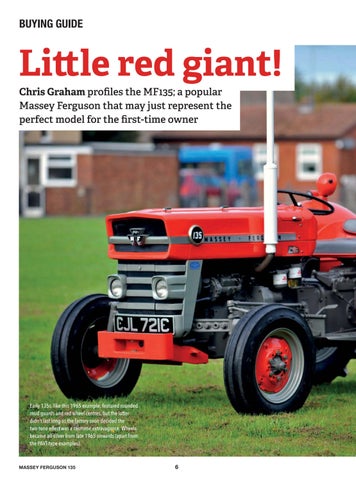
Little red giant! Chris Graham profiles the MF135; a popular Massey Ferguson that may just represent the perfect model for the first-time owner
Early 135s, like this 1965 example, featured rounded mud guards and red wheel centres, but the latter didn’t last long as the factory soon decided the two-tone effect was a cosmetic extravagance. Wheels became all-silver from late 1965 onwards (apart from the PAVT-type examples).
MASSEY FERGUSON 135
06-15 MF135.indd 6
6
10/12/2021 14:57
M
assey Ferguson’s introduction of the 100 Series tractors – named The Red Giants by the marketing men – represented a very important development for the company. Building on the sales and performance successes of the MF35X and MF65 MkII models, the 100 Series was intended to create a whole new, modern image for the domestic tractor market around the world. Here in the UK, those two models got transformed into the MF135 and MF165 respectively, and were launched – together with the brandnew MF175 model – at the 1964 Smithfield Show, in London.
Entry-level model
Although there was a smaller, MF130 model created for the French market, the 135 was the entry-level machine in the UK, and was an instant success. Outwardly, it looked very different from the MF35X it replaced, with more contemporary and sharply-styled new bodywork, although traditional, shell-type mud guards were retained on the earliest models. These were updated to a more angular, flat-topped design in 1965, which was more in keeping with the rest of the 135’s tinwork, and featured integral, cast aluminium hand grips and front side lights. Then, a couple of years later, the factory switched to an all pressedsteel mud guard design, which, presumably, was a cost-saving measure. Aluminium had also been used for the headlamp casings on the first 135s, but these were replaced by plastic alternatives in 1969. Another money-saver saw the originally twotone wheels (red centres, silver rims) changed for simpler, all-silver finish after only six months of production. Under the skin, though, there were plenty of similarities with the previous model. Power still came 7
06-15 MF135.indd 7
MASSEY FERGUSON 135
10/12/2021 14:57
BUYING GUIDE reverse gear transmission also taken from the 35X. A Multi-Power option was available for those who wanted it, although this was only fitted on dual clutch-equipped models. It offered drivers on-the-move changes, even under load. However, this was only up or down from the selected gear, and the system couldn’t handle complete ratio changes. Another limitation was the fact that engine braking was only available with Multi-Power engaged. An ‘updated’ MF135 was officially introduced in 1971, and featured a number of significant enhancements. As already mentioned, the air filtration system was changed but, perhaps more significantly, the fuel tank capacity was increased from 8.5 to 10 gallons, which also involved raising the
The silver headlamp bezels were aluminium to begin with, until plastic housings became available as a more cost-effective solution. The exhaust silencer is, in this case, finished in white, as per factory spec. Many owner snowadays opt for silver or black.
Note the position of the small, ‘Ferguson System’ sticker here, that sits on the tinwork above the air cleaner oil bath housing. This is the correct positioning for early models like this, but lots of restorers incorporate it into the ‘Massey Ferguson’ decal strip above. In fact, this relocation only happened when the wheels switched to an all-silver finish.
from the 45.5hp, Perkins AD3152, 2.5-litre, three-cylinder, direct injection diesel engine, but there was also a petrol-powered version. This utilised a four-cylinder unit supplied by the Standard Motor Company, but the variant wasn’t a popular seller here and was aimed primarily at export markets (it sold especially well in Denmark and New Zealand).
Tried and trusted
Of course, the Perkins engine was a tried and trusted performer, and the early models featured an oil bath air cleaner. This was changed – early in the 1970s – to a dry element-based system, with a replaceable filter linked to a service indicator below the dash panel. The MASSEY FERGUSON 135
06-15 MF135.indd 8
It looked very different from the MF35X it replaced, with more contemporary and sharply-styled new bodywork engine was supported by a 12-volt electrical system, and fuel supply was managed by a CAV injector pump. A comprehensive instrument cluster provided gauges for fuel level, coolant temperature and oil pressure as well as a tractormeter and an ammeter. Single or double Auburn clutches were available, linking the engine to the familiar six forward and two 8
10/12/2021 14:57
OWNER’S VIEW: JOHN SHARPE “My MF135 was owned from new by a farmer who lived just a few miles away from me here in Lincolnshire. It’s a 1965 model, has just 6,000 hours on the clock and was known to both my grandfather and dad. “It hadn’t been taxed for several years when I bought it, but it came with its original registration number and matching serial number, so the application process was just about as simple as it could be. “In my opinion, the 135 is the perfect allrounder. It makes a great road run tractor; mine will easily do 16mph, although I usually set it at about 10mph, especially when I’m leading a run. It’s also ideal for those wanting to attend shows as, with it weighing just 1,500kg, it’s easy to transport without the need for a top-end 4x4 and, once on the rally field, it’s a model that always seems to attract plenty of attention.
“I also think that it makes a perfect first-time tractor for those new to the hobby. It’s so easy to live with and handle. Anyone can drive a 135, and a properly set-up example will have good steering and brakes. Don’t listen to people who tell you that the brakes are rubbish, because that’s simply not true. There’s plenty of stopping power for a tractor of this size, and systems that aren’t working effectively have either been poorly maintained, or are badly adjusted. “The MF135 is also a genuinely useful machine for those who want to work it. While 45hp isn’t powerful by modern standards, the 135 remains perfectly capable of pulling a twofurrow plough very effectively. Also, in practical terms, it’s easy to get on and off as it’s not too high off the ground and, once in the driver’s seat, it’s not too cramped so is comfortable to drive.”
height of the radiator grille by 1.5in. Also, as a knock-on consequence of the higher bonnet, the steering column was lengthened. Perhaps more significantly, the old-style, swept-back front axle was also changed at this point for a straight, box-section design that was both stronger and cheaper to produce.
Alternative models
9
06-15 MF135.indd 9
Narrow and vineyard versions of the MF135 were also available, with conversions to standard models being undertaken in Kent by Lenfield Engineering, using parts shipped from the Massey Ferguson factory at Beauvais, in France. The narrow version was simply narrower than the standard model (shorter trumpet housings and half shafts), but the vineyard version was both narrower and lower, representing a more complicated engineering job. A cab was offered right from the start for the 135, but the earliest ones – made by Duple Coachworks, in Blackpool – used glass fibre panels on a lightweight steel frame and plenty of glass to ensure good visibility. However, when driver safety started to become an issue in 1970. Rollover protection became MASSEY FERGUSON 135
10/12/2021 14:57
BUYING GUIDE
The MF135 benefitted from a comprehensive instrument array. Note the centrally-placed tractormeter. This was offset to the right on later models. Also, the tractor’s all-important serial number can be found on the riveted-on plate below the instrument cluster, the top of which can just be seen here
a requirement, and the mountings for this necessitated a re-design of the gearbox casting. Then, in 1976, more legislation set a standard for the maximum noise level (90db) permitted inside a tractor cab, so sound-deadening material was added to every surface possible to achieve the necessary result. To say that the MF135 was a sales success is something of an understatement. Between 1965 and 1971, Massey Ferguson produced 322,428 examples of the model then, between 1971 and 1979, churned out an additional 90,725 of the updated version. Over the 14year production run, 413,153 rolled from the factory gates in Coventry. Now, just over 40 years since the last example was made, the MF135’s place in the affections of enthusiasts around the world is set in stone. It’s become an incredibly popular MASSEY FERGUSON 135
06-15 MF135.indd 10
An ‘updated’ MF135 was officially introduced in 1971, and featured a number of significant enhancements tractor for experienced showmen and novice owners alike.
Buying advice
For some down-to-earth advice on buying an MF135, I took a trip to Holbeach, in Lincolnshire, to consult Ferguson and Massey Ferguson enthusiast and experienced restorer, John Sharpe. Having completely renovated his 1965 model way back in 2000, the present condition of John’s 135 is testament to the quality and thoroughness of the work he undertook all those years
ago. Unsurprisingly, he’s a man who understands his tractors and, as such, is well qualified to offer experiencedbased hints and tips for newcomers considering one of these versatile and still incredibly popular tractors. The first point John made, as we stood in the garage with his gleaming, 1965 MF135, was that buyers always need to be clear about what they want their tractor for. “The use to which would-be owners intend to put their new machine should be a big factor at the buying stage,” he explained. Perhaps the owner wants to take part in road runs, attend shows or actually work the tractor on a smallholding or in ploughing competitions. “They may also be looking specifically for a restoration project or, alternatively, want a tractor that’s already complete and usable
10
10/12/2021 14:57
WHAT TO PAY
Prices for an original, diesel-powered MF135 start at £2,500 for a down-at-heel example that maybe a runner, but needs plenty of work. You’ll probably have to pay a few hundred more for an updated version (1971-’79), or one fitted with Multi-Power. For a model that’s been restored in the past and is a decent runner, expect to pay £6,500 or so while, at the top of the market, the best examples are currently fetching £12,000-£14,000.
The seat was un-sprung on early 135s, but featured comfortable cushions. The design was updated later in the production run. This is the extremely reliable, 45.5hp, Perkins AD3-152, 2.5-litre, three-cylinder, diesel engine that powered most MF135s. A petrol-powered model was available with an engine from the Standard Motor Company, but most of these went for export.
from day one. I also believe that it’s important for buyers to decide how important originality is to them, and whether they’re keen to own a machine that’s correct in every detail. All these factors have a bearing on the sort of tractors you’ll be looking at, and how much you’re prepared to spend.”
Registered or not?
John continued: “Be aware that if you want to run a tractor on the road, it’ll need to be registered for that purpose so, if it isn’t when you buy it, you have that process to negotiate, too. Doing this requires, at the very least, the tractor’s serial number, but I don’t believe that it’s as easy as it used to be to get an unregistered tractor added to the DVLA database. Authentication – typically by a knowledgeable club official – will be required to reassure the authorities that the machine is what you claim it is, and only then will they issue an age-appropriate registration number. “The whole process will be more 11
06-15 MF135.indd 11
MASSEY FERGUSON 135
10/12/2021 14:57
BUYING GUIDE complicated if the serial plate is missing from the panel beneath the steering wheel (the panel can be missing altogether, or the number may have become illegible due to years of wear from the driver’s left knee). Ideally, the tractor you buy will have a logbook and a numberplate (or a painted-on number), confirming the original number and making it possible for it to be re-registered for road use with that. “The worst option is to end up with a Q-plate! I’ve heard that once one of these has been assigned, the vehicle can’t be switched back to an age-appropriate registration, so be warned if you’re considering a tractor that’s already carrying a Q-plate.”
The 135’s hydraulics are both reliable and functional. The tractor will happily pull a two-furrow plough.
Restoration advice
If you’re looking at a restoration project, then John says that it all boils down to the condition of the tinwork. “All the mechanical parts needed to rebuild one of these tractors are available nowadays from specialist suppliers, and are of reasonable quality,” he told me. “Unfortunately, the same can’t be said for many of the remanufactured panels being produced these days. Those items that originate in places like Turkey or the Far East, tend not to be as good as the originals. “So, the golden rules with major parts such mud guards, bonnets, foot rests, front grille assemblies and seats, is to ensure all the originals are present, and to repair any that are damaged, if possible.” The bonnet is a key component on the MF135, and John says that it’s worth entrusting even quite beaten-up but original examples to a professional body repair specialist. There will be a cost involved, but it’ll be worth it to ensure a decent job and retain the good-fitting original. “Remanufactured, pattern panels often fall down on the small but important details,” John added. Often, with replacement mud guards, for example, you’ll find MASSEY FERGUSON 135
06-15 MF135.indd 12
The battery is found beneath a hinged panel towards the rear of the bonnet. The hinges were often broken and it’s quite common for the compartment cover to be missing altogether. 12
10/12/2021 14:57
MF135 PARTS PRICES
A second, hinged bonnet cover reveals fuel and coolant filling points.
drillings all over the place, which were never on the original. This – presumably – is done to allow the parts to be fitted to the widest possible range of tractors. Others may show metal joints or swage lines in the wrong places, which is a problem for those who want to an authentic-looking restoration.”
Judgement call
If you have no information about the provenance of a tractor, then you’re left having to make a judgement based on nothing more than the machine’s overall condition. As always, the key factors are how hard the machine was worked and how well it was looked after during that
13
06-15 MF135.indd 13
Bonnet kit
£570
Oil filter kit
£24
Bonnet handle kit
£60
Steering shaft repair kit
£102
Crankshaft kit
£294
Wheel bearing kit
£19.20
Lift pump repair kit
£15
King pin repair kit
£52.80
Valve train kit
£42
Brake shoe set
£90
Tractormeter
£48
Rollbar
£420
All prices from Old 20 Parts Company (tel: 01332 792698, old20tractorparts.com) Owners like John Sharpe consider that the MF135 offers just about the perfect tractor for the first-time owner new to the hobby.
MASSEY FERGUSON 135
10/12/2021 14:57
BUYING GUIDE MF135 TECH SPECS Production period
1964-1979
Produced at
Coventry, England
Engine:
2.5-litre, 3-cyl (diesel) 2.5-litre, 4-cyl (petrol)
Power
45.5hp
Bore/stroke
91x127mm (diesel)
Compression ratio
17.4:1
Rated speed
2,000
Transmission
6 forward, 2 reverse
Dimensions
Length: 120.6in Width: 63.5in Wheelbase: 72in
Weight
3,130lbs (1,419kg)
period, and in subsequent years. There will be rare occasions, as in John’s case with his 135, that a tractor will come with a creditable back story. But, in most cases, there will be little clue about how it’s been used in the past, so your decision to purchase or not will come down to your own gut feeling about the machine. Hour meters can be checked, of course, but there’s no telling whether the figure displayed is accurate. However, if there’s an obvious mismatch between the claimed hours and the general state of the tractor, then that’s a warning sign. Obvious tell-tale signs of wear and tear, such as heavily worn pedals, excessive play in the steering and gear lever, dented tinwork and non-existent brakes all speak of a hard working life and a general lack of care and attention. While none of these issues are deal-breakers if the tractor is for sale at the right price and/or you have the budget, time and skills needed to put things right, having to replace exterior componentry isn’t always ideal, as John explained. “While most parts are available for the MF135, the quality of some of them isn’t great. For example, you MASSEY FERGUSON 135
06-15 MF135.indd 14
can buy remanufactured pedals, but they’re not exact replicas. Important details like shaft shape and thickness are incorrect, so they look instantly wrong to anyone who knows how they should be.”
The MF135 makes a great road run tractor; John’s will easily do 16mph although, more generally, he tends to run at a steady 10mph.
Reliable power
The good news, with regard to the engine, is that the Perkins threecylinder diesel engine that powers most MF135s is all-but bulletproof. It’s an engine that was used in many different applications and was thoroughly established before appearing in this model. So, even if you do come across a badly worn example that has suffered from years of neglect and mechanical abuse, most problems will be straightforward to rectify. You can buy replacement cylinder heads, short engines, plus all the internal parts needed, so all bases are covered. Essentially, everything is doable so, as with any other renovation issues, it simply comes down to whether or not you have the inclination and experience to tackle the work yourself, or the funds available to pay somebody reputable to do the job for you. John says that the transmission is tough and durable, and that serious problems in this department are very rare. However, if you notice that the rubber gaiter at the base the base of the gear lever has perished, then it’s likely that water will have got inside. Consequently, check the condition of the oil in the gearbox; there is a dipstick, so use it to see if the contents look like milk or oil. Apart from this, just about the only gearbox-related issue commonly found is worn selectors. A simple check for this involves attempting to twist the gear lever, as you might rotate a screwdriver when tightening a screw. If you detect excessive rotational movement while doing this, then the chances are that the selectors beneath are badly worn. The danger then is that, during certain changes, the base of
the lever can pop out of the selector, leaving the gearbox stuck in gear and the lever floating ineffectually above it. This can be temporarily rectified by removing the oil filler plug and using a long screwdriver to realign the selectors with the base of the gear lever.
Fluid dynamics
The hydraulic system and rear axle are both fundamentally reliable, although age-related axle oil seal failure can result in oil leaking out and finding its way onto the brakes. Putting this right necessitates the
14
10/12/2021 14:57
Depressing the clutch pedal fully will, of course, free it to roll.”
Choose carefully
removal of the half-shafts, which isn’t an easy job, but it’s doable, according to John. With regard to the hydraulics, John says: “A useful, practical test can be to put your foot under the lift arm and raise it slightly, to note how much free play there is in the system. Then, if you’re feeling a bit cheeky, you can also test the system with the engine running, by standing on the lift arms and seeing if the system is capable of lifting you up. Obviously, this isn’t a realistic, real-world test, but it will at least demonstrate that there is some power in the system,
and that it’s operating. “However, the only true test for any tractor will come when you put it to work. Once it’s under heavy load, that’s when you’ll be able to see how the engine copes; whether it overheats, dumps its coolant or starts leaking oil. If you’re looking at a Multi-Power-equipped model, you can test that system by driving the tractor up a slope in ‘high’ setting, stopping and then depressing the clutch pedal to the first stage point. At this point the tractor should remain stationary if all’s well; if not, it’ll start rolling backwards. 15
06-15 MF135.indd 15
As we’ve already mentioned, the beauty of the MF135 is that it’s a tractor that you can virtually rebuild from new parts sourced from well-known specialist suppliers. So, in some respects, having that kind of ‘safety net’ means that the penalties for buying a ‘lemon’ aren’t disastrous. But, as we’ve also noted, the use of remanufactured new parts isn’t always the ideal solution, especially when they’re on the ‘outside’. The inaccuracy of some of the components and panels available nowadays can detract from the overall appearance of a restored tractor, which is why the retention of original parts is so important. The popularity of the MF135 means that good quality, secondhand parts are becoming increasingly hard to source, which is why bagging yourself a complete, unmolested example is such an advantage. Original-condition 135s do still come up in sales and auctions, so there’s always hope for the patient buyer. John told me that he saw a perfect example being sold recently; it was an essentially complete, original tractor (just missing its headlights) that sold for £5,600 (plus VAT and auction commission). However, whichever example you eventually buy, you can be assured that the MF135 will tick all the right boxes. It’s a model that’s perfectly sized for the first-time owner; it’s not too heavy or too big, so is easy to handle, to store and to transport. Its straightforward design, and use of tried and trusted components, means that servicing, repair and even full restoration are all within the grasp of the keen enthusiast. Couple this with the comprehensive spare parts availability situation, and it’s clear that the MF135 represents an immensely appealing proposition, whichever way you look at it. MASSEY FERGUSON 135
10/12/2021 14:57
HEAD TO HEAD
The red and grey, standard version of the MF135 is much more common than the slightly differently specced, yellow Industrial.
MASSEY FERGUSON 135
16-19 MF135.indd 16
16
10/12/2021 15:00
What’s in a colour? There are plenty of standard, red and grey MF135s about, but this model’s yellow and grey Industrial cousin is an altogether rarer beast. Ben Phillips compares the two
O
n the face of it, both the MF135 and its Industrial counterpart look pretty much the same – if you discount the paint colour, of course – but there are a few differences worth mentioning. The bonnet is the same on both, with a centre flap allowing the fuel and water to be topped up, and the battery is accessed in both cases via the same cover that’s just ahead of the dash. However, there is an important difference in this area, although it isn’t a structural one; it concerns the vinyl decals! On the standard, agricultural model, these consist of a silver-coloured strip that’s inscribed with the words ‘Massey Ferguson’ and, ahead of that, a white ‘135’ on a black, circular background that, itself, is finished with a shiny metal bezel. By contrast, on the yellow and grey Industrial model, the ‘Massey Ferguson’ lettering runs in a much wider silver strip that, at its front end, has a black portion containing the model designation ‘2135’. There is no round model emblem on the Industrial.
The Industrial featured a much wider side decal, that was applied higher on the bonnet than on the red version.
The familiar, narrow, silver decals that identify this as a ‘Massey Ferguson’ tractor, were applied along the ridge on each side of the bonnet.
Instrumental differences
The respective instrument clusters contain more differences, although both models are well-equipped in this department. Standard 135 drivers benefit from water temperature, fuel level and oil pressure gauges, as well as a large tractormeter and a smaller ammeter. However, given that it was anticipated that many Industrial models would be used on the public road, it was also necessary to fit these models with an mph-
Greatest difference The round, model-identifying ‘135’ badge is found near the front of the agricultural version’s bonnet. 17
16-19 MF135.indd 17
displaying speedometer. The drive for this was transmitted via a cable running from the round, PTO control lever cover at the rear of the tractor. The seat on both models was the familiar, tipping, bucket-type design with a two-section cushion set. However, on the agricultural machine, the cushions were covered in grey material with red piping while, on the Industrial, these soft furnishings were finished in black with yellow piping. Both models’ mudguards were identical, and featured side and rear lights plus built-in toolboxes. The two models also shared the same Ferguson System hydraulics. Another important difference between the two models relates to the brakes. If you compare the brake drums fitted to both, there’s a visible difference, with those on the Industrial being almost double the width. The reason for this was that the Industrial’s drums had to accommodate two sets of shoes; one for the foot brake and one for the hand brake. The idea of this was to improve the performance of the handbrake; the agricultural version relied on a single set of shoes for both braking functions. Obviously, the requirement for a functioning and effective handbrake is an important one for a road-going vehicle; far less so for one that’s used primarily on the farm. Obviously, the colour of both tractors is the most visible difference between them. The agricultural version is finished with red paint on the tinwork, grey on the skid unit and MASSEY FERGUSON 135
10/12/2021 15:00
HEAD TO HEAD
I love the MF135’s dash; it contains everything needed to keep the tractor working in prime condition. The Industrial’s dash (on right) is almost identical, but sees the addition of a dedicated speedo gauge next to the standard tractormeter.
These bucket seats were the most comfortable that tractor drivers got in the 1960s. The agricultural version’s cushions are trimmed in grey with red piping, while those on the Industrial model (on right) got black covers and yellow piping.
The respective instrument clusters contain more differences, although both models are well-equipped in this department silver on the wheels. The Industrial, on the other hand, replaces the red with bright yellow on the tinwork and wheel centres. However, both tractors have a silver and black striped grille, silver-coloured light surrounds and a black upper grille MASSEY FERGUSON 135
16-19 MF135.indd 18
with an ‘MF’ badge bar in silver. I have restored many agricultural Massey Ferguson 135 tractors in red and grey but, when I had the pleasure of renovating the Industrial version featured here, it made a real impression on me. It took me a long time before I could look at the traditional red version once again, in the same way. Both these colours are bright and cheery, and would look good in any collection or rally field, but which would I choose? Well, it’s a hard decision but, for me, it’s probably the more familiar red and grey combination that I’d go for. After all, Massey Ferguson means red, doesn’t it?
Those familiar with normal-sized MF135 brake drum will notice how much bigger these Industrial-spec ones are.
18
10/12/2021 15:00
When I had the pleasure of renovating the Industrial version featured here, it made a real impression on me
TECHNICAL SPECIFICATIONS Massey Ferguson 135
Massey Ferguson 2135
Engine
Perkins three-cylinder diesel
Perkins three-cylinder diesel
Power
45hp
42hp
Front wheels
6:00/16
6:00/16
Rear wheels
12.4/28
12.4/28
Colour
Red tinwork, grey skid unit, silver wheels
Yellow tinwork, grey skid unit, silver wheel rims with yellow centres
These flat-topped mudguards replaced the original, shell-type ones found on the earliest MF135s. The Industrial got the same design (on right), so some can still be found with the early, rounded shape.
The Silver Mist paint used on MF135 wheels is a lovely colour that really sparkles in the sunlight. Some Industrial Massey Ferguson tractors have Silver Mist-painted rims and yellow centres, while others are yellow all over. 19
16-19 MF135.indd 19
MASSEY FERGUSON 135
10/12/2021 15:00
HEAD-TO-HEAD
The same, but different! We compare a couple of tractor rivals from the 1960s, the Massey Ferguson 135 and the John Deere 1020
T
he Massey Ferguson 135 is often used as a benchmark for comparisons – everyone knows what it looks like and what it’s capable of. It’s often compared to its main rivals of the day – predominantly the Ford 3000, the David Brown 880 Selectamatic and
the International Harvester 434, but it’s rarely measured against a Continental contender – in this case, the John Deere 1020. In the late 1960s, when these models were on sale, the 1020 was not a common sight in the United Kingdom – it was more often seen in mainland Europe. With this said, some were sold to British farmers, helping to give Deere a small percentage of tractor sales in the 135’s homeland.
With similar power outputs, the John Deere 1020 and Massey Ferguson 135 make for an interesting comparison. MASSEY FERGUSON 135
20-25 MF135.indd 20
20
10/12/2021 15:02
On paper, it may seem as though there’s not much to choose between them, but a closer look reveals their designers adopted different approaches to the two tractors that were destined to be rivals in certain markets. It’s evident that Massey Ferguson was keen to extol the virtues of the Ferguson System used on the 135, but John Deere had a different philosophy when it came to the 1020 – it presented the hallmarks of a larger model, but in a smaller package.
Power play
When it comes to the engine, both tractors are similar in terms of displacement, but the 135’s Perkins-built unit has a longer stroke and, consequently, better torque. Maximum torque is 148Nm at 1,500rpm for the 1020, but 161Nm at 1,300rpm for the 135. The Deere’s engine revs higher, too – generating its power differently from the AD3.152 used in the 135. John Deere stipulated that its engine’s operating range was 1,500-2,500rpm and, although it performs well, the MF’s engine has, in our opinion, greater appeal. Irrespective of the fact that it’s giving away 1.5hp, the grunt it possesses – and its responsiveness – make it particularly likeable. The basis of this engine, as diehard MF fans will know, went on to be used in numerous models for many years – in both naturally-aspirated and turbocharged forms. It really was that good! Both engines are good starters, and have proved to be reliable over the years – particularly the AD3.152, which has earned a reputation for being one of the most reliable engines ever built. Should you need to overhaul either, parts are plentiful and it won’t cost the earth to bring a tired example up to scratch. Both engines will bring owners a lot of pleasure, no matter what the task at hand. But we feel the 135 is the winner in this section.
The 1020 uses a lower link-sensed system for draft control… … while the MF135 employs top-link sensing
n OUR VERDICT: MF135 21
20-25 MF135.indd 21
MASSEY FERGUSON 135
10/12/2021 15:02
hyphenate this
HEAD-TO-HEAD
The instrumentation on the Deere is Spartan by comparison to the Massey Ferguson…
Transmission and axles
During the late 1960s, two-wheeldrive was still very much the standard arrangement, so both the 1020 and 135 were produced in this configuration. It is possible to find 135s that have been fitted with a driven front axle, but you should assume that two-wheel-drive is the norm. Even without using the brakes, the MF135 is the more agile of the two machines – with a turning radius of just 118.5in (3,010mm), although this is hardly surprising given that it’s the shorter of the two models. But, with similar rear tread widths, both are capable of a multitude of row-crop and other specialist work, so there’s little to choose between them in this respect. The gearboxes are difficult to separate, too, with six forward speeds and two reverse across two ranges on the MF, and eight forward speeds and four reverse on the Deere. Both had the option of a ‘splitter’ to double the number of gears available – dubbed ‘MultiPower’ on the 135 and ‘High-Low’ on the 1020. Both optional systems offered a clutch-less change, but High-Low had the benefit of engine braking irrespective of the position the operator selected. Running on 11x28 tyres with a standard transmission, speeds from 2.1-24.4kph (1.3-15.1mph) are achievable on the JD, compared to 2.4-26.4kph (1.5-16.4mph) on the MF. But, in the case of the latter, add Multi-Power into the equation and a top speed of 21.7mph can be achieved! However, thanks to engine braking in both high and low settings, the 1020 takes the win in this category.
n OUR VERDICT: JD 1020 … which has a comprehensive array of useful dials. MASSEY FERGUSON 135
20-25 MF135.indd 22
22
10/12/2021 15:02
Power take-off
If all you need is a 540rpm power take-off, either tractor will oblige. But, if you require something else for a specific task, the implement’s drive speed will have a bearing on which of these two models is the most suitable choice. The little Deere has a 540rpm PTO as standard, but the option of a rear 540/1,000rpm combination and a 1,000rpm front power take-off, all at approximately 2,100 engine rpm (erpm). The 135, on the other hand, has a PTO speed of 540rpm at 1,685erpm – which equates to 722 PTO rpm at the engine’s rated speed of 2,250rpm. Ground speed PTO is also a feature of the MF135, with the shaft revolving once for 19in of motion.
n OUR VERDICT: JD 1020 Hydraulic matters
Irrespective of your knowledge of the little Deere, it’s likely that you’re familiar with the 135’s hydraulic arrangement – everyone is aware of the Ferguson System, aren’t they? This is where our comparison gets very interesting, as it’s top link sensing versus lower link sensing. The 135’s Ferguson System hydraulics was a development of that first used on the TE-20, but with two-lever control rather than one. The draft control lever is for use with soil-engaging implements like ploughs and cultivators, where the working depth is controlled automatically through changes sensed through the top link. Weight is transferred from the implement to the tractor’s rear wheels. Position control moves the lower links to the operator’s desired height, which is useful when the likes of a transport box or post hole borer are in use. The constant pumping section of the quadrant is for use with external services, such as front loaders. John Deere, on the other hand, chose to use a lower link-sensed 23
20-25 MF135.indd 23
Massey Ferguson was keen to extol the virtues of the Ferguson System used on the 135, but John Deere had a different philosophy when it came to the 1020 system – the type of arrangement usually found on much larger tractors. Like the 135, any change in soil condition or resistance is sensed through the lower links and the flexible torsion bar that sends signals to the hydraulics – automatically adjusting working depth as required. Unlike the 135’s two-lever arrangement, the 1020 has a singlelever quadrant and a separate, ‘selective hitch control’ adjuster – enabling the operator to switch between position and draft control, or a blend of the two at the positions in between. The Deere’s closed-centre system generally comes in for praise and although it works well, we think the Ferguson System is hard to beat. In standard form it’s great, but with the option of a high-capacity pump and a combining valve on Multi-Power tractors, as well as Pressure Control as an added extra, a little tractor can suddenly do a whole lot more. You’re more likely to find a doubleacting spool valve on a 1020 than you are on a 135, but if originality isn’t a concern, you can rig up something adequate with a little bit of knowledge.
n OUR VERDICT: MF135 Driving position
First up in this section, access. The operator’s ability to climb aboard is largely dependent on the rear wheel size. With 28-inch wheels fitted to the 135, whether MASSEY FERGUSON 135
10/12/2021 15:03
HEAD-TO-HEAD The ‘horseshoe’ nose, tapered bonnet and rounded mudguards give the John Deere 1020 an unmistakable look.
pressed steel or PAVT, access is unchanged and pretty easy. While the Deere’s tapered dash panel and round mudguards allow for easy manoeuvring, it can be quite a step up to the footplate when the 1020 is fitted with 36-inch rear wheels. Once aboard, the difference between the dash panels is instantly noticeable. There’s a minimalist approach to the 1020’s design, with instrumentation kept to the bare essentials, but the rake of the panel means that it’s not particularly easy to see. The 135, on the other hand, although ‘cluttered’ in comparison, is comprehensive and angled nicely. In terms of comfort, the standard seat on the Deere is nicer than the 135’s cushion seat, with a sweeping backrest that envelops the operator and a decent amount of adjustment. MASSEY FERGUSON 135
20-25 MF135.indd 24
The layout of pedals and controls is similar on both tractors, but we particularly like the position of the foot throttle and PTO lever on the 1020. As with any tractor, the more you use it, the more natural operation of it becomes, but the 135 has a more intuitive feel to it. Perhaps this is because it’s a system that many of us are familiar with. But, whatever the reason, using the MF feels natural – there’s very little thought involved.
n OUR VERDICT: MF135 Overall styling
The debate really hots up when aesthetics are mentioned. We all know what we like and what we don’t like, so our verdict in this category is certain to divide opinion.
By 1967, when these tractors were on sale at the same time, the MF135 was fitted with flat-topped mudguards, whereas the 1020 had rounded versions, reminiscent of those on the early 135. The MF’s square-cut bonnet and mudguards definitely work well together, but with its sweeping lines and bonnet that tapers towards the steering wheel, the 1020 is a handsome machine. The ‘horseshoe’ front can divide opinion, but we like it and think it enhances the overall design. The outboard headlights and protruding sidelights are a point of debate on the 1020 – arguably not as neat as the 135’s, but these are small points and don’t affect our decision.
n OUR VERDICT: JD 1020
24
10/12/2021 15:03
Final thoughts
Comparing these two tractors may seem a little unfair, given that John Deere’s market share in the UK was minimal during a period when one in every four tractors sold in the UK was an MF135. But, given their similar performance, it makes for an interesting talking point. Massey Ferguson’s success with the 100 Series would ripple across the globe and, although the 20 Series did well for John Deere, the company was still very much in its infancy in Europe at that time. If you’re looking for a tractor of between 40-50hp and these two models are contenders, which should you pick? Although parts availability is good for both, and both are reliable and a joy to operate, it’ll be easier to find a 135. With few 1020s sold in the UK during the 1960s and ‘70s, if you’re seriously interested in buying one, your best bet is to import one, or approach a specialist, like Nick Young Tractor Parts in Lincolnshire (tel: 01673 828883). Don’t be alarmed, though, as rarity doesn’t necessarily equate to additional expenditure. The MF135 may have been produced in mind-boggling numbers, but decent examples still command high prices – thanks largely to the tractor’s reputation as a reliable and capable workhorse. With our verdict currently a tie, with each model earning three section wins, it’s difficult to choose an overall winner. The John Deere 1020 has bags of personality and obvious appeal, particularly given the brand’s current market standing, but the Massey Ferguson is an icon of its generation – the little red tractor. Given its prowess and the fact that it’s proved to be a ‘safe bet’ time and time again, we feel that choosing to buy a 135 is never going to be a bad decision!
SPECIFICATION: JD 1020 & MF 135 Model
JD 1020
MF 135
Engine
John Deere
Perkins*
Power
47hp
45.5hp
Cylinders
3
Bore
98mm (3.86in)
91.4mm (3.6in)
Stroke
110mm (4.33in)
127mm (5in)
Displacement
2,490cc (151.9cu in)
2,502cc (152.7cu in)
Rated speed
2,500rpm
2,250rpm
Clutch**
254mm (10in)
305mm (12in)
Transmission
8 fwd, 4 rev or 16 fwd, 8 rev (High-Low)
6 fwd, 2 rev or 12 fwd, 4 rev (Multi-Power)
PTO speed
540rpm or 540/1,000rpm
540rpm
Lift capacity
1,043kg (2,300lb)
1,406kg (3,100lb)
Turning radius***
3,250mm (128in)**
3,010mm (118.5in)**
Rear tread
1,350-1,950mm (53.1-76.7in)
1,321-1,930mm (52-76in)
Wheelbase
2,050mm (80.7in)
1,829mm (72in)
Weight
2,020kg (4,440lb)
1,451kg (3,200lb)
Front tyres****
6.00x16
Rear tyres****
11x28
* Built to MF’s specifications ** Transmission clutch *** Without brakes **** Standard
With its square-cut, modern looks, the 135 is very different to the Continental-built 1020.
n OVERALL WINNER: MF135 25
20-25 MF135.indd 25
MASSEY FERGUSON 135
10/12/2021 15:03
IMPORTING AN EXPORT
The wanderer returns
New Zealand was a successful export market for the MF135, and Lindsay McClounie now owns one that went there first, but has returned home to its roots, as Bob Weir discovers
Lindsay McClounie is delighted with the MF135 that he imported from halfway around the world.
T
he town of New Cumnock is in East Ayrshire and has some famous historical connections, including King Robert the Bruce and William Wallace, of Braveheart fame. It’s also the old stomping ground of Scotland’s most famous bard, Robert Burns. Lindsay McClounie’s family specialises in building demolition and plant hire; a business that was established in 1962. There’s also a strong agricultural connection at the headquarters at Meikle Garclaugh Farm.
Working tractor choice
“Apart from the building work, we keep a small herd of beef cattle,” Lindsay explained. “We also rent out part of our land for grazing sheep, and farm a total of 600 acres. We’ve used several different types of tractor over the years, but our current workhorse is a Massey MASSEY FERGUSON 135
26-29 MF135.indd 26
Ferguson 6470. It’s a local machine and we’ve had it for four years.” The McClounies were brought up in the area, and have been there for several generations. Like a lot of Scottish families, they also have relatives living ‘down under’. “Members of the family started to move to New Zealand several years ago,” Lindsay told me. “Ironically, there are probably more McClounies living there now, than in Scotland, and some of them are also involved in farming. “I was over there visiting two of our relations – Ted and Pauline Allen – in 2004, when I spotted the MF135. It was being kept in a small shed on their hill farm, and it was the dual rear wheels that first caught my eye. I wasn’t particularly clued-up about old tractors in those days, but it certainly got my interest. “Pauline likes to visit Scotland every few years, and it was during a trip in
2010 that the subject of the tractor cropped up. I was showing her around our farm and jokingly said that if Ted ever wanted to sell the 135, I’d take it off his hands. I knew that he barely used the Massey, but that he wasn’t looking to change it, so I never imagined for a moment that it would actually happen.”
Done deal!
“Later that visit, Ted rang Pauline on a routine call from New Zealand. Apparently, his accountant had told him that they’d made a decent profit for the year, and had suggested buying a new tractor to offset the tax bill. So, Pauline asked Ted to sit tight until she’d flown home and, once she was back, they were in touch again.” The upshot was that Ted and Pauline did buy a new tractor and, after a bit of friendly haggling, Lindsay agreed to buy the MF135.
26
10/12/2021 15:06
Then came the hard part; shipping the Massey halfway around the world! “Ted had agreed to deliver the tractor to the docks in Auckland,” Lindsay recalls, “but the rest of the journey was down to me. I hadn’t attempted anything like this before, so it was a bit of a learning curve. “I searched the internet and trawled through some shipping agents’ websites. The biggest decision was choosing whether I wanted the tractor to be transported across the oceans in its own container, or just tied down in the ship’s hold, similarly to a regular ferry. The first option included delivery from the port of arrival up to Scotland, but the total cost was a bit expensive. The cheaper alternative meant it was my responsibility to collect the MF135 once it arrived in the UK. In the end, I decided to drive down to Southampton docks with my 4x4 and trailer.” So, having made all the arrangements, all Lindsay had to do was sit back and wait.
Indirect route
“These ships are massive and they don’t just sail straight from A to B,” he explained. A quick glance at the route showed that our ship, the Tamerlane, had stopovers all over the Pacific Rim, including Japan, up towards the Barents Sea and down the coast of California. Like all ships passing from the Pacific to the Atlantic Ocean, it also had to negotiate the Panama Canal. Fortunately, I was able to follow its progress using marinetraffic.com That website tracks the progress of each ship, using a system based on GPS and, every time the Tamerlane approached the next port, I was automatically sent an email.” After three months at sea, the ship finally docked at Southampton, on February 5th, 2012. After such a long wait, I was starting to get a wee bit excited,” Lindsay recalls. “One morning we set off from home at the crack of dawn. My eight-year-
The reduction box on the Selene four-wheel-drive system.
The familiar Perkins three-cylinder diesel engine is as reliable as ever. 27
26-29 MF135.indd 27
MASSEY FERGUSON 135
10/12/2021 15:06
IMPORTING AN EXPORT
The tractor turned out to be in pretty good condition, so it didn’t require a lot of work were John Deere machines, awaiting loading for export. However, he added that I was welcome to take a look around.
Searching the dock
“So there we were, no safety helmets or high-viz jackets, walking up and down these lines of tractors. Nobody stopped us, or even batted an eyelid! Eventually, one of the forkThe hills surrounding Meikle Garclaugh Farm are similar to those in New Zealand, so a home from home lift drivers remembered seeing my tractor, and we were able to follow for this much-travelled MF135. him to the other side of the landing in Southampton docks in time for area. After a couple of diversions, we old son, Ewan, had taken the day our 2pm appointment. I was a bit discovered the wee Massey sitting off school to come along for the concerned that, with all the Health on the dock, all by itself. ride. Ironically, we only got as far as & Safety regulations, they’d refuse “One of the stevedores mentioned Sanquhar, just six miles down the Ewan entry as he was so young, but that when they were taking the road, when we were stopped by the it was all very straightforward. tractor off the ship the engine local police. There had been a spate “I was given a ticket and pointed started up at the first time of asking. of sheep rustling in the area, and in the right direction. Unfortunately, This meant we were able to load it they wanted to know what we were when I got to what I assumed was straight onto our flatbed, after which doing at that time of the morning the right dispersal bay, I drew a we wasted little time in heading for driving a 4x4 and pulling a flatbed? blank. The foreman said that the only the gate marked ‘Exit’. I think it’s a “Thankfully, it was all plain tractors on his section of the dock real testament to Massey Ferguson sailing after that, and we arrived MASSEY FERGUSON 135
26-29 MF135.indd 28
28
10/12/2021 15:07
The tractor is loaded onto a flatbed for its journey to the Auckland docks. (Pic: Lindsay’s family in New Zealand).
Awamutu, which is the town on the North Island where my relations live. “It was originally specified as a 2WD model and equipped with the Perkins, three-cylinder diesel engine. The transmission is the later, eightforward-and-two-reverse unit, but the tractor had been converted to Selene 4WD by the local dealer. The area around Te Awamutu is quite hilly, which is why Ted had also fitted the dual rear wheels using rims that had previously seen service on his Massey Ferguson 35.”
4WD solution
engineering that the machine was in such good condition after all that time.” Once he’d returned safely to New Cumnock with the MF135, Lindsay was able to give it its first, thorough inspection. “The tractor was first registered in 1977 and had originally been supplied by the Massey Ferguson dealer in Te
Selene Engineering started using surplus front axles salvaged from American ex-army trucks at the end of World War Two. The intention was to provide extra traction for ploughing on heavy, clay soils. The conversions were initially fitted
The original New Zealand number plate is still on board.
Dual rear wheels are a rare accessory on an MF135.
29
26-29 MF135.indd 29
It was being kept in a small shed on their hill farm, and it was the dual rear wheels that first caught my eye to the Fordson E27N, Ferguson TE-20s and Ford 9N/2Ns. The firm eventually went on to supply kits for tractor manufacturers all over Europe. Selene also started converting Massey Ferguson tractors to 4WD in the mid-1960s, and patented the ‘sandwich box’ design, which took the transmission output drive to the front axle via a single prop shaft. “The tractor turned out to be in pretty good condition, so it didn’t require a lot of work,” Lindsay added. “The climate on North Island is a lot milder than Scotland and, thankfully, the tractor was free from rust. It certainly doesn’t need restoring. I obviously gave it a good wash and removed the water from the rear wheels as they were waterballasted. “I did have a small problem with the clutch last winter. I wasn’t aware that Ted had even fitted a new clutch but, thanks to the cold weather, the plate had got stuck to the flywheel and I couldn’t select a gear. Try as we might, we couldn’t free it until we split the tractor and gave it a little tap with a hammer.” Now that he’s finally got the Massey, I asked Lindsay about his future plans. “The tractor is still capable of doing a day’s work,” he told me. “It sprayed several acres of weeds in our meadow this summer, and also did a turn on the sawbench, splitting logs. I’ve also taken it to the occasional show. “My main aim is to preserve the machine just the way it currently is. This 135 is a true original, and these are hard to come by these days. It also acts as a fond reminder of my family living on the other side of the world.” MASSEY FERGUSON 135
10/12/2021 15:07
BUYING POINTERS
Most wanted! If you’re inspired to buy an MF135, which remains one of the most sought-after tractors, here are some helpful tips about what to look for
T
he second model in a lineup of four tractors (MF130, MF135, MF165 and MF175), the Massey Ferguson 135 was introduced to the British farming community in December 1964, at the Royal Smithfield Show in London. Launched alongside its stablemates, all four models were highly polished and presented on a podium adorned with flowers for maximum visual impact.
The MF135 benefits from a great engine, which is both reliable and durable.
MASSEY FERGUSON 135
30-35 MF135.indd 30
30
10/12/2021 15:09
Now, nearly 60 years later, the MF135 is among the most coveted tractors of all time and, if you count special applications such as narrow width and vineyard versions, it was in production globally for some 21 years. It was made in various countries including North America, France and Spain, as well as at Banner Lane, in Coventry. At this factory in the Midlands, the model was manufactured in a variety of guises, ranging from industrial versions – sporting options such as front mudguards, speedometers, twin braking systems and various tyre choices – to specialist machines such as rare, petrol-engined variants and vineyard and narrow models designed for fruit growers and other orchard/market gardening-type applications. These models were also sold in skid format to manufacturers such as Standen of Ely, for beet harvester applications, and in partial and complete knock-down for export
Wheel rims are durable but do suffer from corrosion, particularly if exposed to farmyard manure.
and subsequent re-assembly in many countries around the world. Perhaps it’s not surprising that, today, the early 135s are the most admired and sought-after examples of all those produced, and the list of early features included in the table later in the feature, should help you identify a UK-manufactured machine built from 1965 to approximately 1968. If you decide to buy a 135, there are things to look out for.
The Massey Ferguson 135 has grown in stature and popularity since production ended in the late 1970s. Nowadays, it’s one of the most sought-after classic tractors around.
31
30-35 MF135.indd 31
ENGINE
The engine of the 135 is one of its real plus points, as it’s extremely reliable and long-lasting. The engines used are the Perkins D3.152 – with ‘D’ denoting direct injection, ‘3’ indicating three cylinders and ‘152’ representing the 152cu in capacity (which equates to 2.5 litres). Always view a cold diesel engine to get a true impression of its starting performance. MF135s are generally good starters but, occasionally, you do come across reluctant ones, usually due to cylinder bore glazing as a result of stop/start running and not enough hard work! Once running, listen for any undue knocking or rattling from the engine. The oil pressure should be towards the upper green sector on the gauge when cold, but will drop naturally when hot, but not by too much. Low revs will produce lower pressure when hot, but it should increase rapidly on acceleration. The oil colour should be dark brown to black, depending on how long it is since the last service. A grey or milky look may indicate head gasket problems, although the 3.152 engine isn’t especially prone to this. Oil leaks from the valve rocker cover are quite common and leave the engine block looking messy, MASSEY FERGUSON 135
10/12/2021 15:09
BUYING POINTERS However, on high-hour tractors, there may be wear on the gear lever and this may cause the tractor to become stuck in gear if the lever comes out of engagement with its socket at the base. The alternative box has MultiPower as an addition, with a high/ low selector lever on the dashboard, and it provides 12 forward and four reverse speeds and works via a hydraulic clutch pack within the gearbox, which allows clutchless speed changes between high and low in each gear. When testing the operation of Multi-Power, drive the tractor in first or second gear in high range at an engine speed of about 1,400rpm, then flick the Multi-Power lever into The instrumentation was comprehensive on the MF135.
although they’re relatively easy to rectify. Another point of escape for engine oil is through the rear main oil seal on high-hour tractors, and putting this right means splitting the tractor at the clutch housing to access the seal (comprising string packings in two aluminium housings). Tractors built up to 1970 had oil bath air filters, which use engine oil as the filter medium. These are rather messy to service but effective in operation. Later machines used dry, paper filter elements, which are cleaner and quicker to maintain. The engine coolant should contain MASSEY FERGUSON 135
30-35 MF135.indd 32
anti-freeze to ensure frost and internal corrosion protection. When checking the water level in a 135, it may appear empty or low due to a cranked filler neck in the radiator. Give the tractor a rock and observe whether any coolant moves about at the base of the neck before mixing up too much fresh coolant to replenish.
GEARBOX
The 135 came with a choice of two gearboxes. The standard one provides six forward and two reverse speeds, through two ranges, is very robust and gives little trouble. 32
10/12/2021 15:09
‘high’. The tractor should respond by briskly picking up speed if all’s well. If a Multi-Power machine requires work to the transmission it can become expensive to obtain the spares and requires somebody knowledgeable to carry out the work. Otherwise, maintenance is confined to ensuring the oil is maintained at the correct level.
CLUTCH
The clutch is a dual-plate type providing live drive to the power take-off and hydraulic pump, and should give no problems and provide long service if it’s kept adjusted correctly. The pedal should have 7/16in free travel before disengaging the first stage. The
Due to the popularity of the MF135, and the fact that there are many still in regular service, the spares situation remains excellent.
adjustment for the second stage is internal and requires setting up on assembly. When correctly set, the pedal should enter the second stage just above the footplate, allowing the PTO to be engaged/disengaged without drag or grating. A catch plate is present to prevent the pedal from entering the second stage when using fore loaders etc, but should never be used while using the PTO. If improperly adjusted, it may be difficult to engage the PTO.
STEERING & FRONT AXLE
The steering mechanism is of the recirculating ball variety, and seldom gives any trouble in service as long as the oil is maintained at the correct level. Up to 1969, tractors had similar axles to the earlier 35 but, after this date, the model received a straight, box beam-style axle until the end of production. If viewing a machine of unknown age, this is a good indication of pre- or post-1969 models.
HYDRAULICS
The hydraulic system of the 135 is very reliable and gives good service. It provides position and draft control, together with external services for 33
30-35 MF135.indd 33
MASSEY FERGUSON 135
10/12/2021 15:09
BUYING POINTERS fore loaders etc. Early tractors were equipped with category one, threepoint linkage with later tractors fitted with reversible link arms to provide category two. During the early ‘70s, interchangeable ball ends provided this choice. When viewing a tractor, look for wear in the lower link arms as this is a good barometer of the amount of work it's done. It’s a good idea to run the tractor too, and observe the lower links when in the raised position, as wear in the hydraulic pump and ram seals may be evidenced by the jerky movement of the links. There were two hydraulic options – some have the basic facilities while others included the option of pressure control (a means of increasing or decreasing hydraulic pressure to the lift ram cylinder) in addition to position, draft and external services. Pressure control could be used to provide hydraulic pressure to trailer braking systems, but its main objective was to provide weight transfer from four-wheeled trailers – which would otherwise have been a dead weight – using a special pressure control coupler. Many pressure-control couplers were consigned to the back of the tractor shed, and their full potential was never realised. Sometimes they appear in the classified ads and are worth seeking out to complete a machine’s accessories.
BRAKES
All agricultural models have 14indiameter Girling drum brakes. If adjusted and maintained properly, they’re adequate for their purpose. Beware of oil leaks into the brake housings as this may have contaminated the brakes and rendered them inoperative. If viewing an ex-scraper tractor, expect to find corrosion around the brake area. If required, all brake components are available from many suppliers. Industrial tractors used a dual-brake system, MASSEY FERGUSON 135
30-35 MF135.indd 34
34
10/12/2021 15:09
Up until 1969, the MF135 was fitted with the type of swept-back front axle used on the earlier 35 model. But, after this date, the model received a straight, box beam-style axle that ran on until the end of production.
LAUNCH MODEL SPECIFICATIONS – 1965 TO ABOUT 1968
(Serial number plate on lower dash panel, tractormeter centrally-positioned in dash)
Hinged battery door
Later models have a lift-off lid
Cigarette lighter fitted on dash panel
Although listed as an optional extra, many early examples will have this fitted – it only cost a pound to have this option on your new machine Very early MF135s have shell-type mudguards as standard
Safety, shell-type mudguards Flat-top mudguards featuring cast aluminium grab handles
Flat-top mudguards were soon fitted as standard. The aluminiumhandled mudguards are now a much-coveted prize for the serious restorer. Flat-top mudguards were always standard on an MF-cabbed version
13in grille with cast aluminium light cowls
As above, much coveted by restorers for their originality. A 13in grille relates to the size of the diesel tank
Cast 135 medallions and aluminium-type ‘Massey Ferguson’ bonnet decals
Once again, a much-needed feature for a Concours restoration
Two-piece front ‘MF’ logo badge bar
On these models, the triple triangle and badge bar are two separate pieces, both of which are made of cast aluminium
Oil bath engine air filter
This would remain an option for many years to come – but at this time it was standard fitment (and the only option)
11in and 9in dual clutch
Smaller than the later 12in and 10in versions
Old-type swinging drawbar
These models had the T-bar-type hitch found on earlier machines, such as the 35X
Category 1 linkage
Fixed link arms with no option of interchangeable ball ends
Fibreglass comfort cab offered as an option
As an aid to operator comfort – offered no rollover protection for the driver
Optional, pressed-steel PAVT wheels
An American idea believed to be first introduced by Allis-Chalmers, which never seemed to be popular with the UK farming community
Red-painted wheel centres
Front and rear
Sweptback front axle with radius arm support
Up to 1969
which consists of two sets of shoes within each drum. One set is hydraulically-operated and the other is mechanical.
WHEELS & TYRES
Wheel rims are durable but do suffer from corrosion, particularly if exposed to farmyard manure. Replacements are easy to source, second-hand or new. 35
30-35 MF135.indd 35
SPARES
Due to the popularity of this model, and the fact that there are many still in regular service, the spares situation is excellent. Massey Ferguson supports its older models with the 10+ Parts scheme, where good-quality parts are available at fair prices. As well as this, there are many after-market parts suppliers offering ranges of parts, too. MASSEY FERGUSON 135
10/12/2021 15:09
A RARE TREAT
Huw Gruffydd with his wonderfullyrestored MF135 QD – a tractor he bought because it was something a little bit different.
Something a little bit different
Dave Bowers visits an enthusiast and restorer who decided his tractor collection needed something else out of the ordinary MASSEY FERGUSON 135
36-41 MF135.indd 36
36
10/12/2021 15:13
H
uw Gruffydd was on the lookout for another 100 Series Massey Ferguson, to join the MF148 and 165 that he’s already brought back to as-new standard. An MF135 seemed like a good idea but, whatever he bought, it had to have some additional point of interest that would make it stand out a bit from the normal tractor crowd. The late production version of the MF135, the MF135 QD, met the requirement as those had the ‘Quick-Detach’ cab, so named because it could be removed in just 10 minutes by two men although, more truthfully, it also involved heavy lifting gear, as revealed by looking closely at a photo on the cover of the advertising material! Huw commented: “I liked looking for an unusual tractor, but I didn’t want an Industrial or a highway version, painted yellow. The QD version is quite unusual. It was only introduced in this country after the replacement 500 Series arrived in 1977. The smallest of the new 500 Series was the MF550, which replaced the MF148 as it had the spacer by the gearbox.”
Popular choice
“The 135 was a very popular yard tractor, and there was a demand for something smaller than the 550 and, ideally, something that would fit into low livestock buildings. For the first time in MF history, the company continued producing an older model alongside the new series. Production of the MF135 QD continued until 1979, when it was replaced by the MF230 and the MF240. “Fitting quiet cabs had come in by that time, so the QD cab had to be a lot quieter than the Sirocco cab it replaced. Massey Ferguson commissioned Cab Craft to build the new cab, which was supported on rubber bushes to kill the noise, and also included a lot of rubber and foam padding to reduce the decibels inside the cab.”
The MF135 QD is one of those tractors that you either like the look of, or don’t!
The other characteristic that attracted Huw to the QD version was the ability to remove the top section of the cab to allow access to low buildings; something that no doubt also appealed in this tractor’s day to those who preferred to work a tractor without a cab in place whenever the weather was fine! That’s providing the cab could be removed in a matter of minutes, which Huw and a friend, Richard Straughan, failed to confirm after
To comply with noise level legislation, the cab interior was shrouded in thick, rubber matting.
37
36-41 MF135.indd 37
they’d removed the electrical wiring connected to the windscreen wiper and loosened off the four main retaining bolts and those attaching the cab to the mudguards. “The idea was fine in principle,” said Huw. “Although this task took us all of three-and-a-half hours, which I have to say was probably due to the cab not having been removed since the tractor was new, in 1978. We had to use burning gear to free off the seized bolts and, although we wanted to retain the original wiring for the sidelights, this was damaged by the heat.”
MASSEY FERGUSON 135
10/12/2021 15:13
A RARE TREAT So, this set him off on a search that shouldn’t have been easy to resolve, but was! “I sourced replacement rear wheels from an MF30 seed drill. They were identical to those fitted to the 135,” Huw explained. “It’s a popular solution for restorers of these tractors, and I was also fortunate that these GKN Sankeymade wheels also came with a very good set of ‘Made in Great Britain’ Goodyear tyres!” One of the 12-hole front wheels was also replaced, and Huw salvaged a set of Goodyear 6.00x16 tyres from a local garage. All the wheels were sandblasted and any imperfections found in the pitted surfaces were corrected with coats of filler primer before Huw applied topcoats of Massey Ferguson Silver Mist. He added: “You should never rush the paintwork as the standard of finish is all-important. If it’s not quite right, then doing it again until it is right is the only way, as far as I’m concerned!”
Cab noise regs
Huw sourced the cab cladding he needed, together with the rear screen, from Cab Craft’s original supplier – Westford Cab Trim.
Mechanically good
After lowering the cab to the ground, Huw took a second look at the Perkins AD3.152 engine and mechanics, which with assurance from Richard and a reading of 5,090 hours on the tractormeter, convinced him that little attention was needed apart from a good service and the replacement of the seals on the injector pump to cure the usual leakage problems, plus the front and rear crankshaft oil seals. However, a further problem concerned the trumpet oil seals on the back axle, as transmission oil had been leaking onto the brakes, so the MASSEY FERGUSON 135
36-41 MF135.indd 38
I liked looking for an unusual tractor, but I didn’t want an Industrial or a highway version, painted yellow brake pads were replaced as well. The rear wheels were in a poor state; so badly rusted that a perforation was noticed in one place. They were replaced. Huw couldn’t countenance reproduction items – they never look right with the inners welded rather than riveted, as they should be, to the outer rims.
The thick rubber matting that was used as sound insulation was another distinctive feature of the MF135 QD. To comply with 90dB(A) noise level legislation, pre-formed sections of this rubberised material were fitted all around the cab and gearbox. In the case of this tractor, most of the original matting was still in place and in good condition; the sole exception being the section that should have covered the battery access panel, forward of the dashboard. Huw was very lucky when a friend, Thomas Powley, loaned the moulding for the battery panel from his tractor, so a copy could be made using the same material. As the rubber matting was vulnerable to being lost, worn or thrown away over the years, many restorers of QD-cabbed tractors tend to leave out this detail, with some tractors assuming a new identity as a standard MF135.
38
10/12/2021 15:13
When he test-drove the tractor over rough ground, there was an unacceptable amount of shaking from side to side Compared to those on a standard MF135, the mudguards on the QD are to a different flat-topped design, as these had to accommodate the new type of cab. New lighting regulations called for sidelights and brake lights, which are installed in protective, recessed sections of the leading and trailing edges of the mudguards. That the mudguards appeared to be in reasonable order was another important factor when Huw gave the tractor the once-over; finding a replacement set would have been nigh on impossible. Huw continued: “When I took a look at the cab roof, I could see the rain channel was made of thin metal, so that when the cab strikes a tree, for example, the paint gets cracked, letting in the rust, so repairing the rain channel took some effort, and I added some drain holes to allow water to escape.”
This particular 135 QD is fitted with the optional pick-up hitch. Interchangeable category I/II ball ends and Pressure Control hydraulics were standard equipment.
Repair not replace
A stickler for detail, Huw managed to find a replacement pair of rear wheels and tyres from an MF30 drill.
“The footplates are unique to the QD cab; one was badly rusted and the other had rotted away completely, so I fabricated replacements to the same design. The lower bonnet chin panel was badly bashed, but I resisted the temptation to buy a new, reproduction part, as the hole in the middle is not reproduced for some reason. “Hours were spent panel-beating and filling the old panel but the result was worth it. All the rest of the tinwork, except for the bonnet, was in remarkable condition, including the mudguards, and this was all blast-cleaned and taken back to bare metal.” Following the 39
36-41 MF135.indd 39
application of generous coats of red oxide paint, the preparation for the topcoats that Huw eventually applied himself involved endless bouts of rubbing down and then correcting any indentations until the surfaces were smooth enough to call it a day, and for Huw’s spray gun to be set to good use once more. Although the top section of the cab was in good condition, the lower section had corroded along the bottom edges, partly due to the foam insulation material between the cab and the fenders letting in water that couldn’t get out once it was trapped, resulting in corrosion. Huw also had to replace the insulation material. MASSEY FERGUSON 135
10/12/2021 15:13
A RARE TREAT friend, Paul Stalker, to cut out the damage and weld in new metal, which Huw crowned with filler to finish off the repair. In preparation for refitting the cab, Huw managed to obtain a set of the four rubber bushes as, when he test-drove the tractor over rough ground, there was an unacceptable amount of shaking from side to side. These bushes secured the cab to the chassis at the front, and the rear axle at the back. Huw commented: “Before the QD cab was available, MF100 cabs had been directly bolted to the bell-
The Quick Detach cab, built by Cab Craft, weighed 240lbs (109kg) and was said to be removable in under 10 minutes.
In an earlier restoration, Huw had come across Pat Geary from Westford Cab Trim, in the Republic of Ireland. A call to Pat revealed that his company had done the original foam cladding for Cab Craft. Pat still had the templates, and a new set was soon winging its way to Huw’s home in Cumbria!
Extra strength
The mudguards were strengthened as part of the manufacturing process, with the addition of a boxframe section safety frame, which was installed to add extra rigidity MASSEY FERGUSON 135
36-41 MF135.indd 40
and also the more important task of providing non-collapsible support to the cab roof in the event of a rollover. However, where the frame had been stitch-welded to the mudguards, the gaps in the weld had allowed water and slurry to enter, with the result that the sheet metal had lifted from the box section metal. This gave the mudguard tops a wavy appearance. Although the mudguards appeared to be good initially, sandblasting had revealed a large number of holes in the sheet metal. Huw asked a
Huw’s impressive MF135 QD basking in the sunshine; the epitome of a job well done.
40
10/12/2021 15:13
housing and the back axle. But Cab Craft did a better job by securing the cab to the chassis via these rubber bushes, to cut down on any noise and vibration. A ‘phone call to the local MF dealer in search of new bushes ended with ‘sorry, no chance’. “The internet came up with Tony Grover, of Robush, in Suffolk. Robush specialises in anti-vibration mounts for industry, and did a sterling job in finding suitable replacements. I had sent him a set of the originals so that he knew exactly what to look for. Although the front ones didn’t match
exactly – they were slightly oversized – we managed to press them on so they fitted into the housings.”
Cab replacement
The cab was replaced with Thomas Powley’s assistance, using his Terex loading shovel. It went onto the tractor very easily, the only extra input involved using a small amount of pressure to the sides of the mudguards, then securing the cab to the mudguards with a set of eight nuts and bolts. Huw was keen to mention John Willis, of JW Tractors in Shrewsbury,
41
36-41 MF135.indd 41
who was a great help with finding and supplying many parts: “Whenever I gave him a call, I got straight through to him and he was always exceedingly helpful. John knows the differences between Massey Ferguson parts, as he does his own restorations. He’s someone that’s very good to know. He supplied the brake pads, rear wheel nuts, the wheel bolts, also new side and brake lights that are bespoke to the QD lights, which are the same as those fitted to the Lambournmade cabs.” The rear screen was in surprisingly good condition considering it was 37 years old, but not quite good enough to match the rest of the tractor, so Huw again contacted Pat Geary at Westford Cab Trim, who supplied a replacement screen to the correct dimensions. This left Huw with the task of punching some holes in the screen to accommodate the turn buttons. “I asked Pat if he had a punch I could use,” said Huw. “To which he replied in his wonderful Irish accent, ‘Is there a boatyard near you? They may have a punch of the correct type you need!’ I thought that wasn’t very likely, given that I live in the middle of Cumbria, but he was right. I visited Ullswater Marine and got talking to William Grundy, who has three Masseys that he uses for towing boats off the lake; an MF575, a 390 turbo and a more modern one. He loaned me a punch.” Huw added: “The tractor never had any external hydraulic services fitted to it, so this aspect was in exceptional condition. It had spent much of its time working a hay bob.” With the tractor complete, Huw took it to its first show in late August 2014, where it attracted many admiring glances – not just because it had been so well restored, but because it was, well, something a little bit different. This, of course, is precisely why Huw had bought it in the first place!
MASSEY FERGUSON 135
10/12/2021 15:13
QUALITY RESTORATION
Correcting the neglect Russell McNab reports on how he restored an MF135 and kept his wife happy in the process – until she discovered his next project!
R
ussell McNab bought his Massey Ferguson 135 tractor from a smallholder near Lanark, back in 2012. The tractor was originally owned by a country estate in the area, but that was sold for housing development. Then, having fallen into the hands of the smallholder early in its life, and done relatively light work from then on, the tachometer was showing only 1,572 hours when Russell bought it.
At the time of purchase, which saw the tractor moved from its native Lanarkshire to Russell’s home in Ayrshire, this MF135 sported a Duncan cab, which looked to have been fitted right from when the tractor was new. This was the original ‘boneshaker’ cab, complete with a wooden sliding door, which competed with the rest of the construction for superiority in producing the highest decibels! LEFT: A view of the rear, taken before the work began.
The tractor as Russell bought it, with Industrial tyres and Duncan cab fitted.
MASSEY FERGUSON 135
42-45-41 MF135.indd 42
42
10/12/2021 15:14
By this stage, the Duncan cab had been removed, and the tractor was a good deal easier to use.
Mechanical abuse
Although the tractor had been little used it was, as is often said, abused by neglect. Engine fluids had been taken care of, but many of the operational parts of the tractor were either stuck or seized. However, Russell really liked this wee tractor – it just felt a bit special. It started and ran very well, there was a good ‘tight’ feel to it, and the removal of the cab did nothing other than increasing his liking for the machine. “Without the cab, I could get on and off the tractor without being a contortionist, and it also reduced the risk of bruising!” he explained. Then, following a thorough steam clean, things were looking much better. For the next few years, the passenger link box was attached and the tractor was taken on many road runs to see what would develop! Hardly surprisingly, oil leaks developed, with the volume
of precious fluid lost increasing dramatically as time went by. Another thing that was increasing was Russell’s wife Isobel’s annoyance at having to travel with him on the road runs “on that rusty old thing,” as she put it! So,
With the tractor split, the repairs are well underway. 43
42-45-41 MF135.indd 43
Engine fluids had been taken care of, but many of the operational parts of the tractor were either stuck or seized
MASSEY FERGUSON 135
10/12/2021 15:14
QUALITY RESTORATION Salt from the winter roads obviously contributed greatly to the rusty condition of the wings
The skid unit in the spray booth
during the winter of 2015/16, it was decided that it was time to put this wee tractor right. The first thing to be addressed, of course, was the mechanical side of the machine. Oil leaks had become prevalent from both the front and rear engine seals, as well as from the gearbox. So, the tractor was stripped and split so that these important seals could be replaced. Also, this provided a good opportunity for the clutch to be assessed, and Russell took the opportunity to replace it.
Component replacements
The water pump appeared to be a bit ‘shaky’ so was also replaced, as were minor components such as water hoses, fan belt etc. The brakes couldn’t be ignored, either, and these were taken apart and a full set of new brake shoes was fitted. Russell also carried out a full service – oil filters, change of oil etc – and then dealt with any seized components, such as the handbrake, which was returned to proper working order. The tinwork was found to be in exceptionally good condition, apart from the rear wings, which had become seriously corroded. The old gentleman who Russell had bought the tractor from – having no car – used to use the tractor for shopping trips in and out of town on an almost daily basis all year round. Salt from the winter roads obviously contributed greatly to the rusty condition of the wings, and the purchase of a pair of new replacements was a necessity. Assembled once again, the tractor was run frequently to see
Russel was lucky that the 135 was more or less complete.
There’s plenty left to be painted! MASSEY FERGUSON 135
42-45-41 MF135.indd 44
44
10/12/2021 15:14
process compared to the challenges Russell has faced with some of the other tractors he’s restored. Nevertheless, he found it one of the most satisfying to tackle, and is understandably delighted with the results. This Massey Ferguson 135 started life over 50 years ago, on June 21st, 1968. With the tachometer now reading just 1,611 hours, Russell is confident that, thanks to the restoration he’s carried out, this very likeable tractor could easily go on for another 50 years! The final stages of the mechanical rebuild.
that nothing further was amiss, and then it was time to give it the facelift that it deserved. Everything was stripped down to the basics again, every component was shot-blasted, primed and top-coated with a smart new coat of two-pack paint. A new wiring loom was fitted and all the lights were re-wired. The number plate with the original Lanarkshire registration – OVD 437F – was also lettered traditionally. Re-assembly was a very satisfying part of the process; seeing this genuine ‘low-hours’ tractor returning to its former glory was a real treat. Completed in the spring of 2016, the tractor took part in the Creetown Road Run on May 15th, and did very well. Russell’s wife was delighted by travelling as a passenger on such a “nice and shiny tractor!” However, soon after this, she became aware that Russell had another, unrestored 135, which he intends to start using on a few road runs; he obviously likes to live dangerously! As if to vindicate all the time and effort that Russell put into the restoration of OVD 437F, the tractor won a couple of red rosettes at two local shows, and has also made an appearance at Newark Vintage Tractor & Heritage Show. Overall, though, bringing this MF135 back to as-new condition was a relatively straightforward
The finished job, from the rear.
A job thoroughly well done! 45
42-45-41 MF135.indd 45
MASSEY FERGUSON 135
10/12/2021 15:14
RESTORATION
All good things
A
lex MacDonald was born and bred in East Lothian and worked on a farm for 50 years. But, since he retired he’s been concentrating on his other passion – collecting and restoring old tractors. “I was born and raised at Abbey Mains, just up the road in Haddington, before eventually moving to Lawhead on the Tyninghame estate, which is the former seat of the Earl of Haddington,” he explained. “My father was what we call in Scotland the local ‘grieve’, or farm manager. Back in those days, we farmed a bit of everything, including cereal, sugar beet, turnips and cattle feed.”
Massey Ferguson enthusiast Alex MacDonald was having trouble tracking down the right MF135 until his three sons came to the rescue, as Bob Weir explains East Lothian’s economy has been based on farming for many years, and a large percentage of the land is under the plough. The county has a mild climate compared to the rest of Scotland, and some of the lowest rainfall in the UK. Although there’s some livestock farming, the focus is primarily on arable crops.
First job
Alex left school when he was 15, and went to work on a farm. “I went straight onto a holding at Lawhead, loading sugar beet with the help of a Massey Ferguson 35 and root bucket,” he recalls. “Back in the early 1960s there was a railway station at East Linton, on the main Edinburgh to London line, and I would use the tractor to take the beet to be loaded
Alex MacDonald with his superb Massey Ferguson 135. MASSEY FERGUSON 135
46-49-41 MF135.indd 46
46
10/12/2021 15:15
onto a train. I then worked my way up through the system learning how to plough with a wee two-furrow Ferguson, and all the other 101 jobs that need doing on a large farm.” Alex recalls that farming was a lot different back in those days, as most of the work was labour-intensive and had to be done by hand. “We had some farm machinery, but it was quite basic by today’s standards,” he explained. “The tractors were a lot less powerful and most of them didn’t have cabs, so you had to wear a hat to keep the seagulls at bay! The lights on tractors weren’t very powerful, so you had to be careful if you wanted to work in the dark. The combines and trailer loads were also very modest by today’s standards. All things considered, you had to work longer and harder to get the job done.” Despite the long days, Alex still found time for the occasional hobby. By the early 1980s, he was a member of a tug-of-war team, which was rapidly making a name for itself. He said: “I remember we were called the ‘Goblin Ha’, and the team was based just up the road, in Gifford. Most of us were farmers, and we travelled around in a minibus, going as far north as Tayside, competing in the Highland Games. One year we were even champions. It was also how I met my wife, Kate, so some good certainly came out of it!”
Not the worst example in the world, but certainly not the best! This was the starting point for Alex’s project. (Pic: Alex MacDonald)
The tractor’s Perkins AD3.152 was a direct-injection engine producing plenty of power and torque, as well as an infectious soundtrack!
Learning curve
On January 16th, 1966, Alex moved from Lawhead to the farm estate at Kingston Steading, near North Berwick, where he would remain for the next 45 years. “Looking back, this was the best move I ever made,” he says. “My father had been appointed grieve, and I went along with him. The previous manager had worked there for 60 years, in the days when they still relied on horses. As I recall, there were five other staff to handle the work. “We were farming a mixture of cereal and livestock, and were the
Alex’s tractor has a comprehensive instrument layout. 47
46-49-41 MF135.indd 47
MASSEY FERGUSON 135
10/12/2021 15:15
RESTORATION The MF135 managed to include all of Harry Ferguson’s original ideas from the TE-20, while incorporating several new features and improvements.
only place for miles around to feed our herd of Friesian cattle on ‘barley beef’. This was an experimental new system based on high-protein concentrates. It seemed to work well enough, although we used to get a few complaints when the time came to empty the slurry out into the fields!” The farm also kept a herd of French Percheron horses. This ancient breed of draft horse originated in the Perche valley in Northern France, and is believed to have been a popular favourite with mediaeval knights, as the horses were capable of taking the extra weight of their armour. By this time Alex had also replaced his father as Kingston grieve, and admits it was a steep learning curve. He said: “You didn’t have computers and mobile phones back in those days, so you had to keep your wits about you. Some of the older staff had also retired, so there MASSEY FERGUSON 135
46-49-41 MF135.indd 48
were only three of us left to do the work. By this time, we’d got rid of the cattle, as the price of barley was on the up. As I recall, 1985 was a particularly bad year, because of the bad weather. We had a lot of problems getting the crop in and, to complicate matters, the price of fuel went through the roof.”
Better times
Fortunately, better times were on the way. The introduction of bigger and more powerful tractors meant that the farm was able to benefit from economies of scale. “Back in the 1960s, even with the help of tractors, the jobs were more labour intensive,” he recalls. “You needed several passes to plant the crops, and two or three men had to walk out in front. The arrival of the latest machines meant we could work the ground and sow it in one pass, which saved a lot of time and money. “There was also the introduction
The 135’s Ferguson System three-point linkage offered draft, response and position control as standard, with a 3,100lb static lift force.
of bigger, five-furrow ploughs that also cut down on the work. The Ford 5000 in particular was a very good tractor, and the same went for the later 6600. To put this into perspective, my son Craig is also a farm manager, and with the
48
10/12/2021 15:15
improvements in technology he can do all the work himself.” By the late 1980s, Alex was taking part in local ploughing matches in his spare time. He was reserve champion for East Lothian using a Ford 7600. In more recent years he has graduated to vintage matches, driving a 1962 Fordson Dexta. Having progressed all the way up from ‘tractor man’ to farm grieve, he finally decided to call it a day in March 2011. “I really enjoyed my work over the years,” Alex summed up. “Having a good boss is very important, and I couldn’t have asked for more from the Stodart family. The machinery they provided was first class, and I have no complaints.”
Hard to find
Alex has been fortunate to own several classic tractors over the years but, for some reason, could never get his hands on a suitable Massey Ferguson 135. He said: “It’s peculiar when you think about it, as there are still quite a few MF135s knocking about. But, for one reason or another, it just never happened. Collectors were either reluctant to move them on, or other examples I found were still working on a parttime basis. The MF135 was always a handy wee tractor, and more than capable of doing a good job.” Fortunately, his three sons, Craig, Fraser and Murray, had other ideas, and Alex was presented with an MF135 as a surprise, 70th birthday present in May, 2016. “I was completely taken aback,” he recalls. “It coincided with Craig’s wedding, so we had all the family around. We were just sitting down to dinner when Murray turned up with the tractor on the back of a lowloader. My wife Kate has had to put up with several of my restorations over the years, but even she was happy when she recognised the tractor was an MF135. She knew I had been looking for one for some time.” The tractor also came with an
interesting history, as it had spent some time in Northern Ireland. “It was bought new in 1970, by Tyrone local council in Northern Ireland,” said Alex. “When it was stood down in 1974, the Massey moved over the Irish Sea to Scotland. The new owner was Ernst Todd of Awhirk Farm in Stranraer, and he used the machine as a scraper tractor. When my sons discovered the Massey, it was working at a local sawmill in Swinton, where it was being used to drive a log-splitter.”
The right model
Alex was also pleased that the Massey was the deluxe version of the tractor. “You get some nice little extras with that model, like a tachometer/hour meter, ammeter and fuel gauge,” he explained. “There’s also the optional diff’ lock, dual-clutch live hydraulics and PTO, as well as power steering.” No sooner had he been given the tractor, Alex got straight down to work, and the Massey was treated to a full, nut-and-bolt restoration. “As a general rule, I just roll up my sleeves and get stuck in,” he explained. “The tractor was leaking a lot of oil so I stripped everything down to the bare bones, and renewed all the
The MF135 was the best-selling Massey Ferguson tractor of all time, and with good reason. It had a fine heritage and epitomised all that was good about a small tractor in the 1960s and ‘70s. 49
46-49-41 MF135.indd 49
seals. I also prepared the metalwork for painting. “Fortunately, I’ve built my own spray booth, which certainly makes things easier. I used the proper shades of red and grey, and put on several coats. The paint wasn’t cheap at £14 a litre, but I’ve always believed in doing things properly. “There were a few mechanical issues, and the engine was pretty rough. The oil that came out of the gearbox looked like Irish cream; it was in a right state! The tractor’s clutch had also seized up, but you just have to work methodically, taking things one step at a time. Fortunately, there are still plenty of Massey Ferguson spares knocking around and, over the years, I’ve built good relationships with several suppliers.” As the church bells rang in 2018, there was just time for one more coat of polish, and the tractor was ready to go. The Massey made its debut later that spring at the Borders Vintage Agricultural Association rally at Kelso. “It’s just what I’ve always wanted, and I’m delighted with the way things turned out,” said Alex. It’s a classic case of ‘all good things come to those who wait’.
MASSEY FERGUSON 135
10/12/2021 15:15
The MF135 remains incredibly popular at shows and rallies all over the UK. This smart example was photographed parading in the ring at the 2021 Hellingly Festival of Transport, near Hailsham, in East Sussex.
MASSEY FERGUSON 135
50-51-41 MF135.indd 50
50
10/12/2021 15:15
51
50-51-41 MF135.indd 51
MASSEY FERGUSON 135
10/12/2021 15:15
A WORKING CLASSIC
Steve’s dream machine
S
teve Brooks has spent his career in the motor industry, so he’s no stranger to a set of spanners and a spray gun. However, he says he’s neither the time nor the inclination to restore a battered old relic. So, when he bought a tractor for his smallholding that’s high above the North Wales coast, Steve settled on a tidy, working classic that could be put straight to good use on his nine-acre site. “I initially thought of getting myself a Kubota, or something relatively modern, but something drove me towards the 135,” he explained. As a youngster, Steve did a milk round with a Morris Minor, muckedout cattle sheds on the same farm and frequently drove the farmer’s 135. As soon as he pictured himself owning a tractor for the first time, these memories came flooding back. “I needed something useful and reliable to do the jobs on my land, but then I thought it would be nice to have something with nostalgia attached to it, so the 135 totally fitted the bill,” he added.
Jo Roberts meets an owner who believes that the popular MF135 remains a genuinely useful, working classic.
Interesting option
Steve felt the 135 was old enough to be of interest, but not so old that it might be temperamental and awkward to use. When he bought the tractor at a local auction, it was in tidy, running condition, but the
Quite possibly the nation’s favourite classic tractor, the MF135 also has global appeal, and can still be found hard at work all over the world. MASSEY FERGUSON 135
52-57 MF135.indd 52
Steve Brooks on board his muchloved working classic; he thought of buying something more modern for working on his smallholding, but nostalgia took over and he opted for this 1971 MF135.
52
10/12/2021 15:16
chine
Although Steve has spent his career in the motor industry, he had no desire to restore an old tractor. So he chose for a well-maintained example that was ready for work.
radiator had seen better days, so he had it serviced by Llanrwst Radiators. Otherwise, the tractor was in decent condition and is an older restoration that has been kept up to scratch more as a reliable workhorse than as a showpiece. “I might restore and respray it one day,” says Steve, who runs his own business, Advance Autoparts, an independent supplier distributing
INTRODUCING THE MF135 The Massey Ferguson 135 was introduced in 1964 as part of MF’s 100 Series of tractors, intended to update the old MF35; a design that hadn’t been radically updated since the days of the FE35. In the early 1960s, many tractors were still being built in a style that followed on from a pre-war design, although the 135 wasn’t totally turning its back on Ferguson’s traditional design. The new range was designed to bring MF to the forefront of modern farming. American examples were built at Massey Ferguson’s Detroit plant, while the British versions were built in Coventry, with a Perkins three-cylinder engine. 53
52-57 MF135.indd 53
MASSEY FERGUSON 135
10/12/2021 15:16
A WORKING CLASSIC GLOBAL APPEAL The Massey Ferguson 135 was one of the most popular tractors of its era, and remains a firm favourite with collectors today. The high prices these tractors can command make it a model well worth restoring to a high level. However, not only is the 135 much loved by collectors, but it’s also popular in developing countries, too. Although the 135 has increased in value in recent years, auctions still see plenty of overseas buyers seeking out our 135s for export to countries like Sri Lanka, Tanzania, Nigeria, Kenya and Somalia. Higher-tech tractors are not only more expensive to buy, but they’re also far more complicated to mend. So, the 135 perfectly fits the bill as a useful workhorse that’s robust and simple to fix out in the field. Reliable tractors can massively transform the lives of people living in poorer countries, allowing them to farm more effectively, to carry vital supplies like water and building materials and to earn a living.
MASSEY FERGUSON 135
52-57 MF135.indd 54
54
10/12/2021 15:16
So far, Steve has bought a topper and a set of harrows to maintain the land, plus an old Monarch seed drill to take to shows. I feel more implements will soon follow…
Steve settled on a tidy, working classic that could be put straight to good use on his nine-acre site automotive parts, “but now, I feel it’s well preserved and since I want to use it, I’m not going to spray it yet. If I sprayed it, I’d be more precious about scratches and so on, so it’s better off left as it is for now.” Steve leads the way to the shed and fires up the 135. “It starts right on the button every time, no messing,” he says, which is exactly what you need in a tractor that was bought for work. Fear of having to tinker with a temperamental old tractor puts some people off buying an oldie for work, especially if the buyer isn’t ‘au fait’ with their ways. Some people also have concerns about how easy to use and how safe an oldie will be. Steve said: “It’s very simple to use, and easy to work on.
We aren’t quite sure how a Reading-registered tractor ended up in Anglesey! 55
52-57 MF135.indd 55
MASSEY FERGUSON 135
10/12/2021 15:16
A WORKING CLASSIC
While the earlier MF35 had followed the pattern of Ferguson’s original tractor design, the 135 had a whole new shape, designed to take the tractor to the forefront of modern farming.
MASSEY FERGUSON 135
52-57 MF135.indd 56
56
10/12/2021 15:16
THE GOLDEN AGE Many farmers cite the 1960s and early ‘70s as the golden age of farming. Agriculture was moving forward quickly into the modern age; there were plenty of grants and subsidies available, and farming was more profitable than it had been in the past. The new tractors were reliable and more user-friendly than those of the 1950s, and yields increased as did the prices these yields returned, making this an exciting time to be involved in agriculture. It wasn’t all good news, though. There was Foot & Mouth disease for one thing, plus it was the dawn of the ‘chemical age’ of farming, and there was little or no understanding of the environmental impact and the damage that overuse of those chemicals could cause. However, all-in-all it was a time of great progress and many farmers fondly remember successfully using what we’d now call a ‘classic’
Just look at it; it’s a real babe, isn’t it?” Steve is obviously well enamoured with his 135, so much so that he pushes me to admit that it is a ‘babe’, and that it is (possibly) a better tractor than my four-cylinder MF35. “Alright, it might be ‘better’ than my 35, but it isn’t as shapely,” I admit. However, to me the 135 – perfect workhorse that it is – was the start of the era when tractors lost their curves and became boxy, modernlooking and less attractive overall. Saying that, I fully appreciate the 135 was probably the pinnacle of tractor design, in that it’s a tractor with all mod cons, but which still retains the simplicity of an older machine, making it the ultimate workhorse.
as their sole farm tractor. One good tractor, like the MF135, was capable of every job required on a farm and, with the right implements, farmers were self-sufficient and rarely had to bring specialist contractors in. Tractors could be easily repaired at home, so farmers didn’t have to call on technological experts when something went wrong with their machinery. It was indeed a simpler time and no wonder people hark back to the tractors of this era. A recent poll of our nation’s favourite tractors lists the Ferguson TE-20, the Nuffield Universal, the David Brown 990 Selectamatic, the Fordson Major and the Massey Ferguson 135 as being our most-loved models. The fact most of these tractors are what people were using in the 1960s and ‘70s shows that this era was considered by most as the heyday of British farming.
Steve felt the 135 was old enough to be of interest, but not so old that it might be temperamental and awkward to use
Heavy steering
The only faults Steve can find with the 135 is that it can be a little heavy on the steering, and the clutch can be a little stiff to use for long periods. A modern tractor might be lighter on the body, but then Steve has enjoyed taking the 135 to a local show, with a ‘Knapp’ Monarch seed drill behind it. It’s unlikely he would have done that with a nearly-new Kubota, or a brand new Tafe... 57
52-57 MF135.indd 57
The addition of a handbrake and foot throttle gave the driver more options than ever before. MASSEY FERGUSON 135
10/12/2021 15:16
VINEYARD RARITY
Berry good!
The Smith brothers own a superb, 1978 MF135 Mk.III that was originally bought new by their father. Bob Weir discovers more
T
he twin towns of Rattray and Blairgowrie are located at the western end of the Strathmore Valley, and have been dubbed the ‘Berry capital’ of Scotland. The area attracts an army of fruit pickers and tourists during the harvest, and the produce is exported all over the world. In 2016, strawberries alone accounted for a turnover of £84 million, or 73% of the overall value of soft fruit. Robert and Rodger Smith come from a farming background and have lived in the Blairgowrie area for many years. They were brought up on a local farm, and both run building contracting businesses in the area. “Five of us grew up on the farm, but nobody followed our father into agriculture,” Rodger explained. “Unless your holding is over 500 acres of arable, it is difficult to make a living these days. My father sold the farm in 1988, and we’ve gone onto other things.”
King of fruits
The brothers can remember back in the 1970s, when the raspberry was still king. “There were berry fields for miles around,” Rodger recalls. “The area was producing something like 750,000 tons of raspberries each year. Soft fruits are still popular, but the raspberry has mostly been replaced by other types. Things
MASSEY FERGUSON 135
58-62 MF135.indd 58
58
10/12/2021 15:17
This attractive little Vineyard model soon started picking up prizes once it joined the Scottish tractor show circuit.
were also different back in those days. There were none of today’s distractions like iPads and computer games. When my brothers and sisters were growing up, we were always out and about and rarely in the house. They were good times, and a farm was a great place to grow up.” WES 845T is particularly relevant to Rodger as he passed his driving test on the tractor when he was 16. “My father’s main working tractor was a 1977 Leyland 272 Synchro, and this was used to do the arable side of the farm,” said Rodger. “He then bought the Massey for spraying on the berries. He also used the tractor on fertiliser work, like dung-spreading.” Both Robert and Rodger recall that the acquisition of the MF 135 coincided with the introduction of safety cabs. “This was good news for me as I wanted to learn how to drive, and the Massey replaced an old Ford Dexta, which didn’t have a cab,” said Rodger. “According to my father, it was difficult to fit the new safety equipment to the older Ford, which is why he went out and bought the Massey Ferguson. Robert had already passed his test on the Dexta, but it was no fun driving a tractor without a cab in bad weather.”
A princely sum!
“My father bought the tractor on November 3rd, 1978, for the princely sum of £5,555.50 + VAT. The tractor had been imported directly from the Massey Ferguson factory at Beauvais, in France, by the Burns Tractors dealership in Perth. The company also fitted the Duncan cab.” When the farm was sold in 1988, WES 845T was part of the arrangement. “Fortunately, as things turned out, the new owners decided to keep the Massey,” said Rodger. “As far as we know, they continued to use the tractor until the early 1990s. By this stage, the soft fruit industry was in recession, and they 59
58-62 MF135.indd 59
MASSEY FERGUSON 135
10/12/2021 15:17
VINEYARD RARITY
The MF135 Mk.III Vineyard retained the standard dash arrangement and the eight forward/two reverse synchromesh transmission with planetary reduction.
Safety cabs transformed the working environment for a generation of operators. It’s interesting to see how this Duncan cab is mounted to the Mk.III Vineyard. MASSEY FERGUSON 135
58-62 MF135.indd 60
60
10/12/2021 15:17
more than you would expect for a tractor of that age. Fortunately, the brothers grew up handling tools, and decided to do a lot of the refurbishment work themselves. “There were a lot of pieces missing that needed to be replaced,” Rodger recalls. “The tyres were shot, so we bought a new set. One of the front wheels was also damaged beyond repair. As the list started to mount, the refurbishment eventually turned into a full restoration.”
Back to basics
Note how the lower links are cranked to accept standard implements and the rear axle configuration. The tractor has oil-cooled, threeplate disc brakes, similar to some of the larger models in the Massey Ferguson range.
The tractor had been imported directly from the Massey Ferguson factory at Beauvais, in France
The hydraulic quadrant was moved due to the lack of space between the mudguard and driver’s seat.
eventually decided to move on. The people that came after were more horse-orientated, and the tractor was mostly used for cutting grass and baling hay.” This continued until 2018, when Robert and Rodger decided to bring the tractor back into the family fold. “We suddenly had a bout of nostalgia,” Rodger explained. “Our father, Charles, was now in his nineties, and we wanted to bring the tractor home and restore it as a bit of a surprise. I also had fond memories of the tractor because of my driving test, which I passed in September 1979.” Both Robert and Rodger recall that the Massey’s condition had deteriorated somewhat, but no 61
58-62 MF135.indd 61
The brothers used PJM Services, based in Ladybank, Fife, to shotblast the tractor’s wheels, and the tyres were supplied by Ladybank Tyres. “PJM Services did such a good job that we also hired them to do the rest of the bodywork,” said Rodger. “Although the Massey’s cab came with the tractor, it had been taken off by the previous owners and also needed to be refurbished.” The Smith’s Massey 135 Mk.III vineyard model is one of the last of the breed, as production ended before the decade was out. The 135 had an illustrious career and was arguably the most important tractor of its generation. Later models featured flat-topped mudguards (and eventually cabs) and silver wheels, although the optional PAVT (Power Adjusted Variable Track) wheels were always made with silver rims and red centres. Most 135s were built to a standard format, but the tractor’s versatility encouraged variations – including those produced by specialists, such as Lenfield Engineering Co. Ltd. The MkIII Vineyard version had the capability of operating between 30in and 60in track widths (rear). This made the tractor a big hit with fruit growers, as it was ideal for working in orchards. Fruit farmers in the Strathmore Valley took to the tractor in a big way, and found it a good replacement for the local Reekie narrow conversions, which had been used on the TE-20. MASSEY FERGUSON 135
10/12/2021 15:18
VINEYARD RARITY DUNCAN CABS: A BRIEF HISTORY Alexander Duncan (Aberdeen) Ltd. was set up in the 1950s. The company’s primary aim was to provide a safe and comfortable work environment for tractor operators. Before this period, scant attention was paid to the wellbeing of drivers, who were forced to endure harsh working conditions and the vagaries of the weather. Industry safety standards were also improving, and the cabs were built to conform to OECD, ISO and SAE standards. Duncan designed and produced cabs for many well-
The ideal machine
“The 135 Vineyard was ideal for working on fruit farms, although you had to take care manoeuvring the tractor because of its narrow width,” Rodger explained. “As I remember, my father was very pleased with the tractor and was sorry to see it go.” According to Rodger, the tractor was still mechanically sound, but the engine and gearbox were also given a thorough overhaul. “Fortunately, the mechanical parts on the 135 were generally reliable, which was one of the tractor’s many plus points,” Rodger explained. “As long as you have the right spares and take your time, it’s a straightforward process. The paintwork was also done locally, by Croles Coachwork, although the owner has since retired.” By this stage, Robert was also determined to restore the Massey to the same condition as the day he took his test. “This meant we now had to sort out the cab,” he said. “Although it had been removed by the previous owners, most of the unit was still there, including the roof. But, inevitably, some parts were missing, including the doors and windows. The condition of some of the panels was also a bit rough. “I decided the best way to tackle the problem was to get hold of another cab, and I managed to find a secondhand unit off a tractor down in Darvel, Ayrshire. I used one of MASSEY FERGUSON 135
58-62 MF135.indd 62
known manufacturers including Ford, New Holland, John Deere, Universal, Kawasaki, Fermec, Kubota and Zetor. However, the cab is particularly associated with Massey Ferguson tractors and, in particular, the ground-breaking MF135. The company ceased making cabs in 1999, but is still trading. Spare parts are also available to the original specification and fit. The company’s current address is: Alexander Duncan (Aberdeen) Ltd., Inchbroom, Nigg, Aberdeen AB12 3GF (tel: 01224 897278, duncancabs.co.uk)
the doors and the back windows from the Darvel cab, and the other door was supplied by my cousin, Willie Smith, who’s also a tractor enthusiast.”
Original cab parts
Rodger got in touch with the original cab makers, Duncan, in Aberdeen, and the company was able to supply both front windows, and parts for the rear lights. The front lights were acquired from Agriline. “There was a bit of fun with the front grille, because the part used on the
vineyard model is narrower than the one fitted to the standard 135,” said Rodger. “The front of the Massey had been bashed in, and all the lights were missing. I took it to a friend of mine, Stuart Crichton, who specialises in body panels, and he was able to sort it out. I believe the front grille on all the French-built vineyard models was painted in black.” Robert and Rodger were able to complete the work in a reasonable time frame, and the restoration is to a very high standard. The brothers were recently rewarded for their efforts by winning a prize at the prestigious Farming Yesteryear Show held at Scone Palace, near Perth. “Our father does know we have the tractor, and believes we’re still working on it, as he’s yet to see it,” Rodger said. “We’re planning to have a family celebration to celebrate our parents’ 60th wedding anniversary, and I will drive the tractor down to the hotel. We’ve also managed to re-register the Massey in his name, and I’m sure it will be a pleasant surprise. This tractor played a significant role in our lives, and will always be part of the family.”
Robert (left) and Rodger Smith with their father’s MF135 Mk.III Vineyard. 62
10/12/2021 15:18
1P� � T: 01332 792698 Superior Engine Parts
Most parts to suit the Petrol, TVO, & Diesel engines PLUS the early Continental Z120 engine!
W: www.old20.com Ferguson T20 Tinwork Parts
High quality tinwork and panel parts to suit the little grey fergies! Don't settle for poor reproductions, speak to us for bonnets, mudguards and more..
E: sales@old20.com Exciting Electrical Parts Parts EXCLUSIVE to OLD20 include the Alternator Conversion Kits to give your TEA or TED more reliable charging.
Plus many ather electrical parts available!
View parts available online at www.old20.com or contact us for a FREE catalogue!
Classic Tractor Parts
We are still one of the UK's leading suppliers for parts and accessories to suit classic tractors like the MF135, Ford 5000 & Leyland.
Questions? Enquiries? Ordering...
Call Us Now! We are open Mon-Fri, 9am - 5pm and our helpful staff are on hand to take your call!
01332 792698 I sales@old20.com
Filters & Lubricants
Whether it's vintage, classic or modern, all tractors, vehicles & machinery need to have clean filters & clean oil. Speak to us for all your filter and lubricant needs __.. •---to suit any application!
Paint, Decals & Accessories
Looking for that final finishing touch? OLD20 has been supplying high quality paint to suit many applications for over 30 years! The majority of our paint is made in the UK and mixed from original sources. Colours include; T20 Grey, Case Orange, Vicon Yellow, Fordson
Modern Tractor Parts
Don't forget! We can also supply parts for all the latest makes and models of tractor too. Including cab glass & lubricants to suit Massey Ferguson, John Deere, New Holland, & Case
Accessories & Gifts
We also carry a great range of accessories & gifts to make any tractor fan happy! Jugs, badges, books, manuals, cushions, electrical accessories and so much more! Visit www.old20.com for a range of parts...
Printed Catalogues!
Don't be bogged down with an encyclopedia of parts you don't need! Our slimline catalogues cover most makes & models without the bumph!
�
Field Farm,Aston Lane, Shardlow, Derby, UK, DE72 2GX
Please Note: Prices listed ore plus VAT. Prices ore correct at time of print and subject to change without notice. Ports ore subject to availability
RESTORATION
I should’ve wal ked
Have you ever undertaken a project you should have left alone? One man who did just that with an MF135 tells his story to Alan Barnes
T
here are probably some potential tractor restoration projects that a wise man would just walk away from and, a few years ago, Trevor Alexander, from Beamish in County Durham, encountered one such machine.
MASSEY FERGUSON 135
64-69 MF135.indd 64
“It was just before Christmas in 2004 that a friend told me about a Massey Ferguson 135 that he’d seen advertised for sale, and which he thought I might be interested in,” Trevor explained. The advert had appeared in one of his local, free
newspapers and, from the details, it certainly seemed to be very cheap. That really should have been the first warning sign!
64
10/12/2021 15:18
wal ked away! First impressions
“Anyway, as I’d been looking for a suitable MF135 restoration project for a while, I telephoned the chap and arranged to view the tractor. I only had to travel about 30 miles, so I took the trailer with me just in case the tractor was worth buying. When I arrived at the farm, the 135 was standing in the yard and perhaps I
should have driven away then, but I parked the trailer and decided at least to give it a quick look over. “The owner told me that it had been on the farm since new, which, from the look of the tractor, must have been about a thousand years ago! It had obviously been worked very hard, and was fitted with an MF loader. Judging by the overall state of the whole machine, it had obviously been regularly used for mucking out his beasts.
65
64-69 MF135.indd 65
“The clock, which obviously hadn’t worked for some time, showed 13,000 hours, the tractor was covered in all sorts of nastiness and any sane person would have headed for the farm gate. However, instead of getting back into my car and heading for the hills, I, for some unaccountable reason, allowed the red mist of restoration descend upon me and, before I knew what was happening, I was negotiating with the owner to buy the decrepit old thing!”
A done deal
“A deal was eventually agreed, after which I found myself driving home with the MF135 secured to the trailer behind me. Every now and again I had a quick look in the rearview mirror just in case I’d dreamed the whole episode but, every time I checked, the 135 was still there! “With the tractor safely back at home, a closer look did nothing to lessen my growing concern; it seemed that I’d made a huge mistake. The battered tinwork and rust were the least of the problems. I’d only heard the engine running briefly, so I started it up again and, judging by the strange sounds it was producing, there was obviously something very wrong. “I removed the head to reveal the nightmare inside, and the only option was to fit new valves, guides, springs and re-cut the seats. For a cheap tractor, this restoration was already proving to be expensive but, with the cylinder head back together, it was time for another test run. Then, after the engine had been running for about three minutes, I noticed that oil had started to run out past the exhaust manifold; this was going to be a long job.” Despite the growing number of problems, Trevor continued to search for replacement parts, and managed to source the correct pattern front and rear Butler lamps. “I even bought a set of brand new Goodyear front tyres and put MASSEY FERGUSON 135
10/12/2021 15:18
RESTORATION
them in storage – where they were destined to remain for nearly six years! “The engine received the same treatment as the cylinder head, with most of the existing parts having to be replaced, but the result was a smooth-running and leak-free motor. The gearbox was just flushed out, the differential was removed and checked over and everything seemed to be fine; and the usual wear I found showing on first and reverse was nothing out of the ordinary.”
A terrible axle
“I’d also started to work on the front end, where I found that the front axle was possibly the worst I had ever seen. The bushes had worn through while the axle itself had ground through and was beyond repair, MASSEY FERGUSON 135
64-69 MF135.indd 66
so a secondhand replacement was essential. The kingpins were also badly worn, with the bushes practically gone, and the holes in the uprights had all been turned oval due to running with loose bolts; the hubs had suffered in the same way due to loose wheel bolts. “At this point, I must admit I was getting fed up with this particular project, so I decided to leave it alone, especially as my attention had been grabbed by another, more interesting tractor. Sometime later I drifted back to the 135, prompted by an advertisement I’d seen for a pair of original mudguards in Tractor & Machinery magazine; they were on offer for a tenner. As the ones I had were being held in place by a few lengths of baler twine, I telephoned the seller and told him that my tenner was on its way. The
When I arrived at the farm, the 135 was standing in the yard and perhaps I should have driven away then mudguards proved to be in very good condition, although they did need some soldered repairs, which a friend of mine handled for me. “The purchase of the mudguards seemed to re-ignite my interest in the 135, which was still in bits in the shed. So work on it started once again, and the rebuilt engine was reunited with the chassis, then the refurbished clutch and gearbox were refitted. Other work included replacing the bushes in the brake and the clutch shafts, as they had worn paper-thin.
66
10/12/2021 15:18
“The seal in the first motion shaft was replaced, and new clutch release and spigot bearings were also fitted. The half-shaft seals were replaced, and new brake linings were installed. I found that one of the drums was broken, so I fitted a good, secondhand replacement. Also, two of the rear wheel studs had snapped and, once these had been eased out, new ones replaced them.”
Axle and bushes
“The replacement front axle was fitted, together with the new bushes and kingpins and, by that stage I’d also managed to track down and fit two replacement wheel hubs. All the track rod ends were worn out, so new ones were ordered but, when they arrived, the new parts looked nothing like the originals, and more time was spent searching for the correct, Massey Ferguson parts. Now the pile of bits and pieces was beginning to take shape, and look more like a tractor than a heap of scrap, which added to my growing enthusiasm and determination to complete the project. “Having made good progress with the front end and the engine, I was brought back to earth by the state of the rear end. The linkage was only fit for scrap, as was the seat, so the search for more spare parts continued. I also found that the lift pins on the axle trumpets were worn to around half the size they should have been, so off came the trumpets so that new MF pins could be fitted. “Unlike the rest of the tractor, the rear wheels were in good condition, although they weren’t the tractor’s originals, and appeared to have come from a Massey Ferguson corn drill. The front wheels weren’t so good, and had to be replaced with a secondhand pair that I managed to find. I probably spent more time searching for spare parts than I did actually rebuilding the tractor. “All the gauges were broken and the fuel gauge was missing, so I 67
64-69 MF135.indd 67
MASSEY FERGUSON 135
10/12/2021 15:19
RESTORATION needed a replacement one of those, too. The rest of the gauges were removed and sent to Speedograph for repair, and that company did a really excellent job, so can be highly recommended. The steering wheel was worn down to the steel, so that was removed and sent away for reconditioning. “By now I had the chassis completed, the engine running and the tractor was back on its wheels and, having completed further periods of trouble-free test running, the whole lot was dismantled once again and prepared for sandblasting. “Once the skid had been blasted, primed and painted, I really started to feel that I was on the home straight, although there was still a good deal of work to be finished. The original tinwork, which, despite initial appearances, was good enough to be used, was straightened, cleaned then primed and painted. “There was a big dent in the bonnet and whatever had caused it had also damaged the radiator, which had been replaced some years previously. That replacement radiator was still in fine condition, although the dented bonnet needed to be properly sorted out. The only parts that had to be replaced were the bonnet side panels and the front grille, and these new parts proved a devil of a job to fit. “I just don’t understand why replacement parts aren’t made to the exact size of the original. If you’re going to the bother of making the parts, at least make them to the correct size! However, swearing and fiddling got the job done and, at long last, the MF135 was nearing completion. “The rebuild had taken nearly eight years and the final touches – badges and transfers – were added in the summer of 2012, just in time for the tractor’s first rally appearance in August. However, that event – at a local Friends of Ferguson rally – fell MASSEY FERGUSON 135
64-69 MF135.indd 68
After the engine had been running for about three minutes, I noticed that oil had started to run out past the exhaust manifold victim to the weather like so many others that year, so I and the tractor had to wait until the Brunton Rally in October, which was organised by the Northumberland Vintage Tractor Club. “Getting this MF135 back into shape has been something of a struggle and, even now, there are a couple of minor jobs on the electrics to be sorted out. Also, if I get around to it, I’ll probably have the front numberplate refurbished, too. I didn’t repair or replace the original pedals as I really wanted to leave some indication of just how hard this tractor had been worked over the years. “However, throughout the project, I think that I’ve learnt one lesson, and that is that if, in future, I’m offered a tractor that has a bucket on the front and a weight on the back, you won’t see me for dust!” Many thanks to Trevor for the use of some of his photographs taken during the – lengthy! – restoration process. 68
10/12/2021 15:19
I just don’t understand why replacement parts aren’t made to the exact size of the originals
69
64-69 MF135.indd 69
MASSEY FERGUSON 135
10/12/2021 15:19
OWNER’S TALE
Industrial appreciation
Bob Weir went to the Clyde Valley, near Glasgow, to meet Bill Orr and his Massey Ferguson 2135 Industrial
B
ill Orr lives near Crossford, just a short distance from Glasgow. Despite being located next to some of Scotland’s largest towns, the area is a green oasis in an industrial landscape. The family’s plant nursery is situated in the middle of superb countryside, just a stone’s throw from historic Craignethan castle. Bill was brought up in the Clyde Valley area, and has lived there all his life, as he explained. “My family lived at Waygateshaw Farm, just across the valley in Carluke. It was
originally rented, but my parents managed to buy the 120-acre property in the 1950s. In addition, they rented another 40 acres.”
Farming roots
“They kept a dairy herd for many years, before reverting to beef cattle, and my brother and nephew are still looking after the place. Like a lot of farmers in the area, my father had been working with horses up until the time I left school. Then he bought his first tractor, a petrol/ paraffin grey Fergie, but eventually
changed that for a diesel-powered TEF.” But Bill wasn’t really interested in dairy farming, so got a job driving JCBs instead. “Looking back, I was more mechanically minded,” he recalls. “The JCB job came about in 1965, when I was doing a friend a favour. He owned a Fordson Major fitted with a JCB loader, and needed a driver. I was only supposed to be helping him for a couple of days, but ended up staying for eight years! “By that stage, I was married and had a place of my own. Then, when my wife’s grandfather died in 1974,
The familiar shape of the MF135 made it one of the most popular tractors in farming history. Industrial examples like this one are now quite rare in Scotland. MASSEY FERGUSON 135
70-73 MF135.indd 70
70
10/12/2021 15:20
Growing decline
The Industrial version was very similar to the farm model, with the addition of a few extras to make the machine more road-friendly.
Bill Orr aboard his 1967 Massey Ferguson 2135 Industrial.
A familiar sight to many tractor drivers during the 1960s. Note the addition of the speedometer.
we moved down to Crossford. I was still working with JCBs and driving trucks but, after a couple of years, my wife’s parents asked us both to help with the business. “The plant nursery was originally acquired by my wife’s grandfather in the early 1920s, from the Duke of Hamilton’s estate. In the early days – around the time of the Great War – they rented the property, before
buying it outright. Back then, the family was growing strawberries and other fruit. They used to sell the produce to markets in Edinburgh and Glasgow, and some of it also went by train as far south as England. They even operated their own canning factory, but all that’s long gone. By the time I joined the business, we were growing mostly tomatoes.” 71
70-73 MF135.indd 71
“At its peak, we had two-and-a-half acres under glass. Then the market went into decline following the introduction of ‘pick your own’. It was also getting harder to compete with foreign growers from the likes of Spain and Holland, and we were forced to cut back because of the heating costs. We eventually moved into bedding plants in 1985, although we still grow a small number of vegetables. Things are certainly not getting any easier, as there are a lot of garden centres in the area. We supply a few of these and also sell a lot of plants on site. We’re currently doing a bit of everything to appeal to as wide a market as possible.” Bill has been involved with tractors all his life and, when they took over the business, he inherited the family’s grey Fergie. “My wife’s grandfather had bought the tractor from new,” he explained. “The Fergie was originally a petrol model, but he converted it to a P3-powered machine sometime in the 1950s. “By the time I came here in the 1970s, that tractor was no longer a runner, and evidently needed plenty of work. So I decided to restore it, as a spare-time project. Like a lot of my generation, I’d learned most of my mechanical skills on the job. I stripped the engine, and renewed most of the parts. Working on the Fergie also sparked my interest in old tractors. I still have the P3, and take it for a spin now and again.”
Interest in tractors
Bill and his son, Jimmy, have acquired several makes of tractors over the years. These include a couple of Fordsons, an International B-250, a Caterpillar D2 and Jimmy’s superb collection of early John Deere tractors. But Bill has always had a soft spot for Massey Ferguson and, in addition to the 2135 featured here, owns an MF135 from the same era. He said: “The 135, registration MASSEY FERGUSON 135
10/12/2021 15:20
OWNER’S TALE MARKET GARDENING IN THE CLYDE VALLEY The Clyde Valley, between Lanark and the southern outskirts of Glasgow, has a well-earned reputation for its fruit- and vegetable-growing. This can be attributed to the combination of the shelter offered by the enclosing valley sides, moderate rainfall and well-drained alluvial soils. There are records of fruit orchards dating eight back to the fifth century and, in more recent times, the industry was promoted by the valley’s proximity to several important country estates. These included Dalziel House, Lee Castle, Hamilton Palace and Chatelherault. By the beginning of the nineteenth century, orchard growing was in full swing, particularly on the north bank of the river. This was to take advantage of the southern exposure. The situation is reversed today, with the majority of holdings being located on the south side. The industry continued to grow into the twentieth
MASSEY FERGUSON 135
70-73 MF135.indd 72
century, with apples and gooseberries being the main commercial crops. The area also acquired a well-earned reputation for its strawberries and Victoria plums. The industry peaked in the years leading up to the Great War. Fruit growing then went into steady decline, with the introduction of tomatoes grown in heated greenhouses. This was further aggravated by a lack of labour, and higher wage costs. The loss of fruit growing acreage was replaced instead by plant nurseries dependent on glasshouses. Despite a long-term decline in the industry, the region is still known throughout Scotland as ‘the Garden Valley.’ There’s a distinctive character to the area, with glasshouses abounding and neat areas of intensive cultivation on the valley floor. Although fruit and vegetable production has had to take more of a back seat to bedding plants, garden centres play an important role in the local economy.
72
10/12/2021 15:20
CDS 35E, was originally new to Kirkton Muir Farm at Eaglesham. It was then moved on, three months later in 1968, to my uncle Guy Ross in Strathavan, who used it on his farm until he retired. When I got the tractor, it was in good condition, and I’ve used it on road runs and ploughing matches since.” Ploughing matches are keenly contested in this part of the world, but Bill assured me that he’s capable of holding his own. “Fortunately, when I was young, I picked up a lot of tips from a ploughman contractor, and this experience has stood me in good stead,” he explained. The 2135 is a recent addition to the family stable, and used to belong to his close friend, John Foley. Bill was already familiar with the machine as it was stored at Crossford for many years. “Before he bought the Massey, he
There was plenty of power (42hp) delivered by one of the most popular Perkins engines of all time.
used to borrow one of my tractors to go ploughing,” said Bill, who is a member of the Avon Valley Vintage Power Club. “Then, in 2009, he decided to get a machine of his own. He saw one advertised in a tractor magazine and took it from there. Unfortunately, John’s health deteriorated in 2012, so he decided to dispose of his tractor and plough. As the Massey was being stored on my premises anyway, I bought it, and John gave my son Jimmy the plough as a present.”
Industrial spec
The 2135 industrial had basically the same specification as the MF 135, with a few minor exceptions. The tractor was fitted with a speedometer and horn, as well as a different type of power steering, plus a heavier, non-adjustable front axle. It also had an extra set of brake shoes for the hand brake. These were independent, as the tractor spent a lot of time on the road. The Massey could be ordered with either diesel or petrol engines supplied by Perkins or Continental. The 2135 was also available as a ‘Turf Special’, and was a popular machine for working on golf courses. The tractor was also capable of using Massey Ferguson type 100 and 212 loaders. According to Bill, the original Bill’s collection of old, Massey Ferguson veterans. The P3 has been in the family since it was new. 73
70-73 MF135.indd 73
owner lived near Buxton, in Derbyshire, and the 1967 tractor was mostly used for cutting grass. The Massey was in good condition when he acquired it, and hasn’t been restored. It’s been taken to several shows, and used on club road runs. He said: “Industrial tractors of this period are quite rare up in Scotland, probably because most of them led a hard life. The family occasionally takes it to rallies, which always makes for an enjoyable day out.”
MASSEY FERGUSON 2135 SPECIFICATIONS Year
1967
Registration
GDS 197E
Serial no
n/a
Engine
Perkins AD3-152
Fuel
Diesel
Cylinders
3
Capacity
2,500cc (152.7 ci)
Power
42hp
Gearbox
6 forward, 2 reverse (manual shuttle)
Rated speed
2,000rpm
Weight
3,400lbs (1,542 kg/basic tractor)
Front tyres
6.00x16
Rear tyres
12.4x28 MASSEY FERGUSON 135
10/12/2021 15:20
IN THE WORKSHOP
MF135 DIY SERVICE Part 1: Even the most reliable of tractors requires some servicing and a little TLC, as Andrew Hall explains
T
he Massey Ferguson 135 continues to be one of the most desirable tractors in its class, whether as part of a collection or even in regular daily use. Many 135s are still the unsung heroes of the dairy unit, working as scrapers and they’re still to be seen on many fruit farms in Kent and around the Vale of Evesham. Reliable they may be, but the MF135, like all machinery, will always benefit from regular maintenance. The example I’m working on here dates from later in the model’s production run, and so is fitted with the straight front axle, dry paper air filter element, silver wheels and the pressed-steel pull handles on the wings.
What’s required
A general service of this model doesn’t require any special tools, just a good set of AF combination spanners and a similar socket set, plus a selection of screwdrivers, pliers, pouring jugs and suitably-sized drain pans. One of the first tasks when undertaking a service on any tractor is to give the machine a thorough clean, using either a pressure washer or, better still, a high-pressure steam cleaner. Such a tool will make light work of any residual oil and grease clinging to the skid unit. In this case, I was quite lucky, as the tractor was actually relatively clean to start with, so didn’t need too much preparation. Nevertheless, I still gave it the once-over and, while doing so, took the opportunity to inspect the whole machine, ear-marking anything that I could see required further attention. A perfect case in point was the bent PTO guard that I spotted MASSEY FERGUSON 135
74-79 MF135.indd 74
74
10/12/2021 15:20
while cleaning the rear end. One job I was specifically asked to do on this 135 was to fit a replacement temperature gauge, as the capillary tube had broken on the original, rendering it unserviceable. A word of warning if using a highpressure steam cleaner on your
tractor; take care of the paintwork. It’s very easy to overdo it and end up lifting the paint. After cleaning, the engine was run up to working temperature to facilitate draining the engine oil. After about 1971, Massey Ferguson tractors benefitted from spin-on,
75
74-79 MF135.indd 75
throw away oil filters, which replaced the earlier, canister-type, the design of which dated way back to the TE-20 models. However, the tractor I have here has the older-style, canister-type that, strangely, sits horizontally rather than in the usual, vertical position. However, a clue to why this should be, soon became obvious after cleaning, as the grey paint flaked off, leaving yellow beneath – a tell-tale sign that the engine had been replaced with one from an Industrial model at some time in the past! A suitable oil filter element was ordered, together with fuel filter elements, which will be covered in part two of this feature. While the oil was draining, the filter was removed and taken to the wash tank for cleaning. Care was taken not to lose any of the parts contained within the filter, which consist of a spring and washer that press the element against the filter head, and their correct order was noted before removing them. Before reinstating the oil filter, a new sealing ring was fitted to the filter head. In this instance it came out easily but, if they stick in the groove – as they often do – a scriber can be used to prise out the old ring. With the new filter in place, the engine oil was replenished, followed by draining the cooling system. On the AD3.152 engine fitted to this 135, the two coolant drain taps are situated on the bottom right-hand side of the radiator, and on the rear lefthand side of the cylinder block. Sometimes these taps seize up and are easily broken, so an alternative is to remove the radiator bottom hose to drain the system, which is what I did. But I also managed to move both taps, following some careful persuasion. As the age of the previous coolant wasn’t known, a hose was applied to flush out the cooling system while the bottom hose was disconnected. In addition to frost protection, the use of antifreeze helps to prevent corrosion, so it’s wise to change it every other year at the very least, and to maintain it at a 50/50 concentration. MASSEY FERGUSON 135
10/12/2021 15:20
IN THE WORKSHOP
While the coolant was draining, an opportunity arose to change the damaged temperature gauge, as the capillary tube was broken. This involved removing the battery to access the rear of the dash panel and gauge unit, and also removal of the fitting at the thermostat housing. The replacement gauge came from Agriline (tel: 01527 579111, agrilineproducts.com), and was a direct replacement for the original gauge. With the bottom hose reinstated and the drain taps functioning, the fresh coolant was mixed in a suitable container and the radiator refilled. Further service tasks will be covered in the next part of this feature.
1. One of the first tasks was to steam-clean the dirt and grime off the tractor, as it makes for a much more pleasant working environment.
2. A look around the tractor highlighted some jobs to do, such as straightening the PTO guard.
3. A broken temperature capillary tube meant a replacement gauge, which came from Agriline.
TOOLS USED FOR THIS SERVICE n 7/16in, ½in, 5/8in and 11/16in AF spanners and sockets n Large, flat-bladed screwdriver n Suitably-sized oil drain pan n Oil measuring jug n Funnel n Coolant drain pan n Wash tank for oil filter
MF135 ENGINE LUBRICANT & COOLANT CAPACITIES n Engine oil 6.25 litres n Coolant 10.1 litres MASSEY FERGUSON 135
74-79 MF135.indd 76
4. Unusually, the oil filter is horizontal on this tractor. The reason for this is that a replacement engine from an Industrial model has been fitted in the past. 76
10/12/2021 15:20
5. The oil filter canister was cleaned in the wash tank, making sure no internal parts were displaced or lost.
6. The replacement oil filter element was kept clean before being fitted.
8. .. the new seal, ensuring it wasn’t twisted before refitting the new filter element.
7. A scriber is used to prise the sealing ring from the filter head, which was cleaned before fitting…
9. Coolant was drained by removing the bottom hose, as the drain taps proved a bit stubborn, initially. 77
74-79 MF135.indd 77
MASSEY FERGUSON 135
10/12/2021 15:20
IN THE WORKSHOP
10. The cylinder block drain tap is located to the rear of the block, and can just be seen in this view.
13. The old temperature gauge bulb was removed from the thermostat housing…
11. A little, gentle persuasion soon had the radiator drain tap free, without breaking it.
14. … as was the gauge from behind the dashboard after removing the battery.
12. Fresh engine oil of 15W-30 grade was used, via a clean pouring jug and funnel. MASSEY FERGUSON 135
74-79 MF135.indd 78
15. The new gauge was a direct replacement for the original and went straight on with no problems! 78
10/12/2021 15:21
16. Now the driver can see the engine temperature thanks to a new gauge. The lighting switch looks to have been replaced at some point, too.
18. Antifreeze and water were mixed at 50/50, to ensure full frost protection as well as protection from corrosion.
19. Care was taken not to allow any debris into the radiator as the fresh coolant was poured.
17. Yellow paint beneath the grey revealed the fact that the original engine had been replaced with one from an Industrial model. 79
74-79 MF135.indd 79
MASSEY FERGUSON 135
10/12/2021 15:21
IN THE WORKSHOP
MF135 DIY SERVICE
I
Part 2: Andrew Hall finishes the full service of this, one of Massey Ferguson’s most popular tractors
n the first instalment of this maintenance mini-series, I explained what’s involved in changing the engine oil and filter, plush flushing and replenishing the cooling system. Now, with those important tasks out of the way, it’s time to move on to the tractor’s fuel system. The successful functioning of the diesel set-up used on tractors like the MF135 relies on the correct operation of some very precisely-made components, particularly within the injection pump. This is the device that’s responsible for metering the correct amount of fuel into the engine at the right time, in response to the throttle position selected by the driver. To protect the system from contamination, there are two filters that are fitted in series, and both of these need to be replaced as part of the service procedure. However, before you do anything that involves contact with diesel fuel, it’s wise to take some simple precautions. You should avoid any prolonged contact between diesel and your skin as this can promote irritating conditions, such as dermatitis. Neoprene or latex gloves are readily available for workshop use, with neoprene being an alternative for anybody with an allergy to latex; they are well worth the investment. Working on a tractor’s fuel system inevitably tends to be rather messy, particularly when bleeding the air from the system, so a good collection of trays and containers to catch the waste fuel is another essential. The first job was to switch off the fuel supply at the tap that, in the case of the 135, is found on the rear, left-hand side of the fuel tank. I then positioned some suitable trays beneath the fuel filters, to catch any spillages. The 135 uses UNF and UNC threads throughout, and a
MASSEY FERGUSON 135
80-85 MF135.indd 80
7 /16in AF spanner was used to release the filter elements from their heads. The first, or primary, filter has a glass sediment bowl at its base, so be careful not to drop and break this as the element comes away. In this case, dirt in both filters was quite apparent and both were discarded, together with their O-rings. Each filter uses four O-rings for effective sealing, and the largest of these fits into the groove of the filter head, with the next biggest sealing around the base. A smaller ring fits under the filter head, sealing between the unfiltered and filtered fuel, and it’s important to replace this! Finally, the centre fixing bolt has a small ring that should be replaced, too. But liberating the fixing bolt of the primary filter – which is higher than the secondary – is a bit of a chore, so many people often choose to retain the original ring, if it’s still serviceable. The O-rings were installed taking care not to twist them in their grooves, then the new filters were fitted. I tightened these carefully and only by a sensible amount using the spanner; it’s easy to strip the threads on the secondary filter base as it’s made of die-cast aluminium. Bleeding the system is a systematic procedure, working from the primary filter to the injection pump. The fuel tap was turned on followed by slackening of the bleed vent on the primary filter. I also slacken the union on the top of the secondary filter to allow air to escape, as the lift pump is primed. The lift pump is situated on the right-hand side of the engine, and the view of the filter is limited when priming, so an assistant is useful at this stage! Once the fuel that was free from air bubbles was being emitted from the vents, they were tightened and the lower vent of the injection pump slackened and further priming carried
out, again tightening once air-free fuel was seen. The upper vent was then treated similarly but, as I hadn’t disturbed the high-pressure injector pipes, I didn’t need to touch these. The engine was then cranked up and it fired without a problem. If, however, air enters the high-pressure side of the injection pump, the injector pipes will need to be slackened. It’s only necessary to slacken the most accessible pipe at the injection pump outlet, as non-return valves are present in the lines and a single plunger serves all three cylinders of the engine. Crank the engine on full throttle with the stop control in the ‘run’ position, until the engine fires on two cylinders, then immediately tighten the slackened union! Next on the list was the air filter which, in the case of this later MF135 model, is a dry paper type – earlier ones had an oil bath-based system. It was removed and inspected for signs of damage, then blown clean with an air line – much easier than dealing with the earlier variety! The fan belt was checked for any cracks, then tensioned correctly at the dynamo. It should have a half-inch flex between the pulleys when correctly set. The tractor was started and warmed up before the transmission oil was drained into a suitably-sized container. There are two drain points on the 135 to ensure complete draining of the rear end, and the old fluid was replaced with 10-30 grade universal oil. Another task was to check the fluid level in the steering box, topping up as necessary. This often gets overlooked, and uses the same grade of oil as the transmission. The final tasks included the checking and adjustment of the front wheel
80
10/12/2021 15:21
bearings and brakes. Each side was jacked up so that the wheels, when held top and bottom, could be wobbled to check for play. They were also revolved to check for rough running before any necessary adjustment was made. The hub caps were removed, together with the split pins locking the castellated nuts. These were then tightened to 60lb/ ft torque, and slackened back by one flat on the nut, before the pins and caps were replaced. Be careful not to mistake kingpin play for wheel bearing play when checking them! The brakes were adjusted by raising each wheel and inserting a flat adjuster into the slots in the back plates. The adjusters were moved forward to tighten each brake until the wheels locked, then it was backed off about four or five clicks, until the wheels rotated freely again. This was followed by a road test, after which any necessary brake balancing was carried out by slackening the tighter side, rather than tightening the slack side. Greasing all grease points and checking the tyre pressures rounded off the service, which left the tractor fit and ready for another season’s work.
1. The first task, before servicing the fuel system, is to turn off the fuel tap. Always take care with nylon-type taps as they tend to creak when tight, rather than stopping dead as the metal types do!
CAPACITIES AND GENERAL INFORMATION n Transmission oil: 30.3 litres (6.73 gallons) n Steering box: topped up to top of filler cap n Fan belt tension: ½-inch flex between pulleys n Tyre pressures: Rear - 1 bar (15psi); Front - 2 bar (30psi)
2. A 7/16in AF spanner is required to slacken the fuel filter elements. Be careful not to drop the glass sediment bowl as the filter releases.
TOOLS USED FOR THIS SERVICE n 5/16, ½, 7/16, 9/16, 5/8 and 11/16in AF spanners n Drain trays and containers n Compressed air line/blow gun and tyre inflator n Torque wrench and 11/16in AF socket for wheel bearings n Flat brake adjusting tool n Trolley jack n Grease gun
3. The dirt build up in these old elements was quite apparent; the bowls will be cleaned in the wash 81
80-85 MF135.indd 81
MASSEY FERGUSON 135
10/12/2021 15:21
IN THE WORKSHOP
4. The O-rings in the filter heads need to be changed; replacements are included in the filter kits. 6. Here the new O-rings are in place in the filter head, and the bowl is ready to accept the new element.
5. New elements are kept clean and O-rings checked before installing.
7. Elements should be tightened sensibly with a spanner, taking care not to over-tighten and strip the threads, or crack the glass sediment bowl. The bleed vent is to the back of the head, and must be slackened before bleeding air from the system. MASSEY FERGUSON 135
80-85 MF135.indd 82
82
10/12/2021 15:21
8. The lift pump is situated on the right-hand side of engine, and is used manually to prime the system and expel the air.
11. The air filter element was checked for any damage before being blown clean with the air line.
9. After any air has been expelled from filters, the two vents on the injection pump are bled, starting with the lower one.
12. The condition of the fan belt was checked, then its tension was adjusted by slackening and moving the dynamo. The requirement is half an inch of flex between the pulleys.
10. The dry paper air filter is under the right-hand side of the dashboard. 83
80-85 MF135.indd 83
MASSEY FERGUSON 135
10/12/2021 15:21
IN THE WORKSHOP
13. After warming, the transmission oil was drained from two points on the left-hand side of the transmission casing.
14. The front axle was jacked up to check for play in the front wheel bearings. Be careful not to mistake kingpin play for slack wheel bearings! MASSEY FERGUSON 135
80-85 MF135.indd 84
84
15. Once satisfied that the bearings are fit for further service, they were tightened to 60lb/ft with a torque wrench, then the nut was backed off by one flat.
10/12/2021 15:21
16. New split pins were installed and bent over neatly to retain the castellated nuts.
18. The brakes were adjusted by inserting a flat adjusting tool and tightening until the wheels were tight, then backing it off by four or five clicks, until the wheels spun freely.
17. The steering box was topped up with transmission oil, to the top of the filler plug.
19. All grease points were treated to some fresh grease before the tractor went back to work. 85
80-85 MF135.indd 85
MASSEY FERGUSON 135
10/12/2021 15:21
IN THE WORKSHOP
THE RIGHT DIRECTION Most tractors endure hard working lives and one area that typically suffers greatly is the steering box. Ben Phillips explains how to deal with common, age-related problems
I
hate driving a tractor when the steering box appears to have a mind of its own due to excessive, age-related wear and tear. Oil leaks from the same source can be equally annoying. Recently, an MF135 came to me for restoration, and the steering box was suffering in just these ways, so it was decided to fit a new one.
MASSEY FERGUSON 135
86-89 MF135.indd 86
There are kits available to rebuild existing boxes but, when you allow for the time spent stripping a box then fitting the replacement parts, a complete new box can provide a simpler and more cost-effective solution. Agriline Products, in Bromsgrove, stocks of a wide range of steering boxes, including the one needed for the 135 with a 13in grille, and they’re of superb quality. There’s a few items that need transferring over from the original box, including gearsticks, steering drop arms and the oil filler plug. Once I’d removed the main gearstick, I soon discovered the wear in the system wasn’t confined to the steering box internals. Water had obviously got inside and rusted the moving parts. I imagine the tractor had been left uncovered, outside and that the rubber, gearstick boots were missing. Luckily, all the parts to fit a new set of gearsticks are easily available; two gearsticks, a spring and a spring seat, two cups and corresponding nuts and locating pins were all on the Agriline shopping list. I’ve fitted all these items before, and can confirm that it makes such a difference when shifting gears. The cup is fitted first from the underside, and secured with a slotted nut, making
86
sure the securing pin holes are horizontal across the steering box. Then the ball on the stick is daubed with as much grease as possible, and placed in the cup, after which the locating pin can be slid in with the slightly raised end with lines going in last. Underneath, a spring tightens the whole lot, and is held in place by a special, horseshoe-shaped seat. The high-low lever is very similar, albeit without the spring on the underside.
Fitting procedure
Before I fitted the new steering box, I replaced the gear selection springs. These sometimes break or, as in this case, become bent. A new gasket was the next item to be fitted. Lifting the steering box isn’t that hard, the important thing is to make sure that the gear levers locate in the correct place. Once it was bolted down, I installed a couple of new steering drop arms as the old ones wouldn’t budge. These are located on a shaft with fine splines that have four thicker splines to ensure that it’s facing in the right direction. Sandwiched between these arms and the box are two felt seals, which I also purchased new. After a bit of research on suitable oil to fill the box, it seemed that EP-90 gear oil would suffice. I also made a point of not forgetting to grease the top bearing, via the nipple provided. I used to have an old gentleman visit my workshop regularly; he was a tractor enthusiast and had a small collection of Ferguson tractors. Every time he came to see a tractor that I was working on, the first thing he’d do was turn the steering wheel gently. After finding out what play was present – if any – he’d then make some comment. If he’s still around, I’m sure he’d approve of this job!
10/12/2021 15:22
1. This weeping plug was just one of the reasons this steering box needed attention. Although there’s only a dribble here, it soon became a pool.
4. The drop arms can be removed by undoing these large nuts, after which the arms should slide off the spline. In this case, however, they wouldn’t budge.
8. To remove the gearstick cup this slotted nut needs to be undone; a chisel and hammer works well for this.
2. Another reason was the play found in both these drop arms; even slight play here will be greatly magnified at the front wheels.
5. A collection of 11/16th bolts secure the steering box to the gearbox. Under here there’s the gasket.
9. Knocking the cup through underneath the steering box removes the whole gearstick, allowing further investigation into the state of wear to be carried out.
6. The new steering box needed the gearsticks transferred over and, to start this process, the roll pin needed to be removed using a punch.
3. A new steering box was bought from Agriline Products, this one was for a 13in-grilled 135, and is of superb quality.
7. The first sign of wear was noticed as the roll pin was removed. If this was worn, what else would be? 87
86-89 MF135.indd 87
10. Not only was a new steering box needed, but also new gearsticks and associated parts, plus a couple of drop arms. MASSEY FERGUSON 135
10/12/2021 15:22
IN THE WORKSHOP
11. Comparing the two gearsticks, the wear is clear to see.
12. Here you can clearly see the wear on the old pin, compared to the new one. It also looks as though water has also corroded it. MASSEY FERGUSON 135
86-89 MF135.indd 88
13. When fitting a new cup, I first smeared some thread lock over the thread to secure the slotted nut.
16. Daubing copious amounts of grease on the cup and gearstick will cut down on further wear, and promote a smoother gear change.
14. Turning the whole steering box assembly over allows the new cup to be inserted on the underside.
17. The pin goes in one way; the slightly raised end with lines in it goes in last, and prevents it from sliding out.
15. Lining the pin holes up crossways like this allows the new levers to be positioned correctly, once they’re fitted.
18. This cone-shaped spring located underneath certainly tightens the lever up, and the horseshoe-shaped seat secures it.
88
10/12/2021 15:22
22. Be careful when lifting the steering box on; make sure the gasket stays in place and that the gearsticks locate correctly, and don’t forget to fill the box with oil and to grease the top bearing.
19. These three springs are worth a check as they keep the gear selectors from slipping out of gear.
24. There are four master splines where the drop arm locates, so it’s easy to get this into the right position.
20. The one on the left is clearly bent, so a set of new ones was bought, as shown on the right.
21. A new gasket between the steering box and gearbox was fitted just before the steering box was lifted into place.
23. It’s a good idea to fit new felt seals just before you fit the steering drop arms; you’ll probably find that the old ones have become hardened with age. 89
86-89 MF135.indd 89
25. The gearbox oil filler cap from the original steering box was, in this case, the only component carried over. MASSEY FERGUSON 135
10/12/2021 15:23
IN THE WORKSHOP
HARNESSING THE POWER! Andrew Hall explains the practical ins and outs of replacing the wiring harness on a Massey Ferguson 135
A
lthough the Massey Ferguson doesn’t have a particularly complicated electrical system, it’s important that what’s there all works properly. Anyone involved in the restoration of one of these tractors is likely to run into a few electrical issues along the way and, in a good number of cases, the most cost-effective solution is to replace the whole loom with a new one. Doing this can save a lot of time and frustration in the long run, as what you fit should ensure reliable running in a way that a series of patched-up repairs rarely can. A while back, I was helping a friend with the restoration of his tractor, and we reached just this position, and the decision was taken to replace the original loom rather than fiddle about trying to repair the tractor’s old and damaged wiring. Thankfully, due to the popularity of the MF135, parts are readily available from many of the aftermarket suppliers, so a new loom (wiring harness) was ordered, together with a new voltage regulator and an ammeter. When tackling a job like this, my advice is that you should always take plenty of photographs before you start, to give yourself a useful source of reference. Being able to refer back to how things were before things got dismantled will make things a lot easier as the work progresses, especially if – as often happens – the work gets spread out over weeks or months. Being able to check on precise component locations and the correct routing of wires, can be a godsend. One of the first tasks before attempting to fit the loom was to lay out the new harness on a bench, and to identify the wires and their colour codes to ensure that the correct wires were
MASSEY FERGUSON 135
90-93 MF135.indd 90
chosen for the various components of the system to be fitted. This is where it’s a good idea to have the workshop manual available, which shows all the colour codes and makes life so much easier. Another tip is to keep all the electrical components attached to the original loom when removing it, which will provide another useful reference
in terms of which bit needs to be connected to which wire. This is what we did in this case, and we were able to lay the two looms side by side for a direct comparison. The tractor skid unit had been refinished in Stoneleigh Grey, and the fuel tank was painted in MF Super Red. It had been fitted – together with the dynamo – before the loom-fitting
90
10/12/2021 15:23
process began. The fuel gauge on MF 100 Series tractors is powered by dynamo current, so both the tank and dynamo needed to be in place to complete the job. With the old and the new looms laid out, the colour codes were carefully compared to make sure that everything matched; some replacement looms I’ve dealt with have different colours in some areas, which can lead to confusion once it’s on the tractor, unless you’re aware of the change. Also, some of the terminals may vary from the originals, too, requiring them to be changed to match the components being fitted. Fortunately, in this case, the looms
This MF135 restoration project is nearly complete, with just the electrics, wheels and tinwork to deal with.
matched perfectly, so we were able to press ahead with threading the new one through the back of the bulkhead, and positioning the wires close to where they were required, as we progressed. Correct routing of the wiring is essential, as it’s easy to get it too close to moving parts, such as the throttle linkage. Mistakes at this stage can prove disastrous, as the resultant chafing or pinching that’s bound to occur will lead to electrical problems further down the line. With the new loom in place, it was then a simple matter of attaching the wires to the voltage regulator (D, E, A, F terminals), which locates under the dashboard, on rubber mountings. The ammeter, which sits inside a rubber casing on the dashboard that insulates it from the frame of the tractor, was then connected. This casing, which was a new one (the original had perished), also helps keep the unit weather-tight and less prone to the effects of vibration. Next, the main starter/heat switch was connected and secured to the dashboard. The fuel gauge was also fitted, which takes its power from the ‘D’ terminal of the regulator, and earths through the fuel tank sender unit. Working on the right-hand side of the engine, the forward end of the loom was connected to the dynamo and field terminals of the dynamo, together with the cold start heater wire, which connects to the thermostart on the inlet manifold. The main feed wire was then attached to the live side of the starter solenoid, together with the heavy, live battery cable, followed by the supply wire for the starter solenoid itself. The battery earth cable was also attached to the clutch housing, and cleaned to ensure a good earth. With the battery connected, the dynamo was polarised to suit the earth return. This then allowed the engine to be cranked to bleed the fuel system, and then started for the first time since its rebuild. All was well with the engine, but the dynamo was found to be faulty, so was replaced with a new one.
91
90-93 MF135.indd 91
1. The new loom was laid out to enable us to identify the individual wires, and attach the components correctly when fitting.
2. The starter/heater switch can be seen here, still attached to the original loom. Terminals were noted before transferring it to the new
3. This is the original loom, which was too tatty to reuse. A new loom always enhances the look of a restored tractor, anyway! MASSEY FERGUSON 135
10/12/2021 15:23
IN THE WORKSHOP
4. The wiring loom passes along the right-hand side of the engine to connect 7. … It attaches this way around on the two brackets, making sure no wires with the dynamo, starter motor and cold start heater in the inlet manifold. can short out behind it.
5. Subject to some manipulation and fine adjustment, the loom is now connected to the electrical system’s major components.
8. The ammeter was connected to the loom and fitted to the dashboard…
6. The regulator box locates under the left-hand side of the dashboard on rubber mountings, to minimise vibration…
9. … but later moved to the lower position, as the fuel gauge fits in the upper position.
MASSEY FERGUSON 135
90-93 MF135.indd 92
92
10/12/2021 15:23
10. With the wiring complete, the fuel system was bled with new filter elements in place, in preparation for starting the engine for the first time.
11. Just a reminder of what the tractor was like before the restoration began. The loader won’t return and the dent in the bonnet is also history!
13. All the instruments have now been fitted in their correct locations and are in working order. A new steering wheel was also fitted to replace the tatty original.
12. Unfortunately, the original dynamo had issues and wouldn’t work despite a rebuild, so a new one was sought and will be refinished with new paint in due course.
14. The number plate has been restored as it was also tatty. The chrome lamp cover is to be replaced with a black enamelled version, when the lighting wiring is finished. 93
90-93 MF135.indd 93
MASSEY FERGUSON 135
10/12/2021 15:23
IN THE WORKSHOP
HEAD GASKET REPLACEMENT When a local dairy farm had problems with its faithful MF135, Andrew Hall set about giving the tractor a new lease of life
D
espite their age and classic status, not all Massey Ferguson 135s lead sedate lives. Many of them are still hard at work and, as such, are simply regarded as workhorses or ‘tools of the trade’ by their owners. So, when a local farmer contacted me about his misbehaving 135, I went along to take a look at it. It’s a 1969 model and, in fact, is a tractor that I’ve known since it was new; it originally belonged to our local coal and builders’ merchant, and sported a front-end loader and one of the fibreglass, Duple weather cabs. At some point in its life the loader was removed, as was the original cab, the latter being replaced with a Lambourn safety frame and canvas cladding. The tractor’s been with its current owner for a good while, and serves as the hard-worked parlour scraper. The problems with the tractor were twofold. First, it had been consuming a lot of water and it was first thought that the radiator had failed due to impact damage. However, on my arrival, I completely filled the cooling system and ran the engine, only to discover air bubbles being emitted at the radiator cap. This indicated a failed head gasket to me. The other problem concerned the hydraulic system, which was struggling to lift the heavy scraper so, before stripping the engine, I pressure-tested the hydraulics and achieved a reading of just 1,200psi – about half what it should be. So, it was clear that a hydraulic system rebuild was required, but that’s another story! Scraper tractors are notoriously filthy but, thankfully, the farmer had thoroughly steam-cleaned this one before I arrived, which made life more pleasant for all concerned. He’d also
MASSEY FERGUSON 135
94-98 MF135 RG - pic added.indd 94
removed the bonnet to allow cleaning access to all areas of the engine bay, and that was sitting beside the tractor when I got there. After diagnosing the gasket problem, I set about the stripping process by first removing the radiator, which was taken
to a specialist for pressure-testing, and proved to be sound. However, due to the fan blade hitting the fan shroud, one of the blades had broken off, leaving it unbalanced, so new blades were first on the shopping list. As many will know, the fuel tank is situated above
94
10/12/2021 15:24
the engine on the 135, so not much can be done without its removal. Doing this also necessitates the removal of the leak-off pipes and, with these out of the way, access to the Perkins AD3.152 engine was easy. The dirt missed by the steam cleaner’s first pass was then cleaned off before I set about removing the valve rocker cover. The exhaust manifold came off, together with the fuel injectors – the holes of which were plugged with paper to prevent any dirt entering – before the cylinder head was taken off. One thing to remember when removing the cylinder head from
these engines is that the oil feed pipe to the valve gear is external, so has to be removed before attempting to lift the head! The cylinder head nuts were slackened evenly, enabling the head to be lifted clear of the engine. The coolant pipe between the head and water pump was also slackened to allow the head to come away, and was inspected while the head was off. Evidence of a blown gasket was immediately apparent once the head was removed and inverted, as marks between each cylinder were clear to see. In view of the hours worked by the tractor, the inside of the engine was quite clean and lacked any of the sludge often associated with diesel engines, so the head didn’t require too much effort to clean it. It was decided that the head should be skimmed on its gasket face, to present a better joint and prolong the life of the new gasket. So, after cleaning, the cam followers were removed and marked in order to return them to their original places. As the engine had been performing well before the coolant loss, it was decided not to grind in the valves, so the head was skimmed in a vertical milling machine using a fly cutter mounted on a Land Rover flywheel, which makes for a very rigid set-up. A good finish was obtained with minimal metal removal. While the head was away, the cylinder head studs were removed and the whole cylinder block face was cleaned up ready to accept the new gasket and head, taking care not to allow any dirt to enter the engine via the camshaft trough. Each of the stud holes was cleaned out before refitting the studs to ensure they seated down fully. With the cylinder head home again, and a gasket set to hand, the cylinder head gasket was positioned and left dry. The head was lowered into place and tightened in sequence to the correct torque setting of 55-60lb/ft. The rocker shaft was refitted together with its oil supply pipe, then the engine was rotated until number one cylinder was at TDC (top dead centre) on the compression stroke. The valve 95
94-98 MF135 RG - pic added.indd 95
clearances were then set to 0.012in (12-thou) on valves 1, 2, 3 and 5, then the crankshaft was rotated through 360°, and valve clearances set on 4 and 6. The ‘rule of nine’ doesn’t work for these three-cylinder engines! When fitting the rocker cover, care was taken not to displace the cork gasket, and a liberal amount of gasket sealant was used too. These engines are prone to oil leaks from the rocker gasket area which, if ignored, will lead to loss of engine oil and possible engine damage! New fuel injector washers were used when fitting the injectors. They were tightened evenly before fitting the leakoff pipes. The exhaust manifold, air inlet hose and radiator were fitted, then the system was filled with fresh coolant. The fuel tank was refitted next, but proved a bit fiddly to work over the two springloaded coach bolts at the front end. Once the tank was in place, the fuel system was bled, starting at the primary fuel filter, then the injector pump. The high-pressure pipes to the injectors were bled by slackening the most accessible union at the injector pump and cranking the engine with the engine stop in, until the engine fired up on two cylinders, followed by quick tightening of the union, when the engine ran evenly. The engine was warmed up and checked for any leaks from both the lubrication and the cooling systems before straightening and refitting the bonnet.
1. Hydraulics were also an issue and so were pressure-tested (only 1,200psi) before dismantling the engine, and some additional work was needed here! MASSEY FERGUSON 135
10/12/2021 15:24
IN THE WORKSHOP
2. On MF tractors such as these, the fuel tank has to come off before any substantial work is carried out on the engine.
5. Dirt missed by the cleaning process needed to be removed to prevent it entering the engine before removing the rocker cover.
3. The fan blades were broken due to contact with the radiator shroud, so replacements were added to the shopping list.
6. The fuel injectors and leak-off pipes were next to come off and the holes plugged with paper to prevent ingress of dirt into the engine.
4. Access to the engine is much easier with the radiator and fuel tank removed.
7. Paper was inserted into the camshaft trough, also to stop dirt entering, as this is a difficult area to clean fully!
MASSEY FERGUSON 135
94-98 MF135 RG - pic added.indd 96
96
10/12/2021 15:24
8. Evidence of the blown gasket was clear see, thanks to the obvious marks between each of the cylinders.
11. All cleaned with studs refitted, the new gasket has been lowered into place ready for the cylinder head to be fitted.
9. The cylinder head was thoroughly cleaned and sent for light skimming, which necessitated the removal of the cam followers, numbered to retain their correct positions.
12. The head was tightened down in sequence to 55-60lb/ft followed by fitting of the rocker shaft.
10. The cylinder head studs were removed to facilitate cleaning of the top face of the cylinder block.
13. Tappet setting is fiddly using three spanners and feeler gauge setting to 0.012in (12-thou) – refer to main text for correct sequence. 97
94-98 MF135 RG - pic added.indd 97
MASSEY FERGUSON 135
10/12/2021 15:24
IN THE WORKSHOP
14. The injectors and pipes back in place, just awaiting the exhaust manifold.
15. The fuel system was bled, starting with the primary filter and then the injector pump. High-pressure pipes were bled while cranking the engine on full throttle, with the stop control in and the most accessible union slackened on the injector pump outlet. MASSEY FERGUSON 135
94-98 MF135 RG - pic added.indd 98
98
10/12/2021 15:24
NEXT ISSUE – DON’T MISS IT!
THE MASSEY FERGUSON 65 The MF65 was launched late in the 1950s and, with just over 114,000 having been built, it was succeeded by the MF165 in 1964. It was a great all-rounder that was powered initially by a durable, 50hp, four-cylinder Perkins diesel engine. Then a Mk.II version arrived in 1960, boasting 56hp. Since then it’s become a desirable classic and values are on the up. This new 100-page, full-colour, perfect-bound bookazine – No.3 in the Ferguson & MF Tractor Collection series – will celebrate all aspects of this fine model, and include comprehensive buying guides, restoration stories, owners’ experiences and maintenance information. It will be a must-read publication for existing MF65 enthusiasts as well as those keen to buy their first Massey Ferguson tractor.
ON SALE MARCH 25th 2022
Save 20% when you subscribe to the MF & Ferguson Tractor Collection for just £28.77* and have each copy delivered to your door (price includes postage) ORDER ONLINE AT SHOP.KELSEY.CO.UK/MFC OR CALL 01959 543747 AND QUOTE ‘MFC’ Lines are open Monday to Friday, 8.30am-5.30pm. Calls will be charged at your standard network rate. * Prices quoted are UK-only. Single copy EUR and ROW issue price is £13.49. For overseas subscription prices, please visit website. Savings are based on cover price. Subscribers receive four issues per year. For full terms and conditions, visit shop.kelsey.co.uk/terms
099 MF135.indd 3
10/12/2021 15:25
OBC MF135.indd 6
10/12/2021 15:26
John Sharpe restored his 1965 MF135 about 20 years ago but, to look at the tractor’s overall quality, you’d think it had only been finished yesterday!