at the end of December 2024. As such, I’m penning this welcome message at the close of November, trying hard to remember these words will be read as the 911 & Porsche World faithful (that’s you, in case you were wondering) recover from Yuletide festivities and get ready to welcome the new year.
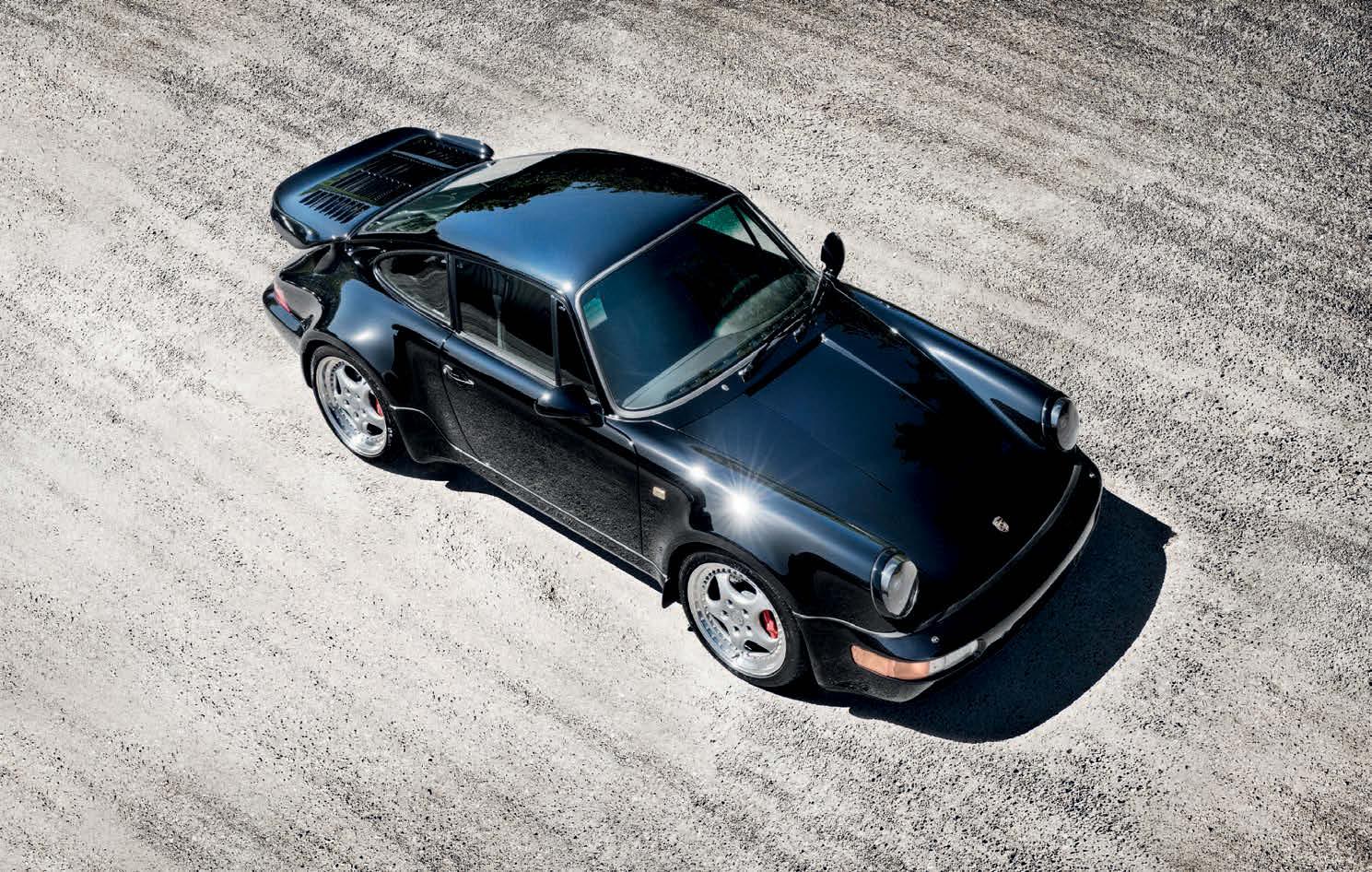
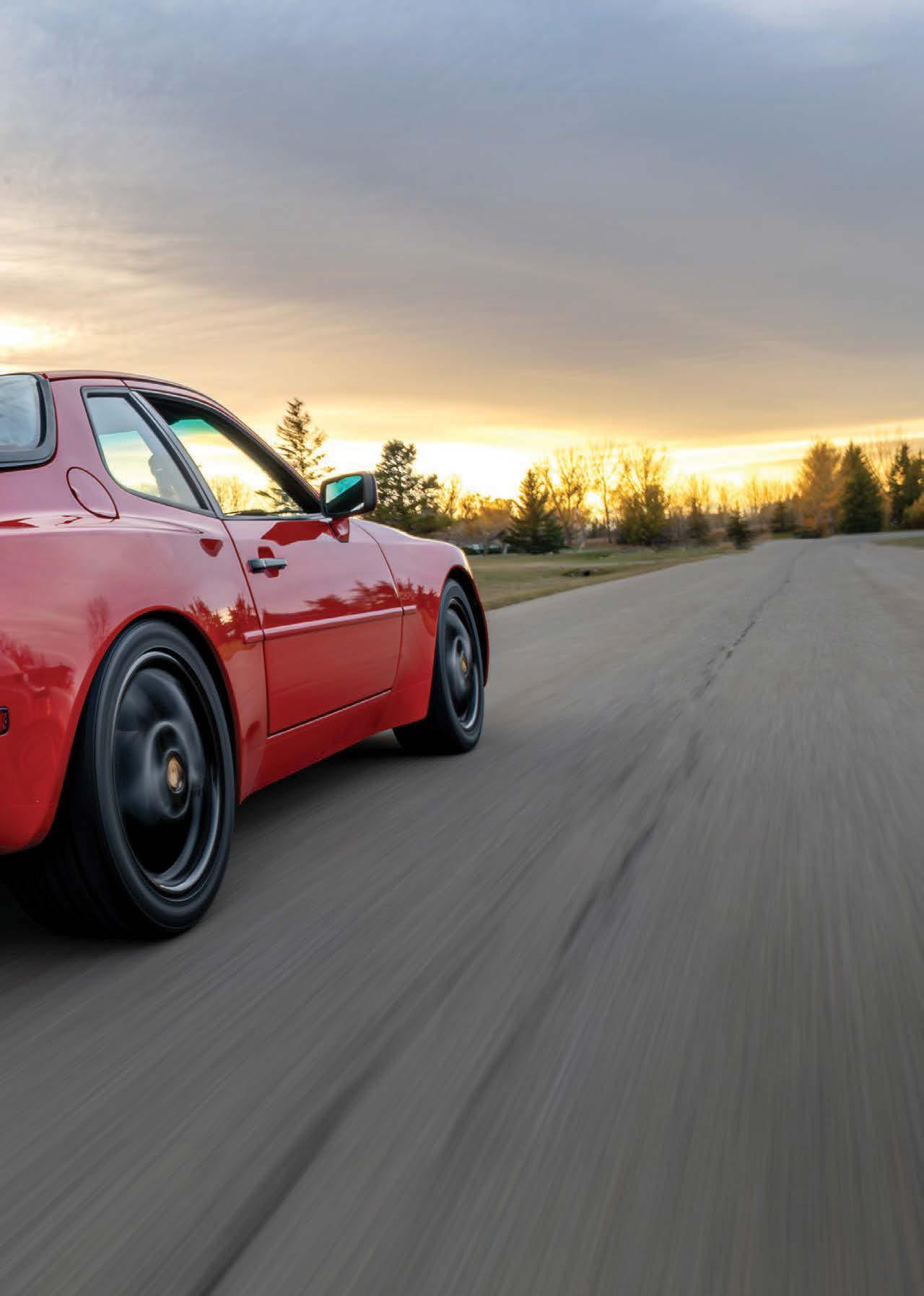
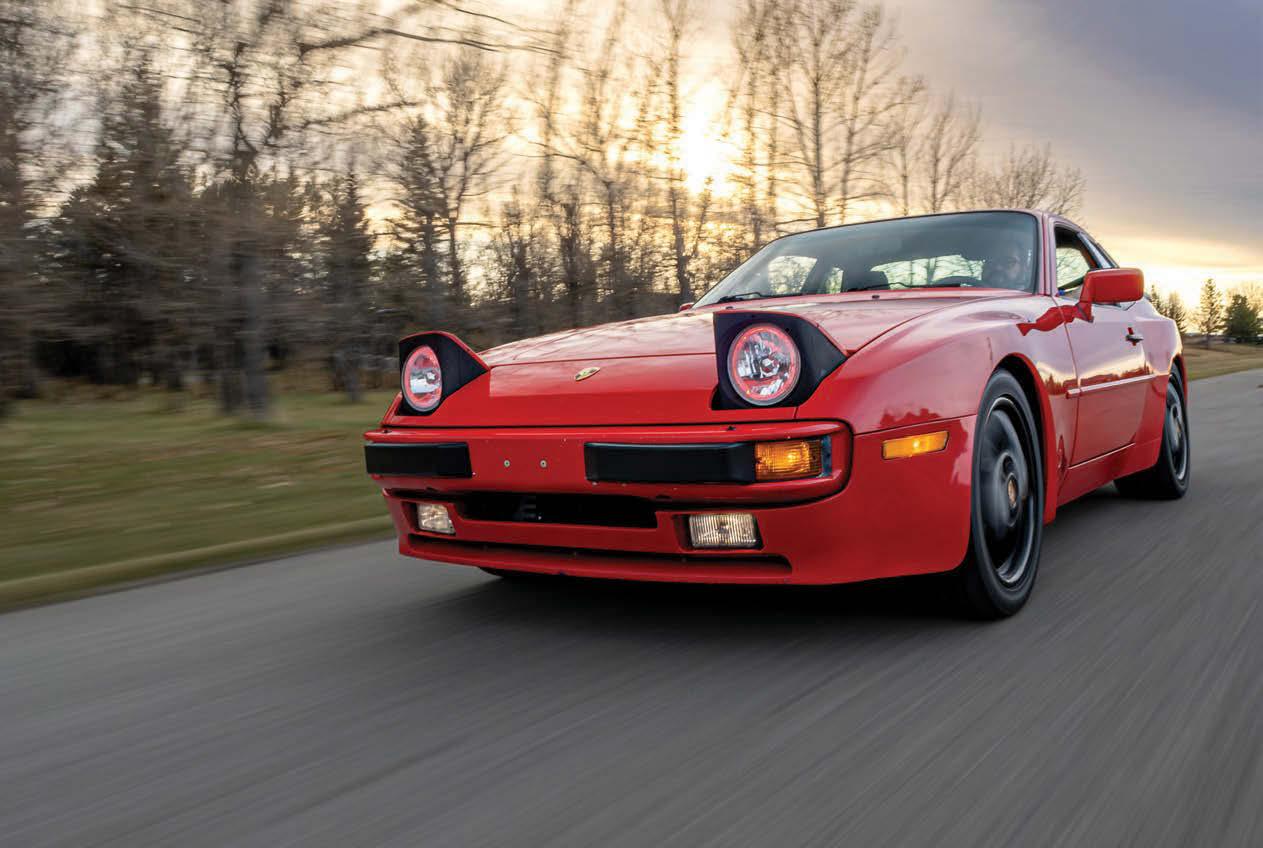
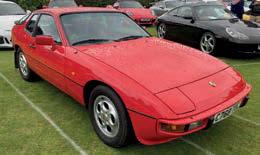
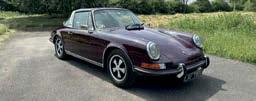
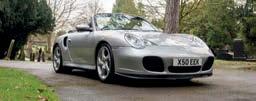
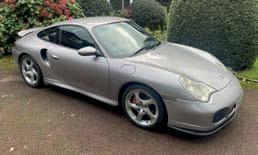
The past twelve months delivered much for Porsche enthusiasts to celebrate, not least key anniversaries, including the 964 and 993 hitting their thirty-fifth and thirtieth birthdays respectively. 2025 promises more of the same — the 944 Turbo hits forty, the Cayman
KELSEYmedia
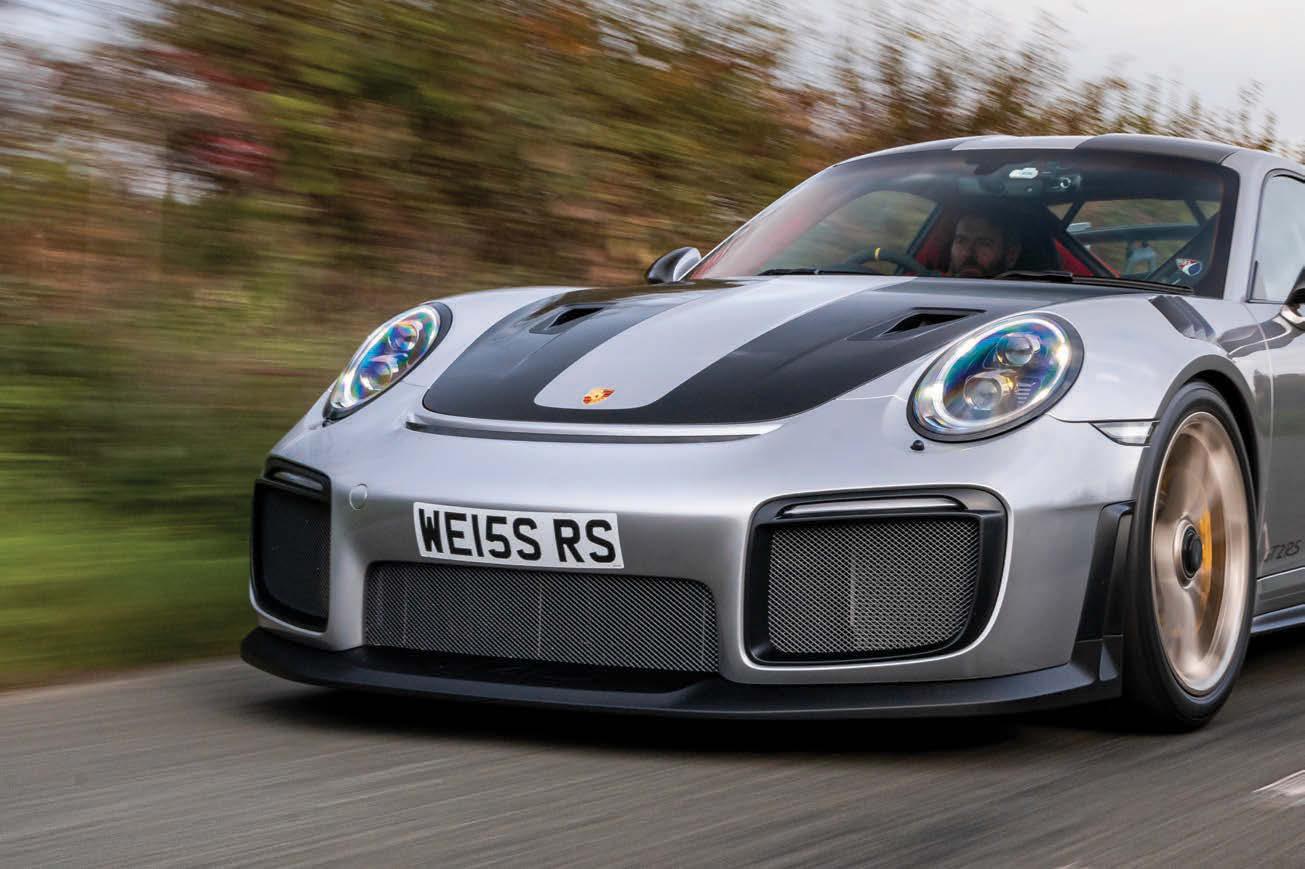
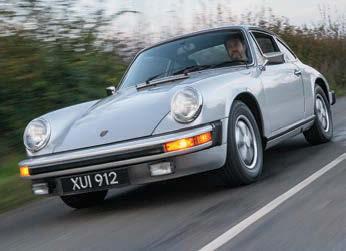
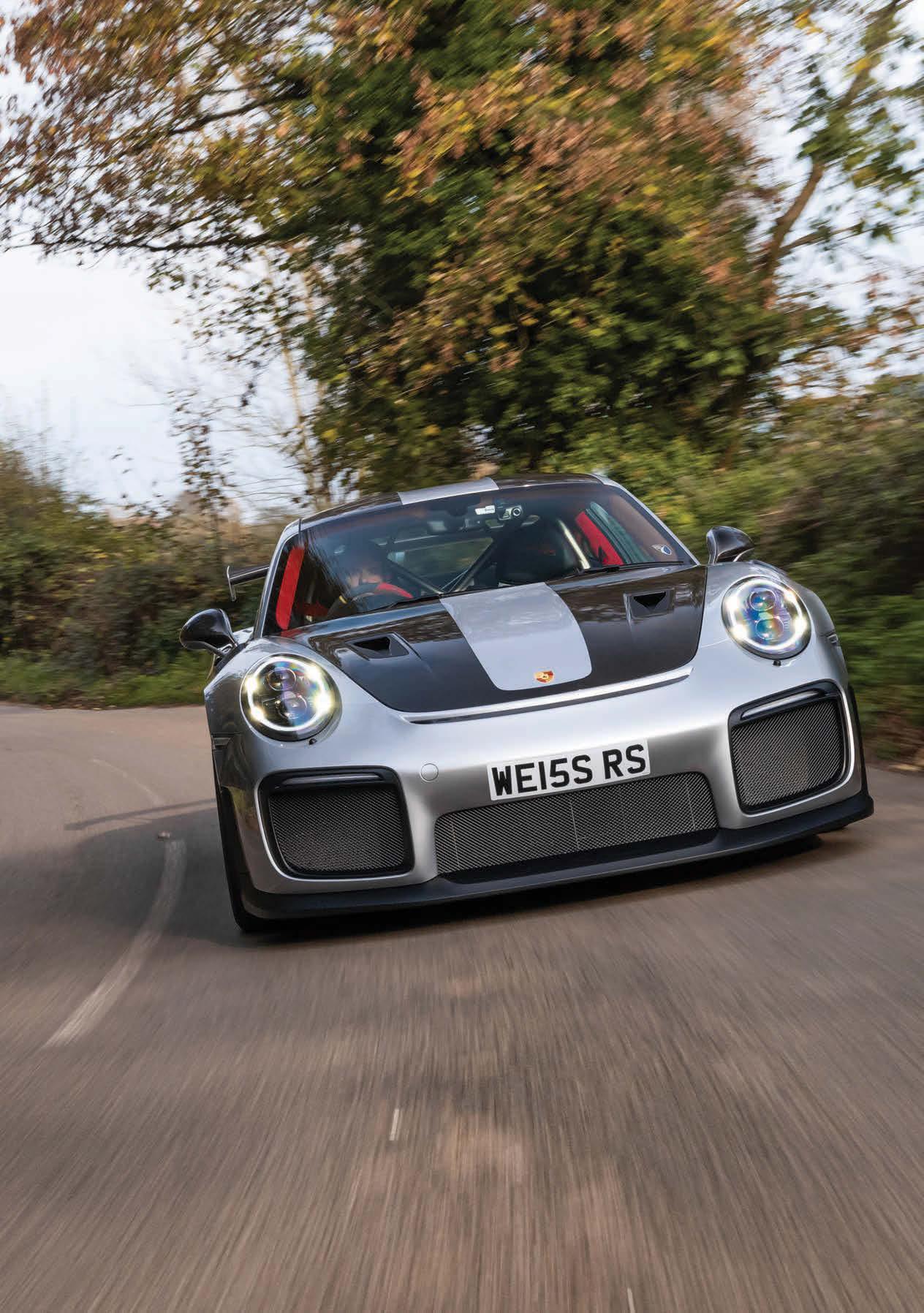
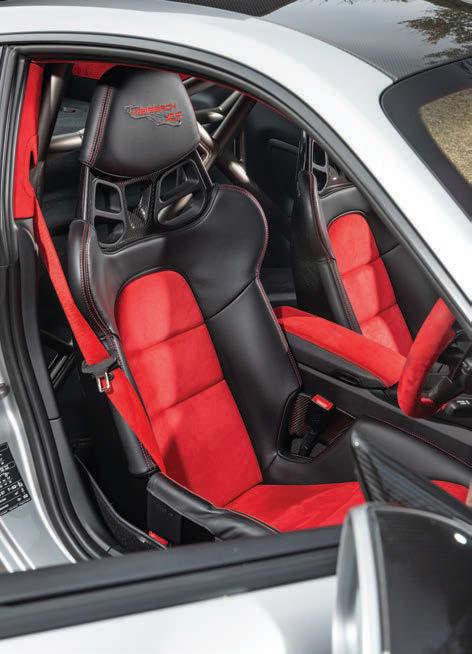
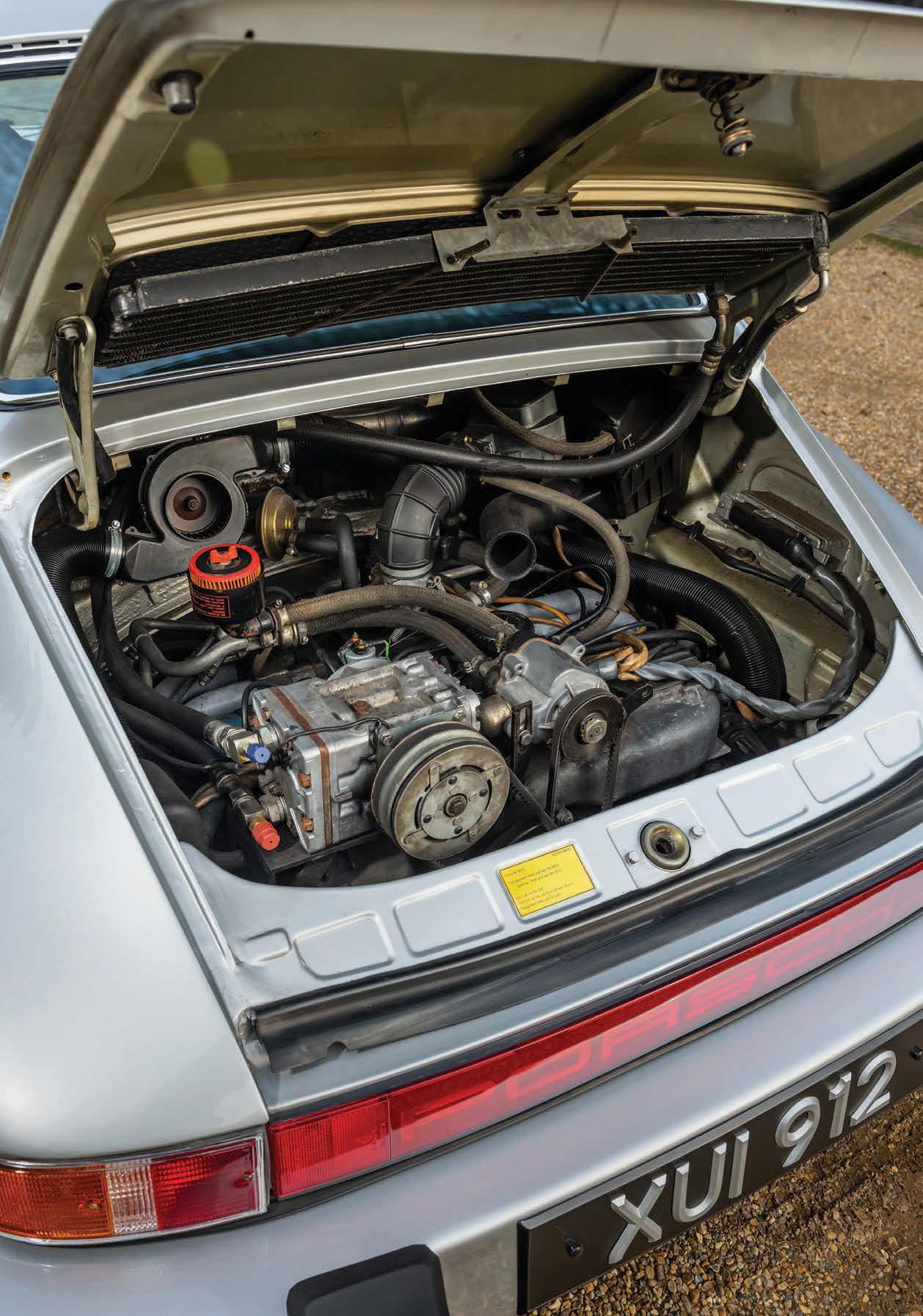
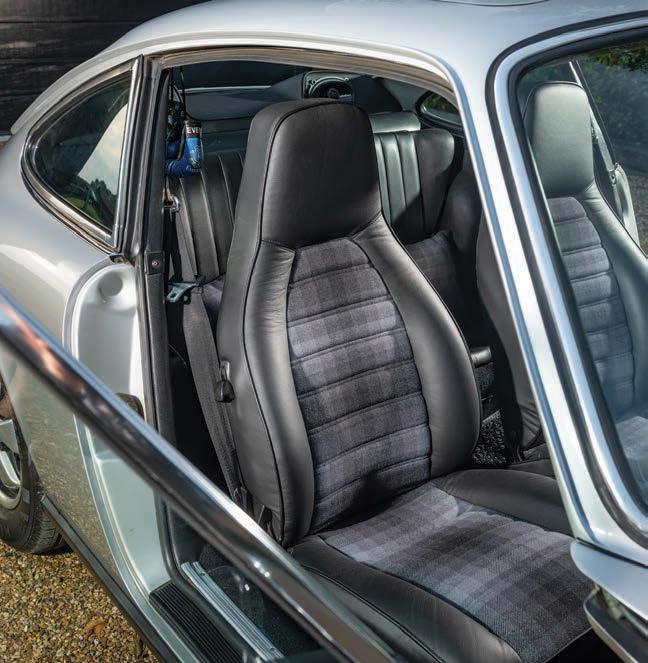
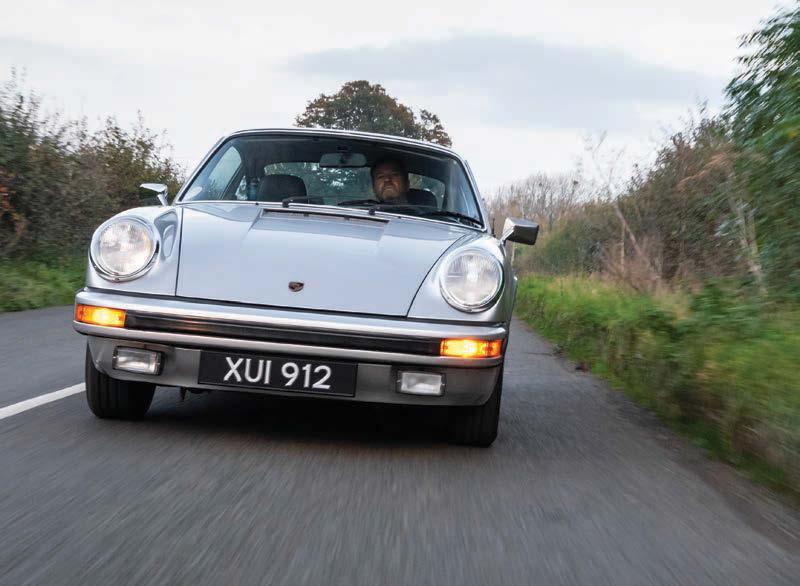
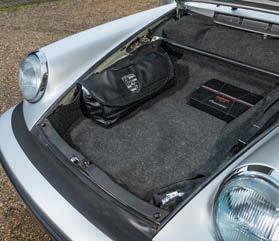
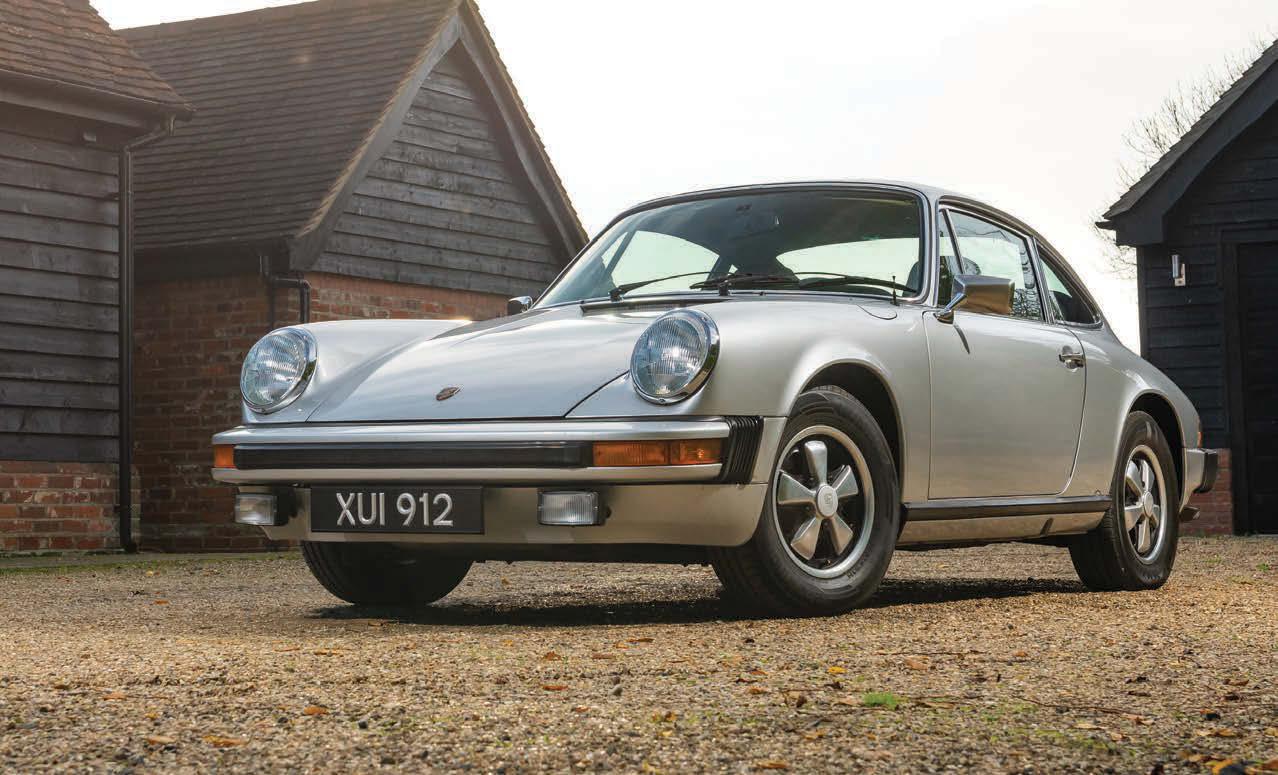
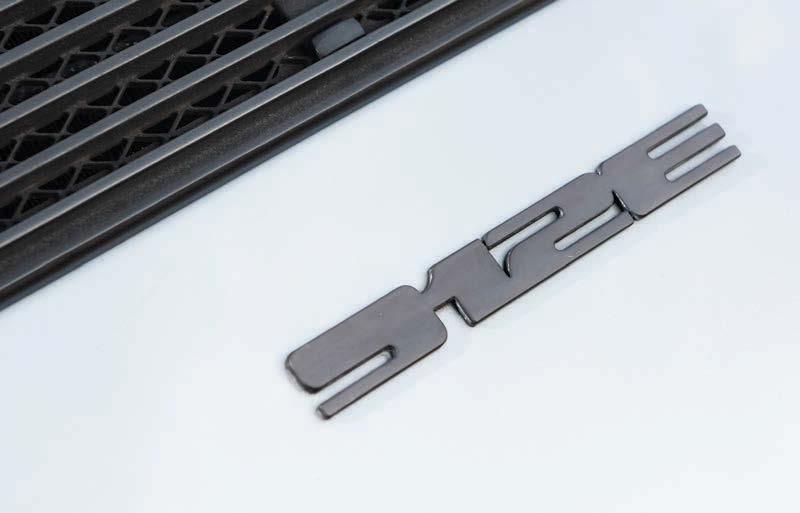
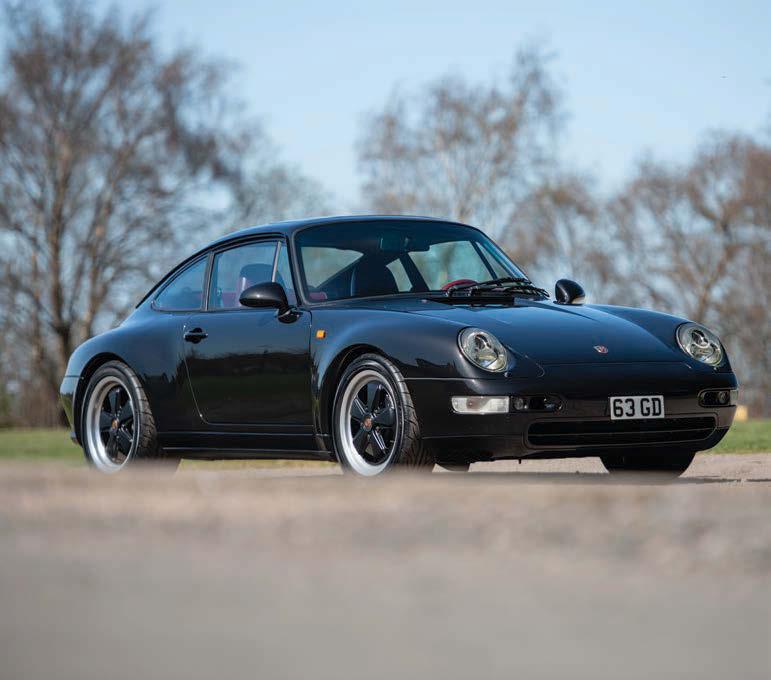
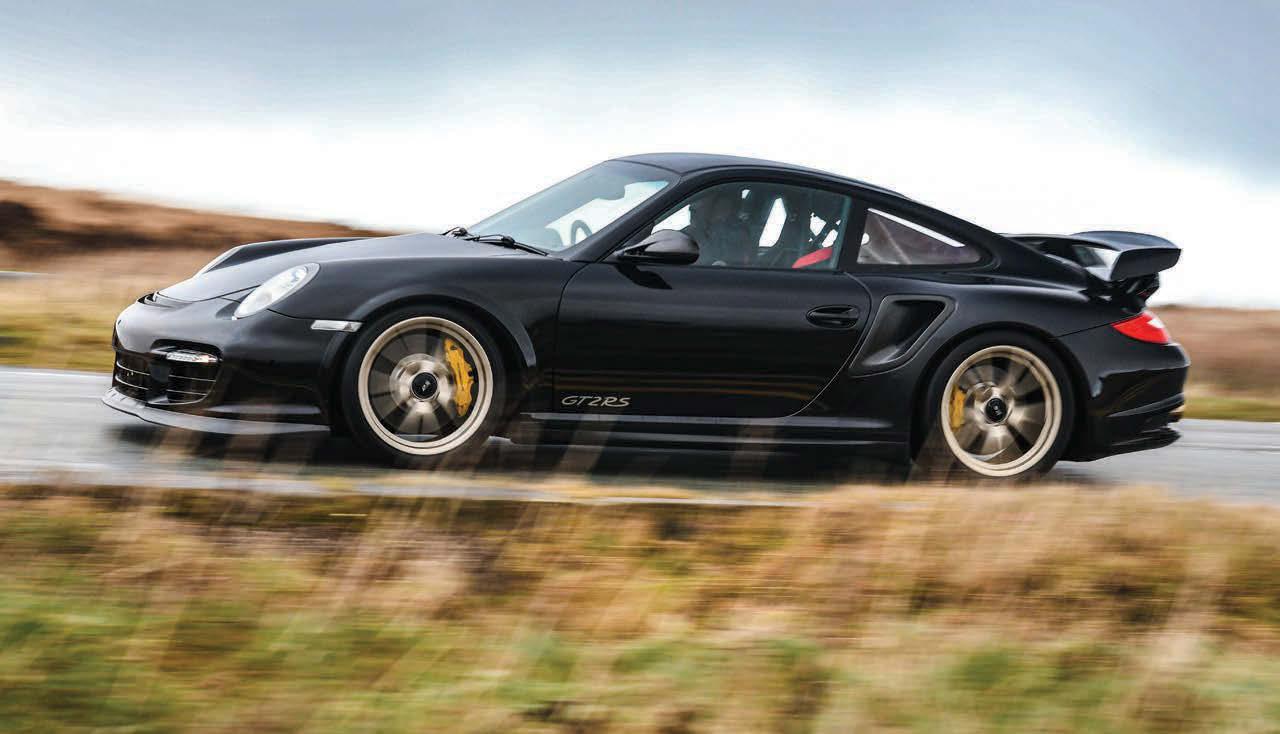
you’ll find a rare 912 E serving as quite the contrast to our cover star, a Weissach-kitted 991 GT2 RS. We’re always on the lookout for interesting cars to point our cameras at. If you’d like to see your Porsche in print, hit me up on Instagram. In the meantime, I wish you and yours health and happiness for the year ahead. Here’s to a fun and prosperous 2025.
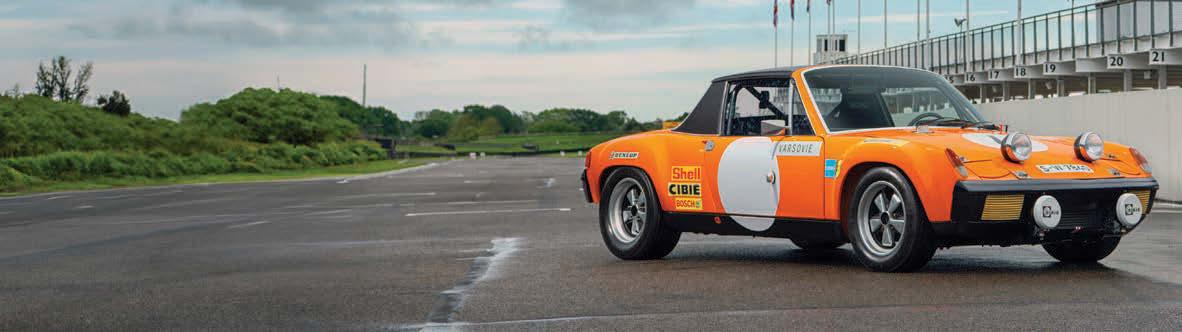
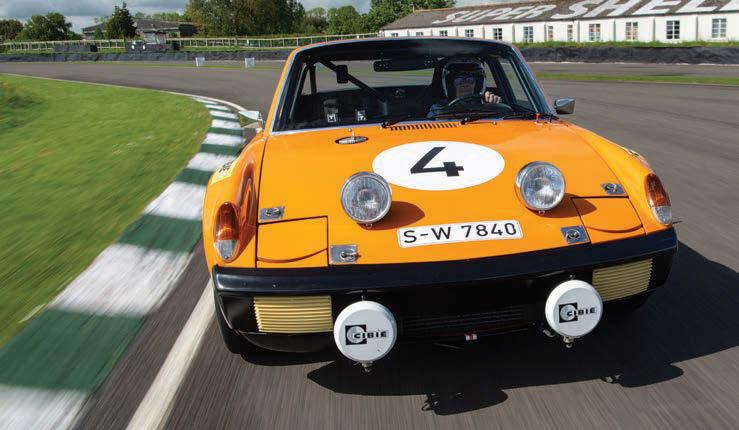
The 914 gave the 911 plenty to think about in the heat of competition. We drive a ex-works development 914/6 GT to see just how close the Targa-topped two-seater came to toppling the evergreen Neunelfer from its throne...
Words Steve Bennett Photography Ade Brannan
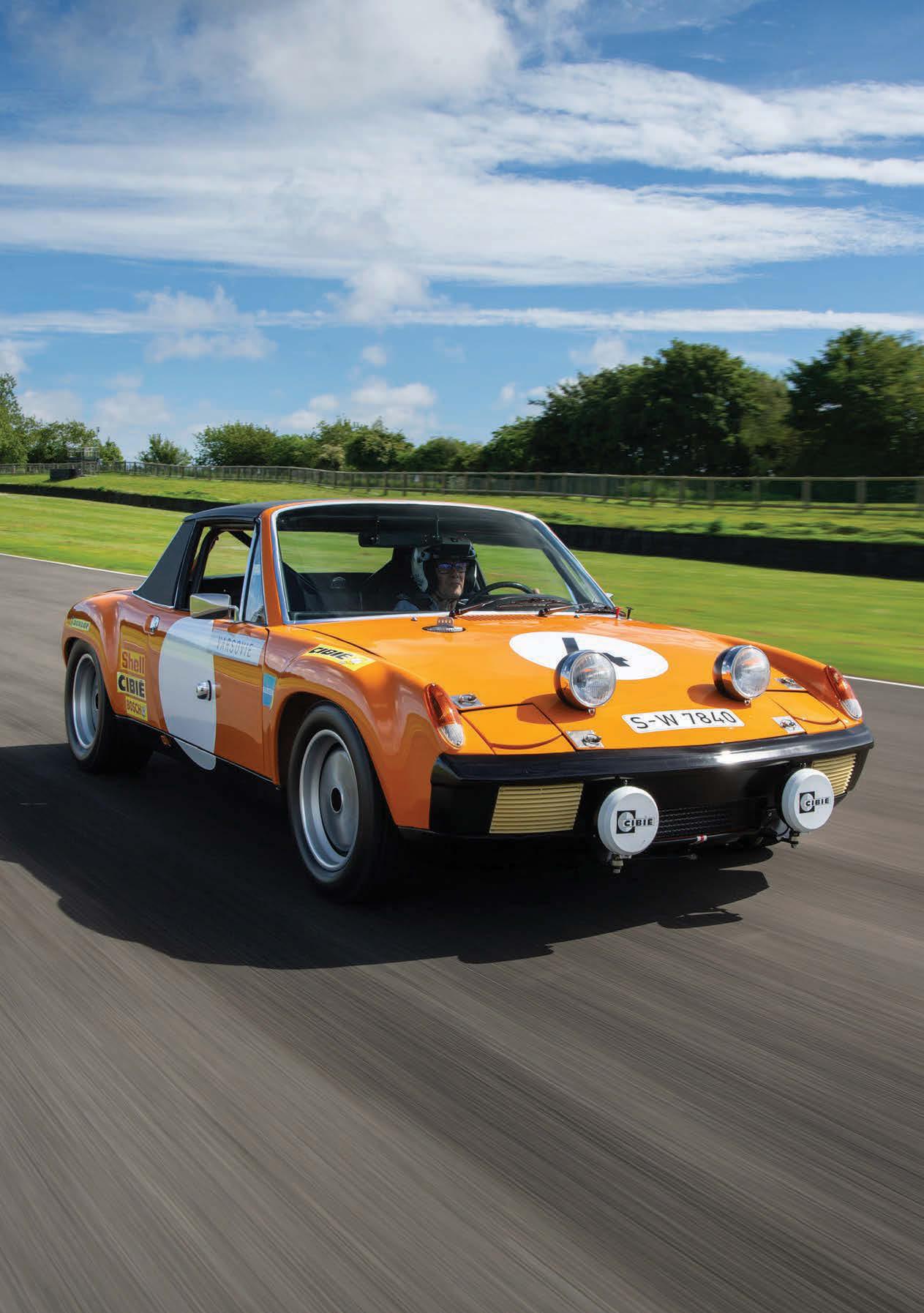
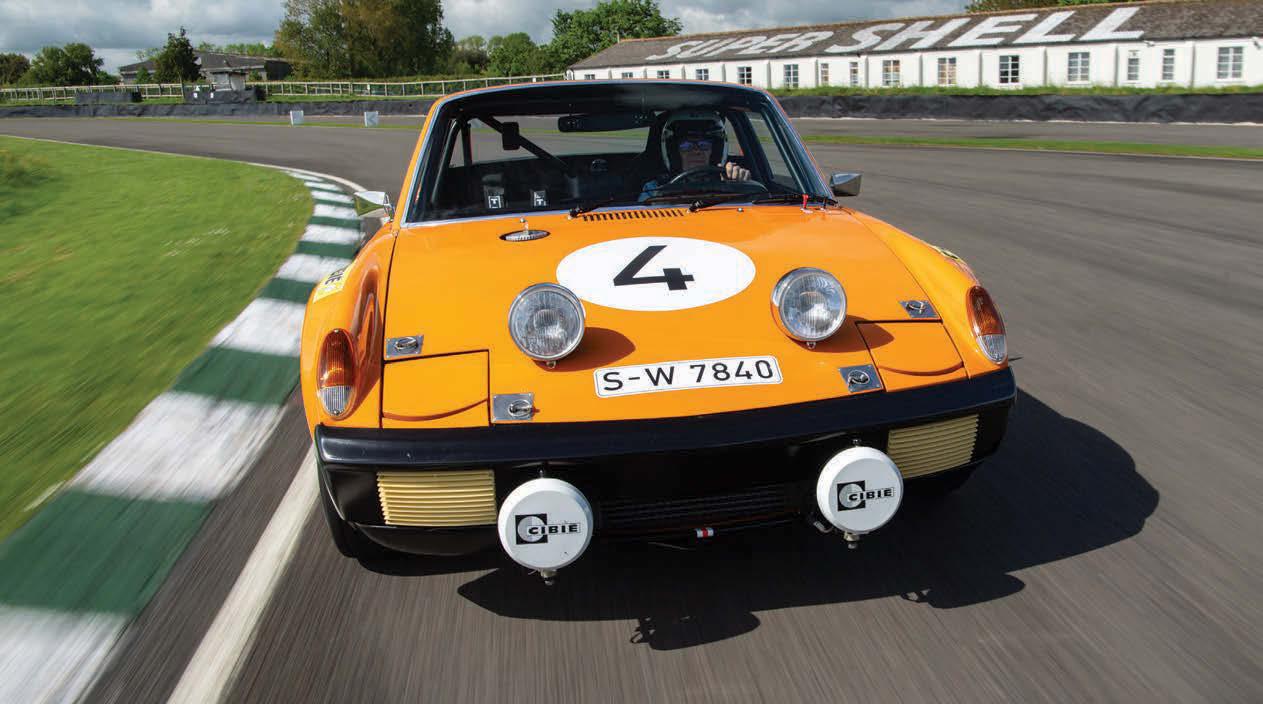
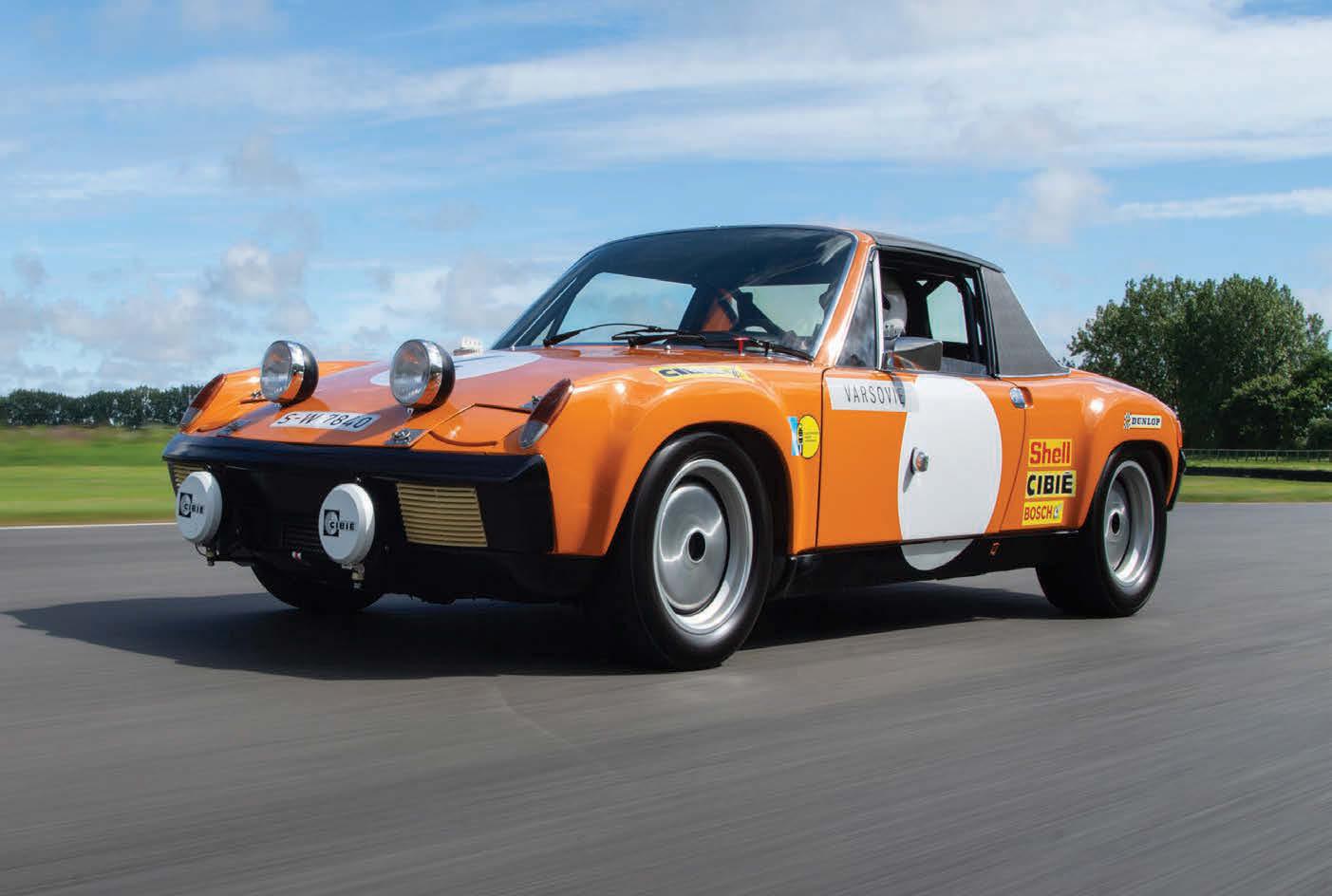
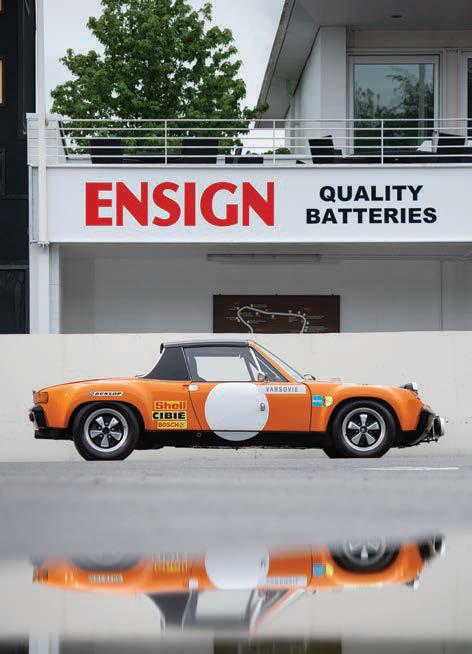
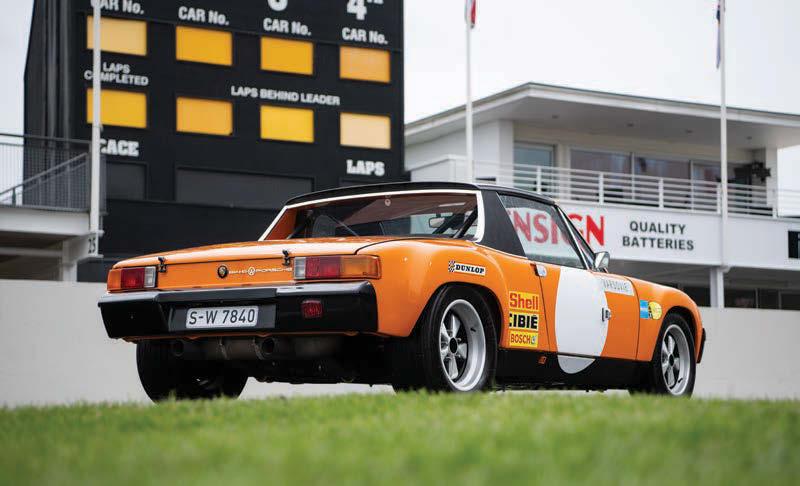
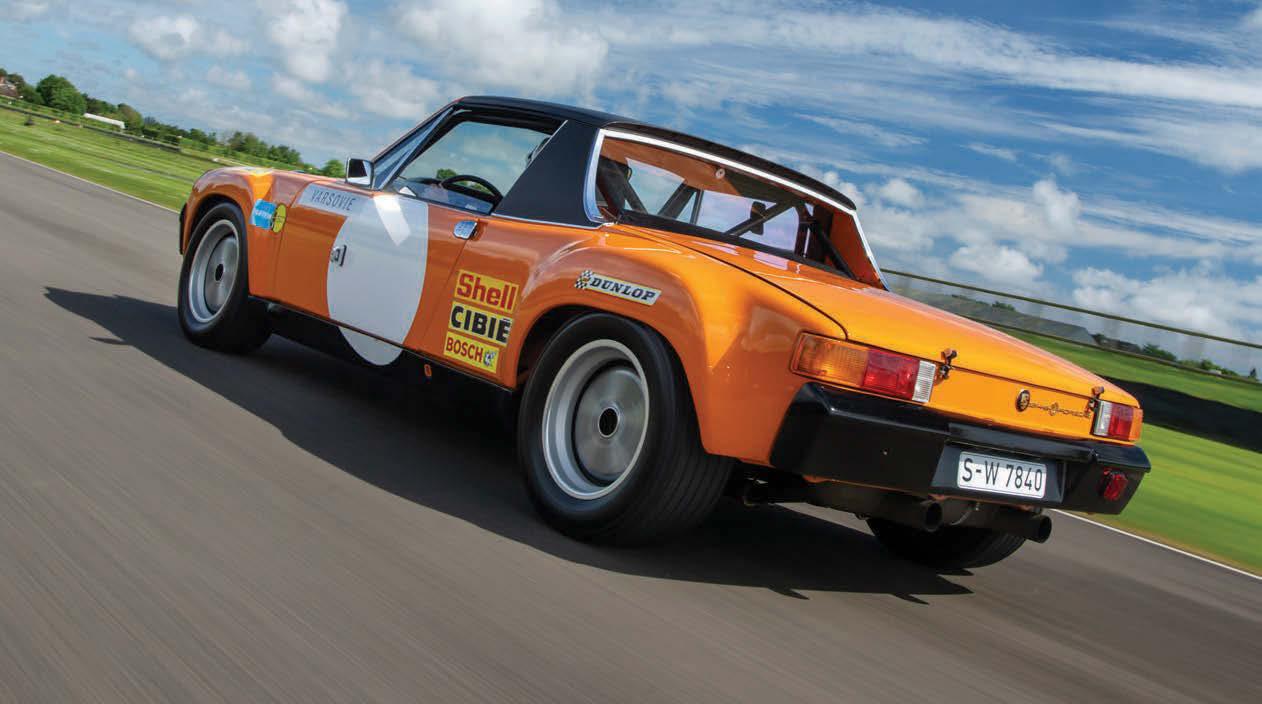
The green light at the end of the pitlane definitely means ‘go’. A red flag definitely means ‘stop’. Just three laps separate the two. As for orange, it’s the vivid Signal Orange of this exworks 914/6 GT, ensuring we have the full ‘traffic light’ effect. The problem?
The brap, brap, brap of the car’s 250bhp two-litre flat-six on open intakes and open megaphone pipes and, of course, the delicate balancing act between what happens at Goodwood Motor Circuit and the concerns of a twitchy local council, whose noise metres are ready to pounce and send marshals sprinting for the red flag of doom.
seemingly leftfield collaboration, you wouldn’t be reading this article. Put simply, the 914 satisfied Volkswagen’s desire for a range-topping car sports car, while the boxy two-seater would serve as an entry-level Porsche to replace the outgoing 912. In four-cylinder guise, the 914 would use VW’s new 80bhp Bosch S-Jetronic-injected 1.7-litre flat-four, while as a Porsche, the model would make use of the 911’s 110bhp two-litre flat-six on traditional carburettors.
Whether in range-topping Volkswagen form or as an entry-level Porsche, the
BURSTS OF ENTHUSIASM FROM WITHIN AND OUTSIDE THE POLITICS OF THIS VW-PORSCHE MASH-UP
That, then, is that. The 914/6 GT is banished to the ‘naughty garage’ in the paddock. End of story? Thankfully, no. A couple of gentle sub-5,000rpm warm-up and photography laps and one rather more ‘on it’ lap is enough to glean a feel for this important piece of Porsche race car history. I confess, I did rather suspect this might be the outcome. Good job there’s much more to this story than my own brief drive, though.
914 concept was exotic in its midengined layout. Indeed, in 1966, when designs and concepts were being mulled over, the number of mid-engined series production cars could be counted on one hand. Lotus Europa aside, none of them were remotely affordable. Lamborghini Miura, anyone?
Facing page Factory homologation papers show chassis 9141430137 was supplied with the first ever 914/6 engine, which remains with this special Porsche
The 914/6 GT’s star shone bright for barely more than a couple of years, but could have shone brighter still had it not been for Porsche’s own glass ceiling, which took the shape of the 911. In deciding to take the 914 racing and rallying, Porsche created its own enemy within — if afforded more development time, the Targa-topped two-seater could very easily have seen off the 911 in competition circles. Considering the 914 was supposed to be a budget-focused entry-level Porsche, this would never do. Then again, wasn’t it supposed to be a Volkswagen-Porsche?
Do we want to go there? Well, yes, go there we must because without this
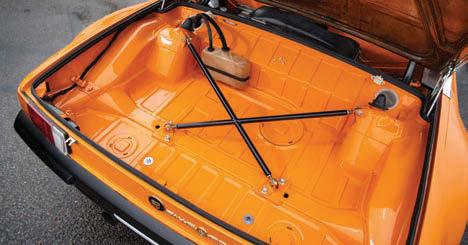
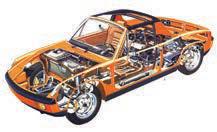
It could be said the 914 wasn’t remotely attractive. A bit harsh, perhaps, but there’s no denying a sharper suit of panels could have had a dramatic bearing on the model’s success. It’s difficult to apportion total design credit to the 914, but it’s fair to say it was a joint(ish) collaboration between Stuttgart-based industrial design house, Gugelot, and Porsche’s own in-house styling department. It might not be much of a looker, but in terms of layout and packaging, the 914 is clever, being wide and passenger spacious, with a good amount of fore and aft storage space, incorporating room to stow the detachable Targa roof panels in the nose.
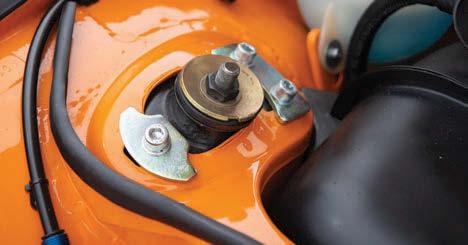
The 911’s entire front suspension assembly, including torsion bars, crossmember, struts and all, was used
on the 914, although the front hubs were changed on the four-cylinder model to allow the use of cheaper Volkswagensourced disc brakes. By contrast, the 914/6 used 911-style brakes in each corner. The rear suspension caused a few headaches — mid-mounting the engine meant transverse torsion bars could no longer be used. As a consequence, Porsche chose to use coilover rear damper units instead. Both versions of the 914 went into production in 1969. Behind the scenes, the relationship between Porsche and VW was not so much strained as confused, not helped by the fact latter’s chief cheerleader, Heinz Nordhoff, passed away prior to the start of production. His replacement, Kurt Lotz, didn’t share Nordhoff’s passion and was amazed to discover no formal detailed contract existed between VW and Porsche. Lotz insisted on sticking to the letter of the agreement in place, which he felt made it clear the 914 was first and foremost a VW project. Porsche, for its part, was keen to keep control of the 914/6 as a second string to the 911.
COST OF LIVING
For all this, the joint venture worked out fine, but for one thing: cost. For what might seem inexplicable reasoning, VW demanded Karmann charge Porsche more for its supply of 914 bodyshells than it did for 911 bodies. This seemingly arse-about-face thinking turned out to be because VW regarded the 914 as a low-volume product, with high development and tooling costs, and the only way Wolfsburg could recoup them was to increase the cost of the basic components, namely the bodyshells supplied to Porsche. The 914 might have been an entry-level Porsche, but it ended up being expensive, certainly when compared to its rivals.
The 914 soldiered on into production. The four-cylinder model saw further development as VW expanded the Type 4 engine range from a 1.7 to 1.8 and finally the full two litres. The 914/6, however, underwent virtually zero development at the hands of Porsche, remaining resolutely a slightly underwhelming 110bhp second cousin to the 911.
That said, there were bursts of enthusiasm from within and outside the politics of this VW-Porsche mash-up. Moreover, within the walls of Porsche’s then new Weissach product testing and motorsport facility, the company’s engineers were keen to show off the benefits of the 914’s midengined layout and its low centre of gravity. Consequently, preparations for competition 914/6s began in early autumn 1969. Twelve works GTs were built by late 1970, these cars forming the basis of the 914’s brief works competition life. Our noise-busting feature car is one of them.
top brass weren’t entirely sold on the idea, but had been persuaded by the motorsport department. Note the 914/6 was very much an endurance racer.
The GT package had substantial reinforcement to the rear of the chassis. The front suspension incorporated stronger front wishbones, plus anti-roll bars front and rear, unlike the standard road car, which had neither. On road- and track-purposed GTs, the ride height was reduced by four inches.
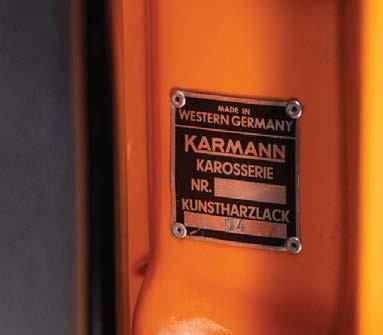
were assembled by Bauer at Cannstatt on the east of Stuttgart and were finished off at Zuffenhausen. Of the original twelve works cars, two were scrapped, one of which was the Monte Carlo car driven by Björn Waldegård. Another was sold to Recaro and built into a Nürburgring rescue vehicle, while the third test car is our noisy feature star, now residing in the UK in the custody of 914 aficionado, Mick Pacey.
IT IS KNOWN TO BE ONE OF THE EARLIEST 914/6
GT WORKS
TEST CARS, BUILT USING FACTORY DESIGNATION 914-55
The twelve-car line-up comprised three prototypes and test cars, two Targa Florio cars, three Marathon de la Route (an eighty-four-hour endurance race at the Nürburgring, rather than a race over Europe’s highest peaks) cars, three Monte Carlo Rally cars and one RAC rally car. Pretty impressive given Porsche’s
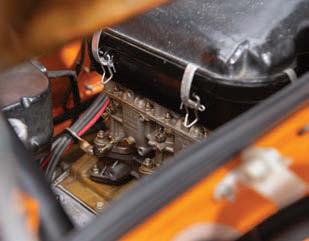
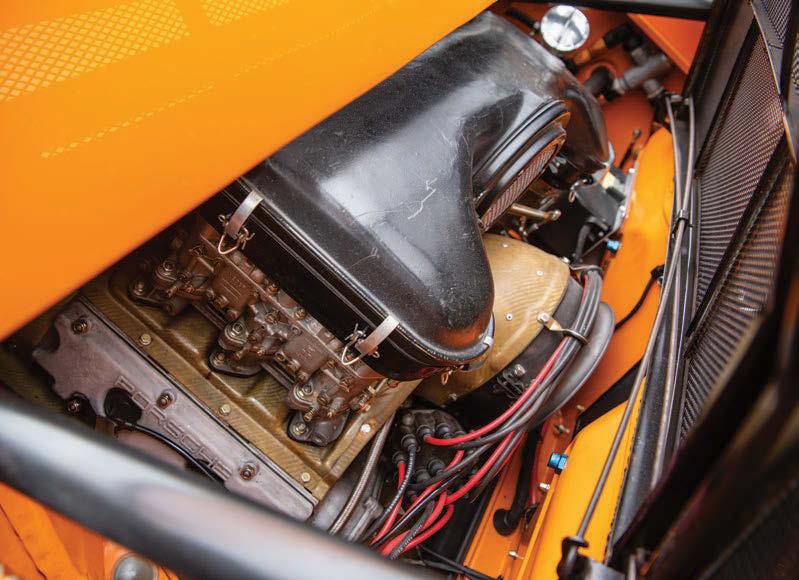
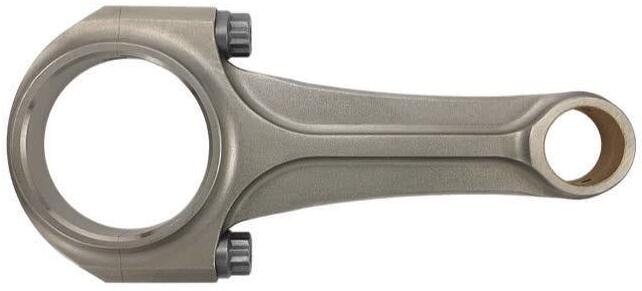
For the body, Plexiglass replaced side and rear windows and plastic bumpers took the place of the steel production items. Under the visibly wider engine grille sat a two-litre, twin-plug flat-six designated 901/25 and based largely on the 210bhp motor from the 911 R. Downdraught Weber carburettors, cylinders with special bores, forged connecting rods and a steel crank with additional counterweighting rounded off the specification. With a 10.3:1 compression ratio, the 914/6 GT engine developed 220bhp.
In addition to the works GTs, fortyseven customer cars were built, offered with the full M471 racing option. These
The 914 GT’s competitive career — in Europe, at least — was short, but bright, making more than a fair impression. When pitched against the contemporary 911, the 914 was very much an equal, if not better. The first outing was in May 1970 at the ADAC 1,000km of Nürburgring, where four 914/6 GTs finished nineteenth, twentieth, twentyfirst and twenty-third overall, plus second in the two-litre class, directly behind a 911. The 914/6 GT really made its presence known and its potential abundantly clear, however, at the 1970 24 Hours of Le Mans.
Of course, in Porsche legend, this particular outing at Circuit de la Sarthe is synonymous with Porsche’s first overall victory at the French enduro and with the 917, which was driven by Richard Attwood and Hans Hermann first past the finish line. As if this wasn’t enough,
Above The car shows only three owners from new and has been accurately restored to factory GT specification, leading to current FIA papers and eligibility for the world’s most prestigious historic motorsport events
the 1970 event is also when Steve McQueen came to town in order to film his all too personal (and arguably all too self-indulgent), Le Mans. McQueen’s personally owned 908/2 was converted to a live-action camera car and was driven by Herbert Linge and Jonathan Williams, remarkably finishing in the top ten, albeit not classified.
Indeed, in a race of attrition, Porsche won every class in which there was actually a finisher, all in the shadow of its overall win with the 917. And so often forgotten, but no less of an achievement, must surely be the sixth-placed Sonautoentered 914/6 GT driven by the French duo of Claude Ballot-Lena and Guy Chasseuil. If features heavily in the film,
too. A race of attrition it might have been, but the 914/6 was entered into the lowly two-litre GT Class and finished ahead of hordes of 911s. Besides, to finish first — or even sixth — you have to finish. What could have been? Well, it was more than a clue as to the 914’s potential. Even with just 220bhp and privately entered, the 914/6 could clearly humble its far more illustrious stablemate.
More 911 vanquishing would follow. The three Marathon de la Route cars locked out the podium, giving a grid full of 911s a through savaging. By contrast, the 1971 Monte Carlo Rally wasn’t quite a giant-killing performance. Set up for dry asphalt, the event was hit by heavy snow and the 914/6 had to give
best to the nimbler rear-engined Alpine. Waldegård reckoned he could have gone quicker in a 911. This is likely true, but nonetheless, third on the 914/6’s rally debut was pretty good going, especially when you consider the first 911 home was way back in fourteenth. Interestingly, Waldegård’s Monte Carlo car came up for auction in March 2024 with a guide price of between £947,000 and £1,183,000. It didn’t sell.
THREATENING BEHAVIOUR
That was pretty much that for the 914/6 GT in competition, certainly as far as Porsche was concerned. You don’t need to read between the lines. The GT was too fast. Developing it would have made it faster still. In modern terms, it’s rather like Cayman embarrassing the 911. Up until very recently, Porsche kept the midengined coupe firmly in its place, thereby not upsetting the status quo. Similarly, 914/6 GT beats 911 S/T was not what the company’s marketing department wanted to shout about.
The 914’s competition career continued with many privateer entrants, notably in the USA. Here, the model was much better understood, particularly on the West Coast, where the Targa roof panel could be dispensed with near permanently. The 914/6 had been seen as crucial to the American market — the 914/6 GT slotted neatly into International Motor Sports Association (IMSA) and Sports Car Club of America (SCCA) series, events and regions. In the myriad classes and categories, cars could be run stock or extensively modified. The
Above Finished on 1st November 1970, chassis 9141430137 is an ex-works
914/6 GT retained by Porsche AG for testing purposes
914/6 was perfect for either scenario. Cue, then, a racing career continuing to this very day.
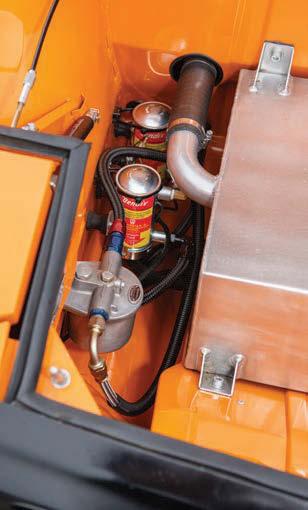
That’s the history and the background taken care of, what about our feature car? Manufactured on 1st November 1970, chassis number 914 1430137 (as listed on factory homologation papers) is a GT retained by Porsche as an Eigenbedarfsfahrzeug (the literal translation is self-use car) for testing purposes. As such, it is known to be one of the earliest 914/6 GT works test cars, built using factory designation 914-55. The build sheet shows this car was initially assembled without an engine and described as Versuch (meaning experimental). A flat-six was duly fitted. Number 640001, in fact, making it the very first 914/6 engine.
SPOUSAL SUPPORT
This GT may not have been raced by the factory, but it has had a fascinating life. It remained a works car until 1972, accumulating twenty-eight thousand kilometres (not inconsiderable mileage) before it was sold to its first private owner, John Rulon-Miller, an American racer based in Germany. He was a renowned wheelman and handy when in charge of various 911s at Le Mans, Nürburgring and at many of Europe’s other top-tier tracks. As a prolific Porsche privateer with factory connections, Rulon-Miller was able acquire the 914/6 GT, not for himself, but for his wife. The pair used the car regularly in competition, before
relocating to the UK in 1975, bringing the 914 with them. At the turn of the decade, the engine was rebuilt with 2.2-litre 911 T cylinder heads and displacement was increased to 2,195cc. A major body restoration was started in the mid-1980s, but effectively stalled for ten years. Then, in the small world occupied by the 914 and those who understood it, the car was acquired by its second private owner, Mike Smith, he of famed 356 and 914 specialist, PR Services. Funnily enough, this is the second 914 feature with a Mike Smith connection I’ve penned in the
past seven days, having just documented the life and times of an uber-rare Crayford-converted right-hand drive 914 for our sister title, Classic Porsche. This was a car Smith also previously owned. Like I say, small world.
In a partially dismantled state, Smith could see the car was a 914/6 GT with the correct factory body, including those flared wheel arches, although the car was missing most of its other modeldefining parts. Crucially, the engine was still in place. He carried out a fair amount of body restoration, but as is often the
Below The car is currently equipped with a twin-spark 911 S two-litre engine numbered 961200, while the historically significant 6400001 is kept safely in storage
way, paid work got in the way, which is why the job of finishing the restoration was entrusted to Martin Greaves at Classic Performance Engineering in 2012. Unsurprisingly, given Greaves’ reputation in the industry, the result is stunning, supported by invoices totalling more than £300,000 and indicating use of original 914/6 GT parts.
was therefore receptive to an offer from the aforementioned Mr Pacey, proprietor of independent classic Porsche sales
volumes for the work carried out by Martin Greaves, insofar as it satisfied Pacey’s eye for originality and detail. The reason we are here at Goodwood?
FIRST IS BACK AND TO THE LEFT, SECOND IS FORWARD TO THE RIGHT, BACK FOR THIRD, FORWARD AND RIGHT FOR FOURTH AND BACK FOR FIFTH
Restored in its original Signal Orange and with decals in homage to Waldegård’s Monte Carlo car, as well as the Marathon de la Route trio, the newly restored 914/6 GT wasn’t used by Smith quite as much as he felt it deserved. He
and restoration specialist, Export 56. This is a man who can’t resist a 914, or any other leftfield air-cooled Porsche for that matter, particularly if resplendent in one of Porsche’s 1970s ‘Opal Fruit’ colours. The fact he’s a leading expert in the restoration of early Porsches speaks
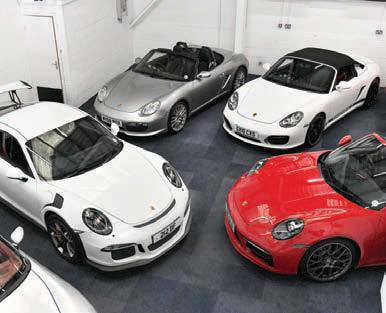
This significant car now resides in a collection of other significant Porsches curated by Export 56 for a private collector. Typically, the individual in question wishes to remain under the radar, but he has made this day possible by hiring the historic circuit for our benefit. I’m the jammy so and so tasked with getting behind the wheel of this and other rare beasts from the same extraordinary fleet.
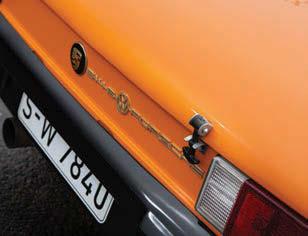
I confess, I’ve never had much of a problem with the 914 and what some would describe as its ‘challenging’ looks. And I’ve got no problem with it in GT specification and with a lick of Signal Orange covering its bodywork. Or those wide Fuchs filling out the blistered arches. Pre-Rennsport, this is toughest road-racing Porsche of its era. Short squat, pugnaciously loud and ready to cause trouble, albeit not on the supervaluable original engine, but a 250bhp in-period twin-spark two-litre 911 S boxer fitted back in 2016.
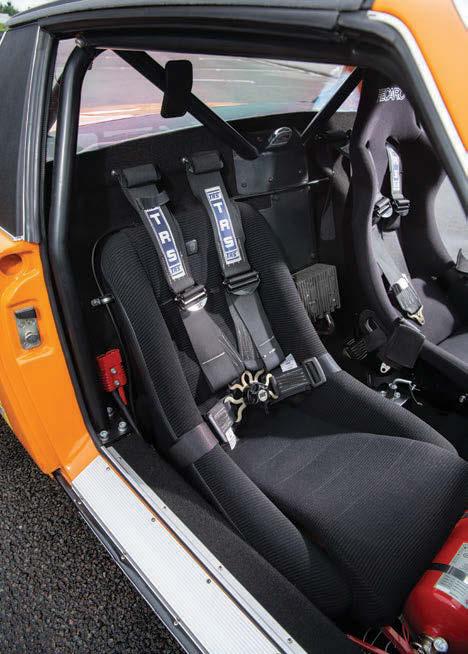
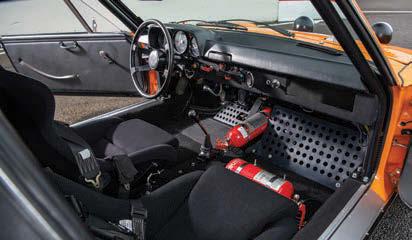
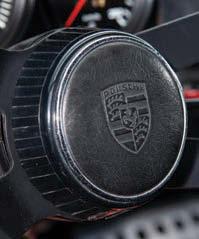
Helmet on and the din is slightly more muffled. Inside, this car is as it would have left the factory, save for a more modern Recaro driver’s seat. The cabin isn’t actually too spartan — it features carpets and a passenger seat, plus a substantial footrest to facilitate secure
Above John RulonMiller bought the car from Porsche in 1972, before moving to the UK in 1975, Greece in 1983, then back to the UK in 1984, the 914 with him at all times until it was sold to PR Services founder, Mike Smith, in 1997
pace note and map reading duties.
Typically, the clutch is on the firm side, but the Type 901 gearbox is synchro’d, Porsche believing that for endurance racing, the driver deserved a helping hand. That said, the dog-leg shift pattern always takes a little acclimatisation. This is to say, first is back and to the left, second is forward to the right, back for third, forward and right for fourth and back for fifth.
Dodging behind the camera tracking car — with snapper Brannan hanging out the rear — gets the balloon-profile Michelin TB semi-slicks up to temperature. With Ade giving me a thumbs up to indicate ‘job done’, I’m free to let rip for one lap and 2.367 miles only.
the 914 digs in and grips, sorting itself on the exit and streaking off up the Lavant straight. Hard on the brakes for Woodcote, turn in, a quick squirt to the chicane and… that’ll be the red flag, then. Game over? Not quite.
I mentioned the 911 S/T. While this will be the subject of a separate magazine feature, it was both fascinating and a privilege to drive, but also provided a very useful comparison against the 914/6 GT, given the S/T was the contemporary
necessitating a quick dab of opposite lock. A warning from the rear? You could say so.
DIFFERENCES BETWEEN THE TRADITIONAL REAR-ENGINED SETUP AND THE BALANCE OF THE MID-ENGINED LAYOUT ARE IMMEDIATELY OBVIOUS
The 250bhp makes short shrift of the GT’s 840kg along the pit straight. Into the fast, third-gear double apex Madgwick, the camber of the track drops away, loading the offside tyres. There is noticeable roll and lurch as weight transfers to the outside, but once settled, the 914/6 feels planted and stable and gallops up through Fordwater, demolishing fourth gear, with fifth taken briefly before blipping and blapping down to third for the blind right-left St Mary’s and a quick squirt to the tight right Lavant, taken in second. Again, there is roll, but as soon as the weight transfers,
customer-and-works competition 911 to the 914, right down to sharing very similar engines. Well, in terms of capacity and power. Identical gearboxes, too.
This was never supposed to be a backto-back comparison, but then again, why not? I jump from the 914/6 GT to the S/T (which, fortunately, is quieter) and head back onto the high-speed Goodwood track. The differences between the traditional rear-engined setup and the balance of the mid-engined layout are immediately obvious, from the moment you try to stick the 911’s nose into the circuit’s off-camber first corner. It doesn’t really want to go there. The weight of the rear takes over and does its thing,
And so it continues around the lap. It’s all textbook, law of physics, 911 stuff. Stick the engine that far out the back and like a brick on the end of a broom stick, it will have a pendulous influence on the balance. Stick that same flatsix in the middle, and things suddenly become a lot more manageable and predictable. The 911 works very much in three dimensions to the 914’s two dimensions, adding an extra variable for the skilled 911 racer to exploit that famed rear end grip, which is what Waldegård wanted on the snowy Monte Carlo and what the 914 couldn’t deliver. In the dry? A different story. I certainly don’t count myself in the late Mr Waldegård’s talent orbit, but I can tell my mid from my rear and I don’t doubt had Porsche kept developing the 914 in competition, the 911 would have had a pretty tough time of things. This is a conclusion Porsche has largely come to itself in recent years — it moved the 911’s centre of gravity ever more to the middle ground and even turned the engine around altogether in the recent RSR endurance racers, effectively making them mid-engined. If that’s not proof you can’t defy the laws of physics, I don’t know what is. Porsche knew all along. l
Above 0137 was recently put through its paces by former Porsche works driver, Richard Attwood, who secured Porsche’s first overall victory at Le Mans by campaigning the Salzburg 917 to victory in 1970
THE BULLETIN
News from the world of Porsche
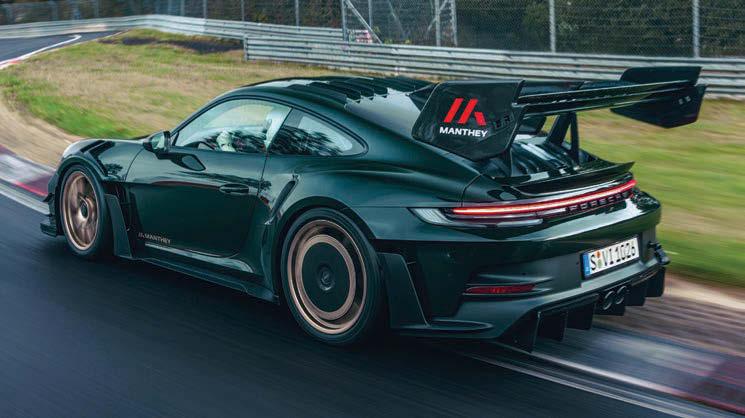
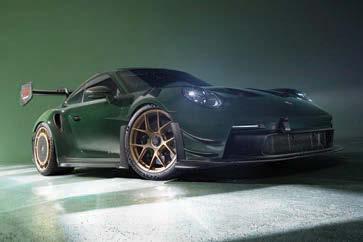
MANTHEY PERFORMANCE KIT NOW AVAILABLE TO ORDER FOR 992 GT3 RS
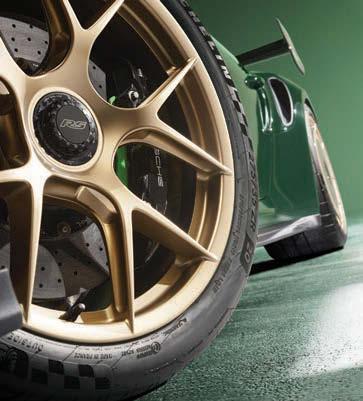
Porsche has announced a range of Manthey Racing upgrades for the new 911 GT3 RS, delivering even higher performance at the track. The kit provides significantly increased contact pressure and, as a result, higher cornering speeds. The suspension has been specially adapted for circuit life, while the brakes are optimised for the particularly high demands of trackday driving. The new Manthey kit was developed as part of a close collaboration between the Porsche Development Centre in Weissach and the Manthey Racing engineers in Meuspath. These track-focused components will be distributed via Porsche Centres.
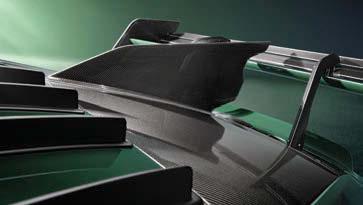
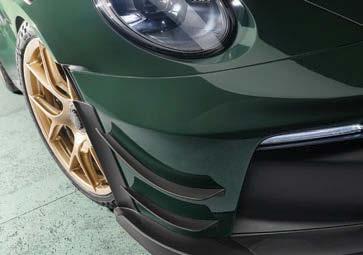
Extensive changes to the host 992’s aerodynamic components make this Manthey kit immediately recognisable. The spoiler lip (with its new wing profile) has been significantly enlarged and is supported by reinforcing elements made of carbon-fibre. Together with redesigned wheel arch Gurney flaps and two dive planes on each side of the front bumper, the spoiler lip increases downforce on the front axle. The rear window, meanwhile, is replaced by a twenty-five percent lighter carbon-fibre panel on which a carbon-fibre ‘shark fin’ is mounted. The fin was derived from the World Sportscar Championship-winning 963 and is designed to increase cornering stability. In conjunction with six additional roof fins, it also diverts warm output air from the front radiator outward, thus ensuring cooler intake
THREE BODY ACCELERATION SENSORS ENSURE MORE
PRECISE AUTOMATIC DAMPER TUNING
air is drawn in at the rear, even under extreme operating conditions. In conjunction with larger, redesigned end plates, the split carbon-fibre DRS wing element increases downforce on the rear axle. The significantly widened rear diffuser also increases downforce, but without increasing air resistance. The carbon-fibre ‘aerodisc’ wheel covers reduce air resistance and make the perfect addition to the combination of aerodynamic components, which work seamlessly to optimise airflow and maximise overall efficiency. Overall, downforce has been increased significantly, without increasing drag. For example, at 177mph, a Manthey-kitted 992 GT3 RS produces more than a thousand kilograms of downforce. This enables higher speed on fast and medium-speed corners by way of maximised vehicle stability.
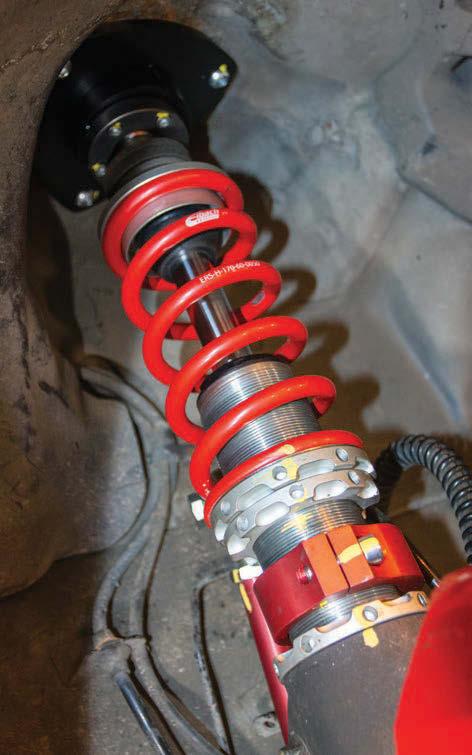
The spring rates of the semi-active coilover suspension have been adjusted for the higher downforce figures — rates were increased by thirty percent on the front axle and by fifteen percent on the rear. Four wheel sensors and three body acceleration sensors ensure more precise automatic damper tuning.
The Manthey kit for the 992 GT3 RS can be ordered from Porsche Centres now. It will be available in EU markets from January 2025 and outside the EU from March 2025. The host 911’s warranty remains unaffected.
PORSCHE MOTORSPORT AND IRON DAMES IN FARREACHING PARTNERSHIP
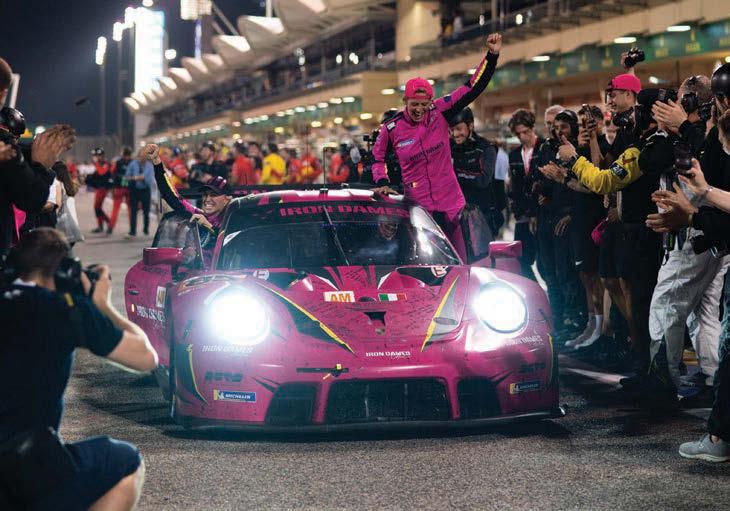
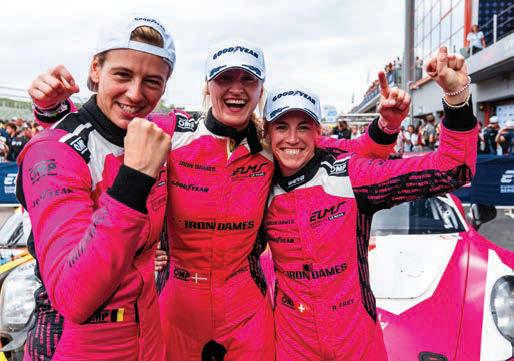
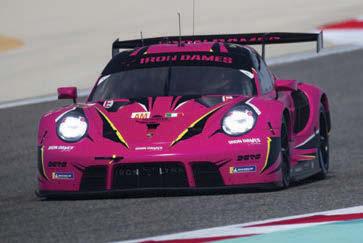
Porsche X Iron Dames — because every dream matters. It’s a slogan representing the close collaboration between Porsche Motorsport and Iron Dames, the renowned initiative to promote women in motor racing. The project kicks off with the start of the Asian Le Mans Series.
Four fast female drivers will compete in four top series at the wheel of a 911 GT3 R. Michelle Gatting from Denmark, Rahel Frey from Switzerland, Sarah Bovy from Belgium and Célia Martin from France will race for the Iron Dames squad in Asia, Europe and the USA. The schedule also includes the 24 Hours of Le Mans as part of the FIA’s World Endurance Championship (WEC).
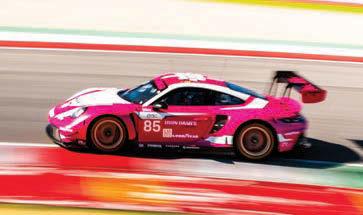
Gatting, Frey and Martin will share the pink Iron Dames 911 in the WEC’s LMGT3 class. Manthey Racing is responsible for the operational side of campaigning the near 560bhp race car. The seasoned customer squad lifted every title in the GT3 category’s
debut season in the WEC. Meanwhile, Proton Competition runs operations in the Asian Le Mans Series, the European Le Mans Series and the North American IMSA WeatherTech SportsCar Championship. As part of this programme, Gatting will be promoted to the Porsche contracted driver squad.
The alliance between Porsche Motorsport and Iron Dames is set to continue for several years. Plans are already in the pipeline for the project to be closely linked to the German sports car manufacturer’s successful junior development pyramid. The aim is to interlink national support programmes in Porsche one-make cups, the central Junior Program of Porsche Motorsport and the recently introduced Iron Dames Young Talents initiative. This creates a path from karting to top professional motorsport.
“Porsche stands for a culture of equal opportunities and diversity. Encouraging women to get involved in motorsport and then supporting them in open competition is something we value highly. In this context, we’ve recognised the Iron Dames project is very well-structured and has been very successful in recent years,” explains Thomas Laudenbach, Vice President of Porsche Motorsport. “Since our customer teams have
already celebrated victories with Iron Dames, we’re now taking the next logical step. We’re confident the collaboration in all series will reap excellent results. We also hope to highlight our contribution to supporting female racing drivers by securing victories and podium finishes.”
Deborah Mayer, founder of the Iron Dames project, says “it’s an honour to join forces with such a renowned brand as Porsche Motorsport, which shares our goal of leaving a lasting legacy while driving progress forward. The Iron Dames initiative has always been rooted in the power of dreams to overcome barriers. Our journey is not just about competing at the highest level, but it is also about proving the door to the racing world is open to any woman with the passion and determination to succeed.”
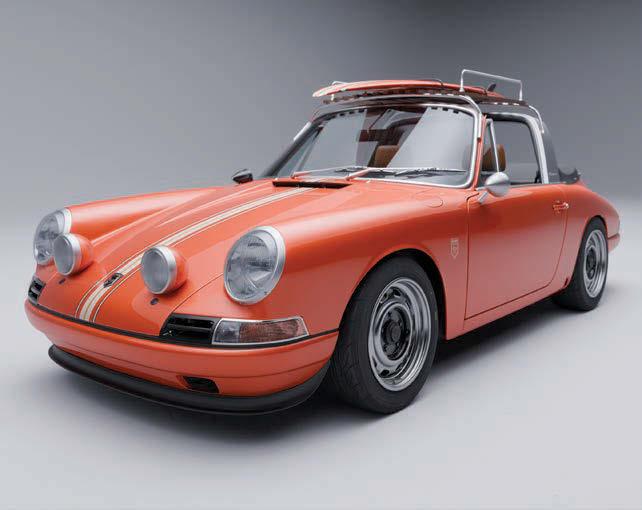
KAMM LAUNCHES IN USA AND ANNOUNCES 912c TO BE JOINED BY NEW TARGA
In the world of ultra-lightweight classic sports cars, KAMManufaktur is setting the standard. Known for its meticulous redesign and reengineering of the classic 912, KAMM’s 912c (as featured in the pages of 911 & Porsche World) has won the hearts of drivers, critics and collectors across Europe on account of the car’s lightweight construction and high-performance four-cylinder engine.
KAMM has now officially launched in the United States with appointment of Zweck as US dealer and delivery of the first production 912c to a 911 & Porsche World reader in Miami.
The ultra-lightweight KAMM 912c captures all the magic of Porsche’s classic 1960s design, further enhanced by the extensive use of carbon-fibre to deliver a class-leading weight of just 750kg (specification dependent). Combined with an extensively re-engineered, air-cooled flat-four based on the famous Type 616 boxer fitted to the late 356 and the 912 in period, the KAMM 912c guarantees a fully analogue, pure driving experience.
KAMM founder, Miklós ‘Miki’ Kázmér, and his team have a deep love for the 912, which is often overshadowed by its famous sibling, the 911. Through careful attention to detail and a respect for tradition, Kázmér has brought the 912 back into the spotlight. Interestingly,
bringing the 912c to the US is a full-circle moment for him — KAMM’s output was inspired by a visit to California’s famous Petersen Automotive Museum many years ago.
“I’ve always had a passion for the 912 and the 911,” he says, “but seeing the original 911 R at the museum sparked my journey toward creating the 912c. I wanted to capture the 911 R’s designed-forpurpose attitude and bring it to life in a highly optimised 912.”
and manufactured in-house at KAMM. The donor car’s original chassis is retained.
Every 912c is fully bespoke, created with discretely hidden modern essentials for everyday comfort. Partnerships with iconic automotive brands, such as Fusina and TracTive, ensure every detail not only stays true to the original 912 concept, but exceeds all expectations.
AND KOENIGSEGG
A TEAM OF PASSIONATE PORSCHEPHILES, WHOSE EXPERIENCE INCLUDES SINGER
Released in the US at the New York Auto Show in 1965, the 912 was known for being a usable, nimble sports car. Today, KAMManufaktur is taking the model’s original character and elevating it, giving owners the same thrills, but with added craftsmanship, performance and everyday usability. The 912c is more than an updated classic, though. Crafted in Budapest by a team of passionate Porschephiles, whose experience includes Singer Vehicle Design, Koenigsegg and Porsche Motorsport, each 912c is based on a 912 donor car, which is updated with lightweight carbon-fibre panels designed
”The KAMM 912c is so much more than a restomod,” says Kázmér. “We have reengineered almost every element of the 912 in order to deliver a truly bespoke product. While the changes are extensive, the classic looks of the original 912 remain, along with a driving experience mirroring that of a thoroughbred racer from the 1960s.”
Two coupe KAMM 912c models are available: the Semi-Carbon (€355,000), which retains some original steel bodywork, and the Full-Carbon (€395,000), which features full carbon-fibre bodywork. A 912c Targa (€375,000) is now being readied for availability in 2025. For further information, visit kammanufaktur.com l
ESSENTIALS
Hot new products for you and your Porsche…
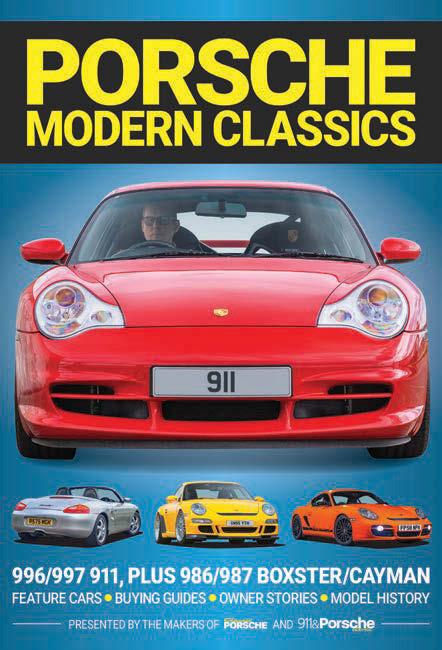
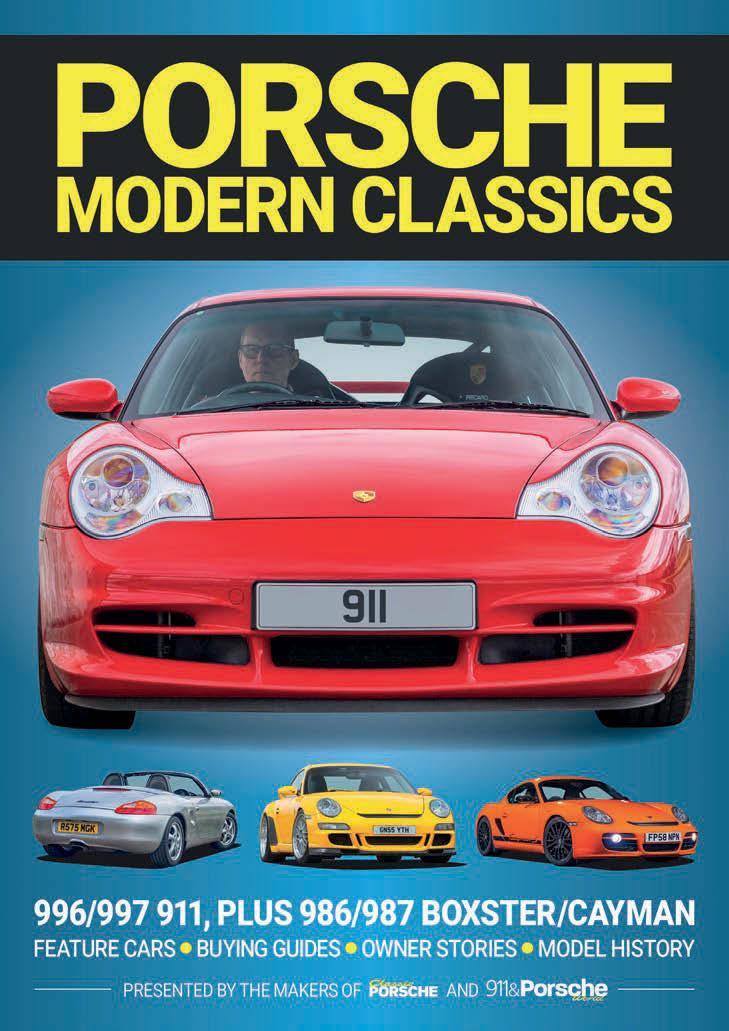
NEW PORSCHE MODERN CLASSICS BOOKAZINE
New from the team behind 911 & Porsche World magazine comes this 164-page celebration of the 996- and 997-generation 911s and their Boxster/Cayman 986/987 counterparts. We chart the design and evolution of this hugely popular range of Porsches, going on to examine the long-lasting impact these cars have had on all subsequent Porsche products, not to mention the sports car world as a whole. Along the way, we get behind the wheel of standout models, delve into owner stories, explore ground-breaking engineering and show you what to look out for when on the hunt for an early water-cooled 911 or Boxster/Cayman to call your own. Essential reading for marque enthusiasts, this beautifully presented bookazine comes hot on the heels of our successful Porsche Air-Cooled Classics title and can be ordered at the link below.
Price: £9.99
shop.kelsey.co.uk/porsche-modern-classics
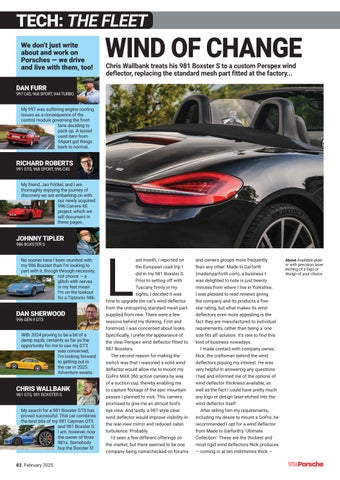
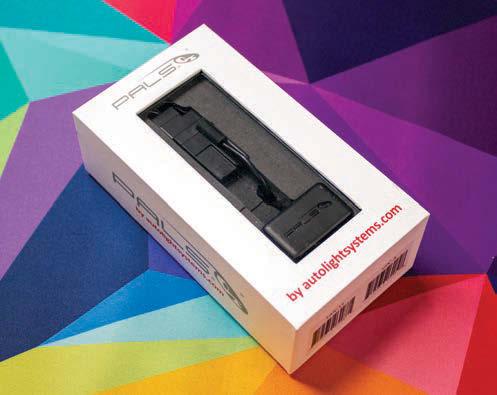
Bring the comfort and convenience of modern automatic headlight switching to your 997, 987 or early Cayenne (955/957) with the homologated Pro Auto Light System (PALS) from Auto Light Systems. After simple DIY installation, your Porsche’s driving light (low beam headlight), cabin instruments and Porsche Communication Management (PCM) night mode are switched on and off automatically — irrespective of ambient brightness — at dusk, dawn and in sudden darkness, such as when travelling through tunnels. Simply leave the headlight switch in the ‘home’ position. Additionally, high-speed driving is detected by built-in GPS, triggering activation of low-beam lights at speeds past 50mph. Each kit comes supplied with the required sensor, mounting tool and fitting instructions, and requires no modification to the car’s standard wiring.
Price: £539
autolightsystems.com or email contact@autolightsystems.com
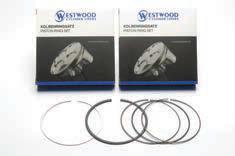
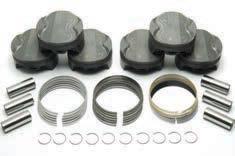
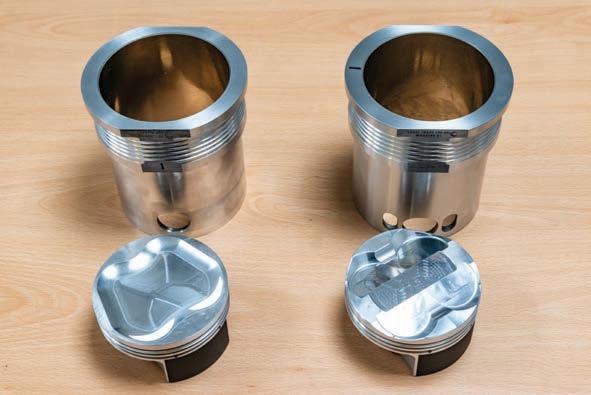
MAHLE MOTORSPORT OVERSIZED PISTONS AND CYLINDER SETS FOR 911 TURBO (930)
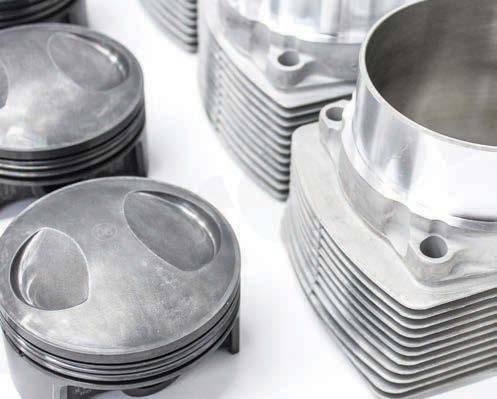
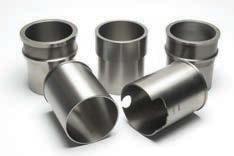
Leading independent Porsche tuner, Cargraphic, is offering a trio of oversized sport-specification piston and barrel kits for the classic 911 Turbo (three-litre and 3.3-litre models). The first kit lifts displacement to 3.2 litres (7.5:1 compression ratio), the second kit to 3.4 litres (7.7:1 compression ratio) and, lastly, the third kit increases the size of the host flat-six to 3.5 litres (7.0:1 compression ratio). Everything required for the conversion is supplied, including the pistons, cylinders, rings and seals. The 3.5-litre conversion kit can also be used in the turbocharged carryover engine fitted to the original 964 Turbo. Cargraphic’s wider offerings for the 930 include exhaust valves, long-primary manifolds, sport rear silencers and tailpipes, heat protection material, unique wheels, suspension and bucket seats.
Price: POA
cargraphic.de or call +49 6341 968 9110
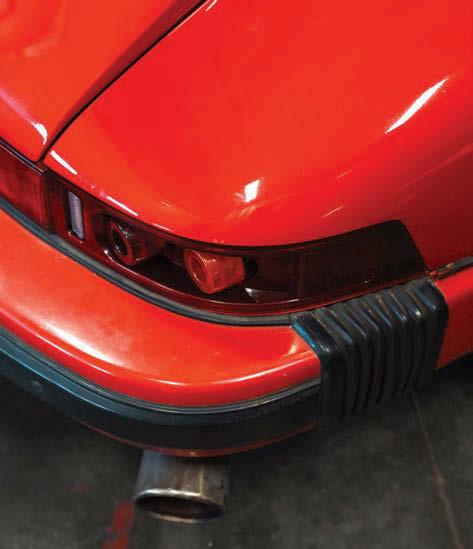
NEW RENNLINE DROP-IN LED REPLACEMENT TAIL LIGHTS FOR G-SERIES 911 AND 912 E
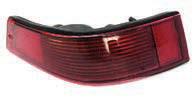
Upgrade your G-series 911’s tail lights for a set of Rennline’s drop-in LED replacement units and transform the look of your Porsche, while keeping the retro aesthetic by way of design cues borrowed from the classic 911 R race car. A straight plug-and-play fit in place of the G-series 911’s factory rear lights, the kit comprises both left and right units and promises straightforward installation (all necessary hardware is included with each purchase). For those of you interested in shedding weight from your classic 911, each Rennline LED tail light kit tips scales five pounds (2.2 kilograms) lighter than the 911’s OEM rear lights. Flasher relays are included, thereby avoiding the distressing ‘hyper flash’ often generated by LED illumination. Order direct from Rennline, or visit to the Pelican Parts online store. Price: $750 rennline.com or
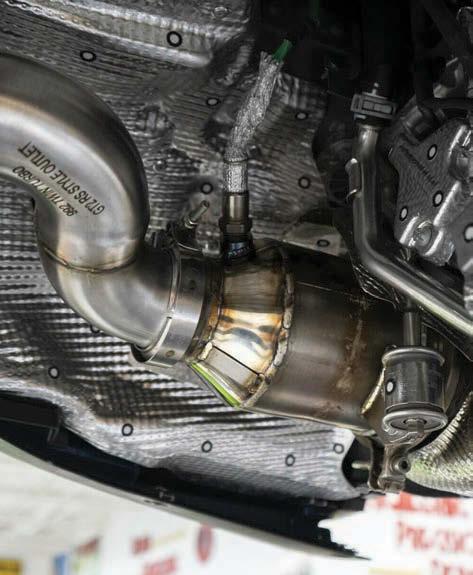
NEW FABSPEED HIGH-FLOW CATALYTIC CONVERTERS FOR 992 TURBO/TURBO S
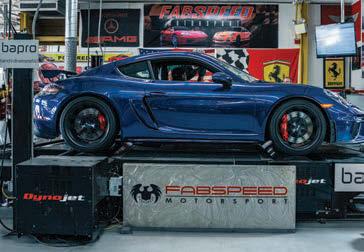
Designed to extract more power and sound from your 992 Turbo/Turbo S without generating check engine lights, this CNC-machined, mandrel-bent, T304 stainless steel catalytic converter kit from Porsche tuning hardware manufacturer, Fabspeed, offers a massive gain of 47.1lb-ft torque with a similar number of extra ponies. Weighing 11.3kg less than the factory catalysts they replace, Fabspeed’s offering mimics the ‘valves open’ configuration of a 991 GT2 exhaust system. And, because of the modular design, if you find the setup too loud for everyday driving, you can make use of Fabspeed’s optional muffler adapter pipes, enabling reinstallation of the factory muffler or the introduction of a Fabspeed Valvetronic Maxflo exhaust system. Make no mistake, this is the most free-flowing exhaust design possible while maintaining catalytic converters. The included valve bracket prevents any chance of the electronic valves triggering a check engine light, while installation is a simple DIY job, requiring no cutting or welding. When testing on Fabspeed’s all-wheel drive Dynojet rolling road, power was up across the board. Down low, the Turbo spools faster and harder, netting 23.7whp and 41.5lb-ft torque at 3,000rpm, while the aforementioned maximum power gains are realised at 5,300rpm. All Fabspeed performance products are backed by the company’s lifetime warranty. Price: $4,295 ($4,795 with GT2 outlets and muffler adapter) fabspeed.com or call +1 215 646 4945
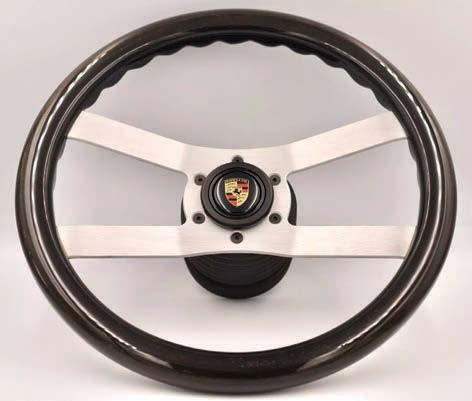
GOCLASSIC HERITAGE OAK STEERING WHEEL
Classic Porsche accessories specialist, GoClassic, has launched a brand-new steering wheel as part of its heritage range of products. Making use of a thick wooden rim manufactured from oak and expertly smoothed and polished by craftsmen in GoClassic’s native Latvia, this fabulously retro-styled steering wheel is designed for classic 911s (and the 912) and is seamlessly installed in the host Porsche by way of the included MOMO steering wheel hub boss kit. Also included is a fifty-eight-millimetre MOMO horn push button featuring the Porsche crest. GoClassic is also now offering a carbon-fibre variant of the classic MOMO Prototipo, featuring girth of thirty-nine millimetres and a MOMO-branded horn push. This lightweight steering wheel is available to order direct from the GoClassic online store, where you can also find the MOMO Prototipo Black Edition (as the name suggests, finished in black) and the individually numbered MOMO Racing Heritage Edition. Price: €1,599 goclassic.eu or call +1 310 626 8765
PRODUCT CALL
OUR LATEST SUBSCRIPTION DEALS
Get every issue of 911 & Porsche World magazine delivered direct to your door by taking advantage of our latest subscription deals. You’ll get every issue before the official on-sale date, plus you’ll receive a discount off the regular retail price. Shipping is included in the cost of subscription and we deliver internationally — enjoy 911 & Porsche World no matter where you are in the world. Simply turn to page 98 of this issue to view our latest offers. shop.kelsey.co.uk or call 01959 543 747
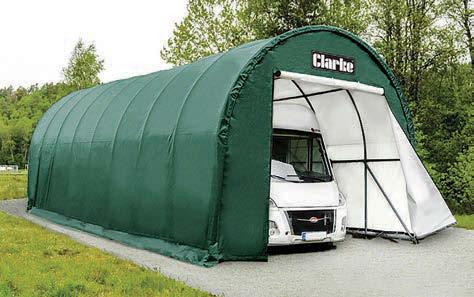
NEW CLARKE GARAGE/TEMPORARY WORKSHOP
Machine Mart’s range of garage/shed/temporary workshop units come in a variety of sizes to suit your needs, allowing you to protect your Porsche or create additional work space in a tight-fit, well-lit, protected environment. At the smallest end of the range are two fantastic bike sheds, but one of the most popular models is the CIG81015. At fifteen feet in length, with a width of just under ten feet and height of around eight feet, this superb unit offers the protection of traditional buildings at the fraction of the price. It is ideal for protecting cars, but can just as easily be used to satisfy dry storage needs.
Price: From £104.39 machinemart.co.uk or call 0115 956 5555
9M EXHAUST FOR 718 BOXSTER/CAYMAN 2.0/2.5
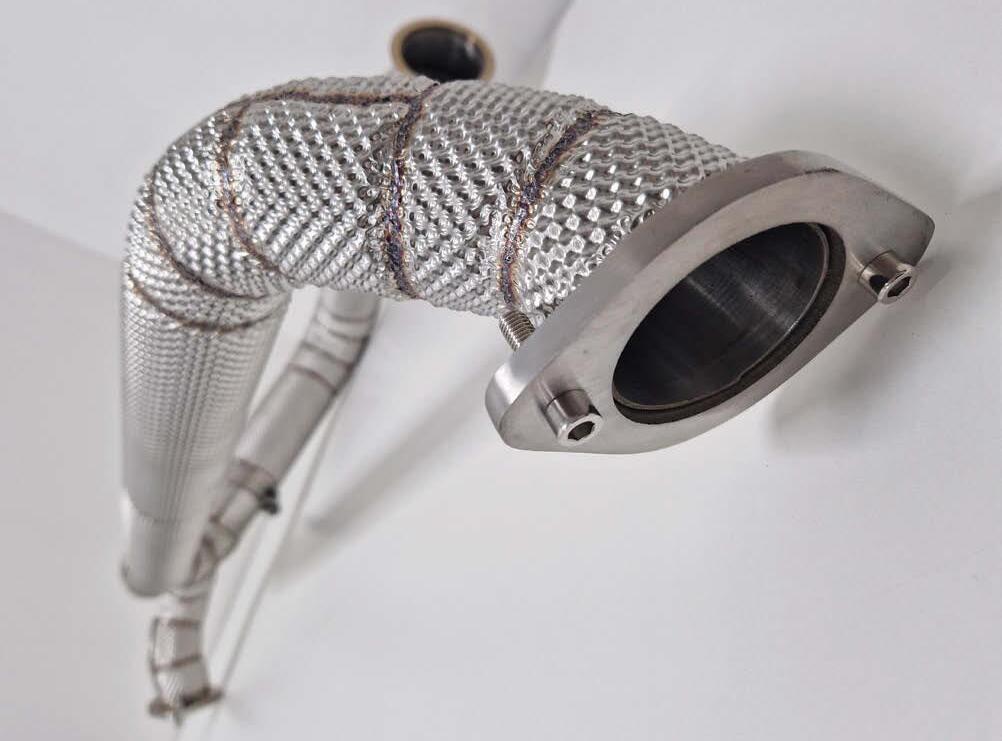
Under its 9M performance brand, Warrington-based Porsche restoration, maintenance and tuning specialist, Ninemeister, has released a brand-new lightweight stainless steel exhaust system for the 718 Boxster/Cayman twins equipped with the (hugely underrated) two-litre and 2.5-litre turbocharged flatfour powerplants. Promoting a reduction in exhaust gas temperatures, improved throttle response, reduced back pressure, higher gas flow, improved exhaust note and no drone, resonation or additional vibration, the system is available as a de-cat exhaust or with a high-flow sports catalytic converter. Heat-shielded, the exhaust features a 3.5-inch (89mm) downpipe flowing into a 2x2.5-inch (57.15mm) Y-pipe. Orders can be placed direct at the recently launched 9M online store.
Price: £1,074 decat, £1,314 with sports catalyst ninemeistershop.com or call 01925 242342
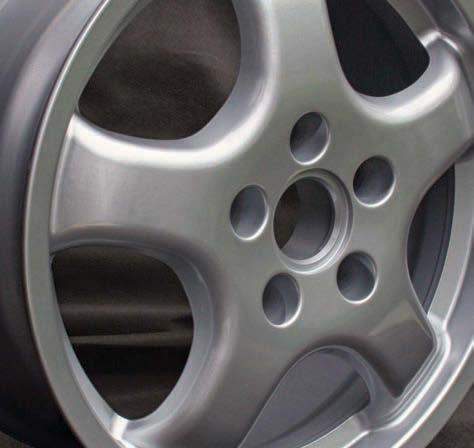
Fuchs aside, one of the most popular OEM Porsche wheels is the soft-spoke ‘Cup’, as fitted to the 964 Carrera Cup and RS models. This timeless design perfectly underlines the sporty, cool and powerful character of a 1990s Porsche. We’re pleased to report Europe’s market leader in the field of retro-look Porsche wheels, Maxilite, has launched its own take on this evergreen classic. Available in a choice of 7.5x15, 7.5x17 or 9x17-inch sizes (with the option to stagger), this Cup-style wheel is suitable for all 928, 944, 964, 968, 993 and 996 models, as well as the 986 Boxster. Unlike the original Cup wheels, which were manufactured from magnesium, Maxilite’s offering is aluminium, meaning it isn’t prone to breakage, thereby delivering better performance and safety. And, reassuringly, Maxilite products are subject to TUV scrutiny (the toughest wheel test anywhere in the world). As regular readers will know, Maxilite is launching new classic-style wheels for Porsches with increasing regularity. To view the Swiss company’s full range of products, visit the website address listed below.
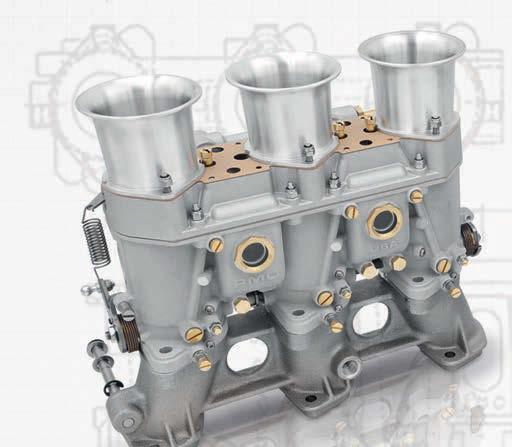
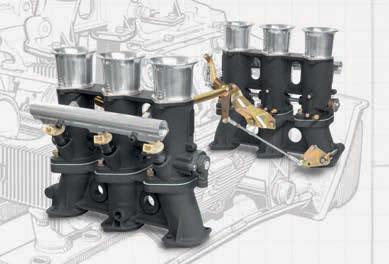
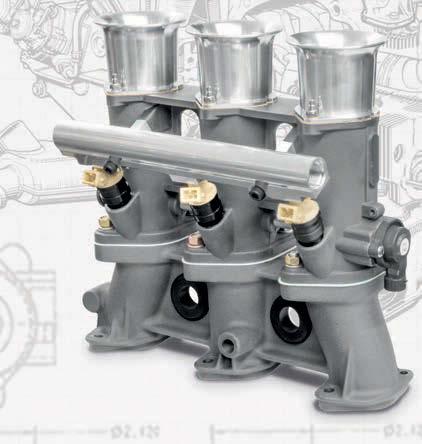
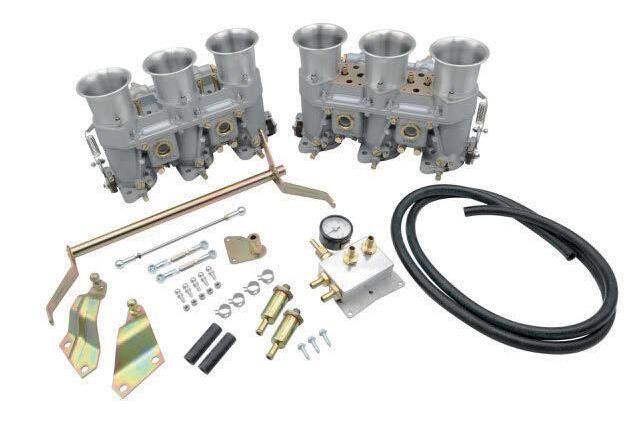
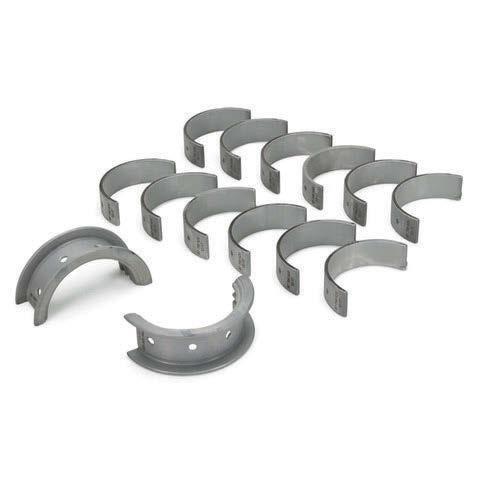
Like PMO Induction carburetors, PMO EFI throttle bodies are compatible with any flat six Porsche engine from 1965 to 1998 and will enhance the tunability, throttle response and fuel efficiency of your air-cooled Porsche.
Available in 40mm, 46mm and 50mm Sizes in natural aluminum or black anodized “R” finishes for a vintage / period correct appearance.
Manifolds, Fuel Injectors and TPS are for reference only and not included in the kit.
Whether you’re looking for replacement carburetors or an upgrade, PMO Induction has you covered. High-quality core billet material is machined, hand assembled and finished at PMO’s facilities in Anaheim, California. Your classic Porsche deserves the best and PMO delivers just that. Pick your choice of 8 uniquely designed stock carburetor sets, ranging from 40-50 mm to fit 2.0 to 3.6 L engines.
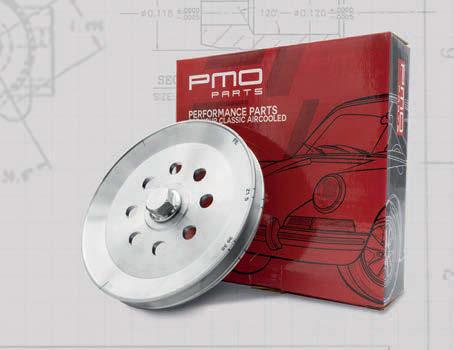
TITANIUM CRANKSHAFT PULLEY
Independent Porsche Specialist
Independent Porsche Specialist
Sales,
Sales,
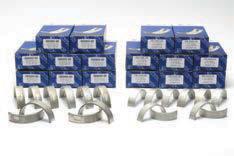
Engine parts for Porsche 996
Cylinder
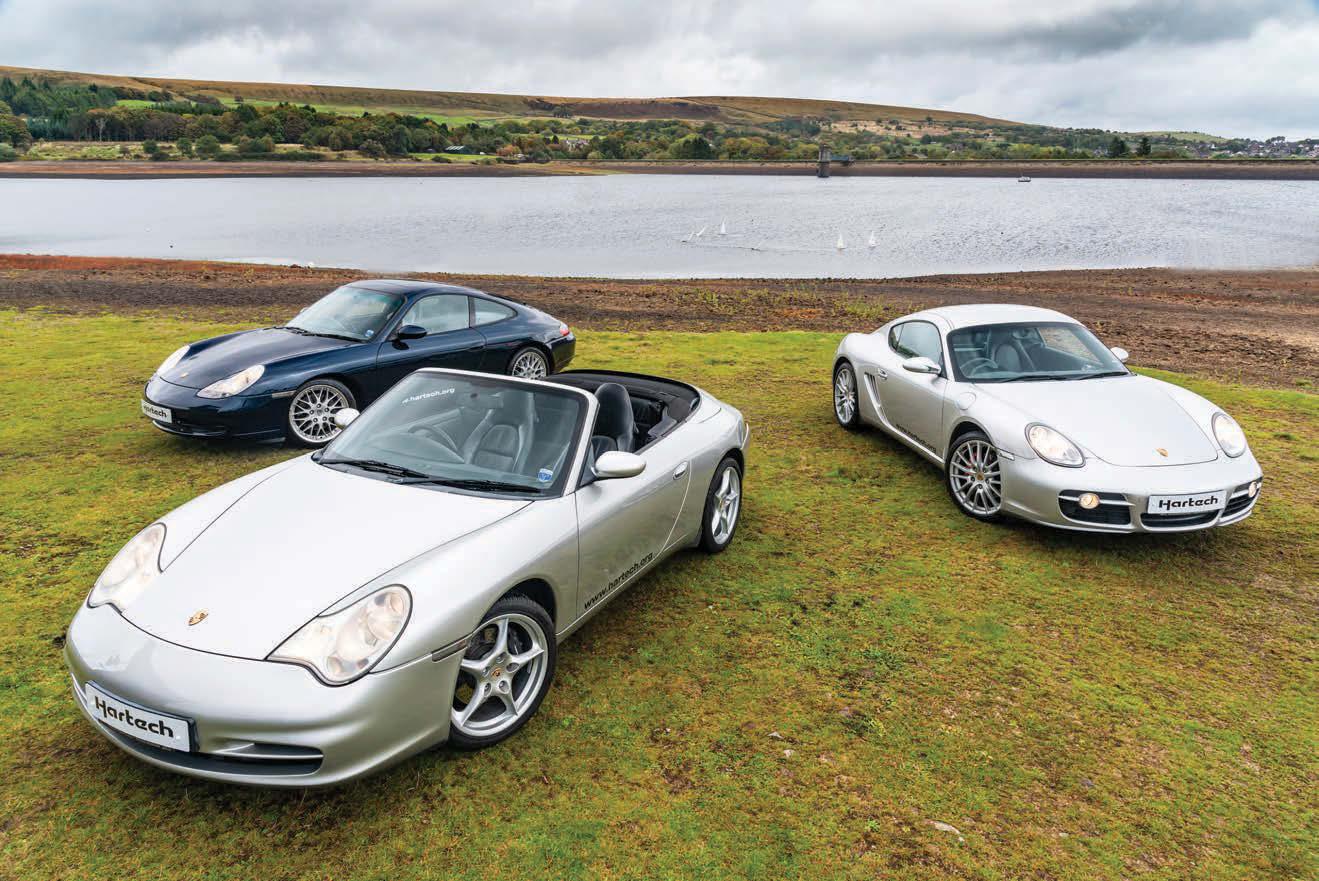
997 / Cayman / Boxster
TOM VAGI
When the time comes to retire your Porsche from the road in readiness for winter hibernation, you should carry out an oil change to protect engine internals, but how many miles can you drive thereafter? Will the simple act of using your Porsche undo all the good work you’ve just done?
My wife was incredulous. “You’re taking the car out again?!” I shrugged as I grabbed the keys. Fall in New England can be something of a fickle beast, but how do you restrain yourself when it’s sunny and fifty degrees outside? Throughout the rest of the year, I’m usually quite unaware of what the weather report is for the foreseeable future, but when autumn arrives, I can give you an almost minute-by-minute forecast. There are several reasons for this, but the primary one has to do with road conditions. Put it this way, it’s safe to say most sports car enthusiasts consider road salt to be enemy number one. That said, I find it incumbent upon me to wring out every mile of driving before I retire my beloved 944 Turbo for the winter months. In the past, I have been known to push things a bit far, with clouds and snowflakes literally closing in on me as I drove home to a warm garage. Running from weather is a fun game, after all. Typically, the game of chicken we play with weather is over and done with in early
November. Sometimes, it’s over as early as the end of October. This year, however, has been something of an anomaly. As I write these words, we’re in the middle of November with Thanksgiving knocking on our door. Remarkably, some of our customers are still driving their 911 Cabriolets. From the reported twenty-nine days of straight sunshine this part of the world enjoyed in late summer, to the crisp-but-sunny days we’ve had in recent weeks, this may be the longest and nicest driving season I’ve experienced in southern New England.
If you store your car in a place with a hard date for drop-off, this article isn’t going to help much, but for those of us fortunate enough to have flexible storage space, the bonus driving days this year are wonderful. As far as I can see, there is only one hitch: not knowing when to service your car before the unexpected end of the season. This is the game of driving right up until salt hits the road, but I have come up with a solution (more precisely, an opinion).
To my knowledge, Porsche has always recommended servicing a ‘summer’ car in the Fall. At the very least, basic annual maintenance
Tom Vagi is founder of Seacoast Specialist Cars, a New Hampshire-based independent Porsche specialist carrying out repair, maintenance, servicing, sales and restoration. He is a Master Technician, lifelong Porsche enthusiast and Technical Chair for the local chapter of PCA. Visit sscarsnh.com
should be carried out. The logic behind this instruction is simply to allow the car to be stored with clean oil during winter months, thereby preventing corrosion to engine internals by acids accumulating in used engine oil. Several of my customers have asked how many miles they can drive with clean oil before the benefit of replacing old with new is lost. I’ve pondered carefully. I hope my answer proves useful.
I believe there is a fine line between following the maintenance schedule outlined by Porsche and your joy being taken away by it. We all know and love these cars and will do virtually anything to keep them from harm, but the point where we’re denying ourselves the joy of driving simply to uphold a maintenance schedule seems like a step too far. Granted, the idea of avoiding road salt — especially older cars with little in the way of anti-corrosion properties — is a reasonable step toward prolonging the life of a car’s bodywork, but the potential for internal engine corrosion after a few hundred miles of driving is somewhat nebulous.
To be clear, what I’m advising is for owners to service their car in the Fall and drive it however many days they like before putting the car away for winter. If you have the luxury of putting another ten thousand miles on your Porsche before putting it away for the season, by all means do so and then carry out another oil change, although I suspect this will be more exception than rule.
Most of our customers add between 2,500 and 3,500 miles to their Porsche during spring and summer, amounting to around six months of usage. Another five hundred miles or so after an oil change is fine. Sure, some level of gunk will end up in the oil, but it’s still much better than it would have been if you hadn’t done the Fall service and waited until spring.
Seeing so many of our customers dropping off their cars for storage and reporting on what a great season they’ve had driving is, for me, one of the real rewards of being in this business. It always reminds me of how special Porsches are to nearly everyone lucky enough to own one.
From all of us here at Seacoast Specialist Cars, we wish 911 & Porsche World readers a wonderful holiday season. Go squeeze out every driving day you can. You won’t regret doing so. l
1976 Porsche 911S Coupe #16776
KARL MEYER
With 2025 promising a flood of Macan EVs, how has the market stacked up during the past year, and what can we glean from it if trying to make predictions relating to values of nearly new Porsches in the short- to long-term future? Is it even wise to speculate on an increasingly unpredictable sales scene?
For many of us, the holiday season is the one time of year we can finally stop and totally indulge our passion for Porsche. From spending a little more time at home polishing or driving our cars, to escaping the noise of work and sitting with a copy of 911 & Porsche World, it has long been a belief of mine that much of the Porsche market’s activity is decided within these precious weeks. We look back at missed opportunities, we look forward to the coming year’s hopes. We examine our finances and set personal and professional goals. All with a belly full of food and misty-eyed festive merriments. With all this in mind, let’s kick back and recap 2024’s market activity and look ahead to what 2025 has in store.
Here at the theporschebuyer.com, we keep a close eye on competitor brands. In 2024, the prestige car market came under serious fire. Lack of demand and poor build quality asked questions of general business model viability, with multiple well-known manufacturers admitting real concern for their futures. Famous and influential YouTubers have condemned where the new-car market is heading, and rightly so. Yet the business my team conducts with Porsche Centres tells a different story, one of month-on-month record quotas of sales and orders. Quite the contrast.
In 2024’s chaos, I believe we overlooked something worth praising Porsche for: in an age many automotive brands have lost their way (certainly in terms of branding and communications), Porsche has proved exceptional. It’s design language is also brilliant. Let’s face it, Porsche is seemingly the only premium brand with zero negativity regarding the penmanship of its designers, who perfectly pay tribute to the manufacturer’s legacy models, whilst boldly looking forward.
Speaking of modern design, 2024 proved turbulent for Porsche’s EV output. Even so, the brand has doubled down on this stuff, in part due to legislative pressure — if my sources are correct, twenty-six percent of all UK allocations from Porsche in 2025 will be the Macan EV. Thankfully, for those of us who love combustion engines, Porsche’s take on hybrid power for the updated 992 was a genuinely pleasant surprise, followed swiftly by the announcement of a proposed six-stroke engine, promising to massively increase power at the same time as reducing emissions. If all comes good, this will be a masterclass in engineering simplicity, efficiency and power, proving Porsche continues to innovate and can remain agile wherever the market leads.
Many of you want to know what’s hot (and what’s not) in the year to come. I have been outspoken on this topic, cautioning investors
Karl Meyer is a UK-based independent Porsche buyer advising OPCs and independent specialists. Buying everything from 986s to Carrera GTs, his is a trusted name in the space of moving off-market and premium Porsches. If buying, selling or part exchanging, call Karl first. Visit theporschebuyer.com
and Porsche businesses alike against predicting the future. Constantly changing legislation, technological advances and new human behavioural patterns mean predicting the market has never been more complex. Yes, even those of us in the ‘expert space’ need to proceed with a humble attitude. In the past, historic transactional data coupled with intimate product knowledge and a good gut for the market would have been enough to predict which cars would appreciate and, importantly, when, long into the future. A six-to-twelve-month forecast is about all I’m comfortable with nowadays.
With this in mind, what looks great value and is not likely to pull your shirt off? How about a pair of normally aspirated V8 monsters so often overlooked in these conversations? I’m talking about the 958 Cayenne GTS and the facelift 970 Panamera GTS. Starting at £15,000 and £20,000 respectively, these are two of the bargains of our brand. I have fond memories of opening up my Porsche Centre super-early and, while warming the coffee machine, enjoying an empty showroom and starting up the Pan-GTS. Honestly, if you’ve never heard one, be prepared for expectation to be defied.
Next are a trio of cars that have bottomed out: 986 Boxster, the vast majority of 996-generation 911, as well as first-generation 997. Whenever I drive these cars, I find myself wondering how we even have a new car business when Porsches are performing so well at this price point. On this note, I am (somewhat controversially) a champion of Tiptronic. I’m not alone — solid sales data demonstrates this sweet semi-auto transmission appeals to the majority of buyers.
The 356 and air-cooled 911s seem to be on a small downward trend — baby boomers are offloading their childhood sweethearts, which reads consistent with the data for all collectibles. 2025 is likely to prove strong for 993 values, while the 911 SC and Carrera 3.2 seem rock solid for the year ahead, as do all 911 Turbos. Keep an eye on the 918 Spyder, too. While I don’t want to make bold claims about what is likely to happen to prices long into the future, I feel confident in saying this special Porsche is ripe for a big hike in value.
Wishing you every happiness for the holiday season. Indulge your passion for Porsche. l
UP FOR THE CUP
When the opportunity to acquire a cheap 997 Carrera S presented itself, Jordan Hoke wasted no time in setting off on a journey of Porsche personalisation...
Words Dan Sherwood Photography Quan Smalls
The piercing whine of the straight-cut gear ratios invades the cabin and melds with the roar of the race-tuned 3.6-litre flat-six as the Alcantara steering wheel bucks and writhes in your hands. As you’re pressed hard into the thinly-padded racing seat wrapping around your shoulders and gripping your thighs, the rabid acceleration you feel from a squeeze of the throttle is breathtaking. It pales into insignificance, however, when the first corner arrives. Stabbing the long sequential shifter twice to drop down two gears in fast succession as you smash the middle pedal into the stripped-out footwell, you feel your chest strain against the tight race harnesses as they cut into your shoulders. The turn itself is no less visceral, with the wide footprint of the sticky Michelin slicks working in perfect harmony with the rigid suspension to seemingly defy the laws of physics and slingshot you through the curve faster than your scrambled brain can process what’s happening.
things go wrong. All this whilst focusing on giving ten tenths on the track. Some race cars can be adapted for use on the road, but we wouldn’t recommend it. The harsh, loud, uncompromising demeanour and an interior stripped bare of all but the most necessary of equipment makes driving a race car on the road an experience wearing thin extremely quickly. An assault on the senses? Yes. Something you’d want to live with on your daily commute or even on a regular spirited blat down your favourite country lanes? Maybe not. Put simply, a superbly configured road car taking
POLYBUSHES ARE LESS FORGIVING, BUT THEY ALLOW THE CAR TO BETTER RETAIN ITS GEOMETRY SETTINGS, EVEN UNDER EXTREME DRIVING CONDITIONS
influence from the world of motorsport will likely be a faster, more engaging and, ultimately, more enjoyable proposition on the street. It’ll also come at a fraction of the cost to buy and maintain.
acquired a two-litre Mk3 Golf. While not satisfying his need for speed, the Volkswagen allowed him to indulge his passion for automotive customisation and modification. The not-so-hot hatchback was the start of a long line of VAG vehicles he would come to own over the years, switching between the likes of a 1984 Golf/Rabbit GTI to a 2012 Audi Allroad, but never venturing far from the Wolfsburg or Ingolstadt stables. “I’ve modified almost all of my cars, mainly to improve their looks, but I’ve long wanted to present a 911 in BMW Atlantis Blue, my favourite automotive colour. It’s an incredible shade from the brand’s Individual colour palette and flips from mid-blue to vibrant turquoise in direct sunlight light.”
Driving a 997 GT3 Cup flat-out on a racetrack is an experience only a select few get to experience. Even fewer get to take these highly-focused machines into the fiery crucible of door-to-door motor racing. Even so, for those lucky enough to occupy the driving seat, a 911 race car can become little more than a tool used solely for the task of lapping a circuit faster than anyone else. By contrast, to spectators, race cars command near mythical status, dripping with an air of apparent unobtainability.
Of course, at some point in their lives, most race cars are available to purchase. You just have to possess the funds to not only buy one, but run it, maintain it, transport it and, of course, repair it when
Forty-two-year-old graphic designer, Jordan Hoke, admits the steroidal stance, raucous engine and functionover-form aesthetic of the 997 GT3 Cup is intoxicating, especially for a life-long car-nut admiring 911s from afar. “I got my love of cars, specifically German cars, from my grandfather,” says the Pennsylvania-based petrolhead. “He was always working on air-cooled Volkswagens and Porsches on his driveway. I remember various Beetles and 356s on the receiving end of his magic touch with the spanners.”
A keen racer, Jordan’s grandfather competed in various Sprint Car series, flinging be-winged space-framed buggies around local dirt-track ovals at weekends, then tuning his cars during the week in anticipation of the next event. It was a pastime fascinating a young Jordan. When he was old enough to drive, he
To get the pearlescent hue to reveal its full optical magic requires application by a highly skilled professional painter, making the process one of great expense. Knowing this only too well, Jordan was adamant it be applied to a vehicle both worthy of the outlay and would wear the coveted colour well. Enter the 997 you see on the pages before you.
INSPIRED CHOICE
“Even though I’m an ardent VW fan, my dream car has always been a 911, specifically a hardcore track-tuned variant such as the 997 GT3 Cup,” he reveals. “To my mind, there’s something about Coke-bottle curves contrasting with razor-edged spoilers that’s just pure automotive perfection.” He began his search for a suitable steed by checking out several 993s (“my ultimate weapon of choice”), but the last of the air-cooled 911s proved staunchly out of his price range. Consequently, like many others looking for their first point of entry into Porsche ownership, he was soon checking the classifieds for a financially viable water-cooled 911.
Facing page Jordan’s dream 911 has
with
“I looked at a few 996s, but the bubblelike interior styling just wasn’t to my taste,” he says. Needless to say, he found himself in 997 territory. “Fortunately, the timing coincided with release of the second-generation 991, meaning prices of 997s were faltering as owners were clamouring to release funds to get into the seat of the latest 911 to hit the streets.” Even with values softening, the price of 997s local to Jordan’s native town of Lebanon were strong. “The sundrenched streets and palatial beachfront properties of California and Miami attract the some of the US’s wealthiest individuals, for whom driving an outgoing model of any motor is simply unacceptable,” he laughs. “You can often get 911s at a bargain price in these coastal locations — sellers are generally more interested in getting the newest toy on the block than worrying about losing out on top dollar when selling their discontinued sports car.” This theory paid dividends when he found a 997 for sale in Los Angeles at a knockdown price. The Porsche promised to serve as the perfect starting point for a highly personal project.
“It wasn’t possible for me to easily view the car in the metal before I purchased it,” Jordan continues, citing the distance between Lebanon and Los Angeles. “I therefore bought the car unseen.” Taking the form of a 2005
Basalt Black Carrera S with Sport Chrono and a black leather interior, this particular Neunelfer’s flat-six had been oversized from 3.8 litres to the full four. The car’s exterior had been subjected to a handful of modifications and, though it was a little rough around the edges and its paintwork was dulled as a consequence of being exposed to a lifetime of scorching sun, the asking price of $28,500 was a steal.
Porsche launched the 997-generation 911 in 2004. The base 997 Carrera
received the 3.6-litre M96 boxer, while the Carrera S received the largerdisplacement 3.8-litre M97 engine. The headlamps, which drew huge criticism on the 996, were once again rounded, while the exterior was even more curvaceous and the ‘bubbly’ interior was replaced with a more angular and luxurious offering, which still looks fresh today. Porsche Active Suspension Management (PASM) was introduced as standard equipment on the Carrera S and was optional for the base 997, altering
Above The colour is BMW Atlantis Blue, which has an almost flip effect in sunlight
JANUARY 2025
COVER STORY 997 Carrera GTS vs 992 GTS
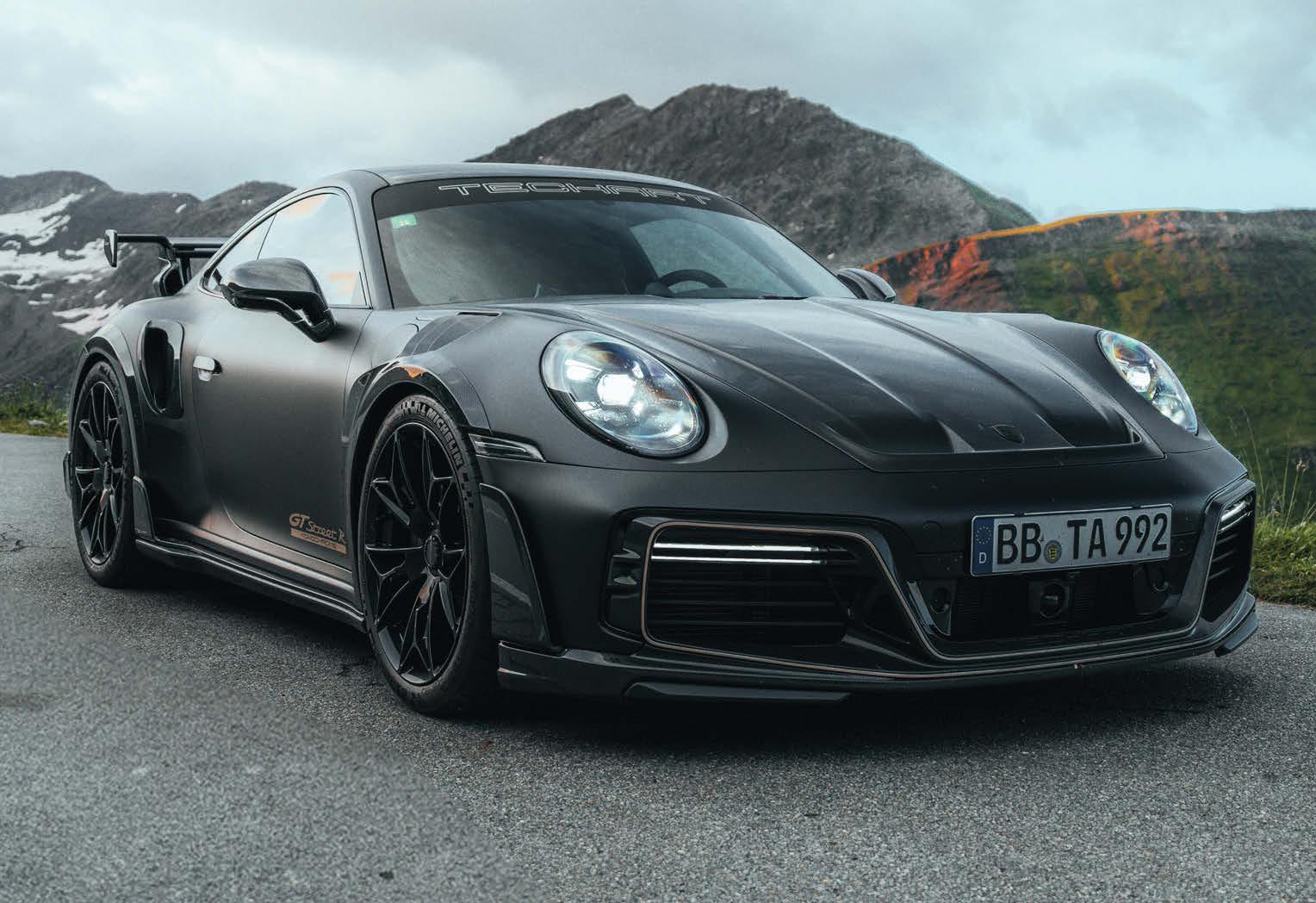
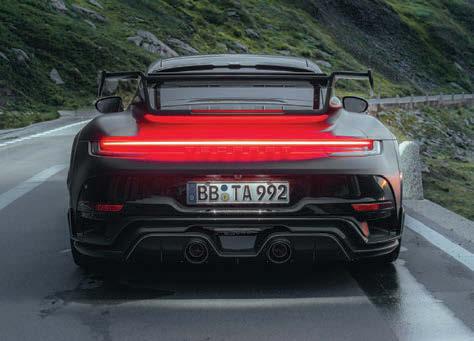
INSIDE STORIES New 911 Targa GTS driven, 981 Boxster S road trip, 996 Carrera 4S project, 944 Turbo, 964 Targa Tiptronic, Techart Taycan
SEPTEMBER 2024
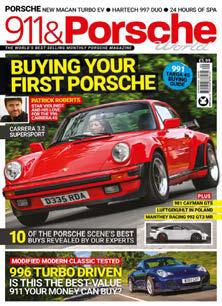
COVER STORY Buying your first Porsche INSIDE STORIES Manthey Racing 992 GT3 MR, 996 Turbo driven, Carrera 3.2 Supersport, new Macan Turbo EV, Hartech 997, Patrick Roberts
DECEMBER 2024
COVER STORY 987 Cayman R vs 718 GT4
INSIDE STORIES New Cayenne GTS driven, 987 Boxster S passion project, Carrera RSR 3.0, Carrera GT recall, 986 Boxster S, 997 Carrera 4S
INSIDE STORIES 911 GT3 RS Jo Siffert Edition, 928 evolution, 924 Owners Club Young Members, Porsche Centre Norwich, Beverly Hills Car Club
JUNE 2024
COVER STORY Buying your next Porsche INSIDE STORIES 930 Turbo versus 991 Turbo, 997 Carrera Tiptronic, Harbour Cars, Panamera 4, Sebastian Vettel, 928, Carrera 3.2, 986 Boxster S
Below And you
damping rates in anticipation of spirited driving. Bear in mind, back in 2015, when Jordan bought his 911, prices of comparable examples of the 997 Carrera S were fetching approximately $40,000, meaning spending two thirds of the price was a risk worth taking, especially when his plans involved a full respray.
Deal done, the Carrera S was transported from California to Jordan’s driveway in Pennsylvania. “The car featured a badly bonded-on front lip and was lowered on Eibach springs over a set of huge Axis twenty-inch wheels,” he recalls. “The four-litre engine
conversion, which had been carried out after intermediate shaft bearing failure, was running, but lacked the level of installation and finish I had hoped for. Also, this oversized boxer was still being controlled by the factory applied ECU software map for the 3.8-litre flat-six. This meant the engine wasn’t performing as it should have been and was considerably down on power.”
Unperturbed about the predicament of his latest purchase, Jordan used the car in this state for around six months, feeling out what he needed to change and devising a plan of action to achieve
his desired outcome. “I took the car off the road at the start of 2016. It would remain inactive for the next five years as I carried out the transformation. I’d already authored a computer-generated rendering of how I wanted the car to look. I rolled up my sleeves and began to make my dream a reality.”
QUESTION OF SPORT
The work began with exterior aesthetics, which Jordan was adamant would faithfully replicate his beloved Cup car. This involved swapping out the standard bumpers for OEM GT3 alternatives, which he sourced brand-new from his local Porsche dealership in Delaware.
“The GT3 parts are much more aggressive and alter the look of the car immediately,” Jordan reasons, “but the parts giving a proper race car vibe were a little harder to come by.”
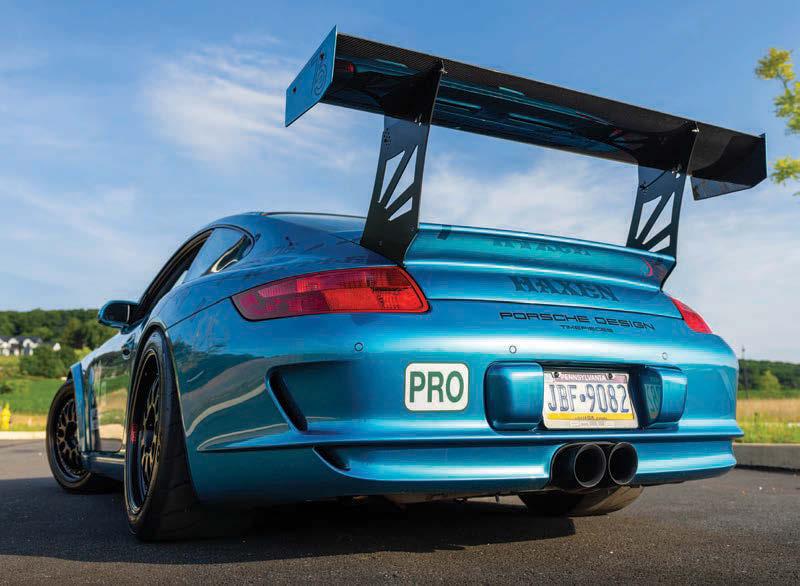
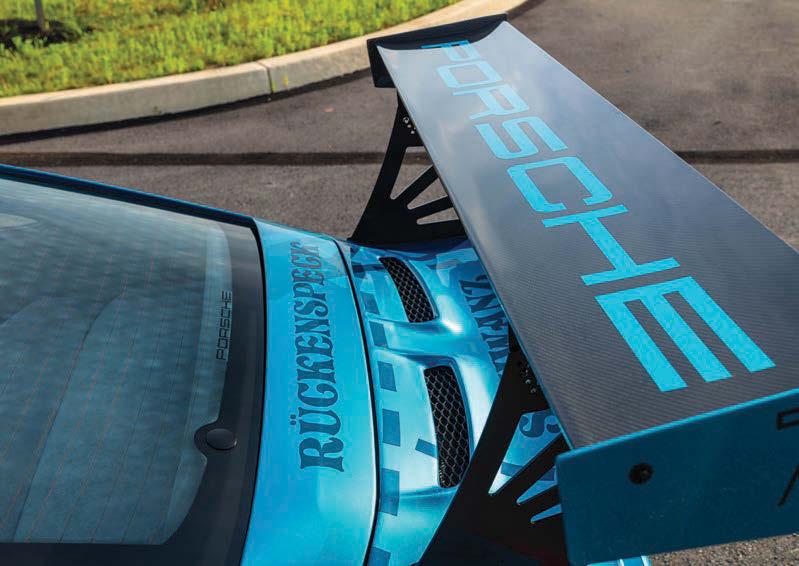
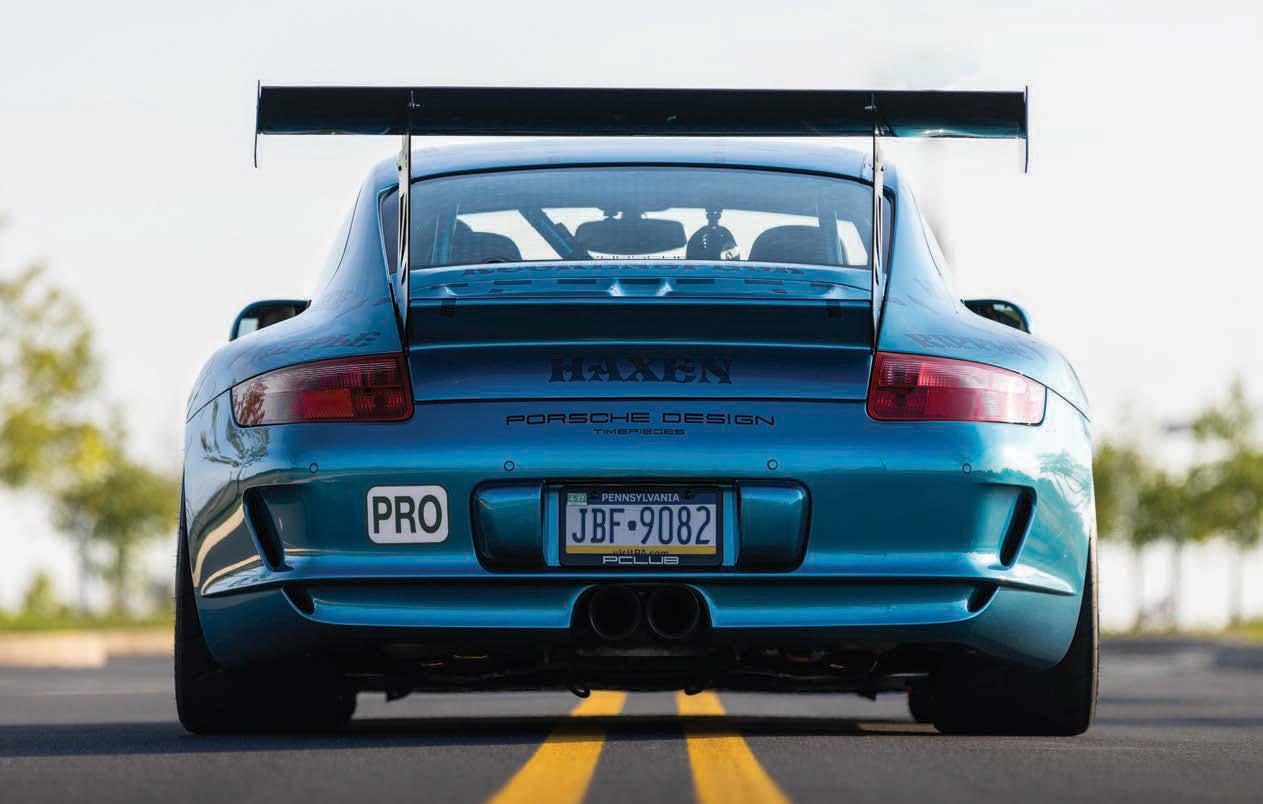
Wanting to use only genuine Cup parts and panels, he spoke to staff at the USbranch of independent Porsche parts retailer, FVD Brombacher, who kindly liaised with their German counterparts to source genuine Porsche motorsport componentry. The list included a chin spoiler, mirrors, front canards, monowiper conversion, front fender flares (complete with the required inner arch extensions), the rear deck lid and the huge fifty-eight-inch carbon-fibre rear wing blade, which is mounted to a pair of high-level uprights supplied by Ohiobased Demon Speed Motorsports.
With the bodywork taking shape, Jordan knew the oversized wheels were not fitting with the race look he was after,
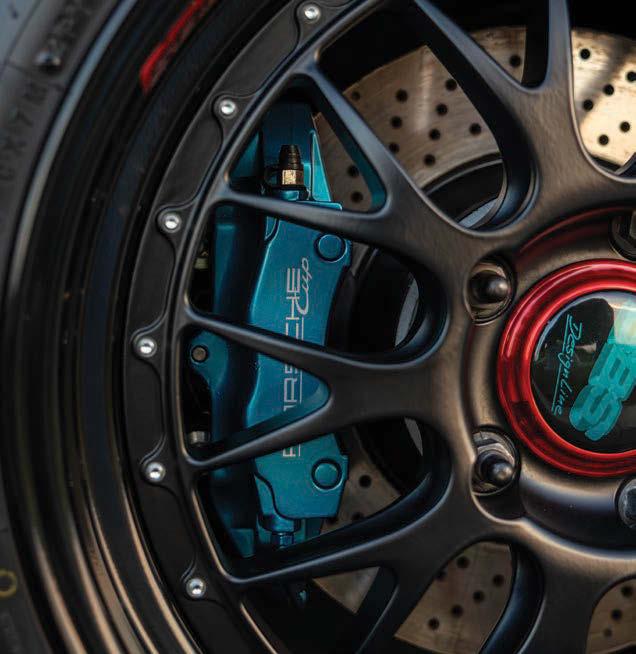
Above Genuine BBS E88 wheels painted satin black wrap around refurbished brake calipers carrying the BMW shade of blue
thought your 911’s wing was big?!
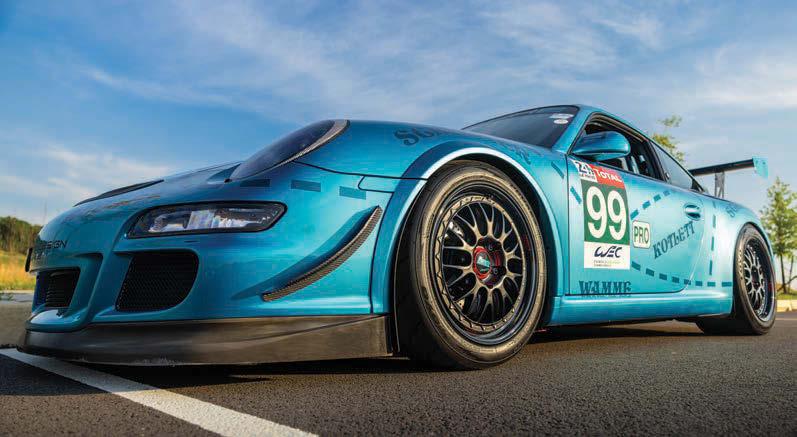
hence him ordering a set of nineteeninch Fifteen52 wheels. They’re wrapped around Toyo Proxes R888R tyres and are accompanied by custom ‘Turbo fans’. “I thought they would work, but soon after I bought these wheels, I knew there was no substitute for the real deal, which is why I sold them and bought a set of genuine BBS E88 wheels instead,” he says, smiling. “These were powdercoated satin black before being fitted with a Rennline stud-to-lug-nut conversion.”
STOPPING POWER
Hiding behind the slim spokes of the BBS rims are refurbished brake calipers, which were the first items to be painted in the Atlantis Blue colour scheme soon to dominate. “The calipers were the first of many parts on the car I removed to either replace or refresh,” Jordan explains. “They were installed with uprated ECS Tuning two-piece discs, Hawk ceramic pads and braided brake hoses. Not only do the brakes now look amazing, but their performance has improved dramatically.”
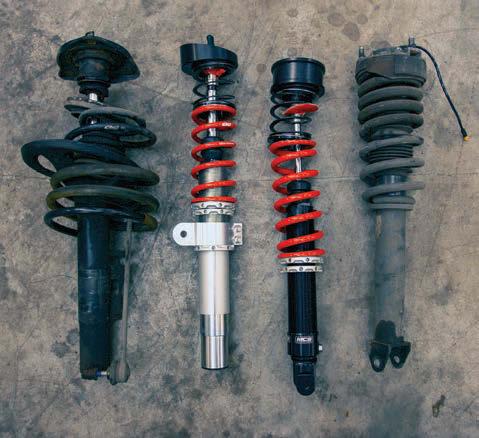
He then focused on refreshing and uprating the suspension. “The wider wheels were fouling on the spring platforms of the standard suspension. I needed to fit coilovers in order to achieve the required clearance. At first, I considered the Bilstein B16 Damptronic kit, which works with PASM, but the more research I did, the more I was leaning
towards a passive Öhlins Road & Track setup. I’d read many positive reviews about the kit when used in both circuit and street applications. I wasn’t bothered about keeping PASM, anyway.”
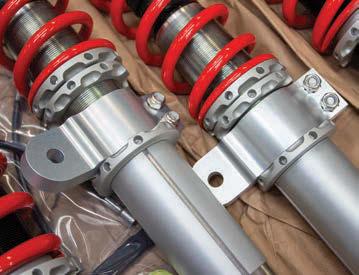
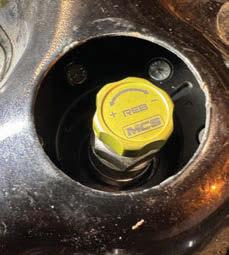
Fitting the Öhlins kit wasn’t without its problems. For example, Jordan found the dampers wouldn’t fit correctly with his preferred choice of top mounts (Rennline at the front, Tarett Engineering at the rear). To do so necessitated removal and modification of the front mounts to allow the suspension to be installed without any problems. “After the update was complete, the coilovers fitted a treat. I bolstered the suspension with a full
complement of Powerflex polyurethane bushes. They’re much firmer than the OEM rubber bushes, which had perished over the years. Polybushes are less forgiving, but they allow the car to better retain its geometry settings, even under the most extreme driving conditions. They should also last the lifetime of this 911. Fit and forget.”
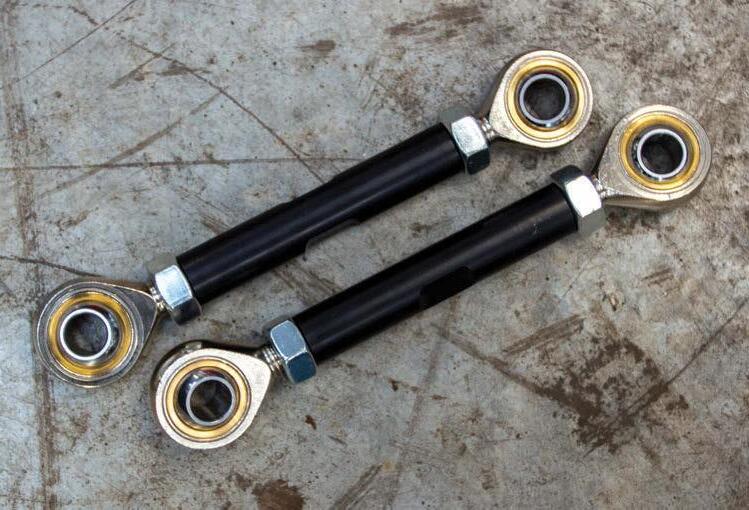
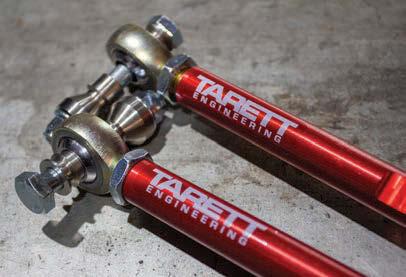
The coilovers and uprated bushes were joined by a Rennline bump steer kit and adjustable rear toe arms. The former replaces the factory tie rods and allows each arm to be lengthened or shortened as needed to restore suspension geometry on a lowered Porsche,
Above M97 has been oversized to four litres, although was in a sorry state when Jordan bought the car
thus reducing the car’s propensity to bump steer. The latter allows greater adjustment of the rear toe settings, a parameter which will rapidly run out of adjustment with the factory arms.
The final piece of the suspension puzzle was the installation of uprated H&R front and rear anti-roll bars with Rennline drop-links and Torque Solutions solid rear subframe mounts. Replacing the stock rubber subframe bushings with solid items (manufactured from CNCmachined high-grade billet aluminium) limits both drivetrain and suspension movement, keeping the host Porsche’s precise geometry settings intact, improving cornering ability, as well as allowing more precise gear shift due to less movement from the transmission.
BLUE FOR YOU
With the uprated chassis equipment in place, Jordan turned to Lightner Motorsports in Harrisburg, Pennsylvania, to begin the car’s exterior metamorphosis from sun-scorched black to brilliant Atlantis Blue. “Dave Lightner is a good friend of mine and a very experienced painter. A safe pair of hands,” Jordan smiles. “I took out the side glass and removed the lights, front and rear bumpers, door handles, side skirts and all the interior trim except the dashboard. I then transported the car to Dave’s workshops for the preparation process to begin.”
This was October 2019. Dave kept the Porsche for around five weeks, painstakingly painting all the body panels in the beautiful BMW pigment before returning the car and its associated parts back to Jordan for reassembly. While the shell was away getting its makeover, he was busy giving the interior a touch of motorsport-inspired luxury with a full retrim in grey Alcantara, plus body-colour blue stitching. The dashboard, roof lining, pillars and door cards were covered.
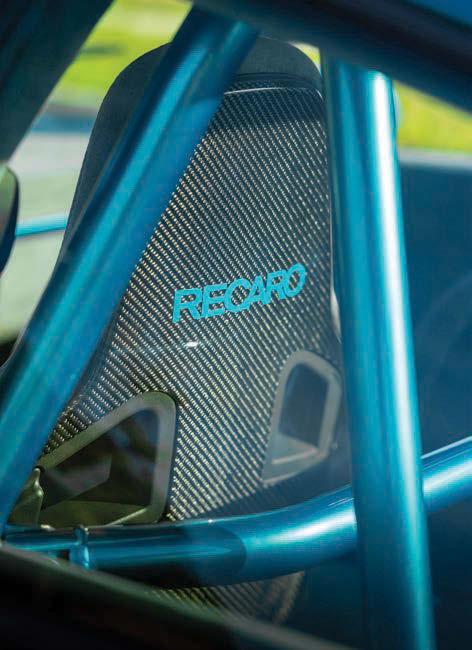
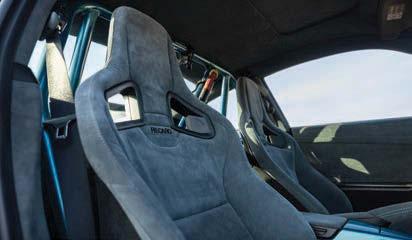
Even with a retrim, however, the car’s standard seats were never going to suit Jordan’s aspirations of owning a racer for the road, which is why he invested in a pair of deep-bolstered Recaro Sportster CS recliners and had them trimmed to match the rest of the cabin.
“The 997’s standard interior features silver plastics I didn’t feel sat right with the build. I painted them in either satin black or had Dave hit them with a coat of Atlantis Blue. I then had Dave paint
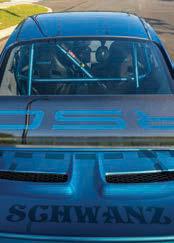
Above and below Jordan designed and applied the body graphics himself, citing inspiration as the 991 RSR livery paying tribute to the 917/20 ‘Pink Pig’
the appointed Agency Power roll bar to match. The addition of the bar means the rear seats weren’t reinstated.”
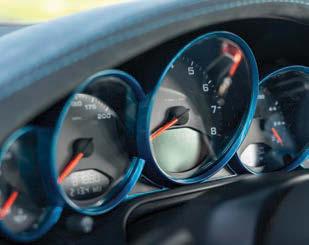
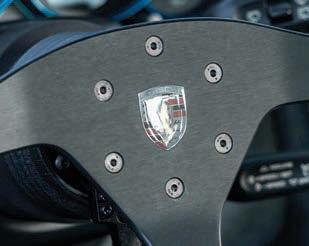
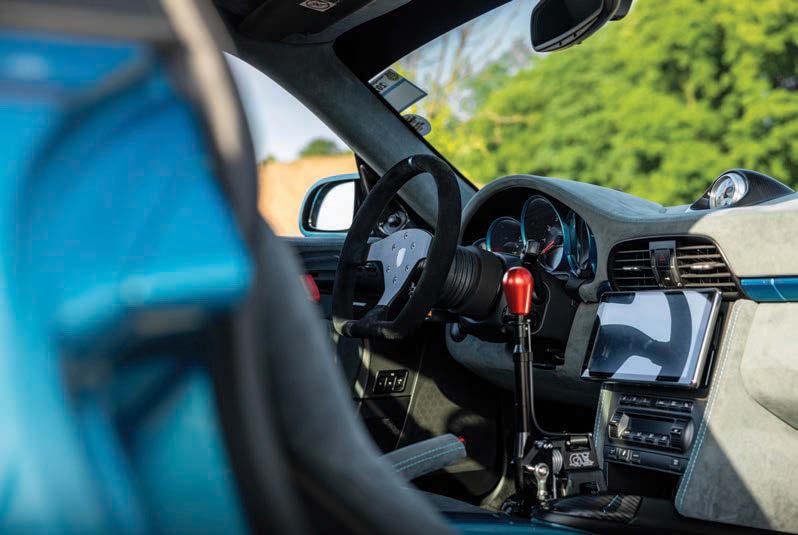
Other flourishes include RS-style door pulls, while the standard airbag steering wheel has made way for a suede-rimmed racing wheel lifted straight from a 991 Cup car and mounted on a tilting boss kit for easier entry and egress. Carbon-fibre has been put to good use in housing the dashmounted Sport Chrono stopwatch and
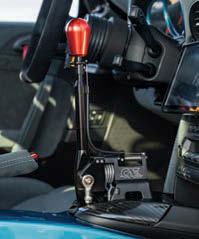
the surround of a trick CAE shifter.
“Along with the paint, the uprated shifter is one of my favourite
THE DOTTED LINES
SECTIONING-OUT
CUTS OF MEAT ARE FAITHFULLY REPLICATED, AS ARE THE NUMBER CARDS ON THE DOORS AND BONNET
modifications,” Jordan admits.
Constructed from aluminium alloy, the elongated shift lever positions its red knob within a few inches of the steering wheel, reducing the distance and time for
your hand to be away from the wheel and allowing quick precise shifts with reduced travel and a much more positive feel. “It looks like a hardcore sequential transmission has been installed, but works with the standard H-pattern gate and factory six-speed gearbox. It feels great when you’re driving on the limit and you can bang through the ratios like a proper race car, yet it also works perfectly when you’re pootling along in traffic.”
As much as the finished article looks akin to a street-legal Cup racer, it sounds a lot like one, too. The soundtrack is provided by a Fabspeed intake, as well as headers and an exhaust system from the same performance parts manufacturer.
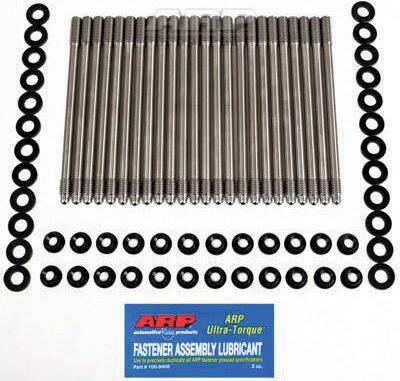
“When I took ownership the car, the four-litre conversion had taken place, incorporating many desirable parts, including JE pistons and ARP fasteners, but much of the engine’s ancillary equipment hadn’t been changed,” Jordan remembers. “There was leaking from old gaskets. Also, the coilpacks were damaged and were missing bolts. It was clear there was a fair amount of work to do.”
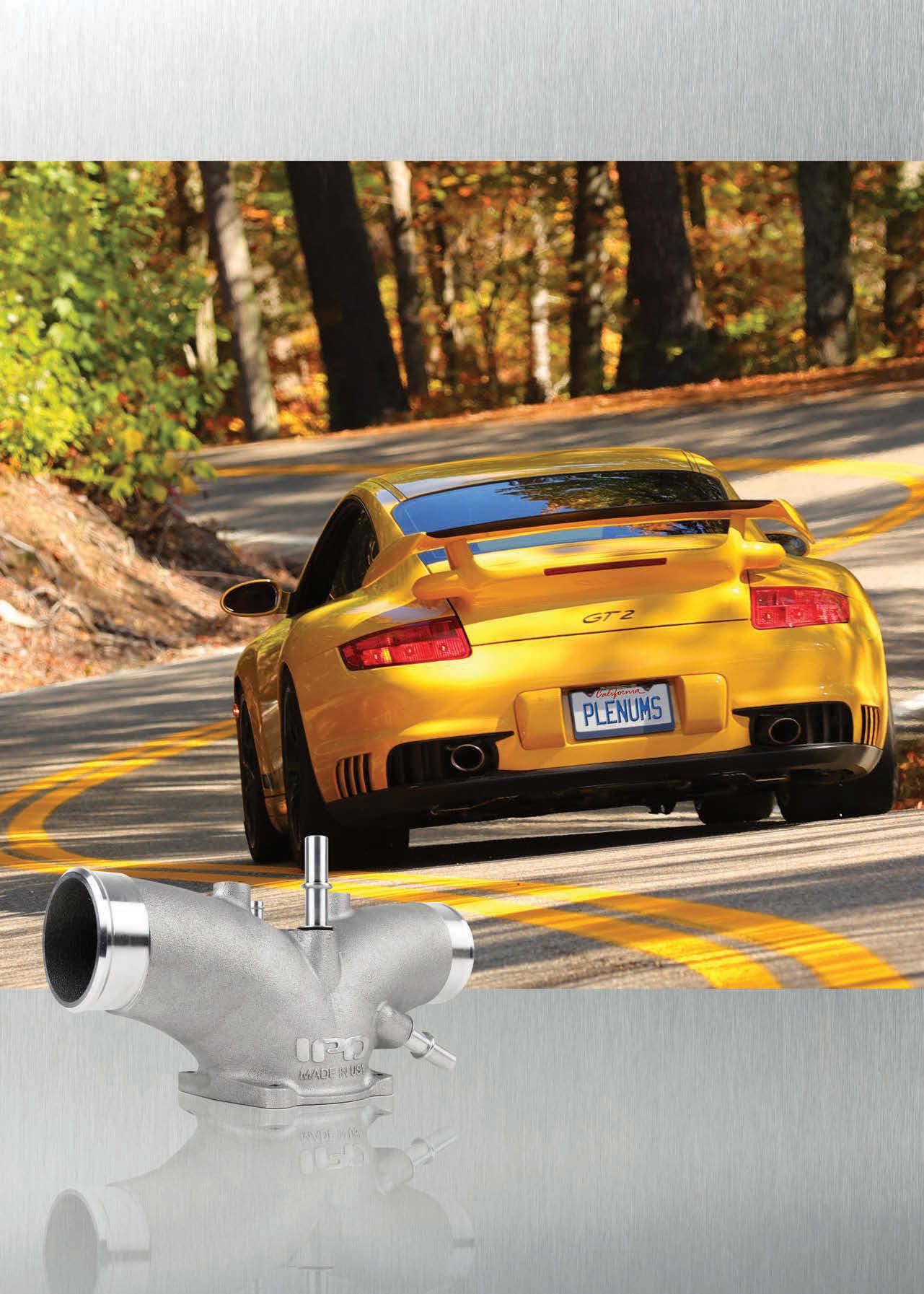
To put things right, Jordan, along with his friend, Brandon Dougherty (owner of Hershey-based Battalion Motorsports), treated the oversized motor to a thorough service, cleaning and renewing any components deemed not up to scratch. An IPD plenum and OEM GT3
Above Interior is a curious mix of motorsport-inspired paraphernalia and standard fittings trimmed in Alcantara
throttle body were installed to improve responsiveness, before a new custom tune was uploaded to the ECU with consideration of the modifications and larger engine size. “Brandon was a huge help throughout the build and the engine now not only sounds the part, but pulls like it should. There is a distinct increase in torque, even at low revs, which you’d expect from the bigger displacement, but pull is carried throughout the rev range, making for a much more potent flat-six than standard.”
ART ATTACK
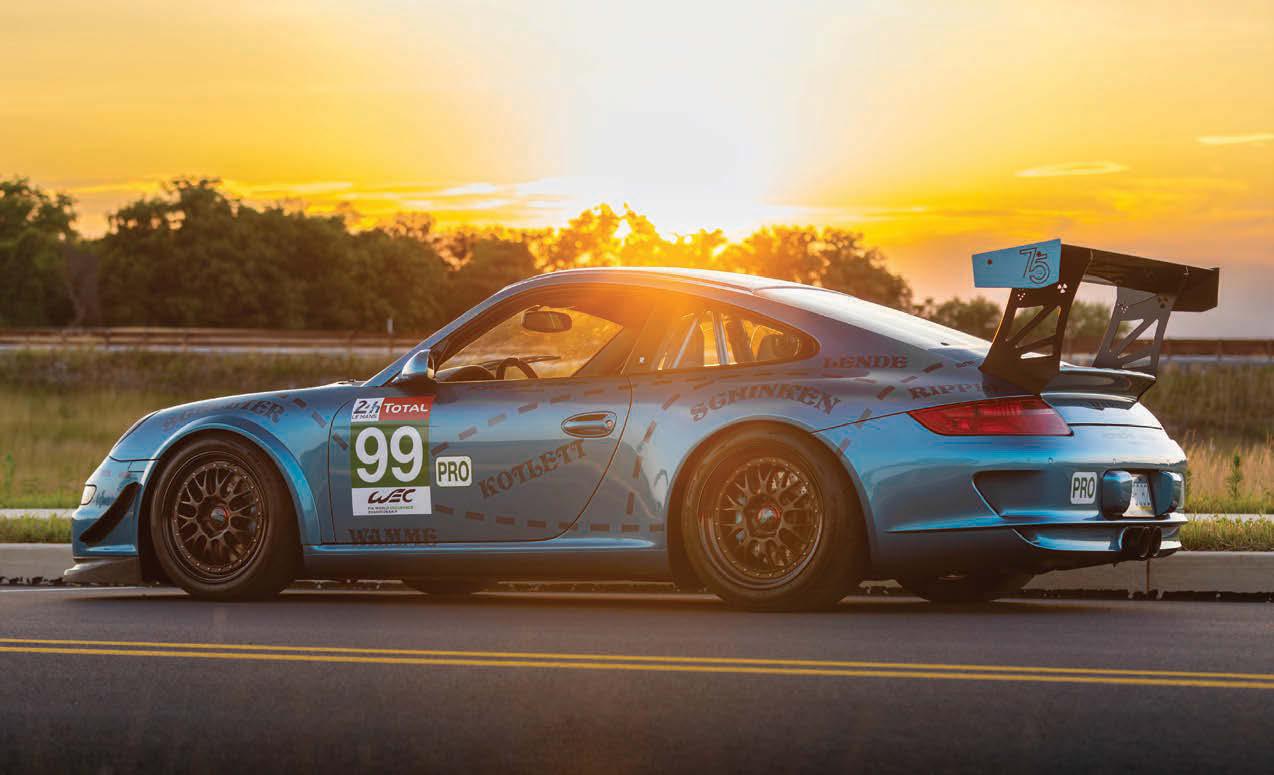
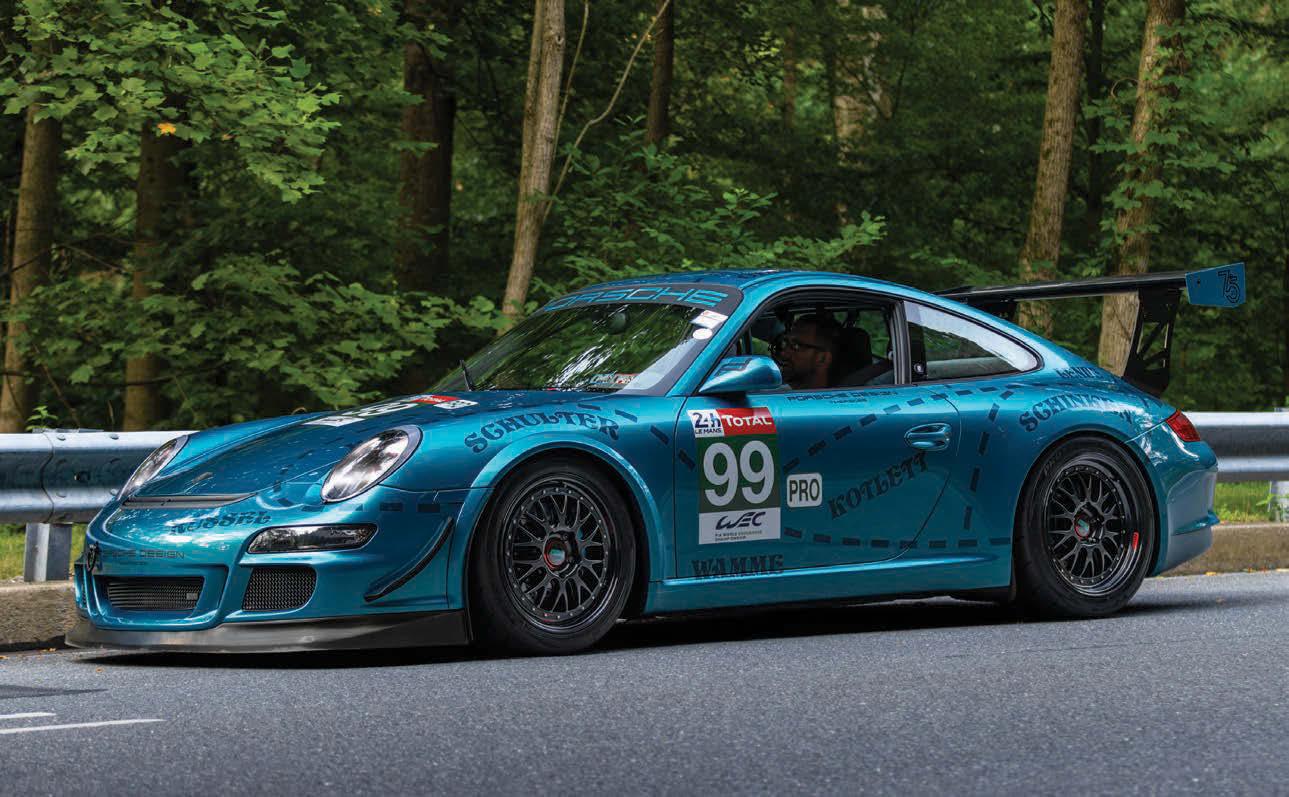
The build complete, Jordan set about enjoying his Atlantis Blue bruiser, but he felt something was missing. Designed and applied by himself (he runs a vinyl graphics business as a side hustle to his main job as creative manager at CJ Pony parts), his 997’s initial round of body graphics were heavily inspired by the Vaillant sponsor livery of the Kremer 935 K2 of 1977. The triple-stripe design wrapping itself around the nose and down the flanks worked well on Atlantis Blue, but Jordan wasn’t entirely happy with how the overall design looked, leading to a rethink.
“The 1971 24 Hours of Le Mans is remembered not only for Porsche’s second overall win at Circuit de la Sarthe, but also for the inclusion of striking
racing livery, including the ‘Pink Pig’ look of the 917/20. This design was mimicked on the 991-generation 911 RSR at the 2018 24 Hours of Le Mans, where it won the GTE Pro category. It is from this car I based the look of my 997.”
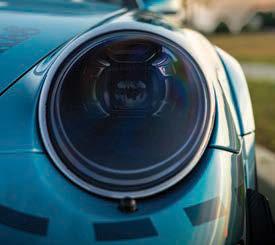
The dotted lines sectioning-out cuts of meat are faithfully replicated, as are the number cards on the doors and bonnet, just as they were presented on the RSR, only this time in a dark blue over the BMW hue. “The new livery, supported by Lamin-X tinted headlights, is a cheeky nod to Porsche motorsport history, but without detracting from the perfect
paintwork,” Jordan smiles.
It may have taken him close to half a decade to complete his dream machine, but he has accomplished something very special with this build. By taking the styling cues of a Cup racer and blending them with the comfortable and usable DNA of a luxuriously appointed street car, he’s created a Porsche excelling in whatever environment he puts it in. Be it the show circuit, the track or making the most of the winding roads of the Appalachian mountains dividing his home state of Pennsylvania, Jordan’s 997 is the best of all worlds. l
Above and below
If you’d like to see your Porsche featured in our You & Yours pages, contact Editor Dan using the email address listed on the intro page to this magazine, or hit him up on Instagram by adding @FurrsFleet
TOURING TIMES
The 991 GT2 RS is well-known for impressing with its headline performance and track-dominating abilities, but how does this flavour of 911 perform on the road?
Words Nicholas Found Photography Dan Sherwood
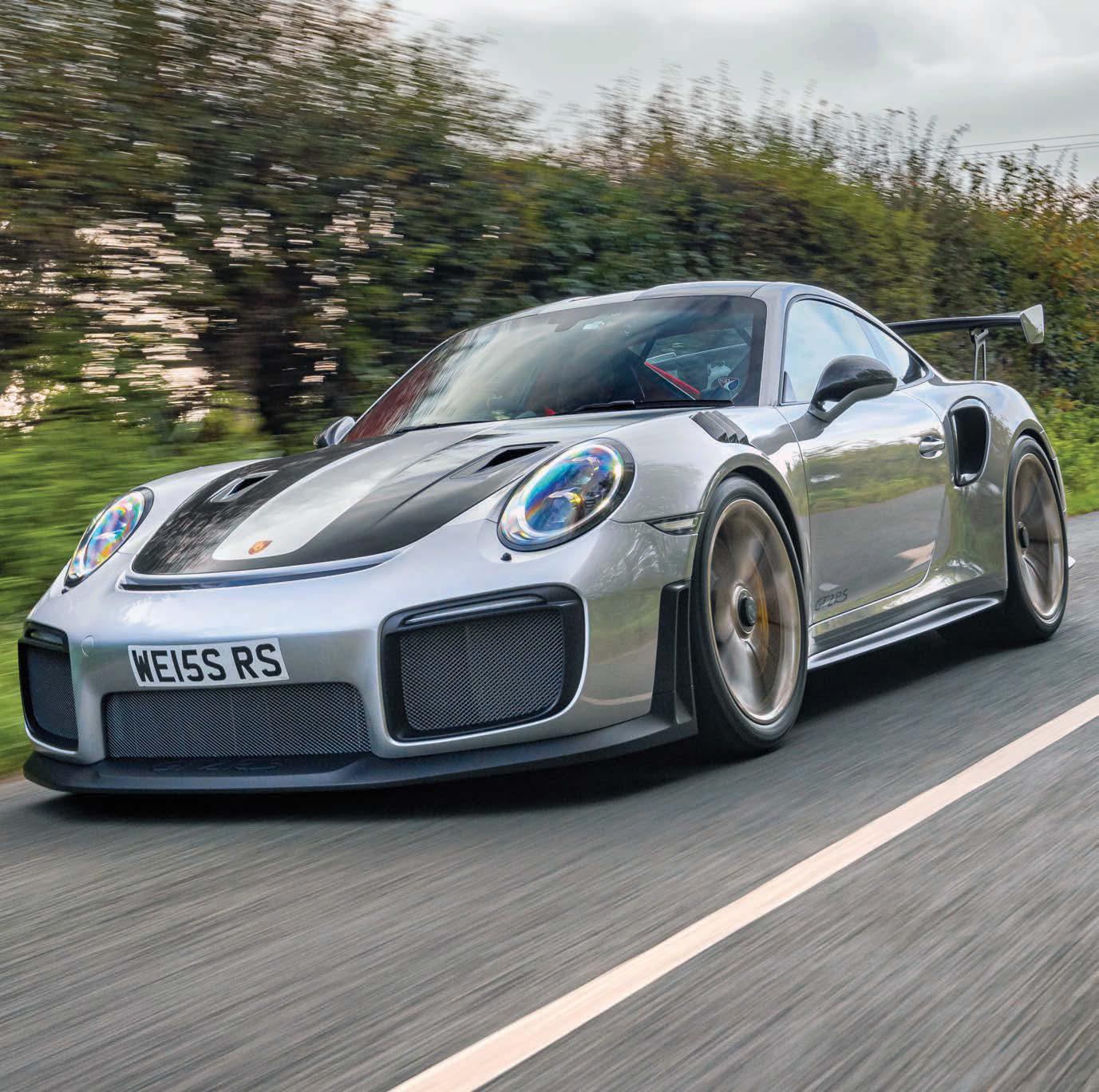
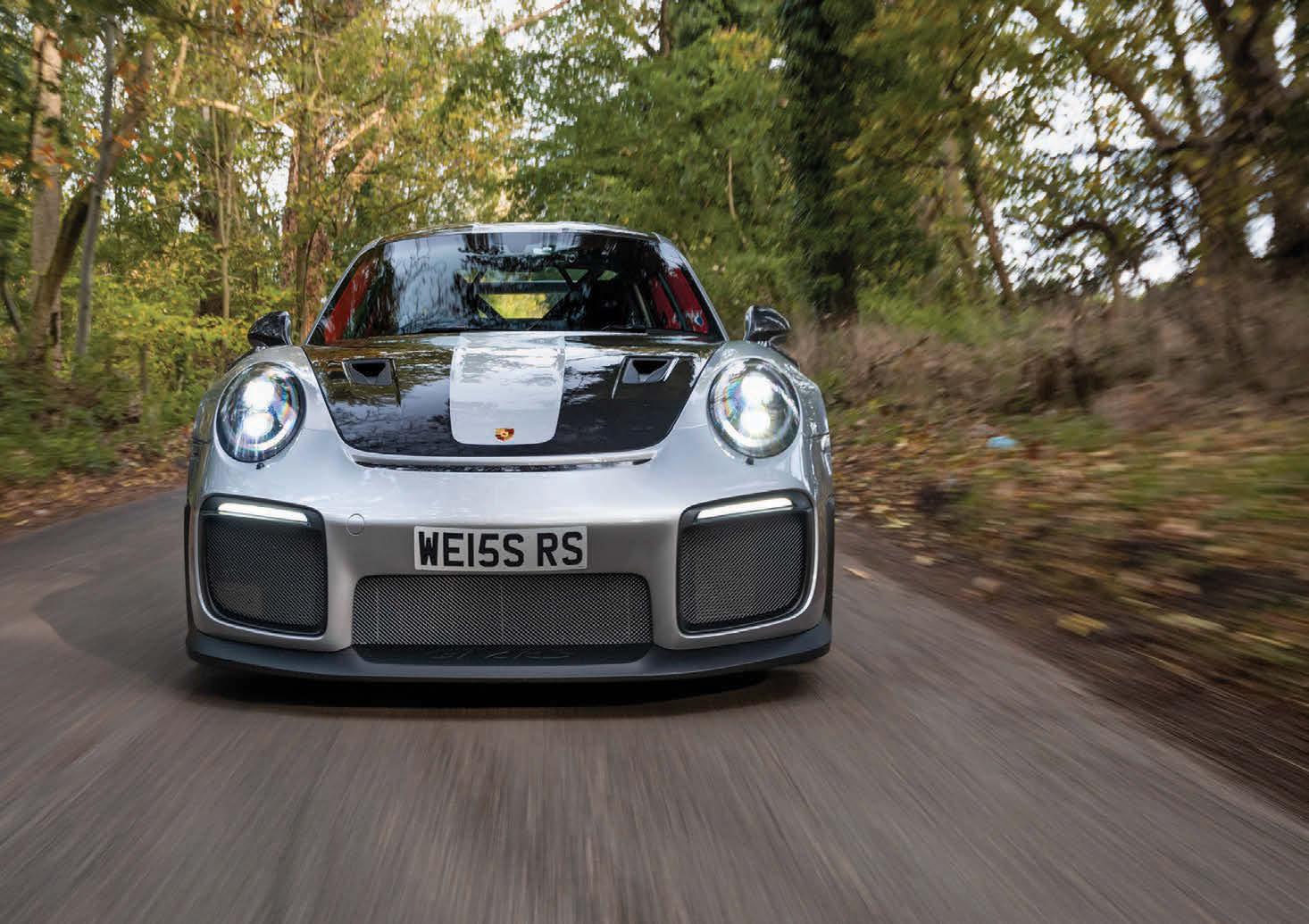
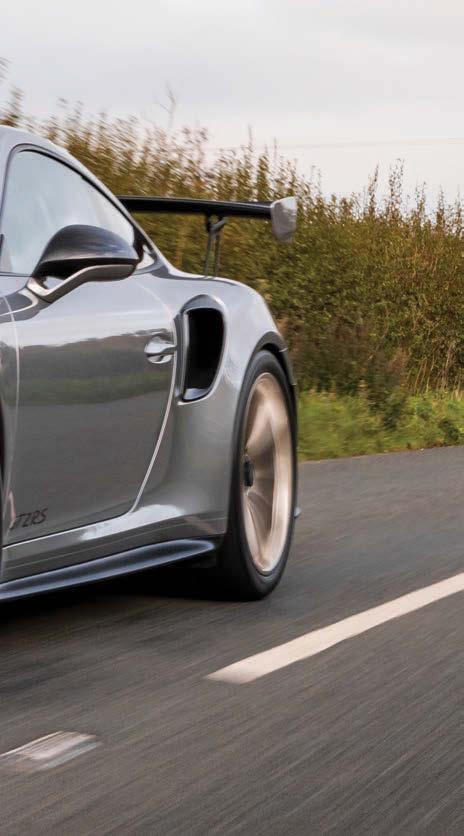
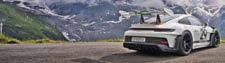
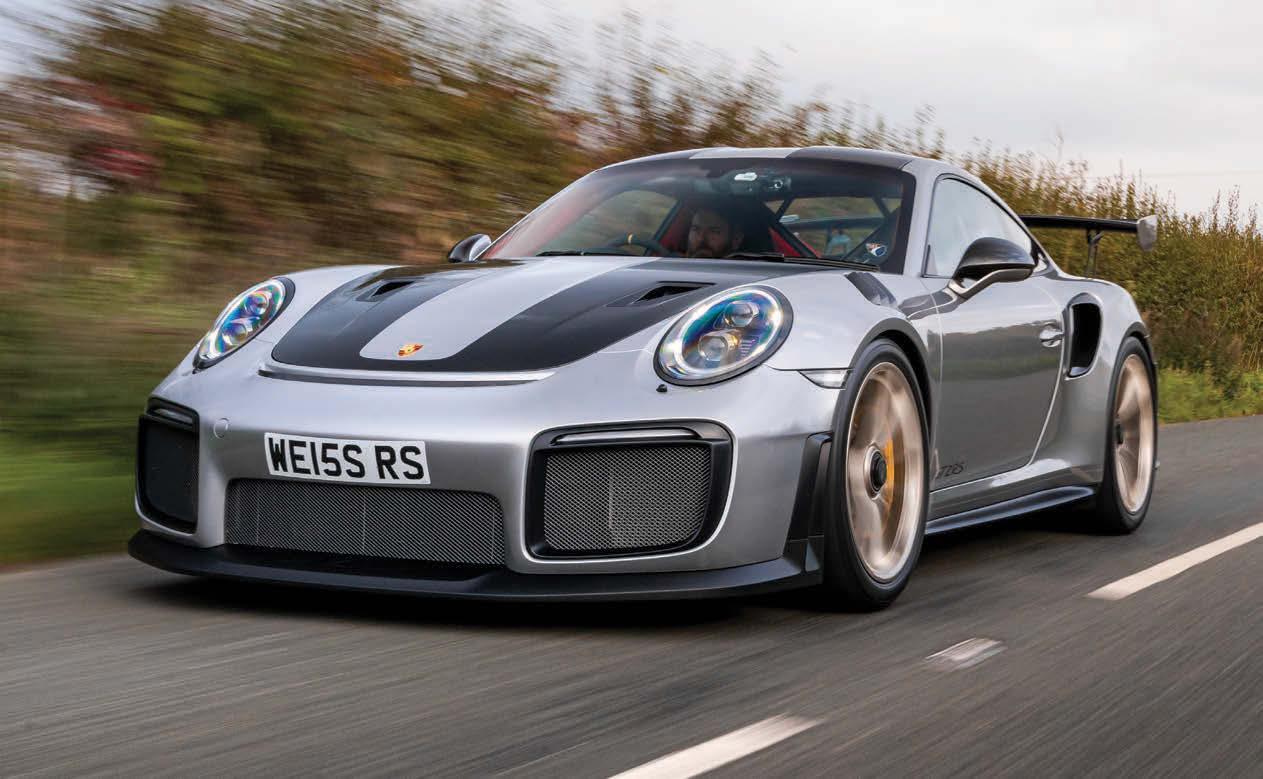
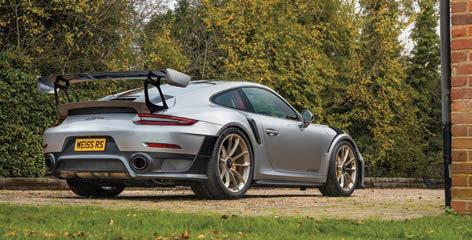
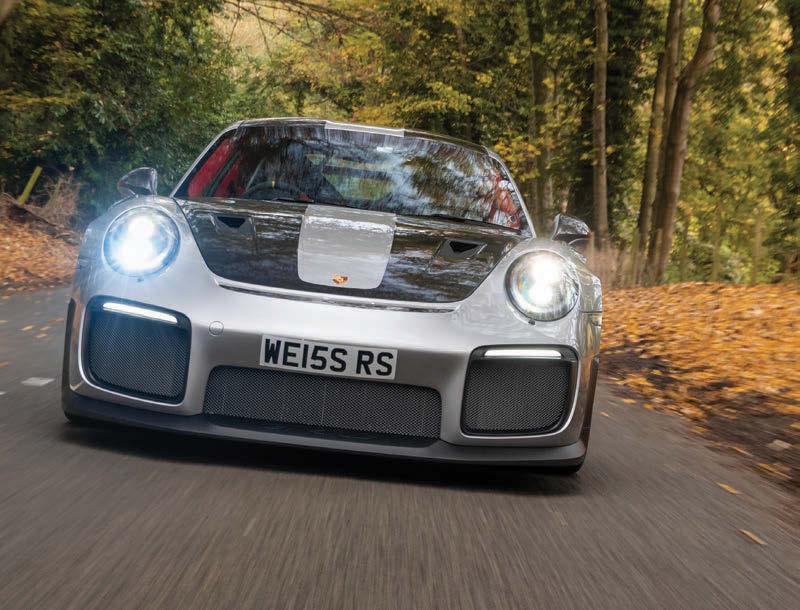
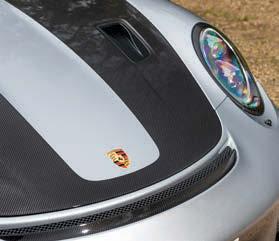
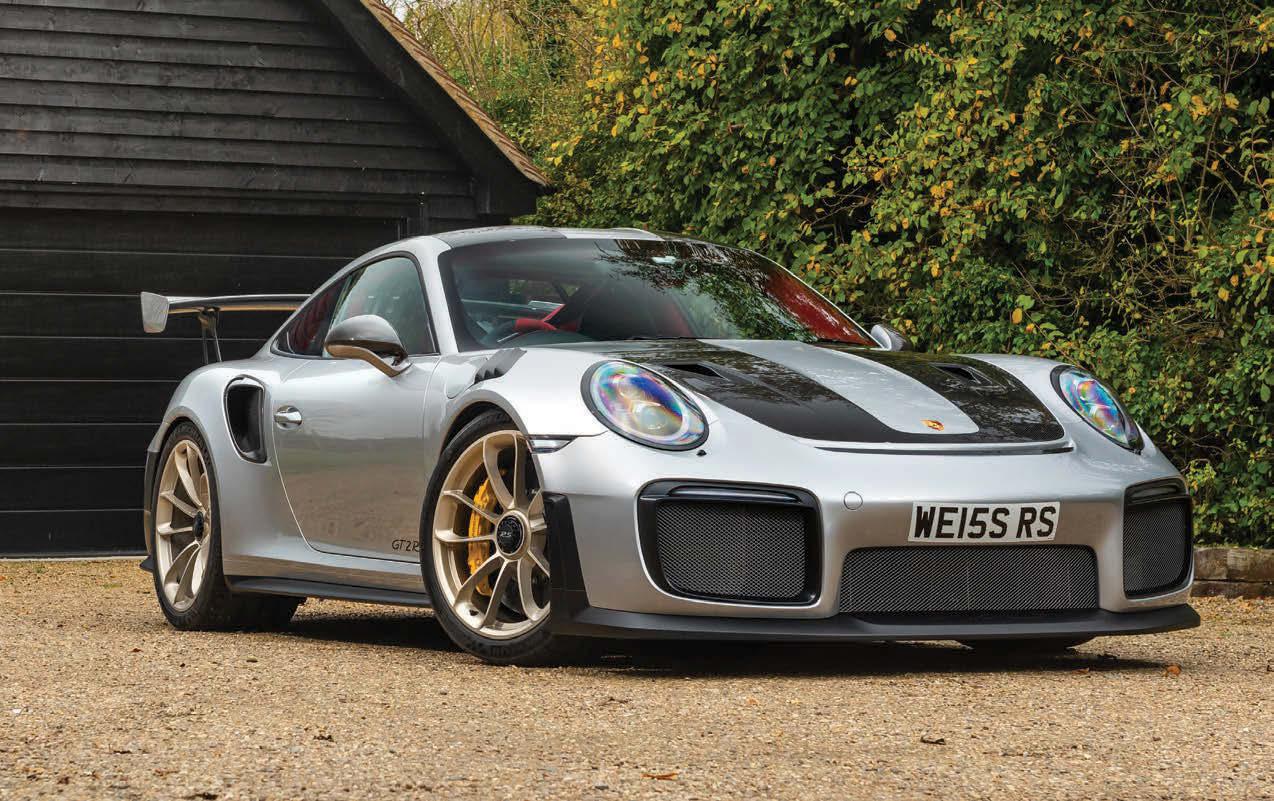
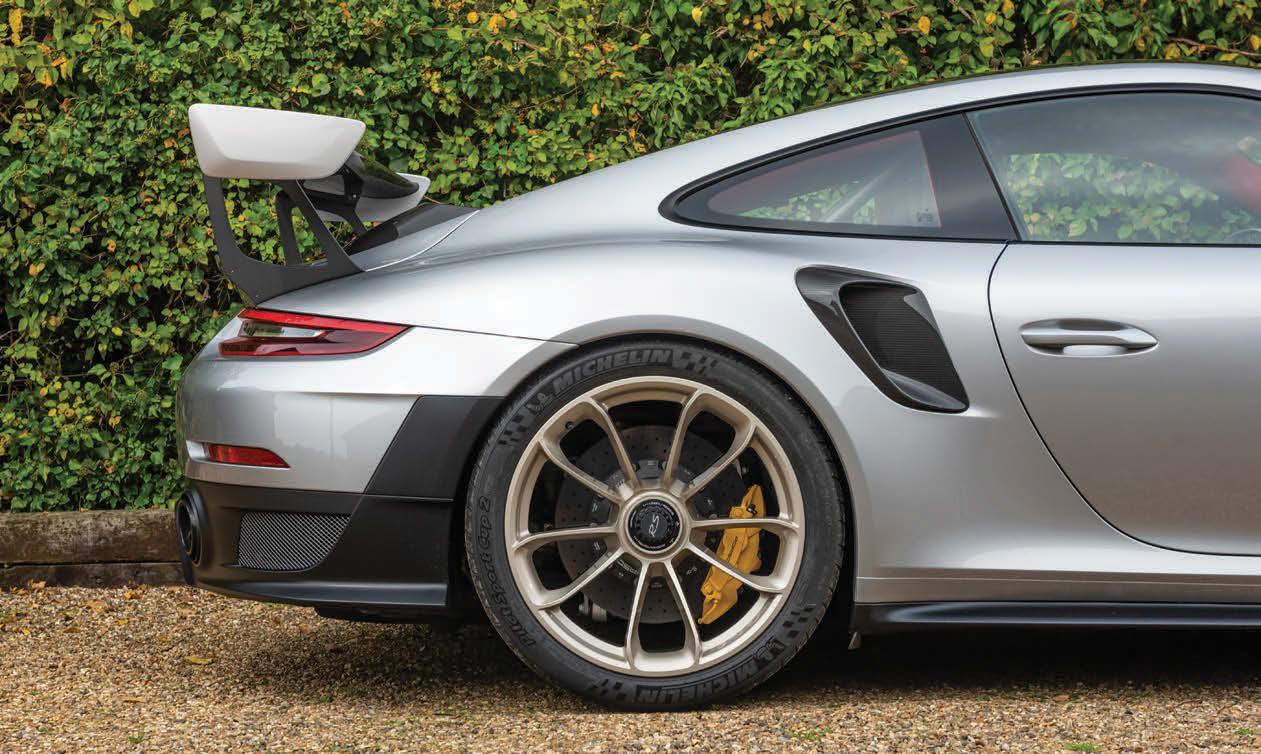
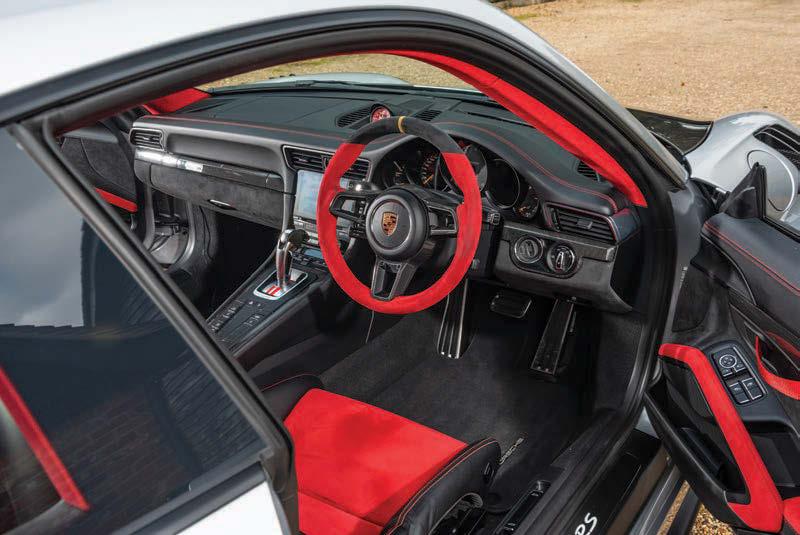
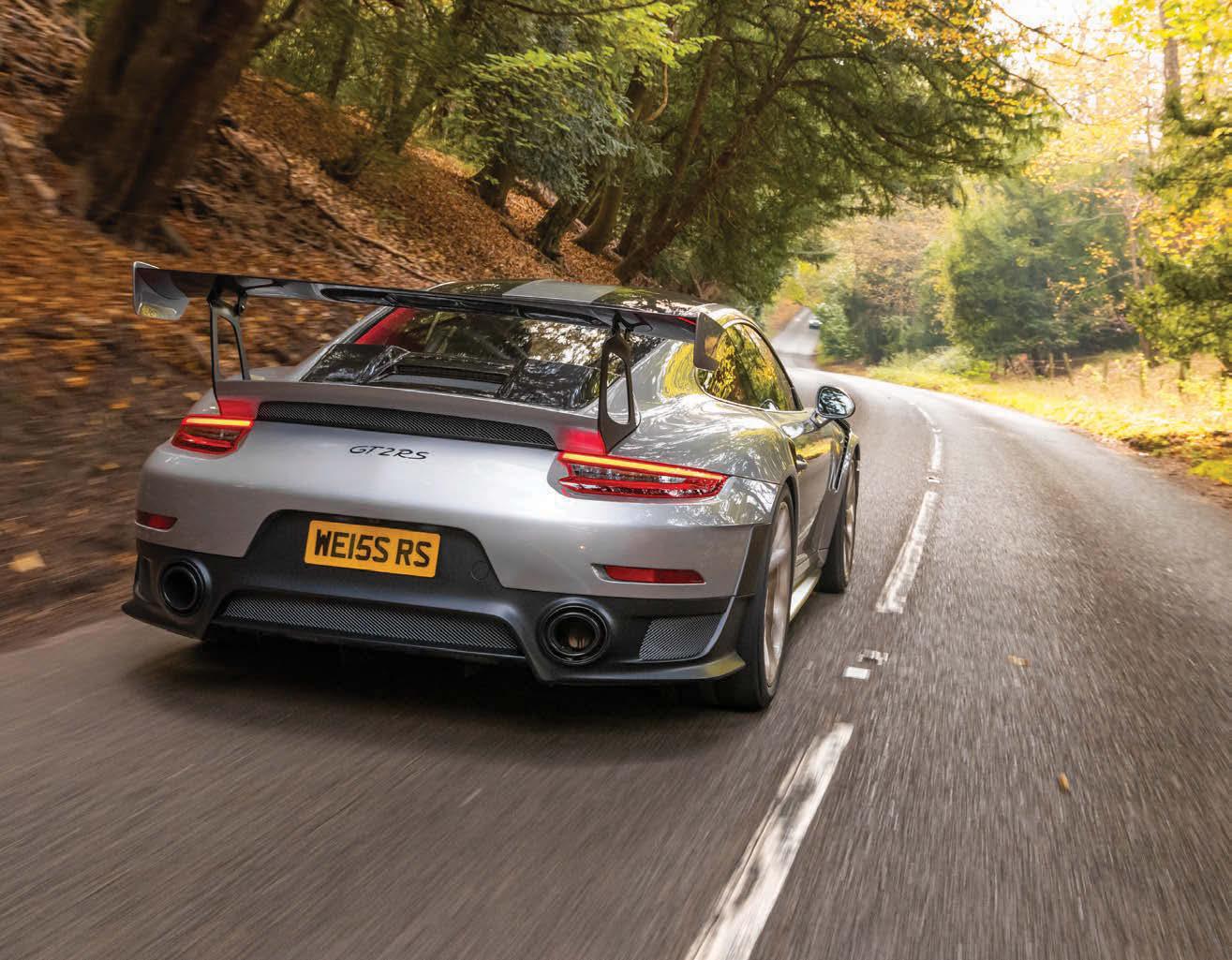
The 911 GT2 RS is as much a car as it is an emotional rollercoaster. It bridges intimidation, trepidation, surprise, exhilaration and relief. Does this make it a fairground experience? Can it really work on the road? First, just look at it. The striking silver paintwork contrasts with the dark carbon-fibre scattered all over the bodywork. The stance is aggressive — wide and low with no space to breathe between arch and tyre. Walking up to Martin Berry’s 2018 991 GT2 RS is an intimidating experience. There’s weight of history and heavy Porsche product development resting on this car’s shoulders. After all, the GT2 and RS badges are special in their respective rights, let alone when combined.
stretches deep into Porsche history, conceived in 1957 and applied to the 718 RSK race car. This was six years before the 911 was launched. RS (an abbreviation of Rennsport, meaning motorsport in German) is, however, most recognised for giving us 911 icons, such as the Carrera RS 2.7, 964 Carrera RS and 996 GT3 RS.
The 991 GT2 RS in front of me
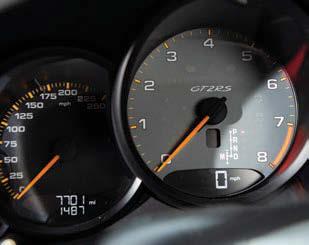
Porsche claims this 911 has a wet weight of 1,470 kg.
UNLIKE THE FIRST TWO GENERATIONS OF GT2, THERE’S TRACTION CONTROL, WHICH AT TODAY’S COLD 10°C, I’LL HAPPILY KEEP ACTIVATED
Facing page Not a sight you want to see in your rear-view mirror, is it?
The GT2 model line started with the 993-generation 911 in the mid-1990s. It was introduced to meet homologation requirements for GT2 class racing, where all-wheel-drive had been banned.
This gave Porsche a problem, chiefly because its halo Turbo model had just been introduced with four-wheel-drive for the first time. To overcome less traction from two-wheel-drive, Porsche widened the model’s track, increased downforce with large splitters and spoilers, reduced weight and added more boost. The GT2 was born.
This became the blueprint for all GT2s going forward, despite Porsche abandoning the model for motorsport use when the 996 was introduced, focusing instead on the normally aspirated GT3 for racing. It wasn’t until the second-generation 997 that an RS variant was introduced for the GT2, with development starting initially as a ‘secret’ side project to unlock further potential from the recipe. The RS story
represents the fourth-generation of 911 to boast a GT2 derivative. As intimated, in a broad sense, the GT2 RS is based on its contemporary Turbo, but ditches all-wheel drive for rear-wheel drive, blending GT3 RS witchcraft across its chassis along the way. In reality, there is so much more to this car.
It uses the 991 Turbo’s 572bhp 3.8litre engine, as opposed to the GT3 RS’s four-litre boxer, but utilises bigger turbochargers and a water-spray system to cool inlet temperatures. The result is a whopping 691bhp through the rear wheels. This made for the most powerful production 911 ever built. As such, and unlike previous GT2s, 991 variants are equipped with seven-speed PDK transmission to handle the 553 lb-ft torque on offer.
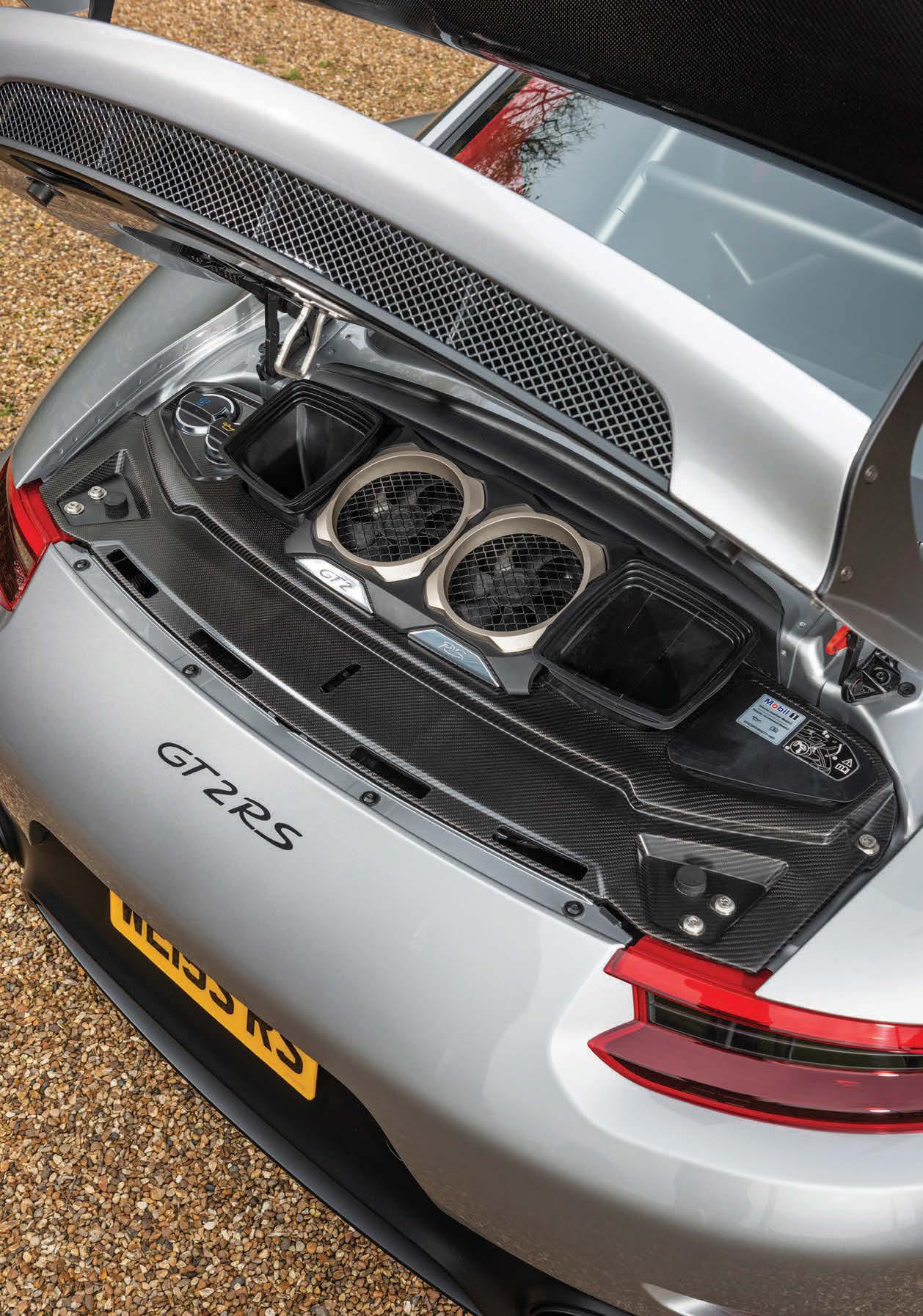
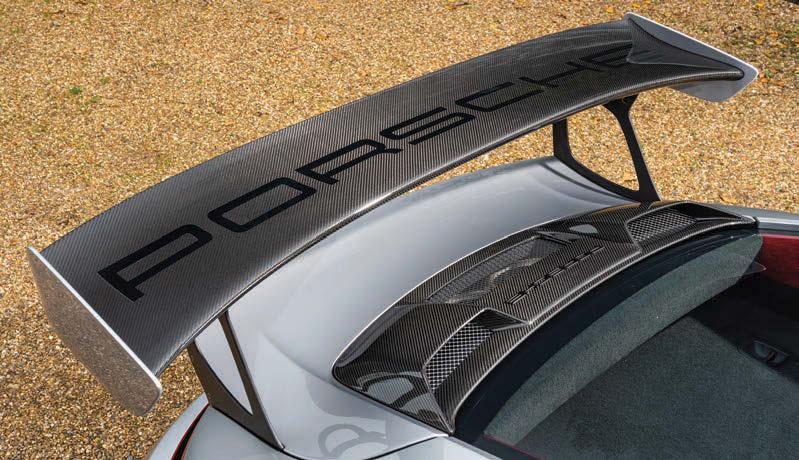
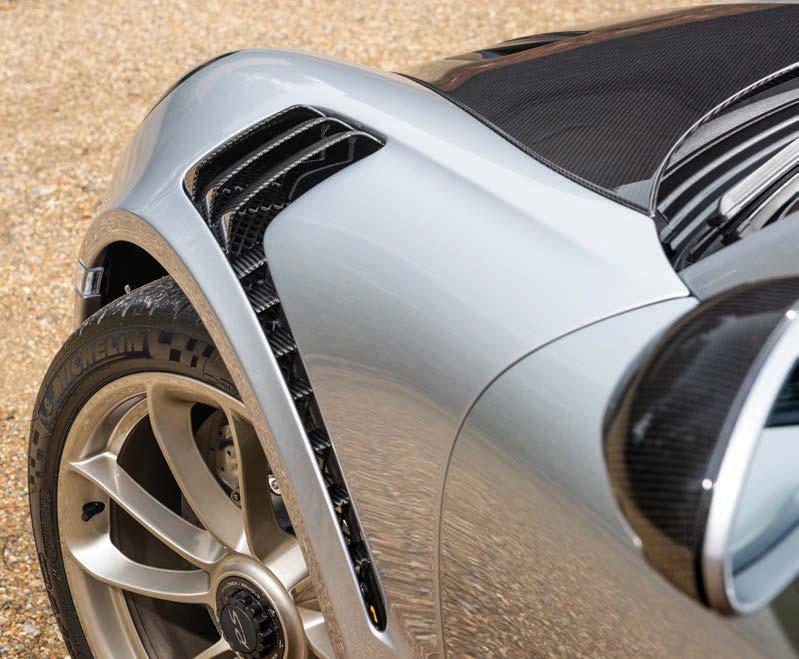
Despite the additions of a gargantuan front splitter, wide wings and lofty rear spoiler, these cars have been on a serious diet, especially when compared to a standard 991. The roof is made from magnesium, while the front lid, front and rear wings and engine cover are constructed from carbon-fibre. The front and rear aprons are lightweight polyurethane. The rear and side windows are thin polycarbonate, and the exhaust system is made from titanium.
On top of this, an optional £21,000 Weissach package, which our star car benefits from, reduces weight by a further thirty kilos, replacing the already light magnesium roof with a lighter carbon-fibre panel, as well as introducing carbon fibre anti-roll bars and coupling rods on both axles. The roll cage, meanwhile, is titanium. If this wasn’t enough, the package also includes six-point safety harnesses and a set of BBS forged magnesium wheels. Not even the front enamel badge has been spared from scrutiny, evidenced by the fact it has been replaced with a sticker. All this adds up to make me feel extremely guilty about eating a bacon sandwich an hour ago.
LAP DANCER
I’m not one to judge road cars based on their lap times at the Nürburgring. It would be like judging the taste of fish based on how well it once swam. This car’s credentials at the Green Hell, however, are difficult to ignore. In late September 2017, for example, a 991 GT2 RS pedalled by Porsche test driver, Lars Kern, set a 6:47.3-minute lap time, averaging 114.4 mph. This was the fastest lap time recorded by a production car, some ten seconds faster than Porsche’s then most recent hypercar, the 918 Spyder. A year later, Kern did it again, albeit in a GT2 RS loaded with Manthey Racing equipment. He shaved four seconds off his already impressive record.
Even by Porsche standards and the wealth of limited-edition models on offer, the 991 GT2 RS is truly special. I remember being at the 2017 Goodwood Festival of Speed, where this flavour 911 was first unveiled to the world.
The claim of hitting 62mph from rest in 2.8 seconds held so much weight, but what does this lightweight, hardcore, turbocharged 911 feel like away from the Nürburgring, in the real world of potholes and traffic in wintry Britain?
We should stress, this particular GT2 RS has been bought by its owner to be used on the road. It was purchased from Portland Autos in November 2021 with just 183 miles on the clock. Since then, Martin has added a further 7,500 miles. He may take great pride in using this special 911, but he knows how to balance care and preservation at the same time — in preparation for using this Porsche as a long-distance road car, it went straight to Azuri Car Care for paint correction, paint protection film and a ceramic coating.
Additionally, the car remains in standard specification, save for aluminium alloys purchased from Porsche, recoloured in gold to lift looks, and fitted at Bell Sport Classic, all to preserve the car’s original magnesium wheels. As you can see, Michelin Cup 2s (265/35 front and 325/30 rear) are used in place of the standard Dunlop tyres issued by Porsche. The carpets are covered by floor mats to protect from muck and gravel. The seats make use of side bolster protectors to prevent wear, and Martin drives wearing gloves to stop grub getting into the Alcantara.
It’s all very considered. Perhaps this shouldn’t be surprising, considering Martin is a serial GT Porsche owner?
Deep breath, let’s start from the top. His first was a white 2016 911 GT3 RS acquired from Porsche Centre South Lakes in July 2017, before he switched to a then new 991 GT3 in Agate Grey Metallic from the same dealership in April 2018. This was followed by a 2019 991 GT3 RS in GT Silver with added Weissach pack, supplied by Porsche Centre Hatfield in September that year.
Finally, a 992 GT3 RS in black was supplied by the same issuing dealer in November 2023. Only a Volkswagen Amarok and the 991 GT2 RS pictured here are currently left in the Berry stable, making something of an unusual twocar garage. Talking to Martin, I get the impression this GT2 RS is, unlike the other Rennsports mentioned, a keeper. All servicing work is completed at Porsche Centre Hatfield, where the car remains under warranty, ensuring it has been maintained to as-new standard in
Above Despite its size, the GT2 RS feels nimble on tight, twisty rural backroads
preparation for this road test. Opening the driver’s door and swooping into the carbon-fibre bucket seats, any sense of intimidation (and guilt from the bacon sandwich I’ve just eaten) turns into heightened expectation. Until getting in, I hadn’t appreciated the vibrant red Alcantara dressing the headlining, A-pillars and steering wheel. It’s like sitting down with a date and realising she’s wearing red stockings. It sets the tone for things to come.
The seats are just about the most impressive I’ve sat in. They look
purposeful and hug the body like a tailored suit. Simple slider adjustment with a manual lever gives a reassuring sense of being locked into place. The only issue with these seats concerns wearing a helmet on a track day, where the helmet would work in combination with the padded headrest to push your neck out, something Porsche solved with removable headrest padding in the latest GT3s. Not that this is a problem for Martin. You see, this car has never been on track. Instead, he’s covered the aforementioned 7,500 miles on
numerous road trips, “the last being a trek to the Monaco Historic Grand Prix in advance of a drive through Italy and Switzerland.” He tells me the car not once felt uncomfortable at any point during this particular jaunt’s two thousand miles. The seats are obviously a huge contributing factor.
MISSION CONTROL
I start the engine. There’s an immediate sense this is an angry so-and-so. It sounds snarly and deep. Old-school, even, but for all the right reasons. Compared to the latest standards from Porsche, the GT2 RS has few driving modes to worry about, but the few it does have are important. For starters, unlike the first two generations of GT2, there’s traction control, which at today’s cold 10°C, I’ll happily keep activated. There’s also PDK Sport to relax the stability systems, sharpen the gear changes and shift at higher rpm in automatic mode.
Speaking of which, I start with PDK in automatic, letting the car shift on my behalf, primarily because this 911 requires warming up thoroughly. I’m not just talking about the engine (as is the case with any car), but those Cup 2 tyres and carbon-ceramic brakes only come to life when warm. It’s a ritual grounded in respect and commanded by supercars. Shifts in automatic are as smooth as double cream. In the blink of an eye, the readout on the dashboard is claiming to be in seventh gear before even hitting the national speed limit. The low-speed shifts lure you into a similar sense of
Above Martin isn’t afraid to pile on the miles, but ensures great care is taken to preserve the car’s condition whenever he hits the road
relaxation pulled by the standard 991 Turbo, except the tone from the engine reverberating through the GT2 RS’s cabin is louder and bassier, with a drone from the exhaust just below 2,500rpm as the engine begins to reveal itself.
Navigating through windy towns in Hertfordshire, I’m left feeling surprised. The drive is, well, docile. I thought having to navigate sunken manhole covers and potholes would leave this 911’s front splitter scuffed, suspension bushes chirping and my back broken from general hardness, but I was wrong. There’s a level of control and sophistication to the setup, meaning bumps are absorbed alongside a tightness ensuring there are no rattles, knocks or bangs from the suspension. I’m left contemplating whether I could use this 991 every day, much like I could a 911 Turbo.
CUNNING DISGUISE
There’s one big difference, though. Where a 911 Turbo slips under the radar, the GT2 RS absolutely doesn’t. Its flashes of carbon through the bonnet, the deep side intakes, Porsche script across the rear wing and general girth means this is a Porsche turning heads wherever it is pointed.
The 991 is a large 911, but somehow, the GT2 RS feels smaller on the road than it is. I think this is because other
road users simply move out of the way when they see it coming, a result of those big front grilles looking like they’ll eat approaching traffic for lunch. Heading out of town onto more technical B-roads and approaching the first bend at national speed, the brakes initially dominate.
It’s rare I’m impressed by feedback given by modern brakes, which often feeling over-assisted, sensitive and numb. These are different. It almost feels like there’s no brake servo. There’s weight to the pedal and the bite is near instant, but remains progressive, with
plenty of performance to explore the harder the brake pedal is stamped.
The steering, too, is another delight. It may be electric, lacking some of the feedback offered by earlier 911s with hydraulic steering, but there’s consistency to the way the steering weights up through a bend, meaning I’m never in doubt about what’s happening below. On this note, the overall chassis of the GT2 RS shares much in common with a GT3 RS, including four-wheel steering, but makes use of harder springs and softer anti-roll bars. This car has been fettled by Jonny Cocker at JCR
Above As the number plate suggests, Martin’s GT2 RS benefits from the optional £21,000 Weissach pack
Developments. The geometry has been honed to a fast-road setup, which is said to be something of a blend between standard, Martin’s personal preference and a Manthey Racing configuration. There’s no doubting the confidence the front end induces. Historically, this would be the Achilles heal of a fast 911.
Catching up to traffic, I take a moment to activate PDK Sport for the first time. I may still be travelling within the speed limit as before, but the sharper gearchanges make the whole experience more alert. The car suddenly seems more excitable, perhaps unintentionally making low speed driving more enjoyable with added drama. With the car now warm, I flick the PDK gear lever left to enable manual shifts. I’m now in full control of the gear changes using the carbon paddles on the steering wheel. The throw of the paddles is as short and seemingly instantaneous as the shifts themselves. There’s a crispness to the gear changes, giving a sense of tightness to the overall drivetrain and a desire to find any excuse to change gear.
In manual mode, untapped territory can be explored in the upper realms of the rev range, revealing a deeper character heading onto the slip road of the A10 dual carriageway. This thing may be as docile as a donkey around town, but bury your foot on the throttle and the effect is similar to inserting
a jalapeño pepper into the bottom of a horse. There’s a thunder of noise, a rush of power. Except, there must be a jockey at the helm of this horse. It’s all so controlled and linear in its response, giving a sense of predictability to inspire confidence. Sure, disable traction and stability controls and the Porsche
becomes as scatty and ferocious as a feral cat, certainly if you probe it. Interestingly, Martin tells me manual gear changes keep the car more settled and predictable in the wet than when relying on automatic shifts.
Unlike GT2s of old, the big surprise here is how engine output is
Above and below Flashes of exposed carbon-fibre highlight this is no ordinary 991
Above and below
Exterior is a masterclass of understatement, which makes the eyepopping interior all the more surprising
proportionate to the throttle inputs given. This never used to be the case with the KKK-turbocharged 911s, where the engine would take a deep breath for a second or so to fill its lungs before catapulting forward. The feel of progression from a 991 GT2 RS is in its variable-vane turbine technology (VTG), with guide blades on the turbocharger opening and closing in relation to engine speed. Imagine a playground carousel, spinning
children around while all their hands are across the bars. That’s the blades of the turbocharger at low rpm, with the
turbochargers to gradually increase airflow.
IT PLAYS THE PARTY TRICK OF HAVING THE LOW-DOWN GRUNT OF A DIESEL AND THE SCREAMING ABILITY OF A NORMALLY ASPIRATED MOTOR
guide blades tightly clustered. As the revs climb, the blades spread outward, just like kids letting one arm swing out wide while the carousel spins. It effectively expands the diameter of the
Make no mistake, speed in a GT2 RS happens at what feels like an unmeasurable rate — the speedometer draws in on three figures as though there’s a magnetic pull. Cars in the neighbouring lane on this dual carriageway somehow seem to be driving in reverse. Squeezing the throttle is all encompassing, with a raucous exhaust note elevating through the cabin as the centrally positioned rev counter climbs. I do not exaggerate when I say there’s no feeling of lag from the turbochargers and there’s no let-up as the engine bellows to its climax of 7,200rpm. Plough quickly through the gears and this thing will pop between shifts as unburned fuel enters the hot exhaust, much like a 911 Turbo thirty years its senior would.
I sense this car would be too loud on track, but on the road, with 691bhp developed at a high 7,000rpm, as well as 553lb-ft torque available from just 2,500rpm, it plays the party trick of having the low-down grunt of a diesel and the screaming ability of a normally aspirated motor. A Taycan Turbo could pull similar speed, but it’s the way a GT2 RS does it with theatre within the realms of speed limits. It pulls the trick of all great 911s insofar as it has dual personality: sedate when you want to cruise, but a complete riot when you
don’t. After three years with the car, it’s what impresses Martin most. “It never ceases to amaze me. A docile 911 capable of being driven anywhere, then, in the blink of an eye, it becomes a widow-maker.”
Slowing the pace as I head back to Martin’s house, I briefly look down at the centre console and realise the traction and stability control systems are still active. The penny drops. At no point have the systems taken away from the experience. They’re refined to make near 700bhp usable, rather than an interference. They have your back. None of this feels dictated or compromised. It is, perhaps, the first time in a 911 where tyre technology and electronics have kept up with extreme power to work in harmony as a package, rather than act as a blunt instrument to kill progress. Before today, if I’d been asked to
reveal my ideal GT Porsche for the road, I’d have suggested a normally aspirated two-horse race between a GT3 and GT4. I was wrong. The GT2 RS is the petrolhead’s ‘hybrid’. It has an amazing ability to blend extreme power, raw feedback and genuine usability in a
PULLING UP TO MARTIN’S HOUSE, I FEEL RELIEF THE HEADLINE POWER DIDN’T INTIMIDATE OR MAKE THE CAR UNUSABLE ON THE ROAD
theatrical package.
Pulling up to Martin’s house, I feel relief the headline power didn’t intimidate or make the car unusable on the road. Getting out, I applaud him for taking a GT2 RS with near delivery mileage and putting it to work over the past three years. The performance of this model has been widely documented before today, but here, this proven level of usability is a real eye opener.
I’m left having gone through a rollercoaster of emotions, not limited to intimidation, trepidation, surprise, exhilaration and relief, combining to represent something close to automotive nirvana. Walking away from Martin’s GT2 RS, I’m left longing, knowing I don’t own it and desperately scrambling to find a reason to go back and repeat the experience. I can’t. In a moment of reflection, I realise what the GT2 does is take the greatest sports car into the realm of supercars. To compare it to the likes of a Lamborghini undermines the Porsche’s ability to deliver at the limits of performance, while being accessible and sedate when you want it to be, giving it the abilities of a tourer.
It’s the Swiss Army knife of the automotive world. It’s an all-time great, perhaps never to be bettered. l
Above Is this last of the truly unbridled production 911s we’re likely to see?
FORGOTTEN SIBLING
Can a 912 E with carefully considered modifications get one-up on the same-age G-series 911? We get behind the wheel and find out...
Words Nicholas
How is it possible I can step out of a 991 GT2 RS, considered by many to be the pinnacle of modern 911s, and be completely won over by a narrowbodied Neunelfer from the 1970s as soon as I walk up to it? It’s probably the simplicity of design. The slim hips. The smooth deck. The modest silver paintwork. If the 991 GT2 RS represents the most extreme production 911, this is the purest form. Except, despite every morsel in my body telling me this is a G-series 911, it isn’t a 911 at all.
Phil Brown, the owner who’s as approachable as the car itself, reveals this is a 1976 912 E. Being an entry-level model, this car has a curious place in the Porsche pantheon. Phil’s example arguably more so, having been enhanced to make it more usable for everyday motoring in the twenty-first century. Does this mean it can take the fight to a same-age 911?
Found Photography Dan Sherwood WITH SEVENTY-PROFILE TYRES ABSORBING THE HARSHNESS OF UK ROADS, THIS AIR-COOLED CLASSIC NEVER CRASHES THROUGH DIPS
an E at the end of its name, representing Einspritzung, which is the German word for fuel injection.
With only 2,092 912 Es manufactured, Porsche sold about twice as many 911 S across coupe and Targa forms in 1976. Little more than two thousand units is a seriously modest figure when compared to the 30,895 first-generation 912s produced between 1965 and 1969. If sales numbers are anything to go by, this comeback was more Basic Instinct 2 than Die Hard Secondly, I’m not sure time is
changed to modern LEDs with period European H4 lenses and chrome retainer rings. The rear bumper features smaller Euro-spec bumperettes and carries a UK-sized number plate. The front fogs and bonnet vent have been refinished by Amwell Blast Coat. Altogether, this car looks sharper and prettier than a standard 912 E and far closer to a European G-series 911.
I see three immediate problems. First, history would tell us no. The 912 served as baby brother to the 911 and was on sale for just half a decade, debuting in 1965 to replace the 356 as the entrylevel Porsche. It took the Type 616 1.6-litre flat-four from its predecessor, albeit tuned for more torque, and was dressed in the 911’s bodywork. The 912 was on sale for four years before making way for the square-edged, midengined, Targa-topped 914 roadster in 1969, but it wasn’t long before the 912 made a comeback for a fourteen-month period between 1975 and 1976, with a nip and tuck to carry G-series bodywork, filling a gap while Porsche readied the 924 for launch. This time around, the 912 used a two-litre development of the flat-four fitted to the 914 and spawned
forgiving. 911s, like humanity, have been about constant evolution, rather than revolution. They age slowly, but relentlessly. We may think a Porsche from the 1970s is as usable today as it was back then, but we don’t really notice how far the 911 has come until hopping into a jacked-up 992 Dakar, hybrid-power GTS or, indeed, a 691bhp 991 GT2 RS, a point which becomes immediately obvious when stepping into a vintage Porsche and finding there’s nowhere to put your caramel macchiato and no way of streaming Taylor Swift on Spotify. Thirdly, the second-generation 912 was sold exclusively in the United States to cater for Porsche’s most important market. This is concerning. Stuff that works in US doesn’t necessarily work here. Think spray cheese, drive-through weddings and Donald Trump. And in the 912 E’s case, US-specific road safety regulations gave it the looks of a chimpanzee, with its heavy brow from the sugar scoop headlights and those wide, grinning front turn signals.
That said, Phil’s car is different. The sugar scoop headlights have been
This trickery continues with subtle changes in the cabin. As I pull the door lever to hear the reassuring two-toned ‘clack’ synonymous with air-cooled 911s, I spy Rennline aftermarket cup holders for my cappuccino. There’s a modern Pioneer had unit, amplifier and speakers, installed by Braybrooks In-Car Enhancements. There’s even a mount to dock my iPhone. This means music can be streamed seamlessly via Bluetooth. It gets better. The seats don’t feel like my gran’s old sofa. They are plush, having been re-foamed and retrimmed with new fittings by Nine Series Classics. The mats are thick, handmade Coco Mats to elevate the interior. The steering wheel also feels sturdy, having been trimmed by the talented Jason Wright at JW AutoTrim.
STOP THE CLOCKS
In a 912, even things as a simple as a battery indicator and oil pressure gauge are welcome additions. Here, they were skilfully grafted into the original dials when they were refurbished alongside the addition of the 76 script on the centrally positioned rev counter by John Bell in the US. I wouldn’t go as far to say this example is a restomod, though. For starters, it’s never been restored, being a California car until recently. Indeed, following a reckie in the US, which confirmed it was a good buy, this 912 E was imported through
My Car Import in Derby. It was collected from the USA in early April 2022 and Phil took delivery two months later, on 20th June. Rather than being subjected to an agonising wait, he reflects fondly about the import company being “really helpful and making the process really easy”. This includes handling the NOVA customs clearance, container shipment, registration application to the DVLA, supply of vintage-style number plates and transport to Phil’s home.
A life in the dry Californian climate means the original chassis and galvanised bodywork remain rock solid. There’s nothing to suggest this car has covered more than 260,000 miles. What Phil has done is take a good, used 912 E and given it selective enhancements to make it a more relevant package for today. It’s modernisation. Of course, the types who go to an auto jumble looking for dust caps will say this is all wrong, it’s interfering with heritage. Rest assured period features abound.
Like a 911 of the same vintage, which this car shares much of its interior with, it is imperative you get to know the switchgear before you set off because it’s the devil’s own job finding the correct buttons and levers for essentials like the sunroof and heaters when on the move. They’re closer to your feet than hands. Starting the engine, I’m met with the first giveaway this isn’t a 911. The flat-
four fires like a Clint Eastwood western is being filmed under the bonnet. This is in stark contrast to the thick and smooth tone of a flat-six. The engine’s Volkswagen heritage sings through the otherwise Porsche cabin.
Being a left-hand drive car, I have to shuffle my legs in order to point my feet to the right and get comfortable with the pedal box position. This is in contrast to a right-hand drive 911. Pulling away for the first time, there’s no hiding the fact the four-cylinder boxer lacks the
torque of an age-equivalent flat-six. I keep having to remind myself I’m not in a 911. It needs more revs to get going than I think, particularly as I’m starting on a hill.
It’s a busy experience. The 912 E gets the mind ticking over as much as physical muscles. I’m having to balance rather alien floor-mounted pedals, no power steering and a wand-like gear stick as the car pulls away. The clutch engages smoothly, but the overall feel of the setup initially leaves more
Above 912 E was a US-only model serving as a filler between discontinuation of the 914 and arrival of the water-cooled 924
Facing page Though the 912 E was stifled by US emissions legislation, the model’s flat-four can be tuned to release untapped power
questions than answers. Specifically, the Type 923 gearbox fitted to the 912 E is largely similar to the infamous Type 915 gearbox of the 911, apart from ratios for fourth and fifth, yet the clutch has a totally different feel, largely because of the 923’s unique clutch cable and smaller input shaft. The gear change is positive, but needs a helping hand to guide the H-pattern gears. Shifting across from second to third, it doesn’t self-centre around neutral like a modern gearbox. Changing gear reminds me of when people throw a ball and I’m expected to catch it. There’s a brief
moment between throw and catch where I’m convinced I’m going to miss, and then the ball falls into my hands with a satisfying thump. It feels as much luck as skill, meaning caught off-guard, misses are going to happen.
These are all classic car foibles to indulge in and get used to, rather than be alarmed by. Indeed, with servicing and maintenance of this car handled by the well-regarded AMS Porsche in Hertfordshire, I know this is just how a 912 E is. I rather enjoy the slower pace needed to lock in a gear change.
Running through the ratios, I become
more aware the engine is excellent at turning petrol into noise, but little power is produced along the way. I notice the Heuer stopwatch in the centre console measures in minutes, as well as seconds. Perhaps an apt addition if zero to sixty were ever to be measured. Peak power and torque of 86bhp and 90lb-ft respectively are only achieved above 4,000rpm, meaning the throttle pedal needs a good workout. Fortunately, with such delicious feel and linearity, it’s not an arduous task. But in truth, the engine doesn’t call to be revved out hard — around 3,500rpm is where it likes to be, with its rev limit below 6,000rpm. It’s an altogether very different experience to driving something like a 911 SC, where you can ride a blanket of torque across most of the rev range.
GETTING IN TUNE
There’s potential to be extracted from these flat-four motors, though. Talk to people in 912 circles and the name John Benton (of California’s Benton Performance) will crop up. This man gets the most out of these engines, taking them to 911 S power and beyond in order to make them special in their own right. In the UK, all eyes turn to Max Revell at Revival Cars, a business still going strong more than a quartercentury after establishing itself as a 912-only specialist a stone’s throw from Heathrow airport.
This Porsche isn’t always on the back foot of its bigger brother, though. The trump card a 912 E has over a G-series 911 is weight. The four-cylinder model
Above Retrimmed interior lifts the cabin
tips scales a little over a tonne. 1,086kg, to be precise, meaning power steering isn’t needed. On the move, the steering feels light — far lighter than a 911 — but weights up through B-roads to let you know what’s happening beneath you.
On account of the fact the 912 E has some hundred kilos less over the rear axle than its 911 brother, it’s considered to be a sweeter and more predictable handling car, a contrast against the sixcylinder model’s reputation for being tricky at the limit. For the most part, I haven’t got enough speed between corners to be concerned about the rear end coming around, as it might in a 911. Once the 912 E is wound up, however, I’m acutely aware it won’t steer on the throttle like a 911. It takes adjustment, even for a seasoned 911 pilot.
EXPERIENCE DELAY
The limits are more accessible, but they take time to get to. I couldn’t therefore say the 912 E is easier to drive at ten tenths because, although it’s not snappy or bitey, the reactions to throttle and brake inputs do have lag. Instead, there’s a plushness to the ride. With seventyprofile tyres absorbing the harshness of UK roads, this air-cooled classic never seems to crash through dips and potholes. It makes me wonder whether roads have become worse over the past few decades, or tyres have just become less forgiving.
Add all this together and the penny drops: the big difference is that a 912 E does not want to be hustled like 911, which can be grabbed by the scruff of its neck. Accept the 912 E as a cruiser and the driving experience becomes charming, rather than alarming. This is exactly how Phil uses the car. Indeed, when buying this Porsche, he wasn’t concerned about speed. He owns a 997 Carrera S, which is perfectly adequate for fast thrills. He’s also in possession of a 1967 Sunbeam Alpine, ideal for when the sun is shining. He bought the 912 E for long-distance road trips in mainland Europe, where this silver stunner will feel
perfectly at home on the ‘wrong’ side of the road. Useful, then, the large eightylitre fuel tank. And fifth gear is welcome to settle into a cruiser mentality. As I take a break trying to stir the car through its paces, I’m spared a moment to reflect how perfectly put together everything feels. No thumps and rattles are par for the course for cars nowadays, but back in the 1970s, against offerings from British Leyland and Chrysler, this car must have shown the world there is another way. It’s also extraordinary how light and airy the interior feels. The windows are cavernous — the pillars are thin and
Above Whether original 912 or the later G-series 912 E, there is little to visually separate these cars from their 911 brethren
Club Autosport Limited
We
From
maintenance, bodywork, engine and gearbox rebuilds, diagnostics with the latest approved equipment. We manufacture lightweight Porsche panels for all models. But the real passion for many of us here is in the restoration and/or rebuild of cars back to factory specs or modified to the owners individual tastes including our singer style builds pictured.
We carry out all aspects of work on all age of Porsches. From servicing, maintenance, bodywork, engine and gearbox rebuilds, diagnostics with the latest approved equipment. We manufacture lightweight Porsche panels for all models. But the real passion for many of us here is in the restoration and/or rebuild of cars back to factory specs or modified to the owners’ individual tastes including our Singer style builds pictured.
We carry out all aspects of work on all age of Porsches. From servicing, maintenance, bodywork, engine and gearbox rebuilds, diagnostics with the latest approved equipment. We manufacture lightweight Porsche panels for all models. But the real passion for many of us here is in the restoration and/or rebuild of cars back to factory specs or modified to the owners individual tastes including our singer style builds pictured.
delicate, their purpose simply to support the roof, rather than absorb the impact of an avalanche.
Navigating through town with such visibility, I can see the head turns and smiles this 912 E brings. It’s as though fairy dust is being sprinkled out of the exhaust onto the public, lifting everyone’s spirits. I thought people generally hated Porsches, but evidently not classics. As Phil acknowledges, “this car puts not only a smile on my face when I’m driving it, but people of all ages generally love seeing and hearing it approaching.”
TURNING JAPANESE
In this sense, you won’t get anywhere fast in a 912 E. To judge this Porsche on performance is to miss the point, but if the 912 E is not as sporty as its siblings, where is its place? In many ways, it reminds me of a recent visit to sushi restaurant, Roka, in London’s West End. The shoji screens, open kitchen and hot oshibori hand towels given before service made me feel like I’d stepped into a sushi bar in Tokyo, but the staff speak English and cutlery is available. It gives a taste of what could be if I ever visit Japan, without the expensive
flight or language barrier. In the same way, a 912 E gives the look and feel of a 911, without the financial outlay or the fear it’ll snap in corners as fast as chopsticks. It’s an experience, but most of all, the 912 E is a time machine. In my head, it’s not 2024. It’s 1976. This car is a reminder of brilliant engineering away from the industrial strikes
characterising the period in Britain. Phil’s car makes this trip back in time accessible more of the time, preserving the best bits of the past, while layering selective creature comforts from the twenty-first century. For those wanting a taste of a classic Porsche, it’s hard to think of a better way to experience it every day than this. l
Above Few people outside Porsche circles know the 912 exists, let alone the short-lived 912 E
SHORT AND SWEET
This Guards Red 1988 944 S has been reborn as what its owner refers to as the 948, signifying the appointment of a General Motors LS1 bent-eight...
Words Garry Melnyk Photography James Kelly
Back in the year 2011, Wheeler O’Harrow of Chestemere, Western Canada, faced a dilemma. The 2.5litre M44 inline-four powering his low-mileage 1988 944 S decided to kill itself. The pristine, three-owner coupe was a treasured ride he’d been enjoying since obtaining ownership a few years earlier. Wheeler rightly recognised how, as one of only 5,965 944s built for the 1988 model year, not to mention the car’s fantastic cosmetic condition, it was worth saving, but the cost of rebuilding or replacing the factory powerplant was an eye-watering seven thousand Canadian dollars. This was the estimate he received from an import shop local to where he lives.
generously sized engine bay. As he studied the complexities of such a project, the more he felt it made sense. He’d need to secure the donor powerplant, though.
While scanning classifieds, he came across an LS1 V8 originally fitted to a 1997 Corvette C5, but later shoehorned into a Mazda RX-7, a Japanese sports car owing more than a passing nod
family of products. He obtained an off-the-shelf conversion kit, which included a two-part C5 bellhousing, throw-out bearing, pilot bearing, clutch lines, bleeder and modified oil pan to allow the engine to fit over the Porsche crossmember. He modified the engine mounts to accommodate the LS1.
A TRANSMISSION RE-ENFORCEMENT PLATE WAS WELDED IN PLACE TO HANDLE THE ADDITIONAL TORQUE DELIVERED BY THE V8
Soon after, he discovered the 944hybrids.com website, which promotes unusual (and not so unusual) 944 engine swaps. Particularly popular is the installation of a General Motors LS-series V8 engine into the 944’s
to the 944. The Mazda had suffered accident damage and its component parts were up for grabs. Wheeler was interested in buying the engine after ascertaining it was in good condition. After settling on a mutually agreeable purchase price with the seller, the V8 was acquired.
Soon after, Wheeler found himself chatting to the team at Texas Performance Concepts, which specialises in LS V8 conversions, not limited to cars from Porsche’s transaxle
Remarkably, there was no need to do anything else in the engine compartment — there was room enough for the V8, as many 944hybrids.com users had already discovered. Not even the bonnet needed to be modified to accommodate the General Motors engine, which at first glance, looks too tall for such an installation. Only the bonnet latch was altered slightly, but even this was only actioned in order to make for room for a large intake system.
That said, Wheeler installed aluminium crossmember spacers (shims) to allow the engine to fit neatly. There is also an additional spacer between bolting to the crossmember between the subframe and the control
Above Exterior is largely standard, save for Boxster wheels and LED headlights
The makers of 911 & Porsche World magazine chart the design and evolution of 996- and 997-generation 911s, as well as their 986/987 Boxster/Cayman counterparts. Along the way, we get behind the wheel, delve into owner stories, explore ground-breaking engineering and show you what to look out for when on the hunt for an early water-cooled 911 or Boxster/Cayman to call your own. PRE-ORDER YOUR COPY FOR JUST £9.99
Above Interior is immaculate, as is the car’s paintwork, which has us wondering why Wheeler would want to subject this Porsche to autocross
arms. Stronger brakes were added to cope with the additional engine power, necessitating hydro boost for better stopping power.
A VSS kit for the system is mounted on the CV shaft. Put simply, hydro boost provides doesn’t rely on engine vacuum to work and will continue operating if the engine cuts out.
350bhp at 5,600rpm and 375lb-ft torque at 4,400rpm. The flywheel is aluminium and saves six pounds of weight over a
THE ONLY HINT SPECIFICATION HAS CHANGED UNDER THE BONNET IS THE ADDITION OF AN AIR-FUEL RATIO GAUGE IN THE CABIN
A transmission reinforcement plate was welded in place to handle the additional torque delivered by the V8, which when originally installed in the Corvette, developed approximately
steel equivalent part.
The transaxle assembly is that of a 944 Turbo and has been upgraded with a limited-slip differential. The unit was sourced from a low-mileage Turbo in the eastern United States.
The solid rubber transmission mount was tossed and replaced with a billet mount to prevent flexing from the high torque generated by the engine. This was also the reasoning behind installation of a transaxle reenforcement plate — remove all flex in the system or suffer the destruction of gears inside the transmission. No thanks! New 4130 chromoly CV joints were purchased on account of being stronger than steel and therefore more able to handle the bigger torque load.
Wheeler had two routes to choose from when cooling the big V8: he could utilise a 944 Turbo radiator or make use of a custom aluminium dual-pass radiator. In the back of his mind, he thought autocross might be something this red coupe might be involved sometime in the future, despite its near immaculate exterior. Feedback from forums told him to go with the dual-pass radiator if planning potential trackday outings. Subsequently, he bought a dual-pass kit from Texas Performance Concepts, which came complete with all the required hoses and fitting hardware.
The company also provided an airconditioning conversion kit and included a modified block hugger mount for the system’s compressor, which required no additional modifications to the engine bay. Custom fuel lines and fittings were also sourced from Texas Performance Concepts, thereby converting the
original 944 fuel return system to a return-less system, as required by the LS1 engine.
The exhaust system is custommade and comprises tubular exhaust manifolds feeding Patriot collectors, which Wheeler cut and shaped into mild steel pipe at forty-five-degree angles, leading to a dual two-and-ahalf-inch to three-inch Flowmaster Y-pipe. This setup was recommended by the 944hybrids.com faithful for the scavenging it creates. The muffler is a Borla 350 S. Wheeler tells us he felt there was little to gain by introducing dual mufflers, and he didn’t want to cut the rear bumper cover for the additional tailpipe this would have necessitated.
SWEET CHARITY
The single exhaust is built in sections for easy disassembly. The current system looks almost stock and produces a satisfying rumble at idle, becoming a strong bark at full throttle. Guesstimates put the engine at approximately 385bhp, encouraged by a Comp Cams XFI RPM high-lift camshaft donated to the project by one of Wheeler’s friends. He’s keen to stress the bulk of work was done on his own, although he enlisted the help of neighbours to drop the 944’s body onto the engine, which wasn’t as straightforward as it sounds. “I had a brute of a battle to get the engine snorkelled over the bellhousing with the torque tube and the pilot bearing
in place. It took a bit of tugging and shoving,” he laughs.
Still wearing its original coat of Guards Red and boasting a cabin exhibiting factory trim, the only hint specification has changed under the bonnet is the addition of an air-fuel ratio gauge in the cabin. The wheels are from a first-generation Boxster and were powdercoated not long before our photographs were taken. The car has yet to visit a rolling road, with Wheeler continuing to iron-out the installation
and get the car running to his total satisfaction before subjecting the Porsche to power runs.
The 944 S weighed little more than 1,300kg when new. You can imagine how much thrust a torquey V8 can rocket such a small coupe down the road, pressing driver and passenger deep into the backrest of their seats.
This V8 beast might upset Porsche purists, but their opinion is of little concern to this happy Canadian and the car he refers to as the 948. l
Below LS-series V8s are in plentiful supply (new or used) and are relatively straightforward to get running in a wide variety of applications
PORSCHE 987 BOXSTER S 3.4 MANUAL BLACK 2008 - £15,995
PORSCHE MACAN S PETROL VOLCANO GREY 2020 – £39,995
PORSCHE 968 CLUB SPORT RACE CAR RED / BLACK – CALL FOR DETAILS
PORSCHE 986 BOXSTER S RACE CAR BLACK / RED – CALL FOR DETAILS
RACE CAR HIRE PACKAGES AVAILABLE FOR PORSCHE CLUB CHAMPIONSHIP
STREETS AHEAD
Currently celebrating its thirtieth anniversary, Leeds-based independent marque specialist, Strasse, is a one-stop shop for Porsche maintenance, repair, sales, motorsport preparation and detailing services...
Words Dan Sherwood Photography Chris Wallbank
When it comes to gathering knowledge, nothing beats genuine timehonoured experience. Sure, you can complete various training courses, attend workshops and conduct your own research through books and online videos, but there really is nothing to compare with decades of carrying out a task in order to master of it. After all, as proposed by Malcolm Gladwell in his book, Outliers, it’s said to take around ten thousand hours of deliberate practice to achieve complete mastery of a complex skill. Even the most in-depth learning medium would fall far short of
that timeframe. It would also likely miss many of the common idiosyncrasies often arising when working on the job.
Someone who has taken this approach to the extreme is David Sunderland, one of the founders and resident Senior Technician at Leedsbased independent Porsche specialist, Strasse. He has been working on Porsches since 1968. Back then, he was twenty-six years old and had joined Jack Tordoff’s JCT600 dealership just one year after it became one of the very first Porsche dealerships in the UK. Throughout his considerable career, David has worked on almost every model and generation of production Porsche manufactured.
“David is a legend within Porsche
circles. He’s done it all!” states Strasse co-owner, Lindsay Dobby. “Even at eighty-two years of age, he remains an avid Porsche enthusiast and an active member of the Strasse team, using his vast experience to not only oversee all our air-cooled engine and transmission rebuilds, but also by acting as a mentor and teacher, passing on his hardearned and hugely valuable insight and technical skill to a new generation of technicians and apprentices.”
Strasse, which is currently celebrating its thirtieth anniversary, was the brainchild of two Davids and a Mark (Sunderland, Forest and Pendleton), three Porsche-mad friends who had previously worked together at Porsche Centre Bradford. While both Davids
Above Strasse always has a fantastic selection of sales cars available
Below
were experienced mechanics, Mark served as the Centre’s Service Manager. Having gleaned all they could from the dealer network, the trio forged a new path together to create a passionate independent business servicing and maintaining Porsches of all ages.
“David Forrest had been working at Porsche Centre Bradford since 1988, when he joined the main dealer network as a twenty-five-yearold trainee, even though he had been working as an experienced mechanic for a local non-specialist garage,” says Lindsay, who, along with being Strasse’s Office Manager, is also David Forrest’s partner. “He has loved the Porsche brand since he was a teenager, when his bedroom walls were plastered with posters of a Guards Red 911 Turbo. The opportunity to work on his favourite brand’s exceptional sports cars was a dream come true. He stayed at the Centre, rising to the position of Senior Technician, until breaking out in 1994 to launch Strasse with David Sunderland and Mark.”
garages, meaning the pair grew up with petrol in the veins. “We still own the small local garage previously operated by my parents,” she reveals. “It has been in the family for sixty-five years and continues to serve the local community of Baildon with fuel, vehicle servicing and repairs.” Unlike her partner in both life and work, Lindsay initially pursued
The third of the company’s founding members, Mark Pendleton, tragically died in a car accident at the turn of the millennium, but Strasse becoming one of the UK’s leading independent Porsche specialists is a fantastic legacy for him to have left.
HAVING GLEANED ALL THEY COULD FROM THE DEALER NETWORK, THE TRIO FORGED A NEW PATH TOGETHER TO CREATE A PASSIONATE INDEPENDENT BUSINESS
a career in law, a job she held for a number of years, while working part-time at Strasse from 1994, eventually joining as a full-time member of the firm’s management staff in 2019.
Both David Forrest and Lindsay have family backgrounds in the motor trade — their respective parents owned local
Just a few years earlier, in 2016, Strasse became a fully-fledged family business when David and Lindsay’s son, Sam, joined the ranks. With the same fascination for Porsches as his parents, he began his time at the firm working during summer breaks from school and simply never left. He is the employee responsible for the smooth running of the workshop and the first point of contact for enquires regarding Strasse’s many immaculate sales cars.
The business started by working out of a small unit just half a mile away from the company’s current premises in Holbeck. It was a humble affair, occupying a single workshop on a row of units they shared with neighbouring businesses on Marshall Street in Leeds. With just two ramps, few parking spaces and a small office cubicle, the facility was compact, yet served as perfectly usable space while the business took its tentative steps. Word spread and Strasse went on to outgrow its Marshall Street base, prompting a move to a much larger unit in 2001.
“As well as a greater workload requiring extra space for more ramps and parts storage, the car sales side of the business had also taken off and was expanding rapidly, requiring us to hold vehicles in stock to satisfy increasing demand,” Lindsay explains. “This led us to acquire our current
A team effort, Strasse's success is down to its dedicate staff, many of which have been with the company for twenty years or more
TECH: SPECIALIST
detached premises on Bridge Road in Holbeck.” The site features six ramps, a dedicated engine assembly room, a comfortable office and reception area, plus a showroom, where gleaming and perfectly prepared sales cars are presented as available for purchase.
After Mark’s passing, the two Davids ran the operation in tandem, with David Sunderland solely on the tools and David Forrest in charge of the steering the ship, while still helping out in the workshop whenever necessary. In 2004, however, avid Forrest bought out his partner’s shares in the business to become the sole proprietor of the firm, with David Sunderland staying on as an employee and oracle of all things air-cooled.
are no less devoted to the business, as demonstrated by technicians, Chris Dyer and Ryan Morton, joining the fold in 2000 and remaining in post ever since. Dave Goddard, meanwhile, joined in 2005. Archie Lambert and Harry Forrest
doors. Indeed, he’s the man responsible for Strasse’s modern engine and transmission rebuilds, including the many race-winning motorsport engines prepared by the company for action.
IN ADDITION TO OFFERING TRACK CAR PREPARATION FOR CUSTOMERS ALREADY IN POSSESSION OF A COMPETITION PORSCHE, STRASSE CAN BUILD TO ORDER
both came on board as apprentices under the expert tutelage of Chris and Dave Goddard in 2021 and 2024 respectively.
Away from the founding members and their families, Strasse’s other employees
If David Sunderland is the firm’s air-cooled expert, Chris (known as the wizard, presumably for his skills with a spanner, rather than a penchant for oversized sleeves and pointy hats) looks after the water-cooled Porsches making their way through the workshop
“Chris is not only an excellent builder of road and race engines, he’s also a handy wheelman, being the driver of our 987 Cayman S race car, in which he contests Class One of the Porsche Club Great Britain Championship,” Lindsay reveals. “We were one of the first independent Porsche specialists to prepare a Cayman for racing. Chris won the Class Two title in a 944 S2 before switching to the 987.”
Knowing exactly what’s required from a race-winning machine, Chris oversees Strasse’s customer race car builds and takes care of vehicle hire, driver preparation and track-side support
The
has grown from strength to strength from its humble beginnings three decades ago
Above
business
under the guidance of David Forrest. “We currently look after a number of competition cars, including a 996 and 997 running in the same class as our Cayman. A Boxster, too, which competes in the Porsche Club Great Britain Boxster Cup,” Lindsay explains.
Motorsport is part of Strasse’s DNA.
David Sunderland ventured into the rallying world in the 1970s, when he helped build and prepare Jack Tordoff’s rally cars, including a Carrera RS 2.7 (carrying the now famous JCT600 number plate), in which Jack pulled off a minor miracle with an inspired drive to
beat Irish home favourites in their own back yard at the celebrated Circuit of Ireland Rally. “David Forrest’s family also has roots in rallying,” Lindsay explains. “In fact, he runs a Pinto-powered Mk2 Ford Escort in the Northern Historic Rally Championship.”
In addition to offering track car preparation for customers already in possession of a competition Porsche, Strasse can build to order, including sourcing a suitable donor car and specifying it with the requisite modifications to adhere to the regulations of whatever series it will
compete in. Having achieved multiple titles and won many championships with rear- and mid-engined Porsches, plus its experience campaigning the manufacturer’s transaxle family of products, Strasse knows what it takes to be a winner.
STREET SURVIVORS
Unsurprisingly, Strasse’s bread and butter is in the maintenance and repair of Porsche road cars. Offering its services for all conventionally powered models, from 356 to the latest 911 GT3 RS, the company ensures only the highest quality parts are used. Additionally, the latest version of Porsche Integrated Workshop Information System (PIWIS) is adopted for diagnostic work and programming of modern cars, with David Sutherland and the team acting as the very best human diagnostic systems for air-cooled classics. “We have recently invested in brand-new, state-of-the-art four-wheel geometry equipment from Absolute Alignment,” Lindsay confirms. “We can reset your Porsche’s suspension geometry to factory settings or dial-in a custom setup within the tolerances of your suspension’s adjustment level. For race cars with high adjustment arms and wishbones, we can set aggressive chassis tuning gleaned from our years of successful circuit racing.”
As well as improving your Porsche’s
Above Whether minor service or major engine rebuild, Strasse has you and your Porsche covered
TECH: SPECIALIST
handling characteristics, proper wheel alignment also has a positive effect on the lifespan of its tyres. Whichever Porsche you drive, though, it’s important to routinely check and adjust wheel alignment, which can be easily knocked-out by potholes, speed bumps or rough surfaces. Trackday use, too. Put simply, irregular settings can have hugely negative impact on the driving experience, plus tyre wear. Strasse recommends an alignment check after tyre changes or any alterations to suspension hardware.
“We carry out all manner of maintenance and repairs to the vast majority of Porsche models, with the exception of EVs, which we leave to the main dealer network,” Lindsay explains.
BESPOKE DETAILING PACKAGES FOR CUSTOMERS WHO VALUE AN EXCEPTIONALLY CLEAN PORSCHE IS ALSO A KEY OFFERING AT STRASSE
“We routinely work on Porsche hybrid models, but only their mechanicals. We don’t delve into modern high-voltage EV electrical systems.”
Irrespective of whether your car needs an alignment check or a full engine rebuild, Strasse will give it a free health check, thereby being able to bring to your attention any items requiring immediate or future consideration, allowing you to budget for the months or years ahead and prevent smaller jobs becoming major repairs.
Strasse’s dedicated bodyshop, however, has provision for all Porsches. Equipped to carry out everything from eradicating wheel arch corrosion to a full colour change and insuranceapproved accident repair work, this side of the business also caters for windscreen scuttle repairs, removal of stone chips and scuffs, dent removal and wheel refurbishment. “We have
vast experienced liaising with insurance companies and their engineers,” Lindsay says. “We are able to assess damage and understand what parts are needed in order carry out the remedial work, including applying paintwork to the highest of standards. As recognised Porsche specialists, if your car is covered by an aftermarket warranty, we can repair under this cover, too. Dealing with warranty providers can sometimes be a stressful process requiring a technical approach to ensure the company understands the extent of work needed and, more importantly, why the work is needed. From start to finish, we are able to manage this process for our customers.”
Strasse also offers restoration services. “We are currently in the process of restoring our own 964, a build Sam is overseeing. The car is being converted into a Carrera RS
Above Look closely and you'll spot signs the company is seasoned in the field of race car preparation and trackside support
TECH: SPECIALIST
replica. It was a 911 we’d maintained for its previous owner since 1997. When the car came into our possession, it had a whopping 330,000 miles on the clock. Needless to say, we felt the old girl had earned a much-needed refresh and sporting makeover,” Lindsay laughs. “Your readers are invited to follow the build on our social media channels.”
REPEAT BUSINESS
If you’re after a Porsche with a few less laps around the block, then look no further than Strasse’s stunning selection of handpicked sales cars. You’ll usually find those on sale have been regularly serviced and cared for by the firm. Many have been previously sold by the company — customers often return time and again when they are looking to upgrade or simply experience the ownership of a different model. “We don’t specialise in any particular models or age of vehicle,” Lindsay continues. “We tend to consider a sales car on each its individual merits, such as condition, mileage and history. We never source sales cars from auction or the trade.”
All of Strasse’s sales cars are subjected to a rigorous sales preparation process, including a full service, a fresh MOT (if needed) and a thorough health check, with any items
in need of addressing completed before customer collection. “If you want to purchase a particular Porsche we don’t have in stock, then get in touch,” Lindsay says. “We are more than happy to trawl through our extensive contacts list to find exactly what you’re looking for.”
Bespoke detailing packages for customers who value an exceptionally clean Porsche and the benefits this can bring is also a key offering at Strasse. “As well as general car cleaning, we
offer professional detailing services, including paint correction and polishing, Gtechniq ceramic coatings and the application of Xpel paint protection film,” Lindsay beams. Clearly, there’s not much Strasse can’t do with a Porsche. And all under one roof, too. Whether you’re after a circuit-slaying racer, a meticulously maintained road car or an expert eye to oversee the upkeep and presentation of your existing P-Car, then Strasse is the specialist right up your street. l
Above and below All ages of Porsche are catered for at Strasse
DRIVEN TO WIN
In the 60s and 70s, Pennzoil, Quaker State, and Kendall made top race oils using a unique green base oil from the Appalachian mountains. Today, their formulations have changed. Driven Racing Oil recently introduced the GP-1 range, based on this amazing base oil and Driven’s race proven additives. The new Driven GP-1 ticks all boxes – less friction, lower oil temperature, less wear and more performance!
We don’t just write about and work on Porsches — we drive and live with them, too!
FURR
My 997 was suffering engine cooling issues as a consequence of the control module governing the front fans deciding to pack up. A tested used item from 9Apart got things back to normal.
ROBERTS
My friend, Jan Frickel, and I are thoroughly enjoying the journey of discovery we are embarking on with our newly acquired 996 Carrera 4S project, which we will document in these pages.
JOHNNY TIPLER 986 BOXSTER S
No sooner have I been reunited with my 986 Boxster than I’m looking to part with it, though through necessity, not choice — a glitch with nerves in my feet mean I’m on the lookout for a Tiptronic 986.
DAN SHERWOOD
996 GEN II GT3
With 2024 proving to be a bit of a damp squib, certainly as far as the opportunity for me to use my GT3 was concerned, I’m looking forward to getting out in the car in 2025. Adventure awaits.
CHRIS WALLBANK
981 GTS, 981 BOXSTER S
WIND OF CHANGE
Chris Wallbank treats his 981 Boxster S to a custom Perspex wind deflector, replacing the standard mesh part fitted at the factory...
My search for a 981 Boxster GTS has proved successful. This car combines the best bits of my 981 Cayman GTS and 981 Boxster S. I am, however, now the owner of three 981s. Somebody buy the Boxster S!
Last month, I reported on the European road trip I did in my 981 Boxster S. Prior to setting off with Tuscany firmly in my sights, I decided it was time to upgrade the car’s wind deflector from the uninspiring standard mesh part supplied from new. There were a few reasons behind my thinking. First and foremost, I was concerned about looks. Specifically, I prefer the appearance of the clear Perspex wind deflector fitted to 987 Boxsters.
The second reason for making the switch was that I reasoned a solid wind deflector would allow me to mount my GoPro MAX 360 action camera by way of a suction cup, thereby enabling me to capture footage of the epic mountain passes I planned to visit. This camera promised to give me an almost bird’s eye view. And lastly, a 987-style clear wind deflector would improve visibility in the rear-view mirror and reduced cabin turbulence. Probably.
I’d seen a few different offerings on the market, but there seemed to be one company being namechecked on forums
and owners groups more frequently than any other: Made In Garforth (madeingarforth.com), a business I was delighted to note is just twenty minutes from where I live in Yorkshire. I was pleased to read reviews giving the company and its products a fivestar rating, but what makes its wind deflectors even more appealing is the fact they are manufactured to individual requirements, rather than being a ‘one size fits all’ solution. It’s rare to find this kind of business nowadays.
I made contact with company owner, Nick, the craftsman behind the wind deflectors piquing my interest. He was very helpful in answering any questions I had and informed me of the options of wind deflector thickness available, as well as the fact I could have pretty much any logo or design laser-etched into the wind deflector itself.
After telling him my requirements, including my desire to mount a GoPro, he recommended I opt for a wind deflector from Made In Garforth’s ‘Ultimate Collection’. These are the thickest and most rigid wind deflectors Nick produces — coming in at ten millimetres thick
Above Available plain or with precision laser etching of a logo or design of your choice
Top right The 981’s standard mesh wind deflector, which Chris never liked
Right Out and about in mainland Europe, where the wind deflector allowed for the mounting of a
meaning zero flex when the host Boxster is travelling at high speed. Ideal.
He also ensured me that the materials used were the very best Britishmanufactured cast Perspex available, complete with full UV-resistance, meaning the part won’t fade or lose any of its transparency.
THE CREST ADDED VERY LITTLE COST TO THE ALREADY VERY REASONABLE PRICE
To have a logo or not to have a logo? That is the question. Initially, I wanted a completely plain deflector, but after seeing the quality of the etching in person, I opted for a discreet Porsche crest placed centrally on the lower third of the part. I went for the Porsche crest, rather than Porsche script, because the boot lid already features the company’s name in individual letters. The crest added very little cost to the already very reasonable price of these meticulously crafted deflectors. I was happy.
I gave Nick a very tight turnaround on account of contacting him just one week before I was setting off on the trip. Fortunately, he was able to accommodate my request, and with Made In Garforth being based a short distance from my house, I was able to collect the deflector from his workshop in person. This also gave me the
opportunity to watch the man at work. Indeed, I was able to witness the process of production, involving cutting-edge machinery and tools, although the final touch of polishing the deflector’s edges to an almost sparkling diamond-like finish is carried out entirely by hand and is something of a work of art. During the trip, the deflector performed faultlessly. Wind buffeting was noticeably reduced at motorway speeds, visibility was improved significantly in low light, and my GoPro’s suction mount stuck to the part like a limpet. Visit my Instagram feed to view some of the footage from the Route Napoleon mountain passes I drove in my brilliant Boxster.
I can’t recommend Nick and Made In Garforth highly enough, so much so I’ve decided to buy another of the company’s wind deflectors following my decision to take ownership of a 981 Boxster GTS.
Yes, as outlined in last month’s ‘market watch’ pages, my trusty 981 Boxster S is now up for sale. With my 981 Cayman GTS taken into consideration, I’ve got three cars sharing very similar specification. Regrettably, the S has to go. Email chris@chriswallbank.co.uk if you’re interested in buying it. l
Above Better rearview visibility, a neat design and reduced buffeting in the cabin
GoPro suction cup
TECH: THE FLEET
UNDER CONTROL
Dan Furr’s 997 Carrera 4S struggles to keep its cool following failure of the car’s radiator fan control module...
Something was amiss. Back in the summer, I noted how my 997’s radiator cooling fans were kicking in, staying on and then ceasing to operate before repeating the process every couple of minutes. There was nothing triggering this behaviour, which is to say the fans would fire up even when the engine was cold, shortly after start-up. I reasoned the control unit governing the parts was playing up.
The problem seemed to fix itself, or so I thought. Stupid, really. After all, problems don’t generally tend to fix themselves, do they?! The calming silence from the front end of the car, where the fans at full chat had previously created quite the racket, suggested all was well. You can’t hear the fans when you’re in the cabin, meaning I didn’t actually know whether they were working or not. A glance at the rapidly rising temperature gauge needle when I was stuck in London traffic indicated not. In fact, engine operating temperature rose to worrying levels, so much so a
dashboard warning message told me as much. Those of you familiar with driving in London will appreciate I didn’t choose to venture onto the Holloway Road, but there I found myself, Carrera 4S at the mercy of hordes of countless mopedriding fast food delivery operatives (a law unto themselves), a typically high volume of cars and buses (for this part of the city, at least), plus hordes of Arsenal fans on their way to the Emirates Stadium. I love driving in London (I agree, there must be something wrong with me), but slow progress was proving very frustrating, not least because I too was hoping to make it to the match before kick-off. The aforementioned temperature gauge needle, however, was making fast work of pointing as far right as it could, triggering warning lights in the process. It’s not as though there was anywhere to pull over, either. Drat. When I eventually made it to my parking destination, I hopped online and looked for a new radiator fan control module, essentially a plug-and-play device. I didn’t fancy shelling out the four hundred quid asked of a new genuine
Porsche part, which is why I ordered a tested used unit from spares indie, 9Apart. The cost? Less than sixty quid, including next day delivery.
The car was due to land at Suffolkbased independent Porsche sales and maintenance outfit, PIE Performance, for its annual service. While the car was on site, the duff fan control module was removed and the replacement part was installed. The fans are now operating as intended and toasty temps are a thing of the past. On to the next job. l
Above Everything about this car is cool, apart from the engine operating temperatures it was recently generating
TECH: THE FLEET
BACK IN THE SADDLE
Richard Roberts is reunited with his 991 Carrera GTS, but has his local Porsche Centre finally fixed the catalogue of problems he previously reported in these pages?
My last 991 Carrera GTS update
outlined how I’d left the car at my local Porsche Centre (again) after a saga starting in December 2023, which eventually saw the car delivered back to me in May 2024, supposedly fixed. It wasn’t. The air-conditioning system wasn’t working (again) and there was a fault with the handbrake. My new mate, the Centre’s Head of Service, was really good. “Drop it off and I’ll get it sorted,” he told me. True to his word, he did. Nice.
We’d already had a conversation about airconditioning gas not disappearing. It’s a closed system, meaning if there’s a loss in liquid, then there’s a leak. There simply isn’t any other explanation. After the car returned to the Centre, it was quickly raised on a ramp and I was contacted with news a pipe was likely at fault. From the description, I suspected it to be the frontto-rear pipe running from the engine bay to the front-mounted condensers.
Warranty. It is worth its weight in gold, as I have discovered.
I digress. After another week at the Porsche Centre, the old girl came back, washed and vacuumed, with working air-conditioning and eradication of the handbrake fault. Hooray! Hang on a second. I’ve just referred to this 991 as ‘the old girl’. Perhaps the saying is true — absence makes the heart grow fonder? Certainly, my love affair with this 911 has become more intense on account of our temporary separation. I’m also aware the
PERFORMANCE IS EFFORTLESS AND THE INTERIOR IS AS COMFORTABLE AS THAT OF ANY CAR I’VE EVER DRIVEN
car is getting on a bit now, and that faults are likely to be expected. Then again, could months of inactivity have caused the problems to occur?
Since the car’s return, it is back to daily driving duties. The Fridge Freezer (AKA my Tesla) is parked at the office and used for official work duties only. The rest of the time, I’m enjoying using
the Porsche for, well, everything, from the daily commute to shopping trips and spirited blasts across North Wales. I’d honestly forgotten how amazing the 991 Carrera GTS is. Performance is effortless and the interior is as comfortable as that of any car I’ve ever driven. Dare I say, if piloted sensibly, this Porsche is also economical. Proving the point, last weekend, I visited Pete Sparrow at Sparrow Automotive in Hereford (visit sparrowautomotive.co.uk) with a mate who is having Pete build him a truly mental Citroen 2CV. On the journey back, we managed 37mpg. I bet you wouldn’t get that in an M4. Not long before this magazine went to print, I helped out with marshalling duties on the Three Castles Trial. Based in Llandudno, this is a historic road rally taking place across four days through some of the country’s best scenery. An eclectic mix of classic cars participates. Yes, there were a number of air-cooled 911s in attendance. I’ve previously competed in the event. Indeed, I campaigned a V8-powered MGB for
A quick bit of Googling suggests this isn’t a particularly common fault, but let’s face it, nine years and 67,000 miles exposed to the elements — albeit behind a pretty comprehensive undertray — isn’t bad going, all things considered. Besides, he fix qualified as yet another warranty job. I do love Porsche Extended Warranty. At the risk of sounding like an advert, I’m impressed by the fact it covers cars to a very high level. Not only that, but cars up to fifteen years old and up to 125,000 miles qualify. Look at what’s covered and compare the cost to a generic warranty from the aftermarket. Then check the ‘general’ warranty’s exclusions and compared them to those outlined by Porsche. It’s a no-brainer — if your car is eligible, even if you didn’t buy the car from a Porsche Centre, then take advantage of Porsche Extended
Facing page Richard is back with his GTS at long last, but is it operating as it should?
Right Yeah, you definitely missed a bit there, mate
I spent the morning at Bodrhyddan Hall manning a checkpoint, followed by an afternoon on Llandudno’s Great Orme.
This is a private road carved into steep mountainside with large drops down to the sea on one side. Cliff walls make themselves known on the other. For me, it has been a highlight of the event in past years, and marshalling it was good fun this time around. Take it from me, if you ever want to get close to the action, then you’ll enjoy volunteering. You can sign up at motorsportuk.org/volunteers/ marshals and put yourself forward to help out at any number of events across the UK. This gets you closer to the action than being a spectator ever will. I must admit, having a chance to blast along the stage in my 911 — sunroof open, windows down, Porsche Sport Exhaust (PSE) valves open — on the way to my allocated marshalling point was nothing short of epic. Is all now well with the GTS, then? We’ve reconnected, after all. I’d love to say yes, but the recently replaced rear camera now only has a view in the centre of the screen and the passenger window isn’t closing properly. Again. There’s also a new problem to worry about: the central locking has become somewhat intermittent. I’ve
were wondering. No change.
I received correspondence from 911 & Porsche World reader, Jason Townsend, who suggested the car’s battery might have failed. Google suggests his diagnosis may well be correct. The age of the part, combined with its recent lengthy stay outside the dealership, might be enough to result
battery is original to the car and, as many of you will know, the 991 is susceptible to numerous random faults caused by low voltage feeding the model’s many electrical systems. Let’s hope the Porsche Centre reaches the same conclusion. I somehow doubt the battery will be covered under warranty, though. I'll be sure to report back next month. l
Below GTS trim is perfect when optioned with Alcantara and colour-coded double stitching, as opposed to straight leather
TECH: THE FLEET
SHOCKING BEHAVIOUR
Faced with the prospect of renewing his 911’s dampers, Dan Furr submits the car as a development vehicle to Six Four and Motion Control Suspension...
Those of you reading this magazine through the haze of post-Christmas cheer might struggle to recall the August 2024 issue of 911 & Porsche World, in which I wrote about preparations for my 997 Carrera 4S in advance of a trip to the Green Hell for the year’s highly anticipated 24 Hours of Nürburgring, my favourite motorsport event. The rationale for this work was the fact all the car’s supporting suspension components (not limited to bushes, ball joints, drop links, coffin arms, tuning forks and so on) had been replaced, but the work had knocked-out previously dialled-in geometry.
The only move away from standard specification (all parts replaced were from OEM supplier, Meyle, and purchased through the online store of independent parts retailer, Design 911) was the appointment of Eibach Pro-Kit lowering
springs and Powerflex front control arms pre-loaded with polyurethane bushes. Unlike the suspension system’s ‘consumables’, which were showing their age, these parts were introduced through choice, rather than necessity. As far as the springs were concerned, they served to drop the car’s ride height a useful amount, eradicating a look I reasoned made it appear as though I was in charge of a 911 riding on stilts.
To make good of the changes and afford myself as little effort as possible when cornering, I drove the car to the Atherstone workshops of chassis tuning specialist, Center Gravity, recognised for its outstanding work in configuring Porsche sports cars for road, track and to each customer’s personal preference, as well as what’s best for the car relative to its individual specification, how it is likely to be driven and, crucially, where. I was looking forward to not continually having to correct steering, a result of
the steering wheel pointing to the left following the earlier suspension work. As I wrote at the time, I was also excited at the prospect of charging across mainland Europe in a 911 — my 911 — with finely tuned chassis equipment.
The ten-hour drive (not including stops) from Center Gravity to my digs near the Nordschleife promised to serve as the perfect proving ground.
Center Gravity’s work is thorough and includes a full chassis health check for each car rolling through the company’s
Above MCS kit is a work of art and came complete with four rebound control knobs and knurled spring perch locking tools in the company’s signature shade of lime green
Right Pre-production kit is subject to alteration in advance of market launch
doors. The results weren’t as rosy as I’d hoped. Don’t get me wrong, the overall health of the car’s suspension system was very good. I’d just commissioned the installation of all-new supporting components, after all, but the front nearside damper was leaking and its accompanying bump stop had deteriorated.
Though the damper remained operational, it obviously needed to be dismissed. My 911 was equipped with Porsche Active Suspension Management (PASM) from new, and while this system was impressive at the time of the car’s construction in late 2006, it leaves a lot to be desired today. Frankly, it’s a crude setup with no degree of adjustability. You either have a slightlytoo-soft ride or a much-too-crashy ride. There really isn’t anything in between, which is why those in the know tend to disable PASM when activating Sport Chrono on applicable cars.
with,” I reasoned. “I need to leave this one in standard specification.” This is why, despite all other suspension components (and much more besides) being renewed, the dampers have remained as Porsche intended. The leaky shock absorber,
COMPARE A TWO-WHEEL DRIVE 997 AND A FOUR-WHEEL DRIVE VARIANT SIDE-BY-SIDE AND YOU’LL NOTE THE FRONT
SUSPENSION IS VERY DIFFERENT
however, meant the time had come to investigate the different options available beyond factory prescription.
Having declared all this, the less said about the car’s GT3 throttle body, IPD plenum, Fabspeed carbon-fibre intake system, ECU calibration, Porsche Communication Management Plus (PCCM Plus) head unit, bespoke seat belts, semi-slick tyres and 991-style PALS automatic lighting system, the better.
When I bought this 911 back in summer 2019, I said I’d avoid replacing parts unless there was a good reason to do so. A failed item, for instance. In other words, I wanted to dodge the temptation to modify, even if there was nothing stopping me from, well, modifying. “I’ve got plenty of other cars to muck about
Bearing in mind I didn’t much care for keeping PASM, the suspension world was my oyster, so to speak. There are seriously advanced systems available on the aftermarket today, some from OEM suppliers, meaning I had a good selection of damping solutions to choose from. I was obviously keen to exploit the car’s handling abilities and improve upon what came before, but which route to take?
While I was deliberating, I received a call from a decidedly excited Steve Bennett. No, not the regular 911 & Porsche World scribe, but his namesake, who many of you will know as founder of performance parts retailer, Six Four, not least from our showcase feature on the company in last month’s issue of this magazine. For those who missed the article, Six Four deals in high-end performance enhancing equipment for premium sports cars (and, er, reimagined Range Rovers) and is supplier to many well-known restorers creating highlevel bespoke 911s. Think Everrati, Paul Stephens Autoart, Theon Design, 911 Rennsport and Ninemeister.
During the course of the past year or so, Steve revealed to me he was in talks to become a distributor for Motion
TECH: THE FLEET
Control Suspension (MCS), supplier of premium motorsport-quality damper systems developed through decades of GT and touring car racing. Whilst the company’s roots stretch to the deepest levels of professional sports car racing, its products are known to excel in all environments, from ‘spirited’ street driving to autocross, track days, club competitions and beyond.
UNITED FRONT
MCS claims to have created one of the most advanced and most reliable aftermarket suspension systems available today, utilising the very best materials. This is a US-based company with headquarters in Atlanta, Georgia, although was founded by Dutchman, Jerome Van Gool, who entered the suspension industry in 1990 after obtaining a degree in mechanical engineering. Since then, he and his team have been building, designing and servicing dampers for notable racing teams, including Alfa Corse, Prototype Technology Group (PTG) and General Motors, with MCS products excelling in ALMS, Trans-Am, DTM, NASCAR, World GT Championship and more.
Steve explained how MCS is a big name in its native America, but as I’m sure many of you will acknowledge, is little known in the UK and the rest of Europe, hence his interest in bringing the company’s products to this part of the world through Six Four. Essentially, MCS produces four different suspension systems, all based on shared architecture. Ranging from one-way remote adjustment (effectively the entrylevel offering, ideal for fast-road cars), all the way to four-way adjustment (aimed squarely at motorsport applications), these ready-to-go systems are available for a wide range of sports cars, including many different Porsche models, whether air-cooled or water-cooled. No 997 Carrera 4S, though.
An animated Steve, who knew of my car’s damper woes, hit me with a proposition. Would I be interested in my 997 becoming something of a development vehicle for MCS? The company had all four aforementioned suspension systems available for twowheel-drive 997s — the GT3 in particular proving a popular application — but lacked an option for four-wheel drive 997s, including the Carrera 4S and Turbo.
You can’t just whack a GT3 kit on an allpawed Porsche — compare a two-wheeldrive 997 and a four-wheel-drive variant of the same-generation 911 side-by-side and you’ll note the front suspension is very different. For example, whereas a two-wheel-drive 997’s front dampers sit more or less perfectly upright and therefore poke through the centre of their top mounts, the uppermost part of a four-wheel-drive 997’s front dampers point toward the front of the car, meaning they carry a pronounced angle top to bottom. Indeed, by the time you get to the base of a Carrera 4S or Turbo’s front shocks, they’re quite a way back in the wheel well, a feature dictated by the presence of driveshafts feeding into the front differential.
You don’t need to be a mathematician to appreciate this difference dictates the need for longer dampers, as well as different spring rates and supporting hardware, such as drop links. As far as the latter is concerned, a two-wheel-drive 911’s drop links are significantly shorter than those of a four-wheel-drive model. Again, you can’t simply take parts from a GT3 and expect them to fit to your Carrera 4S or Turbo. Pity.
Top and left Dampers were delivered to PIE Performance, where they were joined by monoball top mounts Above Fresh MCE dampers alongside the car’s original dampers, which were previously equipped with Eibach Pro-Kit lowering springs
Above Nifty Rohler adjustable drop links got the team out of a sticky situation, but are best suited to two-wheel-drive 997s, making them a temporary solution
Top and right With the dampers fitted, basic alignment was dialled in before the car made its way to Center Gravity
Steve explained how MCS was a forward-thinking company and was keen to provide a pre-production (essentially a prototype) coilover kit for my car in the interests of our mutual benefit — I’d get the first MCS suspension system of its kind for the 997 Carrera 4S, while MCS would get valuable feedback concerning installation. This point is key — Steve is keen for Six Four to offer complete suspension packages for installation, rather than individual components requiring owners to source the necessary supporting hardware themselves. I’m talking top mounts and drop links, that kind of thing.
Center Gravity founder, Chris Franklin, put it, “MCS products really are of the highest quality,” before assuring me Steve hadn’t paid him to deliver such a glowing review. I was all in. Wyatt Gilbert, MCS’s Chief
THE FRONT STRUTS ARE TWENTY-EIGHT MILLIMETRES LONGER
THAN
STANDARD, THE REARS ARE FIFTEEN MILLIMETRES LONGER
What was being pitched to me was an intriguing journey of discovery.
I have previous experience of MCS products on the road, albeit one of the brand’s high-end kits, complete with remote reservoirs and multiple aspects of adjustability. This setup was installed in a 997 GT3 I spent time with, and though a GT Porsche of this ilk is, by nature, a stiffer, firmer beast than a sameage Carrera (4S or otherwise), I was immediately aware of how compliant, controlled and how measured the ride was. I’d also had the privilege of seeing MCS products up-close in the metal. As
Innovation and Revenue Officer, promptly confirmed a set of the company’s oneway adjustable dampers were being manufactured specifically for my car. Despite being the base offering, this kit is still streets head of the premium products of many top suspension system manufacturers. Moreover, not only was my car slated to serve as a development mule, I was to become part of the process — Steve and Wyatt concocted a devilishly masterful plan amounting to me experiencing the one-way adjustable MCS damper system on my 997 before it being replaced at a later date for one of the firm’s multi-way adjustable systems, thereby allowing me to ‘compare and contrast’ the differences between kits and supply feedback relating to realworld driving experiences with MCS products in the UK.
maintenance and tuning specialist, PIE Performance, offered to take delivery of the kit and fit it to the car. Sure enough, the stunning new dampers arrived at PIE’s new workshops a few weeks after Wyatt confirmed they were in production. Liberating the parts from their cardboard box was very much a ‘jewellery box’ affair, the stunning finish of the parts glistening under the workshop’s bright strip lights.
Included were all four dampers, the rears anodised gloss black, the fronts silver. The front struts are twenty-eight millimetres longer than standard, the rears are fifteen millimetres longer, thereby providing sufficient droop at a less aggressively lowered ride height. The striking red coil springs (manufactured for MCS by Eibach) are
Independent Porsche sales,
TECH: THE FLEET
rated 50N/m at the front and 80N/m at the rear, while the fitted bump stops are forty-three millimetres tall with a spring rate of 60N/m and twenty-five millimetres of compression, offering additional chassis support during high-displacement movements.
KEEP YOUR SHIRT ON Silver height adjusters, black mounting cups and a bag containing knurled spring perch locking tools, rebound adjustment knobs, an Allen key and rear adjustment extenders were also in the box. Oh, and a selection of MCS stickers. Steve, meanwhile, arrived at PIE with an MCS-branded t-shirt for me to wear. Don’t quote me on this, but I think donning it while driving generates an additional 20bhp, not that I can find any supporting information for this claim in the installation instructions provided with the damper kit.
This was the first time an MCS damper kit was being fitted to a 997 Carrera 4S. A world first! The process began with my car being raised on one of PIE’s new ramps, at which point the PASM-equipped factory dampers were despatched. So, too, were the front top mounts, which had definitely seen better days. I came prepared — knowing installation of this pre-production
damper kit would result in a fair amount of ‘trial and error’, I bought a new set of OEM-specification top mounts, as well as Rohler adjustable monoball top mounts (ordered from Design 911), affording PIE’s technicians a fair amount of flexibility during the installation process.
Unlike the dampers of many other aftermarket manufacturers, MCS products are adjustable at their uppermost point, meaning dialling-in the desired rebound rate is achieved under the bonnet and in the back of the cabin, front and rear respectively. The inclusion of adjustment extenders for the rear dampers allows the supplied adjustment knobs to sit ahead of the parcel shelf or, as is the case with my car, to clear a BOSE amplifier. Effectively, the adjustment extender pokes up between the parcel shelf and amp, meaning the user (me, in this case), shouldn’t need to remove the latter every time they want to make a change. Result.
As you can see from my photographs, the dampers are a work of art, almost too nice to subject to the ravages of UK roads. Judging by the thick layer of muck coating my 911 by the time it arrived at PIE’s premises in Suffolk, it’s safe to assume the parts won’t stay shiny for long, although I have promised the springs and damper bodies a protective
coating to repel dirt and general road fallout in a bid to preserve them for the long-term.
I’d like to say installation went without a hitch, but I can’t — in my sac magique were new Spyder Performance drop links, but manufactured to the same specification as the car’s original parts, which are too long to work with the new dampers. GT3 (or any two-wheeldrive) drop links would have been too short. Design 911 came to the rescue with a set of Rohler adjustable drop links, which allowed PIE’s technicians to dictate a specific length unique to the application at hand. In truth, though brilliantly manufactured, these parts are best suited to two-wheel-drive 997s on account of the limited length they offer on a four-wheel-drive setup. This wasn’t of huge concern — the aim of the game was to get the new damper kit installed and the car rolling, after which, it was due to make its way to Center Gravity for fine-tuning.
An overnight wait for delivery of the Rohler parts gave the PIE team an opportunity to give the car its annual service, as well as install the replacement radiator cooling fan control module outlined a few pages earlier in this magazine. Punctual as a star, the delivery from Design 911 dropped the
Above Suspension health check and damper testing procedures were carried out as soon as the car arrived at Center Gravity’s Atherstone workshop
Above Chris Franklin takes Dan’s 911 out for a test drive prior to work beginning
Right Tarett drop links are longer than those previously installed, thereby allowing greater flexibility
Bottom GT3-style drop link bracket allows the drop link to be connected to the strut at a much higher location than stock
next morning, leading the PIE team to spring into action (pun intended) and get the kit fitted.
MCS supplied a box of billet aluminium collars to serve as spacers for installation, allowing up to thirty millimetres of adjustment at the front and forty at the rear. These proved useful in advance of the car being dropped back down to earth and rudimentary alignment being applied before I set sail for home. The ride height, approximately fifteen millimetres lower than the standard for a GT3, though very cool, was temporary — Steve, Wyatt and I knew would be revised when the car visited Center Gravity for optimised chassis tuning.
more than enough seat time for me to know where further development work was required, even if I wasn’t entirely sure what the work amounted to. Needless to say, I had every faith in the abilities of Center Gravity’s dynamic
THE REVISED RIDE HEIGHT WAS DICTATED BY THE REQUIREMENT TO ACHIEVE 1.5 DEGREES OF NEGATIVE CAMBER
duo, Chris Franklin and Pete Leason, to draw on their decades of experience in the field of sports car suspension and chassis tuning in order to finalise the kit’s specification, allowing MCS to press ahead with series production.
Smashing through production of multiple issues of both 911 & Porsche World and Classic Porsche (of which I am also editor), as well as production of the Porsche Modern Classics bookazine and preparation for the forthcoming Porsche Air-Cooled Restomods title gave me little chance to use the car between its stay at PIE and its arrival at Centre Gravity, although the three-hour journey from Suffolk to my workshop and the same-length drive from home to Center Gravity’s Warwickshire base provided
Steve arrived on site a short while after me and brought with him a ‘care package’ supplied by Wyatt following feedback delivered after the car’s stay at PIE. In the box was a set of Tarett Engineering adjustable drop links much longer in length than those previously installed, affording Chris a great deal more flexibility when working with the demands of a four-wheel-drive 997’s front suspension. Additionally, Wyatt sent longer rear damper adjustment extenders (to ensure clearance of the BOSE amplifier) and Tarett Engineering extended drop link pickups. GT3-style,
these custom attachment brackets allow for the drop link end to be connected to the strut at a much higher location than stock. In turn, this allows for increased (or, in the case of my car, bespoke) drop link length, which provides significant control over geometry, all without interfering with the coil spring stack. As Wyatt describes, “clever stuff from Tarett.” Chris set to work reconfiguring the kit with the newly supplied parts, as well as items from Center Gravity’s extensive stockpile, enabling installation resembling what the series production kit should look like. To this end, feedback to Wyatt and the MCS team includes the desired length of drop links, specification for top mounts, revised spring rates and elimination of the helper springs, among other detail. Obviously, the intention
TECH: THE FLEET
is for these parts to be manufactured or acquired at the given specification, thereby enabling Steve to sell the system as a complete kit.
“We tailor geometry to each car and the individual driver,” Pete confirms.
“We take into consideration the types of roads and, if applicable, tracks the car is likely to encounter. Obviously, geometry suited to Silverstone is very different from geometry suited to the Nürburgring. Similarly, B-road blasting delivers different demands to motorway driving.”
This point illustrates why a one-solutionfits-all approach to chassis tuning simply doesn’t exist, irrespective of what a suspension tuner might be advertising.
“Consider the fact an owner might request geometry suited to a specific circuit,” Pete continues. “Now consider the car spending eighty percent of its time on the road, not least driving to and from the circuit. Is this geometry really what the owner wants? When they stop and think about it, the answer is usually a resounding ‘no’.”
In the interests of driving enjoyment, Center Gravity advises focusing on the eighty percent and configuring accordingly, albeit with sympathy for the
remaining twenty percent. “Naturally, some of our customers say they don’t care about how their Porsche behaves on the road. They bought it for track work and that’s their focus. No problem. In fairness, these clients usually understand an aggressive track car is going to drive horribly on the street, but in most cases, we find ourselves presented with wayward perceptions about how a Porsche should behave.”
Testing of the car’s suspension system was conducted before and after Center Gravity worked its magic, with Chris keen to ensure my driving behaviour and the roads I travel most frequently were foremost in his thoughts when configuring the car’s geometry. The revised ride height was dictated by the requirement to achieve 1.5 degrees of negative camber (GT3/GTS standard) at the rear, the front then following suit. As mentioned earlier, when he started work, the car was fifteen millimetres lower than the GT3 standard, front and back. It looked great, but together with the too-short drop links, was putting the front anti-roll bar at risk of catching on the neighbouring driveshafts. “You’re going to lose all your street cred at
the McDonald’s car park,” joked Pete, referencing the impending raised ground clearance, “but at least you’ll be able to access the McDonald’s car park without the car bottoming out,” he laughed. Indeed, such a significant drop looked great (to my eye, at least), but it isn’t much good if it serves to restrict use of the car to its full potential.
Following Chris’s intervention, the car now rolls two millimetres higher than the GT3 standard, with 1.5 degrees of negative camber achieved front and rear. “Absolutely perfect,” he smiled, showing me a printout illustrating the fruits of his not insignificant labour.
Following corner weighting and further road testing, it was time to head home. As you’d expect, the ‘before and after’ difference is akin to night and day. There’s still more work to be done — installation of parts to be produced in accordance with specification dictated by Center Gravity, plus introduction of springs better suited to a road-biased Carrera 4S — but it’s been a fascinating journey thus far and I’m very much looking forward to reporting on the next chapter in this story. Keep ‘em peeled in forthcoming issues. l
Above Final fettling, corner weighting, geometry and testing rounded out the day’s work at Center Gravity
EXPERIENCE THE EVOLUTION OF PERFORMANCE.
ENGINEERED FOR CHAMPIONSPERFECTED FOR EVERY DRIVE!
• Every generation of 911 • Practical guides to owning
• Maintaining your Porsche.
911 Porsche History
Receive
TECH: BUYING GUIDE
993 (1994-1998)
Fresh from celebrating its thirtieth anniversary, the ultimate realisation of Porsche’s air-cooled 911 concept was built in big numbers and can be yours in a variety of body styles and engine options…
Words Dan Furr, Shane O’Donoghue and Steve Bennett
Ade Brannan
Photography
During the early 1990s, Porsche was in major financial turmoil. Its cars — chiefly the 964-generation 911, the V8-powered 928 ‘land shark’ and the 944, once Porsche’s most successful offering — were being assembled on separate production lines with few shared components. Meanwhile, impressively affordable, fast and well-built sports cars from the Land of the Rising Sun were eating into market share the Stuttgart brand enjoyed for many decades. The writing was on the wall: Porsche needed to radically cut costs by developing new vehicles alongside one another, regardless of the mammoth expense involved in overhauling the plant at Zuffenhausen and irrespective of the seismic change in thinking required across the company.
A new way of doing things arrived with the adoption of Toyota’s Just-in-Time production methodology, whereby inventory levels are kept low and each technician receives only the parts they need when they need them, resulting in reduced waste, suppressed costs and greater productivity. Changes at boardroom level and a massive overhaul of the Porsche product line, including joint development of the 986 Boxster and 996-generation 911, not to mention discontinuation of the manufacturer’s transaxle family of products in their entirety and the development of a then controversial line of SUVs, meant the German marque’s coffers would swiftly return to the black, setting a path to its current status as the world’s most profitable car maker.
Before the company reinvented itself through major corporate restructuring, however, a shot in the arm for its existing product range was deemed a worthwhile exercise in the interests of boosting flagging showroom sales.
Of course, Porsche being Porsche ended up redeveloping the 944 with eighty percent new parts, the resulting model seen as original enough to carry its own nameplate: 968. Smoother, more integrated polyurethane bumpers, exposed pop-up headlamps and wider rear lights — all taking their cue from the same-age 928 — were designed to introduce a ‘family’ look to Porsche’s products for the first time. This collection of common styling elements also served as the starting point for the aesthetic of the 993-generation 911.
Introduced for the 1994 model year and replacing the now hugely popular 964, the 993 is the ultimate realisation of Porsche's original air-cooled 911 concept. It’s also considered by many Porschephiles to be the very best 911 ever produced, built before the manufacturer’s accountants dictated how its products should be put together.
High-quality assembly, extensive anti-corrosion protection, amazing engineering and superior chassis dynamics were a major part of the appeal then as they are now, but whereas the 964 fell foul of a slump in interest for Porsche products during the 2000s (meaning money spent on maintenance was often commensurate with the low value of the cars in period), the 993 was too new to be neglected before today’s unbridled enthusiasm for Porsche products kicked-off in earnest. Consequently, it’s almost impossible to find a rusty 993 in the present.
With a huge range of body styles and engine options to choose from, as well as the availability of a pleasingly sensible price point for entry-level Carreras, there’s never been a better time to delve into the classifieds and buy a 993 to call your own — they won't stay this price forever. Here’s what you need to be aware of when scanning today's classifieds for a 993.
TECH: BUYING GUIDE
IDENTITY
If you’re new to Porsches, the 993 name may be confusing. It doesn’t appear on the model’s bodywork or even in official literature, but it’s cast on the crankcase, defining the factory ‘type number’ and prefix for spares. This was the final incarnation of the air-cooled 911 and, as such, the last of the old-school Carreras. It has all the plus-points of its predecessor’s running gear and, stylistically, its sleekly rounded curves grow on you. Although the 964's traditional ‘torpedo’ wings — with their stand-up headlights — were suppressed and the prominent bumper panels kneaded to nothing front and rear, the 993 still manages to perpetuate the classic 911 body shape. Back in the mid-1990s, traditionalists either lamented the design upgrades or grudgingly admitted, at last, the 911 shape had achieved a homogeneity of form lacking in the G-series concertina-impact-bumper models. Now firmly ensconced in classic territory, the 993 is the antithesis of its water-cooled successors.
Spend a couple of quid at mycarcheck.com, where you can download a history report outlining any insurance claims, change of registration number, recorded mileage and whether there’s any outstanding finance on the car. You should also enter the vehicle’s details into the DVLA’s free-to-use MOT history database, which can be found at
bit.ly/dvlamot. The service will return all test passes, failures and advisories registered as far back as electronic records are stored (which is helpful in identifying any ongoing mechanical or safety issues) and, if you have the V5 document number at your disposal, you can even see which test centre carried out the inspection.
Damage may have been inflicted upon 993s driven in anger, so check panel gaps to make sure they’re straight. Look for signs of mismatched colour and don’t be afraid to ask questions. You might be eyeballing a Porsche which has simply been tapped with a trolley in a car park, but then again, the car might have been stacked into a tyre wall at a race circuit. Either way, Porsche body repairs shouldn’t be done on the cheap, so ask to see receipts relating to the work, if applicable. A paint thickness gauge will help you to determine whether you’re looking at quarters full of filler.
Often, independent Porsche dealers and private sellers don’t know the full specification of the cars they advertise for sale, which is why the Suncoast Parts VIN decoder (visit bit.ly/suncoastdecoder) is a useful tool for new and existing owners. Simply punch the car’s VIN into the search field, part with £8 and you’ll receive a factory build sheet highlighting everything from the differential type to all Individual Equipment options paid for by the original buyer.
ENGINE AND VARIORAM
The 993's 3.6-litre air-cooled flat-six developed 272bhp on launch, rising to 285bhp in its final VarioRam form. This patented Porsche technology has long been a source of confusion among owners and enthusiasts, and though we’ve written about the system in previous issues of 911 & Porsche World, it’s worth us summarising how it works. VarioRam is, in short, an ingenious way to alter geometry of the inlet manifold according to engine needs under different operating conditions. Intake air is fed into the manifold from the air filter, but airflow can enter two separate butterfly throttle valves. The upper valve opens by varying amounts at all times, allowing air into a central plenum distributing flow to the three runners atop the engine, which lead to what appears to be further plenum chambers with lower runners connecting to the cylinders below.
What you can’t see from the outside is that the top runners feed moveable sections, which are vacuum-operated and computer controlled. At low engine speed, they seal the top runners to the lower runners, resulting in much longer runner length, better suited to the creation of low-speed torque. At this stage, the rest of the manifold is redundant, but when engine speed reaches 5,160rpm and the throttle is more than fifty percent open, the moveable sections retract to allow air from the top runners into the lower plenum chambers.
The lower throttle valve also opens, increasing overall airflow to the engine. In this scenario, the runner length is much shorter from the lower plenums to the cylinders, which is better suited to high-speed operation and develops more power. At 5,920rpm, further changes occur, resulting in higher volumetric efficiency as the engine homes in on its peak power point.
The first engine to make use of VarioRam was the 3.8-litre flat-six powering the mighty 993 Carrera RS. This was a significantly different engine to the 3.6-litre boxer propelling the same-
generation Carrera and all-wheel drive Carrera 4 — the RS lump featured lighter pistons and rocker arms, along with large intake vales and a 2mm increase in bore diameter. Peak output of 296bhp at 6,500rpm and 262lb-ft torque at 5,400rpm are, understandably, usefully higher than the 3.6litre unit’s aforementioned output (delivered at 6,100rpm), the higher revs in the track-focused RS befitting its remit in life.
A more useful comparison can be made between early 993 engines and those introduced from 1996, when all 993s benefited from VarioRam. As we explained earlier, power wasn’t radically improved, but VarioRam’s goal is to refine and improve torque output across the whole rev range. The 3.6-litre VarioRam-equipped 993 engine also received bigger valves, which enhanced breathing, especially at the top end. Weight may have been hiked by thirty kilos, but the sprint to 62mph from rest dropped from 5.6 seconds to 5.4 seconds, with top speed increasing from 167mph to 171mph. Fuel consumption improved, too. For all these reasons, the short-lived VarioRam 993 is regarded as pick of the Carreras, although it is more mechanically complex, a consideration when it comes to servicing and maintenance.
Talking of which, air-cooled Porsche engines can be expensive to repair, which is why you should be presented with documentation demonstrating regular oil and filter changes, regardless of age or the amount of ground covered — in Porsche circles, maintenance trumps mileage. Paperwork from recognised independent marque specialists or Official Porsche Centres will contribute to maintained value.
Lack of proof may be reflected in the asking price, but keep in mind few cars are as expensive as a ‘cheap’ 911. Thankfully, most 993 oil leaks are easy to fix, but check the oil temperature gauge on your test drive — a high reading suggests the oil cooler fan may be non-operational. It’s a timeconsuming repair, even though replacement parts are reasonably priced from independent retailers.
BRAKES, SUSPENSION AND TRANSMISSION
The 993 was offered with a six-speed manual gearbox or Tiptronic semi-automatic transmission. The latter is nowhere near as slick or as advanced as it became in the water-cooled 911 era (which preceded the arrival of all-conquering PDK). For this reason, Tip-kitted air-cooled 911s tend to command a far lower purchase price than those with a stick shift. Clutches are hardwearing, but have a service life of 70,000 miles. Look at the car’s accompanying paperwork to see when the part was last changed. Factor the cost of remedial work into what you’re prepared to pay.
The 993’s brakes were market-leading when new and remain impressive today, even on the base model Carrera, but be aware they require more legwork than you’d expect from stoppers on a modern servo-assisted car. All 993 braking system components
are relatively inexpensive and are in huge supply. This is a point worth noting — through Porsche Classic and the massive network of aftermarket manufacturers and retailers (Design 911, Heritage Parts Centre, FVD Brombacher, Stoddard, Rose Passion and others) serving the Porsche community, virtually every part remains in production, which is half the battle won when maintaining a classic or modern-classic for regular use on road or track.
The factory dampers are likely to have been replaced, but original supporting equipment, such as rubber bushes and ball joints, might be showing their age. Once again, a high number of retailers are at your disposal, but shop around — buying direct from Porsche is often cheaper than hitting the aftermarket. Incidentally, the 993 introduced a five-link all-alloy control arm arrangement to the rear of the 911, improving handling and stability over earlier models.
TECH: BUYING GUIDE
BODYWORK
Available as a coupe, cabriolet, Targa or widebodied Carrera S and 4S, the 993 range ticked all boxes, spawning a top-tier versions in the 408bhp Turbo, the 430bhp GT2, the Carrera RS and Clubsports. Door straps fail regardless of trim level. Open the doors and listen for a cracking sound. If you hear it, the straps need replacing. It’s a labour-intensive job, but not essential (if you’re prepared to open the doors with a little more care than you otherwise might).
The 993 introduced an all-new Targa top. The “new Targa for a new generation” featured an electrically operated retracting glass roof panel
which slid inside the host 911’s rear window at the push of a button. User convenience was the order of the day, but at what cost? There was no longer the need for a standalone roll bar, meaning in profile view, the new Targa was virtually indistinguishable from its coupe stablemate, the only notable difference being the way the rear side window sloped to where it met its neighbouring bodywork. There was no removable roof panel, no metal ‘hoop’.
Admittedly, the new panoramic view afforded to occupants when the glass panel was in place was a great idea, but to all intents and purposes, the 993 Targa was a hatchback coupe with a
fancy sunroof. The lower purchase price you’ll expect to pay for a 993 Targa today makes its coupe-aping aesthetic very appealing to tintop fans working with a modest budget. Find a 993 Carrera Targa with Tiptronic transmission and you’ll have stumbled upon one of the most affordable routes into air-cooled 911 ownership.
As mentioned earlier, rust is likely to be evidence of accident damage, rather than corrosion. Walk away if you’re presented with a doer-upper. Porsche used high-quality galvanised steel during 993 assembly, but check around the sunroof (if present), the top of the windscreen and along the rear window seals, where dirt can collect underneath rubber gaskets and cause bubbling paint. Additionally, check around the headlights — their cavities act as a magnet for dirt, trapping moisture, requiring corrective cosmetic work if left unattended.
Rear chassis legs can rot, especially if the car in question has been left exposed to the elements for long periods and driven daily in all seasons. There is no way easy way to check for problems at the side of the road, which is why a pre-purchase inspection from a recommended specialist is a wise idea. It might set you back a couple of hundred quid, but the findings of such an assessment could save you a fortune in the long run.
TECH: BUYING GUIDE
ELECTRICS
The newest 993 is more than two decades old, meaning there’s every chance a dodgy head unit, alarm system and myriad other add-ons have been butchered into the car’s wiring loom. Test all switches, paying careful attention to electric window and seat height operation. Failed adjuster motors are the likely cause of complaint. They’re a satisfyingly straightforward and cheap fix, but not one you really want to be dealing with from the off. Door harnesses become brittle and deteriorate with age, and the air-conditioning system is prone to failure. This can be costly, which is why you should test the system thoroughly. Of course, you might only be dealing with a re-gas (especially if you’re looking at a 993 which hasn’t been used for a while), but if the system has given up the ghost, you can expect a four-figure bill to follow.
DEVELOPMENT VEHICLE
Pretty much central to the 993’s dynamic turnaround was a whole new rear end amounting to the most radical suspension redesign in the 911’s history. In essence, a pressure-cast, two-piece alloy subframe connected to the bodyshell by rubber bushes. As well as providing better road noise isolation, the subframe acts as a rigid mounting point for the multi-link independent suspension system.
Taking the classic double-wishbone design as a starting point, Porsche developed the system by adding an extra stabilising link aft of the rear lower wishbone to form what the company dubbed its Lightweight, Stable, Agile (LSA) axle. Light alloy suspension arms are bushed to provide self-steering properties similar to the Weissach rear axle found on the 928. Effectively, under cornering loads, the outside wheel geometry changes to provide greater stability under high lateral loads and rapid direction changes.
Up front, the suspension had rather less to do, meaning the struts continued to, er, strut their stuff, albeit with revised caster and geometry, as well as lighter components. Of course, there was much more to the 993 than its suspension — there’s plenty more to chew over.
Launched to the world at the 1993 Frankfurt Motor Show, the 993 featured the most far-reaching design changes afforded to the 911 since its inception, hence the deeply sloping front end, raked-back windscreen and a widening of the hips. Even the rear side windows were pushed out. The 911 had never looked so modern.
Once again, Porsche looked at alternatives to the venerable flat-six. How about a water-cooled V6 or V8? Fortunately,
the air-cooled 3.6-litre M64 boxer got a stay of execution and received myriad internal improvements, including a stiffer crank, lightened connecting rods and valves. Oh, and the introduction of hydraulic, selfadjusting valve clearances, thus ending (at last) the ritual of manual valve clearance adjustment.
All of the above, together with advances in fuelling and ignition, saw power increase from 247bhp for the 964 to near 270bhp for the 993. Not bad for a normally aspirated flat-six. This figure would be further improved in 1995 with the arrival of Varioram and its push toward 285bhp. Again, no mean feat, particularly alongside the development of other 993 models, such as the twin-turbocharged four-wheel-drive Turbo, plus GT cars and the RS. Oh, and the Boxster and 996, which were being developed in the background in readiness for Porsche’s water-cooled revolution.
Transmitting power was the familiar Getrag G50 transaxle, but now with an additional overdrive sixth gear. To ensure there would be no weight penalty, existing components were slimmed down, shafts hollow-bored and castings reduced in thickness, wherever possible.
Four-wheel drive, introduced with the 964, was retained, but its job, according to Bez and Porsche, was to enhance handling, rather than just traction. Not that fourwheel drive was ever going to sully the 993 Carrera RS, of course. For motorsport purposes, it would bring no benefit, unless Porsche was looking to get back into rallying. Nope, like every other Rennsport, the 993 Carrera RS was conceived for racing, from Carrera Cup to GTs forming the homologation basis of the mighty 911 GT2. An amazing legacy. l
Founded in 1961 by a handful of enthusiasts, Porsche Club Great Britain is the only o cial Porsche Club in the UK and belongs to the worldwide community of Porsche Clubs recognised by Porsche AG.
We’re here to help you get the very best out of owning your Porsche, with exclusive events, experiences and discounts for our 22,000 members. Join
TECH: TOPICS
GO LARGE
Engine remanufacturing specialist, Hartech, wowed the world with its M96 and M97 capacity conversions, but just what did the company have up its sleeve for the 9A1 flat-six, as fitted to the second-generation 997 and its Boxster/Cayman counterparts? We head to Bolton and get the lowdown in advance of taking to the wheel...
Words Dan Furr Photography Chris Wallbank
Car manufacturers have known for many decades they can make their engines perform with more torque, more power, less emissions and better fuel economy by fitting higher compression pistons. The problem with doing so is the potential to push the engine closer to its limits, encouraging damage and premature failure. For this reason, OEMs equip the powerplants propelling their cars with compression ratio (C/R) suited to reliability, rather than efficiency. Even so, with very high C/R, an engine would only ever fail when the host vehicle is being driven flat-out on full throttle and in the higher rev range, which would be dangerous and, in all but a tiny number of countries, illegal. Considering the average calculated speed (based on mileages and running hours) of most drivers is close to a surprisingly low 23mph, no damage would occur at lower throttle position and low revs with a higher C/R, but OEMs ignore the benefit of better fuel economy, lower emissions and increased performance in these conditions in order to ensure their engines don’t give up the ghost when being driven flat-out, which, with the exception of track day toys, is a condition hardly any are subjected to.
More than ever before, today’s automotive landscape dictates OEMs consider the impact of their products on the environment. With this in mind, some manufacturers have experimented with engine designs capable of mechanically altering C/R on the fly to suit different driving conditions. A ‘best of both worlds’ solution, variable C/R engines are, in theory at least, capable of improving fuel economy in the operating conditions they’re almost always driven in, whilst performing well and safely at full throttle. Unfortunately, these engines are very expensive to manufacture, leading all but one to be dropped when legislation
around the world dictated OEMs focus their attention on electrification, necessitating development and investment in new models, tooling and assembly lines. With these changes came widespread acceptance the internal combustion engine would be phased out.
Meanwhile, Porsche engine remanufacturing specialist, Hartech, came upon a discovery enabling the Bolton-based firm to produce revamped M96 and M97 flat-sixes in a way enabling each unit to enjoy the benefits of a variable C/R engine, but at little or no additional cost and, crucially, without sacrificing performance. Better still, Hartech founder, Baz Hart, quickly realised his idea could be applied not only to remanufactured engines, but to all new internal combustion engines, thereby significantly prolonging the limited manufacturing life of these units on OEM assembly lines.
Put simply, the solution was to fit very
high C/R pistons (working safely in most driving conditions, but, as we touched on earlier, not suited to flat-out engine operation) with provision to prevent damage (when pushed to the limit) by limiting the host vehicle’s throttle opening. Achieved by altering the signal from the electronic accelerator pedal to the ECU — using technology similar to that adopted by OEM speed control systems — Hartech’s invention replicates the effect of the driver not fully pressing the pedal, even if that’s exactly what’s happening in the cabin.
“With existing cars contributing to a reported twenty-five percent of global emissions, our Eco-Power innovation, for which we have patent pending, can be applied to the world fleet, reducing emissions to a far higher level and much sooner than other solutions presently being grant-funded,” Baz told us, before admitting Hartech has found it difficult to secure financial support for the project. “It seems funding for automotive
TECH: TOPICS
development outside OEM applications is being diverted away from projects concerned with internal combustion engines,” he adds, recognising this leaves Hartech in possession of a potentially valuable contribution to reducing greenhouse gases worldwide, but only able to progress the project at relatively slow pace within the company’s own limited research and development funding.
Simultaneously, Hartech needs to protect investment already committed to the Eco-Power project to date.
torque. As we all know, it’s torque which is more relevant for acceleration and, ultimately, what a driver ‘feels’ when putting the pedal to the metal.
In a nutshell, this is the Eco-Power project, a patented innovation Baz is determined to share with the wider world, seeing it as his obligation to future generations, despite the heavy financial cost to Hartech, which is, ultimately, a
is what you feel when pulling away and downshifting,” he adds, echoing what we’ve just outlined.
“Even though it was inexpensive and easy to change overall gearing to compensate for higher revs,” he continues, citing switching chains and sprockets on motorcycles as the obvious approach, “raising the rev band to increase horsepower didn’t provide as much acceleration as developing and matching maximum torque to gear ratios as the revs accelerated the bike.”
REPORTS FROM OWNERS ANNOUNCING THEIR OVERSIZED FLAT-SIXES WERE DELIVERING BETWEEN TEN AND FIFTEEN PERCENT IMPROVED FUEL ECONOMY
How did Baz and his colleagues come by this discovery in the first place?
The leading light in Porsche engine remanufacturing, Hartech has been offering its capacity-increased M96 and M97 water-cooled flat-sixes (for 996 and 997-generation 911s, as well as their same-age Boxster/Cayman siblings) alongside standard rebuilds for some time. Ranging from 3.4-litre boxers lifted to 3.7 litres of displacement, all the way to 3.8-litre units raised to 4.1 litres, these remanufactured ‘oversized’ engines have rewarded their owners with significantly improved drivability, enhanced responsiveness and bettered performance. As a case in point, Hartech flat-sixes increased from 3.6 litres of swept capacity to 3.9 litres generate approximately twenty-five percent better
modest-sized engineering firm, even if its reputation is as big as companies many times the size.
“In the 1970s and 1980s, my work concerned designing and manufacturing motorcycle racing engines, transmissions and complete bikes, which won international, club and British championships, scoring Grand Prix podium finishes along the way,” he explains. “The work covered 250cc and 350cc twins, 500cc and 525cc triples, 500cc, 750cc and 850CC fours, all with six-speed gearboxes. The secret to success was to realise that although power at the drive wheel was the same in all gears, the available torque was altered by transmission ratios. Torque is the force that accelerates the mass, which
Decades later, having won several Porsche Club
Championships by adopting this philosophy — albeit matching rev limits to existing gearbox ratios and overall gearing — and having earned a solid reputation for the re-manufacturing of the first-generation five-chain Porsche flat-sixes (M96 and M97 variants, as installed in the 986, 996 and the first generations of 987 and 997, which when given the Hartech treatment feature a change from open-deck cylinders to closed-deck Nikasil-plated aerospacegrade aluminium cylinders, thereby mirroring the ‘Mezger’ boxers powering the same-age GT3s and Turbos), Baz decided to apply the same principles to ‘overgeared’ Porsches and make capacity conversions, expecting doing so would increase mid-range torque and allow for
Above As its registration number suggests, this is one of Baz's personally owned 997s
faster acceleration. He also reasoned the changes would make the M96 and M97 more responsive and would deliver a more pleasurable drive in normal conditions, certainly when compared to peaky high-revving flat-sixes.
He wasn’t wrong and is proud of the fact Hartech’s remanufactured engines are faster at the top end, just one of many reasons the company’s oversized powerplants have achieved big things in the field of motorsport and why they have been extremely well-received worldwide, leading to the opening of Stateside Hartech outpost, Slakker Racing, headed-up by engineer and former racer, Brandon Clark.
Somewhat unexpectedly, however, Hartech began receiving reports from owners announcing their oversized flatsixes were delivering between ten and fifteen percent improved fuel economy. Some even claimed improvements getting on for double those figures. And they weren’t driving particularly conservatively, either.
“We initially made the 3.4-litre M96 into a 3.7, the 3.6 into a 3.9 and the M97 3.8 also into a 3.9, going on to increase displacement further with a 4.1-litre version of the latter, which thanks to many small improvements made to the engine’s internals has won endurance racing championship classes,
demonstrating both reliability and increased performance.” Those changes aren’t limited to wider and betterquality big ends, bespoke motorsportspecification sumps, custom cylinders and specially developed Capricorn pistons. Incidentally, Brandon has been experimenting with porting to improve the output of Hartech’s 4.1-litre offering to 100bhp per litre.
Twenty-two(ish) years ago, Porsche made the decision to switch from hardiron coated pistons to plastic-coated parts, which is the primary reason for bore scoring in the original Lokasil cylinders. We’ve documented this fault many times, suffice to say it’s beyond the scope of this article and, frankly, you’re probably sick of hearing about it. Fast-forward to arrival of the second-generation 997 and its 987 Boxster/Cayman counterparts and the introduction of the direct injection 9A1 flat-six to replace the outgoing M96/M97 heralded a return to use of Alusil block material, as successfully adopted with iron-coated pistons for production of the 944 and 968. As far as the general public was concerned, bore score on a 997 was now a thing of the past. Was it, though? After all, Porsche had matched Alusil with plastic-coated pistons.
“Initially, and possibly because the engine blocks became closed-deck to support bore ovality, 9A1s seemed to be lasting much longer than the M96 and M97,” Baz recalls. “We were bombedout repairing these earlier water-cooled
Above Stickers are something of a giveaway when wondering what's different about this particular 911
TECH: TOPICS
flat-sixes, meaning we largely ignored the 9A1 until we were asked to repair a number of seized examples. It’s important to note, these engines weren’t suffering bore score. Consequently, we assumed the number of 9A1s in need of remanufacturing would be significantly lower than the volume of M96s and M97s suffering failure, but recognised there would eventually be a need to repair the newer units. Having successfully replaced M96 and M97 bores with our bespoke liners, and with our oversized engines proving more economical than the standard Porsche engines, we decided to begin a research and development programme focused on capacity conversions for the 9A1.”
to warm up, even when coolant and oil is piping hot. In other words, the lower part of the 9A1 isn’t always as hot as the upper part of the engine. This difference in thermal expansion means the bottom of the bore is effectively being stretched by the top.”
Providing the engine is being used sensibly for a meaningful amount of
diameter than the bore, hence the result being a seized engine.
HARTECH IS ALSO REMANUFACTURING ASTON MARTIN DB9 5.9-LITRE V12 ENGINES, WITH OR WITHOUT A CAPACITY CONVERSION
“The symptoms look very similar to bore score,” Baz reasons, highlighting how easy it is to misdiagnose the problem. “Don’t get me wrong, the 9A1 is a fabulous engine, and it’s important to recognise failure rate is low, but then again, the oldest 997 making use of a 9A1 flat-six is only fifteen years old. For a handful of these engines to start registering failure at this late stage is pretty good going, all told.”
Why, though, is the 9A1 prone to seizing? “The block starts to shrink,” Baz explains. “The cylinders of M96 and M97 flat-sixes are held in place at their middle. This gives them a degree of flexibility. The 9A1, however, is a closeddeck design. At the bottom of the bore is an area of casting where the main bearings sit. This casting takes a while
time, the temperature at the bottom of the engine will eventually match that above, but at a microscopic level, the ‘stretching’ phenomenon Baz describes has the effect of the bottom of the bore being smaller after cooling than the size at which it started. Effectively, the bore is closing in on the piston. This change is encouraged by less than sympathetic driving — hammering a 9A1-powered Porsche from cold, for example, where the bottom of the engine has no chance of catching up with a rapidly toasty top end. The result is a piston bigger in
We’ve known about Hartech’s 9A1 engine development programme for some time and were eager to take to the wheel of the firm’s test vehicles. “The first-generation M96 engines are five-chain units with only two-position variable inlet timing to improve performance,” Baz confirms. “Engines powering the first-generation 997 and its Boxster and Cayman siblings feature infinitely variable inlet camshaft variable timing and valve lift, with two cam lobes per valve set at different cam timings. These engines are much more efficient than their predecessors, which
Above Dan Furr gets to grips with Hartech's
Carrera
is why we took the decision to develop them into 3.9-litre units and, more recently, 4.1-litre engines, which are even better. For several years, we have been working on increasing thermal efficiency by raising compression ratio, which feeds into our Eco-Power development programme, essentially a way of Hartech remanufacturing flatsixes and delivering these engines with better performance and drivability at the same time as significantly reduced emissions, something of paramount importance for the future survival of the internal combustion engine, not to mention the health of the global population as a whole.”
Put simply, Baz is a man of principle — he cannot accept the idea of developing Eco-Power-equipped engines and then cancelling project progress, even if ongoing research eats into a large part of Hartech’s overall development budget. To this end, the company is investing heavily in a bespoke engine test cell with equipment capable of recording high-speed cylinder compression and expansion pressures, which will assist fine-tuning the company’s work, something proving difficult when utilising conventional engine output measuring equipment, such as a dyno or rolling
road, which is designed to observe the behaviour of an engine at wide open throttle (WOT), which is to say flat-out.
On this note, Baz is quick to pay tribute to Wayne Schofield at engine mapping specialist, Chipwizards. “He has gone beyond the call of duty to fully understand the work we do and therefore how to get the very best results when recalibrating the ECU of a Porsche powered by a Hartech remanufactured engine, whether standard, oversized or Eco-Power, the latter now something
we are committed to applying to all of the flat-sixes we remanufacture.”
As an aside, but not something for us to delve into here, Hartech is also remanufacturing Aston Martin DB9 5.9-litre V12 engines, with or without a capacity conversion.
Back to the 9A1 conversions we’re keen to shout about. “The first was BAZ 1981, my personally owned 3.6-litre 997, loaded with PDK semi-automatic transmission,” Baz tells us. “We applied a capacity conversion, ultimately resulting
Right All Hartech remanufactured engines, whether oversized or standard capacity, are subject to the company's EcoPower programme
TECH: TOPICS
in a long-stroke four-litre engine with superb mid-range on part-throttle, but it seemed to hold back at the top end. There was much in the way of restriction with the cylinder heads, which we sorted, but my feeling is this particular conversion will be prohibitively expensive for the vast majority of owners.”
The problem? Irrespective of whether the M96 or M97 you’re in charge of is an early 2.5-litre unit or a late 3.8litre variant, all examples of this breed make use of the same cylinder heads and therefore the same valves, which offer ample breathing space (pun intended) for capacity conversions. With the 9A1, Porsche shifted the goalposts by dressing the 3.6-litre variant with heads featuring smaller valves than those installed on the 3.8-litre unit. The latter is more than capable of accommodating the level of airflow demanded of a four-litre conversion — even a 4.2-litre upgrade — whereas the former is too restricted. In practice, this means the 3.6 needs to be kitted-out with 3.8 heads, which adds significant cost to the job. Better to start with a 3.8.
crank,” Baz reveals. “This was installed in BAZ 7249, another of my 997s, a manual. We also built a short-stroke fourlitre 9A1 retaining the 3.8-litre engine’s crank. This went into EA59 OTH, another PDK-loaded 997.” Both engines feature direct-plated blocks with 104mm bores running Capricorn pistons manufactured to Formula One standards. Both boxers started out as 3.8-litre units and therefore make use of 3.8 heads.
article, we suspect the additional 200cc will prove popular with many owners, not only because of the tangible difference it makes to engine output, but also because of its promise of affording oneupmanship in bragging stakes.
WITH THE 9A1, PORSCHE SHIFTED THE GOALPOSTS BY DRESSING THE 3.6 WITH HEADS FEATURING SMALLER
VALVES
THAN THOSE INSTALLED ON THE 3.8
“We decided to bite the bullet and build a long-stroke 4.2-litre 9A1 utilising a 3.6
“The short-stroke four-litre unit turned out to be far more lively than the longstroke four-litre 9A1 we built to begin with,” Baz says. “In truth, the short-stroke four-litre engine is almost as powerful and as fast as the 4.2-litre unit. It also delivers exceptionally good mid-range torque.” The 4.2-litre 997, however, pulls very hard and is very fast indeed. Both engines are extremely flexible and exceed 100bhp per litre (the 4.2, for example, is chucking out a useful 426bhp), and though the short-stroke four-litre is the sweet spot of the three oversized 9A1s we’ve described in this
And not without merit — torque from the 4.2 is, in fact, fifteen percent greater than that of a same-age GT3, but reaches this point sixty-six percent lower in the rev band, making for more effective onroad gearing and a more pleasurable drive in normal operating environments. This shouldn’t come as a surprise — we’ve lost track of the number of 997 owners who have told us their Hartechpowered cars often out-accelerate the GT Porsches they come up against at home and abroad.
That’s the background, but what about the drive? The world has been waiting to see what Hartech would do with the 9A1 engine, and how such developments would fit into the company’s ongoing Eco-Power programme. It was therefore important for us to outline the background to the company’s hugely considered work before delivering our verdict from behind the wheel. Don’t miss next month’s issue of 911 & Porsche World, when we’ll be doing exactly that. l
Above Long-stroke 4.2
delivers a useful 426bhp, making it notably punchier than Hartech's four-litre 9A1 conversions
BUYING: MARKET WATCH
AUCTION NEWS
Traditionally, February marks the beginning of auction season. Sales houses around the world are gearing up for the sale of rare Porsches, as we discover in this month’s round-up...
Last month, we reported on a number of Porsches destined to go under the hammer at the Historics Auctioneer sale at Mercedes-Benz World on 23rd November. We were delighted to see six of the seven P-cars up for grabs find new homes, but commanding our attention more than the other Stuttgart-crested cars in attendance was the auction’s 924 Turbo, a force-fed transaxle featured in a recent issue of 911 & Porsche World. Restored by Porsche Centre Bournemouth as part of the UK’s Porsche Classic Restoration Challenge competition and remaining in the Centre’s possession until 2021, this radiant red Turbo carried a lower estimate of £25,000, but went on to sell for £33,176, more than
twenty-six years in single ownership and has been maintained at Porsche Centres throughout its life. The final sale price? £37,125. Like we said, half what you’d expect to pay for the equivalent coupe.
What does the new year hold in store for those of you looking to get your mitts on a Porsche in advance of spring? Quite a few white cars, so it seems. Go figure.
First up is a 993 GT2 R, one of just forty-three examples manufactured and one of only a handful registered for road use. Chassis no.393094 is powered by a recently overhauled twin-turbocharged 3.6-litre M64/81 flat-six (original to the car) producing up to 450bhp and 479lb-ft torque driving the rear wheels through a six-speed G50/54 close-ratio manual gearbox loaded with a limited-slip differential.
UPGRADED TURBOS, HIGH-LIFT CAMS, AN EXTRA OIL COOLER, A BESPOKE EXHAUST AND A RARE TAG ECU MAKE FOR IMPRESSIVE SPECIFICATION
a grand over the upper estimate. Not only is this a fantastic result demonstrating increased appetite for Porsche’s transaxle family of products, it indicates fresh appreciation specifically for the 924, previously considered the runt of the litter, Turbo or otherwise.
Another somewhat underappreciated Porsche doing good business before we went to print is the 964 Cabriolet. Regular readers will know we’ve championed this breed of 911 drop-top, as well as its Targa sibling, as one of the cheapest ways to secure ownership of an air-cooled Porsche. In fact, in the current climate, an open- or semi-open-top 964 is even more affordable than a 912, pretty much half the price of the equivalent coupe, as demonstrated by the 1991 Grand Prix White 964 Carrera 4 Cabriolet offered at the Iconic Auctioneers Classic Sale, held at the Warwickshire Event Centre the day before this magazine went to press. Making use of manual transmission and with only 82,901 miles from new, this delightful all-pawed Porsche spent the past
Upon completion, the car was shipped to Nagoya in Japan and subsequently relocated to Tokyo. During its time in the Land of the Rising Sun, this motorsport-ready 911 was only ever driven on the road or at track days organised by Porsche Japan. In 2017, the car was imported to the UK, registered with the DVLA in May of that year and has since been kept in secure storage. Accompanying the vehicle is a history file containing its specification summary, origin information, service history, the Japanese export certificate, HMRC and DVLA import documents, an inspection report and a collection of maintenance invoices. The Tag Electronics ECU was recently serviced by McLaren — the Woking firm’s technicians replaced the battery, missing resistors and a capacitor. Upgraded KKK turbochargers, high-lift camshafts, an extra oil cooler, a bespoke exhaust and the rare Tag ECU make for impressive specification. As you’re doubtless thinking, this also makes for an
BUYING: MARKET WATCH
impressive asking price. You’re not wrong. Due to pass the block at the Race Retro Competition Cars sale at Stoneleigh Park in Warwickshire on 22nd February, this bright white GT3 R commands a guide price of between £800,000 and £900,000, subject to a buying premium of 12.5% plus VAT on the first £300,000 and 10% plus VAT thereafter.
The same is true of the 718 Cayman GT4 set to star at the Race Retro Collector Car sale the same weekend. Offered with a guide price of between £78,000 and £85,000, this mid-engined Carrara White Metallic marvel has covered only 230 miles from new. Yes, you read that message correctly. The seller purchased the car from Porsche Centre Mayfair as a
manuals and a Porsche Certificate of Authenticity. The car has been used as intended, but kept in as-new condition with no expense spared. Its originality and rarity will make it of particular interest to marque collectors who can accommodate the guide price of between €300,000 and €350,000.
A similar asking price is listed for the same sale’s 997 Sport Classic, 991 GT2 RS (with Weissach pack, as per this issue’s cover star), 997 GT3 RS 4.0 and 993 Carrera RS, making the auction’s 964 Carrera RS N/GT seem something of a bargain, considering its lower estimate of €200,000. Even the event’s 928 S4 is listed with a guide price of €250,000, although this is a prototype of the uber-rare S4 Club Sport.
THE CAR HAD ALL THE ADVANTAGES MADE POSSIBLE BY THE CONVERSION TO GROUP 5 SPECIFICATION AND PROVED TO
BE VERY COMPETITIVE
Christmas present to himself in December 2020. Individual equipment includes Sport Chrono, BOSE audio, Sport seats, Light Design Package, folding exterior mirrors, dimming interior mirror, cruise control, Park Assist with reversing camera and much more. The seller is fortunate to have a choice of recreational vehicles, including a Lamborghini Aventador. Consequently the Cayman simply isn’t being used, hence the remarkably low mileage.
Within the history file is a copy of the original bill of sale indicating the total purchase price was £85,421, including £5,767 for the optional equipment. This is about as close as to new as a 718 GT4 gets without actually being, well, new.
For many, the 964 Turbo 3.6 is the ultimate Porsche, which is why we expect a good result for the Speed Yellow example being readied for RM Sotheby’s Paris sale, scheduled for 4th February. One of two non-sunroof Turbo 3.6s finished in the custard-like colour, the car benefits from inspection by Porsche Centre Copenhagen in September gone. This 964 was originally delivered to its first owner in Sweden, where it has remained ever since.
A hero car at the recent Luftgekühlt meet in Denmark, this tip-top Turbo displays 128,298 kilometres on its odometer at the time of cataloguing, retains its original engine and gearbox, and is offered with a significant history file, including the original build sheet, warranty booklet, owner’s
We love scouting the Race Cars Direct website and doing a bit of window shopping. The former Mike Jordan 993 RSR certainly caught our attention. Built in 1999 by Gordon Wardle of 9 Automotion for Richard and Chris Eggington before being raced and further developed by Jordan’s use in Belcar and Intermarque series, this air-cooled monster is powered by a 390bhp Judd 3.5-litre short-stroke boxer making use of slide throttles and a bespoke MBE ignition system with purpose-built loom. The price? A reasonable £87,750. How about a 934/5 instead? The example currently offered through Race Cars Direct was built by Scuderia M66 on a classic 911 Turbo (930) platform. The car had all the advantages made possible by the conversion to Group 5 specification and proved to be very competitive, driving at the same level as Porsche-prepared 935s. The car raced successfully at Peter Auto CER2 and at the Le Mans Classic following an engine rebuild Reinholt Schmirler Tuning, when it was converted to twin turbochargers. Incidentally, the engine is an original 935 unit with horizontal fan. Offers are invited around the €495,000 mark. Considerably cheaper is the Martiniliveried 997 GT3 Cup being offered by William François Porsche in Belgium. Yours for €79,997. Race Cars Direct is also offering one of seventeen works 924 GTRs and a BWT-liveried 992 Cup ($385,00). l
BUYING: MARKET WATCH
DEALER SPOTLIGHT
Continuing our series looking at the cars currently available from specialist dealers, we check out the TechArt 992 GTstreet R Monochrome...
Words Dan Furr Photography Eros Gosub
The 911 Turbo celebrated its fiftieth anniversary in 2024. As we reflect on five decades of Neunelfers loaded with forced induction, Leonberg-based Porsche tuning house, TechArt, has upped the ante with Monochrome, a further development of the 992 GTstreet R, based on the 992 Turbo S and limited to eighty-seven units. For the Monochrome edition, total production will not exceed twenty cars. During a recent excursion to TechArt’s base of operations near Stuttgart, a visit yielding our review of the company’s take on the Taycan Turbo Sport Turismo (as featured in last month’s issue of 911 & Porsche World), we grabbed time with a completed Monochrome in order to
find out why this fantastically presented 911 should be on the wish list of wellheeled prospective purchasers on the hunt for exclusivity. On this note, if the 992 GTstreet R is anything to go by, the twenty Monochromes promise to sell quickly — the TechArt team tells us Monochrome marks the end of the 992 GTstreet R line, certainly as far as the first-generation 992 is concerned.
TechArt is also keen to stress how Monochrome might be a new development of the GTstreet R, but it remains purely Turbo, which is to say no T-Hybrid power, as per the new 992 Carrera GTS, which makes use of an electric motor to bolster its forced induction capabilities.
Not that Monochrome needs any additional power — this terrific TechArt
creation is nothing short of technical perfection, building on the 992 Turbo S’s already extraordinary capabilities to deliver a solid, reliable 800bhp and top speed of an eye-watering 217mph.
is exquisite and features the new TechArt crest, which borrows heavily from Höfingen’s official coat of arms
Right Carbon-fibre is used extensively throughout, reducing the host Turbo S’s overall weight, which is further achieved by the appointment of new forged wheels
Monochrome’s interior reflects absolute luxury and the highest standards of craftsmanship. To be fair, we have come to expect nothing less from TechArt, but where the finish of previous GTstreet R upholstery has been, well, a bit too in-yer-face for many Porschephiles, Monochrome delivers an altogether more subtle cabin. The clue is in the name, after all.
The finest leather is paired with lashings of top-tier carbon-fibre and swathes of Alcantara. TechArt is proud of the fact its interiors are the work of the company’s in-house saddlery, where every stitch is applied with the utmost precision and attention to detail. This is without question — purists might find themselves yelling in the direction of clouds at the very thought of TechArtoverhauled Porsches, which, let’s face it, are known for their outlandish looks, as much as their extraordinary power, but there is no doubting the high standards of workmanship invested in each of the company’s cars, which serve as a rolling showcase of the uncompromising quality this company has built its reputation on during almost four decades of trading.
Unless you’re new to the Porsche scene, TechArt is a name you’ll have
come across time and again. Founded in Fellbach, Germany, in 1987 by a small team keen to provide owners of premium marque sports cars with custom leatherwork, the company soon narrowed its attention to exclusively cater for Porsches. It also extended its portfolio of products and services to include all aspects of vehicle styling. The launch of a custom body kit for the 928 signalled the direction TechArt was heading in, but after the decision was made to build completely new TechArt vehicles based on unmarked Porsche chassis (cars assembled using TechArt’s own parts and materials, and carrying TechArt-specific vehicle identification numbers, achievable after the German government officially recognised the firm as a manufacturer), the arrival of the bespoke 993 CT3 established the brand as a leading Porsche specialist.
TechArt’s basic 993 upgrade package consisted of engine, transmission, wheel, brake and aerodynamic improvements, making the last generation of air-cooled 911s faster, quicker and slicker than when they rolled off the assembly line in Zuffenhausen. For the CT3, however, a reimagined 993 was developed around a supercharged 3.8-litre flat-six producing 462bhp. This was big power for a road car in the mid-1990s and caught the
BUYING: MARKET WATCH
attention of Porsche enthusiasts, many independent tune shops and, of course, Porsche itself.
Following launch of the 986 Boxster, a new generation of marque enthusiasts became switched on to the idea of Porsche personalisation. TechArt — by now occupying premises in Leonberg — released a hugely successful line of power and styling upgrades for the mid-engined droptop accordingly. Even so, the company’s now famous GTstreet programme wasn’t launched until the turn of the century. “The 996 Turbo changed everything,” says TechArt boss, Tobias Beyer. “We looked at what Porsche had produced and immediately realised there was an opportunity to further develop it with more trackoriented aero, making the Turbo a more aggressive and more focused driver’s car, but without sacrificing comfort equipment, such as climate control.”
based GTstreet was the realisation of the company’s first truly functional aerodynamic package. It proved to be a big hit, giving owners the perfect blend of optimised performance for trackdays and superior comfort for daily driving. The floodgates opened thereafter — among the different 996
MONOCHROME IS THE FIRST TECHART MODEL TO WEAR
THE COMPANY’S NEW HOOD EMBLEM, WHICH FEATURES AN UPRIGHT LION WITH A KEY IN ITS CLAWS
GTstreet RS driven by Porsche Supercup stalwart, Jörg Hardt, ran the fastest time at Hockenheim’s annual Tuner Grand Prix. The record remained unbroken for many years. A few months after Hardt’s Hockenheim triumph, the GTstreet RS completed a record-breaking lap of the Sachsenring. German automotive magazine, Auto Bild, confirms no other Porsche was faster at the Hohenstein circuit until 2015.
Despite TechArt’s work on Porsche body styling in years previous, the Turbo-
offerings produced by TechArt was the GTstreet S package for the GT2, setting a strong foundation for what was to follow. “We’ve produced a GTstreet version of every 911 since the 996,” Tobias tells us. “The 997 saw us develop the concept further with the GTstreet R, featuring an even more aggressive aero package, complete with Gurney flaps, small wings and lots of carbonfibre.” The 997 GTstreet RS (as the name suggests, based on the 997 GT2 RS) really shook things up — in May 2008, a
Fast-forward to the present and the GTstreet R programme is more popular than ever. It’s easy to see why — mind-boggling power is one thing, but the attention to detail in every build is astonishing. Monochrome exemplifies this, and then some. Additionally, Monochrome is the first TechArt model to wear the company’s new emblem, which features an upright lion with a key in its claws, reflecting the coat of arms associated with the Höfingen district of Leonberg. To secure a Monochrome build slot, contact Tech9 at tech-9.co.uk l
Above Monochrome is more than just a sports car — each of the twenty units scheduled for build is a rolling showcase of automotive art
MOTORFREE ADS
CARS FOR SALE
CARS FOR SALE
PORSCHE 924
PORSCHE 911T
911
PORSCHE 3400
1986, 37000 miles, £9,750. A very smart Porsche 924 S finished in Guards Red with Teledial alloy wheels. It has the 2.5-litre engine and a five-speed manual gearbox. It has immaculate black leatherette and flannel cloth upholstery. There are some cracks on the top of the dash panel - a common 924 issue. The rest of the interior is in very good condition and everything works as it should, including the radio with electric aerial, and the sunroof has recently been sorted so it works perfectly. The car has also recently had a new battery and alternator, as well recent oil service. It’s a 1986 car that was delivered new from AFN Porsche in Guildford to its first owner. Please call 07768372440, Scotland. 124470
PORSCHE 996 TURBO
2002, 108000 miles, £25,000. £30k spent during my 5 years of ownership, £18k this year alone. New suspension, steering column and rack, tyres, screen etc etc. Still requires a couple of jobs to make it tip top. Drives beautifully. Please call 07872317195, Greater London. 124861
2012, 66000 miles, £66,000. Registered in 2012 this Porsche Boxster S 981 series is fitted with the desirable PDK 7 speed gearbox. Powered by the 3.4 litre flat 6 cylinder ‘Boxer’ engine, it is one of the last models available with this 6 cylinder engine, producing 315 bhp. Finished in Platinum Silver metallic paintwork with a contrasting black leather interior. Please call 07577 575770, South East. (T) 113397
1960, 103000 miles, £69,995. 356B T-5 1600 Super. Manual, ivory with black interior, left hand drive, original condition. Please call 01765 609798, Yorkshire and the Humber. (T) 111326
1973, £134,995. Meticulously maintained and always garaged. Completely restored in California in 2014 covering around minimal since. Finished in its original colour combination of classic Aubergine with beautiful Beige interior and removable Black targa top. Porsche COA on file. Fitted with many rare options. Please call 01765 609798, Yorkshire and the Humber. (T) 124071
PORSCHE 911
PORSCHE 911
1980, £87,500. As brand new. Everything done top to bottom. Super Carrera G series. UK registered all matching numbers. Please call 07860744358, South East. 124789
PORSCHE 911
2012, £54,995. 2012 PORSCHE 911 CARRERA 991. Finished in unmarked Carrara White with Black Hide PDK 7 speed transmission with steering wheel paddles. Specifications include Sat Nat, Cruise Control and Launch Control, Climate Control, Heated Seats and Rear Park Assist. 66,000 miles with Porsche Dealer Stamps at 6231 miles, 22951 miles, 50,139 miles and 58,716 miles. Comes with all the original Porsche Book Pack in the leather wallet, invoices for all the services etc. Exceptionally well looked after example with a very good Specification. Free delivery to England, Wales or to any UK port. International transportation can be arranged. Part exchanges of both classic and modern cars welcome. Please call 01485 541526, South East. (T)
1987, 48033 miles, £89,999. A highly original 1988 Porsche 911 Carrera 2, boasting a desirable factory specification. This Porsche 911 Carrera Super Sport Cabriolet is a highly collectible open-top performance car, combining its soulful air-cooled flatsix with an involving G50 transmission and the Turbo’s bodywork, suspension, brakes, and spoiler. Having covered a modest 48,033 miles at the hands of just four owners from new, this example would make a fantastic addition to any collection as well as a stylish and involving weekend cruiser for any marque enthusiast. Please call 07999222999, Wales. (T) 123711
2004, 55,000 miles, £47,995. First registered May 2004 (04 Reg) this Porsche 911 (996) Turbo Cabriolet is a factory X50 pack car (comprising of larger turbos and intercoolers) which provided a further 39 bhp over the standard 415 bhp output, with the PCCB Ceramic Brake option this is for all intents and purposes an “S” specification car. Beautifully presented in Arctic Silver with a Black Leather interior; this six speed Manual transmission example enjoys many factory optional features including: Turbo II wheels, Wind deflector, Xenon lights, Bose Sound package, Heated Seats, Cruise Control, Parking Aid, PCM 2 Telephone and Aluminium Console. Please call 01798 874 477, South East. (T)
1984, £89,995. From 1984 this 911 RS tribute utilised a C16, righthand drive 3.2 Carrera Coupé as its starting point. Specifically, this was a healthy well-serviced example with a good history file. This tribute car presented here pays homage to the legendary 1973 2.7 RS, echoing that famous silhouette very well, and was professionally built. Please call 01798 874477, South East. (T)
116683
2002, 73000 miles, £16,990. Finished in basalt black with contrasting graphite grey leather upholstery. Last owned for the past 11 years the previous keeper had the vehicle in dry storage and used purely on occasional weekend 911 club drives. The vehicle comes with the certificate of authenticity from Porsche UK also. www.kccarsales.co.uk. Please call 01322226766, South East. 122959
£99,840. Previously supplied by ourselves in 2019 to the current keeper, this is a GT3 we know well and adore. The comfort spec cars are just so easy to live with and are just as happy on the dual carriageway as they are on track. This example was specified with Axle Lifting system making for a GT3 you really could drive round a city centre as easily as with a Ford focus. Please call 01229 486315, North West.
112557
PORSCHE
PORSCHE 356
PORSCHE 911
PORSCHE 911
PORSCHE 911
2005, 22000 miles, £35,000. 996 carrera 4S Tiptronic one owner from new, seal grey, midnight blue leather interior, PSM, 18” turbo wheels with mitchelin tyres, switchable sports exhaust, full service history. An outstanding 911 which are appreciating in value making it a great solid investment. Please call 07973760534, South East. 124438
PORSCHE 911
2006, 117000 miles, £19,000. C2 997, manual. Fabulous car in great condition. No issues, ready to enjoy. Please call 07900374300, East Midlands. 122762
PORSCHE 911
2004, £36,950. Turbo X50 (450 BHP) Cabriolet Tiptronic S with 4 wheel drive. Metallic Basalt Black with Black full leather interior and Black mohair power roof. Permanent All Wheel Drive, twin turbo fitted with the desirable X50 ‘Performance Kit for Turbo’ delivering circa 450 BHP, Tiptronic gearbox with the optional steering wheel buttons, 18 inch factory alloy wheels, plus other extras. Really superb condition. ULEZ compliant. Please call 01277365415, East of England. (T) 124070
PORSCHE 911
1983, 8655 miles, £99,999. The ‘Holy Grail’, for any British Porsche enthusiast, is a sub-10,000 mile lowproduction C16 car. Fully matching number Porsche 911. The odometer displays an incredible 8,653 miles from new. Please call 07999222999, Wales. (T) 123710
PORSCHE 911
2019, 27,000 miles, £79,995,00. Porsche 992 C2S for sale finished in Crayon with Crayon seats. Fabulous example with extended Porsche warranty. Specification as follows. Heated seats, heated steering wheel, sports chrono package, BOSE sound system, Sports exhaust system, 20 / 21 inch classic alloy wheels, light design, adaptive cruise control. We offer great rates of finance and welcome any part exchange. For more information please call Rob. Please call 07730979259, East of England.
PORSCHE 911
1984, 208000 miles, £32,500. Bright Red 3.2 911 Carrera, Left Hand Drive. MOT till April 2025. Previous owner was the editor of Porsche World. Please call 07871924318, East of England. 122960
PORSCHE 911
1964, POA. 2.0ltr. 1964 first series, price on application. The Porsche 911 is a sports car from Porsche and the successor to the Porsche 356. Known as the “Neunelfer” or just “911,” is the Stuttgart company’s best-known vehicle. My car is fully authentic professional restored in the original delivery configuration to the best. 6.700km done since restoration. First owner delivery in Germany according to the workskardex-card, current ownership since 2014. A valuation report is available, German MOT until 03/2026, car is situated near Hannover/Germany, for more information call or e-mail ar21@ outlook.de. Please call +49 163 33 44 911, Rest of the World.
PORSCHE 993
1996, £85,000. 3.6 litre twin turbo 6 speed gearbox, full cage bucket seat air jack system BBS wheels and spare set. Wide body road race car includes V5. Please call 07860379440, East of England.
125135
PORSCHE 996
2000, 16246 miles, £29,999. An original right-hand drive ‘C16’-code UK-market car. More usable all year round thanks to the hard top and allwheel-drive system, this Porsche 996 Carrera 4 Cabriolet is a wonderfully capable sports car. Finished in the lesser-seen hue of Paladio Metallic and presented in excellent overall condition. Please call 07999222999, Wales. (T) 123709
PORSCHE 996
1999, 145000 miles, £10,000. 3.4 Carrera 4, FSH, bore scored symptoms hence priced at £10kovno as it is. Has MOT and comes with 2 keys, additional Clifford Security. Full clean bill of health on the instrument panel with no loss of power at all. Plenty of factory options including xenon’s, sunroof, rear wiper, etc, confirmed by the buildsheet. Lots of time and money spent maintaining this vehicle with stacks of receipts available in a folder. Lots of car here for a reasonable price. Ideally looking for a cash sale due to reducing fleet. Please call 07989961039, East Midlands. 122153
PORSCHE BOXSTER
2001, 109500 miles, £5,500. Sadly it’s time to let my much cherished 986 s go to a new home after almost 8 years of ownership. The colour is Lapis blue metallic complimented by Boxster red leather interior and hood in Fulham red. It comes with a 2 inch thick folder of every receipt since new and has a very good history, last serviced at 104,500 miles. Next MOT due 4.4.25. The private plate T11 EPB will go with the car (THE PB). Tyres are excellent Kuhmos and still have the checker flag imprint on the tread. A new clutch and flywheel were fitted at 106,500 miles and new genuine Porsche front springs fitted a couple of weeks ago along with new rear brake pads and new wear sensors on each corner. Just before lockdown I was about to have a new red hood fitted with a glass rear window but that didn’t happen so in lockdown madness I dyed the hood myself, it’s the one thing I would get done if I were keeping the car. Please call 07469713341, North East. 124233
MOTORFREE ADS
PORSCHE BOXSTER 2.7
2005, 75000 miles, £10,995. With blue paintwork and tan interior, sports exhaust, recent service, full mot, genuinely immaculate condition. Please call 07500714593, Scotland. 123115
PORSCHE BOXSTER
2003, 82000 miles, £6,950. Arctic Silver paintwork, blue hood, leather seats, Porsche crest on seats, 18 inch Carrera wheels, 4 new P1 Pirelli tyres, polished new exhaust. Please call 07923105828, East Midlands. 122859
PORSCHE BOXSTER
2003, 51150 miles, £10,450. 3.2s260BHP. Full history. All original. Last main service at 50k. Recent wheel refurb. Summer use only, garaged in winter. VGC in and out. Hard top and stand included. Please call 07530773273, Scotland. 123409
PORSCHE BOXSTER
2001, 47500 miles, £10,000.
Porsche 986 (black on black spec)
Boxster with a 2.7L engine. Beautiful low mileage example in excellent condition all round. Tasteful upgrades include clear facelift headlights, 18” 996 turbo twist alloy wheels (unmarked) wrapped in new Michelin Pilot Sport 2 tyres and a Blaupunkt retro look head unit with bluetooth. Full service history and at 37,000 miles the clutch was replaced along with an upgraded LN Engineering IMS bearing. The Rear Main Seal was also done at the same time. 5 owners.
Next MOT due May 2025. Please call 07834156681, South East. 124738
PORSCHE BOXSTER 987
2008, 44400 miles, £10,500. 2687
cc. Sport edition, 6spd. Blue. Sports seats. Bose audio. New blue hood 2017. Excellent condition with FSH. MOT October 2024. Private sale. Please call +447939528614 or 01603400971, East of England. 123261
PORSCHE BOXSTER
2012, 29000 miles, £31,900. 62 plate. Full Porsche dealer and specialist history. This car’s history has been documented in ‘The Fleet’ section of 911 and Porsche World magazine every month in great detail for the 3 years I have owned it. It also appeared on the cover along side my 981 GT4 last year with an 8 page feature. Total cost of options: £12,295. Additional recent maintenance includes: brand new Michelin PS4’s fitted in March, wheels refurbished in November 2023, important 12 year PDK gearbox serviced carried out last year November 2023 year at RPM, both AC condensers replaced this year in July 2024, fully 3 stage paint correction with ceramic coating in 2022 at a cost of £1000 (took him 3 days!) all paint was depth checked and all panels original apart from bumpers and skirts. Please call 07974185777, Yorkshire and the Humber. 125152
PORSCHE TAYCAN
2023, 12,000 miles, £79,995,00. Porsche Taycan GTS Sport Turismo for sale finished in Basalt Black with GTS interior package. Great specification as follows. Carbon interior package, 14 way electric heated memory seats, panoramic glass sunroof, BOSE sound system, electric folding mirrors, top view parking camera, Carmine red seat belts, gloss black alloy wheels, light design package, GTS package, 5 seats, privacy glass. We welcome any part exchange. If you would like more information please call Rob on 07730979259, East of England.
PORSCHE CAYENNE
2012, 80000 miles, £16,500. Here we have a very rare black Porsche Cayenne S that drives absolutely as new. Extremely good on fuel, just been used in a music video. Full service history, no oil leaks, lovely body work, pleasure to drive, sunroof, electric tail gate, no warning lights on the dash, SAT NAV. HPI clear and ULEZ Compliant. Please call 07355417118, South East. (T) 123263
PARTS & MISC.
PORSCHE PARTS
£125. Nearly new, Cobra seat runners, for two seats, suitable for most Porsches and other cars with floor bolt holes at 405mm x 330mm, complete with fitting instructions and all bolts etc. P and P included for mainland UK. Please email b.whalley708@btinternet. com. Please call 01435813214, South East. 124520
PORSCHE ALLOY WHEELS
£850. A complete set of Porsche OEM alloy wheels. In perfect condition, no marks, scratches or blemishes. Fitted with Michelin Pilot Sport tyres, with 4mm plus remaining depth in great condition. Alloy sizes are: Front at 235/40/ZR18 (95Y) Rear at 265/40/ ZR18 (101Y). Will fit Boxster and Cayman models from 2006 -11. No rim marks or scratches, perfect usable condition. Please call 07729679059, Ireland. 124518
PORSCHE REGISTRATION NUMBER
£10,000. 718 F. Ideal personalised registration for owners of 718-generation Boxster/Caymans or vintage 718 race cars. Available for immediate transfer to new owner. Please call 07828 260172, East of England. 124747
PORSCHE REGISTRATION NUMBER
1966, £600. MOY 3D personal registration currently on retention certificate ready for immediate transfer. Please call 07967024311, South East. 123260
PORSCHE REGISTRATION NUMBER
1991, £1,800. X60 JOE currently on retention certificate ready for immediate transfer. Please call 07967024311, South East. 123259
PORSCHE 911 PARTS
1973, POA. Early 911 parts, tool roll, air pump (unused) rear override rs, turbo driver manual plus others, jack, 911 badge, etc etc. Please call 07737 174200, West Midlands. 125150
PORSCHE TYRE SAVERS
£90. Tyre Savers - 8 pairs (enough for 2 cars), purchased from PCGB; 2 pairs are still in wrappers. £90 to include postage or £75 collected (6 miles SW of Bath). Call Mike or email: mikercarter@outlook.com. Please call 07768740929, South West. 125180