[kee/chi - nee/wesk]
noun
THE GREAT SPIRIT OF THE FEMALE SIDE OF LIFE OF ALL THINGS
NATIVE WOMEN’S ASSOCIATION OF CANADA MAGAZINE AUGUST • 2021 ISSUE Nº 05
RESIDENTIAL SCHOOLS SPECIAL ISSUE
04.
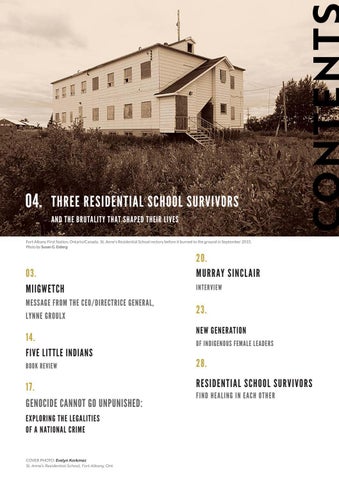
THREE RESIDENTIAL SCHOOL SURVIVORS AND THE BRUTALITY THAT SHAPED THEIR LIVES
Fort Albany First Nation, Ontario/Canada. St. Anne's Residential School rectory before it burned to the ground in September 2015. Photo by Susan G. Enberg
03. MIIGWETCH MESSAGE FROM THE CEO/DIRECTRICE GENERAL, LYNNE GROULX
14. FIVE LITTLE INDIANS
20. MURRAY SINCLAIR INTERVIEW
23. NEW GENERATION OF INDIGENOUS FEMALE LEADERS
BOOK REVIEW
28.
17.
RESIDENTIAL SCHOOL SURVIVORS
GENOCIDE CANNOT GO UNPUNISHED: EXPLORING THE LEGALITIES OF A NATIONAL CRIME
COVER PHOTO: Evelyn Korkmaz St. Anne’s Residential School, Fort Albany, Ont.
FIND HEALING IN EACH OTHER
WELCOME
TO
THE
FIFTH
EDITION
OF
KCI-NIWESQ,
THE MAGAZINE OF THE NATIVE WOMEN’S ASSOCIATION OF CANADA (NWAC). T H I S I SSUE I S D ED I CA TED TO TH E S U R V I V O R S O F C A N A D A ’ S I N D IA N R ES I D EN TIA L S CH O O LS ,
a program of assimilation that ran in this country from the early 1800s to 1996. It is also dedicated to those children who did not come home and to the parents who waited for a beloved son or daughter who never returned. The final report of the Truth and Reconciliation Commission (TRC), which spent years uncovering the horrors that happened behind the walls of the infamous institutions, said thousands of children died at the schools. The report also said many of their bodies remain in unmarked graves on school sites. We know that the federal government was aware, at various points in its history, that the mortality rate at some of the schools was as high as 50 per cent—a loss that was deemed acceptable by bureaucrats and politicians. In this issue, you will read an interview with Murray Sinclair, the former chief commissioner of the TRC. He talks about the survivors who reached out to him in the days after unmarked graves were found at the site of the residential school in Kamloops, B.C., and at other sites, and how the former students need us to listen to them. You will also read about Michelle Good, the retired Cree lawyer who was profoundly affected by her mother’s story of the residential school she attended and whose award-winning book Five Little Indians brings the experience of students, and its aftermath, to life in gut-wrenching fashion. You will learn about the legal steps that NWAC is considering to force accountability on the part of the government and the churches that ran the schools for genocide—a crime that has most surely been committed here in Canada through various means of assimilation and annihilation. We will tell you the stories of three residential school survivors. They are profoundly horrible tales, and I warn you that they do not make easy reading. But the resilience of each of the women who agreed to share their experiences with us shines through. We will introduce you to a new generation of Indigenous female leaders who are taking over as the country staggers from the shock of the irrefutable evidence of the deaths of more than a thousand children. And finally, there are some words about healing from an Elder who is helping to develop NWAC’s next Resiliency Lodge. So thank you once again for opening the pages that follow. Thank you for reading the fifth edition of Kci-Niwesq. Please drop us a line and let us know what you think at reception@nwac.ca.
3
T HRE E RE S I DE N TIAL SC HOOL SURVIVORS A N D T HE BR UTALI TY T HAT SHAPED T HEIR L IVES THE FORMER INDIAN RESIDENTIAL S CHO OLS WERE PLACES OF BRUTALIT Y. SEPARATED FROM THEIR PARENTS, CHILDREN WERE VULNERABLE TO ALL MANNER OF ABUSE .
E v e l y n K o r k m a z , S t . A n n e ’ s R e s i d e n t i a l S c h o o l , F o r t A l b a n y, O n t . 1969–72
HERE ARE THE STORIES OF THREE SURVIVORS.
4
KCI-NIWESQ • NWAC
Fort Albany First Nation, Ontario/Canada. St. Anne's Residential School rectory before it burned to the ground in September 2015. Photo by Susan G. Enberg
EVELYN KORKMAZ
meant she could live at her parents’ house instead of in the dormitory, but it was also a place where abuse was rampant.
ST. ANNE’S RESIDENTIAL SCHOOL, FORT ALBANY, ONT. 1969–72
Evelyn Korkmaz was raped multiple times by boys in her home community of Fort Albany on the west coast of James Bay. They were fellow students at St. Anne’s Indian Residential School, which was also located in Fort Albany. They were her classmates and they were her cousins. But today, as she looks back on those attacks, she sees them as something else. She sees the boys as probable victims of physical and sexual abuse by clergy at the notorious institution made infamous by the home-made electric chair that was housed in its basement. Ms. Korkmaz is now an outspoken activist against child sexual abuse. She is the founder of a group called Ending Clergy Abuse–Global Justice Project and has appeared multiple times before committees of the United Nations. She is also a leading plaintiff in a lengthy legal effort by former students of St. Anne’s to obtain the release of documents created by the Catholic Church and federal government that would shed light on what happened at the school. Today she is a fighter. But 50 years ago, she was just a scared little girl who was the target of repeated attacks. Ms. Korkmaz’s mother is Cree and her stepfather was Scottish. Her first experience with the residential school system took place in Combermere, Ont., south of Algonquin Park, at an institution run by a group of Irish nuns. She said in a recent interview that it was a wonderful experience. But that school ran into financial trouble and closed, so Ms. Korkmaz was transferred to St. Anne’s. That
One day, a group of eight to 10 boys ambushed her on the way home from school and dragged her into the bushes. “They proceeded to rape me. I didn’t know at the time it was rape. I was only 10 and I thought I was getting beaten up. Or hurt. I didn’t know the word sex,” says Ms. Korkmaz. “I passed out.” While she was unconscious, the boys singed her body with cigarettes, leaving scars that are still there to this day.
“ A N D I RE M E M BE R LO O K I N G D O W N AT THIS G I RL BE I N G BE AT E N U P BU T I D I D N ' T K NO W W H O S H E W AS . I H A D W H AT Y O U W O U L D C AL L A N O U T - O F - BO D Y E X PE RI E N C E . A N D W HEN T H E G I RL T U RN E D H E R H E A D T O T H E OTHE R S I D E , W H E RE I C O U LD S E E H E R F ACE, I RE A LI ZE D I T W AS ME . A N D W H E N I RE AL IZ ED I T W AS ME , I W E N T BA C K I N T O MY BO DY AND CONTINUED TO FIGHT.” Finally, the attack came to an end. “They put some earth in my underwear and pulled them up and patted me on the bum and said: ‘Off you go.’ So, I was, I guess, in a state of shock, crying, bleeding. And I walked to the hospital, which was not very far from the scene of the crime,” says Ms. Korkmaz. “One of the missionary nuns took care of me. She patched up my wounds and put some ointment on my cigarette burns. But, apparently, she didn't report the assault.”
KCI-NIWESQ • NWAC
5
“E V EN T H OU GH I SAW THINGS WHEN I W AS A K I D , I D I D N ’ T RE A LI ZE W H AT I W AS S EEING . " - EVELYN KORKMAZ
That was the start of a series of attacks that took place over the four years she attended the school. “There were multiple gang rapes,” she says. “I used to be scared to walk home.” Ms. Korkmaz’s parents did not intervene. She did not say much to them about what was happening to her. Her mother, who is still alive, worked for the school when she was a young girl, remains a devout Christian, and does not, to this day, accept that the priests and the nuns were abusing children. But St. Anne’s, which operated between 1941 and 1972, is notorious. A police investigation in the early ’90s turned up 74 suspects and resulted in the convictions of five former staff members on criminal charges related to the abuse of the children—the details of which could have been taken from the script of a horror film. Years after those convictions, when survivors of the school asked for compensation for what they had suffered, federal government lawyers told adjudicators there was no record of sexual abuse or student-on-student abuse at the school. Ms. Korkmaz was one of those who was initially denied compensation because there were no documents to back up her claims that students had been abused at St. Anne’s. That denial was subsequently overturned by another adjudicator who could hear the painful truth in what she was saying.
“No one discussed it, even though we knew it happened to each other through our actions. When we’d walk to school, one of my girlfriends would point to a boy and say, ‘Oh, I don’t want to walk near him, watch out for him’ or something,” she says. “And you knew that he was your rapist, too. So you would just look at her and go, ‘Hmm, I think I know what happened to you,’ but you don’t discuss it. You just keep your shame to yourself.” There was so much shame, says Ms. Korkmaz. “You start blaming yourself, and asking yourself: ‘Was I at the wrong place at the wrong time? Was it something I was wearing?” But, as she grew older, the shame disappeared and was replaced by anger—and questions. “Why did this happen to me? Why was it that there were no authorities around? Why did the government look the other way? Why were these priests and nuns allowed to do this all these years and get away with it?” asks Ms. Korkmaz. “I also wonder, if a priest or nun did not abuse that guy who raped me, or those guys who raped me, maybe I wouldn’t have gotten raped.” (Continued on page 7)
Looking back on it, says Ms. Korkmaz, many people who are abused become abusers themselves. “I didn’t know what was going on at St Anne’s,” she says, adding that she believes she escaped the abuse [by staff members] because her stepfather was not Indigenous. “Even though I saw things when I was a kid, I didn’t realize what I was seeing. For example, when we would line up for lunch or line up for class, one of the missionaries would come in, grab a kid by the arm, and take them out of the line. I just thought that they were misbehaving or talking in the lineup or whatever. Later, I found out that they were taken to a room where a priest would be sexually abusing them. As an adult, now I can see that very clearly, but as a kid, that’s not the way you think.” Ms. Korkmaz was not the only victim of the gang rapes. As the years went on, she realized it was also happening to her friends.
6
Evelyn Korkmaz, survivor of St. Anne’s Residential School, Fort Albany, Ont. 1969–72
KCI-NIWESQ • NWAC
CHARLOTTE MARTEN POPLAR HILL DEVELOPMENT SCHOOL, RED LAKE, ONT. 1966–68
THEN THEY GAVE US THE RULES. WE WERE NOT ALLOWED TO SPE AK OUR L ANGUAGE, AND THIS IS WHAT’S GONNA HAPPEN IF WE DO, AND SO FORTH,”
Charlotte Marten was brutally beaten for taking back a pencil that had been snatched from her desk. Then she was beaten again for her reaction to the beating. Ms. Marten, the daughter of a Cree mother and an Ojibway father, was a young teenager when a plane landed in the Wunnumin Lake First Nation in northern Ontario to take her and her older sister, Joyce, away to residential school. Until that time, they had attended the day school on the reserve. There was no time to prepare, and Ms. Marten says she had no idea what to expect. The girls were flown to the Poplar Hill Development School, near Red Lake, Ont., which was run by Mennonites. “I always remember walking into the place and all these toothbrushes are all lined up on the wall with the numbers,” says Ms. Marten, who is now 68 years old and lives in southern Alberta. “And I was told, this is gonna be your number, it’s gonna be 63.”
- SAYS CHARLOT T E MART EN
She arrived at the school wearing her favourite pale-blue A-line skirt and a nice sweater. But she was forced to trade those clothes for a long dress, which was the uniform of the Poplar Hill girls. “Then they gave us the rules. We were not allowed to speak our language, and this is what’s gonna happen if we do, and so forth,” says Ms. Marten. The dorm room she shared with the other girls had a space for sewing, which was also where the punishments were meted out. “I was never hit or anything like that as a child. Growing up you were punished through a lesson of consequences, but never physically,” says Ms. Marten. So, when physical punishment first happened at the school, it left a deep and lasting emotional scar. “It started so innocently,” she says. “During class, one of the boys kept grabbing my pencil. And I grabbed it back. Just then, the teacher turned around and saw me grab the pencil back. And he came to me and smacked me on the top of my head so hard my forehead hit the table enough to have a goose egg.” But the worst was to come. The teacher told her she was to meet him in the sewing room after devotions.
Poplar Hill Development, Red Lake, Ontario Residential School Photo by Mary Horst, 1977
(Interview continued on page 8)
7
KCI-NIWESQ • NWAC
“HE STARTED WH I P P I N G ME , W H I P P I N G ME , WH IPPIN G ME, WH IPPIN G ME. ON MY BA R E BA C K. BA RE SKI N. I RE AL LY F E E L , TO T H I S D AY, T H AT T H E P U NISH MEN T WAS N OT C A LLED FOR . IT R E A LLY DID DEST ROY M E. I T D ESTROY ED M Y S E L F -E S T E E M. A N D I E N DED UP N OT BEIN G A BLE T O FIGH T FOR MYSELF. ” - CHARLOTTE MARTEN
(continued from page 7) “I was so scared. And everybody in my
class, including my sister, just stared at me, because we were not allowed to even try to explain anything,” she says. Ms. Marten went to devotions, hoping that the teacher would forget about the threat to punish her. But it wasn’t long before the teacher’s wife sought her out to tell her she had to go to the sewing room. “So I went. And he told me: ‘I want you to sit on the floor and lean against this chair. And your dress has to be up to expose your back.’ So that’s what I did. And then he took his belt off. And he started whipping me, whipping me, whipping me, whipping me. On my bare back. Bare skin. After it was all over, I ran out. And that was the biggest mistake. I ran out and I slammed the door.” Five female teachers were standing in the hallway, she says. None of them had intervened to stop the beating. Ms. Marten ran to the dormitory and was on her bed crying when one of those teachers arrived to tell her she had to go back to the sewing room. “So, I went, and endured more whipping. And then, after it was over, I went back to my room, I felt really depleted. I felt really cracked. And alone,” she says. “Our Matron, her name was Madonna, she came in, she was a kind soul but I think she felt helpless in many aspects. She came and my sister Joyce came after as well. And my sister was horrified when she saw the broken skin and blood on my back. So Madonna and my sister, they tended to my wounds.”
see my scars, he said: ‘You don’t fit the criteria of what the government wants.’” So she has never collected anything more than the Common Experience payment that was given to any former student of the schools, whether they had been abused or not. The beating “affected me forever. I’m still in therapy today,” says Ms. Marten. “I really feel the scars we have are deeper than physical scars. They’re so deep, they affect you for the rest of your life.” When the unmarked graves were discovered this spring at the site of the former residential school in Kamloops, B.C., she says: “It just knocked the air out of me and I was hyperventilating.” But she also says she is on a path to healing. “One of the things I find that has saved me is I’m fluent in my language,” says Ms. Marten. “I really believe that, as Aboriginal people, language is the way to go. That’s your lifeline. That’s your bloodline.” And when the Truth and Reconciliation Commission was collecting the stories of survivors in 2012, Ms. Marten mustered the courage to give her testimony. “I was driven to go to the TRC by anger that I felt from coming from that school,” she says. “I was driven by a force … by my voice needing to be heard. Because I had carried this pain from that school for so long.”
That night, as she lay awake in the dormitory, Ms. Marten says she pleaded with the moon to tell her parents to come to the school to get her. “As a child, you just feel so alone. So many of our people have been through that,” she says. “I really feel, to this day, that the punishment was not called for. It really did destroy me. It destroyed my self-esteem … I was ashamed of what I did. When you’re ashamed of something, you become very small. And I ended up not being able to fight for myself. As I got older, I was very shy. And I really think this was the starting point.” In 2012, Ms. Marten decided to apply for a payment under the Indian Residential Schools Settlement Agreement, which was given to former students who suffered physical, sexual, or extreme emotional abuse at the schools. She visited a lawyer. “After we discussed the process, he asked me to turn around to lift my shirt to see if I had any scars on my back from the beating. And, when he could not
8
Charlotte Marten, survivor of Poplar Hill Development School, Red Lake, Ont. 1966–68
KCI-NIWESQ • NWAC
Ekti (Margaret) Cardinal, survivor of Blue Quills Indian Residential School.
EKTI (MARGARET) CARDINAL
When they arrived at the school, the children were herded into a cavernous gymnasium. Ms. Cardinal thought it was a cave.
BLUE QUILLS INDIAN RESIDENTIAL SCHOOL, ST. PAUL, ALBERTA, 1959–70
Ekti Cardinal is a tipi maker of 46 years who lives on the south shore of Lesser Slave Lake in northern Alberta. She creates traditional dolls, clothing, and mixed media art. Her Cree heritage is an essential part of her life. But that is only because she resisted the efforts of nuns and priests to drain every ounce of it from her when she was a child attending an Indian residential school. In 1959, when she was a five-year-old girl living with her family in Saddle Lake First Nation, a large green truck with railings on the side and a canopy covering the bed arrived outside the community’s Catholic church. “I had never seen a truck before. It was really scary,” Ms. Cardinal said in a recent interview. “They packed us (children) in there like sardines. And then off we went, by country road, all the way to Blue Quills (Indian Residential School). It was 20 or maybe 30 kilometres away, but it was far for us because we had always travelled by horse and wagon, and they don’t go very far.”
“ W H E N MY E Y E S A D JU S T E D T O T H E D AR K I N S I D E T H I S C AVE , I N OT I C E D T H ESE C RE AT U RE S C O MI N G F RO M H O LE S IN THE W A LLS A N D T H E Y LO O K E D LI K E T H E Y W ER E JU S T F LO AT I N G I N T H E A I R. T H E Y W ER E VE RY S C A RY A N D I T T U RN S O UT T H E Y W E RE N U N S . ” The children were sorted according to height, and each was given a number, which would stay with them throughout the years they spent at the school. Ms. Cardinal was the smallest of the little girls and she was given number 40. From then on, the nuns would call her Number 40 rather than call her by her name. “They lined us up and they were cutting our hair slowly. I’d always had long hair. The only time we ever cut our hair in my family is when a person dies,” says Ms. Cardinal. “And the hard part was you couldn’t pick up your hair. My mom taught me that (continued on page 10)
KCI-NIWESQ • NWAC
9
you have to pick up your hair. But, at the school, I couldn’t keep my own hair. I couldn’t take it away. It was so sad.”
(continued from page 9)
After the boys had been separated from the girls, the children were stripped naked. Older girls were assigned to tend to a younger one. Then the pairs of older and younger girls were forced into the showers together where they had to scrub each other down with a brush similar to the ones used on horses. “This water was coming out and it was so hot. And there was a nun at the gate, and we could not pass that gate until our skin was so red,” says Ms. Cardinal. “And once she deemed that we’d been brushed enough, then we could leave and cool off and put on whatever towels or dresses they had given us.” A few years later, Ms. Cardinal had to go through the same ritual, but as an older student with a younger girl. “I got assigned this little girl. It was horrible,” she says. “She and I were both crying in the shower, and she didn’t want to do it, and I didn’t want to do it. And we were both being hollered at by the nun. We were so scared.” After her initiation in the shower, Ms. Cardinal settled into school life. Meals, she says, were mostly “slop”—a goulash of boiled leftovers. In the earlier years, classes ended mid-afternoon so that the children could be put to the physical chores that were required to keep the institution running. Punishments were harsh. Ms. Cardinal suffered from a bout of polio before she arrived at the school, which had left her with a limp. The nuns told her that her disability was her punishment for a past sin and they made her stay long hours praying in the chapel for forgiveness. “Sometimes they forgot about me,” she says. “When the other girls went to bed, they would come and get me.” Other times she was forced to sit in an enclosed stairwell. It has left her claustrophobic to this day. Then there was the time she reached out to her older brother, who also attended the school, to let him know she loved him. They were not permitted to talk to each other but, on Valentine’s Day, she made him a small red heart. (continued on page 13) Ekti (Margaret) Cardinal, residential school survivor.
10
KCI-NIWESQ • NWAC
Ekti (Margaret) Cardinal, healing through crafting.
11
KCI-NIWESQ • NWAC
pictured above and below, Ekti (Margaret) Cardinal
12
KCI-NIWESQ • NWAC
“I NEVER WANTED MY CHILDREN INSTITUTIONALIZED. I DIDN’T EVEN LET THEM GO PL AY HOCKEY BECAUSE IT IS AN INSTITUTION. I WANTED THEM TO BE FREE, AND I WANTED THEM TO BE ABLE TO CHOOS E WHAT THEY WANTED TO DO. BUT THEY STILL SUFFERED AS A RESULT OF THE CELLUL AR MEMORY OF WHAT I AND MY ANCESTORS ENDURED AT THE INSTITUTIONS. MY YOUNGEST COMMIT TED SUICIDE BECAUSE OF THE TRAUMA.” - EKTI (MARGARET) CARDINAL
(continued from page 10) “As we were lining up, I handed it to him,” she says. “And, of course, we got caught because somebody saw us. So he got tortured and I did too. I was beaten because the nuns said that what I did was really filthy, my own brother, giving him a heart and telling him that I loved him.”
Ekti (Margaret) Cardinal
Ms. Cardinal’s little brother also went to Blue Quills but he lasted only a couple of weeks. Her mother stopped by to visit and found that a nun had ripped off the top portion of his ear. “So she took him, she just took him,” she says.
M S . CA R DI N A L SPENT 1 1 YE ARS AT T H E S C HOOL. WHEN SHE LEFT, SHE BRO K E A LL T IE S WI T H T H E CATHO LIC CHURCH. TO T H I S D AY, SH E S AYS, “I CANNOT BE ARO UND N U N S OR PR I ES T S.” Her own two boys were not forced to attend an Indian residential school. But Ms. Cardinal says they still suffered as a result of the cellular memory of what she and her ancestors endured at the institutions. “My youngest committed suicide because of the trauma.” That worst-of-all tragedies happened even though she did not speak much to her children about the residential school experience. But it did affect her decisions as a parent. “I never wanted my children institutionalized. I didn’t even let them go play hockey because it is an institution. I wanted them to be free, and I wanted them to be able to choose what they wanted to do,” says Ms. Cardinal. “I didn’t want them to go through what I went through.”
ALL PHOTOS OF EKTI BY JODI SWARE
KCI-NIWESQ • NWAC
13
F I V E L I T TL E I NDIANS : BRINGING READERS INTO THE LIVES AND HEARTS OF RESIDENTIAL S CHOOL SURVIVOR S
Ph o t o : Mi che l le Goo d's m othe r's clas s a t the re s id e n t i a l sc h o o l sh e a t t e n d e d
INTERVIEW WITH AUTHOR MICHELLE GO OD
14
KCI-NIWESQ • NWAC
I
t took nine years, and a lifetime of immersion in the lives of residential school survivors, for Michelle Good to complete her gut-wrenching chronicle of the schools’ impacts on five fictional former students.
Five Little Indians, which won the 2020 Governor General’s Award for Fiction as well as the Amazon Canada First Novel Award, has been optioned by Prospero Pictures to be adapted into a limited series for television. Interest in the book, predictably, intensified this past spring when unmarked graves of children were located on the sites of former residential schools. After the first of those discoveries was announced, people began reaching out to Ms. Good to ask, among other things, if she was shocked. “I’m not shocked about the unmarked graves. What I’m shocked about is that it took us to get the evidence, and to present it— that it took skeletons—to open some people’s eyes. That’s what shocked me,” says the retired Cree lawyer and member of Red Pheasant First Nation in Saskatchewan. It has, after all, been six years since the Truth and Reconciliation Commission (TRC) released the final report of its lengthy study of abuses at the schools, a report that included an entire chapter on the children who died or went missing and that stated thousands of graves would be found. Even before the TRC report, survivors knew and spoke about the children who died in the schools. Government documents from the early 1900s have officials endorsing death rates of up to 50 per cent in support of the mission to kill the Indian in the child. “So, at first, I was kind of miffed,” says Ms. Good. “But now, on the other hand, I’m going, ‘well okay, however they’ve come to it six years later, Canadians are starting to wake up to the residential school experience.’” Ms. Good describes her experience of “cognitive dissonance” at the age of 11 when her mother began talking about her experience as a student at the St. Barnabus Indian Residential School in Onion Lake, Sask. She told the story of Lily, one of her classmates, who hemorrhaged to death from tuberculosis while other children stood around helpless to do anything. Her mother referred to the residential school she attended as a ‘boarding school’ and Ms. Goode’s only frame of reference for such a thing was the upper-crust English boarding schools that were the setting of many of the books she had read. “So, when she told me what happened at the residential school,” she says, “I was a little bit traumatized by it. It did not compute with what I thought I knew to be true. And it has really stuck with me.” Ms. Good wanted to be a lawyer from an early age. It was a dream that was realized when she was called to the bar at the age of 43. She has since spent much of her legal career (fighting for compensation) advocating for residential school survivors. But before she entered law, she worked for many Indigenous organizations and First Nations communities. “It was the mid ’70s,” she says. “It was right around the time when these kids are having their lives outside of the residential school and virtually everybody that I worked with
was a survivor. So, I was immersed in that experience as well as witnessing my mother’s experience with residential school, my aunties, my uncles, basically my entire cohort.” What she saw was people struggling with the impacts of the years they had spent in the institutions—the physical and sexual abuse, the loss of family, the deprivation of culture. During that time, Ms. Good says she read hundreds of psychological profiles. And, when she took up her pen years later to write Five Little Indians after obtaining a Master of Fine Arts degree, it was that knowledge of trauma and its impacts that informed her protagonists. The first character she developed was Kenny, the internally, and eternally, restless residential school escapee who can never stay in the same place for any length of time, not even when that place is with the woman he loves. We are given a small glimpse of Kenny’s abuse in the book, with much more implied. To create Kenny, Ms. Good says she looked at the kind of abuse he would have experienced and determined what kinds of psychological impacts he would have sustained from those injuries. Then she asked herself, ‘how would that impact how he would grow as a human being and what his issues would be throughout the rest of his life.’”
" FIVE LIT TLE INDIANS C O U LD H AVE BEEN SAD A N D O P PRE S S I VE LY G LO O MY . BU T I T ISN’T. " (continued on page 16)
KCI-NIWESQ • NWAC
15
“ I W AS T R A U M AT I Z E D B Y M Y M O T H E R ’ S E X P E R I E N C E AT T H E R E S I D E N T I A L S C H O O L . I T H A S R E A L LY , R E A L LY S T U C K W I T H M E . H O P E F U L LY , T H E C O N F I R M AT I O N O F D I S C O V E R I E S O F U N M A R K E D G R AV E S AT T H I S J U N C T U R E I S G O I N G T O B E A T I M E O F E P I P H A N Y , A T I M E O F AW A K E N I N G . ” - MICHELLE GOOD
(continued from page 15)
A prologue helps forecast the moments of light to be had in the pages that follow. Getting through the first two chapters, which largely take place at the school where the abuses are meted out, takes some fortitude. But the reader is rewarded with a beautiful love story, a tale of insight, bravery, and, ultimately, peace and understanding. Another central character is Lucy, who is determined to make something of herself and to provide a good life for her daughter as she struggles with obsessive compulsive disorder and her ongoing love for a man who cannot be tied down. “The relationship between Lucy and Kenny basically starts at the school because they recognize each other,” says Ms. Good. “She just loves him because he doesn’t give up and because he’s strong. And he just loves her because she’s Lucy.”
a rare glimpse of pre-colonial Indigenous life and the ultimate clash with colonial violence against Indigenous Peoples. The book will take the main character through the “troubles” in what was the Northwest Territories, through the flight of the First Nations people to Montana, and then back to Canada after an amnesty. As she works to tell that tale, Ms. Good says she is still receiving feedback from readers of Five Little Indians who say they had no idea of the impact of the residential schools, but now they will never forget. Meanwhile, the confirmation of discoveries of unmarked graves at this juncture “is quite incredible,” she says. “It feels divine to me in a way, it really does … hopefully this is going to be a time of epiphany, a time of awakening.”
Then there is Maisie, who, as an adult, must keep revisiting the sexual trauma she experienced at the hands of a priest in an effort to find a way around it. Some of the characters survive their inner turmoil. Some do not. “I really wanted to ensure that this was not just an examination of trauma, but that these characters were whole individual people who had relationships, who love, who struggle, who have humour, who have rage, and who have all of the desires of any person trying to make a life for themselves,” says Ms. Good. “One of the reasons that I think the book is successful,” she says, “is that the characters not only display visceral responses to the trauma they encountered but also come across as real people.” Kendra, who is the daughter of Lucy and Kenny, does not understand her mother’s willingness to accept her father’s wandering ways. Ms. Good says she created that tension because she wanted to show the ways in which the residential schools affected the relationships between the survivors and their children. “I wanted to have a very uninformed second generation to reflect the reality that parents very rarely talked about what they experienced in those schools,” she says. “For Kendra to finally sort of open up and accept Kenny, it took Clara (another of the five survivors) to tell her what had happened to him.” As she continues to receive accolades for Five Little Indians, Ms. Good is working on her next book. It loosely recounts the story of her great grandmother, who was born in 1856 in pre-contact Saskatchewan and did not come into contact with anyone who was non-Indigenous until she was in her late teens or possibly her 20s. In this character, she says, we have
16
Michelle Good, author of Five Little Indians, winner of the 2020 Governor General’s Award for Fiction.
KCI-NIWESQ • NWAC
‘ G E N O C I D E C ANNOT GO UNPUNI S HE D’ E X P L O R I N G T H E L E G A L I T I E S O F A N AT I O N A L C R I M E
Cross Lake Indian R esidentia l Schoo l in Manit oba, fema le s tudents and a nun in a classroom, Februar y 1 9 4 0 Librar y and Archives Canada
17
KCI-NIWESQ • NWAC
THE PERPETRATO RS O F G E N O C I D E M U S T F A C E C O N S E QU E N C E S .
The perpetrators of genocide must face consequences. That is why NWAC is exploring legal ways to bring criminal charges against the Canadian government and other actors, including churches, that have taken part in the genocide against Indigenous Peoples in this country. “The rule of law dictates that criminals be brought to justice,” says NWAC President Lorraine Whitman. “That is true whether those who have committed the crimes are individuals—including those wearing the robes of a religious order—or organizations like churches or nation states.” The toll taken by centuries of efforts to eliminate the original people of North America became starkly clear in recent months when more than a thousand unmarked graves of children were discovered on the sites of former Indian residential schools. Survivors knew the bodies were there. They saw their classmates die from disease, malnutrition, neglect, and, in some cases, outright physical brutality. They testified about the deaths before the Truth and Reconciliation Commission (TRC), which spent six years uncovering what happened behind the walls of the infamous institutions. The TRC ultimately determined in its final report released in 2015 that the schools were part of a campaign of “cultural genocide” against the First Nations, Métis, and Inuit. Murray Sinclair, who chaired the commission, says the word “cultural’ was added for legal reasons, but that cultural genocide is still genocide. The TRC’s findings were echoed in 2019 in the final report of the National Inquiry into Missing and Murdered Indigenous Women and Girls, which declared outright that a genocide against Indigenous Peoples is taking place in Canada and is the root cause of the violence against Indigenous women and girls.
But what is genocide? What are the practical implications of these findings? Can they lead to criminal charges? Fannie Lafontaine, a law professor at Université Laval and the holder of the Canada Research Chair on International Justice and Human Rights, says that, to meet the definition of genocide under international law, the intended extermination of a people must have three elements: The victims must belong to a group whose members can be identified by their race, ethnicity, nationality, or religion. Despite their diversity, the Indigenous Peoples in Canada have always been considered by the federal government to be members of a single race, so there is “no debate” that they are a protected group within the definition of genocide, says Dr. Lafontaine. There must be an intent on the part of the perpetrators to eliminate the victimized group of people. Canada's intent has been evidenced over the years by the policies and conduct of the state that crossed multiple administrations and involved multiple political leaders. “This is the colonial nature of genocide,” says Dr. Lafontaine. And at least one of five specific actions related to genocide must have been taken. The first of those actions, and the most obvious, is murder. In Canada, says Dr. Lafontaine, this is obvious in the number of children who died at residential schools, the disproportionate number of women and girls who have been murdered, and other historical atrocities like the annihilation of the Beothuk in Newfoundland. But genocide can be committed in more ways than direct killings. “The other acts of genocide are acts of slow death.” Genocide can be perpetrated by injuring the mental or physical health of the people who are targeted. Sexual violence and torture can be part of that, she says, or it can be done by creating conditions that lead to destruction, or that prohibit traditional practices or governance structures, or that confine people to small areas of land. “Those
18
KCI-NIWESQ • NWAC
are different kinds of acts of massacres,” says Dr. Lafontaine. Genocide can be carried out by imposing conditions of life that are calculated to bring about the physical destruction of a targeted group. An example of that can be found, she says, in what happened during the construction of the railways when Indigenous Peoples were displaced from their land, confined to reserves, and reduced to starvation. Genocide can entail preventing births within the group. In Canada, an example of that in Canada would be the forced sterilization of indigenous women, which was official policy in some jurisdictions. And it can be done by transferring children of the targeted group to the group that is committing the genocide. “That obviously concerns residential schools,” says Dr. Lafontaine, “as well as the high level of placement of Indigenous children in nonIndigenous families by child protection services and the ’60s Scoop.” All of this shows that Canada has committed the crime of genocide in multiple different ways over the course of many generations, says Dr. Lafontaine. But who, in this case, are the perpetrators? Obviously, there are some individuals who bear personal responsibility—the heads of residential schools who willfully mistreated children, for example, or those who performed scientific experiments on the residential school students. “And if you can prove—and it’s hard to do—that they had the intent to destroy the group, and if they’re still alive, then yes, they could be prosecuted for genocide. But I think it’s not enough, because most of these people are going to be dead by now,” says Dr. Lafontaine. In Canada, the genocide has been more of a collective action than the acts of specific people. “The whole genocide has been committed by multiple individuals through the state and the state has to prepare for that.” So how do you criminally prosecute the nation of Canada, or even the churches that ran the schools, for the crime of genocide? Steven Pink, NWAC’s Chief Operating Officer and General Counsel, says there are a couple of ways this could be done. There are charges in the Criminal Code that could apply to the treatment of children at the residential schools, (continued on page 19) says Mr. Pink.
“THE WHOLE GENOCIDE HAS BEEN COMMIT TED BY MULTIPLE INDIVIDUALS THROUGH THE STATE AND THE STATE HAS TO PREPARE FOR THAT. CENTURIES OF COLONIALISM CANNOT BE UNDONE IN - DR. FANNIE LAFONTAINE ONE MOMENT. BUT IT CAN BE DONE. IT HAS TO BE DONE.”
For t R eso lution Indian R esidentia l Schoo l ( St . Joseph's Convent) , Nor thwe s t Territ ories, group of s tudents in a sewing class, da te unknown Librar y and Archives Canada
For instance, there is a law that says guardians are responsible for providing children under the age of 16 with the necessaries of life. “And, of course, the argument will be that it didn’t happen, just the opposite happened. But these children ended up starving, tortured, and so on,” says Mr. Pink. (continued from page 18)
Criminal offences usually apply to individuals. But organizations, which would include the churches, can be charged under the Criminal Code, says Mr. Pink. Prosecuting the government, on the other hand, gets trickier. But Mr. Pink says he believes it could be done. While the Crown, or the government, is generally understood to have immunity from prosecution, individual sections of the Criminal Code spell out that ‘everyone” or “every person” who commits the specified offence can be found guilty of the crime. Mr. Pink says he believes “everyone” includes “Her Majesty the Queen,” which means that the Crown or the government could be charged. Other provisions of the Criminal Code are also relevant to what happened to children at residential schools in Canada—for example, criminal negligence causing harm or death. There is also the Crimes Against Humanity and War Crimes Act, which came into effect in 2000. Generally, a law must be in effect at the time a crime is committed for its provisions to be applicable. The last Indian residential school closed in 1996, so it would be difficult to proceed under this Act because the Act is not retroactive for domestic offences.
19
But the United Nations Declaration on the Rights of Indigenous People (UNDRIP) could be used to force the government to make reparations for the genocide. According to Mr. Pink, Article 8 of UNDRIP requires the Government of Canada to provide mechanisms for the prevention and redress for “any form of forced assimilation or integration” that deprived Indigenous Peoples of their cultural values or ethnic identities, dispossessed them of their land and resources, and forced the transfer of the population. All of the redress provisions of UNDRIP relate directly to the acts of genocide, says Mr. Pink, and Indigenous Peoples have a right to compensation for these acts of genocide. Unlike the Crimes Against Humanity and War Crimes Act, retroactivity is not an issue. Article 8 of UNDRIP is about compensation for Indigenous Peoples regardless of when the acts of genocide were committed, he says. Dr. Lafontaine says that under international law, states that are found guilty of genocide have an obligation to ensure that the genocide ends, and to make reparations to the victims. Reparation can mean a lot of things, she says, but the National Inquiry into Missing and Murdered Indigenous Women and Girls indicated, in Canada’s case, it requires undoing the negative consequences of colonization. “Adopt the United Nations Declaration on the Rights of Indigenous People in a meaningful way, give indigenous Peoples
KCI-NIWESQ • NWAC
the right to self-determination, which can lead to the abolition of the Indian Act, give back the power to Indigenous Peoples, stop fighting Indigenous kids in court,” says Dr. Lafontaine. “It means giving back to different Indigenous communities power over child protection services, giving back their land, and making sure their right to free, prior, and informed consent over any projects on their land is respected.” Centuries of colonialism cannot be undone in one moment, she says. “But it can be done. It has to be done.”
INTERVIEW WITH MURRAY SINCLAIR
MURRAY SINCLAIR: SURVIVORS CARRY A HUGE BURDEN Murray Sinclair spent six years of his life leading the commission that uncovered the truth about Canada’s Indian residential schools. Justice Sinclair is a lawyer who was born on the St. Peter’s Indian Reserve north of Winnipeg. He was the first Indigenous judge appointed in Manitoba and, more recently, was a Canadian Senator. During the years he headed the three-person Truth and Reconciliation Commission (TRC), Justice Sinclair travelled Canada gathering accounts of survivors and translating their testimony into a massive document of revelation about the institutions created, in the words of former prime minister Sir John A. Macdonald, to “take the Indian out of the child.” The final report of the TRC was released in November 2015 and contained a section, 273 pages long, that spoke about the children who died at the schools, those who went missing, and the fact that many of the grounds around the former institutions were sites of unmarked graves. Justice Sinclair spoke with Kci-Niwesq in July as some of those graves were being discovered. (continued on page 21)
20
KCI-NIWESQ • NWAC
“TH EY W A N TED M E A ND OT H E R S T O BE ABL E T O C O M M U N I C AT E BACK TO THE PUBLIC THAT THEY WERE HURTING, AND THAT THEY NEEDED HELP, AND THEY WANTED OTHERS TO KNOW THAT.” -MURRAY SINCLAIR
Q. HAVE YOU BEEN HEARING FROM RESIDENTIAL SCHOOL SURVIVORS SINCE THE DISCOVERY OF UNMARKED GRAVES WAS FIRST MADE PUBLIC? MURRAY SINCLAIR. (Members of the Tk’emlúps te Secwépemc First Nation) started calling me ahead of time and giving me a heads up that this news was coming out of Kamloops. I had numerous conversations with them … then it just kind of escalated from there, because we had a full day of hearings in Kamloops and we had probably 40 or 50 survivors testifying during the Kamloops hearings. One of the things they did talk about was the number of children who died that who were buried in the orchard. We talked about that in the TRC report. But they were initially calling me because they said: ‘Get ready, this is going to be big news, and we just want to make sure that you're ready for it.” So it was like they were calling to take care of me, to help me and get me ready. And then, afterwards, people started calling me from all across the country, starting with committee members. They were calling, first of all, to see how I was doing and also to talk about the phone calls they had been getting. And they wanted to know if people who were kind of on the deep edge could call me because, they said, it would probably take my voice to help them. So I said sure, have them call me. And in that first week or so after the news broke, I probably had 200 or 300 phone calls from survivors. I was inundated with calls. It was pretty overwhelming for them, and overwhelming for me and for the other two commissioners.
Q. WHY DID THE SCHOOL SURVIVORS REACH OUT TO YOU? MS. I think they just wanted to know that somebody still cared. They knew that people within their family cared. But, what many survivors told us, as veterans have told us too, was that ‘I hesitate to tell my children what happened to me in the war or in the school because I have this really strong feeling that if they start to cry, they’ll never stop.’ And that’s a really difficult burden to carry. You’re not only hurting, but you could possibly hurt others just by telling the truth. And that was why the TRC hearings were so important to them. Because they could talk in an open and transparent way to somebody who would listen to them. And at the same time, their children could hear what they’re saying … They weren’t imposing this on their children, they were sharing it with them through us. So, in a way (after the unmarked graves were discovered) they wanted me and others to be able to communicate back to the public that they were hurting, and that they needed help, and they wanted others to know that.
Q. THEN YOU REACHED OUT TO THE PUBLIC TO DELIVER THAT MESSAGE. MS. I said I should issue a statement. And my daughter, who is my business manager for my consulting work, said the statement would be more effective as a video. So we recorded that video. And I have to say that her instincts were right on, because I think the video, according to the metrics that have been done by the media, has been viewed over 700,000 times around the world, including in places like Africa, Australia, and
New Zealand. These are people just trying to connect to the story. They are already connected to the story but they are trying to connect in a deeper way.
Q. DID IT NOT FRUSTRATE YOU THAT YOU SAID IN THE TRC REPORT, WHICH WAS RELEASED IN 2015, THAT THESE GRAVES EXISTED, AND YOU HAD SAID THE SAME THING YEARS EARLIER, AND YET THE NEWS THAT THEY WERE BEING ‘DISCOVERED’ CAME AS SUCH A SHOCK TO SO MANY PEOPLE? MS. (When the Truth and Reconciliation Commission findings were released) it was still such a heavy issue, still such a big issue. Many people kind of shielded themselves away from feeling that sense of connection. It was overwhelming for many people. I knew it would take time (for people to accept the findings of the TRC report) I knew that most of Canada was not ready. The Kamloops discoveries plus all the other ones have gotten Canadians to care.
Q. WHAT CAN INDIVIDUAL CANADIANS DO FOR SURVIVORS OF THE RESIDENTIAL SCHOOLS? MS. I think people need to talk to them. What I said in the course of the many interviews and presentations I’ve done since the news out of Kamloops first broke was that the survivors who are carrying this information still want to be able to express it to somebody who can do something about it. Because there is a desire, and I think probably a legitimate desire, for there to be some justice around this and for people or institutions to be held accountable.
Q. DO YOU THINK MANY OF THOSE PERPETRATORS ARE STILL ALIVE? THEY WOULD BE OLD BY NOW. IS THERE STILL A REASON TO BRING THOSE WHO ARE ALIVE TO JUSTICE? MS. To the extent that there are survivors still alive to whom this happened, who witnessed it happening, I think that there are probably perpetrators still alive. But we also have to keep in mind that the perpetrators generally will have been 15 to 20 years older than the survivors. So, we just have to accept the fact that most of the perpetrators, I don’t think all of them, but most of them, will have passed away by now. I would also say it’s quite conceivable that they themselves were victims. Because we had a session with a group of nuns in their retirement home, along with a couple of staff, and we recorded some of their stories. And one of the things they told us was that they were helpless in the hands of people who were directing them and were telling them what to do. Many of them were told, for example, to not feed the children at a particular point in time. Many of them were told that they had to punish children. Many of them were told that they had to lock the children into small rooms, even though they would personally not have done that. But they were told that they had to do that. And some of the professional teachers told us the same thing—that they were told they had to teach things in a particular way and had to use harsh disciplinary measures. To a certain extent, some of the people who worked in the schools, who had been named as perpetrators, (continued on page 22)
KCI-NIWESQ • NWAC
21
"I T HINK IT BRINGS H OM E TO P EOP LE TH E FA C T T H AT T H I S W AS A D E L I BE R AT E E F F O R T T O AN N I H I L AT E A R A CE " -MURRAY SINCLAIR
(continued from page 21) particularly around harsh disciplinary methods, would themselves have been victims of the system. Because that’s how systemic discrimination occurs. Systemic bias occurs when a system forces you to do something even though you don’t want to do it.
Q. WHEN YOU CONCLUDED IN THE FINAL REPORT OF THE TRC THAT THE RESIDENTIAL SCHOOLS WERE PART OF A “CULTURAL GENOCIDE,” MANY CANADIANS DISMISSED THAT FINDING. IT MAY BE EASIER FOR THEM TO ACCEPT IT NOW THAT ACTUAL BODIES ARE BEING DISCOVERED. DOES ACCEPTANCE OF A GENOCIDE HELP FOSTER RECONCILIATION? MS. I think it brings home to people the fact that this was a deliberate effort to annihilate a race. We avoided using the singular word genocide without a defining term (cultural) for a couple of reasons. One was that there was a legal prohibition in our mandate that said that we could not pronounce culpability. Therefore, we were concerned that if we simply used the term genocide—which surely we could have—the government or somebody would have asked a court to wipe out that part of the report. And the court, in its heavy-handed way, would likely have simply deleted those findings. So we couched it as carefully as we could, but as clearly as we could, by referencing the term cultural genocide. Cultural genocide was not an invention by us. It was a term referenced by (Raphael) Lemkin (a Polish Jewish lawyer), who had written about genocide and its multiple facets back in the 1930s. He said then, as did we, that you can allow people to live and therefore be able to argue that you’re not committing genocide because you’re not killing them—you’re not committing the Holocaust, so to speak—but you can still try to eliminate them as a distinct race of people by annihilating all of the systems of cultural supports around them. And that’s still a form of genocide. What we wanted people to focus on was not the number of children who died. If we had used the term genocide, the simple terminology, then we were causing people to focus upon the question of deliberate killing. And you can find acts of deliberate killing, there’s no question of that. But they’re not as numerous as the many, many thousands of children whose lives were negatively affected, and whose existence was brutalized, by the lengths that were taken to eliminate their culture, their language, their sense of identity—and that had a much more significant long-term impact than the act of killing those children who were killed.
“I KNEW IT WOULD TAKE T I ME (FOR PEOP L E TO ACCEPT T HE FINDI NGS OF T HE T RC REPOR T) I KNEW T HAT MOST OF CANADA WAS NOT RE ADY. T HE KAMLOOPS DISCOVERIES PLUS ALL T HE OTH E R ONES HAVE GOT T EN CANADI ANS T O CARE . “WHAT WE WANT ED PEOPLE T O FOCUS ON W AS NOT T HE NUMBER OF CHI LDREN WHO DIED B UT ON T HE MANY, MANY T HOUSANDS OF CHILDREN W H OS E LI VES WERE NEGAT IVELY AFFECT ED, AND W H OS E EXIST ENCE WAS BRUTALI ZED, BY T HE LEN GTH S T HAT WERE TAKEN T O ELI MINAT E T HEI R CU L TUR E , T HEIR L ANGUAGE, T HEIR SENSE OF IDENT IT Y—A N D T HAT HAD A MUCH MORE SIGNI FI CANT LONG -TE R M I MPACT T HAN T HE ACT OF KILLING T HOSE CH I L DR E N WHO WERE KI LLED.”
-MURRAY SINCLAIR
KCI-NIWESQ • NWAC
22
NEW GENERATION OF INDIGENOUS FEMALE LE ADERS TA K E S O V E R I N C O U N T R Y I N D I R E N E E D O F H E A L I N G
MEET: MARY SIMON, ROSEANNE ARCHIBALD, KAHSENNENHAWE SKY - DEER, AND MANDY GULL - MASTY
23
KCI-NIWESQ • NWAC
I
ndigenous women are taking key positions of power as the country looks for healing in the wake of the discoveries of unmarked graves at former residential schools.
MARY SIMON, an Inuk from Kangiqsualujjuaq in Nunavik in subarctic Quebec, has been appointed Governor General, the highest office in the land. ROSEANNE ARCHIBALD has been elected National Chief of the Assembly of First Nations (AFN).
KAHSENNENHAWE
SKY-DEER
has been elected Grand Chief of Kahnawake, one of the largest First Nations in the country.
MANDY GULL-MASTY has been elected Grand Chief of the Grand Council of the Cree, which represents 18,000 people in the region of Eeyou Istchee in northern Quebec. Each one is the first Indigenous woman to hold her new position. Each is taking the reins of leadership at a time that their people—residential school survivors in particular—and Canada as a whole are in need of healing energy. “The discoveries of unmarked graves on the grounds of residential schools in recent weeks has horrified me, along with all Canadians,” Mary Simon said at her installation on July 26. “A lot of people think that reconciliation will be completed through projects and services. All Canadians deserve access to services. My view is that reconciliation is a way of life and requires work every day. Reconciliation is getting to know one another.” Political life is difficult. It is also a calling. Ms. Simon, 73, is a former head of the Inuit Tapiriit Kanatami, an organization that advances the rights of the Inuit across Canada. She was also Canada’s Ambassador for Circumpolar Affairs and Ambassador to Denmark. Ms. Archibald, 54, was the first female Chief of the Taykwa Tagamou Nation, the first female Deputy Grand Chief of the Nishnawbe Aski Nation, and the first female Grand Chief of the Mushkegowuk (continued on page 25)
Mary Simon
KCI-NIWESQ • NWAC
24
(continued from page 24) Council. She was the Ontario Regional Chief of the AFN before being elected to the organization’s top job.
capable. That confidence has been helped, she says, by understanding that self-care is a priority.
Politics is in her blood.
“When you’re on a plane, they always tell you to put on your mask first and then help somebody else,” she says with a slight laugh. “Having a disciplined approach to self-care is absolutely essential in this line of work. I wasn’t always as disciplined, thinking about my mental health, my emotional health, my physical health, my spiritual health. As a younger leader, I certainly didn’t have that sense of balance.”
“I’m actually a third-generation chief in my family. So, we have a long history of leadership,” Ms. Archibald said in a recent interview. “It felt like a natural progression for me to start to move into leadership. It is very much a spiritual calling and responsibility and duty that I have picked up from my family.”
“I WA NT TO CRE ATE SP A C E FOR MO RE WOMEN L E A DERS I N P OLI TI C S, HEL P ING TO BUI LD C A P A C I TY AND P ROVIDING TH EM W I TH TH E TOOL S A ND THE S K I LLS TH EY NEED TO S UC C EED. ” - RO SE ANNE A RC H I BA LD
Over the course of her political career, she has often been the only woman in the room. But there was never a time, she says, that she was discouraged on the basis of her gender from pursuing her ambitions. Her father, who was a chief, and her mother, who also held positions on the First Nation council, were hugely supportive of her political roles “and I’ve always felt encouraged by people to do it.”
But now, she says, it is ingrained. No matter where she goes or how much has been jammed into her schedule, she takes time out to create through photography, music, or film.
And she wants to create space for more women leaders in politics, helping to build capacity and providing them with the tools and the skills they need to succeed. “I’ve done that at different levels and I’m going to do that nationally.” Mandy Gull-Masty, 41, was Deputy Grand Chief of the Quebec Cree before being elected Grand Chief in late July. Ms. Gull-Masty says her priorities will be land protection, resource development, and economic revitalization. But she has also pledged to protect language rights, which have been a source of healing for residential school survivors. Kahsennenhawe Sky-Deer, who is also 41, served on the band council in Kahnawake before being elected Grand Chief.
Ms. Archibald says her election as National Chief so soon after the discovery of the unmarked graves means much of her work will be focused on the residential schools, “the former institutions of assimilation and genocide, and the healing that is needed from that, and the reparations that have to be given to First Nations and Indigenous Peoples.”
Women held much power in traditional Iroquois societies, and descent was matrilineal. Although the chiefs were men, they were appointed by clan mothers. It is fitting then that women are now being elevated to positions of leadership as Iroquois nations, like the Mohawks of Kahnawake, shirk the vestiges of colonialism.
In addition to that, she says she focused on post-pandemic recovery, including putting in place health and social strategies and plans for dealing with an increase in mental health issues and addictions.
“When I was a teenager, I had leadership qualities and my peers were always saying: ‘One day you’re going to do something, you’re probably going to be a chief.’ (continued on page 27)
The difficult job of National Chief is work that Ms. Archibald says she has been preparing to do for her entire adult life, right from the time she was a student activist in university. But political leadership is not something she pursued of her own volition. “People came to me, they asked me to do this work,” she says, and her answer was often ‘no’ because she was fully aware of the demanding nature of First Nations politics. It was only after persistent appeals from those who saw her as a leader that she turned to ceremony, prayer, and meditation to determine whether politics would be her path—“to make sure that this is where I’m supposed to be.” Only then did the ‘no’ change to ‘yes.’ Although the work is challenging, Ms. Archibald says her experience has prepared her for it and she feels more than Roseanne Archibald
KCI-NIWESQ • NWAC
25
"PEOPLE ARE NOT IN A GOOD PLACE EMOTIONALLY AND SPIRITUALLY. THERE’S DEFINITELY A REQUIREMENT FOR US TO DO SOME HEALING WORK." - KAHSENNENHAWE SKY-DEER
26
KCI-NIWESQ • NWAC
“ R E CO NCILIATIO N IS A WAY O F LI F E A N D RE QU I RE S W O RK E VE RY D AY . RECO NCILIATIO N IS G E T T I N G T O K N O W O N E A N OT H E R. ” - MARY SIMON
(continued from page 25) And I actually thought about it when I was younger, that maybe one day this is something I would do.”
Ms. Sky-Deer left Kahnawake when she was 20. She was an athlete and wanted to pursue sports at a higher level. And she went to university in Florida to get a degree in psychology. Being away for eight years “helped me broaden my horizons and made me realize we have it so good in our community. Everybody’s so close together and you have your grandparents, your aunts, your uncles.” So she moved back home and took a job in a tobacco factory after being told she did not have the qualifications to be a social worker. Then the band council elections came up and she asked people if they thought she should run.
“AND THEY SAID: ‘OH MY GOD, YES, WE NEED YOUNG PERSPECTIVES IN THERE, AND NEW BLOOD,’” SAYS MS. SKY-DEER. ‘SO I WAS LIKE, ALRIGHT, LET ME TAKE A STAB AT IT. I RAN AND I ENDED UP GETTING IN.” Twelve years later, armed with experience, fluency in her Mohawk language, and a deep understanding of her culture and identity, she decided to run for Grand Chief. “I thought I could incorporate those things into governance,” says Ms. Sky-Deer. “I thought I could be a good candidate for the position because of my work ethic and the number of contacts I've made over the duration of my political career, and some of the vision that I have,” she says. “And I think it was time for a woman to be at the helm of our community, to try things from a new approach, to try different strategies, and to involve the community more. Because the way we’re modelled is the same as how municipal governments are set up and that’s a very top-down approach instead of
the community having more say in the decisions that affect everybody.” Ms. Sky-Deer will now have to fight for many things as Grand Chief, including more housing, land rights, jobs, and economic development. And, like Ms. Archibald, she is dealing with the fall-out of the discovery of the unmarked graves at the Indian residential schools. Although most people in her community attended a day school on the First Nation, many were taken away as children to live in the institutions where abuse was rampant. “People are not in a good place emotionally and spiritually” and people are having to relive traumatic times," she says. “This just keeps perpetuating it, and it keeps bringing up things that people had suppressed for a long time. So there’s definitely a requirement for us to do some healing work.” Ensuring that the healing happens will be the job of community leaders. What would she tell a young Indigenous girl who aspires to do that kind of work and who wants to lead? “Stay grounded in your identity and who you are as a First Nations person,” says Ms. Sky-Deer. “It’s so important to be rooted in the culture and the identity, to speak your language. Because ultimately, that’s what they tried to take away from us. So we have to be proud, we have to live our truth, we have to be who we are.” Education is also key, she says, both mainstream education and knowledge of your own people’s history, ceremonies, and legends. “Life is a never-ending journey of learning,” says Ms. Sky-Deer. “I think anybody who has aspirations, if their heart and their mind is in the right place, can be a leader … you have to be a person of the people, you have to love your people, you have to understand that there’s a lot of complex issues out there and try to do your best for your community.”
MA NDY GU L L - MAS T Y , 41, W AS D EPUTY GRAN D C HIE F O F T HE QU E BE C C RE E B EF ORE B EIN G E L E C T E D GRA ND C HIE F IN L ATE JULY. MS . GU L L - MAS T Y S AY S HE R PRIORITIES WILL BE L A ND PROT E C T IO N, RE S OURCE D EVELOPMEN T, A ND E C O NO MIC RE V ITA L IZATION . B UT SH E H AS A L S O PL E DGE D T O PROT E C T L AN GUAGE RIGH TS, W HIC H HAV E BE E N A S O U RC E OF H E ALIN G F OR RE S IDE NT IA L S C HO O L S U RV I VORS.
Mandy Gull-Masty
KCI-NIWESQ • NWAC
27
R E SI DENT IAL SC H OOL SUR VIVORS FIND HEALING IN EACH OTHER
Elder Alma Brooks, one of the Grandmothers who is part of the healing program at the Native Women’s Association of Canada (NWAC).
28
KCI-NIWESQ • NWAC
Resiliency Lodge, Wabanaki, New Brunswick
There is no magic cure for the trauma inflicted by Indian residential schools. But, with the right support, Elders say there can be solace and there can be internal peace. “Healing is a journey. Sometimes it’s a long journey,” says Elder Alma Brooks, one of the Grandmothers who is part of the healing program at the Native Women’s Association of Canada (NWAC). In the case of residential school survivors, “some take the trauma with them to the grave,” says Ms. Brooks. But some, she says, learn to live with it. For five years, Ms. Brooks helped to counsel former residential school students as part of the program provided by the Aboriginal Healing Foundation, a non-profit corporation created under the Indian Residential Schools Settlement Agreement, which was approved in 2006 to compensate survivors. “It was incredible to watch the healing process that happened,” says Ms. Brooks. The former students “helped to lift each other up. What worked the best was bringing them together. I had to look for them. They were scattered everywhere. And I brought them together and I held special weekend events for them to be able to help each other to heal. It was amazing.”
“The land will heal them,” says Ms. Brooks. “But they need the support, and we need the resources and the funding to be able to bring them together for a special time among themselves, just to relax and to know they’re in a safe place, and to be able to share with one another.” Many residential school survivors were taken from their families before they learned their traditional language, she says. And many do not know their own culture and traditions. “They want to learn and to participate in ceremonies. That really works for them,” says Ms. Brooks, and the Resiliency Lodge is a place where that can happen. Three different ceremonial structures are currently being built at the New Brunswick site. There will be a full commercial kitchen. And there will be an assortment of educational workshops for survivors and for other Indigenous women who need healing. The New Brunswick facility is patterned on NWAC’s first Resiliency Lodge, which opened last year in Chelsea, Que., not far from Ottawa.
Residential school survivors share a sense of community, and they understand each other in ways that no one else does. “If you weren’t there, you have no idea,” she says. Ms. Brooks is now overseeing the development of NWAC’s new Wabanaki Resiliency Lodge on the Saint John River in her home province of New Brunswick. She says it will be a place for former students to be able to gather and heal. The Wabanaki Resiliency Lodge, which is expected to become fully operational by next April, is set on 16 acres of rolling land.
29
KCI-NIWESQ • NWAC
Lynne Groulx, CEO of NWAC, says the New Brunswick lodge will have cabins where Indigenous women will be able to stay for up to a month at a time to learn from Elders and go through a program of healing. There will be medicinal baths, Indigenous meditation workshops, and land-based programming. Ms. Brooks always says that “we can’t heal anyone, but we help people find a way to deal with their traumas through the different techniques that we are going to have available to them,” says Ms. Groulx. The Resiliency Lodges also host online workshops to reach out to survivors and others from across the country. More than 7,000 women have already taken part in those workshops since they began being offered late last year. Even that is a small number given the immense need for healing among Canada’s indigenous women. “I keep telling myself the story of the little hummingbird,” says Ms. Groulx. “The whole forest was on fire, and all the little animals were (continued on page 30)
T H E R E S I L I E N C Y L O DGES A LSO H OST ON LIN E WOR KSH OPS TO R E A C H O U T T O S U R V I V O R S A N D OT H ER S FR OM A C R OSS T H E C OUN T R Y. ( S IG N U P US I N G FAC E B O O K O R T WI T T E R )
(continued from page 29) scurrying around just trying to hide or run away. And the little hummingbird was flying to the lake and picking up water and then flying back and putting it on the fire, one little drop at a time. The other animals asked him: ‘What are you doing?’ And the little bird said: ‘Well I’m just doing what I can. One drop at a time.” So we can only do our part, one little drop at a time.”
Residential school survivors are not just traumatized by the experiences of their childhood, says Ms. Brooks. Many have had to contend with subsequent “re-victimization” through the legal processes established to award compensation under the settlement agreement. And families have also been affected. Some parents, she says, “waited for their children to come home for a lifetime. And they never came home. And they never knew what happened to them. Tha's traumatizing.” Then there is the trauma that is being carried by the children of the survivors. “We don’t just carry it in our head. We carry it in our body,” says Ms. Brooks. The ancestors, she says, understood what scientists who study epigenetics are just beginning to understand— that cellular memory can be passed biologically through the generations from grandmother to mother to child. “We also transmit trauma and hurt,” says Ms. Brooks. “When I stop and think about what our people have been through, I can imagine what’s in that memory that we carry as Indigenous women and people.”
“
S O ME P A RE N T S W A I T E D F O R T HE IR C H I LD RE N T O C O ME H O ME F O R A LI F E T I M E . A N D T H E Y N E VE R C AM E H O ME . A N D T H E Y N E VE R K N E W W H AT H A P PE N E D T O T H E M . T H AT’S T RA U MAT I ZI N G . W H E N I S T O P A ND T H I N K A BO U T W H AT O U R P E O P L E H AVE BE E N T H RO U G H , I C A N I M A G I N E W H AT ’ S I N T H AT ME M O R Y T H AT W E C A RRY AS I N D I G E N O U S W O ME N A N D P E O P LE . ” - ELDER ALMA BROOKS
Elder Alma Brooks
KCI-NIWESQ • NWAC
30
ISSUE 5
KC I-NIWESQ is a monthly magazine of the Native Women’s Association of Canada (NWAC). Its objective is to highlight the work of the organization and to tell the stories of the Indigenous women of Canada. NWAC, which was founded in 1974, is a national Indigenous organization representing First Nations (on and off reserve, with status and without), Métis, and Inuit women, girls, and gender-diverse people in Canada. Its goal is to enhance, promote, and foster the social, economic, cultural, and political well-being of Indigenous women within their respective communities and Canadian society.
E XEC UT IVE EDIT O R LYNNE GROULX NWAC Chief Executive Officer
E DIT O R JOAN WEINMAN
W R IT ER
S P E CI A L P H OTO CR E D I T
GLORIA GALLOWAY
JODI SWARE
DE SIGNER KYLA ELISABETH
31
KCI-NIWESQ • NWAC
KCI-NIWESQ • NWAC