T he I mp o rtance o f Co -Regulatio n 7 N eeds o f a H ealth y B rain an d B o d y Shining a Li g ht o n Unhel p fu l S o cial Norms for Gir l s F o rever Searchin g f o r Refug e The Magazine of Spectrum Education PROFESSIONALLY & PERSONALLY TeachersMatter Leaders in Developing Teachers NZ$25 / AU$25 ISSUE 56

2
Dear Readers,
Does the Internet stress you out when it comes to keeping your kids safe? There seems to be a new app, game or website for them to visit every day…before us adults can tackle the one they showed us this morning, they’re on to the latest and greatest thing, leaving us in the dust! If you are like me, it can be a lot to manage. In her debut article, Navigating Ethical Citizenship, Spectrum’s very own Jo Hall guides us through raising kids who build a moral compass within themselves to guide their actions while surfing the Internet world. It’s a must read!

How often do we hear that we need to set goals, make a goal for this, make a goal for that? How often do we achieve those goals? Check out the article by Carolyn Stuart titled, Habits - Not Goals Themselves - Change our Lives. You will be challenged to not only set a goal for yourself, but to change your habits surrounding that goal in order to achieve it! I don’t know about you, but I feel challenged (in a good way!) by this idealogy.

Lastly, be sure to read Parental Support Groups, by Michael Ray. We hear so much about the rights of all different kinds of people, but have any of us - or enough of us - stopped to think about the single dads out there? Michael brings to light so many important issues and challenges faced by single fathers, and offers some ideas on how we can all chip in to make it better. As a mom of four, I always find myself being thankful for my “village.” I know Michael is appreciative of his village, too! If you’re a single dad, or you know a single dad, make sure to read this article and get yourself connected!
Enjoy every word in this jam packed issue of Teachers Matter Magazine! I know I did!
Yours in Education,

Like TeachersMatter on Facebook
3 EDITOR’S NOTE



6 Got Gaps? BILL SOMMERS & JORGE SCIUPAC 9 Design Thinking –Creating Great Thinkers in Your Classroom, Part 2 ORTAL GREEN 12 Changing Classroom Practice EMILY HALES & HEATH HENWOOD 15 Quote 16 The Importance of Co-Regulation KARI SUTTON 18 Shining a Light on Unhelpful Social Norms for Girls MAGGIE DENT
Issue p16 – The Importance of Co-Regulation p30 – Generation Carbon –It’s Time to Start p36 – Needs of a Healthy Brain and Body 21 Complaint Management ANDREW OBERTHUR 24 Using Portfolios to Self-Assess ALAN COOPER 27 On Being Dyslexic, by Sarah Platt GEOFF LOVEGROVE 28 Why is Self-Harm Rising in New Zealand Schools? MICHAEL HEMPSEED 30 Generation Carbon –It’s Time to Start MEREDITH PAIGE NEJAME 32 Navigating Ethical Citizenship JO HALL 35 Quote 36 7 Needs of a Healthy Brain and Body KAREN TUI BOYES 38 5 Family Money Rituals LAUREL MAKOWEM 40 And Breathe… JO MCBROWN 42 7 Tips to Begin Increasing Learner Agency KATE FRIEDWALD 4 Teachers Matter CONTENTS
In This
To receive your own copy of the next issue, send an e-mail to magazine@spectrumeducation.com
Teachers Matter Magazine Team
Publisher, Sales and Advertising
Karen Tui Boyes
Editor Jessica Youmans
Art Director Andrea Aragon-Echano
Printer
Spectrum Print, Christchurch Magazine Co-ordinator

Jo-Ann Hall hello@spectrumeducation.com
Subscriptions
Toll free (NZ): 0800 373 377 (International): +64 4 528 9969
Thanks to the educators, speakers and authors who contributed interviews, articles, photographs and letters.
Teachers Matter magazine is registered with the National Library: ISSN 1178-6825
© Spectrum Education 2022 All rights reserved.
Parts of this publication may be reproduced for use within a school environment. To reproduce any part within another publication (or in any other format) permission from the publisher must be obtained.
The opinions expressed in Teachers Matter are those of the contributors and we love them!

All Enquiries
Spectrum Education Ltd
Street Address: 19 Rondane Place, Lower Hutt, New Zealand
Postal Address: PO Box 30818, Lower Hutt, New Zealand
Phone: (NZ) +64 4 528 9969
magazine@spectrumeducation.com
www.spectrumeducation.com
Subscribe today
p50 – Habits — Not Goals Themselves — Change our Lives p56 – Parental Support Groups 45 Ditch Money Worries LAUREN PARSONS 48 D.B. Cooper – Where Are You?! ELIAS KANARIS 50 Habits — Not Goals Themselves — Change our Lives CAROLYN STUART 52 Sensory Sensitivities and Fussy Eating JUDITH YEABSLEY 55 Ad 56 Parental Support Groups MICHAEL RAY 59 What I’ve Learnt About Wellbeing DEB BARCLAY 61 Forever Searching for Refuge LESLEY JOHNSON 64 Have Your Children Set Goals? HELEN PANOS 66 The Game of Life KAREN TUI BOYES 5 MAGAZINE CONTACTS
Got Gaps? Build Bridges
Do you know an acronym for GAPS? How about…
GAPS:
Good
Alternatives
Produce
Success
“If you always do what you did, you always get what you got.”
There is a great deal of talk about gaps between what we want and what we have. News outlets, alarmists and pessimists make a lot of money and keep our attention diverted from our goals. From our own experiences and from the book by Marshall Goldsmith, comes the idea that what got us here, won’t get us there. There is a different gap between where we are and where we want to be.
These gaps need new maps. Relying on past successes and solutions may not be as effective as our environment changes around us.
When an either/or path is followed, there is usually a defined winner and a loser. An alternative to this is a both/ and approach. Popularised by Barry Johnson in 1992, Polarity Management produced strategies to reduce the gap of ‘one way or the other’ to, “How do we get the best from two good options?” Barry has updated his work in the book AND.

An example from education is content acquisition (measured by testing) and learning process skills (measured by psychological safety and learning cultures). The rush to increase test scores left more students and staff behind. Current business literature points toward wanting talented people who feel free to suggest creative solutions, work collaboratively with diverse employee groups and share what works and what doesn’t with everyone. We call this the reverse Las Vegas Effect. If it works, tell everybody. If it doesn’t work, tell everybody.

Teachers Matter
6
BILL SOMMERS & JORGE SCIUPAC
As Richard Sheridan said, “Fear does not make bad news go away. Fear makes bad news go into hiding.” Amy Edmondson wrote Fearless Organisations. She has done great research on creating psychological safety in the workplace. This goes for non-profits as well as businesses. So, to get the best thinking from individuals and teams, creating a culture of learning and respect will be even more important in the future. Both non-profits and business, in order to attract and retain talent, will be required to create a safe, learning-filled culture.
Knowledge is important AND insufficient. Yes, we need to learn more information. AND, implementation is where the rubber meets the road. Being smart, content or wise is not enough to navigate future challenges.
This is particularly relevant in today’s world, where accelerating changes make our models obsolete in no time. Information is becoming a commodity available from multiple sources. More than a “set of truths,” what we need is new maps that are dynamic and flexible. More than education we need a “Learning Paradigm” that is adaptable to twists and turns.
The updated resource AND, by Barry Johnson, provides a strategy that can help deal with the mounting polarities. First, decide whether the issue is a problem to solve or a polarity to manage. His newest books have examples from politics, diversity issues and personal differences. Here are two examples from education:
There were 350 student parking spaces at a high school. There were 700 requests for a parking permit. The senior leader did not have the funds nor the desire to spend tax dollars on an additional parking lot. This is a problem to solve. Put the 700 names in a hat and then draw 350 out. Those students get permits. Students and parents continued to call trying to get a permit. The senior leader can’t give what they don’t have. This was a problem solved, albeit not to everyone’s satisfaction.
At another school, a new senior leader found that 15% of the staff would be retiring at the end of the year. One way to view this problem is to hire lower cost, less experienced staff. Another way is to recruit more experienced staff to replace those retiring. The answer is both/and.
The positives of hiring less experienced staff might be new technology applications, energy to be coaches and advisors, and more willing to try new learning strategies. The downside might be that less experienced staff do not have the connections to the community or might try more impulsive things that have little chance of success.
Bringing in more experienced staff that has knowledge from working with many students, can mentor less experienced staff, and has experience in dealing students and parents. The downside is experienced staff are less likely to want to spend many hours coaching, advising, etc. They are also less willing to try new ideas since what they have been doing generally works and may be technologically averse.
The answer is…bring in a mix of professionals from both sides to get the positive contribution from each group. Watch for any negatives that might arise and deal with possible conflicts. Jeffrey Pfeffer and Robert Sutton, at Stanford University, wrote The Knowing-Doing Gap: How Smart Companies Turn Knowledge into Action. They posit five elements that may be present when this gap exists.
Here are the five elements that play out in real time:
1. When Talk Substitutes for Action: This is classic in organisations. McGannon said, “Leadership is action, not position.” Talk is useless if not followed through with actions.
2. When Memory Is a Substitute for Thinking: You hear, “We tried that before and it didn’t work.” What did we learn from that initiative? Has anything changed since that initiative was tried? Are there different staff with different skills?
3. When Fear Prevents Acting on Knowledge: Remembering one of W. Edwards Deming’s tenets, “Without a safe place, ideas will stay hidden.”
4. When Measurement Obstructs Good Judgment: You might think that firms would recognise the commonsense wisdom expressed in a line from Otis Redding’s song, “Sitting by the Dock of the Bay,” on the need for fewer, focused measurements: “Can’t do what ten people tell me to do, so I guess I’ll remain the same.” Measuring sales at the expense of relationships may not be a long-term success indicator.
5. When Internal Competition Turns Friends into Enemies: Motivation has been studied by Herzberg, Pink, and Deci, just to name few. Motivation is key to individual success, which will drive organisational success. Learn what others do and improve upon it. Internal competition makes it even more difficult for
7
We call this the reverse Las Vegas Effect. If it works, tell everybody. If it doesn’t work, tell everybody.
BILL SOMMERS & JORGE SCIUPAC
people to put knowledge into action and to learn from each other.

So, what are some ways to bridge the gaps, connect yourself with others? A bridge is a structure that both recognises the existence of the gap and provides a way to have a two-way flow between the polarities. A bridge connects two sides, two ideas and engages different perspectives to a better future.
Turning Knowledge into Action
The following quotes are from the Knowing-Doing Gap and capture why action is so important:
“CEO David Kelley likes to say that, ‘Enlightened trial and error outperforms the planning of flawless intellects.’”
“There is no doing without mistakes. What is the company or non-profits’ response?”
Clayton Christensen: “What companies need is a forgiveness framework - and not a failure framework - to encourage risk-taking and empower employees to be thinking leaders rather than passive executives.”
Bridging the GAP connects yourself with others, releases and multiplies energy and accelerates learning. Build bridges not walls.
Dr William Sommers
William A. Sommers, PhD, of Austin, Texas, continues to be a learner, teacher, principal, author, leadership coach and consultant. Bill has come out of retirement multiple times to put theory into practice as a principal. His latest book is 9 Professional Conversations to Change Our Schools.


He can be contacted at sommersb4@gmail.com
Jorge Sciupac
Jorge Sciupac has been called “The Partnering Architect.” His work, mission and passion is to help design and build innovative business strategies with the significant alignment, engagement and commitment of clients, allies, teams and boards.
He can be reached at JES@Partnergies.com
Teachers Matter
8 BILL
SOMMERS & JORGE SCIUPAC
Design Thinking – Creating Great Thinkers in Your Classroom, Part 2

Amplify Your Impact
In my previous article, I shared there is a framework called Design Thinking that you can use to amplify your impact and achieve these desirable outcomes:
• Enhance academic results
• Create an innovative learning environment
• Drive better engagement
• Create great thinkers
• Create a better culture
• Provide your students with a voice and agency over their learning
• Increase students’ wellbeing
• Make your job as a teacher easier
Now, we will continue the journey of exploring how to use this powerful approach to problem-solving and what it looks like in a classroom setting. But first things first…
You have more autonomy than you think.
If you’re thinking, “Well, this sounds great. But I have…”
• a curriculum to follow…
• many policies to adhere to…
• a senior leader to answer to…
The list of constraints can go on and on. You are right to think so. Yes, teachers have many constraints. You operate
9 ORTAL GREEN
within a system the provides many boundaries, red tape and bureaucracy. However, you have more freedom than you might believe. Although you need to deliver a particular curriculum and follow the requirements for standardised testing, you have the freedom to choose how to facilitate this learning. You can choose Design Thinking as the framework to facilitate any topic within your set curriculum. So, where do you start? You start by coming up with the right question.
How to Choose the Right Question

This first step is a crucial one on your journey. Deciding on the question you pose for your students will impact many areas, including:
• Level of engagement
• Ability to develop critical skills
• Enjoyment
• Creative confidence
• Belief in themselves
• Positive impact on their environment
• Behaviour in the classroom
Therefore, there are a few questions you need to think about when you are coming up with such a question:
1. Is this question relevant to my students’ life?
2. Is it a meaningful, real-life problem?
3. Is this question the right size? (not too broad and not too narrow)
4. Will this question give my students a voice and empower them to drive a change within their communities?
5. Is this question involving our broader community?
Teachers Matter
Although you need to deliver a particular curriculum and follow the requirements for standardised testing, you have the freedom to choose how to facilitate this learning.
10 ORTAL GREEN
Examples:
• “How might we reduce waste generation?”
- This is a real-world problem, but it is too broad. Where do you even start with such a broad question?
• “How might we reduce waste generation at our school?”
- This real-world problem is relevant to the students, provides them with a voice and empowers them to drive change in their environment. It is not too big for the students to answer and not too narrow that students don’t have the space to come up with their ideas for a solution.
• “How might we reduce the paper waste generation in our classroom?”
- This is a too narrow question as there is not much room for research and for coming up with creative ideas for solutions. This question refers to a very specific type of waste – paper, which most of us already know how to reduce.
Unpacking the Project Question
In the following few articles, I will share with you a stepby- for a project question. For this example, I will use this question:
How might we connect different generations within our community?
This project aims to develop students’ personal and social capabilities. (Any teaching that uses Design Thinking as a framework covers the development of critical and creative thinking, perspective taking, working as part of a team, communication and presentation skills, life skills, resilience and mindset for success.)
The first step would be to introduce this question to your students and unpack it together. When unpacking a question, paying attention to subjective words and words that might be new to your students is essential. In our question, the words to pay attention to are:
• Connect – What does connect mean in this context?
• Generations – What is a generation? What are different generations?

• Community – What is a community? What does it mean to be part of a community? Can you belong to more than one community? What communities do you belong to? What do we mean by our community? In the next part of this series, I will show you how you and your students can plan your project’s research.
Ortal Green
Ortal is a passionate educator with a mission to empower teachers and parents to create tomorrow’s innovators. She started her career as a computer scientist. She co-founded “Glittering Minds” and created a programme for schools, “PBL and Beyond”. She is also a an author and speaker. She can be contacted at admin@glitteringminds.com.au
11 ORTAL GREEN
Changing Classroom Practice
Introducing Flexible Seating
When planning for this year, our senior leader asked what needed to change to engage students more in their learning. One of the authors of this article responded in a whisper, “Flexible seating,” thinking about their thencurrent classroom. It had stark, rows of desks with blue chairs and laminated nameplates reminding each student where they should be sitting.
This began a journey to transform our practice and challenge the ways of learning for a group of Year 6 students used to sitting in desks and rows for years.
What is flexible seating?

Flexible seating has been defined as moveable furniture to create an engaging learning environment. It is a shift in practice from being teacher-focused to student-focused learning. For us, flexible seating has meant removing most of the traditional chairs and desks and introducing a variety of different seating options to promote student engagement.
The use of rows and their minimal adaptions to ‘U’ shape and similar was traditionally used to maximise on-task behaviour and reduce distraction from the teacher. Teachers
tend to still use this format because of either the need to control students and/or the belief that the teacher is the most important person in the room.
How we Created a Flexible Room
Our students have a range of different seating options, including a floor desk with recliners, couches, stools (short and tall), bean bags and the traditional desk-and-chair. They can use kneeboards or sit on the floor with a clipboard.
While it may seem extravagant, it isn’t. There is not a set seating plan. Students choose where to sit according to the task, their learning needs and preferences at any point in time. We have used flexible seating as a part of the greater classroom design and pedagogical styles used to teach. The flexible seating allows students – whether as a whole class, in small groups, with a partner, or individually – to talk, listen, read, write, play and learn.
Some teachers will already be thinking of groups of students gathering, becoming disengaged in their learning. We have overcome this by building positive teacher-student relationships. Through open conversations with the students
12 EMILY HALES &
HEATH HENWOOD
Flexible seating fosters engagement in the learning and student ownership of the space and learning, while reducing rates of disengagement and student disciplinary actions.

regarding ‘good pick seats’ and ‘good pick partners,’ they have taken ownership of their choices and seating arrangements. Students have become aware that some seats and people may not work well together. This has been supported through ongoing explicit lessons on choosing seats, communicating with friends and recognising who makes a ‘good learning partner.’ It took only two weeks for students to understand expectations and develop a routine.
At times, more students desire the same seating option than is available. This occurred frequently early on. We overcame this by giving preference to groups of students according to the day of the week – allocating students into five groups named after the days of the week and on Monday, Monday chooses first, then Tuesday and so on.
Did we face any issues?
Yes, there are issues. Firstly, it takes time and confidence to implement. We are not suggesting that this is for every teacher or class - it’s not. We had the confidence of a senior leader in a low-socioeconomic school with high rates of absenteeism, behavioural issues and student disengagement. We knew we had to change some things. Substitute (casual relief) teachers often do not cope with the flexibility and try to restore traditional thinking. The students do not react well to this. Similarly, there is some lack of acceptance from teaching colleagues. We recognise that it’s not their cup of tea, but it is working for us and our students.
What improvements have we seen?
We’ve noticed that students who have been disengaged in learning in previous years, and frequently in trouble for it, have become engaged in their learning. The number of behaviour incidents in the classroom has halved, with the same core students from 2021 to 2022. This is a dramatic fall, which has been allocated to improved student engagement
13 EMILY
&
HALES
HEATH HENWOOD
EMILY HALES & HEATH HENWOOD
due in part to the flexible classroom arrangement.
The improvement in student engagement has a flow-on effect to academic results. An additional five percent of students previously failing are now achieving a pass mark. Responses to student surveys show they are enjoying learning and they want to be at school, and feel more confident in communicating with their peers about their learning. School data show an improvement of seven percent in attendance compared to the previous year.
Conclusion
Flexible seating and learning environments have seen us to break away from traditional models and allowed a focus on student learning in an environment they are comfortable with. From our experience so far, it fosters engagement in the learning and student ownership of the space and learning, while reducing rates of disengagement and student disciplinary actions. A win for all concerned.

Heath Henwood
Heath Henwood is a practising teacher with over twenty years’ experience in teaching and educational leadership. He is a Doctoral Candidate (Educational Leadership) and Coach of teachers and community leaders. Heath is an active member of the education community with roles with Adobe, Qsite, Education Queensland and many non-profit organisations. and education. He has written many articles and is a popular conference speaker. He can be contacted at heath.henwood@bigpond.com

Emily Hales
Emily Hales is an early career primary school teacher. She has a passion for students with differing abilities and backgrounds. Emily believes that all students deserve the opportunity to learn at their own pace. She ensures that students of different abilities are recognised and supported so that they can become their best selves. She values building strong, long-lasting relationships with her students so that they feel confident when accessing the curriculum. Currently, Emily is teaching a year six class in Central Queensland.

Teachers Matter
14
15
The Importance of Co-Regulation
Guiding Kids Through Their Big Feelings
We all experience anger, fear, frustration, sadness, rejection, disappointment, jealousy and guilt at different times; they are simply part of being human. Selfregulation enables us to control and manage how we react to our emotions. Self-regulation is the crucial foundation for children’s healthy social-emotional development. Before they develop other social-emotional skills, children first need to develop the capacity for self-regulation - the ability to manage their thoughts, feelings and actions.

Self-regulation is not a skill that can be taught. It is something that has to be modelled and experienced through co-regulation hundreds and hundreds of times. Just like children learn by doing when they learn to play an instrument or ride a bicycle, they learn how to self-regulate
by experiencing co-regulation, where an adult brings them back to calm. These experiences of co-regulation enable children to develop their own neural pathways they can use to independently bring themselves back to a calm state.
5 Ways we Can Help Children CoRegulate
1. Self-Regulate First
During their big emotions and challenging behaviours, our children need us to be their calm, safe place. It can be incredibly challenging to deal with a child who is incredibly upset and irrational. Their nervous systems will pick up on what our nervous systems are doing, so we need to self-regulate first. Take a few deep breaths,
16 KARI SUTTON
clear your mind and focus on being calm. Our selfregulation serves as a model of how to control their emotions for the child.
2. Listen Empathetically and Validate Feelings
When we listen empathetically to our children’s concerns, we are showing them that we respect them, we take their emotions seriously and we understand how they are feeling. We don’t have to accept or validate their behaviour if it’s inappropriate, but we do need to validate their feelings and demonstrate our care and empathy for them.
people can describe and label their intense feelings, this has a calming effect on their nervous system and helps them recover from upsetting situations or incidents more quickly. Putting their feelings into words helps children define what’s happening for them and helps to transform big, scary, overwhelming feelings into something that other people feel, too. This shows children that the feelings can be managed, especially with some guidance and help at first.
5. Setting Limits While Helping the Child Problem-Solve
Once we have acknowledged the emotion that sits behind the tantrum or other challenging, inappropriate behaviour and have helped our children label it, we then need to ensure our children understand that some behaviours are inappropriate and will not be tolerated. All feelings are acceptable — but all behaviour is not. You can gently guide your child to develop this understanding by saying something like, “You’re mad at Jenny because she took that doll from you. I would be upset and angry, too. But it’s not okay for you to pull her hair. What could you do instead?” We need to provide scaffolding and guidance for our kids to come up with ideas about possible solutions that are effective and consider other people’s feelings.
Our children don’t need us to be perfect. They need us to be there for them, gently guiding them through the tough time they are having and being the safe, calm harbour in the middle of their storm.
3.
View Emotions as an Opportunity for Connection and Teaching
Even though it seems counterintuitive, a tantrum is the best time to connect with your child and use it as a teachable moment. I admit this doesn’t feel like the most rational thing to do when your child is hurling objects or verbal abuse at you. When our children encounter challenging situations like not wanting to share a toy, falling out with a friend, a bad grade on a test, being teased or not being selected for a sporting team, it is a wonderful opportunity to connect with them, demonstrate empathy for how they are feeling and help them through the challenging situation by remaining calm, comforting them physically, speaking calmly to them, removing them from the stressful situation if needed and modelling self-regulation strategies, such as taking slow deep breaths.
4. Help the Child Verbally Label Emotions
When children can label their emotions and talk about the big scary feelings they are having, these will dissipate more quickly. As adults, we have the words to describe our feelings; our children don’t. We need to help them develop a broad emotional vocabulary so they can label the feelings they’re having. Dan Siegel, in his book, The Whole-Brain Child, has shown that when
Kari Sutton
Kari Sutton is an educator, speaker and author who has helped over 25,000 children, parents and educators with evidence-based strategies, tools and approaches to foster children’s positive mental health. She helps others to plant the seeds of resilience, emotional wellbeing and mental fitness in our children. For more information, visit www.karisutton.com

We need to provide scaffolding and guidance for our kids to come up with ideas about possible solutions that are effective and consider other people’s feelings.
17 KARI SUTTON
DENT
Shining a Light on Unhelpful Social Norms for Girls
Raising Strong, Confident Girls
Cultural norms are deeply embedded, playing out in unconscious ways. These are often reinforced by nursery rhymes, traditional fairytales and expectations that have been shaped over many years.
Thankfully, things have changed since I was a young girl. I can still remember a boy who pushed over one of my friends. My teacher explained his actions by saying, “Boys being boys.” Even at that time I thought it was an unsatisfactory explanation.
Early childhood educators and primary school teachers can be so influential in challenging unhelpful social norms.
Data shows that most girls transition more competently and smoothly than young boys into big school. They have larger vocabularies, are capable of thoughtful reflection, they remember things better (especially rules and guidelines) and they often have less physical energy needing to be discharged through movement.

However, we need to keep in mind that this is not all girls. I was one of the girls who struggled to sit still, fidgeted a lot and spent most of my recess and lunch time running, climbing or chasing someone.
In the research for my recent book, Girlhood, I explored how in the first eight years of life, girls develop their sense of
18 Teachers Matter MAGGIE
identity, their sense of self, 90% of their brain, their social and emotional awareness, their belief systems and their mind.
They are watching those around them intently and modelling is a huge part of how they shape their sense of who they really are. When we speak to little girls as though they are less capable, less brave and somehow weaker than our male students, we are shaping their future resilience to deal with hard things.
Given how long they spend in early childhood settings and classrooms, the influence that educators have over shaping the core foundation of all of our children is enormous.
Girls learn very early that they are in a lifelong competition, especially against other girls. The tendency to compare and despair starts young but we can help them to embrace their own individuality with its strengths and challenges.
They are meant to be themselves, not as the marketing world would have them believe they are – focusing excessively on appearance. Please be careful how you greet girls, so that they don’t come to believe that their appearance is what is most important.
As educators and teachers, we can teach girls about their capacity to be persistent, to strive to overcome challenges whether that be in learning, in friendships or in play. Girls learn early how to please others and becoming a people pleaser often comes at the cost of taking care of themselves. Encourage them to have their own voice and create opportunities for them to be heard, especially the quiet girls.
Girls can struggle with their emotional world and research shows that any significant, negative event that causes strong emotions can come back later in life and cause more angst. They tend to remember everything, especially the moments where they felt let down, excluded, disrespected or ignored. Nurturing their inner world with plenty of awe and wonder in nature, with lots of creative and imaginative play and lots of time to laugh and be a bit ridiculous will help them right through life because it gives them other memories to remember, not just the painful ones.
When girls are not given the same opportunities as boys to take risks and to stretch themselves physically and mentally, they can struggle with having confidence after eight years of age. Indeed, the research shows that girls’ self-esteem after eight tends to plummet while boys’ seems to stay the same.
As girls tend to be more worried about pleasing their parents and not disappointing them, they often struggle

Given how long they spend in early childhood settings and classrooms, the influence that educators have over shaping the core foundation of all of our children is enormous.
19 MAGGIE DENT
even more when they fail at something or make a mistake. They don’t just let themselves down, they feel they have let their parents down. When educators and teachers can be enthusiastic about how mistakes can help you learn and grow, and give them lots of opportunities to lose and fail, you can help them navigate setbacks and disappointments, especially in the adolescent years. Emotional buoyancy, especially around things like disappointment, can only be learnt through experience.
Finally, the last area that educators and teachers can help our girls to grow to be confident, capable and resilient is to enable them to become their own problem solvers and creative thinkers. There are so many classroom activities that give our girls, indeed all children, opportunities to think for themselves and work out creative solutions to common problems.

Girls benefit enormously from having a strong early foundation for their minds, bodies, hearts and spirits, and teachers and educators have such an enormous role to play in this space. As we challenge unhelpful social norms, we can then challenge the blue and pink haze so that girls can grow up to be capable, happy, healthy and heard; being who they really are – a one-off miracle.
Maggie Dent

Commonly known as the ‘queen of common sense’, Maggie Dent has become one of Australia’s favourite parenting authors and educators. She has a particular interest in the early years, adolescence and resilience, and is an undisputed ‘boy champion’. Maggie is the author of nine major books, including the bestselling Mothering Our Boys and her 2020 release From Boys to Men. She hosts the ABC podcast, Parental As Anything and in 2021 released a book of the same name. In May 2022, Maggie released her first book about girls, Girlhood: Raising our little girls to be healthy, happy and heard.
You can find out more at:
www.maggiedent.com
20 Teachers Matter MAGGIE DENT
Complaint Management
Creating Open Communication Between Home and School

Are complaints from unsatisfied parents inevitable in primary schools? Some employers agree that they are; hence we need processes to manage the complaints. Of course, there is an alternative - minimise the complaints! This can be achieved through training the combatants, parents and staff to engage in a culture of trust, as well as collaboration and enquiry, rather than the opposite, which may be a culture of distrust, individualism and blame - at its worst!
Significant amounts of money, time and energy are often spent on managing complaints. I once suggested to my boss that the employing authority may be better served in training people on how to engage with schools and then training respondents on how to minimise escalation, which would save everyone time, money and energy. He agreed with me, but believed I was suggesting a huge change to society! Although it may be a tall order, I believe it’s worth exploring, starting with the people we can influence: the respondents.
Knowing how to respond to complaints is important, especially in an effort to keep children and adults safe. It is also important to note that responses to behaviours is very unique to the individual - what one person views as offensive, others may see as humorous. So, too, with responses to staff behaviours. One student may ignore or dismiss a staff member’s behaviour, while another finds it hurtful. It is the student’s response to the behaviour that may truly result in a complaint, which proves the need for complaint management.
Let’s use a sports analogy: If an athlete gets seriously injured through an illegal act during a game, the offending player may get a serious sanction. If the injured player gets up and plays on, the sanction is likely to be less. The referees could be responding to the response to the injury, not the actual offense.
Now, if the response at the school level is not satisfactory in the eyes of the parents, then they may choose to escalate
21 ANDREW OBERTHUR
the complaint to the education authority. How might this change if we train parents and teachers how to engage at school, ask questions and respond? Might the need for complaint management be minimised, saving time and money for many people? I am realistic enough to know that we may not eradicate complaints, but I am optimistic enough to believe that if education authorities invest a portion of the time, money and energy they currently invest in complaints management to engagement and response, then we may improve relationships and well-being of staff, parents and students.
Now before we get too excited, there is no magic formula to achieving this. Anything worth doing takes time and effort. Cultural change takes time. Changing human behaviour takes time. But, we have to start somewhere and we need to start now. The well-being of teachers and school leaders is being jeopardised due to the toll investigations take, especially when they are proven to be unfounded. Actions to keep students and staff safe are necessary now. Perhaps if we train parents and teachers how to engage properly, the need for formal investigations of alleged staff misconduct may diminish.
There are generally five reasons parents engage with their child’s school:
• To share information, usually about their child. Staff listen and take notes, but may or may not need to take action.
• To understand the history or the context of a school matter. Staff have the opportunity to share information with the parents.
• To seek a solution to a problem with the school. Staff need to act in order to fix the problem.
• To get advice from trusted school members in order that they may solve a problem of their own. Staff need to communicate wise solutions to assist in this matter.
To give advice to school staff. Some staff may find this threatening, and some may be wise to listen and even consider this advice from a trusted community member.
There are three questions that parents should use when engaging with school staff. (Remember many parent queries are after their child has reported something about school.)
The first question is...
• What happened at school today?
- This allows the staff to recount their view of the incident. No accusations, but simple enquiry and opportunity for dialogue. Parents may then share how their child viewed the situation to help gain understanding for all parties involved.
The second question is…
• What is the school policy on...?
- This allows the staff to clarify the school’s policy or procedure on the topic. No accusations, simple enquiry and opportunity for dialogue.
The third question is…
• What can we do to work together for my child’s education?
- This promotes dialogue and the expectation that parents and teachers can work together for the mutual benefit of the child’s education.
If parents ask these three questions, staff responses may be appropriate, leading to a lower number of complaints. Parents may need guidance in using these questions. The investment in time necessary to educate parents will be worth it as it may reduce any dissatisfaction of parents. Once these five reasons are explained and the parents can identify why they are engaging with their child’s school, open dialogue and collaboration is possible.
Just as parents are encouraged to use a certain set of questions, teachers are likewise. They may ask questions such as:
What do you need?
- This expresses genuine interest in finding an outcome to the engagement and a willingness on behalf of the teacher to listen to the parents. Again, opening the dialogue.
• What do you think this could look like in our school/ class?
Teachers Matter
If a culture of trust, collaboration and enquiry is established between parents and schools, then the need for complaints will diminish for parents.
22 ANDREW OBERTHUR
- This prompts discussion of a parent’s proposed outcome from the viewpoint of the teacher or school leaders. It would allow guidance toward utilising a parent idea, but with school-feasible implementation.
• Are there any other questions or comments you would like to share?
- This allows the conversation to close, while providing every opportunity for the parent to express themselves.
If a culture of trust, collaboration and enquiry be established between parents and schools, then the need for complaints will diminish for parents. In turn, the need for significant time, money and energy will decline for schools. Definitely a win-win situation.
So, employing authorities are invited to invest in training parents and staff in how to successfully engage with one another. Isn’t that what parents and teachers want and need to improve their well-being?

Andrew Oberthur is a primary school principal with over 30 years experience teaching and leading primary schools in Brisbane. Andrew has been on ABC radio a dozen times in the last couple of years. He is available for presentations and workshops for school staff and parents. In 2018 he published his first book “Are You Ready for Primary School This Year? which is about building a culture of trust, collaboration and enquiry between parents and teachers.
His book is available from his website: www.creativecollaborativesolutions.net
 Andrew Oberthur
23 ANDREW OBERTHUR
Using Portfolios to Self-Assess
Pushing Yourself Professionally
Do you keep a teacher-professional development portfolio? If not, you should. It is a formal way of ensuring that we are continuously learning through critically self-assessing our performances and the performance of our students to be more skilful and strategic through self-reflection and self-learning, as we critically examine our own behaviour and the reactions of our students.
Connecting To The Personal Intelligences

Personal portfolios match well with the two standouts of Gardner’s eight Multiple Intelligences.
The first of these is intrapersonal. To paraphrase from Gardner’s 1999 book, Intelligence Reframed, this is to have an effective working model of oneself. To understand oneself. including one’s own capacities (strengths, weaknesses and gaps or what we do not know) and to use such information effectively in regulating one’s own teaching and professional development.
Teachers Matter
“We do not learn from experience …We learn from reflecting on experience.”
– John Dewey
24 ALAN COOPER
The second is interpersonal. To understand the intentions, motivations and desires of other people (your students and parents) and consequently to work well with them. Specifically for teachers, this is where attention is given to the individual differences of the students, using this information to enable both you, the teacher, and your students to become efficacious people through mutual rapport and empathy.
The Planning Stage
Allow time for this. Get the foundation right and the building will be substantial. Plan as a senior leader to work with your teachers. If grass roots teachers want to try it out, work with them for time to do this. To quote Voltaire: “Perfection is attained by slow degrees; it requires the hand of time.” It will be a slow continuous journey for all the faculty to become more skilful and strategic practitioners.
Rationale (Big Picture)
This starts with a question to the portfolio developer. What professional development do I want to gain from my portfolio? The rationale should provide a succinct answer, such as, “I want to gain personal, practical knowledge of the best questioning techniques through experimenting with different strategies and techniques.”

Essential Question (Purpose)
This is the catalyst for reflection, the organising question, the thesis for the portfolio, but NOT for judgment or measuring. It is the specific against which teacher and student development is discussed and reflected on. Therefore, avoid scoring rubrics. Allow time for several drafts, so that the final product is a quality statement.
Precision and accuracy using what Costa and Kallick label ‘thinking flexibly’ is required. That is enhanced by brainstorming and working in teams. When you think you have the right word, phrase or short sentence, put the favoured one or two to one side and review them with critical freshness a few days later.
Related Research Questions
Kaye Burke, in her 1997 book, Designing Professional Portfolios for Change, advocated five sub sections under each of the headings underneath. However, it is better to start with one or two to not overload yourself and then add
25 ALAN COOPER
Get the foundation right and the building will be substantial.
one on for each new portfolio as your confidence and skill grows…avoid generalities – be specific!
The questions here can be related to the personal intelligences which will maintain consistency across the school, at the same time having an array of data from the grass root student and teacher level.
Individual Research Questions
• Intrapersonal: How successful is student teacher interaction?
• Interpersonal: How accurate is the listening of student to student and teacher to student?
Group Research Questions
• Intrapersonal: What aspects of emotional intelligence are you aware of?
• Interpersonal: What is body language telling me?
School Wide Research Questions
• Intrapersonal: What staff training needs are revealed?
• Interpersonal: Who are the obvious team leaders and do they need to be less intense?
Artifacts
Artifacts show what you are using as your evidence for proving your assertions under the sub-headings in the planning stage. Teacher or student metacognitive reflection provides grass roots authentic evidence which when analysed provides a road map of where the teacher and/ or student is at, and where to go next to eventually get to mastery level. Such artifacts can be a single, short sentence or paragraph. Be careful of being too wordy.
Reflection is best done from the grass roots level. Our students wrote an hour or so piece on an incident of their choice that was successful or not, during the previous week, or added to a previous comment in the last hour on Friday. One teacher wrote in her portfolio how she would make a flask of coffee on Sunday afternoon, sit down and relax as she read with genuine pleasure from the level of content in the reflection and giving herself a lift for a the new week coming up. Another informed me that doing these portfolios was very difficult for some because it was close to pure research.
Conclusion
Four portfolios were required from all participants in the first year of introducing them. That meant dividing the year into four sections. Be prepared for teachers wanting longer periods but stand firm. In a sense, that first year was a practice field. Each new portfolio would increase the personal, practical level in keeping a portfolio. At the same time, we talked about the need to progress in small steps.
At the novice end, some were inadequate but as there was no competition, they qualified provided they had at least partially completed one. In the poorest cases, the syndicate leaders, or Heads of Department, would encourage them to link with a mentor or critical friend of their choice.
Cooper
Alan Cooper is an educational consultant based in New Zealand. As a principal, he was known for his leadership role in thinking skills, including Habits of Mind, learning styles and multiple intelligences, information technology, and the development of the school as a learning community.

Alan can be reached at: 82napawine@gmail.com

Teachers Matter
Alan
26 ALAN COOPER
On Being Dyslexic,
 by Sarah Platt A Book Review
Do you know a teacher looking for a remarkable story of courage and success against the odds? If so, have them look no further than On Being Dyslexic. They will learn from it and many will change their approaches to teaching children who struggle with their learning. It became clear to Whanganui raised author Sarah Platt, at a very early age, that she could not read or write as well as her peers and her siblings. While Sarah did have developing literacy skills, the teaching approach of caring parents and teachers simply did not do it for Sarah. She struggled with deciphering the symbols that make up words and sentences, and her writing proved nearly impossible for others to decipher.
We all know that it takes only one teacher to make a significant difference in a child’s life, and Sarah was fortunate to have one of those teachers during her primary school years. He recognised her ability in the arts and encouraged her to express herself through her pictures and her artistry.
Sarah’s struggle continued through her Intermediate and Secondary years. She always wanted to be a teacher, but those most basic of subjects, Reading and Writing held her back at every point. She did manage, however, to pass the critical external exams and was amazed to be accepted for Teachers’ College. The struggle did not end there but her tenacity got her through, even including a scholarship in her second year. Sarah became a highly successful, innovative teacher drawing on her personal life experiences to develop programmes for all pupils, especially those with learning challenges.
As an author, Sarah has a refreshing honesty and humour in her writing. She developed the necessary skills to tell a story
that needs to be heard. Even as an adult, there are so many challenges when your dyslexia gets in the way of something seemingly simple to others – like feeding a parking meter the proper amount! There are heartening stories within this book of the daily struggles faced by a young person whose teachers and classmates, “just thought she was dumb.”
While enjoying success as a teacher, Sarah also nurtured a lifelong wish to develop her skills as an artist. Her art works are now well known and respected throughout New Zealand! She has also achieved remarkable success in the business world.
This is not only an easy read, but also stands as an ideal book to include on every staffroom bookshelf - essential reading for all teachers, from early childhood to primary and secondary!
Reviewer Geoff Lovegrove was a primary school principal in a range of schools in New Zealand from 1972 to 2014. He served as Editor of the New Zealand Principal Magazine for 10 years, and as NZPF President for two years. He was awarded a Queen’s Service Medal (QSM) for Services to Education in 2014.
Geoff can be reached at: lovegrove@inspire.net.nz

Even as an adult, there are so many challenges when your dyslexia gets in the way of something seemingly simple to others – like feeding a parking meter the proper amount!
27 GEOFF LOVEGROVE
Geoff Lovegrove
MICHAEL HEMPSEED
Why is Self-Harm Rising in New Zealand Schools?
Helping Those who Self-Harm
Arecent report shows the number of people aged 10-14 admitted to hospitals for self-harm has almost doubled since the start of the pandemic and the rate for 15-19 yearolds rose by 15%. A previous study found roughly 1 in 3 high school students reported self-harm. A 2017 study found 28% of university students had tried it.

The numbers cited about should ring alarm bells. Something is seriously wrong when the rates are this high.
When we talk about self-harm in this context, we are talking about someone deliberately hurting themselves without the intention to end their lives. The technical name for it is nonsuicidal-self-injury. There are a lot of myths about self-harm, the biggest of which is that they are just seeking attention. The person may be saying, “I need help,” but they are not
self-harming for the sake of attention. It is also worth noting that up to 70% of people who self-harm do it on nonvisible parts of their bodies, essentially the opposite of seeking attention.
There are many reasons why people self-harm. Here are some of the most common:
To Feel Something
When depression becomes advanced, many people do not report an overwhelming feeling of sadness. They report feeling numb. Some people self-harm to feel pain and when they feel the pain, they feel a little bit human again.
28
To Avoid Dying by Suicide
This one sounds paradoxical but for some people, the only way they know how to avoid intense thoughts of suicide is to self-harm.
To Punish Themselves
Often, if people are angry and hate themselves, they take out this anger out on themselves is by self-harm.
To Gain Relief From Emotional Pain

Many people say the intense physical pain takes their mind of the emotional pain they are in.
Anxiety, high stress and difficulty making friends can all contribute to this. Another significant reason I am seeing is sensory issues. These occur when people perceive the world more intensely or softly than other people. For example, they may hear footsteps on linoleum floor as loud a sound as a gunshot, or they might find looking at white paper so bight they need to look away. More and more students are experiencing sensory issues. They often feel like their head is going to explode with overwhelm.
I said that self-harm can bring relief. One of the problems is this relief often lasts 10-15 seconds, so some people will do it again and again. The end result of this is that they feel worse not better.
If you discover that a person has self-harmed, it is really important that you show understanding and acknowledge the pain they must be going through. You should say something like, “I have noticed those cuts on your wrist. I’m not angry, but I’m really concerned for you. You must be going through a really tough time.”
Self-harm is not a do-it-yourself job. If someone is selfharming, it is very important to get them to a competent
mental health professional. The key word is competent. Sadly, there are many helping professionals that do not understand self-harm or they say the person is just seeking attention. It is vital to find someone who does understand this.
Above all, self-harm must be taken seriously. Unmanaged self-harm can lead to thoughts of suicide. The good news is that about 90% of teenagers who self-harm do not go on to become chronic self-harmers.

Michael Hempseed is the author of Being A True Hero: Understanding and Preventing Suicide in Your Community, which has sleep has a major theme. The book is being used by the New Zealand Police, Fire and Emergency NZ, GPs, Counsellors, as well as many parents and teachers. Michael gained an honours degree in Psychology from the University of Canterbury in 2008. The Trauma page on my website has more info about this: www.beingatruehero. com/trauma.html
Michael has lots of sleep resources on his website: www.beingatruehero.com
29
If someone is selfharming, it is very important to get them to a competent mental health professional.
MICHAEL HEMPSEED
Michael Hempseed
Generation Carbon – It’s Time to Start
Teaching climate change actions to primary students
When it comes to the climate, kids want answers and explanations that go way beyond, “Let’s recycle plastic bottles.” Many kids and adults think they are doing all they can for the climate crisis by recycling - and the truth is, it will just not be enough.
Generation Carbon is the cohort of kids currently in primary school who are being handed the climate crisis to solve. They need facts and ideas that allow them to hit the ground running so they can grow up understanding how to recognise the systems that need changing to make a dent in the climate crisis.
In the free ebook, Generation Carbon: It’s time to Start (thecarbonalmanac.org/kids), children learn about climate change and then use their voices to teach adults what they know. They also learn to think beyond “individual actions” like recycling and to recognise systems that they might have a hand in changing things for the better.
Many adults have also told us that it’s the perfect book for getting a basic understanding of the mechanics of climate change - something they realise they should know but never learned.
Since parents and adults may know less than they should about climate change, kids can feel a real sense of confidence by teaching them. There are exercises where kids read and teach what they’ve learned to adults.
Children also learn how spreading the word about climate change and teaching others can be a more impactful climate solution than recycling, turning off the lights, or saving paper all combined. If kids don’t have their climate facts straight, they’re reluctant to jump into conversations that will affect change.
Teaching kids to think beyond their own individual actions and to start thinking about systemic measures that will help affect real change for our climate.

Teachers Matter
30 MEREDITH PAIGE NEJAME
If your classroom uses SeeSaw as a learning platform, there are lessons that tie back to the free ebook. Search for “The Carbon Almanac” on SeeSaw to find them.
If you’re interested in paper lesson plans, check out the Educator’s Guide at https://thecarbonalmanac.org/177/. Dozens of licensed teachers collaborated and wrote comprehensive lesson plans for Generation Carbon, which is also available in Dyslexie Font, which makes it easier to read for kids with reading disabilities.
It’s the perfect starting point for kids and adults on their climate journey.

It’s time to start.
Children can start looking for systems that need changing right in their own classrooms, helping to make climatefriendly rules like:
• “Maybe the cafeteria can put the plastic straws behind the counter so people don’t automatically take them.”
• “Let’s see if we can buy our electricity for the school from a power plant generating electricity by solar and wind.”
• “Let’s see if the soccer league can ban plastic bottles.”
• “Let’s request meatless dinners and no disposable utensils for our scout camping trips.”
Changing the extensive systems that automatically make decisions for us will be vital to solving the climate problem, and it’s important to point these opportunities out to kids.
Meredith to colleagues, Paige to friends, Mom to the kids (and that’s her favorite), she is a writer and business owner who loves to bring humor and whimsy to her work.
She can be contacted at: nejamefamily@gmail.com

Teach kids to think beyond their own individual actions and to start thinking about systemic measures that will help affect real change for our climate.
31
MEREDITH PAIGE NEJAME
Meredith Paige Nejame
Navigating Ethical Citizenship
Developing an Online Moral Compass in Children

Schools and households together play a pivotal role in guiding students and their communities to help build their digital compass, so we develop children with a positive and inspiring digital footprint for life.
Navigating the online world isn’t much different than navigating our roads - such a simple comparison, easily understood by most of our parents.
What does the law say about getting a driver’s licence? In short, a person can officially begin their journey towards obtaining a New Zealand driver’s licence at the age of 16 years. The New Zealand Transport Agency states, “Getting your car driver’s licence in New Zealand involves a three-step process. As you progress through the stages, you gain a new licence with fewer requirements and more responsibilities. It’s an approach that ensures all fully licensed drivers have the skills and experience to drive safely on our roads.”
How does this connect with Internet safety, laws and ethics?
If this is the requirement by law to be able to drive on our roads, then what are the laws in place to ensure that all Internet users have the skills and experiences to view, browse and interact safely online? The online world is vast; a simple click can take you down multiple pathways across continents and around the globe to a range of destinations
aimed at a range of audiences.
Digital challenges are real and a major dilemma facing schools. The overall focus for schools is to create a digital learning environment that involves the safe and responsible use of digital technology. Schools use stringent website filtering, digital user agreements and policies aimed at reducing the incidents of misconduct involving digital technology and minimising the harm to students by effectively responding to these incidents when they occur.
If we have a carefully thought out, three-step system to gain a driver’s licence on our roads, why don’t we have such a system to access the Internet? Why isn’t there a certain age in which a person becomes able to access the Internet? Safekids.com suggests that children can be online from the early age of two years old. As a teacher and parent, this suggestion is alarming. Most households don’t have the skills or expertise to run stringent web filtering for their children like their local school does - what would a twoyear-old see without one? Within any single day, children navigate between having robust web filtering at school to being thrust into unlimited, open Internet access at home. Can you imagine letting your seven-year-old hop off the safety of the school bus and climb behind the wheel of your car to drive off down the road? Seems crazy, right?
Teachers Matter
32
HALL
JO
We must ask ourselves a fundamental question: How do we prepare our children for this transition - how can we help them to have ethics while they’re online?
We have to face the reality that apps, social media, gaming and digital content are constantly evolving and gaining popularity among our children. We are living in a world where the ‘viral’ nature of digital communication spreads rapidly to reach a broad audience. Once digital information or items are created, it can be difficult, if not impossible, to permanently delete all copies. Adults and young people interact in online environments in very different ways. The perception and management of online risks can differ for adults and children. Interestingly, children’s online behaviour can vary significantly from their offline, realworld behaviour.
Who’s responsible for teaching our students online safety? I believe the responsibility lies in a tripartite process between the student, the home and the school. Just like obtaining your driver’s licence, there are various stages to becoming a safe, responsible and honourable online citizen. How do we prepare our children to transition from restricted access at school to full access at home?
Schools and households must work simultaneously, and numerous opportunities must be available for open, honest and respectful conversations about challenges and changes affecting our children. Between school and home, we must share the responsibility to teach our children how to develop their moral compass in an online world. How do we do this? To have a moral compass means you should treat others the way we want to be treated.
Consider are you modelling the moral behaviours you want your child/ren to adopt? Do you share your moral beliefs directly and indirectly regularly with children. Don’t forget it is important to ask the right questions, such as:
• “Was that part of our school/family’s values?”
• “Why do you think I’m concerned?”
• “How would you feel if someone treated you that way?”
Helping our children develop their moral compass takes time, patience, commitment and love. Keep in mind that every day is a learning day when it comes to moral growth.
Whenever children are online, we must ensure there is a clear purpose. Here are some simple steps to help teachers and parents review the content their children want to or are experiencing online:
1. Ask your child/ren, “What apps or sites do you access?”
2. Take the time to view these sites and apps. Ask yourself, “Is the content age appropriate?”
3. Have discussions with children about the appropriateness of content for their age.
4. Is the content developmentally appropriate?
5. What is exciting about this app? What draws children to want to use it?
6. Does this app have functions that could leave my child open to cyber bullying?
7. Take the time to download new apps and experience them yourself. Use it for a few days and get a feel for it before deciding whether it is right for your child.
8. Did you know you can use commonsensemedia.org and their search function to search for the app or online games? Commonsense Media will outline the age and content for the app as well as give you an explanation of what the game is about. They include reviews from other parents whose children have played the game and even reviews from children themselves. I highly recommend that you read the parents reviews. This is where you discover things about the app that are not necessarily documented anywhere else.
9. For children under 13, COPPA rules are designed to

The bottom line is that it’s up to you to do your research. If you’re not comfortable with what’s on your child’s device, you can always turn off the app or delete it.
33 JO HALL
protect personal information. Parents and teachers must be aware of whether an app is collecting personal information.
Unfortunately, this isn’t always obvious. Some developers offer short privacy policies written in plain language. In most instances, you’ll often feel like you need a law degree to decipher the legal language. Aggregate data collection can be good - it can help developers improve their products. It’s what happens to your information that is key. Will it be sold to marketers who then will target you? Can you have your personal information/data removed from the developer’s records?
10. When reviewing a new app, check to see if the user can interact with others. Are your location details collected and revealed? How easy is it to delete your account and remove any or all data?
11. There is the urge among parents to ‘block, ban and protect.’ These all have a role, but do they provide a complete solution? We need to understand that it’s not possible to be safe all the time. We must balance ‘protecting’ young people with ‘guiding’ them as they grow and develop, and make their own life choices.
The bottom line is that it’s up to you to do your research. If you’re not comfortable with what’s on your child’s device, you can always turn off the app or delete it. Sometimes it takes a village to figure out which apps are suitable for our children. If you’re on the fence, see what other parents and children say.

I was not given any digital citizenship training as a childthe Internet didn’t exist like it does today. I was raised by

parents with strong morals and values. I use these values to guide myself whenever I am online. We have to hope our children will do the same. What I do know is that ethical dilemmas are part of everyday life and seem to increase in complexity as we continue to grow as global communities. Schools and households together play a pivotal role in guiding students and their communities to help build their digital compass, so we develop children with a positive and inspiring digital footprint for life.
Jo is a passionate, curious, innovative, future-focused, professional educator with over 24 years of experience. She has been a leader for over 20 years and is currently a Deputy Principal in a large primary school. She inspires and encourages kaiako and ākonga to explore, question, collaborate, create, innovate, think and be ethical digital leaders. Jo has taught in various settings, including working in England, China and Kura Kaupapa Māori. These broad experiences have strengthened her kete; she brings diverse lenses and perspectives to education. Jo believes great schools are hinged upon positive relationships and rich experiences that nurture the spirit, challenge the mind and touch the heart.
You can contact Jo at: johallnzed@gmail.com
Teachers Matter
34
Jo Hall
JO HALL
35
7 Needs of a Healthy Brain and Body
Look After Your Brain Health When Studying
Maximising your study effectiveness and focus is all about optimising your brain health. If you are looking for greater clarity, improved memory and better concentration, you must look after your brain health.
There are seven fundamental needs of your body and brain to optimise your study smart effectiveness:
1. Air
Breathing is perhaps the most important process to keep you alive. Medics say that on average, you can only live two minutes without air before your brain health is diminished and three minutes before the body starts to die. Low, slow, deep breathing has been promoted not only for health but also to lower stress and anxiety. Recent research shows that breathing through your nose is more advantageous than mouth breathing. Scientists suggest nose breathing allows 18-20% more absorption of oxygen, aids in better digestion and can significantly reduce anxiety. The fresher, cleaner air you breathe, the better it is for your brain.
2. Water
Water is essential for life and your body requires large quantities to maintain your internal temperature and keep your cells alive. Most people can only live for three days without water. One of the ways water impacts your brain, and therefore your concentration and focus, is by clearing the brain of any toxic chemicals which inhibit it from working at its best. Toxins are then excreted through urine and faeces. Co-founder of Max Fitness College, Rowena McEvoy, teaches, “Drink more water until you have clear wees [urine]!” Darker urine is mostly a sign of dehydration and maybe potentially dangerous waste products circulating in your system. Water aids in this clearing of toxins. Drink fresh, clean water and avoid adding anything to it. Carry a water bottle with you, drink
between meals and keep yourself (and your brain!) hydrated every day.
3. Sleep
Interestingly, your body's third main need is sleep. This comes before food! If you have ever had disturbed sleep, night after night, over a prolonged period, you know the struggle to make decisions, think clearly or recall simple information. Teenagers are recommended to have 8-10 hours of sleep a night, while most adults can function well on 7.5 hours of sleep per night. If your schedule does not allow for this, many cultures routinely have ‘afternoon naps’ to allow their brain to rest and recharge. To get a great night’s sleep, it helps to have a darkened, cooler room, to avoid eating 1-2 hours before bedtime and to ensure there is no ‘blue’ light from screens and phones. Being exposed to blue light at night can stop your brain from producing melatonin which aids in the sleep process.
4. Nutrition
Your brain is approximately two percent of your body weight and uses a staggering 20-30% of the food/calories/energy you consume. The quality of the food you eat directly influences the quality of your brain health, impacting focus, memory, recall and concentration. The ideal intake for optimum brain health is to eat 50% fruit and vegetables, 25% high-quality proteins and 25% whole grains and fibre-rich carbohydrates. Avoid sugar as much as possible. Don’t believe a product advertising claims that it will give your brain a boost, as a diet heavy in sugar has been shown to increase depression by 58% and to rewire brain pathways – and not in a good way! Did you know manufacturers use at least 56 different names for sugar on their packaging? Brain foods include berries, nuts, fish, broccoli, bananas, whole grain bread, spinach and tomatoes. To boost your brain health, add an extra serving of fresh fruit and vegetables to each meal.
If you have ever had disturbed sleep, night after night, over a prolonged period, you know the struggle to make decisions, think clearly or recall simple information.
36 Teachers Matter KAREN TUI BOYES
5. Movement
Keeping your body active assists with blood flow and getting this oxygenated blood to your brain for improved thinking and learning. The movement also activates the lymphatic system, which protects your body from illness-causing invaders, maintains body fluid levels, absorbs digestive tract fats and removes cellular waste. During your study time, plan for times to be physically active. You might use the iStudyAlarm app to take frequent breaks. Use these breaks to jump rope, bounce on a trampoline, go for a walk in the fresh air or have a private dance party!
6. Sunlight
Vitamin D is important for strong bones and increasing intestinal absorption to gain maximum benefits for the good food you are eating. Vitamin D is produced naturally when the sunlight is in direct contact with your skin and can be absorbed from food such as salmon, tuna, eel, eggs, milk products and liver. It is not stored in the body, so it requires a daily top-up. The best way to do this is with 10-15 minutes of early morning, sensible sun exposure. Supplementation may be an option in the wintertime to reduce SAD: Seasonal Affective Disorder. Contact a health professional to see if this is right for you.
7. Non-Energy Nutrients
Non-energy nutrients add essential components that support and promote overall well-being. They do not provide fuel in the form of calories or energy. These include vitamins, minerals and fibre. Overall, although
not exclusively, vitamins assist in the biochemical reactions related to the metabolic processes, while minerals support your skeletal structure. Fibre aids in digestion, ensuring you get the best from the highnutrient food you are eating. A well-balanced diet provides a range of vitamins and minerals you need each day.
If you have exams coming up and want your brain to be clear and focused, or you are looking to clear any brain fog to boost your memory and learning, it is important to take steps to look after your physical needs in order to boost your brain power.

Karen Tui Boyes
Karen Tui Boyes is a champion for Lifelong Learning across nations, industries and organisations. Winner of the NZ Educator of the Year 2017 and 2014 and the NZ Speaker of the Year award in 2013 & 2019, Karen is a sought after speaker who continually gets rave reviews from audiences around the world. Her dynamic style and highly informative content—which turns the latest educational research into easy-to-implement strategies and techniques — sets her apart from others in her field.

Find out more at:
www.spectrumeducation.com
37 KAREN TUI BOYES
Photo by Emma Simpson on Unsplash
5 Family Money Rituals
Normalising Talking About Money with Children
You may have money rituals and traditions of your own, but if you don’t have any yet, or if you’d like to create some new ones, read on for some ideas!
According to psychologist Barbara H. Fiese, family rituals give children a sense of belonging and security, and symbolically instil a sense of, “This is who we are as a family and this is how we behave.”

A family money ritual is an activity your family does consistently and regularly. It doesn’t always have to involve money, and not only communicates family beliefs, values, and thoughts about money, but is also an opportunity to talk about money in a fun, unemotional way. The ritual could be as simple or as elaborate as works for your family, as long as it’s unique to and understood by all members of the family.
Ritual One – Lounge Picnics
Depending on the age of the children, a lounge picnic could be an informal chat about money values and how the family’s budget and spending is aligned with the family’s money values. It could include creating a family values poster. As the family changes, matures and grows, so could some of the values, as well as the poster. Display the poster for everyone to see and bring it out at each picnic to discuss.
Ritual Two – Invent a Money Motto
A family money motto is a sentence encapsulating the family’s money beliefs and values in a way that makes sense to all family members. Some examples could be:
Teachers Matter
38 LAUREL MAKOWEM
In the Smith family, we save before we spend.
The Smith family members are savvy, wise owl savers and spenders.
Our family budgets, saves, invests and makes a difference every day.
We are always learning, earning and growing.
You could turn the motto into a poster and display it as a reminder.
Ritual Three –Celebrate Saving
Every time the family saves money, whether it be a decision not to spend, an actual savings made on a purchase or family bill, or putting money into a money jar, bank account or investment portfolio, have a specific cue that your family uses to communicate how proud you all are of the saving effort and achievement, no matter how small. The cue could be a simple dance movement, a hand movement, a word or even a facial expression. When deciding on the cue, consider something that could be small and quick when out in public, but can also be big, wild and noisy when the family is home or alone and free to express themselves. Not only is this a fun way to celebrate saving but you are creating a positive association with the act of saving.
Ritual Four – Declutter and Sell in the Second-Hand Economy
Tell your children the family is going on a treasure hunt and suggest each family member (including the adults) hunts for something they own that they don’t use anymore and could sell. Together as a family, decide whether it can be sold or whether it’s too far gone, research the price new and second hand, decide which price to sell at, take photos, write the copy and list the sale. Decide up front and agree on what the money from the sale will be used for and who it will go to – will it be the family as a whole, or the owner of the item sold? This ritual also affords children the opportunity to do real selling - in real time, in a real economy, with real money.
Ritual Five – Embark on Family Savings Challenges
Family savings challenges are fun, creative ways to encourage a saving mindset and habit. Place a clear jar in a hub area in your home so everyone can add to it and watch
it grow. If your home is cashless, open a separate bank account and call it, “Family Savings.” As a family decide what the money will be used for.
Consider these four savings challenges:
• The Coin Challenge - Place all $1 and/or $2 coins in the jar or transfer into savings account.
• 31 Day Challenge – Pick a month and on each even day, put $1 in the jar. On each odd day, put $2 in the jar. You can also set up an automatic payment into savings account.
• The ‘No Spend’ Challenge – Pick a day, week or weekend and only spend money on necessities. Put all money saved (i.e., what you would have spent) in the jar, or transfer into savings account.
• The Round Up Challenge – If you buy something for $48, you will round it up to $50 and put the $2 in the jar or transfer into the savings account.
As children get older, they may not wish to take part in family money rituals and their money values may differ from yours, so some rituals may need to change or at least be discussed. A money ritual will only be effective when all participants are willing and enjoying taking part.
Laurel Makowem is a Certified Financial Education Instructor and founder of Mothers Teaching Money, a business and movement helping parents raise financially confident, responsible and independent adults, regardless of their own financial knowledge or situation.
Her mission is to demystify financial literacy through the Millionaire Mindset Money System, a comprehensive holistic financial education system. She provides fun online courses, workshops and products for children from 4-18 years.
Laurel can be reached at mothersteachingmoney@gmail.com

A money ritual will only be effective when all participants are willing and enjoying taking part.
Laurel Makowem
39 LAUREL MAKOWEM
And Breathe…
Using Breath and Posture to Improve Wellbeing

Ihave long been interested in breath and how we can use it to energise or calm ourselves, help ourselves to feel safe, improve sleep, reduce stress, wake ourselves up or even feel more confident before a meeting or a presentation. I have been on breathwork courses, read books and learned how to teach breathing techniques (pranayama) through yoga. Knowing the impact this has had on my own life and the lives of other adults I have taught, I have recently turned my attention to young people. This came about through one beautiful student who was experiencing attacks of anxiety and whom I noticed was asking to be excused from class more and more regularly. For the sake of this article, let’s call her Hana. I will return to her in a moment.
I became really curious as to how our kids are breathing. I did an informal survey of a few classes and also checked
out what was going on with our young people on public transport, waiting in queues, at the supermarket and other public places. What I noticed was, debatably, quite astonishing. Many that I observed had a couple of things in common - they breathed through their mouths and sat in a hunched position.
Let’s do a wee experiment together. Try assuming the following position (it might help to pretend you are using a phone) for five minutes: Slump your torso and round your shoulders forward, either tuck your chin to your chest (phone on your lap) or extend your chin forward arching your neck (phone down but more towards your knees). Now open your mouth and cease breathing through your nose. What do you notice? I imagine you are now breathing into the top portion of your lungs and feel as though you
40
JO MCBROWN
have less space to breathe into your body, your mouth has become drier and, after a while, you have begun to feel a dull ache in your neck and across your shoulders.

Now imagine that for you this position and way of breathing is a constant. Not only is the position unnatural and uncomfortable but this way of breathing is signalling to your body that you are unsafe. As I wrote in an article in Issue 53, shallow, mouth breathing activates your sympathetic nervous system. Studies have shown that those of us experiencing anxiety and panic attacks are more prone to breathing this way as a matter of course.
Now let’s return to Hana. I noticed she displayed some of the breathing and sitting positions outlined above and asked her if she was open to trying something new. We talked about the nervous system and the role of the breath in the body and altered her seated and standing position slightly. We set up some reminder cues as this doesn’t happen overnight and the body returns naturally to the way it has been trained when we are not consciously aware of what we are doing. I then taught her a simple box breathing technique. Breathing in and out through the nose and extending the out breath. A simple count works well, this also helps the brain to focus. We worked out what the first signs of anxiety were for her and got her to begin the box breath. It is hard to identify these signs when in the middle of a full-blown panic attack. She has continued to practice this and reports having been able to reduce stress levels and has needed to leave the room less. She also reports feeling better using a fuller breath as the more upright body position allows more air to reach the bottom of her lungs, important in activating the parasympathetic (peace) nervous system. Other students - and teachers - to whom I have taught this also report similar outcomes.
This is not just for kids! Adults are equally affected by posture and mouth breathing. If this is you, try changing your body position - roll your shoulders back, straighten your spine (lift out of the hips) and extend the crown of your head skyward. Breathe in and out through the nose and extend the exhale for a longer count than the inhale. Make it easy, use the count of three to inhale, pause at the top of the breath and exhale for a count of six. As you get used to this, you can extend your count (four and eight, or five and ten). Do this for 3-5 breaths. I will be surprised if you don’t notice a difference in the way you and your body feel.
Jo McBrown
ReSeed Yourself
Fascinated by human behaviour, Jo knows that no one does anything without reason. Her passion is to support others to make breakthroughs in understanding how they work so they live their best lives. Jo has a warm, humorous, open and non-judgmental outlook. Her experience as a coach, mentor and teacher of all ages means she has a huge depth of knowledge and practical tools that can be applied immediately.
Jo can be reached at: reseedyourself@gmail.com

This is not just for kids! Adults are equally affected by posture and mouth breathing. If this is you, try changing your body position.
41
JO MCBROWN
7 Tips to Begin Increasing Learner Agency

Teaching Students How to Learn, Not What to Learn
So, you want to provide more agency for your learners? A great idea. Increasing agency develops self-managing learners, increases engagement and gives you more time to teach.
Whether it is the start of the year or part way through it, the seven tips below will have you making a positive start to increasing agency in your classroom in no time.
1. Check Your Mindset
Increasing agency really is all about your mindset. Four main ideas to think about are:
• Classroom Control – You NEED to share this as much as possible.
• Key Competencies – You NEED to see these as important learning areas that require explicit teaching and learning. Managing self is agency in a nutshell.
• Curriculum Learning – You NEED to see the importance of not only explicitly teaching curriculum areas, but also integrating these to allow for the more realistic application of learning.
• Evidence of Learning – You NEED to ensure you place value on the learning process over the learning product. Having 26 identical products for the wall does not necessarily equal high learning or high agency.
2. Setup Your Class for Agency
This is all about walking the talk. Do you know why passion projects or genius hours don’t work for some teachers? It is because they are ONLY giving agency at these times. The majority of a learners’ week, they are directed by the teacher and then all of a sudden, for this “time,” expected to self manage and show agency. To achieve success, you need your class to be set up to live and breathe agency.
Think about your setup and organisation. Are you setting up your procedures and routine with a focus on agency? Take a moment to really look around. Can learners access resources easily? Can the go to the toilet when they ask? Choose where to learn?
42 KATE FRIEDWALD
3. Start on Day One
Don’t wait. If it is the start of the year, don’t confuse your bright-eyed, new learners by waiting to “start” when you don’t need to. If it’s the middle of a term, then that’s all good, but start NOW! Don’t wait. As long as you have the right mindset, there really is no reason not to get started straight away.
On day one, set three tasks and a timeframe to do all them within. Give time checks to help and make tasks easy so learners focus on self-management, not the learning itself. At the start of a year, these might be tasks such as a gettingto-know-you survey, creating a label for their tote tray and reading from the class library.
4. Start Small
Remember, many of your learners might be new to this. They (and you!) might have had several years in a predominantly teacher-directed environment. Start small, by giving agency over a couple of things at a time or a short block of time at once. Don’t try and jump ahead until they have got the basics sorted as this will make your life harder down the track. The basics isn’t just the setup - it is understanding what they are learning and managing their time effectively.
Keep in mind that you must walk before you can run.
5. Set Expectations
Set expectations with your learners from early on. Again, make these expectations small so progress can be seen and success can be experienced. Once learners can show they are meeting expectations independently and consistently every day, then you can increase the expectations along with the amount of agency.
Early expectations might include moving away from someone if you aren’t managing to stay focused, reading the clock or setting a timer and following the task instructions.

43 KATE FRIEDWALD
Just because you aren’t teaching curriculum content doesn’t mean they aren’t learning.
6. Question, Question, Question
You are trying to move away from doing everything for your learners so stop telling them how to improve, what to do or how to do it. Question them. Ask questions before, during and after a task to prompt their thinking about selfmanagement and learning. Ask questions such as:
• What do you think you will learn from doing this task?
• How long do you think it will take you?
• What resources will you need?
• Who could help you?
• What did you learn?
• Where to next?
It can be harder than you think to change the way YOU prompt learners but is so worth it.

7. Teach Less, Guide More
I know it is tempting to want to get stuck into taking groups and workshops. BUT DON’T. One of the huge benefits of having an increased level of agency in the classroom is more learning rather than busy work or off-task behaviours. To develop this, however, your learners need you!
You don’t need to make it all the way to ninja level before teaching, but you do need to spend a decent chunk of time dedicated JUST to supporting learners as they develop. You are teaching key competencies. You are teaching problem-
solving. You are teaching time management. Just because you aren’t teaching curriculum content doesn’t mean they aren’t learning.
So, What are you waiting for?
Go forth and enjoy. Bring the fun and engagement back to learning and experience the awe as your learners start to take charge themselves.
Kate Friedwald
Kate Friedwald is a classroom teacher at heart who has been successfully supporting teachers for many years to increase agency in the classroom, challenge educational norms and make education a better experience for learners and educators. She is an MoE accredited facilitator, speaker, workshop facilitator and director of freedom ed.
Kate can be reached at: kate@freedomed.co.nz

44 Teachers Matter KATE FRIEDWALD
Ditch Money Worries Boost
Wellbeing Instead
As a teacher, your finances have an enormous impact on your wellbeing. Both from an emotional level (stress about bills or competing priorities) and a practical level (affecting your choices and quality of life). This is why becoming Money Smart is one of the pillars within my Live Well Principles, under the ‘strengthen’ principle. Let’s take a look at why this matters and what you need to do to master your money.
Why we need to get savvy
Financial literacy isn’t always taught in schools, yet it’s essential throughout life. Our attitude toward money can cause us angst and worry, especially if we don’t really know where our money is going.

Stress over money can become a major problem in relationships. Different risk profiles, competing priorities and unexpected events can all create friction.
To get your money working for you, it’s important to understand your finances, set goals, avoid negative debt and to know how you want to save, give, invest and spend your money. These are great skills to role model for your class and your own children to help set them up for life!
Know Your Stuff
There are fundamental financial concepts you need to master to become Money Smart. For example, it’s critical to understand the power of compounding, so you can make the most of its benefits and avoid the common pitfalls.
Compounding interest helps you save faster. If you save $50 a week for 30 years, with an average 5% interest rate, you’ll have $181,263. It’s the compound interest that will earn over $100,000 of that total. You only have to put in $78,000 cash, but you achieve more than double that amount!
On the other hand, compounding interest on something like credit card debt can cost you an enormous amount more than your original purchase. If you pay your credit card off even just one day late, you’ll get a huge interest bill, as it charges you interest not just for the one day you’re late, but for all the days back to when you made the purchase.
Credit card debt can quickly snowball and get out of hand. To avoid this, you can set up for your bank to automatically pay it off in full on the due date, from another account, avoiding this debt spiral. You just need to keep an eye out that your account has sufficient funds on the payment date. A monthly phone reminder to double check this can be a life-saver here.
45
LAUREN PARSONS
Seven Essentials to Master:
1.
Get Clarity
A great place to start is getting clear on your earning and spending habits. Sit down with your partner or on your own and look up your last few months’ transactions. This will give you an idea of what you’re spending so you can create a budget.

There are fantastic budgeting tools on the www.sorted. org.nz website that prompt you with categories to make this easy. Outline your key fixed living costs, transport and utility expenses, as well as what you plan to spend on discretionary things like interests and entertainment.
for children so they learn the value and benefits of saving up for things they’ll really treasure.
3. Track Your Spending
Do you know where your money actually goes?
Once you’ve got a budget in place, you can track your spending each month to see how much it actually lines up. This isn’t about giving yourself a telling off if you overspend, but simply about raising awareness.
The biggest benefit is the attitude shift a budget can create. You might be tempted to buy that extra
2.
Set Goals
Set saving goals for short and medium term things like holidays and important purchases, and for longer term things like house purchases and retirement.
Your budget will help you come up with realistic savings goals. Open savings accounts and create automatic payments so you’re saving first, then spending out of what’s left over. Start small and track your progress. Celebrate when you reach each milestone and then set a new one.
Often, we value and enjoy things more when we’ve saved up for them, rather than buying things on a whim, creating debt and having to pay them off later. Building this cycle of anticipation and reward is great
Teachers Matter
Save for an emergency fund. You never know when you’ll have an unexpected bill due to the car breaking down, home repairs or a vet bill.
46
LAUREN PARSONS
coffee or nice-to-have product, but if you can picture a key goal – being at that beach resort spending time with your family – you’ll realise it’s not worth it to miss out on that bigger reward.
4. Have Savvy Habits

Choose to be a wise steward and make your money count. It can be helpful to aim to save, give, invest and spend certain percentages of your income. For example, you might save 20%, give 10%, invest 10% and spend the remaining 60%. Start with the ratios that feel right to you and adjust them over time.
Remember that money is not good or bad. It just gives you options. It enables you to do a lot of good, both for yourself and for the people and causes you care about. Small things add up. Avoid frittering money on things you really don’t need. Just think, if you spend $15 a day buying lunch, compared to $4 of ingredients if you made lunch to take from home, you’d have almost $3,000 at the end of the year to spend on something amazing or to give to a cause you’re passionate about.
Beware of hire purchase arrangements, where the minimum repayment is usually designed so that you don’t pay it off during the interest-free period. This means you end up paying a whole lot of extra money in interest later on. The way around this is to take the total amount, for example $2,000 and if it’s a 24-month interest-free period, divide it by 24. This way you know you need to pay $83.30 a month (rather than the minimum amount) to avoid the unnecessary overrun at the end.
6. Build Security
Save for an emergency fund. You never know when you’ll have an unexpected bill due to the car breaking down, home repairs or a vet bill.
Protect your loved ones by getting insurances in place. Plan for retirement by drip feeding into your superannuation. If you’ve got a mortgage, consider increasing your repayments to reduce the total interest you pay.
Learn about investing. Regardless of how much you earn, you can always choose to set some aside for savings and investment. It’s an investment mindset and discipline in your habits that will grow your wealth over time.
7. Find the Balance
As with so many things in life, managing your finances is a balance. Plan ahead enough to give yourself peace of mind for the long term, while enjoying spending on things that bring you joy now. The more Money Smart you are, the more it will give you a sense freedom and wellbeing.
5. Ditch Debt
Avoid debt on low value assets. Debt to buy a house is an investment, as it’s an asset that will appreciate over time. Debt to buy new furniture, a car, boat or other ‘toys’ is not an investment as those things will devalue over time.
If you have debt with high interest rates, the best thing you can do is pay it off as quickly as possible.
Lauren Parsons
Lauren is an award-winning Wellbeing Specialist who believes that everyone deserves to thrive. With over 20 years’ experience in the health and wellbeing profession, she is a sought after speaker, coach and consultant. TEDx speaker, author, founder of the Snack on Exercise movement and host of the Thrive TV Show, Lauren is based in Manawatu, New Zealand. She specialises in helping schools and organisations create a high-energy, peak- performance team culture, which enables people to thrive.
For more information, visit: www.LaurenParsonsWellbeing.com
“Too many people spend money they haven’t earned to buy things they don’t want, to impress people they don’t like.”
– Will Rogers
47 LAUREN PARSONS
D.B. Cooper –Where Are You?!
Searching for D.B. Cooper –or are we Looking for Jesus in the Toast?

Ihad some down time and was surfing through Netflix, when it automatically recommended a series for me to watch – D. B. Cooper: Where Are You?! I’m not sure if you heard about him, but he was one of the most wanted fugitives by the Federal Bureau of Investigation (FBI). He pulled off the perfect crime and disappeared without a trace!
According to Wikipedia, “D. B. Cooper is a media epithet used to refer to an unidentified man who hijacked Northwest Orient Airlines Flight 305, a Boeing 727 aircraft operated by Northwest Orient Airlines, in United States airspace on the afternoon of November 24, 1971. The aircraft was flying from Portland, Oregon, to Seattle, Washington.” He managed to extort over $200,000 (now the equivalent of $1,460,000) and escaped by parachuting from the plane –never to be seen again – getting away with the perfect crime. Or so he
thought…
The series, which helped build a picture of a prime suspect that the producers wanted you to believe was still alive at the time of filming. It made for compelling viewing, and I have to admit that I did binge on the series.
Despite numerous sightings from the public in the aftermath of the event, the FBI maintained an active investigation for 45 years after the hijacking. Despite compiling an extensive case file over the period, the FBI reached no definitive conclusions regarding Cooper’s true identity or fate. Eventually, the FBI officially suspended active investigation of the case in July 2016, releasing their evidence to the public over time. This led to accelerated theories from people involved with the original investigation, now documented
in this Netflix series.
What struck me the most was the title of the third episode: “Seeing Jesus in The Toast.”
In this episode, one of the investigators makes the following statement:
“Trying to discern truth is now a major occupation of the American public. And the Cooper case is a tiny piece of that dynamic. On many of the Cooper forums, as one hunter wrote to another, ‘You’re seeing Jesus in the toast.’”
Now that got me thinking. How often do we look at the evidence and try to make it fit a presumption of what we want it to be?
Here are three keys to unlocking the truth in any conversation and dispelling the myth that we are, “Seeing Jesus in the toast.”
DO YOU HAVE A BLIND SPOT?
I remember speaking to my wife when we were on holiday in Perth back in 2015. As we were walking around Bibra Lake, I made some throw-away comment about what she had said or done. Without breaking stride, my wife asked, “Is that what you are looking for, because that is what you will find!”
This got me thinking. Am I really looking for the evidence to support my viewpoint? What do you do on a regular basis that could put you in a similar category to me? Do you have a blind spot that you might not be aware of?
Teachers Matter
48 ELIAS KANARIS
There is a great article on Hive.com about how to identify leadership blind spots. Amongst the seven points they raise, here is one that appeals the most to me:
Question where you get information from.
“Is your social media feed filled with people who look, see and act just like you do? When faced with a challenge at work, do you only seek advice from a small circle or do you bring people to the table with varied experiences and perspectives?
Broadening the scope of how you are informed allows you to see valuable resources you previously missed,” says Beckham. Remember that you’ll most likely have to go out of your way to access different perspectives. But it is well worth it.
HOW DO YOU SPOT A PHONEY?
Psychology Today published an article related to spotting fake news. Here are the 10 points that they raised:
1. Don’t just read the headline – dig deeper. Read the full article and assess the sources of the claims.
2. Look for evidence, not (just) opinion.
3. Look for replication – Has the same story been published elsewhere?
4. Read about the site, the author or publisher. Knowing more about these will help inform your evaluation of balance as well.
5. Ask yourself, are all the reasons presented to you for believing something actually relevant to the central claim?
6. If the structure lacks logic or what the writer deems to be logic is weak, this may be a sign that you’re dealing with fake news.
7. Logic is objective; so, look out for dramatic punctuation (!) and sensationalist language.
8. Construction of logic requires care, so look out for careless presentation.
ARE YOU OPEN-MINDED OR SIMPLY BIASED?
An author of an interesting article I found on LinkedIn, Robert Glazer, opens his article with the following thought: “I Am Biased. So Are You. Here’s What Open Minded People Do Differently.”

Glazer goes on to say in his article that, “We need to be mind-changers, of which there are two kinds: The people who are open to change and those who are successful at creating it.”
Here’s how they do this. Glazer identifies a group as “persuaders.” These are the people who are successful at creating change.
“When they are in a debate or dialogue, they are engaging, rather than dismissive. Their arguments lean on facts and historical background rather than emotion and opinion. They seek to explain and educate, rather than to attack.”
The second group are the “open-minded” people who are open to challenging their preconceived biases. They will seek to understand the perspective of others and they are open to having a dialogue or debate about their own beliefs. Glazer states that, “They listen and thank people for sharing their perspective and feedback. They contemplate before responding.”
It was that last statement that made me think. Do I contemplate before responding?
9. Count the reasons and objections (i.e., reasons for and against). If there’s a relatively large difference between these counts, then we can consider the argument imbalanced, which may imply that that the argument’s author is in some way biased.
10. Question the intentions of the author and ask yourself, “What is the purpose of this news story?”
So, the next time you find yourself thinking a specific thought about someone, ask yourself, “Am I being openminded or simply biased?” Are you finding yourself simply looking for Jesus in the toast?

Elias Kanaris is a professional speaker who talks about resilience and leadership. He’s the author of ‘Leading From The Stop’ where he shares leadership lessons learned from the people of Newfoundland, Canada in the aftermath of 9/11. It is about positive influence and heartfelt resilience in times of adversity.
You can contact Elias here: elias@EliasKanaris.com or visit: www.EliasKanaris.com
How often do we look at the evidence and try to make it fit a presumption of what we want it to be?
Elias Kanaris
49
KANARIS
ELIAS
Habits — Not Goals Themselves — Change our Lives
Who do You Want to Be?
Over the years, I have noticed a real pattern in my behaviour around holidays. The first few days see me collapsing in a heap, having run myself ragged trying to get everything finished before leaving for a break. Then, as I start to recover I become active - visiting places, getting jobs done, catching up with friends, etc. The final stage, the one I am in now - is thinking about what I am going to do differently in the future so that I don’t start my next holiday collapsed in a heap!
Sound familiar? I have also noticed that despite my best efforts, the goals I return to work with are quickly forgotten as the juggle of trying to get everything done takes over. Clearly I am missing something! Based on my conversations with other leaders, I am not alone.
This week I listened to a Brené Brown’s podcast with James Clear, the author of Atomic Habits, and I realised that there were two main things I am missing. Firstly, I have been thinking about the changes I want to make in my life as goals, rather than habits. James Clear says, “You don’t rise to the level of your goals, you fall to the level of your systems. Habits are the compound interest of self-improvement.”
It is not the goals we set that matter the most, but the habits we build around those goals that lead to meaningful change. James also points out that the changes to our habits don’t need to be large ones. They just need to be consistent so that over time they become a habit. Small changes have a compounding effect when seen in the long term. I think we’ve all been where Pooh is in this picture below: “Checking if that salad I ate last week has worked its magic yet.”
As I listened to the podcast, I thought about how good I used to be about getting exercise everyday. Irrespective of where I was, I would ensure I exercised for an hour. This habit faded when one of my glutes started playing up and walking for an hour on days when I couldn’t make the gym left me crippled. I’ve now figured out how to manage my glute. What I haven’t figured out is how to reinstate my walking habit. I realised I’d become trapped in thinking that I needed to walk for an hour. Turns out, I just need to walk each day! If on some days all I can manage is ten minutes, then that is fine because I am creating the habit of daily exercise.
The second thing I realised I was missing is that if you really want to nail a new habit, then you need to line it up with

50
CAROLYN STUART
your identity. James Clear puts it this way: “The real reason that habits matter is that they reinforce the kind of person that you see yourself as being. They cast votes for a certain type of identity.”
So, if we wanted to create a habit of being fully present in meetings, then we would need to start thinking of ourselves as a leader who is fully present. From then on, when we are in a meeting and an email alert floats across our screen, we can mentally ask ourselves, “What would a leader who is fully present do now?” It is such a simple strategy but so powerful.
I often quote Jerry Sternin’s wise observation, “It’s easier to act your way into a new way of thinking, than think your way into a new way of acting.”
I actually want to take Sternin’s quote one step further and ask:
How might we act our way into the person we want to become?

The first step is to be clear about who we want to be. Do we want to be the leader who values people over output? Do we want to be the parent who prioritises their children over their work? Do I want to be the person who doesn’t start holidays collapsed in a heap?
Spending time getting clarity about exactly who we want to be is important. Once we know who it is we want to become, we then need to figure out a first step we could take AND devise a system to ensure we take it. Taking this first step over and over will create a habit which in time we can scale.
Carolyn Stuart is a weaver of futures, who uses a strengthsbased approach to help people and organisations to unlock an abundant and enjoyable future. Carolyn’s varied career in education has included 13 years as a principal, 5½ years in a senior system-level education role and now as the founder of Weaving Futures, a company that combines the latest design strategies with sound leadership practices to help people navigate their preferred future.
Carolyn can be contacted at: carolyn.stuart@weavingfutures.nz

It is not the goals we set that matter the most, but the habits we build around those goals that lead to meaningful change.
Carolyn Stuart
51
STUART
CAROLYN
JUDITH YEABSLEY
Sensory Sensitivities and Fussy Eating

4 Strategies for Support
Sensory sensitivities are thought to affect a significant percentage of children. They also go hand-in-hand with other childhood challenges like ASD and ADHD.
If a child has sensory processing challenges, eating may be more difficult or even unpleasant. Eating is a huge sensory experience. It’s the sight, the smell, the taste, the feel and even the sound of food. For instance, think about the feel of a corn chip when touched by your fingers, how it smells when you open the bag, the sound and the feeling when you crunch on it and the distinctive taste as you eat it.
The way we interpret sensations from our environment is unique to us. It is also something that we manage differently over time. Young children can struggle to process the volume of information coming into their system and find certain things overwhelming.
Sensory Sensitivities Around Food
The sensory discomfort can often be seen in relation to food. Although the discomfort stems from the sensory input
it often leads to other challenges that make eating more difficult, too:
1. An uncomfortable feeling can lead to fears around eating or eating specific types of food.
2. It can also build up a general dread or anxiety around meals in general.
3. Even when a child better adapts to sensory input as they mature, they have an emotional reaction to the foods, or a ‘hangover’ from when those foods were unpleasant.
The Sensory Spectrum
Although it’s common for children to find sensory inputs overwhelming, there is also the opposite end of the sensory spectrum where there is under stimulation of the system. A child may not like soft textures, for example, as they may find it difficult to feel them in the mouth. Or they may want to cram foods into the mouth so there is a noticeable feeling.
Sensory seekers are likely to want to jump and swing and bang. Avoiders may dislike loud noises or messiness. It’s
Teachers Matter
52
also surprisingly common to have a child who is both an avoider and a seeker in different situations.
How to Spot Sensory Sensitivities
There are many ways that discomfort may show up. Some of these are listed below:
a. A dislike of loud noises or bright lights
b. Discomfort having dirty hands or faces
c. Not wanting to be touched or hugged
d. Touching everything and wanting bear hugs
e. Discomfort with labels in clothes, the fit of socks or certain materials
f. Poor coordination
There are also some signs that are specific to food:
a. Gagging at the sight, smell, touch or taste of a food (This is before it goes in the mouth, not when trying to eat.)
b. Avoiding certain tastes or textures
c. Eating only specific textures
d. Overstuffing or holding food in the mouth
e. Disliking food smells
There are specific ways to support a child to be able to eat more comfortably and more widely:
1. Empathise Appreciating that sensory sensitivities can be something a child finds really challenging and validating that difficulty. Conversely, it’s also vital that we don’t endorse avoidance of specific tastes, textures and smells. Studies show that not coming into contact with stimuli can make us more sensitive to them rather than solve the problem.

Although sensory sensitivities can make eating more challenging, there are also many things that support a child to manage the sensations more comfortably.
53
JUDITH YEABSLEY
2. Desensitise to Touch When we desensitise certain parts of the body, it helps with other areas. For example, if we become less uncomfortable with touching something with our hands, it also helps with the feeling in our mouth.
There are specific ways we can support a child to become less sensitive via props like sensory bins filled with uncooked rice or sand for children to play in. What is appropriate will depend on what the specific sensory needs are.

A vibrating toothbrush can be a great way to desensitise the mouth. Brushing not just the teeth but also the sides and the top of the tongue and the insides of the cheek can help.
3. Gradual Comfort Level Exploring all aspects of food, this is often best done away from the table and can be done via shopping, gardening and cooking, for example. Messy play may also be an option, everything from bubbles to slime to pudding pictures!
Starting gently and taking things in really small steps enables a child to gradually build up a tolerance to something that initially may seem overwhelming. We may also need to scaffold those steps forwards to begin with to enable them to be able to manage things. For example, if touching a food seems overwhelmingly difficult, perhaps using a fork to touch the food instead of their fingers would be a good place to start.
Thinking of ways that we can make things easier for a child also pays off big. For example, if soft foods are a no-go for your child, then alternating between crunchy and then a tiny bite of soft may prove beneficial. That
way, the main texture that is experienced is the favoured one.
4. Role Modelling Children learn from us and how we behave around food. Showing them pleasure in touching and handling foods, which over time, gives them the confidence that those foods are okay. Although sensory sensitivities can make eating more challenging, there are also many things that support a child to manage the sensations more comfortably. The sooner we start, the easier it becomes!
Judith is an AOTA accrediated picky eating advisor and internationally nutriontional therapist. She works with hundreds of families every year resolving fussy eating and returning pleasure and joy to the meal table. She is also mummy to two boys and the author of Creating Confident Eaters and Winner, Winner I Eat Dinner. Her dream is that every child is able to approach food from a place of safety and joy, not fear.
You may contact her at: Judith@theconfidenteater.com

Teachers Matter
54
Judith Yeabsley
JUDITH YEABSLEY

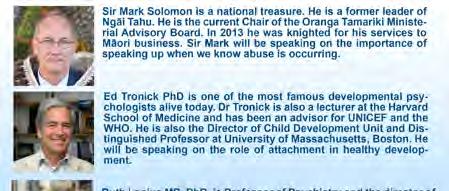


55
MICHAEL RAY
Parental Support Groups
Why They Shouldn’t be a No Man’s Land
After eight years as a dad - six of those as a solo dad, something that has become glaringly obvious to me is the difference in support networks for fathers compared to mothers. Mums almost always have a group of friends that they can call upon for support, playdates and even emergencies. Dads don’t seem to have the same levels of support at all. As men become more involved as fathers, do as I do and run the family home, that level of support for guys is becoming more important.

What If You Don’t Have A Network of Supportive Friends?
As a social experiment, I recently contacted a few Maternal and Child Health Centres - often the first point of contact for new parents. I was bemused that there was no information available for father’s groups (Not surprising, given the
Teachers Matter
I have, and always will, stand for equality. Equality to me is nothing to do with being a mother or a father but rather a PARENT.
56
name - Maternal. We really need to fix this.). In fact, the only suggestion offered was to try Men’s Help Line, and yet every centre had information and even brochures only for “Mother’s” groups.
The world is changing as Charlie and I have learned. Family structures now take on many shapes and forms and the most prevalent change is that dads are spending more time caring for their kids across the entire range of care activities and moving away from the traditional and outdated breadwinner stereotype.
My Initial Support Network
Unfortunately, my daughter’s mum and I drifted apart, until eventually, the marriage ended. We shared custody until she suddenly moved away, and I was thrust into the role of solo dad of a two-year-old.
Initially, my support network as a solo dad was my amazingly supportive family. The relationship Charlie has with her grandmother is the fountain of youth for my mum and a lifeline for me. After her, there has always been an abundance of fantastic mums ready to help.
In fact, Charlie’s ballet school tried to instigate an arbitrary ban on myself being allowed backstage as a male - which would have resulted in Charlie being the only child without a parent by her side. It was the legendary ‘Mums Groups,’ this revered group of wise woman that had all the answers to teething, sleeping, soothing, etc. that came to my aid with threats of a boycott if I was not permitted to assist my daughter. I was an honorary Mum and my posse had my back!
I have, and always will, stand for equality. Equality to me is nothing to do with being a mother or a father but rather a PARENT. Surely it is truly time for the old societal norm to be challenged and for these groups to be mutually inclusive. Are we ready to explore and drive this inclusivity?
Parenting Is a Skill
Parenting is a skill, yet in a recent survey, 45% of the fathers surveyed had never sought advice on parenting or caring for children. For fathers with children under 18 seeking advice, the main source of advice was their partner, followed by friends, their mother and only then their father. Encouragingly, the survey showed a change in attitudes with fathers almost twice as likely to seek advice or support.
Your physical well-being feeds directly into your mental health and directly affects your parenting

There are several Dads groups doing amazing work:
• Dads Group Inc.
• Beers and Bubs
• Suit Tie Stroller
These are just a few that are providing support, connections and fostering positive social relationships with Dads.
Establish Your Own Group
Social media is a fantastic way to establish networks. In fact, a defacto dad’s group has sprung up through the readers of my website and the talks I give that spans several countries and includes such a diverse range of participants from surgeons and CEOs to stay-at-home dads and same-sex dads. They all have one common thread: fatherhood.
We support and encourage each other with advice from our own trials and tribulations of this messy and magical, exhausting and rewarding, exhilarating and sometimes
57
MICHAEL RAY
MICHAEL RAY
terrifying thing called fatherhood.
Through this virtual group we are in the planning stages to facilitate monthly get togethers encompassing all things fatherly, with an emphasis on physical and mental health.
Here’s what has worked for me:
• ALWAYS ASK FOR HELP IF YOU NEED IT!
• Find a podcast that resonates with you.
• Start a dad’s group at work.
• Stay connected with your sports and interests by including your kids in them.

• Join in with mother’s groups. They’re always keen to offer advice and support.
Michael speaks about his insights from his personal journey raising his daughter and the profound impact being a solo dad has had on his outlook. He addresses the gender and societal roles that are no longer applicable and the negative impact on organisational, business and personal outcomes. He speaks straight from the heart and his ability to connect, resonate and inspire people is obvious.

For more information, visit: www.michaelray.com.au
Include your children in your sports, hobbies and social
Teachers Matter
Michael Ray
58
What I’ve Learnt About Wellbeing Lead

with Heart
Enduring more than two years of managing and leading a school through a pandemic had taken its toll, and I knew it. I had slowly lost my motivation and joy for my work, and my internal chatter had become increasingly negative. I found myself becoming less and less tolerant each day. As a result of too much adrenaline and cortisol pumping through my body every day, I had forgotten how it felt to be calm, happy and content. I didn’t know the stress my workload had taken until I slowed down - all the way down - and took time for myself during a ten week sabbatical.
During this period of rejuvenation, I intentionally made positive changes to my life. I ate healthily, exercised daily, read countless books, wrote in my journal and pottered around my home. I painted a fence around our house, bought a coffee from Starbucks every day and sat in solitude in the sun. It was the first real break I’d had in six years. It was during this time of rest that I realised what activities and practices made me feel well and happy. I began the journey of incorporating these activities and practices into my daily life. My focus turned to where I derived my energy and what depleted it.
59 DEB BARCLAY
During my time away from work I came to understand this about wellbeing:
1. We are responsible for our own well-being. We are the only ones who know what we need to feel happy and healthy. No one person or thing can ever compensate us for ignoring our own needs.
2. For each individual, wellbeing looks very different. A one-size-fits-all approach does not exist. Each of us is such a unique being and each of us has unique needs. No two people have the exact same values, beliefs, goals or personality, so certain aspects of wellbeing may be more or less important to one person than they are to another. Taking a walk in nature might be my daily wellbeing fix, while socialising with friends or family might be yours.
3. We need to know what our personal definition of wellbeing is. What does it look like and feel like for me? How do I feel when I’m well? What brings me joy, happiness, contentment? What gives me energy? We can’t improve our wellbeing unless we know what it is.
4. Those activities that we identify as important to our wellbeing need to be prioritised, and scheduled daily and weekly. Wellbeing should not be confined to the weekends and school holidays. Wellbeing is an everyday act of self-compassion, commitment and consistency. Having returned to work, I’ve started getting up every morning at 5am to meditate, journal and write a gratitude list. By doing so, I am able to start my day on a positive note.
5. We need to ask for what we want. Upon my return to school, I had a few requests to ask my Board. It was necessary for me to make those changes in order to fulfil
my potential as a senior leader. One of my requests was asking the Board to pay for my own leadership coach for six months. I wanted someone to talk to confidentiality (outside of education) that was neither a mentor nor a counsellor, who would support me to challenge myself with intentional thought, action and behaviour.
6. Compassion towards oneself is just as important as compassion towards others. I read a lot of Kristin Neff’s research during my break and came to fully understand and embrace the three elements of self-compassion: Kindness - to myself; Common Humanity - this is a shared experience; and Mindfulness - feeling the feels without trying to suppress or deny them.
As a senior leader, I need to provide service from a place of overflow, not deficit, to everyone on site.
We are more capable of handling those times when we are pushed to our limits, either by a hectic schedule or an unexpected event, if we can bank our energy and keep our wellbeing cup overflowing.
Everyone benefits when we take care of ourselves.
According to Dr Kristin Neff, it is a myth that self-care is selfish. In fact, research shows that when you give yourself what you need, when you give yourself the resource of kindness, support and understanding, you actually have more to give others.
Wellbeing is neither a quick fix nor a short term pathway. It is life long and intentional. The key to wellbeing is knowing what you need to be well, committing to those practices and being consistent in your daily routines and habits.
Deb Barclay

Deb Barclay works as a Principal in a North Shore Primary School. She is an Accredited Coach and works with teachers and leaders in education on fine tuning their organisation and their well being. Her philosophy is Lead Smart with Heart.
For more information, visit www.debbarclay.com
Teachers Matter
Research shows that when you give yourself what you need, when you give yourself the resource of kindness, support and understanding, you actually have more to give others.
60 DEB BARCLAY
Forever Searching for Refuge
A Timely, yet Timeless Situation
Alan Gratz is the bestselling author of a number of novels for young readers.
His 2017 novel, Refugee, has spent more than two years on the New York Times bestseller list.
For those of us who live in a place of relative comfort, safety and opportunities, our understanding of the challenges of life without these basic human rights can only be gained through the recorded experiences of those who have been forced to live without them.
The news media touches the superficial aspects of such lives. Their short articles are frequently written to focus on a specific call for help - often the situation but not the individual.
The search for safe refuge, a place to live where the freedoms of whatever culture are recognised and achievable, has stretched across centuries. The struggle is repeated decade after decade, century after century. Does humanity never learn from its past?
Alan Gratz, in his book, Refugee, tackles this situation that is both timely and timeless. Through three short stories that span countries and eras, he takes us on the grueling journeys of three different characters. The characters and their families, although in vastly different situations, all pursue refuge and are driven by the hope embedded in their dreams.

This book is also available as an audiobook.
Lesley Johnson has taught for 30 years. The facilitation of an ICTPD cluster nurtured her three passions: Literacy, ICT tools and Thinking Strategies. She now runs her online business, Read Think Learn, providing online literacy resources that promote higher order thinking.

For more information, please visit: www.readthinklearn.com
Title: Refugee
Author: Alan Gratz
Publisher: Scholastic
Audiobook: Audible
Free PDF: https://www.d-pdf.com/ book/1443/read
ISBN13: 9781407184326
The characters and their families, although in vastly different situations, all pursue refuge and are driven by the hope embedded in their dreams.
Lesley Johnson
61 LESLEY JOHNSON
LESLEY JOHNSON
Character:
Josef, Isabel and Mahmoud all face danger, hatred and abuse in their search for safety.
1. Complete the summary sentences about the character’s emotions. _______________________(character ) at the start of the story feels but then _______________________________________________________________ and at the end of the story they feel ________________________________________

2. Complete the emotion graph for a character.
a. Identify two feelings/emotions the character experiences.
b. At the bottom of the graph, summarise the main events of the story.
c. Place an X and an 0 on the graph to show the level of the character’s emotions at each of the main events in the story.
d. Connect the Xs together by drawing a line.
e. Connect the Os together by drawing a line.
Character’s Name:__________________________________________
Emotion 1: (use X on your graph)
Emotion 2: (use O on your graph)

62 Teachers Matter
3 Skim the story again and list four choices that the main character made.
4. Evaluate that choice and by each choice place a tick on the continuum.

5. If you could change one choice that the character made, what one would it be? Predict three different outcomes that might result from that change.
63 LESLEY JOHNSON
Have Your Children Set Goals?
An Easy Formula For Them to Follow!
Does your child have dreams and aspirations but does not know how to achieve them? Setting SMART Goals are crucial in their development as intelligent, functioning adults. We have been there, stuck at our desks contemplating what our next strategy in life would be, but the question that one must ask themselves is not, where but how. How am I going to achieve this goal? What are the steps in making my vision into my reality? SMART Goals that are Specific, Measurable, Attainable, Relevant and TimeBound can help and are essential in further understanding the world around them and for a more meaningful life. Click HERE (https://skilled-composer-2459.ck.page/3c28cc580e) to obtain a tool that you can use that will benefit your child in his future endeavors.
Let’s use the task of completing an essay as an example for explaining the SMART Goal System.
The ‘S’ in the SMART Goals System stands for Specific, meaning the tasks should be to the point or relate to the primary goal at hand. For instance, when writing an essay, the task should not be a general statement, it should be “Do Research on Catherine the Great”, or “Complete Topic Sentences for each of the Body Paragraphs,” etc.
The ‘M’ in the SMART Goals System stands for Measurable. This is a deadline that one must meet so one can track the child’s success over time. For instance, when writing an essay, once the teacher gives out the deadline for the essay, the student should first write down the date in their planner. Second, count out how many days there is to complete the essay (give a few days to give a break). Finally, break up the tasks involved in writing the essay into the time the child might need to complete the task. An example of this would be break down the writing portion of the

Teachers Matter
64 HELEN PANOS
paragraphs. Also, this is important for parents because they can track their child’s progress throughout the assignment. If the child met the designated deadline, then he can receive a reward such as 30 minutes of game time. If the child does not finish the assignment, then it is the parent’s job to determine the consequence, such as no video games, etc.

The ‘A’ in the SMART Goals System stands for Attainable, meaning that the task should be simple enough for one to complete within a timely manner. If one makes the task too difficult, the child will lose interest and not want to finish the assignment. On the other hand, if the task is simple enough to achieve, then the child will feel as though he is one step closer to achieving his goals. Something to watch is when the child becomes stressed about a task; tell him that this is only a small piece of the big picture, meaning to take it step by step. When writing an essay, tell him today, we will write the outline, tomorrow the thesis statement, and so on.
The ‘R’ in the SMART Goals System stands for Relevant, and this is relative to each person. Relevant pertains to the task the child is currently working on and reviewing. Will this help him in his future endeavors or help reach the goals he has set? An example would be when writing an essay. The child can ask if this essay is going to help him receive an excellent grade in the class. If the answer is ‘yes’, then the path he is on is correct. The goals will be achieved and the assignment finished. If the answer is ‘no’, then more work needs to be completed. A strategy may need to be altered to reach the goals.
The final letter in the SMART Goals System is ‘T’ representing Time-bound. This is important because a time limit being set on a task can be beneficial for a child in terms of focusing. Let’s use the example of writing an essay again. If the assignment is due in seven days, then its best to set a goal to finish the piece earlier. A start and end date to should be recorded, so the child is aware of how much time he needs to complete the assignment. When assigning a time limit on a task, keep in mind the use of electronics such as phones, tablets, computers, etc can be a distraction to the child achieving their full potential.
The SMART Goals System can help your child in many ways. Mainly, it can help them achieve goals by making dreams a reality. Implementing just one tip from above can be a tremendous amount of help for your child.
Helen Panos is an accomplished educator/instructional specialist with over 25 years experience in a public school system. Helen began her K-12 nationwide tutoring business, Dynamis Learning Academy, 6 years ago to help children reach their potential.
Helen has acquired a BBA, Master’s in Education and an Educational Specialist in Administration & Supervision from various collegiate institutions. She also holds certifications in gifted education and has several years of experience with gifted testing, curriculum design, RTI/SST, and managing Section 504 plans in America.
She can be reached at:
helen@dynamislearningacademy.com
 Helen Panos
65
The SMART Goals System can help your child in many ways. Mainly, it can help them achieve goals by making dreams a reality.
HELEN PANOS
The Game of Life
How to Give it Your Best Play
T here are many different quotes, proverbs and sayings to inspire us to live our best life. One such quote comes from a revered Indian spiritual master, Sai Baba. He said,
“Life is a game; play it. Life is a challenge; meet it. Life is an opportunity; capture it.”

66 KAREN TUI BOYES
Life is a Game – Play it
Games have rules, and so does living your best life. Some rules are universal and are true all the time, such as gravity. On planet Earth, when you drop an object, it will fall. Some rules are for safety. This includes wearing a seatbelt in your car and wearing a hard hat on a building site.
game;
Other rules are more in the “grey area” of whether they need to be followed exactly and may be considered by some as ‘guidelines.’ Some rules are not rules at all. When my children were young, I always tooted three times while driving through the Mt Victoria Tunnel in Wellington, New Zealand. They grew up believing this was a rule because I did it every time! The key is to be able to play the game of life. Deciding on how you want to play your game is important. Which values and rules are going to guide your life?
Boundaries are there to keep us safe and on track. Consider a person being blindfolded and helicoptered into a football field. They have been told that the sidelines have been electrified, and they will play the game blindfolded. If they are not sure where on the field they have been placed, the likelihood of them moving far is slim for fear of an electric shock. However, when the boundaries are clearly marked, it is easy to move quickly and safely within these parameters. Who learns the most in a game? Is it the participant or the spectators? Of course, it is easy to criticise the players from the outside, yet it is the players themselves, “in the arena,” as Theodore Roosevelt's 1910 speech stated, who learn the most.
“It is not the critic who counts; not the man who points out how the strong man stumbles, or where the doer of deeds could have done them better. The credit belongs to the man who is actually in the arena, whose face is marred by dust and sweat and blood; who strives valiantly; who errs, who comes short again and again; who spends himself in a worthy cause; who at the best knows in the end the triumph of high achievement, and who at the worst, if he fails, at least fails while daring greatly, so that his place shall never be with those cold and timid souls who neither know victory nor defeat.”
–Theodore Roosevelt
Life is a game to play and there is always a choice on how you play the game. This includes focusing on the positive, the progress and the goals. History shows one of the selfimposed rules of successful people is to minimise, or at least turn down, the noise of the negative naysayers and critics in life. This can be achieved by watching what you feed your brain in terms of information. Turn off or minimise mainstream media and social media, giving only the highlight reels of people’s lives. Instead, spend time reading or watching documentaries about successful people, say positive affirmations, practice gratitude and surround yourself with people who help you grow and uplift you.
Life is a Challenge – Meet It
The essence of Ryan Holiday’s Book, The Obstacle Is The Way, is that challenges in life are the purpose of life, helping us to grow, get stronger and give us practice living our values. When a butterfly emerges from its chrysalis, it is the struggle to get out of the cocoon which makes the wings strong, allowing the butterfly to fly.
When you meet challenges in life, treat the opportunity as a test. If you squeeze an orange, orange juice comes out. If you squeeze a lemon, lemon juice comes out. It doesn’t matter how hard a lemon is squeezed, orange juice will not come out. What comes out is what is inside. Now, acknowledge what is inside you. When you are squeezed, when the pressure is applied, what comes out? Anger, jealousy and hate? Or thoughtfulness, patience and love?
Challenges are a chance to be able to see what is inside ourselves and decide if that is who we want to be. Tony Robbins says, “The purpose of pain is to move us into action. It’s not to make us suffer.”
Action is the key. When meeting a challenging situation or time, sitting still, burying your head in the sand or waiting it out does not solve the issue, nor cause you to grow. Taking action may mean having to look deeply within and face your fears. You may need to ask for help. You may need to ‘DSD,’ or “Do Something Different.” You may need to think flexibly, make changes and take action! Even if you are not sure that the action you take is the right one, it is often so much better than the prospect of staying stuck. You may need to realign and evaluate your values, goals and dreams. What is important is to be true to yourself. A great maxim is, “Don’t let your ice cream melt while you are counting somebody else’s sprinkles.”
Life is a
play it. Life is a challenge; meet it. Life is an opportunity; capture it.
67
KAREN TUI BOYES
Life is an Opportunity – Capture It

Leon Spinks said, “Opportunities only knock once.” I’m not sure this is entirely true, as I believe there are an abundance of opportunities when you are ready to receive them. This does not make all opportunities equal, or even the ones for you. Many times, there is only one way to find out – say yes! Taking an opportunity can leave you in a state of uncertainty and can feel vulnerable and uncomfortable. A life lived within your comfort zone can feel safe and secure, yet true growth and adventure lie outside your comfort zone. Trying something new is often peppered with awkwardness, mistakes and difficulty. After all, everything is hard before it is easy. Being willing to make mistakes, be in a state of confusion, ask questions or to seek help and support are all important considerations. It pays to remember that FAIL stands for First Attempt In Learning. It is all part of the process.
One way to help decide on which opportunities to take is to create a vision board for your year or life. Set goals, decide on the values you wish to live by and create habits that allow you to you be your best. Each day, find the joy in your life. Robin Sharma says, “Success without joy is an empty victory.” Celebrate the tiny wins, your forward progress and your failures.
Most of all, capture it. Record your life for no purpose but to see your growth and journey. Write in a journal, take photos and display them and put away your phone when with others to truly be in the moment. Listen more than you speak and be genuinely interested in others and their life. Make eye contact, embrace spontaneity and be mindful by
practising daily prayer, gratitude or meditation. Like me, you might create a photo book of each year of life, record daily gratitude and design yearly vision boards with goals, values and reflections.
“Life is a game; play it. Life is a challenge; meet it. Life is an opportunity; capture it.”
In what ways will you embrace this beautiful quote to live your best life?
Karen Tui Boyes
Karen Tui Boyes is a champion for Lifelong Learning across nations, industries and organisations. Winner of the NZ Educator of the Year 2017 and 2014 and the NZ Speaker of the Year award in 2013 & 2019, Karen is a sought after speaker who continually gets rave reviews from audiences around the world. Her dynamic style and highly informative content—which turns the latest educational research into easy-to-implement strategies and techniques — sets her apart from others in her field.
Find out more at: www.spectrumeducation.com
Teachers Matter
68 KAREN TUI BOYES
Subscription Form
Learn HOW to APPLY the principles of effective teaching. Learn WHAT helps you perform at your best.
Subscribe to the only magazine that both informs and inspires teachers – your injection of educational energy.
PLUS practical ideas for the classroom, the latest in thinking on educational issues, and handy tips for optimum personal performance.
PERFECT for all educators of pre-school, primary, and secondary students.
NZ$105/AU$105
1 copy of Teachers Matter Magazine 4 times per year
Same quality & format, packed full of short, practical articles
NZ$115/AU$115
1 copy of Teachers Matter Magazine 4 times per year
Online Gold Access to previous issues and the next 4 issues
NZ$129/AU$129
Online Gold Access to previous issues and the next 4 issues
Searchable articles and access for all team members
Name
Phone Address
Postcode Email Signature
How to Respond: Copy and scan this form and email to: info@spectrumeducation.com
1. If ordering by phone or if you have questions, phone +64 4 528 9969 between 9am and 3pm, Monday to Friday.
2. Post your subscription to: Teachers Matter Magazine, PO Box 30818, Lower Hutt, 5040, New Zealand
69
16 Days of Thinking




90+ Study Tips For Success



www.SpectrumEducation.com
Dispositions Practical ways to develop self directed independent learners in your classroom Gain access to 8 hours of videos for $189 + $47 worth of bonus material Multi Award Winning Speaker and Educator www.SpectrumEducation.com Acknowledge and Reward your Teachers with a groovy Poster/Postcard Great for popping in the post, pigeon holes, adding with reports or hanging on the wall.
To see your advert here contact Spectrum Education: info@spectrumeducation.com
Useful Products Services &
Post your Order to: Spectrum Education PO Box 30 818, Lower Hutt, NZ NZ Phone: 0800 37 33 77 or +644 5289 969 Email: studysmart@spectrumeducation.com 70



Useful Products Services & To see your advert here contact Spectrum Education: info@spectrumeducation.com Learn the time-saving tricks experienced teachers, principals and admin staff use. Grab your digital copy from: https://www.robynpearce.com 71