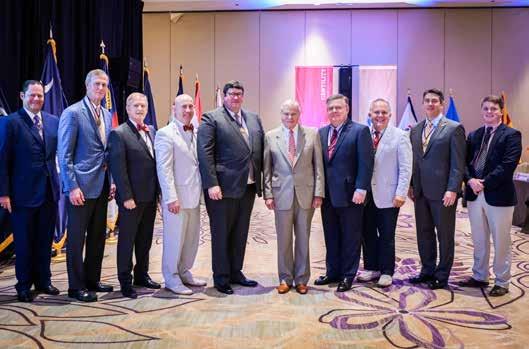
General J. H. Binford Peay III (Beta Commission–VMI ’62), a retired four-star U.S. Army General and the Superintendent Emeritus of the Virginia Military Institute— our 20th recipient of the Order’s Award for Distinguished Service.


General J. H. Binford Peay III (Beta Commission–VMI ’62), a retired four-star U.S. Army General and the Superintendent Emeritus of the Virginia Military Institute— our 20th recipient of the Order’s Award for Distinguished Service.

Dr. Bill Hardgrave (Epsilon Zeta–Arkansas Tech ’84) has been serving as the 13th President of the University of Memphis since April 1, 2022. Previously, Dr. Hardgrave served as Provost and Senior Vice President for Academic Affairs at Auburn University since January 2018. Dr. Hardgrave is one of a few current college presidents that are KAs, including Dr. Robert Pearigen (Alpha Alpha–Univ. of the South ’73) at the University of the South.
University of Memphis.




In August 2023, I was honored to be installed as your 42nd Knight Commander. We have much of which to be proud and much to celebrate since that time. I wish to thank Former Knight Commander C. Douglas Simmons III and the 42nd Executive Council for their leadership, commitment, and their example during the past biennium.
The Order continues to emphasize our values of Reverence, Gentility, Knowledge, Leadership, Brotherhood, and Excellence to fulfill our purpose of being a Moral Compass for the Modern Gentleman.
In the spring of 2023, our chapters and members achieved the monumental mark of a 3.136 GPA, the highest in a regular semester for our Order. This past fall, the overall GPA reached a 3.087, the highest in history for the Order in a fall semester.
But that’s not all. In the spring of 2023, our chapters collectively topped the $1 million mark in fundraising for The Independence Fund—providing allterrain track chairs for catastrophically wounded veterans.
King V. Aiken, Jr. (Kappa–Mercer ‘83)
This leaves our chapters at a 65-man average size, and as of the spring term, we have reached our highest membership level in history, topping 8,000 undergraduates.
Furthermore, I am pleased to announce that we continue to grow in our membership. This fall, our chapters, have successfully recruited new members at a remarkable rate, boasting an 11 1/2 percent increase over the previous fall in 2022. And our chapters are maintaining an average 90 percent initiation rate for these new members that join—creating the largest new class of initiated men in our history. This leaves our chapters at a 65-man average size, and as of the spring term, we have reached our highest membership level in history, topping 8,000 undergraduates. These results are a direct reflection of our young men, their hard work, and the undeniable need for the product we offer—that is the values, history, and experience of KA.
And finally, the Kappa Alpha Order Educational Foundation Crimson & Gold Society continues to support the needs of our undergraduates. Academic excellence, leadership education, and career-building personal development are crucial to their success. The Crimson & Gold Society has for three years now reached the goal of more than 1,000 brothers and friends contributing $1,000 annually.
Last fall, I had the privilege of attending my chapter’s 150th anniversary, Kappa Chapter at Mercer University. To serve as Knight Commander is humbling, to preside over my chapter’s sesquicentennial in that capacity was a hallmark of my term.
As I’ve said since the Convention in 2023, as a charge to all our chapters, “Let’s Go!” and now I like to follow that up with, “Because KA is on the move!” God bless you and may God continue to bless Kappa Alpha Order.
Fraternally,

The Kappa Alpha Journal (ISSN #08888868, USPS #014-747) is an educational journal published four times a year by Kappa Alpha Order, 115 Liberty Hall Rd., Lexington, Virginia, 24450. Periodicals postage paid at Lexington, Virginia, and additional mailing offices.
The Kappa Alpha Journal seeks to reflect the Kappa Alpha experience by presenting news of active and alumni chapters, individual members, and the national organization; by addressing current issues facing the Greek system and the Order; by educating and entertaining those interested in the welfare of Kappa Alpha; and by serving as a historical record.
The Kappa Alpha Journal has been published since 1879. From 1883 to 1885 it was known as The Magazine of Kappa Alpha.
Kappa Alpha Order was founded in 1865 at Washington College (Washington and Lee University) in Lexington, Virginia. Today, Kappa Alpha boasts 125 undergraduate chapters and more than 60 alumni chapters across the nation.
SUMMER 2024

VOLUME CXXXI NO. 1
HOW TO CONTACT:
Editor, The Kappa Alpha Journal
P.O. Box 1865 Lexington, VA 24450 (540) 463-1865 jlyons@ka-order.org
TO CHANGE AN ADDRESS:
Fill out the Alumnus Update on the website or send both your new and old address to Rose Kinard at the above mailing address or to rkinard@ka-order.org.
MEMBER:

Copyright © 2024
Kappa Alpha Order
KAPPA ALPHA ® is a registered trademark of Kappa Alpha Order.
Postmaster:
Send address changes to Kappa Alpha Order, P.O. Box 1865, Lexington, Virginia 24450
Dear Brothers,
In the pages of this edition of The Kappa Alpha Journal, we come together to celebrate the embodiment of our shared values: Reverence, Gentility, Knowledge, Leadership, Brotherhood, and Excellence. These principles serve as the guidelines for our Order, inspiring us to strive for greatness and make a positive impact in our communities and beyond.
Within these pages, we honor the exceptional leadership of General J.H. Binford Peay III (Beta Commission–VMI ’62), whose unwavering dedication to our values has earned him the prestigious Distinguished Achievement Award from the Order. General Peay’s commitment to excellence and service is a shining example of the leadership we aspire to emulate as members of Kappa Alpha Order

In addition to recognizing the achievements of our distinguished brothers, we also pay tribute to acts of heroism and selflessness that exemplify the spirit of our fraternity. Mario Reid, a police officer in Evansville, Indiana, personifies the values of Reverence and Gentility through his courageous actions, demonstrating a deep respect for and a commitment to protecting and serving his community.
Furthermore, as we commemorate the 100th anniversary of the Alpha Xi Chapter House at the University of California, Berkeley, we reflect on the knowledge and traditions that have been passed down through generations of brothers. This historic landmark stands as a testament to our enduring Brotherhood and serves as a reminder of the bonds that unite us across time and distance.
On March 28, 2023, Robert Sullivan (Delta Mu–Eastern Kentucky ’70), made a gift to the KAOEF “in memory of John Michael Wills USMC (Ret.) (Delta Mu–Eastern Kentucky ’69),” but notation of the gift was accidentally excluded from the previous Journal. Additionally, John E. Ross III (Delta Omicron–Clemson ’71) also made gifts that were accidentally left out in 2023 in honor of Thomas W. Eiserhardt (Delta Omicron–Clemson ’71), Joeseph M. Pazdan II (Delta Omicron–Clemson ’79) and William David Thrailkill (Delta Omicron–Clemson ’70). The “Recognition” section will return in the next issue. Please see KappaAlphaJournal.com for recent KAOEF gifts in memory and in honor of KA brothers.
As we turn our gaze toward the future, let us reaffirm our dedication to the values that define us as KAs. Let us continue to lead with integrity and humility, fostering a spirit of camaraderie and mutual respect among all members of our fraternity. And let us strive for excellence in all that we do, honoring the legacy of those who have come before us and paving the way for future generations of brothers and friends.
Fraternally,

[Editor’s Note: As an experiment with ever evolving technologies that affect all areas of life, business, and journalism, most of this Letter from the Editor was generated largely by specific prompts given by the Editor to Open AI’s Chat GPT. This is the first “Artificial Intelligence” used in producing The Journal.
Jesse S. Lyons (Delta Alpha–Western Carolina ’98)
And let us strive for excellence in all that we do, honoring the legacy of those who have come before us and paving the way for future generations
Rekindle your interest in the Order
The Journal reached out to the members of Official Kappa Alpha Order LinkedIn group and asked them to respond to one question:
“What
is
one piece of professional advice for graduating seniors or young alumni?”
Here are some of the best responses. To join the LinkedIn group, visit KappaAlphaOrder.Org/LinkedIn and request to join. We verify each person is a member of KA in good standing, so it may take a few weeks to be approved.
“Avoid sacrificing experience, growth, valuable relationships, and priceless leadership for compensation. Avoid chaining yourself to debt trying to live a life you can’t afford…yet.”
– JEREMY D. DUKE (DELTA LAMBDA–MIDDLE TENNESSEE STATE ‘09)
“You will take on many traits of the 5 people you are exposed to the most. Choose wisely, and don’t be the smartest person in your group.”
– HECTOR X. NIEVES (DELTA CHI–LOUISIANA STATE-SHREVEPORT ‘83)
“Slow down and take a moment to learn from senior leaders in your office or field.”
– KELVIN E. RUTLEDGE, PH.D. (ZETA TAU–AUSTIN PEAY STATE ‘11)
“You are the sum of your past experiences. Every step you take is significant, for better or ill. Be intentional about the relationships you form. Leverage your alumni networkKA and university. And most importantly be on time, be available, and professional. 90% of success at work is
showing up with the right attitude and effort even if you don’t like the job.”
– CASSIN Y. DYSON (ZETA OMICRON–SOUTHERN INDIANA ‘08)
“Always move forward and focus on what you can control. No matter where you are today, there is a path to where you want to be.”
– RISHAB NEGI (ALPHA ZETA–WILLIAM & MARY ‘17)
“Take the opportunity to work for the National Administrative Office. The skills you learn, the ability to travel across the country, meet with KAs young and old from all walks of life, and give back to the Order in a unique and special way. Some of my best friends I met while on staff. Unbelievable experience!”
– TULLIS D. BEASLEY (DELTA RHO–VALDOSTA STATE ‘09)

Dear Larry,
I always enjoy the outstanding work by Jesse Lyons and team on the KA Journal issues. I enjoyed the story on [former Executive Director] Dick Barnes and especially your personal tribute to him. He was a real gentleman and a professional representative of not only KA, but the fraternity community as well. It was an honor to know Dick and to call him an interfraternity brother. He is missed.
All the best, Robert A. Biggs, CAE (Ret.) Chief Executive Officer Emeritus Phi Delta Theta Fraternity
The Order held a historic biennial Convention this summer in Orlando, Florida. All of the videos from the weekend have been uploaded and featured on KappaAlphaJournal. com and include a full recap of the weekend, the Installation Address of Knight Commander King V. Aiken, the Presentation of the Award of Distinguished Achievement to GEN J. H. Binford Peay III, and the KAOEF Leadership Luncheon with KA’s Top Guns.


JB’s Barnyard, a regional Ice Cream vendor owned and operated by Jared H. Simpkins (Epsilon Theta–Western Kentucky ‘12) and his wife, Briley, has integrated from just selling to now producing their own ice cream. Flavors that include espresso chip, banana pudding, and pumpkin pie are now sold in nine wholesale locations in Indiana and Illinois. Learn more at JBsBarnyard.com.


Gov. Dunn of Tennessee
In the Summer 2023 edition of The Journa l, much effort went into the research about KA’s former and current Governors. One mishap was published. Gov. Winfield C. Dunn (Alpha Upsilon–Mississippi ’48) was noted as a past Governor of Mississippi, when in fact he was Governor of Tennessee. That leaves Mississippi with four KA governors, tying it for the most along with Alabama. Thank you to brother Eddie Wilson (Delta Beta–Delta State 1973) and Steve Bingham (Alpha Upsilon–Mississippi 1977) for identifying this errata.

The
Caroline and Cal Mayo (Alpha Upsilon–Mississippi ‘83) joined the first episode of Season 2 of The Mayo Lab Podcast to talk about how the Thomas Hayes Mayo Lab was established, the memory of their son Thomas and the stigma surrounding mental health and substance use issues.
Cal and Caroline shared the story of their son Thomas, who struggled with drug use while attending the University of Mississippi and passed away from an accidental overdose caused by Fentanyl in 2022. Through a heartfelt and honest conversation, the Mayos open up about their personal journeys as parents and what advice they give to families dealing with similar challenges.
Also, Cal Mayo’s essay, “After Thomas’ Death,” that appeared in the Summer 2022 Kappa Alpha Journal, was republished with permission in the Winter 2024 Journal of American College of Trial Lawyers. It is the first time in recent history that publication printed a previously published article.

Rekindle your interest in the Order
At Convention last summer, then Knight Commander Doug Simmons unveiled the Order’s newly redesigned national website. If you have not already visited it, go check it out at KappaAlphaOrder.org.
Values and Navigation.
Our home page is centered on what makes unique, our values. Also, we have improved navigation to help website users find what they need quicker.
Events Calendar.
We have created a centralized location for all national and regional events. You can see if something is taking place near you or find that event invitation that was lost in your email. Also, all the details and registration process is included! Check it out at KappaAlphaOrder.org/Events
Forms in one place.
Have you ever needed to complete a form, but not sure where to go? We have put all of our forms in one place to easily scan for the one you need. For example, have you lost your badge or shingle (membership certificate) and want a new one? You can order replacement at KappaAlphaOrder. org/Forms
Shopping.
KA’s new national website make it easy to
order. The Official Online Store, Shop KA Marketplace, Official Jeweler, Official T-Shirt Vendor, and all other vendors are all easily accessible at KappaAlphaOrder.org/ShopProducts
KA News.
Want to know what is going on with the Order, various chapters, or chapters and alumni near you? Visit the news page through KappaAlphaJournal.com for the latest issue of The Journal, news articles, videos, social media, and more! You can also submit your story to share your news there as well! Visit KappaAlphaOrder.org/ News or KappaAlphaJournal.com
Giving Back.
The website combines all of the Order’s previous sites including for the Kappa Alpha Order Educational Foundation. Now you can quickly support the KA experience by making a donation to the KAOEF to support scholarships, internships, and leadership education programs. Donate now and learn about the KAOEF.org or KappaAlphaOrder. org/Foundation

June 6–9 2024
Washington & Lee University Lexington, Virginia
27th KAOEF Bid for Brotherhood
July 25, 2024
Hillwood Country Club Nashville, Tennessee
By Mark DiRienz (Beta Epsilon–Delaware ´80)
Like many of you, I learned much as a pledge and brother and then later in life through dedicated research of Robert E. Lee’s life that is defined by his exemplary religious and gentlemanly ideals and values; it is no wonder then to know of the profound effect his life has had on me to this day. As a result, my wife Amanda and I were not only humbled and honored to take on the restoration of Cobbs Hall, the birthplace of the Lee family, but have great pride in the effort we have invested in returning it to its rightful place among the many fine Lee family homes located in Virginia. Although we have gone out of our way to use local or regional resources and craftspeople when/wherever possible, we also have ventured far and wide nationally for those with the highest and best skills available, many times at great cost. Despite the long list of craftspeople engaged to assist in the restoration of the house and grounds, we have invested ourselves fully hands on in the project. Contributions ranging from substantially all hardscaping and landscaping for the entire acreage, complete interior painting including advance significant wall plaster and wood trim repair or replacement, all window treatment manufacture, period lighting (sconce and chandelier) electrification and/or replacement, as well as the investment and deployment of our lifetime collection of museum quality period furniture and decorations represent just a fraction of our personal investment in the restoration. It is also especially worth noting that we have developed and maintained close relationships with many Lee family members with whom we have shared ongoing progress and who have graciously shared their memories of life at the house, providing needed detail and even legacy family artifacts from the house at
Cobbs Hall is a historic plantation house and surrounding property located on Dividing Creek in Northumberland County of Virginia. Cobbs Hall is historically significant as the original and core plantation property associated with the Lee family of Virginia, countless generations of which have served our country with distinction. Built on land first patented in 1656 by Col. Richard Lee I (“The Immigrant”), progenitor of the Lees of Virginia with his wife Anne Constable Lee, Cobbs Hall was still in the ownership of his direct descendants when we purchased the property from them in December 2009.
times and certainly inspiration otherwise in bringing brilliant life back to the house.
We were recently honored by being awarded the exclusive John Paul Hanbury Award from the Northern Neck of Virginia Historical Society which recognizes outstanding restoration of historic properties in the Tidewater of Virginia area. As part of the nomination process for that award we had to provide detailed information about the history of the property, its key architectural features as well as investments/ improvements we’ve made.


Rekindle your interest in the Order

In awarding the Distinguished Achievement Award last summer to General J. H. Binford Peay III, then Knight Commander Simmons added on name to a short roll of honor of men who had received KA’s highest honor. In March 1975, the fifth such award was bestowed upon the man who, among other highlights, was the leader of the group that bought The Coca-Cola Company from Asa Griggs Candler in 1919. Robert Woodruff died on March 7, 1985, just ten years after receiving this honor.
Kappa Alpha Journal, Fall 1972, Page 1
Robert Winship Woodruff, Epsilon ‘09, [Epsilon–Emory 1909] was presented the Distinguished Achievement Award for Kappa Alpha Order on March 4, 1975. He is the fifth KA to be so honored since the establishment of the Award twenty-eight years ago. The citation accompanying the Award reads:
“For outstanding achievements as an Industrialist, Financier. and Philanthropist and for his service to mankind as a benefactor of education. As a gentleman, he reflects High Honor on his country and his Fraternity.”
The presentation was made by Knight Commander Reynolds S. Cheney assisted by Former Knight Commander Giles J. Patterson in the office of Mr. Woodruff at The Coca Cola Company in Atlanta. Those participating were Brother William C. Morrow. Beta Nu, ‘22; J. Paul Auston, Chairman of the Board of Directors and J. Lucian Smith, President, The Coca Cola Company; Dr. E. Garland Herndon, Jr . Director of the Woodruff Medical Center at Emory University; Boisfeiullet Jones, Director of the Emily and Ernest Woodruff Fund, Inc.; R. W. Bowling. Former Treasurer of The Coca-Cola Company; J. W. Jones, vice president, The Coca Cola Company; Kappa Alpha Executive Director William E. Forester and Director of Chapter Services Richard A. Barnes.
In recognition of his devotion to philanthropic endeavors which have fostered education for countless numbers of young people and his outstanding contributions of time, personal participation and financial support to many educational and character building organizations including Emory University, the Emily and Ernest Woodruff Foundation, the Joseph Whitehead Foundation, Lettie Pate Evans Foundation, the Berry Schools in Georgia, Tuskegee Institute and the Boys’ Clubs of America, the Executive Council of Kappa Alpha Order selected Robert W. Woodruff to receive the Distinguished Achievement Award, which was established in 1947 for the purpose of
recognizing Kappa Alphas who have made outstanding contributions to our nation or to mankind in literary. professional. scientific or educational fields.
The Award is the highest honor that can be bestowed upon a Kappa Alpha and requires excellence not only in his loyalty and devotion to Kappa Alpha but also in other fields that reach out for the good of mankind and can be conferred only with the unanimous approval of each member of the Executive Council of Kappa Alpha.
In making the personal presentation, the Knight Commander expressed the Order’s pride in Brother Woodruff’s many services to mankind in the fields of education. personal development and his outstanding achievements as one of the nation’s distinguished business leaders. He emphasized the esteem. the pride and the
high regard in which Brother Woodruff is held by Kappa Alpha. Responding, Brother Woodruff expressed his thankfulness for being chosen to receive this Award and his appreciation for the Brothers being present for the occasion. He spoke of his interest in Kappa Alpha Scholarship Fund and the work of the Order.
Robert W. Woodruff served as a major in the United States Army, Ordnance Department, during World War I and has served unofficially under five Presidents in several areas of Government operations. As a businessman, industrialist, and financier, he has marked many milestones along the path of his life. Currently, as a Director and Chairman of the Finance Committee of The Coca Cola Company he has served the Company as President, Chairman of the Board and Chairman of the Executive Committee. He has also held Directorships in the Morgan Guaranty Trust Company of New York, Trust Company of



Georgia, Southern Railway Company, General Electric Company, Metropolitan Life Insurance Company and the American Express Company. He presently serves as a member of the Directors Advisory Council and Trust Company of Georgia and Morgran Guaranty Trust Company. In his early
years, prior to joining The Coca Cola Company, he was Vice President and General Manager of White Motor Company in Cleveland.
To the list of recipients of Kappa Alpha’s Highest Award is now added the distinguished name of Robert Winship Woodruff.
With the U.S. Department of Education’s COVID-19 relief for student loans ending, The Journal surveyed graduates on how much student loan debt they currently had.
Of the 135 respondents,
• 46.67% of respondents had no student loan debt.
• Of those with student loan debt,
37.50% had less than $25,000, and 80.56% had less than $75,000
• With those of $200,000 or more in debt, 75% left college 5 years ago or more recent
• 70.59% of students out of school 1 year or less have between $10,000 and $75,000 in debt
The Order has partnered with Juno, a free resource to help brothers reduce the cost of their existing student loans. Over the past five years, Juno has helped they've helped thousands of students and professionals access nearly $1 billion in funding and negotiate down interests rates.
Learn more at JoinJuno.com/p/ KappaAlphaOrder.
HIgh-quality items from our licensed partners
All of these items and more are available at our KappaAlphaStore.com – the official online store of Kappa Alpha Order.

Maroon Nike Embroidered Hoodie $84.95
The Nike Swoosh you know and love just got a whole lot better! This hoodie is one that every KA needs, embroidered with your Greek letters on the front left chest just under the legendary swoosh. This Nike hoodie is made with an 80/20 cotton/ polyester blend with a 100% cotton hood lining to ensure that quality comfort.
Maroon Old School Crewneck $38.95
Rep KA in vintage style with the Kappa Alpha Maroon Old School Crewneck. This super soft crewneck sweater celebrates your brotherhood’s long history with a retro design all KA members will love. Prominently featuring your Greek letters in collegiate navy and old gold on the front this crewneck gives off

2
Peter Millar Perth Stretch Quarter Zip
$148.95
Experience a new level of comfort with KA Peter Millar Quarterzip. Crafted with signature high-tech loop terry fabric and four-way stretch, this garment delivers an unrivalled blend of style and performance. Moisture-wicking technology quickly dries fabric and keeps you cool, making it perfect for the golf course or everyday wear.

3

4
Champion Performance Hoodie $72.95
Get ready to perform in style with this Kappa Alpha Champion hoodie. Crafted from a soft and stretchy material, this performance hoodie features a Champion logo drawcord and the iconic Champion branding. It also displays your KA logo badge on the sleeve and name on the chest, making it a musthave.
Black Badge Performance Polo $43.95
This KA polo will keep you protected from the sun with its UPF30 rating. With extra stretch for additional comfort, this polo is great for keeping cool under pressure. Featuring Kappa Alpha Order's badge logo on the front, this button-up polo will make you the envy of your Kappa Alpha brothers!

5

General Peay standing at the window of his office at
in Tampa, Florida. In 1997, General Peay was the highest ranking, active duty graduate of VMI.
abridged
eneral J. H. Binford Peay III (Beta Commission–VMI '62), a distinguished and highly accomplished military leader, is a name that resonates with excellence and valor in the realm of the armed forces. With a storied career spanning several decades, General Peay has demonstrated unparalleled dedication to duty, steadfast leadership, and a remarkable commitment to the service of his nation. Throughout his illustrious journey, he has earned the respect and admiration of peers and subordinates alike, leaving an indelible mark on the history of the military. In this introduction, we delve into the life and achievements of General Peay, a true embodiment of valor and leadership, whose legacy continues to inspire and shape the future of the armed forces.
During his remarkable career, General Peay served with distinction as the Commander of the United States Central Command (CENTCOM). This pivotal role placed him at the forefront of America's military operations in one of the most critical and complex regions in the world.
As the CENTCOM Commander, General Peay demonstrated an unwavering commitment to national security and regional stability. With a keen understanding of the intricate political and strategic dynamics in the Middle East and Central Asia, he navigated the complexities of the region with finesse and tact, earning the trust and respect of allies and partners.
Under his astute leadership, General Peay fostered strong international partnerships, facilitating joint operations and intelligence sharing that bolstered the fight against terrorism and extremist threats. His emphasis on cooperation and collaboration strengthened the regional security architecture and contributed significantly to the overall success of U.S. and coalition efforts.
Throughout his tenure at CENTCOM, General Peay displayed a steadfast dedication to the well-being and morale of the troops under his command. His relentless pursuit of excellence and his genuine concern for the welfare of service members instilled a sense of pride and purpose among the men and women he led.
General Peay's tenure at CENTCOM stands as a testament to his visionary leadership and strategic acumen. His profound impact on the region and the military at large continues to shape the trajectory of national defense and security strategies, leaving an enduring legacy of service and valor.
During his illustrious career, General Peay also served with distinction as the Superintendent of the Virginia Military Institute (VMI). As the leader of this prestigious institution, he brought his unparalleled military expertise and unwavering commitment to education to foster a culture of excellence and honor.
During his tenure as Superintendent, General Peay worked tirelessly to strengthen VMI's reputation as a premier military college. He championed academic rigor, instilling a strong sense of discipline, and emphasized the importance of character development among the cadets. Under his leadership, VMI continued to produce outstanding graduates who went on to serve their country with distinction in various fields.
General Peay's vision for VMI extended beyond its campus borders. He actively engaged with alumni, the local community, and stakeholders to forge lasting partnerships that would enrich the institution's resources and opportunities. His dedication to the growth and prosperity of VMI contributed significantly to its continued success and prominence in the realm of military education.
As Superintendent, General Peay faced challenges with a sense of resilience and adaptability, leading the institution through periods of change and growth. His commitment to diversity and inclusion further strengthened VMI's commitment to providing a welcoming and inclusive environment for all cadets.
Throughout his tenure at the Virginia Military Institute, General Peay left an indelible mark on the institution's history, nurturing the next generation of leaders and shaping the character of future military officers. His legacy as Superintendent stands as a testament to his unwavering dedication to duty, leadership, and commitment to the values of honor, integrity, and excellence.
By General J. H. Binford Peay III (Beta Commission–VMI '62)
This is the edited address of General Peay to the 80th Convention in Orlando last August. While uncharacteristic for The Journal to print, the message conveyed outweighed other factors.
Good morning to all of you, I’m delighted to be here. Mr. Simmons, our 41st Knight Commander; Mr. Aiken, Senior Councilor and Knight Commander in-waiting; members of the Executive Council; KAOEF Trustees; Executive Director Wiese, and the KA national staff; distinguished guests; active and alumni chapter leaders; commission delegates; KA members and friends,
This award means a great deal to me. I will always cherish it and am honored to be in the company of prior recipients. Kappa Alpha has a long impressive and evolving history, standing for, and with, objectives of national and community importance so vital to our prosperity and well-being.


The nation needs you, particularly, in these concerning and interesting times.
As mentioned, I have been so fortunate to “daily” be around young and older soldiers for thirty-five years in the Army, a short stint running a defense company, and later in my life, for seventeen years, leading the Virginia Military Institute and being around students like you, the next set of leaders responsible for our way of life, defense of our nation and a vibrant democracy. I look at you, many of the best leaders in our nation, attending this impressive national convention. You are patriotic, inquisitive, you want to know why? You ask hard questions! I’ve found that you “probe deep.” “Thinking leaders” need to do that. Why Vietnam? Why Iraq, Afghanistan, and Ukraine? Other brush wars or police actions? These are important concerns related to the conduct of particularly long wars that many believe have changed our American culture with lasting impact on our institutions, society, our faith in government and pride as a nation.
I entered the Army in 1962—a draft Army—and one that is far different from our superb Volunteer Force today. Some aspects of both were wonderful. It pulled young Americans out of their provincial communities and dropped them into faraway places. Our nation stood tall in Berlin, won the Cold War with massive forces in Europe supported by a strong industrial base, built a modern nuclear deterrent, conducted a long war in Vietnam, converted to a volunteer force, rebuilt its armed forces and, twenty years later, won the 1st Gulf War, expelling Iraq from Kuwait. To secure and stabilize aspects of the region, we established a lengthy secure border with a “no fly” zone, insured the safe passage of oil and commerce in the Gulf waters, and provided forces to protect Kuwait, Saudi Arabia, and the GCC [Gulf Cooperation Council] countries. All the while, we responded on short notice with forces to Somalia, Panama, Haiti, Grenada, the Balkans, forest fires, and hurricanes, among others. Our youth discovered first-hand the variety


and complexity of many cultures, ours and theirs, and learned responsibility and service to nation. That was a good thing for America. Today, we’re involved in the world perhaps more than ever. We have interests in the world, we have exposures, and we face dangers.
Having a standing Army—an established condition in the present era—was not the original impulse of our Founders. Our early leaders did not want, nor felt we needed, that. That’s what every American thought. The oceans would protect us from East and West. Over time, mostly in the 20th Century, the world taught us otherwise; that our interests were global and our exposure was near infinite. More to the point, our pursuits could be contested. Our national ambitions had become competitive with other national ambitions. It has always been more complicated for us, and it still is.
Look at what we confront today: border security and illegal immigration, public safety, information security, public education, financial security and world-
TOP: General Peay (left), Commander in CHIEF of US Central Command, MacDill AFB, Florida, is welcomed by Saudi Arabian Air Force Brigadier General Muezzin Talat (center), Prince Sultan AB Commander, and Lieutenant General Carl Franklin, Commander US Central Air Forces, Shaw AFB, South Carolina. General Peay is at Prince Sultan AB, to meet with the Air Base Command STAFF and observe the Air Base build up progress thus far during Desert Focus, the relocation of Operation SOUTHERN WATCH (monitoring the no-fly zone over Iraq) personnel, April 9, 1996. Credit NARA & DVIDS Public Domain Archive.
LEFT: The Judge Advocate of the United States Army, Major General John L. Fugh, administers the oath of office to the Vice CHIEF of STAFF, General Peay. General Peay’s wife Pamela holds the Bible, February 4, 1993. Credit NARA & DVIDS Public Domain Archive.
Why
Vietnam? Why Iraq, Afghanistan, and Ukraine?
Other brush wars or police actions? These are important concerns related to the conduct of particularly long wars that many believe have changed our American culture with lasting impact on our institutions, society, our faith in government and pride as a nation.
national economic issues, proliferation of sophisticated armaments, Ukraine, tensions with Iran, China, Russia, North Korea, international terrorism and more. Many describe this period as commencement of the 2nd Cold War with national and world implications for security and financial stability for years in the future. Our “standing armed forces” of all services are far too small at a time when major adversaries are challenging our technological edge and previous advantages.
The clock is ticking. The years pass quickly for you. In two decades (2043) you will be in your mid-forties, many married with children, maybe some of you with grandchildren. The mantel of “strategic leadership,” more quickly than you realize, falls on your shoulders, whether it be political, social, education, industry, medicine, or military. It is now your time “on watch.” The defense of the nation is much more than purely military; it’s the robust success and performance in “all” these fields and new ones developing today. Strong leadership is fundamental.
General Peay (right) as a two-star Major General, assuming command of the 101st Airborne Division, the “Screaming Eagles,” and reviewing troops.
Let me make a few “observations”—some you may wish to consider. I imagine many of you have ideas of your own—ambitions, dreams and aspirations—and I sincerely would have your hopes fulfilled. But it won’t “just” happen.
To lead, you need to know some “stuff.” We have a national surplus in the other category. Knowing “stuff” starts with our country: What it is—what it is not. It is virtually impossible to understand this country without references to history. Our human aspirations have always been great and our national record has been somewhat mixed. If you rummage around in the past, you will immediately discover that America exists in a perpetual state of pursuit. The Declaration of Independence says so right up front: We are in pursuit of happiness. Quite a concept. It’s also “visionary.” You’ve heard that phrase, “nations and institutions without vision perish.” I’ve found the best leaders, young and old, dream; they insure a vision for their organization with clear objectives to bring the vision to life, at every level, whether running a warehouse or distribution element, a college,

hospital, sports entity, or business.
Similarly, with the United States Constitution. Lots of strong, actionoriented verbs:
to form a more perfect Union; to establish justice; to insure domestic tranquility; to provide for the common defense; to promote the general welfare; [and to] secure the blessings of liberty.
It’s not exactly a passive document. Rather, it implies a forward-seeking mentality—a drive towards higher goals. Don’t let anyone tell you we’ve arrived. We’ve achieved great things as a nation, but the story of our “still young” nation is still unfolding.
Do we have the community, state, industrial, academia, religious, medical, and national leadership to take on all these things? We’re trying, but the demands are great. I can speak directly to the military, and to “providing the common defense.”
Our first foray into international force projection, the Spanish-American War, was a quickly done thing. Roughly four months.
on August 11, 2023, at the J.W. Marriott Grand Lakes in Orlando, Florida, General J. H. Binford Peay III (Beta Commission–VMI ’62) was presented with the Order’s Award for Distinguished Achievement. Only presented nineteen times prior this honor is the highest award for personal and professional achievement that the Order may bestow. As a component of the invitation to General Peay to receive the award, the Order requested that he deliver formal remarks to the Convention assembled that day. These remarks are herein reprinted to share broadly with all KAs and beyond. A video of General Peay’s speech is available online at www.KappaAlphaJournal.com.
General Peay’s remarks to the 80th Convention may be the most monumental and insightful ever delivered to a Convention, particularly regarding the Nation’s future and our members’ roles in that future.

The First World War. The serious combat occurred over a half year, May to November of 1918.
The Second World War lasted less than four years.
At the time, I was there twice with each tour a year long, Vietnam seemed interminable. It ran on for more than a decade.
The decades long Cold War and maintaining the unsteady peace in Korea continues today.
And, now, the war on terrorism with the challenges in the Middle East and the Gulf stretching well over two decades.
We don’t just have a “standing Army”; we have a standing Army that’s constantly engaged!
America has great resources. Our material resources rival any in the world. But, wear and tear on our soldiers, sailors, airmen and marines, and their supportive families, is a reality. Could we take some time off? How about a reset? Or as the troops say, “take a knee” and then we will go again. No mission too small or too great! Can we do that?
“Yes and no.” The dangers are acute. The stress is formidable. The demand for leaders with steadiness, competency and judgement has never been greater. It’s been sixty-one years since I reported to my first Army assignment. I was sent to Germany to join the 1st Battalion, 83rd Field Artillery, a unit deployed from the Carolinas as part of the Cold War buildup. We had conventional rounds and others that were, let’s say, non-conventional, very non-conventional. They were nuclear projectiles and my job, along with ten other 2nd Lieutenants in our battalion, was to secure, assemble them (parts large and small), and compute the firing data by slide rule and tabular firing tables. As mentioned, this was still the draft Army at that time, recovering from the 1950’s Korean War and preparing for whatever the Soviets might throw at Europe. Tactical Nucs, nuclear projectiles for both howitzers and missiles, fitted into every anticipated scenario and war plan. We knew what that meant, understood the risk of nuclear and biological-chemical warfare, and there simply could be no mistakes nor accidents. It required long, tiring, stressful, detailed training. America was eager to move to another stance, which eventually we did. We emphasized deterrence. We terminated, years later, tactical nuclear weapons and relied on long range missiles. That made sense to us. It was prudent. Our economic
and military strength was dominant. We won the Cold War.
Now, years later, Vladimir Putin has repeatedly reminded the world that he has TacNucs to use. He keeps bringing it up. This is not prudent. It is worrisome. In May 2022, Russia moved ahead with a plan to deploy tactical nuclear weapons in Belarus. That’s the first deployment of such weapons outside Russia since the 1991 fall of the Soviet Union. A thought expressed, followed by an action taken, must now be factored into our thinking. It cannot be shrugged off. We realize another Cold War is on our door step. And, where does all this end? In your lap, your “time on watch.” Understanding this past landscape, over a century, is my first observation.
A second observation as regards leadership, and the need to develop and cultivate the “best” of leadership (at all levels) is acute.
Take the hard jobs! Accept responsibilities that test you, that require grit, perseverance, earned knowledge and followship. On this path you may be challenged. You may fail, and, sometimes you may fail for unfair reasons. Endure it; push on. Because, in the process, you will grow in wisdom and
confidence, judgement and patience, humility, and, being a “servant leader” builds trust and, thus, cements your reputation.
Learn, learn, learn. I used to stress read, read, read; but, it’s really much more than that. This goes back to what I said about history and why things are the way they are. History provides important background and “context” to decisions and guides institutional direction, and, in a broader sense, facilitates societal stability. Lifelong learning, knowledge of history, and civics, and a receptivity to hearing others are essential. Learn through reflection on your experiences in uniform or civilian suit, in peace and war. Master the art of speed reading, finding the essential points in papers, and fall asleep nightly with a good book in hand. Read, read, read. Lifetime. Draw a line under that: Lifetime of Learning.
Listen and be civil. Listening is a “lost” art in our country. Listen intently with your ears and eyes and always be civil to all. We cannot lead if not civil in discourse and action and we must demonstrate this 24/7 as a “way of life.” Leaders are always “on parade.”
Make a commitment to excellence. I found that when the shooting started—real shooting, real chaos— the conditions that make it hard to think straight; at that moment,

in that situation, a commitment to standards and excellence, in training and in life, becomes a reservoir of strength. Similarly, our best hospitals, universities, industrial plants, concentrate on this fundamental. Excellence builds pride in organizations and its people. And, by the way, sets you apart. People notice.
Taking care of your people. There are many aspects to this, far too many for this morning. You must truly care, “bone deep” caring as seen by your actions, whether it be the courage to defend a subordinate, or to stand-up at the risk of your future for a principle of an institution, or long hours at the expense of other personal activities. Sometimes caring requires “tough love” action. Usually, that approach improves and grows subordinates to be successful, and are lessons they carry forward in life as they move into senior responsibilities. Preparing subordinates for succession is a principal responsibility for a leader at every level. Spend hours on your manning chart, thinking ahead two, five, and ten years, positioning your people for growth and their development. Grow leaders to understand the “framework” they will “next” (and even years later) be operating within. Remember, while basic leadership fundamentals are foundational, techniques, style, and points of emphasis at one level do not necessarily transfer to the next. Witnessing your subordinates succeed, at times moving ahead of you, brings enormous personal satisfaction.

LEFT: General Peay thanks VMI and the Corps of Cadets upon presentation of their highest honor, the VMI New Market Medal.
Work Ethic. Hard work is “still” a competitive advantage and brings success, satisfaction and steadiness to life and provides a bedrock of wisdom.
Last thought. It hit home just recently. I was attending a Fires (air defense and field artillery) Conference at Fort Sill, Oklahoma, along with the Army’s senior leadership and many senior industry leaders. It was about concepts of defensive and offensive fires, research development plans, and concluded with leadership and organizational discussions. The Army loves those conversations, and, you can imagine the many disparate and interesting views from this large and diverse audience. A very patient, yet somewhat agitated, retired three-star general sitting next to me, and a mentor from years past, slowly struggled to his feet. He had a cane and my shoulder for support. He is 93-years-“young” and more than a bit of a legend who, after military retirement, formed and built a very highly regarded and successful business, said, (and I quote) “Integrity and Character.” Then he carefully sat down. “Integrity

A distinguished Eagle Scout, he was a scholar and athlete,
He became a highly decorated soldier with noble service to his country in Vietnam, the Persian Gulf, and with senior duties in the Pentagon.
Listen and be civil. Listening is a “lost” art in our country. Listen intently with your ears and eyes and always be civil to all. We cannot lead if not civil in discourse and action and we must demonstrate this 24/7 as a “way of life.” Leaders are always “on parade.”
and Character: the principal requirement of leaders today and tomorrow.”
I am confident, for many of you, the mantle of leadership has already quietly slipped upon your shoulders. So, the question is often not whether you have the potential, the question will be whether you wish to fulfill it. I am not talking necessarily about military leadership, we do need that. Rather, the defense of the nation includes the “entire” national and political infrastructure of leadership. That provides for the “common defense,” which always should be the first requirement demanded of our elected leaders
Thank you for listening.
Thank you for this award and recognition. And, thank you for the sterling leadership, which you will provide for our country. Best wishes and good luck.
His decorations include: The Defense Distinguished Service Medal; Army Distinguished Service Medal, with Three Oak Leaf Clusters; the Silver Star; and Purple Heart. He wears U.S. Campaign Ribbons for Combat Duty in Vietnam (Seven Campaigns) and Saudi Arabia (Three Campaigns) and has received foreign awards from Vietnam, Bahrain, Egypt, Jordan, Kuwait, Saudi Arabia, and Qatar.
As 24th Vice Chief of Staff of the United States Army (1993–1994) and later as Commanderin-Chief, U.S. Central Command (1994–1997), he provided sterling leadership in the most challenging times for our Nation.
As a leader of men, and a warrior dedicated to the education of young men, he dutifully served his alma mater, the Virginia Military Insitute, as Superintendent (2003–2020)
In recognition of his service and leadership he was named Superintendent Emeritus and on November 11, 2022, was awarded the Institute’s highest honor, the New Market Medal.
Upon his country and his Fraternity, Kappa Alpha Order
Kappa Alpha recognizes alumni through several awards and honors, the highest of which is the Award for Distinguished Achievement. This award recognizes those alumni who have made outstanding contributions in their profession and to their country. Until last summer, only 19 have been bestowed. The first was presented to George C. Marshall in 1948. The award was established for distinguished achievement to be made by a member of the Order based upon the following: Outstanding service to the United States in the Army, the Navy, the Marine Corps, the Air Force or the Coast

1948
George C. Marshall (Beta–VMI 1901) General of the Army; Chief of Staff, WW II; U.S. Secretary of State, Secretary of Defense

1970
Lemuel C. Shepherd, Jr. (Beta Commission–VMI 1917)
Four-Star General & Commandant, U.S. Marine Corps

1977
Dean Rusk (Sigma–Davidson 1928) U.S. Secretary of State
Guard, and previously recognized by the United States Government; or outstanding service in public work for the United States Government, or for one of the states and such services result in national prominence and recognition; or outstanding service to mankind in literary, professional, scientific, or educational fields, resulting in national public acknowledgment of and praise for such service. The Executive Council grants this award at its discretion and only upon a unanimous vote by secret ballot.

1951
H. Carl Vinson (Kappa–Mercer 1901) Distinguished Member of Congress, Georgia

1974
Robert W. Woodruff (Epsilon–Emory 1909) Chairman of the Board of the Coca–Cola Company

1981
Carl Albert (Beta Eta–Oklahoma 1928) Speaker of the House of Representative of the Congress of the United States

1966
J. Edgar Hoover (Alpha Nu–George Washington 1914) Director of the Federal Bureau of Investigation

1976
Ovid Williams Pierce (Alpha Phi–Duke 1929)
Acclaimed author, novelist on Southern life; distinguished North Carolina educator

1983
J. Caleb Boggs (Beta Epsilon–Delaware 1928)
Distinguished Member of Congress; U.S. Senator; Governor, Delaware

1985
John D. deButts (Beta Commission–VMI 1936)
President and Chairman of American Telephone and Telegraph (AT&T)

1989
Frank A. Rose (Alpha Theta–Transylvania 1940)
President of Transylvania University; President of University of Alabama

1994
George S. Patton, Jr. (Beta–VMI 1904)
Four-Star General, U.S. Army; Outstanding Combat Officer, WW II (awarded posthumously)

2001
Dr. Ferrol A. Sams, Jr. (Kappa–Mercer 1938)
Acclaimed author and novelist

1987
Richard E. Byrd (Beta–VMI 1906)
Rear Admiral, U.S. Navy; Antarctic Explorer and Pilot (awarded posthumously)

1991
Richard H. Truly (Alpha Sigma–Georgia Tech 1956)
Vice Admiral, U.S. Navy; Administrator of National Aeronautics and Space Administration (NASA)

1996
Gillespie V. “Sonny” Montgomery (Beta Tau–Mississippi State 1940)
Distinguished Member of Congress, Mississippi

2023
GEN J.H. Binford Peay III (Beta Commission–VMI 1962)
Four–Star General, U.S. Army; Commander, CENTCOM; Superintendent, VMI

1987
Clark M. Clifford (Beta Theta–Washington 1924) U.S. Secretary of Defense

1992
John P. Fishwick (Beta Rho–Roanoke 1934)
Chairman and CEO of Norfolk and Western Railway

1998
Dr. James Irvin Robertson, Jr. (Zeta–Randolph–Macon 1949)
Acclaimed author and historian

The inaugural 1948 certificate, presented to General Marshall, now on display of Mulberry Hill.
True Bearings
BY RICK MOORE
Evansville, Indiana, police officer Mario Reid (Zeta Omicron–Southern Indiana ’04) is more than your everyday policeman. He is the Evansville Police Department’s Community Mental Health Outreach Officer, something seen in only a few police departments around the country. While he carries the full authority of a normal policeman, he spends much of his time working with some of Evansville’s most at-risk citizens, people who may be considered a danger to themselves or to others because of their mental health issues.
Reid is an Atlanta native who attended high school in Carmel, Indiana, before attending The University of Southern Indiana and becoming a KA brother. After graduating with a public relations/social sciences degree, he decided to make his home in Evansville, where he worked as a youth program coordinator and as a family case manager for the Indiana Department of Child Services before joining the Evansville Police Department in 2014.
Reid, who has a wife and two daughters, served as both Number V (Historian) and Number VII (Parliamentarian) of Zeta Omicron. He has always clearly had a passion for helping people, and his current law
I’m still here because I did what I was trained to do. And just because the aftermath can get to you, it doesn’t mean you aren’t tough enough to do the job, it just means you’re human. I challenge everybody to get checked out after something like that.”
enforcement position gives him the chance to do that in many ways. “I’d always wanted to be a police officer,” he said, “and worked in social services and social work before an opportunity presented itself with the department. My job as a police officer is to help you, and I am also working as a case manager at the same time.”
In 2019, Reid was involved in a confrontation with a suspect which ended with the suspect’s death. Reid was placed on administrative time off because of the shooting in accordance with EPD policy, and, after an internal investigation, he was cleared of any wrongdoing, the department determining that Reid had “acted in a legal, justified and reasonable manner.”
Reid said that he sought mental health counseling for several months after the incident. “I had to see a PTSD specialist,” he said. “The thing that was unique about me was that I had worked in mental health before, and understood the importance of mental health, and knowing that when something happens, you don’t stop everything you’re doing. When you break your leg you don’t stop your life, you go to the doctor to get it treated, they set your leg until it’s healed and you go back to doing

what you were before. In a situation like mine, I’m still here because I did what I was trained to do. And just because the aftermath can get to you, it doesn’t mean you aren’t tough enough to do the job, it just means you’re human. I challenge everybody to get checked out after something like that.”
When asked if this critical incident had any bearing on his decision to become his department’s mental health officer, he said, “Not really. The position I’m in now didn’t exist until recently. A couple of years ago we were having riots, and some people were encouraging the ‘defund the police’ kind of thing, and our chief came to me and asked if I thought we should get a social worker. And I said that would be great, but the problem is that, every time you send a social worker out, you have to send an officer out. Why don’t we see what it looks like to have an officer that can do case management, equip an officer
with what they need to take care of those things?”
So his current position was created. “For the last two years I did it part-time, like an extra duty assignment,” he said. “But as of this year it’s full time, and I work under the special operations unit, where my partner is the homeless outreach liaison.”

would say I took from it was from being the parliamentarian. I’ve always been a person who’s big on rules, on how to apply rules, and I think those kinds of skills have helped me as a police officer and in working with the court system to help the people I serve.”
Reid said his KA years definitely played a role in making him the man, and the public servant, he is today. “I would say being in KA helped in learning how to take care of people, in being very civic-oriented, always wanting to better my community,” he said. “A lot of the guys in the chapter were very civic-oriented. Focusing not on myself, but focusing on the community, is one of the things I would say I really took from it. Another thing I
Reid was happy speak with the KA Journal, which, unlike so much of the mainstream media, is more apt to present a factual story. “With the different things that are happening in law enforcement, unfortunately, we haven’t gotten the best press. So any good press I can get, I’ll take.”
Member and chapter highlights from around the Order
On Saturday, October 28th, the Alpha Theta Chapter at Transylvania University teamed up with Delta Sigma Phi to host a chili cook-off. Held in the Campus Center, attendees paid $5 to enjoy the nineteen unique chilis from classic red and white to spaghetti chili.
The official judges chose the traditional red chili of the team “Two Dads and a Son” as the winner. The crowd favorite was by team “Texas Chili Bowl” for their Texas-style chili. The two chapters raised $1,160 for the Susan G. Komen Breast Cancer Foundation.

Capt. Michael C. Gates (Beta Commission–VMI ’17) is the commander of the Horse Cavalry Detachment for the First Cavalry Division in Fort Cavazos, Texas. His unit is one of seven activeduty Army units that work with horses. It is a very unique position with less than 200 soldiers.
Gates came to the cavalry unit with zero equestrian experience. “I didn’t necessarily need equestrian experience. I needed to understand our mission set and be able to utilize my soldiers and noncommissioned officers in roles that would allow the unit to thrive,” he said.
After joining the unit, he was tasked with representing the U.S. Army and the cavalry to a foreign military unit in leading the envoy for the King of England’s coronation.


James I. “Jim” Oliver II (Alpha Sigma–Georgia Tech ’63) was inducted into The Space & Satellite Professionals International’s prestigious Space & Satellite Hall of Fame on Tuesday, March 23, 2021, at the annual Hall of Fame Celebration. Oliver, founder, owner, and CEO of AvL Technologies, is an inventor and entrepreneur with a proven record of achievement in ground-segment technology. He has made major contributions to freeing satellite ground systems from fixed locations throughout his career, from his work at SatCom Technologies—where he led the introduction of innovative technologies for fixed and truck-mounted antennas—to the creation at AvL of high-accuracy pointing technologies for small portable antennas for commercial and military use. Jim’s technological contributions have greatly expanded the applications for satellite communications in ways that save lives and expand opportunities for millions.
During the August meeting, Sam J. Winterberg IV (Zeta Rho–Arkansas-Fort Smith ’09) was one of seven new members introduced to the University of Arkansas–Fort Smith Alumni Advisory Council.
“The UAFS Alumni Office relies heavily on the Alumni Advisory Council work and engagement,” Alumni Director Jasmine Smith said. “The time and energy each member puts back into the institution is deeply appreciated.”
Thirteen graduates make up the Alumni Advisory Council which strives to engage and strengthen alumni participation and create lifelong experiences for all UAFS alumni.
Wingerberg graduated with his bachelor’s degree in information technology in 2009 before receiving his MBA from Mississippi State University in 2014. While at UAFS, he “actively participated in campus life while learning how technology is used to solve problems and drive value for organizations.” As an involved student in the Order of Omega, Kappa Alpha Order chapter president, and vice president for the freshman honor society, Alpha Lambda Delta, he joins the Alumni Advisory Council with a background in serving the university. Winterberg looks forward to “giving back to the University that provided so many opportunities.”


The Epsilon Chapter at Emory University recently completed some much-needed trail clean-up on South Fork Conservancy’s Peavine Trail. While it was cloudy, cool, and windy, the brothers gave up three hours on Sunday, February 4th to make some crucial trail improvements. Starting from the Old Briarcliff Road trailhead, the brothers shoveled and spread nearly two truckloads of mulch onto the trail heading toward the Peavine Trail Rain Garden.
“Dog walkers, cyclists, and runners stopped to offer their thanks and appreciation for the great work that the KA brothers did,” commented Becca Raciborski, Volunteer Coordinator for Friends of Peavine Trail and Board Member of South Fork Conservancy.
1SG Andrew C. West (Epsilon–Emory ’90), Alumnus Advisor of Epsilon Chapter and Druid Hills resident, used his chainsaw skills to clear the trail of a fallen tree. Several brothers hauled heavy pieces away from the area where the tree came down and used them to install new edging on the trail.
Alumni from the Beta Zeta Chapter who were initiated between 1978 and 1985, recently gathered in Tampa, Florida, for their annual Christmas party.
Member highlights from around the Order

John Carroll (Zeta Gamma–Goldey-Beacom ’01) was recently sworn in as President of the Maryland Municipal League. He took over the reins of the Maryland Municipal League as statewide President for 2023-2024 at the annual summer conference. He will represent the 157 Municipalities statewide and advocate for the interests of the 1.9 million residents and businesses who reside in them. Prior to his term Carroll served as the Vice President and a board member at large.
John is the owner and Director of Sales of Village Real Estate Company and has more than 17 years of experience as a licensed agent. He has sold more than 500 properties during his career including residential, commercial, land/development, and corporately owned properties.
In addition to real estate, John serves as the Mayor of the Town of Galena, Maryland, a position he has held since 2017. Prior to his term as Mayor, he served as a council member from Galena.
On December 15th, there was a horrific traffic accident in Gilbert, Arizona involving multiple vehicles, one of which caught fire with two people trapped inside.
Off-duty firefighter and paramedic Ryan G. Spilsbury (Epsilon Tau–Northern Arizona ’10) just happened to be driving by when the accident occurred. Without hesitation, Brother Spilsbury jumped into action. Spilsbury blocked traffic with his own vehicle so that he and other first responders could operate and mange the scene safely. Then he pulled the two occupants from the vehicle that was on fire and began performing CPR. Simultaneously he directed bystanders to safely use a fire extinguisher to extinguish the fire.
When the Gilbert Fire and Medical Department arrived, Spilsbury gave them a run-down of the situation, helping them to quickly and efficiently get to work.
Once the incident was stabilized and patients were transported to local medical centers,
Spilsbury remained on scene for more than an hour to give his account to law enforcement. Spilsbury is a firefighter for the Fort McDowell Yavapai Nation Fire Department and an emergency medical services supervisor for the Maricopa Ambulance, LLC. When asked on why he took time to do things that he normally would be paid to do he humbly stated, “It’s just what we do, right? I was just in the right place at the right time.”
“Firefighter Spilsbury shows up every shift with a positive attitude, ready, and eager to preform whatever tasks may await him and his crew,” commented Mark Barnhart, Acting Fire Chief of Fort McDowell Fire Department. “The Fire Service is blessed to have him. I couldn’t be prouder of how he carries the title of Firefighter both on and off duty. I can only hope that if I was faced with the same situation I would preform in such a competent and humble manor as Ryan Spilsbury.”
Ryan and his wife Laura live in Phoenix, Arizona, and have five children. Spilsbury is a member of the Loyal Order.


For Valentine’s Day, the Zeta Epsilon Chapter at Tennessee Tech University handed out roses and spent time visiting with the ladies at Charter Senior Living in Cookeville, Tennessee.


Surrounded by about 30 of his friends and university supporters, the athletic director at San Diego State University J.D. Wicker (Beta Tau–Mississippi State '89) celebrated bringing named the Sports Business Journal’s 2023 Athletic Director of the Year in New York this past May. A historic moment, Wicker is the first winner from a non-Power Five school.
Some say that Wicker did what the NFL could not do in San Diego – get a football stadium built with the city’s help. It took a legal and political battle just to get the rights for San Diego State to purchase the property for the stadium and extended campus. Now with a new stadium and talks of changes to the Big10, San Diego State is well positioned to accept an invitation to a Power Five conference.
Prior to returning as Athletic Director of San Diego State in 2016, Wicker was in facility operations at Southern Mississippi, Washington State, Georgia Tech, and San Diego State. Wicker studied accounting at Mississippi State and graduated in 1992. But when he was unhappy with his job at a major accounting firm, he decided to pursue a master’s degree in sports management at the University of Georgia.

Member highlights from around the Order

On May 6th, 2023, the Beta Tau chapter at Mississippi State University presented an all-terrain track chair to Captain William Bellerdine, Jr. during the Mississippi State baseball game.
CPT Bellerdine spent 14 years enlisted, 8 of those as an Officer, deploying to The Gulf War, OIF, and OEF. Due to injuries sustained while deployed, he has had two knee replacements and shoulder surgery from his clavicle being ripped out. His passions were golf and hunting; however, with his knees and shoulder, he is unable to play golf anymore as well as unable to walk distances, especially while hunting.
The Beta Tau chapter raised $20,000 for the Independence Fund to gift a chair to allow Captain Bellerdine much more freedom of mobility to be able to be outdoors and to hunt with his kids.


CPT William Bellerdine Jr. was born in upstate NY where he joined the military in February 1989. He spent 14 years enlisted and 8 as an Officer, deploying to The Gulf War, OIF, and OEF. Due to injuries sustained while deployed, he has had two knee replacements to his left knee and one to his right and shoulder surgery from his clavicle being ripped out. His passions were golf and hunting; however, with his knees and shoulder, he is unable to play golf anymore as well as unable to walk distances, especially while hunting. This wonderful gift allows William more freedom to hunt with his kids and help with his PTSD.

Coach Trevor Norris (Gamma Upsilon–Texas A&M-Commerce ’08), of Ouida Baley Middle School, was honored for being his campus’ 2023 Teacher of the Year.
Coach Norris has 11 years of teaching experience, all in Royse City ISD. As Baley Middle School Boys Athletic Coordinator he works with 6th, 7th, and 8th grade student athletes. He was also chosen as an influential educator in 2022 by a graduating senior of Royse City High School. When asked about Coach Norris, his athletes shared that he is a great role model that guides them in athletics and in life. He pushes student athletes to reach goals while encouraging them to never give up.
The folk and indie rock group West 22nd has become popular on the campus of the University of Texas and is expanding its fanbase around Austin, and it is led by two undergraduate KA brothers, Logan J. Madsen (Omicron–Texas ’21) and Jeremy J. Ancheta (Omicron–Texas ’22). With a unique sound and a setlist that includes covers from The Backseat Lovers to Fleetwood Mac, and even some original songs, the band’s recent rounds of gigs include fraternities and philanthropic events.
It all began last year when Ancheta heard the guitar talents of Gabe Acevedo, another student at UT, during an open mic night. They shortly realized that the three of them all lived in The Callaway House. Quickly becoming good friends, they named the group after the street where they all lived.
“We started jamming in Callaway, and one thing led to another,” said Madsen, a finance sophomore and the band’s lead singer. “We thought we should get a full band together and see how we sound.”
The trio decided to expand, seeking interest through the old-school method of posting flyers around campus. After gaining interest, they invited bassist Nakul Nagaraj and drummer Doug Blatt to join them.
After a debut performance at the KA house, the band recorded some original songs and started booking more gigs including Chi Omega’s Dream Jam and a gig in College Station with hopes of fulfilling a lifelong dream of performing.
“I’ve been a concertgoer my whole life, and being a fan of other people and now having people come see (us) is a blessing,” Madsen said. “I never thought I could find as much joy as I have, and it’s definitely something I would do full-time.”

Member highlights from around the Order
In the early morning hours of January 7, 2017, Louisiana Department of Wildlife and Fisheries Sergeant Tyler Wheeler (Gamma Nu–Louisiana Monroe ’11) observed a car weaving erratically on the highway. He pulled the automobile over in the rural darkness.
He approached the car. The female driver then shot him four times.
Wheeler almost miraculously cheated death, spending about a month in the hospital in Shreveport, then nearly two weeks in a rehab center in Jackson, Mississippi, before returning home to Monroe. He returned to work in his law enforcement post about eight months later.
“It was four total times,” he said, recalling the wounds to his head and neck area, and left shoulder and forearm. “I had more entrance and exit wounds than that but it was four separate rounds. They replaced the full left side of my jaw, which knocked out most of the nerves, so I don’t have very good feeling there … At the time that it happened, I had put a lot of work into getting in the best shape I had ever been in, so it’s possible that that had an effect [on my recovery]. But that situation could have gone a thousand different ways.”
A few years later, Wheeler said he never thought the woman who shot him, who seemed to show no remorse, would plead guilty. But she did, and is now spending 60 years in prison, basically a life sentence. “I forgive her,” he said matter-of-factly. “As Christians, it’s not our job to hold that guilt or that hatred over somebody. Because we’ll all be judged when that day comes. She made a mistake, and you own up to your mistakes and you deal with the consequences.”

After graduating from ULM with a bachelor’s degree in criminal justice, Wheeler attended the Louisiana Wildlife and Fisheries Enforcement Academy in Baton Rouge. “My original plan was to go to state police, but Wildlife and Fisheries, they hired first so that’s where I went.”
Josh Rachow (Gamma Nu–Louisiana-Monroe ’09) is a close friend of Wheeler’s. “Me and my wife found out he’d been shot around five o’clock that morning,” Rachow said, “… I went to his room, and he looked unrecognizable at that point. It was just scary.”
Wheeler’s longtime friend Clint Branton (Gamma Nu–LouisianaMonroe ’11), who is also a game warden, recalled the events of early that morning. “My phone rang, it was about two o’clock in the

Left: Tyler Wheeler being congratulated on his promotion from Senior Agent to Sergeant with the Louisiana Department of Wildlife and Fisheries on December 20, 2021, by Colonel Chad Hebert.
morning. It was one of the other game wardens and he said, ‘Wheeler got shot.’ And it hit me like a ton of bricks.”
Wheeler was Gamma Nu’s Number III his senior year, and his loyalty to the fraternity is evident. “Being in KA actually has qualities of law enforcement, of law and order, and of being patient and being good to people,” he said.
Rachow said that there were times he had his doubts about Wheeler’s recovery, but it was almost as if he needn’t have worried. “God had His hand on him,” he said. “The circumstances played in his favor and he just pushed through. It was pretty amazing, a miracle. It wasn’t his time to go.”
Washington and Lee KA seniors Jake McCabe ’23, Bailey Keel ’23, and David Onyejekwe ’23 (left to right below) have created lasting connections with the local community as volunteer coaches for Lex Lax youth lacrosse.
BY KELSEY GOODWIN, WRITER, WASHINGTON & LEE UNIVERSITY • MAY 23, 2023
Spring Term at Washington and Lee is a time full of fond farewells as graduating seniors transition into their next steps after Commencement. For W&L seniors David Onyejekwe ’23, Jake McCabe ’23 and Bailey Keel ’23, part of that process has been to say goodbye to a very special group of friends made during their time on campus.
The three friends have served together as volunteer Lex Lax coaches for the last two years; Onyejekwe and McCabe have been volunteering with the organization for three years. The program supports teams for six age groups: 14 and under, 11 and under, and 9 and under for girls; and 14 and under, 12 and under, and 10 and under for boys. Home games are played at Brewbaker Field in Lexington, with away games taking the teams to Roanoke, Lynchburg and other larger metropolitan areas in the region.
Keel, McCabe and Onyejekwe recently wrapped up their season with the 12 and under teams, many of whom they have coached for multiple years. Keel, an offensive lineman for W&L’s football team, said ending his time with the team is bittersweet.
“Aside from football, this is my favorite thing I’ve been a part of during my time on campus,” Keel said.
Keel said that he has talked with McCabe and Onyejekwe about the fact that their five-year class reunion will coincide with the senior year of high school for many of their current 12U lacrosse players, and that if any of the team members continue to play lacrosse, the three would love to return to Lexington and attend one of their final games.
Lex Lax board president and parent Mindy Laubscher said the students’ dedication and commitment to the organization is admirable.
“The thing that impressed me the most was that not only did they show up at practice twice a week, but they also showed up in Roanoke, Blacksburg, Lynchburg — anywhere we had a game — at nine o’clock in the morning on Saturdays,” Laubscher said. “They really prioritized it.”
The three students were also instrumental in organizing a successful fundraiser for Lex Lax in conjunction with a local barbecue caterer. By coordinating with four of W&L’s fraternities to purchase meals from the fundraiser, they doubled the typical proceeds of the event. McCabe, Keel and Onyejekwe are affiliated with W&L’s Kappa Alpha fraternity. All the equipment used in Lex Lax’s practice and games are free for players, making fundraisers and donations a critical component of keeping participation accessible for families.
Keel said the coaching experience was something that he, McCabe and Onyejekwe looked forward to each week.
“I guess it was technically volunteer work, but
it really didn’t feel like it,” Keel said. “It’s grounding to get to go out there and hang out with the kids — it puts things into perspective. There’s a lot to learn from them. It’s also just fun. The Saturday games were some of the best times that I’ve had at W&L. At a certain point, you’re not coaching too much; you’re more on the sidelines just cheering and going crazy with everyone when we score a goal. We’ve built their skills and made sure they know how to play, and now we just want them to get out there and enjoy being a lacrosse player.”
McCabe, an economics major, and Keel, a business administration and environmental studies major, will both be working in real estate after graduation. Onyejekwe, a biochemistry major, will be taking a gap year to work in a hospital near his hometown of Falls Church, Virginia, while applying to medical school.

The Crimson & Gold Society has maintained a level above the stated goal of 1,000 brothers and friends giving $1,000 or more annually, unrestricted on June 30, 2023. The exceptional level of support was 1,010 total members in 2022–2023.
Founded in 1982, “To raise funds for the benefi t of the Order”
Crimson & Gold Society – To maintain 1,000+ alumni and friends giving at $1,000 annually, unrestricted – our most exclusive donor club
1865 Trust – Planned gift society, minimum gift $10,000
Forever KA – $10.00 per month, consistent giving program for graduating seniors and young alumni
Leadership Fund – The annual fund to meet annual and continuing needs
Day of Giving – Annual Day of Giving in recognition of the foundaing of KA—the one day that all alumni can support the KAOEF.
3.42% increase in average amount
Cost of college is up 221% over 4 decades.
Societal pressures are stronger than ever.
Research shows the positive benefits to fraternity membership.
for Leadership Education
Number I’s Leadership Institute –
Premiere education for every single Number I at the beginning of his term, free to all chapters (more than 120 attendees)
Offi cer Training Conferences –
Regional leadership education for all chapter officers (more than 1,000 attendees)
Emerging Leaders Academy –Summer leadership program for our next chapter leaders (300 attendees)
Funding for Academic, Professional, and Personal Success
Scholarship Program –provides much–needed support and academic financial aid, along with timely relief grants, totaling more than $135,000 granted
Internship Program –offers real-world and unmatched summer experience in D.C. with recent expansion to Atlanta and Dallas. (5 interns selected for each city.)
fiscal

CHAIRMAN
R. Scott Heath (Delta–Wofford ‘77)

King V. Aiken, Jr. (Kappa–Mercer ’83), Senior Councilor

James R. Estes (Alpha Kappa–Missouri ‘60)

VICE CHAIRMAN
Hon. David M. Warren (Tau–Wake Forest ’78)

Richard L. Burke* (Zeta–Randolph-Macon ’83)

E.L. Scott McLain (Epsilon Zeta–Arkansas Tech ‘84)

SECRETARY
Robert W. Hagan (Delta Rho–Valdosta State ‘74)*

Derick S. Close* (Alpha Omega–North Carolina State ‘78)*

TREASURER
Darren S. Kay (Alpha Eta–Westminster ‘88)

Walter M. “Sonny” Deriso (Epsilon–Emory ‘65)

KNIGHT COMMANDER
C. Douglas Simmons III (Beta Tau–Mississippi State ’95)

William E. Dreyer (Alpha Delta–William Jewell ‘57)


Michael V. Paulin* (Beta Sigma–Southern California ‘60)*

Russell J. Saloom, MD (Gamma Phi–LouisianaLafayette ‘74)
*These men concluded KAOEF board service on June 30, 2023. The KAOEF bylaws require a minimum one-year pause in board service following two consecutive three-years terms.

Timothy Killen Adams (Epsilon–Emory ’57)

Larry Stanton Wiese (Gamma Omega–Midwestern State ’87), President

J. Michael Duncan (Delta Kappa–Stephen F. Austin State ’69)

Ben W. Satcher, Jr. (Delta Omicron–Clemson ’79), Executive Vice President

H. Lynn Greer, Jr. (Delta Lambda–Middle Tennessee State ’69)

Andrew P. Carr (Epsilon Iota–Texas State ’00), Chief Development Officer

Dr. Idris R. Traylor, Jr. (Gamma Chi–Texas Tech ’70)

Aaron D. Masey (Epsilon Eta–Virginia Tech ’17), Director of Annual Giving and Stewardship

Tanner L. Gellinger (Zeta Omicron–Southern Indiana ’12), Director of Development

Teresa Sloan Foundation Assistant


The Kappa Alpha Order Educational Foundation (KAOEF), a 501 (c) (3) charitable organization, was founded by the Convention in 1981 and was established in 1982 to promote the education of undergraduate and graduate students in academic improvement, leadership, alcohol and substance abuse prevention, and other general educational areas.
The KAOEF receives no government funding but provides a vehicle for tax-deductible contributions from alumni and friends to be made in support of KA. With these gifts, the KAOEF helps underwrite a number of educational programs to the benefit of the Order.
The most convenient and frequently used method of supporting the KAOEF is a gift of cash—personal check, credit card authorization or money order—made payable to the KAOEF and mailed to P.O. Box 1865, Lexington, VA 24450. Online donation can also be made at www.KAOEF.org/donate.
A gift of your appreciated stocks, bonds or mutual fund shares is an ideal way support the KAOEF. The educational programs of the Order will benefi t from your support and you will receive a tax deduction for your contributions. In addition, transferring the securities prior to liquidation will help you avoid capital gains taxes. Please contact the KAOEF for personal assistance with the transfer of assets of this type. Donors can select the KAOEF to receive transfers from an IRA account without a tax consequence. Please contact KAOEF staff for personal assistance.
The KAOEF has benefited greatly from planned gifts from members of the 1865 Trust and other planned giving. Inclusion of the KAOEF in your will or trust should reference KAOEF, P.O. Box 1865, Lexington, VA 24450. Please visit www.KAOEF.org/ giving or contact the KAOEF directly for further information.
Many corporations will match gifts to the KAOEF. If you or your spouse works for one of these organizations, your gift could multiply. Please ask your human resources office if your company provides matching gifts to charitable organizations. If so, please ask your employer for the proper form to include with your gift. You may also visit www. KAOEF.org/giving or contact the KAOEF for assistance in determining if your employer offers a matching gifts program.
Your real estate and other marketable personal items can be given to the KAOEF as an outright gift. For tax purposes, the contributor may deduct the fair market value of the real estate. Items of personal property must be related to the KAOEF’s purpose and function to be fully deductible. For example, a brother can donate a percentage interest in a building to the KAOEF that can be sold and the proceeds would be directed to the KAOEF.
In keeping with the KAOEF’s mission and obligations as a 501(c) (3) charitable organization, the distributions from each specific chapter endowment account will be used to benefit the local chapter and/ or active members and must satisfy the IRS Code for educational purposes only.
The KAOEF Scholarship Program remains an important benefit to members of Kappa Alpha Order. As a primary focus of the KAOEF, these academic-, merit-, and needsbased scholarships serve as an inspiration for excellence inside and out of the classroom and oftentimes prove the difference in whether recipients can continue their undergraduate or graduate education.
In the second half of 2023, upon selection in spring 2023, the KAOEF was very pleased to award 142 academic scholarships totaling $125,425.00 to undergraduate and graduate Kappa Alpha brothers and friends.
Subject to change, the distributions may be used for:
Purchase of chapter computer equipment, software, and/or internet wiring for educational purposes
Residential educational advisor lodging/stipend
Establishment of educational areas in chapter facilities
Educational percentage of national training travel expenses and registration fees
Scholarships (tuition payments) and academic expenses (books, fees, equipment)
*Included in these totals are Brotherhood Relief Grant dollars and recipients. These include support for those affected by COVID-19, natural disasters, and more.
For further questions about applying for the next round of scholarships, please contact the National Administrative Office by phone at (540) 463-1865 or e-mail at foundation@ka-order.org.
The KAOEF is proud to congratulate and honor the following scholarship recipients:
Appalachian State–Delta Psi
Hayden Coppley
Harry J. Breithaupt, Jr. Scholarship
Jackson Martin Kinney
Robert W. Woodruff Scholarship
William C. Morrow Scholarship
John Andrew Warren II
Bob & Nancy Smith Scholarship
Founders Scholarship
Arizona–Gamma Epsilon
Samm Hannula
Harry J. Breithaupt, Jr. Scholarship
Benjamin James Harmeyer
Harry J. Breithaupt, Jr. Scholarship
Mychal Cooper Stukel
Colonel David Monroe Buie Memorial
Scholarship
Gamma Epsilon Scholarship
Arizona State–Epsilon Omega
Alan Mejia Bernal
Harry J. Breithaupt, Jr. Scholarship
Arkansas–Alpha Omicron
Aaron Todd Gardner
Robert E. Lee Memorial Scholarship
The McCall Trust Scholarship
Paul Edward Gramling
Harry J. Breithaupt, Jr. Scholarship
William E. Dreyer Endowment
Arkansas State–Delta Eta
Samuel Hayson Lane
Vance E. Rule Scholarship
Arkansas-Fort Smith–Zeta Rho
Seth William Standridge
William C. Morrow Scholarship
Auburn–Nu Braden Lee Glenn
Colonel David Monroe Buie Memorial
Scholarship
Jack B. Carter II/Nu Scholarship
Auburn–Nu
Edgar Preston Pritchett, III
Founders Scholarship
Harry J. Breithaupt, Jr. Scholarship
Austin Peay State–Zeta Tau
Luke Harrison Brown
Andrew R. Eickhoff, Jr. Scholarship Founders Scholarship
Austin Peay State–Zeta Tau
Nikolas Ryan Lamie
Harry J. Breithaupt, Jr. Scholarship
Carter Mansfield
Vance E. Rule Scholarship
Vernon W. and Marion K. Piper Scholarship
Eli Douglas Worsham
Vernon W. and Marion K. Piper
Scholarship
William C. Morrow Scholarship
California–Alpha Xi
Jackson Hamilton
Colonel David Monroe Buie Memorial Scholarship
Michael Lizardi
William C. Morrow Scholarship
Oscar Karl Logevall
Harry J. Breithaupt, Jr. Scholarship
Isaac Schultz
Harry J. Breithaupt, Jr. Scholarship
Centenary–Alpha Iota
Jaron Bradley Petreas
Clark, Conrad, Dismuke, Dubose Scholarship
Harry J. Breithaupt, Jr. Scholarship
The Cain Family Scholarship
Clemson–Delta Omicron
Ben Bryson
Harry J. Breithaupt, Jr. Scholarship
Colorado–Zeta Alpha
Ethan Aubert
Harry J. Breithaupt, Jr. Scholarship
Colorado–Zeta Alpha
Henry Babbie
Harry J. Breithaupt, Jr. Scholarship
Emory–Epsilon
Liam Luke Wilkie
Mark Huntington Pruitt Scholarship
Florida–Beta Zeta
Bo Hilton
Colonel David Monroe Buie Memorial Scholarship
Kim Weller Memorial Scholarship
Florida Gulf Coast–Zeta Pi
Jon Thomas
Crawford Province Scholarship
Harry J. Breithaupt, Jr. Scholarship
Francis Marion–Delta Tau
Samuel Johnston Cathcart
Charles W. McCrary Scholarship
Founders Scholarship
John W. Nowell Scholarship
George Mason–Epsilon Phi
Joshua H. Lyon
Colonel David Monroe Buie Memorial Scholarship
Hunter W. Henry Scholarship
Robert S. Hart, John B. Heath, Peter B. Waters, Harry V. Sims, Jr. Memorial Scholarship
Chapter Endowment Funds: Established and Endowed as of 6/30/2023
Alabama–Alpha Beta
Bowling Green State–Zeta Lambda
Delaware–Beta Epsilon
Duke–Alpha Phi
Florida–Beta Zeta
Florida State–Gamma Eta
Georgia Tech–Alpha Sigma
Kentucky–Theta
Georgia–Gamma
Matthew Stoia
Knights of Arlington Memorial Scholarship
Michael B. Hargrove Scholarship
Robert E. Lee Memorial Scholarship
Georgia College–Epsilon Nu
Samuel Jones
Harry J. Breithaupt, Jr. Scholarship
Matthew Freeman Rose
Colonel David Monroe Buie Memorial Scholarship
Timothy K. Adams Endowment
Thomas Ray Smith
Knights of Arlington Memorial Scholarship
Georgia Tech–Alpha Sigma
Ashley Sloan Wilds, Jr.
Barry E. Cox Scholarship
William C. Morrow Scholarship
Hampden-Sydney–Alpha Tau
George Agee Langhammer
The McCall Trust Scholarship
Vance E. Rule Scholarship
High Point–Zeta Phi
Adam John Lawall
Harry J. Breithaupt, Jr. Scholarship
Marshall James Donathan, Jr. Scholarship
Kentucky–Theta
Michael Attabary
Theta Trust Scholarship
Giovanni Lazarus Ricardo Theta Trust Scholarship
Lamar–Gamma Xi
Joseph Alan Grey
James D. Roessler Memorial Scholarship
Louisiana State–Alpha Gamma
Carson Caruso
Robert E. Lee Memorial Scholarship
Thomas Cole Main III Memorial Scholarship
Louisiana Tech–Gamma Alpha
Carter Alexander Lodgen
Kaplan James Andrew Memorial Scholarship
Vernon W. and Marion K. Piper Scholarship
Larry F. Robb Chapter Endowment
Account for Midwestern State–Gamma Omega
Louisiana State–Alpha Gamma
Memphis–Gamma Gamma
Mississippi–Alpha Upsilon
Missouri–Alpha Kappa
Missouri S&T–Beta Alpha
Missouri Southern State–Delta Pi
Maryland–Beta Kappa
Henry Goldstein
Colonel David Monroe Buie Memorial Scholarship
Gavin Paul Walter
John R. & Paulina Beall Scholarship
Vernon W. and Marion K. Piper Scholarship
McNeese State–Delta Xi
Bailey William Leonards
Harry J. Breithaupt, Jr. Scholarship
Julian A. Pardini Scholarship
Memphis–Gamma Gamma
Hayden Micheal Eskins
Colonel David MonroeBuie Memorial Scholarship
Colonel David R. Williams Memorial Scholarship
Mercer–Kappa
John Christian Lightner
Colonel David Monroe Buie Memorial Scholarship
Robert W. Woodruff Scholarship
Millsaps–Alpha Mu
Jackson Hood
Bruce D. Stafford - Walter M. Jones Memorial Scholarship
Mississippi–Alpha Upsilon
John Lowery
Founders Scholarship
Richard B. Wilson, Jr. Scholarship
Stanley J. Viner Scholarship
Mississippi–Alpha Upsilon
Brian Threadgill
Colonel David Monroe Buie Memorial Scholarship
Irwin-Turner Scholarship
Missouri S&T–Beta Alpha
Andersen Lohr
Colonel David Monroe Buie Memorial Scholarship
Harry J. Breithaupt, Jr. Scholarship
Matthew Sherman
Harry J. Breithaupt, Jr. Scholarship
Landon Viers
Founders Scholarship
Robert E. Lee Memorial Scholarship
Nevada–Zeta Delta
Adam Ahmed
Harry J. Breithaupt, Jr. Scholarship
North Carolina–Upsilon
Oklahoma–Beta Eta
Univ. of the South–Alpha Alpha
Southern California–Beta Sigma
Southern Methodist–Beta Lambda
Tennessee-Martin–Delta Upsilon
Texas State–Epsilon Iota
Tulsa–Mu
Westminster–Alpha Eta
Chad Sherf
Founders Scholarship
Henry G. Tiller, Jr. Scholarship
Stewart Turley Scholarship
North Carolina-Wilmington–Epsilon Psi
Myles Petterson
Colonel David Monroe Buie Memorial Scholarship
Oklahoma–Beta Eta
Jackson Ryan Law
William C. Morrow Scholarship
Ethan David Spencer
Colonel David Monroe Buie Memorial Scholarship
Sammons Family Scholarship
Oklahoma State–Beta Xi
Alexander F. Germeyer
Floyd M. Stevenson Scholarship
Shane Keith Wingate
Floyd M. Stevenson Scholarship
Presbyterian–Beta Pi
Wyatt Jones Wangsnes
Vernon W. and Marion K. Piper Scholarship
Randolph-Macon–Zeta
Alexander Oakley Buzzo
John R. Berryman Memorial Scholarship
Porter Hardy III Memorial Scholarship
Sam Houston State–Gamma Tau
Austin McCarroll
Harry J. Breithaupt, Jr. Scholarship
Zacarey Anthony Mocci
Colonel David Monroe Buie Memorial Scholarship
Mark A. Robb Scholarship
South Alabama–Epsilon Alpha
Jackson Avery Fitch
Colonel David Monroe Buie Memorial Scholarship
Barry Eldon Porter, Jr
Harry J. Breithaupt, Jr. Scholarship
Established as of 6/30/2023
Baylor–Delta Omega
James Madison–Zeta Theta
Purdue–Epsilon Rho
Rhodes–Alpha Epsilon
Ian James Silva Dunwody Province Court of Honor Scholarship
George E. O’Mara Scholarship
Jim Hunter Scholarship
South Carolina–Rho
Christian Banks Zadig
Founders Scholarship
Thomas G. Paulson II Scholarship
Southeastern Louisiana–Epsilon
Kappa
Lawrence Aiavolasiti Frieman
Harry J. Breithaupt, Jr. Scholarship
Southern Indiana–Zeta Omicron
Gavin Michael Angel
Idris R. Traylor Jr. Scholarship
Tennessee-Martin–Delta Upsilon
Blake Carson Perry
Harry J. Breithaupt, Jr. Scholarship
Jacob Qualls
Charlie R. Ashford III Memorial Scholarship
Joseph G. Webster Scholarship
William L. Meier Scholarship
Texas A&M–Epsilon Delta
Michael Morrison Fulton
J P Rector Memorial Scholarship
Luke Patton Memorial Scholarship
Transylvania–Alpha Theta Will Fries
Lynch-Applegate Memorial Scholarship
Tulane–Psi
Thomas Bitterwolf
Harry J. Breithaupt, Jr. Scholarship
Tulsa–Mu
Samuel James Kullberg
Colonel David Monroe Buie Memorial Scholarship
Hugh Comer Scholarship
LCPL David K. Fribley Memorial Scholarship
David Kanghyun Seo
George E. O’Mara Scholarship
Wake Forest–Tau
Jeff Truly Amoss
Colonel David Monroe Buie Memorial Scholarship
John L. Hall Scholarship
Washington & Lee–Alpha
Michael K. Shields, Jr. J. Warren Frazier, Jr. Memorial Scholarship
Vance E. Rule Scholarship
Hasmit Singh
J. Warren Frazier, Jr. Memorial Scholarship
Vance E. Rule Scholarship
West Georgia–Zeta Kappa
Luke Alexander Roberts
Harry J. Breithaupt, Jr. Scholarship
Western Carolina–Delta Alpha
Matt Salerno
Vernon W. and Marion K. Piper Scholarship
Westminster–Alpha Eta
Jason Reilly
Colonel David Monroe Buie Memorial Scholarship
Jack R. Taylor Scholarship
Robert W. Maupin Scholarship
William Jewell–Alpha Delta
Brenden Day
Clyde E. Williams Scholarship
William E. Dreyer/Alpha Delta Scholarship
Wofford–Delta
Davis Myers Newman
Colonel David Monroe Buie Memorial Scholarship
Jacob West Summers, IV Memorial Scholarship
Garrett David Steck
Colonel David Monroe Buie Memorial Scholarship
Friends of the Order
Miss Lauren Brooke Fellows
General Lemuel C. Shepherd, Jr., USMC (Beta ‘17) Memorial Scholarship
Harry J. Breithaupt, Jr. Scholarship
The E. Fleming Mason Memorial Internship Program was created to provide deserving undergraduates with the opportunity to become better educated and informed on both the public and private sectors of our national government. Since inception, this program gave undergraduates the opportunity to gain professional work experience while living in the Washington, D.C. area.
Beginning in the summer of 2020, internships were secured by the KAOEF staff in locations including Washington, D.C., along with Atlanta, Georgia and Dallas, Texas. The goal was to place five undergraduate members in each city. The KAOEF appreciates all of our partners who hosted internships in the summer 2023.
To help fund this unparalleled program, please contact Former Knight Commander and KAOEF Executive Vice President Ben W. Satcher, Jr., at (540) 463-1865, or bsatcher@ka-order.org.


Zach Bean (Mu–Tulsa ‘20)
LOCATION: Washington, D.C.
INTERNSHIP : Fundraising, Inc.
HOST: Alexandra Kendrick
Zach Burks (Beta Tau–Mississippi State ’20)
LOCATION: Washington, D.C.
INTERNSHIP : Wilkinson Barker Knauer, LLP
HOST: Bryan Tramont (Alpha Eta–Westminster ‘17
Atlanta, Georgia


Dallas, Texas
Zachary Pease (Zeta Nu–North Florida ‘21)
INTERNSHIP : Checkpoint Software Technologies
LOCATION: Dallas, Texas
HOST: Fred Diaz (Delta Iota–Texas-Arlington ‘84)
Max Pinto (Zeta Alpha–Colorado ‘21)
INTERNSHIP : Wingert Real Estate
LOCATION: Dallas, Texas
HOST: Jason Wingert (Alpha Iota–Centenary ‘97)

Reed Edwards (Epsilon Kappa–Southeastern Louisiana ‘21)
INTERNSHIP : Georgia State Department
LOCATION: Atlanta, Georgia
HOST: Marty Smith
The future is bright…because of more than 1,000 brothers and friends like you.
The goal of the Crimson & Gold Campaign is to continue to retain 1,000 or more donors at the unrestricted, annual level of $1,000.
This fiscal year we had 1,010 brothers and friends from 39 states, representing 144 chapters and commissions, along with the Rose Circle, all giving at least $1,000 in unrestricted support.
With this support we continue to make a positive difference in the lives of our undergraduate brothers. Therefore, we hope everyone will continue to support the KAOEF’s effort to provide much needed scholarships and leadership education to our undergraduate members.
Alabama–Alpha Beta
Christopher Caleb Connor JD LO2001, 4th Year
Mims J. Cooper LO1977, 3rd Year
Geoffrey Mark Gotsch LO1995, 5th Year
George Merrill Jones III LO1981, 11th Year
Stephen A. McLeod LO1984, 1st Year
James L. Priester LO1977, 1st Year
Joseph M. Simcox LO1964, 3rd Year
Ken D. Tidwell LO1982, 9th Year
W. Edgar Welden LO1962, 1st Year
Hugh P. Whitehead LO1985, 10th Year
Appalachian State–Delta Psi
Richard H. Barnett LO1976, 2nd Year
Douglas Ross Coley LO1976, 8th Year
Wyatt T. Dixon III LO1987, 11th Year
Charles Yates Pharr LO1987, 5th Year
Arizona State–Epsilon Omega
Phillip J. Bales LO1990, 2nd Year
Daniel M. Engel LO1998, 3rd Year
Arizona–Gamma Epsilon
James K. Cooper LO1959, 4th Year
George R. Henman LO1986, 3rd Year
Douglas M. Johnson LO1990, 5th Year
Bradford W. Lowe LO1960, 3rd Year
William F. Murray LO2021, 2nd Year
Stephen G. Muzzy LO1989, 7th Year
Special recognition in the KAOEF Annual Report
Crimson & Gold Society lapel pin for first-time members
Special gift in recognition of membership each year
Access to the Crimson & Gold Society membership roster
Invitation to Annual Crimson & Gold Society event
Permanent membership in the Loyal Order for a lifetime Journal subscription
Join these brothers and friends, members as of June 30, 2023, and show your commitment to our Order’s mission and make your $1,000 unrestricted donation today; or mail a check to: KAOEF 115 Liberty Hall Rd., Lexington, VA 24450, or online at KAcrimsonandgold.com
Arkansas State–Delta Eta
James Robnett Estes, Jr. LO1997, 2nd Year
Jack Plumlee LO1969, 2nd Year
Chris L. Vandergriff LO1994, 5th Year
Arkansas Tech–Epsilon Zeta
Dr. George Robert Franks, Jr., PhD LO2000, 7th Year
Evan M. Hanna LO2017, 5th Year
E.L. Scott McLain LO1984, 6th Year
H. David Pinson LO2000, 7th Year
Arkansas-Fort Smith–Zeta Rho
Aaron W. Brown LO2009, 6th Year
Arkansas–Alpha Omicron
William Gene Horton Esq. LO1994, 1st Year
Harrison Alden Robb LO2013, 5th Year
James Michael Vann LO1989, 4th Year
Auburn–Nu
Patrick J. David LO1990, 4th Year
John R. Davidson LO2006, 1st Year
Adam S. Fielding LO2005, 2nd Year
Col. John W. Haynes, USAF (Ret.) LO1964, 3rd Year
Allen House LO1992, 1st Year
Charles W. Humphreys LO2008, 3rd Year
James Douglas Kay, Jr. LO1979, 10th Year
Jon S. Kay LO1982, 1st Year
John D. Lentz DDS LO1969, 6th Year
W. Thomas Morgan III LO1957, 7th Year
Harris Albert Pippen III LO1985, 4th Year
John Stephen Powell III LO1975, 7th Year
Edgar Preston Pritchett III LO2010, 2nd Year
William Dewey Reaves III LO2017, 2nd Year
Todd D. Reaves LO1989, 10th Year
James C. Salter LO2008, 1st Year
T. Everett Stewart, Jr. LO1973, 5th Year
T. Michael Tennant LO1967, 3rd Year
Thomas Evenden Williams, Jr. LO1990, 5th Year
Austin Peay State–Zeta Tau A. Blake Ball LO2012, 5th Year
Bennett Russell Evans LO2014, 4th Year
Daniel Nolen Pitts LO2012, 4th Year
Baylor–Delta Omega
Keven Brelsford Caldarera LO1986, 4th Year
Robert D. Fletcher LO1977, 9th Year
Dr. D. Tyler Greenfi eld, MD LO1976, 3rd Year
Evan Lawson LO2020, 2nd Year
John C. Martin LO1982, 7th Year
Ralph M. Randall LO1979, 7th Year
Bethany–Beta Beta
Lawrence S. Branch LO1965, 11th Year
Birmingham-Southern–Phi
Ryan S. Simpson, Sr. LO1992, 2nd Year
Jacob T. Woodard LO2018, 3rd Year
Bowling Green State–Zeta Lambda
Kevin P. Hughes LO1997, 1st Year
California State-Bakersfield–Epsilon
Upsilon
Clifford Frank Loader, II LO1991, 9th Year
California-Davis–Epsilon Gamma
Dennis K. Baldwin LO1977, 5th Year
California–Alpha Xi
Roderick P. Gaerlan LO2007, 1st Year
Centenary–Alpha Iota
John M. Moore LO1990, 7th Year
Gabriel Anthony Rodriguez LO2018, 3rd Year
Jason G. Wingert LO1997, 1st Year
Centre–Omega Commission
James Julius Winn, Jr. LO2011, 3rd Year
+ Indicates deceased at time of compilation
Charleston–Beta Gamma
Cornelius Harrington Bissell, Jr. LO1984, 5th Year
John M. Gantt, Jr. LO1975, 2nd Year Baxter Hahn LO2021, 2nd Year
David M. Hay LO1978, 7th Year
Joseph L. Nicholson LO1984, 3rd Year
Carlton O. Schumpert LO2010, 5th Year
Christopher Alton Skipper Esq. LO1990, 1st Year
Citadel–Theta Commission
LCDR Edward John Derst III, USCGR Ret. LO2016, 8th Year
William Blake Duke LO2017, 2nd Year
Capt. Edward H. Fetner III LO2009, 3rd Year
LT Alexander Faris Giles III LO2013, 5th Year
Col Myron C. Harrington, Jr., NC, USMC (Ret.) LO2008, 3rd Year
John Charles Jamison LO2022, 1st Year
James Lockemy LO2014, 1st Year
Brandon Grayson Lutes LO2015, 2nd Year
COL John A. McAllister LO2011, 2nd Year
LTC Donald Lanier Plunkett+ LO2009, 3rd Year
H. Mark Plunkett LO2010, 2nd Year
CPT Ronald C. Plunkett LO2009, 10th Year
LtCol John W. Powell, Jr., USMCR (Ret.)
LO2011, 2nd Year
Lt. Gen. Ellie G. Shuler, Jr., USAF (Ret.) LO2011, 4th Year
Palmer R. Stokes LO2012, 4th Year
Howard Jerome Strickland, Jr. LO2017, 4th Year
BG Hugh B. Tant III USA (Ret.) LO2008, 1st Year
Clemson–Delta Omicron
E. Lawton Benton LO1979, 2nd Year
Joseph W. Chapman, Jr. LO1976, 2nd Year
James M. Doolittle LO1974, 2nd Year
Capers A. Easterby LO1980, 1st Year
Fred W. Faircloth III LO1970, 9th Year
A. Tim Hinson LO1973, 2nd Year
Leonard L. Hutchison III LO1976, 1st Year
John N. McCarter, Jr. LO1975, 7th Year
Thomas C. Moss, Jr. LO1970, 2nd Year
James Dreyer Norris LO2015, 3rd Year
Patrick A. O’Connor LO1988, 4th Year
Daniel B. Pattillo, Jr. LO1977, 7th Year
David A. Pattillo LO1979, 10th Year
Timothy J. Reed LO1977, 3rd Year
Stephen R. Ridgeway LO1987, 3rd Year
S. Lathan Roddey III LO1973, 2nd Year
Dr. John E. Ross III, DMD LO1971, 4th Year
Louis T. Runge, Jr. LO1980, 4th Year
Ben W. Satcher, Jr. LO1979, 11th Year
Harold L. Turner, Jr. LO1982, 5th Year
Robert Sharp Turner LO2014, 2nd Year
Coastal Carolina–Zeta Omega
Jacob A. Seay LO2017, 5th Year
Davidson–Sigma
Hon. Rudolph Bumgardner III LO1960, 7th Year
Jeffrey D. McEwen LO1982, 5th Year
Robert Stephen Ukrop, Jr. LO1989, 4th Year
Delaware–Beta Epsilon
Adam C. DiSabatino LO2009, 2nd Year
Francis Espey Gardiner, Jr. LO1959, 10th Year
Dr. Steven E. Hastings LO1970, 6th Year
Bruce L. Hudson LO1965, 6th Year
Eugene M. Julian LO1963, 11th Year
Peter H. Sargent LO1986, 2nd Year
Scott H. Walter LO2019, 4th Year
Michael D. Wedlick RCDD LO1989, 10th Year
Delta State–Delta Beta
Hugh Cam Smith, Jr., DDS LO1967, 1st Year
Robert Wilbanks LO2019, 4th Year
Eddie S. Wilson LO1973, 10th Year
Drury–Beta Iota
Mark A. Clippard LO1976, 1st Year
Duke–Alpha Phi
Steven R. Bell LO1980, 4th Year
Richard R. Crosier LO1981, 9th Year
Alexander B. Feinberg LO2004, 6th Year
Raymond Allen Jones III LO1981, 9th Year
Edwin F. Payne LO1959, 10th Year
East Carolina–Gamma Rho
Barry R. Carter LO1982, 1st Year
David W. Dupree LO1984, 7th Year
Jeffrey A. Glenn LO1988, 1st Year
Lyle J. Hagwood, Sr. LO2003, 2nd Year
Matthew R. Hollomon LO2003, 2nd Year
Max Ray Joyner, Jr. LO1979, 6th Year
Christopher C. Knott LO1984, 4th Year
R. Randolph Reid LO1971, 5th Year
George Dallas Weaver LO2012, 5th Year
James Ben Whiteside, Jr. LO1977, 5th Year
East Tennessee State–Delta Delta
Thomas E. Williams LO1966, 1st Year
Eastern Kentucky–Delta Mu
Walter Phillip Burgess LO1978, 3rd Year
Christopher M. Castle LO1999, 5th Year
Gary J. Fassler LO1973, 5th Year
Randal G. Grimme LO1970, 1st Year
Lee G. Martin LO1971, 2nd Year
LTC Robert M. Sullivan LO1970, 3rd Year
Collin B. Taylor LO1996, 6th Year
Tony D. Whaley LO1980, 1st Year
LTC John Michael Wills (Ret.)+ LO1969, 7th Year
Elon–Epsilon Mu McLean Marion Warren LO2014, 4th Year
Emory–Epsilon
Timothy Killen Adams, Sr. LO1957, 10th Year
George Robert Blanchard, Jr. LO1983, 2nd Year
Dr. Joseph J. Burch LO1977, 1st Year
L. Hunt Campbell LO1975, 3rd Year
William Zimmerman Cannon+ LO1966, 2nd Year
David Carico LO1984, 2nd Year
Dr. L. Adolph Casal LO1984, 10th Year
Walter Mabry Deriso, Jr. LO1965, 9th Year
Dr. James Paul Ferguson+ LO1956, 3rd Year
James Laurens Ferman, Jr. LO1962, 11th Year
Dr. Jason R. Hubbard LO1989, 3rd Year
Matthew J. Jewell LO1984, 1st Year
George Rozier Lee III LO1989, 6th Year
Corey N. Neal LO2002, 5th Year
Dr. James M. Tallman, MD LO1968, 5th Year
Clarence Wilbur Warner, Jr. LO1959, 5th Year
1SG Andrew C. West, USMCR LO1990, 6th Year
Florida Gulf Coast–Zeta Pi
Michael Jacob Arden LO2012, 2nd Year
Andrew M. Graziani LO2006, 2nd Year
Anthony M. Graziani LO2007, 8th Year
Altony Lee III LO2017, 4th Year
David C. Merrill LO2008, 4th Year
Bradley Williams LO2012, 2nd Year
Florida Southern–Gamma Pi
COL Guy D. Colado LO1964, 10th Year
Brent E. Ellis LO1998, 1st Year
James C. France LO1966, 11th Year
Brian L. Lightle LO1980, 2nd Year
Florida State–Gamma Eta
Daniel Richard Amato, Jr. LO2008, 6th Year
Frank A. Argenbright, Jr. LO1970, 5th Year
L. Blair Bailey LO1988, 11th Year
Peter H. Collins LO1990, 5th Year
Gary A. DeLapp LO1981, 3rd Year
Randal Horace Drew, Sr. LO1978, 7th Year
Patrick J. Farrell, Jr. LO1972, 5th Year
Richard E. Heath LO1967, 5th Year
David J. Middleton LO1958, 2nd Year
Theodore R. Ostrander, Jr. LO1967, 2nd Year
James A. Owens LO1979, 3rd Year
Hon. P. Michael Ruff LO1967, 5th Year
William K. Seago, Jr. LO1978, 3rd Year
William Godfrey Smith, Jr. LO1973, 10th Year
John A. Yearty LO1985, 7th Year
Florida–Beta Zeta
Gregory B. Adams LO1999, 7th Year
Henry H. Beckwith LO1954, 9th Year
Preston Lee Farrior, Sr. LO1985, 3rd Year
Thomas M. Fiorentino LO1978, 2nd Year
Charles W. Gregg LO1969, 1st Year
Nelson J. Guagliardo LO1980, 5th Year
John A. Langley, Sr. LO1978, 7th Year
Daniel A. Rodriguez LO1984, 1st Year
Prineet D. Sharma LO1992, 1st Year
Sawyer C. Smith LO1994, 3rd Year
Edward G. Sullivan, Esq. LO1977, 10th Year
Duane Ernest Thompson III LO1975, 5th Year
David A. Tomkins LO1986, 4th Year
COL Joseph A. Viani, USAF (Ret.) LO1978, 3rd Year
William H. Wadsworth LO1974, 3rd Year
James R. White LO1986, 7th Year
Troy E. Young LO1994, 1st Year
Francis Marion–Delta Tau
Brian D. Anderson LO1983, 4th Year
Kenneth Wayne Jackson LO1981, 5th Year
Theodore Edgar Maness III LO1974, 6th Year
Dr. Ronald E. Miller, Jr. LO2011, 7th Year
S. Kent Moore LO1985, 2nd Year
William H. Skipper, Jr. LO1980, 11th Year
Furman–Iota
Julian Hearn Brackman, Jr. LO1989, 1st Year
C. Tucker Moore LO1961, 9th Year
Matthew W. Schivera LO1997, 2nd Year
C. Bruce Shealy LO1969, 2nd Year
James N. Taylor, Jr. LO1962, 2nd Year
George Mason–Epsilon Phi
James E. Boyer LO1990, 1st Year
Kenneth Mika LO2012, 4th Year
Robert A. Simms LO1989, 6th Year
Garrett S. Stengl LO2019, 2nd Year
George Washington–Alpha Nu
Clay W. Socha LO2008, 5th Year
Georgetown–Beta Delta
M. Brent Drury LO1981, 1st Year
Charley Grant LO2005, 4th Year
Henry H. Hays LO1967, 2nd Year
Hunter B. Nighbert LO1997, 1st Year
Flash Williams LO1964, 2nd Year
Georgia College–Epsilon Nu
Evan R. Karanovich LO2011, 6th Year
Georgia Southern–Delta Theta
Matthew A. Griffin LO1998, 2nd Year
Dr. Thomas Henry Moseley, Jr. LO1971, 1st Year
Paul E. Parker LO1968, 2nd Year
Terrell Draper Watson, Sr. LO1968, 8th Year
Leon C. Watson LO1971, 7th Year
Edmond H. Wilson LO1980, 9th Year
Georgia Tech–Alpha Sigma
Barry E. Cox LO1978, 5th Year
Charles R. Haley LO1981, 2nd Year
Hubert Lamar Harris, Jr. LO1962, 1st Year
James L. Herrin LO1987, 8th Year
Edward L. Kelly LO1959, 9th Year
William R. Toole LO1976, 1st Year
VADM (R) Richard H. Truly LO1956, 1st Year
James Hunter Yancey, Jr. LO1995, 4th Year
Georgia–Gamma
Frank H. Barron LO1970, 1st Year
George Thomas Haddock LO2009, 1st Year
Harry Gilbert Haisten, Jr. LO1956, 2nd Year
William B. Heeney LO1962, 2nd Year
W. Lawrence Jenkins LO1971, 6th Year
William Lawrence Manning Knox, Jr. LO1965, 5th Year
Andrew Hall Knox, Sr. LO1969, 2nd Year
Jefferson Boone Aiken Knox, Sr. LO1981, 2nd Year
Malcolm H. Liles LO1971, 11th Year
Fred Marion Sims, Jr. LO1982, 5th Year
Robert Long Stewart, Jr. LO1972, 3rd Year
B. Neely Young LO1963, 4th Year
Hampden-Sydney–Alpha Tau
W. Birch Douglass III LO1962, 10th Year
James R. Foster LO2005, 6th Year
High Point–Zeta Phi
Michael H. Esposito LO2014, 3rd Year
Allen McLean Kay LO2018, 5th Year
Mason Kay LO2022, 1st Year
Houston Baptist–Delta Sigma
Dr. Joel A. Nickles LO1974, 8th Year
Dr. Chris R. Sawyer LO1975, 7th Year
Indiana State–Zeta Iota
Douglas E. Hess LO1996, 7th Year
Patrick B. Hurst LO2006, 2nd Year
Jacksonville State–Delta Phi
Marcus E. Angle, Jr. LO1980, 11th Year
Duvan L. Brock LO1984, 2nd Year
D. Scott Cates LO1981, 3rd Year
Randall Edward Dove II LO2005, 1st Year
2LT Caleb Matthew LaFollette LO2018, 3rd Year
Stephen J. LaFollette LO1984, 9th Year
James Madison–Zeta Theta
Kevin M. Grunkemeyer LO1995, 2nd Year
Kennesaw State–Zeta Chi
Michael Curtis LO2015, 1st Year
Craig Arnold Stack LO2016, 5th Year
Evan L. Stack LO2015, 6th Year
Kentucky–Theta
Jack R. Carr LO1979, 2nd Year
William Preston Cox, Jr. LO1980, 2nd Year
William K. Downey LO2004, 7th Year
John D. Goggin LO1980, 4th Year
George B. Hocker LO1978, 2nd Year
Jeffery R. McIntosh LO1982, 5th Year
COL Philip Kenneth Miller USA (Ret.) LO2013, 3rd Year
Daniel H. Miller LO1980, 5th Year
Larry M. Roy LO1981, 6th Year
Gary Alan Smith, Sr. LO1980, 8th Year
W. Ashley Smock LO1981, 3rd Year
Lamar–Gamma Xi
Curtis W. Moreland LO2000, 1st Year
Lambuth–Gamma Omicron
Dan H. Akin LO1960, 9th Year
CDR Parker H. Dinwiddie, Jr. LO1974, 3rd Year
Charles W. Elliott LO1966, 4th Year
Jeremy A. Nagoshiner LO1995, 2nd Year
Louisiana State–Alpha Gamma
Dr. James R. Andrews LO1961, 7th Year
Dr. A. Michael Aura, MD LO1982, 4th Year
B. Terry W. Bennett LO1964, 11th Year
Christopher L. Bentley LO1995, 5th Year
William Franklin Biossat, Jr. LO1998, 4th Year
Paul R. Burns, Sr. LO1971, 8th Year
Richard R. D’Antoni LO1966, 2nd Year
John B. Frierson, Jr. LO2007, 2nd Year
William V. Henry LO1970, 3rd Year
W. Regi Mullins LO1970, 9th Year
T. Michael Stanberry LO1971, 9th Year
Louisiana Tech–Gamma Alpha
David Haynes Alexander LO2013, 5th Year
Brandon A. Ashlock LO2018, 3rd Year
Ronnie E. Bounds, Jr. LO1963, 4th Year
Ronald Gilbert Carlson II LO1996, 1st Year
Canyon L. Elkins LO2018, 2nd Year
Donald Roy O’Neal, Jr. LO2009, 10th Year
Matthew D. O’Neal LO2006, 9th Year
MG Jack W. Ramsaur II LO1971, 5th Year
Daniel W. Reynolds LO2000, 2nd Year
Erik T. Showalter LO2002, 11th Year
Richard H. Wilcox, Jr. LO1964, 4th Year
Louisiana-Lafayette–Gamma Phi
Harlan H. Kappel LO1991, 5th Year
LT N. LaRon Phillips CPA LO1960, 2nd Year
Dr. Russell J. Saloom LO1974, 6th Year
Harold P. Vice, Jr. LO1992, 4th Year
Louisiana-Monroe–Gamma Nu
John M. Pierce LO1973, 1st Year
Destin Brook Sebren LO2009, 5th Year
Louisville–Beta Omicron
Robert M. Bouse LO1951, 10th Year
Marshall–Beta Upsilon
Franklin T. Brackman LO1961, 9th Year
James F. Kirtley LO1966, 5th Year
James C. Musser LO1987, 7th Year
Gary W. Sweeney LO1968, 2nd Year
Maryland–Beta Kappa
Carl W. Buchheister LO1963, 2nd Year
Dhruva D. Kumar LO1990, 3rd Year
McNeese State–Delta Xi
Ethan J. Bush LO1997, 10th Year
Dr. Mark Daughenbaugh LO1975, 6th Year
Steven Lee Gros LO2016, 3rd Year
Memphis–Gamma Gamma
C. Kevin Campbell LO1981, 4th Year
Bruce Steve Conley, Jr. LO1988, 1st Year
Dr. Richard Alan Ellis LO1975, 3rd Year
MG Donald R. Gardner USMC (Ret.) LO1959, 10th Year
S. Morgan Morton, Jr. LO1960, 11th Year
John N. Nunnery LO1987, 1st Year
Cal Overman LO2007, 1st Year
Marcus J. Rhodes LO2000, 2nd Year
Gregory R. Singleton LO1982, 10th Year
Jeffrey K. Smith+ LO1988, 4th Year
Terry E. Trim LO1987, 1st Year
David C. Wadlington LO1971, 6th Year
Jake Warren LO2014, 1st Year
Matthew D. Wingett LO2011, 1st Year
Mercer–Kappa
King V. Aiken, Jr. LO1983, 10th Year
Dr. Harold Allan Bivins, Jr. LO1982, 3rd Year
Robert Adger Bowen, Jr. LO1947, 3rd Year
CPT Regis John Carr, II LO2000, 1st Year
Philetus Sawyer Harison, Jr. LO1983, 7th Year
Alexander Love Hinson, Jr. LO1991, 1st Year
Lee A. Jackson LO1981, 5th Year J. Ed Magruder LO1980, 3rd Year
Kenneth L. Pipkin LO1964, 1st Year
Kevin P. Tolbert LO1982, 4th Year
Raymond McLeod Warren III LO1983, 10th Year
CAPT Sidney Ezell Wood, Jr., USN (Ret.) LO1954, 6th Year
Miami–Epsilon Lambda
Bruce Benes LO1981, 8th Year
Brad Bundy LO2018, 5th Year
Eric Finger LO2017, 2nd Year
Steve K. Kendrick LO1971, 2nd Year
Ryan Holloway LO2004, 6th Year
Middle Tennessee State–Delta
Lambda
Julian B. Baker, Jr. LO1969, 6th Year
Richard A. Barnes+ LO1969, 5th Year
Joseph L. Coleman, Sr. LO1973, 5th Year
Jeremy Duke LO2009, 4th Year
Stephen D. Grand LO2008, 5th Year
Herschel Lynn Greer, Jr. LO1969, 7th Year
Nicholas S. Palmer LO2004, 8th Year
S. Todd Shelton LO1991, 8th Year
James Q. Sidwell, Jr. LO1969, 1st Year
Dr. Gary Gribble Wiser Jr., EdD LO1999, 8th Year
Midwestern State–Gamma Omega
Clayton Dale Brown LO2014, 2nd Year
Jesse C. Brown LO2014, 4th Year
Dick Y. Fletcher LO1982, 2nd Year
Bradley A. Grimm LO1990, 3rd Year
Charles M. Gustafson III LO2007, 3rd Year
Wyatt D. Henderson, CPA LO1990, 2nd Year
Mitchell S. Hill LO1987, 10th Year
A. Allen Jones LO1990, 2nd Year
Daniel W. Mills LO2005, 3rd Year
Michael A. Stokes LO1990, 5th Year
Larry Stanton Wiese LO1987, 11th Year
Millsaps–Alpha Mu
Dr. Russell Peyton Atchley DMD LO1966, 8th Year
Samuel Griffin Cole III LO1961, 7th Year
LTC Wayne E. Ferrell, Jr. LO1966, 2nd Year
Todd David Glisson CFP LO1989, 5th Year
John B. Link IV LO1989, 5th Year
Stephen Lyons McCord, Jr. LO1995, 2nd Year
Hon. Jonathon Tate Reeves LO1993, 1st Year
Michael Brandon Steele LO2005, 1st Year
Marcus Alfred Treadway, Jr. LO1961, 2nd Year
James Murray Underwood, Jr. LO1960, 8th Year
Ward William VanSkiver, Sr., CLU, CFP LO1962, 3rd Year
Mississippi State–Beta Tau
Dr. Jason R. Barrett LO1998, 2nd Year
Walter A. Bryan, Jr. LO1981, 1st Year
Stephen L. Burwell LO1969, 11th Year
Jerry D. Carlisle LO1965, 2nd Year
Earnest William Deavenport, Jr. LO1958, 11th Year
Walter L. Dowdle LO1964, 7th Year
Haley R. Fisackerly, Sr. LO1984, 1st Year
John A. Holliday, Jr. LO1973, 2nd Year
G. Stevens Hollister LO1975, 4th Year
Hunter M. Lipscomb LO2004, 6th Year
William Fritz Maxwell, Sr. LO1968, 2nd Year
William Ogden Plyler, II LO1995, 5th Year
Jonathan Matthew Shook Esq. LO1998, 7th Year
C. Douglas Simmons III LO1995, 11th Year
Ryan H. Whittington LO1994, 4th Year
Mississippi–Alpha Upsilon
Edwin W. Barnett LO1973, 4th Year
Steven C. Craddock LO1984, 1st Year
James M. Ferguson, Jr. LO1984, 3rd Year
Chad W. Franks LO1991, 6th Year
Joseph A. Haley III LO1995, 7th Year
G. Lee Hawkins LO1975, 5th Year
Frederick Boykin Horne III LO2002, 6th Year
Cooper A. Manning LO1993, 1st Year
David T. Martineau V LO1988, 10th Year
J. Cal Mayo, Jr. LO1983, 1st Year
John D. Mayo LO1994, 2nd Year
Douglas Gray McKinnon LO1972, 6th Year
+ Indicates deceased at time of compilation
Ernest Herbert Mellor III LO1982, 1st Year
Bobby D. Noah LO1992, 1st Year
Mark C. Reaves LO1986, 3rd Year
Mixon Robb LO2016, 5th Year
Dr. Daniel H. Shell IV LO1991, 2nd Year
Clyde Douglas Simmons, Jr. LO2002, 3rd Year
Homer Lester Sledge III LO1989, 1st Year
Taylor M. Sledge, Jr. LO2004, 4th Year
Huey Love Townsend, Jr. LO1995, 4th Year
Jon Crosby Turner LO1975, 7th Year
Stanley J. Viner LO1976, 6th Year
Michael Quirk Walshe, Jr. LO1989, 1st Year
Hon. W. Swan Yerger (Ret.) LO1953, 11th Year
Missouri S&T–Beta Alpha
Robert G. Brinkmann LO1968, 6th Year
Jeffery Lyle Donner LO1985, 1st Year
Dennis L. Dutton LO1973, 8th Year
Jared L. Gregory LO1999, 4th Year
Brett L. Hanke, PE LO1969, 7th Year
James R. Hennessey LO1984, 4th Year
Craig S. Hilke LO2002, 1st Year
Joel J. Kovach LO2002, 4th Year
William J. Nance LO2001, 1st Year
Patrick A. O’Brien LO1983, 1st Year
C. Edward Schmidt, Jr. LO1962, 11th Year
Robert M. Schmidt LO1970, 2nd Year
Theodore L. Weise LO1964, 5th Year
Missouri Southern State–Delta Pi
Daniel R. Day LO1977, 7th Year
Dr. Chad E. Wagoner LO1993, 11th Year
MAJ Thomas Langston Williams, ARNG LO1997, 5th Year
Missouri State–Gamma Beta
Douglas S. Evans LO1964, 4th Year
Michael T. Evans LO2004, 1st Year
Craig D. Frazier LO1980, 1st Year
Jacob P. Gamache LO2004, 1st Year
Gordon L. Kinne LO1973, 11th Year
John S. Kuhn LO1981, 1st Year
Anthony J. Michalka LO2003, 2nd Year
Missouri–Alpha Kappa
James Earl Davis LO1953, 7th Year
James R. Estes LO1960, 11th Year
Ralph O. Hoevelman LO1957, 9th Year
Charles Jacob Hoffman, Jr. LO1947, 8th Year
Justin K. Lynchard LO2000, 1st Year
James A. Pangman LO1979, 2nd Year
Kenneth Rickli LO1959, 10th Year
Brian M. Roberts LO1997, 2nd Year
Robert A. Robison LO1976, 4th Year
J. William Schulz LO1960, 10th Year
Murray State–Delta Nu LTC Thomas Ray Murray USA (Ret.) LO1969, 5th Year
Newberry–Delta Epsilon
Leon Charles Banks, Jr. LO2002, 8th Year
John Woody Cornwell LO1966, 5th Year
C. Alan Crowell LO1969, 3rd Year
Wade H. Davis LO1975, 1st Year
James M. Green IV LO1975, 5th Year
Michael E. Gunn LO1993, 5th Year
Hugo Atlas Pearce III LO1966, 5th Year
Michael E. Reid LO2001, 5th Year
Ralph Richard Sargent II LO1971, 3rd Year
Stephen A. Thrailkill LO1973, 1st Year
Harold L. Turner III LO2006, 2nd Year
Rudy L. Williams, Jr. LO2000, 6th Year
North Carolina State–Alpha Omega
Richard C. Anderson LO1985, 1st Year
Dustin G. Brann LO2011, 9th Year
Jack E. Brinson, Jr. LO1979, 2nd Year
Lynn T. Clark LO2011, 3rd Year
Derick S. Close LO1978, 11th Year
M. James Donathan, Jr. LO1972, 3rd Year
Paul F. Haddock III LO1980, 10th Year
David Blair Hagan CCIM, SIOR LO1976, 9th Year
Stewart Hamlin Haynes LO2017, 3rd Year
Bruce W. Knott, CIMA LO1969, 3rd Year
Matthew T. Korff LO2011, 4th Year
Stephen Howard Kouba, Jr. LO2011, 8th Year
Dickson M. Lupo LO1976, 8th Year
Charles Franklin McDowell IV LO2011, 6th Year
Philip McIver Payonk, Jr. LO1998, 2nd Year
Grady Leonard Pittman, Jr. LO1980, 4th Year
William Trent Ragland III LO1975, 6th Year
Troy M. Raines LO1985, 5th Year
Ronald Glenn Sherrill, Jr. LO1990, 3rd Year
Robert Jones Smith LO1959, 9th Year
Edward I. Weisiger, Jr. LO1979, 8th Year
G. Smedes York LO1960, 9th Year
North Carolina-Charlotte–Epsilon Xi
Phillip Heath Cook LO1997, 2nd Year
Hon. Richard L. Hudson, Jr. LO1990, 4th Year
Kevin R. Wilkinson LO2012, 2nd Year
North Carolina-Wilmington–Epsilon Psi
George Akers Moore IV LO1993, 7th Year
John-David P. Morris LO2007, 3rd Year
North Carolina–Upsilon
Norman E. Block LO1969, 4th Year
Scott W. Warren LO1981, 5th Year
V. Charles Wyatt LO1967, 3rd Year
North Florida–Zeta Nu
Charles Ray Jordan LO2002, 5th Year
Adam R. Newell LO2004, 6th Year
North Texas–Gamma Lambda
Blake E. Benney LO1986, 9th Year
James McKinstry Burns LO1972, 2nd Year
James B. Fincher LO1968, 4th Year
Greyson W. Slicker LO2019, 2nd Year
Northern Arizona–Epsilon Tau
Douglas W. Hanisch LO1998, 6th Year
Chad A. Raymond LO2000, 3rd Year
Northwestern State–Gamma Psi
Charles Randolph Gentz LO1968, 10th Year
Donald J. Nici LO1980, 1st Year
Thomas N. Whitehead LO1972, 5th Year
Thomas M. Wright CPA LO1970, 4th Year
Oklahoma–Beta Eta
Brent E. Buswell LO2009, 6th Year
Win O. Cramer LO1996, 4th Year
Paul D. Dollahite, JD LO2010, 4th Year
Dr. Jason E. Drake LO1995, 3rd Year
Gil Ira Hayes LO1968, 3rd Year
Robert L. Morris, Jr. LO1967, 6th Year
Daniel Joseph O’Connell, Sr. LO1997, 4th Year
William C. Routh LO1958, 8th Year
Charles W. Schmidt LO1971, 1st Year
Oklahoma City–Gamma Kappa
Dr. Scott W. Calhoon LO1969, 2nd Year
Steve C. Knight LO1970, 11th Year
Dr. Virgil D. Medlin LO1967, 2nd Year
David N. Price LO1990, 2nd Year
Chris A. Radke LO1981, 1st Year
David L. Stevens LO1969, 1st Year
Dr. Charles R. Walker LO1957, 2nd Year
Ronald E. Willis LO1984, 7th Year

2023 80th Convention & Brotherhood Weekend, Lake Nona Country Club in Orlando, Fl.
2022 Executive Council and KAOEF Board Meetings, Mint Museum Uptown in Charlotte, N.C.
Executive Council, Advisory Council, and KAOEF Board Meetings, The Diskill Hotel in Austin, Texas
2021 79th Convention & Brotherhood Weekend, Wrigley Mansion, Phoenix, Ariz.
2020 Virtual Receptions throughout the year
2019 78th Convention & Brotherhood Weekend, Galatoire’s, New Orleans, La.
2018 Executive Council, Advisory Council, and KAOEF Board Meetings, Cherokee Town and Country Club, Atlanta, Ga.
2017 77th Convention & Brotherhood Weekend, St. Louis Racquet Club, St. Louis, Mo.
2016 Charleston Yacht Club, Charleston, S.C.
2015 Sesquicentennial Celebration & 76th Convention, Hotel Roanoke Crystal Ball Room, Roanoke, Va.
2014 Executive Council, Advisory Council, and KAOEF Board Meetings, The Quail Hollow Club, Charlotte, N.C.
2013 75th Convention, Alamo Hall, on the grounds of the Alamo, San Antonio, Texas
LTC Walter David Archibald (Ret.) LO1965, 2nd Year
Richard V. Armstrong II LO1987, 1st Year
Kent T. Chapin LO1970, 9th Year
Richard I. Evans LO1964, 5th Year
Lance D. Laubach LO1992, 1st Year
Sam O. Leake, Jr. LO1961, 11th Year
Chase P. Martin LO2010, 3rd Year
William Howard McKee V LO2006, 6th Year
Frank W. Podpechan LO1948, 4th Year
Mason Tarpley LO2010, 1st Year
Old Dominion–Delta Gamma
Michael D. Ellis LO1983, 5th Year
James B. Hichak LO1980, 6th Year
William E. Lobeck, Jr. LO1965, 10th Year
David M. O’Dell LO1979, 3rd Year
Presbyterian–Beta Pi
John W. Adams III LO1948, 5th Year
Lindsay N. Bickerstaff III LO1987, 1st Year
Ike W. Cobb LO1962, 1st Year
Oklahoma State–Beta Xi
Hal Holland Crosswell III LO1985, 3rd
Year
Sloan P. Ellis LO2002, 1st Year
James C. Jacob, Jr. LO1975, 1st Year Dr. George Alexander Jenkins III, MD LO1985, 4th Year
William M. Matthews V LO1959, 7th Year
Franklyn D. Owen III LO1985, 2nd Year J. Derrill Rice LO1980, 10th Year
Sanford DeLoach Satcher LO2018, 3rd Year
William Brown Shearer, Jr. LO1961, 5th Year
David W. Spivey LO1993, 2nd Year
Paul G. Trippe LO1972, 4th Year
Frederick G. Williams LO1977, 1st Year
Brian M. Wilson LO1992, 7th Year
Purdue–Epsilon Rho
James R. Beebe LO1994, 2nd Year
Scott T. Clifford LO2004, 7th Year
Rich J. Fabisiak LO1989, 1st Year
Michael Jerry Garrison LO1988, 6th Year
Gerald Morris Giordano LO1986, 1st Year
Thomas Lobonc, Jr. LO1987, 1st Year
Jeffrey W. Love LO1986, 5th Year
“She’s the sweetest girl in all the world, the fairest flower that grows…”
In 2020, three KA Roses set out to raise significant funds for the KAOEF by establishing the Rose Circle of the Crimson & Gold Society. Their aim was to develop and solicit donations at the level of $1,000 annually, unrestricted, from the special women in the lives of KAs and of the Order in general. As of June 30, 2023, seventy-four women answered the call or were sponsored to be the inaugural founders of the Rose Circle and will be recognized as such. The KAOEF and the entire Order give thanks to the KA Roses who support all that we do for the future of our youngest members, including financially.
Mrs. Ellen Aiken, 3rd Year
Mrs. Elizabeth Asbury+, 9th Year
Mrs. Monica R. Bailey, 3rd Year
Mrs. Jamie Mauldin Beasley, 3rd Year
Mrs. Paula Tyree Bowman, 4th Year
Mrs. Jordan McNabb Buswell, 4th Year
Mrs. Nina B.Campbell, 3rd Year
Mrs. Janice Carr, 1st Year
Mrs. Laura Carr, 4th Year
Ms. Susan Coleman, 2nd Year
Mrs. Barbara T. Cromwell, 10th Year
Mrs. Trish Day, 3rd Year
Mrs. Gwendolyn Deal, 3rd Year
Ms. Kitty L. DeKieffer, 5th Year
Mrs. Judy Deriso, 1st Year
Mrs. Karen Dick, 3rd Year
Mrs. Margaret Batte Dowdle, 1st Year
Mrs. Margaret Doyal, 1st Year
Mrs. Dina A. Dudley, 4th Year
Mrs. Sally Estes, 3rd Year
Mrs. Carol Evans, 2nd Year
Mrs. Cindy Fellows, 3rd Year
Mrs. Maureen Field, 1st Year
CRIMSON & GOLD SOCIETY CONT’D.
David E. Newton LO1986, 2nd Year
Stephan B. Oliver LO1986, 4th Year
Luke D. Snyder LO2021, 3rd Year
Stephen T. Weakley LO1986, 1st Year
Randolph-Macon–Zeta
James Alexander Baber IV LO1991, 4th Year
Carlton W. Baker LO1981, 7th Year
Richard Lester Burke, Jr. LO1983, 10th Year
COL Michael G. Comeau USA (Ret.) LO1975, 2nd Year
Charles Leonard Isaacs LO1972, 4th Year
Thomas David Jones III LO1967, 4th Year
Littleton M. Maxwell LO1959, 8th Year
Michael Joseph Walsh IV LO1972, 4th Year
D. Calloway Whitehead III LO1993, 6th Year
Rhodes–Alpha Epsilon
P. Livingston Brien LO1983, 1st Year
D. Bryan Darr LO1981, 2nd Year
Joseph M. Evangelisti LO1977, 3rd Year
Michael R. Frick LO1977, 6th Year
Richmond–Eta
Clayton Eugene Bunting, Esq. LO1969, 9th Year
Dr. Scott C. Cole LO2011, 6th Year
George W. McCall III LO1976, 9th Year
Douglas L. Nickel LO1983, 8th Year
Dr. Walter Edward Saxon, Jr. LO1975, 2nd Year
Craig R. Webb LO1998, 1st Year
Roanoke–Beta Rho
Samuel B. Adams+ LO1967, 9th Year
Peter J. Foster LO1994, 4th Year
David M. Gritte LO2003, 1st Year
Frederick Leatherbury LO2017, 4th Year
Matt Mandeville LO2012, 2nd Year
John H. Turner, Jr. LO2010, 10th Year
Rollins–Alpha Psi
William H. George LO1973, 1st Year
Sam Houston State–Gamma Tau
Charles L. Beckner LO1971, 5th Year
Allen M. Burns LO2009, 4th Year
Darron E. Franta LO1990, 4th Year
Tracy S. Hoffart LO1985, 5th Year
Travis B. Lacox LO2000, 5th Year
Daniel L. Moreland LO2008, 5th Year
Ronny J. Snow LO1987, 4th Year
San Diego State–Gamma Iota
David K. Dere LO1993, 6th Year
South Alabama–Epsilon Alpha
Michael R. Andreoli LO1980, 2nd Year
Paul W. Lammers LO1980, 4th Year
D. Brady Wilson LO1992, 3rd Year
South Carolina–Rho
D. Benjamin Graves LO1993, 1st Year
S. Mercer Heath LO2013, 6th Year
Richard Abner Jones, Jr. LO1966, 2nd Year
Robert P. Jordan LO1986, 7th Year
J. Lynn McCants LO1979, 4th Year
Jonathan T. Servant LO2009, 2nd Year
James W. Smith LO1966, 4th Year
Dr. Heath McAlvin Stewart, Jr., DMD LO1972, 4th Year
Timothy D. Wise LO1988, 1st Year
Southeastern Louisiana–Epsilon
Kappa
Jonathan D. Duhon LO2010, 3rd Year
Robert William Hopkins, II LO1997, 1st Year
John C. Houeye, USN (Ret.) LO1984, 1st Year
David Kent Landacre, Jr. LO2009, 2nd Year
James Saloom LO2017, 3rd Year
Southern California–Beta Sigma
Otis M. Healy LO1944, 3rd Year
CDR Lewis E. Hoyt, USN (Ret.) LO1962, 1st Year
Dr. Robert F. Padgett LO1966, 1st Year
Michael V. Paulin LO1960, 10th Year
Southern Illinois–Zeta Sigma
Anthony M. Maheu LO2011, 2nd Year
Southern Indiana–Zeta Omicron
Jeremy W. Blankenship LO2007, 4th Year
Tanner L. Gellinger LO2012, 6th Year
Benjamin K. Hirschauer LO2011, 5th Year
Southern Methodist–Beta Lambda
William D. Balthrope LO1958, 9th Year
John J. Campbell III LO1963, 6th Year
Geoffrey A. Cole LO1982, 1st Year
Barry B. Donnell LO1958, 11th Year
Dustin B. Donnell LO2001, 11th Year
Brad B. Freeman LO1959, 11th Year
William Thad Holt IV LO1988, 2nd Year
John H. Howard LO1988, 6th Year
David T. Kastor LO1981, 8th Year
Thomas Francis Maxwell III LO1995, 8th Year
Andrew Van Pittman LO1989, 5th Year
Rufus C. Porter+ LO1938, 6th Year
Warren S. Wingert LO1958, 11th Year
Southern Mississippi–Gamma Zeta
James H. Heidelberg LO1972, 6th Year
R. Clark Pearson LO1955, 2nd Year
Southwestern–Xi
Daryl M. Allen LO1990, 3rd Year
Arlen G. Ferguson LO1960, 2nd Year
Edwin Bryan Gentle LO1970, 9th Year
William Mansfi eld Gilker III LO1966, 6th Year
Martin Reese Harris, Jr. LO1970, 2nd Year
Mark B. Holmes LO1989, 6th Year
Rock N. Houstoun LO1970, 10th Year
William P. Houstoun LO1997, 3rd Year
J. Cameron Nokes LO1995, 3rd Year
Gary T. Scott LO1963, 7th Year
Michael Ross Weir, Jr. LO1984, 5th Year
Stanford–Alpha Pi
Thomas B. Coleman LO1962, 7th Year
Dr. James K. Collins LO1970, 7th Year
William J. Hagenah LO1963, 11th Year
Robert F. Sawyer+ LO1947, 3rd Year
Stephen F. Austin State–Delta Kappa
Jeffrey S. Bennett LO1992, 2nd Year
Cooper Carroll LO2017, 3rd Year
J. Michael Duncan LO1969, 10th Year
Kenneth W. Faires LO1976, 5th Year
R. Scott Hilborn PhD LO1994, 4th Year
John M. Hudec LO1986, 4th Year
Edwin Randall Jones LO1978, 2nd Year
Dwain P. Knight LO2004, 6th Year
Clay M. Leveritt LO1994, 3rd Year
Tom J. Lipsey LO1972, 2nd Year
Robert Michael Pickel LO1969, 2nd Year
Rocky T. Sanders LO1992, 2nd Year
Gerald W. Schlief LO1966, 5th Year
Stephen F. Wilson LO1982, 2nd Year
Tarleton State–Epsilon Pi
Alan L. Looney LO1986, 3rd Year
Tennessee-Martin–Delta Upsilon
Charles S. Briggs LO1975, 10th Year
Christopher B. Churchill LO2003, 3rd Year
James Larry Crews, II LO1986, 10th Year
Levi Addison Dees LO2018, 1st Year
Tennessee–Pi
Thomas G. Chappell LO1963, 7th Year
R. Keith Googe LO1980, 4th Year
Gust Edwin Johnson, Jr. LO1970, 6th Year
Jeffrey P. Konrad LO1980, 4th Year
Hon. Gerald D. McCormick II LO1982, 1st Year
Dr. Edwin P. Rather LO1960, 5th Year
Texas A&M-Commerce–Gamma Upsilon
John B. Chenault LO1973, 5th Year
William Joe Cureton LO1970, 3rd Year
S. Kyle Lowe LO1997, 2nd Year
John F. Ory LO1990, 2nd Year
Marc Allan Scott LO1984, 2nd Year
Joshua D. Shaul LO1998, 2nd Year
David R. Worley LO1997, 2nd Year
Texas A&M–Epsilon Delta
J. Stephen Atkins LO1982, 2nd Year
Robert E. Bodnar LO1987, 2nd Year
R. Sidney Cauthorn LO1982, 1st Year
Eric J. Doyal LO2003, 6th Year
David Van Eaton LO1978, 1st Year
Texas State–Epsilon Iota
Chris Boeker LO1985, 2nd Year
Wesley J. Box LO1979, 2nd Year
Andrew P. Carr LO2000, 7th Year
F. Michael Carr LO2004, 5th Year
Scott D. Carter LO2001, 9th Year
Andrew J. Huber LO2009, 1st Year
Ross W. Newberry LO2000, 9th Year
D. Mitchell Sheaffer LO2000, 9th Year
Texas Tech–Gamma Chi
Alex Norman Arnold LO2005, 1st Year
Chip Brownlee LO1992, 1st Year
Blas S. Catalani, II LO1970, 6th Year
Ronald S. Childress LO1970, 5th Year
Henry B. Dorris IV LO1982, 5th Year
COL Michael H. Fox LO1967, 4th Year
Brent B. Hamilton LO1990, 5th Year
Charles L. Hamilton LO1992, 5th Year
John T. Hamilton LO1989, 4th Year
Michael A. Hedlund LO1992, 6th Year
Mitchell L. Heidenheimer LO1983, 8th Year
H.R. Hilderbran LO1980, 1st Year
MAJ Christopher A. Huff LO2005, 7th Year
William R. Mathews III LO1969, 6th Year
James L. McCarley LO1983, 3rd Year
Gordon R. McDowell LO1984, 4th Year
Larry D. Meyers LO1968, 2nd Year
James R. Purvis LO1985, 9th Year
Ronald G. Schwartz LO1984, 1st Year
Curtis Arnold Smith LO1971, 5th Year
James B. Smith LO1969, 3rd Year
Paul H. Tarwater LO1984, 6th Year E. Powell Thompson LO1975, 10th Year
Dr. Idris Rhea Traylor, Jr. LO1970, 11th Year
Dustin S. Whittenburg LO1996, 6th Year
Texas Wesleyan–Zeta Xi
James C. Bridges LO2003, 5th Year
Texas-Arlington–Delta Iota
Alfred Diaz, Jr. LO1984, 10th Year
Scott M. Hughes LO1981, 7th Year
Lynn A. Morgan LO1989, 7th Year
Gregory Scot Weadon LO1983, 3rd Year
Texas–Omicron
Benny E. Edwards LO1961, 2nd Year
Brian P. Hanson LO1961, 4th Year
John E. Oden LO1965, 3rd Year
Steven W. Tomson LO1981, 7th Year
Transylvania–Alpha Theta
J. Mason McCauley LO2004, 6th Year
Dr. William K. Schmied LO1967, 2nd Year
Michael L. Sloane II LO1986, 4th Year
Michael P. Wilson LO2000, 7th Year
Tulane–Psi
Dr. James W. Denham LO1996, 10th Year
Jonathan H. Parker LO1982, 4th Year
Mrs. Grace J. Fishel, 6th Year
Mrs. Claudia Forester, 2nd Year
Mrs. Audra Franta, 2nd Year
Mrs. Mary L. Frazier, 4th Year
Ms. Jackie Hackett Gellinger, 2nd Year
Mrs. Allison Graziani, 2nd Year
Mrs. Elizabeth Greer, 1st Year
Mrs. Anna Haley, 2nd Year
Mrs. Cori Hanisch, 4th Year
Mrs. Pamela Heath, 4th Year
Mrs. Rosann F. Hooks, 9th year
Mrs. Courtney Hurst, 1st Year
Mrs. Mary E. Irish, 3rd Year
Tulsa–Mu
Timothy J. Dixon LO2006, 7th Year
James Roy Jorden, Jr. LO1953, 1st Year
Calvin Moniz LO2004, 10th Year
John F. Sanclemente LO1985, 2nd Year
Thomas E. Stanton LO1957, 6th Year
Dr. William A. Weinrich+ LO1951, 1st Year
Univ. of the South–Alpha Alpha
Mason Gardner Alexander, Jr. LO1979, 3rd Year
George P. Apperson III, PhD LO1980, 10th Year
Christopher M. Elwell LO1992, 5th Year
Stewart Moxley LO2021, 1st Year
USMA–Sigma Alpha Commission
MG Robert M. Bunker, USA (Ret.) LO2012, 7th Year
Paul Fairelaugh Haddock IV LO2013, 1st Year
CAPT James P. Malinda LO2014, 1st Year
USNA–Sigma Beta Commission
CDR Frank Joseph Weisser III LO2022, 1st Year
Valdosta State–Delta Rho
Tullis D. Beasley LO2009, 6th Year
Donald O. Davis LO1972, 7th Year
COL Wayne C. Edwards LO2017, 4th Year
Robert W. Hagan LO1974, 10th Year
William C. Harvey LO1980, 2nd Year
Frank S. Heard LO1974, 5th Year
Justin C. Martin LO1999, 3rd Year
Douglas Alex Powers II LO1991, 3rd Year
Vanderbilt–Chi
Robert Howell Baker III LO1971, 7th Year
William Winston Hoy, Jr. LO1958, 8th Year
Paul Hubert Kuhn, Jr. LO1962, 9th Year
Virginia Tech–Epsilon Eta
Bernard Clements LO1984, 3rd Year
Michael B. Gimbert LO1982, 4th Year
Aaron D. Masey LO2017, 6th Year
Patrick K. Moore LO1984, 6th Year
Hunter W. Wagstaff LO1978, 5th Year
Carlyle R. Wimbish III LO1984, 5th Year
Ms. Carole Jones, 2nd Year
Mrs. Donna Julian, 2nd Year
Mrs. Karen Kay, 4th Year
Mrs. Camille Knight, 2nd Year
Mrs. Suzan Knight, 1st Year
Mrs. Margaret Kovach, 1st Year
Mrs. Tracy Lacox, 2nd Year
Mrs. April LaFollette, 3rd Year
Ms. Amy Lescher, 1st Year
Mrs. Kookie Liles, 4th Year
Mrs. Kelly Love, 2nd Year
Mrs. Tracy Lyons, 4th Year
Mrs. Kay Maddox, 2nd Year
Mrs. Caroline B. Marshall, 2nd Year
Virginia Wesleyan–Epsilon Omicron
Scott A. Brown LO1991, 3rd Year
Douglas B. Wilson LO1984, 2nd Year
Virginia–Lambda
William Patton Coles IV LO1977, 2nd Year
Kirkman Finlay III LO1989, 2nd Year
W. Raleigh Robins LO1980, 1st Year
VMI–Beta Commission
J. Curran Bowen LO2015, 3rd Year
COL George Mercer Brooke IV LO1994, 5th Year
David Wilson Godfrey Burke LO2016, 5th Year
Richard Jackson Burke LO2022, 2nd Year
William B. Cornett LO1983, 2nd Year
LTC Mark W. Dick+ LO1990, 7th Year
Guy Alexander Bowling Foster LO2023, 1st Year
Robert Lee Fricke LO2021, 2nd Year
CDR Patrick Joseph Griffin LO2017, 3rd Year
CSM G. Jeffery Jackson (Ret.) LO2009, 7th Year
LCDR John F. Keane (Ret.) LO2021, 1st Year
MG John W. Knapp, PhD, (Ret.) LO1954, 4th Year
George Frederick Mayforth, Jr. LO1982, 2nd Year
SGM E. Kent McMichael LO1995, 10th Year
Michael R. Meads LO1998, 3rd Year
Grover C. Outland III LO1981, 2nd Year
GEN J.H. Binford Peay III (Ret.) LO1962, 1st Year
Charles Carroll Roder, Jr. LO1971, 2nd Year
James Carlton Showalter, Jr. LO1982, 8th Year
Wake Forest–Tau
Plato Collins Barwick III LO1980, 3rd Year
Lewie Lanham Bates III LO1973, 1st Year
Ross A. Berlin LO1976, 3rd Year
J. Melville Broughton III LO1977, 6th Year
Jack Weston Lewis III LO1996, 2nd Year
Allen K. Lydick LO1977, 6th Year
Jerry T. Myers LO1979, 3rd Year
Mrs. Ali Martineau, 4th Year
Mrs. Katherine Masey, 4th Year
Mrs. Betty Lackey McMichael, 4th Year
Mrs. Angie Michalka, 1st Year
Mrs. Leslie Nance, 1st Year
Mrs. Hannah Nokes, 1st Year
Mrs. Elizabeth D. Norris, 1st Year
Mrs. Anna W. O’Neal, 2nd Year
Mrs. Aida Paulin, 3rd Year
Ms. Joyce Paxton, 2nd Year
Mrs. LeAnn Pinson, 3rd Year
Mrs. Dianne Ruff, 3rd Year
Mrs. Marilyn Schmidt, 3rd Year
Robert James Ramseur, Jr. LO1989, 2nd Year
Benjamin Conrad Sutton, Jr. LO1978, 7th Year
Robert H. Wall LO1995, 9th Year
Robert J. Wansker, Sr. LO1975, 1st Year
Hon. David M. Warren LO1978, 11th Year
Washington & Lee–Alpha
Dr. Timothy Killen Adams, Jr. LO1991, 2nd Year
Dr. John Garland Pollard Boatwright, Jr. LO1978, 8th Year
Julian E. Fant III LO1987, 2nd Year
Steven Grist LO1998, 4th Year
Everett Gibson Kerr LO1982, 1st Year
Neil T. Treger LO1977, 3rd Year
Donald Woodford Webb, Jr. LO1987, 2nd Year
Washington College–Beta Omega
Douglas S. Ewalt LO1971, 10th Year
Kevin T. McGarry LO2005, 2nd Year
Christopher C. Reese, Esq. LO2008, 1st Year
Joseph M. Van Name III LO1987, 9th Year
Washington–Beta Theta
Kent B. Stoffel+ LO1942, 2nd Year
West Georgia–Zeta Kappa
M. Todd Zittrouer LO1997, 2nd Year
West Texas A&M–Gamma Sigma
Dr. N. Andy Cole, PhD LO1968, 7th Year
Donald R. Houchin LO1972, 4th Year
John D. Morrison LO2004, 6th Year
M. Greg Reynolds LO1975, 5th Year
J. Marcus Taylor LO1997, 1st Year
West Virginia Wesleyan–Beta Chi
Millard L. Cursey, Jr. LO1965, 11th Year
Stephen E. Foster+ LO1968, 10th Year
Andrew F. Hileman LO1968, 2nd Year
David E. Reemsnyder II LO1966, 2nd Year
West Virginia–Alpha Rho
William C. Brewer LO1973, 4th Year
Patrick Anthony DeLeonibus LO2009, 5th Year
Mrs. Judy Schmuck, 5th Year
Mrs. Brook Showalter, 3rd Year
Mrs. Teresa Sloan, 2nd Year
Ms. Anita E. Snyder, 4th Year
Mrs. Brianne A. Tillotson, 4th Year
Mrs. Katharine Van Name, 3rd Year
Mrs. Jennifer L. Wagoner, 4th Year
Mrs. Keena Bartley Warren, 4th Year
Dr. Dawn Wiese, 6th Year
Mrs. Virginia B. Wilson, 2nd Year
Ms. Amelia S. Wagner, 1st Year
Ms. Lorin Wilhelm, 1st Year
+ Indicates deceased at time of compilation
David Benjamin Fletcher LO1988, 2nd Year
Alexander Harvey Ghiz, Jr. LO1954, 5th Year
CPT John Wilbur Swartzwelder, Jr. LO1969, 3rd Year
Gregory J. Totterdale LO1971, 8th Year
Western Carolina–Delta Alpha
Robert A. Byrd, Jr. LO1971, 6th Year
Brian A. King LO1998, 6th Year
SGT Clevie Clifford Luckadoo, Jr. LO1965, 3rd Year
Jesse S. Lyons LO1998, 10th Year
John A. Moore LO1970, 2nd Year
Eric K. Nelson LO1998, 2nd Year
Charles Craig Phillips, Jr. LO1966, 2nd Year
James F. Wood LO1981, 2nd Year
Western Kentucky–Epsilon Theta
Brent W. Fellows LO1998, 9th Year
Michael R. Hancock LO1990, 1st Year
Scott E. Toncray LO1991, 2nd Year
Westminster–Alpha Eta
Philip J. Boeckman LO1985, 7th Year
Robert E. Deal, Jr. LO2015, 9th Year
David A. Dick LO1987, 1st Year
Rex A. Friedman LO1966, 2nd Year
Enrique Fuentes LO2019, 1st Year
Thomas A. Gorman LO1990, 5th Year
Daniel E. Harris LO1967, 5th Year
Dr. Rob Havers LO2014, 5th Year
James Stevens Hofman LO1977, 2nd Year
Darren S. Kay LO1988, 11th Year
Scott Z. Larson LO1987, 1st Year
Erik K. Lescher LO1995, 8th Year
Kurt Alan Matheney LO2017, 1st Year
David J. Neihart, CPA, CFP LO1980, 11th Year
Neal F. Perryman LO1985, 3rd Year
William R. Piper LO1987, 6th Year
Travis L. Sartain LO1995, 11th Year
Dr. James M. Schmuck LO1969, 11th Year
Blake Strebler LO2015, 4th Year
Thaddeus Aaron Stubbs LO1996, 10th Year
J. Frank Taylor III LO1989, 1st Year
Bryan Tramont LO2017, 7th Year
Thomas P. Wohlgemuth LO1967, 3rd Year
William & Mary–Alpha Zeta
William A. Armbruster LO1955, 3rd Year
William Jewell–Alpha Delta
Stuart L. Bascomb LO1960, 8th Year
Philip A. Cantwell LO2005, 8th Year
William K. Dillingham LO1995, 9th Year
William E. Dreyer LO1957, 11th Year
M. Tyler Griffin LO1998, 11th Year
Eric W. Long LO1987, 3rd Year
Thomas Edwin Norris LO1980, 7th Year
William Edwin Norris LO2016, 3rd Year
David C. Palmatier LO2000, 1st Year
Clinton L. Stull LO2005, 1st Year
Wofford–Delta
H. Paige Carlton LO1980, 7th Year
James Madison Dye, Jr. LO1979, 1st Year
Robert Edwin Graham, Jr. LO1977, 1st Year
R. Scott Heath LO1977, 11th Year
Wade P. Keisler LO1979, 1st Year
Dr. Paul Dominic Kountz, Jr. LO1977, 4th Year
Richard W. Krapfel LO1975, 4th Year LeRoy Baskin Lewis, Jr. LO1977, 5th Year
COL Robert N. Maddox LO1977, 6th Year W. Gairy Nichols III LO1972, 3rd Year
Bryan Stuart Rogers, Jr. LO1975, 1st Year J. Mark Satterwhite LO1976, 2nd Year
Dr. Ronald B. Shealy LO1968, 2nd Year
Albert Randolph Smith, II LO1980, 8th Year
Dr. Charlie Dorn Smith III LO1977, 2nd Year
Charlie Dorn Smith IV LO2011, 2nd Year
George Murrell Smith, Jr. LO1987, 3rd Year
Benjamin C. Taylor LO1977, 1st Year Allen N. Wilkerson LO2006, 2nd Year

Dear Brothers,
KA’s planned giving society, The 1865 Trust, continues to recognize the generosity and foresight of brothers and friends of KA who choose to embrace the vision of KA’s future by making an impactful gift to the KAOEF. The mark of generosity is the willingness to give without any guarantee of seeing the results and the power of planned gifts represents the truest form of generosity. Your membership into The 1865 Trust bears powerful testimony to the charitable expressions of your values, ideals, and commitment to Kappa Alpha Order today. However, your partnership and investment help us to shape our students into dynamic leaders of tomorrow.
Membership in The 1865 Trust is obtained when provisions for a planned gift of $10,000 or more are made to the KAOEF. This past year the Trust welcomed five (5) additional members whose contributions will enrich the KA experience for future generations of KA brothers. We all hold in our hands the power to leave a legacy and there have been men from all walks of life join the Trust since it was created in 1992. Please join me in expanding the vision and reputation of KA today, tomorrow and forever. I cannot emphasize more strongly how important it is that we remain committed.
If you have any questions about The 1865 Trust, or if you wish to add your name to the roll with other KA brothers who are members, please contact Ben W. Satcher Jr, Executive Vice President, by phone, (540) 4631865, or by e-mail, bsatcher@ka-order.org.
Thank you for your continued support, and for leaving a legacy in Kappa Alpha Order.
Fraternally yours,

Dr. Idris R. Traylor, Jr. Former Knight Commander Chairman, 1865 Trust
Anonymous*
Alabama–Alpha Beta
Adolph N. Hampton 1928+*
Paul M. Speake 1924+*
Henry Grady Tiller, Jr. 1947+*
Appalachian State–Delta Psi
M. Lee Barnes, Jr. 1987*
Stuart F. Whetsell 2006
Arizona–Gamma Epsilon
Wayne E. Dawson 1960
Arkansas State–Delta Eta
Walter J. Dunn 1987
Arkansas Tech–Epsilon Zeta
H. David Pinson 2000
Baylor–Delta Omega
John C. Martin 1982
Birmingham-Southern–Phi
Gary Allen Brown, Jr. 1982
Valrey Wingfield Early III 1980
Richard H. Marks 1988
California–Alpha Xi
Kenneth R. Mitchell 1932+*
Julian A. Pardini 1952+*
Thomas G. Paulson, II 1949+
Centenary–Alpha Iota
COL William E. Steger 1938+
Charleston–Beta Gamma
Douglas D. Ashley 1987+*
Citadel–Theta Commission
LT Alexander Faris Giles III 2013*
CPT Ronald C. Plunkett 2009
Clemson–Delta Omicron
Ben W. Satcher, Jr. 1979
Coastal Carolina–Zeta Omega
Jacob Seay 2017
Delaware–Beta Epsilon
John F. Bishop II 1946+*
Eugene M. Julian 1963
Delta State–Delta Beta
Hon. Paul C. Artman, Jr. 1970+*
Eddie S. Wilson*
Drury–Beta Iota
Bret R. Neathery 1984
John Thomas Woodruff III 1975+*
Duke–Alpha Phi
Edwin F. Payne 1959
East Tennessee
State–Delta Delta
Lawrence E. Ault 1971+*
Eastern Kentucky–Delta Mu
Donald W. Wells 1970
Emory–Epsilon
Timothy Killen Adams, Sr. 1957
Ely Reeves Callaway, Jr. 1937+
David Carico 1984
Hugh Moss Comer, Jr. 1934+*
Andrew C. West 1990
Florida–Beta Zeta
Stumpy Harris 1957+*
Florida Gulf Coast–Zeta Pi
Anthony M. Graziani 2007
Florida State–Gamma Eta
Daniel Richard Amato, Jr. 2008
L. Blair Bailey 1988
Francis Marion–Delta Tau
Kenneth Wayne Jackson 1981
William H. Skipper, Jr. 1980
George Washington–Alpha Nu
Edward W. Lansing 1943
Georgetown–Beta Delta
COL James C. Coleman, Jr. 1928+*
Georgia–Gamma
Boone A. Knox 1956+*
Malcolm H. Liles 1971
Philip C. Rand 1968
Georgia Southern–Delta Theta
Leland I. Hyer 1993
L. Jay Mehaffey 1982
Georgia Tech–Alpha Sigma
Barry E. Cox 1978
Hampden-Sydney–Alpha Tau
Raymond B. Bottom, Jr. 1948+*
James R. Foster 2005
Kennesaw State–Zeta Chi
Evan L. Stack 2015
Kentucky–Theta
V. John DeLong 2017
John R. Hutchings IV 1977
Lambuth–Gamma Omicron
Dan H. Akin 1960
CDR Parker H. Dinwiddie, Jr. 1974
Louisiana–Gamma Phi
Dr. Russell J. Saloom MD 1974
Louisiana State–Alpha Gamma
William T. Pegues III 1932+*
Louisiana Tech–Gamma Alpha
Sinclair Bert Kouns III 2015
Erik T. Showalter 2002
Maryland–Beta Kappa
Edgar B. Rouse, Jr. 1937+*
McNeese State–Delta Xi
Ethan J. Bush 1997
Memphis–Gamma Gamma
Gregory R. Singleton 1982
Mercer–Kappa
M. Tom Faircloth 1961
M. Woody Faircloth 2005+
James Thomas Turner, Jr. 1970
Miami–Epsilon Lambda
Gregory B. Smith 1985
Middle Tennessee
State–Delta Lambda
Richard A. Barnes 1969+
William S. Dinker II 1974
H. Lynn Greer, Jr. 1969
J. Devin McClendon 1994
John R. Milam 1972
Robert A. Pugh 1975
Midwestern State–
Gamma Omega
Don Canada 1964
Larry Stanton Wiese 1987
+Indicates deceased at time of publication * Indicates gift fulfilled as of June 30, 2023
Millsaps–Alpha Mu
Dr. William H. Murdock, Jr. 1949*
Bruce D. Stafford 1966+*
Mississippi State–Beta Tau
Dr. Jason R. Barrett 1998
Earnest William Deavenport, Jr. 1958*
Missouri–Alpha Kappa
Lance E. Calvert 1990
CPT David R. Cheney II 1990
James R. Estes, Sr. 1960
Robert L. Graves 1990
Harold Jordan Hudson, Jr. 1942
J. William Schulz 1960
Jack R. Taylor 1950+
Lewis H. Wyman III 1963
Missouri S&T–Beta Alpha
C. Edward Schmidt, Jr. 1962
Missouri Southern
State–Delta Pi
Robert D. Kelly 1973
Capt Thomas Langston
Williams 1997
Dr. Chad E. Wagoner 1993
Missouri State–Gamma Beta
Ty G. Morgan 1991
Newberry–Delta Epsilon
L. Charles Banks, Jr. 2002
North Carolina–Upsilon
Wallace Andrew Brown, Jr. 1940+*
Charles Zorah Flack, Jr. 1955+*
Frederick Lord Munds, Jr. 1948+*
Morris W. Pully 1945+*
North Carolina State–
Alpha Omega
Dustin G. Brann 2011
Marshall James Donathan, Jr. 1972
Matthew T. Korff 2011
Charles Franklin McDowell IV 2011
Grady Leonard Pittman, Jr. 1980
Robert Jones Smith 1959
North Texas–Gamma Lambda
Blake E. Benney 1986
Gary Recer 1967
Northwestern State–Gamma Psi
W. Julian Foy 1972+*
Charles Randolph Gentz 1968
Oklahoma–Beta Eta
Gilbert I. Hayes 1968
Hugh Howard III 1948+*
Oklahoma City–Gamma Kappa
Steve C. Knight 1970
Oklahoma State–Beta Xi
Kent T. Chapin 1970
Edward P. Leslie, Jr. 1932+*
F. M. Stevenson 1930+*
Presbyterian–Beta Pi
COL David M. Buie USA (Ret.) 1939+*
Purdue–Epsilon Rho
Scott T. Clifford 2004
Jeffrey W. Love 1986
Randolph-Macon–Zeta
Carlton W. Baker 1981
Frank Harry Robinson, Jr. 1951+*
Rhodes–Alpha Epsilon
Rufus W. Shivers 1942+*
Paul E. Snodgress 1943+*
Richmond–Eta
Grant V. Harrison 1926+*
Roanoke–Beta Rho
Harry James Breithaupt, Jr. 1933+*
Sam Houston State–Gamma Tau
Michael K. Nikkel 1978
South–Alpha Alpha
George P. Apperson III, PhD 1980
South Alabama–Epsilon Alpha
Hon. Mallory Donald Davis, Jr. 1977
Paul W. Lammers 1980
Southern California–Beta Sigma
Michael P. McManus 1989
Michael V. Paulin 1960
Warren Reed Sprinkel 1941+*
Southern Indiana–Zeta Omicron
Tanner L. Gellinger 2012
Southern Methodist–
Beta Lambda
Scott Jeoffory Berlin VP 1972
Barry B. Donnell 1958
John M. Moore 1990
Rufus C. Porter 1938+*
Southwestern–Xi
Rock N. Houstoun 1970
Gary T. Scott 1963
Stanford–Alpha Pi
William R. Williamson 1908+*
Stephen F. Austin
State–Delta Kappa J. Michael Duncan 1969
Tennessee–Pi
Dr. Edwin P. Rather 1960
Tennessee-Martin–Delta Upsilon
Nathaniel JoDann Spears 2001
Texas–Omicron
Frank Pierce Sebastian, Jr. 1944+*
Texas A&M-Commerce–
Gamma Upsilon
John F. Ory 1990
Marc Allan Scott 1984
Texas-Arlington–Delta Iota
Gregory Scot Weadon 1983
Texas State–Epsilon Iota
Andrew P. Carr 2000
Troy W. Cooper 1987
Texas Tech–Gamma Chi
Joseph Coleman McDowell, Jr. 1978
Dr. Idris Rhea Traylor, Jr., PhD 1970
Transylvania–Alpha Theta
Michael D. McCaslin 1970+*
Michael P. Wilson 2000
Tulane–Psi
CDR A. Corey Schmidt 1992
Tulsa–Mu
John Sulton, Jr. 1947+*
Dr. William A. Weinrich 1951
Valdosta State–Delta Rho
Robert W. Hagan 1974
Perry S. Ivey, Jr. 1982
Vanderbilt–Chi
Robert Howell Baker III 1971
Paul Hubert Kuhn, Jr. 1962
Frank S. McLaughlin, Jr. 1955+*
Philip Dickinson Rowe, Jr. 1946+*
Robert M. Varn 1957+*
Frank Arthur Walker, Jr. 1948
VMI–Beta Commission
COL William Henry Hastings, Jr. (Ret) 1939+
SGM E. Kent McMichael 1995
Dr. Andrew J. Thacker 1961+*
Virginia Tech–Epsilon Eta
James H. Cochrane, Jr. 1978
Michael C. Matthews 1978
Wake Forest–Tau
James Guy Revelle, Jr. 1952+*
Robert H. Wall 1995
Hon. David M. Warren 1978
Frederick L. Wendorf 1964+*
Washington College–
Beta Omega
Dr. James L. Bowers 1957+*
Joseph M. Van Name III 1987
Washington & Lee–Alpha
David Rhodin Murphey III 1951+*
Washington Univ.–Beta Theta
Vernon W. Piper 1933+*
West Georgia–Zeta Kappa
David W. Smith 1996
West Texas A&M–Gamma Sigma
Michael W. McDowell 1990
West Virginia–Alpha Rho
Dr. Richard T. Feller 1937+*
CPT John Wilbur
Swartzwelder, Jr. 1969
Roy H. Whipp 1968
Western Carolina–Delta Alpha
Jesse Samuel Lyons 1998
Western Kentucky–Epsilon Theta
Brent Fellows 1998
Todd P. Lowe 1979
Westminster–Alpha Eta
William H. Angle 1945+*
Darren S. Kay 1988
Dr. James Michael Schmuck 1969
Thaddeus Aaron Stubbs 1996
Kent B. Stoffel 1942+*
Carl Trauernicht, Jr. 1942+*
William & Mary–Alpha Zeta
Bensley H. L. Field 1954+*
William Jewell–Alpha Delta
William E. Dreyer 1957*
M. Tyler Griffin 1998
Louis W. Romigh 1928+*
Robert T. Steinkamp 1964
Wofford–Delta
Raymond Scott Heath 1977
Friends of the Order
Howard C. Pickett
Mrs. Virginia N. Toombs+*
No matter how your life has been impacted by Kappa Alpha Order, your brothers are helping future brothers have the same wonderful experience: Forever KA. Forever KA is not a giving society; it is an opportunity for Kappa Alpha alumni to stay connected for life by a gift of only $10 per month. With your support we can continue to enrich the lives of so many. Forever KA was developed in 2011 by then Knight Commander J. Michael Duncan (Delta Kappa–Stephen F. Austin State ’69) who saw the need to keep alumni engaged from the moment of graduation. Each year, when an Active Member becomes an alumnus, they are invited to become Forever KA. It is the KAOEF’s aim to make sure that every new alumnus remains connected and begins a lifetime of giving back to their Order. Additionally, Forever KA participant receives a subscription to The Kappa

Alpha Journal throughout their participation in Forever KA. This year, we celebrate 1,091 members of Forever KA—a top level of membership in the 11th year of the program. All Crimson & Gold Society members are included in Forever KA, or seperately contribute the addition $10 per month. The men below represent additional Forever KA members.
If you have any questions, please contact the KAOEF at Foundation@ka-order.org or 540-463-1865.
Arkansas-Fort Smith–Zeta Rho
Timothy W. McClure, LO3701
Centenary–Alpha Iota
Merrill Charles Wautlet, Jr., LO2447
Citadel–Theta Commission
1LT Andrew Pryor Nelson, III, LO3063
Florida–Beta Zeta
Michael G. Geoffroy
Florida State–Gamma Eta
LTC Steven K. Coker, LO4408
Francis Marion–Delta Tau
Maxwell P. Davenport, LO3429
John D. Waters, LO3020
Georgia–Gamma
William E. Robinson III, LO2784
Georgia Southern–Delta Theta
Leland I. Hyer, LO367
Houston Baptist–Delta Sigma
David Y. Stutts CPA, LO1556
Lambuth–Gamma Omicron Randall Lofton Brown, LO4401
Louisiana Tech–Gamma Alpha
Michael Schaff, LO4407
Louisiana-Monroe–Gamma Nu
Richard C. Alwood, LO802
Mercer–Kappa
Dorsey L. Covenah, LO3151
Miami–Epsilon Lambda
Michael D. Fox, LO3147
Middle Tennessee State–Delta Lambda
Derek C. Chambers, LO3861
Midwestern State–Gamma
Omega
Kevin J. O’Connell, LO3012
Mississippi–Alpha Upsilon
William Chandler Douglas, Jr., LO4185
Mississippi State–Beta Tau
William H. Walker, LO2825
J.T. Wood, III, LO4165
Missouri S&T–Beta Alpha
James John Kohl, Jr., LO4403
Joe Studer, LO4088
Missouri Southern State–Delta Pi
Robert D. Kelly, LO25
Patrick A. Law, LO2870
North Carolina State–Alpha
Omega
Gregory D. Frederick, LO3860
North Carolina-Charlotte–Epsilon Xi
Garrett Alexander Bedenbaugh, LO2644
North Texas–Gamma Lambda Gary Recer, LO3064
Northwestern State–Gamma Psi
Alfred A. Claude, LO3423
MAJ John J. Waller, LO3364
Oklahoma–Beta Eta
James M. Kruger, LO3408
Raymond C. Lauchner, LO3153
Oklahoma City–Gamma Kappa
Charles C. Caldwell, LO2292
Oklahoma State–Beta Xi
Robert Kenneth Steinkirchner, II, LO2689
Old Dominion–Delta Gamma
Christopher Coleman
South Alabama–Epsilon Alpha
John M. Peek, LO4404
Southeastern Louisiana–Epsilon
Kappa
Randy S. Vicknair, LO2705
Southern California–Beta Sigma
Erik R. Barkhimer, LO3074
Southwestern–Xi
Andrew B. Mullinax, LO3398
Stephen F. Austin State–Delta
Kappa
Charles L. Kazlow, LO1965
David W. White, LO3294
Tennessee-Chattanooga–Zeta
Upsilon
Charles Robert Marczynski
Tennessee-Martin–Delta Upsilon
J. David Nailling, LO2780
Texas A&M-Commerce–Gamma
Upsilon
Frederick Russell Edgar, Jr., LO3791
Dr. Harold Jackson Lassiter, Jr., LO3790
Garry Neal Lilly, Jr., LO4401
John H. McCasland, CPP, LO2513
Texas Tech–Gamma Chi
C. Shannon DeVaney, LO3698
Shawn M. Fyfe, LO2622
Valdosta State–Delta Rho
Lawson Leo Patten, II, LO3401
VMI–Beta Commission
Aaron Mitchell Belanger, LO3753
CPT Joseph E. Pinhak, LO4146
Washington & Lee–Alpha
Brian Hooper, LO3987
W. Anderson Wasden IV, LO2665
West Texas A&M–Gamma Sigma Michael J. Zoch, LO3045
West Virginia–Alpha Rho
James M. Ransbottom, LO3760
Western Carolina–Delta Alpha
Van A. Stayton, LO4405
Western Kentucky–Epsilon Theta
Travis A. Simpson, LO2756
CPL Joseph B. Tharp IV, LO2212
Chris Woods, LO2642
Westminster–Alpha Eta
Sturt Adam Hollandsworth, II, LO3923
Stephen Weech, LO4406
The KAOEF’s Day of Giving is a multifaceted fund-raising event with a major impact on the Foundation and the Order. Several opportunities are available to make and impact:
An annual, mailed fundraising appeal kicks off the lead up to December 21
Emails are sent to all good addresses promoting the event
Matching gifts are presented and met throughout the day
Current pledges are encouraged to be fulfilled by donors
Crimson & Gold Society renewing members are called by National Staff
And many more gifts are made online by Active and Alumni Members and friends of the Order
Additionally, Active Chapters are encouraged to become Foundation Chapters. This designation is the result of the chapter’s committing to donate $18.65 per man that day. For many members, this is the first gift they will make to the KAOEF and begins their donation lifecycle.
Due to our fiscal year ending on June 30, this report includes the year 2022 Day of Giving results.
CHAPTER TOTAL RAISED TOTAL DONATIONS
KAOEF 60,650.41 47
Epsilon 32,736.23 14
Beta Alpha 28,642.40 83
Beta Tau 15,238.99 16
Alpha Mu 12,642.91 17
Gamma Chi 12,615.72 152
Alpha Omega 11,281.25 20
Alpha Delta 9,578.74 36
Alpha Upsilon 9,227.85 298
Delta Omicron 9,152.61 8
Alpha Eta 8,567.36 43
Delta 7,788.65 14
Delta Omega 6,250.00 2
Gamma Omega 6,146.93 9
Epsilon Zeta 5,517.98 6
Gamma Kappa 5,498.02 7
Nu 5,278.75 10
Beta Commission 5,268.15 32
Theta Commission 4,577.84 12
Beta Zeta 3,915.67 16
Omicron 3,566.20 189
Beta Xi 3,529.52 8
Gamma Eta 3,354.56 13
Kappa 3,209.52 12
Zeta 3,131.40 9
Tau 3,064.16 11
Delta Rho 2,966.31 12
Alpha Kappa 2,871.25 5
Delta Epsilon 2,678.45 8
Delta Pi 2,595.82 6
Epsilon Eta 2,409.93 7
Delta Alpha 2,396.67 9
Alpha Gamma 2,296.64 6
Gamma 2,280.13 7
Beta Lambda 2,213.76 8
Alpha Rho 2,186.58 4
Delta Theta 2,177.63 11
Alpha Beta 2,112.81 3
Gamma Tau 2,079.80 5
Delta Upsilon 2,069.01 79
Beta Beta 2,053.17 1
Beta Epsilon 2,033.22 6 Rho 1,997.28 7
Gamma Rho 1,996.75 7
Epsilon Iota 1,975.84 7
Epsilon Phi 1,889.36 10
Gamma Sigma 1,807.42 10
CHAPTERS OR COMMISSIONS REPRESENTED
1,773
1,659 TOTAL DONATIONS
140 UNIQUE DONORS
$388,652.87
TOTAL RAISED
Delta Phi 1,739.87 4 Beta Kappa 1,734.05 8 Beta Upsilon 1,700.00 4 Delta Lambda 1,688.87 9 Beta Rho 1,677.16 4 Mu 1,654.73 70 Gamma Lambda 1,603.92 11 Zeta

GIVING TO THEIR OWN CAUSE
The Foundation Chapter program is an effort for current active brothers to support the KAOEF and commit themselves to helping ensure that the programs they currently enjoy and benefit from will continue for future members of their chapter.
Ten (10) chapters committed donations of $18.65, or more, per active member, to the KAOEF this past fi scal year. Many of these committed in order to support the Day of Giving. These funds are used to support the Order’s leadership programs and training initiatives, and to provide scholarship dollars to our active brothers.
Foundation Chapters Fiscal Year End June 30, 2023:
Mississippi–Alpha Upsilon
Missouri S&T–Beta Alpha
North Florida–Zeta Nu
Tennessee-Martin–Delta Upsilon
Texas–Omicron
Texas Tech–Gamma Chi
Tulsa–Mu
Westminster–Alpha Eta
Western Carolina–Delta Alpha
William Jewell–Alpha Delta
The KA Leadership Fund assists our members with the rising costs of higher education and provides the resources necessary to be successful in life. In part, it supports our unrestricted funds, scholarships, internship program, and leadership education program.
The KAOEF asks alumni to contribute annually, and it is through your generosity that these programs, which benefit our undergraduate members, are supported. Our hope is that every KA will annually contribute to the KA Leadership Fund and we humbly ask for your support.
Crimson & Gold Society
$1,000 or more in unrestricted contributions
The Knight Commander’s Circle and George C. Marshall Circle include Crimson & Gold donors as well as those who have made restricted gifts.

$5,000 OR MORE IN CONTRIBUTIONS
Arkansas Tech–Epsilon Zeta
E.L. Scott McLain LO3104
Auburn–Nu
Todd D. Reaves LO1315
Baylor–Delta Omega
Robert D. Fletcher LO1317
Clemson–Delta Omicron
Daniel B. Pattillo, Jr. LO1365
David A. Pattillo LO3492
Ben W. Satcher, Jr. LO17
Delaware–Beta Epsilon
Eugene M. Julian LO1239
Delta State–Delta Beta
Eddie S. Wilson LO228
Emory–Epsilon
Timothy Killen Adams, Sr. LO326
Walter Mabry Deriso, Jr. LO3520
James Laurens Ferman, Jr. LO185
Florida State–Gamma Eta
L. Blair Bailey LO84
James A. Owens LO3981
Francis Marion–Delta Tau
William H. Skipper, Jr. LO2380
Georgia–Gamma
Malcolm H. Liles LO342
Lambuth–Gamma Omicron
Dan H. Akin LO2549
Louisiana State–Alpha Gamma
B. Terry W. Bennett LO1133
Louisiana Tech–Gamma Alpha
Erik T. Showalter LO884
Louisiana-Lafayette–Gamma Phi
Dr. Russell J. Saloom LO816
Midwestern State–Gamma
Omega
Wyatt D. Henderson, CPA LO4141
Larry Stanton Wiese LO37
Millsaps–Alpha Mu
Dr. Russell Peyton Atchley DMD LO3260
Dr. William H. Murdock, Jr. LO2309
Mississippi–Alpha Upsilon
David T. Martineau V LO3484
Mississippi State–Beta Tau
C. Douglas Simmons III LO179
Missouri–Alpha Kappa
James R. Estes LO10
Missouri S&T–Beta Alpha
Patrick A. O’Brien LO4293
Newberry–Delta Epsilon
Ralph Richard Sargent II LO3174
North Carolina State–Alpha
Omega
Marshall James Donathan, Jr. LO1144
G. Smedes York LO2540
Oklahoma City–Gamma Kappa
Steve C. Knight LO1147
Oklahoma State–Beta Xi
Kent T. Chapin LO1258
Purdue–Epsilon Rho
Michael Jerry Garrison LO3499
Randolph-Macon–Zeta
Richard Lester Burke, Jr. LO1038
Rhodes–Alpha Epsilon
P. Livingston Brien LO4352
Richmond–Eta
Dr. Scott C. Cole LO2800
Sam Houston State–Gamma Tau
Travis B. Lacox LO3681
Southern California–Beta Sigma
Michael V. Paulin LO1623
Texas Tech–Gamma Chi
Alex Norman Arnold LO4264
James G. Huffman
James B. Smith LO3333
Dr. Idris Rhea Traylor, Jr. LO866
Tulsa–Mu
Dr. William A. Weinrich LO323
Wake Forest–Tau
Hon. David M. Warren LO13
Frederick L. Wendorf
Washington–Beta Theta
Kent B. Stoffel
Westminster–Alpha Eta
Darren S. Kay LO55
Dr. James M. Schmuck LO1064
Bryan Tramont LO3607
William Jewell–Alpha Delta
Stuart L. Bascomb LO2776
William E. Dreyer LO12
Wofford–Delta
Robert Edwin Graham, Jr. LO4315
R. Scott Heath LO2243
Friends of the Order & KA Roses
Mrs. Barbara T. Cromwell
Ms. Kitty L. DeKieffer
Mrs. Karen Dick
Fairwinds Estate LLC
Mrs. Caroline B. Marshall
Mississippi–Alpha Upsilon Chapter
Kappa Alpha Order
Howard C. Pickett
Eric A. Robb

$2,500 TO $4,999 IN CONTRIBUTIONS
Arizona State–Epsilon Omega
Daniel M. Engel LO3814
Arkansas Tech–Epsilon Zeta
Evan M. Hanna LO3693
H. David Pinson LO63
Charleston–Beta Gamma
John M. Gantt, Jr. LO1496
Citadel–Theta Commission
CPT Ronald C. Plunkett LO2241
Eastern Kentucky–Delta Mu
Tony D. Whaley LO1630
Emory–Epsilon
Dr. Jason R. Hubbard LO490
Georgia–Gamma
William B. Heeney LO4002
Georgia College–Epsilon Nu
Evan R. Karanovich LO2410
Indiana State–Zeta Iota
Patrick B. Hurst LO4114
Jacksonville State–Delta Phi
Stephen J. LaFollette LO2330
Mercer–Kappa
King V. Aiken, Jr. LO99
Midwestern State–Gamma
Omega A. Allen Jones LO4163
Mississippi–Alpha Upsilon
Edwin W. Barnett LO710
Missouri–Alpha Kappa
James Earl Davis LO1084
Missouri Southern State–Delta Pi
Dr. Chad E. Wagoner LO32
North Carolina State–Alpha
Omega
Derick S. Close LO2838
Paul F. Haddock III LO408
Presbyterian–Beta Pi
William Brown Shearer, Jr. LO3370
Purdue–Epsilon Rho
Scott T. Clifford LO3412
Sam Houston State–Gamma Tau
Charles L. Beckner LO1321
Darron E. Franta LO856
Stephen F. Austin State–Delta
Kappa
J. Michael Duncan LO11
Texas A&M–Epsilon Delta
Eric J. Doyal LO1186
Texas Tech–Gamma Chi
James R. Purvis LO678
Ronald G. Schwartz LO1349
Texas-Arlington–Delta Iota
Alfred Diaz, Jr. LO549
Univ. of the South–Alpha Alpha
George P. Apperson III, PhD LO266
Valdosta State–Delta Rho
Robert W. Hagan LO2150
Vanderbilt–Chi
William Winston Hoy, Jr. LO2091
Virginia Tech–Epsilon Eta
Patrick K. Moore LO2207
Wake Forest–Tau
Ross A. Berlin LO3139
Robert H. Wall LO2698
Washington & Lee–Alpha
Julian E. Fant III LO4186
Friends of the Order & KA Roses
Mrs. Deborah A. Carroll
Dell Technologies
Duke Energy Foundation
Mrs. Allison Graziani
Mrs. Judy Schmuck
Texas–Omicron Chapter
$1,000 TO $2,499 IN CONTRIBUTIONS
Alabama–Alpha Beta
Christopher Caleb Connor JD LO4044
Geoffrey Mark Gotsch LO3287
George Merrill Jones III LO385
James L. Priester LO4324
Joseph M. Simcox LO4175
Ken D. Tidwell LO3590
W. Edgar Welden LO67
Hugh P. Whitehead LO3461
Appalachian State–Delta Psi
Richard H. Barnett LO4182
Douglas Ross Coley LO1065
Wyatt T. Dixon III LO2829
Arizona–Gamma Epsilon
James K. Cooper LO3704
George R. Henman LO4050
Douglas M. Johnson LO2290
Bradford W. Lowe LO3962
William F. Murray LO4189
Stephen G. Muzzy LO3474
Arizona State–Epsilon Omega
Phillip J. Bales LO3874
Arkansas–Alpha Omicron
William Gene Horton Esq. LO1966
James Michael Vann LO3795
Arkansas State–Delta Eta
James Robnett Estes, Jr. LO4207
Jack Plumlee LO4235
Chris L. Vandergriff LO1027
Auburn–Nu
Patrick J. David LO3872
John R. Davidson LO4308
Adam S. Fielding LO4187
Col. John W. Haynes, USAF (Ret.) LO502
Allen House LO4318
Charles W. Humphreys LO4036
Jon S. Kay LO4320
John D. Lentz DDS LO753
W. Thomas Morgan III LO3589
Harris Albert Pippen III LO3925
John Stephen Powell III LO3430
Edgar Preston Pritchett III LO3001
T. Everett Stewart, Jr. LO243
T. Michael Tennant LO3996
Thomas Evenden Williams, Jr. LO1788
Austin Peay State–Zeta Tau
Bennett Russell Evans LO3809
Daniel Nolen Pitts LO3905
Baylor–Delta Omega
Dr. D. Tyler Greenfield, MD LO2204
John C. Martin LO1272
Ralph M. Randall LO3456
Bethany–Beta Beta
Lawrence S. Branch LO1262
Birmingham-Southern–Phi
Ryan S. Simpson, Sr. LO4369
California State-Bakersfield–Epsilon Upsilon
Clifford Frank Loader, II LO1157
California-Davis–Epsilon Gamma
Dennis K. Baldwin LO2606
Centenary–Alpha Iota
John M. Moore LO1704
Jason G. Wingert LO4328
Charleston–Beta Gamma
Cornelius Harrington Bissell, Jr. LO2086
David M. Hay LO1497
Joseph L. Nicholson LO3995
Carlton O. Schumpert LO3671
Christopher Alton Skipper Esq. LO4276
Citadel–Theta Commission
LCDR Edward John Derst III, USCGR Ret. LO3581
Capt. Edward H. Fetner III LO3206
LT Alexander Faris Giles III LO3134
Col Myron C. Harrington, Jr., NC, USMC (Ret.) LO3048
John Charles Jamison LO4343
Brandon Grayson Lutes LO4200
COL John A. McAllister LO2994
LtCol John W. Powell, Jr., USMCR (Ret.) LO4097
Lt. Gen. Ellie G. Shuler, Jr., USAF (Ret.) LO3808
Palmer R. Stokes LO3115
Howard Jerome Strickland, Jr. LO3824
BG Hugh B. Tant III USA (Ret.) LO2244
Clemson–Delta Omicron E. Lawton Benton LO1035
Joseph W. Chapman, Jr. LO4261
James M. Doolittle LO4212
Fred W. Faircloth III LO1416
John N. McCarter, Jr. LO1414
Thomas C. Moss, Jr. LO992
Patrick A. O’Connor LO1711
Timothy J. Reed LO769
S. Lathan Roddey III LO2205
Dr. John E. Ross III, DMD LO677
Louis T. Runge, Jr. LO3848
Robert Sharp Turner LO4101
Coastal Carolina–Zeta Omega
Jacob A. Seay LO3752
Davidson–Sigma
Hon.Rudolph Bumgardner III LO3259
Jeffrey D. McEwen LO341
Robert Stephen Ukrop, Jr. LO1899
Delaware–Beta Epsilon
Francis Espey Gardiner, Jr. LO1941
Dr. Steven E. Hastings LO3747
Bruce L. Hudson LO2148
Peter H. Sargent LO4035
Scott H. Walter LO3815
Michael D. Wedlick RCDD LO580
Delta State–Delta Beta
Hugh Cam Smith, Jr., DDS LO4252
Robert Wilbanks LO3852
Duke–Alpha Phi
Richard R. Crosier LO433
Raymond Allen Jones III LO3334
Edwin F. Payne LO3613
East Carolina–Gamma Rho
Barry R. Carter LO4281
David W. Dupree LO3530
Matthew R. Hollomon LO2414
Max Ray Joyner, Jr. LO3552
Christopher C. Knott LO3898
R. Randolph Reid LO393
East Tennessee State–Delta Delta
Thomas E. Williams LO4256
Eastern Kentucky–Delta Mu
Walter Phillip Burgess LO225
Christopher M. Castle LO2851
Gary J. Fassler LO1049
Randal G. Grimme LO97
Lee G. Martin LO149
LTC Robert M. Sullivan LO3960
Collin B. Taylor LO2411
Emory–Epsilon
George Robert Blanchard, Jr. LO4154
Dr. Joseph J. Burch LO4280
L. Hunt Campbell LO4001
William Zimmerman Cannon LO1453
Dr. L. Adolph Casal LO3449
Dr. James Paul Ferguson LO1370
Matthew J. Jewell LO2023
George Rozier Lee III LO973
Dr. James M. Tallman, MD LO834
Clarence Wilbur Warner, Jr. LO3645
1SG Andrew C. West, USMCR LO3350
Florida–Beta Zeta
Gregory B. Adams LO817
Henry H. Beckwith LO346
Preston Lee Farrior, Sr. LO4029
Thomas M. Fiorentino LO3201
Charles W. Gregg LO4286
Nelson J. Guagliardo LO3732
John A. Langley, Sr. LO3464
Prineet D. Sharma LO1720
Sawyer C. Smith LO3949
Edward G. Sullivan, Esq. LO1393
Duane Ernest Thompson III LO2757
David A. Tomkins LO3832
James R. White LO3582
Florida Gulf Coast–Zeta Pi
Michael Jacob Arden LO4153
Andrew M. Graziani LO1187
Anthony M. Graziani LO3606
Altony Lee III LO3571
Bradley Williams LO4179
Florida Southern–Gamma Pi
COL Guy D. Colado LO1832
James C. France LO3554
Florida State–Gamma Eta
Daniel Richard Amato, Jr. LO2599
Anonymous LO2876
Peter H. Collins LO3646
Gary A. DeLapp LO3276
Randal Horace Drew, Sr. LO1138
Patrick J. Farrell, Jr. LO3653
Richard E. Heath LO3982
David J. Middleton LO180
Theodore R. Ostrander, Jr. LO4145
Hon. P. Michael Ruff LO3060
William Godfrey Smith, Jr. LO3534
John A. Yearty LO1637
Francis Marion–Delta Tau
Brian D. Anderson LO3836
Kenneth Wayne Jackson LO1123
Dr. Ronald E. Miller, Jr. LO3411
S. Kent Moore LO4168
Furman–Iota
C. Tucker Moore LO1278
Matthew W. Schivera LO3951
C. Bruce Shealy LO4174
James N. Taylor, Jr. LO4110
George Mason–Epsilon Phi
Anonymous LO4278
Robert A. Simms LO3569
Georgetown–Beta Delta
Hunter B. Nighbert LO4291
Flash Williams LO1956
Georgia–Gamma
W. Lawrence Jenkins LO1409
Steve K. Kendrick LO3943
William Lawrence Manning Knox, Jr. LO2539
Andrew Hall Knox, Sr. LO4321
Jefferson Boone Aiken Knox, Sr. LO4108
Robert Long Stewart, Jr. LO2593
Georgia Southern–Delta Theta
Terrell Draper Watson, Sr. LO1348
Leon C. Watson LO1104
Edmond H. Wilson LO366
Georgia Tech–Alpha Sigma
Barry E. Cox LO1710
Charles R. Haley LO2500
Hubert Lamar Harris, Jr. LO4287
James L. Herrin LO3050
Edward L. Kelly LO1336
William R. Toole LO4255
James Hunter Yancey, Jr. LO474
Hampden-Sydney–Alpha Tau W. Birch Douglass III LO2521
James R. Foster LO998
Houston Baptist–Delta Sigma
Dr. Joel A. Nickles LO1641
Dr. Chris R. Sawyer LO3332
Jacksonville State–Delta Phi
Marcus E. Angle, Jr. LO1082
Duvan L. Brock LO4151
Randall Edward Dove II LO4310
James Madison–Zeta Theta
Kevin M. Grunkemeyer LO1021
Kennesaw State–Zeta Chi
Evan L. Stack LO3422
Kentucky–Theta
William Preston Cox, Jr. LO4184
George B. Hocker LO4188
Jeffery R. McIntosh LO347
COL Philip Kenneth Miller USA (Ret.) LO3132
Daniel H. Miller LO147
Gary Alan Smith, Sr. LO3313 W. Ashley Smock LO3245
Lamar–Gamma Xi
Curtis W. Moreland LO2492
Lambuth–Gamma Omicron
CDR Parker H. Dinwiddie, Jr. LO3991
Charles W. Elliott LO1301
Louisiana State–Alpha Gamma
Dr. James R. Andrews LO3715
Dr. A. Michael Aura, MD LO3761
Christopher L. Bentley LO3659
William Franklin Biossat, Jr. LO3735
Paul R. Burns, Sr. LO46
Richard R. D’Antoni LO1338
John B. Frierson, Jr. LO4215
William V. Henry LO2384
W. Regi Mullins LO3482
T. Michael Stanberry LO1773
Louisiana Tech–Gamma Alpha
Brandon A. Ashlock LO3990
Ronnie E. Bounds, Jr. LO3668
Ronald Gilbert Carlson II LO2522
Donald Roy O’Neal, Jr. LO2815
Matthew D. O’Neal LO2228
MG Jack W. Ramsaur II LO2195
Louisiana-Lafayette–Gamma Phi
LT N. LaRon Phillips CPA LO1215
Harold P. Vice, Jr. LO3782
Louisiana-Monroe–Gamma Nu
R. Bradley Carroll LO4045
John M. Pierce LO3279
Destin Brook Sebren LO2391
Louisville–Beta Omicron
Robert M. Bouse LO729
Marshall–Beta Upsilon
Franklin T. Brackman LO3627
James F. Kirtley LO3168
James C. Musser LO3831
Maryland–Beta Kappa
Carl W. Buchheister LO3240
McNeese State–Delta Xi
Ethan J. Bush LO18
Dr. Mark Daughenbaugh LO3559
Memphis–Gamma Gamma
C. Kevin Campbell LO3863
Bruce Steve Conley, Jr. LO4283
Dr. Richard Alan Ellis LO3986
MG Donald R. Gardner USMC (Ret.) LO2192
S. Morgan Morton, Jr. LO3481
John N. Nunnery LO4292
Gregory R. Singleton LO184
Terry E. Trim LO4295
Jake Warren LO4297
Mercer–Kappa
Dr. Harold Allan Bivins, Jr. LO3989
Philetus Sawyer Harison, Jr. LO3615
Lee A. Jackson LO1916
J. Ed Magruder LO3924
Kevin P. Tolbert LO1455
Raymond McLeod Warren III LO2453
CAPT Sidney Ezell Wood, Jr., USN (Ret.) LO931
Miami–Epsilon Lambda
Bruce Benes LO1234
Brad Bundy LO3738
Middle Tennessee State–Delta
Lambda
Julian B. Baker, Jr. LO1492
Joseph L. Coleman, Sr. LO3498
Jeremy Duke LO3055
Herschel Lynn Greer, Jr. LO105
Nicholas S. Palmer LO1864
S. Todd Shelton LO23
James Q. Sidwell, Jr. LO1459
Dr. Gary Gribble Wiser Jr., EdD LO254
Midwestern State–Gamma
Omega
Jesse C. Brown LO4009
Dick Y. Fletcher LO4139
Bradley A. Grimm LO181
Mitchell S. Hill LO2568
Daniel W. Mills LO865
Michael A. Stokes LO3879
Millsaps–Alpha Mu
Wilburn Eugene Ainsworth, Jr. LO3587
Samuel Griffin Cole III LO2856
LTC Wayne E. Ferrell, Jr. LO835
Todd David Glisson CFP LO2216
John B. Link IV LO3736
Marcus Alfred Treadway, Jr. LO4121
James Murray Underwood, Jr. LO3591
Ward William VanSkiver, Sr., CLU, CFP LO2353
Mississippi–Alpha Upsilon
James M. Ferguson, Jr. LO3871
Chad W. Franks LO3166
Joseph A. Haley III LO1224
G. Lee Hawkins LO3588
Frederick Boykin Horne III LO3629
Cooper A. Manning LO4299
John D. Mayo LO4115
Douglas Gray McKinnon LO3690
Ernest Herbert Mellor III LO4290
Bobby D. Noah LO4323
Mark C. Reaves LO3974
Dr. Daniel H. Shell IV LO4109
Taylor M. Sledge, Jr. LO3683
Huey Love Townsend, Jr. LO3602
Jon Crosby Turner LO971
Stanley J. Viner LO1376
Hon.. W. Swan Yerger (Ret.) LO1759
Mississippi State–Beta Tau
Walter A. Bryan, Jr. LO4279
Stephen L. Burwell LO1993
Jerry D. Carlisle LO4107
Earnest William Deavenport, Jr. LO1318
Walter L. Dowdle LO3219
Haley R. Fisackerly, Sr. LO4313
John A. Holliday, Jr. LO4099
G. Stevens Hollister LO3567
William Fritz Maxwell, Sr. LO662
William Ogden Plyler, II LO3780
Jonathan Matthew Shook Esq. LO3603
Missouri–Alpha Kappa
Ralph O. Hoevelman LO2255
Charles Jacob Hoffman, Jr. LO830
Justin K. Lynchard LO4270
James A. Pangman LO2409
Brian M. Roberts LO3964
Robert A. Robison LO3922
J. William Schulz LO2503
Missouri S&T–Beta Alpha
Robert G. Brinkmann LO3601
Dennis L. Dutton LO1557
Brett L. Hanke, PE LO3543
James R. Hennessey LO3700
Craig S. Hilke LO4317
William J. Nance LO4322
C. Edward Schmidt, Jr. LO294
Robert M. Schmidt LO4234
Theodore L. Weise LO293
Missouri Southern State–Delta Pi
Daniel R. Day LO35
John M. Weedn LO2661
MAJ Thomas Langston Williams, ARNG LO2110
Missouri State–Gamma Beta
Douglas S. Evans LO3910
Craig D. Frazier LO4284
Gordon L. Kinne LO886
John S. Kuhn LO349
Anthony J. Michalka LO4136
Murray State–Delta Nu
LTC Thomas Ray Murray USA (Ret.) LO3330
Newberry–Delta Epsilon
Leon Charles Banks, Jr. LO2690
John Woody Cornwell LO784
C. Alan Crowell LO2747
James M. Green IV LO2597
Michael E. Gunn LO3840
Hugo Atlas Pearce III LO506
Michael E. Reid LO2356
Stephen A. Thrailkill LO550
Harold L. Turner III LO4100
North Carolina–Upsilon
Norman E. Block LO3803
North Carolina State–Alpha
Omega
Richard C. Anderson LO4277
Dustin G. Brann LO3000
Jack E. Brinson, Jr. LO4204
Lynn T. Clark LO4005
David Blair Hagan CCIM, SIOR LO43
Bruce W. Knott, CIMA LO4014
Matthew T. Korff LO3896
Dickson M. Lupo LO3544
Charles Franklin McDowell IV LO2709
Philip McIver Payonk, Jr. LO3182
Grady Leonard Pittman, Jr. LO850
William Trent Ragland III LO3734
Troy M. Raines LO3673
Robert Jones Smith LO2957
Edward I. Weisiger, Jr. LO3784
North Carolina-Charlotte–Epsilon Xi
Phillip Heath Cook LO4368
Hon.Richard L. Hudson, Jr. LO1846
North Carolina-Wilmington–Epsilon Psi
George Akers Moore IV LO3539
North Florida–Zeta Nu
Adam R. Newell LO1663
North Texas–Gamma Lambda
Blake E. Benney LO1137
James McKinstry Burns LO3788
James B. Fincher LO1332
Northern Arizona–Epsilon Tau
Douglas W. Hanisch LO2217
Chad A. Raymond LO4040
Northwestern State–Gamma Psi
Charles Randolph Gentz LO2816
Christopher Aaron Nichols
Thomas M. Wright CPA LO978
Oklahoma–Beta Eta
Win O. Cramer LO3762
Paul D. Dollahite, JD LO2721
Gil Ira Hayes LO4010
Robert L. Morris, Jr. LO1057
William C. Routh LO1418
Charles W. Schmidt LO4319
Oklahoma City–Gamma Kappa
Dr. Scott W. Calhoon LO4138
Dr. Virgil D. Medlin LO4116
Chris A. Radke LO476
David L. Stevens LO4381
Dr. Charles R. Walker LO4301
Oklahoma State–Beta Xi
LTC Walter David Archibald (Ret.) LO1032
Richard V. Armstrong II LO1632
Richard I. Evans LO3775
Sam O. Leake, Jr. LO21
Chase P. Martin LO3216
William Howard McKee V LO2390
Frank W. Podpechan LO445
Old Dominion–Delta Gamma
Michael D. Ellis LO2733
James B. Hichak LO1494
William E. Lobeck, Jr. LO3580
David M. O’Dell LO24
Presbyterian–Beta Pi
Hal Holland Crosswell III LO4021
Sloan P. Ellis LO4311
James C. Jacob, Jr. LO4342
William M. Matthews V LO2745
J. Derrill Rice LO3599
Paul G. Trippe LO3875
Frederick G. Williams LO4298
Brian M. Wilson LO145
Purdue–Epsilon Rho
James R. Beebe LO4095
Rich J. Fabisiak LO4377
Thomas Lobonc, Jr. LO4250
Jeffrey W. Love LO79
David E. Newton LO954
Stephan B. Oliver LO2547
Stephen T. Weakley LO3285
Randolph-Macon–Zeta
James Alexander Baber IV LO3844
Carlton W. Baker LO335
COL Michael G. Comeau USA (Ret.) LO3403
Charles Leonard Isaacs LO3822
Thomas David Jones III LO3854
Littleton M. Maxwell LO568
D. Calloway Whitehead III LO3515
Rhodes–Alpha Epsilon
D. Bryan Darr LO4329
Joseph M. Evangelisti LO3078
Michael R. Frick LO3533
Richmond–Eta
Clayton Eugene Bunting, Esq. LO204
George W. McCall III LO2607
Douglas L. Nickel LO3594
Dr. Walter Edward Saxon, Jr. LO1173
Roanoke–Beta Rho
Samuel B. Adams LO664
Peter J. Foster LO3758
Frederick Leatherbury LO3911
John H. Turner, Jr. LO2596
Sam Houston State–Gamma Tau
Allen M. Burns LO3862
Tracy S. Hoffart LO3682
Daniel L. Moreland LO3716
Ronny J. Snow LO3839
San Diego State–Gamma Iota
David K. Dere LO83
South Alabama–Epsilon Alpha
Paul W. Lammers LO108
D. Brady Wilson LO1741
South Carolina–Rho
D. Benjamin Graves LO4316
Richard Abner Jones, Jr. LO4164
J. Lynn McCants LO356
Jonathan T. Servant LO4220
James W. Smith LO807
Timothy D. Wise LO452
Southeastern Louisiana–Epsilon
Kappa
Jonathan D. Duhon LO4039
David Kent Landacre, Jr. LO2640
Southern California–Beta Sigma
Otis M. Healy LO1518
Dr. Robert F. Padgett LO2639
Southern Illinois–Zeta Sigma
Anthony M. Maheu LO3340
Southern Indiana–Zeta Omicron
Jeremy W. Blankenship LO3192
Tanner L. Gellinger LO3345
Benjamin K. Hirschauer LO3737
Southern Methodist–Beta Lambda
William D. Balthrope LO3847
John J. Campbell III LO3120
Barry B. Donnell LO1045
Dustin B. Donnell LO3494
Brad B. Freeman LO1942
William Thad Holt IV LO2586
David T. Kastor LO1836
Thomas Francis Maxwell III LO3460
Warren S. Wingert LO2116
Southern Mississippi–Gamma Zeta
James H. Heidelberg LO1007
Southwestern–Xi
Daryl M. Allen LO3937
Arlen G. Ferguson LO100
Edwin Bryan Gentle LO3548
William Mansfield Gilker III LO557
Martin Reese Harris, Jr. LO4132
Mark B. Holmes LO1329
Rock N. Houstoun LO961
J. Cameron Nokes LO2332
Gary T. Scott LO859
Michael Ross Weir, Jr. LO937
Stanford–Alpha Pi
Thomas B. Coleman LO3490
Dr. James K. Collins LO1081
William J. Hagenah LO1155
Robert F. Sawyer LO3929
Stephen F. Austin State–Delta
Kappa
Jeffrey S. Bennett LO4052
Kenneth W. Faires LO3572
R. Scott Hilborn PhD LO3817
John M. Hudec LO3818
Edwin Randall Jones LO2852
Dwain P. Knight LO618
Clay M. Leveritt LO115
Tom J. Lipsey LO3663
Robert Michael Pickel LO103
Gerald W. Schlief LO1214
Stephen F. Wilson LO4152
Tarleton State–Epsilon Pi
Alan L. Looney LO2299
Tennessee–Pi
Thomas G. Chappell LO3250
R. Keith Googe LO3837
Gust Edwin Johnson, Jr. LO3561
Jeffrey P. Konrad LO1058
Hon.. Gerald D. McCormick II LO4274
Dr. Edwin P. Rather LO617
Tennessee-Martin–Delta Upsilon
Charles S. Briggs LO285
James Larry Crews, II LO2796
Texas–Omicron
Benny E. Edwards LO4206
John E. Oden LO2861
Steven W. Tomson LO3595
Texas A&M–Epsilon Delta
Robert E. Bodnar LO4137
Texas A&M-Commerce–Gamma
Upsilon
John B. Chenault LO601
William Joe Cureton LO3816
S. Kyle Lowe LO3399
John F. Ory LO59
Marc Allan Scott LO88
Joshua D. Shaul LO3648
David R. Worley LO4148
Texas State–Epsilon Iota
Chris Boeker LO4130
Wesley J. Box LO4265
Andrew P. Carr LO2993
F. Michael Carr LO3670
Scott D. Carter LO3477
Andrew J. Huber LO2795
Ross W. Newberry LO3453
D. Mitchell Sheaffer LO41
Texas Tech–Gamma Chi
Blas S. Catalani, II LO3739
Ronald S. Childress LO3767
COL Michael H. Fox LO3674
Brent B. Hamilton LO3654
Charles L. Hamilton LO3656
John T. Hamilton LO3651
Michael A. Hedlund LO3605
Mitchell L. Heidenheimer LO3675
H.R. Hilderbran LO4246
MAJ Christopher A. Huff LO3841
William R. Mathews III LO3503
James L. McCarley LO3447
Gordon R. McDowell LO3810
Larry D. Meyers LO790
Curtis Arnold Smith LO595
Paul H. Tarwater LO3109
E. Powell Thompson LO3546
Dustin S. Whittenburg LO561
Texas-Arlington–Delta Iota
Scott M. Hughes LO3292
Lynn A. Morgan LO2701
Gregory Scot Weadon LO3835
Transylvania–Alpha Theta
J. Mason McCauley LO1737
Dr. William K. Schmied LO4119
Michael L. Sloane II LO3829
Michael P. Wilson LO40
Tulane–Psi
Dr. James W. Denham LO3463
Tulsa–Mu
Timothy J. Dixon LO2669
James Roy Jorden, Jr. LO563
John F. Sanclemente LO1600
Thomas E. Stanton LO3540
Univ. of the South–Alpha Alpha
Mason Gardner Alexander, Jr. LO135
Christopher M. Elwell LO1151
Stewart Moxley LO2106
USMA–Sigma Alpha Commission
MG Robert M. Bunker, USA (Ret.) LO2849
Valdosta State–Delta Rho
Tullis D. Beasley LO3184
Valdosta State–Delta Rho
Donald O. Davis LO1118
COL Wayne C. Edwards LO3801
William C. Harvey LO3680
Frank S. Heard LO3749
Douglas Alex Powers II LO3959
Vanderbilt–Chi
Robert Howell Baker III LO1647
Paul Hubert Kuhn, Jr. LO2103
Virginia–Lambda
William Patton Coles IV LO4370
Kirkman Finlay III LO1925
Virginia Tech–Epsilon Eta
Bernard Clements LO3083
Michael B. Gimbert LO3934
Aaron D. Masey LO3518
Hunter W. Wagstaff LO3771
Carlyle R. Wimbish III LO2670
Virginia Wesleyan–Epsilon
Omicron
Scott A. Brown LO1736
VMI–Beta Commission
J. Curran Bowen LO4198
COL George Mercer Brooke IV LO2536
William B. Cornett LO4041
Robert Lee Fricke LO4140
CDR Patrick Joseph Griffin LO4073
CSM G. Jeffery Jackson (Ret.) LO1865
George Frederick Mayforth, Jr. LO3945
SGM E. Kent McMichael LO251
Michael R. Meads LO2440
Grover C. Outland III LO4170
Charles Carroll Roder, Jr. LO1739
James Carlton Showalter, Jr. LO3811
Wake Forest–Tau
Lewie Lanham Bates III LO806
J. Melville Broughton III LO3513
Allen K. Lydick LO1078
Jerry T. Myers LO4060
Robert James Ramseur, Jr. LO1413
Washington & Lee–Alpha
Dr. John Garland Pollard Boatwright, Jr. LO3551
Everett Gibson Kerr LO4249
Neil T. Treger LO3939
Washington College–Beta
Omega
Douglas S. Ewalt LO78
Kevin T. McGarry LO1913
Joseph M. Van Name III LO69
West Georgia–Zeta Kappa
M. Todd Zittrouer LO4122
West Texas A&M–Gamma Sigma
Dr. N. Andy Cole, PhD LO3468
Donald R. Houchin LO133
John D. Morrison LO1171
M. Greg Reynolds LO3621
J. Marcus Taylor LO2697
West Virginia–Alpha Rho
William C. Brewer LO3501
Patrick Anthony DeLeonibus LO3618
David Benjamin Fletcher LO4272
Alexander Harvey Ghiz, Jr. LO3689
CPT John Wilbur Swartzwelder, Jr. LO2024
Gregory J. Totterdale LO3583
West Virginia Wesleyan–Beta Chi
Millard L. Cursey, Jr. LO537
Stephen E. Foster LO2062
David E. Reemsnyder II LO4236
Western Carolina–Delta Alpha
Robert A. Byrd, Jr. LO2764
Jesse S. Lyons LO39
John A. Moore LO4093
Eric K. Nelson LO4144
Charles Craig Phillips, Jr. LO4134
James F. Wood LO4211
Western Kentucky–Epsilon Theta
Brent W. Fellows LO2628
Michael R. Hancock LO4268
Scott E. Toncray LO1833
Westminster–Alpha Eta
Philip J. Boeckman LO425
Robert E. Deal, Jr. LO3416
Rex A. Friedman LO2456
Thomas A. Gorman LO2835
Daniel E. Harris LO3773
Dr. Rob Havers LO3851
Erik K. Lescher LO3522
David J. Neihart, CPA, CFP LO2727
Neal F. Perryman LO3845
William R. Piper LO3667
Travis L. Sartain LO214
Blake Strebler LO3786
Thaddeus Aaron Stubbs LO2009
Thomas P. Wohlgemuth LO4043
William & Mary–Alpha Zeta
William A. Armbruster LO4078
William Jewell–Alpha Delta
Philip A. Cantwell LO3465
William K. Dillingham LO1425
M. Tyler Griffin LO114
Eric W. Long LO2610
David C. Palmatier LO4251
Wofford–Delta
H. Paige Carlton LO3579
Wade P. Keisler LO4248
Dr. Paul Dominic Kountz, Jr. LO1843
Richard W. Krapfel LO3664
LeRoy Baskin Lewis, Jr. LO2319
COL Robert N. Maddox LO3608
W. Gairy Nichols III LO4081
Bryan Stuart Rogers, Jr. LO4325
Dr. Ronald B. Shealy LO1005
Albert Randolph Smith, II LO995
Dr. Charlie Dorn Smith III LO4226
Charlie Dorn Smith IV LO4227
George Murrell Smith, Jr. LO2742
J. West Summers III & Mrs. Liz
Summers LO1153
Benjamin C. Taylor LO4254
Allen N. Wilkerson LO4089
Friends of the Order & KA Roses
Alpha Eta Chapter House Assn.
Mrs. Monica R. Bailey
Mrs. Jamie Mauldin Beasley
The Boeing Company Gift Match
Mrs. Paula Tyree Bowman
Mrs. Janice Carr
Brandon Chaney
Charityvest Inc
Ms. Susan Coleman
Hamilton Province Court of Honor
Mrs. Trish Day
Mrs. Gwendolyn Deal
Mrs. Judy Deriso
Mrs. Margaret Batte Dowdle
Mrs. Grace J. Fishel
Baird Foundation
Mrs. Audra Franta
Marlon L. Gibson, Ph.D.
Mrs. Elizabeth Greer
Baxter Hahn LO4300
Mrs. Cori Hanisch
Mrs. Rosann F. Hooks
Ms. Carole Jones
Mrs. Donna Julian
Robert E. Kiley
Mrs. Tracy Lacox
Mrs. April LaFollette
Mrs. Kookie Liles
Mrs. Kelly Love
Mrs. Kay Maddox
Mrs. Ali Martineau
Jeff Martini
Medtronic
Missouri S&T–Beta Alpha Chapter
Mrs. Hannah Nokes
Mrs. Elizabeth D. Norris
Mrs. LeAnn Pinson
Mrs. Dianne Ruff
Daniel A. Smercina
Tennessee-Martin–Delta Upsilon Chapter
Texas Tech–Gamma Chi Chapter
Tulsa–Mu Chapter
Mrs. Brianne A. Tillotson
Mrs. Katharine Van Name
Dr. Dawn Wiese
Mrs. Virginia B. Wilson

$500 TO $999 IN CONTRIBUTIONS
Alabama–Alpha Beta
Stephen A. McLeod LO4289
Auburn–Nu
Thomas M. Fluharty
James C. Salter LO3123
James Francis Wurthmann, Jr.
Birmingham-Southern–Phi
Jacob T. Woodard LO4066
Bowling Green State–Zeta Lambda
Kevin P. Hughes LO3108
Centenary–Alpha Iota
Gabriel Anthony Rodriguez LO4042
Hayden Weber
Citadel–Theta Commission
William Blake Duke LO4103
Robert W. Schivera LO3942
Drury–Beta Iota
Mark A. Clippard LO4282
East Carolina–Gamma Rho
Jeffrey A. Glenn LO4314
Lyle J. Hagwood, Sr. LO4105
Philip C. Hoft LO3514
George Dallas Weaver LO3577
Eastern Kentucky–Delta Mu
LTC John Michael Wills (Ret.) LO3379
Florida–Beta Zeta
H. Matthew Fuqua
Daniel A. Rodriguez LO4357
COL Joseph A. Viani, USAF (Ret.) LO4056
William H. Wadsworth LO3574
Troy E. Young LO1340
Florida Gulf Coast–Zeta Pi
David C. Merrill LO3054
Florida State–Gamma Eta
William K. Seago, Jr. LO4013
Francis Marion–Delta Tau
Kent C. Caudle
Furman–Iota
Julian Hearn Brackman, Jr. LO3950
George Mason–Epsilon Phi
Garrett S. Stengl LO4222
George Washington–Alpha Nu
Clay W. Socha LO3383
Georgetown–Beta Delta
M. Brent Drury LO3400
Henry H. Hays LO4202
Georgia–Gamma
Frank H. Barron LO4359
Harry Gilbert Haisten, Jr. LO2911
B. Neely Young LO3890
Georgia Southern–Delta Theta
Dr. Thomas Henry Moseley, Jr. LO4358
High Point–Zeta Phi
Michael H. Esposito LO389
Indiana State–Zeta Iota
Douglas E. Hess LO3190
Kennesaw State–Zeta Chi
Craig Arnold Stack LO3563
Kentucky–Theta
Judge James Granville Adams, Jr.
Jack R. Carr LO3864
William K. Downey LO2219
Larry M. Roy LO1020
Louisiana Tech–Gamma Alpha
David Haynes Alexander LO3505
Patrick G. Coudrain LO2618
Canyon L. Elkins LO4214
Daniel W. Reynolds LO322
Richard H. Wilcox, Jr. LO3252
Marshall–Beta Upsilon
Norbert J. Ore
Gary W. Sweeney LO4091
Maryland–Beta Kappa
Dhruva D. Kumar LO4008
McNeese State–Delta Xi
Steven Lee Gros LO3954
Mercer–Kappa
Robert Adger Bowen, Jr. LO3685
Kenneth L. Pipkin LO4351
Miami–Epsilon Lambda
Ryan Holloway LO1588
Middle Tennessee State–Delta Lambda
Stephen D. Grand LO3459
Midwestern State–Gamma
Omega
Charles M. Gustafson III LO3969
Millsaps–Alpha Mu
Stephen Lyons McCord, Jr. LO3870
Michael Brandon Steele LO4087
Mississippi–Alpha Upsilon
Steven C. Craddock LO3440
William Chandler Douglas, Jr. LO4185
Michael Quirk Walshe, Jr. LO4296
Mississippi State–Beta Tau
Hunter M. Lipscomb LO912
Harold D. Walker LO3776
Ryan H. Whittington LO1646
J.T. Wood III LO4165
Missouri–Alpha Kappa
Michael T. Stuckenschneider LO3920
Missouri State–Gamma Beta
Jacob P. Gamache LO4285
North Carolina–Upsilon
V. Charles Wyatt LO3772
North Carolina State–Alpha
Omega
Ceasar Cone III LO4262
Stewart Hamlin Haynes LO4058
Stephen Howard Kouba, Jr. LO3067
Ronald Glenn Sherrill, Jr. LO3813
North Carolina-Wilmington–
Epsilon Psi
John-David P. Morris LO3967
North Texas–Gamma Lambda
William E. Martin LO1352
Greyson W. Slicker LO4221
Oklahoma–Beta Eta
Brent E. Buswell LO3185
Dr. Jason E. Drake LO4302
Daniel Joseph O’Connell, Sr. LO3843
Oklahoma City–Gamma Kappa
1LT. David O. Beal, USA LO3307
David N. Price LO209
Ronald E. Willis LO3293
Oklahoma State–Beta Xi
Lance D. Laubach LO555
Presbyterian–Beta Pi
Dr. George Alexander Jenkins III, MD LO3857
David W. Spivey LO282
Purdue–Epsilon Rho
Gerald Morris Giordano LO4245
Luke D. Snyder LO4065
Randolph-Macon–Zeta
Michael Joseph Walsh IV LO3873
Rhodes–Alpha Epsilon
Dr George Atkinson, Jr.
Roanoke–Beta Rho
Matt Mandeville LO3371
South Alabama–Epsilon Alpha
Michael R. Andreoli LO3936
South Carolina–Rho
Robert P. Jordan LO3768
Dr. Heath McAlvin Stewart, Jr., DMD LO3833
Southeastern Louisiana–Epsilon
Kappa
Robert William Hopkins, II LO2799
John C. Houeye, USN (Ret.) LO4288
Southern Methodist–Beta
Lambda
Geoffrey A. Cole LO4244
John H. Howard LO3512
Andrew Van Pittman LO2033
Southern Mississippi–Gamma
Zeta
R. Clark Pearson LO4219
Southwestern–Xi
William P. Houstoun LO2583
Stephen F. Austin State–Delta
Kappa
Cooper Carroll LO4068
Rocky T. Sanders LO4125
Tennessee-Martin–Delta Upsilon
Christopher B. Churchill LO2225
Levi Addison Dees LO4309
Texas–Omicron
Brian P. Hanson LO3908
Texas A&M–Epsilon Delta J. Stephen Atkins LO3894
Texas Tech–Gamma Chi
Chip Brownlee LO33
William J. Steed III LO4269
Tulsa–Mu
Calvin Moniz LO2658
Valdosta State–Delta Rho
Justin C. Martin LO3807
Virginia–Lambda W. Raleigh Robins LO4356
VMI–Beta Commission
LCDR John F. Keane (Ret.) LO4344
Wake Forest–Tau
Plato Collins Barwick III LO4015
Jack Weston Lewis III LO3992
West Virginia Wesleyan–Beta Chi
Andrew F. Hileman LO4161
Western Carolina–Delta Alpha
Brian A. King LO2567
SGT Clevie Clifford Luckadoo, Jr. LO1105
William Jewell–Alpha Delta
Clinton L. Stull LO4253
Wofford–Delta J. Mark Satterwhite LO4092
Friends of the Order & KA Roses
Ally Financial Inc.
Mrs. Elizabeth Asbury
Bank of America Foundation
Bank Of America Charitable Gift Fund
Experian, Inc
Frampton Province Court Of Honor
Ms. Amelia Kiser
NexAir LLC
North Florida–Zeta Nu Chapter
OneMain Financial Inc.
Orlando Alumni Chapter
The Progressive Insurance Foundation
Stephen E. Ratterman, Sr.
Retirement Plan Contributions IRA
Kevin Thornton
Westminster–Alpha Eta Chapter
William Jewell–Alpha Delta Chapter
Ms. Angela Wood
SCHOOL TOTAL($) DONORS
Alabama–Alpha Beta 10,528.51 13
Appalachian State–Delta Psi 3,707.18 7
Arizona State–Epsilon Omega 3,593.05 2
Arizona–Gamma Epsilon 6,801.64 10
Arkansas State–Delta Eta 3,359.76 6
Arkansas Tech–Epsilon Zeta 12,319.15 7
Arkansas-Fort Smith–Zeta Rho 447.75 2
Arkansas-Monticello–Epsilon Chi 223.8 1
Arkansas–Alpha Omicron 2,457 3
Auburn–Nu 30,305.7 27
Austin Peay State–Zeta Tau 2,404.42 4
Baylor–Delta Omega 17,105.81 7
Bethany–Beta Beta 2,313.17 3
Birmingham-Southern–Phi 2,367.56 6
Bowling Green State–Zeta Lambda 513.29 1
California State-Bakersfi eld–Epsilon Upsilon 1,000 1
California-Davis–Epsilon Gamma 1,000 1
California-Riverside–Epsilon Epsilon 102.65 1
California–Alpha Xi 25 1
Centenary–Alpha Iota 3,910.5 6
Charleston–Beta Gamma 8,845.26 10
Citadel–Theta Commission 18,712.47 19
Clemson–Delta Omicron 47,709 24
Coastal Carolina–Zeta Omega 1,344.87 2
Colorado–Zeta Alpha 20 1
Davidson–Sigma 5,025 8
Delaware–Beta Epsilon 18,168.67 15
Delta State–Delta Beta 8,684.72 9
Drury–Beta Iota 815.65 4
Duke–Alpha Phi 3,200 5
East Carolina–Gamma Rho 11,274.31 20
East Tennessee State–Delta Delta 1,662.3 3
Eastern Kentucky–Delta Mu 14,306.17 13
Emory–Epsilon 53,887.49 25
Florida Gulf Coast–Zeta Pi 6,363.33 6
Florida Southern–Gamma Pi 2,955.44 6
Florida State–Gamma Eta 36,086.53 32
Florida–Beta Zeta 19,307.61 31
Francis Marion–Delta Tau 11,292.51 7
Friends of the Order/Other 211,003.57 154
Furman–Iota 5,382.56 9
George Mason–Epsilon Phi 3,566.78 9
George Washington–Alpha Nu 697 2
Georgetown–Beta Delta 4,091.4 10
Georgia College–Epsilon Nu 4,750 2
Georgia Southern–Delta Theta 5,957.43 16
Georgia Tech–Alpha Sigma 9,378.39 21
Georgia–Gamma 19,487.41 24
Hampden-Sydney–Alpha Tau 2,408.22 4
High Point–Zeta Phi 836.13 1
Houston Baptist–Delta Sigma 4,162.39 6
Houston–Gamma Mu 80 2
Indiana State–Zeta Iota 4,746.73 2
Jacksonville State–Delta Phi 7,269.47 7
James Madison–Zeta Theta 1,207.73 3
The following list shows the number of individual donors, both undergraduates and alumni, from each of these chapters and their total giving per chapter. If a chapter is not listed, none of its members donated. Figures are reflective of the members’ preferred chapters.
SCHOOL TOTAL($) DONORS
Johns Hopkins–Alpha Lambda 300 1 Kennesaw State–Zeta Chi 2,162.53 3 Kentucky–Theta 10,014.36 14
Lamar–Gamma Xi 1,716.4 1
Lambuth–Gamma Omicron
$1 MILLION AND ABOVE
Roanoke–Beta Rho
Harry James Breithaupt, Jr.+
Southern Methodist–Beta
Lambda
Rufus C. “Buddy” Porter+
William & Mary–Alpha Zeta
Bensley H. L. Field LO651+
William Jewell–Alpha Delta
William E. Dreyer LO12
$500,000 TO $999,999
Hampden-Sydney–Alpha Tau
Raymond B. Bottom, Jr. LO687+
Oklahoma State–Beta Xi
Edward P. Leslie, Jr.+
Presbyterian–Beta Pi
COL David M. Buie USA (Ret.)+
Southwestern–Xi
Rock N. Houstoun LO961
Stanford–Alpha Pi
William R. Williamson+
Westminster–Alpha Eta
William H. Angle+
Kent B. Stoffel+
$100,000 TO $499,999
Auburn–Nu
Todd D. Reaves LO1315
California–Alpha Xi
Thomas G. Paulson, II LO44+
Clemson–Delta Omicron
Ben W. Satcher, Jr. LO17
Delaware–Beta Epsilon
Eugene M. Julian LO1239
Duke–Alpha Phi
Roy O. Rodwell, Jr. LO2749+
East Tennessee State–Delta Delta
Lawrence E. Ault LO167+
Emory–Epsilon
Timothy Killen Adams, Sr. LO326
James Laurens Ferman, Jr. LO185
Florida State–Gamma Eta L. Blair Bailey LO84
Francis Marion–Delta Tau
William H. Skipper, Jr. LO2380
Georgetown–Beta Delta
COL James Chapman Coleman, Jr.+
Georgia–Gamma
William Lawrence Manning Knox, Jr. LO2539
Wyckliffe Austin Knox, Jr. LO3634
Boone A. Knox+
John William Walden, Jr. LO3564
Georgia Tech–Alpha Sigma
Raymond Jackson Alexander, Jr.+
Lambuth–Gamma Omicron
James L. Ostner
Louisana State–Alpha Gamma
B. Terry W. Bennett LO1133
Louisiana-Lafayette–Gamma Phi
Dr. Russell J. Saloom MD LO816
Memphis–Gamma Gamma
S. Morgan Morton, Jr. LO3481
Mercer–Kappa
Andrew H. Heyward III LO16+
Midwestern State–Gamma
Omega
Larry Stanton Wiese LO37
Millsaps–Alpha Mu
Dr. Russell Peyton Atchley DMD LO3260
Mississippi–Alpha Upsilon
David T. Martineau V LO3484
Mississippi State–Beta Tau
C. Douglas Simmons III LO179
Missouri–Alpha Kappa
James R. Estes, Sr. LO10
Missouri S&T–Beta Alpha
Theodore L. Weise LO293
North Carolina State–Alpha
Omega
Derick S. Close LO2838
Edward I. Weisiger, Jr. LO3784
Oklahoma–Beta Eta
Hugh Howard III+
Harold Frank MacDowell, Jr. LO213
Oklahoma State–Beta Xi
F. M. Stevenson+
Rhodes–Alpha Epsilon
Paul E. Snodgress+
Richmond–Eta
Dr. Scott C. Cole LO2800
Southern California–Beta Sigma
Michael V. Paulin LO1623
Warren Reed Sprinkel LO656+
Southern Methodist–Beta Lambda
Barry B. Donnell LO1045
Stephen F. Austin State–Delta
Kappa
Gerald W. Schlief LO1214
Texas Tech–Gamma Chi
Joseph Coleman McDowell, Jr. LO516
Dr. Idris Rhea Traylor, Jr., PhD LO866
Valdosta State–Delta Rho
Dr. Charles Thomas Hopkins, Jr.
Washington Univ.–Beta Theta
Vernon W. Piper+
Washington & Lee–Alpha
David Rhodin Murphey III+
Westminster–Alpha Eta
Carl Trauernicht, Jr.+
William Jewell–Alpha Delta
Vance E. Rule+
Clyde E. Williams+
Friends of the Order and KA
Roses
Kappa Alpha Order
Alfred I. duPont Foundation
Ruth A. Elder Estate
Howard C. Pickett
Mrs. Dorothy Tyree
$50,000 TO $99,999
Auburn–Nu
Jack Ballard Carter, II LO57+
Delta State–Delta Beta
Eddie S. Wilson LO228
Emory–Epsilon
Robert J. Beckham+
Florida–Beta Zeta
Stumpy Harris LO919+
Georgia–Gamma
Richard J. Arroll
Malcolm H. Liles LO342
William A. McRae
Edwin Richard Neel
Lewis Lanier Scruggs, Jr.
Barry L. Storey
Georgia Tech–Alpha Sigma
James W. Bowyer
Jerry B. Fussell
Hubert Lamar Harris, Jr.
Lambuth–Gamma Omicron
Dan H. Akin LO2549
Maryland–Beta Kappa
Edgar B. Rouse, Jr.+
Middle Tennessee State–Delta
Lambda
H. Lynn Greer, Jr. LO105
Mississippi State–Beta Tau
Earnest William Deavenport, Jr. LO1318
Missouri–Alpha Kappa
J. William Schulz LO2503
Lewis H. Wyman III LO47
Missouri S&T–Beta Alpha
C. Edward Schmidt, Jr. LO294
Missouri Southern State–Delta Pi
Dr. Chad E. Wagoner LO32
North Carolina State–Alpha
Omega
David Blair Hagan CCIM, SIOR LO43
Robert J. Smith LO2957
Northwestern State–Gamma Psi
C. Randolph Gentz LO2816
Oklahoma State–Beta Xi
Kent T. Chapin LO1258
Samuel O. Leake, Jr. LO21
Randolph-Macon–Zeta
Richard L. Burke, Jr. LO1038
Frank Harry Robinson, Jr. LO2378+
Sam Houston State–Gamma Tau
Charles L. Beckner LO1321
Stephen F. Austin State–Delta
Kappa
J. Michael Duncan LO11
Tennessee–Pi
Henry C. Goodrich+
Texas–Omicron
Frank W. Maresh LO14+
Harry Albert Trueblood, Jr.
Vanderbilt–Chi
Robert M. Varn+
VMI–Beta Commission
SGM E. Kent McMichael LO251
Wake Forest–Tau
Norman Bryant Kellum, Jr. LO1480
Hon. David M. Warren LO13
Frederick L. Wendorf+
Washington & Lee–Alpha
James H. Sammons, M.D.+
West Virginia Wesleyan–Beta Chi
Harvey P. White LO3526
Westminster–Alpha Eta
Darren S. Kay LO55
Dr. James Michael Schmuck LO1064
William Jewell–Alpha Delta
Joseph Ray Gill+
Friends of the Order & KA Roses
Mrs. Rosann F. Hooks
Mrs. Caroline B. Marshall
Mrs. Helen R. O’Mara
Eric A. Robb
Mrs. Gretta Robb
Gamma Eta Educational Foundation
$25,000 TO $49,999
Alabama–Alpha Beta
Harold M. Anderson
Henry Grady Tiller, Jr.+
Hugh P. Whitehead LO3461
Arkansas Tech–Epsilon Zeta
E.L. Scott McLain LO3104
Baylor–Delta Omega
Robert D. Fletcher LO2293
California–Alpha Xi
Gerald C. Down LO2293
Bruce B. Higton LO683+
Citadel–Theta Commission
CPT Ronald C. Plunkett LO2241
Clemson–Delta Omicron
Daniel B. Pattillo LO1365
David A. Pattillo LO3492
Delaware–Beta Epsilon
John F. Bishop II+
Francis E. “Skip” Gardiner, Jr. LO1941
Drury–Beta Iota
William W. Francis IV LO500
Emory–Epsilon
Frank L. Asbury III LO751+
David Carico
Florida Southern–Gamma Pi
James C. France LO3554
Florida State–Gamma Eta
David J. Middleton LO180
Curt Steger
Furman–Iota
James M. Ney LO2361
Georgia–Gamma
Upshaw Cranfill Bentley, Jr.+
William Waldo Bradley, Sr.
Daniel G. Broos
George Anthony Campbell, Sr.
John H. Crawford IV
J. Rex Fuqua
Rutledge Avalon Griffin, Jr.+
George M. D. Hunt IV
William W. Kidd LO744+
Paul Van Kilpatrick, Jr. LO673
Robert Edward Knox, Jr.
Andrew Hall Knox, Sr.
Jefferson Boone Aiken Knox, Sr.
S. Wistar Lewis
Matthews G. Moffett
Georgia Tech–Alpha Sigma
Barry E. Cox LO1710
Charles L. Wallace LO1829
Houston Baptist–Delta Sigma
Douglas B. Harris LO873
Kentucky–Theta
Jeffery R. McIntosh LO347
Louisiana State–Alpha Gamma
Dr. James R. Andrews LO3715
Louisiana Tech–Gamma Alpha
Erik T. Showalter LO884
Memphis–Gamma Gamma
Gregory R. Singleton LO184
David C. Wadlington LO3483
Middle Tennessee State–Delta
Lambda
Richard A. Barnes LO4057
Millsaps–Alpha Mu
Robert John Richardson, Jr. LO3346
Mississippi–Alpha Upsilon
Richard Baxter Wilson, Jr. LO93+
Mississippi State–Beta Tau
Hunter Woods Henry, Jr.+
Missouri–Alpha Kappa
James Earl Davis LO1084
Robert W. Maupin LO1591+
Missouri S&T–Beta Alpha
Patrick A. O’Brien LO4293
North Carolina–Upsilon
Wallace Andrew Brown, Jr.+
Morris W. Pully LO189+
North Carolina State–Alpha
Omega
Marshall James Donathan, Jr. LO1144
North Texas–Gamma Lambda
Larry F. Robb LO66+
Northwestern State–Gamma Psi W. Julian Foy+
Oglethorpe–Beta Nu
Max S. Flynt, Jr.+
Oklahoma–Beta Eta
Richard C. Beveridge+
Oklahoma City–Gamma Kappa
Steve C. Knight LO1147
Oklahoma State–Beta Xi
Richard I. Evans LO3775
Randolph-Macon–Zeta J. Whiting Chisman, Jr. LO3585
Rhodes–Alpha Epsilon
Rufus W. Shivers+
Richmond–Eta
Clayton Eugene Bunting, Esq. LO204
Raymond Wilkinson+
Sam Houston State–Gamma Tau
Travis B. Lacox LO3681
Univ. of the South–Alpha Alpha
George P. Apperson III, PhD LO266
Alvan S. Arnall LO1054+
Robert D. Fowler+
South Alabama–Epsilon Alpha
Hon. Mallory Donald Davis, Jr. LO570
Southern California–Beta Sigma
Otis M. Healy LO1518
Tennessee–Pi
Michael R. Gonzalez LO174
Texas A&M–Epsilon Delta
Russell C. Brown LO22
Texas State–Epsilon Iota
L. Don Stricklin LO3491
Texas-Arlington–Delta Iota
Alfred Diaz, Jr. LO549
Transylvania–Alpha Theta
Michael D. McCaslin+
Valdosta State–Delta Rho
Robert W. Hagan LO2150
Vanderbilt–Chi
Paul Hubert Kuhn, Jr. LO2103
Frank Sherman McLaughlin, Jr.+
Virginia Tech–Epsilon Eta
James H. Cochrane, Jr. LO804
VMI–Beta Commission
Dr. Andrew J. Thacker+
Wake Forest–Tau
David P. Barksdale LO156
Wake Forest–Tau
Dr. John W. Nowell+
Washington Univ.–Beta Theta
Eugene E. Brucker, Jr.+
Washington College–Beta
Omega
Douglas S. Ewalt LO78
Joseph M. Van Name III LO69
West Virginia–Alpha Rho
Dr. Richard T. Feller+
Westminster–Alpha Eta
Thaddeus Aaron Stubbs LO2009
William Jewell–Alpha Delta
Stuart L. Bascomb LO2776
M. Tyler Griffin LO114
Wofford–Delta
LaFon C. Dees LO1852+
Robert Edwin Graham, Jr.
Raymond Scott Heath LO2243
Friends of the Order & KA Roses
Masterpiece Investments
Dr. J. Crayton Pruitt
Community Foundation For Greater Atlanta
Coca-Cola Foundation Matching Gift Program
Anonymous
Mrs. Mildred H. Street
Ms. Kimberly J. Novak
Mrs. Barbara T. Cromwell
Mrs. Paulina T. Beall
Mrs. Virginia N. Toombs
Mrs. Virginia Bateman Comer Estate
James Howard Andrew
Fairwinds Estate LLC
Kappa Alpha Foundation For Leadership & Service
Alpha Upsilon Chapter
Epsilon Delta Chapter
$10,000 TO $24,999
Anonymous
Alabama–Alpha Beta
Clyde B. Anderson
Victor H. Hanson II LO315+
George Merrill Jones III LO385
Carl Eugene Jones, Jr.
Thomas C. Moxley
Paul M. Speake+
Ken D. Tidwell LO3590
F. Brook Voght+
Ernest G. Williams+
Appalachian State–Delta Psi
M. Lee Barnes, Jr. LO1396
R. Craig Cass LO2700
Douglas Ross Coley LO1065
Wyatt Thomas Dixon III LO2829
Arizona–Gamma Epsilon
Stephen G. Muzzy LO3475
Arkansas Tech–Epsilon Zeta
H. David Pinson LO63
Auburn–Nu
James Douglas Kay, Jr. LO2147
William D. Melton LO1204
W. Thomas Morgan, III LO3589
John Stephen Powell, III LO3430
Baylor–Delta Omega
Keven Brelsford Caldarera
John C. Martin LO1272
Ralph M. Randall LO3456
Bethany–Beta Beta
Lawrence S. Branch LO1262
Bowling Green State–Zeta
Lambda
Kevin P. Hughes LO3108
California–Alpha Xi
Lloyd Power Cornell, Jr.+
Kenneth R. Mitchell+
Julian A. Pardini+
California State-Bakersfield–
Epsilon Upsilon
Clifford Frank Loader II, LO157
Centenary–Alpha Iota
Markham Allen Dickson, Sr.+
William T. Green LO812
Charleston–Beta Gamma
Clayton P. Boardman III LO1917
Citadel–Theta Commission
LT Alexander Faris Giles, III LO3134
Clemson–Delta Omicron
Charles C. Mickel
Delaware–Beta Epsilon
Dr. William R. Baldt+
Dr. John A. Hildreth MD LO1176
Bruce L. Hudson LO2148
Michael D. Wedlick RCDD LO580
Delta State–Delta Beta
Hon. Paul C. Artman, Jr. LO3327
Duke–Alpha Phi
Richard R. Crosier LO433
Raymond Allen Jones III LO3334
Edwin F. Payne LO3613
Eastern Kentucky–Delta Mu
Collin B. Taylor LO2411
Emory–Epsilon
Louis Adolph Casal LO3449
Walter M. “Sonny” Deriso, Jr. LO3520
James Laurens Ferman, Sr.+
James L. Matte
John Mathews McNatt, Jr.
John Warren Stephenson, Sr. LO3565
Dr. James M. Tallman MD LO834
Dr. Mell Burress Welborn, Jr. LO2986
Andrew C. West LO 3350
Florida–Beta Zeta
Michael D. Abney LO933+
Wogan S. Badcock, Jr.+
Henry H. Beckwith LO346
Jeff A. Hedden, Jr. LO3655
Edward G. Sullivan, Esq. LO1393
Florida Gulf Coast–Zeta Pi
Anthony M. Graziani LO3606
Florida Southern–Gamma Pi
COL Guy D. Colado LO1832
Florida State–Gamma Eta
James A. Owens LO3981
Hon. P. Michael Ruff LO3060
William Godfrey Smith, Jr. LO3534
John A. Yearty LO1637
Francis Marion–Delta Tau
Kenneth Wayne Jackson LO1123
Furman–Iota C. Tucker Moore LO1278
George Mason–Epsilon Phi
Philip P. Noftsinger LO208
George Washington–Alpha Nu
John Daniel Kurtz Smoot, Jr.+
Georgetown–Beta Delta
Donald Woodford Webb, Sr.+
Ralph Dudley Webb
Georgia–Gamma
Mark Curry Cross, Jr.
John Evans Dowlen, Jr.
Hugh M. Inman+
John R. Jackson
John Darryl Jones, Jr. LO989
John F. Knight
Jefferson Boone Aiken Knox, Jr.
Stephen C. Owings
George W. Simmons
Georgia College–Epsilon Nu
Evan Rand Karanovich LO2410
Georgia Southern–Delta Theta
Terrell Draper Watson, Sr. LO1348
Georgia Tech–Alpha Sigma
Edward L. Kelly LO1336
James L. Oliver, II LO3531
Hampden-Sydney–Alpha Tau W. Birch Douglass III LO2521
Houston Baptist–Delta Sigma
Dr. Joel A. Nickles LO1641
Jacksonville State–Delta Phi
Marcus E. Angle, Jr. LO1082
Stephen J. LaFollette LO2330
Johns Hopkins–Alpha Lambda G. Walther Ewalt LO77+
Craig S. Thompson
Kentucky–Theta
Gary Alan Smith, Sr. LO3313
W. Hunt Smock LO3244+
Louisiana State–Alpha Gamma
Paul R. Burns, Sr. LO46
W. Regi Mullins LO3482
Ray Palmer Oden, Jr. LO637+
William T. Pegues III+
T. Michael Stanberry LO1773
Louisiana Tech–Gamma Alpha
Ronnie E. Bounds, Jr. LO3668
Donald Roy O’Neal, Jr. LO2815
Matthew D. O’Neal LO2228
Louisiana-Lafayette–Gamma Phi
Harlan H. Kappel LO3692
Louisville–Beta Omicron
Robert M. Bouse LO729
Marshall–Beta Upsilon
Franklin T. Brackman LO3627
James C. Musser LO3831
Maryland–Beta Kappa
Lawrence A. Heinze LO2242+
Robert M. Ross LO1279
McNeese State–Delta Xi
Ethan J. Bush LO18
Memphis–Gamma Gamma
MG Donald R. Gardner USMC (Ret.) LO2192
Kenneth A. May
Mercer–Kappa
King V. Aiken, Jr. LO99
Robert Adger Bowen, Jr. LO3685
M. Tom Faircloth LO19
James Thomas Turner, Jr. LO963
Raymond McLeod Warren, III LO2453
Miami–Epsilon Lambda
Bennett P. Applegate
Bruce Benes LO1234
Middle Tennessee State–Delta
Lambda
Julian B. Baker, Jr. LO1492
Thomas H. Campbell
Nicholas S. Palmer LO1864
Todd Shelton LO23
Midwestern State–Gamma
Omega
Wyatt D. Henderson LO4141
Mitchell S. Hill LO2568
Millsaps–Alpha Mu
Nat S. Rogers LO646+
Dr. William M. Murdock LO2309
Charles M. Sours LO640+
James Murray Underwood, Jr. LO3591
These brothers have remained committed to the Order through years of annual donations to the KAOEF, prior gifts to the KASF, or recent “catch up” gifts.
67 Years
CAPT Clinton M. Hunter Jr. (Alpha Sigma– Georgia Tech ‘55)
59
John H. Turner, Jr. (Beta Rho–Roanoke ‘10)
55
Raymond F. Burfeind (Alpha Eta–Westminster ’61) 54
CAPT Sidney E. Wood, Jr. USN (Ret) (Kappa–Mercer ‘54)
Black Chaffe III (Psi–Tulane ‘52)
42
Jon Crosby Turner (Alpha Upsilon–Mississippi ‘75)
41
Timothy K. Adams (Epsilon–Emory ‘57)
40
James H. Heidelberg (Gamma Zeta–Southern Mississippi ‘72)
Benjamin W. Satcher, Jr. (Delta Omicron–Clemson ’79)
39
Dr. Edwin P. Rather (Pi–Tennessee ‘60) 617
38
Gregory R. Singleton (Gamma Gamma–Memphis ‘82)
37
John M. Schattyn (Beta Alpha–Missouri S&T ‘61)
J. Michael Duncan (Delta Kappa–
Stephen F. Austin State ‘69)
Littleton M. Maxwell (Zeta–Randolph-Macon ‘59)
34
Sam O. Leake Jr. (Beta Xi– Oklahoma State ‘61)
Dr. Heber Grey Winfield III, MD (Sigma–Davidson ‘63)
33
Robert C. Cragon (Alpha Epsilon–Rhodes ‘75)
Dr. Cleveland H. Porter Jr. (Alpha Zeta–William & Mary ‘57)
Victor J. Herbert Jr. (Beta Beta–Bethany ‘64)
32
John H. Tucker (Beta Commission–VMI ‘78)
31
COL Walter Middelton Fitts Sr. (Upsilon–North Carolina ‘56)
30
James R. Estes (Alpha Kappa–Missouri ’60)
Randal G. Grimme (Delta Mu– Eastern Kentucky ’70)
Eugene M. Julian (Beta Epsilon–Delaware ’63)
Eddie S. Wilson (Delta Beta– Delta State ’73) Hon. David M. Warren (Tau– Wake Forest ’78) 29
Mark DiRienz (Beta Epsilon–Delaware ’80)
William E. Dreyer (Alpha Delta–William Jewell ’57)
Robert D. Kelly (Delta Pi–Missouri Southern State ’73)
Dr. Thomas Scott Dunavant, Jr. (Gamma Omicron–Lambuth ’94) 28
John R. Rowe, Jr. (Alpha Sigma–Georgia Tech ’58) 27
William Haynie Price (Rho-South Carolina ’61) 26
Brent W. Fellows (Epsilon Theta–Western Kentucky ’98)
MG John W. Knapp (Ret.) (Beta Commission–VMI ’54)
Jesse S. Lyons (Delta Alpha-Western Carolina ’98)
Leonard J. Maranto (Gamma AlphaLouisiana Tech ’55)
Gordon R. McDowell (Gamma Chi-Texas Tech ’84)
George R. Reese (Alpha Rho–West Virginia ’71)
Larry Stanton Wiese (Gamma Omega–Midwestern State ’87)
25
Dr. Jerry D. West OD (Beta Eta–Oklahoma ’65)
Kevin P. Hughes (Zeta Lambda–Bowling Green State ’97)

The Centennial Celebration of the Alpha Xi Chapter KA House at CaliforniaBerkeley was held on Saturday, August 16, 2023 at the Berkeley City Club, in Berkeley California. More than 100 Alumni and Active Members were in attendance to celebrate and learn of major renovation plans for the future of the house. Assistant Executive Director for Advancement and Editor of The Kappa Alpha Journal, Jesse Lyons (Delta Alpha–Western Carolina ’98) spoke at the event and was part of the rechartering team in 2005–2007 with former

Chapter House Stories

Xi
Alpha Xi Chapter at the University of California at Berkeley was KA’s first chapter, “in the west,” to speak. The City of Berkeley, California, and eventually the University there, was named after Bishop George Berkeley (1685–1753), an Anglo-Irish philosopher, who died 100 years before the founding of the school. He was also a poet and when the University’s founders were at a special place on campus now known as “Founders’ rock,” a trustee spoke the famous Berkeley quote, “Westward the course of empire takes its way …” The response was in agreement to name the city, and as such the institution, Berkeley
Such was also the destiny of KA, and the plan of Samuel Zenas Ammen, who as the Knight Commander in the 1890s personally agreed to and approved the establishment of this chapter. Therefore, Neal Province and all of that part of the US is affectionately known as the “Western Empire” of the Order.

found in a more than 100-yearold pamphlet entitled, “Kappa Alpha at California, 1895–1922.”
History of the founding of the Alpha Xi Building Corporation and the establishment of a KA House at 2425 Piedmont, is
Very interesting tid-bits of information are found in this volume, no doubt both a communication and a fundraising tool.
Alpha Xi was founded in 1895,
and 2425 is the fifth chapter house. In 1895, the first home was on Channing Way. The next house for the chapter was located on Durant, near Telegraph. Following that, another house was utilized, on Durant, near Bowditch
Then the chapter was in a house on Ridge Road, for nearly 10 years; all brothers went to World War I, and members came back to this house and reorganized the chapter in a strong manner— also greatly realizing they needed a proper, permanent home. In this house, the alumni organized the Alpha Xi Building Association, which was in fact filed with the State of California on April 21, 1921.
In 1922, the building association bought an option on the now current home, for $25,000, and the chapter thereafter occupied it as the fifth and now final chapter house. In the early years, the chapter cash flowed the house very well, and the alumni and members bought certificates, made modest to serious loans, and finally, the home was purchased in 1923.
The rest is as they say, history. Alpha Xi has produced two Knight Commanders, Julian A. Pardini (Alpha Xi–California ’52) and Thomas G. Paulson II (Alpha Xi–California ’49), four recipients of the Knight Commander’s accolade, including longtime President of the Building Association, Ryan S. Ledwith, Sr. (Alpha Xi–California ’79).
This chapter has been blessed with alumni with foresight, and alumni who have steadfastly


steered their property through the twists and turns of events and regulations in California and the City of Berkeley, for decades. Alpha Xi was founded in 1895, rechartered in the late 1970s with Ledwith and others, and once more rechartered in 2007. Since that time, they have been awarded multiple Samuel Zenas Ammen Awards for Chapter Excellence and George Marshall Awards for Chapter Excellence.
Hundreds of KAs have been produced at Berkeley since 1895, and all of them since 1922 would remember their house at 2425 Piedmont Avenue. To the next 100 years!


The Order’s 80th Convention & Brotherhood weekend was held from August 10 through 12, 2023, in Orlando, Florida. The headquarters and all primary meetings were held at the JW Marriott Orlando, Grande Lakes.
Thursday
Thursday played host to The Values Center, a trade show style and fishing-themed event registration that showcased vendors and partners, live music by KA brother and country artist Hunter L. Chastain (Delta Phi–Jacksonville State ’18), and the traveling archives.
Knight Commander Simmons called the 80th Convention to order. Province Commander P. Michael Ruff (Gamma Eta–Florida State ’67) welcomed everyone to Crawford Province and Orlando, Florida, and Executive Director Larry Stanton Wiese (Gamma

Omega–Midwestern State ’87) read letters of greeting from Virginia Governor Glenn Younkin, Tennessee Governor Bill Lee (Nu–Auburn ’78), Mississippi Governor Tate Reeves (Alpha Mu–Millsaps ’93), and South Carolina Governor Henry McMaster (Rho–South Carolina ’67), and a video welcome from Florida Governor Ron DeSantis was played. He also read letters from Former Knight Commanders Idris R. Traylor, Jr. and William E. Dreyer who were not able to attend. Knight Commander Simmons eulogized former Executive Director William Allen “Dick” Barnes (Delta Lambda–Middle Tennessee State ’69) who passed earlier in the year. Knight Commander Simmons presented several awards and his Biennial Report, which included the launch of a new website at KappaAlphaOrder.org, and lauded the success of the Kappa Alpha Order Educational Foundation and its Crimson & Gold Campaign, along with continued growth and success‘s of the Order.
That night the KAOEF 26th Annual Bid for Brotherhood (B4B) was held at the House of Blues Orlando where attendees enjoyed the “fund of need” push, a “Last KA Standing” game, a bourbon pull, and the silent and live auctions. The evening grossed approximately $125,000 to support leadership education programs and scholarships for our undergraduate members.


Following the Convention Breakfast, attendees witnessed the initiation of two new brothers, Tracy “Michael” Woodson (Delta Omega–Baylor ’23) and Jack Michael Estes (Epsilon Sigma–West Florida ’23) during the Model Initiation performed by Zeta Nu from the University of North Florida, and Zeta Pi from the Florida Gulf Coast University.
The Convention reconvened for the sole purpose of Knight Commander Simmons to present the Award for Distinguished Achievement to Former VMI Superintendent and 4-Star U.S. Army General J. H. Binford Peay III (Beta Commission–VMI ’62). Following his introduction and the presentation of the award, General Peay gave a motivational address to the Convention.
Attendees then enjoyed the KAOEF’s 19th Annual Leadership Lecture Luncheon where they heard stories and lessons on leadership from the life experiences of two KA military heroes; CDR Frank J. Weisser (Sigma Beta Commission–USNA ’22), former Blue Angel and stunt pilot for the blockbuster film “Top Gun: Maverick” and CDR Lew Hoyt (Beta Sigma–Southern California ’62), a fighter pilot for the U.S. Marine Corps and the U.S. Navy flying combat missions in the Vietnam War, flight instructor at the Navy Fighter Weapons School, better known as TOPGUN, and consultant for the 1986 “Top Gun” movie.
The Legislative, Finance, and Resolutions Committees met as well as the KAOEF Board of Trustees before Friday’s evening activities. The KAOEF’s 11th Annual Crimson & Gold Society Dinner was held at the Lake Nona Golf and Country Club and recognized members of the Crimson & Gold Society, brothers and friends who contribute $1,000 or more each year in unrestricted support. A Brotherhood Dinner and Outing was also held at Aquatica. Earlier, receptions for the George C. Marshall Circle and the Knight Commander’s Circle of the Crimson & Gold Society were held, respectively, and recognized donors of $2,500 and $5,000 annually to the KAOEF.
The day began with the Province Breakfast. The Undergraduate and Alumni Conferences were held concurrently. J. Cal Mayo, Jr. (Alpha Upsilon–Mississippi ’83) shared the tragic loss of his son and discussed the dangers of fentanyl in reference to illegal drug use with the undergraduates. The Alumni Conference was chaired by Councilor James M. “Jim” Schmuck, and the Crawford Court of Honor held an induction ceremony.
Saturday’s Interfraternal Recognition Luncheon celebrated leaders in the Greek Life movement. Speakers included Mitchell B. “Mic” Wilson, Executive Director Emeritus of Kappa Sigma Fraternity,
King V. Aiken, Jr. (Kappa–Mercer ’83), Knight Commander
James M. “Jim” Schmuck, Jr. (Alpha Eta–Westminster ’69), Senior Councilor
L. Blair Bailey (Gamma Eta–Florida State ’88), Councilor Derick S. Close (Alpha Omega–North Carolina State ’78), Councilor
Malcolm H. Liles (Gamma–Georgia ’71), Councilor David T. Martineau V (Alpha Upsilon–Mississippi ’88), Councilor
Robert H. “Rob” Wall (Tau–Wake Forest ’95), Councilor


and William F. “Bill” Murray (Tau–Wake Forest ’21), president of Arrowhead General Insurance Agency, Inc.
The Convention reconvened for a third and final meeting. Knight Commander Simmons presented several awards. Executive Director Wiese read letters of greeting from Alpha Tau Omega and Sigma Nu Fraternities, members of the Lexington Triad, and five KA brothers who are members of Congress, including Representatives Richard Hudson, Robert Aderholt, Steve Womack, and Greg Murphy. After the conference reports were presented, and received, the committee reports were all received and adopted unanimously. The Convention elected King V. Aiken, Jr. as the 42nd Knight Commander, Dr. James M. Schmuck as Senior Councilor, and L. Blair Bailey, Derick S. Close, Malcolm H. Liles, David T. Martineau, and Robert H. Wall as Councilors.
Saturday evening, the Crimson & Gold Society and Knight Commander’s Accolade Reception took place concurrently with the Convention Reception. The Knight Commander’s Installation banquet was held to cap the weekend and King V. Aiken, Jr. was installed as the 42nd Knight Commander and delivered his first address. As all departed the Sunshine State, peace and harmony carried each on safe travels home.
The Order’s system of Provincial Courts of Honor is unique in the system of American college fraternities. It was first introduced at the fifth province council, in 1930, by Frank Hammett Myers, Commander of the James Ward Wood Province. For insignia, each Court uses its own Provincial Cross with its own distinct colors. The purpose of the Courts of Honor is to recognize and acknowledge alumni for their continued interest, support, and participation in the Order, its active or alumni chapters, and their capacity to stimulate the expansion and prestige of the fraternity. A Court of Honor typically holds an annual meeting and dinner or event to nominate new members and make plans for the events of the upcoming year. A new inductee is presented with Court of Honor jewel along with a certificate of membership.

August 12, 2023, at the J.W. Marriott Orlando, Grande Lakes during the 80th Convention & Brotherhood Weekend
• King V. Aiken, Jr. (Kappa–Mercer '83)
• Anthony M. Graziani (Zeta Pi–Florida Gulf Coast '07)
• Jesse S. Lyons (Delta Alpha–Western Carolina '98)
• Lonnie Shelton Crews III (Gamma Eta–Florida State '82)
• Altony Lee III (Zeta Pi–Florida Gulf Coast '17)

August 26, 2023, at the Country Club of Mobile in Mobile, Alabama
• Elbert McQueen (Nu–Auburn '74)
• Everett Stewart (Nu–Auburn '73)
• Whit Whittelsey (Nu–Auburn '10)
• Brad Bonner (Delta Phi–Jacksonville State '17)
• Nick Chapman (Epsilon Alpha–South Alabama '13)
• Braden Urban (Epsilon Alpha–South Alabama '16)
• Frank Wendling (Epsilon Alpha–South Alabama '84)

August 19, 2023, at the Moerlein Lager House Restaurant and Brewery in Cincinnati, Ohio
• Bradley M. Bundy (Epsilon Lambda–Miami '18)
• Collin B. Taylor (Delta Mu–Eastern Kentucky '96)

Former Knight Commander and KAOEF Executive Vice President Ben W. Satcher, Jr. (Delta Omicron–Clemson '79) received the 2023 William D. Jenkins Outstanding Foundation Professional by the Foundation for Fraternal Excellence (FFE). The presentation was in Indianapolis, Indiana, during the FFE Awards of Distinction Program on Tuesday, August 29, 2023.
A lifelong dedicated KA and interfraternity volunteer and professional, Ben has led the Kappa Alpha Order Educational Foundation’s (KAOEF) fundraising efforts for 15 years. His exceptional leadership and fundraising success have elevated the KAOEF in the fraternal philanthropic movement.
As Executive Vice President of KAOEF, Ben is responsible for development and fundraising as well as ongoing planned giving efforts and has launched many successful campaigns including Kappa Alpha Order’s Crimson and Gold Campaign which saw the KAOEF become the first organization to achieve 1,000 donors giving $1,000 or more annually, unrestricted.
In addition to his many responsibilities and accomplishments serving Kappa Alpha Order, Ben has also been a dedicated volunteer with the Foundation for Fraternal Excellence (FFE). Originally sitting on the Awards Review Committee and later chairing the Seminar Planning Committee, Ben eventually joined the Board of Directors in 2017, serving as president from 2019–2020.


Commander’s Accolade was created to recognize excellence in leadership and service to the Order. It's the highest individual honor an alumnus can receive.

CONFERRED: July 26, 2023, by Knight Commander C. Douglas Simmons III during a lunch at the Cosmos Club in Washington, D.C.

Eugene M. Julian (Beta Epsilon 1963) served as the President of Eastern States Development Company, where he worked for over 37 years. During his career, Mr. Julian managed the acquisition, negotiation, financing, preliminary site plan, civic recordation, site development, and sale of lots in numerous residential communities, shopping centers, commercial and industrial buildings and business parks. In addition, Mr. Julian led the bidding, project management, and funding, of a heavy, highway and site construction company, Eastern States Construction Company, from 1969-2000. Gene has served as an officer and/or director in Benchmark Builders, Eastern States Leasing, Sentinel Self Storage and Tire Sales and Service.
Prior to Mr. Julian’s career in construction and real estate development, he was an officer in the United States Army Corps of Engineers, having served in the Republic of South Vietnam.
Gene graduated from the University of Delaware in 1966 with a Bachelor of Science in Business Administration degree. While there, he was proud to serve as the Number One at Beta Epsilon chapter of Kappa Alpha Order. He has served on the Kappa Alpha Order Educational Foundation Board of Trustees and is currently the Preceptor of the James Ward Wood Province Court of Honor.
A Delaware native, Gene lives in Wilmington with his wife, Donna, with whom he raised three daughters and are now the proud grandparents of eight.
Gamma Sigma–West Texas A&M ’00
CONFERRED: August 10, 2023, by Knight Commander C. Douglas Simmons III during the KAOEF’s 26th Annual Bid for Brotherhood at House of Blues Orlando during the 80th Convention & Brotherhood Weekend in Orlando, Florida
Toya attended West Texas A&M University and served as Number I and Number VI of Gamma Sigma Chapter.
In 2001, Toya founded Continental Auctioneers, Inc., a contract auction firm which quickly became one of the premier contract auctioneers in the country. For more than twenty years, his services have taken him around the world including Dubai, Lebanon, India, and the Philippines, to work for many of the world’s top auction clients.
Toya was named the 2018 Texas State Champion Auctioneer, 2018 Texas Lone Star Open Champion Auctioneer, 2020 Mile High Open Champion Auctioneer, and 2013 Reserve World Champion Automobile Auctioneer.
Toya has served as the auctioneer for most of the KAOEF’s annual Bid for Brotherhood auctions since 2004, which, since its inception, has raised more than $1.2 million dollars for leadership and educational programs hosted by the Order for undergraduates.
In 2015, Toya was inducted into the now Duncan Province Court of Honor.
Toya currently resides in Las Vegas, Nevada, with his life partner DeAnn, and is the proud father of two teenage daughters, Claire and Meredith.
CONFERRED: August 12, 2023, by Knight Commander C. Douglas Simmons III during the Convention Meeting III at the JW Marriott Orlando, Grande Lakes during the 80th Convention & Brotherhood Weekend in Orlando, Florida

A native of Winter Park, Florida, Guy attended Florida Southern College
on a Florida Bankers Association Scholarship. As an undergraduate, Guy participated in ROTC and served as Number I of his chapter.
Upon graduation, Guy was commissioned a 2nd Lieutenant, Infantry. He served in Vietnam with the 173rd Airborne Brigade as platoon leader, executive officer, and company commander. As the result of this duty, he wears the parachutist badge and the Combat Infantry Badge.
Upon discharge in 1969, Guy married his wife of 53 years, Donna, and entered Rollins College where he received his MBA while beginning his career as a community banker.
In 1971, Guy was called back to the U.S. Army reserves. After 30 years of service, Guy retired in 1997 as a Colonel and was awarded the Legion of Merit.
As an advocate for community banking, Guy organized the National Bank of Commerce in 1985, which sold to Wachovia Bank in 2001.
In 2003, Guy and his son Ray Colado (Iota–Furman ’92) organized Commerce Bank & Trust which celebrated 20 years of operation at its Winter Park location earlier this year. Guy attended the Order’s Centennial in 1965 and Sesquicentennial in 2015, both held in Lexington and Roanoke, Virginia. He is a member of the Loyal Order, a Forever KA participant, and a 10-year member of the KAOEF’s Crimson & Gold Society.
Alpha Upsilon–Mississippi ’02
CONFERRED: August 12, 2023, by Knight Commander C. Douglas Simmons III during the Knight Commander’s Accolade and Crimson & Gold Society Reception at the JW Marriott Orlando, Grande Lakes during the 80th Convention & Brotherhood Weekend in Orlando, Florida
A native of Atlanta, Georgia, Trey graduated from Woodward Academy in 2001, and continued his education at the University of Mississippi.
Upon graduation from the University of Mississippi in 2005 with a Bachelor of Business Administration in Finance, Trey moved to Washington D.C. to work on Capitol Hill. However, he quickly moved back to Atlanta to work for his family’s business. It was here that Trey honed his skills in business operations and would later use these skills to open several businesses in the city of Oxford, Mississippi, where he attended college.
Trey was appointed Alumnus Advisor of Alpha Upsilon Chapter in 2011. Since then, the chapter has grown to record membership, achieved academic success, and acquired strong new member classes. He has received multiple awards for service to the chapter, including the Alpha Upsilon’s Alumnus of the Year and The University of Mississippi Advisor of the Year.
Trey is a Forever KA participant, a member of the Loyal Order, a 6-year member of the KAOEF’s Crimson & Gold Society, and has been inducted into the Irwin Province Court of Honor.
Sigma Alpha Commission–USMA ’12
CONFERRED: September 7, 2023, by Knight Commander King V. Aiken, Jr., at the Bunker Residence, in Atlanta, Ga.

MG Robert M. Bunker, U.S. Army (Ret.) graduated from the U.S. Military Academy at West Point in 1958 with a Bachelor of Science in Military Engineering. He also earned Master of Science in Civil Engineering and a Master of Science in Nuclear Engineering from the Massachusetts Institute of Technology and completed the Senior Managers in Government program from the Kennedy School of Government at Harvard University. In 1959, Bob married his wife, Marion Owen Sims. They have three sons: Radford, Dell (Kappa–Mercer ’84), and Robert Jr.
Bob is a retired Major General in U.S. Army, Corps of Engineers, having served as Commanding General of two separate Engineer Divisions, each with annual budgets more than $1 billion. He served an intervening assignment at Director of Management of the Army. He also commanded the 307th Airborne Engineer Battalion.
He then spent seven years on international assignments as a Senior Vice Present for engineering-construction giant Brown & Root (now KBR). In 2006, he became Senior Vice President of Brookwood Program Management. In 2008, he also formed RM Bunker Associates, LLC, a service-disabled veteran-owned small business.
Bob is a recipient of the U.S. Army Distinguished Service Medal.
In 2013, then Knight Commander William E. Dreyer appointed Bob to serve as Chairman of the Sigma Alpha Commission and he serves in that capacity to this date. Bob is a member of the Loyal Order, the Military Division, and a seven-year member of the KAOEF’s Crimson & Gold Society. In 2018, Bob was inducted into the James Ward Wood Court of Honor.
Lee P. Oliver
‘86
CONFERRED: November 11, 2023, by Knight Commander King V. Aiken, Jr. at the Mercer University Newton Chapel during the Kappa Chapter’s Sesquicentennial Anniversary Celebration Weekend.
Lee graduated from Mercer University in 1989 with a Bachelor of Arts in Communication.
As an undergraduate, he served as house manager for Kappa Chapter.
With 42 years of experience in healthcare and emergency services, Lee has served as Vice President of Operations for Metro Atlanta Ambulance Service since 2013. His prior experience includes serving as the Director of EMS for the Medical Center of Georgia and as Assistant Vice President of Emergency Services for the Medical Center of Georgia.
Lee earned a Master of Public Administration from Georgia College and State University in 2001. Additionally, he holds several professional certifications including EMT-Paramedic, and he is a Fellow of the American College of Healthcare Executives (FACHE).
Lee has served as Vice Chairman of the Region 5 EMS Council for the State Office of EMS and Trauma, as a member of the State Trauma Commission EMS Advisory Council, and as the Chair of the Statewide Emergency Medical Services Advisory Council that advises the Georgia Department of Public Health on matters related to EMS.
With nearly two decades of volunteer service to the Order, Lee previously served as the Vice President of the Macon, Georgia Alumni Chapter as well as Commander of the John L. Hardeman Province from 2008 to 2022. Lee has been inducted into the Hardeman Court of Honor and is a member of the Loyal Order.
Lee resides in Macon, Georgia, with his wife, Becky, and they have two sons, Lee and Michael.
Delta Nu–Murray State ‘69
CONFERRED: February 3, 2024, by Knight Commander King V. Aiken, Jr. at the 2024 Officer Training Conference at Marriott Louisville East in Louisville, Kentucky.

As an undergraduate, Tom served his chapter as Number III, V, and VII. Upon graduation, he was commissioned as an officer in the U.S. Army, serving our Nation for more than twenty years and retiring as a Lieutenant Colonel. From 1994 to 1997, Tom was the Managing Director for Historic Newburgh, an Indiana non-profit dedicated to promoting and maintaining the character and growth of downtown Newburgh.
In addition to serving on the Delta Nu Chapter House Corporation, Tom served as president of the West Kentucky Alumni Chapter from 1983 to 1985. In 2001, he assumed the role as the Southern Indiana provisional chapter’s Alumnus Advisor where he helped guide the chapter from establishment to chartering as the Zeta Omicron Chapter in December 2003. To this day, Tom continues to serve in this role.
In 1973, Tom married his wife Elizabeth, after meeting her at Murray State. In 2008, Elizabeth was diagnosed with breast cancer and ultimately passed in 2011, after 38 years of marriage. During this difficult time in their life, Tom remained dedicated, present, and his character never wavered as he dealt with the loss of his KA Rose. Tom is a member of the Traylor Court of Honor where he has served as Registrar and currently serves as Preceptor. He is also a member of the Candler Court of Honor and a member of the West Kentucky and Southern Indiana Alumni Chapters. He is a Forever KA participant, a member of the Loyal Order, a member of KA’s Military Division, and a six-year member of the KAOEF’s Crimson & Gold Society.
On January 20, 2024, the Southern Indiana Alumni chapter voted unanimously to change the “Alumnus of the Year” award to be named in Tom’s honor, celebrating the 20th anniversary of Zeta Omicron Chapter’s chartering.
Tom is the Chairman and Program Coordinator for the Southern Indiana Civil War Roundtable, a member of the Trinity United Methodist Church, and a member of the Masonic Lodge No. 64. He resides in Evansville, Indiana, with Rita Rex. He has two daughters, Joanna and Sarah, and three grandchildren, Linus, Norah, and Adelais.
CONFERRED: February 24, 2024, by Knight Commander King V. Aiken, Jr. and presented by Former Knight Commander J. Michael Duncan at the 2024 Duncan Province Court of Honor at the Royal Oaks Country Club in Dallas, Texas.

Dwain Knight graduated from West Texas State, now West Texas A&M University, with a Bachelor of Science in Secondary Education and obtained a Bachelor of Theology in Bible Languages and a Master of English Bible from Texas Baptist Seminary.
Ordained in 1979, Dwain has served in various capacities within churches for over four decades, and on staff and faculty at Texas Baptist Institute and Seminary. Additionally, he devoted 27 years to educating and guiding students as a classroom teacher and coach, having been instrumental in securing a Texas State High School football championship in 2010. Since 2007, Dwain has served as the Order’s National Chaplain, offering spiritual guidance and support to members. He assisted in the creation of a KA Heirloom Bible and Devotional Resource Guide. He is a frequent facilitator and speaker at Convention, Number I’s Leadership Institute, and Emerging Leaders Academy.
Dwain is a member of the East Texas Alumni Chapter and a member of the Duncan Court of Honor. He is a Forever KA participant, a member of the Loyal Order, and a 7-year member of the Crimson & Gold Society.
Dwain lives in Henderson, Texas, with this wife, Camille. They have a son, Judson (Gamma Chi–Texas Tech ‘06), and two grandchildren.
CONFERRED: February 24, 2024, by Knight Commander King V. Aiken, Jr. and presented by Former Knight Commander J. Michael Duncan at the 2024 Duncan Province Court of Honor at the Royal Oaks Country Club in Dallas, Texas.

As an undergraduate, Dan McAfee served his chapter as Number I and VII. He graduated in 1988 with a Bachelor of Science in Mathematics. Additionally, he holds a Master of Business Administration in Healthcare Management from the University of Texas at Arlington. For more than three decades, Dan has worked in the healthcare industry and has served as an executive for several healthcare provider companies, including roles as Senior Vice President and Interim President, with service on multiple Boards.
Dan has served as the Chair of the Delta Iota Chapter House Corporation and as Alumnus Advisor to the Delta Iota Chapter. Dan served as the Registrar of the Henry J. Mikell Court of Honor and the William A. Walsh Courts of Honor, now combined as the J. Michael Duncan Court of Honor, at different times since 2006.
Dan has been involved with the Arlington, Texas Alumni Chapter, the Dallas Alumni Chapter, and the Atlanta Alumni Chapter. He is a member of Forever KA, the Loyal Order, and the Crimson & Gold Society.
Dan and his wife Melissa live in Grand Prairie, Texas. They have two high school aged children, Noah and Abigale.
Award for Distinguished Achievement

Former VMI Superintendent and 4-Star U.S. Army General J.H. Binford Peay III (Beta Commission–VMI ’62), August 10
William E. Forester Alumni Chapter of the Year

Orlando Alumni Chapter, August 10
Accolade for Interfraternal Service

William F. “Bill” Murray, President, Arrowhead General Insurance Agency, Inc. Member of Kappa Alpha Order, August 11
Alumnus Advisor of the Year

Duane E. “Donny” Thompson III (Nu–Auburn ‘75), August 12
Beta Zeta–Florida
Zeta Nu–North Florida, August 11
Zeta Pi–Florida Gulf Coast, August 11 Service to the Order
Award for Distinguished Public Service
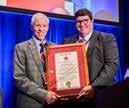
CDR Lewis E. “Lew” Hoyt (Beta Sigma–Southern California ‘62), August 10

CDR Frank J. Weisser (Sigma Beta Commission–USNA ‘22), August 10
Accolade for Interfraternal Service

Mitchell B. “Mic” Wilson, August 11
Executive Director Emeritus, Kappa Sigma Fraternity Member of Kappa Sigma Fraternity
Knight Commander’s Commendation

Faculty Advisor of the Year

Michael Woodson, August 11 Delta Omega–Baylor University
Zachary C. “Zach” Burks (Beta Tau–Mississippi State ‘20), August 10

Award for Fraternal Excellence


Anna Edwards, Ph.D., August 11
Associate Vice President for Student Life, University of South Carolina Member of Kappa Kappa Gamma
Anne Strickland, August 11 Director of Student Engagement, Rhodes College Member of Alpha Delta Pi
The Risk Management Policy of Kappa Alpha Order consists of expectations that shall apply to all entities and all levels of membership. Compliance with this policy may result in a safer fraternity experience. If members choose not to comply with the policy and expectations, the Order may impose sanctions for non-compliance. Additionally, all members are expected to follow all applicable federal, state, county, parish, and municipal laws and institution of higher education policies. Provisions of the Risk Management Policy are below:
Certificate of Service


Blake E. Benney (Gamma Lambda–North Texas ’86), August 10
Jeffrey W. “Jeff” Love (Epsilon Rho–Purdue ‘86), August 10
Certificate of Honor

J. Mason McCauley (Alpha Theta–Transylvania ’04), August 10
Brent Ellis (Gamma Pi–Florida Southern ’99), August 11
Alex van de Berg, Jr. (Gamma Eta–Florida State ’13), August 11
1. The possession, sale, use and/or consumption of alcoholic beverages while on chapter premises, or during a fraternity event, in any situation sponsored or endorsed by the chapter, or at any event an observer would associate with the fraternity, must be in compliance with any and all applicable laws of the state, county, parish, city and institution of higher education, and must comply with either BYOB or Third Party Vendor guidelines.
2. No alcoholic beverages may be purchased through or with chapter funds nor may the purchase of same for members or guests be undertaken or coordinated by any member in the name or on behalf of the chapter. The purchase or use of a bulk quantity or common sources of such alcoholic beverage, for example kegs, or cases are prohibited.
3. Open parties, without specific invitation, where alcohol is present are prohibited. Open parties have been defined as those functions at which the guest to member ratio exceeds three-to-one.
4. No chapter members, collectively or individually, shall purchase for, serve to, or sell alcoholic beverages to any minor (i.e., those under the legal “drinking age”).
5. The possession, sale and/or use of any illegal drugs or controlled substances by a member are strictly prohibited.
6. No chapter may co-sponsor an event with a distributor of alcohol, charitable organization or tavern (tavern defined as an establishment generating more than half of its annual gross sales from alcohol) where alcohol is given away, sold or
otherwise provided to those present. This includes any event held in, at, or on the property of a tavern, as defined above, for the purposes of fundraising. However, a chapter may rent or use a room or area in a tavern, as defined above, for an event held within the provisions of this policy, including the use of a third party vendor and guest list.
7. No chapter may co-sponsor or cofinance or attend or participate in a function where alcohol is purchased by any of the host chapters, groups or organizations.
8. All recruitment or rush activities associated with any chapter will be non-alcoholic. No recruitment or rush activities associated with any chapter may be held at or in conjunction with a tavern or alcohol distributor as defined in this policy.
9. No member or pledge/associate/ new member/novice shall permit, tolerate, encourage or participate in “drinking games”.
10. No alcohol shall be present at any member awaiting initiation/pledge/ new member program or activity of the chapter. This includes, but is not limited to, activities associated with “bid night”, “big brothers - little brother” events or activities, “family” events or activities and initiation.
No chapter, student or alumnus shall conduct nor condone hazing activities. Permission or approval by a person being hazed is not a defense. Hazing activities are defined as: “Any action taken or situation created, intentionally, whether on or off fraternity premises, to produce mental or physical discomfort, embarrassment, harassment or ridicule. Such activities may include, but are not limited to, the following: use of alcohol; paddling in any form; creation of excessive fatigue; calisthenics, physical and psychological shocks; use of pledge books or signature books, quests, treasure hunts, scavenger hunts, road trips or any other such activities carried on outside or inside the confines of the chapter house; wearing of public apparel which is conspicuous and not normally in good taste; engaging in public stunts and buffoonery; morally
degrading or humiliating games and activities; and any other activities which are not consistent with fraternal law, ritual or policy or the regulations and policies of the educational institution.”
The fraternity will not tolerate or condone any form of sexist or sexually abusive behavior on the part of its members whether physical, mental or emotional. This is to include any actions, activities or events, whether on chapter premises or an off-site location which is demeaning to women or men, including but not limited to verbal harassment and sexual assault by individuals or members acting together. The employment or use of strippers, exotic dancers or similar, whether professional or amateur, at a fraternity event as defined in this policy is prohibited.
1. Calling 911 to contact the appropriate first responders is the first action a member or members should take in the event of an emergency, or if any person appears to be in need of immediate medical assistance.
2. All chapter houses shall, prior to, during and following occupancy, meet all local fire and health codes and standards.
3. All chapters must have posted by common phones and in other locations emergency numbers for fire, police and ambulance and should have posted evacuation routes on the back of the door of each sleeping room.
4. All chapters shall comply with engineering recommendations as reported by the insurance company or municipal authorities.
5. The possession and/or use of firearms, archery equipment, incendiary devices such as fireworks or explosive devices of any kind within the confines and premises of the chapter house are prohibited.
6. Pets are not permitted in any chapter house, lodge or facility.
7. Permanent or make-shift pools are not permitted at any chapter
house, lodge or facility.
8. Make-shift or temporary builds or structures are prohibited, provided, however, that they may be approved if the procedures are followed in the Special Events section, Part 3.
Special events are defined as any event/function (1) where alcohol will be present, and the guest to member ration exceeds three-to-one; (2) involving athletic events or competitions; or (3) that involves any activity that is deemed to be potentially hazardous by the Alumnus Adviser, the Alumni Advisory Committee, the Province Commander, the Executive Director, or the Order’s insurance broker. Any chapter wishing to host a special event must do the following:
1. Complete a comprehensive, written description of the event and forward it to the Province Commander and the Executive Director for review and approval. This information must be received by the Executive Director at least 60 days prior to the event; and
2. Secure a Special Events Insurance Policy (“Policy”) or pay a risk management assessment fee in an amount to be determined by the Order’s insurance broker. If the Policy option is selected, the Policy shall be in the amount of $1,000,000 available through the Order’s insurance broker and shall name Kappa Alpha Order, a Virginia Corporation, as an additional insured.
Each Active Member and Member Awaiting Initiation should be instructed annually on the Kappa Alpha Order Risk Management Policy. A copy of the Risk Management Policy shall be available on the fraternity website.


Pursuant to Article 7, Section 116, of the Order’s Bylaws, Knight Commander King V. Aiken, Jr., following the Convention, has appointed the following Province Commanders to serve until 2025. New appointments are noted with an asterisk, with bios below.
He would like to thank Dr. Joel Nickles (Delta Sigma–Houston Baptist ’74) for his service as the inaugural Commander of Duncan Province. Dr. Nickles has relocated to Alabama. He would also like to thank William H. Skipper (Delta Tau–Francis Marion ’80) for his service as Commander of Frampton Province.
Bios for all province commanders can be found at KappaAlphaOrder. org/Leadership.
Appointments as of September 29, 2023.
Samuel Zenas Ammen Province
Darron E. Franta
Henry C. Chiles Province
M. Tyler Griffin
William B. Crawford Province
Hon. P. Michael Ruff
J. Michael Duncan Province
Travis B. Lacox*
W. Elliott Dunwody Province
E. Preston Pritchett III
Richard T. Feller Province
Gregory R. Singleton
Idris R. Traylor, Jr. Province
Collin B. Taylor
W. McLeod Frampton, Jr. Province
See below
John L. Hardeman Province
Edmund H. Wilson
Emmett Lee Irwin Province
Hunter M. Lipscomb
Howard P. Locke Province
H. David Pinson
Daniel R. Neal Province
Douglas W. Hanisch
Ed Chambers Smith Province
Dustin G. Brann*
Horace H. White Province
Matthew D. O’Neal
As of publication time, Knight Commander Aiken had appointed Matthew T. Mandeville (Beta Rho–Roanoke ’12) as Frampton Province Commander and Nicholas S. Palmer (Delta Lambda–Middle Tennessee State ’04) as Feller Province Commander, following Greg Singleton’s resignation. This news will be covered in the next issue and is available at KappaAlphaJournal.com.

Appointed September 9, 2023
Travis B. Lacox
Gamma Tau–Sam Houston State '00 Duncan Province Commander
As an undergraduate, Travis held multiple offices and was Recruitment Chair. He graduated with a Bachelor of Science degree in Criminal Justice in 2004 and a Master of Science degree in Leadership and Management in 2011.
From 2006 to 2020, Travis was an officer with the College Station Police Department. He was on the SWAT team for more than 10 years with the last three as the team leader for the team. Travis completed his career as a supervisor of the special investigations’ unit and person’s crimes for the College Station Police Department. Due to his response to the August 13, 2012, tragedy in College Station, Texas, Travis was presented with the Law Enforcement Achievement of Valor from the Texas Commission on Law Enforcement, the Congressional Badge of Bravery from the United States Congress, and Kappa Alpha Order’s Knight Commander’s Medal,
In 2016, Travis and his wife, Tracy, founded TNT Security Solutions, LLC, and BadgeHire, LLC, in May 2020.
Travis has been inducted into the Duncan Court of Honor and has served as Seargent of Arms for the 78th, 79th, and 80th Conventions. He is a member of the Loyal Order and a 6-year member of the KAOEF’s Crimson & Gold Society.
Travis and his wife, Tracy, live in Franklin, Texas, and have two children, Avery and Levi.

Appointed September 9, 2023
Dustin G. Brann
Alpha Omega–North Carolina State '11 Smith Province Commander
As an undergraduate, Dustin served his chapter as philanthropy chair, alumni relations chair, and Number IV for three terms. He graduated with a Bachelor of Science in Agricultural Business Management and Agricultural and Environmental Technologies in 2012.
After graduation, Dustin worked for the National Administrative Office from 2013 to 2016, serving as an Associate Director for Chapter Development then as Director of Leadership Education.
Dustin is currently the corporate Senior Product Manager for National Carwash Solutions, North America’s largest equipment, service, and cleaning solutions provider in the car wash industry. He currently serves as President of the North Carolina Professional Carwash Association.
Dustin has served as chairman of the Alpha Omega Chapter Alumni Advisory Committee, he is a member of the Loyal Order and the 1865 Trust and is a 10-year member of the KAOEF’s Crimson & Gold Society. He has been inducted into the Candler, Duncan, Hamilton, and Smith Courts of Honor.
Dustin and his wife Katie Anne live in Roxboro, North Carolina.

Appointed February 20, 2024
PINSON STEPS DOWN; VASCELLARO TAPPED
Locke Province Commander Dave Pinson (Epsilon Zeta–Arkansas Tech ’00) recently resigned and pursuant to Article 7, Section 116, of the Order’s Bylaws, Knight Commander King V. Aiken, Jr., appointed F. Jerome Vascellaro to serve effective February 20.
As an undergraduate, Jerome served his chapter as Number I, Number V, Recruitment Chair, and IFC representative. He graduated in 1999 with a Bachelor of Science in journalism and broadcasting, with a minor in marketing.
Upon graduation, he worked for the National Administrative Office, serving as an Educational and Leadership Consultant, a Chapter Development Consultant, and Director of Educational Programming.
Jerome has been in the medical field both on the pharmaceutical/biotech and hospital sides of the business. He has served in various leadership roles on local, regional, and national levels in sales training and development and management of highperforming sales teams. He is currently the Director of Business Development for Select Specialty Hospital.
Jerome has been inducted into the Locke Province Court of Honor. He and his wife, Melinda, live in Tulsa, Oklahoma, and have two children, Jordyn and Joey.

The Kappa Chapter at Mercer University celebrated its 150th anniversary over the weekend of November 10 and 11, 2023.
On Friday evening, after a welcome from J. Douglas “Doug” Dunwody ’77, more than 360 brothers and guests celebrated with cocktails, live music by Anita and the Party Life Band, and a silent auction at the Idle Hour Country Club in Macon, Georgia.
On Saturday, a program at Newton Chapel was held with more than 200 attendees. Number I Tysen Reece Dougherty ’20 welcomed everyone and gave an update on the chapter. Proclamations were presented to Kappa Chapter on behalf of Mercer University and the city of Macon. Finally, Executive Director Larry Stanton Wiese (Gamma Omega–Midwestern State ’87) introduced Knight Commander King V. Aiken, Jr.
(Kappa–Mercer ’83) who gave a state of the Order address and conferred the Knight Commander’s Accolade upon Lee P. Oliver III (Kappa–Mercer ’86).
Following the program of events, a tour of the old chapter room was given, and more than 400 people enjoyed a tailgate before the Mercer vs. Samford Homecoming Football Game.
It was announced that the “Dunwody/Aiken Chapter Endowment Fund” was established through the Kappa Alpha Order Educational Foundation to provide funding for scholarship and leadership education, and a Kappa Chapter Sustainability Fund reached $38,000 with donations from the weekend to help support recruitment efforts.

DATE: Sunday, October 1, 2023
INDUCTEES: 22 Men (60 as of 5/30/24)
LOCATION: Hall Meeting Room of The Ohio Union

DATE: Wednesday, October 4, 2023
INDUCTEES: 38 Men (52 as of 5/30/24)
LOCATION: Kirkbride Lecture Hall
At the time of publication, the provisional chapters at University of North Alabama and Kansas State University had been established and the Delta Alpha Chapter at Western Carolina University and the Epsilon Sigma Chapter at the University of West Florida had been rechartered. This news will be covered in the next issue and is available at KappaAlphaJournal.com.
Notes & Recognition


At the 2023 People’s Choice Awards, The Chamber of Commerce, Serving Lexington, Buena Vista, and Rockbridge County, Brent Buswell (Beta Eta–Oklahoma ’08), Director of Communications, was named Volunteer of the Year for his volunteer leadership in numerous organizations, including with the Lexington-Rockbridge Jaycees, Virginia State Jaycees, and for the United States Jaycees (JCI USA). Additionally, he is a Past Master and current Treasurer for Mountain City Masonic Lodge No. 67, and is also Treasure for Rockbridge Royal Arch Chapter No. 44 and Moomaw Commandery No. 27. He continues to serve as the volunteer Director of Finance for the Fraternity Communications Association, a national industry association.
On December 6, 2023, KAOEF Director of Development Tanner L. Gellinger (Zeta Omicron–Southern Indiana ‘12) completed the Certificate in Fund Raising Management (CFRM) through The Fund Raising School on Indiana University–Purdue University Indianapolis campus. This is the professional development arm of the IU Lilly Family School of Philanthropy. Courses included Principles & Techniques of Fundraising, Developing Major Gifts, Planned Giving: Getting the Proper Start, and Fundraising Campaigns: From Capital to Comprehensive.
More importantly, Tanner married Jackie Hackett, on October 22, 2023, with a large KA contingent in tow. Jackie,a member of Sigma Sigma Sigma, is the Assistant Executive Director for Sigma Alpha Mu Fraternity.
On May 13, Anthony M. Graziani (Zeta Pi–Florida Gulf Coast ’07), Assistant Executive Director for Chapter Services, graduated from Texas A&M University’s Bush School of Government and Public Service, earning an Executive Master of Public Service and Administration, Nonprofit Management. For the past two years, Anthony has attended the Bush School, which is ranked in the top 10% of public affairs programs in the nation by U.S. News and World Report.
Additionally, Anthony was recognized for his ten years of service to the Order and the Greek movement by the Fraternity Executives Association at its 2023 Annual Meeting in May.
After more than seven years as Director of Annual Giving and Stewardship for the Kappa Alpha Order Educational Foundation, Aaron D. Masey (Epsilon Eta–Virginia Tech ‘17) departed the National Staff to pursue another opportunity at Washington & Lee University. He and his wife, Katie, are the parents of James and Bailey and will continue to reside in Lexington.
Emsuring the future of Kappa Alpha Order


Brian Roberts (Alpha Kappa–Missouri ’97)
• Knight Commander’s Circle, Crimson & Gold Society ($5,000 annually or more)
• KAOEF Sponsor, 2024 Number I’s Leadership Institute
• Loyal Order No. 3964
Brian began building his financial services practice more than 20 years ago. After great success, Brian was afforded the opportunity of a lifetime to become CEO of Synergy Wealth Solutions, which has become one of the larger offices in the MassMutual system with over 200 advisors, staff, and brokers covering a five-state region.
He and his wife, Kylee, have two amazing children, Kendall and Brock. They love spending time hunting on their farm or boating at their lake house. They created two foundations for charitable giving scholarships so that two candidates a year can go to college. Brian loves coaching, mentoring, and spends his time volunteering as a youth coach. He also serves on the Board of Fellowship of Christian Athletes and administers a Servant Leadership Program.
My favorite memory as a KA was my sophomore year during a social event named Mint Julip when I lavalliered my girlfriend, Kylee Hiatt. I remember all our brothers grabbing a knee to serenade her. The look on her face and tears in her eyes cemented to me that she was the one, and we were going to eek the most out of our college experience. That was the beginning of many great memories ahead for us. Kylee went on to become the KA Rose for our Sophomore and Junior year. I proposed to Kylee our junior year with twenty of my pledge brothers and brothers in Keystone, Colorado. We have been married 24 years this year.
Why do you give back to the KAOEF and KA through the
Kappa Alpha provided me a strong sense of community and belonging, it made the University of Missouri feel like a smaller place. I want to give back to support the organization that played a significant role in my life. I am grateful for the

experiences, friendships, and opportunities I’ve gained through KA. I feel a sense of duty to uphold the traditions and ensure our fraternity continues to thrive for future generations. My fraternity connections helped me tremendously in my career and personal life. Giving back is a way for Kylee and I to invest in the Kappa Alpha’s future success and the continued growth of its network. I believe that involvement in a fraternity can foster personal growth and development in various ways. We give back to provide current members with similar opportunities for growth and development that I was able to benefit from. Overall, we choose to give back to Kappa Alpha because of our feelings of loyalty, gratitude, tradition, and a desire to support its ongoing success and impact.
I would wish for them to develop strong leadership skills, integrity, and a sense of responsibility. May they lead by example and positively influence those around them, both within their fraternity and in their broader community. Ultimately, my wish for a younger fraternity brother would be for them to lead a fulfilling and purposeful life, guided by values of integrity, compassion, and service to others.
Your KA Scoreboard
The National Football Foundation & College Hall of Fame (NFF) recently announced that George A. Langhammer (Alpha Tau–Hampden-Sydney ‘22), the punter for the Hampden-Sydney College football team, has been named a semifinalist for the 2023 William V. Campbell Trophy. The award recognizes an individual as the absolute best football scholar-athlete in the nation for his combined academic success, football performance, and exemplary leadership.
A six-time Dean’s List honoree, George is a senior majoring in foreign affairs with a minor in Spanish. He is a member of the Honor Court, Phi Beta Kappa, Omicron Delta Kappa, The Alexander Hamilton Society, The Wilson Center for Leadership in The Public Interest, and The Society for
Collegiate Journalists. He holds leadership roles include being a Senior Rhetoric tutor, a three-year member of the Honor Court, Section Editor for the student newspaper, a founding member and former President of Phi Alpha Delta-Professional Law Fraternity, Orientation and Service Leader, and a tour guide for the Office of Admission. He has weekly mentored a local elementary school student, shadowed in the local hospital, and participated in numerous volunteer service projects.
George entered this season with a 40.1-yard career punting average on 53 punts in 21 games. He has six career punts longer than 50 yards, including a career-long of 67 yards. Photos courtesy of Hampden-Sydney Athletics.


Fratres Usque Ad Aram Fideles
E.

It is my sad duty to inform you that John Elzie Simpson III (Gamma Chi–Texas Tech ’67) passed away on August 3, 2023, just one day after celebrating his fiftieth anniversary with his wife, Carolyn Byrd Simpson. He attended Texas Tech University and then Texas Tech University School of Law. Simpson was the first in his family to receive a college and graduate degree.
Simpson spent 49 years with his law firm that eventually became Splawn Simpson Pitts. He was appointed to the American College of Trial Lawyers and the American Board of Trial Advocates. He received the Distinguished Service Award from the Texas Tech School of Law and the James E. Denton Distinguished Lawyer Award from the Lubbock Area Bar Association. In 2003, the Supreme Court of Texas appointed John to serve as member of the Texas Board of Law Examiners, and he chaired it from 2008–2013. As an avid golfer, John led the Hillcrest Country Club Board of Directors from 1987–88. He had served as chair of the Staff Parrish committee at First United Methodist Church.
Simpson served as a KAOEF Trustee from 1995 to 2000. In 1986, then-Knight Commander Idris R. Traylor, Jr., awarded him the Knight Commander’s Accolade. On August 12, the 80th Convention adopted a resolution expressing sadness for the loss of this dedicated and loyal servant of the Order.

Richard H. “Dick” Truly (Alpha Sigma–Georgia Tech ‘56), a pioneer of space exploration and the first astronaut to fly in space aboard two different spacecraft, passed away on February 27, 2024, at the age of 82. Born in 1937, Truly’s legacy in the realm of aerospace is monumental. As a NASA astronaut, he piloted the Space Shuttle Columbia on its maiden voyage in 1981 and later commanded the Space Shuttle Challenger. His dedication to the space program continued as he served as NASA’s Associate Administrator for Space Flight and later as the Director of the Johnson Space Center. Truly was a recipient of the Order’s Distinguished Achievement Award in 1991.

Stephen “Steve” Eugene Foster of Gassaway, West Virginia, passed away on June 15, 2023, at Pont Du Hoc in Normandy, France. He was 74. Steve graduated from West Virginia Wesleyan College where he met and married Kathryn Elaine Hammond. He started a career with Union Carbide in sales and marketing that lasted over twenty years. He finished his career as the Economic Development Director of Upshur County, West Virginia, where he became re-involved with KA and the Beta Chi Housing Authority as president. He oversaw a renovation of the dilapidated chapter house following the chapter closure and worked with the National Staff during the successful re-chartering of the chapter in 2007. In 2009, he became Hamilton Province Commander, serving until 2017.
With a deep reverence for the sacrifices made on the beaches of Normandy almost 80 years ago, Steve had organized a trip for his family. His father Frank had entered Europe via Utah Beach, and then fought through France and into Belgium. It was one of Steve’s greatest wishes to share the impact of those events that changed the course of history with his family. To this end, he was successful, and also added a new layer of honor to the land.
He was a member of the Hamilton and Ammen Courts of Honor, the Loyal Order, and a 10-year member of the KAOEF Crimson & Gold Society. He was also a donor to the Sesquicentennial Campaign. In 2017, he received the Knight Commander’s Accolade by then Knight Commander Darren S. Kay.

Dr. Kent Lee Gardner (Gamma Kappa–Oklahoma City '60) passed away at his home after a lengthy illness on August 31, 2023. He was 82.
Kent was born June 17, 1941, in Lawton, Oklahoma. He earned a bachelor’s degree from Oklahoma City University where he joined the Gamma Kappa Chapter and was manager of the Men's Basketball team. He earned a master’s degree from Oklahoma State University and his Doctorate degree from the University of North Texas.
Kent was a history teacher, coach and counselor in the Stillwater, Oklahoma, school system from 1963 to 1967 where he coached the Pioneers to a State Golf Championship. He came to the University of Texas at Arlington in June 1967, as an Assistant to the Dean of Students, ultimately, retiring as Vice President of Student Affairs in 2005. He received numerous awards for his university and fraternity/sorority involvement and influenced countless others through their lives.
In 1971, Dr. Gardner also assumed the role of National President of Order of Omega formed to recognize fraternity and sorority men and women for their excellence and service to their campus and communities. He inherited a box of ten file folders from chapters and a checkbook with a balance of $97.00. He leaves a legacy today of an international headquarters in Arlington, Texas, a professional staff, an active Board of Directors and almost 600 chapters across the United States and Canada. The organization has awarded over $2 million in scholarships and fellowships to members of Order of Omega. He served as President from 1971–1984, was named Executive Director, and served until 2012, when he was named Executive Director Emeritus.
Kent was a recipient of the Order’s Accolade for Interfraternal Service in 1985 and the North American Interfratenty Conference’s Silver Medal in 2009. He was a member of the Oklahoma City Alumni Chapter.
At time of publication, the Order was aware of the passing of Raymond R. “Randy” Beard, former member of the National Staff and recipient of the Knight Commander’s Accolade. He will be honored in the next issue.
Alabama–Alpha Beta
Roger Hugh Bedford, Jr. 1975, 10/11/23
William W. Gentry 1947, 1/23/22
Louis B. Lusk 1951, 7/15/23
Dr. Gary P. Nichols, DMD 1957, 10/3/23
Harris M. Riggs 1958, 2/4/22
W. Pafford Tate 1965, 2/29/24
William R. Windham 1963, 1/14/24
Appalachian State–Delta Psi
Robert K. Rice 1993, 1/20/24
Arkansas Tech–Epsilon Zeta
Perry R. McCourt 1979, 11/30/23
Auburn–Nu
Albert W. Brame 1952, 2/25/22
Jonathan G. Eggena 1989, 1/4/24
Vernon N. Hopkins 1957, 3/25/22
Joseph Vincent Leberte 1949, 3/5/23
William D. Melton 1962, 10/10/23
Albert Alexander Nettles, Jr. 1955, 9/19/23
William B. Reed 1947, 9/14/22
William Cornelius Shelor, Jr. 1960, 12/15/23
Baylor–Delta Omega
David R. Black 1976, 12/27/23
Terry W. Murphy 1976, 1/21/24
Bethany–Beta Beta
John W. Gordon III 1950, 8/18/23
Birmingham-Southern–Phi
John Bigham Barnett III, Esq. 1971, 11/11/23
George G. Smith 1957, 12/3/23
Paul T. Vaughan 1900, 11/3/22
California–Alpha Xi
George L. Marchand 1955, 2/24/24
Charles R. Moll 1961, 10/27/23
Dennis W. Shimek 1958, 7/15/23
California-Riverside–Epsilon Epsilon
Daniel N. Yates 1978, 9/2/22
Centenary–Alpha Iota
Richard D. Liles 1980, 7/17/23
Charleston–Beta Gamma
Douglas W. Bostick 1975, 10/24/23
Citadel–Theta Commission
Dr. Ronald Calhoun Fulmer 2015, 1/20/23
Thomas Clark Henderson 2021, 6/14/23
Richard G. Howard 2015, 4/7/22
John Elford Morgan 2021, 7/8/23
CPT Harold Woodliff Sanford 2015, 7/13/23
1LT Michael Forrester Warren, MD 2021, 9/30/23
Clemson–Delta Omicron
John C. Higgins III 1973, 12/24/23
Joseph M. Pazdan II 1979, 4/28/23
William D. Thrailkill 1970, 6/2/23
Davidson–Sigma
S. Powell Bridges 1951, 8/7/22
John Arthur Nix JD 1956, 8/18/22
James H. Rollins 1963, 7/15/22
Dr. Robert Felts Sloop, Jr. 1953, 3/3/24
Delaware–Beta Epsilon
Dr. Frederick T. Lewis 1948, 3/13/22
Dr. Lee P. McMaster 1961, 2/8/24
Thomas C. Palmer 1966, 2/22/22
Capt James S. Roberts 1951, 10/22/23
Chester J. Stachecki, Jr. 1959, 2/29/24
Delta State–Delta Beta
Frank Word Burdine 1967, 8/28/23
Drury–Beta Iota
LTC Ronald W. Lumpe 1958, 3/28/22
Duke–Alpha Phi
Robert D. Frye 1946, 3/2/24
Douglas M. Lehman 1993, 9/12/23
Houston Dillon Smith III 1985, 1/18/22
East Carolina–Gamma Rho
James K. Kennon 1991, 7/14/23
Joel D. Wheeler 1967, 3/12/22
Eastern Kentucky–Delta Mu
David A. Etheredge 1971, 1/17/22
Emory–Epsilon
Dr. James Paul Ferguson 1956, 5/9/23
Dr. Jerome Worth Lynn, Jr. 1956, 1/13/24
Dr. Michael E. Morris 1988, 8/24/23
Dr. W. Lanier Pearce 1955, 12/20/23
Frank Cushman Tindall, Jr. 1949, 10/22/23
Florida–Beta Zeta
Edward A. Andrews 1952, 6/1/23
Richard D. Barker, Jr. 1951, 7/21/23
Dr. Henry G. Breitmoser, Jr. 1961, 8/23/23
Thomas A. Davis 1957, 12/28/22
Glenn K. Dickman 1953, 8/11/23
Richard M. Kane 1983, 11/25/23
Robert L. Manly 1955, 1/1/24
Walter R. Stedeford 1956, 9/29/23
Reuben S. Williams III 1950, 6/15/23
Florida Southern–Gamma Pi
John J. Matz 1958, 8/16/22
Florida State–Gamma Eta
Aleck T. Alissandratos 1980, 6/12/23
William R. Lawson 1958, 1/21/24
William T. Snyder, Jr. 1956, 1/13/24
Florida State–Gamma Eta
Richard Allan Weidner, Jr. 1985, 6/22/23
Georgetown–Beta Delta
Robert A. Sarver II 1966, 6/1/23
Georgia–Gamma
Don A. Bomgardner 1953, 1/30/24
Cornelius B. Davis 1949, 7/25/22
Geoffrey L. Gray 1965, 12/12/23
Hollis Olin Hackney, Jr. 1965, 6/6/24
Stephens Gary Hobby, Jr. 1989, 2/15/24
Robert Edward Knox, Jr. 1963, 1/4/24
Francis M. Oliver III 2009, 2/6/24
Grayson Candler Powell, Jr., USAF (Ret.) 1945, 7/24/23
Neal H. Ray 1962, 8/26/23
Albert F. Shelander, Jr. 1974, 10/13/23
Robert Long Stewart, Jr. 1972, 2/9/24
Thomas M. Vinson III 1961, 6/24/23
Georgia College–Epsilon Nu
Brian H. King 1986, 7/8/23
Georgia Southern–Delta Theta
Julian Jordan Kight 2011, 2/1/23
Georgia Tech–Alpha Sigma
Thomas Augustine Barrow, Jr. 1945, 1/6/24
Thomas M. Childs 1959, 6/29/22
Marcel Frederick Dastugue III, CMA 1958, 12/21/22
William J. Demetree 1962, 12/30/23
Robert D. Hayes 1961, 9/30/23
VADM Richard H. Truly, USN (ret.) 1956, 2/27/24
Charles M. Valentine, Jr. 1956, 3/15/23
Hampden-Sydney–Alpha Tau
Dr. Virgil Atwell Motley, Jr. 1948, 10/10/22
Kentucky–Theta
COL Calvin E. Barwick 1958, 1/23/22
Robert W. Byington 1956, 5/8/23
Richard N. Grimes 1952, 11/20/23
William Thomas Isaac II 1985, 2/17/24
William A. Perry 1967, 10/9/23
William H. Russell 1963, 6/13/23
Terry D. Trovato 1962, 11/16/23
Lambuth–Gamma Omicron
Jan Fulenwider 1968, 1/16/23
Fletcher L. Groves III 1969, 6/2/22
John R. Hardesty 1973, 2/27/23
Louisiana State–Alpha Gamma
Dr Robert Worden Dougherty, Jr., PhD 1963, 11/22/23
James Edward Fagan III 1968, 7/10/23
*Deceased list includes those reported through March 22, 2024. Fratres Usque Ad Aram Fideles
Luke L. Falgoust 2019, 9/5/23
Wellborn Jack, Jr. 1955, 4/4/23
Kenneth W. Roberts 1984, 2/21/24
Oscar Menees Thompson III 1967, 2/25/24
Louisiana-Lafayette–Gamma Phi
G. Michael Beduze 1972, 1/3/24
John A. Boatner 2007, 10/8/23
Edward E. Chase 1963, 10/22/22
Edwin Randolph Soulier 1968, 7/23/23
Louisiana-Monroe–Gamma Nu
Andrew J. Cascio 1975, 8/18/23
Carroll H. McLean 1958, 7/11/22
Jody K. Sebren 2010, 12/4/23
Louisville–Beta Omicron
James P. Long 1947, 10/22/23
Marshall–Beta Upsilon
John B. Koehler 1956, 7/4/23
Maryland–Beta Kappa
Paul G. Sykes 1959, 9/3/22
James E. Sylvanus 1951, 12/26/23
McNeese State–Delta Xi
Don M. Cline 2001, 9/20/23
Ronald S. Crain 1972, 7/2/22
Anthony F. Whitford 1976, 1/25/24
Memphis–Gamma Gamma
James G. Buchanan 1958, 10/1/23
Thomas Clyde Ford 1957, 3/8/24
COL Edward T. Ladd, Sr. USAF 1956, 2/14/24
Mercer–Kappa
Benjamin Garrett Bodne 2021, 9/8/23
Ralph Lamar Brantley, Jr. 1960, 8/2/23
COL G.L. Dozier, Jr., USAF (Ret.) 1962, 8/1/23
A. Byron Gilbert 1962, 9/27/22
Emory Speer Heyward, Jr. 1960, 1/1/23
Peter T. Mullady 1986, 7/7/23
Henry Wilder Smith, Jr. 1964, 9/19/23
Wilton Vernon Tanner, Sr. 1957, 12/20/23
Univ. of Miami–Gamma Theta
Bobby D. Carlton 1955, 2/6/22
Univ. of the South–Alpha Alpha
Richard Richard Hogan 2016, 2/1/24
Middle Tennessee State–Delta Lambda
W. Ronald Hosse 1970, 1/14/22
Thomas E. Roddy 1969, 12/17/23
Darren J. Scoggins 1994, 12/16/23
Millsaps–Alpha Mu
Leon McClung Bailey, Jr. 1966, 4/25/22
William Hollis Leech, Sr. 1975, 6/4/23
Mississippi–Alpha Upsilon
Walter M. Denny 1954, 7/16/23
Samuel B. King 1970, 11/5/23
Brad E. Mallette 1993, 5/8/23
Frank Jordan Reilly, Jr. 1951, 8/16/23
James L. Robertson 1959, 12/10/23
Alex Roy 2013, 11/20/23
Mississippi State–Beta Tau
Clarence D. Blaine 1959, 12/13/23
John F. Grafe 1963, 1/22/22
Richard D. Murphy 1966, 3/8/24
William H. Robbins 1951, 8/22/23
Frank E. Stubbs 1958, 12/31/23
Missouri–Alpha Kappa
Lance Kyle Baker 2009, 2/2/24
Richard P. Benkelman 1958, 7/6/23
Kyle W. Cook 1981, 8/26/23
Joseph William Dellastatious 1943, 11/6/23
Charles Jacob Hoffman, Jr. 1947, 2/10/24
Missouri S&T–Beta Alpha
Gerold D. Woodring 1969, 6/29/23
Missouri Southern State–Delta Pi
Arron N. Coots 1992, 2/21/24
Axel F. Hartman 1992, 7/11/23
1SG Michael T. Rogers (Ret.) 1980, 10/1/23
Missouri State–Gamma Beta
Harry R. Baker 1951, 12/10/23
Scott C. Mitchell 1982, 7/15/23
Ralph C. Tinnin 1959, 11/18/23
Murray State–Delta Nu
Dennis C. Arndt 1971, 6/6/23
Ronnie C. Marshall 1970, 1/30/23
New Mexico–Beta Phi
William Shober Seese 1951, 2/8/22
Newberry–Delta Epsilon
John A. Ferguson 1968, 8/20/23
William B. Lorick 1966, 10/23/23
Nicholls State–Epsilon Beta
Burnell Stephen Sens II 1997, 1/22/24
North Carolina–Upsilon
James Toole Fain III 1966, 6/7/23
Robert L. Kirby 1957, 1/10/24
Dr. Marvin William Lee, Sr. 1943, 10/19/23
Daniel Thaddeus Perry III 1964, 9/2/23
Charles T. Spruill 1971, 9/12/23
Greg A. Stewart 1987, 7/11/23
North Carolina State–Alpha Omega
James L. Griffin III 1959, 10/27/23
W. Emerson Teer 1996, 4/27/23
G. Vincent Wyche II 1973, 2/2/24
North Carolina-Wilmington–Epsilon Psi
Eric G. Wondergem 1990, 6/10/23
North Texas–Gamma Lambda
Thomas E. Dalton PhD 1957, 5/13/23
Carl W. Yarbrough 1975, 10/1/23
Northwestern State–Gamma Psi
Leonard W. Blanton, Jr. 1963, 9/5/23
Wilbur E. McKee 1973, 9/12/23
Andrew J. Pontz 1963, 12/12/22
Hollis R. Waller 1969, 7/31/22
Oklahoma–Beta Eta
Matthew B. Bachman 1997, 2/26/24
James R. McCasland 1958, 10/7/23
Oklahoma City–Gamma Kappa
Dr. Kent L. Gardner 1960, 8/31/23
Ted W. Oney 1955, 10/14/22
Oklahoma State–Beta Xi
Frank I. Moore II, PH.D 1957, 2/15/24
Old Dominion–Delta Gamma
Jerry C. Whitehurst 1970, 2/4/22
Presbyterian–Beta Pi
Allen H. Ansley 1953, 6/28/23
John T. Durden, Jr. 1976, 7/27/23
Robert H. Hopkins 1963, 7/2/23
Douglas E. Miller 1961, 1/10/22
Rhodes–Alpha Epsilon
George W. Wilson III 1950, 12/27/23
Richmond–Eta
Rev. Paul Samuel Jones, Jr. 1959, 9/7/23
Roanoke–Beta Rho
Alexander F. Anthony III 1971, 6/21/23
William Doxanas II 1970, 3/28/22
David M. Sable 1973, 2/25/23
Rollins–Alpha Psi
Edwin P. Granberry, Jr. 1947, 8/8/23
R. Dennis Pierce 1974, 3/12/24
Sam Houston State–Gamma Tau
Charles E. Dobbins 1960, 11/23/23
Perry W. Hicks 1987, 9/2/23
Frederick Brian Irvin, Jr. 1985, 2/27/24
South Carolina–Rho
Jerry M. Brennecke 1952, 1/27/24
G. Larry Brown 1951, 4/10/22
Clarence Fletcher Carter III 1956, 8/5/23
Jonathan L. Dieter 1942, 2/10/24
Frank R. Ellerbe, Jr. 1953, 3/6/24
Arthur Lee Gaston 1956, 1/2/24
D. Benjamin Graves 1993, 2/20/24
William G. Hagler 1964, 6/14/23
Otis Clebourne Johnston III 1968, 11/26/23
Hamilton C. Jones, Jr. 1947, 11/21/23
A William Muir II 1967, 2/26/24
Robert C. Parrott 1962, 2/26/22
Southern California–Beta Sigma
Frank E. Fullerton 1965, 2/18/22
John Steven Moseley 1958, 11/22/23
Southern Methodist–Beta Lambda
George Wilbur Beeler III 2000, 2/11/24
Gerry B. Cooper 1972, 1/6/22
Charles J. Hagen, Sr. 1954, 12/11/23
Gavin W. Laurie, Jr. 1952, 1/14/24
Robert L. Trimble 1958, 6/18/22
Southern Mississippi–Gamma Zeta
Garland Braswell 1960, 12/20/23
Lamar R. Taylor 1968, 1/15/24
Jack B. Weldy 1953, 5/10/22
COL Jay W. Woodbeck 1953, 5/6/22
Southwestern–Xi
William C. Fellows 1961, 5/1/22
Stanford–Alpha Pi
CPT Ronald J. Bush 1952, 8/10/22
Myron P. Hollister 1952, 7/23/23
Robert F. Sawyer 1947, 7/14/23
Henry G. Viets 1954, 6/26/23
Stephen F. Austin State–Delta Kappa
Rob R. Wright 1982, 6/25/23
Tennessee–Pi
Bill B. Carpenter 1956, 7/9/22
Charles M. Costello 1966, 11/14/23
Sean P. Deeney 1996, 6/12/23
Raymond K. Doty 1949, 5/22/23
George R. Frazier 1969, 1/8/22
William Campbell Giddings, Jr. 1961, 7/18/23
LaVern C. Reedy 1953, 10/5/23
Christopher G. Stringfield 1991, 9/19/23
Texas–Omicron
John R. Dale 1975, 1/23/24
Thomas Russell Delatour, Jr. 1973, 2/7/24
Earl A. Denney, Jr. 1955, 6/12/23
D. K. Dodson 1963, 1/20/24
Campbell H. Gillespie III 1958, 2/24/24
Dr. Douglas Wayne Robinson 1966, 3/25/22
Texas A&M-Commerce–Gamma Upsilon
John D. Brown 1973, 9/23/23
Larry E. Ferguson 1973, 2/16/24
Tommie D. Rape 1972, 8/2/23
Texas Tech–Gamma Chi
Ronald D. Coffee 1961, 2/27/24
Donald J. Jackson 1961, 2/10/22
James R. Quinn 1974, 12/10/23
John E. Simpson III 1968, 8/3/23
Transylvania–Alpha Theta
Donald H. Combs 1976, 9/15/23
Robert D. Hammet 1972, 10/3/23
David Preston Marthey 1972, 9/6/23
Tulane–Psi
Alvin Schaaf Flettrich, Jr. 1964, 1/4/24
Dr. Peachy Ridgeway Gilmer, Jr. 1951, 6/18/23
Eugene Albert Grasser, Jr. 1961, 3/5/24
Wyatt A. Hassel 1994, 10/13/23
W. Thomas Zander 1959, 1/30/22
Tulsa–Mu
Phillips C. Hall 1951, 8/30/23
Vanderbilt–Chi
John D. Hanes 1962, 1/6/24
Charles Richard Johanson, Jr. 1944, 3/25/22
Fred Rudder Jones, Sr. 1946, 1/25/22
Samuel Proctor McCutchen, Jr. 1947, 3/26/22
Virginia–Lambda
James E. Dunn 1951, 1/27/22
George P. Greenhalgh III 1967, 1/18/24
Virginia Tech–Epsilon Eta
Joel R. Kelly 1985, 3/12/24
VMI–Beta Commission
Jack T. Casey 2019, 2/7/24
Hon. James Wilson Enochs, Jr. 1949, 2/23/24
MAJ Tom Faulkner, Jr. 1964, 11/22/23
Robert L. Green 1967, 9/10/23
Dr. Louis Reams Hundley PhD 1969, 3/26/22
The Rev. Philip Randolph Taylor 1965, 10/26/23
G. Chandler Williams 1968, 4/5/22
Samuel B. Witt III 1958, 7/6/23
Wake Forest–Tau
Joseph Edwin Bullock II 1980, 1/3/24
Howell John Hatcher, Jr. 1952, 1/3/24
Lindsay Stewart Wall, Jr. 1954, 10/27/23
Washington & Lee–Alpha
Michael S. Wyatt 1981, 9/28/23
Washington College–Beta Omega
C. James Holloway, Jr. 1956, 10/12/23
West Texas A&M–Gamma Sigma
James J. Brandt 1965, 9/27/23
Edwin A. Mann, Jr. 1961, 4/11/22
West Virginia–Alpha Rho
Sam R. Fisher 1955, 3/18/22
William D. Harvey 1957, 10/3/23
Neil A. Reed 1951, 6/26/23
Roger G. Roberts 1950, 11/2/22
West Virginia Wesleyan–Beta Chi
Stephen E. Foster 1968, 6/15/23
Charles Sanford Murray 1954, 12/10/23
Frank L. Pile, PE 1961, 6/13/23
Dennis J. Willett 1987, 11/19/23
Western Carolina–Delta Alpha
Kenneth E. Flynt 1968, 6/19/23
Donald V. Morris 1979, 11/27/23
Peter H. Morrow 1970, 7/28/23
Chris M. Reid 2001, 11/1/23
Westminster–Alpha Eta
F. David Barlow 1958, 10/15/23
Edward T. Durant 1969, 10/14/23
Fred D. Farris 1946, 8/2/23
Adam B. Mallette 2008, 6/17/23
William & Mary–Alpha Zeta
Andrew J. Gray 2006, 8/23/23
John Henry Parker, IV 1952, 11/14/23
William Jewell–Alpha Delta
John F. Hensley 1985, 9/2/23
Dr. William V. Miller 1952, 1/8/24
Wofford–Delta
Charles Jackson Bradshaw, Sr. 1955, 5/4/23
Harry L. Johnston 1965, 7/16/23
Acquilla Richard Johnston, Jr. 1960, 6/9/23
Dr. Marshall L. Meadors III 1975, 7/17/23
Rev. Marshall LeRoy Meadors, Jr. 1952, 5/25/23
Kirby Darr Shealy, Jr. 1964, 12/30/23
COL Lee Cole Smith, Jr. USA (Ret.) 1955, 1/21/22

Donald R. Gardner, USMC (Ret.)
GAMMA GAMMA–MEMPHIS 1959
• Loyal Order Member No. 2192
• Inaugural Military Division member, 2009
• Ammen Court of Honor, 2015
• Crimson & Gold Society, 11-year member
• Distinguished Lecturer, Emerging Leaders Academy, 2009, 2016
• Gamma Gamma Chapter, Number VII (Parliamentarian)
A candid conversation with a member of our Order
Who are a couple KAs you still talk to regularly?
The first one is my son Thomas H.C. Gardner (Epsilon Mu–Elon ’90). He’s expecting to inherit my KA paddle and mug and the Challenge Coin that Knight Commander Simmons gave me in Lexington … but he isn’t getting them until I go to Chapter Eternal.
The second one is Kent Horner (Beta Alpha–Missouri S&T ’62). He’s a retired chemical engineer from DuPont. When we retired from the Marine Corps and came to Chester, Virginia, we started attending St. John’s Episcopal Church. He was on the vestry and we quickly developed a strong bond. For the last 30 years we have talked regularly and had lunch almost monthly.
All Marines remember their first Commandant. When I enlisted in 1955, General Lemuel C. Shepherd, Jr. USMC, (Beta Commission–VMI 1917), who I found out later was a KA, was the 20th Commandant of the Marine Corps. I greatly admired him.
General Shepard, long retired, died on August 6, 1990, in La Jolla, California. By then I was a Major General, serving as Deputy Chief of Staff for Requirements and Programs at Headquarters Marine Corps (HQMC) in Washington, D.C.
On the day General Shepherd’s casket arrived at Andrews Air Force Base, I was the HQMC “Duty General” and the Commandant’s representative. Full military arrival honors were given, and then after the trip to Arlington National Cemetery, full military honors again were given, and the committal ceremony was executed flawlessly by the Marine Barracks. Mrs. Virginia Shepherd’s ashes were also buried with her husband that day.
With respect, over the years I have often said, “General Shepherd saw me into the Marine Corps, and I saw him out.”
What are some special memories from being an Active Member?
I think my initiation falls into one of my early memories. The second one is about Mr. Bill or William E. Forster (Gamma Gamma–Memphis ’49), who was the Executive Secretary. I visited the cemetery where he is buried not long back, and paid my respects because he signed my membership shingle and I’ve always remembered him. Finally, she wouldn’t even want me to say this, but my KA sweetheart Elaine, became my KA bride. I used my KA pin for my first serious commitment after I’d worn it for a good while.
What is one piece of advice for all young KAs in the world?
“Remember integrity is your most valuable asset!”
I remembered a quote from my Marine Officer’s Guide, Second Edition (1956), which read, “To All Young Marine Officers, Into Whose Keeping The Corps Is Year By Year Entrusted, ‘Once a Marine, always a Marine...’”
I often rephrased that quote to the following, “To all young KAs, into whose keeping the Order is year by year entrusted, ‘Once a KA, always a KA.’”
While looking for this quote, I realized that General Randolph M Pate (Beta Commission–VMI 1921), 21st USMC Commandant (followed Shepherd), was also a KA, and later Superintendent of VMI. In 1957 he meritoriously promoted me to Corporal.
Given I was initiated in 1959, I supposed I was destined to be a KA.
Commentary relevant to the Order
How fraternity and sorority membership assists with retention on a post-pandemic campus
By Dawn Wiese, Ph.D.
In January 2024, The Chronicle of Higher Education published an article of dismay regarding student engagement and retention on college campuses following the COVID-19 pandemic. One key factor was left out—that of fraternity and sorority life and how it bucks the trend of student disengagement. Dr. Dawn Wiese submitted a letter to The Chronicle’s Editor and it was published. In its original form, it is presented here.
Erin Gretzinger and Maggie Hicks’ article, “Why Campus Life Fell Apart,” recounts post-pandemic student engagement, a key to both retention and graduation. Gretzinger and Hicks failed to note one of the greatest programs which retains college students— including post-pandemic—fraternity and sorority life.
In the Summer of 2020, Ronald Yates, a math professor at the College of Southern Nevada, published an article titled, “Student Involvement and Graduation Rates: A Quantitative Study on the Impact of Adding a Fraternity and Sorority Community at Colleges and Universities in the United States.” As shared by Yates, “The results of this study suggest that the addition of a fraternity and sorority community can have a positive overall influence on student and institutional success.” Yates reviews literature dating back to the 1970s and going well into the 2000s, by such long-time higher education experts as Astin, Kuh, Tinto, Creamer (and Creamer), Pike, Pascarella and Terenzini: students who are engaged both inside and outside the classroom are more likely to stay and graduate. As summarized by Pike and Askew, “fraternities and sororities contribute to the psychological sense of

community that is experienced by students and increases levels of social involvement.”
Testing these works in the late 2010s, Yates affirmed these outcomes in his study revealing that “the addition of a fraternity and sorority community on a college or university campus correlated to a positive impact on graduation rates ... in alignment with Astin’s Theory of Student Involvement and Tinto’s Theory of Student Departure.”
During the pandemic, when colleges and universities worked to continue instruction and manage all new policies and procedures related to student health, national fraternities and sororities remained at work on student engagement. As studied by Ballinger and Workman in “Fraternity/Sorority Organizational Response to the Covid-19 Pandemic,” fraternities and sororities, conducting their business differently, reported that “89% [of national fraternal organizations] believe their relationships with undergraduate chapters remained consistent or grew stronger during the pandemic.” While national organizations may have believed this, participation in fraternity and sorority life post-pandemic, also reflects this work with membership on the increase—not decrease
– with most national fraternities reporting overall positive gains in membership postpandemic, with some as high as 11% greater than prior to the pandemic. This, despite enrollment not having recovered.
One can debate the merits of fraternity and sorority life. It is something I do every day. As a former dean of students and vice president for student affairs and, now, chief operating officer of a captive insurer for men’s social fraternities, I am well-versed in the benefits and drawbacks to fraternity and sorority life. What I definitively know: there is significant value in supporting a healthy, vibrant fraternal community. Such a community, working in partnership with national fraternal organizations, can share in the work of engagement, retaining and graduating students but also in educating in topics ranging from alcohol and other drug use and misuse, hazing, sexual misconduct and more.
The decline in student enrollment and engagement is very real. Also very real: a strong fraternal community retains and graduates students—before the pandemic, during the pandemic, and post pandemic. The numbers tell the story.
Dawn Wiese, Ph.D., is the Chief Operating officer of FRMT, Ltd. She is a former Vice President for Student Life and Dean of Students at Washington & Lee University, a recipient of the North American Interfraternity Conference’s Silver Medal, and the Fraternity Executive Association Award for Fraternal Excellence. She is married to Larry Wiese, the Order’s Executive Director, and they have one daughter, Jill.


“Buster” LaRue Haigler (Alpha Beta–Alabama 1921) began the family tradition when, in 1921, he was initiated by Alpha Beta chapter at the University of Alabama, along with his brothers Charles Brightman Haigler (Alpha Beta–Alabama 1918) and William Larkin Haigler (Alpha Beta–Alabama 1918).
After college, Buster moved home to Hayneville, Alabama, was a successful cattle farmer and businessman, and enjoyed retirement until he died in 1994. Buster’s daughter, Margaret, married William “Billy” Evans Davis (Alpha Beta–Alabama 1952), who served as Number I of the chapter. He also visited Sewanee, or University of the South, while a student and brought home with him the “Highlander Party,” which was a fixture at the University of Alabama for many years.
Billy completed medical school at University of Alabama Medical College and practiced family medicine and pediatrics in Greenville, Selma, and Fairhope, all in Alabama.
Billy and Margaret’s son, Paul Haigler Davis (Phi-Birmingham-Southern ’90), completed a degree in finance and moved to Fairhope, Alabama, where he is now Baldwin County President of TCB Coastal Banking.
Paul’s son, Paul Haigler, Jr. (Nu–Auburn ’21), currently a student at Auburn University, one hundred years after the initiation of his great grandfather LaRue Haigler. Paul Sr. was proud to participate in his son’s initiation, as his own father and grandfather had when he was initiated.
Other men in the Haigler family were members of Kappa Alpha at the University of Alabama include, William Larkin’s son William Lafayette Cottrell “Rueben” Haigler (Alpha Beta–Alabama ’53), Charles Brightman’s son Charles Brightman “Charlie” Haigler, Jr. (Alpha Beta–Alabama ’54), LaRue “Rooster” Haigler, Jr. (Alpha Beta–Alabama ‘63), and Rooster’s son LaRue Haigler III (Alpha Beta–Alabama ‘00). A recent addition to this family, LaRue Haigler IV, gives promise that this proud tradition may continue.
