about time
design report
by Justyna Doherty
MA Design for Change, IADT
design report Justyna Doherty MA Design for Change IADT, 2022
6
sensemaking & futuring for uncertain times
7
RESEARCH DESIGN
PROTOTYPE
TEST
ITERATE
Content 1. Introduction 2. Time – what is 3. Literature 4. Objectives 5. Rationale 6. My research 7. Why futuring? 8. Next steps 9. The barometer 10. Testing phase 11. Conclusions 12. Appendix
10
Introduction
We do not know how to think about the future, about time, or even how to engage with it.
In this dissertation, I wanted to dive into relations between the past and the future; hoping to explore the role of the past in the present, backcasting, and the multidimensions of time. I also wanted to engage with various ways of thinking about time, and find novel ways to do it. My project is called “about time”. The central objective of this dissertation’s research was to explore how design can shape and influence attitudes about the long-term future and how it could affect our behaviours toward the planet and our individual futures. There is something about the human mind; when thinking about the future, we assume that most things will stay similar, and trends will continue linearly. However, the world is changing drastically in front of our eyes, and the speed of changes in the world is unprecedented.
In the next thirty years, the world will change more than in the last ten thousand years; the difficulty is that we are still in the darkness to embrace the “unknown”. We do not know how to think about the future, about time, or even how to engage with it. Thinking about the “collective trauma” which we are all experiencing, because of or as an effect of global warming, and trauma and silencing, which I have experienced personally in my past, I wanted to engage with this element of our human existence as well. I wanted to explore the roots of our resilience as human beings and learn how to embrace uncertainty. Finally, I wanted to dive into the subject of memory and the power of open communication to create and reimagine what we can call a “better tomorrow.”
11
12
Time - what is
he indefinite continued progress of existence and events in the past, present, and future...
I should start this dissertation by defining the subject. However, the definition is so extensive, one cannot hope to cover it all solely within this paper, therefore it will contain some findings that I hope are thought provoking. To start, time in our society can be defined in two main ways: 1. the indefinite continued progress of existence and events in the past, present, and future regarded as a whole. 2. a point of time as measured in hours and minutes past midnight or noon (dictionary.com)
IS TIME A MOMENT? In my belief, we are here on the earth for a moment, but this is only the start of something bigger, an adventure. I somehow believe that an invisible curtain curtails us and that our bodies restrict us in a way from seeing the bigger picture. And now, in this dissertation, I am trying to reach out to see what the bigger picture is—trying to become like a Flammarion from the 1888 book. I am trying to get the answers – I got to the end of the world, sticking out my head to see more, trying to see what is there outside this container we call “time”.
13
14
Time - what is THE MOMENT IS NOT PROPERLY AN ATOM OF TIME BUT AN ATOM OF ETERNITY. Danish philosopher, Kierkegaard, wrote “If time is correctly defined as an infinite succession, it most likely is also defined as the present, the past, and the future. This distinction, however, is incorrect if it is considered to be implicit in time itself because the distinction appears only through the relation of time to eternity and through the reflection of eternity in time.” Kierkegaard’s reflection about eternity in time seem very vivid. We can see the reflections of eternity around us, in friendships, nature, the people we love. To reflect on this experience, M. Popova writes: “this temporal tension between the immediate and the eternal is one of the core characteristics and defining frustrations of the human experience — over and over. We strain to locate ourselves within time, against time, grasping for the solid ground while aswirl in its unstoppable flow” (2021).
No, we can’t stop time as much as we want to. In our attempts, over and over, we are unsuccessful and set ourselves an impossible mission. On the other hand, we realise that all we have is now. Different religions call it in different ways, but apart from the current moment, everything else seems to be an illusion – of either our memory or our minds trying to run forward and predict the flow of things upfront. Kierkegaard frames this tension quite successfully: ”If in the infinite succession of time a foothold could be found, i.e., a present, which was the dividing point, the division would be quite correct. However, precisely because every moment and the sum of the moments is a process (a passing by), no moment is a present, and accordingly, there is in time neither present, nor past, nor future”.
NEVERTHELESS, WHAT DO OTHER PHILOSOPHERS, SCIENTISTS AND THINKERS SAY ABOUT TIME?
Arendt argues that thinking is “our rebellion against the tyranny of time and a hedge against the terror of our finitude.” “From the perspective of the everyday world of appearances, the everywhere of the thinking ego — summoning into its presence whatever it pleases from any distance in time or space, which thought traverses with a velocity greater than light’s — is nowhere. Moreover, since this nowhere is by no means identical with the twofold nowhere from which we suddenly appear at birth and into which almost as suddenly we disappear in death, it might be conceived only as of the Void” (Arendt). According to Arendt, the time continuum, everlasting change, is broken up into tenses: past, present, future. Whereby past and future are antagonistic to each other as the no-longer and the not-yet only because of the presence of man, whom himself has an “origin,” his birth, and an end, his death, and therefore stands at any given moment between them; this in-between is called the present. The gap between past and future opens only in reflection, whose subject matter is absent — either what has already disappeared or has not yet appeared. Reflection draws these absent “regions” into the mind’s presence; from that perspective, the activity of thinking can be understood as a fight against time itself, concludes Arendt (1978).
15
SO, WHAT IS THIS PRESENT MOMENT, THIS NOW WE ALL LONG TO LIVE FOR?
TIME AND GRAVITY
Some of us try to deal with the past, erase it, stop the flow of it coming to our stream of mind – and concentrate on now. We meditate. Exercise. Pray. Still nothing. Our conscience constantly brings us images of the past and tries to envision the future and foresee what will be. We are continually trying to predict the future state of things and deal with the unknown.
Thinking about this relativity, Albert Einstein famously said, that people who believe in physics know that the distinction between past, present, and future is only an illusion.
Through the Looking Glass, the White Queen remembers the future instead of the past. By this, Carroll, half a century before Einstein and Gödel, challenged our linear conception of time. (Popova) Consequently, in that case, it’s worth looking at how can science explain time?
16
The theory, which Einstein published in 1915, argued that space and time are inextricably connected, gravity affects the fabric of space-time. In other words: time moves differently for someone below sea level than for someone situated on the highest peaks on the planet.
Consequently, time is not only the creation of our minds, but those who tried to measure it scientifically show us its elasticity and multidimension. As relativity saturated the cultural atmosphere of her time, Virginia Woolf wrote: Time, unfortunately, though it makes animals and vegetables bloom and fade with amazing punctuality, has no such simple effect upon the mind of man. The mind of man, moreover, works with equal strangeness upon the body of time. An hour, once it lodges in the queer element of the human spirit, may be stretched to fifty or a hundred times its clock length; on the other hand, an hour maybe accurately represented on the timepiece of the mind by one second (Woolf).
In Virginia’s words, time is more than a construct of our mind for us spiritual beings. It is affecting our bodies as part of the rules of nature. The time, which “makes animals and vegetables bloom”, does affect our bodies, but, in mysterious ways, affects our mind as well. We are beings of time and in time. We cannot escape it. We are surrounded by it from inside and out. Jorge Luis Borges, wrote (186): MEDITATION ON TIME Time is the substance I am made of. Time is a river which sweeps me along, but I am the river; it is a tiger which destroys me, but I am the tiger; it is a fire which consumes me, but I am the fire. The language, poetry, or art seem much more suitable to describe time. Talking about time required openness, a certain amount of empty space, to “feel the void”, or flow of it.
Time - what is That riverine quality of being is what Ursula K. Le Guin explores with few words in “Hymn to Time” from her last poetry collection, Late in the Day. Le Guin considers the difference between poetry and science, as showing the world from opposite directions: Poetry is the human language that can try to say what a tree or a rock or a river is, that is, to speak humanly for it, in both senses of the word “for.” Science describes accurately from the outside; poetry describes accurately from inside. Science explicates, poetry implicates. Both celebrate what they describe. Bertrand Russell called time “a largeness of contemplation,” according to which we continually suffer at the smallness of our temporal existence. (Russell, 2017). In his view: “Metaphysics, or the attempt to conceive the world as a whole by means of thought, has been developed, from the first, by the union and conflict of two very different human impulses, the one urging men towards mysticism, the other urging them towards science.” (Russell)
In this dissertation, I tried to touch upon time as an internal language to understand how we can use our experience of time, past and present, to create a better future.
HYMN TO TIME
In my final design task, I attempted to evoke participants’ personal experiences and somehow intuitive/poetic or creative language to gather their views on time and the future. I have collected their notes in the summary of the prototype for “the barometer” – a booklet designed to open, or continue, my investigation into our relationship with time.
every moment and instantly
by Ursula K. Le Guin (2015) Time says “Let there be” there is space and the radiance of each bright galaxy. And eyes beholding radiance. And the gnats’ flickering dance. And the seas’ expanse. And death, and chance. Time makes room for going and coming home and in time’s womb begins all ending. Time is being and being time, it is all one thing, the shining, the seeing, the dark abounding.
17
18
Literature
Anthropocene encourages us to think carefully, ethically and creatively about the propriety of our actions in the world, about their virtue (Hulme)
As I progressed in the research, the objectives for the dissertation changed, were refined. Taking the subject of time as a starting point, I reflected on the various metaphors and descriptions of time, as well as those given to us by ancient philosophers.
ETERNAL NOW The ancient Greeks had two words to designate time: Chronos and Kairos. The former refers to the chronological or sequential time, a unit of time that had a beginning and an end. The latter signifies a proper or on opportune action that takes place in “eternal now”. Early Christian theology developed a particular view of time as Kairos. Discerning Kairos for the Christian is a call for action–a conversion and transformation, a specific change of lifestyle and an orientation toward God. So acting releases God’s moment of grace, his window of opportunity to bestow forgiveness (Hulme, 2020, 396-400).
Kairos implies a proper time to act or, instead, that there is always a proper action that we are called upon to make. It is always possible to act improperly within the Chronos, but with Kairos, it is never too late to act properly. The difference is between the quantity of time within which one acts and the opportuneness of the present time to act in particular ways in the world. With Kairos, time is not rationed. The rightactions are always opportune.
19
Ethical responsibility not only towards current contemporaries but to the future contemporaries
20
Considering this time view towards today’s world, Hulme places Anthropocene in light of Kairos: Anthropocene encourages us to think carefully, ethically and creatively about the propriety of our actions in the world, about their virtue. It does not invite us to calculate the endpoint after which such actions are ineffective. The Anthropocene is not a crisis to be resolved through decisive action within a limited unit of time. The Anthropocene is offered to us as a description of a new condition of being human, an invitation to think differently about ourselves, the material world in which we are embedded, and about the conjoined future of the Anthropos and materiality (Connectedness 396-400).
Hulme talks about the window of opportunity opened by the Anthropocene, which is captured much better by Kairos than by Chronos. The Anthropocene requires a commitment from us – a particular form of commitment – of being knowledgeable of and involved in the environment where the transformation is taking place. It is about seizing the opportune moment appropriately. Moreover, if one can do this, that moment is always now. Following Hulme’s words, I wanted to reflect on what challenges the Anthropocene brings and how to embrace the need to reimagine human and non-human life. Furthermore, what can we do – now.
Literature
Thinking about our ethical considerations towards the future, we reflected upon Adam’s quote: According to the idea of a social contract, all autonomous individuals have reciprocal duties to each other because they could choose to act in a way that ignores other peoples’ rights. Nevertheless, this leaves out an important consideration concerning the future: we are all already involved with the future as its creators. In other words, when we extend ourselves into the future through imagination and action, we make and take future (Adam chaps. 5 and 6).
SO – WHY WHAT FOR AND WHOM EXACTLY WE ARE RESPONSIBLE FOR? In 1993 Prof Allen Tough posed the question: “What do future generations needs from us?” If we could see humanity many decades from now, we would see people of all ages playing, working, talking, building, laughing, crying, loving. We call these people “ future generations”. This is not an abstract and meaningless concept: actual people will really exist at any given time in the future. If these people of the future could speak to us to influence our perceptions, values and actions – what would they say? What do they need from us? (Tough).
In his view, a clear understanding of the needs of the future can provide a highly valuable perspective. First, it can be useful for all of us in our personal decision-making and enhance our meaning and purpose in life. (…) It is also a valuable perspective for setting their agenda’s and dealing with today’s complex issues. Twenty years later, and the same questions are still, if not even more, valid. (Tough). From an ethical point of view, considering future generations’ needs should stand at the centre of this research. Consequently, Adam’s thought about our Ethical responsibility not only towards current contemporaries but to the future contemporaries became a mission statement for my project (Adam, Vol 3).
21
22
Literature COLLABORATE SURVIVAL Jeremy Davies talks about the pressing need to reimagine human and non-human life outside the confines of the Holocene while also asking “how best to keep faith with the web of relationships, dependencies, and symbioses that made up the planetary system of the dying epoch” (2016) .
The task is to make kin in lines of inventive connection as a practice of learning to live and die well with each other in a thick present. (Haraway)
Tsing notes concern with the possibility of what she calls “collaborative survival”: “the Anthropocene imagination “crawls with narratives of survival”, in which varying conditions of resource scarcity exist, and varying kinds of salvage are practised” (Mushroom 2021). In her book Staying with the Trouble: Making Kin in the Chthulucene, Donna Haraway connects the many factors that have led to our current state of ecological devastation and social upheaval. She offers a recipe for reconsidering and restructuring the present and future of life on Earth: “The task is to make kin in lines of inventive connection as a practice of learning to live and die well with each other in a thick present. Our task is to make trouble, to stir up potent response to devastating events, as well as to settle troubled waters and rebuild quiet places“ (2016). She insists that art can and should play a significant role in how we try to understand the world, citing examples of science and art collaborations “committed to partial healing, modest rehabilitation, and still possible resurgence in the hard times of the imperial Anthropocene and Capitalocence” (Haraway 2016).
23
HEROISM According to Haraway, we are threatened by heroic storylines and practices that are thought to have “made Man great’. “Heroism” was “produced within the heart of modernity”. As an alternative, she evokes Le Guin “carrier bag” as another way to tell a story. Collecting stories with more complex arcs of temporality, she argues, instead of hero-single-handedly making the future, there are entanglements and losses of many kinds (Haraway 9-22). As part of the final project, I based one of the tasks in my charrette around Le Guin’s The Carrier Bag Theory of Fiction, trying to pose the questions to participants and myself, and reflect upon modern heroism (2020). Le Guin also describes the web of connections between all beings, which also calls for an ethical consideration: “Relationships among all things appears to be complex and reciprocal — always at least two-way, backand-forth. It seems that nothing is single in this universe, and nothing goes one way”.
24
Literature
In other words: We humans appear as particularly lively, intense, aware nodes of relation in an infinite network of connections, simple or complicated, direct or hidden, strong or delicate, temporary or very long-lasting” (2020). Le Guin concludes, that a web of connections, infinite but locally fragile, with and among everything — all beings — including what we generally class as things, objects. One of the examples listed by Haraway is Elaine Gan, who makes clocks and time machines as speculative devices for sensing and mapping worlds otherwise. Working at the intersection of digital arts, anthropology and science technology, Gan traces coordination with things as small as mycorrhizae and as large as rivers. DUMP, Aarhus gathered artists, scientists and organisms to explore multispecies socialities that persist in garbage dumps and rubble of modernity and to contest the celebration of technoscientific fixes and human exceptionalism that permeates contemporary discourse. (elainegan.com)
Finally, Catherine Keller, a Professor of Constructive Theology, offers a different way of seeing the complexity we are entangled in. Keller talks about human solidarity in a moment of need to “liberate the possible”. “We struggle for language that makes clear that globalism is pitted against individualism, not individuality; that such solidarity thrives on the diversity not just of groups but of persons; that to globalise solidarity, far from reducing difference, vastly enhances it (Keller, 2014). For difference itself in relation: we exist only in the relationality of our differences. And we thrive only in recognising and strengthening our entangled difference. Keller concludes “And then—without fear of our humanity being reduced—we can embrace its entanglement with the multiple layers of the non-human” (2021).
25
26
Objectives
The future is something which everyone reaches at the rate of sixty minutes an hour, whatever he does, whoever he is. C.S. Lewis
Below, I attempt to describe different methods through which we can engage the subject of time and the long-term future, and through this, learn to talk about what the past, present, future and what a subject of time means for us as individuals. As the research progressed, I started thinking about the importance of future thinking and long-term thinking. I gathered, that thinking about the long term needs to involve the following five themes, which should form the basis of this dissertation: 1. Deep Time 2. Connecting to future generations 3. Speculation 4. Mortality consciousness 5. Legacy 6. Connecting with the non-human world.
27
28
Objectives 1. DEEP TIME It is impossible to think about time without mentioning deep time. Effects of our actions are already affecting humanity for millions of years ahead. We are facing unimaginable changes at unimaginable scales. However, these effects are also a challenge. Hume proposes that the idea of the Anthropocene asks hard questions of us. “Temporally, it requires that we imagine ourselves, inhabitants, not just of a human lifetime or generation, but also of “deep time” – the dizzyingly profound eras of Earth history that extend both behind and ahead of the present” (Hulme 296-400).
Deep time is not a technical term, but rather a way to relate to time scales that are outside of our human physiological experience. Rachael Sussman, Oldest Living Things project
The Anthropocene, or era of the human, denotes how industrial civilisation has changed the earth in ways comparable with deep-time processes. For example: •
•
•
•
One of the most chilling traces of the Anthropocene is the global dispersal of radioactive isotopes since mass thermonuclear weapons testing began in the middle of the 20th century, which means that everyone born after 1963 has the radioactive matter in their teeth. The half-life of depleted uranium (U-238) is around 4.5 billion years, roughly the same as the age of the earth, while that of the plutonium in Chernobyl’s nuclear reactor is 240,000 years. Such timescales resist the imagination but exist as a haunting presence in our daily lives. We currently produce around 100m tonnes of plastic globally each year. Because plastics are inert and difficult to degrade, some plastic material will get into the strata record. Therefore, the future fossils of the Anthropocene might be the trace forms of megafauna and nano-planktons and shampoo bottles and deodorant caps. These strata contain them precisely dateable regarding the product-design archives of multinationals. (Ferrier, 2016) In Canada’s tar sands region, a single mine moves 30 billion tons of sediment annually, double the quantity carried by all the worlds’ rivers combined. The weight of the freshwater we have redistributed has slowed the earth’s rotation. The mass extinction of plant and animal species is unlikely to recover for ten million years.
We, as humans, are conjuring ourselves as ghosts that will haunt the intense future. Coming to terms with even these few facts must invoke reflection and become a reason for engaging in long term thinking.
29
30
Objectives 2. CONNECTING TO FUTURE GENERATIONS IN A PERSONAL WAY, ON AN EMOTIONAL LEVEL While most of us have feelings (positive or negative) for the relatives we have known in our lifetimes, we find it hard to generate the same emotional connection for our descendants who have yet to come.
When I listen to a sound recording, I can hear my grandfather’s voice. Looking at a photograph, I can see his face
Magnason refers to the year 2100 as it has no meaning for us because it is not there. “Think about your descendants in the year 2100. They do not exist.” (2021 68-94). In his view, humans tend to think of the future as some dystopic timeline and not an intimate time that includes those we will know and love. For that reason, people are not terrified when they hear about ocean acidification, which he calls the “biggest word” in the world. “It is like the word nuclear bomb when it was still a theory” (2021). Discussing images of slaves and the incompleteness of the visual record of slavery, Stephen Best uses the idea of deferred action: only when an event is recognised (later) as significant did it “take place” does it become remembered.
Memory happens when we remember, and archives are full of present events, the event of the researcher stumbling upon and “creating” the past (Best Vol 11.1). When I listen to a sound recording, I can hear my grandfather’s voice. Looking at a photograph, I can see his face. Like Mangnson, the individual recollections and personalisation of the past make it visible to the audience. However, looking at the crisis we are facing, we do not have time to wait until “it is done”, we still have time to act but embracing the issue seems beyond our human comprehending. According to Magnason (2021), we need to develop a new language to help us embrace real danger and climate emergency, and in the same way, to look into the future beyond the “short them”. Nevertheless, it also means connecting to people living in the future in a somehow emotional way.
31
32
Objectives In his article “What future generations need from us”, Tough suggests several ways to connect with people of the future (1993). Apart from imagining them as living and breathing creatures, he lists example engagements that could help politicians and policymakers consider future generations’ views while making decisions. Tough suggests for positions like: A House of Spokesperson for the Future, Third House of U.S. Congress, or leaving “an empty chair” while making decisions to keep in mind future person. He also suggests experimenting with some other models. Fox example, Tough suggested a plaque for future generations. I used the plague as a template in my final design project as one of the prompts for people to think about people in the future. Connecting to future generations as living, breathing and feeling people is a very powerful tool. It helps extend our thinking beyond our own and teach us empathy towards future people, people we do not know. In the final design project, I attempted to create prompts evoking feelings towards people from the future, realising that this is incredibly hard, as we never practice it as species. Our brains are wired to think
about the past and the present. We are not used to thinking about the future this way, so imagining relatives in the future involves a stretch of the imagination, creativity and even the power of will. Tough concludes that the concept of future generations and their needs should become the centrepiece of new global ethics, a new international religion, a new perspective for meaning and purpose in Connecting life, or a new to future approach for human generations as living, breathing civilisation to achieve and feeling its highest people is a very potential. “At minimum, it powerful tool. may persuade human society to alter course and thus achieve a positive future” concludes Tough optimistically (1993). Magnason reflects on the current working generation, who lacked a higher goal growing up. In his view, the purpose was to get a job, learn something useful and make a living. Technology advancements and utilising nature as a resource, especially over the last ten years, got us to the heights of climate emergency.
However, in his view, the paradigm has shifted. Climate emergency is an opportunity for a new generation. In his words: “What needs to be done is in front of us, and it is not essentially negative to be a generation that has to rethink and reinvent and redesign almost everything”. The purpose of young people today should be to work on the planet’s renewal, restoring its resources and learning contact with nature anew. “It is an opportunity for the designer to design with purpose. When producing a chair, not only produce another yet chair to look good but also produce and design for the better good “ concludes Magnason (2021). Again in this case, to find that purpose, connection to the future people may be extremely helpful. It is possible to do this: many indigenous cultures have worldviews that connect them emotionally to long lineages, so they feel responsible for caring for future generations. From the Haudenosaunee to the Lakota and the Navajo, fundamental laws or principles, respect is integral to healthy and balanced relationships. The Seventh Generation Principle states that we should decide how we live today based on how our decisions will impact future generations. Thus, we must be good caretakers of the earth, not simply for ourselves, but for those who will inherit the world and the results of our decisions.
33
34
Objectives 3. SPECULATION
Speculative work can liberate us from the confines of pragmatism and dream new futures. Fictions can fuel the future. Salmarshe
When considering scenarios, we believe them as methods for accessing and thinking about the time frames and future. The design uses, amongst others, narration, speculation, and worldbuilding to create scenarios and elaborate on future possibilities. In the next section, I will analyse these methodologies; I also attempted to use them in the practical areas of the dissertation.
However, to achieve the whole emphasis of the vision, design needs to be constructed and emotionally moving. In order to become realities, new futures must be experienced rather than merely thought. They must be more than cognitive; they must be vivid, personally meaningful, and compelling to those who must adopt new behaviours to execute them.
According to Bishop, Hines, & Collins, scenarios are a set of alternative futures that “describe a world to come, making a systematic set of assumptions about the drivers shaping that world. They may be brief and descriptive, or they may include story-like narratives that represent the point of view of personas in the future” (2007). Foresight practitioners use several inductive and deductive methods to create scenarios, including Generic Images of the Future, 2×2 Matrix, and Branch Analysis Method.
The idea of experiencing a new future emotionally and cognitively is grounded in an interpretive, socially constructed perspective rather than an objectively rational one (Andrews 39-46).
Scenario building might tend to focus on possible and plausible futures, but in order to create a preferred future, it has to be imagined first. That is where the design role lies.
Architects build models, Product Designers construct prototypes – but prototyping a new future is more challenging to envision. (Buhring & Koskinen vol 6). Design’s emphasis on visualisation tools like storytelling and journey mapping contributes considerably to foresight work. It is “the creation of imaginary worlds with coherent geographic, social, cultural, and other features” is called worldbuilding (www.oxfordreference.com, von Stackelberg & McDowell, 2015, p. 32).
35
It is a different form of a narrative about the future. According to cf. von Stackelberg & McDowell, “Speculative Worldbuilding enables us to explore potential implications of emerging technology and creates a contextualised image of the future. Thus, it establishes enriched material for hermeneutical approaches to understand the implicit, underlying assumptions and critically reflect upon the everyday visions of the futures we hold and live by” (2015). On the other hand, Ferrari and Losch (2017) talk about the technologies themselves as existing only through the images of the future. From the perspective of narratology, the tangible outline of a possible world is known as the storyworld. It constitutes and holds the narration while hiding in the mundane everyday situations that all fictional character’s encounter throughout the story.
36
Therefore, ‘world’ does not only refer to geographical or spatial categories but covers “everything that is experienced by the characters” (Wolf p. 25). To summarise, the process of worldbuilding and the concept of storyworlds respectively is described in the literature as the practice of creating Speculative Fiction (S.F.). The genre is intriguing as it does not try to imitate the actual world – the one that we inhabit – but instead extrapolates, changes, rethinks or (re) invents unique alternatives in the form of possible worlds (Oziewicz vol 1.2). To conclude – apart from seeing the vast role of design in creating the future, we can identify ways to make the design more cognitively compelling to the user.
Objectives
WHY SPECULATION? Speculation enables us to undertake thought experiments of living in possible worlds different from the actual world we inhabit. Once we ‘enter’ those other worlds, we explore not only its otherness but, more importantly, our relation to our actual world. (Whitehead p. 132) According to Whitehead, “Imagination is never very free” (1979) as it always proceeds from particular actualities and their accompanying possibilities which emerge from the actual world and our relation to it. Consequently, speculating about a possible world enables us to reflect upon how we currently imagine the world might become. Nordman states that understanding the future as part of the current social reality triggers trying to understand the impacts those images have on current actions and decisions and enables to shape a future present by own images.
In his words: “ Understanding ‘the future’ as state-yet-tobecome - no matter how implicitly - triggers thoughts on predictability, likelihood, and possibilities” (Nordman vol 1.1). Fischer discuss our understanding of “the future as present images of the future shaping current actions and decisions, and the importance of reflection” In short: images of the future attribute meaning to the present. Alternatively, as Whitehead puts it more radically, “Cut away the future and the present collapses” (p. 191). Similarly, while talking about the future and time, it is crucial to reflect on existing assumptions and imaginaries of the future in the present. In practical terms, I included reflection on current assumptions of the future in my design project. I also introduced the concept of design fiction during my charette workshop. I used the Design Fiction Matrix, as a method for speculative design. I my view, this exercise was a good way of concluding the charrette and bringing the participants learning and knowledge together. It was also a moment for
Speculation does not create any knowledge about a future present but instead creates knowledge about our currently shared assumptions, traces current discourses and uncovers the social imaginaries of the present. (Nordman)
37
4. MORTALITY CONSCIOUSNESS
According to Joanna Macy, denial of our mortality prevents us from engaging with the long-term future. The last year and the Covid-19 pandemic brought us closer to this aspect of our reality, allowing us all to reflect upon our future in a way. Due to ethical considerations, I will not be elaborating on mortality; I also left blank space in the project created for this reflection. I just wanted to mention at this point that thinking about human impermanency allows for thinking about the future in the long term.
38
Objectives 5. LEGACY Stretching people’s capacity to care about future generations means that they take responsibility for that future. None of us is going to live forever; we are all mortal. The question we are asking is, what do we want to leave behind? How can we leave a better legacy for future generations? How might we be better ancestors? Hodgins ask a question we should all be asking each other when starting a new task: can we honestly say that we all think deeply about what we wish our project legacy to be? Or is it that – in a world where our approach to projects often tends to be short term, delivery oriented and focused on ‘getting the job done’ – legacy is not something we are concerned with? To consider, from the beginning, what may occur after a project is delivered allows us to think in novel ways. ‘Legacy’ can have many meanings and can be dependent on many things – such as our perceptions, judgments and view of the world. Legacy can be visible or invisible, permanent or temporary, real or perceived, with a short- or long-term impact. Hodgins suggests: “There are ‘hard’ legacies, such as the ‘afterlife’ of a built venue; ‘soft’ legacies, such as lessons learned; and ‘emotional’
legacies, such as the feeling of togetherness and pride. However, one thing that none of us can control – and yet contributes significantly to how a project’s legacy is perceived – is the dimension of time” (2016). Since the dawn of time, humans have been producing and leaving behind for several generations waste. When the human population no longer remains on earth, what will remain in the trash left behind us. “Humankind’s Legacy is Basically Garbage”, an article written by Jess Romeo, takes us on a tour of humanity’s trashy lifestyle throughout centuries. “Today, our waste reflects our lifestyle with more electronics in the garbage than ever. Trash, our mark on the world, is quite the hyperobject. Hyperobjects are larger than humanity; they are items that will remain intact even after humans are no longer present on the earth. While one discards an object, it never really leaves, although it is out of sight. Most garbage a household throws out ends up in a landfill and stays there indefinitely. It continues to add up, and by now, there is more trash than humans on earth. The history of humans will be marked by the hyperobject of garbage” (Romeo 2020).
Nevertheless, legacy work is also about our desire and agency to leave a positive legacy. In that sense, it can involve looking back to what our ancestors gave us and forward to the world we want to leave as good ancestors ourselves. I also consider the concept of Cathedral Thinking, that originates from medieval times, which refers to things that take many generations to be constructed. It has since been applied to space exploration, city planning and other developments that require decades of foresight and a shared commitment to long-term implementation (Pembroke et. al. 2020). In my final design project, I asked participants to reflect on the legacy they are leaving behind – be it their waste or their positive personal contribution for the future. It is impossible to think about the legacy we are leaving behind without thinking about the future and those our legacy will affect.
39
How did we lose our sense of living here on Earth? How did we become so alienated and estranged from everything else alive? How did we get convinced that we are the only interesting game in town and the only species worthy of extending a sense of the sacred to? (R. Powers, Overstory)
40
Objectives 6. CONNECTING TO THE NON-HUMAN WORLD The Anthropocene marks a shift in the material composition of the world; it raises fundamental questions of meaning, value, responsibility and purpose in the face of global environmental change (Rose et al. p. 1). However, the multifaceted environmental crises of the Anthropocene is also a call for enlarged understandings of the entanglements between human and non-human worlds (Castree, Davison). Consequently, the Anthropocene challenges us all to radically rethink nature, humans, and the political and historical relationship between them at what might be at the end of the world (Haraway et al., 2015). Talking about the greatness of mind to empathise with all living creatures, Le Guin writes in Late in the Day: “Skill in living, awareness of belonging to the world, delight in being part of the world, always tends to involve knowing our kinship as an animal with animals” (2015). The outward of mind could, in different words, be called empathy. From its definition, Empathy - Einfühlung, or “feeling into”, initially referred to the capacity of humans to project themselves into objects and feel their subjective quality. (Ganczarek
vol 19). Understanding others’ feelings through empathy is crucial for successful social interactions between humans. However, according to de Wall , the extension of our empathic sensitivity toward other living beings remains an issue poorly explored from an evolutionary perspective (2005). So – in terms of thinking a long time – why are we pressing importance on connecting with the non-human world? The next few decades will be pivotal for the billions who have yet to be born. If we act wisely, humanity will survive; the earth may remain habitable for at least a billion years; what has occurred so far could be a tiny fraction of possible human history and achievement. But there is a darker alternative too. We do not make the necessary changes in time, and where we wipe ourselves out as a species, taking many others with us (Pembroke et. al 2020). Donna Haraway’s concept of becomingwith emphasises the importance of human response-abilities in our relationships with companion animals, later broadened to imply ‘critters of all kinds’ : The notion of becoming-with is grounded in connectivity and encounter rather than
indifference and separation: ‘becoming is always becoming with, in a contact zone where the outcome, where who is in the world, is at stake’ (2007). Lacey (2013) explains: “a feminist genealogy connecting the subject in general with the forces and techne that have made it possible – and an active becoming, though this is affirming the specific value of the other values”. According to Haraway (2010), ‘becomingwith’ is a process of becoming open to the capacity of all non-humans. Bradotti talks about ‘becoming-world’ - a relational process of ethico-political interaction, which moves away from speciesism and away from individualised rights, towards an ethical appreciation of what human, faunal, floral and abiotic elements (such as rock, water, sand, fire and so on) can do together. In other words: becoming-world is a posthuman process, which appreciates the shared, common condition of the world as a whole: the world worlding itself (Barad, 2012, 46). Rather than integrating the non-human into our worlds, we attempt to become enmeshed and interconnected into theirs. We are all in this together.
41
42
Rationale
Adam starts from a non-deterministic stance in which humans have agency and can have real effects on the future. The argument of the monograph Time Matters (Adam vol 3) follows from the vision of an Open Future to which we have a responsibility. Their book maps out our ethical responsibilities not only to our current contemporaries but to our future contemporaries and those of our descendants.
WHY DESIGN? Engaging with the future is a fundamental part of the design, as the design is about exploring, creating and proposing something new. This ‘newness’ entails a wide range of possible changes, from altering the form of an already established product or service to creating entirely new forms and functions. Simon underlines the normative aspect of design in stating that design is not about any changes but about “how things ought to be”. (1996). While these “things” traditionally have been products or services, the emergence of design for sustainable behaviours implies an expansion of “things” also to include behaviour.
Design futuring research involves imagining and debating alternative futures through speculative design, discursive design, and design fiction. Knowledge is produced through debate, contestation, reflection. The Futures Cone used to represent future speculations visually. It frames future possibilities via four cones: possible, plausible, probable, and preferable. Used by Voros and adapted for Dunne & Raby’s (2013) , it brings the assumption that time is framed as progressing linearly. The present is shown as a single dot. The past is absent from the model. One can assume that past is not important in modelling future scenarios. Nevertheless, not everyone agrees. Through this research, we explored how multi-dimension of time could further expand the Voros futuring model.
43
At least within our consciousness, the past is malleable and flexible, constantly changing as reuse, distribution, and reproduction in any medium (...) our recollection reinterprets and re-explains what has happened. (Cottle)
THE PAST Zeitlyn describes that the relationship between past and future, which runs in the opposite direction, is open to continual recollections, reinterpretation, and reassessment. “In the world of common sense, the past is often assumed to be fixed and immutable as against the ever-changing flux of the present and the supple fantasies of the future” (2015 vol 26 no 4). According to Cottle, common sense appears to be entirely wrong in this assumption on the linearity of time “At least within our consciousness, the past is malleable and flexible, constantly changing as re-use, distribution, and reproduction in any medium (...) our recollection reinterprets and re-explains what has happened” (Explorations 1974). Borges, in his story about Funes the Memorious’, the man who could not forget (1964, 370-340), turns upside down the logic of the saying: “to forgive is to forget” (in which forgiving must proceed forgetting). For him, rather, to forgive, we must first forget. However, individuals and societies have different trajectories for this. For example, trauma survivors may want to put their trauma out of their minds and act out a kind of forgetting. Despite such individual forgetting (or silencing), socially,
44
Rationale
it may be necessary that the world does not forget. In cases of trauma, violence and dispute, the acts of recognition and relabelling, sometimes long after the event, can be an essential part of a process of healing (Zeitlyn vol 26). Freud used another approach to memory. Freudian theory uses a term “nachträglichkeit”. Translated into English as “deferred action”, more recent work suggests “reconstrual” or “retroactivity” as a better phrasing It helps to see how pasts, presents and futures interrelate: we reconsider (either pasts or futures), change our understanding, and follow the actions that follow from that understanding. Then, based on this understanding, our daily activities take place (Marion 317 - 40). Grosz has explored (Becoming 172-74) some of the ways in which memory works to bring the past into the present as an active working factor. She emphasises the professional nature of durational time, seeing it as a form of emergence or becoming. While duration entails the coexistence of the present with the past, it also implies the continual elaboration of the new, the openness of things (including life) to what befalls them. This is what time is if it is anything at all: not simply mechanical repetition, the causal effects of objects on objects, but the indeterminate, the unfolding and the emergence of the new (Grosz 1999).
45
THE PRESENT Based on the interconnections between past, present, and future, Baert argues for what he calls a “reconstructive present” (2000). For him, “the present is that the representation or meaning of the past and future are continually alt red. People regularly re-assess the past and, as a consequence, start thinking differently about the future”. Similarly, the future seems to be open; we make decisions and act in the world in ways that affect the course of events. Adam proposes “A true future orientation is only possible when the future is no longer pregiven as a future present but arises from actions in the present. In our terms, this is the difference between the providential future present and progress tied to the creation of present futures” (Adam vol 3). Lategan argue that sense making (of or about the past) has a future orientation. He accords ontological priority not to the real but to the possible. This opens up connections between pasts and future “It is exactly when events do not follow the anticipated course or do not comply with the expectations of common (that is, historical) wisdom, that the future potential of history becomes visible” (Lategan vol 83). Following the arguments above, Voros’s future cone needs a further extension to the past and future. Backcasting model is helpful to do so, as it is already widely used, allowing for going back and into the future.
46
Rationale
BACKCASTING Origins of backcasting date back to the 1970’s, when Lovins (p. 65) proposed it as an alternative planning methodology for electricity supply and demand (Robinson et al. 337- 4). He called this methodology ‘Backwards-looking analysis”, while Robinson proposed the terms “energy backcasting”. Assuming that future energy demand is mainly a function of current policy decisions, Lovin argued that it would be beneficial to describe a desirable future or range of desirable futures and assess how such futures could be achieved instead of focusing only on likely futures projective forecasts. The assumption was that after identifying the strategic objective(s) in particular future, it would be possible to work back to determine what policy measures should be To backcast, one implemented to guide the energy asks: if you want industry in its transformation towards the future. to be the case,
what should you be doing now? (Robinson)
In other words: In contrast to the predict-and-provide approach of traditional energy planning, backcasting was taken as the starting point of the desired future level of energy use and gave suggestions on
Today we see a variety of backcasting approaches. Drawing on Bibri (2018) there are, however, three central elements that are (or should be) common to all backcasting studies: (1) the formulation of a demanding target that cannot be reached without significant societal changes, (2) the development of one or more images of the future in which this target has been met and (3) an analysis of these images to e.g. other societal goals and concerning the present state. Finally, backcasting is a tool for exploring potential conflicts or synergies for other societal targets or high priority issues certain futures could imply (Robinson et al. vol 78). On the other hand, according to Wangel (2011 vol 78), the future images developed through backcasting are typically represented in rather technocratic and scientific ways only, which means that despite the best efforts, they do not communicate well to people who are not policymakers, planners or researchers. To engage people and reach a wide audience, the images of the future must be represented to make them interesting and understandable for the intended target groups.
how to design the policies.
47
48
Rationale THE FUTURE Let’s start from definitions. Oxford dictionary describes Foresight as the ability to predict what will happen or be needed in the future (oxford.com). Slaughter (1995), positions foresight applied in business as a pragmatic approach to addressing the strategic questions of how to survive in an increasingly competitive environment. In this instance, Foresight is related to the new core competency in business. It provides a competitive advantage to those companies who use it to ‘navigate our uncertain and changing world with purpose’. For others, though, Foresight is an adjective to describe a methodology, a method, or a process - strategic Foresight, corporate Foresight, government Foresight, narrative Foresight, Foresight methods. The term indicates that a foresight framework can be used to design the method or process when applied in this way. Foresight then is the capacity that enables us to include ‘the future in our present, in the same way, that we now include the past in our consideration of the present.
However, most scholars situate Foresight activities as one segment of strategic planning processes (Cuhls, 2003). The Foresight discipline encompasses various approaches and activities designed to help business stakeholders to deal with uncertainty. Foresight methodologies use techniques such as macro trend analysis and expert knowledge to explore alternative futures and classify them into possible (might happen), plausible (could happen), probable (likely to happen), and preferable (wanting to happen) (Voros, 2001). One of the particular areas of concern relates to time. Despite the widespread acknowledgement of growing uncertainty over the rapidly changing external macrobusiness environment, most product or service solutions continue to be informed by current market needs and over the short-term (1-3 year) time horizon (Heger & Rohrbeck vol 78 no 5;). This development has prompted a call for business leaders and educators to become more forward-thinking and to develop the organisation’s innovation and creative capabilities to remain feasible in the long term (Kock 539-555). Making decisions based on simply projecting today’s market trends into the future started to become untenable.
Trying to solve existing issues, organisations, innovators, leaders, and changemakers are turning to the genre to navigate the future and design for the present, perhaps unaware that generating and using images of the future for strategic purposes has a close relationship to design. Design tools here assist decision-makers in constructing a portfolio of alternatives with an eye towards timing, by surfacing assumptions around the impact on the demand side relative to ease of implementation on the supply side, with capability development a critical factor. In other words, the design emphasises specifying a set of preferred futures. In this way, its intent lies more with shaping the future than merely responding to it. Like business scenario planning, the emphasis is on optionality – specifying a range of different future options (Liedka et. al).
49
HUMANS HAVE AN INBUILT PSYCHOLOGICAL TENDENCY TO FILTER EVERYTHING THROUGH THE LENS OF A RELATIVELY NARROW EXPERIENCE OF THE PRESENT, WHICH LEADS TO SHORT-TERM, SHORTSIGHTED, AND RISKY DECISIONS. WITH MASSIVE GLOBAL CHALLENGES LOOMING, LIKE CLIMATE CHANGE, PEAK OIL, AND ECONOMIC VOLATILITY, WE NEED TO DEVELOP A CULTURAL CAPACITY FOR THINKING AHEAD AND CREATING OPTIONS SO WE ARE NOT JUST REACTING TO CRISIS AFTER CRISIS. (CANDY, 2012)
50
Why futuring? One of our significant challenges, and opportunities, is to make high-quality engagement with the yet-to-be more widespread. (Candy)
Being futures literate empowers the imagination, enhances our ability to prepare, recover and invent as changes occur. Democratising the origins of people’s images of the future opens up new horizons in much the same way that establishing universal reading and writing changes human societies. It addresses the urgent need to transform human governance by empowering everyone to use the future more effectively and efficiently. In short, looking at the world today seems like future thinking should and cannot be related to business only - it is needed at all levels of society. However, engaging with the subject of the future is not an easy task. According to Miller (2007), “Futures Literacy lacks most people’s experience, even in core social institutions where we might hope to find it well established, such as education,
politics, and the media.” Consequently, the foresight field finds itself with much room for improving public uptake towards the fulfilment of (…) the development of a distributed, society-wide capacity for anticipation. “Amid pervasive uncertainty and accelerating change, one of our significant challenges, and opportunities, is to make high-quality engagement with the yet-to-be more widespread” concludes Candy (2012). Riel Miller (Head of Futures Literacy at UNESCO) explains this point well, “Recent advances in understanding complexity, uncertainty and emergence have opened up new ways of defining and using the future. Therefore, the question is not how to cope with a universe that seems to be getting more complex but how to improve our ability to take advantage of the novel emergence that has always surrounded us.
51
Why futuring?
We need to bring our capacity to use the future to align with our perceptions of the complex, emergent reality around us and our aspirations. If policymakers want to address complexity, they must define and use the future more effectively” (Miller 341-62). Conventional strategic plans will usually have a page on the external environment and a future vision as part of their contents. In most cases, the ‘future’ is around five years and focused on the short term. Foresight approaches use a longer-term ten to twenty or more-year time frame to facilitate thinking that moves beyond the boundaries of convention and the status quo. It can be difficult for people to deal with much beyond the short-term future, however, if minds are closed to the potential of what might happen rather than the tangible what is. If people are overwhelmed with the business of today, they will not be able to see a space in their schedules to be able to devote time to thinking about change and its implications.
52
Short term thinking allows people to remain within their comfort zones. They can subconsciously convince themselves that the future will be more of the same way of coping with what is going on around them. Innovative thinking and futures ready strategy development does not emerge from that comfort. “Ten to twenty years is the minimum time frame for foresight work – taking people away from the conceivable present stretches thinking and taking them into new spaces where new thinking emerges. The constraints of the present are removed, and people have permission to think in new ways about their work and their organisation. This is still uncomfortable, though, because it is an unfamiliar space.” (Conway 2020).
THINKING LONG TERM
If policymakers want to address complexity, they must define and use the future more effectively (Miller)
Although trying to jump straight into long term thinking may not be an easy task, futuring literacy is a skill that can be achieved at all levels. It is a skill that will naturally lead to engraining creative, widespread, long-term thinking across genres. UNESCO lists futures literacy as a core capability and describes it as the skill that allows people to understand better the role of the future in what they see and do (unseco.org). In Conway’s article, Hayward describes Foresight as a cognitive construct, something that an individual assembles in their consciousness, and then acts as if this construct carries significance for the real world. It is a capability which operates to increase the biological continuation of a human organism by reducing risk, employing prudence, and taking care.” In short: Foresight is a cognitive activity, one that is grounded in an innate human capacity to imagine new futures (Conway 2021).
The term Futures Literacy mimics the idea of reading and writing literacy because it is a skill that everyone can and should acquire. Moreover, it is a skill that is within everyone’s reach. There are two main reasons people can become more skilled at ‘using-the-future’ and become more ‘futures literate’. The first one is that the future does not yet exist. It can only be imagined. The second: humans do have the ability to imagine. As a result, humans can learn to imagine the future for different reasons and ways, becoming more ‘futures literate’. In short: Instead of planning for one future and trying to reduce the complexity of the present (essentially future illiteracy), future literacy allows us to think about futures consciously. We can develop a skill that allows us to understand when, why, and how to imagine possible futures in the present. It is a capacity that allows us to challenge assumptions about the present and then explore new, alternative futures.
53
54
Why futuring?
FUTURES LITERACY Fundamentally, futures literacy matters because the norm today is to attempt to reduce the complexity of the present to something that can be managed so that we can find the single ‘right future’. However, it is quite the opposite: foresight provides a different mental frame for understanding the complexity of the present. “Complexity means there are no simple answers, generating uncertainty about options and future implications. (…) Humans prefer certainty, but in today’s post-normal times, we need to embrace uncertainty and look for new perspectives emerging today if we are to find new pathways into our futures” - explains Miller (2007). Consequently, one of the hidden obstacles in developing any foresight capacity, or even using a method on a single occasion, is challenging the status quo – both in terms of where the organisation/life is and how people think about the futures of their organisation / personal life.
The status quo is underpinned by assumptions about how the world will evolve into the future. Therefore, we will need to work on shifting assumptions, which, while they seem very appropriate and reasonable today, may not be appropriate or reasonable in ten or twenty years. Challenging assumptions is uncomfortable because it asks us to question deeply held and unquestioned ways of making sense of the world. (Thompson vol 55). Even if presented with information that challenges those assumptions, people often do not change them because they can retreat to the ‘that’s rubbish’ or ‘that will never happen’ response. Our brains are covert supporters in this process because the pattern recognition processes that underpin our thinking deal with new information by matching what we are seeing or hearing to what we have seen or heard before. “We need to build new thinking patterns to think about the future. Foresight processes, done well, can help us do that” concludes Conway (2021). To summarise: Foresight is not just about understanding how to prepare for potential crises or plan how to overcome grand challenges or realise the essential goals of Agenda 2030. It is about moving beyond a dependency on the illusion of certainty and the fragilities this creates (Miller, 2021).
55
56
However good our futures research may be, we shall never be able to escape from the ultimate dilemma that all our knowledge is about the past, and all our decisions are about the future (Wilson)
Taking these assumptions into consideration, futures literacy is essentially people’s conscious ability to know: • what types of futures we need to be imagining (different assumptions generate different futures), • why we are imagining these futures now (for what purpose), but also • how to imagine futures (methods), • who is imagining the futures (context), • when to use futures in organisations (timing is critical in organisations) (Larsen)
ASSUMPTIONS According to Miller, understanding the assumptions that underpin our thinking about futures is the first step to building our futures literacy capacity. “Everyone can imagine possible futures and describe them in the present. This ability to tell stories about the future is possible because we all have taken-for-granted assumptions to describe ‘the future’’ in those stories. Making these assumptions explicit is the first step in recognising the human capacity of anticipation” (Miller). Consequently, the culture, norms and discourses arising out of attempts to plan the future, reinforced by generations of confirmation bias, have narrowed our assumptions about the future. They have
limited our ability to imagine outside predefined paradigms and make sense of phenomena that may not belong to preexisting models. Imagined futures that do not arise from efforts to address what is currently deemed probable or desirable have no place in mainstream thinking. As a result, given the power that images of the future have over what we perceive and do, most novel phenomena remain invisible, bereft of meaning, because they are excluded from our images of the future (Miller, 2021). In other words, “Futures literacy helps us move outside the paradigms of prediction and planning to define the assumptions we use when imagining futures and deliberately and very consciously seek out the new and novel in the present. It is not trend watching that allows us to find the new today - this approach reinforces what we know. Instead, we need to focus on what we do not know we do not know and seek the novel phenomena (Larsen 2021).
In our world today, we are often trapped in the strategic planning paradigm when we think about futures. The result is that we colonise the future with today because our futures blinkers prevent us from finding new perspectives today. We are locked into the single ‘right future’. When we challenge the assumptions underpinning how we think about futures - individually or collectively - we can break old paradigms to find new futures in the present. Consequently, futures literacy is available through the discipline of anticipation, which can be trained and refined to establish familiarity with the unfamiliar. The discipline of anticipation is becoming aware of assumptions about the future. Mastering it allows us to view uncertainty as a resource rather than an enemy of planning. By imagining different futures, individuals can become aware of their capacity to shape and invent new anticipatory assumptions. The act of shifting this ability to anticipate from an unconscious to a conscious state is the start of becoming futures literate. Taking all the above into account, the futures literacy and foresight practices are steps to building a long-term worldview. I will try to accommodate these into the project in the final design task.
57
58
Next steps
Time is a storm in which we are all lost (W.C. Williams)
Examining one’s assumptions is only a first, however important, step towards future literacy skills. The whole future studies area of knowledge is directed into learning how to think more deeply and systematically about the future. I have to be selective in the tools I am about to choose for this dissertation, as I will not manage to dive too deep into all of them in such a short timeframe. Therefore, I will restrain from deep expansion into other futuring methods for this research, and keep them as notes for our other projects.
Consequently, to start thinking long term about the future, we need to move away from our natural short-term thinking and learn to start incorporating thinking about the future in various areas of our life. There is a potential in engaging with future thinking. Therefore, in my design project, I decided to develop tools helping with the futures literacy at a basic level, which could become a starting point to expand it into long-term thinking. I also wanted to challenge the traditional linear thinking process about time, and develop ways of engaging people in future thinking processes and reflection.
59
THE MOST POWERFUL IDEA IN FORESIGHT, AND FUTURES STUDIES, IS THE COMMITMENT, THE ACT OF DECIDING TO ENGAGE IN THE “GARDENING” CHANGE, ENGAGING IN THE OPTIMISM OF THE WILL, AND ASKING THE QUESTION: WHAT ARE THE OTHER POSSIBLE ANSWERS HERE? WHAT ARE THE FUTURES THAT ARE NOT BEING DISCUSSED, AND HOW MIGHT I INFLUENCE THEM? WHAT CAN I DO TODAY TO MOVE THINGS IN THE DIRECTION THAT I WOULD LIKE TO SEE HAPPEN? (CANDY, 2012)
60
Next steps
I love the quote about engaging in the optimism of the will. It speaks to the curiosity we all have in us and our natural desire to aim for goodness in people. Reading this, I felt that it was time to engage with my tiny bit of gardening change, take the seeds of research I gathered in the last few months and garden my one small seed, hoping it will bloom in the future. I also hope that in the future, I will have the privilege to engage in further research, expand and build on what I learned in the last few months, and be able to develop my ideas and projects further.
61
62
Conclusions Learning about future thinking, we need to learn how to engage with the conversation about time. However, to think about our relationship with time raises profound questions around mortality, memory, continuity and identity.
Time is free, but it’s priceless. You can’t own it, but you can use it. You can’t keep it, but you can spend it. Once you’ve lost it, you can never get it back. (H. McKay)
As humans, we have the unique capacity to think about immaterial things that we can never experience through the senses (e.g., courage, gravity) and imaginary things that we can never experience (e.g., negative numbers time travel). Even the most cursory reflection suggests that we do not experience time in any straightforward, externally measurable way; instead, our sense of time changes over the life span (so that the days of childhood seem endless, but months and years rush past later in life). Durkheim claims that human awareness of time is neither innate nor a direct reflection of the rhythms of nature. Instead, it is a socially created “social institution” that links the individual to the collective (1996). Many later sociologists have supported and developed Durkheim’s idea, arguing, for example, that time is a socio-cultural construction, which aids people in their efforts to orient themselves in the world and coordinate their activity collectively. From this perspective, different societies with different patterns of social interaction will have a different perception of time.
63
For example, in the industrial age, via consumerism, the commodification of labour bound up with the commodification of time. It depended on a view of time as an abstract, quantifiable, divisible resource that could be bought and sold. In this sense, time became equated with money. To sum up the spirit of capitalism, Weber decided on an extract from Benjamin Franklin admonition to hard work and industry that begins precisely with “Time is money” (Weber vol 53, p.503-24).
Consequently, to become money, time must also be measured; the development of modern time, therefore, required the development of more precise ways of observing and measuring its passing. In medieval society had been measured by sundials, hourglasses, candles, and water clocks. It was also publicity announced through the ringing of church bells, while strict timekeeping was central to the discipline of many monarchic orders. However, with the introduction of the mechanical clock in the 13th-century timekeeping became accurate and reliable, encouraging perception and scientific investigation of time as a phenomenon; as mentioned in earlier chapters, it started existing outside the human consciousness. Bryson writes that “there is no one time, only times” (2014), it is now possible to see that the older concepts of time and ways of being have not entirely disappeared. At the same time, new means of instant, global communication may offer positive opportunities for mobilisation and engagement.
Ten thousand years is about the age of modern civilisation so that The Clock will measure out a future of civilisation equal to its last 64
Conclusions
“If we recognise that several time cultures may be dominant (…) at particular times, we can analyse how these processes are bound up with wider issues of power and control, asking …” who structured whose life, what rules are being adhered to, and how these processes occur”. (Adam 9). From this perspective, conflicts between time cultures are inherently political” concludes Bryson (2014). A few months ago, I started this dissertation by looking at the “The Clock of the Long Now”. This clock will mark time with specially-designed dials and a chime generator — designed with Brian Eno — that can produce over 3.5 million unique bell chime sequences for every day for the next ten thousand years. Work on The Clock continues at present. No completion date has been set. On the website describing the clock, we can read: “ten thousand years is about the age of modern civilisation so that The Clock will measure out a future of civilisation equal to its last”. This assumes that our civilisation is in the middle of whatever journey we are on — an implicit statement of optimism.” (longnow.org/clock)
Addressing the psychological, philosophical, scientific, and theological implications of human relationships with time is well beyond the scope of this research. However, via this dissertation, I wanted to find a way to share this optimism with others, let people reflect on the future, and by sharing their findings learn from each other. Apart from reflection about time I was trying to ask: where are we at now? What are we now? If the clock of the long now is a product and symbol of our time, that should evoke optimism and purpose for people of today. Consequently, we should look more towards the future, rather than looking at the past. “The possibilities do sparkle in the darkness of improbability,” said Keller, offering a cautious hope for the future. “Some chances maybe last chances —but they are real chances” (Keller, 2021).
65
66
the barometer
Design typically comes through as an objective and rational process. To evoke the normative content of “how things ought to be”, design needs to be confronted with several questions, such as for whom and to what end things ought to be in a certain way. (Ehrnberger)
During the autumn charette, I tried to reframe the conversation about time and temporality by inviting participants/ students to engage in speculative design. I also proposed reflection, storytelling, and worldbuilding as tools. While developing the theoretical part of the research and finding a creative outlet for thoughts, I started developing a visual journal. It was a place for thoughts, dreams, and pieces of artwork reflecting everything we were learning about. As a final design project, I was planning to a workshop, diving more profound than in the charette into intergenerational timelines, connecting people’s timelines into timelines of people from their future. However, during the last few weeks of my research, observing activities by other futurists and designers, I realised that many long-term future activities involve reflection; however, there is no actual record of them. Similarly, it was hard to keep track of everything that was said during my previous charette.
I wanted to create something that lasts, possibly, could be passed from one person to another. With another wave of covid pandemic approaching, I concluded that finding a group of people willing to engage in a face-to-face workshop may be complex. The timing before Christmas was not ideal, as everyone was quite busy. On the other hand, everyone had an overload of zoom and online tasks. While my journal/sketchbook was getting more prominent in volume, I started reading about the benefits of journals and sketchbooks. This led me to think that creating a template for a diary could be a suitable medium for personal reflection, reading, learning and creativity. It would also allow participants to record or share their findings. Consequently, the journal would aim to engage with the subject of time, future, and long-term thinking. I concluded in my research, that, to achieve long-term thinking, people often need to learn to start thinking about time.
67
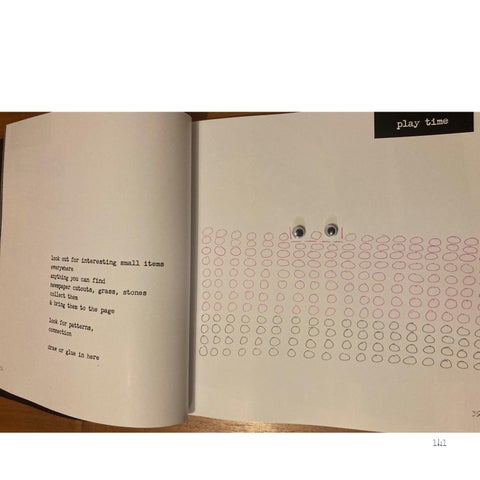
Therefore, I thought that a simpler journal that evokes thoughts about time and the future, even at an elementary level, could be beneficial and could lead to long-term thinking in the further stages of the process. I thought that this way, people can engage with future thinking on their terms without judging and pressure from others watching. On the other hand: slow paste, intimacy, thoughtfulness of the diary would accommodate different personality types, as suit both extra and introverts to express themselves. Apart from engaging in future thinking, I thought that another of the journal aims would be to engage with assumptions about the future. I wanted to ask participants to reflect - may be more clearly and deeply than usual - about whatever their beliefs and preferences might be (and what might be the consequences of acting on those beliefs) compared with the beliefs and preferences of others. I also wanted to make sure that I would place people from the future at the centre of the journal and try to build up the diary around building up the personal connection to the future generations. Thus I created a prototype book called “the barometer”: a booklet / journal / sketchbook full of exercises, creative tasks, reflection prompts, notes, suggestions for various ways of thinking about time and future for participants to do individually, in their own space. I was hoping that this type of journaling would allow for engaging creativity, imagination, reflection, and a record of it.
68
the barometer
Finally, I also wanted to keep it simple and keep the tasks open and light. This way, the outcome would depend on how participants decide to use the journal and how much thought/energy/time they want to give it. So Mayer names the current time as “the broken open” – a time of collective trauma and historical confusion and suggests a “survival strategy” (2019). In her view, ritual and storytelling are tools for creating spaces of possibility where we can ask, “what sort of world do you want to live in?” If I would dream of one takeaway for anyone using or flicking through “the barometer”, it would be asking ourselves the very same question: what sort of world do I/we want to live in? What world are we creating? Consequently, I wanted to create “the barometer” as a space of possibility. In other words, following Donna Haraway example, I wanted to explore how we can learn together to “carry on living” on the planet affected by the change and share the findings among those who will be willing to take part in the journey offered by the journal. In my last chapter, I would like to briefly explain the benefits of journaling and the testing process.
69
I KEEP A SKETCHBOOK AS AN ACT OF NOTICING. I PRACTICE YOGA TO SLOW IN THE INCESSANT PUSH TO ACHIEVE AND GET THINGS DONE. I FIND TIME WITH MY SKETCHBOOK A SIMILAR MINDSET - IT IS TIME TO EXPLORE, SLOW, NOTICE, AND RECORD. BOTH ACTIVITIES ARE THE TIME I SPEND WITH MYSELF CONNECTING INWARDS TO MY PASSION FOR ART AND MAKING AND CONNECTING OUTWARDS TO ALL THAT WE ARE. A DAY SPENT DRAWING IS AN EXPLORATION OF BEING HUMAN - COMING FACE TO FACE WITH EXPECTATIONS, FAILURES, UNEXPECTED DELIGHTS, AND THE PHYSICAL PROCESS OF LOOKING AND SEEING SURFACE, SHAPE, PATTERN, AND LINE. (HALLOWS, 2020)
70
the barometer JOURNALING FOR THE FUTURE Lieuschener, in her article about Reflexive Journaling, proposes conceptions of journal such as ‘logbook’, ‘itinerary’, ‘personal diary’, ‘scribble’ and ‘sketchbook’. In her view, they should be used for academic purposes. They provide nuanced understandings and suggest ways in which academic journaling suitably serves the pursuit of reflexivity and contributes to other dimensions of trustworthiness in the praxis of academic rigour. (2007) My idea of journaling includes similar elements. I wanted to make sure that “the barometer” is a place to write doodle, sketch, reflect, and creative outlet involving various sense. According to PsychCentral.com, benefits of journaling include: • Journaling helps you to clarify your thoughts and feelings. • Know yourself better. By writing routinely, we recognise what makes us feel happy and confident. • Reduce stress. • Writing about anger, sadness, and other painful emotions helps release the intensity of these feelings. By doing so, we will feel calmer and better able to stay present. • Solve problems more effectively. Similarly, PositivePsychology.com lists 83 Benefits of Journaling for Depression, Anxiety, and Stress, which are, among others: • Boost your mood; • Enhance your sense of well-being; • Reduce symptoms of depression before an important event (like an exam); • Reduce intrusion and avoidance symptoms post-trauma; • mprove your working memory.
On the other side, journaling helps with creativity. “The act of writing accesses your left brain, which is analytical and rational. While your left brain is occupied, your right brain is free to create, intuite and feel. In summary, writing removes mental blocks and allows us to use all of our brainpower to understand ourselves better, others and the world around us.” (psychcentral.com) Consequently, according to other researchers, journaling can help us learn to process and communicate complex ideas effectively; it can also help us memorise important information and brainstorm new ideas. In other words, writing about our experiences helps us process them and helps us see opportunities that may not have been apparent at first glance. It also helps us break down complex experiences into relevant, valuable bits of information organised coherently. Finally, as journaling and sketching involve observing and telling stories, they help our brains see what to pay attention to, what meaning to give our experiences, and what actions we should take in response. Journaling allows us to stretch our imagination and consider new possibilities for our life, determine what is most important for our future, and make better life decisions.
71
72
the barometer
73
74
Testing stage
Mid December 2021, I printed “the barometer” in two formats: ten copies with perfect bound, silk stock and ten copies with spiral wiro, uncoated. On the 18th of December, I sent hard copies to 18 participants – in Ireland and abroad. In addition, I sent about ten copies in digital format (ISSUU flipbook) to those who could not pick up a hard copy by post. I asked participants to fill in the same five exercises, a short survey was to be completed at the end of the task. On the next few pages, I am listing all the feedback received and few example of journal pages filled in by participants of my study.
75
76
77
78
Testing stage
IWONA, WEXFORD, IRELAND
79
80
81
82
83
84
85
86
87
88
89
90
91
92
93
94
95
96
FIONA
DUBLIN, IRELAND
97
98
99
100
101
102
103
104
105
106
107
108
MICHAEL
MODLING, AUSTRIA
109
110
111
112
113
114
115
116
117
118
JULIE
BERLIN, GERMANY
119
120
121
122
123
124
125
126
127
128
129
130
131
132
SAM
BRAY, IRELAND
133
134
135
136
137
138
JANE
DUBLIN, IRELAND
139
140
141
142
143
144
145
146
147
148
KAREN
GREYSTONES, IRELAND
149
150
151
152
153
154
155
156
157
158
KRISTIN
MELBOURNE, AUSTRALIA
159
160
Choose one of the people from the future you are connected to. Describe them. What are they like? What hobbies do they have? What allergies do they have? What's their favourite pet?
)
144
(draw, write, cut & paste) 145 161
What does 11 time 11 means to you? (doodle, write, draw, copy & paste)
Go 162
time - what is
for me, time •••
�
Gl 163
Seasonal clearance available now lf you cannot see t ...
time - what is
1 1 flies 11
notice how time for you today, mark below, make it pretty
fast
4am
5am
Gam
7am
8am
9am
10am
11am
12noon
lvm
4vm
8vm
lam
2am
Jam
slow
G2
164
GJ
mark how you felt all day, use colours (pretty or not) furious
not that great
4am
5am
Gam
7am
8am
9am
10am
11am
12noon
lvm
2vm
Jvm
4vm
5vm
Gvm
7vm
8vm
9vm
lOvm
llvm
12vm
lam
2am
Jam
havvY enough
G4
G5
165
166
MARITE
FRENCH ALPS
167
168
169
170
171
172
173
Note: Nine survey forms received. Not everyone who filled in the survey shared their work from their barometer (and vice-versa).
174
175
I COULD TRAVEL IN TIME TO EXPERIENCE THE FUTURE, IT BECAME A PART OF MY OWN EXISTENCE
176
177
178
179
180
continue from previous page
181
182
183
IT GOT ME TO THINK HOW I THINK ABOUT THE FUTURE
184
185
186
187
188
189
190
191
IT’S LIKE A DIARY FOR TIME AND THE REFLECTION OF TIME
192
193
194
195
196
ADDITIONAL COMMENTS:
197
198
Testing stage
FEEDBACK SUMMARY Overall, the feedback I received was quite positive. People seem to acknowledge the benefits of the book and the format itself. Most participants engaged with the journal well, which reflected in the quality of feedback I received and the number of responses. As for the formal feedback, over half of the respondents stated that they tend to think about time over half of the time (55.6%). Eight out of ten survey participants agreed that engagement with the barometer changed how they think about time. In addition, over 77% of respondents agreed that the barometer helped them view future people as personally connected to. In regard to expanding on how people perceive time and the future, most of the respondents agreed that the barometer helped them to reflect about the future, few did not have time to think about the future, few more responded that they are willing to spend more time with the journal and reflect a little bit deeper. Regarding the strong points of the barometer, the design of the book was described as “very engaging visually and physically”, “inspiring” and “thought-provoking”. Some of participants felt encouraged to further creativity by the book and felt comfortable doing so.
Regarding the points for improvement for the journal: some respondents found open questions a bit challenging; some described it as it was hard to come back to the “playful” mode. One person filling out the journal at in her workplace which is a hospital mentioned this part as very challenging. In that case, the environment she/he was in - trying to fill in playful pages of the journal (a workplace - hospital) - might not have been the best choice. In response to this, I will mention creating a safe space for yourself when engaging with activities for the barometer in the iteration. One of the respondents was afraid to “write something or do something, without knowing the “right” thing to do”. In the accompanying instructions I had sent to participants, I proposed that there are no right and wrong answers. However, I will take this as a learning and include a note about it at the beginning of the book in the future. Another person said that after looking for instruction at the beginning of the book, she found the “appendix” explanatory. In that context, the “appendix” became an instruction guide. I decided to change its name to the “reflection capsule” as an iteration to reflect the informative purpose of the last chapter. Three people mentioned doing activities of the barometer with kids and suggested that filling out the pages could perhaps be a more anticipatory experience. I will create and add a group experience in the iteration of the project. Still, in my view, the barometer could be amended to suit various genres. In the future, I could design a few versions of the journal to suit different personality types, kids etc.
199
200
Testing stage
My five-year-old son engaged with the journal while I was creating it, collecting objects and things. Looking at what I do, he made a book himself and called it “a little museum”. My work, and the barometer, allowed him to learn to observe and see things from a different perspective. This led me to think that in the future, it could be beneficial to design a version of “the barometer” for kids and/or for families. Another person suggested that the exercises about collecting objects could be repeated multiple times over time to observe the seasons etc. It was a valid point, I’ll consider it for the iteration. To summarise, in the next iteration – I will: 1. Add note about the safe space when working on your journal. 2. Make the point that there are no right or wrong answers. 3. Expand on the appendix and change the name to the “reflection capsule.” 4. Add and exercise re participatory experience. 5. Add exercise about collecting things number of times/looping 6. I will also make minor tweaks to the design, possibly adding visuals/photos of journals created by my study participants to create a more participatory experience. Regarding the stock: one batch was printed on silk paper, with a perfect bound; second batch: uncoated, wiro bound.
I felt that the wire bound possibly encouraged creativity slightly differently. Saying that, participants who received the perfect bound commented on the book’s quality and were inclined to keep the journal on a shelf, treasure it, and come back to it from time to time. As perfect bound is more eco-friendly and easier to recycle, I will use it in the next iteration. In an ideal scenario, this journal should be printed on a heavier, suitable for drawing and art, stock. As I am limited in my budget, I will use silk finish in the iteration. Finally, I was hoping to design and print a box /packaging for the barometer for the submission. Again, due to my time and budget limitations, I could not do it, so I included a few ideas for the box itself and for packaging in the next few pages instead. The examples include potential ways or items which could help to carry the long time message forward, as well as potential activities eg. writing a postcard from or for future generations. All items and materials will be sustainably sourced.
The version with the perfect-bound looks more elegant. However, I the recipients of the spiro version were more inclined to “get their hands dirty”, stick things and objects to the pages, and keep the journal “messy”.
201
possible packaging / box options for the barometer 202
203
the merchandise could include clothing items, even match boxes - to fire up the world and bring the message in!
204
205
what gift goes well with the barometer? how about the puzzle for your mind! a perfect gift for every occasion...
206
207
...and the smell of the future!
...and finally with this umbrella you won’t get wet!
210
212
finally... the box could include journaling / stationery set ... and small hourglass as a takeaway. It all could fit in the box. 214
Regarding the overall conclusion on the final project, I learned a lot, to the extent that my worldview has altered. It has not happened at once, it was a gradually change, but in a way, I feel like a different person then when I started. The idea for the final design came intuitively to me while I was working on my sketchbook book. I believe the positive responses I got came from the fact that participants could somehow feel that my project was personal to me (which it did become). Learning about long-term thinking and futurity helped me define my purpose and connect to something I was longing for. In my view, people who took part in my study have a common thread - apart from curiosity, they all have a longing for “something more” or something deeper in life. I would be hopeful the open questions of the barometer helped the participants to reflect and examine it for themselves.
216
Conclusions Consequently, I was astounded about the talents of people I met on the way. In the charette – I was amazed by the wisdom, creativity and energy of the students. In the same way – in this design project, looking at people sending beautiful photos of their journal pages, or writing so deeply about what time means to them, or even collecting objects and sharing them with me, I was amazed about the richness of talents in the people I met on the way. I feel I would like to acknowledge their talents, celebrate them, and thank them for their generosity. In the context of their insights – even the word thank you feels small, insignificant. I felt that opening the journal let me into people’s souls a bit, with so much beauty and richness which I can only admire and be grateful. This also led me to think that, with so much beauty in people and the world, we are in safe hands for the future. We need to figure out “how”. To add to the experience of the book, I would love to be able - in the future - to design more activities and workshops connected to the subject of future thinking.
I could use intuition and observation as a process. The workshop for example could include several activities, such as collage, doodling, sketching, feeling, collecting, reflecting – or all of them at the time with the subject of future thinking and connecting to future generations. The task of reimagining how the future person we are connected to could be very impactful by a group. Participants could be tasked to reimagine future people in small groups; sharing the experience would allow for open conversations and examining the assumptions – which could lead to rebuilding images of the future into the ones we see as more beneficial. The steps for dealing with uncertainty could also become a group activity. A group could then become some “time support” for each other. Reflection on the collectiveness of the experience, following Haraway’s and Le Guin’s steps - cries out for more participatory experiences to reflect on our being in the world and the world we are creating.
To conclude, by saying that I would like to design and / or participate in future workshops or projects about the time and future, I think vast parts of me would like to participate in this process of sharing. I want more, more of admiring the beauty in the world, but also, more of embracing the broken pieces, as, somehow, one does not exist without another. And maybe that is what my project was about: looking at and telling a story of beauty in broken pieces and uncertainty of our times, and analysing, where my role in the “broken open is”. My research was a personal journey for me as well, in a way, it was a journey in time, and I think at the end of this process I am little bit close to my better future me, I am definitely closer to understanding where my purpose, where my heart, is.
217
218
POTENTIAL ACTIVITIES / FOLLOW UP How do we make a personal, empathic connection with future generations whom we can never meet and whose lives we can barely imagine?
Potential activity/ workshop: creating postcards and letters from or/and for future people
What future generations say to us?
220
221
224
Appendix
225
226
my research
227
Visua research: layers on acetate / reflections about the past / future generations and the flow of time 228
229
visual explorations: work with acetates / creating layers informed my ideas about complexity of time etching tests - thinking about past and towards future 230
231
232
top and right: etching on milk carton, green and yellow ink added left: acetates & reflection after etching process
233
234
daily activities (eg. swimming), inspire content for my sketchbook (etching, collage, watercolour)
235
labels on packaged received inspired my hand drawing, sketch in watercolour
236
package from China with multiple labels inspired my thoughts on our legacy
237
my journal - mix media: collage, litography right: hand made cover
238
239
my journal - continues
240
241
my journal 242
243
my journal 244
245
246
my inspirations: Juliana Colless, Revisionary Journal, Lewis Rossignol,various works
247
248
Inspiration / research: S. Canmdy, Archeology from the future project Reading about various activities design / vs futurology inspired ideas / activities for the journal 249
250
Workshop concept: connect past, observing present, scanning signals towards the future November 2021
251
252
other documents
253
How can we engage in conversation about time in meaningful and personal way. Dear Karen
Thank you for taking part in my research.
Concepts such as
world, nature, and
even environment are
no longer a meaningful horizon against which
human events take place. “Having set global
warming in irreversible motion, we are facing the possibility of
ecological catastrophe. But the environmental emergency is also a
crisis for our thought, confronting us with
a problem that seems to defy not only our control but also our understanding. Morton (2013)
Justyna Doherty MA Design for Change, IADT, Ireland December 2021
How to embrace ethical
responsibility not only
towards current conterporaries
but towards the
future conterporaries Adam, Open Future, Time Matters
254
To give you a little bit of background: I’m currently finishing MA In Design on Change in IADT in Dublin, Ireland. In my project called “About time”, I am attempting to explore relations between the past and the future, backcasting, the role of the past in the present, and the multidimensions of time. I am also interested in memory, trauma, silencing, resilience, and the power of open communication to create and reimagine what we call “better tomorrow.” Our present actions are future-orientated in various ways. What to eat, what to wear- small daily tasks combine and inform our predictions. Schedules, work, leisure - we are designing our lives to combat the flow of time, and doing it often unconsciously. But these tasks are also past-oriented; they are based on our current knowledge. Similarly, it seems that differences depend on whether we think about short-term or longer-term futures. On the other hand: Some of the most significant challenges that humans presently face could result from our “short term thinking”, which is, in fact, insufficient ‘futurity’ built into the world. In my dissertation, I am attempting to explore how design can shape and influence attitudes about the long-term future and how it could affect our behaviours toward the planet’s end and our individual futures. I ran workshops where I was trying to reframe the conversation about time and temporality. I invited participants/students to engage in speculative design and proposed reflection, storytelling, and worldbuilding as tools for the reflection. The aim of the journal I am sending over to you is a little bit different: I was trying to find ways of engaging with future thinking on a more basic level, in order to build up steps to futuring literacy. Once a certain level of futuring literacy is achieved, individuals can extend the thinking into the long term and start practising creative positive visions of the future. T. S. Eliot wrote, “only a fool, fixed in his folly, believes he turns the wheel on which he turns.” - in other words, there is no “correct” or “false” view of the time or future that we wish to infuse or defuse or attempt here to get people to think “correctly” about the future. In short: one of the journals aims is to try and think - maybe more clearly and deeply about whatever people’s beliefs and preferences might be (and what might be the consequences of acting on those beliefs), in comparison with the beliefs and preferences of others.
Looking at the existing research, I concluded that any type of futuring or speculating about time should be cognitively touching and, simply put, personal. Also - looking at what has already been done in this area, many existing exercises are purely reflective but have no record of reflections. Thinking about one of the final outcomes of my dissertation I wanted to combine individual and group reflection, meditation, play, and inspiration in one document. In conclusion, I created this very simple “journal”, (which I called “ the barometer” for now) . It includes exercises / ways of thinking about time and future for participants to do individually, at their own space, which would allow for using their imagination, reflection, and a record of it. Still, it’s up to participants to keep the journal for themselves, keep it “ for future generations,” or, simply put, burn it. I also wanted to keep it simple - almost basic, use tools widely available, keep the tasks open and light if possible. I was trying to take the heaviness of the deep subject and keep it simple. What you see attached is the very first draft. The outcome of this booklet will very much depend on how you decide to use it, and how much thought / energy / time you want to to give it. Just to say - I realise that tasks included in the booklet may not be “ comfortable”, but this dealing with discomfort imakes it valuable. So Mayer, in the introduction to Spells: 21st-Century Occult Poetry (2019), talks about the current time as “the broken open” – a time of collective trauma and historical confusion and suggests a “survival strategy”. In his view, ritual and storytelling are tools for creating spaces of possibility where we can ask “what sort of world do you want to live in?” If I would dream of one takeaway for anyone using or flicking through the journal would be asking yourself the very same question: what sort of world do I want to live it? What world am I creating, and to use “the barometer” as space of possibility. Another aim I was trying to reach: findings a medium / tool to connect to the future in a personal way. By creating different timelines I was hoping to use the participant’s role in building their future of the planet as a place to live for people connected to us, and let them reflect on it. That’s the part I know I need to expand and work on.... Still, most of all, following Donna Haraway example, I wanted to explore how can we learn together to “carry on living” on the planet affected by the change.
I hope that, after sharing few exercises we all completed, participants of the study will be able to somehow connect and learn from each other. Therefore, I am asking all participants of this research to share with me - and others if they wish - few of the same tasks. I will use these tasks as a research, comparison, and an expansion of the journal, so in a way – you are the one creating the time vehicle with me. I am working on a platform where – with your permission - I will share the outcomes of the research and the sample exercises I received from various participants of this research, as well as my own. Of course - if you wish not to publicise the tasks you completed, I will not do so.
We can not create a world we can’t imagine. ...
and stories are the engines of our imaginations Josh Stearns
In the same way, if you agree for your name or photo to be mentioned as a reference with the research, great. If you decide to use your image or photograph of the tasks I will ask you to complete, great. But you can also have the right to remain absolutely anonymous and not share any outcomes at all with anyone. Finally (apparently I need to add this note from ethical and legal point of view), if at any stage of the research anyone feel emotionally moved, or overwhelmed you can contact me or look at once of the irish contact numbers below to get support. https://www.mentalhealthireland.ie/get-support/ www.iacp.ie, 01 230 3536 So, finally…..
Practically: the help am I asking for, is as follows: As part of the research, I want to ask you to complete five following exercises, photograph them and send them back by phone, email etc 1. Exercise from page 34-35 (Creativity) 2. Task from page 60-61 (What is time) 3. pages 132 - 133 (Finish the page) 4. page 144 (Future) 5. 186 - 187 (Non-human). If you would like to share more than these five exercises, please do! If you only want to complete one, or decided not to share anything - that’s perfectly fine as well.
I will send a short survey to all participants gathering feedback (I need to do it before Jan 3rd 2022). Apart from that: I appreciate any comments, suggestions for tools, improvements etc. Any feedback is valuable to me, even the one saying: leave it and never do it again! As I will be preparing a research report I would love to ask for few additional small things from you: 1. Please send me a photo of your process (for example during a walk, your desk drawing etc.) 2. Please me a picture of the journal showing a location where you are in, for example: in the mountains, on a bus stop, ideally - anything in the background indicating the location you are in 3. Finally, I would also love to get your photo for the records... if you agree? Again – if you decide not to share anything, remain anonymous; of course, you can choose to do so. Thank you for taking part. The journal is yours to keep. Thanks so much for all your time and your help!
justyna.doherty@gmail.com T: +353 872114644 25 Churchlands, Delgany, A63XV81, Co. Wicklow, Ireland
255
CERTIFICATE OF COM This certificate is awarded to:
JUSTYNA DOHERTY
for the successful completion of a Foresight Futures course
256
MPLETION
e: The Basics of Foresight.
Date: 21 December 2021
257
258
charette report
259
260
charet te date 13 - 17 Sep 2021
report Issued: 08.10.2021
about time
C h a r e t t e r e p o rt j u s t y n a d o h e rt y M A D e s i g n f o r c h a n g e
IADT
261
w e lc o m e Having set global warming in irreversible motion, we are facing the possibility of ecological catastrophe. But the environmental emergency is also a crisis for our thought, confronting us with a problem that seems to defy not only our control but also our understanding.
According to Morton (2013), concepts such as world, nature, and even environment are no longer a meaningful horizon against which human events take place. In this charette, participants had the opportunity to reflect on temporality, time, and place in the world. The workshop aimed to rediscover students expectations about the future and the most significant emergency we
J u st y n a D o he rt y Faciliator Workshop Designer
face. To reframe the conversation about climate and make it more relatable to the “local” and individual, I proposed reflection, storytelling, and worldbuilding as tools.
262
2
CCharette About time 13 - 17 Sep 2021
IADT MA Design for Change
My world, my Earth is a ruin. A planet spoiled by the human species. ursul a K . le gui n
Justyna Doherty
263
I C R A T 4
264
A D H A E T T BOU I M
T E T E
Charette About time 13 - 17 Sep 2021
IADT MA Design for Change
c o n t e n t s see chapters below:
6
t he stu dents
11 cha rete sc hedu le
8
c har et te ov erv iew
10
w o rks h o p d e s ign
12 19 c har et te step by step
s u m m ary
(m onday - fr iDay )
We cannot create a world we can’t imagine
13-17th September 2021 IADT
and stories are the engines of our imaginations
Josh Stearns
Dun Laoghaire, Ireland
Justyna Doherty
Toronto, Canada
Delgany, Co. Wicklow
265
the students During the charette, I had the privilege of working with a fantastic group of very talented and intelligent students. For some, it was the first opportunity to meet and collaborate with groups from a different course.
the great nine
266
E l l i e O’ B rien
An ulowa Kuy e
Katie Call an
Design for Change
Animation
Animation
Roi si n B en tley
Dean Kern ey
Sam O’ N eill
New Media
New Media
New Media
A l e x F itzpatrick
Ellen O’ N eill
B eatrix Treacy
Arts Management
Arts Management
Arts Management
6
Charette About time 13 - 17 Sep 2021
IADT MA Design for Change
...hard times are coming. we need (...) poets, visionaries, the realists of larger reality. (ursula K. le guin)
Justyna Doherty
267
c h a r e t t e ov e rv i e w Thinking about time and temporality, as a subject of my master proposal, I reflected on the importance of understanding the climate emergency we are facing and our role in it. Therefore, in this charette, I aimed to use a conversation about time to talk about climate change and what it means on an individual vs global scale.
1
thinking long term
2
One of my goals was to connect to the future in a personal and intimate way. By creating individual timelines and expanding them to the people we know and love, I was hoping to use the charette to reflect on participants role in building their future of the planet as a place to
term goals.
live for people connected to us. I also wanted to create an opportunity to listen to others and learn from their experiences and discover our inner knowledge.
Reflecting on the systemic problems we are currently facing, the effect of short-term thinking and planning, I gathered that the importance of thought in the long term is critical. Therefore, reflection about the long term future became one of the main objectives for the week.
3
local perspective
I was hoping that this charette would bring participants closer to getting to terms with embracing their purpose towards climate emergency, allow them to reflect on their responses towards it, and carry their thinking process into thinking about long-term futures as opposed to short
my time
Still, most of all, following Haraway example, I wanted to explore how can we learn together to “carry on living” on the planet affected by the change (2016).
4
design fiction
So Mayer, in introduction to Spells: 21st-Century Occult
Following Le Guin (2020) I aimed to focus on local
Poetry (2019), talks about current time as “the broken open” – a time of collective trauma and historical confusion, and suggests survival strategy. In his view, ritual and storytelling are tools for creating spaces of possibility where we can ask iterations of the question posed by all of Le Guin’s work “what sort of world do you want to live in?”
perspective and, by storytelling, create a shared platform to place our experiences within the broader familiar context. As a tool to imagine and reimagine what could happen and allow for creative free-thinking about various scenarios in plausible ways, I planned to use design fiction and test the design fiction matrix for worldbuilding.use design fiction and test the design fiction matrix for worldbuilding.
o bj e c t ive s the charet te’ s aims were
1. to r e fle ct on t h e clim at e e m e r ge n cy, an d t h r ough r e fle ct ion ab out t im e , r e fle ct on lon g t e r m s ce n ar ios
8
268
2. s h if t s cale s fr om glob al to in dividual an d us in g s tory t e llin g tap in to a c olle ct ive h um an e xpe r ie n ce
3. allow part icipan t s to us e t h e ir im agin at ion an d cr e at ivit y an d, by us in g de s ign fict ion , cr e at e a tan gib le outc om e of t h e r e fle ct ion an d e xpe r ie n ce
IADT MA Design for Change
Charette About time 13 - 17 Sep 2021
reflection about the long term future became one of the main objectives for the week
Justyna Doherty
269
wor ksh op d e si g n The charette was divided into three sections as follows:
1
Day One: Storytelling A day of sharing our stories via multiple platforms, in various ways. I based the first day on Ursula Le Guin “The Carrier Bag Theory of Fiction”. In Ursula’s world, time is meshed up and runs nonlinearly. I wanted to allow our stories to be “meshed up”, to be connected. I also wanted to explore how to connect the past to the future by inviting participants to share their stories and stories of people they love. Day one was a day of sharing and building our commonality, our base, a day of sharing.
2
Day T wo: Reflection about time and climate emergency On the morning of day two of the charette, I asked students to develop and reflect on their “intimate timeline”. I hoped that this perspective would open participants to thinking about the future and their purpose on a long term rather than a short term individual scale. In the afternoon, students researched the “big buzz words” concerning climate change and tried to find their naming for it. Creating a “lexicon” was an incentive for research, reflection and discussion. We realised how humour helps to deal with a subject that big and terrifying.
3
Day Three: De sign Fiction The third day of the charette, the design fiction, was planned as a final visible outcome of our few days together. Many stories were told and written by students that morning; participants created and discussed many design fiction scenarios. At the end of the process, students chose one of the storylines for production and based on this created very short humorous animation for the final presentation, and had great fun doing so together. In addition to the animation, at the end of this intensive day, students also created a three-page presentation in response to the brief and summary of the charette.
10
270
survey At the beginning of the charette, I asked students a few questions about their expectations of the charette: See answers below:
Charette About time 13 - 17 Sep 2021
IADT MA Design for Change
charette schedule See below schedule of the charette:
Monday 14.00
Charette opening
15.00
Meet your Team
Tue sday
wedne sday
Thursday
10am
Welcome, Intro
10am
Welcome, Miro Intro
10am
Welcome
10.20
Le Guin, listening
10.10
Warm up
10.15
Design Fiction 1
10.40
Spatial Chat meeting
10.30
Advisory Session
11.00
Break
11.05
Break
11.00
Break
11.15
Design Ficion Matrix - Intro
11.20
Strange Garden
11.15
Our Values
11.30
Brainstoriming - groups
13.00
Lunch
12.00
Timeline
13.00
Lunch
14.00
Warm up, Story and back
13.00
Lunch
14.00
Discussion - DF execution
14.30
My mountain
14.00
Timeline
15.00
Presentation Prep & DF execution
15.00
Break
14.30
Lexicon - research
16.00
Advisory session
15.15
More storytelling
15.00
Lexicon - findings
15.30
More sharing
15.30
Lexicon draft
15.45
Reflection
15.45
Reflection
Justyna Doherty
Friday 10am
Execution - follow up
14.00
Presentations
271
14 September
charette step by step tuesday See below a breakdown of each activity from the charette:
Day one – welc ome
Gathering, holding, sharing.
After my presentation introducing the subject and aim of the workshop, I asked students to listen to the reading of an essay by Ursula Le Guin, “The Carrier Bag Theory of Fiction”.
Le Guin tells the story of the carrier bag, “the sling, the shell, or the gourd”. It talks about early humans, who could carry more than can be held in hand in this empty vessel and, therefore, gather food for later.
We also moved our online gathering from Teams to the Spacial Chat - a novel online meeting space. I was hoping this would allow for further personalise experience during the workshop.
In her essay, before sticks, swords and the Hero’s killing tools, our ancestors’ greatest invention was the container: the basket of wild oats, the medicine bundle, the net made of your hair, the home, the shrine, the place that contains whatever is sacred. “The recipient, the holder, the story. The bag of stars”.
(Spatial Chat allows to customise the look of the meetings rooms, so I prepared room for various activities: a Reading room, Sharing room, and Breakfast room.) I wanted to begin from a low engagement activity, and where participants didn’t have to do anything apart from listing. I was hoping this would help to include more smoothly more shy and introverted participants.
According to S. Leddy (2019) “Not only is the carrier bag theory plausible, it also does meaningful ideological work — shifting the way we look at humanity’s foundations from a narrative of domination to one of gathering, holding, and sharing”. “The carrier bag story, (...) is a collective rather than individualist endeavour.” A carrier bag story contains no heroes. There are, instead, many different protagonists with equal importance to the plot. “It’s a gripping tale of how I wrested a wild-oat seed from its husk, and then another, and then another, and then another, and then another, and then I scratched my gnat bites, and Ool said something funny, and we went to the creek and got a drink and watched newts for a while, and then I found another patch of oats…” writes Le Guin.
How we can create the conditions for generative dialogue so that together we achieve more than we could alone.
272
12
Charette About time 13 - 17 Sep 2021
IADT MA Design for Change
Without the container, we could not bring the food home. In the same way - we need to be a unique receptacle of stories to keep the world going forward. And the question is, what type of stories we are containing: the bloody ones, or the ones from simple daily life. And are we looking for common ground in our stories? According to S. Shin (2021), ritual and storytelling – linked in their capacity to access sacred time, zones of meaning and the non-ordinary reality of the unseen – provide frameworks for forms of collectivity. In this charette, I wanted to create a space where we can open up to one another, explore how to search for common ground, how to listen and find value in mundane daily activities, share our lives, our “mess”, expose our bag, what do we carry, ponder on us being containers of stories for the future. Finally, after the day of storytelling, to look at our lives, our local scale, how to bring it to a global scale, and connect local to individual.
Day one – follow up After listening to the essay, we moved to the “Breakfast room” and introduced ourselves. Despite changing the online platform and encouraging participants to have the video on, only a few people turned on the cameras. After speaking to other facilitators, I realised how important and valuable it was to see participants via video during the online part of the charette. We learned later that it was important for participants themselves; nevertheless, I didn’t want to push too much, especially those who didn’t feel comfortable doing so.
Strange Garden
more sharing Group started with a warm-up exercise and talking about challenges in life they overcame. The activity was also an introduction to Miro - for some students, it was learning a third new online platform that day. In the next exercise I asked students to communicate with one word only by creating associations to the previous word. After few rounds, we were trying to go back to what we said, word by word. The flow wasn’t great as we were disrupted by my kids coming home from school, but it definitely gave us something to think about. In exercise three - I asked everyone to tell one-minute story “about a mountain”. Everyone had a story related to it, we were sharing memories and slowly building our common language, trying to find a level of comfort with each other. It was the last hour of the day, and few students were still “ off-camera”. I was trying to encourage sharing and vulnerability. I started by example: by showing my “mess”: my kitchen with kids toys, the construction site around my house. Participants also started sharing their “ messes” and talking about what they are holding on to and don’t want to throw away. After the first student - who had the camera off all day decided to turn it on, other cameras opened, and suddenly we saw faces of all students - for the first time that day. It felt like a powerful and intimate moment. It felt like the group finally opened up to be with each other! We felt that’s something we all have in common: imperfection, vulnerability, “mess”. It was an uncomfortable moment for me as a facilitator, and I was learning to embrace tis discomfort, but it was also a precious and unforgettable moment for the group. As some people had to leave for classes and work, we finished the day by quick discussion summarising the day. On reflection, the last activity was one of the most critical moments in the charette. We showed each other our weaknesses, and this created a level of trust and foundation for collaboration.
After the break, we moved to the “Strange Garden” - another online platform, where participants could quickly make and upload photos of their objects in a rapid form of collage. Looking at the college students spoke about objects meaningful to them and stories connected to these objects. (On the third day of the workshop, students brought the physical objects to the class; seeing them in person allowed for sharing on a different level and included them in the design fictions they were to design).
A “container” for a conversation provides a “holding” atmosphere in which the things that matter most can be discussed.
justyna doherty
273
It is the story that makes the difference. r e a d i n g / l i st i n g “The Carrier Bag Theory of Fiction” by Ursula Le Guin
wa r m u p Example of one of the exercises we use to introduce each other / and learn Miro
274
14
tuesday “The story is not in the plot, but in the telling” (Ursula Le Guin)
s tr an g e g ar den A collage full of precious objects
s paci al ch at
S h a ri ng
Morning meeting (cameras off)
and reflecting on our “mess”
justyna doherty
275
15 September
charette step by step wednesday Conversations around climate change often take an impersonal, cold character, making it hard to relate to or understand. I wanted to spend a day creating personal links to the future and expand our vocabulary of words related to climate change. I planned to devote the morning session to the subject of time and afternoon about climate change.
Wedne sday
our values
Looking at the survey I asked students to fill in on day one, I felt we needed to make sure we were 100% aligned, so I added one more element to the morning session, creating group values.
After the advisory session, I run an activity to create group values and purpose.
We started day two with a warm-up exercise: creating a monster solo but also as a group. I also asked participants for a quick reflection on yesterday’s activities.
This activity made an opportunity to reflect on individuals role in embracing sustainability
As a result, the team agreed on the following: 1. The most important value for the team is understanding and compassion. 2. Kindness and Care. 3. Being upfront
The groups also created and agreed on the following statement: We aim to be open-minded and kind to ourselves, each other and our environment.
276
16
IADT MA Design for Change
Charette About time 13 - 17 Sep 2021
timeline In this task, participants were invited to create their timeline. The exercise aimed to create a close emotional link to the future and the process of climate emergency. Students were invited to either work off the template saved for them in Miro or create them by hand (or use any other format). In this task, I asked participants to locate a point in time to mark when and how long people they know and love lived and will live, including their children, potential children of their children and their kids, and offset this against the deadlines marked by climate change experts. I also asked them to reflect on their purpose within the timeline and how their actions can affect people in the future they will be connected to. Reflecting on personal experiences, students ellaborated on how the process happening in nature affecting and will affect the people close to them, how much happened and is happening within one generation? To conclude, one of the students said: “ People are asking us, what do we want to be when we grow up, or what job do we want to have. Our planet is dying, but nobody asks us what our role and purpose is in this process and our role in it”.
The generation growing up in the 90th lacked a higher purpose. Or, in different words, it seemed like the only purpose was “ to get a job” or fulfil material means - but this mentality, this lack of reflection, led us, amongst others, to today’s climate emergency. The point I was trying to bring across was that once we understand what is happening with the climate, the only purpose of today’s generation is to try to save the planet for future generations, which should be the main purpose of young people today. We all experience the power of humanity when a common purpose is created and when - simply put - we are scared enough. The development of the Covid-19 vaccine is proof of the same. To resolve climate emergencies, we need to align to the common purpose, or - again- be and feel “scared enough”. But climate emergency, due to it’s nature, as a nature of hyberobjects, is not so easily understandable, despite all of us feeling and experiencing it at some point. Students shared their thoughts, divided into small groups. We used Spatial Chat again to create an intimate meeting space; some of them even decided to sit “by the pool” for a chat (page 27).
Previous generations had a purpose: even as simple as participating in warfighting enemy, creating a nuclear bomb, flying to the moon, etc.
W h e n a s c i e n t i s t s ay s [ t h e y e a r ] 2 1 0 0 —t h at ’ s e i g h t y y e a r s a f t e r B l a d e R u n n e r . W e ’ r e u s e d t o t h at c u lt u r a l ly. T h at ’ s j u s t s o m e k i n d o f d y s t o p i a . It’s not connected to us. It’s a cold, distant place. (Magnusor)
wj w u swt. ye nx a md po lhee. rc to ym
277
LEXICON Some participants had to attend classes in the afternoon, so the group was small - with only four people attending. The dynamic was quiet and intimate. After a short warm-up (talking about the unique skills), the task was to create our lexicon of “buzz” words related to climate change. The main idea of the “lexicon” was to try to understand what is happening, and by naming the processes ourselves somehow, to become more customised with them. I asked students to research words like “ocean acidification”, “methane release”, “mass extinction”, and “global heating”; every student could choose from a pool of words. I realise that this could be a project on its own, on a larger scale, but creating this as a small workshop task allowed students to research the processes, discuss them, share their opinions and feelings about what is happening on a global scale.
Students discussed each process, and its meaning shared their feelings about the change and reflected on it. The discussion was based on research, we were also planning to bring this research to the next day activity - design fiction. At some point, once we realised the scale and the magnitude of the processes happening around us, the conversation became very dark and heavy. Again it was hard for me as a facilitator to stay with this feeling and let it sink in. It is also worth noting that, at that stage, students asked for the Thursday session to be placed on campus rather than placing it remotely. Everyone in the group wanted to meet in person the next day.
In our discussions, we were trying to bring it to our “local” - what does it mean for me personally, how does it feel.
we have an urgency that has not been seen on a scale never before As species, we never had a common goal before. (Magnusor)
278
w w w . e x a1 m8 p l e . c o m
Charette About time 13 - 17 Sep 2021
IADT MA Design for Change
16 September
charette step by step thursday It was a beautiful sunny day. The atmosphere in the room was exciting, if not a little bit nervous. Meeting in person was a new experience - some knew each other only from the screen the last few days, some studying together haven’t seen each other for a year. Students started rediscover each other engage anew with their colleagues.
meeting in person Knowing that we had few introverts in the group, I wanted to ensure that the first task was easy and calm. I wanted to create space for both personal creativity and sharing. As the first task, students wrote a story of their object and their story in the future - by hand on a piece of paper. (I have asked students to bring items we discussed on day one with them, and we started the day with free writing exercise). After 15 minutes, seeing the pages filled up, I grouped students in pairs and asked them to combine their stories in the future. The discussions seemed endless, and there was a lot of laughter in the room. After a while, each of the groups shared their findings. They all managed to meet in time, extended their timelines, brought their stories and objects to the future. Some stories started in the past, creating entangled timelines, imagination was flowing.
justyna doherty
I was treating this exercise as a warm-up. Students unknowingly were creating design fiction without any structure to it. It was a fun and light activity, which allowed us to get to know each other and build connections within the group, within timelines, and create one more level of commonality. Talking about design fiction, Vistisen et al. (2015), talks about “a narrative opens for possibilities and engages the reader, viewer, listener”. Consequently, with engagement comes participation and empathy and a deeper understanding of the design and its purpose and possibilities within the world. This exploration is not based on some far-future utopia or dystopia but on how we make the most responsible user experiences in the near future. I wanted to invite students to this exploration, and to make sure there is a plausible element in the narrative they were creating.
279
20
280
IADT MA Design for Change
justyna doherty
Charette About time 13 - 17 Sep 2021
281
IADT MA Design for Change
Design fiction:the deliberate use of diegetic prototypes to suspend disbelief about change. (Sterling)
282
j u s t y n a2 2d o h e r t y
Charette About time 13 - 17 Sep 2021
Charette About time 13 - 17 Sep 2021
IADT MA Design for Change
thursday
by Peter Vistisen
design fiction After the break (and after students managed to get some time with each other), I introduced the concept of design fiction and Design Fiction Matrix created by Peter Vistisen from Aalborg University (2015).
The physicality of the room had an influence there, their board was on the wall as opposed to on the floor, so it was easier for them to stand, which could help in the thinking process and collaboration).
The design fiction matrix is a didactic synthesis tool to support designers and design students in adopting design fiction as a method for speculative design. I was curious to see how students engage with the tool, and what type of narrative will appear with its help. I divided students into two groups - trying to balance between introverts and making sure groups from different courses are mixed.
After an hour, each of the groups presented their ideas: three or four per group.The room was filled with laughter again. Some design fictions presented were very funny, others e were more serious. Stories were going back to the past and the future - mass extinction and war of dinosaurs while nature was renewing itself. Climate change affecting flights on the 9/11 and what if the 9/11 would never happen?. In this scenario, the world was better and more peaceful.
At that stage, I wanted students to synthesise the knowledge gained on day one and two of the workshop. I wanted them to combine their individual stories - and use them in the “ history” section of the tool. The previous day, in the process of the lexicon, students researched climate change, we wanted to use this knowledge to think about signals and predict probabilities within the matrix. Students worked for about an hour individually; during that time I provided a little guidance (mainly to direct students to think about “what if” scenarios). Each of the groups worked in different ways: Group 1 was quieter, board / matrix was very lightly filled, they seemed to discuss less and work individually from time to time, collaborating and combining their stories. Group 2 was very vocal; they took time to fill in the board as much as possible. They were feeding on the richness of information on their board, standing in front of the board.
After the presentations, I asked students to vote and agree on one scenario to move forward to visual execution. Voting was unanimous. Shortly after, students moved to execution of the story. They wanted to use humour to conceptualise the day and reflect the atmosphere in the room. After few minutes of elaboration, students decided that they would like to create an animation. They quickly drew up a storyboard adding to the story and started drawing sections of animation of the board. They knew that want to do something simple but funny and reflective. I was planning to create a break at 1 pm for lunch. Still, students were so engaged in the process, enjoying each other’s company, that they divided jobs between those who draw animation, storyline, postproduction, few of the students offered at the same time to work on the three slide presentations - findings from the last few days.
At that stage, students were working autonomously, displaying a very high level of engagement in the process, but also very reflecting as discussions in the room were about the story and the what-if scenarios and based on what is happening the climate. I felt that this exercise was a good way of summarising the workshop and bringing their learning/knowledge together. Their theoretical knowledge about the processes happening in nature was clearly showing in the probable section of matrixes. Still, they were also taking knowledge from their lives, their own experience, their imagination, combining what they learned about each other, reflected about their own life to the next level where things are changing due to climate change. In this way were able to combine the local and individual scales and create new temporality. As students were so engaged, they decided to keep working and postpone the lunch break. After two hours, their presentation and animation were ready, and they were happy with the outcomes and results of the day. They were also delighted to be back on campus after the long covid break. Looking at their later reflections, for some, it was the first time they worked with other students’ disciplines. The combination of different groups of students in the room that day was a very joyful experience for them. In the evening, after a busy day on campus, students had to come back to their engagements, and only one of them was able to attend the advisory session that evening. Advisors feedback suggested extending the presentation to more detail, so that’s what I was hoping to work on the following day.
a narrative opens for possibilities, and engages the reader, viewer, listener. A n d w i t h e n g a g e m e n t c o m e s pa r t i c i pat i o n a n d e m pat h y. ( P. V i s t i s e n )
283
17 September
charette step by step Friday Friday morning, most of the students had other classes and engagement. In their view, the presentation was finished as they did the three slides as per the initial brief. I asked them to extend the slides and add more dynamic to it, but as only two or three people were left at that stage, they were not fully engaged in this process, but did the best they could.
click here
24
284
At 1.30 pm, half an hour before the presentation, we met for 15mins to agree who is presenting which slide and run a quick rehearsal. All students were present during the presentation, showing their engagement in the process.
At the end of the workshop, I asked students to fill in a quick survey to summarise the workshop and input into further seminars of the same sort. (see next page)
to view short animation prepared by students
IADT MA Design for Change
Charette About time 13 - 17 Sep 2021
s u r v e y r e s u lt s
thank you
285
s u m m a ry I found the workshop process enjoyable, I wanted to make sure that everyone will benefit from the week - be it learning about climate change, and in an ideal scenario reflecting on individual response and responsibility towards it.
Regarding design fiction itself, I wanted to concentrate on individual stories of participants and include embedding
it gave us a basis for research and conversations aroundthe climate emergency. Having larger groups and
In ideal scenario I would like to be accompanied by one more facilitator (even if charette would take longer).
theeir stories, histories and objects they brought with them into the fiction. (I was placing less emphasis
more viewpoints would enrich this conversation.
I think having additional faciliator
on the more than human world. In the future workshops, I will try to extend the focus on various ways of seeing from different angles.)
Finally - as for individual vs larger scale, I would have liked to create one more section to expand and build on what we have done, create more connections and more insights,
Regarding the personal timeline - it was a critical moment during the workshop - I would like to give ito be ablr to expand on it, create one of two day workshop based on the timeline
possibly with trying to place even more emphasis on how to define individual purpose towards the climate emergency. This is something I am taking away for the next chapter and
itself. Some students had to leave charette to attend other classes. As a result, a few, not all from the group
next workshop.
took up this particular activity.
Regarding lexicon - due to time constraints, we didn’t go to massive lengths and deepness in coming up with new phrases or words, but
Taking faculty & student’s feedback on board, I would like to create a section for free-thinking about time, futuring, and reflection on multi-dimensions of time.
would add more interesting dynamic to the group.
I would also love for students to be available for the full time of charette. As some students had to leave to other classes during the week at some stages, at these times, the dynamic was broken up. It was also harder for students to engage in the workshop, having to go in and out of the process.
Overall, taking the timeframe, resources and subject, I am happy with the process of the worskhop and what we managed to achieve in such a short timeframe. I will try to use this workshop as prototype, sometime to expand on and build in the future, using participants and faculty view on board.
S p e c u l at i v e fa b u l at i o n , w h at- i f ’ . ( . . . ) i s a p r a c t i c e o f i m a g i n at i o n , ( . . . ) y o u d o n o t r e a l ly k n o w i f a n y t h i n g i s g o i n g t o c o m e o u t o f i t, o r n o t. P e o p l e m ay d e c i d e t o w o r k t o g e t h e r o n s o m e t h i n g , o r n o t. B u t i t w i l l grow out of somehow having affected each other’s imaginations. d.haraway
286 26
Charette About time 13 - 17 Sep 2021
IADT MA Design for Change
wa r m up Make a moster - individual and collaborative creative exercise.
s t r a nge ga rden
spat ia l c h at
Special objects - scary or not?
Reflection “by the pool” is as good as it gets, when talking about timelines.
287
a ppe ndix .
Works Cited Auger, James. ‘Speculative Design: Crafting the Speculation’. Digital Creativity, vol. 24, no. 1, 2013, pp. 11–35. Crossref, doi:10.1080/14626268.2013.767276. ---. ‘Speculative Design: Crafting the Speculation’. Digital Creativity, vol. 24, no. 1, 2013, pp. 11–35. Crossref, doi:10.1080/14626268.2013.767276. ‘Conversation Sarah Shin’. Tank Magazine, 30 Aug. 2021, tankmagazine.com/tank/2019/09/ sarah-shin. Dunne, Anthony, and Fiona Raby. Speculative Everything: Design, Fiction, and Social Dreaming (The MIT Press). Illustrated, The MIT Press, 2013. Guin, Le Ursula, et al. The Carrier Bag Theory of Fiction (Terra Ignota). Ignota Books, 2020. Haraway, Donna. Staying with the Trouble: Making Kin in the Chthulucene (Experimental Futures). Illustrated, Duke University Press Books, 2016. Haraway, Donna, and Cary Wolfe. Manifestly Haraway (Volume 37) (Posthumanities). 1st ed., Univ Of Minnesota Press, 2016. Leddy, Siobhan. ‘We Should All Be Reading More Ursula Le Guin’. The Outline, 28 Sept. 2019, theoutline.com/post/7886/ursula-le-guin-carrier-bag-theory. Magnason, Andri Snær, and Lytton Smith. On Time and Water. Open Letter, 2021. Morton, Timothy. Hyperobjects: Philosophy and Ecology after the End of the World (Posthumanities). 1st ed., Univ Of Minnesota Press, 2013. Spells: 21st Century Occult Poetry. Ignota Books, 2019. Sterling, Bruce. ‘COVER STORYDesign Fiction’. Interactions, vol. 16, no. 3, 2009, pp. 20–24. Crossref, doi:10.1145/1516016.1516021. Tokarczuk, Olga, and Jennifer Croft. Flights. Illustrated, Riverhead Books, 2019. Vistisen, Peter. ‘THE DESIGN FICTION MATRIX— A SYNTHESIS TOOL FOR GROUNDING FICTION SCENARIOS IN REAL FACTS’. Nordes 2021, 2021st ed., 2021, pp. 124–29.
288
28
It is the story that makes the difference. ursul a K . le gui n
C H A R E T T A B O U T I M
E T E
08.10.2021
Justyna Doherty N00190115@iadt.ie
289
290
Works Cited
291
Works Citied
292
293
294
295
296
297
Special thanks, to my Thesis Advisor for inspiration and patience: CLYDE DOYLE, Programme Chair, MA Design for Change, IADT Thank you ARON, OSKAR & SHANE for all your support in this process