Johnson & Wales University Magazine FA LL 2 0 2 6
p.10 Today’s Experience Economy ALSO 18 Changing the Recipe 22 Experience Doesn’t Retire 28 Strategic Connections
EXPERIENCE DOESN’T RETIRE At JWU, students learn from experienced faculty who have deep connections with police departments, agencies and professionals, resulting in hands-on opportunities for students. More on p.22.
Contents FEATURES 10
22
You Had to Be There
Experience Doesn’t Retire
Today’s experience economy is about making memories over material things.
THE INTERSECT
18
Faculty bring decades of real-world experience to the Criminal Justice department.
Changing the Recipe PROFILE
Chef Jennifer Gallagher is shaping a new generation of leaders.
18 DEPARTMENTS 28 Occupational therapists benefit from three generations of mentorship
4
3 Focus
“STUDENTS PUT THEIR HEART AND SOUL INTO THESE DESIGNS.” p.5 25 Forever JWU ALUMNI
Catch up with alumni stories, milestones, class notes and giving back.
CAMPUS NEWS
“ AI cannot replace genuine hospitality or meaningful connections.” JWU.EDU
Explore the latest faculty insights, campus news, media buzz and career tools.
30
FA L L 2 0 2 6 1
Johnson & Wales University Magazine VICE PRESIDENT OF MARKETING & COMMUNICATIONS Matthew Montgomery
Momentum
EDITOR Clara Schwager CREATIVE Skelton Sprouls CONTRIBUTORS Leslie Agan Jennifer Brouillard Kris DeRaimo Alissa Dion Pete DiVito Anne Foley Chris Gash Melinda Hill Caitlin Isles Annie Kennedy Chris Massa Rachel Nunes Katelyn Silva Dana Smith Jill Smith Lauren Rebecca Thacker Rich Wells Johnson & Wales University Magazine is published twice a year. Letters to the editor and story ideas can be sent to: Johnson & Wales University Magazine, 8 Abbott Park Place, Providence RI, 02903 or emailed to jwumagazine@jwu.edu. Johnson & Wales University Magazine is produced by University Marketing & Communications in cooperation with the department of Advancement & Alumni Relations. CHANCELLOR Mim L. Runey, LP.D. CAMPUS PRESIDENTS Providence Joe Greene, ’89, ’98 M.S., CPA
“Meaningful progress is built day by day, student by student, and strengthened by a community committed to creating opportunity for the next generation.”
Charlotte Richard G. Mathieu, Ph.D.
2 J O H N S O N & WA L E S U N I V E R S I T Y M AG A Z I N E
Momentum can be an interesting measure of a university. It is not defined by a single milestone or headline, but by the steady progress that comes from staying true to your mission while continuing to evolve. At Johnson & Wales University, that momentum is visible in the choices students are making and the investments we are making alongside them. Our College of Health & Wellness continues to expand with new academic programs while welcoming more students into nursing and other high-demand fields. We are also extending the reach of a JWU education through continued growth in our online programs. Meanwhile, our College of Food Innovation & Technology remains a destination for students who want to learn from accomplished faculty, experienced industry professionals and leaders shaping the future of food. Momentum also means investing in places where students can thrive. The transformation of The Maple in Charlotte reflects our long-term commitment to that campus and the experience it provides. Interest in our three-year bachelor’s degrees continues to generate national attention as families seek new models that deliver both value and quality. This spring, we saw our most successful oneJWU, the university’s Annual Day of Giving, showcasing the enduring confidence of alumni, donors and friends who believe in our mission. The stories in this issue remind us that meaningful progress is rarely about one moment. It is built day by day, student by student, and strengthened by a community committed to creating opportunity for the next generation.
M I M L . RU N E Y, LP. D. CH A N CELLO R
Focus
CAMPUS NEWS I N C LU D I N G 5 Picture This 6 Résumé Builder 7 Headliners 8 Athletics
BRIAN WARRENER JWU’s director of the Center for Beverage Education & Innovation discusses a generation’s evolving expectations when it comes to their morning pick-me-up. The Boston Globe, May 2026
JWU.EDU
FA L L 2 0 2 6 3
Focus Campus News
TA LK I N G P O I NT S
Creative Caps NEWS
At Commencement last May, it wasn’t just the graduates who stood out. Mortarboards became miniature works of art, decorated with photos, glitter, scripture, symbols and heartfelt messages. Together, they offered a glimpse into the people, passions and experiences that shaped the Class of 2026. MOST POPULAR INSPIRATION Family and friends supported students every step of the way. WORDS TO LIVE BY Scripture, inspirational quotes and personal mantras celebrated perseverance and purpose.
National Spotlight PBS “News Hour” Highlights Three-Year Degrees Johnson & Wales University was featured on PBS “News Hour” as part of its national series Rethinking College, examining how colleges and universities are responding to changing student expectations and the rising cost of higher education.
“There’s a whole group of students who want to hit the job market running.” Provost Richard Wiscott
The segment highlighted JWU’s innovative three-year bachelor’s degree programs, following students who chose the new offering and exploring how the model provides a faster, more affordable route to
graduation while maintaining the hands-on education that defines the university. “This is about creating new ways of educating our students,” says Provost Richard Wiscott, Ph.D., who helped design the curriculum. “There’s a whole group of students who know what they want to do. They want to jump right into their chosen field of study, get as much experience as possible, and be prepared to hit the job market running.” The story positioned Johnson & Wales among a growing number of institutions helping redefine what a college education can look like for today’s students.
4 J O H N S O N & WA L E S U N I V E R S I T Y M AG A Z I N E
SHOWING PERSONALITY From “This Barbie is a Graduate” to glitter, bows and lights, graduates embraced what makes them uniquely themselves. HONORING HERITAGE Many students celebrated their cultural identities, traditions and communities through meaningful symbols and artwork. CAREER PRIDE Chef hats, whisks, sports equipment, business logos and other profession-inspired designs reflected the careers graduates are preparing to pursue. ONE COMMON THREAD Every cap told a different story, but together they celebrated resilience, gratitude and the many paths that led to commencement.
“Even if people do not meet the optimal intake of a particular nutrient, it doesn’t necessarily mean they need supplementation.” Luciana Soares ’02, nutrition & dietetics department director, says most should forego buying expensive supplements. The Boston Globe, April 2026
“We’re not only meeting the evolving needs of our students but also driving workforce development in tourism and hospitality — dynamic, fast-growing industries that are shaping the economic future of the Southeast.” Charlotte Campus President Richard Mathieu said in an interview with Business North Carolina, September 2026
“Beyond flavor and versatility, ALDI’s Artisan Lettuce packs are rich in phytonutrients, making it a smart choice for healthy, vibrant meals.” Fred Tiess, master culinary arts instructor, shared 10 ALDI groceries chefs swear by Southern Living, March 2026
Picture This
Revealing What’s Next Every spring, the gallery inside the John J. Bowen Center transforms into more than an exhibition space — it becomes the culmination of years of creativity, collaboration and growth. At REVEAL 2026, graduating design seniors displayed portfolios and signature projects that reflected their evolution as creative professionals. This year also marked a milestone as Digital Marketing & Social Media seniors presented their portfolios for the first time, representing the inaugural graduating class from the Providence Campus program. The annual showcase celebrates the work, talent and determination of JWU students while giving family, friends, faculty and industry guests a firsthand look at the next generation of creative thinkers.
1 JWU.EDU
2 3
A Showcase of Possibility For many students, REVEAL is more than a capstone exhibition; it’s the beginning of a career. Portfolios become conversation starters with employers, alumni and industry professionals while giving students the opportunity to present the ideas, process and problemsolving behind their work.
Designed for What’s Next “The Class of 2026 seniors brought their A game,” says Deana Marzocchi, associate professor and chair of the Design department. “Students created that wow factor and put their heart and soul into these final designs.” For graduates, REVEAL is both a celebration of what they’ve accomplished and a launchpad for what comes next.
Four Years in the Making Each portfolio tells a story of growth. From branding systems and packaging design to digital campaigns and multimedia projects, students curated work that demonstrates the creativity, strategic thinking and technical skills developed throughout their time at JWU. FA L L 2 0 2 6 5
Résumé Builder
Major: Exercise and Sports Science Hometown: Coventry, Rhode Island
EXPERIENCE Allor completed an athletic training internship at Moses Brown School in Providence, where he worked alongside the school’s athletic trainer to help prevent, evaluate and manage injuries across 17 varsity sports. From pregame preparation and rehabilitation exercises to responding to injuries during practices and competitions, he applied classroom knowledge in a fast-paced clinical setting. EXTRACURRICULARS As vice president of JWU’s eSports Club, Allor helped organize club activities and foster a welcoming community for students across campus. The experience strengthened his communication, teamwork and leadership skills while balancing the demands of academics and his internship. APPLIED LEARNING JWU coursework in Clinical Exercise Physiology and Human Performance gave Allor the confidence to contribute in real-world healthcare settings. During his internship, he worked alongside certified athletic trainers to evaluate injuries, discuss treatment options and support studentathletes throughout their recovery. “I use skills from classes like Clinical Exercise Physiology and Human Performance every day,” says Allor. “They taught me how the body works, where injuries are possible and what to do in those scenarios.” POST-COLLEGE Following graduation, Allor accepted a full-time position as a medical scribe in a primary care practice while preparing for graduate school. His longterm goal is to build a career helping athletes and patients as a physical therapist or physician assistant.
Dana Smith
Maxim Allor ’26
CA M PU S N E W S
H E A D LI N ER S
Plating Confidence This spring, JWU Charlotte culinary nutrition students brought their classroom skills to Nourish Up, North Carolina’s largest food pantry, leading hands-on “Pantry to Plate” cooking classes for the community. Guided by Assistant Professor Leslie van Horn, DCN, RDN, LDN, FAND, students built each session around a simple formula — vegetables, a whole grain and a protein — paired with an approachable nutrition discussion. Students Amalee Barrett ’27 and Peyton Parker ’27 recently led a class featuring pan-seared chicken, brown rice succotash, roasted Brussels sprouts and carrot cake, emphasizing realistic, budget-friendly strategies over perfection: repurposing vegetable scraps into broth, stocking affordable pantry staples, and embracing “cook once, use twice” to stretch groceries. The approach is resonating. As the program nears its first anniversary, 100% of participants have reported learning a new way to prepare a vegetable, with confidence growing among those who started out unsure. “One of the best moments was when someone said they were going to try making one of the recipes at home for their family,” Barrett said. Charlotte’s spring outreach continued elsewhere too: Students created recipes for The Bulb, a mobile farmer’s market, delivered a bilingual tostada demo for a local daycare group, and shared heart-healthy snacks at a community health fair, extending JWU’s hands-on approach to nutrition education across the city.
DINING RECOGNITION Johnson & Wales University Dining Services is once again earning national recognition from the National Association of College & University Food Services (NACUFS), bringing home two awards this year:
• Sustainable Procurement Award • Loyal E. Horton Dining Award for Special Event Programming The honors reflect the standard JWU Dining Services has set, and continues to raise, every day.
JWU.EDU
FINANCE IN FOCUS Ten members of JWU’s Wildcat Investment & Finance Initiative (WIFI) Club traveled to New York City for the GAME Forum, the world’s largest student-run financial conference. Students toured Cerity Partners, an independent wealth management firm and JWU client, and heard from industry leaders including Merrill Wealth Management’s Lindsay Hans and J.P. Morgan’s David Kelly on AI, markets and the economy. WIFI President Brandon Durante ’28 and Vice President Oscar Peña ’29 also competed in a national student portfolio competition, presenting their fund’s performance to industry judges. “We walked away with new insights, connections and a deeper appreciation for the industry,” said Peña.
A RECIPE FOR BETTER CARE For more than a decade, Johnson & Wales University and Brown University’s Warren Alpert Medical School have partnered on Food Is Health, a preclinical elective teaching future doctors to prescribe nutrition, not just discuss it. Led by JWU Culinary Chair Michael Makuch ’03, ’05 MAT, sessions pair Brown medical students with JWU nutrition, OT and PA graduate students for hands-on cooking labs alongside clinical instruction on heart-healthy diets and diabetes management. Sparked in 2014 by chef-turnedphysician Dave Lieberman, the partnership has grown into an institution-wide experience. “It’s one thing to tell medical students food is medicine, but another to give them skills to practice it,” says Brown’s Mariah Stump, M.D.
CHAMPION FOR WOMEN Associate Professor Suzanne Buglione, Ed.D., a faculty member in the Educational Leadership (Ed.D.) program, received the Catalyst for Women’s Empowerment Award from the ACE Women’s Network Massachusetts. The honor recognizes her exceptional leadership, advocacy and commitment to advancing women in higher education.
NATIONAL RECOGNITION Doctor of Physical Therapy student Tatyana Boiano ’27 received a national scholarship from the American Physical Therapy Association’s Catherine Worthingham Fellows during the Combined Sections Meeting. The award recognizes outstanding academic achievement and reflects the strong faculty mentorship that helps prepare students for success in the profession.
LEADERSHIP IN CLUB MANAGEMENT Professor Matthew Samel, Ph.D., has been appointed to the Master Club Manager Academic Council of the Club Management Association of America. His appointment recognizes his leadership and scholarly expertise in club management and supports the association’s highest professional designation for industry leaders.
FA L L 2 0 2 6 7
B OX S C O R E
VOICE OF EXCELLENCE Julia Caputo ’26 and Mady Lyons ’26 were each named to the 2025–26 College Sports Communicators (CSC) Academic AllAmerica Third Team.
A LEAGUE OF HER OWN An Exercise and Sports Science major with a 4.00 grade point average (GPA), Lyons led the Conference of New England (CNE) with a .509 average to go with a league-leading 55 hits, 15 doubles, 15 home runs, and 48 RBI. She was named CNE Player of the Year.
MAKING TRACKS Caputo, who received her MBA in May, was named CNE Track Athlete of the Year. She competed at the NCAA Division III Outdoor Track & Field National Championship, where she placed 10th in the country in the 5000m run and earned All-America Second Team honors.
SHAPING THE GAME The Division III Academic All-America® program is being financially supported by the NCAA Division III national governance structure to assist CSC with handling the awards fulfillment aspects for the 2025–26 Division III Academic All-America® program. The entire Division III team retained a collective grade point average (GPA) of 3.85.
8
Athletics
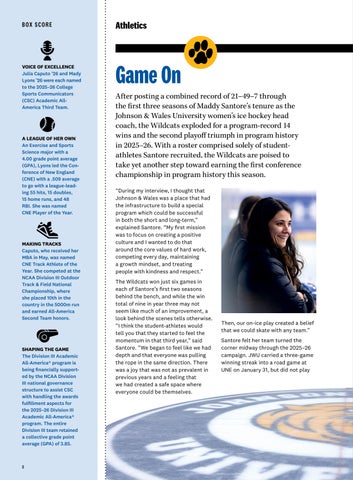
Game On After posting a combined record of 21–49–7 through the first three seasons of Maddy Santore’s tenure as the Johnson & Wales University women’s ice hockey head coach, the Wildcats exploded for a program-record 14 wins and the second playoff triumph in program history in 2025–26. With a roster comprised solely of studentathletes Santore recruited, the Wildcats are poised to take yet another step toward earning the first conference championship in program history this season. “During my interview, I thought that Johnson & Wales was a place that had the infrastructure to build a special program which could be successful in both the short and long-term,” explained Santore. “My first mission was to focus on creating a positive culture and I wanted to do that around the core values of hard work, competing every day, maintaining a growth mindset, and treating people with kindness and respect.” The Wildcats won just six games in each of Santore’s first two seasons behind the bench, and while the win total of nine in year three may not seem like much of an improvement, a look behind the scenes tells otherwise. “I think the student-athletes would tell you that they started to feel the momentum in that third year,” said Santore. “We began to feel like we had depth and that everyone was pulling the rope in the same direction. There was a joy that was not as prevalent in previous years and a feeling that we had created a safe space where everyone could be themselves.
Then, our on-ice play created a belief that we could skate with any team.” Santore felt her team turned the corner midway through the 2025–26 campaign. JWU carried a three-game winning streak into a road game at UNE on January 31, but did not play
Daily Game Plan
Sophia Warburton ’27 Sport: Women’s Soccer Stats: Team Captain, Academic All-American Major: Criminal Justice (Psychology Minor) Hometown: Norfolk, Virginia
8 AM – WAKE UP
“My first mission their best and came away with was to focus a 2–1 defeat. on creating a Upon entering positive culture.” the locker room following the setback, Santore felt that the team understood that they beat themselves. “As a coaching staff, we didn’t need to say anything to them. They understood that the expectations were now higher and there was a sense of, ‘We never want to feel this way again.’ Losing because they did not show up as the best version of themselves was now unacceptable, and that was the last time it happened.” Maddy Santore
This was never more evident than the night of February 25, 2026, when a raucous home crowd was treated to a 3–1 win over Curry College in the
Conference of New England (CNE) Quarterfinal round. And while the Wildcats season ended three days later with a road loss to Western New England, Santore and her squad entered the offseason with a different mindset than ever before. “This was the first time reaching the end of a season with a group so special that nobody wanted to be done,” said Santore. “The following week was spring break and yet I felt that 100 percent of our group fully wanted to be at practice the following week. The team was upset with the loss, but there was an immediate excitement for the future because they could feel the momentum and see the build. The assignment this year is to be the best version of ourselves right out of the gate and not just the second half of the season.”
Breakfast is usually a yogurt bowl with granola and fresh fruit. On lighter training days, I head to a morning boot camp workout before class.
9:30 AM – CLASSES Most mornings are criminal justice and psychology courses. One of my favorites is crime scene lab.
12:30 PM – CLASS My accounting elective is like learning a language — the language of business.
1 PM – RESET After classes, I drive home to my apartment for lunch, homework and a little recovery or athletic training treatment before practice.
4 PM – PRACTICE Practice begins with a team warm-up and possession drills, then position-specific training or game situations.
6:30 PM – LEADERSHIP As captain, I plan workouts and prepare for the week. I’m working toward my personal training certification.
7 PM – WIND DOWN I live with several teammates so we end the night watching TV or just hanging out. JWU.EDU
FA L L 2 0 2 6 9
C OV ER S TO RY
1 0 J O H N S O N & WA L E S U N I V E R S I T Y M AG A Z I N E
Consumers are increasingly investing in experiences and JWU graduates are stewarding their not-to-be-missed moments. By Katelyn Silva Illustration by Rich Wells
JWU.EDU
FA L L 2 0 2 6 1 1
YO U H A D TO B E TH ER E
In June, in the heart of downtown Providence, people from across the world erupted in unison as goals flashed across a jumbotron at watch parties for the ’26 FIFA World Cup. The PVD FanZone, set up on the lush green of Station Park, welcomed more than 145,000 visitors who arrived draped in a rainbow of team regalia. With the State Capitol Building and waving international flags as the backdrop, teens played lawn games, children enjoyed facepainting and crowds spilled into nearby restaurants and businesses. An event of this size, scale and success — while appearing seamless to guests — does not happen without a lot of strategy, planning and expertise behind the scenes and JWU
graduates are leading the charge in creating unforgettable, you-just-hadto-be-there moments. One example is Jonathan Walker, ’14, ’18 MBA, executive director of the Rhode Island Sports Commission at GoProvidence, whose work helped Rhode Island prepare for and capitalize on the opportunities surrounding the 2026 FIFA World Cup. While the PVD FanZone was led by the Providence Department of Art, Culture and Tourism and the Providence Tourism Council, Walker and the Rhode Island Sports Commission played a significant role in the broader RI Summer of Soccer initiative, helping create a destination-wide experience around the tournament while also positioning Rhode Island to host one of the participating national teams. “Today’s experience economy is about making memories over material things,” says Walker, who graduated
from the Sports, Entertainment, Event — Management (SEEM) program and later received his online MBA with a concentration in hospitality, both from JWU. Other hospitality degrees include Hospitality Management and Food & Beverage Industry Management. The explosion of the experience economy The PVD FanZone is one illustration of the rise in demand for immersive, authentic live events that prioritize memories over objects. While entrance to the PVD FanZone cost nothing (a rarity in a world where big stadium concert tickets can average $216), the experience economy is big business. Consumer spending on recreation services totaled approximately $819.2 billion in 2025 according to the U.S. Bureau of Economic Analysis, reflecting a significant post-pandemic rise in spending on entertainment, membership clubs, sports centers and related leisure activities.
“Today’s experience economy is about making memories over material things.” Jonathan Walker, ’14, ’18 MBA, Executive Director of the Rhode Island Sports Commission at GoProvidence
“We’re in a ‘you-had-to-be-there moment’,” says Elizabeth Craighead ’09, vice president of experiential at Live Nation, the world’s leading live entertainment company. “Consumers want to prioritize live experiences that you can’t replicate. We throw around terms like ‘once in a lifetime’, and ‘money can’t buy,’ but there’s a lot of truth to that. People want to be 1 2 J O H N S O N & WA L E S U N I V E R S I T Y M AG A Z I N E
First Person immersed in these moments. This is especially true after COVID when the demand for experiences exploded.” Marina Middleton ’13, the CEO and co-owner of Create & Cultivate, an events and media company, agreed that the experience economy came back heavily after COVID. “I think people were just like, ‘I need this’ after being cooped up for so long. In addition to the post-pandemic effect, I think individuals are increasingly burnt out by their online lives. We’ve gotten to the point where people are trying to just be together, get a hug, have a real conversation.” Deloitte calls consumers’ postpandemic willingness to pay a premium for live entertainment and experiences — even while the cost of living and inflation is rising — the effect of “funflation,” and it doesn’t appear to be dampening. In 2024, Deloitte surveyed approximately 3,500 Americans for its Digital Media Trends study and found the majority (61%) invested in at least one live event in the last six months. The average attendee surveyed went to seven live events in the past six months. And those in younger generations, particularly Gen Zs and millennials, were the most likely to seek out multiple and diverse live events. Associate Professor Elizabeth Covino, who teaches event management courses within the SEEM program, points to Taylor Swift’s The Eras Tour as one of the most “impressive and clear” examples of the power of the experience economy. With more than 10 million attendees worldwide, Swift didn’t just deliver a 51-city concert tour, she created what The Washington Post called a “cultural phenomenon” that inspired some fans to fly internationally or pay a premium multiple times over to experience it. Covino discussed the immersive culture, special details and authentic vibe that Swift built to make her JWU.EDU
tour successful. She says, “Swift illustrated that it wasn’t enough to just attend the concert; you had to experience it. Attendees brought friendship bracelets to trade, wore special outfits to match the theme of Swift’s performance and the crowds of thousands became part of the concert’s light show.” The creation of an immersive world helped make The Eras Tour the highest grossing tour of all time with an estimated profit of $2.2 billion. It’s harder (and more rewarding) than it looks For fans, Swift made the Eras Tour look effortless. The reality is that it took a massive international team, from sound technicians to truck drivers, all working towards a single goal to create the once-in-a-lifetime experience described by fans. JWU graduates across the globe are also doing that detailoriented work to create unforgettable moments — and sharing in the rewards of the memories they make. “We do a lot to make our events look easy and flawless,” notes Craighead, whose experiential team manages anything with a live component for brand partnerships, including creating VIP experiences at music festivals like Lollapalooza and BottleRock or executing a postconference party from beginning to end. “It’s about paying close attention to a lot of details; having plans A, B and C.” For example, inclement weather at Chicago’s Lollapalooza festival recently gave her team a run for its money, but they were ready. She says that type of snafu is a perfect example of why you must “expect the unexpected” and plan for every possibility when creating experiences. But the payoff can feel transcendent. “Most of us live for the moment that the band or artist goes on stage. People eat it up. They start singing, dancing, jumping. It’s this
The Making of JWU Jam Fest Anna Countouroudas ’26 Sports, Entertainment, Events Management (SEEM)
We all had to come up with different concert ideas initially, and then over the semester we used those ideas and plans to form JWU Jam Fest. It was really cool to see something that started as an idea in class turn into an actual concert. We were planning everything from the talent and venue to the marketing and all the little details that make an event come together. I was part of the talent management team, so I got to see how many different pieces go into producing a concert. We had to think creatively, but we also had to think “It takes about what many people was realistic. When we were bringing deciding on different perspectives a venue, for example, we and ideas.” wanted somewhere that was student friendly and could accommodate everything we had planned. We ultimately chose Gaebe Commons because financially it would save us money that we could invest in other parts of the concert. The biggest thing I learned is that it takes many people bringing different perspectives and ideas. Everyone had a different role, but we were all working toward the same goal. Seeing it all come together was a really rewarding experience because it showed me what it’s actually like to take an idea and make it happen. FA L L 2 0 2 6 1 3
On Course unified force that you can palpably feel, and we all take a deep breath because we made something special happen for people,” says Craighead, who also graduated from the SEEM program and whose team handles 150 programs globally annually.
TRVL 4011
Destination Management INSTRUCTOR Bryan Lavin, DBA Associate Professor, College of Hospitality & Business CLASS DESCRIPTION Destination Management is a senior-level tourism strategy course focused on how destinations attract visitors, support local economies and create experiences that keep people coming back. Students explore the interconnected tourism ecosystem, from hotels and restaurants to venues, attractions and events, and examine how Destination Management Organizations (DMOs) bring those pieces together to drive sustainable growth. A TYPICAL PROJECT Students put strategy into practice by working with local tourism organizations, including GoProvidence, on projects 1 4 J O H N S O N & WA L E S U N I V E R S I T Y M AG A Z I N E
“The tourism ecosystem has a symbiotic relationship across all sectors. When one part succeeds, the benefits can spread throughout the entire destination.” Bryan Lavin, DBA
designed to support real-world destination goals. Past projects have included a marketing program for Providence Pizza Week and PVDpov, a destinationfocused storytelling podcast. Students also develop their own strategies for destinations, considering everything from economic development and branding to community needs and destination stewardship. THE TAKEAWAY “The hope is that students understand the interconnected nature of the industry,” says Lavin. “When you understand how the destination tourism ecosystem works, the benefits spread across all industry sectors — restaurants, hotels, venues, attractions, service providers and event managers.” Several students have gone on to careers in destination management, putting that strategic perspective to work.
“ Most of us live for the moment that the band or artist goes on stage … It’s this unified force that you can palpably feel.” Elizabeth Craighead ’09, Vice President of Experiential at Live Nation
Craighead’s whole business is creating “customized and curated” experiences for her brand partners, which can include things like backstage tours, photo opportunities with artists or decked-out suites on-site. Delivering the unforgettable means truly knowing who you’re doing it for and why, she says. “To create something special, you have to know your audience inside and out because everything doesn’t work for everyone,” she explains. Craighead, who prior to joining Live Nation worked on NYC PRIDE and toured with Demi Lovato activating a pre-concert sponsorship experience for Tampax, encouraged students to approach the work as “a non-ego game” and stressed the importance of flexibility in the evolving world of experiential hospitality. She explains, “In this work, you have to be flexible because you have to roll with whatever a client might ask, what an artist might need or what the environment is telling you. My cardinal rule is ‘underpromise but always overdeliver.’”
The power of building connection Middleton, who earned her B.S. degree in marketing, also knows a thing or two about bringing massive immersive experiences to large crowds. Her team recently hosted its second Create & Cultivate Festival, the largest festival for women in business, in Los Angeles. The scope of the festival was immense with a venue the size of five football fields filled with four live stages to host 150+ speakers who spoke to thousands of businesswomen. Keynotes included influencer and podcaster Alix Earle and businesswoman Emma Grede (co-founder of Good American and founding partner of Skims). Beyond the stages, attendees had access to more than 300 experiential brand activations, multiple workshops and countless networking opportunities. The event closed with a musical performance from Cardi B, no less. “Nothing on this scale has ever existed for women in business before,” says Middleton, who bought Create & Cultivate in 2023 after having been an attendee of its events, a guest speaker, and then, an investor. While Create & Cultivate hosted smaller events before Middleton’s tenure, the festival was her brainchild, and the payoff has been tremendous. She explains, “The festival itself is the largest thing that we’ve ever created. Between our festival and other events, we reach over 3 million women, and we have an email list of 500,000 subscribers.” For Middleton, success has meant balancing excellent event execution with the prioritization of human connection. She says, “What people often get wrong in the experiential space is they’re focused so much on what’s happening versus how you can engineer connection between people. Building those connections is what we do.” At last year’s festival, Middleton’s team facilitated over 10,000 one-on-one meetings, she says. JWU.EDU
That focus on connection doesn’t stop with attendees; it also shapes how Middleton’s team brings brands into the experience. “You’re never going to walk into a sponsor activation at a Create & Cultivate event and get handed a business card. You’re just not. And not because those don’t work, but they don’t work at our events. What we want is for people to connect with one another authentically, to try out the products, do the demos, and be in the experience. For example, we do coffee shops in the pop-ups. There might be a DJ, tattoos, tooth gems. It’s very experiential. We want people to say, ‘I love this brand.’” That approach means that Create & Cultivate events might look different from the business networking events people are used to. There are no folding tables or linens. No step-and-repeat branded photo backdrops. No generic exhibitor booths, Middleton says. “We create beautiful, unique events and because of that, women love being there,” she said. That approach has led to millions of loyal experience economy customers.
Rhode Island a major player in the international experience — creating memorable moments for fans and would-be fans while positioning the state as an attractive home base where visitors could stay, dine and experience local culture. “It was gratifying to see Rhode Island come together around such a unique opportunity,” says Walker. “Whether it was helping welcome an international team to the state, creating opportunities for local youth to connect with the World Cup experience, supporting transportation options for visitors traveling to matches or helping create a championship-style atmosphere throughout Rhode Island, the goal was to make sure people could experience something special here.”
experience can take months like the Create & Cultivate festival; other times, it’s years in the making. For Walker, the work surrounding the RI Summer of Soccer, which comprised over 100 community events including the PVD FanZone, began four years before the first FIFA World Cup match was played in the region. When Boston was named a World Cup 2026 site in 2022, Walker’s wheels started turning right away. With Providence just 50 miles from Boston and about 20 miles from Gillette Stadium, he saw a oncein-a-lifetime opportunity to make
Elizabeth Craighead ’09, Vice President of Experiential at Live Nation
“To create something special, you have to know your audience inside and out because everything doesn’t The importance of looking ahead Sometimes the deep preparation work for everyone.” required to execute an extraordinary
Walker adds, “By creating those memorable moments, we were able to give both visitors and Rhode Islanders an opportunity to experience the destination in a new way while also creating economic and community benefits that could extend beyond the tournament itself.” Currently, Walker and the Rhode Island Sports Commission are pursuing bids for large-scale sporting events that wouldn’t take place for another five or six years. FA L L 2 0 2 6 1 5
“What we want is for people to connect with one another authentically … and be in the experience.” Marina Middleton ’13, CEO and Co-owner of Create & Cultivate
He recommends that those who want a career in the experience economy stay “tapped in” to the ever-changing landscape. “You need to have a vision for events and experiences that may not occur for many years. You need to know the key players in the industry, the market conditions, where things are trending, and, just as importantly, what attendees are looking for and how they want to experience an event,” says Walker, who credits JWU faculty and their decades of real-world experience in hospitality end event management with instilling in him the importance of understanding those factors. He added, “My experiential education at JWU is the reason I’m in my position. If I hadn’t had the opportunity to work directly in sports as a student, I wouldn’t have had the confidence … and I wouldn’t have been aware of the different career paths and opportunities in the world of sports outside of actually playing.” An education that understands the evolution of hospitality Through hands-on projects, industry partnerships and realworld learning, students aren’t just studying hospitality at JWU, they’re practicing the collaboration, creativity and adaptability
1 6 J O H N S O N & WA L E S U N I V E R S I T Y M AG A Z I N E
needed for today’s experience economy and building networks of invaluable career connections. “As part of the SEEM program curriculum we realize that to understand events, students must go out into the industry and put learning into practice through real-life experiences and projects,” explains Covino, who notes that the program provides a litany of opportunities for students to apply their coursework to the real world, including the annual SEEM Concert. The SEEM concert is the result of months of student-led planning, collaboration and problem-solving, guided by Covino. What begins as an idea in the Advanced Event Production: Concert course becomes a full-scale event where every decision, from booking talent to securing a venue, has real impact.
“As part of the SEEM program curriculum we realize that to understand events, students must go out into the industry and put learning into practice through real-life experiences and projects.” Elizabeth Covino, Associate Professor
Checklist From the start, students are immersed in the realities of the industry, an approach Covino intentionally built into the course. “In the first semester, we learn about concert production, and in the second semester, the class produces the event,” she explained. That event, JWU Jam Fest, was not handed to the students; it grew from their own ideas and collaboration. “It was an idea that came up during class, and we all loved it,” says Megan Correia ’27. The goal was to create an exciting, memorable experience for the campus community. The concert offered a range of attractions, including live entertainment, local vendors and food trucks. By the time JWU Jam Fest took place, it represented more than an afternoon of music. For the students behind it, the concert was a culmination of what they had learned and a chance to apply their skills in a real-world setting. The newly integrated College of Hospitality & Business, which houses the SEEM program, also provides ongoing opportunities to hear from experts. Both Walker and Craighead have returned to campus to share their hard-earned wisdom. At a 2024 Conference, Walker advised students to appreciate all that a JWU education has to offer. “Embrace the assets that you have here at JWU,” said Walker. “Not only your fellow students, but the faculty — their level of industry experience and knowledge are unmatched. I think sometimes students are afraid to take advantage of that, ask questions or stick around after class, but I would say use the network you have here and all the assets that you have on campus and take full advantage of your education.”
JWU.EDU
How to Make Event-Day Chaos Look Effortless What does it take to pull off an event that feels seamless? “There are so many moving parts to an event, and the guest should never have to see the chaos behind the scenes,” says Lee Esckilsen, associate professor in JWU’s College of Hospitality & Business. “That’s what makes venue management so dynamic. You’re constantly thinking three steps ahead while making sure everything feels effortless for the people in the room.” For Esckilsen, great event management comes down to five foundational planning items:
Know Your “Why” Before you start thinking about logistics, you need to understand what you’re trying to accomplish. The purpose of the event, who you’re bringing together and what you want guests to take away, should drive every decision you make.
Walk the Space You can’t manage a venue from a floor plan alone. Walk through the space as a guest would and think about everything from arrival and wayfinding to traffic flow, accessibility and the little moments that can make an experience feel easy — or frustrating.
Build the Run of Show A great event may look effortless, but there’s a lot of coordination happening behind the scenes. You need to know what’s happening, when it’s happening and who’s responsible for making it happen. Building in enough flexibility to keep things moving is key.
Plan for the “What Ifs” Something will go wrong. A speaker will be late, technology won’t cooperate or a vendor will have a question at the worst possible moment. It’s important to anticipate those situations and have a plan before you need one.
Own the Guest Experience At the end of the day, it’s not about how well you managed logistics; it’s about how the guest experienced the event. Every touchpoint matters. The best venue managers are always looking at the event through the guest’s eyes.
Lee A. Esckilsen, Associate Professor, College of Hospitality & Business
FA L L 2 0 2 6 1 7
1 8 J O H N S O N & WA L E S U N I V E R S I T Y M AG A Z I N E
PRO FI LE
CHANGING THE
RECIPE Chef Jennifer Gallagher has spent decades in professional kitchens. Now, she’s helping shape a new generation of leaders who believe excellence and empathy belong on the same menu. By Clara Schwager Portrait by Mia Rose
JWU.EDU
FA L L 2 0 2 6 1 9
PRO FI LE: CH A N G I N G TH E R EC I PE
C
hef Jennifer Gallagher can still picture the magazine that changed her life. She was in middle school when her older sister handed her an issue of Gourmet. Flipping through its pages, Gallagher stopped at a photograph of students gathered on the steps of a culinary school. Until that moment, she hadn’t known such a place even existed. In the 1980s, becoming a chef wasn’t a career path most high school guidance counselors talked about. But for Gallagher, the image crystallized something she already knew about herself. She wanted to cook. “I’m one of those lucky people,” she says. “I knew what I wanted to do, and I actually got to do it.” She found her way into restaurant kitchens as soon as she could, quickly falling in love with the rhythm of professional cooking. Every service felt like a performance built on precision and teamwork. There was the adrenaline of a busy dinner rush, the satisfaction of seeing a carefully planned menu come together, and the camaraderie that develops when an entire kitchen moves as one. “It can be challenging,” she says. “But when you write the menu, select the wines and everything comes together for a great night, there’s nothing better.” That passion for the profession has never faded. What has changed, however, is Gallagher’s definition of what makes a successful kitchen and, ultimately, a successful career. When Gallagher entered the food industry, there were certain assumptions that simply weren’t questioned. Long hours were expected. Working 70- or even 80hour weeks was worn as a badge of honor. Commitment was measured by endurance, and young chefs learned 2 0 J O H N S O N & WA L E S U N I V E R S I T Y M AG A Z I N E
quickly that exhaustion was often treated as proof of dedication. “It was just the expectation,” Gallagher says. “That’s what everybody thought the career required.” Today, after more than two decades educating students at Johnson & Wales University, she sees a very different generation walking into culinary classrooms: a generation that’s asking different questions and, in many ways, changing the profession itself. That realization hit head-on during a guest speaker event several years ago. Gallagher had invited a chef to campus to demonstrate techniques and talk about building a career in the industry. She expected students to ask about recipes, restaurants or career milestones. Instead, one of the first questions came from an 18-year-old student who simply asked: What about work-life balance? Gallagher still laughs at her own surprise. “My head almost spun off,” she recalls. Today, she says, it’s one of Younger professionals the most common questions increasingly students ask expect visiting chefs. organizations How many to invest hours do you in their work? Can you well-being. have a family? What does a sustainable career actually look like? The questions reflect more than changing attitudes inside culinary education. They mirror broader shifts happening across the workforce. According to Deloitte’s 2025 Gen Z and Millennial Survey, work-life balance is the top consideration Gen Z employees evaluate when choosing an employer, ranking ahead of salary for many respondents, while meaningful work and supportive workplace culture continue to rise
as defining career priorities. Rather than accepting burnout as inevitable, younger professionals increasingly expect organizations to invest in their well-being — and they’re willing to leave workplaces that don’t. Gallagher doesn’t see those expectations as unrealistic. She sees them as necessary. “I think the industry has had to evolve,” she says. “If you want people to work for you — and enjoy what they’re doing — that has to be part of the conversation.” That evolution is visible not only in restaurants, but throughout the food industry. Employers recruiting Johnson & Wales students increasingly promote predictable schedules, professional development opportunities and workplace cultures designed to retain talented employees. Some openly advertise capped work weeks and benefits that would have been almost unheard of when Gallagher was starting her career. It’s a shift she welcomes, not because the work has become easier, but because the industry has recognized that caring for employees ultimately strengthens the businesses they build. “We lost a lot of great people,” Gallagher says. “People who loved the work but eventually decided they couldn’t keep living that way.” Those conversations have also changed the way Gallagher mentors students. Every fall, she meets firstyear culinary students who arrive convinced they already know exactly where their careers will lead. Some dream of opening restaurants; others imagine becoming television chefs. Many have never worked a single shift in a professional kitchen. Within weeks, reality begins to set in — long hours on their feet, fast-paced labs, new techniques. The realization that loving food and thriving in a commercial kitchen are not always the same thing.
employee wellbeing can coexist. “We don’t need to substitute a strong work ethic or high standards, but they don’t have to be the reason we don’t stay somewhere long or take care of ourselves,” Johnson says. For Johnson, sustainable leadership means creating a culture where people understand the why behind the work rather than being driven by fear. Those sentiments reinforce what Gallagher hopes every graduate carries into the profession: that technical excellence and human leadership are inseparable. “If you’re not compassionate,” she says, “how can you really be successful?” Gallagher often reminds students that every generation changes the industry in some way. Her generation proved its commitment through relentless effort. Today’s students, she believes, are asking something equally important: Can excellence also be sustainable? Can ambitious careers leave room for family, creativity and longevity? Can leaders build kitchens where people genuinely want to stay? Gallagher believes the answer is yes. In fact, she believes the future of the food industry depends on it. “I want them to elevate “It’s about being food,” she says. intentional “But I also about the career want them to you build and elevate the work the culture you experience.” create for the Recipes people coming evolve, menus up behind you.” change — even Ashley Anna Hovis ’17 the best chefs never stop refining their craft. Chef Gallagher believes the food industry should keep evolving, too; building kitchens where excellence and empathy belong on the same menu. Chef Gallagher leads students in a JWU Charlotte food lab.
Some begin to wonder if they’ve made the wrong decision. Rather Jennifer Gallagher than reassuring them they’ll become chefs anyway, Gallagher offers something more valuable: perspective. She often walks students outside the classroom, looks back through the windows into the teaching kitchens and reminds them that there are countless ways to build a career rooted in food. Some graduates will become executive chefs. Others will work in nutrition, food science, product development, culinary research, food media, entrepreneurship or education. The goal isn’t to steer students toward one destination. It’s to help them discover the path that fits them best. “I want them to have options,” she says. “I want them to build a career, not just have a job.” That distinction matters. Careers evolve; jobs end. Gallagher encourages students to think beyond the role they imagine at 18-years-old and prepare for the person they’ll become at 30, 40 or 50. A four-year education, she believes,
“I want them to have options. I want them to build a career, not just have a job.”
JWU.EDU
creates flexibility that allows graduates to continue shaping their futures as both they and the industry evolve. That philosophy extends beyond the classroom. Over the past several years, Gallagher has intentionally broadened the voices students hear from throughout their education. Guest speakers and alumni panels increasingly feature professionals working across every corner of the food industry — entrepreneurs, food scientists, product developers, educators and restaurant leaders whose careers reflect the expanding possibilities available to graduates. Just as important, they speak candidly about workplace culture. Students hear from professionals who have built successful businesses without sacrificing the people who make them successful. For Ashley Anna Hovis ’17, JWU expanded the definition of a culinary career and helped her see the importance of shaping the culture around it. “It’s about being intentional about the career you build and the culture you create for the people coming up behind you,” says Hovis, director of café operations at Community Matters Café. Community Matters Café Executive Chef Chayil Johnson ’17 believes high standards and
FA L L 2 0 2 6 2 1
TH E I NTER S EC T
Experience Doesn’t Retire In JWU’s Criminal Justice department, faculty bring decades of real-world experience into the classroom to prepare the next generation. By Katelyn Silva Illustration by Chris Gash
I
n Assistant Professor Barbara Frazier’s Criminalistics class, students analyze crime scene photos. They discuss protecting the integrity of a crime scene, how to collect evidence and what’s essential to building a case. Then, they learn something else: A detective who worked hundreds of cases like this one is standing right in front of them. Some careers don’t end with retirement; they evolve and continue to create impact through the next generation. In JWU’s Criminal Justice program, professionals like Frazier, a 20-year veteran law enforcement officer and detective, bring decades of frontline experience into the classroom, transforming hardearned lessons — from crime scenes to courtrooms to command centers — into the education of tomorrow’s criminal justice professionals. Frazier, who teaches Criminal Justice, Corrections and Criminalistics, says, “Through my education, from undergrad to my doctorate, I was taught by people who had experience in the field and people who didn’t. I know that I’m a much better learner from someone who actually did it.” “We know what the [text] book says, but we also know the reality. We
2 2 J O H N S O N & WA L E S U N I V E R S I T Y M AG A Z I N E
all did it in real life,” adds Professor James Desmarais, a lawyer and retired Providence police detective captain who worked approximately 100 homicide cases, oversaw more than 135 detectives, and now teaches courses, including Corrections, Criminal Justice Ethics and Criminal Investigations. From Experience to Application Applying his knowledge from decades of investigative experience, Desmarais helped outfit the program’s stateof-the-art crime lab in 2017. The lab has a crime scene staging room and laboratory-grade forensic equipment, including comparison microscopes for ballistics analysis, a fuming cabinet for latent fingerprints, a blood drying cabinet, forensic photography stations, shoe print castings and blood spatter analysis tools. “We have stuff that I didn’t have when I was doing it for real,” says Desmarais, who notes that evolving technology is becoming increasingly integral to criminal justice work. He says the field has evolved from primitive radios to drones, from street-level crimes to cyber investigations, from cash exchanges on corners to Venmo payments and more. “The hands-on approach our students get in the lab and beyond is necessary for the jobs of today.”
10 Major Courses
From law enforcement, corrections and criminology to criminal investigation, homeland security, criminalistics and criminal law, the major coursework spans the many facets of the field.
IndustryFocused Labs
2
Students step into a staged crime scene room to learn evidence collection and investigation, then analyze forensic evidence — including fingerprints, blood spatter and bullet trajectories — in the Crime Lab.
22
2 Ways to a B.S. Students can complete the Criminal Justice B.S. through a traditional four-year program or the newly launched, 90-credit three-year option.
JWU.EDU
2
Years of Law Enforcement Experience Professor and Department Chair Paul Sylvestre spent 22 years with the Pawtucket Police Department before bringing his experience into the classroom. He’s one of several Criminal Justice faculty members with substantial professional experience in the field.
FA L L 2 0 2 6 2 3
TH E I NTER S EC T: E X PER I EN CE D O E S N ’ T R E TI R E
That real-world perspective carries across a curriculum that spans criminal investigation, homeland security, criminal law, forensic science and psychology — preparing students for careers ranging from law enforcement and forensic analysis to victim advocacy, fraud investigation and corporate security. Connections that Open Doors At JWU, students learn from faculty who are not only equipped with the skills developed over long careers, but also the deep connections built with police departments, agencies and professionals shaping what comes next. Those connections result in even more hands-on opportunities for students through special talks, trainings, site visits and internships. “After decades in the field, you develop relationships with people who are doing the work at every level. We can bring those connections into the classroom, but more importantly, we can help students build relationships of their own. Sometimes a conversation with a police officer, investigator or other professional can change how a student sees their future,” says Paul Sylvestre, Ph.D., Professor and Department Chair. “Our faculty’s experience opens many doors, providing students with connections, insights and opportunities,” says Emma Powers ’20, who notes that without the “dedication of the faculty,” she would not be where she is today, which is seven years into a career with the MIT Lincoln Laboratory where she works in national security and information management for the Department of Defense. Powers didn’t initially imagine a career working with a classified data archive when she entered JWU’s Criminal Justice program, but her exposure to diverse careers showed her there are multiple pathways to contribute meaningfully to the field. 24 J O H N S O N & WA L E S U N I V E R S I T Y M AG A Z I N E
Beyond visiting experts and their own hard-earned knowledge, JWU faculty consistently expose students to hands-on learning opportunities. For example, students recently traveled to a National Guard facility to assist the Providence Police Department as “actors” for academy trainees. One of those students was Katie McPartlin ’28, a member of the threeyear Criminal Justice B.S. program launched in Fall 2025 (JWU was the first in the nation to launch in-person, 90 credit, three-year degrees). She learned much from the experience and is looking forward to another opportunity arranged by Frazier. She says, “Professor Frazier … is planning a trip to tour one of Rhode Island’s prisons. I will definitely be signing up, since it will give me insight into possible careers.”
“I know that I’m a much better learner from someone who actually did it.” Barbara Frazier
A Two-Way Partnership Faculty partnerships with agencies directly benefit students, but the impact goes both ways. Among many examples, JWU faculty teach criminal law to Providence Police recruits, who put that knowledge into practice. More recently, Frazier hosted a fiveweek course for rising detectives focused on strengthening crime scene, investigative and interviewing skills. “We had students help and some secured internships from the experience, so that synergy between our faculty members and the departments is meaningful,” she says. That synergy was also on display this past June when the program
hosted a training that drew more than 100 police, corrections and probation officers to campus. Frazier and Lecturer Stephen Riccitelli, a retired police captain with 25 years of experience, helped bring the Texas Department of Public Safety Interdiction for the Protection of Children (IPC) training program to JWU. The IPC program helps officers recognize and rescue children who are being exploited. Riccitelli and Frazier attended the training so they can bring the material back to their classes. “It’s about identifying kids who might be trafficked or in some sort of harmful situation where they can’t ask for help, so it’s teaching law enforcement how to recognize the signs and address them,” says Frazier. “I will bring this training to my Victimology and Juvenile Justice classes, and share not only the information, but also some of the experiences the speakers shared as case studies.” Evolving Impact Frazier says she has moments of missing fieldwork, but she’s consistently energized by the impact she brings to the classroom and the continuously changing landscape that allows for new courses. She says, “This semester, I’m excited to teach comparative criminal justice systems, which is a course that will tap my network of law enforcement professionals around the world to bring international perspectives directly into the classroom. I enjoy having influence on people coming into the profession and helping them enter the criminal justice world prepared.” That enthusiasm to bring hardearned knowledge, connections and real-world expertise is hardly unique among JWU’s Criminal Justice faculty, says Frazier. “I think we all feel this way,” she says.
Forever
J W U A LU M N I I N C LU D I N G 27 Class Notes 28 Strategic Connections 30 Crowdsourced 32 Wildcat Chat
Keep an eye out for upcoming alumni events at jwu.edu/alumni.
THE JWU PLEDGE Support the next generation of Wildcats! Your gift helps students with the highest need as they achieve their dreams. jwu.edu/giving
JWU.EDU
FA L L 2 0 2 6 2 5
Forever JWU Alumni
Lessons in Leadership Alumni Offer AI Advice for Tomorrow’s Workforce
Nol Foretia ’16 Shares Recipe for Career Success
NEWS
As executive performance chef for the Pittsburgh Pirates, Nol Foretia ’16 spends his days fueling elite athletes with meals designed to optimize performance. Outside the ballpark, he also operates his private chef business, Meals for Victory, creating customized dining experiences for clients. After helping feed the Philadelphia Eagles during their Super Bowl-winning season, Foretia says every opportunity has
reinforced one lesson: stay open to new experiences.
Compass Group Alumni Share Lessons in Leadership
Career paths are rarely linear; a lesson several JWU alumni all working at Compass Group USA know firsthand. Last spring, these graduates working across hospitality, recruiting and healthcare operations reflected on the experiences, relationships and opportunities that shaped their careers while encouraging students to stay
Alexa Giovanis ’17
As artificial intelligence continues to reshape the workplace, four JWU alumni returned to campus to share how they’re using the technology — and why human skills remain the greatest competitive advantage. During a panel discussion, alumni from industries including marketing, design and consulting agreed that AI is best viewed as a tool that enhances creativity and efficiency rather than replacing people. Among their advice for students: Develop strong prompt-writing skills,
experiment with emerging technologies and never stop thinking critically. “It can help you expedite and be more efficient,” said Sierra Barter Terry ’09, “but we still need to make sure that we’re thinking critically.” Daniel Willis ’20 encouraged students to build technical expertise now, while Kyra Northup ’24 emphasized learning how to communicate effectively with AI to produce stronger results.
Human skills remain the greatest competitive advantage.
“Find a place that fits you,” says Foretia, who earned a degree in Culinary Nutrition. “Wherever you are now isn’t where you’ll be in five years, so try different experiences and see if you like them.” He also encourages students to seek mentors and remain adaptable. “Life is a journey, not a straightforward path, adjust as you go, make changes and be flexible.”
2 6 J O H N S O N & WA L E S U N I V E R S I T Y M AG A Z I N E
open to possibilities they may not have considered. Alexa Giovanis ’17, now a university relations recruiter, encouraged students to embrace every opportunity to learn and build connections. Alec Marvin ’15, ’16 MBA, who advanced from sous chef to general manager, emphasized that great leadership begins with investing
in people and creating exceptional experiences. Laura Vasconcelos ’11, now senior regional director of operations for Compass Healthcare, credited JWU’s handson education with preparing her to lead confidently. Together, the alumni shared a common message: meaningful careers are built through curiosity, adaptability and a willingness to keep growing.
Class Notes
PH I L A NTH RO PY N E W S
First Tool of the Trade
19 9 4 M’Lisa J. Kelley San Leandro, California In addition to teaching Culinary Arts full time to high school students in Fremont, California, M’Lisa is starting their fourth year volunteering with autistic students teaching culinary and life skills. Jeanne R. Michon Lincoln, Rhode Island Jeanne was named Southern New England’s Remarkable Woman 2025 by WPRI for her work in Rhode Island communities. Jeanne is the executive director of New Beginnings Inc. in Woonsocket.
19 9 7 Becoming a chef starts long before the first signature dish. It begins with mastering the fundamentals, one technique — and one wellused pan — at a time. Each summer, incoming Culinary Arts students at Johnson & Wales receive a professional sauté pan, marking the start of their journey in the kitchen. For many, it’s the first piece of equipment they’ll rely on through hours of practice, from perfecting knife skills to building confidence over the stove. That tradition is made possible through a longstanding partnership between Vollrath Company and the university. In addition to providing every first-year Culinary Arts student with a sauté pan, the commercial cookware manufacturer supports hands-on learning through gifts-in-kind, including induction ranges for culinary labs and barware for beverage classrooms.
JWU.EDU
Jason Evans, dean of the College of Food Innovation & Technology, says that collaborating with corporate partners elevates education at JWU.
Wesley C. Garland Cherry Hill, New Jersey Wesley has been promoted to Captain with the New Jersey State Police.
“It is because of these relationships that students can learn their craft using the most state-of-the-art tools and technologies in the food world. We simply couldn’t do what we do in maintaining our global reputation for food education without their support,” he says.
19 98
Johannah Evans ’28, a culinary arts major, remembers getting her Vollrath pan as a freshman. “I was ecstatic about the possibilities I would have with that pan and at JWU. Receiving that pan felt like an investment into my future and a new beginning, all wrapped in one.”
Gifts-in-kind fill JWU’s labs and stock our culinary storerooms. Want to learn more about how you or your company can help students learn with the best? jwu.edu/giving
2002 Thomas M. Tricarico Wesley Chapel, Florida Thomas and his wife Elaine, both class of ’02, are co-owners of Mana T’s Treats in Wesley Chapel. Says Thomas, “What started as a dream and a passion for creating amazing desserts has grown into a bakery that’s receiving more and more recognition every day, and we couldn’t be more grateful.”
2004
Cris Mattoon, Esq. Allen Park, Michigan Cris is the chief risk & compliance officer at Michigan First Credit Union in Lathrup Village, Michigan. Cris leads legal, legislative affairs, regulatory compliance, enterprise risk management and internal audit functions.
Jamie Silverberg Needham, Massachusetts Jamie serves as kitchen manager at Newman Elementary School in Needham. He also teaches hands-on cooking classes for children, helping young chefs build confidence, develop lifelong kitchen skills, and discover the joy of cooking from scratch.
19 9 9
2005
Kimberly Mattoon Allen Park, Michigan Kimberly received her master’s degree in business education from Ball State University in May 2026.
2000 SUPPORT STUDENT SUCCESS
Club Management Association of America (CMAA) Board of Directors at its 2026 World Conference and Club Business Expo, held in Anaheim, California, in February. Joseph was first elected to the Board of Directors in 2020 and re-elected in 2023.
Joseph E. Krenn Charlottesville, Virginia Joseph Krenn, CCM (Certified Club Manager), CCE (Certified Chief Executive), was elected the vice chair of the
Gwanda J. Passmore, CFE Miami, Florida Gwanda has launched ProWokeVegan LLC, a health consulting firm dedicated to plant-based lifestyle coaching in Miami. Gwanda has also released a cookbook on Amazon, “Pro Woke Vegan Recipe & 30 Day Challenge,” and can be found at Professionally Woke on Substack.
FA L L 2 0 2 6 2 7
Strategic Connections
3 Q U E S TI O N S
A Matter of Occupation Three Generations of Mentorship When occupational therapy student Bella Fazio ’27 began her Level II fieldwork at Sensation Station, a pediatric occupational therapy practice in Rhode Island, she found herself surrounded by fellow Wildcats. Her fieldwork educators, Jimmy Greene ’23 and Madisyn Frederick ’25, once stood exactly where she is now — JWU students preparing to enter the profession.
Soh Kone ’26 The Sports, Entertainment, Event — Management graduate turned a student job at Gillette Stadium into a dream opportunity with FIFA World Cup 2026. We caught up with him after the final whistle.
JWU students consistently arrive prepared, professional and eager to learn.
DREAM JOB? Working the FIFA World Cup. Growing up watching the tournament, then helping welcome more than 61,000 fans into Gillette Stadium was surreal. Seeing their excitement before kickoff made every long day worth it.
Frederick completed her own fieldwork placement under Greene before joining the clinic full time, creating what she describes as “three generations” of JWU occupational therapists learning from one another. That continuity is no coincidence. Greene says JWU students consistently arrive prepared, professional and eager to learn. “Johnson & Wales students have very good documentation, they’re timely and they’re confident asking questions,” he says. “You can tell they build close relationships with their professors, and that carries over into the clinic.” For Fazio, those faculty relationships have been one of the program’s greatest strengths. “Our professors are so accessible,” she says. “Even while we’re away on fieldwork, we can still reach out to them, and they’re always there to support us.” That culture of mentorship extends beyond graduation. Frederick says faculty continue to offer guidance as alumni begin supervising the next generation of students, while Greene credits the program with intentionally connecting students, alumni and clinical partners throughout their careers. At Sensation Station, those relationships come full circle every semester, demonstrating how the JWU network continues to open doors, strengthen careers and inspire Wildcats to invest in those following in their footsteps.
2 8 J O H N S O N & WA L E S U N I V E R S I T Y M AG A Z I N E
“Johnson & Wales students have very good documentation, they’re timely, very professional … they just have things figured out and ready to go.” Jimmy Greene ’23
MADISYN FREDERICK ’25 “JWU does a really good job of immersing their students into that web.” (Speaking about the professional OT network). BELLA FAZIO ’27 “Even while we’re away at fieldwork, we can always reach out to our professors, and they’re always there to support us.”
BEST JWU CLASS? Professional Sports Management. It showed me what happens behind the scenes at major sporting events and confirmed I wanted to build a career in the industry. BIGGEST MENTORS? Associate Professors Liz Covino and Lee Esckilsen, along with adjunct faculty Louis Pullano. They always connected me with hands-on opportunities and encouraged me to say yes to every experience. Those moments helped launch my career.
Class Notes
A LU M N I PRO FI LE 2009
SHARE YOUR NEWS Did you recently start a new job, receive a promotion, move to a new city or have a baby? We want to hear all that and more. Email alumni@jwu.edu or submit a note:
Kristina N. Stanford Lima, Ohio In 2020, Kristina published the children’s book “The Hero Brothers Set The Table.”
2007 Amanda R. Frizziola Union Beach, New Jersey Amanda is the agency owner and travel advisor at Almost There Travel Group in Union Beach. The company is celebrating their one-year anniversary.
2008 Jerusha DeVargas Winter Park, Florida Jerusha launched Meridian Standard, a data governance consultancy serving independent and mid-scale hospitality operators. Meridian Standard helps hotel operators find, fix and prevent the guest data problems that undermine repeat bookings and revenue attribution.
Leslie Agan
Ryan R. Hill ’09 MBA San Francisco, California Ryan was promoted to chief operating officer at the law firm of BraunHagey & Borden LLP in San Francisco.
JWU.EDU
Elizabeth Goslee Virginia Beach, Virginia Elizabeth has been promoted to dual property corporate sales manager for DoubleTree by Hilton in Bristol, Connecticut.
2 0 10 Bridget M. Boylan Charlotte, North Carolina Bridger is the founder and CEO of Pro Sports Pet Logistics LLC in Charlotte. Pro Sports Pet Logistics LLC is dedicated to empowering women athletes and executives in the sports industry by providing comprehensive pet care solutions.
2 0 14 Jenna Barone Harrison, New Jersey Jenna has been promotoed to director of operations at Electric Picks Jewelry in New Jersey.
2 0 15 Ines S. Contreras Cranston, Rhode Island Ines is the co-founder of Caliella, a luxury balloon décor and event design company based in Providence, Rhode Island. Caliella serves both private and corporate clients, and has built a strong reputation for elevated event styling.
A Taste of Home Andrea Cabrera ’16, ’18 MBA For Andrea Cabrera ’16, ’18 MBA, hospitality has always been about more than serving food. It’s about creating places where people feel welcomed, seen and at home. That philosophy is at the heart of Café Ava, the Latin-inspired Rhode Island business she founded with her husband and named for their daughter. Cabrera discovered her calling at Johnson & Wales University, where she earned a bachelor’s degree in Tourism and Hospitality Management before pursuing her MBA. She credits JWU’s hands-on, well-rounded education with giving her the tools to turn an idea into a growing business — from customer service and leadership to marketing, consumer behavior and the operational side of entrepreneurship. She put those lessons to work from the beginning, applying what she learned in class to jobs in restaurants and other customer-facing roles. Her campus involvement as a resident assistant, orientation leader and sorority president further shaped her approach to leadership and community.
“Stay open to possibility.”
After opening Café Ava in Cranston in 2022, Cabrera saw firsthand the demand for a space that celebrated Latin culture and brought people together. When customers began lining up for tables, she knew it was time to grow. In March 2026, Café Ava opened its second location in Providence, bringing the brand back to the city where Cabrera’s own journey began.
Amy J. Patel Boonton, New Jersey Amy started a new position: associate director, legal affairs, at Alvogen in Morristown.
Designed to feel like a grandmother’s home, the Providence café offers signature lattes and arepas alongside new menu offerings, a bar and a space for community gatherings. For Cabrera, expansion is less about growth for growth’s sake than creating an environment where everyone can feel at home.
2 0 16
That mission is closely tied to her daughter, Ava, and the café’s signature phrase, “Sí se puede” — anything is possible. Cabrera hopes her business will show the next generation, particularly young Latinos, that there are pathways to pursue their ambitions.
Tyler A. Parenti Boston, Massachusetts Tyler has joined Sigon Group in Boston as a partner leading the Audit, Compliance and Finance Modernization practice. Tyler is helping organizations modernize how their audit, IT compliance and finance functions operate.
Her advice to aspiring entrepreneurs echoes her own journey: Stay open to possibility. “You never know what may come out of it.”
FA L L 2 0 2 6 2 9
Crowdsourced
What skills matter most in an AI-powered world? Three Johnson & Wales alumni share their perspectives on the skills, mindsets and human qualities that will matter most as AI reshapes the future of work.
Robert Falcone ’06 Distinguished Threat Intelligence Researcher at Unit 42, Palo Alto Networks
In an AI-powered world, the workplace skills that matter most aren’t purely technical; they’re human. In cyber threat intelligence, AI helps to scale the collection and analysis of vast datasets of telemetry, malware and infrastructure, accelerating report generation for decision-makers. But AI models can generate flawed analysis or hallucinations. That makes critical thinking, relentless attention to detail and a questioning mindset more important than ever. Ultimately, the practitioner remains the essential human-in-theloop, scrutinizing AI outputs and applying sound judgment to ensure accurate assessments and truly intelligence-led decision-making.
Damaris Messina ’05, ’14 MBA General Manager at Aloft by Marriott Providence Downtown
Partner at Sigon Group
3 0 J O H N S O N & WA L E S U N I V E R S I T Y M AG A Z I N E
Grundini
Tyler Parenti ’16
To anyone starting out in audit and risk: AI now handles what once consumed entire teams. Pulling evidence, testing controls and even interpreting results faster than I could alone. So what’s left for you? Judgment, expressed three ways. Context: knowing which interpretation matters for your client. Direction: knowing what to ask and when an answer is too clean to trust. Accountability: you stake your name on the call; the AI never does. And curiosity sharpens all three — the appetite to keep learning as fast as the tools change. Technical skills get you in the room. These keep you there.
As a general manager for Marriott International and proud Johnson & Wales alumna, I believe the most important workplace skills in an AI-powered world are the uniquely human ones: passion, engagement, emotional intelligence and personality. AI can enhance efficiency and provide insights, but it cannot replace genuine hospitality or meaningful connections. Our associates bring warmth, empathy and authenticity that turn everyday interactions into memorable “wow” experiences. As Marriott looks to the future through innovation and technology, our greatest competitive advantage will remain our people, whose passion for service brings our values to life.
Class Notes Jose A. Samayoa Farmington, Connecticut Jose is the owner of Eels Professional Development in Farmington.
2 0 17 Sean M. Appleby Fairfax, Virginia Sean is a culinary instructor for Fairfax County Public Schools and was selected a New Teacher of the Year for the state of Virginia. Aileen M. Egan Freehold, New Jersey Aileen has been promoted to senior finance manager for Google’s Food Program with Compass Group USA — Restaurant Associates in New York City. Taylor M. Watchorn Kenansville, North Carolina Taylor is the owner of Everything Nice Sweets Bakery & Cafe in Kenansville. The restaurant has been awarded several local awards, including Best New Restaurant and Best New Business.
2 0 19 Daniel Genevick Cambridge, New York Daniel is the managing director for MassMutual Metro New York in New York City and Saratoga Springs, New York.
2 0 24 Kali Hine ’23 MBA Mountain Home, Idaho Kali is the assistant director of housing and residential life at Boise State University in Boise, Idaho.
2025 Audrey M. Linek Cartersville, Georgia Audrey is a pastry cook at Mason’s Steakhouse in Quincy, Massachusetts.
A LU M N I PRO FI LE I N M EM O R IA M
Lasting Connections
ALUMNI
Noir Hospitality Group
1957 Joan Lindstrom May 2, 2026 1967 Marilyn Bardell February 15, 2026 Joan E. Briggs February 12, 2026 1968 Jean Brassard February 28, 2026 Conrad Long May 3, 2026 1969 Burton Stallwood May 7, 2026 1974 Hugh Sheran Jr. April 11, 2026 1976 Raymond A. Baril March 19, 2026 Joseph Belli March 3, 2026 Richard Morrissette March 20, 2026 Donna M. Viera March 12, 2026 Anthony P. Voccio February 25, 2026 1978 John E. Jones Jr. April 21, 2026 William E. LaValley Jr. February 26, 2026 1979 Peter R. Doliber March 7, 2026 Robert W. Gorbig March 31, 2026 Chester O. Losinski August 24, 2026 Robert K. VanVeen April 3, 2026 1981 Brenda J. Gomes February 14, 2026 Jeffrey Mitchell May 10, 2026 1985 Leonard D. Desjarlais Jr. April 1, 2026 Glenn S. Rutley February 14, 2026
Leslie Agan
Todd M. Schmitgall July 2, 2026
JWU.EDU
More than two decades after meeting as students at Johnson & Wales University, a group of alumni has transformed lifelong friendships into a thriving business. Noir Hospitality Group (NHG), founded by classmates who stayed connected long after graduation, is proving that the relationships built in college can become the foundation for something much bigger. Led by (clockwise from top left) CEO Quientina Stewart-Morrow ’12, COO Crystal Johnson ’05, Chief Administrative Officer Natashnym Meggett ’00, ’03, and Chief Financial Officer Chavonne James-Fuller ’00, NHG draws on more than 100 years of combined hospitality experience to provide culinary project management, food and beverage consulting, curated travel experiences and hospitality strategy. Based across the Southeast, the team “People always serves clients nationwide while championing come first.” inclusion and wellness throughout the industry. The company’s origins were unexpectedly simple. During the pandemic, when travel slowed and the hospitality industry faced unprecedented challenges, former classmates began gathering regularly over Zoom to reconnect. Those conversations quickly evolved into a shared vision, fueled by years of trust and professional experience. For Meggett, the venture demonstrates how leadership and hospitality skills translate across industries. After transitioning from hospitality into global technology project management, she brought a new perspective to NHG while maintaining the service mindset developed at JWU. James-Fuller also reinvented her career after more than two decades in hotel leadership, moving into public service with the City of Fort Lauderdale while helping build NHG. She credits JWU with teaching a lesson that has guided every role she’s held: People always come first. Today, NHG reflects the entrepreneurial spirit its founders first developed on campus. Their advice to current students is simple: Invest in your relationships, embrace change and never underestimate where your journey — or the people you meet along the way — may lead. FA L L 2 0 2 6 3 1
Class Notes
Wildcat Chat
ALUMNI CONT.
1997 Robert Tacy June 30, 2026
1986 Norinne A. McSweeney March 20, 2026
1999 Thomas J. Harvey April 23, 2026
1989 James M. Orenberg March 6, 2026
Clifford W. Sylvia ’99 Ed.D. February 24, 2026
1991 Dennis W. Hawley March 22, 2026
2000 Shannon J. Smith April 6, 2026
Frederick J. Megna June 5, 2026
2002 Jodi L. Martin January 15, 2026
I N M EM O R IA M
1992 Lisa J. Ashley May 7, 2026 1993 Mark S. Crouthamel December 23, 2025 Nina E. Kennedy ’94 M.S. June 5, 2026 Edward “Sonny” Sweetman May 7, 2026 1994 Daniel Purcell March 5, 2026 1995 Jeremy P. Hudon April 1, 2026 1996 Nicholas Cringoli March 2, 2026 Esther B. Ferguson ’96 Hon. February 18, 2026 Daniel A. Gescheidle ’96 Hon. March 16, 2026 Shirley D. Rose June 12, 2026 Rebecca B. Scelza March 15, 2026
2007 Kathleen M. de Lara August 27, 2026 2012 Jena A. Schlosser May 11, 2026 2018 Joshua E. Orel July 20, 2026 2025 Matt O. McTiernan March 11, 2026 2026 Lester Allen Gibson Jr. April 25, 2026 FACULTY, STAFF AND FRIENDS Gail A. Carpenter February 27, 2026 Michael E. Michaud March 28, 2026 David Scott Petrone ’82 September 11, 2026 Scarlet H. Sager May 2, 2026 Patricia L. Wilson July 20, 2026
ONEJWU IS APRIL 7! Each year, alumni, students, faculty, staff and friends come together to support the JWU initiatives they care about most. Save the date and join in to make your gift of any size. It all adds up to oneJWU! jwu.edu/giving
3 2 J O H N S O N & WA L E S U N I V E R S I T Y M AG A Z I N E
P O D CA S T
“Culinary Now” Podcast Created by JWU culinary educators Jaime Schick, M.Ed., CEPC, and Matthew Britt, “Culinary Now” looks beyond the classroom to explore the people, ideas and innovations shaping the culinary profession. Now preparing to launch its eighth season, the podcast brings chefs, restaurateurs, educators and industry professionals into conversations about the future of food. What inspired you to create the podcast? We saw an opportunity to create a podcast centered on culinary arts education that looks beyond the classroom. “Culinary Now” spotlights the innovators, thought leaders and industry experts shaping the profession, sharing their ideas, experiences and insights with the next generation of culinarians, home cooks and food enthusiasts. What topics do you explore? We explore the people, ideas and innovations shaping the culinary world today — from emerging trends in food, hospitality and culinary education to the realities of kitchen leadership and restaurant operations. Each episode features conversations with chefs, restaurateurs, educators and industry professionals who share their expertise, experiences and passion.
MATTHEW BRITT ’19 MED & JAIME SCHICK ’07, ’19 MED Associate Professors, College of Food Innovation & Technology
How has JWU influenced the podcast? JWU has given us the opportunity to build a network within the broader food ecosystem. As educators, we embrace lifelong learning, and the podcast gives us another way to keep learning while creating a platform where our guests and listeners can grow within the discipline. What has surprised or rewarded you most? One of the greatest rewards is connecting with and learning from the broader food industry. Every conversation expands our knowledge and perspective. The biggest surprise? How much time goes into creating the final episode! What listeners hear is the result of considerably more work behind the scenes than they might expect. What’s next for “Culinary Now”? As we prepare to launch Season 8, we’re exploring new partnerships that can expand our audience, deepen our impact and support the podcast’s long-term sustainability. We’re excited to keep the conversation going and to continue learning alongside our listeners.
Parting Shot
Welcome to the Pack Fall at JWU means a whole new class of Wildcats is ready to find their place. From Providence to Charlotte, orientation gives students and families a first taste of campus life, an opportunity to meet their community and a chance to start feeling at home.
First Things First
Make It Yours
Orientation helps new students get familiar with campus resources, meet fellow Wildcats and prepare for the start of their JWU experience.
Each JWU campus has its own personality, but the goal is the same: helping new Wildcats feel connected, confident and ready to begin.
Meet Your People
Wildcat Ready
From future classmates to student leaders, orientation is all about making connections and finding your community before classes begin.
Orientation gives students the tools, connections and confidence to make the transition from accepted student to college student.
Get Involved
Takeaways
Clubs, organizations, events and activities give Wildcats plenty of ways to discover new interests, make friends and get involved on campus.
New Wildcats arrived ready to begin and left with new faces to recognize, places to explore and a community to call their own.
NON-PROFIT ORG U.S. POSTAGE PAID PROVIDENCE, RI PERMIT NO. 17
8 Abbott Park Place Providence, RI 02903 CHANGE SERVICE REQUESTED
Are you on the new JWU Network? Discover our revamped alumni platform built to help you reconnect with classmates, expand your network and mentor the next generation of JWU graduates.
Sign up today:
network.jwu.edu