
May-june 2023 • YEAR 11 • Nº122 • $3.50
Joaq uín

current issues / actualidad
Judicial Manipulation threatens Our democracy: Growing Challenge of Plutocracy

Manipulación Judicial y nuestra democracia: La Creciente Amenaza de la Plutocracia
Hawaii’s solution to Homelessness: Worth Replicating?
solución al sin-techo en Hawái: ¿Digno de Réplica?
educatiOn / educaciÓn
rethinking education: Montessori to Zapatistas radicalización Pedagógica: Montessori a Zapatistas
Mass sHOOtinGs / BaleOs MasiVOs An Equal Opportunity Tragedy
Una Tragedia al Alcance de Todos
Joaquín
Our mission is to provide the latino community of california’s central Valley with an unbiased mirror of our society, to advocate civic duty and participation, to celebrate the successes and achievements of our peers, and to provide a tribune for emerging latino leadership.
Personnel
Editor-in-Chief
Roberto A. Radrigán radrigan@joaquinmag.com

Contributors
Sonya Fe, Art Editor
Las Cruces, NM
Andy Porras
Sacramento, CA
Richard Soto
Tracy, CA
Thomas Block
Lorain, OH
Dave Wellenbrock
Lodi, CA
Ed Ramírez
Linden, CA
David Stuart
Sacramento, CA
Editorial boa rd
Inés Ruiz-Huston, PhD
Gene Bigler, PhD
Richard Ríos, MA, MS
Paula Sheil, MA
Manuel Camacho, MA
Jeremy Terhune, BS
Candelaria Vargas, BS
Mercedes Silveira, MA
Composition, Layout & All Illustrations (unless noted)
Gráfica Design
Translations
roberto radrigán & ronald Godoy
Offices/ Advertising
1 North El Dorado Stockton, CA 95202 (209) 513-7749
info@joaquinmag.com
www.joaquinmag.com

Joaquín is an English & spanish bilingual publication addressing relevant Latino issues in the California’s northern Central Valley. it is published monthly by Gráfica Design, LLC. a Stockton-based diversified advertising & bilingual services.
Submissions for publishing
We accept free, informational and editorial content. If you feel you have unique, fresh and compelling content to share, please send your writing, photo, art, etc. to editor@joaquinmag.com for consideration. All content must be current, unpublished and cannot advertise any particular business or service. Material can be written in English or spanish. All material submitted for consideration will not be returned except upon request.
Disclaimer: t he views and opinions expressed in this issue are those of the authors and do not necessarily reflect the opinion or position of Joaquin Magazine
ALL RIGHTS RESERVED. Any use of materials from this publication, including reproduction, modification, distribution or re-publication, without the prior written consent of Gráfica Design, is strictly prohibited.
MAY-JUNE 2023
cover art
Watercolor by Vincent Pucciarelli new York, nYin this issue En Este Número
Current Issues / Actualidad
How Judicial Manipulation threatens Our democracy: Growing challenge of Plutocracy cómo la Manipulación Judicial amenaza nuestra democracia: la creciente amenaza de la Plutocracia
Chican-izmos
Forging a new chicano identity Forjando la nueva identidad chicana
Current Issues / Actualidad
Hawaii’s solution to Homelessness: Worth replicating? solución al sin-techo en Hawái: ¿digno de réplica?
Deadly Trends/ Tendencias Mortales uvalde, Mass Murder, and Gun control: an equal Opportunity tragedy uvalde, asesinatos en Masa y control de armas: una tragedia al alcance de todos
Latino Literature /Literatura Latina José Montoya ¡Presente!
Art Focus /Enfoque Artístico Vincent Pucciarelli: Hidden in Plain sight/Oculto a simple Vista
SUSD
Policy anti-discrimination and Bullying Guaranteeing safer schools rechazo a la discriminación y acoso Garantizando escuelas seguras
Education / Educación rethinking education: From Montessori to the Zapatistas radicalización Pedagógica: de Montessori a los Zapatistasl
Porrazos ¡Viva Zapata (the Other One/ el Otro) A Novel
2 Joaquín MaY-June 2023
Novela
c asa es su c asa (chapter V) (capítulo V) continuations / continuaciones Poetry / Poesía the lonely eyebrow / l a ceja solitaria 3 5 7 10 13 14-16 17 19 21 23 24-26 27
/
Mi
current issues • actualidad
How Judicial Manipulation Threatens Our
Democracy:
the rise of Donald Trump in the u s. has accompanied the spread of strongman rule and concerns about autocracy in a number of other countries around the world from Hungary and Turkey in the West to the Philippines and several Latin American neighbors. Yet trump’s electoral setbacks and increasing legal problems may have already shifted the problem in the u.s. to the spread and strengthening of plutocracy as a result of judicial appointments he was able to make. Linking the American judiciary to plutocracy may for most of our history have seemed a stretch too far, but the recent revelations about Justice Thomas’s billionaire buddy, and Justice roberts’ wife’s multi-million consulting, and Bloomberg’s report that at least six are multimillionaires – not including the assets hidden and unreported – has changed the picture.
Yet more importantly, the policy transformation, staying power, disguisability, and insidious influence of wealth that the Trump phalanx of appointees to the supreme Court and other federal benches have already achieved may actually surpass the potential damage to America of the would-be tyrant himself.
t he possibility of such far reaching change in the u s. was recognized almost instantly by a number of court watchers. Linda Greenhouse was one of the first to point out the amount of impact that could follow be cause of the death ruth bader Ginsburg and the appointment of Amy Coney rett in her place. In many respects, just the first 12 months after her death were the source of more wrenching change in America than trump’s meager policy initiatives.1
t he late term triumph of the barrett appointment that sen ate leader McConnell made possible not only encour-
The Growing Challenge of Plutocracy

Cómo
La Creciente Amenaza de la Plutocracia
El ascenso de Donald Trump en los EEuu ha acompañado la propagación del gobierno autocrático y las preocupaciones sobre el absolutismo en varios otros países del mundo, desde Hungría, Turquía y varios vecinos latinoamericanos en Occidente, hasta las Filipinas. Sin embargo, es posible que los reveses electorales de trump y sus crecientes problemas judiciales hayan ya desplazado el problema en los EEuu hacia la propagación y el fortalecimiento de la plutocracia como resultado de los nombramientos judiciales que pudo hacer. Vincular el poder judicial estadounidense a la plutocracia podría sonar —durante la mayor parte de nuestra historia— demasiado exagerado. Pero las recientes revelaciones sobre el amigo multimillonario del juez Thomas, la consultoría multimillonaria de la esposa del juez Roberts, y ahora el informe de bloomberg —que revela que al menos seis son multimillonarios, sin incluir los activos ocultos y no declarados— ha cambiado el panorama.
Pero más digno de preocupación la transformación de la norma, la inmovible permanencia, el encubrimiento, y la insidiosa influencia de la riqueza que la falange de trumpistas designados para la Corte suprema y otras cortes federales han establecido y usado puede, desde ya, superar el daño que el propio candidato-atirano ha hecho a los Estados unidos. Varios observadores de la Justicia reconocieron casi instantáneamente la posibilidad de un cambio de gran envergadura en los EEuu. Linda Greenhouse fue una de las primeras en señalar el impacto que podría tener la muerte de ader Ginsburg y el nombramiento de Amy Coney barrett en su lugar. En muchos aspectos, solo los primeros 12 meses después de su muerte fueron la fuente de un cambio más desgarrador
continúa a la vuelta
MaY-June 2023 Joaquín 3
continued on next page
la manipulación judicial amenaza nuestra democracia:
dr. Gene e. Bigler, stockton, ca
Growing Challenge of Plutocracy from the previous page
aged his drive to stay in power and encourage sedition, but Barrett’s first Court decisions signaled an end to much of stare decisis when her votes suddenly also limited the authority of science-based COVID policy to limit in person worship services, then the role of administrative state over the environment and worker protection, the protection of voting rights against racially discriminatory actions, the power of states to control the carrying of concealed guns, and women’s rights to abortion. Few Congresses in American history have enacted as many sweeping changes to policies impacting so many of the American people. understanding the intentional change in American society sought by the supreme Court since the advent of the 6-3 supermajority on the Roberts Court with the trump appointments of neil Gorsuch and brett Kavanaugh in addition to Barrett has been a key concern of ian Millhiser. His compact but meaty account of the changes the Court is engendering in American society leaves out abortion because it is so heavily covered and commented by the media.2
current issue s
in America that has been unleashed by the trump-ruled judiciary is Pulitzer-prize winning author Joan Biskupic’s impressive new book, Nine Black Robes: Inside the Supreme Court’s Drive to the Right and Its Historic Consequences (William Morrow, 2023).
While accurately and understandably detailing the important cases and decisions of the Court and providing lots of background, personality, and legal clarification on most supreme Court developments and internal debates, it also clarifies the extent to which “the justices reordered every aspect of American life.”4 one of the most important contributions of Biskupic’s analysis is her coverage of cases not otherwise covered varied widely, including the last day decision in Americans for Prosperity v. Bonta (2022).
In this case, Justice Roberts struck down a controversial California donor-disclosure law for certain, more likely to be political, tax exempt charities in the state. t he powerful rightwing Americans for Prosperity Foundation, long affiliated with the arch conservative Koch family, and the Thomas More Law Center, an evangelical Christian advocacy group, argued almost without evidence in their challenge to the California law that the disclosure of the names of donors, rather than assist the state in preventing fraud and
Creciente Amenaza de la Plutocracia viene de la vuelta
Gene Bigler, PhD
Writer & consultant on global affairs, former professor, retired diplomat

His account starts by reviewing the role of the supreme Court and also details the contributions of trump appointees in lower courts and the extent to which major changes were made to reduce the protection of voting rights, to limit administrative law authority in environmental and occupational health and safety, and to establish new religious rights and protections. He then turns to an area not much commented elsewhere, the right of workers and consumers to bring law suits that was drastically changed by Epic systems v. Lewis (2018), the first major decision drafted by Justice Gorsuch for the majority. Millhiser concludes that Epic systems effectively undoes the sections of the National Labor Relations Act which enables workers to sue in order to redress the bargaining power imbalance that workers face. Given the implications of this and other decisions regarding worker and consumer rights, he goes on to ask rhetorically: “What use is a minimum wage, or a right to not be charged hidden fees, or even a right not to be physically harmed by a defective product, if those rights cannot be vindicated in court?3
b y far the most comprehensive and balanced analysis of the course of change
en Estados unidos que las escasas iniciativas políticas de trump1
El tardío triunfo que el líder del Senado, Mitch McConnell, le regaló [a Trump] con el nombramiento de barrett no solo alentó su impulso por permanecer en el poder y alentar una sedición, sino que las primeras decisiones judiciales de Barrett marcaron el final de gran parte de la política stare decisis (respetar el precedente) — repentinamente sus votos limitaron la autoridad científica [del CDC] sobre el COVID que limitaba los servicios religiosos presenciales; al que siguió con el papel del Estado como administrador del medio ambiente y la protección de los trabajadores; la protección del derecho a voto contra acciones racialmente discriminatorias; el poder de los Estados para controlar el porte de armas ocultas; y los derechos de las mujeres a aborto. Pocos congresos a lo largo de la historia de los Estados unidos han promulgado tantos cambios radicales en políticas que afectan a tantos estadounidenses.
Comprender el intencional cambio sobre la sociedad estadounidense que se granjeó la Corte suprema con trump desde el advenimiento de la mayoría calificada (6 sobre 3) en la Corte Roberts —además de Barrett, estuvieron previamente los nombramientos de neil
Gorsuch y brett Kavanaugh— ha sido una mayor preocupación para [el analista jurídico] Ian Millhiser. su compacto pero sustancioso relato de los cambios que la Corte está engendrando en la sociedad estadounidense deja de lado el aborto porque los medios de comunicación lo cubren y comentan mucho2 . su relato comienza revisando el papel de la Corte suprema y también detalla las contribuciones de los designados de trump en los tribunales inferiores y la medida en que se realizaron importantes cambios para reducir la protección del derecho al voto; para limitar la autoridad del derecho administrativo en el tema medioambiental; en salud seguridad ocupacional; y en establecer nuevos derechos y protecciones religiosas. Luego se dirige a un área que no se comenta mucho en otros lugares, el derecho de los trabajadores y los consumidores a presentar demandas judiciales que fue cambiado drásticamente por Epic systems v. Lewis (2018), la primera decisión importante redactada por el juez Gorsuch para la mayoría. Millhiser concluye que Epic systems anula efectivamente las secciones de una Ley Nacional de Relaciones Laborales que permite a los trabajadores demandar para corregir el desequilibrio del poder de negociación al que se enfrentan los trabajadores. Dadas las implicaciones de esta y otras decisiones con respecto a los derechos de los trabajadores y consumidores, continúa preguntando retóricamente: “¿De qué sirve un salario mínimo, o el derecho a no pagar cargos no anunciados, o incluso el derecho a no ser dañado físicamente por un producto defectuoso —si esos derechos no pueden reivindicarse en los tribunales?3
Lejos, el más completo y equilibrado análisis del curso de cambios en Estados unidos que ha desatado el poder judicial instalado por trump es el nuevo e impresionante libro de la autora ganadora del premio Pulitzer, Joan Biskupic, Nine Black Robes: Inside the Supreme Court’s Drive to the Right and Its Historic Consequences (Nueve Túnicas Negras: el Vuelco a la Derecha de la Corte suprema y sus Históricas Consecuencias) (William Morrow, 2023).
si bien detalla de manera precisa y comprensible los casos y las importantes decisiones de la Corte y brinda muchos antecedentes, personalidad y aclaraciones legales sobre la mayoría de los desarrollos y debates internos de la Corte Suprema, también aclara hasta qué punto “estos jueces reordenaron todos los aspectos de la vida estadounidense.”4 una de las contribuciones más importantes del análisis de Biskupic es que su cobertura —de casos que de otro modo no se cubrirían— varió ampliamente... incluyendo la decisión a última hora de Americans for
continued on page 24 continúa en pág. 25
4 Joaquín MaY-June 2023
c H ican-i ZMO s

Forjando La Nueva Identidad Chicana Forging a New Chicano Identity
Hace algún tiempo nuestro editor, nuestro mismísimo roberto radrigán —quien emigró a Estados Unidos en 1978 desde su Chile natal— me planteó una interesante pregunta respecto a algo que había escrito en Joaquín, o quizás era en un relato de mi libro “Canciones del Barrio”, donde hablo de mi trabajo recogiendo fruta en el campo cuando era niño. “¿Por qué ustedes, los chicanos, siempre hablan de trabajar en el campo?” Una pregunta en la que no había pensado mucho. Después de pensarlo un rato me di cuenta que “trabajar en el campo” o cosechar fruta en las huertas era algo que teníamos en común muchos de los chicanos que crecimos durante los 1940s y 1950s. Esta es quizás la razón por la que tantos de nosotros fuimos tan rápidamente absorbidos por el Movimiento Chicano a finales de la década de los 60s —y especialmente por la lucha de los campesinos dirigida por César Chávez. Era nuestra marca, nuestra comunidad como chicanos.
Me di cuenta de que la mayoría de mis amigos chicanos trabajaron en los campos cuando eran niños. recogieron algodón (José Montoya hace referencia a esto en su hermoso poema “La Jefita”), tomates, cebollas, duraznos, uvas, albaricoques y peras por todo el Valle Central de California. teníamos eso en común. Además, muchos de nosotros teníamos padres que —en nuestro propio tiempo— habían emigrado de México. Y teníamos en común la pobreza.
todo esto me lleva a preguntar ¿Qué tiene en común la nueva generación de chicanos? ¿Es... “Mis padres crecieron trabajando en el campo? o “Mis abuelos vinieron de México” —¿Cuál será el pegamento que los mantendrá unidos? ¿Un apellido español? “¿Mi papá habla español?” Nosotros teníamos nuestra música chicana. teníamos a nuestros pintores chicanos, poetas chicanos... Pero ellos ¿qué tendrán? ¿el mismo color de piel?
Hace varios años una pregunta similar me
richard ríos, stockton, ca
llevó a escribir un poema que titulé “Dime ¿qué le pasó a Joaquín?” Usé el nombre Joaquín como símbolo de uno de los nombres hispanos más comunes y como una sutil referencia al protagonista “Joaquín” que el poeta chicano Rodolfo “Corky” Gonzales usó en su poema épico de 1967 “Yo soy Joaquín”.
En mi poema, juego continúa a la vuelta
some time ago our editor, our very own roberto radrigán —who immigrated to the U.S. in 1978 from his native Chile— posed an interesting question to me in regards to something i had written about in Joaquin, or perhaps it was to a story from my book, “Songs from the Barrio”, a reference I had made to my working in the fields as a kid, picking fruit. “Why do you Chicanos always talk about working in the fields?” A question i had not thought much about. After some thought I realized that “working in the fields” or picking fruit in the orchards was something that many of us Chicanos who grew up during the 40s and 50s had in common. This is perhaps why so many of us were so quickly absorbed into the Chicano Movement of the late 1960s, and especially to the Farmworker struggle led by Cesar Chavez. It was our brand, our commonality as Chicanos.
i realized that most of my Chicano friends worked in the fields growing up. They picked cotton (Jose Montoya references this in his beautiful poem “La Jefita”), tomatoes, onions, peaches, grapes, apricots and pears all up and down California’s central valley. We had that in common. Moreover, many of us had parents who had in our time, emigrated from Mexico, and we had poverty in common.
All of this leads me to ask what does the new generation of Chicanos have in common? Is it that “my parents grew up working in the fields? “My grandparents came from Mexico.” What will be the glue be that holds them together? A Spanish surname? “My dad speaks Spanish?” We had our Chicano music. We had our Chicano artists, Chicano poets. But what will they have? Color of skin?
several years ago a similar question led me to write a poem i titled “Say, Whatever Happened to Joaquin? ” i used the name Joaquin as a symbol of one of the most common Hispanic names and as a subtle reference to the protagonist
MaY-June 2023 Joaquín 5
on next page
continued
Forging a New Chicano Identity from the previous page
“Joaquin’ —that Chicano poet, Rodolfo ‘Corky” Gonzales uses in his 1967 epic poem “I Am Joaquin.”
In my poem, I satirically play with the question of what becomes of the sons and daughters of Joaquin. Who are they now? What is it they identify with since they no longer worked in the fields and grew up years after the Chicano Movement is only a memory or reference in a history book? Will we hear from our kids, grandkids and great grandkids say “My Grandpa used to pick tomatoes and onions when he was a kid?” “He was a leader in the Chicano Movement.”
Will Chicanismo simply wilt or die away or will it metamorphose into some new butterfly and wing off into a future movement? i hope LatinX is not it. Quién sabe. My poem (previously printed in our magazine) is included hereby, on the right column:
Forjando La Nueva Identidad Chicana viene
satíricamente con la pregunta ¿qué será de los hijos e hijas de Joaquín? ¿Quiénes son ahora? ¿Con qué se identifican ya que ya no trabajaron en el campo y crecieron años después de que el Movimiento Chicano era solo un recuerdo o una referencia en un libro de historia? ¿Escucharemos a nuestros hijos, nietos y bisnietos decir “Mi abuelo cosechaba tomates y cebollas cuando era niño?” o, “era un líder en el Movimiento Chicano”.
El chicanismo ¿simplemente se marchitará? ¿o morirá? ¿o se transformará en una nueva mariposa y volará hacia un futuro movimiento? Espero que LatinX no sea eso. Quién sabe. Mi poema (previamente impreso en nuestra revista) es en la columna del frente:
Notes:
1. a line from rodolfo (corky) Gonzalez’epic poem “i am Joaquin” (1967) defining the chicano Movement of the 1960’s.

2.a manifesto drawn up during a chicano Youth conference in denver, colorado in 1969, establishing a chicano nationalism and assuming the name “aztlan”, for the american southwest, as that territory once belonging to Mexico and the aztecs, and now the rightful inheritance of chicanos.
3. a popular chant in the farmworkers’ struggle: “Yes, we can!”
4. chicano slang for u c sacramento
5. chicano slang for u.c. Berkeley
6. slang for the immigration department
7. chicano slang for prison
8. Ongoing war between chicanos from northern and southern california
9. a crazy dude, crazy guy.
10.Popular Mexican folk songs
Notas:
1. una línea del épico poema de rodolfo (corky) González “Yo soy Joaquín” (1967) que define el Movimiento chicano de la década de los 1960s.
2. un manifiesto redactado durante una conferencia de la Juventud chicana en denver, colorado en 1969, estableciendo un nacionalismo chicano y asumiendo el nombre de “aztlán”, por el suroeste de estados unidos, como aquel territorio que una vez perteneció a los aztecas, luego a México, y ahora el legítimo legado de los chicanos.
3. un canto popular en la lucha de los trabajadores del campo: “¡sí se puede!”
4. argot chicano para la sede sacramento de la universidad de california (uc)

5. argot chicano para u c. la sede Berkeley de la universidad de california (uc)
6. argot para el departamento de inmigración
7. argot chicano para prisión
8. Guerra en curso entre norteños y sureños de ca
9. un vato loco. impredecible
10.canciones folklóricas populares mexicanas
Say, Whatever Happened to Joaquin?
Poem by richard rios
“i am Joaquín and i refuse to be absorbed.”1
I remember Joaquin when he burst upon the scene; a Warrior, mean, aloof & clad in a Brown Beret, dark shades, creased khakis, a Pendelton across his arm, his shield; A tattooed teardrop sliding down a brown cheek, sleek. A Master’s in barrioology, Phd. in misery, donning a Huelga button, El Plan de Aztlán2 y qué? No longer Non-Goal Oriented, no mas passive: “Si Señor, No señor”; Sassy now - sporting a furtive “Give me an inch and I’ll take a mile” smile.
I remember Joaquin, keen, a lean Macho Machine in faded blue jeans; proud, defiant, hardly compliant, a little giant, leading the marches and the protest rallies, taking on the Board of Trustees with ease, facing the ugly goons, and patronizing patrones, armed with that “Si Se Puede”3. savvy and a Financial Aid form; He filled the classrooms from wall to wall, down the hall, all the way to the mall, aghast to learn about his past. But whatever happened to Joaquin? I mean, did he just split the scene? Or did he take off with Irene? Or leave to discover the American Dream? I heard he transferred, that he went on to UC Sacra4., UC Davis or U.C. Basurklas5 Others say they saw him in a suit, Men’s Wearhouse, No doubt, not Zoot; That he’s working for La Migra6 .; an air- conditioned office, quite conditioned, earning 50 thou’, or that he’s a counselor, or working with migrant kids.
José told me he dropped out of school, still playing the fool, not too cool and Concha says that she saw him at the Welfare office, that he got Margarita pregnant, that he’s paying alimony for three kids, his life on the skids; that she heard from Rosa his ex-esposa, that he got busted for blowing some homeboy away, and did time in La Pinta7, that Norte-Sur pedo8 ., tú sabes: same old same old. My Comadre said that he looked pale, a sad tale, thirty-eight going on sixty-five.
But this is just hearsay, rumors, cause I spoke to him today and he’s doin’ just fine; told me he’s gone online: www.Vato Loco9.com. A Dow Jones Discover Card shark, writing grants, his scheme; No longer José, he’s Joe now. No más Alfredo, ahora es “Al”. No longer Pancho, but “Pete”, more discreet; No more Juan but John. Goodbye Chuy now Jess.
Now it’s Sean, Briana no mas Juana; Penélope Sánchez? Today he leases a BMW ( sold his 57’Chevy). No longer listens to Rancheras10., listens to Rap and Hip Hop now, and he told me, as if to wake me from my dream, almost in a scream:
I am still Joaquín, the one who burst upon the scene: “I am the masses of my people and I refuse to be ignored, ignored, ignored, ignored!”
6 Joaquín MaY-June 2023 c H ican-i ZMO s
richard ríos stockton, ca
de la vuelta
Sin-techo y En Tránsito:
Solución Hawaiana
¿Digna de Réplica?
SEGUNDA DE DOS PARTES
El papel a menudo descuidado del transporte y la complejidad de la crisis de gente sin-techo en los Estados unidos se describieron el mes pasado —en la primera parte de este ensayo. Debido al crucial papel de varios medios de transporte para brindar algún tipo de refugio a las personas sin hogar, el Código de los EEUU y el Departamento de Vivienda y Desarrollo Urbano de los EEuu han formalizado la contribución de los sistemas de transporte —desde automóviles estacionados hasta autobuses, estaciones de tren y aeropuertos.
sin embargo y hasta hace muy poco —a pesar de esta formalización en papel— el problema de la falta de vivienda ha superado con creces el esfuerzo para hacer frente al problema. Sin embargo, dado que en algunos casos el número de pasajeros ha disminuido y las quejas de los usuarios han aumentado, las autoridades de tránsito han centrado cada vez más su atención en el problema.
Hawái hizo una temprana y particular contribución digna de nota. Por hermoso que sea como lugar, según el afamado periodista Timothy Schuler, en 2017 Hawái tenía la mayor población de gente sin-techo per cápita en los
Homelessness on the Move: Hawaii’s Solution to Homelessness

Jeremy terhune, stockton, ca
Worth Replicating?
SECOND OF TWO PARTS
the often neglected role of transportation and the complexity of the crisis of homelessness in the united states were described in the first installment of this essay last month. because of the crucial role of various means of transport in providing some form of shelter for the homeless, the U.S. code and U.S. Department of Housing and Urban Development have formalized the contribution of transportation systems from parked cars, to buses, train stations and airports.
Yet notwithstanding the formal role, the problem of homelessness has until recently far
EEuu. El precio de la vivienda se había disparado tanto que, finalmente, 487 de cada 100 000 residentes no podían pagar por vivir ahí. La media de precios hipotecarios durante este período era de $700 000, y los alquileres promedio en Honolulu fueron de casi $2000 por mes por una pequeña unidad de dos habitaciones.
outpaced the effort to cope with the problem. However, as ridership has in some instances declined and user complaints increased, transit authorities have increasingly turned their attention to the problem.
Hawaii made a particularly noteworthy early contribution. As beautiful of a place as it may be, according to famed journalist Timothy Schuler, in 2017 Hawaii had the largest per capita homeless population in the U.S. Home prices had skyrocketed so far out of reach that eventually 487 out of every 100,000 residents could not afford housing. Mean home mortgage prices during this period were at $700,000, and average rentals in Honolulu were at nearly $2,000 per month for a small two-bedroom unit.
El destacado empresario y propietario Duane Kurisu, como tantos otros hawaianos y viajeros internacionales, no pudo evitar notar la monstruosidad creada por una lagunacampamento de 11 acres cerca del aeropuerto de Honolulu, habitada
continúa a la vuelta
Prominent businessman and property owner Duane Kurisu, like so many other Hawaiians and international travelers, couldn’t help but notice the eyesore created by an 11-acre lagoon and wasteland occupied by a homeless encampment near the Honolulu Airport. t he City owned the property. strangulated by a massive highway interchange, there were dozens of haphazardly built huts out of tarps, trash, and whatever else the residents could get continued on next page
MaY-June 2023 Joaquín 7
current issues • actualidad
Homelessness on the move from the previous page
their hands on as they lived cut-off from the rest of the city.
After gazing upon the messy encampment from his airplane, Mr. Kurisu saw an opportunity instead of an eyesore. As a real estate investor, he chose to view the resident homeless population as potential contributors to the economy that just needed a foothold.
After working with the governor to secure an emergency declaration, the local government was able to procure and build 30 prefabricated steel emergency shelters on the property recycled from the 2011 Tsunami in Japan. The units included a small kitchen, living space and a small bedroom.
t he President of United Laundry also vetted in the project and committed to hiring residents of the newly dubbed “Kahauiki Village ” to provide laundry service to some of the larger hotels in Hawaii from the former highway lagoon encampment. Mr. Kurisu, who has earned the community’s affection, summed it up best: “While we’re saying this is a solution for homelessness, this is really a solution for affordable housing, not only here but nationwide.”
When interviewed, most transit authorities acknowledge that they should address homelessness in some way, and their tendency is to favor a combination of punishment and positive outreach (e.g. referring unhoused people to social services). For the better part, this unfortunately seems to equivocate to finding different ways (like offering one way bus tickets to shelters) to shift unhoused people out
Sin-techo y en tránsito viene de la vuelta
por indigentes. La laguna y los terrenos eriazos que la rodeaban eran propiedad del Ayuntamiento. Estrangulada por un enorme laberinto de cruces viales, había docenas de chozas de lonas, basura o cualquier otra cosa que los residentes pudieran obtener, protegidos al estar aislados del resto de la ciudad.
Después de contemplar el desordenado campamento desde su avión, en lugar de una monstruosidad, el Sr. Kurisu vio una oportunidad. Como inversionista de bienes raíces, eligió ver a esa población sin recursos como potenciales contribuyentes a la economía —y que solo necesitaba un punto de apoyo.
Después de trabajar con el gobernador para obtener una declaración de emergencia oficial, el gobierno local pudo adquirir y construir 30 refugios de emergencia de acero prefabricados en la propiedad reciclada del tsunami de 2011 en Japón. Las unidades incluían una pequeña cocina,
of their jurisdiction instead of resolving the root cause and trying to transform them into paying customers that are housed.
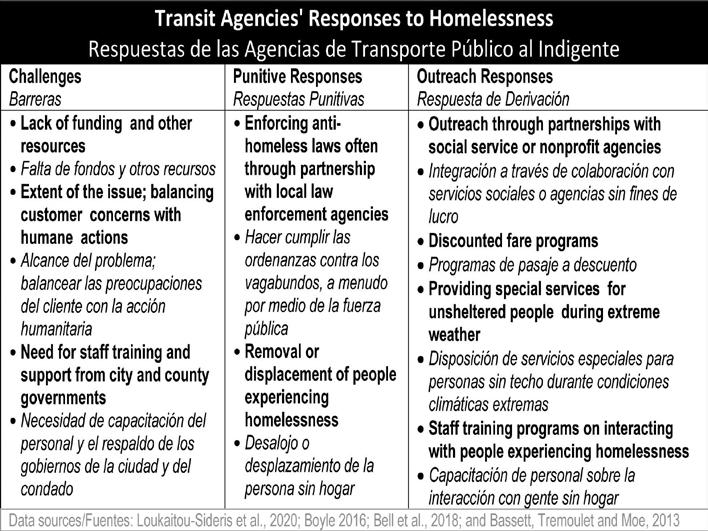
below and center in this page there is a table from “Homelessness in Transit Environments ” that summarizes strategies of transportation agencies use to respond to homelessness that tend to vary between punitive and constructive responses.
t he Los Angeles County Metropolitan transportation Authority (LA Metro), whose challenge with decreased ridership was at least partly influenced by homelessness, tried to resolve their challenges with a different
approach: offer services and, when possible, create a space for the unhoused within their jurisdiction instead of punishing them. i n 2018, their Board of Directors requested that staff explore how they can repurpose swaths of vacant property near Metro stations to provide services to the unhoused.
one solution they came up with was to provide lockers, showers, and safe parking places in unused bus lots for families that live out of their cars and ride the Metro. i n another facet of this multi- pronged strategy, LA Metro launched an effort to beef up positive outreach by hiring and employing homeless ambas -
sala de estar y un pequeño dormitorio.
El presidente de united Laundry también investigó el proyecto y se comprometió a contratar a los residentes de la recién denominada “Villa Kahauiki” para brindar servicio de lavandería a algunos de los hoteles más grandes de Hawái desde el antiguo campamento de “la laguna de la autopista”. El Sr. Kurisu, que se ha ganado el afecto de la comunidad, lo resumió mejor: “si bien decimos que esta es una solución para las personas sin hogar, en realidad es una solución para viviendas asequibles, no solo aquí sino en todo el país”.
Cuando son entrevistados, la mayoría de las autoridades de tránsito reconocen que deberían abordar la falta de vivienda de alguna manera, y su tendencia es favorecer una combinación de castigo y divulgación positiva (por ejemplo, remitir a los indigentes a los servicios sociales). En su mayor parte, desafortunadamente, ofrecer boletos de autobús de ida a los refugios no parece ser solución alguna para sacar a las personas sin-techo de
su jurisdicción... en lugar de resolver la génesis del problema y tratar de transformarlos en clientes alojados que paguen.
Arriba y al centro se incluye una tabla de “Personas sin Hogar en Entornos de transporte Público” que resume las estrategias que usan las agencias de transporte para responder a los indigentes, y que tienden a variar entre respuestas punitivas y constructivas:
La Jurisdicción de Transporte Publico del Condado y Los Ángeles Metropolitano (LA Metro), cuyo problema con la disminución del número de pasajeros estuvo influenciado, al menos en parte, por la presencia de indigentes sin casa, trató de resolver sus desafíos con un enfoque diferente: ofrecer servicios y, cuando sea posible, crear un espacio para las personas sin hogar dentro de su dependencias en lugar de castigarlos. En 2018, su Directorio solicitó que el personal explore cómo pueden reutilizar franjas de propiedad vacante cerca de las estaciones de metro para brindar servicios a las personas sin hogar. una solución que se les ocurrió fue pro -
8 Joaquín MaY-June 2023
current issues • actualidad
current issues • actualidad
sadors to reassure riders and remind people to help keep public transit clean and courteous for everyone.
“We were not just asking people to leave our system,” comments Senior Director of Special Projects Desarae Jones, who was hired by LA Metro to assist with homelessness situation, “We are out there saying we want to help you. We want to help you get housing. We want to help you get home and that’s what Metro’s goal is, to help people get home and to get to the places they need to go.”
t he jury is still out regarding how effective this approach has been. Since 2017, social workers have connected with approximately 10,000 unhoused people in and around the LA Metro. In March 2021, they even started paying for clients to stay at a locally run homeless shelter. Yet, only about 2,500 of the 10,000 people they reached out to have been housed, and in 2021 violent crime rose by 36% in the Metro.
One of the main findings of “The Extent of Homelessness on Transit: What We Know ” reveals an unsettling truth: the homeless people that we encounter when using public transit are “...the most likely, among their unhoused peers elsewhere to be chronically unhoused and structurally disadvantaged.” In other words, they need a hand up, not a handout, to get ahead.
Several of the reflections in ““Homelessness in transit Environments Volume ii: transit Agency strategies and responses” are also particularly resonant:
• We need more data to guide transporta-
porcionar casilleros, duchas y espacios de estacionamiento seguros en lotes de autobuses, vacantes, para las familias que viven en sus automóviles y viajan en el sistema LA Metro En otra iniciativa de esta estrategia multifacética, LA Metro inició un esfuerzo para reforzar la positiva integración, mediante la contratación y empleo de “embajadores de usuarios sin hogar” para tranquilizar a los pasajeros y recordar a todos que ayuden a mantener el transporte público limpio y cortés para todos.
“no le pedimos a la gente que simplemente se alejara de nuestro sistema”, comenta la directora jefe de Proyectos Especiales, Desarae Jones, quien fue contratada por LA Metro para ayudar con la situación de la población sin-techo, “Estamos diciéndoles que queremos ayudarlos. Queremos ayudarlo a obtener donde vivir. Queremos ayudarles a llegar a donde sea estén residiendo —y ése es el objetivo de LA Metro, ayudar a las personas a llegar a “casa” y a los lugares a los que necesitan ir”. no hay todavía un acuerdo sobre cuán
tion agencies in crafting policies that blend the right amount of social outreach and enforcement to keep housed riders safe and engaged while avoiding demonizing and “shuffling along” the homeless population.
• State and Federal government should offer funding that allows transportation agencies to scale and tailor their programs to fit their unique situations
• Public transportation agencies can do more to educate both housed ridership and their own drivers about how to as-
efectivo ha sido este enfoque. Desde 2017, los trabajadores sociales se han conectado con aproximadamente 10,000 personas sin hogar en Los Ángeles metropolitano y sus alrededores. En marzo de 2021, incluso comenzaron a pagar para que los clientes se quedaran en un refugio para Personas sin Hogar administrado localmente. Sin embargo, solo unas 2.500 de las 10.000 personas a las que se contactaron fueron alojadas, y en 2021 los delitos violentos aumentaron un 36% en el área.
uno de las principales conclusiones de “La Extensión de la Falta de Vivienda en el Tránsito Publico: Lo Que Sabemos ” revela una inquietante realidad: la gente sin hogar que encontramos cuando usamos el transporte público son “...entre sus pares sin hogar en otros lugares, la que se halla, mas crónicamente, sin albergue y desventajada estructuralmente”. En otras palabras, necesitan una mano, no una limosna, para salir adelante.
Varias de las reflexiones en “Homelessness in Transit Environments Volume II: Transit
sociate with homeless in the public right of way in a balanced fashion.
• We need more affordable and appropriate housing connected to social services!

Homelessness is a pervasive and divisive societal issue. Pointing fingers, punishing the homeless we encounter in public transit, and complaining about it will not resolve the issue. t his author concludes that people from all sides of the situation need to quit pointing fingers. It is EVERYONE’S problem. Most importantly, government agencies, community-based groups, non-profits, housed riders, and unhoused riders must work together to develop affordable housing solutions that provide essential social services and help make our transit system clean, safe, and viable for everyone!
Agency Strategies and Responses ” (Personas Sin Hogar en Entornos de Tránsito Masivo, Volumen ii : Estrategias y r espuestas de las Agencias) son también particularmente resonantes:
• Necesitamos más data para orientar a las agencias de transporte en sus políticas —que combinen la cantidad adecuada de integración social y aplicación de reglas para que los pasajeros “con techo” se sientan seguros y escuchados, al tiempo que evitamos demonizar y “echar a un lado” a la población “sin-techo”.
• El gobierno estatal y federal debe ofrecer fondos que permitan a las agencias de transporte adaptar sus programas a la escala y situaciones particulares.
• Las agencias de transporte público pueden hacer más para educar tanto a los pasajeros “con techo” como a sus propios conductores sobre cómo tratar a personas sin hogar en su derecho al espacio público de manera
continúa a la vuelta
MaY-June 2023 Joaquín 9
equilibrada.
• ¡Necesitamos viviendas más asequibles, apropiadas y accesibles a través de los servicios sociales!
La falta de vivienda es un problema social generalizado y divisivo. Apuntar con el dedo, castigar a las personas sin hogar que encontramos en el transporte público, y quejarnos, no resolverá el problema. Este autor concluye que las personas de cada lado de la situación deben dejar de apuntar culpables. Es problema de TODOS. Lo que es más importante, las agencias gubernamentales, los grupos comunitarios, las organizaciones sin fines de lucro, los pasajeros con vivienda y los pasajeros sin vivienda deben trabajar juntos para desarrollar soluciones de vivienda asequibles que brinden servicios sociales esenciales y ayuden a que nuestro sistema de tránsito sea limpio, seguro y viable para todos.
NOTES / NOTAS
1 Jeremy terhune, “Homelessness on the Move: a transportation Problem?” JOaQuin #119 (March 2023).
2 schuler, timothy a. “it takes a Village to solve Homelessness, so this Hawaii Businessman is Building One.” next city.org (2017).
3 loukaitou-sideris, anastasia, Jacob l Wasserman, ryan caro, and Hao ding. “Homelessness in transit environments Volume ii: transit agency strategies and responses” (2021): 26

4 Op. cit.
5 smith, sandy. “l.a. Metro May Make room for Homeless on its Properties.” next city. org (2018).
6 uranga, rachel. “ With crime up and ridership down, l.a. Metro struggles to move homeless people off trains.” la times (2022), https://www.transittalent.com/articles/index. cfm?story=laMetro_Homeless_4-1-2022
7 uranga, rachel. “ With crime up and ridership down, l a. Metro struggles to move homeless people off trains.” la times (2022), https://www.transittalent.com/articles/index. cfm?story=laMetro_Homeless_4-1-2022
8 Wasserman, Jacob l, ryan caro, anastasia loukaitou-sideris, and Hao ding. “the extent of Homelessness on transit: What We Know”
(2021): 2
9 loukaitou-sideris, anastasia, Jacob l Wasserman, ryan caro, and Hao ding. “Homelessness in transit environments Volume ii: transit agency strategies and responses”

(2021): 83-84
tendencias MO rtales
Uvalde, Asesinatos en Masa y Control de Armas
Una Tragedia al Alcance deTodos
El aniversario de la masacre escolar en Uvalde, Texas, el 24 de mayo de 2022, revivió la atención en el debate sobre el control de armas. La atención se magnificó para mí por la masacre en Cleveland, Texas, el 28 de abril de 2023.
En Cleveland —cuarenta y cinco millas al noreste de Houston— Francisco Oropeza, de 38 años, mató a cinco de sus vecinos, incluido un niño de nueve años. Esa noche oropeza había estado sentado en su patio disparando su rifle, probablemente mientras bebía. Otro vecino dijo que no era raro que, después del trabajo, hombres en el vecindario se sentaran en sus patios para beber y disparar, especialmente los viernes por la noche.
Pareciera que el pasatiempo de oropeza fue interrumpido por un par de sus nuevos vecinos hondureños, quienes le pidieron parar el ruido porque sus niños no podían dormir, así que fue a su casa y les disparó hasta darles muerte.
Fue hace un año que Salvador Ramos, de 18 años, entró a la Escuela Primaria Robb en Uvalde, Texas, y mató a 19 estudiantes y 2 maestros, además de herir a otros diecisiete. El AR-15 lo compró cuando cumplió 18 años. Es difícil discernir una explicación para estas balaceras, tanto en Uvalde como en Cleveland. Lamentablemente los perpetradores eran descendientes de mexicanos —y casi todas sus víctimas eran mexico o hispanoamericanas. ramos vivía y cursó la secundaria en uvalde. sus antecedentes personales revelan a un muchacho solitario, quien sufría acoso, sin antecedentes penales, y con interés en las armas de fuego de alto poder. El comportamiento de Oropeza es aún más desconcertante, dado que es un inmigrante mexicano indocumentado... ¿por qué atacaría a otros inmigrantes
latinoamericanos?
En el caso de Oropeza, el alcohol pudo haber sido un factor. Está bien documentado que el alcohol y las armas son una mezcla peligrosa. Es más difícil señalar un problema específico para Ramos, pero su problema podría haber sido más psicológico.
La pregunta sigue siendo, ¿qué hace que estos asesinos masivos pierdan el control de sus impulsos y que descarguen sus frustraciones, ira o agresión en niños y personas inocentes? Alcohol, inmadurez (demasiado jóvenes para poseer armas de manera responsable), tendencia criminal, odio, extremismo ideológico, crisis personal, estrés sin tratar, enfermedad física o mental, pandemia, etc... la lista de posibles desencadenantes del comportamiento antisocial y homicida parece interminable. Y no debemos olvidar la conducta de ilegalidad, sin ética, o inmoral, modelada por personas sin escrúpulos con poder e influencia.
Los defensores de los derechos de las armas a menudo dicen que no es el arma sino la persona quien mata. La enfermedad mental se convierte en una excusa o se usa para explicar la necesidad de un control de armas. Por ejemplo, cuando los padres de Uvalde que abogaban por aumentar la edad para la compra de armas de asalto de 18 a 21 años, pensando en Salvador Ramos, el asesino de Uvalde, el senador federal por Texas, Ted Cruz, se opuso a su iniciativa. también se opuso al proyecto de ley bipartidista ‘Comunidades Más Seguras’, el primer proyecto legislativo sobre seguridad de armas que se aprobó en casi 30 años, y encabezado por el también senador republicano por Texas, John Cornyn.
Después de la masacre de Uvalde, Cruz propuso un proyecto de ley en el senado que proporcionaría fondos para servicios de salud

10 Joaquín MaY-June 2023
actualidad Sin-techo y en tránsito viene de la vuelta
Uvalde, Mass Murder, and Gun Control
An Equal Opportunity Tragedy
he anniversary of the Uvalde, Texas school shooting, May 24, 2022, brought attention to the gun control debate again. t he attention was magnified for me by the Cleveland, Texas mass shooting on April 28, 2023.
In Cleveland —forty-five miles northeast of Houston— Francisco Oropeza, age 38, killed five of his neighbors, including a nine-year-old boy. t hat night o ropeza had been sitting in his yard firing his AR-15-style semi-automatic assault rifle, possibly while drinking. Another neighbor said it was not uncommon for men in the neighborhood after work to sit in their yards to drink and shoot, especially on a Friday night.

i t seems o ropeza’s
mental y más agentes de seguridad armados en las escuelas —el que no obtuvo apoyo. una solución más eficiente, efectiva y directa sería mantener las armas fuera del alcance de esas personas en crisis. inestables, inmaduras, etc., implementando reglas más estrictas sobre la posesión de armas. Con Cruz, uno no sabe si su oposición al control de armas se basa en la lealtad a la segunda Enmienda de la Constitución de los Estados unidos o en el hecho de que recibe cientos de miles de dólares en donaciones de campaña de la industria de las armas.
Una prohibición de armas de asalto, o reglas estrictas sobre la posesión de armas, probablemente habrían continúa a la vuelta
tbackyard firing was interrupted by a couple of his new Honduran neighbors, who asked him to stop the noise, because their children couldn’t sleep, so he went to their house and shot them to death.
It was a year ago that 18-year-old Salvador ramos entered robb Elementary school in Uvalde, Texas and killed 19 students and 2 teachers as well as wounding 17 others. He used an AR-15 style assault weapon that he bought on his 18th birthday.
An explanation for the uvalde and Cleveland, Texas shootings is difficult to discern. Although both were of Mexican descent, almost all of their victims were Mexican/Hispanic Americans. ramos attended high school and lived in Uvalde. His personal background reveals a bullied loner with no criminal history and with an interest in high-powered firearms. o ropeza’s behavior is even more baffling —given the fact that he is an undocumented Mexican immigrant... Why would he attack other Latin American immigrants?
In Oropeza’s case, alcohol may have been a factor. it is well documented that alcohol and guns are a dangerous mix. it is harder to pinpoint a specific issue for Ramos, but his problem might have been more psychological.
The question remains, what causes mass murderers to lose impulse control and causes them to take out their frustrations, anger, or aggression on innocent children and innocent people? Alcohol, immaturity (too young for responsible gun ownership), criminal intent, hate, ideological extremism, personal crisis, unmitigated stress, physical illness, a pandemic, mental illness, etc., the list of potential triggers for antisocial and homicidal behavior seems endless. And let’s not forget lawless and unethical or immoral
behavior modeled by unscrupulous people with power and influence.
Gun rights advocates often say it’s not the gun but the person who kills. Mental illness becomes an excuse or is used to explain away the need for gun control. For example, when uvalde parents who advocated for raising the age for the purchase of assault type weapons from 18 to 21, with Salvador Ramos the Uvalde shooter in mind, Texas U.S. Senator Ted Cruz opposed their initiative. He also opposed the Bipartisan Safer Communities Act, the first major gun safety bill to pass in nearly 30 years, spearheaded by fellow texas republican senator, John Cornyn.
Following the Uvalde massacre, Cruz proposed a senate bill that would provide funding for mental health services and more armed security officers on school sites – which failed to get support. A more efficient, effective, and direct solution would be to keep guns out of the hands of those in crisis, unstable, immature, etc., through implementing more stringent gun ownership rules. With Cruz, one doesn’t know if his opposition to gun control is based on fealty to the second Amendment of the u s. Constitution or the fact that he receives hundreds of thousands of dollars in campaign donations from the gun industry.

A ban on assault weapons or stringent rules on gun ownership would have probably kept assault weapons out of the hands of Oropeza and definitely out of the hands of Ramos.
Of course, the opponents of gun control say that it doesn’t work. After the recent mass shooting in Allen Texas, State Representative, Democrat, Henry Cuellar asserted that strict gun measures have not ended mass shootings in blue states with stricter gun laws.
However, his -
MaY-June 2023 Joaquín 11 deadl Y trends
continued on next page
Ed Ramírez linden, ca
An Equal Opportunity Tragedy from the previous page mantenido ese AR-15 fuera del alcance de Oropeza y, si lugar a dudas, fuera del alcance de ramos.
tory contradicts this argument. New York university’s Michael J. Klein writes that in “the years after the federal assault weapons ban went into effect (1994), the number of deaths from mass shootings fell, and the increase in the annual number of incidents slowed down (...) The data shows an almost immediate — and steep — rise in mass shooting deaths in the years after the assault weapons ban expired in 2004.”
Jennifer rubin of the daily Washington Post argued that gun control opponents should see what an AR-15 does to a child. Roy Guerrero, Uvalde’s lone pediatrician, described the “...mangled, unrecognizable bodies of children who were victims of the shooting” on his town’s school. He saw “two children whose bodies had been pulverized by bullets fired at them, decapitated, whose flesh had been [so] ripped apart, that the only clue as to their identities was the blood-spattered cartoon clothes still clinging to them.”
Ten-year-old Maite Yuleana Rodriguez, a victim in the Uvalde school, always wore green high-top Converse sneakers with a hand-drawn heart on the right toe “because they represented her love of nature.” Her green Converse shoes turned out to be the only clear evidence that could identify her after the shooting. Maite’s green shoes have become a symbol for the horrific loss of children at Robb Elementary school.
In May 2023, a bill that would raise the age to legally purchase semi-automatic rifles in Texas, supported by Uvalde shooting victims’ parents, found some momentum but was left off the texas House’s agenda ahead of a key deadline. Uvalde parents had lobbied and demonstrated in support of House Bill 2744 at the Capitol’s legislative chambers. Despite the setback, they vowed to never stop the fight. One of the parents declared on Twitter, “2744 may have died tonight, but we will never stop! Texas has fk’d with the wrong parents.”
After yet another mass shooting —just now, in May 2023— Texas State Senator Roland Gutierrez, Democrat, whose district encompasses u valde blasted politicians that refuse to enact gun reform stating on Twitter, “There is a special place in hell for people who watch this happen and choose to do nothing...”
sometimes art and music capture a sentiment that logic and reason can’t. In this vein, I offer a line that may capture Gutierrez’ sentiment from a Jose Alferdo Jiménez ranchera that reads “Pero se sentía el ambiente, Muy cerquita del infierno.”
Una Tragedia al Alcance de Todos viene de la vuelta
Por supuesto, los opositores al control de armas dicen que no funciona. Después del reciente baleo masivo en Allen, Texas, el representante estatal demócrata Henry Cuellar afirmó que las estrictas medidas sobre armas no han terminado con las balaceras en los estados azules que cuentan con restricciones en la posesión de armas.
Sin embargo, la historia contradice este argumento. Michael J. Klein, de la Universidad de Nueva York, escribe que “en los años posteriores a la entrada en vigor de la prohibición federal de armas de asalto (1994) disminuyó la cantidad de muertes por tiroteos masivos y se desaceleró el aumento en la cantidad anual de incidentes (...) Las estadísticas revelan un aumento casi inmediato, y pronunciado, en las muertes masivas por balas en los años posteriores a la expiración de [dicha] prohibición de armas de asalto en 2004”.
Jennifer Rubin, del diario Washington Post, argumentó que los opositores al control de armas deberían ver lo que un AR-15 le hace a un niño. Roy Guerrero, el único pediatra en Uvalde, describió los “...cuerpos destrozados e irreconocibles de niños que fueron víctimas de las balas en la escuela” de su pueblo. Vio a “dos niños cuyos cuerpos habían sido pulverizados por las balas que les dispararon, decapitados, cuya carne había sido [tan] desgarrada, que la única pista sobre sus identidades era la ropa de dibujos animados salpicada de sangre que aún llevaban adherida”.
Maite Yuleana Rodríguez, de diez años, víctima en la escuela Uvalde, siempre usaba zapatillas Converse verdes de caña alta con un corazón dibujado a mano en la punta del pie derecho “porque representaba su amor por la naturaleza”. sus zapatillas Converse resultaron ser la única evidencia clara que pudo identificarla después del tiroteo. Esas zapatillas verdes de Maite se han convertido en el símbolo de la horrible pérdida de niños en la Escuela Primaria robb.
En mayo de 2023, un proyecto de ley que aumentaría la edad para comprar legalmente rifles semiautomáticos en Texas, respaldado por los padres de las víctimas del tiroteo de Uvalde, halló cierto respaldo, pero quedó fuera de la agenda de la Legislatura de texas antes de una fecha límite clave. Los padres de uvalde habían hecho mucha presencia y se habían manifestado en apoyo del Proyecto de Ley 2744 en las dos cámaras legislativas del
BIBLIOGRAPh Y
Campbell, Josh. “ t here is a special place in hell for people who watch all this happen and choose to do nothing,” Gutierrez tweeted, along with the hashtag: #bloodontheirhands. 7 May 2023. Article. 22 June 2023.
CBS News. texas shooting manhunt continues; sheriff says suspect “could be anywhere now”. 1 May 2023. Artilce. 22 June 2023.
Choi, Matthew and William Melhado. Parents of uvalde shooting victim urge ted Cruz to support gun control, to no avail. 14 September 2022. Article. 22 June 2023.
Jiménez, José Afredo. “Llegó borracho el borracho.” by José Alfredo Jiménez. n.d. Levenson, Eric, et al. uvalde school shooting suspect was a loner who bought two assault rifles for his 18th birthday. 27 May 2022. Artilce. 22 June 2023.
Marcus, John. Maite Rodriguez: uvalde victim identified by her green Converse who is inspiring Matthew McConaughey to act. 7 June 2022. Article. 22 June 2023.
Millman, Andrew. texas rep. Cuellar rejects calls for stricter laws, says shootings happen in blue states, too. 7 May 2023. Article. 22 June 2023.
Moore, Robert and Mark Berman. El Paso suspect said he was targeting ‘Mexicans,’ told officers he was the shooter, police say. 9 August 2019. Article. 22 June 2023.
Rubin, Jennifer. republicans should see what an AR-15 does to a child’s body. 9 June 2022. Washington Post. 22 June 2023.
Serrano, Alejandro. raise-the-age gun bill misses crucial deadline, as Uvalde parents protest outside the Texas House. 9 May 2023. Article. 22 June 2023.
Capitolio. A pesar del revés, prometieron no detener nunca su lucha. uno de los padres declaró en twitter: “Puede que 2744 hayan muerto esta noche ¡pero nunca nos detendremos! Texas ha jodido a los padres equivocados”. Después de todavía otro baleo masivo — recién ahora en mayo de 2023— el senador estatal de Texas Roland Gutiérrez, demócrata, cuyo distrito comprende Uvalde, criticó a los políticos que se niegan a promulgar una reforma de armas declarando en twitter: “Hay un lugar especial en el infierno para las personas que ven que esto sucede y deciden hacer nada...”
A veces, el arte y la música captan un sentimiento que la lógica y la razón no pueden. En este sentido, ofrezco una línea que puede capturar el sentimiento de Gutiérrez de una ranchera de José Alfredo Jiménez que reza “Pero se sentía el ambiente, Muy cerquita del infierno”.
12 Joaquín
MaY-June 2023
current issues • actualidad
José Montoya, ¡Presente!
arteamericas exhibition
1630 Van ness avenue Fresno, ca
icannot believe that it has been 10 years since the passing of Maestro Jose Montoya, cofounder of the Rebel Chicano Art Front better known as the RCAF. In the past 10 plus years, so many creative artists of that time period have passed. Armando Cid, Richard Favela, Esteban Villa and from Stockton Raoul Mora. Todos ¡Presentes!
In the October 2013 issue of Joaquin Magazine, I, as a former student of Don Jose Montoya wrote about his passing in sacramento. In 1969/70 I had been accepted into the Mexican American Education Project at Csu Sacramento headed by Dr. Steve Arvizu. This program and its maestros were to be a life altering experience for me and the thousands of counselees that i was eventually to work with in the city of Tracy Unified School District.
As i vividly remember my time with Jose Montoya, in the classroom or in the college cafeteria where the Chicanada occupied one long cafeteria table i can still see Jose drawing images on napkins and then leaving them there. Aware of Jose’s fame as a Chicano artist i would collect these priceless pieces after everyone had gone to class.
Jose Montoya’s r EsonA nt VALLEY is the title of the exhibition at the Arteamericas in Fresno, California that runs from May 12th to November 26, 2023. May 12, the final day ends with a celebration from 12 to 3 p.m. The exhibition consists of hundreds of napkin art pieces created by Jose over the years, in addition to poetry, as well as many other personal items that illustrate his uniqueness.
Jose was born in Escobosa, New Mexico
Es difícil creer que hayan pasado 10 años desde el fallecimiento del maestro José Montoya, cofundador del Frente de Arte Chicano-Rebelde —más conocido como la RCAF. En los últimos 10 años o más, han fallecido tantos creativos artistas de aquel período. Armando Cid, Richard Favela, Esteban Villa y, en Stockton, Raoul Mora... Todos ¡Presentes!
En la edición de octubre de 2013 de la Revista Joaquín, yo, como ex alumno de don José Montoya, escribí sobre su fallecimiento en Sacramento. En 1969-70 fui aceptado en el Proyecto de Educación Mexicoamericana en la universidad Estatal de California (Csu ) - Sacramento —dirigido por el Dr. Steve Arvizu. Este programa y sus maestros iban a ser
Other works by or about Jose Montoya:
1. El Sol y Los de Abajo and other R.C.A.F. poems. 1972
2. La Raza’s Quinceanero 1988
3. In Formation 20 Years of Joda. 1992
4. Los Compas El Chale Gallegos y’l Xorty2010
5. Jose Montoya’s Abundant Harvest 2016
6. Joaquin Magazine October 2013 Year 2 No.2
on May 28, 1932, and migrated to California in the 40’s con su familia. Raised in the 1940’s Jose was to experience the Pachuco time period and the ugly, racist reaction by the U.S. military and citizens in California. Jose, in addition to being a migrant farm worker, was also a Korean War Veterano, all three experiences played a major role in his art and poetry.
t his outstanding exhibit gets its name from Jose’s poem “resonant Valley” —that can be found in the 2016 book co-edited by Selene Preciado and Jose’s son richard Montoya: “Jose Montoya’s Abundant Harvest, Works on Paper/Works on Life ”
una experiencia que cambiaría mi vida y la de los miles de orientadores escolares con los que eventualmente trabajaría en el Distrito Escolar Unificado de la ciudad de Tracy. recuerdo vívidamente mis años con José Montoya —en el salón de clases o en la cafetería de la universidad... donde la Chicanada ocupaba una larga mesa en esa cafetería. todavía puedo ver a José dibujando imágenes en servilletas y luego dejándolas allí. Consciente de la fama de José como artista chicano, yo recolectaba esas invaluables piezas después de que todos se hubieran ido a clase.
VALLE r EsonAntE de José Montoya es el título de la exposición en Arteamericas en Fresno, California, que se lleva a cabo desde del 12 de mayo al 26 de noviembre de 2023. Ese último día —noviembre 26—termina con una celebración de 12 a 3 p.m. La exposición consta de cientos de piezas de arte en servilletas creadas por José a lo largo de los años, además de poesía... como asimismo muchos artículos personales que ilustran su particular personalidad.
José nació en Escobosa, Nuevo México, el 28 de mayo de 1932, y emigró a California en la década de 1940 con su familia. Creciendo en la década de 1940. José experimentaría el “período Pachuco” y la intimidante reacción racista de los militares y ciudadanos estadounidenses en California. Además de trabajador agrícola migrante, José fue, también, veterano de la Guerra de Corea. Estas tres experiencias jugaron un importante papel en su arte y poesía.
Esta destacada exhibición recibe el nombre de un poema escrito por José, “Valle Resonante”, y que se encuentra en el libro editado por Selene Preciado y el hijo de José, Richard Montoya: “ Abundante Cosecha: Obra en Papel, obras en Vida” (2016).
Otras obras de, o sobre, José Montoya se listan en el recuadro central

MaY-June 2023 Joaquín 13 latin O literature • literatura latina
Richard Soto Biblioteca san Joaquin Murrieta library
Vincent Pucciarelli Hidden In Plain Sight

the desire for self-expression may not be the sole reason to make art. It may also come from a desire to create a bond with the world outside ourselves. but this bond can never in reality show us the external world. All that it shows us is our own soul, the one world of which we have any real cognizance. it is deeply personal. t he arbitrary ways we make sense of life, choosing to note certain things but not oth-
Oculto a Simple vista
Puede que el deseo de autoexpresión no sea la única razón para hacer arte. También puede provenir de un deseo de crear un vínculo con el mundo exterior a nosotros mismos. Pero este vínculo nunca puede, en realidad, mostrarnos el mundo exterior. Todo

lo que nos muestra es nuestra propia alma, el único mundo del que tenemos algún conocimiento real.
Es profundamente personal. Las formas arbitrarias en que damos sentido a la vida, eligiendo notar

14 Joaquín MaY-June 2023
continúa
vuelta continued on next page . . . ...
a la


MaY-June 2023 Joaquín 15
ers, framing the world so that what we see comes into focus, thereby excluding what doesn’t seem to fit. In this way the world is something we invent for ourselves. it is art that reveals us to ourselves.


I have often thought in my many walks in the city that there is so much to be discovered and wondered at. I have walked and looked and seem to have had ample opportunity to see everything. But I have not done it, not seen it all. It is, of course, not possible. I am constantly confronted with a multiplicity of forms, light and compositions that are as inexhaustible as they are fascinating. t his observation has led me to encounter a sense of mystery in the commonplace. it is this sense of mystery that I have discovered, is a theme in my work.
Trained as a painter, I am intrigued by the many fascinating shapes and colors that seem to describe unique and unknown tableaus on the streets and sidewalks. I chose to work in digital photography for the medium’s ability to capture quickly and permanently the ephemeral and transient in our environment. i have often observed what i call the “hidden in plain sight” nature of my urban surroundings.
ciertas cosas pero no otras, enmarcando el mundo para que lo que vemos se enfoque — excluyendo así lo que no parece encajar. De esta manera el mundo es algo que inventamos para nosotros mismos. Es el arte el que nos revela a nosotros mismos.

En mis innumerables paseos por la ciudad, muchas veces pienso que hay mucho por descubrir y maravillarse. He caminado y mirado y
pareciera que he tenido amplias oportunidades para verlo todo. Pero no lo he hecho, no lo he visto todo. Por supuesto, no es posible. Me enfrento constantemente a una multiplicidad de formas, luces y composiciones tan inagotables como fascinantes.
Esta observación me ha llevado a encontrar un sentido de misterio en el lugar común. Es este sentido de misterio que he descubierto, es un tema en mi trabajo.
Formado como pintor, estoy intrigado por las muchas formas y colores fascinantes que parecen describir cuadros únicos y desconocidos en las calles y aceras. Elegí trabajar en fotografía digital por la capacidad que tiene el medio de captar de manera rápida y permanente lo efímero y transitorio de nuestro entorno. A menudo he observado lo que llamo la naturaleza “oculta a simple vista” de mi entorno urbano.
16 Joaquín MaY-June 2023
art f O cus • enf O que artÍstic O
Hidden In Plain Sight from the previous page
Oculto a Simple Vista viene de la vuelta
SUSD Board Policy BP 5145.3: Anti-Discrimination and Bullying
Guaranteeing safer schools
the b oard of trustees desires to provide a safe school environment that allows all students equal access and opportunities in the district’s academic, extracurricular, and other educational support programs, services, and activities.
the board prohibits unlawful discrimination, including discriminatory harassment, intimidation, and bullying, targeted at any student by anyone, based on the student’s actual or perceived race, color, ancestry, nationality, national origin, immigration status, ethnic group identification, ethnicity, age, religion, marital status, pregnancy, parental status, physical or mental disability, sex, sexual orientation, gender, gender identity, gender expression, or genetic information, or association with a person or group with one or more of these actual or perceived characteristics.

The District designates the individual identified below as the District compliance officer. t he compliance officer shall be responsible for coordinating the District’s efforts to comply with applicable state and federal civil rights laws, including Title IX of the Education Amendments of 1972, Section 504 of the Rehabilitation Act of 1973, Title II of the Americans with Disabilities Act, and the Age Discrimination Act of 1975, and to answer inquiries regarding the District’s nondiscrimination policies.
t his individual shall also serve as the compliance officer specified in AR 1312.3 - u niform Complaint Procedures as the responsible employee to handle complaints alleging unlawful discrimination targeting a student, including the descriptions and conditions spelled on the second paragraph above. The compliance officer may be contacted at:
Enrique P. Torres, Director, Constituent ServicesStockton Unified School District
701 N. Madison St. Stockton, CA 95202
(209) 933-7000 Ext. 2195
t his Policy shall apply to all acts related to school activity or to school attendance occurring within the District, and to acts which occur off campus or outside of school-related or school- sponsored activities but which may have an impact or create a hostile environment at school.
5145.3: Rechazo a la Discriminación y Acoso
Garantizando Escuelas seguras
El Directorio Escolar desea proporcionar un ambiente académico seguro que permita a todos los estudiantes igualdad de acceso y oportunidades en los programas, servicios y actividades académicas, extracurriculares —como asimismo de otro y todo tipo de apoyo educativo del Distrito.
El Directorio Escolar prohíbe la discriminación ilegal —incluido el acoso discriminatorio y/o la intimidación y el acoso— dirigidos contra cualquier estudiante, por cualquier
discriminatory harassment, intimidation, or bullying, may result from physical, verbal, nonverbal, or written conduct based on any of the characteristics listed above.
ing with the student’s academic performance; or otherwise adversely affects the student’s educational opportunities.
unlawful discrimination also includes disparate treatment of students based on one of the characteristics above with respect to the provision of opportunities to participate in school programs or activities or the provision or receipt of educational benefits or services.
t he b oard also prohibits any form of retaliation against any individual who reports or participates in the reporting of unlawful discrimination, files or participates in the filing of a complaint, or investigates or participates in the investigation of a complaint or report alleging unlawful discrimination. retaliation complaints shall be investigated and resolved in the same manner as a discrimination complaint as set forth in AR 5145.3.
unlawful discrimination also includes the creation of a hostile environment through prohibited conduct that is so severe, persistent, or pervasive that it affects a student’s ability to participate in or benefit from an educational program or activity; creates an intimidating, threatening, hostile, or offensive educational environment; has the effect of substantially or unreasonably interfer-
t he s uperintendent or designee shall facilitate students’ access to the educational program by publicizing the District’s nondiscrimination policy and related complaint procedures to students, parents/guardians, and employees. t he superintendent or designee shall provide
Unlawful discrimination, including continued on next page continúa a la vuelta
MaY-June 2023 Joaquín 17
s t O c K t O n u ni F ed s c HOO l d istrict
Norma del Directorio SUSD BP
Guaranteeing Safer Schools
viene de la vuelta
training and information on the scope and use of the policy and complaint procedures and take other measures designed to increase the school community’s understanding of the requirements of law related to discrimination. the superintendent or designee shall regularly review the implementation of the District’s nondiscrimination policies and practices and, as necessary, shall take action to remove any identified barrier to student access to or participation in the District’s educational program. t he superintendent shall report his/her findings and recommendations to the Board after each review.
students who engage in unlawful discrimination, including discriminatory harassment, intimidation, retaliation, or bullying, in violation of law, Board Policy, or Administrative regulation shall be subject to appropriate consequence or discipline, which may include suspension or expulsion when the behavior is severe or pervasive such as is set forth in Education Code Section 48900.4.
Any District employee who permits or engages in prohibited discrimination, including discriminatory harassment, intimidation, retaliation, or bullying, shall be subject to disciplinary action, up to and including dismissal.
Garantizando Escuelas Seguras
continued from the previous page
persona, debido a su raza, color, ascendencia, nacionalidad, origen nacional, estado inmigratorio, identificación con algún grupo étnico, el origen étnico, la edad real o percIbida del estudiante, su religión, estado civil, condición de embarazo o estado parental, discapacidad física o mental, sexo, orientación sexual, género, identidad de género, expresión de género, o información genética, o asociación con una persona o grupo —o con una o más de estas características reales o percIbidas.
El Distrito designa al individuo identificado a continuación como el funcionario a cargo de cumplimiento del Distrito. Este funcionario será el responsable de coordinar los esfuerzos
del Distrito para cumplir con las leyes estatales y federales aplicables a derechos civiles, incluido el Título IX de las Enmiendas de 1972 a la Educación; la Sección 504 de la Ley de Rehabilitación de 1973; el Título II del Acta ‘Estadounidenses con Discapacidades’; la Ley de Discriminación por Edad de 1975 —y para responder consultas sobre las políticas de rechazo a la discriminación del Distrito.
Esta persona también servirá como el funcionario de cumplimiento especificado en Reglamento Administrativo (AR) 1312.3Procedimiento uniforme de Queja —como el empleado responsable de administrar las quejas que aleguen discriminación ilegal dirigida a un estudiante, incluidas las descripciones y condiciones especificadas en el segundo párrafo, arriba. La información de contacto del funcionario de cumplimiento es:
Enrique P. Torres, Director, Constituent Services
Stockton Unified School District 701 N. Madison St. Stockton, CA 95202 (209) 933-7000 Ext. 2195

Esta Política se aplicará a todos los actos relacionados con la actividad escolar o la asistencia a la escuela que ocurran dentro del Distrito, y a los actos que ocurran fuera del campus o fuera de las actividades relacionadas con la escuela o patrocinadas por la escuela —pero que puedan tener un impacto o crear un ambiente hostil en la escuela.
La discriminación ilegal, incluido el acoso discriminatorio, la intimidación o el acoso, puede resultar de una conducta física, verbal, no verbal o escrita basada en cualquiera de las características enumeradas anteriormente.
La discriminación ilegal también incluye la creación de un ambiente hostil a través de una conducta proh Ibid a que es tan severa, persistente o generalizada, que afecta la capacidad del estudiante para participar o beneficiarse de un programa o actividad educativa; que crea un entorno educacional intimidante, amenazante, hostil u ofensivo; que tiene el efecto de interferir sustancialmente o irrazonablemente con el desempeño académico
del estudiante; o que de otra manera afecta adversamente las oportunidades educativas del estudiante.
La discriminación ilegal también incluye el trato desigual de los estudiantes basado en una de las características anteriores con respecto a la disponibilidad y acceso de oportunidades para participar en programas o actividades escolares o la provisión o recepción de beneficios o servicios educacionales.
El Directorio Escolar también prohíbe cualquier forma de represalia contra cualquier persona que denuncie o participe en la denuncia de una discriminación ilegal; que presente o participe en la presentación de una denuncia; o que investigue o participe en la investigación de una denuncia o denuncia de discriminación ilegal. Las denuncias de represalias se investigarán y resolverán de la misma manera que las denuncias de discriminación, tal como se establece en AR 5145.3.
El superintendente o la persona que este(a) designe facilitará el acceso de los estudiantes al programa educacional mediante la publicación de la Política de Rechazo a la Discriminación del Distrito y el Procedimientos de Queja relacionado —a los estudiantes, padres/ tutores y empleados. El superintendente (o su designado) deberá brindar capacitación e información tanto sobre el uso y la cobertura de esta política como los procedimientos de denuncia y, además, tomar otras medidas diseñadas para aumentar la comprensión de la comunidad escolar sobre las protecciones de la ley respecto a la discriminación. El superintendente o su delegado revisará regularmente la implementación de las políticas y prácticas de protección contra la discriminación del Distrito y, según sea necesario, tomará medidas para eliminar cualquier barrera identificada para el acceso o la participación de los estudiantes en el programa educativo del Distrito. El Superintendente informará de sus conclusiones y recomendaciones al Directorio Escolar después de cada revisión.
El estudiante que participe en discriminación ilegal, incluido el acoso discriminatorio, la intimidación, las represalias o el acoso —en transgresión de la Ley, la Política del Directorio Escolar ( bP) o el reglamento Administrativo (AP), estará sujeto a las consecuencias o medidas disciplinarias apropiadas, que pueden —cuando el comportamiento es grave u omnipresente tal como se establece en el Código de Educación Sección 48900.4— incluir la suspensión o la expulsión.
Cualquier empleado del Distrito que permita o participe en discriminación proh Ibida, incluido el acoso discriminatorio, la intimidación o represalias, estará sujeto a medidas disciplinarias, que pueden incluir el despido
18 Joaquín MaY-June 2023
s t O c K t O n u ni F ed s c HOO l d istrict
Radicalización Pedagógica
thomas Block, lorain, OHEducation De Montessori a los Zapatistas
near the end of the last millennium, Paulo Freire’s tome, Pedagogy of the Oppressed,1 assailed traditional educational philosophies either as bureaucratic and authoritarian based on paternalism and humanitarianism which camouflaged a “top-down” approach characterized by monotony and lethargy or as dialectic between oppressors and the oppressed. both employed a narrative style of instruction. t his narrative style metaphorically likened educators to depositors who filled their depositories with as much content as possible. t he more they deposited, the better they were at their craft. t he “containers” or “receptacles” were passive, hollow or even alienated. (One can see where Freire is coming from.) t his concept left no room for critical thinking because students were too busy storing what had been deposited. “The more meekly the receptacles permitted themselves to be filled, the better students they were”1. Compare Freire’s critique to another a few decades older: We know only too well the sorry spectacle of the teacher who, in the schoolroom, must pour certain cut and dried facts into the heads of the scholars. In order to succeed in this barren task, she finds it necessary to discipline her pupils into immobility and to force their attention 2
She likened the children in these schools, “fastened” to their desks, to butterflies mounted on pins “spreading the useless wings of barren and meaningless knowledge which they have acquired.” Montessori was every bit the radical! Her first schools were founded in the san Lorenzo tenement section of Rome, Italy in 1907.
Rethinking
From Montessori to the Zapatistas
Afinales del último milenio, el tomo de Paulo Freire, Pedagogía del Oprimido, 1 atacó las filosofías educativas tradicionales —ya sea como burocráticas y autoritarias, o basadas en el paternalismo y el humanitarismo— camuflando un enfoque “de arriba hacia abajo” —caracterizado por la monotonía y el letargo, o como dialéctica— entre opresores y los oprimidos. Ambos emplearon un estilo de instrucción narrativo. Este estilo narrativo compara metafóricamente a los educadores con los depositantes que llenan sus depósitos con la mayor cantidad de contenido posible. Cuanto más depositaban, mejor eran en su oficio. Los
San Lorenzo was the “quarter of the poor,” where poverty, vice, and ignorance “prevailed.” t hese poor included miners whose “very blood has been consumed or his intestines wasted away through their work.” (Ibid)
it was among the poor that Maria Montessori sought to begin her teaching of children between the ages of three and six:
“I believe that these tentative experiments, because of the surprising results which they have given, will be the means of inspiring a continuation of the work thus undertaken.” Freed from their
continued on next page
“contenedores” o “receptáculos” eran pasivos, huecos o incluso alienados. ( uno puede ver para dónde va Freire con esto). Este concepto no deja espacio para el raciocinio analítico porque los estudiantes estan demasiado ocupados almacenando lo que se ha depositado. “Cuanto más mansamente se permitían llenar estos recipientes, mejores estudiantes eran”1 Compare la crítica de Freire con otra unas décadas antes:

Conocemos muy bien el lamentable espectáculo del maestro que, en el salón de clases, debe verter ciertos hechos claros en la cabeza de los escolares. Para tener éxito en esta estéril tarea, encuentra necesario disciplinar a sus alumnos hasta que se queden inmóviles y forzar su atención.2
[Montessori] comparó a los niños de estas escuelas, “atados” a sus pupitres, a mariposas montadas en alfileres “que extienden las alas inútiles del conocimiento estéril y sin sentido que han adquirido”.¡Montessori era absolutamente radical! sus primeras escuelas se fundaron en los proyectos habitacionales de San Lorenzo, en Roma, Italia, en 1907. San Lorenzo era el “barrio de los pobres”, donde “prevalecía” la pobreza, el vicio y la ignorancia. Estos pobres incluían a los mineros cuya “misma sangre se ha consumido o sus intestinos se han consumido a través de su trabajo...” (Ibid)
Fue entre los pobres, que María Montessori buscó comenzar su enseñanza a niños de entre tres y seis años:
“
Creo que estos experimentos tentativos, por los resultados sorprendentes que han dado, serán el medio para inspirar una continuación del trabajo así emprendido.” Liberados de sus pupitres, los niños estarían sujetos a sus manifestaciones naturales: esta era su “reforma esencial ” (Ibíd) Las pedagogías fra -
MaY-June 2023 Joaquín 19
educati O n • educaciÓn
continúa a la vuelta
educati O n • educaciÓn
From Montessori to the Zapatistas from the previous page
desks, the children would be subject to their natural manifestations – this was her “essential reform” (Ibid)
Montessori and Freire’s fraternal pedagogies then diverged —with HEr methodology becoming formalized in the Western world.

While Montessori’s early intervention with infants —followed by her children’s houses, elementary and kinder schools being adapted by Geoffrey Canada in Harlem3 , Freire appeared to be trapped in the Marxist dialectic. Yet, he broke free of the Marxist storm. He is
more and more convinced that true revolutionaries must perceive the revolution, because of its creative and liberating nature, as an act of love. For me, the revolution, which is not possible without a theory of revolution – and therefore science – is not irreconcilable with love. On the contrary: the revolution is made by people to achieve their humanization (Freire, 1993).
We can possibly seek Freire’s educational pedagogy in the Zapatista community in Oventik, Chiapas, southern Mexico, far removed from the auspices of the secretaria Educacion Publica in Mexico City. Within Oventik is the Aguascalientes II school which is part of a Zapatista dialogue in which the campesinos, teachers, scientists, elders, Zapatista leaders and students are “co-authors” of a creative, living and grass-roots curriculum that is taught in the communities’ own languages as well as spanish. based on local traditions and culture, the curriculum recognizes the ecological needs of the land such as how to save seeds and conserve water sources and forests.4
A seed bank is part of the Zapatista Education system which partners with the campesinos and schools. scientists who visit and teach seed saving techniques receive priority. Data collecting, research on seeds, soils and climate; recipes; stories and ceremonies and prayers are integrated into the curriculum.
the communities’ elders and adults who plant and harvest the corn have become the principal teachers and have replaced the government teachers in the autonomous schools5
Yet, as radical as the Aguascalientes II system appears, Article 3 of the Mexican Constitution states that educational services shall be directed to “preserve our economic independence... and enrich our culture” while Article 2 states that indigenous communities “living in a territory and integrating a social, economic, and cultural unit” shall “determine whom indigenous law will be applied to” and that “self-awareness about the indigenous identity shall be the most important criteria” in that determination.

ternas de Montessori y Freire luego divergieron —y la metodología de la primera fue la que se formalizó en el mundo occidental. s i bien la temprana intervención de Montessori en la primera infancia —seguida de sus ‘Casas de los Niños’, las escuelas preescolares y jardines infantiles— fueron adaptadas por Geoffrey Canada en Harlem3, Freire parecía estar atrapado en la dialéctica marxista. Sin embargo, se liberó de esta tormenta marxista. Él está cada vez más convencido de que los verdaderos revolucionarios deben percibir la revolución, por su carácter creador y liberador, como un acto de amor. Para mí, la revolución, que no es posible sin una teoría de la revolución –y por tanto de la ciencia–, no es irreconciliable con el amor. Al contrario: la revolución la hacen las personas para lograr su humanización.1
Posiblemente podamos buscar la pedagogía educativa de Freire en la comunidad zapatista de Oventik, Chiapas, al sur de México, lejos de los auspicios de la Secretaría de
NOTES

1.Freire Paulo, Pedagogy of the Oppressed. 1968 (1970 english ed.) continuum Books. new York
2.Montessori, 1964
3.see Joaquin, Feb 2021
4.davies, Jessica. “the assault on autonomous education in southeast Mexico” nov 16, 2011
5.Organic consumers association/asociación de consumidores Orgánicos, dec. 09 2002
Educación Pública de la Ciudad de México. Dentro de Oventik se encuentra la escuela Aguascalientes ii que es parte de un diálogo zapatista en el que los campesinos, maestros, científicos, ancianos, líderes zapatistas y estudiantes son “coautores” de un currículo creativo, vivo y de base que se imparte en las lenguas propias de las comunidades, así como en español. basado en las tradiciones y la cultura locales, el plan de estudios reconoce las necesidades ecológicas de la tierra, tales como cómo guardar semillas y conservar las fuentes de agua y los bosques.4 un banco de semillas es parte del sistema Educativo Zapatista y una colaboración entre campesinos y las escuelas. se da prioridad a los científicos que visitan y enseñan técnicas de conservación de semillas. recopilación de datos, investigación sobre semillas, suelos y clima; recetas; las historias, las ceremonias y las oraciones están integradas en el plan de estudios. Los ancianos de las comunidades y los adultos que siembran y cosechan el maíz se han convertido en los maestros principales y han reemplazado a los maestros gubernamentales en las escuelas autónomas5
Sin embargo, por más radical que parezca el sistema de Aguascalientes II, el artículo 3 de la Constitución mexicana establece que los servicios educativos estarán dirigidos a “preservar nuestra independencia económica... y enriquecer nuestra cultura”, mientras que el artículo 2 establece que las comunidades indígenas “que viven en un territorio y se integran en una unidad social, económica y cultural” deberá “determinar a quién se aplicará el derecho indígena” y que “la autoconciencia sobre la identidad indígena será el criterio más importante” en esa determinación.
20 Joaquín MaY-June 2023
De Montessori a los Zapatistas viene de la vuelta
thomas Block lorain, OH
OTRA R EvOLUCIóN... OTRO ZAPATA
Casi todo estadounidense semieducado conoce este apellido español en particular y lo que significó para la Revolución Mexicana de 1910-20.
Pero casi nadie sabe del “otro Zapata”. El de texas. Ése de otra revolución.
Gracias en parte al Dr. Roberto Mario Salmón, su investigación, y su excelente aporte al sitio virtual de la sociedad Histórica del Estado de Texas, muchos escritores —sedientos de hechos— ahora pueden informarse sobre este olvidado e interesante segmento de la historia de texas/EE.uu./México.
La investigación del Dr. Salmón revela que Antonio Zapata, nacido alrededor de 1800 en el norteño estado mexicano de Tamaulipas, pasaría su juventud como un simple pastor de ovejas. Zapata perfecciona esas habilidades de pastoreo a toda una ciencia, lo que eventualmente lo convierte en un acomodado ranchero. Más tarde también se convertiría en un destacado oficial de milicia durante las escaramuzas contra los indígenas, lo que le granjeó el apodo “Sombrero de Manteca” por los nativos comanches y lipanes —esto debido al tipo de peinado grasoso que eligió para alisarse el pelo.
Según el reportaje del Dr. Salmón, Zapata se unió a otros líderes del norte en la resistencia armada a la subversión centralista del general Antonio López de santa Anna respecto de la Constitución Mexicana de 1824. Zapata fue nombrado Coronel y se fue a luchar por la causa federalista, bajo el mando
PO rra ZO s
!Viva Zapata!
(the other one)
A NOTh ER R EvOLUTION... ANOTh ER ZAPATA
Almost every semi-educated American knows this particular Spanish surname and what it meant during the Mexican Revolution of 1910-20.
But almost nobody knows about the “other Zapata.” t he one from texas. t he one from another revolution.
Thanks in part to Dr. Roberto Mario salmon and his research and excellent posting of information on the texas state Historical Society website, many thirsty-for-facts writers can now report this most interesting forgotten trozo of texas/ u s./Mexico history.

Dr. Salmon’s research reveals that Antonio Zapata, born around the 1800s in the northern
de Antonio Canales rosillo.
“Rosillo”, escribe el Dr. Salmón. “Era un brillante oficial de caballería —al punto que ha sido comparado a Chevalier bayard y Stonewall Jackson”.
Aproximadamente en ese momento de la vida del Coronel Zapata, su propiedad fue saqueada [por las tropas centristas] por una suma de $70 000 de la época (US$2,5 millones de hoy en día). Ese robo fue solo fue un golpecillo en su fortuna, ya que se había vuelto extremadamente rico como ranchero.
Esa pérdida, no obstante, puede haya sido el aliciente que necesitaba para su determinación de luchar en contra el gobierno centralista mexicano.
Para enero de 1840, las calles de Laredo bullían con una es -
Mexican state of Tamaulipas, would spend his youth as a simple sheepherder. Zapata then hones those sheepherding-smarts to a science to convert him into a well-to-do ranchero. Later he would also become a well-known militia officer during Indian skirmishes and known to the Comanche and Lipan natives as “Sombrero de Manteca” or ‘lard-hat ’ on account of a greasy type of hair dressing he chose to slick down his locks.
According to the report by Dr. Salmon, Zapata joined with other northern leaders in armed resistance to Gen. Antonio López de Santa Anna‘s Centralist subversion of the Mexican Constitution of 1824.
Zapata was commissioned a colonel and went to battle for the existing Federalist cause under the command of Antonio Canales rosillo.
“Rosillo,” writes Dr. Salmon. “Was a gifted cavalry officer, he has been compared to Chevalier Bayard and Stonewall Jackson.”
About this time in Col. Zapata’s life, his property was looted [by Centralist troops] to the tune of $70,000 ($2.5 million in today’s dollars.) t he loss made but a tiny dent in his financial armor as he had become extremely wealthy as a rancher.
His loss, however, may have given him a more serious reason to continue the fight against the Mexican Centralist government. Meanwhile, in January, 1840, the streets of Laredo were abuzz with a special convention in their city. Around mid-month the convention attendants broke the news that they were declaring independence from Mexico and claimed for its
MaY-June 2023 Joaquín 21
continúa
continued on next
a la vuelta
page
andy Porras, sacramento, ca
¡Viva Zapata!
continued from the previous page independent territory the areas of tamaulipas and Coahuila north to the nueces and Medina rivers, respectively, adding Nuevo León, Zacatecas, Durango, Chihuahua, and new Mexico.
t he newly formed Republic of the Rio Grande elected as its leaders: Jesús de Cárdenas, president; Antonio Canales Rosillo, commander-in-chief of the army; Juan nepomuceno Molano, delegate and member of the council for tamaulipas; Francisco Vidaurri y Villaseñor, for Coahuila; Manuel María de Llano, for Nuevo León; and José María Jesús Carbajal, secretary to the Council.
Zapata became rosillo’s cavalry commander as they prepared to launch initial attacks against the Centralist forces while Laredo became their capital.
Col. Zapata’s proven leadership begin to bear fruit as he led the troops into early battles against the Centralist troops taking town after town. At the Battle of Matamoros, however, the Federalist followers faced stiff resistance from the Centralists, but succeeded in lifting the town’s siege.
It was on to Monterrey, an important city held by the Centralists where things went south. As the plans for the attack of the city begin, internal strife enveloped the CanalesZapata led soldiers and many of them decided to join the Centralists. A big blow made worse as the intense fighting brought heavy losses to the Federalists.
it is interesting to note that part of the Zapata-led troops were made up of anglos, tejanos and native Americans. sent on a volunteer recruiting mission along the soon-to-be
U.S.-Mexico border, Col. Zapata and his men were surprised at the Coahuila town of santa r ita de Morelos and captured.
Col. Zapata and his men refused to betray their newly formed republic and were convicted of treason.
All of them were executed. the Centralists decided to send a bloody message to their enemy and on March 29, 1840, Col. Zapata’s head was severed and taken to Guerrero, his home town, to be exhibited on a pole for three days, serving as a warning to those thinking of splitting from the existing Mexican government.
The Federalists took the Col. Zapata’s beheading to heart and soon disbanded their entire operation and sought refuge along the Nueces River. They would, according to Dr. Salmon, occasionally revive their independence inspiration to no avail.
In a twist of fate, in 1858, that South Texas area was part of two counties, Starr and Webb. Residents of the area then known as Carrizo, decided to separate and become independent as their own county.
t hey named both their county and county seat, Zapata.
¡Viva Zapata!
pecial Convención que se efectuaba en esa ciudad. A mediados de mes los asistentes a dicha Convención dieron la noticia de que declaraban su independencia de México y reclamaban para sí las zonas de tamaulipas y Coahuila —al norte de los ríos nueces y Medina, respectivamente— a las que se sumaron Nuevo León, Zacatecas, Durango, Chihuahua y nuevo México.
Esta naciente nación, bautizada como República del Río Grande, eligió como sus dirigentes: Jesús de Cárdenas, presidente; Antonio Canales Rosillo, comandante en jefe del ejército; Juan Nepomuceno Molano,
delegado y miembro del cabildo por tamaulipas; Francisco Vidaurri y Villaseñor, por Coahuila; Manuel María de Llano, por Nuevo León; y José María Jesús Carbajal, secretario del Cabildo.
Zapata se convirtió en el Comandante de Caballería de Rosillo, y se preparó para lanzar los primeros ataques contra las fuerzas centralistas. En el ínterin, Laredo se convertía en su capital.
El comprobado liderazgo del Coronel Zapata comenzó a dar frutos cuando dirigió a las tropas en las primeras batallas contra las tropas centralistas —las que se tomaron pueblo tras pueblo. Sin embargo, en la Batalla de Matamoros, los seguidores federalistas enfrentaron una dura resistencia, aunque lograron levantar el sitio de la ciudad.
Fue en Monterrey, importante ciudad en manos de los centralistas, donde las cosas comenzaron a salir mal. Al iniciarse los planes para el ataque a la ciudad, la lucha interna envuelve a los soldados dirigidos por Canales y Zapata —y muchos de ellos deciden unirse a los centralistas. todo empeoró cuando la intensa lucha causó grandes bajas a los federalistas.
Es interesante notar que parte de las tropas dirigidas por Zapata estaban compuestas por anglosajones, tejanos y nativoamericanos. Enviado en una misión para reclutar voluntarios a lo largo de la futura frontera entre EEuu y México, el coronel Zapata y sus hombres fueron sorprendidos en la ciudad de santa rita de Morelos, Coahuila, y capturados.

El coronel Zapata y sus hombres se negaron a traicionar a su recién formada república y fueron condenados por traición.
todos fueron ejecutados. Los centralistas decidieron enviar un sangriento mensaje a sus enemigos y, el 29 de marzo de 1840, la cabeza del coronel Zapata fue cercenada y llevada a Guerrero, su ciudad natal, para ser exh Ibida en un poste durante tres días —como escarmiento a quienes pensaban de escindirse del gobierno mexicano existente.
La decapitación del coronel Zapata desmoralizó tanto a los federalistas que pronto disolvieron toda su operación y buscaron refugio a lo largo del río Nueces. Según cuenta el Dr. Salmón, de cuando en cuando revivirían sus impulsos independentistas, pero en vano.
Y en una de esas vueltas del destino pasó esto: en 1858, esa área del sur de Texas era parte de dos condados, Starr y Webb. Los residentes de dicha área —entonces conocida como Carrizo— decidieron separarse e independizarse como condado propio.
nombraron “Zapata” tanto a su jurisdicción como a su cabeza de Condado.
¡Viva Zapata!

22 Joaquín MaY-June 2023
PO rra ZO s
¡Viva Zapata! viene de la vuelta
Andy Porras sacramento, ca
Snippets from the novel ‘FEAR NOT EVIL’
Mi Casa es su Casa
Fragmentos de la novela ‘NO TEMAN A NADIE’
Ch APTER v
Everyone is born to either live the life of a king, a queen, a beggar, a gardener, or a saint. Diego’s mother Rosario, or as she was called, Doña Ro, was chosen to be a saint. she always saw the good in people and was not one to judge when her advice was sought out by the troubled many. Eventually, every farmworker living in the Conejeras ended up at her door, asking for guidance or simply seeking someone to listen to their life’s troubles. Some people find out later in life what role they have to play in the scheme of things, but that was not the case for rosario. it seems that Diego’s grandparents knew her path when they named her rosario. Perhaps being named after a sequence of prayers and a string of prayer beads bound her to prayer. Everyone who visited her house bowed when they entered the room, and the men and women kissed her right hand, the hand that she used to make the sign of the cross. “En el nombre del Padre, del Hijo, y el Espíritu Santo.” She kissed her thumb knuckle and blessed the visitor: “Vaya con Dios,” prayed rosario. the dreary and the distraught smiled when they saw her. rosario had a presence and radiance that brightened people’s days.
When she said “mi casa es su casa,” she meant it, and the invitation extended well beyond the physical house, to her body and spirit. rosario freely gave of herself to her family and friends, and also to strangers. There was never any expectation on her part that the recipient of her generosity would return the favor. r arely would you see her exhausted and when you did, she’d simply disappear for a brief siesta and within no time at all, reappear fresh, rested enough to take the weight of the world on her shoulders.

Rosario was always in constant motion, doing some kind of work. Sometimes she
CAPíTULO v
todo el mundo nace para vivir la vida de un rey, una reina, un mendigo, un jardinero o un santo. La madre de Diego, Rosario, o como la llamaban, Doña Ro, fue elegida para ser santa. Ella siempre vio lo bueno en las personas y no era alguien que juzgara cuando muchos atribulados buscaban su consejo. Eventualmente, todos los campesinos que vivían en las Conejeras terminaban en su puerta, pidiendo orientación o simplemente buscando a alguien que escuchara los problemas de su vida. Algunas personas descubren,
could be seen hunched over the stove, momentarily still as if in prayer, then she would continue working. It didn’t matter how tired she was, she was able to work up a smile for you. She had the ability to look deeply into their souls with her penetrating dark brown eyes. One look, and she knew you: she saw every single bit of their pain. no one ever claimed Doña Ro talked with God, but they knew she had a divine connection. Every night, without fail, and when she first arose, Rosario was on her knees, pray- continued on next page
tarde en la vida, qué papel tienen que jugar en el esquema de las cosas... pero ese no era el caso de rosario. Parece que los abuelos de Diego conocían el camino que tomaría cuando la llamaron rosario. Quizá llevar el nombre de una secuencia de oraciones y un collar de cuentas la condenaron a rezar. todos los que visitaban su casa se inclinaban al entrar en la habitación, y los hombres y mujeres besaban su mano derecha, la mano que ella usaba para hacer la señal de la cruz. “En el nombre del Padre, del Hijo, y el Espíritu Santo,” besaba el nudillo de su pulgar y bendecía al visitante: “Vaya con Dios”, rezaba Rosario. Los melancólicos y los angustiados sonreían al verla. rosario tenía una presencia y un resplandor que alegraba los días de la gente. Cuando decía “mi casa es su casa”, lo decía en serio, y la invitación se extendió mucho más allá de la casa física, sino también a su cuerpo y espíritu. rosario se entregó libremente a su familia y amigos, y también a los extraños. nunca hubo ninguna expectativa de su parte de que el destinatario de su generosidad le devolvería el favor. rara vez se le veía exhausta y, cuando era el caso, simplemente desaparecía para una breve siesta y, en poco tiempo, reaparecía fresca, lo suficientemente descansada como para soportar el peso del mundo sobre sus hombros.
Rosario siempre estaba moviéndose, haciendo algún tipo de trabajo. A veces se la podía ver inclinada sobre la estufa, momentáneamente inmóvil como en oración, luego continuaba trabajando. no importaba lo cansada que estuviera, ella siempre lograba sacarte una sonrisa. tenía la capacidad de mirar profundamente en sus almas con sus penetrantes ojos marrones oscuros. Le bastaba una mirada, y ya te conocía: había visto cada pedacito de tu dolor. Nadie afirmó alguna vez que Doña Ro hablara continúa a la vuelta
MaY-June 2023 Joaquín 23 a n O vel • n O vela
arturo M. Vásquez, las cruces, nM
from the previous page
ing. She believed in Jesús, our Savior, and entrusted her life to his safekeeping.
t he thought of birth control did not enter her mind, so childbearing and raising her children provided the rhythm and foundation in her life. First came Robertito, followed by María and José, two stillbirths and then Carmela, Rosie, Gilberto, Diego, and Socorro.
Diego saw Rosario as a devoted mother, who loved each and every one of her eight children dearly. She’d make sure that they were fed, had clean clothes to wear, and like the best detective, she always knew the exact whereabouts of her children. Everyone hugged and kissed her on the hands and face. Don Robo didn’t kiss her hand, although he often kissed her on the lips in public. He demonstrated in so many ways that he ruled over his family, just as he did over his workers: not going to church with his family, staying late any day he wanted, and sometimes not coming home for days.
rosario continued to request that he attend church with no results. Don Robo did relent and agree to drive the family to and from the Catholic Church. Although Don robo never implied he was scared to step inside the church, his words and behavior told Diego otherwise: he thought that his father had sinned too much to step inside a church, at least not while he was alive. He often said, “t he only way you’ll see me in church is in a wooden box,” with a laugh. Diego was not convinced that his father thought it was funny. The expression of uncertainty in Don Robo’s eyes didn’t match his words.
Diego’s house seemed to always have people traveling through it, as his mother considered everyone to be one extended family. His mother was so widely known and respected that even father Gregorio kissed her hand on the steps of the church, in front of the Anglo community and God. On Sundays, rosario beamed with contentment and outright joy, her family and friends flocking around her on the steps of the church.
to be continued in the next issue...
con Dios, pero sabían que tenía una conexión divina. Todas las noches, sin falta, y nada más levantarse, Rosario estaba de rodillas, rezando. Creyó en Jesús, nuestro Salvador, y encomendó su vida a su custodia.
La idea del control de la natalidad no cabía en su mente, por lo que tener hijos y criarlos fue la base y el ritmo de su vida. Primero llegó Robertito, seguido de María, y José, dos mortinatos (muertos al nacer), y luego Carmela,
Rosie, Gilberto, Diego y Socorro.
Diego veía a Rosario como una madre entregada —amaba mucho a todos y cada uno de sus ocho hijos. se aseguraba de que estuvieran bien alimentados, tuvieran ropa limpia y, como el mejor detective, siempre supiera el paradero exacto de sus hijos. todos la abrazaban y la besaban en las manos y las mejillas. Don Robo no le besaba en la mano, aunque a menudo la besaba en los labios en público. Eran muchas las maneras con las que demostraba que gobernaba a su familia —tal como lo hacía con sus trabajadores: no iba a la iglesia con su familia, se quedaba hasta tarde los días que quería y, a veces, no volvía a casa por días.
rosario siguió pidiéndole que fuera a la iglesia sin resultados. Don Robo algo cedía y llevaba a la familia hacia y desde la parroquia. Aunque Don Robo nunca dejó entrever que le daba miedo entrar a la iglesia, sus palabras y comportamiento le sugerían a Diego lo contrario: creía que su padre había pecado demasiado para entrar en una iglesia... al menos no mientras estaba vivo. siempre decía: “La única forma en que me verás en la iglesia es en una cajón”, y reía. A Diego no lo convencía que su padre lo considerara como algo para la risa. La incertidumbre que expresaban los ojos de Don Robo cuando lo decía no coincidía con sus palabras.
La casa de Diego siempre parecía tener gente pasando por ella, dado que su madre consideraba a todos como una extensión de su familia. su madre era tan conocida y respetada que hasta el Padre Gregorio le besaba la mano en las gradas de la iglesia... frente a la comunidad anglosajona y ante Dios. Los domingos, rosario resplandecía de satisfacción y alegría absoluta, su familia y amigos la rodeaban en los escalones de la iglesia. continúa en el próximo número...
page 4
supporting tax administration, would violate the first amendment right to free association. Dissenting Justices countered that the ruling was a step toward ending disclosure laws in the campaign finance context, and liberal commentators further showed that the new ruling would be an important additional step in enabling wealthy donors “ far more ability to shape American politics in secret.”5 one of the few areas of judicially inspired change that Biskupic does not cover in depth relates to the relatively recent phenomena known as the shadow docket , but Stephen Vladeck admirably fills the gap in a book published about the same time as Biskupic called The Shadow docket: How the Supreme Court
Uses Stealth to Amass Power and Undermine the Republic (Basic Books, 2023).
Vladeck’s work focuses on the recent but rapidly increasing tendency of the supreme Court to issue orders on an often impromptu basis with no identified author and with little if any explanation or rationale for the decision. For instance, the September 2021 decision supported by five justices simply refused to block the Texas Heartbeat Act, known as SB8, which banned abortions after the sixth week of pregnancy and obviously presaged the majority decision written by Justice Alito in Dobbs v. Jackson Women’s Health Organization nine months later.
t he term shadow docket was first used in 2015, and observers report that a trickle started in 2017 and has turned into a steady flow since 2021. For instance, all but one of the twelve supreme Court rulings on trump immigration policy has been via the shadow docket i n another highly important case in April 2022, Justice Barrett provided the decisive vote which abruptly enabled power plants to pollute navigable waterways in a way that left users of the waterways without explanation or recourse for protection or redress or understanding for months. Justice Elena Kagan and many observers of the judicial process believe that this has become just part and parcel of the full blown institutional crisis that the supreme Court is breeding.
university of texas Law school professor Vladeck elaborates in great detail the compelling evidence that the expansion of the shadow docket is just another lamentable aspect of what he calls the 2022 judicial power grab. t he supreme Court has
“...radically expanded the Second Amendment; eviscerated the constitutional right to abortions; constrained Congress’s ability to delegate authority to executive branch agencies in a dispute over climate-change regulations; and expanded the Constitution’s protection for religious practice...The justices were now acting behind doors that were literally and figuratively closed.”6
Vladeck shows that the Court has radically reduced the transparency of its work at the same time that it has become more polarized and overtly partisan, while also responding in partisan fashion to partisan lower court actions, as in the responses to the Texas vigilante anti-abortion law and Louisiana v. American Rivers, and above all in the recent practice of granting certiorari. Vladeck concludes with alarm that the pattern of counter-majoritarian action of the supreme Court may undermine its legitimacy entirely.
Senator Sheldon Whitehouse (D-RI) with
24 Joaquín MaY-June 2023
a n O vel • n O vela
Mi Casa Es Su Casa
Mi Casa Es Su Casa
viene de la vuelta
actualidad
Growing Challenge of Plutocracy continued from
current issue s
Jennifer Mueller makes the dramatic, lamentable, anti-democratic judicial trend in America understandable, and possibly even actionable, in their brilliant book, The Scheme: How the Right Wing Used Dark Money to Capture the Supreme Court (New Press, 2022). Whitehouse clearly recognizes that this is a story of already burgeoning plutocracy in America and the drive of the wealthy that extends far beyond the story of Donald Trump’s judicial manipulation to the historic compulsion of the wealthy to exploit society in their interest. Writing like the successful prosecutor that the Senator once was, he organizes the book to make his case the way he would in court.
He starts by showing that climate denial, regulatory capture and covert ops are the interests that America’s corporate tycoons seek to protect today, just as Teddy Roosevelt and the progressives struggled against similar monopolistic drives over a century ago. t he motive behind both the historic and contemporary drive of the plutocrats to make social gains and avoid election losses is rooted in the effort of Civil War secessionists to extend their “liberty” to the right to own slaves and of their modern corporatist heirs to the unrestrained white supremacist privileges of laissez faire capitalism. t he means to accomplish their domination is rooted in the plan provided by the infamous Powell memorandum that laid out the work of the corporate hierarchy and then financed and built the lobbying and fund raising mechanisms that were needed.
t he co-conspirators of the corporate scheme seem to bubble up endlessly from three sources to overwhelm our regulatory agencies and lawmakers. First, there are the mercenaries, lobbyists, and fringe groups from the National Manufacturers Association, the Business Roundtable , business PACs, and institutes and foundations that have grown three to four times faster than all the labor and worker organizations. Then there are the junk science and quasi science archipelago first invented by the tobacco lobby and since nurtured by the fossil fuel industry and big pharma and others to confuse, contort and opaque the reality that they surreptitiously try to dominate. Finally, there are the Super PACs, the 501(C)s, and the corporate shareholders. t he co-conspirators provide the wherewithal for the methodical enterprise of corrupting the judiciary through the cultivation of a quasiideological rationale and brotherhood in the profession rooted in the Federalist Society
Whitehouse and Mueller conclude by flooding us with the evidence from 80 decisions by the Roberts Court between 2005 and 2019 in which the rightwing five (Justices Roberts, Alito, Kennedy, Thomas, and Scalia or
Gorsuch) advance one or more “conservative interests: (1) controlling the political process to benefit conservatives candidates and policies; (2) protecting corporations from liability and letting polluters pollute; (3) restricting civil rights and condoning discrimination; and (4) advancing a far right agenda.” Where appropriate they also generously point out in each of the 80 cases how the Roberts Five disregard the conservative principles of (1) stare decisis, (2) judicial restraint, (3) originalism, (4) textualism, and (5) aversion to fact finding in their decisions7 .
o ne obviously actionable part of The Scheme would be the adaptation of elements of the cases and arguments in new legal cases to defend citizen, environmental, consumer and worker rights. More importantly, it seems time for a crusade for changing the court. of course many Americans are already crusading for abortion rights, for gun control, to protect voting rights, for climate action – all because of supreme Court actions that have already and abruptly denied their vital interests.
At some point the Court’s continuing trampling of the rights of ordinary Americans as it advances the power of corporate America and the wealthy will arouse some real pushback beyond just the rapid delegitimizing of the last few years. Moreover, the rightwing majority on the Court has also proven to be so ambitious and far reaching in its actions that the changes it is imposing on the u s. may rival the activist Congresses of the Progressive Era and the New Deal. Yet rather than change in service to the needs and demands of an overwhelming majority of the American people as in those eras, the authors and beneficiaries of transformation today are a narrow corporate elite and somewhat opaque wealthy class that is reshaping our democracy into a legalistic plutocracy. An immediate antidote, such as the expansion of the court, seems widely unpopular because of the rejection of FDR’s court packing scheme, but something immediate seems needed to tame the currently unbridled conservative ambitions of the trump-anointed supermajority.
Prosperity vs Bonta (2022).
En este caso, el juez-presidente Roberts anuló una inconveniente ley de divulgación de donantes de California para ciertas organizaciones benéficas exentas de impuestos —muy probablemente políticas— en el estado. La poderosa fundación derechista Americans for Prosperity, afiliada durante mucho tiempo a la archiconservadora familia Koch y al Centro Jurídico Thomas More — grupo de defensa cristiano-evangélico— argumentaron, casi
NOTES / NOTAS
1. Justice on the Brink: the death of ruth Bader Ginsburg and the rise of amy coney Barrett / Justicia al Borde del Precipicio: la Muerte de ruth Bader Ginsburg y el ascenso de amy coney Barrett (random House, 2021).
2. the agenda: How a republican supreme court is reshaping america / la agenda: cómo una corte suprema republicana está transformando estados unidos (columbia Global reports, 2021).
3. Millhiser, pp. 109-110.
4. Biskupic, p. 324.
5. Biskupic, p. 291.
6. Vladeck, p. 263.
7. Whitehouse & Mueller, appendix a takes 12 pages to cover the 80 cases, and Whitehouse then adds amicus briefs in three more appendices/el “apéndice a” ocupa 12 páginas para cubrir los 80 casos, y Whitehouse luego agrega escritos amicus curiae en tres apéndices más.
sin evidencia en su desafío a la ley de California, que la divulgación de los nombres de los donantes, en lugar de ayudar al estado a prevenir el fraude y apoyar la administración tributaria, transgredía la Primera Enmienda a la libre asociación.
Los jueces disidentes respondieron que el fallo era un paso para poner fin a las leyes de divulgación en el contexto de la financiación de campañas, y los comentaristas liberales demostraron además que el nuevo fallo sería un paso adicional importante para permitir a los donantes adinerados “mucha más capacidad para encauzar secretamente a la política estadounidense ”5
una de las pocas áreas de cambio de inspiración judicial que Biskupic no cubre en profundidad se relaciona con el fenómeno relativamente reciente conocido como “shadow docket ” (expediente en las sombras), pero Stephen Vladeck llena admirablemente el vacío en un libro publicado casi al mismo tiempo que Biskupic llamado El Expediente en las Sombras: Cómo la Corte Suprema usa el Sigilo para Acumular Poder y Debilitar la República (Basic Books, 2023).
La obra de Vladeck se centra en esta tendencia y la más reciente —pero en rápido aumento— en la que la Corte suprema emite órdenes —a menudo de manera improvisada, sin un autor identificado, y con poca o ninguna explicación o fundamento para la decisión. Por ejemplo, la decisión de septiembre de 2021 respaldada por cinco jueces simplemente se negó a bloquear la Ley “Latido del Corazón” de Texas, conocida como SB8, que prohibía los abortos después de la sexta semana de embarazo —y obviamente presagiaba la decisión mayoritaria escrita por el juez Alito en Dobbs v. Jackson Women’s Health Organization nueve meses después.
El término expediente en la sombra se usó por primera vez en 2015,
concluye a la vuelta
MaY-June 2023 Joaquín 25
Creciente Amenaza de la Plutocracia viene de la pág. 4
actualidad • current issue s

y los observadores informan que comenzó como goteo en 2017 —pero ya se convirtió en una constante desde 2021. Por ejemplo, todos menos uno de los doce fallos de la Corte suprema sobre la política de inmigración de trump se han producido a través del Expediente en las Sombras. En otro y muy importante caso en abril de 2022, la juez Barrett emitió el voto decisivo que permitió, abruptamente, que las centrales eléctricas contaminaran las vías navegables de tal manera, que dejó a los usuarios de las vías navegables sin explicación ni recurso para protección, reparación o comprensión durante meses. La jueza Elena Kagan y muchos observadores del proceso judicial creen que esto se ha convertido en factor integrante de la crisis institucional en toda regla que está generando la Corte suprema.
Este profesor de la Facultad de Derecho de la Universidad de Texas, Vladeck, elabora con gran detalle la convincente evidencia de que la expansión del Expediente en las Sombras es solo otro lamentable aspecto de lo que él llama “La Toma del Poder Judicial de 2022 ”. La Corte Suprema ha, “...radicalmente expandido la Segunda Enmienda; destripó el derecho constitucional al aborto; restringió la capacidad del Congreso para delegar autoridad a las agencias del poder ejecutivo en una disputa sobre las regulaciones del cambio climático; y amplió la protección de la Constitución para la práctica religiosa... Los jueces ahora actúan detrás de puertas que antiguamente estaban literal y figurativamente cerradas”.6 Vladeck demuestra que la Corte ha reducido radicalmente la transparencia de su trabajo,
al tiempo que se ha vuelto más polarizado y abiertamente partidista, que responde de manera partidista a las acciones partidistas de los tribunales inferiores y en sus respuestas al Vigiliantismo contra el Aborto de Texas, y al caso Louisiana v. American Rivers —pero, sobre todo, en la reciente práctica de otorgar certiorari (decidir qué casos acepta escuchar). En con alarma que Vladeck concluye que el patrón de acción contra-mayoritaria de la Corte suprema puede socavar su legitimidad por completo.
El Senador Sheldon Whitehouse (D-RI) con Jennifer Mueller —en su brillante libro, “The Scheme: How the Right Wing Used Dark Money to Capture the Supreme Corte” ( nueva Prensa, 2022)— hacen que la dramática, lamentable y antidemocrática tendencia judicial en Estados Unidos sea comprensible, y hasta incluso procesable. Whitehouse reconoce claramente que, a este punto, esta ya una historia de floreciente plutocracia en Estados unidos y el avance de los ricos es mucho más anterior que la reciente manipulación judicial de Donald Trump en su interés de explotar la sociedad para su beneficio. Escribiendo como el gran fiscal que alguna vez fue este Senador, Whitehouse organiza el libro de la misma manera que lo haría en la corte para presentar su caso.
Comienza demostrando que la negación del clima, la captura regulatoria y las operaciones encubiertas son los intereses que los magnates corporativos de Estados unidos buscan proteger hoy —que son los mismos impulsos monopolísticos contra los que lucharon teddy roosevelt y los progresistas hace más de un siglo. El motivo detrás de estos empujes —tanto el histórico como el contemporáneo— de los plutócratas para lograr ganancias sociales y
evitar pérdidas electorales tiene sus raíces en el esfuerzo de los secesionistas de la Guerra Civil. Los primeros por extender su “libertad” al derecho a poseer esclavos y los segundos, sus herederos corporativistas modernos, a los privilegios supremacistas blancos y la libertad de un capitalismo sin restricciones. Los medios para lograr esta dominación tienen sus raíces en el plan contenido en el infame Powell Memorándum —que estableció las tareas de la jerarquía corporativa, y luego construyó y financió los mecanismos de influencia y recaudación de fondos que se necesitaban. Los co-conspiradores del esquema corporativo que abruma a nuestras agencias reguladoras y legisladores parecen brotar, casi siempre, de tres fuentes. En primer lugar, están los mercenarios, los traficantes de influencia y grupos marginales de la Asociación Nacional de la Manufactura, la Mesa Redonda del Comercio, los Comités de Acción Política (PAC) empresariales, y los institutos y fundaciones —que han crecido tres o cuatro veces más rápido que todas las organizaciones laborales y obreras. De ahí viene el archipiélago de ciencia-basura y cuasi-ciencia —inventado por primera vez por el lobby del tabaco y desde entonces alimentado por la industria de los combustibles fósiles y las grandes farmacéuticas y otros para confundir, distorsionar y oscurecer la realidad que intentan esconder. Finalmente, están los Super PACs, los 501(C) y los accionistas corporativos. Los co-conspiradores proporcionan los recursos para la metódica tarea de corromper el poder judicial cultivando un raciocinio casi ideológico y un tipo de hermandad en la profesión —arraigada a la sociedad Federalista.
Whitehouse y Mueller concluyen anegándonos con la evidencia de 80 decisiones
26 Joaquín MaY-June 2023
Creciente Amenaza de la Plutocracia viene de la vuelta
de la Corte Roberts, entre 2005 y 2019, en las que los cinco derechistas (los jueces Roberts, Alito, Kennedy, Thomas y Scalia o Gorsuch) presentan uno o más “intereses conservadores: ( 1) controlando el proceso político para beneficiar a los candidatos y políticas conservadoras (2) protegiendo a las corporaciones de responsabilidad y dejar que los contaminadores contaminen; (3) restringiendo los derechos civiles y tolerando la discriminación; y (4) promover la agenda de la extrema derecha”. En su caso, también señalan generosamente cómo, en cada uno de los 80 casos, los Roberts Five ignoran los principios conservadores de (1) stare decisis (suspender la decisión), (2) moderación judicial, (3) originalismo, (4) textualismo y (5) aversión a averiguar los hechos en sus decisiones7 .
u na parte del Esquema (obviamente procesable) sería la adaptación de ciertos elementos nuevos argumentos casos legales para defender los derechos de los ciudadanos, de los consumidores y trabajadores, como asimismo los ambientales. Más importante aún, pareciera ser el momento de una cruzada para modificar la Corte. Por supuesto, muchos estadounidenses ya están en una cruzada por el derecho al aborto, por el control de armas, para proteger los derechos de voto, por la acción climática, todo debido a las acciones de la Corte suprema que ya han negado abruptamente sus intereses vitales.
En algún momento, este continuo pisoteo de los derechos de los estadounidenses comunes por parte de la Corte —y a medida que avanza el poder de las empresas y los ricos— despertará una demanda de retroceso más allá de la rápida deslegitimación de los últimos años. Es más, la mayoría derechista en la Corte también ha demostrado ser tan ambiciosa y de tal consecuencia en sus acciones, que los cambios que está imponiendo en los EEuu pueden rivalizar con los Congresos activistas de la Era Progresista y el New Deal. Sin embargo, en lugar de cambiar a un servicio de las necesidades y exigencias de una abrumadora mayoría del pueblo estadounidense como en esas épocas que nombramos, los autores y beneficiarios de la transformación actual son solo una estrecha élite corporativa, y una clase adinerada un tanto opaca que está transformando nuestra democracia en una plutocracia legalista. un inmediato antídoto —como la expansión de la Corte— parece muy impopular debido al rechazo que sufrió el esquema de restructuración de la Corte en la Administración Roosevelt, pero parece necesario algo inmediato para domar las ambiciones conservadoras actualmente desenfrenadas de la supermayoría ungida por trump.
La Ceja Solitaria

Para sobrellevar la pandemia, esta mañana me miré en el espejo. Noté algo diferente en una de las cejas. No son cejas hirsutas; son esbeltas, bien diseñadas, con la curvatura natural de la sofisticación. Tampoco son pobladas como pedazos de estropajo erizado; O feroces, como lanzallamas salvajes, mucho menos prolongadas como un solo montaje con gesto malhumorado. Me percaté que irradian cierta elegancia. Y es que cuando alzo una ceja, Dibuja un gesto coqueto y hace reír a las mujeres. No se contienen, quieren imitar el mismo movimiento. Tengo que aceptar que algunas lo han logrado. De cualquier manera, observé que en medio de mi ceja derecha, apareció un pelo blanco. No me molesta ese hecho.
Lo que pasa es que desentona, es ajeno al color negro que distingue mis cejas. Se encuentra solitario, deprimido como todos nosotros. No es justo, no merece estar aislado y sufrir el trauma de la soledad. Le dije que se fuera, pero no me hace caso el muy cruel.
The Lonely Eyebrow
To endure this pandemic, This morning I looked myself in the mirror. I noticed something different in one of my eyebrows. They are not bristly; they are slender, well designed, With the natural curvature of sophistication. Neither are they bushy like pieces of a bristly scrubber; Nor fierce, like a savage flamethrower, much less prolonged Like a single assembly with a grumpy gesture. I realized they irradiate certain elegance; That is because when I lift an eyebrow, It draws a flirtatious movement, which makes women laugh. They cannot contain themselves; they want to imitate the same move. I have to accept that some of them have succeeded. At any rate, I observed that in the middle of my right eyebrow, A white hair had appeared. That fact didn’t bother me. However, it doesn’t match, it is foreign to the black hair, which distinguishes my eyebrows. It is lonely, depressed like all of us. It’s not fair, it does not deserve to be isolated and suffering the trauma of loneliness. I told him to leave, but it is so cruel it won’t listen to me.

MaY-June 2023 Joaquín 27
p O etr Y • p O es Í a
Manuel Camacho san Joaquin delta college stockton, ca
actualidad
