Our ‘Kids at Camp and Beyond’ special section will help

FROM
MITZVAH DAY p4
LVJF TRIBUTES p8
JEWISH DAY SCHOOL p10
JEWISH FAMILY SERVICE p11
JEWISH COMMUNITY CENTER p16-17
COMMUNITY CALENDAR p23

Our ‘Kids at Camp and Beyond’ special section will help
FROM
MITZVAH DAY p4
LVJF TRIBUTES p8
JEWISH DAY SCHOOL p10
JEWISH FAMILY SERVICE p11
JEWISH COMMUNITY CENTER p16-17
COMMUNITY CALENDAR p23
It’s not an underestimation to say that every single member of our Jewish community is more concerned than ever about antisemitism and finding solutions that will ensure that our community feels safe and supported. People want to know that our efforts to combat antisemitism are having an impact.
Every day, I meet members of our community who are frightened by the current climate in our country and by the news about attacks on the Jewish community in our nation and abroad. Even our local community has been targeted by antisemitism. There was an the incident in
Bethlehem where four individuals walked around Christkindlmarkt wearing messages of hate on their shirts.
At the same time, our community has received tremendous support from our elected officials at the local and state level. But that is not enough. That’s why we have spoken more and more over the last few months about standing up to antisemitism, joining the national campaign to Shine a Light on antisemitism.
Now we are inviting experts, elected officials and law enforcement partners to join our first-ever Summit to Combat Antisemitism on March 12 at Muhlenberg College. Cosponsored by the AntiDefamation league (ADL),
the summit will feature four panels of experts, each focusing on an important element of combating antisemitism.
We will begin the summit by looking at the rise of antisemitism and extremism in Pennsylvania through presentations by the ADL Center on Extremism, the Secure Community Network (SCN) and the Pennsylvania State Police to understand where we stand today and what can we do to alter the current trend.
The second panel will bring experts from the Israel Action Network, the SCN and the ADL to talk about tracking antisemitism, about how important it is to document incidents better as part of bringing attention to the situation and of lobbying our elected officials at the state
and national level to do more to protect the Jewish community with increased security funding and by enacting steeper penalties for perpetrators of antisemitic acts.
On the third panel, our elected officials and our representative from the Pennsylvania Jewish Coalition will talk about what the state is doing to enact laws and provide security funding to combat antisemitism. There is a lot that can be achieved at the state level, and we want our elected officials to guide us in how to lobby more effectively, to let us know what is achievable given the laws and regulations in our state, and to give us their views on where we can expect better outcomes. Based on their
feedback, we will have action items available for all attendees so we can follow up after the summit.
After a long day focused on antisemitism, the last panel is about hope. Members of the Bethlehem Interfaith Group will talk about faithful approaches to combat hate and antisemitism. The group has been meeting for a few years to find ways to work together as a community of faith to understand one another and support one another when needed. Here they will showcase what they have done.
The summit is open to everyone in the Lehigh Valley. To learn more and to RSVP to the event, visit our website at jewishlehighvalley.org/ calendar or scan the QR code on page 5.

On the day before Josh Shapiro was set to be sworn in as Pennsylvania’s 48th governor, he had somewhere important to be: the Jewish Community Center in the state capital of Harrisburg.
Shapiro and his family spent that day, January 16, volunteering at the Alexander Grass Campus for Jewish Life, which was hosting a Martin Luther King Day celebration

for the region.
It was a pre-inauguration stop that made sense for Shapiro. From his stint as Pennsylvania’s attorney general to his gubernatorial campaign ads to his election victory speech, Shapiro has long woven his Jewish identity into his politics, making him an archetype for a new breed of Jewish politicians.
“They seem above politics because they exude pride,” Scott Lasensky, a professor of American Jewish studies at
the University of Maryland, said about Shapiro and other Jewish politicians who publicly demonstrate comfort with their identity. “It offers a much-needed respite from the reactive, defense posture that has seized the community.”
As Shapiro was sworn in on Tuesday, the 17th, on a stack of three Hebrew Bibles — including one from Pittsburgh’s Tree of Life synagogue, where a gunman massacred 11 Jewish worshipers in 2018 — a novelty became reality: A Jewish day school grad and dad is now one of the most influential elected officials in the United States.
“Now is the time to join together behind the unifying strength of three simple truths that have sustained our nation over the past two-and-a-half centuries,” Shapiro said: “that above all else, beyond any momentary political differences, we value our freedom, we cherish our democracy and we
love this country.”
After the swearing in, the day of celebration continued on a schedule that included a sold-out concert with performances by rappers Wiz Khalifa and Meek Mill, Rock and Roll Hall of Famer Smokey Robinson and the rock group Mt. Joy.
Back in November, Shapiro said in his victory speech that “you’ve heard me quote my scripture before, that no one is required to complete the task, but neither are we free to refrain from it, meaning each of us has a responsibility to get off the sidelines, to get in the game and to do our part.”
It was a speech that Shapiro’s friends, teachers and associates might have envisioned decades ago. Nearly
a dozen of them have said in interviews that the 49-year-old graduate of Akiba Hebrew Academy (now Jack M. Barrack Hebrew Academy) has openly melded Jewishness and activism since his early teens, practicing a politics of bringing together disparate communities with his Jewish identity at the core.
“He gets done what he needs to get done, what he wants to get done,” said Robin
(continues from page 1)
Schatz, the director of government affairs at the Jewish Federation of Greater Philadelphia. “And it is always in that framework of Jewish values.”
Schatz contrasted Shapiro’s openness about his Jewish identity with one of his Jewish predecessors as governor, Ed Rendell, for whom Schatz worked when Rendell was mayor of Philadelphia.
“Josh shows up for us just by being so proudly Jewish, and that is really something, because Rendell, who I worked for and who I love, I mean, he never hid his Jewishness, but he didn’t wear it on his sleeve,” she said.
Perhaps Shapiro’s most direct antecedent is Joe Lieberman, the Orthodox former U.S. senator from Connecticut who was Al Gore’s vice presidential running mate in 2000. Lieberman, the first Jew on a major-party presidential ticket, recalled being ridiculed and questioned by Jewish groups for expressing his faith at campaign events.
That hasn’t happened for Shapiro, who is part of a relatively younger generation that includes congresspersons Elaine Luria of Virginia and Becca Balint of Vermont, and expresses unabashed Jewish identities when campaigning among the broader public.
What separates Shapiro is his outsize success in a competitive race in a swing state — a record that has insiders bandying about his name as a potential presidential candidate one day.
Shapiro’s interest in things political goes back to his days growing up in Montgomery County, just outside Philadelphia. Shapiro centered his bar mitzvah, for example, on a letter-writing campaign to free a refusenik, a Jew whose intended emigration was blocked by the USSR’s bureaucracy.
By the time he was 31, in 2004, he was running for his first elected position: Pennsylvania state representative. He impressed people in his district with his low-key straightforwardness, said Betsy Sheerr, a Jewish lay leader and a Democrat. “With Josh,” she said, “there never has been any confusion about where he stands on things.”
Within two years, Shapiro rose to statewide prominence when he brokered a deal to break a deadlock in the state house, where Democrats had a one-seat majority. Under Shapiro’s plan, Democrats would back a moderate Republican, Denny O’Brien, to keep the scandal-plagued incumbent speaker, Republican John
Perzel, from reelection. As soon as O’Brien got the job, he named Shapiro deputy speaker.
Shapiro’s backers cite the now-legendary episode as a sign of his leadership. His detractors say it’s a signal of his self-promotion and gamesmanship. (Perzel ended up serving time in prison.)
Schatz said Shapiro remained sensitive to issues affecting the Jewish community, helping expand Medicare assistance for the elderly, instituting Holocaust education and targeting terroristbacking countries like Iran for sanctions.
In 2008, Shapiro was among just a handful of establishment Democrats who endorsed Barack Obama for president. (Hillary Clinton went on to win the Pennsylvania primary.) Shapiro defended Obama when his former pastor, Jeremiah Wright, came under fire for antisemitic comments.
The following year, the Democratic machine eliminated the “deputy speaker” title, leading the Philadelphia Jewish Exponent to muse, “The Once-Lofty Shapiro; Has He Been Brought Down a Few Pegs?”
Shapiro soon was looking to advance elsewhere: He
ran for and won a spot on the three-member Montgomery County Board of Commissioners. He was elected chairman, effectively the mayor of the populous and prosperous suburban Philadelphia county.
In 2016, Shapiro was elected Pennsylvania attorney general. He led battles against President Donald Trump’s efforts to limit entry to the United States of people from a number of Muslim-majority countries, and to keep Trump acolytes from overturning his 2020 loss in the state. He also led the investigation into child abuse in the Roman Catholic Church.
Shapiro’s gubernatorial campaign launch last April was an ad in which he declared, “I make it home Friday nights for Sabbath dinner,” while the camera closed on challahs. It also stars his four kids and his wife, Lori, whom he refers to as his “high school sweetheart.”

Shapiro’s ultimate victory was especially sweet to many Jews because he defeated the Republican Doug Mastriano, who had highlighted Shapiro’s Jewishness, but not in a positive way.
It is a source of delight to Shapiro and his backers that his open Jewish identity did not alienate Pennsylvanians.
Mastriano’s team, toward the end of the campaign, appeared to notice the resonance Shapiro’s beliefs had among Pennsylvanians. His surrogates pivoted to claiming Shapiro was not a genuine Jew, with one consultant saying Shapiro’s defense of abortion rights made him inauthentic, and Mastriano’s wife claiming that she and her husband loved Israel more than Jews did.
Since the election, Shapiro has stayed largely out of the public eye, focusing on preparing for his inauguration and putting together a transition team. The team bears signs of Shapiro’s long and deep Jewish ties. Marcel Groen, for example, a retired attorney on the economic development advisory committee, attended synagogue with Shapiro’s father.
Maybe someday Shapiro would like to make history as America’s first Jewish president. For now, he has said, he is focused is on his home state. “I have an a mbition to get a little bit of sleep, to reintroduce myself to my kids,” he told CNN right after winning the election, “and then to serve the good people of Pennsylvania as their governor.”
Although we are in the middle of winter and it may be hard to imagine spring and summer right around the corner, it’s already time to start thinking about summer camp and Israel travel opportunities for all ages! How will we keep the next generation of Jewish kids interested in being Jewish and connecting to Israel?
Jewish summer camp, particularly overnight camp, has long been a mainstay of American Jewish life and culture. Today, studies show that attending a Jewish summer overnight camp, such as Harlam, Pinemere and Ramah, is one of the strongest predictors of developing a strong Jewish identity in adulthood.
Jewish summer camp options continue to reflect the diversity of lifestyles and identities within the broad
American Jewish community, aiming to meet the evolving needs of Jewish children. There are overnight camps, day camps and specialty camp options, some of which are reflected in our own community. More broadly, summer camp is an opportunity for growth and development for children and counselors alike. The camp experience affords participants the chance to build new relationships, foster independence and resilience, develop new skills or practice favorite ones and, most importantly, contribute to a camp’s own community and culture.
Camp is an opportunity for children and adolescents to begin to explore their own identities and blaze their own paths, either as a camper or as a counselor or counselor-in-training.
By attending one of our local community camps through the JCC, both campers and counselors begin to learn and experience the things that we, as the Lehigh Valley Jewish community, value, such as developing and enhancing specialty skills alongside friends; bonding with the Israeli teens from Yoav, our partnership region; and celebrating Shabbat together as a community on Fridays. Our local camp options are a chance for us to introduce the youngest in our community to the richness and vibrancy that our Jewish community has to offer them, allowing them to experience those things and see for themselves how loved, welcomed and valued they are as the future of our community. There are also Israel travel experiences. No
THURSDAY, MAY 4, 2023
Tickets available beginning on SUPER FUNDAY, March 5, 2023 Jewish Community Center

Sponsorships Available
We gratefully acknowledge those individuals who have offered expressions of friendship by requesting that trees be planted in the Mark L. Goldstein Friendship Park, a Yoav-Lehigh Valley Partnership Forest.
IN HONOR ABBY AND BEN FEINBERG
In honor of the birth of your daughter, Briana Alison Feinberg
Aaron Gorodzinsky and Jennie
Schechner
FISCHMANN FAMILY
In honor of the engagement of Veronica to Yakov Pechersky
Steven Aronsky
IN MEMORY ELIZABETH ANNIS
(Mother of Diane Reimer)
Nils Dubin
JONATHAN DICKER
(Son of Neil and Linda Dicker)
Arlene Robbins
Kay and Earl Winters
IRIS FINE
(Mother of Faith Fine)
Nils Dubin
STEVEN FINE
(Father of Faith Fine)
Nils Dubin
MAUR LEVAN
(Husband of Doe Levan)
Carole and Michael Langsam
MAXINE MILLER
(Wife of Norman Miller)
Sheila Berg
ELLEN (ELLIE) WEINBERGER
(Wife of Ben Weinberger)
Marlene and Arnan Finkelstein
matter your background, there’s a Jewish experience where participants will have fun, be comfortable, learn more about themselves and explore their Jewish identity. Masa Israel offers long-term Israel experience programs ranging from 2-12 months of study, service and career development internships for Jews in the diaspora ages 18-30.
Whether it is a trip to Israel, Jewish day or residential camp, these experiences will enrich the lives of participants and their families now and into the future. Make this a summer to remember!
The Jewish Federation of the Lehigh Valley is proud to make need-based scholarships available for Israel teen and young adult travel, and for summer camp for eligible families. These
funds are made possible through the VISIT program, the Elaine and Leslie z”l Lerner Israel Scholarship Fund (for young adults) and the generosity of our donors who provide scholarship support each year. For more information, visit jewishlehighvalley.org/ scholarships to apply be fore March 24, 2023.
TO ORDER TREES, call the JFLV at 610-821-5500 or visit www.jewishlehighvalley.org
HAKOL is published 11 times per year for the Jewish communities of Allentown, Bethlehem, Easton and vicinity by the Jewish Federation of the Lehigh Valley. COMMUNITY SUBMISSIONS
Submissions to HAKOL must be of interest to the entire Jewish community. HAKOL reserves all editorial rights including, but not limited to, the decision to print any submitted materials, the editing of submissions to conform to style and length requirements, and the placement of any printed material. Quotes may be edited for grammar and clarity. Articles should be submitted by e-mail or presented as typed copy; “Community Calendar” listings must be submitted by e-mail to hakol@jflv.org or online at www.jewishlehighvalley.org. Please include your name and a daytime telephone number where you can be contacted in the event questions arise. We cannot guarantee publication or placement of submissions.
MAIL, FAX, OR E-MAIL TO:
JFLV
ATTN: HAKOL
702 N. 22nd St. Allentown, PA 18104
Phone: (610) 821-5500
Fax: (610) 821-8946 E-mail: hakol@jflv.org
HAKOL STAFF
CARL ZEBROWSKI
Editor
CHARLENE RIEGGER
Director of Marketing
DIANE McKEE
Account Representative
TEL: 610-515-1391 hakolads@jflv.org
JFLV EXECUTIVE STAFF
JERI ZIMMERMAN
Executive Director
AARON GORODZINSKY Director of Campaign & Security Planning
DENISE AHNER Director of Finance & Administration
JULIA UMANSKY Director of Gift Planning & EITC
LEE SOLOMON Associate Director of Development
ROBBY WAX
JFLV President
WENDY EDWARDS Office Manager
GINGER HORSFORD Donor Services Associate

Member American Jewish Press Association

All advertising is subject to review and approval by The Jewish Federation of the Lehigh Valley (JFLV). JFLV reserves the right to decline, withdraw and/or edit any ad. The appearance of any advertising in HAKOL does not represent an endorsement or kashrut certification. Paid political advertisements that appear in HAKOL do not represent an endorsement of any candidate by the JFLV.
JEWISH FEDERATION OF THE LEHIGH VALLEY
MISSION STATEMENT
In order to unite, sustain, and enhance the Lehigh Valley Jewish community, and support Jewish communities in Israel and around the world, the Jewish Federation of the Lehigh Valley is dedicated to the following core values:
• Supporting Jews in need wherever they may be.
• Supporting Israel as a Jewish homeland.
• Supporting and encouraging Jewish education in the Lehigh Valley as a means of strengthening Jewish life for individuals and families.
• Supporting programs and services of organizations whose values and mission meet local Jewish needs.
To accomplish this mission the Jewish Federation of the Lehigh Valley is committed to the following operating guidelines:
• Raising and distributing funds to support the core values.
• Developing Jewish leaders.
• Building endowments to support implementation of core values.
• Committing to ongoing Jewish community strategic planning. Fostering cooperation among organizations and community building.
• Evaluating all decisions with respect to fiscal responsibility. Identifying unmet needs and investing in community initiatives to help get them started.
• Coordinating and convening a community response as an issue or need arises.
• Setting priorities for allocation and distribution of funds. Acting as a central address for communication about events, programs and services of the Jewish community as a whole.
Approved by the JFLV Board of Directors on November 15, 2000


Under the organization of Miriam Zager, Fay Kuhn and Ilene Ringold, twenty-six women gathered at the JCC kitchen Sunday morning, January 29, for the Women’s Philanthropy Cooking for the Community portion of the Jewish Federation’s Mitzvah Day.

Divided into various cooking stations, including vegetable chopping, cookie making, fruit slicing and casserole baking, the volunteers
cooked 33 meals. They then packed up all the food to be distributed to older adults in the Lehigh Valley through the Mazal Meals program of the Jewish Family Service.
Of course there was plenty of schmoozing throughout the three-plushour event.
Volunteers are still needed for the Holocaust Resource Center Organization. Plenty of dates and times are still open for you to register.
 By Aaron Gorodzinsky Director of Campaign and Security Planning
A phone-a-thon by the Jewish Federation’s Maimonides Society of health professionals brought in $82,000 on Sunday, January 29, as part of the Federation’s Mitzvah Day.
Dr. William Markson and Vicky Wax, cochairs of the Federation’s Annual Campaign for Jewish Needs, led the phone-a-thon, and volunteers closed 40 outstanding gifts, helping the
Maimonides Society achieve its goal for the year.

As donors know, the money raised for the annual campaign will be distributed to the three Jewish agencies in the Lehigh Valley — the Jewish Day School, Jewish Family Service and the Jewish Community Center — to the synagogues, and to Jewish communities around the world that have been suffering.
The society’s next phonea-thon will take place during Super FunDay on March 5 and will focus on closing
the remaining campaign pledges for the year, giving the Federation a better estimate of the campaign’s final total so it can allocate funds beginning in early April. Making solicitation calls can be intimidating at first, but it’s a rewarding opportunity for those who participate. They are helping the community to move forward and to be Here for Good! Please join us at the phonea-thon on March 5 to help our community reach its full potential.
Families gathered at Muhlenberg College Hillel on Sunday, January, 29, for a PJ Library-Muhlenberg Tu B’Shevat program. Tu B’Shevat is considered the “birthday of the trees.”
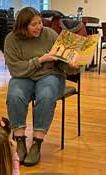


Muhlenberg Hillel students planned activities around the theme “Reduce, Reuse and Recycle.” Children decorated cups to plant seeds in and created paper
leaves as a group project. The college students read several PJ Library Tu B’Shevat stories, and then everyone came together to add personalized leaves to a group tree poster. The students shared with the children ways to help reduce waste, reuse items in new ways, and recycle plastic and other items.
BY EVA LEVITTFebruary is Jewish Disability Awareness, Acceptance and Inclusion Month (JDAIM). JDAIM serves to amplify disabled Jewish voices and raise awareness about disability and inclusion.
With JDAIM bringing welcome attention to the disability community, it’s the perfect time to for individuals and businesses to evaluate their own dedication to access and inclusion, as they are yearround issues.

The Americans with Disabilities Act (ADA) will turn 33 this year, yet disabled Americans are still fighting every day for access and inclusion. There are an estimated 61 million adults living with mobility, hearing, visual and cognitive disabilities in the United States. Disabled

people can be consumers, medical providers, teachers, politicians, and artists, and contribute to society equally to non disabled people.
However, barriers to access and inclusion exist in nearly every aspect of living. From issues with physical access to limited employment or transportation options and even to public opinion, disabled individuals must actively work to overcome barriers every day. In the absence of complete universal design, or design and utilization practices that create access for everyone regardless of ability or other diverse factors (i.e., architectural elements like curb cuts and ramps), there is always work to be done toward accessibility and inclusion.
Aside from familiarizing yourself with the aforementioned barriers and amplifying disabled voices when they speak up for inclusivity, accessibility and equality, there are many ways that individuals and businesses can take care to demonstrate a dedication to accessibility and inclusion.
Here’s what you can do as an individual: Adjust your language
Language surrounding disability is a commonly discussed topic in conversations
about access and inclusion. It also happens to be one of the simplest issues to resolve. Some folks prefer person-first language, such as “person with blindness” or “person with autism,” while others prefer identity-first language, such as “blind person” or “autistic person.” Neither is more correct than the other. The best practice is simply to ask for the person’s, or wait for them to make the distinction and then follow suit. Avoid infantilizing euphemisms like “differently abled,” “wheelchair-bound,” and “handicapable,” as well as “special needs” and “handicapped.” “Disabled” is not a dirty word.
Practice awareness
Don’t let accessibility be an afterthought. Consider the access needs and preferences of your disabled friends and family members when making plans, and try to make the plans as inclusive as possible. For example, remove a barrier to accessibility by calling ahead to a restaurant and making sure it’s accessible before inviting your wheelchair-using friend out to dinner. If you make plans, don’t exclude someone with a disability just because you think they might not be able to go. If the plans are not accessible, explore potential

changes or accommodations.
Ask. Don’t just grab
This phrase coined by blind disability advocate Dr. Amy Kavanagh reminds us that no matter how much we want to help, consent to assistance is mandatory. Touching someone’s mobility aid or grabbing their arm without permission can be dangerous, possibly leading to injuries and disorientation. Always ask before helping someone with a disability, and don’t be offended if they decline. Even if doing something or getting somewhere takes longer for a disabled person, independence and consent are important. Remember: impact over intent. No matter how good your intentions, if an action can negatively impact someone, reconsider. Businesses too can become more inclusive and implement better accessibility practices. Urge your favorite local businesses to improve in the following ways:
Physical accessibility
Physical accessibility is a crucial part of inclusion. ADA compliance should be the minimum and universal design the goal. If a building is historic or exempt from
modern accessibility standards, those in positions of power should do their best to accommodate areas that are lacking. Consider the accessibility of entrances/ exits, hallways, bathrooms and bathrooms stalls, elevators and parking spaces (and enforcement of those parking spaces and rules). Lighting and auditory elements are also important, as individuals with visual, hearing or cognitive disabilities may be directly affected by those features. Hiring a disability consultant to evaluate your business may be a worthy expense to ensure that disabled individuals have access.
Clear information
Having clear information regarding the physical
(continues from page 5)
accessibility of your business helps to ensure that disabled persons and their friends, families or assistants are informed and able to avoid the frustration of an access issue.
Educated staff
Not only should staff be educated on the physical accessibility of the location, but management should also endeavor to educate staff on how to interact properly with disabled individuals. Consider a diversity and inclusion seminar. Employees should at minimum know proper language and behavior, know whether the building is accessible, and be aware of any barriers to accessibility such as narrow hallways, flashing lights or loud music.
Comprehensive emergency procedures

In the event of an emergency evacuation, it is
imperative to ensure that disabled patrons and/or employees are able to exit safely. There should be clearly defined accessible exit routes with both visual and auditory alarms. A disabled employee may be the most knowledgeable about the best way to prevent unnecessary danger.
Service animal education
Service animals, specifically dogs and sometimes miniature horses, are animals trained to do work or perform tasks that help a person mitigate disability. Examples include a guide dog trained to assist a blind or visually impaired person with navigation, or a medical alert dog trained to detect seizures or changes in blood sugar. Don’t touch, talk to or otherwise distract them. A service dog is considered medical equipment
and has access to all areas aside from specific medical exceptions, no registration required. Note that emotional support animals do not have the same rigorous training as service animals and therefore have no public access rights. There are two questions allowed by the ADA when a disability is not apparent: Is the service dog required because of disability? What work or task has the dog been trained to perform? Any employee may ask these questions of any service animal handler. Adapt and accommodate Adaptation and disability go hand in hand, as the needs of a disabled person may vary in different circumstances. For example, you might have to read documents aloud to a blind or visually im-
paired individual, or write notes to or interact with an American Sign Language interpreter to communicate appropriately with someone who is deaf or hard of hearing. Some people may not be able to attend inperson meetings or to work certain shifts due to chronic illness or disability-related symptoms. A phone call, Zoom conference or workfrom-home policy is a useful accommodation.
Digital accessibility
Internet, social media and marketing accessibility means making online content accessible for people with disabilities. Some examples include using alt text image descriptions and video captions, and offering written or audio transcripts. Keep in mind that many website design services offer ways to easily integrate
screen-reading accessibility features. Additionally, information found online describing programs or events should also be available in print (and ideally braille and large print) for those who may not have access to a computer.
Disabled voices are the most educated on how to direct the conversation about accessibility and inclusion as these decisions affect them on a daily basis. This JDAIM, take the time to evaluate your own practices (and those of the businesses you frequent), advocate for inclusion and accessibility, ask questions, boost the content of disabled Jewish and non-Jewish creators across social media, and don’t let disability be an afterthought. After all, the future is accessible!


Leon Zoller visited Country Meadows in Allentown on a Friday afternoon late in January to
lead a Shabbat service. Residents came from all buildings on the campus to join. After the service, they dined on a brisket
In a world filled with unprecedented need, Federation not only rose to the occasion, but thrived.
We were able to do so because of the generous support we have received in the past.
Because of your generosity GOOD continues to grow throughout our community.
For almost 70 years, Federation has been HERE FOR GOOD.
And with your help, we’re not going anywhere.
www.JewishLehighValley.org
year, we will continue to reach out to those in need, find innovative ways to engage with our community and make sure GOOD grows at home, in Israel and around the world. Just as we have in the past. Just as we will in the future. Because together, we are # HEREFORGOOD
The composer Wu Fei will discuss the WWII-era Jewish community of Shanghai that inspired her 2019 composition “Hello Gold Mountain” at Lehigh University’s Zoellner Arts Center on February 8. This private audience with the community will conclude with a sneak peak at a rehearsal with Fei on Chinese zither, Shanir Ezra Blumenkranz on oud and an ensemble from the Lehigh University Philharmonic in preparation for the February 11 performance of the work.
The companion events are presented in a partnership between the Jewish Federation of the Lehigh Valley and the Zoellner Arts Center. The February 8 program was originally scheduled to take place in a slightly different
format at the JCC, and free bus round-trip transportation is being provided from the JCC to Lehigh’s campus for the free event (see details at the end).
The Jewish community of Shanghai was made up of refugees escaping Europe after the Nazis came to power. By the end of the 1930s, China was at war with Japan, and Japan held Shanghai. In 1941, the Japanese rounded up the Jews into a one-square-mile ghetto.
Conditions were harsh, with some 10 people to a room, poor sanitation, and not enough food and few jobs.
Some Jews joined the resistance movement, working as informants and carrying intelligence, performing minor acts of sabotage and helping downed Allied airman.
Eventually, the most of the Jews left. Many ended up in
San Francisco.
Fei, born in Beijing and trained in the city’s China Conservatory of Music, learned about the Shanghai community in 2006, when she discovered a documentary in a library after moving the United States. “When I watched ‘Shanghai Ghetto,’ I probably used a whole box of tissues to wipe my tears,” she said. “I was stunned by how profound this history was, at the same time puzzled by why it was never mentioned or taught to us in China nor the United States.” She wondered what might have been if the community had remained in China, if its Jewish folk music had a chance to filter through the local folk music to form something new. “‘Hello Gold Mountain’ is my attempt to write music that I think could have come out of the fascinat-
ing cultural possibilities of the Jewish presence in Shanghai,” she said.
The foundation was in place for exciting things to happen in Shanghai, she said. “If the Jewish community stayed, also assuming China didn’t have the civil war (which was intermittent through the end of the 1940s), the Jewish community of Shanghai would be a center of education, arts and science, businesses, fashion and cuisine in the world.”
What about the music itself? “It would have been incredibly fun and vibrant,” she said, “lots of singing, lots of string and piano playing together, lots of woodwind and reeds playing, lots of dancing, lots of jamming and improvising together, and lots of new orchestral works.”
The February 8 program at the Zoellner center was
moved from the JCC to accommodate Fei’s hectic rehearsal schedule in getting ready for the February 11 performance. Admittance to our private reception on February 8 is free. Register at jewishlehighvalley.regfox.com/hellogold-mountain-wu-fei-2823.
The bus will leave the JCC for Zoellner at 5:45 p.m. (please arrive at 5:30) and return to the JCC after the program ends. Attendees can also go straight to Zoellner, to arrive by 6:15.
The full performance of “Hello Gold Mountain” will happen on Saturday, February 11, at 7:30 p.m. Tickets are $25 (free for Lehigh students). Call 610-758-2787 or visit zoellnerartscenter.org for tickets.
IN HONOR
MAXWELL DAVISON
In honor of the birth of his grandson, Shaiyan Lal Davison-Pradhan
EILEEN AND ROBERTO FISCHMANN
In honor of your daughter Veronica’s engagement to Yakov Pechersky
Carole and Michael Langsam
CAROL BUB FROMER
In honor of becoming a board member of the National Women's Philanthropy and attending the JFNA International
Lion of Juda Conference
Sybil and Barry Baiman
PAM AND SCOTT KRIM
In honor of the birth of your grandson, Aaron Thomas
Laurie and Robby Wax
AMY AND ROB MORRISON
In honor of the birth of your granddaughter, Brianna Alison Feinberg
Aaron Gorodzinsky and Jennie
Schechner
JUDY MORRISON
In honor of the birth of your greatgranddaughter, Brianna Alison Feinberg
Aaron Gorodzinsky and Jennie
Schechner
AMY AND RICH MORSE
In honor of the birth of your granddaughter, Hailey
Marlene and Arnan Finkelstein
ROBERTA AND ALAN PENN
In honor of your granddaughters' Sophie and Maddie’s Bat Mitzvah’s
Sybil and Barry Baiman
Marlene and Arnan Finkelstein
JAY PLOTNICK
In honor of a speedy recovery
Evelyn and Jay Lipschutz
JILL AND IVAN SCHONFELD
In honor of the birth of your greatgrandson, Knoxyn Grey
Sybil and Barry Baiman
ARLENE AND RICHARD STEIN
In honor of your granddaughter Erica’s engagement to Mark Derner
Sybil and Barry Baiman
STEPHANIE AND STEVE SZILAGYI
In honor of your daughter Jillian’s engagement to Rory
Elaine and Leon Papir
EILEEN UFBERG
In honor of receiving the Kipnis-Wilson/ Friedland Award
Sybil and Barry Baiman
Carol and Barry Halper
Elaine and Leon Papir
JERI AND LEN ZIMMERMAN
In honor of your son Zach’s marriage to Ashley
Sylvia and Sam Bub
IN MEMORY
BROTHER-IN-LAW (Brother-in-law of Barbara Cohen)
Elaine and Leon Papir
CAROLYN ALBERT
(Mother of Jill Nathanson and Andy
Albert)
Lynn and Ronnie Goldman
Mariner Wealth Advisors
Team Phoenix
Ilene and Andy Schaeffer
Rebecca Zimmerman
Admission FREE!
Sunday March 5th doors open at 4:00 p.m. Refreshments available for purchase. Basket Raffle, and more! Donations cheerfully accepted.
Congregation
IRA (BOB) BORN
(Father of Ross Born, grandfather of Lisa Ellis)
Marilyn Claire
Roberta and Jeff Epstein
Carol and Gary Fromer
Aaron Gorodzinsky and Jennie
Schechner

Bonnie and Bobby Hammel
Eileen Ufberg
Laurie and Robby Wax
Barbara and Arthur Weinrach
JONATHAN DICKER (Son of Neil Dicker)
Beth and Wes Kozinn
Elaine and Leon Papir
Eileen Ufberg
BARBARA GORDON
(Mother of Lance Gordon)
Randi and Donald Senderowitz
Laurie and Robby Wax
SY KLIONSKY
(Step-father of Frank Tamarkin)
Laurie, Robby, Ben and Danny Wax
MAUR LEVAN
(Husband of Doe Levan)
Sheila Berg
Marlene and Arnan Finkelstein
Beth and Wes Kozinn
Randi and Donald Senderowitz
Eileen Ufberg
Barbara and Arthur Weinrach
HOWARD LISTWA
(Husband of Sherree Listwa)

Susan and Marc Levin
THOMAS LOETZBEIER
(Father of Ilsa Loetzbeier)
Cindy and Nolie Schneider

JERRY MELAMUT (Husband of Ethel Melamut)
Dee and Arny Kaplan
MAXINE MILLER
(Wife of Norman Miller)
Randi & Donald Senderowitz
ALAN MORRISON
(Husband of Judy Morrison, father of Rob Morrison)
Sybil and Barry Baiman
Alli and Scott Lipson
ELLEN (ELLIE) WEINBERGER
(Wife of Ben Weinberger, mother of Liz Levy and Julie Hettleman, sister of George Beneman)
Sybil and Barry Baiman
Michele and Jason Becker
The Ellis Family
Carol and Ed Gratz
Sally and Howard Kramer
Alice and Mark Notis
Harriet Orange
Roberta and Alan Penn
Arlene and Lenny Samuelson
Melissa Schechter
Brad Scott
Randi and Donald Senderowitz
Arlene and Richard Stein
Eileen Ufberg
Larry D. Unger and MPT Colleagues
Beverly and Ron Wasserman
Vicki Wax
Linda and Jim Wimmer
Endowment Card is $10. Call 610-821-5500 or visit www.jewishlehighvalley.org to place your card requests. Thank you for your continued support.
ARE
APPLICATION DEADLINE: MARCH 24, 2023

Contact Jeri Zimmerman at 610-821-5500 or jeri@jflv.org


Congregation Bnai Shalom will present a unique perspective on the Purim story in a Purim spiel on March 5 that explores unexplored aspects of characters in the Book of Esther, featuring songs from the Broadway show “Wicked” repurposed with new lyrics.
The Purim spiel was written and is directed by An-
nelise Davis, daughter of Bnai Shalom’s Rabbi Melody Davis. “I have been involved in many Purim spiels and have enjoyed these experiences,” Annelise said. “I also love to assume the position of devil’s advocate, encouraging the audience to reflect on and perhaps reframe preconceived notions. I wanted to delve more deeply into the psyches of the characters and provide them with an opportunity to become more than cardboard cutouts.
“It’s often the cumulative choices we make in life that create who we are. It’s fascinating to conjecture how the small decisions and paths we take influence who we become. That’s the essence of this show.”
Rabbi Davis commented that the Book of Esther provides endless possibilities for bibliodrama, the modern form of midrash that allows
characters to provide their own back stories. In the Joseph story, for example, Mrs. Potiphar attempts to seduce Joseph. The Torah tells us that Joseph was extremely handsome, but was that really enough for her to pursue him? Perhaps she was lonely. We don’t know from the text, but what if she could speak? This Purim
Brie Finberg became a bat mitzvah at Temple Beth El in Allentown on January 7.
toy drive provides toys for children — infants to 12 years old — from needy homes within Luzerne for the holiday season. In the past, I had participated by volunteering to sort and wrap toys.
“I’m not the best at wrapping,” she laughed.
Robyn Finberg, Brie’s mom, grew up in Luzerne County. “I’m one of three girls,” Robyn said.

“My parents really picked themselves up after the loss of my sister. Losing someone so young is so difficult, and they made something good come of it. Toys
From Heidi is a part of all our lives now.”
The Eyer Middle School seventh grader wanted to do a mitzvah project that was related to her and her family. Continuing in a tradition of giving back to the community, she decided to highlight Toys From Heidi, an organization that collects toys for children in Luzerne County.
Heidi was Brie’s aunt, Heidi Mitchneck Seeherman, who died in June 2012 at age 40. Heidi’s parents, Joe and Bedonna Mitchneck, Brie’s grandparents, started the program to memorialize and honor their daughter, who worked with children for many years.
“My aunt worked as an advocate for special needs children in Luzerne County,” Brie said. “The annual
Brie knew her aunt Heidi only for a short time.
“I remember that she was a fun person and she liked to do activities with me so that I’d have a memorable time,” she said. “For my mitzvah project, I collected new, unwrapped toys for the 2022 holiday season. I know that my aunt would be so proud that our family continues to bring this happiness to children. I’ll keep on wrapping toys every year.”
Robyn and Brad Finberg are proud of their daughter. “It was amazing to watch her grow as she studied throughout the year,” they wrote. “Her determination and drive was impressive. We could not be prouder of all she accomplished.”
In addition to her mitzvah project, Brie has made her
story provides such opportunities.
A graduate of the Fashion Institute of Technology, Annelise designed and crafted the luxurious costumes for the principals. She has incorporated couture techniques in their construction. Mordechai’s handwoven ribbon jacket, for example, features Jewish stars and other geometric shapes that become visible or invisible depending on the lighting and their angle.


Doors open at 4 p.m. Homemade hamentashen (filled cookies) and other refreshments will be available for purchase before the show, which will begin promptly at 5. In traditional Purim style, there

will be lots for purchase, as well as a Gonza Megillah basket raffle, and much more.
All are welcome. There is no charge for the show.
first adult gift of tzedakah (righteousness or charity) to the Jewish Federation of the Lehigh Valley Annual Campaign for Jewish Needs. For help developing a mitzvah project, contact Abby Trachtman, project coordinator, at abbyt@jflv.org or at 610-821-5500.


 By Joanna Powers
Very early Sunday morning, January 8, I began my travels to Denver, Colorado in order to attend the 2023 Prizmah Conference.
I was immediately surrounded by a breathtaking array of resources, peers, and cutting-edge information connected to Judaic, Hebrew, and Israel education. As the Director of Hebrew and Judaics at the Jewish Day School of the Lehigh Valley I could not wait to dive into the wealth of treasure that I would be bringing back to the JDS.

Prizmah: Center for Jewish Day Schools is a network organization that strengthens the North American day school field. They work to enhance Jewish day schools’ ability to excel and thrive, by deepening talent, catalyzing resources, and accelerating educational innovation.


I was absolutely thrilled to join 1,100 Jewish day school professionals to learn, create, and benefit from leading practices, novel ideas, and fresh approaches.
The theme of the 2023 Prizmah Conference was Creative Spirit. The spirit of creativity that is used in education every day was celebrated and the creative competencies that can be applied to impact students, schools, and communities were
explored.
Expert facilitators and thought leaders shared incredible ideas and resources. I had more than 100 sessions, workshops, and hands-on experiences to choose from.
This immersive experience allowed me to reconnect with other Jewish school professionals who I had gotten to know through Prizmah cohort programs, such as the current Judaics Administrators’ Cohort that meets monthly, my friends from YOU Lead, Prizmah’s signature leadership development program that I attended in 2016, and the Harvard Graduate School of Education’s 2018 Institute, The Art of Leadership, as an AVI CHAI representative. I also met and networked with new acquaintances whose positions in Jewish education will now allow me access to the latest techniques, tools, and curricula being used in schools across the country.
Of all of the wonderful symposiums I attended, there was a selection of sessions that were especially significant for me. Ethan Tucker, the Rosh Yeshiva of the Hadar Institute led “Midrash and the Rabbinic Imagination” during which he characterized the midrashim as “love letters” written by the rabbis to the Torah
and was even able to connect the midrashic tradition to the show Hamilton!
Tamar Appel from Hidden Sparks dove deep into classroom differentiation and inclusion in “Strengthening School Culture to Serve All Students.”
“Sharing Best Practices in Creative Tefillah Education” presented by Koren Publisher’s Daniel Rose was excellent as Judaic department heads shared the best methods to make prayer engaging and meaningful to our students.
The session I thought had the best ti-
tle was “What I Thought I Taught and What My Students Actually Learned,” where Esther Friedman presented her dissertation about the differences between what different students and teachers do, say, think, and feel.
I am incredibly grateful to have been given the opportunity to spend three days amongst the mountains and amongst the best and the brightest in Jewish education.
I can’t wait until the 2025 Prizmah Conference!
February is Jewish Disability Awareness, Acceptance and Inclusion Month (JDAIM), a unified effort among Jewish organizations to raise awareness and foster acceptance and inclusion of people with disabilities and mental health conditions. This year, Jewish Family Service will host two events celebrating inclusion.

PJ Library learns about inclusion
This Zoom program offered in partnership with PJ Library from 2 to 3 p.m. on February 12 is geared toward teaching young children the meaning of inclusion. Of course, there will be a PJ Library story.
Closed-captioning will be provided. Contact Amanda Thomas at amthomas@jfslv.org

to request additional
accommodations.
Admittance is free. Register by scanning the QR code to the right.


‘Bigger Than Us’ screening, Q&A with filmmaker
JFSLV is partnering for this February 16 event with ReelAbilities Film Festival New York, the largest festival in the country dedicated to promoting awareness and appreciation of the lives, stories and artistic expressions of people with disabilities.

Founded in New York City in 2007, the festival presents international and award-winning films by and about people with disabilities in multiple locations throughout each hosting city.
“Bigger Than Us” is a behind-the-scenes documentary about the

making of “Best Summer Ever,” the world’s firstever Studio Actors Guild-registered feature film made by a majority disabled cast and crew.
Participants in the 7:308:30 p.m. Zoom program will watch the 16-minute documentary followed by a 40-minute Q&A with the filmmaker. The discussion will explore and celebrate inclusion.
Maya Albanese directed the film, with cinematography by Turner Jumonville and Maya Albanese.
Audio descriptions of the scenes and closedcaptioning will be provided.
Attendance is free. Register by scanning the QR code below or email amthomas@jfslv.org.
February
We thank the following individuals who have graciously supported JFS by sending tribute cards:

IN HONOR
ALLEN & ROBIN ABBOTT
Jim & Bonnie Kelly
PEGGY & BILL BERGER
In honor of Bar Mitzvah of grandson Jake
Roberta & Alan Penn
LISA & BARNET FRAENKEL
In honor of the birth of their grandson
Debbie Zoller, JFS Staff & Board
EYDIE & NEIL GLICKSTEIN
In honor of B’nai Mitzvah of grandchildren Shayna & Bradley
Roberta & Alan Penn
CHERI STERMAN & BARRY
GOLDIN
In honor of the birth of their grandson Noam
Lynn & Mark Shampain
RUTH MEISLIN
In honor of her service to Jewish Family Service
Rill Ann & Steve Miller
AMY & RICH MORSE
In honor of the birth of your grandchild, Hailey
Debbie Zoller, JFS Staff & Board
TAFFI NEY
In honor of long-standing service to the Jewish community of the Lehigh Valley
Edward Taffet
LOIS RATNER
In honor of the birth of your great-grandchild, Hailey
Debbie Zoller, JFS Staff & Board
JACQUI SCHWARTZ
In honor of the birth of your first
grandchild, Wesley
Debbie Zoller, JFS Staff & Board
ARLENE & DICK STEIN
In honor of the marriage of granddaughter Nicole & engagement of granddaughter Erica
Roberta & Allen Penn
STEFFI & STEVE SZILAGYI
In honor of Jack’s Bar Mitzvah & Meredith’s engagement
Roberta & Allen Penn
EILEEN UFBERG
In honor of her birthday
Carol & Perry Zirkel
IN LOVING MEMORY
ANNETTE ALBERT
(Mother of Sharon Albert)
Linda Yankaskas
IRWIN COHEN
(Husband of Gerda Cohen)
Rabbi Allen & Toby Juda
MAUR LEVAN
(Husband of Doe Levan)
Pam Lott & Ron Ticho
MORT MILLER
(Husband of Judy Miller)
Theodore LaRose
MICHAEL NATHAN
(Father of Phyllis Kaufman)
Roberta & Allen Penn
ROBERT SKEMER
(Father of Linda Schneider)
Phyllis & Henry Perkin
INA MAE SLOOP
(Mother of Jill Rice)
Lynn & Mark Shampain
ANN THERESA RUGE
(Sister of Peggy Stettner)
Debbie Zoller, JFS Staff & Board
A tribute card from JFS is a wonderful way to share your thoughtfulness with family and friends. For a donation of $18 or more (the amount is up to you), we will send a lovely card to the recipient of your choice, letting them know of your contribution. Your contribution may be made to JFS’s General Fund or may be directed to a special program such as the Community Food Pantry, Education and Programs or Older Adult Services. Call 610-8218722 or visit www.jfslv.org/tributes to order cards.
As our Birthright Israel Foundation group walked toward the Kotel (the Western Wall), our tour guide told us we may feel certain emotions. As I listened to the many voices praying on
Shabbat, I felt love. I felt love for my Jewish heritage, Israel as a country, the incredible opportunity of Birthright, and my family and loved ones.
I even started to hear the voice of my late Poppy, who shared quite the incredible love story with my beloved Nana (long-time Keneseth Israel congregants). It was an inspiring moment that I’ll always remember.
I traveled to Israel (specifically Tiberias, Tel Aviv, Eila and Jerusalem) on a Birthright tour through Israel Outdoors — its Outdoors Max trip — from December 27 to January 9 with 45 other participants, including my brother Troy and six Israelis. It was amazing to experience a country filled with our history and culture, while also


building friendships with other young Jewish adults.


We embraced the outdoors, driving ATVs, camping, biking, snorkeling, rappelling and hiking. Our group shared an emotional day when we visited Har Herzl (the National Military Cemetery) and Yad Vashem (the World Holocaust Remembrance Center). To further connect with Judaism, we engaged in meaningful seminars on our values, Israeli politics and our own Jewish identity.
From the phenomenal food to bus rides (which involved both loud singing and catching up on sleep), it was truly an amazing adventure that I’ll cherish for the rest of my life.
Celebrate Israel’s New Year for Trees (Tu B’Shevat) by eating some fruit that grows in Israel. If you like dates, this makes a delicious breakfast. Serve spread with whipped unsalted butter topped with a sprinkle of sea salt. Recipe from Sandi Teplitz.


We’ve all been hearing reports for a while now about mental health issues among America’s youth. With the arrival of Hakol’s Kids, Camp and Beyond issue, and as we continue to emerge from the pandemic’s disruption, we asked a couple of pediatricians and pediatric offices connected to the Jewish community to offer their input on the sub ject.
Dr. Richard Morse Pediatrician with Lehigh Valley Pediatric Associates

Q: Are you seeing a rise in mental health issues?
A: Yes, particularly anxiety and depression in teenagers and young adults. While it is true that the pandemic exacerbated the problem, the rise in mental health issues started before the pandemic.

Q: What signs are you seeing?
A: Sometimes patients and their families recognize that there is a problem and they come to the office seeking advice.
Sometimes they don't realize there is a problem.
The signs we see in the office that might clue us in to anxiety or
depression include: sleep difficulties, school difficulties, mood changes, withdrawal from family or friends or activities, substance use. These are the same clues that parents would be on the lookout for.

Q: What should parents do?
A: Unfortunately, resources are stretched thin. It can be difficult to get an appointment with a therapist. Sometimes a school guidance counselor can be helpful. Probably the best thing for parents to do is make an appointment with the primary care provider.
Brandi Burns Physician assistant at Children’s Healthcare in Allentown

We are definitely seeing an increase in mental health problems and diseases in
our youth and adolescent populations. They are coming in with anxi ety and depression, equally.
I would say we are seeing youngerthan-ever patients, meaning 8-10-yearolds, who are struggling, which we never really had prior to COVID-19 pandemic. They are withdrawn from their peers, teachers, family members, etc.
We are recommending at this point that they see a therapist or counselor, whether it’s through their school or outpatient. This will help them cope with their feelings but also work through them so they can “live with” their anxiety and depression a little better. They give them coping techniques to help typically.

our adolescent center to further discuss and diagnose, and we go over management with medications then. It should always be brought up and treated just like any other illness or disease.

Here’s the early scoop on a handful of summer sleepaway camps! To make sure we had the latest info for you, we asked each camp two questions (and a third one just for fun!):
• What was special or different about your camp in the summer of 2022?
• What will be different at your camp in 2023?
• What is your favorite camp alumni success story?
• Following are the answers we received (not all camps answered all questions).
Camps Airy and Louise Camp Airy for boys and Camp Louise for girls in the Catoctin Mountains of Western Maryland
• Camp Airy campers last summer got to try out the new mountain bike trail. Camp Louise campers celebrated 100 summers of fun and friendships.
• Camp Louise is getting pickleball this year, and Camp Airy will have new STEAM (science, technology, engineering, art and math) activities
and the return of culinary activities.
• We have 100 years of alumni. We are hosting many events this year to celebrate 100 summers of memories.


Camp Galil Ottsville, Pennsylvania
• The addition last summer of an auto-belay climbing tower offered a new option for free time.
Campers could choose to climb the 25-foot tower right in the heart of camp, separate from our high-ropes course in the woods. The fourtrack tower set the stage for a lot of fun climbing competitions last summer.
• Alumni are part of an extraordinary tradition of youth leadership at the camp. Youth have long set the agenda. From the youth leadership of Habonim Dror to the youngest campers getting their say at our Friday all-camp meetings, from our eighth graders planning “Aliyah Bet” to our counselors-intraining taking over camp
for a day, you never know what’s around the corner. Every summer is different because of the passion and creativity of our youth leaders building the amazing, fun summer community they wish to see. Summer 2023 welcomes the next generation of leaders.
Golden Slipper Camp Stroudsburg, Pennsylvania
• Last summer we added elements to our lake, expanded our archery area, had a camp-wide karate kid night and made shofars.
• This coming summer is our 75th. We will be celebrating with foam parties, havdalah making and much more.

• Our alumni stories are long and varied over the past 75 years of campers and staff experiencing all we have to offer. One recent success story is that an alumnus who became a teacher after his experiences at camp became a member of the Golden Slipper Club and Charities,
and was recognized as a Golden Citizen of our organization and celebrated this award at camp. Now he is back working at camp, making a difference in our special events, all while his two sons are continuing his family’s legacy as campers.
Camp Judaea Hendersonville, North Carolina
• This year we are excited to open our brand-new cabin village. It will feature six state-of-theart cabins, a shared garden and a new soccer field. Deborah’s Village will be enjoyed for generations to come. In addition, we are always continuing to enhance our programming with fun new items like an industrial slip and slide.
Pinemere Camp
Stroudsburg, Pennsylvania
• We are excited this year for the brand-new rec hall, amphitheater and chapel.
• We had a huge rec hall capital campaign to raise money to build these three new facilities. They will enhance our performing arts department and Shabbat services.
• The rec hall provides an indoor/outdoor stage where we have a musical each summer, all-camp lip sync performances, and our drama and dance activities. The amphitheater, or Del, as we call it, is an outdoor space where our whole camp can enjoy performances, havdalah, and Maccabi. The chapel is where our whole camp community comes together every Friday evening and Saturday morning for camper/ counselor-led services that include lots of singing and songs.
• Our greatest alumni success is that four of the six full-time members of our team are Pinemere born and bred.
• Our associate director, director of camper care and communication, and director of finance and operations all had parents who grew up at camp, met their spouses at camp. They have been on the full-time team for the past three to six years. Our assistant director, who joined us in April, also grew up at Pinemere. The passion our professional team has for Pinemere runs for generations.
Camp Ramah in the Poconos Lakewood, Pennsylvania
• This year we are excited to be building on the curricular arc of our eight age groups. Campers in each group will be connected to a Jewish theme or value, such as
friendship and kindness. These important themes will be the foundation for our staff to develop radically creative, fun and educational programming for campers throughout the summer.
• The Ramah journey of alumnus Benji Goldberg is not so much a single story as an evolving, lifelong experience. It all started when he was two years old.
• “Ramah’s greatest impact on my life has been keeping me actively Jewish while living in Israel,” he said. “Ironically, you can find yourself disengaged with almost anything Jewish when living in a primarily Jewish country. Years of breathing joyous and vibrant Jewish summer air at Ramah Poconos has lit a strong and active light inside of me.
• “Ramah camping is the most powerful tool our beloved movement has, keeping the future generations of campers and staff involved with their Judaism and connected for years to come.
• “I have spent decades at camp making lifelong friendships and learning about myself. Now, as the Ramah Poconos director of operations and retreats, I have the privilege, with my wife Ella, of bringing our children each summer, watching the next generation of Jewish leadership grow.
URJ Camp Harlam
Kunkletown, Pennsylvania
• We launched our newly revamped introductory experience program, Rishonim, which is a 12day first-time experience for campers in grades 2 and 3. We also added a Summer Taste of Camp program to give future campers an authentic “taste” of what Harlam is all about while helping to build their confidence and readiness for an overnight camp experience. We also added new out-of-camp hiking trips for middleschool-age campers and more “free choice” programming, and built a new camper cabin.
• We are excited to celebrate 65 years of Reform Jewish camping this summer. We are offering some new things to enhance the experience, including round-trip bus transportation from central locations throughout the region, towel service at the pools and lake, two more renovated bunks, a brandnew garden space and the return of out-of-camp trips for all age groups.


The JCC would like to thank all of our donors who participated in the annual Friends of the J Campaign.

Leonard and Enid Abrams Family Foundation*+
Lori & Houman Ahdieh+(L)
Lynn Wilson & Michael Alterman+
Raquel Alvarez & Guillermo Garcia*+
Amy Born Fund
Marsha Baar+
Thomas Basseches
Frederick Bausch+
Steven Bergstein
Susan & Larry Berman+
Laura Black
Christy & Andrew Block+
Sheryl & Rance Block+(L)
commemorates the victory of the Maccabees over King Antiochus IV and his soldiers. After their victory, the Maccabees rededicate the Temple in Jerusalem. A new menorah was built, but there was only a tiny jar of oil, which looked like enough to last for a day. However, a great miracle happened! The oil lasted for eight whole days.
Ira Blum
Wendy & Ross Born*+(L)
Leslie & Victor Bunick+
Chelsea & Elliot Busch+
Marilyn Claire+
Robert Cohen*+
Rt. Rev. M. Blair Couch+
Audrey Cylinder
Jenn & Gregg Dietz+
Emery Dudra+
Nicole & Adam Edwards*+
Jan & Glenn Ehrich+
Lisa & Andrew Ellis+(L)
Iris & Jonathan Epstein+(L)
Amy Faivre & Marten Edwards+
Patricia Feast+
Lynn & Samuel Feldman+
Brenda & Edward Finberg+
For that reason, a candle on the menorah or Hanukkiya is lit for each of the eight nights of the holiday to commemorate the miracle. For that reason, Hanukkah is referred to as The Festival of Lights! It is a custom to light the menorah near a window, where it can be easily seen, and each night, the light from the candles continues to grow, which serves as a
Kathy Zimmerman & Peter Fisher*+(L)
Ophira Silbert & Jeffrey Fleischaker+(L)
Emily & Brian Ford*+(L)
Phyllis Ford+
Marjorie & Neil Forgosh+
Lisa & Barnet Fraenkel*+(L)
Monica & Henry Friess+
Susan Jarrett+
Jewish Day School Board of Directors
Gia & Matthew Jones+
Roby & Rabbi Allen Juda+
Nancy & Andy Kahn+(L)
Audrey & Steven Kanoff+
Janice & Robert Kaplan+
Chelsea Karp+
Amy Katz+
Marty Katz+
Talia Katz
Alexander Kita+
Beth & Wesley Kozinn+
traditional foods are made on Hanukkah. Potato pancakes or latkes, jelly donuts, and chocolate coins, known as Hanukkah gelt, are mainstays that the entire family can enjoy! In a heated debate that many Jews find themselves on the opposite side of, it is a question of whether latkes go better with applesauce or sour cream. While we won’t take sides in this article, there are cases for both!
Lynda & Stuart Krawitz*+(L)
Stephanie & Robert Kricun+
Fay & Michael Kun+
Enid & Bruce Reich
Lauren & Kevin Reuther+(L)
Pat Rhodes*+
Carol Rieder+
Sara Ritter & Mike Smith+
Bob Rockmaker+(L)
Amy & Jesse Saborsky+
Mary & Alan Salinger+
Amy & Richard Sams+
Arlene Samuelson+
Terry Schettini+
Brenna & Michael Schlossberg+
Lanethea Mathew Schultz & Jonathan Schultz+
Annie & Maggie Schutzler
Cari Schutzler
Peter Schutzler
Suzanne Lapiduss+
Heather & David Lavin+
Paul Lemberg*+
Lisa Yoskowitz & Matt Leon+
Lesavoy Butz & Seitz LLC+
Penny Lesavoy+
Gary Levenson+
Judith & Larrie Sheftel+
winner receiving a pile of chocolate coins.
Linda & Elliot Sheftel+
Rachel & Andrew Shurman*
Jenny Hayden & Nathan Siegfried*+
Jodi Eichler-Levine & Maccabee Levine+
Margo & Eric Lightman*+(L)
Robin & David Lightman+
Marilyn & David Louick+
Jodi & Sam Lovenwirth+
Karla Lyle+
Lisa & Moshe Markowitz+
Markson Family Fund*+
Another staple is the dreidel, a four-sided spinning top with Hebrew letters on each side that stand for the phrase “a great miracle happened there,” with “there” referring to Israel (Fun fact, in Israel the letters are different with “here” replacing “there!”). Traditionally, games of dreidel are played for stashes of Hanukkah gelt, with the
The JCC of the Lehigh Valley will be celebrating Hanukkah with our annual Family Hanukkah Celebration and Community Candle Lighting on Sunday, December 18 from 3pm-5pm. We will be celebrating in style
Madeline Marte & Audberto Rolon
Jeanne Narkiewicz & Constantine Marcopul+
Sara & Marcos Martinez+
Linda Maurin+
Harry & Ethel Miller Memorial Fund
Stephanie & Adam Smartschan+
Kaitlyn Stefanowicz+
Tracy & Matt Sussman+
Tamarkin Family Fund+
Janelle Konstam & Stuart Teger+
Pam Lott & Ron Ticho+
Cristina & Jason Toff+
Eileen Ufberg+
Melissa & Matthew Unger+
with games, crafts tables, doughnuts, hot latkes and cocoa, live entertainment, and a dance party! Register online at lvjcc.org/SpecialEvents or call the JCC at 610-435-3571. We hope to see you there and wish everyone a chag sameach!
Cantor Ellen Sussman & David Vaida+
Chris Valuntas+
Ali Raza Visram+
Peggy & James Waite+
Kristina & Alexander Ward
Robert Watkins+
Beatrix Watt+
Gary Fromer & Carol Bub Fromer Family Fund*+
Carol & Stewart Furmansky+
Ronald Glickman
Patricia Glosser+
Andrea & Zach Goldsmith*+
Ina Goldstein+
Aaron Gorodzinsky+
Sandra Greenfield
Melissa & Harvey Hakim+(L)
Kathleen Halpert
Bonnie & Bobby Hammel*+(L)
Alissa Romano & David Hammerman
Julianne Heiney+
Beth & Cory Hiken+(L)
Arlene Hurwitz+
Donna & Mike Iorio+(L)
Amy & Douglas Jaffe+
Sukaina & Mustafa Jaffer
Heather Lavin
wowed the audience and was able to fully embrace their roles with the help of PBS39 and the Museum
Michael Miller*+(L)
Jeannie Miller+
Judith Miller
Marielle Messing & William Miner+
Barbara & Thomas Mulligan+
Edward Nissenbaum+
Sandy Nussbaum Giercyk
Amy & Martin Oselkin+
Leon Papir+
Joan Goldstein Parker & Alan Parker+
Nicole Pawlowski
Hannah Miller & Dan Pelagio
Eve & Joseph Peterson+(L)
Marjory Kramer & Rabbi Seth Phillips+
Stephen & Marianne Phillips Charitable Fund
Megan & Jeremy Pildis+
Adina & Aron Preis+
Sandra Preis+
Ellen Osher & Robert Prichard+
Maria Pursel+
Wax Family Fund*+
Melissa & Samantha Weinstein
Jaclyn Weiss
Martin Westman+
Sara Whildin*+
Working Dog Press*+
Helen & Jeffrey Wright+
Janet Yandrisevits+
Valeska & Israel Zighelboim*+(L)
Jeri & Len Zimmerman+
Carol Zirkel+
Debbie & Leon Zoller+
Jessica & Scott Zolotsky
+ Previous Year Donors

* Over $500
(L) Life & LegacyTM Donors
List as of 1/16/23
of Indian Culture. Stagemakers Molly of Denali. In addition, the Participants worked on hand
became part of the costumes for the
Excitement is in the air. Camp is coming. And even though it’s four months away, that doesn’t matter to the kids who have looked forward to returning since the second they left in August. So many memories are made. There’s so much to learn. There’s so much to be grateful for.
Many children in the Lehigh Valley attend overnight camps such as Ramah, Harlam and Pinemere. There are so many of them, and each is different.


Camp Ramah is where many kids in my family went. My cousin went for eight weeks every summer

from the time she was 9. She met her now-husband during one of those summers and currently sends both her daughters there. They love it as much as she does. The tradition continues from generation to generation: l’dor v’dor.
A friend of mine said this about her experience as a camper and the lasting impression it made on her on life: “The relationships there were among the most meaningful of my life. Although the camp closed down over 40 years ago, we continue to share photos, stories, essays and our lives via Facebook, a website and an email server. We’ve had relationships and marriages through camp, and camp-
ers’ parents and grandparents have met and married through camp as well. We continue to maintain our relationships and support each other through good times and bad, over the distances and the decades.”
As evidence of how much a camp can impact one’s attachment to Judaism, a friend said her daughter had “10 wonderful years at Harlam, enriching Jewish experiences, lasting Jewish friendships and NFTY (the Reform Jewish Youth Movement) in Israel.” She also said, “There was a study to find out what makes the fullest Jewish identity: 10 years at a congregational school or five years at a Jewish day
school or two years at a Jewish summer camp.”
When deciding what camp to send your child to, there’s a lot to consider.
Do you want a camp that is religiously affiliated?
If so, there are camps for Reform, Conservative and Orthodox Jewish children. There are camps that are not religiously affiliated but are geared toward different interests such as sports or theater. French Woods in Upstate New York specializes in performing arts, and many Broadway actors spent the summers of their youth there.
Studies have found that kids attending sleep-away camp build self-confidence, improve their social integra tion, develop an apprecia tion of nature and strength en emotional intelligence skills such as empathy with others.
The Children’s Bureau of Southern California says the top benefits of sum mer camp are: socializing and friendship building; eliminating screen time and getting exercise; per sonal growth, learning and development; positive role models; and making memo ries.

If you’re not sure over night camp is a good fit for
your child, some camps, such as Ramah, offer a



To all our friends and partners in the Lehigh Valley, happy 2023!
Winter has finally made its appearance in Israel and Yoav — and it is cold! But the wonderful spring flowers are peeping out, and a rather lukewarm sun deigns to appear for a few hours a day, so it’s really not too early to begin thinking of summer warmth and vacations.
When I was growing up in London, summer vacation meant camping with the youth movements, sleeping in tents and hiking miles with rucksacks on our backs. Theoretically the weather was lovely when not rainy. But guess what? It often poured every day of the three-week camp! We had one big tent for drying clothes (though they never dried!), a small schoolroom for activities, and tents with sleeping bags on wet groundsheets — until some of the beds floated across the fields toward the river. End of what we called “real camping”!
Then there were fam-
ily vacation camps at the beach, where fathers joined their families on the weekend. We children watched with embarrassment as our parents wore funny hats and pretended (in our opinion) to be back in their youth.
By the time we moved to Canada to work for the Israeli government and institutions, there were many sleep-away camps. But family camping was a rare thing, having given way to staying at family houses in the countryside or taking trips abroad, perhaps signs of a more prosperous community.
My husband would talk wistfully about growing up in Jewish Montreal, where the community on the whole was not wealthy but was very big on helping everyone. Bnai Brith, for example, encouraged families who could not afford the very reasonable camp fees to come to camp for free and work in some of the various easier jobs there. My brother-in-law was at the Bnai Brith camp for 10 years and for most of that time was the outstanding camper.
In the early years of the


state of Israel, who had the money or the time for camp?
Then the young volunteers who came from all over the world to help Israel just before the Six-Day War began a camp revolution that lasted almost 50 years, and members of youth movements started attending work camps in kibbutzim. Why, my students would ask me, when world youth were roaming the globe, could Israeli youths not do the same thing? “Because we still need you all to build our country first,” I answered.
Today, the classic sleepaway summer camp has largely vanished in Israel, replaced by all kinds of study groups for all ages, by travel abroad with families or longterm travel with friends. In Yoav, we are fortunate to have a very active and creative staff, so there’s an abundance of activities year round.
The summer break is an opportunity to spread out and try new ideas. And even if the sleep-away camp seems to have gone away, opportunities for exploration survive.


 By Alicia Zahn Partnership2Gether committee member
Yoav teenagers are returning to Camp JCC after a twoyear hiatus due to COVID-19. The camp will welcome four teens from the Yoav region of Israel who will bring Israeli spirit to the summer program. Yoav, the Jewish Federation’s Partnership2Gether counterpart in Israel, chose the best of the best to train and send to the Lehigh Valley for the season.
The teens get an enlightening introduction to American culture and, in turn, the valley community gets a summer in-
(the valley’s shlicha, Eynav Dahan, will be at camp too). Even if you are not involved with Camp JCC, you can get to know these remarkable teens by hosting them for dinner, inviting them to an event or taking them to visit a local

involved and become a home host, housing two teens for two weeks (they spend their days at camp and come home to their host in the evenings). This is a very meaningful experience that often leads
to connections that can last a lifetime. For over a decade, I have typically hosted kids for a few weeks each summer, and I have kept in touch with a lot of them over the years.
For information on hosting a teen, contact Aaron Gorodzinsky, director of campaign
jflv.org or Miriam Zager, Partnership2Gether chair, at swimmir@aol.com.

 By Heather Lavin JCC Program Director
One of the earliest lessons I learned working with youth (and being a parent) is that every child is on their own journey.
At the Jewish Community Center, we strive to provide opportunities at every step along the way. In our building, we see kids at all stages of life, from toddlers in Early Childhood Education to young adults returning to the JCC to work as camp counselors and lifeguards.
Some children find their passion at a young age, while others require more time for exploration. And what sparks enthusiasm for one child might not work for their siblings or their
friends. With that in mind, we work hard to offer a variety of recreational and enrichment opportunities all year long and at all stages of their development.

The JCC is a great place to try something new, with programs that vary from season to season. You’ll find recreational sports like JHoops basketball and aquatics offerings in a safe and supportive environment. Creativity can start at a young age with exploring dance through creative movement or with mixed media in a class like Messy Art. Strategic thinkers may gravitate toward chess club, while those who were born to perform can be seen on stage in Stagemakers Youth Theater productions. If you have multiple children

with varied interests, you might find yourself in our building dropping off one at swim practice and the other at a guitar lesson at the same time.
Camp JCC is a perfect example of such varied offerings under one program. Camp Adventure provides campers in grades 1-8 with a traditional day camp experience in a familiar setting. It offers a rotating schedule of activities from instructional swim lessons to art, sports and STEM (science, technology, engineering and math). There are new experiences (cue weekly field trips and special events) and opportunities to hone skills by repeating favorite activities (archery and a Gaga showdown, anyone?).
Young campers, rising pre-K and kindergarteners, experience much of what Camp Adventure has to offer at a more flexible pace with active, hands-on and age-appropriate fun at every turn. Our new counselor-in-training program provides teens in grades 9 and 10 a chance to learn new skills and develop personally while becoming
leaders at our camp. For our campers who have an early passion, specialty camps provide a concentrated environment and expert instruction to dive deep for one week and flourish. Artists can express themselves through jewelry making, cartooning and crafts. Budding young chefs can take ownership of the kitchen with cooking and baking. Theater performers will be inspired by “The Greatest Showman” and “Encanto” and bring weekly themes to life on the stage. Hobbyists can get lost in their love of Lego brick building, Harry Potter,
mysteries and fairy tales. No matter where your child is on their personal journey, the JCC is a great place to try something new or dig deep into what they already love. Whether kids enroll in activities all year long or see us only during camp, they will find a supportive and caring staff and a chance to make lifelong friends as they learn, grow and have fun.
All our youth and camp offerings can be found at lvjcc.org. We hope to see you soon.

Scholarships will be awarded to individuals for Jewish teen education experiences that will enrich the recipients, enhance the community, and increase the likelihood of future engagement with Jewish life.

Scholarships are provided by the Jewish Federation of the Lehigh Valley's annual campaign, on a non-needs basis.


Teens may request scholarships for: Conventions Jewish youth group summer programs Jewish summer camps Certain trips to Israel Leadership development programs
LIMITED FUNDS ARE AVAILABLE.
Scholarship forms are available at www.jewishlehighvalley.org/scholarships
DEADLINE: MARCH 24, 2023


I have a lot of experience with the JCC camp. Both my children became counselors in training and then counselors.
I remember putting my smiling kids on the bus with their friends. All I wanted was for them to come home safely after a day of running around in the sunshine and cooling off in the pool.

I actually did, however, have another agenda: there is nothing like camp to build
friendships. Many of my children’s best friends came from the JCC camp, and it helped them develop a connection to our community, the Jewish community of the Lehigh Valley.
Summers at the JCC camp foster a love of Judaism in a very subtle way: sharing Shabbat with your camp friends, singing Jewish and Israeli songs together, and Israeli dancing. What we want to do is create Jewish memories in a fun way, with dear friends.
It is also important to teach our children Jewish values embodied in kindness, honesty and respect. It is easy to model derech eretz (an ethical and responsible way to live) at camp. Children must be taught to include everyone, give someone else a turn, speak kindly and listen to directions. This is what we
learn in an informal setting, not encumbered by the rules of school.

I take the morning exercise classes at the JCC, and this summer I had the joy of watching the little campers with their huge backpacks scurry happily behind their counselors for a fun day at camp. They were all smiles, hugging their friends and hanging onto the counselors. It certainly made my day a little sunnier just watching them at play.
The need for community extends to joining our religious institutions in the valley. The rabbis describe Judaism as comprising God, Torah and the Jewish people. The sense of peoplehood is central to what it means to be a Jew.

I had an interesting meeting with the parents of a perspective bar mitzvah boy.

In order to tell you about our camps, I need to give you a little vocabulary first:
Keytana: Day camp.
I don’t really know much about American summer camps, as I’ve never been to one. I do remember as a kid watching movies and TV shows set in American camps and always wanting to take part in one. Each one had a theme (like Disney’s “Camp Rock”!), and I thought it would be so fun to be in a camp like that. So I am very excited to take part in the JCC day camp this summer, even if it’s not as one of the kids.
Israeli summer camps are very different from the camps here. They are day camps that take place in matnasim (community centers) with groups for grades 1 to 6.

Madatz: A young counselor who spends one day a week learning how to be a counselor. They are ages 14 to 18 and pretty much run the keytana. Each madatz is assigned to an age group in the keytana, two madatzim for each group.
Kvutza: Age group in the keytana. The sentence you hear most in the keytana is, “Eyfo ha kvutza shelcha?”

(Where is your group?) Because the kids love to be all over the place.
Himnon: Anthem.
OK. Now that you’re all caught up, I can start telling you more.
The first day of keytana is always like this: The kids in each kvutza
meets their madatz and start thinking of a name for the kvutza. It’s usually something like Hasholtim (the Controllers) or Hashvim (the Best). And then the kids start working on the group’s himnon, an anthem for the group that follows a familiar melody but with lyrics such as, “We are the best. / All the other groups are gross….” You know, normal.
Then the kids create a big poster with the name of the kvutza. At the end of the day, there’s an assembly where all the groups sing their hearts out trying to show the other groups they are the best.
During the summer the keytana will have fun days indoors, go to the pool and go to every fun place Israel has to offer: Luna Park, Luna Gal, Gai Beach and more. By the end of the summer, the kids feel like the madatzim are their big siblings.
And how could I forget the best part? Shoko be’lachmania! Cold choco late milk and a bun in a bag. You take one bite of the bun and pour the chocolate milk inside and eat it. It sounds weird, but even as an adult, I highly recommend this as a treat!
They met with me to discuss how to proceed in training their son for bar mitzvah in two years. They wanted me to teach him and lead a service for him. Having prepared hundreds of children, studied all aspects of bar mitzvah training in cantorial school and led countless bar mitzvah services, I certainly could ensure their son excellent training.
But that is not what bar mitzvah is about. I was concerned that the young man would not have the full experience because he was not enrolled in religious school where he could share his experience with other students and publicly acknowledge that he was accepting the responsibilities of an adult in the Jewish community in front of that community. I told the parents to join a
synagogue and enroll him in religious school as my shul, Temple Shirat Shalom, does not have one. I think they understood what I was saying and will follow my advice. In this crazy world we live in, many of us feel alienated, and our children feel that as well. Of course, the pandemic only added to the feelings of loneliness. Now more than ever our children need to belong and be connected to something larger than themselves. JCC camp and our synagogues can be an antidote to loneliness and depression. I would add joining our Federation and volunteering for Jewish Family Service. Getting out to meet people, as well as helping others, will make our reentrance into the world after the isolation of the pandemic a joyful positive thing.
 By Alicia Zahn Partnership2Gether committee member
Third graders from Temple Beth El, Congregation Keneseth Israel and the Jewish Day School, along with their families, participated in a kickoff program introducing them to the Same Moon pen pal program.

The program is part of the Partnership2Gether project and has the goal of connecting the Lehigh
Valley Jewish community with Yoav, its counterpart community in Israel. By exchanging letters throughout the year, participating families will discover how much we share with our friends in Yoav — beyond looking up at the same moon.
The Jewish Federation of the Lehigh Valley and the Jewish Agency in Israel have collaborated on this program for over 10 years, fostering hundreds of new friendships.
By Sean Boyle Special to HakolGennaRose Nethercott’s first novel, “Thistlefoot,” is a Jewish retelling of the story of the Slavic folklore character Baba Yaga set in contemporary times with her great-great-grandchildren Bellatine and Isaac along with her sentient house they name Thistlefoot.

The story begins by introducing the Yaga siblings, who haven’t seen each other for many years but are now reunited by an inheritance lawyer looking for Baba Yaga’s youngest living descendants. They are to receive an heirloom from Russia that was not allowed to be given until 70 years after her death. The heirloom turns out to be Baba Yaga’s sentient house, which sits on top of huge chicken legs. Isaac quickly realizes that Bellatine feels a strong attraction to Thistlefoot. He
says he will give up his share of ownership if Bellatine agrees to use it for a traveling puppet show and accompany him on a cross-country tour for a year, with him receiving 100 percent of the profits. As they are updating and preparing Thistlefoot for the tour, they learn that they are being stalked by a mysterious figure from Russia called the Longshadow Man, who says that he needs to correct the past.
Intermixed among the Yaga siblings’ stories are Thistlefoot’s tales of its origins and folktales associated with Baba Yaga and her daughters. One story is about the 1919 pogroms in the tiny Russian shtetl Gedenkrovka that directly affected Baba Yaga and her daughters, and Thistlefoot, where aftereffects included magical abilities and curses for Bellatine and Isaac.
Nethercott grew up in a performing family and has been a lifelong storyteller and folklorist. She has stated in interviews that her most enjoyable chapters in “Thistlefoot” are those where the house tells tales. Not coincidentally, those are some of the chapters readers love most.
The shtetl in the story is modeled off Nethercott’s own great-great-grandpar-
ent’s shtetl, Rotmistrivka, in Ukraine, and the events that Gedenkrovka experiences are events that Rotmistrivka experienced.
Nethercott tours the country doing book signings, bringing a puppet stage where she acts out folklore skits inspired by “Thistlefoot.”
Highly recommended for ages 13-120, especially for readers who love folklore and stories about family legacies.
“Thistlefoot,” by GennaRose Nethercott, Anchor Books, 2022, 448 pages.
Sean Boyle is Congregation Keneseth Israel’s librarian and serves as vice president and president-elect of the Association of Jewish Libraries.

To list an event in the Community Calendar, submit your information on our website, www.jewishlehighvalley.org, under the “Upcoming Events” menu. All events listed in the Community Calendar are open to the public and free of charge, unless otherwise noted. Programs listed in HAKOL are provided as a service to the community. They do not necessarily reflect the endorsement of the Jewish Federation of the Lehigh Valley. The JFLV reserves the right to accept, reject or modify listings.
SUNDAY, FEBRUARY 5
JDS and PJ Library Sing, Smile, Schmooze
9:30 a.m., Jewish Day School
Join us in the JDS music room for a morning of fun with Miss Alli Lipson. All kids under 5 and caregivers are welcome. RSVP at jdslv. org/sing.
WEDNESDAY, FEBRUARY 8
‘Hello Gold Mountain’: A performance and talk by Wu Fei
5:30 p.m., JCC; or 6:15 p.m. Zoellner Arts
Center
Wu Fei, a Beijing-born composer, performs part of her 2019 piece “Hello Gold Mountain,” inspired by the European Jews who fled to Shanghai during World War II. She will share the book “Shanghai: The Port of Last Resort,” written by best-selling author Paul French and share the brief history of a decade when Jewish life thrived in Shanghai. Transportation will be provided from the JCC to the Zoellner Arts Center at 5:45 p.m. Register jewishlehighvalley.org/calendar.
SUNDAY, FEBRUARY 12
Maimonides Brunch and Learn: Cataract and refractive surgery
10 a.m., Congregation Keneseth Israel
Ophthalmologist Houman Ahdieh will discuss new innovations for cataract and refractive surgery. Open to the entire community. No cost for Maimonides members and spouses; nonmember cost is $10 per person. Register at jewishlehighvalley.org/calendar.
SUNDAY, FEBRUARY 12
PJ LIbrary learns about inclusion
2-3 p.m., virtual program
As part of Jewish Disability Awareness and Inclusion Month, join PJ Library and Jewish Family Service in a virtual program geared toward young children about what inclusion means. And, of course, a PJ Library story. Closed captioning is available. The event is free. Registration is required at jewishlehighvalley..org/calendar.
WEDNESDAY, FEBRUARY 15
Women’s Philanthropy Mitzvah
Project: Holocaust Research Center Organization
10:15 a.m.-12:15 p.m., JCC
Join the Jewish Federation’s Women’s Philanthropy for its third mitzvah project of the year to organize the historical resources in the Holocaust Research Center in the JCC. Other dates for the ongoing project are: February 15, March 15 and 22, March 5 (Super Funday) and April 4. Register @ jewishlehighvalley.org/calendar.
THURSDAY, FEBRUARY 16
‘Bigger Than Us’ screening with filmmaker
7:30-8:30 p.m., JFS via zoom
“Bigger Than Us” is a behind-the-scenes documentary about the making of “Best Summer Ever,” the world’s first-ever, Screen Actors Guild-registered feature film made by a majority disabled cast and crew. Participants will watch the 16-minute documentary followed by a 40-minute Q&A with the filmmaker. Attendance is free. Please register @ amthomas@jfslv.org.
SUNDAY, FEBRUARY 19
Sons of Israel Men’s Club
Brunch: Antisemitism
10 a.m., Congregation Sons of Israel
Bagels and lox Sunday brunch. Aaron Gorodzinsky, director of campaign and security planning for the Jewish Federation, will speak on the topic “Antisemitism? In the Lehigh Val-
ley? Are You Kidding?” Cost is $5 payable at the door. Register by February 13 at office@ sonsofisrael.net or 610-433-6089.
SATURDAY, FEBRUARY 25
Temple Beth El Comedy Night
8:15 p.m., Temple Beth El
With special guests Brad Zimmerman and Cory Kahaney. Doors open at 7:30 p.m. $50 admission includes appetizers, desserts and beverages. Make a reservation at bethelallentown.org or 610-435-3521.
SUNDAY, FEBRUARY 26
JDS and PJ Library Purim
3-4:30 p.m., Jewish Day School
Join us for a Purim celebration at JDS. There will be face painting, chakra, Henna by Henna, special treats, a photo booth and more. Register at jdslv.org/purim.
FRIDAY, MARCH 3
Shabbat Across America Dinner
6:45 p.m., Temple Beth El
Shabbat Across America Dinner. For the entire family. Schmooze and Spirits begins at 5:30. Dinner is served at 6:45. Cost for dairy meal is $18 or $45 per family. Register at bethelallentown.org/event/shabbat-acrossamerica.html.
SUNDAY, MARCH 5
Super FunDay
JCC
In partnership with the JCC Purim carnival, come make your gift and buy tickets to the Main Event, MODI LIVE in the Lehigh Valley. Register at jewishlehighvalley.org/calendar.
SUNDAY, MARCH 5
‘Wicked’ Purim Spiel
5 p.m., Congregation Bnai Shalom Annelise Davis, daughter of Rabbi Melody Davis, wrote and directs this unique exploration of the characters of the Book of Esther with songs from the Broadway show “Wicked” reimagined with new lyrics. A graduate of the Fashion Institute of Technology, Anneslie also designed the elaborate costumes for the principals. Doors open at 4. Refreshments will be sold before the show, which begins promptly at 5. There is no admission charge, though donations will be accepted. For more information call 610-258-5343.
SUNDAY, MARCH 12
JFLV Antisemitism Summit
9:30a.m., Muhlenberg Seeger’s Union Elected state representatives, security and antisemitism experts, law enforcement officials and other leaders talk about the rise of antisemitism and extremism in Pennsylvania, how to best document incidents, and what are better ways to fight against it. Register at jewishlehighvalley.org/calendar.
WEDNESDAY, MARCH 22
Women’s Philanthropy Dignity Grows
6:30 p.m., JCC Volunteers will pack tote bags with of essentials for women in need. For information contact Lee Solomon at lee@jflv.org.
THURSDAY, MARCH 30
Women’s Philanthropy Dollar-aDay Spring Event
6:30 p.m., JCC Save the date. Further information to come.
THURSDAY, MAY 4
The Main Event: A Night of Comedy With MODI LIVE In the Lehigh Valley
The comedy headliner the New York Times called “the next Jackie Mason” is coming to the valley. Save the date. Details to come.
MONDAYS Yiddish Club
2 to 3:30 p.m., JCC of the Lehigh Valley via Zoom
Experience the joys of Yid-
dish via Zoom as part of “Adults at the J.”
The group meets weekly to discuss topics like cooking, humor, music and all kinds of entertainment in the Yiddish language. All are welcome to join this lively, weekly discussion. There is something for everyone no matter if you know a few words or are a fluent speaker. Enjoy fun, fellowship, stories and more. Participants Zoom in from 5 states. No cost. Contact Janis Mikofsky at the JCC of the Lehigh Valley, 610-435-3571, ext. 501.
Peaking Through the Veil class
7:15 p.m., Congregation Brith Sholom
Jewish women have always been a spiritual force within Torah and Jewish tradition. Too often, however, the voices of prophetesses and female sages have been overlooked, discounted or repressed. Join with Rabbi Michael Singer to explore classical and modern texts, bringing new life to important voices, perspectives and issues. The required books, “A Bridge for One Night” by Ruth Calderon and “Sisters at Sinai” by Rabbi Jill Hamme, cost $50. No class November 7, December 26, or January 1 or 9. For information email tammy@brithsholom.net or call 610-8668009.
MONDAYS AND THURSDAYS
Online Jewish yoga studio
Mondays 11 to 11:45 a.m., Thursdays 4 to 4:45 p.m., Institute for Jewish Spirituality
Mindful body practices help us find shelter right where we are, in our bodies in this very moment. Join yoga teacher and IJS faculty member Rabbi Myriam Klotz or Cantor Lizzie Shammash as she guides you in an all-levels yoga and movement session informed by Jewish spiritual teachings and designed to relieve stress as we increase awareness of breath and grounding through our bodies. Open to all, no experience needed. Sign up at jewishspirituality.org/get-started.
TUESDAYS
Weekly Torah study
11:45 a.m. to 12:15 p.m., Institute for Jewish Spirituality
Rabbi Jonathan Slater will lead a weekly program: “Torah Study to Sustain The Soul,” aimed at addressing an aspect of spiritual life that will help us navigate this time of uncertainty and isolation. Open to all, no previous knowledge needed. Sign up at jewishspirituality.org/get-started.
Torah on Tuesdays with Bnai
Shalom
12:30 p.m., at a private home Torah on Tuesdays interactive Torah study group. Contact office@bnaishalomeaston.org for more information.
WEDNESDAYS
Judaism for Our Time with Bnai
Shalom
11 a.m., Congregation Bnai Shalom via Zoom Register in advance for this meeting. For information call 610-258-5343.
Yoga with Miriam Sandler: ChairSupported Yoga
1 to 2 p.m., Congregation Brith Sholom in person and via Zoom
Be seated in a comfortable chair, preferably armless (folding works well). Some standing poses holding onto the chair are offered, though students may choose to remain seated. Modifications are given. Open to the public in person and live stream available to all via Zoom. *$10 drop-in fee payable to Congregation Brith Sholom. For more information email mbserow@gmail.com.
WEDNESDAYS
Torah Studies: A Weekly Journey into the Soul of Torah
7 p.m., Chabad of the Lehigh Valley via Zoom and in person
Torah Studies by the Jewish Learning Institute presents Season Two 5783, a 12-part series. Cost is $36 for the course including textbook. For more information, call 610-3516511 or email rabbi@chabadlehighvalley. com.
EVERY OTHER WEDNESDAY
Hadassah study group
12:30 p.m., via Zoom
We discuss short stories from an anthology. Always welcoming new participants! Contact Marilyn Claire at mjclaire@gmail.com or 610972-7054 to sign up.
THURSDAYS
Basic Yiddish class
4 to 5:30 p.m., JCC via Zoom
Learn to read, write, speak and comprehend Yiddish. Textbooks from Yiddish Book Center available for purchase. Contact Janis Mikofsky at 610-435-3571, ext. 501.
3RD THURSDAY OF THE MONTH
Belonging to Bethlehem: A Jewish Story Sampler
1:15-2:30 p.m., Congregation Brith Sholom or virtual
In this six-session workshop, you’ll hear the stories that made the Bethlehem Jewish community, starting from 1890. You’ll also learn writing techniques and have time to write stories from your life or family. $10 per session. Light refreshments served. Instructor Jennifer Lader is a writer, storyteller and author. Registration required at tammy@ brithsholom.net or 610-866-8009.
FRIDAYS
Kol HaEmek
8:30 to 9:30 a.m., WMUH 91.7
Radio show with Cantor Kevin Wartell. For information go to muhlenberg.edu/wmuh.
3RD FRIDAY OF THE MONTH
KI Shabbat B’Yachad
5:30-7 p.m., Congregation Keneseth Israel
Art projects, songs, snack stories, prayer and dinner. Geared toward kids ages 5-10, but perfect for younger siblings too. RSVP at kilv. org.
SATURDAYS
Wisdom of the Talmud class
After Shabbat Lunch and Schmooze, Congregation Brith Sholom
Join Rabbi Michael Singer in a discussion about Jewish law, ethics, customs and history as found in the pages of the Talmud. The fall-winter class begins a new volume of the Talmud: “Mesechet Megillah.” Books are available in the synagogue office. No previous Talmud study required. For information email tammy@brithsholom.net or call 610866-8009.
DAILY
Jewish Broadcasting Service
JBS is a Jewish television channel featuring daily news from Israel; leading Jewish figures, issues and events of Jewish importance; call-in programs; Jewish studies; 92nd Street Y; live Friday and holiday services for those at home; children’s programs; films; music; books; and entertainment. jbstv.org.
Congregation Sons of Israel minyanim
Shacharit on Mondays and Thursdays 6:30 a.m.; Tuesdays, Wednesdays and Fridays
6:45 a.m.; Sundays 8:30 a.m.
Congregation Sons of Israel welcomes all to the daily Shacharis and Mincha/Maariv services which are conducted in the main sanctuary of the synagogue for Covid-19 safety. Please check the synagogue at sonsofisrael.net for the weekly listing of the starting time for Mincha/Maariv. Face masks are not required, but strongly recommended. If you have any questions, call the synagogue office at 610-433-6089.
MONDAY THROUGH FRIDAY
Daily online meditation
12:30 p.m., Institute for Jewish Spirituality
One of their master teachers will lead a live daily guided meditation. Join with people from around the world to share 30 minutes of Jewish mindfulness. Open to all, no experience needed. Sign up at jewishspirituality. org/get-started.
Not all heart care is the same – Anthony’s heart attack survival story is proof. Lehigh Valley Heart and Vascular Institute consistently ranks among the best in the nation for heart attack survival, demonstrating that expertise, teamwork and dedication to excellence is part of our DNA. Learn more at LVHN.org/Heart.

World-class heart care that’s not a world away.Anthony Cadwalader, Chester County, Pa.