w w w.je su it nola .org | 39
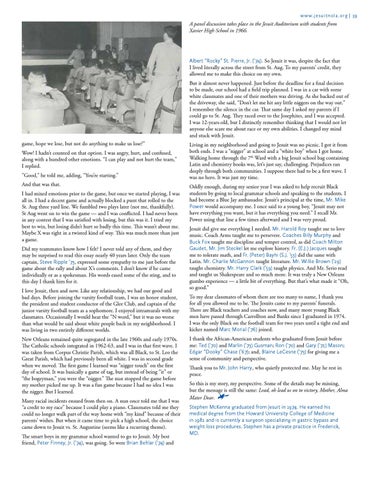
A panel discussion takes place in the Jesuit Auditorium with students from Xavier High School in 1966.
Albert “Rocky” St. Pierre, Jr. (’74). So Jesuit it was, despite the fact that I lived literally across the street from St. Aug. To my parents’ credit, they allowed me to make this choice on my own. But it almost never happened. Just before the deadline for a final decision to be made, our school had a field trip planned. I was in a car with some white classmates and one of their mothers was driving. As she backed out of the driveway, she said, “Don’t let me hit any little niggers on the way out.” I remember the silence in the car. That same day I asked my parents if I could go to St. Aug. They raced over to the Josephites, and I was accepted. I was 12-years-old, but I distinctly remember thinking that I would not let anyone else scare me about race or my own abilities. I changed my mind and stuck with Jesuit. game, hope we lose, but not do anything to make us lose?” Wow! I hadn’t counted on that option. I was angry, hurt, and confused, along with a hundred other emotions. “I can play and not hurt the team,” I replied. “Good,” he told me, adding, “You’re starting.” And that was that. I had mixed emotions prior to the game, but once we started playing, I was all in. I had a decent game and actually blocked a punt that rolled to the St. Aug three yard line. We fumbled two plays later (not me, thankfully). St Aug went on to win the game — and I was conflicted. I had never been in any contest that I was satisfied with losing, but this was it. I tried my best to win, but losing didn’t hurt so badly this time. This wasn’t about me. Maybe X was right in a twisted kind of way. This was much more than just a game. Did my teammates know how I felt? I never told any of them, and they may be surprised to read this essay nearly 40 years later. Only the team captain, Steve Ripple ’73, expressed some sympathy to me just before the game about the rally and about X’s comments. I don’t know if he came individually or as a spokesman. His words eased some of the sting, and to this day I thank him for it. I love Jesuit, then and now. Like any relationship, we had our good and bad days. Before joining the varsity football team, I was an honor student, the president and student conductor of the Glee Club, and captain of the junior varsity football team as a sophomore. I enjoyed intramurals with my classmates. Occasionally I would hear the “N word,” but it was no worse than what would be said about white people back in my neighborhood. I was living in two entirely different worlds. New Orleans remained quite segregated in the late 1960s and early 1970s. The Catholic schools integrated in 1962-63, and I was in that first wave. I was taken from Corpus Christie Parish, which was all Black, to St. Leo the Great Parish, which had previously been all white. I was in second grade when we moved. The first game I learned was “nigger touch” on the first day of school. It was basically a game of tag, but instead of being “it” or “the bogeyman,” you were the “nigger.” The nun stopped the game before my mother picked me up. It was a fun game because I had no idea I was the nigger. But I learned. Many racial incidents ensued from then on. A nun once told me that I was “a credit to my race” because I could play a piano. Classmates told me they could no longer walk part of the way home with “my kind” because of their parents’ wishes. But when it came time to pick a high school, the choice came down to Jesuit vs. St. Augustine (seems like a recurring theme). The smart boys in my grammar school wanted to go to Jesuit. My best friend, Peter Finney, Jr. (’74), was going. So were Brian Behlar (’74) and
Living in my neighborhood and going to Jesuit was no picnic. I got it from both ends. I was a “nigger” at school and a “white boy” when I got home. Walking home through the 7th Ward with a big Jesuit school bag containing Latin and chemistry books was, let’s just say, challenging. Prejudices ran deeply through both communities. I suppose there had to be a first wave. I was no hero. It was just my time. Oddly enough, during my senior year I was asked to help recruit Black students by going to local grammar schools and speaking to the students. I had become a Blue Jay ambassador. Jesuit’s principal at the time, Mr. Mike Power would accompany me. I once said to a young boy, “Jesuit may not have everything you want, but it has everything you need.” I recall Mr. Power using that line a few times afterward and I was very proud. Jesuit did give me everything I needed. Mr. Harold Roy taught me to love music. Coach Arms taught me to persevere. Coaches Billy Murphy and Buck Fox taught me discipline and temper control, as did Coach Milton Gaudet. Mr. Jim Steckel let me explore history. Fr. (E.J.) Jacques taught me to tolerate math, and Fr. (Peter) Bayhi (S.J. ’53) did the same with Latin. Mr. Charlie McGannon taught literature. Mr. Willie Brown (’29) taught chemistry. Mr. Harry Clark (’59) taught physics. And Mr. Serio read and taught us Shakespeare and so much more. It was truly a New Orleans gumbo experience — a little bit of everything. But that’s what made it “Oh, so good.” To my dear classmates of whom there are too many to name, I thank you for all you allowed me to be. The Jesuits came to my parents’ funerals. There are Black teachers and coaches now, and many more young Black men have passed through Carrollton and Banks since I graduated in 1974. I was the only Black on the football team for two years until a tight end and kicker named Marc Morial (’76) joined. I thank the African-American students who graduated from Jesuit before me: Ted (’70) and Marlin (’73) Gusman; Ron (’70) and Gary (’72) Mason; Edgar “Dooky” Chase (’67); and, Blaine LeCesne (’73) for giving me a sense of community and perspective. Thank you to Mr. John Harry, who quietly protected me. May he rest in peace. So this is my story, my perspective. Some of the details may be missing, but the message is still the same: Lead, oh lead us on to victory, Mother, Alma Mater Dear. Stephen McKenna graduated from Jesuit in 1974. He earned his medical degree from the Howard University College of Medicine in 1982 and is currently a surgeon specializing in gastric bypass and weight loss procedures. Stephen has a private practice in Frederick, MD.