Calliope
Calliope
The arts and literary magazine of Jesuit High School 2020
4 | Calliope
Calliope 2020 Editor-in-Chief
Ben Schaubhut
Poetry Editor
Ryan Castellon
Fiction Editor
Mac McCabe
Art Editor
William Wells
Staff Charlie Garitty
Jake Nelson
Will Quinlan
Jake Heap
Jacob Nguyen
Jack Scott
Noah Leingang
Kaden Oqueli-White
Rayford Smith
Evan Malbrough
Matthew Perschall
Moderators Christopher Bowes
Gary Wyss
Jesuit High School |
5
Calliope Cover: William Wells, Empathy in Winter
What Did You Learn Today?
Ronnie Bergeron
8
Polar Poles
Jimbo Hotard
9
Refuge; Voyage
Jacob Nguyen
10
photograph
Matthew Perschall
12
photograph
Matthew Perschall
19
photograph
Jackson Page
21
A Lost Time
Ronnie Bergeron
22
photograph
Gabe Barfield
23
Found
Jack Scott
24
photograph
Matthew Perschall
25
photograph
Noah Leingang
26
Ronnie Bergeron
27
The Harmonist
Jake Heap
28
Pure Money
Ethan Pipitone
30
photograph
Zach Haydel
31
painting
Davis Laibe
32
How Dare You?
Daniel Ralph
33
photograph
Matthew Perschall
34
Anomalies
Ben Schaubhut
36
Moonbeam Dreams
Ronnie Bergeron
37
Romanticizing the Rented Heart
6 | Calliope
photograph
Eli Bartlett
38
Hamlet's Not Dead
Ryan Castellon
39
I'm Scared of Death
Will Quinlan
40
War Panels
Cristoffer Garcia
41
Park Benches
Benjamin Wombacher
42
drawing
Thomas Cecola
44
Legends Live Forever
Jake Nelson
47
The Spring of Courage
Kaden Oqueli-White
48
The First Pronouncer
Garrison Trahant
49
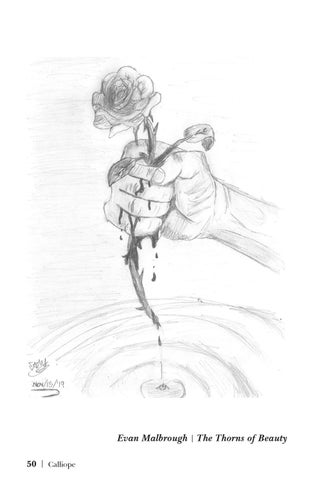
The Thorns of Beauty
Evan Malbrough
50
The Piano
Eli Bartlett
51
glass sculpture
Andrew Bruce
52
Best-Laid Plans
Mac McCabe
53
Ebb and Flow
Owen Ettinger
55
photograph
Zach Haydel
55
White Caps
Jimbo Hotard
56
A Solemn Farewell
Matthew Busenlener
57
drawing
Zachary Davis
58
photograph
Ethan LaNasa
60
Falling
Daniel Ralph
62
Blake Johnson
63
Untitled
Will Quinlan
64
photograph
Ethan LaNasa
64
photograph
Mason Wulff
66
Morningside Heights and Boston
Jesuit High School |
7
What Did You Learn Today? Ronnie Bergeron Every day at school is a test. A We learn our facts and figures, C A Bubbling in our brains on scantron. B A B That’s all learning is, right? D Memorization? B SOH CAH TOA and Punnett Squares, C B C D D The number of presidents we’ve had, A C The number of people killed in some war. B B But what happens when you ask a student, A B C D Who are you? You never leave a scantron blank. C
8 | Calliope
Polar Poles Jimbo Hotard This compass points to north of northern way My destination south of southern sea This watch too fast for us to stay today My place in life this life too small to see You tell of things you do not know I know You lie to those who see who you do not I peer right through yourself myself and so You lay upon the ground my ground and rot I pray today you see for prayerfulness To ask for help they say I say I need To be unthankful for my selfishness Is our biweekly selfless helpless deed This compass points to north too north I say My way in life is south too south to stay
Jesuit High School |
9
Refuge; Voyage Jacob Nguyen The breeze circulated through the house, which all of us gladly accepted. Dad was sitting, his leg crossed over the other. "Did you hear? Saigon has fallen," he said, reading a newspaper. He looked at us. A truckload of fish and other assorted seafood passed by our house. Mom was cradling my newborn sister in her arms when she reciprocated his glance. After a moment, Mom said, “What should we do?” "We will take the fishing boat out to sea for a few days," my dad said. “Truong, get the food ready, son," he continued, “and put it in the boat." Truong dropped what he was doing and immediately went. As the oldest son of the family, he helped my dad with most things. If Dad was gone, I’d look to Truong. Another truckload of fish passed. Living nine years in this small village, I still couldn’t bear the smell. “Dad,” I asked, “What are we doing?” "The Northern soldiers will be coming soon. We will wait out the fighting and hopefully come back all safe and sound. Does that sound good?” "Yeah. I feel like we could stay, though. We are all Vietnamese, so they won't hurt us, right?” Dad smiled. “Think of the Northerners as an angry brother. He tries to get what he wants from us, but after a while, he will give up, and we will be happy once again." He rubbed my head and went to pack more food. I sat on a red plastic chair on our concrete porch, watching some of our neighbors. Many were playing tiến lên, some smiling as money was put down. Mom needed me to hold my sister; she went to inform my relatives. She smiled and kissed both of us. She put on sandals stationed at the entrance of the doorway and scurried to various houses near ours. I held my little sister. “Shh, it will be all right,” I cooed. The sun began to fall into the blanket of water. I adjusted myself in the chair. My little sister began to sleep, and I watched the horizon darken. A truck of soldiers zoomed past; an officer shouted commands.
10 | Calliope
Eventually, Mother returned and told us to heat some rice and cá kho as she made final preparations for the boat. After about fifteen minutes, the plastic plates were filled, and everyone gathered. “Thank you, Lord, for this meal as a family. Protect all of us as we seek safety from danger,” Dad said, making the sign of the cross. He wiped the sweat from his brow and took a seat. We responded with “Amen.” A knock on the doorframe. We turned to see a young, tall soldier saying: “Leave tonight. It will not be safe.” Dad gave a quick nod and the soldier dashed to the next home. “Go to sleep early,” was all Dad said, throwing away his plastic plate. I went to sleep in the room next door. “Wake up,” Truong said as he nudged me the next morning. My little sister was awake, whining in Mom's arms. Dad was hurrying everyone to wake up. After some confusion, the seven of us rushed to the boat. Luckily, Mom had convinced many of our relatives to leave also. I knew they’d come since they hated the Northerners—all the stories they told about them in the past recalled to me in that instant. “Quick, hop in!” Dad pestered, as we seven and a few other relatives—Bắc Quyen, my uncle; Bắc Mai, my aunt; and Bắc Doan, my other uncle—entered the small boat. The motor sputtered until finally we cruised farther and farther from home. The sun had begun rising, coloring the once black liquid into a light blue. Behind us was the dark silhouette of a future warzone. The water was our friend, keeping us afloat without many disturbances. “Eat this,” Truong said, offering me a bowl of ramen. “I know you’re exhausted, but you need energy. Being on the sea is more tiring than you think. Trust me, I’ve fished with Dad, and it knocks you off your feet.” I thanked him for it. On my right, Dad was boiling water on a portable kerosene flame while Bắc Quyen handed out the premade meals with a smile. Dad clapped his hands and stood tall. “Someone will sail to us to deliver the news when the fighting is finished. For now, we wait.” An uneasiness spread through the boat. “How long will it be?” asked Truong. “Maybe a few days,” Dad said. “We can stay out here for about five days if we have enough food. It’s going to be okay.” The sun beat down on the brown plastic tarp above us. The intensity of the sun heightened as morning turned to noon. Dad and Mom took turns watching the baby, one napping while the other held the child. CHRIS WOMBLE “It’s your move,” said Bắc Quyen, grinning as I looked at the pile Jesuit High School |
11
of cards. He flaunted his final card toward all four of us. A two of hearts. The strongest card in tiến lên, almost unbeatable. Unless someone had a four of a kind. I smiled back at him, playing my King-four-of-a-kind in ebullient excitement. With the highest combination in this game, I placed the rest of my cards, winning the match. His eyes widened, taking a look at the pile and then at me. A grin overtook his face. “Good job, kid,” he said, patting my head, "Truong just sucks.” Truong rolled his eyes and tossed his cards. He exposed a hole in the tarp to get some air circulation. Everyone sighed as the breeze blew into the encapsulated boat. “Ahh, jeez! Uncle, the cover was a bad idea. Can we take it off for the love of God!?” Truong said. “I can, but our skin would pay,” he said. He turned to me. “What do you want me to do, since you won that game?” “Off, please!” I said, fanning myself with my hands. Everyone agreed that he should remove the tarp. That day, we all got sunburn. The sun descended back under the blanket of water; the burner’s illumination dimmed. We slept to the swaying of the boat. When I woke up, most of us were sitting, watching the shoreline. Deep gunshots could be heard from afar, but we peacefully ate. Out of the blue, someone tapped my shoulder. “First one to catch three fish wins?” Truong said. “Sure. You already lost,” I said, cracking my fingers. Those were the last words I said before he caught Matthew Perschall three fish back to back. Everyone congratulated Truong, and he gave me a pat on the back. "Better luck next time," he sighed with a grin. “I’m just too good
12 | Calliope
at fishing.” The process repeated itself—napping, sleeping, and gazing at the shore. The sun descended once again, and the stars reflected in the sea. I awoke. All I heard was snoring. Rubbing my sore back from the thin mat, I sat up, hoping to stretch a little before going back to sleep. Dad was awake, watching the water. “Couldn’t sleep?” he asked. “Yeah. The mat is super thin. Why are you awake?" I said. “The same. And I’m looking at the nice view.” I leaned onto the side of the boat, just like he did. There was an awkward pause. “I’m afraid,” I said. “Of?” “Not being able to go home.” “That’s nothing to be scared of,” he said, “If we must leave, I heard the U.S. is waiting for refugees somewhere on the sea. I doubt we need to go, though.” "Oh, that's good, I guess," I said. I sank my hand into the magnificent blue, weaving it in between my fingers. The sea was warm and comfortable in my hand. Dad and I enjoyed the nighttime serenity the ocean offered. “You should go back to sleep,” he said. “Goodnight.” He looked coldly at the stars, but his response was ever so warm like the ocean. That next pale grey morning, a man in a boat, waving a white flag. “Someone’s coming,” Dad told Truong, nudging him to wake. Everyone was sore from sleeping on the wooden floor. Some slept on the nets used for fishing, others on small bamboo mats. Slowly, everyone sat up, wanting the answer from the man on the boat. We could hear his faint voice. “Start the boat,” Dad said, taking the wheel. Slowly, it revved into motion, and we cruised next to him. “Come back to the village,” the man said, “the fighting has passed. You should return now.” He did not look at us but instead looked at the wheel and tapped it with his fingers. Then, he said “If you can leave with what you have now, leave now. It’s not safe back there.” He drove off, looking for other boats that went to seek safety. We stared at the man driving off. His brevity kept us all quiet, even as we sailed back. We expected the worst. Getting closer to the shore, I saw a few pillars of smoke ascend. In the water, countless bodies stared at the gray sky. Dad pulled one up, and we recoiled in fear. He checked for any sign of life. Nothing. Dad stopped at the sand-dirt coast and tied us onto a wooden beam protruding from the sea. We stepped Jesuit High School |
13
onto the shore; uncle and others thanked us and went to check their own houses, hopefully, to see nothing out the ordinary. Dad held my mom's hand as we rushed toward our house. We passed a crying lady, her face buried into the green uniform of a dead man, his body as pale as the sidewalk. Some soldiers walked toward the dead man with a stretcher to take the body someplace else, at least away from the main road. Making a right, I saw our house; luckily for us, that pillar of smoke I saw from the boat was farther out. My Dad rushed into the house, but something else caught my eye—another dead soldier. I stared at it, its body missing an arm. His green uniform was stained with dark maroon, shading it a hideous brown color. “Get away from that body!” shouted a soldier with a stretcher. He poked his bayonet at me. “If one of you Southern scum interferes with our work here, we'll shoot you,” he said. “Now go home.” As I scrammed I stared at it, its body inside, he retracted his gun and missing an arm. His proceeded to take away the body, green uniform was tossing the dead man upon the white cloth stretcher. I told Truong what stained with dark happened, and he said I could have maroon, shading it a actually been shot, no warnings. hideous brown color. “Stay inside,” he said. “I’m going to tell Dad.” “No!” I said, “I could get in trouble!” "Does that matter now? We are in danger! Those dead people you saw outside—the soldiers did that! They were the ones who shot them!” he said. After glaring at me, he went to search for Dad. For what felt like thirty minutes, I waited in the main room for an answer, for some kind of punishment. Finally, Dad returned. “This place is dangerous now,” he said. He looked at us. “I will consult the priest about this. Be careful while I’m gone. They will kill you if you misbehave.” Dad rose. A truck filled with Northern soldiers singing their national anthem and praising a man named Bắc Hồ passed by. After putting on slippers, Dad walked away. My little sister was put in Truong’s arms for the time being. As time flew, many trucks of soldiers passed the house. Red plastic seats on the corners of blocks were filled with these soldiers playing some stupid card game. Dad finally came home, and I rushed to embrace him. “We are going to leave, this time for sure,” Dad said to all of us. The priest said U.S. boats are far out in the sea. If we can get to them, we will be safe.”
14 | Calliope
“Aren’t those the people who are fighting with us?” Truong asked. “Yes,” Dad responded, “and they are willing to give us refuge. So thank them and God for this opportunity. The voyage to the Promised Land was never easy. We will need to leave in secret by boat once more,” Dad continued. "Truong, make sure we still have enough food in the boat for about fifteen of us.” “Go and help Truong, you’re big enough now,” Mom said to me. Truong smiled and invited me to buy some ramen cups at the nearby store. As we walked, I had a random thought. “If you wanted to be heroic, how would you do it?” “Duh, I would save someone, so that way, they can always tell stories about me. If I could do that, Dad said I would become a more noble husband and hero.” When we returned, everyone was napping from the midday slumps. We put our products on the table and followed suit. What felt like a big push for our family—leaving Vietnam—could always be postponed for a little rest. Unlike last time, we stayed up the entire night, idling around, listening to the radio, or other things to consume time. Finally, at about one o'clock, half of my younger siblings had given in to the wait of time— dozing on the floor. I woke them and instructed them to be quiet, for we would leave soon. The packing that Truong, Dad, and I did was set, and we slowly snuck to the boat. This time, the cost of being caught leaving could be fatal. Luckily the streets were abandoned, besides a spot where the northern soldiers were still playing cards, laughing and screaming tirelessly. We traversed through the neighborhoods and streets, until we finally got to the shore. The subtle crashing of waves was a clear indicator of our arrival. At the end of the pier, a few squid boats were still tied down, their bodies gently rocking on the surface. We entered the ship and waited for our relatives. Soon, the adults were double-checking the supplies. “Please, I need to take my son with us! He’s in Vũng Tàu, at the top of the mountain,” said one of my aunts. “Why would he be all the way up there?!” Mom said. “He's with my dad. I couldn't get to him in such short notice!” she said. “Please, can someone go, I beg!” “It’s too risky! By the time someone gets up—” Dad said. “I’ll go,” Truong said, standing up. “Thank you so much,” she said, holding his hand. “Truong! Stay here!” Mom yelled. "It's okay. I’ll be back in two hours. Trust me. Bắc Mai deserves a family just like we do,” Truong reassured her. Truong jumped into the Jesuit High School |
15
waist-high water and waded toward the shore. Dad screamed for his attention. Truong was already too far for our voices, too far for our eyes. "Well, we will wait,” Dad said, slamming the side of the boat with his hand. “Pray for his soul and pray for a safe departure as soon as he comes back.” Through that whole incident, As I stared at Truong, I saw a fire in his eyes and weight to his steps. I knew he was coming back, prayers or not. The sand under my feet felt warm, even though the moon was out. I really don’t know why I volunteered. Maybe it was the begging or an attempt to cut our bonds with North Vietnam. I could hear my parents yelling at me to come back, but I didn’t listen. As I reached the shore, I sprinted toward my village. The hill had become a silhouette in the darkness, its edges illuminated by the light of the moon. At the base of the large rock was a sleeping guard, and I walked silently up the stairs. Every hundred or so stairs, statues of Jesus’ life showed the suffering and compassion he went through. I remember the days when Dad took me up here to show me the statue of Christ at the top, when we had Mass beside the shade of a tree. After about four hundred stairs, I stopped at a small wooden gazebo. During the day, I could see the ocean from here, in its grayish-blue glory. After five minutes, I climbed the mountain once more and finally reached the top. A lamp was on, and people were talking. “… for now, you are in control of the town, but we will inform you and give directions,” someone said. “Thank you,” I heard another man say. "Just make sure to read that booklet,” said that other voice. His footsteps got close, but I darted behind a wheelbarrow. After he left, I approached the door. “Truong!? What are you doing here?” Get inside!” he said. “To be frank with you, I need Huy,” I said, walking down the hallway. “Is he here?” “Yes, he’s in my office. Care for a drink?” he asked. “Yeah, actually I do,” I said, my head beating from the fatigue of staying up and running up the stairs. “We’re leaving Vietnam. Your daughter wants her son back,” I said. “It’s because the North came, huh?” He handed me a bottle of water. I nodded. He gave a deep sigh and nodded in disapproval. Tell Mai I’ll miss her,” he said. “You can come with us, right? I mean, there’s plenty of spa—” “No, as the leader of this town, I must stay. Also, they will be
16 | Calliope
watching my moves, controlling me like a puppet. If I leave, my whole family could be shot, murdered for my actions. So take Huy,” he said, leaving the table and turning off the TV. Picking up the little boy, I nudged him into sleeping on my back as I held his legs. Without any time to waste, I stood and bowed, showing him my deepest gratitude for this simple transaction. Luckily the way back down was more comfortable than going up even though Huy had grown since I last saw him. I skillfully skipped a few steps with the extra weight on me. Huy somehow slept through the entire process. He must have had a good dinner. As we approached the bottom, the guard was still dozing, bottles of alcohol in the moonlight. I tip-toed until I reached the exit. Running at a quick pace, I promptly He towered over over arrived at the entrance of the town, me. He was twice as where the church and school were. Thankfully again, all the guards wide, and he had a were dozing. Those slackers. cigarette in his mouth. “The way back to the shore His gun was in his is simple,” I reassured myself. “I just take a lef—” hands, ready to shoot. “Halt!” someone yelled. I froze, slowly turning. I looked up. He towered over me. He was twice as wide, and he had a cigarette in his mouth. His gun was in his hands, ready to shoot. “What are you doing?” he asked. “I needed to pick up my brother from my grandpa’s house,” I stammered. "This late?" he asked. “I forgot to pick him up earlier.” I adjusted Huy so he would sleep comfortably on my back. “Let’s go, I’ll take you home. Where do you live?” he asked. “I’ll take myself home, I’m close,” I said, looking at his boots. He looked around and exhaled. “You know what? I’ll give you a break. Get home quickly, get some rest. This is a warning. Starting tomorrow, there will be a lot of work for everyone.” “Thank you, sir," I said. He watched as I walked to the end of the street by Ông Su’s house. I nodded at him, and he nodded back at me. I fled past the concrete buildings, and time seemed to fly. The thought of possibly seeing these people and buildings one last time—I’ll miss it. Finally, I got to the shore, where the waves beat softly, the moonlight still reflecting on the water. I could barely see Dad's boat in the distance, but it was still there waiting. It had drifted further away from the pier, but I had made it. Huy was still sleeping peacefully, and Jesuit High School |
17
I smiled, knowing that we were almost there. I took my slippers off, my feet now in the mixture of dirt and sand. I walked onto the dock, then into a squid boat where it rocked lightly. I paddled toward the main boat. “Now I know why I went into that water,” I thought. “The role model for my brother is me.” Mom was still sniffling, weeping at the rash decision that Truong had made. Dad looked into the sea to pray another Hail Mary. He focused his eyes at a silhouette coming toward us. “Truong!” he shouted. He made it. I jumped; I couldn’t hold myself together. As Truong approached the boat, Dad pulled him into it, and Truong gave the sleeping boy to Bắc Mai. I ran to embrace him. His silhouette, in my eyes, shone brighter in the moon than everyone else. Mom was at her knees, crying in joy. Bắc Quyen laughed and patted his back. “Let’s go, I'm tired," Truong said, smiling. Dad, without a doubt happy, walked to the wheel and started up the boat. "Hey, kiddo," Truong said to me. “What you did was amazing!” I shouted. "Yeah, it was something. Something great," he said, smiling. “Can you teach me how to run that fast once we reach the United States?” I asked. “Yeah, I can,” he said. “It just takes some practice, and eventually that will become perfection. When I scaled those steps however, phew, that was something else.” The smell of gas permeated the air, and the boat set sail, away from our home. “We won’t be anywhere for a while, so now’s a good time to take a nap,” Dad said to us. So I dozed. I woke to the sounds of my Mom murmuring and looking off to the sides of the boat. In fact, everyone had woken but Truong, who was shivering furiously even though it had been warm. It wasn’t normal from him to be sleeping this late in the day. I looked around and saw many ships around us, sailing in the same direction. Bắc Quyen told me that along the way, we had met other villagers trying to escape. We had halted. Scattered around us were many abandoned boats. There was no noise from any boats near us, just the sea and the sight. Some neighboring boats decided to turn back. Dad started the engine again and cruised toward the nearest abandoned boat so we could check for loot. It was not normal for Truong to be sleeping right now. I followed Bắc Doan to check for any survivors, or at best, remaining goods. “Found something!” I said. I proudly raised a cardboard container of ramen cups. I gave it to Bắc Doan, and he, in turn, threw it onboard ours. We confirmed nothing was left, and we hopped back on, sailing away. Bắc Quyen suggested to Dad, “We should turn back. I have been awake the whole time and have not seen a single U.S. ship.” More and
18 | Calliope
more abandoned ships were appearing on the horizon. I could see the frustration in Dad, the distance we had traveled without seeing one sign of American hope. “Em, let’s return, we’ve gone far enough,” Mom said. "NO!" Dad said, "There is no life in that village—everything will be gone if we return, everything changed. Have faith, woman! I-I’m sure these boats found the U.S. ships. We just need to sail farther.” I despised the way Dad got when he was angry like that. Truong woke up, his face a red blush. “Are you okay?” I whispered to him. “Yeah, I think so. It’s just the heat,” he responded. Huy sat in Bắc Mai’s lap sleeping. After a moment of silence, the captain of the ship gave his final verdict. “Have faith, we will sail on. If we die, so long has it that we at least tried not in vain.” Five days at sea and counting. The brine of the ocean kept us parched and wanting more water than we had ever had. Bắc Quyen had turned a pale lighter than his usual caramel. Bắc Mai hadn’t stared at anyone or anything but the ripples in the water. I had to watch Truong for the time being. Dad said he contracted a bad sickness. To make it worse, the sun kept everything in the boat scorching hot. Truong was sweating so much that we had to take off his shirt. The vomiting made it difficult for him to lie on his back. Be Bich, the name given to my little sister, sat in my mother’s arms as we floated Matthew Perschall on the ocean, while Bắc Doan heated up ramen for the fifteenth time. Dad stared at the vastness of the dark blue water from the small cabin. The kerosene lamp turned off, and Bắc Doan handed out food to everyone. "Eat, everyone; we must persevere." We all took it and prayed. After finishing, Mom collected the Jesuit High School |
19
cups and threw them into the sea. I watched them drift up and down the waves, farther away, farther away, my head against the thin wooden side, farther away until they did not exist in my eyes. I took a water bottle and shared it with Truong, who gladly finished the last half after I took many gulps of water, each the size of a chicken egg. After finishing the ramen cup, I closed my eyes and tried to sleep. I had thought,” Once we reach the United States, Truong will be healed, my parents pr—” "B-b-boat!" my Dad screamed. We rose and squinted into the distance to where he was pointing. It wasn't a boat but a platform. A large platform with its giant American flag. Dad sped up the boat a little to use the remaining fuel we had. Bắc Quyen was finally standing and moving around, stretching his limbs. Dad kept the ship running as we stretched. “Truong! Hang in there!” Bắc Doan had looked back. Truong was curled up and vomiting blood. Dad sped as fast as he could. I knelt next to Truong and spoke to him, a now barely breathing man: “We’re almost here! Please, hold on. The Americans will heal you!” Tears welled up in my eyes. He gave a smile but quickly ached in pain. Mom was panicking; she had no clue what to do. As we got closer, we saw many people on it, many Vietnamese that made the same trip we did. Bắc Quyen called for help. Dad steered next to the floating platform. Some people threw ropes and tried to get all of us as fast as they could. One hopped onto the boat. One of them picked me up, but I stayed put. I was crying tears that were meant for another time, not now. Truong had passed. The spectators on the platform bowed their heads in reverence. After a while, people brought up the corpse and me onto the platform. “Why now?” I asked the dead body. “We made it, look!” But it did not stir. Kneeling on both knees, I looked to the sea, the expansive blue, with Truong next to me.
20 | Calliope
Jackson Page Jacob Reeder Jesuit High School |
21
A Lost Time Ronnie Bergeron There is something to be said about an ancient clock. Her hands stuck, moving forever. Regardless of her wishes. She does not want to hurt us, but she must do her job. She simply lets her pendulum swing, as she hears the whispers.
“Why are you going so slow?”
“Can’t you move faster? I don’t want to be here.”
“Why couldn’t I have more time!?”
“Why can’t you hurry up? I hate being a kid!”
“Please, I’ll give anything to go back!” “C’mon man! Bars closing, head home already!”
“He got hit? That poor kid, so young.”
“You always live in the past!”
“Time of death, 12:57 pm. I’m sorry, ma’am.”
“Jane, last night Grandpa died.”
“Stop thinking about your future for once!”
“Welcome to the world, little Gracie!”
“Drive faster already! We’re gonna be late!”
“But why? Can’t I see him tomorrow? Why?”
“Well, baby girl, I’m afraid not.”
22 | Calliope
“We can’t control these things. It was just his—”
“Time.”
Shedding a tear, she collects herself and does her job. Her minute hand moves on, and so does time.
Gabe Barfield Zach Haydel | Ol ' Blue Eyes Jesuit High School |
23
Found Jack Scott I was studying in the kitchen when I heard the barking. At first, I thought it was just a dog being walked past my house, but the barking continued. I tried to ignore it, but I couldn’t. It was high pitched but loud. In a sense, supremely distracting. So I got up, abandoning my books, and went to the front door. The second I opened the door, my cat raced inside, meowing indignantly. Going out onto my porch, I scanned the sparse lawn until I found the barking’s source. It was a tiny, scruffy dog with long brown hair. He was thin but clearly not starving. I figured that he was a stray that had wandered into the yard. He was small enough to fit between the gaps of the metal gate. When he saw me, he stopped barking. He just stared at me, not moving. I walked down the steps in front of the porch and took a few steps forward. He continued to just stand there. Then, when I took one more step, he sprinted to the other side of the yard. This dog was fast. So, I decided to take a different approach. I went back inside and grabbed some dog treats. They were large, since they were from my former dog, who had died a little while ago, but I hadn’t been able to throw out any of her stuff. I tore off a few small pieces and went back outside. The little dog was in the same spot, still looking very suspicious of me. I sat down at the top of the stairs and tossed one treat in the dog’s general vicinity. He immediately pounced on the treat and ate it. He sniffed the air and then took a few steps towards me. I threw another piece, this time just a few feet away from me. He hesitated before snatching up the treat and retreated a few feet. I repeated this action until he no longer ran back after eating the treat. As he got closer, I began to notice things that I hadn’t before. For instance, his hair wasn’t all brown. Most of it was, but there was a streak of white on top of his head that gave him a kind of mohawk. Then I placed a treat right next to me. This time, he hesitated even longer. He sniffed, he came forward, he went back before finally coming up onto the porch and nabbing the treat. To my surprise, he didn’t run away when the treat was gone. He just sat down and looked up at me. When he looked up, his ears straightened out, and I had to laugh. They were massive compared to his tiny form, each dwarfing his head. If he was startled by my short fit of laughter, he didn’t show it. Slowly, I held out
24 | Calliope
a treat for him, and he ate it right out of my hand. He even licked my hand afterward. I felt that I had earned enough trust to try petting him. I was wrong. When I reached out, he ran backward, almost tripping over himself. Disappointed, I put my hand down. Almost immediately, he came back and sat down. I smiled. He didn’t want to be pet yet. That was fine. I was patient. The only thing that mattered was that he was found. And so was I.
Matthew Perschall Jesuit High School |
25
Noah Leingang
26 | Calliope
Romanticizing the Rented Heart Ronnie Bergeron The spotless carpet floors, The stairs that never groan, The clean and unmarked walls, Because lord knows we don’t own; The clean door frame, Unmarked and unscarred, No playing catch outside, Our building has no yard; They say a house Is not a home, Your home's not where you went, Well hell if I Didn’t know My childhood was rent; They say that they can’t leave, They belong in that place, But how could I stay here when We live in borrowed space; His whole house is his own: Never using a coaster His drinks leave a stain, His walls filled with posters; The stories love them, They're easy to write The house provides an arc, But no one writes us: Our house is rented— We never made a mark. Jesuit High School |
27
The Harmonist Jake Heap Raziel Tor’Go lifted his head to the heavens, felt the heat of the suns on his face, and drew a deep breath. He closed his eyes and listened to the world surrounding him. Silence. Stillness. Peace. It wasn’t unusual for Raziel, he was acquainted with such things, he had become friends with them during his years of solitude. That was the way he liked it. No disturbances, no distractions, and no one else. Just Raziel and the peace. Raziel and the Harmony. He opened his eyes to the light of the morning stars, their gentle warmth gracing his light brown face and sharp features. Their light glimmering onto his green eyes, giving them the look of the brightest emeralds. His mind was awakened by the presence of the suns. As he opened his eyes, the faint outline of a city appeared in the distance. Anyone besides Raziel would not have seen it, but Raziel’s eyesight was keen. The city of Dumah shone in the distance. In his pursuit of the Harmony, Raziel had left Dumah with nothing more than the bare necessities. But that was a long, long time ago. And Raziel was not fond of the memory. Raziel let out a long, deep sigh and turned to face his humble cabin, which resided in a small clearing in the Forest of Yttri. Raziel disliked fancy things. He was never the kind for large houses, or shiny dwellings built in the sky, he preferred the quiet, simple life. And that was exactly what he had. Solitude and the Harmony. What more could a man like Raziel want. Raziel stood a few seconds longer, staring at the sight he’d seen countless times, and headed towards his front door. His cabin was simple: made entirely of wood planks with a thatched roof, no porch, two small windows in the front, two in the back, and one on each side. His door was simple, nothing setting it apart except for two things: its lack of a doorknob (since Raziel lived far from civilization, he was not concerned with locking his door), and a symbol carved on the upper center of the door. The symbol resembled a circle of chain links intertwined with vines. At its center was a character that looked like two X’s atop one another. This was the symbol of the Harmony and of those who seek its promise of wisdom. Raziel was one of those people, referred to as Harmonists.
28 | Calliope
Raziel swung his door open and stepped into his small abode. The interior was much like the outside, extraordinarily simple. The whole cabin consisted of one solitary room (perfectly square) which employed every use that Raziel required from a home. Seven lit lanterns hung from strings nailed to the beams of the ceiling. There was a little straw mattress in the far right corner with a feather pillow and wool blanket, the latter neatly folded at the foot of the bed. At the back wall was a miniature fireplace containing two minute logs which remained unlit. A brick chimney led up through the roof. In the right corner closer to the door was Raziel’s chamber pot: a black bowl which Raziel emptied daily. In the left corner next to the door, was a small tub in which Raziel bathed, his water carried from a creek not far from his cabin. In the far left corner was a large cushion surrounded by candles and incense. The wall around this corner was covered in runic symbols and sigils that depicted Harmony. Raziel would often spend the whole day meditating, without food or water, letting the Harmony wash over him. If you were to find him in such a state, you would see him sitting with his legs crossed, eyes closed, and completely at peace. He would remain like this and dream until awoken from his reverie, filled with the gifts of the Harmony (which I could only describe as wisdom or insight. However, no one could properly describe the gifts that the Harmony bestows on its followers). He was heading to do this just then, when he stepped on a locket lying on the floor next to one of the candles. This was peculiar, seeing how Raziel never misplaced anything. He looked down at the locket with sudden sadness. He had brought it with him when he left Dumah, even though he knew it would only distract him‌and bring back painful memories. It was round and gold, decorated with an intricate design of a tree. He tenderly picked up the locket. He slowly opened it and saw a very old, very familiar picture. He saw himself: tall, brown skin, dark hair, green eyes, and rather handsome, though he was younger in the picture. Beside him a woman and two children: a boy and a girl, both around the same age. The woman was beautiful in every sense of the word. She was a head shorter than Raziel, blonde hair with streaks of brown, amber eyes, and lovely features. Her face was soft and delicate but at the same time tough and strong. She was smiling broadly, a smile that was full of love and happiness. The children were practically copies of their parents, and they were both smiling. There are some things that the Harmony cannot give, and Raziel knew one of them. ALEX TRAN A tear streaked down his cheek, fell from his face, and extinguished the candle beneath him. Jesuit High School |
29
Pure Money Ethan Pipitone Waking up early on a Sunday but not for church. Yanking on the starter handle of the mower as I maneuver through the dewy grass. I tell my drowsy self that “It’ll be worth it.” The smell of freshly cut grass glides into my sweaty face as I complete the job, interrupting Travis Scott’s album Astroworld as I take off my earbuds. I scroll through websites, watch videos, and look in stores hoping for one to catch my eye. None do. Babysitting my cousins on Friday nights looking to make a couple bucks. I say “It’ll be worth it” as I change a full diaper. I become obsessed with the thing I’m after, even though I don’t know what it is I’m after. My work begins to show as my glass jar fills with green. I become anxious to spend it. No, I need to wait for the right time. Bac Huy (Vietnamese for Uncle Huy) and I visit a small, trendy store that's collection is vibrant with diversity. I’m in awe as I walk by the shelves like a kid in a candy store. And there they are... the ones I want. Covered in white leather with hints of metallic silver. Perfect for the summer. The shoe, properly named ‘Pure Money,’ is a Jordan 4 Retro designed in 1989, but features a new, modern aesthetic. I had seen the shoe online, but for a steep price of $190 that I wasn’t willing to pay. I notice “100” written on a piece of white tape on the sole of the shoe. $100?!?!? I ask the employee for a size 10, and I slip my foot into them. I gaze into the small mirror on the ground. I love ‘em. I hand the employee my hard-earned money as he rings me up. He puts the box in a black bag as I shake with excitement. “It was worth it.” When I get home, I begin an impromptu photoshoot. I take pictures of the shoe on the living room floor, outside in the grass, and in my room on the bed. Whenever I wear them, I walk like a duck to prevent creasing the soft leather. I avoid anything and everything that could stain my kicks. I meticulously clean them with a brush after each wear. I decide to bring them with me to a basketball tournament in Mississippi. I wear them to the gym, but switch into my other shoes to
30 | Calliope
play in. I place my forest green bag containing my valuables behind the bench as the team warms up. After the game I look for my bag... It’s not there. I think I might have left it in the hallway where the team stretched... It’s not there. I begin to panic. My friend’s dad finds the bag in the men’s bathroom. I never went in there. I open the bag... Empty. I check my wallet... Empty. Tears flow down my bright red face like a river. I walk out the gym with my head down as my teammates and parents try to cheer me up...REESE LEONHARD Fast forward to the school year, I am in Latin class translating the Aeneid as a line catches my attention: “Forsan et haec olim meminisse juvabit.” The meaning of the phrase, “perhaps one day it will be pleasing to remember even these things,” promotes an optimistic view on life. Although something may seem tragic, eventually you will be able to look back and learn from the experience. At the time, losing my shoes devasted me for weeks; however, I have learned to focus on working towards personal and academic goals, like getting a job or raising my GPA, rather than obsessing over material things that are ultimately meaningless.
Zach Haydel Jesuit High School |
31
Davis Laibe
32 | Calliope
How Dare You? Daniel Ralph How dare you do this to these lovely people. You’ve hurt them, yes you have. Away they push and back you pull. Leading them down this awful path. You’ve taken. You’ve used. You’ve broken. Abused. All these people, They thought they were your friend. So they took your outreached hand. They had you ‘til the end. You take what you want, And with the things you do; You hurt these people so damn much. You say this is how you are. I say “How dare you?”
Jesuit High School |
33
Matthew Perschall 34 | Calliope
MATTHEW PERSCHALL
35 | Calliope
Jesuit High School |
35
Anomalies Ben Schaubhut Anomalies like these, sweet sounds of magic melody, from a puddle under lovely limbs of the damp oak tree, are pleasant and lovely to find: Fanfare frog in densest fog comforting and nullifying, gentle obscurity of peace; these happy crickets, content and full, playing volumes of satisfaction; careful and cautious, the tender and meek song of the evening bird; So beyond the distance —the horn, blown at the top of the river mist, deep and searching— mingling man’s roar and heavenly symphony, the sounds of things.
36 | Calliope
Jesuit High School |
36
Ronnie Bergeron | Moonbeam Dreams Jesuit High School |
37
Vanitas
38 | Calliope
Eli Bartlett
Hamlet's Not Dead Ryan Castellon His brain awoken is like a tide; Its presence could never provide. The true shade and shadow rest behind the façade. The waves surge, slack, and mellow, Yet someday their flood will slow. He will discover his grave inside this wave. Oh, the powerful yet pointless calls, Echoes of ghosts within these walls, Will never garner the power to conquer him. Shall not, says he, reveal his fate, For now, my class can only wait And continue to half-consciously inspect him. Mr. V. hath claimed it gets better, For we have not truly met her– The lunacy that resides within this tide.
COLIN SCRIPTER Jesuit High School |
39
I'm Scared of Death Will Quinlan I’m scared of death. Not so much a fear of what comes after death, I instead fear the idea that I will not have lived my life to the fullest. I fear I will have missed out on hundreds of experiences and passions I could have done, but, since I had to work for a living and fulfill duties out of politeness or to maintain an outward persona of normalcy, I will have wasted the vast majority of my time on earth doing things I don't really care about and miss things that I would. I have a romanticized view of "passions." A painter's passion for his art, a monk's dedication to his religion, a father's love for his son. I wish I could experience all of these loves, all of these passions, all of these fulfilling, life-affirming experiences in my lifetime; and while I know that's likely impossible, I'd still like to strive to achieve that goal, and hopefully live a full life in the process. I see in these "passions" a feeling of authenticity and fulfillment, a sense of independence from the world and its happenings. I see in those individuals an attitude of "as long as I can paint, pray, or raise my son to be a good man, I can rest easy, and the rest of the world can go to hell and I wouldn't mind it." That's the point of view I feel I need, but there's so many different ways people can experience it I have no clue where to start. The choice I have of deciding what I want to dedicate my life to is a terrifying one, because
40 | Calliope
whichever one I don't choose I will never get the experience to live. Even if I make a good choice, what if another one would lead me to a happier life? This is what really keeps me up at night. Not some morbid thought of what might happen or has happened, some socially awkward failure of mine causing embarrassment or death or anything, but the fear that I may not get to do what makes me happiest in the future, that my life might just be as boring and monotonous as most other people’s lives seem.
Cristofer Garcia | War Panels Jesuit High School |
41
Park Benches Benjamin Wombacher It was the early hours of one of the most important days of the year. However, you could not tell how significant this day was because of the slow, sleepy town, which was only just starting to wake up, and the dark sky that loomed over the town like a guillotine over its victim. The day was cloudy, and the grey gloom clung to the sky as if it was a reminder of the tragedy that had happened all those years ago. A man in a brown brimmed hat and brown coat sat patiently but anxiously waiting for his bus to arrive. He gripped his cane as if it were the only thing keeping him rooted to the ground. He pushed back his coat sleeve and held up his arm to look at his silver-colored atomic watch to check the time. It was 8:52. He thought he heard whistling and looked up to find the noise’s origin, but he saw only the small stores and the passersby of the young day, none of whom knew. The man looked at the shops and restaurants of his quiet little town, but he saw something more disturbing than the quaint shops. He could not bear the sight and averted his gaze. He sat at the bus stop quietly but grew more unnerved as time continued to pass. He waited for ten more minutes before he heard the rumble of an approaching engine and the shriek of rubber against concrete. A blue and white metallic bus came to a stop in front of him. The bus doors opened, revealing the driver of the machine. The driver wore an all-blue uniform, a cap similar to a military officer’s, a coat that was large and heavy, and slacks that were light and airy in contrast to the jacket. He wore a pair of black dress shoes shined so well they could be used as mirrors. The old man got up from his seat, grabbed his cane, and crept toward the open doors of the bus. “Good morning, sir,” said the driver in a formal, business-like tone, tipping his cap to the man as he made his way into the bus. “Good morning,” said the man in a slow and gravelly voice, as he gave his fifteen cents to the bus driver. “Thank you,” said the bus driver. He looked back and said, “Hasn’t been a very busy morning, looks like you get the bus to yourself.” The old man stood and looked upon the bus seats and saw a barren landscape devoid of all life, an alien world no man would ever willingly enter. However, he walked toward the back of the bus and sat.
42 | Calliope
He saw as the bus driver started turning the mechanism that closed the bus doors and heard metal striking metal as the wheel turned, and a thunderous roar ripped through the air as the doors slammed shut. As the bus started moving, the sounds of working machines made a drumming sound. The rattling and the grating noises resounded in the man’s ears. His breath quickened, but he seemed to calm down as he looked at the quiet town outside. “Looks like hell’s about to open up out there, doesn’t it?” said the bus driver, “It’s a good thing I got to you when I did. Otherwise, you might have been soaked.” The man looked outside and saw the grey smog that clung to the sky, choking all life and color from it, depriving the world of the sweet light of the morning sun. However to him, the grieving sky was an all too familiar sight. Suddenly, a deluge of rain came down. The sound of fat raindrops hitting the metal roof of the bus was deafening. The ground outside, already a muddy mess, turned into a sickly and vile sludge with the consistency of blood. The man hunched over slightly, with his head down, and he held his cane between his legs as water dripped off the brim of his battered brown cap. He saw people run for cover as the assault began, and a thunderous crack in the distance shook the very souls of even the bravest men. He pulled a golden locket, shiny and new in appearance, from his coat pocket and opened it. On the inside was a black and white picture of a young woman. The picture was new, but water had seeped into the locket, distorting the image. “You all right there?” said a new voice in a strange accent the man had never heard before. He looked up to see the speaker. “First time, isn’t it?” the speaker said. The speaker did not look too dissimilar from himself; he wore the same attire as the man but had a scruffy beard that was unkempt and looked a couple of years older than himself. “This thunderstorm’s pretty bad, worst I’ve seen in awhile,” the bus driver yelled over the raging storm. The man gripped his cane more firmly even though he was sitting down and said, “Yes, it is.” The speaker gave a friendly smile. “Don’t worry. I’ve been at this for a whole year. Old Jack will make sure you’re all right.” The old man looked back down and pulled out a golden locket from his coat. It had been dented and scratched over time, taking away its luster. Holding it, he looked at it, searching for something, but what he was searching for, he didn’t know. Another muffled blast brought his attention back up to the infernal sky. Black puffs of smoke began to fill the air, and he started to pray silently. Jesuit High School |
43
Several minutes passed. Someone called out “One minute,” in a commanding voice. “Hey, did you hear me? We should be at your stop soon,” the driver said. The other men in the area all stood quietly as the clamor of rain continued, its pitter-patter dominating the dreary silence. Some of the men wore nervous faces, others faces of indifference, while some even had sadistic smiles. Men stood waiting for one minute to pass as the rain dripped off their helmets and onto the waterlogged floor, washing mud off their dirty boots. Another command was called: “Bayonets.” The order sped down the trench. The rows of soldiers steeled themselves for what they had to do. The trench filled with the clatter of steel as men equipped bayonets to their rifles. Some men looked up, maybe hoping they could be saved; some drank from shot glasses, trying to shake their fear in drink; and others kissed necklaces and rings as a final display of their love. The man stood trying to clear his own thoughts, but he was distracted by the whispers of others beside him in the trench. “Front rank, ladders,” the commanding officer called, then climbed up a poorly made wooden ladder, splintering and wet after absorbing rainwater. The men in front turned, with a slosh of water against boots, and climbed halfway up their ladders. The commanding officer had a pained expression as he looked at his wristwatch and pulled out a whistle. Pulling back his coat sleeve to look at his watch, he put the whistle to his lips, but there was a moment of hesitation, time seeming to stop as if the only thing that mattered in the world was the Captain and his whistle. Then the shriek of the whistle rang out across the trench. Men rushed up their ladders shouting, but their voices were washed out by machine gun and artillery fire. The man gripped the ladder with shaky hands and began to climb. Other soldiers fell dead in the first seconds, some so close they fell back into the trench. However, they were soon replaced as a seemingly endless wave of men poured out into a barren landscape devoid of all life, an alien world that no man would ever willingly enter, a scene
44 | Calliope
similar to Hell on earth. A land devoid of anything living, and the hollow skeletons of civilization were all that remained in the vast expanse of craters and death. As he advanced, the living and dead alike fell to the ground, and a hailstorm of bullets and artillery fell upon those hopeless souls. Hordes of men rushed through the maze of barbed wire while countless numbers fell to the ground. He ran forward and saw men in front of him fall after being shot in the chest. He slowed for a moment: one of the men was not quite dead, but he was coughing up blood. His lungs had been hit, and he would soon drown in his own blood. The man was sweating. He sighed and shook his head as if in disapproval of something, but he would not be able to shake this off so easily. He lowered the hand that held the locket and let it rest on his leg. Then he leaned back and looked up. While the battle raged on, smoke and fog settled upon the wasteland, but through the haze of an ensuing slaughter, the din of approaching vehicles could be discerned. The metal behemoths started advancing, and the rumble of engines and the sounds of moving machines made a drumming noise. The rattling resounded in the man’s ears as he sat silently in his ditch. The sound of metal striking metal and a thunderous roar ripped through the air as the machine guns on the tanks started firing upon an unseen enemy. He tried to move to a safer position and discovered the dead, plague-ridden body of another soldier in a blast crater. He gagged at the sight of the blackening Thomas Cecola corpse, the dead man still clinging to his rifle. Suddenly the man felt weak, unable to move from his spot, but he could not release his grip on his rifle, just like the fallen soldier beside him. The man pressed himself against the side of the impact crater and sobbed quietly, praying that the nightmare would end, but the nightmare would never end. The only comfort he could find was in the words of those doomed to die, those who wished to see their families one last time, and those who just hoped the pain would end. The voices filled his ear until they, too, were cast aside by the steely scream of an incoming artillery shell. The man pressed himself as close to the ground as he could and covered his head with his hands. Jesuit High School |
45
Then impact, and he was thrown into the air by the blast. His ears were ringing, and he couldn’t hear anything. There was a moment of quiet. This moment was the eye of the hurricane, a moment of escape from the horrors that surrounded him, but then he hit the ground, and everything went black. “Sir, sir, we have reached your stop,” said the bus driver. The man looked up and put his locket back into his coat. “Oh, I am terribly sorry, sir, I was just distracted by my thoughts.” “It is no problem, sir, but you best get moving. It looks like the storm has cleared for a second. You don’t want to get caught in the rain, though,” the driver said. “Thank you,” said the man as he grabbed his cane, stood, and made his way to the front, passing the empty rows of seats. “Have a wonderful day,” the driver said in his professional and emotionless voice. The man stepped onto the sidewalk, and the doors behind him closed. The bus pulled away, returning to its route, but he just stood for a minute, listening. Something was unnatural about the quiet that consumed his sleepy town. He finally looked up and saw the words Park Entrance engraved on a metal archway. He entered the recently drenched park, walking along a stone pathway, passing trees and bushes, until he found a seat at a park bench. He sat, took off his hat, and put his cane to the side. He sighed as he again pulled out his golden locket that was more valuable than the gold it was made of. He looked upon the locket, but he refused to open it and see its contents. The man thought back to his time in the war. Sometimes he had no choice but to look back. He remembered the horrors he had witnessed and the nights when he woke in a fit because he saw the faces of those less fortunate than him. He remembered the screams, the sounds of explosions, and the blackened body in the crater. He sat quietly in the park, but his mind was anything but quiet. His mind was the rumble of engines, the fire of machine guns, and the cries of fear of young men. He was a man cursed by the horror that he had seen. He was a soldier, he was unthanked, and he was accursed, but to all others that saw him, he was just a relic of a different time — an old man who sat quietly on park benches.
Dowen Fife 46 | Calliope
Jake Nelson | Legends Live Forever Jesuit High School |
47
The Spring of Courage Kaden Oqueli-White A trembing leaf upon the breeze, A warrior falls to his knees, A thief from his own caring mother flees. Against the tidings of the fairer, You refuse to admit the darkest error, Of which you remain the unfortunate bearer. Defying the course of Mother Nature, You've yet to bend your rigid stature, Though being no better than the poorest thatcher. When you discover the end of the trails, When the fertile season of spring pales, Only then your arrogance shivers and quails.
48 | Calliope
A meeting that many accept and resign to, There, Pride and Defiance indeed choose to seize you, You decide to be the chosen among the few. Stray from your foolish, wayward path, Or face Nature's inevitable wrath, Your undertaking's aftermath. Despite you spilling many tears, And venturing forth in many years, Courage is not worn by those without fears.
Garrison Trahant | The First Pronouncer Jesuit High School |
49
Evan Malbrough | The Thorns ofMillet Beauty Wesley 50 | Calliope
The Piano Eli Bartlett Three tall towers basked in black, shining in the light— filling the room at the center of attention. The great case of strings and hammers hidden under the cover— (A boy raises the cover, exposing the great clockwork beneath.) Oh, what marvelous gleam and shine! The freshly polished keys lay silent, waiting for melody— like troops preparing for battle— like orchestra preparing for symphony. (The boy sits down and begins to play.) Oh, precious sound! Marvelous, moving melody crashes through the haze of silence! The great case and keys echoes and clangs, causing sparks of craze—and love and listening. (The boy moves as he plays, his body mumbling the tune.) Mumbling and humming, the case of keys and hammers and strings moves the air and echoes everywhere. The tune dwindles softer. (The boy plays softly now.) Soft, soothing sound echoes all around. Silence is now the sound. (The boy stands up—and walks away.) Oh boy, I hope one day again you’ll play.
Jesuit High School |
51
Andrew Bruce | Blue Horse
52 | Calliope
Best-Laid Plans Essay by Mac McCabe So often they try to prepare you for what comes next. You’re shown the equations, the steps, what to do when things go wrong. You practice and drill and prepare until you delude yourself into thinking that nothing can go wrong because you’ve already seen it coming. No plan ever survives first contact. After only a minute without oxygen, brain cells begin to die. By three minutes, there is irreparable damage to the brain. By five, death is imminent. You know you have to act fast and act decisively or someone will die. Someday you will hold a life in your hands. I wasn’t prepared for the scream. The scream of anguish and grief from a mother seeing her daughter float face down in the water. It cuts through the thick summer air, loud and clear against the silence of the club closing up for the evening. I didn’t know that a child deprived of oxygen resembles a blueberry more than a human being, bloated up an eerie blue, flesh cold as ice. The skin seems to absorb the floodlights of the pool deck, a sinister contrast to the bright pink swimsuit she wears. I wasn’t ready for the summer job I took as an easy gig, where I joked and hung out and tanned for days on end, to suddenly take a dark and deadly turn. Adrenaline courses through my veins, telling me to help! Do something! Save her! I rush over (at least my legs are still working) and bend down over the cold blue body, knowing I have to do something, anything. But I can’t think, can’t focus. The mother is only a few feet away, transformed into a blubbering mess of sorrow, held back by friends who can only wait and watch. A crowd presses in out of morbid curiosity, like slowing down on the highway to inspect a crash. Except now there’s no metal chassis or stretch of pavement between me and the accident, no separation from the sudden horror of death. The wailing and the presence of the crowd cloud my mind, stop me from recalling what should be instinct. Was it twenty compressions or thirty? Two breaths or three? My hands start to shake, and panic surges, and I can practically see the reaper coming to take this little girl. In a flash which feels almost like surrender, I call for help. Jesuit High School |
53
No man is an island. Two by two the disciples were sent to keep one another in check when they faltered. Suddenly there is my Peter, my rock in the storm of emotions. The crowd parts as he kneels next to me, joined by an off-duty ER nurse in the right place at the right time. He starts the motions, and like a long-forgotten dance I begin to pick up the steps. We engage in this duet against death, counting out breath after breath while humming a soft tune in my head. Stayin’ Alive. The mother’s sobs can still be heard, though even they are dying down slowly, waiting. Other guards push back the crowd, and in the office a manager is frantically calling for help that won't even matter unless we do something. Time slips off its axis as moments seem to last an eternity but go by in the blink of an eye. With a captive audience, I try to cheat the devil, to bring back life. Bated breath waits in the wings, and waits . . . . and waits . . . . and waits . . . . . Release!!! Water is forced out of damaged lungs. Young eyes dart back and forth, unable to process. Parents grab on and never let go, thanking God for His mercy. My mind starts to go on autopilot, checking in on the other guards, talking with the manager, watching as an ambulance pulls up to take the little girl to the hospital. Time begins to move on and the world continues as it did before. Well, almost. That night I sit on my bed staring at the wall. Questions bounce back and forth inside my head: “Why did this happen? Was it my fault? Why didn’t I see her sooner? Why didn’t I act quicker? What could I have done?” I call friends and talk with family, but none of their answers satisfy that feeling inside of me saying that I failed, that I didn’t do my job, that I could be better. Sleep doesn’t come easy. Days at the pool seem to lose their wonder and excitement. Now every shift is a new feeling of dread. I live waiting for the sword to fall, for someone to blame or confront me, for my due to come. It isn’t until weeks later, when I see the little girl again with her family walking by the poolside and laughing the day away, that I finally start to breathe again. I realize that maybe I made a mistake, but by no means did I fail. In the end, a child’s life was saved. For a short minute I was a player in the game of life, and I made sure death didn’t win that day. Not all guardian angels have wings and harps and halos. Sometimes they’re just a teenage lifeguard, in the right place at the right time, who made all the difference.
54 | Calliope
Ebb and Flow Owen Ettinger Are we not similar to the tide By the same rules we abide. For the sea can place driftwood on the sand As we mortals force our legacy on the land. But does the sand not cover the log, As legacies are hidden by time’s fog? So live not as to allow your name to last, But as to be content with residing in the past.
Zach Haydel Jesuit High School |
55
White Caps Jimbo Hotard There's a painting in my room A ship in violent seas Strong strokes of blue consume Its wooden hull with ease White sails full blown entomb The waters' salty breeze No birds No bees No trees of green The cough The wheeze The death unseen Of crashing waves on deck The swinging boom on sailmen neck The deep of pool off boat that beckons sailors to their doom This painting in my room A canvas born of rigid loom Encased in frame of darken fleck Bring burly sailors to their knees This painting Creation in my room Has paint my fear of seas.
Crumbling Giant
56 | Calliope
A Solemn Farewell Matthew Busenlener Jordan gazed into the crackling flames of the campfire as the stars reflected upon the lake. He adjusted himself on one of the many crudely shaped stones that the camp dared to call seats, hoping to find a bit of comfort. To Jordan’s left was his friend Richy, who for once was sitting silently, staring into the dirt while fidgeting with his fingers. They had been best friends since they met here at age eight. The counselors and remaining campers sat similarly to Jordan and Richy, a flock of teenagers and young adults crammed together on jagged rocks surrounding a campfire. Today was Vespers, a religious campfire service that the camp held every Sunday night. During Vespers, the campers and counselors appreciated the beauty of nature while the Senior Staff shared adages and stories teaching the campers to love and respect each other. Vespers was typically a communal time of pleasantry and reflection, but today there was a more solemn feeling prevalent. Mr. Lewis, the owner of the camp and son of the original founder, had died the night before in his sleep. Jordan continued to stare into the campfire, watching the flames dance back and forth with a crackle rivaling even the rhythmic chorus of crickets from the surrounding woods. Finally, the Vespers began as a group of counselors stepped up, a couple of guitars among them, and began singing “One Tin Soldier,” a camp classic. A blend of rugged singing ensued, many remaining quiet while others belted with uncharacteristic ferocity. Jordan, who usually sang along pleasantly, fell into the former category while Richy lifted his head and bellowed the lyrics skyward. The remaining songs passed in a blur as Jordan continued gazing into the flames until Brother Henry stepped forward in front of the fire. Brother Henry was Mr. Lewis’s best friend of several decades; they were two of the campers at the camp’s very first summer and had remained friends ever since. As Brother Henry began his speech, Jordan’s mind guiltily slipped back into the fire. He knew that he should listen, but he had NATE BEECH experienced Brother Henry’s memories of Mr. Lewis several times before. Tonight, Jordan cared only about his own memories of Mr. Jesuit High School |
57
Lewis. As Brother Henry preached, Jordan recounted his experiences with the old man. The time that Jordan and Richy got lost on their first day. The lunch bell had long since rung, but they were hopelessly lost and terribly panicked. Like a savior of legend, Mr. Lewis emerged from behind the trees in his tractor, a bucket of stray tennis balls that he had just picked up in his free hand. With the widest, friendliest smile on his face, he listened to their struggle and squeezed them in the back of his tractor before driving them back for lunch. Jordan could still remember his wide, expressive grin that layered his old, wrinkled bags of skin like a pile of clumsily folded sheets. On the other hand, there was also the time that he had brought Jordan and his cabinmates to tears of guilt with a talking-to. They were a rowdy cabin that often found themselves in trouble with the counselors and Senior Staff. After continued warnings,
Zachary Davis their cabin was eventually sent to receive a talk from Mr. Lewis, who proceeded to preach the meaning and importance of the camp and express his disappointment in them. Within minutes, even the most troublesome kids in the cabin were sobbing. Mr. Lewis was a man that loved everyone. He was so loving, in fact, that the mere notion of his earnest disappointment could reform an entire cabin full of obnoxious twelve-year-old boys.
58 | Calliope
How could this camp keep going on without Mr. Lewis? Mr. Lewis, the heart of the camp, who was always patrolling to ensure that the campers were enjoying themselves and always arrived in time for meals to ring his little bell, prompting the ritual pre-meal prayer, was truly gone. Mr. Lewis had brought kids together from every side of the country, big and small, rich and poor, and allowed them to form bonds that would last for a lifetime. Mr. Lewis allowed boys to be boys, where nobody would dare judge or inhibit them. Mr. Lewis made camp into a beautiful escape from the modern world where boys could learn to appreciate the beauty of life and be free. And now he was gone. Jordan stumbled back into reality as Brother Henry stepped away, having finished his remembrance speech, before returning with a small honorary candle and pushing it out onto the lake after lighting it with the campfire. The entire camp gazed in a frozen silence upon the candle as it floated down the lake, moving further and further away. Eventually, Brother Henry stepped forward again to notify everyone that the Vespers was over. As always, Brother Henry requested that everyone sing “Day is Done” as they walked up the hill and to keep singing until they reached the top. A solemn chorus of song ensued, Jordan quietly muttering along as he stood and filed out of the campfire circle. “Day is done,” he muttered in tune. “Gone the sun.” As Jordan sang, he glanced through the trees at the lake, watching the candle in the distance. “From the lake, from the hills, from the sky.” Jordan turned his back to the path as Richy walked up beside him and turned on his flashlight, illuminating the path ahead. He glanced at Jordan before hurrying ahead to reach the showers first, ready to leave the Vespers behind. “All is well. Safely Rest. God is nigh. Day is done.” Jordan turned back a final time towards the lake as he approached the top of the hill, desperately scouring his vision for the little light. But the candle was long out of view. “Day is done.”
Jesuit High School |
59
Ethan LaNasa 60 | Calliope
Jesuit High School |
61
Falling Daniel Ralph Climb and climb and climb and climb. Almost there, it’s almost time. Up and up and up and up. Once you’re done it’ll all be fine. It is worth it, but I’m scared. It is worth it, but I’m not prepared As I turn’t to stop I tripped, and began to fall Just to think that one small slip, may have ended it all. Falling, falling, falling down! Oh lord, what should I do? Closer, closer to the groun’, It’s over, I’m done, I’m through. And as I come to-ward the ground, the other kid with whom I tried, began to break into a bound, “Come on, let’s try the bigger slide!”
62 | Calliope
Morningside Heights and Boston Blake Johnson Morningside Heights calls out my name in a New York accent, But my spoons aren’t silver enough for me to call home the home of the Comedian Carlin, the college Columbia, and the coronary corner of 113rd and Broadway; So these dreams end up floating down the Hudson into the Harbor and into the Atlantic. Instead I’ll invest my hopes and bonds in magnanimous Boston, That mystical Mystic River city once home to the Sons of Liberty, That old brownstone town crowned with the Bunker Hill mound; A village whose Ivy-clad roots grew through burnings and sieges and even tourists While tapping into the Charles River and flowing out to the Harbor and to the Atlantic. These visions of Upper Manhattan and Boston are lost in the green water on the coast, Where they then drain into the Gulf, crawl up the Mississippi, sneak into my house, And nest themselves in my mind as if they’ve always been there, always a part of me; Through these memories, I become homesick for homes I’ve never known.
Jesuit High School |
63
Untitled Will Quinlan It was a hot day; one of the hottest days of that year, actually. Some of the boys had their shirts off, showing off their hairy, out-ofshape bodies in the shade under the overpass which hung above the skate park. All of them wore pants or jeans despite the heat, a pain which frankly felt worse than any scrapes or bruises they might have protected them from. It was your first day skating since sixth or seventh grade, and you were a little nervous since you had definitely lost all muscle memory of the activity since then. You were greeted by your friend from school, Adam, who was with his friends Benji, Silas, and Charlie. Benji was the oldest, eighteen, almost nineteen, and had a full beard with short dyed blonde hair. Charlie had long greasy hair, an unkempt beard, and yellowish teeth. Adam was next, who had a collection of stolen street signs which he kept in Benji's garage since his parents would "go absolutely bonkers" if they ever Ethan LaNasa saw it (you also knew him the longest, since you were lab partners in a chemistry class where you did all of his work). And then Silas, the youngest and the tallest, a little above your height, who occasionally complained to you about Charlie being annoying and inconsiderate. You had met Benji once before in passing but neither of the others. Silas was going up and down a half pipe while the others watched
64 | Calliope
and greeted you. Adam explained he had already told them about you before you came, and everyone there was pretty relaxed with you already just from his description. Silas eventually came down off the half pipe, and then Charlie went up on the half pipe in his place. Benji asked what you could do skating-wise, and you explained you couldn't do much more than ride around and turn, not even with great balance either. "That's fine, everybody has to start somewhere, even if you're coming back into it and all." Charlie wiped out less than a minute after getting on, and Benji motioned for you to get on the half pipe yourself. After a while your group was relaxing on the park bench where everyone at the park put their phones, water bottles, and backpacks. Adam and Charlie were smoking cigarettes while Silas explained to you how to pierce your ears with a safety pin, amazed by the fact that you didn't realize people with pierced ears have to clean out the hole every once in a while. Benji, silent, was reading an article from The Economist on his phone. You complained that your hip hurt from falling, and Charlie made some joke that wasn’t received well. Benji suggested that everyone go back to his house a few blocks away and relax for a while, since he had to get ready for work in an hour. Charlie asked if Benji could drive him to his own house before he left for work, which was in the opposite direction from Benji's job at Cane's. At Benji's house the AC was out, and in the garage all the light bulbs were out as well, but color-changing Christmas lights were strung up and provided some light to the messy room. The garage had a cement floor covered with segments of the rough fake grass they use in indoor sports complexes strewn about as a makeshift carpet—the kind that feels like Velcro. Underneath it you could feel the wires of the Xbox Jesuit High School |
65
and TV which stood on cinderblocks across from the couch. There was a Jimi Hendrix poster taped to the aluminum wall, under which there was an acoustic guitar, a bass guitar, and a keyboard just a little longer than a king-size Hershey's bar. A giant blanket separated it all from what looked like a work-room of some sort with saws, tools, batteries, and other supplies on a workbench next to a washer and dryer. Pieces of wood were lying half-organized on the floor below a power-saw, and what looked like a coffee table and a chair made of rough plywood stood in the corner waiting to be sanded, stained, and polished. The washer started making loud bumping noises, and Benji asked Silas to turn it off while he went to get something. Benji brought out a plastic industrial fan from his room and plugged it in, which helped significantly with the heat. Inside, it was now 90 degrees instead of 100. Benji switched between playing guitar and keyboard while Charlie sang different punk or emo songs. You and Silas, both shirtless, were passing each other hot water from a mason jar and listening. Adam fiddled with his camera. The neon lights strung up around the Neighborhood Watch signs lazily turned from purple to pink, then to red, then an ugly yellow-green, and back to purple. Benji stopped playing and glanced at his watch. Sighing with dead-tired eyes, he slowly stood, grabbed his work uniform up from the fake grass carpet, and walked into the sunlight streaming from the garage door.
Mason Wulff 66 | Calliope
Calliope Awards Photography Ethan LaNasa, p. 64
Art Davis Laibe, p. 10
Prose Jacob Nguyen, "Refuge; Voyage," p. 10
Poetry Ronnie Bergeron, "Romanticizing the Rented Heart," p. 27
Calliope thanks everyone who submitted this year and encourages all students to contribute next year. A.M.D.G.