Through its content, Jerk is dedicated to enhancing insight through communication by providing an informal platform for the freedom of expression. The writing contained within this publication expresses the opinions of the individual writers. The opinions expressed herein are not those of Syracuse University, the Office of Student Activities, the Student Association, or the student body. Additionally, the ideas presented in this publication do not necessarily reflect the opinions of the Jerk Editorial Board. Furthermore, Jerk will not be held responsible for the individual opinions expressed within. Submissions, suggestions, and opinions are welcomed and may be printed without contacting the writer. Jerk reserves the right to edit or refuse submissions at the discretion of its editors. Jerk Magazine is published monthly during the Syracuse University academic year. All contents of the publication are copyright 2024 by their respective creators. No content may be reproduced without the expressed written consent of the Jerk Editorial Board.
LETTER FROM THE EDITOR
There is a song by the 1960s folk-rock duo Simon and Garfunkel called "America," in which poetic lyrics tell the story of two young people on a road trip through the American heartland. In it, the main narrator struggles in his existential search for the "American Dream," contemplating promised ideals that seem to fade away into the scenery as he perceives them from a bus window. At one point, the narrator whispers to his sleeping companion, "I'm empty and aching, and I don't know why," a feeling prompted by a lack of fulfillment in his search for the long-promised dream. The song ends with a modification of the main hook, "I've gone to look for America," now in a third-person voice: "They've all come to look for America."
Whether Simon and Garfunkel deliberately planned it as such, they managed to capture the feeling of anyone who has ever indulged in the promise of the "American Dream," only to find that it is not as simple as it's made out to be.
I was born in Guatemala and moved to the United States when I was 15 years old. My whole life, I dreamt of something bigger, of better opportunities and of safer circumstances, and the one thing that was clear to me was that the U.S. was the only place to get those things. To say that I haven't gotten them would certainly be a lie; you probably wouldn't be reading this right now if I hadn't had the opportunity (and privilege) to attend an American university and earn this leadership role. However, like the song's narrator, I have come to find that this "dream" is selective and, at times, extremely isolating. Now more than ever, as people I love find themselves threatened for their mere existence and identity, these feelings of emptiness and aching are more prominent.
I wish I could tell you I have a solution for everything, Jerks, but the truth is that, like most humans, I find comfort in the (perhaps cheesy and overused) idea that there's always light in the darkest times. Here at Jerk , we have committed to "jerk" people out of their
apathy, and as we all navigate this changing political landscape, we can only hope our little mag can bring you some very necessary light.
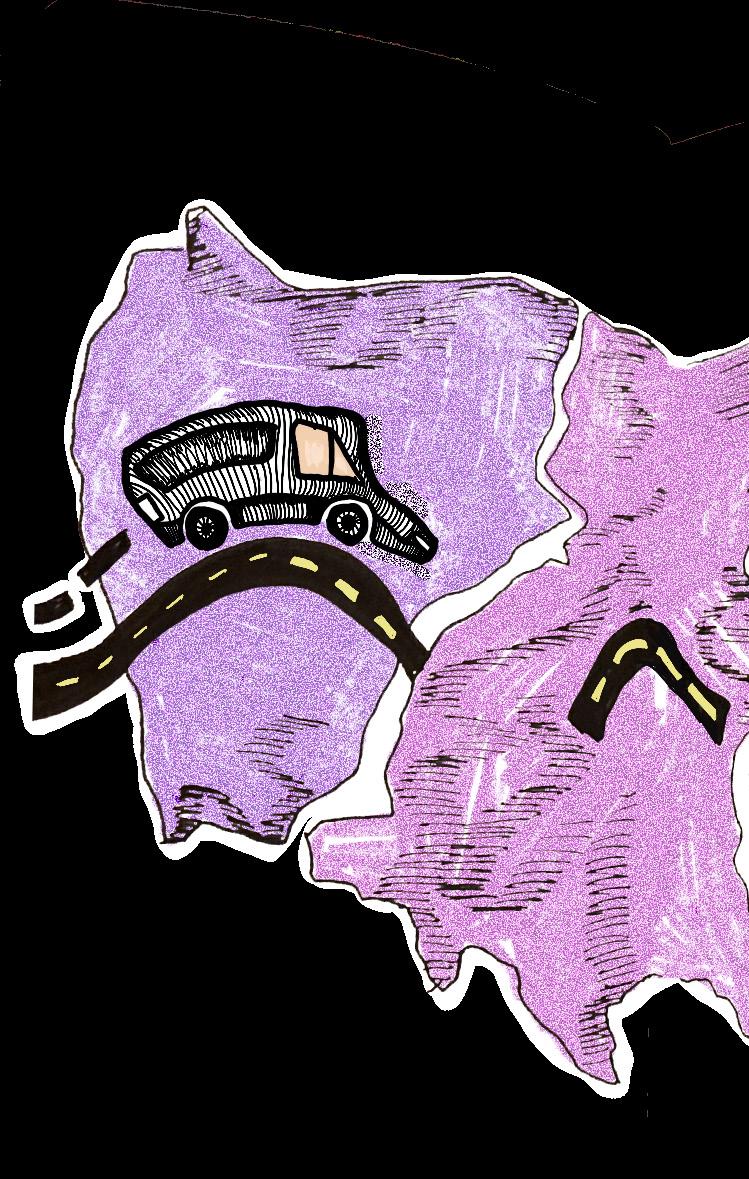
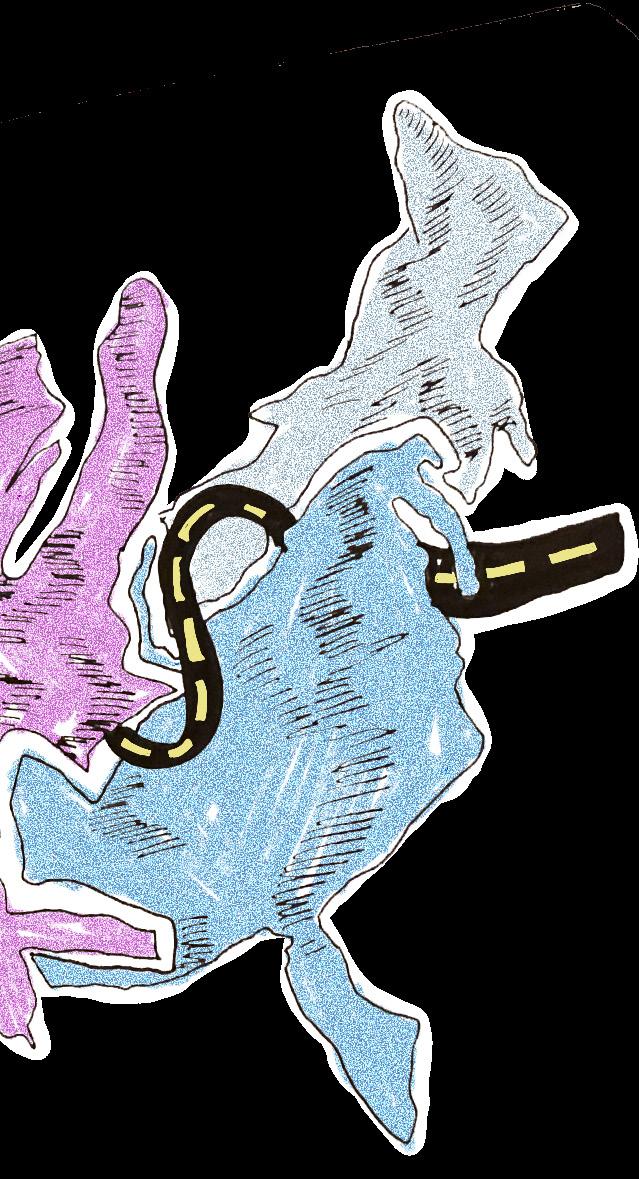
In this issue, we dive into the indefinable concept of the "American Dream." We explore its meaning for different communities in a thought-provoking photoessay on page 35, asking, "Who is this dream really for?" We also provide a resourceful guide for women considering alternative birth control options during this uncertain political climate on page 27. We hit the road on our very own road trip through America, stopping in four states to celebrate and explore the musical movements that shaped their culture on pages 57–64. And we explore the Black youth experience in America as told by Tyler, the Creator's new album, CHROMAKOPIA , on page 17.
So, Jerks, now is the time to question the promises we have been fed and put in the work to redefine them. Although the "American Dream" means different things to everyone, at the end of the day, it's just words. And do you know what an editor says about words? They can always be rewritten.
Always unapologetically,
Karla Perez Editor In Chief (she/her/hers)
Kaileigh
Madeleine
Mams
Brenne Sheehan Package:
Maryn
Miguel
Joelle
JERK ON THE INTERNET
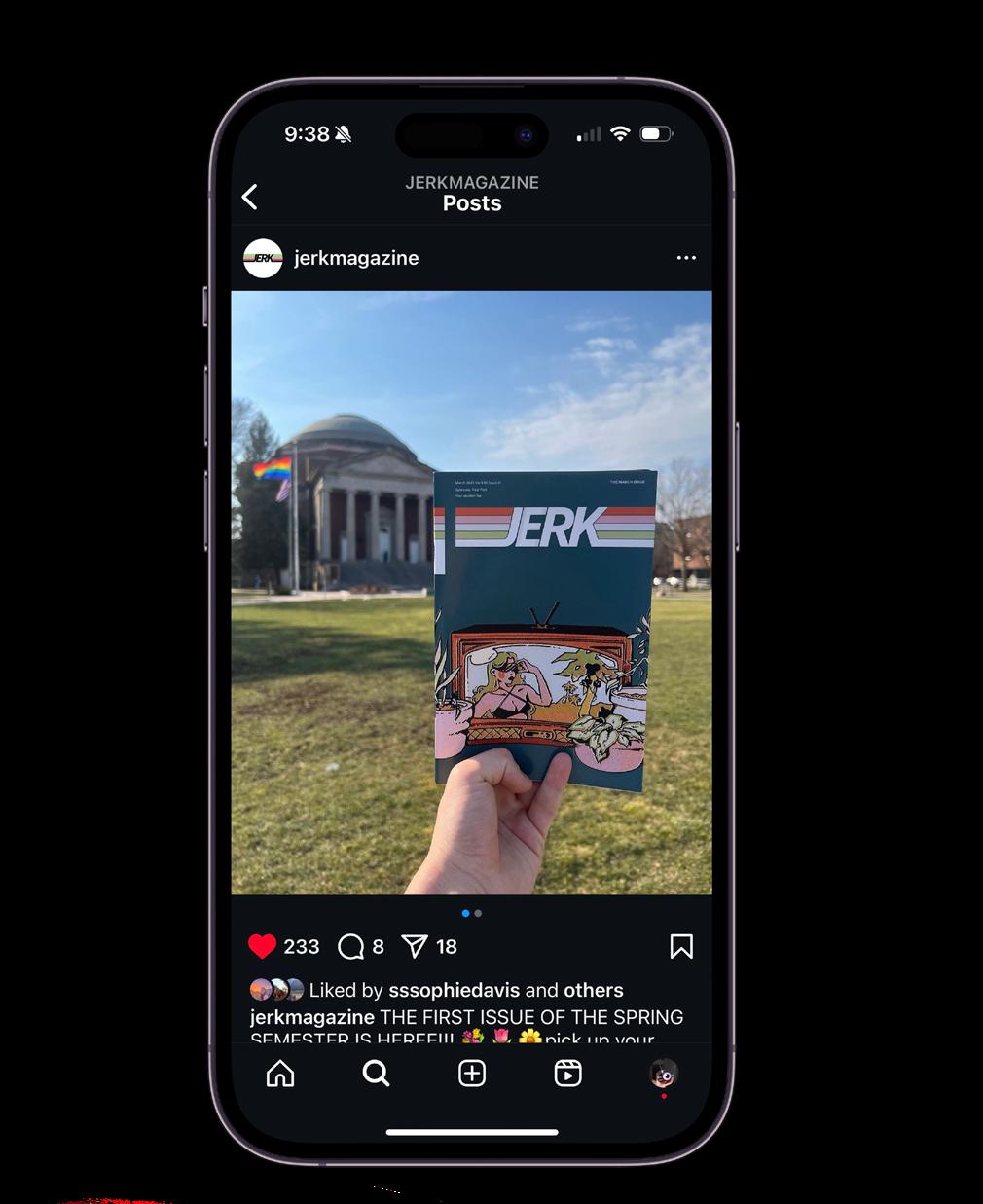
Jerk Magazine is exploring new ways to compliment our print mag. Find additional content on social media and our website jerkmagazine.net.
Words by Kaileigh Strong
What we love
A COMPLETE UNKNOWN
DECEMBER 25
And just like that, Timothée Chalamet is at it again. We’re not complaining, though. By the looks of the trailer, we think this will become an instant classic. There’s nothing like a heartwarming movie about a beloved singer, Bob Dylan, to watch with your family and friends. And, of course, we can never have too much of our boy Timmy.
SQUID GAME, SEASON TWO
DECEMBER 26
We know what we’ll be doing this winter break: going back into the game. We've been living in a drought since Squid Game season one and we’re tired of it. It might be one of the only shows on Netflix that deserves another season. It’s all we’ve been thinking about since they announced the second season back in June 2022. There’s a chance we might have to sleep with our heads under the covers once it’s finished, but it’s worth it.
PADDINGTON IN PERU
JANUARY 17
Who knew Paddington was so worldly? And Peruvian? It’s exciting to see him getting out there and seizing the day. We can’t wait to tap into our inner child with this one. We’re counting down the days until we get the pleasure of seeing our favorite bear in a red hat take on Peru!
ISSA RAE'S ONE OF THEM DAYS
JANUARY
24
Issa Rae, you’ve done it again. We know we’re in for a treat with this one. The world has been DYING to see SZA on the big screen—there is literally nothing she can’t do. And with Keke Palmer? It’s a match made in heaven and you best believe we’ll be sat.
MUFASA DECEMBER 20
You already know how we feel about live-action remakes. It’s not right to mess with the classics and now a live-action prequel? On the list of things we don’t need, this is number one. Get us out of here. That said, it will be a treat to see Scar as a kid. Let's see if his villain origin story gives him a redemption arc.
HOLIDAY GIFT SHOPPING
DECEMBER
25/HOLIDAY SEASON
Now, we could be wrong, but didn’t we just have the holidays like last week? This is seriously getting old. We are broke college students, give us a BREAK. The day our parents stop asking for overpriced Syracuse merch for Christmas is the day we’ll stop resenting buying Christmas gifts. Five hours a week at a minimum wage job is just not covering it.
LOOK UP BY RINGO STARR JANUARY 10
We have to be honest, we thought Paul McCartney was the last living Beatle. Turns out half of them are still alive! Since when? And another question—why is Ringo Starr releasing a country album? We can’t all be Beyoncé and pull a Cowboy Carter. Sorry buddy, we’re all set with this one.
MARIAH THE “QUEEN” OF CHRISTMAS
DECEMBER
25/HOLIDAY SEASON
Don’t get us wrong, Christmas music never fails to get us in the holiday spirit. It's the shit. But here’s the thing: Mariah Carey thinks she’s the shit. This whole Mariah Carey owning Christmas bit is low-key tired. We don’t care if she’s defrosting, we’ve all moved on. This year, we’ll be enjoying Sabrina Carpenter’s Christmas album AND holiday special. Move over Mariah, there’s a new queen in town.
What we hate
TAURUS
ARIES GEMINI
Slow down, Aries, you’re doing fine. Give yourself extra time because slow and steady wins the race. Take a self-care day or that long nap you deserve. You’ll get to where you need to be eventually.
CANCER
Mar. 21 - Apr. 19 Jun. 21 - Jul. 22
When emotions are running high, look deep within and seek patience. Life is overwhelming sometimes, Cancer, but you’ve got moxie. Use your intuition to navigate larger groups and make the most of every situation.
Libra, embrace your creative side. Take on new projects or create something just for you! We love the grind mindset, but maybe it's time to invest in that adult coloring book. It might just bring you the happiness you’re looking for.
Take a look around you, Taurus, because we sense romance in the air. Afraid to feel your feelings? Let’s put a stop to that. Be honest about your emotions and let that spark ignite.
May 20 - Jun. 20
That nonchalant façade can only do so much, Gemini. Vulnerability is a gift; maybe it’s time you share it. You can’t keep that side of you hidden forever. Each part of you makes you unique, so flaunt it, baby!
LEO VIRGO
Get out of your comfort zone and shock the world, Leo. A last-minute invitation can change the course of your life. Don’t be afraid of having fun.
Aug. 23 - Sep. 22
The answer you have been waiting for is yes. Are we, here at Jerk , telling you to text your old situationship? Probably not, but things are heating up for you socially and romantically.
23 - Aug. 22 Oct. 23 - Nov. 21
LIBRA SCORPIO SAGITTARIUS
Hey there, Scorpio. Be open to unexpected new love with someone who will come into your life. Want a honey for the holidays? Get after it!
Nov. 22 - Dec. 21
You are entering a period of calmness. In fact, people will turn to you for advice and inspiration, so get ready, Sagittarius. Good luck will be on your side, and it’s time to spread the wealth.
23 - Oct. 22 Dec. 21 - Jan. 20 Apr. 20 - May 20
The hard part is over, Capricorns. You have overcome a challenge and gained new friends and opportunities. Keep moving forward, you are in control of your future.
21 - Feb. 18
CAPRICORN AQUARIUS PISCES
Feb. 19 - Mar. 20
Hey there, Aquarius. We, here at Jerk , think it might be time for a change in your life. It’s time to learn to embrace your true self and go against the grain. This new journey of independence may not be easy, but your inner strength and passion will prevail.
Trust your intuition, Pisces. Don't try to please everyone when those closest to you are the ones who truly matter. Haters gonna hate, but you know what’s best for you in the end.
Words by Madeleine Oliveros and Jack Pasquale | Art By Alissar Michel Youssef
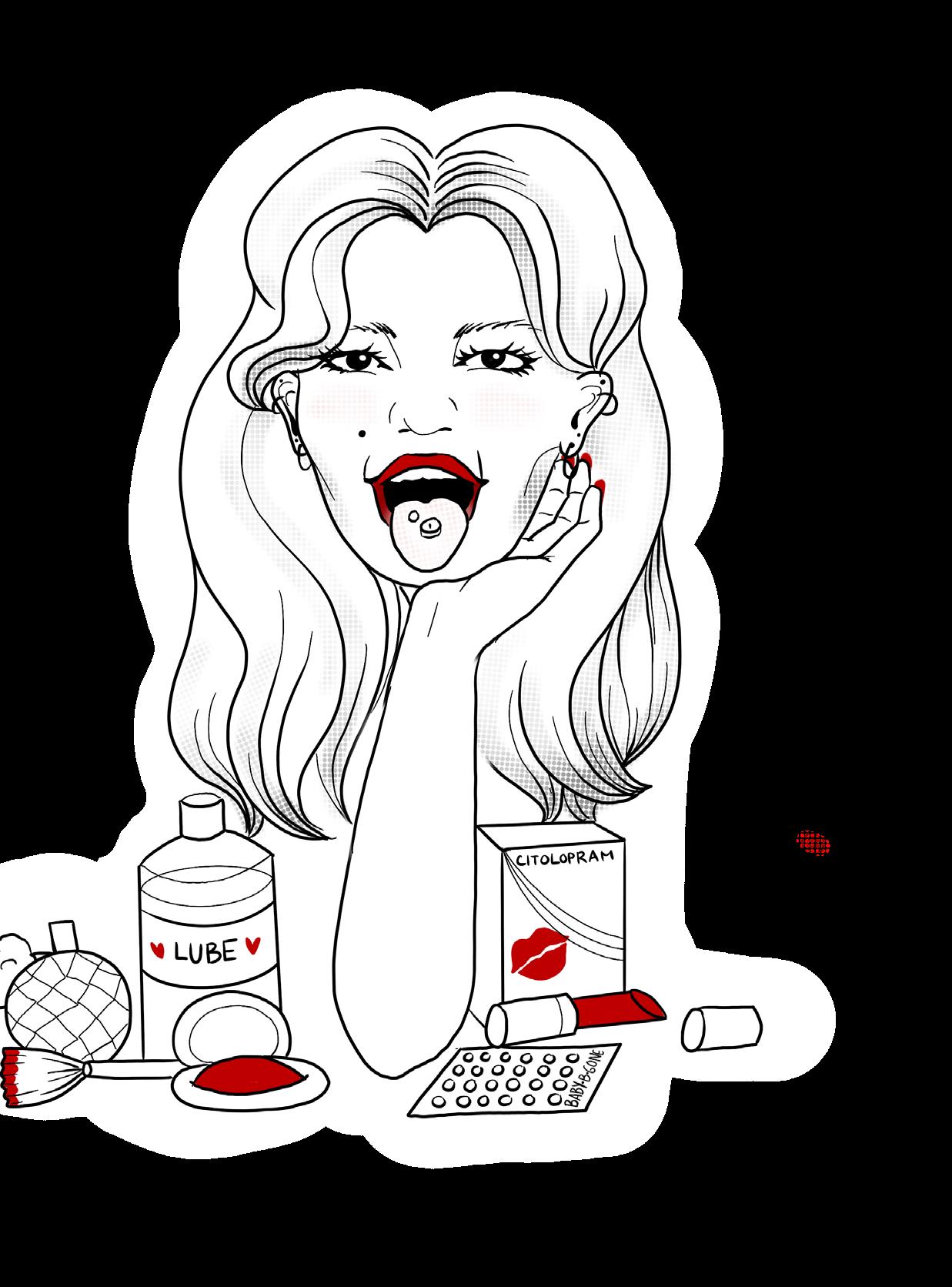
LET’S TALK ABOUT SEX, SSRIS AND HORMONES, BABY
The two guilty culprits of your dead sex drive
Words by Maddy Brousseau
Art by Kate Tang | Designed by Abigail Aggarwala
After the recent election, you would think the life of an American woman couldn’t get much worse. Our bodily autonomy has been ripped from us by the government, a convicted rapist is president-elect and Congress is red. What else could add to the bad news? Well, what if we told you your hormones and antidepressants were lowering your libido and decreasing your ability to finish when having sex? It’s not just your ugly boyfriends that don’t give a fuck about your arousal in bed anymore—now, our bodies are making it harder to orgasm during sex.
If you’re a woman, you’ve likely heard of this dreaded diagnosis from your gynecologist or from a friend who was unlucky enough to receive it. PCOS, or polycystic ovarian syndrome, is one of the most common diagnoses amongst young women in America right now, as one in ten women live with it, according to the World Health Organization. PCOS involves the growth of cysts on a woman’s ovaries, which can cause a number of symptoms including abnormal periods, acne, hair growth, depression, fatigue, weight gain and low libido. Additionally, it makes women more prone to ovarian cancer and type two diabetes. Currently, there are only a few treatments and no cure. Great.
Samantha Croco, a junior at Syracuse University was recently diagnosed with PCOS. “I was having many issues with weight, my period and my energy, and doctors couldn’t give me an answer,” she said. “It was so frustrating and isolating because, if I don’t know what’s going on, how can I treat it?”
PCOS is caused by a hormone imbalance, which many women experience during puberty, their period and menopause. Yet PCOS is a prolonged version of these common imbalances. Because our bodies are constantly changing, our brain can’t keep up. Hormonal fluctuations for women cause us to feel the symptoms of depression and anxiety. Psychologists at Johns Hopkins Medicine theorize that women are twice as likely to get diagnosed with depression due to their fluctuating hormones and one in three women have been diagnosed with depression in their lifetime, according to Mental Health America.
Ananya Sayekumar, a third-year student at SU, recently started an SSRI, or a selective serotonin reuptake inhibitor, which has helped her manage PMS symptoms. “I used to get so frustrated and depressed during my time of the month,” she said. “Now my emotions are manageable overall, but specifically before my period.”
Fatumata Sow, a junior at SU has been learning to manage the symptoms of PCOS. “PCOS has definitely had an effect on my mental health because I often feel overwhelmed with tasks; I get fatigued and it makes me anxious [so] I can’t get anything done,” she said. “I often find myself being anxious about how I look and if people will be able to see the physical signs of my PCOS.”
As a woman, sometimes it feels like our bodies are against us. A woman’s body is supposed to go through 40 years of monthly sheddings of our uterine walls—aka hell—and this innate biological experience in itself makes us more
prone to anxiety and depression? If we try to combat our depression with SSRIs, which are neurotransmitters that increase levels of serotonin in our brains, our sex drive drops and our likelihood of finishing during sex plummets. On top of that, hormonal imbalances like PCOS do the exact same thing due to increased levels of androgens, or male hormones. So to this big, depressed, hormonally imbalanced group of female-identifying people in the United States, how the hell is your sex life coping? And how do you manage it with every single other thing women have to deal with?
“It feels like you have no control of your body and no matter what you do you’re stuck,” Croco said.
The chaotic hormonal environment these women are dealing with can lead to shame or lowself esteem for not being able to fully participate in sexual activities with a partner.
“It’s something that I feel like I was definitely insecure about,” Liv Boyer, a junior at SU, said in
reference to her experiences not finishing during sex.
Boyer, who has been on SSRIs for five years, noted she often feels she has to be the one to comfort her male sexual partners for her lack of pleasure because they feel like bad partners.
Jordan Kramer, a third-year at SU who has been struggling with PCOS for a couple of years, has found PCOS not only permeates her sex life, but also her attitudes about romantic relationships.
“[PCOS] has caused me to become very selfconscious of my body due to my weight constantly fluctuating. It has also made me scared of marriage in the future because I am scared there is a chance I could be infertile,” Kramer said. “The older I get, the more I stress myself out that I have never had a romantic partner. I get scared that my peers are judging me.”
In a society so focused on romantic relationships, many women feel an unfulfillment with life related to having no partner. The Huffington Post identifies this phenomenon as The “Single Inferiority Complex,” and (shocker!) it’s far more prevalent in women than in men. Not all single women experience this, but it is important to note when discussing situations, or conditions like PCOS, that may influence women’s feelings about romantic relationships.
Sayekumar has found herself not worrying about a romantic partner while being on Lexapro, a common SSRI. “I don’t find myself obsessing over wanting a relationship or that being something of high priority at the moment,” she said. “This doesn’t mean I don’t compare myself.”
Now what can we do about this whole phenomenon? Maybe breaking the intense societal pressures on women to be cuffed by 25 could be a start. But in all seriousness, it’s time to back off the female population—we’ve got too much on our plate right now. Instead of spending time learning about someone’s sex life, or lack thereof, spend your time spreading awareness about PCOS, a disorder with no current cure. Get on your lab coat and design an SSRI that doesn’t reduce sex drive. The women in your life will thank you.
HANNAH DELARAY
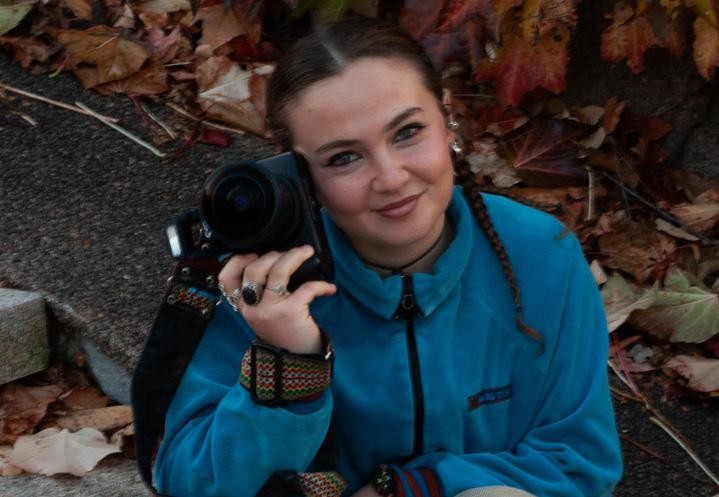
The photographer behind Syracuse’s electric house show scene
Words by Laura Lemgruber | Photo by Olivia Pagel
As a child, Hannah Delaray frequented Venice Beach, California with her surfer dad and brother, but rarely joined them in the ocean. Instead, she wandered the boardwalk and talked to strangers. From a young age, Delaray had a blazing curiosity about the people around her and was fascinated by connecting with others and learning about their lives. By the time she was 12 years old, Delaray started experimenting with photography through a local after-school arts program, where she began to document the eclectic strangers of Venice Beach.
“Photography has given me the ability to show proof of the way I interact with life and the things that I see,” she said.
Delaray continued to explore her passion for street and skate photography during high school. In college, she found her photography “home”: the house show scene.
As a first-year at Syracuse University, Delaray unexpectedly found herself at the first unofficial Redgate show, an emerging house show venue. Entranced by the music, Delaray recalls spending her whole night leading the front of the basement crowd, sweating and headbanging her heart out. Growing up, Delaray admired photographers like Charles Peterson, who captured the grunge scene in Seattle, and movies like Almost Famous . She always aspired to become involved in music photography
and standing in the basement of Redgate on that very first night, Delaray knew she had found something special.
Now a third-year student, Delaray can be spotted with her camera in one of Syracuse’s live music venues practically every weekend. Although many people wouldn’t view a crowded room filled with music as their ideal workspace, Delaray prefers it.
“I do my best work in loud spaces listening to loud music,” she said. “I’m able to hone in. It feels really meditative.”
When photographing, Delaray likes to dance with the crowd and be completely consumed by what she describes as a wild “orchestra of sound.” The result? Photos that transcend viewers into the messy, electric atmosphere of each show. A fisheye lens, high contrast and saturated green and purple tones define Delaray’s style. To her, post-production is crucial to capture the energy of the room.
Although Delaray continues to photograph house shows, she is currently working on her second book, which will focus on themes of intimacy and how human skeletons and bodies intertwine and interact. This project follows her first book, Flabbergasted by Sound, which is a collection of Delaray’s work as a first-year. Delaray found a lot of guidance and fulfillment after opening up to friends about intimacy. Together, they learned how to discuss a crucial part of being human that’s often hard to navigate. These conversations inspired Delaray’s upcoming book—a project that will allow Delaray to venture into new territory. Not only will she explore more vulnerable topics than usual, but it will also be her first time publishing her writing. While the book’s black-and-white, still nature seems completely different from Delaray’s previous work, she is excited to explore a different side of human connection in her photography.
MRS. CLAWS
You know Dasher and Dancer and Prancer and Vixen. But do you recall, Mrs. Claws is the biggest alcoholic of them all?
Words by Jojo Wertheimer
Photos by Ailani Wong
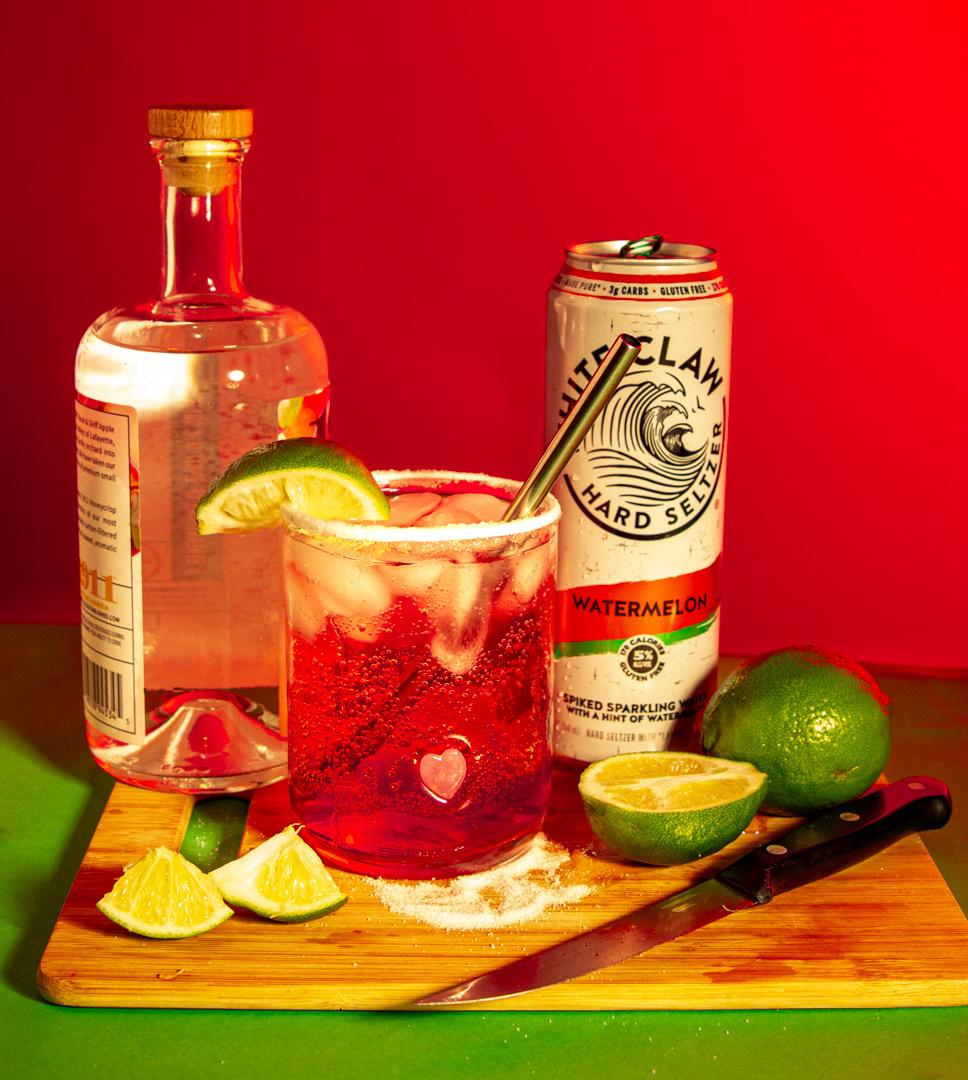
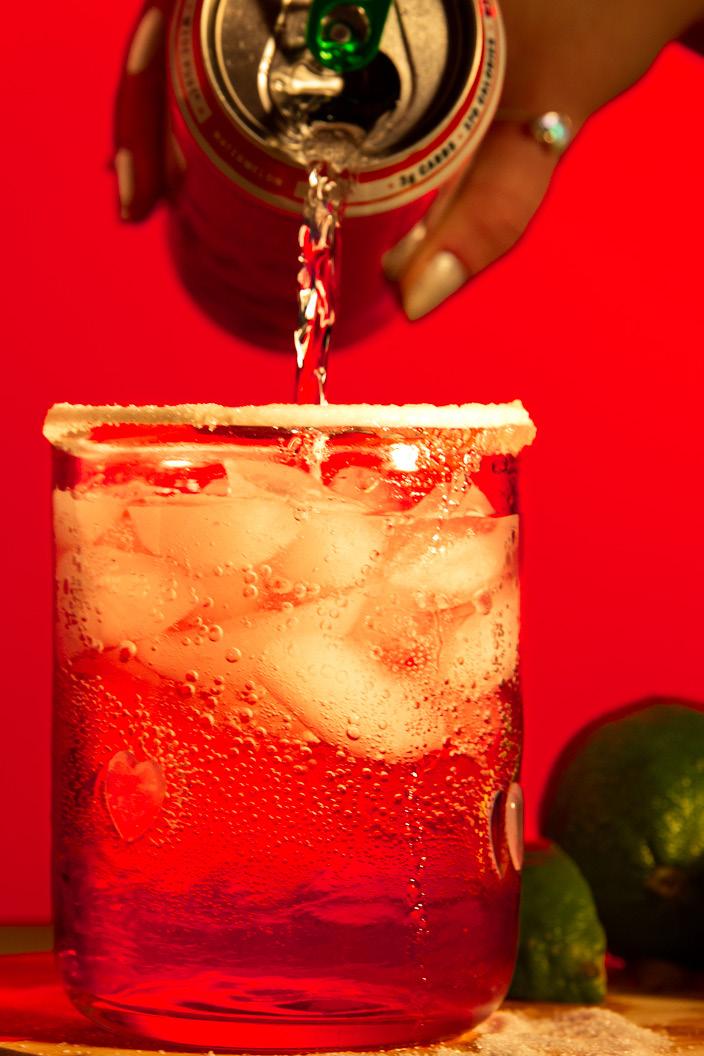
Ahh, yes. The holiday season is finally here—a time marked by brisk winter winds, a bright cheer in the air and, of course, the final few cans of seltzer sitting in your room just waiting to be consumed before winter break. Well, lucky for you, Jerk knows exactly how to make sure your leftover seltzers don’t get lonely during the holidays.
INGREDIENTS
• 2 tbsp coarse sugar
• 1 lime, cut into 4 wedges
• Ice
• 4 ounces pomegranate or cranberry juice
• 2 ounces vodka
• 1 (12-ounce) can of raspberry-flavored White Claw, or any other seltzer of choice
PROCEDURE
1. Pour sugar onto a plate.
2. Drag a lime wedge along the rims of two glasses of your choice (the more festive the better).
3. Dip the rim of the glasses into the plate of sugar, shaking off the excess until it looks like a nice sprinkling of fresh snow has landed gracefully on your glass.
4. Fill each glass with ice (so Mrs. Claws feels at home in the preglobal warming arctic climate).
5. Divide the juice and vodka between prepared glasses.
6. Squeeze a lime wedge into each.
7. Top off with seltzer.
8. Enjoy your holly, jolly cocktail.
WHAT’S THE HARM IN HARM REDUCTION?
The case for legalizing overdose prevention centers
Words by Daisy Polowetzky
Art by Maddie Sloyer | Designed by Molly Zagroba
Whether you realize it or not, every time you buckle your seatbelt before driving a car, adjust your helmet before riding a bike or lather on a layer of sunscreen before laying on the beach, you are practicing harm reduction. You are taking safety measures to reduce the effects of engaging in unsafe activity.
Harm reduction is a strategy of meeting people with substance abuse disorders “where they’re at,” according to the National Harm Reduction Coalition. Harm reduction does not focus solely on sobriety, or abstaining from drug use.
Rather, harm reduction seeks to prevent opioid overdoses and deaths. To address the opioid crisis in New York State, overdose prevention sites must be legalized at the state level.
OnPoint NYC is the largest harm reduction organization in the East Coast, with locations in East Harlem and Washington Heights. OnPoint operates overdose prevention centers (OPCs), also called supervised injection facilities (SIFs) and safe injection sites (SISs), where people with substance abuse disorders can use pre-obtained drugs in the presence of qualified healthcare professionals. Currently, OPCs are only legal in New York City, not in the rest of New York state, according to the New York City Health Department.
OPCs are not places for people with substance abuse disorders to simply get high and leave— OPCs save lives. Harm reduction can look and sound different for different people. It can mean helping people who use drugs switch from
injecting a drug to ingesting a drug, or switching from using drugs in public to using drugs at home. Small steps of harm reduction can lead to lifechanging outcomes.
If a drug user can go from injecting drugs to ingesting drugs—for example—by eliminating their use of needles, they decrease their risk of contracting diseases such as hepatitis C or human immunodeficiency virus (HIV), according to the Centers for Disease Control.
New York State has been gripped by opioids for decades, especially in Onondaga County. In 2022, the U.S. Census Bureau found that 12.7% of Syracuse families earn less than $10,000 a year. In Syracuse, opioids have been destroying communities.
The presence of the city’s three hospitals— Upstate University Medical Hospital, Crouse Hospital and the Syracuse VA Medical Center— coupled with the fact that Syracuse is the nearest city to neighboring counties, makes Syracuse a breeding ground for access to opioids, according to Barry Weiss, administrative officer for the Office of the Onondaga District Attorney.
“We’re not advertising [opioids],” Weiss said. “It’s just the resources are here.”
Legal OPCs in NYC have been proven to be effective from both a public health and economic standpoint. A study from Weill Cornell Medical College found that establishing four OPCs would prevent 130 overdoses in NYC and save the NYC Health Department up to $7 million a year. If these measures could save over 100 lives and millions of
dollars for a city of over 8 million people, imagine the lives and money that could be saved in smaller New York towns.
Despite the clear suffering of New Yorkers and positive data on OPCs, Gov. Kathy Hochul’s administration has turned the other cheek to taking action on implementing the centers in all of New York state.
In 2023, Hochul rejected the use of opioid settlement funds—national monetary settlements made to states by pharmaceutical companies involved in distributing opioids—for safe injection sites, as reported by Politico. Hochul also failed to support the authorization of safe injection sites in New York, explaining that the state is already utilizing harm reduction strategies and emphasizing the legality of the ones already being used.
The unknown surrounding OPCs seems to be what makes the Hochul administration hesitant to legalize them.
“It’s easier to say no than to say ‘Oh yeah, let’s do it and not realize what it is we’re doing,’” Weiss said.
Alexandra Punch is the director of the Lerner Center for Public Health Promotion and Population Health at Syracuse University and a member of the Onondaga County Drug Task Force. As a proponent of harm reduction, Punch acknowledges the misconceptions about the topic.
“The foundations of the principles of harm reduction actually is that we acknowledge that what [drug users] are doing is engaging in illegal activity that can kill them,” Punch said.
Cities like Syracuse have experimented with different methods of tackling the opioid crisis like tracking overdoses and providing addiction treatment services, such as those at Crouse Hospital, but OPCs have the potential to be the most accessible for people who are not ready to be completely sober.
One treatment option for those convicted on drug charges is drug court. Drug court allows those convicted on drug charges
to complete a highly monitored treatment and rehabilitation program instead of serving jail time. Drug courts consist of an intricate web of professionals such as judges, attorneys, prosecutors, and social workers to name a few.
While drug courts can help offenders get clean and avoid the harsh environment of jail, drug court is a complex puzzle that many don’t have the pieces to complete.
“There’s evidence showing that drug courts do work to some degree,” Punch said. “But there’s also a lot of people that get into the criminal justice system and go through drug court that are just absolutely not emotionally, physically ready to go into treatment.”
Harm reduction isn’t the solution for every person with a substance abuse disorder, and neither is drug court. But just as New Yorkers are given the opportunity to engage in drug court, New Yorkers across the state should be allowed to engage in harm reduction. New Yorkers with substance abuse disorders deserve multiple options to address addiction.
“Harm reduction is acknowledging that what [drug users] are doing could lead to a lot of negative consequences,” Punch said. “But we want to give [them] enough human touches, trust and connection so that [they] start loving [themselves] again to eventually change.”
THE BLACK YOUTH EXPERIENCE IN
An in-depth look into Tyler, the Creator’s newest album
Words by Mams Jagha
Art by Mara DuBay | Designed by Kate Tang
On Sunday, Oct. 27 at the Intuit Dome in Los Angeles, Tyler, The Creator unveiled his most honest self and declared, "This is the first album where everything I said is true." For fans and artists, this statement marks a monumental artistic shift from Tyler Okonma’s ever-evolving persona to a raw personal narrative.
His newest and seventh studio album, CHROMAKOPIA , offers an unfiltered look into Tyler’s experiences like never before. Already sparking conversation and making waves in the music industry, the album strips away at the careful layers Tyler has built over his career. But most importantly, it provides an introspective perspective of identity, mental health, community and other complexities of Black youth culture, resonating heavily with young Black listeners.
Tyler’s opening track, “St. Chroma” begins with a powerful message from his mother, Bonita Smith: "You are the light, it’s not on you, it’s in you." Within Black culture, many are taught to stay quiet and avoid standing out to avoid criticism. In this track, however, Tyler rejects those lessons. Through whispered lyrics, he reflects on his accomplishments and never “dimming his light,” despite the cultural expectation to remain humble.
His line, “Give a fuck about tradition, stop impressing the dead,” challenges the generational tension between Black culture and Christian beliefs, which were often used as coping mechanisms during the painful history of slavery. Jaydan Rivers, a Syracuse University freshman, explains that,
“For younger Black generations, these traditions are restrictive,” pressuring them to honor the past instead of making their own paths.
As the track builds, Tyler surprises us with an electric beat drop, shifting into a more confident tone, enhanced by featured artist Daniel Caesar’s smooth vocals. This transition symbolizes the release of pent-up energy—his promise of success, breaking free from tradition and embracing his "fire." It’s not only a statement to his critics but an empowering anthem for Black youth.
Progressing to the fifth track, “Hey Jane” opens with Tyler confronting the fear of an unexpected pregnancy. While the song captures his internal struggle, Tyler seamlessly shifts into the emotional state of his partner, “Jane.”
In an album release post, Tyler highlighted an Instagram user who commented that the track captures, “The pain, fear, doubt, love and everything in between from a woman’s perspective.” Though he and “Jane” don’t know each other deeply, Tyler lists her physical traits, suggesting that their connection is strong enough to raise a child. Despite this, unspoken anxieties begin to surface, revealing the complexity of the situation.
In the Black community, there’s a heavy societal expectation to have children, even when unprepared or unsure, leaving many to navigate these challenges without substantial support. This often results in single parenthood, especially among mothers, capturing this conflict between societal norms and personal struggles.
Continuing seamlessly, he launches into his sixth
track, “I Killed You,” a powerful reflection on heritage and the insecurities regarding cultural identity.
Tyler’s line, “I filled you with chemis, forced you to relax, you was thick, you was beautiful,” reminds us of the inherent beauty in Black hair, free from modification. Tyler also touches on the “unspoken professional rules” that deem natural Black hair “unruly” or even “dirty,” singing, “If they see you on top of me I gotta leave.” For many, including myself, learning to love our natural hair is a long journey, and there are countless young Black girls still struggling with these issues.
This song encapsulates the Black experience of growing up ashamed of our features, only to later realize their beauty and power. In “I Killed You,” Tyler reclaims this perspective, using his own bold hair choices as a statement of self-expression and a celebration of Black hair in all its forms.
Tyler’s ninth track, “Take Your Mask Off," explores the journey of embracing one's true self while getting rid of societal expectations, accompanied by powerful vocals from Caesar and Latoiya Williams.
The song first tells the story of a teenager influenced by toxic masculinity, leading to prison time "cause you had something to prove.” The second half addresses the inner turmoil of a preacher struggling with his sexuality, exposing the hypocrisy in faith communities that avoid discussions of acceptance. Tyler also touches on the sacrifices women make, particularly when raising children, and the emotional toll it takes on their dreams as he sings that “Your identity gone, momma your first name.”
Exploring themes of gang culture, masculinity and LGBTQ+ acceptance, “Take Your Mask Off” serves as a message to Black youth about the importance of self-exploration over societal conformity, while critiquing outdated norms.
Tyler’s tenth track, “Tomorrow,” begins with his mother professing how much she wants grandchildren and then develops into an exposition of Tyler’s fears of growing old and all that comes with it. The song captures the feeling of being behind, especially as many of his peers are getting married, having children and settling down, while he’s still trying to define himself outside of his music career.
Tyler reflects with the lyric, “My mother’s hands don’t look the same, these jet-black strands are turning gray, the thought of children, it brings me stress, because time is changing.”
He acknowledges his pride in his accomplishments but also struggles with the comparison to others, torn between taking his time to discover who he is or rushing the process, particularly as his mother ages and the world continues to evolve.
"I feel like in the Black community, we rush to be stable early in life compared to other races," Braelynn Hall, an SU freshman and Tyler, the Creator fan, said. "[I appreciate how Tyler explains] how you don't have to rush through life—take things day by day."
The track speaks to the broader experience of Black youth, who often face societal pressure to adhere to a prescribed timeline—graduate, marry, settle down, have kids—and the judgment that comes when their path doesn’t align with these expectations.
One of Tyler's most emotionally charged tracks to date, “Like Him,” his 12th song, is a raw and introspective confession of his longing for a father figure. With its expressive piano melody, the track gradually builds in intensity, enhanced by Lola Young's soulful vocals, drawing listeners into Tyler’s vulnerable state of mind.
Subtle yet powerful, “Like Him” offers a window into Tyler’s inner turmoil as he reflects on the emotional weight of looking like someone he never knew. He confesses to, “Constantly yearning and chasing a ghost” he can't fully grasp, yet questions, “How could I ever miss something that I’ve never had?”
The song speaks to the broader emotional impact of missing a parental figure, particularly within Black communities. For young Black men, the absence of a father often means missing out on vital lessons and guidance, which can lead them to search for mentorship in dangerous places, such as gang culture. This repetition of generational cycles highlights the deep psychological toll fatherlessness takes on individuals and communities, and “Like Him” effortlessly captures that struggle.
In CHROMAKOPIA , Tyler isn’t just sharing music—he’s sharing his truth, and by doing this, he’s creating conversations about self-acceptance, the Black experience and the power of storytelling in music. This album represents the Black youth experience while challenging boundaries of what fans expect from Tyler, and in many ways, it redefines his legacy.
DANCING AROUND THE ISSUE: THE NUTCRACKER'S CULTURAL CRISIS
The façade of tradition when confronting racist portrayals in holiday classics
Words by Anne Kosanke and Annabel Adams
Art by Dorothea Dolan | Designed by Abigail Aggarwala
Ballet is beautiful, but The Nutcracker has a distasteful side. Alongside the “visions of sugar plums” are deep-rooted stereotypes that make this holiday classic less magical than it seems—at least for those marginalized by its depictions.
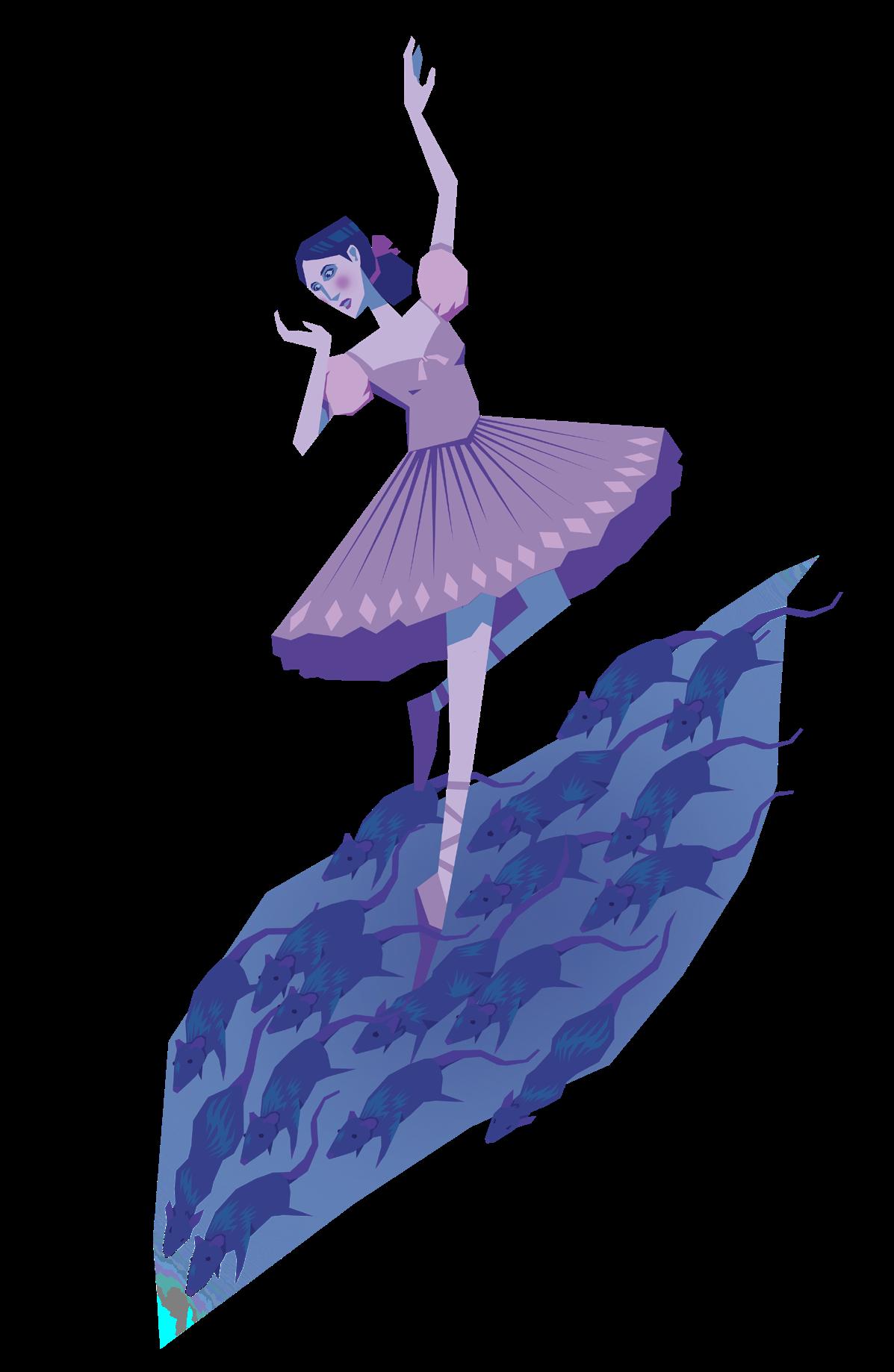
The Christmastime favorite follows a young girl's dream journey into a fantastical world. Act I appears innocent enough: Clara receives a wooden Nutcracker from her mysterious uncle Drosselmeier, which her brother breaks. After falling asleep with her repaired toy, magic transforms her world—the house grows, the Nutcracker becomes a prince and together they defeat the Mouse King before traveling through an enchanted forest to the Kingdom of Sweets.
The real problems lie in Act II. Here, they arrive at the kingdom where the Sugar Plum Fairy rules. To thank Clara for saving the Prince, the court presents a series of celebratory dances that reveal the ballet’s dated cultural perspectives, including “Spanish Chocolate,” “Arabian Coffee,” “Chinese Tea,” “French Marzipan,” “Russian Troika” and a “Flower Waltz."
A common dance in The Nutcracker's Land of the Sweets, known as "Tea" or "Chinese," has historically been problematic in its portrayal of Chinese culture. While productions often use stereotypical elements like fans and mandarin collars, one notable example of misrepresentation is a widely-used, two-finger gesture that, despite being recognized as "Chinese" in ballet, has no basis in actual Chinese dance traditions.
Additionally, many traditional productions of The Nutcracker's "Arabian Coffee" dance have
perpetuated harmful Orientalist stereotypes and exoticized Middle Eastern culture. Stereotypical costume choices like bare midriffs and veils misrepresent Middle Eastern dress. Props and gestures that reinforce colonial-era stereotypes about the “exotic East” are also used.
In 2017, New York City Ballet made adjustments to their rendition of the dance. It modified its costumes, makeup and choreography, and the Balanchine Trust—which owns the rights to Balanchine’s work— notified other ballet companies that the changes were approved. Boston Ballet has embraced the encouragement to change. The company released statements of its ongoing initiatives, including reworkings in 2018, 2021 and 2023.
Starting in 2018, the ballet company updated its “Chinese Tea” dance. Artistic Director Mikko Nissinen revised the costumes to address racial stereotyping. In 2021, the company introduced new choreography incorporating Chinese ribbon dancing traditions. Working with faculty member Chu Ling in 2023, Nissinen further developed the piece with traditional Chinese ribbon dancing. These changes prove that cultural authenticity can enhance rather than diminish the performance.
Yet this poses the questions of why it took so long to make these changes and why not all ballet companies have followed suit.
There is a tension between preserving artistic tradition and promoting cultural respect. Most of the time society tends to accept things because it's how they have always been. Offensive content hides
under the guise of “art.” Artistic merit is sometimes just fancy talk for “we've always done it this way.” And if you’re thinking: “Why fix what’s not broken?” It is broken—as broken as the wooden nutcracker that breaks in Act I.
In recent years, the phrase “separate the art from the artist” has gained traction when people defend creators from J.K. Rowling to Kanye West. Some of the most famous artists are racist and misogynistic, but that doesn’t stop us from praising their work. The "it's art" defense has long served as a shield for offensive content, allowing harmful stereotypes and prejudices to persist under the guise of artistic expression.
The resistance to modifying The Nutcracker's potentially racist narratives in favor of tradition reflects broader societal patterns in how we approach change in established cultural institutions. This resistance may stem from a powerful combination of psychological attachment to familiar holiday traditions. The ballet's position as a holiday tradition has created a deep cultural investment that makes change particularly challenging.
In a recent interview with Central New York Ballet dancer Lucy Hamilton, Jerk gained insight into the world of classical ballet. Hamilton, who has been dancing throughout her life, currently performs multiple prestigious roles in The Nutcracker, including the Snow Queen, Marzipan and the Sugar Plum Fairy.
I once had."
However, young children may not recognize these stereotypes, but they absorb them nonetheless, unconsciously learning to view certain cultures as "other." This enchanting power makes it more crucial that it uplifts rather than diminishes the culture it portrays. Breaking from established patterns proves challenging, particularly with a beloved classic like The Nutcracker.
For Hamilton, The Nutcracker represents more than just a seasonal production—it's a cornerstone of a dancer's journey. "There's a 'circle of life' feeling to it," she said. "It's one of the first ballets you see as a young dancer. Now, performing in it feels like paying homage to my younger self and the dream
"It's hard to stray from what you know," she said. "When tradition is the basis of something, where do you go from there? What themes are resonating and what can we get rid of?"
This limited cultural emphasis creates a difficult balance; productions need revenue, but changing traditional acts risks alienating audiences. With minimal funding, even basic updates like new costumes become challenging. Yet we must ask: are we bringing racism to the stage, or is the stage bringing racism to us? While audiences might overlook these problematic scenes, artistic directors have the power—and responsibility—to adapt productions. Hamilton maintains an optimistic outlook, particularly regarding Act II's untapped potential. As a member of a new generation of dancers, she envisions exciting possibilities for evolution.
"The magical world that Clara enters could be so much more," she said. "Instead of a missed opportunity, it could be a way to teach children about different cultures in an approachable way, taking them on a journey around the world."
The ballet does not lose its appeal with newly adapted scenes. If Clara can dream of a mouse king and dancing sugar plums, surely she can dream of respectful cultural representations. The beauty of dreams lies in their unlimited creative potential— bottom line: no one should be dreaming of a world of racist stereotypes.
THE HIP ENNUI
EPIDEMIC
Words by Kaileigh Strong
Art by Emmet Kobasa | Designed by Emily Saraidarian
“Ennui. It’s what you would call the boredom,” explains a new emotion.
About 20 minutes into Inside Out 2 , we’re met with Ennui, a periwinkle emotion with slouched posture and a careless manner. Ennui explains their namesake to the band of emotions while lying on the couch, controlling Riley’s neural console from a smartphone. The new emotion comes across as apathetic, uninterested and greatly unimpressed—qualities that many young people have today.
It is becoming concerningly and increasingly acceptable to not give a shit. Everywhere you turn, there are people who couldn't care less about you or anything else. In a completely digital world with iPad kids running rampant, societal disconnect is fatal. People are so checked out they can never be caught having an opinion on anything.
As Jerks, we’re known to have strong opinions. In a world where our rights are being taken away daily, it is so important to be vocal about issues that impact ourselves, our friends and our loved ones. In all honesty, you don’t have to commit to being the world’s most vocal activist. However, we live in a world where staying silent doesn’t help anyone. If
you don’t have any opinions whatsoever, that’s where the trouble lies. To be ennui is to be passive. Passivity gets you nowhere. Hate to break it to ya, but you’re not mysterious. Maybe you’re bored, but moreso, you’re borING. The hip ennui epidemic is in desperate need of a cure.
As a generation, we have lost both the desire for sincerity and the desire to be sincere. We no longer value connection—we just want to live our lives alone and mysteriously. Since when is mysterious all we long to be? I don’t know about you, but I like being very clear about who I am. You can never catch me holding back my personality or my values to seem nonchalant. Maybe that’s just a personal preference, but in all seriousness, this IDGAF mindset is getting old. We can’t go through life as only partly formed humans. Care about something! Have an opinion! Writing about people not caring is kind of a strange feeling. At least it’s a feeling, so I know I’m alive. Unlike our ennui believers— who knows if they’re alive? Or if they cared enough to read this.
SMUT
FEATURES
In Smut, we deep-dive into aspects of on and off-campus life that affect you (yes, YOU!).
TO IUD OR TO NOT IUD
hazing
In the face of a second Trump term, many women are asking themselves that question
Where do we draw the line between admiring from afar and invading privacy?
NOT-SO BROTHERLY LOVE
The psychology behind hazing
Words by Annabel Adams
Art by Chris Mastel | Designed by Eva Aurnhammer
On Wednesday, Oct. 16, 2024, Syracuse University chancellor Kent Syverud, a member of Delta Kappa Epsilon during his own college years, issued a university-wide statement regarding the leaked videos exposing campus fraternity Phi Kappa Psi’s hazing rituals.
Chancellor Syverud condemned the actions, calling them “repugnant.” In the video, two brothers are seen vomiting on two pledges lying on the ground and there is a shot of someone tied to a pole with duct tape over their mouth. Since the release of his statement, Phi Kappa Psi and Psi Upsilon have both been suspended and are being investigated by the SU Department of Public Safety.
These recent events surrounding Phi Kappa Psi and Psi Upsilon are not unprecedented for SU regarding problematic and degrading behavior within Greek life. In 2018, the SU chapter of professional engineering fraternity Theta Tau came under fire after a leaked video showed members of the fraternity performing a skit that degraded Jewish people, people of color, queer people and disabled people.
SU did not suspend the organization, but instead indefinitely suspended the 15 members who were shown in the video. Syverud and the central office of Theta Tau both publicly condemned the video.
A year later in 2019, Alpha Chi Rho was suspended after members of the fraternity shouted racial slurs at a Black student on campus.
The sudden controversy surrounding Greek life and its long precedent on campus has left SU students with many questions as to why hazing happens.
To understand this pattern, Dr. Leonard Newman, a professor of psychology at SU who specializes in attitudinal ambivalence and social stigma, shared his insight on young people’s behaviors when they feel the need to belong.
Dr. Newman discussed a survey that took place at SU many decades ago, asking students whether or not they believed that people other than white Protestants should be allowed into their organizations. Most fraternities agreed that they’d be willing to diversify their pledge classes, but change did not happen for a long time. He believes that the mindset displayed in that survey is similar to the one displayed in Greek life today. There may not be unanimous agreement with the idea of hazing, but the tradition is so deeply ingrained into organizations that it continues to happen.
“If someone were to survey fraternity brothers now about their comfortability with hazing, most would probably say that they dislike [it], but nothing would change,” Newman said.
To incite hazing can be seen as inherently sadistic. However, there may be more levels to the motivation behind it.
Dr. Newman said that a young person’s motivation and willingness to haze their peers in an organization is a product of cognitive dissonance—which Merriam-Webster defines as the “psychological conflict resulting from incongruous beliefs and attitudes held simultaneously.”
It’s plausible that many fraternity brothers do not actually agree with the principle of hazing potential new members (PNMs). Still, Newman says that older members feel that it’s acceptable for PNMs to be subjected to the same treatment that they once endured.
“They can all collectively reflect on wanting to be a part of something so badly that they put themselves through this,” Newman said.
Robin M. Kowalski and other researchers explained in Hazing, Bullying, and Moral Disengagement that the reason fraternities undergo and incite hazing has to do with the belief that enduring hazing is a sign of loyalty and commitment to an organization.
Kowalski thinks the lines between hazing and bullying are often blurred, but there are two stark differences.
For one, hazing is more associated with group behavior and initiation, whereas bullying more often takes place between only two individuals.
According to studies by Jennifer Waldron, Christopher Kowalski, Nadine Hoover and Norman Pollard, victims of bullying often report increased feelings of depression, anxiety and suicidal ideations after enduring bullying whereas victims of hazing report positive feelings following being hazed, such as acceptance and solidarity.
Hazing has become such a cemented tradition within Greek life that it has become difficult to get rid of. Every semester or two, new batches of PNMs undergo hazing and are then presented with a group of brothers who accept them—people they have trauma bonded with.
According to Newman, this overwhelming feeling of solidarity after being subjected to acts of hazing almost conditions PNMs to believe it was in their best interest, instead of “resenting the organization for torturing them.”
This contributes to the feelings of cognitive dissonance and moral disengagement that older members of the fraternity feel. Fraternity brothers are not necessarily morally corrupt, but are conditioned to believe hazing is an effective and worthwhile tradition.
Still, Kowalski says that hazing is not limited to Greek life. In her research, she cited data from an NCAA study, in which 80% of college athletes “responded affirmatively” to having experienced hazing-type behaviors and 55% of college students reported having experienced hazing across university organizations, such as clubs and honor societies.
According to NBC News, there have been more than 50 deaths that can be traced back to hazing since 2000, as of 2020. This has led to the rise of anti-hazing activism, which calls for a stop to the cycle of hazing and moral disengagement.
One such activist group is Stop Hazing, an organization with the goal of providing education and resources about hazing, its risks and hazing prevention. The group believes hazing is a widespread issue across universities because of leadership. According to Jenny Desmond of Stop Hazing, “unaddressed behaviors can become ingrained, creating a cycle of harm among members.” Desmond believes that to haze or not to haze is an example that must be set by the leaders of an organization.
“If hazing is happening in these groups, our leaders-in-training may be learning that humiliating, harassing or violent behavior is an accepted or expected way to induct new members and build cohesion,” Desmond said.
According to Stop Hazing’s 2008 national study, 73% of fraternities and sororities have partaken in behaviors that meet the definition of hazing. Because of this crisis, Stop Hazing formed the Hazing Prevention Framework, which they describe as “the only research-based framework for hazing prevention.”
The HPF is a guide with eight components that can be implemented in any organization to prevent hazing. The components are commitment,
capacity, cultural competence, assessment, planning, evaluation, sustainability and implementation. The framework uses a public health approach to foster healthy relationships
TO IUD OR TO NOT IUD
In the face of a second Trump term, many women are asking themselves that question
Words by Julia Reedy
Art by Eva Morris | Designed by Molly Zagroba
Now that a second Trump presidency is upon us, many women are weighing their options when it comes to birth control.
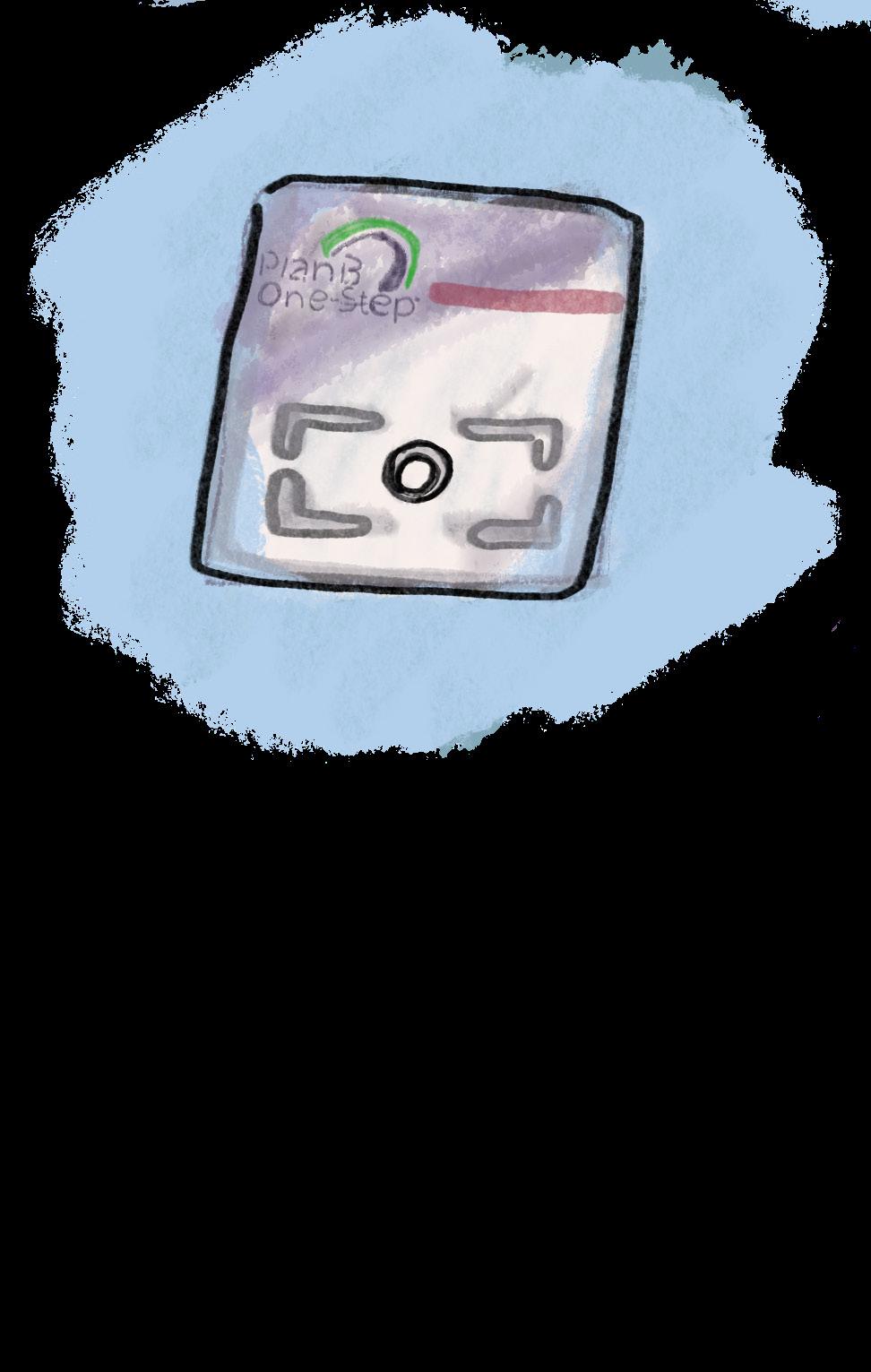
Oral contraceptives are prone to human error—they only prevent 93% of pregnancies— and the “4B movement” that has TikTok in a chokehold sounds great in theory, but has its shortcomings as well (no pun intended). Namely, asking all women to abstain from dating, having sex and reproducing with men in the course of these next four years is impractical—and not everyone has the means to stock up on a fouryear supply of Plan B.
So, women are urged to do the next best thing:
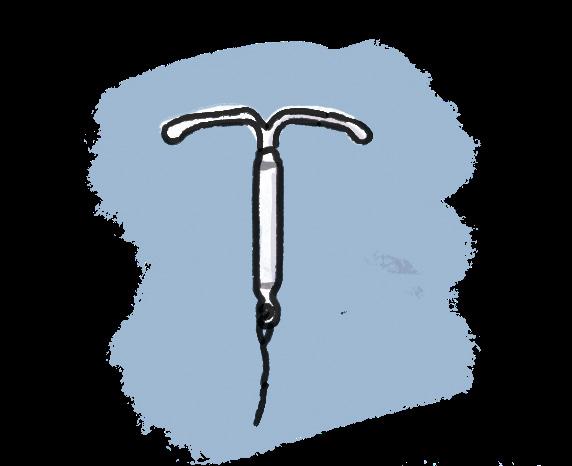
get an IUD, or an intrauterine device, a temporary but highly effective form of contraception.
But what does that entail exactly? Before you pull the trigger, here are some things to consider. What does a second Trump term mean in terms of reproductive rights?
Since the overturning of Roe v. Wade in 2022—which the Trump administration proudly takes credit for—Trump has maintained that women’s reproductive rights should remain up to state policy. This includes access to birth control.
To date, there are 13 states that have a total ban on abortion. According to a study published in June by the JAMA Network Open
medical journal, states with the most restrictive abortion policies saw declines in fills for both emergency and daily oral contraceptive pills following the Dobbs And while Trump asserted on the right-wing social media platform Truth Social that he “has never, and will never advocate imposing restrictions on birth control,” he has laid the groundwork for these restrictions through his successful attempt at overturning Roe v. Wade
And then there’s Project 2025. Although not authored by Trump himself, the 900-page proposal is written by a slew of his “alumni”—including Spencer Chretien, Paul Dans and Troup Hemenway—and headed by the Heritage Foundation and other right-wing organizations. Project 2025 seeks to restrict abortion access and severely limit contraceptive use through a number of initiatives, including prohibiting Planned Parenthood from receiving Medicaid funding, codifying the Hyde Amendment and tracking abortion seekers using “every available tool, including the cutting of funds, to ensure that every state reports exactly how many abortions take place within its borders, at what gestational age of the child, for what reason, the mother’s state of residence, and by what method.”
According to Margaret Thompson, a professor of political science at Syracuse University, the biggest threat Trump poses in relation to birth control access lies in his unpredictability, and his susceptibility to be swayed by his cabinet.
“It doesn't matter whether he attributes policies he proposes to Project 2025 or not—if they're comparable, there's still going to be a problem,” Thompson said. “We’re talking about something where the people he listens to, the people he trusts, are the people who wrote this. JD Vance is also really well-connected with them, perhaps more so than Trump.”
What is an IUD?
IUD stands for intrauterine device, and is often referred to as LARC: long-acting, reversible contraceptive. Compared to oral contraceptives— which have a 93% prevention rate against pregnancy—IUDs are 99% effective.
“It’s as good as being sterilized without being sterilized,” Renee Mestad, MD, an Upstate Medical gynecologist and associate professor at the university, said. “The failure rates are equivalent to that of having surgery to tie your tubes. But if
you decide you want to get pregnant, you can take it out at any time.”
The reason why IUDs have a much higher success rate than that of its contraceptive counterparts is largely because they aren’t as susceptible to human error—you don’t have to set an alarm each day to take it, or use it incorrectly, like you might with a condom.
Once the IUD is inserted, you can practically forget it’s there until it expires. The expiration date of these contraceptives varies from brand to brand, and hormonal vs. non-hormonal (more on that later).
While most insurance will cover the cost of an IUD, they can cost anywhere between $500$1,300, depending on the type.
What’s the difference between hormonal vs. non-hormonal?
There are two types of IUDs: hormonal and copper (non-hormonal).
A hormonal IUD releases the hormone progestin—a synthetic version of progesterone—in the body and prevents pregnancy in two ways: by making the mucus on your cervix thicker, therefore
blocking sperm from getting to the egg; and it can also stop ovulation altogether. According to Mestad, you might want to consider a hormonal IUD if you have particularly heavy and painful periods, as hormonal IUDs like Mirena (specifically approved by the FDA to help with heavy periods), Liletta, Kyleena and Skyla work to ease these symptoms and make periods lighter.
Mirena and Liletta IUDs last up to eight years; Kyleena lasts up to five years, and Skyla lasts for
On the other hand, copper or non-hormonal IUDs like Paragard—the only hormone-free IUD available in the U.S.—are a good option for those who want to opt out of hormonal birth control. Copper naturally repels sperm, making it difficult to reach an egg.
Paragard can last for up to 12 years, but typically make periods heavier and can cause cramping in the first three to six months.
Both hormonal and non-hormonal contraceptives can be used as emergency contraception— meaning that up to five days after having unprotected sex, these IUDs can be inserted.
What should I expect during and after the procedure?
Insertion is often the most dreaded part—and while it can be painful, it varies for each patient based on lived experience.
The good news: the procedure itself typically takes less than five minutes.
You’ll be asked to lie on your back, and your doctor will put a speculum—a plastic or metal instrument used to separate the walls of the vagina—into your vagina, and then the IUD is placed in your uterus. In some cases, you might be offered a numbing gel, like you would at the dentist, or medicine that makes you relax or go to sleep completely. If you have experienced a trauma, you may request anesthesia for your procedure.
Before your procedure, Mestad recommends two things: eat, as this will prevent your heart rate and blood pressure from dropping during insertion (i.e. you won’t feel “woozy”); and take 800mg of Motrin.
It’s normal to experience cramping, backaches and spotting following the procedure.
Will it affect my chances of getting pregnant in the future?
No. According to Mestad, this is a general myth surrounding long-term contraceptive use. It’s not the long-term use of any kind of contraception, it’s just the fact that you aged along the way.
Should I get an IUD?
According to Mestad, that depends entirely on your goals. If you’re planning on getting pregnant within the next year, don’t get an IUD. If you’re applying for grad school and don’t want to get pregnant during that time, then an IUD is the way to go. Regardless, the current political climate is one to take into consideration.
“At this moment in time with the incoming administration, there is a chance we're going to lose access to a lot of contraception,” Mestad said. “It might be wise to get either an IUD or a Nexplanon, which is the implant that goes in your arm. Ideally, once it's in your body, it can't be taken away from you.”
THE PARASOCIAL PHENOMENON
Where do we draw the line between admiring from afar and invading privacy?
Words by Fei Chan
Art by Alissar Youssef | Designed by Kate Tang
No one is ever prepared for the day someone you grew up with passes away, even if it’s someone you didn’t know personally. The people and media we grow up with are foundational to our memories and how we look back on our childhood and adolescence. In many ways, they shape us; this is why Liam Payne’s sudden death in October struck the One Direction-loving generation so hard.
There was an outpour of shock and grief online, not only from Payne’s family, friends and other loved ones, but also from longtime fans of the band, who, even after they split up, continued to follow the members as they began their solo careers. Even those who had grown out of following the band and its members shared their sadness.
“I feel like most of us are so shocked over Liam Payne's death because that man once was part of something our 13-year-old selves could never imagine living without. Like why am I actually speechless right now? It's so weird,” user @GALITZINEFOX posted on X following Payne’s death, summing up a common sentiment among fans everywhere.
Notably, Payne received backlash in the months prior to his death. One of his ex-girlfriends, Maya Henry, spoke out about the abuse she faced during their relationship earlier in October prior to Payne’s death. As expected, people were quick to share their thoughts of support and disapproval of Payne.
This was a parasocial relationship on full display. The term was first coined by sociologists Donald Horton and Richard Wohl as “para-social relationships,” using it to refer to one-sided relationships. Today, it is most commonly used in the context of social media and online interactions.
Erika Schneider, a public relations professor who specializes in crisis communications and social media, described it as an “emotionally driven” idea of a friendship with someone like a public figure, celebrity, or influencer, who doesn’t know the other person exists.
“There's no reciprocity; there's no two-way communication that it's a mutually understood relationship. It's kind of this attachment that grows,” Schneider said. “I think the focus is on this unequal balance of closeness, that you have feelings but it's not reciprocated.”
Parasocial relationships have always existed in some form. The entertainment industry functions as a breeding ground for them, cultivating and fueling the culture of celebrity and fanfare. However, traditional parasocial relationships prior to social media were related to people’s favorite actors, musicians and fictional characters.
“They were a little more protected in that way because there isn't that accessibility element that social media has,” Schneider said.
However, with current social media, parasocial relationships have extended to online personalities, such as influencers and bloggers, who build their following solely from online platforms and use parasocial relationships to their advantage. Schneider explained that with the strategies they use—replies, live streams, back and forth communication—the lines get blurred. What used to be purely one-sidedness becomes a form of a two-sided interaction just with the barrier of a screen.
“Asking questions and having conversationallike approaches to a video, where it's not a twoway communication strategy, but it's like some type of cue or design that's promoting this type of [relationship],” Schneider said. “Their goal might be to get that type of level of relationship with their followers, where, I think in the past, when you're on a movie screen, when you're a celebrity, maybe that wasn't the ultimate goal.”
Still, parasocial relationships start with what may seem harmless but gradually veer into something that can become concerning over time. Schneider emphasized that a clear sign of it is the extremity of the influence the public figure has over an individual, particularly if indicators of a typical real-life relationship are there: trust, loyalty, influence over decisions that are made, if the figure impacts how the individual thinks, feels, behaves and perceives the world around them.
A recent example of this is Chappell Roan’s rapid rise to stardom. The indie pop star came under public scrutiny over her decision to not endorse Vice President Kamala Harris for this
year’s presidential election, which was then followed by a sudden cancellation of two big music festival performances. Roan also criticized invasive fan behavior, posting two videos on TikTok in August, explaining that regardless of her newfound fame and status, “That doesn’t make it okay. That doesn’t make it normal. That doesn’t mean that I want it. It doesn’t mean that I like it.”
She also expressed on different podcasts, for which she was a guest, that fans have not only stalked Roan herself but her family too, leading her to say that she “might quit” if the behavior carries on and escalates.
Syracuse University alumna Madelyn Gosselin has personal experience being on the receiving end of parasocial relationships, having grown up in the public eye on TLC’s reality television series "Jon & Kate Plus 8" (later known as "Kate Plus 8"). While many of Gosselin’s family members have opted to live private lives, others have continued to seek media coverage, leading to assumptions from the public that have fallen back on Gosselin, who they expect to answer to them.
“A lot of people will not only reach out to me, assuming that they already know what the situation is, but also in a very negative connotation,” Gosselin said. “And so for me, that experience has honestly been distressing. People think because of what they see, they know the whole story, and because they think they know the whole story, ‘they can exact change’ in your life.”
Gosselin acknowledged that not all parasocial relationships turn into something negative, but her experience reached the territory of cyberbullying. Having been a big fan of bands like One Direction
herself, Gosselin believes there’s a way to be respectful about others’ lives from afar.
“You're not supposed to have that much feedback from people that you don't know. It's a balance of yes, social media does good for activism and for free information and education and things like that, but it also can be a lot to consume all of that content, and then to consume all of those opinions on who you are and what you do,” Gosselin said.
Lorelai Soper, a junior television, radio and film student at SU, ran fan accounts when she was younger, and was able to create her own curated space of people who also enjoyed the same media as her.
“I found that a lot of people were interacting with it because they also enjoyed the topic of the account, whether it was a stan twitter account
to interact with content that they were also passionate about,” Soper said.
However, she still acknowledged that some fans took things too far, going to lengths to show up to celebrities’ hotels and finding their home addresses, among other things.
“I have always felt respect toward the people I support, so I have always been aware of the
who are interested in the same things as me,” Soper said.
The general public has seen what can happen when a parasocial relationship becomes dangerous, and it can truly happen to anyone, whether you’re a public figure or not. That said, Jerk encourages its readers to tread lightly—the line is thin but exists for good reason.
PHOTOESSAY:
Words by Fei Chan | Assisted by Juliet Seith
Photos by Zobayer Joti | Designed by Eva Aurnhammer
The “American Dream” is deeply rooted in the perception of the U.S. as a place where anything is possible, no matter who you are or where you come from. A country that calls itself a melting pot, people have immigrated to the U.S. for decades with hopes of upward social mobility and the belief that they can be self-made—adhering to the “pull yourself up by your bootstraps” mentality.
With that idea comes the works: the white picket fence, the nuclear family and being plopped perfectly in the middle class. But for whom is the “American Dream” actually attainable?
Historically, there have been barriers put in place to keep marginalized communities from bringing their “American Dreams” to fruition. From the lens of higher education, the “American Dream” for minority students looks like working a job or two to earn extra money, building a professional network and skills from scratch and being forced to put themselves in proximity to whiteness and trying to “assimilate,” but never being seen as equals. It looks like the fact that elementary, middle and high schools in underserved communities receive less funding, leaving fewer opportunities for extracurricular programs and professional development.
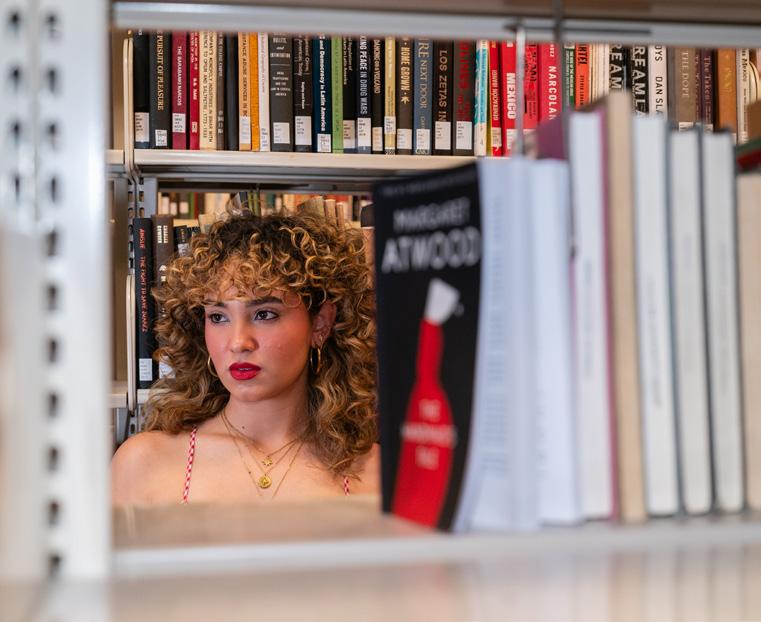
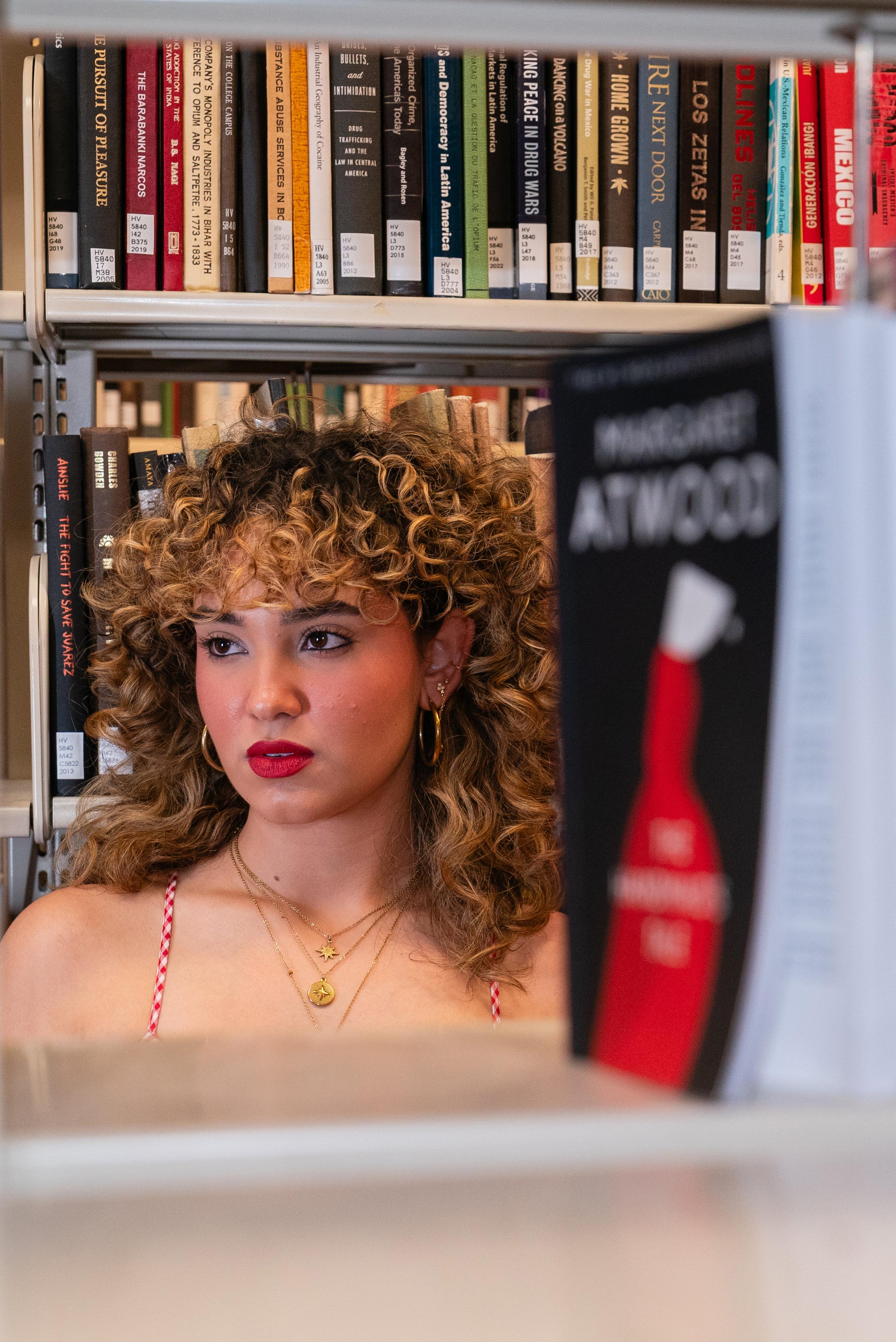
This set of images reflects not only that but also the impact of this year’s election on women in the U.S.
Reproductive rights are at risk with the election of Donald Trump to serve a second term as president. While many perceive Margaret Atwood’s The Handmaid’s Tale to be a dystopian nightmare, it’s not far off from what the future could be if the plans outlined in Project 2025 manifest.
PUMPKIN!
How this TikTok duo turned a “pumpkin” into a carriage
Words by Olivia Fried
Photo by Brenna Desmond
This holiday season, while everyone else is dreaming of sugarplums and picturing elves and Santa Claus, Syracuse University sophomore John Spina can’t stop thinking about pumpkins.
“Not to say that I’m necessarily hearing voices now, but sometimes I'll be like, ‘Did someone just say pumpkin?’” Spina said.
And no, this isn’t like when your younger sibling says they saw reindeer flying over your house on Christmas Eve—there actually are dozens of people on campus yelling out “pumpkin” to Spina as he walks by.
In late October, Spina and his friend, Spencer Howard, made a viral TikTok of them saying “pumpkin” in Bird Library, alternating between each other and getting louder each time. The TikTok, which has over 23.8 million views and 4.5 million likes, has made Spina and Howard “campus celebrities” and inspired a trend on the app.
Howard said a teacher from his high school texted him that her students were doing the trend in her biology class. In the comment section of the video, users said the word “pumpkin” is banned at their schools now. But when Howard and Spina first created the video, they weren’t necessarily trying to start a trend.
“We had no idea it would go viral, we just thought it would be funny,” Spina said. After the video exploded with views, his TikTok account, @johnspinaa, gained over 50,000 followers. Spina had a following on the platform making dance
videos before he came to SU, but has recently been trying to make more personality-based content. Videos like this, he said, are exactly what he and Howard are hoping to create more of.
“A lot of the comments are like, ‘Oh my God, I want to be friends with you guys,’ or ‘This is the funniest thing,’ and it's weird because that’s just how our normal hangouts are. It’s nothing different,” Howard said.
Howard, who began making videos on Youtube and transitioned to TikTok when the platform took off, doubled his following after the pumpkin video went viral. As a sophomore majoring in public relations, Howard uses his industry knowledge to inform the creative process. With Spina studying advertising, the two balance each other out well, Howard said.
The two agreed that wherever their paths take them, the ability to use social media effectively is going to be important for any career. “[Social media’s] always gonna be around, and I think knowing how to make it work for you is the best thing someone in our generation can do,” Howard said.
BIRRIA QUESATACOS
How Candelaria Cibrian’s side hustle became Central New York’s best birria restaurant
Words by Laura Lemgruber
by Izzy Lamporte
Although most Syracuse University students are familiar with the restaurants around the university, Jerk encourages them to expand their horizons and venture about a mile off campus to Birria QuesaTacos SYR. Upon entering the colorful, lively restaurant, customers can expect to be greeted with the mouthwatering scent of its signature birria—a rich meat stew that originates from Jalisco, Mexico. While the restaurant currently sits on 415 W. Onondaga St., it all began four years ago on the porch of Candelaria Cibrian, the restaurant’s owner.
Cibrian, or as most call her, Candi, grew up in Los Angeles surrounded by her parents’ exquisite cooking. Her father, a native of Jalisco, developed the secret family birria recipe that Cibrian continues to use today at Birria QuesaTacos. While her father was the one behind the birria, Cibrian claims she inherited her love for cooking from her mother.
“She could take something so little and make it so delicious,” Cibrian said.
Cibrian’s family moved to Syracuse in 2006, but her business began in 2021. After years of receiving encouragement from friends and family, Cibrian finally decided to sell her tacos on the weekends while maintaining a full-time job on weekdays. Weekend after weekend, massive lines gathered along Cibrian’s street. The impressive
support from her community eventually led Cibrian to the Salt City test kitchen where she would go on to win Eat Local New York’s “Best Taco in CNY” award in 2023. Business exploded from there, and, in January, she was able to relocate the restaurant to its current location.
Today, Birria QuesaTacos offers a variety of dishes centered around birria. While the birria tacos and fries are customer favorites, the menu offers a wide range of items including birria quesadillas, burritos and even ramen. Not to mention, the dessert menu consists of heavenly must-try Mexican classics. Although the restaurant currently operates mostly on to-go orders, it will open up its bar and sitting area once renovations are complete. After the bar’s inauguration, the restaurant will offer Mexican-inspired cocktails and beers.
College students can also look forward to an upcoming lunch special which will offer a reduced price for those looking for a more affordable option (and let’s be honest, most of us could do without spending an obscene amount of money at Schine). So, whether you are looking for a quick lunch option or a full course accompanied by a marg, Birria QuesaTacos has got you covered.
Photo
Photos by Abby Johnson Assisted by Sophie Davis
Designed by Megan Radakovich
CELEBRATING SILVER
Why women everywhere are deciding gray is the new black
Words by Sophie Davis
Art by Kate Tang | Designed by Emily Saraidarian
Baby Botox, anti-aging straws and listicles promoting products guaranteed to make you look ten years younger in just two minutes. Society’s total refusal to allow women to age naturally is overt and inescapable.
As disheartening as it may be to open TikTok and see a thirteen-year-old unboxing a brand new Retinol cream, a growing group of women are finding the beauty in natural aging by embracing their gray hair.
From Andie MacDowell’s glamorous red carpet mane to Facebook support groups boasting tens of thousands of followers, it seems the gray hair movement is only growing—just as beautiful as the locks of the women at the center of it.
After touching up her grays since the age of 28, 51-year-old Danielle Fried from Clinton Corners, New York decided it was time for a change. As the window between hair appointments to hide her gray became increasingly short, she started asking her friends and coworkers what they thought about her growing out her natural hair.
embrace it for what it is and have it be ‘a new me,’ like a sort of coming into my own.”
“All of a sudden I was just like ‘would I ever actually do this?’ and the very first person that I said something to about it just looked right at me, shook her head no and just said ‘sixty.’ It was like a scene from a sitcom.”
But after reflecting on her own mother’s experience growing out her natural hair color and speaking with a few colleagues more willing to embrace the silver wave, Fried decided to welcome the personal evolution.
“For most of my life, it’s kind of been associated with letting yourself go,” Fried said of the notion of no longer dyeing her hair. “I’m just going to
While Fried is still in the process of growing out her grays, she’s quick to sing the praises of the process, viewing it as a celebration of change and an opportunity to switch up other aspects of her personal style as well.
“I’ve been getting my hair cut shorter and shorter and I absolutely love it. I haven’t had hair this short since college,” Fried said.
Despite initial anxieties about how people would react to her new look, Fried decided to view the experience as an acknowledgment of how far she’s come in terms of her confidence.
“I’m not 12 anymore. I don’t have to crumble and fall apart at the thought that someone might judge me for the way I look,” Fried said.
Bonnie Champney, a former preschool teacher
from Pinnacle, North Carolina, experienced a similar liberation after growing out the white hair she had been covering up for nearly 30 years.
“You just have to come to the realization that nobody is paying attention to your hair a fraction of the amount that you do,” Champney said regarding anxiety about how the public might perceive her change in hair color.
Like Fried, Champney grew tired of the increasing maintenance her hair required, taking the opportunity to stop using heat on her hair as well.
“Society is telling me that I have to look young. Everything’s anti-aging and ‘if you want to be beautiful you have to look young.’ I finally got to a point where I was like ‘I’m tired of doing this,’” Champney said.
After speaking with friends about her feelings, she was met with mixed responses, some of them telling her they were unwilling to go gray because of fears of “looking old.”
Not only did Champney point out that hair— and physical features in general—are not the only indicators of age, but she also highlighted the blatant double standard that surrounds the conversation around gray hair.
“Men look sophisticated when their hair is white but women must at all costs look young. It’s drilled into you by the beauty industry and the media,” Champney said of the way the stigma around gray hair targets women’s insecurities specifically.
When asked what advice she would give to women who have not yet embarked on this journey of quiet resistance and screaming selflove, Champney said “I think as women, there’s
something brave about anything that we can do to just turn the narrative around and be ourselves— you’re enough just the way you look.”
The women at the center of the gray hair movement embody a quiet sort of bravery. It may not be the feats of action heroes or daredevils, but to be grateful for the opportunity to age and recognize that not everyone has such privileges requires profound courage in a world obsessed with youth. To love oneself in a world that commodifies insecurities is a truly radical act, and there is a lot of joy to be found in the gray area.
A YANKEE’S HAT (OR SOMETHING RESEMBLING IT): You may not watch baseball or even be from New York, but that doesn’t matter. “It’s just an accessory!”
On Oct. 27, dark haired twinks from New York City swarmed Washington Square Park with a mission: win a grand prize of $50 and look exactly like the teenybopper icon, Timothée Chalamet. Even though 21-year-old Miles Mitchell won the contest, you can still rock the look that is guaranteed to pull any girl you want.
Buff studs like Glen Powell may get their 15 minutes of fame, but skinny Timmys? They’re forever. So, Jerks, here is how YOU can dress just like Timothée Chalamet for a new look this white boy winter—just don't start your own chlamydia outbreak in the dorms, okay?
FORM AND FUNCTION: How to dress like...
CURLY BROWN HAIR: Well, not really “curly.” Just a little wavy and unkempt enough that your bed head gives your brittle hair some sort of texture. You don’t need curl cream! You’ll still pull.
“VINTAGE” SUNGLASSES: You’re too mysterious and you don’t want to be recognized, right? Nah. That nonchalant attitude is just what makes you even hotter. Keep wearing those ambertinted lenses inside, babe.
A WORN ASS SWEATER THAT SOMEHOW COSTS $120: “Oh this? I thrifted it,” you claim, but we all know that shit came from some micro fashion brand based in Seattle. You’ve never sorted through the Goodwill bins in your life, but keep letting people think you’re down-to-earth.
A TIMOTHÉE CHALAMET LOOKALIKE CONTESTANT
Skinny white boys everywhere are embracing their sickly, Victorian child-like charm
Words by Brenne Sheehan
by Kat Shaw
Photo
HANDLE WITH CARE
Why some clothes need a little extra TLC
Words by Joelle de Poto
Photos by Alicia Hoppes | Modeled by Jess Yenawine
Owning unique clothes is more than just a fashion choice—it’s a commitment to care, craftsmanship and sustainability. For some, clothes with detailed care instructions can be daunting to own, but not for Jess Yenawine, a Syracuse University studio arts student, who strongly believes in the importance of long-lasting clothes. As a collector and creator of unique fashion, she abides by the process of washing and drying clothes properly and with care.
Yenawine showed Jerk one of her unique clothing items: a pair of patchwork parachute pants that she got from Mexicali Blues, a Maine-based business. “There's a bunch of tie-dye patterns, and they're all one of a kind,” she said. “So, no two pairs of pants are the same, which is really cool.”
Additionally, Yenawine talked about a glittery dance vest that she thrifted, made of satin and linen. The vest had specific care instructions, which Yenawine showed an appreciation for.
“Because of the ‘dry clean only’ tag, it feels so
handmade and hands on,” she said.
Lastly, Yenawine showed she found at an Old Navy sale, which she called a “traveling sweater” because she and her brother take turns bringing it to college. “It's the one article of clothing that we share and the one thing we don't fight over, which is really nice.”
Caring for clothes teaches us to approach material consumption with greater intention. Finding and making meaningful clothes promotes slow fashion and makes us feel good about our wardrobes. When we handle clothes with care, we are taking time to appreciate our belongings, and thus granting ourselves the agency to be sentimental about them.
HAPPY FEET: MEET THE SU TAP CLUB
The emerging club is building friendship through classic dance
From left foot to right heel, the sounds of the dancer’s steel-tipped shoes echo through the first floor of the Syracuse Stage.
You’d think that they’d be dancing to the classic “Moses Supposes” from the musical Singing in the Rain, but what’s playing is none other than “Lose Yourself” by Eminem.
Every Monday, the emerging Syracuse University Tap Club meets in “small dance,” or Room 141 at the Syracuse Stage on W. Genesee Street. Here, club executive board members and guest teachers lead workshops for both beginners and advanced tappers across all schools at SU.
The SU Tap Club started when senior Ethan Clark Davis and freshman Leonard Allen, both musical theater majors, each came up with the idea separately. When the two simultaneously inquired with Student Engagement about starting a club, they decided to put their heads together and create a space for people to learn tap outside of the traditional drama department track.
“We wanted some sort of tap curriculum because in the drama department, it’s kind of offered every other semester,” Davis said. “We wanted to start something extracurricular so that
we could build our skills.”
They quickly got to work organizing an executive board, which now consists of Clark, Allen and freshmen musical theater majors Peter Dessert and Mia Spallina. Each e-board member has years of tap dancing experience under their belt, leading workshops for tap dancers of all levels.
Spallina’s experience with the New Jersey Tap Ensemble and other dance groups from a young age has helped her lead workshops in perfecting technique, form and choreography.
“For me, tap has always been about community, and we’re just trying to build a safe space for people to try it out,” Spallina said. “We all just sort of hang out, we like to make rhythm and just have a good time.”
Every Monday at 6:30 p.m., the Tap Club meets for two separate classes. The first hour is dedicated to beginners, where aspiring tap dancers learn different steps and how to develop their own technique to culminate their skills into a combination, or series of steps. They don’t expect anyone to sign up or join an official roster—only for interested people to come and bring tap shoes if they have them.
For freshman acting major Quinn Hendel, the club started as just a place to hang out with his drama department friends in the beginner class but later turned into a space for coming into a new art form. Now, later in the year, he attends class every week with flashy outfits and a ready-to-learn attitude.
“I think the thing that made me stick with it is just the idea of making yourself as well-rounded as possible,”
Hendel said. “I’m not in musical theater, so I probably won’t be taking upper-level tap classes, but it’s just a way I can improve my dance skills and have a good time.”
Since his training at the beginning of the year, he has advanced from learning the basics of tap to developing full combinations and routines with his fellow tappers.
“The biggest thing for me is recognizing and picking up choreography,” Hendel said. “I’m improving in that aspect as well as just gaining the tactical trivia of learning different steps from the Shirley Temple to the Maxie, Floor and Buffalo—all that stuff.”
The SU Tap Club’s weekly workshops do not work towards a particular show or recital at the end of the semester—they only serve as a space to work and grow as a tap dancer.
“When I’ve taken a class before, it’s always been working towards a recital,” Hendel said. “With this, it’s just for technique and fun, which takes a lot of
the pressure off and makes me feel more self-motivated.”
As Hendel continues exploring his future as an acting major, juggling the worlds of screen and stage acting, he makes time for
Tap Club on Monday nights for only one reason: fun.
“The biggest thing for me is just going, having fun with friends and moving my body,” Hendel said. “It’s about picking up little skills, but mostly just dancing.”
Each lesson has a new theme, whether it be the tunes of Eminem, Halloween classics or ‘60s night. The club’s first theme was “Pink Pony Club,” featuring routines to Chappell Roan’s biggest hits.
For guest teacher and freshman club member Abigail Werner, her love for tap started when she was just three years old. A competitive dancer and musical theater major, she uses her experience in the field to lead classes with stacked routines.
“It’s a space that’s really safe and open for everyone, just a place to go and have fun doing something,” Werner said. “Whether you have done it for years or have never done it before, it is just a really good release and escape from your day.”
Davis says that tap has made its way out of the limelight as popular and contemporary styles of dance such as jazz, hip-hop and ballet are more easily pairable to the music of today. But, with fun themes and popular song choices, the club hopes to bring the magic of tap dancing back.
“Tap is starting to become more in the background, almost, and we want to push tap forward,” Davis said. “It’s still there, people just aren’t picking up tap anymore. It’s important to have it as a skill because it makes you a more versatile performer.”
While the club primarily sees passionate dancers from the drama department, they are looking to expand their reach across campus.
“It is absolutely open to everyone,” Davis said. “We kind of started it with the drama department in mind, but we’re trying to get a wider range. The more on-campus presence, the better.”
The club is hoping to obtain registered student organization status by next year, hopefully able to move to a more permanent and accessible location on campus as opposed to the Stage. With a growing community and a modern, creative spin on a classic discipline, the group is preparing for a bright future.
“Tap is back—not just in musical theater but as its own art form,” Spallina said. “At Tap Club, everyone just sort of takes on a style of their own.”
JERK HITS THE ROAD
A trip through the melting pot of cultures that shape our country
Words by Maryn Ascher
Art by Maddie Sloyer | Designed by Ailani Wong
Jerk is going on a musical road trip! From hard-hitting Seattle grunge to soulful, funky Washington, D.C. go-go music, we invite you to join us as we explore a variety of regionally-based music scenes. This issue’s package will take you on a road trip around the country, stopping at four different states to discuss the musical movements that shaped their respective communities. While the future of our country may seem frightening, we would like to share the brightness and hope that lies within the rich, vast cultures that shape America’s regions. Music scenes and movements can be as small as the house party culture here at Syracuse University or as large as genres like pop or hip-hop that shape our national culture. Here at Jerk , we invite you to immerse yourself in these scenes and get a taste of the cultural importance that lies within.
Regional music scenes are crucial in shaping how music and culture are viewed in society, both on a local and national level. In the local sense, it gives the people within their community a voice or an opportunity to shed light on important social issues.
Theo Cateforis, an SU music history professor, explained the communal influence of musical movements using hip-hop as an example.
“It’s often associated with the Bronx in the late ‘70s. This was a highly impoverished area, one that had been torn apart by industrial projects, highways being put up, poor neighborhoods being ignored and torn apart,” Cateforis said. “So hip-hop, in a sense, became a type of platform where the artist could draw attention to what is happening in the community.”
culture, or popular rap music.
You have songs like “The Message” by
Regional music scenes can oftentimes make it into the mainstream media, opening them up to
Grandmaster Flash and the Furious Five that share
a whole new realm of both positive and negative influences. This can happen through publicity in different forms of media, which can increase in the particular
sometimes when regional music scenes infiltrate the mainstream, they can be exploited by people scene. Cateforis labels “are trying these artists, and they’re trying to basically mimic and capitalize upon an existing style—and so you get a lot of cynicism.”
In light of capital gain, this shift to the mainstream can also take away from the original purpose of the art. The mimicking of this existing style can dilute aspects of the scene that made it unique locally.
In a more positive light, putting regional music scenes in the mainstream can also bring awareness and appreciation to that region. It introduces people throughout America and the world to a unique culture. Take hip-hop, for example: without its introduction into the mainstream, people would not appreciate it in the ways that it is celebrated today. And even while it is a much more normalized genre nowadays, it is rich in culture. Different regions of America gave birth to different styles of hip-hop, and it is something that people still appreciate today.
Regional music scenes are so crucial to the growth and appreciation of music all over the world. They provide people with a sense of pride and contribute to the dense cultures that make up our country. It is important for us to take note of this relation between music and geography, as explained by geographer and professor Ray Hudson of Durham University in Regions and Place: Music, Identity, and Place. He explains, “There is no doubt that music—in both its production and consumption—can be an important influence in shaping the typically hybrid identities of people and places, of engendering a sense of place and deep attachment to place.”
Music brings people together within their geography and has the potential to introduce newcomers to the culture within that place. Here at Jerk , we can’t wait to introduce you to this realm of culture as you join us for our musical ride!
SMELLS LIKE EVERGREEN SPIRIT
Tracing the life of the grunge movement and its footprint in the
city of Seattle
Words by Kiran Hubbard
Art by Chris Mastellone | Designed by Eva Aurnhammer
Basement bands tucked away in the state of Washington exploded onto the national scene in the early 1990s, leaving a lasting imprint on the Pacific Northwest and beyond.
Following a flurry of album drops from Pearl Jam, Nirvana and Soundgarden in 1991, a new genre began to take form—this was the rise of grunge. The music’s air of social consciousness and de-emphasis on production quality appealed to its millions of listeners, reflecting and helping shape the character of its home state.
Paul Stafford, associate professor of communication at Tarleton State University, described how the grunge movement resonated with youth across the country because of its authentic celebration of life.
“It was something they could really hone in on and go, ‘this is real, this is not fake, I can feel this.’ There was very much an emotional connection,” Stafford said.
Inexpensive recording sessions in makeshift studios throughout Seattle lent grunge bands their signature gritty sound. As a former intern and production and promotions assistant at KISWFM—a rock radio station based in Seattle—Phil Honeywell remembered the grunge era as less glamorous than the 1980s.
“They just wanted to play harder music. They weren’t looking for flashy shows, they just wanted to entertain their friends and play harder music,” Honeywell said.
Honeywell described a small-town feeling in Seattle’s music industry during this era, where everybody knew everybody. Even after rising to
prominence, many grunge musicians maintained a strong connection to their roots in Washington state. In September 1992, Pearl Jam hosted a free concert at Magnuson Park in Seattle to encourage voter registration. Just under 30,000 fans attended, with around 3,000 registering to vote on-site.
“Pearl Jam gave back to the city that had launched them and it was super cool that way,” Honeywell said. “It was a great snapshot of what the Seattle music scene was, ‘cause they’re a global band at that point, and they’re doing this.”
Although the grunge movement lost momentum in 1994 with the death of Nirvana’s frontman, Kurt Cobain, its legacy remains etched in the state that raised it. Nirvana’s exhibit at the Museum of Pop Culture and the public art display, “A Sound Garden,” which inspired Soundgarden’s name, are just some relics of this era scattered throughout Seattle.
Syracuse University junior Anna Scholl grew up in Snohomish, Washington learning about the grunge scene from her dad and her state history class. She feels the spirit of the movement can be felt in Seattle’s emphasis on individualism, specifically in the Capitol Hill district.
“I’m very intrigued by the history of it,” Scholl said. “It does derive from punk, and punk is really about being yourself and standing up for what you believe in and things like that. So, I feel like I really like the music, but I also feel like the culture of it has really really affected me.”
This rich musical history is just one layer of Seattle’s vibrant culture—so from us, at Jerk , make sure to add a stop on your next road trip.
MISSING WHAT WE NEVER FORGOT
Not to be overly dramatic, but Midwest emo always meant so much to Illinois
Words by Miguel Rodriguez
Art by Mara DuBay | Designed by Abigail Aggarwala
Car sick yet? No? Good! Keep your eyes peeled as we make our way through the wonderfully flat state of Illinois, the birthplace of a musical genre that remains prominent today.
Coined by the skateboarding magazine Thrasher, emo-core was the name given to the bands coming out of Washington, D.C.’s hardcore-punk scene, whose deeply personal lyrics separated them from their peers. The genre—which was shortened to “emo”—has since become the sort of embarrassing, awkward, younger child of rock. When people think of emo music nowadays, their minds usually go to the more popular, whiny-voiced, eyeliner-ridden third-wave emo bands who rode the radio waves in the late 2000s, such as My Chemical Romance and Fall Out Boy.
Before you can wince in pain at the thought of your Panic! At The Disco phase, take a second to consider the beauty of emo’s second-wave child, born and raised right here in Illinois: Midwest emo.
Known loosely for its arpeggiated guitar melodies and blunt song lyrics, Midwest emo is a unique genre that is defined more by feel than words.
“I feel like it's anything that captures the solidarity of living in the Midwest,” Levi Isaac, a member of the Illinois band Manifest West, said. “[It’s] melancholic, maybe even like numb and kind of helpless.”
Although its exact origins can’t be accurately pinpointed, most fans credit the University of Illinois at Urbana-Champaign and the rise of its genre-defying band: American Football, formed in 1997 by students Mike Kinsella, Steve Holmes and Steve Lamos.
“I think that the people influenced by Midwest emo are influenced by the bands that came from Urbana-Champaign, especially American Football,” Keaton Yarber, former owner of the DIY house show venue Mirror House in Urbana-Champaign, said. “That's always the elephant in the room with that kind of stuff because they pushed it way further into the mainstream.”
The trio began as friends who occasionally jammed together and played at the developing DIY house show scene in Urbana-Champaign.
“Steve invited me to his living room and they were like ‘okay let’s play a show,’” Kinsella said of the band’s origins in a 2020 interview with The Daily Illini. “Then we were like ‘let’s record these.’” Following graduation, the band released their groundbreaking self-titled album American Football in September 1999, whose influence on the genre can’t be understated. The album’s lead track, “Never Meant,” became era-defining, sparking a wave of influence that helped shape the Midwest emo sound. With lyrics that meditate on failed relationships over strangely-timed guitar parts, “Never Meant” embodies Midwest emo.
Today, the influence of Midwest emo and its ties to Illinois can still be felt throughout the DIY music scene in Urbana-Champaign, as well as amongst popular contemporary artists such as Mom Jeans. and the aforementioned Manifest West.
“I certainly look up to American football and hum a lot myself, for sure,” Cade Whitt, frontman of Manifest West, said of the continued influence of Midwest emo on the music of Urbana-Champaign.
“It’s what they were able to create with their means of doing so—what that collective could accomplish in the time that they were together.”
songs, the genre balances the durability of its roots with an energetic yet groovy atmosphere that sets it apart.
However, Washington natives and scholars agree that go-go’s value extends beyond its sound.
“Go-go is more than just music,” Kip Lornell and Charles C. Stephenson said in their 2009 book
The Beat: Go-Go Music from Washington, D.C. , “It’s a complex expression of cultural values masquerading in the guise of party music in our nation’s capital.”
R&B and Afro-Cuban percussion, Brown continued to strengthen go-go’s sound. As go-go evolved alongside hip-hop in the ‘80s, the two styles profoundly influenced one another.
“It’s inherently this fusion of Black culture, Latino culture, just a melting pot of Americana,” Velez said.
Following the release of Chuck Brown’s Billboard chart-topping single “Bustin’ Loose” in 1979, gogo took off and several bands began to solidify themselves as part of the scene, making room for
themselves in history. Groups like Trouble Funk, E.U. and Rare Essence—all of which still perform today—brought the genre to popularity among the Black community in the Washington region. Not only did the community embrace the music, but the lyrics and rhythms were directly inspired by Black Washingtonians, according to Lornell and Stephenson.
“Go-go is clearly a district product and is a product of the streets rather than of the cultivated elite or of the academy,” Lornell and Stephenson wrote.
The Black community has not stopped using go-go as their voice. In April 2019, the “Don’t Mute D.C.” movement began when a store in a Washington neighborhood known for playing gogo music outside its doors was forced to stop after complaints from residents at a luxury apartment complex. The movement and protests that followed, rooted in the community’s protection of the store and its music, have continued to fight against gentrification and the erasure of Black culture in the region, and even led to
that the Kennedy Center include more go-go performances—which has since succeeded in bringing more go-go shows to the center.
Kravinsky said that the act of including go-go and classical music in the same sphere brings Black music and artists to the cultural forefront and gives opportunities for the culture to be experienced by many different groups of people.
“We’re bringing go-go out to the world,” Kravinsky said. “We’re bringing something culturally accessible to the symphony world.”
Go-go has been sustained as Black art by the people and culture of Washington for all of its existence, but we, here at Jerk , hope that as its scope continues to grow, its influence will one day expand beyond the nation’s capital.
THE SAX-Y NEW YORK JAZZ SCENE
The historical genre that keeps on evolving
Words by Joelle de Poto
Art by Dorothea Dolan | Designed by Emily Saraidarian
In our fast-paced American culture, we are always looking ahead to something new. Even in a culturally rich place like New York City, it can be challenging to care about the past and make time to be present. And yet, jazz prevails in NYC as a means of creating community and engaging with history and culture. Hailing artists from all over the world, NYC’s jazz scene is diverse and lively. Today, jazz clubs play a significant role in making NYC’s nightlife scene vibrant.
To learn more about the experience of attending a jazz club in NYC, Jerk spoke with Timea Czira, a college student living in NYC who has attended several live jazz events. Although Czira claims she is “not a connoisseur of jazz,” she enjoys attending jazz clubs for their immersive quality. One venue that Czira praised is The Flatiron Room, a whiskey bar with live music.
“The sounds really filled the room,” Czira said. “It was much more of an experience than just listening to a jazz song.”
Within the NYC jazz scene, there are niches for different communities.
“NYC has a lot of jazz clubs that have been around for a very long time, and all of them feature different kinds of jazz from different places,” Czira said.
For example, Bill’s Place is owned by Harlemborn saxophonist Bill Saxton, who focuses primarily on pure jazz in performance. Another cultural jazz venue that Czira talked about was Tomi Jazz, a Japanese jazz and blues club.
“It feels historical, which I think is the entire appeal and charm of the place because it’s not like an average jazz bar,” Czira said.
Jerk also had the opportunity to hear from Annie
Chen, a jazz vocalist and composer, who performs at a variety of jazz venues and leads Voyagers, her current ensemble of musicians. As a collaborative performer, Chen emphasized the importance of communication in live jazz.
“[Other musicians] really have a great sense of what your composition is about; they will try to support your music as much as they can,” Chen said.
In jazz performance, performers communicating with their fellow musicians is just as important as communicating feelings to the audience.
In addition, Chen spoke about the importance of multiculturalism in jazz. Speaking about her own practice, she explained the importance of Chinese culture and international influences in her work.
“My goal is to fuse my culture, my background, and the things that I love,” Chen said.
Likewise, her interest in experimentation engages audiences from many different cultural backgrounds. According to Chen, different areas in NYC have different levels of jazz immersion. Brooklyn, for example, has people who are more interested in experimentation.
“You can play very, very crazy original music, and everybody will appreciate it because you just present your character,” Chen said.
Chen’s words reflect the unique qualities of the NYC jazz scene. Although the interests of jazz audiences may differ, each audience shares their love for live music and their support for jazz as an art form. In the vast variety of jazz venues in NYC, there is always something new to be discovered and there are always elements from jazz’s past to appreciate.
DON'T DOUBT THE DUNKS
A look into the influence of music scene staple Nancy Dunkle
Words by Miguel Rodriguez
Photos by Abby Johnson
Nancy Dunkle has been writing and performing for two years out of Syracuse, New York. In that time, she has become one of the most beloved acts in the Syracuse University scene. Born and raised in the town of Amherst, New York, Dunkle is the daughter of two visual artists who inspired her to be creative from a very young age.
“There was never a ‘you shouldn't do music, you shouldn't do art,’” Dunkle said, seated at the coffee shop where she works part-time as a barista. “They were really supportive of anything, and pushed me towards more creative things.”
By the time she was enrolled in classes at SU, Dunkle was studying sound recording technology and met fellow student Giulianna Iapalucci— known professionally as Rocco!—who helped Dunkle book her first gig.
“I was completely terrified because I never played a real venue before, and I had no fucking idea what I was doing,” Dunkle said. “She helped me get a band together and figure it out.”
The two remain best friends to this day.
After the first show, SU’s house shows became fans of Dunkle, booking her consistently and making her a beloved staple of the house venue scene, known for her simultaneously energetic and impressive performances.
During her second year at SU, Dunkle released the single “Symptom,” a soft ballad that discusses issues of self-perception and the struggles that
come with it. The song’s themes connected with one of Dunkle’s co-workers, Jackson Barnes, a film student at the university. Barnes suggested to Nancy they should shoot a music video for the song and as a fan of visual media herself, Nancy was more than happy to help bring the idea to life.
The two spent the month of September conceptualizing and producing the music video with the help of other students.
“She inspires me a lot, like watching her do her thing singing a song in front of a bunch of people on set that she barely knows,” Barnes said on working with Nancy. “She created a very great environment as the subject and focus of the video. Where some people can have an ego, Nancy does the exact opposite.”
The music video for Dunkle’s “Symptom” can be viewed @NancyDunkle on YouTube.
CALIFORNIA, HERE WE COME
The O.C. wasn’t just another teen soap opera—it was ahead of its time
Words by Fei Chan | Art by Alissar Michel Youssef
“Are you free tonight to watch The O.C.?” are the opening lyrics to “Cocoon” by Holly Humberstone. While this lyric may mean nothing to many people, it means everything to those who grew up watching (and loving) The O.C.
As an unabashedly self-proclaimed California girl at heart, The O.C. was a quintessential classic during my teenage years. For many, it still holds up two decades later.
favorite band, Death Cab for Cutie, The Killers and many others. The music reflected the characters’ emotions and experiences, but also fulfilled its audience’s desire to find new music.
What’s keeping the show alive now is the Adam Brody resurgence, nearly two decades after his iconic role as lovable nerd Seth Cohen. You may have seen him in Netflix’s Nobody Wants This, in which he brings some of his classic charms to his role as Kristen Bell’s love interest dubbed “hot rabbi.” Additionally, Rachel Bilson, who played shallow popular girl turned environmental activist Summer Roberts, and Melinda Clarke, who played Marissa’s mother (MILF) Julie Cooper, collaborated on a rewatch podcast called “Welcome to The O.C. , Bitches!” Clarke even started a spin-off podcast, “Beyond The O.C.” once she and Bilson completed their rewatch of the series.
While it ran for just four seasons, the show left its mark on pop culture for decades after. The show was known as a teen soap opera but tackled coming-of-age topics other teen shows didn’t. Mental health, depression, questioning sexuality and addiction were part of golden girl Marissa Cooper’s character arc. Ryan Atwood’s struggle navigating being the “outcast” because he did not grow up wealthy was also a theme throughout.
If any of this sounds familiar, that’s because Josh Schwartz, who created The O.C. , also created Gossip Girl, another cult classic teen drama. Given its fast-paced storylines and similar themes, it’s fair to say The O.C. walked so Gossip Girl could run. Other shows The O.C. served as a launching point for were Laguna Beach: The Real Orange County, The Hills and Real Housewives
Schwartz also carefully maintained the show’s soundtrack as its own character, incorporating music from indie rock bands—most notably Seth’s
There’s a reason why audiences still come back to The O.C. now. While the show's quality wavered over time, its impact hasn’t. If you ever find yourself in the famous Orange County, put on Phantom Planet’s “California” to be transported right back to 2003.