TRANSPORTATION TRIBUNAL Option for recourse:
The Transportation Appeal Tribunal of Canada An interview with Chair John Badowski
W
hile the Transportation Appeal Tribunal of Canada (TATC) is not a new subject for BC Shipping News (see the December 2011 article from Joe Spears), the appointment of Chair John Badowski and renewed efforts to raise awareness about the TATC have prompted a refreshed look at this option for recourse should you be on the wrong side of a Transport Canada (TC) inspection. As we hear from Mr. Badowski, the TATC exists to provide those in the transportation industry an avenue to ensure TC inspection decisions are fair and warranted.
Background — John Badowski
Appointed to the chair’s position in January 2014 for a five-year term, Badowski’s resume reads as though he was being prepped for the position since beginning his career. After 27 years in the Toronto Police Service where he held supervisory and senior management positions in several of its units, including the Marine Unit, Community Programs and Forensic Identification, Badowski was a member of the Refugee Protection Division of the Immigration and Refugee Board of Canada (IRB) for the past six years. He is a former chairperson of the IRB’s Professional Development Committee and a former member of the International Association of Refugee Law Judges where he served on its Expert Evidence Working Party. “I have conducted at least 450 face-toface tribunal hearings and at least 200 more paper reviews. Also, I was a manager for two years at the IRB so I’m used to doing high-volume management of tribunals. So with my background in adjudication and a strong background in law enforcement and investigation, it all fed together to lead to management of the Tribunal.”
Background — TATC
“It’s fairly simple,” said Badowski of the mandate of the Transportation Appeal Tribunal of Canada. “We were created to be an impartial panel or review board of any action taken by the Ministry of Transport.” The origins of the TATC can
With upwards of 90,000 commercial vessels, 45,000 fishing vessels and over one million pleasure craft..., Badowski is surprised more people don’t take advantage of the free service. be traced back to its predecessor, the Civil Aviation Tribunal, which was created in 1986. While there was no major incident or accident, it was realized that the aviation industry was being treated differently from other transportation modes so, in 2003, the federal government changed the CAT mandate to be inclusive of rail, marine and some additional “odd little things” such as the tribunal for international bridges and tunnels (“we’ve never had a case from this one”) as well as false advertising in the travel industry. The process for getting the TATC involved is fairly simple as well: a written request, including a copy of the notice received from Transport Canada, will initiate a review. Notices of actions run the range of enforcement, suspension, monetary penalties and even medical suspensions — in fact, Badowski notes that 50 per cent of the cases presented to the TATC are medical in nature. “Pilots or mariners can be suspended based on a change to their medical licence and that can be a financial burden on the person holding the licence,” said Badowski. “For example, a mariner can lose their status for watchkeeping abilities and this will impact on that person’s ability to perform all of their duties.”
The process
On average, the TATC deals with 300 requests for reviews of actions taken by Transport Canada. These are split evenly between marine and aviation industries. Of the 150 marine-related cases, half are penalty-type reviews and half are medical in nature. While most of the medical cases proceed to a review, roughly half of the ones involving penalties are typically resolved before reaching the hearing stage. It’s important to note that the TATC does not get involved if the charge is criminal in nature. If the police (Transport
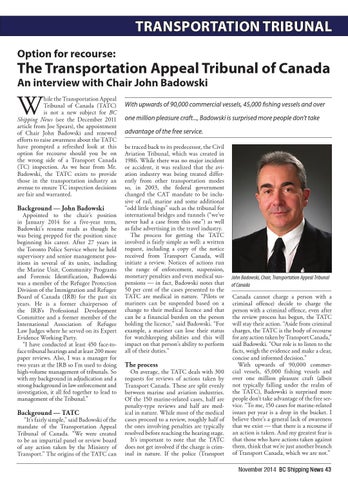
John Badowski, Chair, Transportation Appeal Tribunal of Canada Canada cannot charge a person with a criminal offence) decide to charge the person with a criminal offence, even after the review process has begun, the TATC will stay their action. “Aside from criminal charges, the TATC is the body of recourse for any action taken by Transport Canada,” said Badowski. “Our role is to listen to the facts, weigh the evidence and make a clear, concise and informed decision.” With upwards of 90,000 commercial vessels, 45,000 fishing vessels and over one million pleasure craft (albeit not typically falling under the realm of the TATC), Badowski is surprised more people don’t take advantage of the free service. “To me, 150 cases for marine-related issues per year is a drop in the bucket. I believe there’s a general lack of awareness that we exist — that there is a recourse if an action is taken. And my greatest fear is that those who have actions taken against them, think that we’re just another branch of Transport Canada, which we are not.” November 2014 BC Shipping News 43