issuu Guide:
Digital Publishing for Student Journalists
Students: Get That Front-Row Seat on Life Four things to look forward to as a student storyteller:
1. Peers that are empowered, curious and motivated. 2. Elevating the voices of others. 3. An excuse to talk to fascinating people. 4. The chance to affect change at your school and beyond. Cover Publisher: Mad Sounds
Left
Publication: Take What Is Yours
Publisher: #Photography
Photographer: John Novotny
Publication: Issue 14
Have an Impact There are countless untold stories out there waiting for you to share with the world.
Publisher: Flash and Fuse Publication: Issue 2
Your voice is important. A story can combat ignorance, humanize people, expose corruption and destigmatize taboo topics. With writing, photography and design, you can capture the most hopeful of human endeavors — stories of strength and survival … of overcoming seemingly insurmountable odds … of persevering in the face of extreme challenges.
Step 1: Organization Teamwork + Hierarchy = Squad Chances are there are some mighty-talented people on your school campus, and many are looking for ways to showcase their work, improve their skills or be a voice on campus. A successful magazine can utilize es
olv cal W o L : r l lishe Apri Pub ion: t a c i l Pub
photographers, illustrators, programmers, marketers, business people ‌ the list goes on. Appeal to the opportunity for your fellow peers to have their voices heard, develop new skills, create a portfolio of work, add a powerful experience to their
Publisher: Loca l Wolves Publication: Ap ril
resume and join a new social group.
Editor-in-Chief, a.k.a. Top Dog:
Section Editors:
• Directs the magazine’s overall vision.
• Oversees the design and content
• Educates the staff about journalistic
of their respective sections.
practice, ensuring top quality work
• Guides their section’s stories
is being published. • Facilitates staff discussions, enforces deadlines for each production cycle.
through the entire editorial process. • Maintains an expertise in their section’s topic.
Business Manager:
Creative Director:
• Finds creative ways to cover expenses,
• Develops and maintains the
such as publishing/editing programs,
publication’s overall design, from
travel costs and equipment.
fonts and layout to artistic feel.
• Tracks and utilizes a system for managing the flow of money.
• Aids in the development of specific design-heavy spreads.
Copy Editor:
Staff Writers:
• Ensures no spelling, grammar or style
• Constitutes the life of your publication.
mistakes slip through. • Stays well-versed in AP Style (a standard for all journalistic writing). • Is ultimately responsible for the validity of all facts published.
• Are creative, compelling writers, bold reporters and receptive to feedback. • A diverse group of writers that collectively can dive into an array of issues.
Step 1: Organization
Expansion Pack As your publication grows, you may need to add more structure to keep everything running smoothly. Web/Multimedia Editor: • Builds and updates website for digital outreach. • Drives new traffic with social media channels.
Managing Editor: • Acts as the second in command. • Provides guidance and knowledge to support staff writers and editors.
“The biggest thing if you’re going to be running a publication is organization. You have to make sure people understand what’s going on. If you can do that well, you’ll have a phenomenal staff and quality content.”
Publisher: The Eye Creative Publication: Issue 7
Katie Pickrell, 2016 Colorado Journalist of the Year National Runner-Up
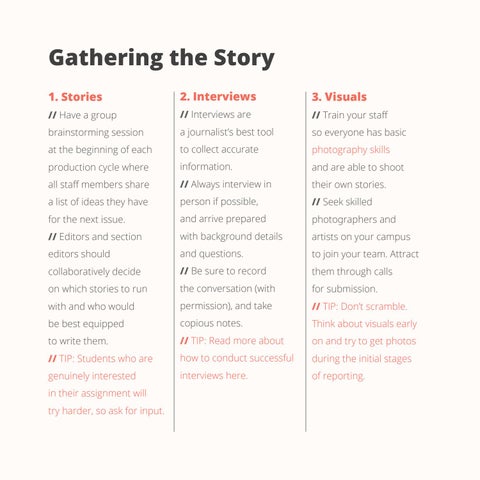
Gathering the Story 1. Stories
2. Interviews
3. Visuals
// Have a group
// Interviews are
// Train your staff
brainstorming session
a journalist’s best tool
so everyone has basic
at the beginning of each
to collect accurate
photography skills
production cycle where
information.
and are able to shoot
all staff members share
// Always interview in
their own stories.
a list of ideas they have
person if possible,
// Seek skilled
for the next issue.
and arrive prepared
photographers and
// Editors and section
with background details
artists on your campus
editors should
and questions.
to join your team. Attract
collaboratively decide
// Be sure to record
them through calls
on which stories to run
the conversation (with
for submission.
with and who would
permission), and take
// TIP: Don’t scramble.
be best equipped
copious notes.
Think about visuals early
to write them.
// TIP: Read more about
on and try to get photos
// TIP: Students who are
how to conduct successful
during the initial stages
genuinely interested
interviews here.
of reporting.
in their assignment will try harder, so ask for input.
Refining 4. Editing
5. Consistency
6. Final Drafts
// Peer editing is the
// AP Style is the norm,
// It’s time for your copy
lifeblood of student
so every editor should
editor to go to town.
publications. Each article
be well versed in AP
Everyone should
should receive feedback
Stylebook rules and
be keeping an eye on AP
and edits from editors,
ensuring all stories
Stylebook rules and fact
fellow staff writers and
adhere to them.
checking to make sure
the copy editor. Although
// The editor-in-chief
everything you publish
this can be a lot of work,
should be looking over
is 100% accurate.
it will inevitably make
everything. In the end, they
you a better writer and
are responsible for what
improve your piece.
gets printed.
// Early checks in the
// Fact check, then check
editing process are critical
it again. Getting details
to make sure the piece is
right is essential.
going in the right direction.
// Resources:
// Resources:
AP Stylebook
Newswriting style guide
Fact checking guide
Long-form journalism guide
Step Step3:3: Journalism Journalism 101 101 A CrashCourse Courseinin A Crash What Meanstotobe be What ititMeans Student a StudentJournalist Journalist:
Reporting Principles: Reporting Principles: Credibility
Credibility Balance Accuracy Accuracy Conflicts ofof Interest Conflicts Interest Clarity
Balance
Clarity
“Early on, make sure you ho
and integrity. Don't allow p
things. Have reporters do t
Tell your staff that they sho
go out and take their own.
the additional phone call o
-— Jack Brook, 2015 California Jou
Publisher: #Photography Publication: Issue 14
old yourselves to high standards of journalistic ethics
people to cut corners, no matter how much easier it will make
their big interviews in person, not over email or the phone.
ouldn't just rely on photos from their sources, but should
. Fact check information, get the correct spelling, make
or interview.�
urnalist of the Year, National Runner Up