AVIATION EPHEMERA 83* Aircraft Archive. A personal archive of cutaways, drawings and photographs relating to aircraft types, contained in 7 ring binders plus a collection of technical drawings/posters and technical manual for the Hunter Mk4
84* Aircraft Recognition. Fifty-six original WWII and early postwar aircraft recognition posters displaying British, German and American types, plus approximately 200 ‘playing card’ size recognition test cards and associated paperwork contained in a small box
(-)
(-)
£100-150
£100-150
85* Aircraft Transport Auxiliary. Veronica Volkersz (1917-2000). Pilot's Flying Logbooks c. 1938-65, Ferry Pilot's Notes, etc., an important group of documents relating to Veronica Volkersz, former beauty queen, one of only 166 World War II ATA women pilots (against 1152 male pilots), the logbooks comprise Veronica's first (CA Form 24) as issued and completed c. 1939-43, commencing with flying training in Gypsy Moths, first solo flight recorded 13.2.39, first solo flight in a Spitfire recorded 12.2.41, first solo flight in a Harvard recorded 12.10.41, and on 12.11.41, while flying Hurricane Z2642 from Calais to Hullavington her remark reads 'guns loaded!'. Veronica's subsequent logbooks (RAF Form 414) have been bound together by her into a single volume, c. 1941-65, the entries detail the wide variety of different types flown during the war, including Hurricanes, Spitfires, Lysanders, Oxfords, Dominie, Wellingtons, Masters, Swordfish, Seafire, Barracuda, Beaufighter, Blenheim, Anson, Hudson, Tiger, Typhoons, Ventura and many others (in all about sixty different types), flying assessment consistently 'above average'. Veronica is also notable for being the first woman in the world to fly an operational jet fighter, delivering a Meteor 3EE386 from the Gloster Meteor Plant at Moreton Valance to RAF 124 Squadron at Molesworth. She was offered no conversion course,no cockpit inspection or helpful hints, just a new printed card to be inserted into her ATA Ferry Pilot's Notes, the occasion is underlined in red in her logbook, both logbooks bound in orig. blue cloth, some wear, oblong 8vo & 4to, together with her ATA Ferry Pilot's Notes, comprising fifty-six printed cards (many double-side), occ. manuscript notes, generally a little soiled and well thumbed, orig. ring-bound blue cloth, worn, approx. 6 x 4.5 in (15 x 11.5 cm), plus Pilot's Notes for Anson 20, 21 & 22, 2nd ed., August 1952, orig. printed card wrappers, a little soiled, and Commercial Pilot's Licence issued 1952 (with updates) and Private Pilot's Licence, issued 1963. A first edition copy of Veronica's biography 'The Sky and I', pub. 1956 is also included in this lot as well as a first edition copy of 'Spitfire Women of World War II', by Giles Whitwell, pub. 2007, both in d.j.
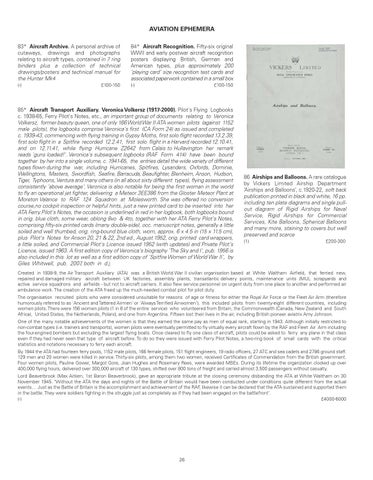
86 Airships and Balloons. A rare catalogue by Vickers Limited Airship Department ‘Airships and Balloons’, c.1920-22, soft back publication printed in black and white, 16 pp. including ten plate diagrams and single pullout diagram of Rigid Airships for Naval Service, Rigid Airships for Commercial Services, Kite Balloons, Spherical Balloons and many more, staining to covers but well preserved and scarce (1)
£200-300
Created in 1938-9, the Air Transport Auxiliary (ATA) was a British World War II civilian organisation based at White Waltham Airfield, that ferried new, repaired and damaged military aircraft between UK factories, assembly plants, transatlantic delivery points, maintenance units (MU), scrapyards and active service squadrons and airfields - but not to aircraft carriers. It also flew service personnel on urgent duty from one place to another and performed air ambulance work. The creation of the ATA freed up the much-needed combat pilot for pilot duty. The organisation recruited pilots who were considered unsuitable for reasons of age or fitness for either the Royal Air Force or the Fleet Air Arm (therefore humorously referred to as 'Ancient and Tattered Airmen' or 'Always Terrified Airwomen'), this included pilots from twenty-eight different countries, including women pilots. There were 156 women pilots (1 in 8 of the entire service) who volunteered from Britain, the Commonwealth (Canada, New Zealand and South Africa), United States, the Netherlands, Poland, and one from Argentina. Fifteen lost their lives in the air, including British pioneer aviatrix Amy Johnson. One of the many notable achievements of the women is that they earned the same pay as men of equal rank, starting in 1943. Although initially restricted to non-combat types (i.e. trainers and transports), women pilots were eventually permitted to fly virtually every aircraft flown by the RAF and Fleet Air Arm including the four-engined bombers but excluding the largest flying boats. Once cleared to fly one class of aircraft, pilots could be asked to ferry any plane in that class even if they had never seen that type of aircraft before. To do so they were issued with Ferry Pilot Notes, a two-ring book of small cards with the critical statistics and notations necessary to ferry each aircraft. By 1944 the ATA had fourteen ferry pools, 1152 male pilots, 166 female pilots, 151 flight engineers, 19 radio officers, 27 ATC and sea cadets and 2786 ground staff. 129 men and 20 women were killed in service. Thirty-six pilots, among them two women, received Certificates of Commendation from the British government. Four women pilots, Pauline Gower, Margot Gore, Joan Hughes and Rosemary Rees, were awarded MBEs. During its lifetime the organization clocked up over 400,000 flying hours, delivered over 300,000 aircraft of 130 types, shifted over 800 tons of freight and carried almost 3,500 passengers without casualty. Lord Beaverbrook (Max Aitken, 1st Baron Beaverbrook), gave an appropriate tribute at the closing ceremony disbanding the ATA at White Waltham on 30 November 1945. "Without the ATA the days and nights of the Battle of Britain would have been conducted under conditions quite different from the actual events... Just as the Battle of Britain is the accomplishment and achievement of the RAF, likewise it can be declared that the ATA sustained and supported them in the battle. They were soldiers fighting in the struggle just as completely as if they had been engaged on the battlefront'. (-) £4000-6000
26