WINTER 2022
REFLECTING BACK & LOOKING FORWARD NONNATIVE SPECIES JAXZOO TUBE TREES PAST AND FUTURE INSPIRATION ON THE HORIZON PHOTO: JASON GULLEY
Say Hello to Our New Logo Jacksonville Zoo and Gardens is connecting our community with wildlife and wild places. As part of this mission, we’re launching a new logo for WILD Magazine.
Last year we transitioned the member magazine to a digital platform to align with our commitment to conservation by reducing our environmental footprint. The logo may have been updated, but as a JZG member you’ll continue to receive exclusive access to articles, updates, and insider information about the happenings at the Zoo.
ON THE COVER Photo by Dr. Jason Gulley. Geologist.Writer. Photographer. National Geographic Explorer.
PHOTO: JASON GULLEY
Don't miss the opportunity to see Dr. Jason Gulley during Toast To Conservation.
AT JACKSONVILLE ZOO AND GARDENS to benefit manatee rescue, rehabilitation and release
SATURDAY, FEBRUARY 5, 6-10pm
featuring
Page 5
DR. JASON GULLEY
DR. ROBERT BONDE
Geologist. Writer. Photographer. National Geographic Explorer.
Research Biologist. Scientist Emeritus with U.S. Geological Survey.
JACKSONV ILLEZOO.ORG/TOAST
Table Of Contents 2 Who's Who at the Zoo
22 Animal Highlights: Cotton-top Tamarins
5 Toast to Conservation
24 Education: Kids & Family Programs
6 Jax ZooTube
26 Conservation: Saving Florida’s Pristine
7 Thank You ZooLights Sponsors
8 What's New: Births, Hatchings, Acquisitions
30 Animal Highlights: Asian Small-clawed Otters
11 ExZOOberation: Havanna Nights
32 Social Spotlight
11 Teddy Bear Affair
36 Snapshot Society: Gone But Not Forgotten
12 Animal Highlights: Squirrel Monkey 16 Development: Inspiration on the Horizon 18 Gardener's Corner: Trees Reflecting on the
Past & Looking Forward to the Future
Waters and Unique Wildlife
A Fond Look Back at Past Species
42 Animal Programs: Nonnative Species of Florida 46 Past Exhibits & Event Opening Highlights 53 Volunteers: Join ZooTeens 54 Book Your Next Event
SENIOR MANAGEMENT Tony Vecchio, President and CEO Teresa Kennedy, Chief Operating Officer Holly Ellis, Chief Financial Officer Nikki Smith, Chief Development Officer Paula Shields, Director of Human Resources Leanne White, Director of Education Kelly Rouillard, Director of Marketing & Sales Rick Holzworth, Director of Support Services EXECUTIVE COMMITTEE Chuck Ged, Chair Missy Peters, Secretary George Mikes, VC Finance Janna McNicholas, VC Animal Care, Conservation and Wellness Lucia Lindsey, VC Capital Campaign Anne Marie Cushmac, VC Governance John Hayt, Honorary Advisor John McIlvaine, VC Marketing & Development Kelly Coker-Daniel, VC Education Kerri Stewart, VC Special Projects & Properties Karen Estella Smith, VC Garden & Art *Leanne Cryer, Mayoral Appointee *City of Jacksonville Appointed
GENERAL BOARD Paul Blackstone Scott Chamberlayne Asher Chanan-Khan, M.D. Jonathan Coles *LeAnna Cumber Kenyonn Demps Margaret Hicks Rene Kurzius Barney Lane Cyrus Moshiree John Naugle Missy Peters *Ju’Coby Pittman Clint Pyle Bill Rowe Param Sahni Paul Sandler Joel Swanson Salmaan Wahidi Darryl Willie Scott Witt HONORARY BOARD Ivan Clare Dano Davis Lenore McCullagh
Elizabeth Petway Herbert Peyton Clifford Schultz Frank Surface Janet Vaksdal Weaver HONORARY PAST CHAIRS COUNCIL Martha Baker J.F. Bryan Howard Coker Charles Commander Jed Davis Matt Fairbairn Joseph Hixon J. Michael Hughes Lewis Lee David Loeb Richard Martin Frank Miller John A. Mitchell Thomas Schmidt Carl "Hap" Stewart James Stockton Penny Thompson Courtenay Wilson
WILD MAGAZINE • SPRING 2022 • JACKSONVILLE ZOO AND GARDENS
1
WHO'S WHO AT THE ZOO
Employee Reflections As we reflect on the past and look forward to the future, we asked some of our long-term employees their favorite things about working here and what they look forward to the most.
Video: Craig Miller, Curator of Mammals
Craig also appears on page 29 and page 51.
2
WILD MAGAZINE • SPRING 2022 • JACKSONVILLE ZOO AND GARDENS
Peggy Lehew, Lead Guest Service Associate
How long have you worked here? I have worked at the Zoo for 21 and a half years. What positions have you held here? I started off as a train driver and then was promoted to Lead Guest Service Associate. What got you started in your career? I needed a job and was told about a job fair at the Zoo. What is your favorite plant or animal fact? I have too many favorites to pick just one! I would have to say though, if I only had time during a visit to see one plant and one animal, I would want to see Bird of Paradise and Chimpanzee. What makes this park special to you? I love interacting with the guests and associates. I have made some wonderful friends here! What upcoming changes make you most excited? The upcoming construction on the front entrance and finishing Asia. I love Orangutans and can't wait till we finally get them!
If you could turn into an animal, what would it be? Why? I would want to be a bear. I enjoy eating and sleeping. If I was a bear, I could eat all Spring and Summer, then hibernate all Fall and Winter. If you could bring back an extinct species, what would it be? Why? I can’t think of an extinct species, but if I can help an endangered species, I’d choose Okapi. I think they are cool looking, and I have been kissed on the head by one. Name an animal species you haven’t seen in person that you wish you could. I believe I have seen them all. I have visited several Zoos across the US. To name a couple, I've seen a Giant Panda at Zoo Atlanta and I have seen an African Wild Dog at Columbus Zoo. What soundtrack plays in your head while you work? The soundtrack that plays at the carousel. Lol, I can hear it throughout my work area.
What is your favorite memory of working here? The Chimpanzees when we had them. Every day, I would be sure to visit Jackson, the only male chimp. See a picture of Jackson on page 38.
WILD MAGAZINE • SPRING 2022 • JACKSONVILLE ZOO AND GARDENS
3
Jennifer Blondin, Exhibit Guide
How long have you worked here? 15 years What positions have you held here? I have been an Education Exhibit Guide and have helped with Camp and Homeschool programs as needed. What got you started in your career? My previous job had been phased out, so I took a temporary job and prayed for the next step. This was the answer. What is your favorite plant or animal? I love seeing Giraffes when they sleep curl their necks around and rest their chins on their backside. What makes this park special to you? It is a beautiful garden setting with amazing animals and guests who are excited to be here. What upcoming changes make you most excited? I look forward to the new entrance pavilion, with Manatee River, as you enter the Zoo.
4
WILD MAGAZINE • SPRING 2022 • JACKSONVILLE ZOO AND GARDENS
What is your favorite memory of working here? I have two. First, I enjoy watching animal training, Gorillas, Tigers and Stingrays; it never gets old. Second, I am excited when I see coworkers, who have worked very hard, achieve the positions they have been striving for. If you could turn into an animal, what would it be? Why? A bird because how much fun would it be to fly. If you could bring back an extinct species what would it be? Why? A Xerces Blue Butterfly, they are beautiful. Name an animal species you haven’t seen in person that you wish you could. I would love to see a Fennec Fox. What soundtrack plays in your head while you work? I love music, especially Enya, Lord of the Rings, but when working nothing is better than just sounds from outside with nothing else added.
PHOTO: JASON GULLEY
AT JACKSONVILLE ZOO AND GARDENS to benefit manatee rescue, rehabilitation and release
SATURDAY, FEBRUARY 5, 6-10pm
featuring
DR. JASON GULLEY
DR. ROBERT BONDE
Geologist. Writer. Photographer. National Geographic Explorer.
Research Biologist. Scientist Emeritus with U.S. Geological Survey.
JACKSONVILLEZOO.ORG/TOAST WILD MAGAZINE • SPRING 2022 • JACKSONVILLE ZOO AND GARDENS
5
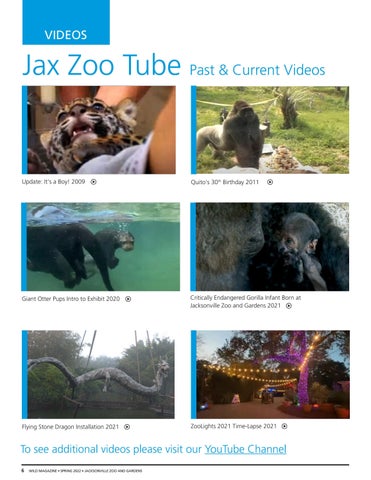
VIDEOS
Jax Zoo Tube Past & Current Videos
Update: It's a Boy! 2009
Quito's 30th Birthday 2011
Giant Otter Pups Intro to Exhibit 2020
Critically Endangered Gorilla Infant Born at Jacksonville Zoo and Gardens 2021
Flying Stone Dragon Installation 2021
ZooLights 2021 Time-Lapse 2021
To see additional videos please visit our YouTube Channel 6
WILD MAGAZINE • SPRING 2022 • JACKSONVILLE ZOO AND GARDENS
Thank you to our sponsors Presented by
Sponsored by
WILD MAGAZINE • SPRING 2022 • JACKSONVILLE ZOO AND GARDENS
7
WHAT'S NEW
Births, Hatchings, Acquisitions By Donna Bear, Curator of Species Management, and Jasmine Alvarado, Species Management Officer
Greater Kudu (Tragelaphus strepsiceros) The greater kudu is the tallest of the African antelopes. Depending on the subspecies, greater kudu can be found in different regions throughout Africa such as Ethiopia, Kenya, Tanzania, Zimbabwe and South Africa. The most prominent feature of the greater kudu is its horns. The average straightline length of a male kudu’s horn is 35 inches long. Including the curves, their horns can reach up to 51 inches, almost the width of a full-size bed. A male’s age can be determined based on the number of spirals in the horns. At two years, he will have one full spiral and at four or four and a half years, he will have at least two full spirals. In the wild, the greater kudu can live from seven to 15 years of age. In captivity, they can live up to 23 years. The Zoo has been housing kudus since 1976. While greater kudu is listed as Least Concern on the IUCN Red List, their population is still threatened by poaching, human encroachment, habitat modifications, excessive cattle grazing and disease transmission from cattle.
PHOTOS: JOHN REED
Guianan Squirrel Monkey (Saimiri sciureus) The Guianan squirrel monkey is just one of seven species of squirrel monkey. As the name suggests, the Guianan squirrel monkeys’ geographic distribution ranges from the French Guiana to northern Brazil, above the Amazon River. The species are distinguished from each other by their coloring and markings. Guianan squirrel monkeys are generally grayish/greenish to reddish agouti (meaning the same hair strand displays more than one color). Depending on the subspecies of squirrel monkey, their limbs and hands can be more yellowish orange. In the wild, squirrel monkeys are primarily insectivores and frugivores. But when insects or fruit are scarce, they will eat flowers, spiders, lizards and even bird eggs. The Zoo received its first squirrel monkeys back in 1972.
WILD MAGAZINE • SPRING 2022 • JACKSONVILLE ZOO AND GARDENS
9
Florida ivory millipede (Chicobolus spinigerus) The Florida ivory millipede—a brand-new species for the Zoo—is just one of the 50 species of millipede native to Florida. With a dark color on the top and light-colored underbelly and legs, ivory millipedes can grow up to three and a half inches—that’s longer than a credit card! While often sold as household pets, they do more than just roll into a ball when frightened.
When threatened, ivory millipedes secrete a toxin called hydrogen cyanide, a chemical that can burn the skin or cause an allergic reaction. But there’s no need to worry about any of that if you are gentle when holding them. The millipedes are used in our education programs.
April–June 2021
Acquisitions
Births & Hatchings
Florida Ivory Millipedes * ..................................................0.0.15 FLORIDA MANATEE ................................................................0.2
Cownose Ray............................................................................1.0 Giraffe........................................................................................1.2 Greater Kudu............................................................................0.1 Guianan Squirrel Monkey...................................................0.0.1 Gulf Coast Waterdog ........................................................0.0.68 Striped Newt .................................................................... 0.0.235
10
WILD MAGAZINE • SPRING 2022 • JACKSONVILLE ZOO AND GARDENS
LEGEND: 0.1.2 • • • • • •
First digit male. Second digit female Third digit sex unknown Two digits only represent male and female CAPS = Endangered Species * (Asterisk) = First time at the Zoo †(Dagger) = Released back into the wild
A RY
N
2
Ex OOberation 5T
NIVE
RS
L 2 , 2 02 I R A PSAVE THE DATE 2
WILD MAGAZINE • SPRING 2022 • JACKSONVILLE ZOO AND GARDENS
11
H A
ANIMAL HIGHLIGHTS
Squirrel Monkey There's a new resident in Play Park! Though this little one was born in September 2021, the gender is not yet known. Animal care staff has left mom and baby to bond in the company of their troop. Be sure to stop and say hello to the infant during your next visit!
12
Zoo Exhibits Play Park and Range of the Jaguar
Habitat Tropical forests
Diet Fruit, leaves, insects, frogs and invertebrates.
Range Bolivia, Brazil, Colombia, Ecuador, French Guiana, Guyana, Peru, Suriname, Paraguay and Venezuela.
WILD MAGAZINE • SPRING 2022 • JACKSONVILLE ZOO AND GARDENS
Range (con't) A small population of squirrel monkeys have been introduced to Southern Florida and many Caribbean Islands Conservation Status IUCN Redlist Vulnerable
PHOTO TOP: JOHN REED
WILD MAGAZINE • SPRING 2022 • JACKSONVILLE ZOO AND GARDENS
13
WILD MAGAZINE • SPRING 2022 • JACKSONVILLE ZOO AND GARDENS
15
DEVELOPMENT
Inspiration on the Horizon By Morgan Purvis, Corporate Giving Officer
Jacksonville Zoo and Gardens has big dreams to be bold and revolutionary. We want to welcome Florida visitors as we endeavor to become one of the best zoos in the country while doubling down on our commitment to environmental education and global conservation. These dreams are closer than you may think. So how are we going to get there? We just announced a five-year, $50 million campaign to make significant improvements to our organization. REZOOVENATION: The Campaign to Inspire will expand wellness-inspired habitats for animal care, grow conservation initiatives, offer enhanced educational spaces and introduce new species. The first phase of REZOOVENATION includes the construction of Manatee River, being supported first by $3 million from J. Wayne and Delores Barr Weaver, Honorary Chairs of this campaign. Florida’s most beloved and charismatic species will greet our Members and guests entering the Zoo from their new exhibit, paying homage to the vibrant natural world surrounding North Florida. This new first-impression habitat will solidify the Zoo’s position as a leader in Florida wildlife conservation and animal wellness.
16
WILD MAGAZINE • SPRING 2022 • JACKSONVILLE ZOO AND GARDENS
Other planned improvements through REZOOVENATION include a new lion habitat with a scenic overlook, an expanded and immersive elephant exhibit and the addition of orangutans in a space with extensive room to climb. At its core, REZOOVENATION is about inspiring the future. We would not be where we are today without the help of supporters like you—and we look forward to sharing new, inspiring experiences among our animals and gardens with you and your loved ones in the future. Our goal is to raise $5 million per year from private sources, which will be matched for another $5 million per year thanks to the support of Mayor Lenny Curry and Jacksonville City Council. To learn more about the campaign and giving, visit jacksonvillezoo.org/rezoovenation
jacksonvillezoo.org/rezoovenation
TIGER PHOTO: JOHN REED
GARDENER'S CORNER
Trees Reflecting on the Past & Looking Forward to the Future By Chris Dailey, Horticulture Manager
In previous writing, I have described some of my favorite Florida native trees, many of which the horticulture team are currently planting in our new parking lot. Another of my favorite trees is the cabbage palm (Sabal palmetto). The cabbage palm, also commonly called Sabal palm, is the state tree of Florida. In my opinion it is the finest palm species for the Florida landscape. It is very easy to care for, long-lived, hardy and problem free.
18
WILD MAGAZINE • SPRING 2022 • JACKSONVILLE ZOO AND GARDENS
WILD MAGAZINE • SPRING 2022 • JACKSONVILLE ZOO AND GARDENS
19
For wildlife, the cabbage palm provides many benefits. The berries feed birds and mammals and the flowers feed bees. The leaves and boots provide shelter and habitat for many animals, like bats, birds, reptiles and amphibians. And the boots create growing places for epiphytic plants. Historically, humans have relied on the cabbage palm for many uses. The trunks and leaves have been used as building materials. The heart and berries are a source of food. The leaves have been woven and crafted into various tools, implements and textiles. The berries have various reported traditional medicinal uses.
Fifty six brand new cabbage palms have been planted in our new parking lot. Throughout the Zoo, there are hundreds of cabbage palms. Some were planted by us and some are naturally occurring. Of all our solitary palm species, there are far more cabbage palms than others. They are in just about every area of the park. Cabbage palms are one of the best trees for exhibits, as they tolerate constant pressure from tough animals like giraffe, rhinoceros and gorilla.
These palms have always been a big part of the gardens. On your next visit, give them a second look and remember how much they are appreciated.
WILD MAGAZINE • SPRING 2022 • JACKSONVILLE ZOO AND GARDENS
21
ANIMAL HIGHLIGHTS
Cotton-top Tamarins
22
WILD MAGAZINE • SPRING 2022 • JACKSONVILLE ZOO AND GARDENS
PHOTO TOP: JOHN REED
Zoo Exhibits Emerald Forest Aviary in the Range of the Jaguar
Habitat Tropical forest edges and secondary forests.
Diet Fruit, flowers, nectar, plant gums and saps, animal prey (insects, small vertebrates) and bird eggs
Range Northwestern Colombia
Squirrel Monkey (Saimiri sciureus) Play Park
Conservation Status IUCN: Critically Endangered
EDUCATION
Kid & Family Programs Upcoming Events By Jamie Gilkison, Education Engagement Supervisor
Event Descriptions Stroller Safari It's a special introduction to the Zoo for our littlest guests. Make new friends while you visit animal exhibits, meet a friendly animal ambassador and explore the animal world with all your senses.
Spring Zoo Camp Stretch your legs and join us for Spring Zoo Camp. Spend a day or two exploring the natural world while playing games, meeting animals and chatting with keepers.
January
March
Natures Newbies & Zoo Tots Spring Semester Registration opened mid-January Programming starts in mid-February. •
More Info
February Wild Family Workshops February 12, 2022 The Snuggle Is Real Ages 4 and older •
Homeschool Zoocademy Session 4 •
Wild Family Workshops March 12, 2022 Farm to Table Ages 4 and older •
More Info
Stroller Safari Bird Aviaries February 22 and 26, 2022 8:45–9:30 a.m. Ages 0–3 •
24
More Info
More Info
WILD MAGAZINE • SPRING 2022 • JACKSONVILLE ZOO AND GARDENS
More Info
Wild Family Workshops These workshops will be an opportunity for you to spend quality time together, explore and learn about plants and animals, while participating in hands-on, naturebased activities.
Spring Zoo Camp: Passport to Adventure March 14–18, 2022 9:00 a.m.–4:00 p.m. K–5th grades •
More Info
Stroller Safari Africa Loop March 22 and 26, 2022 8:45–9:30 a.m. Ages 0–3 •
More Info
PASSPORT TO ADVENTURE | MARCH 14 -18 WILD MAGAZINE • SPRING 2022 • JACKSONVILLE ZOO AND GARDENS
25
CONSERVATION
Saving Florida’s Pristine Waters and Unique Wildlife: A Critical Winter for the Florida Manatee By Fátima Ramis, Assistant Curator of Conservation
26
WILD MAGAZINE • SPRING 2022 • JACKSONVILLE ZOO AND GARDENS
Florida’s friendly giants spend the year traveling throughout the state and along the coast of the U.S., from Texas to New England and can even make it as far south as Cuba. However, when water temperatures decrease to 68 degrees Fahrenheit or below, manatees need to have daily access to warm water refuges found in our state. These warm water pockets are places in which hundreds of manatees gather and rest throughout the winter months, when they’re not making daily runs to feed in the cold waters nearby. However, over the last few decades, multiple stresses have been placed on some of these ecological communities, depleting nutritional resources to manatees and many other species.
“…over the last few decades, multiple stresses have been placed on some of these ecological communities, depleting nutritional resources to manatees and many other species.”
View of Trout River from River View Gardens
The Indian River Lagoon (IRL), a 156-mile estuary, is a critical winter habitat for manatees, that has experienced a progressive loss of seagrass precipitated by algae blooms, which occur due to an excess of nutrients in our water systems. These excessive nutrients originate from our own use of fertilizers and waste and inevitably end up in our water systems. The IRL is so important because one of the largest congregations of manatees takes place at a power plant discharge toward the northern end, with numbers known to exceed two thousand.
MANATEE PHOTOS: U.S. Fish and Wildlife Service, CC, Flickr and U.S. Geological Survey, Public Domain
WILD MAGAZINE • SPRING 2022 • JACKSONVILLE ZOO AND GARDENS
27
2021 was a record-breaking year for manatee mortalities across the state of Florida, with more than one thousand deaths, the majority taking place and being attributed to reduction in food availability in the IRL. This is about 12 percent of their estimated population. The crisis experienced by manatees is a symptom of the issues Florida waters are currently facing. Seagrass does not just feed manatees; it is vital to the health of our coastal ecological communities and our economy. This year, $8 million dollars was appropriated for seagrass habitat restoration by law makers. However, this issue will not be resolved overnight; it is expected that 2022 will also be difficult. Therefore, on December 2, 2021, the U.S. Fish & Wildlife Service (FWS) and Florida Fish and Wildlife Conservation Commission (FWC) made the unprecedented decision to experimentally provide supplemental feeding to manatees in the northern IRL, where large numbers of manatees normally gather throughout the winter months. This enormous and complicated effort will be matched by an increase in the collective capacity for the Manatee Rescue & Rehabilitation Partnership to rehabilitate manatees in need. Your zoo serves as a key acute care facility, being the only one in Northeast Florida.
28
WILD MAGAZINE • SPRING 2022 • JACKSONVILLE ZOO AND GARDENS
PHOTO: U.S. Fish and Wildlife Service, CC, Flickr
Please remember that feeding and interacting with manatees continues to be illegal. If you spend time near the water and encounter a distressed manatee, please report it to the Florida Fish and Wildlife Conservation Commission’s wildlife alert hotline: (888) 404-FWCC (3922).
Video: Prevent Manatee Mortalities, June 2021 Watch Craig Miller's discussion on manatees. Craig also appears on page 2 and page 51.
WILD MAGAZINE • SPRING 2022 • JACKSONVILLE ZOO AND GARDENS
29
ANIMAL HIGHLIGHTS
Asian Small-clawed Otters
30
WILD MAGAZINE • SPRING 2022 • JACKSONVILLE ZOO AND GARDENS
PHOTOS: JOHN REED
Zoo Exhibits Land of the Tiger Diet Crabs, snails and other molluscs, insects and small fish.
Habitat Freshwater rivers, lakes and ponds surrounded by moderate vegetations.
Conservation Status IUCN Redlist Vulnerable
Range From India, throughout Southeast Asia and into southern China
WILD MAGAZINE • SPRING 2022 • JACKSONVILLE ZOO AND GARDENS
31
SOCIAL SPOTLIGHT
Tag your posts with #jaxzoomember for a chance to see your pictures or videos in Wild Magazine.
Facebook privacy setting need to be set to public in order for us to see that you've made a #jaxzoomember post. Don't forget to change the privacy settings back on your next post. Our Extraordinary Ordinary Life Zoolights 2021 Jacksonville Zoo, Better than Ever
The Johnson Crew Come Tour The Zoo With Us! Jacksonville Zoo Homeschool Field Trip 32
WILD MAGAZINE • SPRING 2022 • JACKSONVILLE ZOO AND GARDENS
Off Our Couch Tour of Jacksonville Zoo and Gardens Total Experience Ticket
my_enchanting_florida_life
hamburgevons
Dana Rice
WILD MAGAZINE • SPRING 2022 • JACKSONVILLE ZOO AND GARDENS
33
redfraggle32 34
WILD MAGAZINE • SPRING 2022 • JACKSONVILLE ZOO AND GARDENS
Melissa Martin
sroxu 1 WILD MAGAZINE • SPRING 2022 • JACKSONVILLE ZOO AND GARDENS
35
SNAPSHOT SOCIETY
Gone But Not Forgotten
A Fond Look Back at Past Species By John Reed, Photography Volunteer & Snapshot Society Instructor
Amur Leopard (Panthera pardus orientali). Species is not currently at the Zoo. Date taken: 1/21/06
36
WILD MAGAZINE • SPRING 2022 • JACKSONVILLE ZOO AND GARDENS
Florida Panther (Puma concolor coryi). Species is not currently at the Zoo. Date taken: 01/28/11
Red Wolves (Canis rufus). Species is not currently at the Zoo. Date taken: 01/25/11
WILD MAGAZINE • SPRING 2022 • JACKSONVILLE ZOO AND GARDENS
37
Chimpanzee (Pan troglodytes). Species is not currently at the Zoo. Date taken: 06/25/04
38
WILD MAGAZINE • SPRING 2022 • JACKSONVILLE ZOO AND GARDENS
Red Ruffed Lemur (Varecia rubra). Species is not currently at the Zoo. Date taken: 07/04/04
WILD MAGAZINE • SPRING 2022 • JACKSONVILLE ZOO AND GARDENS
39
Meerkat (Suricata suricatta). Species is not currently at the Zoo. Date taken: 04/26/04
40
WILD MAGAZINE • SPRING 2022 • JACKSONVILLE ZOO AND GARDENS
Harpy Eagle (Harpia harpyja). Species is not currently at the Zoo. Date taken: 09/18/05
Southern Ground Hornbill (Bucorvus leadbeateri). Species is not currently at the Zoo. Date taken: 08/13/05
WILD MAGAZINE • SPRING 2022 • JACKSONVILLE ZOO AND GARDENS
41
ANIMAL PROGRAMS
Nonnative Species of Florida By Jasmine Alvarado, Species Management Officer
Green Iguana (Iguana iguana) They cause negative impacts to local wildlife and damage residential and commercial landscape vegetation. They are considered an invasive species and were added to Florida's Prohibited Species List in April 2021. These iguanas are not located at the Zoo and are found in southern counties of Florida.
Florida is one of the most biologically diverse states in America. It has more than 4,000 known animal species, of which almost 300 of them are only found in Florida. Our native wildlife is at risk due to the increased number of invasive species, specifically nonnative animals that are negatively affecting Florida’s ecosystem.
A Green anaconda can be seen in the Temple at Range of the Jaguar. This species is not established in the wild in Florida. The FWC Management Focus includes preventing populations from establishing and limiting possession through regulation.
There are currently 139 nonnative species of fish and other wildlife that have established populations in Florida. We have more nonnative species living and breeding in the wild than any other place in the world. Many of these species were introduced via the exotic pet trade, such as the Burmese python, black-and-white tegu and the green iguana, all of which became listed as prohibited species and are now illegal to keep as pets in the state of Florida. While their populations are only established in southern Florida, sightings have been recorded throughout the state, most likely the result of people releasing their “pets” to the wild when they get too big and expensive to maintain.
Invasive species disrupt Florida ecosystems by altering the predator-to-prey balance to such extremes that our native flora and fauna cannot compete. Invasive animals have no natural predators and they prey on Florida’s native species including endangered and threatened wildlife. There are many different programs to help curb the population of invasive species. The Florida Fish and Wildlife Conservation Commission (FWC) developed the Exotic Pet Amnesty Program in 2006 that gives exotic pet owners a responsible alternative to releasing a pet. For no costs or legal penalties, no matter the regulatory status (e.g., prohibited or conditional), anyone can have their pet rehomed to an approved adopter for whatever reason. While the pet does have to stay at the original owner’s home until an adopter can be found, this gives a second chance to these animals that would have otherwise been released into the wild or euthanized. Anyone can apply to become an adopter. WILD MAGAZINE • SPRING 2022 • JACKSONVILLE ZOO AND GARDENS
43
Burmese Python (Python bivittatus) A Burmese Python can be seen in the WIld Florida Herpetology House. In 1992 Category 5 Hurricane Andrew struck south Florida which included a Burmese Python breeding facility. Many of the breeding facility snakes escaped during the storm and survived in the wild.
44
WILD MAGAZINE • SPRING 2022 • JACKSONVILLE ZOO AND GARDENS
Today, the Everglades are overrun with thousands of these snakes. They continue to decimate local populations of raccoons, opossums, rabbits and foxes.
Besides adopting an exotic animal, you can report any sightings to FWC of nonnative species out in the wild throughout Florida. Either online or via the app IveGot1, you can upload photos and share the location where you found the animal. There’s also a hotline, (888) 483-4681, where you can speak with a live operator or leave a voicemail. It is never recommended to approach any of these nonnative animals if encountered in the wild. The best thing that you can do is report and observe from a distance.
The Zoo is a current Prohibited Species permit holder for our African Rock Python, Burmese Python and Green Anaconda. We began housing these species in 1966 and as a permit holder, we are required to make reports annually, educate about these species as well as maintain exhibits that meet the FWC standard regulations.
Additional Information:
Myfwc: Florida's Nonnative Fish and Wildlife Eddmaps: Map of Known Nonnative Species Sightings
African Rock Python (Python sebae) An African Rock Python can be seen in the Africa Loop Herpetology House. They are considered an invasive species and were added to Florida's Prohibited Species List in April 2021. They are also listed as an Injurious Species by the United States Fish and Wildlife Service (USFWS) which prevents their importation to the States.
Black and White Tegus (Tupinambis merianae) They prey upon imperiled and protected native Florida species including juvenile gopher tortoises. They are considered an invasive species and were added to Florida's Prohibited Species List in April 2021. These lizards are not located at the Zoo and are found in southern counties of Florida.
WILD MAGAZINE • SPRING 2022 • JACKSONVILLE ZOO AND GARDENS
45
Past Exhibits & Event Opening Highlights 2008 Stingray Bay
46
WILD MAGAZINE • SPRING 2022 • JACKSONVILLE ZOO AND GARDENS
PHOTO: JOHN REED
2009 Asian Bamboo Gardens and Komodo Dragons
WILD MAGAZINE • SPRING 2022 • JACKSONVILLE ZOO AND GARDENS
47
2010 Tuxedo Coast and Penguins
48
WILD MAGAZINE • SPRING 2022 • JACKSONVILLE ZOO AND GARDENS
2012 Butterfly Hollow and First ZooLights
WILD MAGAZINE • SPRING 2022 • JACKSONVILLE ZOO AND GARDENS
49
2014 Land of the Tiger
50
WILD MAGAZINE • SPRING 2022 • JACKSONVILLE ZOO AND GARDENS
2017 Campground Critters and Manatee Critical Care Center
WILD MAGAZINE • SPRING 2022 • JACKSONVILLE ZOO AND GARDENS
51
2018 African Forest
52
WILD MAGAZINE • SPRING 2022 • JACKSONVILLE ZOO AND GARDENS
VOLUNTEERS
Join ZooTeens! Are you a high schooler passionate about biology, animals, conservation and environmental issues? If so, consider applying for our ZooTeens! Program. In addition to furthering your knowledge on these topics, ZooTeens! is a great opportunity for teens to gain leadership experience, over 100 hours of volunteer service, public speaking confidence and memories to last a lifetime.
Students often join ZooTeens! and continue their involvement with the Zoo for many years to come. Many find part-time jobs, internships and careers here using their experience and interest to further their commitment. Just as the Zoo grows in size, experiences and scope, many ZooTeens! are personally growing alongside it. One of our long-standing ZooTeens! has some thoughts below. He briefly shares the growth he has witnessed during his childhood and young adult life.
I would not be where I am today without Jacksonville Zoo and Gardens. If you count all the different things I have been involved with at the Zoo, I probably have seen more changes and experinced more growth than many staff members. I started zoo camp in the 1st grade and attended every consecutive year, joined the ZooTeens! program for four years and now am an employee. Of all my time here, I have witnessed so many exciting changes from brand new exhibits, renovations and even a pandemic. I still have fond memories of animals that are no longer here at the Zoo like sea lions, falcons, kangaroos and more. I am very excited to witness all the new additions and plan to create fond memories with them as well. Throughout my many years, I have formed bonds with numerous staff members, which I am proud to call my Jacksonville Zoo and Gardens-Family. All the staff and volunteers, both present and past, work so hard to create these memories for myself and others. The Zoo has accomplished so many amazing things and we will do great work in conservation and animal wellness far past my time. — Jacob Darr If you want to see our organization continue to grow over the years and create these experiences for yourself, join the ZooTeens! Program in 2022.
More information can be found on our website and applications will be posted in February of this year. For questions, please email zooteen@jacksonvillezoo.org. We look forward to spending the summer with you!
WILD MAGAZINE • SPRING 2022 • JACKSONVILLE ZOO AND GARDENS
53
Book Your Next Event Dynamic indoor and outdoor spaces available jacksonvillezoo.org/venue-rentals