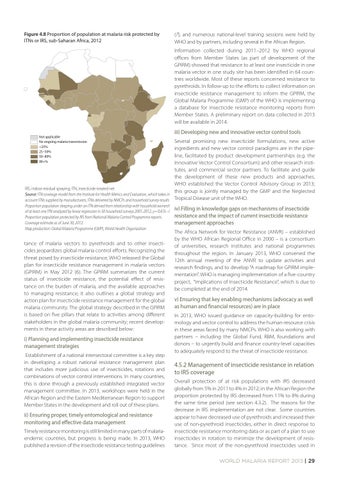
Figure 4.8 Proportion of population at malaria risk protected by ITNs or IRS, sub-Saharan Africa, 2012
(7), and numerous national-level training sessions were held by WHO and by partners, including several in the African Region. Information collected during 2011–2012 by WHO regional offices from Member States (as part of development of the GPIRM) showed that resistance to at least one insecticide in one malaria vector in one study site has been identified in 64 countries worldwide. Most of these reports concerned resistance to pyrethroids. In follow-up to the efforts to collect information on insecticide resistance management to inform the GPIRM, the Global Malaria Programme (GMP) of the WHO is implementing a database for insecticide resistance monitoring reports from Member States. A preliminary report on data collected in 2013 will be available in 2014.
Not applicable No ongoing malaria transmission <25% 25–50% 50–80% 80+%
IRS, indoor residual spraying; ITN, insecticide-treated net Source: ITN coverage model from the Institute for Health Metrics and Evaluation, which takes in account ITNs supplied by manufacturers, ITNs delivered by NMCPs and household survey results Proportion population sleeping under an ITN derived from relationship with household ownersh of at least one ITN analyzed by linear regression in 50 household surveys 2001-2012, y= 0.67x - 0 Proportion population protected by IRS from National Malaria Control Programme reports. Coverage estimate as of June 30, 2012. Map production: Global Malaria Programme (GMP), World Health Organization
tance of malaria vectors to pyrethroids and to other insecticides jeopardizes global malaria control efforts. Recognizing the threat posed by insecticide resistance, WHO released the Global plan for insecticide resistance management in malaria vectors (GPIRM) in May 2012 (6). The GPIRM summarizes the current status of insecticide resistance, the potential effect of resistance on the burden of malaria, and the available approaches to managing resistance; it also outlines a global strategy and action plan for insecticide resistance management for the global malaria community. The global strategy described in the GPIRM is based on five pillars that relate to activities among different stakeholders in the global malaria community; recent developments in these activity areas are described below: i) Planning and implementing insecticide resistance management strategies Establishment of a national intersectoral committee is a key step in developing a robust national resistance management plan that includes more judicious use of insecticides, rotations and combinations of vector control interventions. In many countries, this is done through a previously established integrated vector management committee. In 2013, workshops were held in the African Region and the Eastern Mediterranean Region to support Member States in the development and roll out of these plans. ii) Ensuring proper, timely entomological and resistance monitoring and effective data management Timely resistance monitoring is still limited in many parts of malariaendemic countries, but progress is being made. In 2013, WHO published a revision of the insecticide resistance testing guidelines
iii) Developing new and innovative vector control tools Several promising new insecticide formulations, new active ingredients and new vector control paradigms are in the pipeline, facilitated by product development partnerships (e.g. the Innovative Vector Control Consortium) and other research institutes, and commercial sector partners. To facilitate and guide the development of these new products and approaches, WHO established the Vector Control Advisory Group in 2013; this group is jointly managed by the GMP and the Neglected Tropical Disease unit of the WHO. iv) Filling in knowledge gaps on mechanisms of insecticide resistance and the impact of current insecticide resistance management approaches The Africa Network for Vector Resistance (ANVR) – established by the WHO African Regional Office in 2000 – is a consortium of universities, research institutes and national programmes throughout the region. In January 2013, WHO convened the 12th annual meeting of the ANVR to update activities and research findings, and to develop “A roadmap for GPIRM implementation”. WHO is managing implementation of a five-country project, “Implications of Insecticide Resistance”, which is due to be completed at the end of 2014. v) Ensuring that key enabling mechanisms (advocacy as well as human and financial resources) are in place In 2013, WHO issued guidance on capacity-building for entomology and vector control to address the human-resource crisis in these areas faced by many NMCPs. WHO is also working with partners – including the Global Fund, RBM, foundations and donors – to urgently build and finance country-level capacities to adequately respond to the threat of insecticide resistance.
4.5.2 Management of insecticide resistance in relation to IRS coverage Overall protection of at risk populations with IRS decreased globally from 5% in 2011 to 4% in 2012; in the African Region the proportion protected by IRS decreased from 11% to 8% during the same time period (see section 4.3.2). The reasons for the decrease in IRS implementation are not clear. Some countries appear to have decreased use of pyrethroids and increased their use of non-pyrethroid insecticides, either in direct response to insecticide resistance monitoring data or as part of a plan to use insecticides in rotation to minimize the development of resistance. Since most of the non-pyrethroid insecticides used in WORLD MALARIA REPORT 2013 | 29