INTERSECTIONS SPRING 2021
PEOPLE I INFORMATION I TECHNOLOGY
SPRING 2021
Intersections
1
The iSchool at Illinois educates leaders in the information sciences who impact our communities, nation, and world.
Spring 2021 School of Information Sciences University of Illinois Urbana-Champaign Published by the iSchool Communications Office. For more information or to submit story ideas, please contact brya@illinois.edu.
Intersections
Contents
New project for youth health literacy
9
Kearse follows interests to iSchool
14
Same program but different paths
16
Alegre receives inauguralscholarship
18
Dean: Eunice E. Santos Editor: Cindy Ashwill Managing Editor: Cindy Brya Contributing Writers: Cindy Ashwill, Cindy Brya Photography: Cindy Brya, Della Perrone, L. Brian Stauffer, Thompson-McClellan Photography Design: Pat Mayer
501 East Daniel Street Champaign, Illinois 61820 ischool@illinois.edu ischool.illinois.edu Phone: (217) 333-3280 People use information for analysis, inquiry, collaboration, and play—and in so doing, change the world. The iSchool at Illinois is dedicated to shaping the future of information through research, education, and engagement, both public and professional. Intersections highlights our current work in these areas as well as achievements of our students, alumni, faculty, and staff.
NEWS
Letter from the Dean 2 iSchool at Illinois ranked number one 3 Chan assists with global strategies as Provost Fellow 3 New appointments for Hopping, Shasteen 4 Orozco Villicaña selected for leadership academy 4 Talbott recognized for excellence in advising 4 Chu and Raju appointed coeditors of Library Trends 5 See the Cat: Three Stories About a Dog receives Gryphon Award 6 Grenby delivers 2021 Gryphon Lecture 6 The Center for Children’s Books celebrates 75 years 6 Negovschi awarded grant for film preservation 7 Students complete practicum at IDEA lab 7
RESEARCH Chin researches role of information in “actionable memory” among patients with diabetes Sanfilippo edits book on privacy New project to boost youth health and data literacy skills in Illinois Illinois researchers to digitally preserve history of live musical performances Researchers receive awards at ASIS&T Book examines information behavior and home buying He receives grant to study how risk of foreign influence on media can be mitigated
8 8 9 10 10 11 11
FEATURES
Who are… iSchoolers who appeared on Jeopardy!? 12-13 Interest in education, data management leads Kearse to iSchool 14 Leep student prepares children for responsible citizenry 14 O’Rourke Kasali supports the creation of libraries in the Democratic Republic of Congo 15 Get to know Hadley So, BS student 15
ALUMNI Same program but different paths for iSchool sisters iSchool degree prepares Nettles for meaningful career School librarianship program celebrates 20 years
16 16-17 17
GIVING Koval Scholarship is a life changer for MS student Alegre receives inaugural CNH Industrial Information Sciences Scholarship iSchool graduates express gratitude Campaign update
18 18 19 19
CLASS NOTES 20-21
INTERSECTIONS SPRING 2021
2
Letter from the Dean
S
“
Our strength lies in our multifaceted programs, research, and projects, which teach students to think critically, push the boundaries of creativity, and enthusiastically embrace
”
diversity and inclusion.
pring is a time of hope and joy. This spring, we have many reasons to celebrate and look toward the future—including the end of a pandemic that has challenged conventional practices for teaching and research. Our faculty, staff, and students have learned more about our creativity and resilience than we knew before, and we have persevered and continued to thrive. At the end of March, the iSchool was once again named the number one graduate school in library and information studies by U.S. News & World Report, a position we have held since 1996. We also ranked highly in key areas of specialization, including a new number one ranking in Information Systems, while also maintaining number one in Digital Librarianship and Services for Children and Youth, as well as in the top ten for School Library Media, Health Librarianship, and Archives and Preservation. Our strength lies in our multifaceted programs, research, and projects, which teach students to think critically, push the boundaries of creativity, and enthusiastically embrace diversity and inclusion. This calendar year marks the 75th anniversary of The Center for Children’s Books and the 20th anniversary of our School Librarian Licensure program. We continue to celebrate these points of pride for our School, recognizing their excellence as well as the contributions of our alumni in youth and school librarianship. We also mark 25 years since the beginning of online education with the launch of the Leep program in the summer of 1996. We learned this spring that an impressive forty-nine iSchool instructors were named to the University’s List of Teachers Ranked as Excellent for Fall 2020, based on end-of-course evaluations submitted by students. This recognition is yet another measure of the quality of an iSchool education, which is provided by engaged and dedicated faculty who are leaders in the field. As shared in this issue of Intersections, their excellence extends beyond the classroom to include innovative research addressing contemporary issues, such as health literacy, privacy and governance, and the dissemination of disinformation. In our May convocation ceremony, the iSchool celebrated the graduation of nearly 250 students, including the first graduates from our Bachelor of Science in Information Sciences program. These individuals have achieved their goals in spite of the challenges presented by a global health crisis, which placed a tremendous burden on their education and lives. Their ability to earn a degree from our prestigious School has been extraordinary. We all share in the joy of their accomplishments. Now, as we prepare for a new academic year, our School can anticipate more in-person classes and activities for students whose numbers continue to steadily grow. Demand for our programs remains strong, with an increase of 23% in applications across all of our graduate degree programs for fall 2021. In addition, we can look forward to expanding into spaces on the fourth and fifth floors of Hub Champaign Daniel, a new building slated for completion in August (see the back cover), while retaining our location at 501 East Daniel Street. Our School is in a position of leadership and strength, one that gives us yet another reason to celebrate and anticipate the future with optimism. Best wishes for a happy and healthy summer! Sincerely,
Eunice Santos, Dean
“
INTERSECTIONS SPRING 2021
3
We are leaders in creating well-trained professionals who support information access and think critically about the
”
values that inform and drive their practice.
– Maria Bonn, associate professor and MS/LIS program director
iSchool at Illinois ranked number one U.S. News & World Report has once again named the iSchool at Illinois the top graduate school for library and information studies, based on national rankings of accredited master’s degree programs. The iSchool has held the top spot since 1996. “Our faculty and staff prepare students to succeed in a competitive job market and advance research that addresses contemporary challenges in society,” said Dean Eunice E. Santos. “This recognition confirms our School’s preeminence in teaching, research, and engagement.” The iSchool’s MS degree in library and information science (MS/LIS) is a richly interdisciplinary program that provides expertise in diverse areas of research and practice. The flexible curriculum allows students to study on campus or online, tailoring a program to meet their career goals. In addition, the School offers individualized advising and career services, allowing students to benefit from a variety of experiential learning opportunities. “We are leaders in creating well-trained professionals who support information access and think critically about the values that inform and drive their practice,” said Maria Bonn, associate professor and MS/LIS program director. The U.S. News rankings are based on the results of a fall 2020 and early 2021 peer assessment survey sent to deans, directors, and senior faculty in 55 programs accredited by the American Library Association. The last ranking for graduate programs in library and information studies occurred in 2017. Congratulations to faculty, staff, students, and alumni for their contributions in making the iSchool the national leader in library and information studies.
Specialty programs In addition to retaining the top position overall, the iSchool also ranked the highest in three of the six areas of specialization and placed in the top ten in the additional three areas:
#1
Digital Librarianship (retained)
#4
School Library Media
#1
Information Systems (increased from #6)
#5
Health Librarianship
#1
Services for Children and Youth (retained)
#7
Archives and Preservation
Chan assists with global strategies as Provost Fellow
A
nita Say Chan, associate professor in the iSchool and the Department of Media and Cinema Studies, shared her expertise with campus as the Provost Fellow for International Affairs and Global Strategies for the 2020-2021 academic year. The Provost Fellows Program provides selected Illinois faculty with academic leadership experience in key campus administrative roles. Fellows participate in mentoring and learning opportunities, collaborate with colleagues in the Provost’s and Chancellor’s Offices and across campus, and assume leadership roles on critical campus strategic initiatives and projects. Chan’s research and teaching interests include globalization and digital cultures, innovation networks and the “periphery,” science and technology studies in global contexts, and feminist and decolonial approaches to technology. As a Provost Fellow, Chan worked closely with Vice Provost for International Affairs and Global Strategies Reitu Mabokela and the Illinois International Advisory committee to develop a campus global strategic plan.
News
INTERSECTIONS SPRING 2021
4
Ruth Shasteen
David Hopping
New appointments for Hopping, Shasteen
T
he iSchool is pleased to announce the appointment of two professionals into new roles in program management. Teaching Assistant Professor David Hopping serves as director of the iSchool’s Workforce Development/Continuing Education Program. His primary responsibility focuses on developing a strategic vision and framework, which includes defining the curriculum, audience, and modes of delivery. He also supports the recruitment of industry and agency partners and supervises the management of continuing education/ nondegree student enrollment. Hopping earned his PhD in sociology from Illinois and was a visiting assistant professor in the Sociology Department before joining the not-for-profit community development organization Generations of Hope, serving as executive director prior to joining the iSchool as a lecturer. Ruth Shasteen (CAS ’13) serves as school librarian program coordinator, after providing interim leadership in this role. Her duties focus on advising students interested in pursuing licensure or endorsement as a school library information specialist and supervising teacher-librarian candidates during their student teaching. She continues her work at the iSchool as an adjunct lecturer, teaching courses, leading student teaching seminars, and supervising student teachers. Shasteen previously served as district librarian at Neoga CUSD and librarian at Central A&M High School in Moweaqua, both in the state of Illinois, and taught junior high and high school in Sullivan and Bethany, Illinois. She earned an MSEd in information services and technology from Eastern Illinois University, followed by a CAS in library and information science from the iSchool.
Orozco Villicaña selected for leadership academy
M
oises Orozco Villicaña, director of enrollment management for the iSchool, has been selected to participate in the University of Illinois System’s Professional Staff Leadership Academy (PSLA). Twenty professionals were selected from across the University of Illinois’ three campuses for the program, which includes speakers, leadership activities, facility tours, state legislative education, relevant literature reviews, system-wide networking, and a mentor program. At the iSchool, Orozco Villicaña provides oversight for recruitment and admissions operations, managing numerous strategies and programs to attract the most talented and diverse students across all degree programs. He has extensive experience in student services in higher education and in national professional organizations. In 2020, he received the Future Leader Award from the Association for Graduate Enrollment Management (NAGAP) for his leadership in and enthusiasm for the graduate enrollment management profession. In addition to NAGAP, Orozco Villicaña is active in the Midwest Association for Graduate Admissions Professionals (MAGAP) and was recently elected treasurer for the organization.
Talbott recognized for excellence in advising
A
cademic Advisor Katelyn Talbott has received the Region 5 Excellence in Advising - New Advisor award from NACADA, the global community for academic advising. The award is presented to “individuals who have demonstrated qualities associated with outstanding academic advising of students” for less than three years. Talbott, who joined the iSchool in January 2019, primarily advises MS/LIS students. She received the award at the NACADA Region 5 Conference, which was held virtually in April.
Chu and Raju appointed coeditors of Library Trends
T
he iSchool is pleased to announce that effective February 1, Clara M. Chu and Jaya Raju assumed the role of coeditors-in-chief for the School’s quarterly journal, Library Trends. Their extensive editorial experience and unique combination of global, multicultural, and diverse perspectives will advance the journal’s reputation as an essential tool for professional librarians and educators. “Clara and Jaya’s leadership and vision will build on our journal’s nearly 70 years of success, furthering its history of distinction and excellence,” said Dean Eunice E. Santos. Chu and Raju’s professional collaboration began as cofounding members of the IFLA Building Strong LIS Education Working Group (BSLISE), which they now cochair. They coedit the “International Insights” column in College & Research Libraries News and are coauthors of the book chapter “Prioritizing Diversity in Library and Information Science (LIS) Education,” published in Humanizing LIS Education and Practice: Diversity by Design. “They work extremely well together, as evidenced by their successful partnerships and efforts that have advanced the field, particularly in the areas of diversity and international librarianship,” said Santos. Chu is director of the Mortenson Center for International Library Programs and Mortenson Distinguished Professor at the University of Illinois Urbana-Champaign. She is a leading voice in international and multicultural LIS education, research, and practice. She publishes, presents, and consults worldwide in English and Spanish on topics such as LIS education, strategic planning, research methods, library trends, emerging technologies, and diversity, equity, and inclusion in LIS. She currently serves on the boards of Libri: The International Journal of Libraries and Information Studies and The International Journal of Information, Diversity, & Inclusion (IJIDI). Chu is the recipient of numerous
Clara M. Chu
Jaya Raju
honors and awards, including the 2018 American Library Association (ALA) Beta Phi Mu Award for distinguished service to education for librarianship. She is a past president of both ASIS&T and ALISE. Raju is professor and head of the Department of Knowledge and Information Stewardship, Humanities Faculty, at the University of Cape Town, South Africa. Her research expertise includes LIS education and its epistemological implications for the discipline as well as for professional practice. She is currently focusing on the development of research-based LIS competency indexes, contributing to the evolution of the LIS discipline in a highly digitized and rapidly evolving global information environment. Raju is the inaugural coeditor of the ALISE Book Series on LIS education and research. She currently serves on the boards of multiple journals including IJIDI, Libri, Information Research, and Open Information Science. From 2012 to 2018, she served as editorin-chief of the South African Journal of Libraries and Information Science. “We are thrilled to build on the rich history of Library Trends and to have the opportunity to drive its content to impact the research and practice of the profession. We propose to advance three
strategic directions: reach, visibility and engagement, quality and impact, and effective journal management,” said Chu and Raju. Chu and Raju succeed Lisa Janicke Hinchliffe, who has served as editorin-chief of Library Trends since January 1, 2017. Hinchliffe is a professor and coordinator for information literacy services and instruction at the University of Illinois Urbana-Champaign Library. Her extensive knowledge of LIS research and practice has contributed to the ongoing success of the journal. “Lisa’s professional insights, expertise, and connections have elevated Library Trends through the development of diverse, timely content authored by prominent practitioners and thought leaders in the field,” said Santos. Since 1952, Library Trends has addressed critical trends in librarianship through practical applications, thorough analyses, and literature reviews. A thematic journal, each issue explores a topic of professional interest through in-depth, thoughtful articles. Library Trends is published for the School of Information Sciences by Johns Hopkins University Press.
INTERSECTIONS SPRING 2021
5
News
ee the Cat: Three Stories About a Dog, written by David LaRochelle and illustrated by Mike Wohnoutka, and published by Penguin Random House, has won the 2021 Gryphon Award for Children’s Literature. The Gryphon Award, which includes a $1,000 prize, is given annually by The Center for Children’s Books (CCB). This year’s award committee consisted of Deborah Stevenson, editor of The Bulletin of the Center for Children’s Books; Kate Quealy-Gainer, assistant editor of The Bulletin; and Elizabeth Bush, reviewer at The Bulletin, iSchool adjunct faculty member, and longtime school librarian. The prize is awarded to the author of an outstanding English language work of fiction or nonfiction for which the primary audience is children in kindergarten through fourth grade, and which best exemplifies those qualities that successfully bridge the gap in difficulty between books for reading aloud to children and books for practiced readers. The Gryphon Award is sponsored by the CCB and funded by the CCB’s Gryphon Fund. Income from the fund supports the annual Gryphon Lecture as well as the Gryphon Award.
Grenby delivers 2021 Gryphon Lecture M. O. Grenby, dean of research and innovation and professor of eighteenth-century studies at Newcastle University, UK, delivered the 2021 Gryphon Lecture on April 15. Sponsored annually by the CCB, the lecture features a leading scholar in the field of youth and literature, media, and culture. In “Going Global: Transnational Networks and the Spread of Early Modern Children’s Books,” Grenby examined a little-known aspect of the early history of children’s literature: the international networks by which children’s books were transported and transplanted around the globe in the seventeenth, eighteenth, and early nineteenth centuries.
E
N
BO
S
S
CE
OR CHILDREN F R ’S TE
TH
See the Cat: Three Stories About a Dog receives Gryphon Award
OK
INTERSECTIONS SPRING 2021
6
75 YEARS 1946-2021
The Center for Children’s Books celebrates 75 years
A
crossroads for critical inquiry, professional training, and educational outreach, the iSchool’s Center for Children’s Books (CCB) is celebrating its 75th anniversary this year. In its dual role as research collection and educational community, the Center has a national impact on the future of reading and readers. The CCB supports its mission by providing space, staff, and other support to affiliates; housing collections and other research tools; and sponsoring outreach, scholarly conferences, and instructional activities. To commemorate its diamond anniversary, the CCB held a virtual lecture series featuring iSchool youth services faculty and alumni speaking about the Center’s history and activities, with an emphasis on children’s literature, storytelling, diversity, and literacy as a public health issue. Speakers included Professor Emerita Betsy Hearne; Associate Professor Kate McDowell (MS ’99, PhD ’07); Sarah Park Dahlen (MS ’09, PhD ’09), associate professor of library and information science at St. Catherine University; and Dipesh Navsaria (MS ’04), pediatrician and medical director of Reach Out and Read Wisconsin. “Given the focus on the Center’s history, it is especially appropriate that three of the speakers were students of the fourth, longtime CCB director and Bulletin editor Professor Emerita Betsy Hearne,” said Professor and CCB Director Sara L. Schwebel. “The Center for Children’s Books has been led by a series of remarkable women who enjoyed long associations with the Center and its Bulletin, including Zena Sutherland, Betsy Hearne, and Deborah Stevenson—all of whom commanded tremendous industry-wide respect in the world of children’s books. During the most recent decade, the iSchool has welcomed four new youth services faculty members with diverse research interests and disciplinary backgrounds. As we celebrate the many successes of the CCB over the past 75 years, we are also engaged in strategic planning with an eye to the future.”
Negovschi awarded grant for film preservation
M
S/LIS student Ari Negovschi has been selected to receive the 2021 Nancy Mysel Legacy Grant from the Film Noir Foundation. The purpose of the $5,000 grant is “to enhance or benefit a student’s film restoration/preservation or moving image archive studies.” Negovschi earned her BFA from California Institute of the Arts’ Film and Video Program and worked in various fields, including the film industry, before deciding to pursue a degree in library and information science (LIS). “As an undergraduate, I learned just how vital independent film preservation is to ensuring that works of film outside the mainstream, Hollywood studio systems are not lost forever,” she said. “This interest was further piqued years later when I was working at a digitization firm, scanning an old 8mm home movie of a May Day parade in Chicago. It was fascinating and exciting to see firsthand the historical documents that live in people’s home movie collections. That’s when I decided I wanted to get involved in film preservation as a career.” Negovschi began saving job descriptions that she found interesting and noticed a common thread—all the jobs she wanted to pursue required a master’s degree in LIS. After emailing schools across the country to get a sense of their programs, academic priorities, and professional development opportunities, she chose the University of Illinois. “After speaking to Dr. Jimi Jones, as well as Josh Harris of the Media Preservation Unit, it was clear to me that my focus on audiovisual archival studies would be supported,” she said. As the media preservation graduate assistant for the Rare Book and Manuscript Library at Illinois, Negovschi is overseeing the preservation of the Perry Miller Adato film collection, which is comprised of 457.5 cubic feet of film, audio, and miscellaneous media elements from Adato’s numerous documentary productions. Negovschi’s long-term goal is to work as a film archivist or preservationist, ideally at an archive where she can focus on “preserving work by BIPOC creatives, particularly women of color, in order to expand the cinematic canon.” This focus is especially important to Negovschi as a person of mixed Mexican and Romanian heritage, who is hoping to bring more diversity to the field. She would also like to work in a pro-bono capacity by lending her skills to people, collectors, and small organizations that need help preserving images in their possession but may not have the financial resources to do so.
Students complete practicum at IDEA Lab
I
n the fall semester, three iSchool students worked on a 3D scanning service project and software development project as part of their practicum experience at the Innovation, Discovery, Design, & Data Lab (IDEA Lab). Located in Grainger Engineering Library, the IDEA Lab serves as a demonstration and prototyping site for exploring the interface between design learning, informatics, visualization, and data analytics. Students who completed the practicum include PhD student Yingying Han, MS/IM student Xiaohan Yin, and MS/LIS student Nathan Moore. According to Rob Wallace, IT technical associate at Grainger Engineering Library, the iSchool students he supervised at the IDEA Lab contributed to the project team’s knowledge of 3D modeling, digital preservation best practices, and descriptive and technical metadata. PhD student Yingying Han worked on the 3D Digital Scholarship Scanning Service team, investigating how 3D scanners are used in other libraries, museums, and archives; creating descriptive and provenance metadata elements for the 3D repository; and identifying potential copyright issues in the digitizing project. She felt prepared for the practicum after taking Digital Preservation (IS 543), Metadata in Theory and Practice (IS 575), and Copyright for Information Professions (IS 541). “The Digital Preservation class with Professor McDonough introduced in detail what a preservation workflow looks like and some reference models like OAIS, as well as some strategies for selecting file formats,” said Han. “In my practicum, I applied the related knowledge while discussing with my teammates on what formats we should use for access copy and preservation copy. Also, the knowledge of OAIS was helpful when we designed a workflow for this project.” The software development project, Komodo, is in partnership with VR@Illinois, a collaborative initiative to support virtual, augmented, and extended reality teaching, research, and exploration at the University of Illinois. “IDEA Lab has had a consistently positive experience working with practicum students from the iSchool, and this semester is no different,” said Wallace.
INTERSECTIONS SPRING 2021
7
Research
INTERSECTIONS SPRING 2021
8
Chin researches role of information in “actionable memory” among patients with diabetes
I
t is important for patients to understand the information they need for making health decisions, yet studies have shown that a large segment of the population lacks the health literacy to do so. Health literacy refers to capacity of people to obtain, process, and understand health information needed for making health decisions. Assistant Professor Jessie Chin addresses this topic in the paper, “Health Literacy, Processing Capacity,
Illness Knowledge, and Actionable Memory for Medication Taking in Type 2 Diabetes: Cross-Sectional Analysis,” which was recently published in the Journal of General Internal Medicine. The paper’s coauthors include Huaping Wang, Adam W. Awwad, and James F. Graumlich, University of Illinois College of Medicine in Peoria; Michael S. Wolf, Northwestern University Feinberg School of Medicine; and Daniel G. Morrow, Department of Educational Psychology, University of Illinois. “Many people have inadequate health literacy to support them in understanding health information and/or performing basic self-care activities,” said Chin. “Successful self-care would lead to better health outcomes, especially for patients with chronic illness.” In their study, Chin and her colleagues investigated the relationship between health literacy and “actionable memory,” or memory for medication purposes,
among patients with diabetes. Their results demonstrated the link between health literacy and self-care, which the researchers said could be accounted for by both the processing capacity and health knowledge of the patients. “The study also showed that there are individual differences in the way that people can compensate for limitations in their cognitive capacities in order to maintain their health literacy. The implications of our study include improving medication adherence for patients with chronic illness through multiple strategies to promote the actionable memory of medication-taking,” said Chin. Chin holds a BS in psychology from National Taiwan University, an MS in human factors, and a PhD in educational psychology with a focus on cognitive science in teaching and learning from the University of Illinois Urbana-Champaign.
Sanfilippo edits book on privacy
A
ssistant Professor Madelyn Sanfilippo has co-edited a new book, Governing Privacy in Knowledge Commons, with Brett M. Frischmann, Villanova University School of Law, and Katherine J. Strandburg, New York University School of Law. The book, which was recently published by Cambridge University Press, explores the complex and dynamic relationships between privacy, governance, and the production, cultivation, and sharing of knowledge. Governing Privacy features several case studies across academia, social media, mental health, and the Internet of Things (IoT). One of the examples is Sanfilippo’s own study of political activists and IoT users. “It was wonderful to bring together so many thoughtful individuals, all considering privacy and governance to explore their cases in parallel, so as to help us better understand general principles about how personal information is collaboratively governed as resources and how privacy itself governs participatory communities and platforms,” said Sanfilippo. “One of the biggest insights from this work is how important the legitimacy of governance is relative to privacy. We need to make sure that people have both choices about how to share their personal information and the means to express their expectations about privacy.”
New project to boost youth health and data literacy skills in Illinois
A
project to increase the health data literacy of youth has received funding through the University’s Extension Collaboration Grant Program. Assistant Professor Rachel M. Magee will lead the project, “Health Data Literacy Ambassadors,” with Associate Professors Catherine Blake and Jana Diesner serving as co-investigators. Funded through the Office of the Provost’s Investment for Growth Program and University of Illinois Extension, the grant supports research
and partnerships that address critical issues in five key areas: food, economy, environment, community, and health. In the two-year project, iSchool researchers and Extension staff will build on existing 4-H Ambassadors and Advocate models to create a Health Data Literacy Ambassadors program. “Our interdisciplinary collaboration connects researchers with expertise in health informatics, data analytics, youth services, and youth community engagement with Extension experts deeply experienced with positive youth development, health, nutrition, and wellness,” said Magee. Fifteen teens from across the state of Illinois will participate as program ambassadors. They will conduct needs assessments of health topics in their communities, develop and conduct data analytics projects to address issues that arise from their assessments, and present their findings to University and local
audiences. University of Illinois students and faculty will serve as mentors and support the teens in their projects. “This collaboration has the potential to build a sustainable model for other data literacy ambassador programs for Illinois 4-H, furthering efforts to address critical issue areas across Illinois through the lens of data analytics, continuing to empower youth as change agents, highlighting career pathways, and building connections and new partnerships between local communities and the University,” said Magee. Informed by her background as a public librarian, Magee is a youth advocate who teaches about and researches youth technology and information practices. She holds a PhD in information studies from Drexel University and a master’s degree in information resources and library science from the University of Arizona.
INTERSECTIONS SPRING 2021
9
Research
10 INTERSECTIONS SPRING 2021
Illinois researchers to digitally preserve history of live musical performances
A
Michael Twidale
J. Stephen Downie
project to preserve the history of live musical performances and the relationship between live music and communities will use material from Krannert Center for the Performing Arts. The project, involving researchers at the University of Illinois Urbana-Champaign, will develop an online archive of musical events. “The Internet of Musical Events: Digital Scholarship, Community, and the Archiving of Performance,” known as InterMusE, aims to preserve access to the record of historical live musical performances through digital archiving of concert ephemera such as programs and posters. It also will collect oral history interviews with concertgoers. The project is funded by the United Kingdom’s Arts and Humanities Research Council, and it is part of that organization’s UK-US New Directions for Digital Scholarship in Cultural Institutions program. The lead institution is the University of York. Project team members include musicologists, archivists, computer scientists, and performance providers at several institutions, including iSchool professors and co-investigators Michael Twidale and J. Stephen Downie, the latter of whom is also co-director of the HathiTrust Research Center; co-investigator Maureen Reagan, the associate director for marketing at Krannert Center; and graduate student in musicology Kathleen McGowan. They will work with concert materials from various sources, including Krannert Center. The researchers will use the materials to form case studies for exploring music’s role in community life during the past century—particularly relevant as the performing arts recover from the effects of the COVID-19 pandemic. The researchers will develop tools and techniques to examine the archival data for new patterns and trajectories of change over time, and to help arts organizations understand their musical histories and traditions. They also will create online open-access portals to link with existing collections, providing a widely accessible digital archive of musical events. –courtesy of the University of Illinois News Bureau
Researchers receive awards at ASIS&T
i
School researchers were recognized with best paper and poster awards at the 2020 Association for Information Science and Technology (ASIS&T) Annual Meeting. “Adapting Research Process Models for the Design of Knowledge Engineering Applications,” coauthored by Informatics PhD student Donald Keefer and Assistant Professor Karen Wickett, received the Best Short Paper Award. It addressed how Keefer and Wickett adapted research process models (RPM) to support the information and document needs associated with the design of a knowledge system. “Good, Bad, and Practical: Exploring Human Memory in Everyday Information Behavior,” coauthored by Assistant Professor Melissa Ocepek, PhD student Lo Lee, and Stephann Makri (City, University of London), received the SIG USE Best Information Behavior Conference Poster Award. For their study, they interviewed and observed arts and crafts hobbyists navigating a creative shopping space designed to spark serendipity. Their findings demonstrate the distinctions between different types of memory and their impacts on everyday information behavior.
Book examines information behavior and home buying
A
ssistant Professor Melissa Ocepek and William Aspray, senior research fellow at the Charles Babbage Institute at the University of Minnesota, Twin Cities, have co-edited a new book, Deciding Where to Live: Information Studies on Where to Live in America, which was recently published by Rowman & Littlefield. Their book explores major themes related to where to live in America and shows how “changes in media and information technology are shaping both our housing choices and our understanding of the meaning of personal place.” “Dr. Aspray and I wanted to put together an edited volume to bring in many different and unique voices to help us think broadly about informational questions related to where to live,” said Ocepek. “We wanted a business perspective, a surveillance and privacy perspective, a perspective on race, and a nontraditional perspective that considers a community instead of a resident. In addition to these goals, we wanted to find people who have explored this space or were interested in bringing their approaches to consider how someone decides where to live.” Teaching Assistant Professor David Hopping, Teaching Associate Professor and Acting BS/IS Program Director Judith Pintar, PhD student Jamillah R. Gabriel, and Ocepek contributed chapters to the book.
He receives grant to study how risk of foreign influence on media can be mitigated
T
he National Science Foundation has awarded Associate Professor Jingrui He a two-year $319,568 grant to study how the risk of foreign influence on news media can be mitigated. Her project, “Towards a Computational Framework for Disinformation Trinity: Heterogeneity, Generation, and Explanation,” will lead to a new suite of algorithms and software tools to detect, predict, generate, and understand disinformation dissemination. Hanghang Tong, associate professor of computer science at Illinois, will serve as co-principal investigator.
“As the 2020 decade unfolds, there is great optimism on what technology will emerge and how it can make daily life easier. However, the greater the technology, the greater risk foreign influence can have on that technology,” He said. For her project, He will study foreign influence via the lens of disinformation on news media from a computational perspective. She will use Explainable Heterogeneous Adversarial Machine Learning (EXHALE) to address the limitations of current techniques in terms of comprehension, characterization, and explainability. “The proposed techniques are expected to advance state-of-the-art in machine
learning and AI. They are also expected to enhance the national resilience to foreign influence operations from multiple aspects, and thus help to mitigate the risk of foreign influence through the identification of messaging, tactics, target audience, and outreach,” she said. He’s research focuses on heterogeneous machine learning, rare category analysis, active learning and semi-supervised learning, with applications in social network analysis, healthcare, and manufacturing processes. She earned her PhD in machine learning from Carnegie Mellon University.
INTERSECTIONS SPRING 2021
11
INTERSECTIONS SPRING 2021
12
Features
Who are... iSchoolers who appeared on Jeopardy!?
The trivia talents of six iSchool alumni—and a faculty member— catapulted them to one of America’s most popular game shows, Jeopardy! We invited these trivia buffs to recall their appearance on the show.
Nanette Donohue (MS ’12)
Erin Hart (MS ’19)
January 2002, four episodes
February-March 2011, two episodes
How much did you win?
How did you get selected for the show?
Donohue: I auditioned in Chicago during the summer of 2001, a couple of months before I moved to Champaign. I had to pass a written test and play a mock game with others who had passed the test. Hart: I auditioned in Chicago my freshman year of high school. I did not advance at that time, but I made it the following year. Because I was a minor, Jeopardy! called my mom with the news first and arranged for the local news station to surprise me with the announcement in my calculus class. Jorgenson: Before I eventually got “the call” to be on the show, I had auditioned four times. Palmer: I took the online test twice and was called to audition in person both times. I didn’t hear anything until August 2012, when I got “the call” telling me that my recording date in Los Angeles was on September 18, 2012. Reisig: After trying to get on Jeopardy! for decades, I took the online test in 2017 and was invited to audition. At that point, they told me if I didn’t hear from them in 18 months, I could try again. Two days before the end of my 18 months, long after I figured I wasn’t getting on, they called me. I had three weeks to arrange things to get to Los Angeles for the taping. Tilley: Sometime in early 2006, I saw an announcement on a library-related listserv that Jeopardy! would be in Indianapolis for testing and auditions. Having been a lifelong trivia geek and avid reader, I decided “Why not?!” The test wasn’t as difficult as I anticipated, and I was invited to stay for taped auditions. While I was delighted to be in the show’s pool of potential contestants, they use less than five percent of qualifying folks in a typical season. I had mostly given up hope of being selected to appear, but I got a call and was invited to come to Los Angeles in January 2007. Willis: I did an online screener test and auditioned in Chicago on Navy Pier.
Donohue: $53,030 and a trip to Hawaii Hart: As a semifinalist on the teen tournament, I automatically won $10,000. I saved most of the money for college. Jorgenson: $58,800 ($32,800 for the first win, $24,000 for the second win, and $2,000 for the second-place loss) Palmer: $1,000 Reisig: $1,000 Tilley: $1,000 Willis: $1,000
What was your strongest subject?
Donohue: Literature. Also pop culture stuff, especially anything related to pop music. My brain is full of useless information. Hart: The Final Jeopardy in my first game was on American literature. English is my favorite subject (I ended up majoring in it), and I knew the answer, Edgar Allan Poe, right away. My sister said that sitting in the audience, she immediately thought, “Oh, Erin knows this.” Jorgenson: I would have assumed it would be something about literature or films, but my best category turned out to be “Italian Music Terms.” I did, however, do fairly well in “American Writers” and “People Sexiest Man Alive Movie Team-Ups.” Sadly, I wasn’t able to run a category, but I’m relieved that I responded correctly to the “What are libraries?” question (“Evenings in the Stacks’ galas, held in various communities, benefit local ones of these places.”) Palmer: My bachelor’s degree is in history, so I thought historyrelated topics would be my strong suit. However, I missed quite a few questions, including a few that make me shake my head to this day. Reisig: It turns out, it was “Fathers and Daughters.” Shout out to my dad for making me an expert! Tilley: I don’t know that I had a strongest subject for the show: I did OK across categories. Getting the timing for the buzzer is really hard, and that ended up being my biggest failure. My second biggest failure? I joked that if any of the categories had to do with Charles Dickens, I was sunk. I’ve made it a personal goal to never read anything by Dickens (it’s a weird, nonsensical goal). Unfortunately, Final Jeopardy involved a Dickens quote. Willis: I did OK with Old Testament questions, which thrilled my paternal grandmother.
INTERSECTIONS SPRING 2021
13
Charlie Jorgenson (MS ’12)
Ana Palmer (MS ’07)
Becky Reisig (MS ’07)
July 2019, three episodes
December 2012, one episode
June 2019, one episode
Associate Professor Carol Tilley
Clare Gaynor Willis (MS ’10) October 2007, one episode
April 2007, one episode
Have you always been a trivia buff?
Donohue: Yes! Growing up, one of our house rules was that nobody could come over to play until Jeopardy! was over. We wagered on Final Jeopardy, and you always have to answer in the form of a question. Hart: I was on the quiz bowl team in high school, and I’m a regular pub trivia participant, frequently with one of my friends who was also on Jeopardy! when we were both in college. I love crossword puzzles and Sporcle quizzes. Recently I wrote and hosted a virtual trivia program for teens at my library. Jorgenson: After appearing on Jeopardy!, I’ve gotten to “meet” a fair number of trivia buffs online, and compared to them, I’m just not that intense. I was a senior in high school when the Trebek-era Jeopardy! premiered, and Trivial Pursuit was still culturally a hot item. Both of those outlets rewarded my general knowledge of middlebrow subjects. Palmer: In eighth grade, my best friend predicted that I would one day be on Jeopardy! She was right. Reisig: Always. I was captain of my Knowledge Bowl team for three years in high school. When we could hang out in bars and restaurants, I was the anchor of my work’s Geeks Who Drink team. I really miss that a lot and hope I can get the band back together when we can all do normal things again. Tilley: Yes! I was four when a family friend gifted me a set of a 1960s Ladies Home Journal children’s encyclopedia, and that set me on a long path of trivia geekery. For Christmas when I was six, I received my first copy of the Guinness Book of World Records, and the following year I was given my first World Almanac and Book of Facts. When I wasn’t buying comics and paperback cartoon collections as a kid, I bought trivia compendiums. Willis: Absolutely. I still love trivia. I would play Jeopardy! again with no cameras and no money at stake all day every day if I could.
Is there anything else you’d like to add about your Jeopardy! experience?
Donohue: I was an iSchool student when I appeared on Jeopardy!, and I used some of my winnings to support myself during grad school. Also, in true librarian fashion, I researched buzzer techniques before I went on the show. It ended up being very helpful! Hart: People watching the show at home see Alex Trebek and Johnny Gilbert, but they don’t see all the wonderful behind-the-scenes staff
who make the show possible. Pretty much every Jeopardy! contestant will sing the praises of the contestant coordinators. They’re the ones who run auditions and select contestants and, during taping, go over the rules, run the practice games, and give you pep talks during commercial breaks. Jorgenson: If you’re still in the contestant pool at lunchtime, you’re escorted to the commissary and given a couple of vouchers. After buying my meal, I had so much credit left that I took the cashier’s suggestion and stocked up on candy bars. Upon returning to the seating area, I saw that apparently no other contestants were given that advice. On the one hand, that was slightly embarrassing; on the other hand, well, free candy bars. Palmer: It was wonderful, and I wish I could do it again. I am glad I got the chance to do it. It was a lifelong dream, and it gives me some extra credibility with my students. Reisig: You tape your episode(s), and then they don’t air for three months. Everyone was asking me if I had to play against James Holzhauer, and I couldn’t say a word because I was under an NDA until my episode aired. I got very good at saying “I can neither confirm nor deny. . . .” A lot of Jeopardy! is down to luck. If you’re lucky enough to be on a game when you are good at the categories, great! If the categories are against you, it can be a bad day. I had been telling everyone as soon as I knew I was going to be on the show, “If I get Opera, I’m screwed”—and then I got Opera. Tilley: Even though I didn’t win anything, I had a great time. I’m still in touch with the person who beat me and went on to win a couple more games. She’s a producer for the Rachel Maddow Show, and we often meet up for a meal when I’m in NYC. My dad was super excited that I got to audition for the show, but unfortunately, he died in May 2006, so he didn’t get to see my appearance. Willis: My maternal grandmother was an enormous Jeopardy! fan, so it was a huge thrill for her when she heard that I was going to be on the show. She got to see my episode air in October 2007, and we had several fun conversations about how it went. In November 2007, she was diagnosed with pancreatic cancer, passing away just after Thanksgiving. I served for several years on the Young Professionals Board of the Rolfe Pancreatic Cancer Foundation, raising money and awareness for pancreatic cancer early detection research. I’m grateful for everything that Jeopardy! host Alex Trebek did to raise the profile of pancreatic cancer and help people understand the symptoms.
INTERSECTIONS SPRING 2021
14
Features
Interest in education, data management leads Kearse to iSchool
M
S student Jeremy Kearse is a future educator and data manager. His career goals are to work both in the corporate world, “helping a business make smarter and more efficient decisions,” and as an adjunct professor in an MSI (Minority Serving Institution), working with students in STEM and LIS. Kearse, who earned his BS in computer science from Morehouse College, became interested in LIS after serving as a paraprofessional for a fourthgrade class through the UPS Community Scholars Program. “I was amazed at the impact that the librarians had on all ages and grade levels,” he said. “I knew that eventually I would want to work in an educational setting. Earning my MS/LIS is the perfect way to keep up with technology and still gain the knowledge needed to work as an educational professional.” At the iSchool, Kearse is a graduate assistant serving in data management and data processing roles. He has found the skills he learned in courses, such as Introduction to Data Science (IS 407) and Theory and Practice of Data Cleaning (IS 537), to be invaluable in his assistantship and internships. Outside of class, Kearse is a collections developer, working on a project with “one of his fellow Morehouse Men.” “We have embarked on a journey to create a digital exhibit and collections for our alma mater that would allow us to preserve our HBCU’s history,” he said. “I hope one day that this project will possibly be something similar to the MoorlandSpingarn Collection built by Dorothy Porter Wesley at Howard University in Washington, DC.” In addition, Kearse celebrated Black History Month with a special project to recognize the unsung heroes of literature and the field of librarianship. “My project’s items are bookmarks that have significant facts about different individuals from these various communities that people should be aware of,” said Kearse. “I plan to expand the project to include Women’s History Month, National Hispanic Heritage Month, and many more.”
Leep student prepares children for responsible citizenry
F
or Julie Knutson, the online MS/LIS (Leep) program is “incredibly convenient,” allowing her to continue authoring children’s nonfiction while working toward her goal of becoming a school librarian. “My first job out of college was at Temple University’s Paley Library. After that experience, I kept returning to the idea of school librarianship. Really, the best I can describe it is as an unshakable drive to work in this space—with kids—to help them not just find books they love, but also to develop into discerning consumers of information, passionate researchers, and empowered makers,” said Knutson, who holds a master’s degree in education and art history from Rice University, master’s degree in political sociology from the London School of Economics & Political Science, and a bachelor’s degree in cultural studies from New York University. Knutson’s passion for global citizenship, world history, and human rights stems from her academic experiences and from her time as a classroom teacher. She is the author of several nonfiction series for children, including Nature’s Makers, Parallel Lives in History, and Changing Spaces. Her recent book, Global Citizenship: Engaging in the Politics of a Changing World, was released in September 2020. “The book touches on so many issues with which we are struggling as local, national, and global communities, from the pandemic to climate change, and from ethnoreligious violence to persistent gender wage gaps. Kids can’t afford not to pay attention to these concerns. Our world is so interconnected today and will become increasingly more so in the coming years,” she said. Knutson has been impressed by her experience as a Leep student. “I’ve been floored by the attentiveness of faculty and staff across the board, all of whom work in concert to really prepare students to enter librarianship as responsible and responsive professionals,” she said.
25 years of online excellence through Leep
T
his year marks the 25th anniversary of the iSchool’s popular MS/LIS Leep option, which is recognized for innovation, excellence, and value in online education. Leep offers a highly interactive online learning environment, allowing students to engage and collaborate with faculty and other students in real time.
O’Rourke Kasali supports the creation of libraries in the Democratic Republic of Congo
S
hannon O’Rourke Kasali’s involvement with libraries started before she arrived at Illinois for her MS/ LIS degree. While working in the Democratic Republic of Congo, she witnessed the lack of accessibility to books. In response, O’Rourke Kasali crowd-funded $27,000 to purchase 27,000 books, leading to the creation of Books for Congo. Since 2016, the organization has established 16 libraries in two provinces in the country, distributing over 56,000 books and training 30 librarians. “Based on prior experience I had in Senegal, I knew a way to get books, so I decided to do my part to support some local organizations in their dream to set up libraries,” said O’Rourke Kasali. “In addition, Books for Congo has hosted writing workshops in collaboration with a publishing house to promote the publication of local stories.” O’Rourke Kasali holds a BA in political science and international studies from Illinois Wesleyan University, an MA in international development from The George Washington University, and a certificate in peace and conflict studies from Chulalongkorn University. She decided to pursue her MS/LIS with the goal of learning more in order to further develop Books for Congo. O’Rourke Kasali has worked as an apprentice at The Urbana Free Library and as a graduate hourly at the Mortenson Center for International Library Programs. She is currently the iSchool student leadership and engagement graduate assistant and serves on the Progressive Librarians Guild and the ALA Student Chapter’s International Committee. “I am most interested in the role that libraries play in community development. I am also conducting research on the role of libraries and library work in conflict and post-conflict settings, which is particularly interesting, stemming from my work in the Democratic Republic of Congo,” she said. “I would like to continue to give as much time as possible to Books for Congo because the organization is doing incredibly interesting, needed, and really fun work, and the opportunities are limitless.”
Get to know Hadley So, BS student
H
adley So, a freshman from the San Francisco Bay area, is interested in ethically harnessing technology’s potential to help society and the world. According to So, the iSchool classes he has taken so far have helped him analyze problems in new ways, and his professors’ wide range of backgrounds and perspectives “keep the lessons interesting and relevant to modern issues.” Why did you decide to pursue a BS/IS degree? Information science is becoming more relevant and important because of the increasingly digital nature of society. As a greater percentage of our lives happen in a digital world, understanding how to handle growing amounts of data ethically and efficiently is important for business, privacy, and security. Learning to utilize data as a commodity can help us solve a wide range of problems in healthcare, business, and education. The BS/IS degree is the perfect combination of technology and human factors. I’ve always had a love for technology and computing but found it too distant from the end user at times. This degree enables me to utilize the power of computers without forgetting the human consequences of our decisions. Why did you choose the iSchool at Illinois? I chose the iSchool at Illinois because of its long legacy in information sciences and its faculty and teaching professors. The School’s focus on interdisciplinary aspects of technology, especially in data and computer science, was also very appealing. What areas of information science interest you the most? For me, the most interesting area of information science is the relationship humans have with the technologies we create. Learning how to design for and understand human action and perception is fascinating. What career plans or goals do you have? My current career goal is to work in data science or some branch of UI/UX. I love both the design aspects of UI/UX and the more technical side of data. What do you do outside of class? Outside of class, I am part of Design for America, a national organization focused on solving community problems by applying a human-centered design process. I am also a student representative for iSchool faculty meetings, serving the BS/IS student body. This semester, I am working with Dr. Ian Brooks, the Center for Health Informatics, and the WHO to develop and implement tools for measuring the COVID-19 infodemic.
INTERSECTIONS SPRING 2021
15
Alumni
INTERSECTIONS SPRING 2021
16
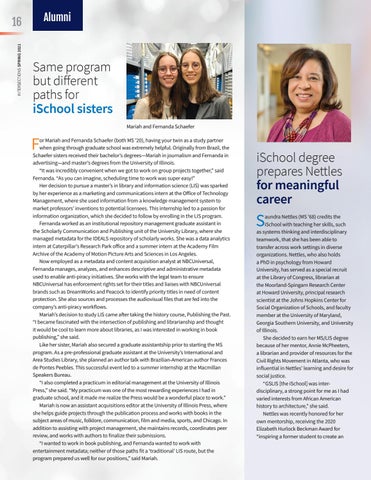
Same program but different paths for iSchool sisters Mariah and Fernanda Schaefer
F
or Mariah and Fernanda Schaefer (both MS ’20), having your twin as a study partner when going through graduate school was extremely helpful. Originally from Brazil, the Schaefer sisters received their bachelor’s degrees—Mariah in journalism and Fernanda in advertising—and master’s degrees from the University of Illinois. “It was incredibly convenient when we got to work on group projects together,” said Fernanda. “As you can imagine, scheduling time to work was super easy!” Her decision to pursue a master’s in library and information science (LIS) was sparked by her experience as a marketing and communications intern at the Office of Technology Management, where she used information from a knowledge management system to market professors’ inventions to potential licensees. This internship led to a passion for information organization, which she decided to follow by enrolling in the LIS program. Fernanda worked as an institutional repository management graduate assistant in the Scholarly Communication and Publishing unit of the University Library, where she managed metadata for the IDEALS repository of scholarly works. She was a data analytics intern at Caterpillar’s Research Park office and a summer intern at the Academy Film Archive of the Academy of Motion Picture Arts and Sciences in Los Angeles. Now employed as a metadata and content acquisition analyst at NBCUniversal, Fernanda manages, analyzes, and enhances descriptive and administrative metadata used to enable anti-piracy initiatives. She works with the legal team to ensure NBCUniversal has enforcement rights set for their titles and liaises with NBCUniversal brands such as DreamWorks and Peacock to identify priority titles in need of content protection. She also sources and processes the audiovisual files that are fed into the company’s anti-piracy workflows. Mariah’s decision to study LIS came after taking the history course, Publishing the Past. “I became fascinated with the intersection of publishing and librarianship and thought it would be cool to learn more about libraries, as I was interested in working in book publishing,” she said. Like her sister, Mariah also secured a graduate assistantship prior to starting the MS program. As a pre-professional graduate assistant at the University’s International and Area Studies Library, she planned an author talk with Brazilian-American author Frances de Pontes Peebles. This successful event led to a summer internship at the Macmillan Speakers Bureau. “I also completed a practicum in editorial management at the University of Illinois Press,” she said. “My practicum was one of the most rewarding experiences I had in graduate school, and it made me realize the Press would be a wonderful place to work.” Mariah is now an assistant acquisitions editor at the University of Illinois Press, where she helps guide projects through the publication process and works with books in the subject areas of music, folklore, communication, film and media, sports, and Chicago. In addition to assisting with project management, she maintains records, coordinates peer review, and works with authors to finalize their submissions. “I wanted to work in book publishing, and Fernanda wanted to work with entertainment metadata; neither of those paths fit a ‘traditional’ LIS route, but the program prepared us well for our positions,” said Mariah.
iSchool degree prepares Nettles for meaningful career
S
aundra Nettles (MS ’68) credits the iSchool with teaching her skills, such as systems thinking and interdisciplinary teamwork, that she has been able to transfer across work settings in diverse organizations. Nettles, who also holds a PhD in psychology from Howard University, has served as a special recruit at the Library of Congress, librarian at the Moorland-Spingarn Research Center at Howard University, principal research scientist at the Johns Hopkins Center for Social Organization of Schools, and faculty member at the University of Maryland, Georgia Southern University, and University of Illinois. She decided to earn her MS/LIS degree because of her mentor, Annie McPheeters, a librarian and provider of resources for the Civil Rights Movement in Atlanta, who was influential in Nettles’ learning and desire for social justice. “GSLIS [the iSchool] was interdisciplinary, a strong point for me as I had varied interests from African American history to architecture,” she said. Nettles was recently honored for her own mentorship, receiving the 2020 Elizabeth Hurlock Beckman Award for “inspiring a former student to create an
SU
17
R
20th Anniversary • iSchool at Illinois
School librarianship program celebrates 20 years
I
n recognition of the 20th anniversary of the School Librarian Licensure program this year, the iSchool will be highlighting school librarians who have made a difference in the field. One of these alumni is Kim Anderson (MS ’07, CAS ’09), librarian at Jefferson Middle School in Champaign. Anderson loves being a school librarian and mentoring future librarians. Through the years, she has mentored 25 practicum and student teachers in her role as a cooperating librarian. She also contributes her time and expertise as a member of the iSchool’s School Librarian Licensure program advisory board. Anderson shares her thoughts on being a school librarian in the Q&A below.
Why did you want to become a school librarian? I like to think that I was part of an informal “grow your own” effort. I was encouraged to become a librarian by Maggie Stephens, the former librarian at Franklin Middle School (where I was a classroom teacher at the time). She has since retired, but I am forever in her debt. As a reading teacher I always relished chances to introduce students to new books. I was excited about the idea of being a school librarian, fully immersing myself in the books my students would be reading, and then getting to share them with my readers. How did the iSchool prepare you for your position? GSLIS, now the iSchool, was the greatest educational experience of my life. I was encouraged to think deeply about all aspects of school librarianship and how I could use what I learned to create a library and library program that would create lifelong readers. I was challenged to be flexible in my thinking and vision for the library so that it would continue to grow and meet the needs of our ever-changing population. My education has also prepared me to advocate for what I know is best for my library at the building and district level. What do you like best about your job? I love that there are so many different facets of my work that I never get bored. I’m a teacher, curator, programmer, manager, designer, mentor, and planner. And that’s just on Monday! But seriously, if I’m honest, one of my favorite things is having a student jump up and down when I give them a long-awaited book. That feels amazing. What advice would you give to current students? Don’t stop learning, stay flexible, and remember that you are the gateway to the library users of the future. Always remember you are your best cheerleader. It’s not bragging if you are advocating for your program and highlighting the work that you do as it improves student learning and engagement. And last, be kind, friendly, and helpful, and they will use the library for life.
INTERSECTIONS SPRING 2021
RAM
SCHO
OG
OL
PR
LI
N LICEN
E
organization which has demonstrably conferred a benefit on the community at large.” She was nominated for this honor, which includes a one-time cash award of $25,000, by her former student Christen Clougherty. “Christen approached me to serve as her stateside mentor in her doctoral studies at the University of Birmingham, U.K.,” said Nettles. “Our conversations, often difficult ones, centered on her dissertation and her readings of my research on social change through place-based education. Other topics included social justice and racial/ ethnic/gender disparities in education. Clougherty’s organizations include the Nobis Project, of which Nettles served as the first president of the board, and the Susie King Taylor Community School, a K-8 public charter school in Savannah, Georgia. Nettles’ retirement from the University of Illinois, where she was a teaching professor in the Department of Educational Psychology, has allowed her more time for her book projects. One is with a photographer and a curator to create a book and exhibit on the photographs of Ellie Lee Weems, her great uncle. Another book is forthcoming; it is about her career and writings on positive social change. Her book, Crazy Visitation: A Chronicle of Illness and Recovery (University of Georgia Press, 2001), also held a personal connection for Nettles. “In 1994, I was diagnosed with an orange-sized meningioma on my left frontal lobe. It had been growing for most of my life. I wrote the book, Crazy Visitation, with a foreword by my neurosurgeon because I found no other books on living with and without a brain tumor,” she said. In addition to her book projects, Nettles is a member of the board of SwaTaleem, an organization founded by former student Ananya Tiwari, PhD candidate in educational psychology and recipient of the 2020 Illinois Innovation Prize. “The MS/LIS credential afforded me opportunities to work with exceptional librarians, archivists, and information scientists and to consult with organizations that specialize in community-based learning environments,” she said.
B
R
IA AR
Giving
INTERSECTIONS SPRING 2021
18
Koval Scholarship is a life changer for MS student
T
hanks to the generosity of Edward Koval and his family, MS/LIS student Claudia Farris can stop worrying about finances and simply focus on their studies. Farris is a recipient of the iSchool’s Anna Mae Koval Scholarship, a need-based scholarship for students interested in youth services and literature. “Receiving this scholarship has made an enormous impact on my education,” said Farris. “Because of COVID, I was laid off, and I honestly didn’t know if I was going to be able to afford to finish my degree. I’m a better student if I’m not worried about how I’m going to make rent and pay my tuition bill. I am not exaggerating when I say this scholarship changed my life.” Farris decided to pursue an MS/LIS degree because of the “huge impact” libraries have played in their life. For Farris, libraries have always been safe, welcoming spaces. “I specifically want to go into youth services, but I’m also passionate about community outreach,” said Farris, who holds a bachelor’s degree in English from Portland State University. “I think libraries can be a great site for giving marginalized populations a variety of services.”
“
I’m a better student if I’m not worried about how I’m going to make rent and
”
pay my tuition bill.
Alegre receives inaugural CNH Industrial Information Sciences Scholarship
T
hanks to a new scholarship at the iSchool, David Alegre has been relieved of some of the stress in financing his education. Alegre, a junior from Chicago, is the inaugural recipient of the CNH Industrial Information Sciences Scholarship, which supports continuing BS in information sciences (BS/IS) students who have financial need. He chose the iSchool for his undergraduate study because of his interest in becoming a data analyst. “No other major in this field provides anywhere near as much in-depth material about the ethics behind technology,” he said. “I am leaning toward the data and society pathway [one of the four pathways offered in the BS/IS degree]. My favorite class at the iSchool has been Community Innovation (IS 266) with Anita Chan. I loved this class because it helped me find something that I was passionate about in my research.” Alegre has secured a summer internship with PepsiCo, where he hopes to “learn more about what I want out of my career.” With the variety of professional paths available to him once he graduates, he is still weighing his options and doing his research. Outside of class, Alegre works as a wellness support associate— specially trained employees who help manage the University’s COVID-19 building access—and enjoys spending time with friends. “I would like to express how thankful I am to have received this support,” he said.
iSchool graduates express gratitude The following May 2021 graduates shared statements of gratitude for the scholarship they received as iSchool students. “I am honored to be the recipient of the Tung-Li and Hui-Hsi Yuan Award. Without this generous financial support towards my higher education, I would not be able to achieve the academic goals necessary to fulfill my professional ambition. I would like to thank Tung-Li and Hui-Hsi Yuan for their support and investment in my future.” —Siyao Cheng (MS/LIS) will continue her education in the iSchool’s PhD program.
“Through the Lucille Huntington Wilkinson Memorial Scholarship, I was equipped to focus less on the cost of attendance and more on the wonderful educational and experiential opportunities the iSchool has to offer, including serving as the ALA Student Chapter Treasurer this past year. Education is one of the most valuable assets in life, and as a first-generation college student, I truly have been blessed by the moral and financial support that have guided me through this experience.” —Livia Lee Garza (MS/LIS) is searching for a full-time position in digital archiving or digital asset management. “I feel very grateful to have received the G. Edward Evans Minority Students Scholarship. I recognize that it is a privilege to receive a scholarship in any form, and I hope that scholarships like this allow more BIPOC [Black, Indigenous and People of Color] students to relieve some of the financial burden of pursuing their degrees.” —Jessie Maimone (MS/LIS) will continue her education in the iSchool’s PhD program.
“I was ecstatic when I learned that I would be a recipient of the Hearsey Scholarship. Last year was difficult for me financially, due to the global pandemic limiting the number of available job and internship opportunities. This scholarship made it easier for me to manage my living expenses during that tough period. I want to thank the donors of my scholarship, Herbert R. Hearsey and Laura Beth Hearsey, for their generosity.” —Niken Shah (MS/IM) would like to pursue a career in data analytics and business intelligence.
97.5
%
Achieved toward $20 million campaign goal
Campaign update
T
he iSchool has reached 97.5% of its $20 million campaign goal. Gifts toward the campaign will continue until June 30, 2022. The School’s priorities for this campaign are accessible education, enhanced student experience, and faculty support. Thank you to the iSchool Campaign Committee and the many alumni and friends who have contributed to the campaign. Your generosity supports the excellence of the School’s academic programs, which is reflected in the ongoing number one ranking of the MS/LIS degree program. For more information about supporting the iSchool during the campaign, including bequest language for estate gifts, please contact Diana Stroud at dstroud@illinois.edu or (217) 244-9577.
INTERSECTIONS SPRING 2021
19
Class Notes
INTERSECTIONS SPRING 2021
20
DECADE: 2020s Christine Case (MS ’20) has started a new position as a library media specialist at Hillcrest High School in Country Club Hills, Illinois. Ashleigh Cofer (MS ’20) has accepted an offer for an instructional librarian position at Columbus Technical College in Columbus, Georgia. Mitchell Haas (MS ’20) has been appointed assistant professor and online learning librarian at Southern Illinois University Edwardsville. In February, Allison Kilberg (MS ’20) started a new position as the archivist and genealogy librarian at the Floyd County Library and Carnegie Center for Art & History in New Albany, Indiana.
Henry Gabb (PhD ’19), senior principal engineer at Intel Corporation, joined the Board of Directors of the Linked Data Benchmark Council (LDBC). LDBC develops industry benchmarks for social network analysis, graph analytics, and Resource Description Framework (RDF). Elaine R. Hicks (MS ’10) and her Librarian Reserve Corps volunteers, Stacy Brody and Sara Loree, were named Library Journal’s 2021 Librarians of the Year. Brittany (Craig) Labinger (MS ’17) has been appointed director of the Elgin (TX) Public Library. Urszula Lechtenberg (MS ’14) recently started a new position as learning design coordinator at the University of Pittsburgh University Library System.
coding, classifying, and organizing information related to diasporic groups. Christina Nhek (MS ’14) recently accepted a promotion to become a senior librarian at Long Beach (CA) Public Library. UCLA’s Center for Critical Internet Inquiry (C2i2), codirected by Safiya Noble (MS ’09, PhD ’12) and Sarah T. Roberts (PhD ’14), recently received a gift from the Archewell Foundation to support “research, programs, and convenings focused on the harms vulnerable communities face from internet technologies.” Thomas Padilla (MS ’14) has been named director of information systems and technology strategy at the Center for Research Libraries.
Shuyi Liu (MS ’19) accepted a position as international outreach services librarian at the Illinois Fire Service Institute Library at the University of Illinois.
Ruth Slagle (MS ’17) started her position as instruction librarian at Jackson State Community College in Jackson, Tennessee, in March 2020. She recently published the article, “Remembering who is important: keeping the right focus in a national emergency,” in the Journal of Electronic Resources Librarianship.
Patty McGowan (MS ’16) started her new position as reference librarian at National Defense University Joint Forces Staff College in Norfolk, Virginia, in December 2020.
Stacey A. Smith (MS ’15) earned a promotion to digital asset strategist at Groupon. In her new role, she is now responsible for the strategic roadmap of Groupon’s content.
Mansi Tripathi (MS ’20) has accepted a fulltime offer as a senior data scientist at Target headquarters in Minneapolis, Minnesota.
Colleen Melone (MS ’16) began a new position as the head of information services for the Lincolnwood (IL) Public Library District.
Christinna Swearingen (MS ’19) was appointed as library director for Schreiner Memorial Library in Lancaster, Wisconsin.
DECADE: 2010s
Melinda Miller (MS ’11) became an owner of Pixo, a custom software consultancy in Urbana. She is the general manager at Pixo and co-owns the company with her business partner, Jason Berg.
Kim Tipton (MS ’18) and Cherie Watson (MS ’14) coauthored the article, “Starting a Professional Reflection Practice,” in the March 2021 issue of the ILA Reporter.
Archana Kulkarni (MS ’20) credits the iSchool’s classes with preparing her for her job as a project manager at B2BMD. Diana Liao (MS ’20) was selected as a recipient of the Illinois Arts Council Agency (IACA) Ethnic and Folk Arts Master/Apprentice Program Awards (MAP) for 2021. She is studying the art form of Japanese tea ceremony with Professor Emeritus Kimiko Gunji as part of the preservation of Illinois’ rich cultural heritage.
Tarida Anantachai (MS ’11) was a corecipient of the Syracuse University Libraries’ 2020 Distinguished Service Award. The award is a 30-year tradition recognizing staff members who have made significant contributions to the libraries and university community. Heather Campbell (MS ’19) started a new position as the metadata management librarian at Iowa State University. Ben Chiewphasa (MS ’19) joined the Hesburgh Library at the University of Notre Dame as the economics and data librarian in December 2020. Jarrett Dapier (MS ’15) is the author of a new children’s book, Jazz for Lunch, which was recently published by Simon & Schuster. Carla Dinnocenzo (MS ’15) recently joined the Palos Heights (IL) Public Library as the youth and teen services librarian.
Alice Mitchell (MS ’15) has begun a new position as youth services manager at Fondulac District Library in East Peoria, Illinois. Emily Moran (MS ’16) recently joined the University of Wisconsin-Superior as an instructional design librarian. Araceli Moreno (MS ’18) presented, “Mathical: Books for Kids from Tots to Teens,” at the School Library Journal Virtual Summit 2020, which was held on October 24. Teresa Helena Moreno (MS ’19) was featured in the March 2021 issue of Information Today for her research focusing on problems in
Anna Trammell (MS ’15) joined the Tacoma Public Library as the Northwest Room local history librarian. In this role, she will manage the library’s archives and special collections. Kameron Wells (MS ’18) has started a new job as baseball systems data engineer with the Boston Red Sox. DECADE: 2000s After taking a nearly six-year break from libraries to work with a nonprofit organization focused on bicycle travel and advocacy, Laurie Chipps (MS ’07) has found her way back as the technical services librarian at the Montana Historical Society’s Research Center.
INTERSECTIONS SPRING 2021
21
Janice Del Negro (PhD ’07) has been selected as a 2020 Illinois Library Luminary Honoree. She is a professor at the School of Information Studies at Dominican University. Julie Derden (MS ’06) retired in June 2020 from Illinois State University’s Milner Library where she served for 14 years as the teaching materials librarian and subject liaison to the College of Education’s School of Teaching and Learning. Eric Edwards (MS ’06) recently finished serving as past president of the Illinois Association of College & Research Libraries (IACRL) and as chair of the Illinois Library Association’s ILA Reporter Advisory Committee. He is currently the secretary for the ACRL Chapters Council and a member of the ILA Conference Program Committee. Nancy Falciani-White (MS ’07) is the author of Creativity: A Toolkit for Academic Libraries, which was recently published by the Association of College & Research Libraries (ACRL). Kelly (Kloster) Fisher (MS ’03) has been promoted to full professor rank at Eureka College, where she has served as a librarian since 2004. Originally hired as the public services librarian, she now serves as the public & access services librarian and the campus learning management system administrator. Jon Gorman (MS ’04) received an Outstanding Academic Professional Award from the University Library. He works as an application support specialist within Library IT. Alison (Bolla) Greenlee (MS ’09) recently earned promotion and employment security status. She has been the special collections metadata librarian at Wayne State University in Detroit, Michigan, since 2017. Matthew Harrington (MS ’09) passed away on March 17, 2021. Merinda Kaye Hensley (MS ’06) was named senior fellow of information literacy for Project Information Literacy. She will focus on their Provocation Series, a new publishing initiative for 2021 that will delve into pressing information literacy and higher education issues, while exploring new ways of thinking and directions for future research. Mary Z. Rose (MS ’01) was recently appointed as the archival library research manager
at the Madison County Archival Library in Edwardsville, Illinois. Bryan Voell (MS ’07) recently started his eighth year as the local arts librarian with Johnson County (KS) Library. DECADE: 1990s Scott Drone-Silvers (MS ’92) retired on January 1 after serving as director of library services at Lake Land College in Mattoon, Illinois, for 29 years. Carol Simmons (MS ’95) just finished an Encore Fellowship with Community Tech Network (CTN), a 1,000 hour per year commitment. Encore matches skilled, seasoned professionals who have 20+ years of experience with nonprofit organizations in flexible, high impact (with a stipend) assignments. She is still working with CTN part time and continuing her library consultant work.
Kathy Durley Freiheit (MS ’80), former director of library services for the City of Rowlett, Texas, is now retired. Her post-graduate career path included library administrative services and building projects in public, academic, school and special libraries in Illinois, Iowa, Nebraska, Wisconsin, and Texas. DECADE: 1970s Diane Carothers (MS ’75) passed away on March 1, 2021. She retired in 1995 as head librarian of the University of Illinois Communications Library. Nelly Gonzalez (MS ’73) passed away on November 29, 2020. She served as the head of Latin American Library Services at the University of Illinois before her retirement in 2008. Kathryn Harris (MS ’71) has received the 2020 State Journal-Register First Citizen Award. The award recognizes residents in the Springfield, Illinois, area who give selflessly of their time and resources in service to others.
Mark Spasser (PhD ’98) retired as the online nursing librarian at Maryville University in St. DECADE: 1960s Louis, Missouri. He is a distinguished member Carol Doty (MS ’63) retired last year from the of Academy of Health Information Professionals. Morrison-Shearer Foundation, where she had DECADE: 1980s served as trustee and chair. She is currently serving on Committee 2021 for the new Sybil Faye Chadwell (MS ’88), the Donald and Delpha Campbell University Librarian at Oregon Shearer Dance Studio at Ragdale Foundation in Lake Forest, Illinois. She worked at The Morton State University Libraries and Press, has been Arboretum from 1963 until her retirement in 1998. selected to serve as the dean of University Libraries and Scholarly Communications at Pennsylvania State University. Choy Fatt Cheong (MS ’87) has received the 2019 Lifetime Contribution Award from the Library Association of Singapore.
Rosemary Young Singh (MS ’69) passed away on January 20, 2021. She worked at the Mathematics Library, Illinois Historical Survey, and Main Library circulation desk at the University of Illinois and at the Manitowoc (WI) Public Library.
Send us your news! We’d love to hear from you! Send us your updates as well as any employment or internship opportunities, conferences of interest, or opportunities for iSchool alumni to connect in your area. Office of Advancement and Alumni Relations School of Information Sciences 501 East Daniel Street, Champaign, IL 61820 ischool-advancement@illinois.edu (217) 300-5746 ischool.illinois.edu/engage/alumni
Non Profit Org. U.S. Postage PAID Permit No. 75 Champaign, IL University of Illinois Urbana-Champaign 501 East Daniel Street, MC-493 Champaign, IL 61820-6211
New space for iSchool expansion This architectural rendering of Hub Champaign Daniel at 614 E. Daniel Street illustrates the view from the corner of 6th and Daniel Streets. The building, which is nearing completion, will provide additional space for the iSchool on the 4th and 5th floors. The School will retain its current location at 501 E. Daniel.