INTERSECTIONS FALL 2021
PEOPLE I INFORMATION I TECHNOLOGY
FALL 2021
Intersections
1
The iSchool at Illinois educates leaders in the information sciences who impact our communities, nation, and world.
Fall 2021 School of Information Sciences University of Illinois Urbana-Champaign Published by the iSchool Communications Office. For more information or to submit story ideas, please contact brya@illinois.edu.
Intersections
Contents
McDonough passes away
5
Exhibit celebrates 75 years of CCB
11
Scavenger hunt builds community
14
Noble named MacArthur Fellow
16
Dean: Eunice E. Santos Editor: Cindy Ashwill Managing Editor: Cindy Brya Contributing Writers: Cindy Ashwill, Cindy Brya, Frankie Blanco Photography: Cindy Brya, Melissa Newell, L. Brian Stauffer, Thompson-McClellan Photography, and the John D. and Catherine T. MacArthur Foundation Design: Pat Mayer 501 East Daniel Street Champaign, Illinois 61820 ischool@illinois.edu ischool.illinois.edu Phone: (217) 333-3280 People use information for analysis, inquiry, collaboration, and play—and in so doing, change the world. The iSchool at Illinois is dedicated to shaping the future of information through research, education, and engagement, both public and professional. Intersections highlights our current work in these areas as well as achievements of our students, alumni, faculty, and staff. On the cover: BS/IS students Luke Emano and Bea Verin
NEWS
Letter from the Dean 2 New Faces—Fall 2021 3 2020 Downs Intellectual Freedom Award given to Amy Dodson 4 iSchool unveils new art installation, Library of Color 4-5 McDonough passes away 5 Koh selected as Fab Lab research director 6 Stevenson retires 6 Bonn elected ASIS&T director-at-large 6 Dubin and Kilicoglu named NCSA Faculty Fellows 7 Quealy-Gainer named editor of The Bulletin 7
RESEARCH
Schneider receives NSF Career Award 8 Kaushik and Wang receive best privacy paper award at SOUPS 2021 8 Bruce authors new book on thinking with maps 9 Schwebel edits book on Newbery Medal books 9 New CIRSS series focuses on responsible data science and AI 9 Model helps predict, analyze decision-making on adopting Type 2 diabetes medical guidelines 10-11 Bonn and Twidale explore concept of “informated food” 10-11 Digital exhibit celebrates 75 years of the CCB 11
FEATURES MS Graduate Outcomes Spectrum Scholar Spotlight: Ashley Bolger Scavenger hunt builds community Rolling Stone the subject of undergraduate research Practicum Spotlight: JPMorgan Chase
12-13 14 14 15 15
ALUMNI Noble named MacArthur Fellow, honored with Diversity and Inclusion Award Rhinesmith receives the 2021 ASIS&T Outstanding Information Science Teacher Award Wightman fights spread of misinformation by educating church congregations Kathryn Harris named Illinois Library Luminary Meet Rahul Chandran (MS/IM ’20), product manager at Yahoo!
16 17 18 18-19 19
GIVING Lee-Smeltzer Scholarship to support future academic librarians Belcher Scholarship honors mother’s commitment to LIS education iSchool surpasses goal for “With Illinois” campaign Prillaman joins the iSchool Advancement Office
20 21 22 23
CLASS NOTES
24-25
GRANTS
26-27
INTERSECTIONS FALL 2021
2
Letter from the Dean
T
his fall marked a period of continued growth, as we welcomed new members to our close-knit iSchool community. Our total student enrollment of 1,468 surpassed last year’s enrollment by 46 percent, which represents the largest percentage of growth among academic units on campus. In addition, as we entered the second year of our BS in information sciences program, our undergraduate enrollment more than doubled with a total of 296 students. We also welcomed new faculty with research expertise spanning areas such as accessible computing and health informatics, cultural analytics, computational social science, digital humanities, diversity in the information professions, and more. A number of our faculty and staff recently moved into the fourth and fifth floors of the Hub Champaign Daniel building, located at the intersection of 6th and Daniel Streets. This new location increases our School’s visibility on campus and provides much-needed additional space, including offices, conference rooms, research labs, common and event areas, and student support spaces. We continue to occupy our existing building at 501 East Daniel, which serves as our main location. Enhancements to this location include a new digital art installation, Library of Color, created by artist Jer Thorp and funded by the John N. Chester Estate Endowment through the Office of the Chancellor. We have made great strides in a strategic planning process that began in the spring. As our School continues to expand, this plan is crucial to our ongoing success and leadership in the field. We must identify strategic priorities and opportunities while supporting our core values and building on our number one ranking in library and information studies. You can expect to read more about the plan in By providing students with future issues of Intersections. The accomplishments of our alumni contribute to the prestige of our School. In the pages that a strong foundation of follow, you will read about Safiya Noble, MacArthur Fellow and inaugural recipient of the University of Illinois Alumni Association’s Diversity and Inclusion Award; Colin Rhinesmith, this year’s ASIS&T knowledge and practical Outstanding Information Science Teacher, who is the eighth recipient affiliated with our School; experience, the iSchool and Kathryn Harris, former director of the Abraham Lincoln Presidential Library and Museum, who has been inducted as an Illinois Library Luminary. Their successes bring us great pride, as do educates leaders in the the professional achievements that alumni share with us in class notes. Our alumni’s diversity of information sciences. contributions and positive impact on society reaffirm the importance of our School and the field in general. By providing students with a strong foundation of knowledge and practical experience, the iSchool educates leaders in the information sciences. Our donors play a key role in this process, as demonstrated in this issue of Intersections by the Kuang-Hwei “Janet” Lee-Smeltzer Scholarship Fund and the Lucille H. Belcher Scholarship Fund to support future librarians. Gifts such as these have allowed our School to surpass our $20 million “With Illinois” campaign goal, the priorities of which include offering an accessible education, enriching the student experience, and providing faculty support. I’d like to take this opportunity to thank all who have contributed to the campaign as well as those who share their time and talents with our School. I know that Eileen Prillaman, our new assistant dean for advancement, looks forward to meeting our alumni and discovering the many ways in which they have used their iSchool education. As we enter the month of November, we have much to be thankful for: the opportunity to continue our teaching and research, to engage with dedicated alumni and donors, and to benefit our local, national, and global communities.
“
”
Sincerely, Eunice Santos, Dean
INTERSECTIONS FALL 2021
3
New Faces—Fall 2021
Ryan Cordell Associate Professor Cordell’s research areas include book history, book arts, print culture, bibliography, digital humanities, text and data mining, machine learning, and critical making.
Sarah Park Dahlen Associate Professor Dahlen’s research addresses Korean adoption in children’s literature, Frank Carpenter and Frances Carpenter’s writings for children, and diversity in children’s literature and library education.
Melissa Madsen Director of Human Resources Madsen oversees human resources operations for the School and serves as the primary contact for questions regarding HR policies and procedures.
Denzel Goodloe Assistant Director for MS/IM and MS/BIO Advising Goodloe provides academic advising for students enrolled in the MS in information management (MS/IM) and MS in bioinformatics programs (MS/BIO).
JooYoung Seo Assistant Professor Seo’s research focuses on accessible computing, inclusive data science across dis/abilities, and accessible health informatics.
Ashley Hipsher Associate Director for Marketing Hipsher oversees the development, execution, and evaluation of a comprehensive marketing strategy as well as branding and public relations to promote the iSchool.
Dong Wang Associate Professor Wang’s research interests lie in the areas of intelligence and computing, social sensing, big data analytics, and human cyber-physical systems.
News
INTERSECTIONS FALL 2021
4
2020 Downs Intellectual Freedom Award given to Amy Dodson
F
“
Dodson steadfastly supported the need for diversity initiatives while working to assure the safety and comfort of her
”
staff.
or supporting the value and necessity of equity, diversity, and inclusion as a part of her library’s mission and service, Amy Dodson has been named the 2020 recipient of the Robert B. Downs Intellectual Freedom Award. The award is given annually by the faculty of the School of Information Sciences at the University of Illinois Urbana-Champaign and cosponsored by the Freedom to Read Foundation (FTRF), a nonprofit legal and educational organization affiliated with the American Library Association (ALA). Dodson, former director of the Douglas County (NV) Public Library, faced enormous public criticism last year for posting a diversity statement on the library’s Facebook page that included the line, “We support #Black Lives Matter.” The Douglas County sheriff equated this statement with the Black Lives Matter movement and perceived it as support for violence against law enforcement. He posted a letter on the sheriff office’s Facebook page stating this and adding that library staff should no longer call 911 for help with disturbances. The sheriff’s letter led to national media coverage and protests in Douglas
iSchool unveils new art installation, Library of Color
County, and Dodson was told to take down the diversity statement by county officials. Some of her most strident critics were members of the library’s board of trustees, which voted to investigate Dodson’s actions using $30,000 of the library’s budget to pay for a third-party investigation. The law firm conducting the investigation found that the library, Dodson, and her staff had not violated any laws or policies in introducing the diversity statement. According to the letter of nomination, “Throughout the investigation, Dodson steadfastly supported the need for diversity initiatives while working to assure the safety and comfort of her staff.” The Robert B. Downs Intellectual Freedom Award acknowledges individuals or groups who have furthered the cause of intellectual freedom, particularly as it affects libraries and information centers and the dissemination of ideas. Each year, the recipient is recognized at the ALA Annual Conference. The award was established in 1969 by the iSchool’s faculty to honor Robert Downs, a champion of intellectual freedom, on his twenty-fifth anniversary as director of the School.
W
hen students returned to campus for the fall semester, they found an exciting new art installation welcoming them back. The digital art installation, Library of Color, is in the East Foyer of the iSchool building at 501 E. Daniel Street. The artwork was created by one of the world’s foremost data artists, Jer Thorp, and made possible through a generous grant from the John N. Chester Estate Endowment Fund provided by the Office of the Chancellor. Thorp is best known for designing the algorithm to place the nearly 3,000 names on the 9/11 Memorial in Manhattan. He is
McDonough passes away
ssociate Professor Jerome (“Jerry”) McDonough passed away at his home on September 17 after a long illness. He is survived by his spouse, Associate Professor Lori Kendall, and extended family and many beloved friends and colleagues. McDonough was born in Inglewood, California, in 1963. He attended the University of California at Berkeley, where he received a BA in rhetoric, and both a master’s and PhD in library and information studies. While a doctoral student, he was instrumental in creating METS, a metadata standard used in libraries and other institutions worldwide. Prior to joining the faculty of the iSchool in 2005, McDonough served as the head of the Digital Library Development Team at
New York University. His research focused on sociotechnical aspects of digital libraries, with a particular interest on issues of metadata and description as well as digital preservation of complex media and software. He was also well known for his work on preserving intangible cultural heritage. At the iSchool, McDonough taught Sociotechnical Information Systems (IS 504), Digital Preservation (IS 543), and Metadata in Theory and Practice (IS 575). “Jerry was deeply devoted to the field of library and information science and what it could do for people and communities, and his many contributions will endure. He expertly taught extraordinary courses at the very heart of our discipline, holding students to high standards while caring deeply for them and their success,” said Allen Renear, professor and special advisor for strategic initiatives in the Office of the Provost and former iSchool dean (2012-2019). “In addition to teaching key courses for our MS/LIS and MS/IM programs, Jerry was a dedicated research mentor,” said Linda C. Smith, professor emerita and interim executive associate dean. “He guided the work of several students in completing master’s theses and doctoral dissertations. Topics investigated by students ranged from digital
video standards to the Open Archival Information System (OAIS) Reference Model. They valued his support at every stage in the research process.” McDonough was an active participant in metadata standards activities for digital libraries, having served as chair of the METS Editorial Board, an international group of volunteers committed to maintaining editorial control over METS, its XML Schema, the METS Profile XML Schema, and official METS documentation. He also served on the National Information Standards Organization (NISO) Standards Development Committee and on the Open Digital Rights Language Initiative (ODRL) International Advisory Board. “This is a great loss for our community,” said Dean Eunice E. Santos. “Jerry was a kind and caring leader who contributed significantly to our School’s progress through his fair-minded and equitable approach to academic governance as well as his ability to anticipate the consequences of complex strategies. This ability carried over into his relationships with colleagues and students.” A celebration of McDonough’s life will be held at a later date. Donations in his memory may be made to the Lou and Jean Malnati Brain Tumor Institute at Northwestern University.
one of the world’s foremost data artists and a leading voice for the ethical use of big data. His data-inspired artwork has been shown around the world, including in New York’s Times Square and Museum of Modern Art, the Ars Electronica Center in Austria, and the National Seoul Museum in Korea. In addition to his artwork, Thorp is the author of Living in Data: A Citizen’s Guide to a Better Information Future, which was recently published by Macmillan. Thorp created the original web-based A Library of Color while serving as the
Innovator-in-Residence at the Library of Congress. “Library of Color uses customwritten text analysis software to extract color words (red, blue, sand, blood, grass) from titles of collections material. The results are displayed as wide color palettes, where each slice represents an individual book, photograph, map, or other object,” said Thorp. The iSchool’s Library of Color is a permanent media piece, installed on a flat-screen video wall.
“The piece will exist in a kind of ‘dream state’ where it explores the collections color palette over time. The system will never repeat itself, taking a long and always changing path through color space,” said Thorp. According to the committee in charge of selecting the artist and artwork, this new digital installation will embrace the iSchool’s foundation, history, and values, while also exemplifying the School’s commitment to shaping the future of information using a creative, interdisciplinary approach.
A
INTERSECTIONS FALL 2021
5
INTERSECTIONS FALL 2021
6
News
Koh selected as Fab Lab research director
W
ith her focus on the maker movement in libraries and community engagement, Associate Professor Kyungwon Koh is a natural for her new role as director of research for the CU Community Fab Lab. Short for “fabrication laboratory,” the Fab Lab encourages individuals to develop new ideas, solve problems, and make things. Free and open to anyone who is interested, the Fab Lab promotes personal growth, economic development, and cross-cultural understanding. “The C-U Fab Lab was one of the first places I visited when I joined the iSchool in 2018,” said Koh. “Its strong community engagement mission and focus on youth and families—including those from nondominant cultures—is such a wonderful fit for my research.” Koh’s areas of expertise include digital youth, the maker movement, learning and community engagement through libraries, human information behavior, and competencies for information professionals. This past semester, she co-taught Make, Design, and Learn in Libraries (IS 582MD). The Fab Lab has developed relationships with several community partners over the past decade, including the UNCC (Urbana Neighborhood Connections Center), The Urbana Free Library, and Urbana Middle School. “I’m looking forward to working with the Fab Lab team to further increase its full potential as a community-research partnership centerpiece and PreK-12 pipeline on campus, which will expand the capacities of the University to work with the community and ultimately benefit the entire campus and community,” said Koh.
Bonn elected ASIS&T director-at-large
A
ssociate Professor Maria Bonn has been elected to the Board of Directors of the Association for Information Science and Technology (ASIS&T). Bonn’s research focuses on scholarly communication and open culture and on collaboration in the humanities. She teaches largely in the areas of academic librarianship, scholarly communication, and publishing. In addition to chairing the ASIS&T publications committee, Bonn shepherded the relaunch of the Annual Review of Information Science and Technology (ARIST), and helped develop the association’s new publication, Information Matters. “ASIS&T and its members do invaluable work in creating and sustaining human and technological systems for the benefit of all,” said Bonn. “As a director-at-large, my goal will be to increase the visibility and impact of the scholarship that comes from the ASIS&T community.”
Stevenson retires
D
eborah Stevenson retired from the University of Illinois on July 31. Stevenson served as editor of The Bulletin of the Center for Children’s Books since 2001. From 2010-2019, she was director of the iSchool’s Center for Children’s Books (CCB). “The reviews produced under her direction—approximately one-third of which she pens herself—directly influence which children’s books appear on library and school shelves across the country, shaping three rising generations of American adults, as readers, consumers of information, and global citizens,” said Sara L. Schwebel, professor and CCB director. Stevenson has served on major children’s book award committees of the American Library Association (ALA), including the Newbery Medal, Caldecott Medal, and Batchelder Award. In addition, she has served on or chaired the Scott O’Dell Award committee since 2011. Her articles have appeared in The Horn Book Magazine, The Lion and the Unicorn, and the Children’s Literature Association Quarterly, and she is a senior editor of The Oxford Encyclopedia of Children’s Literature. She is the coauthor, with Professor Emerita Betsy Hearne, of Choosing Books for Children: A Commonsense Guide and coeditor of the in-progress Wiley-Blackwell Companion to Children’s Literature. “It has been a joy and a privilege to work with my talented and dedicated colleagues at the iSchool, and I’m honored to have been able to add my contribution to the School’s longstanding commitment to youth and the librarians who serve them,” said Stevenson.
INTERSECTIONS FALL 2021
7
Dubin and Kilicoglu named NCSA Faculty Fellows
Quealy-Gainer named editor of The Bulletin
T
K
eaching Associate Professor David Dubin and Associate Professor Halil Kilicoglu have been named National Center for Supercomputing Applications (NCSA) Faculty Fellows for the 2021-22 academic year. This competitive program for faculty and researchers at the University of Illinois provides seed funding for new projects that include NCSA staff as integral contributors to the research. Dubin received funding for “Analyzing and Visualizing Linguistic Variation in Monolingual and Bilingual Speakers,” a project he will be conducting with Silvina Montrul, professor in the Department of Spanish and Portuguese and in the Department of Linguistics. The researchers plan to build a “syntactically and morphologically annotated corpus” with speech samples of 500 monolingual and bilingual speakers of Spanish and English in the U.S. and Mexico. “Through improving workflow support and addressing the data management needs for this case study, our project will investigate why existing automation tools and encoding standards are underutilized and how computational resources can better improve researchers’ productivity and lead to new discoveries,” said Dubin. In the Fall 2021 semester, he will draw on the ontologies and data models from his NCSA Faculty Fellow project for use as examples and case studies for his course, Knowledge Structures for Information Organizations (IS 595-KSI). Kilicoglu received funding for his project, “Identifying Conflicting Claims in Clinical Literature Using Natural Language Processing and Knowledge Graphs,” in which he plans to build a literature mining tool to more easily pinpoint biomedical claims made in scientific publications and how they relate to current knowledge. “Conflicting information is common in biomedical research and can have serious consequences for clinical practice and public health,” said Kilicoglu. “Patients, caregivers, and providers are increasingly exposed to conflicting health information through news and social media, which may exacerbate their cognitive biases and lead to errors in judgement. Understanding the evidence base around clinical claims, in particular the conflicts and controversies, is critical for establishing clinical practice guidelines and identifying knowledge gaps for which additional studies may be needed.”
ate Quealy-Gainer (MS/LIS ’09) has been selected as editor of The Bulletin of the Center for Children’s Books, one of the nation’s leading children’s book review journals for school and public librarians. She has over a decade of experience with the publication, starting as a reviewer while a student in the MS in library and information science program. “I had worked in the Center for Children’s Books as a grad assistant, and upon graduation, the then-editor Deborah Stevenson asked me if I wanted to stay on as assistant editor,” she said. “I was thrilled!” Quealy-Gainer looks forward to taking a larger role in the production of The Bulletin and would like to create more opportunities to engage with the field and the community “as a resource for all things related to contemporary youth literature.” “We are delighted that Kate has accepted the position of editor of The Bulletin of the Center for Children’s Books,” said Sara L. Schwebel, professor and CCB director. “Her deep subject knowledge; sharp, critical eye; and long association with the Center makes her the ideal person to oversee the journal’s editorial content during its historic 75th year of production.” Quealy-Gainer also serves as an adjunct lecturer at the iSchool, teaching courses in children’s literature, materials, and programming; teen materials; and youth services. “It’s a reader’s dream to be able to look at upcoming books for youth and get to review them,” she said of her work at The Bulletin. “I also work with a great staff of reviewers, and it’s always a delight to discuss not only the books but also the latest trends in children’s books and how they can be used in both public and school library settings.”
Research
INTERSECTIONS FALL 2021
8
Schneider receives NSF CAREER award
A
ssistant Professor Jodi Schneider has received a National Science Foundation (NSF) CAREER award to assess how to identify potential sources of bias in research and how confident we can be in the conclusions drawn from a particular body of evidence. This
prestigious award is given in support of early-career faculty who have the potential to serve as academic role models in research and education and to lead advances in the mission of their department or organization. Schneider’s project, “Using Network Analysis to Assess Confidence in Research Synthesis,” will be supported by a five-year, $599,963 grant from the NSF. According to Schneider, although policy makers use the best available science in informing their decision making, experts can come to different conclusions in synthesizing this knowledge. For her new project, she will use network analysis and text mining to develop a novel framework of tools and workflows that will reveal potential sources of bias in expert literature.
“This research could facilitate datadriven decision-making in a broad range of areas,” she said. “We’ll focus on four areas: conservation, energy policy, healthcare, and sustainable development. For example, in energy, our research could help in determining the carbon footprint of various forms of food production.” For the educational component of her NSF CAREER award, Schneider will develop two iSchool courses—Bibliometrics and Research Assessment, with PhD student Tzu-Kun (Esther) Hsiao, and Systematic Reviewing and Evidence Synthesis with Caitlin Clarke, teaching assistant professor in Kinesiology and Community Health and an iSchool affiliate. In addition, she will work with middle school students on a video to attract underrepresented students to STEM careers.
Kaushik and Wang receive best privacy paper award at SOUPS 2021
A
paper authored by PhD student Smirity Kaushik and Associate Professor Yang Wang received the IAPP SOUPS Privacy Award at the 17th Symposium on Usable Privacy and Security (SOUPS 2021). The symposium, which was held August 8-10, brings together an interdisciplinary group of researchers and practitioners in humancomputer interaction, security, and privacy.
In the paper, “‘How I Know For Sure’: People’s Perspectives on Solely Automated Decision-Making (SADM),” Kaushik, Wang, and coauthors Yaxing Yao (University of Maryland Baltimore County) and Pierre Dewitte (KU Leuven) describe the findings of their online study to explore people’s understanding of SADM. According to the researchers, while the General Data Protection Regulation of the European Union has granted citizens some rights
regarding SADM, including obtaining an explanation of such processing, “it is unclear how organizations should support people in effectively exercising such rights.” “SADM is widely applicable in job searches, healthcare, banking loan approval, and others,” said Kaushik. “However, SADM system-based decisions could lead to discrimination, social segregation, and loss of privacy. As a result, they could significantly or legally affect people.” The paper’s authors offer design recommendations, including an icon for SADM processing that companies could add to their websites, “sandbox for SADM” to allow people to experiment with the SADM process, and personalized explanation templates to inform people about how SADM made a decision. They also offer policy recommendations such as mandating notifications to alert users when they are being subjected to SADM processing, similar to cookie notification.
9
P
rofessor Emeritus Chip Bruce has authored a new book on the nature and importance of maps. In Thinking with Maps: Understanding the World through Spatialization, which was recently published by Rowman & Littlefield, he demonstrates how the concept of maps and mapping has implications and applications across all spheres of intellectual endeavor. “Maps for me represent the essence of interdisciplinary or holistic understanding of the world. The fact that they are created
by so many different people, for different purposes, makes them a challenge to understand, but also an unending source of pleasure,” wrote Bruce in the foreword of his book. Thinking with Maps shows that maps are valuable not only for geographic knowledge but for providing “mechanisms for rejuvenating our engagement with the world.” According to Bruce, in writing the book he hoped to continue his exploration of the world that he started in his book,
Schwebel edits book on Newbery Medal books
S
ara L. Schwebel, professor and director of the Center for Children’s Books, and Jocelyn Van Tuyl, professor of French at New College of Florida, have coedited a new book, Dust Off the Gold Medal: Rediscovering Children’s Literature at the Newbery Centennial, published by Routledge. The Newbery Medal, the oldest and most influential children’s book award in the United States, marks its 100th anniversary this year. “Newbery Medal-winning books rarely go out of print, enjoying permanent spots on library shelves. But children’s literature has changed considerably in the hundred years since the awards’ inception,” said Schwebel. “Should Newbery Medal-winning books remain in perpetual
circulation, being introduced to each new generation of schoolchildren? There has been a dearth of scholarship on the prize-winning books despite their outsized influence.” The book presents 14 essays written by contributors who examine Newbery winners that have been understudied by literary scholars. Each chapter analyzes a title illustrating how it responds to contemporary concerns around race, class, gender, disability, nationalism, and globalism. “When I first entered the field, I set myself the task of reading all of the Newbery winners,” said Schwebel. “I wondered, on more than one occasion, ‘why did this title win the prize?’ The contributors of this volume speculate on just that question, presenting wonderful arguments for texts whose import had previously been obscure to me—and to many others.” A historian and children’s literature scholar, Schwebel’s work centers on the way books, media, and school instruction shape young people’s conceptualizations of the past. She is the author of Child-Sized History: Fictions of the Past in U.S. Classrooms (2011) and the editor of Island of the Blue Dolphins: The Complete Reader’s Edition (2016) and The Lone Woman and Last Indians Digital Archive.
INTERSECTIONS FALL 2021
Bruce authors new book on thinking with maps
Education’s Ecosystems: Learning through Life. Bruce’s work has focused on inquirybased learning, community inquiry, and the information and communication practices that help people in communities learn and work together.
New series focuses on responsible data science and AI
T
he iSchool’s Center for Informatics Research in Science and Scholarship (CIRSS) is highlighting responsible data science and artificial intelligence (AI) in a special speaker series this fall. Topics include equity, fairness, biases, ethics, and privacy. “While data science, AI, and related technologies and methods are disruptive and pervasive, they can also be empowering and transformative. To leverage the potential benefits of these technologies while harnessing risks and harm, we need to approach tech in a responsible way, where responsibility refers to the workforce, products, and services,” said Associate Professor Jana Diesner, who organized the series with Assistant Professor Nigel Bosch. Speakers are new and established thought leaders and role models in the field, representing a diversity of thought and backgrounds. Attendees are invited to engage with the iSchool in a wider discussion on topics that impact society at large.
INTERSECTIONS FALL 2021
10
Research
Model helps predict, analyze decision-making on adopting Type 2 diabetes medical guidelines
H
ealth care workers often don’t adopt new guidelines for best practices in medical care until well after those guidelines are established. A team of researchers led by Professor and Dean Eunice E. Santos has developed a new computational modeling and simulation framework to analyze decision-making and identify effective dissemination strategies for medical guidelines. The research team examined guidelines for Type 2 diabetes that were established in 2012 and were still not adopted years later. The researchers found that health care workers’ specialties, patient volume, and experience were among the factors that affected acceptance of individualized glycemic-control guidelines. The team developed a novel computational framework that incorporates the interactions and influences among health care workers, along with other intricacies of medical
decision-making, to simulate and analyze a wide range of real-world scenarios. The researchers introduced the Culturally Infused Agent Based Model (CI-ABM) and reported their findings in the cover article for the June issue of the IEEE Journal of Biomedical and Health Informatics. Their research highlights that modeling and simulating human behaviors must take into account factors such as sociocultural context and complex social interactions, without which the models can lead to a profound misunderstanding of human decision-making, they said. “One of the major challenges is capturing the decision-making of the actors and the factors that influence them. This is especially true when the agents are human beings (e.g., health care workers), where their behavior is uncertain and the information about the factors that influence their decision-making is often incomplete and/or contradictory,” they wrote.
The modeling system incorporates social networks and cultural influences that guide decision-making, and it captures how beliefs evolve over time due to personal and external factors. It provides the ability to model real-world events that involve incomplete, imprecise, and conflicting information, and it provides a way to handle uncertainty in human behavior. These aspects of their computational model led to better analysis and prediction of guideline-dissemination behaviors, the researchers said. Santos and her colleagues used the model to analyze the dissemination of a Type 2 diabetes guideline that recommends individualizing glycemic goals for patients. The researchers found that including sociocultural factors and information about social interactions of health care workers in their model increased the accuracy of predicting guideline-adoption behaviors of various demographic groups.
Bonn and Twidale explore the concept of “informated food”
A
ssociate Professor Maria Bonn and Professor Michael Twidale have a two-part concept piece on “Informated Food” in the ASIS&T publication, Information Matters. It is one of the first featured pieces in this new digital-only forum for information science, which shares research evidence and industry developments, news, and opinion with various audiences. The concept of informated food explores the very broad idea of information that is connected to food. It includes the stories that are attached to the food we buy and consume, from
recipes and cookbooks that are passed down through generations to the narratives and notes that precede today’s online recipes. Through digital technologies, consumers share information and personal stories about food that are valued both emotionally and economically. In the marketplace, information shared regarding food includes ingredient lists, nutritional labeling, and the ubiquitous “sell by” or “best by” date on food packaging. Consumers are also interested in the provenance of food, especially in regard to luxury items such as wine, cheese, olive oil, chocolate, and honey.
Bonn and Twidale address these topics as well as how informated food facilitates consumer decision-making, allows producers to distinguish their products, and promotes an understanding of the economic and social impacts of food. They are interested in the role of information throughout the entire food supply chain, from production to consumption, as it occurs on the family farm as well as in large industry. They encourage further work on informated food to benefit broad research areas, including agriculture, food processing, popular culture, tourism, small scale entrepreneurship, rural
11
The framework also allows policymakers to study the effect of different barriers to disseminating medical guideline information, identify the factors contributing to guideline adoption, and create targeted strategies to improve communication about the guidelines. The team of researchers included iSchool PhD students Suresh Subramanian and Vairavan Murugappan; John Korah, a computer science professor at California State Polytechnic University; Elbert S. Huang and Neda Laiteerapong, both professors of medicine at The University of Chicago Medicine; and Ali Cinar, a chemical and biological engineering professor at the Illinois Institute of Technology. Adapted from a University of Illinois News Bureau press release
studies, economic geography, consumer behavior, marketing, eating and health, human computer interaction, and supply chains. “As researchers in [the] School of Information Sciences, one of a growing number of iSchools worldwide, we believe that iSchools serve as a natural hub for facilitating multidisciplinary studies of informated food, and how it plays numerous different roles in people’s intersecting economic and personal lives,” said Bonn and Twidale.
I
INTERSECTIONS FALL 2021
Digital exhibit Digital exhibit celebrates celebrates 75 years of 75 theyears CCB of the CCB This exhibit photograph displays former Bulletin editor Zena Sutherland (left) and Sara I. Fenwick (right), professors at the Graduate Library School at the University of Chicago and key contributors to the CCB’s early history.
n celebration of its 75th anniversary, the Center for Children’s Books (CCB) has published a digital exhibit highlighting defining moments from its past. “The history of the Center for Children’s Image Credits: University of Chicago Photographic Archive, Books provides an excellent window [apf1-08006], Hanna Holborn Gray Special Collections Research into the history and evaluation of U.S. Center, University of Chicago Library. children’s books more broadly—and for a period when both the quality and quantity of youth literature published increased tremendously,” said CCB Director and Professor Sara L. Schwebel, who worked with a team of graduate assistants to design and publish the multimedia site. MS/LIS student and CCB graduate assistant Josh Altshuler implemented the year-long project, which involved several other graduate assistants, all working remotely during the pandemic. After completing extensive research, the students worked together to organize the content into interactive timelines, create a multimedia gallery, and write biographic profiles of leaders of the CCB and The Bulletin of the Center for Children’s Books. According to Altshuler, the exhibit incorporates the sources of several university archives, including the Photographic Archive and Campus Publications at the University of Chicago, where the CCB began before it transitioned to the iSchool at the University of Illinois Urbana-Champaign. Other sources consulted for the project included the American Library Association Archives, Champaign County Historical Archives, and the Betsy Hearne Papers at the University of Illinois Urbana-Champaign Archives, which provided a historical context for The Bulletin and the work of its early editors. “One of the highlights of studying the Betsy Hearne Papers was reviewing the memos produced by the Center between 1945-47 for the faculty at the University of Chicago and instructors at the University of Chicago Laboratory Schools,” said Altshuler. “The popularity of these memos—children’s book lists with brief descriptions that were divided into themes based on subject and child development stages—led to the creation of a more widelycirculated Bulletin.” MS/LIS student Helen Salkeld, who joined the project in January, worked on the multimedia gallery, scanning the CCB’s files for pictures and posters from past events. As a Leep (online) student, she especially enjoyed collaborating and catching up with team members during Zoom meetings. “It’s been great to work with coworkers from such varied educational backgrounds and come together to keep the CCB going,” she said. “Working at the CCB and celebrating its 75th anniversary was one of the bright spots for me during the pandemic that I will never forget.” Altshuler and Salkeld consulted with former directors of the CCB, editors of The Bulletin, and CCB graduate assistants as part of their research. They expressed their gratitude, in particular, to Professor Emerita Betsy Hearne, Associate Professor Kate McDowell, and former Bulletin editor Deborah Stevenson for their assistance with the project. “We hope the site will be of interest to alums, and we know that the history presented will be useful for researchers,” said Schwebel. Visit the exhibit at ccb.ischool.illinois.edu/ccb75
Features
INTERSECTIONS FALL 2021
12
MS Graduate Outcomes These pages report the outcomes of students who earned their master’s degrees from 2018-2020, including the MS in library and information science (MS/LIS) and MS in information management (MS/IM). The majority of data came from the campus-wide survey, which invited graduates to provide information about their post-graduation status at regular intervals for six months following their graduation. In addition, data were also gathered from college reports and a limited use of LinkedIn profiles.
LIS Post-Graduate Status AY 2018-2020
When Respondent Received First Job Offer, 2018-2020
472 Post-Graduate Records
231 Respondents
6.3%
22.9%
12.1% 9.5%
81.6%
66.2%
0.4%
88% secured a first destination
■ By graduation
■ Enrolling in Additional Education
■ Between 3 to 6 months after graduation
■ Employed
■ Between graduation and 3 months after graduation
■ Seeking Employment
■ More than 6 months after graduation
LIS First Destination Data Nationwide, AY 2018-2020
Illinois, AY 2018-2020
For the full report, visit go.ischool.illinois.edu/ MS-outcomes
Select LIS Graduate Employment by Industry, AY 2018-2020 359 Graduates Education Libraries & Museums Government Agencies and Organizations
10%
20%
30%
■ Pre-K-12 Education ■ Public Libraries ■ Museums & Cultural Institutions ■ Government Agencies and Organizations
Other Professions 0%
■ Higher Education/Academic Libraries
■ Other Professions 40%
50%
INTERSECTIONS FALL 2021
13
IM Post-Graduate Status AY 2018-2020
When Respondent Received First Job Offer, 2018-2020
249 Post-Graduate Records
83 Respondents 20.5%
3.6% 0.4%
8.4%
6.8% 71.1%
89.2%
88% secured a first destination
■ By graduation
■ Enrolling in Additional Education
■ Between graduation and 3 months after graduation
■ Employed
■ Between 3 to 6 months after graduation
■ Seeking Employment ■ Engaged in Military Service
IM First Destination Data Nationwide, AY 2018-2020
Illinois, AY 2018-2020
Select IM Graduate Employment by Industry, AY 2018-2020 214 Graduates IT & Tech Business & FinTech Management Consulting Industry & Manufacturing Other Professions 0%
10%
20%
30%
40%
■ Internet & Software ■ Electronics & Computer Hardware ■ Telecommunications ■ High Tech & Information Technology ■ Investment & Finance ■ Retail Trade ■ Other Business ■ Management Consulting ■ Industry & Manufacturing ■ Other Professions
Features
INTERSECTIONS FALL 2021
14
Spectrum Scholar Spotlight: Ashley Bolger
Scavenger hunt builds community
E
ight iSchool master’s students were named 2021-2022 Spectrum Scholars by the American Library Association (ALA) Office for Diversity, Literacy, and Outreach Services. This “Spectrum Scholar Spotlight” series highlights the School’s scholars. MS/LIS student Ashley Bolger earned her BS degree in environmental studies from the University of Vermont, with a concentration in environmental justice, policy, and education. Why did you decide to pursue an LIS degree? I have been interested in becoming a librarian since high school, so getting an LIS degree has been in my plans for some time. Once I started working in libraries and confirmed that I enjoyed the work, I decided to apply for master’s programs. Why did you choose the iSchool at Illinois? The main thing that drew me to the iSchool at Illinois was the selection of classes. From looking at the course catalog, it was clear that I would be in an environment where I could explore many of my interests, with multiple courses if I so chose. The tuition waiver for Spectrum Scholars was also a large reason that I applied. What particular LIS topics interest you the most? I am interested primarily in public library services, including social justice, collection development, and cataloging. I am also interested in classes about academic librarianship. What do you do outside of class? I live in the Burlington, Vermont, area and work at a public library as a circulation assistant and volunteer coordinator. I love to read, especially graphic novels. I also am a rugby player and love to garden, sew and quilt, cook, and explore Vermont with my girlfriend. What does being a Spectrum Scholar mean to you? Being a Spectrum Scholar means that I will always be a part of a supportive network of library professionals of color. I am looking forward to the opportunities for networking, leadership development, and learning how to make the LIS field more justice-oriented. What career plans or goals do you have? I would like to continue working in Vermont public libraries or possibly academic libraries. I am particularly interested in circulation, technical services, and management.
i
School students learned more about campus and each other at the second annual iSchool Scavenger Hunt. The event, which was held September 3-10, was open to on-campus students in all programs. Students who opted to participate were placed in small groups of peers in the same degree program. Students were given a list of ten campus locations to find, such as the Alma Mater, Morrow Plots, and Main Library. In addition to checking a point of interest off their lists, the students would take a group selfie at the spot. “I hope students were able to enjoy meeting their peers in a social activity outside of the classroom setting,” said Academic Advisor Katelyn Talbott, who organized the event. “Plus, as this may be the first time on campus for new and even second-year students, I hope they were able to explore new places and make new friends.” In the week following the scavenger hunt, people voted on their favorite group selfies, with the top selfies earning iSchool-branded giveaways. This year’s winners included the Alma Mater Group, composed of MS/LIS students Jenna Courtade, Katherine Majewski, and Rebecca Stover, and the Hallene Gateway Group, including PhD students Clara Belitz, Frank Stinar, and Andrew Zalot. “I haven’t had much time to explore since I arrived in August. I definitely learned that campus is a LOT bigger than I thought it was,” said Stinar, who admits that his favorite place on campus is anywhere that serves coffee. “I also learned that the PhD program has some very interesting and nice people in it.” Student Affairs joined campus in celebrating Graduate Student Appreciation Week from October 25-29. “During this time, staff and faculty show gratitude to our students through messages, giveaways, workshops, etc. These types of events are important to ensure that each individual student feels part of the iSchool community,” said Talbott.
Above left: Jenna Courtade, Rebecca Stover, Katherine Majewski Above right: Clara Belitz, Andrew Zalot, Frank Stinar
Rolling Stone the subject of undergraduate research
Practicum Spotlight: JPMorgan Chase BS/IS student Jose Ramos discusses his practicum experience at JPMorgan Chase. What is your area of interest at the iSchool? My focus is on data science and analytics, particularly understanding different techniques for retrieving, processing, and interpreting information.
BS/IS student Hanyu (Zella) Zhao learned about pop culture and data analytics through her work on the undergraduate research project, Analysis on Rolling Stone Magazine Covers. Professor Michael Twidale mentored her during the project, in which a team of undergraduates created a database of celebrities who appeared on the magazine cover from 1967 to 2021. “We collected information on the celebrities from the internet and put them into Excel to create our own database. After collecting this data, we would make a data visualization of the celebrities’ age, gender, nationality, genre, etc., to spot changes in the music industry or in people’s tastes towards the music industry,” said Zhao. Zhao learned new skills while working on the project, including data cleaning for databases and how to make data visualization “understandable and neat.” She appreciated the opportunity to participate in undergraduate research, to help her identify academic interests and possibly establish a future career path. As an added bonus, she learned more about music in the process. “Sometimes when searching for some celebrities, I would search for those old classic songs after the work was done,” said Zhao. “Now my playlists sound really ’80s!”
Where did you work this past summer, and what was your role? I was a summer analyst at JPMorgan Chase. For ten weeks, I was able to get a preview of the Corporate Analyst Development Program (CADP), which is a two-year, full-time program consisting of data analytics, process improvement, and project management rotations. I was an intern for the data management and remediation team, and my role consisted of amending, organizing, and mitigating data on a client and/or account level, while ensuring that the quality of information collected was both accurate and current. How did you find out about the practicum? During my internship search, I used LinkedIn and Handshake to apply to different positions. However, I also did my own research and found companies that interested me. Within my list of companies was JPMorgan Chase, in which I was able to find more information about their CADP program on their website. From there, I was able to apply and go through the recruitment process. What knowledge and skills did you acquire? I was able to work on my technical skills, as I learned to use different software/ applications to complete my summer projects. Such projects consisted of retrieving and reviewing client information, exporting data to excel sheets, and having a deeper understanding of the databases used by the team. Furthermore, I also was able to improve my soft skills, such as communication. At first, I was a bit nervous reaching out to my team and asking for help, but over time, I learned that my team was there for me, and they were always happy to help. I learned that it was okay not to know something, because by asking the right questions, I would find the answer. I also learned more about the power of networking and reaching out to different people within the firm. What did you like best about working at the organization? I enjoyed learning more about JPMorgan Chase and how analytics plays a role in a financial institution. It was eye opening being able to understand how data is collected and managed on a large scale and the teams needed to protect and organize such data. Furthermore, I enjoyed working with people at the firm, as they were always willing to help and teach me something new. Through multiple coffee chats during the summer, I was able to learn about different careers and the vast array of opportunities that exist at the firm. I also had the opportunity to work with mentors and summer interns, which was a great experience as I gained a sense of what CADP was about and learned about the other cool projects my peers were working on. What are your plans after you complete your degree? After I graduate next spring, I will begin my full-time analyst journey with JPMorgan Chase. I will be part of the CADP for two years in the city of Chicago!
INTERSECTIONS FALL 2021
15
Alumni
INTERSECTIONS FALL 2021
16
Noble named MacArthur Fellow
I
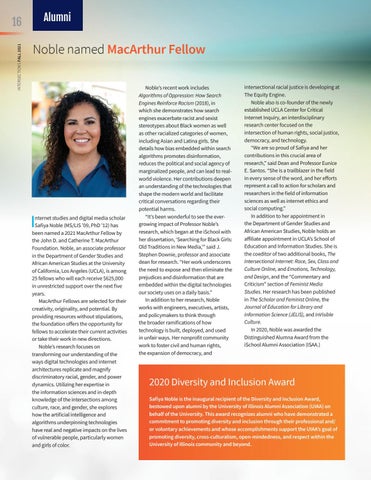
nternet studies and digital media scholar Safiya Noble (MS/LIS ’09, PhD ’12) has been named a 2021 MacArthur Fellow by the John D. and Catherine T. MacArthur Foundation. Noble, an associate professor in the Department of Gender Studies and African American Studies at the University of California, Los Angeles (UCLA), is among 25 fellows who will each receive $625,000 in unrestricted support over the next five years. MacArthur Fellows are selected for their creativity, originality, and potential. By providing resources without stipulations, the foundation offers the opportunity for fellows to accelerate their current activities or take their work in new directions. Noble’s research focuses on transforming our understanding of the ways digital technologies and internet architectures replicate and magnify discriminatory racial, gender, and power dynamics. Utilizing her expertise in the information sciences and in-depth knowledge of the intersections among culture, race, and gender, she explores how the artificial intelligence and algorithms underpinning technologies have real and negative impacts on the lives of vulnerable people, particularly women and girls of color.
Noble’s recent work includes Algorithms of Oppression: How Search Engines Reinforce Racism (2018), in which she demonstrates how search engines exacerbate racist and sexist stereotypes about Black women as well as other racialized categories of women, including Asian and Latina girls. She details how bias embedded within search algorithms promotes disinformation, reduces the political and social agency of marginalized people, and can lead to realworld violence. Her contributions deepen an understanding of the technologies that shape the modern world and facilitate critical conversations regarding their potential harms. “It’s been wonderful to see the evergrowing impact of Professor Noble’s research, which began at the iSchool with her dissertation, ‘Searching for Black Girls: Old Traditions in New Media,’” said J. Stephen Downie, professor and associate dean for research. “Her work underscores the need to expose and then eliminate the prejudices and disinformation that are embedded within the digital technologies our society uses on a daily basis.” In addition to her research, Noble works with engineers, executives, artists, and policymakers to think through the broader ramifications of how technology is built, deployed, and used in unfair ways. Her nonprofit community work to foster civil and human rights, the expansion of democracy, and
intersectional racial justice is developing at The Equity Engine. Noble also is co-founder of the newly established UCLA Center for Critical Internet Inquiry, an interdisciplinary research center focused on the intersection of human rights, social justice, democracy, and technology. “We are so proud of Safiya and her contributions in this crucial area of research,” said Dean and Professor Eunice E. Santos. “She is a trailblazer in the field in every sense of the word, and her efforts represent a call to action for scholars and researchers in the field of information sciences as well as internet ethics and social computing.” In addition to her appointment in the Department of Gender Studies and African American Studies, Noble holds an affiliate appointment in UCLA’s School of Education and Information Studies. She is the coeditor of two additional books, The Intersectional Internet: Race, Sex, Class and Culture Online, and Emotions, Technology, and Design, and the “Commentary and Criticism” section of Feminist Media Studies. Her research has been published in The Scholar and Feminist Online, the Journal of Education for Library and Information Science (JELIS), and InVisible Culture. In 2020, Noble was awarded the Distinguished Alumna Award from the iSchool Alumni Association (ISAA.)
2020 Diversity and Inclusion Award Safiya Noble is the inaugural recipient of the Diversity and Inclusion Award, bestowed upon alumni by the University of Illinois Alumni Association (UIAA) on behalf of the University. This award recognizes alumni who have demonstrated a commitment to promoting diversity and inclusion through their professional and/ or voluntary achievements and whose accomplishments support the UIAA’s goal of promoting diversity, cross-culturalism, open-mindedness, and respect within the University of Illinois community and beyond.
Rhinesmith receives the 2021 ASIS&T Outstanding Information Science Teacher Award
T
he Association for Information Science & Technology (ASIS&T) is very pleased to announce that Colin Rhinesmith, associate professor at Simmons University School of Library and Information Science, is the 2021 recipient of the ASIS&T Outstanding Information Science Teacher Award. The award’s purpose is to recognize the unique teaching contribution of an individual as a teacher of information science. Rhinesmith was selected as the winner from among a pool of outstanding candidates who were judged based on these criteria: evidence of sustained and unique contributions to teaching information science; impact on students, colleagues, and institutions; innovative and imaginative teaching materials and methods; professional association activities related to teaching excellence; research activities related to teaching excellence; and previous teaching awards. Rhinesmith serves as director of the Community Informatics Lab in the School of Library and Information Science at Simmons University. He is also the editorIn-chief of the Journal of Community
Informatics. Rhinesmith’s research and teaching interests are focused on the social, community, and policy aspects of information and communication technology, particularly in areas related to digital equity and community technology. He is the principal investigator on a research project funded by the U.S. Institute of Museum and Library Services to investigate how advanced broadband measurement capabilities can support the infrastructure and services needed to respond to the digital demands of public library users across the U.S. Furthermore, he is affiliated with the UCLA Center for Critical Internet Inquiry as a member of its Scholars Council. Previously, Rhinesmith was a Google Policy Fellow and an Adjunct Research Fellow with New America’s Open Technology Institute. He was also a Faculty Research Fellow with the Benton Foundation and a Faculty Associate with the Berkman Klein Center for Internet & Society at Harvard University. In nominating Rhinesmith for this award, Sanda Erdelez, professor and director at Simmons University School of Library and Information Science, wrote, “Professor Rhinesmith establishes a classroom environment that is intellectually stimulating, a direct result of the passion he holds for his research, and the respect he shows his students. Incorporating his own research and
personal experiences into lectures and discussions, he offers his expertise in the subject area along with an openness to classroom dialogue, making even the most challenging of topics approachable. In this way, he exposes students to the nuanced ways that information technology can cause extraordinarily isolating conditions for marginalized communities. His rigorous focus on the tensions among digital equity, technology, and society transforms his courses from finite lecture experiences into an innovative, intersectional thought framework that students can continue to call upon in their professional lives.” Upon learning of his selection as the 2021 ASIS&T Outstanding Information Science Teacher Award winner, Rhinesmith said, “I am incredibly honored to receive this year’s award, particularly during such an enormously challenging year. I am grateful to my students and colleagues at Simmons University for nominating me for this award and to the awards Committee for selecting me. Thank you also to ASIS&T for this wonderful recognition.” Rhinesmith received his award at the 2021 ASIS&T Annual Meeting, October 29-November 2, in Salt Lake City, Utah. Adapted from an ASIS&T press release
Colin Rhinesmith (PhD ’14) joins seven iSchool individuals in receiving this prestigious award: Michael Twidale, 2017 (faculty) Michelle Kazmer, 2014 (PhD ’02) Carole Palmer, 2013 (former faculty, PhD ’96) Carol Tenopir, 1993 (PhD ’84) Linda Smith, 1987 (faculty, MS/LIS ’72) Pauline Atherton Cochrane, 1981 (former faculty) F. Wilfrid Lancaster, 1980 (former faculty)
INTERSECTIONS FALL 2021
17
Alumni
INTERSECTIONS FALL 2021
18
Wightman fights spread of misinformation by educating church congregations
L
ibrarian Rachel Wightman (MS/LIS ’09) has spent her career teaching students to find information. Outside of her work as associate director for instruction and outreach at Concordia University in St. Paul, Minnesota, she is teaching church congregations how to spot and stop the spread of misinformation. For the past year, Wightman has been holding online training sessions for congregations across the country. “We have access to so much information, and it’s so easy to share, like, and post that I think we’ve created an online space that thrives on misinformation,” said Wightman. “I’ve found that many church communities are experiencing the same divisions we’re seeing in other areas of our lives. I wanted to provide a space for people of faith to think about how their faith impacts their online behavior (or not) and a chance to possibly engage in kinder, more productive ways.” Wightman’s workshops offer a mix of hands-on tools and examples along with plenty of time for discussion. She
teaches participants how to understand the information landscape, evaluate information, and decide how to engage with information. “We need to acknowledge deeper motivations behind people’s informationseeking habits,” said Wightman. “Sometimes we teach information literacy skills as if people are in a vacuum. For example, lateral reading is a helpful tool, and teaching people to look up information about an author or creator before engaging with the content is beneficial. However, we need to acknowledge this is not part of our human nature. We don’t naturally slow down or fact-check. I think librarians can help normalize how difficult it is for people to do those things. Those skills come naturally to us because we use them every day, but for many people, it’s counterintuitive.” Wightman has found that workshop participants are interested in not only having the tools to help them evaluate information but also being able to discuss strategies for talking with their loved ones who believe misinformation. “It’s been a really cool opportunity to connect my professional and personal lives. It has also been such a rewarding experience to hear people say, ‘I don’t fact-check everything the way you showed me, but I pause more before I share things online.’ None of us can fact-check everything or read every single article, but if I can give people tools to notice their behavior and be mindful, that seems like such a rewarding opportunity,” she said. Find out more at racheliwightman.com.
Kathryn Harris named Illinois Library Luminary
K
athryn Harris (MS/LIS ’71), former director of the Abraham Lincoln Presidential Library and Museum in Springfield, has been inducted as an Illinois Library Luminary. The Illinois Library Luminary program, an initiative of the Illinois Library Association (ILA), recognizes those who have made a significant contribution to Illinois libraries. Harris joins a roster of more than 70 individuals in Illinois’ “library hall of fame.” She served as the director of library services at the Abraham Lincoln Presidential Library and Museum in Springfield from 1990-2015. Prior to that, her experience includes stints at the Illinois State Library, Southern Illinois University, and the Lincoln Library. Since her retirement in 2015, Harris spends her time volunteering in the community, including portraying Harriet Tubman in vibrant reenactments. In February 2021, she received the Illinois Treasurer’s Office Black History Month Award for Outstanding Service in Arts and Humanity. She was recognized in 2020 by The State Journal-Register as the
“
Kathryn Harris is a tremendous force for good in Springfield, Illinois, her
Meet Rahul Chandran (MS/IM ’20), Product Manager at Yahoo!
hometown for five decades. Her commitment to scholarship, especially the sharing of her remarkable research of abolitionist Harriet Tubman, is a continuation of her life’s work around history and
”
exploration.
– Anne Craig
First Citizen Award winner, an award that recognizes Springfield-area residents who give selflessly of their time and resources in service to others. Harris has served on the Illinois Humanities Council, the Springfield mayor’s study circles on race, and the city’s zoning commission. She was the first African American and woman to be president of the Abraham Lincoln Association. She holds “distinguished alumnae” honors from the universities she attended and received the Webster plaque from the Springfield Branch NAACP. Anne Craig, executive director of the College and Research Libraries of Illinois consortium, who wrote the successful nomination, says, “Kathryn Harris is a tremendous force for good in Springfield, Illinois, her hometown for five decades. Her commitment to scholarship, especially the sharing of her remarkable research of abolitionist Harriet Tubman, is a continuation of her life’s work around history and exploration.” Courtesy of the Illinois Library Association
A
fter receiving his bachelor’s degree in computer science from Visvesvaraya Technological University in India, Rahul Chandran joined Deloitte Consulting as a business technology analyst. It was there that he realized how much he enjoyed solving customers’ problems. This experience motivated Chandran to further his education in a master’s program that would best complement his professional goals. Ultimately, Chandran chose the iSchool because it was a great fit for him. He appreciated that the MS in information management included several pathways, making the degree unique from other programs. “The iSchool’s curriculum offers a blend of courses, and there are many opportunities at the University of Illinois Research Park,” said Chandran, whose iSchool experience prepared him well for a successful career. Chandran’s favorite class, Applied Business Research (IS 514), started his journey as a project manager. Taught by Associate Professor Yoo-Seong Song, this class focused on advanced techniques of business research by giving students hands-on experience with real-world clients. “The ABR course allowed me to learn how to recognize user’s problems, understand and predict the needs of my peers, and structure information into actionable insights,” said Chandran. During his time in the class, Chandran worked with Song to introduce new tools and workflows to help make the student consultants more successful. “The unique experiences and appreciation from both clients and students brought tremendous exposure to
the ABR course, nearly tripling the number of students who apply for the course,” he said. Chandran is currently a product manager at Yahoo!, where he leads the analytical platforms for advertising partners and works on complex problems faced by their users. For Chandran, it is very exciting to collaborate with different teams, synthesize user’s needs, and build innovative solutions. “I feel extremely satisfied building and witnessing all our products being loved by customers. I also had an opportunity to file two patents for our work and complete several publications,” said Chandran. “I am particularly happy with my decision to earn my MS/IM from the iSchool, which allowed me to completely tailor my degree according to my needs and interests.” His advice to students is to have an end goal in mind and to keep their focus on courses and external organizations that complement that goal. When Chandran is not working, he plays soccer with friends, reads, and writes his ideas and views at rrahulchandran.com.
INTERSECTIONS FALL 2021
19
Giving
INTERSECTIONS FALL 2021
20
Lee-Smeltzer Scholarship to support future academic librarians
A
“
Janet was a consummate cataloger and manager and supported a more diverse profession. I wish to continue that support and make possible careers in academic librarianship for members of underrepresented populations. Librarianship was a shared love of ours— we wanted to ensure its
”
future.
– Thomas Wilson
new scholarship in the iSchool will support students who are interested in pursuing a career in academic libraries. Thomas Wilson established the KuangHwei “Janet” Lee-Smeltzer Scholarship Fund in honor of his wife, Janet, who passed away on November 28, 2015. Lee-Smeltzer (MS/LIS ’93) had a distinguished career in librarianship, working in academic and public libraries in several states. At the time of her death, she served as head of Cataloging and Metadata Services at The University of Alabama (UA) Libraries in Tuscaloosa. An active member of the American Library Association (ALA), Association for Library Collections & Technical Services (ALCTS), Library and Information Technology Association (LITA), and Association of College and Research Libraries (ACRL), Lee-Smeltzer served on many committees over the years. She received the ALA’s Samuel Lazerow Fellowship for Research in Acquisitions or Technical Services in an Academic or Research Library and was selected to participate in the ACRL Leadership and Career Development Program and the ACRL/Harvard Leadership Institute.
Lee-Smeltzer held a BA in library science from Fu Jen Catholic University in Taipei, Taiwan; MS in education from Southern Illinois University; and MS in library and information science from the University of Illinois. According to Wilson, the education of future library and information science (LIS) professionals was important to his wife, who was actively engaged in giving back to her alma mater through mentoring UIUC students. She was also a champion of diversity in LIS, coediting a book on the subject, Diversity Now: People, Collections, and Services in Academic Libraries, with Teresa Y. Neely. Preference for the new scholarship will be given to students that contribute to the diversity of the iSchool’s student body. “We both spent most of our library careers in academic libraries,” said Wilson, professor and associate dean of UA Libraries. “Janet was a consummate cataloger and manager and supported a more diverse profession. I wish to continue that support and make possible careers in academic librarianship for members of underrepresented populations. Librarianship was a shared love of ours— we wanted to ensure its future.”
Belcher Scholarship honors mother’s commitment to LIS education
W
“
My parents created the means to support a scholarship; we’re blessed with the fruits of their labor. I believe they both would be proud and humbled to see what their hard work and ideals
”
ultimately achieved. – JoAnne Ramirez
hen Lucille Belcher applied to the Graduate School of Library Science (now the iSchool) in the 1960s, she was met with some uncertainty, or at least concern, regarding her ability to complete the program. After all, Belcher was a middle-aged housewife and mother, and at that time, there weren’t many women of her age and situation heading back to college. “Before she could be admitted to the program, she had to interview with the chair of the School, about her educational goals and if she could manage this as a forty-something housewife with a husband and a family,” recalled Belcher’s daughter, Mary Lu Bretsch. “‘This is a very serious business,’ he lectured her. Oh, she was quite serious, she assured him.” Belcher’s commitment paid off, and after earning her MS in library and information science in 1966, she went on to work as a librarian for the DelandWeldon School District in Piatt County, Illinois, for almost twenty years. “We take pride in Mom’s perseverance when it came to getting her education,” said Belcher’s younger daughter, JoAnne Ramirez. Belcher paused her undergraduate studies during World War II, in order to get married and start a family. Later, when her husband Lowell received two job offers in Illinois—one in Mascoutah and the other in Monticello—they chose Monticello, so she could finish her education at the University of Illinois. Both sisters remember their mother telling them that she knew she wanted to be a librarian from the first time she went to her local library at the age of four. Like her mother, Bretsch’s love of libraries and path toward becoming a librarian started early. “I used to play ‘Library’ as a young child. All of the books in my parents’ two
living room bookcases contained little squares of paper that simulated the book checkout cards with the title of the book at the top and columns for the date due,” she said. Bretsch followed in her mother’s footsteps, earning her MS/LIS from the U of I in 1975, then spending most of her career as a librarian for the high schools in Belleville, Illinois. Over the years, she and her mother have both developed and served in their church libraries, Belcher in the Monticello United Methodist Church and Bretsch at her church in Belleville, where she still volunteers. “I always loved my job as a librarian. There wasn’t a day when I didn’t look forward to going to work,” she said. “Mother was retired then, and she would come and visit my library, where she helped with cataloging, handing out and retrieving periodicals, taking inventory, etc.” A few years ago, the sisters decided to create a scholarship fund at the iSchool to honor their mother’s perseverance in earning her LIS degree and acknowledge the role of the School in preparing mother and daughter for rewarding careers as librarians. The Lucille H. Belcher Scholarship supports students from Piatt and central Illinois counties who are interested in school or public librarianship. Ramirez noted that she personally knows the first two scholarship recipients, because they are from Monticello, where she lives. “My parents created the means to support a scholarship; we’re blessed with the fruits of their labor. I believe they both would be proud and humbled to see what their hard work and ideals ultimately achieved,” said Ramirez. “Mom would be so happy to help others who share her love of the library turn that into a career.”
INTERSECTIONS FALL 2021
21
INTERSECTIONS FALL 2021
22
iSchool surpasses goal for “With Illinois” campaign
T
he iSchool has surpassed its $20 million goal in the “With Illinois” campaign, the Urbana campus’ most ambitious fundraising effort to date. Gifts toward “With Illinois” will continue until June 30, 2022. The School’s priorities for the campaign are to offer an accessible education, enrich the student experience, and provide faculty support. “With the help of our alumni, friends, research partners, faculty, and staff, we have not only met but exceeded our campaign goal. Thank you all for your contributions large and small—they made a difference. It has been my pleasure to assist you with your desire to give to the iSchool,” said Diana Stroud, who served as assistant dean for advancement and alumni affairs, coordinating the School’s involvement in the “Brilliant Futures” and “With Illinois” campaigns. New funds established during the current campaign include the following: • Nancy and Dan Balz Scholarship • Midwest Services Scholarship • Ginny Murray Scholarship • Laura M. and Paladuga V. Rao Scholarship • Raymond L. and Barbara O. Slanker iSchool Fund • Selma Richardson Scholarship • School of Information Sciences Class of ’75 Scholarship • Kuang-Hwei “Janet” Lee Smeltzer Scholarship In addition, thanks to a gift from the Beta Phi Mu Alpha Chapter, the School has a new award, the Kathryn Luther and William T Henderson Award, which
will be given to a student who demonstrates a record of service through professional activities. “As a doctoral student, I was fortunate to receive the Josie B. Houchens Fellowship,” said Michèle Cloonan (MS/LIS ’84, PhD ’88), who serves as chair of the iSchool’s campaign committee. “Houchens was a librarian and adjunct faculty member who left money to the iSchool, and in so doing gave students a lasting legacy. It occurred to me when I received the fellowship that I could do the same thing! She and the other women for whom fellowships are named at Illinois have inspired me to give unto others as they have given to me.” The School has received over $7 million in support from alumni in the “With Illinois” campaign. Several existing funds received major gifts during this period, including the iSchool Annual Fund, Endowed Chair in Libraries and the Information Professions, Linda C. Smith Doctoral Fund, Harold Ladd Smith Jr. and Flora Lancaster Smith Endowment, Mildred M. Luther and Kathryn Luther Henderson Fellowship, Mildred M. Luther and Kathryn Luther Henderson Professorship, Susan F. and Clifford H. Haka Fund, and Molly Dolan Travel Fund. “Our students, faculty, and staff have benefited from the generosity of our donors. We are not done—there is still one more year to make a gift during this campaign,” said Stroud. For more information about supporting the iSchool, please contact Eileen Prillaman at prillamn@illinois.edu or (217) 333-7344.
Prillaman joins the iSchool Advancement Office
E
ileen Prillaman joined the iSchool on October 18 as assistant dean for advancement. In her new role, she will lead and manage a comprehensive advancement strategy. She will engage alumni, friends, corporations, and foundations in support of the School’s vision, mission, and goals. Prillman served as director of stewardship and donor relations for the U of I College of Fine and Applied Arts from 2017 to 2021. During this time, she developed a stewardship and donor relations program, started a student ambassador program, and managed financial operations in accordance with gift accounts. Prillaman joined the University in 2011 as a regional director of development, building relationships with major and principal gift donors in the Mid-Atlantic region. Prior to joining the University, Prillaman spent 25 years in leadership and managerial roles in the private sector. “I am excited about the opportunity to work with the dynamic team at the iSchool,” said Prillaman. “I look forward to building upon the accomplishments of the advancement office, while creating engagement and philanthropic opportunities. It is so rewarding to build meaningful connections with alumni, friends, and corporate partners that will enhance and support the mission of our School.” Prillaman holds a Master of Education in human resource development from the University of Illinois and a BS in biological sciences with a minor in business management from Eastern Illinois University.
Leave a Legacy There are a number of ways to give to the School of Information Sciences. These include short- and long-term options. The iSchool Advancement Office is happy to work with you to determine which option best fits your needs. If you would like to designate your estate gift for a particular use or gift fund within the School, please contact Eileen Prillaman in the iSchool Advancement Office, (217) 333-7344, prillamn@illinois.edu, to obtain further information to ensure that your wishes are carried out. Leave your Legacy by using this language in your will/trust or on IRA or other beneficiary forms: “I leave (e.g. % of estate, $ amount, residue) to the University of Illinois Foundation, an Illinois nonprofit corporation (37-6006007), to be used for the School of Information Sciences at the University of Illinois Urbana-Champaign.”
For more information about giving to the iSchool, or to make a gift, visit go.ischool.illinois.edu/give.
INTERSECTIONS FALL 2021
23
Class Notes
INTERSECTIONS FALL 2021
24
DECADE: 2020s Joann Bosas (MS/LIS ’20) is the youth services librarian at the Franklin Park Public Library. Gillian Dubin (MS/LIS ’20) moved to Louisville, Kentucky, to begin working on site as the special collections and metadata librarian at the American Printing House for the Blind. Tanya Gupta (MS/IM ’21) has started a job as business technology solutions associate in the Philadelphia office of ZS Associates. DECADE: 2010s In June, Tegan Beese (MS/LIS ’18) started as teen services librarian at Ankeny Kirkendall Public Library in Ankeny, Iowa. Katie Blakeman (MS/LIS ’11) has been elected president of the Champaign Public Library Board of Trustees. Katie Chamberlain (MS/LIS ’10) teaches online courses at the iSchool and was included on the List of Teachers Ranked as Excellent by Students for Spring 2021. In July, Zachariah Claybaugh (MS/LIS ’15) is the student success librarian at the University of Connecticut, where he advocates for and facilitates the use of open educational resources on campus. Jarrett Dapier (MS/LIS ’15) has published a children’s book called Mr. Watson’s Chickens. Hailley Fargo (MS/LIS ’16) is the head of education and outreach services at the W. Frank Steely Library at Northern Kentucky University. Brian Flota (MS/LIS ’13) coauthored the article, “Re-imagining (black) comic book cataloguing: increasing accessibility through metadata at one university library,” with Steven Holloway (MS/LIS ’13) and Justina Kaiser, in the Journal of Graphic Novels and Comics. Patti Gibbons (MS/LIS ’10) coauthored a library science textbook, Exhibits and Displays: A Practical Guide for Librarians, published by Rowman & Littlefield. Sam Helmick (MS/LIS ’12), community and access coordinator at the Iowa City (IA) Public Library, has been elected to serve on the ALA Executive Board. Rebecca Hodson (MS/LIS ’13), assistant director of career services at the iSchool, was interviewed by American Libraries for the article, “The Library Employment Landscape.”
Megan Jackson (MS/LIS ’17) is the youth services supervisor at the Kathryn Linnemann branch of the St. Charles City-County Library system in Missouri. Ellen Janowski (MS/IM ’18) started a new role at Invenergy LLC as a senior analyst in knowledge management. Annie Larson (MS/LIS ’15) recently accepted the position of humanities librarian at the College of Saint Benedict & Saint John’s University. Monique Lassere (MS/LIS ’17) presented “Translating Bits: Maintaining (Born-)Digital Heritage” as part of Syracuse University Libraries’ annual Brodsky Series for the Advancement of Library Conservation. Sarah Lindenbaum (MS/LIS ’13) published the article, “Memorializing the Everyday: The Evidence of the Final Decade of Frances Wolfreston’s Life,” in The Seventeenth Century (August 2, 2021). Lainie Miller (MS/LIS ’18) is now the collection development librarian for adult materials for Colorado’s Jefferson County Public Library system. Jordan Neal (MS/LIS ’17) has been elected director-at-large of the Illinois Library Association. Erica Parker (MS/LIS ’15) recently accepted a position as manager of adult programming at the New York Public Library. Catheryne Popovitch (MS/LIS ’11) was awarded the 2021 Rising Star Award from the Council of State Archivists. She also became the first recipient of the National Association of Government Archives and Records Administrators Emerging Leader Award. Naomi Sandler (MS/LIS ’12) has started a new job as a junior salesforce developer at NextStep in Seattle, Washington. Yasmeen Shorish (MS/LIS ’11), head of scholarly communications at James Madison University, has been elected to the Board of Directors of the Association of College and Research Libraries (ACRL) as a director-atlarge. Joella Travis (MS/LIS ’18) recently celebrated two years as the youth services librarian at Rantoul (IL) Public Library.
Jeanette Wallace (MS/LIS ’17) has been named the new director of the Winchester (IL) Public Library. Paul Wheelhouse (MS/LIS ’16) is selfemployed and the owner of A USA PPP LLC as well as the publisher of five book titles, mainly under the imprint name of Wheel House Publications. Sherry Williams (MS/LIS ’19), president and founder of the Bronzeville Historical Society, has received the MOSAIC Award from the Chicago Cultural Alliance in the category of Outstanding Community Leader. Elizabeth York (MS/LIS ’14) has published an article, “Eden in Sin City: Adapting for the Musical Theater Body in Takarazuka Revue’s Ocean’s 11,” in Dance Chronicle. DECADE: 2000s Jeanie Austin (MS/LIS ’09, PhD ’17) and coauthor Chelsea Jordan-Makely published an article, “Outside and In: Services for People Impacted By Incarceration,” in Library Journal. André Brock, Jr. (PhD ’07) has received the 2021 Nancy Baym Book Award from the Association of Internet Researchers for his book, Distributed Blackness: African American Cybercultures (NYU Press, 2020). He and Samip Mallick (MS/LIS ’11) have been selected to serve on the advisory board for the Connecting Communities Digital Initiative, a key component of the new initiative Of the People: Widening the Path at the Library of Congress. Tamela (James) Chambers (MS/LIS ’05) is now the branch manager at the Beverly Branch Library in Chicago. Brian Conn (MS/LIS ’09) was featured by American Libraries in the article, “Serving Those Who Have Served,” on June 27, 2021. Kelly Czarnecki (MS/LIS ’02) is the 20212022 president of the Young Adult Library Services Association (YALSA). She coauthored Connecting Teens with Technology at the Library, which was recently published by Rowman and Littlefield. Christine D’Arpa (MS/LIS ’06, PhD ’17) and Caroline Nappo (MS/LIS ’08, PhD ’15) copresented “The Chicago Public Library Omnibus Project: Reappraising the Literature of Library Work and the WPA” at the Library History Seminar XIV in June.
INTERSECTIONS FALL 2021
25
Aaron J. Enright (MS/LIS ’03) is enjoying his eighteenth year at Wolfram Research & WolframAlpha, where he was recently named senior information scientist. Fiona Griswold (MS/LIS ’09) recently returned to Illinois from Louisiana to assume the role of librarian at Alton (IL) High School. Margaret Heller (MS/LIS ’08), digital services librarian at Loyola University Chicago, has been elected as the 2021-22 president-elect of Core: Leadership, Infrastructure, Futures, a division of the ALA. Martha Kyrillidou (PhD ’09), research associate at the iSchool, has been engaged by the Institute of Museum and Library Services (IMLS) to lead a feasibility study for transferring the Academic Library survey from the Integrated Postsecondary Education Data System/National Center for Education Statistics to the IMLS. Sarah Miller (MS/LIS ’06) started a new position as research services librarian and assistant professor at the University of Dayton in July. Elizabeth D. Muller (MS/LIS ’08) began a new position as assistant director for special collections processing at the New York Public Library. Mark Newton (MS/LIS ’07) began serving as the University Librarian ad interim at Boston University in July. Cathy Ritchie (CAS ’00) is a blog contributor to Public Libraries Online, focusing on bookrelated topics and recommendations. Michael Robak (MS/LIS ’01) contributed a chapter to the open textbook for LIS courses, Legal Issues in Libraries and Archives. Alec Sonsteby (MS/LIS ’05), chair in the Department of Library and Information Services at Metropolitan State University in Saint Paul, Minnesota, was promoted to the rank of full professor. Janet Vogel (MS/LIS ’08) is the library director for Hiram College. DECADE: 1990s Judith Currano (MS/LIS ’99) was named a 2020 Fellow of the American Chemical Society. Heather Jagman (MS/LIS ’96) has been elected president-elect of the Illinois Library Association.
Chad Kahl (MS/LIS ’98) has started a new position as a data services librarian at Illinois State University’s Milner Library in Normal. At the end of June, Loring Prest (MS/LIS ’97) retired from Manderino Library at California University of Pennsylvania, where he served as full professor and spent nine years as department chair. Jennifer E. Sweda (MS/LIS ’94) recently accepted the position of editor of the Books and Proceedings for the Web of Science database (Clarivate) in Philadelphia. Lynne M. Thomas (MS/LIS ’99) has been selected as a finalist for a 2021 World Fantasy Award in the Special Award–Non-Professional category. She was selected for her work with Uncanny Magazine, alongside her husband, Michael Damian Thomas. DECADE: 1980s Fred Jenkins (MS/LIS ’86) is retiring as associate dean for collections and operations after 34 years at the University of Dayton Libraries. Elizabeth Van Jacob (MS/LIS ’88) retired as director of library services at Ivy Tech Community College at South Bend/Elkhart in September. Karen Wells (MS/LIS ’80) retired from her position as senior director of system library services for Sisters of Charity of Leavenworth Healthcare System in June. DECADE: 1970s Virginia Carden (MS/LIS ’77) retired from Duke University Medical Center Library in August, following 35 years of service.
In March, Beth Christensen (MS/LIS ’77) was awarded the Music Library Association Citation for a lifetime of “expert professional practice, insightful scholarship, and generous service.” Linda Houle (MS/LIS ’70), a retired junior high media center director/technology facilitator, is a part-time content curator for LiveBinders.com. Sharon Michalove (MS/LIS ’75) released her debut romantic-suspense novel, At First Sight, in October. Elizabeth Griggs Shuler (MS/LIS ’79) retired from Selmaville School in Salem, Illinois, after 34 1/2 years as a librarian and classroom teacher. Laura Cameron Spencer (MS/LIS ’78) is retiring after 34 years in Technical Services at the James V. Brown Public Library in Williamsport, Pennsylvania. Michael Widener (MS/LIS ’74) has digitally published his first novel, Fishbein, Ascending. He retired from law practice and public officialdom in 2021. Lizabeth (Betsy) Wilson (MS/LIS ’78) retired as vice provost for digital initiatives and dean of university libraries at the University of Washington in June. DECADE: 1960s Mohamed M. El Hadi (MS/LIS ’60, PhD ’64) recently published two books in the Arabic language about the data revolution and artificial intelligence and their impact on societal and economic development.
Send us your news! We’d love to hear from you! Send us your updates as well as any employment or internship opportunities, conferences of interest, or opportunities for iSchool alumni to connect in your area. Office of Advancement and Alumni Relations School of Information Sciences 501 East Daniel Street, Champaign, IL 61820 ischool-advancement@illinois.edu (217) 300-5746 ischool.illinois.edu/engage/alumni
Grants
INTERSECTIONS INTERSECTIONSFALL FALL2021 2021
26 Research Grants
Our faculty and staff are principal investigators on a portfolio of 44 projects totaling $27.4 million and co-investigators or partners on 19 projects totaling $81.9 million.
Measuring the value and impact of library makerspaces Associate Professor and Interim Associate Dean for Academic Affairs Emily Knox and Associate Professor Kyungwon Koh received a $100,000 grant from the Institute of Museum and Library Services (IMLS) for a project to develop an initial framework and future toolkit for measuring the impact and value of public library makerspaces in the lives of users and the communities that libraries serve.
Utilizing artificial intelligence to address agricultural challenges Associate Professor Jingrui He is one of the researchers involved in the new Artificial Intelligence for Future Agricultural Resilience, Management, and Sustainability (AIFARMS) Institute at the University of Illinois. The National Artificial Intelligence Research Institutes program, a joint effort between the National Science Foundation (NSF) and U.S. Department of Agriculture’s National Institute of Food and Agriculture (NIFA), recently awarded the University $20 million for the institute.
Reducing the risk of foreign influence on news media The Department of Homeland Security (DHS) awarded Associate Professor Jingrui He a two-year, $319,568 grant to study how to mitigate the risk of foreign influence on news media by developing algorithms and software tools to detect, predict, generate, and understand disinformation dissemination.
Reducing the spread of retracted science Assistant Professor Jodi Schneider’s research on reducing the spread of retracted science, funded through a $174,981 grant from the Alfred P. Sloan Foundation, was shared in a case study published in a special issue on scholarly literature mining in Scientometrics and in an online workshop, Reducing the Inadvertent Spread of Retracted Science (RISRS2020).
Creating international cyberinfrastructure networks Anita Nikolich, director of research and technology innovation and research scientist, is the principal investigator of a $3 million project funded by the National Science Foundation (NSF). FABRIC Across Borders (FAB) will expand FABRIC, a project to build the nation’s largest cyberinfrastructure testbed and accelerate scientific discovery by creating networks to seamlessly and securely move vast amounts of data across oceans and time zones.
Digitizing astrophysical literature Teaching Assistant Professor Jill Naiman received a $506,912 grant from the National Aeronautics and Space Administration (NASA) to digitize predigital scientific literature. The project is a collaboration with Harvard University and the Astrophysics Data System (ADS), a digital library portal operated by the Smithsonian Astrophysical Observatory (SAO) under a NASA grant. With over 15 million records, ADS is one of the most important archives in the scientific field of astronomy.
Identifying privacy measures in public libraries Associate Professor Masooda Bashir received a $150,000 grant from the Institute of Museum and Library Services (IMLS) to identify the existence and absence of privacy protecting technologies in public library systems, determining adherence to American Library Association (ALA) digital privacy guidelines. Associate Professor Yang Wang serves as key project staff.
27
Preserving the history of live musical performances Professor and Associate Dean for Research J. Stephen Downie and Professor Michael Twidale are coinvestigators for InterMusE, a collaboration with partners at the University of Illinois Krannert Center for the Performing Arts and colleagues across the United Kingdom. Funded by the UK’s Arts and Humanities Research Council, the project will preserve the history of live musical performances and the relationship between live music and communities by developing an online archive of musical events.
Analyzing digital collections for marginalized texts and communities The HathiTrust Research Center (HTRC), cohosted at Indiana University and codirected by Professor and Associate Dean for Research J. Stephen Downie, received a $500,000 grant from The Andrew W. Mellon Foundation to develop new methods for creating and analyzing digital collections. In collaboration with the University of Kansas, the project will focus on content related to historically under-resourced and marginalized texts and communities.
Investigating potential biases in adaptive learning software The National Science Foundation (NSF) awarded Assistant Professor Nigel Bosch a three-year, $987,015 grant to study potential biases in K-12 mathematics adaptive learning software related to the identities expressed by students.
A new project led by Assistant Professor Jessie Chin aims to develop a “Motivational-Interviewing Conversational Agent (MintBot)” for increasing COVID-19 vaccination among vulnerable populations, especially those with compromised health conditions. The project is funded through a $74,992 grant from Jump ARCHES, a partnership between OSF HealthCare and the U of I’s Grainger College of Engineering and College of Medicine in Peoria.
INTERSECTIONS INTERSECTIONSFALL FALL2021 2021
Creating a digital health solution for promoting COVID-19 vaccination
Empowering youth to build health data literacy skills Assistant Professor Rachel M. Magee, Professor Catherine Blake, and Associate Professor Jana Diesner received funding from the Office of the Provost and U of I Extension to build on existing Illinois 4-H ambassadors and advocate models to create a Health Data Literacy Ambassadors program, which will empower youth as change agents and build connections and new partnerships.
Studying the impact of scientific research on society Associate Professor Jana Diesner is a member of a research team that received a $1 million, three-year grant from the Federal Ministry of Education and Research (Germany) for the collaborative project, “TextTransfer: Assessing Impact Patterns in Research Texts Applying Corpus Driven Methods.” The main goal of this project is to advance, validate, and apply methods to study the impact of research on society at large across different dimensions of possible impact of science on people. The team also is developing and validating new taxonomies and methods for this purpose.
Improving access to restricted digital collections HathiTrust Research Center Associate Director Glen Worthey was one of the first recipients of new grant funding to advance digital scholarship in cultural institutions. His project, AEOLIAN (Artificial Intelligence for Cultural Organizations) will bring together a team of experts to develop and examine new approaches—particularly artificial intelligence and machine learning—for improving access to and use of digital collections that are currently restricted due to privacy concerns or copyright protection. It is a collaboration with Loughborough University in the UK and led by the HathiTrust Research Center, which is cohosted by the iSchool.
Non Profit Org. U.S. Postage PAID Permit No. 75 Champaign, IL University of Illinois Urbana-Champaign 501 East Daniel Street, MC-493 Champaign, IL 61820-6211
iSchool adds new space New space for iSchool expansion
This architectural rendering of Hub Champaign Daniel at 614 E. Daniel Street illustrates the view from the corner of 6th and Daniel Streets. The building, which is nearing completion, will provide additional space for the iSchool on the 4th and 5th floors. The School will retain its current location at 501 E. Daniel.
This fall, our School expanded into the fourth and fifth floors of the new Hub Champaign Daniel building, located on the corner of 6th and Daniel Streets. The new location added significant space beyond what our main location at 5th and Daniel can provide for our growing faculty, staff, and student body. It features collaborative study and research areas, conference rooms, and open spaces for gatherings as well as faculty and staff offices.