International Research Journal of Engineering and Technology (IRJET)
e-ISSN: 2395 -0056
Volume: 04 Issue: 02 | Feb -2017
p-ISSN: 2395-0072
www.irjet.net
5. PROPOSED ALGORITHM
Surf Feature Extraction:
I. Outline of the Proposed Work
The purpose of feature point matching is to find up the feature point from the same location in two images and match a couple of feature points. SURF adopts nearest neighbour. A SURF descriptor is a 64-dimensional vector which need new data structure to place.
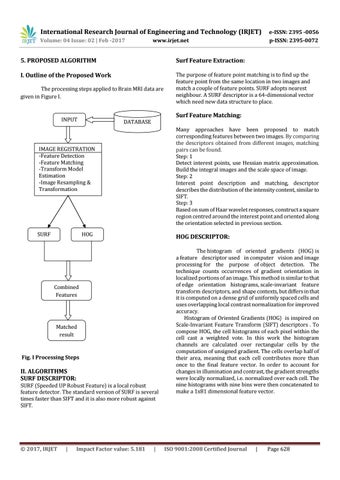
The processing steps applied to Brain MRI data are given in Figure I.
INPUT
Surf Feature Matching:
DATABASE
Many approaches have been proposed to match corresponding features between two images. By comparing the descriptors obtained from different images, matching pairs can be found. Step: 1 Detect interest points, use Hessian matrix approximation. Build the integral images and the scale space of image. Step: 2 Interest point description and matching, descriptor describes the distribution of the intensity content, similar to SIFT. Step: 3 Based on sum of Haar wavelet responses, construct a square region centred around the interest point and oriented along the orientation selected in previous section.
IMAGE REGISTRATION -Feature Detection -Feature Matching -Transform Model Estimation -Image Resampling & Transformation
SURF
HOG
HOG DESCRIPTOR:
Combined Features
Matched result
Fig. I Processing Steps
II. ALGORITHMS SURF DESCRIPTOR:
SURF (Speeded UP Robust Feature) is a local robust feature detector. The standard version of SURF is several times faster than SIFT and it is also more robust against SIFT.
Š 2017, IRJET
|
Impact Factor value: 5.181
|
The histogram of oriented gradients (HOG) is a feature descriptor used in computer vision and image processing for the purpose of object detection. The technique counts occurrences of gradient orientation in localized portions of an image. This method is similar to that of edge orientation histograms, scale-invariant feature transform descriptors, and shape contexts, but differs in that it is computed on a dense grid of uniformly spaced cells and uses overlapping local contrast normalization for improved accuracy. Histogram of Oriented Gradients (HOG) is inspired on Scale-Invariant Feature Transform (SIFT) descriptors . To compose HOG, the cell histograms of each pixel within the cell cast a weighted vote. In this work the histogram channels are calculated over rectangular cells by the computation of unsigned gradient. The cells overlap half of their area, meaning that each cell contributes more than once to the final feature vector. In order to account for changes in illumination and contrast, the gradient strengths were locally normalized, i.e. normalized over each cell. The nine histograms with nine bins were then concatenated to make a 1x81 dimensional feature vector.
ISO 9001:2008 Certified Journal
|
Page 628