
DECEMBER 2022 THE PROBLEM SOLVER Bernie Uhlich uses systems to design supply chain solutions Future-proofing your supply chain Eco-friendly logistics Digital security The Toyota Sienna Green packaging


MANAGE PROTECT STORE What customers think we do... 1.800.668.5586 • www.johnstonequipment.com MOVE This is a unique mix of innovative products, best-in-class methodologies and software-based, data-powered solutions that work together to help you achieve your goals. What we really do... What we really do... MANAGE PROTECT STORE What customers think we do... 1.800.668.5586 • www.johnstonequipment.com MOVE This is a unique mix of innovative products, best-in-class methodologies and software-based, data-powered solutions that work together to help you achieve your goals. Johnston Equipment Offers End-to-Endless Intralogistics Solutions. What we really do... What we really do... MANAGE PROTECT STORE What customers think we do... 1.800.668.5586 • www.johnstonequipment.com MOVE This is a unique mix of innovative products, best-in-class methodologies and software-based, data-powered solutions that work together to help you achieve your goals. Johnston Equipment Offers End-to-Endless Intralogistics Solutions. SOLUTIONS™ COMPLETE


SUPPLYPRO.CA 3 VOL.64 No.06 DECEMBER 2022 SUPPLYPRO.CA COVERING CANADA’S SUPPLY CHAIN @SupplyProMag facebook.com/supplyprofessional linkedin.com/company/supplyprofessional FEATURES 8 SUSTAINABLE PACKAGING Greener packaging is often found in the most obvious places. 10 THE PROBLEM SOLVER Bernie Uhlich looks to systems for solutions. 13 FUTURE PROOF Navigating tomorrow’s supply chains. 14 DIGITAL SECURITY Working to prevent supply chain cyber attacks. ALSO INSIDE 4 UP FRONT 5 BUSINESS FRONT 6 IN THE FIELD 7 INDUSTRY NEWS 30 THE LAW 16 GREEN LOGISTICS The rise of sustainable transportation. 18 NET-ZERO PROCUREMENT Sustainable strategies for the public sector. 20 OUTLOOK 2023 Challenges facing supply chains in the New Year. 22 MODERN SLAVERY How to combat supply chain’s dark side. 23 COVER: MIKE FORD PHOTOGRAPHY 14 8 10 Fleet Management
THE YEAR AHEAD
This time of year, everyone wants to make some sort of list. New Year’s resolutions, gift lists, naughty-versus-nice lists – whatever else, this season is about taking account of our lives and the world. The year’s end is a good time to reflect not only on what has just passed, but also to consider what the New Year holds. This is as true in supply chain as anywhere else. As 2022 winds down and the New Year looms, here are trends likely to gain traction.
SUSTAINABILITY AND ESG
For supply chains, sustainability has been a ‘nice-to-have’ concept, rather than a business imperative. That has changed. Pressure from consumers and regulatory bodies means businesses now embrace sustainability in their supply chains and promote environmental, social and governance (ESG) goals. This will no doubt continue.
LABOUR SHORTAGES
The pandemic exacerbated labour shortages across many sectors, supply chain included. Other ongoing structural issues, like inflation and an aging workforce, have worsened the situation. Yet there are steps that can ease labour woes: upskilling programs, automated processes, and reviewing retention practices can help.
TECHNOLOGY ADOPTION
Due to these labour shortages, many industries are looking to technology and automation to handle tasks previously done by people. Yet technology shouldn’t replace human beings entirely. People can be re-skilled to use the technology, or to work alongside robots rather than see themselves displaced (hence the term ‘co-bot’). It’s also important that organizations don’t adopt all the technology they can simply because it’s available. Rather, identify a problem then look to technology for potential solutions.
EDUCATION
Online learning gained popularity during the pandemic. Online education opportunities were a good option while we all worked to limit our in-person contacts. Going forward, we’ll likely see more live business events. This includes conferences offering education opportunities. It pays to attend these events to further one’s knowledge of the field.
NEARSHORING AND FRIEND-SHORING
Geopolitical conflict, climate and weather challenges, pandemics, and other issues can strain global supply chains. Concepts like nearshoring, onshoring, and friend-shoring have been discussed as ways to buffer potentially fragile global links. These practices aren’t risk free. For example, they could raise costs, depending on which locations are chosen to replace riskier options. Used strategically, nearshoring may lower exposure to disruption.
To add some seasonal cheer, some things have improved. For example, supply chain bottlenecks have eased, and there’s more volume going faster. And whatever else, supply chain professionals are experts in dealing with disruption and the unknown. That’s something to be thankful for going into 2023.
EDITOR
MICHAEL POWER 416-441-2085 x7 michael@supplypro.ca
PUBLISHER
ALEX PAPANOU 416-441-2085 x1 alex@supplypro.ca
DESIGN
Art Direction ROY GAIOT Design Consultation BLVD AGENCY
CUSTOMER SERVICE/PRODUCTION
LAURA MOFFATT 416-441-2085 x2 lmoffatt@iqbusinessmedia.com
ASSOCIATE PUBLISHER
FARIA AHMED 416-919-8338 faria@supplypro.ca
EDITORIAL ADVISORY BOARD
LORI BENSON Procurement Compliance, L&D, Engagement and Knowledge Lead | Business Enablement, Ernst & Young LLP
THOMAS HUDEL Manager, Purchasing and AP, Esri Canada Ltd.
WAEL SAFWAT Procurement Director, Black & McDonald
SHERRY MARSHALL Senior Manager, Meetings, Travel & Card Service, PwC Management Services
KIRUBA SANKAR Director, Program Support, Purchasing and Materials Management— City of Toronto
JEFF RUSSELL Corporate Purchasing Manager & Inventory Manager, Miller Waste Systems Inc.
iQ BUSINESS MEDIA INC.
Vice President
STEVE WILSON 416-441-2085 x3 swilson@iqbusinessmedia.com
President ALEX PAPANOU
PUBLICATION MAIL AGREEMENT
NO. 43096012 ISSN 1497-1569 (print); 1929-6479 (digital)
CIRCULATION Mail: 126 Old Sheppard Ave, Toronto ON M2J 3L9
SUBSCRIPTION RATES
Published six times per year Canada: 1 Year $ 99.95 CDN Outside Canada: 1 Year $ 172.95 USD
Opinions expressed in this magazine are not necessarily those of the editor or the publisher. No liability is assumed for errors or omissions. All advertising is subject to the publisher’s approval. Such approval does not imply any endorsement of the products or services advertised.
Publisher reserves the right to refuse advertising that does not meet the standards of the publication.
No part of the editorial content of this publication may be reprinted without the publisher’s written permission. © 2021 iQ Business Media Inc. All rights reserved. Printed in Canada.
4 DECEMBER 2022 SUPPLY PROFESSIONAL
UP FRONT
MICHAEL POWER, Editor
PAYING WHAT WE OWE DIGGING OURSELVES OUT OF THE PANDEMIC HOLE
It is past astonishing that anyone with even a cursory understanding of economics was surprised that, in the wake of the shutdown due to the COVID-19 over-reaction, the North American economies would experience stagflation.
Yet this seems to have been the case. This past June 1, US Treasury Secretary Janet Yellen admitted the following: “I was wrong about the path that inflation would take.” She was referring to a comment she made only one year earlier that inflation posed a “small risk.” When you listen to Yellen speak, you understand immediately that she’s about as sharp as a bowling ball. But this kind of (I struggle for the right word) naivete/ignorance/stupidity is almost past belief.
Imagine the following. There is a small country with $100 million worth of money outstanding. It produces 100 million units a year and all are purchased and used. Because I’m particularly gifted at mathematics, I can conclude that the price of the average unit must be $1 (if you need a calculator to confirm my numbers, take a moment and do the arithmetic). Then the economy shuts down due to a healthcare panic. Production falls to 75 million units a year. In response, the Central Bank and government flood the economy with liquidity, and now there is $150 million in circulation. Isn’t it utterly logical that the average price would rise to $2 per unit?
Of course. But for whatever reason, the Janet Yellens and Joe Bidens and Tiff Macklems and Justin Trudeaus of the world seemed surprised. And the reaction to inflation has been consistent on
both sides of the 49th parallel: Let’s jack-up interest rates!
On March 1, the bank rate in Canada was .25 per cent, or 25 basis points. It tripled the next day. As I write this column in mid-November, it stands at 3.75 per cent and the consensus is that there will be another hike in December (more about that later). Meanwhile in the US, the 30-year fixed mortgage rate started the year under 3.5 per cent and now it is north of 7 per cent.

Yes, one way to fight inflation is by raising interest rates. This was the path followed by Paul Volcker in the early 1980s when inflation raged. And for those old enough to remember (which unfortunately includes me), the result was a severe recession. I have argued in this column previously that North America has already gone through a de facto recession due to inflation. Fortunately, it has not been reflected in the employment market. At least, not yet.
That said, there has been a series of high-profile layoffs announced by tech companies recently. Twitter is cutting its workforce in half. Amazon has announced that it will cut 3 per cent of its white-collar workers. Meta (previously Facebook) recently laid off 11,000 people, 13 per cent of its employment pool. I can see this rippling through the entire economy.
GOVERNMENT SPENDING
However, there is a better way to battle inflation and that is through controlling government spending. In the years before the pandemic, the US deficit climbed each year under the Trump presidency and stood at $984 billion in 2019.
It exploded to $3.13 trillion in 2020. Then $2.77 trillion in 2021 and it is projected to be approximately $1.0 trillion this fiscal year. There’s been a similar pattern in Canada but it’s more egregious given the mendacity of our current Prime Minister. In the 2015 election, he committed to a budget surplus in 2019. If you recall that was preCOVID-19. Let’s take a look at the actual record. The deficit was $39.4 billion in 2019 and if we had anything close to a functioning democracy, an immediate resignation would have been required. But that’s a whole other column.
Then the pandemic hit. Canada’s deficit peaked at $314 billion in fiscal year 2020/2021 and was brought down to $95.4 billion the next year. It is projected to be $12.9 billion this year which in all fairness is quite an impressive reduction. But I wouldn’t be surprised if the deficit increases in the future in no small part because of the higher interest rates required to finance the huge amount of outstanding debt.
This gets me to the ultimate point of this column. We should be fighting inflation through balancing budgets and ultimately running surpluses which would allow us to gradually pay down what we owe. I know this would be politically unpopular. It would require a combination of tax increases and spending cuts. But it’s required. We acted as if COVID -19 was a crisis and whether it really was or not is water under the bridge. Looking forward, we should be cutting spending, raising taxes, and cutting interest rates rather than raising them, positioning ourselves towards a future of real economic growth and prosperity. SP
SUPPLYPRO.CA 5
BUSINESS FRONT—BY MICHAEL HLINKA
Toronto-based Michael Hlinka is a tenured professor at George Brown College. He hosts a weekly podcast about wagering on professional football. His website is www. michaelhlinka.com
“We should be fighting inflation through balancing budgets and ultimately running surpluses which would allow us to gradually pay down what we owe.”
HELP WANTED GETTING STARTED WITH PROCUREMENT AS A SERVICE
Procurement as a service is an outsourced procurement model that combines technology, staff, and expertise to handle a portion, if not all, of your organization’s procurement function. There are several models available that include payas-you-go, on-demand services, scale to suit individual businesses or allow the ability to leverage expertise. These services are often affordable and do not require any extra technological skill.
If you are thinking about implementing this type of solution, then you should be looking at how you handle your indirect procurement. This typically involves purchases of items that are essential for dayto-day operations but don’t directly contribute to the company’s bottom line.
Keep in mind that you are not a pioneer. Many services exist that companies use to outsource certain job functions. I have seen it done for HR, marketing, sales, and IT. HR functions that are outsourced to a service often include payroll processing, employee benefits administration, and other business needs unrelated to day-to-day company functions. Use a similar methodology to come up with solutions for your procurementas-a-service challenge.
What I haven’t seen as much is a similar offering for procurement. Perhaps it’s because people in the profession have a can-do attitude? Maybe they don’t believe that they can afford a service that they truly need? It could be that they fear losing their job. or looking in the wrong areas.
OUTSOURCING BENEFITS
I suggest that moving certain tasks to others is the smart thing to do. It frees up time to work on value-added tasks. It allows the opportunity to engage with your internal stakeholders rather than get encumbered with administrivia.
If you are interested in learning more, where do you start? The first thing to do is determine where you might either have pain points or gaps. Pain points are easy to recognize as they are those areas that everyone complains about. Gaps are trickier. Perhaps your staff is lacking the knowledge, skills, or experience. Maybe your ERP system is old, outdated and was installed with every other department in mind. Or worse yet, you still use Word and Excel.
You could try to get your staff trained but that takes time. The risk you take when doing the training is that it might not provide you with the desired outcomes.
Procurement’s problems are ever evolving. The market is in constant change. There are solutions, but you must remember that they are new or often not well known. It took years for outsourced HR functions to take hold.
To be successful in your search for the ultimate procurement as a service, you will need to take a few limited risks. You must focus your search in order to find and develop existing or new solutions, prove them in the real world, then develop a contract to make them a lasting reality.
You will need to explore existing solutions, potentially create a pro-
curement process start-up, in-residence program and determine how to redefine an approach that allows you to have a positive impact on the future of your organization. Here are a few suggestions to get you on your journey:
Identify baseline needs and important issues from your internal stakeholders. Where are the gaps and pain points?
Embrace the challenge/need for a solution-based model.
Energize local solution providers.
Implement a supply chain residency program to develop simpler software solutions for existing challenges.
Agree to pilot projects with potential solution providers. Give your staff a chance to take 10 per cent of their time in order for them to review options when it comes to utilizing procurement as a service. Allow responding companies to be creative when responding to a request for information.
WHAT TO CONSIDER
Here are some areas to think about regarding procurement as a service. Firstly, look at your vendor management and onboarding process. This area of the procurement function is often managed by accounts payable or delegated to other departments when you are in a decentralized environment. Using procurement as a service allows you to delegate the often time-consuming and error-prone process. This would give your staff time to moni-
tor and supervise the outcomes versus actually doing all the work. There are other administrative tasks where procurement as a service might come in handy. The procurement world is still overwhelmed with paperwork. Most of it is critical to the smooth operations of various departments.
Examples include the maintenance of contracts, updates to insurance certificates, verifying workplace insurance coverage, conducting trade and work references, and repetitive ordering.
These functions take time. In fact, if you have a base of over 200 suppliers, the time taken to keep the above up to date and functioning may take 25 to 40 per cent of your staff’s time. We are now witnessing an evolution in our profession and the next step belongs to you. SP
6 DECEMBER 2022 SUPPLY PROFESSIONAL
“To be successful in your search for the ultimate procurement as a service, you will need to take a few limited risks.”
IN THE FIELD—BY GERALD FORD
Gerald Ford is director, supplier development, with Kinetic & CEO of QCsolver Supplier Management.
Cascades division ranks first in survey
Cascades’ Canadian Retail Tissue division has ranked first in the Household paper category in the 2022 Voice of Retailer feedback survey, done by the Advantage Group International.
Cascades ranked first in 16 out of the 28 competencies evaluated by retailers, and 96 per cent of the corporation’s competencies are considered “best in class” including capability and expertise; trust; customer service; collaborative planning; ESG & innovation. The corporation also ranked first in the top 125 manufacturer’s serving the Canadian market in retailer sentiment.
“Coming out of a pandemic that tested our entire industry and more, particularly our supply chains, we are very proud of this recognition,” said president and COO of Cascades Tissue Group, Jean-David Tardif.
The report benchmarked view of performance as rated by business on their business relationships’ strengths, weaknesses, and opportunities.
Cadillac Fairview lands
zero-carbon
certification at Vancouver offices
Cadillac Fairview (CF) has won Zero Carbon Building (ZCB) – Performance standard certification for seven buildings in its Vancouver office portfolio.
The Canada Green Building Council (CaGBC) awarded the certification to four Pacific Centre Office locations: 777 Dunsmuir, 885 West Georgia, 609 Granville and 700 West Georgia, and three Waterfront Properties: 200 Granville, 200 Burrard and 250 Howe.

“CF is committed to achieving net-zero carbon emissions by 2050 for our Canadian portfolio and this recognition demonstrates our drive to meet our targets related to emissions, energy, climate resilience, sustainable transport, water and waste,” said Sal Iacono, executive VP
of operations at Cadillac Fairview.
CF achieved the ZCB certifications through CO2 emission mitigation initiatives and capital projects. CF has incorporated advanced technologies and best practices to support CF’s journey to net zero, including the installation of the GeoExchange Plant at 777 Dunsmuir; installation of heat recovery chiller systems at multiple properties; and revitalizing 609 Granville by reglazing its exterior to provide optimal energy performance.
Several CF properties have also won the WELL-Health-SafetyRating, as well as LEED, BOMA BEST and Rick Hansen Foundation Accessibility Certifications.
Nulogy VP appointed to F4SS board
Supply chain solutions provider Nulogy has appointed Henry Canitz, Nulogy’s VP, industry strategy, to the board of directors of the Foundation for Supply Chain Solutions (F4SS).
F4SS is a national trade association focused on building and strengthening supply chain partnerships within the consumer goods industry.
EcoVadis acquires ecotrek
EcoVadis, a provider of business sustainability ratings, has acquired ecotrek, a sustainability data mining company.
The company’s automated sustainability data collection, scanning, and analysis capabilities complement EcoVadis’ solutions by enhancing technical capabilities, improving customer experience, and expanding visibility with data about trading partners, the company said.
With over five million company profiles in its database, ecotrek’s sustainability data mining (SDM) capabilities make it possible to automate the gathering and integration of sustainability data into business processes.
This gives EcoVadis access to company-specific insights to understand environmental, social and ethical risk and opportunity, providing supply chain risk visibility.
Ontario manufacturers call for red-tape reduction targets
To help secure long-term investment in Ontario, Canadian Manufacturers & Exporters president and CEO Dennis Darby has called on the province to reduce red tape by $700 million over the next four years as the province creates an advanced manufacturing strategy.
At a roundtable with Parm Gill, Minister of Red Tape Reduction, Darby praised the province’s commitment in its recent Fall Economic Statement to streamlining government requirements for businesses and the creation of new consultation groups.
“Unnecessary, duplicative processes and red tape can plague all critical elements of doing business in Ontario –from hiring, to building a new facility or exporting,” said Darby. “It has been refreshing to see the government of Ontario set a specific objective for regulatory burden reduction – $576 million over the last four years, and then meet that objective.”
CME members discussed three key themes during the discussion: labour and human resources; transportation and supply chain; and employment lands and real estate.
In his three-year term, Canitz will leverage his over 30 years’ of experience to promote the F4SS mission of promoting partnerships between FMCG brands and their supply partners.
At Nulogy, Canitz champions collaboration to accelerate the efficiency and effectiveness of the supply ecosystems of FMCG companies, and is an expert on the multi-enterprise supply chain business networks (MESCBN) software category.
“It is an honour and an exciting opportunity to join the F4SS board to help grow collaboration in the consumer goods industry,” Canitz said. “I look forward to working with the other F4SS board members to generate new collaborative capabilities between FMCG companies and their strategic partners for years to come.”
Joining Canitz on the F4SS board are: Steve Schroder, president, creative werks llc; Chuck Woods, executive director - customer & commercial, MSI Express; and Annette Cutchens, VP, customer solutions, Coregistics.
SUPPLYPRO.CA 7 INDUSTRY NEWS
BY MARK KENNY
SUSTAINABLE PACKAGING LOOK IN THE MOST OBVIOUS PLACES TO MAKE GREENER PACKAGING CHOICES
When it comes to making sustainable packaging decisions, choices can be overwhelming, like climbing an information mountain, only to wonder, why are we struggling to understand the marketplace and how to make the right choices?
In the campus food service environment at the University of Guelph, serving up to 25,000 meals per day, choosing the right packaging is important. Landfill waste can affect local and municipal waste streams, the environment and public perception. Waste from coffee cups, takeout triangles, food wraps, and clamshell containers adds up. Depending on the municipality, certain disposables don’t fit into the right waste stream containers, based on the manufacturing designations on the product. Ask questions to find out if what you are purchasing adheres to your municipality’s waste stream to gauge what’s acceptable. Consumers want the convenience of food to go so procurement’s role and consumer purchasing choices are a double- edged sword. Our goal is to nourish our students, yet we also see ourselves as sustainability educators and advocates for solutions.
We look at all packaging options when deciding how best to serve takeout food. It must allow food to be appealing while keeping it hot or cold. We strategize with our suppliers when packaging is too single-use or when there might be a better option.
One franchise partner approved a request to allow their product to be served on china plates, instead of in their disposable containers. This is a win for sustainability and
now we offer customers the choice. We hope our educational campaign will help them think before they choose a disposable option.
Another supplier agreed to package their dessert product in bulk for our service needs, rather than single-use plastic containers. Working together, we are solving an additional waste problem so it never enters the supply chain. Of course, the model never works with 100 per cent accuracy, so fine
tuning is needed. But suppliers seem willing to take note.
We’ve developed an educational marketing campaign to tell customers they have a choice when serving themselves (pay by weight self-serve helps to solve food waste) and we call our campaign “Choose to Reuse.” We’re showing customers that they can change how much disposable waste they create by choosing a reusable china plate with stainless steel cutlery, or a green food container. We wash and sanitize all vessels in our commercial kitchens so customers must only return them.
This program is marketed on our social media channels and TV screens in our operations. Choosing the type of container is as important as the work that went into purchasing the food, preparing the dishes, and educating customers. It’s the first item from the 3R’s: reduce. We’re reducing unneeded packaging, while offering convenience.
Next is the circular economy concept to lead us to a waste-free future. The RPRA (Resource Productivity and Recovery Authority) is the regulator mandated by the Government of Ontario to enforce the Resource Recovery and Circular Economy Act. Through the legislation, manufacturers must account for and track waste for items they produce. For an end user, determining producer responsibility can be tricky, depending on who is deemed to have created the waste. We’re working with the university’s sustainability office to report on items where we’re determined to be the producer, but more important, how we work with our supply chain to reduce packaging before it gets to us.
Food service pack size is open to modification when it’s important to suppliers and works for procurement. For us foods can be bulk packed, as that is how they are consumed in back-of-house before moving to front-of-house. We’ve worked with our suppliers to fill cartons completely, fill skids for shipping, and change outer packing if transportation and safety con-
8 DECEMBER 2022 SUPPLY PROFESSIONAL
cerns are met. All to reduce waste out the back door. Sometimes change can be as simple as asking, “How can we work together to change the way we do procurement to make it more sustainable and move towards a circular business model?” We ask that question a lot. We’ve heard the expression, “Clean your Plate.” For 2023, we should add a new expression: “Green your Plate.” We must look at solutions to reduce packaging waste to dine-in or take-out. Yes, some people still choose a disposable option when dining in. Many suppliers offer environmentally friendly options. The key is knowing if they are a fit for your waste or recycle streams. We are eager to work with colleagues at other universities and colleges across the country to solve these issues. That goes for our customers as well. We welcome comments and solutions,
and how they could align with our food service and business models.
If you read my article in Supply Professional (December 2021), you will recall how Hospitality Services was “resetting the table” in 2019 through a new way to reduce, reuse and recycle. By March 2020, not only was our population hit by the pandemic, but all sustainability ini-

tiatives were wiped out as well.
That was devastating, as all businesses had to pivot to bend to the serving needs (read disposable) of the time. Thankfully, in 2022 we have reverted to our sustainable options on campus for meal service. Our customers appreciate it, and students are engaged in our “#iamreusable” programs.
Whatever the goal, if it’s important enough, you’ll make it happen. People want to change but are not always sure how to start. For us, it started by looking in the most obvious of places, the garbage bins, and asking questions.
Look at the waste in your garbage, compost, and recycling bins. Ask, “What could we remove that would help the planet? Would our customers notice if we changed the packaging for our takeout food? Can our chefs maintain food integrity with something that is more

sustainable?” And finally, “Can we actually make a change?”
We’ve asked questions and made significant changes, but we continually review and ask new questions whenever there is a change to the supply chain, our menus, a manufacturing process or just to see if there is more we can do. SP
22_003850_Supply_Professional_DEC_CN Mod: October 19, 2022 9:30 AM Print: 11/08/22 page 1 v2.5


SUPPLYPRO.CA 9
1-800-295-5510 uline.ca
π MAKE THE OFFICE GREAT AGAIN ORDER BY 6 PM FOR SAME DAY SHIPPING
“We continually review and ask new questions whenever there is a change to the supply chain, our menus, a manufacturing process or just to see if there is more we can do.”
Mark Kenny, CSCMP, is the procurement manager with Hospitality Services at The University of Guelph.
BY MICHAEL POWER
THE PROBLEM SOLVER
was to automate the organization’s project management disciplines. He punched data into a form to produce large printouts of all the tasks the engineers did there.
Uhlich next worked at Fibreglass Canada as an industrial engineer. In his quest to find better ways to do things, he got access to the company’s computer. He began writing programs to automate certain processes, eliminating the need for handwritten paper forms.
While at Fibreglass Canada, Uhlich partnered with IBM to pioneer the development of factory automation tools. At the time, automation was still in its infancy, and IBM had just produced computers that connected to a production line that would count the products as they were made, eliminating the need for manual counting. Uhlich employed that technology at Fibreglass Canada.
“People talk about systems thinking.” Uhlich says. “A system is defined by its environment. You’ve got a system – here’s a piece of machinery – but the system is actually the people who have to feed the machine, the people who have to capture and figure out what it did. You look to a certain point, and you say, ‘that’s now my system saying, these things are all interrelated. So, I can optimize how it works but I need something to enable me to optimize it better.’ To enable it you have to integrate information with the operations, with the technical, so you get into optimizing and integrating. That allows you to create new capabilities. That’s how my life and my career have unfolded, looking at the system approach.”
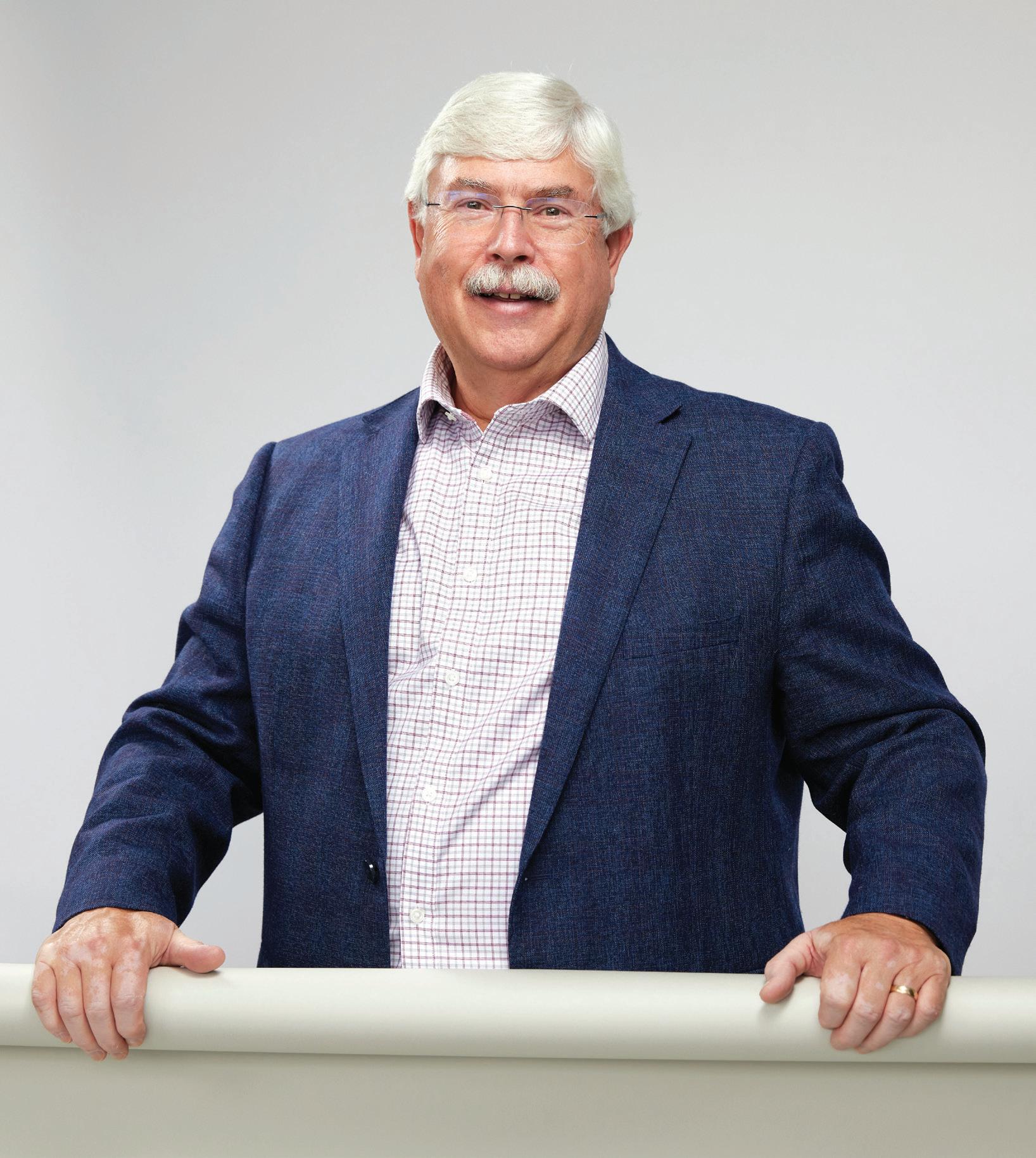
If there’s one thing that Bernie Uhlich knows about, it’s coming up with solutions.
His decades-long career has shifted between IT, supply chain, and operations. During that time, Uhlich has worked to understand problems and constraints, then create cross-functional solutions while delivering transformational leadership. Often, his solutions develop into a department or process of its own that Uhlich then hands off to a colleague.
“I ended up developing a reputation as the guy that, if you’ve got a problem and you don’t know what to do, call Bernie,” he says.
Uhlich is now president and managing director of Uhlich Associates Inc., a supply chain and IT transformation consultancy. He is also the board chair at the Supply Chain Management Association of Ontario (SCMAO). Along with setting up his own consultancy, his employment resume includes Celestica, IBM, Indigo-Chapters, and Coca-Cola.
But his beginnings in Canada were humbler. Uhlich was born in Germany and his family emigrated to the Kitchener-Waterloo area of
Ontario when he was four. He describes his family as “poor immigrants who didn’t have anything.” His father worked in a tire factory while his mother sewed and did other work to make ends meet. Everyone in the family worked multiple jobs.
He has long taken an interest in systems and how they work. He began computer programming in high school, landing a job as a computer operator. He learned how to program in his spare time by reading manuals and asking questions of the technicians who fixed the computers.
“It started from there and I got a job at a shoe company operating a computer – I was 15 or 16 at the time,” Uhlich says. “I operated the computer in the evenings and on weekends doing payroll runs, inventory, financials, and things like that, because they just needed some help.”
Uhlich attended the University of Waterloo, studying systems engineering. Through their co-op program, he eventually began work at Atomic Energy of Canada Ltd. in Missisauga, Ontario – his first job after high school that involved working with computers. Uhlich’s job
By the mid-80s, Uhlich had worked in various, progressive roles within several organizations. Eventually, after a hiring process that included 13 interviews, he landed a position at Coca-Cola. His role included re-engineering the company’s supply chains across Canada. At the time, Coke was consolidating over 60 independent bottler operating units and Uhlich spent almost the next three years integrating and updating the company’s supply chain and operating footprint.
Uhlich and his team worked on what was eventually called Project Max. The goal was to save $10 million, and to get there, the team realigned supply lines and procurement policies. Coke’s product had good quality control, Uhlich said. But the systems needed aligning. Bottling operations had to be upgraded.
To do so, the company established sub-teams and sub-projects. Among the challenges were upgrading operations, linking multiple programs, establishing sales and operations planning, and rolling everything out nationally. Success in his role meant acting almost like a military general,
BERNIE UHLICH ON WHAT IT TAKES TO GET SUPPLY CHAIN RESULTS
10 DECEMBER 2022 SUPPLY PROFESSIONAL
says Uhlich – appear on the battlefield to provide direction and leadership before leaving to allow the soldiers to return to their tasks.
“You need to know enough detail to get in there and have a conversation, to step up to the corporate level and look at the business impact of doing or not doing this, manoeuvring around the organization to build your power bases and to navigate through the organization,” Uhlich says. “Put together the right players, identify the obstacles, move to get rid of the obstacles, put it together the way it needs to go, and then be on the ground and work the crowds because you’ve got to encourage people to do things in a different way.”
Following Coca-Cola, Uhlich worked at DMR Consulting before taking a position at Celestica, where he would spend the next 15 years. The
organization needed someone with consulting experience. Uhlich oversaw the IT and supply chain teams in deploying integrated IT and business process solutions. He also led those teams through over 20 mergers and acquisitions globally.
He progressed through more senior positions, eventually moving out of IT entirely and into supply chain. Uhlich worked to tackle process issues, setting up operational discipline, and establishing training programs. At the time, Celestica was acquiring several companies. Uhlich once again had to establish discipline within an organization with several competing global cultures. The process involved implementing ERP systems, establishing standards, setting up training programs for several thousand people and so on.
Uhlich took early retirement in 2012, setting up his own consultancy, Uhlich Associates Inc. Along with his various activites with his consultancy, he is also a senior consultant with Supply Chain Alliance. Although he was by now experienced, the new role proved challenging.
“There are two things about being a consultant,” Uhlich says. “One of them is being very good at what you do and differentiating yourself. Two, how do you market your skills? If you’re not spending 40 to 60 per cent of your time marketing yourself, you’ll have zero work. That took a couple of months to sort out. I had enough contacts that I would get people saying, ‘do you want to do this?’ Once I got better at working out the pricing and other things, I started becoming more able to maintain an independent consulting operation. I could pick and choose the companies that I wanted. I was able to move forward.”
THE SUPPLY CHAIN LANDSCAPE
Alongside his career, Uhlich also volunteers with several organizations. He serves as the vicechair of the Georgian Bay General Hospital, as well as board chair with the Supply Chain Management Association of Ontario (SCMAO) His experience in consulting has prepared him for these roles, he notes.
“You need to know how to gather information, assimilate it, and turn it into a solution that you can sell and package into a proposal that somebody will buy,” Uhlich says.
His roles have also given Uhlich a unique view of today’s supply chains and its trends. Those supply chains have begun to stabilize, he says. Still, many issues remain unresolved. For example, many large retail companies continue to struggle getting products from Asia. Finding warehouse space remains challenging. Yet many in the field are finding workarounds.
Supply chain professionals are dealing with the disruptions and finding workarounds, Uhlich notes. Yet those disruptions now occur more frequently, with a shorter lag between them. Events that once happened across decades are now compressed into a few years, he says. To deal with this, remove the word “can’t” from the discussion.
“You need resilience, tenacity, and innovation. The resilience to live through it, the tenacity to put up with all of it, and the ability to push through,” Uhlich says. “We have an obstacle; we need to break through. Otherwise, you’re dead. Churchill had a good view of it: don’t let a good
MIKE FORD PHOTOGRAPHY SUPPLYPRO.CA 11
crisis go to waste. A good crisis drags out the best in people and organizations and the worst in them. It also provides huge opportunities.”
There’s a shift towards a holistic, optimized approach to supply chains, Uhlich notes. It’s better to think of supply chains not as chains, but as networks.
The business model for many global supply chains has changed from ‘just-in-time’ to ‘justin-case.’ It pays to have a ‘demand-and-supply’ view of these networks. Know who your suppliers are, as well as who your suppliers’ suppliers are. “That’s supply chain 101,” Uhlich says. “We’ve forgotten all that stuff now and people are panicking. Some of the answers are already out there.”
The automotive industry has long had effective, just-in-time supply chains, he notes. There are advantages to these lean operations. Yet, these systems rely on predictability, forecasting and a lack of volatility. The pandemic challenged that.
A lean supply chain depends on a relationship with a large supplier that can deliver inexpensive, high-quality product consistently. But that arrangement gets in trouble if supply gets cut off. That’s especially true during catastrophes like pandemics and wars. Risk management means maintaining buffer stock and extra warehouse space to guard against shortfalls.
An example of this is the decision to throw out old, expired PPE equipment just before the COVID-19 pandemic began, leaving many without such equipment for several months. Uhlich presents a unique solution to this dilemma.
“You don’t need to have the buffer stock sitting there,” he says. “What if you decide that some percentages of purchases are going to go into the buffer stock and we’re going to draw anything that’s a year old out of the buffer stock? If it’s got a two-year life, we run it into the buffer stock and we pull out the more current stuff. So now you’re keeping the replenishment of your buffer stock into live production so that you’re not letting it go stale.”
This arrangement can lead to other issues, like how to manage rotation through stock, minimizing single points of failure, and operating like a network, Uhlich says. But networks tend to be self-healing, and good relationships help with finding alternative supply sources and creative solutions.
Another challenge that supply chain practitioners face is capabilities gaps, Uhlich says. It can be tough to deliver what customers want due to space or time constraints, or through regulatory limitations.
One issue with buffer stocks, reshoring, friend-shoring, and other supply chain techniques is that it’s much less expensive to
import goods from Asia, India, and other locations due to their lower cost of labour, Uhlich says. Paying far more for labour for goods made closer to home isn’t sustainable in the long term. The pendulum swings from outsourcing to achieve lower costs back to reshoring or friend-shoring.
“You’ve got to have smart people who understand those implications and can deal with the dialogue,” Uhlich says. “In some cases, it means creating better relationships and partnerships. That goes back to supply chain 101: you should have good relationships with your suppliers.”
Uhlich has received numerous accolades throughout his career, including the ‘President’s Award’ from several of his employers. Such recognition is not only personally gratifying, but also shows that whatever the recipient is doing is effective, Uhlich notes.
Celestica also awarded him the ‘Energizer Bunny Award,’ for success on a project designed to turn around lagging financials, fix cash flow and inventory turns. That meant getting about $2 billion of inventory off the books. Uhlich’s personal portion of that was about $400 million in excess and obsolete inventory. Achieving that involved travel to 40 global sites while working to get multiple players onboard with changes, several times a year.
“Ultimately the team delivered the changes, and we went from worst to first in the next couple of years and it kept getting better, going from an organization in trouble to one that’s leading the pack again,” Uhlich says.
FUTURE PLANS
Going forward, Uhlich wants to continue travelling, speaking, consulting and leading breakthrough projects, he says. He also looks forward to continuing to work with SCMAO, coaching and mentoring professionals and organizations while advocating growth, inno -
vation, education, and problem solving while elevating the profession.
“Where am I going? It’s hopefully continuing to make a contribution to the industry and things that are going to move the needle and get out of the tactical thing and help move things forward,” he says.
In his life outside of work, Uhlich has been a master scuba instructor for several years. He has a passion for the underwater realm, and has swum with octopuses, sharks, stingrays, and manta rays. He also enjoys photography and does a lot of event, building, and nature photography. The hobby lets him spend time in the outdoors with his dog. He also likes astrophotography – pictures of the night sky. Photography is a great networking opportunity and conversation starter, he notes, for example through event photography. Uhlich also enjoys building little wooden boats from model kits.
“That’s when I’m not chasing my dog Stella around the house,” he says. “She’s a rescue, one of those Covid dogs that people just couldn’t take care of anymore.”
For those new to the field or looking to develop their supply chain careers, Uhlich recommends following one’s passion and having a goal or vision. Pick a path and follow through. Avoid distractions but change course if necessary.
Also, ensure to add value, Uhlich says. Identify the outcomes you want then tackle barriers head on. Respect everyone and leverage all your resources. Inclusivity and teamwork are important, as are leading and following when appropriate.
Stay connected, informed, and relevant, he adds. Continuing education is always useful, as is networking to remain active in your industry – organizations like SCMAO, and its CSCMP professional designation, are useful in that goal.
“It shows commitment to your profession and being part of the leading supply chain community,” he says of the organization. “You can do that through a couple of things. There is industry-specific, thought leadership and training programs and events that you can attend. There’s professional development and a worldclass leadership series that are offered.”
Finally, a supply chain professional’s competitive advantage lies in the results they deliver, Uhlich says.
“Races are won in the turns, and you’ve got to be ready for that,” he says. “If you go in strong and you execute well, you’ll have the skills to navigate that turn without crashing into the walls and you’ll come out stronger at the other side. Lead change and supply chain excellence and make a difference for success.” SP
12 DECEMBER 2022
SUPPLY PROFESSIONAL
“Races are won in the turns, and you’ve got to be ready for that. If you go in strong and you execute well, you’ll have the skills to navigate that turn without crashing into the walls and you’ll come out stronger at the other side.”
THE CHALLENGES AHEAD FUTURE PROOFING YOUR SUPPLY CHAIN
Supply challenges can stem from raw material and component shortages to weather events that impede transit routes, to a lack of workers affecting production and distribution. No matter the reason, supply issues affect every part of business – manufacturing, distribution, and the end customer.
Almost all businesses, big and small, have experienced supply challenges over the past few years. The COVID-19 pandemic has been a catalyst for many of these challenges, but there are actions you can take to stay ahead of potential supply disruptions and lessen the impact to your business or that of your customers.
Act now. In today’s supply challenged times, building and maintaining strong partnerships with suppliers and customers is critical. Having regular touchpoints with suppliers to understand their capabilities and challenges can provide visibility to potential issues
and help you plan for disruptions before you’re in the thick of it. In addition, helping your suppliers understand your needs – and pain points – will help ensure they’re able to support you if you need to quickly pivot as a result of a disruption. Equally important is staying close to your customers to understand their needs and help them understand your capabilities. Putting in the time now to build transparent and honest relationships with customers will help you gain a better understanding of their planned or expected spend based on current state but to also have conversations around activities that might require more (or less) inventory. Get in front of your suppliers and customers now. If you wait until an issue arises you may not be able to respond effectively. Plan for the unplanned. Planning for the unexpected is possible, but you need to be deliberate. Pay attention to trends in your industry, think through unexpected situations like disasters or emergencies before they arise, review your product offer, and consider whether it makes sense to have multiple suppliers or alternate options for fast moving items that may be hard to replenish if there is a supply disruption. Thinking through these considerations care-
fully can help you determine the value of making strategic inventory investments for both planned and unplanned events.
Don’t put all your eggs in one basket. When you do find yourself in a situation where you have limited inventory but high demand, consider how to best allocate products to ensure you’re managing your inventory in a way that not only makes sense for your business, but also for your customers – you know, the ones you’ve spent time building solid relationships with to ensure you’re their supplier of choice. Keep in mind that when demand is high you need to balance sales with maintaining customer relationships beyond the current situation. This is also where strong partnerships with your suppliers
come into play. Chances are if you’re experiencing a surge in demand for a product, so are your competitors. If you’ve done a good job developing supplier partnerships, they will work harder for you to find inventory or alternate products to fulfill customer demand.
People matter. In addition to the decisions that go into ensuring you have the right type and quantity of inventory available you also need people to make it all happen –people to make the products, deliver the products, use the products to keep operations running and sell the products to end users. Hiring and retaining staff is becoming more and more challenging. To retain people, creating an environment and culture that allows people to feel safe, in terms of health and safety and psychological safety, will help ensure you have an engaged workforce and higher staff retention.
Supply chain challenges will ebb and flow but are likely here to stay. Being thoughtful and proactive about both planned and unplanned needs is critical to navigating the supply chain. SP

SUPPLYPRO.CA 13
BY MINDY WEIR
Mindy Weir is senior manager, distribution, at Grainger Canada
“In today’s supply challenged times, building and maintaining strong partnerships with suppliers and customers is critical.”
BY JACOB STOLLER
CYBER ATTACKERS UP THE ANTE
AN INCREASE IN THE NUMBER AND SEVERITY OF CYBERATTACKS HAS SUPPLY CHAIN MANAGERS ON EDGE
The pandemic has brought many supply chain resiliency threats – material shortages, labour disruption, transportation delays, supply, and demand shocks – into the public eye. Lesser known is a growing risk of cyberattack.
That concern ranked a surprising second in a 2021 Economist Intelligence Unit survey on supply chain resiliency commissioned by the Association for Supply Chain Management (ASCM).
“When you consider all the other things that were on the list, I was a bit surprised to find that cyberattacks actually landed the number two position just behind the pandemic,” says Douglas Kent, executive vice-president of corporate and strategic alliances, ASCM
Cyber security often falls under the radar because companies are reluctant to admit they’ve been hacked due to reputational concerns. Strict laws requiring disclosure of all attacks that exist in the US, but fo, and following the lead of Quebec, similar legislation is expected across Canada.
Regardless, the growing frequency of successful attacks should have every supply manager concerned.
“One of the biggest IT risks that we’ve seen lately is the growth of ransomware in Canada,” says Yogesh Shivhare, research manager, secu-
rity and infrastructure, IDC Canada. “Based on our study published in June, the infection rate for Canada is 52 per cent. This means that if you’re talking to a Canadian organization, whether commercial or public sector, it’s a coin-flip probability that they have experienced at least one ransomware infection in the last 12 months.”
Recent attacks have also become far more likely to create harm and extort ransoms. “Years ago, the standard was that a hacker would encrypt your data and demand a ransom to give it back,” says W. Curtis Preston, chief technical evangelist at data resilience solution provider Druva. “That’s relatively easy to defeat if you have a decent backup and recovery system. But what we’re seeing now is hackers that exfiltrate your data and then threaten to expose it, which is very different. Once your data has been exfiltrated you basically have two choices – pay the ransom or suffer the consequences.”
Ironically, the same backup systems that protected companies in the past are often the easiest data sources for exfiltration. “We’re seeing attackers use on-premises backup systems to accomplish this,” says Preston, “as they are often ignored and not properly secured against such things.”
According to IDC, roughly half of Canadian companies that are infected end up paying ransom. The average ransom for all industries is $220,000, and that’s only the tip of the iceberg. “Based on our research, usually ransom payments account for 10-15 per cent of the overall cost of incidents,” says Shivhare. “So, the average cost per incident is around $2.4 million.”
WELL-ORGANIZED ADVERSARIES
Today’s attackers look for two factors – ease of compromising the target network, and the amount of ransom that the victim organization would likely pay. Companies in supply chains are often prime targets because of the knockon impact of disruptions on their customers and partners.
The alarming success rate of attacks speaks to the phenomenal resources that their perpetrators have at their disposal. “This is a big business, and these companies are quite sophisticated,” says Preston. “They have HR departments, a management structure, and huge infrastructure behind them.” There are even career paths – a hacker can be assigned a larger project, Preston notes, after succeeding in a more modest one.
SUPPLY PROFESSIONAL 14 DECEMBER 2022
While attackers often use technology to achieve their means, the most common method of gaining access is the age-old “social engineering,” where a hacker impersonates a legitimate person and tricks an employee into providing a login and a password.



“Despite all the agitation for training and awareness, social engineering and phishing haven’t gone away,” says Daniel O’Neill, director, managed detection and response (MDR) security operations, Bitdefender. “Those are still how attackers get into the environment 60-70 per cent of the time, possibly more depending on source. And once they’ve got those credentials, they have the potential to escalate privileges undetected and try to gain administrative rights.”
Unlike the “smash and grab” approach where hackers would do their damage within minutes, a hacker using a legitimate login can troll a victim network for weeks or even months, patiently discovering how to make the greatest impact.


“In the past, cyber attacks used a carpet-bombing approach, where they’d throw out a big net and try to make some money from that,” says Shivhare. “Nowadays, attackers do a very detailed recon. They find out what information is where, and we’ve seen some cases where they know exactly how much cyber insurance coverage there is. I’ve even seen attackers send out mass communications within an enterprise to recruit employees.”
SECURING THE DIGITAL CHAIN
With the increasing likelihood of any network being compromised, it’s critical to restrict lateral movement within the network. First steps include limiting access rights and tightening authentication procedures. “One of the keys would be what we call the concept of least privilege,” says Preston. “If a partner has access to your network, how much access do they need? You should absolutely give them only the bare minimum information that they need to do their job.”
Accordingly, security goes far beyond technology solutions. “It’s 2022, and you still can’t buy security,” says John Dwyer, head of research, IBM Security X-Force. “It all comes down to the people behind the response, behind the defense, and behind the management.”


The challenges get more complex in supply chains. As companies seek greater visibility of the elements in their supply chains, partners are increasingly granting access to each other’s networks. This makes every company in the supply chain more vulnerable to cyberattack. For example, an intruder in a small
retailer’s network could gain access to the network of a large distributor.
“The bigger your company and the bigger your list of third-party vendors, then the bigger your attack surface,” says Preston. “So, it can seem an insurmountable challenge.”


“I think one of the issues is acknowledging that with supply chains, security posture is an ecosystem,” says O’Neill. “There is no one solution, and you can’t do that internally. So, you try as much as possible to ensure that your partners’ security posture has coherence with your own security posture.”
ASCM has developed the Supply Chain Operations Reference Digital Standard (SCOR DS), a process framework for standardizing supply chain workflows. In addition to movement of physical goods and payments, the approach also includes standards for mapping information flow.
“Our SCOR DS model has encouraged companies to also map how information is being exchanged in order to highlight where the vulnerabilities exist,” says Kent.
Ultimately, a company’s approach to security will have to be at least as well orchestrated as the attackers’. “The problem with a lot of security organizations is that they are thinking in silos,” says Shivhare. “They’ve got their endpoint security team, there’s a risk assessment team, there’s an identity and access management team, without effective orchestration. But when the adversaries look at your organization, they’re not thinking in silos. They’ll be looking at the security posture in its entirety.” SP
“Cyber security often falls under the radar because companies are reluctant to admit they’ve been hacked due to reputational concerns.”
SUPPLYPRO.CA 15
GREENING LOGISTICS
ECOFRIENDLY AND SUSTAINABLE TRANSPORTATION METHODS
We have been witnessing supply chain disruptions caused by climate change, floods in some parts of the world, dry weather causing lower crops and forest fires in other parts. There is no doubt we need to cut carbon emissions. This was reiterated by world leaders at the COP27 Conference in Egypt. We’re putting unprecedented strain on our planet and our resources are finite. What can the logistics world do to help cut our carbon emissions?
Many recent initiatives involve EVs and the electrification of fleets but there are developments with other transport modes. Airlines aim to use greener fuel, called SAF (sustainable aviation fuel), to decarbonize aviation. SAF’s are defined as renewable or waste-derived aviation fuels, produced from sustainable feedstocks. Typical feedstocks include cooking oil, waste oil from animals or plants, solid waste from homes and businesses like packaging, paper, textiles, and other scraps that would
otherwise go to landfills. Other potential sources include forestry waste and energy crops. The SAFs currently used by airlines on a trial basis are made from cooking oil and animal waste fat.
Two issues hamper the process: producing such fuels requires substantial investments in new plants and the current worldwide capacity is limited. With no economies of scale, SAFs cost at least two to three times more than regular jet fuel. Several airlines have nevertheless partnered with shippers and freight forwarders offering options to offset or reduce greenhouse gas emissions from travel or freight transportation. Whether these moves will have an impact or are merely greenwashing, remains to be seen. Another approach is flying less air cargo, since ocean shipping is cheaper and more environmentally friendly. Ironically, the opposite may happen: Boeing’s 2022 world air cargo forecast predicts demand for air cargo will double over the next 20 years.
ECO-FRIENDLY WATERS
Shipping lines are decarbonizing by moving from bunker oil and investing in more fuel-efficient, LNG-propelled, or methanol-propelled ships. These transition fuels could lead to producing bio-methane and e-methane. CMA-CGM, which has 31 e-methane ready ships in its fleet, plans to operate 77 such ships by the end of 2026.
Maersk has orders for 19 vessels with dual-fuel engines that can be operated on green methanol, including six 17,000 TEU ships. Maersk is going further, investing in a green methanol production facility in Rosholt, South Dakota. The first facility will be co-located with the existing Red River Energy bioethanol plant and will have an annual capacity of 100,000 tonnes. Production should start in 2027 and Maersk plans to purchase the full volume produced at the plant.
MSC has commissioned 12 LNG-powered ships and Taiwan’s Yang Ming recently invited ship-
yards to bid on five LNG-powered ships. Containerlines are not the only ones, as Rio Tinto announced has placed an order for nine newcastlemax bulkers with engines capable of using both regular fuel and LNG. Rio Tinto expects to deploy the first one in 2023. It plans to reduce emissions by 40 per cent by 2025, thanks to biofuels and LNG-powered vessels.
Until these new green fuels are developed, there is an issue with LNG: the second largest LNG-producer is the US and their natural gas is extracted through fracking. Fracking creates vast amounts of wastewater, emits greenhouse gases, releases toxic air pollutants, and can lead to loss of animal and plant habitats, species decline, migratory disruptions, and land degradation. Is this really what we want to encourage? Also, do we really need bigger containerships?
Dockside, ports around the world are using the cold ironing method to reduce emissions. Cold ironing can supply a ship by shore power when it docks, to run operations like ventilation, heating, cooling, pumps, control systems and cargo handling systems, instead of using the ship’s generators. This is now widely used but its benefits depend on how the shore power is generated. If it comes from an oil- or a coal-fired power plant, there is no benefit.
Our federal government has committed to creating a system of zero-emission maritime routes between ports and to create green shipping corridors. At the COP27,
Canada has joined the Zero-Emission Shipping Mission initiative, with the goal of working to eliminate emissions and tackle the climate crisis. We also have a Green Shipping Corridors Network in the Great Lakes-St Lawrence Seaway System program with the US but these high-level initiatives are short on details so far.

Several countries have also agreed to join the Global Memorandum of Understanding on ZeroEmission Medium and Heavy-Duty Vehicles. Canada joined at the COP26 and there are now 26 signatories. The MOU’s aim is 30 per cent zero-emission new medium and heavy-duty vehicles by 2030 and 100 per cent by 2040.
Switching to hydrogen or EVs has its challenges. For example, will the power grid be able to handle all these vehicles? Ultimately, our goal should be to improve public transit, stop overconsumption and reduce waste, not employ more vehicles.
An example is apparel overconsumption. With the combined effect of “fast fashion” and e-commerce encouraging consumers to buy more through free shipping and free returns, more textiles go to landfills. In the US, about 85 per cent of all textiles end up in landfills annually. And the percentage of non-biodegradable synthetics is rising. We must consume wisely and buy more durable goods. This winter, don’t buy a snowblower, get a shovel instead. Hopefully, the shovel is made in Canada. SP
BY CHRISTIAN SIVIÈRE
Christian Sivière is president at Solimpex.
16 DECEMBER 2022 SUPPLY PROFESSIONAL
“Airlines aim to use greener fuel, referred to as SAF (sustainable aviation fuel), to decarbonize aviation.”
Using Fleet Management Technology to Build Sustainable Best Practices in the T&L Industry
Fleet management technology is often heralded for its ability to facilitate smoother operations, decrease inefficiencies and more. What fleet management solutions aren’t recognized for is their ability to drive sustainability best practices in the Transportation & Logistics (T&L) sector. For example, fleet management solutions can extend device lifespan to avoid unnecessary e-waste or optimize fuel usage. The potential for more sustainable fleet management options must be better understood and capitalized upon to further reduce a supply chain’s impact on the environment.
Sustainability Tactics in T&L
According to research by SOTI, 68% of IT leaders state that device management is an important environmental issue. Yet 67% of Canadian IT leaders believe devices are replaced prematurely, contributing to excess and unnecessary e-waste. In fact, 49% of respondents stated they replace devices whether they still work or not.
Enterprise Mobility Management (EMM) solutions, in combination with a Diagnostic Intelligence solution like SOTI XSight, allow operators to seamlessly and continuously monitor device usage and device battery health, encouraging practices that lengthen the life of the device and determine when a device is actually ready for disposal. With operational intelligence, a feature of SOTI XSight, metrics are pulled regarding critical data of your devices to pinpoint the root cause of issues. This allows your IT team to quickly diagnose the problem and find the right solution to solve it, rather than staying blind to issues occurring in your device fleet.
Similarly, fleet management tech can help facilitate more sustainable fuel usage by monitoring fuel levels across fleets. Idling has shown to consume approximately 7,500 liters (1981.29 gallons) of fuel per truck per year. Using a fleet management solution that monitors and diagnoses fuel overuse can be highly effective in fostering more sustainable practices. In fact, the use of these technologies have been shown to cut fuel costs by up to 25%.
Powering Sustainability
Platforms such as SOTI XSight, which have complete fleet management capabilities in one solution, will be key in creating best practices to foster sustainability within the sector. With advanced diagnostics and automated monitoring, T&L managers and head office can stay on top of what’s happening with any device in their fleet and be alerted to problems the minute they occur. Such a solution pulls diagnostic data in real-time providing organizations with the key data they need to make informed decisions on aspects such as fuel waste or premature device waste.
With SOTI XSight, T&L organizations get the industry’s most comprehensive remote-control capabilities, which allow IT teams to manipulate a device
in the field as if they were holding it in their hand. Interactions with end users are further improved with features such as remotely drawing, whiteboarding and annotating on the device screen, as well as recording audio and video. With these remote-control capabilities organizations can not only identify emergency issues as they happen but can also remedy them immediately and with precision and clear communication.
Tips For T&L Sustainability Best Practices
In addition to leveraging fleet management technology built to power sustainability efforts, there are a few best practices T&L organizations can implement. For example, just like a car, regular maintenance and service, using approved device accessories (chargers, docking stations, cords, etc.) and keeping devices free of unnecessary apps will help extend the lifespan of enterprise mobile devices, even in challenging environments with many users.
Another best practice is to use devices which are built to last. Rugged devices can last up to five years, compared to the lifespan of a typical enterprise mobile device, which lasts approximately two and a half years. Ask yourself what’s preferable and better for the environment: replacing a device twice in a decade or four times?
Additionally, maintaining device battery health must be prioritized. To do this, organizations can implement dashboards to monitor battery charge cycles, temperature, turning on a device’s battery saver mode, closing the most power-hungry apps when not in use, using data to predict when batteries will fail, and proactively replacing them and shortening idle time before devices lock or sleep.
Organizations across sectors are actively seeking ways to reduce waste and their environmental footprint. As more advanced mobile devices are implemented into the field, T&L companies must find a balance in adopting the latest in technology with their overall sustainability practices. With the right fleet management technology solutions, such as SOTI XSight, they can.
Learn more about SOTI XSight and how it can augment your sustainability programs here: soti.net/products/soti-xsight/

SPONSORED
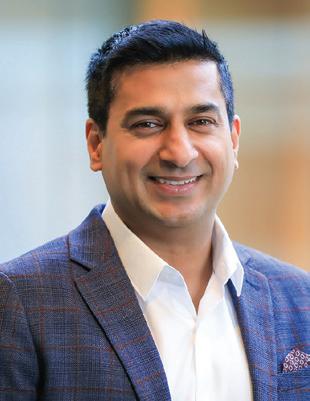
Shash Anand, SVP of Product Strategy, SOTI
BY AMANDA CHOUINARD
THE PATH TO NET-ZERO PROCUREMENT
FIVE SUSTAINABLE STRATEGIES FOR PUBLIC SECTOR ORGANIZATIONS
We’re getting closer to 2030, an important milestone year on the path to net-zero emissions by 2050. As we do, the procurement function cannot be overlooked by those hoping to achieve a net-zero, circular, and inclusive economy.
Incorporating sustainability requirements into the procurement of goods and services is a tangible, every-day practice to create a positive effect within their community and beyond by creating demand for sustainable products.
The Canadian Collaboration for Sustainable Procurement’s (CCSP) 12th-annual Report on the State of Sustainable Public Procurement in Canada highlights trends, best practices, and case studies from the CCSP’s network of 40 municipalities, crown corporations, and post-secondary institutions. This group of institutions employs a holistic view of sustainable procurement, encompassing environmental, social, Indigenous, and ethical pillars – which encourages members to be open to the sustainability risks and opportunities within any procurement.
Drawing from highlights in the CCSP 2021 Annual Report, here are five procurement strategies for public organizations to make a positive impact:
ELECTRIFICATION TO HELP ACHIEVE CLIMATE GOALS
In 2021, the global increase in catastrophic climatic events was noticeable, including floods, smoke, heatwaves and windstorms. The COP26 conference in Glasgow focused on the transition towards a more sustainable, low-carbon world. The conference was a platform for leaders to set a global commitment to achieve net-zero emissions by 2050.
Public sector procurements are a key factor in the scale of work done to slow climate change and reach global 2050 goals. The City of Ottawa purchased electric boilers for installation in three of its largest recreation facilities – projecting to reduce the facilities’ greenhouse gas (GHG) footprints by 320 tonnes of CO2 annually. The cost of the project is now likely to be repaid to the City in six years. This purchase stemmed from a recommendation from the City’s Corporate Energy Management Office (CEMO) to electrify the heating systems based on a combined costs and carbon analysis.
In particular, hybrid and electric vehicles are taking over the market when it comes to green fleet initiatives. Through the 2021 Zero Emission Transit Fund, the federal government is
investing $2.75 billion over the next five years to support the electrification of public transit and school bus operations. The City of Brampton deployed the largest standardized battery electric bus fleet (globally, to date), along with high-powered overhead on-route charging systems – the first step in completely electrifying the City’s fleet. The District of Saanich launched a district-wide e-bike incentive pilot program in October and purchased a small e-bike fleet for district staff. This procurement demonstrated leadership in mode shift towards active transportation. It also helped to reduce pressure on the existing pool of fleet vehicles, providing more climate-friendly transportation options at a lower price than sourcing multiple new electric vehicles and charging infrastructure.
PROGRAM PIECES TO ENABLE SOCIAL PROCUREMENT COMMITMENTS
Social procurement has gained traction recently across the public sector. The social pillar focuses on advancing diversity and inclusivity by creating economic opportunities for equity-deserving and other target populations. This includes purchasing from suppliers that offer social value, such as non-profits, social enterprises, and diverse suppli-

18 DECEMBER 2022
Amanda Chouinard is the program manager for the CCSP.
ers, as well as mandating suppliers to deliver social value as a condition of the contract. Many city councils recognize the importance of this and are asking staff to act on social procurement. It’s important to ensure that staff can put the right pieces in place to support these actions.
The City of Toronto’s Social Procurement Program is one of Canada’s flagship programs of its kind, improving access for diverse suppliers to municipality’s supply chain and enabling procurement spending to drive inclusive economic growth. The City has a social procurement policy, utilizes a social value supplier database, invites certified diverse suppliers to attend “Doing Business with the City” vendor workshops, and hosts supplier diversity trade shows.
The City of Calgary created their own Public Value Through Procurement Policy, Benefit Driven Procurement Strategy, and a Benefit Driven Procurement Leadership Questionnaire. From council approval in September 2021 until January 2022, over 60 requests for proposals (RFPs) have included the questionnaire in their evaluation criteria. These procurements have resulted in contracting local businesses, creating employment for underrepresented groups, and supporting suppliers who are implementing their own social procurement and living wage policies.
SUPPORT LOCAL ECONOMIES AND PEOPLE
COVID -19 highlighted the inequalities and vulnerabilities of global supply chains, thus the importance of investing in local economies. Public sector organizations are looking to their own communities and conducting match-making analyses to identify product and service categories that can be fulfilled by local businesses.
Especially when possible under trade agreement thresholds, put in the extra mile and support local businesses. Thompson Rivers University (TRU) demonstrated this by purchasing a set of custom, wooden coffee and end tables from a local woodworking company in Kamloops, BC. The tables were crafted using local and salvaged wood from a neighbourhood development project, that would have otherwise gone to landfill. The purchase also had comparatively fewer emissions because of the manufacturing process as well as reduced delivery transportation.
Cities can also leverage local impact in larger procurements by requesting that contractors engage with local social enterprises and non-profits that support equity-seeking individuals. The City of Vancouver released a request for application (RFA) to prequalify companies specializing in emergency, abatement, and repair restoration services. The RFA required that the
awarded company complete a portion of the services by sub-contracting or partnering with social enterprise organizations that help hire people facing employment barriers.
INCLUDE JUSTICE IN YOUR EDI AND INDIGENOUS RECONCILIATION EFFORTS
Equity, diversity, and inclusion (EDI) has been a practice for a few years, but adding ‘justice’ to the acronym expands the conversation. Justice shines light on who is being brought into the conversation, creating equal opportunities, and asking if our procurement policies and practices really work for everyone. The City of Toronto has worked on creating a Transportation JEDI category in their engineering roster calls to make it easier for smaller firms to compete.
The City of Winnipeg is also putting this in action with a recent convergence of interests for an RFP for the provision of security services at a library that included a strong set of social, ethical, and Indigenous related requirements.
The RFP was awarded to a security services organization that understood the bid requirements – namely, committing to hire at least 50 per cent Indigenous peoples, as well as paying a living wage to all guard staff. As part of the contract, the City began providing training for security staff in life-saving procedures, conflict de-escalation, anti-racism, cultural awareness, harm reduction, and trauma and mental health awareness. Multiple stakeholder and community groups engaged in the process.
LEVERAGE PEERS AND TURN UP THE COLLABORATION
In 2021, workplaces continued through the second year of the pandemic and witnessed the outcome of the learning curve on virtual collaboration. Despite not always being in the same room – collaboration shines through.
The partnership between procurement and sustainability is especially important for high impact, and for sustainability thinking into the planning and needs assessment stages of the procurement process. This powerful partnership can deliver a compelling message by communicating in internal working groups and sharing cross-developmental goals. Leadership listens when sustainable and procurement groups champion common values to the organization.
This year, the City of Mississauga established a cross-functional team who convene quarterly to address sustainable procurement opportunities; the City of Ottawa formed a cross-departmental Social Procurement Advisory Group; and the City of Kelowna’s purchasing manager engaged the City’s cross-functional Sustainability Action Team to raise awareness around sustainable procurement.
Collaboration amongst peer organizations is another avenue ripe with opportunity, whether through group purchasing initiatives or aligning on standard sustainability criteria. Sheridan College, as part of the Halton Co-operative Purchasing Group (HCPG), facilitated a contract with a new supplier of winter entryway mats. The new mat rental program includes a re-designed washing process to reduce CO2 emissions by using mats with increased water retention technology, as well as reduced emissions from fewer fleet vehicles in pick-up/delivery.
Organizations are leveraging procurement practices to drive broader corporate sustainability goals like reducing waste and advancing circularity, reducing GHG emissions, supporting local economic development, increasing supplier diversity, and contributing to Indigenous reconciliation. Don’t wait to get started in your own institution. SP
SUPPLYPRO.CA 19
“Public sector procurements are a key factor in the scale of work done to slow climate change and reach global 2050 goals.”
BY MICHAEL POWER
THE ROAD AHEAD TECH USAGE AND UNCERTAINTY RANK HIGH IN SUPPLY CHAIN THEMES FOR 2023
If there’s one thing that supply chain professionals can count on, it’s uncertainty and disruption.
As many places exit the COVID -19 pandemic’s emergency stage, and inflation and economic uncertainty put pressure on businesses and consumers, it makes sense to ask what the New Year has in store for supply chains. Supply Professional asked several industry experts what to expect in 2023.
With volatility still ranking high among concerns, the Association for Supply Chain Management (ASCM) has seen ‘resilience’ move up three spots from last year on its annual Top 10 Trends in Supply Chain report, says ASCM’s executive VP, Peter Bolstorff. Resilience – and dealing with supply chain risk – now ranks number-three on the top trends in 2022. That’s behind ‘big data and analytics’ at number one, and the second-place issue, ‘digital supply chain.’
Several of the other trends in the report focus on technology advancements. AI and machine learning comes in at number four, robotics at number five, and data security and cybersecurity at six. Circular and sustainable supply chains is in the number seven spot, while essential goods supply chains are number eight. Smart logistics and IoT is number nine, followed by logistics vulnerability at number 10.
Overall, according to the trends report, the theme for this year has been supply chain digitization. And while that’s the overall pattern, Bolstorff says that ASCM’s corporate community has been picking and choosing what technologies they need to improve supply chain operations, rather than simply buying every technology option available.
“They’re not doing one trend at a time and investing all their money in each trend,” he says. “They’re looking at their supply chain from a standards point of view, figuring out, ‘what is it that I need to run my supply chain?’ and then pinpointing where they want to add digital capabilities.”
MANAGING RISK
Risk mitigation and supply assurance have been major themes within supply chain over the past few years and that trend is likely to continue into 2023, says Jennifer Strawn of Rand Technology, a semiconductor distributor. But it’s now more challenging to plan for them. Organizations are dealing with the balancing act of utilizing surplus inventory from deliveries on orders placed a year or more ago, Strawn notes. Yet many still can’t get certain essential components.
Incorporating data analytics can help to deal with lingering uncertainty into 2023, Strawn says. That includes their own data and that of their supply partners. The best use of technology involves helping organizations to identify and understand trends and patterns, which in turn aids in better planning.
As well, organizations may have to pick and choose which products to focus on, with some products taking priority. Some industries will move faster than others going into the New Year.
“I was at dinner with a large charging station company for electric vehicles,” Strawn says. “They’re full force. They have to be moving forward because of what’s expected coming down the pipeline. It’s going to be about selecting the products that will be the drivers and creating the economies for our future.”
As well, although things appear to be improving, Strawn stresses remaining vigilant. Keep planning as if next year will be full of challenges and constraints.
“Don’t think that everything is OK and go back to what you think what might have been before,” Strawn says. “It’s really just having conversations with your suppliers, with your partners, and just keep moving forward in that direction.”
Globally, markets have been experiencing a boomerang effect, says Reza Bafandeh, CEO of Darwynn Ltd., a Canadian e-commerce company. Steamship lines saw a lot of constraints over the past few years, with container prices exceptionally high. There was also a lot of constraints within shipping rails. This led to many companies experiencing stockouts, issues with fill rates, and difficulties getting the right inventory. Some companies overbought. Several large retailers therefore have too much stock. As a ripple effect, storage space became scarcer. This helped to fuel rising costs in many areas.
“What happened during the pandemic was something that had never occurred,” Bafandeh says. “Companies didn’t know how to deal with it. Suddenly, organizations in North America and Europe needed to find new ways of sourcing and reducing their reliance on foreign goods. At the same time, supply dropped significantly. We had significant constraints in the waterways, and I think we’re starting to see that come back into normal effect. But a lot of organizations saw their vulnerability as a result of the pandemic.”
Accurate and timely information can help supply chains deal with uncertainty, Bafandeh
20 DECEMBER 2022
says. “Until now, I think it’s been a hidden gem, he notes. “Most people haven’t seen the true value of timeliness and an accurate level of information from the supply side of the business.”





DIGITIZATION
The rise of digital technology enabling supply chain visibility will be one of the themes going into 2023, says Oleg Kamenetsky, senior product marketing manager at wireless technology company, Qualcomm. The pandemic exposed underlying shortcomings within supply chains regarding visibility and communication. Using digitization to improve that visibility and planning, reduce bottlenecks while boosting supply chain resiliency will be a theme into the New Year. Staffing shortages and deploying the right talent will also remain challenging, he noted.
Any digital solution requires meaningful data, Kamenetsky says. But what sort of solution to use depends on the situation, he notes. While technology like AI can prove useful, that technology is constantly evolving to enable new uses.











“It really depends on the use case,” he says.










“We can, for example, create a visibility solution that can work across a number of use cases, but we need to know what we’re solving for. Are the issues that we’re having, gaps of high value in transit goods? Is it yard management in an open-air warehouse environment, for example?”


“There isn’t a one-size-fits-all solution so talk to a provider that has expertise in the space,” Kamenetsky continues. “There’s so much nuance that goes on behind the scenes that end users might not even be aware of. It gets increasingly more complex once you’re combining any kind of positioning capabilities, any kind of connectivity capabilities. And then, how do you make sense of that data? There are a lot of things that need to be considered.”
Of course, supply chain disruptions have always existed, says Ron Leibman, a partner at McCarter & English LLP, who leads the transportation, logistics and supply management practice. The pan-



demic and the Russian invasion of Ukraine have simply highlighted that disruption. Those issues, along with the future of Taiwan, the global rise of protectionism, and ESG issues, will continue to be trends going into 2023, Leibman notes.
“Remain flexible and follow the practices that the COVID crisis highlighted – supply chain resiliency and redundancy – not just paying lip service but looking to kill the cost-only model once and for all,” he advises.





Ocean lines will look to use blank sailings as a means of stabilizing the rate market so take advantage of the current environment as much as possible, Leibman says. Secure warehouse space as far in advance as you can and be willing to pay market rates, particularly for refrigerated goods on a guaranteed-space basis, given the current space crunch.
Leibman also sees a continued drop in trucking rates due to reduced freight levels and the resulting overcapacity. “There is also the fast evolution on the autonomous side that could affect smaller companies unable to integrate this or other new technologies,” he says. SP
“What happened during the pandemic was something that had never occurred.”
SUPPLYPRO.CA 21
MODERN SLAVERY SHEDDING LIGHT ON A DARK STAIN ON GLOBAL SUPPLY CHAINS
Like millions of fans, I have recently enjoyed my favorite sports event, the FIFA World Cup. This year however, the event has brought to light more than the Beautiful Game. This year highlights the death of over 6,000 migrant workers in Qatar over the past 10 years under low-wage, dangerous and hard labouring conditions. Overshadowing this year’s games is the stain of modern slavery.
Within the context of supply chains, modern slavery is defined as the exploitation of workers anywhere along the chain from the extraction of raw materials to construction, manufacturing, logistics to final product or service delivery. Modern slavery takes various forms: debt bondage, forced labour, child slavery and human trafficking. It currently affects approximately 49.6 million people, a quarter of which are children,
and more than half of which are trapped in labour camps, according to the International Labour Organization.
Buying firms play a key role in helping eradicate this practice. Doing so, however, is not an easy task. Modern slavery exists buried further down across multi-tiered supply chains. Lack of transparency across all nodes often makes it difficult for buyers to identify issues. In this context, auditing has become one of the tools most used.
The challenge with auditing is how to avoid them turning into a “tick-the-box” exercise that leads to mock compliance. Faced with the threat of losing business relationships with their customers, suppliers can see audits as just another “jump-through-hoops” step with little significance and no real consequences. At times they can pass by hiding information, producing false records, and simply cheating. Isolated corporately mandated audits from a buying firm on the other side of the world and no meaningful connections to the reality on the ground are perceived more as a way for buyers to clear themselves of liability rather than to improve working conditions in country.
SUPPLIER DEVELOPMENT
Instead, an approach that has seen better results is to shift from arm’s length compliance management to
supplier development. Workers are closer to the issues being audited and the socioeconomic reality of the markets where the supplier operations are located. Therefore, involving workers in the design of the audit is an important step to add legitimacy and efficacy to the process. This takes worker collaboration and education to facilitate detection and remediation.
In complex markets it can be hard for buying organizations to go at it alone. Instead, buyer consortiums can add uniformity and weight to the auditing process by providing a unified voice to set expectations for working conditions and rights. Working with NGOs is another key strategy that many firms have relied upon to improve auditing efficacy. NGOs with a presence in country can work bottoms up to foster relationships with workers, suppliers, and third-party recruitment firms to better detect, mitigate and remediate indicators of modern slavery.
From a corporate and legal compliance perspective, Canada is still in the process of enacting Bill S-211, which puts in place the Fighting Against Forced Labour and Child Labour in Supply Chains Act and to amend the Customs Tariff. While it comes short compared to similar pieces of legislation overseas, in that it focuses on reporting obligations rather than due diligence requirements, this
bill will be an important step forward to drive businesses to take proactive measures and build programs and processes that address child and forced labour, including remediation, and to provide training to employees on these matters. Other bills, like Bill C-262, focuses on corporate responsibility to prevent, address and remedy adverse impacts on human rights occurring in relation to business activities conducted abroad and Bill C-243, dealing with eliminating forced and child labour in supply chains, are also being reviewed and will eventually help by respectively imposing a duty on international operations to avoid adverse impacts on human rights, and introducing an inspection regime to be managed by the Minister of Public Safety and Emergency Preparedness.
Supply chain managers will remain at the forefront of the battle to root out all forms of modern slavery from large, interconnected supply chains, through strategic and judicious supplier selection, collaboration and development, as well as by working closely with in-country industry and trade organizations, as well as local NGOs. After all, doing so is not only morally right, but part of their duty to management and shareholders in driving efficiency and reducing financial and reputational risk in global operations. SP
BY DENIS SANCHEZ
Denis Sanchez, MCIPS, MS, MA is vicepresident, operational excellence at Alcumus Cognibox.
22 DECEMBER 2022 SUPPLY PROFESSIONAL
“Faced with the threat of losing business relationships with their customers, suppliers can see audits as just another “jumpthrough-hoops” step with little significance and no real consequences.”

SUPPLYPRO.CA 23 24 EV cheat sheet Tips for fleets when buying and operating EVs. 26 Upfitting update New technology accessories for work vans. 28 Road test Taking the Toyota Sienna for a spin. Fleet Management 26 28 Fleet Management is a special section of Supply Professional magazine. It is an important resource for Canadian supply professionals who recommend, select and manage fleet vendors and service providers. EDITORIAL INQUIRIES: Michael Power, 416-441-2085 x110, michael@supplypro.ca ADVERTISING
Alex Papanou, 416-441-2085 x101, apapanou@iqbusinessmedia.com
INQUIRIES:
By Emily Graham
EV transition
How to make the shift to electric vehicles a smooth one
As organizations continue to prioritize corporate social responsibility, more businesses are exploring a variety of sustainability initiatives. For fleet operators, this often means evaluating the feasibility of electric vehicles (EVs), plug-in hybrids, and other alternative fuel options to align with their companies’ sustainability goals. As you begin to develop your strategic plan for 2023 and beyond, now may be the perfect time to explore if your organization is ready to begin embracing EVs.
Determining the best way to integrate EVs into your fleet can challenge even the most seasoned fleet professional. With more EV/ hybrid models becoming available along with a variety of charging options – at-home charging, centralized charging depots, and public infrastructure – determining the best solution for your fleet and developing a “best practice” strategy can feel overwhelming. But it doesn’t have to be.
Key planning considerations
As you explore potential fleet electrification, you’ll want to work closely with stakeholders from across the organization – procure-
ment, sustainability, operations, facilities, HR, and so on – to identify overarching sustainability goals and determine how your fleet emissions align with those objectives. It’s vital that you begin your EV journey with clear objectives.
Once you know the need and business purpose for transitioning to EVs, you can begin to determine the steps to achieve those goals over the next five to 10 years. Remember, this transition won’t happen overnight, so plan for a gradual transition over multiple vehicle lifecycles.
Keep in mind that integrating EVs into your fleet mix is a bit more complex than simply determining which model is the best fit. Equally important is focusing on infrastructure, driver behaviour, power needs, charging location(s), charge data management, et cetera. A thorough analysis of your fleet’s profile and performance will allow for the most seamless transition. During an initial consultation with customers, we often help them think through the right vehicle application, the region in which they operate, driver fit, and the role these units play in supporting the business to develop a path to fleet electrification.
EV charging
When your organization is ready to begin integrating electric vehicles into your fleet mix, you’ll need to develop a charging strategy that aligns with your business objectives. Your charging strategy is just as important – if not more so –as spec’ing and ordering the EVs themselves. You’ll need your solution in place before your first electric vehicles arrive.

Today, there are three primary types of charging solutions: at-home, depot, and public. Most fleet operators are likely to implement a charging strategy that relies on all three options to varying extents but there are several key considerations that will influence your approach including:
Are you prepared to install chargers at drivers’ homes where suitable?
What is your ability to install depot charging at your facilities?
What local infrastructure exists to support your fleet’s public charging needs?
These are just a few of the factors that will begin to shape your EV
charging strategy. Let’s take a closer look at each of these charging solutions.
If your fleet includes a large number of passenger vehicles (cars, SUVs, crossovers, and so on), in all likelihood, your drivers are taking these units home with them at the end of the day rather than returning them to a central hub. In this scenario, at-home charging is likely going to be your best option.
This option works best for drivers who have a designated parking area (garage or driveway) and whose home can accommodate the installation of the charging equipment. It’s the most efficient option, allowing the unit to charge during off hours and eliminating unnecessary charging downtime. It also typically provides the most cost-effective charging method (lowest cost per kilowatt-hour), where in terms of the charging device itself, there are a variety of options including Level 1 (standard AC 110/120 home outlet) and Level 2 (AC 220/240, same as an electric range or dryer outlet) chargers to accommodate most scenarios. Most fleet operators opt for a smart charger that monitors usage, consumption, energy
Fleet Management 24 DECEMBER 2022 FM/SP SUPPLY PROFESSIONAL
Emily Graham is director of sustainability at Holman.
cost, and so on to integrate this charging information with the rest of their fleet data. This data also allows you to track and reimburse drivers for at-home energy use.
In a typical vocational fleet, the vehicles (class 3-8 GVW) often return to a centralized hub at the end of the workday. In this scenario, most organizations benefit from a depot charging solution.
An onsite charging depot is relatively cost effective long-term and provides the convenience of charging at your facility, ensuring vehicles can recharge after a day’s use and will be ready to hit the road again the next day. However, there’s a great deal of pre-planning and ongoing management associated with an EV charging depot, and it typically involves several stakeholders. Other factors to consider include:
Requires significant planning and collaboration with your operations and property management teams for location assessment, energy capacity review and infrastructure development.
Engage local utility and/or third-party energy providers to plan power load requirements and explore potential electricity cost hedging.
Depot should include a mix of Level 2 and Level 3 chargers. Level 3 (or DC fast chargers)
can power a vehicle to approximately 80 per cent capacity in about 30 minutes, ideal for fleet operations that do not allow much downtime for charging but can result in significantly higher cost to charge.
Design the charging depot to be easily scalable to accommodate long-term EV growth.
You’ll need to develop a charging strategy that coordinates vehicle downtime and schedules charging for off-peak hours (as much as possible) to minimize energy costs. You’ll also want to ensure you have a comprehensive charge management platform in place to monitor vehicle usage, charging duration, energy consumption, electricity rates, et cetera. This data provides the visibility necessary to optimize vehicle and depot performance and effectively contain energy costs.
While the public charging infrastructure throughout North America continues to expand, you cannot rely on public EV charging as your fleet’s primary charging solution. In fact, if neither at-home nor depot charging options work for your fleet, we recommend delaying EV implementation in that area and explore other alternative fuel solutions to increase fleet sustainability.
The only scenario in which a fleet vehicle should utilize public charging is when the unit needs just enough energy to make it to an at-home or depot charging station for a full recharge. For the most part, public charging units are: Too hard to find; Often unreliable (broken equipment, connection failures, payment challenges, et cetera); Too long to charge at – most public chargers are Level 2 units which need several hours to fully recharge a vehicle’s battery; and
Too expensive; public charging rates can cost three times as much as at-home or depot charging.
That said, while public charging can help in a pinch, there are far too many obstacles to have public infrastructure be the foundation of a viable electrification program.
Ready to embrace EVs?
While the transition to electric vehicles won’t happen overnight, it’s clear that many businesses are ready to embrace EVs. As a growing number of OEM s introduce electric versions of popular truck and van models, the transition for vocational fleets will continue to become easier over time.
The good news is that you don’t need to wait to start your transition to electric vehicles. We often recommend a phased approach to fleet electrification, assessing factors such as vehicle type, role within your business, utilization, charging options, and so on to determine the segment of your fleet best suited to lead your transition. Then, you can build on your initial success, gain additional insight and understanding, and apply this EV knowledge to other areas or applications within your fleet.
And you don’t have to navigate this road alone; we’re here to help. There are a variety of partners and resources available to help simplify electrification projects. With the right strategic partnerships, you can streamline vehicle acquisition, infrastructure development, and charge management to make integrating EVs into your daily business operations virtually seamless. FM/S
SUPPLYPRO.CA 25 FLEET MANAGEMENT
While the transition to electric vehicles won’t happen overnight, it’s clear that many businesses are ready to embrace EVs.
By Howard J Elmer
Staying connected New technology accessories for work vans
Buying a commercial van is simply the first step towards building a trade-specific tool for your business. An obvious statement, right? And while I’m thinking of “obvious” I should state that, when it comes to upfitting that new van, there really is nothing new on the market – simply better versions of what’s always been out there.
In fact, each year, upfitters look at what they’ve always provided (storage bins, containers, sliders, ladders, racks, organizers, tool drawers and external racking) and apply new designs and materials to make them even better. For that reason alone, its good business to keep abreast of what’s new from these builders.
However, when the van is upfitted and ready to work it’s these ageold items that get the job done and keep all the bits organized. So, is there really anything “new” for the commercial van buyer?
Yes. In a word – electronics. You may think of this as info screens in the van, but its what’s on the screens that is really what’s new. That and the data that is produced.
A key change to the market in the past few years is the availability of these electronics right from
1.
the factory. So, to start with your new purchase from Ford, Ram, GM or MB can be outfitted with Wi Fi. Wi Fi is the backbone of every system that we’ll have a look at here. Once this Wi Fi connection is made in your new van you have a wealth of information available to you. In addition, these factory Wi Fi hotspots will run as many as 10 devices up to 50-feet outside the van.
For instance, Ford offers its Ford Pass system, while Ram has its Uconnect. These software packages will work with your Apple or Android devices to provide navigation, Bluetooth, and entertainment. But, for business, they also unlock a wealth of vehicle data that will aid in tracking maintenance, expenses and produce reports (for tax purposes – for instance).
Most of this data is available on your phone with the right apps. However, I did note while scanning upfitters’ websites that many are now offering driver accessible laptop tables. These lock the laptop in place and are said to be no-drill additions. They use existing seat bolts in each brand of van. Now, having a laptop at the constant ready opens up another level of
speed and efficiency – from inventory to billing. Best of all, you don’t have to have a fleet of trucks to utilize these electronics – all this works fine for the single proprietor.
Cameras
Vans have screens and many have at least a backup camera. This is a mandated safety system that can prevent accident damage. However, if one camera is a good upgrade then a 360-degree camera view is an even better one. That’s what the aftermarket is now offering for commercial vehicles – camera systems that provide a complete 360-degree view around your van. So, while safe, tight-space maneuvering of your vehicle is one benefit of these installs (the screens can be split and the driver can toggle between various views while moving), there are at least two more. First, there’s security. Your van has contents that thieves want. These camera’s that cover every angle of approach run all the time and record to a video recorder. In the event of a theft, you’ll have video evidence to provide to the police and your insurance company. Secondly, these videos are a tool to combat false accident
claims. Who hit who? This is no longer a concern when you can show the authorities a video record of an accident. And unlike a simple dashcam – this system can record damage to your van while its parked and unattended. In fact, some insurance companies may offer discounts for having this type of system on your van.
If you are a fleet manager, these 360-degree camera systems can be equipped with a 4G LTE cellular connection. This lets you view their vehicle’s live video broadcast from anywhere in real time. In addition, fleets will have the ability to remotely request-to-download recorded clips directly from the vehicle’s DVRs.
GPS – for fleets, knowing where their equipment is, in real time, matters. This is the one obvious benefit of GPS tracking.
However, the aftermarket is awash in GPS related software that is now aimed at providing fleet managers with a larger wealth of information about their trucks. As the GPS can also upload from the vehicles own running CPU –it can collect a dizzying amount of data. From a planning point of view, this information can be used
FM/SP SUPPLY PROFESSIONAL 26 DECEMBER 2022
Fleet Management
to maximize fuel efficiency, reduce idling time, and optimize routes. These are the immediate benefits of data collection.
However, when we add in a software package that also tracks and breaks out maintenance using GPS data you can combine two functions into a single platform. This allows not only tracking, but scheduling of downtime, shop-time and digitizing of checklists and reports. This information can be simultaneously sent to several people involved with specific aspects of
the overall vehicle program management. These systems then also track completed work and calculate overall efficiency results. Best of all, most software companies can scale these systems to accommodate five trucks or 500.
Keep things moving
Predictable workflow is another benefit of Wi Fi and GPS for dispatchers and managers. Drivers/ technicians can tap a screen to indicate arrival and departure from a job site. This information is
relayed to the office where the jobs are lined up and assigned. This GPS-related function really helps with customer service call anticipation. It does away with the “we’ll be out between 9am and 5pm” scenario. Nobody likes that.
Much of what has been discussed here works for one truck, as well as fleets, because new software will accommodate both. That fact alone boils down to cost management and analytics that will make any size of business more efficient and profitable.
It’s all about connectivity. So, when you are in the market for a new work van, make sure that you spend as much time researching the available Wi Fi and on-board electronic systems as you do on the available powertrains.
FM/S
SUPPLYPRO.CA 27 FLEET MANAGEMENT
If one camera is a good upgrade then a 360° camera view is an even better one. That’s what the aftermarket is now offering for commercial vehicles.
By Stephanie Wallcraft
The right van for the job
The Toyota Sienna is a smart choice for fleets

Average Canadian households may turn their noses up at minivans, but these expert haulers of people and cargo continue to play a vital role in many fleet operations.
And when finding the right van for the job, fleet buyers have critical choices to make. There are minivans on the market today that can offer maximum interior space, compact-like levels of fuel efficiency, all-wheel drive, and affordable prices, but no single minivan sold today offers all these attributes in a single package.
For applications where fuel economy is a high priority, the Toyota Sienna is an obvious choice with an
estimated fuel consumption rating of 6.7 litres per 100 kilometres combined. The Sienna is bested by only one other minivan on the market where fuel efficiency is concerned, that being the Chrysler Pacifica Hybrid, which is a PHEV and needs to be plugged in to achieve its 2.9 litres-equivalent per 100km rating.
The Sienna is what Toyota calls a self-charging hybrid, meaning its 2.5L, four-cylinder engine, electric motors, and 1.9kWh battery work in tandem to keep the battery charged and electric drive assistance available in most situations. It can’t spend time running in full-electric mode like the Pacifica Hybrid can,
but drivers don’t need to remember to plug it in to maximize their fuel efficiency. Plus, the Sienna is a less expensive purchase up front. That said, the Pacifica Hybrid does qualify for federal and provincial incentives, which may change this value proposition depending on your needs and where you’re located.
And if you’re thinking that the Pacifica Hybrid benefits on interior space, think again: its battery is housed beneath the centre of the van, which means Stow ‘n Go seats aren’t available for the second row. So, if you’re looking to use a van’s full available cargo space on a regular basis, you’re
almost certainly looking outside the hybrid side of things entirely.
The final argument in favour of the Sienna? Its hybrid powertrain is standard and comes with available all-wheel drive. Again, there’s only one other van sold in Canada that offers AWD, and again it’s the Chrysler Pacifica, but in this case it’s only with the gas powertrain and only on the most expensive trims. A Sienna Hybrid LE AWD starts in Canada from $42,890 before fees, which is much more practical from a fleet perspective.
The 2.5L, four-cylinder engine and electric motors combine for a total system output of 245HP. Low-
28 DECEMBER 2022 FM/SP SUPPLY PROFESSIONAL Fleet Management
1. There is 949L of cargo space behind the third row of seats, and 2,129L behind the second row.
2. The LE AWD comes with a heated steering wheel, three-zone automatic climate control, a nine-inch infotainment system with Apple CarPlay and Android Auto connectivity, and a full suite of safety systems including a pre-collision system.

1.
2.
er-speed applications with plenty of stops and starts are where this powertrain does its best work, when the electric motors help get the van up to speed more quickly and the throttle feels more responsive. In higher demand situations such as merging onto a highway, the engine’s unassisted power output of 189hp and 176lbs-ft of torque feels more sluggish, especially under load.
Bells and whistles
We tested the Limited grade, which is priced at $61,310 including a destination charge of $1,890. This comes with a lot of bells and whistles that are certainly nice to have
but won’t be required by the average fleet buyer such as second-row captain’s chairs with ottomans, an above-view parking camera, seven-inch digital instrument cluster display, and 12-speaker JBL audio system. The LE AWD comes with heated front seats, a heated steering wheel, three-zone automatic climate control, a nine-inch infotainment system with Apple CarPlay and Android Auto connectivity, and a full suite of safety systems including a pre-collision system with pedestrian detection, lane departure alert with lane tracing assistance and steering assistance, dynamic radar cruise control, auto-

matic high beams, blind spot monitoring, and rear cross-traffic alert. Add in 949L of cargo space behind the third row and 2,129L behind the second row, and this entry point for the Sienna will suit most business applications just fine.
For outright practicality, especially for moving people and things on city streets, there’s simply no replacing the minivan. When it can be had with excellent fuel efficiency and the added traction of all-wheel drive, that brings usability in Canada into the equation. And to get these features in combination, the Toyota Sienna is the way to go. Suburban families may be leaving
them on the lots, but for fleets, this minivan is a smart choice that makes a whole lot of sense. FM/SP
As Tested
Price (incl. freight and PDI): Starts at $61,310
Engine: 2.5L I4 and hybrid drive system Power: 245hp (total system output)
Transmission: e-CVT Rated Fuel Economy (L/100km): 6.8 city/6.6 hwy/6.7 combined Observed Combined Fuel Economy (L/100km): 7.1
SUPPLYPRO.CA 29 FLEET MANAGEMENT
For applications where fuel economy is a high priority, the Toyota Sienna is an obvious choice.
GRIDLOCK AHEAD
HOW TO AVOID PROCUREMENT DELAYS
While some may be surprised and frustrated by your organization’s annual cycle of procurement gridlock, systemic procurement delays are inevitable unless you adopt proactive strategies to avoid them. This article explains how you can accelerate your tendering cycle by developing an annual procurement plan and by adopting a proper portfolio management strategy.
THE FORESEEABILITY OF ANNUAL GRIDLOCK

Every year, many institutions sit in procurement limbo, waiting for budget approvals. Every year, those same institutions find themselves in procurement gridlock once their budgets are approved and everyone converges on the procurement department at the same time to develop and release their bid solicitations. This annual logjam has particularly adverse impacts on timesensitive procurements and on complex new projects that are shortchanged on attention in a resourcelimited procurement system.
While many in your organization, including repeat users of the procurement process, may still be surprised by this annual gridlock – which they typically blame on inefficiency in the procurement department and on unnecessary “red tape” in the procurement process – these delays are foreseeable, systemic, and, unless you adopt measures to proactively prevent them, inevitable.

Yet, year after year, many organizations remain mired in this gridlock, putting unreasonable pressure on their procurement operations to approve questionable sole-source awards for recurring annual purchases, while incurring unnecessary risks by rushing com-

plex new projects through the system with flawed strategies and weak execution.

FAILING TO PLAN FOR PEAK DEMAND
Organizations typically fail to staff their procurement departments at the levels necessary to quickly meet peak volume demands. This reality hides under the surface if you consider total staffing and total annual procurement volumes in isolation since, superficially, your procurement team may appear to be adequately staffed to process your total number of procurement transactions in any given year. However, this game of averages fails to account for the post-budget-approval surge in procurements during the annual cycle. Since carrying excess procurement capacity to meet peak demand is not a realistic strategy for most resource-constrained organizations, the solution lies in flattening the demand curve by avoiding the annual post-budget surge that overwhelms the capacity of your procurement operation and leads to gridlock in the first place.
Flattening the curve requires strategic planning and a realistic understanding of procurement timeframes. While the time required to run a proper tendering process should be well known to everyone involved in the procurement cycle, project teams who are behind schedule coming out of budget approvals are notorious for failing to allocate adequate time to the tendering process or any time to the work required by the procurement department to prepare solicitation documents for public posting.
ANNUAL PLANS AND PORTFOLIO MANAGEMENT
Organizations could quickly reduce their level of procurement gridlock, and the compliance risks that it creates, by adopting annual procurement plans that help flatten the curve of peak demand. By allowing work to begin on time-sensitive and complex projects prior to annual budget approvals, bid solicitations can be finalized in advance for quick release once budgets are confirmed.
When presented with this option, many operational departments claim that this advance work is not possible since they are still waiting to know which projects will be approved in their annual budget. This weak excuse is, at best, a half truth. While a department’s exact total annual budget may not be known in advance, this does not prevent a department from ranking its time-sensitive and complex projects at the top of its annual budget request list, where those projects are most likely to be approved so that time spent in advance work is not wasted. Even if that advance planning list only covers half of the department’s procurement requirements for the upcoming year, cutting post-budget-approval peak demand in half would go a long way to eliminating procurement gridlock across the organization.
Further, time-sensitive contracts tend to fall in recurring areas. An annual procurement plan should stream recurring purchases to pre-established supplier roster framework agreements that use fast-tracked invitational tendering, as well as direct rotational awards for lower value contracts,
so that repeat purchases never have to take up space in the annual gridlock of publicly posted projects in the first place. These multi-year framework agreements can be established in off-peak periods to help facilitate a strategic approach to portfolio management.
FUTURE CONSIDERATIONS
Rather than remaining trapped in an annual cycle of gridlock and then blaming the procurement depart ment and procurement process for the resulting delays, the adoption of advanced planning and portfolio management would go a long way to resolving the existing logjams in your procurement cycle. SP
30 DECEMBER 2022 SUPPLY PROFESSIONAL
THE LAW—BY PAUL EMANUELLI
Paul Emanuelli is the general counsel of The Procurement Office and can be reached at paul.emanuelli@ procurementoffice. com.
“Organizations could quickly reduce their level of procurement gridlock, and the compliance risks that it creates, by adopting annual procurement plans that help flatten the curve of peak demand.”







































































1. EYESIGHT® is a driver-assist system which may not operate optimally under all driving conditions. The driver is always responsible for safe and attentive driving. System effectiveness depends on many factors such as vehicle maintenance, and weather and road conditions. See Owner’s Manual for complete details on system operation and limitations. 2. SUBARU STARLINK® Connected Services are offered on an initial three-year free subscription on select trim levels. Customers are required to enroll in the SUBARU STARLINK® Connected Services program. To operate as intended, SUBARU STARLINK® Connected Services require a sufficiently strong cellular network signal and connection. See your local Subaru dealer for complete details. ASCENT IMPREZA LEGACY Full-time all-wheel drive for full-time confidence in motion. Superior drivability, outstanding control and handling you can count on. From innovative features to expert maintenance, plus leading resale value, Subaru brings safety to your drivers and value to your fleet. welcome to uncommon peace of mind TM Visit us at subaru fleet .ca Innovative advance warning safety system that helps you avoid potential danger on the road. Subaru’s eye on safety1 On-board technology system connecting your Subaru to the world. 24/7 safety and convenience wherever you go2
THE ASPER SCHOOL OF BUSINESS IN WINNIPEG, MANITOBA, CANADA
MEET THE GROWING DEMAND
Asper Master of Supply Chain Management and Logistics
Located in Manitoba, a continental hub for logistics and transportation, the Asper Master of Supply Chain Management and Logistics program is designed to prepare students for leadership positions in the field. A built-in four-month co-op ensures students learn from industry leaders in and outside the classroom.
Register for an info session umanitoba.ca/master-supply-chain-logistics
