SOPHIE BARBER
(b. 1996, lives in Hastings)
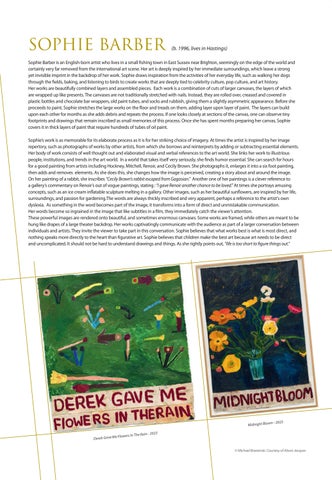
Sophie Barber is an English-born artist who lives in a small fishing town in East Sussex near Brighton, seemingly on the edge of the world and certainly very far removed from the international art scene. Her art is deeply inspired by her immediate surroundings, which leave a strong yet invisible imprint in the backdrop of her work. Sophie draws inspiration from the activities of her everyday life, such as walking her dogs through the fields, baking, and listening to birds to create works that are deeply tied to celebrity culture, pop culture, and art history. Her works are beautifully combined layers and assembled pieces. Each work is a combination of cuts of larger canvases, the layers of which are wrapped up like presents. The canvases are not traditionally stretched with nails. Instead, they are rolled over, creased and covered in plastic bottles and chocolate bar wrappers, old paint tubes, and socks and rubbish, giving them a slightly asymmetric appearance. Before she proceeds to paint, Sophie stretches the large works on the floor and treads on them, adding layer upon layer of paint. The layers can build upon each other for months as she adds debris and repeats the process. If one looks closely at sections of the canvas, one can observe tiny footprints and drawings that remain inscribed as small memories of this process. Once she has spent months preparing her canvas, Sophie covers it in thick layers of paint that require hundreds of tubes of oil paint. Sophie’s work is as memorable for its elaborate process as it is for her striking choice of imagery. At times the artist is inspired by her image repertory, such as photographs of works by other artists, from which she borrows and reinterprets by adding or subtracting essential elements. Her body of work consists of well thought out and elaborated visual and verbal references to the art world. She links her work to illustrious people, institutions, and trends in the art world. In a world that takes itself very seriously, she finds humor essential. She can search for hours for a good painting from artists including Hockney, Mitchell, Renoir, and Cecily Brown. She photographs it, enlarges it into a six foot painting, then adds and removes elements. As she does this, she changes how the image is perceived, creating a story about and around the image. On her painting of a rabbit, she inscribes “Cecily Brown’s rabbit escaped from Gagosian.” Another one of her paintings is a clever reference to a gallery’s commentary on Renoir’s out of vogue paintings, stating : “I gave Renoir another chance to be loved.” At times she portrays amusing concepts, such as an ice cream inflatable sculpture melting in a gallery. Other images, such as her beautiful sunflowers, are inspired by her life, surroundings, and passion for gardening.The words are always thickly inscribed and very apparent, perhaps a reference to the artist's own dyslexia. As something in the word becomes part of the image, it transforms into a form of direct and unmistakable communication. Her words become so ingrained in the image that like subtitles in a film, they immediately catch the viewer’s attention. These powerful images are rendered onto beautiful, and sometimes enormous canvases. Some works are framed, while others are meant to be hung like drapes of a large theater backdrop. Her works captivatingly communicate with the audience as part of a larger conversation between individuals and artists. They invite the viewer to take part in this conversation. Sophie believes that what works best is what is most direct, and nothing speaks more directly to the heart than figurative art. Sophie believes that children make the best art because art needs to be direct and uncomplicated. It should not be hard to understand drawings and things. As she rightly points out, “life is too short to figure things out.”
m - 2025 Midnight Bloo Rain - 2023 Flowers In The Derek Gave Me © Michael Brzezinski. Courtesy of Alison Jacques