OPTIMIZING EXCELLENCE
INDUSTRIAL AND SYSTEMS ENGINEERING
UNIVERSITY OF MINNESOTA - TWIN CITIES


INDUSTRIAL AND SYSTEMS ENGINEERING
UNIVERSITY OF MINNESOTA - TWIN CITIES
DEPARTMENT HEAD
ARCHIS GHATE
DIRECTOR OF GRADUATE STUDIES
KEVIN LEDER
DIRECTOR OF MASTERS PROGRAMS
KRISHNAMURTHY IYER
DIRECTOR OF UNDERGRADUATE STUDIES
LISA MILLER
DIRECTOR OF FACULTY AND ACADEMIC AFFAIRS
JEAN-PHILIPPE RICHARD
CHIEF OF STAFF
TARYN VERLEY

DEPARTMENT OF INDUSTRIAL AND SYSTEMS
ENGINEERING
207
isye@umn.edu
(612) 624-1582
www.isye.umn.edu
O N T E N T S
The
ISyE teaching professors Kathryn Wust and Darin England explain two impactful courses taught through ISyE
4
The Class of 2025
Learn what the future holds for the class of 2025
8
Read about how ISyE seniors helped 2 Minnesota companies
13
The Spring Reception was a evening of celebration and achievement
6
More Than a Program
ISyE senior Zaid Dameh explains what his time in the program means to him
14
The Spirit of Giving
ISyE establishes the spirit of giving by participating in Give to the Max Day


Learning through doing is the cornerstone of many of the courses and electives taught through the ISyE department Assistant Teaching Professor Kathryn Wust’s Project Management course (IE 4541/5541) is an excellent example of such learning through doing
Emphasizing a project-based class setting, and moving away from traditional course aspects such as exams, Wust encourages a course that is tangible and practical
Teaching students to focus on process over product, Wust has students become project managers where they learn perspective matters by encouraging students to choose, develop, and implement a project Having agency in their project promotes meaningful
and passionate projects
Wust explains, “Many project teams choose to work with different charitable organizations like the American Heart Association to successfully implement a blood drive on campus Some teams will do campus-based projects such as proposing energy generating treadmills at the Rec Center, or analyzing and redesigning the queue at the Campus Dining Hall ”
In the development phase of their project, students implement project management theories, concepts and techniques learned in class, as well as simulate elements of project management that actually happen when working as a project manager in the real world Wust, for example, will schedule update meetings with
teams and have students complete multiple peer reviews of deliverables
Since a classroom cannot simulate all aspects of a real experience, Wust researches, creates, and uses case studies to fill in the gaps of where their projects may not necessarily reach, such as budget constraints
Wust hopes to continue to grow and evolve the course, and encourages alumni who took the course to participate in future project management ideas and partnerships
For Wust, varying perspectives impact students’ understanding of what it means to be a project manager
Life is full of decisions. What should I have for breakfast? Should I bring an umbrella today? Should I go on to get a Master’s degree? Sometimes, however, these decisions are made in competitive situations where decisions are being influenced by competitive and cooperative behaviors or group dynamics
From negotiating with friends about where to eat dinner to understanding why companies price products the way they do, Teaching Associate Professor Darin England’s course Decision Analysis (IE 5545) helps students utilize a structured framework for making decisions when facing uncertainty The course analyzes three types of decision-making: individual, decisions versus an opponent, and group decision-making

England explains that values and outcomes influence our decision, but we have to make the decision without knowing the exact outcome. Using quantitative methods with the knowledge that there are some things that we do know (assumptions), probability can be applied to help make the decision
Whether analyzing how the likelihood of rain from a weather app influences our decision to bring an umbrella, how competitive pricing between companies can be analyzed with assumptions within a market to better make decisions against their opponent, or how behavior in group dynamics such as jury deliberations can influence our decision, students walk away with a better understanding of the world around them
Using probability and concepts such as competitive Nash equilibrium (brought to popular culture thanks to the movie A Beautiful Mind), students learn to think about decision-making in a quantitative and different way England notes that he will be adding AI decision-making into the course curriculum in the near future.
This course attracts students from a variety of departments and across colleges Students from ISyE, Data Science, Computer Science, Biomedical Engineering, and Carlson School of Management have found value in taking the course With the course ’ s blend of math, economics and psychology, students find the course interesting and more unique than what they encounter in a traditional engineering course
England remarks, “When students complete the course, they will be able to recognize real-world situations in which strategic behavior is taking place In addition to customs, beliefs, and culture, students will be able to use quantitative methods to make decisions that maximize their utility.“
Learn about the next generation of ISyE change-makers.

Boston Scientific
Philips
Medtronic
Beckhoff Automation
United Parcel Services
General Mills
Kraft Heinz
Garmin
Ecolab
International Motors
Leela AI
Hormel
Accenture
Emerson Pentair
Andersen Windows
Northrop Grumman
Emerson
Ball Corporation

Valmont Industries
nVent
Industrial Engineer
Design Assurance Engineer
Industrial Engineer Supervisor
Lean Coordinator
Logistics Development
Management Development
Manufacturing Engineer
Consultant
Operations Management Associate
Supply Specialist
Process Engineer
Product Management Engineer
Project Engineer
Quality Engineer
Supplier Engineer
Supply Chain, Operations, and Logistics
Technology Analyst

I loved my time in ISYE!!! Everyone involved made it a great experience and set me up for all my future success!!!

Industrial and Systems Engineering


ISyE senior Zaid Dameh exclaims, “[ISyE is] just amazing, and we are a tight-knit group and family! And as a department, as a whole, it just feels right!”
During his senior year at Rosemount High School, Dameh had the opportunity to take PSEO courses through the University of Minnesota It was during this time that he solidified the desire to continue his education in a STEM field, and with the majority of his family being engineers, he understood the power of the degree He, however, knew he didn’t want to enter a field that kept him in a particular industry. Dameh explored more ISyE courses and saw the marketability of the degree
“With the way manufacturing is going in the US, a lot of future factors play into the need for more Industrial Engineering positions, so the needs are very promising”
As his years progressed in the program, Dameh was able to combine his interests with his projects required in courses such as Project Management. In this course, students are given the opportunity to choose a project regardless of scope
thryn Wust, Dameh and his Project Management team YMCA where he worked during his high school years - to $ q p the help of donations and other fundraisers, as well as through generous donations from the University of Minnesota basketball team
Along with Project Management, Dameh also took Systems 1 and 2, and the Senior Design project, all taught by Wust.
“She teaches big picture engineering,” explains Dameh “She focuses on philosophies, documentation, and ultimately, how to think effectively”
Dameh also recalled Teaching Associate Professor Darin England’s courses, Engineering Economics and Decision Analysis, fondly
“[Professor England] is very engaging and his curriculum has helped me understand aspects of engineering outside of the usual scope ”
Dameh remarks that almost all of the courses in ISyE give students the opportunity to work with industry professionals and in group projects
“The courses are personalized, and the professors are helpful, receptive to feedback, and make sure that the curriculum adapts to what is happening in industry. They are “future-proofing” the curriculum.”
These courses and projects leads to the Senior Design Project, which
2024-2025
Minnesota-Twin Cities chapter Board Members

gives students the opportunity to take all of their learned skills to solve a real-world problem (You can learn more about Dameh’s Senior Design Project with Medtronic on page 10 )
During his time in the department, Dameh accomplished more than a degree; he immersed himself in the University and all the department has to offer
As the out-going President of the Institute of Industrial and Systems Engineers - University of MinnesotaTwin Cities chapter (IISE-UMN-TC), Dameh knows the impact of finding a good group in which to be involved IISE-UMN-TC is a student group that helps students engage with industry professionals and peers to provide general events, career resources, and peer and professional mentorship opportunities It is also one of the most established IISE groups in the Midwest
“IISE is a really good group of people who are choosing to spend their time with each other The meetings are always filled with positive energy, and there is so much knowledge going around Upperclassmen have a lot of knowledge, so it's a good opportunity to hand down that knowledge to the next generation.”
Dameh has made such an indelible impression on the community that he has been the recipient of various scholarships and awards recognizing his accomplishments as a student and leader, including the ISyE Eliason scholarship, the ISyE Community scholarship, and the President's Student Leadership and Service Award
Continuing on with the Integrated Bachelor’s and Master’s in ISyE program, Dameh will stay in the ISyE for an additional year to complete his Master’s degree
“The M S program is at the forefront of problem-solving for the future With a focus on machine learning and data science principles, the degree sets you apart and equips you with great skills It also enhances the undergrad program, and makes you more well-rounded and prepared for future success ”
For Dameh, the ISyE department has taught him to be a problem solver Whether these problems are regarding technical, business, or supply chain, the program has prepared him for any industry, and the collaborative environment and positive energy established in ISyE makes the department more than a program.

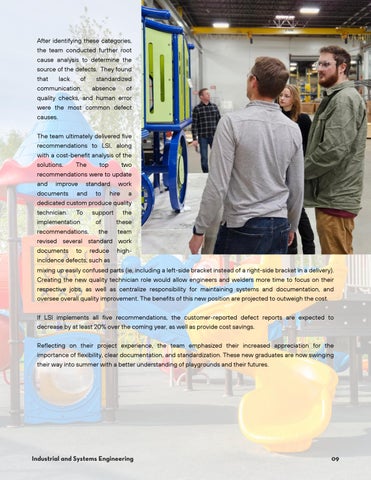
With summer fast approaching, children are eager to play outside, making playgrounds a popular destination ISyE seniors Patricija Freiberga, Katherine Vandelac, Walter Marshall, Diriye Osman, and Diya Hariharan focused their senior design project on these popular summer attractions
The team collaborated with Landscape Structures, Inc (LSI), a Delano, MN, based company that manufactures catalog and custom-designed playground equipment As orders for LSI’s custom playgrounds increased, so did customer reports of defects Working with LSI employees Bob Wolter and Brad Wiyninger, the team aimed to reduce custom product defect reports by 20%, enhancing reliability, lowering costs, and improving customer satisfaction.
To achieve these goals, the team employed Root Cause Analysis techniques, including data analysis, Failure Mode and Effects Analysis (FMEA), and the 5 Whys method They used defect data provided by LSI and interviewed employees from the Custom Welding, Custom Engineering, and Custom Design departments. They discovered that nearly 80% of reported defects fell into five categories, such as incorrect product or part delivery and welding defects
After identifying these categories, the team conducted further root cause analysis to determine the source of the defects They found that lack of standardized communication, absence of quality checks, and human error were the most common defect causes
The team ultimately delivered five recommendations to LSI, along with a cost-benefit analysis of the solutions The top two recommendations were to update and improve standard work documents and to hire a dedicated custom produce quality technician. To support the implementation of these recommendations, the team revised several standard work documents to reduce highincidence defects, such as mixing up easily confused parts (ie, including a left-side bracket instead of a right-side bracket in a delivery)
Creating the new quality technician role would allow engineers and welders more time to focus on their respective jobs, as well as centralize responsibility for maintaining systems and documentation, and oversee overall quality improvement The benefits of this new position are projected to outweigh the cost
If LSI implements all five recommendations, the customer-reported defect reports are expected to decrease by at least 20% over the coming year, as well as provide cost savings
Reflecting on their project experience, the team emphasized their increased appreciation for the importance of flexibility, clear documentation, and standardization. These new graduates are now swinging their way into summer with a better understanding of playgrounds and their futures


The Medtronic facility in Brooklyn Park, MN, manufactures the Affinity Fusion Oxygenation System, a critical device used during surgery to oxygenate blood ISyE seniors Jared Burnett, Allan Kim, Betty Huynh, Samantha Klinke, and Zaid Dameh, under the guidance of sponsor Mitchell Nienaber,
focused their senior design project on analyzing and improving the inconsistent handling of work-in-progress (WIP) across three production shifts The existing processes were experiencing underutilization, overproduction, and elevated scrap and rework rates
The team used both lean and operations research methodologies to address the problem through two solutions: a visual management system and a simulation model that can assess the impact of potential process changes and demand fluctuations.
The existing WIP visual management system faced several challenges, including spatial constraints and a lack of clear indicators for when each product was originally produced This was particularly problematic, as the manufacturing process utilizes a bonding agent that requires rework if cured beyond a certain timeframe To address these issues, the team developed a new visual management system centered around a first-in, firstout (FIFO) approach, ensuring timely processing and minimizing the need for rework To test the concept, the team piloted the system using two redesigned WIP carts, assessing flow and usability before scaling up to full implementation The finalized system includes seven carts, enhanced signage, and a standardized staging layout, allowing for better inventory control, efficient shift handoffs, and a streamlined workflow


management system indicated that full implementation would result in reduced WIP variability, improved FIFO compliance, and a decrease in rework. Additionally, the new system improved coordination among workers from different shifts Along with other solutions, such as implementing redesigned carts to improve ergonomics and staging compliance, and developing visual cues and labeling to improve production flow tracking, the team was able to reduce rework and labor waste, improve operational control, and achieve greater flexibility through scenario-based planning
The team also developed a discrete-event simulation model to enable Medtronic to test production scenarios, including varying cycle times, staffing levels, and throughput targets Ultimately, the team found that adding a centrifuge to the production line would have the most positive impact on product flow and WIP The model was developed as a hybrid solution leveraging both Simio (a simulation software program) and Excel VBA platforms, so that Medtronic can continue to utilize it in future work
Through their work with Medtronic, the seniors learned the importance of early problem definition, stakeholder engagement, and expectation alignment, as well as testing small, iterative improvements to achieve greater outcomes The team came away with a better understanding of one of Minnesota’s most well-known companies, as well as an understanding of building buy-in and delivering practical, sustainable solutions

Abercrombie and Fitch Corp.
“Impact of Estimated Delivery Date on Customer Loyalty and Retention”
Determine the estimated delivery date range provided to customers at checkout
Andersen Corporation
“Inventory Optimization & Documentation”
Optimize visual management and implement Kanban for line-side inventory
Tuffy's Pet Foods
“Product Flow Optimization”
Use simulation to identify possible solutions to reduce production flow bottlenecks and changeover time.
Collins Aerospace
“Facility Layout Redesign”
Present a CAD layout, verified through simulation, that proposes a more efficient production setup. Serve as a proof of concept and supporting future facility changes aimed at increasing production capacity.
West Monroe Partners & Lakeshirts
“Updating Operator Efficiency Calculation and Scheduling Improvements”
Consult with West Monroe to update Lakeshirts’ embroidery operator efficiency calculation to more accurately reflect current production operations and deliver recommendations to enhance the current scheduling process.
Daikin Applied Americas
“Predictive Maintenance (HVAC)”
AI training, testing, and implementation project to enhance technician tools in reliability maintenance activities.
CINTAS
“Implementing AI Engine into Asset Management Software”
Create predictive maintenance model that is able to determine when a fault in an HVAC system will occur based on historical sensor and warranty data.
“Pharmacy Technician Staffing Schedule Optimization”
Improve technician schedule satisfaction by building an optimization model.
“Custom Product Defect Analysis”
From research driven data-analysis, give 5 technical and human factors suggestions on how to reduce defects by 20%
“Capacity Improvement and Waste Reduction in Receiving Area”
Increase operator efficiency within the receiving area at Abbott’s tier one distribution center.
“Consumable Inventory Management System”
Implement a two-bin Kanban system to manage consumable inventory. Calculate optimal reorder points and economic order quantities for materials within the system.
“Developing a Manufacturing Strategy”
Create line interchangeability for the new and legacy product that has a turnover goal of less than 1 hour and additionally increase output by 20%.
“Mechanical Heart Valves - Line Balancing”
Improve flow and reduce defects by employing classic lean tools such as visual management, space management, and simulation.
“Perfusion Systems - Process Improvement”
Improving efficiency in Medtronic’s production line with visual management and simulation tools.

Become a Senior Design Project Industry Sponsor!
Learn more by scanning the QR code.


pivotal role in the department’s success and impact
There is something special about the Department of Industrial and Systems Engineering at the University of Minnesota - Twin Cities Ask any student, faculty, or staff member, and most will agree that this special element is the community the department fosters
ISyE takes pride in the exceptional contributions of its faculty, staff, and students Together with its industry partners, board members, and alumni, the ISyE community plays a
To celebrate this community, ISyE hosted a Spring Reception, which served roughly 80 attendees.
ISyE alumni joined and celebrated the class of 2025 Faculty and staff shared stories of past years, all while eagerly discussing hopes for the department’s future Hosted in the department on April 29, the second floor of Lind Hall bustled with excitement and energy
This event also included awarding 2 ISyE industry partners, Brian Naslund and Kyle Stahl, with the ISyE Industry Partner award This honor was awarded to them for their outstanding contributions and engagements to the ISyE community.
Also celebrated was the spirit of giving The reception was an opportunity to support the ISyE Community Scholarship, which recognizes students whose actions help create a more diverse and inclusive environment in the department and pave the way for broader representation in Industrial Engineering and, more generally, in STEM-related fields
“As a doctoral graduate of the department, I’m deeply grateful for the mentorship and community that shaped my journey. It’s inspiring to see ISyE’s continued commitment to fostering diversity and inclusion while empowering the next generation of leaders,” says one alum said along with his generous donation to the scholarship
As ISyE continues to grow, so will its community With gratitude, those within the department are honored to celebrate the efforts and contributions of its students, partners, and alumni
Give to the Max Day has been a yearly tradition in Minnesota since 2009, and for the first time in 2024, ISyE participated in this generous day of giving.

With great generosity from 33 donors, the ISyE Strategic Initiative Fund, raised a total of $5, 373 This fund provides scholarships for undergraduate and graduate students, allowing them to benefit from experiences that prepare them for successful careers, as well as fund innovative faculty research that addresses societal needs
It is clear that ISyE means a great deal to so many Along with receiving donations, the department also received kind words equally as valuable.
“ISyE is simply the best place to be," says one donor. “Wonderfully kind and intelligent professors, stimulating and interesting curriculum, and an extremely supportive administration has allowed me as a student to feel like I’m not just pursuing a major, I’m getting ahead in my career.”
Another donor exclaims, “I’m so proud to be an ISyE alumni! Keep up the amazing work!”
ISyE is and will always be committed to providing student-centered coursework and research initiatives that drive academic excellence On this day of giving, donations directly supported ISyE’s efforts to bridge the gap between classroom learning and real-world applications by fostering collaborations with businesses and alumni. These partnerships enable students to apply their knowledge to practical challenges, while also promoting groundbreaking research on critical issues facing society.
With this new tradition of giving, ISyE will continue to grow and foster its outstanding sense of community and its dedication to exceptional research and courses
Thank you to all who donate on Give to the Max Day!

SEPTEMBER 2024 - FEBRUARY 2025
$10,000+
Rao and Rani Varanasi
$1,000-$9,999
Accenture LLP
Siyuan Song
Ulteig Engineers
$500-$999
Bruce and Nancy Gregoire
Up to $499
BRENT KELLUM
KYLE STAHL
BENJAMIN J. DIMOND
SWATANTRA K. KACHHAL
BRIAN AND JENNIFER NASLUND
RAYTHEON TECHNOLOGIES
JED J. LIANG
ZHENGTING YANG
ZAID DAMEH
JIALI HUANG
LYNNE A. MCLANDSBOROUGH
XIAOYE L. SU
ANNA THOMPSON
MICHELE T. NGUYEN
ZACHARY S. ORVIS
SAMI CASEY
JEROMY KNAPP
DEREK R. SINGH
NATHAN VIJAY
JASON J. BRAATZ
STASIA CARR
MEGAN BROSNAN
BOSTON SCIENTIFIC
YIFENG HUANG
NATHAN R. LEMOINE
BENJAMIN G SHARPE
MEGAN N. BREDEHORST
HAOYU WANG
EMMA J. EHLING
JAGMEHR MADAN
RAUNAK R. PANDEY
EUGENE AND SANDRA DANKBAR
CHARLES R. LEA
MARK MEISTER AND CARLA KRIVAK
Become the impact for an ISyE student or faculty today!
Learn more about giving by scanning the QR code.

With a spirit of gratitude, ISyE Awards and Scholarship recipients celebrated with friends, family, ISyE faculty and staff, and board members in an intimate ceremony dedicated to their achievements
Taking place in the Coffman Memorial West Wing Dining Room on April 4, 2025, recipients were awarded by Director of Undergraduate Studies Lisa Miller and Department Head Archis Ghate.
Recipients Mohameddeq Ali, Mira Patel, Quelia Yang, and Zhixin Sophia Han gave inspiring, and sometimes humorous, speeches regarding their time in the Department, as well as their experience, and their gratitude for being recognized for these yearly ISyE traditions.


Dr. Alan L. Eliason Undergraduate Achievement in ISyE Award
Ed Easton
Elizabeth Schottler
Jack Bly
Jocelyn Johnson
Jose Porras Campos
Maria Esparza Talamantes
Mohameddeq Ali
Sydney Roswall
Zaid Dameh
Zhixin Sophia Han
Mahendra Bakshi - Sant Ram Arora Memorial Scholarship
Mira Patel
ISyE Community Scholarship
Quelia Yang
Zaid Dameh
MinneAnalytics Scholarship
Zhixin Sophia Han

KATHRYN WUST
Assistant Teaching Professor Kathryn Wust will present her research entitled “Walk a mile in their shoes: Older Adults and ED Nurses’ Perception of Work System Barriers and Facilitators to Collaboration Perceived From Each Other’s Perspectives” at the Healthcare Ergonomics and Patient Safety Conference at Trinity College in Dublin, Ireland in June 2025.
Martín Zubeldía and Yishun Luo
Assistant Professor Martín Zubeldía and ISyE PhD student Yishun Luo will present their research on re-enforcement learning algorithms and machine learning, as well as on queueing theory regarding data center efficency algorithms at the 2025 INFORMS
Applied Probability Society Conference at Georgia Tech in June/July 2025. Professor Zubeldía also organized the Queueing Theory technical session for the conference.
ISyE is hosting the 2025 Mixed Integer Programming Workshop on the University of Minnesota - Twin Cities campus in June 2025. The Mixed Integer Programming (MIP) Workshop is a single-track workshop highlighting the latest trends in integer programming and discrete optimization, with speakers chosen by invitation. The workshop also includes a Summer School and Poster Session
ISyE is assisting the IISE - University of Minnesota-Twin Cities chapter in hosting the 2027 IISE Annual Conference on the University of Minnesota - Twin Cities campus. This conference will provide approximately 120 students insight into the Industrial and Systems Engineering profession through site visits, interactive activities, workshops, and more. The 2-day event allows undergraduate and graduate students to engage with peers, leaders, and professionals in academia and industry.

207 Church St. SE Minneapolis, MN 55455


linkedin.com/groups/13845677/ @UMNISyE


@umnisye ISyEUMN
Industrial engineers make changes happen. Invest in the Department of Industrial and Systems Engineering today.
Your gift, combined with those of other alumni and friends, provides our students, faculty, and facilities with the resources necessary to sustain our drive for excellence.
SCAN TO MAKE A GIFT

