INDUSTRIAL & SYSTEMS
ENGINEERING Winter 2023
Innovating in the Classroom pg. 11
INSIDE: Welcoming new faculty 7 Engineering health care 15 Sneak peek: ISyE’s new home 19 Ride-sharing with remote drivers 21
Features About the Front Cover
CONTENTS
New Faculty The ISyE Department is growing with two new faculty, Saumya Sinha and Martin Zubeldia.
Innovative Teaching in ISyE ISyE faculty use a range of strategies to engage students in complex problems.
Department of Industrial and Systems Engineering 207 Church Street SE, Minneapolis, MN 55455 Email: isye@umn.edu Phone: 612-624-1582 www.isye.umn.edu
Department Head Saif Benjaafar Director of Graduate Studies William L. Cooper
In this edition of the magazine, we highlight the extraordinary talent of ISyE faculty and what they do to bring out the next generation of industrial and systems engineers. Three faculty in particular juggle the complexities of their topics with innovative teaching methods.
Pictured: Nick Arnosti Photo by Samantha Karsten
Optimizing the Future of Health Care From cancer treatments to administration to organ transplant decisions, ISyE is at the forefront in health care optimization and engineering.
Sneak Peek: ISyE’s New Home After a multiyear and multimillion dollar renovation, Lind Hall is ready to welcome ISyE.
Remote Driving: The Future of Ride Sharing? Saif Benjaafar’s research team examined efficiencies that could be gained by operating a ride-hailing service with remote drivers.
7 11 15 19 21
Director of Undergraduate Studies Lisa Miller
Highlights
Director of Faculty and Academic Affairs Jean-Philippe Richard
Undergraduate highlights
23
Department Administrator Hongna Bystrom
Graduate highlights
27
Editor and Designer Samantha Karsten
Faculty awards
31
Features About the Front Cover
CONTENTS
New Faculty The ISyE Department is growing with two new faculty, Saumya Sinha and Martin Zubeldia.
Innovative Teaching in ISyE ISyE faculty use a range of strategies to engage students in complex problems.
Department of Industrial and Systems Engineering 207 Church Street SE, Minneapolis, MN 55455 Email: isye@umn.edu Phone: 612-624-1582 www.isye.umn.edu
Department Head Saif Benjaafar Director of Graduate Studies William L. Cooper
In this edition of the magazine, we highlight the extraordinary talent of ISyE faculty and what they do to bring out the next generation of industrial and systems engineers. Three faculty in particular juggle the complexities of their topics with innovative teaching methods.
Pictured: Nick Arnosti Photo by Samantha Karsten
Optimizing the Future of Health Care From cancer treatments to administration to organ transplant decisions, ISyE is at the forefront in health care optimization and engineering.
Sneak Peek: ISyE’s New Home After a multiyear and multimillion dollar renovation, Lind Hall is ready to welcome ISyE.
Remote Driving: The Future of Ride Sharing? Saif Benjaafar’s research team examined efficiencies that could be gained by operating a ride-hailing service with remote drivers.
7 11 15 19 21
Director of Undergraduate Studies Lisa Miller
Highlights
Director of Faculty and Academic Affairs Jean-Philippe Richard
Undergraduate highlights
23
Department Administrator Hongna Bystrom
Graduate highlights
27
Editor and Designer Samantha Karsten
Faculty awards
31
Faculty
Saif Benjaafar
Nick Arnosti
Distinguished McKnight University Professor and ISyE Department Head
Assistant Professor
Ph.D., Stanford Market design, emphasis on giving away social goods such as affordable housing and public school seats
William Cooper
Director of Graduate Studies and Professor
Ph.D., Georgia Tech Stochastic modeling, pricing, revenue management, applied probability
Darin England
Teaching Associate Professor
Ph.D., University of Minnesota Optimization, simulation, machine learning
3
Ph.D., Purdue Operations management, supply chains, service systems, sharing economy, sustainability
Sherwin Doroudi
Ying Cui
Assistant Professor
Assistant Professor
Ph.D., National University of Singapore Optimization, stochastic programming, operations research
Krishnamurthy Iyer
Ph.D., Carnegie Mellon Stochastic modeling, queuing systems, computer security
Kevin Leder
Associate Professor
Associate Professor
Ph.D., Stanford Game theory, applied probability, economics and computation, stochastic modeling
Ph.D., Brown Stochastic modeling, cancer evolution, probability theory
Department of Industrial and Systems Engineering
Zhaosong Lu Professor
Ph.D., Georgia Tech Continuous optimization, statistics, data analtyics, machine learning, image proceessing
Jean-Philippe Richard Professor
Ph.D., Georgia Tech Mathematical optimization, healthcare, transportation, infrastructure
Yiling Zhang Assistant Professor
Ph.D., University of Michigan Stochastic, integer and nonlinear programming, energy systems, healthcare, transportation
Winter 2023
Ankur Mani Assistant Professor
Ph.D., Massachusetts Institute of Technology Peer and network interactions, pricing, matching and mechanism design
Saumya Sinha
Assistant Professor
Ph.D., University of Washington, Seattle Optimization under uncertainty, robust optimization, incentive design, healthcare operations and policy
Lisa Miller
Distinguished Teaching Professor and Director of Undergraduate Studies Ph.D., Georgia Tech Optimization, analytics, operations research
Shuzhong Zhang Professor
Ph.D., Erasmus University Nonlinear optimization, game theory, signal processing, risk management
Martín Zubeldía
Assistant Professor
Ph.D., Massachusetts Institute of Technology Applied probability, modeling/analysis/control of large-cale stochastic decision systems
4
Faculty
Saif Benjaafar
Nick Arnosti
Distinguished McKnight University Professor and ISyE Department Head
Assistant Professor
Ph.D., Stanford Market design, emphasis on giving away social goods such as affordable housing and public school seats
William Cooper
Director of Graduate Studies and Professor
Ph.D., Georgia Tech Stochastic modeling, pricing, revenue management, applied probability
Darin England
Teaching Associate Professor
Ph.D., University of Minnesota Optimization, simulation, machine learning
3
Ph.D., Purdue Operations management, supply chains, service systems, sharing economy, sustainability
Sherwin Doroudi
Ying Cui
Assistant Professor
Assistant Professor
Ph.D., National University of Singapore Optimization, stochastic programming, operations research
Krishnamurthy Iyer
Ph.D., Carnegie Mellon Stochastic modeling, queuing systems, computer security
Kevin Leder
Associate Professor
Associate Professor
Ph.D., Stanford Game theory, applied probability, economics and computation, stochastic modeling
Ph.D., Brown Stochastic modeling, cancer evolution, probability theory
Department of Industrial and Systems Engineering
Zhaosong Lu Professor
Ph.D., Georgia Tech Continuous optimization, statistics, data analtyics, machine learning, image proceessing
Jean-Philippe Richard Professor
Ph.D., Georgia Tech Mathematical optimization, healthcare, transportation, infrastructure
Yiling Zhang Assistant Professor
Ph.D., University of Michigan Stochastic, integer and nonlinear programming, energy systems, healthcare, transportation
Winter 2023
Ankur Mani Assistant Professor
Ph.D., Massachusetts Institute of Technology Peer and network interactions, pricing, matching and mechanism design
Saumya Sinha
Assistant Professor
Ph.D., University of Washington, Seattle Optimization under uncertainty, robust optimization, incentive design, healthcare operations and policy
Lisa Miller
Distinguished Teaching Professor and Director of Undergraduate Studies Ph.D., Georgia Tech Optimization, analytics, operations research
Shuzhong Zhang Professor
Ph.D., Erasmus University Nonlinear optimization, game theory, signal processing, risk management
Martín Zubeldía
Assistant Professor
Ph.D., Massachusetts Institute of Technology Applied probability, modeling/analysis/control of large-cale stochastic decision systems
4
Message from the Department Head
Affiliated Faculty
“
I am particularly proud of the culture we have been able to nurture, one that puts people at the very center of everything we do and puts a premium on collaboration.” —Saif Benjaafar
Tony Haitao Cui Affiliated Faculty
Carlson School of Management, UMN Deputy Associate Dean for Global DBA, Professor
Karen Donohue
Mingyi Hong
Affiliated Faculty
Affiliated Faculty
Carlson School of Management, UMN Board of Overseers Professor
Department of Electrical and Computer Engineering, UMN Associate Professor
Saif Benjaafar, Distinguished McKnight University Professor and ISyE department dead
Alireza Khani Affiliated Faculty
Department of Civil, Environmental, and Geo-Engineering, UMN Associate Professor
Qi Zhang
Hui Zou
Affiliated Faculty
Affiliated Faculty
Department of Chemical Engineering and Materials Science, UMN Assistant Professor
School of Statistics, UMN Professor
This year marks the ten-year anniversary of the Department of Industrial and Systems Engineering (ISyE). In ten short years, the department has grown into one of the most exciting departments of industrial engineering in the nation, with a faculty working at the cutting edge of the field and counting among its ranks some of the field’s most prominent leaders, rapidly growing undergraduate and graduate programs, an engaged and devoted staff, and a growing base of successful alumni who remain strongly connected to the department. I am particularly proud of the culture we have nurtured, one that puts people at the center of everything we do and puts a premium on collaboration.The future of the department is bright. I have little doubt that, over the next ten years, the department will rise to even greater prominence. In the pages of this magazine, you can read about some of the many accomplishments of our faculty, students, and alumni. Featured are stories about how our faculty are innovating the classroom, tackling challenging problems in healthcare, and exploring the future of transportation. You will also read inspiring stories about how alumni are thriving in Silicon Valley and making a difference in the world of tech.You will get to meet two of our newest faculty members, Saumya Sinha and Martin Zubeldia. Highlighted are some of the accolades our faculty and
5
Department of Industrial and Systems Engineering
Winter 2023
students have earned this year, including competitive grants from funding agencies, prestigious awards from professional societies, and publications in the most important journals in the field. You can enjoy a sneak peek at the new ISyE space, part of a $30 million renovation of Lind Hall. The new space marks a major milestone in the evolution of the department and culmination of our decade-long effort to bring ISyE faculty, staff, and students, all under one roof. As I reflect on the department’s journey from a small graduate program into an emerging research and teaching powerhouse, I am grateful for the tremendous support from the college (under the leadership of current Dean Andrew Alleyne and previous Deans Mos Kaveh and Steve Crouch), our dedicated staff, our committed advisory board members, our many partners from industry and the community, and our alumni.We could not be where we are today without their support. As usual, I end with a request that you get and stay in touch. Are you inspired by something you read here? Do you have an idea for a project? Would you like to be involved in the department? Please do not hesitate to reach out to me by phone, text, or email, which can be found on our website. 6
Message from the Department Head
Affiliated Faculty
“
I am particularly proud of the culture we have been able to nurture, one that puts people at the very center of everything we do and puts a premium on collaboration.” —Saif Benjaafar
Tony Haitao Cui Affiliated Faculty
Carlson School of Management, UMN Deputy Associate Dean for Global DBA, Professor
Karen Donohue
Mingyi Hong
Affiliated Faculty
Affiliated Faculty
Carlson School of Management, UMN Board of Overseers Professor
Department of Electrical and Computer Engineering, UMN Associate Professor
Saif Benjaafar, Distinguished McKnight University Professor and ISyE department dead
Alireza Khani Affiliated Faculty
Department of Civil, Environmental, and Geo-Engineering, UMN Associate Professor
Qi Zhang
Hui Zou
Affiliated Faculty
Affiliated Faculty
Department of Chemical Engineering and Materials Science, UMN Assistant Professor
School of Statistics, UMN Professor
This year marks the ten-year anniversary of the Department of Industrial and Systems Engineering (ISyE). In ten short years, the department has grown into one of the most exciting departments of industrial engineering in the nation, with a faculty working at the cutting edge of the field and counting among its ranks some of the field’s most prominent leaders, rapidly growing undergraduate and graduate programs, an engaged and devoted staff, and a growing base of successful alumni who remain strongly connected to the department. I am particularly proud of the culture we have nurtured, one that puts people at the center of everything we do and puts a premium on collaboration.The future of the department is bright. I have little doubt that, over the next ten years, the department will rise to even greater prominence. In the pages of this magazine, you can read about some of the many accomplishments of our faculty, students, and alumni. Featured are stories about how our faculty are innovating the classroom, tackling challenging problems in healthcare, and exploring the future of transportation. You will also read inspiring stories about how alumni are thriving in Silicon Valley and making a difference in the world of tech.You will get to meet two of our newest faculty members, Saumya Sinha and Martin Zubeldia. Highlighted are some of the accolades our faculty and
5
Department of Industrial and Systems Engineering
Winter 2023
students have earned this year, including competitive grants from funding agencies, prestigious awards from professional societies, and publications in the most important journals in the field. You can enjoy a sneak peek at the new ISyE space, part of a $30 million renovation of Lind Hall. The new space marks a major milestone in the evolution of the department and culmination of our decade-long effort to bring ISyE faculty, staff, and students, all under one roof. As I reflect on the department’s journey from a small graduate program into an emerging research and teaching powerhouse, I am grateful for the tremendous support from the college (under the leadership of current Dean Andrew Alleyne and previous Deans Mos Kaveh and Steve Crouch), our dedicated staff, our committed advisory board members, our many partners from industry and the community, and our alumni.We could not be where we are today without their support. As usual, I end with a request that you get and stay in touch. Are you inspired by something you read here? Do you have an idea for a project? Would you like to be involved in the department? Please do not hesitate to reach out to me by phone, text, or email, which can be found on our website. 6
There are so many “variables that cannot
New Faculty Background: University of Washington Ph.D. in Applied Mathematics University of Washington M.S. in Applied Mathematics Tata Institute of Fundamental Research M.S. in Mathematics University of Delhi
be quantified. And that is the heart of it… The need is so much greater than what is available.”
B.S. (Honors) in Mathematics
Research Interests: Optimization under uncertainty Markov decision processes
Saumya Sinha
Robust optimization Incentive design Healthcare operations Health policy
Story and photo by Samantha Karsten
Saumya Sinha brings an impressive background in applied mathematics, solving problems in sequential decision-making, and optimization under uncertainty to the improvement of healthcare and health policy. She joined the ISyE department as an assistant professor in the fall semester of 2022. Sinha grew up in Delhi, India and has always had a passion for learning. She first got interested in the idea of scientific exploration and research in high school, when she had to study for a math class on her own with limited guidance due to scheduling issues. This turned out to be serendipitous, as she enjoyed the academic freedom to explore and study as she liked, and decided to pursue her interest in math and science. After getting her bachelor of science from the University 7
of Delhi, she pursued her master’s at the Tata Institute of Fundamental Research Centre for Applicable Mathematics in Bengaluru. She moved to the United States to pursue a Ph.D. in applied mathematics at the University of Washington in Seattle, where she was further exposed to applications of operations research and industrial engineering. While much of her graduate research was theoretical and highly technical, she sought a broader, application-oriented experience. This drove her to take a subsequent postdoctoral position at Rice University. Her postdoctoral advisor had a long history of healthcare research and she saw an opportunity to apply her mathematics training to study health policy.
transplant hospitals to federal regulations that evaluated hospitals on the basis of patients’ post-transplant outcomes and penalized those with poorer-than-expected outcomes. Sinha’s work demonstrated that these regulations could induce risk-aversion whereby hospitals would turn away sicker but high-risk patients with unpredictable outcomes. She further observed that medium-sized hospitals were disproportionately impacted. While many studies have looked at the problem from the perspective of the patients and the government, not many have analyzed the problem from the hospitals’ perspective, and how organ transplant organizations react to government regulation.
Her most recent research focuses on the reaction of
During her study, Sinha sat in on organ transplant medical review board meetings to learn about and analyze how these critical decisions were being made,
Department of Industrial and Systems Engineering
Winter 2023
and how to optimize as many factors as possible to create the best outcome for hospitals and patients. She further learned that while modeling can help these boards make more streamlined and data-driven decisions, it cannot replace subjective conversations regarding who is approved to receive a transplant and who is not. “There are so many variables that cannot be quantified,” she says.“And that is why the intention of this work is always to assist and support the decision-makers, never to replace them. The need [for such tools] is so much greater than what is available.” The people who decide on organ transplant recipients have a great burden to bear, and it’s clear that Sinha cares greatly for their predicament. This spring, Sinha will be teaching a new elective on healthcare decision-making. She plans to continue her research into organ transplant policies. She is particularly interested in “pay for performance” federal healthcare reimbursement as it relates to organ transplantation. Based on her previous research, she has formulated alternate incentive mechanisms that can help inform policy-makers on how best to help hospitals and their patients. Students interested in working with Sinha are encouraged to contact her via email. Her contact information can be found on the ISyE website. 8
There are so many “variables that cannot
New Faculty Background: University of Washington Ph.D. in Applied Mathematics University of Washington M.S. in Applied Mathematics Tata Institute of Fundamental Research M.S. in Mathematics University of Delhi
be quantified. And that is the heart of it… The need is so much greater than what is available.”
B.S. (Honors) in Mathematics
Research Interests: Optimization under uncertainty Markov decision processes
Saumya Sinha
Robust optimization Incentive design Healthcare operations Health policy
Story and photo by Samantha Karsten
Saumya Sinha brings an impressive background in applied mathematics, solving problems in sequential decision-making, and optimization under uncertainty to the improvement of healthcare and health policy. She joined the ISyE department as an assistant professor in the fall semester of 2022. Sinha grew up in Delhi, India and has always had a passion for learning. She first got interested in the idea of scientific exploration and research in high school, when she had to study for a math class on her own with limited guidance due to scheduling issues. This turned out to be serendipitous, as she enjoyed the academic freedom to explore and study as she liked, and decided to pursue her interest in math and science. After getting her bachelor of science from the University 7
of Delhi, she pursued her master’s at the Tata Institute of Fundamental Research Centre for Applicable Mathematics in Bengaluru. She moved to the United States to pursue a Ph.D. in applied mathematics at the University of Washington in Seattle, where she was further exposed to applications of operations research and industrial engineering. While much of her graduate research was theoretical and highly technical, she sought a broader, application-oriented experience. This drove her to take a subsequent postdoctoral position at Rice University. Her postdoctoral advisor had a long history of healthcare research and she saw an opportunity to apply her mathematics training to study health policy.
transplant hospitals to federal regulations that evaluated hospitals on the basis of patients’ post-transplant outcomes and penalized those with poorer-than-expected outcomes. Sinha’s work demonstrated that these regulations could induce risk-aversion whereby hospitals would turn away sicker but high-risk patients with unpredictable outcomes. She further observed that medium-sized hospitals were disproportionately impacted. While many studies have looked at the problem from the perspective of the patients and the government, not many have analyzed the problem from the hospitals’ perspective, and how organ transplant organizations react to government regulation.
Her most recent research focuses on the reaction of
During her study, Sinha sat in on organ transplant medical review board meetings to learn about and analyze how these critical decisions were being made,
Department of Industrial and Systems Engineering
Winter 2023
and how to optimize as many factors as possible to create the best outcome for hospitals and patients. She further learned that while modeling can help these boards make more streamlined and data-driven decisions, it cannot replace subjective conversations regarding who is approved to receive a transplant and who is not. “There are so many variables that cannot be quantified,” she says.“And that is why the intention of this work is always to assist and support the decision-makers, never to replace them. The need [for such tools] is so much greater than what is available.” The people who decide on organ transplant recipients have a great burden to bear, and it’s clear that Sinha cares greatly for their predicament. This spring, Sinha will be teaching a new elective on healthcare decision-making. She plans to continue her research into organ transplant policies. She is particularly interested in “pay for performance” federal healthcare reimbursement as it relates to organ transplantation. Based on her previous research, she has formulated alternate incentive mechanisms that can help inform policy-makers on how best to help hospitals and their patients. Students interested in working with Sinha are encouraged to contact her via email. Her contact information can be found on the ISyE website. 8
When you think “ abstractly about a
New Faculty
practical problem, and prove theorems about the abstraction, you discover that the same insights that you obtained can be applied to many different problems.”
Background: Massachusetts Institute of Technology Ph.D. in Electrical Engineering Universidad ORT Uruguay M.S. in Engineering Universidad ORT Uruguay B.S. in Electronics Engineering
Martín Zubeldía
Research Interests: Applied probability Large-scale stochastic decision systems Service and learning systems Computer networks
Story and photo by Samantha Karsten
Martín Zubeldía has centered his work around the uncertainties of life.The future is fundamentally unpredictable. Decisions must be made with limited information. But with the power of mathematical modeling, Zubeldía, who joined the ISyE faculty this fall, develops approaches that optimize decision-making in the face of uncertainty and randomness. Before joining the U of M, Zubeldía held postdoctoral positions for the past three years. Now an ISyE assistant professor, his research has focused on using applied probability for the modeling, analysis, and control of large-scale stochastic decision systems, inspired by applications in computer networks, and other service and learning systems. He is interested in the fundamental trade-offs between performance and efficiency that 9
arise in these systems, with an emphasis on the role that information plays in these tradeoffs. Zubeldía grew up in Montevideo, Uruguay, the son of an industrial engineer and a high school math teacher. Like many children, he wanted to be an astronaut when he grew up, but his parents encouraged him to try engineering. While he was earning his bachelor’s of science in electronics engineering and a master’s of science in engineering, he discovered that he could turn his love of learning into a career. His mathematics skills and passion for academics led him into the Massachusetts Institute of Technology, where he completed his Ph.D. in electrical engineering.While in Boston, he experienced snow for the first time. He loved it, but he lamented that the movies didn’t prepare Department of Industrial and Systems Engineering
him for how cold snow really is. From 2019-2021 he was a postdoctoral fellow in the Department of Mathematics and Computer Science at the Eindhoven University of Technology in the Netherlands. Due to the Netherlands’ robust Covid safety policies, much of his experience as a postdoc was remote. While in the Netherlands, he mentored an undergraduate student, and discovered a love for teaching. After a one-year stint as a postdoctoral fellow at the Georgia Institute of Technology, he joined the University of Minnesota as an assistant professor. He is now enjoying living in Minneapolis and experiencing his first Minnesota winter. In his first semester at the U of M, Zubeldía taught a master’s level course in probability and stochastic Winter 2023
models. He is excited about the new and growing department and the possibilities for collaboration with graduate students and further research in his field. He’s hoping to expand his work into machine learning. “Computer scientists are good at creating new machine learning algorithms and testing their limits empirically. I am interested in proving theorems that provide security guarantees for those algorithms.” For example, it’s not very well known how likely or how often reinforcement learning algorithms—such as those in self-driving cars—might make mistakes given a certain number of training hours. He hopes to develop a mathematical framework that can estimate that likelihood.“When you think abstractly about a practical problem, and prove theorems about the abstraction, you discover that the same insights that you obtained can be applied to many different problems.” Students interested in working with Zubeldía are encouraged to contact him via email. His contact information can be found on the ISyE website. 10
When you think “ abstractly about a
New Faculty
practical problem, and prove theorems about the abstraction, you discover that the same insights that you obtained can be applied to many different problems.”
Background: Massachusetts Institute of Technology Ph.D. in Electrical Engineering Universidad ORT Uruguay M.S. in Engineering Universidad ORT Uruguay B.S. in Electronics Engineering
Martín Zubeldía
Research Interests: Applied probability Large-scale stochastic decision systems Service and learning systems Computer networks
Story and photo by Samantha Karsten
Martín Zubeldía has centered his work around the uncertainties of life.The future is fundamentally unpredictable. Decisions must be made with limited information. But with the power of mathematical modeling, Zubeldía, who joined the ISyE faculty this fall, develops approaches that optimize decision-making in the face of uncertainty and randomness. Before joining the U of M, Zubeldía held postdoctoral positions for the past three years. Now an ISyE assistant professor, his research has focused on using applied probability for the modeling, analysis, and control of large-scale stochastic decision systems, inspired by applications in computer networks, and other service and learning systems. He is interested in the fundamental trade-offs between performance and efficiency that 9
arise in these systems, with an emphasis on the role that information plays in these tradeoffs. Zubeldía grew up in Montevideo, Uruguay, the son of an industrial engineer and a high school math teacher. Like many children, he wanted to be an astronaut when he grew up, but his parents encouraged him to try engineering. While he was earning his bachelor’s of science in electronics engineering and a master’s of science in engineering, he discovered that he could turn his love of learning into a career. His mathematics skills and passion for academics led him into the Massachusetts Institute of Technology, where he completed his Ph.D. in electrical engineering.While in Boston, he experienced snow for the first time. He loved it, but he lamented that the movies didn’t prepare Department of Industrial and Systems Engineering
him for how cold snow really is. From 2019-2021 he was a postdoctoral fellow in the Department of Mathematics and Computer Science at the Eindhoven University of Technology in the Netherlands. Due to the Netherlands’ robust Covid safety policies, much of his experience as a postdoc was remote. While in the Netherlands, he mentored an undergraduate student, and discovered a love for teaching. After a one-year stint as a postdoctoral fellow at the Georgia Institute of Technology, he joined the University of Minnesota as an assistant professor. He is now enjoying living in Minneapolis and experiencing his first Minnesota winter. In his first semester at the U of M, Zubeldía taught a master’s level course in probability and stochastic Winter 2023
models. He is excited about the new and growing department and the possibilities for collaboration with graduate students and further research in his field. He’s hoping to expand his work into machine learning. “Computer scientists are good at creating new machine learning algorithms and testing their limits empirically. I am interested in proving theorems that provide security guarantees for those algorithms.” For example, it’s not very well known how likely or how often reinforcement learning algorithms—such as those in self-driving cars—might make mistakes given a certain number of training hours. He hopes to develop a mathematical framework that can estimate that likelihood.“When you think abstractly about a practical problem, and prove theorems about the abstraction, you discover that the same insights that you obtained can be applied to many different problems.” Students interested in working with Zubeldía are encouraged to contact him via email. His contact information can be found on the ISyE website. 10
students to come to class whenever possible, and I think that helps create a vibrant class experience.” Students seem to agree; attendance stayed high throughout the year.
g n i t a v o n n I
He also likes giving small but frequent homework assignments with—and this is something he learned from his spouse, a math teacher—prompt feedback. That quick feedback is key to reinforcing the concepts covered in class, Arnosti says. Right away, “students can see, ‘Oh, I got question 2 wrong – do I understand why, or not?’” before attention moves on to the next concept.
in the
Arnosti finds it rewarding when students try to apply concepts they’ve explored in class to contexts from their day-to-day lives: identifying weaknesses in the U’s course registration system, or allocating scarce parking spots outside a fraternity house. “Seeing these sorts of connections being drawn, that’s very gratifying.”
Classroom
Paper boats, juggling balls, fresh fruit: These are a few of the tactile objects that assistant professor Nick Arnosti uses to engage students in his elective on Allocating Public Resources. Arnosti, whose research focuses on allocation of public goods, believes that making allocation concepts concrete helps students understand them in a way that no book or traditional lecture can. On the first day of class, Arnosti brought in four pieces of fresh fruit—an apple, a banana, a cantaloupe, and a durian—and helped students brainstorm different criteria for awarding each fruit to classmates who needed or wanted it most. “What does it mean to be efficient, if I want to give it away efficiently? What does it mean to be fair? When we’re designing social systems we need to ask, does it satisfy this property? That property? 11
We’re going to take these concepts and turn them into mathematical definitions. —Nick Arnosti
Mimi Wong
Story by Susan Maas Photos by Samantha Karsten
Nick Arnosti
“
“It’s an engineering class, rather than a public policy class, because we’re going to take these concepts, these goals we might have, and we’re going to turn them into mathematical definitions,” Arnosti says. “Whenever I introduce a new algorithm, I try to have a concrete, hands-on walkthrough.” Arnosti likes to challenge himself by learning new hobbies and skills. Recently he taught himself juggling, and he decided to give away his set of juggling balls to illustrate concepts of value and fairness in auctioning goods. Arnosti showed his students how to fold paper into origami boats, then asked them how many boats they’d be willing to make to “win” the juggling balls. (For the record, the highest bid was 75.) Such activities are one reason Arnosti has “a strong preference for in-person learning.” While recognizing that Covid continues to necessitate staying home sometimes, “I do think it’s more effective for Department of Industrial and Systems Engineering
Mimi Wong calls herself an “accidental” project manager. But after decades of experience in business—first with Target, and now as a consultant—there’s nothing accidental about the approach Wong brings to the classroom. Wong, who serves as an adjunct professor both in ISyE and the Carlson School of Management, started her undergrad career as a premed student, later switching to finance. She worked for a while as a financial analyst before eventually learning project management on the job at Target. “My path has been . . . meandering,” Wong chuckles. “Back when I started, people didn’t take classes in project management. I’m a big believer that it’s a discipline,” Wong says. One of Wong’s strengths as a teacher is her experience where the rubber meets the road. Since teaching her first ISyE class in 2014, Wong has worked creatively to simulate that real-world experience with her students. Winter 2022-23
12
students to come to class whenever possible, and I think that helps create a vibrant class experience.” Students seem to agree; attendance stayed high throughout the year.
g n i t a v o n n I
He also likes giving small but frequent homework assignments with—and this is something he learned from his spouse, a math teacher—prompt feedback. That quick feedback is key to reinforcing the concepts covered in class, Arnosti says. Right away, “students can see, ‘Oh, I got question 2 wrong – do I understand why, or not?’” before attention moves on to the next concept.
in the
Arnosti finds it rewarding when students try to apply concepts they’ve explored in class to contexts from their day-to-day lives: identifying weaknesses in the U’s course registration system, or allocating scarce parking spots outside a fraternity house. “Seeing these sorts of connections being drawn, that’s very gratifying.”
Classroom
Paper boats, juggling balls, fresh fruit: These are a few of the tactile objects that assistant professor Nick Arnosti uses to engage students in his elective on Allocating Public Resources. Arnosti, whose research focuses on allocation of public goods, believes that making allocation concepts concrete helps students understand them in a way that no book or traditional lecture can. On the first day of class, Arnosti brought in four pieces of fresh fruit—an apple, a banana, a cantaloupe, and a durian—and helped students brainstorm different criteria for awarding each fruit to classmates who needed or wanted it most. “What does it mean to be efficient, if I want to give it away efficiently? What does it mean to be fair? When we’re designing social systems we need to ask, does it satisfy this property? That property? 11
We’re going to take these concepts and turn them into mathematical definitions. —Nick Arnosti
Mimi Wong
Story by Susan Maas Photos by Samantha Karsten
Nick Arnosti
“
“It’s an engineering class, rather than a public policy class, because we’re going to take these concepts, these goals we might have, and we’re going to turn them into mathematical definitions,” Arnosti says. “Whenever I introduce a new algorithm, I try to have a concrete, hands-on walkthrough.” Arnosti likes to challenge himself by learning new hobbies and skills. Recently he taught himself juggling, and he decided to give away his set of juggling balls to illustrate concepts of value and fairness in auctioning goods. Arnosti showed his students how to fold paper into origami boats, then asked them how many boats they’d be willing to make to “win” the juggling balls. (For the record, the highest bid was 75.) Such activities are one reason Arnosti has “a strong preference for in-person learning.” While recognizing that Covid continues to necessitate staying home sometimes, “I do think it’s more effective for Department of Industrial and Systems Engineering
Mimi Wong calls herself an “accidental” project manager. But after decades of experience in business—first with Target, and now as a consultant—there’s nothing accidental about the approach Wong brings to the classroom. Wong, who serves as an adjunct professor both in ISyE and the Carlson School of Management, started her undergrad career as a premed student, later switching to finance. She worked for a while as a financial analyst before eventually learning project management on the job at Target. “My path has been . . . meandering,” Wong chuckles. “Back when I started, people didn’t take classes in project management. I’m a big believer that it’s a discipline,” Wong says. One of Wong’s strengths as a teacher is her experience where the rubber meets the road. Since teaching her first ISyE class in 2014, Wong has worked creatively to simulate that real-world experience with her students. Winter 2022-23
12
One way she does that is by “flipping” her class: instead of using in-class time to lecture, Wong has her students read/watch lectures at home. Then the “homework” takes place in class, with students working together to solve project management problems. “Students are responsible for the content [outside of class]. And then in class we have these roundtables where we, as a group, solve the problem or scenario.” The approach “makes everybody accountable for participating, rather than the three people in [any class] who always answer all the questions,” Wong says. It also comes closer to replicating what project management is really like in the workplace: “In project management, you have to learn to work with
different people—and be productive very quickly.” She designed her fall class for ISyE seniors to help prep them for their capstone, and it revolves around helping a real-life sponsor—a business or nonprofit— solve a real-life problem. “They get the whole life cycle, from proposing to ending a project”—and the execution stage usually involves trial, error, and revision. “That’s real life,” Wong says. And it requires students to wrestle with the ambiguity that’s inherent in any project manager’s job. “It’s sort of like learning how to fly an airplane: you don’t learn project management just by reading a book. Saying, ‘because I read the book, I’m now a qualified pilot’ . . . you actually have to do it.”
“
It’s sort of like learning how to fly an airplane: you don’t learn project management just by reading a book. . . . you actually have to do it. —Mimi Wong
results that lean can achieve are incredible, but what gets me excited is what it does for the employees—it reduces stress, improves safety, and provides the foundation for an innovative work culture. You can’t have innovation if you don’t have time to innovate and you are stressed!”
in their first job, wherever they may be. “They’ll write, ‘Hey, this methodology really works!’ It’s really fun.” Unsurprisingly, given the subject of his class, Johnson has refined the class a bit each year he’s taught it. He says he’s “using the current best methodology—but if it doesn’t change next year, we’re not improving,” he says. “As a continuous improvement practitioner, it’s important to ‘check and adjust’ your approach. I [want to] make sure the students get as much as they can from my short semester with them.”
Johnson and his students use Legos to simulate how Lean principles and tools drive enhancements. “Using Legos, the students can feel the improvements throughout the semester,” he says. “Each time we apply new tools, they apply the tools with the Legos and really feel the results. It’s a better way to learn than me just telling you about it.” Speaking of experience: Johnson brings lots of anecdotes from the workplace into his classroom, one advantage an adjunct professor can have over a longtime academic. “I’ll tell you stories where I screwed up—‘here’s what not to do,’ or ‘hey, when you’re rolling this out, be careful; this is what can go wrong,” he says. “I really try to focus on the people side of Lean, the tools aren’t that hard to learn, the challenge lies in implementing them successfully.”
Jeremiah Johnson Jeremiah Johnson’s ISyE teaching career began when he started offering a free, one-day lean engineering seminar on campus. Legos and complimentary pizza were starring attractions. The seminar proved wildly popular—and not just because everyone loves pizza. “It spurred the discussion of, maybe this should be a real class,” Johnson recalls. Five years ago, it did. Now the senior consultant manager at Boston Scientific and longest-serving member of ISyE’s advisory board is also a popular adjunct professor in the department. Lean engineering is a holistic approach that aims to 13
improve efficiency and quality through simplification and waste reduction across all facets of an organization. “What I love about [Lean] is that it engages people — everybody is involved in solving problems. The business Department of Industrial and Systems Engineering
Johnson loves mentoring, but also learning from the students. “I really enjoy the students; I love working with people early in their career journey. They’re fun to mentor but I also learn a great deal from them. It’s a blast.” Over the years, Johnson has recruited many of them at Boston Scientific. He enjoys hearing from students Winter 2022-23
14
One way she does that is by “flipping” her class: instead of using in-class time to lecture, Wong has her students read/watch lectures at home. Then the “homework” takes place in class, with students working together to solve project management problems. “Students are responsible for the content [outside of class]. And then in class we have these roundtables where we, as a group, solve the problem or scenario.” The approach “makes everybody accountable for participating, rather than the three people in [any class] who always answer all the questions,” Wong says. It also comes closer to replicating what project management is really like in the workplace: “In project management, you have to learn to work with
different people—and be productive very quickly.” She designed her fall class for ISyE seniors to help prep them for their capstone, and it revolves around helping a real-life sponsor—a business or nonprofit— solve a real-life problem. “They get the whole life cycle, from proposing to ending a project”—and the execution stage usually involves trial, error, and revision. “That’s real life,” Wong says. And it requires students to wrestle with the ambiguity that’s inherent in any project manager’s job. “It’s sort of like learning how to fly an airplane: you don’t learn project management just by reading a book. Saying, ‘because I read the book, I’m now a qualified pilot’ . . . you actually have to do it.”
“
It’s sort of like learning how to fly an airplane: you don’t learn project management just by reading a book. . . . you actually have to do it. —Mimi Wong
results that lean can achieve are incredible, but what gets me excited is what it does for the employees—it reduces stress, improves safety, and provides the foundation for an innovative work culture. You can’t have innovation if you don’t have time to innovate and you are stressed!”
in their first job, wherever they may be. “They’ll write, ‘Hey, this methodology really works!’ It’s really fun.” Unsurprisingly, given the subject of his class, Johnson has refined the class a bit each year he’s taught it. He says he’s “using the current best methodology—but if it doesn’t change next year, we’re not improving,” he says. “As a continuous improvement practitioner, it’s important to ‘check and adjust’ your approach. I [want to] make sure the students get as much as they can from my short semester with them.”
Johnson and his students use Legos to simulate how Lean principles and tools drive enhancements. “Using Legos, the students can feel the improvements throughout the semester,” he says. “Each time we apply new tools, they apply the tools with the Legos and really feel the results. It’s a better way to learn than me just telling you about it.” Speaking of experience: Johnson brings lots of anecdotes from the workplace into his classroom, one advantage an adjunct professor can have over a longtime academic. “I’ll tell you stories where I screwed up—‘here’s what not to do,’ or ‘hey, when you’re rolling this out, be careful; this is what can go wrong,” he says. “I really try to focus on the people side of Lean, the tools aren’t that hard to learn, the challenge lies in implementing them successfully.”
Jeremiah Johnson Jeremiah Johnson’s ISyE teaching career began when he started offering a free, one-day lean engineering seminar on campus. Legos and complimentary pizza were starring attractions. The seminar proved wildly popular—and not just because everyone loves pizza. “It spurred the discussion of, maybe this should be a real class,” Johnson recalls. Five years ago, it did. Now the senior consultant manager at Boston Scientific and longest-serving member of ISyE’s advisory board is also a popular adjunct professor in the department. Lean engineering is a holistic approach that aims to 13
improve efficiency and quality through simplification and waste reduction across all facets of an organization. “What I love about [Lean] is that it engages people — everybody is involved in solving problems. The business Department of Industrial and Systems Engineering
Johnson loves mentoring, but also learning from the students. “I really enjoy the students; I love working with people early in their career journey. They’re fun to mentor but I also learn a great deal from them. It’s a blast.” Over the years, Johnson has recruited many of them at Boston Scientific. He enjoys hearing from students Winter 2022-23
14
Optimizing the Future of Health Care
The breakthrough contributions that ISyE faculty are making in medicine and healthcare range from cancer treatment to organ transplantation—and they all have the potential to save lives.
Story by Susan Maas Photo by Samantha Karsten
It’s an exciting time for ISyE researchers working to improve human health, with untold promise for the years to come. When Professor Jean-Philippe Richard came to the U of M from the University of Florida in 2018, he reached out to researchers at the medical school’s Department of Radiation Oncology about collaborating on “some of the problems they face,” he says. Today Richard, who also serves as ISyE’s Director of Faculty and Academic Affairs, is applying ISyE tools to make radiation therapy both safer and more effective. Historically, radiation therapy has often carried an unintended consequence: the radiation sometimes winds up affecting healthy tissue along with the tumor it is meant to target. “This is kind of an optimization problem,” Richard says. “In this 15
Department of Industrial and Systems Engineering
Winter 2023
particular problem, you’re looking at the best set of decisions [about] how you deliver the radiation to the patient so that you shrink the tumor, but you don’t [damage] the healthy tissue, which could make the life of the patient difficult after treatment.” One of the projects he is most excited about seeks to refine a treatment called brachytherapy. Brachytherapy involves using needles to place radiation “seeds” in the body near the tumor. Along with Ph.D. student Nasim Mirzavand Boroujeni, Richard is working on a 3D-printed mask for skin cancers on the nose. “The optimization question is, what positions do you put the needles in the mask to best treat a particular cancer for a particular patient,” Richard explains. “It’s pretty complicated because it has the features of optimization problems we cannot easily solve—it is discrete, nonlinear, and nonconvex.” 16
Optimizing the Future of Health Care
The breakthrough contributions that ISyE faculty are making in medicine and healthcare range from cancer treatment to organ transplantation—and they all have the potential to save lives.
Story by Susan Maas Photo by Samantha Karsten
It’s an exciting time for ISyE researchers working to improve human health, with untold promise for the years to come. When Professor Jean-Philippe Richard came to the U of M from the University of Florida in 2018, he reached out to researchers at the medical school’s Department of Radiation Oncology about collaborating on “some of the problems they face,” he says. Today Richard, who also serves as ISyE’s Director of Faculty and Academic Affairs, is applying ISyE tools to make radiation therapy both safer and more effective. Historically, radiation therapy has often carried an unintended consequence: the radiation sometimes winds up affecting healthy tissue along with the tumor it is meant to target. “This is kind of an optimization problem,” Richard says. “In this 15
Department of Industrial and Systems Engineering
Winter 2023
particular problem, you’re looking at the best set of decisions [about] how you deliver the radiation to the patient so that you shrink the tumor, but you don’t [damage] the healthy tissue, which could make the life of the patient difficult after treatment.” One of the projects he is most excited about seeks to refine a treatment called brachytherapy. Brachytherapy involves using needles to place radiation “seeds” in the body near the tumor. Along with Ph.D. student Nasim Mirzavand Boroujeni, Richard is working on a 3D-printed mask for skin cancers on the nose. “The optimization question is, what positions do you put the needles in the mask to best treat a particular cancer for a particular patient,” Richard explains. “It’s pretty complicated because it has the features of optimization problems we cannot easily solve—it is discrete, nonlinear, and nonconvex.” 16
objectives change “ Societal as medical technology
changes... how do we help the individual patient as well as the population [as a whole]?”
medicine becomes “ As[increasingly] more
rational, it’s going to require more engineering —and more engineers.
—Saumya Sinha
Photo: UMN Photo Library
—Kevin Leder
Bringing the ISyE ‘toolkit’ to healthcare The U of M’s location in a region widely recognized as a leading healthcare hub helps nurture the growing collaboration between ISyE and health researchers, says Assistant Professor Saumya Sinha. That’s one reason she’s thrilled to join the U this year, where she first met her postdoctoral advisor at a workshop on liver transplantation. “Minneapolis is so well suited for this kind of work. We have the clinic, we have a big, research-focused medical center. There are many [healthcare] partners who are thinking about these relevant problems—I have the toolkit, they have the domain expertise.” Sinha’s research is in the realm of transplantation policy, “an area that’s rich for optimization to contribute,” she says. Who is “a good transplant candidate,” and at what time? How can we ensure that fewer donated organs are wasted? “Is there financial incentive 17
for accepting patients who may be high risk, but also in more dire need of a transplant? How do we define fairness, how do we define equity?” Mathematical modeling can help objectively address critical questions like these, Sinha explains. Professor Kevin Leder’s first love is evolutionary biology. His research uses applied mathematics to try to discover how, when, and why cancer begins. “What mutations do you need to get, say, colon cancer? Can we figure out the most likely sequence of mutations that lead to a patient getting colon cancer?
inform the treatment decisions, so we can prevent further recurrence.” Leder also developed a model for tracking tumor-cell resistance to treatment in lung cancer and leukemia. And he is bringing optimization to the treatment of chronic myeloid leukemia “to minimize the tumor burden at the end of the treatment window.”
“One thing I’ve worked on is [creating] spatially explicit models of the beginning of cancer—what I call cancer initiation,” Leder says. Such knowledge has implications for both early treatment and prevention of cancer. He also studies “local recurrence” of tumors, and has found that patients 50 and older “are more likely to have a larger pre-malignant field surrounding the tumor. That should Department of Industrial and Systems Engineering
Photo: Storyblocks
Mathematical modeling in precision medicine Often these endeavors look different for different patients, Leder explains, adding layers of complexity to basic questions. “If you say, oh, let’s train an algorithm to classify how people respond to this [particular] cancer therapy,” the next question is, which people? Right now, he’s exploring that line of inquiry with multiple myeloma patients. Precision medicine, or personalized medicine, takes into account the individual’s genes, history, environment, and lifestyle, and Leder is excited about the potential big data offers to build on that approach. Boroujeni relishes the chance to collaborate with physicians and scientists fighting cancer, and finds herself “getting more and more interested in this area. We are working with people
Winter 2022-23
from the radiation oncology department at the University who are providing us with a lot of patient cases and information regarding what they expect to see,” she says. “Seeing how much we can improve the results for the patients is really enjoyable for me.” Sinha feels similarly about the chance to bring her “toolkit” to challenging health policy questions. “Being able to bring about any improvement in patient outcomes or in access to healthcare, that’s a direct contribution to social welfare. It’s very, very fulfilling,” Sinha says. For ISyE scholars, opportunities to make meaningful improvements in human health appear limitless. Says Leder: “As medicine becomes [increasingly] more rational, it’s going to require more engineering—and more engineers.”
18
objectives change “ Societal as medical technology
changes... how do we help the individual patient as well as the population [as a whole]?”
medicine becomes “ As[increasingly] more
rational, it’s going to require more engineering —and more engineers.
—Saumya Sinha
Photo: UMN Photo Library
—Kevin Leder
Bringing the ISyE ‘toolkit’ to healthcare The U of M’s location in a region widely recognized as a leading healthcare hub helps nurture the growing collaboration between ISyE and health researchers, says Assistant Professor Saumya Sinha. That’s one reason she’s thrilled to join the U this year, where she first met her postdoctoral advisor at a workshop on liver transplantation. “Minneapolis is so well suited for this kind of work. We have the clinic, we have a big, research-focused medical center. There are many [healthcare] partners who are thinking about these relevant problems—I have the toolkit, they have the domain expertise.” Sinha’s research is in the realm of transplantation policy, “an area that’s rich for optimization to contribute,” she says. Who is “a good transplant candidate,” and at what time? How can we ensure that fewer donated organs are wasted? “Is there financial incentive 17
for accepting patients who may be high risk, but also in more dire need of a transplant? How do we define fairness, how do we define equity?” Mathematical modeling can help objectively address critical questions like these, Sinha explains. Professor Kevin Leder’s first love is evolutionary biology. His research uses applied mathematics to try to discover how, when, and why cancer begins. “What mutations do you need to get, say, colon cancer? Can we figure out the most likely sequence of mutations that lead to a patient getting colon cancer?
inform the treatment decisions, so we can prevent further recurrence.” Leder also developed a model for tracking tumor-cell resistance to treatment in lung cancer and leukemia. And he is bringing optimization to the treatment of chronic myeloid leukemia “to minimize the tumor burden at the end of the treatment window.”
“One thing I’ve worked on is [creating] spatially explicit models of the beginning of cancer—what I call cancer initiation,” Leder says. Such knowledge has implications for both early treatment and prevention of cancer. He also studies “local recurrence” of tumors, and has found that patients 50 and older “are more likely to have a larger pre-malignant field surrounding the tumor. That should Department of Industrial and Systems Engineering
Photo: Storyblocks
Mathematical modeling in precision medicine Often these endeavors look different for different patients, Leder explains, adding layers of complexity to basic questions. “If you say, oh, let’s train an algorithm to classify how people respond to this [particular] cancer therapy,” the next question is, which people? Right now, he’s exploring that line of inquiry with multiple myeloma patients. Precision medicine, or personalized medicine, takes into account the individual’s genes, history, environment, and lifestyle, and Leder is excited about the potential big data offers to build on that approach. Boroujeni relishes the chance to collaborate with physicians and scientists fighting cancer, and finds herself “getting more and more interested in this area. We are working with people
Winter 2022-23
from the radiation oncology department at the University who are providing us with a lot of patient cases and information regarding what they expect to see,” she says. “Seeing how much we can improve the results for the patients is really enjoyable for me.” Sinha feels similarly about the chance to bring her “toolkit” to challenging health policy questions. “Being able to bring about any improvement in patient outcomes or in access to healthcare, that’s a direct contribution to social welfare. It’s very, very fulfilling,” Sinha says. For ISyE scholars, opportunities to make meaningful improvements in human health appear limitless. Says Leder: “As medicine becomes [increasingly] more rational, it’s going to require more engineering—and more engineers.”
18
Sneak peek
New space features Offices for faculty, staff, and graduate students Multiple high-tech classrooms, including several
ISyE moving to a newly remodeled Lind Hall
designed for active learning Multiple conference rooms and study spaces Open interaction spaces with whiteboards and informal seating Transparency and natural light
As of November 2022, the Department of Industrial and Systems Engineering has a new home. The new space in Lind Hall is complete and brings together ISyE faculty, staff, and students under one roof. The new space was designed to encourage collaboration and foster community. “This is a major milestone for us,” says Saif Benjaafar. “It puts an exclamation point on the growth and transformation the department has seen in recent years.” From the beginning, allowing for spontaneous interactions was central to the Lind Hall redesign, according to ISyE Department Administrator Hongna Bystrom. “The feedback that we hear all the time is that our faculty members are very accessible to students,” she says. “With the new space we believe we will do even better.”
19
Department of Industrial and Systems Engineering
Winter 2023
20
Sneak peek
New space features Offices for faculty, staff, and graduate students Multiple high-tech classrooms, including several
ISyE moving to a newly remodeled Lind Hall
designed for active learning Multiple conference rooms and study spaces Open interaction spaces with whiteboards and informal seating Transparency and natural light
As of November 2022, the Department of Industrial and Systems Engineering has a new home. The new space in Lind Hall is complete and brings together ISyE faculty, staff, and students under one roof. The new space was designed to encourage collaboration and foster community. “This is a major milestone for us,” says Saif Benjaafar. “It puts an exclamation point on the growth and transformation the department has seen in recent years.” From the beginning, allowing for spontaneous interactions was central to the Lind Hall redesign, according to ISyE Department Administrator Hongna Bystrom. “The feedback that we hear all the time is that our faculty members are very accessible to students,” she says. “With the new space we believe we will do even better.”
19
Department of Industrial and Systems Engineering
Winter 2023
20
ciencies evident in today’s service when drivers move from low-demand to high-demand locations—repositioning that can cost providers and drivers time and money. Tele-driving would also be important in places where drivers are costly or in short supply.
vehicles could provide the “ Tele-operated efficiency and flexibility of autonomous
vehicles while keeping humans in the loop and ultimately responsible for driving decisions.” —Saif Benjaafar
In this study, Benjaafar and his collaborators, doctoral student Xiaotang Yang and postdoctoral reseacher Zicheng Wang, examined efficiencies that could be gained by operating a ride-hailing service with remote drivers in a region such as the Twin Cities metro. Here’s how it would work: •
The service operator at a central command center matches a vehicle and remote driver to a customer.
•
The remote driver takes control of the vehicle, drives it to the customer (similar to a drone operator), picks up the customer, and drives them to their destination.
• Photo: Phantom Auto
Could Remote Drivers be the Future of Ride Hailing? Story courtesy of the Center for Transportation Studies
A new technology combining nearly autonomous vehicles with remote “tele-operators” has the potential to overcome both the technological and societal hurdles posed by driverless vehicles. Ride-hailing providers will be an important application for remote-driving technology, and U of M researchers found it offers clear advantages for companies and their customers. “Fully autonomous vehicles may take longer than initially expected to become a reality because of technological challenges, public acceptance, and 21
safety concerns,” says Saif Benjaafar, Distinguished McKnight University Professor and Head of the Department of Industrial and Systems Engineering. Tele-operated vehicles would offer several advantages for providers. Perhaps the most important is that remote drivers would be a common resource interchangeably assigned to fulfill trips regardless of a trip’s origin or destination. A remote driver would not be dedicated to a single vehicle, so the service could operate with more vehicles than drivers. This would reduce the ineffiDepartment of Industrial and Systems Engineering
Once the trip is complete, the remote driver and vehicle are unpaired and become independently available for future requests.
The research team studied the impact of operating with more vehicles than drivers—specifically, the extent to which the number of drivers relative to the number of vehicles can be reduced without reducing the quality of the service to customers. They considered two scenarios: one where customers are impatient and leave the system if they cannot be immediately matched with a vehicle and driver, and one where they are patient and willing to wait to be matched. The researchers modeled the dynamics of these two scenarios with a multi-server queueing model.
counterintuitive, can be explained as tradeoffs between faster service times and more drivers, with three key factors at work: the number of idle vehicles, where vehicles are located (distant or close to pick-up sites), and pick-up wait times. Other benefits are possible. Teledriving would eliminate the discriminatory behavior of onboard drivers who avoid locations they perceive to be unsafe, and personal safety would no longer be a concern for drivers and riders.Tele-drivers wouldn’t need to own a vehicle, broadening labor participation. And policymakers could set access and pricing regulations. The researchers note that several pilot projects are demonstrating the commercial viability of teledriving, including one by Vay, a German TNC, and several involving remotely controlled robots for food delivery. Learn more about this and other studies at the Center for Transportation website: cts.umn.edu.
The models showed that whether customers are patient or not, a system with more vehicles than drivers can maintain or even improve the amount of demand that can be served and the corresponding quality of service (i.e., delay experienced by customers). Benjaafar says the results, which may seem Winter 2023
Photo: Storyblocks
22
ciencies evident in today’s service when drivers move from low-demand to high-demand locations—repositioning that can cost providers and drivers time and money. Tele-driving would also be important in places where drivers are costly or in short supply.
vehicles could provide the “ Tele-operated efficiency and flexibility of autonomous
vehicles while keeping humans in the loop and ultimately responsible for driving decisions.” —Saif Benjaafar
In this study, Benjaafar and his collaborators, doctoral student Xiaotang Yang and postdoctoral reseacher Zicheng Wang, examined efficiencies that could be gained by operating a ride-hailing service with remote drivers in a region such as the Twin Cities metro. Here’s how it would work: •
The service operator at a central command center matches a vehicle and remote driver to a customer.
•
The remote driver takes control of the vehicle, drives it to the customer (similar to a drone operator), picks up the customer, and drives them to their destination.
• Photo: Phantom Auto
Could Remote Drivers be the Future of Ride Hailing? Story courtesy of the Center for Transportation Studies
A new technology combining nearly autonomous vehicles with remote “tele-operators” has the potential to overcome both the technological and societal hurdles posed by driverless vehicles. Ride-hailing providers will be an important application for remote-driving technology, and U of M researchers found it offers clear advantages for companies and their customers. “Fully autonomous vehicles may take longer than initially expected to become a reality because of technological challenges, public acceptance, and 21
safety concerns,” says Saif Benjaafar, Distinguished McKnight University Professor and Head of the Department of Industrial and Systems Engineering. Tele-operated vehicles would offer several advantages for providers. Perhaps the most important is that remote drivers would be a common resource interchangeably assigned to fulfill trips regardless of a trip’s origin or destination. A remote driver would not be dedicated to a single vehicle, so the service could operate with more vehicles than drivers. This would reduce the ineffiDepartment of Industrial and Systems Engineering
Once the trip is complete, the remote driver and vehicle are unpaired and become independently available for future requests.
The research team studied the impact of operating with more vehicles than drivers—specifically, the extent to which the number of drivers relative to the number of vehicles can be reduced without reducing the quality of the service to customers. They considered two scenarios: one where customers are impatient and leave the system if they cannot be immediately matched with a vehicle and driver, and one where they are patient and willing to wait to be matched. The researchers modeled the dynamics of these two scenarios with a multi-server queueing model.
counterintuitive, can be explained as tradeoffs between faster service times and more drivers, with three key factors at work: the number of idle vehicles, where vehicles are located (distant or close to pick-up sites), and pick-up wait times. Other benefits are possible. Teledriving would eliminate the discriminatory behavior of onboard drivers who avoid locations they perceive to be unsafe, and personal safety would no longer be a concern for drivers and riders.Tele-drivers wouldn’t need to own a vehicle, broadening labor participation. And policymakers could set access and pricing regulations. The researchers note that several pilot projects are demonstrating the commercial viability of teledriving, including one by Vay, a German TNC, and several involving remotely controlled robots for food delivery. Learn more about this and other studies at the Center for Transportation website: cts.umn.edu.
The models showed that whether customers are patient or not, a system with more vehicles than drivers can maintain or even improve the amount of demand that can be served and the corresponding quality of service (i.e., delay experienced by customers). Benjaafar says the results, which may seem Winter 2023
Photo: Storyblocks
22
Undergraduate Highlights
For the top five shelves of all storage units, they designed a standard layout. The lower shelves were designed with flexibility to accommodate the unique needs of operating rooms that had specializations, such as neurology or cardiology. Overall, they improved the time it took anesthesiologists to find items by 8 seconds and vastly increased efficiency of the working storage units. They also received positive feedback from workers who restocked the shelves, who told them they were being called to restock rooms far less frequently. Lea said that they learned a good deal about how to juggle a project with multiple moving parts, and how to decline requests that are out of scope for a project. She says that being able to clearly communicate what’s possible in a given amount of time greatly helps her in her current position as a consultant. “When you’re comfortable saying ‘no’ to people on some things, you can focus on the parts of a project that are most important and possible to do within a restricted amount of time.”
Tjorvi Perry, M.D., with Professor Nick Arnosti, Samuel Elliott, Sarah Persons
Senior Projects
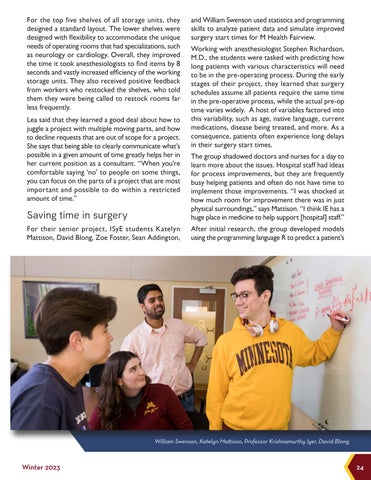
and William Swenson used statistics and programming skills to analyze patient data and simulate improved surgery start times for M Health Fairview. Working with anesthesiologist Stephen Richardson, M.D., the students were tasked with predicting how long patients with various characteristics will need to be in the pre-operating process. During the early stages of their project, they learned that surgery schedules assume all patients require the same time in the pre-operative process, while the actual pre-op time varies widely. A host of variables factored into this variability, such as age, native language, current medications, disease being treated, and more. As a consequence, patients often experience long delays in their surgery start times.
Saving time in surgery
The group shadowed doctors and nurses for a day to learn more about the issues. Hospital staff had ideas for process improvements, but they are frequently busy helping patients and often do not have time to implement those improvements. “I was shocked at how much room for improvement there was in just physical surroundings,” says Mattison. “I think IE has a huge place in medicine to help support [hospital] staff.”
For their senior project, ISyE students Katelyn Mattison, David Blong, Zoe Foster, Sean Addington,
After initial research, the group developed models using the programming language R to predict a patient’s
Three groups of ISyE students tackle tough problems and learn real-life skills for their senior projects.
Organizing the OR ISyE seniors Lauren Lea, Sarah Persons, Megan Trullinger, Amanda Finnegan, and Samuel Elliot worked with a lead anesthesiologist at M Health Fairview to organize and standardize supply cabinets of a set of 25 operating rooms for their process improvement senior project. The students, overseen by professor Nick Arnosti and anesthesiologist Dr. Stephen Richardson, M.D., were tasked with improving storage unit organization for a set of 25 operating rooms. They conducted usability tests and time trials in a mock operating room to identify the problems with how anesthesiologists interacted with the existing storage. Prior to the project, the units were not well organized, 23
had too much of rarely used items and not enough of highly utilized items, and this caused wasted time in equipment retrieval and restocking. Many of the items are critical, life-saving materials. In addition to conducting usability tests, the students were “scrubbed up” and allowed to attend a surgery to observe how anesthesiologists actually use the storage units in real time. They were excited and nervous to witness the surgery, but found it was easier than expected. “I wasn’t sure if I was gonna be able to handle it,” says Lauren Lea. “But it was good! I didn’t have any issues.” After gathering data, the group used skills learned in their Human Factors class to design an optimized storage process for the anesthesiologists. Items that were used most frequently, they placed at eye level. Department of Industrial and Systems Engineering
William Swenson, Katelyn Mattison, Professor Krishnamurthy Iyer, David Blong
Winter 2023
24
Undergraduate Highlights
For the top five shelves of all storage units, they designed a standard layout. The lower shelves were designed with flexibility to accommodate the unique needs of operating rooms that had specializations, such as neurology or cardiology. Overall, they improved the time it took anesthesiologists to find items by 8 seconds and vastly increased efficiency of the working storage units. They also received positive feedback from workers who restocked the shelves, who told them they were being called to restock rooms far less frequently. Lea said that they learned a good deal about how to juggle a project with multiple moving parts, and how to decline requests that are out of scope for a project. She says that being able to clearly communicate what’s possible in a given amount of time greatly helps her in her current position as a consultant. “When you’re comfortable saying ‘no’ to people on some things, you can focus on the parts of a project that are most important and possible to do within a restricted amount of time.”
Tjorvi Perry, M.D., with Professor Nick Arnosti, Samuel Elliott, Sarah Persons
Senior Projects
and William Swenson used statistics and programming skills to analyze patient data and simulate improved surgery start times for M Health Fairview. Working with anesthesiologist Stephen Richardson, M.D., the students were tasked with predicting how long patients with various characteristics will need to be in the pre-operating process. During the early stages of their project, they learned that surgery schedules assume all patients require the same time in the pre-operative process, while the actual pre-op time varies widely. A host of variables factored into this variability, such as age, native language, current medications, disease being treated, and more. As a consequence, patients often experience long delays in their surgery start times.
Saving time in surgery
The group shadowed doctors and nurses for a day to learn more about the issues. Hospital staff had ideas for process improvements, but they are frequently busy helping patients and often do not have time to implement those improvements. “I was shocked at how much room for improvement there was in just physical surroundings,” says Mattison. “I think IE has a huge place in medicine to help support [hospital] staff.”
For their senior project, ISyE students Katelyn Mattison, David Blong, Zoe Foster, Sean Addington,
After initial research, the group developed models using the programming language R to predict a patient’s
Three groups of ISyE students tackle tough problems and learn real-life skills for their senior projects.
Organizing the OR ISyE seniors Lauren Lea, Sarah Persons, Megan Trullinger, Amanda Finnegan, and Samuel Elliot worked with a lead anesthesiologist at M Health Fairview to organize and standardize supply cabinets of a set of 25 operating rooms for their process improvement senior project. The students, overseen by professor Nick Arnosti and anesthesiologist Dr. Stephen Richardson, M.D., were tasked with improving storage unit organization for a set of 25 operating rooms. They conducted usability tests and time trials in a mock operating room to identify the problems with how anesthesiologists interacted with the existing storage. Prior to the project, the units were not well organized, 23
had too much of rarely used items and not enough of highly utilized items, and this caused wasted time in equipment retrieval and restocking. Many of the items are critical, life-saving materials. In addition to conducting usability tests, the students were “scrubbed up” and allowed to attend a surgery to observe how anesthesiologists actually use the storage units in real time. They were excited and nervous to witness the surgery, but found it was easier than expected. “I wasn’t sure if I was gonna be able to handle it,” says Lauren Lea. “But it was good! I didn’t have any issues.” After gathering data, the group used skills learned in their Human Factors class to design an optimized storage process for the anesthesiologists. Items that were used most frequently, they placed at eye level. Department of Industrial and Systems Engineering
William Swenson, Katelyn Mattison, Professor Krishnamurthy Iyer, David Blong
Winter 2023
24
Clearing the Air ISyE alum Nina Domingo is helping the world see through the haze of pollution from food production.
Clay Hall, Ethan Rosenthal, Governess Simpson, Amanda Hadden, Jacinta Rivera
pre-op duration based on the patient’s characteristics. To test their model, they first used simulated data while they worked through the complex process of acquiring de-identified patient data. Having experienced the dynamic of a complex technical problem in addition to coordinating teammates, working with timelines and keeping stakeholders updated, Mattison, who is now pursuing a graduate degree in Analytics in ISyE, said that this senior project was the most helpful in preparing her to work in any industry. “It’s really neat to see IE move from mostly manufacturing to truly making a difference in the world,” she said.
Improving the process For their senior design project, Ethan Rosenthal, Jacinta Rivera, Governess Simpson, Amanda Hadden, and Clay Hall were tasked with improving an upgrade process for ArcherPoint, a Microsoft ERP (Enterprise Resource Planning) system provider based in Chanhassen, Minnesota. While the outcome of their project differed from the original assignment, they learned how to be liaisons for company employees and provided a solid foundation for ArcherPoint to move forward on process improvements.
upgrading customer ERP systems, which ranged from 2 to 12 months per client. ERP systems are complex software applications that manage company assets, HR data, product information, and more. The students worked together under Professor Darin England to identify and implement improvements to ArcherPoint’s existing upgrade process. The team utilized a Lean Six Sigma approach to identify what data should be collected to do a deep analysis. They asked employees what was difficult about their job, what would make things move along faster. “What are the issues they’re bringing up, and do they match with the issues we thought existed?” recalls Rosenthal. After creating a process map, they identified some bottlenecks in the upgrade process that could be improved with employee training. The senior group brought a fresh perspective and found that employees brought up issues with them that were difficult to share with company leaders. Not only did the group use skills from their classes like root-cause analysis and process improvement; they also learned how to improve communication within an organization.
Growing up in the Philippines, Nina Domingo was acutely aware of the effects of climate change in her everyday life. Af ter coming to the United States and eventually starting her academic career at the University of Minnesota, she saw an opportunity to change things for the better at the intersection of data analysis, environmental science, and social justice. Desiring a systems approach to solving these problems, she enrolled in the ISyE undergraduate program. Her “a-ha” moment came after taking a global grand challenge course that asked the question “Can we feed the world without
Upon completing her undergraduate degree in ISyE, Domingo joined the PhD program in the U of M’s Department of Bioproducts and Biosystems Engineering. There, she used many of the skills she gained as an ISyE undergraduate to study how food production affects the environment and human health with a particular focus on air-quality related health impacts of food production in the U.S. Af ter completing her Ph. D, Domingo moved on to a postdoc-
hope my study will be used by food producers “ I and lawmakers to identify specific interventions
that can be adopted within the supply chain, or by consumers to influence product choices.”
toral research position with Yale University where her research addressed interactions between climate change and air pollution, and specifically focused on how different climate conditions affect ground-level ozone. In addition to her research, she has put her ISyE expertise to use by helping companies to identify hotspots in their supply chains and to reduce their environmental impact. Even though she’s currently out of state, Domingo has still volunteered as a remote board member for TC Food Justice, an organization that collects unsold produce from grocery stores and delivers it to hunger relief organizations. She recently took a position at Amazon as a Research Scientist in Sustainability Science and Innovation. Through her work at ISyE, Yale, and beyond, Domingo is on track to help reduce the impacts of food production on public health and the environment.
—Nina Domingo
ArcherPoint wanted to reduce the time it spent 25
destroying it?” It sparked her interest in learning how to increase the efficiency of systems and processes to reduce environmental impact.
Department of Industrial and Systems Engineering
Winter 2023
26
Clearing the Air ISyE alum Nina Domingo is helping the world see through the haze of pollution from food production.
Clay Hall, Ethan Rosenthal, Governess Simpson, Amanda Hadden, Jacinta Rivera
pre-op duration based on the patient’s characteristics. To test their model, they first used simulated data while they worked through the complex process of acquiring de-identified patient data. Having experienced the dynamic of a complex technical problem in addition to coordinating teammates, working with timelines and keeping stakeholders updated, Mattison, who is now pursuing a graduate degree in Analytics in ISyE, said that this senior project was the most helpful in preparing her to work in any industry. “It’s really neat to see IE move from mostly manufacturing to truly making a difference in the world,” she said.
Improving the process For their senior design project, Ethan Rosenthal, Jacinta Rivera, Governess Simpson, Amanda Hadden, and Clay Hall were tasked with improving an upgrade process for ArcherPoint, a Microsoft ERP (Enterprise Resource Planning) system provider based in Chanhassen, Minnesota. While the outcome of their project differed from the original assignment, they learned how to be liaisons for company employees and provided a solid foundation for ArcherPoint to move forward on process improvements.
upgrading customer ERP systems, which ranged from 2 to 12 months per client. ERP systems are complex software applications that manage company assets, HR data, product information, and more. The students worked together under Professor Darin England to identify and implement improvements to ArcherPoint’s existing upgrade process. The team utilized a Lean Six Sigma approach to identify what data should be collected to do a deep analysis. They asked employees what was difficult about their job, what would make things move along faster. “What are the issues they’re bringing up, and do they match with the issues we thought existed?” recalls Rosenthal. After creating a process map, they identified some bottlenecks in the upgrade process that could be improved with employee training. The senior group brought a fresh perspective and found that employees brought up issues with them that were difficult to share with company leaders. Not only did the group use skills from their classes like root-cause analysis and process improvement; they also learned how to improve communication within an organization.
Growing up in the Philippines, Nina Domingo was acutely aware of the effects of climate change in her everyday life. Af ter coming to the United States and eventually starting her academic career at the University of Minnesota, she saw an opportunity to change things for the better at the intersection of data analysis, environmental science, and social justice. Desiring a systems approach to solving these problems, she enrolled in the ISyE undergraduate program. Her “a-ha” moment came after taking a global grand challenge course that asked the question “Can we feed the world without
Upon completing her undergraduate degree in ISyE, Domingo joined the PhD program in the U of M’s Department of Bioproducts and Biosystems Engineering. There, she used many of the skills she gained as an ISyE undergraduate to study how food production affects the environment and human health with a particular focus on air-quality related health impacts of food production in the U.S. Af ter completing her Ph. D, Domingo moved on to a postdoc-
hope my study will be used by food producers “ I and lawmakers to identify specific interventions
that can be adopted within the supply chain, or by consumers to influence product choices.”
toral research position with Yale University where her research addressed interactions between climate change and air pollution, and specifically focused on how different climate conditions affect ground-level ozone. In addition to her research, she has put her ISyE expertise to use by helping companies to identify hotspots in their supply chains and to reduce their environmental impact. Even though she’s currently out of state, Domingo has still volunteered as a remote board member for TC Food Justice, an organization that collects unsold produce from grocery stores and delivers it to hunger relief organizations. She recently took a position at Amazon as a Research Scientist in Sustainability Science and Innovation. Through her work at ISyE, Yale, and beyond, Domingo is on track to help reduce the impacts of food production on public health and the environment.
—Nina Domingo
ArcherPoint wanted to reduce the time it spent 25
destroying it?” It sparked her interest in learning how to increase the efficiency of systems and processes to reduce environmental impact.
Department of Industrial and Systems Engineering
Winter 2023
26
Graduate and Ph.D. Highlights
Twice the Power Twins Niloufar and Nasim Mirzavand Boroujeni are preparing to complete their Ph.D.s in ISyE and take on the world.
Niloufar Mirzavand Boroujeni (left) and Nasim Mirzavand Borjoujeni (right)
For some families, engineers come in pairs. Growing up together in Iran, twin sisters Nasim and Niloufar Mirzavand Boroujeni had two cousins who were industrial engineers. Their cousins saw their potential and encouraged them to take the competitive university entrance exam. Both passed with flying colors, getting into the Sharif University of Technology, one of the best engineering schools in Iran. After completing their master’s degrees, they sought Ph.D.s at the ISyE department here at the University of Minnesota. While they stay in close physical proximity, they are working in different research areas. Both are passionate about their respective fields. Niloufar enjoys industrial engineering because of the potential to optimize almost anything. “You can apply knowledge and the skill set that you learn from this major to almost every application and make people’s lives better.” 27
For her Ph.D. research, Nasim has focused on optimization problems in the field of health care and cancer treatment. Specifically, she is working with Professor J.P. Richard on the optimization of brachytherapy radiation treatments, partnering with two people from the U of M’s Department of Radiation Oncology. Part of her work involves optimizing the placement of special needles that deliver doses of radiation to precise locations on curved surfaces, such as a human face.
“
You can apply knowledge and the skill set that you learn from this major to almost every application and make people’s lives better. —Niloufar Mirzavand Boroujeni
Department of Industrial and Systems Engineering
When Niloufar began the Ph.D. program, she tried a few different topics to find the best fit, eventually finding a good match with ISyE professors William Cooper and Krishnamurthy Iyer and their research on revenue/pricing management, information persuasion, and mechanism design.
optimizing the scheduling of crop growth over a period of years. Niloufar worked on incorporating scientific data with operations research to help Bayer make informed decisions in agriculture. Both sisters say the methods they learned from their Ph.D. research have helped greatly with their internships.
Both Nasim and Niloufar have held internships at Bayer, a pharmaceutical and biotechnology company. Nasim worked on the agriculture side of the business,
While Nasim and Niloufar don’t work together directly, they live in the same apartment building, often discuss work problems, and bounce ideas around. They suggest things to each other, but also respect the other’s academic interests. “Sometimes we converge, sometimes we diverge,” says Nasim. “We do a lot of brainstorming, every day.”
Sometimes we converge, sometimes we diverge. We do a lot of brainstorming, every day.
”
The twins hope to take industry jobs after graduation and to one day start their own business together.
—Nasim Mirzavand Boroujeni
Winter 2023
28
Graduate and Ph.D. Highlights
Twice the Power Twins Niloufar and Nasim Mirzavand Boroujeni are preparing to complete their Ph.D.s in ISyE and take on the world.
Niloufar Mirzavand Boroujeni (left) and Nasim Mirzavand Borjoujeni (right)
For some families, engineers come in pairs. Growing up together in Iran, twin sisters Nasim and Niloufar Mirzavand Boroujeni had two cousins who were industrial engineers. Their cousins saw their potential and encouraged them to take the competitive university entrance exam. Both passed with flying colors, getting into the Sharif University of Technology, one of the best engineering schools in Iran. After completing their master’s degrees, they sought Ph.D.s at the ISyE department here at the University of Minnesota. While they stay in close physical proximity, they are working in different research areas. Both are passionate about their respective fields. Niloufar enjoys industrial engineering because of the potential to optimize almost anything. “You can apply knowledge and the skill set that you learn from this major to almost every application and make people’s lives better.” 27
For her Ph.D. research, Nasim has focused on optimization problems in the field of health care and cancer treatment. Specifically, she is working with Professor J.P. Richard on the optimization of brachytherapy radiation treatments, partnering with two people from the U of M’s Department of Radiation Oncology. Part of her work involves optimizing the placement of special needles that deliver doses of radiation to precise locations on curved surfaces, such as a human face.
“
You can apply knowledge and the skill set that you learn from this major to almost every application and make people’s lives better. —Niloufar Mirzavand Boroujeni
Department of Industrial and Systems Engineering
When Niloufar began the Ph.D. program, she tried a few different topics to find the best fit, eventually finding a good match with ISyE professors William Cooper and Krishnamurthy Iyer and their research on revenue/pricing management, information persuasion, and mechanism design.
optimizing the scheduling of crop growth over a period of years. Niloufar worked on incorporating scientific data with operations research to help Bayer make informed decisions in agriculture. Both sisters say the methods they learned from their Ph.D. research have helped greatly with their internships.
Both Nasim and Niloufar have held internships at Bayer, a pharmaceutical and biotechnology company. Nasim worked on the agriculture side of the business,
While Nasim and Niloufar don’t work together directly, they live in the same apartment building, often discuss work problems, and bounce ideas around. They suggest things to each other, but also respect the other’s academic interests. “Sometimes we converge, sometimes we diverge,” says Nasim. “We do a lot of brainstorming, every day.”
Sometimes we converge, sometimes we diverge. We do a lot of brainstorming, every day.
”
The twins hope to take industry jobs after graduation and to one day start their own business together.
—Nasim Mirzavand Boroujeni
Winter 2023
28
Bringing ISyE to the Majors ISyE graduate Kyle Young is using analytics to help the Tampa Bay Rays win baseball games.
Growing up in the San Francisco Bay area in California, Kyle Young played sports such as baseball and hockey throughout his childhood and high school years. He also excelled in science and mathematics. When Young enrolled as an undergraduate at the University of Minnesota, he initially intended to pursue chemical engineering. However, he never lost interest in sports, and soon realized that analytics offered the potential for a career in professional athletics. Indeed, many teams in major professional sports had begun to invest heavily in sports analytics; i.e., the use of statistics, data analysis, quantitative model-
ing, computing, and operations research to help make decisions in sports. Major League Baseball teams have used analytics in countless ways. Examples include deciding when bunting is a good strategy or when to change pitchers, deciding which players to sign and which to trade (as made famous in the book and movie Moneyball), and helping players to perform better by improving their pitching, hitting, or fielding mechanics. The possibility of a career in sports analytics motivated Young to change his undergraduate major to ISyE with a minor in Computer Science, and then to enroll in ISyE’s Analytics
master’s program. This allowed him to pursue coursework that helped prepare him for such a career. While in the ISyE Analytics master’s program, Young secured an internship with the Tampa Bay Rays, a Major League Baseball team in Tampa, Florida well known for its sophisticated and successful use of sports analytics. Not long after graduating, Young took a full-time position with the Rays as a Junior Analyst in Baseball Research and Development. In his work with the Rays, he has used techniques from ISyE courses including stochastic models, statistics, and human factors as well as general methodologies learned from courses in physics and calculus.
“
Young’s years studying analytics in Minnesota helped pave his way I’ve applied a lot of engineering, calculus, physics, from one “Bay Area” in Caliand statistics concepts, such as building stochastic fornia to another in Florida, models via Markov chains, to analyze player data trends. where he now is pursuing It’s really fun, challenging, and impactful.” an exciting career path that combines his interests in both —Kyle Young sports and engineering.
29
Department of Industrial and Systems Engineering
Graduating to Google ISyE Ph.D. graduate Jongeun Kim is helping Google improve the internet as a software engineer.
There’s an old saying: “If it ain’t broke, don’t fix it.” Engineers like Jongeun Kim see past that. When it comes to complex systems engineering, there is always room for improvement. Jongeun Kim began his academic career in South Korea, getting his undergraduate degree in industrial engineering. After coming to the U.S., he started a Ph.D. degree at the University of Florida, where he met Dr. Jean-Philippe Richard. In the middle of Jongeun’s Ph.D. studies, Richard took a position in the ISyE department. As Kim wanted to continue working with his advisor, he decided to continue his studies at the U of M in 2018. Moving to a new city was not easy, and most of his time at the U of M was spent working on his Ph.D. remotely during the Covid-19 pandemic. But Kim still made new friends in his Ph.D. lab, and he successfully completed two papers in collaboration with Richard during that time. The majority of his work involved improving solution methods for problems that are notoriously difficult to solve. There are many machine learning algorithms in the literature that make predictions and forecasts using large amounts of data. His work studies
Winter 2023
how these descriptive models can be incorporated inside of prescriptive optimization models. These models can help decision-making when the consequences can only be estimated through machine-learning based predictions. While working on his Ph.D. in 2021, Kim applied for an internship at Google. During his last year in the ISyE department, he recieved a call from a Google recruiter, encouraging him to apply for a full-time software engineer position with Google’s cloud network infrastructure team. They must have been impressed. He was offered a position in December 2021, starting summer 2022. He said it was great to receive an offer that early, because he could focus on completing his Ph.D. without worrying about uncertainties of navigating the job market. His team primarily works with the optimization of Google’s cloud computing network. Google has large storage centers and network infrastructure around the world where data is moving constantly. These systems were built with reliability as the primary goal. Now that
the infrastructure is in place, Google is hiring graduates like Kim to make them more efficient. Instead of building more data centers, Kim’s team is tasked with writing software that will increase efficiency across existing centers, saving money, land, and energy. After settling in for the first few months, he is enjoying the work and the San Jose weather. Kim loves learning new things, and since most of his colleagues have Computer Science backgrounds, he is able to absorb new skills while applying his ISyE expertise. When he is not helping Google optimizing the internet, he is enjoying spending time with his family and reconnecting with the many old friends from Florida and Minnesota who also have moved to San Jose.
Google interviews are “ very fun. They provide
a problem and we solve it together. It was different from other companies but I really enjoyed it.” —Jongeun Kim
30
Bringing ISyE to the Majors ISyE graduate Kyle Young is using analytics to help the Tampa Bay Rays win baseball games.
Growing up in the San Francisco Bay area in California, Kyle Young played sports such as baseball and hockey throughout his childhood and high school years. He also excelled in science and mathematics. When Young enrolled as an undergraduate at the University of Minnesota, he initially intended to pursue chemical engineering. However, he never lost interest in sports, and soon realized that analytics offered the potential for a career in professional athletics. Indeed, many teams in major professional sports had begun to invest heavily in sports analytics; i.e., the use of statistics, data analysis, quantitative model-
ing, computing, and operations research to help make decisions in sports. Major League Baseball teams have used analytics in countless ways. Examples include deciding when bunting is a good strategy or when to change pitchers, deciding which players to sign and which to trade (as made famous in the book and movie Moneyball), and helping players to perform better by improving their pitching, hitting, or fielding mechanics. The possibility of a career in sports analytics motivated Young to change his undergraduate major to ISyE with a minor in Computer Science, and then to enroll in ISyE’s Analytics
master’s program. This allowed him to pursue coursework that helped prepare him for such a career. While in the ISyE Analytics master’s program, Young secured an internship with the Tampa Bay Rays, a Major League Baseball team in Tampa, Florida well known for its sophisticated and successful use of sports analytics. Not long after graduating, Young took a full-time position with the Rays as a Junior Analyst in Baseball Research and Development. In his work with the Rays, he has used techniques from ISyE courses including stochastic models, statistics, and human factors as well as general methodologies learned from courses in physics and calculus.
“
Young’s years studying analytics in Minnesota helped pave his way I’ve applied a lot of engineering, calculus, physics, from one “Bay Area” in Caliand statistics concepts, such as building stochastic fornia to another in Florida, models via Markov chains, to analyze player data trends. where he now is pursuing It’s really fun, challenging, and impactful.” an exciting career path that combines his interests in both —Kyle Young sports and engineering.
29
Department of Industrial and Systems Engineering
Graduating to Google ISyE Ph.D. graduate Jongeun Kim is helping Google improve the internet as a software engineer.
There’s an old saying: “If it ain’t broke, don’t fix it.” Engineers like Jongeun Kim see past that. When it comes to complex systems engineering, there is always room for improvement. Jongeun Kim began his academic career in South Korea, getting his undergraduate degree in industrial engineering. After coming to the U.S., he started a Ph.D. degree at the University of Florida, where he met Dr. Jean-Philippe Richard. In the middle of Jongeun’s Ph.D. studies, Richard took a position in the ISyE department. As Kim wanted to continue working with his advisor, he decided to continue his studies at the U of M in 2018. Moving to a new city was not easy, and most of his time at the U of M was spent working on his Ph.D. remotely during the Covid-19 pandemic. But Kim still made new friends in his Ph.D. lab, and he successfully completed two papers in collaboration with Richard during that time. The majority of his work involved improving solution methods for problems that are notoriously difficult to solve. There are many machine learning algorithms in the literature that make predictions and forecasts using large amounts of data. His work studies
Winter 2023
how these descriptive models can be incorporated inside of prescriptive optimization models. These models can help decision-making when the consequences can only be estimated through machine-learning based predictions. While working on his Ph.D. in 2021, Kim applied for an internship at Google. During his last year in the ISyE department, he recieved a call from a Google recruiter, encouraging him to apply for a full-time software engineer position with Google’s cloud network infrastructure team. They must have been impressed. He was offered a position in December 2021, starting summer 2022. He said it was great to receive an offer that early, because he could focus on completing his Ph.D. without worrying about uncertainties of navigating the job market. His team primarily works with the optimization of Google’s cloud computing network. Google has large storage centers and network infrastructure around the world where data is moving constantly. These systems were built with reliability as the primary goal. Now that
the infrastructure is in place, Google is hiring graduates like Kim to make them more efficient. Instead of building more data centers, Kim’s team is tasked with writing software that will increase efficiency across existing centers, saving money, land, and energy. After settling in for the first few months, he is enjoying the work and the San Jose weather. Kim loves learning new things, and since most of his colleagues have Computer Science backgrounds, he is able to absorb new skills while applying his ISyE expertise. When he is not helping Google optimizing the internet, he is enjoying spending time with his family and reconnecting with the many old friends from Florida and Minnesota who also have moved to San Jose.
Google interviews are “ very fun. They provide
a problem and we solve it together. It was different from other companies but I really enjoyed it.” —Jongeun Kim
30
Faculty Awards
Lisa Miller wins IISE Regional Faculty Advisor Award ISyE Teaching Professor and Director of Undergraduate Studies Lisa Miller won this year’s IISE Outstanding Regional Faculty Advisor Award.
Ying Cui named competition finalist and awarded grant Ying Cui was a top three finalist for the INFORMS Junior Faculty Interest Group Competition for her paper “A Decomposition Algorithm for Two-Stage Stochastic Programs with Nonconvex Recourse,” coauthored with Hanyang Li. She has also been awarded a National Science Foundation grant for her project “Decomposition algorithms for nonconvex nonsmooth constrained stochastic programs.”
Shuzhong Zhang ranks as top 1,000 Scientist in mathematics Shuzhong Zhang has been named a Top 1,000 Scientist in the field of mathematics, according to the 2022 rankings assembled by Research.com. Zhang ranked #649 in the world ranking and #329 in the United States.
Zhaosong Lu awarded NSF grant Zhaosong Lu has been awarded a National Science Foundation grant for his project “New Machine Learning Empowered Nanoinformatics System for Advancing Nanomaterial Design.” This project will advance the relationship between engineering innovation and computational analysis, and holds great promise for nanomaterial and nanomedicine developments.
Yiling Zhang and William Cooper awarded grant Yiling Zhang and William Cooper have won a Center for Transportation Studies Seed Grant Award for their study “Increasing Food Access: Integrated Vehicle Routing and Assortment Planning for Mobile Markets.”
Saif Benjaafar wins 2022 Best Management Science Paper Award Saif Benjaafar has won the 2022 Manufacturing and Service Operations Management Society Award for Management Science Journal Best Paper in Operations Management for his paper “Peer-to-Peer Product Sharing: Implications for Ownership, Usage, and Social Welfare in the Sharing Economy,” coauthored with Guangwen Kong, Xiang Li, and Costas Courcoubetis.
Faculty Awards
Lisa Miller wins IISE Regional Faculty Advisor Award ISyE Teaching Professor and Director of Undergraduate Studies Lisa Miller won this year’s IISE Outstanding Regional Faculty Advisor Award.
Ying Cui named competition finalist and awarded grant Ying Cui was a top three finalist for the INFORMS Junior Faculty Interest Group Competition for her paper “A Decomposition Algorithm for Two-Stage Stochastic Programs with Nonconvex Recourse,” coauthored with Hanyang Li. She has also been awarded a National Science Foundation grant for her project “Decomposition algorithms for nonconvex nonsmooth constrained stochastic programs.”
Shuzhong Zhang ranks as top 1,000 Scientist in mathematics Shuzhong Zhang has been named a Top 1,000 Scientist in the field of mathematics, according to the 2022 rankings assembled by Research.com. Zhang ranked #649 in the world ranking and #329 in the United States.
Zhaosong Lu awarded NSF grant Zhaosong Lu has been awarded a National Science Foundation grant for his project “New Machine Learning Empowered Nanoinformatics System for Advancing Nanomaterial Design.” This project will advance the relationship between engineering innovation and computational analysis, and holds great promise for nanomaterial and nanomedicine developments.
Yiling Zhang and William Cooper awarded grant Yiling Zhang and William Cooper have won a Center for Transportation Studies Seed Grant Award for their study “Increasing Food Access: Integrated Vehicle Routing and Assortment Planning for Mobile Markets.”
Saif Benjaafar wins 2022 Best Management Science Paper Award Saif Benjaafar has won the 2022 Manufacturing and Service Operations Management Society Award for Management Science Journal Best Paper in Operations Management for his paper “Peer-to-Peer Product Sharing: Implications for Ownership, Usage, and Social Welfare in the Sharing Economy,” coauthored with Guangwen Kong, Xiang Li, and Costas Courcoubetis.
Recent Faculty Publications Nick Arnosti, S. Matthew Weinberg, “Bitcoin: A Natural Oligopoly,” Management Science, 2022. Nick Arnosti, “Lottery Design for School Choice,” Management Science, 2022. Saif Benjaafar, Xiang Li, Xiaobo Li, “Inventory Repositioning in On-Demand Rental Networks,” Management Science, 2022. Saif Benjaafar, David Chen, Rowan Wang, ZhenZhen Yan, “Appointment Scheduling under a Service Level Constraint,” Manufacturing and Service Operations Management, 2022.
Peiran Yu, Ting Kei Pong, Zhaosong Lu, “Convergence rate analysis of a sequential convex programming method with line search for a class of constrained difference-of-convex optimization problems,” SIAM Journal on Optimization, 2021. Zhaosong Lu, Zhe Sun, Zirui Zhou, “Penalty and augmented Lagrangian methods for constrained DC programming,” Mathematics of Operations Research, 2022. Jaili Huang, Ankur Mani, Zizhuo Wang, “The Value of Price Discrimination in Large Social Networks,” Management Science, 2022.
Recent Seminars Fall 2021 September 15 Florin Ciocan INSEAD “Price Delegation with Learning Agents”
“Practicing Analytics in a Target Rich Environment”
December 8
September 29
Karen Smilowitz Northwestern University
Zhengling Qi, Ying Cui, Yufeng Liu, Jong-Shi Pang, “Asymptotic properties of stationary solutions of coupled nonconvex nonsmooth empirical risk minimization,” Mathematics of Operations Research, 2021.
Soo Jin Kang, Cecilia Xi Wang, Tjorvi Perry, Stephen Richardson, Lisa Miller, “Visualizing Tacit Knowledge in Cardiac Operating Room: A Need-Finding Study,” International Conference on Human-Computer Interaction, 2022.
Dawn Woodard Uber
Jinhak Kim, Mohit Tawarmalani, Jean-Philippe P. Richard, “Convexification of Permutation-Invariant Sets and an Application to Sparse Principal Component Analysis,” Mathematics of Operations Research, 2021.
October 6
Arnab Dey, Andrew Heger, Darin England, “Urban fire station location planning using predicted demand and service quality index,” International Journal of Data Science and Analytics, 2022. Jerry Anunrojwong, Krishnamurthy Iyer, Vahideh Manshadi, “Information Design for Congested Social Services: Optimal Need-Based Persuasion,” Management Science, 2022. Pranav Hanagal, Kevin Leder, Zicheng Wang, “Large deviations of cancer recurrence timing,” Stochastic Processes and their Applications, 2022. Jasmine Foo, Einar Bjarki Gunnarsson, Kevin Leder, Kathleen Storey, “Spread of premalignant mutant clones and cancer initiation in multilayered tissue,” Annals of Applied Probability, 2022.
Xiaoyi Gu, Santanu Dey, Jean-Philippe P. Richard, “Lifting Convex Inequalities for Bipartite Bilinear Programs,” Mathematical Programming, 2022. Kevin Huang, Shuzhong Zhang, “New First-Order Algorithms for Stochastic Variational Inequalities,” SIAM Journal on Optimization, 2022. Junyu Zhang, Mingyi Hong, Shuzhong Zhang, “On Lower Iteration Complexity Bounds for the Saddle Point Problems,” Mathematical Programming, 2022. Yiling Zhang, Jin Dong, “Building Load Control using Distributionally Robust Chance-Constrained Programs with Right-Hand Side Uncertainty and the Risk-Adjustable Variants,” Informs Journal on Computing, 2022. Martin Zubeldia, Michel Mandjes, “Learning traffic correlations in multi-class queueing systems by sampling queue lengths, with routing applications,” Performance Evaluation, 2021.
Rahul Mazumder Massachusetts Institute of Technology
Erick Wikum Wikalytics, LLC
September 22
Moulik Choraria, Ibtihal Ferwana, Ankur Mani, Lav R. Varshney, “Balancing Fairness and Robustness via Partial Invariance,” NeurIPS, 2021.
Jazeem Abdul Jaleel, Sherwin Doroudi, Kristen Gardner, Alexander Wickeham, “A general ‘powerof-d’ dispatching framework for heterogeneous systems,” Queueing Systems, 2022.
November 10
“Sparse Learning at Scale: Convex, Mixed Integer Programming, and Statistical Perspectives”
Ying Cui, Ling Liang, Defeng Sun, Kim-Chuan Toh, “On Degenerate Doubly Nonnegative Projection Problems,” Mathematics of Operations Research, 2021.
Kang Kang, Sherwin Doroudi, Mohammad Delasay, Alexander Wickeham, “A queueing-theoretic framework for evaluating transmission risks in service facilities during a pandemic,” Production and Operations Management, 2022.
with One Layer ReLU Networks and Tight Generalization Bounds for Learning Lipschitz Functions”
“Map Technologies for RideSharing”
Yuan Wang Wells Fargo “Quantitative Modeling for Risk Management in Banking: An Overview and Applications”
October 13 Deon Burchett MITRE Corporation “Telehealth Facility Location Optimization Model”
October 20 Dan Atkins MinneAnalytics “So What? (and Sideways)”
November 3 Boris Hanin Princeton ORFE “Ridgeless Interpolation in 1D
“Integrating Dual Scheduling Modes in Workforce Management”
March 2 Shiquan Ma University of California, Davis “Riemannian Optimization for Projection Robust Optimal Transport”
March 23 Nicolas Stier-Moses Meta “Bernoulli Congestion Games”
March 30 Ali Jadbabaie Massachusetts Institute of Technology “Persuasion, News Sharing, and Cascades on Social Networks”
April 6
Spring 2022
Phebe Vayanos University of Southern California
February 9
“Interpretability, Robustness, and Fairness in Predictive and Prescriptive Analytics for Social Impact”
Alice Smith Auburn University “Innovative Uses of Drones for Last Mile Delivery with a Focus on Healthcare”
April 20
February 16
“Adaptivity and Confounding in Multi-armed Bandit Experiments”
Yunan Liu North Carolina State University “An Online Learning Approach to Dynamic Pricing and Capacity Sizing in Service Systems”
February 23 Robert Shumsky Tuck School of Business at Dartmouth “Optimal Delay Messages”
Daniel Russo Columbia Business School
April 27 Michael C. Ferris University of Wisconsin, Madison “Resilience, Robustness and Performance”
Recent Faculty Publications Nick Arnosti, S. Matthew Weinberg, “Bitcoin: A Natural Oligopoly,” Management Science, 2022. Nick Arnosti, “Lottery Design for School Choice,” Management Science, 2022. Saif Benjaafar, Xiang Li, Xiaobo Li, “Inventory Repositioning in On-Demand Rental Networks,” Management Science, 2022. Saif Benjaafar, David Chen, Rowan Wang, ZhenZhen Yan, “Appointment Scheduling under a Service Level Constraint,” Manufacturing and Service Operations Management, 2022.
Peiran Yu, Ting Kei Pong, Zhaosong Lu, “Convergence rate analysis of a sequential convex programming method with line search for a class of constrained difference-of-convex optimization problems,” SIAM Journal on Optimization, 2021. Zhaosong Lu, Zhe Sun, Zirui Zhou, “Penalty and augmented Lagrangian methods for constrained DC programming,” Mathematics of Operations Research, 2022. Jaili Huang, Ankur Mani, Zizhuo Wang, “The Value of Price Discrimination in Large Social Networks,” Management Science, 2022.
Recent Seminars Fall 2021 September 15 Florin Ciocan INSEAD “Price Delegation with Learning Agents”
“Practicing Analytics in a Target Rich Environment”
December 8
September 29
Karen Smilowitz Northwestern University
Zhengling Qi, Ying Cui, Yufeng Liu, Jong-Shi Pang, “Asymptotic properties of stationary solutions of coupled nonconvex nonsmooth empirical risk minimization,” Mathematics of Operations Research, 2021.
Soo Jin Kang, Cecilia Xi Wang, Tjorvi Perry, Stephen Richardson, Lisa Miller, “Visualizing Tacit Knowledge in Cardiac Operating Room: A Need-Finding Study,” International Conference on Human-Computer Interaction, 2022.
Dawn Woodard Uber
Jinhak Kim, Mohit Tawarmalani, Jean-Philippe P. Richard, “Convexification of Permutation-Invariant Sets and an Application to Sparse Principal Component Analysis,” Mathematics of Operations Research, 2021.
October 6
Arnab Dey, Andrew Heger, Darin England, “Urban fire station location planning using predicted demand and service quality index,” International Journal of Data Science and Analytics, 2022. Jerry Anunrojwong, Krishnamurthy Iyer, Vahideh Manshadi, “Information Design for Congested Social Services: Optimal Need-Based Persuasion,” Management Science, 2022. Pranav Hanagal, Kevin Leder, Zicheng Wang, “Large deviations of cancer recurrence timing,” Stochastic Processes and their Applications, 2022. Jasmine Foo, Einar Bjarki Gunnarsson, Kevin Leder, Kathleen Storey, “Spread of premalignant mutant clones and cancer initiation in multilayered tissue,” Annals of Applied Probability, 2022.
Xiaoyi Gu, Santanu Dey, Jean-Philippe P. Richard, “Lifting Convex Inequalities for Bipartite Bilinear Programs,” Mathematical Programming, 2022. Kevin Huang, Shuzhong Zhang, “New First-Order Algorithms for Stochastic Variational Inequalities,” SIAM Journal on Optimization, 2022. Junyu Zhang, Mingyi Hong, Shuzhong Zhang, “On Lower Iteration Complexity Bounds for the Saddle Point Problems,” Mathematical Programming, 2022. Yiling Zhang, Jin Dong, “Building Load Control using Distributionally Robust Chance-Constrained Programs with Right-Hand Side Uncertainty and the Risk-Adjustable Variants,” Informs Journal on Computing, 2022. Martin Zubeldia, Michel Mandjes, “Learning traffic correlations in multi-class queueing systems by sampling queue lengths, with routing applications,” Performance Evaluation, 2021.
Rahul Mazumder Massachusetts Institute of Technology
Erick Wikum Wikalytics, LLC
September 22
Moulik Choraria, Ibtihal Ferwana, Ankur Mani, Lav R. Varshney, “Balancing Fairness and Robustness via Partial Invariance,” NeurIPS, 2021.
Jazeem Abdul Jaleel, Sherwin Doroudi, Kristen Gardner, Alexander Wickeham, “A general ‘powerof-d’ dispatching framework for heterogeneous systems,” Queueing Systems, 2022.
November 10
“Sparse Learning at Scale: Convex, Mixed Integer Programming, and Statistical Perspectives”
Ying Cui, Ling Liang, Defeng Sun, Kim-Chuan Toh, “On Degenerate Doubly Nonnegative Projection Problems,” Mathematics of Operations Research, 2021.
Kang Kang, Sherwin Doroudi, Mohammad Delasay, Alexander Wickeham, “A queueing-theoretic framework for evaluating transmission risks in service facilities during a pandemic,” Production and Operations Management, 2022.
with One Layer ReLU Networks and Tight Generalization Bounds for Learning Lipschitz Functions”
“Map Technologies for RideSharing”
Yuan Wang Wells Fargo “Quantitative Modeling for Risk Management in Banking: An Overview and Applications”
October 13 Deon Burchett MITRE Corporation “Telehealth Facility Location Optimization Model”
October 20 Dan Atkins MinneAnalytics “So What? (and Sideways)”
November 3 Boris Hanin Princeton ORFE “Ridgeless Interpolation in 1D
“Integrating Dual Scheduling Modes in Workforce Management”
March 2 Shiquan Ma University of California, Davis “Riemannian Optimization for Projection Robust Optimal Transport”
March 23 Nicolas Stier-Moses Meta “Bernoulli Congestion Games”
March 30 Ali Jadbabaie Massachusetts Institute of Technology “Persuasion, News Sharing, and Cascades on Social Networks”
April 6
Spring 2022
Phebe Vayanos University of Southern California
February 9
“Interpretability, Robustness, and Fairness in Predictive and Prescriptive Analytics for Social Impact”
Alice Smith Auburn University “Innovative Uses of Drones for Last Mile Delivery with a Focus on Healthcare”
April 20
February 16
“Adaptivity and Confounding in Multi-armed Bandit Experiments”
Yunan Liu North Carolina State University “An Online Learning Approach to Dynamic Pricing and Capacity Sizing in Service Systems”
February 23 Robert Shumsky Tuck School of Business at Dartmouth “Optimal Delay Messages”
Daniel Russo Columbia Business School
April 27 Michael C. Ferris University of Wisconsin, Madison “Resilience, Robustness and Performance”
Industrial engineers make change happen. Invest in the Department of Industrial and Systems Engineering today. Your gift, combined with those of other alumni and friends, provides our students, faculty, and facilities with the resources necessary to sustain our drive for excellence. To make a gift, please visit: isye.umn.edu/giving