FISH FARMING TECHNOLOGY
TILAPIA FARMING METHODS IN MOZAMBIQUE
International Aquafeed - Volume 23 - Issue 06 - June 2020
- Black soldier fly meal: A highly digestible protein source for aquafeeds - Enhancing growth and development in olive flounder diets - Feed storage: For every requirement there is an ideal building solution See our archive and language editions on your mobile!
- Feeding systems for fish farms and RAS - Expert Topic - Predator Series: Lemon shark Proud supporter of Aquaculture without Frontiers UK CIO
June 2020
www.aquafeed.co.uk
Ecobiol® for Aquaculture
Balanced by nature Shrimp farming without the guesswork: increase stocking density and increase pathogen risk, decrease stocks and decrease profits – finding the right balance in shrimp production can be a guessing game. Evonik’s probiotic solution Ecobiol® helps restore the balance naturally by disrupting unwanted bacteria proliferation and supporting healthy intestinal microbiota. Your benefit: sustainable and profitable shrimp farming without relying on antibiotics. animal-nutrition@evonik.com www.evonik.com/animal-nutrition
WELCOME
Since the advent of COVID-19, with each issue of International Aquafeed we have had to revamp our events calendar as the rescheduled dates prove to be an overlyoptimistic. Typically, the event is pushed back to the fourth quarter of 2020 or, more often, rescheduled for some time in 2021. It’s always disappointing to receive these postponement notices, but they have become the norm in our post-COVID-19 world.
passivity of those who want to maintain the status quo through inaction, while those who seek to destroy or overturn societal norms (for good or bad) are the most proactive. The COVID -19 pandemic has forced us to deal with problems we’ve been side-stepping for years, including social inequality and pollution to environmental issues ranging from climate change, to sustainability and trade. With trade wars already raging, concerns about biosecurity/food safety and the need for full transparency and trusted trading partners is That said, I recently remotely attended the already beginning to eclipse concerns about 2020 Alltech Ideas Conference (ONE), which Vaughn Entwistle Managing Editor, International Aquafeed low prices when trust of suppliers and trading for the first time in its 36+ year history, was partners suddenly becomes the most important not held at Alltech’s Kentucky headquarters. criteria. Likewise, the vulnerability of labour Instead, it was a virtual event held online. supplies is also of concern as is the need for farmers to rely upon If you’ve never attended one of Alltech’s Ideas conferences you migrants to form the workforce. will know that they are super-slick, top-notch events where leading With so many humans under lockdown, pollution levels have specialists in their disciplines unveil the results of the latest research fallen dramatically in most of the world’s large cities, and nature in animal, aquaculture, pet and equine feed nutrition. is resurgent. My favourite example is the news media’s joyful And all of this is book-ended by plenary sessions that are a nocoverage of jellyfish swimming though the crystal-clear canals of expenses-spared multi-media extravaganza complete with famous Venice. It is at once both a hopeful and a shocking sign of how key-note speakers. Last year had Bear Grylls, while this year had quickly the natural world rebounds once humans are removed from retired NASA astronaut Cady Coleman. But despite the switch to a virtual event, the 2020 virtual Allech conference was a huge success the equation, and a damning reminder of how human activity has a largely negative environmental impact upon the world. and welcomed more than 21,500 people from 116 countries. Professor McWilliams invoked the spirit of the Yeats’ poem to show Another of this year’s keynote speakers was David McWilliams. we must undertake positive actions to address these problems and cannot Economist and Professor at Trinity College Dublin. One of the key sit by and wait for others to fix them. He predicted a massive shift in themes developed in Professor McWilliams presentation was how thinking where norms are rendered redundant. Unlike the banking crisis key events in history break the mould of what has gone before and and other recessions and depressions, we cannot spend our way out of establish a new societal “norm.” this predicament. He also predicted that the lock down philosophy may Some examples he gave were the Black Death, the Spanish Flu atrophy and die as the pain of economic destruction bites. pandemic, WW1 and WW2, and now the COVID-19 pandemic. The economic race to the bottom driven by the need for the lowest McWilliams began his presentation with a quote from a poem by cost suppliers will likely be overthrown by the need for traceability, the famous Irish Poet William Butler Yeats. This line is drawn from sustainability, food safety and biosecurity and the new economic what is arguably his most famous poem, The Second Coming, and driver will likely switch to trust-based supply chains that are the line goes: “the best lack all conviction, while the worst are full transparent. of passionate intensity.” McWilliams sees this as a criticism of the
ISSUE HIGHLIGHTS
PROTEIN: Black soldier fly meal - page 20
FISH FARMING TECHNOLOGY
Feed storage: For every milling requirement there is an ideal building solution - page 42
SPECIES
Aquaculture round-up
Tilapia: Tilapia farming methods in Mozambique - page 36
EXPERT TOPIC - PREDATOR SERIES Lemon shark - page 52
www.aquafeed.co.uk
FISH FARMING TECHNOLOGY The COVID-19 pandemic has forced all types of industries to speed up their digital transformation processes. Many employees who used to commute to their office have now experienced a closed office door to practice social distancing and solves their daily tasks from home instead. Work from home has skyrocked the use of online video solutions, such as Microsoft Teams, Skype and Zoom.
her iOS or Android device. This requires only one person with a drone on-site and provides a quick way to make decisions. The ROV pilot doesn’t have to analyse his findings on spot as he or she can involve decision-makers and experts in real-time by live video broadcasted over the internet. This means that even though Henri Parviainen some of the staff are unable to travel to Sales Director, Blueye Robotics the location, they can follow a broadcast of the inspection in real-time, online. This opens up for experts to comment Fish farmers are no exception to this forced and give directions to the pilot, which transformation, and as a response to that, enables quicker decision-making which in the end can save Blueye Robotics launched a live streaming solution to enable real critical time and resources. Live streaming also enables quick time inspections online. visual communication with for example government officials and Blueye Robotics is a Norwegian based technology company insurance companies in unexpected situations. producing underwater drones for the aquaculture industry. With Benefits from using underwater drones in the aquaculture underwater drones, fish farmers can utilise mobile underwater industry include the fact that the solution is both portable cameras to carry out underwater inspections more efficiently. and suitable for easy handling, which also results in easy and A Blueye ROV provides eyes below the surface. The underwater fast deployment. The unique design with powerful thrusters drone can be deployed directly into the water, and within minutes and stabilising functions ensures easy maneuvering in rough you’re able to perform your own underwater inspections. conditions and the powerful LED lights enable users to monitor This enables better decisions making, improved planning, and areas even in low light conditions. The ROV can record HD reduction of unnecessary repair costs. video and capture images for documentation quickly and “We are using the Blueye underwater drone to follow up and efficiently. Minimum training is required to use the solution and control our fish. With the underwater drone we are able to control there is minimal maintenance and downtime required. fish welfare, fouling on nets and general supervision of our Want to learn more about our underwater drones? underwater assets” explains Johannes Schrøder, Salmar. www.blueyerobotics.com The Blueye Live Stream solution enables ROV operators to henri.parviainen@blueye.no. stream live video from the Blueye drone to the internet via his or
ONLINE
The Aqua Feed Extrusion Conference, co-organised by International Aquafeed, Dr Mian Riaz of Texas A&M University and VIV is taking place on July 8-9th, 2020 as an online webinar. Specialising in all aspects of aqua feed production, the twoday webinar will feature a variety of industry experts delivering innovative presentations on how users can make the best use of their extrusion machinery and aqua feed systems.
Register today
www.aqfeed.info/e/862
Aquaculture Without Frontiers (AwF) is a Charitable Incorporated Organisation (CIO) that promotes and supports responsible and sustainable aquaculture and the alleviation of poverty by improving livelihoods in developing countries.
Registered charity No. 1165727
www.aquaculturewithoutfrontiers.org.uk
NUTRITION & HEALTH As we enter summer in the Northern hemisphere and emerge slowly from the COVID-19 global pandemic we can reflect on our period in lockdown and changing work plans. It has been very challenging for all of us, but hopefully, like me, you have found time to be constructive. I have used this time to work on my research and I share some of my outputs with you in this June editorial.
In the quest for sustainable ingredients for aquaculture feeds, we are also comprehensively evaluating coproducts from industrial sources. Our latest study assessed High Protein Distillers Dried Grains (HPDDG) derived from the bio-refinery of corn in diets for European sea bass. The study includes a commercial protease Professor Simon Davies exogenous enzyme supplement with Nutrition Editor, International Aquafeed excellent results. In further developments, it’s a privilege to be collaborating with my colleagues in Nigeria with For some time, there has been debate as to how much wild research on African catfish to develop protein-rich ingredients caught fish is used (Fish in) to generate farmed fish (Fish out) to compute a ratio! I am very pleased that the impressive Bjorn for this species. A 2020 publication of ours in the Journal of the World Aquaculture Society demonstrates the efficacy of Kok from Utrecht University in Holland, in his role as the Black soldier fly larval meal as a partial replacement of fish lead author together with our group including experts from meal at optimum inclusion levels. Clarias gariepinus is popular the Institute of Aquaculture, Stirling, Copernicus Institute, Harvard, USA, Neil Auchterlonie and with my supporting role, in Nigeria and has a good lean meat texture! This preliminary work, led by my former PhD student Dr Deji Adeoye and his has resulted in a new publication in ‘Aquaculture’ to detail the amazing team, is one of many projects being undertaken. concept of the Fish in-Fish out ratio in a more novel approach. Another project of interest to me concerns improving fish Bjorn has greatly refined the computation, based on appraisal health with emphasis on salmonids through the use of and allocation of the raw materials of marine origin and nutritional modulation and a new approach to probiotics in factorised other important considerations! The paper presents feeds. Despite the use of many control strategies such as an improved model that embraces species as well as salmon commercial vaccines, the industry remains threatened by and is a more progressive advancement. Our collective skills bacterial disease incidences. A novel, disruptive technology, provide a perspective on the use of marine ingredients for biological approach controlling pathogens without the aquaculture to inform stakeholders and, importantly, the emergence of resistance is advocated using CRISPR, a consumer. bacterial immune system that comprises an enzyme that My former students from Kurdistan and colleagues in Ireland cuts DNA called programmable nuclease (Cas), delivered to (Anwar et al. 2020) have demonstrated the attributes of specific target sites on the DNA of a pathogen by a guide RNA using a commercial natural Solid State Fermentation (SSF) molecule (CRISPR spacer motif). Once the pathogen’s DNA supplement in diets for carp to enhance nutritional value of plant protein concentrates, in this case European grown lupins! is cut, the target bacterium is non-viable. Our project with an English biotechnology company will target Aeromonas In our July 2020 paper in ‘Aquaculture Reports’ we see salmonicida that, although vaccines are available, outbreaks improvements in growth rates, feed conversion efficiency are still very common in salmonids. and gut architecture with benefits to welfare and health and 2020 is proving a most busy year together with my editorial economics of production! With SSF we can greatly elevate the role for International Aquafeed and my academic job that will efficiency of plant ingredients for aquaculture feeds. mark 34 years next month. My commitments will be changing Processed Animal Proteins (PAP’s) are a vital source of soon as I will be undertaking more contractual work with sustainable ingredients for a wide number of fish species. industry and a more defined role in academia, allowing me to They have excellent attributes for carnivorous leaning fish due focus on the commercial side of aquaculture and supporting to high levels of bioavailable minerals and trace elements in new projects. It will also enable me to travel and to continue organic complex form for skeletal development. Fish display superb health and welfare on these protein sources. Blood meal my research interests on a wider basis and to meet with stakeholders in the sector. and fractions can promote enhanced immune function and I hope that I will be able to visit the World Aquaculture Society disease resistance. My recent paper addresses their potential in (WAS) meeting in Singapore in December and that 2021 will sea bream as a marine species of high commercial value. In a see restoration of meetings and return to normality! previous study, we validated and changed EU regulations for I wish you all a pleasant start to at least our Northern summer the reintroduction of PAP’s in aquafeeds and I am obliged and and much greetings to those who face the winter months. Keep appreciative of my colleague and friend Stephen Woodgate safe and healthy! who made this project feasible with his support. Note: Due to a technical glitch, Professor Davies' column in the May IAF was replaced by a repeat of the Managing Editor's column. We wish to apologise to Professor Davies and to our readers for the mix-up.
5 | June 2020 - International Aquafeed
Perendale Publishers Ltd 7 St George’s Terrace St James’ Square, Cheltenham, Glos, GL50 3PT, United Kingdom Tel: +44 1242 267700 Publisher Roger Gilbert rogerg@perendale.co.uk Managing Editor Vaughn Entwistle vaughne@perendale.co.uk
June 2020 Volume 23 Issue 06
IN THIS ISSUE
FISH FARMING TECHNOLOGY
International Editors Dr Kangsen Mai (Chinese edition) mai@perendale.com Prof Antonio Garza (Spanish edition) antoniog@perendale.com Erik Hempel (Norwegian edition) erikh@perendale.co.uk Editorial Advisory Panel • Prof Dr Abdel-Fattah M. El-Sayed • Prof António Gouveia • Prof Charles Bai • Dr Daniel Merrifield • Dr Dominique Bureau • Dr Elizabeth Sweetman • Dr Kim Jauncey • Dr Eric De Muylder • Dr Pedro Encarnação • Dr Mohammad R Hasan Editorial team Prof Simon Davies sjdaquafeed@gmail.com Rebecca Sherratt rebeccas@perendale.co.uk International Marketing Team Darren Parris darrenp@perendale.co.uk Latin America Marketing Team Iván Marquetti Tel: +54 2352 427376 ivanm@perendale.com Oceania Marketing Team Peter Parker peterp@perendale.co.uk Egyptian Marketing Team Mohamed Baromh Tel: +20 100 358 3839 mohamedb@perendale.com Asia Marketing Team Dante Feng Tel: +886 0227930286 dantef@perendale.com Nigeria Marketing Team Nathan Nwosu Tel: +234 8132 478092 nathann@perendale.com
REGULAR ITEMS 8
50 Technology showcase
52 EXPERT TOPIC - Lemon shark 54 Industry Events
Design Manager James Taylor jamest@perendale.co.uk Production Manager Martyna Nobis martynan@perendale.co.uk
58 The Market Place 60 The Aquafeed Interview 62
Circulation & Events Manager Tuti Tan tutit@perendale.co.uk
©Copyright 2019 Perendale Publishers Ltd. All rights reserved. No part of this publication may be reproduced in any form or by any means without prior permission of the copyright owner. More information can be found at www.perendale.com ISSN 1464-0058
Industry Faces
COLUMNS
Development Manager Antoine Tanguy antoinet@perendale.co.uk Communication Manager Pablo Porcel pablop@perendale.com
Industry News
5
4 Henri Parviainen
Professor Simon Davies 12 Petter Johannessen
14
Dr Thierry Chopin
FEATURES 20 Black soldier fly meal: A highly digestible protein source for aquafeeds
24 Olive flounder diets: Enhancing growth and development in olive flounder diets
28 An Extruder for maximising production of fish feed and petfood
30 Improving resistance of early stages of Rainbow Trout (Oncorhynchus mykiss) with a novel bacterial solution
34 Gregarine control with DOSTOÂŽ oregano oil in commercial shrimp earth ponds 36 Tilapia farming methods in Mozambique
FISH FARMING TECHNOLOGY
THE BIG PICTURE EXPERT TOPIC - PREDATOR SERIES - The Lemon shark The Lemon shark (Negaprion brevirostris) is a species belonging to the Carcharhinidae family which can be found in the Western Atlantic Ocean and Southeastern Atlantic. See more on page 52
42 Feed storage: For every milling requirement there is an ideal building solution 48 Feeding systems for fish farms and RAS
i i i i i i i i i
i i i i i i i i i i i i i i i i i i
i i i i i i i i i
i i i i i i i i i i
i i i i i i i i i
i i i i i i i i i
News
i i i i i i i i i i
Krill meal improves salmon health and fillet
T
quality, according to new study he Norwegian Institute of Food, Fisheries and Aquaculture (Nofima), in collaboration with Aker BioMarine, recently released a study looking into the health and fillet quality of Atlantic salmon after a period of dietary krill supplementation. The study, now published in the British Journal of Nutrition, investigates the health parameters and meat quality of Atlantic salmon fed a diet where fish meal was substituted with krill meal during the finishing feeding period. Overall results reveal that krill meal improved the welfare and fillet quality of the salmon. “Antarctic krill meal has sparked the interest of marine researchers due to its nutritional profile. Previous studies have shown the proven effects of krill, with this study we wanted to uncover the basic mechanisms behind these effects, on farmed Atlantic salmon. The overall goal is to improve the systemic understanding of dietary
krill meal effects on a biochemical, morphological and molecular level,” says Dr Turid Mørkøre of Nofima and author of the study. Researchers picked out 800 Atlantic salmon, weighing 2,270 grams each, and randomly distributed them across eight sea cages at the LetSea feed trial unit in Norway. The study experimented with supplementing krill meal (12%) in a low fish meal diet (5%) among salmon. All feeds were designed to meet the nutritional requirements of salmonid fish, with balanced EPA and DHA content. After 10-weeks, the fish were bulk weighed, and 20 fish from each sea cage were randomly selected for analysis. Overall, the study revealed positive effects on salmon health. Key findings include specific improvements in body shape, heart health, fillet quality, immune genes and hindgut. Krill meal inclusion led to more voluminous body shape and higher condition factor, reduced fat accumulation around
Liptosa register their latest feed solution in China
L
ast March LIPTOSA registered in China its product LIPTOANTIOX PLUS. The solution is a chemical antioxidant in a powdered form, free of Etoxiquin, specifically designed for use in extruded feed for both the pet and aquaculture industries. LIPTOANTIOX PLUS is a very profitable choice for feed mills, due to the low dosage of the solution that is required in order for it to prove effective. The solution achieves a lasting effect and has an impressive shelf life when compared to alternative manufactured feeds. The composition of LIPTOANTIOX PLUS is based upon butylated hydroxyanisole (BHA), butylated hydroxytoluene (BHT), Propyl gallate, citric acid, cinnamon oil CAS n 8015-91-6 and sepiolite. 8 | June 2020 - International Aquafeed
the heart and a more ordered and stable collagen architecture and better muscle integrity. Results also suggested that krill meal resulted in boosted expression of immune genes in liver, including enhanced liver coloration and increasingly responsive structural genes as well as it having led to less inflammation in the hindgut and zero mucus presence. “We knew that nourishing salmon with krill supplemented diets benefits salmon performance, overall health and fillet quality. With these new findings, we now also understand why,” says Dr Tibiabin BenitezSantana, Director R&D Fish Nutrition, Aker BioMarine. Antarctic krill meal is considered one of the few truly sustainable marine sources of protein for aquafeeds. With a nutritional profile consisting of proteins, amino acids and ash contents, it serves as a viable alternative to fish meal. Due to this, krill has garnered interest from the research community, who seek to understand how the krill’s high levels of EPA and DHA, phospholipids, vitamins, nucleotides and natural astaxanthin impact fish health and welfare when supplemented in diets.
LET’S GROW TOGETHER
Temperature Adapted FeedsTM
SUMMER EDITION The Summer Edition is equipped with an extra dose of natural antioxidants. These protect the body cells from oxidative stress, which results in immune stimulation, higher feed intake, improved weight gain and efficient feed conversion.
WWW.ALLER-AQUA.COM
i i i i i i i i i
i i i i i i i i i i i i i i i i i i
i i i i i i i i i
i i i i i i i i i i
i i i i i i i i i
i i i i i i i i i
News
i i i i i i i i i i
All systems go as BioMar Australia begins production
B
ioMar Australia have commenced aqua-feed production at their state-of-the-art 40 million euro facility in Tasmania, Australia, which is welcome news for the local aquaculture industry at a time when many businesses are facing COVID-19 operating restrictions. In a virtual media conference to comply with social distancing requirements, Minster for Primary Industries and Water Guy Barnett congratulated BioMar on achieving this milestone. BioMar Australia’s Managing Director, David Whyte, who was onsite during the virtual launch,
thanked all parties involved for helping BioMar deliver the project on schedule and budget. “While it’s not currently possible to formally celebrate our opening together with our staff, customers and community, we must acknowledge all those involved in bringing the project to life. We are now up and running in Tasmania and we’re excited to add our technical and production capacity to the region’s aquaculture industry,” stated Mr Whyte. “Trials of our products are already underway in a variety of species in Australia and New Zealand, and we are bringing BioMar’s global best practices and nutritional know-how into our region helping to support sustainable innovation in aquaculture.” Carlos Diaz, CEO of BioMar Group also attended the virtual opening event from Chile and expressed the important global role of BioMar Australia and the local aquaculture industry. “Globally aquaculture is a growing industry with growth expected to double by 2050. BioMar is committed to helping Tasmania and our wider region play an important role in this endeavor, supporting farmers to grow healthy, sustainable and safe food,” Mr Diaz said. BioMar announced plans to establish production in Australia back in 2017 and after a two-year build, the first trucks of fish-feed have started to roll out of the facility. The production facility will produce up to 110,000 tonnes per annum of aqua feed to support the Australian and Oceania aquaculture industry. Despite COVID-19, it is business as usual production-wise at the facility with the adoption of key social distancing measures to ensure the wellbeing of BioMar employees.
10 | June 2020 - International Aquafeed
BioMar delivers first products from new JV factory in China BioMar have also announced that they are delivering their first products from their new JV factory in China. The new facility has already proven to deliver high and consistent quality feed, making it possible to transfer production of highend aqua feeds for China that were previously produced in Denmark. The green field factory in Wuxi was announced as a strategic and important growth International Aquafeed - June 2020 | 11
i i i i i i i i i
i i i i i i i i i i
BioMar enters partnership in Vietnam To confirm a mutual interest in entering into a partnership, BioMar and Vietnam’s leading shrimp hatchery Viet-UC have signed a memorandum of understanding with the intention of BioMar becoming part owner and operational lead in the feed factory currently owned by Viet-UC. The two companies see a strong match in terms of values, focus and visions: Viet-UC being one of the leading shrimp hatcheries in the world with the ambition to build an integrated seafood group and BioMar Group being a leading global supplier of high quality aqua feeds based on extensive R&D and market insights. “We believe that a feed partnership with Viet-UC in Vietnam will bring important synergies to the feed business as well as the hatchery and grow-out business of VietUC. Both companies have a common focus on sustainability, food safety, traceability, quality and performance, which we believe will be strong drivers to strengthen and develop both companies as well as the aquaculture industry in Vietnam”, explains Carlos Diaz, CEO of BioMar Group. The memorandum of understanding will ensure that the two companies exclusively can focus on exploring the possibilities further, before signing a final agreement.
initiative back in 2016, to bring BioMar production knowledge from high-end species into the Chinese market. “We are very happy with this important next step to expand our activities. We have established a good business in China through a combination of local production and imported products. We are serving traditional customers as well as customers striving to bring new value propositions to retailers and end consumers. The Wuxi factory will allow new possibilities for customers with advanced product requirements through all production life stages”, explains Carlos Diaz, CEO BioMar Group.
i i i i i i i i i i
Other BioMar projects
i i i i i i i i i i i i i i i i i i
i i i i i i i i i
i i i i i i i i i
i i i i i i i i i
News
During the commissioning phase of the new Wuxi factory, BioMar has been able to achieve product nutritional values and physical quality comparable to the standards seen in high-performing, well established aqua feed factories. Key customers have started to place orders in the new factory for products previously delivered from Denmark.
i i i i i i i i i
i i i i i i i i i i i i i i i i i i
i i i i i i i i i
i i i i i i i i i i
i i i i i i i i i
i i i i i i i i i
News
i i i i i i i i i i
However, there is room for more trimmings and byproducts to be included in Marine Ingredients. It is a good thing that the 11th Petersberg Climate Dialogue held at the end of April discussed with 30 countries how to emerge from the current global health crisis with the goal of EU greenhouse gas emissions reductions of 50-55 percent by 2030 compared to 1990.
Petter Johannessen The circular economy is the way forward
T
he European Union’s Green Deal was to be a strong marker of Ursula von der Leyen’s presidency at the helm of the European Commission. The leadership that it showed was a good signal towards more environmental responsibility and internal alignment within the EU. In IFFO’s view, representing the marine ingredients industry, this deal should trigger even more innovation in the sector and contribute to increased efficiency and competitiveness. The European Commission’s observation seemed to us to be clear and lucid: EU’s industry accounts for 20 percent of the EU’s emissions. More than 90 percent of biodiversity loss and water stress come from resource extraction and processing. Only 12 percent of the materials used by EU industry come from recycling. While the EU’s roadmap says that “the European Union needs a Marshall Plan-type investment effort to fuel the recovery and modernise the economy”, EU officials want to demonstrate that climate protection will be linked with an economic perspective. Does this sound realistic or have priorities shifted amid the pandemic outbreak? From the marine ingredient industry’s perspective, we are fully convinced that the circular economy is the way forward and is not only compatible with, but also a condition to growth. The Marine Ingredients Industry has been involved for years in a circular process which finds a usage for every part of a resource. Today, the use of trimmings and by-product from seafood processing represents one third of total world fishmeal production. This figure is already quite impressive! Recycling products that otherwise would have been discarded has enabled the industry to develop and the farming sector to provide consumers all over the world with fish, poultry and pigs fed with nutritive natural marine ingredients.
The EU’s food supply system is being challenged amid the COVID-19 outbreak The EU’s food supply system – like the whole world’s – have been affected by the disruption to the usual crossborder flow of seasonal workers caused by restrictions to free movement, despite “green corridors” being set up to allow free circulation of goods and workers across EU borders. Indeed, the EU Commission published guidelines mid-March aimed at protecting the proper functioning of the Single Market. It noted that the European Food Safety Authority (EFSA) had found no evidence that coronavirus could be transmitted through food. The current crisis has made it more visible that the agrifood supply chain is highly integrated and operating across borders. In the EU, around three billion tonnes of agri-food are transported every year, according to the EU commissioner for agriculture, Janusz Wojciechowski. Now, some key topics such as environmental impacts of livestock should be addressed. As some manufacturers of commercial fish feed are substituting fishmeal with plant-based ingredients in a move driven by economic incentives and an outspoken claim to improve the sustainability of aquafeed, this approach needs to be investigated and recent studies have challenged it already. As demonstrated by the Institute of Aquaculture (University of Stirling, UK), not only are marine ingredients more sustainable in terms of carbon footprint, they have all the essential nutrients to ensure good animal welfare, growth rate and fillet quality. PhD researcher Wesley Malcorps, who led the international, multidisciplinary team, said that “substituting fishmeal for plant ingredients […] would shift resource demand from the oceans onto the land, potentially adding pressure to the land-based food production systems, which are already under pressure to meet global demand for food, feed, biofuels, and biobased materials. In turn, this would affect the environment and biodiversity, as well as the availability and prices of crops. The study, “The Sustainability Conundrum of Fishmeal Substitution by Plant Ingredients in Shrimp Feeds”, was published in 2019 in Sustainability. Furthermore, fishmeal and fish oil, as the foundation of formulated feed, pass on their nutritional benefits to humans and should be used strategically to combine health and nutrition requirements with continuity of supply.
Petter Martin Johannessen joined IFFO in 2018 as Director General. He was previously Global Business Director for Risk and Management Sourcing at Cargill Aqua Nutrition and before that Supply Chain Director and Global Sourcing and Purchasing lead at EWOS Group. He also worked at PWC and Kavli Holding. He holds a Diploma in International Marketing and a degree in Business Administration from the Norwegian School of Management. He has also studied petroleum economy, economics and science at the University of Bergen. 12 | June 2020 - International Aquafeed
The past year at Deep Trekker has seen two product launches with the DTG3 and Revolution ROVs, the launch of BRIDGE intelligent technology operating system, and the opening of an office in Puerto Montt, Los Lagos, Chile, in addition to being named recipient of the Greater Kitchener Waterloo Chamber of Commerce Business of the Year Award. “Our robotics are designed to go places that aren’t typically seen.” shared Macdonald. “There is a tremendous amount of underwater infrastructure, operations, biology and ecology that people don’t always know about. We aim to create tools that help uncover that underwater world.” Designed to recognise excellence in Canadian innovation and entrepreneurship the CANIE or Canada Innovation & Entrepreneurship Awards are the
i i i i i i i i i
i i i i i i i i i i
D
eep Trekker is thrilled to receive the CANIE 2020 Ontario Product Innovation Award. In a pool of more than 400 applicants from across the country, Deep Trekker’s submersible robots have proven to be among the most groundbreaking. “As an organisation that prides itself on constant innovation and development, we are honoured to accept the CANIE Ontario Region Product Innovation Award,” shared Deep Trekker President Sam Macdonald. “The CANIE Awards are top in recognising and encouraging excellence in Canada and we are thrilled to be a part of it.” Deep Trekker’s remotely operated vehicles (ROVs) solve a suite of problems in harsh environmental situations. Operating in ten industries worldwide, Deep Trekker’s cameraequipped vehicles are versatile, durable and capable.
i i i i i i i i i i
Leading Canadian submersible robotics company Deep Trekker named winner of CANIE Ontario Product Innovation Award
i i i i i i i i i i i i i i i i i i
i i i i i i i i i
i i i i i i i i i
i i i i i i i i i
News
flagship program of the Innovators and Entrepreneurs Foundation. By sharing the award recipients’ stories of resilience and success, the CANIE Awards aim to inspire and encourage future entrepreneurs. In light of COVID-19, CANIE has taken their awards ceremony digital in partnership with Sovereign Insurance and UPS Canada. Deep Trekker will be honoured on Thursday, May 28th at 1:00pm EDT in the 2020 CANIE Ontario Awards as The Innovators & Entrepreneurs Foundation (IEF), in collaboration with Startup Canada, will recognise 40 outstanding innovators and entrepreneurs from across Canada.
SoftAcid Aqua Deca
- A new, unique product for the shrimp industry! SoftAcid Aqua Deca can be used to reduce the presence of vibrio bacteria in shrimp farming. SoftAcid Aqua Deca offers benefits both in the water treatment applications (shrimp nursery, algae growth management, cleaning etc.) and for shrimp feed preservation: • • • • • •
Bactericidal effect Improved feed conversion ratio Increased survival rate Reduced corrosion on concrete and carbon steel Reduced odour/evaporation of acids, hence an improved working environment Reduced handling risks and costs
animalfeed@borregaard.com | www.softacid.com
International Aquafeed - June 2020 | 13
i i i i i i i i i
i i i i i i i i i i i i i i i i i i
i i i i i i i i i
i i i i i i i i i i
i i i i i i i i i
i i i i i i i i i
News
i i i i i i i i i i
Dr Thierry Chopin International Aquafeed was very happy for the opportunity to interview our longtime columnist and IMTA expert, Dr Thierry Chopin. In the interview below (and continued later in the issue), we explore Dr Chopin's innovative work with algae and his thoughts on IMTA's role in the industry. How did you come to be involved in this industry and, more specifically, integrated multi-trophic aquaculture (IMTA)?
My PhD, in France, was on the impact of phosphorus and nitrogen on the growth and production of the sugars called carrageenans in the red seaweed Chondrus crispus (Irish moss). Carrageenans are among the sugars extracted from seaweeds (phycocolloids) that we use every day without knowing it (from our orange juice in the morning to our toothpaste in the evening). During my postdoctoral fellowship at Harbor Branch Oceanographic Institution, in Florida, I continued to look at the effect of phosphorus, more limiting than nitrogen in tropical environments, on carrageenan production in tropical/subtropical seaweeds. I moved to Canada in 1989 and started working at the University of New Brunswick in Saint John. Until 1999, I pursued more work on phosphorus metabolism and the chemistry of phycocolloids. By then, I had also realised that with the development of salmon aquaculture in the Bay of Fundy we had a significant source of dissolved nutrients available and that we could do something with them by recognising them as nutrients for another crop rather than wastes, or, using circular economy vocabulary, as co-products (what is waste for somebody is gold for somebody else). In September 1995, I gave a presentation entitled “Mixed, integrated, poly-, or multi-level aquaculture - whatever you call it, it is time to put seaweeds around your cages!”. I could see a number of faces in the room saying “what is this guy with a strange accent talking about?”! The period 1995-2000 was the period of “preaching in the desert” for what was just “integrated aquaculture”. We started to be taken seriously when we joined the network AquaNet in 2001. In 2004, we gave a name to what we were doing: Integrated Multi-Trophic Aquaculture (IMTA). The distinction between polyculture and IMTA is to recognise that in the first case, it could include, for example, three species of fish, while in the second case, the species are selected based
on their complementary functions in the ecosystem, with a mixture of fed and extractive species, for example a combination of fish, seaweeds and invertebrates. Since 2004, more than 1,300 publications referring to IMTA have been published worldwide. Over the years - with the support of several funding agencies and industry partners - we have been progressing along the continuum from R (Research) to D (Development) to C (Commercialisation) to make the Blue Revolution greener and mature into the newer ERA (Ecosystem Responsible Aquaculture) of the Turquoise Revolution!
Could you tell us about your work with seaweeds and what specifically your work involves?
Seaweeds serve as the IMTA extractive component for the dissolved inorganic nutrients in suspension. We select the species based on a combination of providing a significant biomass quite rapidly, being a good nutrient absorber/mitigator, being able to secure a market and fetching an interesting economic value. There has also been a lot of eco-physiological work required to find the right culture conditions, both in the laboratory and at sea, the right timing to transfer the little plantlets to sea, the depth at which to grow them, the appropriate cultivation infrastructure to deploy at the right place, and the right timing to get the seaweeds at their prime growth rate, maximal nutrient removal efficiency, and most interesting chemical composition. Designing efficient harvesting tools and early processing steps, depending on the type of products sought (fresh and dried), are still very important steps in the supply and value chains we are working on. We also have to work on the other components of an IMTA system: the small organic particle suspension extractive component (shellfish), the large organic particle deposit extractive component (other invertebrates, such as sea urchins, sea cucumbers, worms, lobsters, and herbivorous fish), and, of course, the fed component (finfish). There is also another component of IMTA about which we know very little: the microbial mineralising component, which deserves much more investigation.
What are the most challenging aspects of working with seaweeds for the aquaculture industry? What common misconceptions are there about these organisms and IMTA?
If you are in Asia, there are very few challenges to working with seaweeds! They have been using them for centuries. The challenge is to persuade westerners that seaweed aquaculture is not only worth it, but it also provides many ecosystem services to which we should also allocate a value. There are numerous common misconceptions and it has been quite a battle to dissipate them. You are adding more biomass at/near fish sites, what will happen to oxygen levels? Well, seaweeds are photosynthetic organisms and are net producers of oxygen. Nutrients are not necessarily waste and recycling, encouraged on land and in agriculture, should also be encouraged at sea and in aquaculture. Will your IMTA products be safe to eat? Yes, we have eight years of data, accumulated with the Canadian Food Inspection Agency, and our IMTA products meet Canadian, USA and European regulations. It’s too complicated for my crews. Yes, the people will need to be more versatile or some of your workforce will have to be trained for key periods when extractive species require extra
14 | June 2020 - International Aquafeed
This is a fair question: will I make more money with these extra crops? A growing body of literature is emerging and demonstrating the economic value and benefits of IMTA. We have contributed eleven papers to the topic. We have demonstrated that IMTA is more profitable than conventional fish (salmon) monoculture in the long term. It also reduces the economic risk associated with production variability and changing market conditions. Portfolio diversification is a wellknown strategy on the stock exchange, as is crop diversification in agriculture; why would aquaculture be different? Basically, do not put all your salmon eggs in the same basket! Extensive household surveying and focus group studies demonstrated that consumers consider IMTA products safe, and are willing to pay more for them, averaging 9-10 percent more for IMTA-labelled products. We were able to reach a price premium of 11 percent for IMTA salmon called “WiseSource Salmon” by the leading food retailer in Canada, Loblaws. Production from IMTA systems, especially if combined with eco-certification labelling, could prove useful in increasing the desirability of Atlantic salmon and the likelihood that consumers choose the product. A contingent behaviour method analysis indicated that Canadian salmon consumers would derive benefits
i i i i i i i i i
i i i i i i i i i i
The western world is waiting for proofs that IMTA makes economic sense. Can you convince them?
i i i i i i i i i i
work (for moving them to sea and harvesting, but the rest of the time you do not have to feed them). However, it can be done… look at what is happening in Asia. Seaweed aquaculture is the low-hanging fruit of aquaculture. If growing seaweeds was so easy, there would be seaweed farms everywhere. Such is not the case, so, seaweeds must not be so easy to cultivate. Western marine biologists and regulators tend to focus on animals because of the zoologically-biased education they have received since kindergarten! Unfortunately, that leads to very few being familiar with seaweeds and understanding their benefits. Implementing IMTA requires collaboration across a wide range of disciplines and industries; however, inter-disciplinary collaboration can be inhibited due to differences in language and methods. Funding for inter-disciplinary research can also be challenging to obtain. The scope of the IMTA concept is extremely broad and flexible and is always evolving. IMTA was never conceived with the idea of being viewed only as the cultivation of salmon, kelps, blue mussels and other invertebrates, in temperate waters, and only within the limits of existing finfish aquaculture sites. That is how we started in Canada, to be able to conduct experiments at sea, within the limitations of the regulations presently in place. In fact, IMTA can be applied worldwide to open-water and land-based systems, marine and freshwater (aquaponics) systems, and temperate and tropical systems. Consequently, it cannot be reduced to a short bureaucratic definition indicating species, type and number of infrastructures, distances, etc. There is no ultimate IMTA system to feed the world. It is its versatility that makes IMTA remarkable. It is important to put IMTA in its context of bio-inspired design, biomimicry, law of conservation of mass, circular economy and Integrated Coastal Area Management (ICAM), to understand its full long-term relevance.
i i i i i i i i i i i i i i i i i i
i i i i i i i i i
i i i i i i i i i
i i i i i i i i i
News
of at least CAD 280 million per year for the first five years after the introduction of IMTA salmon to the market. A contingent valuation method analysis indicated that non-consumers of farmed salmon would derive environmental benefits from the adoption of IMTA of between CAD 43 and CAD 65 million per year over the same period. Finfish aquaculture is currently being increasingly scrutinised, as the public grows more sensitive to food production methods and environmental sustainability issues. IMTA improves public perception, thereby helping the whole aquaculture sector gain additional societal acceptability. Consumers have a more positive perception towards IMTA than closed containment aquaculture (CCA): 44.3 percent of the respondents preferred IMTA to conventional net-pen technology, whereas only 16.3 percent of the respondents preferred CCA. While the respondents perceived both methods as environmentally friendly, 70 percent of the respondents who chose IMTA felt that it was more “natural” than CCA. The majority of salmon consumers are aware of the environmental concerns surrounding conventional salmon farming and 63.5 percent of them are supportive of adopting a more sustainable salmon farming method even if it is more expensive. The majority is willing to pay a premium for reduced environmental impacts from the aquaculture industry. In British Columbia, the consumer perception of IMTA is mostly positive and oyster production could increase significantly with the adoption of IMTA, with important shellfish market implications resulting. Interestingly, these papers used data provided by the aquaculture industry. Despite all these studies demonstrating the positive financial results of IMTA systems, their adoption at commercial scale in Canada, and other western countries, appears slow. We have to recognize that these studies only span the last decade. It always takes time for the knowledge acquired in academic studies to be transferred to the industry, investors and regulators. Science and society need time to think, digest and then appropriate new ideas as their own, and evolve. When IMTA is implemented at a larger scale, invertebrate and seaweed productions will certainly increase and so will their contribution to the total revenue of a company, making IMTA more attractive to investors. Politicians, of all sides, have regularly promised a doubling of the aquaculture industry for 2000, 2010, 2030 or 2050! In places like New Brunswick, on the east coast of Canada, where salmon production has, in fact, declined, where will that doubling come from? Clearly, it will come from crop diversification, with seaweeds and invertebrates, which could provide economic stability and resilience, and encourage industry development, rendering IMTA a more attractive practice in the future. Moreover, scientific literature on the economics of IMTA has focused predominantly on the financial side, which is a critical piece of the puzzle but one that ignores the full range of societal benefits associated with IMTA. Given the potential environmental benefits of IMTA, additional economic analyses, that take into account positive and negative externalities associated with production, are needed to demonstrate the true value of IMTA to society. See more from this interview on page 60
Dr. Thierry Chopin is Professor of Marine Biology, and Director of the Seaweed and Integrated Multi-Trophic Aquaculture Research Laboratory, at the University of New Brunswick in Canada. He is also the owner and President of Chopin Coastal Health Solutions Inc., since 2016. International Aquafeed - June 2020 | 15
i i i i i i i i i
i i i i i i i i i i i i i i i i i i
i i i i i i i i i
i i i i i i i i i i
i i i i i i i i i
i i i i i i i i i
News
i i i i i i i i i i
Aller Aqua and TripleNine cooperation to bring improvements in fish performance and health
I
n August 2019 Aller Aqua and marine ingredients producer TripleNine announced that they had entered a research collaboration. The aim was to identify components of marine raw materials with particular function to benefit performance in terms of fish health and growth, as well as a greater extent of sustainability. The feeding trials with fish have been finalised and gave remarkable results. In the feeding trial which took place at Aller Aqua’s research facility, the use of functional marine ingredients produced by TripleNine was investigated. From first feeding after hatch, rainbow trout were fed different test diets containing functional marine ingredients until they reached fingerling size. The functional ingredients led to positive effects on fish growth performance and health and provided excellent survival rates in the test groups. This fulfils the initial aim of maximising feed performance through targeted use of the functional properties of marine ingredients. “We appreciate that TripleNine, a well know producer of marine ingredients, specialises in value-adding products. The ones we have tested are nutritionally valuable fish feed ingredients but using them as concentrated functional ingredients increase their impact. Our trials confirm this”
explains R&D Director at Aller Aqua, Dr Hanno Slawski. Chief Commercial Officer at TripleNine, Kenneth Storbank stated, “We are very happy that the trials confirmed our intentions with 999Vital, which is the name for the product. Ensuring optimal efficiency by concentrating the functional ingredients ensures that we will contribute to heightening both performance and sustainability in the aquaculture sector. We have a good collaboration with Aller Aqua, and it is a good way for us to get our products commercially tested and solidly documented.” In future, 999Vital will serve as set functional ingredients in Aller Aqua’s starter feeds. Continuous testing will further evaluate effects in grow-out and broodstock stages of fish lifecycles for possible later application. Sustainability has been the focus of the conducted research from the beginning, and the key factors have been a desire to make the most of available resources, and in this way further optimising the aquaculture value chain. 999Vital has been deemed highly successful in terms of both performance and sustainability, and both Aller Aqua and TripleNine have benefitted from the trial cooperation.
The annual meeting of the Latin American and Caribbean Chapter (LACC) of the World Aquaculture Society and XXI Ecuadorian Aquaculture Congress (CEA2020) hosted by Escuela Superior Politécnica del Litoral – ESPOL
Guayaquil Ecuador – March 22 - 25, 2021
Hilton Colon Guayaquil
Sustainable Aquaculture – Feeding Africa AQUACULTURE AFRICA 2020 Alexandria Egypt • Nov. 28 - Dec. 1 The 1st Annual International Conference & Exposition of the African Chapter of the World Aquaculture Society (AFRAQ2020)
The annual meeting of:
Hosted by
Chapter Founding Gold Sponsor and AFRAQ 2020 Gold Sponsor
Conference Sponsor Egyptian Aquaculture Society (EgAS)
Silver Sponsor
WAS Premier Sponsors
XXI CONGRESO ECUATORIANO DE ACUICULTURA
Hosted by:
For more info on TRADESHOW & SPONSORSHIP MarEvent mario@marevent.com www.marevent.com For more info on the EVENT Carolina Amézquita carolina@was.org www.was.org
Conference Management worldaqua@was.org www.was.org Exhibits & Sponsors Mario Stael mario@marevent.com
16 | June 2020 - International Aquafeed
WAS - African Chapter Blessing Mapfumo africanchapter@was.org
Solutions for optimizing your aquaculture business performance Wide range of health & nutritional products for aquaculture
Vaccines | Medications | Feed Additives Phibro Aqua brings the expertise in aquaculture production and operation, fish health management, disease diagnosis & vaccination
HEALTHY ANIMALS. HEALTHY FOOD. HEALTHY WORLD.ÂŽ
Follow us on
| Email: info@phibro-aqua.com | www.phibro-aqua.com
i i i i i i i i i
i i i i i i i i i i i i i i i i i i
i i i i i i i i i
i i i i i i i i i
i i i i i i i i i
News
i i i i i i i i i i
i i i i i i i i i i
Unibio to boost sustainable production of protein
A
s a result of participating in the FEED-X programme, Unibio has engaged with Skretting, one of the world’s largest suppliers of feed for aquaculture production and a founding member of FEED-X. Skretting has signed a Letter of Intent with Unibio and will begin testing Uniprotein® as a feed ingredient for fish and shrimp feed. The Letter of Intent indicates Skretting’s willingness to purchase thousands of tonnes of Uniprotein® if the testing goes according to expectations. Unibio and its partners would need to invest millions of dollars to build the production capacity needed to realise the ambitions of the potential collaboration, and the potential revenue generation will be counted in hundreds of millions of dollars over the years to come. Sustainable organic protein Uniprotein® is produced based on fermentation of a microbial culture using methane as feedstock. It is an organic product and can easily be produced in very large scale. The ambition is to utilise methane, which would otherwise be wasted or put to use in less efficient processes. The quality of Uniprotein® is high, and it can easily replace high-value proteins like super-prime fishmeal and highly concentrated soy products. However, with Uniprotein®, the oceans will not be overfished, rainforest will not be cleared, and the methane can be used for something useful. Robert van den Breemer, Procurement Director at Skretting, states, “The available volumes, start-up stage product pricing
and low value-chain commitment of alternative ingredients today remain a limitation towards meeting the needs to the aquaculture industry in the future. We believe that our commitment with Unibio brings us another step closer towards ensuring the sustainable future of the aquaculture industry and fulfilling Skretting’s mission of ‘Feeding the Future’.” Henrik Busch-Larsen, Unibio CEO, “In a future where we have to reduce the global environmental footprint of feed production significantly, we believe that Unibio delivers a game-changing technology. Imagine applying the global abundance of methane to produce an almost unlimited supply of protein. No need to add additional stress to the world’s oceans or agricultural systems. No need to clear more rainforest. This is the opportunity presented by the Unibio technology, which, by the way, is one of the few new protein technologies having made it to full scale.” Unibio and Skretting met through the FEED-X programme, whose purpose is to shift 10 percent of the global feed industry, approximately 100 million tonnes, to significantly reduce feedrelated environmental impacts, by adopting alternative feed ingredients and feed-related technologies into value chains for aquaculture. The FEED-X programme is supported by Skretting, IKEA, WWF and other mission-aligned partners. The expectations for Unibio’s contribution to the FEED-X programme are high. With Uniprotein® Unibio will enable the overcoming of some of the larger challenges that FEED-X has been designed for: To tackle the sustainability challenges of producing feed for animals and fish at an industry and global level and at a fast pace. In the long-term FEED-X wants to be able to provide the world’s growing population with food produced in a more sustainable and environmentally friendly way.
Executive order and COVID-19 fund welcomed by USA aquaculture industry
SAVE THE DATE NOVEMBER 16-17, 2020
Westin Hilton Head Island Resort I South Carolina, USA
The international conference and trade fair on Recirculating Aquaculture System (RAS) technology NEW
RAS INVESTORS’ WORKSHOP – NOV. 18 LEARN MORE AT RAS-TEC.COM FOUNDING SPONSOR
Platinum Sponsors
Gold Sponsors Silver Sponsors
Presented by COMPRESSORS
TRADE SHOW NOW OVER 70% SOLD OUT!
O
n the 7th May, US President Donald Trump signed an executive order focused on increasing the competitiveness of the USA in the seafood industry and to better protect their seafood supply chain. The order instructs agencies to expand sustainable seafood production by making the aquaculture permitting process more efficient, accelerating regulatory reform to increase commercial fishing, and by upholding restrictions on seafood imports that do not meet standards. In addition, President Trump announced US $300 million to assist seafood businesses that had been hurt by COVID-19. The release also noted that while the USA has one of the most extensive ocean resources in the world, they only rank 17th in aquaculture production, and import roughly 85 percent of their domestically consumed seafood. Glenn Cooke, CEO of the Cooke family of companies released the following response, “I am very pleased President Trump has recognised that domestic farmed production of aquaculture seafood is vital to help correct the severe trade imbalance and strengthen local food security. This should be viewed as a call to state and local governments that the country is in dire need of domestically produced seafood protein and that they should find ways to support, promote, and expand this essential food sector as other countries have.”
18 | June 2020 - International Aquafeed
News
i i i i i i i i i
i i i i i i i i i i i i i i i i i i
i i i i i i i i i
i i i i i i i i i i
i i i i i i i i i
i i i i i i i i i
i i i i i i i i i i
SAVE THE DATE NOVEMBER 16-17, 2020
Westin Hilton Head Island Resort I South Carolina, USA
The international conference and trade fair on Recirculating Aquaculture System (RAS) technology
Your partner for industrial process automation
NEW
RAS INVESTORS’ WORKSHOP – NOV. 18 LEARN MORE AT RAS-TEC.COM
Our solutions: Design and engineering Build and installation MCC and PLC panels Software engineering PLC/SDADA MES application Batch Explorer Integration to other software packages Turn Key installations incl. training, service & support
FOUNDING SPONSOR
Platinum Sponsors
Gold Sponsors
Scan the QR-Code to discover our solutions! www.inteqnion.com
Silver Sponsors
Presented by COMPRESSORS
TRADE SHOW NOW OVER 70% SOLD OUT!
THE MOST ACCURATE MIXER FOR HIGH MIXING CAPACITIES With the Double Shaft Paddle Mixers • Mixing accuracy of 1:100.000/C.V. < 5% • Available with capacities from 500 to 20.000 liters • Short mixing time of approximately 30-60 seconds
Scan the QR-Code for more information www.wynveen.com
International Aquafeed - June 2020 | 19
Black soldier fly meal: A highly digestible protein source for aquafeeds
A by Agronutris, France
s aquaculture production is expected to increase in the next few years, implying a significant increase in the need for alternative proteins by 2050, insect meal appears as a sustainable protein source to answer the challenges of the industry. The long-lasting growth of the aquaculture sector is putting growing pressure on protein resources for aquafeeds. A recent study by Lux Research highlighted that, by 2050, the industry will need 15 million tonnes of alternative proteins, among which insect proteins are set to play a key role. The many assets of insect meals have been increasingly highlighted in the past few years: they are rich in proteins and essential amino acids, highly digestible, have interesting amounts of polyunsaturated fatty acids and show no
adverse effect on palatability (Makkar et al., 2014 ; Zamprogna et al., 2017). Furthermore, insect production falls within a circular economy process, as larvae are often fed with underused byproducts, thus reintegrating low-value materials into the feed chain. Among the various insect species reared for protein production, the black soldier fly, or BSF (Hermetia illucens) appears as a particularly promising sustainable alternative to tackle the forecasted shortage of protein for aquafeed. Agronutris, a French biotech company based near Toulouse, specialises in rearing and processing black soldier flies into proteins for animal nutrition. In the R&D centre, entomologists, engineers and agro-industry experts are developing efficient and sustainable practices to rear BSF on a large scale. Efforts are being made to optimise the diet of the larvae, directly impacting their nutritional content, in order to better match the requirements of the aquaculture sector. The R&D pilot also allows the team to gain extensive know-how on the management of the breeding conditions. Temperature, hygrometry, air flow, light, shape and organisation of the cages are some of the many parameters that are being challenged to reach the best reproduction performances of the flies. The insects reared at Agronutris are fed with locally sourced byproducts from the agro-industry allowing the company
20 | June 2020 - International Aquafeed
to be a major actor in the development of a Table 1. Nutrient content of Table 2. Apparent digestibility coefficients of major circular economy in the aquaculture sector. Black Agronutris BSF meal nutrients of Agronutris BSF meal in two fish species soldier fly larvae are exceptionally efficient at Parameter Agronutris bioconverting low-value substrates into biomass: BSF meal in less than 14 days, a larva multiplies its weight Dry matter (%) 92 Apparent European Rainbow trout by about 10,000 times over. Once mature, the digestibility (%) seabass larvae are dehydrated and processed into a Proteins (% of > 59 DM) protein-rich defatted insect meal (See Table 1). Protein 89.1 82.4 Fibre (% of DM) 15 The implementation of BSF meal in the diet of aquaculture fish offers a sustainable alternative to Fat 94.2 100 Fat (% of DM) 9-12 fishmeal. To test the effects of BSF meal when fed to Ashes (% of DM) 5 Energy 86.4 94.8 fish, digestibility trials have been performed with two major European institutes specialized in aquaculture nutrition: Sparos and INRAE (French ingredient for aquaculture stakeholders willing to reduce their National Scientific Research Institute) on European seabass (Dicentrarchus labrax) and rainbow trout (Oncorhynchus mykiss) impact on marine life by partially replacing fishmeal in their diets. These results show a real opportunity, as confirmed by respectively. In each test, the apparent digestibility of major INRAE experts, “Digestibility results of the tested insect meal nutrients of a test diet formulated by replacing 30 or 15 percent open interesting perspectives for its incorporation in the future of a reference diet (containing at least 25% fish meal) with BSF eco-friendly feed for aquaculture trouts”. meal has been evaluated. Trials were performed with sufficient To further investigate the effect of BSF meal in fish feeds, replicates and individuals to ensure statistically robust values. an on-site trial is to be launched on Salmonids as a joint Results show that Agronutris BSF meal is highly digestible in collaboration with the aquaponics company Eauzons! located terms of protein, fat and energy in both species (See Table 2). in Occitanie, France, close to Agronutris pilot. Indeed, previous “Agronutris BSF meal can be considered as a highly digestible studies have shown that BSF meal benefits from strong feed source of protein, essential amino acids, fat, phosphorus and acceptance and palatability, and could effectively replace up to energy for European seabass, with apparent digestibility 100 percent fishmeal in Atlantic salmon (Salmo salar) diet (Li et coefficient values falling within the range of those commonly al., 2020). found in fishmeal” concluded Sparos report (See Table 3). Relying on 10 years of farming, R&D and on an experienced Indeed, with more than 62 percent protein and 11 percent highly team that has already run or built several factories in the agrodigestible lipids, BSF meal definitely stands out as an interesting
International Aquafeed - June 2020 | 21
industry, Agronutris has chosen for its scale-up an integrated approach to run the project. It allows the team to focus on the most strategic activities that include insect biology and operational management of flow. Since the beginning of 2019, Agronutris and BĂźhler have signed a strategic agreement for France. Today, the two companies have finalised the complete feasibility of the plant that should be operational in the last quarter 2021. Environmental awareness is one of the core values of Agronutris, therefore the company decided to set-up its plant in Rethel, North-East of France, a region with strong agricultural activity and a large production of byproducts that can be sourced as feedstock to be converted into proteins by BSF larvae. The company has already secured the necessary volumes for this factory through long term contracts. Beyond the environmental positive impact that this solution brings, the company has a holistic approach of sustainability where sustainable performance comes from three complementary levels of focus: the purpose, the human dynamics and the ecosystemic impact. The company is eager to innovate in its social interactions, both within the company and through its interactions with its ecosystem. Agronutris innovates permanently in its management and governance practices by promoting collective intelligence, transparency, freedom, subsidiarity, volunteering... It gives to each collaborator the freedom to declare himself to be part of any decision and to take the lead on any topic. By providing products of high and constant quality, with their efficacy proven by well-known institutes and promoting a new kind of relationship with its stakeholders based on transparency and a fair sharing of the value created, Agronutris aims to be a
Table 3. Digestibility of amino acids in Agronutris BSF meal for European seabass
Amino acids
Profile of BSF meal (% DM)
Apparent digestibility in European seabass (%)
Digestible content of BSF meal for European seabass (% DM)
Arginine
3.98
93.3
3.7
Histidine
2.15
93.6
2.0
Isoleucine
2.98
90.6
2.7
Leucine
4.27
90.7
3.9
Lysine
5.15
93.3
4.8
Threonine
2.49
91.6
2.3
Valine
4.12
89.7
3.7
Methionine
1.27
93.2
1.2
Cysteine
0.26
96
0.2
Phenylalanine
2.97
91.7
2.7
Tyrosine
5.35
91.2
4.9
Aspartic acid + Asparagine
5.04
92.6
4.7
Glutamic acid + Glutamine
6.39
93.4
6.0
Alanine
3.63
91.9
3.3
Glycine
3.06
91
2.8
Proline
3.44
90.6
3.1
Serine
2.46
92.2
2.3
trustable actor to provide sustainable solutions for the aquafeed industry. www.agronutris.com
Future proofing your aqua feed production starts with co-creating the perfect fit. Let’s build or upgrade your aqua feed mill.
All great ideas start with a dialogue. What’s your ambition? We at van Aarsen believe that sharing know-how and co-creation are essential in finding the perfect fit. Whether you are looking to modernize or expand your aqua feed production, want to replace aging machinery with future-proof innovations, or need advice in the planning and setup of a completely new aqua feed mill, Van Aarsen is the knowledge partner for you. Take a look at our website.
www.aarsen.com/process/aqua-feed
22 | June 2020 - International Aquafeed
FE E D AN D B IOFU E L
YOU KNOW YOUR PRODUCT. WE KNOW PRODUCTIVIT Y HOW CAN WE HELP FEED YOUR BUSINESS?
At ANDRITZ, our aim is to give every animal feed miller the optimal combina
feed traceability, we have your needs covered from raw material intake to bulk
to work, and let’s talk productivity. Find out how our worldclass solutions
tion of feed quality, safety, and capa city utilization. Whether you’re looking to achieve a unique nutrient blend, lower operating costs, or achieve complete
loading of finished feed. Whatever your ambitions, our marketleading solutions and aftermarket services can help you get there. So put our process knowledge
can feed the future of your business at andritz.com/ft.
ANDRITZ FEED & BIOFUEL A/S ⁄ Europe, Asia, and South America: andritzfb@andritz.com USA and Canada: andritzfb.us@andritz.com ⁄ andritz.com/ft
ALL FROM A SINGLE SYSTEM FROM SINKING TO FLOATING
With Extru-Tech’s ADT (Advanced Densification Technology), the possibilities are far reaching. ADT technology gives you the option to produce sinking feeds with excellent consistency and density. That same ADT technology can produce floating feeds with high protein characteristics … all from a single extrusion system. In the aquafeed business, you either sink or swim. Contact Extru-Tech today at 785-284-2153 or visit us online at www.extru-techinc.com
extru-techinc@extru-techinc.com www.extru-techinc.com
ET-296.indd 1
International Aquafeed - June 2020 | 23
P.O. Box 8 100 Airport Road Sabetha, KS 66534, USA Phone: 785-284-2153 Fax: 785-284-3143
1/17/18 10:08 AM
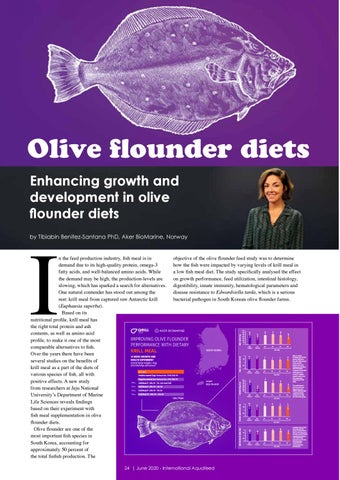
Olive flounder diets Enhancing growth and development in olive flounder diets
I
by Tibiabin Benitez-Santana PhD, Aker BioMarine, Norway objective of the olive flounder feed study was to determine n the feed production industry, fish meal is in how the fish were impacted by varying levels of krill meal in demand due to its high-quality protein, omega-3 a low fish meal diet. The study specifically analysed the effect fatty acids, and well-balanced amino acids. While on growth performance, feed utilization, intestinal histology, the demand may be high, the production-levels are slowing, which has sparked a search for alternatives. digestibility, innate immunity, hematological parameters and disease resistance to Edwardsiella tarda, which is a serious One natural contender has stood out among the bacterial pathogen in South Korean olive flounder farms. rest: krill meal from captured raw Antarctic krill (Euphausia superba). Based on its nutritional profile, krill meal has the right total protein and ash contents, as well as amino acid IMPROVING OLIVE FLOUNDER profile, to make it one of the most PERFORMANCE WITH DIETARY comparable alternatives to fish. SOUTH KOREA KRILL MEAL Over the years there have been 12 WEEK GROWTH AND HEALTH EXPERIMENT several studies on the benefits of Initial body weight: 62g (Paralichthys olivaceus) krill meal as a part of the diets of Test diets: various species of fish, all with Positive control (high fishmeal diet, HFM): 56% FM Negative control (low fishmeal diet, LFM): 28% FM origin positive effects. A new study Krill Meal 3*: 28% FM + 3% krill meal (KM) JEJU ISLAND Krill Meal 6*: 28% FM + 6% KM from researchers at Jeju National Krill Meal 9*: 28% FM + 9% KM Krill Meal 12*: 28% FM + 12% KM University’s Department of Marine * QRILL™AQUA Life Sciences reveals findings based on their experiment with fish meal supplementation in olive flounder diets. Olive flounder are one of the most important fish species in South Korea, accounting for approximately 50 percent of the total finfish production. The 350
BODY WEIGHT (g)
300
bc
ab
a
3%
6%
ab
ab
d
250
200 150
100 50
0
High Fishmeal
Low Fishmeal
9%
12%
FEED CONVERSION RATIO
KRILL MEAL
2
ab
a
b
1,5
b
ab
9%
12%
b
1
0,5 0
High Fishmeal
Low Fishmeal
3%
6%
FEED INTAKE (g/fish)
KRILL MEAL
300 290
a
a
280 270 260 250
a
a
b
b
240
High Fishmeal
Low Fishmeal
3%
6%
9%
12%
HEPATOSOMATIC INDEX (HIS)
SPECIFIC GROWTH RATE (%)
KRILL MEAL
24 | June 2020 - International Aquafeed
2
ab
c
a
a
3%
6%
a
b
9%
12%
After 12 weeks feeding trial, fish fed dietary krill meal (3%, 6%, 9%) showed better specific growth rate, feed utilization efficiency and feed intake compared to low fish meal group as a result of a higher appetite due to the feed attractant properties of krill meal. The performance and survival were improved by the dietary krill meal 6% supplementation compared to high fish meal diet group.
1,5 1
0,5
0
High Fishmeal
Low Fishmeal
KRILL MEAL
2
ab
b
ab
ab
a
b
1,5 1
0,5 0
High Fishmeal
Low Fishmeal
3%
6%
9%
KRILL MEAL
12%
Condition factor in the KM3, KM6 and KM9 groups, hepatosomatic index in the KM6 group and fillet yield in all krill supplemented groups were significantly improved over the low fish meal group, supporting the increased growth performance.
Antarctic krill, a proven supplement in fish feeds
a
a
a
50
a
b
40
b
Increased values of haemoglobin and haematocrit in the krill meal groups over the low fish meal group indicate that krill meal could improve fish health comparable to that of fish fed a high fish meal diet.
HAEMOGLOBIN (g/dl)
DIETARY KRILL MEAL IMPROVES Krill is a marine-originated DISEASE RESISTANCE IN OLIVE SOUTH KOREA protein and phospholipid FLOUNDER JUVELINES 12 WEEK GROWTH AND source that has shown HEALTH EXPERIMENT Initial body weight: 62g through previous studies to (Paralichthys olivaceus) be a successful supplement Test diets: Positive control (high fishmeal diet, HFM): 56% FM in fish feeds, as it lacks the Negative control (low fishmeal diet, LFM): 28% FM origin Krill Meal 3*: 28% FM + 3% krill meal (KM) unacceptable properties linked JEJU ISLAND Krill Meal 6*: 28% FM + 6% KM Krill Meal 9*: 28% FM + 9% KM to plant proteins. PlantKrill Meal 12*: 28% FM + 12% KM derived protein sources have * QRILL™AQUA nutritional limitations such as low protein and high fibre content, imbalanced amino acid profiles and a wide range of anti-nutritional factors that negatively affect growth and health of the fish, as well as palatability of the feeds. Krill meal is mainly produced from captured raw Antarctic krill, a crustacean related to shrimp. Krill aggregate in up to green is due to the algae in their digestive systems. Antarctic krill twenty-kilometers-long swarms and travel up and down a water is harvested in the wild, cooked, dried and ground in order to column. Antarctic krill are one of 85 different species of krill create a powder consisting of proteins, phospholipids, omega-3 around the world. They can be found in the Southern Ocean, with fatty acids and astaxanthin. a nearly 500 million tonnes biomass, which means it has a huge potential among a number of under-exploited marine resources at lower tropic levels. Krill meal diets given to olive flounder studied over 12Krill are transparent animals with some red and green week period colorations; the red is due to astaxanthin pigmentation while the A total of 792 olive flounder were purchased from a South 30 20 10 0
High Fishmeal
3%
Low Fishmeal
6%
9%
12%
KRILL MEAL
ab
6
a
ab
b
a
ab
LYSOZYME (µg/ml)
5
4 3 2 1
0
High Fishmeal
3%
Low Fishmeal
6%
9%
12%
Antiprotease and lysozyme activities of KM3, KM6 and KM9 groups were significantly increased compared to the LFM group.
KRILL MEAL
SUPEROXIDE DISMUTASE (% inhibition)
80
bc
60
d
bcd
Low Fishmeal
3%
a
ab
cd
40 20 0
High Fishmeal
6%
9%
12%
KRILL MEAL
120
100
SURVIVAL (%)
80
60 40 20 0
1
2 3 4 5 6
7 8 9 10 11 12 13 14 15 16 17 18 19 20 21 22 23 24 25 DAYS AFTER INJECTION
High Fishmeal
Low Fishmeal
Krill Meal 3%
Krill Meal 6%
Krill Meal 9%
Krill Meal 12%
Missed our webazine FEEDFORWARD? Take a look back and ‘Say goodbye to sieve analysis’ “The idea behind Feed Forward is to offer a new way of bringing the industry together and – as the name suggests – look forward to how we can help feed mills stay competitive in these challenging times. We wanted to create something that was informative and practical in tackling very actual industry topics, while also being entertaining.” – Ottevanger director, Erik Ottevanger
Scan the QR-Code and find out more
FEEDFORWARD www.ottevanger.com International Aquafeed - June 2020 | 25
The KM-supplemented diets improved performances over the LFM diet in non-specific immune parameters. The KM6 group performed significantly better than the high fish meal group in SOD activity.
A 25-day challenge test with the Edwardsiella tarda pathogen (1 × 10⁵ CFU/ml) showed that the cumulative mortality was higher in fish fed the low fish meal diet than in fish fed either the high fish meal or krill meal-supplemented diets.
Korean olive flounder farm and transported to the Institute of Marine Life Sciences at Jeju University. First, the fish were acclimatised for two weeks before beginning the experiment. Then they were randomly distributed into 24 polyvinyl circular tanks (33 fish per tank). The researchers tested diets that included varying percentages of krill meal (3%, 6%, 9% and 12%) added to a low fish meal diet (28%), versus a high fish meal diet (58%). There were four groups of olive flounder per diet, tested it over a course of 12 weeks. At the end of the 12-week krill meal trial, all the fish were bulk weighed. Then four fish from each tank were randomly selected to provide samples for analysis. These results were compared to those from olive flounder consuming high fish meal (58% inclusion) and low fish meal (28% inclusion) diets.
Partial inclusion of krill meal improves growth performance and feed utilisation of olive flounder
The results of the olive flounder study show that inclusion of krill meal improves growth performance and feed utilisation, confirming earlier studies on dietary krill meal supplementation for other fish species. Overall there was a positive tendency of improved performance in these areas among the olive flounder fed the three percent, six percent and nine percent krill meal supplementation in low fish meal diets. Significantly higher protein efficiency ratio values were observed in the six percent and nine percent krill meal diets, as compared to the low fish meal diet. The study revealed improved feed intake among the three percent, six percent and nine percent krill meal groups, as compared to the low fish meal group. This may be the result of the feed attractant properties of krill meal, which can lead to an increased appetite. Krill meal offers a well-balanced nutritional profile, more similar to fish meal, and contains high levels of phospholipids and astaxanthin, both of which are considered to be stimulators of fish growth. With this in mind, the increased palatability and growth stimulators could be the reason for the improved growth performance in the abovementioned groups. The hematocrit and hemoglobin levels were also increased by krill meal supplementation. Hemoglobin content of fish blood is an indicator of oxygen-caring capacity, while hematocrit is a
primary diagnostic parameter for fish health. This study revealed that the increased values of hemoglobin and hematocrit in the krill meal groups (versus the low fish meal group) indicates that the krill meal could improve fish health similarly to a fish fed a high fish meal diet. The plasma triglyceride level of the six percent krill meal diet was significantly higher as compared to the low fish meal group. In addition, digestibility of dietary protein and dry matter was also increased as a result of the krill meal three-to-nine percent diets, and were more similar to the high fish meal diets. Krill meal supplementation in low fish meal diets also revealed significant improvement in innate immunity and condition factor of the olive flounder, within the three-to-nine percent krill meal diet groups. Most notably the group fed six percent krill meal group performed significantly better than the high fish meal group in superoxide dismutase (SOD) activity. Despite the fact that this experiment did not analyse the direct
EVALUATION OF ANTARCTIC KRILL MEAL (Euphausia superba) SUPPLEMENTATION IN DIETS FOR OLIVE FLOUNDER JUVENILES (Paralichthys olivaceus)
SOUTH KOREA
12 WEEK GROWTH EXPERIMENT Initial body weight: 62g
INCREASED BODY WEIGHT
Test diets: Positive control (high fishmeal diet, HFM): 56% FM Negative control (low fishmeal diet, LFM): 28% FM
JEJU ISLAND
Krill Meal 3*: 28% FM + 3% krill meal (KM) Krill Meal 6*: 28% FM + 6% KM
BETTER FEED CONVERSION RATIO INCREASED VALUES OF HAEMOGLOBIN
Krill Meal 9*: 28% FM + 9% KM Krill Meal 12*: 28% FM + 12% KM * QRILL™AQUA
IMPROVED DISEASE RESISTANCE
OLIVE FLOUNDER JUVENILES (Paralichthys olivaceus)
INCREASED BODY WEIGHT
EVALUATION OF ANTARCTIC KRILL MEAL (Euphausia superba) SUPPLEMENTATION IN DIETS FOR OLIVE FLOUNDER (Paralichthys olivaceus)
BETTER FEED CONVERSION RATIO SOUTH KOREA
ENHANCED DIGESTIBILITY INCREASED HAEMOGLOBIN AND HAEMATOCRIT
12 WEEK GROWTH AND HEALTH EXPERIMENT
Initial body weight: 62g (Paralichthys olivaceus)
origin
JEJU ISLAND
Test diets: Positive control (high fishmeal diet, HFM): 56% FM Negative control (low fishmeal diet, LFM): 28% FM Krill Meal 3*: 28% FM + 3% krill meal (KM) Krill Meal 6*: 28% FM + 6% KM Krill Meal 9*: 28% FM + 9% KM Krill Meal 12*: 28% FM + 12% KM * QRILL™AQUA
INTENSIFIED PALATABILITY
IMPROVED NON SPECIFIC IMMUNE PARAMETERS INCREASED VILLI LENGHT HIGHER NUMBER OF GLOBET CELL BOOSTED FILLET YIELD AND CONDITION FACTOR STRENGTHEN DISEASE RESISTANCE
OLIVE FLOUNDER
(Paralichthys olivaceus)
26 | June 2020 - International Aquafeed
effect of krill meal on the fish immune system, this study did evaluate resistance to Edwardsiella tarda, which can be indicative of overall immune system response. The results show that the astaxanthin and phospholipids present in krill have immunestimulatory effects.
Other factors leading to enhanced digestibility and growth performance
This study also showed that goblet cell counts and villi length were positively impacted by all krill meal diets in the experiment. Goblet cell plays an important role in digestion processes and in the protection of the digestive tract as it synthesises and secretes mucus. The krill meal groups show significantly higher goblet cell counts when compared to the low fish meal group, confirming previous results. It’s also notable that the three percent, six percent and nine percent krill meal groups all had higher goblet cell counts than the high fish meal group. In terms of the villi length, this is a useful way to explain the development of intestinal morphology. Longer villi can indicate greater absorption of nutrients through increasing the surface area. This study revealed increased villi length of the krill meal fed groups. This suggests that krill meal can be beneficial to the development of intestinal morphology, though a direct mechanism was not revealed in this study. That said, this intestinal morphology, as well as the increased villi length and the increased goblet cell counts may be the cause behind the enhanced digestibility and growth performance of the krill meal fed groups.
Higher survival against the E. tarda pathogen
One particularly interesting result from the study show that olive flounder fed with dietary krill meal showed considerably higher survival against the E. tarda pathogen, which is a wellknown bacterium in the Asian feed industry. The researchers behind this study were unaware of any available data on disease resistance of fish fed krill meal diets. This study showed that the krill meal fed group had a much higher survival rate than those in the low fish meal fed group. This is in line with results showing a krill hydrolysate supplementation in a low fish meal diet improved the survival of olive flounder when infected with the E. tarda pathogen. This krill hydrolysate supplement significantly increased the survival of olive flounder and red seabream against E. tarda. The higher survival rate of the olive flounder can be explained due to the improved and/or boosted innate immune system that the krill meal stimulates in the diet.
BiotronicÂŽ Top3 the
breakthrough in
pathogen control!
The Permeabilizing ComplexTM blend in BiotronicÂŽ Top3 weakens the outer membrane of Gram-negative bacteria, thus boosting the synergistic effect of its components, the organic acids and the phytochemical.
biotronictop3.biomin.net
Conclusion
The olive flounder experiment has clearly revealed that krill meal supplementation in low fish meal diets is increasing growth, as well as improving diet digestibility, intestinal development and function and innate immunity as well as disease resistance of olive flounder. The positive growth effects on the olive flounder may also result from the feed attractant properties of krill meal, leading to a higher appetite among the test groups consuming the krill supplemented diet. Krill meal contains high levels of phospholipids and astaxanthin, which are considered to be stimulators of fish growth. Based on positive effects of krill meal supplementation in this experiment, the recommend level of krill inclusion is between six-to-nine percent krill meal when the fish meal feed inclusion is low. www.akerbiomarine.com
Biotronic (IR-543632) and BIOMIN (IR-509692) are registered trademarks of Erber Aktiengesellschaft.
Naturally ahead
International Aquafeed - June 2020 | 27
An Extruder for maximising production of fish feed and petfood
T
by Amandus Kahl GmbH, Germany he extruder OEE NG from Amandus Kahl GmbH & Co KG has set about capturing the market for the production of pet food and fish feed of the highest quality. The German machine manufacturer Amandus Kahl has been manufacturing a new extruder for the production of fish feed and pet food since 2019. The extruder OEE 25 NG (New Generation) was introduced onto the market with a screw diameter of 250mm and a resulting capacity of up to 10t/h. The 2020 series will be expanded by two extruders with screw diameters of 200mm and 150mm for smaller production volumes.
The new equipment and technology level of the Kahl Extruder OEE NG
After more than 20 years of experience with extrusion machines, customers now receive a completely new extruder to meet the growing demands in the production of fish feed and pet food. During the design phase, the focus was on producing a user-friendly machine with new performance standards. A double-jointed connection enables a fast tool and knife change. The design was also a focal point - the extruder OEE NG is manufactured with a frame-mounted touch screen to control all relevant operating data, settings and options even during operation. The machine also features the proven Kahl stop bolt technology for successful mixing and venting in the first cylinder section. Special process zones for compaction, cooking and kneading ensure high flexibility and a wide range of adjustment options. The Kahl extruder can also be ideally adapted to changing formulae. Fine control measures, such as the possibility of adjusting the screw speed, adding steam or water to the extruder barrel
28 | June 2020 - International Aquafeed
or individually adjustable heating and cooling jackets have also been taken into account in the design. A comparison of the screw diameters of both Kahl extruders clearly shows an increase in throughput: Thus, a capacity range of 10t/h is achieved in large industrial applications.
The advantages and options of Kahl machines at a glance
The already mentioned fast knife and die change provides high efficiency. Furthermore, the possibility to change the distance between knife and die during operation allows a flexible definition of the desired extrudate size. Amandus Kahl produces the requested machine as a single unit or turnkey extrusion line. In both cases, no expensive additional equipment is required to influence the expansion behaviour. This saves not only investment costs, but also operating costs. Amandus Kahl defines the specific project together with the customer and finds the most suitable solution for a successful production. Apart from the actual extrusion, turnkey extrusion lines include all process steps such as grinding and mixing of the components. Steam conditioning, drying, coating, cooling and packaging are also performed by machines from Amandus Kahl.
Quality made in Germany - Successful for 140 years
Founded in 1876, Amandus Kahl has been successfully manufacturing machines and plants for conditioning and pelleting of various raw components and product mixtures for more than 140 years. Ever since the company was founded, the pelleting press has been at the centre of production. Thanks to its flat die, it has established itself as a unique selling point on the commercial market in countless industrial sectors. The high quality is also reflected in every other machine and plant ‘Made in Germany’. In addition to pan grinder mills for energy-efficient wood crushing, cooling and drying plants or expanders in various designs, Amandus Kahl customers can obtain extruders for various industrial sectors such as the food or animal feed sector for different production capacities.
How to contact us
Have you seen the new Amandus Kahl website? It provides a comprehensive overview of the broad machine portfolio and shows in which industries Amandus Kahl machines and plants are already successfully used today. Find out more at www.akahl. de, contact us via the contact form or write an e-mail to info@akahl.de. www.akahl.de International Aquafeed - June 2020 | 29
A novel bacterial solution Improving resistance of early stages of Rainbow Trout (Oncorhynchus mykiss) with a novel bacterial solution
Alexandre Brame, Stephane Frouel and Maxime Hugonin report on a field trial run in France to evaluate the potential of a microbial solution to beneficially modulate microbiome in trout farming system and improve resistance and performance from eggs hatching to early juveniles’ stage of rainbow trout Oncorhynchus mykiss.
A
mong the farmed aquatic species, rainbow trout is one of the most important. Some experts have projected that the world's consumption of rainbow trout will hit 950,000 metric tonnes (mt) annually in the first quarter of 2020 alone. The majority of this volume will be provided by aquaculture, with global sales volume of farmed trout expected to reach roughly 830,000 tonnes (t). The continued relatively high cost of salmon has seen rainbow trout establish itself as a cheaper alternative fish, offering many of the same health benefits. The specialists predict a compound annual growth rate for worldwide rainbow trout market of approximately five percent over the next 10 years. However, diseases are a primary problem
by Alexandre Brame, Innovation Manager, Nolivade, Stéphane Frouel, Aquaculture Project Manager and Maxime Hugonin, Aquaculture Product Manager, Mixscience, France
in trout aquaculture and can severely impact its economic progression in many countries. The development of a fish disease is the result of the interaction between pathogens, hosts and the environment. Numerous studies have reported that water treatments may be an indirect driver in shaping the bacterial communities of the environment, skin, gills and gastrointestinal tract, commonly referred to as the ‘microbiomes’, of aquatic animals. These microbes are believed to play important roles in host development, immunity, digestion and nutrition. On the contrary, deleterious bacteria may play inverted role. The diseases encountered in rainbow trout include: those caused by bacteria (Aeromonas spp., Yersinia spp., bacterial kidney disease, Flavobacterium spp., …), parasites (Gyrodactylus, Chilodonella, Trichodina, Epistylis, Trichophrya, Ichthyopthirius, Ichtyobodo, proliferative kidney disease, amoebic gill infestation, Coleps), fungi (Saprolegnia), and viruses (infectious pancreatic necrosis, viral hemorrhagic septicemia, and infectious hematopoietic necrosis). Should a disturbance occur that causes an imbalance, or dysbiosis, in the commensal microbiome, the fish may be more vulnerable to pathogenic infection. Indeed, the gastrointestinal tract, in addition to the skin, gills and any 30 | June 2020 - International Aquafeed
modification of environmental water, are known to be the major routes of entry for potentially pathogenic microorganisms in fish. The management practices designed to
Figure 1: Statistical difference of main pathogenic bacteria abundance (expressed as %) between Control group (CTRL) in pink and Experimental group with Nolivade microbial solution (EXP) in blue
prevent the occurrence of diseases or the degradation of water quality are critical to a successful farming system. A strong biosecurity/prophylaxis to avoid diseases occurrence is mandatory to a successful production. Among this, the infection could be prevented by protecting hatching eggs and controlling water microflora of early stages of the fish. The impact of novel products to preserve a stable and healthy microbiome of farmed salmonids, in particular those of microbial solutions, are receiving more attention as aquaculture practices evolve in line with restrictions on antibiotic and chemicals to treat the animal and the water. Species of Bacillus sp. are spore-forming bacteria that are resistant to aggressive physical and chemical conditions. Various species show unusual physiological features enabling them to survive in various environmental conditions including fresh waters, marine sediments, desert sands, hot springs, arctic soils and the gastrointestinal tract of finfish and shellfish. Application of Bacillus spp. as probiotics in feed or for bioremediation of farming water have great potential for sustainable aquaculture. Species of Bacillus spp.
Figure 2: Overall diseases diagnosis and evolution of survival rate during the trial period Control group (CTRL) in pink and Experimental group with Nolivade microbial solution (EXP) in blue during the 61 days of culture
Figure 3: Final average weight of trout at day 60. Control group (CTRL) in pink and Experimental group with Nolivade microbial solution (EXP) in blue
RO O F CONSTRUCTIO N S
BIN RO O F S
SPECIALIST IN S Q UA R E S I LO S
WA LLS
HOP P ERS
C OM P OU ND FE E D P RE M I X
AQUAFE E D
F LOUR P L ANTS P L AN T S
R ICE
PE TFOOD B RE WE RIE S
COFFE E ROASTING GRAINS & SE E DS STEEL CONSTRUCTIO N S
www.tsc-silos.com
International Aquafeed - June 2020 | 31
may play a desirable role in maintaining optimum water quality and equilibrium, which means a stress reduction, leading to an improved immuno-physiological balance, higher gut balance, better growth and enhanced survival in target aquatic animals. In the present research, we demonstrated the potential of a microbial solution based on selected Bacillus sp. strains (Nolivade, France) directly applied in the farming water of early stages of rainbow trout. Since it was hypothesized that supplementing farming water with microbial solution would modulate the structure of the intestinal microbiota, the primary objective of this study was to characterise the intestinal microbiota of farmed rainbow trout with or without microbial solution in the production system. Therefore, the secondary aim of this research was to evaluate the capacity of beneficial bacteria to prevent mortality or losses of zootechnical performance during a sanitary challenge (pathogenic bacteria, fungi or viruses).
Trout raceway trial
The rainbow trout trial was carried out in indoor 1300 litre (l) raceways in a private trout farm in France. Continuous water flow (with average debit of 0.6 l/s) was applied. All experimental raceways were connected to a common unit of decantation designed to mechanically filter the water. Temperature, salinity, and oxygen levels were based on ambient conditions of the river connected to the farm. Four raceways were used for control (CTRL) and four others for experimental Nolivade product (EXP). Before hatching, 50,000 trout eggs were deposited on special shelves dispatched in each raceway. Initially, the eggs were immersed for one day in a solution containing the microbial solution (2g of product diluted into in 10l of water), and then it was applied under its original powder form, directly in water from day one post hatching to day 60. This microbial solution was applied at a dose equivalent to 1.10e5 CFU/l of raceway’s water. At day 60, for microbiota analysis, 12 young juveniles were sampled per group, rinsed with sterile water and then crushed to extract DNA in order to demonstrate changes in the structure of the microbiota of rainbow trout. The samples were stored in freezer -80º C until processing. For total DNA extraction, the commercial QIAamp® DNA Stool Mini kit (QIAGEN) was used according to the manufacturer's instructions. Then, the V4 region of the 16S ribosome subunit gene was amplified with primers containing overlapping region with Illumina platform primers. After verification of the amplicons quality, samples were sequenced using the Illumina MiSeq (paired-end library) platform with the 250-cycle V2 kit. The bioinformatics analysis was performed through MOTHUR v.1.36.1 software. Taxonomic classification was obtained using SILVA Database. Finally, cumulative mortality and growth performance were measured. Veterinary diagnosis was done all along the trial to identify diseases which occurred at the farm during the experimental period and to observe how they affect fish.
Impact of the microbial solution on gut microbiota, disease resistance and performance of trout
Comprehensive taxonomic baselines of microbial taxa can bring a good overview of the healthy status of rainbow trout. It is assumed that bacterial genera commonly found in the intestine of fish, including Vibrio, Aeromonas, Clostridium, Flavobacterium, Edwarsiella, Pseudomonas, Photobacterium, Renibacterium, Serratia, Yersinia, are strains that are capable of causing disease.
Many of these microbes often comprise minor components of the intestinal microbiome and only emerge as opportunists when the fish is stressed or when its immune system is compromised. Much of the literature often refers to imbalances or perturbations in the fish intestinal microflora and the potential adverse effects that can arise as a result. In the present study (See Figure 1), after 61 days of treatment, gut biodiversity and abundance of trout gut was clearly modulated by the microbial solution and differences appeared between CTRL and EXP groups. Bacteria of the genus Aeromonas, Clostridium and Serratia were significantly or at least numerically more present in control group indicating that the healthy status of trout of control group was potentially altered and fish were more susceptible to be challenged by external stress occurring during the growth period. One major sanitary event appeared between day 23 and day 30 of the experiment (See Figure 2) when an important occurrence of Saprolegnia spp associated to high presence of Aeromonas were diagnosed in the gut of the control group. These pathogens most often become pathogenic to fish only when fish are stressed, injured, in a poor nutritional state, temperature shocked, or otherwise debilitated. A number of predisposing factors are involved in the development of fungal infection in fish—the factors affect both the fish and fungus, and a combination of factors rather than any single condition ultimately leads to infection. It has long since been believed that the fungi responsible for Saprolegniasis are secondary pathogens, and lesions are commonly seen after handling and after traumatic damage to the skin that could be caused by overcrowded conditions or in conjunction with pollution or bacterial or viral infections. Skin and gill lesions are by far the most frequently observed but there have been reports of infection of internal organs. The utilisation of the microbial solution on the eggs and directly in the water during the early stages of the trout development had a protective effect against infestation of juveniles by Saprolegnia and Aeromonas since the fish were less injured and survival was significantly better at the end of the trial. Thus, at the end of the nursery period, the average mortality was of 14.3 percent for experimental raceways whereas it reached 21.1 percent for control raceways, meaning a relative improvement of 33 percent (See Figure 2). This protection of fish by the microbial solution had positive effects on final growth performance since final weight of experimental group was slightly higher than control. Average final individual weight of control group was 1.58g versus 1.65g for the experimental group, meaning a relative improvement of 4.2 percent (See Figure 3).
Conclusion
Should the fish be challenged by fungi associated to opportunistic bacteria, a variety of external disinfectants may be used. They include use of malachite green, copper sulfate, potassium permanganate, and formalin. All these products are controversial since they may have an adverse effect on environment. This microbial product developed by Nolivade seems to be a new and promising route as a preventive solution in trout farming systems. This study has shown effectiveness to reduce the susceptibility of the fish during the early stages of its life, when it faces environmental changes and in case of high pathogenic pressure. www.nolivade.com www.mixscience.eu
32 | June 2020 - International Aquafeed
WELCOME
Singapore - Dec. 14 - 18, 2020 Singapore EXPO Convention and Exhibition Centre
Hashtags: #WA2020 Facebook: Wa2020 Linkdin: WASAPC
Hosted by Singapore Food Agency Organized by World Aquaculture Society
WA
Next generation Aquaculture Innovation and sustainability will feed the world
For more info on the CONFERENCE: www.was.org - worldaqua@was.org For more info on the TRADESHOW: mario@marevent.com
Oregano Gregarine control with DOSTO® oregano oil in commercial shrimp earth ponds
by Fabián Jijón, Global Species Manager Aquaculture and International Sales Manager in LATAM, Dostofarm GmbH and Francisca Veinat G, Product Manager, Dostofarm GmbH
G
method. Important here is a consistent quality of the essential oil regarines are common gut parasites in order to achieve a constant effect at the recommended dosage. that affects shrimp populations around the world. This parasite can affect shrimp in any of its life cycle Origin of oregano oil stage. Some of the negative effects In a commercial shrimp operation in Ecuador with a recurring of the gregarine presence in shrimp gregarine problem was tested the potential of DOSTO® aquaculture are low daily weight Concentrate 500 to control the infection. DOSTO® Concentrate gain and high feed intake, leading 500, contains 50 percent oregano oil from a specific subspecies to a high FCR, and secondary of Origanum vulgare var. hirtum. After harvesting, the essential bacterial infections (Vibrio spp.). Earth ponds, which are the most oregano oil is extracted from the plant by gentle steam widespread building practice for commercial shrimp operations, distillation. living vectors (ie clams), low pond soil bottom management, The content of phytochemicals in the essential oil is determined high feeding rates or low feed quality are some of the factors after each production in order to ensure a consistent standardised that increase the risk of having Gregarines present in shrimp composition. Oregano oil can be used in all livestock and aquaculture systems. aquaculture species both conventional and organic production Feed additives have been used for years to support systems. performance and animal health. The positive effects of essential oils are well-known from Table 1. Gregarine evaluation Table 2. Gregarine count before and after feeding human medicine and can also contribute to scale DOSTO® Concentrate 500 increase performance and health in livestock Level Organisms Mid Gut Hindgut and aquaculture. Essential oregano oil per visual Pond Before After Before After is characterised by its antimicrobial and G1 1-5 1 2 1 3 1-2 antiparasitic properties. The effectiveness G2 6-10 2 3 1 3 2 depends on the chemical composition of the G3 >20 3 2 1 3 1 oregano oil. This is influenced by the origin, plant species, growth stage and processing 34 | June 2020 - International Aquafeed
o oil
STRONG ENOUGH TO FACE EVERYTHING!
Figure 1
Experimental setup
Three infected shrimp ponds, diagnosed using Wet Mount analysis, were uses in this study. The gregarine load in the gut is measured using a scale that indicates the number of gregarine individuals present in gastrointestinal tract (See Table 1). The effect of DOSTO® Oregano was evaluated by comparing the infection load before and after the application of the product DOSTO® Concentrate 500 at a dosage of 200 grams-per-tonne of feed during five days.
Results
Before the application of DOSTO® Concentrate 500 in the feed all three ponds showed level infections between two and three in the mid gut and three in the hindgut. Figure 1 observes the gut of a shrimp with a level 3 infection (more than 20 gregarines per visual). After five days of feeding the shrimp DOSTO® Concentrate 500 their gregarine load was reduced to safe levels (See Table 2). DOSTO® Concentrate 500 is an effective tool to control gregarine in shrimp operations. Natural and standardised, DOSTO® Oregano oil has antiparasitic properties, especially in gregarines, which showed a high sensitivity to its components. Five days’ treatment is enough to reduce gregarine load to a safe level. To avoid reinfection and reactivation of the parasite’s life cycle, it is recommended to feed DOSTO® Concentrate 500 continuously. www.dostofarm.com
Leiber® Beta-S – β-glucans for: Improvement of the cellular & humoral defence mechanisms Support of immunological competence in larval & juvenile stages Improvement of feed conversion
leibergmbh.de
International Aquafeed - June 2020 | 35 Produktanzeige Beta-S 79 x 260 Immunität AquaFeed magazine aquaculture europe 06/17.indd 14.06.17 1 09:46
Aquaculture round-up
Tilapia farming methods in Mozambique
T
by Dr Gianluigi Negroni, ALVEO S.c.a.r.l, Italy
he main species farmed is in Mozambique is Tilapia (Oreochromis niloticus), in addition Tilapia mossambicus is more suited to the environment in this country due to better resistance to disease and the difficult conditions present in said area. Tilapia is the common name for a vast number of freshwater fishes of the family Cichlid. This is one of the largest families of fishes, containing more than 1,800 members, some of them in use in aquaculture. Members of the family range from very small ornamental species used in the aquarium industry to large food-size species rose in the fish-farming industry. Tilapia hatcheries can be highly technical for industrial purposes or less technologically intensive, in the form of simpler structures. In Mozambique, we have the two types as there are several communal famers that produce their own fingerlings. Industrial hatcheries are normally divided in the
following sections: quarantine area, broodstock tanks, spawning tanks, corral systems, reproduction ponds, eggs and larval rearing systems, fry tanks, fingerling tanks, filter and water inlet/outlets, warehouses and services areas.
Earthen ponds
Earthen ponds are more commonly used in Mozambique for tilapia farming and represent the oldest fish farming facility that has been used for many generations. A good pond will showcase the following characteristics: • A well-designed water supply but also easy drainage. This means a slight slope (0.5%) of the pond floor from the water inlet to the drainage point • Good water quality (pH around 6)
Table 1: Aquaculture types of production Facilities
Extensive
Semiintensive
Intensive
Aquaculture type
Earthen Ponds
Yes
Yes
No
Commercial, artisan
Tanks
No
Yes
Yes
Commercial
Concrete Ponds*
No
Yes
Yes
Commercial
Raceway**
No
Yes
Yes
Commercial
Cages
No
Yes
Yes
Commercial
*Possible with geo-membrane ** not yet developed in Mozambique The main species farmed is Tilapia nilotica
36 | June 2020 - International Aquafeed
Aquaculture round-up
• The drainage outlet (standpipe or monk) must be studied with care • Water inlets and outlets must be at opposite ends in order to ease water exchange within the pond • Good impermeability of the pond as a whole and strength/ integrity of the pond’s walls and edges • Clay soil quality • Access and possibility to work around the pond which must be accessible to vehicles (tractors, trucks, trailers etc.) • Sizes of ponds must be adapted to the species but also be easy to manage. If the width exceeds 50 metres, it becomes difficult to pull nets for harvest (eg if 3-to-4 men on each side are necessary to pull a 60 metre net), thus rendering the ponds impractical.
Floating cages
The other more intensive system used in Mozambique is the use
of floating cages. Some commercial farms in Mozambique are using this technology. Some economists consider that the Tilapia fish cage system is the most economic and efficient method used in Mozambique. It needs an appropriate water body that can absorb fish faeces throughout the year. There are many possibilities for obtaining floating cages for growing fish, from locally made ones (usually cheaper but more fragile) to high technology cages. The selection can only be made according to the overall practical considerations concerning the site, the production targets, and the project’s economics. While the optimal size for a tilapia cage is unknown, one should consider that the bigger the cage, the cheaper it costs in both material and equipment. Choice will be determined by considering the ease of management and the final production cost. It appears that a cage of a dimension of 100m2 is a good compromise; in Mozambique it cages range from 8-50m3, with very good results.
CLEAN FEED. CLEAN WATER. Wenger Extrusion Solutions for RAS Feed Production Wenger innovative extrusion solutions deliver clean, durable, nutritional feeds specifically designed for the most efficient RAS operations. Feeds produced on Wenger systems maintain their integrity better and longer, for clean and clear water. So you feed the fish, not the filter. Learn more about the Wenger RAS advantage. Email us at aquafeed@wenger.com today.
PHONE: 785.284.2133 | EMAIL: AQUAFEED@WENGER.COM | WENGER.COM USA
|
BELGIUM
|
TAIWAN
|
BRASIL
|
CHINA
International Aquafeed - June 2020 | 37
Aquaculture round-up
Concerning the depth of the nets, the technical possibilities and maintenance expertise will determine the choice. If the net is deep, special diving equipment will be required for daily checking of the nets and eventual repairs. If the depth does not exceed 3-3.5 metres, repairs and maintenance can be made through free diving. Good care must be paid towards the mooring and anchoring systems. This will be selected based upon the speed of the current, winds and any effect that could move the cage and require a special study. Note that mooring systems for square cages are cheaper than those for round cages. Nets are the subject of very careful selection. Their quality must be beyond reproach since the security of the fish stocks depends largely on the net strength. Mesh size must be adapted to the fish size and must not allow the fish to trap itself by the gills. On the other hand, small sized meshes can be subject to fouling which restricts the water flow through the cage. Larger farms will also invest in net-washing equipment, which imposes the need to have cages with adequate net-removal facilities.
Inputs feed and fingerlings
Selected Tilapia fingerlings are available in Mozambique from the larger farms or auto-produced in the artisanal farms. Pelleted feed for starter and grow out are imported in Mozambique from South Africa and Zambia (on the Cabora Bassa Dam). It is important to know that tilapia has the possibility to be a filter feeder, harvesting the water microorganism (green water technologies) that could be developed by fertilising the pond. Development is slower (more than double time than with feed).
Mozambican Fisheries Management
The legal basis of Mozambican fisheries is given and enforced by the Fishery Law 22/2013 of November 1st (substitute the Law 3/90 of September 26th) Fisheries Law 3/90 of 26 September 1990 and subsequent regulations, being the fisheries management regime based on TAC/quotas and limited entry regulation (licensing/effort allocation) accomplished by closed seasons and mesh size regulation. These management measures are revised periodically, with a view of keeping their effectiveness, based on results of stock assessments for the most valuable resources and economic performance of the fleet, among other tools. In 1996, a Fisheries Administration Commission (Conselho Administracoe das Pescas, CAP) was established, aiming to improve the involvement of the private sector and fishing communities in management decision making. It congregates representatives of the Fisheries Public Administration and of the fishing industry (industrial, semi-industrial and artisanal fisheries associations). This forum is an advisory body to the Minister and discusses and analyses issues such as quota and vessels allocations, magnitude and period of closed seasons, state of exploitation of capital resources and recommendations of management measures addressed by the research component.
Therefore, final decision on fisheries administrative matters is taken by the Fisheries Authorities upon consultation of this forum. The regional and international matters are also discussed in the forum before a national decision is taken. The Co-management Committee (ComitĂŠ de Co-gestĂŁo - GCC) is the participatory management forum at local, district and provincial level. The GCC is composed of the local authority of the Fisheries Administration or its representative, representatives of the Community Fisheries Councils, fishing vessel owners, fishery research, fishery extension, local maritime authority, fish processors and fishery traders. Could be convened by the CCP represented in the GCC. The Community Fisheries Council (Conselho ComunitĂĄrio de Pesca -CCP) is a non-profit Community organisation whose task is to contribute to the participatory management of fisheries, to ensure compliance with existing management measures, to manage conflicts resulting from fishing activity with a view to sustainability activities in their geographical area and improving the living conditions of the local population.
Download the App using this QR code
FISH FARMING TECHNOLOGY
38 | June 2020 - International Aquafeed
Aquaculture round-up
PCE
Sp ecia lis t in Pelletin g Eq uip m ent
Improved pellet quality and increase in capacity
PELLETING CONSUMABLES EUROPE
YOUR PARTNER IN TOP-QUALITY RING DIES availab le for all pellet p ress brands
BOA Compactor PTN’s patented pre-compacting technology – the BOA compactor, a unique alternative for double pelleting or expander technology.
Scan the QRCode for more information
info@ptn.nl - www.ptn.nl
WWW.PCE.EU International Aquafeed - June 2020 | 39
FISH FARMING TECHNOLOGY
Tech update Blueye Pioneer
Groundbreaking technology to get your eyes below the surface: the Blueye Pioneer underwater drone offers exceptional user experience and performance. Whether you are performing inspections in deep and dark oceans or in clear waters, the camera is optimised to perform in different and challenging conditions. The Blueye App allows you to control light exposure and camera hue settings. Underwater navigation is a tricky nut to crack, and the Blueye App is designed specifically to assist you in knowing where you are headed at all times. Assisted navigation with a compass ensures minimal drifting and more precision when needed. A 3D visualisation of the drone illustrates the course of the drone relative to your own. The Blueye App responds to the way you choose to control your ROV, whether that is with a controller or by touch on your iOS or Android device. International Aquafeed - June 2020 | 41
www.blueyerobotics.com
FISH FARMING TECHNOLOGY
Feed storage
For every milling requirement there is an ideal building solution by Silo Construction & Engineering, Belgium During these uncertain times, consumer shopping behavior has shifted to meet the needs of more time spent at home with the whole family. This will result in a fast expansion of packaged foods, among other food categories. Milling companies for the feed and food industry will be a crucial link to keep up with this demand. So early in the value chain, in milling facilities for both food and feed, we have to take responsibility to ensure a sustainable approach. Challenges will be producing food and feed much more efficiently, significantly lowering the energy consumption usage in production, minimising downtimes, utilising valuable raw materials even better, increasing the nutritional value of food, improving tracking of products and responding faster to changing markets. In any milling facility, up to 80 percent of costs are caused by raw materials. Our modular buildings are, therefore, designed to produce high-quality products and maximum yields. If you increase yields by even a fraction, it goes straight to your bottom line. The impact of the food industry on our planet is getting bigger because of the everincreasing global consumption. We, therefore, want to support our customers to build, store and produce in a greener, faster and smarter way, eliminating any form of waste. Our goal is to be the leading modular construction partner for the global animal and human food industry. Together we are engineering a better world. SCE wants all its customer stakeholders to succeed in answering the challenges ahead: • The end customer will be loyal but will demand proof of healthy ‘sustainable’ food manufacturing. So, the need is there to increase the company reputation and invest in a facility built to avoid any form of ‘waste’ • Engineering teams will ask for a waste free process that demands less space, time and energy. So they will look for an experienced and innovative building partner that understands their process needs • Investigating new designs and technologies will increase PM time pressure so they will want to work with reliable partners who can minimise budget and time overruns • Construction schedules will demand for new installation methods without compromise on quality and safety, and that’s why more and more companies are choosing the modular ‘kit’ installation of SCE • Facility users will ask for ‘cleaner’ plants to show to end customers. Output also needs to be reliable and thanks to the newly patented butterfly hoppers of SCE, they deliver mass flow storage facilities which have a low maintenance process. 42 | June 2020 - International Aquafeed
FISH FARMING TECHNOLOGY
Why square silos?
What if mass flow in silos can make your life easier?
SCE designs, produces and delivers modular square building components with the needs of clients in mind. With these dynamic square parts, you can easily integrate our square silos in any production unit. Tailor-made in function of your building, you choose the components you want and we will create customised pieces of your silo building. And you can always easily expand your building depending on your evolving needs.
Hoppers are a crucial part of a mass flow silo and thus designed with the greatest care for your product. We will ensure a perfect transfer from the silo to the machine process. Every product requires its own type of hopper, which are always completely tailor-made. The newly patented innovation in SCE has a name: butterfly hopper.
Clearly - Healthier Harvests! For four decades, Aqua Ultraviolet has been the premier manufacturer of ultraviolet sterilizers and bio-mechanical filtration.
CLASSIC UV STERILIZERS
SL STAINLESS STEEL STERILIZERS
VIPER SL STERILIZERS
ULTIMA II FILTERS
Call today or visit us online to learn how AquaUV can grow your application.
US: (951) 296-3480 | AquaUV.com @AquaUV
@aquauv
AquaUltraviolet
43 | June 2020 - International Aquafeed
FISH FARMING TECHNOLOGY “Solution minded- That’s how SCE works”
To supply feed for salmon in the region, MOWI, an internationally renowned salmon farm operator and processor, built a new factory on the Isle of Skye in Scotland. “A big challenge, but the dedicated team of SCE helped us to realise it,” says Mick Watts of MOWI. In the small village of Kyleakin in Scotland, SCE completed one of the most prestigious projects in its 30-year history: a state-of-the-art salmon feed factory. SCE installed the most innovative silos on the market and built most of the site. “The construction of this plant was a very specific job,” says Mick Watts of MOWI (formerly known as Marine Harvest). “SCE is known in the industry as a company capable of realizing projects of this size and complexity. We were in contact with four different supply companies as a partner for this aspect of the project. We checked references of all four of them, and also visited their factories.” “When I was in Lichtervelde visiting SCE, I was really impressed. Impressed by their innovation skills and the quality of their products, but also about the people who work at SCE. I immediately had a good feeling. We got in contact with a dedicated team and impressive resources. From day one we worked with Tom acting as project manager, Koen as sales manager and Steve as site supervisor. This team never changed. When you work on a project of this size, you often work with partners that send you different people all the time. You lose time because you need to inform them over and over again. That never happened with SCE. Koen, Tom and Steve were with us from the beginning until the final day.”
On site
“At SCE they know very well what they are good at, and what they are not good at. They don’t improvise. They don’t offer a very wide range of different products, they stick to what they are good at. They provide this with big quality as well. We needed such a reliable partner for the complex mission we had here. This was a brown field site, so we built everything from scratch. We started with the 40-metre-high intake tower, but had to interface with the bins and the machinery while building it.” “Steve, the site supervisor of SCE, was always very clear and honest. We got all the important information on time. When there was a problem, we moved around it together. I was impressed by their site organisation and the discipline of the team. In total 15 different companies were active on the site, 50 electricians, 20 programmers… Communication is crucial for a project like this and was handled fantastically by SCE. “Every morning we had a meeting: we talked about the past 24 hours and the next five days. Steve acted as a brilliant team player, always focused on the job, always ready to solve problems, always in control of safety and also just fun to work with. When you work on a plant in the weather conditions that we had to work in, you need people who keep up the morale in the team. I can assure you, this weather doesn’t make people happy.”
Challenge
“The biggest challenge was definitely the weather. We completed the construction in 18 months, which is pretty fast, but in any other place in the world we would have built it even faster. Every day we had to consider the weather forecast. Over here in the north-west of Scotland, almost every day is a rainy and windy day. We worked with five cranes. When it was impossible to use the cranes, we worked round it as much as possible.” “Steve and Koen and everybody at SCE were always solution-minded in their work. They would never say, ‘I don’t know’. They looked into it and the day after they came up with a solution.” “We have plans for the future, and I can tell you for sure: SCE will be involved. It’s a customer-oriented, attentive company that delivers quality. What they say they are going to deliver, they deliver. And when they deliver, it’s of a high quality.”
Upgrade for feed producer AGRI-V by SCE
On 22 June 2019, AGRI V celebrated the opening of its new feed plant in north-west Germany. The previous facility was burnt down in a major fire in 2016, so it was crucial for AGRI V to be up and running again as soon as possible. The animal feed producer therefore decided to work with SCE, as its modular square silos can be put up particularly quickly. Detailed project planning and close interaction with the customer, for which SCE has by now built up a reputation, once again ensured that delays were avoided.
A tight timetable
A tight timetable was presented at the start of the project which is still being adhered to today; in this way, an entire new plant has been developed in just nine months. No fewer than 91 brand-new square silos will soon have animal feed pouring into them. AGRI V opted for the butterfly hopper to ensure a smooth outflow. SCE developed and built the entire steel structure of the new feed plant, including floors, stairs and so on, as well as renovating and upgrading the silos that it had built in 2005 and that had survived the fire.
A state-of-the-art salmon feed factory
MOWI is an internationally renowned salmon farm operator and processor, managing the entire chain from fish eggs to sliced and packaged fish. In 2014, the company opened a first factory for the production of its own specialised salmon feed, and plans were soon being made for the construction of a second site in Scotland. To this end, contact was made with SCE. It represented one of the most prestigious projects ever handled by the square silo experts from Lichtervelde. From its new site in Scotland, MOWI has recently supplied feed for salmon in Ireland, Scotland, Norway and the Faroe Islands. It is a completely new factory, with its own specially adapted jetty and equipped with the most advanced technologies.
Sustainable location
In its search for the location for its new salmon feed factory, MOWI considered its options carefully. Eventually the choice fell on an old quarry in the village of Kyleakin on the Isle of Skye in Scotland. The entire plant is situated just above sea level and,
44 | June 2020 - International Aquafeed
Additional video content available from SCE
VIDEO: What if mass flow in silos can make your life easier?
VIDEO: We’ve got ten more years to bring our food chain under control
aqfeed.info/e/860
aqfeed.info/e/858
thanks in part to the surrounding hills, this greatly reduces the visual nuisance of the 40-metre-high structure for local residents. MOWI’s custom-built sea-going vessels have a direct connection to the Atlantic Ocean via the converted jetty; the ships supply the salmon farms at sea from here.
In just 18 months
SCE has built a new plant on this immense site in which no less than 170,000 tonnes of fish feed can be processed every year. As well as a 40-metre- high unloading station for vessels and trucks, a connecting bridge at a height of 35 metres, 31 dosing silos and 34 large bulk silos for finished products, a warehouse with a floor area of 5,774 square metres was also developed. All this was done in just eighteen months
A brand new feed mill in Germany by SCE aqfeed.info/e/859
Advanced butterfly hoppers
The new MOWI square silos are equipped with the advanced butterfly hoppers. These specially manufactured bulk silos ensure that the pellets do not break (generating dust) under the immense pressure of the mass of product, thanks to a combination of smooth and sheet pile walls. Together with the butterfly hoppers, these walls ensure that the product flows out smoothly and completely. SCE has now built up quite a reputation as a result of this innovative silo technology. The new salmon feed factory, one of the most efficient and sustainable in the world, required an investment of 110 million euros by MOWI. wim.delameilleure@sce.be http://sce.be
Compressors
made for aquaculture M 50 AQUACULTURE
built for OFFSHORE conditions
www.kaeser.com/aquaculture 46 | June 2020 - International Aquafeed
PRODUCTIVITY
NUTRITION
NOURISH PROTECT SUSTAIN
PERFORMANCE
PROTECTION
FISH FARMING TECHNOLOGY
RAS
Feeding systems for fish farms and RAS by Fish Farm Feeder, Spain
Let’s do a little history. The concept of automatic feeding was born and developed in Norway in the early 1980s. The first equipment was developed for sea cage feeding and was very basic. This equipment consisted of a hopper with a capacity of less than 200kg of processing power, a blower to send the feed to the cages and an auger screw to drive the feed from the silo. Over the years, the evolution of technology and the demand for equipment with greater performance led to new solutions appearing on the market such as revolver type feed distributors and software that allowed for greater control over feeding. These centralised systems consist of a central station where the silos and all the (automatic) dosing, distribution and control elements are located. The distribution of the feed to the different tanks is done by means of a fluid (typically air in the pneumatic systems) that flows through pipes. Early in this decade, with the evolution of robotics and artificial intelligence, new power feeding systems have been fully designed and optimised for land-based and RAS systems to emerge from.
Silos
Silos, as necessary tools for safe feed storage, vary in number and capacity according to the needs of the aquaculture company using them. They can be manufactured in various types of material (stainless/galvanised steel, fiberglass, polyethylene, etc) and must be certified for food purposes. They can also be standard or custom-made to cater to the clients needs. An angle at the bottom of the silo ensuring that the feed falls easily is recommended.
has to dose in a defined period of time. When feed and batch are changed calibration should be carried out. Depending on the manufacturer, different types of volumetric dosing units can be found. The most common ones are dosers and auger screws. The auger screw-based system is the most widely adopted to achieve accurate dosing of feed from the hopper. The very thrust of the auger is what makes the precise amount fall into an intermediate hopper, and it is in such a compartment where the various mixtures from several hoppers (up to four) converge to achieve the feed mixture defined by the fish farmer. This functionality allows different sizes of pellets and/or types of feed to be included in one dosage at the same time in a certain proportion. A rotary valve or shutoff located downstream of the intermediate hopper allows the already dosed feed to be regularly introduced into the feed line, avoiding clogging.
Selector
The selector is the device that aims to distribute the feed to the different tanks by selecting an outlet, which is linked to the tank by means of an HDPE pipe. Here we find two types of selectors: • The ‘revolver’, a system wherein the outlets are placed in a circle and the selection of the mouth is done by a motor with a reducer • The ‘matrix’, where the outputs are placed in a matrixial way and the selection of the port is done by two servomotors, one
Doser
Two dosing systems are usually used for feed dosage: Gravimetric and volumetric. Gravimetric systems are based on weighing the doses by means of one or more electronic load cells. The only unit of measurement is weight In volumetric systems the dosage is made according to the volume. In such systems, it is essential to calibrate the dosing element according to the type and size of feed to be used. It is necessary to establish what quantity of mass the dosing element 48 | June 2020 - International Aquafeed
FISH FARMING TECHNOLOGY
on the X axis and the other on the Y axis.
Advantages of matrix vs revolver
These are the main advantages of matrix selectors: • More tanks: Taking a pipe diameter of 32mm as a reference, if we have 60 outlets on a revolver in a matrix system, we will have 180 outlets. Less space also means to solution is more robust • Increased speed: The movement in the revolver mechanisms is rotary while in the matrix system it can follow the X or Y axis, obtaining a speed of displacement between outputs up to three times faster • Low maintenance: Less maintenance is required due to the unique design.
Feed transfer pipe
The pipe used to deliver the feed from the selector to the distributor is usually made of HDPE to increase its durability against abrasion wear. The pipe must have a high enough section to minimise the pressure loss and to prevent the feed from traveling at such high speeds that could it could deteriorate in quality. Another important point is to avoid sharp bends in its installation; the piping should be as straight as possible.
Control systems: PLC
To control all the elements of the feeding system, PLCs are used together with frequency variators that allow modifying the rotation speeds of dosers and blowers according to the quantity requested and the distance that the feed has to travel to the feeding point. The handling of these parameters programmed from the software means that the distribution of the feed is optimised in terms of quantity and time without damaging the pellet. The new feeding systems also allow to integrate oxygen sensors that automatically adapt feeding according to the oxygen level in the tank, temperature sensors, pH and any other parameters that need to be monitored.
Blower
Blowers are the devices that generate the fluid (air) used to
transfer the feed from the dosing components to the tanks. Transportation must be done as smoothly as possible to avoid damage to the feed, but at the same time to avoid clogging the pipes that carry the feed. In order to control the flow of air into the pipe and, thus, control the speed at which the feed flows through the pipe, frequency variators are used. With these variators, the speed of rotation is regulated. An air cooler and/or dryer is usually installed at the blower outlet to prevent damage to the feed due to the temperature the air reaches when compressed.
Disperser: Spreader
The spreader is used to disperse the food in the tank. This is located at the end of the pipe that brings the food. Its main function, besides throwing the pellet, is to distribute it in a homogeneous way.
Software
As important as having a feeding system is, having a program that allows us to manage all the feeding parameters, so that we can manage feeding plans tailored to the fish farmer and integrate it with the farm management software is also vital. Integration with mobile devices such as smartphones or tablets is another requirement that any feeding system should offer.
Why choose an automatic feeding system?
The implementation of this type of system provides a number of benefits: • Improved feed conversion ratio • Decrease in size dispersion • Increased growth rates • Reduction of feed waste • Significant savings in manpower • Low maintenance costs • Programming and total control • Monitoring by computer, smartphone or tablet • Software can be integrated with the farm management program • Integration of sensors (dissolved oxygen, temperature, pH, etc.) • Feed and batch traceability www.fishfarmfeeder.com
EXPANSION TECHNOLOGY YOU CAN TRUST •
Eliminate heat sensitive bacteria (salmonella)
•
Higher fats and liquids inclusions
•
Gelatinization of available starches
•
Improved end product durability and strength
Scan the QR-Code for more information
WWW.ALMEX.NL
International Aquafeed - June 2020 | 49
TECHNOLOGY SH Innovations at AquaFarm June 2020 In this month’s technology showcase, we take a look at parasite treatment solutions, complimentary ROV software, disinfection systems and sedation solutions that can help you save both time and money.
AKVA Group’s FNC8 The Flying Net Cleaner 8 (FNC8) has a cleaning efficiency that outperforms nearly every other option. It is built with standard ROV components that are easy to clean and disinfect. It also has several built-in auto features and advanced IP camera systems and sensors for complete monitoring during the entire cleaning process. This ROV net cleaner is based on a patent pending principle that ensures that the rig is in balance regardless of whether it cleans horizontally, vertically or upside-down. The cleaning rig is easy to operate via a handheld mobile console or from a control room. A new and intuitive positioning system helps you keep track of which parts of the pen that has been cleaned and automatically generate necessary documentation for each job. www.akvagroup.com
Electric Fish Handling Gloves Smith-Root Electric Fish Handling Gloves are a lightweight, water-proof, and portable system designed to temporarily immobilise live fish for easier handling without the use of chemicals. Special purpose gloves are electrified to pass levels of manually adjustable electric current through the body of a fish. Recovery of motion occurs for the fish upon release. The Electric Fish Handling Glove system consists of specially designed conductive gloves that slip over insulating rubber gloves worn by the fish handler. Wires then connect with each fish handling glove to a lightweight, waterproof, and rechargeable control box that slips comfortably into a provided chest harness. Whenever a fish is touched with both hands, the fish completes the electrical circuit and is immobilised. Five amperage settings provide user adjustability for fish of different sizes and fish with different electrical sensitivities. www.smith-root.com
Do you have a product that you would like to see in our pages? Send products for consideration to rebeccas@perendale.co.uk
Biomarine’s NetOx Drum Addition of oxygen in large quantities requires equipment with sufficient capacity. The NetOx Drum makes it easy and efficient to add oxygen during parasite treatment or in acute situations. NetOx Drum is mainly used for treatment against parasites, but also at high sea temperatures, in emergencies, in holding pens before slaughter, before harvesting or in other situations where stress or oxygen deficiency can occur. The network of diffuser hoses covers a large area and is pulled off in minutes. Once the addition of oxygen is complete, the diffusers are easily wound back on the drum. www.biomarine.no
TAK Smart UV Disinfection System Xylem’s Wedeco TAK Smart UV system makes the disinfection of low wastewater flows as easy and cost-effective as possible, without any compromise in quality or flexibility. The TAK Smart is the perfect fit for small to medium effluents of varying wastewater qualities, from sewer overflows to tertiary wastewater reclamation. For improved economics and maximum sustainability, TAK Smart units employ low-pressure, high-output, amalgam Ecoray UV lamps and ballasts. The low lamp count, coupled with the long service life of Ecoray lamps, result in exceptionally low maintenance costs. The Wedeco TAK Smart UV system also maximises operator usability with minimum maintenance. The EcoTouch controller unifies all sensor signals, alarms, SCADA connectivity, and OptiDose closed loop control for easiest monitoring and control. www.xylem.com
50 | June 2020 - International Aquafeed
HOWCASE Teledyne Bowtech MCVIS-1 The Teledyne Bowtech MCVIS-1 miniature compact video inspection system is a portable splash-proof control station for operation, viewing and recording of colour or monochrome underwater video cameras together with audio input and intensity control of a lamp. The MCVIS-1 comprises of a digital hard disk recorder with 32GB SD card drive. This produces noiseless digital images, even when playback is frozen. There is there is time and date overlay provided; a 7” high resolution, daylight readable colour LCD monitor; audio input; a dimmer circuit; video and audio output to enable connection straight into a separate monitor etc. This entire system is housed in a watertight case; measuring just 411 x 323 x 168mm and only weighs 8kg (umbilical and peripherals are extra). It can be powered from 90-264Vac mains, or from optional 12Vdc or 24Vdc. www.teledynemarine.com
Oceanbotics’ Integrated Nav Control System Designed to work in harmony with Oceanbotics’ SRV-8 ROV, this software enables users access to a plethora of information. The navigation aspect of the SRV-8 software provides an intuitive interface to support mission planning and waypoint creation. Customisable map backgrounds and waypoint tools enable simplified creation of mission plans and location marking. Waypoint and marker dialog provide customisable input to provide specifics of each item useful to the operator during and after the mission. With optional positioning systems available, such as RJE’s Standard or Advanced Navigation Packages (R-Nav), the SRV-8 software provides mission support by displaying real time positional information feedback of the ROV relative to the operators location with the ability to easily see navigation and video at the same time. www.oceanbotics.com
Imenco’s Gemini Aquaculture Camera Imenco’s Gemini Feeding and Inspection Aquaculture Camera with optimised image quality and user-friendly interface is now available. Building on 30 years’ experience of developing high class subsea cameras, Imenco has now developed the next generation feeding and inspection camera for the aquaculture industry. Using only the best available modules this camera delivers the best possible underwater images. Combined with Imenco’s own user-friendly software this system gives you a brand new and never seen before overview of your fish. The camera boasts a double IP colour lens, 360-degree viewing angles, integrated sensors and high sensitivity, even in dense surroundings. www.imenco.no
International Aquafeed - June 2020 | 51
EXPERT TOPIC
LEMON SHARK
EXPERT TOPIC Lemon shark PREDATOR SERIES
by Rebecca Sherratt, Features Editor, International Aquafeed
The Lemon shark (Negaprion brevirostris) is a species belonging to the Carcharhinidae family which can be found in the Western Atlantic Ocean and South-eastern Atlantic.
I
ndividuals familiar with farming fish in subtropical waters may be aware of the Lemon shark and its status as a particularly dangerous predator. Lemon sharks have an especially varied diet but a particular fondness for bony fish, crustaceans and shrimp. In the US especially, Lemon sharks are often caught as bycatch in both gillnet and pelagic fisheries. Their name derives from their yellowish hue, which enables the Lemon shark to blend in with the sandy seafloor and remain undetected by the fish above. The species can also be recognised by their blunt snout, which is shorter than the width of their mouth and notably more rounded than those of other shark species. Lemon sharks lack a mid-dorsal ridge and their two dorsal fins are remarkably similar in size. Lemon sharks can grow up to 11.3ft long and 183kg and tend to inhabit the shallow waters of mangroves, coral reefs and enclosed bays, which also serve as nursery areas for the smaller fish they prey upon. They rarely enter open waters any deeper than 300 feet, aside from during migrations, preferring continental and insular shelves for their hunting. This species of shark prefers to live in groups. Known to be social creatures, they regularly communicate for courtship and protection purposes. Feeding is rarely a solitary activity and, once prey is secured, Lemon sharks will feed en masse. Lemon sharks reach sexual maturity at approximately 12-16 years of age and give birth to pups in shallow nursery waters which they often return to throughout their lives.
Hunting methods
The belief that sharks are opportunistic hunters is especially true for Lemon sharks. This species will typically relocate to wherever there is prey in abundance and will feed on whatever is available at the time such as catfish, jacks, croakers, crayfish, stingrays and mullet. Despite this, many studies have shown evidence to suggest that Lemon sharks also display preference towards certain species and will actively avoid preying upon certain species in favour of others. The Lemon shark will adopt a stalking technique to hunt slower species that are easy to capture. In the Bahamas, the Lemon shark’s primary diet will consist of mojarras, a species which notably camouflages in an attempt to escape a 52 | June 2020 - International Aquafeed
EXPERT TOPIC
threatening situation, rather than to simply swim away. Lemon sharks feed at night through the use of electroreceptors to detect the movement of their prey in twilight waters. Unlike other shark species, which rip their prey apart upon initial contact, Lemon sharks swim up to their prey at impressive speeds, only to brake abruptly and jab the prey with their pectoral fins. Once the Lemon shark has disorientated their prey, they clamp down with their jaw and shake their heads from side to side until chunks of flesh are torn off.
Establishing anti-shark precautions
Sharks can be daunting predators for fish farms, but there are precautionary measures one can take to minimise the threat they pose. One of these measures is shark-resistant netting. In 2013, Dutch life-sciences company Royal DSM produced an innovative new shark-resistant net for use in warm water aquaculture. Constructed from polyethylene fibres and stainlessAnuncio ICC - HLY - Tilapias - EN - 19x13.2cm.pdf 1 11/01/2019 14:53:10
LEMON SHARK
steel wire, the net proves to be resistant to bites and can withstand attacks from a variety of aquatic carnivores such as Lemon sharks, hammerheads, tiger sharks and reef sharks. The small holes in the netting also mean that sharks cannot get trapped in the net. A variety of electrical and chemical repellents are also available on the market for fish farmers who want to minimise the risks of sharks. Alloys and magnets generate small voltages in seawater, which affect a shark’s electroreceptors, whilst leaving the farmed fish unaffected. Many companies have undertaken research into bycatch reduction strategies. Sharks account for over 66 percent of global bycatch, which takes a significant toll on population numbers. Regulations surrounding fishing times, which correspond with when sharks are known to be more active, have been put into place around the globe to try and minimise the damage of such activities.
THE BIONIC PREBIOTIC
PROTECT YOUR
TILAPIA FARMING
COMPLETELY!
C
M
Y
CM
MY
CY
CMY
K
In a study conducted at Cairo University *, Hilyses® demonstrated its efficiency on zootechnical indexes, showing a drastic reduction of the mortality rate of Nile tilapia (O. nicoticus) challenged with Aeromonas hydrophila.
TILAPIA MORTALITY RATE 120%
Hilyses guaranteed ®
100% survival
100%
Scientifically proven
80% 60% 40% 20% 0% Control
0.2% Hilyses®
0.4% Hilyses®
* Fish Diseases and Management, Faculty of Veterinary Medicine, Cairo University, Egypt, 2017
For more information: +55 11 3093-0747 | isabela@iccbrazil.com.br | www.iccbrazil.com
International Aquafeed - June 2020 | 53
Industry Events
Status updates for industry events amidst global effects of COVID-19 19-2 ☑ Aquaculture Europe 2020 Cork, Ireland www.aquaeas.eu POSTPONED TO 12-15TH APRIL 2021
Many of us hadn’t heard of COVID-19 a couple of months ago, but this virus has now spread to 149 countries (at time of printing) and territories around the world, meaning that this is now a challenge for all of humanity to overcome. Whether you are involved with feed or food, aquaculture or agriculture, we all play a crucial part in providing good nutrition to the world, arguably the most key element to keeping people healthy – which is said to be the best defence against this virus. Exhibitions, conferences, and workshops are a very effective way of transferring information and building networks to better our industries. The infectious nature of COVID-19 has meant that many event organisers around the world have had to either cancel, postpone to a later date or shift their show from a physical space to a digital one. None of the event organisers have made these decisions lightly, with great consideration being given to the current COVID-19 situation in their respective event locations. Whether directly or indirectly, everyone benefits in some way from exhibitions, conferences, and workshops taking place. We at Perendale Publishers Ltd thought it would be appropriate to give an update on each of the events we are involved with, while many still intend to run during their original dates, 24 events have been either cancelled, postponed to a later date, or shifted to digital.
2020
July 8-9 ☑ Aqua Feed Extrusion Conference Online event aqfeed.info/e/861 Indo Livestock 2020 Jakarta, Indonesia www.indolivestock.com POSTPONED TO 23-25TH JUNE 2021
2020
August 18-21 Nor-Fishing 2020 Online event www.nor-fishing.no
☑
30-2 Aquaculture Canada and North America 2020 St Johns, Newfoundland, Canada www.was.org EVENT CANCELLED, will now take place 29 August – 2 September 2021 31-2 VIV MEA Abu Dhabi, UAE www.vivmea.nl
☑
31 ☑ Build My Feedmill Conference Abu Dhabi, UAE bit.ly/bmfmbangkok20 2020
September 1 Aquatic MEA Conference @ VIV MEA Abu Dhabi, UAE mymag.info/e/290
☑
International Aquafeed, together with VIV, are hosting the latest rendition of the Aquatic Conference- Aquatic MEA at VIV MEA 2020! The conference will feature a variety of industry experts delivering brilliant presentations about the latest updates in both fish and shrimp nutrition. 2019’s Aquatic Asia Conference at VIV Asia was a huge success, with brilliant presentations from companies such as Phileo by Lesaffre, Bühler, Tanin Sevnica, Aker BioMarine, Lallemand, Olmix and many more.
2020
21-24 Aquasur 2020 Puerto Montt, Chile www.aqua-sur.cl 2020
16-17 RASTECH 2020 Hilton Head Island, South Carolina, USA www.ras-tec.com
3-18 International Symposium on Fish Nutrition and Feeding (ISFNF) Busan, South Korea https://isfnf2020busan.com/ POSTPONED TO 18-20th May, 2021
17-19 VIV Qingdao 2020 Qingdao, China www.vivchina.nl
☑
24-25 Seagriculture 2020 Bodø, Norway www.seagriculture.eu 24-26 ☑ Taiwan International Fisheries and Seafood Show 2020 Taiwan www.taiwanfishery.com Taiwan’s largest fishery trade event connecting buyers and suppliers will take once again in 2020. This year’s exposition marks the sixth edition of TIFSS. This is Taiwan’s most important fishery and seafood trade event, connecting over 170 exhibitors and 340 booths with 6,900 buyers, showcasing a complete range of fishery products in fishing tackle, pelagic fishing, off-shore fishing, inland aquaculture, seafood processing and marine biotech.
☑
28-1 Aquaculture Africa 2020 Alexandria, Egypt www.was.org
8-10 Livestock Malaysia 2020 Malacca, Malaysia www.livestockmalaysia.com
☑
☑
November 17-20 Eurotier 2020 Hanover, Germany www.eurotier.com
7-10 ☑ LACQUA 2020 Guayaquil, Ecuador POSTPONED TO 22-25TH MARCH, 2021
15-17 Aquaculture UK Aviemore, Scotland, UK www.aquacultureuk.com
October
December 1-3 AlgaEurope 2020 Rome, Italy www.algaeurope.org 8-12 World Aquaculture 2020 Singapore www.was.org
☑
9-11 Ildex Vietnam 2020 Hồ Chí Minh, Vietnam www.ildex-vietnam.com ILDEX Vietnam is organised by VNU Exhibitions Asia Pacific Co, Ltd a joint venture between Jaarbeurs from the Netherlands and TCC Exhibition and Convention Centre from Thailand. ILDEX Vietnam, the international livestock, dairy, meat processing and aquaculture exposition, has become the leading trade exhibition in the Asia region with strong attendance and plentiful business opportunities. Livestock experts and leading exhibitors have stated that it is the best marketplace and international business platform for the Vietnamese market. 2021
February 25-3 Interpack 2020 Düsseldorf, Germany www.interpack.com
☑ See The International Aquafeed team at this event 54 | June 2020 - International Aquafeed
NEW
THE NEW KAHL EXTRUDER TYPE OEE 25 NG Fast knife and die change Knife distance to the die adjustable during operation
Up to 450 kW drive power Sinking fish feed up to 10 t / h Floating fish feed up to 8 t / h
AMANDUS KAHL GmbH & Co. KG Dieselstrasse 5–9 · 21465 Reinbek Hamburg, Germany · +49 (0) 40 72 77 10 info@akahl.de · akahl.de
Turner Process Equipment Ltd. Colchester/Great Britain T +44 1206 752 017 sales@turnerprocessequipment.co.uk
21 al 24 de octubre 2020 Puerto Montt ∞ Chile En nombre de todo el equipo que trabaja diariamente para hacer este proyecto posible, queremos entregar un mensaje de optimismo a todas las empresas pertenecientes a la industria acuícola-pesquera. Sabemos que son tiempos difíciles, pero estamos seguros que luego vendrá un periodo de recuperación en que la industria podrá reencontrarse.
¡NOS VEMOS EN AQUASUR 2020!
www.aqua-sur.cl
Más información: info@aqua-sur MEDIA PARTNERS:
AUSPICIADOR SALÓN PLENARIO: ORGANIZA:
MEDIO OFICIAL:
VIV MEA 2020 ABU DHABI, U.A.E. AUGUST 31 – SEPTEMBER 2 NEW DATE!
INTERNATIONAL TRADE SHOW FROM FEED TO FOOD FOR THE MIDDLE EAST AND AFRICA 3RD EDITION
SHOW PARTNERS
WWW.VIV.NET
Organized by:
Colour sorters A-MECS Corp. +822 20512651 www.a-mecs.kr
Welcome to the market place, where you will find suppliers of products and services to the industry with help from our friends at The International Aquafeed Directory (published by Turret Group) Air products Kaeser Kompressoren +49 9561 6400 www.kaeser.com
Liptosa +34 902 157711 www.liptosa.com
Adifo NV +32 50 303 211 www.adifo.com
Ferraz Maquinas e Engenharia +55 16 3615 0055 www.ferrazmaquinas.com.br
Evonik +49 618 1596785 www.evonik.com
Bulk storage
Zheng Chang +86 2164184200 www.zhengchang.com/eng
Feed and ingredients
FrigorTec GmbH +49 7520 91482-0 www.frigortec.com
Aliphos +32 478 210008 www.aliphos.com
Soon Strong Machinery +886 3 990 1815 www.soonstrong.com.tw
Aller Aqua +45 70 22 19 10 www.aller-aqua.com
Wenger Manufacturing +1 785-284-2133 www.wenger.com
Alltech +44 1780 764512 w: www.alltech.com
Yemmak +90 266 733 83 63 www.yemmak.com
Jefo +1 450 799 2000 www.jefo.com Phileo (Lesaffre animal care) +33 3 20 81 61 00 www.lesaffre.fr
Elevator buckets Alapala +90 212 465 60 40 www.alapala.com
Chief Industries UK Ltd +44 1621 868944 www.chief.co.uk
Vigan Enginnering +32 67 89 50 41 www.vigan.com
Yemmak +90 266 733 83 63 www.yemmak.com
FAMSUN +86 514 85828888 www.famsungroup.com
Amino acids
Conveyors
Wenger Manufacturing +1 785-284-2133 www.wenger.com
Consergra s.l +34 938 772207 www.consergra.com
Romer Labs +43 2272 6153310 www.romerlabs.com
Westeel +1 204 233 7133 www.westeel.com
Ottevanger +31 79 593 22 21 www.ottevanger.com
Bühler AG +41 71 955 11 11 www.buhlergroup.com
R-Biopharm +44 141 945 2924 www.r-biopharm.com
TSC Silos +31 543 473979 www.tsc-silos.com
Manzoni Industrial Ltda. +55 (19) 3765 9330 www.manzoni.com.br
Amandus Kahl +49 40 727 710 www.akahl.de
Laboratorio Avi-Mex S.A. de C.V +55 54450460 Ext. 1105 www.avimex.com.mx
Symaga +34 91 726 43 04 www.symaga.com
Insta-Pro International +1 515 254 1260 www.insta-pro.com
Coolers & driers
IMAQUA +32 92 64 73 38 www.imaqua.eu
Silos Cordoba +34 957 325 165 www.siloscordoba.com
IDAH +866 39 902701 www.idah.com
Inteqnion +31 543 49 44 66 www.inteqnion.com
Analysis
Silo Construction & Engineering +32 51723128 www.sce.be
Ferraz Maquinas e Engenharia +55 16 3615 0055 www.ferrazmaquinas.com.br
Computer software
Phibro +972 4 629 1833 www.phibro-aqua.com
Croston Engineering +44 1829 741119 www.croston-engineering.co.uk
Buhler AG +41 71 955 11 11 www.buhlergroup.com
Satake +81 82 420 8560 www.satake-group.com
Nutriad +32 52 409596 www.nutriad.com
Bentall Rowlands +44 1724 282828 www.bentallrowlands.com
Brabender +49 203 7788 0 www.brabender.com
Bühler AG +41 71 955 11 11 www.buhlergroup.com
Additives Evonik +49 618 1596785 www.evonik.com
Andritz +45 72 160300 www.andritz.com
Biorigin www.biorigin.net
Tapco Inc +1 314 739 9191 www.tapcoinc.com
Elevator & conveyor components 4B Braime +44 113 246 1800 www.go4b.com
Enzymes JEFO +1 450 799 2000 www.jefo.com
Skretting + 47 51 88 00 10 www.skretting.com
Feed Mill Van Aarsen International +31 475 579 444 www.aarsen.com
Fish counters Calitri + 32 497 46 19 82 www.calitri-technology.com
Equipment for sale ExtruTech Inc +1 785 284 2153 www.extru-techinc.com
Extruders Almex +31 575 572666 www.almex.nl Amandus Kahl +49 40 727 710 www.akahl.de
58 | June 2020 - International Aquafeed
Faivre + 33 3 81 84 01 32 www.faivre.fr
Fish Stunning Aqua Future + 49 27 32 / 65 35 www.aquafuture.de Steinsvik +47 488 52 888 www.steinsvik.no
Fish Stunning
Yemmak +90 266 733 83 63 www.yemmak.com
Ace Aquatec + 44 7808 930923 www. aceaquatec.com
Dinnissen BV +31 77 467 3555 www.dinnissen.nl
Zheng Chang +86 2164184200 www.zhengchang.com/eng
Predator Defence Ace Aquatec + 44 7808 930923 www. aceaquatec.com
Manzoni Industrial Ltda. +55 (19) 3765 9330 www.manzoni.com.br Yemmak +90 266 733 83 63 www.yemmak.com
Probiotics Biomin +43 2782 803 0 www.biomin.net
Yemtar +90 266 733 8550 www.yemtar.com
Lallemand + 33 562 745 555 www.lallemandanimalnutrition.com
Hatchery products Reed Mariculture +1 877 732 3276 www.reed-mariculture.com
RAS Equipment Fish Farm Feeder +34 886 317 600 www.fishfarmfeeder.com
Moisture analysers Hydronix +44 1483 468900 www.hydronix.com Seedburo +1 312 738 3700 www.seedburo.com
Nets & cages FISA +51 998128737 www.fisa.com.pe
Paddle Mixer Anderson www.andersonfeedtech.com
Pellet binders Borregaard +47 69 11 80 00 www.borregaard.com
FISA +51 998128737 www.fisa.com.pe
RAS system Aqua Ultraviolet +1 952 296 3480 www.aquauv.com
Pulverizer (large fine) Soon Strong Machinery +886 3 990 1815 www.soonstrong.com.tw
Roller mill - vertical Soon Strong Machinery +886 3 990 1815 www.soonstrong.com.tw
Second hand equipment
Pellet mill PTN +31 73 54 984 72 www.ptn.nl
FAMSUN +86 514 85828888 www.famsungroup.com
Yemtar +90 266 733 8550 www.yemtar.com
Hammermills
Ferraz Maquinas e Engenharia +55 16 3615 0055 www.ferrazmaquinas.com.br
Silos
Sanderson Weatherall +44 161 259 7054 www.sw.co.uk
Soon Strong Machinery +886 3 990 1815 www.soonstrong.com.tw
Plants Amandus Kahl +49 40 727 710 www.akahl.de Andritz +45 72 160300 www.andritz.com Buhler AG +41 71 955 11 11 www.buhlergroup.com Dinnissen BV +31 77 467 3555 www.dinnissen.nl FAMSUN +86 514 87848880 www.muyang.com Ottevanger +31 79 593 22 21 www.ottevanger.com Wynveen +31 26 47 90 699 www.wynveen.com
International Aquafeed - June 2020 | 59
TSC Silos +31 543 473979 www.tsc-silos.com
Vacuum Dinnissen BV +31 77 467 3555 www.dinnissen.nl Ferraz Maquinas e Engenharia +55 16 3615 0055 www.ferrazmaquinas.com.br Wynveen International B.V. +31 26 47 90 699 www.wynveen.com Yemmak +90 266 733 83 63 www.yemmak.com
Weighing equipment Ottevanger +31 79 593 22 21 www.ottevanger.com Wynveen +31 26 47 90 699 www.wynveen.com Yemmak +90 266 733 83 63 www.yemmak.com
Wet expansion machine Soon Strong Machinery +886 3 990 1815 www.soonstrong.com.tw
Yeast products ICC, Adding Value to Nutrition +55 11 3093 0753 www.iccbrazil.com Lallemand + 33 562 745 555 www.lallemandanimalnutrition.com Leiber GmbH +49 5461 93030 www.leibergmbh.de Phileo (Lesaffre animal care) +33 3 20 81 61 00 www.lesaffre.fr
the interview Thierry Chopin, Professor of Marine Biology, University of New Brunswick Director, Seaweed and Integrated Multi-Trophic Aquaculture Research Laboratory President of Chopin Coastal Health Solutions Inc. Thierry Chopin was born and educated in France. He obtained his Doctorate from the University of Western Brittany, Brest, France. He moved to Canada in 1989 and is presently Professor of Marine Biology at the University of New Brunswick in Saint John. Dr. Chopin’s research focused initially on the ecophysiology, biochemistry and cultivation of seaweeds of commercial value. Around 1995, he became interested in developing what he called, in 2004, Integrated Multi-Trophic Aquaculture (IMTA). He created the company Chopin Coastal Health Solutions Inc. in July 2016.
What has been your proudest achievement whilst working in this sector?
As the Scientific Director of the Natural Sciences and Engineering Research Council (NSERC) Strategic Canadian IMTA Network (CIMTAN) from 2010 to 2017, I am particularly proud that training highly qualified personnel (HQP) became one of the key missions of the network. In fact, the number of HQP was exceeded: instead of our goal of 114, we managed to train 137 (120%): 76 undergraduate students, 35 Master students, six PhD students, seven postdoctoral fellows, 12 technicians and one research scientist. It is important to develop a versatile and interdisciplinary workforce if we want the scientists, policy influencers, decision makers, regulators, and industrialists of tomorrow to be innovative and build a more diversified and responsible aquaculture sector.
How important do you think an academic background is for those wanting to have a career in aquaculture? Would you recommend technical expertise or academia to young people interested in the industry?
What is key is interdisciplinarity, as, often, the solutions are at the interfaces of various disciplines. Moreover, if in agronomy, you need a green thumb, in aquanomy, you need a green thumb and a blue thumb! CIMTAN enabled the priming of young talents so they could enter a highly skilled labour force well-prepared, capable of thinking critically and independently, exposed to the interdisciplinary approach to problem solving, having already acquired a useful combination of technical skills in several academic and industrial fields and, consequently, well-positioned for jobs in several sectors, being academic, industrial, regulatory or nongovernmental. It is interesting to see how these HQP have become respected professionals in several sectors and, in fact, IMTA ambassadors in several provincial and federal agencies and companies, where they will gradually change some attitudes, especially in regulating agencies. They have been remarkable agents of knowledge dissemination and technology transfer.
How can seaweeds and IMTA help transform aquaculture into an increasingly more sustainable industry and efficient food production systems of the future?
Seaweeds can grow without fertilisers/agrochemicals and do not need to be irrigated, on a planet where water availability is, increasingly, becoming an issue. Seaweed cultivation does not need more arable soil or land transformation (no deforestation). Seaweeds provide other ecosystem services, such as nutrient biomitigation and habitat restoration, contributing positively to the United Nations’ Sustainable Development Goals (SDG), especially SDG 14 (Life Below Water). Seaweeds are the aquaculture component sequestering CO2 and providing O2, while the other animal and microbial components consume O2 and release CO2.
Seaweeds can help reduce climate change and coastal acidification impacts. By sequestering carbon dioxide dissolved in seawater, seaweeds can play a significant role in increasing pH in coastal seawater.
Dietary shifts towards the consumption of sustainable, safe, equitable, resilient and low-carbon sources of food from the ocean (such as seaweeds, invertebrates and fish) will reduce gas emissions and carbon footprints from animal land-based food production systems, and contribute significantly to climate change mitigation to keep global temperature rises below 1.5˚C, by 2050, to reach the targets of the Paris Agreement. Seaweeds welcome vegetarians and vegans into the seafood world by offering access to highly nutritious ocean-based, plantequivalent food sources from pristine waters. By eating more seaweeds, people will participate in the decarbonisation of this world and contribute, at their level, in making the Blue Economy greener. That is what we call the Turquoise Revolution, fostering sustainable economic growth in coastal communities and regions. We need a major rethinking regarding the functioning of an “aquaculture farm”. It does not work only within the limits of a few buoys on the water, but should be managed using an ICAM strategy, according to the movement of the different elements considered. If organic particles released by the fed component settle quite rapidly, dissolved inorganic nutrients travel longer distances. This means that different strategies (in space and time) will be needed to recover these different nutrients, and that entire bays/coastal areas/regions should be the units of IMTA management. It is, indeed, opening the Pandora’s box of regulations. The apathy for changes can be frustrating. However, harmonisation and coordination between regulatory departments and agencies is necessary. We need to change our attitudes and business models to evolve from the linear approach (one species – one process – one product), used far too often with fishery and aquaculture products, towards the Integrated Sequential Biorefinery (ISBR) approach (one species – several processes – several products). This fits very well with the circular economy approach, in which by-products are no longer considered wastes but co-products, which can be valued in other applications.
What would you say are the major challenges for the aquaculture industry, that we will face in the next five years? How can we try to combat these issues?
To bestow IMTA its full value, extractive species need to be valued for not only their biomass/food trading values, but also for the ecosystem services and the increase in consumer trust and societal/political license to operate that they provide. The value of the ecosystem services should be recognised, accounted for and used as financial and regulatory incentive tools (for example, the development of nutrient trading credits). In the coastal environment, it is not only a carbon story; consequently, we have to enlarge the debate from carbon tax to nitrogen and phosphorus taxes. However, I prefer to identify credits, instead of taxes, for those implementing sustainable practices. The IMTA multi-crop diversification approach could be an economic risk mitigation and management option to address pending climate change and coastal acidification impacts. IMTA could also be a model of benign aquaculture practices compatible with activities in Marine Protected Areas, where local human populations could find sustainable employment, instead of being uprooted to allow the development of reserves for well-off tourists. IMTA could provide local food and nutrition security, alleviate poverty, and contribute to the socio-economic
60 | June 2020 - International Aquafeed
resilience of local communities. Aquaculture ecotourism could go a long way toward helping the aquaculture industry gain societal trust. IMTA systems could also be associated with wind farms in integrated food and renewable energy parks (IFREP) to reduce the cumulative footprint of these two activities. Aquaculture is more than a fish story! There are also invertebrates, seaweeds, micro-algae and other microorganisms in the oceans! We need an ecosystem approach to solve the issues. Seaweeds are part of what is now called transformative opportunity areas (TOPS) because they are at the intersection of many topical trends. They provide many multi/inter-sectorial benefits: a) they are a source of food and many other applications (some reaching very high return on the investment); b) they provide several key ecosystem services; c) they allow local diversification of a more balanced aquaculture industry; and d) they participate in the dietary shift towards more decarbonized ocean-based sources of proteins. We know that the demand for nutritious and diverse food is accelerating with an increasing human population. Aquaculture already contributes a significant share of the production for our daily intake not only of proteins, but also carbohydrates and lipids. However, if it wants to continue to grow, the aquaculture sector will need to develop more innovative, responsible, sustainable and profitable technologies and practices. The implementation of IMTA is challenging the present management of aquaculture companies and the different levels of policies and regulations. In many countries, the governance and regulatory framework in place for aquaculture is designed with a single species/group of species in mind, just like fishery regulations, and can inhibit a more holistic approach by not considering species interactions and an ecosystem-based management approach. For example, in New Brunswick, the regulations put in place more than twoto-three decades ago, at a time when everything was viewed through the lens/model of salmon aquaculture development, are now inadvertently resulting in regulatory and economic hurdles preventing the development and implementation of innovation in aquaculture practices. If we want to implement IMTA at the appropriate scale, we will need enabling and flexible regulations (using, in particular, an ICAM strategy) and conducive societal conditions. As we are in the middle of this COVID-19 pandemic crisis, what are the lessons we can already see emerging? 1) Produce more locally; 2) Shorten food supply chains. Both can be addressed by IMTA, which can deliver locally a greater variety of seafood products, as it combines the production of fed species (finfish) and extractive species (seaweeds and invertebrates). Moreover, with fed species providing co-products usable by the extractive species, more balanced aquaculture systems are being developed to counter the increasingly unbalanced regions of monocultures (being monocultures of fish, invertebrates or seaweeds). Seaweeds represent 51.2 percent of marine and coastal aquaculture organisms. We could rejoice at such a high percentage of extractive species, but we should also understand that 99.4 percent of seaweed aquaculture is concentrated in seven Asian countries. So, we have not yet balanced the different production types of aquaculture at a worldwide scale. Paradoxically, it seems that some NGOs are now very favorable to the development of aquaculture, as long as it is of extractive species. I would, however, argue that too much of a good thing can also be detrimental. For example, there is presently an infatuation for sea-cucumber aquaculture, but in a region with too many farms of extractive species, the time will come when there will be nothing left to extract. The “soup� (the seawater and the sediments) needs to be rich (in nutrients, organic and inorganic) to be nutritious. Hence, the idea of combining fed and extractive species. The art is to find the equilibrium provided by moderation and diversification (environmental and economic). We have to recognise that we are still in the infancy of western IMTA. IMTA adoption will not happen overnight, especially in the western world, which presently prefers monocultures, linear processes and short-term profits. We will need patience, determination and persistence to get people to see the advantages of growing complementary species together, creating circular economy processes and seeking long-term sustainability.
THE INDUSTRY FACES Change of leadership in Egersund Net
A
s of April, Glenn Mo will take on the role as General Manager for Egersund Net. With his extensive experience from production and service of net products, he will make sure quality and customer service are on top of the company’s agenda.
Glenn Mo
“Being offered the position as General Manager of Egersund Net is a huge vote of confidence. The company has evolved significantly over the years and still has great growth ambitions. After becoming part of AKVA group in 2018, we have gained a valuable network of new colleagues representing a broad range of professions and we now stand better equipped to reach a larger market than ever before,” says Glenn Mo. Mo will take on the role of General Manager after Geir Henning Risholm, who was ready for a change after nine years in the executive chair. Risholm will now become responsible for the company’s service operations, which is Egersund Net’s largest department with seven service stations along the Norwegian coast. “I highly appreciate my colleagues in Egersund Net, who all share the same pride and passion for our products and services. Fish farming nets, top nets and adjacent products are critical components at any cage-based fish farm. Needless to say, it is crucial that the customer can trust us,” he finishes.
Sea Harvest Group announce John Paul de Fritas is stepping down as CFO
F
rozen fish supplier Sea Harvest Group has announced their Chief Financial Officer John Paul de Freitas is stepping down form his role, to be temporarily replaced by Muhammad Brey on an interim basis. The company issued a statement noting that Mr de Fritas had resigned to “pursue personal interests.”
John Paul de Fritas
“Mr De Freitas has agreed to work his notice period of three months during which he will do a formal handover to Mr Brey of his functions,” the company stated. “The board of directors of the company extends its sincere thanks to Mr De Freitas for his performance over the past six years and, in particular, his role in the successful listing of the company on the JSE and the subsequent integration of the various acquisitions within Sea Harvest and wishes him well.”
Pablo Mazo joins Benchmark Genetics Chile
A
new general manager, named as Mr Pablo Mazo, has started work at Benchmark Genetics Chile, Benchmark’s Latin-American subsidiary who specialise in salmon eggs.
Pablo Mazo
Mr Mazo orginally worked at Chilean salmon company Ventisqueros before joining Benchmark and has held several managing roles leading technical departments in different renowned salmon farming companies as well as at the technical department of the Chilean Salmon Farmers Association. Pablo was also part of AquaChile, where he worked in the realm of genetics and breeding and smolt production. He graduated with a degree in Fisheries Engineering from the Universidad Catolica de Valparaiso and holds a Masters of Science in Aquaculture from the Norwegian University of Life Sciences. “We are very pleased to have Pablo joining our team. His wide knowledge of the Chilean salmon industry, professionalism and commitment, together with his experience leading people make Pablo a key resource for the further development of Benchmark Genetics Chile productive and commercial plans” notes Jan-Emil Johannessen, Head of Benchmark Genetics.
Kemin Industries names Patrick Wood Chief Financial Officer
K
emin Industries, a global ingredient manufacturer that strives to sustainably transform the quality of life every day for 80 percent of the world with its products and services, has appointed Patrick Wood, formerly Vice President of Finance for Kemin Nutrisurance.
Patrick Wood
Wood joined Kemin in 2013 as a senior accountant before becoming an accounting manager a year later. The following year, he was promoted to controller for Kemin Animal Nutrition and Health – North America, and in 2015 became finance director for the business unit. In 2018, Wood took on the position of Vice President of Finance for Kemin Nutrisurance, the global pet food and rendering technologies business unit. “Since joining Kemin, Pat has shown his exceptional aptitude for managing financial operations in a variety of business units and across international boundaries,” said Dr Chris Nelson, President and CEO, Kemin Industries. “When it came time to fill Tammi’s position upon her retirement, Pat’s ability to drive continuous improvement and experience developing and executing global strategic plans and budgets made him an excellent fit.”
62 | June 2020 - International Aquafeed