FISH FARMING TECHNOLOGY
EXTRUSION SHOWCASE - Development of solar microalgae feeds
International Aquafeed - Volume 21 - Issue 04 - April 2018
- Sustainability by combatting over-consumption - Feeding systems for fry and fingerlings - Underwater robotics enhancing aquaculture practices - Optical oxygen sensors - Expert topic - Trout Proud supporter of Aquaculture without Frontiers UK CIO
April 2018
www.aquafeed.co.uk
Outgrow your competition. Best results with MetAMINO®
Cut feed costs – and boost productivity. Supplemental amino acids can accelerate fish growth while reducing dependence on costly feed ingredients. With proven superior bioefficacy compared to other methionine sources, MetAMINO® is the ideal essential amino acid for aquaculture. Five production plants and more than 50 warehouses worldwide guarantee short delivery times. MetAMINO®: not just better – best results. www.metamino.com
F
THE EDITOR
mention this event in the next issue’s news section. I am then proceeding to the National irst may I thank my University of Ireland, Galway to visit colleague from Mexico my previous student, Dr Alex Wan to Dr Antonio Garza de Yta address his group at the Ryan Institute for standing in for me in where I will meet his team and discuss our the March issue as Guest collaborative work and growing network Editor due to my absence, of associates globally; we are now all duties and commitments in what was forging an alliance of marine aquaculture a rather hectic month! and integrated food science platforms. His assessment of the Mexican Alex and I, with other authors have just aquaculture industry was interesting, my successfully had our manuscript accepted Professor Simon Davies other sources inform me of a very rosy in ‘Reviews in Aquaculture’ on the topic Editor, International Aquafeed view of the Latin American aquaculture of ‘Macro-algae in Aquaculture’ that I production with a robust Mexican trust will prove a very useful source of component making excellent headway. information for many working on seaweeds in this high impact peerI have been hosting Mexican representatives in both Plymouth assessed scientific journal. and London, as well as at my base in Harper Adams University In Africa, I have just completed trials to evaluate insect meal over March. I will be hoping to visit several key locations in South inclusion in diets for African catfish with excellent preliminary America and also Mexico later in the year to learn more about the results in the early and grower phases of production. These have technological advances in this region. I have a number of projects to given us scope for more activities in a promising area where the feed initiate and also follow through feeding trials on shrimp and tilapia. material may work better than for salmonid fish due to the nature of An increasing amount of my time is devoted to projects overseas insect meal fat profile being better suited to warm water species. It by contributing to their planning using modern technology allowing seems that Professors at this stage of their career have many papers distance input and group meetings via Skype and webinar style to write based on previous experiments and those arising from meetings. current research investigations. It’s rewarding but immensely time It’s hard to believe that I have nearly completed three years in my consuming as I almost reach my 32 years full time in academia, and new Professorial mode since my previous incumbency in the South over 35 years overall in fish nutrition experience. West of England. Life goes on and I am busier than ever with little Since I have lost my hair many years ago, I am now immune to the time for hobbies apart from the occasional water colours. I will one thought of turning grey, so perhaps I am now age resistant visually day offer a painting on an aquaculture theme for a future IAF issue, at any rate despite the elevating free radicals impacting my daily I promise! metabolism. Indeed, laboratory aged rats turning grey benefitted significantly from supplemental inositol and biotin to improve coat 2015 was a turning point that opened up unimaginable colour and thickness, so any exhausted overly stressed and ambitious opportunities I could not have foreseen. I am looking forward to a young fish nutritionist/lecturer take note! It's might not be too late new adventure in the 2020’s with a much sounder commercial focus and increasing responsibilities to initiate sponsored research from the after all to save your outer scales? I am sure there will be plenty to discuss in the coming months and other perspective within an applied industrial setting. the prospect of exciting meetings and conferences where I may meet However, in this month I am chairing the first Aquaculture session up with some of you. Please continue to support this magazine with at Croke Park, Dublin at the prestigious British Society of Animal Science (BSAS) 2018 meeting that will attract some 600 delegates to your inputs of news, articles and features. It all about you and this dynamic industry and we want to hear more from around the world. Ireland, and it was a pleasure to choose the keynote speakers. I will
Croeso - welcome
FISH FARMING TECHNOLOGY
AQUAFEED
ROVs: Underwater robotics enhancing aquaculture practices - page 42
FCR: Focusing on aquaculture sustainability by combatting over-consumption- page 18
SENSORS: Using ‘handhelds’ in measuring electrochemical and physical values in fish farms - page 46
SHRIMP: Protecting your shrimp from AHPND - page 20
FEED EQUIPMENT
SPECIES
EXTRUSION SPECIAL: Technology showcase - page 26
EXPERT TOPIC: Trout- page 34
EXTRUSION SPECIAL: Single screw extrusion in aquafeed - page 28
Nestled in the Coin Valley in the bucolic vales of the Cotswolds is the village of Bibury. If you have a British passport, you’ll find a reproduction of some of its famous cottages on the inside of the front cover.
EXTRUSION SPECIAL: The importance of extrusion training - page 30
www.aquafeed.co.uk
Perendale Publishers Ltd 7 St George’s Terrace St James’ Square, Cheltenham, Glos, GL50 3PT, United Kingdom Tel: +44 1242 267700 Publisher Roger Gilbert rogerg@perendale.co.uk Editor Prof Simon Davies sjdaquafeed@gmail.com
April 2018 Volume 21 Issue 04
IN THIS ISSUE
FISH FARMING TECHNOLOGY
International Editors Dr Kangsen Mai (Chinese edition) mai@perendale.co.uk Prof Antonio Garza (Spanish edition) antoniog@perendale.co.uk Erik Hempel (Norwegian edition) erik@perendale.co.uk Editorial Advisory Panel • Prof Dr Abdel-Fattah M. El-Sayed • Prof António Gouveia • Prof Charles Bai • Dr Colin Mair • Dr Daniel Merrifield • Dr Dominique Bureau • Dr Elizabeth Sweetman • Dr Kim Jauncey • Dr Eric De Muylder • Dr Pedro Encarnação • Dr Mohammad R Hasan Editorial team Zasha Whiteway-Wilkinson zashaw@perendale.co.uk Vaughn Entwistle vaughne@perendale.co.uk Alex Whitebrook alexw@perendale.co.uk International Marketing Team Darren Parris darrenp@perendale.co.uk Tom Blacker tomb@perendale.co.uk Latin America Marketing Team Iván Marquetti Tel: +54 2352 427376 ivanm@perendale.co.uk New Zealand Marketing Team Peter Parker peterp@perendale.co.uk Nigeria Marketing Team Nathan Nwosu nathann@perendale.co.uk Design Manager James Taylor jamest@perendale.co.uk Circulation & Events Manager Tuti Tan tutit@perendale.co.uk Development Manager Antoine Tanguy antoinet@perendale.co.uk
REGULAR ITEMS 4
Industry News
32 Expert Topic - Trout
48 Industry Events
56 The Market Place
58 The Aquafeed Interview 60
Industry Faces
COLUMNS 6 Ioannis Zabetakis 11 Dr Neil Auchterlonie
©Copyright 2017 Perendale Publishers Ltd. All rights reserved. No part of this publication may be reproduced in any form or by any means without prior permission of the copyright owner. More information can be found at www.perendale.com Perendale Publishers Ltd also publish ‘The International Milling Directory’ and ‘The Global Miller’ news service
12 Khaiko Makwela Wali
FEATURES 14 Development of solar microalgae feeds 18 Focusing on aquaculture sustainability by combatting over-consumption 20 Protecting your shrimp from AHPND 22 Feeding systems for fry and fingerlings 24 How inadequate cold storage systems constrain east africa’s seafood market
EXTRUSION SHOWCASE 26 Technology showcase 28 Single screw extrusion in aquafeed 30 Examining the importance of extrusion training and how it can benefit aquaculture as an industry
FISH FARMING TECHNOLOGY
THE BIG PICTURE “With the growing need for a sustainable food source, world organisations are accepting the idea of aquaculture, and seeing robotic systems as the solution to making it successful" See more on page 42
42 Underwater robotics enhancing aquaculture practices 46 Optical oxygen sensors
i i i i i i i i i
i i i i i i i i i i i i i i i i i i
i i i i i i i i i
i i i i i i i i i i
i i i i i i i i i
i i i i i i i i i
News
i i i i i i i i i i
Shortlist announced for Scottish Marine Aquaculture Awards
38
companies, individuals and initiatives have made the shortlist for the 2018 Scottish Marine Aquaculture Awards. The awards, run for the first time by Aquaculture UK, are now officially closed. The organisers have been overwhelmed by both the number of entries and standard of the submissions received. The awards are a unique opportunity to recognise individuals, companies or organisations that have made the most significant contribution to the UK’s aquaculture industry since 2015. A range of companies – from start-ups to established names – and their representatives have made the final shortlist, with nominees chosen on the basis of their high standards of innovation, responsibility in their approach to business and their environmental sustainability. The culmination being a spectacular awards presentation and dinner, hosted by Dougie Vipond, on Wednesday May 23, 2018, during the Aquaculture UK 2018 exhibition in Aviemore. To find out more visit www.aquacultureawards.com 10 award categories recognising the breadth of innovation and good practice from across the sector will be contested at an awards dinner during the Aquaculture UK exhibition on May 23, 2018. These include awards for innovation, business development, stewardship and sustainability, and an inaugural set of awards recognising the contributions made by the shellfish sector and the industry’s rising stars. Entries were encouraged from individuals, companies and
other organisations involved in the UK aquaculture industry, no matter how large or small, who: Employ the highest standards of aquaculture husbandry; Supply aquaculture products to local, national and international markets; Farm with a high level of environmental awareness and deliver a high-quality product. The Best Aquaculture Company Award will be announced on the night and the industry can vote online for the People’s Choice award from the list of nominees, www. aquacultureawards.com/vote/ The winner of this award will also be announced at the awards presentation. Susan Tinch, Event Manager, Aquaculture UK, commented, “This shortlist reflects the spirit of enterprise and the commitment to excellence that characterises the UK aquaculture sector. We would like to thank all those who entered and congratulate those who have made the shortlist.” She continued, “The quality of the entries across all the categories this year was exceptional, and the judges took over a day to deliberate, before selecting the final nominees. The Scottish Aquaculture Marine Awards have established themselves as a key date in the industry’s calendar and Aquaculture UK is delighted to provide a platform highlighting all the excellent work taking place. We are all looking forward to a fantastic night.” The awards are sponsored by The Crown Estate, MSD Animal Health, AFEX, Hendrix Genetics, Skretting, Acoura, EWOS, Scottish Salmon Producers Organisation, Scottish Aquaculture Innovation Centre, Elanco and Benchmark.
Your partner in top-quality ring dies for all pellet press brands
Almex extruders are used for : » Pet Food extrusion » (floating) Aquafeed extrusion » Animal Feed extrusion » Oil seed extraction » Cereal processing extrusion » Compacting » Pre-conditioning prior to other processes
info@almex.nl
A Triott Company
Extruders and Expanders
WWW.PCE.EU
www.almex.nl 4 | April 2018 - International Aquafeed
WANT TO FIND OUT MORE?
RAS. A MORE SUSTAINABLE FUTURE FOR AQUACULTURE
VISIT US AT
#4-5831
DEDICATED TO YOUR PERFORMANCE
i i i i i i i i i
i i i i i i i i i i i i i i i i i i
i i i i i i i i i
i i i i i i i i i i
i i i i i i i i i
i i i i i i i i i
News
i i i i i i i i i i
Exploring the potential of algae for boosting immune systems and reducing the use of antibiotics
I
Ioannis Zabetakis The 80 percent rule
n a previous op-ed article, we had visited the first three of the power nine features of Blue Zones principles. Here are the rest six of them. Blue Zones people eat their smallest meal in the late afternoon or early evening, and then they refrain from eating any more food for the rest of the evening; exactly the opposite to the average Westernised person who might have sandwich for lunch and their main meal of the day in the evening. “Hara Hacki Bu”, an Okinawan Confucian mantra that is 2,500 years old, is said before meals and reminds people in Okinawa to stop eating when their stomachs feel about full. The 20 percent gap between not being hungry and feeling full could be the difference between gaining weight or losing it or increasing or decreasing cardiometabolic risk factors.
Diet - Fruits, vegetables, and recipes based on these ingredients (e.g. fava and lentils soups) are a focal point of the diets of the Blue Zones people and these foods occupy the lower shelves of the Mediterranean diet pyramid. Fish and seafood is eaten at least twice a week, whereas meat (mostly poultry and pork) is eaten on average five times a month. Wine - With the exception of the Seventh Day Adventists, everyone in the Blue Zones consume alcohol on a regular and moderate basis averaging up to two glasses per day. Figure 5.1, the latest version of the Mediterranean diet pyramid encourages the moderate consumption of alcohol; Blue Zones people tend to follow this guideline. Consuming two glasses per day or 14 glasses per week is the optimal dose, however the drinking pattern is of paramount importance. One or two glasses of red wine every day is key, whereas binge drinking should be avoided at all costs. There is no standard portion however studies have shown that 250 ml of red wine may lower inflammatory markers and reduce platelet aggregation. Belong - Denomination does not distinguish the Blue Zones people, however most belong to a faith-based community. Attending faith-based ceremonies on a weekly basis could add from four up to 14 years of life expectancy. This is most likely due to the sense of community.
Loved ones first - Blue Zone centenarians believe in family values. Individuals tend to keep aging parents and grandparents nearby or in the home (it lowers disease and mortality rates of children in the home too!). They usually commit to a life partner (a virtue that can add up to 3 years of life expectancy) and invest in their children with time and love. Right tribe - Blue Zones people live in social communities that support healthy behaviours. In Okinawa, people have created ‘moais’, which are a group of five friends who commit to each other for life.
Further reading
www.bluezones.com e: ioannis.zabetakis@ul.ie
@yanzabet
Currently working on Food Lipids at the University of Limerick, Ireland, focusing on feeds, food and nutraceuticals against inflammation, Ioannis is a co-inventor in two patents, has edited a book on marine oils, and has published more than 60 peer-reviewed articles (h-index 19). He is currently writing a book on "The Impact of Nutrition and Statins on Cardiovascular Diseases" for Elsevier.
T
he marine algae business is growing fast and attracting increasing attention thanks to the nutritional quality of algae and the abundance of bioactive molecules offering potential for applications especially in the human food and animal feed sectors. The cell wall of macroalgae, or seaweed, contains large quantities of sulfated polysaccharides. Various studies have shown their wide range of biological properties, including anticoagulant, antimicrobial, antiproliferative, antitumoral and immunomodulatory. A research partnership was set up between INRA and Olmix Group, the global leader in macroalgal biorefinery (particularly green and red algae), to explore the potential of isolated algal extracts rich in sulfated polysaccharides. Joint efforts have led to demonstrate that in an in vitro study on differentiated intestinal porcine epithelial cells (IPEC- 1), the results showed that MSP® IMMUNITY prepared from Ulva armoricana green macroalgae, harvested from the northern coast of Brittany, stimulated the production of immune mediators in the intestine as CCL20, IL-8 and TNFα.. The role of those immune mediators in the activation, recruitment and migration of immune cells, upon intestinal infections is demonstrated: hence this work proves the possible modulation of intestinal immunity by MSP® IMMUNITY (1) (Berri et al., 2016). Understanding the mechanism of the immunomodulatory action mediated by MSP® IMMUNITY is necessary in order to optimise the use of bioactive polysaccharides in future prevention strategies boosting the animal’s immune response and health. The studies went thus further to explore the mechanisms involved in the modulation of immune response of epithelial cells by MSP® IMMUNITY. We have demonstrated that signalling pathway involves the activation of toll-like receptor 4 (TLR4) via the P13K/AKT pathway and the NF-κB transcription factor (2) (Berri et al., 2017). These in vitro results are very promising, since it shows that the MSP® IMMUNITY could be used in animal feed to modulate the immune response of livestock and protect their mucous membranes from pathogenic bacteria, increase animals’ resistance to infection and reduce the use of antibiotics on farms, an actual major public concern.
6 | April 2018 - International Aquafeed
i i i i i i i i i
i i i i i i i i i i i i i i i i i i
i i i i i i i i i i
I
i i i i i i i i i
i i i i i i i i i
i i i i i i i i i
News
i i i i i i i i i i
IFFO RS launches new Improver Programme Application Mechanism n order to provide clear and useful guidance to those who do not currently meet the IFFO RS certification requirements, and to provide a more robust mechanism for implementing necessary improvements in order to achieve IFFO RS certification in the future, IFFO RS has launched the new Improver Programme (IP) Application Mechanism. IFFO RS has adapted the IP Application Mechanism to bring the Improver Programme in line with current internationally recognised Fishery Improvement Project (FIP) guidelines. It is hoped that this mechanism will promote the path towards responsible supply of marine ingredients aligned with IFFO RS’ Statement of Change to “improve the global responsibility of the sourcing and production of marine ingredients.” Kristin Sherwood, program director at FishChoice, explained, “FisheryProgress and IFFO RS share a common goal of helping fisheries make demonstrable progress
N
Successful ROV inspection ovacavi, specialist in custom cable design and manufacturing, reports use and satisfaction of its hybrid electro-optical neutrally buoyant cable for the latest inspection and control of the Apulian Aqueduct. To check the main pipeline of water supply in Puglia (Italy) and to discover any problem of water dispersion without interrupting the service, it was used a ROV equipped with
toward more sustainable practices. We are delighted to collaborate with IFFO RS and the fisheries engaged in its improver program to provide a consistent way for these fisheries to track their improvement over time against relevant IFFO RS criteria.” Michiel Fransen from the ASC says, “Providing means for fisheries to improve their (sustainability) performance is important – not only for the fisheries themselves, but also for the producers and users of fish meal and oil. ASC welcomes the IFFO RS Improver Programme and sees it as an important element to help feed fisheries progress towards responsible practices and management.” Francisco Aldon, Head of Operations at IFFO RS commented, “We are proud to launch a very comprehensive mechanism that will provide the necessary steps to implement a plan of improvement for reduction fisheries as required by the market. In this way we are encouraging responsible behaviour for a sustainable future.” high resolution colour rotating video camera and sonar system connected through a tether cable. The 18GAX111 cable, produced and deployed in a single length of two kilometers, has supported the whole operation both in a state of flotation and in immersion allowing the success of this delicate activity. Established in 1975 as a specialist cable manufacturer, the company conceives, manufactures and provides in-house bespoke cables matching customers’ exact requirements – even if small quantities are needed in a variety of highdemanding applications.
International Aquafeed - April 2018 | 7
i i i i i i i i i
i i i i i i i i i i i i i i i i i i
i i i i i i i i i
i i i i i i i i i i
i i i i i i i i i
i i i i i i i i i
News
i i i i i i i i i i
"The UV system from Atg has the functionality our well boats are looking for in terms of capacity, functionality and stability. We have been using the UV system for smolt and disease transportation. In all demanding conditions, the system have maintained the required UV dose. Ease of service and installation is why we will be using these systems on our vessels in the years to come" - Erling Lorentzen at well boat shipping company Norsk Fisketransport is satisfied with the system
T
Approval given for use of Wafer UV system in aquaculture practices he Norwegian veterinary institute recently approved atg UV Technology’s Wafer UV system for use in the aquaculture industry. Steinsvik sells the series of UV products. “We are very pleased to finally get the approval” says Geir Arne Albertsen, head of water engineering in Steinsvik. “We have been working towards this for a long time. atg UV Technology might be a new name for some in the industry, but they have had approved UV systems for drinking water in Norway since 2001. Steinsvik started the collaboration with atg in 2013. The approved products are a new UV series especially developed for the aquaculture industry. The design and development phase has resulted in a compact solution with low-pressure loss as well as maintaining Duncan Ockendon the high quality that atg UV Technology is known for,” he said. “The process of obtaining the approval have been a demanding one, however the aquaculture industry is food production, so a strict set of rules is needed for new products” continues Albertsen. “The field testing was done with the Norwegian institute
for water research, (NIVA) as the independent third party, and started in 2016. The sampling and practical test was concluded in October of 2017. These UV products are a perfect fit with our other products such as AquaFilter and complete water treatment plants” he concluded. Erling Lorentzen at Norsk Fisketransport tells us that he is satisfied with the system. “The UV system from atg has the functionality our well boats are looking for in terms of capacity, functionality and stability. We have been using the UV system for smolt and disease transportation. In all demanding conditions, the system has maintained the required UV dose. Ease of service and installation is why we will be using these systems on our vessels in the years to come.” The Wafer range provides the very latest in medium pressure UV lamp technology. A series of Geir-Arne-Albertsen multi-lamp configurations using a range of medium pressure UV lamps, the specially designed in-line UV reactors provide optimum flow distribution and hydraulic performance. The Wafer range offers a state-of-the-art solution for a wide variety of water treatment applications, treating capacities of 1.0 m3/hr to more than 5,000 m3/hr in a single, high output, low footprint UV system.
8 | April 2018 - International Aquafeed
i i i i i i i i i
i i i i i i i i i i i i i i i i i i
i i i i i i i i i
i i i i i i i i i i
i i i i i i i i i
i i i i i i i i i
News
i i i i i i i i i i
The perfect partner for process automation We deliver: Design and engineering Build and installation MCC and PLC panels Software engineering PLC/SDADA MES application Batch Explorer Integration to other software packages Turn Key installations incl. training, service & support
info@inteqnion.com www.inteqnion.com
AQ18_Aquafeed Ad-W210xH148mm_Apr.pdf 1 2018/3/16 下ĺ?ˆ 02:43:11
C
M
Y
CM
MY
CY
CMY
K
10 | April 2018 - International Aquafeed
i i i i i i i i i
i i i i i i i i i i i i i i i i i i
i i i i i i i i i
i i i i i i i i i i
i i i i i i i i i
i i i i i i i i i
News
i i i i i i i i i i
EW Nutrition and ICON form a strategic partnership
E
W Nutrition has concluded an agreement to acquire 51 percent of the shares in ICON, a company specialised in feed solutions for the Turkish livestock market. The transaction was signed on March 29, 2018. The company will be renamed EW ICON. ICON is a trustful partner for the Turkish feed industry having grown quickly due to its service-oriented business model. The company will keep focusing on further developing its current product line and established long term supplier relationships. EW Nutrition’s commitment to the Turkish market combined with ICON’s strength will reinforce customer service. Ziya Pazarbasilar, Managing Director, ICON, commented, “The strategic alliance between EW Nutrition and ICON comprises huge opportunities for the next level of growth. Sustainable success has been always one of our guidelines in this agile market. We are quite happy and optimistic that EW Nutrition’s strong commitment into R&D and technical service will benefit our clients. Michael Gerrits, Managing Director, EW Nutrition, explained, “Turkey is one of our strategic markets. The partnership with ICON will accelerate our business, especially our activities assisting our clients in reducing the use of antibiotics. The ICON team is well established in the market and has shown its customer-oriented results the last years. Its solid supplier portfolio constitutes a strong basis for continued growth.” ICON was established by Ziya Pazarbaşilar, Ufuk Yilmaz, and Fatih Ateş in 2013 in Ankara, Turkey. With a team of veterinarians and agricultural engineers they offer products and services for the Turkish livestock business. The focus sectors are poultry, ruminants and fish. The company’s success is based on acting as exclusive partner for well-known companies in the feed industry. It’s product portfolio consists of toxin binders, organic acids, yeast products, sweeteners and coated products among others. EW Nutrition are a global feed additives player, with a strong science based product portfolio. EW Nutrition sells into more than 90 countries and has subsidiaries in all main markets. Headquartered in Visbek, Germany, EW Nutrition has R&D and production facilities in Brazil, Germany, Japan and the USA.
Dr Neil Auchterlonie Current market sizes for fishmeal across farmed fish species
W
e were very pleased to welcome to the IFFO office in London this week the new IFFO President, Eduardo Goycoolea from Chile. Eduardo is the President of IFFO for the 2018-2019 period, and it was a great opportunity to review our work and think strategically about the future for IFFO and the global fishmeal and fish oil industry for that period and beyond. Eduardo has been in the industry for many years and has previously held the position of President, jointly with Helge Korsager, when IFFO was created from the predecessor organisations FEO and IFOMA in 2001, so he brings a wealth of understanding and knowledge to the strategic planning that is so important for a trade body. One interesting discussion looked at the current market size for fishmeal across the farmed fish species. There is an assumption that the farming of salmonids takes the biggest proportion of fishmeal allocated to aquaculture, but actually it is interesting to look at the data. An analysis of figures for 2016, the last year for which IFFO has complete data at this point, shows that the allocation to shrimp feed was 941,000 tonnes, and that to salmonids was 730,000 tonnes. Another way to put it is to say that the amount going to salmonid feed is a little over three quarters that allocated to shrimp. The next closest species group in 2016 was the freshwater species, taking a total of 446,000 tonnes of fishmeal, a surprising quantity for a species that has comparatively low inclusion rates in feed but with a volume of production that clearly carries a significant impact on global fishmeal supply. Other groups such as the carps, eels, marine species and tilapias varied between 116,000 tonnes and 278,000 tonnes total usage in 2016. A figure of just under one million tonnes of fishmeal represents approximately one fifth of annual fishmeal production, emphasising the importance of fishmeal to global shrimp nutrition, production and worldwide supply of this high value seafood product. Although there is perhaps a tendency to focus on finfish production systems, and salmonids especially, as the success story of global aquaculture, it is a reminder of the great importance of global shrimp production and the feed required for that supply chain. Clearly the important nutritional contributions that are supplied to the finfish species via fishmeal are equally important to farmed crustaceans. With a continuing and increasing investment in science by IFFO over the coming years we look forward to gathering even more data on the reasons why fishmeal is such an effective nutrient for all farmed animals, and this will include shrimp. After a few days of taking a high-level of view of the industry, it is back to the day job and the preparations for the IFFO Members’ Meeting in Miami, April 9-11, 2018. The annual Members’ Meeting is a highlight of our annual calendar, being a great opportunity to discuss current issues in the fishmeal and fish oil industry, and to hear directly from the producers their own thoughts for the future. In the technical session we are hosting a panel discussion on the importance of fishmeal and fish oil to farmed aquatic species nutrition, and I look forward to writing more on this next month. Dr Neil Auchterlonie is the Technical Director at IFFO. He has managed aquaculture and fisheries science programmes in both public and private sectors. Academically he holds a BSc in Marine and Freshwater Biology from Stirling University, a MSc in Applied Fish Biology from the University of Plymouth, and a PhD in Aquaculture (halibut physiology) from Stirling University.
11 | April 2018 - International Aquafeed
C
Khaiko Makwela Wali Overview of the Fisheries and Aquaculture at Cape Maclear in Malawi
ape Maclear traditionally known as Chembe is a small fishing village situated in Mangochi District at the Southern tip of Lake Malawi. Cape Maclear is a fishing village with a population of about 10,000. The fishermen live in the centre of the town, while either end of the village caters to tourists. Malawi is a land-locked country with one of the highest population densities in sub-Saharan Africa. Lake Malawi where Cape Maclear is located along is the largest of the four lakes in the Southern Region of the country the others being Lake Malombe, Lake Chirwa and Lake Chiuta with the Lower Shire within the Shire River Basin also accounting as one of the major fishing providers in the country With 20 percent of Malawi’s surface area covered by water, the fisheries sector is important in contributing substantially to food and nutritional security, livelihoods of the rural population and economic growth of the country as it contributes four percent to the Gross Domestic Product (GDP). In the 1970s, fish provided 70 per cent of animal protein intake of the Malawian population and 40 per cent of total protein supply for the country. These figures have declined as a result of the decrease in catches and rapid population growth over the last 30 years. The per capita fish consumption in Malawi has subsequently fallen by more than 60 percent, from 14kg per person per year in the 1970s, to about eight kg in 2015. The decline in per capita supply and protein intake brings serious nutritional implications for the nation, especially to some vulnerable groups such as HIV/AIDS affected and infected people, orphans and the poor. The Aquaculture development project (Framed around the Energy Facilitated Market Places- EFMP) being proposed by Aquaculture without Frontiers, Green Globe Architecture and Christian Aid Malawi aims to address critical issues affecting fisheries and aquaculture development in Malawi. The aquaculture sub-sector has potential to increase fish production in the country. Enhanced aquaculture production especially at commercial level would improve supply of fish protein in rural and urban areas far away from the major fish production sources and also creation of wealth and employment in such areas.
The EFMP therefore aims at the co-production of locality specific culturally relevant responses to using renewable energy for processing and marketing fish and widening value chains. As it is widely acknowledged on the energy front; unreliability of supply and affordability are key deterrents for enhancing elation aquaculturally-based livelihoods. Most importantly as well for women, access to credits assets and markets in their own right need reinforcing which solarpowered refrigeration can do as advocated by the EFMP. The aquaculture subsector can also be one of the major sources of fish product exports, thereby contributing to Malawi’s economic growth. There are 6,000 fish farmers with varying sizes of ponds in the aquaculture subsector. Fish production in the sub-sector has been increasing from 800 tonnes per annum estimated in 2006 to 3,600 tonnes per annum by 2015. However, one of the major problems identified with commercial aquaculture is that the species cultured are slow growing and have a poor feed conversion, making the products of aquaculture expensive to produce. Also identified as major problems are lack of organised, poor marketing infrastructure and market information system in addition to imperfect markets. There are other several challenges that exist in the sector and need to be addressed for the benefit of fishers and fish farmers. The major challenges include overfishing of commercial valuable fish species like Chambo, high post-harvest losses, climate change, weak collaboration among stakeholders, and slow progress in aquaculture development due to poor quality feed and fingerlings, institutional constraints i.e. lack of funding and to low quality and inefficient markets that lack temperature controlled environments.
Addressing the challenges:
The Sustainable Integrated Infrastructures development project is infrastructure development that utilises Renewable Energy technologies in the face of multiple societal challenges mainly in Sub-Saharan Africa. Currently under this umbrella of Sustainable Infrastructure Development; the projects that are being looked at are: Market Places (linked to the added agriculture value chain), Aquaculture, Schools, Health Facilities, Community Centres-Community Centre+ (The
Khaiko Makwela Wali is an Architect in Malawi 12 | April 2018 - International Aquafeed
Domain Population Growth Climate change Energy Access
Challenge Adapting to a population of 2 billion in need of food by 2050 Mitigating effects of global warming on food production systems; reducing carbon emissions Providing and scaling reliable, accessible energy services (solar &biogas)
Water Access
Providing and scaling accessible clean water and rain- water harvesting systems
Urbanisation
Ensuring scalable and sustainable habitats
Capacity Building Food security Organic Fertiliser Health Equality
Ensuring sustainable and scalable agri-business job creation Reducing food waste (Mainly Post Harvest Losses), optimising value chains Providing and scaling organic fertiliser from bio-digested human waste Improving and maintaining health in the workforce and wider community Empowering women and vulnerable populations
Energy Hubs) and Prisons. These are envisaged as the germane of infrastructure development for integrated sustainable communities in resource constrained settings. Summarised below are some of the domains and challenges that exist in these rural settings requiring this apt intervention:
The Barriers
The barriers to entry have been a lack of understanding of the technologies involved leading to lack of investment. The other being the focus on big solar farms; neglecting the offgrid system that can operate in most rural setting providing Productive Uses of Energy through an Energy Hub. There are examples within the Energy for Development sector in Africa of installation of ‘Energy Hubs’ as it is widely recognised that energy infrastructure development and
investment improves through productive uses of energy at larger scale. As an alternative to developing a PV stand-alone system, the EFMP infrastructure is being developed around a suite of Renewable Energy technologies with a main focus on PV system. The vision therefore being an economically orientated EFMP that fully utilises Renewable Energy technologies.
The Sustainable and adaptive solutions:
The Aquaculture Project at Cape Maclear therefore aims to ensure sustainable growth to attract investors to ideas that address the challenges listed earlier in the brief. At the heart of this proposal is access to renewable energy and community infrastructure. We propose that investing at this nexus will seed sustainable economic development and provide a scalable, flexible and adaptive solution.
Maximizing your grinding efficiency starts with innovative thinking. High capacity feed production. Full grinding flexibility. Healthy business.
The complete grinding solution for high quality, flexible and fast grinding results. The intelligent design of the GD hammer mill with large breaker plates guarantees an extremely effective grinding process which leads to high quality and fast grinding results. This hammer mill combined with an automatic screen exchange system and frequency controlled motor offers full grinding flexibility. By selecting the right screen and adjusting the hammer tip speed, any desired particle size and structure can be produced. The automatic screen exchange positions the screens in just one minute, maximizing the capacity of your hammer mill.
www.aarsen.com/machines/hammer-mills
2018-03-22, Adv. GRINDING 190x132mm.indd 1
International Aquafeed - April 2018 | 13
22/03/2018 10:03
FEATURE
DEVELOPMENT OF SOLAR MICROALGAE FEEDS
N
by Dr Matthew Pearce, Director, Phycofeeds, United Kingdom
ew technologies take time to invent, time to prove to others of their technical feasibility, and yet more time to develop. As this article is being written, Phycofeeds is at an interesting stage of commercial development with its unique multi-disciplinary approach to a new feed technology, although it has yet to produce microalgae for fish feed trials. As such, this article comprises a “work in progress” for what could be a new technology of the future. To solve the feed production challenges of the future, we need to think and act innovatively, both in terms of financial business acumen and energy transformation pathways. Food, feed and energy will be ever more united in their provision. The author hopes to be able to write another article in the future to discuss progress on the fish feed trials. For now, let me tell you more about how I propose to get there.
Why solar?
For those who work in aquaculture regions within hot countries, you will know the power of the sun. For those of you who, like me, live in cooler climates, you will also appreciate the power of the sun when you travel abroad. The solar photovoltaic industry (PV) has grown rapidly in the past decade. PV generated electricity is one of the two forms of solar electricity, the other being from concentrated solar power (CSP). PV converts light directly into electricity. CSP focuses mirrors, transfers heat and light energy into molten salts, transports this energy, produces steam and via turbines produces electricity. Both have their advantages, PV can be used in cooler climates. Whilst CSP can only be produced in the sun-belt regions of the world, it can store energy at night. When peak demand for electricity occurs between about six and 10pm, electricity can still be provided from solar CSP even though the sun has gone down. As solar electricity production is commercially feasible, solar fuel production is not, yet. Phycofeeds aims to create a new energy transformation pathway from turning waste into biocrude using solar CSP. The HTL process has been done in the laboratory and is called hydrothermal liquefaction (HTL). Whilst both CSP and PV convert light or heat with time into electricity, HTL combines light or heat and pressure with time to convert carbon-based feedstocks into bio-crude. This process emulates what the ancient natural environment has already produced under the earth’s crust in the form of conventional crude oil, except Phycofeeds technology uses the sunshine of today, not yesterday to do it.
including site location, mirror aperture, geometry, solar tracking and environmental conditions. In particular, direct sunshine or dispersed sunlight from mist or environmental atmospheric pollution. Thermo-conversion of biomass or waste feedstocks into biocrude oil is a variation of a pyrolysis reaction whereby heat in the absence of oxygen increases the energy density of a fuel. For example, charcoal is a pyrolysis reaction derived from wood. Charcoal (30 MJ/kg) has an energy density greater than wood (20 MJ/kg). The temperature of the thermochemical reaction affects the product output. Using HTL, at low, mid and higher temperatures respectively, solids, liquid and gas fuel compounds are formed. The HTL reaction for the production of bio-crude oil is formed between 280-350°C and 150 to 200 bars of pressure. At this temperature and pressure, solid biomass or agricultural waste feedstock is converted into liquid bio-oil. However, although most of the carbon from the waste input goes into the resulting bio-oil, some carbon, nitrogen and phosphates relocate into the aqueous by-product output. That is where microalgae come in. Studies have shown that microalgae can grow using waste aqueous outputs from HTL because the waste contains carbon, nitrogen and phosphorus.
Phycofeeds approach
Industry creates a lot of waste, which isn’t always used as well as it could be. For example, sugar cane produces a by-product in the form of fibrous sugar cane bagasse, about four times more than the output of sugar. This is just one of four waste feedstock materials which Phycofeeds has tested, others being PET plastic, animal manure and microalgae. Waste material and water is placed within the focal point of a CSP demonstrator and heated to 320°C. The constant volume of the reactor vessel results in a pressure increase and converts solid
How does it work?
Solar CSP can achieve temperatures between 200-450°C. The variation between what can be achieved depends on many factors 14 | April 2018 - International Aquafeed
FEATURE
Offshore
Asia2018
MARICULTURE Conference In association with:
Supported by:
EXPLORING OFFSHORE MARICULTURE OPPORTUNITIES IN ASIA FOR THE FIRST TIME
Offshore Mariculture expands into Southeast Asia! The perfect meeting place for learning about and investing in industrial marine fish farming operations.
15 MAY Marina Mandarin 17 2018 Singapore
S P E C I A L I S T I N S Q U A R E S I L O S
TO
To book contact the events team: +44 1329 825335 or email conferences@offshoremariculture.com www.offshoremariculture.com/asia
Organiser :
Media partner :
WORLDFISHING & AQUACULTURE INFORMING THE GLOBAL FISHING INDUSTRY SINCE 1952
International Aquafeed - April 2018 | 15
www.ts c -s i l os .c om
FEATURE
waste biomass into bio-oil. Following the reaction, the temperature is reduced, and water and the oil phase are separated. Bio-crude oil is a potential future source of renewable energy which can be upgraded into a range of petroleum products including, but not limited to plastics, greases, waxes, oils, resins, polymers, tars, bitumen, diesel and petrol. The water phase is used as a fertilizer ingredient to feed microalgae, benefitting from the dissolved carbon, nitrogen and phosphorus in the water. Because HTL is a complex range of chemical reactions comprising thermal de-polymerisation, dehydration and decarboxylation, any pathogens, viruses and bacteria are completely destroyed during the process, rendering waste nutrients to become available for growth for feed applications, without contamination risks. So far, the technology has been tested as proof of concept scale in Kota University, Rajasthan, India. Bio-oil has been produced and tested for hydrocarbon profile at the Indian Institute of Petroleum, Dehradun. Researchers have shown the variables in thermal heating profile, temperature acquisition and product output.
Next steps
Future work will investigate microalgae growth on the waste aqueous fraction and nutritional value of the microalgae product. Finally, the solar microalgae feeds can be fed to fish. Bio-crude oil is still a cheap product. To make the business economically profitable, value needs to be added from all of the output products, including the nutrient rich waste water. Processing costs need to be optimized. Phycofeeds continues to refine the operational and processing methodology to develop the business
40 YEARS
model further, and scale production. Scale-up to pilot scale is being considered within regions of the world, where electricity CSP is already being produced. These regions also coincide with places where aquaculture and biowaste can also be found. This feed and fuel production system is the most environmentally sustainable technology method of production. Phycofeeds technology addresses five of the sustainable development goals simultaneously, whilst offering a size-scalable business commercialisation prospect, which adds value for a range of operational productivity outputs. For more information, email: Dr Matthew Pearce at matt@ phycofeeds.com. www.phycofeeds.com
VIV EUROPE 2018 JAARBEURS, THE NETHERLANDS Amsterdam 30 min
JUNE 20-22
WORLD EXPO FROM FEED TO FOOD WWW.VIV.NET 16 | April 2018 - International Aquafeed
Their health is your wealth.
POWER UP AQUACULTURE HEALTH Nutriad’s aqua team works together with researchers and producers around the globe to develop an innovative range of health promotors and optimize their application under today’s challenging production conditions. Based on natural ingredients, these specialty additives reduce the impact of diseases and parasites on the productivity of fish and shrimp. Powered by scientifically proven anti-bacterial and anti-parasitic activities, immune-modulators, hepato-protectors as well as novel modes of action such as Quorum Sensing Inhibition. Today, our aqua-specific product lines SANACORE®, APEX®, AQUASTIM® and BACTI-NIL®, are applied in premium brands of functional feeds for fish and shrimp. Feed is much more than just nutrition.
Interested? Find your local contact at nutriad.com
A AQ012-05
FEATURE
Focusing on aquaculture sustainability by combatting over-consumption
F
or decades, the founders of Indigo Seafood have been studying and developing the practices which together comprise the practice of sustainable aquaculture. The starting point for this discussion is the situation humanity finds itself in through the consumption and often over-consumption of the earth’s seafood supply. The oceans’ wild fisheries cannot meet the demands of seven billion people. Thankfully, much of the world has come to the realisation that we must not only wisely manage the wild populations of fish, but also responsibly produce more through sustainable aquaculture. Indigo Seafood has set out not only to conduct its business in such a manner, but also to be the example to follow. Furthermore, Indigo’s business model incorporates local personnel and resources so that the economic development of the industry greatly benefits the citizens of Palau. We also want to create jobs, jobs, jobs!
Sustainability
Feed sourcing is an integral part of producing sustainable fish. In the wild, the feed conversion ratio (FCR) of a carnivorous fish can range from five – 20. That is, the fish must eat from
five – 20 lbs. of fish to grow one lb. of meat on its own. With proper nutrition, and pure feeds, Indigo can produce one lb. of fish with only two lbs. of feed (FCR = 2)! This is a remarkable efficiency! We can grow the fish more efficiently with feed that is contaminant free AND responsibly sourced. Indigo is also investigating alternative protein sources for its feed, such as insects, worms and algae. During the recent Fish 2.0 Sustainable Seafood Conference, the leaders of Indigo met with several such alternative protein source companies. As these developing technologies become financially feasible, our feed sustainability will increase even more. One of the biggest challenges in producing alternative protein (other than fish meal) fish feed is the resulting taste of the fish. Some alternative protein sources can duplicate the appearance of a cultured fish, but duplicating the taste is another matter. Wild fish taste so good because they feed on delicious protein sources (other fish, crustaceans, etc…) in the ocean. Replicating or at least approximating these tastes with which we have become accustomed is a remaining challenge. Therefore, the development of alternative protein sources, while maintaining the expected taste, and brought together in an economically feasible product is what Indigo is watching for. To ensure environmental sustainability, Indigo chooses its ocean
18 | April 2018 - International Aquafeed
FEATURE
by James C. Sanderson, Managing Director, President, Indigo Seafood, USA
sites under exacting conditions, monitors the surrounding waters and sediment, and uses low stocking densities within its ocean cages. Not only does this protect the surrounding ecosystem, but it also maximises the health and growth rates of Indigo’s fish.
Taste test
Indigo recently harvested a sample of Rabbit Fish from its cages to attain measurements and to have a taste test. They were delicious! Since we use only pure feeds from known sources, the fish meat was sweet and clean. These fish are herbivores, but their diet in our cages was purer than their wild cousins. The common comment was that “these taste much better than the wild Rabbit Fish, which usually have a muddy taste!”
Fish 2.0
Indigo Seafood was privileged to be chosen as a finalist for the 2017 Fish 2.0 Conference on Sustainable Seafood. We presented our vision in Palo Alto, California in November 2017 to many industry leaders and alongside many promising entrepreneurs in sustainable seafood. We at Indigo Seafood are on the way to demonstrating sustainable aquaculture for the world to see! All right here in Palau! www.indigoseafood.com International Aquafeed - April 2018 | 19
FEATURE
F
Protecting your shrimp from AHPND by Dr Eckel, Germany
ollowing a high occurrence of reports in Bangladesh districts close to West Bengal regarding incidences of Acute Hepatopancreatic Necrosis Syndrome in shrimp, also known as AHPND or previously named as EMS, authorities have increased the alert. An emergency response team under the National Surveillance Program for Aquatic Diseases will undertake surveillance in the area. The State Government advised that in case of confirmation of the AHPND incidence, all stock at the affected farms will be destroyed and disposed of and the whole farm will be disinfected. All other coastal states in India are requested to be vigilant and to monitor the shrimp aquaculture farms for prevention and control of any incidence. The disease is a newly emerging threat but has already done serious damage to shrimp production and the shrimp aquaculture industry worldwide. It was first detected in China in 2009 and moved in the region, later crossing the Pacific with several reports from Latin America in recent years. Notable symptoms of affected shrimps include an empty gut and pale hepatopancreas. AHPND has been discovered to be caused by toxic strains of Vibrio parahaemolyticus that have acquired a ‘selfish plasmid’ encoding the deadly binary toxins PirAvp/ PirBvp. Morbidity can reach 100 percent, and lead to 100 percent mortality within 20 to 30 days after a pond gets stocked with shrimp postlarvae. Studies have revealed that phytogenic products can have anti-bacterial activity and have the capability to improve immune response. Therefore they have a high potential to improve the survival rate of some aquatic organism. A specific group of plant extracts called polyphenols has many biological effects including antioxidative, anti-inflammatory, and antimicrobial qualities, making them valuable ingredients for health promotion. Recent studies performed in cooperation with the Faculty of Fisheries at Kasetsart University, Thailand, revealed how including Anta®Ox FlavoSyn (by Dr Eckel Animal Nutrition GmbH & Co. KG, Germany) in the shrimp diet leads to excellent results. This was demonstrated under laboratory conditions when the animals were challenged with Vibrio spp. as well under commercial farm conditions in large ponds affected by AHPND. Pacific White Shrimps that were fed with Anta®Ox FlavoSyn not only showed better growth parameters (1.35.1 vs. 1.55:1 FCR in the control group) but also improved histomorphology of the hepatopancreas, with no signs of atrophy and bacterial infection. In contrast, the control group showed 20–80 percent of hepatopancreatic cells damaged. All these benefits allowed for an improved survival rate of 91 percent in the product group, compared with only 63 percent in control. 20 | April 2018 - International Aquafeed
Bßhler – gentle processing at its best. From raw material handling, cooking and shaping through extrusion to drying and coating of finished products. With an extensive know-how and a passion for quality we ensure product uniformity, production efficiency, and maximum sanitation and safety.
www.buhlergroup.com/aquafeed
Complete solutions from a single source. Aquafeed.
Innovations for a better world.
FEATURE
FEEDING SYSTEMS
FOR FRY AND FINGERLINGS
F
by FishFarmFeeder, Spain
ishFarmFeeder (FFF), is a Spanish Company that specialises in manufacturing Aquaculture Feeding Systems, and supplying automatic feeders to the global market. With headquarters based in the main aquaculture production region of Spain and an established international distributor network, FFF knows first-hand the threats and challenges aquaculture farmers face today, mainly related to feed externalities.
Hatchery Central Feeder
FFF developed the first central feeder for hatcheries, a solution which aims to respond to the aquaculture sector’s needs by improving hatcheries’ success, through implementing automatic feeders with micro diets between 150- 500 μm of grain size. Hatchery feeders manage, monitor and control the feeding process based on different parameters (dissolved oxygen, temperature, etc.) and operate with high precision instead of the current artisanal and manual feeding process used for fingerlings. The hatchery feeder is supported by fully programmable software with learning ability from species-specific feeding regimens generating a continuous improvement of feeding protocols. The system is provided with the ability to make decisions based on both the interpretation of insitu rearing parameters and accumulated experience. The hatchery feeder helps reduce direct feed costs, while diversifying the farmed species due to their low profitability associated with their early feeding stages.
Objectives
Hatchery feeder covers the following objectives: • To optimise fingerling stocks viability by reducing direct feed purchases; • To decrease a fish hatcheries’ production costs through automation reducing mortality and deformity rates; ADVANTAGES OF FISHFARMFEDER HATCHERY FEEDER Feed savings
The straightaway consequences of Hatchery Feeder is a Feed Conversion Ratio (FCR) optimisation for any farmed species and feed savings.
Faster growth
The standardised feeding protocols and the selection of the proper feedstuff, based in high content of protein and omega-3 and omega-6, will allow the fish a higher growth rates.
Feed and fish traceability
Hatchery feeder software covers those daily management processes that take place within the normal fish-farm activity and its easy integration with other processes and systems such as warehousing, health management, human resources, finance and controlling, quality system, maintenance, measurement, processing and sales.
Improved fish welfare
By diminishing the cross-contamination risk, the mortality rates decreases while helps to maintain the optimum intank physiochemical conditions, that is directly translated in better selling prices for farmed fish batches.
Amortization <3 years
Our prices policy will allow us to reach hatcheries of many sizes for whose we have estimated savings from direct feed purchasing
Low O&M costs Labour savings
The operational and maintenance costs of smartFEEsh plants are very friendly, especially for fish farmers often used to follow their own machinery. Automation and technicalisation will save labour cost, by on-line controlling the feeding regimes of every single fish batch, depending on their growth needs.
FEATURE
• To diversify fish farmed species due to precise parameter control and protocol optimisation for each individual species.
Operational workflow
software decision is prepared in the intermediate silo until matrix outlet assignation; Matrix delivery positioning. This is the one of the most critical technical developments of FishFarmFeeder’s technology. The system consists of a mobile distributor along a matrix of outlets, where each one corresponds to a specific rearing tank; Blower transportation from the matrix through the 20 mm hose system fabricated in polyethylene to maintain pressures between two and four bar. Based on the SPF standards and hatcheries conditions, FFF’s Hatchery Feeder is suitable for high relative humidity environments, allowing guaranteed feed bio-stability with precise fed dosage and that meets all the biohazard requirements common to industrial hatcheries. FFF’s software gives full access to all production figures, i.e.: growth, feed consumption, FCR, mortality rate, etc., and also manages historical data, with the ability to make a prediction of these data for future batches.
Temperature Adapted Specifications to 60 tanks and 3000 doses per day; Feeds• • TMUp Pellets from 150 microns to one mm;
FFF’s hatchery feeders ensure specific Pathogenic Free Standards (SPF) and have the capability to monitor and manage feeds between 150-500 μm of grain size as follows: Feed storage. This is carried out in four silos/hoppers for different feed sizes (from 150 to 500 μm) and types; Feed composition and frequency is calculated by the software based on the datalogged parameters (water temperature, dissolved oxygen and hopper capacity); Feed dosage mixing and provision. Feed proper dosage based in
Temperature Adapted FeedsTM
• Individual doses from five grams; • Distance of tanks up to 100 metres; • Customised software adapted to hatchery feeding. www.fishfarmfeeder.com
Temperature Adapted FeedsTM
SPRING EDITION Temperature
Temperature IN SPRING A QUICK CHANGE IN WATER TEMPERATURE OCCURS ON MANYAdapted Adapted FISH FARMS, AFFECTING THE METABOLISM OF FISH AND CHALLENGE THE IMMUNE SYSTEM FeedsTM FeedsTM
The Spring Edition contains an extra dosage of Vitamin C to support and strengthen fish during the challenging transition period.
VITAMIN C: - supports formation of red blood cells which improve the oxygen uptake - boosts production of collagen in fish and thus promotes skin repair and wound healing
Aller Aqua A/S · Allervej 130 · DK-6070 Christiansfeld · Denmark · Tlf. +45 70 22 19 10 · info@aller-aqua.com WWW.ALLER-AQUA.COM International Aquafeed - April 2018 | 23
FEATURE
HOW INADEQUATE COLD STORAGE SYSTEMS CONSTRAIN EAST AFRICA’S SEAFOOD MARKET
E
by Shem Oirere, Journalist, East Africa
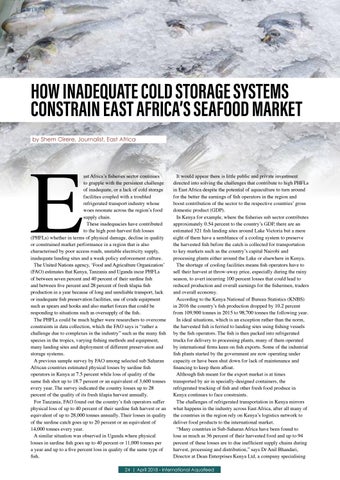
ast Africa’s fisheries sector continues to grapple with the persistent challenge of inadequate, or a lack of cold storage facilities coupled with a troubled refrigerated transport industry whose woes resonate across the region’s food supply chain. These inadequacies have contributed to the high post-harvest fish losses (PHFLs) whether in terms of physical damage, decline in quality or constrained market performance in a region that is also characterised by poor access roads, unstable electricity supply, inadequate landing sites and a weak policy enforcement culture. The United Nations agency, ‘Food and Agriculture Organization’ (FAO) estimates that Kenya, Tanzania and Uganda incur PHFLs of between seven percent and 40 percent of their sardine fish and between five percent and 28 percent of fresh tilapia fish production in a year because of long and unreliable transport, lack or inadequate fish preservation facilities, use of crude equipment such as spears and hooks and also market forces that could be responding to situations such as oversupply of the fish. The PHFLs could be much higher were researchers to overcome constraints in data collection, which the FAO says is “rather a challenge due to complexes in the industry” such as the many fish species in the tropics, varying fishing methods and equipment, many landing sites and deployment of different preservation and storage systems. A previous sample survey by FAO among selected sub Saharan African countries estimated physical losses by sardine fish operators in Kenya at 7.5 percent while loss of quality of the same fish shot up to 18.7 percent or an equivalent of 3,600 tonnes every year. The survey indicated the country losses up to 28 percent of the quality of its fresh tilapia harvest annually. For Tanzania, FAO found out the country’s fish operators suffer physical loss of up to 40 percent of their sardine fish harvest or an equivalent of up to 28,000 tonnes annually. Their losses in quality of the sardine catch goes up to 20 percent or an equivalent of 14,000 tonnes every year. A similar situation was observed in Uganda where physical losses in sardine fish goes up to 40 percent or 11,000 tonnes per a year and up to a five percent loss in quality of the same type of fish.
It would appear there is little public and private investment directed into solving the challenges that contribute to high PHFLs in East Africa despite the potential of aquaculture to turn around for the better the earnings of fish operators in the region and boost contribution of the sector to the respective countries’ gross domestic product (GDP). In Kenya for example, where the fisheries sub sector contributes approximately 0.54 percent to the country’s GDP, there are an estimated 321 fish landing sites around Lake Victoria but a mere eight of them have a semblance of a cooling system to preserve the harvested fish before the catch is collected for transportation to key markets such as the country’s capital Nairobi and processing plants either around the Lake or elsewhere in Kenya. The shortage of cooling facilities means fish operators have to sell their harvest at throw-away price, especially during the rainy season, to avert incurring 100 percent losses that could lead to reduced production and overall earnings for the fishermen, traders and overall economy. According to the Kenya National of Bureau Statistics (KNBS) in 2016 the country’s fish production dropped by 10.2 percent from 109,900 tonnes in 2015 to 98,700 tonnes the following year. In ideal situations, which is an exception rather than the norm, the harvested fish is ferried to landing sites using fishing vessels by the fish operators. The fish is then packed into refrigerated trucks for delivery to processing plants, many of them operated by international firms keen on fish exports. Some of the industrial fish plants started by the government are now operating under capacity or have been shut down for lack of maintenance and financing to keep them afloat. Although fish meant for the export market is at times transported by air in specially-designed containers, the refrigerated trucking of fish and other fresh food produce in Kenya continues to face constraints. The challenges of refrigerated transportation in Kenya mirrors what happens in the industry across East Africa, after all many of the countries in the region rely on Kenya’s logistics network to deliver food products to the international market. “Many countries in Sub-Saharan Africa have been found to lose as much as 36 percent of their harvested food and up to 94 percent of these losses are to due inefficient supply chains during harvest, processing and distribution,” says Dr Anil Bhandari, Director at Dean Enterprises Kenya Ltd, a company specialising
24 | April 2018 - International Aquafeed
FEATURE
in transportation of refrigerated products in East Africa. “Cold chain, which is an essential component of an efficient food supply chain, can help reduce post-harvest losses and increase food security in developing countries including Kenya,” he said. Dr Bhandari said transportation is the most challenging link in the cold chain especially in East Africa where poor rural road infrastructure, lack of adequate, specialised maintenance facilities are common. The situation poses a challenge to operators of refrigerated trucks face particular difficulty in providing timely, reliable and cost effective third-party logistics services to the food industry in Kenya. “As a result, there is a lack of capacity to handle transport of refrigerated products forcing food producers, farmers, and pharmaceutical companies to invest vertically in the value chain particularly in creating their own transportation and networks,” he said. Vertical investment in transportation by these groups means incurring additional costs “because such investment is not efficient since transportation is not part of their core business.” “There is great potential in Kenya for third party logistics, particularly considering that Kenya has the largest and most dynamic economy in the East African Community (EAC) and serves as the business, logistics and financial hub for the region,” said Bhandari. “Apart from the positive macro-economic indicators in Kenya, other factors that are critical to driving the market for cold chain logistics include consumer demand, government regulations, access to finance and public awareness,” he said. But like in some countries in sub Saharan Africa, the biggest challenge facing Kenya’s cold storage and refrigerated transport
segment include “high life cycle costs of providing refrigerated transport, harassment and illegal rent seeking tendencies along transport routes and at border crossings, lack of reliable energy supply for sustaining cold storage facilities, and inadequate specialised maintenance facilities for cooling systems.” “With just a few government incentives, the cold chain market in East Africa can be expected to grow rapidly,” added Bhandari. He listed the incentives to include waiver of duties and taxes on imported specialised equipment for refrigerated trucks and cold storage facilities, such as cooling equipment, compressors and electronic monitoring systems. “To effectively develop a world-class cold chain infrastructure, the government and industry bodies need to join hands to adopt better and more efficient technologies to prolong the shelf life of food products and to bring commensurate economic returns to the producers,” he said. Bhandari said he had to start his my own refrigerated transport company with one truck doing local distribution of mainly ice cream in and around Nairobi, and despite the constraints such as high cost of borrowing, harassment and unnecessary delays at border crossings, inadequate maintenance facilities and lack of back haul, “We have managed to grow over the last five years and have nine trucks that transport ice cream, yogurt, powdered milk, camel milk, pastry dough, not only within Kenya but also to Uganda, Rwanda and Tanzania.” And as FAO put it in a previous fisheries and aquaculture technical paper, “Balancing technical interventions to improve fish quality with the potential increase in selling prices, associated with better quality fish with the demand for cheaper fish by low income consumers, is an important dilemma.”
AQUACULTURE WITHOUT FRONTIERS (UK) Aquaculture Without Frontiers (AwF) is a Charitable Incorporated Organisation (CIO) that promotes and supports responsible and sustainable aquaculture and the alleviation of poverty by improving livelihoods in developing countries.
Registered charity No. 1165727
aquaculturewithoutfrontiers.org.uk International Aquafeed - April 2018 | 25
TECHNOLOGY SHO EXTRUSION EXTRUSION SHOWCASE
Top aquaculture technology
EXTRUSION TECHNOLOGY In the technology showcase this month we will be focusing on extrusion within aquafeed. Both the pelleting process and the extrusion process are adaptable to aquafeed production. As aquaculture as an industry develops however, feed extrusion technology is ever more popular in aquafeed production. This is because of its well-balanced nutrition, notable water stability and particularly the environmental friendliness. You can also read more about extrusion process in the article overleaf, written by the resident extrusion expert Joe Kearns, this month of single-screw extruders.
Single-screw extruder C.W. Brabender Instruments Inc. of South Hackensack, New Jersey, appeared as exhibitors at CWAS Aquaculture America, showing off their single-screw extruder attachment and granulator, which comprises one of their smallest available units. All of the fish feed samples shown at the exhibition were produced on that type of equipment at the University of Rhode Island. C.W. Brabender Instruments Inc. is a leading manufacturer of instrumentation for rheology, processing development, laboratory scale compounding, extrusion, mixing applications and moisture. The company’s extensive product line is used for sample preparation, R&D, evaluation, quality control new product development and production environments. www.brabender.com
Salvatore Iaquez, Vice President, Food Division, CW Brabender, USA
Conditioner Type CM ANDRITZ offer four different series of conditioners that ensures optimum preparation of the material before the pelleting or extrusion process. Correct conditioning of a material is necessary in order to obtain a good pellet quality and an effective utilisition of the pelleting or extrusion installation. Optimum conditioning results in the desired activation of natural binders by using heat, moisture, and time. The range of conditioners comprises of single or dual conditioning. The Conditioner Type CM is a large volume conditioner with a large diameter shaft with individually adjustable stainless steel paddles ensuring maximum frilling and mixing efficiency. The shaft is mounted in pedestal bearings containing grease seals ensuring long life-time. The stainless steel trough features easily accessible cleaning and service hatches. The conditioner has an integrated steam manifold, including adjustable valves over the whole length of the trough. The conditioner can be supplied fully-mounted with motor, v-belt drive, and safety guard. www.andritz.com
Twin-screw extruder The twin-screw extruder POLYtwinTM completely fulfills process requirements such as high torque, screw speeds and pressure. Due to its modular design, this highly sophisticated machine is extremely flexible in application. It can be used to process breakfast cereals, food ingredients, petfood and fish feed for industrial fish farming optimally. Other customer-specific applications are also possible. Stateof-the-art sanitation standards, excellent workmanship and an outstanding price-performance ratio make POLYtwinTM the ideal solution in the field of food and feed extrusion. www.buhlergroup.com
26 | April 2018 - International Aquafeed
OWCASE Energy Management Valve This newest tool from Extru-Tech to compliment your existing Food Safety System and complete your journey towards FSMA compliance. The FMA provides a number of engineered food safety benefits: Seamless integration into the only “Validated Food Safety System.” Variable control of “Reject Mode” for accelerated acquisition of CCP temperature/pressure. Full SSOP Integration. Redundant temperature/pressure instrument wells to facilitate CCP monitoring. No dead zone where residual product can harbour pathogens. The Extru-Tech Energy Management Valve (EMV) is just one more next generation tool to help you control the extrusion process. The EMV replaces your existing final head and allows for high resolution/manipulation/control of product density. It also provides increased flexibility with products that have any type of inclusion: fresh meat, stabilised protein slurries, and all types of liquid (fat, oil, humectants or slurries thereof). www.extru-techinc.com
FEATURE
CROSS-CONTAMINATION SALMONELLA
INCONSISTENCY REGULATIONS
PATHOGENS
DOWNTIME
PROTECT YOURSELF FROM THE ELEMENTS PRODUCT CONSISTENCY PROCESS FLEXIBILTY VALIDATED KILL-STEP FOOD SAFETY VERIFIED EXTRUSION CERTIFICATION Sanitary start-up system Ever Extruder engineers and manufactures extruder equipment, specialising in both after-market upgrades and complete extruder systems. With more than 20 years of experience, their engineers utilise state-of-the-art technology to improve operations, production, and sanitation in the extruder industry. Ever Extruder designs and builds one of the most cost effective Sanitary Start Up and Discharge Systems on the market. The proprietary system allows you to adjust cooking and run parameters on the fly with operator friendly controls. www.everextruder.com
SANITATION CONTROL PLANT CERTIFICATION MANAGEMENT SYSTEMS
P.O. Box 8 100 Airport Road Sabetha, KS 66534, USA Phone: 785-284-2153 Fax: 785-284-3143 extru-techinc@extru-techinc.com www.extru-techinc.com
International Aquafeed - April 2018 | 27 ET-275C.indd 1
12/22/15 3:33 PM
EXTRUSION SHOWCASE
SINGLE SCREW EXTRUSION IN AQUAFEED
T
by Joe Kearns, Owner, JK Kearns Consulting and Meridian Ingredients
he single screw extruder, the “World Heavy Weight Champion of Extrusion Tonnage Per Year Overall”, is the topic of concentration in this issue. Perhaps a review of the history and the developments the single screw extruder has undergone is in order and would be beneficial. The history of extrusion started years ago in an unusual fashion, by design and by accident. A major pet food group, Purina, took plastic extruders and changed them to make simple pet foods. Wenger, a small-localised equipment manufacturer in Kansas, was experimenting in making a high molasses feed for the livestock industry. Accidents happen, as in not turning on the liquid flows to the machine. The die, on an extrusion like machine, plugged except a few holes where the material came out highly expanded or “puffed up”. Studies were done on this product by Kansas State University confirming the product was cooked. No one cooked livestock feeds 60 to 70 years ago. What happened next changed or contributed greatly to the “World of Extrusion Cooking”. Purina marketed a product made for pets as noted above and their competition researched the method of its production. Kansas State, when asked, confirmed that they did not know how it was made but a small company (at that time) in Sabetha, Ks., Wenger, made something with similar characteristics. The phone rang in Sabetha and the research began in trying to figure out how to make this unusual occurrence happen again and on demand. The birth of a new commercial industry, extrusion cooking began. Initially the industry, which was basically just starting,
demanded simple pet foods and other products. Actually, one of the first extruders Wenger sold was for Venezuela and for floating fish feed. Some one noticed the feed floated and the vision of fish eating on the surface started in the 1950’s. It is hard to explain but not many know all of the situations that had to be overcome to make this system work. Examples include, raw materials and continuous operation. In my opinion, these were the major two areas of work initially. How did this system work and what made it work and why were ingredient qualities, grind and the percent in the formula important? What happened to the vitamins, fats oils and other components when extruded? How could the equipment be designed to run 24 hours a day with no issues? The research of both of these aspects, mostly by trial and error, changed over time into a science. If you can imagine, this was all in the experimental times and
everything had to be learned and researched. Were ingredients extrudable, what was the nutritional value after extrusion? How to move the product around, drying methods, coating, and everything surrounding the process had to be developed and proven. Extreme changes and advancements to date have occurred and as a result you have the modern-day extrusion process. Extrusion was not always so simple as there were many difficulties. Most difficulties were extended running time. One example is preconditioning, and it has advanced dramatically. Why? It did not work well having a simple preconditioner
28 | April 2018 - International Aquafeed
FEATURE
on an extrusion cooker at the moisture levels normally used in extrusion. A single cylinder conditioner, much like the one on pellet mills, at approximately 25 percent moisture level created a sticky material which did not flow as well as needed over a period of time. The material plugged in the downspout between the cylinder and extruder barrel. In many cases the plug was cleared by hand while running, preferably with a stick not fingers. In some cases, it was so sticky the machine had to be shut down and cleaned. Downtime is costly. Prove you can run and not stop. It is difficult to determine one aspect that has not been improved. It was not just the extruders and dryers. Accuracy in the raw material area such as weighing, mixing, grinding, sifting all improved so that evenness and uniformity gave consistency in production. Present day situations in comparison are still there but vary. An example; how can we take the starch out of the aquatic formula, as fish or shrimp do not utilise it? Current rules are 10 percent starch minimum for sinking feed and 20 percent minimum for floating feeds. However, there are considerations, the ingredient quality of the other formula components, the grind of the raw materials, the extruder arrangement or hardware and of course the operating conditions. Can we make the feed neutrally buoyant? Can you make the feed swim or move in water? These are not questions normally seen for simple machines to achieve. Obviously as extrusion ability improve the industry comes up with ideas for feeds to push the limit to a higher level to improve overall feed conversion ratios or simply bring a new fish to aquaculture. Where are single screw extruders today? Keep in mind there are differences between suppliers but in a general sense these advancements are available. Loss in weight feeding is designed for accurate dry ingredient inclusion as it is also slaved to the liquid flows as in steam, water, oil and others. This gives you an exact material in the conditioner. Conditioners vary greatly in the industry and the desired result out of this device is a non-sticky free flowing powder where the moisture has been thoroughly absorbed into each particle evenly with a predefined level of cook or starch gelatinisation with no nutritional damage. The extruder barrel comes in two basic designs, single or twin-screw extrusion, which is best for you? Generally, this is defined by what you wish to make in terms of the final feed specifications? More appropriate is what ranges of products are to be made so best machine design can be evaluated for the full range. Desired ingredient inclusion, product diameter and the final desired shape happen to be the questions asked to determine the best fit for a machine. Typically, single screw extruders can make feeds with up to about 25 percent fresh meat inclusion, up to about 15 percent fat inclusion and make many product diameters and shapes. There are limitations, and this is where the twin-screw machines come into play. A good example would be micro feeds, much easier to make over time on a twin-screw extruder due to the positive pumping action of the twin-screw design. Twin-screw designs can be operated to hold the pressure behind the die to reduce back flow resulting in uneven production as seen on single screw machines after some wear on the extruder barrel. The most likely reason it has been seen that aquatic feed manufacturers have both designs. Single screw for the bulk larger diameter feeds and the twins for shrimp feed and smaller diameter feeds required. Good luck in your extrusion cooking. Please send comments, questions or topics for future articles to: zashaw@perendale.co.uk for response and consideration. International Aquafeed - April 2018 | 29
EXTRUSION SHOWCASE
Examining the importance of extrusion training and how it can benefit aquaculture as an industry
E
by Zasha Whiteway-Wilkinson, Production Editor, International Aquafeed
arlier this year International Aquafeed magazine and Dr Mian N. Riaz, a world leader in extrusion technology and the head of the extrusion technology programme at Texas A&M University, hosted a one-day aqua feed extrusion course at the VIV MEA Abu Dhabi exhibition. This article looks at extrusion both as a vague concept and then more specifically how the technology can be appropriated to making fish feed. The practice is very new (about 30 years or so) yet it is now an absolute fundamental to the aqua feed industry and it’s almost impossible to imagine how the art of making fish feed would have progressed without it. When you have a technology that is both vital to an industry and is a reasonably new concept, it is essential that the sector that birthed the practice provides the appropriate training to those up and coming aquaculture professionals who want to learn the trade. Courses such as those described above are a perfect
example of how vital knowledge and experience can be gained without too much time. Dr Mian Riaz, host of the course explained, “Feed quality is one of the most important parameters for fish farming. This one-day course provided a better understanding about raw materials and extrusion as well as pre and post operations.” He continued, “On this course, participants learnt about the current status of aqua feed globally, principles and an introduction to extrusion technology, a selection of raw material and their properties for making aqua feed, grinding of raw material for making good quality pellets, extrusion of aqua feed, drying and cooling of aqua feed, optimising quality and the latest technology for the ingredients and finished product analysis.”
Extrusion – A definition
Extrusion is a process used to create objects of a fixed crosssectional profile. A material is pushed through a die of the desired cross-section. The two main advantages of this process over other manufacturing processes are its ability to create very complex
30 | April 2018 - International Aquafeed
FEATURE
STRONG ENOUGH TO FACE EVERYTHING!
cross sections and to work materials that are brittle, because the material only encounters compressive and shear stresses. It also forms parts with an excellent surface finish. In aqua feed, pellets made by extrusion are more resistant to disintegration in water than that of pelleting. There are three types of pellets produced by extrusion: fast-sinking, slow-sinking and floating form that is available in all water layers to make a rapid and constant growth of fish. Notably, a floating feed allows fish farmers to observe the condition of the fish and the amount of food consumed.
Extrusion – In aqua feed
The process is a high temperature short time (HTST) heating process, it minimised the degradation of food nutrients, while improving the digestibility of protein and starches. Extrusion requires higher levels of moisture, heat, and pressure than pelleting. Temperatures higher than 100 degrees Celsius is needed to achieve expansion of the feed as it leaves the die. Extrusion consists of wet extrusion and dry extrusion. The high temperature in dry extrusion is acquired through dissipation of mechanical energy from heated surfaces such as barrel and screw surface or generated by shear forces between wall and material and screw and material. For wet extrusion, the temperature is achieved through preconditioning and steam injection. Simultaneously the material also undergoes relatively high pressure. The pressure difference in the interior of extruder and the external environment will cause the extrusion of the aquatic feed. As the material is squeezed through die holes at the end of the extruder barrel, part of the water in the superheated dough immediately vapourises and causes expansion. The popular machines for pellet extrusion are wet type fish feed extruders and dry type fish feed extruders. There are multiple differences between extruded fish feed and pelleted aqua feed, both pros and cons. Pelleted fish feed, the sinking pellets are prone to leaching of nutrients into water due to poor stability and disintegration of feed to the bottom waters at feeding. This has been shown to lead to significant losses in aquaculture input management.
Leiber® Beta-S – β-glucans for: Improvement of the cellular & humoral defence mechanisms Support of immunological competence in larval & juvenile stages Improvement of feed conversion Visit us in Taipei/Taiwan: APA 18 | Stand 30
The course
This course was held during the VIV Abu Dubai exhibition in the Abu Dhabi National Exhibition Center. This course was attended
leibergmbh.de
International Aquafeed - April 2018 | 31
FEATURE
by more than 40 participants from several different countries, including, Pakistan, India, Iran, Myanmar, Singapore, Egypt, Kuwait, Saudi Arabia and several other countries. Participants appreciated learning about the latest knowledge and information about aqua feed extrusion technologies. Alongside the general experience, all the participants received a certificate of completion at the end of the course. The run-down of the day went as such: 0800 – registration and welcome; 0815 – current update on aquafeed globally;
0830 – introduction and principles of extrusion (Dr Mian Riaz); 0930 – preconditioning technology for aquatic feeds (Ramesh Gangatharan, Technical Sales Advisor, Wenger Manufacturing Inc.); 1030 – raw materials properties for aqua feed extrusion (Dr Mian Riaz); 1115 – grinding of raw material for the aqua feed (Benjamin Sleiman, CPM Europe B.V.); 1330 – optimisation of aqua feed quality (Nicola Tallarico, Kemin); 1415 – extruded aqua feed quality management: relations betyween technology and extruded aqua feed quality (Thomas Ellegaard Mohr, ANDRITZ Feed and Biofuel); 1515 – drying and cooling of aqua feed (Josef W Barbi, E.S.E. and INTEC); NIR analyser for ingredient and raw material (Per Lidén, Perten) before finally a question and answer session at 1700. When asked why the course was important for attendees and what made the plethora of talented industry speakers such a worthwhile time, Dr Riaz explained, “There are hundreds of species of fish, which require a wide range of feeds. Some species need floating feed (catfish, carp), some of them need slow sinking feed (salmon, trout), and some of them need fast sinking feed (shrimp). The quality of the feed has a direct effect of fish reproduction, maturation, growth rate, uniformity of growth resistance to stress and diseases, mortality and water quality.” He summarised, “The feed industry experiences constant change to meet the needs of the evolving market. New processing technologies provide the flexibility and efficiently to process a wide spectrum of foods that are trending toward increased complexity. “Due to the rising demands of production and necessary food per person, the consumption of fish increases dramatically, as does the need for courses such as these” he concluded.
COMPLETE FISH FEED PLANTS KAHL fish feed plants are equipped with the latest process technology, the core of which is the extrusion system with the extruder OEE and the process control system ESEP. In the production process, the raw materials undergo the process steps of weighing, fine grinding, mixing, extrusion, drying, vacuum coating, cooling and packaging. AMANDUS KAHL GmbH & Co. KG Dieselstrasse 5–9 · 21465 Reinbek Hamburg, Germany +49 (0) 40 72 77 10 info@akahl.de · akahl.de
32 | April 2018 - International Aquafeed
FEATURE
Petfood
& Extrusion Treats Conference
21 June 2018, Jaarbeurs, Utrecht, The Netherlands Pet food and treats are growing rapidly all over the world due to the sharp rise in pet humanization and with increasing disposable income. According to one report, U.S. pet food market was valued at over USD 24.60 billion in 2016, is expected to reach above USD 30.01 billion in 2022 and is anticipated to grow at a CAGR of slightly above 3.36% between 2017 and 2022, and global pet care market sale was reached US $110 billion in 2017 (Pet food Industry.com).
Pet Food Extrusion Trends - Dr. Mian Riaz, Head Extrusion Technology Program, Texas A&M University, USA Extrusion of Pet food and Treats with Single and Twin Screw Extruder - Spenser Lawson- Wenger Mfg., Inc Advanced Single Screw Extrusion for Companion Animal Food, Specialty, Treats, and Supplements – Will Henry - Extru-Tech, Inc.
Extruded Petfood Quality Management; Relations between Technology and Extruded Petfood Quality - Thomas Ellegaard Mohr, ANDRITZ Feed & Biofuel Pet Food Quality Optimization and Palatability - Geoffroy Berthe - Kemin Industries
bit.ly/petfoodextrusion Organised by
Supported by
International Aquafeed - April 2018 | 33
EXPERT TOPIC TROUT
INTRODUCTION
TROUT EXPERT TOPIC
Although less well known, nor as popular as its more colourful cousin, the rainbow trout, the brown trout is a medium-to-large fish with a dark back and a creamy yellow belly with many black and red spots all over the body. As a member of the Salmonid family they possess an adipose fin (a small rounded fin located between the dorsal and tail fin along the back of the fish) However, unlike the salmon the brown trout’s jaw extends beyond the eye. The brown trout (Salmo trutta) is an originally European species of salmonid fish. It includes both purely freshwater populations, referred to Salmo trutta and anadromous forms known as the sea trout, trutta. The latter migrates to the oceans for much of its life and returns to freshwater only to spawn. Although they are one of Europe’s most widespread freshwater fish, in other parts of the world, brown trout may be considered an invasive species, In the United Kingdom they are found pretty much everywhere and because they are an aggressive predator and will take most live baits, the fish is popular with anglers. Many local authorities ensure that river fisheries, such as the River Severn and River Trent, are regularly stocked with the fish (see our accompanying article on Bibury Trout Farm). Spawning occurs between January and March when females (accompanied by a number of males) lay their eggs on gravelly
by Vaughn Entwistle, International Aquafeed beds. Fertilised externally, the eggs are buried in the gravel. The young fish (fry) hatch and feed on the nutritious yolk sac before moving on to feed on invertebrates. As mentioned previously, brown trout are predatory fish and eat a great variety of foods. It commonly feeds upon land and water insects, zooplankton, worms, crayfish, small clams, snails, and a variety of small fish (young trout, sculpins, minnows, and darters), and on insect larvae, and flying insects such as mayflies and damselflies. In small streams, brown trout are important predators of macroinvertebrates, and declining brown trout populations in these specific areas would affect the entire aquatic food web. Whilst they will happily eat maggots and worms, trout along with salmon are known as game fish and for the purists, should only be caught with a fly. There is a considerable art and skill involved in fly fishing which involves using nothing more than hook attached to your line. The hook is dressed usually with bits of feather and other materials as an imitation of shrimps, small fry, insects and other water invertebrates that make up the fishes natural diet. It is also an art to dress/tie your own hooks. The biggest challenge for ardent fly fishermen/fisherwomen is to land a brown trout using only the hook, convincing the ever wary and very cleaver fish that it is real prey/food, hooking, playing and then landing the fish. Because of active breeding programs, their conservation status is officially ranked as “least concerned.”
34 | April 2018 - International Aquafeed
EXPERT TOPIC
The University of Limerick (UL) is a rapidly growing, modern university. UL is a young, energetic and enterprising university with a proud record of innovation in education, and excellence in research and scholarship. We take great pride in attracting students who are seeking a supportive learning environment to help nurture and achieve their personal and professional dreams. UL is highly regarded for conducting leading-edge research in key areas such as biological sciences, information and communication technologies, materials and surface science, environment & bioengineering and humanities & social sciences. Limerick is in western Ireland, an ideal starting point to explore the Wild Atlantic Way. Shannon International airport is only 24km away with frequent bus connections. Limerick, with an urban and hinterland population of over 200,000, has something to offer everybody thanks to its many cultural, historical, architectural, sporting, shopping and business activities. With almost 50 per cent of Limerick’s population under the age of 30, it is a vibrant, living, cosmopolitan city.
TROUT
We have the largest work placement programme of any university in Ireland, with a network of over 1700 employers Amazing academic and sporting facilities on a stunning campus Graduate employment rates that are 18% above the Irish average
www.ul.ie
Double Shaft Paddle Mixers (DPMA) The Wynveen double shaft paddle mixers, realizes high mixing capacity with a relative small mixer content. The mixer has a mixing time, depending on the product type and quantity, from 30 to 60 seconds. Features • Capacities available from 500 to 20.000 liters • Mixing accuracy of 1:100.000/C.V. < 5% • Short mixing time of approximately 30-60 seconds • Minimum filling degree will be 25% of the nominal content • Extra wide bomb doors.
www.wynveen.com International Aquafeed - April 2018 | 35
EXPERT TOPIC TROUT
TROUT EXPERT TOPIC A day at the fish races: A local trout focus by Vaughn Entwistle, Features Editor, International Aquafeed
N
estled in the Coin Valley in the bucolic vales of the Cotswolds is the village of Bibury. If you have a British passport, you’ll find a reproduction of some of its famous cottages on the inside of the front cover. Bibury is renowned as “the most beautiful village in England.” It’s also home to Bibury trout farm, one of Britain’s oldest and, arguably, most scenic trout farms. Naturalist Arthur Severn founded the farm and hatchery in 1902 to stock the local rivers and streams with native Brown Trout. Today, the main focus of the trout farm remains the same: 90 percent of the fish they produce go towards restocking rivers and streams, while a mere ten percent is sold for direct consumption.
Company outing
We here at Perendale try to ensure that all our employees are knowledgeable and fully invested in the industries we serve. In keeping with this philosophy, the entire office staff recently visited Bibury’s farm and hatchery facility. So on a brisk, bluesky day in early March Hatchery Manager, Martin Smith, toured us around the facility. Martin has been with Bibury for five years, but will soon be moving on and handing the position over to the next manager, Robert Waker. Bibury is an open-air trout farm that is also open to visitors, and like the rest of the public, we entered and exited through the gift shop.
GlobalGAP Certification
After a brief tour of some of the uncovered fishponds, Martin
36 | April 2018 - International Aquafeed
EXPERT TOPIC had us dip the soles of our shoes in a disinfectant solution before we entered the hatchery facility. He explained that such basic hygiene practices are required as the site of the hatchery is GlobalGAP certified. GlobalGAP is a Global Food Safety Initiative (GFSI) recognised standard that assures buyers that basic food safety and sustainability practices have been upheld. The GlobalGAP (Good Agricultural Practice) certification is necessary as some of the customers of the hatchery supply fish to supermarkets. The entire farm complex is not GlobalGAP certified due to the difficulty of upholding the standards in areas where the farm functions as a tourist attraction visited by families with children and babies in strollers. The hatchery is also RSPCA assured, and holds QTUK accreditation.
The hatchery
The hatchery complex is comprised of three buildings and multiple atmosphere control marquees. Each of these components is necessary to produce eggs and raise them into triploid females of a size where they can safely be introduced to the farm (more on “triploids” later).
Fertilisation room
The place where science and skill play the largest part is the fertilisation room. This is where Martin collects the eggs and the sperm from female-only fish. A female population is preferred for trout species as males mature sexually while they are quite small and by time they reach market size their meat is grey and watery. For this reason, a monosex culture of so-called “triploids” is preferred.
Save time, frustration and money. INTRODUCING WENGER’S NEW MODULAR EXTRUSION INTEGRATION (MOXI) Wenger’s plug-and-play solution for extrusion process design and implementation reduces system installation time by up to 60 percent. It literally eliminates the need to design interconnection piping between devices, and reduces the requirement for local contractors – who may be unfamiliar with current extrusion process design standards. With MOXI, there are no floor-mounted extruder components; so the extruder barrel is clear of all system attachments, while providing ready access for maintenance, cleaning and sanitizing. Know more about the extreme benefits and customized options of MOXI. Email us at info@wenger.com today.
Developed and supported by
PHONE: 785.284.2133 | EMAIL: INFO@WENGER.COM | WENGER.COM USA
|
BELGIUM
|
TAIWAN
International Aquafeed - April Aquafeed 2018 | 37 37 | April 2018 - International
|
BRASIL
|
CHINA
TROUT
EXPERT TOPIC
TROUT
Producing triploids
Triploiding is a process involving the manipulation of an egg by applying pressure at a specific time during the fertilisation process. The pressure causes an extra set of chromosomes to develop. The resulting fish will not grow any reproductive organs. After triploiding, these fish could be described as female but genetically sterile. This is an important process as it ensures that the farmed fish will not interact with any native fish. Additionally, a nice by-product of triploiding is that the fish expend no energy into reproduction and instead use that energy for growth. “Triploiding is all about timing,” said Martin. “Everything is recorded. Time zero is when I add the sperm to the eggs, and at minute three is when I deem the eggs are fertilised. At exactly 40 minutes after fertilisation (when factoring in machine start up time) I will turn on a machine that pressurizes a vessel holding up to 10,000 PSI. The eggs sit inside for five minutes before the pressure is released.” Martin adds that triploiding has even been observed in the wild. At the bottom of some glacial rivers, where there is a lot of cold water rushing downwards, the same effects as modern pressurized triploiding can occur. Interestingly, heat was used on fish farms prior to the use of pressure. The eggs would be brought up to 60 degrees for a specific amount of time to cause the same effects; however the results were not as consistent as those obtained via the pressure method. Checking that the triploiding process has been successful is of vital importance. At Bibury, 100 fish that have reached five grams per batch are checked to see if they have developed a reproductive system. “If I went around saying I was selling triploids, but was actually selling regular females,” Martin explained, “a customer could release them into a river and get
into a lot of trouble. ”This is why ensuring accuracy throughout the process is paramount.”
Incubation room
We next visited the incubation room, which contained a wall of sealed glass tanks connected by piping. The vessels were full of bore hole water that had been passed through a de-gassing unit, just like the rest of the water used for all of the hatchery processes. During our visit there were no eggs currently being incubated—
38 | April 2018 - International Aquafeed
EXPERT TOPIC
probably a good thing considering how fragile the eggs are in this state. Nurturing trout eggs can be very difficult; a lot can go wrong very quickly. This was evidenced once when a gust of wind blew the door shut abruptly, “I knew it was going to be bad,” Martin explained, “In that moment over 500,000 eggs were lost, just the air pressure change was enough.” The greatest risk at this stage, however, is fungus. When an egg dies it produces a fungus around it that will in turn cut off the oxygen to the other 200,000 eggs stored in the tank, potentially killing them too.
TROUT
A constant but steady flow of water into the bottom of each tank functions to keep the eggs only just in a state of suspension so that the weight of eggs on top does not affect the rest. The flow of water assists in keeping the water in the tank sustaining good oxygen levels. During the incubation period around 80 percent of fertilised eggs make it to hatching; in winter this figure can go as high as 95 percent. At the end of the incubation period, all eggs are subjected to a process referred to as ‘shocking’, that involves moving the eggs about. At Bibury they do this by pouring them back and forth between buckets. This will cause any dead eggs to turn white, making them easier to identify so they can be removed. In the past, all of the eggs would be laid out in a tray and the white ones would be removed by hand, a time-consuming task. Now a machine is employed, which uses infrared technology to detect the white eggs and remove them, a time-saving device greatly appreciated by the hatchery staff.
Degassing
It would seem that having a source of clean, spring fed water would be perfect for an aquaculture environment, but although spring water has the advantage of keeping a stable temperature, it has other issues. “The gasses are horrendous,” Martin explained” especially nitrogen and CO2. We spend a lot of money to degass the water. We’ve built what is basically a u-bend deep well aerator. When you have no height available in which to drop water to break it up and aerate it, you have to create depth. The water that enters the chamber from the spring goes down one side of the centre wall and is met by vigorous aeration coming up. This gives a very good retention time of the bubbles for maximum oxygen International Aquafeed - April 2018 | 39
EXPERT TOPIC
TROUT
diffusion. The water then passes under the centre wall and back up the other side where even more aeration meets it and this helps break the water up to release excess nitrogen and CO2. “It isn’t as efficient as a vacuum degasser,” Martin added, “However, it has very low running costs in comparison. The only running cost currently is the blower to create the aeration. The unit isn’t finished yet as we’re still trialling the diffusers and the depths at which they operate.” (In addition, the hatchery also employs a vacuum degasser.)
Hatching room
The hatching room was dark, and contained many fish at
various stages of early development in shelved trays of water. Some of these trays contained 5000 fingerlings. The majority of fish in this room were around 21 days old, and not as fragile as the eggs. “Once eggs have eyes they are more resilient to external forces such as bumps and air pressure.” Martin explained. “We produce up to 3.5 million eggs per year. We only sell eyed eggs, and our average sales are around one million eggs per year. 90 percent of our eggs are sold to other fish farms. We keep only around 2,000 for ourselves.” All of the fish at Bibury are vaccinated against enteric redmouth disease. When the fish are small they are dipped, unlike some
40 | April 2018 - International Aquafeed
EXPERT TOPIC other farms Bibury does not inject their fish with vaccinations when they get larger, simply because they do not have problems with enteric redmouth. When the fish are large enough they are moved to outside ponds where some are grown in artificial climates and separated into sections depending on their size and stage of development. This is necessary, as trout are known to cannibalise one another.
Rearing tanks
After the hatching room, we moved back outside to look at the concrete rearing tanks which each hold around 10,000 swimming fry, with 90 percent of those being sterilised fish.
Quality control management – Fully fledged fish
Fish intended for restocking for angling purposes are carefully hand-checked for fin quality, size and any external signs of disease before being put into a special pond to await transport. “We are currently at max capacity,” Martin explained. “If we added recirculation, we could double production, but as we are a restocking farm, growth is not that important to us.”
Feed the fish
The fish are fed skretting. “The type of food we buy is very important,” Martin said, “as we are now GlobalGAP certified, which requires that our food is GlobalGAP certified. Other requirements come from customers. Many supermarkets won’t allow certain things in the fish feed such as bone meal, blood meal, or feather meal.” At the end of our hatchery tour, Martin showed us around
TROUT
the beautiful outdoor uncovered fish farm that is also open to members of the public. Farm visitors are able to purchase food to feed the fish, a popular past time with children. It must be pointed out that such hand feeding only represents a tiny amount of additional feed; the vast majority is fed to the fish by farm staff. There is also a fishing experience available to visitors where in one specific part of the farm they can catch, purchase, and take their caught trout away with them. If that were not enough, during the season Bibury makes barbecues available so visitors can purchase their fresh trout from the Bibury farm shop and cook them up on the spot!
Final thoughts
Although Bibury Trout Farm is a modest operation, the farm produces 110 tonnes of live trout per year and currently has around 800,000 total fish. These numbers are even more impressive when one considers that the farm achieves all this with Martin running the hatchery and just four more full-time staff. During the peak season in summer, when the farm hosts visiting families and tourists, the shop and café employ around 20 to 30 staff. So if you travel to the Cotswolds to see the “most beautiful village in England” be sure to visit Bibury trout farm to see some beautiful (and very tasty) trout. The Farm is open daily, April - September 8am - 5:30pm. March and October 8am - 5pm. November - February 8am - 4pm (closed Christmas Day). Groups, school and coach parties welcome. Beginner’s fishery open between March - October, weekends, Bank Holidays and local school holidays. www.biburytroutfarm.co.uk
Containerised Mills outputs 3 - 45 ton/h
All components reliable and tested Assembled and checked in factory before dispatch Container sized support frame included All electric components included Low freight costs and easy handling Saving on civil & building cost Minimum installation time on site Proved concept with many outstanding references
Modular solutions for: › Compound feed production › Pet food › Aqua feed › Cereal processing plants › Soybean processing › Premix / concentrates plants Type: C30-15-15
www.ottevanger.com
International Aquafeed - April 2018 | 41
A Triott Company
» » » » » » » »
FISH FARMING TECHNOLOGY
#1
Changing the perspective: Underwater robotics enhancing aquaculture practices by Deep Trekker, Canada
As the global population steadily increases, the human world continues to face its greatest challenge: how to deal with world hunger. The United Nations recognises that aquaculture may be the sustainable protein source required to help accomplish such a feat. As promising as the industry may be, there remains an abundance of challenges around aquaculture as a solution to this complex issue.
Due to the fact that 90 per cent of aquaculture operations are underwater, the industry has turned to new and innovative technologies to overcome its unique challenges to ensure sustainable and high-quality food source. The most widely accepted system is remotely operated vehicles (ROV), otherwise known as underwater drones. These robotic cameras offer immediate access to observe aquaculture operations from underwater – providing numerous benefits for site managers, enforcement officers and researchers around the globe.
Operation uses of ROVs for aquaculture farms
Aquaculture farms are using ROVs every day to perform a variety of tasks to assist site mangers and better understand fish and health behaviour, and as a result produce a better product. ROVs have not always been widely accessible to aquaculture farms, and site managers would previously hire professional commercial divers to complete inspections or use limiting static cameras to inspect submerged infrastructure. With the option of using an ROV, site managers can now navigate extensive infrastructure and attach tools such as benthic samplers, mort retrieval systems and net repair patches.
Monitoring feeding times
Traditionally, fish behaviour is monitored from the surface – an employee will disperse an allocated amount of feed into each cage. In cases where an automatic feeder is used, a static camera is mounted within the cage below the feeder. Both tactics are great examples of how ROVs can be used and gives a complete picture of what happens during feeding time. Employees are able to manoeuvre the ROVs throughout the subsea environment to monitor fish behaviour and ensure the fish population is being fed evenly and no excess food is being dispersed.
Monitoring school behaviour
The salmon species is known to jump when they are happy; a characteristic that aquaculture professionals look for as a sign that things are running smoothly below the waterline. When oxygen levels are low, fish begin to school deeper into enclosures where it is cooler and oxygen-rich. ROVs are a quick way to see if the schooling behaviour is changing. The Deep Trekker robotic system is
42 | April 2018 - International Aquafeed
FISH FARMING TECHNOLOGY
completely battery operated, meaning a single person can carry it between pens for a quick look at any time during the day, without the hassle of setting up a large system or finding a nearby power supply or generator. Monitoring fish behaviour throughout the day also provides the education needed to help spot potential threats such as low oxygen or algae blooms.
Inspecting predator nets
Offshore fish farms use additional high-strength nets outside of stock enclosures to keep fish safe from predators, such as sea lions and sharks. The integrity of these nets is extremely important to ensure stock is kept safe and not removed from the area. Small tears in the netting is all it takes for predators to manoeuvre through and enter the fish environment. With the use of ROVs, the system can move laterally and can be outfitted with side-facing cameras to work in offshore environments and attach patches to points of risk. When an area requires a diver’s attention, the team can use their already recorded footage to narrow in on specific points of interest, making the dive far more efficient.
Inspecting anchors and mooring lines
An ROV is often used when inspecting where mooring lines and anchor points will be positioned in an aquaculture enclosure. The initial step prior to and while the installation is being done can quickly mitigate potential complications before they arise and record video footage for later review and documentation. Additionally, once in operation these lines are integral to keeping a sound structure. It is important to ensure repairs are completed efficiently. Deep Trekker’s patented pitching system allows the ROV to hold a specific pitch angle of the rope and follow the rope down at the same angle with ease. International Aquafeed - April 2018 | 43
FISH FARMING TECHNOLOGY
“With the growing need for a sustainable food source, world organisations are accepting the idea of aquaculture, and seeing robotic systems as the solution to making it successful"
Smolt introduction
Smolt introduction is the transition from a hatchery to an aquaculture site. The slightest change can make a huge impact on the stock’s wellbeing. During this adjustment period, site managers use ROVs to observe the farm. An ROV can be deployed in water by a single person and detect and observe immediately to make the appropriate correction, if necessary. If there is a mort, the Deep Trekker mort retrieval can be used for immediate surface diagnosis.
Monitoring diver’s work
Highly skilled commercial divers continue to play an important role in the world of aquaculture. In some situations, there are advantages to having human interaction. However, the use of ROVs is much safer and more efficient than the use of commercial divers. Numerous diving companies own and operate their own Deep Trekker ROVs, allowing them to monitor and provide direction from the surface.
Recording images and video for documentation
Training new or seasonal employees, completing longitudinal studies and regulatory complications, are beneficial to the recordings captured on ROVs. Having video documentation on record is another way aquaculture experts can provide facts for public use. It is also beneficial to send documentation to contractors who are completing repairs and need this data for environmental reports and regulations.
Conclusion
With the growing need for a sustainable food source, world organisations are accepting the idea of aquaculture, and seeing robotic systems as the solution to making it successful. The emergence of affordable ROVs provides the ideal solution to monitoring day-to-day operations, enforcing regulations and investigating the surrounding areas and ecosystem. www.deeptrekker.com 44 | April 2018 - International Aquafeed
FISH FARMING TECHNOLOGY
ariculture, Inc. | 2018 Advertising | Theme: The Plankton People Ad | Design: A | Version: 1
DANIEL CO
nt: International Aquafeed magazine | Size: Half Page | Dimensions: 190mm X 132mm
Reed Mariculture: The Plankton People
™
We take care of the little guys Reed Mariculture advances the growth of aquaculture around the globe with the highest quality MICROALGAE CONCENTRATES, LIVE ROTIFERS and COPEPODS for clean-start production—bulk quantities available. Your resource for information & technical support.
Reed Mariculture E N S U R I N G H A T C H E R Y S U C C E S S™
L E A R N M O R E AT :
bit.ly/iaf-tpp4
© 2018 REED MARICULTURE INC. ALL RIGHTS RESERVED. ENSURING HATCHERY SUCCESS AND THE PLANKTON PEOPLE ARE TRADEMARKS OR REGISTERED TRADEMARKS OF REED MARICULTURE INC.
International Aquafeed - April 2018 | 45
FISH FARMING TECHNOLOGY
#2
Optical oxygen sensors
Using ‘handhelds’ in measuring electrochemical and physical values in fish farms by GRYF, Manufacturer of Electronic Measuring Instruments, Czech Republic
Reliable sensors and systems are necessary with either land-based aquaculture or in ponds and offshore.
Farming on land requires accurate and stable measurements of oxygen, temperature and CO2 levels. With accurate information from the necessary technology, including; environmental information, stress, disease and overfeeding, the fish mortality rates can be at least lessened if not avoided completely. Oxygen levels below fish welfare and limit of tolerance will yield poor production results due to lower appetite and feeding utilisation. Temperature is also an important physiological parameter for the fish-stock as it has been noted that they have the best appetitie when the temperature conditions are optimal – good current conditions will ensure a supply of fresh, oxygen-rich seawater.
Providing solutions for water monitoring and optimal farming
Company GRYF HB has over 25 years of history, having been founded in 1990 by the company CEO and owner Mr Vaclav Navratil. As of now, company GRYF is family run business apart from the company owner employing another family member in managerial positions. Its first focus was to manufacture small handhelds for aquarists measuring electrochemical and physical values such as pH, oxygen, conductivity, ORP. Over the following years the GRYF extended its product range for industrial measuring systems. These systems have been installed in hundreds of different type of application such as process controls, chemical dosing, oxygen dosing and many others. Due to the high standard and reliability these systems are preferred amongst our customers. The motto of the organisation is “Innovation, tradition and reliability”. Proof of the success of this can be seen with the supply of products to the University of Defence, NBC Defence Institute, which protect and measure lethal substances permeation. From standard industrial measuring and control systems the very robust system XBase has been developed. The XBase system is manufactured as portable units, laboratory system or industrial system. Thanks to its many features the system can be used with no further changes to control complete applications such as fish farms, industrial application (brewery, swimming pools, galvanic applications, laboratory fermenters and many others).
Optical oxygen sensors
The sensor (XB4-S) is capable of operating in both salt and fresh water conditions, and is designed to be partnered with industrial, laboratory and portable quality measuring and control systems. It can be retro fitted to most existing systems with no further modifications needed, saving time and money when checking water quality in fish farms.
The importance of product development
However, the development in GRYF never ends. Our team of world class engineers is keen to develop new products and perfect the current product range. For example, GRYF provides complete range of its own gas analysers which are being supplied worldwide. Special models for Maritime applications are even certified by Lloyd’s register.
46 | April 2018 - International Aquafeed
FISH FARMING TECHNOLOGY Lately our focus and engineering was focused on manufacturing own optical oxygen sensor. The idea was delivered by Mr Dietmar Firzlaff, owner of ‘aqua FUTURE’ who also did the practical research in his fish farms. Mr Firzlaff, has been a fish farmer for around 40 years and is also involved in RAS-Projects. He announced that, “The industry needs the optical oxygen sensors on high quality and on a reasonable price!” At the moment the list price is below €700, and very good discounts can be given.
Multiple venue applications
We are happy to announce and share our satisfaction that this route we have taken was a great success. The latest product XB4-S Optical has now been presented worldwide and registers a great interest among the customers. Many sensors with complete control XBase systems have already been installed to variety applications such as fish farms, waste water treatment plants etc. What makes our team and company policy different from many other companies that work in the same or similar field of focus is our capability and specialisation in custom designs. If there is an application that requires special needs, custom changes to the current product range we are here to help. Do not hesitate to contact us in that regards. For further information please look at www.gryf.cz or www.aquafuture.de – if you have any question you can also contact Mr Firzlaff who is responsible for the sales development firzlaff@aquafuture.de.
International Aquafeed - April 2018 | 47
Industry Events Events listing MAY
Women in Aquaculture event joins the programme at Aquaculture UK
02 – 04/05/18 Food Ingredients Istanbul 2018 Turkey www.figlobal.com/istanbul 07 – 09/05/18 Agro-Food Oman Oman www.agro-oman.com 15 – 17/05/18 Offshore Mariculture Asia Singapore www.offshoremariculture.com/asia 16 – 18/05/18 FI Vietnam 2018 Vietnam www.figlobal.com/vietnam/ 23 – 24/05/18 Aquaculture UK 2018 Scotland www.aquacultureuk.com 24 – 25/05/18 11th Global Summit on Aquaculture & Fisheries Japan wwwaquaculture.global-summit. com/ 24 – 26/04/18 Seafood Expo Global 2018 Belgium www.seafoodexpo.com/global 29/05/18 – 01/06/18 IPACK-IMA 2018 Italy www.ipack-ima.com/en/
JUNE
03 – 05/06/18 PIX/AMC 2018 Australia http://pixamc.com.au 04 – 06/06/18 7th International Dietary Fibre Conference The Netherlands www.dietaryfibre.org/en/ 06 – 09/06/18 Bio Brazil Fair / Biofach America Latina Brazil www.biobrazilfair.com 19 – 21/06/18 Seafood Summit 2018 Spain www.seafoodsummit.org/ 20 – 22/06/18 VIV Europe The Netherlands www.viveurope.nl/en/Bezoeker.aspx
Ben Hadfield
A new event promoting greater gender equality in aquaculture has been announced by The Fish Site as part of this year’s Aquaculture UK exhibition. Inspired by the response to the site’s editorial series Women in Aquaculture, the networking breakfast will be held at the Aquaculture UK showground, Macdonald Aviemore Resort from 8.30am-10am on Thursday May 24, 2018. The theme of the event is “Supporting the future of aquaculture by encouraging diversity in the workforce”. The breakfast will offer an opportunity for delegates to network informally and share ideas with a panel of senior industry representatives. Senior industry figures will lead the programme, sharing their insights into the importance of promoting gender diversity in the workforce to help support the future sustainability of the aquaculture industry worldwide.
Confirmed speakers include: • • • •
Sheila Voes, Chief Veterinary Officer, Animal Health and Welfare, Scottish Government Ben Hadfield, Managing Director of Marine Harvest Ruth Clements, Head of Veterinary Programmes, Benchmark Animal Health Heather Jones, CEO of the Scottish Aquaculture Innovation Centre
Ellen Hardy, Managing Editor of The Fish Site, said, “This is a unique opportunity to bring together people passionate about diversity and sustainability in the aquaculture industry. The Fish Site team have been delighted and overwhelmed by the positive response to the series, and we want to continue these conversations as part of our mission to support the positive development of aquaculture.” The event is supported by the Scottish Aquaculture Innovation Centre and Scottish Sea Farms. Heather Heather Jones, SAIC Jones, CEO of SAIC, said “Aquaculture UK is a key event in the sector’s calendar. The addition of the Women in Aquaculture breakfast further strengthens the event and SAIC is pleased to play a part in encouraging women to play a leading role in aquaculture.” Jim Gallagher, Managing Director at Scottish Sea Farms, further commented “this event aims to recognise the significant contribution of those women already working within aquaculture and inspire other women to consider a career in the sector – as such, it’s something Scottish Sea Farms is very keen to be involved in.” The event is free to attend and open to all, but places are limited, and delegates should RSVP online here: www.eventbrite.co.uk/e/women-in-aquaculturetickets-43607677738
For more industry event information - visit our events register www.aquafeed.co.uk 48 | April 2018 - International Aquafeed
23 & 24 May 2018 Aviemore, Scotland No other UK event provides aquaculture professionals with direct access to suppliers from all over the globe representing all aspects of the aquaculture industry. Over two days Aquaculture UK offers a valuable opportunity to network, discover new products and meet decision makers. The atmosphere is dynamic and exciting with open and friendly interaction between exhibitors and visitors.
DON’T MISS THE UK’S LARGEST AQUACULTURE EXHIBITION AND CONFERENCE Aquaculture UK 2018 supported by
Visit www.aquacultureuk.com to register as a visitor or contact info@aquacultureuk.com to find out more about exhibiting.
AquaFarm 2018
T
More than just aquaculture in Italy by Roger Gilbert, International Aquafeed
he International conference and exhibition AquaFarm 2018, held its second annual edition dedicated to the technologies, products and best practices of sustainable production of fish at the Pordenone Exhibition Center near Venice, Italy from February 15-16, 2018. This B2B event is dedicated to aquaculture, algae and sustainable fishing, including Mediterranean aquaculture and sustainable fisheries, algae cultivation and vertical farming vegetable crops that rely on hydroponic, aeroponic and aquaponic techniques. The goal of joining together these seemingly diverse themes in one single event is to allow companies to develop new businesses, be up to date on research and create networks and synergies, say the organisers. “Aquaponics is just one of the examples of how aquaculture and vertical farming are inter-connected,” they say.
“The event is now a must also for all operators of vertical farms and off-ground crops sectors, as well as the industrial and environmental algae applications.” Pordenone is situated near Venice, in a strategic position in a highly-connected basin that includes Italian, Austrian, Slovenian and Croatian regions in the Northern Adriatic Sea and Eastern Alps. It also attracted visitors from as far afield as Albania, the Balkan to Malta, Turkey, Spain and Portugal. Organised by the Pordenone Fiere with the support of four national and local institutions, it attracted a professional audience of over 1000 visitors this year. Over the two days it addressed issues in Mediterranean aquaculture and sustainable fisheries, algae cultivation and vegetable crops that rely on hydroponic, aeroponic and aquaponic techniques, known as indoor and vertical farming systems. A central theme was the ‘instruments’ that the Europe Union offers in order to ensure food and active ingredients for the health and well-being of the population in an environmentally friendly manner even in the face of higher living standards.
The objective
The conferences
With only two editions held, Aquafarm has become Italy’s premiere aquaculture event and a reference point in SouthEastern Europe and in the Mediterranean Basin regarding the fish farming and fishing industries,” say the organisers.
The Undersecretary of the Ministry of Agriculture, Food and Forestry responsible for fisheries and aquaculture in Italy, Giuseppe Castiglione, was called upon to open the exhibition along with Paolo Panontin the Fisheries Council Member and the
50 | April 2018 - International Aquafeed
Venezia Autonomous Region and Fishery District Co-ordinator. Paolo Ceccon the Director of the Agrifood, Environmental and Animal Sciences Department of the University of Saudi di Udine along with Maurizio Fermeglia, the President of the University of Trieste, also presented during the opening session. Presentation addressing the topic of ‘Low-impact feeds’ for example, attracted international speakers including Niels Alsted the Chairman of FEFAC’s Fish Feed Committee, who spoke on sustainable aquaculture with regard to fish feeds. Umberti Luzzan, product manager at Skretting, spoke on ‘Ingredients or nutrients’ while Neal Auchterionie, Technical Director of IFFO, spoke on the continuing importance of fishmeal and fish oils in aqua feeds. Olmix’s AquaCare Territory Manager, Jean Peignon, addressed seaweeds and their valuable source of bioactive and structural compounds for fish health. Constant Motte, Business Development Manager at Aquafeed, Ynsect took delegates on a journey into the future with his presentation on the mealworm protein – YnMeal – which boosts the performance and improves the health of
REGISTER TODAY!
Asia Pacific Aquaculture
APA
April 24-26 Taipei - Taiwan
All info: www.was.org Trade show & Sponsorship: mario@marevent.com
240+
37+
60+
50+
9+
DELEGATES
COUNTRIES
SPEAKERS
POSTERS
SESSIONS
WWW.ALGAEUROPE.ORG International Aquafeed - April 2018 | 51
Industry Events
Download the App using this QR code
trout, salmon and shrimps. Finally, in the session Business Development Manager for Aquaculture Health at Nutriad International, Maria Mercé Isern Subich reviewed research on European seabass fed functional feed additives during the cold season. The final session of the second day looked at new diets for farmed fish. Baldassare Fronte a researcher at the University of Pisa was the first of seven presenters and looked at the impact of yeast on gilthead sea bream growth while Dr Simona Rimoldi of the University of Studi deli’Insubria reviewed the same species and how it responds to alternative protein sources. Other presenters include Professor Genclana Terova also of the University of Studi deli’Insubria who also looked at the assessment of diets containing alternative protein sources. Fabio Brambilla a fish nutritionist with the VRM in Italy reported on a range of functional feeds that deliver healthy and nutritious fish. Professor Laura Gasco of the University of Studi di Torino also addressed the topic of insect meals in aqua feeds as did Professor Marco Sarogila of Studi deli’Insubria and Professor Emillo Tibaldi
A Triott Company
MOBILE APP
Progress Pellet Press
Specialist in Pelleting Equipment info@ptn.nl - www.ptn.nl 52 | April 2018 - International Aquafeed
Industry Events
of University of Studi di Udine reporting on the 4F – Fine Feed For Fish Project and the Sushin Project respectively. Other presenters include Professor Genclana Terova also of the University of Studi deli’Insubria who also looked at the assessment of diets containing alternative protein sources. Fabio Brambilla a fish nutritionist with the VRM in Italy reported on a range of functional feeds that deliver healthy and nutritious fish. Professor Laura Gasco of the University of Studi di Torino also addressed the topic of insect meals in aqua feeds as did Professor Marco Sarogila of Studi deli’Insubria and Professor Emillo Tibaldi of University of Studi di Udine reporting on the 4F – Fine Feed For Fish Project and the Sushin Project respectively.
The AVF
The Association for Vertical Farming (AVF) organised a Project Group around this event to help the movement get as much attention as possible. The AVF had an expo area dedicated to organising workshops and meetings. Members had the opportunity to exhibit their products and services and present their case histories during conferences. Over two days AquaFarm’s 1000–plus
The joined meeting of the European Aquaculture Society and World Aquaculture Society
All info: www.was.org Trade show & Sponsorship: mario@marevent.com
For more info on the TRADESHOW : mario@marevent.com For more info on the CONFERENCE : www.was.org and www.aquaeas.eu International Aquafeed - April 2018 | 53
Industry Events
visitors came from 32 countries - up 55 percent companied to the 2017 edition. The exhibition hall presented over 114 companies and their brands - over 30 companies coming from outside Italy and was supported by four associations, both local, national and international. The 21 international conference sessions presented a total of 130 speakers. Some notable exhibitors include: Acqua Azzurra, Aller Aqua, Biomar, Biorigin, Bluefarm, Cenavisa, Coldfish, coppens, Cromaris Italia, Del Pesce, Fairvre, Friends of the Sea, INVE Aquaculture, Natur Alleva, NutriTech Srl, Olmix Group, Skretting and Veronesi.
An annual event
“The most interesting topics presented at Aquafarm are related to aquaponics, that is the integration in a single system of fish breeding and cultivation of plants. “In the aquaculture sessions, the focus had been on the new generation of genetic researches and on the importance of the processing, distribution and commercialisation of products and information to consumers along with the ‘traditional’ issues regarding the regulatory frameworks, feed, health and technology,” the organisers added. The show organisers and its partners are ready for the 2019 edition. “See you on February, 14-15, 2019 at the Pordenone Fiere Exhibition Center for our third edition.” If you missed something of this edition, you can find the presentations, pictures and videos on the official website. www.aquafarm.show.
54 | | April April 2018 2018 -- International International Aquafeed Aquafeed 54
11-14 SEPT. 2018 RENNES - FRANCE
More than 1.440 exhibitors in 11 halls in 2017 and 250 booths outdoors. An exhibit area of 16 Ha. Free farm visits program.
More than 114.000 trade visitors, including 14.000 international from 128 countries. More than 70 conferences, Espace for the Furture and Innov’Space. > Obtain your free pass on: www.space.fr
THE INTERNATIONAL EXHIBITION FOR ANIMAL PRODUCTION LE SALON INTERNATIONAL DES PRODUCTIONS ANIMALES
@SPACERennes #SPACE2018 +33 2 23 48 28 90 / international@space.fr
STIF +33 2 41 72 16 80 www.stifnet.com
Welcome to the market place, where you will find suppliers of products and services to the industry - with help from our friends at The International Aquafeed Directory (published by Turret Group) Additives
VAV +31 71 4023701 www.vav.nl
Elevator & conveyor components 4B Braime +44 113 246 1800 www.go4b.com
Certification Chemoforma +41 61 8113355 www.chemoforma.com Evonik +49 618 1596785 www.evonik.com Liptosa +34 902 157711 www.liptosa.com Nutriad +32 52 409596 www.nutriad.com Sonac +31 499 364800 www.sonac.biz
Analysis Laboratorio Avi-Mex S.A. de C.V +55 54450460 Ext. 1105 www.avimex.com.mx R-Biopharm +44 141 945 2924 www.r-biopharm.com Romer Labs +43 2272 6153310 www.romerlabs.com
Amino acids Evonik +49 618 1596785 www.evonik.com
Bags Mondi Group +43 1 79013 4917 www.mondigroup.com
Bag closing Cetec Industrie +33 5 53 02 85 00 www.cetec.net
Bulk storage
GMP+ International +31703074120 www.gmpplus.org
Vigan Enginnering +32 67 89 50 41 www.vigan.com
Colour sorters Bühler AG +41 71 955 11 11 www.buhlergroup.com Satake +81 82 420 8560 www.satake-group.com
Computer software Adifo NV +32 50 303 211 www.adifo.com Format International Ltd +44 1483 726081 www.formatinternational.com Inteqnion +31 543 49 44 66 www.inteqnion.com
Coolers & driers Amandus Kahl +49 40 727 710 www.akahl.de Bühler AG +41 71 955 11 11 www.buhlergroup.com Clextral +33 4 77 40 31 31 www.clextral.com Consergra s.l +34 938 772207 www.consergra.com FrigorTec GmbH +49 7520 91482-0 www.frigortec.com
Chief Industries UK Ltd +44 1621 868944 www.chief.co.uk
Geelen Counterflow +31 475 592315 www.geelencounterflow.com
Croston Engineering +44 1829 741119 www.croston-engineering.co.uk
Muyang Group +86 514 87848880 www.muyang.com
Silos Cordoba +34 957 325 165 www.siloscordoba.com Symaga +34 91 726 43 04 www.symaga.com
Ab Vista +44 1672 517 650 www.abvista.com
Conveyors
Bentall Rowlands +44 1724 282828 www.bentallrowlands.com
Silo Construction Engineers +32 51723128 www.sce.be
Enzymes
JEFO +1 450 799 2000 www.jefo.com
Equipment for sale ExtruTech Inc +1 785 284 2153 www.extru-techinc.com
Extruders Almex +31 575 572666 www.almex.nl Amandus Kahl +49 40 727 710 www.akahl.de Andritz +45 72 160300 www.andritz.com Brabender +49 203 7788 0 www.brabender.com Buhler AG +41 71 955 11 11 www.buhlergroup.com Clextral +33 4 77 40 31 31 www.clextral.com Dinnissen BV +31 77 467 3555 www.dinnissen.nl Ferraz Maquinas e Engenharia +55 16 3615 0055 www.ferrazmaquinas.com.br IDAH +866 39 902701 www.idah.com Insta-Pro International +1 515 254 1260 www.insta-pro.com Ottevanger +31 79 593 22 21 www.ottevanger.com
Wenger Manufacturing +1 785-284-2133 www.wenger.com
Wenger Manufacturing +1 785-284-2133 www.wenger.com
Yemmak +90 266 733 83 63 www.yemmak.com
Yemmak +90 266 733 83 63 www.yemmak.com
Elevator buckets
TSC Silos +31 543 473979 www.tsc-silos.com
Alapala +90 212 465 60 40 www.alapala.com
Westeel +1 204 233 7133 www.westeel.com
Tapco Inc +1 314 739 9191 www.tapcoinc.com
56 | April 2018 - International Aquafeed
Zheng Chang +86 2164184200 www.zhengchang.com/eng
Feed and ingredients Aliphos +32 478 210008 www.aliphos.com
Ehcolo A/S +45 75 398411 www.ehcolo.com
Aller Aqua +45 70 22 19 10 www.aller-aqua.com APC +34 938 615 060 www.functionalproteins.com Jefo +1 450 799 2000 www.jefo.com SPAROS Tel.: +351 249 435 145 Website: www.sparos.pt
Denis +33 2 37 97 66 11 www.denis.fr
PAYPER, S.A. +34 973 21 60 40 www.payper.com
Muyang +86 514 87848880 www.muyang.com
Pellet binders Akzo Nobel +46 303 850 00 www.bredol.com
Tornum AB +46 512 29100 www.tornum.com
Pipe systems Jacob Sohne +49 571 9580 www.jacob-pipesystems.eu
Hammermills Yemmak +90 266 733 83 63 www.yemmak.com
Silos
Used around
all industrial Plants sectors.
TSC Silos +31 543 473979 www.tsc-silos.com
Sensors Aqualabo +33 2 97 89 25 30 www.aqualabo.fr
Fr. Jacob Sรถhne GmbH & Co. KG, Germany Tel. + 49 (0) 571 95580 | www. jacob-pipesystems.eu
Yemtar +90 266 733 8550 www.yemtar.com
Amandus Kahl Visit us! www.pipe-systems.eu+49 40 727 710 www.akahl.de
Agromatic +41 55 2562100 www.agromatic.com
Andritz +45 72 160300 www.andritz.com
Hatchery products Reed Mariculture +1 877 732 3276 www.reed-mariculture.com
Buhler AG +41 71 955 11 11 www.buhlergroup.com
Level measurement
Clextral +33 4 77 40 31 31 www.clextral.com
BinMaster Level Controls +1 402 434 9102 www.binmaster.com
Training Aqua TT +353 1 644 9008 www.aquatt.ie/aquatt-services
Vaccines
FAMSUN +86 514 87848880 www.muyang.com
FineTek Co., Ltd +886 2226 96789 www.fine-tek.com
Ottevanger +31 79 593 22 21 www.ottevanger.com
Moisture analysers CHOPIN Technologies +33 14 1475045 www.chopin.fr
Wynveen +31 26 47 90 699 www.wynveen.com
Doescher & Doescher GmbH +49 4087976770 www.doescher.com
Yemmak +90 266 733 83 63 www.yemmak.com
Ridgeway Biologicals +44 1635 579516 www.ridgewaybiologicals.co.uk
Vacuum Wynveen International B.V. +31 26 47 90 699 www.wynveen.com Yemmak +90 266 733 83 63 www.yemmak.com
Weighing equipment
Hydronix +44 1483 468900 www.hydronix.com
Yemtar +90 266 733 8550 www.yemtar.com
Parkerfarm Weighing Systems +44 1246 456729 www.parkerfarm.com
Seedburo +1 312 738 3700 www.seedburo.com
Zheng Chang +86 2164184200 www.zhengchang.com/eng
Ottevanger +31 79 593 22 21 www.ottevanger.com
Probiotics
NIR systems
Biomin +43 2782 803 0 www.biomin.net
NIR-Online +49 6227 732668 www.nir-online.de
Lallemand + 33 562 745 555 www.lallemandanimalnutrition.com
Packaging CB Packaging +44 7805 092067 www.cbpackaging.com Cetec Industrie +33 5 53 02 85 00 www.cetec.net Mondi Group +43 1 79013 4917 www.mondigroup.com
Palletisers
Research Imaqua +32 92 64 73 38 www.imaqua.eu
Safety equipment Rembe +49 2961 740 50 www.rembe.com
Second hand equipment Cetec Industrie +33 5 53 02 85 00 www.cetec.net
Sanderson Weatherall +44 161 259 7054 www.sw.co.uk
International Aquafeed - April 2018 | 57
Wynveen +31 26 47 90 699 www.wynveen.com Yemmak +90 266 733 83 63 www.yemmak.com
Yeast products ICC, Adding Value to Nutrition +55 11 3093 0753 www.iccbrazil.com Lallemand + 33 562 745 555 www.lallemandanimalnutrition.com Leiber GmbH +49 5461 93030 www.leibergmbh.de Phileo (Lesaffre animal care) +33 3 20 81 61 00 www.lesaffre.fr
the interview Professor Addison Lawrence Professor Addison Lawrence founded modern-day aquaculture. International Aquafeed magazine caught up with the 82-year-old at this year’s Aquaculture America event. Today, he consults on feeds, feed additives, nutrition, super-intensive, shallow-water, stacked raceway system for commercial shrimp production. Professor Lawrence, worked at several universities with most of his time spent at Texas A&M University – from which he retired in 2015. After 38 years service he retired as a Regent Fellow, Senior Faculty Fellow, Project Leader and Scientistin-Charge for Texas A&M Agrilife Research, and as a member of the Department of Wildlife and Fisheries Sciences and Intercollegiate Faculty of Nutrition. Most recently he played a pivotal role in developing and constructing a new, state-of-the-art shrimp research facility and pilot demonstration plant at the Ralco Technology Campus in Balaton, Minnesota after retiring in March 2015. That facility was created to commercialise the patented technology that was developed at the Shrimp Mariculture Laboratory at Texas A&M University in Port Aransas, Texas. It was a privilege for IAF to ask him questions at Aquaculture America in Las Vegas in mid-February 2018.
When did you first become interested in shrimp and fish farming?
In the early 1960s, when I was considering what I would like to do, aquaculture was like ‘Star Trek’ – it was not on my radar. Space and the oceans they were frontiers. Space was out of the question, so I chose oceans. I preferred marine over freshwater. A lot less was known about marine. It was an excitement, going to places and doing things we didn’t know about. We had very little information about shrimp farming or aquaculture at that time. I got my PhD at the University of Missouri and a fellowship at Hopkins Marine Station at Stanford University and that did it for me; that cemented my interest in oceans and the life in it. Two years Post-doctorate and lecturing at Stanford confirmed what I wanted to do with my life.
years to achieve a new commercial strain of cattle while shrimp can achieve the same in one year.
In your view what are other important aspects of shrimp farming?
We know that shrimp can grow six grammes a week since this growth is achieved in their natural environment. Therefore, all we need to do is achieve that growth under farming conditions. It is the short production crop time from the nursery phase to harvest of only two to six weeks with production levels of 500,000 to 2,000,000 kg per square meter footprint of water per year that makes shrimp farming so desirable. Shrimp farming industry has the potential of being bigger than chicken farming in the future. The commodity price for shrimp has the potential of being cheaper than chicken in the future.
Why shrimp?
I wasn’t thinking aquaculture at that time in the early 1960s; however, when I went from California to the University of Houston to my surprise the diversity of marine life on the Gulf of Mexico Galveston coast was much more limited. Of my choices I selected shrimp to study because of its interesting lifecycle and its role and importance in the ecosystem. At that time the old National Marine Fisheries Service at Galveston, Texas had a major shrimp research program and thus shrimp were readily available free of cost for my research. It was working with natural shrimp species and the Galveston research program is why I got interested in farming shrimp – that was in 1963-64. From there it just blossomed. When I look back on it, initially I was just interested in shrimp and didn’t dream it would become one of the most important species to be farmed today.
What do you think are reasons shrimp farming has done so well?
There are multiple reasons why shrimp have become such a popular farmed aquatic food, and not least is that it is delectable. As it turns out shrimp represents a low food conversion ratio, short crop times, high fecundity, etc. better than that of chicken. You could create a new commercial strain of shrimp every year through genetics given that a single female less than six months old can spawn over two million eggs per month. That’s very high fecundity. It might take 15-20
If that is so, what role will shrimp play in our dietary future?
My dream is to see shrimp as the chicken of the sea. We are the third rock from the sun with a growing human population. Shrimp is one of the best animal protein sources we have to produce the protein in the volumes needed to keep up with population growth. We will be eating more shrimp in the future. Disease is a challenge. Presently, shrimp farming uses open systems (ponds) and is experiencing a new catastrophic disease every one to four years. Controlling disease in enclosed and bio-secure facilities is the only sustainable, long-term, environmental solution. Also, we have to get away from coastal farming. We must go inland. I visualise every city in the world will have an associated shrimp production system.
But how much shrimp can these farming systems produce? Will they meet the demand of cities?
Shrimp production must be sustainable and carried out inside buildings that are bio-secure and alongside cities with minimum production levels of one million kg per ha footprint of water per year. This will minimise land use, reduce the need for transportation and provide up to two million kg of shrimp per ha footprint of water per year in a standard system – especially in one that is stacked up to eight raceways high. That’s the future I predict for shrimp farming.
58 | April 2018 - International Aquafeed
THE INDUSTRY FACES Aquaculture Learner of the Year at the LANTRA Scotland Awards
A
lan Tangny, who is based on the Isle of Mull and is undertaking a Modern Apprenticeship in Aquaculture through Inverness College UHI, was nominated for the exceptional commitment shown both to his on-site and SVQ work. Making his achievement all the more remarkable, the 30-year old father of four came to salmon farming in his late twenties with no previous knowledge of the sector.
Alan Tangny
Alan applied for a vacancy with Scottish Sea Farms for a husbandry trainee and, on being offered the role, was enrolled on the Modern Apprenticeship. Three years on, he has not only successfully completed his Level 2 training, but he has recently been promoted to a senior husbandry position with the company. Alan attributes his success to the support offered by Scottish Sea Farms. “At a company level, they invest a lot in training and development – there’s real potential for career progression. At a farm level, the team have been every bit as supportive, giving their time and sharing their considerable experience.”
New Technical Services Manager for the Mediterranean
H
arry Tziouvas has been appointed as the Technical Services Manager (Mediterranean) for Benchmark Animal Health.
This is part of a strategy to strengthen the company’s presence in the region. Mr Tziouvas will be based in Athens and his role will focus on supporting producers in the field as well as providing them with advice and knowledge on Benchmark’s unique approach to health management in aquaculture.
Harry Tziouvas
He brings to Benchmark years of both scientific and farm-based aquaculture experience. Prior to joining Benchmark he worked as a Senior Biologist (North Region) for the Scottish Salmon Company, where he managed the fish health management of marine and freshwater sites. He holds a MSc in Aquatic Photobiology from the University of Stirling and a BSc in Aquaculture and Fisheries Management from the Technological Educational Institute of Western Greece. He is fluent in Greek and English.
Bühler Aeroglide appoints regional manager, EMEA
M
ark Newton has been appointed regional manager of Europe, Middle East and Africa for Bühler Aeroglide.
As regional manager, based in Manchester, UK, Mark Newton will be responsible for business development and strategic planning that aligns Bühler Aeroglide’s overall business strategy with the wider Europe, Middle East and Africa regions.
Mark Newton
Mr Newton comes to Bühler Aeroglide with a deep understanding of process machinery, having served global organisations in the chemical, mineral, food, waste, automotive and aerospace sectors. In his tenure with Mitchell Dryers, Limited, Mr Newton successfully led capital sales and equipment development for Mitchell’s processing expertise and market requirements. Prior to Mitchell Dryers, Mr Newton was technical sales engineer for Primatronic PLC and Cussons Technology.
60 | April 2018 - International Aquafeed
Mycofix
X
T
M YC OF I
EN
M
AN
X I N RI S K
MYCO
TO
M AG E
®
Absolute Protection Mycotoxins decrease performance and interfere with the health status of your animals. Mycofix is the solution for mycotoxin risk management. ®
mycofix.biomin.net
Naturally ahead