FISH FARMING TECHNOLOGY
Economy in fish farming - Fish oil and fishmeal - The need for feed International Aquafeed - Volume 20 - Issue 10 - October 2017
- Shrimp farming in India - Fish farm water treatment - New multi-approach for application of sodium ferrate - Technology - advanced communication networks - Expert topic - Rainbow Trout Proud supporter of Aquaculture without Frontiers UK CIO
October 2017
www.aquafeed.co.uk
CONTENTS October 2017 Volume 20 Issue 10
Perendale Publishers Ltd 7 St George’s Terrace St James’ Square, Cheltenham, Glos, GL50 3PT, United Kingdom Tel: +44 1242 267700 Publisher Roger Gilbert rogerg@perendale.co.uk Editor Prof Simon Davies simond@aquafeed.co.uk Associate Editor Dr Albert Tacon albertt@perendale.co.uk International Editors Dr Kangsen Mai (Chinese edition) mai@perendale.co.uk Prof Antonio Garza (Spanish edition) antoniog@perendale.co.uk Editorial Advisory Panel • Prof Dr Abdel-Fattah M. El-Sayed • Prof António Gouveia • Prof Charles Bai • Dr Colin Mair • Dr Daniel Merrifield • Dr Dominique Bureau • Dr Elizabeth Sweetman • Dr Kim Jauncey • Dr Eric De Muylder • Dr Pedro Encarnação • Dr Mohammad R Hasan Editorial team Rhiannon White rhiannonw@perendale.co.uk Zasha Whiteway-Wilkinson zashaw@perendale.co.uk Alex Whitebrook alexw@perendale.co.uk International Marketing Team Darren Parris darrenp@perendale.co.uk Tom Blacker tomb@perendale.co.uk Latin America Marketing Team Iván Marquetti Tel: +54 2352 427376 ivanm@perendale.co.uk New Zealand Marketing Team
Expanding aquaculture
Aquaculture is expanding almost everywhere. While high-quality and balanced feed rations are an essential component in the successful growing of fish in captivity, there are other aspects of fish farming that need to be considered if we are to provide consumers with a product they value and wish to buy. Therefore, IAF has, over recent months, expanded its editorial coverage to embrace more activities involved in fish farming. As a result we have updated our cover this month to reflect that development and introduced a ‘reference panel’ on the Editor’s page to identify the four areas our magazine now covers: aquafeeds, feed equipment, fish farming technology and species.
Peter Parker peterp@perendale.co.uk Nigeria Marketing Team Nathan Nwosu nathann@perendale.co.uk
12 Economy in fish farming 3
Industry News
26
Photoshoot
28 Expert Topic - Rainbow Trout
44 Industry Events
Design Manager James Taylor jamest@perendale.co.uk
20 Shrimp farming in India
24 Supersmolt - a good smolt is half the battle won
54 The Aquafeed Interview 56
Industry Faces
FISH FARMING TECHNOLOGY COLUMNS
4 Ioannis Zabetakis 10 Clifford Spencer
©Copyright 2017 Perendale Publishers Ltd. All rights reserved. No part of this publication may be reproduced in any form or by any means without prior permission of the copyright owner. More information can be found at www.perendale.com Perendale Publishers Ltd also publish ‘The International Milling Directory’ and ‘The Global Miller’ news service
16 Fish oil and fishmeal - the need for feed
52 The Market Place
Circulation & Events Manager Tuti Tan tutit@perendale.co.uk Development Manager Antoine Tanguy antoinet@perendale.co.uk
FEATURES
REGULAR ITEMS
34 Complex engineering in aquaculture 38 Advanced communication networks 40 Fish farm water treatment
Croeso - welcome
My editorial comes from my office at Harper Adams University in Shropshire, England this month where I am preparing for my third academic year at this prestigious institution. My technical colleagues are busy here working on the construction of our new International Aquafeed Editor RAS systems for education Professor Simon Davies and feed trial capabilities that will greatly reinforce our position to foster links with industry. Independent research is so important for academic credibility and rigour adding weight to investigations and potential publications. Fortunately, this is the avenue many companies pursue to enhance their reputation and to gain from academic insights into how their products may function and be applied in practice for superior performance. The engineering of our RAS is complex and is dependent on sophisticated parts and components adding to costs and straining my budget. It reminds me of the expense associated with such ventures being advocated now for larger land based aquaculture operations but it’s all worth the effort to bring the aquaculture experience inland to a traditional agricultural university in a rural setting. I am indebted to a local graduate originally from Sparsholt College also in the UK for his dedication to this project. Alex Miles is also undertaking his Masters project with me and is looking forward to his future duties in supporting the facility where he has proven expertise and skills. Although principally for salmonid fish we will be able to hold tilapia and carp in future with a view to extending this to other species. However this has not prevented me from working with researchers overseas and leading to peer reviewed publications, my latest being a study on feed additives for sea bass. One area of interest to me is a project on phosphorous (P) bioavailability in rainbow trout testing various P sources. In this work we examined trout growing in freshwater and subsequently the same fish after full seawater transfer. There
were significant differences in absorption and retention in the first phase but very little differences in P sources that were all highly absorbed in seawater conditions after acclimation. Concomitant examination of the P gene transporter expression is in hand to better understand these findings. Phosphorus is a key element and important for many biochemical processes and especially in fish skeletal health as well as in numerous enzyme systems for energy utilisation and biosynthesis of macromolecules within tissues and organs. With changing feed formulations and emphasis on plant by products such as soybean meals, it becomes an issue as we correct with dietary phosphorous to ensure that phytic bound P is not a limitation although exogenous enzymes as feed additives can greatly assist in this respect or pre-treatment of ingredients. The use of additional P is costly as well as an environmental issue and so better forms of commercial P is appropriate for use in aquaculture. Indeed global supplies of P for fertilisers and use in animal feeds will become an emerging concern unless we demonstrate more stewardship of this essential commodity. I hope to return to mineral and trace element requirements of fish and shrimp in a later issue. In the current issue our species focus is on trout and we have a lovely feature on shrimp and fish oil in fish feed. Our technology features include a promising area of communication across fish farms in terms on using wifi to communicate, as well as a charming article on “Complex engineering in aquaculture". I am always keen to catch progress reports in our knowledge of aquatic animal nutrition, feed ingredient and additives sectors as well as the major compounders. The next issue will be in the autumnal season and progressing towards 2018. There are many conferences to attend and so I hope to meet some of you again soon in more informal venues. Enjoy the issue and keep your views and features coming into our offices in Cheltenham. Hilary Clinton is visiting this fine English town in October, but I have as yet not been approached for an interview. I happen to know she is a fan of aquaponics, and President Clinton has good knowledge of tilapia farming!
IN THIS ISSUE FISH FARMING TECHNOLOGY
AQUAFEED TROUT: A new generation of feed - page 6
Aquaculture systems: Complex engineering in aquaculture - page 34
FISH OIL & FISHMEAL: Fish oil, fishmeal and the need for feed - page 16
Fish farms: Advanced communication networks - page 38
BIOTECHNOLOGY: Supersmolt- A good smolt is half the battle won - page 24
FEED EQUIPMENT
SPECIES
MILL TRAINING: One of a kind short course in aquafeed milling for Asia - page 7
EXPERT TOPIC: Rainbow Trout - page 28 A species local to the Pacific drainages of North America, as mentioned in previous issues, has been in the news recently in the UK.
www.aquafeed.co.uk
International Aquafeed - October 2017 | 3
i i i i i i i i i
i i i i i i i i i i
T
he Animal Nutrition business line of Evonik is to participate in the cooperative research project “Water Footprint for Companies - Local Measures in Global Value Chains” (WELLE). The aim is to expand life cycle assessments of products and processes by the aspects of water consumption and local water scarcity. The three-year project launched in April is funded by the German Federal Ministry of Education and Research. The project management is carried out by the Department of Sustainable Engineering at the Technical University Berlin. For Evonik, the protection of resources, the environment and climate is central to its business activity. Life cycle assessments (LCAs) are already firmly anchored in Evonik’s operating businesses. For example, the Animal Nutrition business line has been regularly performing life cycle assessments for its amino acid products since 2003, in order to quantitatively assess their sustainability with regard to CO2 emissions, acidification and eutrophication over the entire life cycle (“cradle to grave”). Dr Michael Binder, responsible for the water footprint in Sustainability Development in the Nutrition & Care segment of Evonik commented, “We would like to further expand our methodology to include the water footprint and to come to a holistic sustainability assessment by 2020, which also includes social aspects.” One key focus will be on water consumption at the production sites. The methodology for this will be developed within the framework of the WELLE project, making Evonik one of the first companies to test its industrial applicability in the coming year. However, a large proportion of water consumption does not arise at the production sites, but in the supply chain - often in countries already suffering from water shortages. So, a key part of the project WELLE is the consideration of entire global value chains. For Evonik, this means that its suppliers will also be included in the analysis, either by directly working with the methodology or asked to provide the raw data. Dr Martin Kirchner, Head of the Life Cycle Management Group from the Technology & Infrastructure segment, involved in the WELLE project predicted that, “In addition to climate change, water is expected to become one of the most dominant ecological issues in the coming years.” Dr Kirchner summarised, “We are glad that this methodology development in the area of assessing water footprint is now being pushed forward. As a basis for making responsible future business decisions, reliable facts are essential.”
i i i i i i i i i i
Determining the water footprint for global value chains
i i i i i i i i i i i i i i i i i i
i i i i i i i i i
i i i i i i i i i
i i i i i i i i i
News
Ioannis Zabetakis Are the markers we use in cardiovascular prognosis correct?
P
robably, the most difficult question that we need to answer as scientists working in the interface of Aquaculture and Health Sciences is this one: are the markers we use in cardiovascular prognosis correct? It is a rather hard question; no easy answer is available. Latest publications which suggest that the current markers we are using in the prognosis of Cardiovascular Diseases (CVDs) are probably wrong. According to (Fielding, 2017) : in 2004, the ‘Ω-3 index’ was described as the sum of eicosapentaenoic acid (EPA, 20 : 5 n-3) and docosahexaenoic acid (DHA, 22 : 6 n-3) in red blood cells (RBCs) as an index of coronary heart disease mortality. However, recent studies have reported differential metabolism of EPA and DHA. High-dose supplementation with EPA and DHA led to increased levels of RBC DHA that were associated with decreased liver fat. In summary, dietary intake or supplementation studies with n-3 fatty acids should include measurement of n-3 status in a standardised way. The Ω-3 index, reflecting EPA and DHA status throughout the body, is convenient and may be appropriate in some cases, but as EPA and DHA assimilate differently in membranes, and have different potency, measurement of individual fatty acid composition in RBCs may be more informative. In another recent paper, (Givens, 2017) reports the fact that it is now generally accepted that the effects of reducing intake of Saturated Fatty Acids (SFA) are dependent on what replaces them in the diet. Reduced CVD risk has been associated with replacement of SFA with cis-polyunsaturated fatty acids (cis-PUFA) and/or cis-monounsaturated fatty acids (cis-MUFA), with replacement by carbohydrate leading to no reduction or even increased CVD risk. Our personal opinion is that we need to look at the wider picture. We need to assess the overall polar lipid profile; some important bioactivities against CVDs are due to marine polar lipids; such compounds should be taken into consideration when assessing the nutritional value of aqua-cultured marine produce (Zabetakis, 2015).
Further reading
Fielding, B.A., 2017. Ω-3 index as a prognosis tool in cardiovascular disease. Current Opinion in Clinical Nutrition & Metabolic Care 20, 360-365. Givens, D.I., 2017. Saturated fats, dairy foods and health: A curious paradox? Nutrition Bulletin 42, 274-282. Zabetakis, I., 2015. Is fish something more than marine oils?, Marine Oils (From Sea to Pharmaceuticals), pp. 155-161. @yanzabet Ioannis.zabetakis@ul.ie
Currently working on Food Lipids at the University of Limerick, Ireland, focusing on feeds, food and nutraceuticals against inflammation, Ioannis is a co-inventor in two patents, has edited a book on marine oils, and has published more than 60 peer-reviewed articles (h-index 19). He is currently writing a book on "The Impact of Nutrition and Statins on Cardiovascular Diseases" for Elsevier.
Full speed ahead into shrimp: Alimentsa approved to join BioMar
T
he acquisition of Alimentsa as announced in June is now completed. All necessary approvals have now been obtained and Alimentsa will from September 13, 2017 have been a part of BioMar Group. The acquisition will position BioMar among the leading shrimp feed producers in Latin America creating synergies toward existing business. The CEO of BioMar Group, Carlos Diaz explains the rationale behind the acquisition as a unique possibility to create synergies in regards to development and delivery of high end products and services to the Ecuadorian shrimp farmers, complementing the existing BioMar footprint in Latin Americas set by the business unit in Costa Rica. He says, “It is our strong believe that we through an integration of Alimentsa in BioMar Group will be able to deliver a new high-end value proposition to the Latin American farmers by merging the highly recognised products and technical services from Alimentsa with our innovative and proven approach to R&D, sustainability and feed efficiency. We have in BioMar during recent years built a strong knowledge base within feed for shrimp and we can furthermore contribute with extensive research and experience from other species such as tilapia and marine species.” Right now BioMar and Alimentsa are ready to take the first steps in integration. During the fourth quarter focus will be on connecting the established BioMar units with the employees in Ecuador to build the foundation for the future integration of the new business unit. Mr Diaz continues, “We are confident that synergies can be harvested following the acquisition. With Alimentsa as part of BioMar Group, we can immediately deliver an attractive value proposition to shrimp farmers in Ecuador. We believe that in the future, together with the employees in Alimentsa and the customers, we can develop new product solutions based upon our shared interest in sustainability, innovation and cooperation with the customers.” BioMar Group will take over 70 percent of the shares representing an investment of US$119 million. BioMar Group estimates that the market will prove to be very attractive with growth rates of eight to 12 percent.
4 | October 2017 - International Aquafeed
i i i i i i i i i
i i i i i i i i i i i i i i i i i i
i i i i i i i i i i
A
i i i i i i i i i
i i i i i i i i i
i i i i i i i i i
News
i i i i i i i i i i
10 years of strategic sustainability
and in parallel with DNV’s ProSustain programme and t Aqua Nor 2017, the BioMar Group took a today at Aqua Nor 2017, BioMar Group celebrates the 10 moment to celebrate the 10th anniversary of the BioSustain™ concept with a rooftop party year anniversary of this initiative. The project was born out of the need to reduce the at their new offices in Norway. dependence on marine based fishmeal and fish oil and the Carlos Diaz, CEO, BioMar Group commented, “At original concept focused on fish feed solutions for salmon. BioMar we are proud of our long history in sustainability. Mr Diaz explained, “It has long been possible to replace Over a decade ago we recognised the need to find fishmeal with other protein sources, but we didn’t stop sustainable solutions to fishmeal and fish oil and believed there -We continue to push the innovation frontier and that ‘profit through sustainability’ was possible.” today we can produce fish feeds with zero inclusion of BioMar pioneered the introduction of extruded fish feed marine ingredients where the fish oil is replaced with in the 1960s, which enabled a significant reduction on the microalgae, omega-3 in their native form.” negative impact to the local water environment. The company created ECOLINE, which was the first declared ‘environmentally friendly’ fish feed in the world, winning the Danish Environmental Award in 1988. In 1997 sustainability had become a core strategic pillar for the company and by the launch of the BioSustain concept in 2007, at the Brussels seafood exhibition, the company had established themselves fully in the fish feed industry. The BioSustain concept covers sustainability across all three dimensions; economy, environment and society.Ad BioSustain is a |dynamic ariculture, Inc. | 20167 Hatchery Campaign Theme: All-in-One Rotifer Feeds Ad | Design: B | Version: 1 platform that continues to adapt to the fluid t: International AquafeedofProduct Showcase environment stakeholder demands| Size: in theHalf Page | Dimensions: 190mm X 132mm aquaculture industry. It was developed in collaboration with BASF
DANIEL COO
INSTANT ALGAE ®– ALGAE WHEN YOU NEED IT ™
All-in-One Rotifer Feeds: Marine Microalgae Concentrates No one enrichment is effective for all fish!
That’s why we developed a family of All-in-One feeds that provide the right combination and levels of nutritional components to produce the most healthy and vigorous rotifers for your larvae—in one easy step.
RotiGrow® OneStep
with highest DHA, ARA and Carotenoids for fish such as Cobia, Seriola, Red Snapper & Red Drum
RotiGrow® Plus
with moderate DHA, ARA and Carotenoids for fish such as Barramundi & Sea Bream
RotiGrow® Nanno
% FAT T Y A C I D S IN ROTIFERS
DHA
EPA
ARA
26
8
5
% FAT T Y A C I D S IN ROTIFERS
DHA
EPA
ARA
17 12
2
% FAT T Y A C I D S IN ROTIFERS
with no DHA for fish that don’t require DHA
DHA
EPA
ARA
0
20
3
O R D E R R O T I G R O W F E E D S A N D E N S U R E R E P E A T A B L E S U C C E S S. © 2017 R EED M AR I CU LT U R E , I N C . ALL R I G H T S R E SER V ED. I NS TAN T ALG AE , R OT I G R OW, ALG AE W H EN YO U N EED I T, AN D ENSU R I N G HATCH ERY SU CCE SS AR E T R AD EM AR K S O R R EG IS T ER ED T R AD EM AR K S O F R EED M AR I CU LT U R E I N C .
Reed Mariculture
California, USA
International Aquafeed - October 2017 | 5
Learn more about All-In-One feeds at:
bit.ly/iaf-aio1
i i i i i i i i i
i i i i i i i i i i i i i i i i i i
i i i i i i i i i
i i i i i i i i i i
i i i i i i i i i
i i i i i i i i i
News
i i i i i i i i i i
During the last two years, tests with more than 80 different raw materials have been carried out in Aller Aqua Research
A
A new generation of feed ller Aqua has launched a new product, Power2. Traditionally, feeds have been composed and sold in order to obtain a set declaration. During the last two years, tests with more than 80 different raw materials have been carried out in Aller Aqua Research - the result of which, Power2 for trout. The composition of the feeds is adjusted to neutralise the natural variation of the raw materials. The company’s trialstation has establish a system for the continuous testing of raw materials, by means of producing pilot-scale batches of feed suitable for this purpose. Pair with digestibility results this screening enables measurement of the effect of raw materials on faeces consistency and fish appetite. These results can be
utilised and implemented in a new generation of feed. With natural variations in the raw materials characteristics, this can lead to variances in the performance of the products. This relation with this new product has been turned around; the goal is now a net composition, stable performance. The company has said that the product provides the feed with the following benefits. • Declaration and raw material composition may vary, but the content, which makes the fish grow, is set. • Stable performance and thus predictable production on the fish farm. • Efficient utilisation of the applied resources. • Minimal loss of nutrients and thus a better environment on the fish farm.
Containerised Mills outputs 3 - 45 ton/h
All components reliable and tested Assembled and checked in factory before dispatch Container sized support frame included All electric components included Low freight costs and easy handling Saving on civil & building cost Minimum installation time on site Proved concept with many outstanding references
Modular solutions for: › Compound feed production › Pet food › Aqua feed › Cereal processing plants › Soybean processing › Premix / concentrates plants Type: C30-15-15
www.ottevanger.com
6 | October 2017 - International Aquafeed
A Triott Company
» » » » » » » »
i i i i i i i i i
i i i i i i i i i i i i i i i i i i
i i i i i i i i i
i i i i i i i i i i
i i i i i i i i i
i i i i i i i i i
News
i i i i i i i i i i
One of a kind short course in aquafeed milling for Asia
A
qua Feed Milling AgriSchool, November 6-10, 2017 at Kasetsart University, Nakhon Pathom, Thailand. AgriSchools are industry specific courses developed by Progressus with the specific aim to unify and enhance industry knowledge of livestock and aquaculture production and management systems. 2017 marks the 3rd year of successfully contacted AgriSchools. Progressus now delivers six main courses on an annual basis including two focused on aquaculture; Aqua Feed Milling AgriSchool and Aqua Nutrition AgriSchool. AgriSchools are five day residential, university-based intensive courses that deliver independent, unbiased information in a workshop-style format that encourages a high level of participant-facilitator interaction and applied information exchange. Additionally, all courses contain one day of practical sessions conducted in a commercially operated facilities. Progressus, in conjunction with world class industry and university experts, have created a comprehensive and detailed set of chapters for each AgriSchool course they deliver. All materials are constantly reviewed and updated to ensure AgriSchools’ participants receive the latest industry knowledge, best practices and standards available.
Specifically, the Aqua Feed Milling AgriSchool is designed for professionals that would like to learn or refresh their knowledge in both shrimp and fish feed manufacturing. Participants to the course would benefit from learning and exploring the key subjects impacting feed production and feed mill operation. The Aqua Feed Milling AgriSchool course suited most for experienced industry professionals that are operating within feed mill plants, aquaculture nutritionist, quality assurance and quality control professionals and for professionals marketing products and services into the aqua feed milling industry.
15-16 FEBRUARY 2018 INTERNATIONAL CONFERENCE & TRADESHOW ON AQUACULTURE, FISHING INDUSTRY, VERTICAL FARMING AND ALGACULTURE
PORDENONE EXHIBITION CENTER - (VENICE AREA - ITALY)
WWW.AQUAFARM.SHOW ORGANIZERS:
MAIN SPOSNOR:
SPOSNOR: Logo Biorigin.pdf
1
1/18/11
PARTNERS:
MEDIA PARTNERS:
2:53 PM
C
M
Y
CM
MY
CY
CMY
K
2017_Pubb_AQF_190X58.indd 1
International Aquafeed - October 2017 | 7
14/06/17 12.39
i i i i i i i i i
i i i i i i i i i i i i i i i i i i
i i i i i i i i i
i i i i i i i i i i
i i i i i i i i i
i i i i i i i i i
News
i i i i i i i i i i
O
Exploring the preventability of catastrophic infrastructure failure
n August 19, 2017, near Cypress Island in Washington State - a massive pen collapsed at an aquaculture farm causing the release of thousands of Atlantic Salmon into the Pacific Ocean. Originally estimated at 4,0005,000 escapees, the recent clean up activity of the First Nation Lummi’s, indicate that the number could be significantly higher than early predictions. Exact causes of the collapse have not been released, but it begs the question, with current subsea inspection technology, are these types of events preventable? Now more than ever before, systematic inspections of net pens can be easily conducted using cost effective remote operated vehicles (ROVs) also known as underwater drones. For less than $5,000 USD there is an effective method to conduct regular inspections for preventative maintenance - a small cost that far outweighs the financial, environmental and social costs that that can be avoided with regular subsurface asset observation. As wild stocks diminish, farmed fish have become an important source of the world’s protein. In order for aquaculture sites to continue to be viable, sustainable, and environmentally healthy global food sources, strict inspection regimens will need to implemented and adhered too, and the risk of infrastructure failure minimised. Marine Harvest Canada , located in British Columbia, Canada,
currently operates a fleet of Deep Trekker ROVs , to conduct imperative subsurface checks. Since 90 percent of a farm is completely under the water, the only way to ensure that the site is intact is either by diving or by underwater robotic surveillance. Sending commercial divers below the surface is inherently dangerous and conducting human inspections can be a costly endeavor. In order to systematically ensure the inspection of key assets, Marine Harvest is deploying their ROVs on a regular basis; to verify health of fish stocks, detect potential infrastructure failures early, and schedule required maintenance in a timely and cost effective fashion. Aqua-Cage Canada , an aquaculture farm located in Parry Sound, Ontario is utilising a Deep Trekker DTG2 Smart ROV to conduct regular and ongoing inspections. Kana Upton, the on-site biologist and manager advised, “Some of the tasks we use the ROV for have included - routinely checking the fish nets for holes, monitoring fish behavior and health, visual inspections of mooring lines and anchors, monitoring feeding, and checking cage depths – as we want to ensure we are never touching the bottom.” Deep Trekker ROV’s are becoming the industry standard in aquaculture for regular and crucial inspections and maintenance related tasks in a timely and cost effective fashion. The results of this kind of constant monitoring have helped keep farms in compliance with government regulations around the world, have proven to reduce fishery escapes, and have assisted in negating potential catastrophic events like the unfortunate events at Cooke Aquaculture.
8 | October 2017 - International Aquafeed
i i i i i i i i i
i i i i i i i i i i
i i i i i i i i i i
Operational safety starts with innovative thinking.
i i i i i i i i i i i i i i i i i i
i i i i i i i i i
i i i i i i i i i
i i i i i i i i i
News
WINNER VIV ASIA E-NOVATION AWARD 2017
Safe feed production. Healthy business.
Reduce the risk of dust explosions and save on operational costs with our new feeding device with built-in heavy parts separator. By preventing stones and heavy parts from entering the hammer mill, the explosion risk is minimized and the lifetime of the screens will increase. The compact, yet robust new feeding device is designed to fit perfectly with the GD hammer mill and the automatic screen exchange.
www.aarsen.com/machines/hammer-mills
2017-03-23, ADV Miling and Grain 190x132 mm.indd 1
28-03-17 08:55
Maximize capacity, conditioning, and control. WENGER’S AQUAFLEX XT HIGH CAPACITY EXTRUDER When maximum volume matters, the Wenger AQUAFLEX XT High Capacity Aquafeed Extruder is the choice, processing up to 12,000 kg/hour. Equipped with either our High Shear Conditioner (HSC) or High Intensity Preconditioner (HIP), the AQUAFLEX XT is ideal for aquatic feeds as small as 0.5 mm. Precise control of finished product density delivers either high capacity floating or sinking feeds. Know more about the industry-changing designs and customized options of AQUAFLEX. Email us at info@wenger.com today.
PHONE: 785.284.2133 | EMAIL: INFO@WENGER.COM | WENGER.COM USA
|
BELGIUM
|
TAIWAN
International Aquafeed - October 2017 | 9
|
BRASIL
|
CHINA
Winner of Outstanding Performance Business Award
Clifford Spencer
T
Part one: AwF development in Malawi
he UK based AwF activities continue to grow and I am pleased to describe the latest developments in the charity’s increasingly full calendar. After our presence at the World Aquaculture Society conference in Cape Town we have since undertaken London meetings with directors of the charity Christian Aid and follow on discussions on aquaculture assistance. One particular emerging AwF project is based in Malawi, and involves assisting subsistence/smallholder fish farmers at Cape Maclear at the base of Lake Malawi. This project which is founded upon the concept of an energy facilitated market place has excellent prospects as Christian Aid is already present there involved in other activities and thus able to lend a sound base to AwF work. Also we are currently in discussion with the UK R&D establishment to assist in work in Malawian aquaculture and we are also involved in direct discussions with the Malawian government, donors and the LUANAR node at Lilonge University, Malawi. The latter contact is through the appreciated co-operation of Professor Emmanuel Kaunda its Deputy Vice Chancellor and Professor of Fisheries Science. Professor Kaunda has for instance been instrumental in configuring the shape of the Comprehensive African Agriculture Development Programme (CAADP) National Agricultural Investment Plans (NAIPS) for many countries in the region. He is also the co-founder of African Fisheries Experts Network (AfrFishNet), a fisheries voice for CAADP to ensure that fish is appropriately positioned in the continental work plan. Professor Kaunda for instance facilitated the African Union meeting on how livestock can be mainstreamed in the CAADP Results Framework after the renowned and historic Malabo declaration of the African Union. He is also the Coordinator of the African Union Aquaculture Working Group as well as Coordinator of the New Partnership for Africa’s Development (NEPAD) Fish Node of the Southern Africa Network on Biosciences (SANBio). Malawi has a glaring economic potential in integrated fish farming. It is estimated that there
are just over 6,000 farmers currently engaged in aquaculture with fish production increasing from 800 Metric Tonnes (MT) in 2006 to nearly 5,000 MT and making a contribution of in excess of K5 billion to the Malawi economy in 2015. It is further estimated that approximately 10-20 percent (11,650km2) of the landmass of Malawi is suitable for aquaculture but less than 300 hectares are currently under fish farming in the country. Feed is currently imported from Zambia or purchased from Maldeco, the largest Malawian commercial fish feed producer. If formulated, feed cannot be purchased by the fish farmers, locally available ingredients, such as maize bran, are used. Some commercial players like Chambo Fisheries, Maldeco produce their own fingerlings, others purchase from the National Aquaculture Centre (but supply is limited). As a result smallholder producers generally do not restock with purchased fingerlings but rely on natural reproduction in their ponds. The current lack of reliable, quality fingerlings is the major barrier to development within the sector. This year Malawi played host to the Southern African Regional Irrigation Association (SARIA) annual conference and in line with its theme, Rural Fresh Water Aquaculture, the delegates were offered a chance to tour fish farms. However given the demanding nature of an aquaculture venture both financially, human resource wise and commitment it is little wonder that many smallholder/subsistence farmers have looked away from investing in fish farming though it is very attractive in return financially. A lack of private, commercial activity in the Malawian aquaculture sector has meant that critical elements of the market, such as feed and fingerling supply chains have been neglected to the point that currently neither affordable, high quality feed nor fingerlings are available for the majority of Malawian fish farmers. This lack of commercial inputs in the supply chain has been highlighted as one of the main limiting growth factors for the sector and must be addressed if the industry is to commercialise and grow in a sustainable manner.
Currently Mr Spencer leads the Global Biotechnology Transfer Foundation (GBTF), which is dedicated to promoting the potential for biotechnology to support sustainable, long-term, socio-economic development. He is also Chairman of Trustees for Aquaculture without Frontiers UK. 10 | October 2017 - International Aquafeed
G
ael Force Group has been awarded the accolade of Outstanding Performing Business (25+ employees) at an awards ceremony attended by the Highlands and Islands’ most influential and important business leaders. The 2017 Highland Business Awards, which aims to recognise and celebrate the achievements of companies and individuals across the whole region, were presented at a ceremony on Friday September 29, 2017, at the Drumossie Hotel, Inverness. The award win comes as a result of Gael Force’s very strong showing this year, including a growth in turnover in excess of 30 percent, the recruitment of over 50 new employees, successful launch of the SeaFeed Offshore Feeding System and the confirmation of their biggest ever single order for feed barges. The success of this year follows a period of management and corporate organisational change in 2016, which has led to a re-focusing of strategy and an almost immediate improvement in business activities. Collecting the award on behalf of the Gael Force team was owner and MD Stewart Graham. Celebrating the win, he said, “This is a fantastic acknowledgement and appreciation of the hard work and commitment by everyone at Gael Force which is delivering phenomenal success to all our stakeholders. Our highly accomplished and committed team are a great credit to us, and we are very proud to serve the many customers we deal with on a day-today basis, without which we could not have won this award.” He continued, “Our congratulations also go to Marine Harvest Scotland for their tremendous effort in winning a trio of awards. It is very satisfying to see representations from the Scottish Aquaculture industry, including ourselves, being recognised for the social and economic contribution the industry is making to the Highlands and Islands and the wider Scottish economy.
Bßhler – gentle processing at its best. From raw material handling, cooking and shaping through extrusion to drying and coating of finished products. With an extensive know-how and a passion for quality we ensure product uniformity, production efficiency, and maximum sanitation and safety.
www.buhlergroup.com/aquafeed
Complete solutions from a single source. Aquafeed
Innovations for a better world.
FEATURE
I
by Peter Jessen, Technical Support Manager, Aller Aqua Group
n a modern world the laws of the jungle apply – those who can produce efficiently survive, whilst the rest languish. Management is about more than buying cheap and selling expensively. Of course you need to find the best price both when buying and selling goods, but it is just as important to optimise production. One must maximise output from the available resources, and remember that the lowest possible FCR is rarely the goal. Good growth can be just as profitable. When selling feeds for professional aquaculture you are often involved in discussions about the right choice of feed and feeding strategy. Highlighted below you will find some of the aspects to consider.
Planning is crucial
Modern management is primarily focused on planning. Without planning you cannot run an efficient operation and will at some point find yourself not utilising your fish farming facilities in the best possible way - either due to lack of biomass in terms of numbers or size. It is a bad situation when you are unable to feed the fish in an optimal way due to unfavorable conditions or overstocking. Large amounts of money have been lost when fish farmers have had to hold back fish. An even worse scenario is choosing to start feeding to colour the fish (for example - when producing trout); to later discover that you and many others have large red fish that there is no market for. The fish must be produced in order for them to be ready when the market is – just in time – no sooner and no later. An increasing share of fish is sold to processing plants and supermarkets, which to an increasingly larger extent regulates the market. This leads to the necessity of entering into longterm contracts with set delivery dates, and this again makes the processing-industry prefer suppliers who can supply a predetermined amount of fish at an agreed time. This is a challenge for some, and an opportunity for others.
Figure 1
Fixed contracts are the first prerequisite for creating a production plan, aiming for a minimum of idle production time or overstocking. Planning production of animals is obviously affected by biology and weather conditions, and thus to an extent uncertain. This increases the need for careful planning, makes the challenge bigger and makes it necessary to adapt plans continuously.
Feeding strategy
A crucial part of planning is determining the feeding strategy. A feeding strategy obviously encompasses a choice of feed, but more importantly you should decide on the amount of feed that should be used in all phases of production. Good farming conditions are a basic requirement for animal welfare, although real life conditions do not always provide for this. The actual farming conditions should be considered when planning. The feeding strategy should aim to achieve the highest possible growth within the given parameters. A possible exception to this rule could be made in situations with limited access to feed, or when regulation demands minimal loss of nutrients. These scenarios can make it relevant to focus on maximum utilisation of the feed, equaling a low feeding quota (FQ). However, most
12 | October 2017 - International Aquafeed
FEATURE
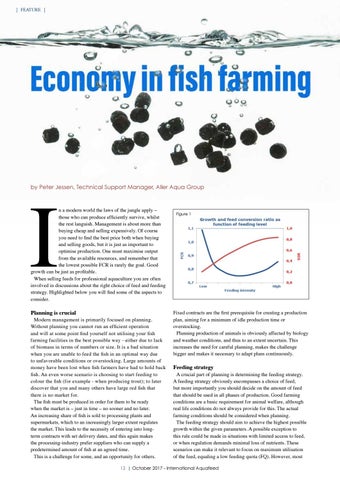
fish farmers, probably more than 90 percent, focus on optimum growth, equaling a high daily growth rate (DGR). All fish feed producers offer recommended feeding tables, stating the recommended amount of feed which should be fed to healthy fish under good farming conditions. It is important to note that these feeding tables are recommendations. Varying farming conditions could mean that it is not possible to feed as much as stated in the feeding tables, whilst other conditions may enable you to feed much more than stated. The recommended feeding tables often focus on good feed utilisation, i.e. a low feed conversion ratio (FCR). However, this rarely equals optimum growth. It is a well-known fact that intense feeding gives fast growth, but also a higher FCR. The high FCR is primarily due to the larger amount of wasted feed. Most fish farmers are aware that very restrictive feeding also gives a higher FCR, which is due to the amount of feed utilised for the daily maintenance of the fish. The correlation between feeding intensity, growth and FCR can be seen in Figure 1. The graph shows how restrictive feeding results in slow or no growth, indicating that all of the feed is utilised in fish maintenance, and resulting in an extraordinarily high FCR. The graph further shows that more feed equals increased growth, until a point where the fish no longer eat all of the feed, and the FCR again starts rising. Typically, the optimum level of feeding for high growth is a great deal above the optimum feeding level for low FCR. This correlation allows for optimisation of production economy. The gap between these two levels is again dependent on the price correlation between feed and fish – the more expensive the fish is compared to the feed, the further the optimum feeding point
moves to the right – toward intensified feeding. A simple calculation can illustrate this relationship. Table 1 shows a calculation example for a Trout production. The 20 percent increase in growth is achieved at the expense of a 10 percent higher FCR. This means that the feeding expense goes up by 10 percent per kilo of produced fish. The increased feed expense is however more than compensated by the increased production. In this example the result is more than 110 Euros of extra income for the increased growth, despite the higher FCR. As a feed producer, it is interesting to expand the calculation.
Latin American & Caribbean Aquaculture 17
November 7 - 10, 2017 Mazatlan International Center
•
Mazatlan, Mexico
Consolidate the growth in Aquaculture All info: www.was.org
A
LA
TI N
RI BB
EAN CHAPT
ER
The annual meeting of:
C AM ER I C A N &
Gold Sponsor
S P E C I A L I S T I N S Q U A R E S I L O S For More Information Contact: Conference Manager P.O. Box 2302 | Valley Center, CA 92082 USA Tel: +1.760.751.5005 | Fax: +1.760.751.5003 Email: worldaqua@aol.com | www.was.org HI a4 CMYK eng.indd 1
www.ts c -s i l os .c om
1/8/17 12:13 PM
International Aquafeed - October 2017 | 13
FEATURE Table 1: Value of increased growth rate Calculated over Fish price
At the very bottom of the calculation you can see that you can pay 0.26 Euro/kg more for the high-growth feed, than for the alternative, as long as feed is the only parameter for the difference. The number highlights that there is money to be made on growth, whilst it would still be affordable to invest in necessary changes.
Better economy
It is obvious that higher growth is an efficient way to achieve good farming economy. However, feed and feeding strategy is just one of many ways for a better utilisation of the fish farm’s potential. The 110 Euros of extra income from the above example could also be made as a result of investments in: Better water quality, such as degassing of carbon dioxide, or addition of oxygen. Optimised water temperatures, e.g. by completely or partially replacing the surface water with groundwater or by covering the entire fish farm. Improved health e.g. by elimination of disease by vaccination.
Your partner in top-quality ring dies for all pellet press brands
30 days
€/Kg
22,00
Biomass at start kg
1,000
Rate of growth
High
Low
Feed price €/kg
9.00
9.00
Feed conversion ratio (FCR)
0,99
0,90
Daily growth rate (DGR)
1,20
1,00
Biomass at end kg
1433
1350
€
8,91
8,10
Growth kg
433
350
Difference
9.533
7.697
1.836
429
315
3.861
2.834
Feed expense per kilo growth
Value of growth, total € Feed usage kg Feed expense, total
€
Net earnings at higher DGR Net earnings per kilo of "high growth" feed
1.027
€809,24 €1,89
Feed which the fish better utilises, and which increases appetite. Breeding; science shows that systematic breeding contains a great potential within aquaculture. Reduction in stocking levels; this could give the fish better living conditions and help maintain the biomass growth.
Choice of feed and quality of the fish
As mentioned, feed is just one of the tools to achieve better growth. It is obvious that a feed needs to be tasty, to entice the fish to eat, whilst also being rich in energy, highly digestible as well as optimally composed, to support high growth rates. The fish need to be able to grow from the feed. This generally means that the first step to optimised production is choosing a better/ more expensive feed. A more expensive feed should be used more carefully and requires more effort of both the fish farmers and his/her colleagues. If the requirements are met, the result is almost guaranteed a better economy. An argument against better and more energy - rich feed is usually that it leads to fatter fish and thus increased loss when the fish is slaughtered. This loss is very tangible for the fish farmer, who sees it as a wasted investment in better feed. However, the calculation does not end here. Differences in fish growth rates have a larger effect on its weight, than on its length. This means that slow growing fish gain more weight than length. This most likely results in the amount of intestinal fat being less when feeding restrictively, but the amount of bones and skin is larger. It can often be seen that the amount of fillet remains the same, despite the fish growth rate. And the fillet is the goal of fish production.
Operational optimisation is a never-ending process
WWW.PCE.EU
Common for all fish farmers are that maximising fish growth is crucial for economy. If it exceptionally is no longer interesting to produce larger amounts of fish, growth optimisation will contribute to maintaining the production volume based on smaller stock, with all the advantages of less tied capital, better conditions for the fish, including lowered risk of disease and overstocking. Each fish farmer has different options for optimisation, but there will always be places in the operation, which can be optimised. One just needs to take notice, and be ready to make the necessary changes. 14 | October 2017 - International Aquafeed
FEATURE
AMANDUS KAHL GmbH & Co. KG Dieselstrasse 5–9 21465 Reinbek Hamburg, Germany +49 (0) 40 72 77 10 info@akahl.de akahl.de
COMPLETE FISH FEED PLANTS
UP TO 10T/H Contrary to conventional extruders, the KAHL extruder OEE is equiped with a hydraulically adjustable die.
WORLDWIDE CALENDAR 2017-2018 VIV MEA 2018
FEBRUARY 5-7, ABU DHABI, U. A. E.
VIV Europe 2018
JUNE 20-22, UTRECHT, THE NETHERLANDS
VIV Turkey 2017
VIV China 2018
JULY 6-8, ISTANBUL, TURKEY
SEPTEMBER 17-19, NANJING, CHINA
WWW.VIV.NET
International Aquafeed - October 2017 | 15
POULTRY Africa 2017 OCTOBER 4-5, KIGALI, RWANDA
FEATURE
Fish oil Fishmeal and ...
“THE NEED FOR FEED”
I
by Neil Auchterlonie, IFFO
t is stating the obvious to say that the use of fishmeal and fish oil in aquafeeds has changed over time. With high inclusion rates of fishmeal and fish oil common in early modern aquafeeds, and especially those for salmonids, these materials could be regarded as the foundation of fed aquaculture as we know it (Auchterlonie, 2016). The provision of diets that met the farmed fish nutritional needs essentially freed up the industry to develop systems technology and health controls. Therefore making the advances in the volume of production that was required to achieve viability. Inclusion rates seen with those early diets were 90 percent or more for total marine-sourced materials (Ytrestøyl, Aas, & Åsgård, 2015), and this was only feasible when the aquaculture industry was of relatively small volume. Over time the partial substitution of marine ingredients with those of other (terrestrial, mainly vegetable but some animal proteins) origin occurred to allow a continuing supply of feed to aquaculture within a global market. The challenge was in meeting the volume of supply required for the developing aquaculture industry. There is an economic consideration too, that emanates from the volume of supply point. Although marine ingredients may appear as higher cost compared to the alternatives in the market, it is simplistic to look at feed ingredients from solely that perspective as bioeconomic models have a great deal more complexity, and feed formulations are not all about price – the performance of the material needs to be taken into account. This has already been shown with fishmeal in respect of feeds for weaning piglets (Ma et al., 2013) where the growth and health advantages of high quality fishmeal in those feeds provide benefits that extend across the whole production cycle. The same may well be true for fish species. (Interestingly, it is the comparative cost of marine ingredients that provides the financial attraction from the investment sector that supports the development of alternatives, as discussed in Naylor et al. (2009) who describe the situation thus: “price signals will provide the best inducement for technological and management change”, even if – nutritionally - those alternatives are generally quite different to fishmeal and fish oil.) Aquaculture is the most successful protein sector in recent times, and – generally - is an efficient way of producing protein for humanity largely as a result of growing cold-blooded animals in an environment that supports their body weight. Aquaculture development has been dramatic and now accounts for 44.1 percent of total seafood production (Food and Agriculture Organisation, 2016). This development will continue and forecasts for growth remain high even though the rate of growth has slowed from 7.2 percent over 1995-2004, to 5.8 percent from 2005 to 2014. Regions or countries are developing aquaculture strategies, within often sit growth targets, and although fed aquaculture is only part of the total figure (FAO estimates this at 69.2 percent, some of which will also be extensive production (In extensive production feed inputs may be provided to the farmed stock, but that is not the only source of nutrition, and external food items from within the farm environment may also support growth.)), it is clear that there will be a continuing demand for increasing aquafeed volume for some time to come. Alternative proteins and oils have been suggested for many years and other than the obvious replacements that have already occurred with vegetable-based ingredients, for the most part the commercial reality for many of the alternatives still seems some way off. At the current time, the key issue for supporting aquaculture development is to continue to make the best use of the fishmeal and fish oil resource we have.
Fisheries supplying fishmeal
In a normal year global supply of fishmeal is in the region of five million tonnes, with an additional one million tonnes, or just under, of 16 | October 2017 - International Aquafeed
FEATURE
fish oil. Annual variation occurs due to the fluctuations of supply around the main fisheries that provide the raw material for the fishmeal production process, the most important of which is that of the Peruvian anchovy (Engraulis ringens). Environmental fluctuations can have an impact on stock levels, where changes in current speed, direction and water temperature may affect primary production and the timing and matching of larval fish with prey items, consequently affecting recruitment into the fishery. It has been widely accepted for years that El Niňo events have an impact on the productivity of the South Pacific Ocean (Schreiber, Ñiquen, & Bouchon, 2011), and these can markedly affect the biomass of the Peruvian anchovy, a stock which contributes somewhere between 15-20 percent of raw material supply for fishmeal and fish oil manufacture. The Peruvian anchovy is an excellent example of a small pelagic fish species of the type that provides the majority of the whole fish for fishmeal and fish oil production. Small pelagic fish (SPF), also known as forage fish, comprise approximately 22 percent of global annual catch according to the FAO. Examples of these SPF species are the anchovies, sardines, pilchards, herrings, capelin and menhaden, also known as Low Trophic Level fisheries on account of the position they hold within the ecosystem. Stocks can show a high variability linked to environmental factors including the vulnerability of planktonic early life-stages and their recruitment (Ospina-Alvarez et al., 2013), but in general are more readily modelled and managed than many of the food species fisheries. Typically, these are single-species stocks that mature early, and have high fecundity, so when the environmental conditions are optimal they can reach very high abundance levels. The management of SPF fisheries has been at the centre of some controversy in recent years. A scientific report published in 2013, commissioned by the Lenfest Ocean Program, “Little Fish, Big Impact” suggested a precautionary approach to the management of SPF stocks to allow for the needs of piscine, avian and mammalian predators in the ecosystem. This work was based on the use of ecosystem models that had previously been used in the terrestrial environment. There is now some scientific debate about whether the methodology in the report is valid, and other authors have recently challenged the assumptions of the original work (Hilborn, 2017). The more recent science suggests that there is “little evidence for a strong connection between forage fish abundance and the rate of change in abundance of their predators.” It seems that environmental factors, rather than fishing pressure, are the dominant factor in abundance, and we may expect continuing scientific effort on the subject, which will hopefully improve the predictability of stock management. That predictability should remove some of the uncertainty in stock modelling and management. Providing additional evidence that tackles a general precautionary approach, improves the accuracy of TAC and quota setting, which in turn has the potential to improve the productivity of the SPF fisheries. That improved productivity of SPF fisheries subsequently supports protein supply and the global food security agenda. SPF fisheries are therefore, on the whole, comparatively easier to manage than mixed stock (food) fisheries. In this respect, there has been a strong adoption of certification in the fishmeal industry, to the extent that over 45 percent of global supply is independently accredited to the IFFO Responsible Supply standard. The trend is continuing upwards as this proportion is increasing year on year with interest from new fisheries and the adoption of IFFO RS Improvers Programme (IP) projects and other Fisheries
BALANCE IS EVERYTHING!
Biolex® MB40 – effective MOS for: Active support and relief of the immune system High bonding power & inactivation of pathogens/toxins in the intestinal lumen Prebiotic effects on the microflora in the intestine
leibergmbh.de
International Aquafeed - October 2017 | 17 Produktanzeige Biolex 90 x 270 International Aquafeed 06/16.indd 1
17.06.16 12:
FEATURE
another 11.7 million tonnes of raw material is available, equating to another 2.365 million tonnes of fishmeal and 352,000 tonnes of fish oil if it could be collected and processed (Jackson and Newton, 2016). With the growth in aquaculture having the potential to supply even more by-product material, this could actually increase through to 2025, to a volume of 45 million tonnes available raw material from the current total of 35 million tonnes potential (In fact, something like 20-22 million tonnes is processed into fishmeal and fish oil every year).
Fishmeal – more than just protein
Improvement Project (FIPs). Also noteworthy is the ability of SPF stocks to recover from low population levels which often result from environmental variability. They are very resilient to the environmental factors that may cause such fluctuations, and this point is never better illustrated than in the ability of the Peruvian anchovy to recover from low stock levels seen during El Niňo events. For a variety of different reasons, these stocks have only very limited, or no, direct human consumption markets so, despite the criticisms of some authors (e.g. Cashion, Le Manach, Zeller, & Pauly, 2017) about a direct consumption loss they may very likely make much more of a contribution to global protein supply as feed materials for food products that have a real market demand.
Increasing raw material supply from by-product
The world’s global supply of fishmeal is not produced solely from fisheries though, and there is another segment that contributes a smaller but important volume. A significant, and increasing proportion of annual supply now comes from the processing of seafood by-product, where frames, heads, viscera and other trimmings are used to produce marine ingredients. The FAO estimates that somewhere between 25 percent and 35 percent of global fishmeal supply comes from this material at the current time (Food and Agriculture Organisation, 2016), and that is clearly an efficient use of material for which other uses are relatively restricted. An IFFO-funded project, reporting in 2016, suggests that there is a significant volume of by-product raw material that at this stage is uncollected and therefore not utilised (and very likely going into waste streams). Current estimates are that globally
This volume is a comparatively limited supply of fishmeal into aquafeed (as an example, 348 million tonnes of soya bean is the USDA’s estimate for production over the period between June 2017 and June 2018; soybean meal accounts for 35 percent of the weight of raw soybean, which equates to 121.8 million tonnes; therefore, the volume of fishmeal produced equates to 4.1 percent of total soya volume). It is a low volume, but high value ingredient, with a price that reflects the nutritional importance of the material in feed formulations. Although fishmeal is a high protein (60-72%) ingredient, its value comes not just in the provision of protein as a macronutrient for growth (although it is important for that based on high digestibility figures). Fishmeal has an excellent amino acid balance, obviously reflecting directly the amino acid balance in fish, and therefore very similar to the needs of carnivorous species, which have evolved over millenia to utilise proteins with amino acids, found in these proportions. It is therefore not surprising that it meets the nutritional requirements of carnivorous species directly. It is not, however, merely the amino acid balance in fishmeal that is of benefit to farmed fish species. Fishmeal is exceedingly rich in some of the minerals and vitamins that are known to be essential for fish nutrition and health. Many of the vegetablebased competitor ingredients from terrestrial systems do not contain these compounds at the same levels, largely because they reflect a plant’s (and consuming animals) physiological needs in the terrestrial environment. Those requirements are different, and that is a function of evolutionary biology. Other aspects of the vegetable-based material include the presence of substances known as anti-nutritional factors (ANFs), again a reflection of plants operating in an environment where they were at risk of being consumed by herbivores – those compounds being a protection against being eaten. Plants also contain fibre, carbohydrate and other compounds that cannot be utilised by many carnivorous species. This results in the use of processed and concentrated material, such as soy protein concentrate SPC, with the processing of the raw material carrying an additional energy cost (and diets made predominantly with this type of material may also require specific amino acid supplementation in formulations for an individual farmed fish species). The nutritional quality of fishmeal has been known for many years and its richness as a source of vitamins and minerals, and their nutritional role for farmed animals well documented (Windsor and Barlow, 1981). Fishmeal is rich in vitamins such as the B-group vitamins, especially choline and niacin, and it is also rich in various minerals important for farmed animal health including calcium, phosphorus, and also selenium. These micronutrients are not only important for the physiology and health of farmed animals, but are important nutritionally for the consumer as well. Fish oil, also, is usually present in fishmeal, in the polyunsaturated form and with global supplies being limited
18 | October 2017 - International Aquafeed
FEATURE
this contribution is accounted for in feed formulations. Often rich in the omega-3 fatty acids eicosapentaenoic acid (EPA), and docosahexaenoic acid (DHA), the levels are variable depending on the source species (Cho & Kim, 2011). At an overall fat level of eight-12 percent in a standard product, fishmeal is a rich source of these materials (Windsor and Barlow, 1981), and the contribution from fishmeal is a significant proportion of the supply into aquafeeds.
Storebakken & Roem, 1998) have not shown the same response. It appears that this is a topic that requires further investigation, although it is quite clear that fishmeal with the presence of numerous different compounds including some volatile organic compounds has at least the potential to be an attractant and improve palatability. The non-essential amino acid, glutamic acid, has been identified as one of the compounds that supports fishmeal palatability for aquafeeds (Miles & Chapman, 2015).
Fish oil – benefits for farmed fish as well as the consumer
Summary
There are a whole host of scientific publications on the benefits of fish oil to human physiology, with a range of level of effects and outcomes cited for a wide variety of conditions. We also know that although some freshwater fish species are capable of “bioconverting” shorter chain fatty acids into the longer chain EPA and DHA omega-3 fatty acids (Turchini, Torstensen, & Ng, 2009), they are essential nutrients for marine fish species (Sargent et al., 1999), including salmon. There is therefore a strict nutritional need to provide these materials into salmon and other feeds. With fish oil only being the available source that currently meets the volume requirement, the drawdown is reflected in the IFFO annual statistics which indicated that in 2015 73 percent of global fish oil apparent usage (total 916,000 tonnes) was directed to aquaculture, and 58 percent of that fraction was taken by salmonid feed. Naylor et al. (2009) discussed the supply of fishmeal and fish oil into aquafeeds to meet the demand of a developing industry, and concluded that although there is pressure on both materials it is that for fish oil which drives the pressure on raw material availability. We are seeing in some instances, and especially with farmed Atlantic salmon that the omega-3 content of the fillets reaching the market is reducing as a consequence of lowering inclusion rates in feed (Sprague, Dick, & Tocher, 2016). That is for salmon produced on standard feeds, and it does leave the pathway open to those producers who may wish to diversify into premium products with higher EPA and DHA concentrations.
It is clear that the contribution that fishmeal and fish oil has made to global aquafeed has been substantial and, in the past, has certainly provided the foundation for modern fed aquaculture production systems. In real terms, the successful aquaculture industry we have today would not have occurred without the contribution these materials made to aquafeed. Contemporary systems have changed, however, and with the onus on feed supply more about achieving volumes, the use of marine ingredients is shifting to points in the production process where their nutritional advantages may be best utilised. The benefits of marine ingredients go well beyond the provision of crude protein and fat for farmed fish diets and the range of micronutrients found in the materials is important for production, for health, and for the quality of the end product in fed aquaculture. As a strategically important ingredient already increased proportions of fishmeal and fish oil are seen in juvenile feeds compared with grower diets, and these materials also have a contribution to make to broodstock diets along with the implications that has for the successive generation. References available upon request
How feed tastes to the animal and its relevance to production
Extruders and Expanders Almex extruders are used for : » Pet Food extrusion » (floating) Aquafeed extrusion » Animal Feed extrusion » Oil seed extraction » Cereal processing extrusion » Compacting » Pre-conditioning prior to other processes
info@almex.nl
International Aquafeed - October 2017 | 19
www.almex.nl
A Triott Company
An important but often overlooked factor in the development of aquafeeds is the palatability of the pelleted feed to the farmed fish. This is an essential factor in appetence and feed intake volume, and therefore has an effect on overall fish growth and production. It can also be of primary importance in key juvenile stages where there may only be a short window of time to get juvenile fish onto feed. Fishmeal is recognised as being important in farmed animal nutrition and production of pigs (Dong & Pluske, 2007) and poultry (Karimi, 2006) in the juvenile stages, where it has been successfully used on a strategic basis to get the younger animals onto extraneous feed. In those industries the use of fishmeal to improve production efficiency in younger animals makes economic sense (Ma et al., 2013), despite the higher cost of the ingredient when compared to other available feed constituents. In fish, similar effects have been observed. (Enes & Peres, 2015) describes this concept and (B. Glencross, N. Rutherford, 2011) suggested a threshold for fishmeal in feeds for barramundi of 15 percent to avoid any problems linked to inappetence. Some other species such as gilthead sea bream have shown similar responses (Kissil, Lupatsch, Higgs, & Hardy, 2000), but in some trials other species such as Pacific white shrimp (Samocha, Davis, Saoud, & Debault, 2004) and Atlantic salmon (Refstie, S.,
FEATURE
S
by Dr B Laxmappa, India duration, the production of this species has reached to a level of 406,044 tonnes during 2015–16. Very recently, L. vannamei culture is also started in freshwater ponds particularly in Telangana State and some other states in India by the stocking of PLs acclimatising to zero ppt salinity at hatchery level. The culture and production level is encouraging. Brackish water aquaculture is mainly concentrated on the coasts of Andhra Pradesh, Tamil Nadu, Orissa and West Bengal in India. With regards to the market, while the main areas of consumption for freshwater fish are in West Bengal, Bihar, Orissa and northeastern India. Cultured brackish water shrimps are destined mainly for export. Among the coastal states, West
hrimp farming is a multi-billion dollar industry contributing a major income to several countries in Asia and South America. India as the second largest country in aquaculture production in the World, the share of brackish-water sector includes culture of shrimp varieties mainly, the native giant tiger prawn, Penaeus monodon and exotic white-leg shrimp, Litopenaeus vannamei. Today, L. vannamei is the most extensively farmed crustacean species in the World.
Culture Status
Brackish-water aquaculture in India is concentrated around the giant tiger prawn (P. monodon) as the single most important species. Recently, the culture of exotic, white-leg shrimp, L. vannamei, however, has attracted the farmers’ attention because of its fast growth, low incidence of native diseases, availability of Specific Pathogen Free (SPF) domesticated strains and culture feasibility in wide salinity range. With the production levels of 10–12 tonnes/ha/ crop of three to four months’
Table 1: State-wise Tiger Shrimp production in India from 2010-11 to 2015-16 Sl. No.
State
1
West Bengal
Year-wise production (MT) 2010-11
2011-12
2012-13
2013-14
2014-15
2015-16
40725
45999
52581
53049
53526
61998
2
Orissa
7520
10901
14096
11075
10075
9191
3
Andhra Pradesh
49030
51081
25948
2883
2962
3739
4
Tamil Nadu & Pondicherry
4020
12097
17220
916
73
1103
5
Kerala
8075
8138
5175
3360
3643
3490
6
Karnataka
2090
609
180
56
498
682
7
Goa
320
51
48
14
16
0
8
Maharashtra
1120
1721
2010
1083
177
6
9
Gujarat Total
5675
4869
6045
4362
2185
1243
118575
135466
123303
76798
73155
81452
Source: MPEDA, Kochi
20 | October 2017 - International Aquafeed
FEATURE Table 2: State-wise Pacific white Shrimp production in India from 2010-11 to 2015-16 Sl. No.
State
2012-13
2013-14
1
West Bengal
0
0
0
479
395
6776
2
Orissa
0
100
436
2907
11866
19241
3
Andhra Pradesh
16913
75385
133135
210639
276077
295332
4
Tamil Nadu & Pondicherry
109
2863
8595
26281
32688
44453
Year-wise production (MT) 2010-11 2011-12
2014-15 2015-16
5
Kerala
0
0
0
0
11
74
6
Karnataka
0
232
484
517
623
1045
7
Goa
0
0
15
67
88
33
8
Maharashtra
508
941
1503
3291
4901
6118
9
Gujarat
717
1195
3348
6326
26763
32946
10
Telangana*
0
0
0
0
0
26
18247
80717
147516
250507
353413
406044
Total
Source: MPEDA, Kochi *Field enquiry
Bengal and Andhra Pradesh is the largest producer of P. monodon and L. vannamei shrimp respectively in the country during the year 2015-16. Today L. vannamei is the largest cultured shrimp in terms of production and productivity in India. Andhra Pradesh tops in area under culture and production followed by Tamil Nadu way behind (Table: 1 & 2). The commercial farming of tiger shrimp declined gradually and L. vennamei shrimp started increasing significantly from the year 2010-11 (Table: 3).
Disease outbreaks
With the development of shrimp culture practice from traditional form to modern intensive culture practice, the complexity of diseases has been equally magnified in India. The frequent outbreaks of diseases such as White Spot Syndrome Virus (WSSV), Black Gill Disease (BGD), Running Mortality Syndrome (RMS), Loose Shell Syndrome (LSS), White Feacal Syndrome (WFS), White Muscle Disease (WMD) and Infectious Hypodermal and Haematopoietic Necrosis (IHHN) in shrimps
International Aquafeed - October 2017 | 21
FEATURE
Shrimp production trends in India from 2010-11 to 2015-16
Table 3: Total shrimp production in India from 2010-11 to 2015-16 Species
Year-wise production (MT) 2010-11
2011-12
2012-13
2013-14
2014-15
2015-16
Tiger shrimp
118575
135466
123303
76798
73155
81452
White shrimp
18247
80717
147516
250507
353413
406044
Total
136822
216183
138059
327305
426568
487496
Source: MPEDA, Kochi
causing economic loss to the aquaculture industry. Farmers are losing 15-25 percent of their investment due to these diseases in every crop in the season. Shrimp aquaculture industry has experienced severe setbacks due to devastating viral diseases. L. vannamei is an exotic species and culturing both in freshwater and saline waters in the country. The viral outbreaks are minimal in low saline waters compared to the high saline waters with the best management practices.
Production trends
In India, a number of development schemes were initiated by the Ministry of Agriculture of the Government of India; including setting up of Brackish water Fish Farmers Development Agencies (BFDAs) in the maritime states for the development of shrimp farming. This paved the way for the establishment of a number of shrimp hatcheries and farms in the coastal states in the early nineties. India witnessed a phenomenal increase in the area under shrimp farming, which occurred between 1990 and 1994, and the
growth rate was phenomenal till 1995. In fact, farmed shrimp production increased from 28,000 tonnes in 1988-89 to 487,496 tonnes in 2015-16. Since the last couple of years, L. vannamei shrimp contributed to lead the shrimp exports in India.
Conclusion
The developmental support provided by the Indian Government through a network of Brackish-water Fish Farmers’ Development Agencies (BFDAs) and the research and development programmes of the Indian Council of Agricultural Research (ICAR) have been the principal vehicles for this revolutionary development. In addition, additional support was also provided by various state governments, host of organisations and agencies like the Marine Products Exports Development Agency (MPEDA), National Fisheries Development Board (NFDB), financial institutions etc.
22 | October 2017 - International Aquafeed
FEATURE
Your global technology process supplier for the aqua feed industry ANDRITZ is one of the world’s leading suppliers of techno logies, systems, and services relating to advanced indus trial equipment for the aqua feed industry. With an in-depth knowledge of each key process, we can supply a compatible and homogeneous solution from raw material intake to finished feed bagging.
ANDRITZ Feed & Biofuel A/S Europe, Asia, and South America: andritz-fb@andritz.com USA and Canada: andritz-fb.us@andritz.com
www.andritz.com/ft
The perfect partner for process automation We deliver: Design and engineering Build and installation MCC and PLC panels Software engineering PLC/SDADA MES application Batch Explorer Integration to other software packages Turn Key installations incl. training, service & support
info@inteqnion.com www.inteqnion.com
International Aquafeed - October 2017 | 23
FEATURE
A good smolt is half the battle won
S
by Europharma
uperSmolt Original is a patented biotechnology programme that combines a functional feed and mineral bath treatment to induce optimal smoltification of Atlantic salmon without need for a winter photoperiod. Europharma, one of the world’s leading developers of fish health and welfare programmes, is helping customers save time and money whilst improving the health of their stocks, thanks to their proprietary smoltification programme, SuperSmolt. The feed and salts act together to stimulate special cell receptors that pre-acclimatise fish to seawater while still in freshwater, providing and maintaining a uniform smoltification. The result is a high quality smolt that delivers numerous benefits in both the freshwater hatchery and on-growing at sea. Following the success of the SuperSmolt Original programme, Europharma introduced “SuperSmolt Feed Only” as a new improved programme variation which reduces effort with no need to include additional mineral treatments alongside the functional feed and can therefore also be applied to freshwater cages. The Clydebank-based company noted a 100 percent uptake of the new programme from existing programmes thanks to its superior benefits and success of SuperSmolt Original. SuperSmolt Feed Only is simple to implement and takes away the need for daily salt dosing, reducing overall costs and the number of hours committed to dosing tanks. Hatcheries or freshwater loch sites using the SuperSmolt Feed Only programme have found that their fish never desmoltify meaning staff have greater flexibility over sea transfer dates, especially when circumstances dictate a later transfer to sea is
required (well boat or sea site delays for example). The programme brings all the benefits of SuperSmolt Original, thus also allowing earlier transfer of fish due to extra growth from having fish on non-stop 24 hour light from first feeding onwards. The results of the optimised smoltification achieved by the use of SuperSmolt programmes have been seen in hundreds of millions of fish treated in Scotland, Chile, Canada and Norway, showing better performance at sea compared with those not treated with SuperSmolt. Feed uptake, survival and growth are improved in the post transfer stage. Europharma supports the SuperSmolt programmes with the integration of in-house ATPase analysis - an important tool in determining the right time to transfer fish to sea. Laboratory analysis of ATPase levels in salmon gills during smoltification helps assess how far the process has come. The Europharma team use their extensive experience in the use and interpretation of ATPase analysis and together with other smolt parameters such as smolt index, condition factor and behaviour it can provide the best basis for choosing the right time for sea transfer – making sure that fish populations will be hitting the bulls-eye of the smoltification window every time. To support the SuperSmolt programme users on site, Europharma employ a highly skilled team of experts. Ross Beedie is the SuperSmolt Technical Support, and works with the team of fish vets and technicians at Europharma to ensure the best use of the programme and service for customers. He works closely with farms ensuring the best practices are being used during the SuperSmolt programmes, in order to achieve the best in fish health and welfare. Ross comments, “I have worked at Europharma for four years, allocating most of my time visiting farms. This gives me the opportunity to speak to our customers and find out their specific needs. Talking face-to-face allows me to discuss any problems on the farms and find the best solutions to ensure optimum fish health. “Since introducing SuperSmolt Feed Only, the feedback has been fantastic. It saves customers time and money and the benefits to fish health are great. We are seeing larger fish thanks to having no winter photoperiod and overall improved health. We will now continue to work with fish farms to help better the aquaculture industry as a whole, identifying issues and providing solutions.” Farms who feel they could benefit from the use of SuperSmolt are encouraged to get in touch with Ross to discuss how the programme can be used to produce an optimal and prolonged smoltification window with the subsequent benefits on growth and survival in the next stage in seawater.
24 | October 2017 - International Aquafeed
PHOTOSHOOT THE BIG PICTURE - NORWAY
This image was taken by the International Aquafeed team whilst attending AquaNor Remember, this year photographers everywhere are invited to submit digital photographic work on the theme of ‘Create, Nurture and Grow Aquaculture’ to the International Aquafeed photo competition. Submissions are still being accepted for the foreseeable future, and some great prizes are on offer, including a Ipad Pro. For full detials visit: www.aquafeed.co.uk/photocomp17
EXPERT TOPIC RAINBOW TROUT
RAINBOW 1
Introduction by Zasha Whiteway-Wilkinson
TROUT EXPERT TOPIC
A species local to the Pacific drainages of North America, as mentioned in previous issues, has been in the news recently in the UK. After floods devastated rivers in Northern Ireland, the Loughs Agency urged anglers to help catch thousands of rainbow trout after the non native farmed fish entered the River Strule near Newtownstewart after it burst its banks and flooded the Rocks Lodge hatchery. The rivers in County Tyrone and County Londonberry were affected with the fear that they could out compete native species for food, the BBC reported. This was alongside a smaller unrelated escape of the fish on the River Faughn. The Loughs Agency, whose remit includes managing Lough Foyle’s inland fisheries met with the company that owns the hatchery, Dawn Fresh. They did not take any legal action as there was no question of liability due to the natural cause with the flash floods. They also reported that they could not remove the fish through stunning or netting due to the potential harm on wild stocks. Commenting to the BBC, Seamus Cullinan, a fishery inspector with the agency remarked, “Our advice to anglers is, get out there, catch them and take them out of the system. Kill them and take them home.” While this may be sound advice, the information that followed gave a little insight into what the broad view of aquaculture in mainstream society is, and that’s not much at all is known about it. Mr Cullinan went on to say, “We have talked to the company and have been assured these fish are fine to eat, and apparently relatively easy to catch compared to wild species. I have received reports of anglers catching hundreds of these fish. “They are bred in fish farms as a commercial species, designed
to put on weight rapidly. They are naturally very aggressive feeders.” Trout will not spawn naturally in culture systems, and so must be collected during their juvenile stages from the wild or through artificial spawning in a hatchery, they can however prove detrimental to native species in the quest for food. In the following Expert Topic feature the authors go some way in describing the complex and intricate art that actually goes into creating appropriate and healthy feed for farmed fish such as these rainbow trout, previously described as “very aggressive feeders”. Research into nutrients included in feed for the fish has shown that the micronutrient Selnium is “required for normal development and growth, as well as the maintenance of metabolic functions and good health status.” The rainbow trout is able to grow fast and tolerate a wide range of environments and diets. Usually spawning once in spring, the fish have been bred in captivity to develop strains that mature earlier and spawn throughout the year. It was previously reported in International Aquafeed that using the best value feed and materials, the average cost of production in rainbow trout farms is between USD 1.20 and 2.00 per kilogram. According to the Food and Agricultural Organisation, “running costs can start at USD$100 per 1,000 fry purchased at six to eight cm and feed for one year from USD$1,000-1,400.” Fish farmers attempt to reduce these costs by increasing the efficiency of trout production including improving recirculation technology, breeding faster growing fish that reach larger sizes, controlling maturation and gender, developing high-nutrient diets, and reducing phosphorous concentrations of effluents.
28 | October 2017 - International Aquafeed
Power up your aquafeed too.
DISCOVER NUTRIAD’S AQUA HEALTH PROGRAM Nutriad’s aqua team works together with researchers and producers around the globe to develop an innovative range of health promotors and optimize their application under today’s challenging production conditions. Based on natural ingredients, these specialty additives reduce the impact of diseases and parasites on the productivity of fish and shrimp. Powered by scientifically proven anti-bacterial and anti-parasitic activities, immune-modulators, hepato-protectors as well as novel modes of action such as Quorum Sensing Inhibition. Today, our aqua-specific product lines SANACORE®, APEX®, AQUASTIM® and BACTI-NIL®, are applied in premium brands of functional feeds for fish and shrimp. Feed is much more than just nutrition.
Interested? Find your local contact at nutriad.com
EXPERT TOPIC RAINBOW TROUT
2
Rainbow trout diets
A
Selenium-enriched yeast improves the antioxidant status and selenium body content of rainbow trout by Nadège Richard1, Otavio Serino Castro1, Philippe Tacon1, Brice Bouyssière2, Stéphanie Fontagné-Dicharry3
quaculture nutritionists have been experiencing multiple challenges to maintain formula costs and performance while facing significant fluctuations on the raw material market in the past years. The decreasing availability of some key traditional ingredients such as fishmeal and fish oil, the price volatility of protein sources and the pressure to increase production sustainability are the main factors driving these efforts. As a result, the incorporation level of marine ingredients sources (fishmeal and fish oil) in aquaculture diets has dropped in almost all industry segments such as marine shrimp, salmon, etc. In this scenario, plant-based ingredients, terrestrial animal rendered by-products, among others, have emerged as alternative protein sources. Despite being a cost effective alternative in terms of protein replacement, alternative ingredients can bring to the diet nutritional imbalances, anti-nutritional factors and mycotoxins. Concerning micronutrients, fishmeal is an important source of selenium for fish and shrimp, and replacing it with Figure 1
ingredients of plant origin usually results in decreased selenium content in the feed (Table 1).
Importance of selenium in fish
Selenium is an essential micronutrient, required for normal development and growth, as well as for the maintenance of metabolic functions and good health status of animals. Selenium participates in the antioxidant defense of cells, protecting cells against oxidative stress damages through its essential role in the activity of several antioxidant enzymes (e.g. most of the glutathion peroxidases, thioredoxin reductases). It is also involved in thyroid hormone metabolism, DNA synthesis and fertility. Selenium deficiency generally reduces fish growth performance, increases mortality rates and, when combined with vitamin E deficiency, contributes to the appearance of muscular dystrophy and exudative diathesis (Watanabe et al. 1997). Development of ataxia (abnormal swimming) as well as nerve cord and liver pathology have also been reported in trout fed a seleniumdeficient diet (Bell et al. 1986). Fish selenium requirement is difficult to determine because it varies according to the developmental stage of the fish, environmental factors and rearing conditions (e.g. water quality, stocking density, stress factors, immune-depression). It also depends on the dietary content of other trace elements and vitamins (E and C), with which selenium can display synergistic interactions (Khan et al. 2017). Finally, selenium requirement also depends on the form in which the micro mineral is supplied, since selenium bioavailability can differ from its inorganic to organic form (higher bioavailability with organic forms).
Effects of organic selenium in rainbow trout
In order to generate more data to support fishmeal replacement strategies, the effects of a dietary selenium supplementation in practical feeds (plant-based or fishmeal based) on the growth performance and antioxidant status of rainbow trout (Oncorhynchus mykiss) fry were evaluated. Two forms of selenium supplementation were tested: inorganic form, sodium selenite; and organic form, selenium-enriched yeast Selsaf® (proprietary Saccharomyces cerevisiae (CNCM I-3399), 30 | October 2017 - International Aquafeed
EXPERT TOPIC
Figure 2A: Whole body selenium content - µg/g
RAINBOW TROUT
CROSS-CONTAMINATION SALMONELLA
INCONSISTENCY REGULATIONS
PATHOGENS
Figure 2B: SeMet
DOWNTIME
PROTECT YOURSELF FROM THE ELEMENTS
Figure 3: GSH/GSSH
PRODUCT CONSISTENCY PROCESS FLEXIBILTY VALIDATED KILL-STEP FOOD SAFETY Figure 4: Se-GPX activity - pmol NADPH oxidised/min per mg protein
VERIFIED EXTRUSION CERTIFICATION SANITATION CONTROL PLANT CERTIFICATION MANAGEMENT SYSTEMS
Phileo Lesaffre Animal Care, France). Selsaf® contains two natural organic selenium fractions: 36 percent selenocysteine and other active seleno compounds and 63 percent selenomethionine. The inorganic selenium constitutes less than one percent of Selsaf®. This experiment was carried out at the National Institute for Agricultural Research (INRA) in France (Fontagné-Dicharry et al. 2015 and Godin et al. 2015). Six experimental diets were formulated using two different basal diets (FM: fish meal as main protein source, containing 1.2 mg/kg of selenium and P: plant proteins as main protein source, containing 0.5 mg/kg of selenium). Four additional diets were obtained by supplementing the two basal diets with 0.7 mg/kg of sodium selenite (SS) or 1.2 mg/kg of selenium-enriched yeast (Selsaf®), the additions representing 0.3 ppm of selenium. Diet composition and respective selenium content are presented in Table 2. Rainbow trout (Oncorhynchus mykiss) fry (91 mg of body weight in average) were randomly distributed into 18 fibreglass tanks (200 fish/tank) at 17°C water temperature. From first feeding, fish were hand-fed to apparent satiation, six times a day over a 12-week growth trial.
P.O. Box 8 100 Airport Road Sabetha, KS 66534, USA Phone: 785-284-2153 Fax: 785-284-3143 extru-techinc@extru-techinc.com www.extru-techinc.com
31 | October 2017 - International Aquafeed ET-275C.indd 1
12/22/15 3:33 PM
EXPERT TOPIC RAINBOW TROUT
Growth performances and whole-body selenium content
At the end of the 12-week trial, fish average body weight reached 8.1g (increase of approximately ninety-fold) and did not differ significantly among treatments. Fish fed plant-based P-0 diet had the lowest selenium content in the body (Figure 2). Selenium supplementation promoted higher fish body selenium content for both basal diets. However, trout fed diets containing selenium-enriched yeast Selsaf® had higher selenium content in the body when compared with fish fed diets containing sodium selenite (Figure 2). The higher selenium retention in fish fed with Selsaf® might be related to a higher bioavailability and/or better retention in the fish tissue. Indeed, organic sources of selenium, such as selenomethionine or selenium-enriched yeast, but not selenocysteine, have been demonstrated to be more available than inorganic sources such as sodium selenite (Prabhu et al. 2014). Accordingly, in the present study selenocysteine content in fish whole body was not affected by selenium supplementation (results presented in Godin et al. 2015). Selenomethionine content in fish whole body was not statistically different when comparing basal diets with sodium selenite supplemented diets (Figure 2), suggesting that rainbow trout is not able to synthesise selenomethionine from the inorganic form. However, the diets supplemented with selenium-enriched yeast Selsaf® led to increased selenomethionine levels in rainbow trout whole body. Fish fed plant-based diet supplemented with Selsaf® demonstrated significantly higher content of selenomethionine in the body (Figure 2). In vitro studies have shown that intestinal absorption of selenium is more efficient under the form of selenomethionine compared to the inorganic forms selenite and selenate (Thiry et al. 2013). It is also noteworthy that the cellular protein synthesis machinery is not able to distinguish selenomethionine from methionine and can incorporate selenomethionine in the muscle in place of methionine in protein sequences depending on cellular availability of both amino acids (Waschulewski and Sunde 1988). Besides impacting antioxidant capacity of the fish, the high ability of selenium retention in fish flesh promoted by seleniumenriched yeast Selsaf® supplementation is also of particular interest in the context of functional food development, being an alternative tool to generate beneficial effects for human health and adding value to aquaculture products.
Improving trout antioxidant status
Glutathione is one of the major antioxidant compounds produced by the cells. It participates in various antioxidant defense processes such as in the regeneration of oxidised compounds (e.g. vitamin C) into their active forms, and by being used as cofactor by the antioxidant enzyme glutathione
peroxidase (GPx). The ratio of reduced glutathione (GSH) to oxidised glutathione (GSSG) was measured in fish whole body at the end of the feeding trial as indicator of fish oxidative status (Figure 3). Selenium-enriched yeast Selsaf® was able to increase GSH:GSSH ratio compared to fish fed sodium selenite or nonsupplemented diets, sign of improvement of overall oxidative status in those fish. Regarding enzymes involved in antioxidant defenses, rainbow trout fed with the plant-based diet non-supplemented with selenium displayed a lower Se-GPx activity in their body, compared to those fed with the basal fishmeal-based diet. This can suggest a selenium deficiency in the non-supplemented basal plant diet. Dietary selenium deficiency generally results in growth reduction coupled with reduced activity of GPx (NRC 2011). Supplementing the plant-based diet with sodium selenite or selenium-enriched yeast Selsaf® led to an increase in whole body trout Se-GPx activity, but the activity was only completely restored in the selenium-enriched yeast Selsaf® group (Figure 4). Analysis of gene expression of Se-GPx isoforms in trout wholebody revealed a lower expression for several of the isoforms (i.e. GPX1b1, GPX1b2, GPX4a1) in fish fed the basal plant diet without selenium supplementation, in accordance with the concomitant decrease in Se-GPx activity (results shown in Figure 4 and in Fontagné-Dicharry et al. 2015).
Conclusion
Selenium supplementation is necessary in order to not compromise the antioxidant status of rainbow trout fed plantbased diets, and also to ensure fish flesh selenium deposition. The organic form of selenium, selenium-enriched yeast Selsaf®, is more efficiently retained in fish body than the inorganic form sodium selenite. The higher performance of selenium-enriched yeast Selsaf® in increasing selenium whole-body content rainbow trout fry is related to its ability to increase selenomethionine levels. By promoting antioxidant defense system of raiblow trout fry, Selsaf® can avoid lipid damage in fish muscle and extend shelf life of fish flesh. 1: Plant meals (% diet): 20% wheat gluten; 18% corn gluten meal; 15% soyabean protein concentrate; 6.2% soyabean meal; 5.2% rapeseed meal; 5% white lupin meal; 3.8% dehulled pea meal. 2: Vegetable oils (% diet): 4.2% rapeseed oil; 4.2% linseed oil; 2.1% palm oil. 3: Premix : 1% Vitamin mixture ; 1% Mineral mixture without selenium for P diets ; 2.2% Dicalcium phosphate for P diets, 1.5% attractant mixture in P diets ; 1.3% L-lysine in P diets ; 0.3% L-methionine in P diets, 2.0% soyabean lecithin in P diets. References available upon request.
32 | October 2017 - International Aquafeed
Outgrow your competition. Best results with MetAMINO®
Cut feed costs – and boost productivity. Supplemental amino acids can accelerate fish growth while reducing dependence on costly feed ingredients. With proven superior bio-efficacy compared to other methionine sources, MetAMINO® is the ideal essential amino acid for aquaculture. Delivered in dry crystalline form, MetAMINO® mixes easily and consistently with other feed ingredients. MetAMINO®: not just better – best results. www.evonik.com/metamino
ulture Aquac 2017 Europe vnik Dubro °18 tand N V i si t S
FISH FARMING TECHNOLOGY by LandIng Aquaculture BV
LandIng Aquaculture BV is a Dutch Aquaculture engineering company. It was founded by Rob van de Ven from the University of Wageningen and Carlos Alberto Espinal from the University of Barcelona, Autonomous University of Barcelona and Polytechnic University of Catalunya. The company is based in the Netherlands and has worked in Europe, Latin America and Africa. We have talked to the two cofounders who happily shared with us the details of some of their latest projects and their thoughts on the future of aquacultural engineering helping the sector grow.
Complex engineering in aquaculture The aquaculture sector has experienced considerable growth over the few past decades. For a large part, that growth has been due to technological development in numerous areas related to the field. From biology and microbiology, to physics and chemistry and even genetics, the sector grows in complexity and technological advances. Consequently, this results in the market need for an engineering discipline applied to aquaculture and its specifics. “LandIng Aquaculture was created from a perceived need for sound aquacultural engineering services delivered in a similar fashion as other engineering disciplines,” states Rob Van de Ven, one of the two managing directors and cofounders. “No black boxes, no secrets and no confidential calculation methods. Instead, engineering services should be science-backed, technically justified and available for review by other professionals.” As an example of good practice, the company looks up to the architects and civil engineers who cannot have their projects approved without thorough audits and explanations of their methods and calculations. “With suppliers of turn-key systems promising one-size-fits-all solutions”, adds Carlos Espinal, “it is important to ask oneself: why would aquacultural engineering be any different from other engineering disciplines? The consequences of a failed project can be just as grave both for the investors and the environment.” Aquacultural engineering is often wrongly associated with only high-tech systems such as RAS. However, as the two engineers point out, engineering processes should be applied to virtually any type of aquaculture system: from a simple pond requiring an aeration system, to the latest, state-of-the-art, offshore cages. In all of these cases, only a thorough, knowledge-based approach can maximise the outputs and make the risks manageable. As an engineering company, LandIng Aquaculture can boast with design and engineering of systems of various sizes, ranging from small research labs to large-scale RAS farms planned to produce hundreds of tonnes of fish per year. The works of LandIng Aquaculture are thus not limited to commercial RAS, but also include biofloc systems, aquaponic systems and hatcheries.
The workflow
LandIng Aquaculture follows the typical development steps of an engineering project. Image 1: On the left Carlos Alberto Espinal Image 2: On the right On the right Rob van de Ven
34 | October 2017 - International Aquafeed
FISH FARMING TECHNOLOGY A project begins with pre-feasibility (is the project even conceivable?) Next, it continues with feasibility (what will be the effort needed and will profitability be possible?). The final step is detailed engineering development and implementation. LandIng Aquaculture uses design, conceptual engineering and front-end engineering for the pre-feasibility and the feasibility steps respectively, ensuring that the costs of the project (both capital and operational) are backed up by a studied design. In LandIng’s experience, the projects tend to take time, as every step is executed carefully and with attention to detail. Yet putting time into these steps saves money in the long term and safeguards against unnecessary mistakes that are usually a result of haste or an attempt to save money at the wrong part of the process. For instance, designing a pipe network in detail makes both procurement and installation easier and faster. Also, putting effort in the details often missed by the layman’s eye such as how small differences in water levels between different compartments affect the overall system water flow, pays off in the long run, because the construction process is smoother and modifications during construction and after startup are avoided.
Aquaponics systems research pilot in Norway
LandIng Aquaculture designed and supplied a pilot-scale aquaponics system for the company LOTICS in Stordal, Norway, to study the viability of using salmon hatchery effluents for growing plants in hydroponic systems. The project started from the common knowledge that fish farming effluents, if untreated, impact the environment due to the high amounts of nitrogen and phosphorous they
contain. However, nitrogen and phosphorous are also important nutrients for agriculture. The aquaponic system was designed and sized to replicate a modern, commercial smolt RAS on a small scale, and was connected to a hydroponic sub-unit with three vertical layers. In order to allow for flexibility and minimise the risks, the system was designed as a “decoupled” aquaponics system. Currently the system produces salmon smolts and a variety of greens such as kale, coriander, dille, strawberries and lettuce.
Centre image: Shrimp RAS for pathology research
Large-scale production of meagre in Portugal: A case study on a cautious approach to a high-risk/ high rewards sector
One of the latest projects from LandIng Aquaculture has been the design and engineering of a large-scale RAS to produce meagre (Argyrosomus regius). The project will start with pilot trials in a system also designed by LandIng for this purpose. Additionally, LandIng Aquaculture has carried out an in-depth feasibility study for large-scale production. The company cooperates with a worldwide network of aquaculture experts that are included in projects when there is a need for specific knowledge. In this case, a comprehensive market study was conducted in cooperation with an independent researcher Maddi Badiola, PhD. In the Mediterranean, meagre is considered an attractive species for diversification, due to its excellent growth performance and fillet characteristics. However, despite the technical advancements on its production, the acceptance of meagre in European markets
Figure 1
Figure 2
Figure 3
35 | October 2017 - International Aquafeed
Figure 1: 3D rendition of a small intensive shrimp hatchery in RAS Figure 2: 3D render of meagre pilot facility. The design was adapted to the available infrastructure Figure 3: 3D render of RAS module designed to be retrofitted to an existing trout hatchery
Top left: Figure 4: at LOTICS, microgreen cultivation uses RAS process water for irrigation Top right: Figure 5; salmon smolt from LOTICS showing an adequate distribution in a circular tank Bottom left: Figure 5: early into the trials at LOTICS, plants were showing fast growth. Bottom right: Juvenile shrimp in a cleanwater RAS
has been slower than originally predicted. This calls for a cautious approach to this project, starting with a feasibility study and continuing with a pilot project. It shows LandIng’s ethos towards approaching high-risk fish farming ventures in a sensible and systematic way.
Modernisation of RAS systems: The redesign of a large-scale trout farm in Romania
LandIng Aquaculture has also been involved in the modernisation of a flow-through farm in Romania since the second half of 2016. The farm has contacted the company because it has not been fully operating due to problems with the water supply from the nearby river. To get the farm up and running again, the designs were made for an upgrade with recirculating aquaculture systems to increase the production capacity, reduce the dependence on high volumes of water whilst at the same time reducing the costs of treating the intake water. In light of the potentially high costs involved in such a retrofit, LandIng Aquaculture dedicated time and effort to thoroughly study and compare five completely different design solutions, ranging from small changes with low production capacity to extensive changes with increases in production capacities, instead of designing a standard “onesize-fits all” RAS. After months of study and analysis, the engineering projects
have been completed and include a number of innovative design solutions such as the conversion of D-ended raceways into mixed-cell raceways, the use of low-head RAS and the potential use of sludge-based de-nitrification reactors. The project is currently on its way to the final permitting before the construction works start.
Shrimp farming projects
Indoor shrimp farming has been another important field of work for LandIng. This sector has gathered a lot of interest in Europe in recent years, due to the attractive market prices that fresh shrimp can attain, coupled with current advancements of biofloc technology (BFT). However, indoor shrimp farming is still in its infancy and thus, projects must be developed carefully, with a good understanding of the economics involved. LandIng has designed and supplied a pilot scale shrimp RAS that can work as a research system and a nursery, as well as several engineering and feasibility studies for hatcheries and grow-out systems that include a combination of RAS for the hatchery phase and BFT for the grow-out phase. These projects are at different stages of development, with one being constructed and two others in the permitting and fundraising stages.
Knowledge sharing
LandIng has provided market studies, expert opinions,
36 | October 2017 - International Aquafeed
training courses and literature to clients and project partners around the world. Market studies are generally part of the prefeasibility or feasibility phase of an aquaculture project, whilst training and literature have focused on biosecurity, design, engineering and managing of RAS and aquaponic systems.
FISH FARMING TECHNOLOGY
Future work – biosecurity in early rearing
Amongst the many recent developments in the sector, LandIng sees a challenge in a variety of emerging diseases threatening the further development of the sector, especially in tilapia. As is currently already happening in the salmon and shrimp farming industries, one way to deal with these issues is to increase the nursery-rearing period ensuring bio-secure conditions during this stage. This principle can be applied to any species, but it will be particularly relevant for tilapia in the near future as Tilapia Lake Virus emerges as an important disease. To help the industry, LandIng will be promoting biosecurity consultancy as well as engineering of bio-secure hatcheries and nurseries.
Get in touch
As aquaculture ventures increase in complexity, cost, and risk, systematic approaches to project development are important since only such a carefully thought-through process allows for informed decision making at every step. LandIng Aquaculture has the know-how to provide both solutions for the fish farmer such as water quality issues or poor productivity, and for the project developer, which is required to make informed decisions with as low risk as possible. The reader is kindly invited to contact LandIng Aquaculture, for more information about the company’s offers for services and products. info@landingaquaculture.com
Double Shaft Paddle Mixers (DPMA) The Wynveen double shaft paddle mixers, realizes high mixing capacity with a relative small mixer content. The mixer has a mixing time, depending on the product type and quantity, from 30 to 60 seconds. Features • Capacities available from 500 to 20.000 liters • Mixing accuracy of 1:100.000/C.V. < 5% • Short mixing time of approximately 30-60 seconds • Minimum filling degree will be 25% of the nominal content • Extra wide bomb doors.
www.wynveen.com 37 | October 2017 - International Aquafeed
FISH FARMING TECHNOLOGY
FISH FARMING TECHNOLOGY #2 by InfiNet Wireless
Fish farming, or aquaculture, is rapidly becoming the leading method of satisfying food demands in today’s climate. Founded in the mid 1980s, Regal Springs was the brainchild of Rudi Lamprecht, a former United Nation aid worker who was looking for a sustainable food and protein source for the community of Java. Today, the company has farms in Mexico, Honduras and Indonesia and exports to mainly US and European markets.
Advanced communication networks Regal Springs has facilities spread across Mexico, but due to the remote rural locations of the farms and wide geographic expanse of the facilities, sustaining a robust communications network is challenging. Due to the lack of fibre network coverage in rural areas, a heavy reliance on long distance fixed wireless broadband networks is a necessity, but Regal Springs’ existing wireless system was lacking in capacity. This meant that the company was unable to transmit in real-time all data from the farms as well as surveillance footage back to the administration centre. Instead, Regal Farms had to download and send data manually by courier between facilities.
Cost-effective wireless
Regal Springs had previously installed several Point-to-Point (PtP) links with Cambium that linked their various facilities and offices, but this was not adequate for its growing needs and only achieved capacities of 20 percent of actual brochure specification. This was a much lower capacity than what was required for the proper operation of communication systems between the farms and the various offices on the mainland. Regal Springs fish farms needed to find a cost effective wireless communications infrastructure that performed better than its current wireless network quickly. The system needed to work across large distances and rural locations, removing the manual processes of communication between all facilities and tackling some of the challenging environmental factors. Essentially, Regal Springs wanted to end up with a single network providing video surveillance, voice and data communications between its production areas, administrative offices and packing plant, while keeping both capital and operational costs of the system to a minimum. Regal Springs had looked to expand its existing Cambium network, but after talking to various system integrators, it decided also to look at other options that would future-proof the growth of its wireless infrastructure. Mexico-based Inxite is a value-added integrator specialising in wireless communications, CCTV and infrastructure solutions, and introduced Regal Springs to the InfiNet Wireless brand. As a part of the initial proof of concept demonstrations, Inxite designed the network not only for optimum performance through the radio planning and network reliability, but also the environment. As the farms were situated on open water they had to function via solar energy due to the lack of AC power sources close to the lake. The equipment also had to be able to withstand the harshest environments and be grounded to withstand the atmospheric discharges such as lightning. The InfiNet system was selected following field trials and the final installation consisted of both Point-toPoint (PtP) and Point-to-MultiPoint (PtMP) solutions. 38 | October 2017 - International Aquafeed
FISH FARMING TECHNOLOGY The backhaul network consisted of three base station sectors and several PtP links, which were set up between the production centres, the administrative office on the main land and the fish farms on the lake. The latter utilised InfiLink XG, InfiNet’s most advanced PtP solution, to achieve highest data rates and low latency and provide enough coverage for up to 54kms. PtMP links then connected each area and department inside the production centres, and allowed for an infrastructure that was easily and quickly scalable while achieving an output speed of 200Mbps. The PtMP antennas were set up to provide a stable connection between the administrative office, along with a signal repeater on the mainland and an antenna on the fish farms. An omnidirectional antenna was used on the fish farms and remote sites such as the boats and camps within the farm for mobile Wi-Fi connectivity. Two 54km links were required to connect the processing plant with the water farms for which Um/5X.500.2X500 devices paired with
“On the one hand, we needed to bring a high speed PtP connectivity to the water reservoir and then distribute the connection over the fish farms area with a PtMP solution that could carry the different services. On the other hand, we had to install and supply solar energy to the project because of the remoteness of the area and there were no electrical lines that ran to the reservoir. Furthermore, subsequent to the project location being on a water reservoir, our solution had to be reliable and able to work in any scenario, as failure and downtime would be very difficult to come back from. With every possible scenario in mind, we found that InfiNet Wireless was our best choice for the project." Humberto Villalobos, IT Manager at Regal Springs Mexico affirms, “Before the InfiNet wireless implementation, we had to depend on low-cost wireless technologies that did not provide the required performance and maintain the high quality standards our operation needed. Today, we have a high speed connectivity throughout the water reservoir that supports our different applications and interconnectivity with our processing plants on the other side of the mountains, all in real-time."
Challenge
The challenge was to provide a more agile, reliable wireless backhaul network that enables the transmission of voice, data and video surveillance footage between the production centres of Regal Springs' farms. The company needed to install a system that was able to reduce manual processes within the company and increase business agility and speed.
Solution
high-gain parabolic antennas were used, so end-to-end capacity of 200Mbps was achieved.
Stable and high performance
As a result of the project implementation, Regal Springs now has a stable and high-performing network that is fully capable of providing triple-play services between the farms and the mainland. CCTV footage has become available online and in turn, that has increased employee productivity, efficiency and return on investment. Wilber Jiemenez, Technologies Director, Inxite comments, “Implementing this project was a challenge from the beginning.
Three base stations sectors were installed to cover the fish farms and the administrative office at the water reservoir. Mmxb/5X.300.2x200.2x16 and PtP links were installed utilising the InfiLink XG product range to create communication between the production centres, the administration office on the main land and the fish farms. Mmx/5X.300x2x200.2x28 PtMP links connected each area and department inside the production centres and allowed for an infrastructure that was easily and quickly scalable. Meanwhile, a PtMP system was set up from the main administration office to two different locations – a signal repeater on the mainland and at the fish farms to provide a stable connection. An omnidirectional antenna was then used on the fish farms and remote sites such as the boats and camps within the farm for mobile Wi-Fi connectivity. Finally, solar power was built into the system as a power source for the antennas on the fish farms and the solution was protected against atmospheric discharges and grounded for lightning.
International Aquafeed - October 2017 | 39
FISH FARMING TECHNOLOGY
FISH FARMING TECHNOLOGY #3 by Mr Gianluigi Negroni and Mr Federico Rivalta
Aquaculture is known worldwide to play an important and promising role in food security. It provides great business and livelihood opportunities to many communities. As better expressed by management expert and economist Peter Drucker, “Aquaculture, not the Internet, represents the most promising investment opportunity of the 21st century.”
Fish farm water treatment:
New multi-approach for application of sodium ferrate Ferrate(VI) is proposed as a viable means for more cost-effective aquatic animal farming. Tests done using ferrate(VI) have showed its effectiveness in wastewater disinfection. Many studies have been conducted on the use of ferrate(VI) as disinfector, oxidiser, and coagulant, as well as for the removal of medicines, ammonium, cyanides, sulphides, phosphates, arsenic, estrogens, anilines and phenols in water and wastewater treatment. However, limited publications have been made on the use of ferrate(VI) in aquaculture. Hence, this research will further demonstrate its most promising technological characteristics, and a new-patented machinery model will be presented in this paper. As seen in Figure 1, shrimp-farming production is concentrated in Asia. Forty-four percent of fish stocks have been heavily exploited. Farm-raised fish have the lowest feed conversion ratio (estimated feed required to gain one pound of body mass) compared to other farmed animals, and will likely increase exponentially in the coming years compared to fish from wild catch. It is clear that there will be an increase in aquaculture activities globally, but space and water resources will continue to be limited, hence, intensive and efficient aquaculture systems are all the more needed.
Open and closed systems
Modern aquaculture systems could be divided into two main types: open and closed systems. In open systems, used water is discharged into the environment. In closed systems, a part (and rarely all) of the used water is recirculated after specific treatment. In the first type, solids and dissolved nutrients are discharged into the environment. In the production, common wastes are composed of: • Nitrogen (N) • Phosphorous (P) • Carbon (C) • Orthophosphate (PO43-) • Soluble waste – carbon dioxide (CO2) • Ammonia (total amount nitrogen) • Residues and trace elements (antibiotics, heavy metals, disinfectants)
To reduce the negative impact from wastes, common applications include the introduction of: • Bacteria that degrade ammonia into urea and nitrate (NO31-) • Plants that transform waste into biomass (bioremediation) Micro and macro algae that use the sun and then transform waste into biomass
Moreover, the pathological area is also a very interesting area of ferrate use. These applications have their own set of advantages and disadvantages. Moreover, ferrate(VI) is an easy, readily available and affordable material. This paper presents some patented equipment for ferrate(VI) production and utilisation in coagulation, chemical oxidation and disinfection of water and wastewater treatment. Figure 2 shows the different disinfection and oxidant capabilities of common water and wastewater treatment chemicals. Until now, there are only a few large-scale patented equipment are being tested—Ferrate (VI) efficacy has already been tested and demonstrated for disinfection against common aquaculture virus, spores, bacteria and
Figure 1: Fishery versus aquaculture production
40 | October 2017 - International Aquafeed
FISH FARMING TECHNOLOGY
Figure 2. Comparison of current disinfectants and oxidant ability to use for treatment of water and wastewater
phosphorus removal). Sodium Ferrate(VI) is preregistered with EC with number 917-620-0 in REACH list at EU level.
Ferrates chemical nature and general properties: Oxidising capacity
Figure 3. Schematic representation of the electrochemical cell for the synthesis of ferrate(VI)
parasites. Ferrate(VI) is also very effective in degrading heavy metals, PCBs, pesticides, antibiotics and other residues thus is considered very useful in aquaculture. It is well known that diseases from bacteria, virus and parasites provide problems particularly to the aquaculture industry (finfish, crustacean and others), affecting food security and causing economic losses. Climatic change is also exacerbating these losses. The new ferrate technologies could be considered as an important mitigation and be adapted as a strategy for combating farm disease vulnerability and risks. Ferrate(VI) is not a biocide and can be safely used in the aquaculture industry.
Green chemistry
Green chemistry is about chemical processes that consider safety, pollution prevention, waste minimisation, and energy optimisation. One of the main goals of green chemistry is to provide effective solutions to industrial processes without harming the environment. In addition, green chemistry considers the need for minimising toxic wastes and the respective disposal costs, recognising the importance of recovery and reuse of materials in synthetic processes. Lower CO2 consumption is another aspect to be considered in the production of the inputs and equipment for the proposed process. Ferrate(VI) is considered a green chemistry product. Over the last ten years, several experimental works on sodium and potassium ferrate production process and their applications have been published. This family of products showed a very high oxidant capacity for iron(VI) which sparked a remarkable interest in its applications both for disinfection and for especially complicated water treatments (e.g., landfill leachate, arsenic removal, ammonia, surfactant removal,
Ferrate(VI) is a strong oxidant agent. The redox potential of ferrate(VI) is higher than that of ozone under acidic conditions and is the highest of all the oxidant disinfectants used for water and wastewater treatment. Several halogen and oxygen-based oxidants are widely used, but each one of them has varying amounts of byproducts. During oxidation, ferrate VI) also generates a base (OH) in aqueous solutions, removing metal ions present as a result of hydroxide precipitation. Studies in the use of ferrate (VI) as an oxidant have shown that it can remove organic pollutants and effectively treat nitrogen and sulfur-containing contaminants in water and wastewater effluents by oxidising them into harmless products. Ferrate(VI) shows excellent disinfectant properties and can inactivate a wide variety of microorganisms at low doses. It also possesses efficient coagulation properties. The final product of ferrate(VI) reduction is ferrate(III), a non-toxic compound. Moreover, treatments by ferrate(VI) do not give any mutagenic/carcinogenic by-products, which make ferrates environmentally friendly ions. During oxidation of organic matter and microorganisms in water, ferrate(VI) will be reduced to ferrate(III), generating a coagulant that has been proven to reduce turbidity of water and decrease the concentration of natural organic matter. One of the benefits of the use of ferrate (VI) for water and wastewater treatment is that lower doses of ferrate(VI) are needed compared with other coagulant agents, thus reducing sludge generation. Another advantage of ferrate(VI) is that it can destabilise colloidal particles within one minute. In wastewater treatment, ferrate(VI) can remove 50 percent more color and 30 percent more chemical oxygen demand (COD) in comparison with commonly used coagulants, ferric sulphate and aluminium sulphate at the same or smaller doses.
Disinfecting capacity
Since the discovery of chlorinated by-products (CBP) and their negative health effects, great efforts have been made to minimise CBP formation after disinfection with chlorine or other halogens. Since the first observation of the capacities of ferrate(VI) to kill and inactivate bacteria and viruses. Its strong oxidising bacteria can destroy the cell wall,
International Aquafeed - October 2017 | 41
FISH FARMING TECHNOLOGY cell membrane and cell structure of the enzyme, inhibit protein and nucleic acid synthesis, and impede bacteria growth and reproduction. A ferrate(VI) concentration is 10-40 mg/L at a contact time of five minutes with multiplying bacteria such as E. Coli and Staphylococcus aureus is very effective, with a killing rate of 100 percent. Test with fungi also have a killing rate of 99.50 percent or more. The disinfection efficiency of potassium in water samples with a concentration of 5.6-6.0 mg/L is at 99.95-99.99 percent. Researchers have shown that for a low dose of ferrate(VI) (10 mg/L as Fe), approximately two logs of inactivation of total bacteria were observed . Iron compounds in the oxidation state (VI) have the advantage of being powerful antioxidants and bactericides. Many technical papers have reported the biocidal capacities of ferrate(VI) against Escherichia coli, Salmonella, Staphylococcus aureus, Bacillus sp., Pseudomonas sp., and Enterococcus feacalis.
Specific applications in aquaculture
It is well known that fish diseases and water quality of farmed fish is an important factor in yield, pathology prevention and quality. In the aquaculture production process, the use of chemical disinfectants is widely applied for prevention and control of aquatic animal diseases. Moreover, some chemical disinfectants in the disinfection process of decomposition products have mutagenic and carcinogenic effects that can cause serious harm to both Table 1. Principles of green chemistry applied in ferrate machinery9 Green Chemistry
Ferrates
1. Pollution Prevention
Yes
2. Atom Economy
Yes
3. Lesser Hazardous Chemical Synthesis
Yes
4. Design of Safer Chemicals
Yes
5. Safer Solvents and Auxiliaries
Yes
6. Design for Energy Efficiency
Yes (possibility to use alternative energy sources)
7. Use of Renewable Feedstocks
Yes
8. Reduced Derivatives
Yes
9. Catalysis
Yes
10. Design for Degradation
Yes
11. Real-time Analysis for Pollution Prevention
Yes
12. Inherently Safer Chemistry for Accident Prevention
Yes
Table 2. Potential redox of most common oxidizers Oxidant
E0, V (Basic)
E0, V (Acidic)
Chlorine
1.358
-
Hypochlorite
1.482
0.841
Chlorine Dioxide
0.954
-
Perchlorate
1.389
-
Ozone
2.076
1.24
Hydrogen peroxide
1.776
0.88
Dissolved Oxygen
1.229
0.400
Permanganate
1.679
0.588
0.7
2.2
Ferrate(VI)
aquatic animals and humans. The introduction of new efficiency and low toxicity residues to control disease and improve pharmaceutical farming environment is being developed everywhere. A report on a project conducted in the United Kingdom and Scottish aquaculture sector regarding the impact of control methods on common fish diseases is cited here. The objectives of the project were to: • Identify the key diseases that affect freshwater aquaculture operations in Scotland, particularly the trout sector, and determine their relative impact. • Identify the main methods used to control these diseases. • Identify the potential consequences if any of the main control methods were to be withdrawn. • Identify any new potential treatments that could be used instead, if any of the main treatments were to be withdrawn. Producers, veterinarians and health professionals surveyed confirmed that production was constrained by a limited group of common diseases that affected rainbow trout producers in England and Scotland. These included rainbow trout fry syndrome (RTFS) caused by the bacterium Flavobacterium psychrophilum, white spot disease caused by the endoparasite Ichthyophonus multifiliis, enteric red mouth disease (ERM) caused by the bacterium Yersinia ruckeri, proliferative kidney disease caused by the myxozoan parasite Tetracapsuoidesa bryosalmonae, red mark syndrome (RMS) and bacterial gill disease (BGD). Possible alternatives to the use of dangerous formalin products purchased for biocidal applications were reviewed in the event of their withdrawal from sale. Review of literature suggested ferrates as potential alternative treatment. Potassium and sodium ferrate has been identified as potentially effective against white spot disease (PicónCamacho et al., 2012). It is a strong oxidising agent that has non-toxic breakdown products (Fe III and O). Recent work has shown that 4.8 mg/l potassium ferrate(VI) for two hours was very effective in vitro in killing theronts and, when applied continuously over three days in vitro, caused an 80 percent measured reduction in the numbers of trophonts on the test fish. A dose of 19.2 mg/l for three days resulted in complete clearance of infection in treated gold fish and crustaceans. Moreover, it has been identified as a chemical for use in wastewater treatment applications. However, to this author’s knowledge, no potassium ferrate product is marketed for use as a biocide in the EU now and it is not listed under EU Regulation No 37/2010. The final products of ferrate(VI) in the form of Fe (OH)3 or Fe (OH)6 are non-toxic and environmentally acceptable and can be easily filtered or settled without creating any toxicity to the surroundings. Moreover, there are certain challenges associated with the use of ferrate treatment strategy. The challenges associated with the use of the proposed technology include ferrate(VI) solutions that are generally unstable. It decomposes by reduction to Fe(III) rapidly at room temperature. The instability may be retarded at low temperature. Therefore, without refrigeration, ferrate(VI) solutions cannot be practically stored for longer periods. This problem can be minimised by generating ferrate(VI) in situ and apply it directly for wastewater and other treatment.
42 | October 2017 - International Aquafeed
FISH FARMING TECHNOLOGY Phosphorus removal
Current phosphorus removal practices employ biological, chemical, or combined biological and chemical processes. Biological phosphorus removal relies on the function of a specific group of polyphosphate-accumulating microorganisms that are capable of taking up excessive phosphorus as intracellular storage, and the phosphorus is removed from the liquid by sludge wasting. Chemical phosphorus removal is achieved by the addition of salts of multivalent metal ions (e.g., FeCl3, Fe2+ (SO4)3, Al2(SO4)3, or Ca(OH)) to form precipitates of sparingly soluble metal phosphate complexes. Many technical studies are reporting that ferrate(VI) was applied to treat secondary wastewater as both a disinfectant and a coagulant. An example of continuous ferrate generators is available for sewage treatment, from pilot to full-scale trials at Hailsham North Wastewater Treatment Plant of Southern Water Ltd of the United Kingdom. The work presented in the paper has significant impact on the use of ferrate(VI) in water and wastewater treatment practices. For achieving the same phosphorus removal target from the crude sewage, the ferrate(VI) dose required was in a very low range (0.01-0.2 mg Fe6+/L) in comparison with high doses of ferric sulphate. Basic principles in on site generator production method According to Rivalta, the two most common processes for ferrate(VI) production are: • A. Wet method through a reaction between iron salts and hypochlorite. This method has the following undesirable effects: - The use of hypochlorite does not produce a “chlorine free” product. - The reaction is not quantitative, so the resulting flow is a mixture of reagents and reaction products. • B. Electrochemical method in electro-cells - either not separated or separated from membranes. - The most difficult aspect of this method in the ferrate production is the passivation of the anode, caused by the formation of a ferric oxide film on the iron anode. For the application in aquaculture INTECNA’s new process described in this document and protected under PATENT 2013 A 001804, “allows the production of sodium ferrate, using an electrolytic cell which has one sector (anolyte) containing an anode, and a second sector (catholyte) containing a cathode. Sectors are separated from a conductive membrane.”
Conclusions and innovative aspects
The new and already tested sodium ferrate machinery can provide a very useful tool in different sections of aquaculture and fish processing with a high degree of disinfection for water, surfaces, and against pathological agents as bacteria, parasites and viruses. The developed process allowed optimising the cell manufacturing aspects and operating processes which result in the designing of a generator for ferrate(VI) production in an industrial setting. In conclusion, the generation of sodium ferrate involves only the use of specially designed iron electrodes, the manufacturing and the use of a special membrane and the generator feeding with high purity sodium hydroxide. Thanks to this technology, an excellent compromise between costs and performances and completely non-toxic effects on fish is achieved. International Aquafeed - October 2017 | 43
Industry Events Events listing n 3 – 7/10/17 - Aquaculture Singapore Singapore WEB: www.aquasg.com/ n 11 – 13/10/17 - DanAqua Denmark WEB: www.danaqua.net/uk/ n 17-20/10/17 - Aquaculture Europe 2017 Croatia www.was.org n 18-20/10/17 - ILDEX Indonesia 2017 Indonesia www.ildex-indonesia.com n 22-24/10/17 - ABITRIGO Brazil www.abitrigo.com.br n 25 - 27/10/17 - Animal Farming Ukraine Ukraine WEB: http://en.animalfarming.com. ua/ animalfarming AnimalFarming n 3 – 5/11/17 - 6th Annual World Congress of Aquaculture and Fisheries 2017 China WEB: www.bitcongress.com/ wcaf2017/default.asp n 07 - 10/11/17 - LACQUA Mexico WEB: was.org WorldAquacultureSociety wrldaquaculture n 08 - 09/11/17 - JTIC INTERNATIONAL 2017 France WEB: jtic.eu n 08 - 10/11/17 - EXPO PESCA & ACUIPERU 2017 Peru WEB: thaiscorp.com n 29/11/17 – 1/12/17 - Sustainable Ocean Summit 2017 Canada WEB: www.oceancouncil.org/event/ sustainable-ocean-summit-2017/
Vietnam targets sustainable aquaculture Ms Rungphech Chitanuwat, Group Director of UBM Asia – ASEAN Business said, “UBM recognises that the aquaculture sector plays an important role in the economy of Vietnam and still has great potential to grow further.” She continued, “Through Aquaculture Vietnam 2017, UBM is committed to driving innovation, boosting competitiveness and promoting best practices for sustainable farming in Vietnam, especially in the Mekong Delta.” Hosted by the Directory of Fisheries (MARD), this event will be held from October 25-27, 2017 at the Can Tho International Exhibition Fair Centre (EFC). The event provides a must-attend B2B platform to showcase the latest innovations and technologies, look for new suppliers, partners and business opportunities and keep up to date with industry news and trends. There will be 100 plus exhibitors, 4,000 plus trade visitors and 20 plus countries. The Conference features many world-class speakers and local speakers who will share their experience and technology with 500 participants from Vietnam and the Mekong Delta SubRegion, under the theme of Aquaculture – Profitable & Sustainable Business. Some of the highlights include; the International Aquaculture Conference, the Mekong Chef Competition and the Bus-in progamme. To attend or sponsor the Conference please contact - Ms Sophie at Thao.Nguyen@ubm.com or call +84 28 36 222 588. www.aquaculturevn.com
Taiwan International Fisheries and Seafood Show Hosted by the Taiwan External Trade Development Council and My Exhibition Co., Ltd., the third Taiwan International Fisheries and Seafood Show (TIFSS 2017), will be exhibited November 9-11, 2017 at the Kaohsiung Exhibition Center. It will be hosting eight thematic areas based on different industrial features, involving fishing equipment, processing machinery, fish breeding and biotechnology. The show will have 250 participants, over 2,500 products and technology and more than 7,000 buyers from 20 countries from the region. The TIFSS combines procurement meetings, trading opportunities, workshops, forums and abundant stage performances. This year’s forum topic will focus on “Taiwan aquaculture, maritime technology and industrial equipment trends of 2017,” inviting international experts as keynote speakers on related topics, analysing the newest industrial movements and highlight techniques, to provide useful knowledge and to share innovative information to exhibitors and attendants.
For more industry event information - visit our events register www.aquafeed.co.uk
“Co-operation for Growth”
READ INTERNATIONAL AQUAFEED FOR FREE ON YOUR MOBILE!
bit.ly/readaquafeed
The European Aquaculture Society is organising their annual meeting Aquaculture Europe 2017 event in Dubrovnik, Croatia from October 17-20, 2017. “Co-operation for Growth”, is one of the factors that may contribute to the lack of positive growth in the aquaculture sector, it could because of the perceived lack of co-operation. This may be regarding production (breeding programmes, feed resources, benchmarking technical performance…), promotion and market intelligence or training and knowledge management, including open access publications. Turning policy into growth can also be achieved through the actions of task forces, public/ private partnerships and other initiatives that decrease competitive forces and help to reduce conflicts. AE2017 will provide a forum for developing these themes and will also feature an international trade exhibition, industry forums, student sessions and activities, satellite workshops of EU projects and initiatives and updates on EU research. An extra big marquee will expand the exhibition space at the show where there are still some booths for sale. 44 | October 2017 - International Aquafeed
23 & 24 May 2018 Aviemore, Scotland No other UK event provides aquaculture professionals with direct access to suppliers from all over the globe representing all aspects of the aquaculture industry. Over two days Aquaculture UK offers a valuable opportunity to network, discover new products and meet decision makers. The atmosphere is dynamic and exciting with open and friendly interaction between exhibitors and visitors.
DON’T MISS THE UK’S LARGEST AQUACULTURE EXHIBITION AND CONFERENCE Aqauculture UK 2018 Supported by
Visit www.aquacultureuk.com to register as a visitor or contact info@aquacultureuk.com to find out more about exhibiting.
At the forefront of the aquacultural technological revolution Record attendance - up 30% in 2017 The development of commercial aquaculture in Norway began around 1970, and with the majority of its towns and cities being coastal, it was and remains a prime country for the marine aquaculture industry to absolutely boom. Salmon farming is by far the heart of Norwegian aquaculture production, amounting for more than 80 percent of the farmed fish. Rainbow trout, which features this month as International Aquafeed’s ‘Expert Topic’, is also very important, alongside cod, halibut and shellfish species such as blue mussels and oysters, all of which are in the process of become commercially viable sectors. Of course, aquaculture itself in Norway dates back to 1850 when the first brown trout were hatched, with a history this rich in the practice it is unsurprising that by 2015 nearly 1.4 million tonnes of aquaculture production was recorded. It is for reasons such as these that events such as Aqua-Nor and Nor-Fishing are so imperative for the global fish farming industry. Not to mention that in today’s industrial climate technology is this region is an absolute hot spot for development and research – and the focus for which Aqua-Nor is so internationally famous for. The Crown Prince of Norway Speaking of famous, as aquaculture is such an integral part of Norwegian culture it makes sense, but still a notable privilege, Crown Prince of Norway, Haakon Magnus (left), talks with Payne-Carter, managing director of the Scottish company Ace Aquatec, which won Aqua-Nor 2017’s Innovation Award for its in-line fish stunner. The award comes with a cheque for NOK100,000 The Norwegian Royal family have been participants in the opening of AquaNor for several years.
46 | October 2017 - International Aquafeed
Industry Events Erik Hensen of Cargill operating a handheld micro-NIR scanner that detects the level of Omega 3 in fish. This demonstration is used iced farmed salmon, but the equipment is designed for scanning live salmon during their grow-out stages to ensure levels of this important fatty acid are at appropriate given their importance in fish and human health
Contract signing at sunny Aqua Nor 2017: in Trondheim, Norway a contract was signed between Marine Harvest and Fluctus with the latter to supply three new feed barges. The contract follows an extensive quotation period and is a significant development for the Norwegian aquaculture industry. The contract signing video is in Norwegian, however IAF interviewed Marine Harvest's COO Farming Norway and Chile Per-Roar Gjerde immediately afterwards. The video is available on the International Aquafeed Facebook page
/internationalaquafeed
International Aquafeed - October 2017 | 47
Industry Events
AQUANOR / PEOPLE
48 | October 2017 - International Aquafeed
AQUANOR / TECHNOLOGY
The University of Limerick (UL) is a rapidly growing, modern university. UL is a young, energetic and enterprising university with a proud record of innovation in education, and excellence in research and scholarship. We take great pride in attracting students who are seeking a supportive learning environment to help nurture and achieve their personal and professional dreams. UL is highly regarded for conducting leading-edge research in key areas such as biological sciences, information and communication technologies, materials and surface science, environment & bioengineering and humanities & social sciences. Limerick is in western Ireland, an ideal starting point to explore the Wild Atlantic Way. Shannon International airport is only 24km away with frequent bus connections. Limerick, with an urban and hinterland population of over 200,000, has something to offer everybody thanks to its many cultural, historical, architectural, sporting, shopping and business activities. With almost 50 per cent of Limerick’s population under the age of 30, it is a vibrant, living, cosmopolitan city.
www.ul.ie International Aquafeed - October 2017 | 49
Industry Events
We have the largest work placement programme of any university in Ireland, with a network of over 1700 employers Amazing academic and sporting facilities on a stunning campus Graduate employment rates that are 18% above the Irish average
Industry Events
that the event was attended and enjoyed by Crown Prince of Norway, HRH Haakon Magnus, who even partook in some of the VR (Virtual Reality) opportunities that were on offer. Occurring between August 15-18, 2017, the event, which was held in the Trondheim Spektrum Centre in Trondheim and organised by Ola Eriksen (who features as this month’s interview in International Aquafeed also), boasted record-breaking figures. The show reported that no less than 27,110 visitors enjoyed the exhibition, representing an increase of more than 30 percent compared to the 2015 edition. Kar Steinsbø, Project Manager, Nor-Fishing Foundation, commented on the event, as “A strong professional programme,
excellent stands, professional stand personnel all round the exhibition and a good feeling through all four days have made Aqua-Nor 2017 an exhibition to remember. In addition, there has been a marked increase in the number of students visiting AquaNor and this holds great promise for the future of the industry.” The visitors came from 71 countries, including the International Aquafeed team from both the UK and Argentina, and there was a solid increase in the number of exhibitors also. A total of 600 exhibitors showed off their technology and shared their expertise at the stands displayed across the many exhibition areas. Exhibitors represented 25 countries. However, there was pressure on space both from a display
Cooperation FOR
Progress Pellet Press
growth
Join us in 2017
october 17 - 20
Croatia
Dubrovnik
A Triott Company
The annual meeting of the European Aquaculture Society
Specialist in Pelleting Equipment All info:
info@ptn.nl - www.ptn.nl
www.aquaeas.eu
for conference: ae2017@aquaeas.eu for tradeshow & sponsorship: mario@marevent.com
All info: www.easonline.org 50 | October 2017 - International Aquafeed
Industry Events
AQUANOR Visitors per day
Tuesday – 6550 Wednesday – 8043 Thursday – 8211 Friday – 4306 Total – 27,110 point-of-view and from visitors attending. Good weather on the opening day made it pleasant in the forecourt of the complex as visitors queued to register or to collect their badges. However, wet weather did visit Trondheim on the third day of the show. Work is now underway to increase the exhibition areas, by replacing several of the halls making up the sports complex with new facilities to be constructed in time for both Nor-Fishing 2018 and Aqua-Nor 2019. There are also plans to improve access and parking and to capitalise on the ‘harbour area’ where demonstrations of fish cages and floating equipment were on display.
Moving forward
Due to the overwhelming show of incredible technology displayed at the fair, International Aquafeed plan to showcase the products and work in the November edition of the magazine, the showcase will feature over the entirety of the Fish Farming Technology section of the publication. As always attending these events (even if the weather is a little unpredictable) is an absolute privilege for us and other members of the industry, and speaking for our team here we sincerely look forward to joining other professionals, experts and aquaculture fans at the Aqua-Nor 2019 which will be held between August 20-23, 2019.
International Aquafeed - October 2017 | 51
Elevator & conveyor components 4B Braime +44 113 246 1800 www.go4b.com
Welcome to the market place, where you will find suppliers of products and services to the industry - with help from our friends at The International Aquafeed Directory (published by Turret Group) Additives
Enzymes Ab Vista +44 1672 517 650 www.abvista.com
Certification Chemoforma +41 61 8113355 www.chemoforma.com Evonik +49 618 1596785 www.evonik.com Liptosa +34 902 157711 www.liptosa.com Nutriad +32 52 409596 www.nutriad.com Sonac +31 499 364800 www.sonac.biz
Analysis Laboratorio Avi-Mex S.A. de C.V +55 54450460 Ext. 1105 www.avimex.com.mx R-Biopharm +44 141 945 2924 www.r-biopharm.com Romer Labs +43 2272 6153310 www.romerlabs.com
Amino acids Evonik +49 618 1596785 www.evonik.com
Bags Mondi Group +43 1 79013 4917 www.mondigroup.com
Bag closing Cetec Industrie +33 5 53 02 85 00 www.cetec.net
Bulk storage Bentall Rowlands +44 1724 282828 www.bentallrowlands.com Chief Industries UK Ltd +44 1621 868944 www.chief.co.uk Croston Engineering +44 1829 741119 www.croston-engineering.co.uk Silo Construction Engineers +32 51723128 www.sce.be Silos Cordoba +34 957 325 165 www.siloscordoba.com Symaga +34 91 726 43 04 www.symaga.com TSC Silos +31 543 473979 www.tsc-silos.com Westeel +1 204 233 7133 www.westeel.com
GMP+ International +31703074120 www.gmpplus.org
JEFO +1 450 799 2000 www.jefo.com
Equipment for sale
Conveyors Vigan Enginnering +32 67 89 50 41 www.vigan.com
Colour sorters
ExtruTech Inc +1 785 284 2153 www.extru-techinc.com
Event organisers
Bühler AG +41 71 955 11 11 www.buhlergroup.com Satake +81 82 420 8560 www.satake-group.com
Computer software Adifo NV +32 50 303 211 www.adifo.com Format International Ltd +44 1483 726081 www.formatinternational.com Inteqnion +31 543 49 44 66 www.inteqnion.com
Coolers & driers Amandus Kahl +49 40 727 710 www.akahl.de Bühler AG +41 71 955 11 11 www.buhlergroup.com Consergra s.l +34 938 772207 www.consergra.com FrigorTec GmbH +49 7520 91482-0 www.frigortec.com Geelen Counterflow +31 475 592315 www.geelencounterflow.com Muyang Group +86 514 87848880 www.muyang.com Wenger Manufacturing +1 785-284-2133 www.wenger.com
Elevator buckets Alapala +90 212 465 60 40 www.alapala.com Tapco Inc +1 314 739 9191 www.tapcoinc.com
VIV +31 30 295 2772 www.viv.net
Extruders Almex +31 575 572666 www.almex.nl Amandus Kahl +49 40 727 710 www.akahl.de Andritz +45 72 160300 www.andritz.com Brabender +49 203 7788 0 www.brabender.com Buhler AG +41 71 955 11 11 www.buhlergroup.com Dinnissen BV +31 77 467 3555 www.dinnissen.nl Ferraz Maquinas e Engenharia +55 16 3615 0055 www.ferrazmaquinas.com.br IDAH +866 39 902701 www.idah.com Insta-Pro International +1 515 254 1260 www.insta-pro.com Ottevanger +31 79 593 22 21 www.ottevanger.com Wenger Manufacturing +1 785-284-2133 www.wenger.com Zheng Chang +86 2164184200 www.zhengchang.com/eng
Feed and ingredients
STIF +33 2 41 72 16 80 www.stifnet.com
Aliphos +32 478 210008 www.aliphos.com
VAV +31 71 4023701 www.vav.nl
Aller Aqua +45 70 22 19 10 www.aller-aqua.com
52 | October 2017 - International Aquafeed
Jefo +1 450 799 2000 www.jefo.com SPAROS Tel.: +351 249 435 145 Website: www.sparos.pt
Pest control
Level measurement BinMaster Level Controls +1 402 434 9102 www.binmaster.com
TSC Silos +31 543 473979 www.tsc-silos.com
Pipe systems
Hatchery products Reed Mariculture +1 877 732 3276 www.reed-mariculture.com
Tornum AB +46 512 29100 www.tornum.com
Rentokil Pest Control +44 0800 917 1987 www.rentokil.co.uk
Jacob Sohne +49 571 9580 www.jacob-pipesystems.eu
Sensors
Used around
Aqualabo +33 2 97 89 25 30 www.aqualabo.fr
all industrial Plants sectors.
Fr. Jacob Sรถhne GmbH & Co. KG, Germany Tel. + 49 (0) 571 95580 | www. jacob-pipesystems.eu
Amandus Kahl 40 727 710 www.akahl.de
Visit us! www.pipe-systems.eu+49
Agromatic +41 55 2562100 www.agromatic.com
Andritz +45 72 160300 www.andritz.com
FineTek Co., Ltd +886 2226 96789 www.fine-tek.com
Moisture analysers
Buhler AG +41 71 955 11 11 www.buhlergroup.com
CHOPIN Technologies +33 14 1475045 www.chopin.fr
FAMSUN +86 514 87848880 www.muyang.com
Doescher & Doescher GmbH +49 4087976770 www.doescher.com
Ottevanger
Dol Sensors +45 721 755 55 www.dol-sensors.com
Shrimp feed additives Dishman +31 318 545 754 www.dishman-netherlands.com
Training Aqua TT +353 1 644 9008 www.aquatt.ie/aquatt-services
+31 79 593 22 21 www.ottevanger.com
Hydronix +44 1483 468900 www.hydronix.com
Wynveen +31 26 47 90 699
Vaccines
www.wynveen.com Seedburo +1 312 738 3700 www.seedburo.com
NIR systems
+86 2164184200 www.zhengchang.com/eng
Probiotics
NIR-Online +49 6227 732668 www.nir-online.de
Biomin +43 2782 803 0 www.biomin.net
Packaging CB Packaging +44 7805 092067 www.cbpackaging.com
Lallemand + 33 562 745 555 www.lallemandanimalnutrition.com
Research
Cetec Industrie
Imaqua +32 92 64 73 38 www.imaqua.eu
+33 5 53 02 85 00 www.cetec.net Mondi Group +43 1 79013 4917 www.mondigroup.com
Safety equipment Rembe +49 2961 740 50 www.rembe.com
Palletisers Cetec Industrie
Second hand equipment
+33 5 53 02 85 00
Sanderson Weatherall +44 161 259 7054 www.sw.co.uk
www.cetec.net Ehcolo A/S +45 75 398411 www.ehcolo.com PAYPER, S.A. +34 973 21 60 40 www.payper.com
Pellet binders Akzo Nobel +46 303 850 00 www.bredol.com Borregaard LignoTech +47 69 11 80 00 www.lignotechfeed.com
Ridgeway Biologicals +44 1635 579516 www.ridgewaybiologicals.co.uk
Zheng Chang
Silos Denis +33 2 37 97 66 11 www.denis.fr Kepler Weber Group +55 11 4873-0300 www.kepler.com.br Obial +90 382 2662120 www.obial.com.tr MYSILO +90 382 266 2245 www.mysilo.com Muyang +86 514 87848880 www.muyang.com
International Aquafeed - October 2017 | 53
Vacuum Wynveen International B.V. +31 26 47 90 699 www.wynveen.com
Weighing equipment Parkerfarm Weighing Systems +44 1246 456729 www.parkerfarm.com Ottevanger +31 79 593 22 21 www.ottevanger.com Wynveen +31 26 47 90 699 www.wynveen.com
Yeast products ICC, Adding Value to Nutrition +55 11 3093 0753 www.iccbrazil.com Lallemand + 33 562 745 555 www.lallemandanimalnutrition.com Leiber GmbH +49 5461 93030 www.leibergmbh.de Phileo (Lesaffre animal care) +33 3 20 81 61 00 www.lesaffre.fr
To include your company in the International Aquafeed market place in print, and a company page on our website contact Tom Blacker. +44 1242 267700 โ ข tomb@perendale.co.uk
the interview Ola Eriksen, Managing Director, Trondheim Spektrum AS Ola Eriksen is the CEO and organiser of AquaNor and Nor-Fishing, as well as the Managing Director of Trondheim Spektrum AS. Trondheim Spektrum is the hosting place for Nor-Fishing and AquaNor, two of Aquaculture’s biggest conferences of the year. The destination also played host to both Rod Steward and Bryan Adams! Mr Eriksen has been the Managing Director for the company since August 2010, before having previously worked with G4S. Trondheim Spektrum is a limited liability company in which Trondheim municipality owns 75 percent, and the rest is distributed among shareholders such as Nordea, Danske Bank and Sparebank 1 SMN. The cost frame is around 500 million. The firm is based in Trondheim, Norway.
Why do you believe there has been a significant increase in technology in aquauculture over the past few years?
Whilst aquaculture is growing, we also see that in the offshore market, the oil market is having a current crash. Technology companies are turning their focus a little and because the technology is also very similar to that in aquaculture, they are turning towards our industry basically to see if their products are good enough. I believe this is the biggest reason for the growth in the past few years. There are a lot of new exhibitors here today with 100 new companies from 500 to 600.
Can Trondheim Spektrum’s square footage accommodate all of these new exhibitors?
Yes, I think we are selling approximately 9,000 square metres, and that only includes the booths. In total we have over 20,000 square metres. There will be a new facility starting straight after this exhibition. The new hall will be approximately 5,000 square metres. We will have a place for 20,000 people for a concert; it will be an indoor concert arena. We will have 8,000-seated spaces for a sports event. We will be hosting the European Championship for handball, for both women and men. This will be finished and in operation in 2019. This is the plan, and it is close, as we are one year behind already.
Is there any innovation on the exhibitor organising side for the next event such as online tickets or apps?
Yes, we have also started working on this. We have to talk together to find out what kind of solution we will need to have in the future. We are very happy that it was not raining. We are working on developing a new system, questioning if we can alter the current system or do something else. We need to do this because one day it is going to rain! We have to be prepared.
Can you give me a view on how you see this event going in the future?
If we manage to hold the quality that we have today, and listen to the customers, and getting better at the smaller things I think we will hold the position. Although, I am not sure we will get much bigger. If we manage to keep the quality on this level and also have meeting days, because everyone says the most important things are the meetings, then I think we will hold the position. We cannot lie down complacently and say we are doing well; we must work very hard to keep it at that level. Our visitors and exhibitors need the feeling that they have been in Trondheim, they need to get that feeling that this was a good exhibition, a lot of leads, a lot of contacts, and town has shown them the best side and the weather is good. This is very important for me to consider as an organiser, the impact of all of these aspects.
Is car parking going to be an issue?
We will create lots of parking around the area, and then use shuttle buses. We don’t want cars in this place; if possible, we will have to have some parking spaces. For big events such as this, for big sporting events or concerts, we will use shuttle buses.
How are the visitor numbers changing?
It is increasing. I believe we had a 30 percent increase,, 6550, and I heard now we are past 8,000. This is a very big record for us. Last year we had 5,000 on the first day, and 6,400 on the second day. It is only people who are in the business that are here, and they are very happy with the quality. I think that is the most important, the quality, not the quantity.
Why do you think you attract quality?
It is not me, it is the industry, it is the exhibitors who have such interesting products. There is so much innovation; the technology is very advanced. I think that is the reason why. There is a lot to do in the sea, but there are also problems, and so they are using a lot of money for science and developing new technology.
Where are you seeing the growth of visitors coming from? Are they from Norway, Scandinavia, South America?
The majority is from the domestic part, and it is increasing from around the world. As the situation is improving, I think the companies are sending more people, this is because the situation in the business is very good now. More money means sending two people instead of one. I think it is more companies, and of course they will invite more of their customers here.
A lot of this technology now, which has been going for a number of decades, is slowly becoming available for more and more countries that are developing. We’re talking countries in Africa, and the Far East, yet I sometimes wonder is the infrastructure of Trondheim prohibitive in cost, for those developing countries to come here?
Yes, I understand that this is a high cost country, especially in this kind of event. There are a lot of possibilities to do actions about that. We are discussing every year about foreign countries, especially Africa, with the department, and also with the fishing foundation. What can we do for them because we have a lot of contacts from Africa that want to come here. We are not talking about the cost side, but I think maybe we should do that, and offer them another kind of hospitality.
54 | October 2017 - International Aquafeed
PEOPLE
THE INDUSTRY FACES
Royalty visits Aqua Nor 2017
H
.R.H Crown Prince Haakon attended the opening of Aqua Nor 2017 for the fourth time in Trondheim, Norway.
His Royal Highness Crown Prince Haakon was present at the official opening of Aqua Nor 2017 in Trondheim on August 15, 2017 at 1030am.
The official opening was performed by Minister of Fisheries Mr Per Sandberg.
H.R.H Crown Prince Haako
In addition, the Mayor of Trondheim, Ms Rita Ottervik, and the Chairman of the Board of the Nor-Fishing Foundation, Ms. Liv Holmefjord, also addressed the audience. This is far from the first time that the Royal family has shown their support to the technology exhibitions Nor-Fishing and Aqua Nor. Ever since King Olav opened the very first fisheries exhibition in 1960, the Royal family has been present at these exhibitions quite frequently. In fact, 19 out of a total of 45 exhibitions have been opened in the presence of a member of the Norwegian Royal family.
Coppens announce new Managing Director
R
onald Faber has been announced as the new Managing Director for Coppens International, an Alltech company.
Mr Faber previously held the role of marketing and sales manager at Coppens International and has been with the company since 1998.
Ronald Faber
Previous MD Anno Galema commented on Mr Faber’s appointment, “I am very proud of my journey with Coppens International and am truly excited for its future at the forefront of aqua health and nutrition. The company’s future with Alltech is strong and I congratulate my colleague Ronald and wish him every success in his new role.”
Patrick Charlton, CEO, Coppens International remarked, “We are excited to welcome Ronald to the role of Managing Director of Coppens International. Having worked alongside Ronald for the past year, I know he is the best person to take our business forward and embrace the new opportunities that being part of the Alltech family represents.”
Nutriad appoints Business Development Manager
M
s Karen de Ridder has been announced as Nutriad’s Business Development Manager Preservation & Functional Ingredients.
Ms de Ridder graduated a Bio-Engineer from the University of Ghent and brings with her several years of experience within the feed additives industry.
Karen de Ridder
She commented, “I am excited to join Nutriad as it provides a hands-on environment where people work closely together in an international setting. Nutriad has developed an interesting portfolio over the years and I am looking forward to supporting the further development of the company.”
Diamond V welcomes Dr Serge Corneillie
D Dr Serge Corneillie
r Serge Corneillie, Ph.D., has joined the Diamond V team as Senior Consultant, Technical and Business Development, Asia.
JC Filippi, Managing Director for Asia, based in Bangkok, Thailand commented, “I am delighted to welcome Dr Corneillie. Serge is bringing tremendous experience to our team with more than 30 years of experience in aquaculture research and business development in Asia. In his new role, Serge will oversee Diamond V businesses in Japan and South Korea and will be leading our growth efforts and support to our aqua business in Asia.” Dr Corneillie earned his doctorate focusing on Fish Nutrition in 1989, graduating from the University of Leuven in Belgium. Early in his professional career, he worked in the Mediterranean marine fish farming industry and later worked for Nutreco/Marine Harvest in the Mediterranean region and in Asia. Dr Corneillie is based in Tokyo, Japan.
56 | October 2017 - International Aquafeed
Mycofix
X
T
M YC OF I
EN
M
AN
X I N RI S K
MYCO
TO
M AG E
®
Absolute Protection Mycotoxins decrease performance and interfere with the health status of your animals. Mycofix is the solution for mycotoxin risk management. ®
mycofix.biomin.net
Naturally ahead