Page 8 • January 05, 2026 - January 11, 2026 • Insight News
insightnews.com
Black Men's Legacy Summit IV
The quiet risk no one plans for By Pulane Choane Contributing Writer By the time the insurance panel took the stage at the Black Men’s Legacy Summit IV, the room had already done heavy work. The earlier conversations had traced what was lost, how ownership is reclaimed, how mentorship repairs the gaps, and how legal planning protects what families build. This session dealt with something less visible but just as decisive. What happens when life interrupts the plan? “This is the part we really cannot overlook,” said Freddie Bell, who was moderating this session and in that one statement, thus set the tone. “We’re building legacy, protecting legacy, and now we’re talking about ensuring legacy.” Insurance rarely carries the same emotional weight as homeownership or healing conversations. It does not come with applause or photographs. Yet the panelists were clear. When insurance is missing, everything else becomes fragile. BJ Wilder of Country Financial began with a truth many in the room recognized immediately. “When I first start-
ed in insurance, they tell you to make a list of fifty people. Friends and family,” he said. “The first people I talked to, my best friends and my mom, all said the same thing. ‘Don’t do it. Insurance is a scam. It’s not going to be there when you need it.’” That belief, Wilder explained, is not accidental. “In our community, we’re taught how to survive,” he said. “Feed the kids. Keep the lights on. Get to work. We’re not taught how to thrive. Insurance is about thriving. And that’s why it’s overlooked.” Indred Alexander placed that mindset in historical and economic context. “There’s deep rooted mistrust of the insurance industry in our community,” she said. “And it didn’t come from nowhere. But there’s also a focus on the here and now instead of long-term thinking. Insurance feels expensive. It feels confusing.” Alexander shared how a lack of coverage reshaped her own life. “I came from real estate. I owned a brokerage. I was developing property,” she said. “When the housing market crashed, I was left holding the bag. I didn’t know how to mitigate risk. Meanwhile, I
Davina Baldwin, Indred Alexander, and BJ Wilder of Country Financial watched white counterparts survive while I was closing doors and filing bankruptcy.” That experience forced her to ask harder questions. “I wanted to understand why Black owned businesses fail at higher rates,” he said. “Over and over, it came back to how we perceive and manage risk. Insurance is not optional if you want sustainability.” Davina Baldwin spoke to the day-to-day reality of those conversations. “Insurance isn’t sexy,” she said. “You
don’t drive it. You don’t get immediate gratification from it. So, people see it as just another bill.” She described clients who start policies, drop them, then come back later. “Life happens. Jobs change. Emergencies come up,” Baldwin said. “But this policy might be the thing that keeps you in your home. The thing that keeps your child in school if something happens to you.” Rather than leading with fear, Baldwin reframes the discussion. “I don’t start with death,” she said. “I ask, what do you want this policy to do for
you? Loans. Income replacement. Final expenses. Education. We let people dream first. Budget comes later.” Across the panel, one theme stayed consistent. Insurance only works when it is part of a broader plan. “This isn’t about what someone else requires from you,” Alexander said. “It’s about what you want for your family. How you protect your home, your business, your future.” The panel also challenged common assumptions.
“The biggest myth is that insurance is unaffordable,” Alexander said. “Many young people can get coverage for less than what they pay for streaming services.” Baldwin addressed another belief that often shuts the conversation down. “I already have insurance through work,” she said. “That benefit usually ends when you leave the job or retire. Life does not stop in between.” Wilder pushed the point further: “Life insurance isn’t just about death benefits,” he said. “It can be a vehicle. It can build value. It can support retirement. It depends on how you use it.” Placed within the larger Summit, this panel did not close the conversation. It steadied it. It reminded the room that legacy is not only built through ambition or healed through conversation. It is also preserved through preparation. As the Summit continued into the remaining sessions, one quiet truth lingered: you can build something strong and you can even protect it legally. But without planning for risk, that legacy remains exposed.
Protecting the legacy before it is lost By Pulane Choane Contributing Writer The fourth conversation at the Black Men’s Excellence Summit shifted the room from vision and motivation to protection. If the earlier sessions focused on why legacy matters, how it is
built, and how it is sustained through identity and mentorship, this final panel addressed a harder truth: legacy can still be lost after it is built if it is not legally protected. “I am pleased to be here today,” attorney Arthur “Ray” McCoy told the audience, explaining that he had stayed for the entire Summit to
absorb the context of the conversations. “The attorneys are the folks who help you put together a plan to protect the legacy. The legal documents you need to make sure whatever assets you leave actually get to the people you want them to go to. But this is about more than paperwork.” Ray grounded his
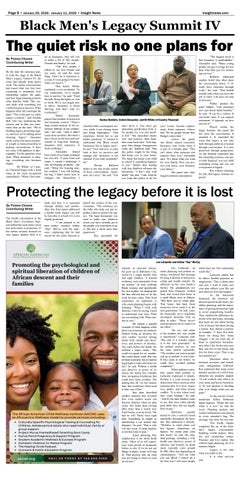
Lee Lafayette and Arthur “Ray” McCoy remarks in personal history. He grew up in Baltimore City, raised by a single mother who had eight children. “I learned resiliency and community from my mother,” he said, crediting Black women, and specifically his own mother, for shaping the life that allowed him to do the work he does today. That lived experience, he explained, is why estate planning begins with listening. “When I work with families, I start by saying, I need to understand your story. What are you dealing with. What matters to you.” He shared a painful example of what happens when these conversations are delayed. Despite being an attorney, his own mother resisted talking about wills, health care directives, and powers of attorney. Ten years before her death, she suffered a major stroke. “She could not speak for six months. She could barely walk. She was all there mentally, but we had no legal right to make decisions for her,” he said. Without a health care directive or power of attorney, the family lost valuable time navigating limitations that could have been avoided. “By putting this off, we lost serious time that could have been used to take care of her.” Ray then described another moment that revealed how even modest assets can fracture families when no plan exists. His father died owning little more than a nearly new Ford Torino, a car he loved. “He had no will. There were eight kids. Something as simple as transferring a car turned into disputes,” he said. “That is why I do this work. To help families avoid that kind of pain.” Estate planning, Ray emphasized, is not about death alone. “Most of us will experience some period of incapacity before we die. If we do not put things in place, courts will step in. That process eats up what you are trying to leave to your loved ones.”
Lee Lafayette, an estate planning and probate attorney, reinforced that message by tying it directly to homeownership and wealth transfer. He reflected on his own family’s history. His grandparents migrated from Arkansas, worked land, and owned their home in a small Black town in Illinois. “But there was no estate plan. That house, that land, those memories never made it to the next generation,” he said. Later, his financially savvy stepfather developed dementia with no plan in place. “Those investment properties never made it to me either.” “So yes, real estate is the number one way wealth is transferred,” Lafayette said. “But only if it actually makes it to the next generation.” In his probate practice, he sees the same pattern repeatedly. “The number one reason people end up in probate is real estate. If they came to me before, we could have avoided probate completely.” When audience members asked what probate is, Lafayette explained it plainly. Probate is a court process that determines where assets go after someone dies. It is slow, expensive, public, and often invites conflict. “It is also where creditors come looking,” he said. “And by the time families come to me, they have often already paid debts they did not legally have to pay.” Questions quickly turned to cost, a concern raised repeatedly throughout the Summit. Ray addressed it directly. “Mistakes in estate plans cost five figures. Sometimes six figures. No estate plan costs that much,” he said. His standard package, including a will, health care directive, power of attorney, and transfer on death deed, typically costs around $1,500, often less depending on circumstances. “Tell me what you can afford. I cannot do it for free, but I will meet people
where they are. Our community needs this.” Lafayette added that he allows flexible payment arrangements. “This is about time and care. I want to make sure your plan reflects your life, not just whoever lives the longest.” As the discussion deepened, the attorneys addressed special needs trusts, disability planning, and the importance of getting documents right to avoid jeopardizing benefits. They clarified the difference between wills and trusts, stressing that trusts are not about having a lot of money but about having a reason. Ray shared a personal example. “I have five kids. Some are doing fine. Some struggle. I do not want any of them to experience homelessness after I die. So the trust says they can live in the house rent free for three years. That is my last parental act.” Questions about retirement accounts and beneficiary designations followed. Ray explained that many assets transfer outside of a will if beneficiaries are properly named. “A will controls only what is in your name and has no beneficiary. Its real purpose is deciding who is in charge when you are gone.” As the session closed, moderator Jeffrey Robinson urged urgency. “Strike the iron while it is hot,” he told the room. Planning packets and contact information were placed in every attendee’s bag. The message was clear. Do not wait. This fourth chapter completes the arc of the Summit’s legacy conversation. Building wealth matters. Identity and mentorship matter. Presence and love matter. But without legal planning, all of it remains fragile. Legacy is not only what you build in life. It is what survives you.