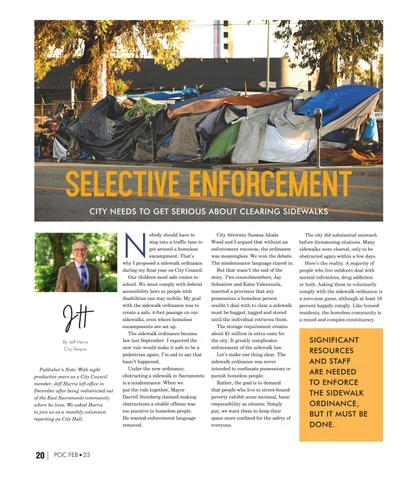
Selective Enforcement CITY NEEDS TO GET SERIOUS ABOUT CLEARING SIDEWALKS
N JH By Jeff Harris City Skeptic
Publisher’s Note: With eight productive years as a City Council member, Jeff Harris left office in December after being redistricted out of the East Sacramento community where he lives. We asked Harris to join us as a monthly columnist reporting on City Hall.
20
POC FEB n 23
obody should have to step into a traffic lane to get around a homeless encampment. That’s why I proposed a sidewalk ordinance during my final year on City Council. Our children need safe routes to school. We must comply with federal accessibility laws so people with disabilities can stay mobile. My goal with the sidewalk ordinance was to create a safe, 4-foot passage on our sidewalks, even where homeless encampments are set up. The sidewalk ordinance became law last September. I expected the new rule would make it safe to be a pedestrian again. I’m sad to say that hasn’t happened. Under the new ordinance, obstructing a sidewalk in Sacramento is a misdemeanor. When we put the rule together, Mayor Darrell Steinberg claimed making obstructions a citable offense was too punitive to homeless people. He wanted enforcement language removed.
City Attorney Susana Alcala Wood and I argued that without an enforcement recourse, the ordinance was meaningless. We won the debate. The misdemeanor language stayed in. But that wasn’t the end of the story. Two councilmembers, Jay Schenirer and Katie Valenzuela, inserted a provision that any possessions a homeless person couldn’t deal with to clear a sidewalk must be bagged, tagged and stored until the individual retrieves them. The storage requirement creates about $1 million in extra costs for the city. It greatly complicates enforcement of the sidewalk law. Let’s make one thing clear. The sidewalk ordinance was never intended to confiscate possessions or punish homeless people. Rather, the goal is to demand that people who live in street-bound poverty exhibit some minimal, basic responsibility as citizens. Simply put, we want them to keep their space more confined for the safety of everyone.
The city did substantial outreach before threatening citations. Many sidewalks were cleared, only to be obstructed again within a few days. Here’s the reality. A majority of people who live outdoors deal with mental infirmities, drug addiction or both. Asking them to voluntarily comply with the sidewalk ordinance is a zero-sum game, although at least 10 percent happily comply. Like housed residents, the homeless community is a mixed and complex constituency.
SIGNIFICANT RESOURCES AND STAFF ARE NEEDED TO ENFORCE THE SIDEWALK ORDINANCE, BUT IT MUST BE DONE.