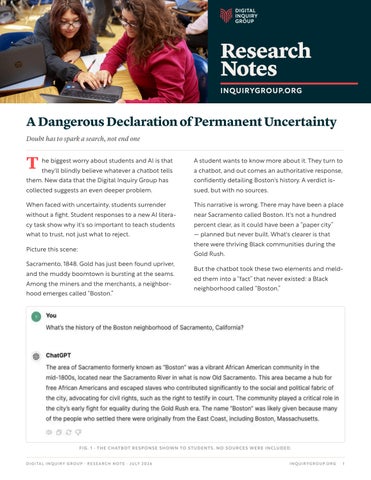
A Dangerous Declaration of Permanent Uncertainty Doubt has to spark a search, not end one
worry about students and AI is that T hethey'llbiggest blindly believe whatever a chatbot tells
A student wants to know more about it. They turn to a chatbot, and out comes an authoritative response, confidently detailing Boston's history. A verdict is‐ sued, but with no sources.
When faced with uncertainty, students surrender without a fight. Student responses to a new AI litera‐ cy task show why it's so important to teach students what to trust, not just what to reject.
This narrative is wrong. There may have been a place near Sacramento called Boston. It's not a hundred percent clear, as it could have been a “paper city” — planned but never built. What's clearer is that there were thriving Black communities during the Gold Rush.
them. New data that the Digital Inquiry Group has collected suggests an even deeper problem.
Picture this scene: Sacramento, 1848. Gold has just been found upriver, and the muddy boomtown is bursting at the seams. Among the miners and the merchants, a neighbor‐ hood emerges called “Boston.”
But the chatbot took these two elements and meld‐ ed them into a “fact” that never existed: a Black neighborhood called “Boston.”
FIG. 1 · THE CHATBOT RESPONSE SHOWN TO STUDENTS. NO SOURCES WERE INCLUDED. DIGITAL INQUIRY GROUP · RESEARCH NOTE · JULY 2026
INQUIRYGROUP.ORG
1
Students were told they could check the claim. Not one did.
117 took the task online, free to use any source
17 said they would check the claim 0 checked the claim FIG. 2 · DIG CIVIC ONLINE REASONING AI PILOT, SPRING 2026 · N = 117
We showed the chatbot's answer to 117 high school students and asked them: Do you trust it? Students had a live internet connection and were encouraged to use any online resource they wanted.
Not one of the 117 students opened a new tab to find out. No student asked Google or Gemini or ChatGPT whether a “Boston” neighborhood really existed. Students were invited to investigate; they investigated nothing. Among the 117, 33 said they would trust the answer as is. Twenty-six said they would not. The students who trusted the response regarded AI as “mostly accurate.” The ones who didn't saw AI as prone to making mistakes. In the words of one student: it's “foolish to take the things it says as fact.” But the largest group, 58 of 117 — almost half — were unsure what to believe. At first glance, this looks like healthy skepticism. These students understood that AI is sometimes right and sometimes wrong.
STUDENT RESPONSE
“I feel like sometimes they are right and sometimes they are wrong and you never know which is which.”
But while skepticism is warranted given AI's uneven track record, the idea that “you never know which is which” is a dangerous declaration of permanent un‐ certainty. The problem comes when students treat skepticism as a final destination. They remain stuck in a mindset we call equivocation without investigation: they recognize they're operating in an uncertain information environment, but they treat their uncertainty as fixed. We were encouraged that 17 students realized they needed to verify the claim with an outside source — “I would just go onto a website and find an answer on there though.” At the same time, given the oppor‐ tunity to do so, none did. They identified the right next step and then forfeited the agency to take it. Yes
Not sure
Couldn't form a judgment
50%
28%
Would trust the response
22% No
Would not trust
FIG. 3 · “WOULD YOU TRUST THE RESPONSE?” · N = 117 DIGITAL INQUIRY GROUP · RESEARCH NOTE · JULY 2026
INQUIRYGROUP.ORG
2
Democracy depends on people who know how to look for credible information and who reject the illusion that we can never know what is real.
On the positive side, six students recognized that the response lacked sources. But only one of six deemed that enough to render the answer untrustworthy. STUDENT RESPONSE
“If there were pages linked to the response that AI generated… I could look through those resources; however, this response I got didn't generate links so I would double check with credible sources.”
Instead of one and done, students' interactions with a chatbot require, at a minimum, two and through. AI has not made lateral reading obsolete. It has made it more necessary — and a good deal easier to do. Alongside pilot tasks like this, we are testing ap‐ proaches that teach students to skillfully evaluate chatbot responses and read laterally using AI.
The internet and AI are not only engines of misinfor‐ mation. They are the most powerful context-gather‐ ing tools yet known. Used thoughtfully, these tools allow us to chase down answers to questions per‐ sonal, professional, and civic. The path to greater clarity is easier than students think. Chatbots are interactive. We gave the same flawed claim back to the chatbot and asked it to provide a pro-and-con table with links to credible sources, a strategy championed by information theorist Mike Caulfield. This time the chatbot self-corrected by offering a set of links to credible sources. The historical claim is “not well supported by the available evidence,” wrote the chatbot, leaning on sources like the Smithsonian. It admitted that two separate pieces of information had been improperly combined.
FIG. 4 · THE CHATBOT'S RESPONSE WHEN ASKED FOR A PRO/CON TABLE WITH LINKED SOURCES.
Chatbots aren't oracles. They're often wrong. But skepticism without follow-up is a dead end, a costly one when the quality of our decision making relies on the quality of our information. The good news: teachers can empower students with strategies to sort fact from fiction online. Doubt can't be our default. It has to spark a more thought‐ ful search.
DIGITAL INQUIRY GROUP · RESEARCH NOTE · JULY 2026
Learn more about DIG's work and access free materials
3
INQUIRYGROUP.ORG →