FIGHT TO SAVE SUNDAY HOUSE HITS HURDLE
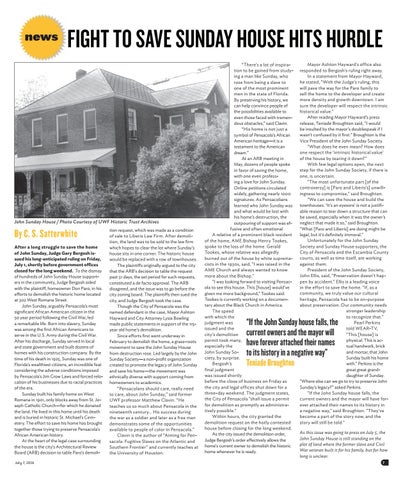
John Sunday House / Photo Courtesy of UWF Historic Trust Archives
By C. S. Satterwhite After a long struggle to save the home of John Sunday, Judge Gary Bergosh issued his long-anticipated ruling on Friday, July 1, shortly before government offices closed for the long weekend. To the dismay of hundreds of John Sunday House supporters in the community, Judge Bergosh sided with the plaintiff, homeowner Don Paro, in his efforts to demolish the historic home located at 302 West Romana Street. John Sunday, arguably Pensacola's most significant African American citizen in the 50 year period following the Civil War, led a remarkable life. Born into slavery, Sunday was among the first African Americans to serve in the U.S. Army during the Civil War. After his discharge, Sunday served in local and state government and built dozens of homes with his construction company. By the time of his death in 1925, Sunday was one of Florida's wealthiest citizens, an incredible feat considering the adverse conditions imposed by Pensacola's Jim Crow Laws and forced relocation of his businesses due to racial practices of the era. Sunday built his family home on West Romana in 1901, only blocks away from St. Joseph Catholic Church—for which he donated the land. He lived in this home until his death and is buried in historic St. Michael's Cemetery. The effort to save his home has brought together those trying to preserve Pensacola's African American history. At the heart of the legal case surrounding the house is the city's Architectural Review Board (ARB) decision to table Paro's demoliJuly 7, 2016
tion request, which was made as a condition of sale to Liberis Law Firm. After demolition, the land was to be sold to the law firm which hopes to clear the lot where Sunday's house sits in one corner. The historic house would be replaced with a row of townhouses. The plaintiffs originally argued to the city that the ARB's decision to table the request past 31 days, the set period for such requests, constituted a de facto approval. The ARB disagreed, and the issue was to go before the city zoning board. The plaintiffs then sued the city, and Judge Bergosh took the case. Though the City of Pensacola was the named defendant in the case, Mayor Ashton Hayward and City Attorney Lysia Bowling made public statements in support of the 115year old home's demolition. Since efforts first went underway in February to demolish the home, a grass-roots movement to save the John Sunday House from destruction rose. Led largely by the John Sunday Society—a non-profit organization created to promote the legacy of John Sunday and save his home—the movement was ethnically diverse with support coming from homeowners to academics. “Pensacolans should care, really need to care, about John Sunday,” said former UWF professor Matthew Clavin. “He teaches us so much about Pensacola in the nineteenth century… His success during the war as a soldier and later as a free man demonstrates some of the opportunities available to people of color in Pensacola.” Clavin is the author of “Aiming for Pensacola: Fugitive Slaves on the Atlantic and Southern Frontier” and currently teaches at the University of Houston.
“There's a lot of inspiration to be gained from studying a man like Sunday, who rose from being a slave to one of the most prominent men in the state of Florida. By preserving his history, we can help convince people of the possibilities available to even those faced with tremendous obstacles,” said Clavin. “His home is not just a symbol of Pensacola's African American heritage—it is a testament to the American dream.” At an ARB meeting in May, dozens of people spoke in favor of saving the home, with one even professing a love for John Sunday. Online petitions circulated widely, gathering nearly 1000 signatures. As Pensacolians learned who John Sunday was and what would be lost with his home's destruction, the outpouring of support was effusive and often emotional. A relative of a prominent black resident of the home, AME Bishop Henry Tookes, spoke to the loss of the home. Gerald Tookes, whose relative was allegedly burned out of the house by white supremacists in the 1930s, said, "I was raised in the AME Church and always wanted to know more about the Bishop." "I was looking forward to visiting Pensacola to see this house. This [house] would've given me more background," Tookes said. Tookes is currently working on a documentary about the Black Church in America. The speed with which the judgment was issued and the city's demolition permit took many, especially the John Sunday Society, by surprise. Bergosh's final judgment was issued shortly before the close of business on Friday as the city and legal offices shut down for a three-day weekend. The judgment states, the City of Pensacola "shall issue a permit for demolition as promptly as administratively possible." Within hours, the city granted the demolition request on the hotly contested house before closing for the long weekend. As the city issued the demolition order, Judge Bergosh's order effectively allows the home's current owner to demolish the historic home whenever he is ready.
Mayor Ashton Hayward's office also responded to Bergosh's ruling right away. In a statement from Mayor Hayward, he stated, "With the Judge's ruling, this will pave the way for the Paro family to sell the home to the developer and create more density and growth downtown. I am sure the developer will respect the intrinsic historical value." After reading Mayor Hayward's press release, Teniade Broughton said, "I would be insulted by the mayor's doublespeak if I wasn't confused by it first." Broughton is the Vice President of the John Sunday Society. "What does he even mean? How does one respect the ‘intrinsic historical value' of the house by tearing it down?" With few legal options open, the next step for the John Sunday Society, if there is one, is uncertain. "The most unfortunate part [of the controversy] is [Paro and Liberis's] unwillingness to compromise," said Broughton. "We can save the house and build the townhouses. ‘It's an eyesore' is not a justifiable reason to tear down a structure that can be saved, especially when it was the owner's neglect that made it so," said Broughton. "What [Paro and Liberis] are doing might be legal, but it's definitely immoral." Unfortunately for the John Sunday Society and Sunday House supporters, the City of Pensacola and the Escambia County courts, as well as time itself, are working against them. President of the John Sunday Society, John Ellis, said, "Preservation doesn't happen by accident." Ellis is a leading voice in the effort to save the home. "If, as a community, we truly value our cultural heritage, Pensacola has to be on-purpose about preservation. Our community needs stronger leadership to recognize that." Pearl Perkins told WEAR-TV, "This [house] is physical. This is actual handwork, brick and mortar, that John Sunday built his home with." Perkins is the great great granddaughter of Sunday. "Where else can we go to try to preserve John Sunday's legacy?” asked Perkins. "If the John Sunday house falls, the current owners and the mayor will have forever attached their names to its history in a negative way," said Broughton. "They've become a part of the story now, and the story will still be told."
“If the John Sunday house falls, the current owners and the mayor will have forever attached their names to its history in a negative way” Teniade Broughton
As this issue was going to press on July 5, the John Sunday House is still standing on the plot of land where the former slave and Civil War veteran built it for his family, but for how long is unclear. 7