Volume 5 2022
BACTERIOPHAGES EXTRACT RAW MATERIALS FROM WASTE BATIMAT INNOVATION AWARDS 2022 A SWARM OF 3D PRINTING DRONES SOLAR CELLS: COPPER OUT; SILVER IN EMERGENCY HOUSES FROM 3D PRINTED LOCAL CLAY
http://hightechmaterials.4tu.nl
Select key words and find relevant materials scientists or research groups within 4TU.
High-Tech Materials form the key to innovative and sustainable technology
www.4tu.nl/htm @4TU_HTM
4TU.HTM Research Programme New Horizons in Designer Materials | Visibility and accessibility of Materials Science & Engineering | Annual symposium Dutch Materials | 4TU.Joint Materials Science Activities | web application http://hightechmaterials.4tu.nl
CONTENT About
Innovatieve Materialen (Innovative Materials) is a digital, independent magazine about material innovation in the fields of engineering, construction (buildings, infrastructure and industrial) and industrial design. A digital subscribtion in 2022 (6 editions) costs € 42,15 (excl. VAT) Members of KIVI and students: € 25,- (excl. VAT)
SJP Uitgevers
Postbus 861 4200 AW Gorinchem tel. +31 183 66 08 08 info@innovatievematerialen.nl
Publisher
Gerard van Nifterik
6 - Bacteriophages extract raw materials from fluorescent lamps Researchers at the Helmholtz Institute Freiberg for Resource Technology (HIF) of the Helmholtz Center Dresden-Rossendorf (HZDR) have developed a process that allows them to extract rare earth metals from fluorescent lamps. The trick: bacteriophages: viruses that primarily infect bacteria.
16 - SeaSolv enables waste-free biorefinery of seaweed Seaweeds ('macroalgae') are rich in valuable nutrients for food, nutraceuticals or pharmaceuticals. However, these are not easily extracted. In the SeaSolv project, Wageningen University & Research (WUR), together with international partners, has developed an innovative waste-free method for the multi-product biorefinery of these substances. This will use a new class of solvents: deep eutectic solvents (DES).
21 - Batimat Innovation Awards 2022 At the beginning of October, the Batimat was held in Paris, a four-day meeting for all construction professions, manufacturers and sellers of materials and equipment, architects and project developers. During the fair, the traditional Batimat Innovation Awards were presented in ten categories, with gold, silver and bronze medals being awarded in (almost) each category. Among the medal winners were several material innovations.
26 - A swarm of 3D printing drones for construction and repair
Drs. Petra Schoonebeek ps@innovatievematerialen.nl
An international research team led the Swiss Federal Laboratories of Materials Science and Technology Empa and Imperial College London has taken bees as a model to develop a swarm of cooperative, 3D-printing drones. Under human control, these flying robots work as a team to print 3D materials for building or repairing structures while flying.
Innovative Materials platform:
28 - Out with the silver, in with the copper: a new boost for solar cell production
Dr. ir. Fred Veer, prof. ir. Rob Nijsse (Glass & Transparency Research Group, TU Delft), dr. Bert van Haastrecht (M2I), prof. Wim Poelman, dr. Ton Hurkmans (MaterialDesign), prof.dr.ir. Jos Brouwers, (Department of the Built Environment, Section Building Physics and Services TU Eindhoven), prof.dr.ir. Jilt Sietsma, (4TU.HTM/ Mechanical, Maritime and Materials Engineering (3mE), Kris Binon (Flam3D), Guido Verhoeven (Bond voor Materialenkennis/SIM Flanders, Prof. dr. ir. Christian Louter (TU Delft)
The rising price and low availability of raw materials, especially silver, are leading to higher costs in producing photovoltaic modules. Fraunhofer researchers have developed an electroplating process that involves substituting silver with copper, which is cheaper and more readily available. In order to bring the technology to the market more quickly, recently the spin-off PV2+ was launched.
Advertizing & sponsoring
30 - TOVA: Spain’s first 3D printed building using earth Housing is a problem worldwide, especially when housing shortages are acute as a result of natural disasters or war. In such a case, it would be useful if shelters could be built quickly and cheaply, preferably without having to bring in materials from far and wide. The first 3D-printed building in Spain has recently been installed in Spain: TOVA. It is made (almost) entirely from local clay and was completed in a matter of weeks. And that with 100 percent local materials and local labour, with no waste and with almost zero CO2 emissions.
Cover: A swarm of 3D printing drones for construction and repair (page 26) (Photo: Empa)
INNOVATIVE MATERIALS 5 2022
NEWS
Martian rock-metal composite shows potential of 3D printing on Mars (Photo by Wasan Prunglampoo on iStock)
If mankind ever wants to build settlements on the Moon or Mars, it will be impossible to bring in all materials from Earth. Bringing materials into space simply is extremely expensive. Local raw materials will have to be used and 3D printing seems to be the most obvious method for making for instance con-
struction parts. But is the Moon or Mars matter suitable for this? In order to investigate the in-space in situ resource utilization, scientists of the Washington State University (WSU) mixed small amount of simulated crushed Martian rock with a titanium alloy to investigate a stronger, high-performance
Objects made of 3D printed regolith composite (Photo: WSU/YouTube)
2 | INNOVATIVE MATERIALS 5 2022
material in a 3D‑printing process that one day could be used on Mars to make tools or rocket parts. The parts were made with as little as 5 % up to 100 % Martian regolith. Regolith is a blanket of unconsolidated, loose, heterogeneous superficial deposits covering solid rock. It includes dust, broken rocks, and other related materials and is present on Earth, the Moon, Mars, some asteroids, and other terrestrial planets and moons. For this study, the WSU scientists, used a powder-based 3D printer to mix the simulated Martian rock dust with a titanium alloy, a metal often used in space exploration for its strength and heat-resistant properties. As part of the process, a high-powered laser heated the materials to over 2,000 degrees °C. Then, the melted mix of Martian regolith-ceramic and metal material flowed onto a moving platform that allowed the researchers to create different sizes and shapes. After the material cooled down, the researchers tested it for strength and durability. Pieces were made with 5 and 100 per-
NEWS cent regolith. The ceramic material made from 100 % Martian rock dust cracked as it cooled, it could still make good coatings for radiation shields as cracks do not matter in that context. But just a little Martian dust, the mixture with 5 % regolith, not only did not crack or bubble but also exhibited better properties than the titanium alloy alone, which meant it could be used to make lighter weight pieces that could still bear heavy loads. According to WSU, this study is just a start, and future research may yield better composites using different metals or 3D‑printing techniques. More at WSU> The study ‘Martian regolith-Ti6Al4V composites via additive manufacturing’ (Ali Afrouzian, Kellen D. Traxel, Amit Bandyopadhyay) was published last July in the International Journal of Applied Ceramic Technology.. It is online> Video (WSU)
'Harsfalt': fossil-free asphalt On 21 July, Harsfalt (resin-asphalt) was applied for the first time in the Netherlands. In Harsfalt, the bitumen, which is extracted from crude oil, has been replaced by a 100 percent biological binding agent. According to the developers of the material - Mourik, NTP, Versluys Groep, Vermeulen Groep and ReintenInfra - Harsfalt is an important and major step in the development of bio-asphalt with which the asphalt of the Dutch road network can be replaced in a future-proof way in the coming years. This completely organic binder contains a mix of organic oils, resin and lignin from Elephant Grass. All components and the mixture have been examined for health, environment, reusability, material properties and mixture properties, among other things. Applying Harsfalt will make an important contribution to the ambition of our industry to work climate neutral on Dutch roads by 2030. The material was created with the contribution of Esha and Miscancell and with the support of Asphalt Kennis Centrum. Mourik> (Photo: NTP/ Meint Brookma)
3 | INNOVATIVE MATERIALS 5 2022
NEWS
Walls and furniture from popcorn on. GreenTec GmbH, part of the Loick Group, plans to use this technology in the future to manufacture toys, furniture, sports and fitness equipment, and children's car seats and headrests.
Wetenschappers van de Universiteit van Göttingen hebben een proces ontwikkeld waarmee panelen kunnen worden gemaakt van hennep-, vlas- en popcornkorrels (Foto: Udo Schmidt/Smarter Habitat)
Affordable housing made from environmentally friendly and CO2-neutral building material: scientists at the University of Göttingen have developed a process for producing panels from hemp, flax and popcorn granules. The advantage of this granulate is that it is a bio-based, environmentally friendly and sustainable, and durable and a great alternative to petroleum or gypsum based products. According to the developers, the material has excellent insulating and fire-resistant properties. The University of Göttingen has concluded an exclusive worldwide licensing agreement with the company Smarter Habitat for its commercial use. The working group ‘Chemie und Verfahrenstechnik von Verbundwerkstoffen’ (Chemistry and Process Engineering of Composite Materials) at the Faculty of Forest Sciences and Forest Ecology at the University of Göttingen has been conducting research in the field of renewable raw materials for years. Smarter Habitat intends to use it to produce panels for drywall and other applications, including load-bearing exterior walls,
4 | INNOVATIVE MATERIALS 5 2022
and market them under the name ‘Ecohab’. In addition to its excellent physical properties, the material is reusable, recyclable and compostable. There are more possibilities with the material from Göttingen. Earlier this year, the university announced that it had found a new license partner for a completely different field of applicati-
Loick has been producing sustainable toys as part of the PlayMais brand for more than 20 years. This natural craft toy can be shaped, pressed, cut and much more. PlayMais® is made from corn using a technique known as high-pressure foaming, and is 100 percent biodegradable. The licence from the University of Göttingen will enable the company to expand its toy range in the future to include larger compression-molded popcorn-based items for arts and crafts. In fact, completely new directions are planned for the future: Loick would like to produce items for automobile interiors (child car seats and headrests), sports and fitness equipment, and furniture (table-tops, seating) all using popcorn. More at the university of Göttingen> Ecohab>
The company GreenTec, part of the Loick Group, plans to produce toys, furniture, sports and fitness equipment, as well as car seats and headrests for children using popcorn granules (Photo: Universität Göttingen)
NEWS
Crinklecrankle Wall: Students make artwork from bricks
(Photo: TU Delft BK)
Four students1 of the BK (Bouwkunde) master and bachelor and two teachers have designed an artwork with dry stackable bricks for the exhibition BAKSTEEN | BRICK in the KAdE art gallery in Amersfoort. The title of the work is 'What do you want, brick?' Does a brick want to be a wall? The design is a variation on the historic crinklecrankle or ‘snake’ walls. A stone wall that stands stable because of its twists and turns. In preparation, many studies were carried out - both with bricks and profiles, as well as in simple Lego. In the design, five higher ‘merlons’ were made in typical Dutch dressings: Dutch cross bond, common or English bond, Flemish bond, Monk bond and a stretcher bond with quarter overlaps. These wall piers are connected by meandering walls in special patterns that are transformations of one pattern into another. Use was made of the dry stacking system whereby the bricks were drilled with 2 x 4 holes on both sides, with which they were stacked on studded layer profiles. The work consists of approximately 6100 bricks.
The BAKSTEEN I BRICK exhibition can be seen from 10 September to 8 January 2023 in the KAdE art hall, in the Elleboogkerk and at various locations in the city of Amersfoort. Many work of Dutch and foreign artists and architects is shown or even specially made for the exhibitionare also be on show with their contribution.
1
The students Nathan Chan, Sacha Oberski, Tobias Macchione and Dirk Hogeveen worked together with the teachers Koen Mulder and Rufus van den Ban, both form the department AE&T.
More information about the exhibition BAKSTEEN | BRICK can be found here. TU Delft Bouwkunde>
Lego experiments for CrinkleCrankle drystack wall For the design of the drystack brick snake wall in the Elleboogkerk in Amersfoort, the TU Delft students devised wildly meandering transition segments between fixed angles in standard connections. Experimenting in Lego proved to work well as spatial preparation. Unfortunately, the joints are not very visible: for this you really have to click on the photo and view it in its original resolution. View the studies made in Lego here (Dutch)>
5 | INNOVATIVE MATERIALS 5 2022
RESEARCH
Bacteriophages extract raw materials from fluorescent lamps Rare earths are important materials in complex electronics. Seventeen different metals such as lanthanum, cerium, europium and terbium that are essential components of smartphones, flat screens, wind turbines and compact fluorescent lamps. China is the world market leader for the supply of rare earths, covering 86 percent of global demand and even 98 percent of Europe's demand. To reduce this dependence and protect the environment, innovative recycling technologies are needed. Researchers at the Helmholtz Institute Freiberg for Resource Technology (HIF) of the Helmholtz Center Dresden-Rossendorf (HZDR) have developed a process that allows them to extract rare earth metals from fluorescent lamps. The trick: bacteriophages: viruses that primarily infect bacteria. Waste electronic products contain a variety of valuable elements in very low concentrations. These include compact fluorescent lamps, which are currently
Using phage technology, the appropriate element-specific biomolecule is selected from bacteriophages containing one billion different biomolecules. This biomolecule is then produced biotechnologically and anchored on a spherical magnetic carrier material. This creates biocollectors that can recognize and bind their target element in a targeted manner (Image: Dr Franziska Lederer)
The vial contains magnetite particles functionalized with rare earth binding biomolecules. The magnet on the right attracts the particles (Image: HZDR/Detlev Müller)
6 | INNOVATIVE MATERIALS 5 2022
collected separately from other electronic waste because the mercury-containing powder from the lamp has to be stored in special storage facilities. This powder contains barium magnesium aluminate, cerium magnesium aluminate, lanthanum phosphide, halophosphate and yttrium phosphide. By 2020, 25,000 tons of fluorescent powder had accumulated in the EU, of which 750 tons were rare earth metals. A share of 4,200 tons is assumed for other electronic end-oflife products. Therefore, HIF researchers have taken the lamp powder as a basis to demonstrate that it is possible and economically feasible to recover the elements contained in it. For recovery, they use a magnetic separation technique based on biocollectors: so-called 'Phage Surface Displays' (PSD).
NEWS The PSD method is based on bacteriophages. These are viruses that specialize in infecting bacteria. Using PSD technology, the correct element-specific biomolecule is selected from bacteriophages with a billion different biomolecules. This biomolecule is then anchored to a spherical, magnetic support material.
This creates biocollectors that can recognize and bind their target element - a rare earth metal - in a specific manner. Depending on the target material, the biocollectors can be loaded with a different type of biomolecule and used to selectively recover a different metal. The researchers at HZDR subsequently saw
the opportunity to use this technique for an applicable process, with which in the future rare earth metals can be effectively recovered with PSD bioreactors. More at HZDR (German)>
'Best Practices for Materials and Constructive Techniques' For designers and architects, materials and constructive techniques play an essential role. Decisions have to be made and those decisions are often very complicated; especially when it comes to environmental impact. Wood, for instance, is a material with an excellent CO2 footprint and outstanding constructural properties, while on the other hand, the use of wood is often associated with deforestation, which not only destroys ecosystems and habitats, but also causes climate changes. A logical question then is: is the use of wood in architecture actually sustainable? Something different. The production of brick requires a relatively large amount of energy, which results in a serious CO2 footprint. On the other hand, bricks last for generations and are often made from a renewable raw material, namely river clay. Don’t the advantages outweigh the disadvantages? Last September, the archdaily.com published an extremely complete overview online, titled ‘Best Practices for Materials and Constructive Techniques’. Not only the advantages and disadvantages of many construction materials
(Photo: Koninklijke Nederlandse Bouwkeramiek (KNB))
and techniques are discussed, but also suggestions and tips are given to make best constructive and ecological choices as responsible as possible.
Read the entire article at archidaily. com>
7 | INNOVATIVE MATERIALS 5 2022
RESEARCH
Improving cement with shrimps By adding nanoparticles from shrimp shells to cement paste, the material becomes considerably stronger. This could lead to less fishing waste and lower carbon emissions from concrete production. A typical win-win situation. The production of concrete causes a large amont of CO2 emissions worldwide. The stronger the concrete, the less of the material has to be used, the less CO2 it produces. On the other hand: seafood waste is a significant problem for the fishing industry. Most of this waste is dumped into the sea. A team of Washington State University and Pacific Northwest National Laboratory researchers created nanocrystals and nanofibers of chitin, the second most abundant biopolymer in nature, from waste shrimp shells. When these tiny bits of chitin, were added to cement paste, the resulting material was up to 40% stronger. In their work, the WSU team studied the chitin materials at the nanoscale. Crab, shrimp and lobster shells are made up of about 20 - 30 % chitin with much of the rest being calcium carbonate, another useful additive for cement. Compared to cellulose, chitin at the molecular scale happens to have an additional set of atoms - a functional carboxyl group - that allows the researchers to control the charge on the surface of the molecules and, consequently, how they behave in the cement slurry. The success in strengthening the cement paste came down to how the particles
Somayeh Nassiri and Li Hui measure properties of cement formulas that contain nanoparticles of chitin (Photo: Washington State University)
suspend themselves within the cement slurry and how they interact with the cement particles. As they added the processed nanocrystals of chitin to the cement, they were able to improve and target its properties, including its consistency, the setting time, strength and durability. They saw a 40 % increase in bend strength and a 12 % improvement in the ability to compress it. The researchers are now hoping to scale up the work to begin producing the additive at large scales.
The article ‘Insights into setting time, rheological and mechanical properties of chitin nanocrystals- and chitin nanofibers-cement’ paste was published last September in Cement and Concrete Composites. It is online> More at Washington State University>
The website of innovative materials has been renewed! Look at www.innovativematerials.nl or click this banner.
8 | INNOVATIVE MATERIALS 5 2022
RESEARCH
Electricity from your kitchen countertop What if you could power the smart thermostats, speakers and lights in your home with a kitchen countertop? Stones, such as marble and granite, are natural, eco-friendly materials that many people building or renovating houses already use. Now, in a step toward integrating energy storage with these materials, researchers of the Korean Kookmin University have fabricated microsupercapacitors onto the surface of stone tiles. The devices, reported in ACS Nano, are durable and easily scaled up for customizable 3D power supplies. Stones, even those that are polished and seem smooth, have microscopic bumps and divots, making it difficult to adhere electrical components to them. Researchers have recently figured out how to place microsupercapacitors, which have fast charging and discharging rates and excellent power supply storage, onto irregular surfaces with lasers. The researchers patterned a copper oxide nanoparticle solution on a marble tile into two comb-like sides whose prongs were interspersed. They pointed a near-infrared laser on the nanoparticles, producing pure copper electrodes that were porous, highly conductive and strongly attached to the stone’s surface. To form the microsupercapacitor, the
Interconnected microenergy devices built on marble tiles create customizable 3D power supply systems
researchers deposited iron oxide onto one of the electrodes to form a cathode, and manganese oxide on the other to form an anode. The electrolyte layer connecting the electrodes was made from a lithium perchlorate and polymer solution. In tests, the device maintained
a high energy storage capacity even after 4,000 charge-discharge cycles. When multiple microenergy devices were strung together in a three-by-three array, enough energy was stored to light an LED. In addition, the stone energy storage devices were exceptionally durable against harsh impacts. The researchers say that stone microenergy devices could provide high-performance, customizable and conveniently accessible power from natural building materials. This work was done by Seunghyun Back, Jung Hwan Park, and Bongchul Kang, School of Mechanical Engineering, Kookmin University, Seoul, Republic of Korea. The article ‘Microsupercapacitive Stone Module for Natural Energy Storage’ was published last summer in ACS Nano.
The researchers patterned a copper oxide nanoparticle solution on a marble tile into two comb-like sides whose prongs were interspersed
More at ACS>
9 | INNOVATIVE MATERIALS 5 2022
RESEARCH
Invisible coating protects wood from fire
An invisible coating that can make wood ‘fireproof’ has been invented by scientists at NTU Singapore. With the popularity of engineered timber growing in the construction industry, one of the biggest challenges for wood is its flammability. When untreated, wood or timber can burn and combust easily. However, current practices to protect the interior of wooden buildings from fires require the use of fire-retardant panels or paint-like coatings that conceals the natural wood grains of timber. In comparison, the new invisible coating developed by NTU allows for natural beauty of timber to shine and yet can still provide a flame barrier when ‘activated’ by fire. It is low-cost, easy to apply, effective in kerbing the spread of fire and generates very little smoke when burnt. Invented by a team led by Associate Professor Aravind Dasari from the NTU School of Materials Science and Enginee-
10 | INNOVATIVE MATERIALS 5 2022
ring, this fireproof coating is just 0.075 millimetres thick and is highly transparent, making it invisible to the naked eye. When heated up by a hot flame, a series
of complex chemical reactions happens, causing the coating to become a char that expands to more than 30 times its original thickness. This char prevents the
NEWS fire from combusting the wood underneath (see video). According to NTU, this new coating is expected to be in high demand by the construction industry, as timber buildings need to meet specific fire codes for buildings set by regulators. There are only a few products which can provide both transparency and fire retardance
that are available in the market. According to NTU, products which claim to have both properties currently are either extremely prohibitive in cost or are unable to pass international standards required for industry use. More at NTU Singapore>
Video
‘Colour increases opportunities for wood in urban construction’ Recently, the Karlsruhe Institute of Technology (KIT) published a study on the importance of wood for urban construction. And remarkably, they concluded that more colour may be the key to greater acceptance of wood. The study, 'Farbige Holzfassaden im urbanen Kontext' (coloured wooden facades in urban contexts), was carried out by KIT's Institute for Building Design and Technology and commissioned and funded by Munich-based project developer Bauwerk. The research focused on Vinzent, a project by Allmann Sattler Wappner Architects. It is a new and innovative residential and office building with colourful wooden facades in the Neuhausen district of Munich. The research identifies trends that are currently determining the growing interest in urban timber construction: the favourable carbon and energy footprint, recyclability, low emissions and relatively good availability. Furthermore, much progress has been made in the field of drawing (CAD) and production (CNC) processes and wood is also excellent for prefab. In the meantime, persistent prejudices appear to have been refuted both in practice and by scientific research, especially in the field of fire protection, maintenance and lifespan. The Vinzent project would also show that the use of colour can be an important factor for further acceptance of wood in urban construction and the integration of wooden structures in urban areas. The report can be downloaded HERE>
11 | INNOVATIVE MATERIALS 5 2022
RESEARCH
New funding for sustainable concrete substitute ‘outstanding’ compression strength, rivaling traditional mortar, making it strong enough to be used in the construction of buildings as compressive elements. It also does not require baking at high temperatures like a traditional brick does, and it can be made quickly, unlike the 28 days needed to cure concrete. This new NSF funding will help the team improve the processes that will allow for EMC to move more swiftly from the lab to construction sites. Working with WPI’s Office of Technology Commercialization, Scarlata and Rahbar created Enzymatic, Inc., a start-up company launched to realize commercial opportunities for ECM and an earlier product - a self-healing concrete - they developed in their initial collaboration. More at the t Worcester Polytechnic Institute> www.nsf.gov Worcester Polytechnic Institute (WPI) researchers Nima Rahbar and Suzanne Scarlata have received $692,386 from the National Science Foundation (NSF) to further develop their Enzymatic Construction Material (ECM), a ‘living’, lowcost construction material with negative CO2 emissions. They developed the material as an alternative to concrete, which is responsible for serious greenhouse gas emissions worldwide. According to the scientists, the new material has properties that can compete with those of concrete. ECM is made by an enzymatic process involving carbonic anhydrase, an enzyme that converts carbon dioxide and water into hydrogen carbonate. This reaction produces calcium carbonate crystals, which are the main component of ECM. A sand slurry is also added, along with a polymer, which initially holds the ECM together. In addition, this process
12 | INNOVATIVE MATERIALS 5 2022
allows ECM to repair itself and repair cracks or other imperfections. Through extensive testing and experimentation, the research team found that ECM has
RESEARCH
Graphene turns waste into gold Throughout history, alchemists believed in the existence of the philosopher’s stone: a substance that could turn cheap substances into precious gold. Now scientists from The University of Manchester, Tsinghua University in China and the Chinese Academy of Sciences have shown that graphene can be a kind of philosopher’s stone, allowing gold extraction from waste containing only trace amounts of gold (down to billionth of a percent). This new application of graphene works quite straightforwardly: add graphene into a solution containing traces of gold
and, after a few minutes, pure gold appears on graphene sheets, with no other chemicals or energy input involved. After this you can extract your pure gold by simply burning the graphene off. The research shows that 1 gram of graphene can be sufficient for extracting nearly 2 grams of gold. As graphene costs less than $0.1 per gram, this can be very profitable, with gold priced at around $70 per gram. Gold is used in many industries including consumer electronics (mobile phones, laptops etc.) and, when the products are eventually discarded, little of the
electronic waste is recycled. The graphene-based process with its high extraction capacity and high selectivity can reclaim close to 100% of gold from electronic waste. More at Universiteit van Manchester> The article ‘Highly efficient and selective extraction of gold by reduced graphene oxide’ was published in Nature Communications. It's online>
Algae bioplastics: the global state of the industry Algae began attracting attention as a biofuel in the 1970s. While the sector grew rapidly in the 2000s, its gains were largely wiped out by the 2008 financial crash. Since then, investors have turned to other high-value chemical derivatives. Among them were bioplastics. For example, algae are nowadays seen as an environmentally friendly bio-raw material for many packaging and consumer applications. But to what extent has the industry actually picked up on those opportunities? Bio Market Insights inventoried the state of affairs on various continents. Read the entire article at Bio Market Insights>
13 | INNOVATIVE MATERIALS 5 2022
RESEARCH
Green electronics made from wood Non-biodegradable electronic waste continues to accumulate year after year. Wouldn't it therefore be useful to make electronic components from a natural, renewable raw material? Wood for instance. But it’s easier said than done. For one thing, wood is naturally an electrical insulator. It also has a complex structure, making it a challenge to achieve homogeneous electrical properties during large-scale fabrication. Now, a research team at Empa and at ETH’s Institute for Building Materials has developed a practical and versatile method for making wooden surfaces electrically conductive by graphitising them. In this way, devices such as touch panels and sensors can be produced on a large scale with great efficiency. The trick is to pretreat the wood with an ink containing iron. The project, led by Ingo Burgert and Guido Panzarasa, was supported by the Swiss National Science Foundation. To make conductive structures on wood, the new method improves an existing process called laser-induced graphitization. A laser can engrave fine lines into wooden boards, or veneers. In this process, the energy of the laser beam heats the wood, causing a series of pyrolytic events leading to the formation of electrically conductive graphite. However, the obtained conductive patterns are irregular in depth and width, and there is also a fire hazard due to overheating. Often, multiple post-processing laser steps are needed as well. The density of wood varies depending on the tree species and growth, so the result can be very uneven graphitization. The research team thus came up with the idea of using iron as a catalyst to enable a gentler process and a much more homogeneous surface. Searching for a biologically based catalyst material they chose an iron-gall ink, a mixture of iron salt and tannins used as early as the
14 | INNOVATIVE MATERIALS 5 2022
Middle Ages for writing. After optimizing the recipe, they coated a variety of wood veneers with a thin layer of the ink and then subjected them to the laser treatment. The ink layer showed the desired effect. The patterns engraved after just one pass showed a more uniform structure and conductivity, regardless of differences in the wood structure and type. The patterns are only a few micrometers deep and can thus be engraved into the thinnest veneer without actually damaging it.
also able to make the wafer-thin wood glow by means of an electroluminescent layer; a phenomenon that could be used in applications such as backlighting for displays or for advertisements and control panels. For the electroluminescent wood, the researchers used still conventional wiring and electronic components, however. In the future, these could also be partially replaced by conductive wood. The next step is to refine and further develop the method for large-scale use.
The team then used their new method to produce trial electronic components from spruce, cherry and beech veneers less than half a millimeter thick. According to the researchers, bendable strain sensors could be integrated discreetly into load-bearing wood components in buildings, allowing for constant monitoring of their structural health. They were
The article ‘Sustainable wood electronics by iron-catalyzed laser-induced graphitization for large-scale applications’ was published in Nature communications. It is online> More at Empa>
Wij leveren complete installaties voor ontstoffing, luchtreiniging en pneumatisch transport Technieken voor o.a.: - Ontstoffing van productieruimtes (MAC) - Reduceren van geuremissies (NER) - Reduceren van stofemissies (NER) Componenten die wij o.a. kunnen leveren: - Natfilters & Droogfilters - Cyclonen - Gaswassers - Topsteen- / Frogreinigers - Naverbranders
Natfilter met slibtransporteur
Projecten kunnen turn-key worden uitgevoerd Wij garanderen de emissie & grenswaarden Engineering, bouw en onderhoud in eigen beheer
Hoog vacuüm stofzuiginstallatie
Frogreiniger
Mesys Industrial Air Systems BV Molenstraat 27, 6914AC Herwen
www.mesys.nl
+31 (0) 316 248744
Info@mesys.nl
Center of expertise for materials characterization. Independent, dedicated, objective research and consultancy. ISO 17025 accredited.
We are pleased to support you with research and analysis of your innovative materials. Call us on +31 26 3845600 or email info@tcki.nl www.tcki.nl
NEWS
(Photo: WUR)
SeaSolv enables waste-free biorefinery of seaweed Seaweeds ('macroalgae') are rich in valuable nutrients for food, nutraceuticals or pharmaceuticals. However, these are not easily extracted. In the SeaSolv project, Wageningen University & Research (WUR), together with international partners, has developed an innovative waste-free method for the multi-product biorefinery of these substances. This will use a new class of solvents: deep eutectic solvents (DES). Seaweed is a promising but underutilised green feedstock in Europe. It is mainly commercially exploited for food and for the production of phycocolloids (thickening agents). But industrial production is complex and inefficient and also uses acid and alkaline conditions,
16 | INNOVATIVE MATERIALS 5 2022
many chemicals and a lot of water and energy. This generates a considerable amount of waste, as other components are destroyed during the extraction of the phycocolloids. Even some of the phycocolloids themselves are degraded. Meanwhile, several new extraction techniques have been developed, for instance using ultrasound, microwaves, enzymes, homogenisation and supercritical extraction. These are still in their infancy and also have many drawbacks: they are expensive, have low yields, affect the final product and are difficult to scale up.
Green solvents
In SeaSolv, a more sustainable and
cost-effective process will be developed that will allow the seaweed industry to significantly reduce its carbon footprint. The process uses deep eutectic solvents (DES). This new class of sustainable solvents offers many advantages, including low price, low toxicity and often biodegradability. They can be 'customised' and are even switchable during a desired process. DES therefore represent a potential alternative to conventional organic solvents. They allow various components to be extracted from biomass one by one in a gentle manner, while maintaining the functionality of the end products. The result is a multi-product biorefinery
NEWS that generates little or no waste and consumes less energy. The technology will eventually also be usable for the extraction of metabolites from other types of land-based and aquatic biomass, such as plants and microalgae. Text WUR>
SeaSolv The SeaSolv research will be developed in Wageningen University's Bioprocess Engineering (BPE) group, led by Dr Antoinette Kazbar. Partners in the project also involve industrial companies that are going to put the new techniques into practice: Hortimare from Heerhugowaard (Netherlands), Kelpblue from Zeist (Netherlands), Algaia from Saint-Lô (France) and the University of Aveira (Portugal). The research will been funded by the Open Technology Programme of the Netherlands Organisation for Scientific Research, NWO.
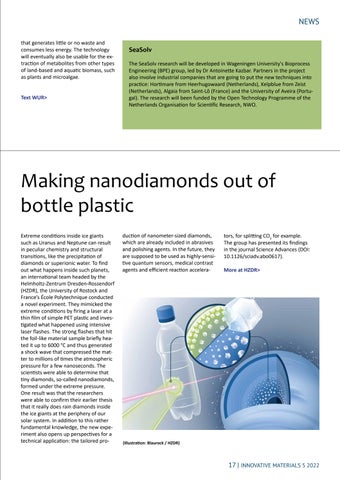
Making nanodiamonds out of bottle plastic Extreme conditions inside ice giants such as Uranus and Neptune can result in peculiar chemistry and structural transitions, like the precipitation of diamonds or superionic water. To find out what happens inside such planets, an international team headed by the Helmholtz-Zentrum Dresden-Rossendorf (HZDR), the University of Rostock and France’s École Polytechnique conducted a novel experiment. They mimicked the extreme conditions by firing a laser at a thin film of simple PET plastic and investigated what happened using intensive laser flashes. The strong flashes that hit the foil-like material sample briefly heated it up to 6000 °C and thus generated a shock wave that compressed the matter to millions of times the atmospheric pressure for a few nanoseconds. The scientists were able to determine that tiny diamonds, so-called nanodiamonds, formed under the extreme pressure. One result was that the researchers were able to confirm their earlier thesis that it really does rain diamonds inside the ice giants at the periphery of our solar system. In addition to this rather fundamental knowledge, the new experiment also opens up perspectives for a technical application: the tailored pro-
duction of nanometer-sized diamonds, which are already included in abrasives and polishing agents. In the future, they are supposed to be used as highly-sensitive quantum sensors, medical contrast agents and efficient reaction accelera-
tors, for splitting CO2 for example. The group has presented its findings in the journal Science Advances (DOI: 10.1126/sciadv.abo0617). More at HZDR>
(Illustration: Blaurock / HZDR)
17 | INNOVATIVE MATERIALS 5 2022
NEWS
Micro nonwoven interlocks for enhanced wind power During WindEnergy 2022 - trade fair for the international wind energy industry, last September in Hamburg, the German concern Freudenberg introduced its new Freudenberg Friction Inserts (FFIs). The FFI technology is based on a special very thin nonwoven carrier material that is coated on one side with hard particles. This increases the lateral stresses in a connection between components; which reduces the chance of failure. In this way, FFIs increase the power density of, for example, wind turbines. The idea is as follows. Bolted connections are in many applications exposed to lateral forces. If this lateral force reaches a critical value, it might cause the connection to fail because the parts slip, limiting the performance of the connection. According to Freudberg this can be prevented with FFI. The Friction Insert is applied between the two parts and the hard particles
18 | INNOVATIVE MATERIALS 5 2022
penetrate into the surface of both. The combination between the normal force and the increased friction coefficient between the two parts results in a significant higher friction force. This friction force withstands the occurring lateral
force, allowing the bolted connection to be secured. Not only can significantly higher torque and shear forces be transmitted, but noise and vibrations are also prevented.
RESEARCH This increase in performance and subsequent safety of the joints allows for use of thinner and lighter materials as well as new innovative material combinations, like connection of aluminium and plastic materials.
also eliminate slipping and prevent the fretting of connections. According to Freudenberg FFI can thus significantly increase the performance of wind turbines.
According to Freudenberg, FFIs help to improve the reliability of connections and thus of the entire wind turbine and
More on Friction-Inserts> Video
Durable coating kills COVID virus Developed by a team of University of Michigan engineers and immunologists, there may soon be a new weapon in our centuries-old battle against germs: the first durable coating that can quickly kill bacteria and viruses and keep on killing them for months at a time. It proved deadly to SARS-CoV-2 (the virus that causes COVID-19), E. coli, MRSA and a variety of other pathogens. According to Michigan University the coating killed 99.9 % of microbes even after months of repeated cleaning, abrasion and other punishment on real-world surfaces like keyboards, cell phone screens and chicken-slathered cutting boards. The coating, which is clear and can be brushed or sprayed on, gets its durability and germ-killing power by combining classical ingredients in a new way. It uses antimicrobial molecules derived from tea tree oil and cinnamon oil, both used for centuries as safe and effective germ killers that work in under two minutes. The coating’s durability comes from polyurethane, a tough, varnish-like sealer that’s commonly used on surfaces like floors and furniture. The results of the study’s durability tests suggest that the coating could keep killing germs for six months or longer before its oil begins to evaporate and reduce its disinfectant power. But even
These images show the bacterial load on a coated and uncoated computer keyboard, cell phone and cutting board with raw chicken (Image: Anish Tuteja)
then, it can be recharged by wiping it with fresh oil; the new oil is reabsorbed by the surface, starting the cycle again. More at University of Michigan>
The article ‘Surfaces with instant and persistent antimicrobial efficacy against bacteria and SARS-CoV-2’ was published in Matter last August. It is online>
19 | INNOVATIVE MATERIALS 5 2022
RESEARCH
Ultraconductive aluminum may beat copper Copper is an excellent conductor and that is why the material is widely used in the world of electricity and electronics. That could be about to change. New research from Pacific Northwest National Laboratory (PNNL) has revealed a method that can significantly increase the conductivity of aluminum, making it economically competitive with copper. According to PNNL, the research may open the way to the development of an ultra conductive aluminium alternative to copper, which could revolutionize vehicles, electronics and the electrical grid. The thing is, copper's properties make its application inevitable, at least so far. In addition, the demand for copper currently exceeds availability, driving up its prize. This is expected to get worse with the rising number of electric vehicles (EVs), which need twice as much copper as traditional vehicles. Plus, copper is heavy, which drives down EV efficiency. Aluminium is just one-third the price and weight of copper, but it is only about 60 % as conductive. Aluminium’s relatively low conductivity can be a limitation in some real-world applications. So increasing aluminium’s conductivity would be a game-changer. PNNL-team's first step was to find out how far the conductivity of aluminium could be increased by the influence of temperature and structural defects. Next, the researchers wanted to develop an atom-by-atom recipe to increase conductivity. The researchers looked to semiconductors for inspiration because previous
20 | INNOVATIVE MATERIALS 5 2022
research had successfully simulated conductivity in these silicon-based materials and some metal oxides. The team adapted these concepts to work with aluminium and simulated what would happen to the metal’s conductivity if individual atoms in its structure were removed or rearranged. These tiny changes added up to big gains in total conductivity. Now that the recipe for changing the conductivity of metal is theoretically clear, the team want to apply the concept in practice on a laboratory scale. They are also exploring the possibility of increasing the conductivity of other metals using the same simulations.
The research team expects that more conductive aluminium would have far-reaching implications - any application that uses electricity or copper could benefit from the development of affordable, lightweight, ultra-conductive aluminium. The paper ‘Electrical conduction processes in aluminium: Defects and phonons’ (Kashi N. Subedi, Keerti Kappagantula, Frank Kraft, Aditya Nittala, and David A. Drabold) was published earlier this year in the journal Physical Review (doi. org/10.1103/ PhysRevB.105.104114) PNNL>
NEWS
Batimat Innovation Awards 2022 At the beginning of October, the Batimat was held in Paris, a four-day meeting for all construction professions, manufacturers and sellers of materials and equipment, architects, project developers, but also contractors and craftsmen. Batimat is (along with InterClima and IdéoBain) part of Mondial du Bâtiment (formerly Salon International de la Construction)', an international trade fair dedicated to construction, building and architecture. During the fair, the traditional Batimat Innovation Awards were presented in ten categories, with gold, silver and bronze medals being awarded in (almost) each category. Among the medal winners were several material innovations.
IPAC In the Major works/Structure/Envelope category, the award (gold) went to the French company BAT'IPAC from Saint-Aignan de Grand Lieu with the material IPAC: a load-bearing and insulating honeycomb cellulose sheet material. IPAC is an 'environmentally responsible' product for construction, made from recycled honeycomb board. According to the manufacturer, it can be recycled up to 97 times without the need to add new materials. In addition, the production of this material requires little electricity and fossil fuels. Transport costs are also reduced thanks to a grid of the territory based on end users. IPAC can be integrated into the construction of all types of buildings: individual or collective housing; new construction, extension or renovation projects; walls, roofs, floors, partitions, facades and more. Everything about IPAC at BAT'IPAC> IPAC at BAT’IPAC>
IPAC (photo: Frédéric Lechat/BAT’IPAC)
UniverCell Cristal Also in the Major works/Structure/Envelope category, Soprema won the bronze medal with UniverCell Cristal, a new generation of cellulose wadding. UniverCell Cristal is a descendant of the cellulose insulation UniverCell family of the French company Soprema. The new UniverCell Cristal sprayable cellulosic material is made using a patented process converting glassine in cellulose wadding. Glassine is a type of glycerine-treated tissue paper that is used as a self-adhesive backing paper for labels. So far, 95 percent of glassine waste went to landfill or was incinerated, but Soprema says they are able to turn it into a new insulation material. The material has a density of 23 kg/ m3, an insulation value of 0.041W/mK and can be sprayed as an insulating fiber material. More at Soprema> UniverCell Cristal (Photo: Soprema)
21 | INNOVATIVE MATERIALS 5 2022
NEWS Diathonite Floor insulation Diathonite Thermostep 047 floor insulation material from DIASEN SRL (Sassoferrato, Italy) was awarded the gold medal in the Interior & Garden category. DIASEN says the material improves a floor's thermal performance while keeping it breathable. The material regulates moisture and is resistant to molds thanks to a relatively high lime content. It is easy to apply and can be applied by hand or sprayed on the floor with a plastering machine. According to DAISEN it’s four times lighter and five times more insulating compared to a traditional screed. More at DIASEN>
CORKAL composite CORKAL, developed by TECHNAL (part of the Norwegian aluminium producer Hydro Group) is a cork composite material in the form of insulation strips for aluminium windows. It is intended as an alternative to petroleum-based plastic materials. According to TECHNAL, the material can reduce the environmental impact of an aluminium window by 15 to 25 percent. In addition to the insulating properties of CORKAL, the material also improves the thermal and acoustic performance of window frames. The new extrusion process TECHNAL has developed allows it to be produced in long bars and in various shapes, making it suitable as a thermal buffer material for doors and windows. TECHNAL was awarded the gold medal in the 'Joinery and closures' category.
(Photo: DIASEN)
More at TECHNAL>
Repan Isosta Group was awarded the silver medal (Preserving the environment category) for Repan, process or method for dismantling and reusing sandwich panels, consisting of a polystyrene foam core and aluminium enclosure. The components that are used in such panels can be easily recycled individually, but once they are processed into a sandwich, this becomes very difficult. Repan can do something about that. According to Isosta, in this way an aluminium sandwich panel with a polystyrene core gets a recyclability of almost 100 percent.
CORKAL (Photo: TECHNAL)
More at Batiweb>
Bamboo window Minco vec's fenêtre HYBRID bamboo is a hybrid window (windows with wood and metal), in which the wood - usually pine and oak - has been replaced by bamboo. This has several advantages. Bamboo grows very quickly and can be harvested after five years. In addition, it has good insulating properties, is climate neutral, FSC certified and easy to recycle.
22 | INNOVATIVE MATERIALS 5 2022
Repan (Photo: Virginie Kroun/Batiweb)
NEWS According to Minco vec, this makes it an innovative solution for resource management, soil restoration and biodiversity conservation. MINCO's bamboo window was awarded a silver medal in the Joinery and closures category. More at Minco>
Bamboo window (Photo: Minco)
Theunisbrug wins Architecture Masterprize 2022
(Photo: ZJA)
The Theunis Bridge connecting Merksem and Deurne has been awarded the prestigious Architecture Masterprize 2022. Commissioned by De Vlaamse Waterweg, architectural firm ZJA, in collaboration with Arcadis, Sweco and OKRA Landscape Architects, designed the new Theunis Bridge over the Albert Canal. A steel bridge in three parts,
which, with a greater vertical clearance, guides pedestrians, cyclists, cars and trams pleasantly and safely to the other side as if over a boulevard. With its dark pillars, radiant white openwork towers and careful detailing, the new bridge is a striking appearance in the urban landscape of Antwerp. The Theunisbrug wins the award in the category 'Infra-
structure. The Architecture Masterprize, an international American architecture prize, is regarded as a leading recognition within architecture. More at ZJA>
23 | INNOVATIVE MATERIALS 5 2022
MAKE IT MATTER
MAKE IT MATTER MAKE IT MATTER is compiled in collaboration with MaterialDistrict (MaterialDistrict.com). In this section new, and/or interesting developments and innovative materials are highlighted.
Paper Clay Paper waste has been a serious problem in many industries and offices for years. Paper may account for 70% of a company’s total waste. Design With Paper Clay An Mor has been exploring the physical and aesthetic properties of waste paper to develop materials that enhance this local resource. This research opens up new areas of innovative applications for waste paper, such as interior and design materials.
More at MaterialDistrict>
OTTAN OTTAN collects food waste as fruit peels, expired grains, vegetable residues and garden waste as tree leaves or grass. This waste is processed by cleaning, drying and grinding to create natural raw materials which are mixed with green resins. The resulting material then is injected into moulds to create minimal yet multi-purpose products. Each of the materials was produced by upcycling an average of 65-85 % organic waste. More at MaterialDistrict>
Plastic Soup Future (PSF) PSF BV makes sustainable products from collected waste plastic that is sorted, cleaned and ground. This plastic is pressed into sheet material, which is used to make tables and tile floors. The crushed plastic can also be used in cast floors via a special process. According to the manufacturer, the material is extremely durable and vandal-proof. PSF materials last at least 50 years and can then be recycled at least seven more times (longer cannot be tested) without the addition of other materials. More at MaterialDistrict>
24 | INNOVATIVE MATERIALS 5 2022
MAKE IT MATTER ECOrange ECOrange is an net acoustic material and an innovative way to combine layers. The core is made of recycled plastic bottles, while the exterior part offers a wide range of textile finishing. Scope it to absorb the sound in the speech frequencies, mission based on circular economy. The sandwich can be shaped in different thicknesses and sections, from flat to U to W to Millerighe (Italian word to revocate ribs or waves).
More at MaterialDistrict>
CEYDIUM CEYDIUM by Mediterraneo Surfaces analyzed and studied new trends in architecture and interior design and developed innovative solutions with ceramic materials. The result is a versatile, refined and durable ceramic surface. According to the manufacturer, CEYDIUM offers a feeling of warmth, luxury, being one with nature.
More at MaterialDistrict>
RiBoard RiBoard is an concrete like material manufactured from recycled mineral fibres with cementitious binders. It offers good acoustic absorption and is also completely fire resistant. Its components are environmentally friendly with the main ingredient being a 100 % recycled mineral fibre material. RiBoard can be combined with other materials like HPL or wood veneer and can be custom dyed.
More at MaterialDistrict>
Wireglass Wireglass is a project of Caroline Priss and Marieke van den Heuvel, which resulted in various dynamic weaves integrated into glass. The metal textile weaves are made of stainless steel, copper and iron, and especially designed for this purpose. The metal, perforated sheets have been melted along with the glass. Because of the handmade process, no design is the same. The glass is available in various thicknesses and colours, and with dimensions of max. 60 by 60 cm. More at MaterialDistrict>
25 | INNOVATIVE MATERIALS 5 2022
INNOVATIVE MATERIALS
A swarm of 3D printing drones for construction and repair Swarms of drones could also be used in space, for example on a future Mars mission. Image: Yusuf Furkan KAYA, Aerial Robotics Laboratory, Imperial College London/Empa
An international research team led the Swiss Federal Laboratories of Materials Science and Technology Empa and Imperial College London has taken bees as a model to develop a swarm of cooperative, 3D-printing drones. Under human control, these flying robots work as a team to print 3D materials for building or repairing structures while flying.
During tests with a scaled up building session, the team virtually tracked the drone's patht to show how a large group could efficiency print large structures
26 | INNOVATIVE MATERIALS 5 2022
The system, called Aerial Additive Manufacturing (Aerial-AM), involves a fleet of drones working together from a single blueprint. It consists of so-called BuilDrones, which deposit materials during flight, and quality-controlling ScanDrones, which continually measure the BuilDrones’ output and inform their next manufacturing steps. The researchers say that in-flight 3D printing unlocks doors that will lead to on-site manufacturing and building in difficult-to-access or dangerous locations such as post-disaster relief construction and tall buildings or difficult to reach infrastructure. Aerial-AM uses both a 3D printing and path-planning framework so the drones can adapt to variations in geometry of the structure as a build progresses.
INNOVATIVE MATERIALS The drones are fully autonomous in flight, but there is a human controller in the loop can monitor progress and intervene if necessary, based on the information provided by the drones. To test the concept, the researchers developed four cement-like mixtures for the drones to build with. Throughout the build, the drones assess the printed geometry in real time and adapt their behaviour to ensure they meet the build specifications, with manufacturing accuracy of five millimetres. The proof-of-concept prints included a 2.05-metre cylinder (72 layers) with a polyurethane-based foam material, and an 18-centimetre cylinder (28 layers) with a custom designed structural cement–like material. A BuilDrone and a ScanDrone built this approximately two-meter-high ‘tower’ of fast-curing foam - layer by layer (image: University College London)
work with construction companies to validate the principle and expand repair and manufacturing capabilities. They expect the technology to deliver significant cost savings and reduce risks compared to conventional methods. More at EMPA>
According to Empa, this technology mainly opens up possibilities for building and repairing structures in hard-to-reach locations. The researchers now want to
Video
In hard-to-reach areas, drones may one day erect structures as a team (Image: Yusuf Kaya / Imperial College London/Empa)
27 | INNOVATIVE MATERIALS 5 2022
INNOVATIVE MATERIALS
Out with the silver, in with the copper: a new boost for solar cell production The rising price and low availability of raw materials, especially silver, are leading to higher costs in producing photovoltaic modules. Fraunhofer researchers have developed an electroplating process that involves substituting silver with copper, which is cheaper and more readily available. In order to bring the technology to the market more quickly, recently the spin-off PV2+ was launched. When it comes to generating electricity from renewable energies, photovoltaics are a mainstay. Modern heterojunction1 solar cells have a particularly low CO2 footprint on account of the low amounts of silicon used to produce them, and when it comes to industrial production, they achieve the highest levels of efficiency. As a result, the chances are high that this technology will become the standard in production. According to the International Renewable Energy Agency (IRENA), more than 96 TWh of energy was produced by photovoltaic systems worldwide in 2012, which rose to nearly 831 TWh by 2020 and this is by
28 | INNOVATIVE MATERIALS 5 2022
Three-dimensional confocal microscopy image of a copper contact produced using the laser-assisted process developed by PV2+. The even, semi-circular shape of the contact ensures a high level of electrical conductivity (Photo: PV2+)
INNOVATIVE MATERIALS no means the limit of what photovoltaics can offer. However, when manufacturing solar cells, valuable silver is used for busbars and contacts, which conduct the electricity that is generated in the silicon layer by means of solar radiation. The cost of this precious metal is rising - even today, silver accounts for around 10 percent of the manufacturing price of a photovoltaic module. Moreover, there are only limited quantities of the metal available on Earth. The solar industry processes 15 percent of the silver mined, but due to the industry’s high growth rate, this proportion is set to rise sharply. This will not be viable, however, as other sectors such as electromobility and 5G technology also report an expected future increase in their use of silver. That is why the solar industry requires breakthrough technological innovations to realize its full potential. Researchers at the Fraunhofer Institute for Solar Energy Systems ISE have taken on this challenge. With about 1,400 employees, this Freiburg-based institute is the largest solar research institute in Europe. A team of researchers led by Dr. Markus Glatthaar has developed an electroplating process for the promising heterojunction technology to replace silver with copper. Copper is many times cheaper and more readily available than silver. The replacement of silver with copper was achieved through the introduction of a new electroplating process, which has also been shown to improve the efficiency of the cells. With the reduction of the diameter of the guide rails to 19 micrometers, less silicon is shaded, allowing it to generate more electricity. To ensure that the electrically conductive surface of the solar cell is not completely electroplated with copper, the areas of the surface that should not be coated must first be masked. These areas are covered by a coating that has an electrically insulating effect, thereby pre-
At just 19 micrometers in width, the copper contacts are extremely thin. As a result, the light-sensitive silicon layer does not experience much shading (Photo: PV2+)
venting them from being electroplated. The copper layer will only build up in the areas not coated with the insulation. The researchers have made another significant advance here: until now, expensive polymer-based lacquers or laminated foils have been used in this industry to mask the silicon wafer in the electrolyte bath. Properly disposing of the polymers is an expensive process that generates a lot of waste. Dr. Glatthaar and his team have been able to substitute the polymers with aluminum. Just like copper, aluminum is fully recyclable. Switching the materials twice, from silver to copper and from polymer to aluminum, also brings twice the benefit: Producing solar cells is not only more sustainable, but also significantly cheaper.
In order to bring the promising technology to the market more quickly, Fraunhofer ISE launched the spin-off PV2+. The letters ‘P’ and ‘V’ stand for photovoltaics, with ‘2+’ indicating the double positive charge of copper ions in the electroplating bath. He is aiming to set up a pilot production plant together with industrial partners as early as the start of 2023. Fraunhofer> 1
Heterojunction solar cells combine two different technologies in one cell: a crystalline silicon cell sandwiched between two layers of amorphous (thin-film) silicon. Together, these technologies make it possible to harvest more energy compared to the single ones alone. More on heterojunction at wikipedia>
The website of innovative materials has been renewed! Look at www.innovativematerials.nl or click this banner. 29 | INNOVATIVE MATERIALS 5 2022
INNOVATIVE MATERIALS
Project: TOVA by IACC/WASP, Valldaura Labs, Barcelona (Photo: IAAV/Gregori Civera)
TOVA: Spain’s first 3D printed building using earth Housing is a problem worldwide, especially when housing shortages are acute as a result of natural disasters or war. In such a case, it would be useful if shelters could be built quickly and cheaply, preferably without having to bring in materials from far and wide. The first 3D-printed building in Spain has recently been installed in Spain: TOVA. It is made (almost) entirely from local clay and was completed in a matter of weeks. And that with 100 percent local materials and local labour, with no waste and with almost zero CO2 emissions. According to the Institute for Advanced Architecture of Catalonia (IAAC), which was responsible for the development and construction of TOVA, this concept can be used anywhere in the world, for example when dealing with people in emergency situations. 30 | INNOVATIVE MATERIALS 5 2022
INNOVATIVE MATERIALS
According to IAAC, the concept can be a solution for acute housing problems anywhere in the world (Artist Impression IAAC/YouTube)
TOVA is the first architectural construction made with earth and a 3D printer in Spain, the project has been developed by the 3DPA postgraduate research program at the IAAC. According to IAAC, the project is a prototype that represents the bridge between the past - vernacular earthen architecture - and the future - large scale 3D printing technology which will not only serve to change the architecture of the future, but will also
be very useful when facing the current climate and housing crisis across the globe. TOVA is the beginning of a larger project in collaboration with WASP in which a complete house made with 3D printing technology is projected. WASP is an Italian 3D printing company that has carried out several projects with 3D printed earth in recent years. One of the most talked-about is the Tecla house: a 3D-printed eco-home made of clay and
designed by Italian architecture studio Mario Cucinella Architects (MCA). At the time, it was the world's first house to be completely 3D printed from a mixture of mostly local soil and water. (The name is also a contraction of 'technology' and 'clay'. The 3D printing technology Crane WASP from WASP was used for the building, which is now also used for the building in Barcelona. TOVA is the first building of this type in
WASP/TECLA January 2021, Italian 3D printer manufacturer WASP made headlines worldwide with the completion of a similar project to TOVA: TECLA, a 3D-printed house made of natural materials - mainly earth in this case. TECLA is made with multiple 3D printers working simultaneously. The house was developed by WASP and designed by Mario Cucinella Architects. It is intended as a new circular residential house principle, made entirely with local, reusable, recyclable materials, CO2 neutral and adaptable to any climate and environment. Innovative Materials 2021 Volume 1>
2020, WASP CRANE in action at the TECLA project (Innovative Materials 2021 volume 1)
31 | INNOVATIVE MATERIALS 5 2022
INNOVATIVE MATERIALS 3D printing (or additive manufacturing) is a great example of km zero construction. According to the zero-km philosophy, a construction must meet a number of conditions, such as (among others) use of local materials, reduction of CO2 emissions caused by the transport of building materials and the use of local labor. That is exactly what the TOVA project meets. The possible applications of this construction model are endless; from homes, to public spaces, interiors and exteriors.
Worldwide
(Photo: IAAC)
Spain and stands out for being one of the most sustainable and environmentally friendly construction forms that can be applied today. The construction took 7 weeks time to complete, a Crane WASP, the architectural 3D printer and km zero materials.
great insulation to prevent heat loss in winter and protect from solar radiation in summer.
During the entire construction process, zero waste is generated, as the materials were sourced within a 50 meter radius. The structure is made of local earth, mixed with additives and enzymes, to ensure the structural integrity and material elasticity necessary for the optimized 3D printing of the house. The foundation is made of geopolymer and the roof, wooden construction. To ensure the longevity of the material in resistance to weather, a waterproof coating is added using raw extracted materials. The design of the building takes into account the climatic conditions of the Mediterranean: the volume is compact to protect from the cold in winter, but expandable during the other three seasons of the year, allowing the use of the immediate outdoor surroundings. The walls are made up of a network of cavities that contain airflow and allow
32 | INNOVATIVE MATERIALS 5 2022
(Photo: IAAC)
The project was conceived as a prototype for sustainable housing that could be built anywhere in the world. This promising technique opens the door to quickly solving problems of access to housing in vulnerable areas or temporary settlements, offering new solutions for the creation of more sustainable and affordable spaces.IAAC responds with this and other projects to increasingly serious climate and migration emergencies, providing new solutions that contribute positively to the global housing emergency problem that will have to be faced in the future due to large migrations or natural disasters. The use case
INNOVATIVE MATERIALS of this rapid construction method can be a solution for increasing spaces that require emergency response for housing solutions of masses such as communities for asylum seekers. More at IAAC>
Video IAAC Project ‘Openings In 3d Printing With Earth’ (Photo: IAAC)
3D Printing Architecture (3DPA) While the 3D-printed building at Valldaura Labs is still modest in size, IAAC's vision is not. The Institute for Advanced Architecture of Catalonia sees 3D printing with local materials - especially clay and loam - as an important option for 21st century construction and architecture, with all the challenges that come with it. The institute has set up a special research program for this purpose and a training program under the name 3D Printing Architecture (3DPA) aimed at additive manufacturing of sustainable architecture. The program is being carried out in close collaboration with the 3D printing industry Printing clay plays an important role in the project. When it comes to the ecological footprint, clay has significant advantages over, for example, concrete. It's usually available locally and production has a very low carbon footprint. In the context of the 3DPA programme, for example, research has been carried out into the properties of the raw materials and additives in terms of extrudability and 3D printability. The experimental research was carried out in two phases. In the first phase, the experiments were performed to define the properties of the raw materials (clay, brick dust and marble dust) and the additives (enzymes, collagens and starch) in terms of miscibility, and drying properties (drying time and shrinkage). On that basis, the most successful mixtures/compositions with additives (casein, wheat and rice) were determined. Much more on 3D-printen with clay, and the 3DPA-activities of IAAC can be found here>
The website of innovative materials has been renewed! Look at www.innovativematerials.nl or click this banner.
33 | INNOVATIVE MATERIALS 5 2022
RESEARCH
Co-Consolidated TitaniumThermoplastic Composite Joints: a study on the mechanisms governing adhesion and durability The main drivers for technological innovation in the aviation industry are the reduction of the CO2 emissions along with the reduction of operating costs. Multimaterial design that joins advanced metals, such as titanium, to high-performance thermoplastic composites represents an appealing solution, as metal inserts are often required for load introduction purposes. Besides, composites and metals can be combined to form hybrid materials called Fibre Metal Laminates, typically used in fuselage panels. The moldability of the thermoplastic matrix allows for a cost-efficient joining method, known as co-consolidation, where composite consolidation and joining to the metal are achieved simultaneously during a standard composite consolidation or forming process.
Vanessa Marinosci with one of the samples (Photo: Gijs van Ouwerkerk)
For the implementation of the co-consolidation technology, it is essential to develop guidelines which ensure reliable and predictable metal-thermoplastic composite interfaces. Therefore, the objective of this research is to understand and optimize the interfacial bonding mechanisms between metal and thermoplastic composites, more specifically, between the titanium alloy Ti6Al4V and C/PEKK composites.
Scanning Electron Microscopy picture showing the crystalline phase of the polymer (called PEKK) on the crack surface of a titanium-PEKK joint (Picture by Nick Helthuis)
34 | INNOVATIVE MATERIALS 5 2022
RESEARCH
Video
It has been demonstrated that the attraction between Ti6Al4V and PEKK relies on physical interactions. As evidence, the loss of adhesion in the presence of water is recovered when redrying. Additionally, it has been found that the mechanical interlocking, promoted by the titanium surface roughness, has a beneficial effect on the fracture toughness in dry conditions. The metal surface irregularities alter the local stress state at the crack tip and may cause a transition from adhesive to cohesive failure. A stable Ti6Al4V-C/PEKK interface in both dry and humid conditions has been obtained by combining the toughening effect of the surface roughness and the moisture barrier provided by a silane-based coating. Altogether, this work
Scanning Electron Microscopy picture showing the crystalline phase of the polymer (called PEKK) on the crack surface of a titanium-PEKK joint (Picture by Nick Helthuis)
constitutes a fundamental basis towards reliable titanium-thermoplastic composite joints manufactured via a co-consolidation process. This research was performed by Vanessa Marinosci at the ThermoPlastic
composites Research Center (TPRC) and the University of Twente and financed by the Dutch Research Council (NWO). The dissertation can be found online>
35 | INNOVATIVE MATERIALS 5 2022
RESEARCH
Publications A Comprehensive Study on the Rejuvenation Efficiency of Compound Rejuvenators for the Characterization of the Bituminous Binder, Mortar, and Mixture Materials, August 2022
This study aims to comprehensively investigate the rejuvenation efficiency of various self-developed compound rejuvenators on the physical, mechanical, and aging properties of aged bitumen, asphalt mortar, and mixture. The results revealed that the restoration capacity of vacuum distilled-oil rejuvenators on high-and-low temperature performance-grade of aged bitumen is more significant. In contrast, an aromatic-oil based rejuvenator is good at enhancing low-temperature grade and aging resistance. Moreover, the temperature and time of the curing conditions for mixing recycling of asphalt mixture were optimized as 150 °C and 120 min. Furthermore, the sufficient anti-rutting, structural stability, and moisture resistance of recycled asphalt mixture affirmed the rejuvenation efficiency of compound rejuvenators. The article is online>
Lignin as a Renewable Building Block for Sustainable Polyurethanes Materials, September 2022
Currently, the pulp and paper industry generates around 50–70 million tons of lignin annually, which is mainly burned for energy recovery. Lignin, being a natural aromatic polymer rich in functional hydroxyl groups, has been drawing the interest of academia and industry for its valorization, especially for
the development of polymeric materials. Among the different types of polymers that can be derived from lignin, polyurethanes (PUs) are amid the most important ones, especially due to their wide range of applications. This review encompasses available technologies to isolate lignin from pulping processes, the main approaches to convert solid lignin into a liquid polyol to produce bio-based polyurethanes, the challenges involving its characterization, and the current technology assessment. Despite the fact that PUs derived from bio-based polyols, such as lignin, are important in contributing to the circular economy, the use of isocyanate is a major environmental hot spot. Therefore, the main strategies that have been used to replace isocyanates to produce non-isocyanate polyurethanes (NIPUs) derived from lignin are also discussed. The article is online>
Systematic derivation of safety factors for the fatigue design of steel bridges Structural Safety, July 2022
This paper presents a probabilistic framework to derive the safety factors for fatigue of steel and composite steel concrete road bridges. Engineering models are used for the design and the safety factor is derived in such a way that the design meets the target reliability set by international Eurocode and ISO standards, estimated using measured data and advanced probabilistic models. Engineering model uncertainties and dynamic amplification factors are established through comparison of measurements and models. The value of visual inspections is quantified based on observations from practice and expert opinions. The safety factors are derived for Eurocode’s Fatigue Load Model 4 and Eurocode’s tri-linear S-N curve. The study shows that the safety factors for fatigue as currently recommended by the Eurocodes need to be raised. (Technische Universiteit Eindhoven) The article is online>
The realities of additively manufactured concrete structures in practice Cement and Concrete Research, June 2022
Lignin as a renewable building block to produce sustainable polyurethanes.
36 | INNOVATIVE MATERIALS 5 2022
Extrusion-based 3D Concrete Printing (3DCP) is rapidly gaining popularity in the construction industry. Trial projects are now being realized at an increasing rate around the world to test the viability of the technology against real-world requirements. This step, from the ‘simple’ deposition of filaments of self-stable concrete to its application in buildings and structures, with all associated requirements and interfaces, comes with challenges. These range from matching the design
RESEARCH intent to the manufacturing capabilities (through structural analysis and approval, and reinforcement) to quality consistency (robustness) on large scale, and compatibility with other materials. In many of these areas, much simply remains unknown due to a lack of experimental data or information from projects where 3DCP has been applied. This paper aims at reducing this knowledge gap by presenting a systematic discussion, based on the analyses of eight realized 3DCP projects from around the world. It was found that the structural application of printed concrete is limited, due to a lack of regulatory framework for expedient approval, as well as limited reinforcement options which require to resort to unreinforced masonry analogies. The application of the technology features a host of practical issues that relate to the print process, material, site conditions, building integration and design - or to the 3DCP technology in general. Although some potential risks, such as shrinkage cracking and quality consistency are generally recognized, the measures taken to mitigate them vary considerably, and are largely based on individual expertise. The actual effectiveness is generally unknown. Finally, it was observed that, while the printing itself is fast, the preparation time is generally considerable. This is partially due to a lack of knowledge amongst professionals. In the practical production of a 3DCP project, three expertise areas are crucial: one for the digital part, one for the machine side, and one for the material side. Thus there is a strong need for educational institutions to develop dedicated training courses and incorporate relevant topics into their curricula. (TU Eindhoven)
reveals that incorporation of End-of-life tire materials in concrete not only serves the purpose of recycling End-of-life tire products, but can also contribute to unique properties such as energy dissipation not attained by conventional concrete and therefore leading to superior performance as flexural strengthening material. It was found that by incorporating 60% by volume rubber particles in combination with recycled steel fibers, it increased the damping ratio of concrete by 75.4%. Furthermore, SFRRC was proven effective in enhancing the energy dissipation of existing structural members. The article is online>
High-strength lithography-based additive manufacturing of ceramic components with rapid sintering Additive Manufacturing November 2022
Additive manufacturing technology enables the fabrication of technical ceramics and multi-materials with unprecedented geometrical accuracy and complexity, opening the path to new
The article is online>
Concrete with a High Content of End-of-Life Tire Materials for Flexural Strengthening of Reinforced Concrete Structures Materials, July 2022
This research investigates the performance of Steel Fiber Reinforced Rubberized Concrete (SFRRC) that incorporates high volumes of End-of-life tire materials, (i.e., both rubber particles and recycled tire steel fibers) in strengthening existing reinforced concrete (RC) beams. The mechanical and durability properties were determined for an environmentally friendly SFRRC mixture that incorporates a large volume (60% by volume aggregate replacement) of rubber particles and is solely reinforced by recycled tire steel fibers. The material was assessed experimentally under flexural, compressive and impact loading, and thus results led to the development of a numerical model using the Finite Element Method. Furthermore, a numerical study on full-scale structural members was conducted, focusing on conventional RC beams strengthened with SFRRC layers. This research presents the first study where SFRRC is examined for structural strengthening of existing RC beams, aiming to enable the use of such novel materials in structural applications. The results were compared to respective results of beams strengthened with conventional RC layers. The study
Ceramic processing applying lithography-based ceramic manufacturing (LCM). (a) LCM technology based on digital light processing (DLP). (b) Photo-polymerized network forming the matrix to organize the ceramic particles in a 3D-printed shape. (c) The removal of the polymeric network leads to an open-porous fragile structure
functionalities for engineering applications. A crucial step to consolidate 3D-printed ceramic parts is 'sintering', a time and energy (temperature) intensive densification process. Here we present a strategy for rapid sintering ~ 300 - 450 °C/min) of lithography-based additively manufactured alumina ceramics enabling consolidation of ceramic components of complex shapes within minutes. Highly dense, fine-grained microstructures were achieved by controlling densification and limiting grain growth through rapid radiation heat transfer. The high mechanical strength and toughness measured in additively manufactured alumina (~ 810 MPa and ~ 4.3 MPa m1/2) sintered at 1600 °C within 2 min was superior to that of conventionally sintered reference parts. This study opens the path for rapid sintering of complex shaped ceramic architectures of high density with tailored microstructure and properties. The article is online>
37 | INNOVATIVE MATERIALS 5 2022
EVENTS Advanced recycling 14 - 15 November 2022, Keulen
Fastener Fair Stuttgart 21 - 23 March 2023, Stuttgart
Formnext 2022 15 - 18 November 2022 Frankfurt am Main
European Coatings Show 2022 28 - 30 March 2023, Nurnberg
VETECO 2022 15 - 18 november 2022, Frankfurt am Main
MaterialDistrict Utrecht 2023 5 - 7 April 2023, Utrecht
Şişecam 37th International Glass Conference 17 - 18 November 2022, Istanbul
Conference on CO2-based Fuels and Chemicals 2023 19 - 20 April 2023, Keulen
Münchener Forum Verbindungstechnologie 2022 23 - 24 November 2022, Munich
KUTENO Kunststofftechnik Nord 9 - 11 May 2023, Rheda-Wiedenbrück
Hagener Symposium Pulvertechnologie 24 - 25 November 2022, Hagen
Renewable Materials Conference 2023 23 - 25 May 2023, Siegburg/ Cologne
AESAN Ceramics Thailand 30 nov - 2 December 2022, Bankok
Maintenance Dortmund 24 - 25 May 2023, Dortmund
Meeting Materials 2022 13 December 2022, Noordwijkerhout
NEWCAST 12 - 16 June 2023, Düsseldorf
InfraTech 2023 17 - 20 January 2023, Rotterdam
METEC 12 -16 June 2023, Düsseldorf
47th International Conference and Expo on Advanced Ceramics 22 - 27 January, 2023 Daytona Beach
GIFA 12 - 16 June 2023, Düsseldorf
Bouwbeurs 2023 6 - 10 February 2023, Utrecht
Moulding Expo 2023 13 - 16 June 2023, Stuttgart
Glassman Europe 2023 8 - 9 February 2023, Istanbul
LightCon 13 - 14 June 2023, Hannover
38 | INNOVATIVE MATERIALS 5 2022
CONTENT 14–15 November Cologne (Germany) Hybrid Event advanced-recycling.eu
Diversity of Advanced Recycling of Plastic Waste All you want to know about
Topics
• Markets and Policy
advanced plastic waste recycling:
• Circular Economy and Ecology of Plastics
technologies and renewable
• Physical Recycling
chemicals, building blocks,
• Biochemical Recycling
monomers, and polymers based
• Chemical Recycling
on recycling
• Thermochemical Recycling • Other Advanced Recycling Technologies • Carbon Capture and Utilisation (CCU) • Upgrading, Pre- and Post-Treatment Technologies
Organiser
Sponsors
Contact Dominik Vogt Conference Manager dominik.vogt@nova-institut.de
39 | INNOVATIVE MATERIALS 5 2022
ENTERPRISE EUROPE NETWORK
Enterprise Europe Network (EEN) supports companies with international ambitions The Enterprise Europe Network (EEN) is an initiative of the European Commission that supports entrepreneurs in seeking partners to innovate and do business abroad. The Network is active in more than 60 countries worldwide. It brings together 3,000 experts from more than 600 member organisations – all renowned for their excellence in business support.
Database
Every company can participate by adjusting its profile to the database. This company will be brought to the attention in the country in which it wants to become active. At the same time it is possible to search for partners. EEN advisers actively assist in compiling the profile, which is drawn up in a certain format. The EEN websites also contain foreign companies that are looking for Dutch companies and organizations for commercial or technological cooperation. The EEN advisers support the search for a cooperation partner by actively deploying contacts within the network. In addition, Company Missions
and Match Making Events are regularly organized. All these services are free of charge. There are five types of profiles:
•
Business Offer: the company offers a product
•
Business Request: the company is looking for a product
•
Technology Offer: the company offers a technology
•
Technology Request: the company is looking for a technology
•
Research & Development Request: the organization seeks cooperation for research
When a company has both a Business Offer and a Business Request (or another combination), two (or even more if applicable) profiles are created. The profile includes the most essential
Video: How Enterprise Europe Network works
information about the nature of the supply or demand, the ‘type of partner’ that is intended and the expected cooperation structure. Get in touch with your local network contact point by selecting the country and city closest to where your business is based. They can help you with advice, support and opportunities for international partnerships. For sustainable building and the creative industry, contact ir. drs. Hans Kamphuis: T: +31 (0) 88 042 1124 M: 06 25 70 82 76 E: hans.kamphuis@rvo.nl For Materials contact Nils Haarmans: T: +31 (0) 88 062 5843 M: 06 21 83 94 57 More information websites can be found at the Europe Network websites: www.enterpriseeuropenetwork.nl http://een.ec.europa.eu
40 | INNOVATIVE MATERIALS 3 2022
ENTERPRISE EUROPE NETWORK
The Enterprise Europe Network Materials Database: Request for partnership: November 2022.
Interested? contact hans.kamphuis@rvo.nl>
An eco-friendly French SME is looking for foreign partners to supply cotton-lined cork, vegetable fibers or cellulose fabrics to produce high-end vegan bags A French entrepreneur had a solid experience in luxury products as a leather goods maker. In 2019, she started her own activity on the basis of eco-responsibility, as designer and producer of leather goods and jewellery for men and women. She is currently looking for new suppliers of cotton-lined cork, vegetal fibers or cellulose in rolls in several colours. Manufacturers of such types of quality and natural materials, are sought as long-term partners under supplier agreements.
A Greek animal feed supplements producer is looking for raw materials
A Greek company active in the field of various animal feed supplements is looking for four types of raw materials for their production. The company is looking for producers or suppliers of Sugar beet Molasses, Dry yeast, Monocalcium phosphate, and Dicalcium phosphate.
A Finnish company is seeking for a supplier or manufacturer of foam plastic components
A Finnish eco-design company is looking for a supplier or manufacturer of designed and round shape-cut foam plastic components. The diameter of the component is 90 mm. The desired form of cooperation is a manufacturing or a subcontracting agreement.
A French yacht equipment manufacturer is looking for new neoprene fabrics suppliers located in Europe This neoprene fabrics should come in rolls, 10 000-15 000 meters per year.
Greek technological start-up company is looking for multiple waste materials, for procurement agreement A Greek start-up technological company is working in the fields of industrial minerals & metals, materials and energy. The company is looking for multiple sources of waste materials such as bauxite residue, residue from metal-making or steel industry, bricks & tiles and other demolishing waste, glass waste and fly ash from biomass incineration. The company needs to have a procurement agreement.
41 | INNOVATIVE MATERIALS 3 2022
Innovative Materials, the international version of the Dutch magazine Innovatieve Materialen, is now available in English. Innovative Materials is an interactive, digital magazine about new and/or innovatively applied materials. Innovative Materials provides information on material innovations, or innovative use of materials. The idea is that the ever increasing demands lead to a constant search for better and safer products as well as material and energy savings. Enabling these innovations is crucial, not only to be competitive but also to meet the challenges of enhancing and protecting the environment, like durability, C2C and carbon footprint. By opting for smart, sustainable and innovative materials constructors, engineers and designers obtain more opportunities to distinguish themselves. As a platform Innovative Materials wants to help to achieve this by connecting supply and demand. Innovative Materials is distributed among its own subscribers/network, but also through the networks of the partners. In 2021 this includes organisations like M2i, MaterialDesign, 4TU (a cooperation between the four Technical Universities in the Netherlands), the Bond voor Materialenkennis (material sciences), SIM Flanders, FLAM3D, RVO and Material District.