
PIZZO’S JASON
no-“bulls—t” leadership style could redefine Florida politics, revive Democrats

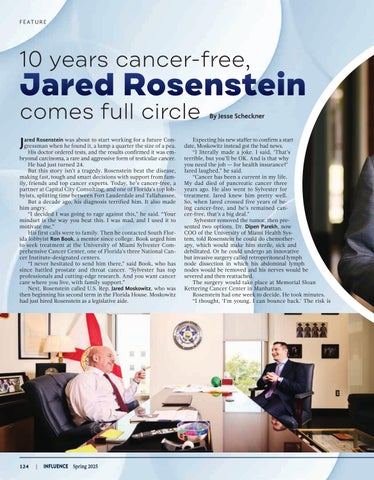
2025 Class of Rising Stars Jared Rosenstein’s Courageous Fight
Get Smart Quick About New Members


Nicole Kelly thrives at the intersection of policy and strategy, working closely with the legislature and top-tier clients to navigate the complexities of the appropriations process. With a sharp strategic mindset and deep expertise, she ensures her clients are an integral part of policy discussions. Known for her tenacity and ability to turn challenges into opportunities, Nicole is a relentless advocate who delivers results in even the most competitive environments.
It’s a Florida kind of America
There’s probably never been a better time to publish a magazine titled “INFLUENCE” then when Florida’s influence on the nation is at an all-time high.
After Donald Trump again won the presidency last year, the now-President began populating his administration with a lot of Florida men and women — people like former Florida Attorney General Pam Bondi, who is now serving as U.S. Attorney General; former U.S. Sen. Marco Rubio, who is now Secretary of State; ace political consultant Susie Wiles now serving as Trump’s Chief of Staff; former U.S. Rep. Mike Waltz, as National Security Adviser and on and on.
Many of these powerbrokers are people with whom I have personal relationships, and just as powerful, if not more, so do the readers of this magazine.
Those relationships open an interesting chapter in Florida, and the nation, as the Sunshine State trend continues to trickle down to second-and third-tier Florida politicos getting pulled into the D.C. ethos. As that happens, I expect plenty of Florida lawmakers, sheriffs and other elected officials to become frequent flyers to Reagan International.
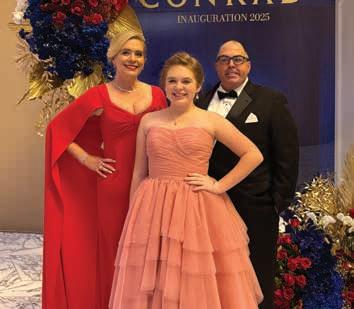
And with that in mind, the photo I have chosen from above is of our family at the presidential inauguration. For us, it wasn’t a political statement — we attended a milestone political event just as we would a White House event hosted by Joe Biden. For Michelle and me, it’s important to see our nation’s leaders and decision-makers up close, and important that our daughter learns the value of democracy in action — whether she lands in support or opposition to anything big happening in our great nation.
Experiencing the inauguration gave our family that opportunity, but we also felt strangely at home despite the bitter January cold. So many of the parties and galas were being hosted or attended by the very Florid-
ians we see frequently at home, to a degree not seen since the Texans took over D.C. under George Bush. No single state has ever made its presence felt as strongly in our nation’s capital as Florida now has.
We’ll be tracking that Florida angle in the pages of this magazine, and on Floridapolitics. com, where much of our focus has already shifted to the Florida-D.C. corridor. But the magazine also sticks to our roots, with strong features, including a profile of likely 2026 Democratic gubernatorial nominee Jason Pizzo. As you’ll read, he may be Democrats’ last best chance in now-red Florida.
But before he can run, he has work to do in Tallahassee, where he and other lawmakers are in Session. Some of them — many of this year’s freshmen, as well as our rising stars in Florida politics — are also profiled.
And it is our Rising Stars section that perhaps stands out the most in this edition. These are the often unsung heroes of The Process, the movers and shakers behind the scenes who facilitate everything from bill drafting to whipping votes or lobbying members. Their stories are often enlightening — from Italian transplants, to accomplished volleyball players and from legacy political leaders to unlikely up-and-comers, they’ve each charted a path that will continue to shape policy and politics in the Sunshine State.
We hope you enjoy learning their stories as much as we have enjoyed telling them.
Peter Schorsch Publisher Peter@FloridaPolitics.com
Michelle, Ella and Peter Schorsch, Winter 2025.


From the Capital City to the Magic City … and the Beaches
to the Bay… success is in
our DNA.


The daily work of government creates immense value in the market. We capture it for you.

Celebrating 25 Years & Gearing up for Legislative Session

25 Years New Faces, New Building: Same Advocacy Excellence
Floridian Partners celebrates 25 years as a trusted name in Florida government affairs, and 2025 marks a new chapter in its storied history. With a newly renovated Tallahassee office and fresh faces on board, the firm continues to invest in the success of its premier client base.
“Our clients’ needs are constantly growing, and so are we.” – Managing Partner Charlie Dudley
Growing Team, Seasoned Leadership
As the 2025 legislative session approaches, Floridian Partners welcomes Director of Legislative and External Affairs Hunter Flack, a Florida Senate veteran, and Government Affairs Coordinator Ella Bevis, an alum of the James Madison Institute. The firm also proudly announces a strategic partnership with adviser Michael Cantens, principal at Miami-based Flagler Strategies.
The firm’s foundation remains strong under Managing Partner Charlie Dudley and Senior Partner Jorge Chamizo. Guiding its future are Partners George Feijoo, Melissa Ramba, and Toby Philpot, leading practices pillared on financial services, business regulation, and healthcare, respectively. Kelly O’Neal is the team’s backbone as Director of Operations, while Gary Guzzo, the team’s Dean, is its heart – providing trusted counsel to clients and policymakers alike.
“For years, Floridian Partners has been an extension of our team. Our membership relies on their collective strength and broad expertise to advance policy priorities.” – Brewster Bevis, CEO at Associated Industries of Florida
With a mix of seasoned professionals and fresh talent, the firm is well-equipped to navigate the challenges and opportunities of the upcoming session.
Legacy & Innovation
Known as The Ritz Theatre in the 1930s, the Floridian Partners building underwent a transformation in 2024. In collaboration with Architects Lewis & Whitlock, the renovation added modern functionality while preserving the building’s historic charm. This duality is evident throughout the office, most strikingly in the cantilevered balcony that nods to the theatre’s original canopy.
“Floridian Partners has consistently delivered wins for us from day one. Their strategy and service are second to none, and this beautiful space raises the bar even higher.” – Javier Correoso, Head of Public Policy & Communications, US South at Uber
This blend of legacy and innovation mirrors the firm’s approach to advocacy—and retaining the Ritz name adds the touch of fun and glamour its clients have come to expect.


“We look forward to sharing the new space with our friends and colleagues in the process.” – Senior Partner Jorge Chamizo


90
INFLUENCE’S 2025 RISING STARS
While others climb the ladder of success, this year’s crop of Rising Stars are taking the express elevator of achievement. With a combination of hard work and political savvy, the sky’s the limit for these young, on-the-go professionals.
67 Welcome to the Jungle
Their time as candidates has paid off and they now don the mantle of “Legislator” for their first Session. Nine freshman newbies — and a couple of oldies but goodies returning after a lawmaking hiatus — share biographical information as well as their thoughts and legislative priorities with our readers.
137 On the Cover: Jason Pizzo
Can a South Florida Democratic Senator claim the Governor’s office in the ruby red Sunshine State two years from now? With a reputation for reaching across the aisle, Jason Pizzo thinks his back-to-basics approach to governor-ing will appeal to moderates tired of culture wars.
CONGRATULATIONS MARCO RUBIO!
Your friends and former colleagues at Becker are proud to celebrate your confirmation as the 72nd U.S. Secretary of State


142 What I’ve Learned
After closing out his time in the House with a stint as Speaker, legislating behind to focus on his family — and the family’s Merritt Island-based businesses. He started out as a farm kid in the family’s orange groves and, changing with the times, is now refocusing on real estate development, as well as consulting and supporting Republican candidates nationwide.
24 Food and Drink in Tallahassee
We’re serving up 15 (!) places to grab a delicious lunch in the Capital City during Session. Also: A list of watering holes for every occasion, curated by liquor and beer lobbyist/attorney Josh Aubuchon
128 Government is not King
Sarasota Rep. Fiona McFarland is sponsoring legislation to revamp Florida’s sovereign statutes that limit how much governments are required to pay out in negligence suits for injuries, by raising the payment limit and allowing local governments to negotiate without approval from the Legislature.
132 No Wake Zone
After Hurricane Helene, two Pinellas legislators offer up a bill that would ban vehicles from driving fast through flooded streets, which can cause wakes that continue to damage houses affected by severe weather.


HOW CAN WE BEST SERVE THOSE WHO SERVED?

We’ve all thanked a veteran in one way or another. At the airport, in a parade, through a donation. As well we should. America’s military veterans didn’t just volunteer—they set aside years of their lives to defend our country, its values, and its allies. These 18 million men and women represent an essential strength of the U.S., embodying the nation’s spirit of public service, courage, selflessness, and leadership. Upon their return to civilian life, some service members transition easily, transferring their skills to civilian jobs and reentering the embrace of their families and communities. But this is not the case for all veterans. Many bring back with them traumas and injuries—physical or mental—that can last a lifetime.
When veterans can’t access the help they need, we all suffer— veterans and their families most of all. Those who need support deserve to be treated with respect by the nation for which they have sacrificed so much. In short, those who served deserve to be served.
Philip Morris International (PMI) has launched a nationwide initiative to empower the veterans community and support these men and women through national and local programs. We are sponsoring organizations with a track record of improving veterans’ lives, partnering with law schools in select communities to help veterans access benefits, and supporting military veterans and their spouses as we expand our business across the U.S.
Individually and collectively, we have an opportunity to do something meaningful for America’s veterans. Working together, with an eye to the future, we can deliver measurable progress so all veterans have a fair shot at succeeding at home, at work, and in their communities.
See how we can better serve those who served DOWNLOAD THE WHITE PAPER

When a child is diagnosed with cancer, their family would go to the ends of the earth for a cure. But they shouldn’t have to.
At Wolfson Children’s Hospital, we’re leading the charge to change that. Together with Florida’s specialty children’s hospitals, we’re building a world-class destination for pediatric cancer research — so no child has to leave home to receive the very best treatment.
Our children deserve world-class cancer care. Let’s bring it home to Jacksonville.



BOOKS

A reading guide to understanding Trump 2.0
By Rosanne Dunkelberger
Team 47 managed to garner enough support in 2024 to win Donald Trump a second U.S. presidency with an undeniable Electoral College victory as well as a 2.3 million vote lead in the popular vote.
Now, prognosticators, pollsters and political analysts are banging away on their laptops to write the definitive explanation of how the once-and-current President, with his hefty amount of baggage — including advanced age, felony convictions, sexual assault accusations and multi-million-dollar court judgements — managed to win so handily last November.
The theories are myriad — former President Joe Biden should have dropped out of the race much earlier, the price of eggs, Democrats should have had a competitive Primary, our country wasn’t ready for a Black, female President, an assassina-
tion attempt Trump met with a bloodied face and a raised fist … the list is long. It might behoove us to take a look at already published books to realize the Republican government takeover wasn’t necessarily a fluke. In fact, the forces that led voters to flip the presidency and Senate were years, decades, perhaps even centuries in the making.


“Why we’re polarized”
By Ezra Klein
This book, published in January 2020, examines the 2016 election, with an afterword that gives a brief look at Biden’s 2020 victory. With the slim margin of victory in critical Electoral College states (44,000 in ’16 and 22,000 in ’20) out of millions of votes cast that year, Klein makes a convincing case for the power of polarization.
Klein posits that Republicans and Democrats, and a good majority of those who call themselves nonpartisans, choose candidates based on their affiliation with identity groups — sorted by race, geography, religion, socioeconomic status and so forth.
It explains why, despite some pretty damning happenings during and after Trump’s first presidency (read: Jan. 6, two impeachments), his approval rating didn’t budge more than a percentage point.
“An identity, once adopted, is harder to change than an opinion,” Klein concludes. “An identity that binds you into a community you care about is costly and painful to abandon, and the mind will go to great lengths to avoid abandoning it.”
“White
trash: The 400-year untold history of class in America”
By Nancy Isenberg
The Declaration of Independence asserts “all men are created equal,” but this weighty tome begs to differ. In fact, the author writes that in its colonial beginnings, the New World was considered a dumping ground for poor undesirables, to serve as “one giant workhouse” for British society.
Centuries, a revolution and Civil War later, the sentiment is alive and well in modern society. The poor have always been part of the nation’s history and for most of them, class barriers still make the American Dream — upward mobility — unobtainable.
Isenberg, a historian and college professor, writes from an academic perspective, but it’s easy to see the political implications of living poor for generations in the land of plenty.
“Hillbilly
By JD Vance
Who hasn’t heard of the Vice President’s memoir about his turbulent past growing up in Appalachian Kentucky and the Rust Belt of Ohio? It stayed on the New York Times best-
seller list for more than a year after its publication in 2016 (and jumped back on again in 2024 when he was named as Trump’s running mate). The story resurfaced as a Ron Howard-directed Netflix movie in 2020, starring Glenn Close as his beloved, but flawed, Mamaw and Amy Adams as his addicted and unstable mother.
It was hailed as an unvarnished look at white poverty, as told by one who had lived through its attendant traumas of alcoholism and drug and physical abuse.
Vance’s biography is familiar to many — a tumultuous childhood, a stint in the Marines, college on the GI bill, and a life-altering law school education at Yale. The book ends with him married and working as a law clerk, but his rise continues, including a foray into venture capitalism (his book’s dust cover includes a blurb from billionaire Peter Theil), the U.S. Senate and his latest gig just a heartbeat away from the U.S. presidency.
Appearing on the heels of Trump’s surprising win in 2016, many pointed to “Hillbilly elegy” as an explanation for the anger and disaffection that drove working class people to support a New York billionaire that year. But detractors criticized Vance for making broad generalizations about the working class, even suggesting the book was planting his flag as a young voice for conservatism and setting him on the path to the Oval Office — assisted by a strong tailwind of donations from Theil and other billionaires.
“The unwinding: An inner history of the new America”
By George Packer
If you’re feeling like America is on the road to perdition in a turbocharged Maserati, you may be right.
But in this book, published in 2013, Packer tells us it wouldn’t be unprecedented. Every generation or two, the nation goes through a period of upheaval in the form of things like the Civil War and the Great Depression. Now a staff writer for The Atlantic, he tells us good news follows the bad. “Each decline brought renewal, each implosion released energy, out of each unwinding came a new cohesion,” he says in the book’s prologue.
“The unwinding” chronicles what the author considers the latest of these periods, starting in the late 1970s through 2012. He takes readers through the era in a novel and engaging way, interweaving the stories of everyday people — such
as a factory worker in the Rust Belt facing the collapse of her hometown — with vignettes about others who are household names representing wealth, prestige or power, such as Oprah Winfrey, Jay-Z, Sam Walton and Elizabeth Warren.
With Trump’s second term featuring DOGE, mass firings and governing by fiat, is the nation in the midst of a new unwinding? Time, and a perhaps a sequel, will tell.
“Confidence
man: The making of Donald Trump and the breaking of America”
By Maggie Haberman
If you only have time for one book that offers up everything you wanted to know about Trump, this opus is the one to grab — with both hands: It runs 500 pages before the footnotes.
Highly anticipated when it was published in 2022, this biography has an intriguing title that can be read two ways. His detractors see “con man,” alluding to the President’s money-making schemes and his propensity to play fast and loose with the truth.
But Haberman, the New York Times reporter assigned to cover Trump full time since 2015, also paints her subject as exuding alpha male confidence in situations that would leave others crying “uncle.” Not the least of which was declaring himself the winner of the 2020 election and inciting his followers to storm the Capitol, then going on to reclaim the presidency four years later.
The salacious bits are not ignored, but a read-through shows that many of Trump’s confounding traits that have become so familiar in recent years were honed through decades of navigating New York City’s politics, business and society.
elegy”
Ready to dive deeper?
More than 1,200 books (and counting) have been written about Trump, a presidential tally that ranks behind only George Washington and Abraham Lincoln.
There are tell-alls, memoirs, biographies, histories, analyses (political and psychological), screeds and valentines featuring the current occupant of the White House, ranging from scholarly to scandalous.
Here are some titles that are also worth a mention.
“All or nothing: How Trump recaptured America”
By Michael Wolff
Once again, instant Trump biographer Wolff has blitzed out a gossipy book full of inside skinny about the President’s campaign and earliest days in office, a mere four months after the election.
When asked for comment about Wolff’s latest book, White House Communications Director Steven Cheung responded: “Michael Wolff is a lying sack of s*** and has been proven to be a fraud.”
Trump weighed in on Truth Social. “He is FAKE NEWS a total LOSER and no one should waste their time or money in buying this boring and obviously fictitious book,” he wrote.
These are damning critiques or high praise, depending on which end of the polarized spectrum on which one lands.
“Listen, liberal: Or, whatever happened to the party of the people?”
By Thomas Frank
This book made it to the New York Times’ list of “6 Books to Help Understand Trump’s Win” when it was published in 2016. Although a critic of conservatism (he supported Bernie Sanders’ runs in 2016 and 2020), he serves up some hard truths to the political left.
Despite holding the White House for half of the past 24 years, he asks: “Why has American liberalism been so singularly unsuccessful at halting the deterioration of the middle class?” The short answer offered is that the Democrats’ supposed big tent is filled with members of the college-educated “professional class” who have led the party away from its past focus on blue collar prosperity.
“Strangers in their own land: Anger and mourning on the American right”
By Arlie Hochschild
Here’s another book on the NYT’s 6-book list, this one examining what the author calls the “Great Paradox” — why some people seem to vote against their economic self-interest.
A sociologist, Hochschild spent five years interviewing people in and around Lake Charles, Louisiana, to try to under stand the social, cultural and emotional forces driving right-wing politics.
“Defectors: The rise of the Latino far right and what it means for America”
By Paola Ramos
This book, published in 2024, is written by a journalist with liberal bona fides as a contributor to MSNBC and Telemundo, a correspondent for Vice News and an operative in the presidential campaigns of Hillary Clinton and Barack Obama Traveling coast to coast interviewing Latinos who have embraced conservative values and the Republican party, Ramos illustrates how identity and political trauma have influenced them and how their voting power might shape American politics in the future.
“Party of the people: Inside the multiracial populist coalition remaking the GOP”
By Patrick Ruffini
While Trump’s popularity and victory in 2016 was shocking, a factoid from his 2020 loss is equally mind boggling — he received 12 million more votes in


like just about every strategist and num ber cruncher at the time, didn’t think Trump would win his ultimately successful first race. Using data, he shows how what was considered a party of white, rural, older voters (it is) also is becoming a party of non-college educated voters, broadening the GOP coalition. The book, published in 2023, was prescient for the most recent presidential election.
“How to make food like the people you just deported: Recipes with a side of perspective”
By Ant Lion Press
You can’t make a cookbook featuring dishes from Latin America, Africa, Asia and beyond without plenty of bold flavors, but this one includes commentary that makes it extra spicy.
Here’s a taste of the narrative to go along with the recipe for Tacos al Pastor in this hot-off-the-press paperback: “Food travels effortlessly across borders, weaving itself into new cultures, being embraced and celebrated. But the people who bring these flavors with them? That’s a different story.”


75% of nursing centers have earned a quality care recognition
Top 10 state in the U.S. for boosting independence and reducing falls
National Leader
in providing holistic care through social and emotional engagement, which can reduce the need for certain medications
Workforce Initiatives
to strengthen the pipeline of compassionate caregivers for Florida’s aging population


Make laws, look good
By The Workmans
Arron’s Fine Custom Clothing, located in Tallahassee, has all your Session and travel needs. We carry many types of leather bags, custom belts, bracelets, and more. Come in and look through fabric books by Ermenegildo Zegna, Loro Piana, Carnet, Dormeuil, Piacenza, and Caccioppoli (Spring/Summer 2025 collection available now). We source the finest materials from the finest mills in the world: Super 200’s, Tasmanian Wool, Wool, Silk & Linen, Bamboo, etc., for the perfect combination, designed just for you.

1 2 3 4 5 6 7 8 9 Look good, feel
10 11 13 14 15 16 17 18 19 12

1. Jefe | Leather Messenger Briefcase
2. Piacenza Swatches
3. Cosmopolitan, Ermenegildo Zegna, and Carnet Swatches
4. Custom Genuine Shark Belt
5. Leather Bracelets
6. Loro Piana “A World of Colours” Fabric Book
7. Sierra | Medium Weekend Duffle
8. Arron’s Fine Custom Clothing Collar Stays
9. 12-Inch Heavy Duty Fabric Scissors
10. Proposte Ariti Swatches
11. Arron’s Fine Custom Clothing Business Cards
12. Custom Belt Samples
13. Loro Piana “Cruise” Fabric Book
14. Measuring tapes
15. Sewing Scissors
16. Caccioppoli Swatches
17. Custom Genuine Italian Calf Belt
18. Dormeuil “Millennial” Fabric Book
19. Cima | Leather Briefcase

We’ll transform your data into insights.

1,400+ data consultants
Our are ready to help you build a modern approach that adapts at the speed of technology and drives Florida forward.


Gone, but not forgotten:
How Jeff Ryan’s son turned tragedy into art, and raised awareness for alzheimer’s
By Liam Fineout
JeffRyan loved politics the same way he loved FSU football — he knew all the players and coaching staff by name, and every Saturday in the Fall was dedicated to the Seminoles.
Maybe that name rings familiar. Ryan started his career with then-Senator Lawton Chiles, and eventually settled down in Tallahassee after Chiles became Governor. Throughout his time in Tallahassee and working with elected officials, Ryan developed a knack for political fundraising. Many politicians from all over the state of Florida knew him by name.
Over many years, Ryan eventually worked his way up to head fundraiser for the Florida House Democrats. And from 2016 to 2018, he served as president of the “Tiger Bay Club,” the well regarded nonpartisan political organization known for its spirited debates and events.
In 2012, Ryan parted ways with the House, but he still was working as a freelance political fundraiser. During this stint, his wife, Cindy Ryan, began noticing some concerning changes. Her husband was now struggling to pay bills, and frequently forgot key details about the candidates with whom he was working. Cindy Ryan visited doctor after doctor, but was fre-
quently dismissed. Jeff Ryan had been in politics his whole life, so he could talk his way through anything, leading doctors to have a difficult time seeing anything wrong because of Ryan’s charm, despite cognitive checkups showing troubling results.
But in 2018, after years of persistence, Cindy Ryan found a doctor who took her concerns about her husband seriously. A few months later, the couple received the life-altering diagnosis: Early Onset Alzheimer’s. In 2023, Ryan’s Alzheimer’s had progressed to the point where it consumed all parts of the family’s life.
That’s when Pierce Ryan, the couple’s eldest son and a 23-year-old graduate of Florida State University’s College of Motion Picture Arts, picked up his camera and decided to make a documentary about his father’s final moments.
The documentary follows the final six months of Jeff Ryan’s life, captured all in Point Of View format by his son. Rather than focusing solely on his father, Pierce Ryan turns the lens toward his mother, sister, extended family, and himself, documenting the family’s journey as they learn to navigate life with a “disappearing man.” Acting as a one-person crew, Pierce Ryan captured an intimacy, the grey area of
families being caretakers, rarely seen in Alzheimer’s documentaries.
“I wanted to make something that captured Alzheimer’s the way I experienced it — the way people in local Alzheimer’s support groups actually talk about it,” Pierce Ryan explains.
“When you live with someone who has dementia, them forgetting your name becomes so common that it doesn’t really affect you.”
“But when my father would suddenly have a lucid moment and, for a minute, actually remember my name, that hurts. That’s what sticks with you.”
The film is built around these small, and oftentimes dark private moments, aiming to immerse viewers in an experience analogous to living through the disease. But unlike most films about Alzheimer’s or dementia, the documentary has its fair share of humor.
“I think people are going to be surprised by how funny it is. I don’t think you can go through something like this with-
out developing a sense of humor about it. My dad was such a jokester — I know he would’ve appreciated that side of it,” Pierce Ryan said.
The film has already gained industry-wide recognition. The documentary is sponsored by FilmIndependent, an LAbased organization that has championed independent filmmakers for more than 40 years. It has also secured a partnership with the sales agency Impronta, whose catalog includes the Oscar-shortlisted and Emmy-winning documentary “Going to Mars.”
“The producers and I got notifications from FilmIndependent and Impronta within 24 hours of each other — it was completely surreal,” said Pierce Ryan.
But at the end of it all, politics runs in the family. Not only did Pierce serve in student government while at Florida State, but during the filming of the documentary he briefly followed in his father’s footsteps, serving as Finance Director and Head of Fundraising for Rep. Mitch Rosenwald’s winning House District 98 campaign.
“He wasn’t there to guide me, but I

leaned on childhood memories. I didn’t bring up who my dad was, but they would usually figure it out. The love I received from people in Florida politics — Democrats and Republicans alike — was something I never expected. So many people had great things to say about my dad and
what he meant to them.”
The documentary is currently in post-production, with completion set for December 2025 and a planned release in late 2026. To learn more, visit https://www. filmindependent.org/sponsored-projects/ cindy-jeff-and-i/.
Before bed, Cindy Ryan brushes her husband’s teeth, as Jeff was unable to do so due to his illness.

From Peruvian to pizza: Where to eat lunch IN TALLAHASSEE
By Rochelle Koff

Photography by The Workmans
In the mood for Peruvian or pizza, kielbasa or catfish? Just be cause you’re taking a lunch break doesn’t mean it has to be boring.
Whether you’re in the market for a quick, solo excursion or a setting for a private power lunch, Tallahassee has a bunch of appealing local restau rants that will fit the bill.
Here are 15 local places to try, a sam pling of worthy venues that are either downtown or a short distance away. If you thought fast food or chain eateries were your prime options in the capital city, take a look, and get started on your culinary journey.
Cafe de Martin:
Lima chef Martín Araujo Bo horquez prepares authentic Pe ruvian cuisine at this sweet des tination, with an adjoining bar and plant-filled patio. It’s worth leaving downtown for the fare and atmosphere. Co-owned by Bohorquez and Gary Parsons, a Tal lahassee financial advisor, the cafe offers such classics as ají de gallina (shredded chicken in a rich creamy sauce), lomo saltado (beef stir fry made with french fries) and ceviche (raw fish or shrimp marinated in citrus juices). Esposito Garden Center, 2743 Capital Circle NE; 850-900-5969.
Coosh’s Bayou Rouge Restaurant:
Louisiana transplants, Durand “Co osh” Willis and his wife, Margaret launched their Cajun-style restaurant in 2001 and gained a reputation for their, crawfish étouffée, jambalaya, red beans and rice and even their juicy burgers. You may have seen Coosh’s, at 6267 Old Water Oak Rd., in January on the Food Network’s “Diners, Drive-Ins and Dives” show with celebrity chef Guy Fieri. Coosh has a branch at 705 S. Woodward Ave. in College Town; 850-597-9505.
Earley’s
Kitchen:

Hayward House:
The breakfast/lunch business runs the Capitol cafeteria and the 10th floor coffee shop, but consider a stop at Earley’s newly renovated restaurant on South Monroe. Open four decades, Earley’s now offers an outdoor patio, a full bar and a more modern dining room. Load up on Southern dishes such as fried chicken, greens, eggs, grits, biscuits and bacon. 1458 S. Monroe St.; 850-224-7090.
Just steps from the Capitol, the upscale bistro, from owner Ashley Chaney, is ideal for the power lunch or a lively confab. Attractions include a sprawling patio shaded by colorful umbrellas, full bar, comfortable setting and a varied selection, including French onion soup, poutine, smoked Caesar, braised short rib ragu and herb pesto gnocchi. 228 S Adams St.; 850-825-7081.
Isabella’s Pizzeria
Napoletana:
In a city loaded with pizza places, Isabella’s pies stand out. The restaurant specializes in Neapolitan-style, thin crust pizzas. Among the options: Prosciutto e rucola, Quattro formaggi and Vegetariana. Isabella’s also serves salads, antipasto, calzones, paninis and homemade gelato. College Town, 799 W Gaines St.; 850-558-6379.
Left: Tallahassee offers an array of lunchtime possibilities with eclectic fare such as Kool Beanz’ jerk- spiced swordfish, pineapple salsa, Caribbean style red beans, coconut rice. Above: Hayward House offers upscale bistro and casual fare just a quick walk from the Capitol. Iceberg wedgeblue cheese, cherry tomatoes, green onion, watermelon radish, bacon, charred onion ranch.
Kool Beanz:
For 28 years, Kool Beanz has been Tallahassee’s go-to spot for creative cooking, friendly service and artsy/fun decor. Owner Baxter switches up the menu daily, changing renditions of staples such as rainbow trout or peppered flank steak, plus adding inventive main dishes, ap petizers, salads and dessert. 921 Thomas ville Rd., Midtown; 850-224-2466.
Leon’s at Lake Ella:
Chef Leon C. Brunson is becoming a Tallahassee star, turning out impressive fare in a small eatery – with the bonus of a sprawling patio by Lake Ella. Brunson, who was also featured on the Food Network’s “Diners, Drive-Ins and Dives,” gets rave reviews for his she crab soup, pork belly buns and shrimp and grits sandwich, among other fare. Lake Ella, 1611 N. Monroe St.; 850-895-3880.


LINK Sausages & Beer:
Stop by the casual new eatery for artisanal sausages made on the premises. LINK is a new concept, replacing El Cocinero, from the Seven Hills Hospitality Group. The restaurant offers 11 signature dogs, including bratwurst, kielbasa, chorizo, jalapeño cheddar, turkey, spinach and roasted garlic, as well as a breakfast sausage served with a scrambled egg, scallions and cheddar. Other items include mac ‘n cheese, beer battered onion rings and salads. 1303 Thomasville Rd., Midtown; 850-329-6591.
The Lively Cafe:
Located inside St. John’s Episcopal Church, the Lively Cafe is an oasis in downtown Tallahassee. Not only can you get an inexpensive homemade meal (thanks to no taxes and reasonable prices), the place is friendly and efficient. It’s run by caterer Fran Doxsee, the church’s culinary director, who has developed four menus that rotate weekly, with soups, salads, sandwiches, desserts, paninis and items such as burgers, muffaletta or grilled chicken. St. John’s Episcopal Church, 211 N. Monroe St.; 850-222-2636.


Signature sausages include the Mild Italian and the Andouille, as well as burgers and sides at the new LINK Sausages & Beer. Bottom: The Lively Cafe offers a variety of soups and sandwiches like the picutred veggie chili and Mexican chicken panini.
Top: Kool Beanz, crispy pork belly, huancaina (spicy Peruvian cheese sauce), cilantro onions. Left: She-crab soup, lump crab meat, puff pastry on the creative menu at Leon’s at Lake Ella. Right Top:


Maria Maria:
Edgar Gamez and his sisters share family recipes, and cooking traditions, handed down by their mother and grandmother (both named Maria, hence the name) in this casual setting, elevated by aromatic dishes. Highlights include chile relleno, enchiladas caseras, chicken mole, tostados and homemade conchas (sweetbreads). 1304 N. Monroe St.; 850-270-9057.

Metro Deli:
The convivial downtown breakfast/ lunch spot is a long-time favorite, serving toasted sandwiches, deli wraps, homey soups (including Brunswick stew) and salads, with Metro Boxed Lunch deals. Arrive early because the place gets packed, especially during Session. Favorites include corned beef, chicken salad and pastrami subs. 104 S. Monroe St.; 850-224-6870.
Midtown & 3rd:

The new bistro, from Eric McKinnon and Apryl Lynn, offers lunch, dinner, Sunday brunch and a lounge. It’s located on three levels, with outdoor decks. The menu includes seafood boils and other favorites from McKinnon’s longtime Leola’s Crab Shack plus chicken wings, crab cakes and pork chops. 1002 N. Monroe St.; 448-230-2590.

Top to bottom: Maria Maria traditional Maria’s Tostada. Metro Deli is a longtime local fave known for its subs and soup, like The “Baze” - chicken salad, provolone, banana peppers, onions, lettuce, tomato, & honey mustard on a pressed hoagie roll. The menu at Midtown & 3rd features seafood platters, including snow crab & shrimp boil with corn, egg, sausage and potato.
Olean’s Cafe:
For nearly 30 years, Olean McCaskill has been dishing out heaps of home-cooked soul food with warmth and a helping of “Jesus Praise Juice.” Olean’s history, and that of her clients, are displayed on the walls. The restaurant is a home away from home, offering Southern classics such as smothered pork chops, fried chicken, catfish and breakfast favorites served cafeteria style. 1605 S. Adams St.; 850-521-0259.
Shell Oyster Bar:
A beloved local spot for seafood, Shell gets raves for its oysters, of course, as well as its fried seafood baskets and fish sandwiches. The restaurant originally opened in a gas station on South Monroe in 1945 and moved to this spot in 1992. Owner Leroy Milligan keeps up Shell traditions – just remember to bring cash. 14 FAMU Way; 850-224-9919.
VeneBites:
A hidden treasure in Midtown, the cozy cafe features an extensive menu of authentic Venezuelan dishes from owners Lida Yajure and Abraham Quintero. Peruse a long lineup of (gluten-free) arepas, plus empanadas, Venezuelan-style lasagna, quesadillas, soup and plates. Tough to beat the pabellón, with shredded beef, black beans, white rice and fried sweet plantains. Other attractions: fun outdoor deck, private rooms and full bar. 217 E. 3rd Ave.; 850-727-7641.
THE HUB AT FEATHER OAKS
DEEP
BREWING CO.
PROOF BREWING CO.
SAGE THE HUNTSMAN
THE LOUNGE AT MARKET
SQUARE
FOOD
GLORIOUS FOOD/BAR AT BETTON HAYWARD HOUSE CORNER POCKET THE FILIBUSTER

to the CAPITAL GUIDE A CITY’S places for a drink
By Josh Aubuchon
I
consider myself one of the luckiest guys in the legislative process, as I have been fortunate enough to represent Florida’s craft breweries and craft distilleries and practice alcohol beverage law for a number of years. It is pretty safe to say I know a little bit about some of the great bars, breweries and restaurants Tallahassee has to offer. And sometimes during the Legislative Session, you just need to grab a drink. With that in mind, here are just a few of the best spots around Tallahassee to check out:

1 3 2 4
Best place to relax with the family: THE HUB AT FEATHER OAKS, 6500 Miccosukee Road. The best time to enjoy Tallahassee is the Springtime, and what better way to enjoy the Capital City then by sitting outside with a beverage and some live music? The HUB has got everything you need to enjoy an afternoon off, with food trucks, live music, plenty of great beverages and, naturally, lots of free space for the kids to run around and tire themselves out!
THE MOMENT, ONE SIP AT A TIME
Best place off the beaten path: DEEP BREWING CO , 2524 Cathay Court. Head on up the canopy road of Centerville to find this hidden gem. Deep Brewing has been crafting creative and unique beers for almost nine years now now at their current location and their incredible new expansion space should be open during Session. Be sure to grab an Octopie or a Cynnical while you’re there.
Best place to see and be seen: PROOF BREWING CO., 1320 South Monroe Street. It’s practically impossible to go and not see someone from The Process enjoying a pint. The menu always hits the spot; heck, I’m mostly a carnivore but even I can’t pass up their buffalo cauliflower. The huge beer garden feels like an oasis just two blocks or so from the Capitol. While their main beer offerings are seemingly everywhere in town, they usually have some creative taproom-only beers that are always worth checking out, especially their tiki beers!
Best place to rage: SAGE, 3534 Maclay Boulevard. Don’t worry, “Sage Rage” is a bit of an inside joke for us living year-round in Tallahassee, as it is usually packed to the gills! It is the perfect spot if you want to see all the local TLH folks in their natural habitat with a fantastic seasonal menu. Probably safer to get reservations ahead of time, just in case.
Best place for exotic foods: THE HUNTSMAN, 320 East Tennessee Street. If you’re looking for something a bit gamier, The Huntsman has you covered. Where else in town can you regularly find boar, rabbit, antelope, deer and bison on the menu? Don’t worry, they have plenty of excellent conventional fare as well, if you’re not feeling as adventurous!
5 9 6 10 7 11 8
Best place for whiskey selection: THE LOUNGE AT MARKET SQUARE, 1415 Timberlane Road. Looking for rare bourbon? This is the place to be. It can be a bit pricey, but if you’re looking for names like Stagg, Taylor, Weller or Handy, you’ll find them here. Don’t miss their top-notch selection of single barrel picks from the store next door and if you’re unsure of what to get next, they have an attentive and knowledgeable staff ready to help.
Best place to hide out from the Adams Street crowd: CORNER POCKET, 2475 Apalachee Parkway. If you’re looking to lay low, this is the place. It checks all the boxes for the night: pub food, cheap beer, sports and pool. Don’t worry, if you didn’t see me, I didn’t see you!
Best place to get drinks and dessert: FOOD GLORIOUS FOOD/BAR AT BETTON, 1950 Thomasville Road. A quick stop away from downtown is just the ticket to wind down your day. The food is terrific but the desserts are legendary. They have something for everyone to satisfy your sweet tooth cravings. I’d be remiss if I didn’t mention the baklava cheesecake and the flourless chocolate torte (probably best to just order both, you know, for research!)
Best place for getting some work done: THE GOVERNORS CLUB LOUNGE, 202 South Adams Street. You never know who might meander over from the Capitol during Session. Whew, it’s a good thing, too, because I’ve got a couple of appropriations requests I need to mention to you ... just kidding! If you haven’t been by lately, the Lounge has been recently redone and is looking fantastic. The vintage collection of campaign materials “borrowed” from Club President John Clark is a perfect touch to the ambiance.
Best place to indulge in mahjong while grabbing lunch: HAYWARD HOUSE, 228 South Adams Street. The iconic corner location is a great spot to enjoy a quick lunch when you’re on or take it easy and play some mahjong when you’re off (or so I am told). If they sold their she-crab soup by the gallon, I’d probably be in trouble!
Best place you don’t know about yet: THE FILIBUSTER, Old Andrew’s Basement, South Adams Street. This one is coming in hot right at the start of Session. I was lucky enough to get a preview tasting of their pizza and tapas menu — and I can already tell this spot is going to be a favorite. This members-only listening and conversation club in the old Andrew’s Basement is the brainchild of Ray Berry and Adam Reiss (Andrew’s nephew), and the menu is bringing back the tradition of naming items after some of our Capitol dignitaries. Unfortunately, it’s electeds only, otherwise I’d be working overtime to make sure there was “The Aubuchon” on the menu!


Become a Shining Star in your community by making an impact with the Florida Sheriffs Association. Your commitment through membership, donations, or riding with our specialty license plate strengthens law enforcement through vital training, resources, and advocacy.
GET INVOLVED BY VISITING FLSHERIFFS.ORG

Florida Hospitals Provide World-Class Care

The Florida Hospital Association advocates for Sunshine State hospitals and health care systems to support their ability to provide cutting-edge, innovative health care technology and treatments for Floridians. Modern, sophisticated, high-quality care close to home supports comprehensive patient care for the best outcomes.
Dave Aronberg reflects on new firm, Capital City Consulting expansion

Dave Aronberg, a former Senator and Palm Beach County State Attorney for 12 years, hung up his public service hat earlier this year. Now, he’s leading Capital City Consulting’s (CCC) expansion into South Florida and launching his own boutique law firm.
While his public service technically ended with the end of his term as State Attorney, his service to the public is far from over.
“I thought that I would attend fewer political and civil functions when I wasn’t in office, but that hasn’t happened,” Aronberg said.
CCC opened its Palm Beach office in January, adding to its already established presence in Miami, Fort Lauderdale, Tampa and, of course, Tallahassee. At about the same time, Aronberg opened his new law firm, specializing in civil and criminal litigation and land use planning.
The move hasn’t slowed Aronberg down, despite the frenetic pace of his new
life complicating the accomplished lawyer’s efforts to close on a new home and move. But he’s not upset about it.
“Now it’s my name on the marquee,” he said, beaming. “You work the extra hours because it’s your name on the line. Although that brings a lot of pressure, it definitely provides motivation and a greater sense of satisfaction.”
Aronberg, a Democrat, is working alongside CCC Co-Founders Nick Iarossi and Ron LaFace to grow the firm in what they describe as one of the “fastest growing and most influential counties” in America.
The Palm Beach office helps businesses hoping to expand in Palm Beach County, or individuals looking to move there, to navigate county and city government and maximize opportunity.
It’s no surprise that the opening of CCC’s Palm Beach office coincided with Aronberg’s new firm. There’s synergy between the two, and it’s intentional.
“The relationships that have devel-
oped over the years have helped in both capacities,” said Aronberg, who, though he’s running a lobbyshop, isn’t a lobbyist. “I am a strategic partner and I’ve been assisting with firm clients and introducing new business.”
CCC has made notable growth in recent years. Two months ago, Iarossi announced that he was joining the federal lobbying firm BGR Group as Managing Director while continuing his work with CCC.
Two years before, CCC entered a nationwide partnership with Advocus Partners, for which BGR does federal lobbying.
The moves proved fortuitous, with CCC collecting a new lobby compensation high last year of nearly $7 million during the opening quarter and ranking third in Florida Politics’ Lobby Firm Rankings.
Since last March, the firm made three other major hires: Heather Barker, a former senior adviser to Gov. Ron DeSantis; Cory Dowd, also a former senior DeSantis staffer; and Alis Drumgo, a previous Administrator for Development and Economic Opportunity for the city of Tampa.
While the Palm Beach office has been open since early this year, the firm offically celebrated its office opening in late February. It was a who’s who of local and state officials, including most of the county’s electeds and consultants from other offices.
For Aronberg, the overlap between his law firm and CCC is a valuable partnership.
“You have legal clients who have government relations needs and clients who have legal needs,” Aronberg said. “Capital City Consulting doesn’t practice law and my firm does not do lobbying, so it’s a natural synergy between the two.”
As he navigates the demands of both firms, Aronberg hasn’t lost sight of his passion: behavioral health and drug treatment.
“As State Attorney, I created a sober homes task force that cleaned up the drug treatment in Palm Beach County,” Aronberg said, explaining why the two issues are so important to him.
Aronberg was among the first in the nation to investigate Purdue Pharma, leading to Florida joining a lawsuit that landed a $7.4 billion multistate settlement with the company over its role in fueling the opioid epidemic. He also served as drug czar under then-Attorney General Pam Bondi.
“Since 2001 it has been a career priority to fight the opioid epidemic,” Aronberg said.
Now, looking forward, he sees bright things on the horizon for his new firm, and CCC’s new Palm Beach office, adding that it’s “growing fast.”
Former Palm Beach State Attorney Dave Aronberg (left) is leading a new Palm Beach office for Capital City Consulting along with longtime lobbyist Tom DeRita Jr. (right).
Florida Roots. Global Reach.


Briefings from the Rotunda

Alberto Martinez re-ups in DC
Continental Strategy has a new head honcho in Washington, Alberto Martinez, a former Chief of Staff to Secretary of State Marco Rubio. Martinez will serve as Managing Partner in the firm’s Washington office.
Martinez joins Continental Strategy after seven years working as a founding executive for public affairs firm Targeted Victory. He boasts more than two decades of experience in politics and an interesting CV tidbit: he worked as an on-set technical adviser for HBO’s award-winning “Succession” series.
He will lead Continental’s strategic growth in the nation’s capital.
Former state lawmaker and U.S. Ambassador Carlos Trujillo, the President and founder of Continental Strategy, lauded Martinez as bringing “an exceptional track record of leadership and strategic insight” to the still-expanding firm.
“His experience in Washington and success in corporate advocacy make him uniquely positioned to lead our growth efforts in D.C.,” Trujillo said in a statement. “We are thrilled to have him onboard as
we continue to expand our impact on behalf of our clients.”
Martinez spent a decade working for Rubio. The former U.S. Senator was quick to praise Continental Strategy for acquiring Martinez’s talents, saying in a statement that Martinez “possesses a rare blend of strategic insight, integrity and unmatched experience,” as well as “deep understanding” of President Donald Trump’s policy agenda.
Continental Strategy also recently announced the firm was promoting Katie Wiles to direct its Jacksonville and Washington offices. Wiles previously served as Director of Communications for former Jacksonville Mayor Lenny Curry. She is the daughter of Susie Wiles, who is serving as Trump’s Chief of Staff. Trujillo won four straight terms in the Florida House, serving until March 2018, when Trump chose him to serve as U.S. Ambassador to the Organization of American States. He launched Continental Strategy in 2022. Within its first full year of operation, it became — and remains — a Top 15 firm in Florida.


BFR Briefings from the Rotunda
Julia Canady King
comes with a family legacy, but she’s charting her own path
Julia Canady King, daughter of Florida Supreme Court Justice Charles Canady and state Rep. Jennifer Canady, has joined Washington, D.C.-based lobbying and public relations firm BGR Group as a Di-
“Her understanding of state and federal policymaking will help our clients achieve their legislative and regulatory goals.”
rector for Washington and Florida.
King previously served as Federal Affairs Coordinator for Gov. Ron DeSantis’ Office of Federal Relations & Intergovernmental Affairs, where she advised on federal policy issues, developed legislative initiatives and facilitated hurricane response and recovery.
That experience, which included serving as a liaison between state and federal government, is what attracted BGR to King.
“We are excited to welcome Julia to the BGR team,” BGR Group Chair and CEO Bob Wood said. “Her understanding of state and federal policymaking will help our clients achieve their legislative and regulatory goals.”
Julia Canady King’s mom, Jennifer Canady, has served in the Florida House since 2022. Her dad, Justice Charles Canady, has served on the Florida Supreme Court since 2008, including as Chief Justice from 2010-2012. Prior to that, he served as a Judge in the Second District Court of Appeal and in the U.S. House from 1993 until 2001.
Prior to her work in DeSantis’ administration, King served as Government Affairs Manager for the Outdoor Hospitality Industry, where she also bridged state and federal government. There, she worked with state associations developing and furthering legislative priorities, coordinating federal outreach strategies and leading grassroots campaigns, including on seasonal labor and tax policy.
King is married to Wells King, the research director at American Compass

whose writing has appeared in National Review, American Affairs, The American Conservative and First Things, among others. Additionally, he served as a senior policy advisor to then-U.S. Sen. JD Vance, now Vice President. Wells King also previously worked as a policy advisor to U.S. Sen. Mike Lee, on the U.S. Congress Joint Economic Com-
mittee, and as a management consultant at McKinsey & Company.
A native of Florida, Canady King earned her undergraduate degree from the University of Florida and her law degree from Florida State University College of Law.


Commitment Results


Matthew Blair Will Rodriguez Jacqueline Corcoran
Helen Levine
Michael Corcoran
Jessica Corcoran
Andrea Tovar Madyson Blair
Alexis Searfoss Jeff Hawes
Brian Ford III
Noah Corcoran
Michelle Kazouris
PILLARS OF ADVOCACY IN FLORIDA
In Tallahassee and throughout the state, Holland & Knight’s Florida Government Advocacy Team represents clients before Florida’s state and local governments, carefully guiding and supporting them through complex issues that affect their interests.
Backed by a deep bench – including some of Florida’s most experienced litigators and regulatory attorneys – our team of public policy advisors and lawyers draws on strong relationships and political and legal know-how to advocate for our clients.

www.hklaw.com
Jonathan Steverson, Senior Policy Advisor
Kimberly Case*, Senior Policy Advisor
Tallahassee, FL | +1.850.224.7000
* Not an attorney.


Jonathan Steverson
Kimberly Case
Becker elevates federal lobbyist Amanda Wood to Senior Director
Amanda Wood has been promoted to Senior Director at Becker, a multipractice commercial law firm with lawyers, lobbyists and other professionals in offices throughout the East Coast. As part of her promotion, Wood will receive equity shareholder-like rights and privileges.
Wood is only the second non-lawyer at Becker to achieve the title of Senior Director. She will enjoy all of the same privileges as equity shareholders, except those imposed by the Florida Bar in relation to law firm ownership. The promotion to Senior Director undergoes the same level of scrutiny and criteria as a nomination to equity shareholder, the firm said in its announcement.
Omar Franco, head of Becker’s federal lobbying practice in Washington, D.C., and Vice Chair of the firm’s Government Law and Lobbying Practice, was the first non-lawyer to be appointed as a Senior Director in 2021.
Wood has been a key member of Becker’s federal lobbying team in the firm’s Washington, D.C., office since its founding 11 years ago. Her primary focus is assisting clients with federal funding needs. Wood’s experience as senior legislative staff on Capitol Hill informed Wood’s representation of clients on matters ranging from Federal Emergency Management Agency policy to smart city solution deployment and from beach renourishment to major transportation infrastructure.
Wood represents municipal, corporate and nonprofit clients on matters related to transportation, economic development, natural resources, law enforcement, homeland security and social services.
Prior to her service with Becker, Wood served as Legislative Director to Democratic U.S. Sen. Bob Graham, where she was responsible for devel-

oping and implementing the Senator’s legislative agenda and strategy.
“Amanda has been an amazing success story at Becker and has been key in growing our federal lobbying practice,” Becker Managing Shareholder Gary C. Rosen said. “She has the attitude, mindset and adherence to Becker culture that the firm prioritizes. She is beloved by clients and colleagues, and we are thrilled to give Amanda the additional benefits and stature that she deserves from this promotion.”
The Becker Federal Government Relations team is bipartisan and includes Washington, D.C., and state capitol insiders, Capitol Hill veterans, former high-level administration officials and agency experts, and former in-house corporate lobbyists.
Kutak Rock promotes Jere Earlywine in Tallahassee office
One of the nation’s premier law firms has added a new partner to its Tallahassee office. Kutak Rock has promoted Jere Earlywine, who focuses his practice on special taxing districts and related
foreclosure and bankruptcy litigation.
Earlywine’s promotion was part of an election of 19 lawyers to firm partnership across the country.
“On behalf of the entire firm, I am thrilled to congratulate our newest partners on this well-deserved achievement,” said John Petr, Chair of Kutak Rock. “Their demonstrated dedication, expertise and unwavering commitment to our clients and values reflect our proud 60year history of providing professional, responsive, solution-oriented service. We look forward to the extraordinary contributions our newest partners will make to Kutak Rock and its clients as, together, we shape the next chapter of our success.”
Kutak has 19 offices in 14 states and Washington, D.C. The firm employs more than 550 professionals who provide multidisciplinary representation across more than 25 areas of focus and dozens of discrete specialities.
Earlywine represents clients in both developer and resident-controlled districts, as well as bondholders who have interests in the special taxing districts.
Prior to his service with Kutak, Earlywine served as a Senior Assistant General Counsel with the Department of Environmental Protection, assisting primarily with the Apalachicola-Chattahoochee-Flint River Basin litigation and Everglades restoration issues.
He clerked with U.S. District Judge G. Kendall Sharp. Earlywine’s work related to special taxing districts includes addressing district establishment; boundary amendments; bond validation, issuance and financing; contracts, real property issues; procurement and bid protests; Sunshine law and public records issues; and other local government issues.
His work also includes debt restructuring transactions, including bond redemptions, tender offers, forbearance/ forgiveness agreements, deeds-in-lieu of foreclosure, bond restructurings, and other “work-out” arrangements.


Nickolas Lowe tapped as Shumaker Advisors VP
Shumaker Advisors has selected Nickolas Lowe to serve as Vice President, where he will provide strategic guidance to clients, foster public-private partnerships and lead legislative advocacy to meet clients’ business and policy objectives.
Shumaker Advisors, a leading government affairs and public policy firm affiliated with the top 25 law firm Shumaker, celebrated Lowe’s addition as an opportunity to add a broad portfolio of expertise to its firm, including on development, project management and innovative problem-solving across a variety of industries both at the state and national level.
Lowe has served in various advocacy roles with the Florida Restaurant and Lodging Association (FRLA) and Mercury Public Affairs.

“His experience and strategic mindset align seamlessly with our mission to provide impactful solutions and advocacy.” — ALAN SUSKEY
“As we navigate a rapidly changing political and business landscape, having experienced professionals like Nick on our team is crucial,” said Ron Christaldi, President and CEO of Shumaker Advisors Florida. “Nick’s strategic expertise and proven ability to deliver results will be invaluable to our clients as they face new challenges and pursue ambitious goals.”
In his new role, Lowe will play a key role in enhancing Shumaker Advisors’ ability to deliver innovative solutions while continuing to strengthen the firm’s presence across Florida and beyond.
“Nick’s exceptional ability to connect people, ideas, and opportunities makes him a tremendous asset to Shumaker Advisors and our clients,” said Alan Suskey, Shumaker Advisors Executive Vice President and Principal State Practice. “His experience and strategic mindset align seamlessly with our mission to provide impactful solutions and advocacy.”
Lowe has an established reputation for cultivating and maintaining relationships and partnerships that will help the firm drive revenue and growth. He’s described as a bridge builder adept at expanding reach and influence, qualities the firm says will further solidify its reputation for delivering results for clients.
“I am excited to join Shumaker Advisors and contribute to the team’s commitment to advancing impactful public policy and business development initiatives,” Lowe said. “I look forward to helping clients navigate challenges, identify opportunities, and achieve their goals efficiently and effectively.”
Shumaker Advisors is a full-service, bipartisan public affairs firm that provides government relations, business development, coalition building and communication strategy service for clients at the local, state and federal level.
Briefings from the Rotunda
Stefanie Sass, Lizzie Pittinger join Uber public affairs team


Uber has strengthened its Southern Region Policy team with the hiring of Stefanie Sass as Public Policy Manager and Lizzie Pittinger as Public Policy Senior Associate.
“We’re thrilled to welcome Stef and Lizzie to the Uber team,” said Javi Correoso, head of Public Policy and Communications for the South Region. “They both have outstanding reputations in their prior positions and bring a wealth of experience to the team here at Uber.”
Sass joins Uber with 12 years of government and political experience, most recently serving as Chief of Staff to Mi-
ami-Dade County’s Chief Operating Officer, Jimmy Morales
Before that, she was Director of Congressional Affairs at NASA HQ in Washington, D.C. Notably, in the 2020 Presidential cycle, she served as Southern Finance Director for Kamala Harris for the People and later as Deputy Southeast Finance Director for Joe Biden for President.
Pittinger comes from Volkswagen Group of America’s Public Affairs team in Washington, D.C., where she was a Senior Specialist, representing the company in their federal and state advocacy efforts as well as community relations initiatives.
Stefanie Sass (left) has joined Uber as Public Policy Manager, while Lizzie Pittinger (right) is the tech giant’s new Public Policy Senior Associate.
Arrow Group: A new voice for advocacy in Florida
In the first market shake-up of its scale in more than two decades, a new and dynamic partnership aspires to reimagine government affairs consulting in Florida. Officially launched on Jan. 7, 2025, Arrow Group is poised for significant impact – with a deep, enviable roster of private and public sector experience at the state’s highest levels of leadership.
Arrow Group is a subsidiary of the renowned Gunster firm, which sought to build upon its public policy and government affairs practice. It connected with Anfield Consulting, known for its expertise in various regulated industries and consistent exceptional results. The subsequent launch of Arrow Group has given rise to a formidable and “constructively disruptive” force in the advocacy
space. The group chose a name that would evoke direction and decisiveness, reflecting its commitment to hitting clients’ targets with strategy and precision.
“Our goal isn’t to go national; it’s to be the premier government affairs group in Florida,” said Bill Perry, Gunster’s Managing Shareholder. “We’re focused on adding geographic depth and increasing our presence across the state. We are going to build our presence with not only existing Gunster clients but also top companies who are looking for a new voice in advocacy.”
Albert Balido, former head of Anfield Consulting, will lead Arrow Group as President and senior advisor. He will be joined by Vice President and Senior Advisor Ron Brisé, who once served as a state legislator
and chair of the Florida Public Service Commission. Together with their team, they bring decades of broad experience and a growing wealth of knowledge to the table.
One of the group’s first orders of business has been to explore and understand just how much everyone on the newly formed team knows. Notable names include Tim Stapleton, former executive director of the Florida Medical Association; Sha’Ron James, Chair of the Greater Tallahassee Chamber of Commerce; Natalie Fausel, land use, water resources, and climate resilience

will lead Arrow Group as President and Senior Advisor, while Rosanna Catalano (center) and Ron Brisé (right) will serve as Vice Presidents and Senior Advisors.
Albert Balido (left)
expert; and Edgar Fernandez, former Miami-Dade County senior staff with three decades of experience.
“We’re really creating cohesion and collaboration as a group, I think because we’re so inspired by the expertise all around us and the deep awareness of the challenges and opportunities that are so unique to Florida,” Brisé said.
Arrow Group’s mission is to be an innovative and relationship-rich alternative in Florida’s advocacy space. The group is committed to serving clients’ diverse needs through deep subject matter expertise across all levels of government. The firm will work with clients across all regulated industries, including but not limited to energy and utilities, health care, land use, transportation, environmental, water, banking and finance, and telecommunications.
Balido brings more than three decades of advocacy to his new position. Since 2002, he has served at the forefront of lobbying some of the most contentious legal issues on behalf of Florida consumers and has tackled some of the biggest issues facing today’s health care industry, including managed care and scope of professional practice issues. During his six years as a staff member in the Florida House of Representatives, Balido had direct involvement in the development of public policy on a wide scale, primarily focusing on health care, children and families, local government, and budget issues.
“I like the challenge of ‘it can’t be done.’ That’s highly motivating for me,” Balido said. “Creativity is our number one asset. There’s always a creative solution to show movement for the client or show resolutions for their issues.”
For his part, Brisé says that throughout his career — as an entrepreneur, then a policy maker, and then a lobbyist – he has been inspired to be a problem solver “not necessarily for one, but for the whole.”
“We’re helping our clients think through, ‘yes, this is my interest, but how does that interest fit into the whole?’ That’s a commitment that I personally have — to make the space that I’m in better,” he said. Brisé also underscored the importance of integrity, honesty, and credibility in this work.
“Everything is done on a handshake and on reputation. Without trust, you have nothing,” he said.
Arrow Group’s strategic goals include leveraging its innovative approach and extensive bank of connections to provide clients with superior insights and access.
“There is nowhere in state government in Florida that we don’t have a real connection — where we can make one phone call and have a legitimate yes or no,” Brisé said. “You can provide almost instant clarity for a client, which then tells them, this is what we need to do in order turn that ‘no’ into a ‘yes.’”
“Our goal isn’t to go national; it’s to be the premier government affairs group in Florida.”
– BILL PERRY
for 4th Quarter
$1,000,000 and up range:
The Southern Group
Ballard Partners
Capital City Consulting
Ronald L. Book
GrayRobinson
Corcoran Partners
Rubin, Turnbull & Associates
Metz Husband & Daughton
Greenberg Traurig

$500,000 - $999,999 range:
SBM Partners
The Advocacy Partners
Johnson & Blanton
Floridian Partners
The Mayernick Group
Johnston & Stewart
Government Strategies
Rutledge Ecenia
Continental Strategy
Vogel Group
Becker & Poliakoff
PooleMcKinley
Ramba Consulting Group
Shumaker Advisors Florida
Sunrise Consulting Group
PinPoint Results
Pittman Law Group


Jeff Aaron
“They should support Ron DeSantis, not fight him.”
Significant other? Children? Grandkids?
Married to my best friend, Chelsea Aaron. Father of two: Blake (7) and Paige (3).
In 25 words or less, explain what you do. I litigate, lobby and fix. If I’ve done my job correctly, you didn’t know I was there.
Without using the words Democrat, independent or Republican, conservative or liberal, describe your political persuasion. Small, efficient government with a balanced budget is best. Education, not indoctrination. Strong national defense, closed borders, fund all the police and arm everyone!
Favorite charities? Give Kids the World, Hope Florida.
Any last-day-of-Session traditions? Nope! Must wait for the vetoes!
What are you most looking forward to during the 2025 Legislative Session? I’m most looking forward to the Legislature further figuring out that they should support Ron DeSantis, not fight him.
Professional accomplishment of which you are most proud? Defeating Andrew Warren in federal court and keeping him out of office.
Who is your favorite Florida Capitol Press Corps reporter and why? Peter Schorsch gets this shoutout! Despite others’ best efforts, he gets the scoop first!


Other than FloridaPolitics. com, your reading list includes … Fox News.
What swear word do you use most often? I don’t discriminate. I use them all equally and often!
What is your most treasured possession? My flamethrower.
The best hotel in Florida is … Governor’s Inn.
You’ve just learned that you will be hosting a morning talk show about Florida politics. Who are the first four guests you’d invite to appear? James Uthmeier, DeSantis, Stasi Kamoutsas and Richard Corcoran.
Favorite movie? Shooter.
When you pig out, what do you eat? Chipotle!

workforce
One of the state’s leading providers of quality, patient-centered care is also the leader in training the future workforce to provide that care. More residents and fellows pursue their Graduate Medical Education with HCA Florida Healthcare than any other health system in the state.
•26 teaching hospitals partnering with several major universities
•5 Galen College of Nursing campuses statewide
•24,000+ residents and fellows trained with HCA Florida Healthcare Inspiring
Mike Grissom
“It’s nice to get back into the active pace.”
Significant other? Children? Grandkids?
An amazing better half, Kristen Grissom, who is a top notch PR pro at Bascom Communications. We have a son, Henry, who is almost 3 and is obsessed with dinosaurs, and surprise — Baby Boy Grissom No. 2 is due in August.
In 25 words or less, explain what you do. I help people and companies understand how to navigate state government.
Without using the words Democrat, independent or Republican, conservative or liberal, describe your political persuasion. Limited government.
Three favorite charities? Duck’s Unlimited, Chipola College Foundation, Second Harvest of Big Bend.
Any last-day-of-Session traditions? Bourbon and pacing.
What are you most looking forward to during the 2025 Legislative Session? Which one? Just kidding. It’s nice to get back into the active pace and to see friends that we don’t see often during the down times.
Professional accomplishment of which you are most proud? My first Session as a lobbyist, I was hired by the Florida Rural Economic Development Association to pass a bill that had failed the previous two Sessions. With the help of my dear friend Chuck Clemons, we were able to reduce the match on grants for rural communities.
Who is your favorite Florida Capitol Press Corps reporter and why? I have to say it is a toss up between Gary Fineout and Matt Dixon. Matt is just too big time now that he’s all national news.


Other than FloridaPolitics. com, your reading list includes … Playbook, The Capitolist.
What swear word do you use most often? That one is too easy, just ask anyone on our floor.
What is your most treasured possession? A couple of years before my dad passed, he gave me his watch. It sits next to my computer at home as a reminder of him. One day I’ll pass it down to my son.
The best hotel in Florida is … Growing up in West Palm, I’ll go with the Breakers.
You’ve just learned that you will be hosting a morning talk show about Florida politics. Who are the first four guests you’d invite to appear? James Harold Thompson, Robert Coker, Paul Renner, Richard Coates.
Favorite movie? Braveheart.
When you pig out, what do you eat? Mexican food. Queso is life.
Steve Harris
“I advocate for TGH and related entities.”
Significant other? Children? Grandkids?
Married to Larissa Harris and we have one daughter, Vivienne, age 15.
In 25 words or less, explain what you do. In my role as SVP of Payor & Gov’t Affairs, I advocate for TGH and related entities on all federal, state and local government health-related legislation, regulations and concerns. I also have oversight responsibility for payor contracting and government reimbursement strategy.
Without using the words Democrat, independent or Republican, conservative or liberal, describe your political persuasion. I support economic growth and stability through responsible government spending combined with commonsense regulatory management. On the health care front, we should continue to strive to ensure every Floridian has access to exceptional health care at an affordable price.
Three favorite charities? Tampa General Hospital Foundation … of course, the Michael J Fox Foundation for Parkinson’s Research and the American Heart Association.
Any last-day-of-Session traditions? I start working on a Legislative Wrap-Up presentation for our Tampa General BOD. I’m not sure that’s really a tradition but more of an annual happening. Oh, and looking to the calendar to see when the next Legislative Session committee weeks begin!
What are you most looking forward to during the 2025 Legislative Session? Building on last year’s Live Healthy Act, which TGH applauded as the most significant piece of health care legislation in over a decade.
Professional accomplishment of which you are most proud? Probably my current position at TGH if I’m being honest. A wonderful organization to work for with amazing leadership and vision.
Other than FloridaPolitics. com, your reading list includes … Modern Healthcare, KFF Health News and The Hill.
What swear word do you use most often? It might begin with an “s” and might have four letters.
What is your most treasured possession? Easy one … my family.
The best hotel in Florida is … I’m sentimental to the J.W. Marriott in Marco Island. I’ve taken my family there a number of times over the years, and it never disappoints. A great property, beautiful and relaxing beach, and what’s not to like about Marco Island in general?
You’ve just learned that you will be hosting a morning talk show about Florida politics. Who are the first four guests you’d invite to appear? How about Gov. Ron DeSantis, Sen. President Ben Albritton, Speaker Danny Perez and Agriculture Commissioner Wilton Simpson. May as well aim high!
Favorite movie? Hard to choose but maybe The Shawshank Redemption. I can watch that one an unlimited number of times (and have).
When you pig out, what do you eat? I have a weakness for good guacamole and chips.


PHOTO: The Workmans


Connect for impac t
How can we make an impact that matters, together?
Deloitte’s Government & Public Services practice –our people, ideas and technology – connect for impact to help Florida leaders improve outcomes for the people they serve.
We combine our human experience, deep insights and emerging trends to help you reimagine the possible, build trust and drive bold innovation.

Justin Thames
“You get what you earn in life.”
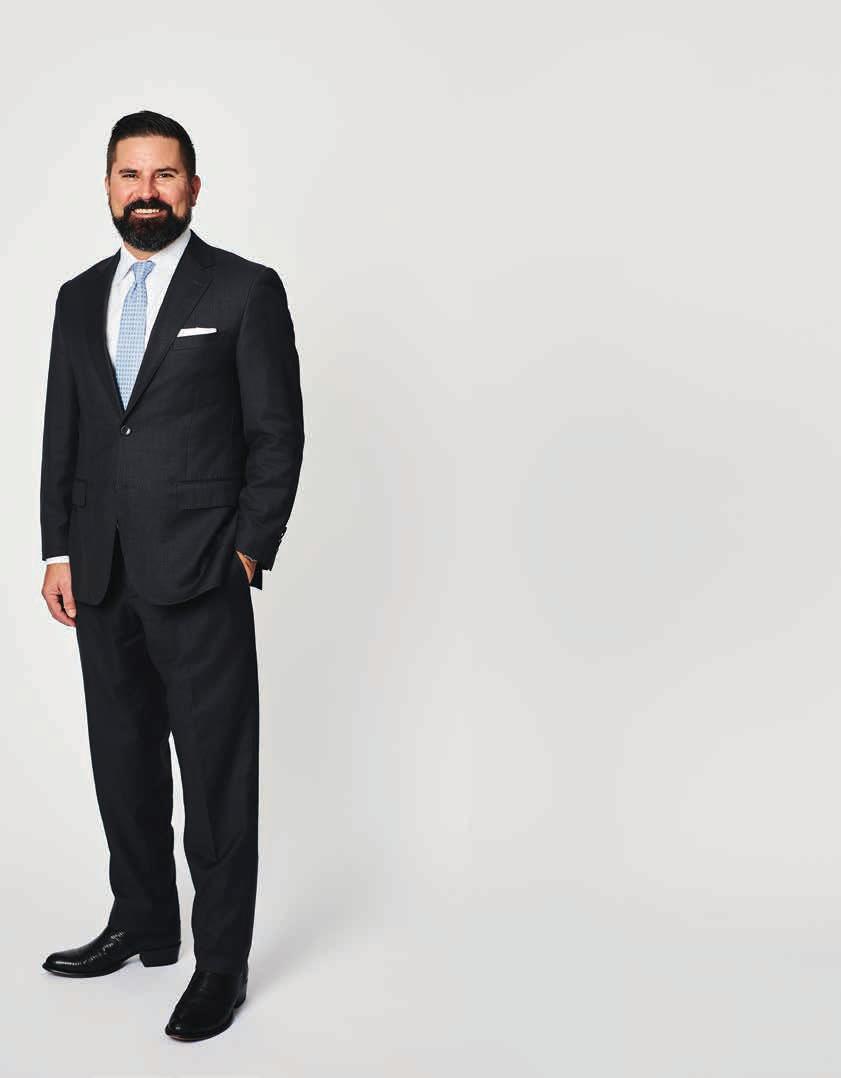
Significant other? Children? Grandkids? Married 15 years to the one that loves me on my best and worst days. One amazing 7-year-old daughter that will be CEO, Governor or President one day.
In 25 words or less, explain what you do. I represent the more than 125-year-old, Tampa-based Tampa Electric and Peoples Gas, the thirdlargest electric utility and the largest natural gas utility in the state of Florida.
Without using the words Democrat, independent or Republican, conservative or liberal, describe your political persuasion. I’m an old soul, Goonie generation, that believes you get what you earn in life, the government cannot be a replacement for personal responsibility, and we shouldn’t take ourselves too seriously.
During your career, have you had a favorite pro bono client? Anything that my hometown of Marianna and Jackson County needs.
Three favorite charities? Red Cross, Tree House and the Hang Tough Foundation.
Any last-day-of-Session traditions? Bone-in ribeye with a nice bottle of pinot noir for dinner with some friends.
What are you most looking forward to during the 2025 Legislative Session? Seeing friends from The Process. Over the years, you build relationships with lawmakers, staffers, and professionals inside and outside of your industry. Outside of the grind of the 60-day Session, it’s nice to catch up with some people you haven’t seen since the previous year.
Professional accomplishment of which you are most proud? Starting a new job with TECO and contributing, in a positive way, to the passage of substantial energy policy for the state.
Who is your favorite Florida Capitol Press Corps reporter and why? Matt Dixon, he’s always done his homework and been fair, and is someone I’ve enjoyed grabbing a beer with over a football game.
Other than FloridaPolitics.com, your reading list includes … Tampa Bay Times, Alex Epstein, Jon Meacham.
What swear word do you use most often? It autocorrects to “duck.”
What is your most treasured possession? My faith. Jesus Christ saved us, even though we’ve all sinned and fallen short. I’m grateful for the grace and many blessings I’ve received and continue to receive.
The best hotel in Florida is … The Boca Raton.
You’ve just learned that you will be hosting a morning talk show about Florida politics. Who are the first four guests you’d invite to appear? Kathy Mears, Marc Reichelderfer, Bill Cotterell and Congressman Jimmy Patronis
Favorite movie? Picking one is impossible, but these are the movies I could watch over and over again: “Star Wars: A New Hope,” “Rocky IV,” “The Princess Bride” and “Days of Thunder.”
When you pig out, what do you eat? Southern food like my grandmother made, any and all of it. Fried pork chops, zipper peas and rice with brown gravy would be high on the list.


Advancing Pediatric Cancer Care in Florida
Florida’s Specialty Hospitals for Children are driving the future of pediatric cancer treatment and research to ensure no child has to leave Florida for world-class, specialized cancer care.
As the only Florida specialty children’s hospitals solely focused on investing in and providing pediatric care, we are committed to making Florida a national leader in pediatric cancer research, innovation and treatment.
Serving the majority of Florida children with complex cancer conditions
The four hospitals in the state with the highest Medicaid utilization
1 in 4 Florida children will be treated in Florida’s specialty children’s hospitals


Power Players of Public Affairs
Proven. Powerful. Unrivaled. At Moore we don’t just navigate the public affairs landscape — we shape it.
Ranked by O’Dwyer’s PR as the #1 Public Affairs agency in Florida, we bring one of the largest rosters of credentialed communications professionals in the state to position clients for success. We leverage deep expertise and strong statewide relationships to deliver impactful results. With a 98% client retention rate, our commitment to excellence speaks for itself. Ready to win? Choose Moore.

A welcome message from Tallahassee Mayor John Dailey
By John Dailey
On behalf of the City of Tallahassee, it is my honor as Mayor to welcome you for this Legislative Session. As Florida’s Capital City, we are proud to host you during this important time of decision-making and collaboration as you do the hard work of planning for the future of our beloved state.
Tallahassee has stood at the center of influence for more than 200 years. A city rich in history, innovation, and community spirit, we hope you will take every opportunity to experience our vibrant arts scene, welcoming neighborhoods, and natural beauty during your stay. I encourage you to truly get to know and love Tallahassee and consider it your home away from home.
Your work has brought you here at a wonderful time. In addition to the energy Legislative Session brings, our community’s natural beauty blooms and festivals abound each Spring. Whether you are attending a concert at the Adderley Amphitheater or touring the replica of Florida’s first capitol in Cascades Park, listening to a reading from your favorite author, or strolling through an arts festival, there’s no limit to the enjoyment and inspiration you will find.
I invite you to discover all that your Capital City has to offer. Stay the weekends, bring your family, and explore together. And when the work wraps up, we hope you’ll plan to visit us again.
For outdoor enthusiasts, our city is a true paradise with 100 parks to choose from and more than 700 miles
of trails. You can hop on a bike, lace up your hiking boots, or rent a kayak to explore the 4,000 acres of parkland and natural beauty that surrounds us. If sports and recreation are more your style, our award-winning parks offer golf, pickleball, tennis, basketball, aquatics, and more.
If you are looking for local flavors, Tallahassee boasts fantastic restaurants and breweries offering diverse culinary options that are sure to satisfy your appetite and quench your thirst. From casual Southern charm to world-class dining experiences, you’ll discover the Capital City is a destination for food lovers.
Throughout your 60 days of Session, I invite you to discover all that your Capital City has to offer. Stay the weekends, bring your family, and explore together. And when the work wraps up, we hope you’ll plan to visit us again. My office is just a short walk from the Capitol – please don’t hesitate to reach out if you need information or simply would like to say hello. Whether it’s your first Legislative Session or you’re returning for another year of public service, I would love the opportunity to personally welcome you to Tallahassee and thank you for all you do for the state of Florida!

Big ideas for Florida: The curiosity deficit in politics
By Jeff Brandes
In 1976, a cognitive psychologist named Richard Nisbett conducted an experiment that, in hindsight, explains a lot about why Florida’s biggest problems remain unsolved.
He gave two groups of students a logic puzzle. One group was made up of undergraduates; the other, graduate students trained in statistical reasoning. The puzzle was straightforward: a fictional town was experiencing a disease outbreak, and doctors needed to determine the cause.
The undergraduates jumped to conclusions, clinging to the first explanation that seemed plausible. The statisticians, on the other hand, paused. They asked questions. They searched for patterns. They wanted to understand the “why.”
That, in essence, is the difference between a policymaker who manages a crisis and one who solves it.
Florida, a state that has spent much of the past two decades bouncing from one crisis to another — skyrocketing insurance rates, a housing affordability crunch, an aging prison system — doesn’t suffer from a lack of ideas, it suffers from a lack of curiosity.
A Problem hiding in plain sight: Florida’s prison crisis
If you were asked which U.S. state has the most prisoners serving life sentences, you might guess Texas or California. You’d be wrong. Florida has more inmates serving life than the entire state of Nevada has prisoners.
The reason traces back to a single policy decision. In 1983, Florida effectively eliminated parole. The idea was simple — if criminals knew they had to serve their full sentences, they’d commit fewer crimes. But, as often happens with simplistic solutions, the reality didn’t unfold as planned.
Today, Florida’s prisons are filled with aging inmates, many of whom require expensive medical care. Some are in their seventies and eighties, serving out sentences for crimes committed decades ago.
Meanwhile, the infrastructure itself is collapsing. Many of Florida’s prisons were built in the 1950s and 60s and have seen little in the way of meaningful upgrades. Staffing shortages are chronic, with some facilities operating at half capacity, making them dangerous for both correctional officers and inmates.
A curious legislator might ask: Did eliminating parole actually reduce crime? And if it didn’t, why are we still
paying for a system that keeps people locked up long after they’re no longer a threat to society?
Other states have introduced earned-release policies that allow nonviolent offenders to, as the name suggests, earn a second chance. Florida could do the same. The question is, will anyone ask?
Traffic signals: Florida’s outdated infrastructure problem
Consider this: You’re sitting at a red light. The road is empty. You wait.
Now, if you were designing Florida’s traffic system from scratch, would you intentionally make drivers stop at intersections when no one else is around? Probably not. But that’s exactly what we have.
Florida’s traffic signals haven’t changed in decades, even as the way we move has evolved. Cities like Pittsburgh use AI-powered traffic lights that adjust in real time, reducing congestion by 25%.
Florida, meanwhile, is still operating on timers built for a world that no longer exists.
This isn’t just about convenience — it’s about safety. Smarter traffic signals could prevent accidents, prioritize emergency vehicles, and even reduce fuel consumption.
A curious legislator might ask: Why haven’t we done this yet?
Housing affordability: No silver bullet, just a lot of lead ones
The simplest explanation for Florida’s housing crisis is that there aren’t enough homes. But that explanation, while true, is also incomplete.
The real issue is that Florida makes it too hard to build.
Outdated zoning laws limit development, keeping land artificially scarce, and even seemingly little things like parking minimums force developers to include unnecessary parking spaces, adding costs. There are also permitting delays that stretch as much as six months to a year, driving up prices before construction even begins.
Other states, like California, have embraced Accessory Dwelling Units (ADUs) and upzoning, allowing for denser, more flexible housing. Florida could do the same.
There’s no silver bullet for affordability. There are only lead bullets, and we need to fire them all.

The insurance market is stabilizing — for now Florida’s property insurance market has been a slow-moving disaster for years. Legislators have made some course corrections, but history suggests the next crisis is never far away.
When California artificially suppressed insurance rates, major insurers withdrew from the state, leaving homeowners with fewer options and rising costs. Florida is at risk of doing the same thing.
Instead of political quick fixes, we need a longterm approach.
While much has been done to improve Florida’s litigious climate, there are still opportunities to reduce the legal loopholes that fuel frivolous lawsuits against property insurers. Doing so would also encourage more private insurers to participate in the market, driving competition and putting downward pressure on prices. Lawmakers could also take steps to allow for realistic, risk-based pricing to prevent future insolvency.
The next major hurricane will test whether Florida’s reforms were enough. Curious policymakers would be wise to ask not just what lowers rates today, but what would make this market healthier for the next decade.
The Florida of the future belongs to the curious
The best legislators aren’t the ones with the loudest voices or the best soundbites. They’re the ones who ask the best questions. Florida’s future won’t be shaped by those who tinker at the
“The best legislators aren’t the ones with the loudest voices or the best soundbites. They’re the ones who ask the best questions.”
edges of problems, but by those who refuse to accept them as inevitable. The ones who stop and ask: Why do we do it this way? What if we did something different? Who’s already solved this problem somewhere else?
The Florida Policy Project has spent the past 24 months identifying big ideas and best practices to move the state forward — on prisons, infrastructure, housing, and insurance. But reports don’t fix broken systems. Data alone doesn’t drive change.
That work belongs to those willing to challenge assumptions, question the status quo, and push for better solutions.
The real question is: Who is curious enough to ask?
About Jeff Brandes and the Florida Policy Project
Jeff Brandes, a former Florida State Senator, founded the Florida Policy Project to drive data-driven and best practice solutions to the state’s biggest challenges. Focused on housing, infrastructure, insurance, and criminal justice reform, the nonpartisan think tank provides policymakers with actionable insights. Brandes believes effective leadership starts with curiosity, not ideology, and continues to champion bold, innovative ideas for Florida’s future.


Adams Street Advocates
is a boutique government relations rm that specializes in successfully helping businesses do business with government.

POWERING A RELIABLE & RESILIENT ENERGY FUTURE
As an integral part of the Tampa Bay region for more than 125 years, Tampa Electric is invested in powering a bright future.
As an integral part of the Tampa Bay region for more than 125 years, Tampa Electric is invested in powering a bright future.
Grid Advancements Deliver Always-On Power
• Our Storm Protection Plan strengthens the grid for fewer outages and faster restoration.
• With smart technology, we redirect power around damage, decreasing outages.
Smart Investments Drive Savings and Value
• With nearly 30 energy-saving programs, we’re helping customers save money.
• Our power plant modernization investments lower fuel and operating costs, yielding long-term savings.


Chip Roy, Mario Díaz-Balar t, Anna Kat Cammack, Ronny Jackson, a Ryan Smith, Danielle Alvarez, Mehgan Perez Acosta, Chris Hudson, Tony Fabrizio, Brad Harold


BYRON DO
U.S. Rep. Byron Donalds, President Donald Trump’s choice for Florida Governor, has an orbit filled with family, friends, and sharp-elbowed political pros Wife Erika, of the America First Principles Institute, remains his closest confidant (a Florida political force herself )
Seasoned consultants, many Trump veterans, help balance campaign and congressional duties, Donalds also maintains close relationships with Floridians (Kat Cammack, Mario Díaz-Balart, Anna Paulina Luna) and Freedom Caucusers (Chip Roy, Ronnie Jackson, Scott Perry, Missy Lastra) in Congress



The orbit of Erika Donalds
ONALDS


Former and current members of the Florida Legislature (Kathleen Passidomo, Bob Rommel, Lauren Melo, Yvette Benarroch, Meg Weinberger form another rung. MAGA world figures inside the West Wing (James Blair, Lynn Patton) and outside (Charlie Kirk, Benny Johnson, Tiffany Justice) fill his circle.
Benny Johnson
Charlie Kirk
Kathleen Passidomo, Lauren Melo, Bob Rommel, Yvette Benarroch and Meg Weinberger
James Blair
Tiffany Justice
Lynn Patton


Advocacy. Strategic Counsel. Experienced Insight.
We are a team of high-energy, results-driven lobbyists and advisors determined to help our clients succeed in today’s fast-changing governmental and political landscape.
What’s different about us? As a boutique consulting firm, we take a true team approach to serving clients at the local, state and federal levels of government. When you engage our firm, you get all of us—from our principals to our consultants, all of our diverse experience, our deep relationships built for decades, and our complete dedication to your success.
We’re proud of our long-time client relationships and our reputation for achieving results while maintaining the highest ethical and professional standards.
Get to know us at RubinTurnbull.com.
Tallahassee Ft. Lauderdale Miami Washington, DC
Membe r s Only
Get smart quick about the new class of legislators
By Peter Schorsch
Photography by The Workmans
Every two years there are some new faces in the Florida Legislature, freshman lawmakers who arrive in the state Capitol eager to get to the business of running the state. Most arrive nervous, though few would show it. All are buckling in for at least two years, and face one of their first tests by navigating hundreds, if not thousands of bills in just 60 days. While these freshmen, who hail from all corners of the Sunshine State, will arrive having already made plenty of introductions, and will make more in the halls of the capital or over drinks at the Governors Club, they may be new to those following along with The Process from elsewhere. We spoke with many (though not all) of this year’s freshman class to suss out their top priorities, learn a little something about them and what makes them tick, and hear their plans to further Florida as one of the top economies in the nation. And interestingly enough, some of the freshmen have been here before — lawmakers such as Randy Fine, who is also on his way out, and Tom Leek. They may technically be freshmen returning from legislative downtime, but they bring with them experience others in their class may enjoy. Collectively though, these new faces make up a special voting bloc in both chambers, and some of them will begin this Session charting a path toward leadership, and what all of them no doubt hope will be a bright future in Florida politics.

kri s tEn
ARRINGTON
Describe what interested you in politics and how you became part of The Process.
My candidacy was inspired by the years of volunteering and work with many visionary candidates in Osceola County. This led me to establishing my own consulting firm, where I focused on working with progressive candidates, most of whom dealt with a financial disadvantage, to run and win local office races. This proved to be deeply fulfilling and ultimately inspired my own candidacy. I first ran for office in 2020. I was fortunate enough to represent my hometown,
the city of Kissimmee, as the Representative for House District 46. My time in the Florida House only furthered my commitment to service, which led me to run for my current seat as the Senator for Senate District 25.
Tell us about your family.
My husband, Osceola County Commissioner Brandon Arrington, and I have been married for 17 years. We met on the first day of high school at Osceola High School and were friends throughout the years, but we did not date until years after graduation. We have had many rescue pets over the years, but our current 13-year-old pit bull, Brody, is the heart of our family.
Describe your top legislative priorities, and explain why they are important to you.
This Session, I am focused on advancing several key initiatives that will improve the lives of our constituents and strengthen our great state. I am proud to introduce several bills that support our veterans by providing them with the benefits they deserve, including tax exemptions for disabled ex-service members. Improving our state’s infrastructure is a top priority for both my district and me. I am also proud to be working with our local delegation to find long-term solutions to clean Lake Tohopekaliga in downtown Kissimmee to prevent flooding in the surrounding areas. Education is a priority near and dear to my heart, and I am determined to enhance student experiences through reforms in standardized testing and increased access to life skills instruction.

In recent weeks, legislative leadership has asserted its independence from the executive branch. How will you navigate those tensions, ensuring bills are heard in Session, but also will be seen favorably by the Governor?
My approach is to continue to build relationships across the aisle and legislative branches,
seeking to find common ground to move the state forward — together. During my time as a member of the superminority party in the House, I was able to pass meaningful legislation and bring home funding for district projects. By focusing on policies that benefit Floridians and maintaining open communication, I am confident we can find a way to navigate these tensions and produce legislation that is not only effective, but also has the support needed to succeed.
Progress has been made on the state’s insurance affordability crisis, but consumers are still feeling the pain. How will you work to ensure Floridians can access quality, affordable property insurance?
One of my favorite parts of the political process is a “working” committee that will really dive into an issue with different panels, discussion and all sides present. I will continue to support increased transparency and accountability between the state and insurance companies, especially to companies that receive taxpayer dollars. Additionally, I aim to carefully review the reforms to Citizens Insurance, which was originally created to be the insurer of last resort for uninsurable properties and now no longer operates as such. It is also crucial for the state to have honest and thoughtful conversations on investing in risk mitigation efforts. I am committed to being a leader in these conversations and look forward to supporting legislation to address this critical issue.
What should we expect from you this Legislative Session?
Every day, my office works tirelessly to read and listen to each email and voicemail sent to us, ensuring that we stay connected with the concerns and needs of our constituents. My constituents have expressed their biggest concerns for this year are the rising costs of insurance, protecting and fully funding our public schools and addressing traffic issues. I look forward to supporting and advocating for legislation that will make a meaningful impact on their concerns this Session. Additionally, I look forward to bringing home funding for roads, flood prevention, education, housing and more.


INNOVATING HEALTH CARE, FUELING ECONOMIC GROWTH
TAMPA GENERAL HOSPITAL AND USF HEALTH MORSANI COLLEGE OF MEDICINE CONTINUE TO DEVELOP AND GROW TAMPA’S MEDICAL & RESEARCH DISTRICT.
In partnership with Tampa Bay Economic Development Council, we are leading the charge on a hub of world-class clinical care, academics, research and biotechnology — creating a more prosperous economy and healthier population.
We would like to welcome the Moffitt Community Engagement Center and Verséa to the district and the city.
Describe what interested you in politics and how you became part of the Process.
Early on in my life I realized that politics affects all aspects of our lives from birth to death and even beyond the grave. So, I decided to get into it to help solve some of the problems facing my community.
Tell us about your family. I am blessed and fortunate to be the husband of a beautiful and very accomplished woman, and we are raising three daughters.
M A CK
BERNARD
Describe your top legislative priorities and explain why they are important to you.
Affordable housing is an issue that is near and dear to my heart. I fought for workforce and affordable housing in Palm Beach County when I was a County Commissioner. Another issue that is equally important to me is quality education. We must find a way to put qualified teachers in our classrooms. According to Florida TaxWatch, 10% of Florida courses lack properly certified teachers and teacher low pay is a major factor for this teacher shortage. So we must increase teachers’ salaries. I am also interested in creating more jobs and
In recent weeks, legislative leadership has asserted its independence from the executive branch. How will you navigate those tensions, ensuring bills are heard in Session, but also will be seen favorably by the Governor?
I do not necessarily see tensions between the Legislature and the executive branch because this is how our system of government was designed to work. The system works best when each branch of the three branches of the government exercises some control over the other two branches. I am hoping that this is a new reality, which will create opportunities to have robust discussions in the Senate.

Progress has been made on the state’s insurance affordability crisis, but consumers are still feeling the pain. How will you work to ensure Floridians can access quality, affordable property insurance?
I believe that property insurance in Florida is in a state of crisis and meaningful rate reduction will necessitate a holistic approach. The biggest factor driving insurance cost upward is extreme weather. Unfortunately, there is no immediate or easy solution for that; however, we can’t afford to ignore it. We should consider the impact of human activities on the climate and take actions to reduce our carbon emission. But we should also consider our zoning laws because honestly, we have allowed people to build in areas where they’re not supposed to. These are long-term solutions. More immediately, we need to put more money into My Safe Florida Home in order to help homeowners harden their homes.
Describe what interested you in politics and how you became part of The Process.
I have been active my entire career as a volunteer for various groups and organizations. Most recently, I served on the Manatee County Planning Commission for 12 years, 10 years as Chair. While this was an appointed position, it allowed me to be a part of a governmental process. From this experience, I realized that I would prefer to be a party to the process and not simply complain that I am a victim of it. In addition, I have a skill set that I feel would be very useful in Tallahassee. As a civil engineer, I am a problem solver and eager to work for the benefit of the state.
Tell us about your family.
My wife, Melanie, and I have been married for 24 years this September. We have three kids, Jamie (29), Emma (22) and Sean (20). In addition to our kids, we both have large, extended families all across Florida. Melanie is a CADD Designer (computer, aided design and drafting) and I am a civil engineer. Also, we work for competing firms, which keeps things interesting.
Describe your top legislative priorities, and explain why they are important to you.
My legislative priorities are infrastructure (transportation, water, wastewater and electrical), housing affordability and flood resiliency and mitigation. As Florida’s population grows, we need to be mindful that these very basic needs are met for the entire state. Another very frequent topic for almost every business or industry sector I have met with is their inability to properly staff to meet their needs. The cost of housing in many cases is the reason for this. One of the things this has caused me and my fellow civil engineers to realize is that we may be underestimating the rainfall intensi-
BI L L
CONERLY
ty for a 100-year storm. As a result, the stormwater management systems may not be sufficient.
In recent weeks, legislative leadership has asserted its independence from the executive branch. How will you navigate those tensions, ensuring bills are heard in Session, but also will be seen favorably by the Governor?
The recent Special Sessions have reinforced the idea that there are three separate and distinct bodies of government in the state of Florida. In addition, it has reminded us that the best solutions come from debate and discussion. I am a very strong supporter of Gov. De Santis. He is the best Gov ernor in the country. We all want the same things. However, how we got there took some time, debate and discussion. I feel we are in an ex tremely good place to continue the work for all Floridians.
Progress has been made on the state’s insurance affordability crisis, but consumers are still feeling the pain. How will you work to ensure Floridians can access quality, affordable property insurance?
The affordability of insurance is going to be a continual process. There are many variables that contribute to the increase in cost. Getting a better handle on the areas vulnerable to flooding will be beneficial.
What should we expect from you this Legislative Session?

Describe what interested you in politics and how you became part of The Process.
My journey into public service started with my military career. As a Navy JAG Officer, I saw firsthand how laws and policies impact our service members and their families. That experience fueled my interest in being a part of how decisions are made. After leaving active duty, I realized that the best way to make a difference was to step up and serve in elected office. Running for the House was the way I felt I could ensure Florida remains a place where families can thrive, busi-
GRECO SA M
er opportunities than we had, which is one of the reasons I ran for office.
Describe your top legislative priorities, and explain why they are important to you.
My focus is on keeping Florida safe, strong and prosperous. That means strengthening public safety, supporting law enforcement and ensuring our justice system works for law-abiding citizens. It also means keeping taxes low, cutting unnecessary red tape and pushing back against federal regulatory overreach so businesses can continue to thrive. Finally, we must support pa-

a beacon of opportunity. These priorities aren’t just talking points — they are commitments to the people who entrusted me to represent them.
In recent weeks, legislative leadership has asserted its independence from the executive branch. How will you navigate those tensions, ensuring bills are heard in Session, but also will be seen favorably by the Governor?
Every Republican in Florida has the same goal: to make sure that the Sunshine State remains the best state in the country to do business, raise a family and enjoy our freedoms. I will focus on good policy, build strong relationships and always find common ground with like-minded individuals. At the end of the day, we’re all working to keep Florida on the right track, and I’ll be an advocate for legislation that achieves that mission.
Progress has been made on the state’s insurance affordability crisis, but consumers are still feeling the pain. How will you work to ensure Floridians can access quality, affordable property insurance?
High insurance rates have strained many Floridians and we must continue to find solutions that stabilize the market. That means attracting more insurers to Florida and ensuring accountability. I will support policies that increase competition, promote efficiency, improve transparency and provide real relief to homeowners. This is an issue that affects everyone in our state, and I’m committed to finding practical solutions.


Doing our par t
At AT&T, we’re dedicated to doing our part to connect America. That’s why we’re investing in and expanding the reach of our fiber-based internet service while also working to provide more affordable and accessible internet services to help close this country’s digital divide.
In Florida, we have invested more than $3.1 billion in the last 3-years and pushed AT&T Fiber to 1.8 million homes & small businesses. Keeping communities connected. At AT&T, it's how we do business.
© 2022 AT&T Intellectual Property. AT&T and Globe logo are registered trademarks and service marks of AT&T Intellectual Property and/or AT&T affiliated companies. All other marks are the property of their respective owners.
Describe what interested you in politics and how you became part of The Process.
At the age of 19, I was fortunate to have a mentor, Rick Bell, who truly took me under his wing. Through his guidance, I was able to understand the intricacies of the political process and, more importantly, the power of authentic relationships built on trust and truth. This experience sparked a deep passion for good governance, fiscal accountability and a desire
da n ny
NIX JR.
Tell us about your family.
Wife: Carla Nix, 14 years married. Kids: Kaydee Wyatt (22) and Riley Nix (18).
Describe your top legislative priorities, and explain why they are important to you.
Public safety is foundational to our society, and our first responders, including the Florida State Guard, are critical to maintaining security and peace in our communities. They deserve not only our respect, but also our ongoing efforts to honor those we have lost in the line of duty. In addition, we must provide opportunities for improvement in their resources, training, and support, ensuring they have the tools they need to do their jobs effectively and safely. Equally important is addressing environmental issues, particularly those within our wastewater utilities. Ensuring that our environmental systems are functioning properly, including wastewater infrastructure, is imperative to Florida’s growth, sustainability, and public health.
In recent weeks, legislative leadership has asserted its independence from the executive branch. How will you navigate those tensions, ensuring bills are heard in Session, but also will be seen favorably by the Governor?
I have full confidence in our leadership and believe that Gov. Ron DeSantis, House Speaker Danny Perez and Senate President Ben Albritton are all committed to working together to demonstrate the strength and effectiveness of government in
Florida. My focus will be on ensuring that important bills are heard and that they align with the values and goals of both the Legislature and the Governor.
Progress has been made on the state’s insurance affordability crisis, but consumers are still feeling the pain. How will you work to ensure Floridians can access quality, affordable property insurance?

While progress has certainly been made in addressing the state’s insurance affordability crisis, I recognize that many Floridians are still feeling the impact of high premiums. I believe that we are starting to see a positive shift, with insurance premiums beginning to cap and trend downward in certain areas. I look forward to continuing discussions with my colleagues to explore additional ways we can further reduce premiums while ensuring that Floridians have access to quality, affordable property insurance. Ensuring better coverage at a more affordable price for all Floridians is a priority, and I am committed to being part of that solution.
What should we expect from you this Legislative Session?
What you can expect from me this Legislative Session is hard work, active engagement and an open mind when reviewing bills. I will approach each issue thoughtfully, weighing all perspectives while staying firm in my core beliefs. My goal is to contribute to meaningful discussions and work toward solutions that align with the values of our community.
Describe what interested you in politics and how you became part of The Process.
There were many things that led me to enter politics. Most significantly, I felt that I needed to have a purpose greater than myself following the unexpected passing of my mother in 2015. I thought perhaps this could help me find that purpose.
Tell us about your family.
Michelle and I recently celebrated our 32nd wedding anniversary. We have two daughters, Alex age 28 and Sarah age 26. I am the oldest of four boys, three of us and my father live here locally. My remaining brother lives in Ohio. I am blessed that two of my grandmothers are still living. One is 96 years old, and the other is 103 years old.
Describe your top legislative priorities and explain why they are important to you.
It is important to me that we continue to attack the insurance crisis. In particular, there is more to be done with regard to insurance claim processing. I have filed legislation this year that would put in place an expedited resolution of insurance claims that would greatly benefit the consumer.
T O M
LEEK
In recent weeks, legislative leadership has asserted its independence from the executive branch. How will you navigate those tensions, ensuring bills are heard in Session, but also will be seen favorably by the Governor?
The Legislature has always been independent of the executive branch. Sometimes, our differences play out in public, and sometimes they play out in private. There has not been a time while I have been in the Legislature where the Legislature has not been indepen dent of the executive branch. Santis has been a great Governor and will continue to be a great Governor over the next two years. I have always worked very closely with the Governor and expect to do so in the future.
Progress has been made on the state’s insurance affordability crisis, but consumers are still feeling the pain. How will you work to ensure Floridians can access quality, affordable property insurance?
See above.
What should we expect from you this Legislative Session?
There are few who have a greater disdain of government intrusion upon the freedoms of our individual liberties than I. You should expect that I will continue to fight to protect our freedom from government intrusion and for the rights mandated by the constitution.

Describe what interested you in politics and how you became part of The Process.
I was an economics major and government minor in college, so I’ve always been interested in policy — specifically how government policy can create both positive and negative incentives, and can lead to both intended and unintended consequences. As someone who runs a business, we are impacted every day by decisions made in Tallahassee and Washington. And as a mother, I selfishly want our state to be so appealing that my children want to grow their careers and families close to home.
Tell us about your family.
I have been married for 15 years to my amazing husband, David. We have three wonderful children and two extremely disobedient rescue pups.
Describe your top legislative priorities, and explain why they are important to you.
This Session, I am honored to run bills that will help families and businesses. Lucy’s Law (HB 289) will strengthen education requirements to make our waterways safer for all. HB 1119, Health Care Patient
OLIVER van e ssa
Protection, will help our hospitals become better equipped to handle pediatric emergencies. HB 6015 will eliminate pointless government regulation and allow greater flexibility for businesses.
In recent weeks, legislative leadership has asserted its independence from the executive branch. How will you navigate those tensions, ensuring bills are heard in Session, but also will be seen favorably by the Governor?
I have the greatest respect for our Speaker, Senate President and Governor. I am confident that, through their leadership, we will ensure that Florida continues to be the best state in the nation.
Progress has been made on the state’s insurance affordability crisis, but consumers are still feeling the pain. How will you work to ensure Floridians can access quality, affordable property insurance?
While there are no easy answers to the state’s insurance affordability crisis, I have every confidence that this Legislature is committed to doing the work that will lead to the best possible outcomes for our state. The laws we have passed have had a meaningful impact, and I want to make sure we continue making insurance more affordable for every citizen in our state.
What should we expect from you this Legislative Session?
I plan to work my bills and support the great legislation that my colleagues are running. I’m so honored to be in the House on behalf of the citizens of House District 76, and will do everything in my power to ensure that they are well represented.

Describe what interested you in politics and how you became part of The Process.
I’ve been involved/interested in politics since I was in middle/high school. The debate club and SGA involvement further spurred that interest and in high school I was a Senate Page for the late Sen. Ed Dunn. In College, I debated on the Daytona State (then DBCC) model United Nations debate team and we were successful against some Ivy League
BI L L
PARTINGTON
Beach to practice as a lawyer I decided I wanted to give back to my community by getting involved in politics. That led to an over two decade period of service to my hometown Ormond Beach.
Tell us about your family.
I am married to the love of my life, Lori, who is talented and beautiful and we have three talented and beautiful daughters. CJ is married and working on her doctorate at FSU, Anne is working on her Bachelors at UF and Faith is a Junior at FGCU. My mom
In recent weeks, legislative leadership has asserted its independence from the executive branch. How will you navigate those tensions, ensuring bills are heard in Session, but also will be seen favorably by the Governor?
It has been an interesting, yet not totally unexpected start to the year. Making sure to promote quality legislation with a desire to make good law for the people of Florida is my best strategy for moving forward and having success in

Progress has been made on the state’s insurance affordability crisis, but consumers are still feeling the pain. How will you work to ensure Floridians can access quality, affordable
Recently, I read an article explaining that nine new insurance companies are entering the Florida market. This is good news and will continue to help the state insurance market stabilize and improve. My plan moving forward is to protect the changes that were made legislatively over the last couple years and make any needed improvements or fixes to make certain
What should we expect from you
I believe my previous years of service have been characterized by hard work, listening and avoiding drama, while working to build consensus and coming to smart, no nonsense and commonsense solutions. I plan to continue to do that, working with my colleagues in the Legislature and listening to my residents to keep Florida as a leader in
GREAT COMMUNICATOR TERRIBLE HANDYMAN

If you need help hanging pictures or mounting a TV, look elsewhere.
But if you need to bring strategy and clarity to the most complex issues, we might know a guy.
Consensus Communications congratulates Ryan Houck for being recognized as one of Florida’s “Great Communicators” by Influence Magazine.
INFLUENCE WITH INTEGRITY

Describe what interested you in politics and how you became part of The Process.
My passion for politics is rooted in my family’s experience with government — specifically, their firsthand struggles under Communist Cuba. My grandparents lost everything when the regime took control, forcing them to flee and start over with nothing. Through them, I learned what makes this country exceptional: the opportunity it provides to those willing to work for it. Having been born and raised in my district, I was deeply familiar with the challenges and aspirations of the people here. So when my predecessor, Juan Fernandez Barquin, was appointed to be the Clerk of Courts in Miami-Dade County, I took this opportunity and have never looked back.
M i k e
REDONDO
Tell us about your family.
I am the proud son of Cuban immigrants and youngest of two brothers. My mother, a retired public school teacher, and my father, a former structural engineer, still call Miami home. My older brother works in education near Orlando. On a personal note, I recently got married this past December and my wife and I reside in beautiful West Kendall.
Describe your top legislative priorities, and explain why they are important to you.
To name a few, the affordability crisis — especially skyrocketing insurance costs — is a major issue. And I understand that the middle-class upbringing I had is slipping out of reach for too many families in my district and across the state. Another critical issue for me is ensuring that we honor our commitment to veterans. Their service and sacrifice make our way of life possible, and it’s our responsibility to support them in every way we can. I also believe that protecting our children is one of the most vital functions of government. Whether it is in schools, online, or elsewhere, we must make sure to protect our children from dangerous predators with tough, strict laws.
In recent weeks, legislative leadership has asserted its independence from the executive branch.
How will you navigate those tensions, ensuring bills are heard in Session, but also will be seen favorably by the Governor?
The passage of major immigration legislation recently
demonstrated that despite debate and occasional disagreement, the relationship between the Legislature and the executive branch remains healthy. Tension isn’t a weakness — it’s part of the process that leads to better policy outcomes. My approach is simple: I will continue to engage with the executive branch in good faith, addressing concerns as they arise and having the tough but necessary conversations when needed.
Progress has been made on the state’s insurance affordability crisis, but consumers are still feeling the pain. How will you work to ensure Floridians can access quality, affordable property insurance?

Under the strong leadership of our Speaker, I will continue working to ensure that insurers are held accountable. The Legislature passed aggressive reforms — many at the industry’s request — because we recognized the severity of the crisis. Now, it’s critical that we verify the information given to both lawmakers and the public so we can distinguish between good actors and bad actors. If insurers aren’t holding up their end of the bargain, we need to take action. At the same time, we must create a regulatory environment that encourages a competitive market, ultimately benefiting consumers.
What should we expect from you this Legislative Session?
You can expect me to work tirelessly on my bills and fight for the issues that matter most to my constituents. That’s the job I signed up for, and I intend to deliver!
Describe what interested you in politics and how you became part of The Process.
My family taught me at a young age that you have to be involved in The Process if you want to help shape The Process. As I grew older I began to be more vocal and more involved in politics, particularly supporting candidates for office. This involvement culminated in me be-
jud s on
SAPP
Describe your top legislative priorities, and explain why they are important to you.
I’m running many great bills this Session, including helping first responders, protecting Floridians and cleaning up government agencies. Government is never perfect, and problems arise, often unintended, that need legislative action. As Floridians bring issues to me, I will do my best to fix problems.
Progress has been made on the state’s insurance affordability crisis, but consumers are still feeling the pain. How will you work to ensure Floridians can access quality, affordable property insurance?
We need to hold bad players accountable and better enable Floridians to harden their homes. We need to continue to make Florida a more attractive market for additional insurance companies to do business, as more competition should lower prices and broaden the risk pool. The good news is, past changes are starting to work, the market is starting to stabilize with more companies entering the market. This will take time, but we must continue reforms to bring relief to Floridians as soon as possible.

What should we expect from you this Legislative Session?
Speaker Perez said his priorities are what Floridians need, not his own. I took that to heart and plan on following his lead.
“All of us have a united goal of making Florida better and more free from government overreach.”
Describe what interested you in politics and how you became part of The Process.
The thing that interested me in politics was being able to help other people and seeing the results of having an idea, of making an ordinance or a change in an ordinance, and seeing how it’s applied in our communities. When I first started the process in politics, I wasn’t quite sure where I was going to find my voice or my niche and as I progressed, I started working with local businesses to improve access to capital financing as well as obtaining licenses and permits for expansion. After some time as Commissioner of the city of Miramar
bar b ara
SHARIEF
and when I arrived in county government, I noticed the food insecurities in our community and worked with the county and stakeholders like Feeding South Florida to create a program to help needy residents and families yearround. As I progressed in my political career, I was able to create programs for homeless families and veterans and decrease our homeless population in Broward County. I think that when you are working in elected office you always want to leave your city, your county, or your state better than when you came in.
Tell us about your family.
I am a proud mother of three beautiful girls ages 26, 23 and 17 years old. I come from a very large family. I have a loving mother, father and nine siblings. I am a middle child. There are four girls before me and four boys behind me. What I loved about my family is that it was
big, it was noisy but there was always love there. I think that sometimes in life and in many families throughout the state that love that we shared in our family is missing. I am extremely humbled and grateful that I have a supportive family and children and I look forward to serving our community for the next few years.
Describe your top legislative priorities, and explain why they are important to you.
My top legislative priorities include creating more affordable housing, creating jobs, decreasing property insurance rates, increasing access to health care, supporting public safety initiatives, supporting small businesses and protecting our environment.

“You always want to leave your city, your country, or your state better than when you came in.”

G R A S S R O O T S
A D V O C A C Y
C O R P O R A T E A N D P O L I T I C A L
C O M M U N I C A T I O N S
S T O R Y T E L L I N G E X P E R T S

C h r i s t i n a J o h n s o n
P r e s i d e n t
c h r i s t i n a @ o n 3 p r . c o m

A n s l e y G r e e n
A c c o u n t s M a n a g e r a n s l e y @ o n 3 p r . c o m
FLORIDA’S PREMIER ENGINEERING & TECHNOLOGY UNIVERSITY

AT UCF, we harness technology across disciplines to ensure students are tech-trained and ready for the jobs of tomorrow. Our industry-aligned curriculum and hands-on learning ensure graduates are ready to innovate, lead and immediately impact Florida’s workforce.
UCF PRODUCES 1 IN 4 OF FLORIDA’S ENGINEERING AND COMPUTER SCIENCE GRADUATES
UCF provides workforce talent to power the future of industry, fueling economic prosperity for the state and accelerating innovation to make the world a better place. (State University System)
BREAKING DOWN FLORIDA’S LOBBYING WORKFORCE
&
of current principals have been represented by lobbyists for 20+ years. 42% of current registered lobbyists have been lobbying for 20+ years.


“We know the importance of being targeted, fast, and flexible to be successful at the Capitol. The advances in digital advocacy and paid media campaigns have moved so far beyond just geo-targeting the Capitol and hoping key decision makers see your message. With first-party data targeting and social proof, our campaigns directly reach the people who matter most with the right message to drive winning outcomes for our clients.”
- LIZ UNDERWOOD, Partner and Executive Managing Director
As the No. 1 public affairs agency in Florida, Moore’s success is due to the strength of our team, led by experienced, senior practitioners who understand the legislative process and its key players. We develop and deploy public affairs campaigns that strengthen our clients’ influence and use digital-first but not digital-exclusive strategies to provide surround sound and leverage real-time data to reach policymakers and influencers.
MOORE’S STRATEGIC APPROACH TO DELIVER WINS FOR OUR PUBLIC AFFAIRS CLIENTS:
1. Understand the Audience. Our thorough research and landscape analysis begins with discovery; media and social listening; and finding compelling voices, stories, and data points. We identify opposition voices and messaging, and we position opportunities for proactive counter-messaging—which we can deploy quickly, thanks to a focus on real-time, high-quality data from comprehensive media and social media monitoring.
2. Building Influence. We understand the importance of building your influence and voice on key issues both in and out of the Capitol. That includes developing thought leadership, brand recognition, and the strategy and tools to amplify your message with the right audiences.
Working closely with clients and lobbying teams, Moore identifies the right targets to move the needle (or stop the needle) on key issues and builds precise targeting to reach them and provide impactful surround sound.
3. First-Party Data Targeting. Moore takes a laser-focused approach with digital strategies to ensure we only target and reach the people who matter most. Our digital-first campaigns provide precise targeting, consistent optimizations, and measurable outcomes.
Moore uses first-party data to reach our targets and their real-life influencer circles— from colleagues and engaged constituents to industry and opinion leaders. First-party public affairs data is more precise than platform or geo-targeting, reducing spill and saving precious ad dollars. This precise approach ensures we deliver messaging tailored to our targets and their influencer network, where they are consuming content, and at a high frequency to make an impact.
4. Support with Surround Sound. Moore recognizes that digital campaigns should not live in a silo. Surround sound is critical to helping amplify messages, build credibility, engage different audiences, and leverage relationships. Digital engagement includes website, social media, and advertising across digital channels. Reaching an audience through other channels, including media relations, grassroots and grasstops engagement ensures a surround sound of key messages—driving the desired action from audiences. Moore has the state covered from end to end, bringing unparalleled relationships with influencers, Capitol media, and reporters and opinion page editors in every media market.
5. Assessing Performance and Optimizing. To ensure success, we continuously assess performance and optimize our strategies. We always want our campaigns to be as targeted as possible, which means evolving our strategy and messaging while seeking new avenues to reach audiences. This ensures that we are always delivering the best possible results for our clients.
We invite you to work with Moore and experience firsthand how our comprehensive, strategic approach to public affairs can deliver wins for your organization.

“By leveraging new data and digital offerings, Moore reaches lawmakers and influencers, both with laser precision. Our expertise in advocacy and crisis communications ensures that our clients’ voices are heard and their goals are achieved.”
- TERRIE ARD, Partner and President


ON THE HORIZON

HORIZON
Meet the Rising Stars of Florida Politics
Curated by Peter Schorsch | Photography by The Workmans

Ask any science nerd and they’ll tell you, when a star is born, a lot has to happen to get to that point. For this year’s class of Rising Stars, that’s a very true sentiment, and for these budding stars, their light is just reaching the horizon, signaling almost limitless potential. From first-inthe-family college graduates to political proteges, each of our honorees this year have charted a path, overcoming obstacles to lay the foundation for their meteoric rise. Whether they identified their love for politics and policy from an early age or found it almost by accident, each is driven by an unwavering passion for their work. This year’s list includes in-house staffers at advocacy agencies, groups and organizations, as well as budding and whip smart trailblazers in lobbying and loyal foot soldiers on legislative staff who are charting a continued path toward greatness. They all have something in common. Ask their colleagues, bosses and former bosses about them and you’ll hear rave reviews of dedicated professionals who stop at nothing to get the job done. But ask them about themselves and you’ll be met with humility and a team attitude. It’s a recipe strong enough to light even the darkest metaphorical galaxy.
PAUL BEBEE

“What truly sets Paul apart is his ability to combine big-picture vision with practical action.” — JENN MEALE
Paul Beebe found his dream job before he found his dream job. While a political science and government major at Florida State University, he applied for a few internships and landed one. The Florida Association of Managing Entities (FAME) devotes itself to meeting the behavioral health needs in the state, including addiction.
He graduated in December 2019, with the country on the verge a pandemic. While he was drawn to legislative work, something about his internship with FAME stuck with him. The association does its share of lobbying, including for nonprof-
its that help connect the uninsured with health care and mental health services, and help unemployed people get jobs and addicts find recovery.
Bebee returned nearly seven years ago to work full-time at FAME, where he is now the chief operating officer. He has worked on legislation and with the state government, developed marketing and communications strategies, planned events, negotiated with players and managed the two-person office he shares with CEO Natalie Kelly.
“What truly sets Paul apart is his ability to combine big-picture vision with
practical action,” said Jenn Meale, the CEO of Pinnacle Media. “He makes it a priority to meet with every state repResentative and Senator, advocating on issues like Baker Act reform, support for certified peer specialists, mobile response team protocols and resources for Floridians in recovery.”
While advocacy for state or federal funds has a political dimension, FAME itself is apolitical, Bebee said. The association has, for example, worked to strengthen peer support for addiction. Certified Recovery Peer Specialists in Florida can reach people who are struggling by completing 40 hours of peer specialist training and completing 500 hours of supervised work experience, among other requirements.
Addiction has been a personal issue for Bebee since seeing a family member reach recovery. The Volusia County native has developed an expert’s eye for differential problems across the state, including a distinct heroin overdose problem in Central Florida. The state has since seen an 8% decrease in opioid-related deaths.
The passion he brings to that work solidifies his commitment to bring about real change.
“Since he began his work at FAME, the association has strengthened partnerships and expanded its reach, making a lasting impact on communities across the state,” Meale said.
For his meaningful impact on Floridians who need help most, Bebee credits Kelly, the FAME CEO and a veteran in The Process since the late 1980s.
“There is nobody I possibly could have had to have been a mentor who knows the ins and outs of this system more than her,” he said.
Bebee has given much in public service, including chairing the government affairs committee for the Florida Society of Association Executives and another FSAE committee for young and emerging professionals. Bebee also sits on several boards, including Healthy Start, the Girl Scouts, the Suicide Prevention Coordinating Council and the Florida Mental Health Institute’s advisory board.
He even became certified to render mental health first aid to adults and youth in the state.
That might not seem to leave a lot of free time, but Bebee and a ready group of friends enjoy playing tennis or finding “something fun to do in Tallahassee.”
On weekends, you might find him at one of the area’s many fresh-water lakes and streams, fishing for largemouth bass.

ON THE HILL
With connections at the highest levels of federal government, TSG Advocates is ready to tackle your greatest challenges and achieve unparalleled results.


DANIEL DIAZ-BALART
KEVIN HOFMANN
SIERRA DEAN

TheFlorida State Guard has raised its profile, most notably in emergency situations such as Hurricane Helene. When the epic storm slammed the West Coast of Florida in September and then parts of North Carolina, the Florida State Guard stepped up.
Soldiers in the state-supported force conducted welfare checks and delivered supplies. In one instance, soldiers were able to render life-saving aid to a 1-year-old in an isolated area in North Carolina, airlifting the infant and mother for further care.
“It was an opportunity to stress test the capability, capacity and compassion of our staff and volunteers,” said Sierra Dean, the External Affairs Director for Florida’s State Guard.
In 2022, Gov. Ron DeSantis resurrected the Florida State Guard after a 75-year hiatus. The state defense force was created in 1941 to fill in for the stateside absence of the National Guard during World War II. It was then shuttered in 1947. The Governor’s reactivation makes Florida one of 19 states, plus Puerto Rico, that maintain active forces, which generally support emergency management or homeland security missions.
Dean said the Hurricane Helene episode demonstrated that the State Guard was ready for the task.
“I think we are all self-starters, fueled by Gov. DeSantis’ initiative, caffeine and our vision to build Florida into the nation’s premiere state defense force. Our team never felt the fatigue because we knew we were helping families in Florida and North Carolina,” Dean said.
Dean not only manages communications and legislative affairs for the Guard, but is also pursuing a separate career track as a medic. The recent completion of a 16week training course with the Florida National Guard as a combat medic allows her to render lifesaving assistance on the battlefield. She also plans on getting EMT certifications allowing her to treat civilians.
Dean is no stranger to juggling highstress roles. She participated in the Junior Reserve Officers Training Corps through all four years at Mulberry High School and was the unarmed platoon drill commander for the squad that won first place in the U.S. Army JROTC National Drill Championship. She was also senior class president.
Dean grew up in Polk County and was raised by a single mother, Tierney Worthen, a pet groomer and entrepreneur who remarried when Sierra was a teenager.
“At some points in my childhood, she was working three jobs all at once,” Dean said. “And she always prioritized to make sure she took care of me, put groceries on the table, that she took time with me.
“ If you didn’t complete a task today, that doesn’t mean you shouldn’t accept a new task tomorrow. You never want to turn away from any area of growth, both personally and professionally. ” — SIERRA DEAN
Those are good character traits.”
She volunteered on political campaigns, including for U.S. Rep. Dennis Ross when the Lakeland Republican was still in Congress. Dean gained additional insight in the Governmental Relations Office at the University of South Florida where she gained experience under Lauren Hartman who was the director of the department for USF and was a key mentor for Dean.
Dean worked multiple jobs, including playing princesses or mermaids for Dreams Come True Entertainment, which creates children’s parties.
“I’m very happy to say that I have no college debt,” Dean said. “I worked three jobs in college and my mom worked hard.”
She graduated from USF in 2018 with a degree in International Studies and Political Science. Her grade point average was an outstanding 3.98 and she was bestowed a
Golden Bull Award, which recognizes leadership and civic engagement at USF.
After graduating from USF, Dean went on to work as a regional representative for then-Gov. Rick Scott. Dean was the Northwest Florida District Director for Scott’s new office as U.S. Senator. Leda Kelly, who directed Scott’s office, was a key contact. Kelly has since become Chief of Staff for the Florida Department of Transportation and was recently named director of Policy and Budget by DeSantis.
Dean went on to work in the Florida Department of Education, first directing outreach, recruitment and technical education and then communications.
Dean’s career has evolved with a new niche in her work as a specialist for the National Guard, which she continues part-time while she maintains her full-time role leading external affairs for the Florida State Guard.
She credits her boss with the Guard, chief of staff Jay Arnold, a Marine Corps Reserve Infantry officer, for guidance with the learning curve.
“My approach,” she said, “is to rely on people who are strong in areas where I’m weak. And he always allows you to come in with grace and humility to teach you what he knows.”
Dean said she’s ready to seize upon opportunities when they present themselves.
“If you didn’t complete a task today, that doesn’t mean you shouldn’t accept a new task tomorrow,” she said. “You never want to turn away from any area of growth, both personally and professionally.”
Away from work, sometimes the opportunity is to unplug, to toss a ball to Britches, her Cavalier King Charles Spaniel. Or she often watches Gilmore Girls reruns while folding laundry.


NICOLE FUMAROLA
I
t takes a while for some to discover their passion. That wasn’t the case for Nicole Fumarola, a legislative aide to Miami Republican Sen. Alexis Calatayud
Fumarola took an early interest in government and politics. Growing up, she saw how her mother, an elementary school teacher, was directly impacted by politicians’ decisions and how those choices affected her community.
That she could one day be part of that
process fascinated her, and she jumped at opportunities leading her toward that end. Now at 22, she’s already logged close to six years of government and political work.
For her, it’s more about policy than politics.
“I really like being involved in seeing how policy can impact people, and it’s less partisan than people might want it to be,” she said. “There are moments, but it’s more important to pass common-sense legislation that benefits Floridians rather than be concerned about what side of the aisle someone’s on.”
Fumarola’s entrée into government work came during her senior year of high school. She enrolled in a program called the American History and Law Academy through which she secured a five-month internship under then-Palm Beach County State Attorney Dave Aronberg, a Democrat and former state lawmaker.
She started her first semester at Florida State University in 2020, just as the COVID pandemic was sweeping the globe. The generally unfortunate timing proved fortuitous; a glut of online-only classes enabled her to accelerate her scholastic pursuits while also seeking inroads professionally.
While earning her bachelor’s degree in political science and government, Fumarola interned for two years at Rubin Turnbull & Associates, where she said she fell even more in love with the process.
Erica Chanti, a consultant at the government relations firm, was immediately impressed with her personality, poise and work ethic.
“Nicole’s work with us was nothing short of extraordinary. She was consistently the first one in the office and the last to leave, always eager to take on more and never uttering the word ‘no,’” she said. “I have no doubt she is destined for great things.”
Fumarola graduated a year early and got a job as a legislative aide at Sarasota Republican Rep. Fiona McFarland’s office. She stayed on for more than a year, working on measures like the 2023 tech transparency bill (HB 3) and 2024 social media ban (SB 262) before taking a summer law clerk post at the Carlin Law Firm.
Fumarola flirted briefly with the prospect of becoming a lawyer. But her heart wasn’t in it.
She then joined Miami Republican Rep. Vicki Lopez’s re-election effort as campaign manager. Lopez, who won handily in November, remembers Fumarola throwing herself into the work.
“She never complained, even under intense pressure, and gladly took on any
“... it’s more important to pass common-sense legislation that benefits Floridians rather than be concerned about what side of the aisle someone’s on.”
— NICOLE FUMAROLA
task, large or small, with a positive attitude,” Lopez said. “She was dependable, responsible, hardworking, strategic, creative, dedicated and focused. These are all attributes of a rising star and her success on my campaign is certainly just the beginning of many future successes.”
It was on one of the many walks Fumarola did for Lopez’s campaign that she met her current employer, and in December she joined Calatayud’s team. She was one of several new staffers in the office, but her organizational and leadership skills set her apart.
Calatayud, one of the youngest people to ever serve in the Legislature, said she sees a lot of herself in the young up-and-comer, particularly Fumarola’s tenacity and desire to take on challenging roles.
“I see her as a sophisticated actor in the legislative process,” she said. “Nicole can be a tremendous asset to any lobbying team. And if she chose to do more permanent work in campaigns, she would be exceptional. She has a gamut of opportunities.”
For now, Fumarola said she’s happy with her current work and has no immediate plans to go elsewhere. But eventually, she said, she hopes to work in lobbying.
“I want to be in a position where I can advocate for issues I’m passionate about and shape meaningful policy,” she said.
Fumarola is especially interested in education policy and in artificial intelligence, a technological frontier for which there are few existing regulatory guardrails.
“It’s really interesting how AI is taking shape,” she said. “I feel like it’s the wild west of policy now, because there’s not a lot of precedent. I’d love to be part of bringing that off the floor.”
As for others early into their careers who hope to do well in their chosen professions, Fumarola offered some advice.
“Be intentional with your actions,” she said. “People that I’ve seen succeed make thoughtful choices, rather than just reacting to what’s happening around them. I feel it’s important to know your goals, when to speak up and when to step back. It makes all the difference.”
Veronica Goddard relishes the opportunity to push for causes and candidates she believes will make a difference. Most recently that candidate was Kamala Harris. As the deputy finance director for the Southern region, she moved from state to state in the home stretch of the presidential campaign, raising funds and talking to voters.
She appreciated the respect Harris showed for those working on her behalf, and the excitement she brought.
“Her tagline was ‘For the people,’ and you just felt like you were part of something bigger than yourself,” Goddard said.
The enthusiasm in her voice is still evident; the result was a disappointment but not crushing.
“As a Democrat in Florida, we never stop fighting the good fight,” she said.
That is especially true when the mood has become polarized and people want to abandon politics, or move somewhere else.

“I think especially in times like this you just have to stay,” she said, “and surround yourself with people who share your vision and have a common level of respect for one another.”
Goddard is the senior vice president of EDGE Communications in Miami, a firm she joined in July. It was a kind of reunion, returning to a company for which she had interned in 2016, as a junior at the University of Florida.
VERONICA GODDARD
“Her ability to pick up issues quickly and immerse herself in client challenges, and produce meaningful and impactful solutions, has impressed many,” said Christian Ulvert, EDGE’s founder and president. “She is someone I depend on greatly.”
Before EDGE, Goddard served as operations manager for Miami-Dade County Mayor Daniella Levine Cava, whom she had helped reelect; then worked for LSN Partners, in government affairs and client relations, particularly with Democratic mayors and governors.
She was born Victoria Pizzorni in Milan, and spoke only Italian the first four years of her life. Even after her family moved to Miami, her Italian father insisted she speak only Italian at home to retain the language. That alone paid off, especially when she spent summers back in Milan with her grandmother, who spoke only Italian.
Her first campaign, a 2018 gubernatorial run by former Miami Beach Mayor Philip Levine, led to an even more significant partnership. At that time, a boss suggested she meet a man named Greg Goddard, who was working for then-U.S. Sen. Bill Nelson. This person made the same suggestion to Greg, but each passed on it at the time and they never met.
Years later they were both working on the Harris campaign and they found themselves across a table, part of a larger group who had all gone to lunch.
“We looked at each other and said ‘Huh?,’” she said. A wedding followed.
The former boss, she acknowledges, “did plant the seed and we like to give her credit.”
“Her ability to pick up issues quickly and immerse herself in client challenges, and produce meaningful and impactful solutions, has impressed many. She is someone I depend on greatly.” — CHRISTIAN ULVERT
She enjoys spending any spare time with family and close friends, reading and discussing what she read with her book group, and celebrating South Florida outdoors. She recently completed the Lifetime Miami Half-Marathon, which took in ocean views, cityscapes, and the MacArthur Causeway Bridge.
“You get to see the city that you live in, in a way you usually don’t have access to,” she said. “The lanes are closed, there are thousands of people surrounding you and there is really no better feeling.”

MAGGIE GAHAN
Maggie Gahan embodies all the best traits of a consummate professional: A strong work ethic – often the first one in the office and the last to leave. Strategic — capable of navigating a field of landmines. Proactive — always thinking about what more she can do.
These traits are what make her successful as a communications professional at Red Hills Strategies, a Florida-based public affairs firm known for its work on behalf of Tampa General Hospital, TECO Energy and
Sen. Kathleen Passidomo, among others.
Gahan is not afraid to put herself out there. As a college student, she coldcalled Amanda Bevis to apply for an internship at the firm.
“I remember her resume was like a to-do list of opportunities she had mapped out and checked off. That’s so Maggie — pursuing every opportunity and gaining as much experience as she can,” Bevis said.
Before graduating from Florida State University, Gahan was working full-time at Red Hills and was already proving to be a great value to the team. Now, she works alongside Bevis to develop communications strategies, respond to media inquiries and plan events. If you witnessed the incredible street activation, helicopter landing and series of events that were part of TGH Day at the Capitol, you got a sense of what she’s

capable of managing.
“Maggie is such an asset because she fully immerses herself in every project. She’s constantly coming up with ideas, generating content and measuring progress,” Bevis said. “She’s one step ahead, always.”
This Session, one of her areas of focus is boater safety. Gahan is leading the Safe Seas Coalition, a group of families from across Florida who were impacted by tragedy on the water and want to see stronger safety requirements.
“Maggie is such an asset because she fully immerses herself in every project. She’s constantly coming up with ideas, generating content and measuring progress. She’s one step ahead, always.” — AMANDA BEVIS
Gahan is inspired by families like Andy and Meli Fernandez, who suffered the tragic loss of their daughter, Lucy, in a boating accident two years ago. They are now dedicated to pursuing change, to prevent others from suffering the unimaginable loss they did. Gahan is working to get their message out through testimonials, media interviews and op-eds, messaging that will help push new legislation increasing boater safety and enhancing penalties for reckless boaters.
“Maggie Gahan stands out among the crowd as a professional who is proactive, strategic and details-oriented,” said Rep. Vicki Lopez, who is sponsoring the boater safety legislation (HB 289). “I have witnessed and been stunned by her incredible work on public awareness campaigns to advance good policy for our state. She’s the type anyone would want on their team. That is if they want to win.”
Gahan loves to make a difference. Not only in her work at Red Hills, but every chance she gets. She serves as a mentor to other young professionals, seeking opportunities to share her best practices and learn from theirs.
She supported the Tallahassee Memorial Healthcare (TMH) Foundation’s first annual giving day last year. With Gahan’s help developing materials and conducting outreach materials and conduct outreach, the initiative raised more than $140,000 to support the Neonatal Intensive Care Unit (NICU), a rehabilitation facility and cancer program.
During her time at Florida State, Gahan was Chair of the ForwardFSU program, working to foster a positive and enriching culture among the university’s student leaders. She founded “End It Movement FSU,” which seeks to eradicate human trafficking. She also worked for the FSU Foundation, working to optimize student and young alumni philanthropic contributions.
Whether she’s generating awareness for important policy issues, giving back to her community or supporting her siblings with guidance and love, Gahan is never looking for credit, fame or fortune. She just loves what she does, and she’s incredibly good at it.
That’s what makes her a rising star.
SADIE HAIRE

“Hearing from my clients has been the most beneficial thing. It’s a matter of finding out what they need and how I can help as long as I show up and deliver for them.” — SADIE HAIRE
Sadie
Haire is an expert at the art of listening. As a government relations consultant specializing in rural communities, including tribal issues, she aims to learn the needs of people and then determine what solutions might be available to meet those needs.
Haire joined Becker and Poliakoff, a Washington, D.C.-based legislative lobbying firm with offices in Florida, in June 2022. Becker runs deep on policy and environmental issues, and uses that expertise to benefit companies and organizations by targeting the Florida Legislature. In a relatively short time since she joined, Haire has managed to secure millions of dollars in earmark requests for substantial needs.
These include a requested $3.7 million for nearly 22 miles of critical road reconstruction in Okeechobee County; and another $3.4 million in airport runway rehabilitation. Haire gained letters of support for initiatives such as these from then-Sen. Marco Rubio, and in line with the Florida Rural Economic Development Association priorities for improving rural life through increasing capacity.
Other requests would underwrite a 300,000-gallon water tower for fire miti-
gation and increased supply; use acoustics and other technology to help law enforcement locate the source of gunshots; and immersive virtual reality hardware and software for law enforcement.
“Hearing from my clients has been the most beneficial thing,” Haire said. It’s a matter of finding out “what they need and how I can help as long as I show up and deliver for them.”
Work with Native American communities has been rewarding. Haire grew up in Madison County, and her own native ancestry is a mixture of Cherokee and other tribes going back many generations. She graduated from Florida State University with a degree in political science and government.
As a regional director for the Republican Party of Florida, she oversaw six counties in northeast Florida and led grassroots campaigning for Gov. Ron DeSantis in 2018, former state Attorney General Ashley Moody, U.S. Rep. John Rutherford; and former U.S. Rep. and current National Security Advisor Michael Waltz
She subsequently worked as a district aide to Rep. Jason Fischer in the Jacksonville area, and for Rep. Jason Shoaf in
the Big Bend. A key point along the way, though, was her decision to take a course in contract law at Yale Law School.
Haire said she found the course fascinating, and completing it granted a paralegal’s certification to consult on some legal matters, including tribal tax credits.
Asked how the current penchant for slashing federal budgets and programs could affect her clients, Haire said she understands “this would be happening to a degree. A new administration brings new priorities. My role is reassuring my clients that we are working on it and we will fully keep them updated.”
If she wanted proof that happy endings are possible, she need look no further than her own story.
“I never thought that coming from Madison County I would be where I am now,” she said. “It shows that no matter what your background is, you stay positive, even if you don’t feel it yourself. We don’t take failure as bad news. We are looking out for the next thing.”





ALEX HALEY
Sometimes the right thing happens at the right time.
That story has reoccurred multiple times for Alex Haley, the legislative affairs director for the Department of Agriculture and Consumer Services. He took an interest in something and a wellspring of information lay nearby. He sought more contact without knowing from whom, until those people appeared.
In his current role with the Department of Agriculture, Haley works to safeguard consumers through food safety measures; to combat pests; protect the environment; and educate consumers.
Haley describes his success as “a series of what I’d like to call people taking a chance on me.”
“I wouldn’t even say it’s luck,” he added.
His “luck” began about four and a half years ago, when he began dating EmmaLea Reed, a food science student at Florida State University, where Haley was majoring in humanities. Emmett Reed, EmmaLea’s father, recalls Haley’s affability and trustworthiness, such that he would house sit and take care of the dog during family vacations.
Over time, Haley expressed an increased interest in politics, with which Emmett Reed has considerable experience as CEO of the Florida Health Care Association.
Reed began inviting Haley to social events he thought might benefit him. At one such gathering, Haley met Jon Johnson, a partner in Johnson and Blanton, a Tallahassee lobbying firm Johnson invited Haley to join as an intern.
He spent nine months at Johnson and Blanton as a legislative assistant, then moved to GrayRobinson, a Tallahassee law firm, for another seven months. He worked on the campaign that helped elect state Sen. Corey Simon
Through that time, and in college as well, Haley had been working part-time for the Army Reserve as a combat engineer. His biggest break came after the Simon campaign, when he joined the Agriculture department as a deputy legislative affairs director. A year and a half later he was the legislative affairs director, under Commissioner Wilton Simpson.
“Alex Haley will go down in history as one of my favorite team members,” said department Chief of Staff Kathy Mears. “He is so incredibly talented. From policy and strategy development to setting a daily tone of excellence in the office, Alex hits the mark. I could not ask for a better legislative affairs director and true friend.”
Haley is grateful for the opportunity. Simpson, who took office in 2023, is “an amazing man, an amazing boss,” he said. “I will always be loyal to him and Kathy for taking a chance on a kid in his early twenties and (having) always stood by me.”
He also credits Deputy Chief of Staff Jason Rojas as a “boss, mentor and friend who took me under (his) wing, gave me a master class.”
In his free time, Haley enjoys reading and duck hunting. Haley and EmmaLea were apart a lot as she earned a master’s degree at the University of Florida. Now she is a registered dietitian. But distance was no match for the couple. They were married on Feb. 22.
“We are excited to start a family,” he said, nodding to the next chapter in his young life.

“Alex
Haley will go down in history as one of my favorite team members. He is so incredibly talented. From policy and strategy development to setting a daily tone of excellence in the office, Alex hits the mark. I could not ask for a better legislative affairs director and true friend.”
— KATHY MEARS
COOPER HARRISON
Cooper Harrison has worn a lot of hats over the course of his budding career. The variety of roles has given him a host of experience, from running campaigns to selling minibikes and on up to representing business clients as an associate in the law firm where he works.
But at the core of it all are two passions — law and politics — each driven by his love for problem solving.
“It all began in Bay County, where I was hired by local candidates to manage their campaigns and boost grassroots engagement,” Harrison said of his early campaign work.
He helped a number of candidates in their bids for local office, including Bay County Commissioners Phillip Griffits, Mike Nelson and Robert Carroll, as well as Jackson County Commissioner Clay Patrick. Bay County Sheriff Tommy Ford is also among his former clients, one who hasn’t forgotten Harrison’s help.
“Lots of folks work hard to win, but Cooper goes the extra mile to do it honestly and with integrity,” Ford said.
His work for those candidates was in 2016. That year, his portfolio also included Rep. Jay Trumbull, Panama City Beach Mayor Mike Thomas, Jackson County Tax Collector Donna Rogers, and a big one: former Gov. Jeb Bush’s 2016 presidential campaign.
Even before then, in 2014, Harrison was already hard at work rustling up wins, including for former Gov. Rick Scott’s re-election bid, Trumbull, and 14th Judicial Circuit Judge Jim Fensom.
Harrison, now a lawyer with Harrison, Rivard, Duncan, & Buzzett Attorneys at Law, most recently worked with Sen. Corey Simon, helping him to a decisive reelection victory in November in his Tallahassee-anchored Senate District 3. Simon, who managed the campaign, helped his boss secure wins in 11 of 13 counties located in the district, with only Leon and Gadsden counties swaying toward Simon’s Democratic challenger, Daryl Parks.
“I’ve been blessed to work with worldclass leaders from the football field to the floor of the Florida Senate and that includes Cooper. He builds a team and ensures they have what they need to be successful. Short

“Cooper has learned early something that folks twice his age may never learn: maintaining meaningful relationships matters. He is the first to lend a hand, he’s not afraid of hard work, and he understands how important showing up is.” — JIM BOYD
on ego and long on integrity, Coops is the best,” Simon said of Harrison, using a common nickname for the young consultant.
Harrison has also worked with Senate Majority Jim Boyd, who shared similar praise.
“Cooper has learned early something that folks twice his age may never learn: maintaining meaningful relationships matters. He is the first to lend a hand, he’s not afraid of hard work, and he understands how important showing up is,” Boyd said.
Serving as district secretary for Trumbull from late 2016 through mid-2018, Harrison worked to prioritize and craft legislation and amendments to pending bills. He was also instrumental in crafting the Triumph Gulf Coast language after the devastating BP oil spill. Triumph is a nonprofit organized to oversee three-quarters of funding recovered for economic damages from the Deepwater Horizon spill, ensuring funds are used for recovery, diversification and enhancement of eight Northwest Florida counties most impacted by the disaster.
Working with Simon more recently, Harrison has had a front-row seat to the
grueling, yet critical work of responding to hurricane devastation.
“I’m also lucky enough to work every day with my dad, William Harrison, who’s instilled in me the glass is always full approach to projects that sometimes feel impossible,” Harrison said. “At the end of the day, my passion for politics is anchored by my dad’s commitment to community and Senator Simon’s belief in putting people over politics — two guiding influences I will never take for granted.”
Other highlights from Harrison’s career include owning and managing his own consulting firm, Propolis. He also was a partner in an electric minibike rental company based in Austin, Texas, that offers local tours in downtown Austin and San Antonio.
Harrison earned his law degree from Florida State University College of Law in 2021. He was the Transfer Student Organization Vice President and was selected by Gov. Ron DeSantis for the Florida Gubernatorial Fellows program, working for the Agency for Health Care Administration during the COVID pandemic.
JAKE HOLMGREEN

“Jake is a natural leader and consummate professional. Working with him was such a gift — he was dedicated to the cause, committed to solutions and unfailingly polite.” — MAUREEN WAGNER VINSON
Since last Summer, Jake Holmgreen has served as the Deputy Political Director for North Florida for the Republican Party of Florida (RPOF), where he works to align the region’s priorities with President Donald Trump and expand the party’s reach and activities.
His latest role is a continuation of years of experience in the political process dating back to his senior year of high school in South Carolina, when he served an internship under U.S. Rep. Joe Wilson. In college, at the University of South Carolina, Holmgreen managed the legislative campaign for state Rep. Paula Rawl Calhoon during her first election. He also paged in the South Carolina Senate and interned with several government affairs firms.
Post-graduation, Holmgreen moved to Jacksonville where he worked as a Field Organizer for the Trump Victory Team. There, he turned heads in GOP circles. He has continued to impress ever since, working with RPOF in the most recent election cycle to ensure another Trump victory in Florida.
“I’ve had the pleasure of working with Jake for the last 3 election cycles in a row,” said state Rep. Dean Black, who previously served as the Duval County Republican Party Chair. “His diligence and skill of navigating novel challenges have been a transformative force in Duval’s political landscape. His efforts, along with other talented folks in Jacksonville, helped to flip Duval County for President Trump this November.”
Holmgreen’s experience in Duval County working at the highest rungs of political advocacy put him in contact with big names in the business, including Trump’s current Chief of Staff, Susie Wiles, and Kevin Cabrera, a current Miami-Dade County Commissioner and former state director for Trump’s 2024 campaign who has been nominated as U.S. Ambassador to Panama.
After the 2020 campaign cycle, Holmgreen went on to work on state and local government relations for a historic preservation nonprofit in Washington, D.C., work that expanded his breadth of knowledge and honed his advocacy skills.
By 2022, he had landed a local leadership role in Gov. Ron DeSantis’ reelection campaign, serving as Regional Field Director in the Jacksonville area.
Following DeSantis’ victory, Holmgreen relocated to the seat of Florida power, in Tallahassee where he first served as the Deputy Legislative Director under Secretary Melanie Griffin in the Department of Business and Professional Regulation and then as Legislative Director in the Department of Management Services.
“Jake Holmgreen has been a key part of our efforts to strengthen Republican victories in North Florida, playing an important role in our overwhelming success in 2024,” boasted RPOF Chair Evan Power. “His dedication and strategic insight continue to make a significant impact, and his recognition as one of Florida Politics’ ‘Rising Stars’ is well-earned. I have no doubt that Jake will play a pivotal role in shaping the future of Republican success in Florida for years to come.”
Holmgreen developed his passion for politics in an unusual way — working as a server at a family-owned restaurant to help put himself through college.
“I never intended to work in political campaigns, but a relative of the owner’s family asked me to manage her campaign for state Representative,” Holmgreen said, referring to his first gig with Calhoon in South Carolina.
“It was a hard-fought campaign that some folks told me to quit because a loss was inevitable, but she ended up winning in a runoff.”
The win was addicting, Holmgreen said, and now he’s hooked.
With his talents now focused in Florida, those who have worked with him see bright things ahead.
“Jake is a natural leader and consummate professional. Working with him was such a gift — he was dedicated to the cause, committed to solutions and unfailingly polite,” said Maureen Wagner Vinson, former Deputy Secretary of Professional Regulation and current Executive Director for the Election Law Center at Florida State University.
“What I appreciate most about him is his rare combination of ambition and character — he does what it takes to be successful, but never at the expense of his values or to the detriment of those he is close to.”
When he’s not politicking, Holmgreen enjoys duck hunting, playing tennis, studying military history and rooting for the South Carolina Gamecocks, because even though Florida called, he hasn’t forgotten his alma mater.
NATHAN HOFFMAN

Whenhis freshman peers down the hall were trying to get rid of their Uno cards, Nathan Hoffman was thinking about the lobbying card he already had.
Not too many 19-year-olds are registered lobbyists. Hoffman kept up the pace through the University of Illinois-Springfield, where he also won an annual citizenship award and served as President of College Republicans and as a student trustee before the university’s board.
Peer endorsements describe him as bright, charming and focused. Those traits have doubtless served him well. At the same time, his pace of learning accelerated after he graduated from UI in 2017 with a degree in political science and government.
Today, Hoffman serves as a senior legislative director for the Foundation for Florida’s Future, which advocates for improving the performance of schools, particularly through school choice options.
Hoffman is also a senior lobbyist on state policy for ExcelinEd, a companion national organization with the foundation.
He credits Patricia Levesque, the CEO for both groups, with some useful counsel about using passion when working on behalf of deeply felt beliefs.
“Over the last decade, she’s certainly taught me a lot about managing passion in order to get something done the rightway, but at the same time, not letting the perfect be the enemy of the good,” Hoffman said.
He can draw on his own experience growing up in suburban Illinois to appreciate a school system as containing critical opportunities while being frighteningly random.
For elementary school, he attended an arts magnet, then a smaller private school closer to home, followed by a different magnet. He ran cross country in high school enough to attract a scholarship offer. Hoffman accepted, but subsequently left the team to work on a political campaign. (But later he enjoyed coaching high school athletes in cross country.)
In retrospect, all of those moves between schools produced the right result.
“I was blessed to have a family commit-
“I was blessed to have a family committed to ensuring that their rambunctious kids got into a school that was going to work. But there are also families who don’t know how to navigate the bureaucracy of the system. What happens with all those kids?” — NATHAN HOFFMAN
ted to ensuring that their rambunctious kids got into a school that was going to work,” he said. “But there are also families who don’t know how to navigate the bureaucracy of the system. What happens with all those kids?”
Hoffman worked for different lobbying organizations in Illinois. He was assigned more responsibility with each job change. Over time, Hoffman came to believe he was fighting for a losing cause in an educational climate controlled by teachers unions and not families.
A particularly disheartening fight dealt with Illinois’ $100 million tax credit scholarship program. Voters let the program go after only a few years, so he moved to Florida and what seemed like a political climate that was friendlier to school choice measures.
He speaks about these challenges as crisply as any teacher, and always goes the extra step to answer the question he was asked.
Since last May, he has also served on a volunteer board for Florida Scholars Academy, an appointment by Gov. Ron DeSantis. The academy seeks to ensure that youths passing through the Department of Juvenile Justice preserve any educational opportunities they might otherwise have lost.
There is one other thing Hoffman acknowledges he’d like to do again, time permitting: He would like to coach high school cross-country runners.
Get Results. Get TuckerHall.

When the stakes are high, balance is the key.
What you do in a challenging situation depends on the circumstances and what you’re trying to accomplish. You need to be strategic to get the right results. Tucker/Hall is the strategic communications firm that can help you develop customized, balanced solutions so you can reach your goal – especially when the stakes are the highest.
Clay Hollis, Tampa 863 397-0702
Towson Fraser, Tallahassee 850 443-1444
Tampa | Tallahassee | Jacksonville | Orlando
RONALD A. CHRISTALDI President/CEO
Shumaker Advisors Florida, LLC


With a new office in Tallahassee just steps away from the State Capitol, Shumaker Advisors is well equipped to help clients navigate the bureaucracy and make their voices heard on the issues that matter most


Columbus - Dade City - Sarasota - St Petersburg - Tallahassee - Tampa - Toledo - Washington, D C shumaker com
SPEAKER PRO-TEM AND STATE REPRESENTATIVE SANDY MURMAN CONGRESSMAN DAVID JOLLY
JENNIE GRANAHAN TARR MAYOR ASHTON J HAYWARD
ALAN J SUSKEY
MICHAEL "MJ" B. JOHNSTON
GINO CASANOVA
NICKOLAS F LOWE
KRISSY HOULIHAN

Krissy
Houlihan and her job with Lee County Schools sure seem to go together. As director of government relations, she must keep students and teachers at top of mind, and she chats about those things freely all the time.
The person acting as a lobbyist for the school system must have experience working with politicians, preferably at the state level or higher. Houlihan has worked as a legislative aide to state politicians since around 2018, her senior year at Florida Gulf Coast University (FGCU). It wasn’t as if she had planned to assist legislators, although she was active in the College Republicans organization.
In the years after graduating, she worked for Ray Rodrigues, a fellow FGCU alum, just as he was opening his office to serve as the Florida Senate Majority Leader. Houlihan was hired as his district secretary, then as his legislative assistant. Rodrigues
is now Chancellor of the State University System.
Houlihan traces these kinds of connections with the assurance of a skilled narrator opening a book and starting with Chapter Two. It doesn’t matter that you weren’t there for Chapter One. You trust her and just know she will get you all caught up.
It’s how she has approached the story of her own life. In 2018, the year she was to graduate, Houlihan was preparing to apply to law school. A conversation with a professor caused her to suspend those plans, at least momentarily.
“He said, ‘Why don’t you go get some real life experience before you commit to law school? See what else is out there.’”
“I was happy I followed that advice,” she said.
Instead of contracts and torts in the Fall of 2018, she was knocking on doors for outgoing Gov. Rick Scott as he ran for the
“Her efforts helped establish the Family Initiative as a vital resource for countless families across Southeast Florida.” — LUKE STROMINGER
U.S. Senate. She did the same for Spencer Roach in his Florida House bid.
Houlihan also spent time with Family Initiative, which seeks to aid children and families affected by autism spectrum disorder.
Around the same period, she started spending more time with an aspiring Cape Coral police officer she had met through College Republicans. She and Riley Houlihan noticed some stark differences to complement the strong similarity between them.
For example, she said, Riley is from Rhode Island. He’s a big Red Sox fan.
“I was born and raised in Tampa Bay. Go Rays, Go Lightning, Go Bucs!”
On a trip north in June 2019, they caught a game at Fenway Park. It was SoxRays, naturally.
Between innings, he proposed. She said yes — and her hometown Rays got the win.
Houlihan stayed close to Family Initiative, and then in 2023 the nonprofit approached her: They needed a lobbyist. As director of government relations and community initiatives, she supported cherished relationships with young people with autism and their families.
“Her efforts helped establish the Family Initiative as a vital resource for countless families across Southeast Florida,” Luke Strominger, a legislative aide to state Sen. Ana Maria Rodriguez, told INFLUENCE in an email.
Now, her weeks find Houlihan working on the persistent challenges, including teacher certification, teacher retention and the like. Every so often she remembers how close she came to pursuing a different dream — one that would surely contain virtues of its own, but they wouldn’t be these virtues.
“People say God has a plan and it must be true,” Houlhan said. “Because everything that’s not in my 10-year plan are things I’m doing.”
SARAH JENKINS
It’s only been a few years since Sarah Jenkins graduated from Florida State University with a double major in political science and public relations, but she already holds a leadership position at one of the state’s leading strategic communications firms.
Currently a Senior Account Executive for Sachs Media, Jenkins began with Sachs about three and a half years ago as a Junior Account Coordinator. She was promoted less than a year later to Account Executive. It took her just nine months to be promoted
again to her current role.
Jenkins now provides strategic counsel to clients in a number of sectors in multiple states, including in energy, health care and technology. Her coworkers describe her as a consummate professional with a strong ability to navigate the nuances of public policy across state lines and to translate complex issues into clear, compelling messages. She has also developed a strong working relationship with reporters in Florida, Georgia, Texas, Washington, D.C., and beyond, a critical skill when advocating on behalf of clients with diverse needs in various locations.
“Sarah is the kind of leader who combines passion, strategic thinking, and a unique ability to deliver impactful results. She’s been a driving force at our firm, elevating the team with her energy and helping clients navigate complex challenges with confidence,” said Drew Piers, the firm’s managing director and partner.

Piers noted that Jenkins played a key role in supporting the firm’s campaign backing legislative changes to Florida’s pharmacy benefit manager (PBM) regulations. The Legislature passed the Prescription Drug Reform Act in 2023 and it went into effect last year. It increases transparency, accountability and reporting requirements for PBMs, often referred to as “middle men” in the pharmaceutical delivery process. Supporters, like Sachs, argued reforms were needed to ensure PBMs weren’t driving up prescription drug costs and squeezing mom-and-pop pharmacies out of business.
“Our firm runs on talent, and we take pride in being an agency where you don’t have to wait to be a leader. Sarah exemplifies this perfectly and is such a star in every way,” Sachs President and CEO Michelle Ubben said.
In addition to her work post-graduation, Jenkins had already gained experience in the public affairs world, working as an intern in the House where she worked with Rep. Dan Daley in the 2020 Legislative Session. There, she tracked key legislation, helped promote policy initiatives — such as the school safety measure that year known as Alyssa’s Law — and facilitated meetings between Daley and his constituents.
And she works outside of her daily duties, leading Sachs’ Junior Account Coordinator program and supervising and mentoring interns each semester.
That leadership was on full display even before Jenkins was unleashed into the competitive political job market. As an undergraduate student, Jenkins served as President of the school’s Panhellenic Association, guiding the activities of more than 5,000 members across 17 chapters. Additionally, she managed a budget exceeding $500,000 and served as a liaison between students and university administration.
“Our firm runs on talent, and we take pride in being an agency where you don’t have to wait to be a leader. Sarah exemplifies this perfectly and is such a star in every way.”
— MICHELLE UBBEN
Currently, she consistently makes efforts to pay her success forward, volunteering as a Big Sister with Big Brothers Big Sisters. She also regularly speaks to student groups and provides pro bono communications support to various nonprofits.
“Sarah’s trajectory is a testament to her work ethic and passion for public affairs. She approaches every challenge with enthusiasm and professionalism, consistently delivering results that exceed expectations. Her ability to navigate the intersections of policy, media, and public opinion has positioned her as a trusted advisor to clients and a respected leader within Sachs Media,” the firm wrote of Jenkins in its nomination, adding that firm leaders expect her star to only grow brighter as her career progresses.
JOE LAFAUCI

“It’s about having the freedom to do what you want with your life, to get away from government tyranny.” — JOE LAFAUCI
By his own account and all available evidence, Joe LaFauci is living for one purpose above all else, the continuation of good fortune for the Republican Party in Florida.
“I live and breathe this,” said La Fauci, who is based in West Palm Beach. “I have a lot of fun doing it and I don’t think about anything else. “
That might be a slight exaggeration. He does enjoy networking and is good at it. He stays in shape and has gotten into triathlons. He plays the trumpet.
But mostly, it’s about this.
“My objective,” he said, “is to get more Republicans elected.”
In recent years he has worked as a legislative aide to the Palm Beach County Commission. He has run campaigns, including for former state Rep. Jackie Toledo in 2020. Observers called her eightpoint win the result of an aggressive, effective campaign.
LaFauci has learned at the side of Republican leaders, including as an aide to Rep. Will Robinson. He has since worked as a consultant for campaigns and private or-
ganizations from the local to national level.
He recently ran a successful campaign of his own in August, besting two other candidates for Republican State Committeeman representing Palm Beach County. He had collected endorsements from several Palm Beach County Commissioners, firefighters and police, and from a nonpartisan organization called Hispanic Vote Palm Beach County. LaFauci is also the state chairman of the Log County Republicans of Florida.
But probably the most consequential campaign he’s worked on was Ron DeSantis’ Governor’s race in 2018. LaFauci coordinated more than 50 high-profile events, helping to create relationships with elected officials and addressing voter concerns. He then served as deputy director of staffing through January 2019.
His style is at once genial and scrappy. He based his committeeman campaign on “an agenda that all Republicans can get behind: Get out of my wallet, get out of my home, and stay the hell away from our kids.”
But as much as he enjoys political com-
bat, he also tries to stay close to another principle, which he calls “humility first.”
“Always take a breath,” he said. “Try to understand somebody instead of being reactive.”
While the 2022 midterms resulted in a “red wave” that didn’t live up to expectations elsewhere in the nation, DeSantis’ nearly 20-point reelection victory over Charlie Crist stood out.
LaFauci looks on that day with pride, as well as Donald Trump’s win in November.
“It’s about having the freedom to do what you want with your life, to get away from government tyranny,” LaFauci said.
He is buoyed by an upward trend in Republican voter registration, particularly in Miami-Dade County.
And he stays grounded by returning to his principles.
“The whole game of politics is that it’s an opportunity to show the best part of yourself or the worst,” he said. “It’s a challenge. People can get nasty and get aggressive. You have to stand up for yourself and know what you know.”

We take a cross-functional team approach to every partnership and having the unique

ANNAGRACE MICHAEL

“What’s so amazing is that everybody has different opinions, but you can agree to disagree in a loving manner, a manner hospitable to everybody. It’s very different from the federal level, and I like it in that regard.”
— ANNAGRACE MICHAEL
Out of the frying pan, into the fire.
That’s pretty much how AnnaGrace Michael has moved in a political environment. She started working as a legislative aide in April 2024, weeks before she graduated from Florida State University. The political science major had hungered for some career-track experience that would test her, let her sink or swim among people with more experience than she had.
She got her wish. Michael has learned a lot working with Rep. Michelle Salzman,
who served on the Appropriations Committee. Michael learned how to build files for the committee, but also to stop whatever she was doing to respond to inquiries.
“I didn’t think that many people would be by my desk left and right,” she said. “And you’ve just got to get up and speak to everybody and then go back to work.”
An internship the previous Session with Advocacy Partners, a lobbying firm, had at least prepared Michael. And amidst the chaos and stresses, or embedded within
those things, came some enduring benefits. The first is Salzman herself, who serves House District 1.
“She is a rock star Representative,” Michael said. “Very hands-on. They love her in Escambia County.”
A camaraderie among aides has also helped, a community spirit that, to her surprise, includes legislators themselves, regardless of politics.
“What’s so amazing is that everybody has different opinions, but you can agree to disagree in a loving manner, a manner hospitable to everybody. It’s very different from the federal level and I like it in that regard.”
She looks forward to meeting all 120 Representatives. In the meantime, she’s working on things like some of Salzman’s legislative priorities this Session, such as more comprehensive driver’s education in schools and requiring term limits for County Commissioners, plus enforcing last year’s Child Protection Act.
Michael grew up in Tallahassee and had always been drawn to politics. She played varsity volleyball for three years at Lawton Chiles High. She was a libero defensive specialist, a singular role on any team. The libero is typically the shortest and the quickest player on the team; they wear a different colored T-shirt to distinguish their role from those of teammates. Responsibilities include diving for balls, receiving serves and passing to the setters, who tee it up for the hitters. The libero is the first critical step in transforming a spike by the opposing team into a kill shot the other way.
She was a gymnast before getting into volleyball, and also played flag football. The point was not any one sport so much as staying active and going all out. That same principle motivated her to work through all four years of college, becoming an assistant manager at Haute Headz Salon. Besides income, the job helped her “to stay productive and, especially, helpful.”
In her free time Michael is a regular at her gym, particularly the Pilates classes. At the end of the day she might just curl up with a good TV series.
Someday she could see herself becoming a lobbyist. But for now, Michael is embracing her role with Salzman, whom she calls “an incredible mentor and boss.”
Michael has juggled reams of information the last 10 months and is hungry for more.
“I want to soak it all in,” she said. At times she can hardly believe her good fortune. “I’m at an age where I’m just coming out of college and I’m learning all these things,” Michael said. “It’s been amazing. I like this life, this adult career life.”
At a moment when the public holds unparalleled access to information, Tylor Rapport said it’s a mistake for leaders to try and conceal it. As the communications director for the Jacksonville Sheriff’s Office, he said his priority remains keeping the department as open as possible.
“Transparency is the core of everything we do here,” he said. “We want to do the most that is legally possible without jeopardizing investigations.”
It’s been a priority for Rapport in his still budding career in The Process. The Florida State University graduate, who just finished his degree in Social Sciences and Public Policy in 2021, said he has seen value both in terms of public service and in the political benefits of being truthful.
“People appreciate it,” he said. “Whether it is positive or negative, they respect you for it. And It’s funny because when you
look at the federal level and see what is going on the past few years, people just want to know what is going on in government.”
Rapport didn’t come from a family deeply involved in politics, he said. It was during his time at FSU that he decided he wanted to go down that path. In 2020, he worked in the 9th Judicial Circuit for Circuit Judge Keith Carsten, giving him a taste of public service.
Through self-described persistence to reach everyone in politics in town, he eventually met state Rep. Webster Barnaby, a Debary Republican starting his first House term who quickly offered Rapport a job as legislative aide in the Florida House during the 2021-22 legislative term.
“That opportunity was my first real step into ‘The Process’ and laid the foundation for everything that followed,” he said. He was also involved in philanthropy,

including acting as event manager for the Luke Murphy International Golf Tournament benefiting Homes For Our Troops. But he jumped into the political fray in 2022 and became the campaign manager for now-state Rep. Jessica Baker’s successful bid in Florida House District 19. Baker, wife to prominent political consultant Tim Baker, won a heated Republican Primary with more than 60% of the vote that year.
After that campaign, Rapport got involved in the Special Election for Jacksonville Sheriff and again signed on with a winner, T.K. Waters
In his role as communications director, Rapport now handles community and political outreach for the elected official.
“Each experience reinforced a simple truth: success isn’t just about knowing the right answers — it’s about knowing the right people, earning their trust, and proving yourself through action,” Rapport said.
TYLOR RAPPORT
“Each experience reinforced a simple truth: success isn’t just about knowing the right answers — it’s about knowing the right people, earning their trust, and proving yourself through action.” — TYLOR RAPPORT
“Eventually, that path led me to the Jacksonville Sheriff’s Office, where I now have the privilege of advocating for the men and women who put their lives on the line to keep our community safe. It’s an honor to work on their behalf, ensuring they have the resources, support, and policies they need to do their jobs effectively.”
And those who have worked closely with Rapport have taken notice.
“Tylor’s super power is listening to others. Whether he’s analyzing voter data or standing on a voter’s front porch, he listens more than he talks and asks meaningful questions, which has left him strategically wise beyond his years,” Baker said of her former campaign manager.
Waters similarly praised Rapport’s ability to connect.
“Tylor has been a large part of creating the trust we have been able to build with the folks we serve here in Jacksonville,” he said. “I promised the people of this city transparency in all that we do and Tylor has worked diligently to help us keep that promise. He thinks big, but pays attention to the details, and that makes all the difference for our team.”
Rapport’s praise runs all the way to the Governor’s cabinet, from a former Senate President widely expected to run for Governor himself.
“With so many hard working young people serving our state, Tylor stands out for his commitment to excellence - for himself and for others. He’s mastered both sincere humility and warranted confidence that makes him an asset to those lucky enough to work with him,” said Agriculture Commissioner Wilton Simpson.

JEREMY ARMANDO RODRIGUEZ
G
rowing up the son of immigrants, Jeremy Armando Rodriguez feels a constant urgency to fight the current state of politics. And that background gives Rodriguez the skills to fight.
“People who grow up in underfunded and underrepresented communities, we are hustlers,” Rodriguez said. “We have to do it to survive.”
Now a Democratic campaign consultant, Rodriguez burns that same work ethic into candidates who hire them, and hopes the results show the next crop of contenders the value of sweat equity on the campaign trail.
“I teach candidates to all put in the extra work,” Rodriguez said.
Throughout the 2024 election cycle, Rodriguez could frequently be found in the background of Central Florida campaign events, speaking with donors about contributions as candidates answered questions about policy. Despite a cycle of marked disappointment for Democrats in Florida, the young consultant’s clientele enjoyed considerable success on Election Day.
Rodriguez served as Finance Director for U.S. Rep. Darren Soto. Despite being the only Florida incumbent targeted by the National Republican Congressional Committee, Soto won reelection with more than 55% of the vote, and in a district where Republican Donald Trump won more votes than Democrat Kamala Harris for President. Soto’s campaign raked in more than $2 million, a record for the Kissimmee Democrat following a 155% spike in donations from prior cycles and a 277% increase in first-time donations to their campaign.
Rodriguez also managed Anne Douglas’ campaign. She won a seat on the Orange County School Board in friendlier Democratic terrain. Douglas won her race by 19 percentage points against a
“Rodriguez works tirelessly to elect candidates who work on issues that create opportunities for everyone.” — NORINE DWORKIN
candidate closely tied to Orange County Republicans and the powerful Moms for Liberty movement.
There were disappointments, though. Douglas’ son, Nate Douglas, failed to unseat Republican state Rep. Susan Plasencia in a closely watched race in House District 37. Rodriguez headed that campaign as well, and noted that the race was among the tightest legislative contests in the state despite challenging an incumbent and being heavily outspent. And Nate Douglas reported more than $1 million raised without accepting any lobbying money.
Still, the cycle bolstered Rodriguez’s reputation as a political strategist who put their candidates in a strong position.
“Rodriguez works tirelessly to elect candidates who work on issues that create opportunities for everyone,” said VoxPopuli Editor-in-Chief Norine Dworkin. “If more people worked as hard as Jeremy Rodriguez does for a fair economy and basic freedoms, the moral arc of the universe would have bent further toward justice by now.”
Rodriguez came in with a certain level of respect, having been part of U.S. Rep. Maxwell Frost’s out-of-nowhere victory in an open Orlando area congressional race in 2022. Frost earned national recognition by beating out two former members of Congress and other local leaders to become the nation’s first Generation Z Congressman.
Last year, the nonbinary consultant was named by Watermark as one of the five most remarkable LGBTQIA+ individuals in Central Florida. Rodriguez also serves on the board for the Contigo Fund, which has awarded more than $4.5 million in grants to LGBTQ causes. Their identity also makes Rodriguez part of another marginalized community currently facing political scapegoating.
All of this reminds Rodriguez just how

important a role politics can play in individuals’ day-to-day lives.
“We live in this time period with the most powerful government ever in history,” Rodriguez said. “To be a part of it in any way is especially important,” they said.
MATT SINGER

“Jeff talked about the importance of not only believing in your mission, but working with people who believe in it too, so that when tragedy strikes unexpectedly, you have a team to support you.”
MattSinger’s family didn’t talk much about politics, but they taught him to look beneath the surface of things. His father was a businessman with multiple income streams; his mother a public school teacher.
Home, Singer said, was “politically agnostic.”
“They talked about civic duty, about what role we play in society,” he explained.
The Plantation native took long bus rides to an honors magnet high school in Pompano Beach, where he studied interna tional business. He became vice president of student government, as much for any other reason because “it was a way to get to know people,” he said.
But the part of high school that might have made the biggest impression was par ticipating in the speech and debate club. He gravitated mostly toward the debate side, analyzing issues in detail, taking things apart, framing positions. It grew on him.
A conversation with his father comes to mind. Singer was 15 or 16 and dating a girl named Hannah
“I was trying to get him to let my girl friend and me stay out late,” he said. “I re member him saying, ‘You know, it was a mistake letting you get into debate.’ That’s


LUKE STROMINGER
“He’s one of the best hires I’ve ever made — reliable in every sense of the word, professional, lowkey and with a stealth sense of politics. A true gem.” — SEN. ANA MARIA RODRIGUEZ
Florida’s natural resources are among its greatest selling points. Even the state’s most climate change-denying residents typically support environmental restoration efforts. So, it can sometimes be hard to stand out among the many who work to improve the Sunshine State’s green and blue spaces.
That hasn’t been a problem for Luke Strominger, the senior legislative aide to Republican Sen. Ana Maria Rodriguez
For the better part of a decade, through various posts with lawmakers and influential organizations, the 26-year-old Florida native has made conservation his central cause. And he has no plans to stop anytime soon.
“I see the power of natural climate solutions,” he said. “Whether it be restoring the Everglades, planting mangroves, reviving oyster reefs and such, we’ve made great strides. But it’s important that we continue.”
Strominger’s involvement in politics began in 2016, spurred by that year’s presidential debates, with the University of Central Florida’s chapter of the College Republicans. He served as the group’s Secretary the following year and as its Chair in 2019.
During that stretch, as he pursued his degree in political science, he worked as a data analyst at the Pinpoint Action consulting firm, where he learned how to dig into data and use it to target voters.
Strominger soon was working on various campaigns, including those of state Sen. Jason Brudeur, Rep. David Smith, former Sen. Ray Rodrigues and former state Rep. Frank White.
He began volunteering his time with the American Conservation Coalition (ACC), a youth-led conservative climate action nonprofit, in 2019. He’s been active with them ever since, partaking of and leading beach cleanups, oyster restorations and other environmentally-focused endeavors.
His growing passion for the issue led to op-eds he wrote in several Florida publications, from the Orlando Sentinel to Florida Politics, connecting economic prosperity with ecological well-being.
Danielle Lindsay met Strominger shortly after she moved to Florida four years ago and credits him with introducing her to the ACC. She’s now State Director of the organization, which continues to benefit from Strominger’s dedication to the cause.
“He has been just an absolute icon within the organization and is known nationally by our staff. We have ambassador positions where we pay people to do what he does, and he does it for free,” she said. “He wins ACC awards every year. At this point, we’re making up new ones just to give to him because of the amazing work he does.”
Recent honors include the ACC’s “Busiest Bee” and “Committed to Change” awards.
Strominger joined Rodriguez’s office in January 2021. He described her as kind-hearted and genuine, with “a servant’s heart.” Rodriguez spoke similarly of him.
“He’s one of the best hires I’ve ever made — reliable in every sense of the word, professional, low-key and with a stealth sense of politics. A true gem,” she said. “My office runs as well as it does in large part because of him. He has a very bright future.”
Caleb Spencer, Deputy Chief of Staff to former Florida Chief Financial Officer Jimmy Patronis, agreed Strominger is a star.
“He’s a really talented individual,” Spencer said. “When he reaches out to us at the CFO’s Office, we’re always excited to work with him because we know he’s advocating for good policy.”
Asked which bills he’s most proud of having a hand in crafting, Strominger rattled off several that share a common thread: helping people. One, SB 288, passed last year and is designed to improve police interactions with neurodiverse people. And of course, there were several items aimed at improving the environment and resiliency, including a measure Rodriguez filed for the coming
Session to create tax incentives for resilient buildings.
For the past several years, Strominger has also organized legislative happy hours to attract more young conservatives to The Process and to environmental causes.
Krissy Houlihan, Director of Government Relations for the Lee County School Board, said Strominger’s ability to combine conservative values with environmental initiatives makes him “a unique and influential voice in politics.”
“He is a driven and principled leader,” she said. “I have no doubt he’ll continue to be a powerful force for positive change in both the environmental and political arenas.”
Strominger said he’s enjoyed using his passion for and experience in advancing environmental and conservation efforts during his time in the Senate. But he sees his best work ahead of him.
“I think I’d excel in continuing to pursue that passion,” he said. “With the trifecta we have now in D.C., with the President and Congress being Republican, as well as here in Florida, this could be a prime opportunity to engage on energy security and resiliency.”


LAUREN ADELE WOOTTON
Asa child in Brazil, Lauren Fielding walked along the banks of the Amazon nearly every day. She remembers dozing off in a hammock and waking up to the sight of alligators below, and neither side of that nonverbal exchange was alarming.
Now married, Lauren Adele Wootton, the daughter of American missionaries, was born in Manaus, Brazil’s seventh-largest city. As a toddler she rode on a riverboat, then walked into the jungle, her fist clutching a rope attached to her mother’s belt, headed for a new building her father had set up for local clergy and their parishioners.
The family would move back to the United States when she was 6. She learned English. By the time she was enrolled in the University of Central Florida, she decided to tune up her native Portugues on the way to a bachelor’s degree in event planning, part of UCF’s Rosen College of Hospitality Management.
One professor proved life changing. Ron Logan, then an executive vice president emeritus for Walt Disney Entertainment Worldwide (now known as Walt Disney Creative Entertainment), had retired after 21 years producing all live entertainment at Disney theme parks, resorts and cruise lines. He also founded Disney Theatrical Productions, which produced Beauty and the Beast, an audience favorite on Broadway and around the world.
Logan was in his sixties when Wootton met him at UCF. He saw much promise, and began hiring her as a writer for his own events. She would go on to found her own company, often hiring Logan or his associates for the next project.
He died in 2022, at 84. But his LinkedIn endorsement from 2010 still speaks volumes:
“Lauren is an outstanding writer who has consistently delivered dynamic presentations that captured my clients’ attention. Her grasp of story, aesthetics and a project’s potential make her my go-to choice, project after project.”
Logan had his own production company, made up mostly of former Disney directors and producers. “They all became consultants,” Wootton said. “And when I was in college, he hired me to just be a writer for their different consulting projects.”
The natural symbiotic teaching style she had with Logan also bore fruit with these accomplished artists. She listened to their ideas and turned them into compelling proposals.
“And a lot of those different men and women mentored me in entertainment,” she said.
An early success right out of college at once made her future and threw it into chaos. She returned to Manaus and met with that state minister of culture, pitching a spectacular Christmas stage show at Teatro Amazonas, an opera house on the edge of the
“Lauren is an outstanding writer who has consistently delivered dynamic presentations that captured my clients’ attention. Her grasp of story, aesthetics and a project’s potential make her my go-to choice, project after project.” — RON LOGAN
Amazon rainforest.
The show, a celebration of diverse culture she pulled together inside of two weeks, not only worked, it was beamed out to millions across the state of Amazonas. The state even created a new department of cultural innovation for her to run.
More job offers came her way, including one from Ric Birch, who had designed the opening and closing ceremonies of the 1984 Olympics, in Los Angeles. Birch, of Australia, offered her a job as his junior producer. A previously unimagined and dazzling future was opening up.
That vision also felt cold. ”I would have to live overseas,” she said, “and continue working out of hotel rooms, or out of China or the Middle East. And I really didn’t want to do that. I wanted to have a family.”
Living in a gray zone between the last
triumph and the unknown was difficult. “It really was a huge loss of identity,” she said.
But a path soon emerged. A career insight came first. She could still tell stories for a living, she decided, and still by using the visual, suspenseful style she’d learned from the best. Only this time in the United States, she would channel her narrative skills into marketing.
She founded Adele Creative Marketing and Design in 2013. Based in Tallahassee and Thomasville, Ga., the company can turn around a slickly produced ad with a single, unambiguous message.
“Your customers are online,” an older 45-second video for Adele Creative’s website design services concluded. ”Why aren’t you?”
At the leisurely end, a vivid 2-minute spot for the Florida State Guard combines outdoor footage during the October
storms with the perspectives of veteran guardsmen themselves. The effect is at once spare and lush, the videography professional, the score stirring.
Now 38, Wootton was married in 2016 and divorced in 2023. She remarried Jan. 1, 2025.
She’s a stepmom to Israel Wootton’s adolescent kids, ages 11, 13 and 15. When the work ran into the night not long ago, she explained it to them.
For her, such unplanned moments and how she reacts constitute the real version of “work-life balance,” a cliche she doesn’t love but can’t quite discard.
“I have been able to have it all — success, family and work,” Wootton said. “I model that for my kids.”
Either way, she added, “I’m 100% all in.”


JESSICA CARUSO WRIGHT
Jessica Caruso Wright grew up knowing she wanted to be around politics. Now at 26, the senior manager of government and community strategy for Charter Communications stays abreast not only of what’s going on in Tallahassee, but also in the state legislatures of Georgia and South Carolina.
The skill sets she has been developing for the last eight years are expanding at an even faster rate; from marketing and me-
“At the end of the day, I am really focused on leaving a positive impact on cities and communities.”
— JESSICA CARUSO WRIGHT
dia relations, event planning and campaign strategy to the broadband needs in rural communities and how the parent company of Spectrum can help.
She responds to challenges by going wider and deeper in ways that connect corporate executives with politicians and everyday people, if not always face-to-face, then by representation at her events.
“At the end of the day, I am really focused on leaving a positive impact on cities

and communities,” she said. “I’m fortunate enough to have a public affairs eye, how to make an event look good and how to make the messaging stronger. You make sure to layer in our legislative priorities, layer in what’s important to the community, to elected officials, and tie that back to the company.”
A hunger to work within a hub of connectivity, as Charter is, sprang from small-town origins. Jessica Caruso was born in Joliet, a town just outside of Chicago, but mostly grew up in the Downs, a village a couple hours to the south, where its most recent population sits at just 1,200. She liked its “small world” atmosphere and camaraderie.
“When we would all get together as a community I really enjoyed that,” she said. “And what I love about the public sector working with the private sector in government relations is that sense of community. So I knew pretty early on that this was the path I wanted to be on.”
A significant early step came around her senior year at the University of Central Florida, when she worked in public affairs with then-Attorney General Ashley Moody and, she said, became passionate about public safety, particularly when it comes to protecting law enforcement.
She also got to know public affairs co-worker Brian Wright, her future and now-husband.
She spent a year as a legislative assistant to Sen. Keith Perry, a North Central Florida Republican who chaired the Criminal Justice Committee. She continued to work while starting grad school at the University of Florida, including a stint as the spokeswoman for the Public Defender’s office in the 6th Judicial Circuit. By December 2022, Wright had earned her master’s degree in mass communications, with a specialization in political communication.
Others were helpful along the way, including former state Sen. Linda Scott and Lauren Cassidy, a former spokeswoman in Moody’s office, and her colleagues at Charter.
These days, Wright’s work includes travels to Georgia and South Carolina as well as Florida, keeping players at all levels in the loop about regional issues. The pace might be fast but there’s a satisfaction that comes from meeting rigid demands.
“The positive relations and community impact are very important to me,” she said, describing her work as part of an ever-expanding wheel of connections she has come to master.
Now, the size of her household will also be growing. Wright and her husband are expecting a daughter, Isabella, in May.

By Jesse Scheckner
Jared Rosenstein was about to start working for a future Congressman when he found it, a lump a quarter the size of a pea.
His doctor ordered tests, and the results confirmed it was embryonal carcinoma, a rare and aggressive form of testicular cancer.
He had just turned 24.
But this story isn’t a tragedy. Rosenstein beat the disease, making fast, tough and smart decisions with support from family, friends and top cancer experts. Today, he’s cancer-free, a partner at Capital City Consulting, and one of Florida’s top lobbyists, splitting time between Fort Lauderdale and Tallahassee.
But a decade ago, his diagnosis terrified him. It also made him angry.
“I decided I was going to rage against this,” he said. “Your mindset is the way you beat this. I was mad, and I used it to motivate me.”
His first calls were to family. Then he contacted South Florida lobbyist Ron Book, a mentor since college. Book urged him to seek treatment at the University of Miami Sylvester Comprehensive Cancer Center, one of Florida’s three National Cancer Institute-designated centers.
“I never hesitated to send him there,” said Book, who has since battled prostate and throat cancer. “Sylvester has top professionals and cutting-edge research. And you want cancer care where you live, with family support.”
Next, Rosenstein called U.S. Rep. Jared Moskowitz, who was then beginning his second term in the Florida House. Moskowitz had just hired Rosenstein as a legislative aide.
Expecting his new staffer to confirm a start date, Moskowitz instead got the bad news.
“I literally made a joke. I said, ‘That’s terrible, but you’ll be OK. And is that why you need the job — for health insurance?’ Jared laughed,” he said.
“Cancer has been a current in my life. My dad died of pancreatic cancer three years ago. He also went to Sylvester for treatment. Jared knew him pretty well. So, when Jared crossed five years of being cancer-free, and he’s remained cancer-free, that’s a big deal.”
Sylvester removed the tumor, then presented two options. Dr. Dipen Parekh, now COO of the University of Miami Health System, told Rosenstein he could do chemotherapy, which would make him sterile, sick and debilitated. Or he could undergo an innovative but invasive surgery called retroperitoneal lymph node dissection in which his abdominal lymph nodes would be removed and his nerves would be severed and then reattached.
The surgery would take place at Memorial Sloan Kettering Cancer Center in Manhattan.
Rosenstein had one week to decide. He took minutes.
“I thought, ‘I’m young. I can bounce back.’ The risk is


line. It was Dr. Parekh. He needed
“I thought that was a full-circle moment then,” Ro-
died in 2024.
Now 34, Rosenstein credits former state Sen. Lauren Book, Ron Book’s daughter, for inspiring him. She turned personal adversity into the nonprofit Lauren’s Kids, helping survivors of childhood sexual abuse.
“She showed me the power of using your story to help others,” Rosenstein said.
And the experience changed him.
“It was terrifying, but it gave me perspective on what a bad day really is,” he said. “And if my story can save one life, it’s worth telling.” worth the reward.”
The surgery took eight hours. Recovery took months, much of it at Sylvester. He had to relearn how to walk. But the biopsies were clean.
“It was a miracle,” he said. “I caught it early. Being aggressive and pushing doctors to listen saved my life.”
Rosenstein worked for Moskowitz for seven years. When Gov. Ron DeSantis appointed Moskowitz to lead Florida’s Division of Emergency Management, Rosenstein followed as Director of Legislative Affairs.
Then COVID hit, and Rosenstein got a call with a familiar voice on the
A bigger one came last year. As a lobbyist, he helped secure millions in state funding for cancer research. His efforts ensured Sylvester and the Mayo Clinic Comprehensive Cancer Center in Jacksonville each received $10 million annually, with another $10 million split between two University of Florida research centers.
“The bill I worked on directly benefits the facility that saved my life,” he said. “That’s a beautiful thing.”
For years, Rosenstein hesitated to share his experience. Testicular cancer carries stigma — it’s “below the belt,” so to speak. But it shouldn’t, he said, not when it affects close to 10,000 men yearly, of whom approximately 500
Jared Rosenstein (right) meeting with Spring Hill Sen. Blaise Ingoglia, whom he worked with to increase Florida’s funding for cancer research centers. Photo by The Workmans. Center: Jared Rosenstein holds a photo of his sister, Jenna Rosenstein, visiting him in the hospital. Photo by The Workmans. Right: Rosenstein’s brother-in-law, Kobi Cohen, helping him to walk at Memorial Sloan Kettering Cancer Center. Image via Jared Rosenstein.
Left:


With a 40-year track record of lobbying success and longstanding relationships at all levels of Florida government statewide, Colodny Fass is ranked annually among Florida’s top lobbying law firms.
A King’swithheld:Ransom
Fiona McFarland targets Florida’s sovereign immunity protections
By Jesse Scheckner

It’s been 15 years since Florida updated its sovereign immunity statutes that shield the state, its local subdivisions and agencies from pricey lawsuits.
Over that stretch, the Sunshine State has seen three Governors, the Cubs won the World Series, U.S. forces killed Osama Bin Laden, Legoland opened, and the “Ice Bucket Challenge” was a thing.
But if governmental negligence hurts you or a loved one, the most you could hope to receive in compensation is $200,000, the same sum set in 2010.
That’s due to a centuries-old concept known as sovereign immunity, which requires legislative approval of government payouts above that level for individuals. The law also requires legislative approval for payouts above $300,000 per incident.
The term “sovereign immunity” is derived from English common law based on the belief that the king could do no legal wrong and is immune from prosecution. Today, all but 11 states in the country have some kind of sover-
eign immunity statutes.
Each year, Florida lawmakers file dozens of measures, called claims bills, to clear payments above the sovereign immunity caps to victims. Few ever pass, regardless of each case’s merit.
Among those still unresolved: a 15year effort to compensate former Broward County Deputy Maury Hernandez, who was grievously injured in an entirely preventable shooting; a push to pay $1.2 million to Pasco County man Marcus Button for life-altering harm sustained in a 2006 school bus crash; and a repeatedly filed proposal to pay millions to the family of a Fort Myers boy with severe brain damage due to the gross carelessness of the Department of Children and Families.
Those efforts have failed despite court findings of culpability or admission of negligence by the state entities involved and numerous legislative attempts by lawmakers from both sides of the aisle, including Republicans Mike Beltran, Jason Brodeur, Manny Díaz
Jr., Juan Fernandez-Barquin, Anitere Flores, Michael Grant, Joe Gruters, Toby Overdorf and Ana Maria Rodriguez, and Democrats Evan Jenne, Kevin Rader and Darly Rouson
That’s not right, said Sarasota Republican Rep. Fiona McFarland, who is carrying legislation (HB 301) this Session to give Florida’s sovereign immunity statutes an overdue revamp.
Her central argument: The arrangement today places the onus on the wrong branch of government after the correct one — the courts — already decided on the matter.
“The claims bill process is basically asking me to vote on how much somebody’s life is worth, and that’s an unnatural function for us as a Legislature. That’s a judicial branch function,” she said.
“We’re not asking governments to provide more services through this bill. We’re not asking them to do more for us. We’re asking them to do more when they’ve done something wrong.”
The measure, which cleared its
first House committee in mid-February, would raise the liability cap for claims against the state and its local subdivisions and agencies to $1 million for one person and $3 million for each incident. Those sums would increase to $1.1 million and $3.2 million in 2030.
Notably, the bill would empower local governments to voluntarily settle claims exceeding those caps without approval from the Legislature. And it would also prohibit insurance companies from having Florida policies that condition benefits on enacting claims bills.
The fiscal implications of the changes McFarland proposes have civil justice and victims’ advocacy groups praising HB 301, while local governments, school districts and agencies oppose it.
To date, more than 100 lobbyists have registered on the bill.
Most are fighting it, including the Florida Association of Counties, the Florida League of Cities, Miami-Dade County, the Martin County School Dis-
trict, the Small County Coalition, the Small School District Council Consortium and the Safety Net Hospital Alliance of Florida.
Bob Harris, a lobbyist for the Panhandle Area Education Consortium, argued the bill could bankrupt small municipalities and school districts. Auburndale Mayor Dorthea Bogert suggested it could create a “niche market” for lawsuits against the government.
Eric Tinstman of the Florida Justice Association called HB 301 a much-needed modernization of a “broken” system that today perpetuates poor governmental oversight.
“I can think of a no more anti-American statement than the king can do no wrong,” he said, referring to the historic meaning of “sovereign immunity.” “When you start holding people accountable for their negligence … things get safer.”
Wellington Democratic Rep. Mike Gottlieb, a lawyer, said HB 301 highlights the conflicting obligations of lawmakers,

who each represent about 180,000 residents, but also local governments.
“We have to balance that, and the best way I can think about that, being a litigator, is Lady Justice, (who is) blindfolded,” he said. “When we’re asked to limit sovereign immunity, we’re asking Lady Justice to pick up that blindfold and wink at the city and say, ‘you’re not going to be held accountable for the same bad faith act (as a private entity would.)’ A person deserves the just compensation they would get if it was a private bad actor.”
Jacksonville Democratic Rep. Kimberly Daniels, a minister and author who has worked to secure compensation for wrongly incarcerated people, said she’s heard various ideas on how to fix sovereign immunity over the years.
“This is what’s on the table, and I’m going to join Rep. McFarland in taking the side of everyday people who have no hope,” she said. “If we keep on doing what we’ve been doing, we’ll keep on getting what we’ve been getting.”

Connect with us anytime, anywhere: flmedical.org
Florida’s Voice of Medicine
The Florida Medical Association is Florida’s premier medical professional association and the most influential advocate for doctors in the Sunshine State. We help physicians practice medicine so that they can deliver high quality patient care that keeps Floridians healthy, protects the public health, and enhances the quality of life in our communities.
Public College in Southeast US #1

Public Engineering Program without a Ph.D.
FLORIDAPOLY.EDU
Best Value Public School in Southeast US #2
Florida Poly is a dynamic institution designed to aggressively push the limits of core STEM education. With industry-driven programs, leading faculty, and cutting-edge facilities, the University is building a strong pipeline of in-demand, high-skilled STEM professionals prepared to innovate and take on the high-tech challenges of tomorrow. The state’s only all-STEM public university, Florida Poly’s graduates earn an average of $57,900 one year after graduation, the highest among all state universities.

BRIDGING THE POLITICAL DIVIDE:
2 Pinellas County lawmakers wake up to get the wake out
By Janelle Irwin Taylor
Sen. Nick DiCeglie, an Indian Rocks Beach Republican, and Rep. Lindsay Cross, a St. Petersburg Democrat, are collaborating on legislation to improve traffic safety and manage vehicle behavior during floods and severe weather.
The lawmakers filed bipartisan legislation (SB 350, HB 241) prohibiting motorists from driving at high speeds through a flood zone. This bill would reduce the number of vehicles creating wakes and exacerbating potential flood damage to homes and businesses.
“I heard from countless residents whose homes were already flooded

during Hurricane Helene forced to endure even more flood damage from vehicles driving at high speeds through their neighborhood, causing additional wake,” DiCeglie said. “This is a commonsense fix that will ensure our communities are protected during these extreme weather events.”
The idea was born of tragedy. While Pinellas County didn’t suffer a direct hit this hurricane season, it didn’t escape the wrath from nearby storms.
Hurricane Helene rolled past Pinellas County — situated on a peninsula nearly dead center along Florida’s Gulf Coast —


about 100 miles off shore. It would go on to make landfall much further north in the Big Bend region. But the miss put Pinellas County on what meteorologists describe as “the dirty side of the storm.” That means even though the storm’s center was far from home for DiCeglie and Cross, the storm still brought driving tropical storm winds, rain and, worst of all, storm surge.
Some low-lying and coastal areas saw storm surge exceeding 6-7 feet. The floodwaters devastated entire communities, sendings sticky sea water mixed at times with sewage flowing into people’s homes.
And when floods like that occur, it’s not as simple as just drying it up with a mop and bucket and some towels. Mold sets in quickly, and flooded homes require extensive remediation that can take months, sometimes more than a year to complete. And property insurance doesn’t always cover the entire bill, even when homeowners are armed with flood policies.
For some, the flooding was inevitable. But other homes might have been spared were it not for cars zipping through floodwaters, pushing wake more typically associated with boats gurgling into yards, garages, cars and even homes.
“We can’t prevent these storms, but we can prevent this,” Cross said.
“I’m seeing photos and videos from neighbors who are heartbroken, who are on pins and needles looking outside their
door and seeing all these floodwaters inching closer and closer to their homes thinking they might get by, and then they get a big truck that comes by and pushes water into their homes.”
But there’s more. Driving through floodwaters can be dangerous.
“There could be downed electric lines,” she cautioned, adding that “sometimes you can’t see how deep the water is.”
Cross’ district includes much of St. Petersburg, where coastal areas touch the waters of Tampa Bay and where some neighborhoods, like Shore Acres, flood even with just a heavy rain. DiCeglie’s district overlaps with hers, and includes Pinellas County beaches on the Gulf coast. And while Cross’ own home was spared, DiCeglie’s beach home was not.
So they put their heads together and hatched a plan.
The bipartisan measure would allow local governments to enact ordinances governing the operation of motor vehicles, boats and other conveyances to limit wake on roadways. It would also give law enforcement an additional tool for educating the public about safe driving during weather events.
After the bills were filed in their respective chambers, Pinellas County Sheriff Bob Gualtieri applauded it.
“Residents and business owners shouldn’t have to worry about careless drivers causing additional water damage to their properties as they try to begin
the recovery process,” Gualtieri said.
So too did Kevin Batdorf, the Civic Association President in Shore Acres, where some of the worst flooding occurred and where flooding has become an increasingly standard part of life.
“Time and time again, we have witnessed reckless drivers plowing through floodwaters, creating a wake that causes millions more in property damage,” he said, offering his full support for the legislation.
DiCeglie called the measure “a commonsense fix,” adding that it will add protection on something elected officials can control, even if they can’t control the weather.
“I’m proud to introduce bipartisan legislation to protect our homes from reckless driving through floodwaters,” he said. “This commonsense bill will make our communities safer after storms and prevent drivers from causing disruptive wakes during a time of critical response.”
So as lawmakers take up various bills this Session — some of them, such as property insurance reforms, related to storms that are ever increasing in intensity and frequency — there’s at least one bill that seems to be gaining traction despite contentious politics happening just about everywhere.
If passed and signed by Gov. Ron DeSantis, the measure would take effect immediately — ahead of Hurricane Season, and ahead of the rainy Spring and Summer seasons.
Left: Sen. Nick DiCeglie, during the Joint Legislative Auditing Committee, at the Capitol in Tallahassee. COLIN HACKLEY PHOTO Right: Rep. Lindsay Cross. ANDREJKA PHOTOGRAPHY PHOTO

JASON PIZZO reshape Florida’s political landscape for Democrats?
Jason Pizzo’s tenure as Senate Democratic Leader commenced in November with an elephant in the room.
In many ways, the Florida GOP is stronger than ever, boasting a nearly 1.2 million-voter advantage over Democrats and dominance in every branch of government.
Democrats are in a tough spot. But as the Special Sessions this year showed, the Legislature’s Republican leaders and Gov. Ron DeSantis aren’t as unified as they once were. There are fissures in the foundation.
The best path forward, Pizzo said, is
through the center, with pragmatic policymaking prioritizing everyday concerns over culture wars.
“We need to get back to basics — lunch money, roofs over our heads, car payments,” he said.
“The bulk of people in Florida are about the Golden Rule, to each his own. They don’t want to mandate behavior outside of just being good, decent people.”
That’s a winning message for many, but it’s one Democrats have struggled to convey well enough to attractively contrast themselves with their Republican colleagues.

By Jesse Scheckner
Pizzo aims to change that, not just to strengthen Senate Democrats, but as a prelude to a likely run for Governor. Many of his colleagues think he’s well suited for the uphill challenge. He’s a proven fundraiser, articulate and politically moderate with values that appeal to both sides.
Perhaps most important, he has a straightforward, no-nonsense approach to discourse voters tend to adore.
“Jason’s totally authentic; what you see is what you get,” said Miami Gardens Sen. Shevrin Jones, a fellow Democrat also rumored to be mulling a gubernatorial bid.
“Democrats have to be strategic moving
forward, and it’s the people who will decide who they want as Governor at the end of the day. But if Jason runs and wins, the people will be blessed to have him.”
The road to public service
Pizzo, 48, was born in Somerville, New Jersey, to a wealthy, mostly conservative family in the homebuilding industry. He attended exclusive prep schools and read a “steady diet of autobiographies” his late father, Kenneth Pizzo, a political centrist, believed would enrich his character.
The plan was to join the family business a couple years after graduating from college and traveling, but his father discouraged it. The money might fulfill your material wants, the elder Pizzo said, but you’ll starve intellectually.
Pizzo was 25 and weighing other options in Manhattan when planes struck the Twin Towers. A high school classmate and a family friend died in the attack. His immediate impulse was to enlist, but his father urged him to focus on a broader impact.
“He was like, ‘I appreciate your patriotism, your energy and loyalty, but I need you to focus on doing well now, and you can do good for more people later,’” he said.
This time, when Pizzo asked to join his father at work, he said yes. Pizzo and his wife soon learned she was pregnant
with twin boys.
Then the real estate market crashed. Pizzo enrolled in law school at the University of Miami. He was 31 and he excelled. After a couple “boring” internships at the U.S. Attorney’s Office and Akerman, he went to work at the Miami-Dade State Attorney Office.
“I was never so excited to wake up in the morning and never lamented going to bed more. It was the greatest job in the world,” he said.
Pizzo poured himself into the work, rising steadily to handle felony cases, serve as Division Chief, create a special Gun Violence Division and significantly improve shooting-related arrest rates.
But the job had risks. In 2012, two teens he was prosecuting followed him home, stole his car and committed armed robberies. Later, law enforcement foiled a crooked former police sergeant’s plot to murder him, his Chief of Staff and two prosecutors. “My wife was like, ‘when the hell does this end?’ And I said, ‘Honestly, I don’t know that it ever ends.’”
LEGISLATING FOR IMPACT, NOT CREDIT
Pizzo won his Senate seat in 2018 and quickly distinguished himself as a incisive lawmaker with a bipartisan approach.
“You usually judge other legislators on a curve. Jason blows up the curve,”
said Republican Jeff Brandes, a former Senator who now leads the Florida Policy Project. “He’s often the one legislator who’s done his homework, and he doesn’t look at it as Republican or Democrat. He asks, ‘What’s the right thing?’”
During COVID, Pizzo stayed in Tallahassee for months processing unemployment claims. Republican U.S. Rep. Aaron Bean, then a state Senator, said state staff estimated the average Senator helped 1,000 people during that time.
Pizzo? “Somewhere between 15,000 and 16,000,” Bean said. Pizzo estimates it was closer to three times that.
“No one works harder, delves more into policy or cares more than Jason,” Boca Raton Democratic Sen. Tina Polsky said.
When the Surfside condo collapsed in his district, Pizzo was there for weeks, providing aid behind the scenes. Though viewers of the televised daily briefings from the site wouldn’t know it; he eschewed the camera.
“Jason doesn’t take advantage of those moments,” said consultant Evan Ross. “He does what we hope leaders in government would do: make things better. And he doesn’t disappear once the spotlight turns off.”
The tragedy hit Pizzo especially hard because he’d tried to prevent such a thing from happening. In 2019 and 2021,
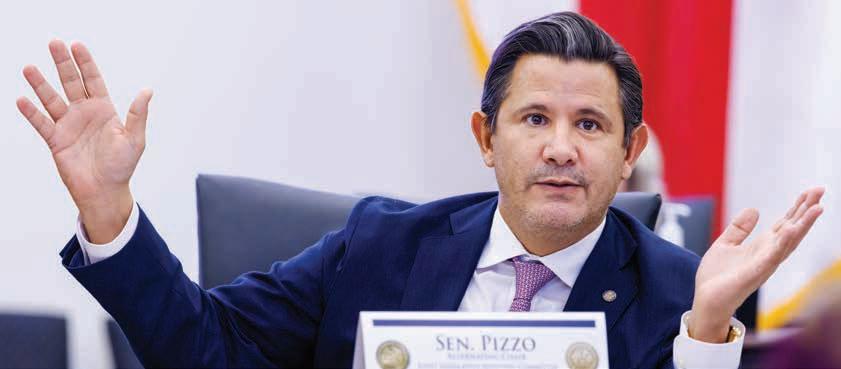
Sen. Jason Pizzo, during the Joint Legislative Auditing Committee, at the Capitol in Tallahassee. COLIN HACKLEY PHOTO
“You usually judge other legislators on a curve. Jason blows up the curve.” – JEFF BRANDES
he proposed building safety reforms that never made it to a Senate floor vote. Parts of them were later absorbed into a Republican-sponsored measure passed in 2022.
It was part of a trend Pizzo recognized. He’d introduce legislation that Republicans initially ignored, only to pass them later under a GOP name. His rejected amendment became the basis for Florida’s “anti-riot” bill. His bill to allow schools to buy Narcan failed — until he convinced a Republican colleague to include it in a related measure.
But in the interim, he said, “a teenager likely died due to partisanship, and that f***ing pisses me off.”
Still, Pizzo pushed through impactful legislation — improving condo transparency, supporting water-based industries, increasing animal abuse penalties and cracking down on illegal street takeovers, among other measures. But he’s no longer concerned with credit.
“I don’t think my colleagues would deny the role I played in these bills,” he said. “But I’m in this for productive legislation and helping people, not pride of authorship.”
LEADING WITH CONVICTION
During his designation speech as Senate Democratic Leader in November, Pizzo criticized lawmakers for wasting time on culture wars while infrastructure crumbled, government agencies suffered staff shortages and Florida lagged in human trafficking prevention and SAT scores.
“We were lulled into a sense of acceptability because we had low interest rates, de minimis inflation, ample availability of labor and materials, and high but not cost-prohibitive housing and insurance premiums,” he said. “Six years later, it’s gotten worse. We can blame Washington, but we’re not being intellectually honest if we don’t acknowledge that these short windows of Legislative Session have (an) opportunity cost when socially divisive issues consume the limited capacity we have.”
He also called out Republicans for
financially starving Democrats in the appropriations process: “Our people matter too. Cut the check.”
Pizzo’s integrity earned him bipartisan respect. Aventura Commissioner Amit Bloom, a moderate conservative, knew of his reputation on condo safety, insurance, and constituent services. But it was his response after Oct. 7 — volunteering in Israel and pressuring cities in his district to stand with the world’s only Jewish nation after a horrific terrorist attack — that solidified her support.
“So many politicians shied away, but Jason stood up strongly and didn’t waver,” she said. “More likely than not, I will be backing him if he runs for Governor.”
Ross first met Pizzo in 2016 at a Liberty City candidate forum. A group called Florida Mothers of Murdered Kids attended.
When Pizzo saw them, he tossed his prepared remarks and addressed each woman by name, recalling their children’s names and the status of their cases.
“I wish I had it on video. It was so moving it had people in tears,” Ross said. “It wasn’t a political thing; it was a human thing. It demonstrated what he’s capable of. I thought, ‘there’s no limit to what this guy can do in politics.’”
A SHIFTING LANDSCAPE
Florida is in a “goldilocks period,” Pizzo said, as DeSantis’ influence has waned following a failed presidential run. The Legislature, under Senate President Ben Albritton and House Speaker Daniel Perez, has regained its autonomy.
“This is my first year here that the Legislature dictates legislation and doesn’t just file things at the Governor’s behest,” Pizzo said. “We can be incredibly effective and get a lot of good done.”
But he remains a vocal critic.
In a Jan. 29 thread on X, he highlighted millions the Legislature authorized DeSantis to spend on “ineffective” immigration enforcement, including the Governor’s controversial and quickly disappearing migrant flights program — the legality of which lawmakers had to fix in Special Session after Pizzo sued.
“For a guy who ran on deregulation — a ‘deregathon’ — DeSantis has a bloated state,” he noted. “And isn’t (the CFO) supposed to be at a podium announcing the relocation of major corporations
to Florida like Google or Amazon and 6,000 new jobs? Because we’ve never seen it.”
Voters, Pizzo argued, should ask themselves a key question: Are you better off? He thinks not and doubts a Republican successor to DeSantis like Byron Donalds, Matt Gaetz, Ashley Moody, or Wilton Simpson would bring meaningful change.
“When voters look to our side and say, ‘What’s the alternative?’ It’s someone who’s not espousing socialist principles, giving everything away for free or making you feel bad about working hard to get your piece of the American dream,” he said.
He then all but confirmed his gubernatorial ambition: “If I had faith that somebody could do the job better, I’d be first to campaign for them. But when you contemplate candidates on our side and that specific role for which you must bring a specific combination of life experience, fortitude, intelligence, and toughness — not just to win, but to bring a seismic shift — I check those boxes.”
Any Democrat will face an uphill battle competing for Governor in Florida, but Pizzo is about as well positioned to pull it off as anyone, according to Mercury Managing Director Eric Johnson, who worked on Pizzo’s 2022 campaign.
He has ample resources, a moderate message that appeals beyond the Democratic base and can dedicate the time necessary to making inroads with undecided voters, Johnson said. He’s also strategic and clever enough to seize on opportunities a Republican candidate will give him.
And voter registration numbers are hardly the death knell to campaigns some might believe. Were that the case, Johnson continued, there wouldn’t have been a Republican Governor of Florida until DeSantis, given the voter advantage Democrats long held in the state.
“With the right candidate, campaign and opponent, a Democrat has an opportunity here, particularly in an offyear election when Donald Trump is the incumbent. Look at the 2018 election. There’s always backlash,” he said.
“At some point, the incumbent party with free rein over the levers of government goes too far, and voters want balance. There will be a point — whether in 2026 or not — where regardless of registration they’re going to say, ‘OK, I think we should try the other side for a while.’”

J e n n M e a l e P o g g i e
C E O

R i s e A b o v e t h e N o i s e
P i n n a c l e M e d i a i s a n a w a r d - w i n n i n g ,
F l o r i d a - b a s e d p u b l i c r e l a t i o n s a n d
m a r k e t i n g f i r m .
S e r v i n g c l i e n t s a r o u n d t h e c o u n t r y , P i n n a c l e
M e d i a d e v e l o p s c o m m u n i c a t i o n s a n d
m a r k e t i n g s t r a t e g i e s t o m e e t c l i e n t s ' g o a l s .
W e c a n h e l p y o u R i s e A b o v e t h e N o i s e .
j e n n @ p i n n a c l e m e d i a f l . c o m
P u b l i c A f f a i r s &
C r i s i s C o m m u n i c a t i o n s
S t r a t e g y
S o c i a l M e d i a &
M a r k e t i n g
W r i t i n g & D e s i g n



What I’ve Learned
Steve Crisafulli
53, Merritt Island
Former Florida Speaker of the House, Now focused on business, family and ‘making connections’
As told to Rosanne Dunkelberger
WITH A COUSIN WHO WAS FLORIDA’S GOVERNOR AND A GRANDFATHER NAMED CHIEF JUSTICE OF THE FLORIDA SUPREME COURT, YOU WERE HEIR TO A DISTINGUISHED POLITICAL HISTORY. DID YOU ALWAYS WANT TO BE A POLITICIAN?
Honestly, I never really thought I would ever want to be in politics because I’ve always enjoyed the family business and the business side of things. In fact, I found myself on the opposite side of government on a lot of things, spending more time sitting in agency and local government offices than (on) my own working through family projects.
The seat I ran for originally was held by an individual that resigned early. It was then picked up in a Special Election by a Democrat in January of 2008. … Obviously Special Elections can bring out a different voting bloc; the seat was a heavy leaning Republican seat on paper. The RPOF and House Campaigns came to the area and started looking for somebody to run for the seat. They visited with several people at the county government and different businesspeople and my name came up on several occasions. So they reached out and asked if I would be interested in running when the seat was back up, which was 10 months later. I still didn’t have an interest in running, but … the timing of their conversation with me along with some different things I was working on for the family business, provided enough frustration for me to say: “You know what? Stop complaining about
“You
know what? Stop complaining about government being in the way and go do something about it.”

government being in the way and go do something about it.” I ended up filing in March of 2008 and ran unopposed in the Primary and then won in the General Election in November against the sitting Democrat.
I was ascending to a role in the family business. I really didn’t think I’d have time to do it and … trying to figure out early on how to balance being a citizen Legislator and running a 100-plus year-old family business provided some challenges. But we worked through it and my family was very supportive.
AS SPEAKER, YOU WERE WELL POSITIONED TO MOVE UP THE FOOD CHAIN AFTER TERM LIMITS ENDED YOUR TIME IN THE HOUSE. BUT YOU DECIDED TO WALK AWAY FROM ELECTED POLITICS. WHY?
The next option was potentially running statewide. (Adam) Putnam was going to be term limited out as Agriculture Commissioner. Obviously, my family’s background in agriculture would have made me interested in that position, certainly one that gave me enough thought to want to run for it. That was kind of what I was contemplating, but everything happens for a reason and … the decision was ultimately made not to run.
A big factor in my decision to step away from politics, first and foremost, was to raise my children. They were in their last years of being at home and moving on to college. And then, obviously going back to the family business and working on setting up the business for the future was and always had been the plan.
In the two years leading up to your speakership, you’re running House campaigns and going out and getting candidates to run and collecting contributions to run an effective operation. I didn’t abandon the family business, but I didn’t have time to focus on it. And so, I couldn’t just sit idly by. A family business that had been around for 100 years was needing me to get back in place to chart the path forward.
It was more important for me to, to be back home and know there are other people that can do these roles and do just as good a job as I could have done. … Even though Nikki Fried won the election, it didn’t change the fact that I was still going to speak to whoever that Commissioner was and tell them the story of agriculture and


Top: Steve Crisafulli stands in his seat in the chamber before being officially nominated as Speaker of the house in November 2014. (Bottom) Near the end of his tenure, Crisafulli is joined by his wife, Kristen. and daughters Carly and Kennedy for the unveiling of his portrait.

items.
the challenges facing today’s farmers with the hopes of still being an advocate for the industry. I still felt like I could be a part of the process without having to do the job. I’m happy I made the decision that I did and I feel like even today, obviously with Commissioner (Wilton) Simpson being there and Kathy Mears being the Chief of Staff — who was my Chief of Staff — helps allow me to still be involved and provide feedback on the day in and day out of farming. I know they do far more than deal with agricultural issues at FDACS, but it is the foundation of the agency to deal with these issues.
TELL US ABOUT YOUR FAMILY BUSINESS.
My family settled on Merritt Island in the early 1900s; 1916 is when they started coming to Florida, putting orange trees in the ground, grazing cattle and acquiring land. They settled in the area that is now known
to be the Kennedy Space Center. In the late ’50s, the Federal government came and said, “We need this property. It’s strategically located for what we want to do for the future of space for this country.” And so, the handful of families that were out there more or less negotiated with the government to have their land — I say taken, but there was compensation. I believe the average price paid was around $100 an acre.
We still have properties outside of what I would call the “gate” of the Space Center. They said “you’ll have to move outside the gate, but you’ll be able to farm this land for as long as you want” on a handshake. We know how handshakes end up turning out later on. Long story short, we did continue to farm the property. And when I say farm, that was all citrus at the time. We continued to farm the property into the early ’80s. Then the government took those leases back and leased them out to different people, many not from around the area.
Many years later, (the Federal Government) just let the property go dormant to where today, it’s basically all invasive pepper trees where all the old orange groves were.
As it stands today we have one small grove that’s a USDA test grove for different varieties and rootstocks. But other than that, we do not commercially grow citrus anymore, the only farming we do today is cow/calf.
WERE YOU A FARM KID?
From working with the picking crews to mowing the groves — anything that had to be done, I did it. When you think of Florida citrus, you basically have what I would call the juice industry and then you have fresh fruit. Back in the heyday, fresh fruit was probably 5-7% of the state’s business. Our family was more focused on the fresh fruit and gift fruit side of the business, which … meant shipping fruit around the world. We did probably 85-90% of our business be-
Rick Scott was Governor during Steve Crisafulli’s speakership and they worked together to craft legislation, including a tax package and budget


“ I get one chance at life and I’m going to make the best of what I’ve got.”

tween Thanksgiving and New Year’s, so it was hands-on every day at that point. I worked on that side of things as a kid, whether it was grading fruit or making boxes or packing boxes or loading trucks.
Living on North Merritt Island back then, you were a long way from civilization. We didn’t know that there was anything different to do. If we had friends come over, they got looped into it too.
Our business was the tip of the spear for what was known as Indian River Fruit. It ran from the Merritt Island/Titusville area down to the Vero Beach/Martin County area. What we sold was a product that was unique, even to Florida. Our fruit just tasted different, and had more juice than the fruit from the middle of the state.
It was a great way to grow up. I wish my kids would have been able to experience that, just from the standpoint of knowing what it was about. But by the time they got to an age to be involved in something like that, the industry had already started making a turn. The freezes of ’84 and ’89 were tough for our family because a lot of our groves were older and those freezes did a lot of damage. We did re-plant some of our groves after that, but then had a flood that later damaged even more of our groves. We shipped through the early 2000s. We managed to kind of fight off canker. … But greening was what ultimately took us out.
HOW DOES DEVELOPMENT FIT INTO YOUR FAMILY BUSINESS STORY?
In the late ’70s my dad — who has two siblings, a sister and a brother — saw the writing on the wall with what was happening with the space industry and the boom that was coming with the shuttle program. He decided to get a contracting license and start building, knowing that people wanted to live closer to work. At that time, he started identifying smaller parcels of the family property near the Space Center, developing them and building out homes.
We, like many citrus families, have a family that’s aging out. There are no 401(k)s for farmers — your land is your
401k. For my family, the natural progression is, property becomes too valuable to try to grow oranges on it anymore. The reality is you can’t justify planting an orange tree on a piece of property that goes for $200,000 an acre. The family has, over time, identified parcels of land based on location and appeal and developed a few of those parcels. We’ve done low density development because we feel people want the rural feel of North Merritt Island, which is where the space center is located and where our family’s properties are.
Since I’ve been out of office, my involvement in the family business has really been about a strategic plan to move the family business forward to make sure that we can provide for the family members as they age and do what’s smart with our properties and our community, not just build houses 10 feet away from each other like we see in so many areas were there were once orange groves.
ASIDE FROM YOUR FAMILY’S BUSINESS, WHAT ELSE ARE YOU DOING THESE DAYS?
I do have a book of business representing clients from around the country in my own personal consulting business, Crisafulli Consulting, Inc.
I’ve got about 30 clients that I represent locally and around the country. I’m registered to lobby for probably 24-25 of them just here alone in Florida. I got involved in consulting when I got out of office.
I don’t spend a lot of time lobbying. I do make some legislative asks, but otherwise it’s mostly consulting with folks on how to best navigate the process.
After I got out of office, people would ask me, for example “Do you have a relationship with the speaker in Mississippi? Can you build a bridge and help us?” This consulting business grew from that type of engagement. It was really because a lot of other states didn’t have term limits. A lot of my relationships with those folks from other states went way past my speakership. I would help connect people and get them in the door. I wasn’t lobbying at the time, but I was just more or less connecting people. That slowly grew into, “Hey, we’re not able to get this done, but we know that you know a lot about this issue and, and you have a relationship with this president or this speaker. Can you help us do this?” And so, the business grew into what it has over time.
I also chair the Republican State Leadership Committee. The RSLC is
a national organization for Republicans that works with Republican legislative caucuses, AG commissioners, lieutenant governors and secretaries of state, all of which are under our umbrella. We’re purely a political organization, no policy, and raise about $100 million a year to help Republicans get elected around the country.
WHAT DOES THE FUTURE IN POLITICS HOLD FOR YOU? DOES ANYTHING INTEREST YOU ON THE NATIONAL STAGE?
I get one chance at life and I’m going to make the best of what I’ve got. Truthfully, my thought process is more beneficial to business than it is to government. Government doesn’t move at the pace of business. I get frustrated with the pace that government moves, though I will say Florida is light years ahead of Washington, D.C. when it comes to pace.
D.C.? Never. There are 535 members of Congress. Me being in that mix isn’t going to change anything. You can effectuate change far better in Florida … than you can in Washington, D.C. I’m not saying I’m interested in running for office by any stretch. I’ve learned however, in this world of politics, that you never say never, because you just never know.
CARE TO PREDICT WHAT A SECOND DONALD TRUMP PRESIDENCY WILL ACCOMPLISH?
I could tell you something today and, tomorrow, it would be different. … The 24-hour news cycle changes the past and the future of our country literally every 24 hours and Donald Trump is no predictable person. It’s why he’s President.
I think people — conservative, liberal, independent, whoever voted for him — like the idea there’s not a predictable path, … that we’re just going to go along with the same old, same old. I do think if there was a chance for any types of changes from the standpoint of accountability, corruption or whatever else it might be that’s going on at federal government level and politics — I see him flushing that type of stuff out. He’s not there to be friends with people, he’s there to run the country more as a business.
I guess to answer the question, obviously, is we’ll wait and see.
I would say he’s got as good a chance as anybody to have his mes-
sage come to fruition as any recent President. (Incoming Trump Chief of Staff) Susie Wiles and (Deputy Chief of Staff) James Blair are good friends, and I know that they know how to operate in that system. They know how to get things done effectively and efficiently. I think President Trump being surrounded by people who understand that system better than maybe the first time around is going to help him accomplish more with a Congress that supports more of his initiatives.
TELL US ABOUT YOUR FAMILY.
My wife, Kristen, and I met in the summer of 1994 at a wedding the summer before she left to go off to school at Florida State and, as they say, the rest is history. We’ve been married 27 years.
We’ve got two daughters, 23 and 21. My kids are entering into the health care field. My oldest is a speech language pathologist who graduated from the Masters program at the University of Florida in the spring of 2023 and my youngest is in her first year of the nursing program at the University of Florida. I really pushed our kids to find a career that a computer can’t replace them in, and I don’t know that a computer can replace bedside manner, just yet.
We’re a very close family. We spend a lot of time together. My wife’s best friends in life are our two daughters. Both Kristen’s and my parents live close by. Her parents are retired from long careers supporting the space industry and my dad still runs the family business to this day at 82 years old, while my mom enjoys her days as a grandmother. I’ve met my dad for breakfast pretty much every morning I’m in town since I got out of college. That’s provided a lot of closeness and obviously a lot of opportunity to understand what each of us is thinking from the standpoint of a family business. I don’t think you can just have a once-a-month meeting and walk away from it and be able to successfully navigate effectively. We’re constantly talking through the future, very rarely talking about the past.
[Editor’s Note: On Jan. 1, after this interview was completed, Crisafulli Consulting merged with the public affairs firm Smith Bryan & Myers to create a new partnership that was renamed SBM Partners.]

A NEW VOICE TAKES AIM
High-level connections. Decades of experience. Cross-industry subject matter expertise. Ready to rival any government affairs challenge in Florida. As a Gunster subsidiary, we bring the reputation you trust and an innovative, collaborative approach. With the direction and decisiveness our name evokes, we are committed to hitting your target.
We are Arrow Group. And we’re ready to take aim for you.
M a d i s o n ’ s I n d e x

If you ask Christopher Columbus, Florida has mermaids. If you ask a Floridian, we have manatees. Thanks to Christopher Columbus, he discovered “mermaids” otherwise known as manatees.
Florida’s official nickname: The Sunshine State
Florida’s unofficial nicknames: The Peninsula State, The Alligator State, The Everglade State, The Flower State, The Gulf State, and The Orange State.
Money, Money, Money! Florida has the 3rd largest number of billionaires in the country and also boasts the 3rd most expensive zip code, Fisher Island in Miami-Dade.
Hurricanes love Florida. Since 1851, we’ve been hit by roughly 500 hurricanes. On the bright side, we’ve been deemed the best state for disaster relief.
Florida’s coastline is 8,436 miles long. That’s longer than driving from Tallahassee to Juneau, Alaska, and back.
140.6 million people visited Florida in 2023. That’s six times the population of Florida itself, which means for every local, there are at least five tourists blocking the left lane and asking where the nearest gator park is.
Ever wonder where the iconic “Florida Man” memes came from? You can thank an abandoned X (formerly Twitter) account, @ FloridaMan, and freedom of information laws in Florida.
Shark bites? Oh, we’ve got those. Florida has an average of 19 bites per year and Volusia County is the “Shark Bite Capital of the World.” You’re more likely to be bitten by a shark in New Smyrna Beach than struck by lightning... but in Florida, there’s a decent chance of both.
12 professional sports teams call Florida home with each major metropolitan area having at least three teams except Jacksonville, who only has one team.
During the British rule of Florida (1763-1783), it was divided into two: West Florida and East Florida. The capital of West Florida was Pensacola and the capital of East Florida was St. Augustine.


Drew Amy Sarah Kinley

At Sachs Media, we move the needle where it matters most. Our strategic communications and public affairs expertise help drive policy shifts, shape public opinion, and create lasting impact across Florida.
By blending data-driven insights with a distinctly human touch, we deliver campaigns that connect, influence, and achieve real impact—every time. Public Affairs and Communications Strategies for High-Stake Challenges.


