July 1, 2026
DURHAM COUNTY WINNERS!

A year after Tropical Storm Chantal, residents of Durhamʼs Old Farm neighborhood are still struggling to repair their homes— or afford to keep them at all.
BY REGAN BUTLER
Raleigh | Durham | Chapel Hill

July 1, 2026
DURHAM COUNTY WINNERS!
A year after Tropical Storm Chantal, residents of Durhamʼs Old Farm neighborhood are still struggling to repair their homes— or afford to keep them at all.
BY REGAN BUTLER
4 Every year, the Human Rights Campaign grades towns on how inclusive they are. Cary jumped 60 points in five years. BY REGAN BUTLER
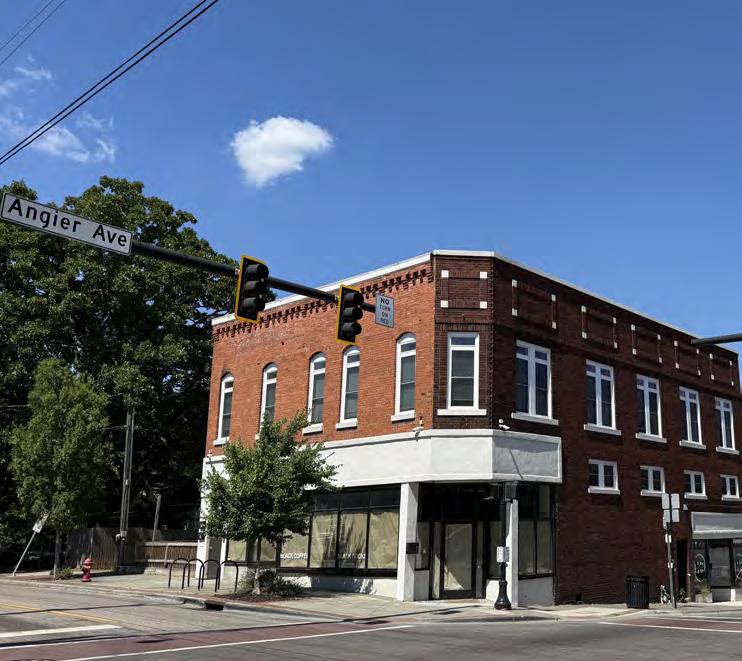
6 While changes aren't coming any time soon, developers want to turn East Durham's Angier-Driver corridor into a mini downtown. BY JUSTIN LAIDLAW
8 A year after Tropical Storm Chantal, Durham's Old Farm neighborhood is still recovering. BY REGAN BUTLER
12 How bad is the drought in the Triangle? And how much rain do we need to end it? BY JUSTIN LAIDLAW
14 An Assembly investigation finds hemp products in North Carolina rarely contain the advertised amounts of THC—but do contain mold and bacteria. BY JEFFREY BILLMAN Culture
31 From dairy farms to shopping malls, where to find Wake County’s best ice cream. BY JOHN BARE
34 Movies to seek out across the Triangle this month. BY GLENN MCDONALD
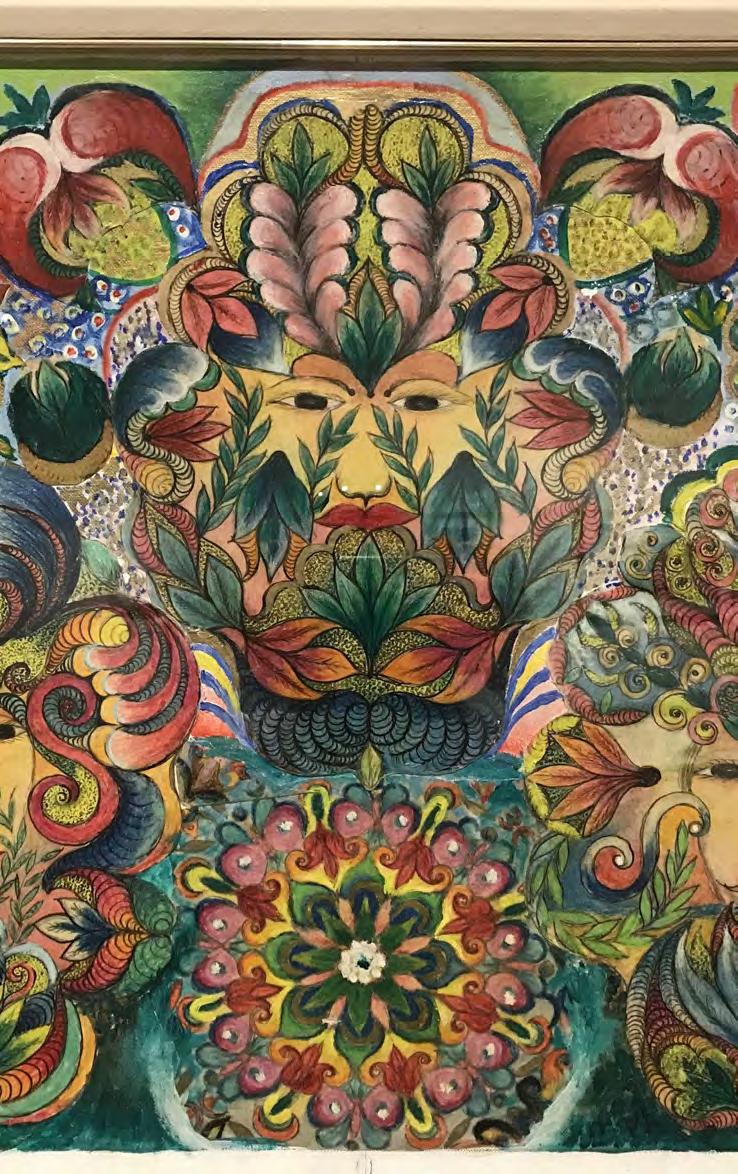
35 A new documentary pays tribute to the visionary North Carolina artist Minnie Evans. BY BRIAN HOWE
37 Local pop-up romance bookstores keep things inclusive. BY JESSICA TOBES
38 Raleigh's Bright Side Books & Wine joins a nationwide romance reading boom. BY SHELBI POLK
40 N.C. State alumna Maddie Jennette playfully documents an ever-changing college campus. BY DANEEN KHAN
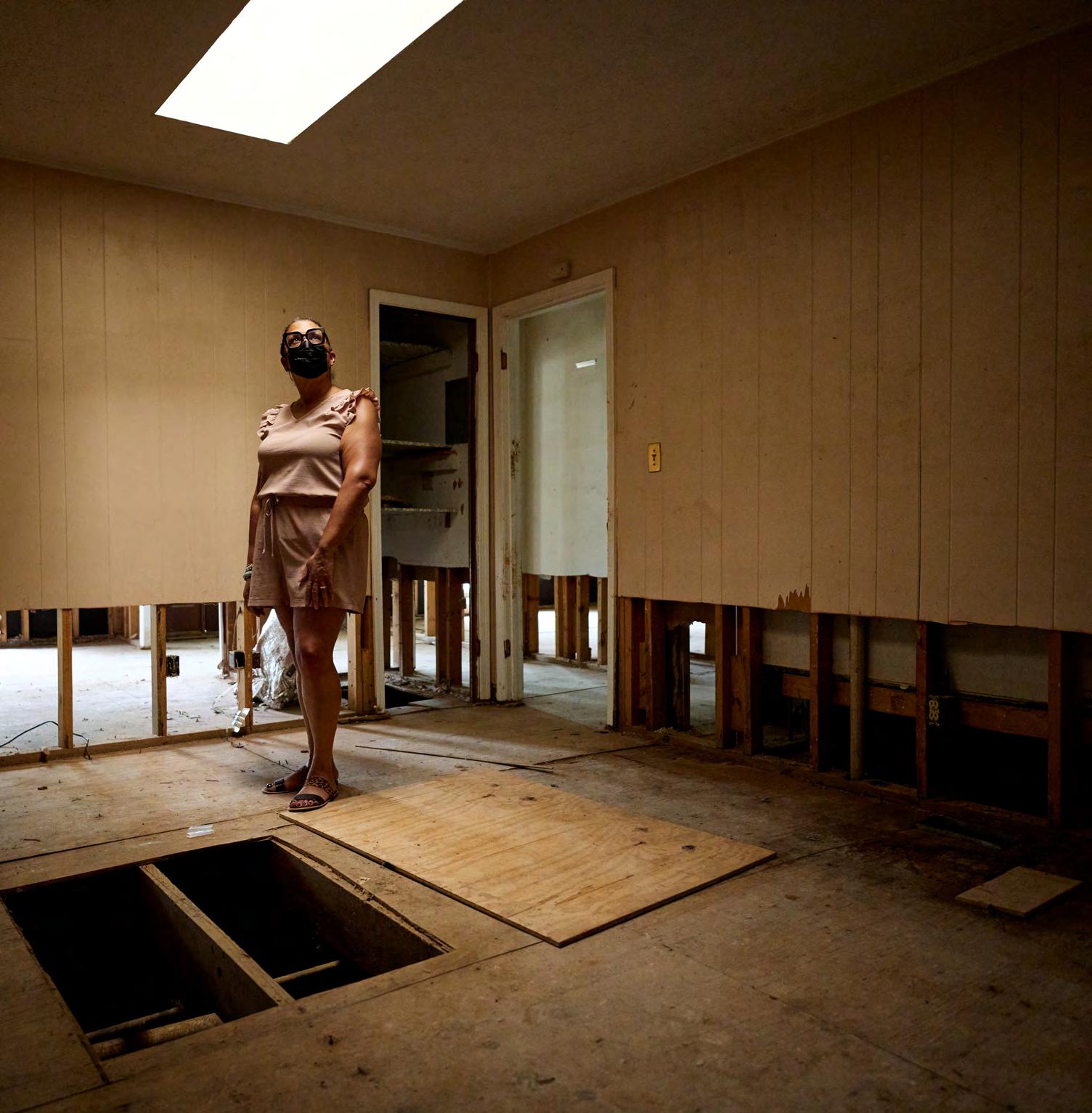
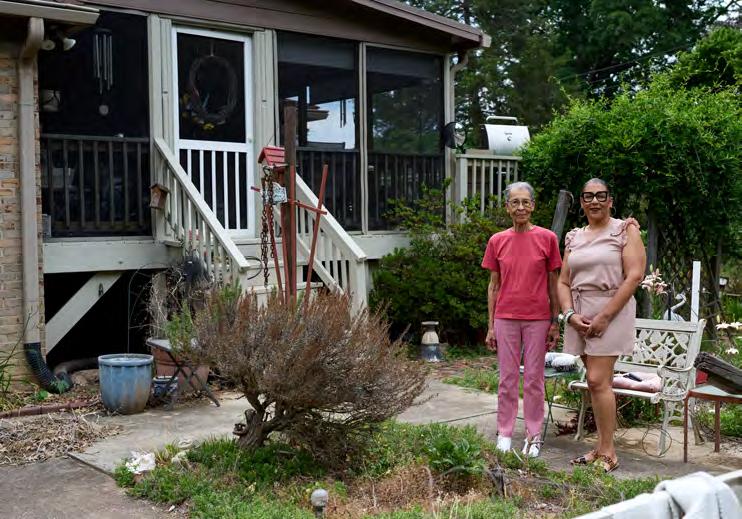
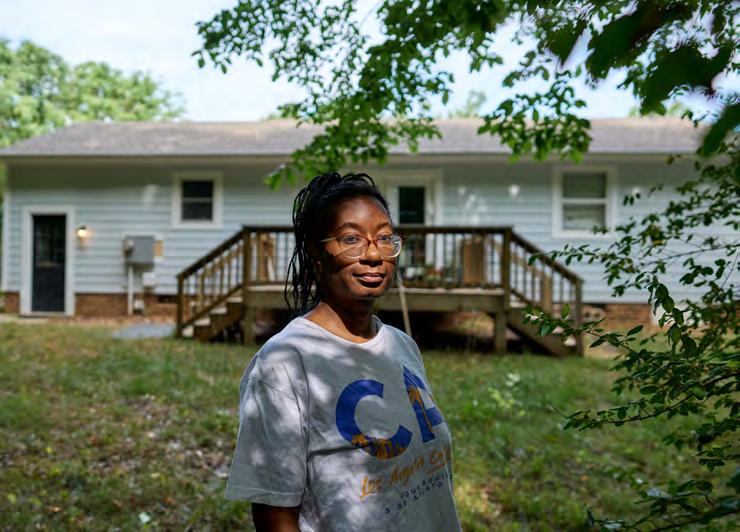
Cover Tanya Exum-Coston poses for a portrait inside her parents’ home, which was destroyed by flooding due to Tropical Storm Chantal, in Durham's Old Farm neighborhood on June 9, 2026. PHOTO BY MATT RAMEY
Publisher John Hurld
Editorial
Editor-in-Chief
Sarah Willets
Wake County
Jane Porter
Culture Editor
Sarah Edwards
Geller
Chloe Courtney Bohl
Contributors
Jasmine Gallup, Desmera Gatewood, Elliott Harrell, Brian Howe, Glenn McDonald, Cy Neff, Andrea Richards, Barry Yeoman, Russ Campbell, Colony Little, Shelbi Polk, Ryan Cocca, Lauren Wingenroth
Copy Editor Iza Wojciechowska
Editorial Interns
Regan Butler, Tori Newby, Jessica Tobes
Creative
Creative Director Nicole Pajor Moore
Last month, INDY staff writer Lena Geller and freelancer
Lee Gans published a detailed investigation into how a Durham County board granted billions of dollars in property value reductions to corporate landlords and companies like Blackstone while ordinary homeowners largely stayed on the hook for higher property taxes. City leaders—in the midst of planning for the next fiscal year’s budget and counting on projected tax revenues that wouldn’t materialize—didn’t learn the full scope of what had happened until April. Readers had lots of thoughts about the story.
From reader BRAD DAVIS via email:
I may often disagree with the Indy’s politics, but I have to say that [the] article on the Durham property tax shortfall was enormously well-researched, extremely well-presented, and comprehensively outstanding.
Durham County government has been essentially dysfunctional for years now (City government is much better run and reasonably accountable). The DPS debacle, 3 County Managers in 4 years, and now these property assessment issues are all testament to this fact.
Thank you on behalf of residential property owners for covering this vital issue.
From reader PAM DAVIS via email:
Thank you for an excellent article! Our home was revalued higher than larger, more expensive, recently sold homes in the neighborhood. My husband painstakingly documented this, went before the board and had his case dismissed without a hearing. I would not be surprised to find out that inequities in the handling of residential and commercial reviews were not accidental.
From reader JOHN DEMPSEY via email:
Thanks to Lena Geller and Lee Gans for the fantastically researched and informative article on Durham’s recent tax revaluation saga, ‘Falling Short’. They [took] a complex process (by design?) and laid it out for us. The entire valuation process seems off, almost as if it is set up to benefit insiders, developers, big business owners while being as opaque about it as possible. Please con-
tinue to flip rocks over. Rural Orange County suffered a similar fate with a giant shift of the County tax burden thrown onto their backs.
Also last month, freelance writer Jasmine Gallup published a story about the rise of charter schools in Wake County and how they’ve cost the public school district $500 million in local funding in the past 15 years.
From reader and independent journalist JEFF BRYANT via email:
Your recent article on [school choice in Wake County] covered a lot of essential issues regarding the influx of charter schools ... but there was little to no consideration of why charter schools are in Wake County in the first place. In my investigative reporting on that issue, I came to the conclusion that “the shifting policy justifications for charters—whether they’re a civil rights cause, an agent for improving the performance of public schools, or a necessary choice for choice’s sake—don’t clearly explain why charter schools show up where they do.
If charters are necessary for equity, then why were they showing up in affluent northeast Wake County? If charters are needed in places where the state’s public schools are the lowest-performing, then Wake County was well down the list of districts in need. And if choice for choice’s sake is the goal, then the state’s many rural school districts—where schools are often few and far between, and parents don’t have the wherewithal for private school or homeschooling—seemed much more in need of new state-supported education options.”
What does explain why charters are in Wake County has more to do with business deci-
sions than good public policy: the cost and availability of land that can be turned into a profitable asset, access to families who can afford to take on transportation and other costs charters externalize onto their “customers,” and proximity to diverse school populations that include parents who want to send their children to a school with the ability, through enrollment practices or exclusionary treatment, to filter out less desirable students.
And from reader RICHARD BOWDON via email:
Your article ... left out a very important fact, one always omitted by public school spokespeople and advocates. When a student enrolls elsewhere, the public schools don’t only lose revenue. They also lose the expense of educating that student. Yes, managing declining enrollment ... or enrollment increasing less than it might have ... puts a burden on administrators to manage that lower market share. But that’s part of their job, to budget for the enrollment they had, not the enrollment they wish they had.
Finally, freelance writer Storms Reback profiled Bertha Bradley, better known as Mama Cookie, one of the Triangle’s most visible labor rights activists.
From reader GANN HERMAN via email:
Thanks so much for featuring my friend Mama Cookie—I’ve learned so much from her and am proud to be fighting with her as an ally of USSW. She practices what she preaches and Durham is blessed to call her ours. She needs to rest sometimes, though!



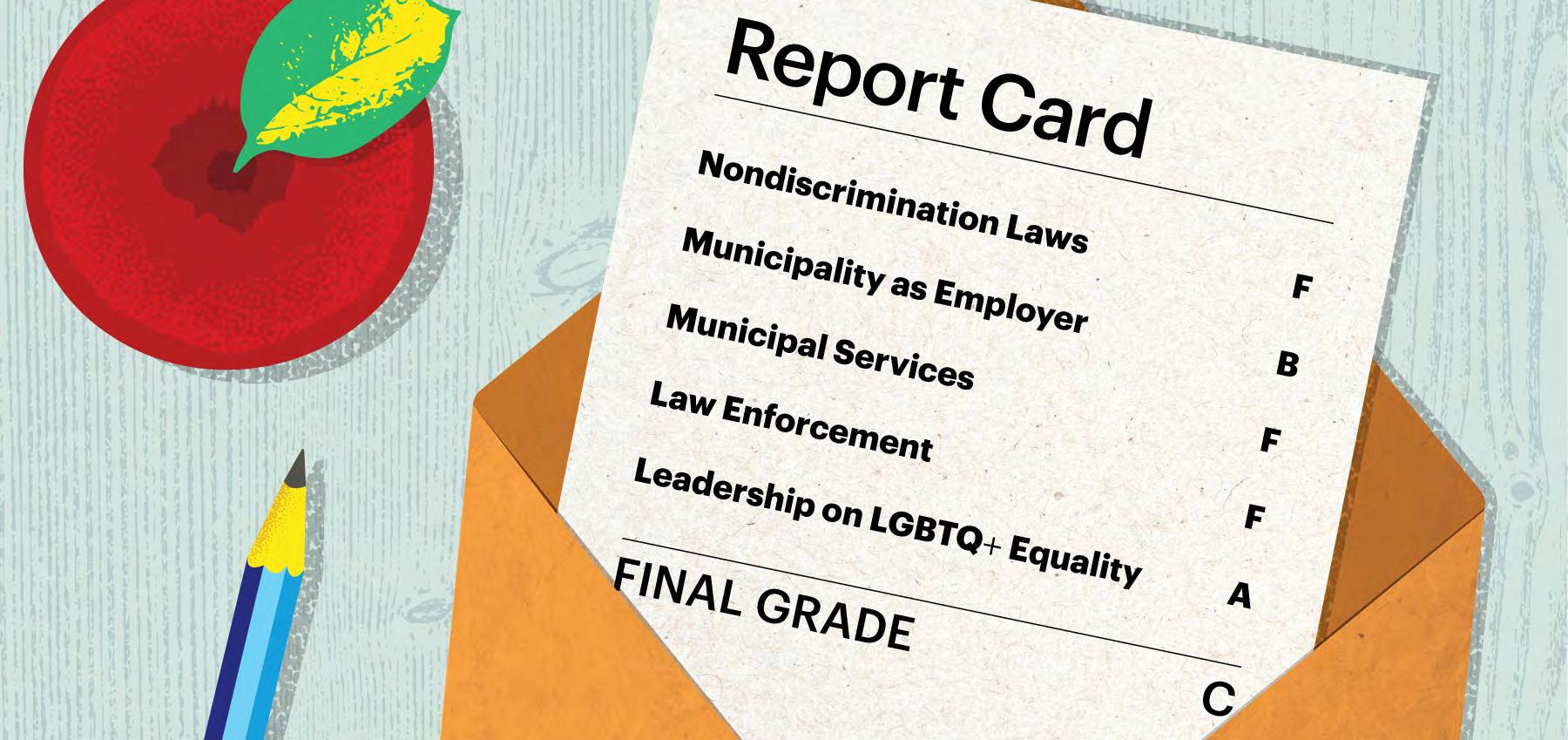
On the heels of Pride Month, we took a look at Triangle towns’ rankings on LGBTQ+ equality.
BY REGAN BUTLER backtalk@indyweek.com
Homebuyers can find Triangle-based realtor Jamie Ferguson on gayrealestate.com, where she is on call to help LGBTQ+ clients find somewhere to live comfortably. It can be nerve-racking for anyone to look for their home in an unfamiliar place; if you are queer, there can be added uncertainty when that place isn’t forthright about supporting the gay community.
“I am a queer woman and I know that there are always ways to make things easier for people,” Ferguson said. “For me, I’m like, OK, if I know how they feel, they don’t have to tell me 90% of the story. I know it, I get it.”
Ferguson said some Triangle cities, like Durham, have historically been more vocal about inviting the queer community in, while others, like Cary, were seen as more conservative, only starting to make statements of acceptance in recent years.
Annual scorecards from the national nonprofit Human Rights Campaign (HRC) provide a look at how some municipalities in the Triangle have shifted in support of LGBTQ+
equality over time. Most have improved from low ratings or remained in a high range.
Ferguson said now that most of the Triangle has achieved an equitable baseline, she sees queer homebuyers looking to live all over. Ferguson said her job isn’t to tell people where the best place to live is if you’re gay; it’s to give clients the tools to figure out where they’re most comfortable and find them a home wherever they want to live.
“There were areas that stepped out further back, and so they did, in the beginning, absolutely hold the flag for being where people wanted to go,” Ferguson said. “But now I feel like it’s changed in the last 10 to 15 years, and it’s everywhere. We’re everywhere.”
Every year since 2012, the HRC issues its Municipal Equality Index (MEI) for a number of cities across the country, assessing over 500 this past year. These cities are selected based on criteria including size, status as a state capital, and same-sex couple population. In North Carolina,
the MEI rates 10 municipalities: Carrboro, Cary, Chapel Hill, Charlotte, Durham, Fayetteville, Greensboro, Raleigh, Wilmington, and Winston-Salem.
The index uses 49 criteria to examine how “inclusive municipal laws, policies, and services are of LGBTQ+ people who live and work there,” according to the HRC’s website. The HRC rates municipalities based on their nondiscrimination laws, employee rights, programs, law enforcement, and local leadership’s positions on LGBTQ+ equality.
In North Carolina’s 2025 breakdown, released in November, the HRC website states that overall North Carolina municipalities exemplified how to support LGBTQ+ individuals at the local level, even if the state legislature has enacted laws like 2023’s House Bill 805, which restricted access to gender-affirming medical care for minors, overriding municipalities’ ability to offer inclusive healthcare policies for transgender family members of employees.
Despite these limitations, Durham, Chapel Hill, and
Carrboro have traditionally passed the MEI with flying colors, largely earning A’s in the past five years after satisfying most of the HRC’s core litmus tests: having nondiscrimination ordinances, promoting workplace inclusivity and benefits, having LGBTQ+ liaisons and commissions, and outwardly supporting equality. (The MEI scores cities out of 100, with “flex,” or bonus, points allowing additional opportunities to score—but final scores cannot surpass 100. The HRC does not assign explicit letter grades.)
In the Triangle, Durham has long been a standout; in 2021 rankings, it was the only Triangle town to score a 100 overall while also having points for transgender-inclusive healthcare benefits and nondiscrimination protections for housing specifically.
“Durham will try things well, well, well ahead of the rest of our areas around,” Ferguson said. “And they did very much publicly invite the queer community years ago.”
Over the years, there’s been a gap in the Triangle MEI scores: Wake County towns typically lag behind their Durham and Orange neighbors. From 2021 through 2024, Cary has had an F. The town crawled from a 12/100 in 2021 to a 49/100 in 2024 and finally saw a big jump this past year when it earned a 72/100—a C, using a 10-point grading scale. Raleigh is less severe but still somewhat low. It received a B rating (85/100) for LGBTQ+ equality this past year, but it had a D in 2021 and teetered from a C to a B in subsequent years.
In 2019, Jonathan Lambert-Melton was elected as the first openly LGBTQ+ City Council member in Raleigh’s history. He said the rubric has served as a guide to address gaps in the city’s services and branding identity, such as when Raleigh was the first Wake County municipality to vote to adopt the nondiscrimination ordinance in 2021, or when the city worked to add an LGBTQ+ liaison in the police department, which bumped up its 2022 score.
In addition to state law, Lambert-Melton said that he also thinks the variation in Raleigh’s score from year to year (and apparent gaps in scores from city to city) can depend on how the HRC itself grades—whether it’s evolving wording for individual criteria, using intentionally rigorous grading so that municipalities do not get complacent, or interpreting the way a city reports something to the HRC during the voluntary reporting process. He said these variables can lead to discrepancies in scoring, such as when having an LGBTQ+
liaison disappeared from the 2022 and 2023 scorecards, despite remaining on the city’s staff. He also said that services the city helps provide through grant programs and public partnerships may not be tracked as city provisions.
“The work is being done. I guess it’s just how it’s being captured and reported and scored sometimes,” he said.
Raleigh’s Wake County neighbor Cary has made a comeback in recent years. Similarly as in Raleigh, Mayor Pro Tempore Lori Bush said the boost from Cary’s longtime F ranking to its C in 2025 came after engaging with the HRC’s rubric as a framework to enact new policies, but also from responding to the HRC’s voluntary survey about the unreported work they were doing.
Following Raleigh’s lead in 2022, Cary adopted the Wake County nondiscrimination ordinance, which has been a sticking point for some Wake towns. Though not scored by the HRC, Holly Springs took four years to adopt the ordinance, and a handful of Wake’s 12 municipalities still haven’t.
Also in 2022, Cary saw new points for providing trans-inclusive healthcare benefits (which were later rescinded after HB805 passed) and adding its Human Relations, Inclusion, and Diversity Advisory Board in 2020. Notably, the town also jumped from a 0/8 in 2021 to an 8/8 in 2022 for local leadership on LGBTQ+ equality—which includes both city officials’ public stances and legislative efforts.
In 2025, for its big push, Cary earned points for policy strides, like enforcing nondiscrimination in city employment. It also racked up flex points for adding programs that support LGBTQ+ youth, LGBTQ+ people experiencing homelessness, and LGBTQ+ older adults. The HRC does still identify gaps in Cary when it comes to robust nondiscrimination enforcement and LGBTQ+ liaisons to the city executive and police department (despite the town having a human resources manager).
“I’m proud of the progress, but we’re not done,” Bush said. “The next phase is about increasing our reach and the trust to make sure that the protections that we put are felt in people’s daily lives.”
Though state limitations to LGBTQ+ rights are the be-all and end-all, the HRC provides a helpful handbook for where LGBTQ+ residents have the most nondiscrimination protections and support programs—even if the scoring is flexible. Ferguson said that since the Triangle has improved its offerings overall, whether you’re in Durham or Cary, community is where you make it.
“Now, we are a melting pot of people. It is no longer a one-tune band,” she said.






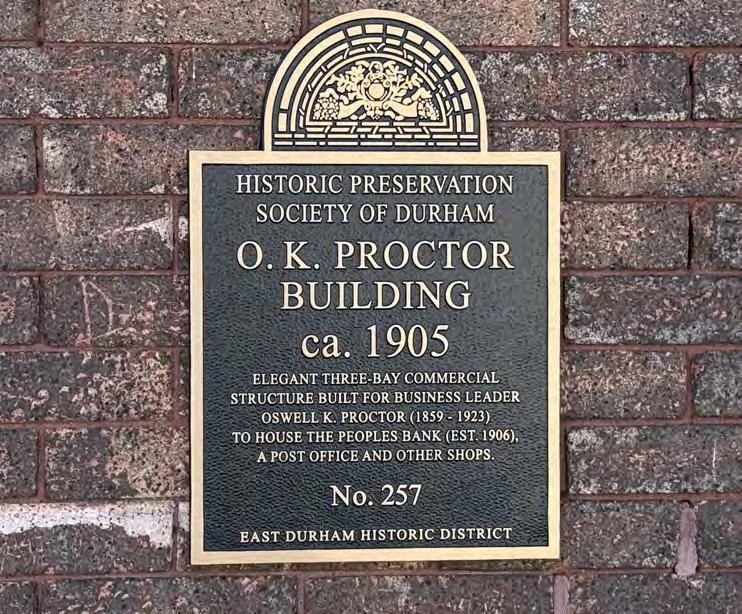
A zoning change and plans to create a mini downtown in East Durham could transform the historic Angier-Driver corridor.
BY JUSTIN LAIDLAW jlaidlaw@indyweek.com
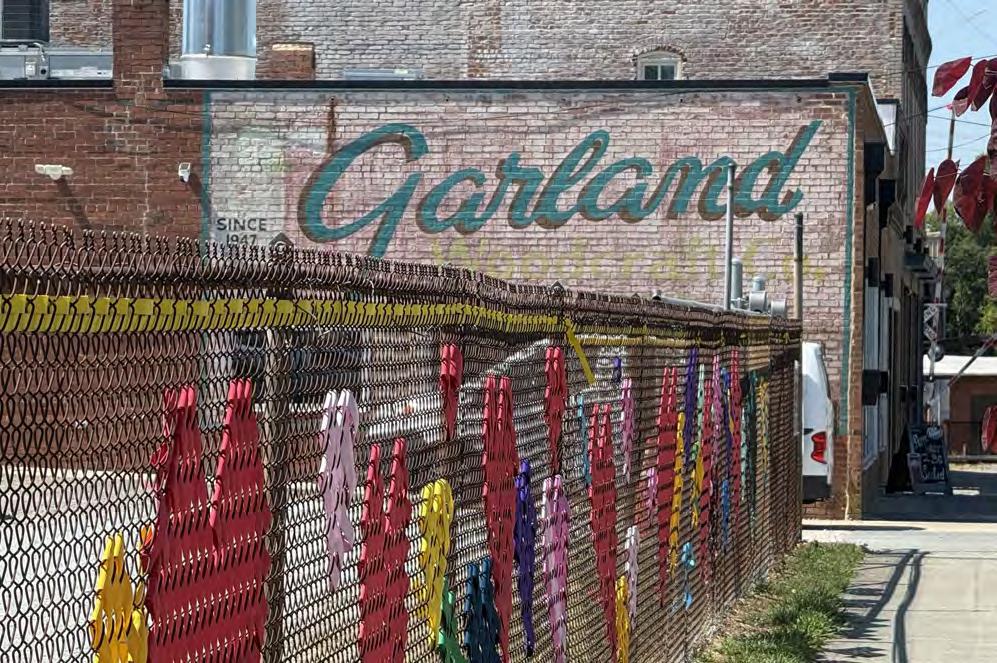
Old East Durham has a long history as an industrial hub, but some property owners in the area want to further transform the district into a residential and commercial destination.
Currently, the district is sliced up by incongruent zoning types. A significant portion of the area is still zoned for industrial uses, even as the neighborhood has slowly reconstituted to include more houses and small businesses. A group of residential and commercial property owners want to turn two blocks around the Angier-Driver corridor into a “downtown” area complete with retail, makerspaces, restaurants, and a variety of housing options.
No specific plans have been filed, and any changes are likely still years away as the city makes improvements to the area’s sewer system, which is currently at capacity, putting additional growth there on hold. The proposal took an initial step on June 15 when the Durham City Council approved the necessary rezoning by a 5-2 vote.
In Durham’s earliest incarnation, the district played host to the Durham Cotton Manufacturing Company, whose headquarters at the end of Driver Street is now occupied by chemical distributor Brenntag. The neighborhood surrounding the mill rapidly expanded to include housing, banks, and churches like the former Angier Avenue Baptist Church that sprung up at that time.
Decades after the mills closed, the industrial zoning lent
itself to automotive shops, scrapyards, and crematoriums. In the early 2000s, as Durham began its economic rebound and downtown became oversaturated, folks took chances on cheaper spaces on the periphery of Main Street. Black entrepreneurs in particular coalesced around the historic Old East Durham neighborhood as a spiritual successor to Durham’s Black Wall Street. But the current hodgepodge of zoning types limits development permitted in the area through an ordinance feature called nonconformity; any changes to properties that don’t conform to the current zoning rules—in this case, homes and businesses in the industrial zoning area—are prohibited.
The rezoning effort is led by Garland Ventures, a group of local developers with a history of rehabilitating former industrial sites in Durham.
John Warasila, one of the partners in Garland Ventures, said the owners of all the properties that will be rezoned opted to be included. Properties whose owners did not want to participate aren’t. About two dozen residential and commercial properties are included in the reenvisioned district. Garland Ventures owns six, with two more under Warasila’s name.
“We are not some big out-of-town developer who’s come in to try and rebuild an entire part of the city,” Warasila said at a previous City Council meeting. “We’re local people who are working from the ground up to revitalize neighborhoods
that have seen no improvement for decades.”
Warasila moved to Durham in the ’90s and lives downtown. His firm, Alliance Architecture, is responsible for rehabilitating other former industrial centers like Golden Belt and American Tobacco Campus.
“When we looked at East Durham, we said, this is distinctly not downtown,” Warasila said. “It’s a very different scale of development: two- and three-story buildings where the commercial is on the ground floor and residential is a floor or two above that, but not five stories. The trade-off is that scale versus building big parking decks.”
The goal is to bring more foot traffic to the commercial corridor, providing a stronger customer base for the businesses in the area, Dan Jewell, who has been working as a developer in Durham for nearly 40 years and is also involved in the Garland rezoning, said at the meeting.
“In talking to those people, the tenants, our tenants and other folks in the neighborhood, it’s clear what is needed is a lot more local foot traffic than is in there today to support those businesses,” Jewell told the council. “We can’t do that with the current light industrial zoning.”
The city began exploring options for rezoning the district several years ago. Business owners like Joe Bushfan, who opened his restaurant-turned-commissary kitchen Joe’s Diner in 2010, told the INDY in 2017 that the city had long neglected the district. Durham made some invest-
ments in the neighborhood. In 2013, the city spent $4.8 million on improvements to the streets, sidewalks, and utilities in the corridor. Popular businesses like Proximity Brewing, Rofhiwa Book Café, Mike D’s BBQ, and Ideal’s sandwich shop filled the vacant millhouses and empty commercial spaces soon after.
The district has been moderately successful, building momentum in fits and starts. Rofhiwa, Proximity Brewing, and Mike D’s recently closed their storefronts for varying reasons, but Dame’s Chicken and Waffles relocated to the corridor late last year, and Ideal’s keeps a line around the block most days. The neighborhood also includes a couple of bars, a home goods store, a small grocery, and other retail options. It’s also poised for growth. Another project, Brickworks, will substantially increase the population of the area. Durham Technical Community College is building housing not far from the proposed Garland District, and the city is exploring options for a transit substation nearby in the Village shopping center.
Jewell and Warasila worked to restore the old Garland Woodcraft building, where Dame’s is now, after a major fire caused structural collapse years ago. The building is part of the East Durham Historic District the city created in 2004, and Jewell said it won’t be demolished as part of future plans for the area.
At the June 15 meeting, the City Council approved changing the Garland District properties’ zoning from “industrial light” to “commercial general” and “commercial infill.” The city planning department created the “commercial infill” zoning district in 2018 to accommodate and encourage smaller-scale development. The designation has been used sparingly—West Chapel Hill Street is the most prominent example—but the zoning does pave the way for future projects in areas like West Chapel Hill Street, and potentially the Angier-Driver corridor.
Councilmembers Shanetta Burris and Nate Baker voiced concerns about the proposed rezoning, citing environmental concerns and the lack of specific plans for the area.
Burris pressed the developers on their plans for some of the industrial sites that might have contaminants in the land, as well as any contingency plans for any accidents on the railroad tracks that might affect the new residents Garland District is expecting to host. Brenntag, a chemical distribution company whose facility is across the railroad tracks on the other side of Peabody Street, is currently being sued for polluting a nearby creek.
Jewell said Garland Ventures would work
with the Durham Fire Department to understand what contingency plans are already in place and take additional steps if needed.
Baker, along with Councilmember Chelsea Cook, who both voted against the rezoning, raised concerns about approving the zoning change without a specific plan for the area in hand.
Baker questioned whether waiting for the city to adopt new land use rules would give City Council, the planning department, and the neighborhood time to think about the area “more holistically” and possibly create a small area plan for the Garland District.
Because the case is for rezoning without a specific development plan, Baker said the city is missing out on the opportunity to receive additional proffers from the applicants. The new zoning could allow future development by-right without the applicants having to come back to the City Council for further approval, precluding the city from negotiating proffers like affordable housing or donations to public schools based on the impact of the project.
“Could we work on commitments that involve community investment, public investments, and infrastructure so that both private investments and public investments are greater than the sum of their parts?” Baker said.
Jewell said that with the uncertainty around Durham’s future land use rules and the sewer capacity issues in East Durham, as well as the lengthy development process, the Garland team wants to get out in front of any potential plans for the district as soon as possible.
Still, the group is optimistic about the potential of the neighborhood. Two neighborhood residents spoke in favor of the rezoning at the City Council meeting, and Mayor Pro Tem Javiera Caballero said that the lack of opponents in City Hall suggested the Garland team had gotten buy-in from the neighborhood.
Warasila hopes that the mix of modest commercial spaces and residential units will offer folks affordable opportunities to live and work in the Garland District.
“That neighborhood, to me, strikes me as the neighborhood where people make stuff.
... You know it’s made in Durham, that’s where they’re doing it, and those people should be able to live in the neighborhood,” Warasila told the INDY. “That’s going to require that the construction and everything else be not gigantic buildings that have a high price tag to them. They need to be moderately scaled and moderately priced; that’s the goal. I have no idea what it’s going to look like in the end, but I do know until we get the zoning changed, we kind of can’t do anything.”W
A year after Tropical Storm Chantal, residents of Durham’s Old Farm neighborhood are still struggling to repair their homes—or afford to keep them at all.
BY REGAN BUTLER backtalk@indyweek.com
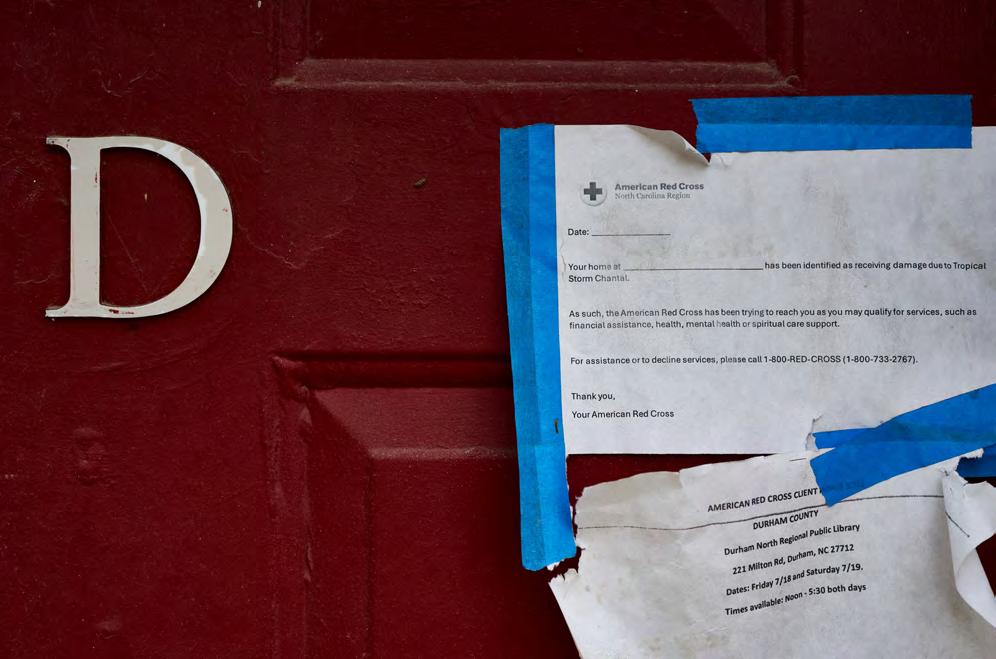
At about 2:30 a.m. on July 6, 2025, Jameka Autry awoke to a frantic call from her neighbor. Floodwater had pooled into their house, they said, and Autry and her mother, Winona, needed to leave fast in case their home was next.
Autry, still half asleep, opened the back door of her house on Peppercorn Street.
“There was no porch. There were no steps. We were literally surrounded by water and couldn’t get out,” she said. After dialing 911 twice, Autry and her mother were rescued by boat before the floodwaters rushed into their home. The next day, it was gutted. Overwhelmed by repair costs, she and Winona had to sell the house in November.
Every Old Farm resident remembers the exact early-morning moment when they learned Tropical Storm Chantal’s floodwaters were violently rushing their tranquil neighborhood in North Durham. For many, like Autry, it was the last time they saw their homes intact. For some, it was the last time they lived there at all.
“You literally just see your house, your childhood house, torn down to nothing. You have to throw out all of your furniture, and it’s a devastating experience. I wouldn’t wish it on most people, probably not even my worst enemy,” Autry said.
Nearly a year later, Old Farm is still in disaster response mode. Some residents remain displaced from their homes; with Chantal leaving structural damage and mold in its wake, homeowners scrambled (and are still scrambling) to find somewhere habitable to stay throughout repairs.
Others, many of whom had lived there for more than four decades, sold their longtime homes to eager real estate investors, unable to shoulder the financial burden of repairs—an onus compounded by a lack of direct federal aid, meager state grants, and outdated floodplain maps that left some without flood insurance. Driving around Old Farm today, some houses are boarded up and stagnant, as if they hadn’t been touched since July. Repair vans are haphazardly parked about the winding streets—both to fix up the homes of remaining residents and to make others that were bought by LLCs look polished, bright-white new, and unrecognizable.
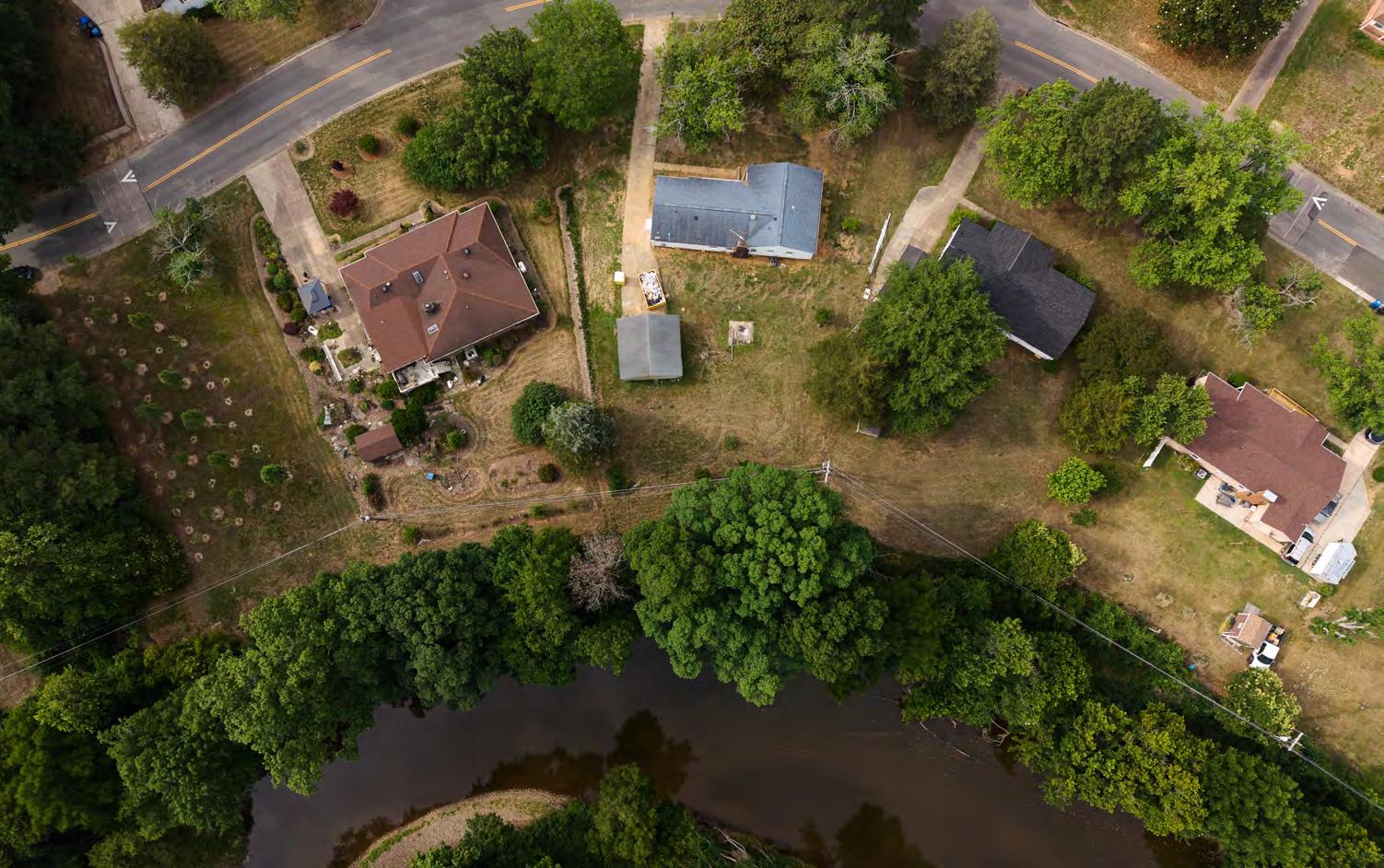
Tropical Storm Chantal unleashed historic rainfall in isolated pockets of central North Carolina. The sliver of Durham County that Chantal hit, and hit hard, was Old Farm and River Forest, two adjacent historically Black neighborhoods along the Eno River, which rose to a record high due to the storm. The streets of Old Farm transformed into turbid, rushing waterways, claiming cars and the bottommost levels of many homes—leaving residents stranded at the mercy of water rescue boats. More than 100 Durham residents (mainly in Old Farm and River Forest) were water rescued, while others, like Morgan Fielding, had to shelter in place to wait out the flood.
Fielding, a remote tech worker in her 40s, joked wryly that on the day Chantal hit, she learned she wasn’t some-
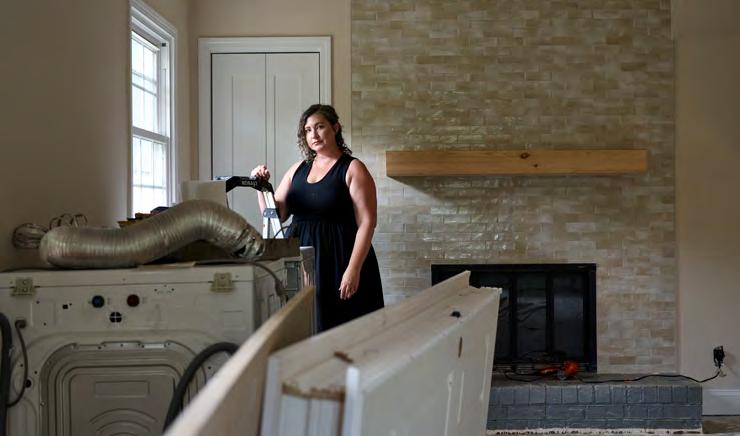
one who did well in an emergency. Lying in bed that night, she knew the power had gone out when her white noise machine cut off abruptly. Fielding was fully prepared to roll over and go back to sleep but was jolted wide awake the moment her partner, Neal Smith, told her there was water pooling into their basement. Smith, whom Fielding commended for being calm under pressure, immediately started hauling their belongings up to the second floor.
“We bought this house thinking we would have a family in it. And then now to think, ah, we might not have a family because of this house.”
“I remember standing at the top of the stairs. It’s pitch black, and there’s probably a foot and a half, two feet, of muddy water sloshing through downstairs. And I just couldn’t rationalize that that was happening inside of our home,” Fielding said, becoming sullen as she recounted the event and stroked one of her cats who leapt onto their wooden dining room table—two surviving reminders of her home as it was before the flood.
Senior residents, some with disabilities, were especially vulnerable to the sudden and rushing floodwaters. Tanya Exum-Coston lives in the southernmost part of the neighborhood, but the home of her elderly parents, Walter and Marilyn Exum, who had lived in Old Farm since the ’70s, sits farther north, right on the riverbank. Though just a 10-minute walk away, she realized she couldn’t get to them; neither could swim, and her father used a walker at the time.
“I just kept calling and kept driving around to the various streets to where I could see down to their house, and calling my mom on the phone,” Exum-Coston said. She said they both huddled on their beds to wait for help, and after she notified emergency services, a rescue team saved her parents by boat—with a wheelchair for her father.
Floods from Chantal impacted 35 of the 462 homes in Old Farm, Starla Tanner, director of the city of Durham’s new Community Partnerships and Engagement Department, told the City Council during a May 18 update. In next-door River Forest, she said, 29 of 169 homes were affected.
Tanner said the most prevalent kinds of damage are structural, interior, and utility-related. Mold and poor indoor air quality are also concerns.
Of the impacted homes in Old Farm, she said residents had been able to repair and return to five, repairs were in progress at 10 (whether or not residents had returned), and residents had left eight, as of the May 18 update. The status of another 12 homes was unknown, meaning the city could not get in touch with residents, Tanner told the council.
As it stands, Tanner said at the meeting, repair efforts are being hindered by limited contractor availability, high costs, and bureaucracy that’s confusing and unfamiliar to residents trying to get financial aid and file insurance claims.
Old Farm residents, for their part, told the INDY they feel forgotten—in media coverage, by their government, and by their fellow North Carolinians. Many wonder whether it’s because of the neighborhoods’ predominant population of Black and elderly folks, coupled with the comparatively low number of homes impacted.
“There’s been little in terms of resources for rebuilding after the initial phase, when we did have a large community effort towards cleaning out the homes,” Trey Gilmore, president of the Old Farm Neighborhood Association told the INDY. “Probably 75% or 80% of those affected by the flood were able to get some volunteer services for cleaning out the water and the mud after
displacement. A lack of direct federal aid, coupled with repair costs that outweighed available state grant money, meant residents who couldn’t afford to fix their homes were left with little choice but to move out of the tight-knit neighborhood where they had grown up, raised their children, and built their lives. Others moved in with family or friends or stayed in their damaged

the flood, but when it came to the rebuilding, it was a drastic lack of support.”
What hit Old Farm nearly as hard as Chantal itself was the resulting wave of
federal and state aid have been painstakingly slow to arrive in Western North Carolina communities devastated by Hurricane Helene in 2024, The Assembly and ProPublica have found.
Old Farm is the kind of place residents live for generations and pass down their homes to their children with a sense of pride. But most of those who sold their homes received the price of the flood-damaged versions due to a lack of funding for federal, state, or city buyouts.
Of those who had to leave permanently, some were eligible for state aid and federal loans from the Small Business Administration, but some weren’t; some had flood insurance for homes in a designated floodplain, but houses right across the street didn’t have the same protection. Chantal’s destruction and resulting financial strain didn’t spare those who had done the “right things” to prepare or respond.
Though it’s the most intuitive funding stream for disaster aid, the Federal Emergency Management Agency (FEMA) was no help to Old Farm residents. Chantal impacted fewer than 500 homes total, meaning it didn’t meet the minimum threshold for direct, individual assistance—so the state didn’t request it. FEMA did reimburse municipalities and counties to the tune of $32 million for emergency response spending after the Trump administration declared Chantal a major disaster in September— two months after it hit. But the city of Durham couldn’t use federal dollars to purchase impacted homes from Old Farm and River Forest residents, leaving many to list on the private market.
Residents were eligible for state grants after Chantal, though the money was slow to come through. As of early December, Old Farm residents hadn’t received any state grant money, The 9th Street Journal previously reported—even if they got through the arduous paperwork and back-and-forth with state caseworkers. Fortunately for some, the grant money—at most $43,600 per household—did arrive beginning later that month.
The state disbursed more than $4.6 million to North Carolinians affected by Chantal, Justin J. Graney, a spokesperson for the North Carolina Department of Public Safety’s emergency management division, wrote in a statement to the INDY
homes amid the repair process. Their experiences echo those of North Carolinians in other parts of the state, who have seen similar barriers to aid in the wake of flooding. State recovery efforts following hurricanes Matthew and Florence in 2016 and 2018 were plagued by delays, while
But not everyone in that unlucky portion of North Durham got help. Graney wrote that 36 State Individual Assistance applications were denied in Durham County, “with the most common reasons for denial being that the applicant had a duplication of benefits, meaning they had benefits from insurance or another source.”
Eleven of these denials were appealed, with seven eventually granted once applicants provided the required documentation. The Department of Public Safety attempts to work with residents “whenever possible,” he added. (Data on how applications broke down specifically in Old Farm was not available.)
Exum-Coston’s parents were among those who applied but were denied money. Since the Exums’ home was in the floodplain, they did have flood insurance, though the coverage was not quite enough to pay for all the damage and loss (state aid is secondary, so it would have covered what insurance didn’t). The couple is repairing their home with plans of returning but, in the meantime, is renting another house nearby—paying for two homes at once.
Exum-Coston said that now they are “fighting against time” to repair their home before their lease, or money, runs out.
“That is a significant cost if you’re paying probably $2,000 in rent a month for over a year for retired people who are in their 80s,” Exum-Coston said. “And both my parents are retired schoolteachers, so they don’t have tons of money to spend on these costs.”
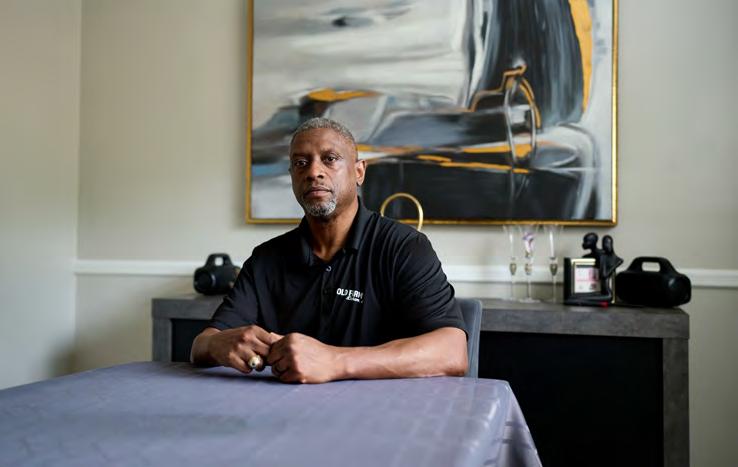
For Fielding and Smith, the cost of repairing the ground and first floors of their home, plus replacing items they lost, amounted to about $75,000. About half is covered by the $43,600 in state assistance. The rest, they’re paying out of pocket. The financial burden has meant they had to give up on trying to have a child through IVF treatments.
“We bought this house thinking we would have a family in it. And then now to think, ah, we might not have a family because of this house,” Fielding said.
The displacement Old Farm residents have experienced in the wake of Chantal is reminiscent of the reason why many families set roots in the neighborhoods at all.
Built throughout the ’60s and ’70s, Old Farm spawned from the implementation of urban renewal—which built the Durham Freeway directly through Durham’s Black Wall Street and Hayti neighborhood, pushing Black working-class families out of the prosperous district and leaving them to seek community elsewhere. For some, that happened to be in a neighborhood right along the banks of the Eno River, partially situated in a FEMA-designated floodplain.
The Old Farm Neighborhood Association’s website states the migration was “a movement that allowed many youths
reared in Old Farm, now (40-60-year-olds) to proudly boast of an incredible childhood and a village that still consists of many of those amazing parents today.”
Since Chantal inundated the neighborhood, nearly 15 homes in Old Farm have been sold, many to LLCs for far less than their assessed pre-storm value. Some have already been flipped and sold or sit on the market—a couple of them with their once-rouge-colored brick exteriors painted a stark white.
Resident Carolyn Young’s home on Rippling Stream Road, for example, sold for $190,000 but had an appraised value of $266,550 before the flood. A few houses down, another home—appraised at $274,918—sold for $140,000. Real estate listing sites peg their estimated market value right before Chantal at about $332,600 and $324,400, respectively.
“I feel like we are at the will of whatever happens.”
Shala Perla, who is still in the midst of repairing her home’s shed and fencing, said she has watched gentrification sweep Durham and is sure Old Farm is next.
“I mean, Old Farm has a history. It is clear who lived over here on this land and who tilled the soil,” Perla said. Still, she can’t fathom why real estate investors have already started to drop hundreds of thousands of dollars on homes in and near a flood zone.
“It’s just interesting to me how they could just build there now, knowing what happened,” she said. “And I’m like, ‘Who’s gonna buy houses? Are they even gonna tell them?’”
Even though Young, a retired Durham Public Schools teacher, sold her home of 50 years at a loss after the flood, she still serves as a treasurer for the Old Farm Neighborhood Association, collecting dues to help keep it running. For her and some of her close-knit, elderly neighbors, being forced to leave after Chantal wrecked their homes was, at that point in their lives, devastating, Young said.
She also still dotingly calls her former Rippling Stream Road home “my house.” She spoke at length about the good care she took of it, whether she was painting, fixing things on her roof, or tending her garden’s bright green grass and lush flowers.
“We’re supposed to be able to just go work in our yards, go work in our gardens, sit down on our patio, sit down on our decks. Do nothing if we want,” Young said.
State Sen. Sophia Chitlik, a Democrat who represents North Durham, introduced a bill in April that would establish a $25 million Tropical Storm Chantal Mitigation Fund. The appropriation would let the state buy flooded properties in the absence of federal buyout funding and provide eligible residents in Durham, Alamance, Caswell, Chatham, Moore, Orange, and Person counties with up to $500,000 for repair or relocation.
But, as Chitlik told the INDY, the bill is somewhat of a long shot. It can’t move forward until Republicans pass the very
delayed state budget, which could mean years before residents see additional financial support. And some legislators are concerned that the state taking the unusual step of buying out properties sets a precedent that the General Assembly has to do FEMA’s job.
“I’ve been trying to advocate with my colleagues across the aisle that this is not precedent-setting. This is about a gap funding situation,” Chitlik said.
Gilmore, the neighborhood association president, said he has discussed forming a long-term recovery group with Chitlik and Tanner from the city of Durham. He is hoping to partner with nonprofits, faith-based organizations, and government agencies to meet the needs of Chantal survivors that remain unmet—such as pooling resources to assist with reconstruction and closing financial gaps. Tanner told the INDY that
the idea is in its infancy, but that Durham is communicating with disaster response nonprofit Day One Relief about a potential partnership and that, in the meantime, the city will continue supporting Old Farm residents.
A more permanent coalition would be ideal for Old Farm, where flooding is routine—whether during a heavy rain, Hurricane Fran in 1996, or Hurricane Florence in 2018. The tropical storm has stirred discomfort among residents about the very real possibility of a severe weather event happening again, the Eno River turning their quiet neighborhood streets into waterways and pulling their livelihoods downstream.
As summer storm season approaches, everyone is coping with it in different ways.
Some have go bags packed or escape plans prepped in case they need to flee in the middle of the night again. Fielding is
trying not to think about it too much and fights the urge to live with caution. Now that the neighbors all know each other a little better after leaning on each other to recover from Chantal, Fielding said it feels good to spend time with them for cookouts or movie nights in spaces that once evoked fear. With each day, they get further away from that night that was full of it.
Perla, despite her reverence for the community, is antsy to leave. Her husband is a war veteran, who she said was shaken by the sudden flood. Her stepfather, who has an autoimmune disorder, had to move out due to mold and air quality risks. But their recently repaired home is still a place of solace for her husband and son, so she isn’t looking to sell quite yet—though that could change if another storm like Chantal hits.
“I feel like we’re at the will of whatever happens,” Perla said.
Talking with N.C. State’s assistant state climatologist about how the Triangle ended up in a once-in-a-decade drought, and what residents can do to conserve water
BY JUSTIN LAIDLAW jlaidlaw@indyweek.com
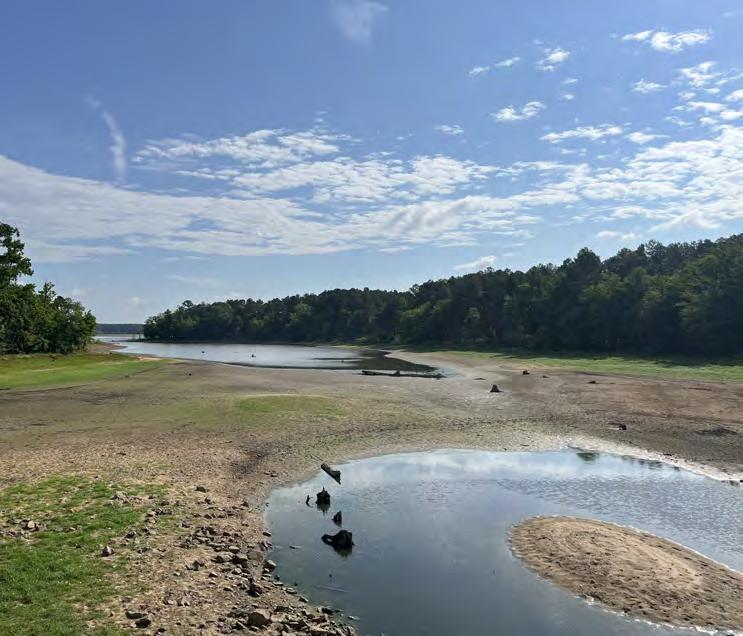
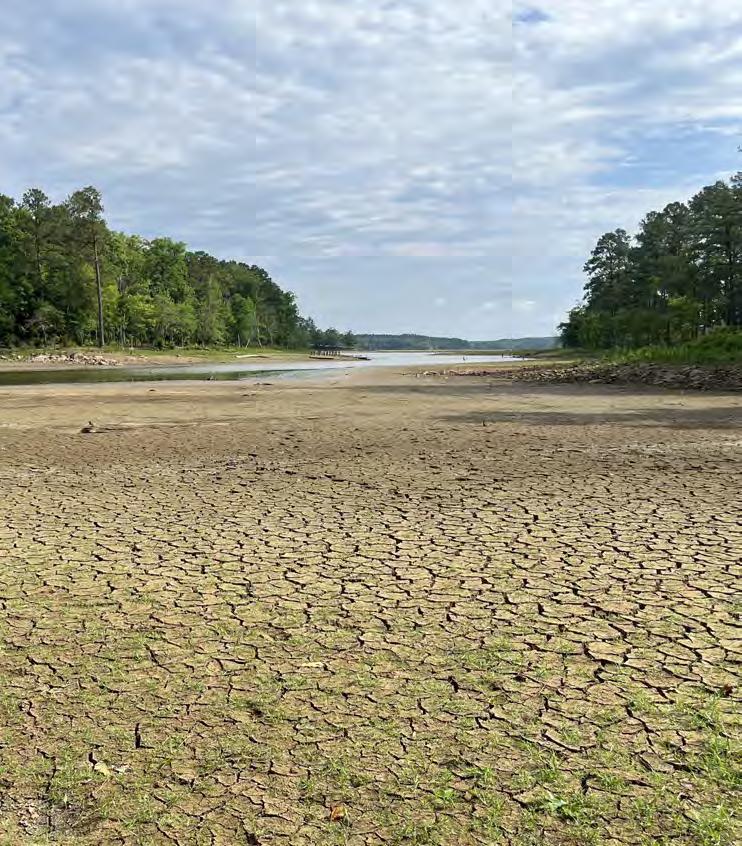
Lakes across the Triangle are beginning to look like the surface of Mars. Though no one has been forced to emulate fictional astronaut Mark Watney and turn rocket fuel into water for survival, the Triangle is in the midst of the worst drought the region has seen in over a decade, one of the hardest hit areas in a state where every corner is experiencing some level of drought.
Corey Davis has spent his career understanding environmental scenarios like the one Triangle residents are facing today. With degrees in meteorology and atmospheric science, Davis serves as an assistant state climatologist at North Carolina State University’s Climate Office, “the primary scientific extension resource for weather and climate science for the state of North Carolina,” and leads the charge on drought and fire weather analysis for the North Carolina Drought Management Advisory Council.
We asked Davis to contextualize the current drought, what to expect moving forward, and how residents can best prepare themselves against these weather conditions, now and in the future.
This interview has been edited for length and clarity.
INDY: When did this drought officially begin?
Corey Davis: The middle of last August is when we first started getting into a dry spell. Initially, it really wasn’t that big of a deal, because we had plenty of rain earlier in the summer last year, especially folks just west of the Triangle. Remember Tropical Storm Chantal? We got tons of rain from that system. Going into last fall, we really didn’t see any more tropical activity. I know
folks don’t like tropical storms and hurricanes, but they are responsible for a decent chunk of our rainfall during that time of the year. This was the fifth fall in a row where we had gone into drought during that time of the year.
Now, folks remember the one big snow that we had at the end of January. ... That snow did not really benefit us all that much. For one, this was one of those very dry powdery snows, so even though some places saw 10 or 12 inches, that amounted to less than an inch of liquid precipitation, but also because it stayed so cold for a week or so after that snow fell, the ground was frozen. None of that melting snow was able to infiltrate down into the ground. So going into the winter, we had most of the state in moderate drought conditions. That’s the lowest level of drought on the U.S. drought monitor. Unless you were a farmer who was trying to get your wheat fields planted last fall, you probably really didn’t notice the impacts of the dryness at that point.
By the end of February, we were mostly in severe drought conditions across the state. That’s the second level on the drought monitor scale. I think when most people really started to notice this drought was by late March, early April. So, when we hit that next level up, the extreme drought category, that was a big surprise for a lot of people because they didn’t realize that we were dealing with drought in the first place. Now we’re starting to see pockets of exceptional drought—that is the worst category—mainly from I-40 north to the Virginia border, including most of Durham County. That has really been one of the epicenters of dryness so far this year. It is on track for the driest year on record at the
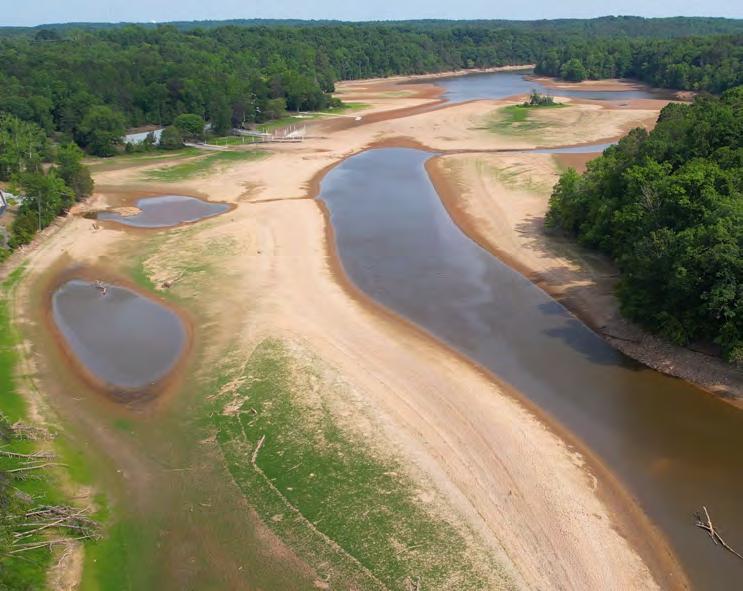
Raleigh-Durham Airport. Places like Chapel Hill are also running one of their driest ever starts to a year. And if you look at the impacts, they’re widespread now. You can’t ignore these anymore. We’re seeing lake levels that are extremely low for any time of year, but especially going into the summer. If you go out to a farm, you’ll notice that the crops are struggling. A lot of the leaves are rolling or twisting or wilting, which is a sign of both the heat stress and the moisture stress that they’re going through, and of course, most parts of the Triangle now are in some degree of water conservation or water restrictions.
You mentioned that we’ve had five falls in a row with these dry conditions. What created these drought conditions? Is it climate change? Is something about the weather patterns year over year changing that makes this less unique than it was a decade ago?
That’s a good question, and it’s a little bit tough to answer because there are so many factors that play into this. A lot of it really is just bad luck. If you look back at the past five falls, there have been similar patterns … that have caused us to go into these droughts, but I think there are
some common factors here, and a lot of them relate back to climate change. We know when we have warmer temperatures, we have higher evaporation rates, and that can cause these drought conditions to emerge more quickly.
The other big change that we’ve noticed in our weather is what we started calling weather whiplash. It’s going from the wet periods to the dry ones with almost no warning, and if you think back to how this drought first emerged last summer, it was really one of those whiplash episodes. We were very wet last July, and going into August, and by the time we got to the middle of August, it was like somebody just turned the spigot off. The opposite is true as well. We’ve had droughts and dry periods that have suddenly ended by getting into an extremely wet pattern. Right now, we’re on the dry side, but it would not surprise me if this drought could start ending pretty abruptly later this year if we start getting into a more reliably wet pattern.
What are some of the lesser-known impacts of the drought? A lot of folks know they can’t wash their car at home or they’re not supposed to water their lawn, but what might they not be thinking about?
These extreme drought events that do affect our way of life are very rare. We tend to only see these maybe every 10 or 20 years. That can affect the ability to go out on the lake and take a boat ride or go fishing, as most folks are seeing now. That also affects how you can use water at your house and in your garden. We do not ask folks to conserve water or restrict their water use the vast majority of years. It’s really only when we get in these most extreme cases that we’re doing that. It’s a community effort to make sure that we’re managing the water as best as we can, saving those supplies, so that we don’t get to a point of running out of water.
Agriculture is probably the other big impact right now. It has been a really dismal year so far for the farmers. We mentioned that they were already in a dry spell late last year. If they were trying to get their cover crops, whether it’s pastures or wheat, planted, they already really didn’t have a lot of moisture late last year, and they never got that moisture over the winter either. So the pastures are in really bad shape right now. There’s a concern that those pastures and hay fields will not be fruitful enough to feed their animals for the rest of this year. Of course, all of our main staple crops in North Carolina are feeling effects right now. Corn especially—this is a time of the year that is just critical for corn to get enough moisture. So the farmers really need some rain soon to be able to salvage the crops that they’ve still got in the fields.
What can we do as individuals to help mitigate these issues in the future?
Where do you use water around your household typically? When we start getting into that moderate or severe drought level, that is my main emphasis for folks. Just think about where your water is coming from, whether that’s from your local lake, whether that’s from your city, even if you have a groundwater well in your backyard, but also think about how you’re using that around your house. If I’m watering my lawn three times a week, maybe I could cut that back. How long are you leaving the water running while you’re brushing your teeth or shaving?
Those are all small things, but they truly do add up if we as a community embrace that idea of conservation and working together.
What’s the outlook for the Triangle’s water supply? As climate change worsens droughts, and as population growth puts more demand on the water supply, should we expect to be living under these conditions and restrictions more frequently?
There’s no reason to believe that water restrictions will ever become an every-year sort of occurrence. It takes a prolonged period of exceptionally dry weather to get into a situation where restrictions are necessary. In other years, we tend to get plenty of rainfall, especially during the summer months, so that’s never an issue. It is possible that with warmer temperatures and increasing demands, we could hit trigger points for water restrictions sooner in the future, like if we slip into a hot, dry pattern during the summer months. But overall, our water supplies, like our large reservoirs, are designed to have plenty of capacity to last through even severe drought events.
It rained a few times in the past couple weeks and so the drought probably isn’t on people’s minds the same way it was when it was super hot and dry—did it make a difference?
The past week is a good example of the impact that rain can, and can’t, have.
The U.S. Army Corps of Engineers measured 0.99 inches of rain at Falls Lake over the past seven days through [June 22], but the lake itself still dropped about three-tenths of a foot, largely because of evaporation and a lack of rainfall farther upstream. But that’s at least an improvement over recent weeks, when it hadn’t rained at all in the Triangle area and Falls has dropped by half a foot or more. If we could keep it up, the sort of pattern we were in this week, where we’re getting average or slightly above average rainfall, would go a long way in helping us weather the drought this summer without it getting too much worse.
For reference, the Raleigh area is about 9 inches below its normal precipitation so far this year. If that number doesn’t get any worse by the end of the summer, and if we start regularly getting 2 inches per week ... then it would take two or three months to fully eliminate that deficit. Of course, that’s still a long time, but the good news is that we would start to notice the improvements a lot sooner. The soil moisture and vegetation would perk up after a couple of events like that, and our lake levels would stabilize or start rising not long after that. In a best-case scenario, we would be in that sort of pattern by September, and by the time we go into next winter, even if we’re still chipping away at that rainfall deficit or waiting for our lakes to fully refill, this drought could feel like it’s already in our rearview mirror.

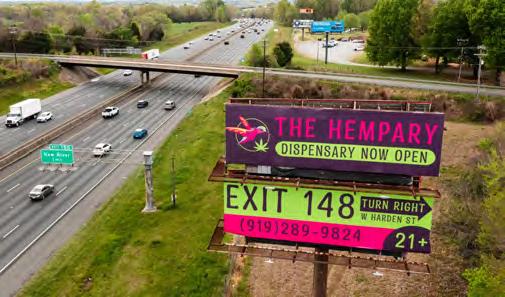
There’s no guarantee that hemp products sold by North Carolina retailers are what they say they are. Our investigation reveals many don’t have the THC levels they claim—but they do contain bacteria and other contaminants.
PART 1 OF “BARELY LEGAL,” A THREE-PART SERIES
BY JEFFREY BILLMAN jeffrey@theassemblync.com
I
f you’ve ever purchased hemp gummies from a dispensary, a THC-infused seltzer from a bar, or a vape from a convenience store, how did you know what it contained?
The question isn’t as straightforward as it seems. And in North Carolina, the answer is ultimately: You didn’t. Our state is one of just seven that prohibit recreational and medical marijuana markets. But it allows products derived from hemp, a variety of Cannabis sativa L. that contains less than 0.3% of the psychoactive compound delta-9 tetrahydrocannabinol (THC), with no regulation or oversight. There’s no legal requirement that a package’s promised cannabinoids match its contents, or even that products disclose their cannabinoids. There’s also no guarantee that a product is free of dangerous contaminants or additives
that could cause long-term health damage.
Many hemp products come with QR codes that link to certificates of analysis —lab test results that say the product is safe and legal. But experts say there’s no assurance those results are legitimate, since no one is checking.
“There’s no standardized testing in this industry,” said Joseph Baker, co-owner of the Asheville-area hemp company Ratoon Agroprocessing. Baker holds a doctorate in organic chemistry and previously worked in the pharmaceutical industry. “What’s considered good testing is just a matter of opinion.”
As a result, consumers buy their hemp on faith, sometimes with terrible consequences. The N.C. Department of Health and Human Services does not track hemp-re-
lated adverse events. But officials have attributed a surge in emergency department visits to hemp’s proliferation. The hemp industry has become a $3 billion-a-year behemoth in less than a decade. While its leaders say most businesses try to do the right thing, they know the status quo is untenable.
Industry representatives have asked the General Assembly to enact regulations that they argue would set uniform standards and rein in bad actors without crippling commerce. Their requests have grown more urgent as a possible federal ban on most hemp products looms in November. They believe that state regulations will mitigate some of the damage. So far, though, state lawmakers remain deadlocked.
With the industry at a crossroads, The Assembly sought to determine what’s in the products currently for sale in North Carolina.
We purchased 21 intoxicating hemp products from retailers across the state and had them tested at Virginia Commonwealth University’s Laboratory for Forensic Toxicology Research (LFTR) for potency, additives, and contaminants. Funded by a $10,000 grant from the Fund for Investigative Journalism, this project aims to bring objective, high-quality data to the debate about hemp’s future in North Carolina.
The results were eye-opening:
• The tests found unsafe levels of aerobic bacteria, yeast, and mold, or coliform in 13 products. Two had all three.
• Five products clearly contained more delta-9 THC than permitted by federal and state law. Another tested just above the threshold.
• Five contained THCO, THCP, or HHC—semisynthetic cannabinoids that are derived from hemp and designed to mimic THC’s effects. These compounds haven’t been well-studied and might pose health risks. THCO and THCP are legal in North Carolina; HHC’s status is unclear. Some products did not disclose the synthetics on their labels.
• Few packages reflected the products’ contents. Some had more THC than advertised—in one case, 34 times more. Many had much less THC or even entirely different cannabinoids.
“These lab results are deeply alarming and underscore the urgent need to protect North Carolinians, especially young people,” Gov. Josh Stein told The Assembly in a statement after reviewing our results. “If we want to keep people safe, we need a legal, regulated market that requires testing so people know what is in the products and how intoxicating they are.”
State Rep. Jeffrey McNeely, an Iredell Republican who has introduced several bills to regulate hemp, agreed. “If these analyses are correct, then this only confirms the need for the regulations that I have been pushing for the last three years,” he said. “The citizens of North Carolina must be protected from these dangerous products.”
Several manufacturers questioned our findings or the lab’s methodology. But lab director Michelle Peace, a past president of the Society of Forensic Toxicologists, said she’s been testing hemp products since 2015. These results weren’t unusual.
“This is all pretty par for the course of what we see in the unregulated cannabis space,” Peace said. “We see so much contamination and adulteration and strange chemicals being put in that, frankly, nothing really surprises us.”
An Assembly reporter was the only customer inside Smoke Kings the morning of January 6. The Wilmington vape shop smelled like a Yankee Candle store, but for weed. Electronic dance music blared from the speakers.
Our reporter told the clerk, who looked to be in his 30s, that it had been a while since she’d used cannabis. He pointed her to a vape with both indica and sativa cannabis, as well as the store’s “most popular” gummies.
The URB Blue Watermelon gummies claimed to have 10 mg of delta-9 and 90 mg of delta-8 each—the “sweet spot,” the clerk said. He recommended she start with half. The products were legal because state law provided “a lot of leeway,” the clerk said.
Our tests found that the vape—Hidden Hills Club Gold Gumdrops—contained five times the legal limit of delta-9. Last winter, reporters from across The Assembly Network had conversations like this with hemp retailers throughout North Carolina—in sketchy-looking convenience stores and suburban wine emporiums, in strip-mall vape shops and well-appointed dispensaries—and purchased an array of gummies, edibles, drinks, flower, and vapes. We chose them mostly at random, in an attempt to obtain a representative sample of what’s for sale in our state.
Of the 21 products we sent to the lab, 12 contained unsafe levels of aerobic bacteria, microbes that thrive in oxygen. Five had unsafe levels of yeast and mold. Three had coliform bacteria, which are found in the environment and the feces of warm-blooded animals.
Our tests couldn’t identify which species of bacteria, yeast, or mold were present. Instead, they gauged whether there were enough contaminants to pose “a potential threat to the consumer,” Peace said, based on a threshold set by the scientific nonprofit U.S. Pharmacopeia (USP).
Of the five products with synthetic cannabinoids, one stood out: Ghost Reaper gummies—produced by Ghost Hemp Company in California and purchased at the Apotheca Cannabis Dispensary in Greensboro—contained 171.05 mg of THCP, which is thought to be longer-lasting and more powerful than delta-9.
Several industry sources said that amount could be dangerous. “That’s really a lot of THCP,” Peace agreed. Because North Carolina has not regulated THCP or set
“If we want to keep people safe, we need a legal, regulated market that requires testing so people know what is in the products and how intoxicating they are.”
— GOV. JOSH STEIN
any dosage limits for hemp products, these gummies are perfectly legal.
Ghost Hemp did not respond to requests for comment. We’ve made the full test results available online, along with a spreadsheet detailing what was found, additional information about the products, and where we purchased them. Peace and her colleagues have also published a journal article detailing their methodology.
Testing cannabis isn’t like you see on TV, “where they inject something into a machine, and it spits out an answer,” said Baker, the chemist and Ratoon co-owner.
To measure cannabinoids, labs have to separate them from other compounds—the biological material in flower, the food components of an edible—that can interfere with the results. At the same time, they have to ensure that the process itself doesn’t alter the sample.
Law enforcement labs typically use gas chromatography, which heats samples to analyze their compounds. That process, however, converts THCA (and sometimes CBD) into delta-9, which critics say can render legal products illicit. The police counter that it measures a product’s available THC.
Peace’s lab uses liquid chromatography, which uses a solvent to separate compounds. The hemp industry generally prefers this method, but that doesn’t mean our findings went unchallenged.
The Assembly attempted to contact the manufacturers of all the products we tested. Most did not respond to requests for comment, but we sent our results to those who did.
Allyson O’Brien, a co-owner of Chronic Guru, criticized LFTR’s microbiological analysis for failing to quantify the contaminants or identify species. “From a consumer safety standpoint, those details matter,” O’Brien wrote in an email. She also took issue with the standard used to assess contaminants. The USP threshold is a “drug standard, not the one cannabis is held to,” she wrote. “What regulated cannabis safety actually turns on, including Florida’s medical marijuana program, is whether the dangerous organisms are present.”
O’Brien supplied The Assembly with a certificate of analysis for Chronic Guru’s Hawaiian Punch gummies, which showed the gummies passed tests for pesticides, heavy metals, and specific bacteria, including Aspergillus flavus and Salmonella
She argued that the time between when we purchased the products and when they were tested could have affected our findings. The brownie’s expiration date was December 25, two days after we purchased it. The lab’s microbiological analysis—the brownie tested positive for yeast and mold and coliform—began on January 29.
“A perishable food product evaluated after its labeled shelf life is not being evaluated in the condition it was manufactured, distributed, or sold to consumers,” O’Brien wrote.
Peace said that several states, including Virginia, have adopted the threshold set by USP, “the world standard-maker for drugs.” Peace considers the standards used by states like Florida that target specific pathogens too lenient. Though many individual contaminants aren’t dangerous, high concentrations can indicate unsanitary practices in a production or packaging facility.
“The dose makes the poison,” Peace said. USP thresholds are “mindful of those who are most vulnerable in our population. If somebody is immunocompromised, it might not matter what the species is, because bacterial infection of any kind could be damaging to their health. Some states have chosen to take a more conservative route.”

Scan the QR code for The Assembly’s full investigation into North Carolina’s unregulated hemp industry, including test results and interviews.

“If these analyses are correct, then this only confirms the need for the regulations that I have been pushing for the last three years.”
— STATE REP. JEFFREY MCNEELY (R-IREDELL)
Peace said O’Brien’s shelf-life argument “doesn’t really matter. If it’s got coliform in it, that contamination came not because it was over its expiration date.” And the yeast and mold had to be present before the product was packaged, she added.
Other manufacturers were skeptical of low THC levels in the drinks and some gummies.
Trophy Brewing co-owner and chief brewer Les Stewart said our results for Starry Eyes look “like almost a calculation problem.” He expressed confidence in the lab tests he gets from Raleigh-based Delta 9 Analytical.
“We’ll do manipulations and send it off to our lab without telling them the difference, and they produce results in the final product that correlate with the changes that we make,” Stewart said. “So over the last year, we’ve created a relationship of trust with our lab, and we have every reason to believe that they’re absolutely right.”
Garrett Perdue, the CEO of Naternal, said that while he didn’t doubt the scientific rigor of our tests, he would know if his products are missing THC.
“We’ve sold hundreds of units of both of those products,” Perdue said. “We have a 100% satisfaction guarantee on all of our products. Both products you’ve flagged would have an impact you could feel. Our customer complaint rate would have been massive.”

The Assembly did not test any of Ratoon’s products, but after reviewing our findings, Baker questioned the cannabinoid levels in several of the products we did test. For example, the results for Heritage Hemp’s Slurricane flower showed THCA, but nothing else.
“No one has bred all of the cannabinoids except for THCA out of these things,” Baker said. “That’s an impossible task.”
Peace said the other cannabinoids in the Slurricane flower fell below the lab’s threshold for measurement—in this case, 0.25%.
Baker’s business partner, James Hurlston, pointed out that LFTR’s final testing step involved heating samples to 300 degrees Celsius, which he called “extremely hot and destructive. More accurate tests require longer methods, which consume equipment time and increase the lab’s costs.”
Peace said the heat doesn’t affect the material being tested. Instead, it burns off the liquid used to separate the samples’ compounds, allowing the lab to observe them. This method is “really standard,” she said, and it’s “outright not true” that liquid chromatography protocols with less heat are more accurate.
Hurlston also noted that the lab’s method-validation data allow for a 20% error margin for cannabinoid levels. With that much wiggle room, Apotheca’s flower—which our tests pegged at 0.37% delta-9—could be legal.
In general, Hurlston argued, THC testing isn’t precise
enough to make conclusions about products that are close to the line. “Anything that’s within 0.5%, maybe even up to 1% delta-9 THC, it’s arguable that that is within the margins,” he said.
But he thought LFTR’s 20% error margin reflected poorly on the lab’s work. “This is not sound science,” Hurlston wrote in an email. “This speaks to the method’s repeatability and accuracy.”
Private labs often claim tighter error margins because they need to. Many states with recreational or medical marijuana markets require that products’ cannabinoid levels fall within 10% or 15% of what’s on their labels. Companies operating in those states want assurances that they’re close to the mark. Research labs don’t face those pressures.
Peace said that’s not why she opted for 20%, however. She said it’s standard in the pharmaceutical industry, and she used it when she ran a private lab.
“Plus or minus 20% allows for expected natural variation in the manufacturing process, compounded with some human error,” Peace said, adding that she doesn’t think her results miss by that much. “We’re giving the benefit of the doubt to the industry.”
For consumers, there’s a negligible difference between cannabinoid levels that deviate 10% or 20% from the label, she added. But anything more raises questions about whether “this product is really different than what’s on the label.”
All of the drinks and most of the gummies we tested deviated from their labels by more than 20%. (The exception was Southern Ease’s pina colada gummies.) Besides Ghost Reaper’s gummies, which had 171.05 mg of THCP, all had less THC than advertised. Several had next to nothing—and, in the case of Naternal’s Play gummies, actually nothing.
Four of the five beverages we tested initially showed undetectable THC concentrations, but retests found some
in each. Peace said the lab refined its technique so that “we were actually able to see [the THC] and quantitate it.”
To an extent, Peace agreed that lab errors are more likely with low-THC products—including many drinks and gummies—than with higher ones, in part because small mistakes can significantly affect the results.
“You have to know what your limits are, and you have to be conservative with those limits,” she said. “You have to be sure of what those low numbers are.”
Peace said she’s used to industry criticism. But she pointed out that she had no stake in the results; her lab would have been paid the same no matter the findings. “I don’t have a dog in this fight,” she said.
LFTR has the same accreditation as many private labs, which indicates that it has a valid testing protocol and can follow it. But accredited labs can churn out bad data, Peace said. What sets her methodology apart, she said, is that she published it in a scientific journal, which required her to spend months defending it to other scientists during peer review.
“I get so pissed off with these yahoos who, you know, look at the data just to pick it apart and say, oh, that’s a bad way to do it,” Peace said. “Nobody else is publishing in the scientific literature.
“There have been multiple eyes on all of that data and on all of our methods that get adopted nationwide by crime labs. At the end of the day, they can be critical all day long, but I will stand up in court and testify to our results.”
Alleged lab errors aside, there are several reasons our tests might show different THC levels than products claim. For starters, THC levels degrade over time, especially

when products are stored in lighted areas without refrigeration. The longer a product sits on the shelf, the more delta-9 it loses. We don’t know how old many of the tested products were when we bought them. (Several listed expiration dates. Southern Ease’s pina colada gummies, which we ordered online in early December, had a bestby date of November 2025.)
Another issue: Cannabinoids aren’t always distributed evenly in gummies and edibles. That means THC levels can vary from product to product and gummy to gummy. The two Southern Ease gummies we tested each promised 10 mg of delta-9. One had 8.16 mg; the other, just 0.48 mg. They can even vary within a single gummy. The test samples only a small amount of each gummy, then extrapolates the gummy’s cannabinoid content from the sample. So if the tested portion had more or less THC than the rest, that would affect the results.
“It’s always an asterisk,” Peace said. But that doesn’t make it unfair, she argued. “There are some people that might not want to eat the whole gummy. So what if you just happen to lop off a part that didn’t have much in it? Or you lop off the part that had all of it in it?
“The burden is on the manufacturer—if they get a result that they don’t like—the burden is on them to create a homogenized product,” Peace said.
Our results also highlighted a potential thorn in the side of the fast-growing beverage market: THC sticks to cans— more specifically, the plastic liner inside the can. The longer a can sits, the more THC it absorbs.
THC doesn’t dissolve in liquid, so drink manufacturers use a process called nanoemulsification to keep it from sinking to the bottom. But that doesn’t prevent the THC from sticking to the liner.
There are can liners designed to ameliorate this specific

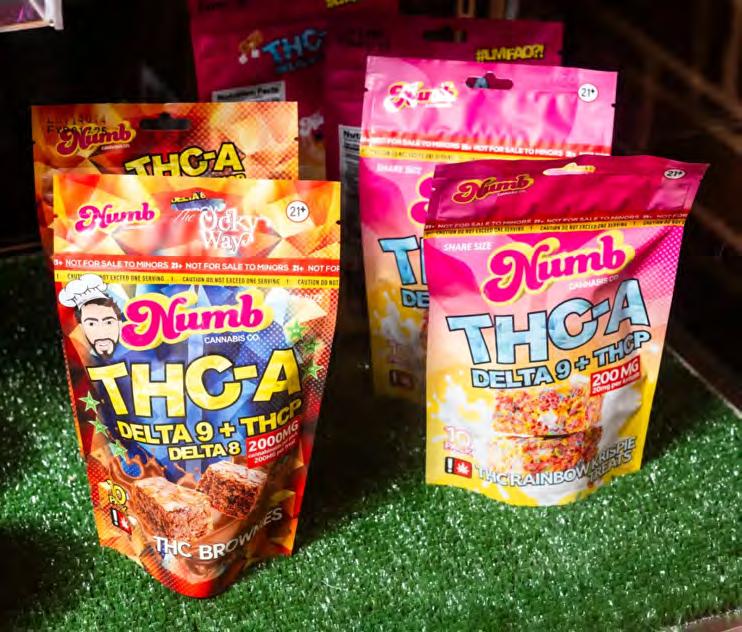
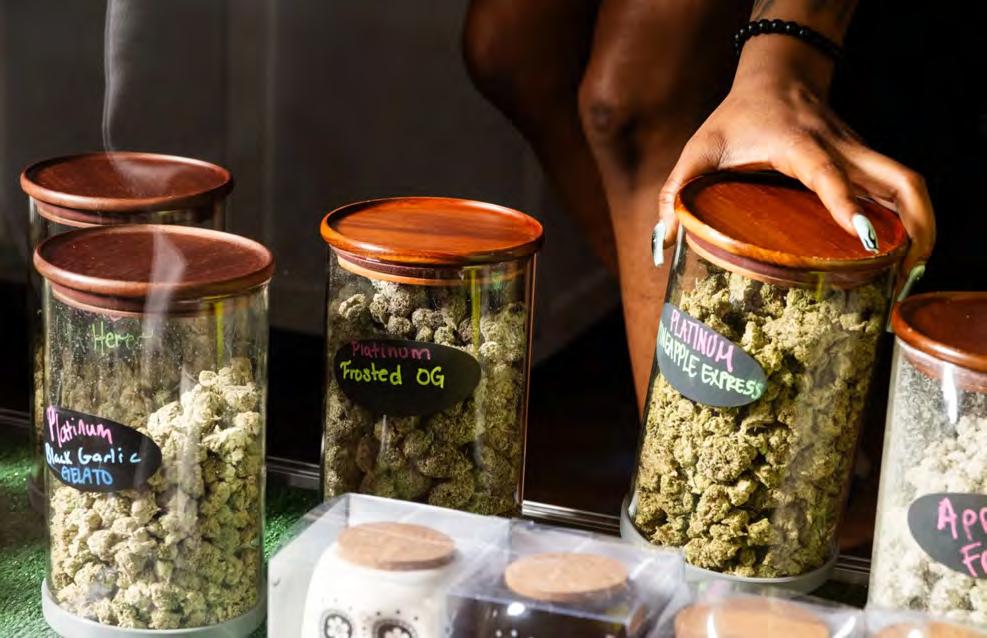
Above: some of the hemp products for sale in N.C. Right: Books about marijuana sit on a table inside Essential Hemp in
BY CORNELL WATSON FOR THE ASSEMBLY

problem, Peace said. But they’re expensive. “Why would they choose a more expensive liner if nobody’s really watching?”
Stewart said Trophy decided it didn’t really matter. “We looked into whether we had to get a different type of liner,” he said. “And we were prepared to do that.” But they tested how much Starry Eyes’ THC levels changed over six months and found only slight degradation.
“When we got the results back,” he said, “we decided there was no reason to change anything. I don’t think the liner effect is all that impactful, at least in our trials.”
Despite our best efforts, it’s impossible to say how well our purchases reflect the overall hemp market in North Carolina. We don’t know whether the products at your local vape shop or dispensary are better or worse, safer or more dangerous. We don’t know if they’re loaded with bacteria, heavy metals, or unadvertised synthetic cannabinoids. We don’t know if the certificates of authenticity that














sing their praises are worth the paper they’re printed on. We don’t know if their contents even faintly resemble what the package says.
Maybe everything’s fine. But maybe not.
That’s kind of the point.
Peace said she’s tested thousands of hemp products from unregulated markets.
“I would say that easily 90% of them were bad,” she said. “Bacteria, yeast and mold, it’s adulterated with analogs, it’s got a lot more THC in it than it’s supposed to, or it has nothing in it.”
In regulated markets, “there’s accountability,” she said. “The overwhelming majority of the products are safe.”
In North Carolina, however, caveat emptor.
“I don’t care if you walk into the bougiest of stores or a hole in the wall, you have no idea what you’re getting,” Peace said. “And so I would say in any unregulated marketplace, buyer beware—and know who you’re going to call when you have an adverse event.” W
Additional reporting by Johanna F. Still and Tori Newby.

INDY readers have a tremendous power: To bestow coveted Best of the Triangle stars on the walls, windows, and websites of local businesses and institutions. For two decades, Triangle residents have relied on our reader poll—and the iconic decals winners receive—to find the best of the best in their communities.
In this section, you’ll find Best of the Triangle winners in Durham County—a round-up of so many of the people, places, and organizations that make the Bull City special. Here, our readers have selected their favorite restaurants, bookstores, dentists, politicians, yoga studios, and much more.
Whether you’re deciding where to eat dinner, where to see art, or where to take your car for a tune-up, our readers’ top picks have you covered. We hope you’ll find this guide handy and take some time to try something new or revisit an old favorite from these pages.
Thanks to everyone who nominated their favorites and congratulations to all of the finalists. Orange and Chatham County winners were announced back in April (find them online if you missed it). Next up we’ll share your picks for Wake County. And stay tuned for a special print edition in December rounding up the Best of the Best across the Triangle.



















BEST ART GALLERY FOR PURCHASE
The Scrap Exchange

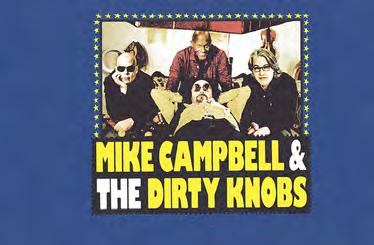


Runners-up: Five Points Gallery, Cecy's Gallery & Studio
BEST GALLERY FOR VIEWING
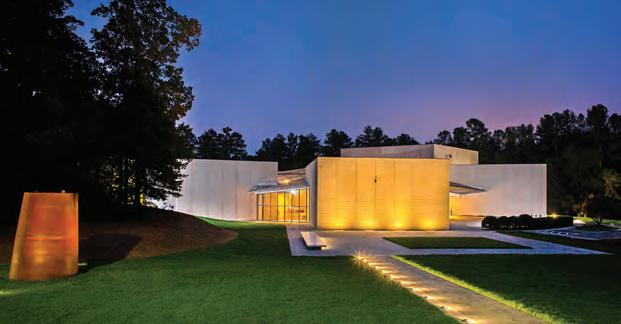
Nasher Museum of Art
Runners-up: 21 c Museum Hotel Durham, Durham Arts Council
BEST COMEDY CLUB/EVENT
Bull McCabe's Trivia Night
Runners-up: Mettlesome, Don't Tell Comedy
BEST DRAG SHOW/EVENT
Music Trivia Bingo @ Velvet Hippo hosted by Stormie Daie
Runners-up: Club Era, Drag Bingo @ Common Market hosted by Miss B Haven
BEST ELECTRONIC CONCERT VENUE
The Fruit
Runners-up: PS37, BOOM Club
BEST FILM THEATRE VENUE/ EVENT
Carolina Theatre of Durham
Runner-up: Shadowbox Studio
BEST LIVE THEATRE COMPANY
The Durham Savoyards, Ltd.
Runners-up: Paperhand Puppet Project, Red Bird Theater Company
BEST LOCAL / REGIONAL PODCAST
Due South on WUNC
Runners-up: Embodied on WUNC, Durham Artist Archive
BEST LOCAL BAND
Sylvan Esso
Runners-up: The Mountain Goats, Durham Symphony Orchestra
BEST MUSEUM
The Museum of Life and Science
Runners-up: Nasher Museum of Art, NC Museum of Art
BEST RADIO STATION WUNC
Runners-up: WNCU, WXYC
BEST UNPLUGGED CONCERT VENUE
Hayti Heritage Center
Runners-up: Red Hat Amphitheater, Hub RTP
BEST AUTO DEALER
Mark Jacobson Toyota
Runners-up: Hendrick Subaru Southpoint, Johnson Subaru of Cary
BEST AUTO MECHANIC
Champion Tire & Auto
Runners-up: Chapel Hill Tire, Fluid Community Garage
BEST BARBER SHOP
Rock's Bar and Hair Shop
Runners-up: Hawk & Fade Barbershop, Dennis Best
BEST BOOKSTORE
Regulator
Runners-up: Letters Community Bookshop, Golden Fig Books
BEST CBD SHOP
Sherlocks Glass & Dispensary
Runners-up: Oak City Hemp Lounge, Redhead Hemp
BEST CHILDCARE
Schoolhouse of Wonder
Runners-up: Indigo Montessori School, Piedmont Wildlife Center
BEST CLOTHING CONSIGNMENT
Rumors
Runners-up: MODE Consignment Boutique, Beanstalk
BEST DANCE STUDIO
DIA Dance Studio
Runners-up: Ninth Street Dance, All In Dance Academy
BEST DOG BOARDING
Eno Animal Hospital
Runners-up: Camp Bow Wow, Cornwallis Road Animal Hospital
BEST DOG GROOMING
Eno Animal Hospital
Runners-up: Elliot’s Pet Spa, Camp Bow Wow
BEST DOG TRAINING
Pawsitive Empowerment
Runners-up: Whole Dog Institute, Yea Dog
BEST DOG WALKING
Bull City Pet Care
Runners-up: Pawsitive Beginnings, DogWalk
BEST ELECTRICIAN
Dynamic Electric
Runners-up: Electric Jake, Kellas Electric
BEST FLORIST
Darcy Garcia - The Florapist
Runners-up: Ninth Street Flowers, One Fun Gal Flowers
BEST HAIR SALON
Fuss & Bother
Runners-up: Rock Paper Scissors Salon, Posh The Salon
BEST HOME REMODELING OR RENOVATION COMPANY
Trinity Design/Build
Runners-up: Zarazua Painting, Hughes Contracting LLC

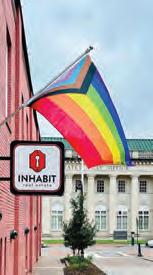

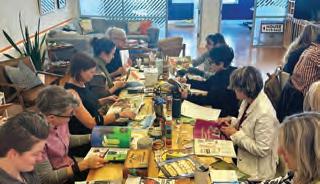
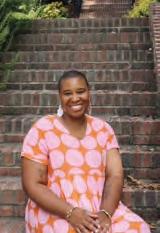
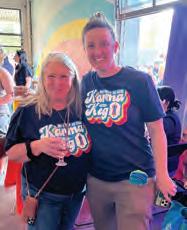
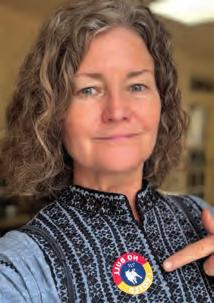
BEST HVAC SERVICE
Boer Brothers HVAC
Runners-up: Air Experts Heating, Cooling & Plumbing, Brown Brothers Plumbing & Heating
BEST INSURANCE COMPANY
North Carolina Farm Bureau Insurance
Runners-up: State Farm - Bonnie Rose, Herring and Bickers Insurance Agency
BEST INTERIOR DESIGNER
Emma Delon
Runners-up: Alva Horton, Sundholm Studio
BEST JEWELER / JEWELRY STORE
Jewelsmith
Runners-up: Bailey's Fine Jewelry, Hamilton Hill Jewelry
BEST LANDSCAPING / YARD CARE
TROSA Lawn Care
Runners-up: For Garden's Sake, Grow it Yourself
BEST LAW FIRM
Law Offices of James Scott Farrin
Runners-up: Walker Lamb, Lisa M Logan
BEST LOCAL BOOKSTORE
The Regulator
Runners-up: Letters Community Bookshop, Golden Fig Books
BEST NEW BUSINESS
Fluid Community Garage
Runners-up: Giant Robot Fight Club, Nextera Strategies
BEST PAINTER
Zarazua Painting
Runners-up: Gonzalez Painters & Contractors, Puebla's Painting NC
BEST PLACE TO BUY LOCALLY MADE CRAFTS/ART
Durham Farmers Market
Runners-up: The Scrap Exchange, Durham Craft Market
BEST PLUMBER
Brown Brothers Plumbing & Heating
Runners-up: Acme Plumbing Co., Boer Brothers Heating and Cooling
BEST REAL ESTATE COMPANY
Inhabit Real Estate
Runners-up: Nest Realty, Triangle Key Realty
BEST REALTOR
Marie Brockenbrough
Runners-up: Dara Shain, Alison Domnas
BEST ROOFING CONTRACTOR
Saltbox Construction
Runners-up: Baker Roofing Company, Alpine Roofing
BEST VINTAGE STORE
Gibson Girl
Runners-up: TROSA, Vaguely Reminiscent
BEST WOMEN’S CLOTHING STORE
TROSA Thrift Store
Runners-up: MODE Consignment Boutique, Vert & Vogue
STORE
BEST ALCOHOLIC COCKTAILS
Velvet Hippo
Runners-up: Alley Twenty Six, Kingfisher
BEST ASIAN RESTAURANT
M Sushi
Runners-up: Thaiangle, Rose's Noodles, Dumplings & Sweets
BEST BAKERY
Guglhupf
Runners-up: Ninth Street Bakery, Loaf
BEST BARBECUE
The Original Q Shack
Runners-up: Picnic, Hog Heaven Bar-B-Q
BEST BEER RETAIL STORE
Beer Study
Runners-up: Common Market, Growler Grlz
BEST BISCUITS
Rise Southern Biscuits
Runners-up: Monuts, Bojangles
BEST BREWERY
Ponysaurus Brewing Co.
Runners-up: Hi-Wire Brewing, Fullsteam Brewery–Boxyard RTP
BEST BURGER
Bull City Burger and Brewery
Runners-up: Queeny’s, Bar Virgile
BEST CHEAP EATS
Cosmic Cantina
Runners-up: Elmo's Diner, Cook Out
BEST CHEESE SHOP
Weaver Street Market Cheese Counter
Runners-up: The Fresh Market, Wegmans
BEST CHINESE CUISINE
Asian Kitchen
Runners-up: Orient Garden, Hong Kong Chinese Restaurant
BEST COFFEE SHOP
Cocoa Cinnamon
Runners-up: Bean Traders, Joe Van Gogh
BEST DESSERTS
Guglhupf
Runners-up: The Parlour, Rose's Noodles and Sweets
BEST DRAFT SELECTION
Beer Study
Runners-up: Growler Grlz, Durham Beer Garden
BEST ETHNIC GROCERY STORES
Li Ming
Runners-up: H Mart, Compare Foods
BEST FOOD TRUCK
Chirba Chirba Dumpling
Runners-up: Taqueria Cruz, Gussy's Food Truck
BEST INDIAN RESTAURANT
Viceroy
Runners-up: Cheeni, Lime & Lemon Indian Grill & Bar
BEST ITALIAN RESTAURANT
Gocciolina
Runners-up: Mothers & Sons Trattoria, Cucciolo Osteria
BEST LATE NIGHT MEAL (PAST 10 PM)
Queeny’s
Runners-up: Cosmic Cantina, Alley Twenty Six
BEST MEXICAN RESTAURANT
Mezcalito
Runners-up: Fonda Lupita, Taqueria La Vaquita
BEST NEIGHBORHOOD BAR
The Velvet Hippo Bar & Lounge
Runners-up: Beer Study, Dain's Place
BEST SMALL PLATES / TAPAS
Little Bull
Runners-up: Mateo Bar de Tapas, Juju Durham
BEST SUSHI RESTAURANT
M Sushi
Runners-up: Sushi Love, Shiki Sushi
BEST VEGAN RESTAURANT
Pure Soul
Runners-up: Goorsha, Zenfish Poke Bar
BEST VEGETARIAN EATERIES
Pure Soul
Runners-up: Lakewood Social, Goorsha
BEST NEW RESTAURANT
Jean's "By the Sea"
Runners-up: Timber Pizza, Tataco
BEST NON-ALCOHOLIC BEVERAGES
The Velvet Hippo Bar & Lounge
Runners-up: Lakewood Social, Arcana
BEST PIZZA
Pizzeria Toro
Runners-up: Timber Pizza, Hutchins Garage
BEST RETAIL WINE
Wine Authorities
Runners-up: Louella Wine, Beer & Beverage, Total Wine & More
BEST SEAFOOD
Saltbox Seafood Joint
Runners-up: M Sushi, Jeans by the Sea
BEST WINE LIST
Nana’s
Runners-up: Louella Wine, Beer & Beverage, Killer Queen Wine Bar
BEST WINGS
Heavenly Buffaloes
Runners-up: Nzingas Kitchen, E.O.’s Athletic Club
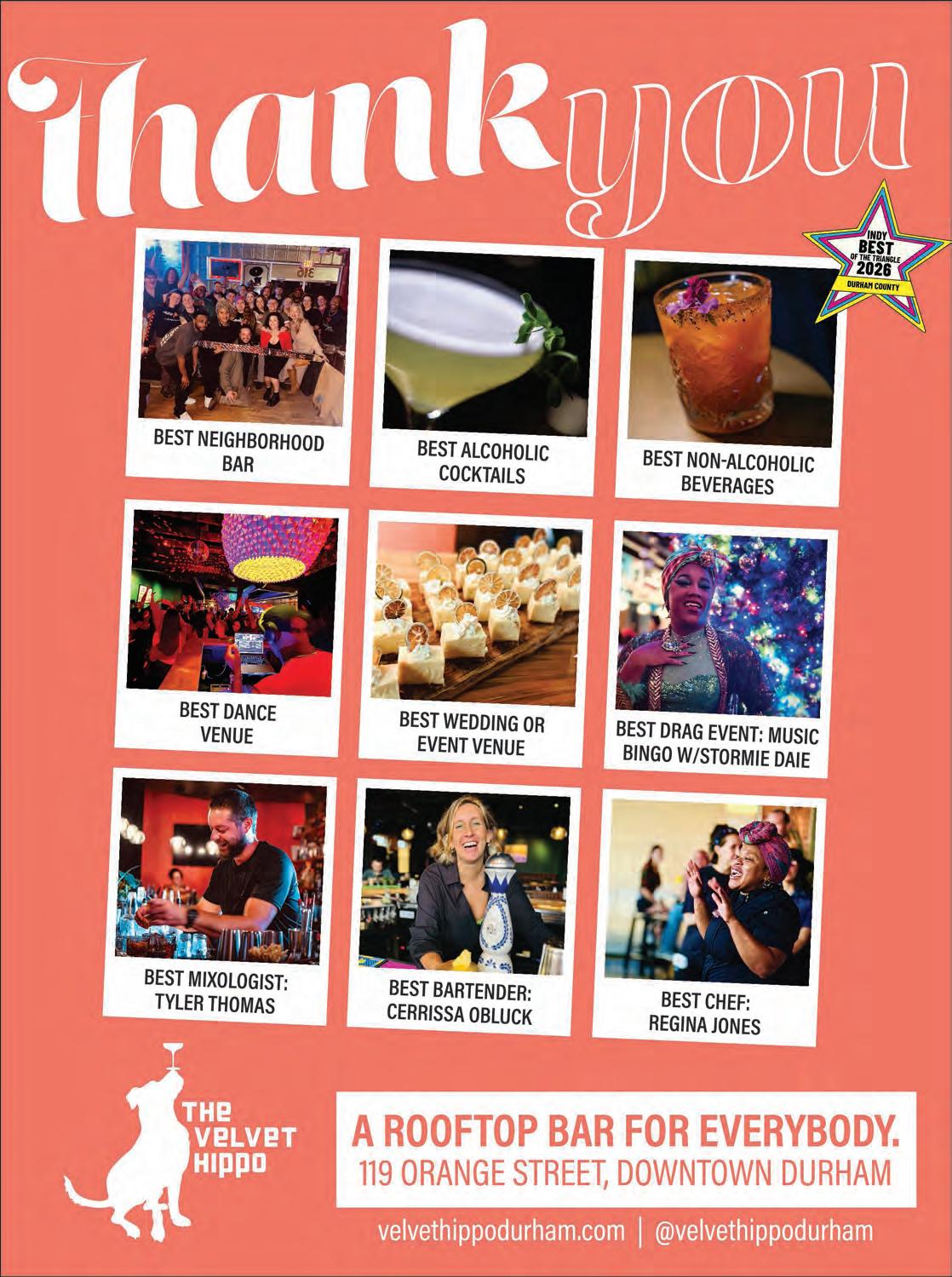





BEST ALTERNATIVE MEDICINE
Compass Health Direct Primary Care
Runners-up: Duke Integrative Medicine, Meridian Health Solutions
BEST CAT VETERINARY
Eno Animal Hospital
Runners-up: Cornwallis Road Animal Hospital, Southpoint Animal Hospital
BEST CHIROPRACTOR
Precision Chiropractic- Dr. David Martin
Runners-up: Bella Vita Chiropractic, Carolina Pain & Performance
BEST DENTIST
Bull City Smiles
Runners-up: Durham Pediatric Dentistry & Orthodontics, Dr. Lionel Nelson
BEST DERMATOLOGIST
Central Dermatology
Runners-up: Regional Dermatology of Durham LLC, Triangle Dermatology - Dr. Janet Tcheung
BEST DOG VETERINARY
Eno Animal Hospital
Runners-up: Urban Tails Veterinary Hospital, Carver Street Animal Hospital
BEST GYM
YMCA–Downtown Durham
Runners-up: Duke Health and Fitness Center, Jewish for Good at the Levin JCC
BEST MASSAGE THERAPIST
Michael J. Savino
Runners-up: Ruth Metz, Mindful Massage - Michael Barriskill
BEST PEDIATRICS
Chapel Hill Pediatrics
Runners-up: Durham Regional Pediatrics, Bull City Family Medicine & Pediatrics
BEST PERSONAL TRAINER
Duke Health and Fitness Center
Runners-up: Chan Little, 360 Approach, Bodfit 510
BEST PHYSICAL THERAPY PRACTICE
Bull City Physical Therapy
Runners-up: Duke Health, Kenny & Associates Physical Therapy
BEST SPA
Blue Water Spa
Runners-up: R&R Wellness Spa, Fuzion Fitness
BEST WOMEN’S HEALTH PRACTICE
Chapel Hill OBGYN - Durham
Runners-up: Compass Health Direct Primary Care, Durham Women's Clinic
BEST YOGA STUDIO
Yoga Off East
Runners-up: Threehouse Studio, Dose


BEST ADULT NONPROFIT TROSA
Runner-up: LGBTQ Center of Durham
BEST BARTENDER - DRAFT SLINGER
Cerrissa Obluck – The Velvet Hippo Bar & Lounge
Runners-up: Kaykay - The Velvet Hippo Bar & Lounge, Arturo Sanchez - Pizzeria Toro
BEST CHEF
Regina Jones – The Velvet Hippo Bar & Lounge
Runners-up: Michael Lee - M-Restaurants, Preeti Waas
BEST DJ
DJ Himbo
Runners-up: Jorden the DJ, Gemynii
BEST KEPT SECRET
Club Era
Runners-up: Broken Spoke Ice Cream, Bar Beej at Cheeni
BEST KIDS NONPROFIT
Book Harvest
Runners-up: Schoolhouse of Wonder, Emily K Center
BEST LOCAL ACTIVIST GROUP
Pauli Murray Center for History and Social Justice
Runners-up: Durham People's Alliance, Food Not Bombs
BEST LOCAL CAUSE / NONPROFIT IMPACT AWARD
TROSA
Runners-up: Pauli Murray Center for History and Social Justice, Bike Durham
BEST MIXOLOGIST
Tyler Thomas - The Velvet Hippo Bar & Lounge
Runners-up: Jules - The Velvet Hippo Bar & Lounge, Connor - Conniption bar & lounge
BEST USE OF PUBLIC MONEY
Public education
Runners-up: Housing Assistance, Fixing bad roads
WORST WASTE OF MONEY
ICE
Runners-up: NC Legislature, Police
Eno River State Park
Runners-up: American Tobacco Trail, Nelson Music Room
Sarah P. Duke Gardens
Runners-up: Little River Regional Park, Geer Street Learning Garden
BEST CAMPS
Schoolhouse of Wonder
Runners-up: Museum of Life and Science, Piedmont Wildlife Center
BEST DANCE VENUE
The Velvet Hippo Bar & Lounge
Runners-up: Rubies on Five Points, Club ERA
BEST DOG PARK
Piney Wood Dog Park
Runners-up: Barkyard RTP, Little River Regional Park
Hillandale Public Golf Course
Runners-up: Croasdaile Country Club, Falls Village Golf Club
BEST HOTEL
The Durham Hotel
Runners-up: 21c Museum Hotel Durham, Washington Duke Inn
The Durham Hotel
Runners-up: 21c Museum Hotel Durham, Durham Farmers Market
Sarah P. Duke Gardens
Runner-up: The Velvet Hippo Bar & Lounge
The Velvet Hippo Bar & Lounge
Runners-up: Southern Picnics, Perfect Lovers

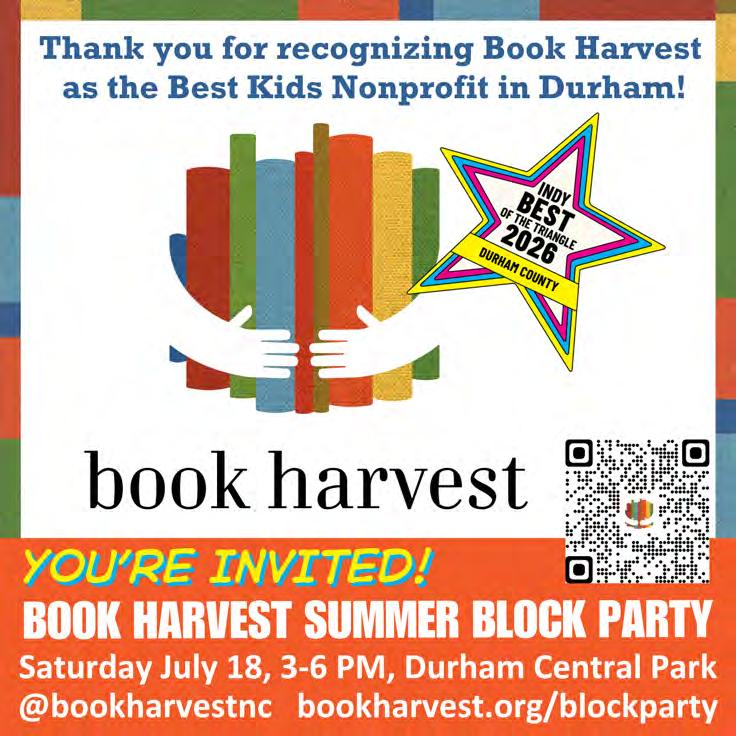



Winning INDY's "Best of the Triangle" Readers’ Poll has been a coveted honor for the past 25 years. The contest is organized in rounds throughout the year by region: Orange & Chatham Counties, Durham County, then Wake County. At the end of the year, the winners of each region go head-to-head to claim the title of “Best of the Best of the Triangle”.
of Wake County voting opens July 22

Where to find the dreamiest frozen treats across Wake County, from N.C. State’s sprawling dairy farm to walk-up windows and specialty shops.
BY JOHN BARE food@indyweek.com

Set aside the oaks, the Stanley Cup, and even the Tobacco Road basketball lore. Raleigh is an ice cream town, a cowto-cone city in a frozen melting pot of a region churning with flavors from Greece, Thailand, Mexico, Japan—and, of course, North Carolina farms.
The city’s appetite for ice cream has deep roots. In the 1880s, shop proprietor Antonio Dughi, who ran a farm south of town, sold ice cream out of his Fayetteville Street shop and sent his horse-drawn ice cream cart to Peace College to satisfy student demand. A century later, in 1988, Raleigh became the birthplace of Harry Brathwaite’s Goodberry’s Frozen Custard, a venture launched with a boost from North Carolina State University’s dairy experts.
Today, Raleigh is home to ice cream royalty, with spots like Andia’s Ice Cream and Two Roosters on USA Today’s lists of America’s best ice cream shops. Andia’s operates shops in Raleigh, Cary, and Durham, and owner Andia Xouris is a James Beard Fellow and a two-time Grand Master Ice Cream Maker, a title the North American Ice Cream Association awards to a handful of chefs who have earned multiple blue ribbons over a period of years.
“Andia is genius at flavors,” said Laura Clemons, the business’s director of operations. French vanilla, double dark chocolate, and mango jalapeño margarita are among Xouris’s prize-winning concoctions.
Two Roosters Ice Cream owner Jared Plummer, an N.C.
State accounting graduate, operates shops in Raleigh, Cary, Durham, and Wake Forest. The business often creates novelty flavors, as in April, when Plummer launched a flavor collection created by Carolina Hurricanes players. Last summer, as part of a podcaster series, Two Roosters created a flavor to celebrate local sports podcast Ovies and Giglio. Cohost Joe Giglio wanted an ice cream that tastes like “the best Reese’s Peanut Butter Cup you could ever imagine,” and said Plummer nailed it.
“I like to call Jared a magician. I don’t know how he gets the ice cream to hold all the flavor, but he does,” Giglio said, adding that tasting Two Roosters ice cream transports “you to where you were when you had that flavor for the first time.”
At Howling Cow Dairy Education Center and Creamery off Lake Wheeler Road, just six miles from the city’s venue for opera and high art, you can wave at the cows that produced the milk that N.C. State students used to make your ice cream.
The creamery is across the pasture from N.C. State’s 389acre dairy farm, where the daily milking of more than 300 cows begins the day’s production. Through underground lines, the milk travels from udders to a way station that
gathers data on every offering from every cow. From there, lines carry the milk to a reservoir and then through a filtration system and on to cooling vessels. Once chilled, the milk rests in bulk tanks until an N.C. State dairy plant milk truck transports it—2,400 gallons at a time—to Schaub Hall on Dan Allen Drive. Right there on campus, the processing facility pasteurizes and homogenizes the milk, churning out skim, low-fat, and whole milk, as well as heavy cream and a “flavorless base mix” that is stored in a silo until it’s blended with flavors to make ice cream.
“Like chili, it’s better the next day,” said Carl Hollifield, director of N.C. State’s Dairy Enterprise System.
From Schaub Hall, ice cream delivery trucks typically make two runs a week to Howling Cow. During the summer, Creamery Supervisor Taylor Nail adds a third delivery to meet demand.
In the best sense, the farm and creamery make Raleigh a cow town. Relentless development has cost Wake County more than 30,000 acres of farmland in the last two decades. Yet Howling Cow persists, and customer affection is growing.
“For many families in Raleigh and the surrounding areas, this may be one of the few opportunities they have to experience a working dairy farm and see large farm animals up close,” said Nail. “That connection between agriculture, education, and community is a huge part of what makes Howling Cow special.”
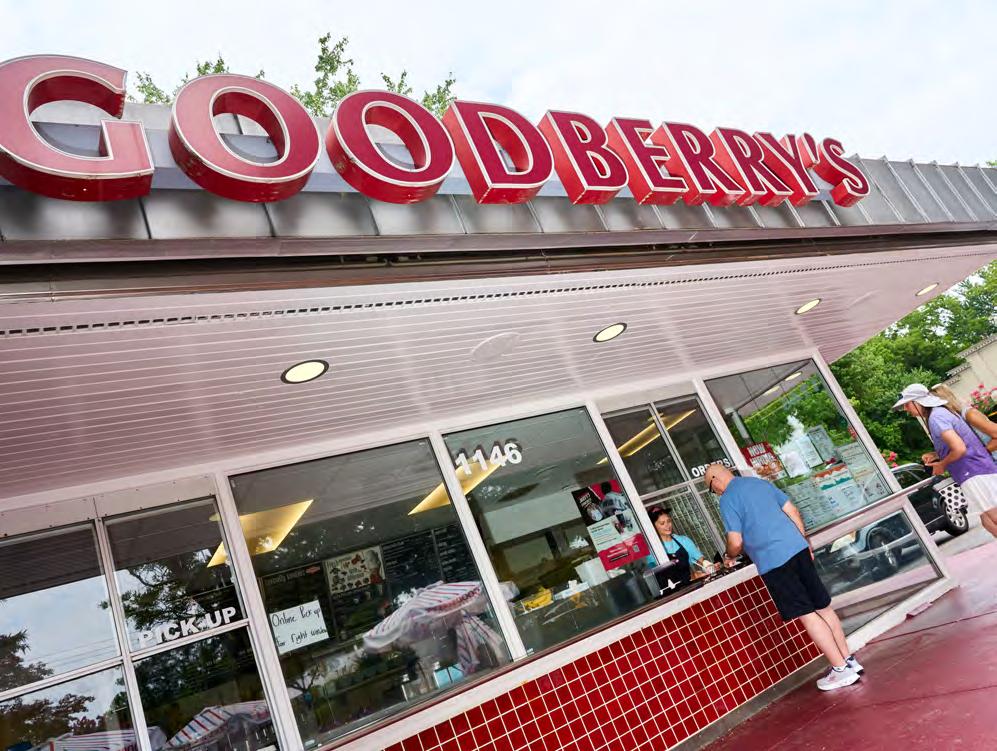

On sunny weekends, the wait for Howling Cow ice cream can reach 45 minutes—or longer. Still, Nail receives positive customer feedback. Folks admire how N.C. State students, who staff the operation, keep it all moving. Guests gravitate to the rocking chairs on the porch, and kids find freerange moments in the meadow and climb the fence to get a better look at the cows.
This spring, for the first time, Nail invited staff to come up with new flavors. From 30 submissions, she settled on six finalists that will make it to the test kitchen. If a flavor works great in production, she’ll take it to Palm Springs in November for Conecon, the North American Ice Cream Association’s annual gathering. If the flavor shows well there, there’s a good chance she’ll add it to the freezer case at Howling Cow, where Wolf Tracks, a vanilla ice cream loaded up with fudge swirl and mini peanut butter cups, is consistently a top seller.
Chef Andrew Zimmern, a restaurateur and TV personality, recently described the Triangle, in an Instagram video, as a place where “serious chefs are doing thoughtful, ingredient-driven work” and “where global flavors and Southern roots actually mean something on the plate.”
This is particularly true in Cary, where seekers can find an ice cream trail of global flavors. Start at the Two Roosters location at Waverly Place with scoops of coffee, bourbon, and blackberry hibiscus ice cream. Head north on Kildaire Farm Road—St. Brigid of Kildare is the patron saint of dairy farmers, among other things—to find Goodberry’s Sir Walter Wally, which blends vanilla custard, strawberries, chocolate chips, and wet walnuts.
A block away at Sugar Koi, Nat Jirasawad, a former sushi chef who grew up in Thailand, has mastered his mother’s homemade coconut ice cream recipe.
A decade ago, Jirasawad began teaching himself to make ice cream from scratch, discovering along the way that the ice cream he was producing was Philadelphia style, which is 16 percent butterfat—two or three times the butterfat of gelato. Now he creates original flavors using Asian teas and fruits and local produce: “Simple and honest ingredients,” Jirasawad said.
Ube is Jirasawad’s most popular original flavor, and he sources the yams from farmers in Garner and Hillsborough. Jirasawad is precise with his produce: He differentiates Alphonso mangoes from Champagne mangoes in his mango recipes, stating, “Each one has a purpose.”
He spent two years working on a recipe for genmaicha tea ice cream. “It came to me in a dream. Now I have the perfect genmaicha ice cream,” he said. He keeps ube ice cream in the freezer case year-round and rotates black sesame, honeydew, oolong tea, and other flavors.
Heading east from Sugar Koi, the Andia’s southeast Cary location is minutes away. A Cyprus native with Greek heritage, Xouris makes a baklava ice cream that somehow tastes more like baklava than the dessert itself. As a reminder of the expanse of the ice cream universe, Dairy Queen is next door to Andia’s.
To the north, on East Chatham Street, Eric and Carlos Torres’ Vida Dulce ice cream shop features many flavors that originated from the family’s ice cream parlor in Guadalajara, Mexico. The cousins offer a churro split and Mexican
ice cream flavors such as Gansito, piñon, and zarzamora con queso.
Across the Triangle, in Garner, married duo Burton Buffaloe and Dustin Smith have turned their family farm, Holl & Stone, into a produce market, nursery, and leisure destination. Their New Zealand-style ice cream, a honeymoon discovery, uses an auger to blend hard-packed ice cream with fruit and herbs from the farm. The result is a product with the swirly look of American soft serve but not the consistency—it’s firmer, less sugary, and “really fruit forward,” said Smith, who said he wanted “to incorporate a piece of the farm.”
Smith makes blueberry basil ice cream, and he created a mint chocolate chip ice cream by blending fresh mint with vanilla ice cream and then adding a chocolate chip topping. To the dismay of some customers, the ice cream was white, not Day-Glo green, and it tasted like fresh mint from the garden, not like mint candy.
“People loved it or hated it,” Smith said. “People were not used to what mint tastes like.” For the summer, he is blending dried fig leaves—which taste like coconut—and pineapple into a vanilla base to make piña colada ice cream.
Bold Batch Creamery’s Maura McCarthy is Raleigh’s ice cream mad scientist. Without a retail store, she brings her ice cream to pop-up events, festivals, and all sorts of venues. She also runs a subscription program, Flight Club, that delivers four original flavors the last week of each month, does a little catering, and occasionally takes commissions to produce bespoke flavors. Sugar Euphoria on North Person Street sells her ice cream in pints and in one- and twoscoop containers.
“I make ice cream,” said McCarthy. “I’m an ice cream lady.”
McCarthy has an aversion to mass production and no tolerance for “boring ice cream.” She’s learning to calibrate for seasonal peaks and valleys. (“The winter is what breaks you,” she said.)
In her recipes, she’s as likely to use salt as sugar. When the ice cream calls for a cookie or brownie, she wants home-baked items. She uses dairy from Homeland Creamery, local strawberries, and pears from a neighbor’s tree. The small-scale production equipment gives her exacting control of ingredients.
Some of her flavors are elegant. Her hōjicha black sesame ice cream is a “silky custard made with roasted green tea, swirled with a black sesame caramel,” per the car-
ton description. It’s elegant enough to pass for a blancmange and deserves a chilled silver spoon.
Then she also makes The Munchies, a “brown butter chocolate chunk cookie-infused ice cream packed full of cookies and milk chocolate toffee made with Cheez-Its, Ruffles, M&M’s, and pretzels.” It’s a 420 binge to eat with a shovel.
“I have to have a balance between the trashy and nostalgic flavors and the flavors that get people to try something new,” McCarthy said.
Her spiced honey cream cheese ice cream works as a bagel spread. She grinds up pink peppercorns to make her strawberry ice cream pop. Her White Monster sorbet carries an energy-drink jolt. Using sourdough waffle cone batter—a Boulted Bread influence—McCarthy makes ice cream tacos loaded with toppings. “They’re very elaborate. It’s like a walking sundae,” she said. A military brat, McCarthy grew up living all over the United States and in Japan, where she returned to live for awhile after attending college at the University of North Carolina at Chapel Hill. In her second tour, she lived on Shikoku, one of a series of islands that feature local food and culture at michi-no-eki, or roadside stations.
“They have all the local goods for that specific town that you’re visiting,” McCarthy said. “There are bridges connecting each island. You can bike the whole thing. It’s beautiful, some of the most picturesque views. Then you stop at all the michi-no-eki, and you get a different flavor soft serve at each island. All of my pictures of myself in Japan, I’m holding an ice cream cone.”
The possibility for a local adaptation of michi-no-eki is compelling. Across the Triangle, neighborhoods could promote their own cultural and culinary specialties, with each neighborhood showcasing a favorite ice cream. After all, some neighborhoods give off Munchies vibes, and some are more blueberry lemon sorbet. From Heather Hills in Garner to Gimghoul Road in Chapel Hill, from Hayti in Durham to Hayes Barton in Raleigh, our Triangle Tour de Ice Cream can outdo Boston’s Freedom Trail and Nashville’s Pub Crawl. The timing is ideal, now that a public-health expert has blown the lid off a conspiracy to suppress research showing ice cream’s positive health effects.
For the Triangle Tour de Ice Cream, we can draw on the words Texas Rep. Kika de la Garza uttered in 1984 to celebrate the passage of his National Ice Cream Day resolution: “If you feel defeated or frustrated, eat ice cream. If you’re happy and want to celebrate, eat ice cream. Ice cream is good for you.” Let the scooping begin.

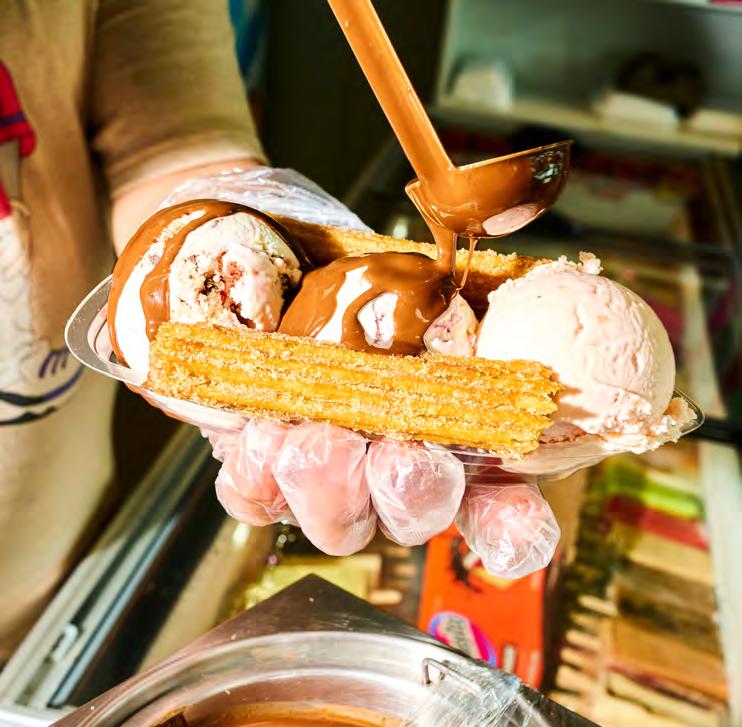
Zoey Deutch in a meta summer comedy, a documentary about the music producer Peter Asher, and more movies coming to theaters around the Triangle.
BY GLENN MCDONALD arts@indyweek.com
The concept of the celebrity sex pass has been around for a while, probably since the dawning of celebrity itself. It goes like this: In an otherwise monogamous relationship, each partner gets to select one famous person they’re allowed to sleep with, in the unlikely event that such an opportunity presents itself.
It’s a jokey thing—or maybe a half-jokey thing, which is what makes it so fun. But here’s a question: What if it actually happened?
That’s the premise for Gail Daughtry and the Celebrity Sex Pass, the new comedy from director David Wain and the makers of the great 2001 cult classic Wet Hot American Summer. The setup: When her fiancé somehow manages to cash in on his sex pass, small-town Kansas girl Gail (Zoey Deutch) flies to Los Angeles for the express purpose of evening the score. Her quarry: The professionally handsome (and admirably game) Jon Hamm. Events progress. Hollywood satire ensues.
Advance buzz on this one is very buzzy indeed. The film was a sensation at this year’s Sundance festival and has since been tagged as the summer comedy of 2026. Director Wain’s movie isn’t a Hollywood satire so much as a stylized fever dream of a Hollywood satire. John Slattery—Hamm’s costar in Mad Men—plays himself in a central role, setting the tone for the rest of the film’s severely meta approach. Weird Al Yankovic, for instance, cameos as a psychotic gun nut.
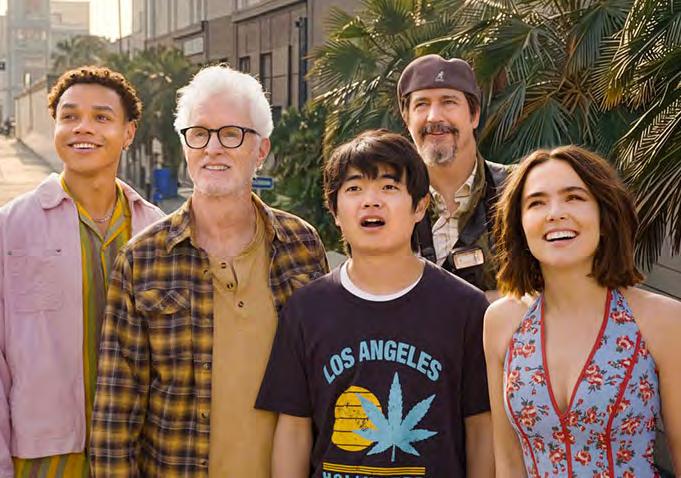
Jennifer Aniston is involved. Intimately. If nothing else, Wain’s movie scores points for being an original story in a July that’s otherwise swamped with sequels and remakes—Minions & Monsters, Moana, and Christopher Nolan’s ultimate rebooted IP, The Odyssey. Click around online and you can find a few more good options playing locally this month.
For instance, several local theaters have booked the fascinating documentary Everywhere Man: The Lives and Times of Peter Asher. Well, fascinating for music history nerds of a certain intensity, anyway.
Musician, producer, and elite-level scenester, Asher was a major player in multiple consecutive eras of pop music history—from 1960s Swinging London, through the California rock scene of the 1970s, and into various nooks of the 1980s and 1990s. (He produced In My Tribe, that stone-cold classic from 10,000 Maniacs.) Asher also collaborated with Paul McCartney, produced giant records by James Taylor and Linda Ronstadt, and introduced Mick Jagger to Marianne Faithfull. Legend holds that Asher, circa 1966, was the original inspiration for Austin Powers.
The new documentary is directed by the filmmaking team of Daniel Geller and Dayna Goldfine, who brought us 2021’s lovely Leonard Cohen doc, Hallelujah. Like that film, Everywhere Man is centered on famous people telling cool stories, which can be delightful when done properly.
Among the friends and admirers paying tribute: McCartney, Taylor, Steve Martin, Eric Idle, Twiggy, Yoko Ono, Carole King, and Natalie Merchant.
For a different kind of multiplex experience this month, watch for Hadestown: The Musical, a live recording of the Tony Award-winning stage musical, playing in U.S. theaters for a limited five-day run, July 23–27. Edited together from three 2025 performances at London’s Lyric Theatre, the film version features many of the original Broadway and East End cast members. Hadestown is a wildly ambitious mélange of multidisciplinary storytelling. The musical combines elements of two ancient Greek myths—Hades and Persephone, and Orpheus and Eurydice. But the updated story deals with complex social, political, and ecological themes: poverty, hope, art, apocalypse. Add in Broadway-level choreography and design, and you’ve got a topshelf theater production optimized for the moviegoing experience.
Bonus trivia for local musical theater fans: The Durham Performing Arts Center will be hosting the national touring production of Hadestown next spring, March 5–7, 2027.
Speaking of mythologies, the historical war epic Young Washington follows the early life of our first president as he takes
command in the French and Indian War. Heads up that the film is being released by the self-described “values-based” distribution company Angel Studios. Bring your flag!
Actor and filmmaker John Early writes, directs, and stars in the indie comedy/ drama Maddie’s Secret, the story of a foodie influencer whose sudden fame triggers an eating disorder relapse.
Evil Dead Burn, the latest chapter in producer Sam Raimi’s wigged-out horror franchise, is being billed as a direct sequel to 2023’s Evil Dead Rise. The director this time out is up-and-coming French filmmaker Sébastien Vaniček, whose debut Vermines (Infested in the U.S.) was a big hit with art-house horror fans.
Here’s an odd one: The documentary Wham! 10 Days in China chronicles the duo’s brief but apparently quite eventful tour of China in 1985. They were the first Western pop act to perform in the country since the end of the Cultural Revolution, and things got weird.
Spider-Man: Brand New Day, the fourth installment of the third reboot series, finds young Peter Parker going back to his roots and fighting street-level crime in New York City. It seems that Dr. Strange cast a spell that toggled a kind of cosmic reset button, so Spider-Man is back to square one. Superhero movies are a sort of mythology, too, which maybe explains why we keep telling ourselves this story, over and over and over.
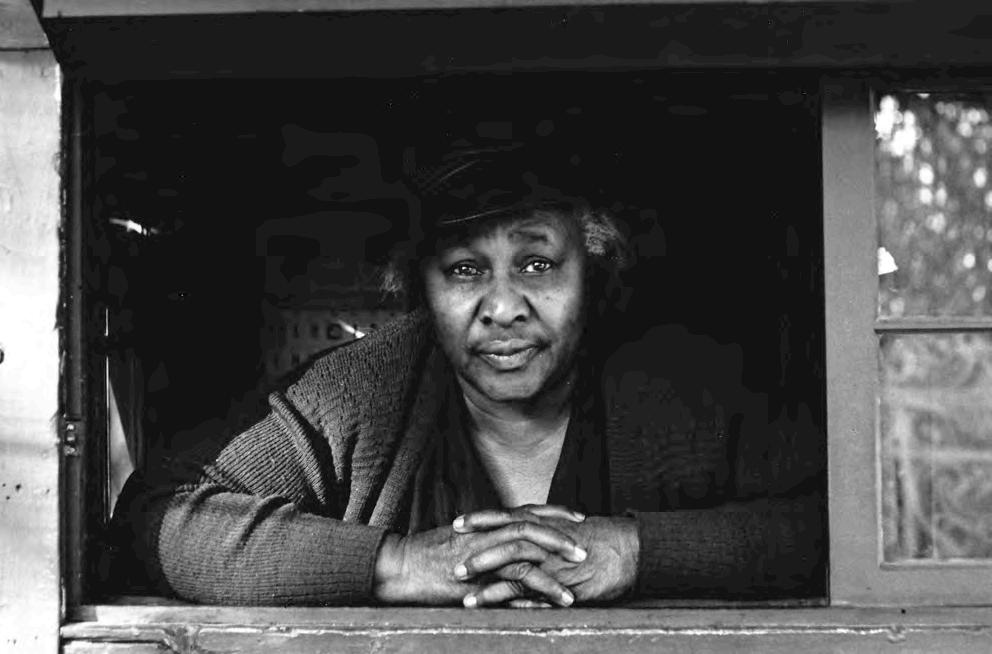
From her garden post in Wilmington, prolific artist Minnie Evans patrolled the borders between worlds.
BY BRIAN HOWE arts@indyweek.com
Elizabeth Penton has vivid memories of visiting Airlie Gardens when she was growing up in Wilmington in the ’60s and ’70s—especially the moment of arrival. From the wayback of her family’s station wagon, she could barely glimpse the ticket seller. But the vibrant drawings tacked all over the gatehouse seared themselves into her mind: intertwined human, animal, and botanical motifs, as lush and abundant as the azalea-laden grounds.
Inside was Minnie Evans, whose gatehouse atelier now stands in replica at Wilmington’s Cameron Art Museum. After more than 30 years as a domestic worker for the family that built Airlie, Evans started selling tickets there in 1948, when she was 56, until she retired in 1974. It’s where she made many of her complexly patterned drawings, often in crayon, which she would sell for less than a dollar or trade for services around town.
This was how many saw Evans—just a colorful local eccentric. Little did they know that her work was being shown in New York galleries and written about in folk art
journals, or that in 1975 she would be one of the first Black women to have a major exhibit at the Whitney Museum of American Art.
“Some people in Wilmington looked askance at Minnie’s work and her obsession,” Penton said recently by phone. “They thought it was strange. These eyes are looking at you, and everything’s out of proportion. And maybe it frightened them on a religious level. But I had that connection formed as a child, so I always had a respect for Minnie’s work.”
Penton is tracking down and cataloging Evans’ pictures for a website and a book.
“They’re all over the place,” she said. “They’re in Europe, everywhere, and people are finding them in their attics. My goal is that future generations can see it, can study it, can appreciate this incredible legacy of an artist who channeled this great spiritual life.”
Penton is also one of the art professionals in Minnie Evans: Draw or Die, a new documentary by her friend Linda Royal, who has made several features since graduating from
Duke’s Center for Documentary Studies. The documentary screened at the Chelsea Theater on June 29, followed by a Q and A with one of the several great-grandchildren who appear in the film.
“It’s meant everything to me to have their support,” Royal said. “It was amazing at our premiere in Wilmington to have the entire front row filled with Evans family members and hear how some of the younger generation are doing their own art now.”
Like Penton, Royal had an unforgettable first encounter with Evans’ art.
“I was getting married in Liz Penton’s home in Wilmington,” Royal said. “I was in her bedroom, putting on my wedding dress, when I noticed these incredible drawings on the walls.”
Evans’ style was inextricable from the intense dreams she had all her life. They were often Biblical or mythological in nature, and she felt that she was tapped into forgotten nations from before the Great Flood. Her drawings seem to combine many visionary traditions: the religious dreamscapes of William Blake, the divine geometry of mandalas and mosaics, the automatism of the surrealists, the floral heraldry of art nouveau.
But there’s no reason to suspect she was motivated by an interest in art history, except for that of her Trinidadian maternal heritage. Instead, her art seems to plumb a level deeper than influence, a universal intuition. When humanity peers into the infinite, in any era, these interlocking shapes are what it sees.
Royal’s moving documentary gives us Evans’ life in a series of prismatic facets, bookended by musical
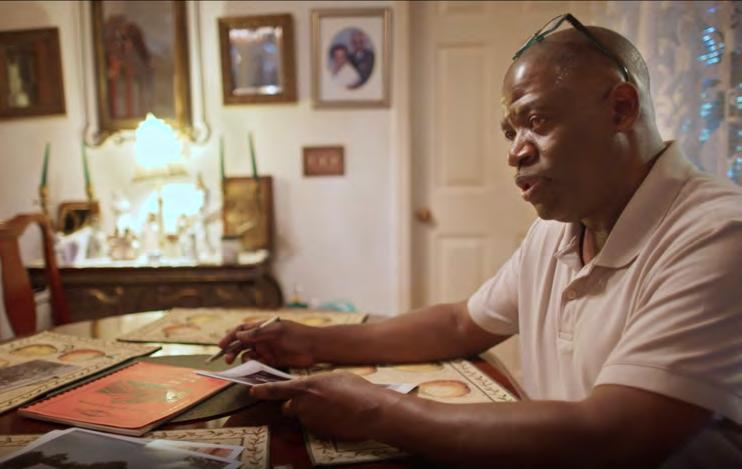
scenes at the Bottle Chapel that serves as her monument at Airlie Gardens.
Evans was born in 1892, her childhood marred by the Wilmington massacre, an infamous white supremacist coup. She grew up sounding oysters, absorbing the sunrises that would become one of her signature motifs. She married at 16 and soon had three sons.
She made her first two drawings, on the backs of shopping lists, around 1935, after her grandmother’s death. Years later, while burning some old magazines, they fell out, and she started to draw again.
From then on, she put her dreams into pictures compulsively. She would make as many as seven a day. In the documentary, one of her grandchildren remembers her drawing as a trancelike state. She didn’t always make it to church—her dialogue with the divine was more direct and more urgent.
Her dreams darkened during World War II. Wilmington was a port city full of targets; German subs lurked along the North Carolina coast. She saw beautiful stars turning into falling bombs. In 1944, she visited a fortune teller who told her her drawings had predicted the war—and implied that they could end it. Within a few days, she heard a mysterious voice saying, “Why don’t you draw or die?”
In response, Evans made her landmark oil painting “Invasion Picture,” which is in the Ackland Art Museum’s collection, depicting the bombing of a river town full of massed eyes and piled skulls. Shortly afterward, the Battle of Normandy turned the tide for the Allies, deepening Evans’ connection between her art and prophecy.
Her first gallery exhibit was in Wilmington in 1961, but it was meeting photographer Nina Howell Starr the next year that
introduced her to the art world. Starr was Evans’ conduit to New York galleries, academic journals, major museums, and private collections. For Evans, she provided a measure of recognition and, late in life, financial relief. One picture from the ’80s shows her wearing a fabulous white fur coat in her wheelchair.
But Starr also left something invaluable for us: a deep archive of recorded interviews, housed at the Smithsonian. It’s why we’re able to hear so much from Evans in her own words, though the only known footage of her comes from The Angel That Stands by Me: Minnie Evans’ Art, a 1983 documentary that’s incorporated into Draw or Die
“Nina realized that Minnie was important and should be recorded,” Royal said. “She dedicated 25 years of her life to assisting Minnie with getting her art out there and getting the respect she deserved.”
The film joins a wave of renewed interest. The Lost World: The Art of Minnie Evans, the first major exhibit since the ’90s, recently closed at the High Museum of Art in Atlanta and moved to the Whitney this summer. After obscurity, then provisional success under labels like “outsider,” “self-taught,” and “vernacular,” Evans’ work is having a third life where its wondrous invention can be better seen.
“We don’t put people in those boxes anymore,” Penton said. “It lets all the air out of the fabulous inner tube coursing down these rapids of what they’re saying and who they are. We want to elevate her voice and ground her particular experience as a Southern Black woman raising grandchildren, making ends meet, in the midst of world wars and the Civil Rights Movement, right here in North Carolina.” W
Mobile romance bookstore pop-ups around the Triangle seek to offer inclusive community spaces.
BY JESSICA TOBES arts@indyweek.com
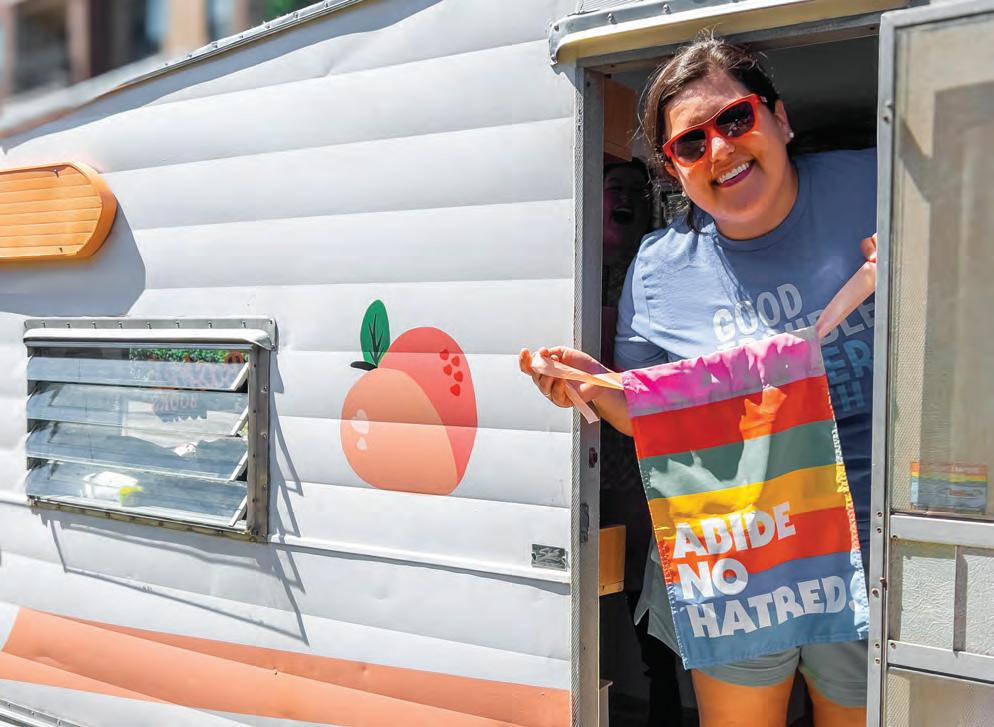
Meredith Bryson and Lauren Brown both credit Bridgerton, Julia Quinn’s popular historical romance series, for reviving their reading lives and inspiring them to open bookstores of their own.
“I got back into [reading] as an adult, actually with Bridgerton,” Brown said. “I watched the first season [of the Netflix adaptation], and then I was like, ‘I need more now, not in years.’ I picked up the books, and I read them all so fast. I haven’t stopped reading since.”
Both Bryson and Brown opened mobile romance bookstores in 2025. Bryson runs the mobile Durham-based Peach Basket Books, and Brown runs Rebel Romance Bookstore, a pop-up.
Novels from the Bridgerton saga now fill the shelves of Peach Basket Books—a pandemic-era dream turned reality.
“My fantasy was always to have my own little cozy bookstore,” Bryson explained, “[but] I like having the stability of a full-time job with benefits and just couldn’t see how I could become a small business owner full-time.”
Inspired by romance bookstores she had seen pop up across the country and the Triangle, Bryson found a solution.
“I ended up purchasing a really run-down camper in 2022 and spent several years renovating it,” she said. “I decided to focus on romance, because that’s the genre I love the most.”
Bryson operates her romance camper-turned-bookshop on a pop-up basis in and around Durham. She announces events on her Instagram (@peachbasketbooks), which are
often hosted at local community spaces like Common Market and Ponysaurus.
In the time since she opened her camper and held her first pop-up event, in May 2025, Bryson says she’s noticed a shift in the ways that the genre is perceived and the popularity that has followed, with bookstores like Bright Side Books & Wine, the Triangle’s first and only brick-and-mortar romance bookstore, opening for readers.
There have been other big industry shifts: “Romance has come a long way from the original Bridgerton, which was written almost 30 years ago now, about a white family in London,” Bryson observed of the series, which got a cast of multiracial actors when Netflix launched an adaptation in 2020.
That broadening is exactly the kind of change that Brown also hopes to capture with Rebel Romance Bookstore, which she opened in August 2025. With the pop-up, Brown seeks to amplify the voices of marginalized authors and implement business practices that align with her values.
“I put a little business card-sized fax card [in each book], and it lets my shoppers know whether the author is local or part of the BIPOC, LGBTQ+, or disabled communities,” she said. “You see a lot of posts for Pride Month or Black History Month, and those are great,” she said, “and you support those fully, but when next month is Disability Pride Month, you won’t see anything.”
Hosting events around the Triangle, she participates in
markets and book fairs like Front Paige Media Book Fair when it’s hosted at Raleigh Iron Works and updates customers on upcoming events on her website. Like Bryson’s camper, Rebel Romance Bookstore is a pop-up, which, as Brown describes, works well for her lifestyle.
“Because I have multiple chronic illnesses, a traditional nine-to-five doesn’t work well for me,” she said. “Romance novels have just felt more and more like home.”
Brown hopes to grow her pop-up into a permanent brickand-mortar bookstore one day, with a staff of chronically ill people in her community to “give them an opportunity for a job that is flexible for them,” just as Rebel Romance has been for her.
For both Bryson and Brown, they hope to foster spaces emphasizing the largest draw for readers to the genre: the guarantee of a “happily ever after” or, as Bryson added, a “happy for now.” To both, this convention and its predictability are what make readers fall in love with romance.
“What’s exciting is the journey that takes you there and the character development,” Bryson said. “How do different characters and even side characters grow and change? How do they learn from each other?” This assurance of stability, especially as “things get more and more chaotic, both politically and economically,” as Brown said, is a draw for readers.
“The guarantee of happiness at the end is just a comforting place for people to be,” Brown said. W
At Bright Side Books & Wine in Raleigh, visitors can find love stories of every stripe—alongside a robust community of readers dedicated to supporting indie romance publishing.
BY SHELBI POLK arts@indyweek.com

I
f social media presents an existential threat to reading as a pastime, no one has yet told the romance readers. Apps like TikTok and Instagram have thriving communities of readers—nicknamed BookTok and Bookstagram, respectively—ready to dissect their favorite books. Within these online communities, romance fans are a particularly visible set.
Bright Side Books & Wine, a romance-only bookstore that recently moved into a permanent home in downtown Raleigh, is, in some ways, the physical manifestation of these online communities.
Here, fans of the genre can find as niche a novel as they could possibly desire. There are sections for queer and local authors, the classics, the breakout hits. Visitors can post up on plush leather couches or at bright café tables, and attend book clubs and signings.
“It feels settled,” owner Susannah Baird told the INDY, recently, surveying the shop. “My friend jokes that this is ‘Susannah’s Barbie Dreamhouse.’ It is, though—how it was built and decorated, everything. It’s exactly what I wanted it to be.”
Romance novels have always been a cornerstone of the publishing industry, though it’s harder than one might expect to pinpoint the genre’s exact heft—the most com-
monly cited figure, a valuation of $1.4 billion, is based on outdated data from the trade association Romance Writers of America, which went bankrupt in 2024 after being clouded by scandals.
Nevertheless, romance novels are certainly more visible than ever, particularly among millennials and Generation Z readers. Many readers got into the genre (and into sharing their reading journeys online) during COVID-19, shortly after the cartoon covers trend emerged to catch new readers’ eyes. Since then, a handful of other dynamic factors—social media, the rise of self-publishing, the popularity of shows like Bridgerton and Heated Rivalry, and updated mores within the books themselves—have contributed to a spike in popularity. The publishing industry has certainly paid attention, and media has followed suit, giving the once-sidelined genre consistent coverage. The biggest beneficiary of this increased attention is the corner of the romance world known as romantasy, or romance novels set in a fantasy world. This fall alone, romantasy fans have new releases to look forward to from Sarah J. Maas, Carissa Broadbent, Rachel Gillig, and Sarah A. Parker (all No. 1 New York Times bestselling authors)—all of which you can preorder at Bright Side Books & Wine.
“There’s so many incredible authors that write about really, really important topics that are very—I don’t want to say more easily digestible, because that devalues it—but because of the context of the romance, people can consume really heavy topics in a way that feels safe, because you know, at the end of the book, it’s happy,” said Baird.
For many readers, the genre offers something like following sports: it’s entertainment, escapism, and a safe place to work through difficult emotions, all in one. Win or lose, sports fans find some kind of catharsis at the end of their carefully formula-bound games. So do romance readers.
“I think there was a lot of my own training to understand that my interests are valid, regardless of what they are,” Baird said. “I’ve seen a lot of that in people coming in to find a new book—being new to romance and not understanding all that it encompasses.”
We’ve known since at least 1984, when Janice Radway—now a professor emerita at Duke University— published Reading the Romance, that the genre’s readers are opinionated women (mostly) who love to granularly dissect their favorite reads and won’t settle for too-mindless writing.
In her studies of a group of Midwestern romance fans she nicknames the Smithton readers, Radway found readers with such specific tastes and voracious habits that they would visit several local bookstores to find the books they wanted.
“In fact, what the Smithton group makes clear is that its members continue to possess very particular tastes in romance fiction that are not adequately addressed by publishers,” Radway wrote in Reading the Romance
Today, romance continues to be at the top of the publishing food chain, and the genre’s writers are doing quite well—take romantasy rock star Maas, who made headlines for selling nearly 5 million books in just the first half of 2024.
Dedicated spaces like Bright Side are a newer phenomenon. In Brooklyn, the Ripped Bodice will celebrate a decade of operation this year, but the other 200ish romance-only bookselling operations in the U.S. are much younger. These shops—many of which are pop-ups or mobile bookstores—are among the most community-oriented book spaces, even within the friendly indie world. Just like the reading circles Radway met in the ’80s, today’s romance readers want spaces to talk through their books from every angle.
That’s exactly how Raleigh got Bright Side: Baird’s business is the setting for the extended community she’s looking to cultivate. Her author events first came about, she said, because “people really wanted something like this.”
Baird, who is 32, found her reading community online first, during the pandemic, after a friend handed her a romantasy series that helped revitalize her reading life.
“At the time, I was reading several books a week—that has slowed down significantly—but I wanted a space. I wanted this place, and I wanted to be the one to do it,” she said. It wasn’t long, reading at this pace, that she found she’d “read through the romance stock at every local bookstore.” (Other than her own, she says that Quail Ridge and Blackbird Books are her favorite bookstores.)
“Both stores are all-genre, which makes complete sense!” Baird said. “But I don’t necessarily read all genres. I stay in my romantasy and contemporary romance lane. And I found that there were a lot of people in an online community in the area [who were] just kind of desperate for a physical, in-person meeting place.”
In 2024, after years of dreaming of opening a bookstore with a friend who lives out of state, Baird decided it was time to give it a shot on her own, asking herself: “Is this gonna stay in our heads as a fun dream, or am I gonna do this?”
Permitting issues initially prevented Baird from moving into the space late last year, when she planned to open, but three rounds of permits and five months later, Bright Side is finally in its intended home on the ground floor of the Platform Raleigh Apartments off Cabarrus Street. The shop is cozy, with walls of moss-green bookshelves facing tables full of laptop-bound remote workers. A bar that currently serves a spread of teas and THC drinks dominates the back half of the shop, and it will serve wine when the ABC licensing process is through. Bar Manager Meredith Kelly plans to have 12 to 15 wines, often tied to specific books or events. Baird opened a pop-up version of the shop last November, which allowed her to start nurturing the community she was looking for. The Bright Side team, now a staff of 13 (up from Baird and just two others at the pop-up), run a robust slate of programming.
When I arrived to talk to Baird, she was in conversation
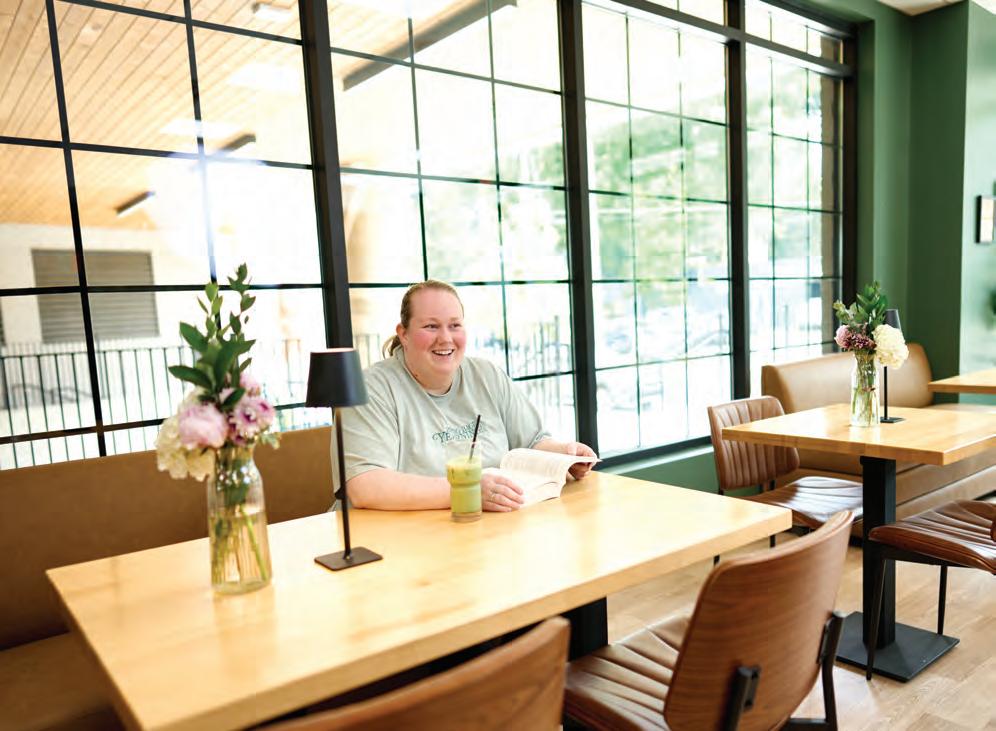
with two local romance authors (both friends she initially made online) who are part of the planning committee for Magic & Meet Cutes—a two-day, 18-author event that took place in mid-June, somewhere between a book signing and convention.
The actual business of selling books comes up almost incidentally in conversations with Baird, nearly always second to her joy at being able to “offer a third space.” Baird heard that authors wanted something like Magic & Meet Cutes, so she initiated it. The indie authors on the list, nine of the 18, will sell their own stock, so Bright Side won’t take any cut from the sales of half the event’s vendors. Asked about favorite publishers, Baird said she usually chases down authors or romance publishers she wants to sell individually.
This attitude, a focus on connection and initiative above other concerns, is, in many ways, a defining feature of the romance industry itself. Much of the stock in Baird’s shop is indie romance, all of which is what other corners of the book world might call self-published. In some genres, that label might carry a kind of stigma, but romance is different. With the rise of platforms like Kindle Unlimited, indie romance authors can build successful careers without the support of traditional publishers.
Some of the biggest romance writers in the game, in fact— writers like Colleen Hoover and Ali Hazelwood—got their start by putting their work online as indie-pubbed books or fan fiction. Once these writers drew enough of a following to prove that the books they want to write are profitable, agents and publishers swooped in. (And often, the most successful romance authors, like Courtney Milan and Kenne-
dy Ryan, eventually cycle back out of traditional publishing, returning to indie publishing for their own work.)
All this makes it easy to see parallels between Baird’s business and the indie romance world. Author Ruby Dixon wanted to write books about women astronauts falling for giant blue aliens, and no one wanted to publish them until they saw how much readers loved them. Now, Ice Planet Barbarians is a successful 22-book series with spinoffs. Likewise, Baird knew that readers wanted a space to pursue their shared interest, so she created one. Now, Triangle romance readers have a physical space and an energetic community-builder bringing their favorite authors to town.
And while Baird has met the occasional skeptic, her business has largely been met with interest and support, she said: Opening weekend in the new space brought in 50% new customers.
Baird loves welcoming new people into the romance community and helping them find their next read or subgenre (dystopian romance and stand-alone romantasy are the trendy romance subgenres this summer, and Baird has recs), but she’s not trying to convert everyone. At the end of the day, she just wants everyone to shop at indie bookstores and find their people.
“Your indie bookstore, no matter if it’s an all-genre, single-genre, whatever—your indie bookstore is the community,” she said. “You’re not going to find that community at a big-box store. It just doesn’t exist, because there is not someone there to nurture it. ... ‘Community’ is just the word I’m gonna always come back to. That’s what everyone was craving.” W
AN INDY SERIES ABOUT FAMILIAR FACES AROUND THE TRIANGLE— AND THE STORIES YOU MAY NOT KNOW ABOUT THEM.
The alumna captures and shares everyday (and often bizarre) discoveries to preserve the memory of an ever-changing college campus.
BY DANEEN KHAN backtalk@indyweek.com



Maddie Jennette was walking through Gardner Hall at North Carolina State University (NCSU) when she noticed a collection of student projects enclosed within a glass display. There was a canvas with three painted flowers. A piece illustrating the yellowing leaves of a plant. And a stuffed weasel.
The creature was slightly smushed between corkboard and a glass panel. Silver pins under its belly raised its rear slightly into the air. Beady eyes stared out at Jennette as she asked herself a very reasonable question: Why is there a taxidermied weasel in there?
She didn’t mull over rationale. Instead, she snapped a picture, opened Instagram, and hit post.
Jennette never uncovered the weasel’s origin story, but that didn’t stop her from making it the insignia for her Instagram page, @exploring.ncsu. She created the account days after graduating with a computer science degree from NCSU in May 2023 to catalog her discoveries across campus.
When Jennette started the account, she was anonymous—partially because she thought it would be funny, and partially so people would focus on her discoveries instead of her appearance. It stayed that way until October 2025, when she ranked buildings at an in-person event on campus and posted a photo of herself: “EXPLORING.NCSU FACE REVEAL,” the caption read. But that was the only time she shared her face in a post, so Jennette says she still sees comments from people she knows who don’t realize it’s her behind the account.
“It’s still funny that I have my face on my profile, but people still aren’t aware it’s me,” she said. By now, all of Jennette’s close friends know about the passion project. They aren’t the only ones keeping up with her adventures, though—@exploring.ncsu has amassed
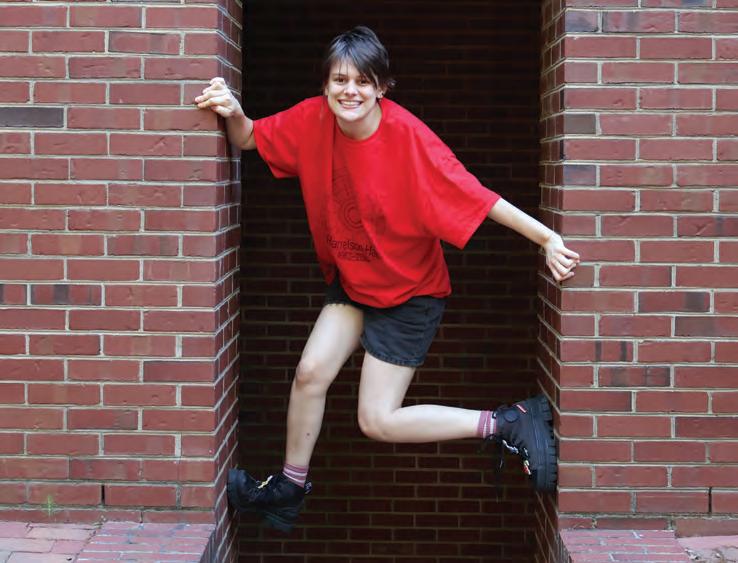
over 2,100 followers.
NCSU’s libraries catalog the university’s history, but most of the archives focus on centuries past instead of more recent changes. The university, like any college campus, is an incredibly transient space; it looks different every year, just like its students do.
“There are so many things on campus, even just my freshman year—that was 2018, so it wasn’t even that long ago—that I know for a fact existed, but I can’t find photo evidence of them anywhere on the internet, and it drives me insane,” Jennette said. “I just wanted to archive campus as I remember it.”

So when Jennette isn’t working at a bookstore and a screenprinting studio in Raleigh, she’s exploring her alma mater to find and photograph lesser-known spots, unique art projects, and campus oddities. Her discoveries—including handmade, $1,000 lamps shaped like seashells in the David Clark Laboratories, a peaceful sitting area nestled in a corner of Leazar Hall, and an enormous lump of cotton behind Weaver Labs—are all uploaded to @exploring.ncsu, often accompanied by tidbits about the campus’s history.
In a 2025 post about “the strangest bathroom on
campus,” Jennette detailed the renovation of a two-stall restroom in Broughton Hall, its walls repainted and the 1980s-era tampon dispenser removed.
“Whaaaat it was so awesome before,” one follower commented. “i used to come in before my class where i had no friends and just sit in peace,” another shared.
When @exploring.ncsu hit 500 followers in January 2024, Jennette set out to rank every academic building on campus. NCSU lists a total of 1,132 campus buildings—an unfeasible number. Jennette decided she would only rank buildings that hold classes. No residence halls. No libraries. Not the Talley Student Union, either. Every student knows those spots; Jennette was more interested in exploring the lesser-explored.


“A dream job of mine would be working facilities at N.C. State, so I can go, literally, into any building, anytime I want,” she said.
It took Jennette nearly two years to complete the project: A ranking of 44 buildings, tier-list style, based on three factors: architecture and design, spaces to study or gather, and “explorability.” When construction on NCSU’s new Integrative Sciences Building concludes this fall,

Jennette said she will add it to the list.
After finishing the project, Jennette said she expected @exploring.ncsu to “flop” into obscurity. Instead, the account kept gaining momentum. When she reached 1,000 followers, she created Why I Explore, a short zine about how the account came into existence and why she keeps posting.
After handwriting the text, collaging images together, and stamping her beloved taxidermied weasel on its front cover, Jennette and her partner distributed the zine across campus with live updates on @exploring.ncsu’s Instagram story. People began messaging her as they hunted for copies.
“It felt like a culmination of everything,” Jennette said.
Jennette still distributes copies of her zine across campus, along with advertising the account through colorful fliers (“your new favorite instagram account,” they cryptically read, followed by a photo of the taxidermied weasel). Some followers send her their own findings. One records her frequent audio messages that always begin with some variety of the phrase “Hello, niche internet microcelebrity.”
There’s always something changing on campus, so @exploring.ncsu will keep ensuring the little things are remembered. Jennette said she wants to make more zines. She might venture into the realm of shortform Reels or longer YouTube videos. That will have to be later, though—she doesn’t make any money from the account, and her work schedule slows her down.
“It’s amazing I have any time for this Instagram at all,” she said. “But it’s just so fun
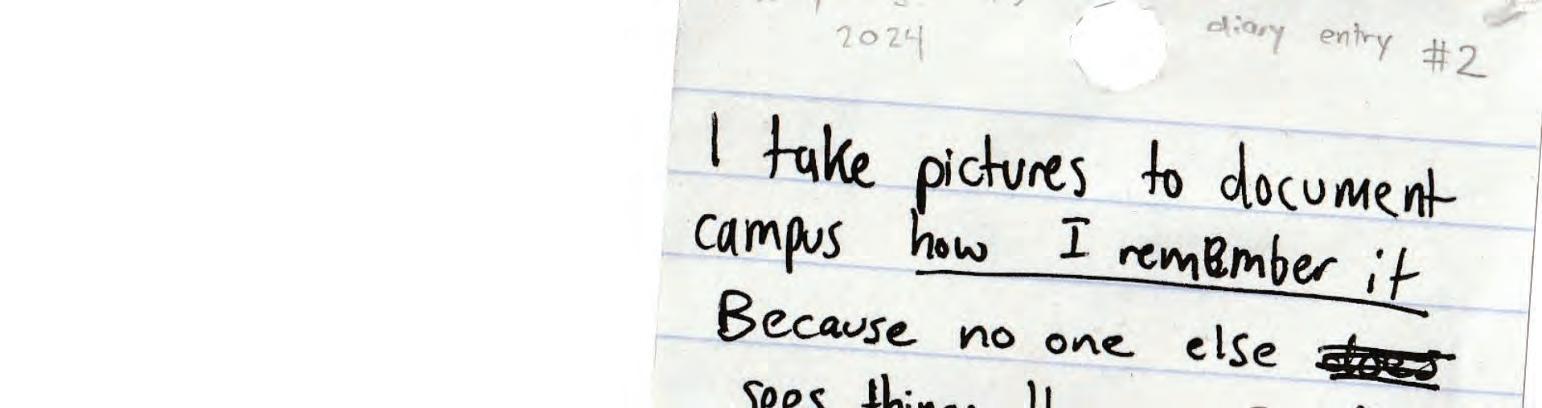

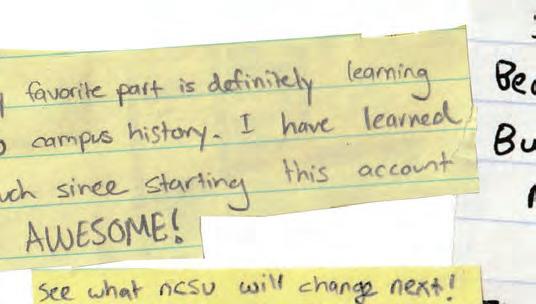
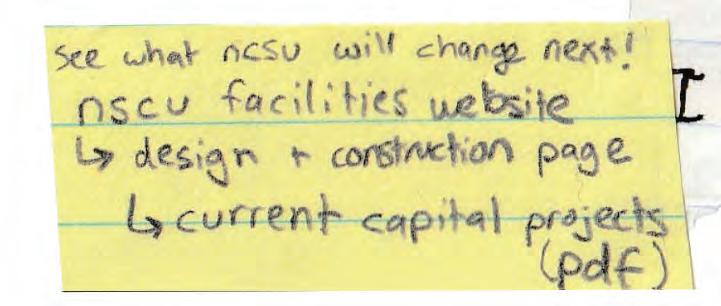
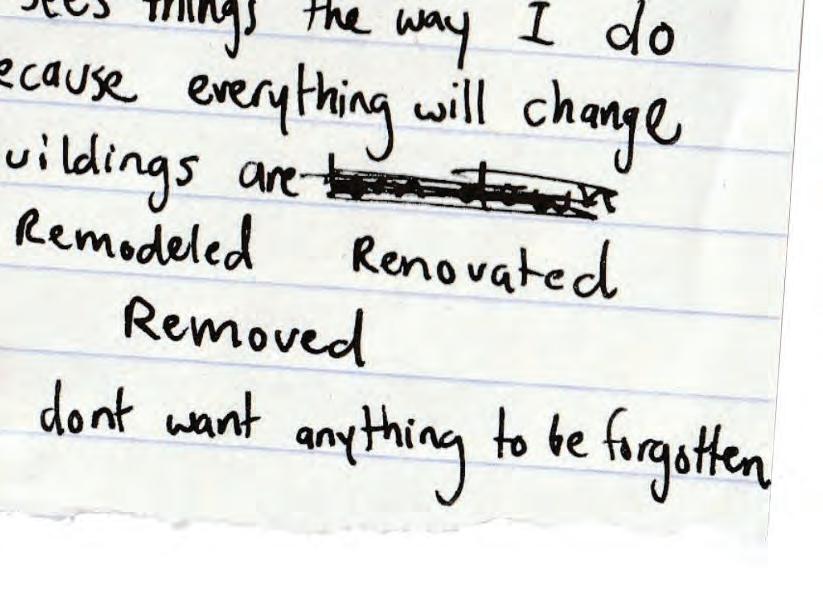

WED 7/1
MUSIC
Bug Hunter, The Narcissist Cookbook
6:30 p.m. The Pinhook, Durham.
Todd Rundgren: DAMNED IF I DO TOUR
8 p.m. The Carolina Theatre, Durham.
STAGE
ADF presents Tere O’Connor Dance
2 and 7:30 p.m. Rubenstein Arts Center, Durham.
THU 7/2
MUSIC
COGS, Twin Films
8 p.m. The Pinhook, Durham.
STAGE
ADF presents Mark Morris Dance Group and Music Ensemble July 2-4, various times, Reynolds Industries Theater, Durham.
FRI 7/3
MUSIC
Africa Unplugged, Del Ward & the Leftovers, MEGABITCH
7 p.m. Rubies on Five Points, Durham.
Excitable—The Def Leppard
Tribute and ’84—A Tribute to Van Halen
8 p.m. Lincoln Theatre, Raleigh.
Future Footwork
8:30 p.m. The Pinhook, Durham.
In That Mode, Ecussionist, AYO VIP, Tennis Rodman
10 p.m. Rubies on Five Points, Durham.
Rockstar Devi Sri Prasad
Live
6 p.m. Martin Marietta Center for the Performing Arts, Raleigh.
Soul Livin’ Jazz
7 p.m. Succotash Durham, Durham.
Soundtrack of The South Tour Kickoff—School of Rock Chapel Hill
6 p.m. Local 506, Chapel Hill.
STAGE
Carolina Theater Company: Zombies
6 p.m. Martin Marietta Center for the Performing Arts, Raleigh.
MUSIC
SAT 7/4
SUN 7/5
MUSIC
MC Chris, Swell Rell
8 p.m. Cat’s Cradle Back Room, Carrboro.
Saturdays in Saxapahaw: Alamance Jazz Band
6 p.m. Haw River Ballroom, Saxapahaw.
An Evening With Harry Connick Jr. 7:30 p.m. DPAC, Durham.
Madison Beer: the locket tour
7:30 p.m. Red Hat Amphitheater, Raleigh.
POLLUTE. with Love Canal, Salisbury, and Doltz
8 p.m. Local 506, Chapel Hill.
STAGE
GIANT ROBOT FIGHT CLUB
8:30 p.m. Mettlesome Theater, Durham.
MON 7/6
MUSIC
Bellows, Dirty Flowers, Paradise Motel Lounge
7 p.m. The Pinhook, Durham.

TUE 7/7
MUSIC
The Bug Club
8 p.m. Cat’s Cradle Back Room, Carrboro.
Ernest Turner Trio
7 p.m. Sharp 9 Gallery, Durham.
Man Man, Death Valley Girls
8 p.m. Motorco Music Hall, Durham.
ADF Presents Monica Bill Barnes & Company
July 7-10, various times, Rubenstein Arts Center, Durham.
PAGE
Denise Kiernan: Obstinate Daughters
6:30 p.m. Quail Ridge Books, Raleigh.
WED 7/8 PAGE
Lauren Hough
6:30 p.m. Quail Ridge Books, Raleigh.
THU 7/9
MUSIC
Napalm Cruiser, Jooselord, Plastique Pigs, Doltz, Lux Posh, Big Feelz
8 p.m. Rubies on Five Points, Durham.
FRI 7/10
MUSIC
Birdleaf with Jupiter 2 and Vishy
8 p.m. Local 506, Chapel Hill.
Blackberry Smoke: Rattle, Ramble and Roll Tour 2026
8 p.m. DPAC, Durham.
Johnny Sunrise and the Clouds, With Love, Nicole Tester
8 p.m. Cat’s Cradle Back Room, Carrboro.
Le’Andra McPhatter
7 p.m. Sharp 9 Gallery, Durham.
Magic Tuber Stringband, Alli Blois & The Seeping Hearts, Maps, Many Hands 7:30 p.m. The Pinhook, Durham.
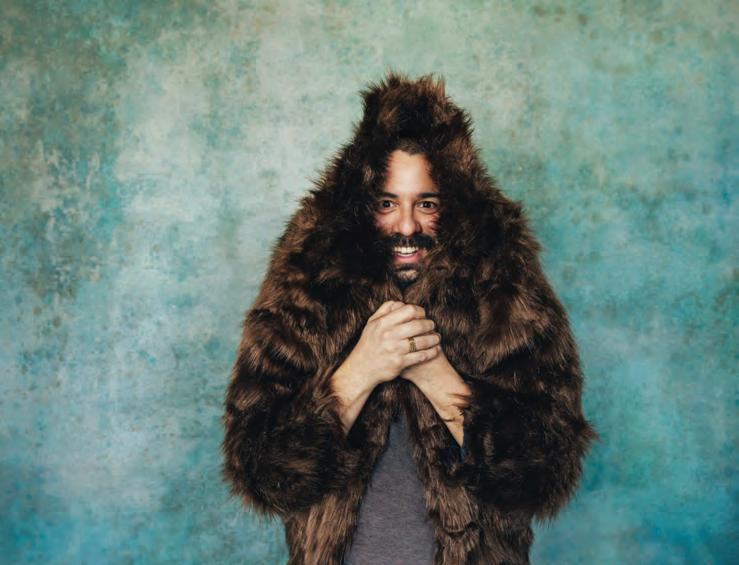
The Pretty Reckless: Dear God Tour
7 p.m. The Ritz, Raleigh.
Sidecar Social Club
8 p.m. Koka Booth Amphitheatre, Cary.
Spacebomb Surf Shop DJ Set
9 p.m. Motorco Music Hall, Durham
The White Buffalo
8 p.m. Lincoln Theatre, Raleigh.
SAT 7/11
MUSIC
ABYSS feat. Dead Language, Anthany Ray, Poetic Note, Tether
9 p.m. The Fruit, Durham.
Baron Tymas & The Swingtet
7 p.m. Sharp 9 Gallery, Durham.
Gladys Knight
8 p.m. Martin Marietta Center for the Performing Arts, Raleigh.
Off Campus Internet Romance Dance Party
9 p.m. Motorco Music Hall, Durham.
Saturdays in Saxapahaw: Django Haskins
6 p.m. Haw River Ballroom, Saxapahaw.
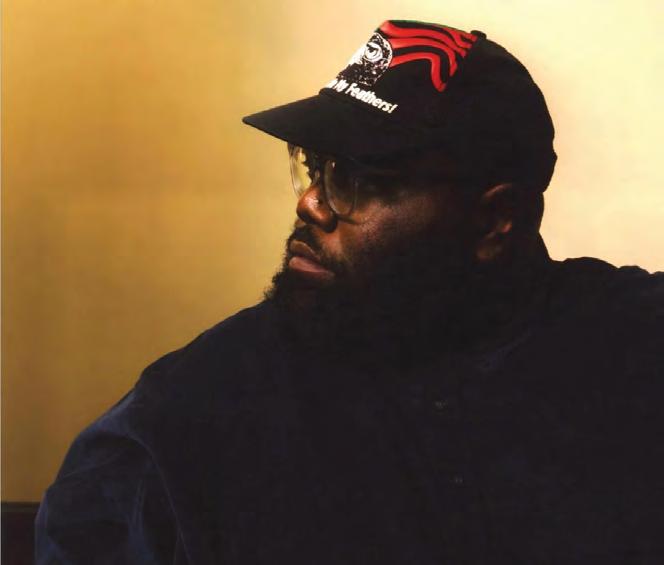

Styrofoam Winos, Ex Iguana, Anne Malin
6:30 p.m. The Pinhook, Durham.
United We Dance
9 p.m. Lincoln Theatre, Raleigh.
Wilco
8 p.m. DPAC, Durham.
STAGE
ADF presents Footprints July 11-12, various times, Reynolds Industries Theater, Durham.
The ComedyWorx Show Matinee
4 p.m. ComedyWorx, Raleigh.
SUN 7/12
MUSIC
feeble little horse, Computerwife
8 p.m. Motorco Music Hall, Durham.
Jalen Baker Quartet
3 p.m. Sharp 9 Gallery, Durham.
STAGE
GIANT ROBOT FIGHT CLUB
7 p.m. Mettlesome Theater, Durham.
PAGE
Flyleaf Second Sunday Poetry Series: Len Lawson and Christopher Shipman
2:30 p.m. Flyleaf Books, Chapel Hill.
MON 7/13
SCREEN
ADF Presents The Sea
1 and 7 p.m. Chelsea Theater, Chapel Hill.
PAGE
Storytime on the Roof 10:30 a.m. The Durham Hotel, Durham.
TUE 7/14
MUSIC
Chuck Strangers w/ Akai (solo)
8 p.m. The Pinhook, Durham.
The Princess Concert 3:30 p.m. Martin Marietta Center for the Performing Arts, Raleigh.
STAGE
The Notebook: The Musical Jul. 14-17, various times. DPAC, Durham.
PAGE
Jessica Knoll 6:30 p.m. Quail Ridge Books, Raleigh.
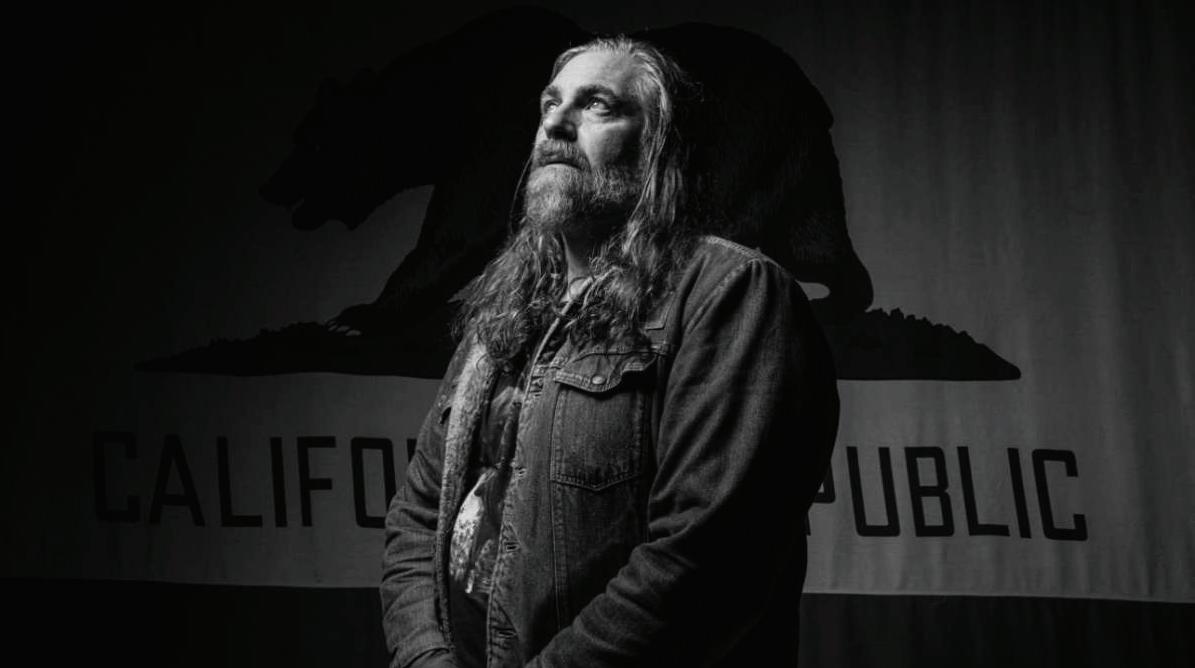
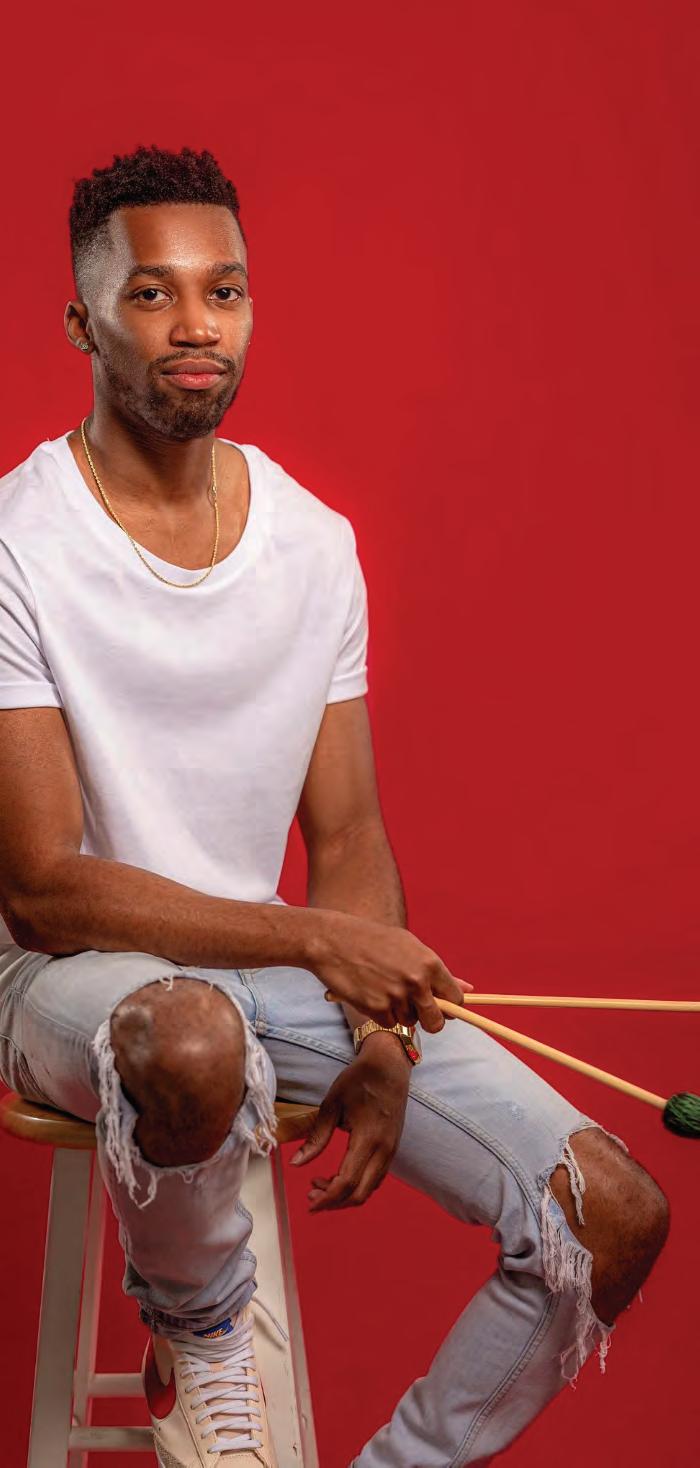







Difficulty level: MEDIUM
There is really only one rule to Sudoku: Fill in the game board so that the numbers 1 through 9 occur exactly once in each row, column, and 3x3 box. The numbers can appear in any order and diagonals are not considered. Your initial game board will consist of several numbers that are already placed. Those numbers cannot be changed. Your goal is to fill in the empty squares following the simple rule above.

RELEASE DATE—Sunday, June 28, 2026
Edited by Patti Varol
Mechanical Engineer
Siemens Industry, Inc. seeks a Mechanical Engineer in Wendell, NC. Review customer specs & reqs while working w/ eng project team to deliver a complete & optimal product. Reqs Bachelor in Mech Eng or rel fld & 3 yrs rel exp. Will accept Masters & 1 yr rel exp. Hybrid work permitted. To apply, visit https://jobs.siemens.com/en_US/ externaljobs/JobDetail/509463
Sr. Software Engineer
First Citizens Bank seeks a Sr. Software Engineer in Raleigh, NC to design, implement, optimize & mngnt of secure & advanced cloud infra solns. Reqs: BS in CS, SE, IT, or rel + 8yrs. Remote role. Base pay gen b/w $168,000 to $203,509 / yr. For more info & to apply, go to https://jobs. firstcitizens.com/jobs & ref Job #2026-34431
System Engineer Consult
First Citizens Bank seeks an Sys Engr Consult in Raleigh, NC to serve as a tech resource in proj plng, proj mgmt, prob res & prod support. Reqs: BS in CS, Comp Engr, Comp Info Mgmt or rel + 8yrs
Creative Marketing Consultant
Creative Marketing Consultant (Cary, NC). Master’s deg in Mktg or Creative Enterprise Leadership. 6 months professional exp in mktg w/in finance, edu, or hospitality industry. Demonstrated exp dvlpg mktg campaigns through major social media platforms. Hands-on exp in website content dvlpmt using WordPress. Practical exp in managing mktg automation tools such as Mailchimp & Sprout. Apply to Triangle Accounting Group, Inc. at 1601 Walnut St, Ste 108, Cary, NC 27511.
Ent. Lvl to Sr. Lvs SW Engineers
Ent. Lvl to Sr Lvl. SW Engnrs. are needed for our Raleigh, NC Office. May req. trvl. To unanticipated locations across the USA. Travel frequency is unanticipated & may req. temporary relocation. Pls send resume, Cvr Ltr., & Sal. Req. to Vaarida Technologies LLC at 5540 Centerview Dr., Ste. 200, Raleigh, NC, 27606.