VOL. 18 NO. 12 PAGES 64
www.expresspharma.in
TECHNOLOGY
Embracing Pharma 4.0: Pioneering future of healthcare Deploying dehumidifiers to protect integrity of pharma industry
INDIA'S FOREMOST PHARMA & BIOTECH MAGAZINE SINCE 1994
NOVEMBER 2023, ` 40
who advances drug delivery? — we do.
Delivering a drug when and where it’s needed results in better outcomes for both manufacturers and patients. Ashland is a global leader in excipient technologies for controlled release, film coatings, disintegrants, tablet binding, long acting injectables, and medical devices. We offer products that meet a wide variety of sophisticated needs: klucel™ hpc, viatel™ bioresorbable polymers, vialose™ trehalose, aquarius™ film coating systems, plasdone™ povidone, benecel™ hpmc, polyplasdone™ crospovidone, natrosol™ hec, pvpi™ povidone iodine Meet Ashland solvers at CPHI India, Nov 28-30, Stand 8.R08, to learn more and let’s talk about how we can help you with your drug delivery challenges. ashland.com/contact
® Registered trademark, Ashland or its subsidiaries, registered in various countries ™ Trademark, Ashland or its subsidiaries, registered in various countries ©2023, Ashland PHA23-057
PHA23-057_Pharma_Express_India_Ad-drug-delivery-AAPS.indd 1
10/26/23 9:02 AM
Siliconized Vials EVERY DROP COUNTS! Further minimize interactions between glass surface and drug product • Less adhesion of high viscosity drug products to the inner surface of the vial • Higher restitution rates • Less residual drug volume
NIPRO PHARMAPACKAGING INTERNATIONAL Blokhuisstraat 42, 2800 Mechelen, Belgium | pharmapackaging@nipro-group.com | www.nipro-group.com
CONTENTS TECHNOLOGY Chairman of the Board
26
EMBRACING PHARMA 4.0: PIONEERING FUTURE OF HEALTHCARE
27
DEPLOYING DEHUMIDIFIERS TO PROTECT INTEGRITY OF PHARMA INDUSTRY
Viveck Goenka Sr. Vice President-BPD Neil Viegas Vice President-BPD Harit Mohanty Editor
POLICY
Viveka Roychowdhury* Editorial Team
Pg 20
Lakshmipriya Nair Kalyani Sharma
28
INCREASED USE OF AI IN PHARMA QUESTIONS PATENTABILITY STATUS
DESIGN Art Director Pravin Temble Senior Designer Rekha Bisht
EVENT
RESEARCH
Senior Artist Rakesh Sharma
P16: INTERVIEW
Marketing Team
DR RONALD AUNG-DIN SCIENTIFIC ADVISOR
Rajesh Bhatkal Ashish Rampure
DR ARIC LOGDSON SCIENTIFIC DIRECTOR, PSYCHECEUTICAL BIOSCIENCE
Debnarayan Dutta Production Co-ordinator Dhananjay Nidre
13
EXPRESS PHARMA TO HOST MAIDEN EDITION OF TECHRX IN MUMBAI
Scheduling & Coordination Pushkar Waralikar CIRCULATION Mohan Varadkar
Express Pharma® Regd. With RNI No.MAHENG/2005/21398. Postal Regd.No.MCS/164/2022 - 24. Printed and Published by Vaidehi Thakar on behalf of The Indian Express (P) Limited and Printed at The Indian Express Press, Plot No.EL-208, TTC Industrial Area, Mahape, Navi Mumbai-400710 and Published at Mafatlal Centre, 7th floor, Ramnath Goenka Marg, Nariman Point, Mumbai 400021. Editor: Viveka Roychowdhury.* (Editorial & Administrative Offices: Mafatlal Centre, 7th floor, Ramnath Goenka Marg, Nariman Point, Mumbai 400021) * Responsible for selection of news under the PRB Act. Copyright © 2017. The Indian Express (P) Ltd. All rights reserved throughout the world. Reproduction in any manner, electronic or otherwise, in whole or in part, without prior written permission is prohibited.
EXPRESS PHARMA
9
November 2023
EDITOR’S NOTE
Building resilience to regulatory risks
I
n September this year, Alkem Laboratories sharpened focus on its API business, branding it as Alkem Activa. Promoter-MD Sandeep Singh's ambition "to propel Alkem Activa into the forefront of the API market" no doubt echoes the sentiments of many API contract manufacturers in India. The logic is simple. API makers across the world are rebounding from COVID-related disruptions in 2020. A report from Fortune Business Insights projects a CAGR of 6.6 per cent from 2021 to 2028 for the API manufacturing sector. In fact, the API makers of the Asia Pacific market could be in a sweet spot: the Fortune Business Insights reports projects that the Asia Pacific API market is set to outpace the North America and European markets, as more pharma players in mature geographies outsource API manufacturing to pharmerging markets to reduce overheads. Moreover, the report analyses that API makers in mature markets are focusing on the more lucrative, difficult-to-make biological APIs, while API makers in India and the Asia Pacific are focusing on developing generic APIs. Contract manufacturing and export of APIs is just one part of the portfolio of India-based contract development and manufacturing organisations (CDMOs). But as a CareEdge (CARE Ratings) report cautions, the Indian pharma sector will have to navigate some challenges while it sets sights on an 8 per cent export surge. On the positive side, the sector has bagged almost half of the total Abbreviated New Drug Application (ANDA) approvals in CY22. Another positive is the upcoming patent cliff. As the CareEdge report highlights, patented products with a cumulative value of USD 224 billion are set to lose their patent protection from CY2022 to CY2026, representing an opportunity in the range of USD 4-5 billion. However, India will have to compete with the rest of the world for a piece of this pie. While India has the largest number of USFDAcompliant pharma plants outside of the US, this also means that the agency's increased inspection
10 EXPRESS PHARMA November 2023
Future growth of Indian pharma companies hinge on their ability to successfully navigate regulatory inspections
rates of pharma manufacturing facilities, and subsequent adverse audit observations, will have a significant impact on the sector’s performance. The CareEdge report points out that several pharma companies in India have already received Form 483 observations in CY2023. Spelling out the consequences, the report cautions that the increasing frequency of audit observations by the USFDA will impact compliance costs and, consequently, adversely affect the profitability of the pharma sector, with delays in the launch of new products, and disruption of revenue streams a further possibility. As the report sums up, it is clear that future profit margins and growth strategies of Indian pharma companies will hinge on their ability to navigate regulatory inspections successfully. Besides the patent cliff opportunity, an analysis from CareEdge Ratings’ Credit Quality Assessment report for H1FY24 projects that operating margins are expected to expand by 100150 bps to 22 in per cent as raw material prices are stabilising, freight rates are normalising, and pricing pressure in the US generics market is easing. Both exports and domestic pharma markets are expected to grow at 7-8 per cent in FY24. The long term prospects for the sector remain good, thanks to increasing demand for healthcare services, aging population, and rising incomes in emerging economies. The caveat to this rosy picture is concerns with respect to adverse observations if any from regulatory authorities. Indian pharma companies seem better prepared for increased regulatory scrutiny. The CareEdge pharma specific report refers to the proactive regulatory risk mitigation measures taken by large pharma companies which include transferring production to compliant sites in cases where regulatory issues arise, filing ANDAs from two separate locations, or identifying contract manufacturers for outsourcing which might reduce regulatory risk to some extent. Only time will tell if these measures will be enough to maximise the opportunities at hand.
VIVEKA ROYCHOWDHURY, Editor viveka.r@expressindia.com viveka.roy3@gmail.com
Q A
EVENT
Express Pharma to host maiden edition of TechRx in Mumbai
&
WITH SCHOTT GLASS INDIA
Q
Is glass permeable against gases and water vapor?
A
Schott Glass India: Glass has been in use for pharmaceutical packaging since decades. It was always first choice not least for its inertness, its transparency and its impermeability. Due to the dense structure of the glass gases and water vapor are not capable of migrating through the glass. There has been a study on ampoules with OPC that showed that even if there is a cut in the constriction of the ampoule not even helium gas (which is much smaller than oxygen and water vapor) can migrate inside the ampoule. This is important especially when it comes to biological products which often are oxygen and or water vapor sensitive and would be degraded.
The theme for this edition is ‘Crafting Cures in the Age of Data’
E
xpress Pharma, in association with our sister publication, Express Computer, is organising the maiden edition of TechRx: Crafting Cures in the Age of Data, on November 23, 2023 at Hotel Sahara Star, Mumbai. TechRx aims to bring together thought leaders, experts, and innovators to explore the power of technology to transform crucial functions in the pharma sector. They will merge the expansive realms of pharma and technology, presenting a curated selection of insights, tools, and actionable strategies to instigate effective digital transformation within the pharma universe.
TechRx will cover z Use of advanced data analytics and real-time monitoring to ensure drug quality and regulatory compliance
Q
What is the shelf-life of glass?
A
Schott Glass India : Glass is in use for cen-
z Transformative power of cloud computing for pharma operations z The role of technologies like AI, ML and blockchain in enabling traceability, anticounterfeiting and patient safety z Robust cybersecurity measures to protect sensitive patient and research data z Building secure and efficient pharma supply chains z The future of smart pharma factories
Experts will present a curated selection of insights, tools, and actionable strategies to instigate effective digital transformation within the pharma universe
turies already. The earliest finding of a glass recipe comes from Syria (700 BC) stating to take 60 parts of sand, 180 of ash from seaweed and 5 parts of chalk, mix it together and you receive glass. Since that time glass vessels are in use and the oldest existing glass vessel is a cup from the Egyptian king from 1450 BC. Clearly from that glass is not decomposing or degrading with UV light. It keeps its properties over the time. As this is also known from church windows such studies to prove this were never really made. The shelf life of glass is generally considered to be infinite. In addition, with focus on pharmaceutical packaging, an internal study shows that the hydrolytic resistance of the inner surface of ampoules has not changed during 20 years of storage. However, to exclude environmental influence, special attention should be paid for an appropriate storage of the glass containers.
For more information contact: santosh.jadhav@schott.com
EXPRESS PHARMA
13
November 2023
RESEARCH I N T E R V I E W
Creating non-habit forming formulations and treatment protocols for psychedelic substances is crucial Despite challenges, there's increasing interest in the therapeutic potential of psychedelic substances, more so after the US FDA released its first draft guidance on psychedelic drug trials in June this year. In an email interaction with Viveka Roychowdhury, Dr Ronald Aung-Din, scientific advisor and Dr Aric Logdson, Scientific Director, Psycheceutical Bioscience detail the regulatory challenges and why Psycheceutical's NeuroDirect topical cream to be applied to the back of the neck at the hairline, currently undergoing a Phase I trial in Australia, offers an innovative way to reduce the complexity of delivering drugs across the blood-brain barrier What are the challenges of developing safe and nonhabit forming therapeutic use psychedelic compounds? Dr Aung-Din: One significant hurdle is navigating the regulatory landscape, as all psychedelic substances aside from ketamine are classified as Schedule I drugs, indicating a high potential for abuse and no recognised medical use. This classification often complicates the process of obtaining permissions for research and clinical trials. The legal status of these substances also contributes to a scarcity of comprehensive, quality research–making it difficult to fully grasp their effects, ideal dosages, and potential risks. Safety is another major concern. Psychedelic substances can sometimes trigger adverse reactions like severe anxiety or paranoia, necessitating the development of protocols to manage these risks, which could include careful screening procedures, supervised administration, and follow-up care. Standardisation and quality control of psychedelic substances is critical in
16 EXPRESS PHARMA November 2023
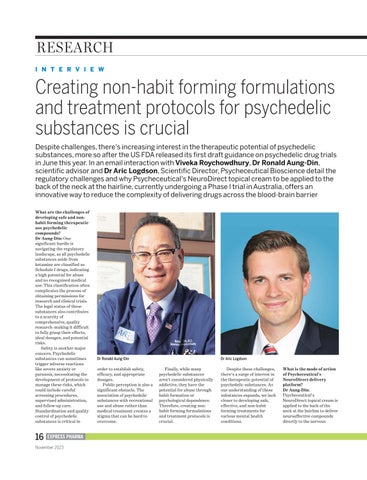
Dr Ronald Aung-Din
order to establish safety, efficacy, and appropriate dosages. Public perception is also a significant obstacle. The association of psychedelic substances with recreational use and abuse rather than medical treatment creates a stigma that can be hard to overcome.
Dr Aric Logdson
Finally, while many psychedelic substances aren't considered physically addictive, they have the potential for abuse through habit formation or psychological dependence. Therefore, creating nonhabit forming formulations and treatment protocols is crucial.
Despite these challenges, there's a surge of interest in the therapeutic potential of psychedelic substances. As our understanding of these substances expands, we inch closer to developing safe, effective, and non-habit forming treatments for various mental health conditions.
What is the mode of action of Psycheceutical's NeuroDirect delivery platform? Dr Aung-Din: Psycheceutical's NeuroDirect topical cream is applied to the back of the neck at the hairline to deliver neuroaffective compounds directly to the nervous
system. Topical ketamine activates receptors on free nerve endings under the skin’s surface at this critical location adjacent to the brainstem. Here, neurochemical reactions communicate with the brain to promote therapeutic benefits without the restrictions of the bloodbrain barrier (BBB). This drug delivery method produces therapeutic benefits within minutes, while reducing or eliminating the side effects commonly associated with other forms of ketamine delivery such as hallucinations, nausea, and dizziness. Psycheceutical’s NeuroDirect ketamine is reportedly the first-ever programme to test the topical application of ketamine for treating mental health disorders. What have been the preclinical results and the way forward? Dr Aung-Din: NeuroDirect ketamine topical cream for the treatment of Posttraumatic Stress Disorder (PTSD) has already shown positive results in an observational preclinical setting. As the inventor of the NeuroDirect delivery system, I’ve been treating PTSD patients with this novel topical ketamine formulation for a number of years through my General Neurology and Neuropsychiatry practice, and currently have several hundred patients using it on a regular basis. I recently published a peer-reviewed study in Drug Development & Delivery which describes the potential of NeuroDirect ketamine topical cream as an improved treatment for PTSD. In 100 patients experiencing intractable depression, anxiety, and other symptoms commonly associated with PTSD, who had failed numerous other treatments–more than 80 per cent experienced symptom relief from the NeuroDirect ketamine
EXPRESS PHARMA
17
November 2023
cream. As quoted in the study: “Discernible improvement[s] in anxiety, depression, paranoia and unrealistic fear, focusing issues, cloudy thinking, neuro-pathic pain, and other such symptoms were noted within 8-10
minutes of topical drug application. No psychogenic effects, such as hallucinations or dissociative phenomena, were experienced by any patient. To the contrary, patients indicated their thought processes were clearer, more
focused, and that they were more keenly aware of surroundings.” What are the therapeutic areas where such braindrug technologies can make a huge difference over current medicines in
terms of patient outcomes, cost and length of treatment? Dr Aric Logdson: Braindrug technologies have the potential to revolutionise treatment in several therapeutic areas, including mental health disorders,
RESEARCH neurodegenerative diseases, and certain types of cancers. Current drug development strategies have relatively low success rates due to the complexity of the brain and challenges in delivering drugs across the blood-brain barrier (BBB). Novel brain-drug technologies could significantly enhance the effectiveness of treatments for conditions like PTSD, Parkinson's disease, and Glioblastoma, thereby improving patient outcomes and potentially reducing side effects and expensive treatment costs. Substance use disorders represent another area where brain-drug technologies can make a
18 EXPRESS PHARMA November 2023
significant impact. Current treatment strategies often involve long-term medication use paired with behavioral counseling. However, innovative approaches could offer more effective and fastacting solutions. For instance, targeted therapies could address the specific brain changes associated with addiction, enhancing recovery rates and preventing overdoses. Brain-drug technologies could also transform how we treat brain tumors. Traditional chemotherapy often struggles to effectively target cancer cells in the brain, due to intrinsic BBB restrictions. However, new brain-drug technologies show promise in navigating the
BBB to effectively treat brain cancer, while reducing side effects. One example is the combination use of advanced imaging and focused ultrasound to transiently open the BBB at the tumour site for chemotherapy. These innovative strategies may improve patient survival rates and reduce the need for traditional treatments that continuously prove to be inefficient. As technology advances and our understanding of the brain continues to evolve, we can expect to become more efficient at treating the causes of these debilitating diseases. Given the challenges, how many companies have
similar development programmes around psychedelic compounds? What are some of the other promising drug delivery platforms in the discovery and preclinical phase? Dr Aric Logdson: There are numerous companies in the psychedelic industry with drug development programmes. However, most are focused on attempting to modify the molecular structure of psychedelic compounds in order to remove the psychedelic effects. This would give them a novel psychedelic compound that they could then patent and control. Unfortunately, this process requires extensive FDA approvals and preclinical
studies, leading to higher expenses and longer timelines. This process differs from Psycheceutical, where we are instead developing next-generation brain-drug technologies to safely deliver established psychedelic molecules with decades of supporting clinical data. Give an overview of the leads in Psycheceutical's development pipeline. Dr Aric Logdson: Our NeuroDirect ketamine topical for the treatment of PTSD is currently undergoing a Phase I trial in Australia. We recently announced the successful dosing of our first cohort of subjects, with key results
RESEARCH from the study confirming that topical administration of NeuroDirect ketamine is safe and well-tolerated. Phase II clinical trials are planned for the beginning of 2024. NeuroDirect ketamine topical is also being tested for the treatment of Complex Regional Pain Syndrome, currently in the preclinical stage. We are also in the preclinical stage of using the NeuroDirect delivery system for the treatment of addiction with an undisclosed psychedelic compound. We round out our drug pipeline with several drug candidates designed to treat Parkinson’s disease and Traumatic Brain Injury (TBI). Given the challenges of designing clinical trials for psychedelic drug candidates, how has the regulatory overview of such trials evolved over time? Has the US FDA's draft guidance, touted as the first psychedelic drug trial guidance, released this June, addressed these challenges adequately? Dr Aric Logdson: We have seen a significant change in the regulatory landscape for psychedelic clinical trials. In the mid-20th century, research on psychedelic drugs quickly dismissed their therapeutic potential due to fears of their abuse liability. A dire need for innovative therapies for brain diseases has led to more public awareness of the potential benefits for psychedelic drugs, especially for treating mental health conditions like depression and PTSD. Regulatory bodies have recently responded to this public acceptance, backed by scientific evidence. The US FDA, for example, has granted "breakthrough therapy" designation for several psychedelic substances, signaling a willingness to expedite their review process. This is a significant departure from previous attitudes, and reflects a revolutionary time to explore the therapeutic potential of these remarkable
EXPRESS PHARMA
19
November 2023
substances. In June 2023, the FDA released its first draft guidance on psychedelic drug trials. This document aims to provide a clear framework for the design and execution of clinical trials involving psychedelic
substances. It addresses key challenges, such as the need for rigorous safety protocols, the importance of set and setting, and the necessity of specialised training for clinicians who administer these substances. While this guidance
represents a major step forward, it's too early to determine its full impact. Further refinements will likely be needed as more data becomes available from ongoing and future psychedelic trials. However, the release of this guidance is
a clear sign of the changing regulatory landscape for psychedelic medicines, and the growing public recognition of their therapeutic potential. viveka.r@expressindia.com viveka.roy3@gmail.com
cover )
20 EXPRESS PHARMA November 2023
As strategic partners for pharma and biotech companies, CDMOs are ramping up their expertise to span the entire life sciences value chain and become enablers of success By Lakshmipriya Nair
EXPRESS PHARMA
21
November 2023
cover ) T
he increasing trend of outsourcing services in the pharma industry has given rise to significant growth opportunities for CROS and CDMOs. More pharma and biotech companies are relying on external service providers for their research, development, and manufacturing needs. The downsizing of major pharma companies and the emergence of smaller biotech firms are further fueling the trend towards increased outsourcing, creating opportunities for expansion in the CDMO sector. As Ramesh Subramanian, Chief Commercial Officer, Aragen explains, “Over the last few years, outsourcing has evolved to play a pivotal role in the growth and development of the pharma and biopharma sectors. From 'good to have’ outsourcing is now recognised as a 'must have' strategy. Outsourcing helps companies ‘variabilise’ their fixed cost by leveraging the cost-effective business models of the CDMOs. It also helps them scale up or down as needed depending on the progress of their programme.” He adds, “Outsourcing is also increasingly seen as an effective risk mitigation strategy. It not only helps mitigate financial risks arising due to project failures at any stage but also helps mitigate operational risks such as supply chain disruptions by ensuring continued operations even during a crisis.”
From 'good to have’ outsourcing is now recognised as a 'must have' strategy. Outsourcing helps companies ‘variabilise’ their fixed cost by leveraging the cost-effective business models of the CDMOs Ramesh Subramanian Chief Commercial Officer Aragen
One of the key challenges for existing CDMOs is to transform from traditional chemistry approach to sustainable/cleaner chemistry approach to help the pharma sector to meet UN carbon footprint goals. We see this as a huge opportunity for CRAMSN Dr Vijay Mathad Chief Operating Officer CRAMSN
Considering the current state of the dynamic industry, to overcome challenges and seize the opportunities, CDMOs must take a proactive approach Yuvraj Dutta Director - Manufacturing & Process Excellence Zeon Lifesciences
The India Advantage India has long been a preferred location for global pharma and biopharma companies to outsource their services. Indian contract development and manufacturing organisations (CDMOs), with their strong technical expertise and regulatory-compliant facilities, have been capable partners to the global pharma industry from clinical supplies to commercial production. Factors such as lower R&D and manufacturing costs, skilled workforce, proximity to specific markets, shared risks and operational experience have nurtured the relationship
22 EXPRESS PHARMA November 2023
between pharma/biopharma companies and Indian CDMOs. Now, this relationship is set to deepen and become more pivotal as CDMOs evolve to keep pace with the shifts in the pharma ecosystem driven by pricing pressures, competition for advanced therapies, and stringent quality and regulatory requirements. An article published earlier
this year by P&S intelligence outlines, “India could be a key gainer of this CDMO transition to the Eastern hemisphere in the coming two decades. The biggest CDMO opportunity in India might be for generic producers, with India supplying almost 40 per cent of the generics to the US already. As per studies, generic manufacturers are witnessing
rapid growth in the global CDMO industry, especially synthetic ones. An idea of the CDMO opportunity available in India can be had from the fact that as per research, 70 per cent of the drugs sold in the country are supplied by CDMOs partnering with major globally operating pharma companies.” As per a report from market intelligence firm BlueWeave
Consulting, the Indian CDMO market will grow to $1,883 million by 2027 at a CAGR of 10.75 per cent. So, how are CDMOs leveraging the immense growth potential by broadening their capabilities and offerings across various treatment categories and stages of the value chain? Let’s examine some key aspects: Expansion and capacity building: Many CDMOs are making strategic investments to bolster their capabilities through expansion of manufacturing and R&D facilities, state-of-the-art equipment and overall infrastructure upgrades to be better positioned to handle large-scale projects in both, domestic and international markets, emerge as attractive partners for global pharma companies and gain a foothold in key pharma markets, as well as align with international quality and regulatory standards. Giving a detailed perspective on how these investments help the pharma sector, Subramanian states, “CDMOs invest extensively in cutting-edge technologies and facilities, staying at the forefront of innovation. Partnering with them can provide access to novel manufacturing processes, analytical techniques, and formulation approaches that can enhance product quality and competitiveness. CDMOs also employ a highly experienced talent pool from a diverse range of scientific domains that can help accelerate drug development and manufacturing processes while maintaining high-quality outcomes.” To cite a few recent examples: Piramal Pharma Solutions invested $11 million to expand drug manufacturing capacity at its Pithampur facility in 2022. The expansion allowed them to boost their production of OSD drugs from three billion to 4.5 billion doses. Earlier, in the same year, the company announced plans to improve high-throughput screening capacity at its Ahmedabad facility to augment in-vitro biology capabilities. Laurus Labs invested Rs 16.5 billion during 2020–2021 and
divulged plans to invest Rs 24 billion over 2023 and 2024 to expand its footprint across the country. Aurigene Pharmaceutical Services, Dr Reddy’s Laboratories’ CDMO unit, is setting up a production facility in Genome Valley, Hyderabad for therapeutic proteins, antibodies and viral vectors with an investment of $40 million. It's expected to be operational by the first half of 2024. The company is also building an additional fill-finish line before the end of 2024. Strategic M&As: An EY article titled, ‘How CDMOs are leading innovation for pharmaceutical partners’ outlines, “CDMOs have increasingly become leaders of innovation and are covering more areas of the pharmaceutical business, not only manufacturing; adding
additional revenue streams. Through acquisitions, CDMOs can rapidly expand their capabilities and, thus, are able to deliver technically advanced services at scale.” While the article, published in 2022, describes the global scenario, it is being mirrored in India as well. CDMOs in India are also looking at mergers and acquisitions (M&As) and strategic alliances to boost their strengths and spur growth. Through these consolidations and collaborations, CDMOs are gaining access to new technologies, expanding their client base, augmenting their geographical presence and diversifying their portfolio of services. This, in turn, is creating a more competitive and dynamic landscape. For instance: Piramal Pharma Solutions
(PPS) purchased a 100 per cent stake in Hemmo Pharmaceuticals for Rs 775 crores in 2021. In the same year, it also expanded its footprint in biologics by purchasing a 27.78 per cent equity in Hyderabad’s Yapan Bio with an investment of Rs 101.77 crores In Jan 2023, Gland Pharma, acquired French CDMO Cenexi Group, for an equity value of nearly Rs 1,000 crores to expand its CDMO business in Europe In April 2023, Biocon Biologics and Serum Institute of India restructured an agreement centering on vaccines and various biological products. Serum Institute increased its total investment in Biocon Biologics to $300 million. The revised pact will grant Serum approximately 4.9 per cent equity stake in Biocon Biologics.
Technology upgrades: Digital and automation technologies are driving a tech renaissance in the pharma industry. CDMOs in India are keeping pace with this requirement by investing in technology upgrades to automate their processes, gain realtime transparency or visibility across their operations, enable key collaboration models and become resilient to disruptions. While many are still in the early stages of this transformation, the CDMO sector is heading towards a more technologically advanced and data-driven future. Some recent cases in point: Sai Life Sciences announced that they are using Dassault Systèmes' industry solution experience ‘ONE Lab’ to bolster security measures and facilitate effortless data access and
analysis. The company is using ONE Lab to create an integrated digital platform for its R&D and chemistry, manufacturing and controls (CMC) laboratories. Zeon Lifesciences, a CDMO for nutraceuticals, upgraded its Paonta Sahib plant enabled with AI and automation technologies to focus on innovations and research advancements in India’s nutraceutical industry Building niche capabilities/ specialisation: The rise of novel therapeutic areas like gene and cell therapies, and biologics has created further growth opportunities for the CRO/CDMO industry. Indian CDMOs are expanding their capabilities in these emerging fields to meet the growing demand from biopharma specialists. These capabilities include
s ti u s Vi at
3 02 2 r be a m ve Noid o C N E th ter P-M to 30 Grea , 8th ntre 2 e , 18 po C B 5, ia Ex 1 l d l Ha In
+91 9900674407 | info@srico-labworld.com | www.srico-labworld.com EXPRESS PHARMA
23
November 2023
cover ) an eclectic range of services for R&D and manufacturing of complex compounds, biologics, cell therapies, and personalised medicines. Examples: Syngene International, a subsidiary of Biocon, is planning to invest over $100 million annually with a primary emphasis on research, biologics, and small molecules. Reportedly, over the last five years, the company has already invested around Rs 4,500 crores Enzene Biosciences, a biopharma company offering integrated CDMO services for biologics, recently inaugurated an R&D facility in Pune. Spanning over 75,000 sq feet, the facility offers integrated services
24 EXPRESS PHARMA November 2023
India’s pharma CRO/CDMO sector is arming itself with new-age facilities, cutting-edge solutions, a talented workforce and strategic investments to meet the increasing demand for contract services and emerge as partners of choice for pharma and biopharma companies. CDMOs in India are poised to play a pivotal role in driving innovation and supporting the development of new therapies and treatments from cell line development to fill and finish across a wide range of modalities
Aragen is constructing a biologics manufacturing plant in Bengaluru, involving an invest-
ment of $30 million. This is a forward integration strategy to position Aragen as a compre-
hensive "gene to clinic" solution provider for biologics. Aragen has also established a new vivarium in Bangalore, enhanced the reagent generation labs in Hyderabad, and introduced new capabilities such as oligonucleotides and photochemistry In September 2023, Strides recently announced the launch of ‘OneSource’, a speciality pharma CDMO covering biologics, complex injectables and oral technologies (soft-gelatin capsules).
Opportunities galore Thus, India’s pharma CRO/CDMO sector is arming itself with new-age facilities, cutting-edge solutions, a talented workforce and strategic
investments to meet the increasing demand for contract services and emerge as partners of choice for pharma and biopharma companies. The country's favourable regulatory environment and strategic geographical location also provide a competitive advantage to this sector. CDMOs in India are poised to play a pivotal role in driving innovation and supporting the development of new therapies and treatments. We are also witnessing the expansion of this sector with newer players. The MSN Group’s launch of a new CRO/CDMO vertical called ‘CRAMSN’ to provide end-toend chemistry solutions, from discovery to launch illustrates this point. Explaining the business rationale behind setting up
this vertical, Dr Vijay Mathad, COO, CRAMSN, informed, “One of the key challenges for existing CDMOs is to transform from traditional chemistry approach to sustainable/cleaner chemistry approach to help the pharma sector to meet UN carbon footprint goals. We see this as a huge opportunity for CRAMSN as we have world-class R&D infrastructure with green chemistry technologies to accelerate drug discovery and development process by reducing CO2 emission levels.” CRAMSN supports solutions like flow chemistry, bio-catalysis, highly potent compound development and manufacturing etc. The sector is also receiving a lot of investments. Advent International’s majority acquisition
of Suven Pharma, a CDMO, is a case in point. Advent acquired a 50.1 per cent stake in Suven at an agreed price of Rs 495/share. But, the sector has its share of challenges too such as traditional mindsets and internal resistance to change, infrastructural constraints, a disruptive environment etc. Opining that a proactive approach is needed to overcome these challenges, Yuvraj Dutta, Director of Manufacturing & Process Excellence at Zeon Lifesciences recommends a few measures that can set CDMOs on an accelerated growth path: Change management: Implement comprehensive change management strategies to address internal resistance. Engage employees, provide
training, and communicate the benefits of the transition to gain buy-in. Strategic vision: Develop a clear strategic vision for the transition. Outline specific goals, milestones, and the desired outcome. This vision should be aligned with the organisation's long-term strategic roadmap. Invest in infrastructure: Allocate resources to upgrade infrastructure and technology. This investment is essential for accommodating the evolving needs of clients and regulatory changes. Agility and flexibility: Develop agile processes and systems that enable quick responses to client expectations and adaptability to changing regulations Client-centric approach:
Prioritise understanding and align with the ever-evolving needs of pharma clients. Tailor services to meet their specific requirements and expectations.
Thriving in times of disruption As the pharma industry continues to evolve, the roles of CDMOs will also have to continuously transform. Their capacity to provide holistic support will ensure their relevance and reinforce their position as indispensable partners in the life sciences industry. Therefore, adaptability and commitment to innovation will be pivotal to driving the sector forward. lakshmipriya.nair@expressindia.com laxmipriyanair@gmail.com
THORNTON
Leading Pure Water Analytics
52
Colony 1 Colony 2
microbes
Colony 3
41
microbes
132
microbes
Plate Counting:
7000RMS Analyzer:
3 colonies identified
225 microbes identified
Count Microbes, Not Colonies With Real-time Microbial Detection No more incubation periods, no more uncertainty with bacteria contamination. Get real-time results with the 7000RMS™. • Continuous on-line monitoring of microbial contamination in pharmaceutical water systems • Immediate detection of bioburden eliminates delays in product release • Compliant with USP <1223> and <1231> requirements
To learn more, call us Toll Free 1800 22 8884 1800 10 28460 or email sales.sales@mt.com
www.mt.com/7000RMS
EXPRESS PHARMA
25
November 2023
TECHNOLOGY
Embracing Pharma 4.0: Pioneering future of healthcare Saransh Chaudhary, President, Global Critical Care,Venus Remedies and CEO,Venus Medicine Research Centre emphasises that it is imperative to foster innovation, nurture collaboration and harness the power of digital technologies to pave the way for a healthier and more sustainable world
I
n the world of pharma, a new era has dawned in the form of Pharma 4.0. This isn't just a tech-driven upgrade; it's a transformative shift that brings digital innovation into the very heart of pharma manufacturing. Imagine a world where pharma production is not only efficient but also of superior quality and higher compliance standards. Pharma 4.0 is a vision that adapts digital strategies to the intricate landscape of pharma manufacturing, resulting in enhanced connectivity, improved productivity, streamlined compliance and the ability to address emerging issues promptly.
A data and digital revolution Pharma 4.0 thrives on a diverse spectrum of data. It encompasses information about material supplies, historical data on strains, details of experimental designs, raw process data, analytical findings, derived process insights, associated metadata, statistical models, mechanistic models and holistic models like integrated process models and digital twins. It also includes analysis workflows, validation processes and meticulous batch records. These data sources collectively provide a comprehensive view of the pharma manufacturing journey. Supporting this datadriven transformation is a suite of digital technologies. These include Big Data analytics, the Internet of Things (IoT), and artificial intelligence (AI). Additionally, advanced robotics, 3D printing, drones and cloud computing are integral parts of this digital metamorphosis. Together, they enable the seamless collection, analysis and application of data across the pharma value chain.
26 EXPRESS PHARMA November 2023
vanced scheduling optimisation enabled by a modular and adaptable digital-twin platform tailored to the specific scheduling constraints of the laboratory.
Suitably aligned with UN SDGs
The significance of Pharma 4.0 Pharma 4.0 is not merely a technological leap. It’s a paradigm shift in how we approach healthcare. It empowers us to detect diseases at their nascent stages, provide quicker and more accurate diagnoses than ever before and pave the way for innovative therapies, particularly in the fight against various forms of cancer. Beyond this, it equips us to respond adeptly to global health challenges while fostering sustainability. By harnessing the potential of data and digital technologies, we can improve patient outcomes, curtail healthcare costs and ensure the delivery of top-notch care.
Harnessing data and digital advancements Every phase of a pharma product's lifecycle, spanning design, manufacturing and delivery, contributes to a vast pool of data that Pharma 4.0 leverages. This data-driven approach empowers companies to make informed decisions and fuel innovation, ultimately shortening the time it takes for a product to move from concept to delivery. The suite of digital technologies can be harnessed in myriad ways. For instance, AI can sift through vast datasets to identify patterns and make predictive insights, while IoT devices
continually collect real-time data from manufacturing processes, facilitating ongoing monitoring and optimisation. The fusion of data and technology elevates the pharma manufacturing process to new heights.
The impact of data and digital technologies The repercussions of embracing data and digital technologies in Pharma 4.0 are profound. Networked digital technologies and advanced automation work in unison to deliver efficiencies through realtime process optimisation and expedited decision-making. One study suggests that the integration of digital processes within Pharma 4.0 could yield savings exceeding 20 per cent. This includes a notable 17 per cent reduction in costs linked to product quality issues and a 14 per cent improvement in delivery reliability. Moreover, Pharma 4.0 has the potential to boost production by a staggering 200 per cent as compared to current capabilities. A real-world illustration underscores this transformative potential. A prominent global pharma firm transitioned to a digitally enhanced laboratory within its Italian digital lighthouse plant. This move led to an astounding 30 per cent increase in lab productivity, attributed to ad-
The United Nations Sustainable Development Goals (UN SDGs) are a universal clarion call to combat poverty, protect the environment, and ensure global peace and prosperity, and Pharma 4.0 has a pivotal role to play in advancing these goals. For instance, by enhancing the efficiency of pharmaceutical manufacturing, we can reduce waste and minimise our environmental footprint, thereby contributing to SDG 12 (Responsible Consumption and Production). Furthermore, by improving the quality and accessibility of medicines, we can drive better health outcomes, thereby making significant strides towards SDG 3 (Good Health and Well-being).
The synergy of One Health and Pharma 4.0 One Health is a holistic approach that seeks to balance and optimise the health of people, animals and ecosystems sustainably. It recognises the intricate interconnectedness of human, animal, and environmental health. Pharma 4.0, with its focus on digital integration and datadriven decision-making, can be a potent ally in championing the One Health cause. By harnessing data from diverse sources, we gain a comprehensive perspective on health challenges and can devise more effective and sustainable solutions.
Harnessing it to address the AMR challenge Antimicrobial Resistance (AMR) is a grave global challenge rooted in the overuse
and misuse of antibiotics. At Venus Remedies, we acknowledge the gravity of this issue and are resolute in our commitment to devise innovative and effective solutions to combat AMR. Pharma 4.0 can play a crucial role in this endeavour. By harnessing the power of data and digital technologies, we can deepen our understanding of AMR, develop more efficacious antimicrobial agents and ensure their judicious utilisation.
A commitment to Pharma 4.0, AMR and UN SDGs We, at Venus Remedies, are driven by an unwavering dedication to develop innovative solutions that enhance patient outcomes. We proudly stand as one of India's largest manufacturers of meropenem, a last-resort antibiotic, and offer an extensive array of pharmaceutical products spanning diverse therapeutic domains, including anti-infectives, oncology and pain management. Additionally, we are proud members of India AMR Innovation Hub (IAIH), a collaborative platform steadfastly devoted to mitigating the burden of AMR in India.
Forging a sustainable future To sum it up, Pharma 4.0, the UN SDGs, One Health and the fight against AMR are all interwoven strands of a comprehensive tapestry. Embracing Pharma 4.0 is our compass, guiding us towards the realisation of the UN SDGs, championing the cause of One Health and coming out resilient against the threat of AMR. As we march forward, it remains imperative that we continue to foster innovation, nurture collaboration and harness the power of digital technologies to pave the way for a healthier and more sustainable world.
Deploying dehumidifiers to protect integrity of pharma industry To protect the integrity of the pharma industry while accelerating its growth, pharma manufacturers should adopt advanced and energy-efficient dehumidification solutions, emphasises Dhirendra Choudhary, CEO, Bry-Air
I
ndia's pharmaceutical industry has emerged as a global powerhouse, supplying high-quality medicines and vaccines worldwide. The sector has experienced remarkable growth, with the market reaching $49.78 billion in FY23, driven by both domestic and export demand. Projections from the CareEdge Ratings report indicate that the industry could reach an astounding $57 billion by FY25, with even more substantial growth on the horizon. There are several factors driving the growth of the Indian pharma sector, including heightened awareness around healthcare and improved access to medical services throughout the nation. The evolving health consciousness among Indians is shaping the pharma market, where it is evolving as a pivotal player addressing diverse healthcare needs. This growing awareness is giving impetus to greater demand for pharma products to address a wide spectrum of health conditions. Along with this, the healthcare infrastructure is working towards ensuring medical facility accessibility to a larger portion of the population. All the factors together are am-
plifying the need for pharma interventions. With over 3000 pharma companies and approximately 10,500 manufacturing facilities, the industry is highly competitive. To meet the increasing demand for quality healthcare products, maintaining the highest standards in pharma manufacturing is paramount. However, one often-underestimated challenge that threatens product integrity is moisture. It presents a significant threat to pharma manufacturing. Even the slightest presence of moisture within a facility can severely compromise product quality. It can initiate biochemical reactions, causing organic corrosion and create conditions conducive for the growth of unwanted microorganisms, affecting product accuracy. To produce top-quality pharma products, maintaining consistent dry conditions throughout various production stages, from processing and manufacturing to storage, research, testing, and packaging, is essential. Dehumidification solutions offer an effective means of controlling humidity in pharma manufacturing. These solutions employ desiccant dehumidifiers to main-
tain relative humidity (RH) as low as one per cent or lower during critical processes, ensuring product quality throughout its shelf life. The impact of moisture on pharma processes can be profound. It can cause materials to become resilient, resisting grinding and pulverising operations, further leading to issues such as tablet disintegration, lumping, caking, uneven coating, and decomposition of formulations. Sluggish and inconsistent performance of pneumatic valves and cylinders can also be attributed to
excess moisture. Such issues can lead to product recalls and damage a company's reputation. More than that, they can negatively impact the safety and quality standards of the final product. People are increasingly becoming hyper-aware across the world, in all aspects of their lives. Among these, one’s health and wellness tops the list. So, it has become all the more essential for healthcare providers to adhere to international quality standards like those set by the Food & Drug Administration (FDA). In order to excel in today's technologically advanced landscape, pharma companies must leverage cutting-edge technologies to optimise their operations. This proactive approach is essential to ensuring that they remain at the forefront of their industry. Meeting the increasing demand for pharma products requires continuous improvement while maintaining unwavering reliability and consistency, which are paramount in the healthcare sector. To protect the integrity of the pharma industry while accelerating its growth, pharma manufacturers should adopt advanced and energy-efficient dehumidification solutions.
Bry-Air's patented P95°x Dehumidifier, which regenerates the desiccant wheel at 95°C compared to the industry standard of 140°C, achieving over 30 per cent energy savings. This technology not only ensures the highest product quality but also contributes to sustainability efforts and costeffective production. In today’s world, these factors are crucial for both the consumer and the manufacturer. Moreover, these advanced dehumidification solutions offer extreme cleanliness and hygiene standards, vital in the pharma industry. By minimising downtime and delivering cost-effective, high-quality pharma products, they support the industry's expansion on the global stage. As India strives to solidify its position as the "pharmacy of the world" and compete in the international pharma market, manufacturers must be agile and adopt advanced dehumidification solutions. The adoption of cutting-edge technology for providing an optimal environment for pharma manufacturing can pave the way for expanding exports while maintaining the industry's reputation for producing safe and effective medicines.
EXPRESS PHARMA
27
November 2023
POLICY
Increased use of AI in pharma questions patentability status With increasing usage of AI in the pharma sector, Rashmita Das, Content Strategist, United & United addresses key questions such as AI’s eligibility as an inventor and other patent-related difficulties of AI-generated medicinal molecules
T
he main reason for the increasing popularity of Artificial intelligence (AI) is that it develops programmes or models resembling human deduction or reasoning. A subset of AI known as "machine learning" uses algorithms trained on vast amounts of data to enable the computer to learn with ever better accuracy without being explicitly programmed. Massive volumes of data are generated in the biopharma and healthcare industries, including information on the properties and traits of medicinal molecules, biological, genetic, and clinical data, the effectiveness of treatments, adverse events and dangers, and electronic health records. Numerous sources, both public and private, may provide the data. AI systems trained on such data can increase productivity and save costs by streamlining and optimising drug development, including drug discovery, disease diagnosis, risk identification, planning clinical trials, and forecasting safety and efficacy profiles. AI can utilise algorithms to analyse massive datasets about various chemical substances and suggest new therapeutic candidates for future testing. Instead of using conventional medicinal chemistry techniques, AI has the potential to "conceive" new chemical entities with expected efficiency and safety properties by modifying current chemical compounds using algorithms and biological and chemical data. AI can also discover novel applications for already-existing medications or chemical substances. AI may also analyse past clinical
28 EXPRESS PHARMA November 2023
trial data to forecast future outcomes and dangers of medication candidates. AI may analyse medical histories, genetic information, and health records to discover candidates for clinical trials. This improves efficiency and recruitment. Lastly, personalised medicines based on genetic information and particular medical histories may be developed by AI employing algorithms and patient data. In other words, AI has the potential to transform the pharma industry completely.
What are the patent-related difficulties that must be taken into account while employing AI to produce medications? Can AI-generated medicinal molecules, for instance, be patented? Who owns inventions made by AI? Some of these difficulties will be covered in this essay.
What will be the patent eligibility? India has shown an impressive improvement in the pharma industry in the last four years. The booming
trend of IP and patent registration in India ascertained that from $3.2 billion in 2021 to $1.4 billion in 2022, India's overall investment in health technology start-ups fell by 55 per cent. Before 2019, India's healthcare industry reported receiving $586.93 million in total investment. Therefore, it can be said that the Indian healthcare business is growing at a good rate despite the COVID-19 situation acting as a hindrance. It is anticipated that India's medical device industry
will be worth $50 billion by 2025.12 Due to the COVID-19 problem, India has a unique chance to alter some of the rules controlling the distribution of medications and drug testing. Considering the practical scenario of the patent process in India, explaining how an AI model functions to turn the assertion into a creative idea could be challenging. However, a candidate can continue to concentrate on the details of the data input and the generative output of an AI model. Let's have a glance at the eligibility criteria for patents in India: z Novelty: To determine a creation's patentability, wonder is essential. The design must produce new knowledge, a new item, or a new process. Any document, patent granted, published patent, non-patent literature, or other work already in the public domain should not be used to anticipate it. It must be different from what is already understood. z Inventive step: The inventor must make a creative contribution to the invention. It needs to be something that a skilled craftsperson wouldn't anticipate. Let's say an innovator creates a device to address a technological issue. A different expert in the same sector offers the same solution by drawing on his knowledge or absorbing instruction. The inventor's technical solution will only be considered original if it was a suggestion or motive. z Industrial application capabilities: Section 2(ac) of the Patents Act states, "the creation is potent of being
POLICY utilised or manufactured in a sector." It implies that a product must be helpful and patentable because the invention cannot exist in the abstract and must apply to all fields. z Specification: The inventor must submit a patent application with a specification to get a patent (Section 10). The objective of the specification is to provide thorough information to the public about the innovation and the means of carrying out and defining its scope. When discussing the eligibility of artificial intelligence as an inventor, we need to explore the scope of inventors.
Can AI make itself eligible as an inventor? Before we dive deep into whether AI can be considered
30 EXPRESS PHARMA November 2023
a valid inventor, we need to understand the concept of AI utilised in invention works. Artificial intelligence is a helping hand in several industries, including improving processes, enhancing industry productivity, and impacting operations and revenue. Artificial intelligence's increasing ability to devise innovative solutions is throwing a challenge to the boundaries of the existing patent laws that were beyond the imagination of the legislature. The new draft of the Patent law in India has brought several necessary changes to be implemented for better patent regulation. However, it still does not consider AI as a valid inventor. Taking the reference from the US patent law, it is worth mentioning that the USPTO
considered that question in 2019, publishing a request for comments on patenting artificial intelligence inventions. The query involved whether current patent laws adequately address inventorship for AI-created innovations, typically created without human intervention. Many commenters agreed that new policies are required to ensure that AI-generated inventions are adequately recognised and protected, even though the responses to the USPTO's request showed a wide range of opinions on AI patent inventorship. This case added a valuable opinion to help the USPTO as it investigated the ethical and legal concerns related to AI inventorship. The case involved two patent applications submitted
in 2019 by Stephen Thaler, the creator of the AI system DABUS (Device for the Autonomous Bootstrapping of Unified Sentience) — who was listed as the inventor. The USPTO denied the applications because there was no legitimate inventor, deeming them deficient. Using U.S. Court of Appeals for the Federal Circuit rulings that reached identical results in denying inventorship status to states and companies, the USPTO held that the Patent Act only grants inventorship to natural persons. In another case, Thaler vs. Vidal, the Federal Court ruled that the inventor must be a natural person. AI is not a natural person; an invention solely made by AI would not be eligible for patent protection or the title of inventor.
Conclusion By following this line of reasoning, AI would be viewed as a tool humans use to carry out scientific study; much like a person may use a computer, a DNA sequencer, or other laboratory apparatus. The person employing the tools would be given credit for the finished product. As a result, if AI creates a chemical compound with the potential for activity, the idea for the compound would be credited to the person who oversaw or guided the AI to produce the compound's structure. Furthermore, it may be argued that an innovation is not a "permanent idea of a complete and operative invention" until a human mind affirms its usefulness. No matter how independent artificial intelligence becomes, human intelligence still needs to verify it.
BUSINESS AVENUES
EXPRESS PHARMA
EXPRESS PHARMA
November 2023
31
BUSINESS AVENUES
32
November 2023
EXPRESS PHARMA
EXPRESS PHARMA
BUSINESS AVENUES
EXPRESS PHARMA
EXPRESS PHARMA
November 2023
33
BUSINESS AVENUES
EXPRESS PHARMA
M. K. Silicone Products Pvt. Ltd. S I L I C O N E T R A N S P A R E N T T U B I N G
for the Quality Conscious….
RTIFIED CE
Serving 1997
L
C
An ISO 9001-2015 COMPANY
IS0 8
Since
EA
NRO
November 2023
®
®
O
208, Hill View Industrial Premises, Amrut Nagar, Ghatkopar (W), Mumbai - 400 086, India. Tel.: 022-2500 4576 Mob.: 93219 65968 E-mail : sales@mksilicone.com
34
®
Blue Heaven
QM 002
M
INDIA
EXPRESS PHARMA
BUSINESS AVENUES
! 01 #2 /// "
EXPRESS PHARMA
EXPRESS PHARMA
! "# $%% %&' ! # ( )*+ , , . " ///
November 2023
35
BUSINESS AVENUES
36
November 2023
EXPRESS PHARMA
EXPRESS PHARMA
BUSINESS AVENUES
EXPRESS PHARMA
IMPLANT / CO-EXTRUSION SETUP
EXPRESS PHARMA
November 2023
37
BUSINESS AVENUES
EXPRESS PHARMA
OsmoTECH® XT Single - Sample Micro-Osmometer Now available! Best-in-class osmolality performance, designed with you in mind.
HIGHLIGHTED FEATURES:
Offers the widest range of osmolality testing (0 – 4000 mOsm/kg H2O) Supports 21 CFR part 11, GMP and EU Annex 11 compliance Meets Pharmacopeia osmolality testing guidelines 3 Level user access and password protection Storage: unlimited data storage for access Audit trail: Preserve unlimited results and events Database backup, protects your data with automatic or manual backup
No. 127, Bussa Udyog Bhavan, Tokershi Jivraj Road, Sewri West, Mumbai-400015, Maharashtra, Landline : +91 022 - 24166630 Mobile : +91 9833286615
38
November 2023
EXPRESS PHARMA
BUSINESS AVENUES
EXPRESS PHARMA
EXPRESS PHARMA
November 2023
39
BUSINESS AVENUES
EXPRESS PHARMA
To Advertise in
Business Avenues
Email: rajesh.bhatkal@expressindia.com rbhatkal@gmail.com
40
November 2023
EXPRESS PHARMA
BUSINESS AVENUES
EXPRESS PHARMA
EXPRESS PHARMA
November 2023
41
BUSINESS AVENUES
42
November 2023
EXPRESS PHARMA
EXPRESS PHARMA
BUSINESS AVENUES
EXPRESS PHARMA
EXPRESS PHARMA
November 2023
43
BUSINESS AVENUES
44
November 2023
EXPRESS PHARMA
EXPRESS PHARMA
BUSINESS AVENUES
EXPRESS PHARMA
EXPRESS PHARMA
November 2023
45
BUSINESS AVENUES
46
November 2023
EXPRESS PHARMA
EXPRESS PHARMA
PHARMA PULSE
Maximise efficiency with L.B.Bohle's container blenders Tests and process optimisation in Hyderabad
T
he first L.B. Bohle container blender was produced in 1987 - since then, the German technology company has manufactured several thousand blenders. Every day, a wide variety of blending systems are used in production lines around the world. Thanks to the innovative design, flexibility, and long service life of the machines, L.B. Bohle has become the world market leader for pharmaceutical container blenders.
High flexibility and scalability The blender product portfolio is characterised by a high degree of flexibility in design and production. This allows the blenders to be adapted to the customer's individual production requirements and daily specifications. All Bohle container blenders are used in all conceivable production scenarios in pharmaceutical, chemical and nutraceutical production. Thanks to the patented mixing elements installed on the inside of the container lid, all blending systems allow a very homogeneous blending of the powder batch. Depending on the process, scalability up to 12,000 liters is possible. As standard, the blending containers are supplied as exchangeable containers with a volume of up to 2,400 liters. Due to the innovative blending systems, each blending container can be used for effective blending between 20 and 85 percent of the total container volume for densities between 0.2 - 1.2 kg/dm³. Another important design feature is the choice of pick-up systems: L.B. Bohle offers its customers five different pick-up systems.
Electronically monitored quick clamps Versions with standard load arm and clamps are most frequently requested. Containers are docked using four electron-
ically monitored quick clamps. Containers with a volume of up to 1,200 liters, which are mounted on an undercarriage, can be adapted to the blender without the need for additional lifting equipment. Optionally, a chopper can be installed in the container lid can be used. The drive of this chopper is integrated into the load arm of the blender. Another blender design is a version where the system can be swiveled around its vertical axis. This allows for optimum adaptation to the customer´s requirements. Long service life and extremely low maintenance requirements are other advantages of this design. In another popular version of the pharmaceutical blender, the container with its adapter tubes is slid onto two receiving mandrels. Two screws on the front side grip the container and prevent it from slipping. As with other Bohle mixing systems, the container is lifted through the mixing systems and rotated.
Ideal solution for automated container pick-up In the third version of L.B. Bohle blending systems, the load arm is equipped with eccentric clamps. Containers are picked up with tines and automatically clamped by eccentric movement in the pick-up tubes, the so-called adapter tubes. This is a very safe pick-up method that is ideal for automated container pick-up, e.g. on a guide rail. If the containers are equipped with a circumferential frame, they can also be picked up and set down in an inverted position. This model is also available in a swivel version that can be rotated around the vertical axis. A fourth version is equipped with a load support with power clamps. These apply pressure to the lower frame of the upright, ensuring that the container is tightly clamped to the load support.
EXPRESS PHARMA
47
November 2023
PHARMA PULSE They can be adjusted either via the upright or via support rails on the machine body. Load handling can be either straight or at an angle of up to 30 degrees to accommodate existing blending processes. This system has proven itself in many years of use on Bohle's SFM mixers. The fifth version is a system where the load arm is equipped with hydraulic clamps. The containers are hydraulically clamped between the fixed and moving parts of the load arm. Various sensors with appropriate controls ensure safe operation of the system. The load handling can be adapted to different types of containers. It is also possible to pick up containers at an angle of 30 degrees. In combination with a lifting unit, the design is particularly flexible and, above all, has a small footprint. All of these five versions of L.B. Bohle mixing systems demonstrate the flexibility of the design, regardless of the type of container used in production. Conclusion: Bohle blenders can handle round or square containers with excellent blending results.
Laboratory blenders for R&D L.B. Bohle has developed the LM 40 laboratory blender
allows easy scale-up to the required production size, providing scalable results from 5 to 12,000 litres. Blending results can be easily transferred to a production scale blender.
Innovation Center: Blending trials in Hyderabad
specifically for research and development applications, offering high flexibility, mobility, scalability and rapid discharge. The modern laboratory blender are designed for optimal homogeneous blending of pharmaceutical solids. The excellent efficiency of the LM 40 is attributed to the innovative proprietary L.B. Bohle countercurrent process principle. This unique method also protects the operator and the product from contamination during processing. The state-of-the-art LM 40 laboratory blender is optimised
for R&D applications and meets all current GMP requirements regarding design, operation, and control. It has a compact flexible design. The blending technology is powered through an AC motor located inside the machine housing for maximum efficiency. The control panel is also integrated into the machine housing for easy access. Equipped with adapter tubes, the containers are easily picked up by the laboratory blender's integrated forklift pick-up system. Flexibility al-
lows square containers, drums, double-cone containers, Vshells and other specialty containers to be used for blending. In addition, the optional mobile lifter ensures that all containers and bowls can be easily removed. Compact, single-axis rotation and a small footprint make this laboratory blender ideal for space-constrained environments.
Scalable production output from 5 to 12,000 liters The LM 40 laboratory blender
L.B. Bohle's test and development center in Hyderabad offers perfect conditions for product testing and process optimisation. The LM 40 laboratory blender and the PM 600 container blender provide the perfect environment for learning and technical advancement. In the few last month many customers have visited the Innovation Center with their formulation problems. In successful trials the L.B. Bohle India team solves formulation problems for e.g., Rosuvastatin, Levothyroxine, Vardenafil, Amitriptyline, Sirolimus or Tacrolimus, so that the customers could achieve BU. Contact L.B Bohle's Indian team for trials in Hyderabad at its Innovation Center: Parag Radia Director L.B. Bohle India p.radia@lbbohle.com +91 987 959 8784
CONTRIBUTOR’S CHECKLIST ❒ Express Pharma accepts editorial material for
❒ We welcome information on new products and
regular columns and from pre-approved contributors / columnists. ❒ Express Pharma has a strict non-tolerance policy of plagiarism and will blacklist all authors found to have used/refered to previously published material in any form, without giving due credit in the industryaccepted format. All authors have to declare that the article/column is an original piece of work and if not, they will bear the onus of taking permission for re-publishing in Express Pharma. ❒ Express Pharma's prime audience is senior management and pharma professionals in the industry. Editorial material addressing this audience would be given preference. ❒ The articles should cover technology and policy trends and business related discussions. ❒ Articles for columns should talk about concepts or trends without being too company or product specific. ❒ Article length for regular columns: Between 1200 1500 words. These should be accompanied by diagrams, illustrations, tables and photographs, wherever relevant.
services introduced by your organisation for our various sections: Pharma Ally (News, Products, Value Add), Pharma Packaging and Pharma Technology Review sections. Related photographs and brochures must accompany the information. ❒ Besides the regular columns, each issue will have a special focus on a specific topic of relevance to the Indian market. ❒ In e-mail communications, avoid large document attachments (above 1MB) as far as possible. ❒ Articles may be edited for brevity, style, and relevance. ❒ Do specify name, designation, company name, department and e-mail address for feedback, in the article. ❒ We encourage authors to send their photograph. Preferably in colour, postcard size and with a good contrast.
48 EXPRESS PHARMA November 2023
Email your contribution to: The Editor, Express Pharma, Business Publications Division,
The Indian Express (P) Ltd, Mafatlal Centre, 7th floor, Ramnath Goenka Marg, Nariman Point, Mumbai 400021 viveka.r@expressindia.com viveka.roy3@gmail.com
PHARMA PULSE
B&R India organises 7th Innovations Day in Pune Empowering Indian manufacturers to build an adaptive manufacturing ecosystem
T
o showcase new technologies and solutions for the Indian market, B&R Industrial Automation recently organised Innovations Day on August 31, 2023, in Pune to experience the future of automation with ground-breaking innovations, especially for machine builders, system integrators and end users. The event brought esteemed manufacturers and experts from leading companies in machine building together for an event that catapulted some of the finest business presenta-
like ACOPOStrak, ACOPOS 6D, Integrated Machine Vision and Machine-Centric Robotics solutions. The products featured some of the finely tuned applications to help the delegates experience and understand the different benefits adaptive manufacturing possesses and how easy it is to switch over and implement into their existing system. Adaptive manufacturing has already been a frequent topic of conversation globally, but being able to understand and implement it seamlessly
Accelerating collaboration and innovation with business partners B&R management from Austria and India shared their outlook on industry trends and business growth with delegates. They emphasised the innumerable opportunities the Indian market possesses and how adaptive manufacturing can help machine manufacturers build a sustainable future with B&R products and solutions. The conference started with a B&R global up-
Jhankar Dutta presents ways to empower Indian machine manufacturers and prepare them for the future with adaptive manufacturing
tions, talks from renowned leadership speakers, and candid conversations. This event centered on demonstrating adaptive manufacturing technologies and spreading knowledge among machine builders. The conference witnessed more than 300 attendees, exploring the various capabilities and innovative features of the products displayed and presented from the Innovations basket of B&R.
Adaptive technologies are transforming the way of manufacturing The Innovations Day event focused on adaptive manufacturing with the tagline "Think Adaptive for the Future", which was the theme for this year's event. Delegates gained inspiration for business growth through various demos showcased by B&R; they witnessed product applications through live demos
come adaptive, efficient, and sustainable. Wlady Martino, Adaptive Global Expert at B&R, along with Dinesh Mungi, B&R India Branch Head-Pune and Packaging Expert, helped manufacturers walk through the various opportunities of adaptive advancements globally. Delegates gained inspiration for their business growth with insights from Sumit Dhingra, Director of Supply Chain, Unilever India. He has led businesses at Unilever with his diligent understanding of the end-user market and
adaptive manufacturing. The conference concluded by inspiring everyone and facilitating an insightful interaction among the delegates, with B&R India achieving a milestone and completing 25 years of successful business in India. The entire B&R team marked this event with great vigour and thanked everyone in good spirits. The event was well appreciated by the attendees and presenters for organising a medium to bring an innovative acceleration of minds to building a nation with a secured future. For
B&R India celebrates 25 years
Delegates getting engaged with ACOPOStrak and exploring the digital twin possibilities
Acopos 6D demo showcasing the 6 dimensions in manufacturing
along with other running machines was well appreciated by the attendees at the event. The leaders and the presenters also acquainted everyone with the sustainability benefits of adaptive manufacturing technology and how every machine builder should aim to achieve their sustainability targets by implementing such innovations in their manufacturing facility.
showed us a glimpse of the market scenario to achieve momentum. He also added how machine builders can catalyse market opportunities by providing solutions with zero manufacturing defects. Adding depth to the market capitalization and how technology itself can bring profit for machine builders, Varun Gude, Director, Avaj Innopack, explained the varied benefits of
date by Joerg Theis, Chief Executive Officer, B&R, followed by a global sales update by Luca Galluzzi, Chief Sales Officer, B&R. Addressing India’s growth journey towards building innovative solutions and empowering Indian machine builders, Jhankar Dutta, B&R’s Regional Managing Director for Southern and Eastern Asia, uprooted some inspiring points to help customers be-
all participants, including customers, partners and journalists, the conference provided the know-how and an easy path for successful implementation of adaptive technologies in machines and factories to succeed in the dynamic world of manufacturing. For more information, visit www.br-automation.com
EXPRESS PHARMA
49
November 2023
PHARMA PULSE
JRS Pharma - The Global MCC Manufacturing Network JRS Pharma is one of the largest manufacturers of MCC across the globe. The know-how is based on more than 25 years of experience in development of own processes
S
ince its introduction in 1964, Microcrystalline Cellulose (MCC) has revolutionised the pharma industry, serving as a vital ingredient in various drug formulations due to its unique properties like compressibility, flowability, and stability. Today, it is one of the most widely used excipients in pharma, cosmetics, food, and other industries. Its invention has significantly contributed to enhancing the efficacy, safety, and overall quality of pharma products. Another remarkable feature of MCC is its biocompatibility, making it safe for human consumption. The fact that it is derived from a natural and renewable source (cellulose from plant fibers) further adds to its appeal as a pharma excipient. MCC is a crucial universal commodity with high demand and long term need for availability at almost all times. Being used in very high volumes in oral solid dosage forms, identifying, predicting and managing certain risk factors, which are mentioned below are a big challenge for procurement teams and also an essential part of a future oriented supply chain management strategy. Years in recent past have shown many sudden situations to us like once-in-a-century pandemic and geo-political sit-
50 EXPRESS PHARMA November 2023
uations affecting businesses like never before. In addition to these, here are few risk potentials working adversely to global pharma operations – Climate change/extreme weather conditions Natural calamities like earthquakes/floods/droughts Epidemics Civil wars Transportation shortages Resource availabilities Digital and energy system instability Cyber crime Currency fluctuations Accident, fire, explosion scenario Population growth To overcome those risk potentials, JRS Pharma provides solutions optimised for individual customers’ global supply chain needs for pharma and other related industries. They offer a perfect high level partnership, combining synergies and advantages of a global manufacturing concept – based on standardised and quality regional production facilities:
Excellence in MCC know-how JRS Pharma is one of the largest manufacturers of MCC across the globe. The knowhow is based on more than 25 years of experience in development of own processes. JRS in-
novated and improved these processes with advanced and specially designed equipments. It gives much better control, excellence and reproducibility of the process, end-product resulting in consistent quality.
Reliable premium quality Strict control on input raw material source, quality and other parameters also play important role on output consistency. The compliance with global compendial monographs and additional internal specifications, such as TUPs and high degree of brightness are tested by local quality control labs.
Technical support In addition to these, JRS Pharma’s two Technical Competence Centers (TCC) carry out functionality and performance testing on our excipients periodically. In collaboration with TCCs, five regional application labs provide in-time technical support and advice. Regionally placed technical and sales representatives get in touch with respective customer departments and assist them to fulfill their requirements too.
Industry leading supply security Being one of the leaders in MCC manufacturers is enabled
by multiple units located scattered across the world. Flagship MCC brands VIVAPUR®, EMCOCEL® and FLOCEL®Plus are manufactured at multiple production sites in three different continents follow standardised German production process technology. This regional manufacturing concept allows faster regional access and ensures optimised supply chain security. It also eliminates risk of supply due to plant maintenance or shutdown due to unavoidable circumstances or accident.
Cost-effectiveness Regional manufacturing helps to offer better pricing to local customers as it minimizes duties, currency conversion and freight costs.
arising needs of the industry. Recent one in this line is PROSOLV® 730, which is MCC based high-functionality adsorbent.
Summary As a dedicated global solution provider, JRS Pharma meets all needs for excellent support and service – Technical assistance Worldwide logistics and warehousing Local sales offices with dedicated customer service Certified quality and regulatory system This helps to make business life much easier and more secure.
Better customer service JRS Pharma has its presence in almost all regions by either having their own sales office or through efficient channel partner. It enables customer service in regional time zone and avoids response gaps.
Customised solutions In case of specific customer needs, JRS Pharma can support new business initiatives with tailor-made solutions. Time-to-time, they also come up with new grades to meet
AUTHOR Krishnakumar Patel Manager, Technical Services, JRS Pharma, India Krishna.Patel@jrsindia.com
PHARMA PULSE
Complete Pharma Solution – testo Saveris Pharma It is an automated system that is integrated in the facility and constitutes of wireless or Ethernet probes installed at different locations that are connected to one base station to document and monitor all measurement data of its own
A
sector like pharmaceuticals which is, governed by strict norms and regulations must operate with utmost efficiency. Testo provides the best-in-class solution for comprehensive data monitoring and management for equipment as well as environmental parameters in pharma industry called as the testo Saveris Pharma. It is an automated system that is integrated in the facility and constitutes of wireless or Ethernet probes installed at different locations that are connected to one base station to document and monitor all measurement data of its own. The monitoring process is uninterrupted, and the system provides number of alarm options in case the measurement values violate the defined limit values. Some advantages of testo Saveris Pharma for environment and equipment monitoring system include: Holistic system comprising sensors, software, and services In accordance with 21 CFR Part 11 and GAMP compliance Provides seamless recording, automated tamper proof documentation Secure triple layer storage of the measurement data of all audit-relevant parameters The data is stored in the probes, so even if software con-
(WLAN, LAN, testo UltraRange) making it very convenient and user-friendly system along with the web-based, intuitive cockpit to detect alarms, initiate corrective measures and to acknowledge them whenever necessary.
Application areas
The four testo 150 data logger modules can be flexibly combined with the three communication modules (WLAN, LAN, testo UltraRange) making it very convenient and user-friendly system along with the web-based, intuitive cockpit to detect alarms, initiate corrective measures and to acknowledge them whenever necessary nectivity is lost the data is safe and can be downloaded once the software is logged in Real time alarm facility to highlight unexpected results
Testo Saveris Pharma system consists of testo Saveris base V 3.0 which is the core component of the system. It manages and evaluates data
from all over the facility from 3000 channels. The four testo 150 data logger modules can be flexibly combined with the three communication modules
Manufacturing/ Production area Research& QC labs Clean rooms and data centers Warehouses and packaging Deep freezers, refrigerators, cold rooms Incubators, Stability test and walk-in chambers Blood and tissue banks Autoclaves and nitrogen tanks Sterilizers and many more Testo’s specially trained service team supports its customers throughout the process in a very systematic way – from planning, documentation, system qualification and software validation through to service and support. Testo also has a NABL accredited service and calibration LAB that takes care of the after sales support locally from Pune. For more details, login to website www.testo.com or write back to info@testo.in
EXPRESS PHARMA
51
November 2023
PHARMA PULSE
Peak Performance,Effortless Compliance With XPR Analytical Balances The patented StaticDetect™ technology, used in combination with the optional ionizing module, offers a complete electrostatic detection and elimination system to ensure accurate weighing results and highest process security
T
here can be no compromise when you need accurate results. Thanks to smart quality assurance features, XPR analytical balances deliver valid results first time, every time. Seamlessly integrating into your existing information system, XPR analytical balances support the highest requirements for security, efficiency, and compliance. With a range of intelligent quality assurance functions, you can depend on XPR to deliver right-first-time results. The patented StaticDetect™ technology, used in combination with the optional ionizing module, offers a complete electrostatic detection and elimination system to ensure accurate weighing results and highest process security. Optional modules and accessories make it easy to customize your XPR analytical balance to perfectly fit your process needs and improve comfort of everyday weighing. Even in highly regulated environments, XPR balances integrate seamlessly into your processes. The weighing principle of METTLER TOLEDO analytical balances is based on electromagnetic force compensation. The weighing cell inside the balance
52 EXPRESS PHARMA November 2023
housing creates a counteracting electromagnetic force to the object that has been placed on the weighing pan. The analytical balance interprets the magnitude of this compensating electromagnetic force as the weight of the object. The result is displayed on the balance terminal in the appropriate unit (grams, milligrams, micrograms, etc.). The weighing pan of an analytical laboratory balance (0.1 mg readability or smaller) is placed inside a draft shield, which protects the sample and container from external environmental influences like air drafts, improving general weighing performance. This is particularly important in analytical weighing when the accuracy of results is of the utmost importance. Analytical balances are used for simple weighing applications, as well as for standard and sample preparation, formulation, density measurement, filter weighing, etc.
Eliminate Static StaticDetect measures the weighing error due to electrostatic charging and provides a warning if tolerances are exceeded. In combination with the optional ionizer, you have a
unique solution that guarantees static-free weighing
Right-First-Time Results The integrated StatusLight™, LevelControl and GWP Approved work actively together to ensure all the relevant conditions for correct weighing are satisfied, giving you the reassurance that your results are valid.
Easy Automation Upgrade Optional modules make it easy for you to quickly upgrade your balance to provide automated powder and / or liquid dosing. Automated dosing enables you to achieve a level of accuracy that is impossible to match in a manual process.
Effortless Data Integrity Connect all your Excellence laboratory instruments to LabX software for full support with regulatory compliance. LabX helps you meet FDA ALCOA+ requirements for data integrity.
Advantages of METTLER TOLEDO's Analytical Balances 1) Automated Weighing: With optional powder & liquid dispensing modules, XPR analytical balances are easily upgraded
to prepare samples and solutions in a fully automatic process. 2) Easy Cleaning: Cleaning your analytical balance is quick & easy, thanks to clever design features, such as fast release draft shields & hanging weighing pans. 3) Easy Documentation: Simplify results handling & documentation with our EasyDirect Balance data management software for Advanced & Standard level analytical balances. 4) Comprehensive Data Management: For our Excellence level analytical balances, LabX™ laboratory software takes care of all data automatically, provides centralized control, and assists with compliance with 21 CFR part 11. 5) High – Performance Weighing Cells: METTLER TOLEDO weighing cells are expertly designed & precisely engineered to deliver accurate & reliable results. 6) Robustly Built for Longevity: Metal casings, overload protection, and high-quality materials ensure your analytical balance will perform reliably for many years to come. 7) Avoid the Hidden Errors Caused by Static: Our antista-
tic solutions help to eliminate electrostatic charges and thus prevent one of the major hidden sources of weighing errors. XPR analytical balances also have static detection technology.
About METTLER TOLEDO METTLER TOLEDO is a leading global manufacturer of precision instruments. The Company is the world’s largest manufacturer and marketer of weighing instruments for use in laboratory, industrial and food retailing applications. The Company also holds top-three market positions for several related analytical instruments and is a leading provider of automated chemistry systems used in drug and chemical compound discovery and development. In addition, the Company is the world’s largest manufacturer and marketer of metal detection systems used in production and packaging. Additional information about METTLER TOLEDO is available at www.mt.com. Visit us: www.mt.com/ XPR-Analytical Email us at – sales.sales@mt.com Call us toll-free at – 1800 22 8884 & 1800 1028 460
PHARMA PULSE
SCHOTTAG launches FIOLAX® Pro glass tubing The product and related services will support three major industry trends: the rise of complex pharmaceuticals, sustainability, and digitalisation
S
CHOTT has introduced improved glass tubing to the global pharma market. FIOLAX® Pro is a new type I borosilicate glass, designed to meet three major trends in the industry: increasingly complex pharmaceuticals, sustainable products and circular economy, and digitalisation. “Creating next-generation materials to contain drugs is a journey and we are still at the beginning. The global launch of our improved borosilicate glass tubing is a first step. But there will be more that we want to take on together with our customers around the world”, said Dr Patrick Markschläger, Executive VP of SCHOTT’s Tubing business. SCHOTT’s pharma glass tubing is used by pharma converters to produce high-quality vials, ampoules, syringes, or cartridges to store both simple and even highly complex drugs. Especially in the latter category, the company sees rising demand for biotech pharma products in the future, which will need to meet stricter requirements and regulations for packaging and materials. The company informs that FIOLAX® Pro has superior chemical quality, such as an improved extractables and leachables (E&L) profile and hydrolytic resistance and is completely free of heavy metals. In China, SCHOTT has been piloting and successfully established the new glass tubing for the last two years together with its customers. A company statement also informed, “In addition, sustainability and digitalisation play a crucial role in SCHOTT’s strategy. Hence, the company plans to produce the new FIOLAX® Pro with green energy and significantly reduce the Product Carbon Footprint (PCF). SCHOTT just recently received funding from the German Federal Ministry for Economic Affairs and Climate Action to build the first climate-friendly glass
SCHOTT continues to advance pharma glass tubing. Image: SCHOTT
FIOLAX® Pro has superior chemical quality, such as an improved extractables and leachables (E&L) profile and hydrolytic resistance and is completely free of heavy metals melting tank. The pilot tank will be constructed at the company’s site in Bavaria, Germany, and produce the pharma glass largely without causing greenhouse gas emissions.” Furthermore, the company strives to become a digital accelerator in the specialty glass industry and is constantly enhancing its digital service portfolio. With the new online pharma type I glass tubing configurator, packaging converters are now able to configure products based on their individual requirements – and save valuable time and costs. “By combining our material expertise with an extensive service portfolio, we offer a comprehensive material solution. This allows our customers to solely focus on their main business: manufacturing advanced pharma packaging solutions and shape the future of global healthcare,” Markschläger states.
FIOLAX®® Pro has superior chemical quality and is completely free of heavy metals. Image: SCHOTT
To know more, check out: https://www.schott.com/ en-gb/products/pharma ceutical-tubingp1000372/product-variants?tab=fiolax®-pro
EXPRESS PHARMA
53
November 2023
PHARMA PULSE
Adaptive manufacturing transforms the medical device assembly Innovative products from B&R portfolio like ACOPOStrak, Supertrak and ACOPOS 6D system provides many distinctive movement possibilities to enhance production processes
I
n the ever-evolving landscape of medical device assembly, innovation knows no boundaries. Leaders in medical device assembly are pioneering solutions with unprecedented capabilities to produce multiple product types, facilitating small-batch flexibility without compromising on productivity. This represents a significant shift towards the utilisation of machines that can adapt, acknowledged as adaptive machines, and excel in performance with dynamic changes in manufacturing processes and consumer demands. As per recent reports and the spread of ‘Atmanirbhar Bharat’, the government and regulators are also pushing advanced technologies to tighten up and standardise the manufacturing and distribution of pharmaceutical products. Digitisation and advanced automation have opened the door to protect consumer safety and avoid diversion, theft, and counterfeiting. The ongoing digital revolution is focused on creating seamless connectivity between machines, processes, and individuals within and beyond manufacturing facilities. The primary objective is to focus on quality control, productivity, reduced wastage, and profit from the power of advanced data analytics. By implementing solutions for advanced automation, Industry 4.0, mass customisation and sustainable manufacturing, pharma companies can drive better operations, increase efficiencies, improve product quality, and fulfill regulatory compliances. The adaptive machines make all of these possible with possibility of easy change over during process, higher performance with reducing the machine footprint and making ready for any unforeseen demands. These machines don't just solve challenges; they redefine what's possible, steering in a new era of problem-solving that goes far beyond conventional methods.
54 EXPRESS PHARMA November 2023
Adaptivity in the medical device assembly line Imagine a production line producing small batches of medical devices and procedural kits with all the adaptivity features and maintaining same level of efficiency as high-volume production. Adaptive manufacturing possesses some of the below features as an add on help to your regular production work. Easy changeovers on the fly: Traditionally, shifting from one product to another on an assembly line was like preparing a new recipe or outfit. But here, imagine a world where changeovers happen in the blink of an eye - without any human intervention. Materials
glide on independently controlled shuttles, adapting to the new product or packaging seamlessly. No retooling, no adjustments for size or shape, and not even a change in recipes or parameters. It's like a magician's quick-change act. Easy profitable personalisation: Different materials, each with its unique characteristics, flowing together like dancers merging on a dance floor. These materials effortlessly combine on the fly to create small batches of medical devices or custom kits and packs, all while maintaining the rapid pace of full production speed. This adaptivity in medical device assembly is not just a
technological advancement; it's a show-stopping innovation that redefines what is possible in manufacturing. It's the future of medical device production, and it is as engaging as it is transformative.
Adaptive transformation With the market developing to grab the finest of technologies, manufacturers are embracing innovative and sustainable solutions to ensure seamless production. Traditional manufacturing processes often face challenges when it comes to making even minor product adjustments, causing disruptions and downtime. However, the dawn of adaptive manufacturing technol-
ogy promises to revolutionise this industry by allowing realtime, hassle-free product modifications without interrupting the regular workflow. In the pharma industry, quality assurance is paramount. Without it, companies cannot adhere to the product’s necessary quality and safety standards. Many times, product quality suffers because of machine downtime. Innovative products from B&R portfolio like ACOPOStrak, Supertrak and ACOPOS 6D system provides many distinctive movement possibilities to enhance production processes. For example, they enable the use of parallel production stations to distribute workloads efficiently and seamlessly merge product flows to create custom kits and packs onthe-fly, all while maintaining full production speed. Also, a prime example of controlled motion is the use of anti-sloshing feature; the movement parameters can be adjusted depending on the fluid type, container dimensions, and fill height. The anti-sloshing feature makes it possible to use a shorter container since the liquid or powder does not reach up as high in the container during movement. Reducing container size helps reduce packaging material. Reducing packaging material benefits the environment and lowers the total cost of production. Moreover, the use of robots creates big advantages for medical device assembly in terms of both production efficiency and total cost of ownership. With machine-centric robotics, B&R has taken another big step towards higher productivity and efficiency. There’s no longer a need for separate hardware and separate communication. The machine doesn't need to wait for the robot, nor does the robot need to wait for the machine. Simultaneous movements in perfect synchronisation with zero waiting time generate higher productivity and take OEE of the manufacturing process to new heights.
REGD.WITH RNI NO. MAHENG/2005/21398, POSTAL REGD. NO. MCS/164/2022 – 24, PUBLISHED ON 5TH EVERY MONTH, POSTED ON 9TH, 10TH, AND 11TH EVERY MONTH POSTED AT MUMBAI PATRIKA CHANNEL SORTING OFFICE, MUMBAI – 400001
Ideal Cures