Indiana Soybean Alliance, 8425 Keystone Crossing, Ste. 200, Indianapolis, IN 46240
Presorted Standard U.S. Postage PAID Indianapolis, IN Permit No. 9059
– See story on page 16
First-generation farmer Mike Koehne is an advocate for agriculture Spring 2022
CORN & SOYBEAN POST INDIANA
( Y O U) Who’s the No. 1 protein source in chicken feed? YOU are. That’s right. You’re winning. All soybean farmers, including you, are really big in poultry and livestock feed. How? By pooling your resources through your soy checkoff. Learn how your soy checkoff is bringing tangible returns back to you and your operation at unitedsoybean.org/hopper.
Moving Soy Forward. Moving You Forward. ©2021 United Soybean Board [61133-1 7/21] IN
SPR I NG 2 0 2 2
|
VO L . 1 5 , N O. 1
ICGA supports waiver allowing summer sales of E15 ICGA thanked President Biden for approving a waiver to allow E15 gasoline – gasoline that uses a 15 percent ethanol blend – to be sold this summer. Ethanol is a major player in Indiana’s economy, and it is especially important to Hoosier corn growers.
14
Chairman Jim Douglas, Flat Rock / D4 Vice Chairman Mike Koehne, Greensburg / D4 Secretary Kevin Cox, Brazil / D3 Treasurer C.J. Chalfant, Hartford City / D2 Committee Chairs Matthew Chapman, Springport / D2 Mark Legan, Coatesville / D3 Denise Scarborough, LaCrosse / D1
Farm leaders react to Vilsack’s Commodity Classic speech
Directors Nancy Cline, Kirklin / D1 Joseph Stoller, Bremen / D1 Kevin Kelley, Brookston / D1 Allen Buchanan, Fowler / D1 Dylan Christopher, Brookston / D1 Steve Phares, Albion / D2 Elaine Gillis, Dunkirk / D2 Carey McKibben, LaGrange / D2 Brian Warpup, Warren / D2 Andrew Miller, Oaktown / D3 Derika Lynam-Spaetti, Richland / D3 Gary McDaniel, Boonville / D3 Craig Williams, Oaktown / D3 Roger Bommer, Brookville / D4 Keevin Lemenager, Monrovia / D4 Kevin Burbrink, Seymour / D4 Anngie Steinbarger, Edinburgh / D4
ISA’s Membership and Policy Chair Matthew Chapman and ICGA board member Mike Beard noted positives and negatives from USDA Secretary Tom Vilsack’s speech during the annual Commodity Classic meeting in March in New Orleans, La.
20 Playground, garden mulch wins soybean innovation competition A soybean-based mulch and playground surface won the $20,000 top prize during the 28th annual Student Soybean Innovation Competition awards ceremony on March 30 at the Purdue University Memorial Union.
29 Talking about worries could help prevent a suicide If you fear a friend is thinking about suicide, the Indiana Rural Health Association advises to talk to that friend about their troubles. Mental health experts claim that those struggling with worries are less likely to follow through with suicide when engaged by friends.
40 About the cover: Greensburg, Ind., farmer Mike Koehne didn’t come from a farm family, but after working on a friend’s farm, decided to pursue his own career in agriculture. See the story on page 16.
President Scott Smith, Windfall / D5
Treasurer Mike Flock, Ramsey / D9
Vice President Chris Cherry, New Palestine / D6
Directors Tom Murphy, Chesterton / D1 Christian Rosen, Urbana / D2 Mike Beard, Frankfort / D4 Tyler Everett, Lebanon / D7 Mike Nichols, Rockport / D8
Secretary Sarah Delbecq, Auburn / D3
Staff Credits Editor / Dave Blower Jr. Writer / Ann Hinch Writer / Emma Hopkins-O’Brien Writer / Susan Hayhurst Creative Director / Carol Johnson Indiana Corn & Soybean Post® is published five times per year by the Indiana Soybean Alliance and the Indiana Corn Growers Association. For address corrections contact: Indiana Corn & Soybean Post® 8425 Keystone Crossing, Suite 200 Indianapolis, IN 46240 Phone: 800-735-0195 or 317-614-0377 Email: dblower@indianasoybean.com
For advertising information in the Indiana Corn & Soybean Post®, contact Dave Blower Jr. at 317-3473620 or dblower@indianasoybean. com. Comments and statewide news articles should be sent to the above address. Advertising space reservations must be made by the first day of the month preceding publication. In consideration of the acceptance of the advertisement, the agency and the advertiser must, in respect of the contents of the advertisement, indemnify and save the publisher harmless against any expense arising from claims or actions against the publisher because of the publication of the content of the advertisement.
Find us on Facebook Badge
CMYK / .eps
facebook.com/indianaSoybeanAlliance facebook.com/IndianaCornGrowers
@Indiana_Soy @IN_Corn
SPRING 2022
3
CHAIR’S REVIEW
In farming and farm policy, it’s wise to trust – but verify Matthew Chapman Chair ISA Membership and Policy Committee Farmer, Springport, Ind.
F
arming, like a lot of things in life, requires trust. We trust that there will be enough dry days in the spring to get a crop in the ground. We trust that our equipment will hold out long enough to get the job done. We trust that the seed varieties we select will give us a good yield. We trust that the prices we get at the end of the season will cover the costs of producing the crop. I believe it is important for us to trust because it can develop a bond with those who we work with. Still, as President Reagan advised years ago, whenever possible, it’s wiser to “trust, but verify.” I know a lot of you have been concerned about cost of inputs this year. And for those of you who can afford the cost, the next worry is the supply and delivery of those fertilizers and chemicals that we need to produce a good crop. On our farm, we had paid for a lot of inputs that got delivered awfully late. Those of us who have been in this business for a while understand that, until it’s on your farm, it’s not really yours. The same idea also applies to farm policy work. As a part of a large farm group, we will often travel to Washington, D.C., or to the statehouse in Indianapolis and talk with lawmakers about policies that affect our lives. Sometimes, these politicians will tell us that they care about agriculture. They say that farmers and the food supply are primary
4
INDIANA CORN & SOYBEAN POST
concerns for their legislative work – and we trust those words. But we are also there to verify those words by watching their votes. Until we have those votes and those policies written into law, they really don’t help farmers. Like many of us, I love what I do. Sure, there are tough days, expensive repairs and discouraging times that suck the joy out of a day. In the end, though, I really believe there’s no better way of life. It’s a great way to raise a family. Our work has purpose. Countless numbers of people have faith and trust in us to do our job well. These are just a few of the reasons why I am so passionate about representing farmers in meetings and policy discussions. There aren’t very many of us who do this for a living. There are many senators and congressmen with good intentions who support policies that have unintended outcomes that hurt U.S. farmers. We need to be there, with the support of many farmers behind us, to explain to lawmakers how every idea can have an impact on agriculture. You can help us do this job. No one represents farmers better than farmers. Reach out to me for ways to get involved. Send an email to Mrchapma2004@yahoo.com
Ag Policy Summit on July 21 ISA’s Membership and Policy Committee will partner with the Indiana Corn Growers Association to host the annual Ag Policy Summit on July 21 at the Shops at Perry Crossing in Plainfield, Ind. The Ag Policy Summit invites state and federal policymakers to discuss issues and regulations that affect Hoosier farmers. More details about this event can be found at www.incorn.org/summit
unitedsoybean.org
KEEPING THE FUTURE OF SOYBEANS BRIGHT
From researching new uses for soybeans to identifying new markets for U.S. soy, the soy checkoff is working behind the scenes to create new opportunities and increase profits for soybean farmers. We’re looking inside the bean, beyond the bushel and around the world to keep preference for U.S. soy strong. And it’s helping make a valuable impact for soybean farmers like you. See more ways the soy checkoff is maximizing profit opportunities for soybean farmers at unitedsoybean.org
Brought to you by the soy checkoff. ©2018 United Soybean Board. Our Soy Checkoff and the Our Soy Checkoff mark are trademarks of United Soybean Board. All other trademarks are property of their respective owners.
PRESIDENT’S REVIEW
Time to celebrate victories such as year-round E15 waiver Scott Smith President Indiana Corn Growers Association
O
n April 12, President Biden visited an ethanol plant in Iowa to announce that he was approving a waiver to allow E15 gasoline – gasoline that uses a 15 percent ethanol blend – to be sold this summer. Without the waiver, regular U.S. gasoline would only have been blended at 10 percent. Without the waiver, a 2021 court ruling would have forced the 10 percent limit starting this summer. A lot of the corn we grow on our farm in Windfall, Ind., goes to ethanol production. We need to celebrate this victory because ethanol is an important provider of income for many Indiana farmers. With 14 ethanol plants, this corn-based fuel is a major source of income for many Hoosier growers. These ethanol plants consume about 47 percent of Indiana’s total corn crop – more than 461 million bushels. Indiana is the fifth-largest producer of ethanol, making more than 1.2 billion gallons per year. Indiana produces 8 percent of the ethanol made in the United States. President Biden’s action is something that will have a positive impact for many farmers and consumers across America. But this didn’t happen by accident. ICGA, the National Corn Growers Association and farmer leaders from across the United States asked President Biden to extend the use of E15 to hold down prices at the pump. Corn growers asked their members of Congress to support continued availability of E15, sending thousands of messages in recent weeks and backing bipartisan Senate and House advocacy for the action that was announced in April. Although we are celebrating this victory, the job is not finished. ICGA now seeks a more permanent solution for those of us who rely on ethanol. ICGA and its partners stand ready to continue working with the Biden Administration, the EPA and Congress on the energy and environmental
6
INDIANA CORN & SOYBEAN POST
solutions that ethanol can provide. Join us as we continue to advocate for Indiana farmers. The more members we have, the stronger our voice becomes when we talk to those who write policy. Ethanol isn’t our only policy challenge. We are representing you on all farm issues. Send an email to ICGA’s new Industry Affairs Outreach Manager Khyla Goodman at kgoodman@indianacorn.org for details about becoming a member.
Goodman joins policy staff There is nothing more exciting than the anticipation of the spring planting season, except maybe the thrill of harvest where you can see all the hard work come to fruition. This feeling inspired my choice to pursue a career in agriculture. My name is Khyla Goodman, and I’m proud to be the new Industry Affairs Outreach Manager for Indiana Soybean Alliance and Indiana Corn. I grew up on a multi-generational farm in north central Indiana. I earned a bachelor’s degree in ag sales and marketing from Purdue University in 2019. After graduation, I worked at Indiana Farm Bureau and at a local FSA office for two years. I am a proud newlywed to a loving husband, and we have two adorable dogs. We love to be on the family farm where we grow corn, beans, and tomatoes for Red Gold. I’m excited for this new season in my career. As the new Industry Affairs Outreach Manager, I oversee our partnerships with corporate sponsors to raise money for advocacy. I am also responsible for attending farmer meetings to grow membership and show the benefits of being a member. I look forward to meeting as many people as I can at the many events coming up. Feel free to reach out to me with any questions or to get acquainted.
FUELING VALUE FOR THE FARM
Growing domestic demand for corn starts right
at the pump. Ethanol continues to be a
domestic driver of corn value. Working with automakers, new technologies, industry partners, retailers, fuel suppliers and consumers, checkoff investments continue to be used to promote higher ethanol blends and use.
Learn more about fueling corn value with ethanol at incorn.org.
Scan for more information
withTO Indiana corn checkoff dollars. THE FUTURE ISFunded OURS GROW
HOLIDAY 2021
7
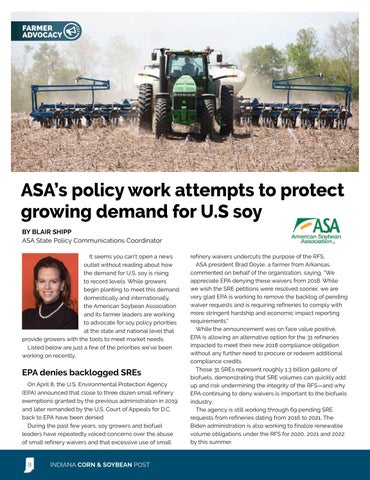
ASA’s policy work attempts to protect growing demand for U.S soy BY BLAIR SHIPP ASA State Policy Communications Coordinator It seems you can’t open a news outlet without reading about how the demand for U.S. soy is rising to record levels. While growers begin planting to meet this demand domestically and internationally, the American Soybean Association and its farmer leaders are working to advocate for soy policy priorities at the state and national level that provide growers with the tools to meet market needs. Listed below are just a few of the priorities we’ve been working on recently.
EPA denies backlogged SREs On April 8, the U.S. Environmental Protection Agency (EPA) announced that close to three dozen small refinery exemptions granted by the previous administration in 2019 and later remanded by the U.S. Court of Appeals for D.C. back to EPA have been denied. During the past few years, soy growers and biofuel leaders have repeatedly voiced concerns over the abuse of small refinery waivers and that excessive use of small
8
INDIANA CORN & SOYBEAN POST
refinery waivers undercuts the purpose of the RFS. ASA president Brad Doyle, a farmer from Arkansas, commented on behalf of the organization, saying, “We appreciate EPA denying these waivers from 2018. While we wish the SRE petitions were resolved sooner, we are very glad EPA is working to remove the backlog of pending waiver requests and is requiring refineries to comply with more stringent hardship and economic impact reporting requirements.” While the announcement was on face value positive, EPA is allowing an alternative option for the 31 refineries impacted to meet their new 2018 compliance obligation without any further need to procure or redeem additional compliance credits. Those 31 SREs represent roughly 1.3 billion gallons of biofuels, demonstrating that SRE volumes can quickly add up and risk undermining the integrity of the RFS—and why EPA continuing to deny waivers is important to the biofuels industry. The agency is still working through 69 pending SRE requests from refineries dating from 2016 to 2021. The Biden administration is also working to finalize renewable volume obligations under the RFS for 2020, 2021 and 2022 by this summer.
“We appreciate EPA denying these waivers from 2018. While we wish the SRE petitions were resolved sooner, we are very glad EPA is working to remove the backlog of pending waiver requests and is requiring refineries to comply with more stringent hardship and economic impact reporting requirements.” – ASA president Brad Doyle
ASA seeks WOTUS ruling In April, ASA and other groups submitted a joint amicus brief to the U.S. Supreme Court in the case of Sackett v. EPA, in which the court will consider the proper test for determining whether wetlands are “waters of the United States” under the Clean Water Act. EPA and the Army Corps will continue with their WOTUS rulemaking while the case is underway. This is in spite of numerous requests from Congress and industry to pause the effort, as the court’s ruling – likely in late 2022or early 2023 – will almost certainly influence what may be included in the regulation. Joining ASA on the brief (14 amici total) are Farm Bureau, American Sheep Industry, Sugar Alliance, Family Farm Alliance, NAWG, NCGA, National Council of Farmer Cooperatives, NPPC, Fertilizer Institute, Egg Producers, USA Rice, and U.S. Poultry and Egg Association. While ASA believes the court will rule favorably and adopt a wetland determination test that works for agriculture, this amicus brief is aimed at getting a majority of justices to go an important step further by making clear to the agencies that their tactics are unacceptable. Judicial deference to agencies is the norm, but the focus of this brief is to show that the agencies have abused their authority in the WOTUS area and that the court should make clear that prior case law should actually exclude much of what the agencies have tried to label as WOTUS. The brief outlines the plight of agricultural producers faced with overbroad and vague WOTUS standards, argues that the court cannot trust the agencies to implement its holding unless that holding is precise and clear, and calls for a stern warning from the court to the agencies to stop evading its rulings.
exporters, and the IPEF provides an opportunity to address these barriers and improve the regulatory processes that lead to them. The comments point out that NTBs are sometimes imposed to satisfy domestic demands for protection or in response to misplaced safety concerns, but many NTBs inadvertently restrict trade because of more benign issues like regulatory misalignment, regulatory uncertainty, or unclear and opaque processes. These barriers can have devastating effects on trade, and robust negotiating objectives for the IPEF should include efforts to resolve these NTBs. The U.S. soy groups reference trade agreements such as the United States-Mexico-Canada Agreement (USMCA) and Trans-Pacific Partnership (TPP) as successful examples of how economic cooperation can promote science-based sanitary and phytosanitary requirements, good regulatory practices, and appropriate regulation of agricultural biotechnology.
Trade to Indo-Pacific region ASA and the U.S. Soybean Export Council (USSEC) provided comments to U.S. Trade Ambassador Katherine Tai regarding the proposed Indo-Pacific Economic Framework (IPEF). The U.S. soy industry welcomes efforts within the Indo-Pacific region to expand market access through the resolution of non-tariff barriers (NTB). NTBs are increasingly causing uncertainty for U.S. soybean
SPRING 2022
9
As Biden steps up for farmers, NCGA works to advance legislation on ethanol BY BROOKE APPLETON Vice President of Public Policy, National Corn Growers Association It was like a scene out of a Hollywood movie. Just as it looked as though the oil industry had succeeded in ending consumer access to higher levels of ethanol – a biofuel that is environmentally friendly and cuts gas prices – during the summer months, President Biden makes an eleventh-hour decision to use his emergency powers to allow for consumer choice. Yet, this wasn’t something out of Hollywood; it was reality. I was pleased to travel to Menlo, Iowa, on April 12 to
10
INDIANA CORN & SOYBEAN POST
watch the president tell a barn full of farmers that he would use his emergency authority to extend access to 15 percent ethanol-blended fuel, or E15, through this summer. The president’s announcement comes after two years of legal drama, in which the oil industry, looking after its own profit margin, sued the U.S. Environmental Protection Agency to end access to E15 during the summer months. A court ruled in 2021 that the EPA had acted outside of its authority, and, as a result, access to E15 was set to end over the summer months, each year, starting this June. The consequences to ending access to E15, even for a few months, would have been serious for consumers and the U.S. economy. Gas
prices would have risen even more than they already have; greenhouse gas emissions would have increased; and rural communities and farmers would have felt the economic effect of a shrinking demand for ethanol. Many thought getting the president to step in was a long shot. After all, he’s dealing with a deadly pandemic, rising inflation, a devastating war in Europe and a host of other issues. But corn grower leaders understood that all the president’s travails were a recipe for a winning argument for higher uses of ethanol. Corn grower leadership alongside the ethanol industry have been making the argument to administration officials and Congress that ethanol is a tool that can help the president address many of the country’s problems, from climate change to a sluggish economy. Timing was of the essence with the deadline quickly approaching, but just as it looked as though there wasn’t much hope, we received word from the White House that the president was to give a speech in Iowa the next day. Mystery abounded, flights were booked, holding statements were drafted. Surely, we thought, the president wouldn’t give a speech in Iowa if he weren’t going to make an announcement about E15. Then official word finally came in the evening beforehand from the White House that the president would intervene on the matter in favor of consumers and corn growers. Now we look to next steps. As we look to build on this momentum, we encourage Congress to advance the Next Generation Fuels Act. The Next Generation Fuels Act highlights ethanol’s unique ability to reduce greenhouse gas emissions, while unlocking new engine efficiency gains, allowing consumers to drive further between fill-ups. The bill will not only help further reduce greenhouse gas emissions, but it will also help lower gas prices, help family farms and revitalize rural economies. Whether it’s combatting climate change, helping lower soaring fuel prices, or helping rural communities and family farms, there is something in the Next Generation Fuels Act for Democrats and Republicans alike. That’s why we are continuing to work to garner bipartisan support for this landmark legislation. So, we’re leaving one movie and moving to the sequel. Like all movies, we have villains, heroes and many twists, turns and surprises. But unlike a movie, the outcomes of these efforts have a real impact on real people. That’s why we take time to savor this victory while preparing for the next.
Opportunity knocking for farmers wanting to serve on Indiana corn checkoff board Hoosier farmers interested in directing Indiana’s corn checkoff investments may now petition to run for one of the five seats up for election. The Indiana Corn Marketing Council (ICMC) manages the corn checkoff investments with the goal of supporting and growing Indiana’s corn industry. “Since the Indiana corn checkoff was created, Hoosier corn growers have benefitted from the volunteer leadership of those who have served on the ICMC board,” said ICMC Treasurer Tim Gauck, a Greensburg, Ind., farmer. “The corn checkoff relies on farmers to fill these leadership positions to help the Indiana corn industry remain strong and effective. New perspectives and ideas will help our corn research and promotion efforts.” Board members direct the promotional, educational and research activities funded by the corn checkoff. Some of the board’s priorities include increased ethanol use, improved transportation infrastructure, on-farm research, livestock promotion and expanding international exports. To run for an ICMC director seat, Indiana corn farmers must be at least 18 years old, a registered Indiana voter and a resident in the appropriate district. All farmers who submit a valid petition by June 1, 2022 will be listed as a candidate on the election ballot. Voting takes place at Purdue Cooperative Extension Service county offices August 8-12 or by absentee ballot, which will be made available on the ICMC website on July 9. Here is the breakdown of each district: District 1– The counties of Lake, Porter, LaPorte, Starke, Pulaski, Jasper, White, Benton, and Newton. District 4 – The counties of Warren, Tippecanoe, Montgomery, Putnam, Owen, Clay, Vigo, Parke, Vermillion, and Fountain. District 7 – The counties of Sullivan, Greene, Daviess, Martin, Knox, Dubois, Pike, Gibson, Warrick, Spencer, Vanderburgh, and Posey. Two statewide At-Large seats up for re-election covers all Indiana counties. Farmers can download petition forms at www.incorn.org/ elections or by calling the ICMC office at 1-800-735-0195. Forms are also available at all Purdue County Extension offices. Newly elected directors will begin a three-year term Oct. 1. ICMC directors can serve three consecutive full terms or a total of nine consecutive years. For more information about Indiana Corn Marketing Council, visit www.incorn.org.
• • • •
SPRING 2022
11
ICGA, M&P say this year’s state government session helped farmers BY M&P AND ICGA POLICY STAFF
F
ollowing a 2021 legislative session that commenced in the shadow of the COVID-19 pandemic, the 2022 session welcomed back a sense of normalcy. Legislators returned to their respective chambers in 2022 with virtually no pandemic-related restrictions. Lawmakers concluded business around 1 a.m. on March 9, five days earlier than their required adjournment day. The 2022 General Assembly likely won’t be remembered for the typical differences between Republican and Democrat caucuses, but rather the conflicting priorities of the House and Senate Republicans. At the onset of session, House Republicans’ priorities included education transparency, strengthening COVID-19 vaccine exemptions under Indiana law, and a major tax cut that included eliminating the depreciation floor on Indiana’s business personally property tax. The Senate Republicans unveiled some similar priorities, but with a more cautious approach especially with regard to sweeping, permanent tax cuts. Their priorities included ensuring more Hoosiers are eligible for the automatic taxpayer refund, shielding schools from unforeseen funding cuts due to quarantining students, and ending the public health emergency. Of the 849 bills that were filed, 177 – or 21 percent – crossed the finish line. Several bills considered by legislators this session impacted corn and soybean farmers. The Indiana Soybean Alliance Membership and Policy Committee (M&P) and the Indiana Corn Growers Association (ICGA) were pleased with the outcomes following this year’s General Assembly work. The seed test legislation was successful, which means that the state seed lab will be able to increase its testing prices to market rates like those of surrounding states and hopefully alleviate the backlog caused by out-ofstate samples, which were being sent to Indiana to take
12
INDIANA CORN & SOYBEAN POST
advantage of its lower than market rate prices. ICGA and M&P supported this bill. The drainage task force legislation was also successful, so the legislature will convene a task force of stakeholders to evaluate whether the state’s water regulations are achieving water quality outcomes without creating undue burden on the agriculture and building industries and make recommendations on any needed changes. M&P and ICGA also considers this a victory. Throughout session there were also dueling carbon capture and sequestration bills. The agricultural community rallied around a coalition-drafted bill that will require companies interested in capturing carbon and pumping it underground to obtain the agreement, by lease, easement, or other contract, of the landowners whose property will contain the underground storage well. Another set of bills which would have amended an existing pilot program to allow a company the right to store carbon underground without obtaining landowner consent were defeated in a floor vote and in committee, respectively. The language of those bills was not successfully inserted into any other legislation during the conference committee process. In April 2021, Gov. Eric Holcomb vetoed SEA 303 that, among other provisions, would have required gas stations to have duplicative labels on gas pumps that dispense E15 fuel blends. In his statement, the Governor said he found the additional layer of government “unnecessary and confusing.” By law, the General Assembly is required to consider veto overrides before the end of the following session. Although SEA 303 passed out of the Senate 46-2 on its final passage last session, the chamber elected to sustain the veto 24-26 following advocacy efforts from the ethanol industry and ICGA. With the legislative session concluded, focus for M&P and ICGA shifts to next year’s budget session.
WISHH serves as an international soy industry incubator, spurring innovation by connecting local entrepreneurs with industry-specific resources and business knowledge.
Connect with WISHH wishh.org
WISHH is a program of the American Soybean Association and is funded in part by the United Soybean Board and state soybean board checkoff programs.
Indiana corn growers support waiver allowing summer sales of E15 BY DAVE BLOWER JR. The Indiana Corn Growers Association (ICGA) thanked President Biden for approving a waiver to allow E15 gasoline – gasoline that uses a 15 percent ethanol blend – to be sold this summer. President Biden made the announcement on April 12 from a POET ethanol plant in Menlo, Iowa. A lower-cost and lower-emission fuel blend, E15 is often marketed as Unleaded 88. Ethanol is a major player in Indiana’s economy, and it is especially important to Hoosier corn growers. Indiana ranks as the fifth-largest producer of U.S. ethanol – generating more than 1.2 billion gallons per year. The Hoosier State produces nearly 8 percent of the total U.S. ethanol output. There are 14 ethanol plants in the state. Collectively, these plants consume about 47 percent of Indiana’s total corn crop – more than 461 million bushels. “Ethanol adds billions of gallons to the U.S. fuel supply every year, lowering demand for high-cost oil while increasing total fuel available to American motorists,” said ICGA President Scott Smith, a farmer from Windfall, Ind. “Ethanol has been priced an average of 80 cents less per gallon than unblended gasoline at wholesale through
14
INDIANA CORN & SOYBEAN POST
March, and drivers currently save up to 20 cents or more per gallon where E15 is available.” With several factors driving gas prices higher, including Russia’s invasion of Ukraine, the National Corn Growers Association (NCGA) and farmer leaders across the country asked President Biden to extend the use of E15 to hold down prices at the pump. Farmers asked their members of Congress to support continued availability of E15, sending thousands of messages in recent weeks and backing bipartisan Senate and House advocacy for the action announced in April. Russia is the world’s third-largest oil producer, and it accounts for 11 percent of the global supply. Before sanctions by the Biden Administration on March 8, Russian oil imports equaled nearly 8 percent of the U.S. oil supply, according to the Energy Information Administration. President Biden, on March 31, ordered the release of 1 million barrels of oil per day from the strategic petroleum reserve through the end of September. That is the largest release in the reserve’s history.
Offsetting Russian oil Ethanol advocates believe there is a better way to offset the loss of Russian oil. Renewable Fuels Association President and CEO Geoff Cooper said replacing 30 percent of the U.S. regular pump gas with E15 would not only replace oil imported from Russia, but it would also eliminate the need to import oil from many other countries. “When you’ve got a conflict a half a world away that can jack up pump prices more than a dollar per gallon, that’s a problem and we need to do more in the U.S. to insulate our consumers from those types of price shocks,” Cooper said. “We’ve got spare capacity. We have plants that are idle today that could come back online and contribute more volume to the system that would obviously bring prices down,” said Cooper, who added that ethanol is currently selling for about $1 less per gallon that gasoline. At present, the United States produces about 15 billion gallons of ethanol per year. “Corn growers thank President Biden for ensuring drivers continue to have access to a lower-cost fuel choice and for acknowledging how renewable ethanol helps reduce prices, lower emissions and improve our nation’s energy security,” said NCGA President Chris Edgington, an Iowa farmer. “Farmers are proud to contribute to cleaner, less expensive fuel choices.” The U.S. Environmental Protection Agency (EPA) has approved E15 for use in all passenger vehicles manufactured since 2001. A 2021 court decision resulting from oil industry efforts to limit the growth of higher ethanol blends was set to end full-market access for E15 beginning June 1 – until the Biden Administration initiated this waiver. “E15, or Unleaded 88, could not be sold during the summer driving months due to some regulatory issues,” said Ferdinand, Ind., farmer J.R. Roesner, who is also a leader on the NCGA’s Ethanol Action Team. “This recent announcement by the President to allow the sale of Unleaded 88 during the summer driving months.” He added that ethanol offers many benefits. “It’s definitely a cleanerburning, cost-reducing fuel with higher octane,” Roesner said. “Ethanol is the octane additive they use to increase octane within the gasoline. So, it’s definitely a health benefit to consumers and drivers across the state and across the country.” Roesner said Hoosier farmers should benefit from this decision. “It means more corn grind will go into the production of ethanol and will also help us keep prices supported and just have higher demand for the corn that we produce,” he explained. Farzad Taheripour, a Purdue University professor of agricultural economics, agreed. “Corn is a major output for United States farmers,” he said. “So, when we have a bigger market for E15, this means we will have a bigger market for corn which will benefit the farmers.” But, he continued, consumers should benefit, too. “E15 is relatively cheaper than E10 (the standard ethanol blend of unleaded gasoline),” he said. “So, those who are consuming E10 are paying a higher price. If you switch to E15, you will pay a lower price.” Now ICGA seeks a more permanent solution. “Farmers stand ready to continue working with the EPA, the Biden Administration and Congress on the energy and environmental solutions that ethanol can provide,” Smith said.
Scott Smith
Geoff Cooper
JR Roesner
SPRING 2022
15
First generation farmer becomes an advocate for agriculture BY SUSAN HAYHURST
M
ike Koehne, a first-generation farmer, is committed to advocating for agriculture. He has sought advice from trusted mentors to evolve his farming operation to what he and his family have established today. He embraces and enjoys learning something new every day – whether it is in the farming operation, doing mechanics on his own equipment or with one of his other businesses. Koehne, of Greensburg, had a steep learning curve – both good and bad – in becoming a first-generation farmer. While growing up, his dad was a carpenter and owned his own construction business. Koehne helped some, but he discovered “hammering nails” wasn’t for him. He did enjoy helping neighbors bale hay and straw. “There weren’t many farm kids at my Catholic grade school; when I got to high school, I joined FFA,” Koehne said. “Through FFA I made some friends and occasionally helped them on their family farms. While in high school, I had a job in the co-op program where I went to school half day and worked half day. I got a job with a family who raised dairy cattle and hogs, and I really enjoyed being with them. It was a real inspiration and eye-opener how the
16
INDIANA CORN & SOYBEAN POST
family worked together, brought up their kids, and lived the family farming lifestyle.” Following high school, Koehne attended the University of Northwestern Ohio for its auto and diesel mechanic program. His industrious mindset enabled him to work for an area hog farmer to help him pay for school, working with hogs during the day and attending school at night. Farming was on the horizon, though. In 1992, while working for a trucking company after returning home, Koehne talked to a neighbor whose 78-acre farm became available for rent. When asked if he could rent it, the neighbor said “sure.” Koehne was on his way. He’s grateful he’s still working with that landlord today. “I knew I had to come up with money to get started,” he explained. “My off-farm job paid for my new habit of farming. Buying only the bare minimum, I found an old tractor and bought an old corn planter and a disc at a sale.”
A ‘family’ farm Koehne is thankful his parents were supportive of his new passion. Later he rented another neighbor’s ground on shares. One of his off-farm jobs, while building his
operation, was at an ag dealership working on tractors and equipment including their pulling tractors. “I did a lot of work for one farm family who said they’d like to have an on-farm mechanic,” Koehne recollected. “I went to work for this family as a mechanic in their shop, and I eventually met my future wife, Jill, there.” Mike and Jill married in 1997 and endeavored to keep growing their own farm. They bought a trucking company that included semi-trucks and livestock trailers and built their own livestock trucking company. Growing that to five trucks at one time, they hauled livestock “in 38 of the lower 48 states,” he said. While making decisions about his family, Koehne decided to quit driving a truck full time in 2006. He and Jill decided to focus on growing the farm and had the opportunity to purchase a farm drainage business. The farmstead they purchased in 2000 was not in good shape, he said. “We eventually tore everything down and started from scratch,” Koehne explained. “At the time, we had a 2-yearold and another on the way. We built our house on the farm in 2002, bought used grain bins and built them on our site to keep costs down and not borrow too much money.” Koehne said a big key for them is to keep debt down. “If we didn’t have the money, we didn’t buy it, or we had to figure out how it would pay for itself.” Mike and Jill have four children. Rebecca, 23, manages a grain elevator. Luke, 21, works on the farm with his dad. Logan, 19, is majoring in pre-med and plays college football. Caroline, 16, is a sophomore in high school.
Related farm businesses Koehne bought a local tile and drainage business in 2006. He worked alongside the owner with the equipment purchased; then started updating on his own. “Drainage tile is a money maker for farmers,” Koehne said. “Yield monitors are my biggest tile salesmen because we can see the benefits of the tile in the yield difference. In 2008, we started mapping with GPS. In 2010, we had full machine controls with GPS guidance. It’s amazing to see where tile is and isn’t in a field. In 2018, I purchased a new wheel machine, and I still prefer a wheel machine today. “I do my own layouts and design drainage systems. I am certified Technical Service Provider with NRCS to do tile layout and design. The original drainage owner, who owned his own kiln to make clay tile, is still a valued consultant for me. Though my training was hands-on, oldschool stuff, I could use it today if I had to. Drainage is not easy work; it takes finesse and knowledge.” He purchased a commercial plow in 2021 “because that’s the trajectory in the industry.” Having his son, Luke, working alongside him is another learning curve, but Koehne is happy to have him driving
Mike Koehne rented his first 78-acre farm in 1992. From that point, he knew he wanted to make a career as a farm.
a truck, ditching and farming. “It can be a chore to be dad and boss, but he sees I still rely on and respect the older farmers who I trust and talk with often.” Luke is also an able hand for his dad as they commit to doing 95 percent of their own mechanic work. They run a lot of old equipment because they can work on it, and it saves time and money. They currently farm approximately 900 no-till acres, with 240 being rented. Their family operation, Kingdom Farms, grows all specialty crops. “With specialty crops it’s easier being a smaller farm to keep them separate,” Koehne explained. “It’s added value for smaller farmers. We grow regular non-GMO corn for a Kentucky bourbon distillery. We also work with a broker for a Japanese dry milling facility where our hard endo corn travels by barge. Our Clear Highland food grade beans go to Japan and Taiwan by container. This works for us as we put
SPRING 2022
17
In 2006, Mike Koehne bought a local tile and drainage business. Today, the tile and drainage business is a successful venture. Above, Koehne installs tile into a ditch. Below, Koehne inspects tile that is on his farm.
foresight into our grains and keep everything very clean.” He noted there was no Roundup available when he began farming. Last year was his first year to plant Roundup Plenish High Oleic beans. “We made that decision to control the weeds. In the last 20 years, there’ve been similar new products for corn but not for beans.”
Advocating for farmers Koehne’s love of learning heightened seven years ago upon receiving a postcard from the Indiana Soybean Alliance inviting him to a legislative breakfast at the Indiana Statehouse. During the event, he visited with a former trucking customer, Jim Douglas, who encouraged Koehne
18
INDIANA CORN & SOYBEAN POST
to run for ISA’s board. Koehne didn’t think he had time, but Jill encouraged him. “I thought it might be interesting, and I like to learn new stuff. I ran for the board, was elected in 2016, and it’s one of the best experiences I’ve ever had,” he admitted. Now the vice chair of the board, Koehne said, “you learn so much about what goes on after the elevator. You don’t often think about what the checkoff does for you as a producer, how it impacts your farm in the long run. I’ve served as chair of the Membership and Policy Committee for two years. Being an advocate for American and Indiana farmers builds relationships with senators and representatives. They recognize me now when I visit D.C. or see them at local events. Having a voice does make a difference.” A trip with fellow board members to Vietnam was also eye opening. Talking to an end user of soybeans, seeing how they work, and hearing what they want and need or listening to complaints, gave Koehne a fresh perspective on how encompassing ISA’s work is. “Hopefully we can continue to build relationships with
Mike and Jill Koehne have four children. Rebecca, 23, manages a grain elevator. Luke, 21, works on the farm with his dad. Logan, 19, is majoring in pre-med and plays college football. Caroline, 16, is a sophomore in high school.
his first year on the board. He is honored to serve Indiana Vietnam and increase our business into the future,” he farmers on this board and excited to see where this will said. “The free enterprise we have in the U.S. is taken for take him. granted. They really enjoyed learning from us, and we “I do encourage people to get involved on the ISA board,” enjoyed learning from them.” he said. “We need our voices heard and share about the Koehne also serves on the Soy Transportation Coalition vital research that the soybean checkoff provides. You only board. STC studies infrastructure and transportation get out of it what you put into it. We work hard as farm issues for agriculture. “Because producers ship grain by families to produce a quality product for the consumer. truck, rail, barge and container, we must keep our modes There’s a lot of sacrifice, but it’s a great lifestyle.” of transportation in good working order,” he said. “This makes our products worth more, and more efficient for our exporters who are buying them.” When Koehne and fellow STC board members visited Mexico in December 2018, they found its port system needing a dredging project similar to the ongoing Mississippi River dredging. “They use smaller ships because they can’t get large ships in with the current water depth,” he said. “Getting larger ships in helps our shipping costs and farmer’s bottom lines.” Koehne’s commitments in ag organizations continues to widen and enhance his learning curve. He advises other farmers to do the same. Koehne was recently elected to American Mike Koehne has also owned and operated a livestock trucking company. Soybean Association and is serving
SPRING 2022
19
Indiana farm leaders react to Vilsack’s Commodity Classic keynote speech BY DAVE BLOWER JR.
T
on February 7, this initiative plans to develop market wo Indiana farm leaders listened with interest to USDA opportunities for farm, ranch or forest products produced with Secretary Tom Vilsack as he addressed farmers as the climate-smart practices such as no-till, nutrient management, keynote speaker at the annual Commodity Classic in agroforestry or prescribed grazing. New Orleans, La., on March 12. Indiana Soybean Association “Secretary Vilsack asked all of agriculture to submit ideas Membership and Policy (M&P) Chair Matthew Chapman, and programs that would enhance the value of the crops a farmer from Springport, Ind., and Indiana Corn Growers that we grow,” Beard said. “For us here, it’s corn, soybeans, Association (ICGA) board member Mike Beard, a farmer from wheat and sorghum. But it can be nuts and berries and other Frankfort, Ind., noted positives and negatives from Vilsack’s fruits and tree fruits and other speech. things that we can add value The Ag Secretary outlined to here in this country and plans for a new domestic certify that they are climate fertilizer program and a threeproven, if you will.” part strategy for setting future Chapman said Vilsack’s federal farm policies. Those comments about developing parts include increasing more value-added products exports, promoting climateand a circular economy were smart commodities and two themes that he could combating consolidation that support. “(Vilsack) said the affects farm competition. Biden Administration is striving Vilsack plans to make toward what they termed as a trips to Dubai, Kenya, the circular economy, where we United Kingdom and Spain can try to keep as much of the to promote U.S. agricultural USDA Secretary Tom Vilsack told Commodity Classic value-added products and exports. He added that attendees about the agency’s plans to encourage domestic proteins here in the state, in U.S. farm exports must be fertilizer production. the Midwest or in the U.S. And more diversified. “China has along with that, the jobs stay here; the money stays here; the diversified and cannot be our only export market,” Vilsack investment stays here,” Chapman said. explained. “We must explore and invest in other markets by Vilsack said consolidation of livestock processors has selling our American pride and tremendous products.” The USDA leader said “climate-smart commodities” is a new negatively affected the prices that farmers and ranchers are receiving, and consolidation by farm input providers has proposition from food companies wanting products grown through responsibly sourced farm practices. “We have already helped spur rising costs. been working with food processors to set standards and to Domestic fertilizer program work on how to roll it out,” Vilsack said. “We want to create The USDA announced a $250 million investment to support additional revenue opportunities and keep the program on a and expand American fertilizer production. Vilsack said, voluntary basis. Technology and innovation will explode in this “We want to invest in fertilizer expansion in the U.S. that is arena with a lot of interest. USDA has made $1 billion available independently-produced, made in America; and hopefully, to build this effort for all sizes and types of farmers. This will embrace new innovation and support sustainable farming help build this circular economy and keep more money here.” operations.” Beard chose to look at USDA’s plan for climate-smart USDA will use funds from the Commodity Credit commodities as another opportunity for farmers. Introduced
20
INDIANA CORN & SOYBEAN POST
Corporation (CCC) to develop a grant program that provides ‘gap’ financing to initiate new, independent domestic production of needed fertilizers. The investment will be made through a new grant program. “We expect to have the application process available sometime this summer and we hope to see awards at the end of the year,” Vilsack said. The United States is a major importer and dependent on foreign fertilizer. America is the second or third top importer for each of the three major components of fertilizer. The top producers of the components of fertilizer include China, Russia, Canada and Morocco, with Belarus also providing a significant share of potash. The standards of the domestic fertilizer production program are: Independent – outside the dominant fertilizer suppliers, increasing competition in a concentrated market Made in America – produced in the United States by domestic companies, creating good-paying jobs at home and reducing the reliance on potentially unstable or inconsistent foreign supplies Innovative –improve upon fertilizer production methods to jump start the next generation of fertilizers Sustainable – reduces the greenhouse gas impact of transportation, production, and use through renewable energy sources, feedstocks, formulations, and incentivizing greater precision in fertilizer use Farmer-focused – like other Commodity Credit Corporation investments, a driving factor will be providing support and opportunities for U.S. agriculture commodity producers “Any time we can keep those value-added products here, we don’t rely on our neighbors or the uncertainty around the world to keep us in business,” Chapman said of homegrown fertilizers. “And it also comes from a security standpoint: if we have food security, that’s one less thing we have to worry about from a global perspective.” Beard said domestic fertilizer sources is a part of that security and is interested to see the results of this program. “We’d all be excited to be able to source fertilizer right here in the U.S.,” Beard added. “The fact that we are so short on fertilizers and other inputs has been a major topic of discussion for farmers-those of us that have it, and those of us that don’t have it, yet.”
• • • • •
M&P Chair Matthew Chapman said USDA Secretary Tom Vilsack’s comments about developing more value-added products and a circular economy were two themes that he could support.
He said he’s hopeful that the trade missions will expand export reliance to more than one or two markets. Beard believes 2022 could be a good season, and exports are a part of that optimism. “Pricewise we have excellent crop insurance prices for corn and soybeans. Those were set in February,” he said. “It’s kind of an exciting time, but it’s a little scary.” He thinks the biggest challenges for farmers is navigating the uncertainty. “There is a bevy of black swans that are congregating at the borders of the U.S. export opportunities,” he quipped. “Then we’re also discussing the cost of inputs and what government programs might be coming down the road.” ICGA and M&P continue to monitor the USDA’s programs and actions so that they can provide Indiana farmers with the best possible policies.
Expanding U.S. exports Vilsack expects another strong year for U.S. ag export sales. “We had a record year for exports last year – $177 billion – we expect to break that record this year,” he said. Vilsack said USDA will conduct trade missions to the United Kingdom in June, Philippines in July, Kenya in October and Spain in November. “There are a whole heck of a lot of people at USDA working very hard to make these trade missions successful, that it doesn’t necessarily require a single person to make them successful.”
ICGA Board member Mike Beard, a farmer from Frankfort, Ind., said the USDA’s plan for climate-smart commodities could be another opportunity for farmers.
SPRING 2022
21
CHECKOFF INVESTMENT
Indiana’s Miller joins USGC in Spain for corn harvest quality report event BY U.S. GRAINS COUNCIL
W
ith the release of the U.S. Grains Council’s (USGC’s) Corn Export Cargo Quality Report taking place in the spring, let’s take a look back at Indiana grower and Council Vice Chairman Josh Miller’s role in a recent Corn Harvest Quality Report rollout event. Miller, Ryan LeGrand, USGC President and CEO and Middle East/Africa/Europe Manager of Global Trade Reece Cannady visited Spain in February to offer Spanish grain buyers a look at the organization’s 2021-22 Corn Harvest Quality Report. In January, the European Union (EU) removed 25 percent import Josh Miller duties on U.S. corn that were imposed in June 2018. This action opened an export opportunity for up to 2 million metric tons (MMT), or 80 million bushels, of U.S. corn. The Council’s engagement while in Spain was vital in promoting U.S. corn exports to its Spanish counterparts. The Corn Harvest Quality Report provides the Council an opportunity to showcase the outstanding Ryan LeGrand quality of the 2021 crop to Spanish importers, especially with regard to bulk shipments, and to remind customers that the U.S. agricultural sector is committed to being a reliable supplier of agricultural exports. “Spain is a valued customer and a stronghold for U.S. agricultural exports to Europe,” Miller said. “The market is a consistent customer for U.S. distiller’s dried grains with solubles (DDGS), and Spain looking at buying U.S. corn is a product of our logistical certainty.” LeGrand provided opening remarks at the event in Madrid before Cannady presented the findings of the report. Miller provided attendees with a firsthand account of the 2021 growing season in the United States,
22
INDIANA CORN & SOYBEAN POST
sharing his personal experiences and answering questions about his crop. To wrap up the program, Sergio Dettmer, senior risk management consultant at StoneX, an institutional-grade financial services network, offered a virtual presentation on U.S. corn and DDGS production, supply and distribution. The Council hopes that by presenting the findings of the 2021-22 report, the Spanish market will have increased confidence when purchasing U.S. corn. The 2021-22 Corn Harvest Quality Report provides information about the quality of the current U.S. crop at harvest as it enters international merchandising channels. A second Council report, the 2021-22 Corn Export Cargo Quality Report is released each spring. This report measures the corn quality at the point of loading for export. To read the most up-to-date reports, and those from years past, visit grains.org/corn_report/
The U.S. Grains Council leaders and staff traveled to Spain in February to conduct a Corn Harvest Quality rollout with Spanish importers. Josh Miller, vice chairman of the Council’s Board of Directors, provided an overview of the 2021 growing season in Indiana. Miller farms near Anderson, Ind.
Five trends impacting the future of the global soy market
Indiana part of group checkoff effort to identify ways to future-proof today’s farms
L
ast year, U.S. soybean farmers grew nearly one-third of the soybeans in the global market. To ensure U.S. Soy retains access to a quickly changing, consumer-driven market, five state soybean checkoff groups jointly funded an effort designed to help soybean farmers make smart and informed decisions that will increase opportunities for future success. The Indiana Soybean Alliance (ISA) joined soybean checkoffs from Iowa, Missouri, Illinois and Ohio to conduct the Future State of Soy exercise that identified the most impactful trends for soy in the coming years. “First of all, this effort was well worth the investment, and it will help us as we plan to help keep U.S. farmers profitable in the future,” said ISA Chair Jim Douglas, a farmer from Flat Rock, Ind. “This exercise uncovered five trends that will affect soy markets around the world. These trends show how global demand for soybeans will change during the next several decades. This gives U.S. farmers a better insight to position for the future.” The five trends identified in the Future State of Soy exercise include: A rising focus on high-quality soybean oil and meal Changes in fuel demand, including alternative fuels, and emerging fuel uses The rising need for protein given a growing global population – both in animal and plant form The increasing global competition for soy and how infrastructure can provide an impactful advantage Emerging and diversified revenue streams that will offer farmers more opportunities “No two farms anywhere are the same, and the farmers that work them are just as unique,” Douglas said. “The main point of this exercise is to help growers in Indiana and around the country to adjust to changes that will drive the future demand of soybeans and soy products. Identifying
• • • • •
these trends enables farmers to determine if their farm is set up to take advantage of trends, or if their farm can take advantage of several different patterns. Figuring how the market is shifting now means farmers won’t have to scramble to meet market demands.” The soybean checkoff is already investing in several programs at both the national and state levels to find new markets, new uses and new characteristics of soybeans that will align with these five trends. The soybean checkoff will also use these trends as a litmus test when determining if future investments will result in strong returns for U.S. soybean farmers. In Indiana, ISA is working with Hoosier farmers to expand planted acres of high oleic soybeans, which produce a high-quality oil used in many products. Farmers also earn a premium of a dollar or more per bushel for growing high oleic soybeans. ISA also attempts to expand the number of soybean buyers by expanding customer access to biodiesel and renewable diesel fuel and investing in products that are attractive to overseas customers. As the soybean checkoff continues to position U.S. Soy for the future, this work will help influence how the world perceives the value of domestic soy and soy products. “This exercise opened our eyes about many things that can affect U.S. agriculture and the soybean supply chain,” Douglas said. “Around the world, there is a need for more protein. But the people who need it are happy to get it whether it is animal protein or plant-based protein. Soybeans can actually serve both markets as protein-rich food or as a high-quality feed for livestock. Both are valuable for U.S. soybean growers.” For more information about the Future State of Soy exercise and to see how ISA is investing in projects to support these trends, visit FutureStateOfSoy.org or www.indianasoybean.com
SPRING 2022
23
Advertorial
Shaping the Future for Indiana Soybean Farmers HOW THE IN D I A N A S O Y B E A N A L L I A N C E I S H E L P I N G TO FUTURE- P R O O F Y O U R F AR M It’s not every day that a report comes out to help you make decisions now so you are set up for success tomorrow. However, a recent report from five state soybean checkoffs has done just that. Aptly named the “Future State of Soy,” the Indiana Soybean Alliance (ISA) joined checkoff groups from Iowa, Missouri, Illinois and Ohio to uncover five major trends for soybeans anticipated in the next several decades. The soybean supply chain is rapidly changing, with consumer trends, expanding export markets and an increased focus on sustainability influencing how soybeans are grown. Understanding these trends now can help you make smart, informed decisions about changes to make on your farm so you are best positioned for future success.
In the Future State of Soy report, these five trends were cited as major contributors to how soy will be used or perceived in the future:
24
1
THERE WILL BE A RISING FOCUS ON QUALITY SOYBEAN OIL AND MEAL
2.
THERE WILL BE CHANGES IN FUEL DEMAND AND EMERGING FUEL USES
3.
THERE IS A RISING NEED FOR PROTEIN, IN BOTH ANIMAL AND PLANT FORM
4.
THERE IS EXPANDING GLOBAL MARKET COMPETITION, AND INFRASTRUCTURE WILL BE A KEY COMPONENT IN SERVING GLOBAL NEEDS
5.
THERE WILL BE EMERGING AND DIVERSIFIED REVENUE STREAMS AVAILABLE TO FARMERS
INDIANA CORN & SOYBEAN POST
Of course, trends are just words on paper unless there is action taken to better prepare for the future. So, what does this mean for Indiana farmers? ISA is focused on three of these trends now. The first trend — a rising focus on quality soybean oil and meal — is already a priority for ISA. Through strategic partnerships with Indiana State Fairgrounds, Purdue University and Fair Oaks Farms, ISA is increasing the use and demand of high-oleic soybean oil. High oleic soybean varieties are in demand by end users because the oil is a heart-healthy option for food manufacturers and restaurants to use. Indiana soybean farmers are poised to meet this specific demand. The second trend — changes in fuel demand and uses — is also a priority for ISA. The soybean checkoff continually invests in promoting and expanding the availability of biodiesel in local communities around Indiana. In fact, the accelerating demand for biodiesel has boosted soybean farmers’ income by $36 per acre. Encourage others in your community to join you in using biodiesel and help secure demand for future Indiana soybeans. The fourth trend — expanding global market competition — provides a unique opportunity for U.S. soybean farmers. Our focus and commitment to growing soybeans in the most sustainable, environmentally friendly way separates U.S. Soy from other global suppliers. ISA partners with companies across the state and invests in on-farm support programs like InField Advantage and the Upper White Cover Crop Program to help Indiana farmers to increase stewardship. This commitment to sustainability may also impact the fifth trend — uncovering new and diversified revenue streams — and provide Indiana farmers the opportunity to be financially rewarded for their stewardship efforts.
As you look to future-proof your farm using the above trends and considerations, know that the Indiana Soybean Alliance is also looking at opportunities to support Indiana farmers’ futures. The soybean checkoff will focus on four key strategies to maximize the opportunities presented by the five trends: • Disrupt the agri-food value chain of the future by taking risks, embracing change and pushing back on the status quo.
• Reimagine research and development to speed the innovation cycle, driven by end-user demands, in agriculture that brings outsiders in.
•
• Define the value propositions of U.S. Soy to domestic and international customers so that our commodity is positioned as the high-quality, sustainable and available soy of choice in the global marketplace.
Explore new business models that make checkoff dollars go further, faster, to ultimately result in unexpected, but impactful, partnerships.
Although there really is no crystal ball for soybean farmers, understanding the Future State of Soy can help you grow and adapt your farm to take advantage of the future changes that will impact our entire industry. Being prepared now can eliminate the need to make rash, complicated, and potentially expensive changes to your farm in the next few decades. To learn more, contact ISA at indianasoybean.com or visit FutureStateOfSoy.org.
SPRING 2022
25
CHECKOFF INVESTMENT
Changes to the grain buyers and warehouse law could impact many Hoosier farmers BY HARRY WILMOTH Director, Indiana Grain Buyers & Warehouse Licensing Agency Created by the Indiana General Assembly in 1975, the Indiana Grain Buyers and Warehouse Licensing Agency (IGBWLA) is established to administer the Indiana Grain Buyers and Warehouse Licensing and Bonding Law (IC § 26-3-7). IGBWLA’s responsibilities include the licensing and compliance of commercial operations who purchase grain from producers in Indiana. Today, the agency operates as a regulatory division of the Indiana State Department of Agriculture (ISDA) with more than 200 licenses issued to grain elevators, warehouses, feed mills, ethanol plants, soybean processors and foodgrade facilities. Collectively, these licensees operate more than 325 grain facilities across Indiana and can store more than 630 million bushels of grain at a time.
On April 29, 2021, Gov. Eric J. Holcomb signed into law House Enrolled Act 1483. The new law amends certain grain marketing practices that are important for both grain producers and grain operations to be aware of. To better understand these changes, lets dive into each one below.
Crop year The new law adopted and implemented USDA’s definition of a “crop year.” Under the definition, the term “crop year” means the period from one year’s harvest to the next year for a specified field crop as follows: June 1-May 31 for wheat, wheat seed, barley, barley seed, rye, rye seed, oats, and oat seed July 1-June 30 for canola, canola seed, lentils, and lentil seed Sept. 1-Aug. 31 for corn, corn seed, soybeans, soybean seed, popcorn, popcorn seed, sorghum, sorghum seed, sunflower, sunflower seed, and all other field crops and other field crop seed
• • •
INDIANA LAW IS CHANGING FOR DEFERRED-PRICED GRAIN ENSURE YOUR FARMING BUSINESS IS PREPARED DO YOU HAVE DEFERRED-PRICED GRAIN?
YES
WAS THIS DELIVERED BEFORE JULY 1, 2021?
YES LICENSEES SHALL COMPLETE PAYMENT OBLIGATIONS TO PRODUCERS BEFORE JANUARY 1, 2024 WHO SHOULD YOU CONTACT? – Contact your licensed grain buyer – Contact your trusted financial professionals
26
INDIANA CORN & SOYBEAN POST
NO
BUT WILL YOU AFTER JULY 1, 2022? Under Indiana law you may not enter into a deferred-price agreement that exceeds the crop year
CROP YEAR IS DEFINED BY LAW TO BE: June 1 – May 31: Wheat, wheat seed, barley, barley seed, rye, rye seed, oats, and oat seed July 1 – June 30: Canola, canola seed, lentils, and lentil seed September 1 – August 31: Corn, corn seed, soybeans, soybean seed, popcorn, popcorn seed, sorghum, sorghum seed, sunflower, sunflower seed, and all other field crops and other field crop seed.
Starting after July 1, this new definition will affect how producers are able to market their grain delivered to a licensee on a deferred pricing agreement.
Deferred Pricing Agreements The new law also adds an entire section regarding new and existing deferred pricing agreements to the statute. People may also refer to deferred pricing as “delayed price” or simply by its abbreviation “DP.” What does the law say about new deferred pricing agreements? After July 1, a licensee may not enter into a deferred pricing agreement with a grain producer that extends beyond the crop year for the delivered grain or transfer the deferred pricing agreement to a new contract beyond the crop year for the delivered grain. IC § 26-3-7-26.5 (a)
Key points How does this law affect my grain marketing practices going forward? After July 1, producers will only have one crop year as defined by the law to price their grain that is delivered to a licensee on a deferred pricing agreement. For purposes of IC § 26-3-7-26.5 (a), the term “price” means either the full cash price is established (i.e., both the commodity futures and basis values have been applied to the deferred pricing agreement) or the basis value is established before the end of the crop year as defined by the law. Example No. 1 – If a producer delivers 1,000 bushels of corn to a licensee on a deferred pricing agreement on Oct. 12, 2022, all 1,000 bushels must be priced no later than Aug. 31, 2023 (i.e., the end of the crop year). Example No. 2 – If a producer delivers 1,000 bushels of corn to a licensee on a deferred pricing agreement on June 4, 2023, all 1,000 bushels must still be priced no later than Aug. 31, 2023 (i.e., the end of the crop year). What does the law say about existing deferred pricing agreement? If a producer has delivered their grain to a licensee on a deferred pricing agreement before July 1, 2021, the licensee must complete its full payment obligations to the producer under the agreement before Jan. 1, 2024. IC § 26-3-7-26.5 (b) What does this mean for producers who currently have grain on a deferred price agreement? If a producer has delivered any grain to a licensee on deferred price before July 1, 2021, and the producer has not fully priced and/or accepted full payment for the grain, the licensee must price and fully pay the producer for the grain before Jan. 1, 2024. Can a producer request a licensee to continue holding payment after Dec. 31, 2023, for grain that was delivered on a deferred pricing agreement before July 1, 2021? No, licensee’s may not hold any payments after Dec. 31,
• •
2023, for grain that was delivered on a deferred pricing agreement before July 1, 2021.
Contract language update The law added new language to the risk notice that licensees are required to have in certain contracts when purchasing grain from producers. This new language addresses grain that is delivered on a deferred pricing agreement after July 1, it and stipulates that producers must price their grain within the new definition of the term “crop year.” The updated risk notice should be found immediately above the place on the contract where the seller of the grain must sign and now reads as follows: Notice – Seller is cautioned that contracting for the sale and delivery of grain involves risks. These risks may include future payments by you to maintain this contract, a lower sales price, and other risks not specified. Indiana State Law requires that after July 1, 2022, all deferred priced grain must be priced within the crop year as defined by IC 26-3-7-2(7). This contract must be price by (insert date). Coverage under the Indiana Grain Indemnity Program is for grain that has been delivered to a first purchaser licensee within the 15 months before the date of failure and is limited to 100 percent of a loss for stored grain and 80 percent of a loss for other covered contracts. Be sure you understand the nature of this contract and the associated risks. How does this risk notice affect producers when delivering grain on a deferred pricing agreement? After July 1, all producers who deliver grain to a licensee on a deferred pricing agreement should see the last date of the crop year, as defined by law, for the specific crop inserted on the designated “(insert date)” line in the risk notice. What if a producer delivers grain to a licensee on a contract that is not a deferred pricing agreement? If grain is being delivered on a contract that is not a deferred pricing agreement, the licensee should insert “Not Applicable” on the designated “(insert date)” line in the risk notice. ISDA and IGBWLA encourages producers to start talking to their grain buyers today to learn more about how their companies will be implementing these new pricing and payment procedures. Producers are also encouraged to seek advice from their own legal counsel, accountants, creditors, and other trusted financial professionals to help better prepare their farming business for any potential changes in their grain marketing practices. For questions regarding these law changes, or other grain related matters, contact the agency’s office by phone at 317232-1360 or by email at ingrainbuyers@isda.in.gov.
SPRING 2022
27
COLORING A PRETTY SOYBEAN PICTURE From distributing over 20,000 boxes of soybean crayons to educating students at the Glass Barn, to partnerships with American Lung Association and Greater Indiana Clean Cities, ISA is invested in promoting the
positive impact of soybeans to millions of consumers.
We're coloring an impactful soybean story. See how at Indianasoybean.com. To order free materials for your next farm event, scan this code.
Mulch for playgrounds and gardens wins Student Soybean Innovation Competition BY DAVE BLOWER JR.
A
soybean-based mulch biodegradable and beneficial to and playground surface plants. won the $20,000 “We wanted to create something top prize at the 28th annual that was going to be safe for those Student Soybean Innovation who were around it and safe for Competition awards ceremony the environment that it is in,” said on March 30 at the Purdue Plassard, one of the winning team University Memorial Union. members. “We kind of looked for a problem that needed to be The winners, Team Smulch, solved. We didn’t want to make a consists of Libby Plassard, a soy-based product just to make a freshman majoring in business soy-based product. We wanted to management and finance from fix a problem.” West Lafayette, Ind.; Ethan Team Smulch, from left, consists of Zuhal Cakir, a Ph.D. She said soy’s versatility and Miller, a freshman studying student studying chemical engineering from Bursa, Turkey; Libby Plassard, a freshman majoring in business value came into focus while biochemistry from Lafayette, management and finance from West Lafayette, Ind.; and deciding on a project. “I didn’t Ind.; and Zuhal Cakir, a Ph.D. Ethan Miller, a freshman studying biochemistry from know all that soy could do before student studying chemical Lafayette, Ind. Presenting the check is ISA Board Chair this competition,” Plassard said. “It’s engineering from Bursa, Turkey. Jim Douglas, a farmer from Flat Rock, Ind. worth learning about because it’s The Student Soybean important, and it’s a big part of our state Innovation Competition is sponsored and what we do.” by the Indiana Soybean Alliance This year, 10 teams composed of (ISA) and Purdue University. After 29 Purdue University students and hosting virtual events for the past 20 faculty advisors, finished the two years, the awards ceremony competition. The participating students was live Wednesday on Purdue’s represent a variety of majors including campus. To participate in this agronomy, biological engineering, competition, Purdue University animal science, pharmacy and students must develop novel environmental and natural resource applications for soybeans that Smulch, a soybean-based mulch and playground surface, won the $20,000 top prize at engineering. Each team works with two satisfy a market need. The awards the 28th annual Student Soybean Innovation faculty advisors who provide technical ceremony is among the most popular Competition awards ceremony on March 30 and market research support. events each year for Indiana’s at Purdue. soybean checkoff. Developing new products “ISA looks forward to working with Purdue students each year and seeing what unique products they create,” said The contest introduces Purdue students to the multiDenise Scarborough, a farmer from LaCrosse, Ind., and the faceted uses and vast potential of soybeans while drawing chair of ISA’s Sustainability and Value Creation Committee. on students’ creativity to develop products that utilize soy. “The goal of the competition is to showcase the versatility Following the contest, ISA works to develop the products, of soybeans while tackling a need in agriculture or evaluate their long-term feasibility and commercial the general public. The results of this event expand viability. opportunities and markets for all Indiana soybean growers. “This event allows ISA to create relationships with bright Team Smulch has created a safe and necessary product and innovative students and their mentors at Purdue,” that we think many communities would use.” Scarborough explained. “Indiana soybean checkoff Smulch offers all of the best assets of a soy-based funds are used to find new uses and new markets for our product. Because it is made from soybeans, Smulch is soybeans, which creates more demand and helps our farms to be more profitable and sustainable. Some of safe for children to pick up and play with as a playground the products from this contest could potentially have a surface. As a mulch, it is a unique, new product that is also
SPRING 2022
29
positive impact on our soybean prices.” Previous contest winners include last year’s Team Biostimulant, who made a liquid biostimulant, designed to promote growth in crops grown in vertical farms. In 2020, HerbiSoy, a non-toxic, soy-based herbicide, and the winner from 2019, Stroy, drinking straws made from soybean plastic. The ever-popular soybean crayons and soy candles are past winners, as well. “A highlight of every year on the Purdue calendar is the Student Soybean Innovation Competition,” said Purdue University President Mitch Daniels during a video address to the attendees of the award ceremony. “I’ve got around the office and other places samples of some of the great, winning innovations of the past. Until I attended the competition, I had no idea what you could turn soybeans into. We’re really proud of those who pull this event together.” Scarborough said ISA continues to invest in this competition because it serves two of the checkoff’s core principles of value creation and market development. “Being farmers and growing soybeans, one of our No. 1 goal is moving the pile and finding ways we can continue to use soybeans outside of food and different products,” she said. “It can also help make our crops more valuable and have more demand for them.”
Team Brilliant Bean consists of four Purdue freshmen including: Rob Bastain, an engineering major from Austin, Texas; Sarah Juffer, an animal science major from Fishers, Ind.; Charles Sebright, an engineering major from East Berlin, Penn.; and Josh Stephenson, a biochemistry major from Muncie, Ind. Presenting the second place check is ISA Board Chair Jim Douglas. Brilliant Bean is a dry erase ink made from soybeans.
Other winners Earning second place this year, and a $10,000 prize, is Team Brilliant Bean, which developed a soy-based ink for markers that can be used on dry-erase boards. This team consists of four Purdue freshmen including: Rob Bastain, an engineering major from Austin, Texas; Sarah Juffer, an animal science major from Fishers, Ind.; Charles Sebright, an engineering major from East Berlin, Penn.; and Josh
ISA Student Soybean Innovation Competition winners YEAR 1995 . . 1996 . . 1997 . . 1998 . . 1999 . . 2000 . 2000 . 2001 . . 2002 . 2003 . 2004 . 2005 . 2006 . 2007 . 2008 . 2008 . 2009 . 2010 . . 2011 . . 2012 . . 2013 . . 2014 . . 2015 . . 2016 . . 2017 . . 2018 . . 2019 . . 2020 . 2021 . . 2022 . .
30
PRODUCT TEAM MEMBERS . . . . . . . . . . . . . . . . . . . . . . . . . . . . . .
. . . . . . . . . . . . . . . . . . . . . . . . . . . . . .
. . . . . . . . . . . . . . . . . . . . . . . . . . . . . .
. . . . . . . . . . . . . . . . . . . . . . . . . . . . . .
Crayon . . . . . . . . . . . . . . . Fire starter . . . . . . . . . . . Birthday candle . . . . . . Ski wax . . . . . . . . . . . . . . Cereal . . . . . . . . . . . . . . . Gel (tie) . . . . . . . . . . . . . . Cracker (tie) . . . . . . . . . . Heating fuel . . . . . . . . . . Marker . . . . . . . . . . . . . . . No Contest Nail polish remover . . . Pectin jam . . . . . . . . . . . No Contest No Contest Waffle bowl (tie) . . . . . . Clay pigeons (tie) . . . . . Cupcake liners . . . . . . . Soy Tabs excipient . . . Denture cream . . . . . . . Flexible circuit board . Fiber insulation . . . . . . . 3D printer material . . . Air freshener . . . . . . . . . Exfoliating bead . . . . . . Air filter . . . . . . . . . . . . . . Hydroseeding tech . . . Drinking straws . . . . . . Herbicide . . . . . . . . . . . . Biostimulant . . . . . . . . . Soy mulch . . . . . . . . . . .
. . . . . . . . .
. . . . . . . . .
. . . . . . . . .
. . . . . . . . .
. . . . . . . . .
. . . . . . . . .
. . . . . . . . .
Jocelyn Wong, Thomas Chang and Don Rode Amy Khal and Brian Beales Amy Khal, Rahul Nair and Adam Watkins Ryan Howard and Faye Mulvaney Aaron Davis, Jon Gray and Laura Zimmer Ryan Howard and Faye Mulvaney Amanda Zeltner, Melody Marshall and Markelle Grossman Matt Peter, Louis Cassens and Bekki Kennedy Brian Costigan, Mindy Durack, Rylie Vance and Amanda Stewart
. . . . . . . Ruth Hegarty and Courtney Howard . . . . . . . Phil Dorroll, Courtney Howard and Ruth Hegarty Pinto
. . . . . . . . . . . . . . . .
. . . . . . . . . . . . . . . .
. . . . . . . . . . . . . . . .
. . . . . . . . . . . . . . . .
. . . . . . . . . . . . . . . .
. . . . . . . . . . . . . . . .
. . . . . . . . . . . . . . . .
Brian Hunter, Clay Arnett and Todd Case Benn Hall, John Mullen, David Conway and Adrien Boeh Marcianne Colglazier, Victoria Horton, Erin Rosswurm and Anna Verseman Danielle Carpenter, Krista Eakins, Ryan Fox and Brittany Phillips Manaz Taleyarkhan, Ankit Gupta, Alvin Ang and David Barron Aniruddha Kelkar, Carmen Valverde-Paniagua and Anand Venkatesan Anshu Gupta, John Grace and Solwoo Kim Carmen Valverde-Paniagua, Nicole Devlin and Yanssen Tandy Evan Anderson, Sean Anderson and Sara Richert Samuel Lewis, Steve Ferris, Alison Switzer and Ryan Pendergast Anderson Smith, Andrew Huang, Sushant Mehan and Samaneh Saadat Terence Babb, Susan Hubbard, Jacob Semonis and Christopher Stichter Morgan Malm, Ruth Zhong and Natalie Stephenson Alyson Chaney and Peyton Clark Cai Chen, Nathaniel Nauman and Emmanuel Alagbe Libby Plassard, Ethan Miller and Zuhal Cakir
INDIANA CORN & SOYBEAN POST
Left: Team Drip Drop won the People’s Choice award for making a soy-based coffee filter. The four members of Team Drip Drop include Riley Garrison, a freshman studying finance from Westfield, Ind.; Nikki Rytczak, a sophomore from Dyer, Ind., who is majoring in multidisciplinary engineering; Hariharan Thirumalai, a sophomore agronomy student from Singapore; and Miriam Walker, a sophomore from Lafayette, Ind., studying biological engineering.
Right: Team Silm created a 100 percent biodegradable agricultural mulch film, earning third place. Team Silm consists of three Purdue seniors including: Loan Cao, an environmental and natural resource engineering major from Ho Chi Minh, Vietnam; Young Choi, a machine systems engineering major from Seoul, South Korea; and Sophie Kwon, a mechanical engineering major also from Seoul.
Stephenson, a biochemistry major from Muncie, Ind. “The idea to make this came to us while we were brainstorming ideas on a dry-erase board,” Juffer said. “Our product is a dry-erase ink that we decided to market as a refillable ink for pre-existing companies. It has a number of pros to it – including being child safe and odorless. It comes off of white boards cleaner than previously existing inks, and it is more environmentally friendly.” Finishing third, and earning a $5,000 prize, is Team Silm, which created a 100 percent biodegradable agricultural mulch film. Team Silm consists of three Purdue seniors including: Loan Cao, an environmental and natural resource engineering major from Ho Chi Minh, Vietnam; Young Choi, a machine systems engineering major from Seoul, South Korea; and Sophie Kwon, a mechanical engineering major also from Seoul. “We made agricultural mulch films that are 100 percent biodegradable and 99.5 percent soybean-based,” Choi said. “While it degrades it will apply nutrients into the soil instead of harming the soil like normal plastic films do currently.” This contest also includes a People’s Choice award of $500, which is determined by votes of attendees at the awards ceremony. Team Drip Drop won the award for making a soy-based coffee filter. The four members of Team Drip Drop include Riley Garrison, a freshman studying finance from Westfield, Ind.; Nikki Rytczak, a sophomore from Dyer, Ind., who is majoring in multidisciplinary engineering; Hariharan Thirumalai, a sophomore agronomy student from Singapore; and Miriam Walker, a sophomore from Lafayette, Ind., studying biological engineering. Indiana soybean farmers’ investment in finding new soybean innovations is not limited to the competition. The state soybean checkoff also funds the Soybean Utilization Endowed Chair at Purdue’s College of Agriculture, Dr. Nathan Mosier, to lead research into new uses for soybeans. At present, ISA is working with companies in the concrete industry to market an innovative soy-based concrete durability enhancer developed through checkoff-
funded research at Purdue University. This soy-based product, called PoreShield, is ideal for concrete roadway infrastructure where protecting the environment is a key requirement or consideration. Go online to www.indianasoybean.com/checkoffinvestments/new-use-innovation for more details on ISA’s investment in soybean innovation.
SAVE THE DATE!
S U M M I T 07
MONTH
21 DAY
22 YEAR
CRG EVENT CENTER 2499 Perry Crossing Way, Suite 205 Plainfield, IN 46168
Registration Opens at 8:00 AM Conference 9:00 AM – 12:00 PM Networking Lunch to Follow To learn more and register, visit incorn.org/summit
Premier Sponsor
SPRING 2022
31
NEW USES, NEW VALUE The Indiana corn checkoff backs research to find new corn uses.
From fuel and bio-based chemicals to corn plastic — we're finding
new corn uses to increase corn value. Learn more about new uses for corn at incorn.org
Scan for more information
THE FUTURE IS OURS TO GROW
32
INDIANA CORN & SOYBEAN POST
Three Hoosier corn growers win national yield contest categories
I
Kevin Kalb and Nikia Kalb finished first and second in the ndiana corn growers earned first place honors in three statewide results for the Strip-Till, Minimum-Till, Mulch-Till, categories of the 2021 National Corn Growers Yield Ridge-Till Non-Irrigated category. Coming in third in Indiana Contest. In all, six Hoosier farmers were among the top was Brian Warpup three finishers of of Warren, Ind., at the nine categories 319.3157 bushels per of the National acre. Corn Growers Ben Kron won the Association’s statewide Stripannual contest. Till, Minimum-Till, The NCGA Mulch-Till, Ridge-Till released the Irrigated category. results of the 2021 Brandon Cardinal of contest on Dec. 15. Oaktown, Ind., was Ben Kron of second at 323.8373 Evansville, Ind., In the Strip-Till, Ben Kron of Evansville, Shawn Kalb of Dubois, Minimum-Till, Mulch-Till, Ind., in only his third Ind., finished first bushels per acre, in only his third Ridge-Till Non-Irrigated contest, won the national nationally in the No-Till, and Jerry Cardinal, contest, won category, Kevin Kalb of Strip-Till, Minimum-Till, Non-Irrigated category also of Oaktown, the Strip-Till, Dubois, Ind., finished first Mulch-Till, Ridge-Till with an average yield finished third with Minimum-Till, with an average yield Irrigated category with an of 391.4773 bushels per an average yield of Mulch-Till, Ridgeof 409.1868 bushels per average yield of 390.7846 acre. 313.5989. Till Irrigated acre. bushels per acre. The three top category with an finishers in the statewide No-Till Irrigated category were: average yield of 390.7846 bushels per acre. Shawn Kalb of Dubois, Ind., finished first in the No-Till, Non-Irrigated Craig Williams of Oaktown at 324.7786 category with an average yield of 391.4773. In the Strip-Till, Dallas Cardinal of Oaktown at 319.7704 Minimum-Till, Mulch-Till, Ridge-Till Non-Irrigated category, Tim Wischmeier of Crothersville at 318.8949 Kevin Kalb, also of Dubois, Ind., finished first with an The three top finishers in the statewide Conventional average yield of 409.1868 bushels per acre. Irrigated category were: Rhylan Kalb, of Dubois, finished second in the Brooks Cardinal of Oaktown at 322.2388 Conventional, Non-Irrigated category with an average yield Randall Kron of Evansville at 320.9071 of 351.0520 bushels per acre. Emmersen Kalb, Dubois, Ind., Joyce Kron of Evansville at 319.8944 came in second in the No-Till, Non-Irrigated category with an average yield of 352.3063 bushels per acre. Nikia B. Kalb Early entry open for 2022 of Dubois finished second in the Strip-Till, Minimum-Till, Early entry for the 2022 National Corn Yield Contest is Mulch-Till, Ridge-Till Non-Irrigated category at 365.4261 open now through June 30. The cost is $75 per online entry bushels per acre. plus a one-time fee for those who need to join NCGA and Rylan Kalb’s second place finish was good enough the Indiana Corn Growers Association. Anyone interested in to take first place in the statewide competition of the entering this year’s contest should read the online contest Conventional, Non-Irrigated category. Chris Cooper of rules and registration information at www.ncga.com/getFort Branch, Ind., was second in this category at 319.9907 involved/national-corn-yield-contest. bushels per acre, and Emily Cooper, also of Fort Branch, The final entry period will be from July 1 through Aug. 17. was third with an average yield of 316.6495. At that time, the cost would be $110 per online entry plus Shawn Kalb and Emmersen Kalb were first and second in a membership fee for non-members. The harvest entry the statewide results of the No-Till, Non-Irrigated category. period is from Aug. 18 through Nov. 30. NCGA National Corn Finishing third in the state was Wally Linneweber of Yield Contest Winners will be announced on Dec. 14. Vincennes at 335.5600 bushels per acre.
• • • • • •
SPRING 2022
33
ISA, ICMC sustainability leader speaks to Commodity Classic crowds BY DAVE BLOWER JR. practices across the state. He said many questions must Dr. Scott Hutchins, Ph.D., who be considered. “What are your highest anxiety concerns serves as the Sustainability about a significant expansion of conservation production and Value Creation Consultant practices on your farm enterprise?” Hutchins asked the for the Indiana Corn Marketing farmers in attendance. “Do you worry about unintended Council (ICMC) and the Indiana consequences, cost, or maybe reduced production? What Soybean Alliance (ISA), was are the specific areas in your farm enterprise where you given the opportunity to share believe new innovations my lead to more conservation his thoughts in how he is guiding production or reduced anxiety of adoption?” Understanding the state’s soybean and corn these farmer insights will lead to a focus on technologies checkoffs in setting priorities for that comprise specific discovery goals, such as next spending research dollars. Dr. Scott Hutchins generation weed control. And, adoption will be broader On separate occasions, and quicker because the farmers established demand on Hutchins spoke to farmers at the American Soybean the front end of the innovation process. Association and National Corn Growers Association booths He further explained that shaping the public narrative during the 2022 Commodity Classic in New Orleans, LA. for future innovations is critical in the early research phase, His presentation was titled Beyond Research: Establishing long before commercialization. “There are numerous Goals for Transformational Discoveries. opposing forces for modern agriculture,” Hutchins said. Hutchins previously worked as a Deputy Undersecretary “With each new technology, there is a new opposing force. for the USDA, and he was the leader of Global Research Learn to anticipate and shape the narrative early. Define and Development at Dow AgroSciences. Through his career, and characterize your discovery goals with words that do Hutchins has noted the positive impact of farm research and not incite fear in consumers. Scientists are notoriously naïve technical innovations on American lives and livelihood. on this skill, so they need support.” He said U.S. agricultural output has tripled in the last 70 years with the same level of inputs, while U.S. food prices have remained low, and American lifespans have increased from 49 in 1930 to more than 79 today. Many of these outcomes are the result of constantly improving farm production techniques. Hutchins said agricultural organizations should take charge of their future with a disciplined process for steering innovations through goals: Research creates possibilities Strategy creates priorities Goals define solutions However, he added, innovation without adoption is costly and wasteful. Hutchins noted that one of Dr. Scott Hutchins, Ph.D., Sustainability and Value Creation Consultant for the state’s checkoffs’ goals in Indiana is to soybean and corn checkoffs, speaks to a crowd of farmers at the National Corn expand the use of sustainable farm Growers Association booth during the Commodity Classic in New Orleans, La., in March.
• • •
34
INDIANA CORN & SOYBEAN POST
MOVING CORN TO DRIVE THE VALUE As transportation costs continue to rise, access to roads, bridges, rails
and waterways to move Indiana corn is critical. Understanding this, the corn checkoff has invested in studies around roads, bridges and even the locks and dams necessary to
move corn to markets. This investment helps spur conversations to keep grain transportation moving. See how we're keeping it moving at incorn.org.
Scan for more information
THE FUTURE IS OURS TO GROW
SPRING 2022
35
Illinois photo takes grand prize in 2021 NCGA photo contest
My Drone’s View Returning Home by Todd Wachtel
Next Generation by Luke Goessling
36
Corn and Snow by Tommy Cates
INDIANA CORN & SOYBEAN POST
Full by Ryan Kanode
My Drone’s View Returning Home is the grand prize winner of the 2021 National Corn Growers Association Fields-of-Corn photo contest. The picture was taken via drone by Todd Wachtel of Illinois. This was the first time a bird’s eye view category was offered as a part of the contest. The most popular entry by April Anthony of Ohio for Fire in the Sky!! was also entered in a new category this year – equipment. Returning popular categories included corn, growing field corn, the farm family lifestyle, scenery/landscapes, farming challenges and conservation. In the eight years of the contest, nearly 3,000 photos have been submitted. “We’re always looking for new and different categories to add to the contest, and this year it was fitting that one of the new categories produced the grand prize winner,” said NCGA Graphic Communications Manager Beth Musgrove. “Every year, it is a challenge for the judges to pick the winners because of the number of high-quality submissions. There are a lot of very talented photographers who enter the contest, and each year we get a wide variety of photographs.” In total, 26 prizes were awarded across the eight categories. Winners are determined through a combination of Facebook likes and consideration of a panel of judges. Images submitted to the contest are valuable assets for NCGA in publications, social media channels and the website. The contest will re-open in Screen Play by Harlan Persinger spring 2022. To see more winning photos, go online to ncga.com/ stay-informed/media/in-the-news/article/2022/02/ ncga-announces-new-slate-of-fields-of-corn-photocontest-winners
Corn by Ben Moore
Fire in the Sky by April Anthony
Corn Harvest by Kari Schiefelbein
SPRING 2022
37
CHECKOFF INVESTMENT
Marking National Biodiesel Day with notable achievements
B20 Club of Indiana celebrates clean air and reduced carbon impact biodiesel helps support all On National Biodiesel Day, March of Indiana while reducing 18, the B20 Club of Indiana and greenhouse gas emissions the Indiana Soybean Alliance (ISA) by as much as 80 percent gave special recognition to all the compared to petroleum diesel.” organizations that have made the The production of biodiesel choice to support cleaner air and produces measurable a lower carbon footprint through economic benefits across the use of B20 biodiesel fuel, a blend state, as well. As the seventh-largest producer of biodiesel of 20-percent biodiesel and in the country, increased demand has created roughly 80-percent conventional diesel. 3,200 jobs across Indiana and boosted soybean farmers’ Biodiesel boosts all of Indiana Helena Jette income $36 per acre on average. by reducing greenhouse gas “Biodiesel fuel is a responsible choice for American emissions and improving air quality. It’s made from consumers who think about what is best for our soybean oil and other renewable feedstocks produced environment when making buying decisions,” said Indiana in the state and lowers carbon footprints by reducing Soybean Alliance (ISA) lifecycle carbon emissions. Board Chair Jim Douglas, a Biodiesel also improves farmer from Flat Rock, Ind. air quality by drastically “At the same time, biodiesel reducing particulate matter is another great product and other harmful vehicle made of soybeans that can emissions. improve the economy of In a little more than a year, Hoosier farmers for many the B20 Club of Indiana has years to come.” made a calculable impact B20 Club of Indiana through: members include: Ozinga 865 vehicles fueled Bros., Al Warren Oil with B20 Company, Altom Transport, 4.878 million gallons of Ball State University, the B20 fuel used City of Fort Wayne and The equivalent of the Muncie Indiana Transit 138,408 trees planted System. 664 pounds of The Muncie Indiana Transit System, also known as MITS, is The B20 Club of Indiana is particulate matter dedicated to providing reliable and sustainable transportation also supported by Associate options for the residents, students and visitors of Muncie, Ind. reduced MITS currently operates 33 full-size transit buses, all of which run Members Casey’s General $322,160 in health on B20 biodiesel. Stores, CountryMark, Louis savings Dreyfus Company and “The benefits of B20 Renewable Energy Group (REG). biodiesel are clear,” Helena Jette, Director of Biofuels at the The B20 Club of Indiana is a collaboration between Indiana Soybean Alliance, said. “It is a crucial component the American Lung Association (ALA) and ISA. For of green fleet technologies that boost the performance more information about the B20 Club of Indiana visit of diesel vehicles and since it is produced locally from B20clubIndiana.org. renewable resources, like sustainable soybean oil, B20
• • • • •
38
INDIANA CORN & SOYBEAN POST
WISHH works with key international stakeholders to demonstrate U.S. soy’s value for businesses and communities.
Connect with WISHH wishh.org
WISHH is a program of the American Soybean Association and is funded in part by the United Soybean Board and state soybean board checkoff programs.
CHECKOFF INVESTMENT
Talking about someone’s worries could help prevent a suicide BY ANN HINCH
T
wo organizers working to normalize mental health assistance for farmers across Indiana want you to understand that if you worry someone you’re close to might be considering suicide, but you fear asking about it might push them to do it – that is not the case. Kathy Walker and Abby Heidenreich explained there are data that show the act of broaching the topic with a person feeling suicidal ideation – the contemplation of, wish for or preoccupation with suicide – does not cause suicide. In fact, bringing up the topic may relieve the person Kathy Walker in crisis. “It shows you care, and not being afraid to talk about the hard topics shows you are there for them and want what’s best for them,” said Heidenreich, an ag and natural resources educator in Orange County and part of Purdue University Extension’s Farm Stress Team.
40
INDIANA CORN & SOYBEAN POST
And Walker, program coordinator with the Indiana Rural Health Association (IRHA), noted broaching the topic is not going to put ideas of suicide into someone’s mind – whether they’re already having such thoughts or are dealing with a less extreme mental health struggle. “Don’t be afraid to ask, ‘Are you thinking about suicide?’” she said. (There are “softer” ways to approach as well – “Have you been unhappy lately?” or some variation may be more appropriate for your style.) If this family member, friend or close colleague answers any variation of “yes,” resist the urge to Abby Heidenreich argue “you shouldn’t feel that way,” “oh, that’s crazy,” “you don’t mean that” or the like. Instead, Walker advises letting the person talk about their problems and perceptions – “Can you tell me about how you’re feeling?” is one such encourager. Also: Listen carefully and be compassionate. “You really need to
listen to what they’re saying without judgment” as well as pay attention to things they’re not saying, in some cases. Heidenreich added someone who admits to suicidal ideation should not be left alone.Accompany them or help them seek/call for the professional referral they need. “Let them know you need them to be alive, and that you will be there to help,” she emphasized.
Rural Health workshops To help rural Hoosiers better learn these steps, the IRHA hosted workshops this winter as part of its Healthy Minds, Healthy Lives mental health initiative with a focus on QPR – Question, Persuade and Refer. QPR is to mental health what CPR is to physical health: It’s about learning to recognize the warning signs of a health crisis, then intervening and assisting in getting professional help. The workshops are on hold for the moment but should resume after planting season to give more farmers and ag workers opportunity to attend. Walker said this also gives the IRHA team time to retool them from just being about QPR and suicide prevention into a broader community conversation about rural stress and mental wellness. “What we’re trying to do with the workshops is go into these communities and have discussions about mental health, mental wellness, signs and symptoms of stress and how those signs can manifest into mental health issues,” she explained. “In that mix, we must talk about suicide because if signs are not treated or acknowledged, they can manifest into suicidal ideation. “While QPR is a piece of what we do … we really want to just have these conversations with our farming communities to try and help reduce the stigma , recognize it for what it is, and have those conversations that aren’t being had.” “It’s a very scary topic and it’s a very heavy topic,” Heidenreich, who grew up on a Gibson County farm, said of suicide, “but it’s one that needs to be addressed headon. So many of us have attended too many funerals.” Symptoms of suicidal ideation may include verbal statements about wanting to die or feeling the world would be better without them in it; withdrawing from loved ones and favorite activities; trauma from one or more major losses; and others enumerated in the list of “Warning Signs” online at www.nimh.nih.gov/health/topics/suicideprevention Sometimes, a person is experiencing depression or mental stress but is not suicidal. It’s as important to give them a chance to open up.
Indiana State Department of Agriculture. Another effort is Purdue Farm Stress Team’s creation of specialized curriculum on rural stress response for call-center workers being trained to staff the National Suicide Prevention Lifeline’s (NSPL) “988” rollout this summer. In 2020, the Federal Communications Commission adopted rules to establish dialing 988 to reach the NSPL – in the same way one would dial 911 for an emergency. By July 16, phone service providers and covered text providers are required to connect all 988 calls to the NSPL, just as dialing 1-800-273-TALK (8255) does now. Heidenreich said Purdue staff has drafted a training module for call-center workers to help them respond specifically to rural and ag callers. The module was going to be simply an option for workers, but has since been
WE’VE BEEN HERE FOR FARMERS SINCE 1916. AND WE’RE HERE FOR YOU NOW.
OFFERING LOANS, LEASES AND CROP INSURANCE SOLUTIONS. CONTACT US TODAY TO LEARN MORE.
Simultaneous efforts The IRHA workshops are part of a rural mental health push funded by a 2021 USDA National Institute for Food and Agriculture $500,000 grant administered by the
Subject to credit approval. Additional terms and conditions may apply. Farm Credit Mid-America is an equal opportunity lender and equal opportunity provider.
SPRING 2022
41
designated required training for all. “Which is awesome,” she noted. The training will teach phone responders how stressors for farmers differ from what most people experience regularly and how to talk about them. “There’s an element of volatility that exists in agriculture, that does not exist in other industries,” she pointed out – weather, markets, interest rates, trade and so much else that directly affects a farmer’s life and bank account. Dr. Michael Rosmann, an Iowa psychologist who studies and treats ag behavioral health, has written extensively on what he calls “the agrarian imperative” – the urge in farmers to acquire sufficient land and resources to produce enough food and ag Dr. Michael Rosmann goods to help others thrive. This imperative is tied with farmers’ mental well-being, and threats to it – particularly financial stressors – can make one react with alarm. In 2019, Rosmann noted at an Indiana conference that suicide in ag-related occupations was about 60 percent higher than among the general population. In the last two years, Heidenreich pointed to the addition of Covid-19 with its stressors, including the possibility of illness (or death) as well as resultant tougher staffing issues and supply-chain shortages. Farmers who didn’t lose their operations in the past two years are facing obstacles such as a 300 percent increase in fertilizer prices – to name one. “It’s like one gut-punch right after another for these farmers,” she said.
Recognize symptoms of stress and change habits It’s important to recognize both the symptoms of stress and how to cool off. Many farmers will bottle up emotions to put on a brave face for family or self-medicate with food, alcohol or a variety of unhealthy habits. Heidenreich’s own grandfather worked successfully through the 1980s farm crisis – but died in the early 1990s of a heart attack, leaving her father in charge of the operation as a young man. As a result, Heidenreich grew up in a family that took vacations and smaller breaks for things like ball games and other relaxation off-the-farm. It’s a positive shift she has seen in other farmers in the last 15 years. Resources To attend IRHA’s workshops,, join its mailing list and monitor planned events visit, www.indianaruralhealth. org/services/healthy-minds-healthy-lives. The Farm Stress team produces a free podcast, “Tools for Today’s Farmer,” that can be found wherever you get your podcasts or through https://extension. purdue.edu/farmstress. If someone you know is contemplating suicide, help them call 1-800-273-TALK (8255) to seek professional help. Visit www.in.gov/issp for a chat feature as well as additional crisis resources for veterans, the deaf and hard-of-hearing, teens, LGBTQ+ kids and more. Dial 988 to reach the National Suicide Prevention Lifeline (NSPL) If a suicide attempt has occurred, immediately call 911 or get the person to the closest emergency room.
• • • •
• •
Find #SoyHelp during Mental Awareness Month This May during Mental Health Month, the American Soybean Association and United Soybean Board/Our Soy Checkoff is sharing resources to combat #FarmStress and offer #SoyHelp. The U.S. soy industry is devoted to the wellbeing of farmers – including combating farm stress so often experienced by growers and their families. The #SoyHelp campaign includes the #SoyHelp social media posts on ASA & USB’s Facebook and Twitter; related content shared in both organization’s newsletters; editorials from soy growers on their encounters with #FarmStress; and advice from professionals on the subjects of farm stress and seeking emotional support. A range of mental health resources, both national and state-specific, are available on soygrowers.com, under the “#SoyHelp for Farm Stress Resources” page. These
42
INDIANA CORN & SOYBEAN POST
materials include: National mental health resources, including crisis centers and suicide hotlines Agriculture-specific resources for farmers and farm families, both national and by soy state Included in the resources are links to self-assessments, professional services, and local health care facilities; hotlines for urgent needs; warmlines for helpful advice; chat and text lines for instant access; and articles on symptoms, solutions, and how to start uncomfortable but healthy discussions. ASA and USB care and want to be a source of information and ideas for seeking qualified help. If you or someone else is struggling, visit soygrowers.com for an updated list of both Indiana-specific and national resources to find help.
• •
RESEARCH RETURNING REWARDS TO THE FARM
Working with the Indiana Corn and Soybean Innovation Center, Purdue University, the University of
Notre Dame, Indiana University and farmers themselves, the Indiana Corn Marketing Council invests in research to identify solutions for environmental stressors, weeds, pests and input use and costs — all driving toward improved
production AND improved farm profitability.
Every dollar invested in research is value returned to the farm. To see research at work, visit incorn.org.
Scan for more information
THE FUTURE IS OURS TO GROW
SPRING 2022
43
CHECKOFF INVESTMENT
Farmers discuss opportunities and risks during 2022 planting BY BETHANY BARATTA Editor, Iowa Soybean Review
T
soft red winter wheat acres. his growing season, soy is projected to “I always tell my son, ‘If we don’t do something overtake corn when it comes to acres. different, we don’t learn.’ So, we’re always trying The USDA’s National Agricultural new practices to push our yields higher,” Nichols Statistics Service’s (NASS) prospective said. plantings report, released March 31, estimates Jim Douglas, a USB director and fourth a record 91 million acres of soybeans will generation farmer from Flat Rock, Ind., raises be planted in the United States this year, a soybeans, corn and hogs in a wean-to-finish 4 percent increase from 2021. Corn acreage system. He farms with his son, and the family is projected at 89.5 million acres, 4 percent raises non-GMO corn for the export market. lower than 2021. They also grow high oleic soybeans and seed Iowa farmers are expected to plant 10.4 million acres of soybeans this year, 3 percent ISA Board Chair Jim Douglas beans, which are used the following year during higher than 2021. Iowa corn acres are said he has invested in on- the planting season. “Farmers are geared up farm fuel, fertilizer and grain to plant this year’s crop,” Douglas told global projected at 12.6 million acres, 2 percent less storage on his soybean, customers during the USSEC webcast. “It’ll go than 2021. corn and hog operation in in and be a successful season; we should have In a discussion hosted by U.S. Soybean Flat Rock, Ind. an ample supply Export Council of soybeans to (USSEC) CEO Jim provide everybody.” Sutter, U.S. soybean The following farmers shared is the dialogue their perspectives between these ahead of the 2022 farmer leaders. growing season. Sutter: The Farmers USDA suggests participating in the more acres will webcast included: be planted with Tim Bardole, a soybeans this fifth-generation year, considering Jim Sutter Tim Bardole farmer near Rippey, David Nichols input prices and Iowa. Bardole other factors. Are you shifting acreage or doing anything farms with his father, brother and his son, who is the sixth differently? generation on the farm. They grow soybeans and corn, raise Bardole: We’re keeping with our normal rotation, which pigs in a nursery and custom feed hogs. Bardole is a past means we’ll have a little more corn than soybeans this year. president of the Iowa Soybean Association and a current The majority of the fertilizer is already on for the corn, and I director on the United Soybean Board (USB). don’t see anybody really switching. We’re farther north than “We definitely have deep roots, and we care deeply about some, so we can put fertilizer and nitrogen on in the fall so the land and the products we produce,” Bardole said. it’s pretty well set. David Nichols, a fourth-generation farmer in Ridgely, Douglas: We want to raise about 60 percent corn, but Tennessee, and a USB director. He farms with his wife and we’re prepared if the season doesn’t work out, and then two sons. They grow soybeans, soft red winter wheat and we’ll go to a 50-50 split. In our part of the state, fall nitrogen corn. Soybeans and wheat go to export markets. The farm’s application isn’t a practice that’s used. That being said, fall location in Tennessee allows the family to double crop their
44
INDIANA CORN & SOYBEAN POST
applications in other states will take some pressure off the supply system this spring. Nichols: Since we’re in the south and we’re a bit warmer, we rely on in season nitrogen applications. We’re up against a tremendous price increase on the inputs side, so we’re increasing our soybean acres this year. We’ll be raising soybeans on 70 percent of the acres and corn on 30 percent. In this area of the country, soybean acres will be up. Sutter: On your farms, how are you managing risks? Bardole: Every year, the risks are different. The past two years, we have paid for fertilizer much earlier than usual. We try not to change much as far as inputs are concerned because of our crop rotations. We utilize the Chicago Board of Trade to price out crops into the future to limit risk. Douglas: Over the last few years, we’ve invested in onfarm fuel, fertilizer and grain storage. We weren’t thinking about this type of (price) event to drive it, but we did
think it was prudent to have those under control to have some flexibility when you buy those inputs. With our hog operation, we’ve always considered it diversification on the financial side, but now we’re seeing how valuable it is on the input side of the equation. Nichols: As input prices started to turn higher and availability started to be an issue, I got into the marketplace and assessed crop protection and chemistries we use and secured those. We’ve seen some of those prices go up 400 percent to 600 percent from a year ago. We’re also utilizing federal crop insurance programs to shore up some of that risk. Our environment is a little bit hotter and drier, and soybeans take out some of the weather risk. In my operation, planting more soybeans is a safer play for us. Editor’s note: This story is republished from a recent edition of the Iowa Soybean Review.
MORE BUSHELS ARE OUT THERE. ASGROW.COM ALWAYS READ AND FOLLOW GRAIN MARKETING AND ALL OTHER STEWARDSHIP PRACTICES AND PESTICIDE LABEL DIRECTIONS. Asgrow and the A Design®, Bayer and Bayer Cross are registered trademarks of Bayer Group. ©2022 Bayer Group. All Rights Reserved.
SPRING 2022
45
CHECKOFF INVESTMENT
USDA appoints ISA Chair Jim Douglas to national soybean checkoff board
T
Consumer Information Act, the checkoff is composed of 78 he U.S. Department of Agriculture appointed Indiana members representing 29 states, in addition to the Eastern Soybean Alliance (ISA) Board Chair Jim Douglas, and Western regions. The number of seats on the board a farmer from Flat Rock, Ind., as one of nine new is determined based on bushels produced in their region. directors to the United Soybean Board (USB) on March 2. Members must be soybean farmers nominated by a Qualified Douglas replaces Mark Seib, a farmer from Poseyville, Ind., State Soybean Board, such as ISA. who has served on the USB board for the past nine years. “With different uses of soy continuing to grow, this is Douglas joins three other Hoosier farmers as directors of an exciting time to be a USB farmer-leader. I the national soybean checkoff board including: look forward to working with these passionate Don Wyss of Fort Wayne, Ind.; Tom Griffiths of individuals who will bring additional perspectives Kendallville, Ind.; and Kevin Wilson of Walton, and insights, expanding our group of creative Ind. Douglas will serve a three-year term as a and innovative thinkers,” said USB Chair Ralph USB director, and he can serve a maximum of Lott, USB Chair, a farmer from New York. “The three terms. reappointed leaders bring back valuable “I’ve been very honored to serve Indiana experience, having worked through our Value farmers on the ISA board, and I’m really looking Creation Framework process determining future forward to doing more while helping to guide checkoff investments. Together, we will move U.S. national soybean checkoff funds,” he explained. “I Soy forward and bring value back to the farm gate believe we are doing great things to create new of all U.S. soybean farmers.” markets and opportunities for soybean growers. Jim Douglas Other newly appointed USB directors by USDA I’m ready to dig into the projects that will help include: Robert Petter, Arkansas; Jesse Patrick, Georgia; make our soybean crops more valuable.” Patrick O’Leary, Minnesota; Robert Alpers, Missouri; Cindy Douglas raises soybeans, corn and wean-to-finish hogs on Pulskamp, North Dakota; Tim Ostrem, South Dakota; Shannon his rural Shelby County, Ind, farm where he partners with his Tignor Ellis, Virginia; and Nancy Kavazanjian, Wisconsin. son, James. He has represented District 4 on the ISA board USDA also repointed eight farmer leaders including: Lynn since 2014. Douglas represents ISA on the U.S. Soybean Rohrscheib, Illinois; April Hemmes; Iowa; Brent Gatton, Export Council (USSEC) and the Indiana Grain Indemnity Kentucky; Garrett Marsh, Louisiana; Tony Johanson, Nebraska; Corporation Board of Directors. Benjamin Derek Potter, North Carolina; Jeff Magyar, Ohio; and U.S. soybean farmers receive an estimated $12.34 in Andrew Fabin, Pennsylvania. value for every dollar they invest in the checkoff. These To learn about key investments made on behalf of U.S. investments fund programs that build a preference for soybean farmers, sign up for the Soy Hopper newsletter at U.S. soybeans across the country and around the world. unitedsoybean.org/newsletter. Authorized by the Soybean Promotion, Research and
46
INDIANA CORN & SOYBEAN POST
When the world relies on you for healthy food choices, rely on SOYLEIC® SOYLEIC® is a non-GMO, high-oleic option for today’s soybean farmers — and those they serve. •
Maturity Groups for Your Area
•
Competitive Yields
•
Added Value for Culinary and Livestock Markets
That means the future of a healthier food system isn’t manufactured — it’s grown. See why soybean farmers are embracing SOYLEIC®. soyleic.com
(573) 635-3819 734 S. Country Club Drive Jefferson City, MO 65109
SPRING 2022
47
48
INDIANA CORN & SOYBEAN POST