FET Phase Grade 10 • Facilitator’s Guide
Life Orientation CAPS Life Orientation
home classroom college workplace
Facilitator’s Guide
2210-E-LIO-FG01
10
2210-E-LIO-FG01
Owned and published by Optimi, a division of Optimi Central Services (Pty) Ltd. 7 Impala Avenue, Doringkloof, Centurion, 0157 info@optimi.co.za www.optimi.co.za
© Optimi
Apart from any fair dealing for the purpose of research, criticism or review as permitted in terms of the Copyright Act, no part of this publication may be reproduced, distributed, or transmitted in any form or by any means, electronic or mechanical, including photocopying, recording, or any information storage and retrieval system without prior written permission from the publisher. The publisher has no responsibility for the persistence or accuracy of URLs for external or third-party internet websites referred to in this publication, and does not guarantee that any content on such websites is, or will remain, accurate or appropriate. There are instances where we have been unable to trace or contact the copyright holder. If notified, the publisher will be pleased to rectify any errors or omissions at the earliest opportunity.
Reg. No.: 2011/011959/07
Life Orientation Facilitator’s guide
CAPS aligned
M du Plessis
2210-E-LIO-FG01
Í6*È-E-LIO-FG01zÎ
Grade 10
Facilitator’s Guide G10 ~ Life Orientation
Contents INTRODUCTION...................................................................................................................6 RESOURCE REQUIREMENTS............................................................................................7 TIME ALLOCATION AND TIME MANAGEMENT................................................................7 WEEKLY SCHEDULE...........................................................................................................8 ASSESSMENT PLANNING..................................................................................................8 STUDY TIPS AND METHODS..............................................................................................9 LESSON ELEMENTS...........................................................................................................9 SUBJECT CONTENT AND PLANNING ........................................................................... 12 Unit 1: Development of the self in society..................................................................... 16 LESSON 1.1: Self-awareness, self-esteem and self-development...........................16 LESSON 1.1.1: Self-awareness................................................................................17 Activity 1: How well do you know yourself?.......................................................17 LESSON 1.1.2: Self-esteem......................................................................................18 Activity 2: Evaluate self-esteem.........................................................................21 LESSON 1.1.3: Personal/Self-development..............................................................22 Activity 3: My personal development plan..........................................................22 LESSON 1.1.4: Strategies to build self-confidence and confidence in others ..........23 LESSON 1.2: Power, power relations, masculinity, femininity and gender................30 LESSON 1.2.1: Gender identity and roles.................................................................31 Activity 4: Gender stereotyping..........................................................................34 LESSON 1.2.2: Power relationships..........................................................................34 LESSON 1.2.3: The impact of gender inequality on general well-being....................36 LESSON 1.2.4: Sexual well-being.............................................................................38 LESSON 1.3: Physical fitness and safety..................................................................40 LESSON 1.3.1: The impact of physical fitness on mental health...............................41 LESSON 1.3.2: Physical fitness................................................................................42 Activity 5: My physical activity diary: Weeks 1 – 3.............................................43 Unit 2: Careers and career choices................................................................................ 46 LESSON 2.1: Knowledge about myself in relation to career choices........................47 LESSON 2.1.1: Choosing a career: The importance of self-knowledge....................47 Activity 6: Introversion versus extroversion quiz................................................51 LESSON 2.1.2: The differences between a job, an occupation, a career and a career field............................................................................................................................52 Activity 7: Career fields......................................................................................52 LESSON 2.1.3: Requirements for the National Senior Certificate (NSC)..................57 Activity 8: Research: Career and subject choices..............................................60 LESSON 2.2: Knowledge about life domains............................................................61 LESSON 2.2.1: The three life domains......................................................................61 Activity 9: What do your life domains reflect?....................................................64 LESSON 2.3: Socio-economic factors to consider when choosing a career ............65 LESSON 2.3.1: Financial/Economic considerations..................................................66 Activity 10: Financial aid for education...............................................................66 LESSON 2.3.2: Gender stereotyping and the influence it has on career choices.....67 LESSON 2.3.3: The impact of tax on personal income.............................................68
1
© Optimi
Facilitator’s Guide G10 ~ Life Orientation
LESSON 2.4: Participation in activities that promote physical fitness ......................70 Activity 11: Evaluate your physical activities for 24 hours..................................71 LESSON 2.4.1: How can I become more physically active?.....................................71 Activity 12: A workout to strengthen the core and increase flexibility.................72 Activity 13: My physical activity diary: Weeks 4 – 6 ..........................................72 Unit 3: Democracy and human rights............................................................................. 74 LESSON 3.1: Diversity, discrimination and violation of human rights........................74 Activity 14: Diversity collage..............................................................................76 LESSON 3.1.1: Diversity and stereotyping................................................................76 Activity 15: Stereotyping....................................................................................76 LESSON 3.1.2: Discrimination...................................................................................77 Activity 16: Do I discriminate?............................................................................78 LESSON 3.1.3: Human rights violations....................................................................78 Activity 17: Xenophobia.....................................................................................79 LESSON 3.2: The Bill of Rights and other human rights instruments........................81 LESSON 3.2.1: National and international instruments protecting human rights......84 LESSON 3.3: Discriminating behaviour and human rights violations........................89 LESSON 3.3.1: Fair and unfair discrimination...........................................................90 LESSON 3.3.2: The Impact of discrimination............................................................90 Activity 18: Violation of human rights.................................................................91 LESSON 3.3.3: Human rights defenders and activists..............................................91 LESSON 3.3.4: Human rights organisations in South Africa.....................................92 LESSON 3.4: Physical fitness...................................................................................94 LESSON 3.4.1: General safety tips during exercises................................................95 LESSON 3.4.2: Fitness regime: Aerobic exercises...................................................95 LESSON 3.4.3: Fitness challenge: Basic step aerobics routine ...............................95 LESSON 3.4.4: Participation in indigenous games...................................................99 Activity 19: My physical activity diary: Weeks 7 – 9.........................................101 Unit 4: Study skills......................................................................................................... 102 LESSON 4.1: Study skills........................................................................................102 LESSON 4.1.1: Listening, reading and comprehension skills.................................103 Activity 20: Self-assessment – Am I a good listener?......................................103 LESSON 4.1.2: Attention and concentration............................................................104 LESSON 4.1.3: How does memory work?...............................................................106 Activity 21: How important is the role of memory during learning?..................106 LESSON 4.1.4: Organising and time management.................................................107 Activity 22: How to improve time management skills.......................................108 LESSON 4.2: Study methods.................................................................................. 110 Activity 23: Making notes / Summarising ........................................................ 114 LESSON 4.2.2: Problem-solving skills..................................................................... 116 LESSON 4.2.3: Comparisons and contrasts........................................................... 118 LESSON 4.3: The process of assessment and an annual study plan..................... 119 Activity 24: Do you think that examinations are a true test of your ability and knowledge?......................................................................................................120 Activity 25: Compile a study plan for Term 2....................................................122 LESSON 4.4: Physical Education............................................................................123 LESSON 4.4.1: Safety tips......................................................................................123 © Optimi
2
Facilitator’s Guide G10 ~ Life Orientation
LESSON 4.4.2: Indigenous games..........................................................................124 Activity 26: Indigenous games.........................................................................130 Unit 5: Social and environmental responsibility......................................................... 131 LESSON 5.1: Social and environmental justice.......................................................131 Activity 27: Is graffiti, vandalism or art?...........................................................136 Activity 28: Informal settlements......................................................................137 Activity 29: Access to education.......................................................................137 LESSON 5.2: Social and environmental issues and their harmful effects...............139 LESSON 5.2.1: Unemployment...............................................................................139 LESSON 5.2.2: Corruption......................................................................................140 Activity 30: Corruption......................................................................................140 LESSON 5.2.3: Lack of health services...................................................................140 LESSON 5.3: Social, constructive and critical thinking skills...................................143 Activity 31: Apply your thinking skills. Volunteer in your community.................146 LESSON 5.3.1: Youth service development............................................................146 Activity 32: Research volunteering options......................................................146 LESSON 5.4: Physical Education: Playground, indigenous and community games......................................................................................................................148 LESSON 5.4.1: The social and academic benefits of team sports..........................149 LESSON 5.4.2: Benefits of playing indigenous games............................................149 LESSON 5.4.3: Playground games.........................................................................151 LESSON 5.4.4: Community games.........................................................................152 Activity 33: Indigenous and playground games...............................................152 LESSON 5.4.5: Deskercising – exercises to do while studying...............................153 Unit 6: Development of the self in society................................................................... 155 LESSON 6.1: Life roles............................................................................................155 Activity 34: Different stages of life....................................................................158 LESSON 6.2: Changes associated with development towards adulthood..............161 LESSON 6.2.1: Physical changes...........................................................................162 LESSON 6.2.2: Emotional changes.........................................................................163 LESSON 6.2.3: Social changes...............................................................................163 Activity 35: Analyse the impact of peer pressure.............................................165 LESSON 6.3: Values and strategies for making responsible decisions that will fully develop personal potential.......................................................................................167 LESSON 6.3.1: Decisions regarding sexuality........................................................167 LESSON 6.3.2: Values and sexuality.......................................................................168 Activity 36: My personal values........................................................................169 LESSON 6.3.3: Skills related to sexuality and lifestyle choices...............................170 Activity 37: Self-awareness journal..................................................................170 LESSON 6.3.4: Sexual decision-making.................................................................172 LESSON 6.4: Physical Education: Activities that promote recreation and relaxation.................................................................................................................174 LESSON 6.4.1: Outdoor recreational activities........................................................175 Activity 38: Plan an outdoor recreational activity with your friends..................175 LESSON 6.4.2: Exercises to improve movement performance...............................175
3
© Optimi
Facilitator’s Guide G10 ~ Life Orientation
Unit 7: Careers and career choices.............................................................................. 178 LESSON 7.1: Diversity in jobs.................................................................................178 LESSON 7.1.1: Economic sectors...........................................................................179 LESSON 7.1.2: Work environment conditions.........................................................179 Activity 39: In which type of work environment would you like to work?..........179 LESSON 7.1.3: Career opportunities in recreation and leisure...............................179 LESSON 7.2: Skills and competencies....................................................................181 Activity 40: Job analysis...................................................................................182 Activity 41: Assessment of skills, interests, and competencies for a career....182 LESSON 7.3: Research skills, promotion, and further study prospects..................184 Activity 42: Research all the possibilities for a career in hospitality, recreation, fitness or sports which will allow you to work on a cruise ship ........................185 LESSON 7.4: Use time productively to gain transferable skills...............................186 LESSON 7.4.1: Time management.........................................................................186 LESSON 7.4.2: Transferable skills..........................................................................187 Activity 43: Am I already skilled?......................................................................187 LESSON 7.5: Physical Education............................................................................188 LESSON 7.5.1: Activities that promote recreation and relaxation...........................188 LESSON 7.5.2: Sunlight and outdoor activities.......................................................189 Activity 44: Recreation and relaxation..............................................................190 Unit 8: Careers and career choices.............................................................................. 192 LESSON 8.1: Trends and demands in the job market.............................................192 LESSON 8.1.1: Globalisation and careers..............................................................195 LESSON 8.1.2: Changing career patterns and the impact on the need for skills and competencies...........................................................................................................197 LESSON 8.1.3: Niche jobs......................................................................................201 Activity 45: How to find your niche...................................................................201 Activity 46: Research career opportunities in critical skills...............................202 LESSON 8.2: SAQA, NQF and RPL........................................................................203 LESSON 8.3: Different forms of learning.................................................................205 LESSON 8.3.1: Lifelong learning.............................................................................206 LESSON 8.4: Physical Education............................................................................209 LESSON 8.4.1: Life lessons learned through sport.................................................209 Activity 47: Ten life lessons learned through sport...........................................209 LESSON 8.4.2: Traditional versus non-traditional sports........................................210 Unit 9: Democracy and human rights........................................................................... 212 LESSON 9.1: Ethical traditions and religious laws of the main religions in South Africa........................................................................................................................212 LESSON 9.1.1: Christianity ....................................................................................213 LESSON 9.1.2: Judaism..........................................................................................214 LESSON 9.1.3: Islam...............................................................................................216 LESSON 9.1.4: Hinduism........................................................................................217 Activity 48: A comparison between Christianity, Islam and Judaism................217 LESSON 9.1.5: African Traditional Religion.............................................................218 LESSON 9.2: Uncover biases in sport.....................................................................219 LESSON 9.2.1: Gender discrimination in sport.......................................................220 © Optimi
4
Facilitator’s Guide G10 ~ Life Orientation
LESSON 9.2.2: Religious discrimination in sport.....................................................220 LESSON 9.2.3: Disability discrimination in sport ....................................................220 LESSON 9.2.4: Homophobia in sport......................................................................221 LESSON 9.2.5: Lack of media coverage for women’s sports..................................221 Activity 49: Analyse and critically evaluate bias in sport..................................221 LESSON 9.2.6: Unfair practices in sport.................................................................221 Activity 50: Research – analyse and evaluate maladministration and subjective umpiring...........................................................................................................222 LESSON 9.3: Physical Education: Traditional and non-traditional games...............222 Bibliography.................................................................................................................... 224
5
© Optimi
Facilitator’s Guide G10 ~ Life Orientation
INTRODUCTION Life Orientation is the study of the self in relation to others and to society. It addresses skills, knowledge and values about yourself, the environment, responsible citizenship, a healthy and productive lifestyle, social engagement, recreation and physical activities and careers and career choices. All of these include opportunities to engage in the development and practice of a variety of life skills to solve problems, make informed decisions, and take appropriate actions to live a meaningful and successful life in a rapidly changing society. The focus is not only on knowledge. The importance of the application of skills and values in real-life situations and participation in physical activities, community organisations and initiatives enjoy equal attention. Life Orientation in the FET Phase aims to: • guide and prepare learners to respond appropriately to life’s responsibilities and opportunities • equip learners to interact optimally on a personal, psychological, cognitive, motor physical, moral, spiritual, cultural and socio-economic level • guide learners to make informed and responsible decisions about their own health and well-being, as well as the health and well-being of others • expose learners to their constitutional rights and responsibilities, to the rights of others and to issues concerning diversity • equip learners with knowledge, skills and values to make informed decisions about subject choices, higher - and additional education opportunities, careers and the world of work • expose learners to various study methods and skills in relation to assessment processes • expose learners to the value of regular participation in physical activities Life Orientation in Grade 10 to 12 focuses on the following core topics • Development of the self in society • Social and environmental responsibility • Democracy and human rights • Careers and career choices • Study skills • Physical Education The subject content and related assessment elements are based on the topics as outlined in the Curriculum and Assessment Policy Statement (CAPS).
© Optimi
6
Facilitator’s Guide G10 ~ Life Orientation
RESOURCE REQUIREMENTS The following resources, stationery and equipment are required to successfully complete this subject: • Impaq Life Orientation Study Guide. • Impaq Life Orientation Facilitator’s Guide (used only by the facilitator). • Tasks which are available on my.Impaq. • A notebook for doing written activities. • Appropriate clothing, footgear and equipment to do the physical exercises.
TIME ALLOCATION AND TIME MANAGEMENT Grade 10 is a very short year. Although CAPS makes provision for 10 weeks per term, the Department of Basic Education’s school calendar does not always correspond with this. Once learners have completed a term’s work, it is recommended that they start immediately with the next term’s work. This will ensure that there is enough time for thorough study and revision. The diagram below represents a suggested framework for covering the content. Note that Physical Education continues throughout the term and the intensity increases to increase personal fitness. • UNIT 4 Study skills
• UNIT 3 Democracy and human rights
TERM 2
TERM 1
• UNIT 2 Careers and career choices
• June exam
TERM 3
• UNIT 5 Social and environmental responsibility
• UNIT 6 Development of the self in society
• UNIT 8 Careers and career choices
• UNIT 7 Careers and career choices
• UNIT 9 Democracy and human rights
TERM 4
• UNIT 1 Development of the self in society
• Revision and exam preparation • November exam • Physical Education
7
© Optimi
Facilitator’s Guide G10 ~ Life Orientation
WEEKLY SCHEDULE The proposed weekly academic schedule for Grade 10. Time allocation per week (Hours) 4,5 4,5 4,5 2 12 (3 × 4) 27,5
Subject Home Language First Additional Language Mathematics Life Orientation A minimum of any three subjects selected TOTAL *The duration of a lesson is 45 minutes.
ASSESSMENT PLANNING No activity in the Study Guide is done for formal assessment. Please refer to the portfolio book for all formal assessments.
© Optimi
8
Facilitator’s Guide G10 ~ Life Orientation
STUDY TIPS AND METHODS Keep in mind that studying should never be left until the night before a test or an exam. It is never too early to develop good study habits. Everyone is different, and for some learners the motivation to study comes more naturally. Just as athletes must practise and develop their skills, effective study skills must be practised continuously to perform well. The sooner learners understand and apply good study habits, the easier tests and exams will be and the better their chances of getting good marks. Tips to help learners make the most of their Life Orientation studies • Learners can study anywhere, but the place they choose must not have any distractions. • Time is the most valuable resource. If learners struggle to find time to study, they must prioritise and set a timetable. • When preparing for tests or exams, learners must spend time reviewing the work. They must start this process by revising the work while it is still fresh in their mind. If they wait too long, they may discover that the content does not make sense. • Learners must make sure they understand all the learning material in their Study Guide. It is useless to memorise facts if they do not understand it. • Learners must test themselves by doing the self-assessment questions and activities. They must use the results as a guide to determine which areas you need to pay extra attention to. • Taking regular breaks is important – working too hard can affect learners’ performance. • Stay motivated. Learners can decorate their study space with inspirational quotes or photos of people they want to make proud by getting good marks. • Learners must reward themselves.
LESSON ELEMENTS Each unit consists of the following learning activities: • Challenges • Life Orientation content • Physical Education • Activities to solve the challenges • Application and reflective activities As well as: • learning objectives • additional activities • definitions • enrichment activities (for the curious) • summaries • self-assessment activities Three weeks are allowed for the completion of each unit.
9
© Optimi
Facilitator’s Guide G10 ~ Life Orientation
LEARNING AIMS What learners should know at the end of the lesson according to CAPS requirements.
IMPORTANT TERMINOLOGY New terminology to assist with the understanding of the subject as part of the lesson.
DEFINE Definitions of concepts to understand the content.
IMPORTANT Explains misunderstandings to avoid possible confusion with existing knowledge
TIPS Any information other than the content, to guide learners through the learning process.
FOR THE CURIOUS Encouragement to do in-depth research about the content. Expand the activity and exercise to such an extent that learners are encouraged to explore. For gifted learners: expanded exercises. For Learners with Special Educational Needs (LSEN): explain the need to complete the basic questions to achieve a pass mark.
© Optimi
ACTIVITY Questions to complete to test learners’ knowledge of the completed lesson
10
Facilitator’s Guide G10 ~ Life Orientation
CORE CONTENT Emphasise the core of the content; in-depth explanation of a specific section of the lesson; learners must understand this content.
11
© Optimi
Facilitator’s Guide G10 ~ Life Orientation
SUBJECT CONTENT AND PLANNING Lesson
1
Content Term 1 Unit 1: Development of the self in society 1.1 Self-awareness, self-esteem and self-development 1.1.1 Self-awareness 1.1.2 Self-esteem 1.1.3 Personal/Self-development 1.1.4 Strategies to build self-confidence and confidence in others
2
1.2 Power, power relations, masculinity, femininity, and gender 1.2.1 Gender identity and roles 1.2.2 Power relationships 1.2.3 The impact of gender inequality on general wellbeing 1.2.4 Sexual well-being
3
1.3 Physical fitness and safety 1.3.1 The impact of physical fitness on mental health 1.3.2 Physical fitness 1.3.3 Safety measures for physical activities
4
1
2
3
4
1
© Optimi
Reflect and apply Unit 2: Careers and career choices 2.1 Knowledge about myself in relation to career choices 2.1.1 Choosing a career: The importance of selfknowledge 2.1.2 The differences between a job, an occupation, a career and a career field 2.1.3 Requirements for the National Senior Certificate (NSC) 2.2 Knowledge about life domains 2.2.1 The three life domains 2.3 Socio-economic factors to consider when choosing a career 2.3.1 Financial/Economic considerations 2.3.2 Gender stereotyping and the influence it has on career choices 2.3.3 The impact of tax on personal income 2.4 Participation in activities that promote physical fitness 2.4.1 How can I become more physically active? Reflect and apply Unit 3: Democracy and human rights 3.1 Diversity, discrimination and violation of human rights 3.1.1 Diversity and stereotyping 3.1.2 Discrimination 3.1.3 Human rights violations 12
Target date*
Facilitator’s Guide G10 ~ Life Orientation
2
3.2 The Bill of Rights and other human rights instruments 3.2.1 National and international instruments protecting human rights
3
3.3 Discriminating behaviour and human rights violations 3.3.1 Fair and unfair discrimination 3.3.2 The impact of discrimination 3.3.3 Human rights defenders and activists 3.3.4 Human rights organisations in South Africa
4
3.4 Physical fitness 3.4.1 General safety tips during exercises 3.4.2 Fitness regime: Aerobic exercises 3.4.3 Fitness challenge: Basic step aerobics routine 3.4.4 Participation in indigenous games Reflect and apply Unit 4: Study skills
1
4.1 Study skills 4.1.1 Listening, reading and comprehension skills 4.1.2 Attention and concentration 4.1.3 How does memory work? 4.1.4 Organising and time management
2
4.2 Study methods 4.2.1 Note-taking 4.2.2 Problem-solving skills 4.2.3 Comparisons and contrasts
3 4
1
4.3 The process of assessment and an annual study plan 4.4 Physical Education 4.4.1 Safety tips 4.4.2 Indigenous games Unit 5: Social and environmental responsibility 5.1 Social and environmental justice
2
5.2 Social and environmental issues and their harmful effects 5.2.1 Unemployment 5.2.2 Corruption 5.2.3 Lack of health services
3
5.3 Social, constructive and critical thinking skills 5.3.1 Youth service development
4
5.4 Physical Education: Playground, indigenous and community games 5.4.1 The social and academic benefits of team sports 5.4.2 Benefits of playing indigenous games 5.4.3 Playground games 5.4.4 Community games 5.4.5 Deskercising – exercises to do while studying
13
© Optimi
Facilitator’s Guide G10 ~ Life Orientation
1
Unit 6: Development of the self in society 6.1 Life roles
2
6.2 Changes associated with development towards adulthood 6.2.1 Physical changes 6.2.2 Emotional changes 6.2.3 Social changes
3
6.3 Values and strategies for making responsible decisions that will fully develop personal potential 6.3.1 Decisions regarding sexuality 6.3.2 Values and sexuality 6.3.3 Skills related to sexuality and lifestyle choices 6.3.4 Sexual decision-making
4
6.4 Physical Education: Activities that promote recreation and relaxation 6.4.1 Outdoor recreational activities 6.4.2 Exercises to improve movement performance Unit 7: Careers and career choices
1 2 3 4
5
7.1 Diversity in jobs 7.1.1 Economic sectors 7.1.2 Work environment conditions 7.1.3 Career opportunities in recreation and leisure 7.2 Skills and competencies 7.3 Research skills, promotion, and further study prospects 7.4 Use time productively to gain transferable skills 7.4.1 Time management 7.4.2 Transferable skills 7.5 Physical Education 7.5.1 Activities that promote recreation and relaxation 7.5.2 Sunlight and outdoor activities Unit 8: Careers and career choices
1
8.1 Trends and demands in the job market 8.1.1 Globalisation and careers 8.1.2 Changing career patterns and the impact on the need for skills and competencies 8.1.3 Niche jobs
2
8.2 SAQA, NQF and RPL
3
8.3 Different forms of learning 8.3.1 Lifelong learning
4
8.4 Physical Education 8.4.1 Life lessons learned through sport 8.4.2 Traditional versus non-traditional sports
© Optimi
14
Facilitator’s Guide G10 ~ Life Orientation
Unit 9: Democracy and human rights
1
9.1 Ethical traditions and religious laws of the main religions in South Africa 9.1.1 Christianity 9.1.2 Judaism 9.1.3 Islam 9.1.4 Hinduism 9.1.5 African Traditional Religion
2
9.2 Uncover biases in sport 9.2.1 Gender discrimination in sport 9.2.2 Religious discrimination in sport 9.2.3 Disability discrimination in sport 9.2.4 Homophobia in sport 9.2.5 Lack of media coverage for women’s sports 9.2.6 Unfair practices in sport
3
9.3 Physical Education: Traditional and non-traditional games
15
© Optimi
1
Unit 1:
Development of the self in society
This unit focuses on how to develop strategies to enhance self-awareness, self-esteem and self-development. There are various factors that influence our self-awareness and selfesteem which could impact on our level of confidence when we relate to others and when we must make decisions. An unhealthy self-esteem can lead to an individual experiencing stress, anxiety, and depression. A high level of self-awareness and a healthy self-esteem will allow a person to not only see their own uniqueness, but also to acknowledge and respect the uniqueness of others. Physical Education is a continuous aspect of Life Orientation. Learners must understand the positive impact of physical fitness on their mental health. Support them to prioritise and manage time to become active.
CHALLENGES FOR THIS UNIT How can I improve my self-esteem and self-awareness to develop myself? Determine the role of power when it comes to gender equality. Determine the impact of physical fitness on my mental health.
LESSON 1.1: Self-awareness, self-esteem and self-development LEARNING OBJECTIVES
• • • • •
At the end of this lesson, learners must be able to: understand the relationship between self-awareness and self-esteem identify factors that influence their self-awareness, self-esteem and self-confidence develop strategies to improve their self-esteem and self-confidence help others to improve their self-esteem and self-confidence design a personal development plan
DEFINITIONS Action plan: A detailed plan of steps that must be taken to reach one or more goals. Confidence: The feeling or belief that you can have faith in or rely on someone or something. The word ‘confidence’ comes from the Latin word fidere which means ‘to trust’. Cyberbullying: The use of electronic communication to bully a person, typically by sending messages of an intimidating or threatening nature. Influence: The capacity to have an effect on the character, development or behaviour of someone or something. © Optimi
16
Facilitator’s Guide G10 ~ Life Orientation
Unit
1
Personal development: The actions a person must take to improve selfawareness and identity and to develop talents to reach potential in order to enhance the quality of life. This may include building human capital, facilitating employability and the realisation of dreams and aspirations. Personal development can take place over the course of a person’s entire life. Self-awareness: Conscious knowledge of your own character, skills, feelings and the events in your life. Self-confidence: A feeling of trust in your abilities, qualities, and judgement. Self-esteem: Confidence in your own worth or abilities; self-respect.
LESSON 1.1.1: Self-awareness Discuss with learners the concepts of self-awareness and emotional intelligence and why it is necessary to be aware of it. They must also understand that it is helpful to know their own strengths and limitations for the development of a realistic self-confidence. Self-awareness will help them to recognise when their emotions have a negative impact on their work or on the people around them.
Activity 1: How well do you know yourself? This is a self-reflection activity. Learners must answer the questions asked. Provide guidelines about the benefit of having values. 1. 2. 3. 4. 5.
What are your most important values and what does that mean to you? What are the things you are most passionate about? List them. What are your goals and hopes for your future? What are your top strengths? What are your top weaknesses?
How to improve self-awareness Motivate the learners to start with a journal where they can write about their thoughts and feelings. Stress the importance of doing this on a regular basis. The purpose of writing a journal is for learners to create a mindfulness of how they feel. Encourage them to follow these steps towards improving self-awareness. 1.
Look at yourself objectively Try to look at yourself objectively, in a way that is not influenced by personal feelings or opinions, so that you can learn how to accept yourself and find ways to improve some of your qualities in the future. 17
© Optimi
Unit
1
Facilitator’s Guide G10 ~ Life Orientation
2.
Keep a journal Take time to write about your thoughts and feelings, your successes and failures of the day. This self-reflection will help you grow and move forward to reach your goals. While reflecting, also try to think about the possible impact of your emotions and actions on other people.
3.
Write down your goals and priorities Learners must formulate their goals very clearly and specifically when designing their personal development plan. • • • •
What are your goals? How should you prioritise to reach these goals? What are you doing that is not working and preventing success? What needs to change in order to improve the rate of success in achieving goals?
LESSON 1.1.2: Self-esteem Discuss with learners how self-esteem, self-worth, self-respect and personal values go hand in hand. Refer to the rating of their own appearances and the impact of what they believe about themselves. Having a positive and realistic view about yourself is better for maintaining meaningful relationships.
© Optimi
18
Facilitator’s Guide G10 ~ Life Orientation
Unit
Features of a healthy self-esteem • A realistic view of your own potential and that of others. • A realistic feeling of self-confidence. • Easily expresses needs. • Aware of strengths and weaknesses and accepting them. • A positive outlook on life. • Accepts failure as part of life. • Moves past negative experiences. • Accepts compliments with grace. • Capable of saying ‘no’ without difficulty.
1
Features of a low self-esteem • The belief that others are better than yourself. • Struggling with self-confidence. • Difficulty in expressing needs. • Focuses only on weaknesses. • A general negative view of life. • An intense fear of failure. • Dwells on past negative experiences. • Often experiences feelings of shame, depression and anxiety. • Struggles to accept compliments. • Finds it very difficult to say ‘no’.
The impact of social media on self-esteem This area explores the main influences of social media on self-esteem. Most learners are not aware that social media has a continuous effect on how they feel during the day and how these emotions can culminate to impact their own self-esteem and emotional wellbeing. Social media comparison Make learners aware of the dangers of comparing these glamourous but often false images of an exciting lifestyle on Facebook with their own lives and the effects on their self-image and well-being. A virtual lifestyle is by no means a realistic lifestyle. Their own lives might not be as boring as they think. Sense of belongingness Discuss with learners that they do not have to avoid social media altogether, but that it is also dangerous to rely only on this for a sense of belongingness. They must try other ways of feeding a sense of belongingness like joining a club or group with shared interests. Make them aware that they might experience feelings of FOMO and FOBLO and suggest ideas of how to deal with this void. They can also suggest their own solutions. Discuss cyberbullying and how to deal with it.
19
© Optimi
Unit
1
Facilitator’s Guide G10 ~ Life Orientation
FOR THE CURIOUS Learners must read the following article. It provides statistics and data on the use of social media. The purpose of analysing this data is to determine how much time they spend on social media and how it impacts not only their emotional well-being, but also their relationships. They must see how much time they waste when they could have done something more interesting, e.g. sport, visiting friends, etc. Read the article on the average daily time spent on social media around the world at bit.ly/3s1lvla How to build my own self-esteem Discuss the value of a healthy self-esteem and encourage learners to start implementing the following for building a healthy self-esteem. A healthy self-esteem is essential to be a happy and successful person. There are certain things that you can do to build and improve your own self-esteem. •
• • • • • •
© Optimi
Stop being your own biggest critic. Start to listen to the way you talk to yourself. There is no use in breaking yourself down. Make a definite decision to stop doing that. Make a list of all the great traits you have and everything that you have already accomplished. Gracefully accept compliments. Stop comparing yourself to others. Be proud of who you are. Do not aim for perfection. Nobody is perfect. Appreciate what makes you unique and what sets you apart from others. Develop a positive mindset. Often repeat the following to yourself: ○ I love and accept myself ○ I believe in myself ○ I value and respect myself (Ackerman, 2020)
20
Facilitator’s Guide G10 ~ Life Orientation
Unit
1
Activity 2: Evaluate self-esteem Learners must complete the self-esteem quiz to determine how they see themselves. Urge them to be as honest as possible. Completing the quiz also increases their self-awareness. Self-esteem quiz This quiz is a way for you to determine how you see yourself. By being honest with yourself you can see which areas need improvement. Your self-image is how you evaluate your own life, how you feel about school, your relationships and the future. Scoring: Never 1 Rarely 2 Sometimes 3 Usually 4 Always 5 Statement
1
2
3
4
5
I express my opinions openly. I have no fear of being rejected by other people. If I must make a major decision that affects myself, I may consult other people, but the final decision will be my own. I forgive myself for my mistakes. I believe that I deserve the best that life has to offer. I accept myself for who I am. I can express both positive and negative feelings. I set aside time for myself. I ask for help when I need it. I will return an unsatisfactory item purchased to the store. I do not worry about what others think of me. When I am dissatisfied with a part of my life, I will take steps to make a change. I am comfortable to make eye contact with other people. When criticised, I listen, but do not take it personally. I am comfortable trying new things. I can list my accomplishments and positive qualities. I am comfortable around successful people. I believe I can handle anything.
21
© Optimi
Unit
1
Facilitator’s Guide G10 ~ Life Orientation
Interpretation of score Discuss with learners their individual scores.
0 – 18: Time to change 19 – 36: Signs of trouble
You question every decision made and do not respect yourself. Your self-esteem is dangerously low. Improving your selfesteem should be your number 1 priority in life.
55 – 72: On the right track
You believe that other people are worth more than you are. You need to start believing in yourself. You have days when you think you are doing OK and days when you question everything you do. Work on believing in yourself more. Your faith in yourself is on the right track. Practise recognising small accomplishments and be proud.
73 – 90: Strong selfesteem
You have a healthy amount of self-respect and are comfortable with making decisions. You learn from mistakes.
37 – 54: Middle of the road
Adapted: (Templateroller, n.d.)
LESSON 1.1.3: Personal/Self-development
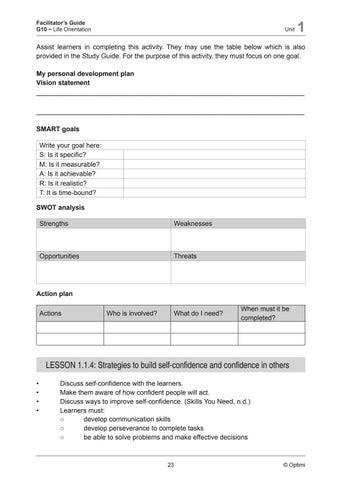
Activity 3: My personal development plan Learners must design their own personal development plan. The following aspects must be included: • Clearly stating a personal vision. • Setting a personal goal. Focus on the goal statement to be SMART. • Do a SWOT analysis on strengths, weaknesses, opportunities and threats. When done properly, this activity will not only increase more self-awareness and improve self-image, but will also help learners to think positively about opportunities that they might want to explore. • Design their own personal development action plan. Learners must identify areas that they need to develop. Assist in setting SMART goals to improve areas in need of development.
© Optimi
22
Facilitator’s Guide G10 ~ Life Orientation
Unit
1
Assist learners in completing this activity. They may use the table below which is also provided in the Study Guide. For the purpose of this activity, they must focus on one goal. My personal development plan Vision statement ________________________________________________________________________ ________________________________________________________________________ SMART goals Write your goal here: S: Is it specific? M: Is it measurable? A: Is it achievable? R: Is it realistic? T: It is time-bound? SWOT analysis Strengths
Weaknesses
Opportunities
Threats
Action plan Actions
Who is involved?
What do I need?
When must it be completed?
LESSON 1.1.4: Strategies to build self-confidence and confidence in others • • • •
Discuss self-confidence with the learners. Make them aware of how confident people will act. Discuss ways to improve self-confidence. (Skills You Need, n.d.) Learners must: ○ develop communication skills ○ develop perseverance to complete tasks ○ be able to solve problems and make effective decisions
23
© Optimi
Unit
1
Facilitator’s Guide G10 ~ Life Orientation
Improve communication skills • Discuss effective communication skills with the learners. • Share and discuss the following tips with the learners: Tips for confident communication • A stable clear voice. Practise to talk without whispers or stammering. • Make eye contact with your audience. • Listen attentively to others. • Be assertive. Do not confuse self-confidence with aggressiveness. • Speak from the heart – if you are passionate about what you say, you will feel more confident. (Matta, 2012) Plan to complete tasks successfully and on time Proper time management skills are equally as important as proper communication skills. • •
Discuss with learners the positive impact of completing tasks successfully and on time. Encourage learners to follow these guidelines.
Useful guidelines • Keep a planner where you plan your activities and manage your time to keep to your deadlines. • Remove all distractions, e.g. TV, social media, phone. • Congratulate yourself on all tasks completed successfully and on time and reward yourself. Problem-solving and decision-making • Assist learners to apply the basic problem-solving method as illustrated below. Once mastered, they will be able to handle difficult situations much easier and start to make more sound decisions in their lives. • Also share and discuss the following problem-solving and decision-making guidelines with learners. Problem-solving and decision-making Some useful guidelines for solving problems or making decisions • Clearly identify the problem or the issue. Try to understand why you think there is a problem. • Try to find potential causes for the problem. Also rely on the input from other people and listen to their opinions. • Identify alternative ways in which to approach the problem in order to solve it. • Brainstorm with others to find possible solutions. • Decide on the best possible solution to solve the problem. • Implement your final decision. • Evaluate the outcome. Did your plan work? Was this the best solution? © Optimi
24
Facilitator’s Guide G10 ~ Life Orientation
Unit
1
Problem-solving method
Very often we make decisions based on emotions. To ensure that the decision is viable and the best personal option available, a logical approach must be implemented. Rely on many different opinions of those not emotionally involved in the problem. Effective problem-solving and decision-making will be covered in more detail in Grade 11. How to build confidence in others Discuss with learners the personal joy they might find in helping someone else and how it might add to their own self-insight. It is not always easy to build confidence in another person. You can merely encourage them to be more confident. Let us look at some ways of encouragement. • •
•
•
Celebrate success. Your friend has passed their test. Make an effort to congratulate them on their success. Tell them how awesome you think that is. Compliment often. Compliment people on things they have done well. Many people are overly critical of their actions. Affirmation that something has been done well will encourage and motivate them. Listen to learn. Learn to listen when somebody talks to you. When someone expresses their anxiety or insecurities about something they must do, do not just dismiss it. Provide support and sound advice. Make an effort to meet people that are different from you. Focus on their uniqueness and what you can learn from them. Acknowledge and respect uniqueness and differences. Try to learn more from people different than you. The better we understand others, the easier it would be to support them.
25
© Optimi
Unit
1
Facilitator’s Guide G10 ~ Life Orientation
FOR THE CURIOUS The Power of Positive Thinking: How Thoughts Can Change Your Life by Brian Tracy Encourage learners to read and discuss the following article. Brian Tracy is a Canadian-American motivational public speaker and self-developed author of over eighty books. Below is a summary of the most important aspects of his article. Can you guess what the most successful and happy people think about all day long? The answer is quite simple … Healthy, happy people think about what they want, and how to get it, most of the time. In this way developing a positive attitude can profoundly change your entire life. When you think and talk about what you want and how to get it, you feel happier and in greater control of your life. When you think about something that makes you happy, your brain releases endorphins, which give you a generalised feeling of well-being. As a result, you develop a positive attitude. How to think positive Based on many psychological tests, happy people seem to have a special quality that enables them to live a better life than the average. Can you guess what it is? It is the quality of optimism! The best news about optimism is that it is a learnable quality. That means you can learn how to think positive by taking adopting an optimistic mindset. By the law of cause and effect, if you do and say what other healthy, happy people with positive attitudes do and say, you will soon feel the same way, get the same results, and enjoy the same experiences that they do. Happy people find good in the world Optimists seem to have different ways of dealing with the world that set them apart from the average. 1.
2.
© Optimi
First, they keep their minds on what they want, and keep looking for ways to get it. They are clear about goals and they are confident that they will accomplish them, sooner or later. Second, optimists look for the good in every problem or difficulty. When things go wrong, as they often do, they say, ‘That’s good!’ And then set about finding something positive about the situation.
26
Facilitator’s Guide G10 ~ Life Orientation
Unit
1
What we know is that, if you are looking for something good or beneficial in a person or situation, you will always find it. And while you are looking, you will be a more positive and cheerful person. The power of positive thinking Optimists seek the valuable lesson in every setback or reversal. Rather than getting upset and blaming someone else for what has happened, they take control over their emotions by saying, ‘What can I learn from this experience?’ Resolve today to learn how to develop positive thinking and a positive attitude toward yourself, the people around you and your life. How do you train your mind to think positive? Training your mind to think positive can be achieved by leveraging a simple concept. Your mind has enough bandwidth to only focus on one thought at a time. All you must do is keep it focused on uplifting thoughts until you form the same types of neural pathways that are created when you establish a new habit. When a negative event occurs, remember that it is your response that truly determines the outcome. Always look for the positive response or optimistic lesson when such events take place. Decide to be happy Resolve from now to see your glass of life as half full rather than half empty. Happy people give thanks for the many blessings in life rather than worrying or complaining about the things they do not have. Assume the best of intentions on the part of everyone around you. Most people are decent, honest and are trying to do the absolute best they know how to. When you look for something good in their words and actions, you will almost always find something. Your positive attitude in action It is easy to be cheerful when everything is going according to plan. But it is when you encounter unexpected setbacks and difficulties that you demonstrate to yourself, and the world around you, what kind of an attitude you really have. Make sure that it is a positive one! How positive thinking can help you Developing a positive attitude can help you in more ways than you might realize. When you think positive thoughts, you do not allow your mind (conscious or subconscious) to entertain any negative thoughts or doubts. After you learn how to think positive, you will notice amazing changes all around you. Your brain will begin to operate in a state of free-flowing feel-good hormones called endorphins, which will make you feel lighter and happier. You will also notice a major boost
27
© Optimi
Unit
1
Facilitator’s Guide G10 ~ Life Orientation
in confidence and will feel more capable of taking on new assignments and challenges that might have previously been outside your comfort zone. By reducing your self-limiting beliefs, you will effectively release your brakes and experience growth like you never imagined. Essentially, you can change your entire life simply by harnessing the power of positive thinking.
Source: bit.ly/3sZqDaF
Summary To be able to develop and grow as a person it is important to increase our self-awareness. Understanding yourself better, knowing your strengths and weaknesses provide you with an opportunity to develop strategies to improve yourself. You need to understand what might impact your self-esteem and how it might influence your level of confidence and relationships. You need to take control of your own personal development. Formulating your own vision statement and setting clear and smart goals will contribute to reaching your dreams. Assist learners with the following assessment task. Use it as a tool for preparing for the formal exams.
LESSON 1.1: Assessment memorandum 1.
List THREE effects of a poor self-esteem on a person’s personal development. Any THREE of the following or any other similar and related effect. • A person with a poor self-esteem does not value or appreciate themself which might prevent any personal development. • A poor self-esteem may cause a person to feel defeated and depressed with no interest in any personal development. • A poor self-esteem can prevent a person from reaching their full potential because they focus on their weaknesses rather than on their strengths and opportunities. • A poor self-esteem may cause a person to fall into a destructive relationship with no prospects of any more personal development. • A poor self-esteem may lead to making bad decisions and choices which might impact negatively on their life with no opportunities for personal development. (3 × 1) = (3)
© Optimi
28
Facilitator’s Guide G10 ~ Life Orientation
2.
1
What is the difference between self-awareness, self-esteem and personal development? • • •
3.
Unit
Self-awareness is the conscious knowledge of your own character, skills, feelings and the events in your life. Self-esteem is confidence in your own worth or abilities. Personal development is the actions you must take to improve your self-awareness and identity and to develop talents to reach your potential in order to enhance your quality of life. (3 × 1) = (3)
Discuss FOUR ways of building self-esteem. Any FOUR of the following or any other similar and related way. • Stop being critical of yourself and breaking yourself down. • Acknowledge your achievements and be proud of yourself. • Stop comparing yourself with others. • Do not aim for perfection because nobody is perfect. • Appreciate your own uniqueness. • Gracefully accept compliments. • Develop a positive mindset. (4 × 1) = (4)
4.
Your friend is struggling with low self-confidence. Suggest FOUR strategies that you can implement to help your friend improve their self-confidence. Any FOUR of the following or any other similar and related strategy. • Celebrate your friend’s successes to show them that you are proud of them. • Give honest and true compliments on tasks well done to make your friend feel good about their accomplishments. • Encourage and motivate your friend when they lack confidence to show them that you are interested in their well-being. • Listen when your friend wants to share feelings of insecurity to show them that they are worthy of your attention and empathy. • Do not dismiss or mock your friend’s feelings of anxiety or insecurity to show them that you care about the way they feel. • Value your friend’s uniqueness and ensure them that they are very special. (4 × 1) = (4)
5.
Explain the importance of having clear vision in order to reach your goals. A clear vision helps you to focus on and be sure about what you want in your life. Without a clear vision you will not be able to set SMART goals to reach this vision. (2 × 1) = (2)
29
© Optimi
Unit
1
6.
Facilitator’s Guide G10 ~ Life Orientation
Your friend has a negative view of the world and about themself. They see only a bleak future. Write a short paragraph on the benefits of positive thinking. You may refer to the article by Brian Tracy. Any FOUR related benefits which include a brief explanation. • Decide to be happy and develop a positive attitude because a happy person or an optimist tries to find the positive in every problem or difficulty. • Start to think positive thoughts which will help you to look for the valuable lesson that you can learn from every setback or difficulty. • Train your mind to avoid thinking negative thoughts because the feelgood hormones (endorphins) released by a happy brain will let you look at the world differently. • Surround yourself with positive people and eventually you will adopt their positive attitude. (4 × 1) = (4) [20]
LESSON 1.2: Power, power relations, masculinity, femininity and gender This lesson explores gender roles in our society. Learners must focus on the fact that society has certain expectations how we should act, speak, dress and conduct ourselves based on our assigned sex, which is called stereotyping. This lesson also provides information about the impact of power in relationships. Learners must understand that when someone has power, it means that person can influence others more easily and can let the other person do what they want them to do. This can lead to manipulation and controlling behaviour which can be harmful to self-esteem.
LEARNING OBJECTIVES
• • • •
At the end of this lesson, learners must be able to: understand the impact of gender identity and gender roles understand the impact of stereotyping gender roles understand how gender inequality and the misuse of power in relationships can contribute to sexual abuse define the concepts of power, power relations, masculinity, femininity and gender
DEFINITIONS Culture: Culture is an umbrella term which encompasses the social behaviour and norms found in different societies, as well as the knowledge, beliefs, arts, laws, customs, capabilities and habits of the individuals in these groups. Femininity: A set of attributes, behaviours and roles associated with girls and women. Gaslighting: A tactic and form of abuse in which a person manipulates another person in the hope of acquiring power and control over them. The manipulation leads to the victim questioning their own reality and perceptions. © Optimi
30