TRAINING PLANS
A 12-Week Training Plan for Your Fastest 10K Follow this plan to achieve a new personal best BY JEREMY DEERE CANADIAN ARMED FORCES Eight-time World Cross Country Championships Competitor, World Athletics Championships 5000m and Owner of Strides Running Store in Calgary, AB. STRIDESRUNNING
STRIDESRUNNINGSTORE
I
STRIDESRUNNING
f you have a time goal for a 10-kilometre race in the next few months this program is designed to help your training progress by keeping it interesting, yet challenging. Before starting this plan, it is strongly recommended that you can comfortably complete a 10-kilometre distance (with or without walk breaks). There may be a few new concepts introduced in this program – e.g. intervals, tempo runs and strides. Here’s a quick definition for each as they relate specifically to the training. Intervals - These are faster-paced runs and can range from 200 metres all the way up to three kilometres, depending on the distance you’re training for. In this program, I’ve kept the longest intervals to 1000 metres to help build your speed and turnover. Pace will vary depending on the length of interval. For example, for intervals 400 – 800 metres in distance, your pace will be run at your goal (or current) 5-kilometre pace. If you don’t know at what pace to run your intervals there are great pace charts available online – I often refer to www.mcmillanrunning.com Note: If you don’t have a GPS to calculate distance (or access to a running track), interval distances can be converted to time, based on your pace. For example, if your goal 10-kilometre pace is 50 minutes, the interval is 1000 metres and the workout calls for 10- kilometre pace, then you will run your interval for five minutes (or approximately 1000 metres). Tempo Runs - These are longer, sustained efforts, often run at, or slightly slower/faster, than your goal race pace. They help you increase endurance and provide feedback on your improvement. After a 10-minute warm-up jog, increase your pace to goal race pace for the designated time (e.g. 16-mininute tempo), then finish
54 I Running Issue 2026 I IMPACT MAGAZINE
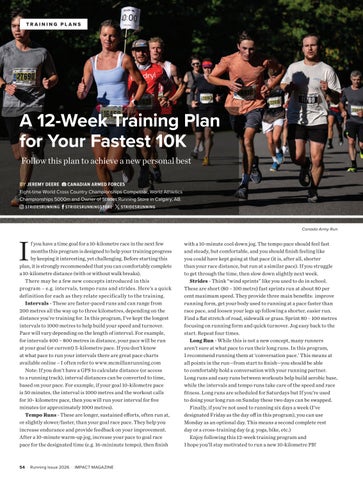
Canada Army Run
with a 10-minute cool down jog. The tempo pace should feel fast and steady, but comfortable, and you should finish feeling like you could have kept going at that pace (it is, after all, shorter than your race distance, but run at a similar pace). If you struggle to get through the time, then slow down slightly next week. Strides - Think “wind sprints” like you used to do in school. These are short (80 – 100 metre) fast sprints run at about 80 per cent maximum speed. They provide three main benefits: improve running form, get your body used to running at a pace faster than race pace, and loosen your legs up following a shorter, easier run. Find a flat stretch of road, sidewalk or grass. Sprint 80 – 100 metres focusing on running form and quick turnover. Jog easy back to the start. Repeat four times. Long Run - While this is not a new concept, many runners aren’t sure at what pace to run their long runs. In this program, I recommend running them at ‘conversation pace.’ This means at all points in the run—from start to finish—you should be able to comfortably hold a conversation with your running partner. Long runs and easy runs between workouts help build aerobic base, while the intervals and tempo runs take care of the speed and race fitness. Long runs are scheduled for Saturdays but If you’re used to doing your long run on Sunday these two days can be swapped. Finally, if you’re not used to running six days a week (I’ve designated Friday as the day off in this program), you can use Monday as an optional day. This means a second complete rest day or a cross-training day (e.g. yoga, bike, etc.) Enjoy following this 12-week training program and I hope you’ll stay motivated to run a new 10-kilometre PB!