EXPLORING THE ISSUES THAT SHAPE TODAY’S BUSINESS WORLD
+
Tit-for-tat tariffs hit Illinois
Our Women to Watch take on the glass ceiling
Cyber threats target tax season
Becoming a best boss
Are you a fraud fighter?
OF THE
THE
MAGAZINE
FALL 2018
We’ll help you make your accoun ng
adding any clients or staff.
We do it by empowering you to take back control of client accoun ng. Most accoun ng so ware is sold directly to small businesses, which has marginalized your professional status That business model is the primary cause of the challenges that both you and your clients face today.
Our cloud-based professional accoun ng system –Accoun ng Power CAS – includes everything you need for client accoun ng, and allows you to work collabora vely with your clients while you remain in control Accoun ng Power CAS minimizes client errors and streamlines your en re accoun ng prac ce so your staff can perform its current accoun ng work in much less me.
Performing Client Accoun ng Services (CAS) is a breeze with Accoun ng Power CAS. Using the me that your firm gains, you can now offer highly profitable Client
Accoun ng Services to clients who want to offload all their accoun ng work to you That’s how you add much more to your bo om line, while be er serving all your clients.
While

See for yourself how Accoun ng Power CAS can make your accoun ng prac ce more profitable. Visit AccountantsWorld.com/IL to learn more. Serious about your accounting practice? So are we.
more profitable without
The AccountantsWorld difference
prac ce 20%
most accoun ng so ware providers find innova ve
to
you
businesses, we find innova ve
ways
use
to grow their
ways to empower you to grow your own prac ce
Developed for CPA firms


CPACharge is a professional, affordable online payment solution that lets you give clients the options they want Unlike other payment solutions, CPACharge deposits 100 percent of payments, with fees debited the following month, for easy, accurate reconciliation We provide PCI Level 1 compliance and security, and expert in-house support Get the solution that’s trusted by more than 50,000 professionals as the best way to get paid CPACharge

MEMBER DISCOUNT PROGRAM CPACharge is a registered ISO of C tizens Bank N A MORE
$1,000 Pay CPA Card Number CVV Exp. **** **** **** 9998 001 NOV 2021 Payment Detail Submit to Smith Johnson, CPA cpacharge.com/icpas 855-612-1016
OPTIONS, FASTER PAYMENTS


2 INSIGHT | www icpas org/insight FALL 2018 www icpas org/insight REFLECTING ON THE GLASS CEILING 2 02 3 2 42 7 2 83 1 WHY CPAs LEAVE PUBLIC ACCOUNTING TARIFFS TAKE AIM AT ILLINOIS’ ECONOMY spotlights 6 Seen & Heard Sustainability Reporting on the Rise 8 Tech Pulse Cybersecurity 101 - From Victimized Tax Pros 42 Gen Next Pursuing a Higher Purpose By Julia Ariel-Rohr, CPA 44 IN Play Q&A With Jason Burian, CPA By Sarah Herrmann trends 10 Tax Is the New IRS Form 1040 Still too Taxing? By Eric Scott 12 Financial Planning Falling Into Tax Planning Season By Mark J Gilbert, CPA/PFS, MBA 14 Mergers & Acquisitions What ’ s Shaking Small Firm M&A? By Bridget McCrea 16 Leadership & People Management 5 Traits of a ‘Best Boss’ By Duncan Ferguson and Jay Scherer 18 Hiring & Retention Mentoring With Meaning By Annie Mueller insights 4 Today ’s CPA Be the Disruptor, Not the Disrupted By Todd Shapiro 32 Capitol Report We Want You to Be Heard By Marty Green, Esq 34 Tax Decoded Wondering About Wayfair By Keith Staats, JD 36 Corporate Minded 3 Keys to Retaining Top Talent By Amanda L Gavin, CPA , MBA 38 Partner Perspectives 7 Reasons Your CPA Firm May Not See a Second Generation By Marc Rosenberg, CPA 40 Ethics Engaged Are You a Fraud Fighter? By Elizabeth Pittelkow Kittner, CPA , CGMA , CITP, DTM
2018 | Illinois CPA Society
Join
The speed of disruptive change in the accounting profession has never been greater. Please join Rose Cammarata, CPA, CGMA, Chair of the ICPAS Board of Directors and Todd Shapiro, President & CEO, for
ILLINOIS CPA SOCIET Y
550 W Jackson Boulevard, Suite 900, Chicago, IL 60661 www.icpas.org
Publisher/President & CEO
Todd Shapiro
Editor Derrick Lilly
Creative Director
Gene Levitan
Photography
Jay Rubinic + Derrick Lilly
Circulation
John McQuillan
ICPAS OFFICERS
Chairperson
Rosaria Cammarata, CPA, CGMA | Mattersight Corporation
Vice Chairperson
Geoffrey J Harlow, CPA | Wipfli LLP
Secretar y
Dorri C McWhorter, CPA, CGMA, CITP | YWCA Metropolitan Chicago
Treasurer
Kevin V Wydra, CPA | Crowe LLP
Immediate Past Chairperson
Lisa Hartkopf, CPA | Ernst & Young LLP
ICPAS BOARD OF DIRECTORS
Christopher F Beaulieu, CPA, MST | Blue Money Strategy Inc
John C Bird, CPA | RSM US LLP
Brian J Blaha, CPA | Wipfli LLP
Jon S Davis, CPA | University of Illinois
Stephen R Ferrara, CPA | BDO USA LLP
Jonathan W Hauser, CPA | KPMG LLP
Scott E Hurwitz, CPA | Deloitte & Touche LLP
Anne M Kohler, CPA, CGMA | The Mpower Group
Thomas B Murtagh, CPA, JD | BKD LLP
Elizabeth S Pittelkow Kittner, CPA, CGMA, CITP | Litera Microsystems
Maria de J Prado, CPA | Prado & Renteria CPAs
Seun Salami, CPA | TIAA
Stella Marie Santos, CPA | Adelfia LLC
Andrea K Urban, CPA | ThoughtWorks Inc
BACK ISSUES + REPRINTS
Back issues may be available Articles may be reproduced with permission
Please send requests to lillyd@icpas org
ADVERTISING
Want to reach 25,000 accounting and finance professionals? Advertising in INSIGHT and with the Illinois CPA Society gives you access to Illinois’ largest financial community Contact Mike Walker at mike@rwwcompany com
INSIGHT is the magazine of the Illinois CPA Society Statements or articles of opinion appearing in INSIGHT are not necessarily the views of the Illinois CPA Society The materials and information contained within INSIGHT are offered as information only and not as practice, financial, accounting, legal or other professional advice Readers are strongly encouraged to consult with an appropriate professional advisor before acting on the information contained in this publication It is INSIGHT’s policy not to knowingly accept advertising that discriminates on the basis of race, religion, sex, age or origin The Illinois CPA Society reserves the right to reject paid advertising that does not meet INSIGHT’s qualifications or that may detract from its professional and ethical standards The Illinois CPA Society does not necessarily endorse the non-Society resources, services or products that may appear or be referenced within INSIGHT, and makes no representation or warranties about the products or services they may provide or their accuracy or claims The Illinois CPA Society does not guarantee delivery dates for INSIGHT The Society disclaims all warranties, express or implied, and assumes no responsibility whatsoever for damages incurred as a result of delays in delivering INSIGHT INSIGHT (ISSN-1053-8542) is published four times a year, in Spring, Summer, Fall, and Winter, by the Illinois CPA Society, 550 W Jackson, Suite 900, Chicago, IL 60661, USA, 312 993 0407 Copyright © 2018 No part of the contents may be reproduced by any means without the written consent of INSIGHT Send requests to the address above Periodicals postage paid at
POSTMASTER:
address changes to: INSIGHT,
CPA Society, 550 W Jackson, Suite 900, Chicago, IL 60661, USA
Chicago, IL and at additional mailing offices
Send
Illinois
us for an event near you!
on the most
happenings within our profession and a view of what lies ahead. all programs: CPE: 1.5 Credit Hours Cost: FREE Complimentary breakfast or lunch included. REGISTRATION Please
or visit www.icpas.org.
an engaging conversation
recent
call 800.993.0407
11.8.18 Bloomington-Normal 12.4.18 Oakbrook Terrace 11.9.18 East Peoria 12.5.18 Chicago 11.9.18 Springfield 12.6.18 Glenview 11.12.18 Champaign-Urbana 12.14.18 Collinsville 11.27.18 Rockford
today’sCPA
INSIGHTS FROM TODD SHAPIRO, ICPAS PRESIDENT & CEO

Be the Disruptor, Not the Disrupted
Iwas walking down LaSalle St in Chicago and got goosebumps when I looked up and saw light pole banners honoring the 75th anniversary of Mary T Washington Wylie becoming the first female African-American CPA in the nation. She started her own accounting firm in 1939 in the basement of her Chicago home during an era when accounting firms wouldn’t hire females or African-Americans, let alone a female African-American. She inspired other young African-American businesspeople and CPAs and paved the way for generations to come Mrs Wylie wasn’t only a visionary, trailblazer, and mentor but a disruptor
Today, our profession is at a crossroads At a recent conference, the speaker said, “We will never see a pace of change slower than right now.” Three major trends are impacting the profession: technological innovation, changing hiring practices, and new client demands. These interrelated trends are forcing CPAs to rethink what they do, how they do it, and who does it.
Robotic process automation (RPA) and artificial intelligence (AI) are already changing how work gets done A study by Deloitte and Accenture states that “the amount of basic accounting work that robotics is predicted to automate or eliminate by 2020 may reach 40 percent.” While I see this transformation happening to a greater extent in the largest firms, I recently visited a firm of about 50 staff that’s looking at an AI-powered audit solution. At a recent ICPAS Chapter meeting, I asked the primarily older audience when they thought we’d see a significant impact from RPA and AI. The clear majority thought major change would occur in seven years or less We may not reach the 40 percent automation mark by 2020 but it’s coming quickly
Firms are changing because of RPA and AI, which means the people inside firms will be impacted and will change, too. Traditionally, for instance, audit teams were comprised of mostly CPAs and, possibly, a few non-CPAs. Today, we are starting to see teams incorporate technologists and data analysts. Client demands
are also changing to include requests for more strategic advice, cybersecurity guidance, and client accounting services. Meaning, CPAs will need to learn how to manage and mesh with teams with very different skills, and CPAs will be spending far more time providing valuable analysis and invaluable insight
So, what should you do?
Adopting new technology obviously presents a wonderful opportunity for CPAs. As technology further automates basic compliance work and functions, CPAs will no longer be burdened with hours of manual computation, testing, and reconciliation It’ll be smart to begin offering new, high-value services to clients and companies But, most importantly, we all need to embrace the future of the profession
My challenge to you is to unlearn your old business practices
Learn new ways of doing business that incorporate emerging and disruptive technologies, like RPA, AI, and blockchain Throughout history, disruptors have led innovative change. In 2000, Netflix Co-Founder Reed Hastings approached then Blockbuster CEO John Antioco about buying Netflix for $50 million Antioco reportedly laughed Hastings out of the room We know how this story ended Blockbuster has a single store still standing while Netflix has soared to have a $147 billion-plus market cap
Blockbuster got disrupted Netflix and Mary T Washington Wylie were disruptors We as a profession, individually and collectively, now must decide which turn to take at the crossroads Will we embrace a brave, new future and become the disruptors, or will we become the next Blockbuster and become the disrupted? If you ask me, there is no choice CPAs must be the disruptors!
{Follow Todd on Twitter @Todd ICPAS}
{Watch Todd’s CEO Video Series on YouTube}
4 INSIGHT | www icpas org/insight

Sustainability Reporting on the Rise
 BY THOMAS L ZELLER, PH D , CPA, DAVID R FAUST, AND RACHEL D PHAN
Environmental, social, and governance (ESG) are the buzzwords accounting and finance pros need to know as calls for greater corporate social responsibility and corresponding sustainability reporting put new demands on companies seeking success in our increasingly socially conscious society
Consumers, investors, suppliers, and business par tners alike are demanding both private and public companies par ticipate in and report on relevant sustainability and social efforts Two main factors seem to be driving the rise in sustainability repor ting
First, stakeholders, owners, and employees either willingly or due to generational changes and social pressures want to par ticipate in sustainability ef for ts Companies engaged then typically measure and repor t on their ESG sustainability practices, which helps to bolster corporate consciences and profits while simultaneously building a better business model
Second, several business risks and oppor tunities fall outside the lens of traditional financial repor ting that impact a company’s value Studies show only 20 to 40 percent of a company’s value is tied to tangible assets, meaning financial statements generally fail to capture and measure ESG-related risks and oppor tunities think risks associated with scarce resources (like clean water or rare ear th materials), geopolitical issues, and labor shor tages Oppor tunities associated with labor practices, leadership styles, and technology also escape the traditional financial reporting lens These risks can become dire, and oppor tunities may be forgone, without the proper repor ting framework to identify and measure them Additionally, companies that do not repor t beyond their traditional financials will miss out on appealing to a growing class of socially responsible investors and consumers
Although the need for sustainability repor ting is growing, business knowledge and understanding of it remains limited “Too few managers are familiar with fulfilling financial and social goals simultaneously and there are few templates for developing organizational processes and systems to help them do so Internally, organizations often struggle to allocate resources toward
these dif ferent goals and to deal with the trade-of fs that they face,” writes
Julie Battilana, Joseph C Wilson Professor of Business Administration at Har vard Business School and Alan L Gleitsman Professor of Social Innovation at Harvard Kennedy School, for HBS Working Knowledge
The pressing question now is how will your company, and how will you, prepare to answer the call when your stakeholders, customers, or clients ask about sustainability measures and repor ting? The independent Sustainability Accounting Standards Board (SASB) might have your answer
The SASB aims to guide public corporations in disclosing financially material information regarding ESG issues to investors and the broader public The SASB’s current repor ting standards cover 1 1 sectors for 79 industries Each industr y has unique sustainability topics and related accounting metrics defined by five sustainability dimensions: Environment, Social Capital, Human Capital, Business Model and Innovation, and Leadership and Governance
The SASB of fers two resources to uncover the material topics and measures per tinent to a business’s sustainability ef for ts a downloadable standard for each respective industr y and an interactive SASB Materiality Map that identifies the relevant topics and accounting metrics for each dimension of the framework for a respective industr y All you need to do is match your business or your client’s to one of the sectors and industries
All in all, the collective trend towards sustainability is clear Investors and consumers value companies that express interest and action in managing their social and environmental impacts There’s no question that sustainability accounting is soon to become a best-practice
For tunately, there’s no need to recreate the wheel when it comes to sustainability repor ting; the SASB has done the heavy lif ting Accounting and finance professionals now just need to do their part by educating themselves and those they ser ve about how and why sustainability repor ting matters
6 INSIGHT | www icpas org/insight

*The 2017 INSIDE Public Accounting Benchmarking report Loans and lines of credit subject to approval Potential borrowers are responsible for their own due diligence on acquisitions CA residents: Loans made pursuant to a Department of Corporations California Finance Lenders License (#6039829) FACT: Oak Street Funding® provides non-SBA loans to CPAs. We’ll get you there. Let Oak Street Funding help you stay ahead of the statistics with capital to propel your business. a first financial bank company The average par tner buy-in for new par tners is Contact us to receive a quote or learn more. oakstreetfunding.com/illinois 844.343.1420 of CPA rms plan to acquire another rm this year.* of rms expect to add FTE staff over the next several years. * .
Cybersecurity 101- From Victimized Tax Pros
As cybercriminals continue to prey on tax professionals’ data, the Security Summit a par tnership between the IRS, states, and the private-sector tax community is sharing some lessons learned by victimized tax professionals in hopes of helping others avoid being cybercrime targets
In recent years, hundreds of tax professionals experienced data thef ts or security breaches that exposed their clients’ personal information to cybercriminals and tax-related identity thieves, warns the Security Summit
Thieves use stolen data from tax professionals and their firms to create fraudulent returns that are becoming harder to detect and distinguish from legitimate taxpayer returns, meaning CPAs and their firms must be especially vigilant if they want to defend against a devastating data loss
Below, the Security Summit of fers insights from victimized tax professionals to help you better protect against cyberattacks
Lesson 1: Get cyber insurance
Tax professionals who’ve been victimized by cybercriminals say they either were glad they had, or wish they had, insurance coverage for data loss
While it’s common to maintain business insurance policies that cover property and liability, data thefts often go overlooked Cyberspecific coverage for data breaches also needs a special look
This may require an addendum or rider to your current policy or an entirely separate one
It’s suggested that the dollar amount of the policy be large enough to cover all expenses But also look for insurance companies and/or coverage that provides exper ts that will assist in setting up safeguards and identifying the source of the data breach and resolving it if one occurs
Another recommendation: If you’re using a cloud storage solution, ask the provider about cyber insurance coverage in case their systems are breached
Lesson 2: Password-protect client accounts
This could be a critical safeguard against cyber thieves Tax professionals who have experienced data thefts acknowledge that
protecting each individual client account with a unique password can be a hassle, but it’s wor th the trouble should a breach occur, and many tax software solutions are making this easier to manage
Further, strong passwords can help prevent or slow cybercriminals from accessing computer systems and accounts Passwords should be a mix of a minimum of eight letters, special characters, and numbers
Lesson 3: Use a vir tual private network (VPN)

This may require help from your IT team, but tax professionals who have fallen victim to cybercriminals say they wish they had used a vir tual private network (VPN) instead of remote access sof tware when working of fsite A VPN allows for teleworkers or branch of fices to securely connect to the firm’s central computer system to send and receive information
Why avoid remotely accessing your work computer system? The Security Summit warns of cases where cybercriminals have taken over remote access of tax professionals’ computer systems, accessing client accounts via the highjacked computers, completing and e-filing pending returns, and changing direct deposit information to their own accounts
Lesson 4: Keep security sof tware updated
Tax professionals who experienced data thefts warn colleagues to keep all security sof tware current This includes the computer operating system, anti-malware and anti-virus sof tware, firewalls, etc While most computers come with security sof tware installed, you can purchase additional security sof tware products relevant to your specific practice and uses To make managing updates easier, set all sof tware to update automatically
In addition to these lessons, the Security Summit reminds all tax professionals that they must have a written data security plan as required by the Federal Trade Commission and its Safeguards Rule The IRS has a variety of security resources available, including Publication 455 7, “Safeguarding Taxpayer Data,” and Publication 5293, “Data Security Resource Guide for Tax Professionals,” which provides a compilation of data thef t information and is available on IRS gov
8 INSIGHT | www icpas org/insight
100% CPA MEMBERSHIP PROGRAM

Arnold, Behrens, Nesbit, Gray P.C.
Bansley, Brescia & Co. P.C.
BDO USA, LLP
Bernard A. Affetto & Co.
Borschnack, Pelletier & Co
BrookWeiner LLC
Catalano, Caboor & Co.
The Charneske Group
CliftonLarsonAllen
Coleman & Associates CPA's, Ltd.
Cray, Kaiser Ltd.
Crowe LLP
Cygan Hayes, Ltd.
Deborah K. Hannan CPA P.C.
Dennis F. Rose & Associates, P.C.
Detterbeck Johnson & Monsen
Duffner & Company P.C.
Dunbar, Breitweiser & Company, LLP
Ernst & Young LLP
FSB&W LLC
Grant Thornton LLP
GW & Associates, P.C.
Hoffman & Tranel P.C.
Insight CPAs & Financial LLC
JM Abbott & Associates, Ltd.
John U. Smyth CPA, LLC
Katz LLC
Kerber, Eck & Braeckel LLP
KPMG US LLP
Kutchins, Robbins & Diamond, Ltd.
Larry J. Wolfe, Ltd.
Lerman, Sweeney & Company, LLP
Lipschultz, Levin & Gray LLC
Mack & Associates, P.C.
Marcum LLP
McCullough, Rossi & Co., Ltd.
Ostrow Reisin Berk & Abrams, Ltd.
Pasquesi Sheppard LLC
Paul M. Roberts, LLC
PricewaterhouseCoopers, LLP

Rub & Brillhart, LLC
Sassetti LLC
Selden Fox, Ltd.
Smith, Koelling, Dykstra, & Ohm, P.C.
Tighe, Kress & Orr, P.C.
West & Company, LLC
Whitlock and Associates, P.C.
Wipfli LLP For more information on how your firm can be part of the 100% CPA Membership Program, please visit www.icpas.org.
To thank you for your support...
of the Illinois CPA Society and the profession, we are pleased to recognize these Illinois accounting firms with 100% of their CPA staff who are members.*
*minimum of 2 CPAs
Is the New IRS Form 1040 Still too Taxing?
Billed as a “postcard- sized” sheet that ’ s more user-friendly, does the revised IRS Form 1040 make a difference for taxpayers and preparers?
BY ERIC SCOTT
Shorter, faster, a time-saver that’s easier to fill and file. Those are just a few of the IRS’ selling points regarding its new “postcardsized” IRS Form 1040 that’s being introduced for the 2019 tax season (for the 2018 tax year)
The first thing you should know is that the new form is not really a postcard you can’t stick a stamp on it and toss it into your mailbox for delivery to the IRS In fact, doing that is sure to get your, or your client’s, identity stolen as the form is still chockfull of sensitive personal information
The postcard reference merely refers to the form’s smaller appearance Considering the IRS received more than 152 million returns last tax season, including more than 132 million electronically filed returns, one must wonder if the paper form change is going to make much difference in today’s increasingly mobile, paperless, get-it-done-on-the-go culture.
Around 90 percent of all tax returns filed each year are received electronically, according to the U S Treasury Department and the IRS, which means paper tax forms are edging closer to extinction

So, the big questions heading into tax season may be: Are we
putting too much emphasis on the look of a paper tax form? Further, will the new 1040 actually add complexity to the filing process?
WHAT’S CHANGING?
The new form updates and replaces the current Form 1040, 1040A, and 1040EZ. While the current 1040 has 79 lines to fill out, the new form has just 23. So, by appearance, it looks like it would take much less time to fill out and file, but that’s not the only change.
Many of the items taxpayers report on their 1040s will now move to six new Schedules that will need to be filed along with the new 1040:
Schedule 1, Additional Income and Adjustments to Income – This covers items such as business income, capital gains or losses, alimony received, unemployment compensation, farm income, and earnings from rental real estate, royalties, partnerships, S corporations, and trusts, among others Of course, many of these will still require additional Schedule filings in certain cases
Schedule 2, Tax – This includes the Alternative Minimum Tax and taxes on a dependent child’s unearned income or “kiddie tax.”
10 INSIGHT | www icpas org/insight T A X
Schedule 3, Nonrefundable Credits – This covers credits that can help reduce your tax bill to zero, but that you won’t get a refund for, including credits for child and dependent care and education
Schedule 4, Other Taxes – This accounts for other taxes you might owe, like self-employment tax, Social Security and Medicare taxes, household employment taxes, retirement plan taxes, net investment income tax, and the ACA penalty tax
Schedule 5, Other Payments and Refundable Credits – Here you’ll include items like estimated tax payments, amounts paid with a tax filing extension request, and premium tax for health insurance marketplace users
Schedule 6, Foreign Address and Third-Party Designee – This is where taxpayers must list any foreign addresses or third-party designees who may discuss a tax filer ’s return with the IRS
So far, no changes have been announced regarding existing Schedules, including Schedule A for itemized deductions, Schedule C for listing profits or losses from business income, and Schedule D for capital gains and losses, which all may still be required depending on the circumstances.
So, only taxpayers with the most basic, straightforward tax returns will file the new top page of Form 1040 too bad that scenario only pertains to about 25 percent of all individual income tax filers, according to recent Treasury Department and IRS estimates. Job security for CPAs, right?
THE TAX PRO’S PERSPECTIVE
Since the IRS released its draft version of the new Form 1040 in June, tax professionals have been weighing in with commentary
“The form isn’t materially changing how I gather and file income taxes for my clients,” says Daniel Rahill, CPA, JD, a Chicago-based tax partner with BDO Rahill, who is also a former Illinois CPA Society chairman, stresses that when it comes to preparing taxes, the information needed isn’t any different, it now just needs to be listed in different places. “It’s essentially going to be the same process. I’ll ask the same questions and will need the same information It’s not a significant event to me or any of us ”
For other tax preparers, the bigger concern is about those different places where information that used to be listed on Form 1040 will now be reported
“The shorter form is not the issue, the sub-Schedules my clients will still need to pick through will be the problem,” says Deborah L. Kurtzke, CPA, MST, of DK Tax & Accounting Inc. “I am anticipating they will attempt to do their return and get frustrated with the Schedules and call for an appointment or to drop off their returns ”
The introduction of the new Form 1040 coincides with the implementation of new tax reform measures specified in the federal Tax Cuts and Jobs Act of 2017, including higher standard deduction levels, which may be more advantageous for tax filers who usually itemize their deductions But while the upcoming tax changes are designed to make filing easier, the one-two punch of combining new tax reforms with a new Form 1040 is likely to land a few blows this tax season.
“Was it a good idea to also make the first significant changes to the tax form at the same time new reforms are taking hold? I don’t know about that,” Rahill says.
Once the new Form 1040 and accompanying Schedules become official, the clock also starts ticking for tax preparation software companies to update and test all their products for quality
assurance. So, the most anxious people awaiting the IRS’ official releases may not be tax practitioners but the software developers who make it possible for everyone, from the largest accounting firms to the do-it-yourselfers, to e-file tax returns.

“You don’t want to have to call your software help desk and explain that you put a number in the box and it didn’t carry over to the Schedule and then hear, ‘Oh, yeah, we have a coding error,’” Rahill explains
That technology update cascades to all 50 states every state and U S territory must make sure their own tax forms align with the new federal guidelines and Form 1040. For example, Rahill points out that the current Illinois Form 1040 begins by instructing preparers to list adjusted gross income from line 37 of the current IRS Form 1040 But the new, shortened form doesn’t include an adjusted gross income line that’s moving to one of the new Schedules.
GETTING HELP
As we head into what may be one of the more memorable tax seasons in recent years, quick guidance and resources are available Updates from the IRS can be found online at www IRS gov/tax-reform, and specific information about the new Form 1040 is at www irs gov/forms-instructions The IRS is also encouraging everyone to make sure their payroll withholding taxes are in line with new tax reforms Their paycheck check-up withholding calculator can be found at https://apps.irs.gov/app/ withholdingcalculator/ The Illinois CPA Society also provides updates on federal tax reforms Check out www icpas org/taxreform for the latest
www icpas org/insight | FALL 2018 11
E xperiencing: • Stress? • L ack of Sleep? • IRS induced Nausea? We have helped thousands sell... and WE CAN HELP YOU! Ta x Se as on Cessation Pro gram Trent Holmes 800-397-0249 Trent@APS.net www.APS.net D e l i v e r i n g R e s u lt sO n e P r a c t i c e At a t i m e
Falling Into Tax Planning Season

With the end of the year approaching, tax and financial planners have some important issues to consider before their clients come calling.
BY MARK J GILBERT, CPA/PFS, MBA
The Tax Cuts and Jobs Act of 2017 (TCJA), enacted into law in late 2017, has held the attention of tax and financial planners all year. As 2018 is nearing its end, however, some of the most useful tools available to aid us in confidently interpreting the law and planning for our clients to effectively reduce their 2018 income taxes (like IRS guidance and tax planning software) are, as of this writing, still inadequate or unavailable Nevertheless, we must carry on. So, here are some of the most important issues I’ve identified in planning for my individual taxpayer clients
TAX RATES, STANDARD DEDUCTIONS, EXEMPTIONS, AND CREDITS
A signature feature of the TCJA is that, generally, for a given level of income, the marginal federal income tax rate is lower in 2018. Clients are likely to focus on that aspect of the law, especially if their gross income has changed little between 2017 and 2018. Of course, taxes are computed on income net of deductions and exemptions, or adjusted gross income (AGI), not on gross income
The standard deduction has increased meaningfully, to $12,000 for single filers and $24,000 for married filing jointly, while the personal exemption for each household filer and dependent has been eliminated (from $4,050 in 2017) The child tax credit has also increased significantly, to $2,000 per qualifying child, and a new family credit of $500 per qualifying dependent has been introduced for 2018.
Since these changes, and others discussed below, are so sweeping and could result in significant increases in or decreases in tax liabilities, I believe most clients will benefit from a review of their 2017 tax liability and some sort of projection of their 2018 liability. At a minimum, I recommend communicating with clients that the impact of this tax law is hard to determine without having a formal discussion and review of their finances before the end of the year
ITEMIZED DEDUCTIONS
Given the substantial increase in the standard deduction, it’s quite possible that most taxpayers will elect it over itemized deductions However, there may be opportunities to proactively “bunch” itemized deductions from two years into one year such that the total exceeds the standard deduction for appropriate clients Consider the following:
• Accelerating qualified medical expense payments into 2018 from 2019 might be beneficial since the medical expense deduction threshold is 7 5 percent of AGI in 2018 vs 10 percent in 2019
• State and local tax deductions are limited to $10,000 per year.
• The mortgage interest expense deduction is reduced to $750,000 (on post-December 15, 2017 loans) from the prior cap of $1 million, and interest on most home equity loans is no longer deductible beginning in 2018. Consider evaluating whether clients should refinance an existing mortgage to pay off the home equity loan.
12 INSIGHT | www icpas org/insight
F I N A N C I A L P L A N N I N G
• The charitable contribution (cash) limitation increases from 50 percent of AGI to 60 percent in 2018. For charitably minded clients, consider introducing the idea of contributing to a donor advised fund, where a relatively large one-time gift can be deposited in 2018 and distributed over multiple years in the future.

• Miscellaneous itemized deductions have been eliminated
Investment management fees once paid with after-tax funds to secure the tax deduction might now be allocated between IRA and after-tax funds Consider paying the IRA share of the fee from the IRA, which is also attractive as this might reduce future required minimum distributions
• The itemized deduction phase-out, for higher income level taxpayers, has been eliminated
ALTERNATIVE MINIMUM TAX
Exemption amounts have increased by 29 percent for 2018, and the income thresholds at which taxpayers can take at least a partial exemption has increased significantly in 2018 ($781,200 for single filers and $1,437,600 for married filing jointly) As a result, fewer taxpayers are expected to be subject to alternative minimum tax
NET INVESTMENT INCOME TAX
The net investment income tax, which first landed on taxpayers’ returns for 2013, was created to generate tax revenue to cover a portion of the costs of the Affordable Care Act. While the tax rate and computation methodology were largely unchanged with enactment of the TCJA, the reduction in itemized deductions might cause modified AGI to increase and result in a higher tax Therefore,
I recommend the use of tax-free municipal bonds in client portfolios as the interest on these bonds is excluded from the computation of net investment income for these purposes
SECTION 529 AND ABLE ACCOUNTS
The TCJA now permits the use of a Section 529 plan account for a child’s elementary and secondary education, in addition to college and other qualified higher education. Therefore, consider recommending clients make contributions to these plans, especially when they are interested in private primary education for children, grandchildren, and other family youngsters.
ABLE accounts, which provide a means for individuals with disabilities and their families to fund the typically higher living costs that disabled individuals face, are funded with after-tax dollars This provision of the law recognizes that a child, for whom a 529 plan account was established with the expectation that he or she would attend college, may develop a disability and be unable to attend post-secondary school In this case, 529 plan funds could be used to assist with the child’s disability-related living expenses I recommend encouraging parents and grandparents of disabled children to set up and fund ABLE accounts.
Whenever we see major tax legislation, it often modifies multiple provisions of the tax code The TCJA is no different That’s why this year it’s critical to assess all areas of your clients’ finances to determine the net effect of all TCJA changes on them. It’s far too difficult to predict that what applies to one client might apply to most of your clients In any event, there’s plenty of tax and financial planning opportunities ahead Hopefully I’ve presented some ideas that you or your clients can act on to mitigate at least a portion of the negative impacts of the TCJA
www icpas org/insight | FALL 2018 13
Looking for a career in accounting or nance? Br illiant can help. We h a ve t e m p, d i r e c t-h i r e a nd c o n s u l t i n g o pport u n i t i e s av a i l able i n g r eat e r C h i c ago. Giv e u s a c all. 312 . 5 8 2 .1800 | www. b r illia n t fs.c o m | @Brill i a n tFS
What ’ s Shaking Small Firm M&A?

Small accounting practices have their work cut out for them in today ’ s mergers and acquisitions environment
BY BRIDGET MCCREA
When New York-based accounting firm Mitchell & Titus finalized a deal to purchase Chicago-based Washington, Pittman & McKeever in July, it closed the final chapter of a long-time plan of managing partner and former Chicago Federal Reserve Chairman Lester McKeever, Jr.
“There had been talk around here for many years over the issue of merging,” says McKeever, 84 “I spoke to all of the local CPA firms particularly minority-owned firms to see if we could come together to create the scale necessary for a firm to offer all of the different services that the large firms could offer in order to support our growth ”
As it turned out, McKeever knew the perfect suitor for decades, but protecting the legacy of Washington, Pittman & McKeever was crucial; the firm was founded nearly eight decades ago by Mary T Washington Wylie, the first African American woman to become a CPA
Around the time McKeever was rallying the troops in favor of a large, merged, minority-owned accounting firm, he renewed a conversation with Mitchell & Titus founder Bert Mitchell that took place some 25 years ago about combining the firms. “That was the kind of firm we all aspired to a larger, minority-owned firm with multiple offices,” says McKeever, reflecting on Mitchell & Titus, which is the largest minority-controlled firm today. “It’s an aspirational dream that has come true for me [the merger], particularly because this is geared toward African American business development; it was a natural fit ”
McKeever is no stranger to the challenges of running a small accounting firm in today’s increasingly competitive and complex
marketplace. If anything, he empathizes with small firm owners. “It’s almost impossible to keep up with everything,” McKeever says “It takes a broader-based organization to cover all of the different areas that must be addressed in order to survive, sustain, and grow ”
Looking at the accounting landscape right now, McKeever says every smaller firm is going to have to start thinking like this, particularly if M&A is to be the backbone for future success or succession planning
“Some firms are waiting until it’s too late and wind up with nothing of value to sell. It’s not easy to find a successful firm that will pick you up,” McKeever warns “If the right opportunity comes along, I always encourage small firms to take advantage of it It’s not just about sustaining growth; it’s about protecting your hard work and seeing it survive and sustain over time ”
TIME CHANGES EVERYTHING
There was a time when small CPA firms (less than $3 million in revenues) were hot commodities That sentiment has changed over the past couple of years as acquirers have become more interested in firms that have an advisory, consulting, tax planning, or specialty service/industry focus, explains Allan Koltin, CPA, CGMA, CEO of Koltin Consulting Group in Chicago Koltin has been called “accounting’s busiest matchmaker” by Crain’s, so perhaps it’s wise to heed his words
“Large firms aren’t as interested in small firms because they see them as ‘stale goods,’” Koltin says, pointing to firms focused heavily on compliance work that must undergo transformations to catch up with the increasing use of automation, artificial intelligence,
14 INSIGHT | www icpas org/insight M E R G E R S & A C Q U I S I T I O N S
machine learning, and robotics. Combined, these factors are pushing acquirers to move investment dollars away from old school, “traditional looking accounting firms,” Koltin explains “The interest level for small firm M&A just isn’t what it used to be ” That’s not to say there’s no hope for small firms, though Koltin says the potential for smaller, high-performing firms that have shown consistent growth and profitability is still there; they’re the kind that “always sell at the high end ” However, the small firms run by a few baby boomer partners who have built their business empire around themselves will be hard-pressed to realize a good valuation right now. “Those types of firms will sell at the low end because the buyer will have to invest in talent,” Koltin says. “It will come down to cost versus deal value ”
WHAT’S IT WORTH?
Getting top dollar is always top of mind for firm owners looking to sell, but expectations should be realistic Trent Holmes, a broker at Accounting Practice Sales, handles the sales of about 15-20 accounting practices annually in Illinois, with 80 percent located in the Chicago area. He says one times gross revenue has historically been the jumping-off point for selling price.
In the Chicago market, Holmes says the average sales price has hovered around 122 percent of gross revenues “The firms located in larger metro areas are going to demand a premium It’s kind of like people asking what houses are worth. There are a lot of factors that go into it, and you can’t just ask what practices are worth without looking at all of the details,” Holmes says

In the midst of his busy season, Holmes cautions that too many firms on the market also can have a negative impact on practice values He warns this could compound in the years ahead as more
baby boomers look to make their exits. Firms also need to be aware of the value of their talent. In assessing the sales opportunities for smaller firms (less than $2 million in gross sales), Holmes says the fact that some or all the talent will leave once the sale closes can be a deterrent
“In many cases, there’s no talent left once the firm is sold. That will have a negative effect on the practice’s value,” Holmes explains, stressing that the greatest M&A potential for small firms lies in taking the time to develop solid succession plans well in advance
“You’re going to need the younger talent to come in and take over. Don’t wait until it’s your last tax season to go out and find a buyer,” Holmes advises “Start now It’s never too early to have a discussion with a nearby firm or a broker or to create a plan of action even if it’s still two to three years out ”
SKIP THE BITTER END
Like Holmes, Koltin sees good planning as a way to ward off problems when it comes time to hang up your pencils and enjoy your retirement years. “Don’t wait until the bitter end to do something about it,” Koltin says. “Engage an outside party for help with the process Every firm stands on its own, so get objective advice on what’s realistic and what intersects with each of the partners’ wishes ”
Having recently wrapped up the sale of his firm, McKeever says mid-size firms may have an easier time finding a suitor in today’s market, but all is not lost for the small firm that wants to be acquired “The real challenge is trying to find firms that have a good mix of different skill sets with the same quality,” he says “To be able to broaden the scale and the scope of the services that you provide I think that’s really the objective ”
For more than one hundred years, The Club has been a valued resource for Chicago’s business leaders - connecting members, providing opportunities for strategic relationship development, access to world class speakers, and enhanced exposure to the broader business communit y.


W ith initiatives, such as Signature Series programs, EC Associates, Leadership Circle, forum events and other member perks, there are ways for women and men of all ages to learn and grow at The Club

www icpas org/insight | FALL 2018 15
GROW.
INSPIRE. JOIN THE CLUB Become a member today. Contact us at 312-263-3500 or Membership@ExecutivesClub.org to learn more.
CONNECT.
5 Traits of a ‘Best Boss’

Becoming a Best Boss should be the focus of every business leader. Here’s how to do it.
BY DUNCAN FERGUSON AND JAY SCHERER
You made me a better person not just a better leader You made me learn how much more people can do when they feel supported and appreciated You taught me to take chances, celebrate success, and appreciate that if I don’t make mistakes, I’m not challenging myself enough! Thank you!”
Have you ever worked for someone who made you feel this way?
If you’re lucky enough to have worked for a Best Boss, this relationship likely had a profound impact on your performance, your career, and your life And if you are, or aspire to be, a Best Boss, you will have that same impact We think everyone should plan to be a Best Boss So, here’s how to do it
BEHAVIORS OF A BEST BOSS
Chicago-based consultancy Lead Well LLC, in partnership with Vantage Leadership Consulting, invited individuals across many demographics and working environments to answer seven openended questions about their perceived Best Boss. Survey respondents repeatedly highlighted five integrated behavioral traits:
• Leads With a Higher Purpose – A Best Boss has a purpose beyond self-interest and profit that is put into action on behalf of the individual
• Activates Potential – A Best Boss observes, values, and takes steps to activate the present capability and future potential of the individual.
• Grants Autonomy – A Best Boss imparts knowledge, business acumen, and big picture thinking, and establishes an autonomous space for the individual to perform.
• Provides Pervasive Feedback – A Best Boss seamlessly uses frequent and diverse feedback to constructively shape, reinforce, and/or modify behavior.
• Encourages Risk Taking to Accelerate Learning – A Best Boss fuels reasonable risk taking to assure learning and realizes that mistakes are a natural part of the growth process
Behind these five Best Boss traits is a contemporary leadership philosophy shared success Being a great leader is not just about work and careers, it’s also about supporting an individual’s success by focusing on their personal needs. It’s about creating an energy in someone, so they achieve their aspirations, and therefore yours and your organization’s
Leading from the point of view that the organization’s needs dominate simply doesn’t work anymore At the same time, we also know that an individual’s needs cannot always be the top priority Instead, great leadership today must be about building an energized balance between individual and organizational needs
A BEST BOSS IS HARD TO FIND
Unfortunately, all too often we tend to work for bad bosses Our society loves to focus on bad boss experiences In 2011, the movie “Horrible Bosses” was a comedic hit. Badbossology.com is
16 INSIGHT | www icpas org/insight L E A D E R S H I P & P E O P L E M A N A G E M E N T
dedicated to helping people deal with difficult bosses. According to this website, half of us would fire our boss if we could Research has increasingly focused on the impact of bad bosses Gallup surveys regularly tell us the top reason people quit their jobs is because of their bosses A 2008 study by Swedish scientists even found that males were 35 percent more likely to have a heart attack if they worked for a bad boss. On and on it goes.
We also know that the accounting and finance profession faces several challenges directly linked to the cultures within organizations and the business practices driving them The Illinois CPA Society’s INSIGHT Special Feature, “The Culture Conflicts,” highlights many of those challenges and asks us what we can do about them In many cases, change must come directly from leadership aka the bosses

Our goal here is to help you build the mindset that a great leader, a Best Boss, must focus on connecting, engaging, and retaining diverse talent. As the “war for talent” worsens, this type of focus is critical for your business to remain competitive in a tight labor market Your ability to differentiate yourself as a great leader, and your organization as a great place to work, materially impacts your business because, done right, you’ll be better able to attract the best candidates, build diverse teams, and motivate each worker to reac fullest potential.
In other words, as a Best Boss, you can help change firm and corporate cultures, drive solutions to the succession planning struggles so many organizations face, and truly drive the development and shared success of your staff
BECOMING A BEST BOSS
To be clear, leading is more than connecting, engaging, and retaining It’s also about aligning, executing, and achieving A great leader must get results It’s “the how” we’re talking about here. And the how matters now more than ever. Here are some steps y can take to become a Best Boss:
Lead With Your Values – A Best Boss is a valuesbased leader who consistently places the needs of individuals ahead of needs of themselves or the organization. Display a strong moral compass Have compassion for your people and their lives outside the job and assure them that your performance expectations need not be at odds with integrity
Learn How You’re Viewed as a Leader – Conduct your own survey or ask your organization to perform a 360 review. Also ask for candid feedback from trusted friends and employees What are the facts regarding your leadership style?
Put a Plan in Place – Closing the biggest gaps between the type of leader you aspire to be and the type of leader you are today should be your primary focus. Start with one area for improvement. Get input on how to improve Then solicit feedback on how you’re doing Once you’ve improved, move on to the next area for improvement.

Aspire to Be Called a Best Boss – Best Bosses display a host of characteristics foundational to forming great relationships with their direct reports Descriptions of Best Boss characteristics include
humble, authentic, positive, optimistic, “can do” attitude, fair, ethical, has a sense of humor, thoughtful, thorough, and respectful

At the core of these traits is respect It’s simple; treat people how you would like to be treated Treat people like people and remember to explain why you need something when giving direction Sell more, tell less
Create a Feedback Expectation – Rather than always waiting for formal performance evaluations, a Best Boss makes real-time feedback a routine part of the supervisor-report relationship Try to balance sharing constructive, respectful criticism with providing positive recognition for work well done
Have More Consistent Discussions – Hold regular one-on-ones with your team members, and ask some of the tougher questions so many leaders try to sidestep:
• What is important to you? What are your needs? What gives you energy?
• What are you good at and like to do? What are you not as good at that you would like to improve?
• What is your view of what is needed for success in your role? How are you doing?
at more can I do to support you? What e can the organization do to meet your eeds?



• How can we work together to put a plan in place to create shared success for you and the organization?
Focus on Developing People –Today, more than ever, younger generations within the workforce want to quickly learn, grow, and develop as professionals. They know they must continually build their skills and capabilities if they’re going to stay competitive in a very ynamic marketplace. That said, it ould be no surprise that the most mon Best Boss behavioral trait was ng potential ” To be a Best Boss, you must help people understand the potential they possess Then make it your mission to actualize it by building real developmental plans, supportively pushing direct reports out of their comfort zones, providing them opportunities to grow their skills, and advocating for them to perform to their best potential
Connect to the Whole Person – All people, but especially your young and diverse talent, want to be thought of not just as employees, but as the unique individuals that they are You must connect with your people on a deeper level, understanding that work is only one part of a rich life
Being a great leader and a Best Boss in today’s workplace requires a much more proactive and personally engaged approach than in the past What that means for accounting and finance leaders today is that the focus must not only be on the numbers but also on the people It’s within you to drive change, create energy, and overcome many of the cultural and leadership challenges the profession faces
So, are you going to be a Best Boss or a Bad Boss?
www icpas org/insight | FALL 2018 17
THE
Leads With a Higher Purpose
BEST BOSS Activates Potential Grants Autonomy Provides Pervasive Feedback
Encourages Risk Taking for Learning
Mentoring With Meaning
Informal or formal, modern- day mentorship can make a world of difference in recruiting and retaining accounting and finance professionals
 BY ANNIE MUELLER
My first day in the office at my first job was my first time in a corporate environment,” says Kari Natale, CAE, director of Planning & Governance for the Illinois CPA Society and director of the CPA Endowment Fund of Illinois. Like many young professionals first entering the business world, Natale comes from a family with limited business experience, and she lacked real-world corporate experience at the onset of her professional life. What has kept her engaged and advancing well into her career has been a series of pivotal relationships, relationships that evolved because, as she says, “Somebody saw potential in me ”
“These people helped me navigate my way through the corporate world, the cultures, the projects, and how to work better with team members,” she explains Today, Natale, who also leads the nationally acclaimed Mary T. Washington Wylie Internship Preparation Program for deserving and high-potential minority accounting students, thinks seeing and nurturing the potential in young professionals is exactly what the accounting and finance profession needs to focus on.
Why? “Recruiting and retaining new employees” was again ranked as one of the biggest concerns for large (71 percent) and mid-size (36 percent) accounting firms when surveyed this year by Accounting Today And for young professionals entering the competitive and stressful accounting and finance industry, outside of a short internship, they often lack real-world corporate experience And we all know a lack of experience can lead to drastic decisions and more retention challenges “If you hit a roadblock, if something’s not working, you look for something different, something better,” Natale says Millennials and Gen Z employees are particularly guilty of this, but it doesn’t have to be that way
The Workplace Institute’s 2017 Retention Report found that up to 75 percent of the causes of turnover, such as issues with career development, work-life balance, and wellbeing, are preventable.
“I didn’t leave when I got frustrated, because I had somebody to talk me through each roadblock and I worked through those things rather than jumping ship,” Natale says, suggesting that both
18 INSIGHT | www icpas org/insight H I R I N G & R E T E N T I O N
informal and formal relationships that provide perspective and experience to young professionals can be one of the greatest means of turnover prevention.
FORMALLY FLAWED
“Empirically, we know that formal mentoring helps,” says Wendy Murphy, an associate professor of management at Babson College and author of “Strategic Relationships at Work.” “We’re seeing results in terms of performance and job satisfaction, which lead to lower rates of turnover, for example.”
But despite the decades of research and attention given to formal mentorship, Accounting Today found only about 25 percent of firms had a mentorship program in place in 2015 Meaning, there’s a disconnect: it’s known that mentorship can reduce turnover but it’s not being broadly used. Even research by Big Four accounting firm Deloitte has documented this in the business world: Employees who intend to stay with their organizations for more than five years are twice as likely to have a mentor, according to Deloitte’s 2016 Millennial Survey. Following up, Deloitte’s 2018 Millennial Survey reported that 73 percent of millennial and Gen Z employees with similar loyalty to their organizations see them as strong providers of training and development
So, why then do so many organizations neglect mentoring altogether or shrug it off as a failed effort if immediate results aren’t seen?
Perhaps it’s the effort needed Mentoring must be implemented thoughtfully and consistently to make a difference It’s not enough for companies to plop a program in place or depend on the one they already have and expect it to catalyze cultural change
“I was in a formal, matched program in the past, matched with a mentor who wasn’t a good fit. It was uncomfortable and broke off before any progress was made,” Natale shares. “I really owe my current success to my informal mentor. He reached out to me and helped guide me through real issues I was facing ”
The informal success isn’t surprising to Murphy “The challenge is when you look at informal mentoring, the effect is even better,” she confirms
INFORMALLY YOURS
Informal mentorship is based on a natural connection; because it’s voluntary, it’s often more effective than formal mentor matches Formality itself, however, isn’t the issue
“It doesn’t matter whether the relationship is naturally formed or established through a formal mentoring program,” argues Mani Goulding, a retired CPA turned founder of HR consultancy Career Passion Limited “The benefits derived from the program have a lot to do with the commitment of both the mentor and mentee to the success of the relationship, and that both see the value in participating in the program ”
Consider the experience of Lauren Crain a young digital marketing professional who tried initiating an informal mentoring relationship which continued over email for several months “Since I initiated it, I felt like I was always bothering her,” Crain says “I began emailing less, wondering if she’d try to keep in touch When she didn’t, I allowed that to confirm my suspicions, and now we no longer talk ” For Crain, the lack of structure created insecurity but when combined with lack of commitment, the relationship disintegrated
Structure is going to be foundational for companies looking to rein in retention and succession challenges through mentoring. As a
2016 Harvard Business Review study found, lack of structure also makes mentoring less effective in dismantling diversity issues, another challenging topic the accounting and finance profession is struggling to navigate “We tend to want to help people who are exactly like us," Murphy explains, "which is not helpful from a diversity perspective ” Structure is a bridge leading people over bias and insecurity, into diverse and beneficial connections at work and beyond.
In moving the needle forward on modern-day mentoring, Murphy suggests organizations and their leaders focus in from a different perspective: “Who are the people who are going to be helpful in your career?”
“It’s not always about finding a perfect mentor, but about seeing the opportunities for developmental relationships everywhere. ‘Developmental network’ is the academic term we use,” Murphy says “It works best when it comes from a variety of sources It’s hard for any one person to provide all of the support ”
In fact, Accounting Today says many of the professionals named to their Top 100 Most Influential People in Accounting list not only had one mentor, but had two, three, or more
On that note, Goulding advises young professionals to approach people on a career trajectory they would like to emulate Don’t ask for open-ended, general career help, though Instead, young professionals should “ask for help with specific career issues over a defined period of time,” Goulding suggests
BENEFITS ABOUND
Mentorship is often seen as one-way, with benefits flowing from the more experienced half of the relationship to the younger protégé That’s an inaccurate picture “It is a co-learning relationship, no matter how you frame it,” Murphy stresses Offering one example, she says, “People who are new to the organization can see things that others don’t They can ask good questions about issues that others don’t notice anymore ”
What’s more, wise leaders will create and nurture a developmental culture so that everyone can benefit Senior individuals should lead by example: putting time into their own developmental network and guiding their direct reports to do the same, whether through informal mentoring and coaching or formal organization-wide initiatives But accountability is key
“Any organization can come up with a scheme to ensure mentorship happens, but if they’re not holding people accountable, it won’t necessarily be taken up by everyone,” Murphy cautions Accountability makes a basic requirement of people put time into development but leaves them autonomy over how it’s done Over time, organizations can add more structure if needed, such as specific training or goals, to make developmental relationships more efficient and valuable “Giving people clear guidance and training on what they’re doing will help them,” Murphy says.
“I see promising people leave the profession too soon,” Natale says “If they had somebody to talk through their challenges with like me, they might not have made that same decision.”
Those one-on-one relationships are like pebbles dropped in the pond: the benefits ripple outward, from individual to organization to industry.
www icpas org/insight | FALL 2018 19

20 INSIGHT | www icpas org/insight
How to Rise Through the Ranks as a Woman in Finance
By ClaRe FiTzgeRald
For the first time, women hold the top U.S. posts at three of the Big Four accounting firms. lynne doughtie, U.S. chairman and CeO of KPMg; Cathy engelbert, CeO at deloitte; and Kelly grier, U.S. chairman and americas managing partner at ey, prove that women finally are ascending to the uppermost levels of leadership in the accounting and finance profession. and yet despite encouraging progress gender equality in the executive ranks is still frustratingly stagnant for the accounting and finance industry as a whole.
Women represent just 22 percent of partners in CPa firms, according to the aiCPa Women’s initiatives executive Committee’s 2017 CPa Firm gender Survey Corporate numbers are similarly discouraging W ith indra Nooyi’s recent departure from PepsiCo, the number of female CeOs in the S&P 500 has dropped to a mere 23 Only two of those companies gM and Hershey’s have both a female CeO and CFO Not exactly glass-shattering numbers But women who have ascended into the partner and C-suite ranks, and those who are steadily climbing and aspiring to reach those levels, are optimistic about their ability to continue breaking barriers
www icpas org/insight | FALL 2018 21
The Illinois CPA Society’s Women to Watch, and other accomplished businesswomen, cite organizational support and personal drive as keys to reaching the upper levels of leadership.
Today, there are simply more women in the pipeline More women are graduating from college with accounting and finance degrees, and a growing percentage of women are serving as directors and non-equity partners, according to the aiCPa There’s rarely just one woman in the room anymore “We’re definitely seeing more regional and national female leaders,” says Roxanne Chow, CPa, a senior manager at ey in Chicago, adding that she sees women in higher-level roles among her clients too
Conscious and unconscious biases that have previously reinforced the glass ceiling also seem to be diminishing just not at the hoped-for pace. “in everyday interactions, you still notice a little bit of bias,” says Chow, a recipient of the illinois CPa Society’s 2018 Women to Watch emerging leader award “Women still have to prove themselves a little bit more, but there’s definitely more awareness about biases today, and companies are working harder to engage women ”
encouraging more women to stay in the profession and make that last push when the incline is steepest as families often grow and work responsibilities multiply remains a major challenge for the industry. But the women who have reached the summit want up-and-comers to know that the climb doesn’t have to be the Mt everest-like expedition they imagine Organizational and institutional support, a bold mindset, and a willingness to push through barriers can get you there. and according to the accomplished women quoted in this article, the view from the top is worth the effort
it’s in the Culture
although the accounting and finance industry has come a long way in terms of women’s initiatives, more communication about gender equality and workplace roadblocks is still needed, according to Kristen Fitzpatrick, CPa, managing principal at deerfield, ill -based Miller Cooper & Co. “gender should never dictate or change anyone’s aspirations, so it’s critical that we continue to talk about solutions and find ways for women to advance,” she says, noting that any forum where women can gather to share experiences is helpful
illinois CPa Society Women’s leadership Forum keynote speaker Kristi Ross, co-CeO and president of Chicagobased online trading and financial news network tastytrade, adds that men must also be included in those conversations “if men are not participating, the initiatives are only half as effective,” she cautions. “gender equality is a two-way street ”
“Some organizations still have a boys’ club mentality despite the diversity initiatives if leaders at the top aren’t truly invested, then women’s acceleration is hindered,” adds Rebekuh eley, tax managing director at BKd CPas & advisors in Oak Brook, ill. She stresses that “a commitment to promoting women and offering equal opportunities has to be ingrained in the culture ”
Mentors Make It
Both informal and formal advancement and mentoring programs also are important in helping women develop skills and encourage their career aspirations For Fitzpatrick, mentors and role models were key to her success a role she now tries to fulfill for her junior employees
“assumptions and perceptions are often different than reality, which is why we need to be transparent,” she says “When we talk and share experiences, we learn how other people climbed the mountain ”
eley also points out that women need to make a conscious effort to help other women who are working their way up. “Women in upper-level ranks need to be doing more to help the young superstars,” she says, adding that sometimes women must set aside jealousies or other feelings that prevent them from building up younger women
On the same note, Jackie Rosenfeldt, CPa, partner at grant Thor nton in Chicago and recipient of the illinois CPa Society’s 2018 Women to Watch experienced leader award, says, “you have to be willing to open up and share to forge bonds and build the relationships that will provide the support you need.”
“Building relationships with the right people will open doors you didn’t know were there,” Ross adds “Be curious and show interest, ask a lot of genuine questions, display a positive attitude, and be appreciative of the time someone gives you to share what they know.”
T ime Is Time
although household duties are increasingly being shared, women still shoulder much of the home and child responsibilities Meaning, flexible work arrangements are a critical benefit for attracting and retaining many women in the workplace The good news is 89 percent of the firms surveyed in the aiCPa’s gender survey had one or more types of modified work arrangements The bad news is flextime still carries a stigma.
“We still hear about cases in the industry where C-level executives associate flextime with being less committed or driven,” says amanda Pictor, CPa, accounting services senior manager at Marcum llP in deerfield "it is important women seek out companies whose management doesn’t share this mindset ”
While companies need to address those biases, women shouldn’t skip out on opportunities to be creative with their schedules Part of the solution is having leaders speak with their staff about flexibility. When Fitzpatrick talks with new parents, for example, she counsels them on how to integrate flexibility options into their lives “People don’t always know how to plug into flexibility We ask them to be creative and to tell us what their ideal situation would be. Then we see how we can get as close to that as possible,” she explains “We want people to stay with our firm for a long time We know that people leave if the sacrifice is too great So, we take a long-term perspective, because we know that if you’re only looking at billable hours or shortterm metrics, then you can make bad decisions or create a culture that doesn’t lend itself to retention ”
22 INSIGHT | www icpas org/insight
That said, eley notes that women need to have realistic expectations about work-life balance “if you aren’t working as many hours as your male counterpart, then your value is different, and your career isn’t going to advance at the same rate,” she says “But there are ways to make it work and move up the executive ranks.” She suggests making those around you aware of your schedule, so they understand why a late-night or early-morning meeting, for example, won’t work
Women also need to assess whether a company’s culture fits with their goals and values. “if the bosses want to see you at your desk from 8 a m to 10 p m every day, then the environment might not work for you,” Rosenfeldt says “But more organizations are operating under the idea that if the client is happy, it doesn’t matter where, when, or how you get your work done you can find more flexibility in that type of culture, but opportunities also exist to be a trailblazer and initiate change in a more traditional culture it might be harder, and you need to be ready to fight for it, but if you think you can do it, you probably can Companies don’t want to lose good people Benefits and policies can be adjusted to people’s needs.”
Staking Your Claim
Taking advantage of organizational support to advance in your career is one thing, having the personal drive and willingness to push through external and internal barriers is another Facebook COO Sheryl Sandberg might have called it leaning in; others call it resilience, persistence, and boldness
“i was blessed to work with an individual who taught me how to be resilient,” Rosenfeldt says “Women tend to dwell on things i lear ned not to try to interpret or assume anything about what other people say or do When you’re in a doom loop in your head, figure out who on your team can help deconstruct what’s going on when the job gets tough and find ways to work through it ”
Fitzpatrick’s sense of determination also played a large role in her success “What you focus on becomes reality,” she says “Rather than focus on the barriers, i always focused on the progress i was making it takes determination and drive to continue moving up.”
in other words, don’t let doubt drive you off course or prevent you from pursuing new opportunities There’s an often-quoted statistic that men will apply for a job when they meet only 60 percent of the qualifications, but women apply only if they meet 100 percent of them. “We can be our own worst enemies when we think we can’t do something,” Rosenfeldt says “Women are usually more qualified than they think they are ”
“Opportunity doesn’t drop in your lap The initiative and drive need to come from you you have to want it,” Ross emphasizes “Be the one to raise your hand, to volunteer to take on the tough job Challenge yourself to lear n something with every choice you make ”
“Be known for something Take risks instead of staying comfortable every step forward, even if it’s not what you planned for, is a building block and a stepping stone,” eley
adds She also war ns women not to fall into the trap of trying to play “nicey-nice” all the time: “don’t use your shy voice Have the mindset that says, ‘i’m at this table; i’m here for a reason, and i’m going to speak at this table ’ you can be the driver of the conversation and can command just as much presence as the men ”
it’s not only you that benefits from speaking up, speaking out, and staking your claim at the business table younger women are watching and taking cues. Pictor, for example, says she gained courage from seeing other strong women express their views. Today, she credits her outspoken nature with helping to advance her to the manager level “Firms have to be willing to hear female voices, and women have to own their responsibility to speak up,” she says
Overcoming the Obstacles
Juggling personal and professional lives isn’t easy, but women in executive roles want other women to know that it is possible to be happy at work and at home
“i knew that if i wanted to be partner, it wasn’t going to be a 9-to-5 job it wouldn’t have worked for me to keep my work and family lives totally separate i had to incorporate the job into my life it’s a juggling act, but when you start doing it, you can get really good at it,” Rosenfeldt says, adding that she challenges women on her team not to leave until they’ve tried different options for balancing their work and home lives
“Some people give up before they even know what’s involved,” Fitzpatrick says, recounting her own doubts about being able to “do it all” when she had her first child as a new manager. “i was a new mom, i had a new role at work, and i wanted to be super involved in both places,” she recounts. “even with a great support system, it took a while to feel like i was doing a great job at home and at work ” Fitzpatrick took the advice of her parents, who told her not to make a rash decision about leaving her job She offers the same words of wisdom to her employees today
Pictor and her peers know they are lucky to see how the generation ahead of them made it to the senior ranks and Pictor, for one, is hopeful that with more women in the pipeline, the number of male and female partners will begin to balance out in the years ahead
“it’s definitely a changing landscape,” Chow says it seems to her that more women are coming into the profession wanting to move up and make partner and even when women have kids, firms are trying harder to retain them and keep them on the partner track On a closing note, Chow says, “at the end of the day, if you work hard, stretch yourself, and make it known you’re interested in getting promoted, the firm will help you get there.”
Dive deeper into the accounting and finance profession’s culture challenges in the 2018 INSIGHT Special Feature, “The Culture Conflicts ” Download it at www icpas org/culture
www icpas org/insight | FALL 2018 23
WHY THEY LEAVE, WHERE THEY GO
CAROLYN TANG KMET
24 INSIGHT | www icpas org/insight
BY
Public accounting is not for the faint of heart. Accountants s h o u l d e r l o n g h o u r s , d e m a n d i n g s e a s o n a l i t y, c o n s t a n t l y changing standards, and more. And yet, year after year, new a p p l i c a n t s a re d r a w n i n t o t h e f i e l d — a n d s e a s o n e d p ro s p re s s o n c o m p e t i n g f o r t h e d e m a n d i n g a n d re w a rd i n g opportunity to serve in the industry. But at what cost? C PA P r a c t i c e A d v i s o r re p o r t s m a n y C PA f i r m s e x p e r i e n c e average annual tur nover rates upward of 25 percent. That’s more than double the national average tur nover rate of 11.6 percent, as reported by CompData’s BenchmarkPro survey S o , w h a t ’ s p u s h i n g C PA s o u t o f t h e f i e l d t h e y w o r k e d s o hard to get into?
www icpas org/insight | FALL 2018 25
For many, the decision to leave public accounting comes down to culture The Illinois CPA Society took a deep dive into this in the INSIGHT special feature, “The Culture Conflicts,” in which a primary theme for departing the profession comes down to work-life balance or the lack thereof
“Accounting fir ms have been espousing work-life balance for decades, but many fail to live up to expectations,” says Scott MacEacher n, a CPA who spent five years with a Big Four accounting fir m before moving on to a variety of controller and CFO positions with multiple companies These days, he’s the founding partner of LedgerLiberty Solutions, a Vancouver-based accounting practice
The challenge with achieving work-life balance is that everyone has a different definition of what work-life balance should be, MacEacher n says. Eight hours a day? Flexible work hours? The ability to work from home? These might all sound like reasonable requests many of which are standard across other industries but accountants in a large public practice environment rarely have access to a combination of such benefits
“As a result, work-life balance is used more as a recruiting buzzword as opposed to a retention tool,” MacEachern says.
For many, it’s accepted that that’s simply the nature of the business “Public accounting is tough!” says Sholly Nicholson, director of human resources at Sensiba San Filippo, a San Francisco Bay Area-based accounting and business advisory fir m “It’s a demanding, deadline-driven, service-centric business ”
Nicholson believes that part of the tur nover trouble is accredited to the fact that many young accountants simply begin their careers not fully understanding what it takes to be successful in the profession They then bail out when they find themselves in over their heads Indeed, according to the AICPA National MAP Survey from 2016, among the least-experienced staff, for every person fired or let go (involuntary tur nover), another two people leave on their own accord (voluntary tur nover)
“Typically, the hours that public accounting professionals work is significant Some people reach a point where they are looking for a better balance, so they move out of public accounting,” says Marc Basil, senior director of financial search with Chicago-based recruiting fir m Brilliant.
Take Paul Russo, CPA, CFE, for instance He is now the director of tax services at The 1911 Trust Company, a wealth management fir m in Greater Boston, after transitioning to the company following 13 years in public accounting and law fir ms His recent decision to depart public accounting was primarily driven by one factor work-life balance The culprit? The relentless pursuit of billable hours still a staple of public accounting fir m profits
“You have to make sure you ’ re tracking all of your time immediately, so the fir m can bill for it as quickly as possible and get the cash in the door,” Russo says. “As a result,
you ’ re constantly striving to hit X number of billable hours for the week, for the quarter, or for the year ”
Russo’s current company uses a holistic management fee, which covers tax and investment services and other client needs
“It lends to a much better work-life balance You’re not stressed about generating and bringing in more business, or having X number of billable hours every year, ” Russo explains “You’re just making sure that your job is done and done well. It’s a completely different atmosphere.”
CORPORATE CALLING
Demanding hours and high expectations aside, turnover in public accounting is also being driven up by today’s robust job market. Simply put, young accountants with easily transferable skills, and experienced accountants with diverse business knowledge, have career opportunities galore
“There are endless industries that accountants can transition to: movies, sports, mining, biotech, construction, the list goes on, ” MacEacher n says “W ith the experience and connections obtained in public practice, accomplished accountants can transition to virtually any role in business ”
Indeed, we see evidence for that trend in the AICPA National MAP Survey. For early career professionals (2-5 years ’ experience), a fraction over five people leave voluntarily for each one let go Among more seasoned professionals (6-10 years ’ experience), that number climbs to nearly six professionals voluntarily leaving for each one terminated Nicholson notes that CPAs commonly leave public accounting to go into back-office corporate accounting and finance positions where they “believe they’ll make more money while working fewer hours ”
“Often, the type of client bases the professional was exposed to in public accounting is the ideal corporate destination for them For example, an individual that had primarily publicly traded clients would have a logical career path in working for a publicly traded company in its SEC reporting or corporate accounting function,” Basil explains He points to numerous positions that would be a natural fit for CPAs leaving public accounting for the corporate world: CFO, controller, corporate accountant, financial planning and analysis, inter nal audit, and more.
A common reason for young professionals to consider transitioning away from public accounting is the perceived lack of advancement opportunities. “Many public accounting professionals feel that if they don’t have a clear path to partner, they need to leave,” Basil explains
For others, the need to commit to a single field to truly succeed is a deterrent MacEacher n explains that there comes a point in every accountant’s career where it becomes clear that staying in public practice means a full
26 INSIGHT | www icpas org/insight
commitment to a specific expertise. “There’s nothing wrong with staying in a specific field, and many accountants find it fulfilling However, for others, the variety of work available in industry makes it inevitable that people leave the public practice field,” MacEacher n says
Right from the start, Kevin Strawbridge knew he wasn’t going to stay in public accounting The now seasoned Csuite executive attributes part of his success at several companies to his time spent in the Big Four trenches. “I still find myself ‘tick and tying’ numbers,” he laughs “I knew when I got both of my accounting degrees it was for a much broader ambition of running a company one day Knowing how to define and defend numbers in financial statements has served me very well.”
Indeed, within a year of taking over the CEO helm of ClickBank, Strawbridge led the company to a 22 percent increase in top-line sales driven by improved margins and optimized spending
Shifting from public practice to industry is less difficult than one might think, at least from a technical standpoint “Usually the greatest obstacle in ter ms of responsibilities is lear ning how to use a new company ’ s ERP or accounting system, which is a minor challenge for a seasoned public practice accountant,” MacEacher n says. “The hardest part is just finding a business willing to take a chance on a public accountant’s first foray into industry ”
PUBLIC PROMISES
Alter natively, maybe the answer isn’t about leaving public accounting. If an accountant is looking for change, perhaps they can find it at another fir m with a different culture “Before heading for the hills and leaving public accounting altogether, I’d suggest doing a little research,” Nicholson says “Each fir m is quite different and operates under a different set of values as well as culture.”
At Sensiba, the turnover rate is about 15 percent Nicholson says they’re able to keep tur nover down because they follow a motto: “Family. Community. Fir m. ” “In that order,” Nicholson emphasizes “We care less about where, when, or how you do your work and more about the work getting done and making our clients happy ”
Despite the demands, there’s an upside associated with working a few years in public accounting particularly with the Big Four “As cliché as it sounds, pay your dues,” Russo advises. “People who put in those years, and who work on engagements and rack up billable hours, will be exposed to
so many more things than someone at the junior associate level who comes in for a year or two and leaves for private ”
Russo speaks from personal experience. He says one of his best decisions was starting at a Big Four fir m right after finishing his master’s program and earning his CPA. “In terms of the learning curve, I was able to learn my industry, my job, and public accounting exponentially quicker than if I had gone into private industry from the get-go,” Russo says “For any type of situation or transaction, there’s always someone at the fir m who is well-versed in that area Leverage that knowledge and learn as much as you possibly can before you jump ship, because you ’ re not going to find that big of a network to bounce things off if you ’ re in private industry.”
“Think about it Each partner has multiple clients, and each client has their own network,” MacEacher n adds. “Don’t like traditional networking? That’s fine Ask your best client out for lunch. Invite your favorite partner to grab a quick coffee Start planting seeds for your future outside of public accounting; you’ll be surprised how many people are willing to help ”
Regardless of whether the goal is to make partner or to transition into private industry, Strawbridge says the most important thing to remember is to make a plan and stick to it
“Fail to plan, plan to fail,” Strawbridge says. “I talk to many young professionals who have expectations that are not founded on building the proper experience and understanding of where to head They are often disappointed that they cannot seem to get ahead and achieve more. That then leads to complacency and stagnation ”
While there are several reasons both young and seasoned CPAs leave the public accounting profession, spanning from a lack of work-life balance to a plethora of attractive opportunities in the private sector, it is indisputable that devoting a few years of your career to public accounting can help position you for whatever path you decide to pursue. And just as CPAs must decide the career paths best for them, public accounting fir ms must the decide on the best ways to retain the talent that is best for them.
www icpas org/insight | FALL 2018 27


28 INSIGHT | www icpas org/insight
CAUGHT IN THE CROSSHAIRS
Tarif fs, aimed at protecting American businesses, are ins tead likely to hit the Illinois economy.
 BY KRISTINE BLENKHORN RODRIGUEZ
Home to roughly three dozen For tune 500 companies and the fif th highest GDP in the nation, and ranked fif th nationally for both expor ts and impor ts, the economic health of Illinois plays heavily into the economic health of the countr y Economic growth then, unsurprisingly, is top of mind for the Illinois Depar tment of Commerce & Economic Oppor tunity, which has targeted six areas for driving Illinois’ growth: advanced manufacturing, agribusiness & food processing, transpor tation distribution and logistics, life sciences & biotechnology, business & professional ser vices, and energy.
Cross-reference that list with the product tarif fs the current U.S. administration is proposing, however, and you’ll see a disconnect. The U.S. Chamber of Commerce warns that nearly $4 billion wor th of Illinois expor ts are threatened by new tarif fs
From soybeans to passenger vehicles, Illinois’ big industries and expor ts are squarely in the middle of the global tarif f brouhaha we’ve been plunged into
With costs creeping higher from the tarif fs imposed so far, it’s no surprise that many Illinois companies are feeling the squeeze, while many others fear consumers and customers won’t be able to sustain the buying volume necessar y to keep Illinois’ economy growing Add in the fact that more than 5,600 foreign-owned businesses operate throughout Illinois and the impact of tarif fs and trade wars becomes all the direr.

www icpas org/insight | FALL 2018 29
TARIFFS TODAY
Laur a Or teg a Lamela, executive director of the Inter national Business Council at the Illinois Chamber of Commerce, says Illinois expor ted goods wor th $6 4.9 billion in 20 17: “Our top markets are Canada, Mexico, China, and Ger many all countr ies with whom we are cur rentl y eng aged in tr ade negotiation sq uabbles. What Illinois companies want is the ability to increase their commercial relationships with these countr ies t ar if fs hinder that. Free trade ag reements are g reat exam ples of the value that building key economic par tner ships br ings to our st ate Illinois’ free tr ade agreement par tner countr ies represent 53 percent of Illinois’ tot al expor ts and they purchase 16 6 percent more goods than non-free tr ade ag reement countr ies The U nited S t ates has free tr ade agreements in force with only 20 countries ”
Manor Tool and Manufactur ing Com pany, a specialized met al stamping company in Schiller Park , Ill , is feeling the tarif f impact in the here and now “Our raw materials are up 30 to 35 percent this year already,” says President Tom Simeone, who’s also a member of the Illinois Chamber of Commerce Manufactur ing Committee “ We were seeing increases in our costs even before the tarif fs took ef fect in anticipation of them ”
Despite the increasing costs, Simeone says he sees the logic in tarif fs: “Af ter 35 years of seeing the amount of business we’ve lost to over seas com petition, sometimes you just get fed up with it Two domestic com petitor s in a mater ials-intensive business will both have the same cost problems That, at least, is a fair f ight Add one over seas competitor to the mix, and the domestic guys struggle at a disadvantage ”
Tarif fs are supposed to level the playing field, but with any new or increased tarif f par ticularly retaliator y tarif fs and any failed free trade agreement, Illinois businesses face rising risks of an economic hit The Chicago area is home to three of Bluewater Ther mal Solutions’ plants, where it commercially heats and tempers ferrous metals Its customers span the agriculture, auto, manufacturing, and oil and gas industries

“Roughl y 70 percent of our business is in ag r icultur al and automotive equipment/components work two staples in Illinois’ economy. Tarif fs on these raw materials and products concern me because it all flows downhill,” says Rich Shapiro, general manager of Bluewater Thermal Solutions’ Chicago 1 plant “I’ve seen estimates that the aver age far mer ’s income could go down 7 3 percent If farmers’ income goes down, they don’t buy new equipment If they don’t buy new equipment, big Illinois companies like John Deere and Cater pillar may cut back on order s to our customer s, which
could mean less product for us to heat treat And it’s the same on the auto side If the price of a car goes up because of tarif fs, people will repair instead of replace If they’re not buying new, we’re not heat-treating components for new cars,” Shapiro explains

Those on the frontline of the ag r iculture industr y are especiall y concerned The Trump administration proposed some $12 billion in aid for farmers hur t by tarif fs, but here in Illinois, farm incomes have already been hur ting tarif fs are just another blow

“Farmers in the state are in their fif th consecutive year of declining income,” war ns Tamar a N elsen, Illinois Far mer s Bureau senior director of commodities. “Because there has been little weather loss and super ior genetics in cor n and soybeans over the past four year s, Illinois far mer s are facing huge stockpiles Toss in the uncer tainty over tarif fs and prices go down ”
“ We’re in a loss scenario Add tarif fs on top of it and it becomes a truly serious situation,” says Rober t Klemm, a farmer of 43 years and Illinois Farm Bureau board member. Klemm says he has watched cor n and bean pr ices decline some 20 percent since President Trump star ted talking tough on tarif fs in May
Klemm’s son helps him work his 1,200-acre farm located between Bloomington and Decatur “He is the f if th generation to far m the land; I’d like to see that continue,” Klemm says “ We need trade, not tarif fs. We know the implications of the trade imbalance. But right now, agriculture is being singled out as a pawn With the swipe of a pen, ever ything we’ve built for decades can be decimated ”

Making matters worse, the banks are “getting edgy,” Klemm adds “They’re concerned Farmers require an extensive amount of capital and f inancing Banks are st ar ting to q uestion their lending If something new doesn’t come into play for us and t ar if fs move ahead full steam well, it’s dishear tening A lot of good people have their livelihood at risk ”
BALANCING ACT
“ The situation is un precedented,” says Joseph Cheng, Ph D , research professor of innovation and inter national business in the Gies College of Business at the U niver sity of Illinois Urbana-Champaign. “The closest I can remember happened from 2009 through 20 1 1 . The U.S. and Mexico were disputing over NAFTA [N or th Amer ican Free Tr ade Ag reement] The Mexican government placed tarif fs on $2 4 billion wor th of goods shipped from the U S to Mexico For Illinois, that meant ever ything from agricultural products to tableware The U S lost more than 25,000 jobs in that trade war ”
30 INSIGHT | www icpas org/insight
“
Tar if f s are kind of a way of life r ight now,” says Illinois Gener al Assembl y Rep William Davis “A delicate balance exists in both directions When you star t talking about increases, you star t to upset that delicate balance As a countr y and a state, we rely on the influx of goods and ser vices, just as we rely on being able to push them out to other countr ies. It ’s not just industr y in Illinois that will be im pacted, but also our far ming community combined, that ’s a huge impact on our state’s economy ”
Davis represents the 30th Distr ict in Chicago’s south suburbs, a district in which industr y is prevalent “ We have assembly plants Ford is in the south suburbs Illinois has a Chr ysler plant S teel production is an impor t ant par t of our local economy. Those are impor tant jobs we’d like to keep,” Davis says “How do we then balance that against something else? Do we say steel is more impor tant than agriculture?” Davis asks “That doesn’t seem right, but neither does the reverse Again, if you’re shif ting a delicate balance, you must do it mindfully Some of the proposed trade changes appear arbitrar y.”
Cheng sees the tarif fs as protectionist measures that look back , not ahead “Our st ate’s mix of industr ies is changing We should be looking for ward and identifying the growth industries of the future r ather than focusing on industr ies that are declining Just as we moved from agriculture to industr y in the Industrial Revolution, we must now move from traditional industries to emerging ones using next-generation technologies,” he argues.
Davis, like Cheng, also believes Illinois should be looking to future sources of revenue “Today, I’m in a discussion with ComEd about growing solar industries in Illinois and expanding trade oppor tunities that currently exist to grow another sector of our state economy We can’t keep relying on the same sectors to do it for us, economically.”
FUTURE-FOCUSED?
“Old jobs will not come back , ” says Cheng “But old jobs do not make us competitive And old jobs don’t create a future Only new jobs do We have not trained our local workforces to transition from old jobs to new jobs ”

A new statewide innovation enterprise led by the University of Illinois System may be the key to those new jobs. The $1.2 billion statewide Illinois Innovation Network (IIN) and its primar y hub, the Discover y Par tner s Institute (DPI), are being developed to acceler ate innovation, job creation, and economic growth throughout Illinois The initiative got a major boost when $500 million in funding was approved in the state’s FY 20 19 budget
S tate funding will go toward design and construction of DPI’s facility in Chicago (cur rentl y slated for a site along the Chicago River), which will be home to wor ld-class research and hands-on educational tr aining for students, as well as to hubs of the IIN stretching across the state.
The new institute will br ing together top faculty in ag r iculture, healthcare, computing, and other critical fields from the U of I System and par tner univer sities, including the U niver sity of Chicago and Nor thwester n U niver sity Dozens of new researcher s also will be added and together they will connect with hundreds of businesses and thousands of students over time, as well as with entrepreneurs and venture capital firms
“ We have to be the first mover in emerging industries there’s an advantage in that,” says Cheng, who currently ser ves as a member of the DPI launch team “The DPI project is focused exclusively on the next-gen technologies that create new industries and new jobs Our economy’s health depends on it ”
LOOKING AHEAD

For now, Illinois is far more reliant on foreign trade than many states, says Adam Nielsen, director of national legislation & policy development for the Illinois Farm Bureau: “ We are ser ved ver y well by our rivers system We have direct access to the Gulf of Mexico We are centrally located We’re a hub for trade ”
On the agricultural front, Nelsen sees more trouble ahead “If we’re still f ighting on numerous fronts in 20 1 9, a lot more of our Illinois farmers will be in trouble,” she worries “They know China will be a longer haul But China matters in a ver y big way ” That said, Nelsen hopes for progress with Canada and Mexico, and a bilateral trade ag reement with Japan, which would give Illinois far mer s some assurance that they’ll be ok

Klemm is focused on the here and now “ We have to worr y about paying of f this year’s operating loan to be able to put a crop in next year You’ve got to make it through today to even get to the long term ”
As for business leader s like Shapiro and Simeone, worries about the state’s overall economic health are sure to linger “I’m concerned in the longer ter m,” Simeone says “I guess all I can do is be as competitive in manufacturing as I can be.”
The full tr ickle-down im pact from t ar if f s and escalating tr ade war s is yet to come in any real sense, yet many Illinois wor ker s, farmers, and business leaders are already beginning to feel it in an all-too-real way There is a lot at stake for Illinois, much more than meets the eye

www icpas org/insight | FALL 2018 31
capitolreport
LEGISLATIVE INSIGHTS FROM MARTY GREEN, ESQ , ICPAS VP OF GOVERNMENT RELATIONS

{Read
latest issue of Capitol Dispatch www.icpas.org/CapitolDispatch}
Our combined voices can create advocacy success.
The central tenant of our democratic republic form of government is citizen participation in our electoral and governing processes Although the partisan tribalism and divisiveness that consumes our political processes have resulted in a diversion of legislative resolutions to many problems of our time, the #MeToo movement and nationwide student walkouts against gun laws and gun violence are strong examples of how collective activism can reset national debate and force change
While the accounting and finance profession, and more narrowly the CPA profession, is unlikely to face legislative challenges that garner such national attention, the point is that our collective voice as the most trusted business advisors can make meaningful change. In other words, more than ever we need your participation, engagement, and support in both our grassroots Calls to Action.
At the state level, the CPA profession (and us as Illinoisans) faces many foreseeable challenges in the coming year with, potentially, a new governor, great change in the Illinois General Assembly, and a record number of bills more than 600 passed during the spring Much uncertainty lies ahead, which we know is rarely good for business planning or investments, so let me elaborate
There will be a record number of new members more than 40 sworn into the 101st General Assembly in January 2019 This sets up an unprecedented transformation of our state’s legislative chambers Gone will be many senior legislators who have been excellent go-to allies for both the Illinois CPA Society and the CPA profession What change will come is unknown; however, the current General Assembly has shown a healthy appetite for introducing legislation. Many of the bills introduced earlier this year negatively impacted the CPA profession and/or its clients, such as taxing investment management services, contingent fee audits, and increasing the Personal Property Replacement Tax on corporations, partnerships, and other business entities These are just a few examples of the legislation we encountered and opposed this spring. With almost no doubt a tax on professional services will be reconsidered I expect that we’ll continue to see progressive legislation to increase regulations and expand the tax base when the new General Assembly is sworn in, which means our efforts to thwart threatening bills and fiscal irresponsibility must expand as well.
32 INSIGHT | www icpas org/insight
Serving as your lobbyist in Springfield, I employ strategic efforts on an advocacy continuum to advance or oppose legislation Key to our advocacy continuum is grassroots advocacy Grassroots advocacy is one of our most effective efforts because legislators generally want to hear from the “local voice” (the voters in their districts). That said, many legislators also the
We Want You… to Be Heard
recognize and respect the expertise and professionalism that accompanies the CPA credential They know that, as CPAs, you’re advising and serving businesses, charities, local governments, and taxpayers in their districts, which further equates you all to financial experts and leaders in your respective communities. Meaning, from an advocacy perspective, your credential makes you a powerful legislative contact and someone who can help make an impact on the legislative process
For this reason, the Illinois CPA Society has invested in a digital platform that connects you with your respective legislators and lets your “voice” be heard via phone, email, or Twitter. Our Voter Voice advocacy platform allows you to contact your legislators in less than two minutes by clicking the red “Take Action” button in our Legislative Alerts We even provide a generalized message or script for you to use or modify when contacting legislators Conveniently, you can do all of this from your smartphone You can also request updates on the issues you act on and/or forward our Legislative Alerts to colleagues and friends to expand our reach and impact
All in all, Voter Voice was put in place for you to make it easier to get engaged in the issues impacting our profession and our state
COMPLACENCY BY THE NUMBERS
We understand and respect you are busy professionals with many demands on your time, which is why we sparingly use our Legislative Alerts or issue a Call to Action When we do send these communications out, it’s because we strongly believe in the need for a grassroots response Further, when we send out these communications, they’re done strategically by identifying ICPAS members who are directly impacted by the legislation that we’re asking for your action for or against
While I hesitate to be critical, I do want to share the percentages of members who have responded to a Call to Action on important legislation In a Call to Action opposing the 20 percent gross receipts tax on investment management services, merely 5 percent of recipients contacted their legislators to oppose the bill Similarly, in a Call to Action opposing legislation that would authorize contingent fee audits, just 6 percent of recipients responded The numbers speak for themselves; we need to be more engaged.
I cannot stress it enough that our combined voices lead to advocacy successes As I stated above, grassroots contact with legislators is impactful The open question is, if we build it, will you come?
The Illinois CPA Society’s board of directors has directed staff to focus on increasing levels of grassroots participation. We have invested in a digital platform that enables you to communicate with legislators in less than two minutes. We are communicating to you the issues that can directly impact you and the professions you’re in. And while we have had tremendous successes in employing our advocacy tools, we still need you Our grassroots initiatives can greatly amplify our influence and impact on the General Assembly if you are heard
I sincerely thank all who have responded to a Call to Action, and I thank those who will respond in the future. As always, I welcome your feedback on all areas of our government relations efforts In the meantime, I will continue advancing our advocacy efforts on your behalf and welcome the difference that you can make through your grassroots engagement.
Author’s Note: This column includes my personal observations of the evolution of the legislative environment and are not necessarily the views of the Illinois CPA Society




www icpas org/insight | FALL 2018 33
Chicagoland Business Broker WE CAN SELL YOUR CLIENT’S BUSINESS Call Dr. Rob Uhland (224) 458-9388 for listing details chicagolandbusinessbroker@gmail.com Help Business Clients! Incorporate Business Brokering! Increase Your Practice Revenues! CALL ME FOR DETAILS. C
Keith Staats, Jd executive director illinois Chamber Tax institute
Wondering About Wayfair
What does the U S Supreme Court’s decision in the online sales tax case mean for Illinois?
South Dakota v Wayfair, Inc (2018) is a hot topic in tax law right now The U S Supreme Court upheld South Dakota’s law requiring out-of-state sellers to collect and remit sales tax even if the seller lacks physical presence in the state. Under the law, sellers who annually deliver more than $100,000 of goods or services into the state, or engage in 200 or more separate transactions for the delivery of goods or services into the state, must charge tax on sales So, what does this mean for Illinois?
Illinois wasted no time in following South Dakota’s lead In anticipation of the Supreme Court’s decision in Wayfair, Illinois law was amended to mirror South Dakota’s law The pertinent amendment begins on p 457 of Public Act 100-587
Unlike South Dakota’s law, however, Illinois’ explains how out-of-state sellers calculate whether they must charge tax Retailers are required to determine on a quarterly basis whether they meet certain tests for the preceding 12-month period. If so, they must collect tax and file returns for one year At the end of the one-year period, the retailer determines whether they continue to meet either test If the retailer didn’t meet either test for the oneyear period, the retailer is not required to continue to charge tax and file returns but remains required each quarter to make the determination

Initially, this sounds like a bright-line test On further examination, however, it’s not such a clear test Although the physical presence question has been addressed by the Supreme Court, other issues remain Let’s decode some of them
The Illinois law becomes effective Oct 1, 2018, so out-of-state retailers without physical presence don’t have to act until then, right? Well, no
First, Illinois’ law establishes an “end of the quarter” test for determining nexus, but Oct 1 is the beginning of a quarter Does that mean retailers can wait until the end of December to determine nexus and, potentially, begin charging and collecting taxes on Jan 1? Not according to the Illinois Department of Revenue (IDOR). Retailers were required to make determinations as of the end of September 2018 and begin collecting tax on Oct 1 if they meet the statutory thresholds
Second, Wayfair did not sanction the South Dakota law as the only valid nexus test The Court cited the standards set forth in Complete Auto Transit, Inc v Brady, 430 U.S. 274 (1977): “The Court will sustain a tax so long as it (1) applies to an activity with a substantial nexus with the taxing state, (2) is fairly apportioned, (3) does not discriminate against interstate commerce, and (4) is fairly related to the services the state provides.”
There are other provisions in current Illinois law that, while inconsistent with the old Quill Corp v North Dakota, 504 U S 298 (1992) physical presence requirement, may not be inconsistent with the Complete Auto standards Three subsections of the statutory nexus definition deal with advertising directed to Illinois None of these provisions require physical presence but in light of Quill were never enforced by Illinois. It is possible these provisions could now be enforced If so, will they be enforced retroactively?
Consider item seven of Illinois’ law, which provides that “a retailer, pursuant to a contract with a cable television operator located in this state, soliciting orders for tangible personal property by means of advertising which is transmitted or distributed over a cable television
34 INSIGHT | www icpas org/insight
T A X D E C O D E D DECIPHERING TODAY’S STATE AND FEDERAL TAX LAWS
system in this state ” Virtually every time I turn on my television I see commercials for Overstock and other internet sellers Could the IDOR take the position that these retailers should have immediately after the Wayfair decision registered with Illinois and begun collecting Illinois Use Tax from Illinois customers considering this provision, even prior to Oct. 1?
Next, what will happen to “marketplace” sellers on sites like Amazon and Etsy? “Marketplace sellers” are independent companies that use Amazon and Etsy as a platform to advertise and make sales Who will be the “retailer” for purposes of the nexus test? Illinois has yet to articulate whether such sellers will be deemed by the IDOR to have nexus irrespective of the whether individual sellers reach the statutory sales thresholds my guess is they will be deemed to have nexus.
And what about item eight of Illinois’ existing nexus definition, which provides a seller has nexus if it is “a retailer engaging in activities in Illinois, which activities in the state in which the retail business engaging in such activities is located would constitute maintaining a place of business in that state ” In the past, enforcement of this provision was constrained by the Quill physical presence requirement What if a retailer is “located” (assuming we can agree on a definition of located) in a state that adopts a stricter standard than Illinois say $50,000 in annual sales and/or 100 or more separate transactions? Will Illinois invoke item eight?
In addition, I also foresee a new round of lawsuits under the Illinois False Claims Act in which the relator asserts that various provisions of the current definition bestow nexus on sellers, even in situations in which the seller hasn’t reached $100,000 in sales or 200 transactions
The Wayfair decision also doesn’t bring complete tax parity between internet and brick-and-mortar sellers in Illinois because of how Illinois law deals with locally imposed sales taxes Locally imposed sales taxes are, with certain exceptions (the Chicago Use Tax for Non-Titled Property and other locally imposed taxes on titled property), retailers’ occupation taxes charged and collected by Illinois retailers.
Following the Wayfair decision, internet retailers will generally charge and collect Illinois’ 6 25 percent use tax on sales to Illinois customers For example, if, as a resident of Springfield, I decide to buy a sofa from Wayfair, I will pay 6 25 percent sales tax If I buy the same sofa from a local retailer, I will pay sales tax of either 8.5 percent or 9 5 percent depending on the location of the retailer in Springfield That’s still a rather large advantage for internet sellers on big-ticket purchases.
One last issue I’d like to point out involves the current Illinois statutory system for distributing a portion of sales tax revenues to local governments Local governments are not going to see a sudden large influx of sales tax dollars because of Wayfair 1 25 percent of the 6.25 percent Illinois Use Tax is distributed to local governments based on population, not the location of purchasers Some local governments will likely feel that they’re not receiving their “fair share” of the new revenue.
We now know the answer to the physical presence requirement of Quill it has been eliminated. However, there remains many difficult and likely vexing post-Wayfair questions that need to be addressed The bottom line is there’s still a lot to decode when it comes to tax law
 Kristi Ross
co-CEO and President of
Kristi Ross
co-CEO and President of
EXPERIENCED
Kelly Richmond Pope, CPA
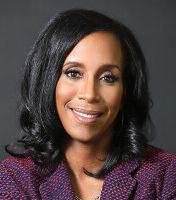

Founder of Helios Digital Learning and Associate Professor at DePaul
EXPERIENCED
Jackie Rosenfeldt, CPA
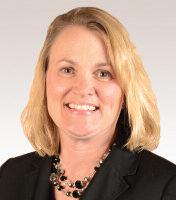
Partner, Audit Services, Grant Thornton LLP
EMERGING
Roxanne Chow, CPA
Senior Manager, Ernst & Young LLP
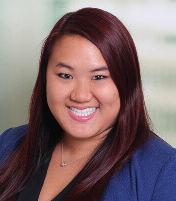
www icpas org/insight | FALL 2018 35 FEATURING: PLUS: 2018 Women to Watch Award Winners
KEYNOTE SPEAKER
tastytrade
LEADER WINNER
LEADER
WINNER
LEADER WINNER
Sometimes we just need to get out of our own way! Join us for an inspiring morning to discover how to break down your own self-imposed barriers and become more comfortable with taking risks. Friday, October 26, 2018 The Standard Club, Chicago, IL REGISTER TODAY: Call 800.993.0407 or visit www.icpas.org/women
3 Keys to Retaining Top Talent

These tips can help young professionals learn to lead better and develop a staff that stays
With low unemployment and a growing need for talented accounting professionals, corporate leaders are increasingly asking, “How do we retain our top talent?” On the other hand, in a competitive job market, accounting professionals have the luxury of looking for companies that will offer them the full package experience We’re seeing staff looking for more fringe benefits, such as increased flexibility, more growth and development opportunities, and a greater corporate focus on diversity and culture In response, corporations across the globe are implementing new strategies and programs and revising policies to help attract and retain diverse accounting talent. But what does that mean for a young professional learning to lead?
If you’re new to managing a team or still establishing your leadership role, it can be challenging to create a dynamic team where top talent remains engaged add in the need to know how to best navigate and implement the policies many corporate HR departments are rolling out and your job seems all the more difficult But it doesn’t have to be
It’s common for young professional leaders to want to do things to immediately and positively impact employee satisfaction and, ultimately, retention I’m going to suggest you slow down and learn from those that led before you Throughout my career in both public accounting and industry, I have worked on very successful teams where leadership did a great job of engaging and empowering staff and providing a highly productive work environment Here’s what I learned
KnOw YOur AudIenCe
How well do you know your team? Most leaders can automatically list the strengths, opportunities for improvements (notice I didn’t say weaknesses), and a few highlights of a direct report’s performance However, how many leaders can also list what each direct report expects from their job, how they learn best, what they want to be doing in five or 10 years, and what they would like to have more support on? Being able to answer the second set of questions is what differentiates you as a real leader
In turn, can your employees list examples of how you have supported them, engaged them in meaningful conversations based on their interests, and provided work to further their development?
To help facilitate this kind of relationship development, Caterpillar, for example, encourages us to hold monthly one-on-one meetings with our direct reports where they lead the discussion and managers are there to engage in providing constructive support These monthly meetings are meant to help team leaders gain a deeper understanding of their employees and how they can serve and develop them better.
eMpOwer
YOur eMplOYees
One of the best retention methods I have seen is quite simple: Let your top talent perform! As a leader, it’s important that you identify areas of improvement and then assign your direct reports meaningful projects related to those areas, but it’s also just as important to make sure your employees are working on projects they care about and to trust them to perform.
36 INSIGHT | www icpas org/insight
C O R P O R A T E M I N D E D SUCCEEDING IN THE CORPORATE FINANCE WORLD
amanda l gavin, CPa, MBa Manager, global Tax, Caterpillar inc
In my experience, keeping a list of ongoing projects, getting staff feedback on their individual interest in the projects, and then balancing involvement in those projects with each staffer ’s core workload leads to employing really productive teams Following this approach results in a team that feels the freedom to pursue and work toward projects of interest, which in turn fosters a fully engaged team that’s committed to the projects it’s working on
enCOurAge FlexIbIlITY
Many companies are coming up with creative ways to promote flexible work environments, which, hopefully, will increase productivity and job satisfaction. However, a company offering a flexible work environment is very different from a leader actually encouraging and supporting that flexible work environment As a leader, how encouraging of flexibility and worklife balance are you within your team?
The most productive teams I have worked with always encouraged their employees to use flex time, work from home when needed, and/or alternate working hours to meet their personal needs Within my group at Caterpillar, for instance, we offer “flex days.” We submit a planned twoweek schedule, working a minimum number of hours to complete an assigned workload. Then, one day during the second week can be a flex day Other groups offer the option of working four 10hour days per week during non-busy times. Another group allows their employees to work from home one set day each week, year-round. The leaders within each of these groups found the flexibility options that worked best and encouraged their employees to participate. The result is increased productivity and job satisfaction
The biggest downfall to a flexible work policy is a manager that doesn’t support or encourage it. So, ask yourself, if your company offers a flexible work environment, do your direct reports fully utilize those policies? If not, why not and what can you do to change it?

The corporate world has a growing need to attract and retain top talent As a young leader, much of that burden will fall on you. I often tell my direct reports that I want to help them reach a point where it would be my pleasure to work for them one day! If you want to hold onto your staff and mold them into next generation leaders, it’s critical that you connect with them, encourage and support their professional growth, and respect their work-life balance as their careers and responsibilities grow.
Serve on an Illinois CPA Society Committee, Task Force or
Chapter
Use your expertise and leadership skills to help guide and govern the work of your Illinois CPA Society.
Volunteering is a great way to give back to and directly enhance the CPA profession. In return, you’ll have unique opportunities to interact with and learn from other professionals, all while enriching your own leadership skills.
Illinois CPA Society regular and affiliate members are encouraged to apply for a position for the term April 1, 2019March 31, 2020.
Application Deadline is December 7, 2018.
Professional Practice Committees
Employee Benefits
Not-for-Profit Organizations
Taxation - Business
Taxation - Estate, Gift & Trusts
Taxation - Flow-Through Entities
Taxation - Individual Taxation - International
Taxation - Practice & Procedures
Taxation - State & Local
Quality Assurance & Public Protection Committees
Accounting Principles*
Audit & Assurance Services*
Ethics*
Governmental Executive*
Governmental Report Review
Programs/Special Issues
Awards Committee
CPA Exam Award Task Force
Women’s Committee
Chapters
Officers and Committee Chairs
=
www icpas org/insight | FALL 2018 37
Young professionals are encouraged to apply.
today at
*Indicates Senior Committee. Apply
www.icpas.org/volunteer
Give a little, g ain a lot!
Marc Rosenberg, CPa President, The Rosenberg associates

7 Reasons Your CPA Firm May Not See a Second Generation
Here are the common problem areas preventing CPA firms from succeeding with their succession plans.
Why is it such a challenge for CPA firms to succeed and survive beyond the first generation? The short answer is that CPA firms suck at succession planning
Let me explain Most CPA firms’ operations are geared toward maximizing short-term profits; they focus on today at the expense of tomorrow. I see evidence of this regularly as a practice management consultant
Consider the 60-year-old sole practitioner who wants to sell her firm and work eight more years. Her firm books annual revenue of $1 million and she takes home $600,000. She meets with several buyers, all of whom are interested in her practice, but none are willing to continue her $600,000 salary. The profitability of her practice simply can’t be sustained in the buyers’ operating model Why? Because she doesn’t invest in the future of her firm She hires low-level people, provides little training, maintains a below-grade office, doesn’t keep her technology current, does no marketing, and she takes short-cuts on quality control While this sounds so wrong in so many ways, it’s what many small CPA firm owners do But these cut corners enable the pocketing of a hefty salary today at the expense of tomorrow
Tim Christen, a former manager partner at Baker Tilly and former chairman of the AICPA, says it well: “The most important thing you can do for your own success is make the people below you successful ”
Unfortunately, I see a lot of CPA firms doing things that thwart succession planning Here are seven common problem areas that prevent CPA firms from succeeding to the next generation
AFFluenCe
This is a good place to start, because money explains a lot of things in life. Partners in local, multi-partner Chicago firms earn, on average, $460,000 annually That’s higher than what 99 percent of all people in the country earn. Proper succession planning requires partners to (a) shift a substantial amount of their time away from client work to mentor up-and-coming staff, thus helping them grow and (b) invest a substantial amount of money to ensure the firm’s future
Many partners simply aren’t willing to make these investments They reason: “I work hard, enjoy my work, and my clients love me Our firm may not be perfect, but we’re doing a lot of things right ” And who can blame them when they earn what they do Affluence, however, is a corrupting influence on succession planning
Mergers
We all know about the frenzied pace of CPA firm mergers in the past 5-10 years Countless numbers of firms have rested easy when it came to an exit strategy, reasoning that if they
38 INSIGHT | www icpas org/insight
P A R T N E R P E R S P E C T I V E S MOVING YOUR FIRM FORWARD
failed at succession planning, they could always execute a reliable fallback plan: sell to a larger firm.
Well, things have changed dramatically in the past two years A huge volume of sellers has flooded the market, enabling buyers to cherry-pick the best and the brightest firms. More firms than ever are being turned away by buyers. Exuberant confidence in being able to sell your firm as an exit strategy is misguided
MenTOrIng
There are several key components to a properly conceived succession plan, but clearly the chief component is staff development: mentoring, training, and leadership development Mentoring works if you do it right. Unfortunately, many firms skimp on their mentoring efforts.
First, partners need to have the skills to be an effective mentor
Contrary to popular thought, many people are not natural-born mentors. The better firms have “train the mentor” programs.
Second, devoting the proper amount of time to mentoring is critical Partners are extremely busy with their clients If they’re going to devote time to mentoring, it will have to come at the expense of something else, like billable hours and admin time
Third, the partners “gotta wanna” be mentors Everything in life is attitude, isn’t it? If someone hates mentoring but they do it because it’s politically incorrect to abstain, this awful attitude will affect the job they do as a mentor
Last, there needs to be accountability for effective mentoring
COMpensATIOn
I love it when you ask a firm how important staff is. The politically correct response is: “Our staff is just as important as our clients.” But they don’t walk the talk If staff is just as important as clients, we should expect to see a meaningful amount of weight assigned to staff mentoring compared to production metrics in partner compensation systems But we don’t In fact, if the partner compensation systems of CPA firms under $15 million were audited, one would find little weight given to staff mentoring at many firms
reTIreMenT
If you want to successfully preserve your firm for future generations, you need to understand that there’s only one reason why your brighter, more ambitious staff stay to take over your firm, its clients, and your $400,000-plus salary!
Firms with stagnant growth and partners who never retire (and refuse to delegate work to staff) will virtually guarantee the eventual exodus of their top talent. That’s why mandatory retirement plays a crucial role in succession planning. In the words of AICPA Chairman Barry Melancon, mandatory retirement “allows for the predictable progression of lesser tenured, and often more diverse individuals into the firm, thus facilitating the orderly transition of clients from senior partners to those who will succeed them.”
buYOuTs
A win-win partner buyout/retirement plan is essential. Firms need to make sure their buyout plans do the following:
• Bring in new partners on a regular basis (this means you need regular revenue growth) to avoid clusters of partners retiring at the same time.
• Preserve the firm’s cash flow. Don’t cripple your firm with onerous buyout obligations If your plan is structured correctly, when a partner retires, the remaining partners should earn more money because the buyout payments are more than offset by no longer having to compensate the retiring partner
• Compensate retiring partners for their contributions to the firm Buyout payments should be based on the growth and profits generated by the retiring partner Don’t allow buyout payments to become unearned entitlements unrelated to the firm’s value.
new pArTner buY-Ins
Most firms have gotten away from the unfathomably steep $400,000-$1 million buy-ins for new partners (computed by multiplying ownership percentage times the firm’s value) Buy-ins for new partners need to be affordable to avoid scaring away upand-coming potential partners. Consider more reasonable statutory amounts in the $75,000-$150,000 range
We’ve seen the enemy, and the enemy is us Partners, if you are disappointed by the succession planning prospects at your firm, you need only look into a mirror. You can’t develop future leaders by willing it or talking about it You need to start walking the talk about staff being just as important as clients Pursue the mentoring and development of your staff with the same passion and survival instinct that you have for providing great client service and bringing in business Do that and maybe you’ll be one of the few that survives to a new generation of leadership
Perennially cited by Inside Public Accounting as one of the 10 most recommended consultants in the country, Marc Rosenberg, CPA is a nationally renowned consultant, author, and speaker on CPA firm management, strategy, and partner issues His 14 practice management books are available at https://rosenbergassoc com/shop/, and Marc can be reached at 847 251 7100 or marc@rosenbergassoc com
The Illinois CPA Society is now accepting nominations for the following awards:
Lifetime Achievement Award
Outstanding Educator Awards
Lester H. McKeever Jr.
Advancing Diversity Awards
Young Professionals Leadership Award
Women To Watch Awards
For more information or to nominate a candidate, visit www.icpas.org/awards
Nomination deadline is Friday, November 30, 2018.
www icpas org/insight | FALL 2018 39
Are You a Fraud Fighter?
Here is how to increase your self-awareness and empower your organization to effectively prevent and detect financial fraud.
Fraud can happen at any time and to any company. Do you know the ways to protect yourself and your business? Every couple of years, the Association of Certified Fraud Examiners (ACFE) publishes its Report to the Nations, the most recent in 2018, illustrating the key trends in fraud worldwide and providing lessons for us on the frontlines to help reduce the risk of fraud This report builds awareness of how you can prevent and detect fraud Here are some key takeaways
whAT dOes A FrAudsTer lOOK lIKe?
Fraudsters are as unique as each of us; they do not all look the same or act the same However, the ACFE has uncovered some recurring characteristics of fraudsters that should be considered in conjunction with suspicious behavior

• More tenured employees are more likely to commit fraud In fact, 91 percent of frauds studied included perpetrators that had been at the company longer than one year
• Fraudsters are more likely to be men Approximately 69 percent of frauds studied in the report related to men, who also perpetrated larger frauds than women (on average, $156,000 versus $89,000)
• More educated employees are more likely to commit fraud and they steal more Sixtyone percent of fraudsters studied held a university or postgraduate degree and the median loss ($160,000-$230,000) from them is about double the loss ($75,000-$130,000) from fraudsters without degrees
• Fraudsters steal more as they reach higher levels in the organization: The median loss of a non-manager, manager, and owner/executive is, respectively, $50,000, $150,000, and $850,000. Fraudsters also tend to steal more money as their ages increase.
• Employees with clean records are more likely to commit fraud 89 percent of fraudsters have never been charged or convicted of prior frauds, and 85 percent have never been punished or previously terminated for fraud
hOw dO FrAuds sTArT?
John Warren, VP and general counsel at ACFE, has stated that people tend to consider fraud an accounting issue when it is mainly a behavior issue. We should focus on the behaviors that tend to arise before frauds happen that can lead to unethical behavior The ACFE has identified six red flags that frequently show up in fraud cases: living beyond means (41 percent), financial difficulties (29 percent), unusually close association with a
40 INSIGHT | www icpas org/insight
elizabeth Pittelkow Kittner
E T H I C S E N G A G E D EXPLORING ETHICS IN BUSINESS & FINANCE TODAY
CPa, CgMa, CiTP, dTM Controller, litera Microsystems
vendor/customer (20 percent), control issues/unwillingness to share duties (15 percent), divorce/family problems (14 percent), and “wheeler-dealer” attitude (13 percent)
All six red flags have shown up in every ACFE report since 2008, meaning they are consistent predictors of fraud In fact, 85 percent of fraud cases studied in the report showed at least one of these flags, and 50 percent of cases demonstrated multiple red flags
hOw CAn YOu beTTer prevenT And deTeCT FrAud?
Implementing anti-fraud controls can prevent some people from committing fraud, help to detect fraud quicker, and reduce financial losses According to the ACFE, three anti-fraud controls lead to lower fraud losses:
1 Publish a code of conduct The presence of this control correlated to a 56 percent reduction in losses for companies that experienced fraud
2 Implement proactive data monitoring and analysis The presence of this control accounted for a 52 percent reduction in losses
3. Conduct surprise audits. The presence of this control resulted in a 51 percent reduction in losses
On the detection side, three means of identifying fraud have been the most successful:
1. Provide an anonymous whistleblower/tip hotline. Approximately 40 percent of frauds were discovered and reported through tips, which is a higher percentage than any other fraud identification method You will need to educate your employees on which
matters are intended for the hotline and which ones are intended for other HR reporting People like when their voices are heard, so even if the issues reported on the hotline are not fraudulent ones, you can still identify negative trends that need to be addressed. Your employees will trust you more if you address issues illuminated by feedback
2. Perform internal audits of work. Approximately 15 percent of frauds were discovered and reported through internal audit.
3. Ensure management is reviewing work. Approximately 13 percent of frauds were discovered and reported through management oversight.
hOw CAn YOu FIghT FrAud?
At the very least, take proactive steps to set up effective controls around financial processes so people cannot easily override them It is important to implement controls not because of a lack of trust but because they are prudent and effective for your processes Also educate employees about the importance of integrity and anti-fraud controls and then continue to reinforce their importance
Of course, listen to your employees Employees who feel appreciated and understood are less likely to commit fraud as a way of getting back at a boss or company Beyond trying to prevent fraud, caring about employees is simply the right thing to do and will build your integrity
The risk of fraud affecting your business is real Take advantage of the ACFE’s findings the return on investment for implementing anti-fraud controls is high and is in the best interests of everyone
Seventy -f ive years ago, Mar y became t he f irst Afr ican-Amer ican female CPA in t he world But, no one would hire her Wit h odds st acked against her, she overcame bar r iers and founded her own accounting f ir m Mar y created oppor tunities for generations of aspir ing CPAs by building a sense of belonging and suppor ting t heir careers

TODAY, WE ASK YOU TO DO THE SAME.
Your t ax-deductible donation to t he Mar y T. Washington Wylie Oppor tunity Fund will help pay for ward t he inspir ing work she st ar ted so many years ago
To donate visit
www.icpas.org/mtww
www icpas org/insight | FALL 2018 41
MARY T. WASHINGTON WYLIE First Afr ican-Amer ican Female Cer tif ied Public Account ant HONOR A LEGEND, SUSTAIN A LEGACY
Pur suing a Higher Pur pose
An aspiring Ph.D. aims to help shape the future of the profession through higher education
BY JULIA ARIEL-ROHR, CPA
Ididn’t know what it meant to be an accountant when I chose to major in accounting at DePaul U niversity
Rather, I knew there were a lot of numbers, and that appealed to me Having always loved school, I naturally excelled in my coursework, and to the surprise of my family, I actually enjoyed accounting theor y During this time, I also got my first taste of teaching
Ser ving as a Supplemental Instruction leader, I attended introductor y accounting classes and organized weekl y review sessions for students struggling with the content I enjoyed working with students to better understand accounting theor y I liked learning how to translate sometimes-obscure ideas into practical ones, and I enjoyed seeing my peers succeed I had never felt like I belonged somewhere as much as I felt I belonged at that university, with those students I loved the collegial atmosphere, the halls filled with professors, the studying, and the knowledge acquisition It was the per fect cultural fit So, it is only natural that I would eventually make my way back to higher education
Like many accounting program graduates, I kicked of f my professional career in an accounting and finance rotational program at a For tune 500 company As I gravitated towards the technical aspects of accounting, I made the decision to leave corporate accounting to join Grant Thornton’s not-for-profit audit practice Although the pace of public accounting was an adjustment, I valued having a multitude of clients, and experiencing the diversity of practice and interpretation of accounting guidance I appreciated the big-picture issues and having the resources to research complex and gray areas that my clients were faced with This is the intellectual stimulation I crave; however, I wanted more time with my curiosity, more balance in my life, and more time developing others
Af ter a year at Grant Thornton, I divulged to my coach par tner [mentor] my dream to earn a Ph D and become a professor To my delight, he rallied the audit practice to suppor t me Perhaps this was par t of Grant Thornton’s cultural mission to “bring your whole self to work,” but with that suppor t, I was able to attend the American Accounting Association’s annual conference in 20 17 (the event for academic accountants all over the countr y) and was allowed flexibility during busy season to travel the countr y for graduate program inter views This kind of employer suppor t can change the lives of employees And with fur ther suppor t from the Accounting Doctoral Scholars Program a scholarship program suppor ted by more than 1 00 organizations, including the Illinois CPA Society, aimed at addressing the huge shor tage of accounting faculty my dream of becoming a professor is becoming a reality
In Fall 20 18, I will embark on my Ph D journey at the University of Wisconsin – Madison It has been hard work to get here, and will continue to be hard work, but I couldn’t be more excited to get star ted or more grateful for all the suppor t I’ ve received along the way If you have ever had a little voice in your head telling you to pursue academia, share it with the people around you, you will be surprised by the response! As an accounting professor, I will get to teach and mentor the next generation of accountants and help shape the future of our profession, and you could too

42 INSIGHT | www icpas org/insight
C L A S S I F I E D S
VALUATION OF YOUR CLIENT’S BUSINESS OR PRACTICE
By:
Crandall & Brackett, Ltd
Phone: 630 344 2355
Email: rober t@crandall-brackett.com
Web: www crandall-brackett com
Our only ser vice is per formed on your behalf in a mutual engagement setting From basic research to a full valuation, we tailor our ser vices to your needs We author, teach and par ticipate on policy setting committees and boards within the valuation profession
BUY OR SELL AN ILLINOIS ACCOUNTING OR TAX PRACTICE
ILLINOIS PRACTICES FOR SALE: Gross revenues shown
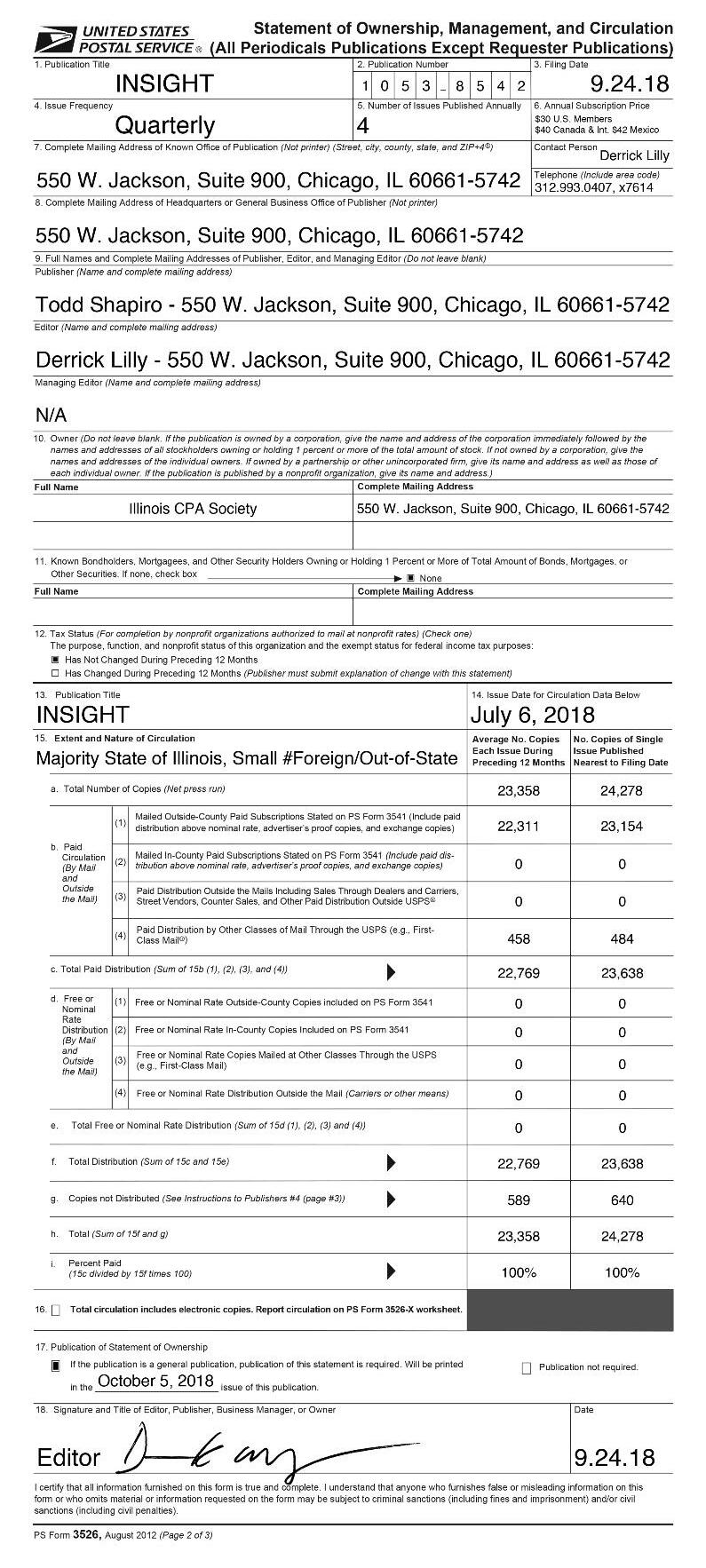
E Central IL CPA $250K; Rockford Area Tax & Accounting $187K; Palatine Tax & Accounting $3 40K

For practice details call 1-800-397-0249. Or, visit us at www.APS.net to inquire about available oppor tunities and register for free email updates.
THINKING OF SELLING YOUR PRACTICE?
Accounting Practice Sales is the leading marketer of accounting and tax practices in Nor th America We have a large pool of buyers, both individuals and firms, looking for practices now We also have the experience to help you find the right fit for your firm, negotiate the best price and terms and get the deal done
To learn about our risk-free and confidential ser vices, call Trent Holmes at 1-800-397-0249 or email Trent@APS net
www icpas org/insight | FALL 2018 43
DIVERSITY MEANS ALL OF US! November 14, 2018 8:00AM - 12:00PM Metropolitan Club | Chicago, IL Visit www.icpas.org/df2018 for more information.
ILLINOIS CPA SOCIETY
a s o n B u r i a n
Chicago Of fice Managing Par tner, CohnReznick
By Sarah Herrmann
National professional ser vices firm CohnReznick has a histor y of helping its young professionals move between of fices and practice areas to develop their skills and exper tise and prepare them for key roles, such as practice leaders and par tners
For Illinois CPA Society member Jason Burian, CPA , working in two dif ferent of fices under four dif ferent leaders each with ver y dif ferent management and mentorship styles and skills gave him the opportunities and guidance he needed to develop his business and leadership skills This ultimately earned him a place in growing the firm’s newer commercial real estate practice Today, 39-year-old Burian is already an of fice managing par tner (OMP) in the firm’s Chicago of fice
Q: What’s so unique about tr ying to lead in these diverse and disruptive times?
While audit and tax will always be par t of CohnReznick’s ser vice deliver y model, the ability to help clients solve a broader range of complex business issues is now par t of my job description CohnReznick no longer wants managers to just be outstanding ser vice providers Instead, we are expected to be trusted business advisors to our clients, helping them distinguish themselves competitively, create more value, and fully manage risk
This means working with clients and prospects to full y understand and address their key business issues including those that extend beyond accounting and compliance
Q: What excites you about being a new OMP?
What is truly exciting is that I have a hands-on role in shaping the capabilities of the Chicago of fice and our employees Beyond the Chicago of fice, I am also enthusiastic about what is taking shape within CohnReznick We are delivering more value-added advisor y ser vices, like corporate per formance improvement, cybersecurity, and transactional consulting In fact, along with a graphic refresh of our logo, we recently changed our ser vices descriptor to Advisor y/Assurance/ Tax to recognize our quest to become trusted advisors
Q: So, where do you see CohnReznick in the next five years, and what impact do you hope to have on the firm?
I believe we can become a top 10 firm through organic growth and possibly some strategic acquisitions/alliances With our recent expansion into Asia and Europe, CohnReznick will continue to grow its global footprint As an OMP, my role will be to suppor t for ward-thinking clients in their growth ef for ts Of course, I will also continue to work with the young people in our of fice and firm to help them acquire new skills and prepare for future leadership positions

Q: What does the future of the profession look like to you?
Ar tificial intelligence and other technologies will transform the accounting profession by making many of our processes, such as compliance testing and verification, much more ef ficient This will free up time for using data analytics and other evaluation tools to deliver deeper insights into our clients’ businesses
As a result, our recruiting focus could change significantly We may hire fewer audit and tax generalists and technical people and, instead, look for consulting, data analytics, cybersecurity, digital innovation, and other specialists that will add value well beyond compliance
Q: Then what’s your advice for the next generations of talent hoping to succeed in the profession?
Finding success in public accounting requires you to go in with your eyes wide open and with the expectation to stay and build a career I encourage ever y professional to be flexible, learn new skills, optimize the use of new technologies, and to jump at the oppor tunities presented to them
I N S I G H T S F R O M T H E P R O F E S S I O N ’ S I N F L U E N C E R S
J
44 INSIGHT | www icpas org/insight
Stay Smart
Conferences
October 23
October 30
November 7
November 8
November 14
November 15
November 27
November 28
November 29
Special Events
Agribusiness Conference (Simulcast)
Construction Industry Conference (In-Person & Simulcast)

IRS/Tax Practitioners Symposium (In-Person & Simulcast)
Healthcare Half-Day Conference
Effectively Guiding Your Board
Financially Half-Day Conference
Not-for-Profit Conference (Rosemont)
Family Law Conference (In-Person & Simulcast)
Accounting & Auditing Conference (Rosemont | In-Person & Simulcast)
Accounting & Auditing Conference (Springfield)
November 30 Not-for-Profit Conference (Springfield)
December 5 Advanced Topics in Flow-Through Taxation Conference (Morning, Afternoon and Full-Day Options | In-Person & Simulcast)
December 6
Employee Benefits Conference (In-Person & Simulcast)
Courses
October 26
Performance Management: Conducting Effective and Results Driven Performance Conversations
October 29 1040 Tax Return Workshop
October 31
October 31
Preparation, Compilation, and Review Engagements: Update and Review (Morning)
Bottom Line on the New Lease Accounting Requirements (Afternoon | In-Person & Simulcast)
November 1 Revenue Recognition: Mastering the New FASB Requirements (In-Person & Simulcast)
November 1 MS Excel: Database and Pivot Tables Made Easy
November 8 Social Security, Medicare, and Prescription Drug Retirement Benefits (In-Person & Simulcast)
November 9 Complete Trust Workshop
November 16 Sec 199A Proposed Regulations (Newscast)
November 19 Monitoring A Practical Approach (Chicago)
November 20
Monitoring A Practical Approach (Springfield)
November 26 Advanced Technical Tax Forms TrainingLLCs, S Corporations, and Partnerships


November 27
November 28
December 3
Advanced Technical Tax Forms TrainingForm 1040 Issues
Practical Guidelines for Managing a Decedent’s Estate (Basic - Morning/Advanced Afternoon)
Reviewing Individual Tax Returns: What Are You Missing? (Morning)
For a full listing of all upcoming education programs visit www.icpas.org/education
October 25 CCFL Corporate Finance Networking Breakfast: "Blockchain - What Accounting & Finance Pros Need to Know"
October 26
Women's Leadership Forum
November 2 Quad Cities Professional Issues Update
November 8 Member Town Hall Forum (Bloomington-Normal)
November 9 Member Town Hall Forum (East Peoria)
November 9 Member Town Hall Forum (Springfield)
November 9 YP Coffee and Conversations
November 12 Member Town Hall Forum (Champaign-Urbana)
November 27 Member Town Hall Forum (Rockford)
December 4 Member Town Hall Forum (Oakbrook Terrace)
December 5 Member Town Hall Forum (Chicago)
December 6 Member Town Hall Forum (Glenview)
December 14 Member Town Hall Forum (Collinsville)
December 3 Smart Tax Planning Strategies for Individual (Afternoon | In-Person & Simulcast)
December 4 Slashing Taxes for Your Small Business Clients: Corporations, Partnerships, & LLCs (In-Person & Simulcast)
December 4 GAAP Basis Governmental Report Review 2018 (Springfield)
December 4 Modified Cash Basis Governmental Report Review 2018 (Springfield)
December 5 Advanced Auditing of HUD-Assisted Projects
December 5 School Districts and Related Single Audit Report Review 2018 (Springfield)
December 6 Advanced Governmental Report Review 2018 (Springfield)
December 6 International Tax Provisions of the Tax Cuts and Jobs Act of 2017 (Morning)
December 6 State & Local Tax Workshop (Afternoon)
December 10 GAAP Basis Governmental Report Review 2018 (Chicago)
December 10 Modified Cash Basis Governmental Report Review 2018 (Chicago)
December 11 School Districts and Related Single Audit Report Review 2018 (Chicago)
December 11 MS Excel: Database/Pivot Tables
December 12 Advanced Governmental Report Review 2018 (Chicago)
December 18
Determining How Much Money You Need To Retire: Practical Planning Strategies (In-Person & Simulcast)
December 19 Estate and Life Planning Issues for the Middle-Income Client
Get today’s must-have skills!





DO YOU NEED TO DRAFT FIVE-STAR ACCOUNTING AND FINANCE TALENT? LET US HELP. The finance and accounting sectors are more competitive than ever Recruiting the elite talent your organization needs to perform during tax season and beyond requires the right combination of hustle and expertise. Accounting Principals and Parker + Lynch can help optimize your organization’s efficiency and effectiveness through workforce services such as temporary staffing, temp-to-hire, permanent placement , consulting and executive placement. Let our all-star recruits make your team go from good to great. Contact us today. Chicago 312.583.9264 I Deerfield 847. 607. 0550 I Oakbrook Terrace 630 .792.1660 I Schaumburg 847. 3 97. 9700 accountingprincipals.compar ke rlynch.com
