DECEMBER 1995, VOLUME 1, NUMBER 2
International Journal of Wilderness EXECUTIVE EDITORS Alan W. Ewert, University of Northern British Columbia, Prince George B.C. Vance G. Martin, WILD Foundation/ICEC, Ojai, Calif. David Porter, Bureau of Land Management, Lakewood, Colo., Alan E.Watson, Aldo Leopold Wilderness Research Institute, Missoula, Mont. James R. Fazio, University of Idaho, Moscow, Idaho MANAGING EDITOR John C. Hendee, Director, University of Idaho Wilderness Research Center, Moscow, Idaho PRODUCTION EDITOR Michelle S. Mazzola, University of Idaho Wilderness Research Center, Moscow, Idaho ASSOCIATE EDITORS Liz Close, U.S. Forest Service, Missoula, Mont., Dave Cockrell, University of Southern Colorado, Pueblo, Colo., Dave Cole, Aldo Leopold Wilderness Research Institute, Missoula, Mont., Don Duff, U.S. Forest Service, Salt Lake City, Utah,William Forgey, Medical Doctor, Crown Point, Ind., Nancy Green, U.S. Forest Service,Washington, D.C., Glen Haas, Colorado State University, Fort Collins, Colo., Dave Harmon, Bureau of Land Management, Portland, Oreg., Steve Hollenhorst, West Virginia University, Morgantown, W.Va., Jon Jarvis, Wrangell-St. Elias National Park, Glennallen, Ark., Kris Kennett, British Columbia Parks, Loiliaras Lake, B. C., Canada, Jamie Kirkpatrick, University of Tasmania, Hobart,TAS,Australia, Ruthann Knudson, National Park Service, Washington, D.C, Ed Krumpe, University of Idaho, Moscow, Idaho, David Lime, University of Minnesota, St. Paul, Minn., Bob Manning, University of Vermont, Burlington, Vt., ]oe Mazzoni, U.S. Fish & Wildlife Service, Albuquerque, N.M., Michael McCloskey, Sierra Club, Washington, D.C., Jonathan Miller, Australian Heritage Commission, Australia, Chris Monz, National Outdoor Leadership School, Lander, Wy, Bob Muth, University of Massachusetts, Amherst, Mass., Connie Myers, Arthur Carhart Wilderness Training Center, Huson, Mont., Roderick Nash, University of California, Santa Barbara, Calif., Max Oelschlaeger, University of North Texas, Corrales, N.M., Margaret Petersen, U.S. Forest Service, Portland, Oreg., Joe Roggenbuck, Virginia Polytechnic Institute, Blacksburg,Va., Holmes Rolston III, Colorado State University, Ft. Collins, Colo., Mitch Sakofs, Outward Bound, Garrison, N.Y., Susan Sater, U.S. Forest Service, Portland, Oreg, Tod Schimelpfenig, National Outdoor Leadership School, Lander,Wy, Alan Schmierer, National Park Service, San Francisco, Calif,Won Sop Shin, Chungbuk National University, Chungbuk, Korea, Jerry Stokes, U.S. Forest Service,Washington, D. C., Ralph Swain, U S. Forest Service, Fort Collins, Colo. Jay Watson, The Wilderness Society, San Francisco, Calif, Tom Zimmerman, National Park Service, Boise, Idaho International Journal of Wilderness (IJW) will be launched in 1995 with two issues (September and December). Look for three issues in 1996 (April, August, and December) and full-production of quarterly issues thereafter (March, June, September, and December). IJW is a not-for-profit publication. Manuscripts and Production: University of Idaho,Wilderness Research Center, Moscow, ID 83844-1144, USA; (208) 885-2267. Fax: (208) 885-2268. e-Mail: wrc@uidaho.edu.
Mission:The International Journal of Wilderness seeks to link wilderness professionals, scientists, educators, and interested citizens, worldwide with a forum for reporting and discussing wilderness research; inspirational ideas; planning, management, and allocation strategies; education; and practical issues of wilderness stewardship.
Subscription rates (per volume calendar year): Subscription costs are in U.S. dollars only—$30 for individuals and $50 for organizations/libraries. Subscriptions from Canada and Mexico add $10; outside North America add $20. Back issues are available for $15.
Submissions: Contributions pertinent to wilderness worldwide are solicited, including articles on wilderness planning, management, and allocation strategies; wilderness education, including descriptions of key programs using wilderness for personal growth, therapy and environmental education; wilderness related science and research from all disciplines addressing physical, biological, and social aspects of wilderness; and international perspectives describing wilderness worldwide. Articles, commentaries, letters to the editor, photos, book reviews, announcements and information for the wilderness calendar are encouraged. A complete list of manuscript submission guidelines can be found toward the end of this journal.
For advertising rates please contact Michelle Mazzola @ the University of Idaho,Wilderness Research Center, FWR Room 18-A, Moscow, ID 838441144, USA; (208) 885-2267. Fax: (208) 885-6226. e-Mail: wrc@uidaho.edu.
Artwork: Submission of artwork and photographs with captions are encouraged. Photo credits will appear in a byline; artwork may be signed by the author.
All materials printed in the International Journal of Wilderness copyright © 1995 by the InternationalWilderness Leadership (WILD) Foundation. Individuals, and nonprofit libraries acting for them, are permitted to make fair use of material from the journal.
Reprints: Manuscript reprints are available from the production office for a nominal charge.
Business Management and Subscriptions:WILD Foundation, International Center for Earth Concerns, 2162 Baldwin Road, Ojai, CA 93023, USA. Fax: (805) 649-1757. e-Mail:WILD@FISHNET.NET
Printed on recycled paper.
SPONSORING ORGANIZATIONS • Aldo Leopold Wilderness Research Institute • America Outdoors (National Outfitters and Guides Association) • International Center for Earth Concerns (ICEC) • International Wilderness Leadership (WILD) Foundation • National Outdoor Leadership School (NOLS) • Outdoor Recreation Coalition of America (ORCA) • Outward Bound • Society of American Foresters—Wilderness Work Group • The Wilderness Society • University of Idaho Wilderness Research Center • University of Northern British Columbia (Faculty of Natural Resources and Environmental Studies) • U.S.D.A. Forest Service • U.S.D.I. Bureau of Land Management • U.S.D.I. Fish and Wildlife Service • U.S.D.I. National Park Service • Wilderness Education Association • Wilderness Inquiry • Wilderness Watch
2
INTERNATIONAL JOURNAL OF WILDERNESS / Volume 1, Number 2, December 1995
I N T E R N A T I O N A L
J O U R N A L O F W IL D E R N E S S DECEMBE R 1995
V O L U M E 1, N U M B E R 2
FEATURES 4
THE POWER
OF WILDERNESS
by John C. Hendee, Managing Editor
5
SOUL
30
OF THE WILDERNESS—
The Wild, the Tame, and the Folly of Sustainable Development by Max Oelschlaeger
8
SCIENCE
35
15
MANAGEMENT
BRITISH COLUMBIA’S QUIET WILDERNESS REVOLUTION
23
LIMITS OF ACCEPTABLE CHANGE PLANNING—
38
by Jonathan Miller
41
THE WILDERNESS MOVEMENT IN ITALY— A Wilderness Model for Europe by Franco Zunino
WILDERNESS DIGEST 43
TRAIL AND SITE MANAGEMENT ARE THE KEY TO UNTRAMMELED WILDERNESS
ANNOUNCEMENTS AND WILDERNESS CALENDAR
46
LETTERS TO THE EDITOR
47
BOOK REVIEWS
EDUCATION WILDERNESS @ INTERNET • The Wildlife Society’s Wildlife Information Network • Columbia Northwest Technical Assistance Network
26
AUSTRALIAN APPROACHES TO WILDERNESS
Evaluating Implementation by the U.S. Forest Service by K. Lynn McCoy Edwin E. Krumpe, and Stewart Allen
by Alan Jubenville
25
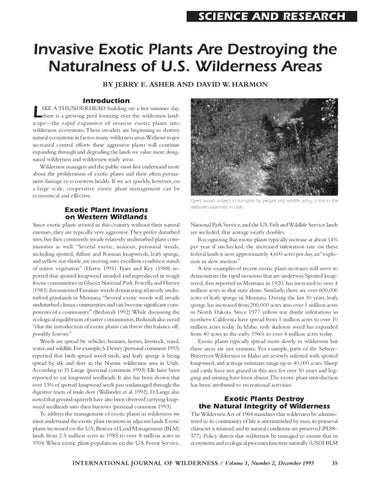
INVASIVE EXOTIC PLANTS ARE DESTROYING THE NATURALNESS OF U.S. WILDERNESS AREAS
INTERNATIONAL PERSPECTIVES
by Patrick Moore
18
TRENDS IN RECREATION USE AND MANAGEMENT OF WILDERNESS
by Jerry E. Asher and David W. Harmon
by Ron Rutledge and Terje Void
AND
RESEARCH
by Barbara Cook and William Borrie
CANADA’S WILDERNESS
PLANNING
AND
WILDERNESS INQUIRY by Greg Lais
• Northern Protected Areas and Wilderness • The Capacity for Wonder: Preserving National Parks • The Wilderness Movement and the National Forests • The World of Wilderness: Essays on the Power and Purpose of Wild Country
Cover photograph of Mt. Fairweather, border of Alaska and British Cloumbia, Tatshenshini area by Uri Peepre. Caribou photograph by Ken Bowen. The cover photograph on issue one, a mid-winter forest scene near Sodankylä, Finland, was by Ville Hallikainen.
INTERNATIONAL JOURNAL OF WILDERNESS / Volume 1, Number 2, December 1995
3
FEATURE
The Power of Wilderness BY JOHN C. HENDEE, MANAGING EDITOR HE STEADY GROWTH OF legally protected wilderness in the United States, to more than 100 million acres during the past 30 years, is one measure of the power of the wilderness idea. That power is what inspired action by millions of citizens, scientists, educators, and natural resource professionals to secure wilderness protection for future generations.The emergence of wilderness as a politically viable concept John C. Hendee in Canada, with plans and actions underway for dramatic growth in its legal protection, is an impressive measure of the power of the wilderness idea in Canadian culture. (See the articles by Ron Rutledge and Terje Vold, and by Patrick Moore in this issue.) Likewise, the recognition of wilderness as a category of land to be protected in many other countries reflects the power of the wilderness idea, worldwide (see the article by Jonathan Miller on Australian wilderness approaches). This past summer I participated in several of the Wilderness Discovery, seven-day backpacking trips that the University of Idaho Wilderness Research Center operated for youth-at-risk at four federal Job Corps centers around the United States. During these
T
4
trips, I observed the power of wilderness firsthand as economically disadvantaged young adults, seeking a second chance at completing their education and finding productive employment through training in the Job Corps, struggled up steep trails carrying everything on their backs for seven days while leaving the culture and comforts of civilization behind. The results were astonishing to team leaders and Job Corps officials. We saw it in the poetry and insights written in the Job Corps student journals, their emerging confidence and assertiveness, in their sharing of responsibility and decision making, their growing compassion for each other, and their determination to address addictions and healthfulness as their systems were cleansed by simple wilderness living.After seven days, they returned to their education and vocational training with higher goals than would have been possible only days earlier. I, too, returned from the wilderness empowered by my experience of naturalness and solitude, and by seeing the power of wilderness in healing and inspiring these youths. This theme of wilderness empowerment continues in this issue with Greg Lais’s article on Wilderness Inquiry’s programs for exposing people with disabilities to the power of wilderness. So, as the power of wilderness inspires its further protection worldwide, it is also empowering humankind to enhance the modern human condition. We should celebrate the opportunities for enhancing the human condition reflected in the growth of wilderness protection around the world. IJW
INTERNATIONAL JOURNAL OF WILDERNESS / Volume 1, Number 2, December 1995
FEATURE
Soul of the Wilderness— The Wild, the Tame, and the Folly of Sustainable Development BY MAX OELSCHLAEGER
A
Sustainable Development Doesn’t Work
only the end of wild creatures and lands, but also the total domestication of humankind. In that dystopian world, human beings will recognize the bars of the cages and fences of the parks confining the floral and faunal remnants of days gone by, days when the animals and plants freely populated Ear th and speciation was an ongoing process. Article author Max Oeischlaeger. Photo credit: But they will not Peter Oeischlaeger see, indeed, they will be incapable of seeing, that their own domestication has been just as complete. Sustainable development would tame all wildlands, habitats and inhabitants alike, as well as humankind.
To a few hard-core, big wilderness advocates, as well as to leaders of some environmental protection organizations, the notion of sustainable development is deceitful, even dangerous. They believe that the prevailing notion of sustainable development is first and foremost a public relations effort. Even the post-Rio, officially sanctioned United Nations study group, a 53 nation Commission on Sustainable Development, chaired by Klaus Toepfer of Germany, concludes that little, if any, progress has been made toward such goals as protecting biodiversity and ameliorating poverty (NewYork Times, May 29, 1994). More penetrating studies have made clear that the economic goals of sustainable development cannot be reconciled with the preservation of biodiversity and the conservation of habitat, even on making the assumptions that human population remains at present levels (5.4 billion) along with implementation of so-called best available technologies. Yet some of our wilderness colleagues and their fellow travelers, as I discovered in 1993 at the 5th World Wilderness Congress in Tromso, Norway, believe that sustainable development is the road to the future. Nothing could pose a greater threat to continued existence of the wild earth. Concealed beneath the scientific facade of sustainable development lurks a potentially deadly force. Namely, the total domestication of the planet, an Earth converted to one vast factory and agricultural system designed to support a single species. With the total domestication of the planet comes not
Which brings me full circle, like a mountain trail looping back to the trailhead, to Thoreau’s assertion that “in Wildness is the preservation of the World.”Wild things and wildlands provide a boundary that defines the ambit of human possibility. No doubt, wilderness experience is in part culturally defined and mediated. But there is something in wildness,and in the experience of wildness, that reminds us of the artificiality of culture. It reawakens us to the reality of our species being; our human nature exists in the reality of biological, even cosmological, time. Which is to say that the wild helps to disclose the tame, the domesticated, human. Mother Culture, the antipode to Mother Nature,holds us tightly to her bosom,playing a powerful nurturing function in human development (a role characteristically associated with women, though men are capable of nurturing as well). Humans are flung into the world as little more than wrinkled lumps of flesh, totally dependent upon the sustaining care of others for survival. Only through an extended period of acculturation and socialization do we acquire our identity as a North American or South African, butcher, baker, or candlestick maker, and yes, as environmentalists or natural resource professionals. But, as writers from Thoreau to Freud have made clear, these cultural projects are at one and the same time the source of our identity and yet a lie, a concealment of our species’ being.The wonder and terror of the human predicament is that we are simultaneously empowered and enslaved by culture, and it constantly threatens to overdetermine our being.Thoreau catches this idea in Walden; his life
S THE CIVILIZED WORLD CAREENS MADLY towards a doubling of the human population, the mass extinction of life, and global climate change, the idea of wilderness assumes new relevance. Today literally, as Thoreau said, “in Wildness is the preservation of the World.” In the inaugural issue’s “Soul of the Wilderness” article, Ian Player avows that wilderness is not, as the world’s politicians think, a peripheral matter in the larger context of global ecocrisis. It lies at the center. Let me go one step further in favor of wild things and wildlands by claiming that their continued presence is a necessity for our own human existence, our humanity, our very soul.We must listen to what the creatures and plants are telling us, or their destiny may become our own.Yet what chance does wilderness have in the face of the politically correct, dominant ideology of sustainable development? Is not the entire idea a contradiction in terms? I have serious reservations about the notion of sustainable development and what it holds in store for wilderness. But make no mistake, sustainable development, as detailed in the Brundtland Commission’s United Nations report, Our Common Future and Agenda 21, is the politically dominant discourse.
Wilderness Helps Define Civilization
INTERNATIONAL JOURNAL OF WILDERNESS / Volume 1, Number 2, December 1995
5
at Walden Pond was an experiment designed to discover what it was that he might recover in a life lived outside the cocoon of culture. He vowed to tell the truth, and to name the wild mean and “barbaric,” if indeed it were so. He came, upon reflection, to the discovery that he loved the wild equally with, not less than, the civil, and that only together, in a life experiencing both, could the human being be whole, vital, and healthy. Clearly, then, wildness and wilderness are not only objects of scientific inquiry to be elucidated through experimental research and analysis. They are also about the awesome mystery of existence, about the world and our participation in that world, and they are necessary to civilization. For without the possibility of knowing wilderness we have no reference with which to contrast our cultural being. Thus, insofar as wilderness is subsumed as an object of scientific inquiry, that is, described, explained, and articulated through professional discourse (disciplinary frameworks or paradigms, as these are called), things wild and free recede, concealed behind a facade of words that reduces wildness to culture.All language reveals and conceals, but scientific discourse can obscure the fundamental truth that wilderness is not just data points to be plotted, concepts to be reasoned, computer models to be constructed, and management policies to be formulated. It is much, much more. Still, as of this moment, whatever the threats posed by global ecocatastrophe, the
6
was a contradiction in terms, not fully appreciating the demographic and geographic vectors that give it meaning as urban proximate wilderness. Or the underlying biology, the natural history, of my species’ being. My own wilderness excursions were summertime odysseys, usually extending over several weeks, when I roamed the conA boundary crossing marker in the Sandia Mountain Wilderness (left). “The tinental divide in the San grain of nature,” as seen in the bark of a rio grande cottonwood tree (above). Juans, still some of the Photo credit: Peter Oelschlaeger. highest and wildest counpossibility of wilderness experience retry existing in the 48 continental states of the mains. Such experience is a clarion call to United States. reclaim our roots, and acknowledge our Now I live alongside a so-called urban affiliation with evolutionary process. John wilderness, that is, the Sandia Mountain WilMuir put it so well: Going to the mounderness of New Mexico.Alpine trailheads are tains is going home. no more than 15 minutes from my house. I frequently wander along the Rio Grande Boundary Crossing Bosque, a near portion of which is a desigYet what chance, the skeptic asks, is there nated nature preserve.While New Mexico is for wilderness experience in a world ingeographically vast and sparsely populated, creasingly covered with burgeoning with only 1.5 million total population, nearly human masses that spread amoebalike over two-thirds of its residents live near this desigthe land and consume habitat? Population nated wilderness area. growth is the biggest threat to wilderness, My perspective on urban wilderness as Jon Roush explained in volume one, has changed. Boundary crossings remain, issue one of this journal. and, for me, they have become more freOur very biological success—human bioquent. I often head off for mountain trails mass now exceeds that of any other terrestrial (especially the two or three that are closlife form with the exception of domesticated est to my house) or wander in the Bosque. herbivores—endangers a common future When I do, the grain of nature, its gritty shared with wild things. Primates historically texture and timeless patterns, appears as if and contemporaneously, with one exception, by magic, impressing itself upon my senare among the scarcest of creatures. In a relasibilities. These experiences stand out in tively short time, we, species Homo sapiens, remarkable contrast to the civilized rouhave become 100 times more numerous than tine of my life. I feel more deeply and any other terrestrial creature of similar size know more reflexively the continual inand now exert more than one million fold terpenetration and interaction of the wild the resource demands of our ancestors at the and the tame. dawn of civilization. My son, too, has come to better know Yet wildness is all around us, if we but these things since we’ve taken up residence remember.True, few of us are accorded opalongside the Sandias and the Rio Grande. portunities to walk the wildlands and His experiences, such as solo backpacking, encounter the exotic creatures of South Afhave rekindled remembrances of things rica. Dorothy’s breathless expression in The past—my own youth. Once again, I am reWizard of Oz, “Lions, and tigers, and bears! minded of the importance of nature in Oh my! Lions, and tigers, and bears!” comes human ontogeny, especially the importance to mind.There are, alas, neither lions nor tiof granitic truth, the mysterious, deep strucgers in my part of the world. Yet wildness tures of existence that stand outside the lives.I remember attending a conference many artifice of culture. years ago and hearing the term urban wilAgain comes the skeptic’s voice,“How derness for the first time. I thought the notion is it that you know these things of which
INTERNATIONAL JOURNAL OF WILDERNESS / Volume 1, Number 2, December 1995
you speak?” Can such be measured? weighed? graphed? Such questions, for those who freely explore the boundary between the wild and the tame, reveal the hold of domestication upon the professional mind. Its immediate impulse is to resettle the wild within the confines of culture. Boundary crossings between culture and the wild can only be made obliquely; if we look directly through the historical lens, the learned categorical scheme of modern culture, we see nothing. The reason why we see nothing is clear: the idea of history—the domestic point of view—itself precludes understanding of the idea of wilderness. Through the lens of history, human experience takes place entirely outside nature. We are butchers, bakers, candlestick makers, and environmentalists and natural resource professionals, too. Nature becomes merely a stage upon which the human drama is enacted.The wild plants and animals, the web of life with which our humanity is bound, and without which the human drama could not be played out, become bit players. The civilized perspective, which Mother Culture teaches us all too well, impels us to relentlessly subjugate the wilderness, since things wild and free are alien to sensibilities nurtured so carefully in the garden of civilization. Hence, the wild and spontaneous wonder of nature is translated into the convenient categories of culture. Our prevailing definitions of wildness and wilderness preclude recognition of nature as a spontaneous and naturally organized system with its own telos, its own deep structure, freely existing apart from any and all human purpose.The consequence is that we, who increasingly domesticate ourselves, believe that we must impose order on nature.
The Buzzword: Sustainable Development Sustainable development is now the catchword, the buzzword, for that domestic impulse. Unable to control ourselves, as the burgeoning mass of human beings confirms, and oblivious even to the possibility of seeing ourselves against the background of nature, we must therefore (as a McArthur prizewinner proclaims) Manage planet Earth. Such arrogance is a confirmation of Descartes’ dream of rendering ourselves the masters and possessors of nature. But there is an alternative to sustainable development,
one that places wild-ness at its center. From such a perspective, the relation between the human species and wilderness itself, is not simply one of exploitation and domination. Instead, wild nature and culture are understood as organically related. Viewed together, the destruction of things wild and free entails the collapse The juxtaposition of the wild and the civil. of civilization. Inheight of conceit to believe that we, whatsofar as this thesis is correct, then the ever our storied achievements, can replace modern project, which has long promised the deep structures of biogeophysical prothe total humanization of the earth’s surcess that sustain the thin covering of life on face, is paradoxically destined to fail through earth with our technologies. Yet we conits own success.Wildness reveals to us what tinue to act as if we can: there are no limits it means to be civilized human beings, since to the reassuring voices of the advocates of only through the recognition of wilderness sustainable development. The truth is that can we understand ourselves: the wild and in the present scheme of things we have the tame are dyadic, virtual figure, and become, as the renowned conservation biground. Otherwise we are ungrounded, ologist, E. O. Wilson tells us in his book, caught totally in the hothouse of culture, The Diversity of Life, an ecological aberrasundered from the reality that we are of tion. and about Earth. Where are the words that speak for We can be what we are capable of benature,Thoreau once wondered, the words ing only if we also have some sense of that still have earth clinging to their roots? contrasts.Wilder ness experience rekindles The words still exist, and they can be rethe consciousness of ourselves as domesticovered, at least for those who close their cated creatures. Boundary crossings ears to the din of civilization and the siren between wilderness and culture facilitate song of sustainable development. As a poet the discovery that we are flesh, organic beonce wrote, we must learn to speak a forings whose thoughts and feelings are gotten language, the language of the forests embodied in a human nature (species beand the creatures, the mountains and the ing) fashioned in the web of life over rivers, the deserts and the oceans. We can millions of years. Boundary crossings exknow in our own souls the wild, irrepresspose the arbitrariness of the line separating ible mystery of nature, of things wild and wilderness and civilization. free. In wildness, truly, is the preservation of the world. IJW
Recursion
Having crossed the boundary, the culturally constructed divide that facilitates the domestication of the world and ourselves, and returned, I gaze again on the hoary face of sustainable development. Beneath the smooth veneer of professional discourse lies the arrogance of anthropocentrism (i.e., the belief that the earth exists but for a single purpose: humankind). The great paradox of such a belief is that we ourselves cannot be fully human unless we exist in relation to a world of things wild and free. It is the
MAX OELSCHLAEGER is professor of philosophy and religious studies at the University of North Texas in Denton,Texas, where he teaches environmental ethics. His recent books include The Idea of Wilderness and Caring for Creation. He edited The Wilderness Condition, Postmodern Environmental Ethics, and The Company of Others.
REFERENCES Edward O.Wilson, 1992. The Diversity of Life. Cambridge, Mass.: Harvard University Press.
INTERNATIONAL JOURNAL OF WILDERNESS / Volume 1, Number 2, December 1995
7
FEATURE
Canada’s Wilderness BY RON RUTLEDGE AND TERJE VOLD
Abstract: Canada is a large country with close ties to its wilderness heritage. This paper describes the extent of Canada’s wilderness (both protected wilderness and remaining roadless areas) and discusses some of the challenges and opportunities facing wilderness stewardship.
Mt. Asgard from Turner Galcier. Auyvittug National Park, Baffin Iswland, Northwest Territories. Photo credit: W Trotter.
Geography, Forests, and Wildlife
Wilderness Values in Canada
ANADA IS THE WORLD’S SECOND LARGEST COUNTRY (7% of the world’s land area), with a land area of nearly 10 million square kilometers (3.86 million square miles)—about the size of Europe. Canada has six broad physiographic regions, including the vast Canadian Shield (60% of the country), the Interior Plains (18%), the Cordilleran Region (including Coast and Rocky Mountains—16%), the Arctic Islands (8%), the Appalachian region (4%), and the Great Lakes-St. Lawrence lowlands (2%). Approximately 50% of Canada is forested, with remaining vegetation being primarily tundra or grasslands. Over 80% of its forests are boreal (or taiga) forests; the remaining 20% consist of pacific and eastern forest types. Pacific forests include coastal temperate rainforests which comprise about 1% of Canada (2% of its forests). Canada is renowned for its abundant and distinctive wildlife. Canada has most of the world’s Stone (thinhorn) sheep, bighorn sheep, and mountain goats, and sizeable populations of many species that have become wilderness symbols, including grizzly bears, polar bears, caribou, wolves, and bald eagles. Canada has one of the lowest population densities in the world (3 people per square kilometer). Most of Canada is largely uninhabited, since 30 million people mainly reside in urban areas close to the long southern border with the United States. Canada’s economy is strongly natural resource-oriented, including logging, mining, fisheries, and resource-based tourism. Canada is comprised of ten provinces and two territories; over 90% of Canadian lands are publicly owned, with provinces having jurisdiction over most of the lands and resources.
In 1970, Bodsworth wrote “the Canadian land has shaped the spirit and nature of its people much more than Canadians, up to now, have reshaped the land ... .The Canadian wilderness selected and molded the Canadian character, for those who could adjust ... stayed, and those who couldn’t ... went elsewhere” (Bodsworth 1970, 17–18). For many years, as Livingston (1970, 121) put it, Canadians felt: “We could never lose the wilderness. There is so much of it!” In fact, in 1970, Bodsworth estimated that over 90% of Canada could still be considered wilderness. Leopold (1949) pointed out nearly 50 years ago: “In Canada ... a representative series of wilderness areas can and should be kept. It will be contended, of course, that no deliberate planning to this end is necessary; that adequate areas will survive anyhow. All recent history belies so comforting an assumption... .To what extent Canadians ... will be able to see and grasp their opportunities is anybody’s guess.”
C
8
Protected Areas and Wilderness— History So what has happened and what is happening to Canada’s wilderness? There has been a steady increase in protected areas and protected wilderness since Banff National Park was established in 1885. (See Nelson 1979, for an historical perspective.) Table 1, (updated from the International Union for the Conservation of Nature publication [IUCN] 1992) shows this steady increase in large protected areas (>5,000 hectares/> 12,345 acres) that are considered highly or partially protected; that is, areas with the degree of protection provided under the following IUCN categories I—IV:
INTERNATIONAL JOURNAL OF WILDERNESS / Volume 1, Number 2, December 1995
I. Scientific reserves/strict nature reserves II. National parks (and equivalent reserves) III. Natural monuments/natural landmarks IV. Managed nature reserves/wildlife sanctuaries V. Protected landscapes or seascapes
Table 1—Protected Areas (>5,000 hectares) by Year of Establishment
Protected Areas and Wilderness— Current Status Canada has about 3,100 protected areas (IUCN categories I—V) amounting to about 79 million hectares (195 million acres); this represents almost 8% percent of the country (updated from Turner et al. 1991). Canada’s protected areas range from federally owned national parks and migratory bird sanctuaries to provincial-owned parks, wildlife management areas, and wilderness areas.Table 2 provides a list of some of the more common types of protected areas (updated from IUCN 1992). About 50% (by area) of the protected areas are either in national or provincial parks; these areas are generally considered to be highly protected where industrial activities like forestry and mining are usually prohibited. About 45% of the protected areas are in various federal and provincial wildlife area designations; these areas are often only partially protected because forestry and mining activities may not necessarily be prohibited. Provincial “wilderness area” designations are infrequently used in Canada, and vary considerably from province to province as to their meaning (McNamee 1990; Clowater 1991; British Columbia Ministry of Forests 1989; Province of Alberta 1970).Wilderness is most often protected in parks and wildlife area designations, the most formal protection provided through 1988 amendments to the National Parks Act which provide for the designation, by regulation, of wilderness areas within national parks. Less formal protection is provided through the establishment of wilderness zones in parks. Table 3 (updated from IUCN 1992) shows 294 large protected areas (>5,000 hectares/> 12,345 acres) in Canada that have a high likelihood of having or protecting wilderness values.These areas total 63.8 million hectares (157.5 million acres) representing about 6% of Canada. Not all
Table 1 confirms that two-thirds of Canada’s large protected areas were designated since 1959, more than one-fourth since 1980, and 12% during 1990–1994
Table 2—Types of Protected Areas in Canada
of these large protected areas are in a wilderness condition. About 85% of all large protected areas (>5,000 hectares/ > 12,345 acres) were considered wilderness in British Columbia (Wilderness Advisory Committee 1986); that is, about 15% are influenced by roads and development. Assuming this factor is reasonably representative, the total amount of “protected” wilderness is likely to be about 54 million hectares (133.3 million acres)— approximately 5.4% of Canada—with about 32 million hectares (79 million acres)—3.2% of Canada—considered highly protected (i.e., in IUCN categories I—II), and about 22 million hectares (54.3 million acres)—2.2% of Canada—
considered partially protected. In comparison, the U.S. National Wilder ness Preservation System now stands at about 40 million hectares (98.8 million acres), representing approximately 4% of the United States (including Alaska).
Protected Areas and Wilderness: Progress and Targets The Brundtland Commission’s United Nations report, Our Common Future, had a profound impact on Canada. National, regional, and local “round tables” were formed throughout Canada to try to achieve the commission’s goal of “sustainable development.” The report is
INTERNATIONAL JOURNAL OF WILDERNESS / Volume 1, Number 2, December 1995
9
Table 3—Protected Areas (>5,000 hectares) Most Likely to Protect Wilderness [Area in Millions of Hectares (no. of areas)]
frequently cited to ensure Canada meets its global obligations. One of the report’s recommendations was that the earth’s protected areas should at least triple in size and represent all ecosystems. At the time, about 4% of the earth was considered to be in some form of protected status.
ing this target would mean that about 120 million hectares (296.3 million acres) of Canada would be in various protected areas with at least 80 million hectares (197.5 million acres) likely in some form of wilderness-like protection.This projection is based on the current situation where over
Canada has continued to increase the size of its protected area systems, continued to give more protection, and increasingly given special recognition to protecting wilderness. As a consequence, Canadian conservation groups like the Canadian Parks and Wilderness Society and the World Wildlife Fund of Canada initiated an “Endangered Spaces” campaign in 1989 and a Canadian Wilderness Charter (Hummel 1989). The charter calls for at least 12% of Canada to be in protected areas by the year 2000, with representation in each of Canada’s natural regions. Over 600,000 individuals have signed the charter (World Wildlife Fund 1995). The federal government responded with Canada’s Green Plan (Government of Canada 1990), which states that “Canada’s long-term goal is to set aside as protected space 12% of the country” through various federal and provincial designations, and that these areas should represent Canada’s natural regions.Achiev-
10
two-thirds of Canada’s protected areas are considered “protected” wilderness. A. Hackman reports that every province has stated their commitment to achieving this goal according to the World Wildlife Fund of Canada (personal comment 1995). For example, Br itish Columbia’s protected areas strategy states that 12% should be protected by the year 2000 and represent ecosystems; further, it defines protected areas to be “fully” protected (IUCN I—II) and prohibits resource uses such as logging, mining, and hydroelectric development. The B.C. Parks Act was just amended in 1995 to provide legislative protection for 2.4 million hectares (5.9 million acres) of new parks created under the protected areas strategy, and also to establish a target of land to be protected by the year 2000 in the act itself.
Biodiversity and Ecosystem Representation One of the important stated objectives of protected areas, including wilderness in Canada, is to help maintain natural biological diversity. Maintaining biodiversity also requires careful management on other lands. British Columbia, for example, has recently enacted the Forest Practices Code of B. C.Act to address (among other things) biodiversity at both landscape and standlevel in all provincial forests. The Canadian Parks Service recognizes 39 terrestrial natural regions. National parks have been established in 23 of the 39 regions, and some kind of protected area exists in 34 of the 39 regions (Government of Canada 1991). The provinces and territories have developed their own, more detailed natural regions, with 25 (6%) considered fully represented, 47 (11%) moderately represented, 132 (31%) partially represented, and 220 (52%) with little or no representation (WWF 1995). Various public opinion polls have shown strong support for additional wilderness protection in Canada. Although many Canadians take wilderness trips (a recent British Columbia study indicated 50% of the residents there had at some time in their life, with 16% having done so in 1992), the most commonly cited reasons for wilderness preservation are for bequest (for future generations) and existence (just knowing the wilderness is protected for its own sake) motives rather than use motives (British Columbia Ministr y of Forests and Ministry of Environment, Lands and Parks et al. 1994). Tourism values associated with wilderness trips by nonresidents are also a significant value to Canadians.
Roadless Areas Canada’s vast tracts of roadless wilderness is one of the country’s most defining features. McCloskey and Spalding’s (1989) global wilderness inventory estimated that about 65% of Canada (640 million hectares/1.58 billion acres) is in large (>400,000 hectares/>988,000 acres) roadless areas.This represents about 12% of the world’s wilderness (18% excluding Antarctica). These large roadless tracts mainly occur in northern Canada. If smaller tracts of roadless areas are included, this total would increase. For example, in British Columbia,Vold et al.
INTERNATIONAL JOURNAL OF WILDERNESS / Volume 1, Number 2, December 1995
The Rocky Mountains in Canada contain extensive park and wilderness opportunities, many of which are already protected. Photo credit: T. Void.
(1993) note that about 63% of that province was roadless in 1988 when looking at areas > 1,000 hectares (>2,470 acres) in size, and this estimate of the total roadless area is much larger than shown by the global inventory. Some roadless areas are recognized as backcountry or wildland areas in land-use planning. For example, in Alberta, along the eastern slopes of the Rocky Mountains, plans have recognized wildland areas outside of protected areas. Recently in British Columbia, land-use plans have g iven emphasis in some areas to backcountry values. For example, the Cariboo-Chilcotin Land Use Plan (Province of British Columbia 1995), covering a 9 million-hectare (22.2 million-acre) area, establishes 12% in protected areas (1 million hectares/2.5 million acres), and also targets another 14% (1.3 million hectares/3.2 million acres) to remain in a roadless backcountry condition. The British Columbia Ministry of Forests (1994) projected that roadless areas (> 1,000 hectares/>2,469 acres) would decline from about 56% of British Columbia (53 million hectares/130.8 acres) in 1994 to about 42% (40 million hectares/98.8 million acres) in 2014 due to road access to commercial forests.This 13 millionhectare (32.1 million-acre) decrease in roadless areas over 20 years averages to about 650,000 hectares (1.6 million acres) per year. If extrapolated to Canada as a whole, the decline of roadless areas would be about five times greater, since British Columbia harvests about 20% of the overall area harvested in Canada, or about 3.25 million hectares (8 million acres) per year. This estimate of reduction in roadless areas may also be conservative in that it does not include road access development for oil, natural gas, and mining which is especially significant in northern Canada.
Although Canada is making progress in protecting more wilderness, it is also very reliant on developing roadless areas to support its resource industries. For every hectare of wilderness protected, about 3 hectares (7.4 acres) of roadless wilderness is likely being roaded and harvested or developed. Yet, still a sizable area of Canada, about 60%, or 600 million hectares (1.5 billion acres), will likely remain as either protected or unprotected wilderness by the year 2000. However, many natural regions in southern Canada have few remaining roadless areas and these ecosystems are “endangered spaces” in terms of wilderness protection.
Wilderness Stewardship— Future Prospects Canada has continued to increase the size of its protected area systems, continued to give areas more protection, and increasingly given special recognition to protecting wilderness. These trends will likely not just continue, but increase more rapidly in the years to come. At the same time, Canada’s economic dependence on its natural resources will mean that many roadless areas will be open to resource extraction and that only some roadless areas will be formally deferred from development until a land-use decision can be made. Backcountry tourism-related developments will also likely increase in the future. As we have seen, Canada has a history of wilderness protection going back over
100 years with about 5.4% of the country now afforded some level of protection from industrial development. But what of the future? Rollins and Dearden (1993) provide a useful typology with which to highlight some current initiatives, challenges, and future opportunities for the protection of wilderness values in Canada.
Legislation and Policy Issues The “lack of clear legislation and policy with regard to parks and protected areas” has led to ad hoc decisions by many provinces (Rollins and Dearden 1993, 294) Recent initiatives like British Columbia’s Protected Areas Strategy (Province of British Columbia 1993) have sought to clarify both the objectives of wilderness protection (e.g., ecosystem representation) and appropriate uses of wilderness resources. While such efforts to broaden wilderness protection policy to encompass concepts like ecosystem management have occurred, legislative renewal to enforce these changes by statute has been minimal or nonexistent at the provincial level. The level of legislative protection in Canada varies. National parks and some provincial parks are guided by their respective acts. Changes in boundaries or status requires legislative debate and approval. Most other protected areas are created through cabinet approval (by Orders-inCouncil.) As a consequence, boundaries or status can be changed and regulations altered with only cabinet approval and no legislative debate needed (Government of Canada 1991). Thus, there remains the
INTERNATIONAL JOURNAL OF WILDERNESS / Volume 1, Number 2, December 1995
11
The Role of Indigenous Peoples
Canada has large river systems in existing or protected wilderness. Kitlope wilderness in coastal mountains of western Canada (left). Photo credit: T. Void. River boats are used to provide access to many of Canada’s remote wilderness and roadless areas (above). Photo credit: T. Void and E. Lea.
need to examine and update the “real levels of legal protection afforded” by the various provincial park and protected area acts and regulations (Government of Canada, 294).
Public Participation Historically, land-use planning, including the planning of parks and protected areas in Canada, has used the synoptic planning model with its authoritarian “top-down” approach. Critics have cited its tendency to be elitist, centralized, resistant to change, and unresponsive to the concerns and needs of the public (Ashor et al. 1985). The synoptic approach began to come under increasing attack in the 1970s as alternatives, such as Friedmann’s (1973) transactive planning model with its emphasis on communal learning combining personal and processed knowledge were elaborated (Friedmann and Weaver 1979). Now, two decades later, Canadians are disillusioned with the traditional approach to land-use decision and are demanding more meaningful input into decisions that directly affect them or the place where they live. This demand for direct input is evident in stakeholders’ views toward both the allocation and day-to-day management decisions associated with protected areas and wilderness. Gillespie (1995, 17) describes some of the reasons why national and provincial governments in Canada should incorporate more direct public involvement in decision-making processes like the planning and management of protected areas and wilderness.
12
In today’s world, the reasons for not involving citizens in the planning and management process are no longer valid. People are far better educated than in previous decades and they can contribute well to the development of government decisions. The contemporary reality is that through consultation, governments today can make more insightful decisions that are better supported by their publics, and are therefore more likely to work when they are implemented. Nowhere is the need for stakeholder support greater than in the implementation of management plans for wilderness protection.While natural resource managers actually administer management policy and direction, it is the actions of users and other interested stakeholders that often determine the effectiveness of these policies. “The future success of our parks and protected areas relies largely upon continued public support (Rollins and Dearden 1993, 297). Effective public involvement in developing area-specific management policies is one key element in creating a feeling of ownership that generates such support. The challenge in Canada is one of meeting the continuing public demand for meaningful public participation in the management of the wilderness resource while minimizing what some have termed “consultation fatigue” and imbalances in interest group power and resources. In order to more clearly guide the management of protected areas, resource agencies are also recognizing the need for explicit area-specific management plans. The trend has been for increased public participation and to provide clearer and more reasonable objectives. Examples include park master plans created for various national and provincial parks throughout Canada.
“Most of the Yukon, Northwest Territories, British Columbia, Quebec and the Atlantic provinces were never covered by treaties” with indigenous peoples (Berg et al. 1993, 228). Negotiations are now underway in many of these areas to define Aboriginal rights, interests, and title to their traditional lands and the natural resources they contain. As Rollins and Dearden (1993,297) indicate:“Many parks and protected areas are located in parts of the country that are important territories for native peoples. South Moresby Island, Pacific Rim, Head-Smashed-In Buffalo Jump, and Nahanni are examples of this situation. Management of these places requires special sensitivities and strategies.” “In the planning of new protected areas, aboriginal people also expect to be involved from the very beginning. They want protected area managers to realize that their participation in planning and management is not a threat, but a guarantee of their own livelihood and a positive contribution to the preservation of wild spaces” (Morrison 1995, 28). This is occurring in northern Canada where parks are tied to settlement of federal land claims. Agreements are also being negotiated for South Moresby National Park Reserve between the Haida and the Government of Canada regarding the operation and management of the park including park management plans and annual work plans (Berg et al. 1993). The direct involvement of indigenous people in the joint management of parks and protected areas at the provincial level is growing as well.The Province of British Columbia has recently announced the creation of the first provincial park to be jointly managed by government and a First Nations tribal council, the Nisga’a Memorial Lava Bed Provincial Park. A memorandum of understanding has also been developed which outlines the mutual commitment between the NemiahValley Indian Band and the provincial government to work together in managing the newly created Ts’yl-os Provincial Park.
Research Canada has long been recognized as a unique natural laboratory for wilderness research, but until the last decade the level of research was minimal.Today, more researchers in the biological sciences, especially, have begun to take advantage of Canadian wilderness to
INTERNATIONAL JOURNAL OF WILDERNESS / Volume 1, Number 2, December 1995
increase our understanding of ecological processes, particularly the boreal forests and the northern Arctic ecosystem. Eagles (1993) described a number of Canadian studies investigating the ecological functions and environmental management of provincial and national parks. Examples include research into: past forest fire behavior and prescribed burning to mimic natural fire regimes (Lopoukhine and White 1985); evaluating and ranking flora and fauna species in Canada (Hoose and Crispin 1990); the reintroduction of declining species of Atlantic salmon in protected area rivers (Eagles 1993); the maintenance and restoration of a prairie nature preserve (Ontario Ministry of Natural Resources 1991; Pratt 1979); and assessing the protection of rare bird breeding sites (McColeman and Eagles 1990). Other Canadian research efforts have examined the attitudes and preferences of wilderness re creationists. Two recent examples include investigations to: identify desired ecotourism opportunities including preferences for nonconsumptive forest-based activities, unmodified pristine forest settings, and remote wilderness experiences (Robinson et al. 1995); and determine the importance and acceptability levels of impacts from recreation use on wilderness experiences (Rutledge in progress, and Rutledge and Trotter 1995). Canadian wilderness research studies are also incorporating concepts and theories from disciplines such as marketing, social science, and social psychology in their efforts to investigate how to integrate wilderness in land-use and tourism strategies as well as basic wilderness management. However, much more will be required from the research community in the future. As the complexity of the management situation increases, so will the need for information and understanding on which to base decisions.A vast increase in biophysical and socioeconomic scientific research will be required to meet this demand. This will entail not only the establishment of more in-house expertise but also a willingness to enter into cooperative research with universities and non-government organizations (Rollins and Dearden 1993, 297–298).
Educating the Public and Resource Managers The education of both resource managers and the people who visit parks and
protected areas presents challenges but also future opportunities for the management of Canada’s internationally significant wilderness values. Walter Lusigi (1988) at the 4th World Wilderness Congress in 1987 called for the development of a “new resource manager” which ... should be a broadly educated person with equal emphasis in biological as well as social sciences ....The new resource manager will have to be more outward looking and place emphasis on managing the whole region where the resource is situated. This will mean dealing with people of all walks of life and other resource managers. The challenge to Canada’s educational institutions is to train natural resource managers for the future.An important objective of degree programs will be to prepare professionals to manage, market, and interpret the natural, aesthetic, and cultural values found in parks, wilderness areas, forests, heritage sites, and other special resourcebased areas that serve as tourist destinations. Teaching and communicating minimum-impact ethics among wilderness users is another challenge and opportunity for the wilderness movement in Canada. While not yet experiencing use pressures typical of some U.S. wilderness areas, impacts from recreation use, like litter accumulation, trampled vegetation, tree damage from horses in campsites, and human-made salt licks are already present in some Canadian wilderness areas. Although long advocated by the broader conservation community in Canada, local and specialized user groups and managers are working to promote wilderness use ethics to combat such impacts.
Contributions to International Conservation Canadian involvement in international conservation efforts has taken many forms over the past century. With almost 10 million square kilometers (3.86 million square miles) of land and inland waters, Canada can make its major contribution to global wilderness protection by being a prudent steward of its own resources (Eidsvik 1989; 1993). Some of Canada’s commitments to future international efforts toward achieving global environmental stability and providing future generations with a viable biodiversity legacy include: the designation of ten Canadian World Heritage Sites
Floodplain Flowers, Tatshenshini Wilderness Park. Photo credit: T. Void.
and six Biosphere Reserves; the administration of controls over trade in endangered wildlife and wildlife products; the designation of 12.9 million hectares (31.8 million acres) of internationally significant wetland sites; the regulation of migratory bird hunting, and the establishment of sanctuaries and restoration programs to protect endangered species (i.e., whooping cranes) and wetland habitats; signing the Antarctic Treaty of 1988 to protect and conserve all living resources; a leadership role in the development of the World Conservation Strategy by IUCN in 1980; and preparation of Caring for the Earth: A Strategy for Sustainable Living. Through its support of these international initiatives combined with increased efforts at wilderness protection at home, Canada has the potential in the future to realize a national and international identity as a wilderness steward. IJW
ACKNOWLEDGEMENTS The authors wish to thank K. Morrison, B.C. Parks, and A. Hackman,World Wildlife Fund of Canada, for reviewing an earlier draft of this paper. RON RUTLEDGE is wilderness areas management specialist and TERJE VOLD is senior wilderness forester, with British Columbia Ministry of Forests, 1450 Government Street,Victoria, B. C., Canada V8W 3E7.
INTERNATIONAL JOURNAL OF WILDERNESS / Volume 1, Number 2, December 1995
13
REFERENCES Ashor, J. L., S. F. McCool, and G. Stokes. 1985. Improving Wilderness Planning Efforts: Application of the Transactive Planning Approach.In Proc.of the National Wilderness Research Conference: Current Research. July 23–26, 1985, Fort Collins, Colorado. USDA Forest Service, Gen. Tech. Rep. INT–212. Intermountain Research Station, Ogden, Utah: Washington, D.C.: U.S. Government Printing Office. 424–431. Berg, L.,T Fenge, and P. Dearden. 1993. The Role of Indigenous Peoples in National Park Designation, Planning and Management in Canada. In Parks and Protected Areas in Canada: Planning and Management. P. Dearden, and R. Rollins, eds. Toronto, Ont.: Oxford Univ. Press. 291–298. Bodsworth, F. 1970.Wilderness Canada: Our Threatened Heritage. In Wilderness Canada. B. Spears, ed. Toronto, Ont.: Clarke, Irwin & Co. 17–48. British Columbia Ministry of Forests. 1989. Managing Wilderness in Provincial Forests: A Policy Framework. Victoria, B. C.: British Columbia Ministry of Forests. ______________1994. Forest, Range and Recreation Resource Analysis. Victoria, B. C.: British Columbia Ministry of Forests. British Columbia Ministry of Forests (BCMOF) and B. C.Ministry of Environment,Lands and Parks.1994. Wilderness Issues in BC: Preliminary Results of a 1993 Province-wide Survey of BC Households.Victoria,B.C.: British Columbia Ministry of Forests. Brundtland Commission. 1987. Our Common Future. Oxford, England: Oxford Univ. Press. Canadian Environmental Advisory Council. 1991. A Protected Areas Vision for Canada. Ottawa, Ont.: Canadian Environmental Advisory Council. Clowater, R. 1991. Critique of “Wilderness” as an Administrative Category for Natural Areas Protection in Canada. Master’s thesis, University of Waterloo, Waterloo, Ont. Dearden, P., and R. Rollins, eds. 1993. Parks and Protected Areas in Canada: Planning and Management. Toronto, Ont.: Oxford Univ. Press. Eagles, P. F. J. 1993. Environmental Management in Parks. In Parks and Protected Areas in Canada: Planning and Management. P. Dearden, and R. Rollins, eds.Toronto, Ont.: Oxford Univ. Press. 154–184. Eidsvik, H. 1993. Canada, Conservation and Protected Areas: The International Context. In Parks and Protected Areas in Canada: Planning and Management. P. Dearden, and R. Rollins, eds. Toronto, Ont.: Oxford Univ. Press. 273–290. Eidsvik, H. 1989. Canada in a Global Context. In Endangered Spaces. M. Hummel, ed. Toronto, Ont.: Key Porter Books Limited. 30–45. Friedmann,J.1973.RetrackingAmerica:ATheory ofTransactive Planning. Baltimore, Md.: John Hopkins Univ. Press.
Friedmann, J., and C.Weaver. 1979. Territory and Function—The Evolution of Regional Planning. Berkeley and Los Angeles, Calif.: Univ. of California Press. Gillespie, P. 1995.Will Governments Stay on the Public Consultation Path? In The National Round Table Review. K. H. Baxter, ed. National Round Table on the Environment and the Economy. Ottawa, Ont. 17–18. Minister of Supply Services Canada. Government of Canada. 1990. Canada’s Green Plan. Ottawa, Ont.: Minister of Supply Services Canada. ______________1991. The State of Canada’s Environment. Chapter 7—Protected Areas. Ottawa, Ont.: Minister of Supply Services Canada. Hoose, P., and S. Crispin., eds. 1990.The Status of Natural Heritage Data Centres in Canada.In Conserving Carolinian Canada.G.M.Allen,P.F.J.Eagles,and S.D.Price, eds.Waterloo,Ont.:Univ.ofWaterloo Press.327–331. Hummel, M., ed. 1989. Endangered Spaces:The Future for Canada’s Wilderness. Toronto, Ont.: Key Porter Books Limited. International Union for the Conservation of Nature (IUCN). 1992. Protected Areas of the World: A Review of National Systems.Vol. 4: Nearctic and Neotropical. Gland, Switzerland: International Union for the Conservation of Nature. Leopold, A. 1949. A Sand Country Almanac. New York, N.Y.: Oxford Univ. Press. Livingston, J. A. 1970. Man and His World: A Dissent. In Wilderness Canada. B. Spears, ed.Toronto, Ont.: Clarke, Irwin & Co. 115-130. Lopoukhine, N., and C. White. 1985. Fire Management Options in Canada’s National Parks. In Proc. of the Intermountain Fire Council 1983 Fire Management Workshop. D. E. Dube, ed. Information Report NOR-X-271. Northern Forest Research Centre. Canadian Forest Service. 59–68. Lusigi,W. 1988.The New Resource Manager. In For the Conservation of Earth:Proc.of the FourthWorldWilderness Congress. V. Martin, ed. Golden, Colo.: Fulcrum, Inc. McCloskey, J. M., and H. Spalding. 1989.A Reconnaissance-level Inventory of the Amount of Wilderness Remaining in the World. Ambio, 18(4): 221–227. McColeman, K. L., and P. F. J. Eagles. 1990. An Assessment of the Protection of Selected Rare Bird Breeding Sites in the Carolinian Forest Region of Ontario. In Conserving Carolinian Canada. G. M. Allen, P. F. J. Eagles, and S. D. Price, eds. Waterloo, Ont.: Univ. of Waterloo Press. 163–169. McNamee, K. 1990. Canada’s Endangered Spaces: Preserving the Canadian Wilderness. In Managing America’s EnduringWilderness Resources: Conf. Proc. St. Paul, Minn.: Univ. of Minnesota Press. 425–434. Morrison, J. 1995. Protected Areas and Aboriginal Interests in Canada. Toronto, Ont.: World Wildlife
Fund Canada. Nelson, J. G. 1979. Canada’s Wildlands. Working Paper No. 4. Faculty of Environmental Studies. Waterloo, Ont.: Univ. of Waterloo Press. Ontario Ministry of Natural Resources. 1991. Draft Resource Management Plan for Ojibway Prairie Provincial Reserve 1991–1996. Chatham, Ont.: Chatham District Office. Pratt, P. D. 1979. A Preliminary Life Science Inventory of the Ojibway Prairie Complex and Surrounding Area. Windsor, Ont.: City of Windsor and Ontario Ministry of Natural Resources. Province of Alberta. 1970. Wilderness Areas, Ecological Reserves and Natural Areas Act. Edmonton, Alberta: Province of Alberta. Province of British Columbia. 1993. A Protected Areas Strategy for British Columbia. Victoria, B. C.: Province of British Columbia. ______________. 1995. Canboo-Chilcotm Land-Use Plan.Victoria, B. C.: Province of British Columbia. Robinson, D, D. Twynam, and L. Hunt. 1995. Toward Integrated Forest Management Northern Canada: Ecotourism Activities, Settings and Experiences in Northern Ontario. Presented at the “Northern Parallels” Fourth Circumpolar Universities Cooperation Conference, February 24-26, 1995. University of Northern British Columbia. Prince George, B. C. Rollins, R., and P. Dearden. 1993. Challenges for the Future. In Parks and Protected Areas in Canada: Planning and Management. P. Dearden, and R. Rollins, eds.Toronto, Ont.: Oxford Univ. Press. 291–298. Rutledge, R. B., and W. Trotter. 1995. The 1993 Northeastern British Columbia Recreation Use Survey. Range, Recreation and Forest Practices Branch, B. C. Ministry of Forests. Rutledge, R. B. In progress. Subject Variability in Estimates of Impact Saliency and Impact Acceptability for Wilderness Conditions. Ph. D. diss., University of British Columbia,Vancouver, British Columbia. Turner,A., C. Rubec, and E.Wiken. 1991. Canadian Ecosystems: a systems approach to their conservation. In Proc. of the International. Conf. on Science & Management of Protected Areas. May 14–19, 1991, Acadia University, Wolfville, Nova Scotia. Vold, T, H. Eidsvik, and K. Kennett. 1993. Wilderness Situation in British Columbia, Canada. In Proc. of the 5th World Wilderness Congress. J. Hendee, andV . Martin, eds. Tromso, Norway. Wilderness Advisory Committee (WAC).1986.TheWilderness Mosaic.Vancouver,B.C.:Queen’s Printer,B.C.Victoria. World Wildlife Fund of Canada (WWF). 1995. Endangered Spaces Progress Report 94–95. Number 5.Toronto, Ont.:World Wildlife Fund of Canada.
“Endangered Spaces” Report Creates a Fuss Midway through 1995, at a series of 13 press conferences across the country, the World Wildlife Fund Canada released its 1995 Endangered Spaces Progress Report. The conclusion of this fifth report? The protection of Canada’s natural heritage is lagging badly, and protection of the marine environment lags even further. The report graded the federal, provincial, and territorial governments on their progress in establishing protected areas in their jurisdiction. Grades ranged from an A- for British Columbia, to a dismal F for its neighbor, Alberta.While not graded, the actions of the First nations (indigenous peoples) were lauded in the report. More wildlands have been protected
14
by First nation’s efforts than by any other means in the first five years the report has been published. Reaction was sharp and swift. Alberta’s premier, reacting to the first F grade ever issued by the report, called it “an unfair hit,” but put a politician’s positive spin on it by saying “the only way we can go is up.” British Columbia’s conservation organizations were quick to point out that the A-awarded their province masked the continuing calamity of over-logging. For information on the report, contact WWF Canada, 90 Eglinton Avenue E., #504,Toronto, Canada M4P 2Z7. —from The Endangered Spaces newsletter, World Wildlife Fund Canada, summer 1995
INTERNATIONAL JOURNAL OF WILDERNESS / Volume 1, Number 2, December 1995
PLANNING AND MANAGMENT
British Columbia’s Quiet Wilderness Revolution BY PATRICK MOORE
A
MIDST THE PUBLIC CLAMOR over logging practices in the Clayoquot Sound rainforest on Vancouver Island, a quiet revolution is occurring over British Columbia’s vast remaining wilderness. Simply put, British Columbians are moving to establish new protected areas faster than any other jurisdiction on Earth.
Historical Background Until recent times the rich forest lands of British Columbia’s mountainous terrain were valued mainly for their timber and wildlife. Following World War II, the forest industry grew rapidly and fueled the post-war boom in material gains for workers and owners alike. Little regard was paid to environmental impacts other than along salmon streams, and even they were often damaged. The timber resource seemed inexhaustible since valleys of big trees stretched from horizon to horizon across the land. Earlier in the history of the province a system of national and provincial parks had been established. In time-honored fashion these protected areas were generally located where there was little conflict with competing uses such as forestry and mining.The emphasis was on mountains and the surrounding high country, what has become known as “rocks and ice” to environmentalists who were seeking to include more productive lowlands in the park system. At the turn of the century less than one-half of 1% of the land base of British Columbia was officially protected as parks. In the 1920s this was increased to about 2% and by 1950, a little more than 4% of the province was designated as park land. During the 1950s and 1960s, the expansion was reversed as a number of parks were reduced in size or eliminated altogether. At the beginning of the 1970s, only 3 1/2% of the province’s land was officially protected from development (Harding and McCullum 1994). The shrinking park lands and the growing emphasis on resource extraction came into headlong conflict with the emergence of the modern environmental movement in the early 1970s. By 1980 there were well organized campaigns to increase wilderness protection by groups such as the Sierra Club, the Valhalla Wilderness Society, and the Western Canada Wilderness Committee. In most cases these proposals were opposed by industrial interests.The result was two decades of confrontation and political debate over the future of many areas that had been allocated for resource extraction but were now targeted for wilderness preservation by environmentalists. During those twenty years from 1970 to 1990, the extent of protected area gradually doubled from about 3-1/2% to 7%, indicating the growing strength of the environmental movement despite increasingly stiff opposition from forestry and mining interests.This set the stage for the revolution in land-use planning and conservation that is now underway across the province.
The Past Decade In 1986 the United Nations Commission on Environment and Development published its landmark report on sustainable development, Our Common Future (Brundtland 1987).They suggested adopting a goal of protecting 12% of the global land base from development, triple the amount protected at the time.This was taken up by environmentalists around the world, nowhere more than in Canada and its westernmost province, British Columbia. In 1989 the Article author Patrick Moore. World Wildlife Fund Canada officially announced its Endangered Spaces program calling for 12% of Canada to be set aside as protected wilderness (Hummel 1989). In 1990 the Canadian Parliament agreed in principle with a unanimous vote calling for the 12% target to be achieved by the year 2000.While the vote itself didn’t result in immediate action, it provided government agencies with a goal and set the wheels in motion to achieve it. The movement to achieve the 12% target is most advanced in the Province of British Columbia. When the New Democratic Party (NDP) won the provincial elections in 1991, they came in with a platform to nearly double the area of protected lands to 12% and to do so by the year 2000. They also promised a wide range of legislation to improve forestry practices and settle the land-use debate. During the past three and a half years they have delivered on many of these promises. There is now almost no question that the target for wilderness protection will be met. Since 1992 the government of British Columbia has been legislating an average of about 800,000 hectares (2 million acres) of new protected areas per year. This is four times the area of land that is logged each year. Furthermore, all logged lands are now either naturally regenerated or planted with native species, mostly from seeds collected in the wild. During the decade of the 1990s, at least, the rate of protection is far greater than the rate of development. At this writing 103 new protected areas have been proclaimed in British Columbia bringing the total to 8.6 million hectares (21.4 million acres) or 9.14% of the provincial land base of 94.8 million hectares (234.2 million acres).These range in size from the tiny twohectare (five-acre) Haro Woods munic ipal park onVancouver Island to the vast 958,000 hectare (2.4 million acre) Tatshenshini-Alsek
INTERNATIONAL JOURNAL OF WILDERNESS / Volume 1, Number 2, December 1995
15
Table 1—Trends in Growth of Protected Areas in British Columbia (after Harding and McCallum 1994)
exception of Florida. If, as is widely expected, the total ends up closer to 13%, even Florida could be included in the comparison. This is the province that has been labeled “Brazil of the North” by some environmental activists for its forest policy (McCrory 1992), an epithet that many believe is an unfair slur on both jurisdictions.
Ecoscience-Driven Wilderness Protection
Provincial Park in northwest British Columbia adjacent to Alaska and the Yukon. It includes the world’s largest undeveloped coastal rainforest watershed with the creation of the 317,291 hectare (784,000 acre) Kitlope Provincial Park on the central coast of the British Columbia mainland. Fully 34% or 48,492 hectares (120,000 acres) of the controversial Clayoquot Sound rainforest on the west coast of Vancouver Island is now fully protected, including three entire undeveloped watersheds. Each
Perhaps even more significant than the size of the area protected is the fact that the wilderness system is now based on representative ecosystems. Prior to the introduction of the Protected Area Strategy there had been no systematic plan to ensure that all ecosystem types were included in the protected area system. Parks had been created on their own merits for various reasons ranging from recreation to scenic beauty to unique biological features. In particular, there were a lot more rocks and ice than commercially valuable forest lands in the mix. Redressing this imbalance is an integral part of the Protected Area Strategy. A detailed “gap analysis” of existing protected areas compared to ecosystem types was done to determine what was missing from the system.This is a complex task as British Columbia has the most diverse range of climates and ecosystem types of any jurisdiction in North America. For-
Since 1992 the government of British Columbia has been legislating an average of about 800,000 hectares (2 million acres) of new protected areas per year. This is four times the area of land that is logged each year. of the 103 new parks has its own unique features and add up to a tremendous increase in biodiversity protection and potential wilderness experiences for hikers, naturalists, and scientists. Put in another context, the additions that have been made to British Columbia’s protected areas in the last three years are greater than the combined state and national parks in all of California. The total park area for British Columbia is more than two and a half times that of the U.S. states of California, Oregon, and Washington combined and is now equivalent in area to all protected land in the U.S. states west of the Mississippi, with the exception of Texas (U.S. Department of Commerce 1994). When the 12% goal has been reached, British Columbia will have as much protected land as the entire lower 48 states, with the
16
tunately, the ecology of British Columbia has been well documented through the Biogeoclimatic Zone Classification System developed by the late Dr.Vladimir Krajina (Meidinger and Pojar 1991). This ecologically based and highly refined system is now the foundation for both wilderness protection and forest management in the province. Many of the new parks are specifically intended to fill the gaps and this has resulted in a greater emphasis on the protection of commercially valuable forest lands than was previously the case. Because of this, it has been doubly difficult for the forest industry to accept the new reality of increased protection. This leads into the most fascinating part of the story; how did the Protected Area Strategy succeed in the face of resistance by strongly polarized commercial interests?
Implementing “Common Future” Round Tables Another of the recommendations in Our Common Future was that all national, state, provincial, and local levels of government should establish “round tables” in order to bring people from all interests together to discuss sustainable development strategies for their jurisdictions. Canadian governments were particularly enthusiastic about this approach, and by 1991 formal round tables on the environment and economy had been established by the federal, all 10 provincial, and the 2 territorial governments. Although the round tables were constituted somewhat differently, they were all variations on the theme of multi-stakeholder citizens groups with a mandate to find consensus on matters of sustainability. In addition, they provided working models of consensus decision-making process and prepared a definitive document on structure and process for reaching agreements (Canadian Round Tables 1993). The round table approach was particularly useful in land-use planning where a wide range of often conflicting interests can only come to consensus through a complex series of tradeoffs among the competing concerns.Hard-line positions must be softened by continuous efforts to satisfy the real needs of each participant without seriously compromising the needs of the others. Rather than battling it out in sensational media headlines, the parties get to sit down together on a regular basis with the help of professional facilitators.They soon come to appreciate each others’ points of view, even to respect opinions that are strongly opposed to their own. These processes invariably prove valuable in furnishing political decision-makers with a more informed basis on which to finally determine policies that are in the best interests of their electorate. In early 1991, the leaders of the largest forest companies created a variant on the round table theme with the launching of the Forest Alliance of British Columbia. They realized that public support for the industry was at an all-time low due to their poor environmental record.The Forest Alliance citizens board was recruited from a wide range of people from across the province, including ranchers, retailers, professionals, mayors and former mayors, academics, labor leaders, and environmentalists.They had in common the belief that what was needed was a balance between the environmental and economic
INTERNATIONAL JOURNAL OF WILDERNESS / Volume 1, Number 2, December 1995
priorities for the forest.They were all willing to help the forest industry if it was willing to improve forest practices and take advice from the new board.This initiative has helped get the forest industry out in front on the environmental agenda by adopting a proactive and progressive stance on a number of issues. Prior to the creation of the Forest Alliance, the forest industry generally opposed additions to forested parks and wilderness for the obvious reason that this would mean less timber for their mills. The Forest Alliance helped convince leaders in the forest industry that increased wilderness was in the greater public interest and that they would be in a better position to influence the details of new protected areas if they accepted the idea in principle. On another front, the industry was on-record as opposing a legislated Forest Practices Code in favor of a voluntary scheme of self-regulation. The Forest Alliance took the position that a system of self-regulation would not be credible to the public and that it was in the companies interests to have the “bad actors” disciplined because the whole industry was judged by their worst performer. Most significantly the alliance drafted the 21 Principles of Sustainable Forestry and had them signed by the chief executive officers of the 17 member companies (Forest Alliance 1992).These principles have provided a common set of goals for improvements in forest practices on the ground. Taken together, the initiatives of the Forest Alliance prepared the industry for a more constructive role in the unfolding land-use debate. When the New Democratic Party came into power in the fall of 1991, they moved quickly to establish the Commission on Resources and the Environment (CORE) with a mandate to create land-use plans for the three most contested regions in the province. Central to the process was the determination of new protected areas to sat-
isfy the 12% target. Vancouver Island, the Cariboo-Chilcotin in central British Columbia, and the West and East Kootenays in the southeast of the province had long been the focus of numerous disputes. Most of these involved opposition to cutting areas of old growth forests that were considered of special value to preservationists. By boldly beginning the process in the most difficult regions the government took the risk of failure in hopes of a breakthrough that would set the tone for the rest of the province.Their gamble has paid off. Using the provincial round table as a model, CORE first appointed regional round tables for each of the regions.These included up to 30 members in order to ensure complete representation of all interests. Some observers and participants felt the commission was going overboard on this point when a representative for the “All-Beings” was appointed to the Cariboo-Chilcotin table. Nonetheless the regional tables became the focal point for detailed, “get the maps out” discussions and led to reports that recommended a range of options for the government. Full consensus was not achieved at any of the table meetings but this was due in large part to some basic weaknesses in the design of the process (Moore 1994).A flurry of post-report meetings and a lot of shuttlediplomacy eventually resulted in agreements in all three regions and fully legislated landuse plans (Government of British Columbia 1994 and 1995). In each region the 12% wilderness goal was slightly exceeded with general agreement from all parties. As an objective measure of the success of British Columbia’s Protected Area Strategy the province received the highest rating for wilderness protection of any jurisdiction in Canada from the Word Wildlife Fund Canada in 1995 (WWF 1995). The B. C. spokesperson for WWF stated that“All British Columbians can feel proud of the leadership role that our prov-
Brundtland, et al. 1987. Our Common Future, (The Brundtland Report). New York, N.Y.: Oxford University Press. National Round Table on the Environment and the Economy. Canadian Round Tables. August 1993, Building Consensus for a Sustainable Future—Guiding Principles. National Roundtable on the Environment and the Economy. 1 Nicholas Street, Suite 1500, Ottawa, Ont. KIN 7B7; (613) 992-7189. Forest Alliance of British Columbia. February 1992. Principle of Sustainable Forestry,Vancouver, B. C.Vancouver, Canada: Forest Alliance of British Columbia. Government of British Columbia 1994, 1995. The Vancouver Island Land-Use Plan,Victoria, June
1994, and The Cariboo—Chilcotin Land-Use Plan,Victoria, October 1994;The West KootenayBoundary Land-Use Plan,Victoria, March 1985; The East Kootenay Land-Use Plan, Victoria, March 1995.Victoria B. C.: Commission on Resources and Environment. Harding, L. E., and Emily McCullum, eds. 1994. Biodiversity in British Columbia: Our Changing Environment. Ottawa, Ont.: Environment Canada and Canadian Wildlife Service. Hummel, M. 1989. Endangered Spaces: The Future for Canada’sWilderness.Toronto,Ont.:Key Porter Books. Meidinger, D., and J. Pojar, eds. 1991. Ecosystems of British Columbia. Special Report Series No. 6. Victoria, B. C., Canada: B. C. Ministry of Forests,
ince is taking to preserve British Columbia’s wilderness and biodiversity for future generations. While there have been tradeoffs, what British Columbia is successfully demonstrating to all Canadians is that a balance can be achieved between jobs and the environment.”
Future Protection Efforts The task now remains to complete the provincial land-use plan by designating additional wilderness areas in the remainder of the province.This effort is well advanced through the sub-regional Land and Resource Management plans that have been established for most of the province that was not covered by the CORE process.There is now little question that the 12% target will be realized by the year 2000. It is less clear whether this will effectively end the controversy over forest development versus protection. Some preservationists, including Vicky Husband (personal comment to author, 1995) who once saw the 12% goal as a distant ideal, now refer to “a measly 12 percent,” indicating they will continue campaigning for an even higher level of protection (personal comment 1995). Others, such as theWWF can be expected to declare their agenda satisfied and turn to other issues in other jurisdictions.Whatever the final outcome, it is fair to say that British Columbia is doing more than its share to meet the global challenge of preserving biological diversity for generations to come. IJW DR. PATRICK MOORE is president of Green Spirit, a consultancy which promotes sustainability, consensus building, and collaborative efforts among competing concerns. In 1990 he founded and chaired the British Columbia Carbon Project, a multistake-holder group that worked to develop a common understanding of climate change as it applies to British Columbia.As Chair of the Forest Practices Committee of the Forest Alliance of British Columbia, he leads the process of developing the “Principles of Sustainable Forestry,” which have been adopted by a majority of the industry. Dr. Moore is also a founding member of Greenpeace and for seven years was a director of Greenpeace International.
REFERENCES Public Affairs Branch. McCrory, C. 1992.TheValhalla Wilderness Society, information pamphlet. Box 224, New Denver, B. C., Canada:Valhalla Wilderness Society. Moore, P. January 5–7, 1995. What is a Sustainable Resource Community? Keynote address, Communities and Resources—A Special Conference for Resource-Based Communities. Union of B. C. Municipalities. U.S. Department of Commerce. Bureau of Census. 1994. State and Metropolitan Area Data Book. Washington, DC: U.S. Government Printing Office. World Wildlife Fund. 1995. 1994–95 Endangered Spaces Progress Report. Toronto, Ont.: World Wildlife Fund.
INTERNATIONAL JOURNAL OF WILDERNESS / Volume 1, Number 2, December 1995
17
PLANNING AND MANAGMENT
Limits of Acceptable Change Planning— Evaluating Implementation by the U.S. Forest Service BY K. LYNN MCCOY, EDWIN E. KRUMPE, AND STEWART ALLEN Abstract: Over the past 15 years the Limits of Acceptable Change (LAC) planning system has evolved as an important planning tool. Originally developed for wilderness planning, the system is expanding to Wild and Scenic Rivers, National Recreation Areas, and forest planning applications. A survey of U.S. Department of Agriculture (USDA) Forest Service LAC leaders in the western United States revealed how the LAC system is being applied and modified, that leaders perceive LAC positively, and that the public is being involved in LAC planning in a variety of ways. The study concluded that: LAC should be applied as a methodology, not just as procedures, and integrated with NEPA guidelines; workgroups should be utilized in LAC; current interpretations of the Federal Advisory Committee Act (FACA) are a barrier to using public work groups, but not to LAC; and the benefits of LAC far outweigh its disadvantages.
Introduction
W
ILDERNESS IS MANAGED to provide opportunities for wilderness recreation while maintaining natural conditions.The challenge is not simply to determine how much and what kind of human use is too much, but how much change in resource and social conditions will be allowed, where it may occur, and what management actions are needed to maintain acceptable conditions. Recreational use of wilderness always has some impact but it is a legitimate use and prohibitions are neither possible nor politically feasible (Stankey et al. 1985). LAC system for wilderness management planning is one of the latest planning tools developed to address increasing recreation use and inevitable change, while still meeting legal requirements for high quality social and environmental standards. In the early 1980s, while testing the concepts underlying the recreation opportunity spectrum, the USDA Forest Service demonstrated basic elements of the LAC wilderness planning process in the Maroon-Bells Snowmass Wilderness in Colorado (Stokes 1990), and similar ideas were being tested in the Flat-head River management plan (Stokes 1991). From this experience the Bob Marshall Wilderness management planning process adopted and applied the LAC system from 1982 through 1987 (Stokes 1990).Both the managers and the citizens involved in this process believed it would better maintain natural conditions while providing quality wilderness recreation opportunities (Ashor 1985).An additional indicator of the success of the new LAC planning process was the lack of appeals to management directives in a potentially contentious area like the Bob Marshall Wilderness and this led to an increased awareness and interest in the LAC process. In 1985 a report was published outlining the LAC approach to wilderness planning in a nine-step framework designed to develop measurable objectives that defined desired conditions (Figure 1), and management actions necessary to maintain or achieve them (Stankey et al. 1985). The report emphasized the integral role of public participation, as did several early articles on the LAC process (Stankey et al. 1984; Ashor 1985; Stokes 1990), and quickly became (and remains) the key instruction manual for LAC planning. By 1989 the LAC system had become an accepted method
for developing a viable wilderness plan and one study reported that 75% of wilderness managers anticipated adopting the LAC approach (GAO 1989). Figure 1—Steps in the Limits of Acceptable Change (LAC) Planning System
The Need For the Study By the early 1990s, 23 separate LAC planning efforts had begun in six western states (Washington, Oregon, Idaho, Montana, Colorado, and Wyoming) based upon the essentially untested LAC system which had only been fully applied in one wilderness area, the Bob Marshall Wilderness complex, and partially in the Alpine Lakes Wilderness. Scientists, managers, and planners began asking questions about applications of the process. In 1991 the University of Idaho was asked to help evaluate success and acceptance of LAC, and with telephone surveys they asked managers the following questions: Was the original LAC process being followed? To what degree were modifications necessary? To what degree was public
(Peer Reviewed) 18
INTERNATIONAL JOURNAL OF WILDERNESS / Volume 1, Number 2, December 1995
involvement being incorporated into the process and with what results? How did agency personnel perceive the process? The goal was to capitalize on experience gained by managers in their initial applications of LAC and to suggest improvements for future wilderness planning.
Methodology A census was conducted of all LAC leaders at National Forests (N=50) in six western U.S. states (Washington, Oregon, Idaho, Montana, Colorado, and Wyoming). This area contains 116 wilderness areas with more than 6.89 million hectares (17 million acres), which in 1992 comprised over half of all the USDA Forest Service wilderness acreage in the lower 48 states. A telephone survey identified national forests applying the LAC process to designated wilderness or other resources such as Wild and Scenic Rivers. Individuals serving as LAC leaders were interviewed, including recreation staff officers, wilderness or recreation planners, LAC coordinators, and LAC interdisciplinary team leaders. The telephone survey of LAC leaders contained three primary sections. The first section asked whether the LAC process was being followed as outlined in the USDA Forest Service General Technical Report INT-176, commonly referred to as the “LAC instruction book” (Stankey et al. 1985). Beyond simply checking for compliance, the focus was to identify if and how changes were being made to LAC in field application of the process. Questions were designed to determine whether or not respondents had completed each particular step in the LAC process and had produced a product as outlined in the General Technical Report. The second section of the questionnaire evaluated the planning leaders’ perceptions of the process, with questions to explore what respondents felt were the most important elements of LAC, and what they felt were the biggest drawbacks to the process. The third section of the questionnaire asked how public participation was being incorporated in LAC planning. Public participation is important because defining “acceptable” standards for resource conditions, as LAC requires, calls for citizen (user) judgments as well as technical data and expertise.This idea has been further supported in the literature on LAC (Stankey et al. 1984,1985; Stokes 1986,
1991; Ashor 1985, Hendee 1990; Merigliano 1994) which recognizes public involvement as an essential component of the LAC process. While LAC does not require the use of formal task forces or public work groups (participation can occur in a variety of ways), LAC has been commonly associated with working group scenarios, and respondents were asked to identify whether they had established an agency/ public work group to collaborate on the development of the LAC plan. LAC leaders who had utilized such groups were asked additional questions about the operation of that group and its advantages and disadvantages in the LAC planning process.
significantly change over time. Analyses relating to compliance with the nine steps must be carefully considered because LAC is a flexible methodology, meant to be modified if necessary to fit unique planning circumstances.
Building rapport between the public and agency participants was commonly cited as a key advantage of the process, as was improving the dialogue among resource users.
Questionnaire Development and Reporting Procedure The questionnaire was developed following the Total Design Method (Dillman 1978) with respondents’ answers recorded directly on the questionnaire during the telephone interview. Because a census was conducted, statistical tests of significance were not appropriate. To understand the role public task forces played in the field applications of LAC and to determine if there were differences in the application of LAC by those efforts that utilized a public work group and those who did not, responses were categorized into two types: (1) Type A—utilized a public work group, and (2) Type B—did not utilize a public work group. Overall response rates are reported and sub-group responses (Type A and Type B) are provided for comparison. Complete details of the methodology can be found in McCoy (1994).
Study Limitations Because LAC is a dynamic process, the results can be generalized to other LAC planning efforts only to the degree to which they are similar to the study population. This study presents a factual analysis of conditions existing in 1992, but the LAC process continues to evolve at a rapid pace and the status of those reports included within the survey may
Results LAC was a primary system for wilderness planning among the 50 western national forests surveyed, with 92% of them either currently involved in applying LAC, had already applied it, or intended to apply it in the near future. Only 8% of the national forests in the study population were not utilizing the LAC planning system and had no plans to do so. Thirty-five forests (70%) had completed or begun LAC based planning for 67 separate wilderness areas, two federally designated Wild and Scenic Rivers, and three National Recreation Areas. Only 23 (56%) of those LAC efforts were far enough along (had developed indicators, standards and management actions) to be included in the survey A 100% response rate was obtained after several rounds of calls to the 23 LAC leaders. Results are reported in percentages for the 23 cases in the population. Of the 23 LAC efforts, ten of them (43%) utilized public work groups (Type A). The work groups most commonly consisted of 16 to 30 agency and citizen participants who collaborated in developing the LAC plan and met an average of 20 times to “complete” the process. Utilizing public work groups did not exclude these LAC efforts from also using other means to obtain public input such as distributing press releases, or holding public scoping meetings. The 13 LAC efforts (57%) that did not use public work groups
INTERNATIONAL JOURNAL OF WILDERNESS / Volume 1, Number 2, December 1995
19
Figure 2—Overall Compliance with Nine-step Process (% of respondents in compliance)
Figure 3—Group Compliance with Nine-step Process (% of respondents in compliance)
Group A
(Type B) primarily established agency interdisciplinary teams to complete the process, and also employed other means to obtain public input such as press releases, scoping meetings, or open houses.
Major Findings 1) In general, the nine-step framework (Figure 2) was followed but the process to achieve those steps was modified from the process outlined in the General Technical Report. LAC was also applied differently among the Type A and Type B applications (Figure 3); often different means were utilized to accomplish a step. 2) Input on issues was gathered differently by the groups. Overall, 91% of all respondents reported that they had identified issues and concerns and had a written narrative or list of those issues. How this list was achieved varied for the two groups. All (100%) of the planning efforts utilizing a public work group (Type A) obtained input from the public and resource managers on issues and concerns. In efforts conducted without a public work group (Type B), input was obtained primarily from other resource managers (85%) and less often from the public (62%). 3) LAC efforts with public work groups (Type A) did a more complete job of writing physical, social, and managerial attributes (i.e., goals or objectives) for their planning area. All of the efforts utilizing public work groups identified opportunity classes and wrote physical, social, and managerial attributes for each opportunity class, but only 62% of the LAC efforts conducted without a public work group (Type B) identified opportunity classes or
20
Group B
wrote physical, social, or managerial attributes for their planning area. 4) LAC efforts utilizing public work groups (Type A) used more comprehensive methods in identifying indicators of resource and social conditions. Over threefourths (78%) of the efforts with public work groups developed indicators for their plan by utilizing a variety of methods— such as analyzing issues, opportunity classes, and project goals; as well as reviewing outside materials such as Cole’s “Campsite Inventory” (1983), Frissell’s “campsite condition class” methodology (1978), other LAC plans, and regional and forest guidelines. Only 23% of the LAC efforts conducted without a public work group (Type B) reported utilizing a variety of such methods to select indicators. Instead, they primarily adopted the items listed in Cole’s “Campsite Inventory,” Frissell’s “campsite condition class,” or adopted regional or national guidelines. 5) LAC efforts utilizing public work groups (Type A) were less likely to conduct field inventories to identify the existing condition of the indicators in the planning area. Only 25% of the Type A efforts utilized field inventories for this purpose while 92% of the Type B groups conducted a field inventory of indicators before selecting standards. However, almost one-third of the Type B efforts did not utilize the data they collected to specify standards. Regardless of how standards were selected, the majority (83%) of both types reported that they felt the selected standards required the area to be restored to at least the minimum acceptable level of wilderness conditions.
6) Generic rather than specific management actions were identified by the majority of both groups (60% in Type A and 85% in Type B) to bring existing physical and social conditions in line with standards.These generic management actions were not tied to a specific issue/ indicator/standard. Instead, respondents reported selecting a “laundry list” of potential actions that could be implemented as deemed appropriate.The high percentage of these laundry lists may be a result of the high percentage of efforts that chose simply to use a campsite inventory system when selecting indicators. All efforts (100%) utilizing a public work group (Type A) reported that they analyzed alternative management actions that would bring conditions in line with standards prior to selecting actions, compared to only one-half (54%) of those efforts without a public work group (Type B). 7) Data on the existing relationships between resource conditions and the selected standards, and recommendations for bringing existing conditions up to those standards, were lacking. Unfortunately, two-thirds (68%) of all respondents reported that they had insufficient baseline data about wilderness conditions. Most of both groups planned to re-inventory indicators in the future. 8) Planning leaders of both groups (Type A and Type B) reported that the biggest drawbacks to implementing the LAC process was a lack of clear understanding of how to develop indicators and standards and the commitment of resources required.Leaders believed that the General Technical Report was difficult to
INTERNATIONAL JOURNAL OF WILDERNESS / Volume 1, Number 2, December 1995
understand and they were uncomfortable with the subjectivity involved in setting their own standards for the wilder ness. Another common complaint was that LAC required a major commitment of personnel time (not to mention the substantial commitment of work group members’ time). Conducting a work group required a considerable effort.On average public work groups met 20 times to “complete” the LAC process (although efforts ranged from 17 to 40 meetings). Leaders spent an average of 23 hours preparing for each meeting and 40% of the LAC leaders reported spending between 30-40 hours in preparation. Eighty percent of the meetings were facilitated by agency personnel and 20% contracted with outside facilitators. 9) Respondents were very positive about applying the LAC process.All respondents (100%) reported that completing a LAC plan was a valuable use of their time. Leaders embraced the philosophy of the planning system and noted that they believed the most important element (albeit the most difficult) of the LAC process was the ability to establish standards and quantitatively measure the status of conditions. Respondents also thought that public involvement was a very important element of the process. One respondent seemed to best summarize the reported advantages of the LAC planning system:“This process allows us to develop decisions we can live with.”
The Role of Public Involvement in LAC Planning The LAC General Technical Report states that the public should be involved throughout the LAC process, however, it does not require use of a citizen task force. It is possible to incorporate the public (and obtain public input) successfully in a variety of different ways. Two primary reasons surfaced for the decision to conduct a work group: 1) The issues were highly controversial, resulting in an intense social and political planning climate, and 2) the agency was interested in improving the quality of decisions and wanted to better integrate public involvement.The work groups most commonly consisted of 16–30 participants, representing 11 to 15 different interests (although the number of reported participants ranged from as few as 10 to as many as 65). Group decision-making relied primarily on working toward consensus. The most common method for achieving consensus
was utilizing a process entailing four levels of support for decisionmaking (adapted from Schell and King 1988 by Krumpe and McCoy 1992) (Figure 4). Consensus was defined as “no one reaching level 4.”This process provided three acceptable levels of support for a decision which allowed people to state their levels of acceptance rather than requiring them to reach complete agreement, a subtle but important difference.
Advantages and Disadvantages of Public Work Groups The disadvantages of work groups related primarily to the impact it had on the agency—not having enough time, money, or personnel to conduct the process properly. Leaders cited several primary advantages of conducting LAC public work groups. Respondents were pleased that both the citizen participants and forest service personnel learned from one another, shared information, and built a mutual understanding of the issues and values involved in wilderness management. Building rapport between the public and agency participants was commonly cited as a key advantage of the process, as was improving the dialogue among resource users. LAC coordinators also felt that the process built public support for agency actions. Over 90% of the LAC work group coordinators believed that completing a LAC plan had a positive impact on the agency’s public relations and that the plan would be supported by the general public.
Conclusions and Recommendations While the nine-step process needs to be updated based on the results of the initial applications and the experiences of the LAC leaders, LAC as a system for planning is an important and successful tool. All agency managers responding believed that producing a LAC plan was a valuable use of their time. With this in mind, the following conclusions and recommendations are offered as implications to management, policy and research.
Management Implications LAC should be implemented as a methodology. In the future, LAC should not be viewed as a regimented step-by-step procedure, but rather as a systematic means of structuring a management plan uniquely tailored to each natural resource setting. LAC is being modified in the field; primarily the process is being shortened. Unfortunately, some attempts to streamline have resulted in shortcutting or excluding essential aspects of LAC. It appears that glorified campsite inventories are being confused with LAC. Just monitoring campsites (and/or trails) as the only method for determining wilderness conditions is neither appropriate nor adequate to provide the agency with a picture of the overall health of the wilderness. Indicators should not be hastily copied but must be carefully defined, accounting for the unique characteristics of each resource. There is a continuing debate over whether the forest service should standardize (or institutionalize) indicators and standards, or whether they should encourage individual national forests to customize the process to each wilderness or resource area. Standardizing could be cost effective, may simplify the process, and could promote some level of quality across resource areas; however, institutionalized standards would be meaningless if they failed to reflect the wide variation of resource and social conditions found across the nation (Krumpe and Stokes 1993).Additionally, adopting institutionalized standards might shortcut the valuable process of having agency staff and members of the public working together to define the appropriate limits of acceptable change for a particular site.
INTERNATIONAL JOURNAL OF WILDERNESS / Volume 1, Number 2, December 1995
21
LAC should be integrated with the procedural guidelines of NEPA. LAC was developed specifically as a framework for wilderness management planning and thus has been viewed as separate from the planning process outlined in the National Environmental Policy Act (NEPA).Overlap in the steps outlined in LAC
and the requirements of NEPA, such as the identification of issues, development of alternatives, and selection of a preferred alternative, supports the idea that these processes could be implemented concurrently.Better integrating LAC and NEPA would support reasonable time frames for the planning process to be finalized and implemented. FACA is a barrier to utilizing a public work group but not to implementing LAC. Unfortunately, based on recent USDA Forest Service interpretations of the Federal Advisory Committee Act (5 U.S.C. App.l), processes using public work groups are being restricted. Use of the words task force, consensus, and recommendation are currently being discouraged for fear that this would constitute a Federal Advisory Committee and fall under the domain of the act which stipulates, among other things, that a charter for the group must be developed, submitted to the Secretary of Agriculture for approval, and that meeting dates must be announced in the Federal Register.To complicate matters, the formation of new advisory groups under FACA was prohibited by Executive Order in late 1993. LAC does not require the use of a formal task force. Citizens and agency personnel can work collaboratively in efforts to encourage dialogue and mutual learning among diverse interests without evoking FACA.Efforts which seek to include a high level of public involvement are currently establishing citizen working groups as one of a variety of tools used to gather public input on a project.To reduce the risks
Ashor,J.L.1985.Recreation Management in the Bob Marshall Wilderness Complex: An Application of the Limits of Acceptable Change Concept and Trans active Planning Theory. Missoula, Mont.: University of Montana. Cole, D. N. 1983. Monitoring the Condition of Wilderness Campsites. USDA Forest Service Intermountain Forest and Range Experiment Station. Ogden, Utah. Washington, D.C.: U.S. Government Printing Office. Dillman, D. A. 1978. Mail and Telephone Surveys:The Total Design Method. NewYork, N.Y.: John Wiley & Sons, Inc. Friedmann, J. 1973. Retracking America: A Theory of Transactive Planning. Garden City, N.Y.: Anchor Press/Doubleday. ———————-. 1987. Planning in the Public Domain: From Knowledge to Action. Princeton, N.J.: Princeton University Press. Frissell, S. S. 1978. Judging Recreation Impacts onWilderness Campsites. Journal of Forestry, 76:481–483. General Accounting Office (GAO). 1989. Wilderness Preservation: Problems in Some National Forests Should BeAddressed.GAO/ RCED-89-202.Washington, D.C.: U.S. Government Printing Office. Hendee, J. C, et al. 1990. Wilderness Management— Managing for Appropriate Wilderness Conditions: The Carrying Capacity Issue. Golden, Colo.: North American Press. 215–238. Krumpe, E. E., and L. McCoy, eds. 1991. The Limits
of Acceptable Change Recreation Management Plan for the Snake River. Univ. of Idaho Forest,Wildlife and Range Experiment Station. Misc. Publication No. 624, Moscow, Idaho. Krumpe, E. E., and L. McCoy. 1992.Techniques to Resolve Conflict in Natural Resource Management in Parks and Protected Areas. In Proc. Of Workshop 1.9—Resolving Conflict in Protected Areas. International Union for the Conservation of Nature and Natural Resources (IUCN) IV World Congress on National Parks and Protected Areas. Feb. 10–21, 1992, Caracas, Venezuela. Keystone, Colo.: Keystone Center. Krumpe, E. E., and G. L. Stokes. 1993. Application of the Limits of Acceptable Change Planning Process in United States Forest Service Wilderness Management. Proc. of the Fifth World Wilderness Congress. Tromso, Norway. McCoy, K. Lynn. 1994.The Limits of Acceptable Change Planning System: Applications and Adaptations. Unpublished thesis. Department of Resource Recreation & Tourism. Univ. of Idaho, Moscow, Idaho. Merigliano, L. L., ed. 1992. Ideas for Limits of Acceptable Change Process. USDA Forest Service. Recreation, Cultural Resource and Wilderness Management Staff publication. Washington, D. C.: U.S. Government Printing Office. Merigliano,L.L.1994.Wilderness PlanningTraining Module.
Public workgroups should be used in LAC. Where LAC has been combined with good public involvement it has resulted in greater public ownership in wilderness management and helped resolve issues at the local level (Krumpe and Stokes 1993; Merigliano 1992). Survey results illustrate that LAC efforts which utilized public work groups reported a higher compliance rate with the technical process as well as a higher level of satisfaction.This seems to demonstrate the positive correlation among the degree of compliance with the planning process, the level of public and agency interaction, the level of consensus, and the amount of dialogue. Thus, we present a hypothetical model that depicts the integrating role that dialogue plays, that is, with increased dialogue there is likely to be a higher degree of compliance with the LAC system, a higher degree of public and agency interaction, and a higher level of agreement (consensus). The model does not mean to suggest a precise linear correlation, but to illustrate the importance of interacting with the key publics in effective dialogue during the planning process, based on findings from our study.
Policy Implications
of being defined as a Federal Advisory Committee, formal memberships should not be established, all meetings should be open to the public, meeting minutes and notes should be available for public review,and consensus should not be actively sought (Merigliano 1994).
Research Recommendations Further research should address the pressing question—does LAC planning result in resource and social conditions in the field being maintained at acceptable levels and monitored in a systematic fashion? Research should also continue to evaluate field applications of LAC since more LAC plans have been completed throughout the United States. The perceptions and evaluations of citizen work group participants should also be documented and an analysis of completed LAC plans might be revealing. In conclusion, based upon response from those people with hands-on experience applying LAC, it appears that the benefits in applying LAC far outweigh administrative inconvenience. Identifying and maintaining desirable resource conditions in an era of change is a daunting but imperative goal. IJW LYNN McCOY, now a natural resource consultant with Sustainable Decisions, Inc., was a graduate student in the Department of Resource Recreation & Tourism at the University of Idaho, Moscow, ID 83844-1139, USA, where EDWIN E. KRUMPE, Ph.D. is a professor. STEWART ALLEN, Ph.D. is a social scientist with the USDA Forest Service Federal Ecosystem Management Team (Eastside) in Walla Walla,WA, USA.
REFERENCES
22
Arthur Carhart National Wilderness Training Center. USDA Forest Service. Hudson, Mont.Washington, D. C.: U.S. Government Printing Office. Schell R., and T. King, eds. 1988.The Arkansas River Recreation Management Plan (Draft). Denver, Colo.: Colorado Department of Parks and Outdoor Recreation. Stankey, G. H., S. F. McCool, and G. L. Stokes. 1984. Limits of Acceptable Change: A New Framework for Managing the Bob Marshall Wilderness Complex. Western Wildlands, 10(3): 33–37. Stankey, G. H., D. N. Cole, R. C. Lucas, M. E. Peterson, and S. S. Frissell. 1985.The Limits of Acceptable Change (LAC) System for Wilderness Planning. General Technical Report INT-176. USDA Forest Service Intermountain Forest and Range Experiment Station. Ogden, Utah.Washington, DC: U.S. Government Printing Office. Stokes, G. L. 1986. LAC Task Force Role. In Proc. of the National Wilderness Research Conference: Current Research—1985. General Technical Report INT-212. USDA Forest Service Intermountain Research Station. Ogden, Utah. 546–547. Stokes, G. L. 1990. The Evolution of Wilderness Management: The Bob Marshall Wilderness Complex, Journal of Forestry, 88(10): 15–20. ___________1991. New Wildland Recreation Strategies: The Flathead Experience. Western Wildlands Winter: 23–27.
INTERNATIONAL JOURNAL OF WILDERNESS / Volume 1, Number 2, December 1995
PLANNING AND MANAGMENT
Trail and Site Management Are the Key to Untrammeled Wilderness BY ALAN JUBENVILLE
P
ROTECTING UNTRAMMELED WILDERNESS against visitor use requires managing visitor impacts, and the principle management tools for achieving this are trails and sites. Managers have often responded to resource impacts by making improvements in trails and sites in order to protect the resource base. In response to the easier access, more and different kinds of users are attracted to these areas causing greater impact. Figure 1—Trail design is critical in determining patterns of use. The designs in these photos represent separate points on the continuum of wilderness recreational opportunities and generally determine the pattern of use.
An alternative approach would harden critical sites, such as stream crossings, but without automatically making access easier. Then use levels, patterns of use, and associated impacts could be maintained by the location, design, and maintenance of trail systems to protect desired ecological and sociological conditions. The Wilderness Act of 1964 declares that a wilderness, in contrast with those areas where the works of humans dominate the landscape, is an area where the earth and its community of life are untrammeled by human beings, where humans are themselves visitors who do not remain. Untrammeled means not subject to human controls and manipulations that hamper the free play of natural forces, and the word has typically been applied to ecological conditions. It appears in the Wilderness Act of 1964, and implies two management objectives: to preserve the natural ecological conditions created by the forces of nature, and to maintain the naturalness of the area in terms of impact from recreational use (Hendee et al. 1990). Naturalness, or untrammeledness, assumes a larger social context when linking change in naturalness (ecological condition) to change in recreational use (social conditions), which is influenced primarily by the access trail system. In general, the benchmarks for desired social and ecological conditions are those existing at time of congressional designation, the concept of nondegradation (Hendee et al. 1990). However, in protecting social and ecological conditions from degradation, and attending to public safety, managers have often introduced developments (improvements), while ignoring the long-term consequences of those actions on maintaining those benchmark conditions.
Trail and Site Management Actions Challenge Wilderness Use Since designation, most wilderness areas have received “improvements” from management to protect the resource base, or visitor safety. Some examples are: improved trail design by increasing trail width; hardening and/or smoothing of tread, footbridges, or stock bridges; new trails; increased trail maintenance; and campsite facilities. Regardless of management motives, these improvements change peoples’ perceptions of a wilderness and may affect visitation and the wilderness experience by making wilderness travel easier. Something as simple as a few footbridges across intervening creeks and improved trail maintenance can make an area easier to visit and thus, attractive to many more visitors. A cycle begins with protective improvements that subsequently attracts more and different kinds of users (Clark et al. 1971).The easier access leads to increased use, which causes more environmental impact, further reducing naturalness, and leads to even more protective development by managers.This cycle continues to move the particular wilderness further away from an untrammeled condition and the naturalness and social conditions existing when it was designated as wilderness. While the change in naturalness may be obvious to management, the change in social conditions, except the increased use, is less obvious. What occurs is a social-ecological process in response to the protective improvements, an invasion, succession, and displacement of visitor use, much like the traditional ecological process. Many original users are displaced since the naturalness and solitude they sought are disappearing, and more new users are attracted because the access is easier, a new user group with different perceptions and preferences for the wilderness (Clark et al. 1971; Jubenville and Twight 1993).
INTERNATIONAL JOURNAL OF WILDERNESS / Volume 1, Number 2, December 1995
23
Figure 2—The design of water crossings are also critical links in determining patterns of use. The photos here show a range of wilderness water crossings from modern to primitive.
Trails and Site Improvements are the Key to Management Wilderness management has a dual mission of maintaining naturalness and providing outstanding opportunities for wilderness recreational experiences.Trails and site improvements are the keys to meeting these goals because they determine the amount and kind of use a wilderness will experience. While trying to maintain an area’s naturalness, more recreational use is encouraged through simple trail and site improvements. Ultimately, this starts the cycle described earlier (attracting more and different kinds of users), which may lead to the need to limit use to guard against social and ecological impacts. Even simple and rustic trail developments may attract more users whose impacts are difficult to reverse. Cole (1981, 1982) concludes that site deterioration is faster than recovery, even on the better sites. Thus, reducing use would have little impact on recovery to an acceptable level of naturalness. Hammit and Cole (1987) stated such deterioration will likely continue until use is totally eliminated and specific cultural treatments are applied to speed recovery. Cole (in Hendee et al. 1990), in synthesizing his earlier work, suggests that trying to manage the problem after the impact occurs is typically too late. The trail location, design, and type of long-term maintenance, assuming there are some natural attractors to draw visitors, will determine the general pattern of recreational use and thus the particular impacts (Jubenville 1975). Relocating trails onto more durable sites is a better long-term solution (Helgath 1975). The original design of these trails is important in limiting specific resource impacts and in limiting the type and amount of use, and
24
thus the overall severity of the problem (Cole in Hendee et al. 1990). Sociologically, limiting the number of users to some former, lower level will not recapture the original social conditions because the social-ecological process,the invasion, succession, and displacement of original users is not easily reversed. Even the imposition of a limited entry permit system itself may contribute to displacement (Stankey 1979). So how do we keep wilderness really wild, and stop the successional displacement of original visitors by those attracted by development and improvements? Since 80—90% of wilderness use is trail-oriented (Hendee et al. 1990), the key to maintaining naturalness and outstanding opportunities for solitude depends on how we manage our trails. Improved roads leading to wilderness trailheads may attract more visitors, but the location, design, and maintenance of trails within wilderness are the wilderness manager’s key tools to direct and contain use, and minimize the associated impacts. But if we keep the design of trail systems primitive enough, we could keep wilderness use and impacts within acceptable limits, and do a better job of keeping wilderness and wilderness use in an untrammeled state.
ers for protective development, increasing trail width, improved tread on the trail, or a footbridge, in order to protect the resource or public safety. But shouldn’t we be concerned about the long-term aggregate impacts of such decisions on changing wilderness use and condition? Can’t we implement protective development of trails and sites without lessening the naturalness or making use easier? For example, rather than building footbridges across intervening creeks to reduce erosion at stream crossings, why not locate the trail at downstream angles to the normal waterline and develop upstream water deflectors— large rocks or simple gabians if necessary? This would keep the trail at the same design level, requiring people to continue to wade the creek. This should protect the resource without altering existing patterns of use and thus maintain original, primitive conditions. This approach would keep the particular wilderness zone untrammeled, ecologically and sociologically (i.e., numbers, type of users, and their patterns of use). While such an approach may be difficult to implement, wouldn’t the result be greater protection of untrammeled conditions?
Policy Implications
The Wilderness Act laid the foundation for wilderness as untrammeled, both ecologically and sociologically, meaning free and unshackled, not subject to human controls.To meet this objective, wilderness managers often opt for trail and site improvements to protect the resource base from deterioration. Consequently, more and different types of users are attracted, and many previous users are displaced, causing greater social and ecological impacts. In some instances, this cycle can lead
Summary At the recent National Wilderness Conference in Santa Fe, New Mexico, USA, there was a call for increasing wilderness budgets by 16-fold. This was because wilderness now constitutes 16% of the U.S Forest Service and U.S. National Park Service lands, yet receives only 1% of the budget. Certainly agencies could use additional monies for education of visitors, scientific studies, assessment of needed boundary changes, and a myriad of other management tasks. Few condemn manag-
(continued on page 25)
INTERNATIONAL JOURNAL OF WILDERNESS / Volume 1, Number 2, December 1995
EDUCATION
Wilderness @ Internet THE WILDLIFE SOCIETY’S WILDLIFE INFORMATION NETWORK
I
MAGINE BEING ABLE TO TAP THE EXPERTISE of hun dreds of wildlife professionals, 24 hours a day, 365 days a year. The Wildlife Society (TWS) is making this dream a reality The importance of communication in attaining the society’s goals of bringing the best scientific knowledge to bear on wildlife management cannot be underestimated. The wildlife information computer network will allow easier communication among wildlife professionals. The new network will facilitate discussion of pertinent issues with wildlife colleagues in an informal atmosphere, every day, across the country. In addition to the existing e-mail connection to The Wildlife Society’s Bethesda, Maryland offices (tws@wildlife.org), a joint venture with Cornell University has allowed TWS to set up a listserve. Essentially an e-mail discussion group, interested parties
are invited to subscribe (it’s free) and join in. Once you have subscribed, any message you send to the list will be instantly redistributed to all other list members over e-mail. Discussions of management techniques, resource and policy issues, as well as job and educational opportunities will allow TWS members to work together better, share ideas, and facilitate their work.TWS will post information on meetings, happenings in Washington, D.C., calls for action, and resources on the net. To subscribe to the listserve, send the following e-mail message with no subject line to listproc@cornell.edu: SUBCRIBETWS– L your first name, your last name. When you subscribe, you will receive guidelines on using the discussion list as well as instructions on how to post messages and unsubscribe. If you have any questions, please contact tws@wildlife.orgSubj:Listserve.
COLUMBIA NORTHWEST TECHNICAL ASSISTANCE NETWORK
T
HE COLUMBIA NORTHWEST REGION FACES major long-term challenge to its fisheries, wildlife, forests, agriculture, rangelands, water quality, wilderness, and to the quality of life and economies of its cities and rural communities. The Columbia Northwest Technical Assistance Network, a prototype science information initiative, is designed to help ensure that scientific information about the Northwest’s natural resources generated by universities, government agencies, nongovernmental organizations, and other sources, is instantly available to public and private natural resource managers in the field. The network will use advanced communications technologies, including a World Wide Web site, to make the latest regional scientific
information available through America Online, CompuServe, and other World Wide Web providers. Managers of the new network will collaborate in gaining and sharing information with federal and state organizations and universities.The network is not a research institution, rather it transfers the best available science to field organizations and assists in implementation of this knowledge to solve the basin’s long-term problems, thus, it is a new “virtual organization.” The network’s coleaders are Jack G. Peterson and Jack E.Williams. Send an e-mail to them at: colnw@cntan.org.Their World Wide Web site is: http://www.cntan.org/~colnw.
(CONTINUED FROM PAGE 24)
to increases so great as to require rationing. Thus, trying to maintain the naturalness of wilderness through trail developments and site improvements is self-defeating. To inadvertently encourage use through development and then hope to recoup the original conditions is not possible.The resource will continue to deteriorate and the
original wilderness recreational opportunity will be lost and cannot be recaptured. An alternative is to harden sensitive sites, such as trail crossings, but to do so in a way that does not make access easier—and thus change the social conditions of use. Or the trail can be rerouted around the sensitive areas while maintaining the appropriate
Clark, R. N., J. C. Hendee, and F. Campbell. 1971. Values, behavior, and conflict in modern camping culture. J. Leisure Research, 3(3): 143–149. Cole, D. N. 1981. Vegetational changes associated with recreational use and fire suppression in the Eagle Cap Wilderness. Biological Conservation, 20: 247–270. ____________1982.Wilderness campsite impacts: effects of amount of use. Research Paper INT284, USDA Forest Service. Washington, D. C: U.S. Government Printing Office.
____________1990. Ecological impacts of wilderness recreation and their management (Chapter 6). In Wilderness Management. J. C. Hendee, G. H. Stankey, and R. C.Lucas. Golden, Colo.: North American Press. Hammitt, W. E., and D. N. Cole. 1987. Wildland Recreation: Ecology and Management. New York, N.Y.: John Wiley and Sons. Helgath, S. F. 1975. Trail Deterioration in the Selway–Bitterroot Wilderness. Research Note INT-193, USDA Forest Service. Washington,
primitive design. In some cases, the area may be better served without a trail.The key to better long-term management of wilderness is the appropriate trail design, location, and maintenance. ALAN JUBENVILLE is professor of Outdoor Recreation Management at the University of Alaska in Fairbanks, Alaska, USA.
REFERENCES D.C.: U.S. Government Printing Office. Hendee, J. C., G. H. Stankey, and R. C. Lucas. 1990. Wilderness Management. 2nd ed. Golden, Colo.: North American Press. Jubenville, A. 1975. Outdoor Recreation Planning. Philadelphia, Pa.: W. B. Saunders Co. Jubenville, A., and B.W.Twight. 1993. Outdoor Recreation Management:Theory and Application. State College, Pa.:Venture Publishing, Inc. Stankey, G. H. 1979. Use rationing in two Southern California wildernesses .J. Forestry, 77(6): 347–349.
INTERNATIONAL JOURNAL OF WILDERNESS / Volume 1, Number 2, December 1995
25
EDUCATION
Wilderness Inquiry BY GREG LAIS personal experience for everyone involved. It opened our eyes. We wanted more. Almost 20 years later, more than 30,000 people have had the opportunity to share this kind of experience in wilderness throughout the United States, Canada,Australia, and Europe.WI has grown beyond its fledgling state.Yes, some people are still saying that wilderness designations discriminate against people with disabilities and the elderly. If we measure progress in incremental steps, we can at least take some satisfaction in the fact that no one today would dare claim that wilderness discriminates against women.
Dispelling Stereotypes
Introduction
I
N 1977, PRIORTO THE PASSAGE of the Boundary Waters Canoe Area Wilderness Act, a U.S. senator from Minnesota stated that reducing motorized use in the Boundary Waters Canoe Area Wilderness would discriminate against “the handicapped, the elderly, and women.” Over the years many people have claimed that wilderness designations discriminate against people with disabilities, the elderly, and anyone else who is not young and physically fit. This charge has been difficult to answer. But it is also the notion that sparked formation of the Minneapolis, Minnesota based, nonprofit group called Wilderness Inquiry (WI). I was in college at the time, and had been involved with a group of friends in the fledgling WI organization. Having just returned from a winter camping trip with 11 and 12 year-old girls, the notion that wilderness was inaccessible to women seemed out of place. It occurred to me that maybe the rest of the senator’s quote was inaccurate too. Being young and, perhaps, a bit overconfident, some friends and I decided to test the hypothesis that wilderness was not accessible to people with disabilities. In August of 1977 we planned a 100-mile wilderness trip involving two people who used wheelchairs as well as two young men who were deaf. To make a long story short, with a huge expenditure of energy, we succeeded in traveling over 80 miles. But, in the end, we rented motor boats to take us the last 20 miles. At that tender age we were forced to eat crow, but we also stumbled upon something that was far more meaningful than simply proving a U.S. senator wrong.1 We discovered that traveling in the wilderness with an integrated group of people was a tremendously powerful
26
In utilizing integrated wilderness adventures to dispel stereotypes, we’ve encountered an interesting irony. When trying to explain the mission of WI, I often see people focus on the issue of serving persons with disabilities. They frequently grab that notion and stereotype WI as the program that serves “the handicapped.”While this is understandable, it misses the point. On our first trip we learned that the world is not easily split into disparate camps such as “the disabled” and “the able-bodied.”The lesson that comes through so clear in the contrast of a wilderness environment is that each person has their own unique abilities that defy stereotyping. If the desire is there, every person can go out and discover the beauty and mystery of wilderness, regardless of their level of ability.Wilder ness Inquiry simply makes it possible for this to happen.
“I learned that I could get along with people who have disabilities. They became ‘so and so’ and not the person in the wheelchair or the person with down syndrome or whatever disability, which was something I never experienced before.” —Kelly a nondisabled WI participant Shared wilderness experience can be an extremely effective means of breaking down the stereotypes we have of our fellow human beings. It can be more effective than busing students to different school systems to integrate cultures and races,diversity training,or all of the other means currently used to bring diverse groups of people together. As one WI participant put it, “I gained a better understanding of ’ the whole is greater than the sum of the parts it’s made of. “I realized that despite our individual needs, age differences, backgrounds or economic status, we all have in common such tremendous capacity to learn from one another.We became wiser and we learned a greater sense of trust.”
Why Does Wilderness Unify People? Since that first trip, we have asked what it is about wilderness that helps to facilitate this “coming together” of diverse people. Can this be accomplished in other environments? If not, why not? We do not claim to have the answers; however, we believe that the
INTERNATIONAL JOURNAL OF WILDERNESS / Volume 1, Number 2, December 1995
wilderness environment itself is a key element in the process. As environments go, wilderness is indifferent to our existence. In the context of this indifferent environment, our common human needs become self-evident, and they far outweigh our differences—whatever those differences may be. One of the many lessons learned by involving physically disabled persons, is that wilderness appreciation is not at all limited to those who are independently mobile in the woods. In fact, often the opposite is true. People who infrequently visit the wilderness often cherish the opportunity more. As our society has become less dependent upon muscle power due to technical innovation, people go more places with less effort. Wilderness travel takes us back to different modes of transportation and makes us rely on our bodies to provide the energy to move—a notion that intimidates many who are unsure of their physical capabilities. Instead of being an obstacle, this can be an exciting means to discover what we are in fact able to do. In wilderness, the traditional yardstick by which we measure the value of our fellow human beings is somehow different. This, we think, has important—if unexplained—social ramifications. At the very least, wilderness travel with diverse groups of people can be an excellent means of facilitating a process called social integration.
Wilderness Facilitates Social Integration “When I first became disabled I was afraid of the physical challenges, but I had no idea how tough the social challenges would be. Marriages break up; old friends no longer feel comfortable. Medicine can rebuild the body, but they cannot rebuild a social life. My trip with Wilderness Inquiry gave me the tools to start this long process.” —Jay Johnson, a WI participant with a spinal cord injury Social integration is a term widely used among groups serving persons with disabilities, especially those serving persons with cognitive impairments. In brief, it means overcoming stereotypes, usually negative, based on perceptions of physical differences. It stems from the reality that many people with disabilities suffer some
form of social ostracism simply because they look different than the norm. This social ostracism can take many forms, from downright avoidance to well-meaning but misplaced displays of patronizing behavior toward those considered “less fortunate.” It is a very real form of discrimination, just ask someone who has a disability. Moreover, the concept transcends disability issues to encompass many forms of discrimination based on the perception of physical differences, including racial, religious, and cultural differences, as well as others. For the last 15 years, especially since passage of the Americans with Disabilities Act, the concept of social integration has been pushed to facilitate inclusion into schools, team sports, and the workplace. For example, today it is not uncommon to catch a glimpse of a person who uses a wheelchair in an advertisement. WI believes that integrated wilderness experiences are one of the most effective tools at facilitating social integration. Others believe it too, as evidenced by the growth of other programs with similar ends, such as S’PLORE, NE Passage, C. W. HOG, and Environmental Traveling Companions.WI, the University of Minnesota, and others have conducted some research on the effects of integrated wilderness travel. More studies need to be done, but based on the research and our own observations over the years we’ve come to the following conclusions: 1) Social integration is easier to achieve when people are further removed from their everyday existence, patterns, and behaviors. The routines of daily life often dictate our perceptions and stereotypes. If you see a lawyer, a police officer, or a politician on the street you probably have a set of beliefs about how that person may act.The same is true if you see a person with a disability, or someone else who is physically different than you.Wilder ness travel, of course, tends to break the routine of daily life, at least for most of us. 2) Social integration is easier to achieve when all participants are able to compete or par-
ticipate equally—when their contribution to the outcome of the experience is equal. Wilderness travel can accomplish this participatory function far better than any other recreational activities. Unlike competitive sports, wilderness travel allows far more opportunities for contributions that are not based upon group members’ physical capability, or their intellectual capability. Participants can play different, but equally valued, roles on a wilderness adventure. On a WI trip, we can have physical workers, attitude shapers, navigators, skills contributors, and group skills workers. Everyone is encouraged to contribute to the good of the group according to their means. 3) Wilderness is indifferent which reinforces common human needs. We all have basic needs for food and shelter. Because we often have to work a bit harder in wilderness to accommodate those needs, this makes it an ideal place for us to explore our common humanity. Unless you’re living on the street, urban settings cannot easily replicate this. 4) The beauty of wilderness builds a common bond of appreciation. Most wilderness areas are naturally beautiful. This is what draws many people to visit wilderness. People who share these beautiful places together often form an intangible bond, a form of spiritual renewal, that brings them closer together. There are also other reasons why wilderness facilitates social integration. For example, Alan Ewert (1989) describes the contributions of wilderness to the development of
INTERNATIONAL JOURNAL OF WILDERNESS / Volume 1, Number 2, December 1995
27
Audiences Served
society and its members. These contributions are often related to interactions of people with natural environments and social interaction in wildland settings. Such settings create socially acceptable medius for testing oneself; provide opportunities for learning and shared experiences in a unique physical and social environment; link values and attitudes with behavior; allow participants to reconstruct feelings, experiences, and problems faced by our ancestors; provide opportunities for a more intimate view of one’s strengths, weaknesses, and character (Ewert 1989).
Wilderness Inquiry’s Mission The primary mission of WI is to provide opportunities that integrate adults and youths with and without disabilities in outdoor education and adventure expe-riences.These experiences inspire personal growth, instill confidence, develop peer relationships, and enhance awareness of the natural environment for everyone involved. Other elements of WI’s mission include: 1) providing opportunities to increase awareness of disabilities among nondisabled people, and to reduce negative stereotypes nondisabled people may hold toward people with disabilities; 2) developing adaptive equipment and program strategies advancing the study of the recreational and educational needs of people with disabilities, with particular emphasis on accessibility to wilderness areas and educating people on the value of wilderness to our society.
28
People of all ages and abilities throughout the world participate in WI adventures.The wide mix of people typically found on WI trips allows for reflection and discussion about the nature of human differences and stereotypes about them.This mixing of people from all walks of life is essential to our mission of integration. In addition, WI maintains active partnerships with a number of organizations for a variety of purposes. Working cooperatively with other organizations has always been the way WI does business.These strategic partnerships help to further our mission of making integrated outdoor adventures accessible to everyone. WI typically integrates people with a variety of disabling conditions in each activity, including people with spinal cord injuries, multiple sclerosis, cerebral palsy, epilepsy,mental retardation,deafness,Parkinson’s disease,and other disabling conditions. Most trips are integrated to include approximately 50% people with disabilities, and 50% people without disabilities. A typical group would include 12 people as follows: one person who uses a wheelchair; two people with a sensory, cognitive, or other type of impairment such as coronary disease, epilepsy, mental retardation, etc; one person who ambulates with canes or crutches; six nondisabled participants; and two WI staff people. Participants are mixed by age and gender. The average age is in the mid30’s, with a range from 2 to 85 years old. In addition to this mix of disabilities,WI adventures are integrated to include people of diverse cultural, racial, and socioeconomic backgrounds. The following demographic breakdown for 1994 is typical: Males 50% Females 50% Under 21 39% Over 60 3% Disabled 52% Nondisabled 48% Racial minorities 15% One of the subtle factors in WI’s success is that the experiences are offered as appealing “recreational” programs that are open to everyone regardless of their ability. People participate simply because they want to share the recreational adventure. There is no stigma of “therapy” attached to these experiences. WI was founded on the premise that these socially integrated experiences are the true building blocks of self-esteem, confidence, and greater sensitivity to the needs and potentials of others.
In addition to the obvious physical challenges involved in wilderness travel, able-bodied and disabled participants face many emotional challenges. Difficult physical conditions demand cooperation which in turn fosters understanding. The stereotypes, discomfort, and emotional distance that sometimes exist between able-bodied and disabled persons are reduced and usually abandoned during the course of a trip. Regardless of one’s ability level at the beginning of a trip, participants usually find that the preconceived limits of their own capabilities were far too conservative.
The Methodology Water is the key to accessing wilderness for persons with limitations in mobility. Water-based activities, such as canoeing and kayaking, provide the means to travel great distances with relative ease. People who push their own wheelchairs generally have more than enough upper body strength to paddle a canoe.The greatest physical difficulty facing some persons is with back support and balance, but with simple adaptations these problems can be remedied. Winter camping provides a different set of conditions and problems. To increase winter mobility, persons with mobility impairments use one-person “pulk” sleds pulled by dogs to travel along the frozen lakes and trails. Sliding through the woods on a dog sled is a truly thrilling experience, one that is available to most anyone who makes the effort to try. Whether it is winter or summer, by working together and experimenting with new ideas, participants on WI trips team up to overcome the challenges of wilderness travel. People with balance problems, for example, often team up with persons who use wheelchairs to cross “portages”— trails between bodies of water. The wheelchair provides a stable base for the person with balance difficulties, who in turn helps give the extra push needed to get over the many rocks and bumps along the way. These “symbiotic” relationships develop naturally on mixed ability wilderness adventures. The key ingredients to success are cooperation, trust, and allowing enough time for the tasks to be completed. The means for successful wilderness travel by mobility impaired people are no secret: hard work and determination.The payoffs are the same: beauty, solitude, and the confidence in knowing that you can do it yourself.
INTERNATIONAL JOURNAL OF WILDERNESS / Volume 1, Number 2, December 1995
Within the context of the WI program there are several major initiatives.These include: Extended Tripping Program—WI currently offers 125 extended trips annually, including canoe, kayak, raft, and dogsled adventures throughout the United States, Canada,Australia, and Europe. Financial aid is provided for those who need financial help. Outdoor Skills Workshops—WI offers free canoeing, kayaking, dog sledding, and outdoor skills events on public lands.They are designed to introduce people with severe disabilities and others to the sport of canoeing and to the programs of WI. Youth Programs—Through WI’s outdoor education and recreation programs, youths with and without disabilities learn new skills, gain confidence, and become more tolerant of differences. The goal of WI’s youth program is to empower youths with disabilities to become socially integrated and move into the mainstream of community life. Universal Program (UP) Training—Since the passage of the Americans with Disabilities Act of 1990, WI has received countless requests for training from outdoor recreation service providers and other groups. UP training is designed to assist these organizations in designing programs that are universally accessible to everyone. For example,WI and the University of Minnesota team up to provide a two-week “short course” for federal, state, and local land managers on UP design. Project PILOT—A three-year project (September 1993 through August 1996) made possible by a grant from the U.S. Department of Education.The goal of Project PILOT is to train people with disabilities to become “Integration Specialists,” who will, in turn, train other outdoor service providers (e.g., U.S.Forest Service, U.S. Park Service,and others) in the concepts and practices of UP design in an outdoor recreation context. Veteran Programs—For the past four years,WI has received funding from the Agent Orange Class Assistance Program (AOCAP) to serveVietnam veterans and their families.This funding will end in January 1996.Work is in progress to find new funding sources to replace AOCAP funding. Wilderness Access Decision Tool—With funding and assistance from the US. Department of Agriculture (USDA) Forest Service, WI has developed a decision tool for federal land managers regarding use of the NationalWilderness
Preservation System for persons with disabilities.Presented at the Sixth NationalWilderness Conference in Santa Fe,New Mexico,this tool will help federal land managers develop consistent policies regarding accessibility in the National Wilderness Preservation System. Adaptive Equipment Development—Over the yearsWI has developed many pieces of adaptive equipment to assist persons with disabilities.With funding from the STAR Program (a System of Technology to Achieve Results) ,WI andTamarack HabilitationTechnologies developed a bow stern seat, a sling seat and oarlock frame, and a portage carrier. Curriculum Development—WI has published several curricula on various topics, including issues related to integration and outdoor skills. With funding provided by the state of Minnesota Department of Education,WI published a leadership development curriculum for youths with disabilities. In cooperation with the U.S.Forest Service and America Outdoors, a national trade association of outfitters, WI produced a “how to” manual for outfitters wishing to make their programs and services more accessible for persons with disabilities.
“I have just had the most meaningful event of my life for the past eighteen years. Eighteen, because that is my life span as a physically disabled adult. It is unfortunate that I had to become disabled to enjoy outdoor activities on such a magnificent scale as Wilderness Inquiry offers.” —Natalie, a WI participant This experience in the wilderness has helped me to grow stronger. This feeling of accomplishment is wonderful. I also saw others with disabilities share their skills, participate, and grow as people this summer. We all paddled, set up camp, portaged, cooked, and got to know each other. Before my trip, I knew people with disabilities could do challenging things, but I didn’t really believe it. Now I know and believe.” —Patricia, a WI participant
Results Over the yearsWI has conducted several studies in cooperation with the University of Minnesota, the U.S. Department of Education, and other agencies to document the effects of integrated adventure experiences toward achieving these goals. Results of a three-year longitudinal study conducted by the University of Minnesota show participants in WI programs experiencing positive changes over time in major life areas such as: • Interpersonal relationships • Attitudes towards those with disabilities • Tolerance of stress • Approaching new situations • Social activities • Ability to live independently • Education • Mobility • Employment While we believe that empirical documentation of integrated wilderness experiences is critically important, we know that measuring these types of “intangibles” is difficult to accomplish.We also know, as evidenced by the concluding participant anecdotes, that the program works. Now we have to work harder at proving it.
For more information contact:Wilderness Inquiry, 1313 Fifth Street SE, Box 84, Minneapolis, MN USA 55414-1546.Telephone: (612) 379-3858 (voice or TDD); Fax: (612) 379-5972. GREG LAIS is founder and executive director of Wilderness Inquiry. He received an M. B. A. from the University of Minnesota and a B. A. in Psychology from St. John’s University. 1
The Boundary Waters bill was passed, and the senator lost his bid for reelection.
REFERENCES Ewert, A. 1989. Outdoor Adventure Pursuits: Foundation, Models,Theories. Columbus, Ohio: Publishing Horizons, Inc.
INTERNATIONAL JOURNAL OF WILDERNESS / Volume 1, Number 2, December 1995
29
SCIENCE AND RESEARCH
Trends in Recreation Use and Management of Wilderness BY BARBARA COOK AND WILLIAM BORRIE
Clear Lake WSA—soon to be a new wilderness? Photo credit: Terry Tenold.
Introduction
T
HIRTY YEARS AFTER PASSAGE of the US. Wilderness Act of 1964, more than 115 wilderness allocation laws have also been passed to designate additions to the National Wilderness Preservation System and sometimes to clarify wilderness stewardship direction.This is a good time to look at the character of the wilderness and the people who use it. Have the characteristics of the American people who use wilderness changed over the past 30 years? Have their patterns of use changed, or their preferences for how wilderness is managed? At the Fourth International Symposium on Outdoor Recreation and Tourism Trends in St. Paul, Minnesota, May 14–17, 1995, two sessions were devoted to discussing trends in wilderness users, resource conditions, and management.1 A mixture of wilderness managers and planners, commercial and institutional outfitters, federal agency and university scientists, students, and other wilderness interests were assembled to discuss these trends based on results of scientific studies and personal experiences. The following is a highlight of important points made in that discussion.
Recreation User Trends Only recently have we had the opportunity to document trends in wilderness recreation use and user characteristics. An earlier attempt by Roggenbuck and Watson (1988) to document user trends summarized results from 30 studies conducted at different places at different times, but they found limited basis with which to compare results and trends. At that time only one study had specifically compared wilderness recreation use at one place over time. Lucas (1985) had compared user characteristics in the Bob Marshall Wilderness Complex in Montana in 1970 and 1982.
30
Cole, Watson, and Roggenbuck (in press) explore in more detail how wilderness recreation use has changed. The Aldo Leopold Wilderness Research Institute recently conducted or funded replications of earlier visitor studies conducted in the Desolation Wilderness in California, the Boundary Waters Canoe Area Wilderness in Minnesota, and the Shining Rock Wilderness in North Carolina. The desolation study, conducted in 1990, compared results to two studies in 1972 (Lucas 1980; Stankey 1980). Shining Rock Wilderness visitors were also studied in 1990, replicating an earlier study there in 1978 (Roggenbuck,Watson, and Stankey 1982).A study in the Boundary Waters Canoe Area Wilderness in 1969 (Stankey 1971,1973) was replicated in 1991.Additionally, studies by Burde and Curran (1986) in the Great Smoky Mountain National Park and a study by Lucas (1985) in the Bob Marshall Wilderness complex were aimed at similar purposes, provided complementary data, and are incorporated into this discussion of trends. These trend data, coupled with the expert knowledge held by symposium panelists, expanded the discussion.
Changes That Occurred Based on the five studies described, there were only five of the 63 variables investigated that changed in a consistent way across at least three of the areas (older visitors, more women, more minorities, other nontraditional users, and higher education levels—but not income; visitors had been to other wildernesses and litter was rated as less of a problem but still the biggest problem).There were no changes in the opposite direction on any of these variables. Wilderness visitors today tend to be older than those who used wilderness in the past. For example, in the Boundary Waters Canoe Area Wilderness, the average age of users increased from 25 to 37 from 1967 to 1991, a trend confirmed by members of the symposium panel. Greg Lais, founder and executive director of Wilderness Inquiry, an organization that offers outdoor experiences to diverse groups of people including persons with disabilities, acknowledged that visitor age is increasing among his clientele. Bill Hansen, president of Sawbill Outfitters, also noted the trend toward older clients. Hansen noted other demographic changes in clients too, including a higher percentage of women among all groups, and more groups of women taking wilderness trips. The increased percentage of women among wilderness user samples confirms this trend. For example, in Shining Rock Wilderness there was an increase from 25% women in the 1978 sample to 31% in 1990. Outfitters believe there is generally an increasing tendency for “nontraditional” users of wilderness (i.e., more women, more persons with disabilities, and more minorities, specifically His-panics and Asians). The outfitters believed that these changes in visitor characteristics
INTERNATIONAL JOURNAL OF WILDERNESS / Volume 1, Number 2, December 1995
were related to increases in income and opportunity rather than cultural values regarding wilderness. Use of wilderness by minorities and their ties to the land, is being examined in depth by Patricia Winter, a social scientist with the U. S. Forest Services Wildland Recreation and Urban Culture Research Project in Riverside, California, one of the symposium panelists. Looking at wilderness users in urban-proximate wilderness, she is investigating whether urban-proximate wilderness visitor expectations are different from other wilderness users. Winter found that only 8% of a sample of San Gorgonio Wilderness users were racial minorities (mainly Hispanics and Asians), although the nearby communities of Los Angeles are 20 to 40% Hispanic. While minorities are not well represented among wilderness users, even in wilderness areas with high numbers of minorities in nearby communities, continued growth in this segment of the population suggests the need for better knowledge about the values minorities associate with wilderness. Another strongly consistent change across the wilderness studies spectrum was the increased educational level of visitors. Boundary Waters Canoe Area Wilderness visitors increased from a median education achievement level of 13.1 years in 1969 to 16.4 years in 1991. Over half of the 1991 visitors had a four-year college degree. Despite these consistent and dramatic education changes, income was found to increase only slightly. The median household income of desolation visitors, for example, (in 1990 U.S. dollars) was near $50,000 per year in both 1972 and 1990. Another strongly consistent change was the proportion of visitors who have visited other wilderness areas. In the Boundary Waters Canoe Area Wilderness, this proportion changed from 45 to 58%. Of course, there are many more wilderness areas today that provide people with more opportunities to visit a federally protected wilderness than there have been at any time in the past. The last strongly consistent change was a tendency for visitors to evaluate litter as significantly less of a problem than they reported in earlier studies. Even though it was consistently rated as less of a problem than in the earlier studies, litter was still the most serious problem, according to visitors, of the problems investigated.
Canoeing in the Mid Swamp/ New River Wilderness (above). Photo credit: Karen Westley. Scene along the Mud Swamp/New River Wilderness (right).
Things That Did Not Change From the five wilderness studies there were 14 user characteristics that showed no change between years. Characteristics that remained the same were length of stay; percentage of visitors from urban areas (wilderness users continue to be mostly urban residents); the percentage of people who hike, swim, or photograph; visitor evaluations of wear and tear on resource conditions; distance traveled off-trail; ability to find a preferred level of solitude; number of groups encountered around campsites; and attitudes toward facility development (day users remained ambivalent about facilities and overnighters still slightly oppose them). Thus, visitor characteristics changed more than the kind of trips they took, the experiences they sought, or the evaluations of their visits.
Things to Watch for in the Future Bill Hansen reported his perception that the persons who use outfitters are seeking solitude, renewal, and a wilderness experience, the same as nonoutfitted users. Outfitted visitors, however, are willing to pay for better food, lightweight canoes, and better equipment. At the Boundary Waters Canoe Area Wilderness, for example, they are expecting this market to continue to increase. Bulky aluminum canoes are being replaced by lightweight, new technology canoes, and the visitors are willing to pay the difference it takes to use them. Use by nontraditional visitors is expected to increase.Wilderness Inquiry, the organization that offers trips at places such as the Boundary Waters Canoe Area Wilderness, the Everglades, Grand Canyon, and
Yellowstone by canoe, kayak, horseback, or on foot, surveyed wilderness managers across the National Wilderness Preservation System (NWPS) and asked them to estimate use by persons with disabilities.The gross estimate was 16,000 persons with disabilities visiting wilderness each year, and these numbers are increasing. Past research suggests that for persons with disabilities the high points of a wilderness visit are scenery, location, a sense of achievement, personal relationships with other group members, and solitude. The low points— rugged terrain, physical discomfort, poor access at entry points, and uncooperative group members—are similar to those of the general wilderness-using population. Persons with disabilities want the same experience as other wilderness visitors.They want wilderness on its own terms, not modified or changed. Wilderness managers would do well to note that persons with disabilities understand the risks and challenges that come with wilderness and look forward to them.
Future Changes in Wilderness Use Is the way we use and value wilderness going to change? Recreation is still one of the biggest uses of wilderness (or at least the most studied/reported on) and the types of recreation activities pursued in wilderness remains roughly the same. Bill Hansen of Sawbill Outfitters, says Boundary Waters Canoe Area Wilderness visitors are first and foremost seeking the wilderness values of solitude and renewal. Fishing, once a major attraction for his company’s clients, is no longer a primary focus for most users. Wilderness managers and the public alike are beginning to focus more on values beyond the purely recreational use
INTERNATIONAL JOURNAL OF WILDERNESS / Volume 1, Number 2, December 1995
31
Canoeing in the Juniper Prairie Wilderness.
of wilderness. One of the key points made by Dan Williams of the University of Illinois, is that what we value about wilderness, in addition to what we do in wilderness, should guide how we describe and manage it. To date, most studies have focused on recreational use of wilderness, but Williams now sees more interest by scientists in studying relationships between humans and nature and suggests this will continue to be the focus of many future studies and of future management.
McClosky’s suggestion that we export the concept of wilderness to other countries in order to protect some of the earth’s last wild places.This, too, has been the subject of much debate in recent years among wilderness managers and academics.Williams reminds us that our concept of wilderness is uniquely American. The historical context that led us to protect wilderness as part of our national heritage cannot be transferred cross-culturally. Other countries do not have the same reasons for
... we must begin to consider how people experience and value places. “A sense of place,” ... depends not only on how we value or use wilderness when we are there, but how we value it when we are not there. There is also more interest in scientific study of ecolog ical values of wilderness. Some managers and university scientists believe that over the last five years recreational values of wilderness has received less emphasis, compared to ecolog ical values. Alan Ewer t of the University of Northern British Columbia fears that the importance and power of the wilderness experience will be downplayed. Coupled with less emphasis on environmental education by natural resource agencies, Ewert speculates this could lead to a decline in youth participation in wilderness. Managers need to ensure that the values, interests, and skills related to being in a natural environment are encouraged in young people, and recreation is one way of experiencing and inculcating these values. The way we use and value wilderness has become global in scale. At the 1989 celebration of the 25th Anniversary of the Wilderness Act, Williams cited Michael
32
preserving wild places, or the same types of use. Indeed, for indigenous populations, recreational use of the scale that America has may be an anathema. In the United States we see wilderness as an uncivilized place where humans are only visitors. For developing countries whose indigenous populations must exist in and depend on the resources, this concept does not fit into their cultural context. Williams suggests two viewpoints to put recreational use of wilderness into perspective. First, perhaps we should question the idea of recreation as a strictly utilitarian use of wilderness. Recreation can be nonutilitarian as well as provide a flow of experiences and benefits, and should not be considered the key concept of wilderness. It is a mistake, however, if wilderness advocates minimize the value of recreational use of wilderness in an effort to bolster the case for nonutilitarian values. Much of that recreational use is an expression of the greater value of wilder-
ness; its meaning is not merely seeking a wilderness experience but a statement of the human value of that type of place. Second, we must begin to consider how people experience and value places. A “sense of place,” so often talked about by landscape architects and others today, depends not only on how we value or use wilderness when we are there, but how we value it when we are not there. Wilderness has cultural meaning to us and individuals bring their own cultural meanings and expectations with them to create their wilderness experience. Cultural values, such as subsistence or ancestral values, are not usually addressed in studies which focus on recreational use. Perhaps it is time for development of a broader wilderness ethic. Julia Parker, with the Wildland Recreation and Urban Cultural Research Project in Riverside, California, suggested that different kinds of people with different kinds of values will view wilderness differently. Do our present concepts of wilderness reflect the diversity of values of the American population? Perhaps they did at one time, but in the last 30 years the racial and ethnic make-up of the American population has changed. Parker suggests it is time for a greater democratization of wilderness concepts; otherwise, we run the risk of having income, opportunity, and cultural background become determining factors in who uses wilderness. Wilderness runs the risk of being thought of as an elitist value and if we don’t collect more data on ethnic minorities and other nonusers we won’t know if wilderness is indeed an elitist notion or if it has broad support.
Management Implications Since visitor attitudes toward wilderness and visitor use patterns have remained relatively consistent despite sociodemographic changes in the U.S. population, wilderness managers may have less need to worry about shifts in the sociodemographic characteristics we have traditionally monitored (e.g., age, education, income) and more need to focus on ethnicity changes in society or neighboring communities, disabled and minority uses of wilder ness, general public awareness of wilderness concepts and values, and risks of income and opportunity becoming determining factors in wilderness access.
INTERNATIONAL JOURNAL OF WILDERNESS / Volume 1, Number 2, December 1995
Trends in Wilderness Management The NWPS has grown from nine million acres designated in 1964, to more than 104 million acres. Thus, the American public has voiced its approval of wilderness through Congress and the presidential administration’s actions. John Twiss, the National Wilderness Program Leader for the U.S. Forest Service in Washington, D. C., has an answer for that oft-asked question,“How much more wilderness can be designated?” By his estimate, there’s another possible 60 million acres out there, including former RARE II areas, protected areas, and defacto (roadless) wilderness.The 1993 Colorado Wilderness Act and the 1994 California Desert Protection Act suggest that wilderness designation is still feasible. Congress will respond when the support for wilderness designation is strong enough.The current focus is on potential wilderness additions in Utah, Alaska, Arizona, and New Mexico, with significant additional opportunities in Idaho, Montana, and other states. Natural processes won’t cease no matter what, but challenges lie ahead too.Twiss identified the four greatest threats to wilderness as being: 1) distortion of natural processes, primarily due to the lack of fire (resulting in unnatural fuel buildup); 2) pollution to air and water, and introduction and spread of exotic species; 3) misuse and impacts by people, though recreation use occurs on only about 2% of the wilderness land base; 4) lack of scientific monitoring. Using the U.S. Forest Service as an example, less than $1 million is spent on research; that’s less than one-half of one percent of the budget, and wilderness comprises about 20% of US. Forest Service lands. At present, it’s hard to report to Congress on the condition of the NWPS without data. Twiss is adamant in calling for more baseline research and monitoring to detect changes in wilderness conditions. Twiss also commented on legal trends. Interest from Congress is higher than ever, especially in wilderness allocation and management. There is also some interest from Congress in declassifying wilderness, a move that could set a new precedent. Twiss also expects an increase in lawsuits, more appeals over management actions or lack thereof, and prescriptive legislation telling managers how to manage wilderness. Allocation will continue, although more slowly.
Another trend is increased cooperation between agencies, with more exchange of information and research, and the combined management of some resources.An example would be a prescribed fire being allowed to burn across agency boundaries, or across wilderness boundaries. Managers can expect to deal with more non-conforming issues, and will be monitored more closely by watchdog groups focusing on how wildernesses are managed. More groups like Wilderness Watch or Friends of the Boundary Waters Canoe Area Wilderness may form. Interest in wilderness and its management will go higher, and managers will need to be able to answer the questions Congress and the public will be asking. Many wilderness managers had the chance to contribute their views of important trends in wilderness management through a survey at the Sixth National Wilderness Conference in Santa Fe, New Mexico, in November 1994. By ranking their concerns, Chris Barns of the U.S. Bureau of Land Management was able to compare results from a similar ranking done in 1983 at a wilderness conference in Moscow, Idaho.Topping the list of concerns by managers in 1994 was the absence of natural processes (28.3% of maximum possible standardized score of 100, compared to only 11% in 1983). Other high-rated concerns in 1994 included nonconforming legal uses (21% compared to 20% in 1983), ecosystem management outside wilderness (21% compared to 10.6% in 1983), and the need to educate nontraditional users (20.2% compared to 15.2% in 1983). Interestingly, the role of wilderness in biodiversity and ecosystems, rated by 1994 respondents at 12.3%, was not even mentioned in the 1983 survey. In addition, the issue of handicapped accessibility, rated as a concern by 3.8% of managers, was the lowest-rated issue in 1983. The number one issue from 1983, Limits of Acceptable Change (LAC) planning and recreation carrying capacity, was only listed by 10.6% of managers in 1994. Barns reported the top five actions obtained from multiple meetings, which utilized the nominal group process facilitation method, at the National Wilderness Conference held in Santa Fe were the need to: 1) acquire legal authority and funding to retire nonconforming uses in wilderness; 2) develop and commit to a national strategy to address wilderness education;
3) restore the natural process of fire to wilderness ecosystems; 4) continue to fund a field-based work force; and 5) add wilderness education to environmental education curricula for grades K— 12. As a result of the changing issues and top actions recommended by the participants at the 1994 conference, Barns anticipates an increase in management’s attention to the biophysical aspects of wilderness rather than concentrating on the recreational/social values. In discussing trends in wilderness education, he suggests there will be a move toward greater emphasis on the values of wilderness and away from education being primarily concerned with low impact methods of visitation.
Implications First, wilderness managers will need more expertise in legal aspects of wilderness. Such expertise will not only help in avoiding appeals and lawsuits, but a sound knowledge of pertinent wilderness legislation will ensure managers have firm ground for decision making. Second, as the number of watchdog groups increase, wilderness managers will need to cooperate with them, enlisting their aid in developing management standards and wilderness regulations. Third, more money is needed for baseline research and monitoring. More wilderness research information looking at ecosystem functions as well as user impacts will help managers make better decisions. Fourth, managers must place greater emphasis on restoring natural processes in wilderness, specifically by increasing the use of prescribed fire, both natural and management-ignited. Fifth and last, there must be more cooperation in managing wilderness that extends across agency units and to other agencies.There must be more consistency in management across the NWPS.
Trends in Higher Education for Wilderness Managers One of the major opportunities to shape wilderness management in the future is the education of wilderness managers.Traditionally natural resource curricula have been sorely lacking in this area. Often superficial, sometimes omitted completely, academic courses in wilderness management have been scarce in universities, or just touched on in classes in recreation
INTERNATIONAL JOURNAL OF WILDERNESS / Volume 1, Number 2, December 1995
33
management. But students leaving universities with natural resource degrees need to have an appreciation of wilderness, an understanding of its complexities, and an awareness of current policy and management issues. Perry Brown, dean of the School of Forestry at the University of Montana, believes education is a key path to achieving more holistic wilderness management. Brown expressed a view that wilderness study in a university curriculum should use a “wilderness and civilization” approach (an option at Montana) to teach students how wilderness fits into American life. In this approach, a combination of biology, music, art, history, religion, economics, and philosophy are interwoven to instill a personal wilderness ethic and an understanding of wilderness values. A second approach to wilderness is to emphasize management, but Brown states that curricula must embody a holistic view of land ethics, land management, and ecosystem management, focusing not just on biological and physical components of a landscape but on the human component and what the landscape means to humans. Brown insisted it’s time to make a greater investment in wilderness managers, and he expressed a view that all natural resource curricula should offer
opportunities for students to develop wilderness policy and legal expertise. He also suggested that the prevalent attitude has been that agency recreation and wilderness programs would provide wilderness education for their employees through hands-on experience and training. Craig Mackey of Outward Bound suggests that agencies with wilderness stewardship responsibilities are still far behind in wilderness education. Mackey expressed disappointment that 31 years after passage of theWilderness Act of 1964 there is still a great need for basic wilderness education of managers and the public in general. Implications: Wilder ness may soon be recognized as its own field of specialization in natural resources, and universities will need to respond to a demand for more classes or programs in wilderness management. IJW BARBARA COOK, U.S. Forest Service, National Forests of Florida, Woodcrest Office Park, 325 John Knox Road, Suite F-100,Tallahassee, FL 32303 USA. WILLIAM BORRIE, School of Forestry, University of Montana, Missoula, MT. 1
Proceedings from the Fourth International Outdoor Recreation and Tourism Trends Symposium (May 14–17, 1995) may be obtained from the University of Minnesota, Department of Forest Resources, 115 Green Hall, 1530 North Cleveland Avenue, St. Paul, MN 55108, USA.
REFERENCES Burde, J. H., and K. A. Curran. 1986. User perception of backcountry management policies at Great Smoky Mountains National Park. In Wilderness and Natural Areas in the Eastern United States: A Management Challenge. D. L. Kulhavy, and R. N. Conner, eds. Nacogdoches, Texas: Center for Applied Studies, School of Forestry, Stephen F. Austin State University. 223–228. Cole, D., A. Watson, and J. Roggenbuck. In press/ Trends in WildernessVisitors andVisits: Boundary Waters Canoe Area, Shining Rock, and Desolation Wildernesses. Ogden, Utah: U. S. Department of Agriculture, Forest Service, Intermountain Research Station. Lucas, R. 1980. Use patterns and visitor characteristics, attitudes and preferences in nine wilderness and other roadless areas. Research Paper INT–253. Ogden, Utah: U.S. Department of Agriculture, Forest Service, Intermountain Forest and Range Experiment Station. Lucas, R. 1985.Visitor characteristics, attitudes, and use patterns in the Bob Marshall Wilderness Complex, 1970–1982. Research Paper INT– 345. Ogden, Utah: U.S. Department of Agriculture, Forest Service, Intermountain Research Station.
34
Roggenbuck, J., and A. Watson. 1988. Wilderness recreation use: the current situation. In Outdoor recreation benchmark 1988: Proc. of the National Outdoor Recreation Forum.A. Watson, comp. January 13–14, 1988, Tampa, Fla. Gen. Tech. Rep. SE-52. Asheville, N.C.: U.S. Department of Agriculture, Forest Service, Southeastern Forest Experiment Station. 346–356. Roggenbuck, J., A. Watson, and G. Stankey. 1982. Wilderness management in the Southern Appalachians. Southern Journal of Applied Forestry, 6: 147–152. Stankey, G. 1971.The perception of wilderness recreation carrying capacity: a geographic study in natural resources management. Ph.D. diss. Michigan State University. East Lansing, Mich. ____________1973.Visitor perception of wilderness recreation carrying capacity. Research Paper INT–142. Ogden, Utah: U.S. Department of Agriculture, Forest Service, Intermountain Forest and Range Experiment Station. ____________1980.A comparison of carrying capacity perceptions among visitors to two wildernesses. Research Paper INT–242. Ogden, Utah: U.S. Department of Agriculture, Forest Service, Intermountain Forest and Range Experiment Station.
INTERNATIONAL JOURNAL OF WILDERNESS / Volume 1, Number 2, December 1995
SCIENCE AND RESEARCH
Invasive Exotic Plants Are Destroying the Naturalness of U.S. Wilderness Areas BY JERRY E. ASHER AND DAVID W. HARMON Introduction
L
IKE A THUNDERHEAD building on a hot summer day, there is a growing peril looming over the wilderness landscape—the rapid expansion of invasive exotic plants into wilderness ecosystems. These invaders are beginning to destroy natural ecosystems in far too many wilderness areas.Without major increased control efforts these aggressive plants will continue expanding through and degrading the lands we value most: designated wilderness and wilderness study areas. Wilderness managers and the public must first understand more about the proliferation of exotic plants and their often permanent damage to ecosystem health. If we act quickly, however, on a large scale, cooperative exotic plant management can be economical and effective.
Exotic Plant Invasions on Western Wildlands Since exotic plants arrived in this country without their natural enemies, they are typically very aggressive.They prefer disturbed sites, but they commonly invade relatively undisturbed plant communities as well. “Several exotic, noxious, perennial weeds, including spotted, diffuse and Russian knapweeds, leafy spurge, and yellow star thistle, are moving into excellent condition stands of native vegetation” (Harris 1991). Tyser and Key (1988) reported that spotted knapweed invaded and reproduced in rough fescue communities in Glacier National Park. Forcella and Harvey (1983) documented Eurasian weeds dominating relatively undisturbed grasslands in Montana. “Several exotic weeds will invade undisturbed climax communities and can become significant components of a community” (Bedunah 1992). While discussing the ecological equilibrium of native communities, Bedunah also noted “that the introduction of exotic plants can throw this balance off, possibly forever.” Weeds are spread by vehicles, humans, horses, livestock, wind, water, and wildlife. For example, S. Dewey (personal comment 1993) reported that birds spread weed seeds, and leafy spurge is being spread by elk and deer in the Naomi wilderness area in Utah. According to D. Lange (personal comment 1993) Elk have been reported to eat knapweed seedheads. It also has been shown that over 13% of spotted knapweed seeds pass undamaged through the digestive tracts of mule deer (Wallander et al. 1992). D. Lange also noted that ground squirrels have also been observed carrying knapweed seedheads into their burrows (personal comment 1993). To address the management of exotic plants in wilderness we must understand the exotic plant invasions in adjacent lands. Exotic plants increased on the U.S. Bureau of Land Management (BLM) lands from 2.5 million acres in 1985 to over 8 million acres in 1994.When exotic plant populations on the U.S. Forest Service,
Dyer’s woad, subject to transport by people and wildlife along a trail in the Wellsville wilderness in Utah.
National Park Service, and the US. Fish and Wildlife Service lands are included, that acreage nearly doubles. Recognizing that exotic plants typically increase at about 14% per year if unchecked, the increased infestation rate on these federal lands is now approximately 4,600 acres per day, an “explosion in slow motion.” A few examples of recent exotic plant increases will serve to demonstrate the rapid invasions that are underway. Spotted knapweed, first reported in Montana in 1920, has increased to over 4 million acres in that state alone. Similarly, there are over 600,000 acres of leafy spurge in Montana. During the last 30 years, leafy spurge has increased from 200,000 acres into over 1 million acres in North Dakota. Since 1977 yellow star thistle infestations in northern California have spread from 1 million acres to over 10 million acres today. In Idaho, rush skeleton weed has expanded from 40 acres in the early 1960s to over 4 million acres today. Exotic plants typically spread more slowly in wilderness but these areas are not immune. For example, parts of the Selway– Bitterroot Wilderness in Idaho are severely infested with spotted knapweed, and acreage estimates range up to 40,000 acres. Sheep and cattle have not grazed in this area for over 50 years and logging and mining have been absent.The exotic plant introduction has been attributed to recreational activities.
Exotic Plants Destroy the Natural Integrity of Wilderness The Wilderness Act of 1964 mandates that wilderness be administered so its community of life is untrammeled by man, its primeval character is retained, and its natural conditions are preserved (PL88– 577). Policy directs that wilderness be managed to ensure that its ecosystems and ecological processes function naturally (USDI BLM
INTERNATIONAL JOURNAL OF WILDERNESS / Volume 1, Number 2, December 1995
35
Badlands WSA (Oregon) is behind the wilderness boundary sign. People, livestock, and wildlife are tansporting seeds from the spotted knapweed in the foreground into the WSA. Exotic plant seed sources, especially in access areas need to be controlled (above). Forest service ranger Dennis Dailey examines a spotted knapweed infestation following a recent fire in the Sellway–Bitteroot Wilderness. If crews returned to wildfire areas to remove new exotic plant infestations, allowing native plants to return, it would cost a tiny fraction of the fire suppression expenditures.
1983) with biodiversity and ecosystem health being key management goals. Exotic plant invasions violate these mandates, policies, and goals. Naturalness, a condition of being free from the evidence of human activity, is one of the principal definitions of the wilderness condition. Since it is assumed that practically no roadless landscape is truly pristine, thus having no evidence whatsoever of human use, naturalness is relative. For a roadless area to meet the naturalness criterion, the land must appear to be natural to the average visitor. For example, subtle changes in vegetative patterns, such as the beginnings of a weed invasion, did not disqualify an area from wilderness consideration during the BLM’s wilderness inventory conducted in 1978-1980. The more obvious impacts to natural conditions, such as seedings of crested wheat grass, past timber harvesting, or the presence of structures were considered the most important unnatural intrusions in the inventory of natural conditions of prospective wilderness areas. Few would dispute the fact that these surface disturbing activities severely impact the naturalness of a landscape. However, the transformation of complex and biologically diverse wilderness ecosystems that have evolved over the millennia to exotic, weedy monocultures creates a far greater impact on the wilderness than a few structures.Although the average wilderness visitor may not realize it, there is little that is natural about an unroaded landscape dominated by knapweed.
36
If a vegetative community is functioning well, the soil, air, water, and animal components of the ecosystem will function well also. Therefore, healthy native vegetative communities are the foundations upon which wilderness values rest. The single greatest impact to this native vegetation is the rapid spread of invasive plants. For example, exotic invasive plants can rapidly infest wilderness sites following fire. Then, in a few years a near monoculture may evolve, drastically reducing natural diversity of native plants, associated wildlife, and stable soil. Exotic plants increase erosion, reduce water quality, and serve as indicators of, and contributors to, desertification (Asher 1994).
Nondegradation and the Minimum Tool An important principal of wilderness management is that of nondegradation of wilderness values (Hendee and Lucas 1990). The goal is to maintain the area’s natural qualities and opportunities for solitude and primitive (nonmotor ized) recreation over the long term.The benchmark is the characteristics that existed at the time of wilderness designation. The manager must attempt to maintain the values over the long term and, when possible, enhance them through actions that might restore natural and solitude qualities where they have become degraded. When weeds invade and expand into a wilderness environment they degrade the wilderness qualities that existed at the time the area was designated wilderness. If nothing is
done to curb their expansion or to eradicate them, the principal of nondegradation has been violated. Naturalness, as well as habitat for wildlife and scientific values of once biologically diverse landscapes, will be eroded. Wilderness managers who ignore this situation will be contributing to the degradation of the public resources they have been entrusted to manage. Another important concept of wilderness management is that of using the “minimum tool.”This means that when planning necessary actions within wilderness, managers must use the minimum necessary tools,equipments, or structures to accomplish wilderness management objectives. The challenge is to manipulate the wilderness environment as little as possible and only in a manner that is compatible with maintaining wilderness values, while still achieving desired results. For example, if a wilderness ranger has collected a summer’s worth of garbage in a central location that must be removed, the minimum tool approach would utilize pack animals rather than the more expedient approach of sling loading the material out with a helicopter. The pack string is much more compatible with the wilderness setting. Can wilderness managers take action to curb weed invasions in an acceptable manner? Control methods might include hand-pulling, grubbing with hand tools, biological control, and chemical control. The minimum tool approach to wilderness management would typically suggest hand-pulling or grubbing as the least impacting to wilderness values and therefore the most acceptable.These methods are effective for some species but not for extensively rooted plant species. Effective biological controls are not available for many invasive exotic plants and bio-controls are least effective on small isolated infestations.
When Chemical Control is the Minimum Tool In some situations chemical application may be the only effective control—and thus the minimum tool. Rush skeleton weed, an exotic from Europe, was observed gaining a toehold in Washington’s Juniper Dunes Wilderness, a land of rolling sand dunes and western juniper. Scotch thistle, another hardy invasive species, was present in a small patch just outside the boundary of the wilderness, but threatening to spread. While the thistle was easily eradicated by grubbing
INTERNATIONAL JOURNAL OF WILDERNESS / Volume 1, Number 2, December 1995
with hand tools, the survival of native bunch grasses and other plants within the wilderness were threatened by the rush skeleton weed as this species has the capability of dominating the ecosystem. Once established, the deeply rooted plants cannot be controlled with hand pulling or grubbing with hand tools. Chemical application was the only effective alternative (i.e., the minimum tool). After explaining the problem to the public, preparing an environmental assessment, and garnering the support from local environmental groups, the chemical Picloram was applied to individual plants with backpack sprayers (USDI, BLM 1992). Picloram kills broadleaf plants for up to three years after application, so it was essential to confine the spray to a radius of three feet around individual rosettes. After several follow-up applications, the weed has been nearly eradicated from the wilderness. There is traditional opposition to the use of chemicals in wilderness, and managers accept it only as a last resort. But if we are to save ecosystems from silent invasion and ultimate take-over by exotic plants, and if the particular weed species can only be controlled with chemicals, wouldn’t it be better to use chemicals sparingly on very small areas to protect the much larger areas, and in a manner that is sensitive to the wilderness environment? Isn’t the trade-off worth the undesirable (but short-term) situation of chemicals in wilderness? Here the minimum tool concept still applies. Chemicals should be used only when they are the minimum methods for meeting the objectives. Then, instead of broadcast spraying with a helicopter, chemicals should be applied to individual plants with a backpack sprayer or with tanks transported by a pack animal.
Degradation of Wilderness Resources is a Worldwide Problem The natural qualities in many of the world’s wilderness areas are under attack by invasive exotic plants. Simply letting “nature take its course” will only exacerbate the displacement of native vegetation. Exotic plants alter ecological processes that operate everywhere. While most wilderness management may be people management, its heart and soul surely rest on maintaining natural processes and vegetation.
Strategies for Protecting Wilderness Naturalness 1. Exotic plants prefer disturbed sites so we must manage wilderness to minimize disturbance.This includes limiting disturbance by recreation use, outfitters, mining, livestock, and so forth. 2. Carriers are the key, so weed seed transport by people, pack animals, livestock, etc., must be minimized. 3. Exotic plant management is almost identical to fire management.The widely understood fire model of prevention, detection, and quick control can be used to develop understanding and support for aggressive exotic plant management. Since the long term impacts from exotic plants are more serious and often permanent when compared to fire, exotic plant management deserves at least as much urgent attention as fire control activities. 4. Exotic plant control should be integrated into the national Leave No Trace Program. Put “pull it out” on a par with “pack it out.” 5. Surrounding lands should be cooperatively managed to minimize sources of
Chemicals being applied to very small patches of leafy spurge on a steep slope in Idaho. Once established, this deep-rooted species cannot be controlled by pulling or grubbing with hand tools.
exotic plant seed. Wildlife and livestock wintering areas are often sources of contamination as are trailheads and roads leading to wilderness areas.
Wilderness as a Beachhead for the War on Exotic Plants Just like the military uses a “beachhead” to launch strategic activities, wilderness can serve as a prevention and control beachhead, providing leadership in the battle against exotic plants everywhere. To protect wilderness we must aggressively attack exotic plants in surrounding areas. Once key people understand and support this process, then areas adjacent to lands that surround wilderness will also receive appropriate invasive plant management. Wilderness provides the best place to focus because wilderness typically has the most natural conditions, limited access, committed constituents who can help, and a legal mandate to protect naturalness comes directly from the 1964 Wilderness Act. IJW JERRY ASHER is a natural resource specialist in the Oregon State Office of the Bureau of Land Management, with responsibility for weed research and management. DAVID HARMON is Oregon State Wilderness Coordinator for BLM.Telephone: (503) 952-6368.
REFERENCES Asher, J. 1994. Rapidly expanding exotic weeds: indicators of and contributors to desertification. Paper presented at the International Symposium on Desertification in Developed Countries, 25 October, Tucson, Arizona. Bedunah, D. 1992.The Complex Ecology of Weeds, Grazing and Wildlife. Western Wildlands, 18: (2). Forcella, E, and S. J. Harvey. 1983. Eurasian Weed Infestation in Western Montana in Relation toVegetation Disturbance. Madrono, 30: (2) 102–109.
Harris, G. A. 1991. Grazing Lands of Washington State. Rangelands, 13: 222–227. Hendee, S., et al. 1990. Wilderness Management. Golden, Colo.: North American Press. Tyser, R. W., and C. H. Key. 1988. Spotted Knapweed in Natural Area Fescue Grassland: An Ecological Assessment. NW Sci., 62: 151 U. S. Department of the Interior, Bureau of Land Management. 1983. Manual Transmittal Sheet 8560, Management of Designated Wilderness
Areas. Washington, D.C.: U.S. Government Printing Office. U. S. Department of the Interior, Bureau of Land Management. 1992. Environmental Analysis OR 130 0206. Juniper Forest Noxious Weed Control.Washington, D.C.: US. Government Printing Office. Wallander, R., B. Olsen, J. Lacey. 1992. Passage of Spotted Knapweed by Sheep/Mule Deer. Washington Knapweed Newsletter, 6: (4) 1–2.
INTERNATIONAL JOURNAL OF WILDERNESS / Volume 1, Number 2, December 1995
37
INTERNATIONAL PERSPECTIVES
Australian Approaches to Wilderness BY JONATHAN MILLER [Editor’s Note: Australia does not have national wilderness legislation such as exists in Finland, the United States, Canada, and South Africa, but rather relies on legislation passed at a state level. Currently, six of the eight states, plus the Australian Commonwealth Territory (analogous to, but much larger than, the jurisdiction of Washington, D.C.) have such legislation. However, some wilderness initiatives are taken at a national level, the best example of which is the National Wilderness Inventory (NWI), a pioneering effort recently completed in Australia. In the following article, Jonathan Miller of the Australian Heritage Commission provides a brief introduction to the NWI framed within a general picture of Australian approaches to wilderness, and some of the wilderness management objectives down under. Look for more detailed information on the NWI in upcoming issues of the International Journal of Wilderness. —Vance G. Martin]
Mt. Manfred, in Tasmania’s famed Cradle Mountains, Lake St. Claire Natural Park. Photo credit: David Ziegeler, Australian Heritage Commission Collection.
Human Association with Australian Wilderness
A
USTRALIA RETAINS SEVERAL LARGE, remote, and natural areas. Even so, these areas represent a small and diminishing proportion of the country’s land area, particularly on the more densely settled eastern seaboard. A workable wilderness concept for Australia needs to take into account the layers of human history across the continent that have left a range of imprints on the landscape.Arguably, much of Australia could be considered a cultural landscape, despite the absence of widespread, urban cultural features. There has been a dramatic rise in the profile of issues relating to Australia’s indigenous peoples, with an accompanying recognition of the importance of their activities in shaping the Australian landscape.Aboriginal people reached Australia at least 50,000 years ago, and it has been argued that occupation spread rapidly right across the continent. Over the millennia Aboriginal peoples brought major changes to their environment, especially through hunting and burning. The idea of wilderness as land with no human presence or impacts is of major concern to Aboriginal groups. Certainly the very close ties of Australia’s indigenous peoples with their traditional lands stand in stark contrast with the concept of “wilderness”
38
as land that is remote or lacking in human imprint, as defined in the United States Wilderness Act of 1964. In a similar vein to Aboriginal groups, some Australian historians have expressed concerns that the wilderness concept can lead to cultural imprints on the landscape not being recognized, or to pressures to remove cultural heritage from areas managed for wilderness objectives. Even in areas managed for wilderness values there has often been a long European association which has left subtle marks on the landscape, and which would detract from a view of wilderness as unaffected by human activity. The ongoing changes to the Australian environment by human activities must be placed against the backdrop of dramatic environmental change brought about by climatic change even in the last 20,000 years. There is no single static “pristine environment” to which a wilderness manager can set out to restore or maintain an area.
Australian Concepts of Wilderness Many of the early British settlers found the Australian “bush” alien and hostile. Affinity for the Australian natural environment increased in the nineteenth century and Australian ideas of wilderness were doubtless informed by the Romantics and important American thinkers, but the Australian wilderness tradition has had its own distinctive history. Wilderness issues have been central to many land use controversies in Australia over the last 20 years. Support for wilderness protection in the 1970s came conspicuously from outdoor recreationists, and this was reflected by wilderness being conceived as providing a certain experience, close to nature and removed from the influence of modern technological society. The main values recognized in Australia for wilderness areas have been: • • • • •
nature conservation recreational opportunity providing spiritual/emotional experiences intrinsic values for “wilderness has a right to exist” scientific research
More recently the emphasis in Australia has shifted from recreation values to nature conservation values and “intrinsic” values.This has been accompanied by a changed perception of the wilderness
INTERNATIONAL JOURNAL OF WILDERNESS / Volume 1, Number 2, December 1995
landscape. Wilderness areas are no longer conceived as lacking in human history, but rather as areas large enough and in such condition that they allow the long-term maintenance of natural systems and biological diversity, as well as cultural values. Over the last decade the conservation of biological diversity has become the preeminent conservation concern for natural environment planners in Australia, as elsewhere. While not all Australian conservation planners see the protection of wilderness areas as necessary to maintain biodiversity, or even an efficient means of doing so, wilderness areas do provide possibilities for protecting biological systems and natural processes.
Figure 1—The Wilderness Continuum
Australian National Wilderness Inventory A definition of wilderness that has been widely adopted is “... an area that is, or can be restored to be: of sufficient size to enable the long-term protection of its natural systems and biological diversity; substantially undisturbed by colonial and modern technological society; and remote at its core from points of mechanized access and other evidence of colonial and modern technological society.” Consistent with this definition is the Australian National Wilderness Inventory (ANWI) techniques, which establishes a Geographic Information System (GIS) database of wilderness quality.The ANWI starts from the premise that the distinctive elements of wilderness areas are size, remoteness, and naturalness. It then defines remoteness and naturalness of land in terms of the imprints on landscape by modern technological society. Recently, there has been considerable international interest in the use of the ANWI, including within the International Union for the Conservation of Nature. A survey of parts of Scandinavia and Russia has now been completed, and may be extended to the whole Arctic region. The ANWI approach allows exploration of the value society places on remote and natural land, even if it is below a minimum size threshold for wilderness areas. Over time minimum size thresholds appear to decrease as remote and natural areas diminish. This approach also allows areas to be selected for the protection (and restoration) of remoteness and naturalness values, irrespective of the areas’ size or
After land Conservation Council; Lesslie and Taylor (1985).
whether the land necessarily has important identified biological or recreational values.
Systematic Assessment with the Inventory One of the benefits of the ANWI approach is that it allows for the systematic identification of wilderness areas across broad areas, using explicit thresholds and criteria for selection. With the completion of national ANWI data coverage, the Australian Heritage Commission will undertake the national identification of wilderness areas. One challenge is that wilderness values are unevenly distributed across the continent. In eastern Australia wilderness areas are relatively small and confined to mountainous areas. In contrast, the arid lands that dominate central and western Australia have huge expanses of remote and natural land. It is impossible to set a single threshold that does not include the majority of Australia’s land mass, but that does not exclude the smaller areas on the east coast, which are certainly valued as wilderness. Stratification of the country into two or more zones may be a solution. The ANWI database also allows for consideration of wilderness values at a regional planning level. The Australian Heritage Commission has been conducting regional heritage assessments in forest regions, and has set its thresholds for the identification
of significant areas on the basis of the relative abundance or scarcity of remote and natural values in the region. Using the GIS-based ANWI techniques, remoteness, and naturalness values can be incorporated with other layers of land information, such as biological data, to make a powerful basis for designing nature conservation systems. It can be usefully linked to gap analysis processes, and in this case becomes an indicator of land condition.
Government Actions to Protect Wilderness Under Australia s constitution, the states and territories have prime land management responsibility. The Commonwealth (or national) government has direct control over very little land, but has increasingly become involved in environmental policy. Over the last three years it has facilitated a range of national environmental strategies. The Commonwealth is committed to establishment of a comprehensive, National Reserve System by the year 2000, and the protection of wilderness could be achieved through that system. Forest wilderness areas will be reserved under a separate initiative. The Commonwealth has established a Wilderness and Wild Rivers Unit in the Australian Heritage Commission which will continue work on the National Wilderness Inventory and the Wild Rivers
INTERNATIONAL JOURNAL OF WILDERNESS / Volume 1, Number 2, December 1995
39
Figure 2—Wilderness Quality
and to ensuring that Commonwealth agencies do not act to degrade wilderness. Specific legislation has been passed by state governments in New South Wales, Victor ia, and South Australia to protect wilderness, and there are provisions for wilder ness management in Queensland and the Australian Capital Territory.
Wilderness Management Issues
program. The unit also will administer a Commonwealth wilderness program, for which objectives are being finalized.Wilder ness legislation is absent at the Commonwealth level, but if it were ever enacted, its scope would probably be limited to protecting the very limited wilderness estate on Commonwealth land,
While European settlement in 1788 may be one useful theoretical benchmark from which to measure changes to the landscape,Australian wilderness managers do not try to recreate the evolving landscape as it appeared at that point in time. Rather, the goal of wilderness management is to maintain or restore wilderness quality within a matrix of other objectives, such as maintenance of cultural heritage and broad nature conservation. Australian wilderness managers face a number of challenges, including increasing pressures from recreation and ecotourism.
Australian Heritage Commission. 1993. National Wilderness Inventory: Bulletin No. 1. Adelaide, Australia: Australian Heritage Commission. Australian Heritage Commission. 1994. National Wilderness Inventory: Bulletin No. 2. Adelaide, Australia: Australian Heritage Commission. Baird Lambert, J. 1988. The need for legislative protection of wilderness. In wilderness and its role in the preservation of biodiversity: the need for a shift in emphasis. L. E. Carter. 1992. Australian Zoologist, 28(1–4): 28–36. Commonwealth of Australia.This paper is expanded and updated from a summary in ‘Wilderness, the Spirit Lives’, Handbook to the Sixth National Wilderness Conference, Santa Fe, New Mexico, USA 14–18 November 1994. Etdsvik, H. 1989. The Status of Wilderness: An international Overview. Natural Resources Journal, 29: 57–82.
Head, L. 1992.Australian Aborigines and a Changing Environment—Views of the Past and Implications for the Future. In Aboriginal Involvement in Parks and Protected Areas. J. Birckhead, T. De Lacey, and L. Smith, eds. Canberra, Australia: Aboriginal Studies Press. Jones, R. 1968. The Geographical Background to the Arrival of Man in Australia and Tasmania. Archaeology & Physical Anthropology in Oceania III, (3): 186–215. Lines, W. J. 1991. Taming the Great South Land: A History of the Conquest of Nature in Australia. North Sydney, Australia: Allen and Unwin. Lesslie, R. 1993. The National Wilderness Inventory: wilderness identification, assessment and monitoring in Australia. A paper presented to the 5th World Wilderness Congress Symposium on International Wilderness Allocation, Management and Research, Tromso, Norway.
Aboriginal sites are protected by strong legislation in all states, and these apply also in wilderness areas. Nonindigenous cultural heritage sites are assessed for their significance and maintained and protected if considered important; otherwise they are left to decay or are sometimes removed. The protection of cultural values in wilderness areas raises interesting questions of accommodating apparently conflicting objectives. Restoration of wilderness values remains controversial, particularly where this would reduce the access of groups who have had a history of access. Finally, increasing recognition of Aboriginal access rights to their traditional lands raises a number of issues, including hunting in protected areas, and mechanized access in wilderness areas. Most important will be the increasing land estate recognized as Aboriginal land and how protection of wilderness values might be achieved in these lands with the agreement of the Aboriginal owners. IJW JONATHAN MILLER IS director, Natural Environment Section, Australian Her itage Commission, GPO Box 1567, Canberra, ACT, 2601 Australia. Telephone: 61-6-271-2111; Fax: 61-6-2732395. Internet: jonathan@ahc.erin.gov.au.
REFERENCES
40
Lesslie, R., D.Taylor, and M. Maslen. 1993. National Wilderness Inventory: Handbook of principles, procedures and usage. Canberra,Australia: Australian Heritage Commission. Miller, J. 1993. Evolution of wilderness concepts in Australia.A paper presented to the 5th World Wilderness Congress Symposium on International Wilderness Allocation, Management and Research, Tromso, Norway. Preece, K. 1992.Wilderness Conservation: the ‘Quality’ approach. Advances in Nature Conservation, 1: 19–29. Pyne, S. 1991. Burning Bush: A Fire History of Australia. New York, N.Y.: Henry Holt and Co. Robertson, M., K. Vang, and A. J. Brown. 1992. Wilderness in Australia: issues and options. A discussion paper.Australian Heritage Commission, Canberra, Australia. Sultan, R. 1991.AVoice in the Wilderness? Aboriginal perspectives on conservation. Habitat, 19(3): 2.
INTERNATIONAL JOURNAL OF WILDERNESS / Volume 1, Number 2, December 1995
INTERNATIONAL PERSPECTIVES [Editor’s Note: How many times have you heard that wilderness does not exist in modern Europe? Therefore, don’t underestimate the value and significance of this brief article. It illustrates the importance of the wilderness concept, and the power of persistence in the face of seemingly insurmountable obstacles. Most of all, it shows us that individuals can make a difference for wilderness all over the world. Franco Zunino presented his vision for wilderness in Italy at the 3rd World Wilderness Congress held in Scotland in 1983. At the time he thought his long struggle for wilderness recognition might fail. But, with support and encouragement from international colleagues, he never looked back. He renewed his vision and determination, and the Associazione Italiana per la Wilderness began to grow. This dedicated group have subsequently created a model for wilderness conservation, protection, and legislation for all of Europe, which has both symbolic and practical importance. Wilderness trivia buffs (and others) should note that the word “wilderness” is now part of the Italian language, and that “Area Wilderness” is an officially recognized land designation in Italy. —Vance G. Martin]
The Wilderness Movement in Italy— A Wilderness Model for Europe BY FRANCO ZUNINO
T
HE ITALIAN WILDERNESS SOCIETY (AIW) was officially founded in 1985 after about five years of activities, during which we publicized what we refer to as the “wilderness idea.” Having learned from American history, the AIW promotes an environmental ethic in which it is assumed that: nature has a cultural and spiritual value for humans; nature has a right to exist for itself (per se); and, most importantly, wilderness areas need laws and/or measures to protect them as forever wild. AIW adopted a concept of “wilderness area” designation similar to the American concept. But it was adapted to the European reality of a land which has ancient human improvements, as old as a millennium, a land where human tracks are everywhere.The high population density in Europe is a grave problem for the conservation of wild places, and for the use of natural renewable resources. Given this high human impact on wild places, the AIW considered it important to maintain within designated wilderness areas some restricted and controlled use of resources, such as wood cutting, pasturage, and hunting rights. But where forest exploitation is permitted, it will be operated only with traditional methods of transport, with pack mules and horses. Nevertheless, in all such areas an interior zone was declared, where forest exploitation is prohibited.The Italian wilderness concept is similar to the concept adopted by Finland in 1991, which established wilderness areas in the Lapland region. It is important to note, however, that the decision to designate wilderness areas has a very low priority to Italian public authorities. Such decisions are actually more important at the democratic grassroots level because wilderness decisions are people-based and should be approved by the people. In ten years of activity, the AIW has stopped roads, dams, and other damaging construction in many wild places, and obtained the designation of seven small municipal and regional “wilderness areas.”These “postage-stamp sized wilderness areas” provide examples for the Italian wilderness concept, with the long-term objective to obtain regional and/or state laws preserving the last wild places of the country. Another victory for the AIW was the establishment (with the help of The WILD Foundation) of the Val Grande National Park
Figure 1. Wilderness areas in Italy for the preservation of the wildest area of the Alps, of which approximately 28,000 acres (11,700 hectares) were considered to have wilderness values significant enough to establish the park and guide its future management priorities.
Italy’s First Designated Wilderness The first designation of a “wilderness area” took place in 1988, with the help of a private foundation that gave the AIW a management agreement for 283 acres (118 hectares) in the wildest valley remaining in the Romagna Region (Fosso del Capanno Wilderness Area). After this first step, the Regional Forestry authority agreed to classify as wilderness 622 acres (259 hectares) of its land adjacent to this private area, followed by the Municipality of Bagno di Romagna, which agreed to unify its public and other private lands to the area, adding another 919 acres (383 hectares).
INTERNATIONAL JOURNAL OF WILDERNESS / Volume 1, Number 2, December 1995
41
But the first public authority that accepted the wilderness concept as a type of land conservation, the Commune of Mignano Monte Lungo in the Campania Region, adopted a decision in 1990 designating the 2,800-acre (1,160-hectare) Monte Cesima Wilderness Area. The AIW achieved a significant victory last year, when the Regional Forestry authority of the Veneto Region in the northeastern Alps agreed to establish a 2,400-acre (1,000-hectare) wilderness area. A few months later the local municipality agreed to enlarge the area to a total of 8,100 acres (3,380 hectares). In the future, this area will probably become the largest established wilderness in Italy, because it is part of a larger mountainous region of over 48,000-72,000 acres (20,000-30,000 hectares), which is extremely wild and rugged. After 10 years of the AIW activities, the Italian environmental movement as a whole is now familiar with and speaks of the wilder-
ness concept, wilderness values, and the wilderness experience.These concepts have helped define a pure and visionary aspect of land conservation previously unknown in Italy—and in modern Europe. More work is needed to strengthen the wilderness movement and to conserve the wildest regions remaining in the country. These regions are large, up to 72,000 acres (30,000 hectares), such as: Majella and Serra Lunga Mountains in Abruzzo Region; Supramonte Plateau and Orosei Coast Gulf in Sardegna Region; Val Grande Mountains in Piemonte Region; Orsomarso Mountains in Calabria Region; Adamello Mount in the Alps; or Etna Volcan in Sicilia.We continue to work. FRANCO ZUNINO, a former forester and wildlife manager, founded and directs the Associazione Italiana per la Wilderness, and can be contacted at C.P. #61, 67050 Villavallelarga (AQ), Italy.
Wilderness Areas in Italy (proposed by the Italian Wilderness Society and established by municipal and regional authorities)
Fosso Del Capanno (The Hidden Creek) Region: Emilia Romagna Designation year: 1988, 1990, 1992, 1993 Wilderness area: 760 hectares; 1,825 acres Inside conservation zone: 533 hectares; 1,280 acres Just south of the newest Casentino Forest National Park, it is probably the largest wild area of the Romagna Region. The area includes a rugged valley on the east slope of the northern Appennino Mountains; rich with oaks, Ostrya c. and beech woods; with many streams and very scenic gray cliffs; and Appennino fauna such as red deer, roe deer, wild boar, wolf, goshawk, eagle, and owl. Monte Cesima (Cesima Mountain) Region: Campania Designation year: 1990 Wilderness area: 1.160 hectare; 2.80 acres Inside conservation zone: 455 hectares; 1,090 acres This area includes the western slope of a small mountain of 1,180 meters on which appears all the vegetation belts of the South Appennino Mountains, from the chaparral to the beech forest and high mountain pasture. With very rare flora and fauna species, as the orchid, Ophrys lacaitae; iris germanica; a population of testudo (Testudo hermanni); a peregrine falcon breeding pair; and the porcupine. It is on the site of Monte Lungo, a well-noted and famous allied battle of World War II. Bric Zionia (Zionia Mount) Region: Liguria Designation year: 1993 Wilderness area: 45 hectares; 108 acres Inside conservation zone: 45 hectares; 108 acres A small but very wild forested mount (1,070 meters in height), with beech and chestnut woods, in the most southern part of the Alps Mountains. Interesting flora and fauna (raptors) species. Gola Del Fiume Rapido (Rapid River Canyon) Region: Lazio Designation year: 1994 Wilderness area: 820 hectares; 1,968 acres Inside conservation zone: 324 hectares; 778 acres Considered one of the wildest places of this central region, consisting of long, deciduous forest canyon where the Rapid River is born from an interesting spring. Inhabited fauna species such as wolf, brown bear, roe deer, wild boar, and also with a peregrine falcon breeding pair and
42
other rare ornithological species. This area is also the site of the most important population of a rare toad (Bombina variegate) in central Italy. In the canyon there is a well-preserved ancient Roman bridge. The canyon was the site of the famous World War II Battle of Cassino. Val Montina (Montina Valley) Region Veneto Designation year: 1994 Wilderness area: 3,380 hectares; 8,112 acres Inside conservation zone: 1,940 hectares; 4,656 acres Now designated the wildest of the Italian wilderness areas, this scenic, rugged, and beautiful valley is located in the eastern part of the famous Dolomite Mounts in the Alps. With big streams and high peaks (2,706 meters is the highest) and alpine temperate forests. Rich of flora and fauna of the alpine bioregion, with chamois, red deer, roe deer, a few rare wild ibex, capercaille, black grouse, hazel hen, rock partridge, ptarmigan, snow hare, golden eagle, pine marten, and ermine. I Monte Bianchi (The White Mounts) Region: Lazio Designation year: 1994 Wilderness area: 990 hectares; 2,160 acres Inside conservation zone: 677 hectares; 1,625 acres An area of many small wild valleys and mounts, interesting for the botanic values; with rare species as the tree Staphilea pinnata (probably the only site in central Italy), or the Erica multiflora; with oaks, Ostrya c. and beech woods, the last of which is very interesting for the mixture with the chaparral species. It is a goshawk breeding site, too. Geologically, it is interesting for the unusual presence of the white exposure of dolomite rocks, a very rare event in central Italy, with its erosion phenomenon. Ernici Orientali (Eastern Ernici Mountains) Region: Lazio Designation year: 1995 Wilderness area: 2,560 hectares; 6,144 acres Inside conservation zone: to be determined The area contains the extreme eastern part of the Ernici Mountains, east of Rome, consisting of large extensions of beech and oaks forests mixed with large tracts of high pastures and rugged slopes. Characterizing the environment is a fine plateau in the wildest part of the area, preserving some ancient human and historic tracts as old as Roman time. It is inhabited by typical Apennine fauna, including the dalmatian woodpecker (Dendrocopus leucotus lilfordi), a very isolated bird subspecies.
INTERNATIONAL JOURNAL OF WILDERNESS / Volume 1, Number 2, December 1995
WILDERNESS DIGEST
Announcements and Wilderness Calendar • • • • • • • • •
WILDERNESS MANAGEMENT CORRESPONDENCE STUDY PROGRAM MOVES TO MONTANA NATIONAL INSTITUTE FOR THE ENVIRONMENT WOULD SUPPORT SCIENCE FOR THE ENVIRONMENT NEW AUSTRALIAN WILDERNESS AND WILD RIVERS UNIT UTAH ENVIRONMENTAL GROUPS BATTLE INADEQUATE UTAH WILDERNESS PROPOSAL NATIONAL MAPPING OF WILDERNESS IN AUSTRALIA HAS BEEN COMPLETED: METHODS ATTRACT INTERNATIONAL INTEREST ENVIRONMENTAL INDICATORS BOB MARSHALL WILDERNESS COMPLEX PUBLISHES EXCELLENT NEWSLETTER UNIVERSITY OF IDAHO’S WILDERNESS RESEARCH CENTER SEEKS WILDERNESS LEADERS CONFERENCES
WILDERNESS MANAGEMENT CORRESPONDENCE STUDY PROGRAM MOVES TO MONTANA The U.S. Interagency Wilderness Management Correspondence (WMC) Study Program has moved from Colorado State University to the Arthur Carhart Wilderness Training Center in Montana. The WMC courses will now be offered for academic credit through the University of Montana.TheWMC study program includes six, college credit, distance-learning courses on wilderness designed to meet a broad range of needs for educators, managers, and interested individuals in the fields of wilderness and wildland management and planning. In 1993 the WMC study program received the U.S. Forest Service’s nationalWilderness Education Award for excellence in wilderness education. For more information about theWMC study program, contact WMC Program Director Ralph Swain at (406) 626-5201.
NATIONAL INSTITUTE FOR THE ENVIRONMENT WOULD SUPPORT SCIENCE FOR THE ENVIRONMENT Lawmakers, businesses, and local communities don’t have the reliable environmental information they need to make informed choices. As a result, environmental decisions too often are based on emotion and politics, rather than on sound science.We all bear the cost in the form of inappropriate regulations, excess litigation, and environmental crises that could have been avoided. The United States needs an authoritative source of credible science for the environment, thus the proposal for the National Institute for the Environment (NIE). The proposed NIE will provide the information needed to solve the United States’ complex environmental problems. As an independent, nonregulatory, federal science institute, the NIE will improve the scientific basis for making environmental decisions.The NIE will integrate environmental knowledge assessment, research, information services, and education by: 1) Assessing environmental knowledge and identifying issues of critical importance where more information is needed; 2) Funding peer-reviewed research in the natural and social sciences, engineering, economics, and other fields as required to understand environmental issues; 3) Communicating environmental information through an easy-to-use electronic National Library for the Environment;4) Supporting public education and sponsoring training for future environmental scientists and professionals. The NIE will be a credible, independent source of scientific information. Because the NIE will not set environmental policies or enforce regulations, NIE’s research will be insulated from the
political influences typically experienced by federal agencies. All NIE science will be subject to peer review to ensure its quality. The effort to create the NIE began in 1989 with a meeting of 50 scientists, environmentalists, and policy experts. Since then, bipartisan legislation to create the NIE has been introduced in the U.S. Congress, and the committee for the NIE has grown into a national nonprofit organization of more than 9,000 scientists, business leaders, environmentalists, and concerned citizens. For further information contact Committee for the NIE, 730 11th Street, NW; Suite 300, Washington, D.C. 20001-4521, USA.
NEW AUSTRALIAN WILDERNESS AND WILD RIVERS UNIT The Australian Commonwealth (national) government has established a new Wilderness and Wild Rivers Unit within the Australian Heritage Commission.This follows a decision to allocate $3.9 million over four years for programs that will identify and assist in conserving Australia s wilderness and wild rivers. The unit will build on the work of the National Wilderness Inventory program which has mapped wilderness quality across the country The Commonwealth Wilderness Program will use this information to ensure that commonwealth actions assist in conserving wilderness areas across a range of programs. Working with key groups, the Commonwealth Wilderness Program will identify wilderness areas and prepare conservation guidelines with consultation and sharing of information. The commonwealth government will liaise closely with states and territories, who are key players in water and land management, on the conservation of wilderness values, because they own most of the land.The government is also keen to discuss the conservation of wilderness with public groups such as conservation bodies, Aboriginal communities, and industry. Funds provided to the Wild Rivers Program will contribute to the work already being done by the Australian Heritage Commission with States,Territories and other groups, to identify Australia’s wild rivers. Wilder ness areas and wild river catchments are important as benchmark systems that have been little disturbed since European settlement, and for conserving biodiversity They are also significant to Aboriginal communities who have links to areas going back thousands of years. For further information, contact Jonathan Miller, director,Wilderness and Wild Rivers Unit, Australian Heritage Commission, GPO Box 1567, Canberra Act 2601 Australia. E-mail: jonathan@ahc.erin.gov.au.
INTERNATIONAL JOURNAL OF WILDERNESS / Volume 1, Number 2, December 1995
43
UTAH ENVIRONMENTAL GROUPS BATTLE INADEQUATE UTAH WILDERNESS PROPOSAL The Southern Utah Wilderness Alliance (SUWA) and 81 other organizations in the Utah Wilderness Coalition are fighting for adequate wilderness designations in the remaining wild and unspoiled canyon country of southern Utah. The contested areas are public domain land, surrounding and connecting Utah’s famous national parks and containing intricate canyons, arches, buttes, vast expanses of slickrock, and red and salmon colored pinnacles in a unique variety of form and color. The areas are vast, magic landscapes with opportunities for immense solitude and silence. The SUWA and the larger coalition are supporting legislation (HR1500) called “America’s Redrock Wilderness Act” that would designate 5.7 million acres of public domain as wilderness. The origins of this bill date back to field studies in the early 1980s leading to a citizens’ proposal for wilderness designation in 1986 and the proposed bill to protect 5.7 million acres first introduced in 1989. As a result of changes in Utah’s congressional delegation during the 1994 elections, and other changes in key congressional committee membership in Washington, D.C., much political support for wilderness was lost.The current Utah delegation is supporting a proposed Utah Wilderness Act (HR1745 and S882) that would protect much less land as wilderness than that proposed by the coalition, 1.8 million acres compared to 5.7 million acres, and the delegations’ bill would also weaken overall environmental protection by releasing areas for development. The Utah wilderness battle is a classic struggle between local rural county and development interests seeking expanded opportunities for natural resource consumption and extraction, and Utah’s and the nation’s urban populations hungering for wilderness opportunities. Some of the region’s best scientists from several universities have joined in the battle to stop the delegation’s inadequate proposal in favor of extensive, additional wilderness designation in southern Utah on ecological, archeological, sociological, and economic grounds. Economist Thomas Powers’ testimony to the U.S. Congress entitled “The Economics of Wilderness Preservation in Utah,” summed up the situation: “Wilderness
44
protection does not impoverish communities by locking up resources. Rather, it protects the economic future of those communities by preserving high quality natural environments that are in increasing demand across the nation.”
NATIONAL MAPPING OF WILDERNESS IN AUSTRALIA HAS BEEN COMPLETED: METHODS ATTRACT INTERNATIONAL INTEREST
out the world.The International Journal ofWilderness congratulates Australia’s wilderness scientists, managers,conservation community, and government for this important achievement. For further information see the article “Australian Approaches toWilderness” in this issue and contact Jonathan Miller, director, Natural Environment Section, Australian Heritage Commission, GPO Box 1567, Canberra, ACT 2601, Australia. E-mail: jonathan@ahc.erin.gov.au.
The mapping of wilderness quality across Australia through a National Wilderness Inventory has been recently completed. The National Wilderness Inventory is a database that measures wilderness quality across the Australian landscape and has mapped Australia, not in terms of roads and cities, but in terms of wilderness. The inventory is a flexible, decision-making tool to assist scientists, land managers, and administrators in monitoring wilderness loss, delineating wilderness areas, defining management options, and predicting the effects of development on wilderness. Most of the data used in the National Wilderness Inventory has been provided by the state and territory governments, demonstrating national cooperation. According to Minister for the Environment, Senator John Faulkner, “the good news is that Australia still retains large areas of wilderness with excellent options for conservation.The bad news is that this wilderness does not include all the ecosystems which were once represented in Australia. Most of the wilderness areas that remain are either desert or very arid.” The NationalWilderness Inventory is also being used internationally.The 1994 General Assembly of the International Union for the Conservation of Nature and Natural Resources passed a resolution linking Australia’s Wilderness Inventory to other international surveys for biodiversity protection. Australia’s wilderness inventory methods are also being used internationally.An international consortium has completed a survey of the Barents Sea Region in northern Scandinavia and northwest Russia using Australia’sWilderness Inventory methods. This study may be extended to the entire Arctic region and possibly to all of Europe,with interest also expressed by Canada and the United States. The national wilderness inventory is an exciting development in Australia’s environmental management and is proving to be an invaluable tool for decision makers through-
All across the United States, policymakers and pundits sit up and take notice when the Dow Jones inches up, housing starts to plummet, or unemployment rates rise, and millions of Americans rethink personal financial decisions. In every country, leaders find changes in the gross national product similarly riveting.These economic indicators show the power of a single number when its importance is widely understood. Yet, no remotely similar numbers exist to indicate how the environment is faring. A significant attempt to bridge this knowledge gaps is Environmental Indicators: A Systematic Approach to Measuring and Reporting on Environmental Policy Performance in the Context of Sustainable Development, published by the World Resources Institute. The authors begin by laying out a conceptual approach for producing “highly aggregated indicators”—that is, for turning mountains of data into a set of simple, significant, and user-friendly tools. The authors note the special utility of environmental indicators in democratic countries, where electorates push governments to act on perceived problems. Indeed, they maintain, creating environmental indicators that the public can easily grasp is the surest way to compel high-level government attention, both to the environment and to the efficacy of policies for protecting or restoring it. Besides illustrating environmental trends, indicators can be designed to measure how well policies work, implicitly pointing the way toward better approaches. In most countries though, policymakers and the public are equally in the dark when it comes to timely warnings about whether policies are taking the nation in the right direction. There are exceptions, of course, most notably the Netherlands. As the authors demonstrate, the Dutch have made good use of indicators based on strong national goals to
ENVIRONMENTAL INDICATORS
INTERNATIONAL JOURNAL OF WILDERNESS / Volume 1, Number 2, December 1995
curb such environmental problems as ozone depletion, climate change, and acid rain. Since 1991 the Dutch government has published indicators showing how the nation’s contribution to such problems has changed from one year to the next.When combined with targets for future performance, these indicators show Dutch citizens how effective current policies are at helping to improve both the Dutch environment and global conditions, and how far they have yet to go.As this report documents, the Dutch experience also shows that when conditions do not improve, indicators stimulate the search for improved policies. Environmental Indicators will not be the last word in this new field. On the contrary, it deliberately proposes bold ideas to spark dialogue on environmental problems. For information on ordering Environmental Indicators, contact WRI, 1709 NewYork Avenue, NW, Washington, DC. 20006, USA. Telephone: (202) 638-6300. (Reprinted from Renewable Resources Journal, summer 1995.)
BOB MARSHALL WILDERNESS COMPLEX PUBLISHES EXCELLENT NEWSLETTER Wilderness stewardship buffs would like Bob Marshall Wilderness Complex (BMWC) Highlights, a newsletter published by the BMWC. Issue No. 5 (summer 1995) presents eight pages of news pertinent to the BMWC and lots of information valuable to wilderness stewards everywhere (e.g., about partnerships between the U.S. Forest Service and cooperating organizations, an equipment loan program to improve food storage for bear and people protection, application of the Wilderness Land and Ethic Awareness Box, the Bob Marshall Foundation, etc.). Contact Joel Holtrop, Lead Forest Supervisor, Flathead National Forest, 1935 3rd Avenue, East Kalispell, MT 59901, USA.
UNIVERSITY OF IDAHO’S WILDERNESS RESEARCH CENTER SEEKS WILDERNESS LEADERS The University of Idaho’sWilderness Research Center is nearing completion of a two-year pilot program and study of Wilderness Discovery, a seven-day wilderness experience program featuring soft skills and reflection to inspire federal Job Corps students toward strengthened performance in their academic education and vocational training. Having completed 44Wilderness Discovery trips over the past three years, at four different Job Corps centers inWashington, Oregon, Montana, and Georgia,respectively,the program may expand
to additional Job Corps centers in the future. Several qualified wilderness leaders, 21 years and older, may be needed for summer 1996. Two weeks of training will be required. For information, contact Keith Russell, University of Idaho Wilderness Research Center, Moscow, ID 83844-1144, USA. Telephone: (208) 885-2267. Fax: (208) 885-2268. E-mail: wrc@uidaho.edu.
CONFERENCES • Expanding Wilderness to Nontraditional Audiences: Planning for the 1996 National Wilderness Conference in the USA Margaret Petersen,chair of theWildernessWorking Group of the Society ofAmerican Foresters, has put out a call for ideas, topical issues, and creative presentations pertinent to wilderness and urban issues for the next National Wilderness Conference—probably to take place in fall 1996. Examples are connecting urban youth to wilderness, creating understanding’s of wilderness among urban populations, strengthening links between wilderness and urban efforts to protect natural areas, wilderness programs for nontraditional populations, and others. For additional information,contact Margaret Petersen, P.O.Box 3623,Portland,OR 97208-3623,USA. Telephone: (503) 326-6719. • 6th International Symposium on Society and Resource Management The 6th International Symposium on Society and Resource Management will be held May 18-23, 1996, at Pennsylvania State University, University Park, Pennsylvania. This conference will focus on a better integration of social and natural sciences in addressing resource and environmental issues. A commitment to the role of social perspectives in managing natural resources is underscored.For additional information,contact A. E. Luloff, Professor of Rural Sociology, 111 Armsby Building, University Park, PA 16802 USA.Telephone: (814) 863-8643. • Wilderness Guides Council Annual Mtg The Wilderness Guides Council is a global network of leaders offering wilderness vision quests and other earth centered healing and personal growth programs.The guiding purpose of the council is to maintain and improve the health of wilderness ecosystems, and thus ensure that the spiritual values of wilderness will also remain intact for the benefit of participants in vision quests and related programs. The council operates a self-registration system whereby program leaders register sites they use and self-regulate occupancy so sites will be impacted only once per year by any program.
Annual meetings of the council feature discussion of issues important to wilderness vision quests and fasts such as: insurance; permits and fees; relationships with federal agencies; competing land uses where applicable such as grazing, mining, off-road vehicle use, hunting, and shooting; ethical standards of conduct; safety; training and education; research; public relations; and image. The next annual meeting of the council will be February 8–11, 1996, in Stovepipe Wells, Death Valley, California. For more information about the council, contact Marilyn Riley, Netkeeper,Wilderness Guides Council, P.O. Box 482, Ross, CA 94957, USA.Telephone: (415) 456-4370. • American Forest Congress The American Forest Congress will be held February 19-24, 1996, in Washington, D.C. USA. It is being sponsored by theYale School of Forestry and Environmental Studies. For additional information, contact William R. Bentley.Telephone: (203) 653-3195. E-mail: b.bentley@cgnet.com. • Wilderness and Natural Areas in Eastern North America: Research, Planning, and Management Join your colleagues in Gatlinburg, Tennessee USA,May 19–23,1996,for this wilderness conference which focuses on eastern North America.The purpose of the second Wilderness and Natural Areas Symposium is to bring together researchers, planners, and managers to address the complex issues of managing natural areas in the densely populated eastern portion of North America. Since the passage of the “Eastern Wilderness Act” 20 years ago, wilderness and other areas managed to preserve or enhance natural qualities have taken on increasing significance in the eastern portion of North America.Fragmentation of ecosystems, population pressures and past human influences combine to create a unique combination of research, planning, and management challenges on these areas. Conference topics will include visitor use, management,impact,and education;wetlands, wild and scenic rivers and waterways; wildlife management,landscape ecology and planning; air and water quality; ethics, history and policy. For additional information contact Dr. Mike Legg, Conference Chair, College of Forestry, Stephen F. Austin State University, Nacogdoches,Texas 75962, USA.Telephone: (409) 468-3301. Fax: (409) 468-2489. Email: mlegg@sfasu.edu.
INTERNATIONAL JOURNAL OF WILDERNESS / Volume 1, Number 2, December 1995
45
WILDERNESS DIGEST
Letters to the Editor Policy Will Limit Naturalness of Wilderness Fire Management I thought Norm Christensen’s article on Fire and Wilderness in the first issue of the International Journal of Wilderness was accurate and pertinent. However, associated with wilderness fire management are two important areas worthy of clarification.These include the blurred understanding of appropriate fire management practices and application of selected strategies, and limitations affecting the accomplishments of desired objectives. Dr. Christensen presents a concise synopsis of federal fire policy by describing management options of suppression, management ignited prescribed fire, and prescribed natural fire. Within the suppression option, three further strategic categories exist. The control strategy is the most aggressive and strives to minimize burned area.Two other strategies, containment and confinement, seek to limit fire spread within a combination of constructed fire lines and natural barriers, or natural barriers only.These strategies do not necessarily minimize burned area but maximize cost-efficiency and firefighter safety. Differences between these available management options, specifically containment or confinement actions and prescribed natural fires in wildernesses, are often interpreted as being minimal. By definition, prescribed natural fires are managed to produce resource benefits, and confinement actions are managed to allow wildfires to burn themselves out within a set of natural barriers. Superficially, the end results of these strategies may seem nearly identical, because the difference is explained in overall objectives. For both options, suppression actions are implemented in response to protection needs, to minimize unacceptable losses, and for prescribed natural fires, to achieve beneficial resource objectives. Another important point in Dr. Christensen’s discussion relates to the ability to manage for variability and complexity in natural fire regimes. Current policy directs agencies to suspend prescribed natural fire programs when wildfire activity reaches critical levels regionally and nationally.Thus, ecologically significant and intense fire events of long duration are frequently prohibited from landscapes. Dr. Christensen succinctly and correctly questions whether this course of action is realistic and natural. Current fire management policy promotes establishment of wilderness fire management programs. But current and future policy, whether perceived as good or bad, will limit fire management in wildernesses, and how natural and realistic management actions can be. —Thomas Zimmerman, Fire Management Specialist National Park Service, National Interagency Fire Center, Boise, Idaho USA
Names on Wilderness Features Are Development As the number of unnamed features in wilderness decreases, the standards for naming them should increase accordingly. There is currently under consideration a proposal to name the northern flank of Mt. Dana at the entrance to Yosemite National Park USA after a recently deceased park service employee, Ferdinand Castillo. Mt. Dana is a very prominent feature on the High Sierra Crest marking the entrance to some of the nation’s most pristine wildernesses. Once named, it will become a national landmark alongside Half Dome and Glacier Point.The feature would be known as “Ferdinand’s Point” and the park service is already discussing scheduling regular hikes to the point now visited only by self-motivated hikers and climbers. Mr. Castillo collected tolls at the Yosemite entrance station during the summer months for 35 years. He was popular among his coworkers, some visitors, and a circle of friends, and they have led the effort to name the feature for him. I am troubled at this campaign to name a national feature that lies within two wilderness areas after a local agency person. Doesn’t existing policy strongly discourage the commemorative naming of features within a wilderness? There is a great danger that this proposal could be precedent-setting. Inspired by this proposal, other groups of individuals may now seek to have other wilderness features named for their friends. Naming wilderness features for less than deceased national figures may be a nice sentiment, but it is a bad idea.Wilderness is not simply any area that hasn’t yet been logged, dammed, or stripmined. Wilderness is an area characterized by the absence of the artifacts and cultural overlay of civilization. Hence, the perception of wilderness is of prime importance. And perception is strongly shaped by the attachment of the human artifact of names to the unnamed features of the wilderness. With the naming of it’s features, the wilderness looses its character of terra incognita, its attraction as the “blank spot” on the map. Unnamed features in wilderness are essentially a nonrenewable resource. As their numbers decrease, the standards for naming them should increase accordingly. If they are to be named at all, they should be reserved for individuals of monumental stature, sacrifice, or contribution. The legacy we leave should not include the festooning of the wilderness with names of our friends. —R.A. Kaspar Mr. Kaspar invites letters supporting his opposition to naming a portion of Mt. Dana inYosemite National Park for a local park service employee. Mail them to R.A. Kaspar, P.O. Box 394, Midpines, CA 95345, USA. Telephone: (209) 379-2041.
(IJW invites letters and opinion editorials expressing views on all sides of wilderness issues, or in response to articles published in IJW. —Managing Editor)
46
INTERNATIONAL JOURNAL OF WILDERNESS / Volume 1, Number 2, December 1995
BOOK REVIEWS
Book Reviews JAMES R. FAZIO, BOOK REVIEW EDITOR Northern Protected Areas and Wilderness, edited by Juri Peepre and Bob Jickling. 1994. Canadian Parks and Wilderness Society, and Yukon Conservation Society, Whitehorse,Yukon, Canada. 379 pp., $20.00 (Canada) and shipping (softcover). The proceedings of a unique international conference held in November 1993, in the Yukon Territory of Canada. The book is a lightly edited compilation of the presentations made by a host of native people, resource professionals, educators, and activists— nearly all of them from the grassroots of the Arctic and sub-Arctic regions of North America. It is this examination of the North by northerners that provided the unique nature of the conference, and that gives special value to this publication. The purpose of the conference was to address the multitude of problems facing northern protected areas. It was also to seek
ethical approaches to the care of ecosystems, find means of providing comanagement, assure consideration of traditional knowledge, and develop a cooperating network of all interested parties.Topics covered the science and ecology of northern ecosystems, a proposed protected areas system for the Canadian north, management of existing protected areas, and better understanding of laws, sacred sites, ethics, and education.The book is rich in detail, varied in style, and an invaluable resource for anyone with an interest in northern Canada.
The Capacity for Wonder: Preserving National Parks by William R. Lowry 1994. The Brookings Institution,Washington, D.C. 280 pp., $28.95 (hardcover). The memories come back to me now of last July s excursion into the backcountry of Rocky Mountain National Park. From a little-used trailhead north of the park, I climbed steadily to Stormy Pass.There I stopped to survey the forested valleys dropping off to each side and to gaze across a meadow decorated with Indian paintbrush, harebell, and columbine.This was the beginning of a four-day trip of renewal and serendipitous surprises, filling me with “the capacity to wonder.” In contrast, the book, The Capacity for Wonder, does anything but lull the reader into a sense of serenity. Its documentation of threats to the national parks of North America, which preserve some of the finest designated and de facto wilderness on the planet, is disturbing. But rather than reciting a familiar litany of problems to wildland protection,William Lowry, an assistant professor of political science at Washington University, stakes out a more original thesis.“Of all the threats facing the park,” he writes, “the most important is the behavior of government officials.” Lowry develops this thesis through a comparative study of the Canadian Park Service and the U.S. National Park Service.While both have similar missions and resources to accomplish their tasks, these agencies have taken divergent paths in the past 15 years, resulting in quite different outcomes. With data and anecdotes, Lowry shows how two variables— consensus over goals and level of political support—can make
the difference between effective or compromised wildland protection. In the U.S. National Park Service, wilderness preservation has suffered as a result of conflicts between use and preservation goals, and the increasing tendency of politicians to override the decisions of field-level staff. The Canadian Park Service, by contrast, has experienced more political support and consensus behind their preservation goals.This clarity, and the political climate, has fostered independent decision-making, employee enthusiasm, and diminished interagency conflict. A disappointment, however, is Lowry s attempt to offer needed reforms (primarily targeting the U.S. agency) in only 13 pages. After a detailed and insightful investigation of the problems, one wishes for more substance in his recommendations. Sometimes these ideas border on being naive, such as his suggestion that the entire National Wilderness Preservation System in the United States be placed under the jurisdiction of the National Park Service. Nevertheless, the reader comes away with the feeling that Lowry has put his finger on key ingredients in federal efforts to preserve wildlands along with examples of the consequences when these elements are missing. —Review by Mark Peterson, doctoral candidate in wilderness management at Colorado State University, and former director of the Sigurd Olson Environmental Institute.
The Wilderness Movement and the National Forests by Dennis M. Roth. 1995. Revised, second edition. Intaglio Press, College Station, Texas. 105 pp., $14.95 (paperback). If you have ever read a historian s dissection of a Civil War battle, you will have an idea of what this book is like—and the stamina it may take to get through it. Roth’s battlefields are the remnants of wild, roadless America. As chief historian for the U.S. Forest Service from 1979 to 1989, the author was witness to some of
the important conflicts over protection of this land. More importantly, he had ready access to the records and many of the people involved in the struggle that has stretched from the 1920s to the present. Interviews with the combatants and selections from their letters and internal memorandums provide detailed
INTERNATIONAL JOURNAL OF WILDERNESS / Volume 1, Number 2, December 1995
47
insights that make this book what Roderick Nash has called “a model of careful and original research.” Roth opens with brief introductions to the pioneers of the wilderness movement, the likes of Leopold, Carhart, Marshall, Zahniser, and others. Some of the information will be familiar to most readers, but considerable detail is added that is probably not known to the casual student of wilderness.These insights carry through the entire book, particularly as Roth presents the players, plans, victories, and disappointments in the torturous, eight-year struggle to pass the Wilderness Act. With equal historical detail, the author brings on the parade of people and issues that emerged as the American wilderness went through its periods of
Primitive Area reviews; debates over de facto wilderness and the resulting roadless area reviews and evaluations (RARE I & II); development of omnibus designations such as the Endangered American Wilderness Act and statewide wilderness bills; and now the movement down-slope to the last pockets of low-elevation, old-growth forests, and home of the spotted owl. This is not an easy, pleasant read. You need a compelling interest in the legislative history of wilderness to truly enjoy this book. In fact, it would be an unexcelled reference if it were not for the sin of sins—no index. It is also physically awkward with a horizontal 8-1/2 x 11 inch format and no graphic relief from what at times seems like endless columns of type. There are some black-and-white photos
of enticing wilderness scenes, but they are presented in a single block of pages near the book’s center. Nonetheless, this is a valuable book that does a remarkable job of pulling together a wide-ranging, complex story into a single volume. In a sense, it is more than a book. It is the record of hard-fought battles that are rapidly being forgotten. Although the struggle continues, particularly with the fate of roadless areas on national forests in Idaho and Montana yet to be decided, the war for wilderness is winding down. Roth’s book preserves the record for generations who will not remember this era and provides a lasting tribute to the leaders engaged in the long struggle for wilderness preservation.
The World of Wilderness: Essays on the Power and Purpose of Wild Country, edited by T. H. Watkins and Patricia Byrnes. 1995. Roberts Rinehart Publishers, Niwot, Colorado. 284 pp., $14.95 (paperback); $24.95 (hardcover). This is a rare book that combines literary excellence with informational detail. The World of Wilderness is such a book. It is actually a collection of 16 essays that were published in Wilderness, the magazine of The Wilderness Society, over the past 13 years. In the introduction titled “The Poetry of an Idea,” a small literary gem, the editors promise to “illuminate the power and purpose of wilderness” and help readers deal with “the increasingly complex mix of science, politics, and economics that now characterizes the conservation movement (and its opposition).” I was skeptical one book could deliver all this, but not for long. The selection of essays forms an encyclopedia of wild country issues. The scope extends from modern range-wars in Oregon’s high desert to the fate of the “densely patterned quilt of micro-habitats” tucked away in the southern Appalachians. Each essay is like a briefing paper, providing the busy reader a way to become quickly familiar with the
background and key details of important issues. For example, if the complex history of the Alaskan Lands Act is murkier than you wish to admit,T. H.Watkins’chapter on Alaska will give you the whole story from the preCarter/Andrus era to the current dilemmas of oil in the Arctic National Wildlife Refuge or the status of subsistence practices (a term, by the way, many natives find repulsive). If the fuss about cougars, grizzlies, and wolves has left you confused, Charles E. Little and Christina Bolgiano will provide you with biological facts, lessons in ecology, and a good start toward understanding the management challenges. The chapter which I personally expected to find boring—wetlands and their protection—turned out to win my vote for best piece in the book. David Rains Wallace opens with,“Wetlands are subtle things, hard to measure and define.” He then proceeds to captivate his audience with descriptions and history in ways that Thoreau would
surely have applauded (“my temple is the swamp,” Henry said in 1853). Another masterpiece is the capsulation of western expansion history by the late Wallace Stegner. For the non-historian, it offers an excellent way to understand the evolution of federal land management agencies and reasons why the United States has been able to set aside land as wilderness. Stegner also exposes the motives and methods of the resource grabbers who have ceaselessly tried to wrestle away this national birthright under the guise of state s rights and other ploys that are still very much alive today. We won’t often use these pages to urge that a book be added to your shelves, but this is one of those times.The reason is not so much that the proceeds benefit The Wilderness Society, which they do, but because The World of Wilderness is truly a collection of some of the best and most informative conservation writing in recent years.
At two o’clock in the morning I found that silence is not a time when there are no sounds, but is when sounds blend to form a silhouette of one’s thoughts. —Brian Hackland
48
INTERNATIONAL JOURNAL OF WILDERNESS / Volume 1, Number 2, December 1995