06 How Hydrogen Could Shape the Future of Fluid Power Applications
The rise of green hydrogen and the innovations powering its potential.
08 Using Transfer Barrier Bladder Accumulators for Subsea Compensation Control
Advancing hydraulic reliability in deepwater offshore operations.
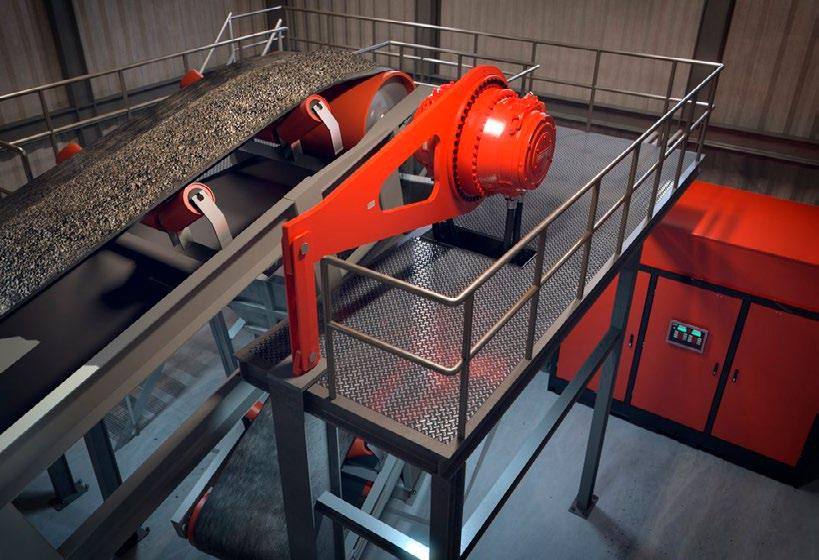
10 Benefits of Modern Gearless Hydraulic Direct Drive Systems in Mining
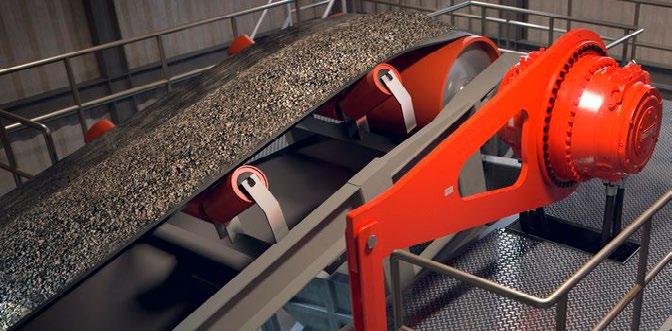
The case for gearless hydraulic direct drive systems in mining, driving efficiency and sustainability.
18 Building the Future
Transforming operations amid a labor shortage.
20 Investment for Today, Investment for the Future How training and certification can be a worthwhile investment.
» TEST YOUR SKILLS
21 Determining the Cause of Excessive Vibration
Stay sharp with this monthly lesson from the IFPS's study guide.
22 The Marketing & Sales Funnel in Hydraulic Component Manufacturing & Distribution
From awareness to loyalty, a business development approach for hydraulic component manufacturers.
» COVER STORY
24 Mobile Hydraulics and Controls for a Rail Car Heating System in the Railroad Equipment Industry
How mobile hydraulics and control systems revolutionize railroad infrastructure.
Departments
Publisher’s Note: The information provided in this publication is for informational purposes only. While all efforts have been taken to ensure the technical accuracy of the material enclosed, Fluid Power Journal is not responsible for the availability, accuracy, currency, or reliability of any information, statement, opinion, or advice contained in a third party’s material. Fluid Power Journal will not be liable for any loss or damage caused by reliance on information obtained in this publication.
DISCOVER
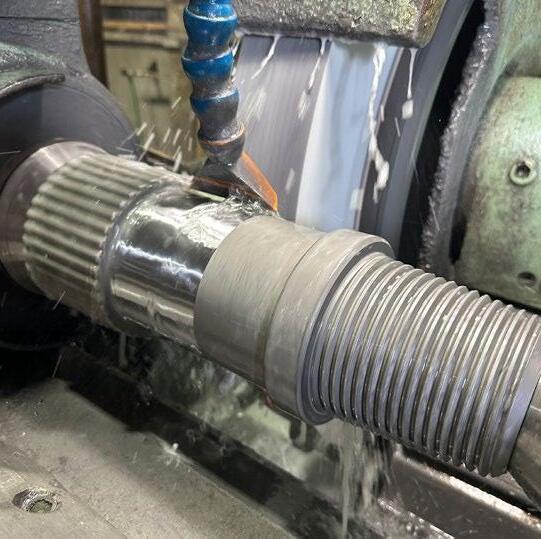
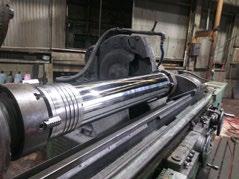
Diamond Coatings stands as a beacon of excellence in the chrome coating industry. Diamond Coatings provides precision grinding, CNC machining, metal finishing, mandrel production, hard chrome coating, and phosphate coating services. With over six decades of operation, our business is steeped in a rich history of providing superior quality services.
Precision Grinding
CNC Machining
Metal Finishing Mandrel Production Hard Chrome Coating Phosphate Coating
Solving EV Fluid Conveyance Issues With Custom Manifolds
By Jim Tuma, Marketing Services Manager, Fluid System Connectors Division, Parker Hannifin
The increasing adoption of electric vehicles has created new, complex challenges for heavy truck and off-highway equipment OEMs to overcome. However, with the U.S. Environmental Protection Agency’s Low-NOx mandate set to take effect in 2027 and similar regulations on the horizon globally, many OEMs are researching how to best incorporate battery electric power into their vehicles without diminishing performance or reliability.
While battery technology has rapidly advanced in recent years, we are still far from completely shifting from internal combustion engines to battery electric power. This is particularly true in the case of heavy trucks used for the most demanding applications.
For example, electric power is ideal for lastmile delivery trucks that return to a depot every night, as the full fleet’s batteries can conveniently be recharged when the vehicles are not scheduled for use. By comparison, heavy-duty trucks demand more power and need longer periods in between opportunities to recharge. Given this, manufacturers
resourcefully use battery energy to enable some of the truck’s key ancillary systems, leaving the internal combustion engine to power the drivetrain.
Since battery systems require more robust thermal management, OEMs are continuously researching their designs to identify iterative improvement opportunities. No industry standard defines how a thermal management system should be structured and installed. Proper routing of the coolant conveyance lines is critical, but as with most automotive design challenges, space is at a premium.
Custom manifolds have emerged as an attractive choice for manufacturers to make running lines easier, reduce the number of ports, and simplify fluid conveyance systems. Whether used for air, fuel, or even coolant, manifolds can be designed with fewer required fittings and a minimal physical footprint. This customization reduces leak points and offers cost savings to manufacturers by simplifying installation. These manifolds are grouped into one of two categories, based on which are best suited for different types of applications based on their design and functionality.
Multi-Port Manifolds
A multi-port manifold allows for a reduction in the number of ports. Among other applications, they are typically seen on air tanks where compressed air is distributed through a single connection and routed throughout the tank. This setup reduces the number of potential leak points, cuts costs associated with additional ports, and helps OEMs move configurability further along within the assembly process.
Firewall Manifolds
Firewall manifolds are designed for placement between the truck engine and the cab. They contain built-in fittings so that tubing can be routed in and out of the firewall. This replaces the need for individually installed bulkhead fittings. This custom manifold also allows manufacturers to reduce installation time and complexity, including fewer cutouts. This, in turn, improves safety performance. For procurement teams, a custom firewall manifold also reduces the bill of materials for needed components.
After determining the manifold type, the next consideration is shape. Manifolds can be designed to a specific configuration that best fits a customer’s unique application. The limiting factor for shape is body material. Brass manifolds are machined and therefore limited, but composite manifolds are injection molded which allows for a significantly wider range.
The manifold’s connection types and number of ends can be customized for optimal system performance. Traditionally, custom manifolds utilize push-to-connect ends over threaded connections to minimize the chance of a leak. However, engineers are routinely accommodating requests for a threaded connection or other end configuration to support a customer’s particular use case or application.
While vehicle designs and powertrain systems will continue to change as EV technology evolves, manufacturers are seeing custom manifolds as one solution to help advance electrification in pursuit of a more sustainable future.
Fluid Power Journal (ISSN# 1073-7898) is the official publication of the International Fluid Power Society published monthly with four supplemental issues, including a Systems Integrator Directory, Off-Highway Suppliers Directory, Tech Directory, and Manufacturers Directory, by Innovative Designs & Publishing, Inc., 3245 Freemansburg Avenue, Palmer, PA 18045-7118. All Rights Reserved. Reproduction in whole or in part of any material in this publication is acceptable with credit. Publishers assume no liability for any information published. We reserve the right to accept or reject all advertising material and will not guarantee the return or safety of unsolicited art, photographs, or manuscripts.
NEW PROBLEM
The Hydrostat Valve Is Not Able To Maintain Consistent Cylinder Flow With Varying Pressures
» A NEW HYDRAULIC employee designed a circuit using a proportional valve to control the speed of a cylinder. It was specifically constructed so the flow would be consistent regardless of the forces the cylinder was exposed to. Proportional valves are directional in nature, featuring built-in flow control. These valves need a hydrostat to make them pressure-compensated, offering constant flow regardless of the actuators’ pressure demands.
The new hire’s circuit design is shown. With a hydrostat installed under the proportional valve controls, the pressure drops across the valve spool and does not control the PSI the cylinder requires. However, the new team member’s system is installed to reduce the pressure available at the cylinder with no pressure compensation.
For the solution, see page 27.
Robert Sheaf has more than 45 years troubleshooting, training, and consulting in the fluid power field. Email rjsheaf@cfc-solar.com or visit his website at www.cfcindustrialtraining.com. Visit fluidpowerjournal.com/figure-it-out to view previous problems.
HOW HYDROGEN COULD SHAPE THE FUTURE OF FLUID POWER APPLICATIONS
By Daniel Hauser, Manager of Lead Group Hydrogen, Trelleborg Sealing Solutions
As the demand for cleaner energy grows, the transition to green hydrogen is gaining momentum. Green hydrogen (see sidebar) is produced through the electrolysis of water using renewable energy sources, such as wind, solar, or hydropower. This eliminates the carbon emissions associated with traditional hydrogen production methods. The shift aligns with global efforts to combat climate change; it also presents significant economic opportunities for developing new technologies and industries surrounding hydrogen production.
To fully realize its potential, investments must be made to advance electrolysis technology, improving energy efficiency and enhancing both storage and transport
solutions. Using hydrogen as a fuel for applications like trucks, buses, and cars is an increasing topic of conversation.
THE PRESENT
Currently, hydrogen technology as it relates to vehicles is somewhat limited, fuel cells for forklifts and a small number of hydrogen-powered trucks and buses notwithstanding. Hydrogen internal combustion engines (ICEs) are being developed by major original equipment manufacturers (OEMs), and related vehicles are still in the prototype phase with concepts shared at trade shows. For many of these vehicles, it is likely the hydraulic systems responsible
for work functions, such as cylinders, will not be in contact with hydrogen. However, any components that are part of the fuel system such as hoses, connectors, valves, and filters will have hydrogen as a medium to deal with rather than diesel or gasoline.
THE FUTURE
In the future, any component of the fuel system within the hydrogen engine of a vehicle would require some hydrogen-compatible materials to operate safely across multiple pressure cycles. In a traditional gasoline or diesel ICE, a standard nitrile O-Ring will seal components as intended but hydrogen creates complexities. Fluid power OEMs will
HYDROGEN HIGHLIGHTS
• hydrogen gas has an average atomic mass of 1.00794 u.
• The first element in the periodic table is also the lightest and the most abundant; it consists of the smallest molecules and can pass through many materials.
• Hydrogen is colorless, odorless, and tasteless, appearing in most organic compounds and making up about 75% of the universe’s overall mass.
• Rarely available in its pure form on Earth, it requires extraction from compounds
containing hydrogen. Any compound with ‘H’ in its chemical formula has hydrogen as one of its components.
• Hydrogen is contained in hydrocarbons, methane (CH4), and water (H2O).
need a reliable partner well-versed in which compounds are compatible with hydrogen.
THE CHALLENGE
Ensuring a dependable seal for hydrogen requires the use of cutting-edge materials and engineering methods. Doing so helps overcome challenges presented by hydrogen's tiny molecular size, helping it permeate various substances. Sealing materials must exhibit exceptional compatibility and resistance to permeation to prevent any loss of gas.
Another significant concern is rapid gas decompression (RGD). In high-pressure environments, hydrogen molecules can infiltrate the sealing material. If there is a sudden pressure drop, the trapped gas within the seal can expand to adjust to the new ambient conditions, which may lead to seal blistering or cracking as the gas attempts to escape. Ultimately, seals used in various hydrogen systems must endure exceptionally challenging conditions, such as high pressures reaching up to 100 MPa (14,504 psi); this occurs particularly in high-pressure valves. Extreme low temperatures plummet to -250 °C / -418 °F, which are encountered in the storage and transportation of liquid hydrogen.
Hydrogen is a highly explosive gas that necessitates careful testing protocols, prompting many seal manufacturers to rely on third-party testing facilities. To ensure safety during these assessments, helium is frequently employed as a proxy with test results adjusted to correspond to hydrogen values. However, helium does not serve as a flawless alternative, leading Trelleborg Sealing Solutions to invest in its facilities for hydrogen testing and proprietary test regimes to prove the performance of materials based on existing and enhanced versions of accepted standards.
Seals undergo rigorous testing according to enhanced proprietary versions of ISO 17268 for hydrogen compatibility and RGD. Regulation EC79 applies to components designed for hydrogen-powered vehicles. SAE J2600 applies to fueling connectors, nozzles, and receptacles for compressed hydrogen surface vehicles (CHSVs), alongside various permeation assessments. Additional evaluations cover a broad spectrum of static sealing cross-sections, including cyclic pressure tests with pressure ranges spanning from 0.7 to 75 MPa (101 to 10,877 psi) and temperature variations from -54 °C to +130 °C /-65 °F to +266 °F.
A partner focused on innovations in hydrogen sealing can provide a comprehensive suite of solutions designed to address future challenges for fluid power applications.
Trelleborg’s H2Pro™ portfolio of over 20 materials exemplifies this dedication. These materials have been proven to perform in demanding application settings, offering suitability for high-pressure scenarios and low-temperature conditions while effectively resisting permeation. They are specifically designed to handle RGD and showcase exceptional wear and extrusion properties. The range includes two newly developed materials tailored for hydrogen applications. H2Pro™ EBT25 is an advanced ethylene propylene diene monomer rubber (EPDM) suited for high-pressure use over a broad temperature spectrum. Zurcon® H2Pro™ ZLT is a distinctive thermoplastic polyurethane (TPU) designed for very low-temperature applications.
CONCLUSION
The future of hydrogen for fluid power applications will continue to evolve. As it does, every participant in the value chain needs to evolve with it. Open communication between customers and suppliers will be critical. Those who choose to invest time and resources into this technology will be the ones who keep pace with the marketplace.•
FEELING GREEN
Green hydrogen refers to a type of hydrogen gas that's fully carbon-neutral. It’s created by harnessing renewable energy sources through a method known as electrolysis. Consider this:
1. Utilization of Renewable Energy: The process of generating green hydrogen involves the use of electricity that's solely produced from renewable energy sources such as wind, solar, hydroelectricity, or geothermal energy.
2. The Process of Electrolysis: The production of green hydrogen happens in an electrolyzer. This process leverages renewable energy to break down water (H2O) into hydrogen (H2) and oxygen (O2) using electric currents.
3. No Greenhouse Gas Emissions: Given that renewable energy is used in the electrolysis process, the carbon footprint linked to green hydrogen production is extremely low or nonexistent.
4. Diverse Uses: Green hydrogen is used across sectors. These include fuel cell vehicles, industrial workflows, power generation, and energy conservation. It acts as a potent energy carrier to efficiently store and move renewable energy.
Using Transfer Barrier Bladder Accumulators for Subsea Compensation Control
By Richard Kendall, Executive Vice President, Accumulators, Inc.
Bladder accumulators have been a cornerstone of the offshore oil industry for decades, playing a critical role in a variety of applications. These versatile devices are commonly used to provide emergency power for blowout preventer (BOP) hydraulic power units, ensuring safety and operational
fluid power engineers have been tasked with overcoming a host of challenges relative to the effects of hydrostatic head pressures. Furthermore, the thermal expansion and contraction of high water-based fluids require precise engineering solutions to maintain system integrity and efficiency.
designed to minimize environmental impact while maintaining performance.
All actuators undergo rigorous testing on the surface before a system is deployed to depths ranging from 150 to 3,000 meters (500 to 10,000 feet). These tests ensure reliability and performance under varying conditions, as surface
accommodate the thermal expansion and contraction of the high water-based hydraulic fluid.
Initially, compensation for fluid expansion and contraction posed a significant engineering obstacle. Fluid expansion caused by high temperatures could lead to over-pressurization, necessitating the use of mechanical relief valves to alleviate excess pressure. Fluid contraction caused by frigid conditions would create problems for the actuators, such as not having enough fluid on demand.
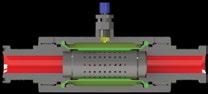
When properly sized, transfer barrier accumulators integrate seamlessly into subsea pods, which house sophisticated equipment, including electronic components vital for efficient operation. When lowered to depth, the housings cannot withstand external pressure from the immense hydrostatic pressure exerted by seawater at depth. Therefore, the housings are filled with a dielectric fluid. A transfer barrier accumulator is connected to the housing, with the bladder inside exposed to the dielectric fluid and the outer component of the barrier exposed to seawater.
As the equipment is lowered to depth, the barrier transfers the seawater pressure to the dielectric fluid. This pressure transfer
mechanism eliminates the risk of housing collapse due to hydrostatic head pressure, ensuring that there is virtually no pressure differential across the pod housing wall. The housing is always protected from collapse due to the transfer barrier accumulator automatically adjusting seawater pressure on the non-seawater side to maintain steadiness.
Beyond their role in pressure compensation, transfer barrier accumulators enhance the longevity and reliability of subsea systems. By preventing over-pressurization and under-supply of hydraulic fluid, they ensure that actuators and other hydraulic components function consistently, even under the most extreme conditions.
As subsea exploration and production activities continue to expand into deeper and more demanding environments, the role of transfer barrier accumulators will only grow in significance. Future advancements may lead to even more efficient designs, capable of withstanding greater pressure and temperature while enhancing system reliability. These innovations will be essential for ensuring safe, sustainable operations in the future.•
1 Quart Subsea Transfer Barrier, 3000 psi version As seen in the photo, the top end of the transfer barrier where the compensating fluid is connected has a perforated tube and coupling. The seawater side has a stainless-steel mesh filter to eliminate seawater contamination. All transfer barrier materials are stainless steel. The shell is high-strength chrome-moly steel that is electroless nickel plated or has a phenolic coating on the ID and marine epoxy paint on the OD. Sizes range from 1 quart to 15 gallons, up to 6000 psi.
Benefits of Modern Gearless Hydraulic Direct Drive Systems in Mining
By Ashok Amin, North America Mining Segment Manager, Hägglunds Drive Systems (Bosch Rexroth USA)
In the mining industry, high-power density drive systems with a compact size and weight are essential when operating heavy, load-bearing machines. Modern gearless hydraulic direct drive systems have unique, attractive features that allow mining operators to exert more operational control, allowing for improved reliability and energy efficiency. Electro-mechanical drive systems, which have been used in mining for many years, have proven to be less reliable at times. As a result, operators are now exploring innovative, energy-saving choices with hydraulic direct drives that represent a clear return on investment (ROI).
The large, powerful machines in the mining industry are known for their lower speeds
and high torque with continual movement. Some in the industry are hesitant to consider newer technology, which can prevent them from improving system operations. Assessing the benefits of change can offer operators insight into how to improve a mine’s overall efficiency while educating the industry on the benefits of gearless direct hydraulic drive systems with variable speed.
Reaping the Benefits of Fluid Power
In harsh environments that are elemental to mining, durable and reliable equipment and applications are essential to maintain longevity and consistency. While electro-mechanical
drive systems have been the status quo for decades, modern gearless hydraulic drives offer sturdy, improved solutions that incorporate standard components for efficiency. Ongoing research and development in recent years has led to better performance of gearless hydraulic drives, making them more reliable with reduced losses and a longer equipment lifespan. Productivity increases and the guaranteed ROI stemming from an extended lifespan and heightened reliability are all incentives for mining companies and their end-users to consider. Many companies that transitioned at one location have moved swiftly to streamline applications across all of their locations due to the tangible benefits of hydraulic applications.
Not only are hydraulic direct drive systems more efficient, but the application is compact and user-friendly. This is due to its modern control systems that use microprocessors and programmable logic controllers (PLC). The shift toward automation has helped produce a precise amount of control for machine operators, a task that has proven difficult with large machines and a need for hyper-specific movements. The electronic, remote operation of modern gearless hydraulic drive systems provides operators and mine managers real-time access to data and predictive maintenance capabilities, along with notable financial savings.
Environmental and Financial Impacts
Change can be difficult for more conventional industries such as mining with deeply ingrained traditions. As these machines consistently work, move, and carry heavy loads, the amount of energy it takes to power them
is remarkable. With that being the case, there are consistent developments in policies and industry standards regarding carbon footprint and global emissions.
The Environmental Protection Agency (EPA) and other government agencies continue to ask major operators to prioritize energy savings, specifically promoting the transition to environmentally acceptable lubricants (EAL). The mining industry is responsible for 28% of total global emissions, emphasizing the importance of more sustainable practices that can be adopted using a shifted approach. Mine operators can affect change through simple equipment swaps that can enhance operations. Mining equipment’s efficiency, energy savings, and carbon footprint can be significantly lowered when using servo motors with variable speed control for precise adjustment of the hydraulic systems’ pump flow. From there, smaller pumps and tandem pumps can be used to reduce energy, improve efficiency, and optimize the duty cycle of a complex mining application. Using servo motors in tandem with hydraulic drive systems also increases equipment responsiveness.
Promising energy savings, financial benefits, and a compelling ROI are all potential impacts seen when hydraulic applications are implemented with the right equipment. Upfront cost savings may be the most important initial factor, but identifying a solution with long-term benefits is a more functional, efficient decision. For example, EALs provide opportunities for operators to ensure EPA compliance and avoid regulatory fines, but they often cost more to use. Although these sustainable oil alternatives may be more costly upfront, avoiding these fines can impact ROI and total cost savings over time.
Promoting Education for Industry Adoption
There is a substantial opportunity for mining managers to serve as industry advocates to facilitate and maintain this shift. Properly managing hydraulic drives requires training and education to improve the full adoption and reap all benefits of the shift. Hiring qualified experts, facilitating ongoing training modules, and offering other on-site educational opportunities can improve the workforce and ensure successful solution application.
Additionally, industry collaboration through thoughtful conversation and continued learning can help overcome these challenges. This includes connecting engineering schools with industry entities to drive recruiting efforts within the areas of mining
and hydraulic applications. Once operators learn about these key benefits, they can retrofit their machines with hydraulic direct drive systems to get started.
Mining remains a vital global industry with an immense impact on society and the
environment. Discovering customized solutions requires a genuine team effort, involving the right individual contributors willing to make tough decisions, promote continued education, and demonstrate a willingness to embrace change. •
efficient reliable tight
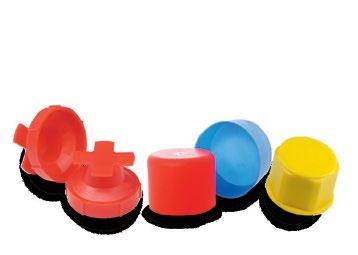
Plugs with integrated molded NBR or FKM seal. Automatically assembled with integrated control. Our products can be found worldwide in hydraulic applications and drive technology. We stock for you.
It’s our turn.
LITERATURE REVIEW
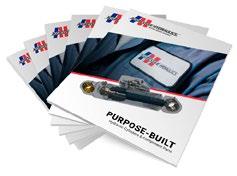
Aggressive Hydraulics® Purpose-Built™ Catalog
Purpose-Built™ Catalog Highlights:
• Custom hydraulic cylinder solutions
• Unique solutions
• Pre-engineered hydraulic cylinders
• Expanded component parts offerings
• State-of-the-art manufacturing
Want more information? We’re here to help.
• Email: Sales@AggressiveHydraulics.com
• Phone: 763-792-4000
Diamond Hydraulics, Inc.
Diamond Hydraulics provides fast, accurate repair of hydraulic components by industry experts. With state-ofthe-art test equipment, we ensure that your products are in the absolute best condition before leaving our facility. We are committed to providing excellent customer service and strive to consistently meet and exceed the needs and expectations of every customer.
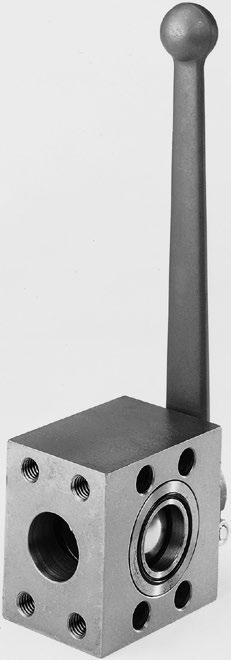
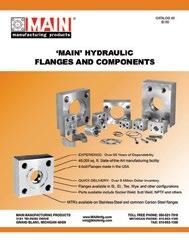
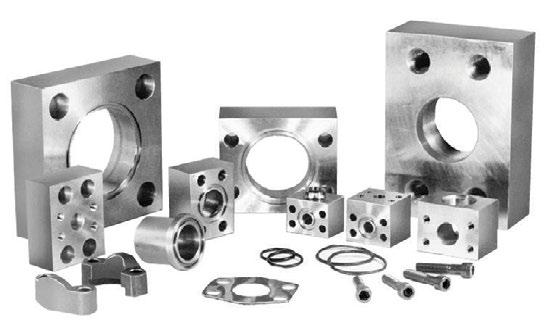
New 120 page catalog includes popular styles of MAIN Manufacturing’s extensive offering of carbon and stainless Hydraulic Flanges and Components – ready for immediate shipment. Metric ordering information, weld specs, and dimensional information included. The “Quick Reference Guide” helps specify less popular items often stocked or quickly manufactured (generally 3-4 days) at our US plant.
MAIN Manufacturing Products, Inc.
Grand Blanc, MI
800.521.7918; FAX: 810.953.1385
E-mail: info@mainmfg.com www.mainmfg.com
The ULTRIQ™ Compact Air Cylinders
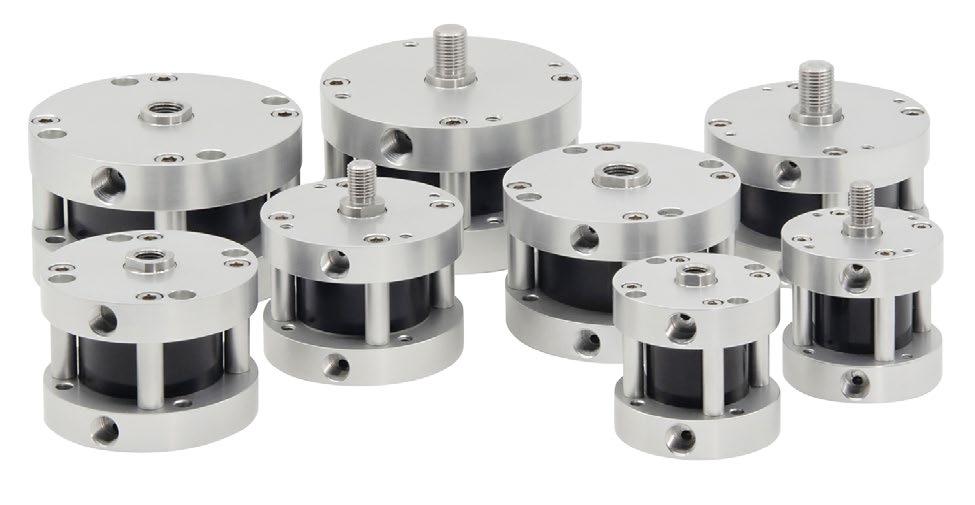
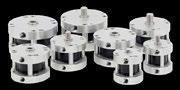
New from Branham - The ULTRIQ™ compact pneumatic pancake cylinder brochure features 5 bore sizes (1” to 3”) and 13 standard stroke Lengths (0.25” to 4.0”). Design includes Quad X-Ring seals, stainless steel hardware, thick walled aluminum precision cylinder tubing, and offers interchangeability with others. Dimension drawings and performance tables shown. Made in U.S.A. Secure online purchasing at www.ultriq.com.
W. C. Branham, Inc.
Tele: 715-426-2000, Email: AskWCB@WCBRANHAM.COM
Compressed Air Filtration
Brochure offers a comprehensive overview of the company’s complete line of compressed air filtration products. Highlighted is the patented family of Extractor/Dryers. These two-stage, point of use filters remove contaminates to a 5-micron rating with flow ranges of 15 to 2,000 scfm. Additional products available include the SuperStar Membrane Dryer, .01 Micron Filter, Refrigerated Extractor/Dryer, and much more.
La-Man Corporation
800.348.2463 www.laman.com
Hydraulic Live Swivels Catalog
Inline and 90° hydraulic live swivels. Available in sizes from 1/8” to 2-1/2”, rated to 10,000 PSI, heat treated, superior quality alloy steel, chrome or stainless steel ball bearings, withstands heavy side loads, burnished (micro smooth) barrel bores, Viton®, Aflas®, or Teflon® encapsulated seals, zinc or nickel plated, available in 304 and 440 stainless steel, full flow - low pressure drop, rebuilding kits available.
Super Swivels
Phone: 763.784.5531
Fax: 763.784.7423
Website: www.superswivels.com
Motion Redefined
As the world’s first ESV, we solve motion control challenges with ingenuity. Evolution Motion Solutions combines over 80 years of industry expertise in hydraulic repair and reman services to deliver technically superior solutions for industries like work trucks, busses, railroads, presses, and foundries. We may not manufacture your systems or machines, but we help them run more efficiently and reliably with locally performed certified repairs and industry-leading hydraulic hands-on training that optimizes production time and enhances performance.
» FOR STUDENTS EXPLORING the exciting world of fluid power, access to the right resources is essential for building knowledge and sparking interest in the industry. Whether you’re studying hydraulics, pneumatics, or systems integration, having quality learning tools can make all the difference.
The International Fluid Power Society (IFPS) provides a variety of resources tailored to students. These include an exclusive student membership, online training modules, study guides, and interactive tools that simplify complex concepts and make learning more engaging. Additionally, IFPS connects students with certification opportunities, helping them stand out as they prepare to enter the workforce.
By leveraging these resources, students can gain a strong foundation in fluid power and position themselves for successful careers in this dynamic field.
Visit www.ifps.org/student-resources to learn more!
Submit Your Hall of Fame Nominations by April 15 th!
» THE FLUID POWER industry owes its success not just to its hardware—pumps, valves, cylinders, and hoses—but to the passionate individuals who bring innovation and expertise to the field. To honor these contributions, the Fluid Power Hall of Fame recognizes those who have dedicated their careers to advancing the industry and made a lasting impact through their work.
Nominations are accepted annually from January 1 through April 15, allowing anyone to nominate a deserving individual, living or deceased, who has demonstrated excellence during a career spanning 25+ years in fluid power. Each nominator may submit one living and one posthumous candidate. Eligible nominees are required to complete a 15-question application detailing their contributions. A panel of judges carefully reviews all submissions and selects the inductees. This prestigious honor celebrates the innovators, educators, engineers, and professionals whose dedication and ingenuity have driven the industry forward, ensuring its continued success. Submit your nomination at www.surveymonkey.com/r/FBKNTPP !
Preparing for Your Fluid Power Certification Test
SETTING YOURSELF UP FOR SUCCESS
»SUCCESS IN YOUR Fluid Power Certification starts with thorough preparation. Taking the time to study ahead of your exam not only boosts your confidence but also ensures you have a solid grasp of the material, setting you up to perform at your best on test day.
The International Fluid Power Society (IFPS) provides a wealth of resources to guide you toward success. These include online training modules that reinforce your understanding, detailed study manuals tailored to specific certifications, and guided review presentations designed to target key areas of knowledge. Test your skills with our pretests to ensure you’re well prepared. For teams, IFPS offers custom training programs built around your schedule and needs, allowing you to choose the specific topics to focus on. By taking advantage of these tools and starting your preparation early, you’ll be well-equipped to tackle your certification test and achieve your goals.
Visit www.ifps.org/training-materials for helpful tools to help you ace your exam!
Individuals wishing to take any IFPS written certification tests can select from convenient locations across the United States and Canada. IFPS is able to offer these locations through its affiliation with the Consortium of College Testing Centers provided by National College Testing Association. Contact Kyle Pollander at Kpollander@ifps.org if you do not see a location near you. Every effort will be made to accommodate your needs.
Written Certification Test Locations
Alabama Auburn, AL Birmingham, AL Calera, AL Decatur, AL Huntsville, AL Jacksonville, AL Mobile, AL Montgomery, AL Normal, AL Tuscaloosa, AL Alaska Anchorage, AK Fairbanks, AK
Arizona Flagstaff, AZ Glendale, AZ Mesa, AZ Phoenix, AZ Prescott, AZ Scottsdale, AZ Sierra Vista, AZ Tempe, AZ Thatcher, AZ Tucson, AZ Yuma, AZ
Arkansas Bentonville, AR Hot Springs, AR Little Rock, AR
TENTATIVE TESTING DATES FOR ALL LOCATIONS
MARCH 2025
Tuesday 3/4 • Thursday 3/27
APRIL 2025
Tuesday 4/8 • Thursday 4/24
MAY 2025
Tuesday 5/6 • Thursday 5/22
JUNE 2025
Tuesday 6/10 • Thursday 6/26
California Aptos, CA Arcata, CA Bakersfield, CA Dixon, CA Encinitas, CA Fresno, CA Irvine, CA Marysville, CA Riverside, CA Salinas, CA San Diego, CA San Jose, CA San Luis Obispo, CA Santa Ana, CA Santa Maria, CA Santa Rosa, CA Tustin, CA Yucaipa, CA Colorado Aurora, CO Boulder, CO Springs, CO Denver, CO
Durango, CO Ft. Collins, CO Greeley, CO Lakewood, CO Littleton, CO Pueblo, CO
Georgia
Albany, GA
Athens, GA
Atlanta, GA
Carrollton, GA
Columbus, GA
Dahlonega, GA
Dublin, GA
Dunwoody, GA
Forest Park, GA
Lawrenceville, GA
Morrow, GA
Oakwood, GA
Savannah, GA
Statesboro, GA
Tifton, GA
Valdosta, GA
Hawaii Laie, HI
Idaho
Boise, ID
Coeur d ‘Alene, ID
Idaho Falls, ID
Lewiston, ID
Moscow, ID
Nampa, ID
Rexburg, ID
Twin Falls, ID
Illinois
Carbondale, IL
Carterville, IL
Champaign, IL
Decatur, IL
Edwardsville, IL
Glen Ellyn, IL
Joliet, IL
Malta, IL
Normal, IL
Peoria, IL
Schaumburg, IL
Springfield, IL
University Park, IL
Indiana
Bloomington, IN
Columbus, IN
Evansville, IN
Fort Wayne, IN
Gary, IN
Indianapolis, IN
Kokomo, IN
Lafayette, IN
Lawrenceburg, IN
Madison, IN
Muncie, IN
New Albany, IN
Richmond, IN
Sellersburg, IN
South Bend, IN
Terre Haute, IN
Iowa
Ames, IA
Maryland
Arnold, MD
Bel Air, MD
College Park, MD
Frederick, MD
Hagerstown, MD
La Plata, MD
Westminster, MD
Woodlawn, MD
Wye Mills, MD
Massachusetts
Boston, MA
Bridgewater, MA
Danvers, MA
Haverhill, MA
Holyoke, MA
Shrewsbury, MA
Michigan
Ann Arbor, MI
Big Rapids, MI
Chesterfield, MI
Dearborn, MI
Dowagiac, MI
East Lansing, MI
Flint, MI
Grand Rapids, MI
Kalamazoo, MI
Lansing, MI
Livonia, MI
Mount Pleasant, MI
Sault Ste. Marie, M
Troy, MI
University Center, MI
Warren, MI
Minnesota
Alexandria, MN
Brooklyn Park, MN
Duluth, MN
Eden Prairie, MN
Granite Falls, MN
Mankato, MN
Mississippi Goodman, MS
Jackson, MS
Mississippi State, MS
Raymond, MS
University, MS
Missouri
Berkley, MO
Cape Girardeau, MO
Columbia, MO
Cottleville, MO
Joplin, MO
Kansas City, MO
Kirksville, MO
Park Hills, MO
Poplar Bluff, MO
Rolla, MO
Sedalia, MO
Springfield, MO
St. Joseph, MO
New Mexico
Albuquerque, NM
Clovis, NM
Farmington, NM
Portales, NM
Santa Fe, NM
New York
Alfred, NY
Brooklyn, NY
Buffalo, NY
Garden City, NY
New York, NY
Rochester, NY
Syracuse, NY
North Carolina
Apex, NC
Asheville, NC
Boone, NC
Charlotte, NC
China Grove, NC
Durham, NC
Fayetteville, NC
Greenville, NC
Jamestown, NC
Misenheimer, NC
Mount Airy, NC
Pembroke, NC
Raleigh, NC
Wilmington, NC
North Dakota
Bismarck, ND
Ohio
Akron, OH
Cincinnati, OH
Cleveland, OH
Columbus, OH
Fairfield, OH
Findlay, OH
Kirtland, OH
Lima, OH
Maumee, OH
Newark, OH
North Royalton, OH
Rio Grande, OH
Toledo, OH
Warren, OH
Youngstown, OH
Oklahoma
Altus, OK
Bethany, OK
Edmond, OK Norman, OK
Oklahoma City, OK
Tonkawa, OK Tulsa, OK
Oregon Bend, OR Coos Bay, OR Eugene, OR
Gresham, OR
Tennessee Blountville, TN
Clarksville, TN
Collegedale, TN
Gallatin, TN
Johnson City, TN
Knoxville, TN
Memphis, TN
Morristown, TN
Murfreesboro, TN
Nashville, TN
Texas
Abilene, TX
Arlington, TX
Austin, TX
Beaumont, TX
Brownsville, TX Commerce, TX
Corpus Christi, TX
Dallas, TX
Denison, TX
El Paso, TX
Houston, TX
Huntsville, TX
Laredo, TX
Lubbock, TX
Lufkin, TX
Mesquite, TX
San Antonio, TX
Victoria, TX
Waxahachie, TX
Weatherford, TX
Wichita Falls, TX
Utah Cedar City, UT
Kaysville, UT
Logan, UT
Ogden, UT
Orem, UT
Salt Lake City, UT
Virginia
Daleville, VA
Fredericksburg, VA
Lynchburg, VA
Manassas, VA
Norfolk, VA
Roanoke, VA
Salem, VA
Staunton, VA
Suffolk, VA
Virginia Beach, VA
Wytheville, VA
Washington
Auburn, WA
Bellingham, WA
Bremerton, WA
Ellensburg, WA
Ephrata, WA
Olympia, WA
Pasco, WA
Rockingham, WA
Seattle, WA
British Columbia Abbotsford, BC
Burnaby, BC
Castlegar, BC
Delta, BC
Kamloops, BC
Nanaimo, BC
Prince George, BC Richmond, BC
Surrey, BC
Vancouver, BC Victoria, BC
Manitoba Brandon, MB
Winnipeg, MB
New Brunswick
Bathurst, NB Moncton, NB
Newfoundland and Labrador
St. John’s, NL
Nova Scotia Halifax, NS
Ontario
Brockville, ON Hamilton, ON London, ON Milton, ON Mississauga, ON Niagara-on-the-Lake, ON
North Bay, ON North York, ON Ottawa, ON Toronto, ON Welland, ON Windsor, ON
Quebec
Côte Saint-Luc, QB Montreal, QB
Saskatchewan
Melfort, SK Moose Jaw, SK
Nipawin, SK Prince Albert, SK Saskatoon, SK
Yukon Territory Whitehorse, YU
UNITED KINGDOM
Elgin, UK
GHAZNI
Kingdom of Bahrain, GHA
Thomasville, GHA
JOB PERFORMANCE TEST LOCATIONS
Arizona California Colorado Florida
Georgia
Maine Michigan Minnesota Montana New Jersey Nova Scotia Pennsylvania Texas Washington Wyoming Western Australia
Delaware Dover, DE Georgetown, DE Newark, DE
Florida
Avon Park, FL
Boca Raton, FL Cocoa, FL Davie, FL
Daytona Beach, FL
Fort Pierce, FL Ft. Myers, FL Gainesville, FL Jacksonville, FL Miami Gardens, FL Milton, FL
New Port Richey, FL Ocala, FL Orlando, FL Panama City, FL
Pembroke Pines, FL
Pensacola, FL
Plant City, FL
Riviera Beach, FL Sanford, FL
Tallahassee, FL
Tampa, FL
West Palm Beach, FL
Wildwood, FL
Winter Haven, FL
Cedar Rapids, IA
Iowa City, IA
Ottumwa, IA
Sioux City, IA
Waterloo, IA
Kansas
Kansas City, KS
Lawrence, KS
Manhattan, KS
Wichita, KS
Kentucky
Ashland, KY
Bowling Green, KY
Erlanger, KY
Highland Heights, KY
Louisville, KY
Morehead, KY
Louisiana
Bossier City, LA
Lafayette, LA
Monroe, LA
Natchitoches, LA
New Orleans, LA
Shreveport, LA
Thibodaux, LA
St. Louis, MO
Warrensburg, MO
Montana Bozeman, MT
Missoula, MT
Nebraska Lincoln, NE
North Platte, NE
Omaha, NE
Nevada Henderson, NV
Las Vegas, NV
North Las Vegas, NV
Winnemucca, NV
New Jersey
Branchburg, NJ
Cherry Hill, NJ
Lincroft, NJ
Sewell, NJ
Toms River, NJ
West Windsor, NJ
Klamath Falls, OR
Medford, OR
Oregon City, OR Portland, OR
White City, OR
Pennsylvania Bloomsburg, PA Blue Bell, PA
Gettysburg, PA
Harrisburg, PA Lancaster, PA
Newtown, PA
Philadelphia, PA
Pittsburgh, PA
Wilkes-Barre, PA York, PA
South Carolina
Beaufort, SC
Charleston, SC
Columbia, SC
Conway, SC
Graniteville, SC
Greenville, SC
Greenwood, SC Orangeburg, SC
Rock Hill, SC
Spartanburg, SC
Shoreline, WA
Spokane, WA
West Virginia Ona, WV
Wisconsin
La Crosse, WI Milwaukee, WI
Mukwonago, WI
Wyoming
Casper, WY
Laramie, WY
Torrington, WY
CANADA
Alberta
Calgary, AB
Edmonton, AB
Fort McMurray, AB
Lethbridge, AB
Lloydminster, AB Olds, AB Red Deer, AB
EGYPT Cairo, EG
JORDAN Amman, JOR
NEW ZEALAND Taradale, NZ
CFPAI
Certified Fluid Power Accredited Instructor
CFPAJPP
Certified Fluid Power Authorized Job Performance Proctor
CFPAJPPCC
Certified Fluid Power Authorized Job Performance Proctor Connector & Conductor
CFPE
Certified Fluid Power Engineer
CFPS
Certified Fluid Power Specialist (Must Obtain CFPHS & CFPPS)
CFPHS
Certified Fluid Power Hydraulic Specialist
CFPPS
Certified Fluid Power Pneumatic Specialist
CFPECS
Certified Fluid Power Electronic Controls Specialist
Master of Mobile Hydraulics (Must Obtain CFPMHM, CFPMHT, & CFPCC)
CFPMIP
Certified Fluid Power
Master of Industrial Pneumatics (Must Obtain CFPPM, CFPPT, & CFPCC)
CFPCC
Certified Fluid Power
Connector & Conductor
CFPSD
Fluid Power System Designer
CFPSA
Certified Fluid Power Support Associate
Tentative Certification Review Training
IFPS offers onsite review training for small groups of at least 10 persons. An IFPS accredited instructor visits your company to conduct the review. Contact kpollander@ifps.org for details of the scheduled onsite reviews listed below.
FLUID POWER SUPPORT ASSOCIATE
» CFC Industrial Training – Fairfield, Ohio | May 5–8, 2025 | December 1–4, 2025
HYDRAULIC
SPECIALIST
For custom IFPS training inquiries, please contact Bj Wagner (bwagner@ifps.org)
» CFC Industrial Training – Fairfield, Ohio | May 19–23, 2025 | October 20–24, 2025
ELECTRONIC CONTROLS SPECIALIST
For custom IFPS training inquiries, please contact Bj Wagner (bwagner@ifps.org).
PNEUMATIC SPECIALIST
For custom IFPS training inquiries, please contact Bj Wagner (bwagner@ifps.org)
» CFC Industrial Training – Fairfield, Ohio | August 4–8, 2025
CONNECTOR & CONDUCTOR
For custom IFPS training inquiries, please contact Bj Wagner (bwagner@ifps.org).
» CFC Industrial Training – Fairfield, Ohio | July 15–17, 2025
MOBILE HYDRAULIC MECHANIC
For custom training IFPS inquiries, please contact Bj Wagner (bwagner@ifps.org)
Online Mobile Hydraulic Mechanic certification review for written test is offered through CFC Industrial Training. This course surveys the MHM Study Manual (6.5 hours) and every outcome to prepare you for the written test. Members may e-mail for a 20% coupon code off the list price. Test fees are not included.
» CFC Industrial Training – Fairfield, Ohio | June 23–27, 2025 | October 13–17, 2025
INDUSTRIAL HYDRAULIC MECHANIC
For custom IFPS training inquiries, please contact Bj Wagner (bwagner@ifps.org).
» CFC Industrial Training – Fairfield, Ohio | June 2–6, 2025
INDUSTRIAL HYDRAULIC TECHNICIAN
For custom IFPS training inquiries, please contact Bj Wagner (bwagner@ifps.org).
» For dates, call CFC Industrial Training at (513) 874-3225 or visit www.cfcindustrialtraining.com.
MOBILE HYDRAULIC TECHNICIAN
For custom IFPS training inquiries, please contact Bj Wagner (bwagner@ifps.org).
PNEUMATIC TECHNICIAN & PNEUMATIC MECHANIC
For custom IFPS training inquiries, please contact Bj Wagner (bwagner@ifps.org).
» For dates, call CFC Industrial Training at (513) 874-3225 or visit www.cfcindustrialtraining.com.
BUILDING THE
HOW AUTONOMY CAN RESHAPE CONSTRUCTION
By Adam Khaw, Head of Autonomy, Danfoss Power Solutions
The construction industry is currently facing a labor shortage that’s forecasted to intensify over time. According to the Associated Builders and Contractors (ABC), in 2025 the industry will need to recruit an estimated 454,000 new hires on top of the normal hiring pace to meet labor demands. ABC cites several causes for the shortage, including “outsized retirement levels, megaprojects in several private and public construction segments, and cultural factors that encourage too few young people to enter the skilled construction trades.”
Looking deeper into the first factor, over 20% of construction workers are over 55 years of age. Their impending retirement means the loss of job site headcount and experience. The result is fewer workers overall and less experienced workers operating machinery, which could lead to higher rework and decreased productivity levels. By transitioning the skill and experience an operator would typically demonstrate onto
the machine, autonomy can provide a solution for the lack of skilled labor in construction. The productivity of the machine and the operator is amplified while precision tasks are performed faster and more accurately. Autonomy is ideal in any off-highway sector seeking to increase safety, boost productivity, and enable greater precision.
Before digging into how autonomy delivers these benefits, let’s clarify what is meant by autonomy in the off-highway machine industry.
DEFINING AUTONOMY
Many discussions around autonomy focus on self-driving vehicles. The reality is more nuanced and there are important distinctions between autonomy in on- and off-highway vehicles. In passenger cars and trucks, the goal is to automate the vehicle. In off-highway machines, the goal is to automate the tasks the vehicle performs. The more automated tasks are, the more autonomous the vehicle appears.
When it comes to off-highway machinery, five defined levels of autonomy differ slightly from the levels of autonomy in passenger vehicles. The levels of off-highway autonomy are:
• Level 1: The driver controls most functions, including specific operations such as steering; these can be taken over by the machine at the operator’s discretion.
• Level 2: In certain settings, the machine can steer, accelerate, and brake while the operator is still directing and monitoring the action of the vehicle; this lightens the operator's load while still engaging them in driving.
• Level 3: More complex actions are controlled and executed by the machine. In the right conditions, a machine can manage most driving aspects, including monitoring the environment. This allows the operator to control other implements on the machine and steer their focus away from driving for short durations.
• Level 4: The machine can operate without human input or oversight, and multiple autonomous machines can work together on one site.
• Level 5: The machine can operate without human input or oversight, but it can be controlled off-site; this is known as unsupervised autonomy.
When people think of autonomy, many think of driver-less or cab-less machines. While autonomous machines do exist today, they are often expensive and intricate; as a result, they have yet to fully penetrate the market. In the next 15 or 20 years, this reality may shift. For now, the state of the art is semi-autonomous functionality that increases machines' ease of use and precision — in other words, level 3 autonomy. These machines enhance job site productivity and safety, even when staffed with a brand-new operator.
AUTONOMY IN CONSTRUCTION
While other off-highway sectors, such as agriculture, have relatively advanced autonomy, construction could see rapid development as new workers enter the industry. As previously mentioned, autonomous and semi-autonomous functionality improves safety, productivity, and precision, regardless of operator experience. In construction, this will lead to reduced rework and faster job completion.
Hyper-repetitive tasks are ideal candidates for automation. In construction, rollers and compactors are good examples. Soil compaction and asphalt rolling require highly skilled operators. Costly rework or accelerated road
deterioration may result if these tasks are not done properly. By using autonomous functionality, these machines can compact soil or roll asphalt with proper overlaps and accuracy regardless of who is behind the wheel. In addition, an operator in a tandem roller with a limited field of view can be more aware of their surroundings.
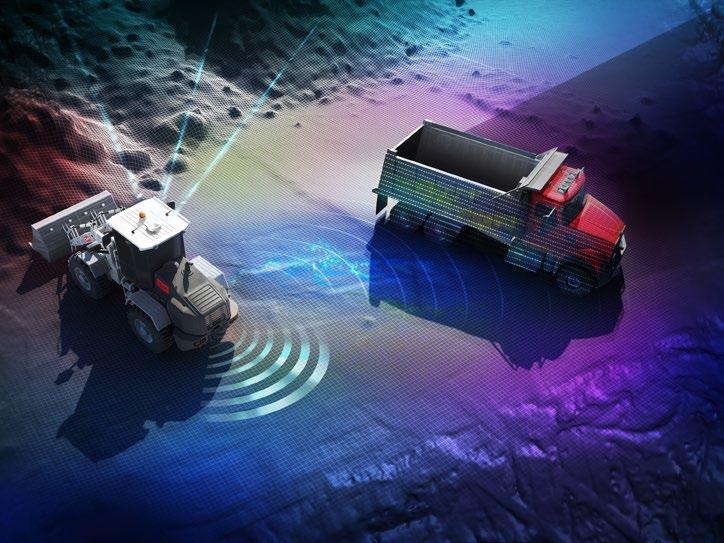
Development efforts focused on obstacle detection and avoidance are particularly relevant in construction due to large machines experiencing significant blind spots. Accidents still happen even today when a driver doesn’t see someone standing or working near a machine. Damage to nearby structures is also common. Collisions can be prevented by adding obstacle-detection functionality to machines.
ANOTHER CHALLENGE IS KNOWING EXACTLY WHAT AND HOW TO AUTOMATE.
Path recording and following is another example of semi-autonomous operation relevant to construction. Such functionality is ideal for pipeline and power line work as well as other applications in which a machine needs to follow a long stretch of road or ground. This functionality enables an operator to drive a path while recording speed, waypoints, and tasks the machine does. A less experienced operator can then manage the machine as it follows the recorded path. Blind spot detection has proven successful in construction, along with semi-autonomous functions that help inexperienced operators rely on the machine. Many original equipment manufacturers (OEMs) in the construction industry have introduced advanced operator-assist features that keep operations consistent and repeatable. Autograde and auto-dig in excavators, along with boom kick-out and bucket positioning in wheel loaders are all examples of existing functions on job sites. Automation of precise tasks that would otherwise require the effort of skilled professionals is an ideal area that would benefit from continued development.
Autonomy in construction is ultimately about finding the right use cases. In relation to the previous example of automating repetitive tasks, solar farm construction would be an ideal candidate. Solar sites require numerous post placements at precise intervals. On megaprojects, haulers could be automated if they operate solely within the confines of the site. This would mimic quarrying or mining, where rock haulers transport loads
from excavators to a rock crusher or conveyor system. Two haulers and one excavator could be operated simultaneously by a single operator who would record paths in each dump truck and oversee all trucks while operating the excavator.
ENGINEERING FUTURE
Autonomy has the potential to unlock significant construction industry advantages, making the choice to use machines with autonomous functionality an easy one for contractors. For OEMs, however, automating machines can be complicated. The process presents new challenges pertinent to software and hardware. Autonomy requires perception sensors such as lidar and radar, global positioning, high-power processors, and other technologies that may be new to design engineers. These technologies are not plug-and-play, and the sensors are not onesize-fits-all. Applications and environments have unique needs that demand different solutions. A significant amount of engineering work is required to integrate these devices and services into a system.
Another challenge is knowing exactly what and how to automate. Single-use machinery such as soil compactors that perform repetitive tasks are relatively simple and straightforward to automate. Having said that, many types of construction machines are multifunctional. Skid steer loaders, for example, can perform many operations. Excavators are also highly versatile, meaning many possible tasks can be automated. In addition, construction machinery often operates in complex, dynamic job sites rather than one static environment, making autonomous operation more of an obstacle.
Autonomy offers a great deal of potential and many exciting engineering possibilities. The responsibility falls on OEMs to identify problems that need to be solved at the ideation phase in the design process. This requires collaboration with product, systems, and software teams, as well as autonomy experts before any lines of code are written. Larger OEMs have an advantage with their established in-house teams focused on solving engineering challenges. With the construction machinery market dominated by several large OEMs, smaller and mid-sized OEMs risk falling behind.
As autonomy evolves, many suppliers and systems integrators offer solutions for automating machines. The Danfoss autonomy team, for example, offers products and services that support the full machine development cycle, including software, hardware, and engineering services. By building upon a foundation of field-tested solutions, smaller OEMs can remain competitive in a rapidly evolving industry and position themselves for the future of autonomous machinery.
In conclusion, contractors should be proactive in considering machines with autonomous functionality, and OEMs should determine whether adding this functionality to a machine will enhance its value to end-users. Navigating the complexities of integrating autonomous solutions requires strategic planning and collaboration, but the potential benefits for both OEMs and the industry at large are significant and worth the time investment. Workforce development alone cannot solve the construction industry’s pressing labor shortage. Technology, such as autonomy, can help bridge the gap and help contractors achieve more with fewer resources.•
By Bradley "BJ" Wagner, CFPAI/AJPP, Director Training/Development, IFPS
future! today,Investment for Investment for the
Growing up as a child, we are taught to set goals and to plan for the future. Questions were often asked: “What do you want to be when you grow up?”, “Who are your role models?”, “What college are you going to?”, “Are you going to participate in an internship?”, “What are your career aspirations?”, “What do you want to do for a living?” For some, those answers may have been clear, and straight forward. For others, some answers may have been unclear or have changed. For many however, those answers have changed numerous times along the way, and are perhaps still changing. Life is not always a set path. Sometimes change is inevitable, but if we are willing to learn and grow over time, it can be a successful path and journey.
As a parent, we invest in the future of our children. We want them to have a better education, have a better job, have a better direction, and perhaps learn from the things that we learned or experienced along the way. In a way, investing in our children is an investment for the future. A proper plan and course of action set early, leads to a reward in the end. For those of us who had clear answers to the questions asked as a child, perhaps that journey was a little easier. While always a challenge, having people to support and encourage us along the way, made the direction a little straighter and the path and hills to climb a little easier.
The IFPS mission is to globally pursue and promote the application of Fluid Power technology through certification, standardization, and education essential to professional growth. While certification may be the goal, education and learning are part of the journey along the way. Education and learning are the investment that can lead to the certification and a bright future in the fluid power industry. I have had the incredible opportunity to facilitate certification review trainings throughout the year to nearly all levels of certifications. I see investment in learning as a key to success in the certification journey. It is not always about the cost of the certification or the cost of the training. While that
does affect the bottom dollar, it is an investment for today and an investment for the future. Just like our children, supporting the goals and aspirations early, can lead to a successful tomorrow. Investing in the learning, can lead to an educated workforce that can tackle the challenges of tomorrow. For some that is investment in their children and their employees, both which lead to a successful today, a successful tomorrow, and successful long time future.
One such company I have had the pleasure of working with this past year, has taken a unique approach to their certification journey and preparation. They have demonstrated that the investment is in the education and learning, and that certification and return on investment will follow. They have demonstrated that learning leads to knowledge, knowledge can lead to certification, and certification can support the tomorrow and long term future. Not all people preparing for the certifications have a significant background in hydraulics or pneumatics, and the successful passing of the certification can be a daunting and challenging task. Their approach has proven to be successful, yielding high results, and focusing on the education and learning as part of that certification journey. Their approach may be a model for others to follow, to aid in their own certification journey.
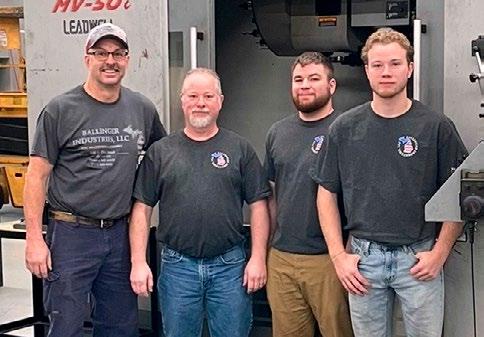
Ballinger Industries, LLC is a small family owned and operated CNC Machining & Assembly company located in Michigan who recognized the importance of certification and what it has to offer, leading to a more knowledgeable workforce, and ultimately a safer working environment. All of their machining equipment is operated by hydraulics, leading to a need for hydraulic knowledge for the maintenance and operation of their machines and equipment. Their approach to certification has been unique in that it was not just an investment in a week long certification review training, but more of an investment in training and learning as a whole. For anyone who has tackled an IFPS certification, preparing on their own, knows that is not always a walk in the park. It can take a lot of time and focus to learn the material and prepare for the certification exam, and perhaps then participate in a certification review training as a last step in their preparation. Ballinger Industries' approach was to utilize a partial-day, bi-weekly, online training, consisting of 32 hours of 2–4-hour sessions scheduled twice per week,
to gradually learn the basics and theory, fitting it around their daily work schedule, and then utilize an in-person certification review training as a true review, allowing for customized training specific to their needs. While this approach is a larger investment in training dollars, it allows for fully learning the material and being prepared for the certification exams. LaMar Ballinger, owner and operator of Ballinger Industries, LLC stated that “It is an investment in the future…” and that while certification is important, “it is the knowledge and understanding that is important to us” for his staff and employees. He shared that “not everyone learns at the same pace or same method” and that the investment is in education, and certification will follow. His discussion and sharing of his company vision was clear and re-emphasized with his questions and comments; he asked where I grew up and where I live now. My response, like many, was that I live close to family and home. This led to his profound statement proclaiming, “I want to invest in the future. My goal is to have a place after graduation of high school or college for people to stay, or to come home to. Youth is the future of our companies and our communities.”
In a way, this aligns with the quote from the popular 1989 movie Field of Dreams “If you build it, they will come”. Building a business with educated staff members today will lead to growth, a place to come home to, and a future for tomorrow. Investing for the future today (children, employees, and workforce), will lead to a safer and more knowledgeable tomorrow.
Investing in learning and training will lead to certification, which can lead to a safer, more knowledgeable, and successful future. An investment for today, is an investment for the future. Training and certification can be a part of that journey and investment. Perhaps Ballinger Industries' approach to training and certification can be an approach that will work for you as well. IFPS is proud to be part of that journey! •
DETERMINING THE CAUSE OF EXCESSIVE VIBRATION
Vibration is often caused by a rotating shaft member. For example: bent drive shafts, out of phase drive shafts, off-center pump couplings, loose components including hose and tubing, and even an internal pump part such as a missing vane in a vane pump. A typical truck mounted mobile pump mounting is shown in Figure 42 (Page 106). Remember that the drive shaft has a U-joint at each end, that the angle of the two U-joints is the same because the shafts are parallel, that the U-joints are off-set slightly to promote bearing lubrication, and that the yokes are in alignment so that the U-joints will be in phase. Locating the source of the vibration can be difficult. A vibrating pump driven by an auxiliary drive shaft from the engine or transmission that is found to be vibrating may be loose. One might reasonably expect that simply tightening the mounting bolts would fix the problem when, in fact, it might not. The pump itself may be vibrating, the drive shaft may be bent, U-joint angles may be too great for the application, the speed could be too high, and the drive shaft could be assembled
out of phase. When the job returns with the bolts loose a second time, the temptation is to use larger bolts in the belief that the pump is the vibrating member, and that the original bolts were simply too small for the application. If the source of the vibration is not found, it is likely that strengthening mounting members and bolt attachments will only delay failure of the pump, or whichever rotating member is the weakest. A better approach is to try to isolate the source of the vibration by testing each rotating member individually to determine the cause of the problem. This is not always easy. First, try using a stethoscope on various parts to determine which one seems to be the source of noise. Seeking expert opinion from the manufacturer should be part of the strategy. If a test bench is available, the system can be run on a bench. Finally, switching parts, such as a drive shaft, from one machine to another also may be required to duplicate operating conditions that cause the problem to occur.•
TEST YOUR SKILLS
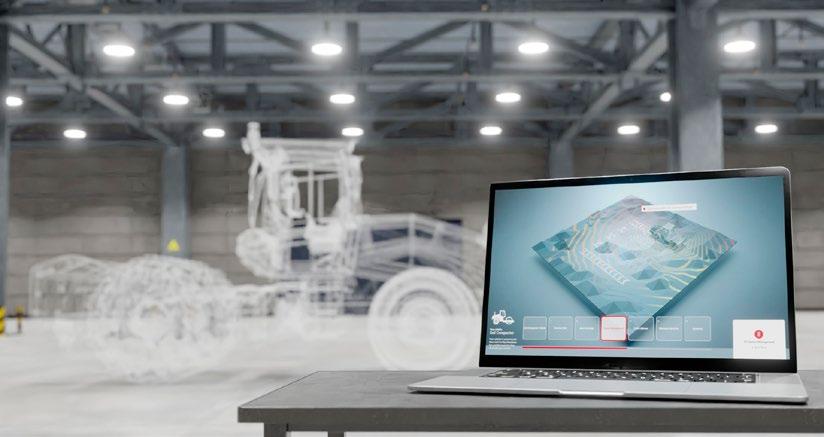
Digital Documents reverse-engineer systems cross/type components
Photo Navigation drilling down to individual components & parts
Interactive Prints illustrate machine operations & functions
Video Troubleshoot capture tribal knowledge & train on-the-job
Can Work Offline on any device browser
The Marketing & Sales Funnel in Hydraulic Component Manufacturing & Distribution
A Business Development Approach
By Steve Thor, V.P. of Sales and Marketing, Aggressive Hydraulics
In the competitive arena of hydraulic component manufacturing and distribution, what if you could stop chasing customers and start attracting them naturally? Imagine a strategy that doesn't just speak to your audience but taps into their core needs, positioning you as the trusted industry leader they didn't know they were looking for. This article reveals a powerful, forward-thinking approach that merges the best of classic marketing principles with the reach of modern technology, thus creating a path to consistent, sustainable growth. Here, you'll learn how to craft a marketing and sales funnel that moves beyond sales pitches, inviting prospects to see you as the expert they can trust. Ready to learn how to draw in your ideal customers, build lasting loyalty, and make an impact that keeps them coming back? Read on to unlock the secrets of a winning strategy that turns curiosity into commitment.
Understanding the Marketing and Sales Funnel for Hydraulic Component Manufacturers and Distributors
A typical marketing and sales funnel is often divided into several stages, which map the progression of a customer’s engagement with a company’s brand and product offerings. For a hydraulic component manufacturer or distributor, each stage of the funnel requires a unique business development approach. Unlike consumer goods, the B2B market in fluid power is characterized by longer sales cycles, complex decision-making processes, and the need for technical support at nearly every touchpoint. Let’s examine each stage of the marketing and sales funnel and explore how business development can drive success at each level, specifically within the hydraulic component industry.
Awareness Stage: Building Industry Presence and Credibility
In the awareness stage, the primary goal is to ensure that potential customers become familiar with your brand and understand the broad value proposition your hydraulic components offer. The fluid power market is specialized, meaning that your marketing efforts should be highly targeted and focused on industry-specific platforms and channels. Position your brand as a thought leader in hydraulic component technology by publishing white papers, technical guides, and industry reports on topics such as component design innovation, material selection for durability, or how to increase operational efficiency using advanced hydraulic systems.
Participating in events like IFPE or industry-specific trade fairs can create brand visibility. Offering live demonstrations of hydraulic components in action or conducting educational sessions on the latest trends in hydraulic system design can boost recognition. Ensure search engine optimization (SEO) for your website specific to relevant keywords like "custom hydraulic components," "heavy-duty hydraulic components," or "precision hydraulic systems" to increase visibility among potential clients searching for solutions. Business development efforts in the awareness stage are focused on generating leads through outbound digital marketing and ensuring that your brand is positioned where key decision-makers are likely to discover it.
Interest Stage:Engaging with Technical Content
Once potential customers are aware of your hydraulic components, the next step is to engage them further by providing content that
builds interest. Since purchasing decisions in the fluid power sector are often technical and driven by performance metrics, it’s essential to educate potential customers about the specific advantages of your products. Offering in-depth demonstrations of how your hydraulic components work, either through live webinars, product demonstrations, or on-demand videos, is a powerful way to engage prospects. Highlight key features such as custom designs, material choices, or performance in extreme environments.
Nurture leads by sending educational content through structured email campaigns. A series of emails explaining various applications of hydraulic components across industries or highlighting successful case studies can keep prospects engaged with your brand. Provide calculators, configurators, or online tools that help prospects understand how your components can meet their specific requirements, such as an interactive calculator that allows engineers to input specifications and receive product performance feedback. Business development professionals should focus on maintaining regular contact with leads during this stage, answering technical questions, and offering additional resources to guide their interest toward a solution.
Consideration Stage: Addressing Technical Concerns and Differentiating from Competitors
At the consideration stage, potential customers are evaluating your hydraulic components alongside those of your competitors. This is where business development efforts focus on addressing technical concerns, clearly differentiating your products, and building trust with the customer.
Demonstrate how your hydraulic components have been successfully used in similar applications, building credibility through in-depth case studies that highlight measurable improvements, such as longer lifespan, increased efficiency, or reduced downtime. Provide transparent comparison guides, data sheets, or other tools that allow prospects to see how your hydraulic components perform against competing products in terms of technical specifications, durability, and customization options, helping them make informed decisions.
Offering samples or trial periods for potential customers to test your components in their specific applications can reduce perceived risk and build confidence in your product. The business development team’s role here is to ensure that prospects have all the information they need to feel confident about choosing your solution, offering personalized advice and technical support throughout the decision-making process.
Intent Stage: Facilitating Purchase Decisions
By the time a prospect reaches the intent stage, they are close to making a purchase decision but may still need reassurance. Business development efforts here focus on removing any remaining obstacles and ensuring a smooth path to purchase.
Customize quotes and proposals to the specific needs of the customer, including custom component designs or volume discounts. Providing detailed pricing information and clear timelines for delivery ensures transparency. Offering flexible payment terms can ease the purchasing decision, especially for customers looking to make large investments in hydraulic systems for major projects.
Emphasize the level of after-sales support, such as maintenance services, training, and warranties, which is particularly valuable in the hydraulic component market, where downtime due to equipment failure can be costly. At this stage, business development professionals should focus on finalizing the deal while ensuring the customer feels supported throughout the purchasing process.
Purchase Stage:Delivering a Positive Experience
The purchase stage is where the deal is closed, but business development efforts shouldn’t end here. Ensuring a positive customer experience during and after the
purchase is critical for securing repeat business and long-term relationships.
Provide clear communication about order status, delivery schedules, and any potential delays. Ensuring that hydraulic components are delivered on time efficiently and in line with customer expectations can set the tone for a positive relationship. Offering installation services or training on how to maintain and optimize hydraulic components for specific applications can add significant value to the customer and prevent issues down the line.
After the sale, follow up with customers to gather feedback on their experience and address any concerns. This shows that customer satisfaction is a priority and helps resolve potential issues. Business develop-
Awarene Interest Consideration Intent
Stay in touch and check in with customers by providing regular updates on new products, technical innovations, and industry trends. Offering exclusive insights or early access to new technologies can strengthen relationships. Encourage repeat business by offering discounts or incentives for repeat orders or establish a referral program where satisfied customers can recommend your components to others.
Implement customer success programs that focus on helping clients maximize the value of their hydraulic systems through maintenance services, training updates, or periodic performance checks. The business development team’s role at this stage is to nurture long-term relationships and continuously provide value to the customer beyond the initial sale.
Aligning Marketing and Sales for Effective Business Development
To optimize the marketing and sales funnel in hydraulic component manufacturing and distribution, it’s critical to align marketing efforts with business development and sales strategies. A few key methods to foster this alignment include:
• Shared Metrics and Goals: Marketing and business development teams should work toward common goals, such as lead generation, conversion rates, and customer retention.
• Collaborative Content Creation: Involving business development professionals in creating marketing content ensures that messaging aligns with customer needs and addresses real-world technical challenges.
ment teams should be proactive during this stage, ensuring a positive customer experience and promptly addressing any issues.
Loyalty Stage:Building Long-Term Relationships
The final stage of the funnel is about turning one-time customers into loyal clients who make repeat purchases and advocate for your brand. In hydraulic component manufacturing, where equipment longevity and performance are critical, loyalty is built on trust, quality, and ongoing support.
• Regular Feedback Loops: Maintain open communication between marketing, sales, and business development to ensure alignment and responsiveness to changes in customer needs or market conditions.
By aligning strategies across the funnel stages, hydraulic component manufacturers and distributors can build stronger relationships with customers, optimize lead conversion, and ultimately drive growth in a competitive marketplace.•
MOBILE HYDRAULICS AND CONTROLS FOR A RAIL CAR HEATING SYSTEM IN THE RAILROAD EQUIPMENT INDUSTRY
By Kevin Smith, Vice President of Sales, Scott Industrial Systems
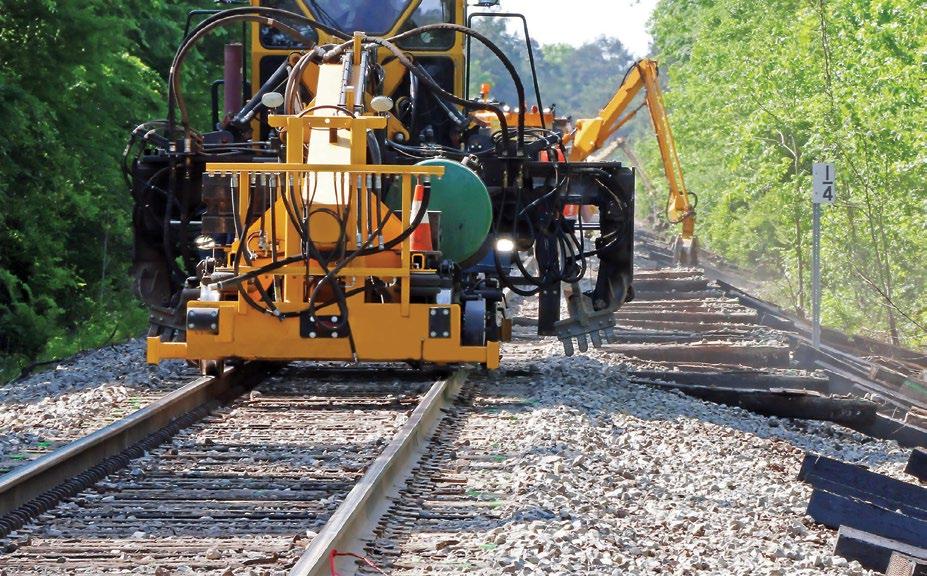
The railroad industry has long relied on innovative technologies to ensure the safety, efficiency, and durability of its infrastructure. One such critical innovation designed for rail service and repair is the mobile hydraulics and control systems used in rail car heating equipment. These systems are designed to heat continuously welded railroad rails up to 260°C (500°F) so they expand to be secured in place while hot. Once cooled, the rails contract to create tension and stability to support the locomotive and rail carloads. This article explores the technical aspects, challenges, and innovations behind the systems incorporated into rail service cars.
THE ROLE OF MOBILE HYDRAULICS IN RAIL HEATING SYSTEMS
To achieve the precise range of speeds and torque required for heating rails, a combination of hydrostatic drive and mechanical linkage systems is deployed. This setup ensures sufficient power to move the system across the rails at controlled speeds, even on inclines. Additionally, an auxiliary pressure-compensated, load-sensing circuit operates ancillary equipment, such as burner assemblies, blower fans, and vibratory mechanisms.
The system’s hydraulic components include a hydrostatic pump featuring pulse width modulation (PWM) control, as well as radial piston motors for the main drive system or vehicle propel function. Pressure-compensated piston pumps supply hydraulic power to the auxiliary functions. Directional control valves, both cartridge-style and sectional-style, manage the hydraulic flow. These components, paired with a hearty mobile control module, create a hydraulic and control system capable of thriving in harsh outside environments.
CONTROL SYSTEM OPERATION AND DESIGN
The control system is built around a durable mobile PLC control module, programmed with software developed using the CoDeSys environment. This module interfaces with the directional control valves via wired communication and with the diesel engine via the
J1939 CAN bus protocol. Analog and digital sensors provide real-time data for monitoring system performance, guaranteeing reliable operation even in austere conditions.
FIELD CHALLENGES
One of the primary obstacles faced by rail heating systems is operating with minimal downtime in severe outdoor environments. These machines often function in remote areas, where resources for troubleshooting and repair are limited. Downtime can halt an entire segment of the railroad system, making simplicity and reliability paramount. The system’s design simplifies maintenance, allowing field technicians to quickly identify and address issues.
HEATING SYSTEM CONFIGURATIONS
Propane-powered and diesel-powered configurations are available when choosing a rail heating system. The propane system requires controlled propane flow, while the diesel system uses a fan/blower assembly with a closed-loop control system to maintain consistent airflow. Both systems feature independent burner banks to heat each side of the rail, ensuring uniform temperature distribution.
INNOVATIVE FEATURES
The rail heating system incorporates a cruise control function conducive to precise speed control. In work mode, the rail car system operates at speeds as low as 0.08 kmph (1/8 mph), a capability unique to the industry. This slow, steady speed is critical for effective rail heating. Additionally, transport mode allows speeds of up to 12.4 kmph (20 mph) for relocating the equipment. Operator controls include an electronic joystick for speed and directional adjustments, along with comprehensive system monitoring and fault indicators used for troubleshooting.
SAFETY & MAINTENANCE MEASURES
Safety is key to the system’s design. Realtime monitoring ensures optimal fluid levels and temperatures, while built-in shutdown
mechanisms protect against low or overheated conditions. The system also includes "driver presence" technology, preventing the machine from operating in an unmanned state. Maintenance is facilitated using intricate operator manuals, on-site training, and diagnostic tools such as test points and fault indicators. These features prepare railroad industry technicians to efficiently service equipment and minimize downtime.
HISTORICAL CONTEXT AND EVOLUTION
The concept of rail heating systems dates back to the 1950s, an era where mechanical technology was used to perform the task. Since the early 2000s, advancements in hydraulics and electronic controls have revolutionized systems. Modern designs that have been operational for over 15 years continue to set a precedent as the industry standard.
ENERGY EFFICIENCY AND ENVIRONMENTAL CONSIDERATIONS
The closed-loop hydrostatic drive system improves fuel efficiency by reducing waste, allowing for longer operating durations before refueling. In the diesel-powered configuration, the shared fuel system between the engine and burners further enhances efficiency. These features contribute to a more sustainable rail heating approach.
CONCLUSION
Mobile hydraulics and control systems have transformed rail heating in the railroad industry. By combining advanced hydraulic technology, innovative control features, and robust safety measures, these systems guarantee reliable operation in even the harshest environments. As the industry continues to evolve, these systems will remain at the forefront of technological advancement and align with the demands of modern rail operations. •
Lubriplate’s complete line of ultra high-performance, hydraulic fluids has been designed to provide a wide range of benefits including: extended fluid change intervals, cooler operating temperatures, reduced friction and reduced downtime. Products include...
• Designed for environmentally sensitive industrial and marine applications.
• Meets U.S. EPA Vessel General Permit (VGP) Requirements. Readily biodegradable.
• Does not leave a sheen on the water.
PRODUCT SPOTLIGHT
Hydraulic Noise and Shock Suppressor
Wilkes and McLean manufactures an In Line Noise and Shock Suppressor for hydraulics and is a stocking distributor of Nacol Accumulators. Our suppressors eliminate pulsations, which greatly reduces noise and vibration from applications from a few gallons up to 200 gallons. We stock all of our suppressor sizes as well as Nacol Accumulators and parts from 1/5 of a pint up to 15 gallons, in our Schaumburg, Illinois facility. 877.534.6445 | info@wilkesandmclean.com | www.wilkesandmclean.com
Clippard Cordis Electronic Pressure Controls
Precise, linear pressure control within a closed-loop system with ultra high resolution and repeatability. Clippard’s Cordis is a revolutionary micro-controller primed for escape velocity from a proportional control market. Built with the highest quality Clippard EVP and DVP proportional valves at its heart, the Cordis is designed to outperform the competition in every way. With unparalleled performance and flexibility not possible with current analog proportional controllers, the Cordis makes everything from calibration to sensor variety more accessible and less complicated.
The World’s most versatile mainstream portable contamination monitor. MP Filtri’s Contamination Monitoring Products and highperformance filtration help ensure efficient, reliable performance dedicated to keeping your company moving forward. Condition monitoring and proper filtration prevent contamination buildup, these products extend your equipment life, reduce downtime, and lower maintenance costs, making them essential for optimizing performance and stopping contamination at the source. mpfiltriusa.com | sales@mpfiltriusa.com | 215-529-1300
Think Yates Cylinders for ALL of your cylinder needs!
Custom Welded Cylinders:
• 1.5” up to 50” bore, with strokes exceeding 300”
Heavy Duty Mill Cylinders:
• 1.5” up to 50” bore, with strokes exceeding 300”
NFPA/JIC Tie Rod Cylinders:
• 1.5” up to 24” bore; interchangeable with all brands
Cylinders
CLASSIFIED BULLETIN
HIGH FLOW COUNTERBALANCE
LOAD HOLD VALVE
• 32mm to 50mm
• Prevent unintended or uncontrolled movement of static or dynamic loads
HERE IS THE SOLUTION TO FIGURE IT OUT ON PAGE 05 The correct answer to Test Your Skills on page 21 is 1B.
A hydrostat works by sensing the pressure on a valve’s outlet and feeding it into the hydrostat's spring chamber. This allows for consistency as the pressure drops across the valve, resulting in a constant flow. Fluctuating pressures before or after the valve have zero influence on the flow. The circuit designer discovered that an order was placed for a check valve module with the signal checks flowing in the wrong direction.
• Pressure, Flow, Directional
• Large Flow 90° Valves
• Offers greater stability
Adaconn + Inserta 7
Aggressive Hydraulics 12, OBC
• Single DIN blocks
IN STOCK FROM 25MM TO 80MM MANY COVERS IN STOCK
• Active Valves
• Monitored Poppets
almomanifold.com
• Control the load speed in case of hydraulic hose failure
• Suitable for safe and stable load handling
• Available with or without Inline Cavity Block
Phone: 989.984.0800 Toll Free: 1.877.ALMO. NOW Fax: 989.984.0830
FluiDyne Fluid Power IFC, 27 586-296-7200 fluidynefp.com
Heinrichs 11 1-859-371-4999 heinrichs-usa.com
La-Man Corp 12 1-800-348-2463 laman.com
COMPONENT SHOWCASE
Clippard Eclipse Isolation Valve with Unrivaled Proportional Flow Resolution
The Eclipse is a proportional isolation valve like no other. Utilizing patented slide technology, it achieves exceptional proportional flow resolution that far exceeds the competition. Designed for precision, its flow path is fully flushable and composed entirely of inert ceramic, ensuring compatibility with a wide range of media. In addition, the Eclipse features a unique soft start capability that gradually introduces media at a controlled ramp rate to prevent damage or turbulence. For applications that demand exceptional liquid or gas control, Clippard’s Eclipse offers outstanding precision.
For further information on the Eclipse Valve or any of Clippard’s line of Precision Fluid Control Products and Solutions, visit www.clippard.com. Proudly made in the USA.
The flange connector you need – quick as 1, 2, 3 Why use MAIN MANUFACTURING PRODUCTS?
1
QUICK: MAIN has a large and diverse inventory, including specials for same day shipping. MAIN’s US production facility, specialized manufacturing processes, and large raw material inventory allow your custom non-stock parts to be shipped in days.
2
INFORMED: MAIN’s engineers are active on ISO and SAE committees. They are available to assist you with your flange needs, call 800.521.7918, e-mail to info@MAINmfg.com or fax 810.953.1385.
3
DEPENDABLE: MAIN has 60 years of experience in designing, developing, manufacturing and distributing quality hydraulic flanges and components.
National Tube Supply’s fluid power products are precisely manufactured and expertly finished to minimize leakage and ensure longer seal life and optimum performance.
Our experienced team is always available to help customers identify the best product for their project specifications, quality requirements and bottom line. We’ll even work with you to set forecasts for JIT delivery management!
Hydraulic Fluid Line Tubing
Cylinder Barrels
Pneumatic Cylinder Tubing
Pump Barrels
Honed Steel Tubing
Chrome ID Tubing
Chrome OD Tubing
DOM Tubing
Seamless Steel Tubing
Chrome Plated Piston Rods
1045 Steel
Ductile Iron & Alloy
We have a massive inventory at your disposal with 8 locations across North America – most orders ship next day!