Effective Management in Uncertain Times Navigating Challenges whilst providing Inspiring Solutions for Effective Management in a Dynamic Industry Bi-monthly publication from the International Association of Professional Congress Organisers
Issue No. 109 | December 2023 / January 2024
DESTINATION PARTNER
Empowering Change:
Dubai Association Centre Conference set to return in 2024
The industry-defining Dubai Association Centre Conference is set to return for its fourth edition, 27–28 February 2024, under the theme ‘Value Amplified: Associations Empowering Change’. Reflecting Dubai’s continued growth as a global association hub, the conference will once again provide a powerful platform for sector leaders and experts from around the world to come together and consolidate the pivotal role associations play in not only serving the needs and aspirations of their members, but also as agents of positive change within their communities and wider societies. Organised by the Dubai Association Centre and taking place at Dubai World Trade Centre, the 2024 edition will explore innovative strategies, best practices and collaborative approaches to create tangible and lasting value for communities and societies. Targeted at association executives and stakeholders who play a crucial role in leadership and management, including government officials and strategic partners, the conference aims to contribute to the immediate civic, economic and social development of the region. Topics explored at the conference will include the implication of artificial intelligence for association executives, strategies for attracting and retaining members, dealing with disruptions and legacy and community-building. Building on previous editions, the programme will also put a strong focus on interactive sessions and open dialogue, ensuring high levels of participation by all delegates. His Excellency Helal Saeed Almarri, Director General, Dubai’s Department of Economy and Tourism and Dubai World Trade Centre Authority, said: ‘As Dubai’s own economy continues to evolve to meet the goals of the Dubai Economic Agenda – D33 – the city will provide an ideal setting to explore the theme around empowering change, and we look forward to once again welcoming global leaders and experts, as well as stakeholders
2
December 2023
from across the region, to embrace a collaborative spirit. ‘The conference will also once again provide associations from around the world with the opportunity to discover the competitive advantages of Dubai, allowing them to grow their memberships and expand their reach in the Middle East and beyond.’ The Dubai Association Conference is the flagship event of the Dubai Association Centre (DAC), which was established in 2014 as a joint initiative of Dubai Chambers, Dubai’s Department of Economy and Tourism and Dubai World Trade Centre to support and license regional and international associations in setting up an office or chapter in Dubai. DAC opened its state-of-the-art offices in One Central, DWTC in December 2019, providing a collaborative environment for registered associations. Previous editions of the Dubai Association Conference have explored key themes and priorities such as ‘Building a community’ and ‘Driving change: The societal impact of associations’.
Visit www.dubaiassociationconference.com for more details.
CONTENTS Destination - Dubai
02
Destination - Hamburg
04
Message from the President and CEO
05
Upcoming Education and Events
06 - 07
Thank you to our IAPCO volunteers
09
UN SDG Spotlight - Cork – Sustainable City
10 - 11
Connvention Centre - Messe Frankfurt
12
New IAPCO Members
13 - 14
Exhibition World Bahrain and IAPCO Partnership
15
IAPCO Collaboration Award 2023 Winner
16 - 17
IAPCO Collaboration Award 2023 Nominees
18 - 21
Destination - Rwanda
23
IAPCO’s Next Gen leaders
24 - 25
Member Focus - Luc Niville (Semico Group)
26 - 27
Join IAPCO
29
Beyond Uncertainty: Creating Seamless Events for Lasting Impressions
30 - 31
‘Feels like running a marathon … uphill!’
32 - 33
Renewing Organisations for Complex Challenges
34
Do you need a new strategy to embrace change?
36
Destination Japan
38
snaPCO
39
Member News
40 - 44
Partner News
45
IAPCO NEWS ON POINT ARTICLES IAPCO PARTNERS MEMBER NEWS
Read the full stories of our members’ news on the IAPCO knowledge hub
PARTNER NEWS
Read the full stories of our members’ news on the IAPCO knowledge hub
The PCO: published by IAPCO Whilst every care is taken in the preparation and publishing of the PCO, the views expressed are not necessarily those of IAPCO or its members and no responsibility can be taken for articles, errors or comment. Editor: Nadeem Ahmad (nadeem@iapco.org)
Sign-up to the IAPCO mailing list to receive the PCO magazine in your email inbox: IAPCO Mailing List
Feature in the February 2024 edition of The PCO! THEME: The Impact of AI on Events Deadline for all contributions: 4th February 2024 Please send all contributions to nadeem@iapco.org The schedule and themes for each of the 6 editions to be published in 2024 is now available at the link - The PCO Publishing Schedule 2024
DESTINATION PARTNER
© Mediaserver Hamburg / Joël Reimer-Eiglmeier
HAMBURG IS ALWAYS AN ASSET WHEN YOUR EVENT IS AS SUSTAINABLE AS OUR CITY.
Hamburg, the green metropolis in the north of Germany, attaches great importance to sustainability in all respects. Whether ecologically, economically or socially. Each of these aspects is substaintial for our MICE industry and is lived with our whole heart. So, become part of something very special.
Contact us for more information I hamburg-convention.com
4
December 2023
MESSAGE FROM THE PRESIDENT AND CEO
Building Resilience for a Future We Can’t Predict
At this time of year, generally, my first thought is relief that the year is over and as this is the height of our summer, Australia takes a big deep breath for a couple of weeks to rest and recharge to ensure that we are mentally and physically ready for the ahead. It also gives me time to reflect on the year that has passed and to finalise plans for the year ahead. This time of reflection, I refer to it as my “sitting on a rock” time where I let the random thoughts, often tucked in the depths of my subconscious come to the surface. In the last edition of “The PCO” I referred to the ability to “tap-dance” as an important factor in the ability for me to manage my mental health. This edition, focused on Management in uncertain times brings to the fore my constant of being able to “tapdance”. The last couple of years have taught us that the only certainty we have is uncertainty! To navigate this, the attitude of “tapdancing” or rolling with the punches can be exhausting but keeps us nimble when working within this world. However, all of this would fail if we didn’t have an operational plan. It is equally important to ensure that our clients’ plans are in place along with our own business plans. It’s the plan, along with open communication that will see us through the times ahead. I wish you a very happy festive season and that 2024 brings you joy.
Sarah Markey-Hamm President, IAPCO
At the meetings industry event, FIEXPO LATAM which took place in June 2023, I presented a session on effective management in a VUCA (Volatility, Uncertainty, Complexity and Ambiguity) environment. This is a critical challenge that requires a dynamic and adaptive approach. We also hear a lot these days about ESTEMPLE which refers to Economic, Social, Technological, Ecological, Media, Political, Legal and Ethical factors that shape the external environment of an organisation. In today’s rapidly changing business landscape, organisations must navigate through constant disruptions and uncertainties. Regardless of the acronym you use, first and foremost, having a clear and flexible vision is paramount. As leaders, it is important to have a clear vision of our organisation’s future whilst remaining open to adjustments as circumstances evolve. We need to foster an understanding of the external forces at play and be clear and agile within our teams whilst empowering employees to make swift decisions and learn from experiences, good and bad. This year, the global meetings and events industry has experienced resourcing challenges, increases in commodity and service rates and geopolitical challenges, all of which have placed added pressures on our ability to drive business forward. Yet again, in 2023, we have been able to do so. Adaptability, resilience, strategic thinking and a commitment to continuous learning continue to be the winning formula. In this edition of The PCO, our contributors share some of their experiences on how they have been able to ensure the successful management of their organisations this year through their adaptive and flexible approaches. Enjoy reading this final edition of our 2023 PCO magazine and continued success to you all in 2024.
Martin Boyle CEO, IAPCO December 2023
5
IAPCO NEWS
Upcoming Education and Events Dates for your diary for education, networking and professional development provided and supported by IAPCO. January 2024
IAPCO EDGE Seminar: Antwerp Antwerp, Belgium Discover the Legacy of Conferences at the IAPCO EDGE Seminar in Antwerp, from 16–18 January 2024. Enhance your skills, expand your network, and stay ahead in the dynamic world of event management. Explore the exceptional educational content, expert speakers and networking opportunities that await you in beautiful Antwerp, Belgium.
16–18 January
February 2024
IAPCO Hosted EDGE TCVB 2024 Tokyo Portcity Takeshiba 1-7-1 Kaigan, Tokyo, Minato-ku, Japan In conjunction with the Tokyo CVB, IAPCO has designed a two-day programme that will be delivered to local stakeholders at an in-person event by three faculty members who are experts in the meetings industry. Topics include EDI, Sustainability, Legacy and Sustainable Economic Impact.
5–6 February
6
December 2023
IAPCO NEWS
AIME 2024 Melbourne Convention & Exhibition Centre 1 Convention Centre Place, South Wharf, Melbourne, Victoria, Australia The Asia Pacific Incentives and Meetings Event (AIME) is the annual event of choice for event planners to connect with the best exhibitors from Australia, New Zealand and the Pacific, together with the whole Asian region. The Programme officially kicks off on Sunday 18 February 2024 and is managed directly with our friends at AIME and in partnership with our Destination Partners, the Melbourne Convention Bureau and Melbourne Convention and Exhibition Centre.
19-21 February
IAPCO AM&GA in Ljubljana Cankarjev dom, Cultural and Congress Centre, Prešernova 10, SI-1000 Ljubljana, Slovenia Experience all Ljubljana has to offer and join us for what will be an exciting, interactive, educational and inspirational programme. Take part in stimulating conversations, network and connect with your IAPCO community and immerse yourself in a special place that ignites vibrancy and an extraordinary cultural atmosphere that promises wonderful moments together. The 2024 AM&GA promises to deliver a diverse, yet well-thought-out and curated programme of content and knowledge exchange with significantly more opportunities for you, our members, to discuss what is impacting your businesses today and tomorrow.
28 February – 2 March
December 2023
7
IAPCO NEWS
IAPCO Job Board The online Job Board facilitating the connection between the meetings industry companies and meeting professionals with the available talent and expertise looking for their next opportunity. Wide range of vacancies in the areas of:
Meeting Planning Association Management Operations Specialist Digital Services Project Management Congress Operations Management ...and much more
Find your next opportunity or candidate on IAPCO Job Board
J BOARD B Scan for more details
Supported by
8
December 2023
For more information please visit:
jobboard.iapco.org
IAPCO NEWS
to our IAPCO volunteers As we start 2024, we look back and take stock of all that has been achieved on behalf of our IAPCO community in 2023. Three EDGE Seminars, fifteen educational sessions at industry trade shows, two IAPCO Impact Dialogues, one AM&GA, six PCO magazines and twelve Insiders published, three Driving Excellence Awards presented in addition to the developments in our digitisation, advocacy, community engagement, accreditation and membership strategies. Many of these activities would not have been possible if it were not for the dedication and commitment from our many volunteers from within our global IAPCO community. Whether contributing content for our publications or volunteering to speak online and in person, volunteers drive IAPCO. So, IAPCO takes this opportunity to sincerely thank each and every one of you (you know who you are) for continuing to help us to drive our mission forward.
December 2023
9
UN SDG SPOTLIGHT
IAPCO Destination Partner
Cork: Sustainable City
Nestled in the South-west of Ireland between the signature visitor experiences of Ireland’s Ancient East and the Wild Atlantic Way, Cork, recently voted the 2nd friendliest city in Europe (Condé Nast), offers visitors an authentic experience, through our history, heritage, landmarks, landscape and our people. Cork’s reputation for high quality, artisan food and drink production, alongside a strong cultural, musical and artistic vibe, provide an extensive choice for the visitor experience.
neutral, smart cities by 2030. As part of this initiative, Cork is developing a Climate City Contract, which will include an overall plan for climate neutrality across all sectors including energy, buildings and transport. Cork is a place of dramatic natural landscapes, riverscapes, harbours, bays and seascapes. A place of mountains, river valleys and coastlines, therefore protecting our status as
Committed to Sustainability In order to preserve our social, environmental and economic heritage, stakeholders across the region are strongly committed to sustainability and the UN SDGs. Cork Convention Bureau (CCB) is the business tourism and events arm of the Visit Cork structure, which also includes the region’s ‘Pure Cork’ leisure destination brand. CCB aspires to ensure that all meetings and events programmes are developed through the lens of sustainability by employing the GDSI Regenerative Event Checklist when planning meetings. CCB seeks to lead the way for the tourism sector throughout the region promoting and implementing environmental, economic and social sustainability programmes that will ensure a sustainable and regenerative future for the sector and Cork was proud to rank 26th out of over 100 destinations in the 2023 Global Destination Sustainability Index. Cork city is also 10
one of the EU Mission Cities that are aiming to be climate-
December 2023
a ‘green’ region is vital. Cork Convention Bureau ensures that environmental awareness is automatically built into the business and conference tourism offerings in Cork, highlighting a variety of local CSR activities (from hands-on nature conservation to forest exploration) that can offset the impact of business tourism and cement an organisation’s global citizen credentials.
A City of Welcomes As Ireland’s largest indigenous industry, the tourism sector has a responsibility to act ethically and drive social innovation. In order to provide an authentic welcome, any reputable tourism destination must demonstrate a commitment to Diversity, Equality and Inclusion (DEI). Cork city is the first and only city on the island of Ireland to have become a member of the International Rainbow Cities Network, that pledge to protect and enhance LGBTI+ rights and inclusion.
UN SDG SPOTLIGHT
When it comes to food and dining, the group takes pride in sourcing from local suppliers. Menus are designed around seasonal produce, ensuring at least ten regional products are featured, and 75 per cent of their fruit and vegetables are seasonal. This helps to support local agriculture and reduce the carbon footprint associated with food transportation. Local sourcing is part of their broader strategy to reduce food waste by 30 per cent by 2025. Community involvement is another key pillar of Trigon Hotel’s sustainability strategy. They participate in local boards and Cork City Council was the first city and public building to
collaborate with organisations, including the Irish Hotels
officially fly the Rainbow Flag, raised by the Lord Mayor in
Federation, Visit Cork and notably the Cope Foundation.
2014. Furthermore, Cork is a member of the UNESCO Global
Through their partnership with the Cope Foundation, they
Network of Learning Cities and the WHO European Healthy
contribute significantly to social welfare projects. This
Cities Network. Cork is a safe and vibrant destination for
community spirit extends to providing housing for those in
people who enjoy the city at night-time, as demonstrated
need and assisting with long-term renting solutions.
by the City’s ‘Purple Flag’ status, held since 2015. This international accreditation, awarded by the Association of
Inclusivity is a priority, with targeted recruitment drives
Cities and Towns Management (ACTM), celebrates areas of
ensuring diversity. They actively engage with their employees
excellence in the night-time economy.
through surveys, regular monthly meetings and training
Trigon Hotel Group For the Trigon Hotel Group, sustainability is more than just a
sessions on unconscious bias and cultural inclusivity. Plans to introduce a living wage by 2026 showcase their responsibility towards both their employees and the community at large.
policy; it’s a core principle that shapes every aspect of their operations, from eco-friendly amenities to community-
By integrating these sustainable practices, Trigon Hotels goes
focused initiatives. As a company, they are dedicated to
beyond merely offering a luxurious experience for guests at its
operating in a way that benefits the environment and
venues – it guarantees a positive and lasting impact on both
enriches their local community in Cork, setting a standard for
the local community and the environment. Looking ahead,
sustainability in the tourism industry.
Trigon Hotels sees Cork and Ireland as leading destinations for sustainable business tourism. Their proactive approach in
The four-star hotel group comprises The Metropole Hotel in
adopting sustainable practices not only sets a benchmark in
the heart of Cork city and Cork International Hotel, which
the industry but also inspires others to follow suit, paving the
is conveniently located next to Cork airport. Each venue is
way for a greener, more responsible sector.
committed to minimising its environmental impact. Central to this approach is a strong focus on reducing waste and educating their teams through practical training and courses. The group has set ambitious targets, including a 10 per cent reduction in their carbon footprint in the first year and a 30 per cent decrease in energy consumption across their hotels. In a move towards a more sustainable future, their rooms are now 99 per cent plastic-free, with a goal to be 100 per cent plastic-free by 2024. December 2023
11
We think in the long term and have firmly established sustainability as a central pillar in our corporate strategy. We have received an award in recognition of this, and are proud to be singled out in this way. Smart Locations and Full Services
Meet us at IBTM World
12
December 2023
74797_MF_Venue_AZ_Nachhaltigkeit_EN_PCO_213x303 • FOGRA 39 • CMYK • nh |
Meeting place for pioneers
DU: 07.09.2023
Inland-EN
CONVENTION CENTRE PARTNER
IAPCO NEWS
IAPCO Members On behalf of the entire IAPCO community, we extend a warm welcome to our newest members. We are thrilled to have these companies join our global network of professionals who share a passion for organising world-class events – a global community that thrives on innovation, collaboration and excellence that is constantly pushing the boundaries of what’s possible in the dynamic world of meetings and events. Our new members bring fresh perspectives, innovative ideas and a vibrant energy that will undoubtedly contribute to the growth and success of our community.
Place Borneo Sdn. Bhd. Bio Place Borneo Sdn. Bhd. is a full-fledged PCO and MICE management company specialising in conference, media and event management, product launches, event publications, music and video production work and music festivals. Located in Kuching, Place Borneo’s international conferences and business activities have been conducted throughout Malaysia. To date, Place Borneo has handled over thirty conference and event activities ranging from 200 to 2,000 delegates and participants. Address Place Borneo Sdn. Bhd. 2nd Floor, Lot 12622, Sublot 10, Block 16, KCLD, Cha Yi Gold Land, 93350 Kuching, Sarawak, Malaysia Other office in Kota Kinabalu, Sabah, Malaysia
Phone +6 088 214 053 Email info@placeborneo.com Website www.placeborneo.com
December 2023
13
IAPCO NEWS
Anderes Fourdy Events Sdn. Bhd. Bio PCO company, Anderes Fourdy, marries congress management solutions that empower small and medium enterprises (SMEs) to function efficiently and effectively. Established in 2013 on the premise that there is a gap between the demand for affordable technology solutions for local Malaysian SMEs and the supply of effective technology solutions which is custom custom-developed. The company aims to marry innovative technology with events management by coming up with state-of-the-art Congress and Exhibition Technology. Address G3 Hive 6 (incubator), MRANTI Technology Park, Bukit Jalil, 57000 Kuala Lumpur, Malaysia
Phone +60 12 3029898 Email events@anderesfourdy.com Website www.events.anderesfourdy.com
Triumph Group International (TGI) Bio Triumph Group International is a network of companies. But first and foremost, it is a network of people who love their work – to communicate through events. It is a versatile group composed of individuals with different skills who work in synergy. For thirty years Triumph Group International has worked with clients to find innovative solutions and meet their needs. Address Via Lucillo 60, 00136 Rome, Italy Other offices in Milan, Florence, Bruxelles, London, Riyadh, Shanghai, Singapore, Dubai
Phone +39 06 355301 Email info.italy@thetriumph.com Website www.triumphgroupinternational.com
We encourage PCOs from all corners of the world to consider becoming part of IAPCO. Membership of IAPCO, besides the prestige of accreditation, offers a plethora of benefits, including:
access to a wealth of resources, expertise, and networking opportunities, enabling PCOs to enhance their capabilities and better serve their clients and partners.
14
December 2023
IAPCO NEWS
Exhibition World Bahrain and IAPCO Partner to Drive Innovation and Position Bahrain as a Global Business Events Leader
New partnership to strengthen Exhibition World Bahrain’s position as a Leading International Exhibition and Convention Venue. HE Dr Nasser Qaedi, the CEO of Bahrain Tourism and
knowledge exchange and training programmes, and the
Exhibitions Authority (BTEA) at the signing of the IAPCO
development of new business opportunities. In addition,
Convention Centre Partnership contract with the IAPCO
EWB will be able to instil its position as a leading international
President, Mrs Sarah Markey-Hamm at the 62nd annual ICCA
exhibition and convention venue, while IAPCO’s members
Congress held in Bangkok, Thailand. Accompanied by Mrs
will have access to EWB’s state-of-the-art facilities and
Maryam Ebrahim, International Associations & Conventions
professional expertise. IAPCO’s network will provide EWB
Manager at EWB, Mr Martin Boyle, the CEO of IAPCO, Dr
with a robust approach to a wide range of potential clients,
Debbie Kristiansen, General Manager of EWB and Mrs. Sana
including international organisations, associations, and
Al-Asfoor, Marketing & Special Projects Advisor at Exhibition
corporations, tapping into new businesses from around the
World Bahrain.
world.
Exhibition World Bahrain (EWB), the Middle East’s newest
In addition, EWB is a proud member of 11 international
and largest exhibition and convention centre, has signed a
organisations and associations specialising in the business
partnership agreement with the International Association
events and tourism sector, including the International
of Professional Congress Organisers (IAPCO), making EWB a
Congress and Convention Association (ICCA), the Global
new Convention Centre of the world’s leading association for
Association of the Exhibition Industry (UFI), the International
professional congress organisers.
Association of Convention Centres (AIPC), the Professional Convention Management Association (PCMA), and more.
The new Partnership agreement was signed on the sidelines of the 62nd annual ICCA Congress, held in Bangkok, Thailand.
Founded in 1968, IAPCO is a non-profit organisation
The signing ceremony was held in the presence of HE Dr
committed to raising the standards of professionalism in
Nasser Qaedi, the CEO of Bahrain Tourism and Exhibitions
the meetings industry regarding efficiency, timeliness, good
Authority (BTEA), Dr Debbie Kristiansen, the General Manager
management, and financial responsibility. Today, IAPCO has
of EWB, Mrs Sarah Markey-Hamm, the IAPCO President and
over 150 registered member offices in over 40 countries, to
Mr Martin Boyle, the CEO of IAPCO.
advance the profession of PCOs and promote the highest
Under this new partnership, EWB will utilise IAPCO’s global
levels of professional conduct.
network of professional congress organisers (PCOs), December 2023
15
IAPCO NEWS
IAPCO Recognises Abbey Conference and Events and its Collaborators with the Driving Excellence Collaboration Award 2023 Abbey Conference & Events, in collaboration with The
Abbey Conference & Events and its collaboration partners for
International
their remarkable achievement. The success of ICIC23
Foundation
for
Integrated
Care
(IFIC),
VISITFLANDERS Convention Bureau (VFCB) and The Flemish Department of Care (FDC), have been announced as the winners of the International Association of Professional Congress
Organisers
(IAPCO)’s
Driving
Excellence
Collaboration Award 2023. The prestigious award is supported by IBTM and was presented at the Meetings Leadership Network during IBTM World on Monday 27 November 2023 in Barcelona, Spain. The winning collaboration was marked by the 23rd International Conference on Integrated Care (ICIC23), held at Flanders Meeting & Convention Center Antwerp, Flanders, from 22–24 May 2023. ICIC23 conference operated in a hybrid
Barcelona, Spain, 27 November
format, blending in-person and virtual participation to
demonstrates the power of collaborative efforts in the events
accommodate a global audience. It focused on the theme
industry, making a positive impact on both local and global
‘Care in Action: How to Work Together, a Participatory
communities. This collaboration demonstrates the potential
Approach’, bringing together leaders, researchers, clinicians,
of conferences to drive positive societal change and leave
managers, citizens, patients and caregivers to discuss
a legacy. Their achievement highlights the transformative
integrated health and social care.
potential of partnerships in advancing the mission and vision of the meetings industry.”
The collaboration’s goal was to promote integrated care globally, with the event serving as a pilot legacy project.
Evelyne Bardyn, Head of VISITFLANDERS Convention
Impact and Engagement Task Forces were established to
Bureau, commented on the win, “Victory has many fathers;
foster collaboration and create a community of practice,
the Romans already knew. But in the case of the IAPCO
ensuring a lasting impact beyond the conference. The event
Collaboration Award 2023, that is the truth. VISITFLANDERS
showcased innovation in policymaking, inclusivity, real-life
Convention Bureau is honoured to have worked so closely
experiences and patient involvement.
with IFIC, Abbey Conference & Events, and the Flanders Department of Care. Only together could we cross the
IAPCO President Sarah Markey-Hamm expressed her
Rubicon and fulfil the ambitions of the ICIC23 conference: to
admiration for the collaboration, stating, “We congratulate
create a positive long-term impact for all parties involved.”
16
December 2023
IAPCO NEWS
ICIC23 project manager Chrissy Schroder added, “The success of ICIC23 included record delegate numbers and an outstanding long-term impact in the Flanders region, which would have never been possible without the support and collaboration from everyone involved. It has been a true pleasure to work alongside all our collaborators to achieve the intended outcomes. On behalf of the team, I sincerely express my heartfelt thanks to all, especially to our long-standing partner IFIC, with whom we have developed a trusted relationship that allows such ambitious projects to be undertaken.” Nominated by IAPCO members, the IAPCO Driving Excellence Awards are a trio of awards created by IAPCO to recognise excellence within the IAPCO member community and have long been coveted by those who seek acknowledgement for their quality and contribution to the meetings industry by IAPCO. The IAPCO Collaboration Award recognises outstanding contributions to the meetings industry, celebrating partnerships that go beyond traditional roles, resulting in impactful and innovative conferences. The winning collaboration between Abbey Conference & Events and its collaborators stood out to the judges from six other nominations for its innovative approach, inclusivity and commitment to creating a lasting positive impact.
About the collaborators
Abbey Conference & Events, a part of the Abbey Group, is an award-winning Professional Conference and Events organiser founded in 1988. With a diverse portfolio and a team of twenty-four professionals, Abbey is dedicated to delivering excellence at international and national conferences.
The International Foundation for Integrated Care leads the global movement for person-centred integrated care. It collaborates with partners worldwide to maximise society’s health and wellbeing through integrated health and care systems.
VISITFLANDERS Convention Bureau supports the organisation of impactful conferences in the Flanders region. Working closely with collaborators, VISITFLANDERS aims to position Flanders as a preferred destination for international events.
The Flanders Department of Care develops and implements policy on health and wellbeing in Flanders (Belgium). Collaborating with partners, the department works towards creating a holistic approach to health and wellbeing in the region.
December 2023
17
IAPCO NEWS
IAPCO Collaboration Award 2023 Nominees While we celebrate the winners, let’s acknowledge the outstanding contributions and collaborative spirit of all nominees in shaping the future of event management.
pandemics to addressing sustainability, each collaboration demonstrated resilience, innovation and a commitment to excellence in the meetings industry.
Explore the remarkable collaborations that vied for the prestigious IAPCO Collaboration Award 2023. These nominees showcased exemplary partnerships, overcoming unique challenges to create impactful events. From navigating global
Discover the stories behind these extraordinary efforts, reflecting the diverse and evolving landscape of professional congress organisation within the IAPCO community.
Collaborative Partners 1. European Society of Endodontology (ESE) 2. Messukeskus Helsinki Expo and Convention Center 3. Helsinki Partners
Summary The ESE 2023 Congress, in partnership with AIM, prioritised corporate social responsibility and sustainability. They jointly signed the IAPCO pledge against single plastic use, aligning with UN sustainable development goals. A live online ceremony was held to symbolically sign the pledge, uniting clients, venues and destinations. Information about the initiative was widely shared. Stakeholders embraced this commitment, implementing eco-friendly practices, such as digital programmes, plastic-free badges and reusable items. The congress collaborated with Spesia School, involving children with special needs. The collaboration between AIM, ESE, Messukeskus and Helsinki Partners demonstrated a sustainable model for the events industry, promoting a positive example.
18
December 2023
IAPCO NEWS
Collaborative Partners 1. Top Kinisis Conferences and Events Cyprus 2. Hellenic Thoracic Society 3. Cyprus Respiratory Society
Summary AFEA and Top Kinisis Conferences orchestrated a successful 1st Cyprus-Hellenic Pulmonology Congress in Nicosia, Cyprus. This transnational event, a collaboration between two PCOs, two societies and two countries, united the Hellenic Thoracic Society and the Cyprus Respiratory Society. Despite post-COVID challenges, the PCOs facilitated seamless collaboration, ensuring a smooth organisation. The event boasted a robust scientific programme, advanced promotion and communication plans and a successful conference attended by over 150 participants, over 60 speakers, and over 20 sponsors. This collaboration not only established a bi-annual event but also created future opportunities for mutual benefit and expanded into new geographical markets.
Collaborative Partner 1. Australia ICOMOS
Summary Arinex and Australia ICOMOS collaborated to host the 2023 General Assembly of ICOMOS in Australia, overcoming challenges such as a three-year COVID-19 delay. The partnership involved collaborative event management, Aboriginal engagement, and sustainability efforts, resulting in a world-class conference with a lasting cultural heritage legacy. The collaboration achieved remarkable outcomes, including 12,000 collaborative hours, 9,065 event tickets and 1,853 participants, as well as a new NSW heritage strategy and increased awareness of cultural heritage issues.
December 2023
19
IAPCO NEWS
Collaborative Partner 1. Ortra Meeting Point
Summary Kenes Group and Ortra Meeting Point successfully navigated the complexities of hosting the IAPCO Annual Meeting and General Assembly 2023 in Jerusalem. The event showcased the destination’s capacity for business events and featured a unique theme, ‘Inspiring Technology – Creating an Impact.’ The collaboration worked seamlessly, dividing responsibilities while prioritising sustainability, legacy and innovation, resulting in a successful event with 160 participants from 31 countries. Impressive online engagement and impactful design contributed to the event’s resounding success, making it the third highest-attended IAPCO AM&GA in twenty years.
Collaborative Partner 1. Emirates ENT Society
Summary The International Federation of Oto-Rhino Laryngological Societies (IFOS) collaborated with the Emirates ENT Society and GCC ORL HNS Society to successfully host IFOS Dubai 2023. Managed by MCI, the event attracted over 7,000 delegates worldwide, establishing it as the largest ENT and ORL HNS conference. MCI ensured seamless execution, with technological advancements promoting sustainability and enhancing participant experiences. The event’s success was underscored by a record-breaking 49 parallel tracks, over 3,500 scientific abstract submissions, and effective global marketing efforts within the ENT community.
20
December 2023
IAPCO NEWS
Collaborative Partners 1. Dundee City Region Convention Bureau
Summary Chosen for the 7th World Bronchiectasis Conference, Dundee stood out against larger Scottish cities due to its expanding research centre on bronchiectasis. Publi Créations – Lena Group and the Dundee City Region Convention Bureau collaborated to deliver the conference at the University of Dundee with practical hands-on workshops delivered in the laboratories at Ninewells Hospital. As part of the pledge to sustainability, health and wellbeing, electric buses were used to transport delegates from Edinburgh airport to hotels within walking distance of the venue. Furthermore, the University of Dundee offered budget accommodation for the many junior professionals and PhD students presenting their work to the conference making it accessible to all. Beyond logistics, the collaboration aimed for a legacy by showcasing Dundee’s research prowess, fostering connections between the destination, participants and the conference’s scientific spirit.
Nominate the Next Winner IAPCO Innovation Award 2024 iapco.org/awards/innovation Supported by
The 2024 IAPCO Innovation Award recognises and celebrates those at the forefront of innovation, helping to raise the standards of professionalism across the meetings and events industry.
Who do I nominate?
A member of your team who has used their initiative to find innovative solutions to overcome a challenge on a project that took place in 2023
How do I nominate?
Scan the QR code or visit the IAPCO website.
Nominations must be received by 15th March 2024.
Why do I nominate?
The winner will be invited to the prestigious gala evening at IMEX Frankfurt to receive the Award
December 2023
21
IAPCO NEWS
22
IAPCO NEWS
December 2023
DESTINATION PARTNER
NZICC AD
December 2023
23
IAPCO NEXT GEN
The Driving Force Behind IAPCO’s Next Gen Leaders In the world of professional conference organizing, every day feels like a new adventure – or a new challenge. We believe that the secret sauce of thriving in uncertain times isn’t just about strategies and plans. It’s about the people – us, you, all of us in this together – who believe in the magic of the PCO world. This article delves into the core motivations that fuel our commitment to the PCO industry. We’re here to share our real, raw stories about why we stick around, even when the going gets tough. In a previous issue of The PCO we featured Ellen Franck, our Co-Opted NextGen Council Member. Along with Ellen, our Next Gen Leaders include:
Head of Service Design & Sales - AIM Communication AIM Group International The power of organizing meetings and events lays in the potential they represent to create true change in the world. At any meeting, each delegate has the chance to share his/her experience and story at the service of their professional field. Within such a scenario we have the unique role to enable and power this knowledge exchange - we carry the honor and burden of making it possible in the most engaging way possible. Being always at the forefront of such a challenge means
Giulia Sarri
sharing thoughts ourselves. What better place to do that than IAPCO and industry Associations?
Head of Marketing & Communication Ega Worldwide Congresses & Events I believe that the next gen is made up of people who can lead a real positive change within the MICE industry (and beyond). Therefore, being able to participate in a committee whose primary goal is to have the voices of the next generation heard by the industry is as important as it is rewarding: • The next gen is showing to be more and more sensitive to issues concerning sustainability, understood more as environmental respect and defense, but also taken into consideration from a social point of view.
Gaetano Maria Dieni
24
December 2023
• Rewarding because being part of a group of enlightened and open-minded young people is an honor.
IAPCO NEXT GEN
Business Manager AOS Congrès Évènements I’ve been working in an organisation founded thirty years ago by my father and our process and vision are a bit outdated. As my ambition is to progress, step by step, to the top of the company, I find it important to get together with fellow young professionals who inspire me. I have a lot to learn about the challenges our industry is facing, and I need to open my mind to a broader vision of our activities. And at the same time, I feel I have a
Alexy Gargani
lot to share on our day-to-day activities and issues. Being part of the committee is the opportunity to feel, share, learn, and be inspired by you all, our industry Next Gen leaders!
MarCom Manager Kenes Group I see great potential in the meetings sector for economic and social transformation through the enabling of platforms for global exchange based on common interests across people from several fields. Therefore, I am diving into ways of contributing more actively to the development of our professional domain, as well as connecting the needs of the next generation of leaders that I identify within my organisation (Kenes Group) to the larger community of event talents at IAPCO, and the other
Estefanía Zárate Angarita
way around.
December 2023
25
IAPCO NEWS
Member Focus
Interview with Luc Niville, Executive Director, Semico Group In a recent interview, IAPCO Marketing and Communications Manager, Nadeem Ahmad spoke with Luc Niville, Executive Director at Semico Group, a stalwart member of the association, to share his insights, experiences and thoughts on the everevolving events industry. The discussion delved into Luc’s extensive experience as a member of IAPCO and how the association has helped his company grow and succeed in the industry. The interview offers a glimpse into the valuable perspectives of a long-time contributor to the meetings and events industry. Thank you, Luc, for agreeing to do this interview. It is great to showcase the fantastic IAPCO community members we have, especially the ones who have been part of it for several years, thirty in your case, right? We’ve been in business since 1993 but it took several years before we were eligible for IAPCO membership. In
a small medical meeting when the original PCO disappeared. Most of our work was to organise clinical trials for pharmaceutical companies who sponsored the trials and presented the results. I realised that I couldn’t be a part-time doctor and had to choose which path to follow. Our first major conference in Ghent merged European and Asian associations and marked the transition to becoming a fully-fledged PCO. Our niche is medical conferences. Our scientific background gives us the unique advantage of being able to talk to the scientific committee and understand what they do and don’t want and helping to design the scientific program.
Belgium, anyone can be a PCO without defined skills. As a newcomer from a different industry, I wanted proper training and discovered IAPCO, a global association doing what I aspired to do. Joining IAPCO was vital for quick learning, however, I didn’t have the experience to qualify to become a member. After gaining experience and organising conferences, we finally joined on our second attempt in 2002 at the AM&GA in Berlin. I felt at home in the member-driven association, learning from shared experiences. The focus on quality was hugely valuable as it meant that we were able to distinguish ourselves from our competitors with the label of quality. Your entry into the events industry was by chance, tell us a bit about how that came about? I got into organising conferences somewhat by chance. I had trained in medicine and was working in a hospital, doing my residency. The head of the ENT department had experience organising conferences and encouraged our involvement. We unexpectedly had to step in to arrange a small medical meeting when the original PCO arranged
How do you think being part of the IAPCO community has affected your professional development? Being part of IAPCO provides a crucial opportunity to meet and connect with industry peers, gaining confidence and inspiration. The shared experiences, diverse solutions and the chance to build friendships worldwide are invaluable. However, over the years, I’ve observed a shift from a member-driven to a more management-driven focus within IAPCO, especially for smaller companies like mine. In my view, members need more than inspiration at the General Assemblies and should prioritise member challenges and shared experiences rather than leaning towards management classes. What are the significant changes you’ve observed in the industry and your prediction for future developments? I remember the introduction of the Internet and how we thought the world would change and conferences would be extinct. However, after thirty years in the business, it’s challenges and shared experiences rather than leaning towards management classes.
26
December 2023
IAPCO NEWS What are the significant changes you’ve observed
difficult combination to find, but it’s essential for success in
in the industry and your prediction for future
our industry. I wish I could give you a formula for finding the
developments?
right people, but it’s not easy. The most important thing is to
I remember the introduction of the Internet and how we
find someone who shares your passion and is willing to work
thought the world would change and conferences would
hard to achieve your goals. Another trait is the willingness to
be extinct. However, after thirty years in the business, it’s
help other people achieve their ambitions.
still the same and it’s during the social programme that ideas are exchanged. It’s funny to think that in 1995, we had about three tonnes of paper in our office and now it is all on a Congress App. Looking ahead, I anticipate conferences to maintain their core function but with enhanced technology for reasons like environmental considerations. Yet, there’s a challenge in transitioning fully to online formats due to client preferences and financial considerations. There’s a generation shift whereby the tech is ready but older clients are reluctant to embrace it all. Clients like the idea of a hybrid but do not want to pay for the big costs with little return. In the future,
What are your passions and interests? I have three passions. Firstly, I’m fascinated by old houses from the 18th and 19th centuries. Secondly, like many, I appreciate nice cars. Lastly, my interest in history centres around Napoleon. Not just for his conquests but for the impact on our legal systems and the idea of Europe that he initiated. Despite the negatives, he played a significant role in shaping the world we live in. My cat was even named Napoleon, and my family history is tied to France, escaping the French Revolution to settle in Flanders.
we need to find a way for the virtual model to not threaten the physical model as it is great to be able to reach people
You are hosting the IAPCO EDGE seminar in Antwerp
who would otherwise not be able to attend.
from 16–18 January. I would like you to share with our readers what the attendees can look forward to.
How do you see the concerns around climate change
In all honesty, attendees can expect a unique experience in
affecting the events industry going forward?
Antwerp, a city with a rich history shaped by various European
It’s a difficult question, and it’s not a new issue. We all want to use less energy but there is a gap between our ideals and reality. We all want to do something about the environment, but it’s hard to make a difference when there’s a cost and not everyone is willing to pay for it. We’ll start with what we can control, like using local producers and reducing waste in our offices. We will make a big impact if we don’t fly in our keynote speakers.
influences. The IAPCO EDGE Antwerp seminar, unlike typical meetings, is a collaborative effort with local partners to showcase educational venues and integrate historical and environmental insights. We aim to discuss legacy topics, exploring the impact of conferences beyond the event itself. Antwerp, with its diverse locations, challenges us to highlight the city’s beauty and history. It’s a unique opportunity layered on the traditional quality of the IAPCO EDGE seminars.
It will take time, but we’ll keep working towards a more sustainable future.
Finally, what advice will you give to fellow IAPCO members?
Another challenge for the industry is recruiting new talent. What are the key skills, qualities and mindsets you look for in recruiting event professionals? I’ve been in the industry for thirty years and I can tell you that finding the right people is a challenge. We’ve tried everything – hiring highly qualified people, young people and people with different selection criteria. But in the end, it’s not about what you’ve done, it’s about why you’re doing it. We look for people who are passionate about something and want to solve problems. The three things
My advice for fellow IAPCO members will be that active participation is key. Joining IAPCO is about meeting colleagues, learning, sharing experiences, and returning with new ideas. My journey started with a small company, and I discovered that the more you contribute, the more you benefit. IAPCO is as strong as its members make it. Engaging in discussions and taking advantage of educational opportunities are essential. Ultimately, what you gain from IAPCO is proportionate to what you invest in it. There’s a need for renewed member-driven engagement, and it’s something I advocate for.
we look for are passion, problem-solving skills and the ability to translate ideas into practical solutions. It’s a December 2023
27
IAPCO NEWS
The Legacy of Conferences An Interactive 3-Day Education Seminar Designed for Meetings and Events Professionals
PCOs | CVBs | Convention Centres Universities | Associations
For a detailed itinerary Click Here
For Bruges Inspiration Visit details Click Here
Peer-to-Peer learning Mix of lectures and practical workshops Excellent networking & fun social programme
In-person IAPCO faculty Nicola McGrane
Mathias Posch
CEO Conference Partners International (CPI)
President and Chairman International Conference Services (ICS)
Sissi Lygnou CEO AFEA (Greece) President HAPCO & DES
Learn from industry leaders and make connections for life Click on the link below to register :
www.iapcoedgeantwerp.org
28
December 2023
IAPCO NEWS
Join IAPCO as Convention Centre and Service Provider Partners
IAPCO’s mission is to raise the standards of service amongst its members and other sectors of the meetings industry by means of continuing education and interaction with other professionals. We do this through partnerships and collaborations across our sector and by delivering quality education to meeting professionals at all levels. Partnering with like-minded, professional organisations is key to this success. At IAPCO, we provide Convention Centres and Service Providers with opportunities to share their stories, engage with IAPCO community and raise the professionalism of our industry together through partnership programmes. If you are interested in becoming a Convention Centre or Service Provider partner of IAPCO and benefit from the global reach and influence of our community, contact martin@iapco.org.
December 2023
29
ON POINT
Beyond Uncertainty: Creating Seamless Events for Lasting Impressions In this article, we focus on the key strategies for delivering seamless events. As an experienced PCO, Congrex Switzerland skillfully navigates the ever-changing landscape of conference management. We see every conference as not just a logistical challenge but also an opportunity to demonstrate our unrivalled expertise. Ensuring a smooth operation is not just an objective but also a commitment to offer participants an experience where they can fully engage with the event’s core objectives.
Leonie Trogus
Sales and Marketing Coordinator, Congrex Switzerland
Navigating uncertain times is a universal challenge, particularly for Professional Conference Organisers (PCOs) dealing with the dynamic landscape of event management. In times of uncertainty, when the ground beneath event planning can be upended by external factors like political turmoil or internal restructuring, it is essential for Professional Conference Organizers (PCOs) to not only adapt but to see change as a profound opportunity for growth. Rather than perceiving uncertainty as an obstacle, PCOs should regard it as a pivotal moment for strategic transformation, and a chance to evolve, learn and strengthen their capabilities, turning challenges into a catalyst for innovation and growth. 30
December 2023
For Congrex Switzerland, the strategies presented in this article are not just theoretical concepts, they are the practical tools we use to organise our events.
Strategic navigation amid uncertainty In the face of uncertainty, a strategic approach is essential. Acknowledge any discomfort openly and foster a culture of transparency within your team. Share insights about upcoming challenges to pave the way for collaborative problemsolving.
Understanding the human element in team dynamics Adapting to ever-changing team dynamics requires a nuanced understanding of individual perspectives. Regular emotional check-ins, in
ON POINT
addition to project updates, can address the unique challenges each team member might face in times of uncertainty.
Prioritising personal wellbeing and team support
Amid uncertainty, personal wellbeing should be a priority. Create an atmosphere of self-care by emphasising the importance of ‘taking care of yourself first’. Recognise that there can be a wide variety of reactions to change and offer tailored support by asking team members what they need, fostering a culture of mutual support.
Using technology for seamless execution Technology can be a powerful ally for delivering seamless events. Innovative tools can optimise communication, project management and attendee engagement. Virtual collaboration tools facilitate real-time communication and ensure connection, even when team members are physically distant.
Continuous improvement Successful event management in uncertain times depends on learning from experience. Conduct regular retrospectives to assess the strengths and weaknesses of an event. Encourage your team to have open discussions to identify opportunities for improvement and celebrate successes, fostering a culture of continuous improvement.
Key takeaways • Embrace change as an opportunity for growth • Prioritise flexibility in your strategies • Communication is key • Focus on what you can control • Learn from setbacks • Cultivate resilience • Innovate and adapt • Invest in continuous learning • Balance short-term and long-term goals • Prioritise wellbeing
Finding balance: Flexibility and strategic planning Maintain focus amidst uncertainty by balancing flexibility and strategic planning. Embrace flexible working methods by breaking larger goals into manageable parts, promoting adaptability and real-time customisation.
Empathy as the captain’s compass Rely on empathy when navigating emotional currents. Recognise different reactions to change by actively listening, taking emotions into account and ensuring stability. Leadership means steering the ship while being a reliable anchor in times of change. December 2023
31
ON POINT
Feels like running a marathon … uphill! models and prioritise our human capital and that flawless communication is the key to success.
From risk management to Situation Room The decision-making process has shifted. Before, we used a set of methods to do risk assessment, forecasting weeks, months and even years ahead. Now, we rely a lot more on live data in shorter periods.
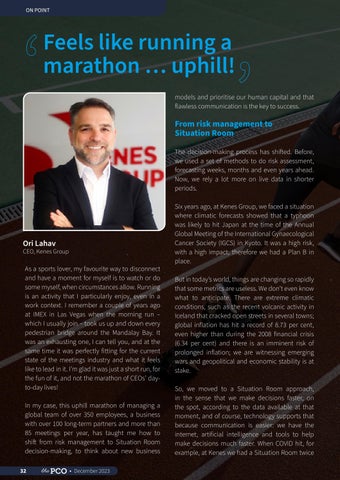
Ori Lahav
CEO, Kenes Group
As a sports lover, my favourite way to disconnect and have a moment for myself is to watch or do some myself, when circumstances allow. Running is an activity that I particularly enjoy, even in a work context. I remember a couple of years ago at IMEX in Las Vegas when the morning run – which I usually join – took us up and down every pedestrian bridge around the Mandalay Bay. It was an exhausting one, I can tell you, and at the same time it was perfectly fitting for the current state of the meetings industry and what it feels like to lead in it. I’m glad it was just a short run, for the fun of it, and not the marathon of CEOs’ dayto-day lives! In my case, this uphill marathon of managing a global team of over 350 employees, a business with over 100 long-term partners and more than 85 meetings per year, has taught me how to shift from risk management to Situation Room decision-making, to think about new business 32
December 2023
Six years ago, at Kenes Group, we faced a situation where climatic forecasts showed that a typhoon was likely to hit Japan at the time of the Annual Global Meeting of the International Gynaecological Cancer Society (IGCS) in Kyoto. It was a high risk, with a high impact, therefore we had a Plan B in place. But in today’s world, things are changing so rapidly that some metrics are useless. We don’t even know what to anticipate. There are extreme climatic conditions, such as the recent volcanic activity in Iceland that cracked open streets in several towns; global inflation has hit a record of 8.73 per cent, even higher than during the 2008 financial crisis (6.34 per cent) and there is an imminent risk of prolonged inflation; we are witnessing emerging wars and geopolitical and economic stability is at stake. So, we moved to a Situation Room approach, in the sense that we make decisions faster, on the spot, according to the data available at that moment, and of course, technology supports that because communication is easier: we have the internet, artificial intelligence and tools to help make decisions much faster. When COVID hit, for example, at Kenes we had a Situation Room twice
ON POINT
a day, morning and evening, every day, because things changed so rapidly. And, I don’t think anybody could have even imagined something like this was likely to happen when we were doing risk assessment for 2020 earlier that year and the year before.
Communication is the key The typhoon did hit Kyoto during the IGCS meeting. We had open channels of communication with the local Convention Bureau, tourism offices, the association and the speakers. Everything happened fast, and the fact that we had all the stakeholders at one table was the key to success. During the pandemic, these twice-a-day Situation Room meetings kept us alert and focused, maintaining a constant flow of communication that allowed us to take initiative, adapt quickly and, ultimately, deliver no matter what. It’s all about working with the team, being very transparent, sharing the most up-to-date and accurate information with the people involved and making fast-paced decisions. Even if eventually we find out that it was the wrong decision, it’s better to make a quick decision than to not make one at all.
Same players, new roles The fact that we are living in a disruptive postpandemic, fast-paced world requires that we challenge the status quo of the existing business models and that we can read between the lines of uncertainty and identify new ways of staying relevant … and profitable. Rising costs are our main obstacle in the UK, a meeting costs 25 per cent more than pre-COVID, and everywhere else in the world those figures reflect a 10 to 15 per cent increase. The recent trend is that attendees are leaving registration to the last couple of weeks before the event. Previously, PCOs would bear all the financial risk for venues, hotels and suppliers. But with these new scenarios, it is impossible for a single organisation to take the full financial risk. Therefore, we need to move from own risk to
shared risk. For venues and hotels, this looks like implementing more flexible terms such as space and room reduction until very close to the event date and even allowing postponement without penalties. For CVBs, taking an insurance companylike role by providing a safety net in case of restrictions or a decrease in the number of visitors, and working in alignment with the suppliers. For PCOs, remaining the captain of the ship and managing the budget, the communications, the risks and the leads. When I speak about this, people ask me: ‘If we share with you the risk, will you share with us the profit?’ And I say: ‘Why not?’
We speak about human capital Recently I heard a quote from Microsoft CEO Satya Nadella stating that when companies are speaking about capital, they are speaking about human capital. And that is exactly the case for PCOs as well. What do we have to offer? We don’t sell mobile phones or material assets, we offer talent, therefore retaining employees and ensuring they are happy and engaged is something I am putting a lot of effort into, because it has the greatest impact on our performance. The current Chief Executive Officer of the leading global Professional Conference Organiser Kenes Group, and immediate past President of IAPCO, Ori Lahav shares his perspective on managing in uncertain times based on his experience in the leadership of these significant organisations within the meetings sector, especially during the COVID pandemic and now, facing the rise of economical and geopolitical volatility.
Just as when running a marathon, you need to be very strong both physically and mentally, the same applies to managing in these uncertain times. As always, stay positive!
December 2023
33
ON POINT
Renewing Organisations for Complex Challenges Marco Quagliarella Director of International Operations, AIM Group International
We live in an era of constant uncertainty, where geopolitical fluctuations, economic crises and technological change are shaking up the landscape of global business. These turbulent times demand unprecedented adaptability, forcing organisations to radically rethink their approaches in order to remain resilient and thrive. Our businesses, which organise events that bring together large numbers of people on an international scale, are particularly exposed to these fluctuations and, rightly so, we have all been asking ourselves in recent years how we can learn to be more flexible, more responsive and more resilient. In an ever-changing world, restructuring organisations has become essential to successfully address complex challenges. To deal with external uncertainty, it’s the internal change that can make the difference. Transforming organisational dynamics is the key to creating a more agile and responsive structure. Here are some of the fundamental pillars of this transformation that we are successfully experiencing across AIM Group’s international network of offices:
1
Team globalisation and office virtualisation The globalisation of teams and the virtualisation of working environments enable greater collaboration between large and diverse teams. This approach also favours the geographical diversity of teams, allowing for a broader and more creative perspective in tackling work projects.
2
3
Flexibility and autonomy
Managers need to adopt a more flexible style, moving from traditional control-based management to supporting their staff in implementing work plans. Delegation and empowerment will be key, allowing employees to feel an integral part of the organisation’s mission, regardless of their geographical location and working methods. For example, you can provide maximum operational flexibility while maintaining rigour in defining work plans and deadlines to ensure efficient output. Managers must have the courage to break the top-down vision and stand alongside employees as those who lead the way and get their hands dirty.
4
Attract new generations
To attract young talent accustomed to virtuality, flexibility and easily changing cities and jobs, companies must offer an open and flexible working environment. The demand for constant physical presence needs to be replaced by hybrid working models that combine remote work and in-office presence, offering both relational and work incentives in a clear path of human and professional growth. Talent gardening is essential not only to retain the best talent, but also to develop it.
5
Talent valorisation
Talent management is no longer limited to fulltime employees, but must also include specialised consultants, vertical skills and remote workers. With a clear vision and action plan shared by all members of the organisation, it will be possible to bring out the best in everyone.
6
Adapting to the fragmented market
The modern marketplace is fragmented and requires an innovative approach. To meet the changing needs of clients, we must go beyond our traditional sales and product approach to offer more flexible and intelligent services and solutions, supported by technology. We need to reimagine our role with greater freedom and creativity, I dare say, to continue to walk alongside our clients with a new approach.
Hyper-technological approach The use of advanced technological tools becomes essential. Instant file sharing, the use of collaborative platforms and the reduction of email communication promote greater efficiency and connectivity between team members.
34
December 2023
In a constantly evolving business landscape, organisational renewal is essential to thrive. By embracing these innovations, companies can not only survive uncertain times, but also emerge stronger, more flexible and more adaptable to future challenges.
IAPCO NEWS
December 2023
35
ON POINT
Do you need a new strategy to embrace change? Here are three points to think about: Understand that change isn’t new 1
Nigel Collin
Become a learning organisation
Founder of ‘Ingenious Oz Project’
Nigel Collin is an international speaker on Growth Mindset and embracing change. He is the founder of ‘Ingenious Oz Project’ and the author of The Game of Inches: Why Small Changes Win Big Results. Find out more at www.nigelcollin.com.au No one is going to argue that dealing with complexity and change isn’t easy, especially in the world of professional conference organising. Author and psychotherapist Nathaniel Branden* summed it up perfectly when he wrote, “We now live in a global economy, characterised by rapid change, accelerating, scientific, and technological breakthroughs, and an unprecedented level of competitiveness.” What’s intriguing is he wrote that in 1994! Nearly twenty years ago. Because the world is changing it is tempting to jump on the newest, ground-breaking strategies, yet in doing so we risk missing vital ideas that are foundational to embracing change, building resilience and adaptability. 36
December 2023
If I was writing this in ancient Roman times, I would be writing this in a period of history that was changing faster than any other period to that point. Accepting the change as a natural and constant part of business takes the overwhelm away. By seeing change as normal means you can start to embrace it and work with it.
2
Constant learning gives you confidence that you can adapt and overcome challenges by learning skills, thinking differently and finding new ways of doing things. So, when the world changes you know you can learn what’s needed to adjust. I’ve interviewed hundreds of successful organisations and leaders and one constant is their curiosity and open-mindedness to constantly learn.
Focus on the small things 3
The challenge is when things change we tend to focus on big shifts and big changes. The truth is though it’s the little things you do that make the biggest difference. So focus on those small gaps, those 1 percenters, that are easy to do and yield productive and profitable returns.
*Nathaniel, B. (1995). The six pillars of self-esteem. Bantam Nathaniel Branden (1930–2014) was a Canadian-American psychotherapist, writer, and lecturer. He is widely recognized for his groundbreaking work in the psychology of self-esteem, particularly through his seminal book, “The Psychology of SelfEsteem,” first published in 1969. Branden’s contributions to the field have had a profound impact on personal development and self-improvement strategies for individuals worldwide.
IAPCO NEWS
CEO Leadership Program O M PC
BERS EM
ONLY
Designed for busy executive leaders and founders Run over six sessions for a six-month period Participants receive a comprehensive digital workbook and templates Session content translated live into 30+ languages via Wordly translation software
IA
Supported by:
Login to webEDGE to view the sessions on demand
Nigel Collin’s ‘Gap Hunter’ Navigating the rapidly changing and complex business environment of conferences and events requires agility and adaptability. One of the traits of successful organisations is their ability to consistently find small, profitable gaps. Those small opportunities or problems that, when addressed, have a bottom-line impact create momentum and consistent growth. However, the challenge is three-fold: Creating a mindset of growth that sees the value in small changes. Having an achievable process that is simple, accessible and fast. Empowering employees to consistently find and act on small profitable gaps.
A Transformative Keynote Speaker, Facilitator And Coach Who Inspires Action Nigel works with organisations and their leaders to draw the best from their people by shifting their mindsets and adopting a process of consistent small steps. His message is simple. Sustainable growth is ‘Game of Inches’ and not a one-off explosive moment.
December 2023
37
DESTINATION PARTNER
The Encouragement of Female Participation as a Key to Progress: IFAC World Congress 2023 as a Case Study in this field, the workshop provided these girls with hands-on programming experience that allowed them to understand the importance and fun of control technology. These efforts increased accessibility to female participants and provided practical experience for the girls in addition to positively contributing to the industry’s development.
In July 2023, the 22nd World Congress of the International Federation of Automatic Control (IFAC) was held at PACIFICO Yokohama. This was the first time in forty-two years that the congress was held in Japan, and with participants’ expectations very high for a fullscale in-person event after the pandemic, more than 3,200 people attended, making it a highly successful and satisfying congress. Aside from its success, the conference also committed to enhancing women’s participation along with bringing positive impacts to the host city. As a DEI initiative, IFAC encourages women to participate in their conferences and research, seeing as there are few female researchers in this field. One way they do this is through financial support for women who attend international conferences through reimbursement of the cost of childcare. Also, during the congress, a workshop called ‘Girls in Control’ was designed to introduce control engineering to girls aged ten to fifteen. Conducted by university faculty members and female university students specialising
38
December 2023
In other sustainability initiatives, a citizens’ forum opened up a marine robot contest to the public, allowing them to actually see where ‘control technology’ is used and encouraging the community and the general public to better understand the conference. Additionally, companies in the city were invited to take advantage of the congress to exhibit in the exhibition space, creating business opportunities, stimulating the economy, and leading to ‘Academic-Industrial Collaboration’. Thus, the event left a significant impact not only on those involved in the congress, but also on the social economy of the host country, Japan. Expectations for meetings and events will continue to change along with technological innovations and global conditions, but in this rapidly changing environment, the importance of international conferences that bring people together to solve major societal issues has been reaffirmed. Therefore, it is now more important than ever to further pursue the development of new activities, venues and legacies in order to make international conferences more effective and sustainable.
MEMBER NEWS
Positive Vibes and Smiles for AFEA onsite teams supporting back2back meetings #teamwork #afeameetings
The 10th MikrobioKosmos International Conference unfolded in Larissa in Central Greece from November 30th to December 2nd #MikroBioKosmos #afeameetings
K.I.T. African Agenda team at the 18th World Congress of Neurosurgery in Cape Town December 2023
39
MEMBER NEWS
MEMBER NEWS
Congrès Inc
PCO Congrès Inc. opens science experience facility in former elementary school – fostering a love for science Science Lab IMAGINUS, the first science experience facility fully managed and planned by IAPCO member Congrès Inc. opened on October 7, 2023 in Tokyo. Using our knowledge and experience in administration of science museums, cultural and tourism facilities, we launched a unique science facility in a former elementary school in Tokyo, engaging in a public-private sector project.Congrès also obtained a Nutty Scientists® master franchise, a leading global children’s education program, that made its debut in Japan at IMAGINUS. Japan’s IAPCO member Congrès Inc. was selected and appointed by Suginami City (Tokyo) to undertake a public-private project to develop and operate/administer a “new hub for next-generation science education” utilizing a former elementary school in the city. The appointment was realized through a municipal leasing scheme that permits the selected company to independently undertake planning & operation of the facility. In recent years, a key term in the field of education has been “STEAM education.” This educational concept combines the initials of “Science,” “Technology,” “Engineering,” “Art,” and “Mathematics.”
READ MORE
40
December 2023
MEMBER NEWS
MEMBER NEWS AFEA
Unlocking Insights: Advances in Laparoscopic Surgery for Urinary System Education Marking an important educational milestone, the two-day scientific event “Laparoscopy is here to stay”, held on October 19-20, 2023, was dedicated to promoting and understanding laparoscopic surgery for the urinary system. The symposium included live 3D surgeries and hands-on training stations, taking educational excellence to new heights. Innovation and new technologies were a central element of the training seminar, which recorded significant participation. Following the event, the Organizing Authority announced the launch of a series of training seminars on laparoscopy, using 3D technology and AI in the future. AFEA was the official organizer of the seminar, which took place at the new premises of the White Cross Clinic and at the Crowne Plaza Hotel in Athens.
READ MORE
The Arinex Group
The Arinex Group appoints Chief Revenue Officer The Arinex Group has appointed event technology expert Joe Ciliberto as its new Chief Revenue Officer. Mr Ciliberto will lead the continued growth of the full range of products and services that The Arinex Group will offer clients. This includes leading the roll out of the new Arinex event management platform, which has a new, revamped model coming to marketing in early 2024. The Arinex Group CEO Nicole Walker said, “We are delighted to welcome Joe to The Arinex Group where he will be an integral, driving force in the leadership team. Joe’s skillset of strong client management and creative growth strategies, coupled with his industry networks, will be the ideal addition to the Group.”
READ MORE
December 2023
41
MEMBER NEWS
MEMBER NEWS
AIM Group International
AI-Powered Multilingual Translation debuts at RHSC General Membership Meeting in Accra The international General Membership Meeting of RHSC took place in Ghana with a strong link to the local community and a focus on technological innovations, leveraging for the first time an A.I. tool for simultaneous translations which allowed access to multiple languages while reducing costs in a very simple way. In a landmark event held from 16th to 20 October 2023, the Reproductive Health Supplies Coalition (RHSC) hosted its General Membership Meeting in Accra, Ghana. RHSC, the world’s largest network of reproductive health agencies, boasting nearly 600 member agencies, has been collaborating with the AIM Group since 2015.
READ MORE
SIAARTI Congress 23: How to ‘Escape’ from Traditional Formats and Succeed The 3,400 anaesthesiologists and resuscitators gathered in Rome for the 77th National SIAARTI-ICARE Congress discussed the hot topics in their profession openly and interactively. And for the first time, an escape room activity made it even more engaging and captivating. From October 26-28, the La Nuvola Congress Center hosted the 77th National SIAARTI-ICARE Congress, which proved to be a highly successful event, attracting over 3,400 participants, and marking a significant growth compared to the 2021 Rome edition. This congress, dedicated to anaesthesia and resuscitation, featured a wide array of sessions and meetings that captured the attention of healthcare professionals from around the world.
READ MORE
42
December 2023
MEMBER NEWS CONVIN S.A. (PCO)
CONVIN delivers award-winning creative excellence at WTC 2023 CONVIN S.A. (PCO) was hailed as the winner of the Best Virtual Event Portal Award at EventsAir’s Innovation Awards, which were announced at AirTime 2023 in London. The team were recognized for their innovative event portal at the World Tunnel Congress 2023 (WTC2023). As the premier annual event of the International Tunneling Association, WTC2023 is considered to be the leading tunneling conference in the world. The event was held at Greece’s Megaron Athens International Conference Center in May 2023 – one of the most technologically advanced conference venues in Europe.
READ MORE
The Kenes Group
BOOM Summit set to revolutionise the healthcare landscape DayOne – the Basel-based healthcare innovation initiative – and Kenes Group are thrilled to announce the inaugural BOOM Summit, a truly fresh take on the healthcare conferencing experience launching in April 2024. This highly anticipated healthtech event will act as a nexus between the healthcare, tech, government, and research sectors, providing an open forum for everyone – from professionals and entrepreneurs to investors and policymakers – to discuss the latest trends, technologies, and strategies poised to transform healthcare. The summit will provide valuable access to key thought leaders from across the entire healthtech ecosystem via a host of expert panels, technology showcases, startup pitch sessions, interactive workshops, networking opportunities, and more. It will present unique opportunities to exchange knowledge, interact with potential investors, stay up to date with industry trends and regulations, discover innovative digital solutions, and contribute to the collective effort of reshaping healthcare on a global scale.
READ MORE December 2023
43
MEMBER NEWS
MEMBER NEWS The Kenes Group
The Global Stroke Community Reunited for the WSC 2023 Gathering 2,468 in-person and 1,168 virtual attendees, the World Stroke Congress, which took place on 10-12 October, emphasized on advancements in prevention, acute treatment, and recovery, leading to notable enhancements in stroke care worldwide. With an impressive turnout of over 3,636 participants from 106 countries, the 15th World Stroke Congress (WSC 2023) marked a significant gathering of the global stroke community in Toronto, Canada, and online. The mission: to collaboratively reduce the burden of stroke across the world.
READ MORE
K.I.T. African Agenda
18th World Congress of Neurosurgery a no-brainer of success in South Africa Nearly 2000 global neurosurgeons attended South Africa’s first opportunity to host the event. Five days of stimulating presentations, incredible exhibitor demonstrations, and valuable networking for nearly 2000 international neurosurgeons - that was the hugely successful 18th World Congress of Neurosurgery in Cape Town, held from 4 to 8 December 2023. Now that all delegates have safely returned to their far-flung countries of service, the congress’s hosts, the World Federation of Neurosurgical Societies (WFNS) and the Society of Neurosurgeons of South Africa (SNSA), are reflecting on a job well done.
READ MORE
44
December 2023
PARTNER NEWS IFES
IFES and ECA Announce New Partnership The Exhibitions & Conferences Alliance (ECA) and International Federation of Exhibition and Event Services (IFES) are pleased to announce a new partnership focused on global collaboration and knowledge sharing. ECA and IFES strongly believe that the future success and growth of the global events industry will increasingly rely on cross-border partnerships between like-minded organisations and stakeholder groups working to address common challenges. Within this context, both organisations look forward to collaborating on educational efforts, issue and Pictured here: Tommy Goodwin and Uta Goretzky policy forums, advocacy support, and other joint opportunities to serve the needs of the broader community. “This partnership with the Exhibitions & Conferences Alliance (ECA), is going to make a real difference. ECA understands how trade shows affect not just the business events industry, but also communities and the global economy. They recognize the importance of what we do,” says IFES President, Phillipe Beille.
READ MORE
IFES and GMA Forge Strategic Partnership to Elevate Global Meetings and Exhibitions Industry The global meetings and events industry thrives on collaboration among organisations and stakeholders. In this spirit, the International Federation of Exhibition and Event Services (IFES) and the Greek Meetings Alliance (GMA) have formalised a partnership that is poised to create mutual benefits for both membership bodies and strengthen the Exhibition Industry. The partnership between GMA and IFES was announced on 10 November at the Open Stage of Philoxenia 2023 during a panel on the benefits of fostering partnerships in the MICE industry that
READ MORE
December 2023
45
IAPCO PARTNERS
Strategic & Affiliations
Destinations
Convention Centres
Council & Annual Meeting Hosts
Service Providers
Media
46
December 2023