faculty what they wanted and needed for the best teaching environments. “From there,” Amato said, “we crafted the rooms.” Construction never disrupted teaching, and the architecture, he added, honors the old buildings that were emblematic of Westlake. Completed in 2008, the expanded thirteen-acre campus features large, state-of-the-art classrooms; a new athletics field; and a spacious performing arts center with one of the best theater facilities in Los Angeles. “The first time I saw it in the evening, with the sun going down and the stars coming up, it took my breath away,” Hudnut recalled. “The new Middle School campus is a beautiful place that represents many years of planning, hard work, and collaboration by the architects and Harvard-Westlake teachers.” Inside the classrooms, Harvard-Westlake expanded the boundaries of education. In 2012, the school opened the Kutler Center for Interdisciplinary Studies and Independent Research on the Upper School campus. It was named for the late Brendan
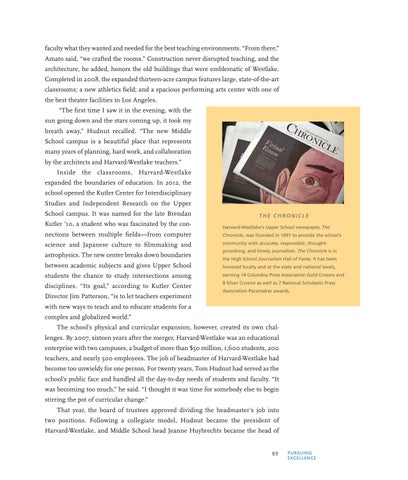
THE CHRONICLE
Kutler ’10, a student who was fascinated by the con-
Harvard-Westlake’s Upper School newspaper, The
nections between multiple fields—from computer
Chronicle, was founded in 1991 to provide the school’s
science and Japanese culture to filmmaking and
community with accurate, responsible, thought-
astrophysics. The new center breaks down boundaries
provoking, and timely journalism. The Chronicle is in the High School Journalism Hall of Fame. It has been
between academic subjects and gives Upper School
honored locally and at the state and national levels,
students the chance to study intersections among
earning 14 Columbia Press Association Gold Crowns and
disciplines. “Its goal,” according to Kutler Center
8 Silver Crowns as well as 7 National Scholastic Press
Director Jim Patterson, “is to let teachers experiment
Association Pacemaker awards.
with new ways to teach and to educate students for a complex and globalized world.” The school’s physical and curricular expansion, however, created its own challenges. By 2007, sixteen years after the merger, Harvard-Westlake was an educational enterprise with two campuses, a budget of more than $50 million, 1,600 students, 200 teachers, and nearly 500 employees. The job of headmaster of Harvard-Westlake had become too unwieldy for one person. For twenty years, Tom Hudnut had served as the school’s public face and handled all the day-to-day needs of students and faculty. “It was becoming too much,” he said. “I thought it was time for somebody else to begin stirring the pot of curricular change.” That year, the board of trustees approved dividing the headmaster’s job into two positions. Following a collegiate model, Hudnut became the president of Harvard-Westlake, and Middle School head Jeanne Huybrechts became the head of
89
PURSUING E XC E L L E N C E