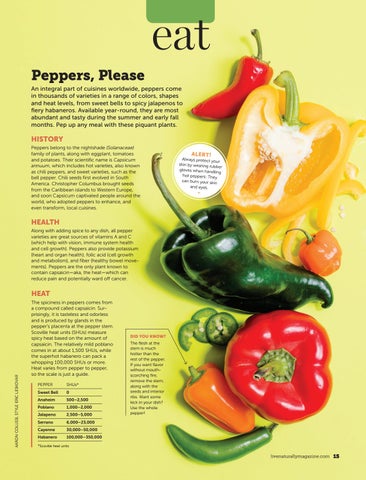
eat Peppers, Please An integral part of cuisines worldwide, peppers come in thousands of varieties in a range of colors, shapes and heat levels, from sweet bells to spicy jalapenos to fiery habaneros. Available year-round, they are most abundant and tasty during the summer and early fall months. Pep up any meal with these piquant plants.
HISTORY Peppers belong to the nightshade (Solanaceae) family of plants, along with eggplant, tomatoes and potatoes. Their scientific name is Capsicum annuum, which includes hot varieties, also known as chili peppers, and sweet varieties, such as the bell pepper. Chili seeds first evolved in South America. Christopher Columbus brought seeds from the Caribbean islands to Western Europe, and soon Capsicum captivated people around the world, who adopted peppers to enhance, and even transform, local cuisines.
ALERT!
Always protect yo ur skin by wearing rub ber gloves when hand ling hot peppers: They can burn your ski n and eyes.
•
HEALTH Along with adding spice to any dish, all pepper varieties are great sources of vitamins A and C (which help with vision, immune system health and cell growth). Peppers also provide potassium (heart and organ health), folic acid (cell growth and metabolism), and fiber (healthy bowel movements). Peppers are the only plant known to contain capsaicin—aka, the heat—which can reduce pain and potentially ward off cancer.
AARON COLUSSI, STYLE ERIC LESKOVAR
HEAT The spiciness in peppers comes from a compound called capsaicin. Surprisingly, it is tasteless and odorless and is produced by glands in the pepper’s placenta at the pepper stem. Scoville heat units (SHUs) measure spicy heat based on the amount of capsaicin. The relatively mild poblano comes in at about 1,500 SHUs, while the superhot habanero can pack a whopping 100,000 SHUs or more. Heat varies from pepper to pepper, so the scale is just a guide. PEPPER
SHUs*
Sweet Bell
0
Anaheim 500–2,500 Poblano 1,000–2,000 Jalapeno 2,500–5,000
DID YOU KNOW? The flesh at the stem is much hotter than the rest of the pepper. If you want flavor without mouthscorching fire, remove the stem, along with the seeds and interior ribs. Want some kick in your dish? Use the whole pepper!
Serrano 6,000–23,000 Cayenne 30,000–50,000 Habanero 100,000–350,000 *Scoville heat units
livenaturallymagazine.com
15