SMALL D SES
Tech
Are the (iPad) Kids Alright? Gen Alpha uses tablet screens more than any prior generation. We asked a scientist what that means. BY JACK THOMAS
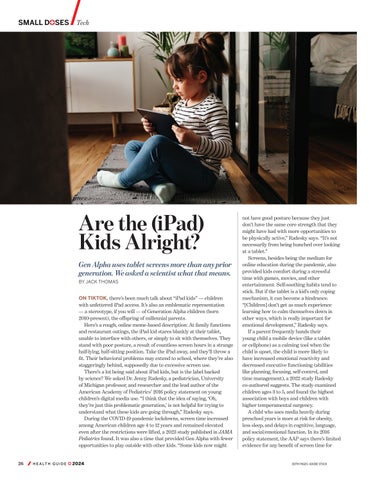
ON TIKTOK, there’s been much talk about “iPad kids” — children with unfettered iPad access. It’s also an emblematic representation — a stereotype, if you will — of Generation Alpha children (born 2010-present), the offspring of millennial parents. Here’s a rough, online meme-based description: At family functions and restaurant outings, the iPad kid stares blankly at their tablet, unable to interface with others, or simply to sit with themselves. They stand with poor posture, a result of countless screen hours in a strange half-lying, half-sitting position. Take the iPad away, and they’ll throw a fit. Their behavioral problems may extend to school, where they’re also staggeringly behind, supposedly due to excessive screen use. There’s a lot being said about iPad kids, but is the label backed by science? We asked Dr. Jenny Radesky, a pediatrician, University of Michigan professor, and researcher and the lead author of the American Academy of Pediatrics’ 2016 policy statement on young children’s digital media use. “I think that the idea of saying, ‘Oh, they’re just this problematic generation,’ is not helpful for trying to understand what these kids are going through,” Radesky says. During the COVID-19 pandemic lockdowns, screen time increased among American children age 4 to 12 years and remained elevated even after the restrictions were lifted, a 2023 study published in JAMA Pediatrics found. It was also a time that provided Gen Alpha with fewer opportunities to play outside with other kids. “Some kids now might 26 / H E A LT H G U I D E
2024
not have good posture because they just don’t have the same core strength that they might have had with more opportunities to be physically active,” Radesky says. “It’s not necessarily from being hunched over looking at a tablet.” Screens, besides being the medium for online education during the pandemic, also provided kids comfort during a stressful time with games, movies, and other entertainment. Self-soothing habits tend to stick. But if the tablet is a kid’s only coping mechanism, it can become a hindrance. “[Children] don’t get as much experience learning how to calm themselves down in other ways, which is really important for emotional development,” Radesky says. If a parent frequently hands their young child a mobile device (like a tablet or cellphone) as a calming tool when the child is upset, the child is more likely to have increased emotional reactivity and decreased executive functioning (abilities like planning, focusing, self-control, and time management), a 2022 study Radesky co-authored suggests. The study examined children ages 3 to 5, and found the highest association with boys and children with higher temperamental surgency. A child who uses media heavily during preschool years is more at risk for obesity, less sleep, and delays in cognitive, language, and social/emotional function. In its 2016 policy statement, the AAP says there’s limited evidence for any benefit of screen time for
BOTH PAGES: ADOBE STOCK