For those who want more Experience Lufthansa Premium Economy Enjoy a more relaxed and stress-free vacation. In the Lufthansa Premium Economy on intercontinental routes,
Up to 50 % more personal space with the Premium Economy seat Feel free to stretch your legs. In your specially developed Premium Economy seat, which offers each passenger their own armrest, fold-out table, adjustable backrest and footrests, you can get really comfortable never be more than one seat away from the aisle. You will certainly appreciate having up to 50 % more space, as well as increased complimentary seat assignment in advance. Enjoy a more relaxed start to your vacation For passengers traveling with sports equipment or for those that may indulge in retail therapy while on vacation will appreciate the advantage of the Premium Economy baggage allowance. Each passenger may check in two pieces each weighing up to 23 kg / 50 lbs complimentary, alleviating stress
when packing. Traveling in Premium Economy also offers you the option to access select exclusive Lufthansa lounges** for a fee. Look forward to more extras on board An extra special service awaits you as soon greeted with a welcome drink. At your seat, quality amenity kit with useful travel accessories. You can relax and choose from the menu, before enjoying a meal served on china tableware. You can then sample our an -11 or -12inch touchscreen monitor, with your own remote control. Whether you would simply like to sit back and relax, enjoy a little peace and quiet or
More baggage Two complimentary checked bags, each weighing up to 23 kg / 50 lbs* More delight Meals served on china tableware More to look forward to On board welcome drink More entertainment Larger -11 or -12inch screen
entertainment – Premium Economy Class refreshed at your destination. You can experience the comfort of Premium Economy Class on all Lufthansa intercontiMore information at: LH.com/premium-economy
* HON Circle Members and Senators can check in three bags each up to 25 kg / 50 lbs. ** Premium Economy Class passengers may access select Lufthansa Business Lounges and the Lufthansa Welcome Lounge at Frankfurt Airport for a fee of EUR 25 or EUR 50 respectively (approximately USD 28 / USD 56). For HON Circle Members, Senators and Frequent Travellers, lounge access is granted in conjunction with the applicable Miles & More member status or Star Alliance member status. *** As at: January 2016. Subject to changes.
More personal space New seat with up to 50 % more space
More relaxation Amenity kit with useful travel accessories More refreshment Individual water bottle at every seat More exclusivity Access to select Lufthansa lounges for a fee**
3
Official Partners
A publication of Hospitality Services in a joint venture with Beyond Beirut Group Editor Nouhad Dammous Managing Director Joumana Dammous-Salamé Publication Manager Zeina Dammous Nahas Project and Sales Manager Maha Khoury-Hasbani Editor Natalie Shooter Sub Editor Sabina Llewellyn-Davies Contributors Charbel Abiad, Araz Boutchakjian, Martine Btaich, Nour Farra-Haddad, Zeinab Jeambey, Reem Joudi, Bob Kastoun, William Khouchaba, Dany Sabbagh, Elsa Sattout, Walid Sayfeddin, Elsa Yazbek Charabati, Nathalie Zeidan Photographer Pavlos Nikolaou Publication Coordinator Rita Ghantous Subscription Coordinators Mirna Maroun, Houayda Haddad-Rouman Sales team Roxane Fersane, Randa DammousPharaon, Michel Ajoub, Josette Hikri-Nohra and Eugene Abela Senior Graphic Designer Rebecca Haddad Junior Graphic Designer Bob Kastoun Circulation Coordinator Karl Hitti Editorial Assistant Roula Koussaifi Production and Printing Arab Printing Press
Published by Hospitality Services s.a.r.l. Burghol Building, Dekwaneh, Lebanon P.O.Box 90 155 Jdeidet el Metn 1202 2020 To advertise contact our office at 01 480081 Fax: 01 482876 We welcome views on any relevant subject. The editor reserves the right to select and edit letters. Please e-mail your comments to info@lebanontraveler.com All the information disclosed in the magazine was provided by the parties concerned by each publication and checked to the highest possible extent by the editors. However, the magazine cannot ensure accuracy at all times of all information published and therefore could in no case be held responsible should any information reveal to be false or insufficient.
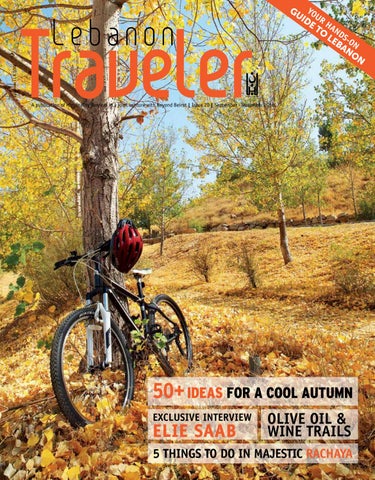
This issue’s cover photo was taken by Nathalie Zeidan in Faqra Resort, Kfardebian. info@nathaliezeidan.com
“Fall in Gemmayzeh.” Photo: William Khouchaba
Falling into nature The autumn cool comes as welcomed relief after a summer of high temperatures. It’s a period of changing colors, a time of transition, of shedding one skin for another. It’s also a festive time in the country’s rural regions, when grapes and olives are picked and pressed, when produce is bountiful and big feasts are prepared. The best way to feel the season is to join villagers and farmers in the great annual harvest. And this issue is full of tips of how to get involved; including harvesting grapes for debs enab (grape molasses) in South Bekaa’s Rachaya, the wineries to visit in the Bekaa Valley and an olive oil trail where you can walk along olive groves, join harvesting and see the production process. From a guide to Lebanon’s lesser-known forests to climbing in stunning scenery, our autumn issue shows you how to enjoy nature in the country. The Food Heritage Foundation takes us on a tour of regional kibbeh specialties. President of the Zouk Mikael International Festival, Zalfa Bouez, gives us her guide to the Mount Lebanon town, Zouk Mikael. We also bring you our tips for the best beds in nature and camping getaways around the country. Culture wise, this issue features a rare interview with the master Lebanese fashion designer Elie Saab; we sit down with British artist Tom Young, whose paintings tell the story of the country’s heritage buildings and capture the changing face of the capital; and we explore the neighborhood of Raouché and memories of old Beirut through the paintings of Hassan Jouni. We put our Lebanon under the spotlight, just as it is – a country that’s defined by vibrant nature, rich traditions and endless narratives. Now take us on the journey with you and share your stories.
Hashtag us #LebanonTraveler Like us LebanonTraveler Write to us info@lebanontraveler.com lebanontraveler.com
4
CONTENTS
30 22
60
66 50
08 Update
The latest happenings
10 A day with...
On tour with the circus
12 Shopping
26
32
Let there be light
14 Interview
Legendary fashion designer Elie Saab
18 Hot topic
Spa treatments to try in Lebanon
22 Indoors
Bader Hassoun Eco Village opens
24 Reader’s experience
Lebanon lost and found with Tom Young
26 Focus on
Five things to do in Rachaya
30 The great escape
48 Design in Lebanon
32 Hidden gems
50 Region through an artist’s eyes
36 Culinary heritage
56 Getaways
38 Outdoor action
58 Best beds
40 Touring Lebanon
59 On the table
46 Customs & traditions
60 Trail
Al Burtasi mosque shot by Dany Sabbagh Gladys: A real familial guesthouse The versatile taste of kibbeh Climbing in Lebanon The country’s lesser-known forests Oriental interiors
How important is a tree to a community? Painter Hassan Jouni in the studio Camping getaways Best beds in nature Lebanese sandwiches to taste Wine and olive oil in Lebanon
62 Travel to...
Destination: Lombok
64 Agenda
Where to go and what to do this Fall
66 Insider guide
Zalfa Bouez’s guide to Zouk Mikael
lebanontraveler.com
26
48
66
24
14
18
46
32
38 40
6
CONTRIBUTORS Nathalie Zeidan
Working for nine years as a family photographer, Nathalie Zeidan recently started exploring new sides of photography: Lebanon’s nature, product and fashion. She’s also founder of a designer-focused Instagram page. lebanesedesigners
Araz Boutchakjian
Araz Boutchakjian, nicknamed Pap(Araz)zi, is an amateur photographer. In August 2015 she won the United Nations 70th Anniversary Photography Competition “Public Service in a Snapshot” – Beirut, Lebanon. paparazzzi101
Dany Dabbagh
A graphic designer and photographer, Dany Dabbagh graduated with an advertising and art direction masters in 2012, afterwards relocating to Qatar for work. Now in Lebanon, he is working on a few personal projects that will soon see the light of day. danythedan
Zeinab Jeambey
With a background in nutrition, food heritage and tourism, Zeinab Jeambey developed Darb el Karam, the first food tourism trail in Lebanon, a main program of the Food Heritage Foundation. She is project manager at the Lebanon Mountain Trail Association. food-heritage.org, lebanontrail.org
Elsa Sattout
Elsa Sattout is a passionate conservationist, scholar and teacher. She strives to share the value of nature for human well-being and the importance of reconnecting with nature through the interpretation of places and spaces. elsasattout.com
Charbel Abiad
Born and raised in Lebanon, Charbel Abiad is an amateur photographer who recently started exploring the country and sharing all the beautiful locations he’s visited on social media. A picture is worth a thousand words and sometimes even pictures don’t do Lebanon justice. He will never stop exploring this land. charbel_abiad lebanontraveler.com
William Khouchaba
William Khouchaba is a Lebanese visual artist. He graduated from the Holy Spirit University of Kaslik (USEK) in 2010 and started taking pictures in 2005. Touring Lebanon with the camera, Khouchaba reflects his passion for the country through pictures. wiliamkhouchaba
Walid Sayfeddin
Born in Bogota, Colombia to Lebanese parents and later relocating to Lebanon, Walid Sayfeddin is an environmental trainer, wildlife observer, photographer, and a technical engineer. walidsayfeddin
Reem Joudi
Reem studied International Economics, but considers writing her true passion.She currently freelances for L’Hôte Libanais and curates her blog, Third Culture Canvas. Her motto is simple: Life’s too short for bad coffee and regret. thirdculturecanvas.wordpress.com
Martine Btaich
Martine Btaich is a professional in community and sustainable tourism development. She is also the vice president of the Lebanon Mountain Trail Association. lebanontrail.org
Bob Kastoun
Bob Kastoun is a graphic designer who graduated from the Arts, Sciences and Technology University in Lebanon (AUL) in 2015. He is also a passionate painter and photographer who enjoys capturing the beauty of Lebanon’s nature and landscapes. bob.kastoun
Nour Farra-Haddad
Nour Farra-Haddad, PhD, is a religious anthropologist and researcher and manages her own travel consultant company NEOS. She is author of “Eco-Lebanon: Nature & Rural Tourism” and “Wiz Kids” guidebooks. neoslb.com
8
UP DA TE
We love… Boshies
A contemporary take on the traditional Oriental hat, Boshies are a new range of hats from designer Elias El Haddad, taking the Lebanese identity of the tarboosh into the modern world. The unisex models are available in four colors with a minimalist stripe, representing the traditional tassel. They are 100 percent handmade with a social slant – at the Institute of Reeducation AudioPhonetic (IRAP) workshop – the school for deaf and hard of hearing children in Lebanon. The British pop icon (of Lebanese heritage) Mika rocked his own customized Boshie post Baalbeck Festival appearance and soon we will be too! 03 641434, boshies.com,
Boshies Beirut
5 MINUTES WITH… Travel bloggers Beatrice Daou and Elie Chahine
Quitting the desk job and traveling the world – it’s a dream many of us fantasize about. We caught up with Beatrice Daou and Elie Chahine, who did exactly that and then set up IGotYourBackpack.com about life in the “free world.” What led you to pack it all in? In short – freedom. Nowadays, slavery takes on a different mask – companies. We felt stuck in jobs with the same routine, working from 9 to 5 just to put aside some money for the yearly vacation. We couldn’t find any meaning in continuing with this path of unfulfillment and unhappiness. How long have you been traveling? We’ve been traveling for six months. So far we’ve passed Dubai, Indonesia, Malaysia, the Philippines, and Cambodia. We aim to travel slowly. It’s the best way of truly discovering a country. What’s the most impressive natural site you’ve seen? The sunrise view from the summit of the active volcano of Mount Batur in Bali. We started our hike at 3am to reach the top in time for sunrise.
New openings Local flavors at Baron After a few months on the Beirut dining scene, we’re already regulars at the new Mar Mikhael restaurant, Baron, with a menu that features a mouth-tingling fusion of flavors including vegetable, meat and seafood dishes. Choose from plates such as pork ribs marinated in sake, miso and tamari, clams served in squid ink spaghetti and Prosecco and a side of squash, flavored with the traditions of the country – zaatar, freekeh, sumac and pine nuts. Their mantra is to “keep it local,” sourcing the finest ingredients from around the country, from Tripoli’s fishing boats to Beirut’s farmer’s markets. Our advice? Start the meal with one of their finetuned signature cocktails. 01 565199, baronbeirut.com lebanontraveler.com
What are your tips for immersing yourself in a new place? First, travel like a local. It is always easier and faster to take the plane, but you won’t get to see anything about how locals travel and share this experience with them. Secondly, try local food. Dare to have some street food and support local restaurants. You’d be surprised by the quality and taste. Thirdly, search for stories; we learn so much about the culture and way of thinking from them. Where would you like to travel next? In the short-term, Sri Lanka, India and Nepal. But ultimately, we wish to travel the whole world country by country. Igotyourbackpack.com
More online lebanontraveler.com
9
Fashion focus Lebanese designers hit Paris Fashion Week
Akkar Al Atika. Photo: Antoine Ajoury
Lebanese designs wowed at this year’s Paris Fashion Week, with Beirut-based designers showing their haute couture mastery on the runway with embroidered designs that took thousands of hours to complete. Elie Saab’s collection featured flocks of birds in flight on vintage-style gowns inspired from Beirut’s hey-day. Zuhair Murad’s couture collection had a more bohemian slant with delicate Chantilly lace and embroidered florals and relative new-comer 29-year-old Rami Kadi showed that couture can be contemporary with gowns made from innovative materials like black silicon lace and playful embroidered prints. Other Lebanese designers showing in Paris included Ziad Nakad and Saher Dia.
Spotlight Lebanon’s favorite village With an impressive 57,000 votes in a competition run by the French-language daily, L’Orient Le Jour, Akkar Al Atika in Akkar in North Lebanon earned the title of Lebanon’s favorite village. The competition, which ran from 23 July to 6 August certainly caught the public’s interest, collecting over 121,700 votes in all. Dhour El Choueir in Metn snatched second place, while Douma in North Lebanon came third.
# WHAT’S TRENDING #Beirut’s hot travel destination status is fast returning. This summer, the city was certainly “en vogue” in the press – featured in Vogue magazine and Monocle’s “Top 25 Cities” roundup, along with topping TravelandLeisure.com’s list of the “Best International Cities for Food.”
A hot date with… Beirut Art Week From 13-20 September, Beirut comes to life, bringing art onto the streets, public spaces and the city’s luxury boutiques, showing that contemporary art can be for all. 20 interactive projects that combine installation, sculpture and performance will be spread across the capital’s most iconic landmarks such as Martyr’s Square, Beirut Souks and Saifi Village. It’s all happening as part of Beirut Art Fair (15-18 September), giving a platform to emerging and established artists and galleries from the region.
#Orient499 have launched their online store, meaning it will be easier to purchase hand-crafted Oriental pieces from their collection. shop.orient499.com
For more news visit Lebanontraveler.com Follow us on Download the Lebanon Traveler App
beirut-art-fair.com lebanontraveler.com
10 A day with
On tour with
the circus
Cirque du Soleil returns to Beirut with the show “Varekai.” It shows Icarus exploring an extraordinary world, through fantastical costumes and acrobatics. We caught up with publicist Julie Desmarais and artistic director Michael Smith to find out about life on tour
How did Acrobat Fernando Miro prepare for the Icarus role? Julie Desmarais: Acrobat Fernando Miro had to audition for the role. First, an acting audition and then an aerial solo audition. He studied the role thoroughly because the performer has to be on stage throughout the show.
Tell us about the plot. Michael Smith: Varekai is about a young man that struggles in adversity. How do you survive an event when your life changes in one instant and you’re left feeling totally incapable of existing? You have to find the courage to look for help and this is when you realize that nobody is alone.
How many hours of training a day do the Cirque du Soleil performers put in? JD: This isn’t a job but a lifestyle choice; the performers chose this line of career from a very early age. There is training every day on stage and backstage; we carry a gym with us. The performers are elite athletes and their safety depends a lot on muscle memory. A training day is very structured. That’s what prevents injuries and keeps the artists very safe, so they can concentrate on the details. 7-12 September, BIEL, cirquedusoleil.com/varekai Tickets priced LL75,000 to LL450,000 available at Antoine Ticketing (01 218078, antoineonline.com) and Entertainment Ticketing (01 494479) lebanontraveler.com
Fun facts: Varekai costumes The show has over 600 costumes, that’s a total of 2000 pieces including shoes, wigs, hats and accessories, that took an astonishing 33,000 hours to make. It takes 250 hours a week to keep the costumes impeccable on tour, with four full time staff members dedicated to the task. The costumes are designed by the late Japanese costume designer Eiko Ishioka. She played with the silhouettes of characters by giving new shapes to the traditional lycra bodysuit. The costumes are unique in their vivid color palette that reflects the tropical animal world. They use padded costumes underneath to adapt the shape. One-and-a-half semi trucks are dedicated to wardrobe. Cirque du Soleil travel with sewing machines, six washing machines, two dryers and everything else that is needed to maintain the costumes on tour. The team do approximately 60 loads of laundry every week.
A MULTITUDE OF UNIQUE REWARDS IN YOUR POCKET Get your free MasterCard® Titanium Debit Card now from any JTB branch!
VOTED BEST SME FINANCING BANK BY
we speak your language® 1558 | jtbbank.com
12 Shopping
LET THERE BE
LIGHT
1
From a tarboosh table lamp to an illuminating cocoon that hangs from above, LT picks the best home-grown light fixtures from Lebanese designers to light up your life and home
LIGHT SCENTS Vintage perfume bottles are transformed into a colorful collection of mini sparkling lamps with character. LL90,000 at B-déco. 76 702999, thestore. me/home-deco, BdecoME
2
SPROUT
3
Taking inspiration from the traditional Arab lantern, this steel light with perforated metal patterning from Damj Design is part of their indoor/outdoor lighting series, Sprout. LL270,000 at Damj Design. 71 376475, damjdesign.com, DAMJ workshop
From Damj Design’s Cocoon lamp series, the Hive Lamp has an organic form made from plywood rings, cut, chamfered and stacked. LL315,000 at Damj Design. Details as on left
4
NOTES ON A LAMPSHADE
A collaboration between origami artist Ghaith Adib and Arabic calligrapher Ghaleb Hawila, Ghain Design have created this functional art piece, hand-folded and hand-written. It’s a lesson in minimal design, using only paper, ink, wood and LED lighting. LL450,000 at Ghain Design. 71 601533, Ghain Design, ghain_lb lebanontraveler.com
COCOON OF LIGHT
More online lebanontraveler.com
5
ILLUMINATING HERITAGE
Add a touch of Ottoman heritage to your home with this table lamp modeled on the typical tarboosh hat. LL300,000 at B-dĂŠco. Details as on left page
7
This design, also from the Light QB range from Fady H. Salame, is a table lamp with attitude, blending Oriental tradition with modernity. LL1,350,000 at Green Tara. 01 203299, greentarahousegallery.com, Green Tara House Gallery
SHADOW BOX
8
13
HANGING BULBS
Forget about chandeliers. For big impact above your dining table, how about this ultra-contemporary sleek steel ceiling fixture with oh-so-hip exposed light bulbs from id.beirut? LL750,000 at id.beirut. 01 899491, id-beirut.com, ID Beirut, id-beirut.com
6
OUT OF THE WOODS
Designer Maya Rizkalla’s elegant lamps are made with solid walnut wood, with circular holes to let the light shine through. LL562,500 at M.Riz. 70 877647, M.Riz, m.riz_design
9
SLEEK TRIO
This self-standing copper trio of elegant lampshades with a black-painted finish work both indoors and out. LL975,000 at id.Beirut. Details as on left
lebanontraveler.com
14 Interview
Elie Saab
The Godfather Of Lebanese Fashion A master creator of wedding dresses and glamorous gowns worn on the red carpets of Hollywood by celebrities such as Angelina Jolie and Halle Berry and by royals like Queen Rania of Jordan, Lebanese designer Elie Saab has become one of the biggest global figures in contemporary fashion. The man whose name has become synonymous with elegance takes time out from his busy schedule to give journalist and TV host Elsa Yazbek Charabati a rare interview lebanontraveler.com
More online lebanontraveler.com
15
“King of the Red Carpet,” “Designer to the Stars,” “World Conqueror” are just a few nicknames you’ve been given. Which is your favorite?
From Casino du Liban to Paris Fashion Week, your career has been filled with fashion shows. Which one had the biggest impact for you?
The Lebanese designer, Elie Saab.
Every show is a new challenge and has its own impact. But the one I’ll never forget is my first fashion show at Casino du Liban. It was one unforgettable night in 1982. The next day, articles [about my show] flooded the newspapers, amidst horrible pictures of the Lebanese war. It was something.
Over the years, Elie Saab has evolved from a name to a brand. What’s the secret to your success? Work. I work 10 hours a day at least. There is no coincidence; I study every step I make. Since I started, I’ve had a vision. To step from a name to a brand is not only a matter of talent, it also needs a strategy and good structure.
I believe we shouldn’t leave our country. We are the fuel and resource of the Lebanese economy
You have a very ambiguous relationship with light. You light up the gowns you design; women sparkle in your creations and attract all the attention, but you yourself don’t like to be in the spotlight. Are you afraid of the limelight? No, but I believe that every artist who has a collection speaking on his behalf doesn’t need to be in competition with his creations. My designs speak for me. When I’m on the streets of Beirut, I’m blessed with the kindness of people, they stop to tell me how proud they are of me. This is my best prize. It gives me fresh impulse to go further. I also feel more responsible not to deceive the people who trust me. I’m so proud to give a good image of Lebanon.
…with the iconic picture of a model draped in the Lebanese flag… you were only 18! We Lebanese are survivors, we are used to working against all odds. Yes, I was challenging the war, myself, my parents… all the people who didn’t understand me then. Another milestone in my career remains to be my fashion show in Rome. I was the first non-Italian to participate in Rome Fashion Week.
For a Lebanese designer, that is truly an achievement. It’s not about being Lebanese or not. For me, the world has no borders. Whatever your nationality, the most important is to offer your best.
After years of hard work you were awarded fashion’s highest honor; induction into the Chambre Syndicale de la Haute Couture. Alongside Valentino, Versace and Armani, you are the only non-French corresponding member to enter this golden circle. How difficult was it for you to reach this level of international recognition? It wasn’t easy at all, but I did it and I reached this status thanks to my creations that were highly appreciated by international clients, market and media. I think I opened the path for other Arab and Lebanese designers. As such, Lebanon is now on the world fashion map. The overall vision has changed. lebanontraveler.com
16 Interview have always created my haute couture in Lebanon. I believe we shouldn’t leave our country. We are the fuel and resource of the Lebanese economy.
Is Beirut an inspiration for you? What do you prefer here: The light, the weather, the architecture? Of course, it is. And the most inspiring element here, more important than the light of Beirut, is the people.
The name of your hometown Damour is derived from the Phoenician god Damoros who symbolized immortality. Is celebrity a way to reach immortality? What are your habits before every fashion show? Do you have a lucky charm? I don’t believe in luck; I believe in hard work. I defied luck to reach my goal. My path is similar to no other. I had lots of obstacles to overcome, but I’m proud of all the steps of my life. And there’s one thing I love doing before every show, being surrounded by my family [his wife, Claudine, and three sons].
You embarked on your career at a very young age. Were your parents pleased with your choice or did they want you to become a doctor, a lawyer or an engineer? Maybe they did, especially that, back then, fashion design was not a recognized profession. But thank God, since I’ve proven myself, they are so proud of me now.
You’ve never quit Lebanon. Even during the war, you launched your own war, a war of color, design, embroidery… How did you do it in such difficult circumstances? Even during the war, I was sending dresses to Arab countries. My only concern was to deliver them on time, even with the airport being closed. If I prepare my prêt-à-porter collection in Milan, I
Thank God, success is here. But being eternal needs much more. It means you have to be successful until the last day. And maintaining success is a very hard thing.
From wedding dresses to haute couture, from prêtà-porter to fragrances, from a person to an empire that you have built up year by year, you now have boutiques in Lebanon, Paris, Dubai, Qatar, London, Hong Kong, Mexico and 130 points of sales worldwide. How do you manage all of this? A good structure with a good team is essential at this stage. It’s a huge responsibility but I was born with a vision. I never look for tomorrow or a year ahead; I look wider, always further and far beyond.
Always on the go, with new ideas and concepts, you have just launched your fabulous Autumn-Winter 20162017 haute couture collection with a twist; matching mother-daughter gowns for the pleasure of little fashionistas. What do you do after every fashion show? Start working on the next one [laughs].
01 981982, eliesaab.com, Elie Saab Salon De Couture, Elie Saab Building, Beirut Central District Elie Saab haute couture collection, Autumn-Winter, 2016-17
lebanontraveler.com
REDEFINING LUXURY IN THE CITY OF LIGHTS Experience five-star Beirut hotel living in this urban landmark. Enjoy Midtown Beirut's exhilarating whirlwind, then return to the serenity and luxury of Four Seasons Hotel Beirut for breathtaking sea and city views.
www.fourseasons.com/beirut 1418 Professor Wafic Sinno Avenue, Minet El Hosn, Beirut 2020 - 4107, Lebanon Tel: 961 1 761000
18 Hot topic
SPA TREATMENTS TO TRY IN LEBANON From the weird to the wow, LT scoured the country for some of the most unusual spa treatments in town and then sampled them for you. From a gold leaf facial to a treatment likened to the “lazy person’s yoga,” here are our recommendations
Gold Therapy at Spa Phoenicia Sampled by: Rita Ghantous, Publications Coordinator Price tag: LL750,000 for 60 mins What they say: “A facial made of gold leaf and natural products. It enriches and vitalizes the skin by first scrubbing and massaging the face, then applying and massaging in the gold foil for the skin to fully absorb. Prevents skin ageing and enhances the skin’s glow.” What we say: “Gold Therapy is one of the nicest facials I’ve ever had. Where other facials can leave your face feeling oily, the gold leaf foils are dry and very light on the face – even if you feel like you’ve turned into a gold statue! The therapist kept me informed every step of the way. After the treatment my skin felt hydrated and was visibly glowing. The treatment makes you feel like a million dollars!” 01 357030, phoeniciabeirut.com, Minet El Hosn, Beirut
lebanontraveler.com
More online lebanontraveler.com
Breathe Massage at Zenotel Sampled by: Natalie Shooter, Editor of Lebanon Traveler Price tag: LL217,500 for 90 mins What they say: “A combination of Zenotel treatments including herbal pouches, crystals, bamboo massage and a mini facial. Breathe and feel the positive energy.” What we say: “Starting with the chime of a gong that channels the Far East rituals of which this treatment takes influence, Zenotel’s Breathe Massage has all the elements for deep relaxation. It starts with a massage using body oils, then switching from hands to a stick. Yes, it may sound odd to have your body rolled out like pastry with bamboo, but it’s actually incredibly relaxing. I left feeling completely rejuvenated; my muscles no longer aching after an intense bike ride the day before.” 04 984281, zenotel.me, Bhersaf, Bickfaya, Metn
19
The Majestic Four Hands Massage at Essential Spa, Mövenpick Sampled by: Eugene Abela, Sales Executive Price tag: LL232,500 for 55 mins; LL330,000 for 80 mins What they say: “Synchronized with two therapists, the massage harmonizes a full body massage with oils.” What we say: “Two therapists massage you with the same strength; it’s impressive how synchronized they were. The ambiance was great and the relaxation factor lasted well into the next day – my body felt fully recovered.” 01 802715, movenpick.com, Général de Gaulle Avenue, Beirut
Turkish Bath at Royal Spa Sampled by: Annie Dilsizian, Editor of Hospitality News ME, Taste & Flavors Price tag: LL150,000 for 60 mins What they say: “In the middle of Le Royal’s Royal Spa, the Turkish Hammam is an attraction itself, constructed in authentic Ottoman style with a central dome. Steam sessions, scrubs and mudbaths are all on the menu, using high quality natural-based products.” What we say: “I felt like I was reborn after the Turkish bath at Le Royal. After sweating out for 10 minutes on the impressive marble göbekta i (raised platform), the therapist soaked me with warm water, lathered me up and gave me a relaxing massage. Then it was time for scrubbing with a traditional cloth. It felt like sand paper at first, but when I saw the dirt coming off my body, it was well worth the sensation – no pain, no gain. After an invigorating Dead Sea mud body wrap, I was soaked once again and even had my hair washed. Rest assured – you’ve never been cleaner in your life!” 04 555444, leroyal.com, Dbayeh lebanontraveler.com
20 Hot topic
Salt Cave Massage at Las Salinas Spa Sampled by: Rana Freifer, Features Editor of Hospitality News ME Price tag: LL165,000 for 55 mins What they say: “The salt cave therapy is a unique treatment and the first in Lebanon. Inside, guests can have a full body massage, so it has a double effect; the relaxation of the massage and the salt therapy benefits.” What we say: “When I laid on the massage bed, the therapist injected medical salt into a special machine. Inside the cave, it turned into microscopic particles that remarkably improve your respiratory system. The whole atmosphere prepares your body for a pampering massage. Everything about the setting was ideal. Once finished, your muscles are relaxed and you feel as if you can breathe more easily.” 06 542862, lassalinas-lb.com, El Koura, Anfeh
Thai Yoga Massage at Four Seasons Sampled by: Lisa Jerejian, Community Manager Price tag: LL253,500 for 90 mins What they say: “The Thai Yoga Massage aims at opening up energy channels to bring well-being to body and mind. It uses a combination of stretching, tissue compression, acupressure and assisted yoga postures. It is often called the ‘lazy person’s yoga’ as many of the movements relate to yoga postures.” What we say: “I liked the fact that I had to wear a special outfit for the treatment (a long sleeved top and loose trousers) and the bed was much larger than usual. Before we started the treatment, the therapist washed my feet and used a mild scrub. It was divine! I enjoyed the stretching aspect of the massage and the fact that it engaged and mobilized every muscle in my body.” 01 761900, fourseasons.com/Beirut, Minet El Hosn, Beirut
Shiro Dhara at EddÉ Spa Sampled by: Maha Hasbani, Project Manager Price tag: LL186,000 for 45 mins What they say: “Lukewarm herb-infused Ayurvedic oil is gently and steadily poured over the forehead, using a special rhythmic swaying movement and gentle massage. It is highly effective in removing mental stress and anxieties and in treating insomnia and migraine.” What we say: “I had a minor headache before the treatment but afterwards it had gone and I felt thoroughly rested. The therapist was very attentive. My only down point – removing the oil and scent from my hair was difficult; I went to a work meeting smelling great, but very spa-like!” 09 546666/126, eddesands.com, Byblos lebanontraveler.com
JUST OPENED: Urban Retreat Beirut With a soft opening in mid-July, Urban Retreat Beirut will officially launch towards the end of 2016. Located at the new Aishti By The Sea complex, the new gym and spa is a partnership between Aishti and the luxury British spa, Urban Retreat. The spa will offer a range of relaxing massages, treatments and facials, and clients will be able to use the on-site gym, sauna and steam, with a pool available from the end of the year. Mon-Sat 10am-8pm 04 711940, aishti.com
More online lebanontraveler.com
21
Pure Indulgence at PureGray Health Club & Spa Sampled by: Josette Hikri, Advertizing and PR Manager Price tag: LL390,000 for 90 mins What they say: “90 minutes during which four hands perform in harmony to relieve all your muscles from pain and stress. 90 minutes that leave you with a feeling of extreme relaxation and comfort, topped with an express facial.” What we say: “The massage was very nice and relaxing. Even though it was the middle of the day it made me feel so disconnected. The facial was great too; I had a clean and clear face for two days.” 01 962885, campbellgrayhotels.com/le-gray/spa/puregray, Martyrs’ Square, Beirut Central District
SOAPS YOU’LL LOVE Make the spa experience part of your daily ritual with these all-natural luxurious soaps available in Lebanon Beurre de Karité Beurre de Karité is taken from the fruits of the shea tree in West Africa. It hydrates the skin, works well on dry feet and reduces the appearance of stretch marks.
Viridescent soap This green cold-pressed soap comes rich in the health properties of green olives. It’s ideal for deep cleansing and nourishing the skin and contains no artificial colors.
LL30,000 (100g); LL50,000 (200g) at Beurre de Karité, 76 736434, Beurre de Karité Pure
LL15,000 at EddéYard, 09 943023, aliceedde. com, AliceEdde.ConceptStore
Tribal Hammam Black Soap Based on argan oil, this luxurious soap is defined as liquid gold. It stimulates cell renewal and is ideal for tired, dull and dehydrated skin. LL85,500 at La Cremerie 09 645344, La Cremerie Lebanon
Lebanese Hammam Made from locally-sourced ingredients, this wheat bran soap paste is perfect for mixed to oily skin and t-zones. It cleanses the skin from blackheads and pimples leaving it smooth, supple and clear.
Hammam Soap Each soap is handcrafted by Lebanese artisans, air-dried for 10 days and then etched with an elegant pattern. Senteurs d’Orient use a blend of precious essential oils, fine fragrance, moisturizing olive oil, vitamin E, shea butter and glycerin.
LL36,000 at Khan Al Saboun, 06 416648, khanalsaboun.net, Khan Al Saboun
LL16,500 at Senteurs d’Orient, 01 744762, senteursdorient.com lebanontraveler.com
22 Indoors
Bader Hassoun Eco-Village Exterior of Bader Hassoun Eco-Village. Photo: Fatima Azizeh
A new eco-village opens in North Lebanon’s Tripoli, showcasing a 600-year old tradition of producing soap from the Bader Hassoun family Bader Hassoun, a Lebanese family who have produced soaps and oils for over 600 years, opened an eco-village on August 10 in Rasmaska, Koura, North Lebanon. The project, which spans 30,000m2, includes the first organic spa in the Middle East, according to Amir Hassoun, marketing and public relations manager, and offers organic aromatherapy treatments. The eco village includes large areas dedicated to organic plantations including rosemary, lavender, and lemongrass used in the production of their oils and soaps. A tea bar will also serve teas produced from their homegrown herbs. Included in the complex is a distillery, production houses, an eco-laboratory, as well as an organic, vegetarian on-site restaurant that can prepare breakfast, lunch and dinner (upon advance booking).
The handmade soap of Khan Al Saboun
Eventually the site will include a 20,000m2 retreat center with 20 boutique rooms, as well as bungalows and caves dedicated to the Lebanese hammam experience, expected to be complete within two years. The soap museum shows visitors the distillation and soap production process, and includes 1,400 different kinds of soap. It also introduces the Hassoun family story that dates back to 1480, and a tradition in soap-making that continues six generations later. The story evolved in 1990 when Dr. Bedr Hassoun and the family, revived the old khan as well as the recipes inherited from his ancestors. Special soap-making activities will be on offer in the museum for school visits and for families with kids. “It was a dream of Dr. Bader Hassoun to make an eco-village because the whole family worked here,” says Amir Hassoun. “He wanted to make it completely eco-friendly. He liked that lifestyle.” Now that dream has become a reality with investment in the whole project at over USD45 million, the eco-village has been listed on the International Diplomatic Tourism map by the United Ambassadors at Large for Global Integration, USA. Set in the heart of nature, in Koura, known for its olive groves and olive oil production, the ecovillage looks set to boost tourism in the area and introduce a new generation to an old Lebanese tradition.
Inside the Bader Hassoun Eco-Village
lebanontraveler.com
71 000313, 03 000313, khanalsaboun.net. Open daily, 8am – 6pm
C
M
J
CM
MJ
CJ
CMJ
N
24 Reader’s experience
Baloumian Family Portraits/Installation (2013)
Lebanon lost and found Beirut-based British artist Tom Young’s paintings are deeply rooted in Lebanon’s heritage. He shares with LT his projects that preserve the city’s traditional architecture and document the narratives tied up within them Nostalgia first brought the artist Tom Young to Lebanon. But rather than his own, it was the nostalgia of his Lebanese car mechanic in London. In 2006, the mechanic commissioned Young to paint scenes of his native country’s mountains and sea. “Reclaiming something that has been lost has always been part of my experience with Lebanon,” Young says. After the 2006 war, “I was upset and angry, and returned to Lebanon to do workshops with children in damaged areas.” For a few years, Young traveled between Lebanon and London, and it was in London that he met his Lebanese wife, the conceptual artist Noor Haydar. “She wanted to meet this British artist who was painting Lebanon, and came to my studio in Chelsea.” In 2009, Young moved to Lebanon permanently. “I identify with Lebanon and the Lebanese. I felt very welcomed and very well accepted. I feel a sense of camaraderie and solidarity.” lebanontraveler.com
One of Young’s best-known projects is the Rose House. Drawn to the crumbling pink mansion overlooking the Corniche, Young befriended its residents, the Al-Khazen family. The connection led to a painting residency at the house, culminating in a public exhibition. “Our lives are always in motion, but the house remains the same. It expresses the transience of life, which is particularly relevant to Lebanon, where history is being eradicated at an alarming rate,” Young says. Some 6,000 people attended the exhibition. “Art can bring us together in a way which religion and politics clearly don’t.” Young continues to connect with threatened Lebanese buildings that are precious for their beauty or history. “Since I first came to Beirut, a lot of older buildings that had a sense of human scale have been wiped out. There are a lot more towers. It has lost some of its
More online lebanontraveler.com intimate charm,” Young says. “But there are many positives too – a bigger art scene, more restaurants and bars, a thriving music scene. It is more cosmopolitan, has more of a feeling of grass roots collective community action and some exciting renovation projects like Beit Beirut, Sursock Museum and Beyt. I like to think my projects are part of this movement.” The Minister of Culture, Rony Araiji, attended the Rose House exhibition, and later invited Young to create a collective project in Tyre. Young designed a dynamic mural at the Roman ruins. Children from local schools, Syrian refugee children, residents from the nearby Bar Elias camp, and even soldiers from the Lebanese Army participated, painting the history of Lebanon, layering images over one another.
“Family Return,” Beit Boustani (2016)
Young recently exhibited at the residence of the British embassy in Lebanon, donating a portion of his proceeds to the orphanage, Home of Hope. Earlier in 2016, Young organized a show in London exhibiting artwork by disadvantaged Syrian and Lebanese children alongside his own. “The children’s paintings sold at LL750,000 each. I returned to Lebanon and took the cash directly to their families.” Young is now preparing for an exhibition to be
25
held in a 19th century mansion in the Zarif neighborhood of Beirut, which will take place from mid-December 2016 and will benefit Dar Al Aytam Al Islamiyeh. After the Rose House, Young also created installations in Beit Boustani in Mar Mikhael, then the Red House in Hamra. He is currently painting at Beirut’s most notorious building, the Holiday Inn, the nexus of the Battle of the Hotels in Lebanon’s Civil War.
Art can bring us together in a way which religion and politics clearly don’t
“After these other peaceful old mansions, I wanted to do something different,” Young says. “The Holiday Inn is such an incredible building, one that merits the word iconic. It is a giant tomb that represents everything that is wrong with the unresolved conflicts of the Civil War.” Young hopes to organize an exhibition there, together with Lebanese artists. “The idea is to make a public event which transcends our differences and past conflicts, and transforms the site into a place of culture and creativity.” Young’s art may be tinged by loss and longing, but ultimately, it expresses a deep commitment to the people and places of Lebanon. tomyoung.com Words by Amy E. Robertson
Tom Young’s tips for “old Beirut” Torino Express (01 443797) in Gemmayze: “My favorite bar; a classic place.” Al Rawda Café (01 743348) – next to Sporting Club on the Corniche: “for an evening lemonade.” Relais L’Entrecote (01 332087) – “I go there once a month to have a steak. It’s 1950s Paris, but has a peaceful charm.”
Painting “Let The Light In,” Villa Paradiso (2013)
Rose Of The City (2014)
Makan (70 954057) – “It’s new, but set in an older Lebanese house, and a great place, especially the lovely garden.” lebanontraveler.com
26 Focus on
things to do in Rachaya
The town of Rachaya, in the South Bekaa region of the same name, framed by the Anti-Lebanon mountain range, features dramatic landscapes and fertile lands, with fruit tree orchards and agricultural fields surrounding it. LT explores Rachaya and finds a town rich in rural traditions, culture and history
Rachaya. Photo: Araz Boutchakjian
lebanontraveler.com
More online lebanontraveler.com
1 VISIT RACHAYA’S 17
TH
CENTURY SOUK
Take a stroll around the town’s renovated traditional souk; the cobbled street is paved with 40,000 stones and includes 36 typical red-tiled roof houses. Colorful flowers line the walls of the street and overhanging balconies. You’ll find jewelry souks selling handmade silver and gold pieces; a traditional craft the town is known for. Watch master jeweler Nadim Halabi work on his unique gold and diamond pieces inside Halabi Jewellery (08 590564) and stop by silver craftsman Issam El Makt (70 928694) and Assaad El Laham Gold Souk (08 590640). Pick up local spices and products from Al Ghilal (70 737476) and afterwards, take a break on one of the sofas inside Maalouli (03 973233) with a glass of Hajj Victor Maalouli’s frozen lemonade.
3 TASTE LOCAL FOOD PRODUCE A little out of the village, but worth the scenic journey is Rachaya Gardens (03 891518, rachayagardens.com), run by Linda and Fares Fayek. Here a group of women make delicious mouneh (preservatives) in a pristine factory. You can taste products such as labneh balls, a variety of jams and apple vinegar or pre-arrange a traditional lunch made by the women (book two days in advance). Also pass by Wadi el Taym (71 349410), another women’s coop making local mouneh. Sweet grape molasses are a specialty of the region. During grape harvesting season (from mid-Sept), visit one of the remaining grape presses (Sheikh Souheil El Qadamani 03 856908). The mountainous land around Mount Hermon with its diverse wild plants and flowers also produces a variety of honey – knowledge of local bee-keepers makes it one of Lebanon’s most well-regarded. Arrange a visit and taste and buy honey directly from one of Rachaya’s many beekeepers (Beekeepers of Wadi el Taym, Rachrache Naji, 03 650303).
Beekeepers in Rachaya
27
2 EXPLORE OLD CHURCHES Rachaya has four churches, all over 100 years old and worth a visit. Some of the souk owners hold keys and will happily take you for a tour. Greek-Catholic church, Notre Dame de la Deliverance, built in 1883, is full of rustic charm. Its arched ceiling is painted a now-peeling blue and vintage lanterns hang among its columns. A road off the souk street leads to the Greek Orthodox Church of the Virgin Mary, which features a simple stone interior punctuated with opulent chandeliers. On the road leading to Independence Citadel, visit the oldest Syriac Catholic church, Mar Moussa al Habachi, which dates back to the 17th century and includes a rare icon of its Patron Saint Moses the Ethiopian, itself 500 years old. Continue past the 18th century Independence Citadel, a palace now occupied by the army and pause for panoramic views over the village before visiting the final church of the town, Saint Nicolas Greek Orthodox Church.
A silver jewelry souk. Photo: Live Love Beirut
Rachaya’s old souk. Photo: Ministry of Tourism
lebanontraveler.com
28 Focus on
4 MEET LOCAL ARTISTS See the region’s rich artistic traditions with a visit to the workshops of some of Rachaya District’s artists and craftsmen. Seventy-eight-year-old painter and sculptor Aref Abou Latif (08 595505) creates clay sculptures that show the traditional characters of rural life, from a shepherd clutching his staff to a woman baking bread. Visit the workshop of Druze sheikh Louay Kasseb (03 004192) who makes art that is delicately crafted from eggshells. He’s jokingly known as the village dentist because of the tools needed to accurately cut the shells, after he’s emptied the egg and drawn his design. In the souk, visit one of the workshops of the few craftsmen still continuing the tradition of handmade wood and oil burning stoves or take a tour of the factory (Raydan Mahmoud, 70 567755).
One of the few remaining craftsmen of stoves. Photo: Live Love Beirut
5 EXPLORE THE REGION The rugged landscape of Rachaya District is defined by limestone rocks, forests of pine and oak and deep-red fertile lands where orchards of apple and cherry trees can be found, along with pistachio and sumac trees. The western slopes of the Mount Hermon range can be seen to the south of Rachaya District. Mentioned in the Gospels as the sacred Mountain of Transfiguration, Mount Hermon, also known as Jabal el Sheikh, peaks at 2814m; its summit straddling the border between Lebanon and Syria. Rachaya District is made up of 28 villages and the beautiful nature and ruins from numerous civilizations provide the perfect backdrop for a hike. Groups can arrange hikes with Mehdi Fayek (03 963378), certified from the Ministry of Tourism and an official guide of the Lebanon Mountain Trail; Promax (03 955642, promaxsports.com) and Footprints Nature Club (03 876112, footprintsclub.com). Stay updated with travel advice though, as it’s an area that can be volatile. The Roman temple of Ain Harcha, can be reached along a small path from the village Ain Harcha, or from Ain Aata. A Greek inscription dates it at 114–115BC. Busts of Selene, the Moon Goddess and Helios, the Sun God can be seen. Other ruins include a Roman citadel in Deir El Aashayer and the remains of a Roman temple in Kfarmeshki, providing a great vantage point on Mount Hermon. For more info or to plan your trip contact: Liliane Walid Maalouli Development of Rashaya Caza, 03 650303, rashaya.org
Where to sleep Sleep at Al Kanz (71 447033, alkanzrestaurant.com), which offers suites overlooking Haramoun Mountain; apartments Bellavista (08 595676, 03 504905) in the souk or Kamal el Sahili Guesthouse (03 615702), part of the DHIAFEE Program, with accommodation for only LL30,000 per person.
Where to eat For a quick snack, grab a manouche at Furn el Sayde (70 851717) or an oldstyle homemade burger at Amine Naji snack (03 531397), both in the souk. For a typical Lebanese spread visit Machhour (03 639852) or Layali Wadi Altaym (03 665317).
Go with a guide Local guides can add a lot to your trip to Rashaya. Take a tour of the area, specialized to your tastes, with Mehdi Fayek (03 963378).
Mount Hermon. Photo: Walid Sayfeddin
lebanontraveler.com
THIS IS LIFE ON OUR SIDE!
Follow us on:
30 The great escape
lebanontraveler.com
More online lebanontraveler.com
31
Al Bourtasi mosque, tripoli “In the old city of Tripoli, at the exit of the Khan Al Khiyatin (Market of Tailors), you face one of the most beautiful mosques in the city. Built in 1310BC, Al Bourtasi Mosque was an early example of Mamluk architecture. The challenges behind the architecture and construction of the mosque, its influences of Andalusian, Moroccan and Byzantine design and its artistic and graceful details, show the ingenuity of its architect, artist and builder.� Photo by Dany Dabbagh danydabbagh@gmail.com,
@danythedan
lebanontraveler.com
32 Hidden gems
Gladys: A real familial guesthouse The most recent member to join the network of guesthouses, L’Hote Libanais, is Gladys. Reem Joudi explores the homely guesthouse inside the village of Jinjleya, a 15-minute drive east of Sidon, and discovers the heart-warming family story behind it
lebanontraveler.com
More online lebanontraveler.com
33
In the kitchen The Jinjleya trio grow a variety of fruits and vegetables in their expansive garden to use in their meals. Gladys cooks in an open-plan kitchen overlooking the garden. Fig jam, pickles, olive oil and even olive soap can be found there. The home is also famous for its lemon trees and the host always insists on guests taking back a bag of freshly picked lemons.
THE HOME The two-story home is a quaint retreat with rustic charm. It sits on a large plot of land on which the host, Gladys and her two daughters Nancy and Nathalie, grow a plethora of fruit trees and vegetables. The sunlight, blue skies, and greenery that characterize the outdoor space flow into the home, which is decorated with color and different prints: shades of blue, white, green and florals. Light runs through all corners of the home, flooding the two guest rooms, named Wardeh and Ghazal. For Gladys and her two daughters, their Jinjleya home is an extension of their personalities – they reworked old furniture by hand, designing each piece with “a little finesse, a little taste and a lot of love”– the phrase Nancy uses to describe their style.
THE STORY The house was built by Gladys and Elias Saab, a couple with two young daughters. In 1985, when Nancy was just under two
Breakfast and Nathalie only a few days old, Elias went missing (as with many men during the Civil War). Gladys found herself overwhelmed with the task of raising her two daughters alone; the home that her and Elias had begun to work on in Jinjleya was ruined during the war. Over the years, Gladys and her daughters worked tirelessly to bring life to the family home. One of Nancy’s earliest memories is having many chairs, tables, and guests around the house; hence the idea of sharing their home came about quite naturally. The guesthouse is a homage to the past and present; a rekindling of Elias’ memory and a celebration of Gladys, the woman who struggled for over 20 years to bring her vision of the Jinjleya home to life. To her daughters and the many guests that enter their home, Gladys is a leading example; both in her generosity and in representing the resilience of Lebanese women, transforming her weakness into strength.
The many colors of the breakfast spread complement the delicious smells from the kitchen. A mix of traditional dishes like foul and manakeesh with omelettes and homemade bread fill the table.
Lunch and dinner Gladys, Nancy, and Nathalie have been vegetarians for 10 years, so Gladys reimagines all her meals without meat. She prepares a mix of traditional Lebanese dishes (such as mulukhiyah) and universal favorites (like pizza) to suit all palates.
Words by Reem Joudi for L’Hôte Libanais To reserve a room visit hotelibanais.com lebanontraveler.com
L E BA N ON A S N O T S E E N ON T V
KEEPSEE SHARING WITH THE WORLD THE LEBANON YOU LOVE COME IT LIVE!
36 Culinary heritage
Tomato kibbeh
The versatile taste of Kibbeh Kibbeh, considered one of the national dishes of Lebanon, is an old and representative dish of all Near Eastern countries. The Food Heritage Foundation’s Zeinab Jeambey takes us on a journey to discover its regional adaptations in villages across Lebanon Gubibate, a dish made with cracked wheat and meat, is the ancestor of what is now known as kibbeh and was one of the many delicacies that once adorned the table of the King of Assyria in 9th century BC. Kibbeh’s main and constant ingredient is bulgur, cracked parboiled
wheat. The most common type of kibbeh is made by kneading finely minced meat with bulgur and shaping it into balls or patties, with or without meat stuffing. In Lebanon, one of the most famous meat kibbeh is Kibbeh Zghirtawiyyeh, shaped in a glass bowl to obtain an over inflated ball, stuffed with minced sheep fat and baked over charcoal. Kibbeh comes in many shapes and forms, be it hollow balls or patties, and can be mixed with many different ingredients that give the dish its descriptive name.
lebanontraveler.com
FROM TOMATO KIBBEH TO FRAKEH – THE AROMAS OF SOUTH LEBANON Both tomato kibbeh and frakeh are based on kammouneh, an aromatic green looking bulgur, obtained by mixing fine bulgur in a food processor with basil, marjoram, mint leaves, parsley, dried rose buds, orange rind, black pepper seeds, cumin seeds, cinnamon and dried hot chilies. Kammouneh is widely known in the south of Lebanon. Tomato kibbeh, also known as tomato kammouneh, consists of kammouneh kneaded with diced raw tomatoes and served on a plate with a generous drizzle of olive oil. Frakeh, another southern delicacy, is made with very finely ground raw meat mixed with kammouneh, formed into small, squeezed balls and offered as an appetizer before meals.
More online lebanontraveler.com
37
1: Kneading the pumpkin kibbeh dough
3: Stuffing the kibbeh ball
2: Forming the kibbeh ball
Photos: The Recipe Hunters 4: Fried pumpkin kibbeh stuffed with labneh and kawarma.
WHERE TO EAT Order tomato kibbeh at To Tango Restaurant (07 768431/ 07 769431, Nabatiyeh) and frakeh at Restaurant Abu Naim (01 750480, Hamra Street, Beirut).
FROM KIBBEH SUMMAKIYEH TO BOILED PUMPKIN KIBBEH – THE COLORS OF THE BEKAA VALLEY Kibbeh summakiyeh, prepared the northern Bekaa way, is made of flour and bulgur wheat kneaded to form a dough. It is then formed into balls, stuffed with potatoes, onions and spices and boiled in sumac water, prepared by soaking sumac flower or powder in water overnight. Earthy colors are reflected in the dish as white kibbeh balls turn pink, upon boiling with purple sumac water. In West Bekaa, pumpkin kibbeh, stuffed with labneh and kawarma – minced sheep or cow meat, stir-fried and conserved in sheep fat is boiled in a light keshek soup (a dairy product made from yogurt and bulgur). For those
Gubibate is the Assyrian ancestor of what is now known as kibbeh
who know it, the sight, aroma and taste of light orange balls of kibbeh floating in a milky soup bring a comforting sensation. WHERE TO EAT Try kibbeh summakiyeh at the women’s coop in Hermel, led by Khadijeh Chahine (71 579547) and pumpkin kibbeh boiled in keshek at Lina Haddad’s Table d’Hôte (70 671399, Khirbet Qanafar).
FROM KIBBEH ARNABIYYEH TO KIBBET SAMAK: THE FLAVORS OF THE COAST Ingredients found along Lebanon’s coastal areas, namely fish and citrus fruits, make up kibbeh arnabiyyeh and kibbet samak. Kibbeh
arnabiyyeh, also known as kibbeh bel tahini, is prepared by cooking meat kibbeh balls in a mix of tahini (sesame paste) and up to seven citrus juices, including different types of oranges, tangerine, mandarin and lemon. The resulting dish is nothing less than majestic, combining both earthy and tangy flavors that marry perfectly with kibbeh balls. Equally succulent is kibbet samak, a delicate dish, but definitely worth the cooking time. Well-refrigerated fish, preferably grouper, is de-skinned and deboned. Mixed with fine bulgur, coriander, orange rind and spices, the patty is either formed into balls or spread in a pan, stuffed with lots of stirfried onions and nuts and then either baked or deep fried. WHERE TO EAT Try kibbeh arnabiyeh at Socrate (01 846646, Sidani Street, Ras Beirut) and kibbet samak at Aal Baher restaurant (09 541116, Byblos) or at Al Fanar (07 741111, Tyre). 71 731437, food-heritage.org, Food Heritage Foundation lebanontraveler.com
38 Outdoor action
Climbing in Lebanon
The once tiny climbing community in Lebanon is now firmly established – with a new generation of climbers active in developing the sport. Community and sustainable tourism development professional, Martine Btaich meets two climbing enthusiasts and explains how to get started
Photo: George Emil Clockwise from top photo: Climber Marc Debahy; Climber Laure Chevalier; Climber Jean Kreiker in Tannourine El-Tahta.
lebanontraveler.com
More online lebanontraveler.com
“It’s self-challenging, a meditation, and contemplation of your own body and your breath,” says Chloé Comati, a young professional rock climber and president of the Lebanese Climbing Association (LCA), as she speaks about the feeling she gets while balancing on the edge of high cliffs. For George Emil, co-founder and climbing development coordinator of Rock Climbing
The development of the Tannourine site has put Lebanon on the international climbing map Lebanon Association (RCL), it is the only activity where he “feels that time stops.” The numerous climbing spots in Lebanon and its stunning natural landscapes as a backdrop has helped climbing take root in Lebanon. Lebanon is a haven for rock climbers, with its many cliffs and limestone walls offering more than a dozen different climbing spots, each with a variety of routes and difficulty levels. Over 200 routes are possible in Tannourine alone. “Lebanon has rocks of great quality for climbing,” says Emil, adding that what is now needed is their development and sustainable management. Both the LCA and RCL work on promoting and advancing the sector in Lebanon. Building on their expertise and the support of internationally renowned climbers and certified trainers, they identify and develop climbing sites and work to maintain them. Climbing devotees and amateurs in Lebanon have been growing in number over the last 20 years, along with their ability and level. While the majority of climbers in Lebanon are men, the sport is attracting more and more women, such as Comati who has been climbing now for five years. “You can really surprise yourself when going up and forget about your fear of heights,” she says. Social media and word of mouth have played a key role in promoting the sport, along with a few overseas climbers who’ve helped boost the sport’s profile in Lebanon, keen to explore a largely unclimbed country that
39
offers excellent climbing conditions and sites of international standards. Also, every year between October and November, the Lebanese Climbing Association organizes the Reel Rock Film Festival (reelrocktour. com) and participates in the BANFF Mountain Film Festival (banfflebanon.com) to draw attention to this new discipline and to mountaineering. “Since 2012, the development of the Tannourine site has attracted several internationally-renowned climbers and has put Lebanon on the international climbing map,” says Emil. Newly established climbing sites are also playing an important role in developing local destinations and bringing opportunities for people living nearby. They “are bringing something new to the local community and climbers are spending more time on preparing their adventure. They are staying in local guesthouses, eating local and using the services of the local community,” says Comati.
HOW TO START CLIMBING Beginners should start with a professional rock climbing instructor or go with a group. Emil recommends beginners can familiarize themselves with rock climbing in an indoor environment first. Once they learn about the equipment, the technicalities, the safety measures and other information, they can then “challenge themselves on the rock.”
BE A RESPONSIBLE CLIMBER While rock climbing is commonly known as a relatively environmentally-friendly outdoor sport, the impact of the climb on the rock and biodiversity in the area is important to consider, especially when in naturally and historically important and protected sites (i.e. natural bridges, sink holes). Rocks are habitats for delicate and endemic plants, squirrels, birds and many others animals. Sustainable management of the sites and what surrounds them still needs to be fostered in Lebanon. Be informed, respect and protect the sites and their vicinities, leave them clean and respect the safety measures. For climbing trips and information visit: Lebanese Climbing Association, Rock Climbing Lebanon
Climber Marc Debahy in Ain Trez. Photos: Nady Sokhn
Where to Climb HARISSA TANNOURINE/ CHIR EL RIBAZI The majestic crag Harissa Tannourine has a magnificent panoramic view. Difficulty level: Routes on offer from 4-8 (beginner to advanced) Tannourine el-Tahta One of Lebanon’s most well-known climbing sites, Tannourine el-Tahta has a great view over the valley. Difficulty level: 4-8 Amchit Crag One of the best climbing sites on the coast in Lebanon, Amchit Crag overlooks the valley of Eddé, Amchit. Difficulty level: 4-8 Jezzine Crag (Caza of Jezzine) Although a relatively small cliff, Jezzine crag offers around 20 routes. Difficulty level: 5-7 For a full list of climbing areas and routes visit: climbinglebanon.com
Go with a group Sports4Life 03 574 874, sports4life-lb.com Sports4life Flying Frog 76 495495,
Flying Frog
URock Climbing 03 807854, urock-climbing.com Urock Climbing
lebanontraveler.com
40 Touring Lebanon
Lebanon’s cedars are a source of national pride, tied up with the country’s identity. But beyond our most well-known forests, there are many more to discover. From umbrella pines in the Metn area, to the firs of the far north, the author of “Native Trees of Lebanon and Neighboring Countries,” Elsa Sattout, takes us on a tour of some of Lebanon’s lesser-visited forests
UMBRELLA PINE FORESTS, South Metn Altitude: 450-800m Distance from Beirut: 32km The charming umbrella pine forests in South Metn, covering a large area of approximately 10km2, feature Judas tree (zamzarik), strawberry tree (katlab), St John’s Wort (dmou’ lebsaynat) and rockroses in early spring. They are spread in the stunning valleys below the mountaintops of the villages of Zandouqa, Qsaibeh and Kneisse. Highlights within the region include Saint Veronica Giuliani church in Qsaibeh, the ruins of a silkworm factory and an Ottoman bridge in Kneisse. Stay at a campsite after hiking the area’s trails (Ray’s adventure, 76 383333). Hikes in the region can lead to the village of Salima and Ras El Metn where you can visit the Serail of El Lam’iyine, a Druze hermitage site perched on a cliff, and Ottoman monuments along the river.
lebanontraveler.com
42 Touring Lebanon
JAJ CEDAR FOREST, Byblos District Altitude: 1,230–1,700m Distance from Beirut: 75km The village of Jaj in north Lebanon features a cedar grove and old isolated cedars that grow on rocky hills. Maple (kaykab), bear plum (khawkh el deb) and wild service-tree (ghbayra) are sporadically spread across the area. Historical records speak about the Phoenicians who transported cedar logs through rivers to the port of Byblos for shipbuilding and export. A 30-minute hiking trail offers a good overview of the area – passing from the forest parking lot to the cedar grove and old church. For more adventurous hiking and advanced mountaineering, explore the surrounding hills which have 360 degrees of panoramic views and take a break at the restaurant Sama Jaj (70 540223) for a quick bite or meal. In the village itself, pass by the 200-year-old oak tree near the church and the private museum of the sculptor and artist Boutros Farhat (03 254283).
CALABRIAN PINE FORESTS, Zgharta District Altitude: 885–1,100m Distance from Beirut: 123km Dense Calabrian pine forests extend on the hills surrounding the villages of Mazraet El Touffah, Ejbeh, Aitou and Sebeel. They cover more than approximately 3km2 and include gall oak (afess), kermes oak, cypress (sharbeen), storax (loubn), juniper (ar’ar), hawthorn (za’rour), hyssop (zoufa), orchids, sage (kas’ine), Syrian oregano (zouba’) and endemic Lebanese oregano (mardakoush lubnani), along with St John’s Wort. The forested area is accessible from the surrounding villages and Meziarat. The landscape features abandoned terraces that were once cultivated with wheat and semi-circular terraces for wheat thresh, old houses, old churches and a water mill. Enjoy outdoor activities in the area, including hiking to El Keif, Dalil, Sifon and Rechta’mout, biking and sightseeing tours, or simply take a picnic and enjoy the panoramic views. If you aim to cross the borders between villages, hikes to Wadi El Karakir, Mereh and Bnache’et are available with ecotour operators.
lebanontraveler.com
44 Touring Lebanon
CALABRIAN PINE FORESTS, Antoura- Harissa Altitude: 200–500m Distance from Beirut: 21km In the Kesrouane region, a large green tapestry is made up of Calabrian pine, florals and plants. Forest edges are composed of kermes oak, pistachio (burzok), Syrian maple (shrek), carob (kharoub), strawberry tree, Mediterranean buckthorn (zefrine), Judas tree, orchids, sage and rockrose. The forest extends over approximately 21km2 in the valley and the region offers the 7km Darb El Qamar trail (09 212212) starting in Aintoura and ending in Daroun-Harissa. A panoramic view takes in the Mediterranean Sea, oak woodlands to the south and dense Calabrian pine forests to the north. The area features orchards, a watercourse and 15 monasteries, including Deir Hrash in Ain El Rihane, which dates back to 1640 and the Lady of Harissa – Virgin Mary.
Photos: Elsa Sattout
QOBAYET PINE FORESTS, Qobayet, Akkar Altitude: 700–1600m Distance from Beirut: 145km Calabrian pine forests extend over 31.1km2, from the foothills where Qobayet village lies to the high peaks of the surrounding mountains. On the hills, Calabrian pine trees grow mixed with heather, rockrose, orchids, sowbread, oregano and sage. The area offers hiking, biking and camping as well as overnight accommodation in the forest at Jabalna Ecolodge (03 542935). Hikes from the village can be organized to the highlands of Karm Chbat nature reserve; Qammoua and the Cilician, cedar and juniper forests; and the water source Naheh el Shouh in Akkar el Atika. Nature lovers can enjoy an indoor exhibition of birds and butterflies at the Permanent Scientific Museum for Animals, Birds and Butterflies at the St Doumit Monastery (06 350004) or take in the many monumental shrines and old churches. lebanontraveler.com
Photo: Bob Kastoun
46 Customs & traditions
Camille Tarazi explaining the process of brass work to visitors
Oriental interiors Beginning in Beirut in the mid 19th century, Maison Tarazi defined the opulent Oriental interior. Their handcrafted work decorated hotels, palaces and royal courts in Europe. LT sits down with Camille Tarazi, the fifth generation to continue the family legacy, to explore the art of luxurious decor
lebanontraveler.com
More online lebanontraveler.com
Oriental room “Emir Bechir” at Alcazar Hotel, Beirut (1959)
It was over 20 years ago that Camille Tarazi started researching the family business, Maison Tarazi. Its heritage stretches back to 1862 when Dimitri Tarazi, Camille’s great, great grandfather opened the first store in Beirut, after escaping from Damascus during the 1860 Civil War. From opulent handpainted wooden wall paneling to furniture inlayed with mother of pearl, the Maison Tarazi name became synonymous with elegant Oriental interiors and high quality craftsmanship. Their work was admired around the world and featured in European royal courts, palaces and private mansions. They became the official supplier of the Imperial Ottoman Sultan from 1900. “My research started as a hobby. I gathered a lot of photos and documents from the family, libraries and collectors,” Tarazi says, from Joanna’s Table, in Beirut’s renovated Nicolas Sursock Museum. In December 2015, the bistro was the location of Tarazi’s third book signing of “Vitrine de l’Orient,” which he wrote based on the large archive he gathered on Maison Tarazi’s history. It sold out only eight months after publishing. He made surprise discoveries during research, including a throne he found in 2011 by chance in Istanbul’s Yildiz Palace. Carved from cedar wood, it was made by Dimitri Tarazi & Sons, gifted to Sultan Abdel Hamid II by Beirut Municipality for the 25th anniversary of his reign in 1900. After a few decades of Dimitri working with his brother André, they separated their shop into two in 1894. Dimitri Tarazi & Sons then opened in Jerusalem, Damascus and,
after Dimitri’s death in 1903, Cairo and Alexandria. “At the end of the 19th century, the ‘Holy Land’ was a favorite destination for tourists,” Tarazi says. “They were looking for souvenirs that reminded them of the Orient and were ordering furniture in the Oriental style. That’s why we ended up making furniture which wasn’t typical of Beirut houses at the time. A demand was created.” In Beirut, the work of Maison Tarazi became a favorite of the aristocratic Beiruti family, the Sursocks. In 1916, Alfred Sursock commissioned Gebran Dimitri Tarazi to craft the main gate and interior woodwork for the Cercle Du Parc – that later became the
I’m proud of my grandfather, he rebuilt the family business French ambassador’s residence. Their recent work also decorates the interiors of wellknown restaurants, hotels and the entrance dome and lounge of Casino du Liban (1965). Surviving 154 years hasn’t been without its difficulties. After bankruptcy in the early 20th century, Tarazi’s great grandfather, George Dimitri Tarazi, made the bold move to relaunch the brand with his sons, Alfred and Emile. Opening a store in Rabat, Morocco, in 1931, reactivated the business and in parallel, they re-opened in Damascus and Beirut within their hotel, Alcazar, in Minet el Hosn. After survivng most of the Civil War, they were forced to close their Beirut shop and workshop in 1987. Emile and his
47
Salon Ottoman in the French ambassadorial residence, Beirut (1996)
son, Michel, then opened their store in Broumana, where it still stands today. “I’m proud of my grandfather Emile because he answered the challenge to rebuild the family business from nothing. Him and Alfred revived Oriental work,” Tarazi says. “My father Michel continued the family legacy with all the difficulties of the Civil War.” Now Tarazi, an architect by trade, and his father run the business. They remain caretakers of their ancestors pieces; restoring work created up to a century ago. “This morning I was at the French ambassador’s residence for some woodwork restoration. The uncle of my grandfather did the woodwork in 1916. In 1985 my grandfather was called to remove and protect it during the Civil War, and in 1996 my father was called to put back the woodwork that survived and restore the main gate.” In the coming few months, Maison Tarazi will open a showroom alongside the designer boutiques and hip cafés of Mar Mikhael. They hope to introduce a new generation to their work. Though many of the techniques used by the Maison Tarazi craftsmen remain unchanged, technology has speeded up a few processes. AutoCAD is used in technical work like drawing; detailed work still done by hand. “You have to evolve and innovate. To keep continuity is a challenge with all the technology around.” It’s the hand-crafted element to their work, though which Tarazi says will always stay. “People these days care less about human work. This is what we need to maintain; to keep alive the human role.” 04 862194, maisontarazi.com lebanontraveler.com
48 Design in Lebanon
How important is a tree to a community?
UniHouse, Living Megasystem
An interactive installation by 109 Architectes at this year’s Venice Biennale of Architecture is a commemoration to Lebanon’s lost public spaces. They invite visitors to plant Lebanese cedar or pine seeds around the world lebanontraveler.com
More online lebanontraveler.com
HAZ2
Lebanese architecture firm, 109 Architectes have taken part in this year’s edition of the Venice Biennale of Architecture as part of the Global Art Affairs (GAA) Foundation’s annual “Time – Space – Existence” exhibition. Their interactive installation, “Notes on a Tree,” commemorates Lebanon’s lost public spaces, inviting visitors to take home a packet of cedar or pine seeds, plant them, visit notesonatree.com and pin their tree’s location on a map. They are then projected on a screen in real time at the installation’s location, held at Venice’s Palazzo Bembo, an iconic 14th century gothic building. With Venice attracting millions of tourists a year, the exhibition is getting a lot of international foot traffic. The seeds are steadily making their way around the world, already having dispered across Europe, reached the African continent and the United States. The installation, which runs until 27 November 2016, raises the question “How important is a tree?” – exploring the role of the architect in countries such as Lebanon, where a lack of urban planning means developers often end up dictating the formation of the city. As part of the installation, 109 Architectes details their battles to integrate public space within their projects and preserve the trees that have become the center of communities. They convinced one client to forefeit a proportion of potential commercial area to preserve an existing tree, where locals gathered to play backgammon. In another case, an area of green land punctuated with trees had to
49
Saint Joseph University Campus, 2011
DESIGNED BY 109 ARCHITECTES SAINT JOSEPH UNIVERSITY CAMPUS One of the most high profile buildings from 109 Architectes with architect Youssef Tohmé, Saint Joseph University Campus of Innovation and Sport, located in Mathaf on the former “Green Line,” is made up of six autonomous blocks, each offering multiple viewing points and open staircases that link students to the neighborhood. Natural light seeps into its interior from the latticework of its exterior walls.
Packets of seeds offered to visitors at 109 Architectes’ installation in Venice
be sacrificed for construction of a project, but the clients agreed to an adjustment of the plans to integrate an old eucalyptus tree at the building’s entrance. Without warning, the construction team cut down the tree to make an accessible route for their equipment and the small public space 109 Architectes had pushed to save, was gone in a moment. Though the battle was lost, the clients became sympathetic to the cause and offered to replace it with a new tree, under which new memories may be formed. 109architectes.com
HAZ2 Multi-use project HAZ2 is now under development in Hazmieh on a vast 3600m2 plot that is one of the last remaining green spaces in the area. The project creates a focal point connecting the crossroads on the perimeter of the plot, with apartments, offices and a souk. With a base of retail spaces, one block is dedicated to apartments and the other to offices, maximizing the space for an internal courtyard – a common green space preserved for public use. UNIHOUSE (LIVING MEGASYSTEM) Currently under development, office building Living Megasystem is a unique project planned for the evolving industrial neighbourhood of Dekwane. Working with ECO Consulting for sustainable design, selfsufficient fragments make up one structure, all connected by a central courtyard. The building’s frame is covered in greenery and climbing vines and the flexible design allows office spaces the potential to expand or downsize in the future. lebanontraveler.com
50 Region through an artist’s eyes
The Beirut embrace
lebanontraveler.com
More online lebanontraveler.com
51
LT meets painter Hassan Jouni in his studio in the atmospheric neighborhood of Manara. The Lebanese artist shares his nostalgia for “old Beirut” – a world he recreates in his paintings showing its architecture, cafés, people and warmth. Beirut El Baher,“Beirut the Sea”(2016)
In the sleepy old neighborhood of Manara, Raouché, on a hill that slopes down to the sea, is a traditional old building that houses the studio of Lebanese artist Hassan Jouni. It faces a faded landmark to old Beirut – a black and white striped lighthouse now surrounded by high-rise buildings, cut off from the sea it once watched over. Jouni’s paintings show nostalgia for the architecture, old cafés and traditional habits of Beirut in another era and Manara is a kind of microcosm for that changing world. The district straddles the past and present. It’s narrow streets maintain a village-like atmosphere, where neighbors share coffee and conversation. There are still some glorious villas of the past, such as the Rose House – an impressive dusty pink building with traditional arched windows and a balcony that stretches
In the old days, the architecture of the houses was as if they were kissing
also a permanent feature in museums of the Middle East. Inside Jouni’s studio, a shabby lounge has been transformed into an intimate exhibition room for his paintings, which hang from every wall, overlapping old windows and stacked against each other on the floor. His paintings vary in style and subject, from the expressionist pieces showing street scenes of old Beirut – flower sellers and colourful buses piled high with luggage and traditional cafes – to rural landscapes and fishermen pulling in their nets. There are also his paintings of human figures that capture the intense emotions of love, passion, pain and suffering. “I want to paint something that when people look at it they can see themselves. Everybody has a cross to bear. I consider my paintings self-portrait. They feature what every man and woman struggles with,” Jouni says, citing El Greco, Velázquez and Goya as three of his major influences. Continuing onto the second room of the studio, it’s clear that Jouni finds his inspiration to paint here. His easel is centred around a window with an incredible sea view – its calming influence on this neighborhood is something Jouni tries to capture in his paintings. Scrawled all over the artist’s walls and doors are quotes
the full length of the house. Jouni’s paintings have a longing for a simpler time. His work is nostalgic for old Beirut, pitted against a modern world that many of Jouni’s generation have struggled to adjust to. Graduating from the Lebanese Academy of Fine Arts in Beirut in 1964, Jouni finished his art studies in Madrid at the Royal Higher Academy of Fine Arts in San Fernando, before returning to Lebanon to teach at the Lebanese University where he headed the department of drawing and painting for 17 years. Since his retirement, Jouni’s career as an artist has continued to excel. So far he’s had almost 30 solo and collective exhibitions around the world, and is
Ahwet l Ezaz,“The Glass Coffee Shop”(2015)
lebanontraveler.com
52 Region through an artist’s eyes of inspiration in Arabic script from poets such as Octavio Paz. There are photographs and paintings from his time in Madrid – a snapshot of the city from above, the waiter who used to serve his morning coffee. There are also shelves full of music cassette tapes, with handwritten labels including Mozart’s requiem – the soundtrack to which he listens while he works. On the easel is a work in progress – a painting that shows what he calls “the last typical café of Beirut,” inspired by Ahwet El Ezez, an old glass café, in Gemmayzeh. “It was like a communion between the people sitting inside and the people passing outside. During that age, even if they didn’t know each other they felt like they did. They felt part of the same community.” Jouni’s paintings lament the loss of this community in Beirut and they continue to show a warm world where Beirutis are connected to each other and the streets; where the houses of the city lean in towards each other in an embrace and winding staircases and open balconies link neighbors together. “In the old days, the architecture of the houses was as if they were kissing,” Jouni says. “Now the architecture is far away. It’s distant, cold. People before felt loved. Nowadays it’s all about hate and narcissism.”
Along with melancholy for a changing world – Jouni’s work is also about memory. The Beirut he sees is perhaps an idealized version, one that has been moulded from both his imagination and memories. “I paint out of nostalgia for the good old days of Beirut. You have a choice – either you live in the past, present or future. The present is even more frightening than the future. So whenever I am down or uncomfortable I go back to the town where I left my old self and feel good when I find it.” Jouni’s daily journey from his home near Khaldé to his studio allows him to stay connected to the outside world in Beirut from which he finds inspiration to paint. “The real museum is not a museum, it’s in the streets,” he notes. He comes to his studio everyday. It consumes him. It’s the place where he can return to the world of the past he longs for and share it with others. “Because I’m living near Beirut I’m in constant relation with it. I think that in the way I used to see it, the way I remember it, I am giving people the gift of sharing the view, the nostalgia, the dream.” hassanjouni.com See Jouni’s work at Gallery Alwane (01 975250, Saifi Village) or visit his studio (03 718187, Ardati Street, Manara)
Take a tour of RaouchÉ Where to eat Café Al Rawda (01 743348) is one of the area’s most atmospheric places to stop for a mint lemonade and pass the hours in its tranquil garden. For dinner eat at Casablanca (01 369334); a restaurant in a traditional villa with great sea views and an impeccable fusion menu.
What to see Despite the changing face of Raouché, it remains one of Beirut’s most charming areas. Look out for the old lighthouse and admire the stunning Rose House, surrounded by regal palms. Explore the old fairground Luna Park, straight out of the ‘50s, and stop for a polaroid in front of the iconic Pigeon Rocks. Afterwards, visit Souffleur (01 365313), the museum of fisherman-turned-collector Ibrahim Najem. His collection includes over 30,000 pieces, from antique rifles to old diving suits.
Rabih Loubnani,“Lebanese Spring”(2016)
lebanontraveler.com
LOUVRE HOTELS GROUP
Do dare reinvent
Royal Tulip 72 Hotel Sharjah – U.A.E.
Royal Tulip Achrafieh - Lebanon
Tulip Inn Ras Al Khaimah – U.A.E.
Golden Tulip Sharma Tabuk – K.S.A.
Golden Tulip Headington Ruwi – Oman
Building today’s hotel industry, imagining tomorrow’s concepts, opening
KEY FIGURES
up to target territories on the international stage and forging innovative
Second Largest Hotel Operator from Europe.
partnerships, these are the ambitions of our group.
Louvre Hotels Group operates in 51 countries with 6 brands classified across the two to five star segments with a total of 100,000 keys.
What makes us different? Our ability to act quickly and effectively, our strong
commitment to service and our soul of a challenger, which values
boldness and stimulates creativity and agility. Welcome to the group where everything is possible.
We currently manage over 60 hotels in the MENA region with another 35 properties in the pipeline by 2020.
Your hands-on guide to Lebanon
Laqlouq. Photo: Charbel Abiad
56
Camping Getaways Founder of NEOS Tourism consultancy and author of Eco Lebanon: Nature and rural tourism, Nour Farra-Haddad gives her eco-friendly tourism tips for getaways around Lebanon. From the coast to Lebanese mountain villages, she explores the campsites that offer outstanding experiences
1
Coastal camping – Amchit
Amchit is well known for its traditional houses and old churches. Spread over 27,000m2, Camping Les Colombes (09 622401/2, campinglescolombes.com) was the country’s first official campsite, established back in 1965. Set on a 40m cliff overlooking the sea, the campsite has direct access to Amchit’s rocky beach. Sleep Stay overnight at the campsite with your own tent, rent a tent or stay in their two-bed tengalows, hotel rooms or chalets. Eat Enjoy a meal in front of the sea at the campsite restaurant or buy fish from a local fishmonger and have a barbecue with friends. Alternatively, enjoy dinner at one of the typical seafood restaurants such as Babel El Baher (09 620999) or Chez Zakhia (09 621717). See Visit the house of the Zakhia family where Ernest Renan, the French historian and author of “Mission de Phoenicie,” stayed in the 19th century. Take in the beautiful old houses including those of the Lahoud family, built around 1838. Then take a tour of the village’s old churches, built on the remains of Roman temples, such as Saint George. Its altar has both Greek and Arabic inscriptions.
2
A night in nature – Chahtoul
Chahtoul is a beautiful village located 32km north east of Beirut, 930m above sea level. It is the hometown of Lebanese writer and poet May Ziade (1886-1941). Known as “the pioneer of Oriental feminism,” her statue is situated in the village. The parish church of the village is dedicated to Saint Joseph. Chahtoul is famous for its pilgrimage site, the Church of Our Lady of the Fort (Saydet El Qalaa) and the cave where the Virgin Mary is said to have appeared. Chahtoul Camping (70 302040; chahtoulcamping.com) is a beautiful spot to pitch up a tent in the mountains, only a short drive from Beirut. Sleep Stay overnight at Chahtoul Camping in the middle of the wilderness. Eat Enjoy a barbecue meal around the camp fire at Chahtoul Camping or classical Lebanese mezze (available on request). Do Enjoy eco-tourism activities organized by Chahtoul such as archery and climbing.
lebanontraveler.com
More online lebanontraveler.com
3
57
Mountain pitch – Lehfed
Located 55km north east of Beirut, set in a beautiful mountainous landscape, Lehfed village is the birthplace of the beatified Estephan Nehme and contains an archaeological Maronite monastery dedicated to St. Elijah (Mar Elias). This monastery was the seat of the Patriarch John VI Lehfed between 1251 and 1254. Nearby is the village of Annaya where Saint Charbel lived and was buried after his death in 1898. Sleep Lehfed Country Club is a beautiful green spot for camping (03 324202, LehfedCountryClub), where campers can enjoy plenty of outdoor activities during the day, and spend evenings around a camp fire. Eat Plan a picnic or have a snack at Lehfed Country Club or in the beautiful natural site of Mountazah Mar Challita. For a typical Lebanese mezze, eat at Elio Restaurant (03 398644). See The district of Byblos is a rich area, full of interesting sites. On your way to Lehfed, visit the convent of Saint Maron in Annaya, the sanctuary of Saint Charbel, and the Hermitage of Saints Peter and Paul, along with the many historical churches of Lehfed. A small hike will take you to an old monastery dedicated to Saint Sabas, built between old oak trees overlooking the village.
4
Adventurous escape – Ehden
Ehden is a high altitude Lebanese village (1,500m) in the north part of Mount Lebanon. It is located in the southwestern slopes of Mount Makmal and Qornet el Sawda, the highest peak in Lebanon at 2,088m above sea level. The origins of its name are obscured by time and myth; one explanation is that it derives from the biblical Eden. There are 26 churches and monasteries in Ehden of which five are dedicated to the Virgin Mary and two are dedicated to Saint George. Ehden is also famous for its midan, the main square of the village, its old traditional houses, as well as the Horsh Ehden nature reserve. A few kilometers from the village, 1,450m above sea level, Ehden Adventures (03 491493; ehdenadventures.com; info@ehdenadventures.com) offers an ideal site for eco-tourism activities and overnight camping. Sleep The Ehden Adventures campsite covers 2,000m2. There you can stay in one of their ready-pitched tents or bring your own. It’s also equipped with a picnic area and toilets. Eat Enjoy an ice cream stop at the midan of Ehden and eat mezze at Nabeh Jouit Restaurant (06 561310). The campsite also organizes special barbecues. See Hike inside Horsh Ehden and admire a mixed forest of juniper, fir and the country’s last protected community of wild apple trees, bordering patches of cedar. A number of water sources can be found in Horsh Ehden, the most important of which are Ain Al-Naasa, Nabaa Jouit and Ain Al-Baiada. Ehden Adventures can organize eco-tourism activities in the area including hiking, archery, paragliding and abseiling. lebanontraveler.com
58
Best beds in nature Fall is the perfect season to explore Lebanon’s rich rural region’s. LT rounds up four of the best eco-accommodation from which to immerse yourself in nature
Maison de la Fôret, Jezzine
Ecolodge Tanail, Taanayel
Beit Ammiq, West Bekaa
Set within the pine forest of Bkassine in Jezzine, the wooden bungalows of Maison de la Fôret offer complete serenity, with only the sound of the birds. This eco-tourist site is a great place to unwind from the city, relax or enjoy outdoor adventures in nature. The on-site restaurant, Beit El Ghabeh, offers an authentic culinary experience and activities such as climbing, rapelling, hiking, biking and canyoning are also on offer.
Located in the Bekaa Valley, Ecolodge Tanail is composed of seven adobe stone houses, each accommodating five to seven people. They are built according to the traditions of the region, from the architecture itself to the doors, handicraft work and floors. Their restaurant, Khan al Maksoud, serves up traditional Lebanese food on its outdoor terrace. Run by NGO Arcenciel, all profits go to helping the disabled be self sufficient.
Wake up to an incredible panoramic view over the fertile plains of the Bekaa Valley from the purpose-built eco-friendly Beit Ammiq guesthouse in West Bekaa. Part of the Souk El Tayeb network, the guesthouse neighbors the popular restaurant Tawlet Ammiq, where Beirutis flock during the weekends for a vast open buffet prepared by local cooks.
Rooms start from: LL187,500 07 800222, lamaisondelaforet.net
Rooms start from: LL52,500 inc. breakfast 08 544881, ecolodge-arcenciel.org
Rooms start from: LL120,000 inc. breakfast, 03 004481, soukeltayeb.com/ beit/beit-ammiq
Blue Jay Valley, Azour The newly opened eco-resort in Azour, Jezzine is set in the the heart of nature, spread within a green valley of 80,000m2. The overnight accomodation offers something for every budget and taste, from furnished tents, to bungalows with outdoor terraces. On-site activities include hiking, caving, biking and canyoning. Make sure to take home their products such as arak. Rooms start from: bungalows LL187,500, tents from LL120,000 inc. breakfast 07 811112, 78 880088, bluejayvalley.com lebanontraveler.com
LOG ON For more tips of where to stay, log onto lebanontraveler.com Diyafa.org offers alternative accomodation ideas, with a network of guesthouses around the country. Hotelibanais.com is also a platform for bespoke accomodation, connecting travelers with boutique guesthouses around the country.
More online lebanontraveler.com
59
On the table From succulent grilled chicken with garlic sauce to a kebab wrap with a special blend of spices, here’s LT’s selection of Lebanese eateries who have mastered the mighty sandwich
Kababji
Concept: A restaurant specializing in authentic Lebanese cooking Sandwich to try: Don’t miss the Kababji Shish Taouk Sandwich: chicken breast cubes marinated in a special blend of spices and wrapped in Arabic bread with garlic paste and pickles. Want the healthier option? Switch to brown or oat bread. Price: LL6,500 Opening hours: Daily 9am-12pm Location: Various branches inc. Hamra, Achrafieh and Jal el Dib Delivery: 01 375999 (Bliss); 01 331133 (Achrafieh)
Woodbees
Concept: Healthy food, Lebanese grill and fusion sandwiches Sandwich to try: Try the Woodbees Salmon Sandwich made with smoked salmon, cream cheese, chives and mixed greens, topped with that special something; the Woodbees sauce. Price: LL16,500 Opening hours: Sun-Thu 11am-2am; Fri-Sat 11am-4am Location: Zalka, main highway Delivery: 01 886600, 71 886600
Al Halabi
Sandwich W Noss
Concept: A Lebanese street food snack offering fresh sandwiches that measure in at the size of a sandwich and a half. Sandwich to try: Try the Chicken Sub – marinated chicken, matched with cheese, lettuce, sweetcorn and a homemade soy sauce, served on submarine bread. Price: LL7,500 Opening hours: Sun-Thu, 10am-12.45am; Fri-Sat, 10am-4am Location: Gouraud Street, Gemmayzeh Delivery: 01 575010
Concept: A traditional Lebanese fine dining restaurant with a section for take-away and sandwiches. Sandwich to try: Meat is the specialty of Al Halabi – both raw and cooked. Try their raw meat sandwiches complete with a special mix of spices, raw onions and fresh herbs or kebab specials. Price: LL6,500 Opening hours: Daily, 8am-12am Location: Antelias Square Delivery: 04 523555
Abou Joseph
Concept: A restaurant serving Lebanese food since 1958. Sandwich to try: The lamb kebab ourfaly is matched with Abou Joseph’s special blend of spices. Add to that grilled vegetables and hot pepper, served with a dab of hummus, a sprinkle of parsley, onions and pickles and seasoned. Perfection. Price: LL6,000 Opening hours: Daily 7am-12am Location: Jal Al Dib, Zalka highway Delivery: 04 711550 lebanontraveler.com
60 Trail
The harvest trail As the season of harvest arrives, LT takes you on a trail of the must-visit wineries in the Bekaa Valley. Hit the road and enjoy a day of stunning scenery over the region’s fertile plains, framed with the Anti-Lebanon Mountain range, matched with wine tasting
Harvesting season is when the wine maker’s year of nurturing vines from bud to grape are finally put to the test. It’s a great time to take a tour of Lebanon’s wineries, take part in harvesting or just enjoy wine tasting and lunch in an incredible setting. The Bekaa Valley has many wineries just a short drive apart. If you’re ambitious, visit between five-10, for a more leisurely pace, pick three. From Beirut, take the highway past Hazmieh and follow the mountain road that emerges above Chtaura and the Bekaa Valley. At Chtaura, take a right towards the village Kherbet Qanafar where you’ll find Chateau Qanafar ( 01 398782, Chateau Qanafar, Kherbet Qanafar), a small family-owned winery that was founded in 2005. Back in the direction of Chtaura, only 6km away is Chateau Kefraya ( 08 645333, chateaukefraya.com, Kefraya). One of Lebanon’s landmark wines, it started life in the ‘50s when Michel lebanontraveler.com
de Bustros planted his first vines. Take a guided train tour of the estate and visit their restaurant Le Relais Dionysos, offering great views over the vineyards. Further up the road is Chateau St Thomas ( 08 500812/813, closstthomas.com, Qab Elias Road, Mazraat Zahle), which has a 100-year heritage of wine-making. Nearby in the village of Qab Elias is Chateau Heritage ( 08 500609, chateauheritage.com, Qab Elias), which after a century in the industry, launched their modern wines in 1997. In Jdita village stop by Chateau Nakad ( 08 540191, chateaunakad. com, Jdita, Chtaura). Now run by the third generation, the winery is built on the remains of wine cellars that date back to the Bronze Age. Another old winery is Domaine des Tourelles ( 08 540114, domainedestourelles.com, Jdita, Chtaura). Tour their vintage wine making machines and sample red, rosé, white and sweet wines, along with liquers such as Orangealine. Chateau Ka
More online lebanontraveler.com
61
OLIVE OIL TRAIL
From November until late December, celebrate the olive oil harvesting season with olive oil producer, House of Zejd’s olive oil trail in the village Baino, Akkar. They invite the public to join a family tradition of olive harvesting, dating back to the 19th century and to see the production process of extra virgin olive oil – from tree to table. Photos: Ksara
( 01 899888, kassatlychtaura.com, Chtaura) was created in 1974; an ambition from Akram Kassatly to produce wine under the brand. Next stop is Massaya ( 08 510135, massaya.com, Tanaayel), where you can enjoy a tasting session with views from the vines to the mountains. A trip to Chateau Ksara ( 08 801662, chateauksara.com, Zahlé), Lebanon’s most well known wine, shouldn’t be missed. They have 156 years of wine making experience, and offer the full winery experience, from a tour around its vast cellars to a Lebanese lunch matched with the perfect wines. In Zahlé also discover Chateau Khoury ( 08 807143, chateaukhoury.com, Dhour Zahle), a relatively new winery in the eastern foothills of Mount Lebanon at 1300m altitude, and the well regarded Domaine Wardy ( 08 930141/2/3, domainewardy.com, Industrial Zone, Zahlé); where wine tasting is offered in the cellar.
HARVEST
The trail starts with a wander through the olive groves in Baino, from which House of Zejd harvest their olives. You’ll be introduced to the sustainable olive picking practices that House of Zejd practice and harvest olives yourself. Afterwards, visit the olive extraction unit to see the process of pressing olives with the latest technology in their ISO-certified, eco-label mill.
TASTE
Next is the all-important tasting session, where freshly-pressed olive oil is sampled with Lebanese bread, straight from the saj oven. You’ll explore the different characteristics of the oil, its culinary applications and health benefits. “People still have no idea how olive oil is made or the different types,” says founder of House of Zejd, Youssef Fares. “This trail is a way for them to see for themselves and taste the difference between organic extra virgin and conventional oil.” Afterwards visit the store and take home infused oils, pickled and stuffed olives and tapenades.
EAT AND EXPLORE
An olive oil trail wouldn’t be complete without tasting the fruits of the harvest. House of Zejd finish the day with a lunch of regional specialities, with that core element – freshly-pressed extra virgin olive oil. Women from the area prepare local dishes such as Kebbeh w lahem bel khal (vinegar-based meat dish with vegetables) and bwebneh (vegetarian kebbeh, stuffed with pomegranate syrup and onions). Make a weekend of it and stay in the nearby Motel El Sayad (06 360534) and House of Zejd can organize a weekend of activities to explore the area. LL45,000 inc. lunch; LL60,000 inc. lunch and transport. 01 338003, olivetrade.com, zejd.net lebanontraveler.com
62 Travel to...
Destination:
Lombok
When LT was invited to Indonesian island Lombok, we packed our suitcase after the first Google search. Nour Mazraani, Hospitality Services event executive, introduces you to the ultimate overseas escape from Lebanon Located in the Indian Ocean of South East Asia, Lombok is one of the 17,000 volcanic islands that make up Indonesia. The island covers a total area of 4,514 km2 and has 350 hotels and resorts and 1,000 mosques. The island features stunning natural scenery including two waterfalls, Indonesia’s second biggest volcano Mount Rinjani, nature reserves and lakes. The island is well known for its cultural diversity, with its 3 million population made up of hundreds of different ethnic groups. Most Indonesians rely on agriculture, with over 65 percent of its population working as farmers producing tobacco, rice and beans.
WHAT NOT TO MISS 1 PURA BATU BOLONG TEMPLE Start your journey at the breathtaking Pura Batu Bolong Temple, an important religious site for Hindus with 14 altars and pagodas spread across a volcanic cliff that slopes down into the sea. Upon entering the temple, you’ll be given a yellow scarf to put around your waist, signifying respect for a sacred place.
2 SUKARARA VILLAGE Locals welcome visitors to Sukarara village with the Gendang Beleq dance. The village is well-known for the traditional craft of weaving, known locally as songket. Local women learn to weave colorful patterned fabrics at an early age, preserving a tradition that has been passed down through generations.
3 TANJUNG AAN, SEGER AND BUKIT MERESE BEACHES It is no surprise that Lombok’s beaches have been nominated among the world’s most stunning. The view from the rolling hills of Mandalika Resort in South Lombok over the pristine beaches of Tanjung Aan, Seger and Bukit Merese beaches is breathtaking. There, crystal-clear waters and pure white sands await.
4 SEDANG GILA AND TIU KELEP WATERFALL A hike to the island’s waterfall is an experience in itself. Entering the forest, you’ll come face-to-face with monkeys jumping from tree to tree. Follow the river and you’ll reach impressive waterfalls. Take a cooling swim in its cold waters, and enjoy the fabulous view. lebanontraveler.com
Where to stay? Jeeva Hotels and Resorts (+62 821 50000800, jeevaresorts.com, res.santai@ jeevaresorts.com) makes a great base for exploration. The word Jeeva means soul and upon arriving you’ll feel at home straight away. The hotel helps visitors immerse themselves in the local culture and art of Lombok. The hotel is environmentally friendly, down to the last detail, so you can enjoy your stay reassured in the knowledge that your environmental footprint is low. Unique spa treatments and massages are on offer and in addition, the hotel organizes exclusive tailor-made weddings.
What to eat? Lombok is considered the capital of chili and most dishes come with a kick of spice. Make sure to try the local dish ayam taliwang, chicken in a rich red sauce of galangal, turmeric and tomato. There is also plenty of fresh seafood on offer, along with rice dishes made with meat.
Go with a guide To plan outdoor activities and tours contact See Indonesia (+62 877 8200454, +62 818 386964, office@ seeindonesia.travel, seeindonesia.travel).
64 Agenda
Agenda september
Here’s LT’s hand curated selection of the festivals and special events not to miss this Fall
33 North Mountain Training Skills Camp
The Shorelines Sessions
Explore Rweiss Grotto
16 September
18 September
9-11 September; 5-6 November Join 33 North for a three-day journey in Sannine where you’ll learn essential outdoor, mountaineering and survival skills from experts in the field. 03 454996. 33-north.com. LL337,500.
This independent music festival, organized by Radio Beirut, returns with an impeccable line-up of talent including: Islam Chipsy (EG), Eliott Vincent Jones (CA), Kid Fourteen (LB), Wovoka Music (FR) and Peter Chouchani (LB). The Gärten. Tickets from LL25,000 at presella.com.
Spend a day exploring Rweiss Grotto, as instructors guide you to expand your caving skills in a two-hour session. 70 353738, walkleb.com. LL67,500 including transport.
Bzebdine Weekend
The Silent Echo
Every Sat and Sun, until Oct 2
17 September- 17 October
Enjoy a magical weekend at Bzebdine Hidden Valley Ranch with a variety of activities from hiking and horseback riding to paintballing. On Sundays, join the open buffet and barbecue. Bzedine Hidden Valley Ranch. 05 360863.
The UNESCO world heritage site at Baalbeck will host a contemporary art exhibition in its museum and Bacchus Temple. The exhibition explores how monuments become symbols of an obsolete past with artworks by Ai Weiwei, Ziad Antar, Danica Dakic and Laurent Grasso. Archaeological Site Museum, Baalbeck.
Tripoli International Festival
Beirut Yoga Festival
12-16 September
18 September
Brazilian architect Oscar Niemayer’s modernist masterpiece makes an incredible backdrop to concerts by Ragheb Alama, Kadim Al Sahir and Assi Hallani. Rachid Karami International Fair, Tripoli. Tickets at Virgin Ticketing.
This annual yoga festival offers up a soul-enriching experience. LL25,000.
Beirut Art Fair 15-18 September Beirut’s most anticipated art event returns this September for its seventh edition, bringing together established and emerging galleries and artists from the region. Biel. Beirut-art-fair.com. lebanontraveler.com
Grand Prix Beirut 24-25 September Like fast cars? You’ll be happy to hear that the first in-city supercar race is coming to Beirut this fall. Ramlet el Bayda. Tickets from LL75,000 at Virgin Ticketing.
Beirut Restaurants Festival 30 September- 2 October Forty restaurants, food concepts and bars come together in one location for the love of food, organized by the Syndicate of Owners of Restaurants, Cafes, Night-Clubs and Pastries and Hospitality Services. Train Station, Mar Mikhael. 01 480081. LL5,000. Last year’s edition of Beirut Art Fair
More online lebanontraveler.com
65
OCTOBER Resistance and Persistence 5-12 October Join Art in Motion’s contemporary art program in a public space, approaching reconciliation with a “painful past and chaotic present.” Expect dance and performance art, installations, video and conceptual art, along with free public debates. Catch local and international artists such as Chaouki Choukini, Bokja Design, Zeina Hamady (Lebanon), Ada Yu from Kazakhstan and Xavier Veilhan (France). Rene Mouawad Garden, Sanayeh. Art-inmotion.org.
Banquet under the pines 14 October, 7-11pm It’s hard to top Beirut Hippodrome as the location for a mid-Fall evening banquet. Once part of Beirut’s vast pine forest, it remains one of the capital’s greenest spots.
Contemporary art program “Resistance and Persistence”
The occasion is Lebanon Mountain Trail Association’s (LMTA) annual fundraising dinner. The food menu – a unique culinary journey, celebrating the food heritage of the mountains – is prepared by the hosts and chefs of the Lebanon Mountain Trail. Beirut Hippodrome. 05 955302, lebanontrail.org.
Wave in the Well” presents her existing work, and new work produced in collaboration with NGO NAHNOO. Twin Galleries, Sursock Museum. sursock.museum
The Human Scale 20 October-30 January
Adelita Husni-Bey 20 October-30 January Based on in-depth interactions with people, artist Adelita Husni-Bey questions the structures that frame daily life. “A
Sursock Museum’s exhibition of archaeological photographs from the Fouad Debbas Collection shows photographic expeditions to Egypt during the 19th century. The Fouad Debbas Collection Gallery, Sursock Museum. sursock.museum
NOVEMBER Salon du Livre 5- 13 November The highly anticipated annual book fair for French-speakers, Salon du Livre – Francophone de Beyrouth is a must for all book lovers. Over 50 exhibitors will be in attendance, so expect to come home with an armful to read. BIEL.
Gourmet Week
The 5th edition of Beirut Cooking Festival happens this fall
14-18 November Part of the Beirut Capital of Taste initiative from Hospitality Services, Gourmet Week is a celebration of culinary experience in Lebanon. Over one week, special events will take place to educate about food with unique culinary experiences at the city’s best restaurants. Special discounts and offers open up some of Beirut’s most exclusive restaurants. Beirutcapitaloftaste.com.
Salon Du Chocolat Beirut Beirut Cooking Festival 17-19 November
17-19 November
Held concurrently with the Beirut Cooking Festival, the world’s largest chocolate event, Salon Du Chocolat, returns to Beirut. A must for all chocoholics, visitors can expect to meet leading choclatiers and sample sweet treats! salonduchocolatbeirut.com. Biel.
The Beirut Cooking Festival is packed with recipes for everyday meals, dishes from celebrity chefs, cocktail courses and lifestyle ideas. Kids can get involved too with a full program for 6-10 year olds. 01 480081, beirutcookingfestival.com. Biel. lebanontraveler.com
66 Insider guide
Zalfa Bouez After the Zouk Mikael International Festival has come to a close, its President Zalfa Bouez shows us the many reasons to return to the historic town of Zouk Mikael in Mount Lebanon
If a visitor was coming to Zouk Mikael for 24 hours only, where would you take them? There are a lot of interesting places to visit in Zouk Mikael including museums, churches and the cultural center. The day can start with a coffee at Layali El Mir Restaurant (09 222224) in the old souk overlooking the charming Zouk amphitheater, the home of the Zouk Mikhael International Festival, which takes place every year in July. The combination of the old souk and the amphitheater make a beautiful morning promenade. After a morning coffee, visit the museum in the house of renowned poet Elias Abou Chabaki, with a collection of the poet’s original manuscripts and letters. Next stop by the Antoine Kazan Museum, named after the lawyer and literary critic and the loom weaving museum, where you can see the artisanal silk work produced on this unique tool that gave Zouk Mikael a place in history.
Where is your favorite Sunday brunch spot in Zouk? In the Old Souk, Mankouchit Emm Salim is not to be missed.
What's your favorite viewpoint from Zouk? My favorite viewpoint is from the Amphitheater where you can see the bay of Jounieh, along with the mountain of Harissa. It’s a celebration of the beauty of the Lebanese landscape, bringing together the sea and the mountains.
Where do you go for coffee with friends?
Where do you go for a big family Lebanese spread? Al Bandar Restaurant (09 212211) or Sahar El Zouk (09 223425).
What's your favorite Zouk food speciality? Zouk is famous for marzipan and the almond sambousik. Both are a sweet delicacy that I enjoy.
On a visit to Zouk open-air market, what treasures do you take home? I would definitely like to take a handmade abaya made on the weaving loom with silk.
Where do you go to unwind following Zouk Festival? The Old Souk is always my favourite place to unwind.
Tell us about your hidden gem in Lebanon – one unknown destination awaiting discovery. I always wanted to visit Naqoura in south of Lebanon, Ras il Biyada. I’ve seen pictures; the coastal landscape looks stunning.
Where do you get your music and culture fix beyond Zouk Mikael Festival? When I travel I like to go to concerts or I go to concerts hosted by other festivals in Lebanon. Other than concerts I also enjoy theater and art exhibitions.
Downtown (09 222211). The old souk, Zouk Mikael. Photo: Bob Kastoun
lebanontraveler.com
Zouk Mikael’s Roman Amphitheater