3
Official Partners
A publication of Hospitality Services in a joint venture with Beyond Beirut Group Editor Nouhad Dammous Managing Director Joumana Dammous-Salamé Consultative Director Myriam Shuman Beyond Beirut Consultant Nell Abou Ghazale Editor Natalie Shooter Sub Editors Sabina Llewellyn-Davies, Brighid Webster Contributors Annie Keropian-Dilsizian, Florence Beland, Jimmy Dabbagh, Roland Ragi, Martine Btaich, Mazin Sidahmed, Nour Farra-Haddad, Roman St Clair, Sam Tarling, Zeinab Jeambey Publication Coordinator Rita Ghantous Subscription Coordinators Mirna Maroun, Houayda Haddad-Rouman Sales team Roxane Fersane, Randa DammousPharaon, Maha Khoury-Hasbani, Michel Ajoub and Josette Hikri-Nohra Graphic Designer Rebecca Haddad Circulation Coordinator Karl Hitti Editorial Assistant Roula Koussaifi Production and Printing Arab Printing Press Published by Hospitality Services s.a.r.l. Burghol Building, Dekwaneh, Lebanon P.O.Box 90 155 Jdeidet el Metn 1202 2020 To advertise contact our office at 01 480081 Fax: 01 482876 We welcome views on any relevant subject. The editor reserves the right to select and edit letters. Please e-mail your comments to info@lebanontraveler.com
Autumn speaks Fall is every bit the season of the lands, as temperatures cool down, the landscape’s colors melt, leaves fall and the time of harvest is upon us. Traditionally it’s a festive time for Lebanon’s rural parts – when villagers come together to make their yearly harvest, from picking the olives of ancient trees to make that golden olive oil, to plucking apples and bringing in the grapes for wine and arak; all ending in hearty village feasts. Plenty of groups offer harvesting daytrips (NEOS Kids, 03 733818, neoslb.com; Auberge Hadath El Jebbeh, 01 680222, hadatheljebbeh.com), where you can work with farmers to bring in the year’s growth, it’s the perfect way to celebrate the season and connect to nature. This issue we speak to the director of the Beiteddine Festival, Nora Joumblatt, to find out about the new “Authentic Shouf” campaign, to boost tourism to the region and promote its local traditions. We explore Lebanon’s national drink, arak, and meet the women behind the country’s rural cooperatives who are preserving local food traditions. We visit the Bekaa Valley’s Qab Elias, taking in the town’s historical landmarks and stop at independent music producer, Zeid Hamdan’s Shouf escape; a home intertwined with history. There’s a healthy fix of Beirut culture too; from architect Galal Mahmoud’s redesign of the Beirut institution, Le Bristol Hotel, to the historic antique district, Basta. As always, we deliver your practical hands-on guide to Lebanon tracking down the experts to bring you the best places to stay, eat and visit around the country. Find your own fall and take us on your journey
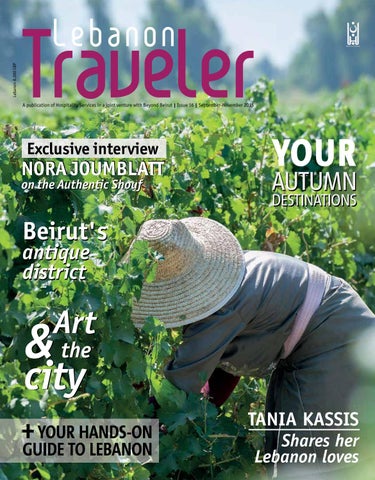
Cover photo courtesy of Clement Tannouri
Tag us #LebanonTraveler Like us LebanonTraveler Write us info@lebanontraveler.com
lebanontraveler.com
Contents
4
06 News
The lastest happenings around the country
09 A Day With
Nakhal: a Lebanese travel institution
10 Shopping
100% made in Lebanon
12 Interview
Nora Joumblatt on the Authentic Shouf
14 Hot Topic
Arak: the milk of lions
18 Responsible Tourism
We meet the women of the land
22 Focus On
5 things to do in Qab Elias
26 Art & Culture Beirut, city of art
Photo: Deniz Abaci
28 Outdoor Action Life’s little pleasures
32 Culinary Heritage
Ambarees: a potted history
36 The Great Escape
Haig Melikian shoots Chabrouh Dam
38 Touring Lebanon The icon above
42 Customs & Traditions Tripoli’s copper tradition
44 Design In Lebanon Reviving a long heritage
46 Indoors
The Sursock Museum’s rebirth
38
50 Region Through An Artist’s Eyes Zeid Hamdan’s Shouf sanctuary
54 In Focus Beirut Basta: an old story
58 Getaways
Four weekend destinations
60 Best Beds
Guesthouses around the country
61 On The Table
Nabil Shuman’s restaurant picks
62 Trail
Exploring Ashrafieh with Zawarib
64 Agenda
What’s on this fall
66 Insider Tips
Tania Kassis’ Lebanon loves
lebanontraveler.com
18
5
Contributors Clement Tannouri Photographer, designer, and entrepreneur, Clément Tannouri plays with talent, ingenuity, and expertise. His photographs are artworks imprinted with authenticity and essential beauty. Whether natural or urban landscapes, aerial views, or architecture, neither the subject nor the time slips away from him.
Martine Btaich Martine Btaich is an independent professional working in community and rural tourism development. She is also the Vice President of the Lebanon Mountain Trail Association. Her motto is inherited from her father’s “Al Ard marja’a,” meaning “Earth is the reference!”
14
28
Zeinab Jeambey With a background in dietetics and food tourism, Zeinab Jeambey is a specialist in food heritage management and has developed the first food tourism trail in Lebanon, Darb el Karam, one of the main programs of the Food Heritage Foundation.
Haig Melikian
46
10 years ago in the summer of 2005, Haig Melikian bought a bicycle and started to ride with groups. He soon became a passionate cyclist, beginning to do longer rides and go to new places alone. When he got a phone with a good camera he started taking photos of his rides, documenting the villages and old houses he saw during his ride.
Nour Farra-Haddad
22
Nour Farra-Haddad manages her own travel consultant company, NEOS, specializing in pilgrimages and religious tourism. She is also a founding member of the Association for the Development of Pilgrimages and Religious Tourism and the author of Eco-Lebanon and Wiz Kids guide books. lebanontraveler.com
More online lebanontraveler.com
6
News
5 MINUTES WITH… Bahi Ghubril
NEW OPENINGS
Places to stay
Inspired by metro maps, Zawarib’s new Beirut Urban Trail map captures the best the city has to offer through themed routes. The company’s founder and CEO, Bahi Ghubril gives LT the low down How did you select the places to feature on the Zawarib Beirut Urban Trail map? Beit Douma, photo: Roland Ragi
The trend of boutique guesthouses has picked up pace in Lebanon over the last year with new openings all around the country. Beit Douma (06 520702, beitdouma.com) is Souk El Tayeb’s latest opening; a carefully restored 19th Century Lebanese home in the Batroun Mountains. Set in one of the country’s most well preserved heritage villages it is the project of Kamal Mouzawak, founder of Souk El Tayeb and Mar Mikhael restaurant Tawlet and renowned fashion designer Rabih Kayrouz. A calm weekend retreat, surrounded by olive groves and apple orchards, Beit Douma offers modern luxury and tradition with its vaulted wooden ceilings, arched windows and six pastel-painted bedrooms. Dar Alma (07 740082, Dar Alma) is a newly opened boutique hotel in Tyre. A converted 19th Century traditional house in one of the city’s oldest neighborhoods, Dar Alma has unbeatable bedroom views with the balconies opening directly out on the sea.
Green spaces
Two park openings After NGO Nahnoo (nahnoo.org) kept the pressure on with an ongoing campaign, Horsh Beirut, the city’s biggest park has partly reopened to the public. Though currently the park will only open one day a week – every Saturday from 7am-7pm – after a 20-year closure it shows there is a light at the end of the tunnel. Also, in Ain Aar, Mount Lebanon, new green space The Park (71 533445, The Park, thepark-lb.com) offers a weekend escape for families with a whole range of outdoor activities. lebanontraveler.com
These are the places within Zawarib's world! They are a selection of what we consider venues that are helping put Beirut on the map (pun intended) and which serve to define each neighborhood in its unique way. The bars of Hamra vs the snazzy locals of Downtown’s Uruguay Street or the art galleries of Mar Mikhael vs its nightlife. Each place has been curated in a way to offer the newcomer – whether to live or visit – a quick inside scoop of the wonderful inimitable energy that makes Beirut, Beirut. Why did you decide to do the maps in metromap style? We love the idea of mapping in all its varieties, and these “category” lines make it easy to follow one activity that you'd like to discover. It is also clean and recognizable, and user-friendly. The idea that some places offer more than one activity (where lines intersect) also quickly reveals to the user an idea of “nodes” within each neighborhood where lots of activity can happen. We are always looking at different ways to promote our chosen places, and coming up with sexy mapping is a challenge and delight. How can the maps aid people on a rich tour of Beirut? Using one of our maps [is like having a] local guide to show you around the hidden treasures. Of course one can get lost, but you can also do that with our maps, knowing that there's always a way out! Zawarib is your local guide. The places we show and the maps we produce are essentially a way to communicate our love and knowledge of this incredible city. zawarib.org
YOU DON’T HAVE TO BE ROYALTY TO BE TREATED AS ONE. Experience the kind of service and access once reserved for nobility with the Jammal Trust Bank World Master Card. Enjoy exclusive priority VIP access to clubs, hotels, resorts, and premium airport lounges across the region and beyond.
we speak your language 1558 | jtbbank.com
VOTED BEST SME FINANCING BANK BY
8
Festival News
NEWS IN BRIEF # A conference was held at the Lebanese University of Beirut this summer, promoting sustainable tourism in Bkassine and the surrounding areas, through an ongoing project under the European Commission’s Heland Program. It entails creating a geo-park in the BkassineJezzine forest and the Shouf reserve – an area of geological heritage of international importance directed towards sustainable use. # With the future of Dalieh at threat, a long publically used space by the sea in Raouche, a group of campaigners have come together to call for its protection. The civil campaign (dalieh.org) is working on several fronts from raising public awareness to a lawsuit and a competition proposing future visions for the public-use of the space. # The Arab Council of Tourism has elected Jbeil as the 2016 Arab Tourism Capital, further underlining the ancient city’s importance as a destination in the region. # A conference was held at the Lebanese University on 22 July for Lebanese beekeepers, to highlight improvements in the field of honey producing. The conference was organized by the Lebanon Industry Value Chain Development project, funded by USAid. Within two years the project has increased exports by 52 percent.
For more news visit lebanontraveler.com & follow us on
More online lebanontraveler.com
INSTA SNAPSHOT Handicraft factory, Beirut Our “Instagram of the issue” was taken by consultant Sabine Karam. “I was visiting for work and this machine took me back to when I was six. I used to go with my parents to spend the summer vacation in Jezzine, where my grandma had an old Singer sewing machine,” she told LT. Tag #LebanonTraveler in your photos to be the next Insta Snapshot
A Day With 9
At the height of Lebanese tourism nowadays we want to turn our attention to regions in Lebanon that have a lot to offer, yet remain only partially explored, such as the Akkar region in the North and some parts of the South close to the border.”
As one of the oldest travel agencies in Lebanon, Nakhal is certainly an authority in the field of tourism. Elie Nakhal, the company’s current owner, speaks to LT about its journey Nakhal, established in 1959, is one of the oldest travel agencies in the Lebanese tourism industry. Throughout times of peace and war, they have foregrounded Lebanon’s colors and beauty to the world. Elie Nakhal, who took over from his father Joseph as chairman of the company in 1990, is passionate about his work. “Our mission is to make Lebanon known and appreciated. For this, there is no other way but to be in love with it yourself.” He recounts the evolution of the company: “We have always ensured tours to the great classics such as Paris and Rome. But
Over time the origin of Nakhal’s customers has changed. In the aftermath of the Lebanese civil war, most clients for local tours were Lebanese. The insecurity at the time, coupled with the desire to move on and to discover the country in yet unrevealed ways, pushed Lebanese in great numbers to book tours with Nakhal, in order to be guided across Lebanon’s regions. This attitude did not prevail though and now a lot of Nakhal’s clients come from abroad. According to Elie, one of the agency’s greatest qualities is its innovative drive: “Everything that exists on the Lebanese tourism market has been initiated by us, whether in terms of destination or service.” Nakhal has also shown a strong perseverance: “For 25 years, we never cancelled any tour, even in the worst wartime moments.” Summer and winter, whether there is one client or twenty, tours go on all the same. Today, the company’s challenges lie in the political instability of the region. “We are far from harnessing the abundance of opportunities that Lebanon can offer as a destination for global tourism.” Give it a few more years of peace, Elie believes, and they will reveal a completely different Lebanon, of even more bountiful riches. Florence Beland
Expert tips Routes: “Never take the highway, always take side roads. They are so much more scenic. When driving to Jbeil, I always take the seaside road.” Care for the mood: “Feeding people is easy, you sit them in a corner and fill them up. But there are better ways to savor Lebanon. Choose a significant setting, more intimate and with a view; it is all about the atmosphere.” An underestimated destination: “Maghdouche. Located on top of a hill, it has a breathtaking view. It is also thought to be where the Virgin Mary waited for Jesus when he travelled to Sidon.” A Lebanese feature to love: “Leniency. We are the best at dealing with chaos. We get on with it.”
lebanontraveler.com
10 Shopping
Made in Lebanon With Lebanon’s vibrant design scene you can find everything from the kitsch to the comic. LT toured Beirut’s boutiques to find the designer pieces with that Lebanese touch
1
2
1. [IN]Leb Women’s t-shirt LL45,000 at Virgin Megastores, Artisan du Liban and the Rafic Hariri International Airport inleb.com 2. Green Cedar Lebanon bracelet by Lara Debs and Pascale Saad LL105,000 (all profits are donated to the Lebanese Army) at Green Cedar Lebanon 03 234006, greencedarlebanon.com
3
4
3. I Love Lebanon purse LL33,000 at Maison De L’Artisan 01 368461/2, mda.gov.lb, Ain El Mreisseh, Minet El Hosn 4. Hand painted papier-mâché tray by Nivine Matar LL52,500 at Finikia 01 566867, Gouraud Street, Gemmayzeh 5. Lebanon coffee tray in wood by Raeda Kreitem price on demand at Beirut National Museum boutique 01 612260 or 03 777657
5
6. Rectangular Beirut Clutch with removable Strap LL97,500 at Scene Beirut 03 698248, scenebeirut.com 7. Metal signs LL22,500 at Glady’s Shop 01 449967, 03 490524, Gouraud Street, Gemmayzeh
6 lebanontraveler.com
7
12 Interview
the real Shouf
Nora Joumblatt, president of the Beiteddine Festival, is one of the Shouf’s biggest advocates. LT spoke to her to find out about “Authentic Shouf,” a new campaign to boost tourism and promote the traditions, local specialties and natural beauty of the region lebanontraveler.com
13 What do you consider to be the authentic face of the Shouf?
Is there a focus on rural and ecofriendly tourism in the project?
The Shouf is one of the best-preserved regions, or districts, in Lebanon. The scenery is breathtaking – picturesque villages dot the mountainside and historical monuments are found at every turn of the road. Rich in history, having been the site of the Emirate of Mount Lebanon, there are a wide choice of heritage sites, from historical palaces to religious sites. The Shouf is also home to the largest nature reserve with three major Cedar tree forests, which enjoy the distinction of being the oldest documented forests in history. The Shouf region is a bastion of nature and culture, unrivaled on a national level.
A network of rural and eco-friendly tourism is already in place and thriving thanks to the initiative of the Reserve and the Ministry of Tourism.
What are the main aims of the Authentic Shouf campaign?
The Shouf Biosphere Reserve is definitely at the top of the list; it is remarkably rich in biodiversity and cultural heritage plus it has a large expanse of wetlands. The reserve enjoys 1532 acres of cedar forest constituting 30 percent of the remaining cedar forests in the country. With seven guesthouses in 22 municipalities and 250km of hiking trails, the reserve is already a major eco-tourism destination with over 70,000 visitors a year.
Our primary aim is to promote the whole region as a destination, encouraging tourism, as well as eco-tourism related industries, supporting initiatives that directly benefit the economic development of the region while conforming to the distinctiveness of the historical and natural heritage. There was a need to set it up, so as to highlight the tremendous assets of the Shouf, helping local producers and smaller businesses to perfect their products and services [and] making them more sustainable. Who are some of the main collaborators you’re working with?
What is the main focus of the tourism packages? All our tourism packages are designed to introduce the visitor to a more authentic experience and a better understanding of the natural and cultural heritage, as well as offering a large choice of destinations. Which treasures of the Shouf will the project highlight?
Why are projects such as the Beiteddine Art Festival important? The Festival [has] proven to be an invaluable platform for promoting
The Shouf is one of the bestpreserved regions... It is a bastion of nature and culture artistic excellence, cultural diversity and intercultural dialogue. It has also contributed to the economic growth of the region, creating jobs, establishing music and dance institutions, and, of course, promoting cultural tourism on national and international levels. Are there any new projects that are boosting tourism in the area? Projects continue to mature in the Shouf, such as Bkerzay crafts and pottery, the Assaf Brothers workshop, Fadi Mogabgab Art Contemporain, Souk au Shouf starting soon, boutique hotels and guesthouses such as Bouyouti and Deir Al Oumara. Tell us about your favorite lesserknown destinations? The Niha Fortress is a historical visit with incredible vistas, and wonderful trails have opened up such as the Mristi Roman Oak trail, the Moukhtara Valley Trail, as well as the new Barouk Patriotic Trail. AuthenticShouf, authenticshouf.com
This initiative is a joint effort between the Lebanese Franchise Association, the Shouf Traders Association, the committee of the Al Shouf Nature Reserve and that of the Beiteddine Festival. We have the support of the Ministries of Tourism, Environment, Economy and Agriculture; the Shouf MPs and municipalities have also endorsed the project. How will the campaign help promote local producers and farmers? The Shouf produces a wide variety of local products; for example, the Al Shouf Cedar Reserve has developed a rural program, which supports local communities and provides training and marketing outlets for their produce. Currently there are over 82 products that carry the Shouf Biosphere Reserve label.
Photo: Shouf Biosphere Reserve
lebanontraveler.com
14 Hot Topic
The milk of The tradition of Lebanon’s national drink, arak, remains an essential part of the Lebanese mezze. LT speaks to wine and beverage specialist Najib Moutran to find out if the long heritage of the industry is enough for it to continue thriving?
lions It’s the typical Lebanese scene Ω– a weekend lunch with friends and family, sat around a feast of mezze. A tabletop jigsaw puzzle of little plates and that essential element; a jug of arak to share. Lebanon’s national drink, arak, is usually served at a 2:1 ratio with water. The sight of the anise reacting with the water to form a white plume that consumes the whole bariq – a traditional Levantine vessel – is intoxicating in itself. “Arak is the only beverage that can be your loyal companion throughout a meal,” says Najib Moutran, wine and beverage specialist and owner of the management company, retailer and bar, The Wine Teller. Moutran, who also specializes in sensorial analysis – the scientific study of the human reaction to food and drink – explains that arak’s ability to clear the palate is what makes it such a good option during meals. “If you’re eating tabbouleh with a lot of onion inside and you drink arak it will wash away the onion. If you’re eating grilled chicken with garlic, arak
lebanontraveler.com
will wash away the garlic. Then you can eat whatever you want to eat. Arak has the role of [cleaning] your palate and introducing a new taste,” he says.
Arak has accompanied meals in Lebanon for a over a century and, according to Moutran, its production became more prevalent while the Ottomans ruled Lebanon. “The arak industry is very, very old. Not only in Lebanon but all over the Mediterranean basin,” he says, citing Greece’s ouzo and Turkey’s raki. “During the Turkish occupation, many of the Lebanese vineyards that were from ancient times were eradicated and pulled out for religious reasons because the Ottoman Empire did not allow alcohol consumption.” Arak was a much easier alcohol to produce and families with grape trees outside their houses would make arak in secret, as there was no need for a vineyard, Moutran adds. Distilling grape must, which is pressed to make wine, produces arak. This creates a 90 percent volume alcohol, which is then watered down to approximately 50 percent and distilled again while adding anise for
More online lebanontraveler.com
15
The arak industry is very, very old all over the Mediterranean basin
Photo: Myriam Shuman
flavor. Moutran says that the period where families began making arak in their homes in an artisanal fashion, spawned many large arak-making families who are still producing today. Ghantous and Abou Raad, two neighboring families in Zahle, have had their own distilleries since the Ottomans ruled Lebanon. Popular winemaker Wardy now owns their distillery. The Touma family have also been creating arak since the late 1800s and the business has been passed down from one generation to the next. Today, all major wineries in Lebanon make arak using excess grape must; however Moutran stresses that the highest quality arak is made from grapes intended for wine. Lebanon’s largest wine makers, Kefraya, Ksara, and Faqra, all have their own brands of arak. There are also more artisanal arak-only distilleries, such as Najem.
However, arak has taken a hit for a variety of reasons, such as the rising popularity of imported spirits such as whiskey and Lebanon’s burgeoning wine culture.
somebody says that arak is going through a crisis, I would tell them no,” he states. “Because we don’t know the volume that is being produced and consumed.”
Moutran believes that arak was not created for the bar culture of fancy cocktails and mixology. “Arak is very dominant so you cannot blend it easily with something else,” he says. “Some people tried to blend it with mint, [others] tried to blend it with grenadine… but it didn’t succeed because arak is a dominant beverage.”
Moutran explains that the government does not diligently monitor the production and sale of arak and therefore there is no record of the amount of arak sold. For him one of the arak industry’s main strengths is its exportation, with many arak producers exporting to the Lebanese diaspora in America and Europe who yearn for a taste of home. This is a lucrative business for local arak producers and may offset the losses from arak’s dip in popularity.
Also, many people would rather give a bottle of wine as a gift as it offers more variety – in terms of both age and cost – to make a larger statement, whereas arak’s price is more or less set at LL18,000 and it is not often distinguished by age. Despite these indicators, Moutran doesn’t believe that the arak industry is at risk. “If
Arak’s companionship is still sought after around the world, and in Lebanon it remains an essential tradition alongside mezze, offering a real taste of the country for tourists and locals alike.
lebanontraveler.com
16 Hot Topic
Lebanon’s oldest arak producers Salim Nakad took over from his father in the 1950s. He updated the facility’s distillery and grew the business into the force that it is today. According to Salim, arak has less of a presence in the food culture of Lebanon than it once did. “Now if you go to weddings during the summer, you’ll see more people drinking whiskey,” Salim laments. “It’s not like it once was.”
Arak As-Samir Joseph Nakad took over his family’s winemaking facility in 1923. He transformed what had previously been a pastime of his father’s into one of Lebanon’s most prominent wine and arak producers. Joseph’s wine was popular among French troops serving in Lebanon; Charles De Gaulle tried it when he stayed in Chtoura and sent Joseph a thank you note.
Arak Touma The Touma family has been making wine since 1888. “My grandfather started it by growing obeidy grapes,” says the 75-year old owner of Arak Touma, Saeed Touma. “He would make them into wine and use the left-overs to make arak.” Before his grandfather and great uncle passed away, they requested that their bodies be buried on the land they grew grapes. “This was to ensure that their children would not sell the land and would continue the business,” Touma explains. And, that they did. 123 years later, Arak Touma is still one of the most highly regarded araks in Lebanon. Touma, who began working in the family lebanontraveler.com
He hopes that people will support the arak industry in the future for the sake of Lebanon’s heritage, in a similar way that the French support their winemakers. Arak also forms a bond between Lebanon and Syria, Salim continues, as anise grown in Syria is most commonly used in arak production in Lebanon. “It’s one of the few positive connections between the two countries during these troubling times.” 08 540191, 03 982654, chateaunakad.com Jdita, Bekaa Valley
business at the age of 12 after his father passed away in a tragic accident, believes that arak is an important part of Lebanese culture. Through his company, he is working on a campaign to raise awareness about the culture of arak. “It’s an awareness campaign to teach young people what arak is,” Touma explains. “How to drink it, mix it, and how to recognize good arak from bad.” One of the main issues they are campaigning against is the large amount of homemade arak sold at restaurants that contain methanol and other hazardous ingredients as a result of improper distillation. Touma has bright hopes for the future of arak. Arak’s reputation suffered during Lebanon’s 15 year Civil War when a much lower quality homemade arak was distributed, he says. Almost 30 years later and arak is once again regaining its reputation. “You could say [that] 80 percent of the people that stopped drinking arak have come back to it again,” Touma says. “Production has risen in the past ten years… the future is positive.” 08 500802, Qab Elias Road, Bekaa
More online lebanontraveler.com
17
A taste of Lebanon Arak Brun
Arak El Rif
Arak Brun, which dates back to 1868, is produced inside the cellar of Domaine des Tourelles, itself 100 years old. They also make Arak Brun Special Reserve, which uses the same traditional production process of three-times distillation, but is aged for five years in clay jars for purity.
Produced by the fifth generation of a family since 1828, Arak El Rif has a long history and remains one of the most popular names in arak today.
Domaine des Tourelles 08 540114, domainedestourelles.com Jdita, Chtaura, Bekaa Valley
Arak Divina
Photo: Chateau Nakad
Though its vines were only planted in 1995, the plots of Chateau Khoury are located where the legendary Arak of Zahle once grew before the war. A family business, Raymond and Brigette El Khoury continue making an arak rooted in that tradition.
Arak Fakra The Arak Fakra heritage started back in the early eighteenth century with one family in Kfardebian. It is prepared from Merwah grapes, with aniseed from Heena, aged in ancient clay jars from Beit Chebab and using water from mountain springs, continuing all the traditional elements to create one of the country’s most highly regarded araks.
08 801160, chateaukhoury.com Dhour, Zahle
Chateau Fakra 09 635111, fakra.com Kfardebian Valley
Ksarak
El Massaya Arak
The arak brand of one of the country’s biggest wine producers, Chateau Ksara, Ksarak is flavored with the aniseed of Heena, Mount Hermon, before being aged for two years in clay jars.
Combining the third distillation with organic aniseed from the village of Heena on the Syrian slopes of Mount Hermon, El Massaya Arak is then also aged in traditional clay pots, from the potters of the famous village Beit Chebab.
Chateau Ksara Chateauksara.com
Arak Du Rouss The Yaghi family started Chateau Florentine in 1997 with a love of the land upon which their family has lived on for generations. Continuing a tradition inherited from their ancestors, they added Arak Du Rouss to their wine portfolio. Chateau Florentine 05 250244, chateauflorentine.com Majdel Maouche, Shouf
Photo: Roula Koussaifi
El Khazen Distillery 76 119719, arakelrif.com Amaret Chalhoub, Nahr El Mot
08 510135, 03 744047, massaya.com Massaya Faqra, Kfardebian
Arak El Karam Set in the landscapes of Qattine in the Jezzine region, Karam Winery was founded by two brothers on the lands of their family. Along with wines and Jezzineyac, their eau de vie, they also produce arak. Karam Winery 01 370519, karamwines.com Qattine, Jezzine
Words by Mazin Sidahmed lebanontraveler.com
18 Responsible Tourism
Denaybeh plant to prepare food with borghol, photo: WADA
Women of the land Cooperatives have not only empowered the women who run them in rural regions, but are helping to create a more sustainable field of tourism. Martine Btaich, a professional in community and sustainable development and vice president of the Lebanon Mountain Trail Association, explores the women-run local agro-food cooperatives
Traveling is about seeking experiences, and when rural and agro-tourism is considered, food and crafts are at the heart of them. Tourism in rural regions is also highly dependent on agriculture as a resource. There is a growing demand for healthy food, authentic discoveries, and sustainable practices, as visitors seek fresh, seasonal produce and the culinary specialties of the region, sourced directly from farmers, local small-scale producers and rural cooperatives. Today, more than 151 rural cooperatives run by women are active around Lebanon (crtda.org.lb). They promote healthy, natural and authentic agro-food produce and preserves, along with local crafts; all produced in a traditional way. Some cooperatives are also developing creative fusions that suit an evolution of tastes and flavors. It is thought that the first agricultural cooperative in Lebanon was established in 1937 in Aabadiyeh. The concept further expanded to other areas, with support from the Ministry of Agriculture and in the early ‘60s, cooperatives were legally recognized. Through the years many agro-food cooperatives have developed. The interest
lebanontraveler.com
of donor agencies in rural development, job creation and women empowerment, has helped local farmers and women entrepreneurs in developing small scale agro-food cooperatives. Almost all of them are offered training programs and technical support in production, hygiene and food safety, quality standards and marketing.
Rural cooperatives and tourism Rural cooperatives have always been a tool for economic and social development in marginalized rural areas. The Rural Tourism Strategy for Lebanon defined rural tourism as “experiencing the country� through a variety of tourism activities that have positive impact on the local environment, community or culture. It highlighted food discoveries, agriculture and contact with local farmers as one of the key ingredients of tourism activities taking place in rural areas. Rural agro-food cooperatives fit well within this mission, becoming a destination for visitors to rural areas and a channel for discovering local agro-food specialties and crafts. According to Samira Akiki, Director of Atayeb, a rural cooperative run by women
More online lebanontraveler.com
19
Women have a big role in promoting their own village
Photo: APJM Jabal Moussa
Photo: Dalia Khamissi – Shouf Biosphere Reserve
Photo: APJM Jabal Moussa
lebanontraveler.com
More online lebanontraveler.com
20 Responsible Tourism in Kfardebian, the cooperative “has helped remind people of authentic flavors.” The cooperative produces all types of preserves and local food produce and is best known for its sour grape juice, apple and prune paste and all apple derivatives. The cooperative employs 10 full time women and 25 seasonal, and also offers catering services at tourism and private events and supplies hotels and restaurants. “Women have grown economically, psychologically and socially. They are more exposed through their participation in trainings and in local and international exhibitions,” says Akiki. “Women have a big role in promoting their own village. It is so nice to see women evolve on a personal level too. They tell me they love life even more and that they are happier,” says Dunia Khoury, director of the Women Association of Deir El Ahmar (WADA). While the organization is not a cooperative but an NGO, their culture is similar to one. They have been working since 1997 on the development of tourism in the area of Deir el Ahmar and surrounding villages through community women based agriculture and hospitality initiatives. The women were previously housewives and have now decided to support themselves and their families without leaving their houses or villages. Fourty of them have opened their homes as guesthouses and offer meals and many are also engaged in crafts and agri-produce. Oumaya el Qadi, from Ain Ata, Rashaya, and the 11 women who work alongside her in the Ain El Loz Cooperative have been active since 2005. Their lives have changed and
their self-esteem and personality has been boosted. They feel they are more respected by their community. Working together like a family, they have become renowned for their catering skills and the distillated herbal derivatives that Jabal el Sheikh is famous for. Namlieh network and Souk el Tayeb have helped them market their produce and develop their business. They are always present in regional exhibitions and festivals to promote their village.
Meet the co-ops Ain El Lawz Cooperative Ain Aata, Rashaya 76 520626
Najmat Al Sobeh
El Mheidsseh, Rashaya 03 502847
Wadi al Taym
08 592567, 71 349410 wadialtaym@gmail.com
Aita el Fokhar Coop Ain El Aarish 71 688853
Rashaya Gardens 03 891518
Bint Jbeil Cooperative for Agricultural Food Processing – Zouwada 03 324186
Al Imad Cooperative for Food Processing Haris, Bint Jbeil 70 927069
Women’s Agricultural Cooperative in Deir Kanoun Ras el Ain 70 430505
Alberto
Zouk Mikhael 70 500566 tonyalbertos@hotmail.com
Atayeb Kfardebian Kfardebian 03 845257 Photo: Shouf Biosphere Reserve
lebanontraveler.com
The success achieved by WADA, Atayeb and Ain el Loz Cooperative are often the result of the qualities of the women themselves, their hospitality and their authentic interest and passion in promoting their local identities. Though cooperatives alone are not enough to create a tourism destination – with a full use of resources needed such as nature, culture and history – they remain a major link to bringing visitors to rural destinations.
Kounouz Loubnan 71 220874, 03 242979 siham_gh67@hotmail.com
Rural Delights A network of 42 women-owned agricultural and artisanal cooperatives. 03 335854
Namlieh Promoting more than 36 rural women cooperatives. 01 397292 namlieh@crtda.org.lb namlieh.com
Fair Trade Lebanon A network of several cooperatives around Lebanon. 05 952153 fairtradelebanon.org, contact@fairtradelebanon.org
WADA The Women’s Association of Deir El Ahmar Food produce and crafts. 03 622369
Souk el Tayeb A farmers’ market where several cooperatives exhibit every Saturday at Beirut Souks, 9am to 2pm. 01 442664, soukeltayeb.com
Nature Reserves The Shouf Biosphere Reserve, Tannourine Nature Forest Reserve, the Association for the protection of Jabal Moussa, Ehden Nature Reserve and many others, are acting as channels for local agro-produce from cooperatives in their respective areas.
22 Focus On
5
things to do in and around
Qab Elias The Bekaa Valley offers the perfect Fall escape, bringing heritage, nature and agricultural experiences into the mix. Follow the road to the historical town of Qab Elias and its surrounding lands to discover a vibrant fruit and vegetable market, archeological remnants of another time and ecotourism activities
1 Qab Elias The town has many historical and archeological treasures scattered around it. The Roman altar, known as the Haydara, is carved into the rock of a cliff. Don’t miss the remains of the Fakhreddine Fortress, a 10-meter-long wall that stands on the top of a hill above the town. It was a strategic location overlooking the flat plains below, with a breeze that still blows from the Valley of Wadi el Delm. Nearby in Ras el Ain is a Roman tomb and a curious inscription from the Iron Age.
Prophet Elijah, dating back to the Middle Ages. The town also has a statue built in 1927 to commemorate the French soldiers sent to Lebanon in 1860 by Napoleon III. The municipality of Qab Elias has developed two hiking trails; beginning near the forest and leading visitors past the landmarks. Starting September, Qab Elias celebrates its local agri-food produce, mouneh, at its yearly fair. Visitors can also enjoy environmental trips, harvest activities and cycling.
Stroll around the old souk where a few heritage houses can be seen, the 19th Century Roman Orthodox church of St. Elias, and the historic mosque and tomb of the
To organize a trip call the Municipality of Qab Elias – Wadi el Delm on 08 500721
Photos: Myriam Shuman
lebanontraveler.com
More online lebanontraveler.com
23
2 Souk Qab Elias No visit to this part of the Bekaa Valley is complete without leaving with a car-trunk loaded with all the treasures its land has to offer. Visit Souk Qab Elias, the biggest fruit and vegetable market of the region for the freshest produce, in all their colorful glory, at wholesale prices. Open Mon-Sat, 7am-3pm Qab Elias town center
lebanontraveler.com
More online lebanontraveler.com
24 Focus On
3 Hima Anjar From Qab Elias follow the road to the West Bekaa and signs to Hima AnjarKfarzabad. This protected area is a great ecotourism destination: a mix of wetlands, fertile agricultural fields and a vast forest. Fall is the perfect time of the year to go bird watching and
Where To Eat discover Lebanon’s rare migratory birds. Many activities are on offer from cycling and mule back riding to environmental activities and harvesting. For tours contact SPNL on 01 344814, berjt@live.com
4 Wine tasting In Qab Elias spend an afternoon wine tasting in a rich landscape filled with endless vines. In the area is Chateau Clos St Thomas (08 500812), a family run-winery with a 100-year history and Chateau Heritage (08 500609), the Touma family’s winery, established in 1888. For lunch stop at Chateau Kefraya (08 645333/444) or Chateau Ksara (08 813495).
5 Taanayel Domaine de Taanayel is well known in the region for its outreach and conservation work. Owned by the Jesuit Fathers since 1863, Lebanese NGO Arcenciel took charge of the management of the convent’s agricultural terrain, which covers 568 acres, in 1997. A variety of activities are on offer including cycling, horseback riding and hiking around the lake, along with a zip-line, archery lebanontraveler.com
and educational farming for kids. Taste the fresh dairy products of the convent or visit Khan el Maksoud (08 544881, 71 485807, Damascus Road, Taanayel), near Taanayel Ecolodge, that offers locally made seasonal food and accommodation. While at the ecolodge learn how to build an adobe house, the ancient art of constructing from sun dried earth, common in the Middle East and North Africa.
For a quick snack and local specialties, Tablyit Massaad (08 806626) is a Zahle institution, founded back in 1967. For delicious Armenian food, in a large atmospheric restaurant eat at Anjar’s Shams (08 622600), where people flock from the surrounding areas. Also, don’t miss Tawlet Ammiq (03 004481, tawletammiq.com), the Mar Mikhael restaurant’s Ammiq stop, with local food, cooked by villagers.
Where To Sleep Zahle, the gateway to the Bekaa, is the perfect base for a weekend exploring the area. A 5 star hotel in the heart of The Valley, Chtaura Park Hotel (08 540011, chtauraparkhotel.com) offers ultimate luxury with 75 rooms and suites. Akl Hotel (08 820701, akl-hotel. com) is located in the historic part of Zahle’s center. The hotel is over 100 years old and had all the traditional touches from stone walls to high ceilings and arched windows. Guests are greeted upon arrival with that Lebanese touch of hospitality, with a cup of mint tea or coffee. Grand Hotel Kadri (08 813290 08 800027, cristalgrandkadri. com) is a landmark in itself, overlooking the city’s famous Al Berdawni river. Built in the 19th Century, the hotel’s Lebanese architecture combines oriental style with a modern aesthetic.
26 Art & Culture
CITY
Of Art Mona Hatoum, Impenetrable (s version) – Steel, fishing wire, Courtesy Saradar Collection
Beirut Art Fair has become an essential part of Beirut’s vibrant arts scene. We speak to its founder and director, Laure d’Hauteville on its evolution and her essential spots to see art in the city Beirut has a long history as a destination for art that only keeps evolving further. With 48 art galleries and art spaces, 32 archeological, historical and thematic art museums and two museums set to open soon (sourced from Agenda Culturel, agendaculturel.com) there is a vibrant art scene that continues to thrive. Beirut Art Fair (BAF), which launched in 2010, has established itself on the regional and global arts scene with a focus on art from the Middle East, North Africa and South Asia, attracting galleries, visitors and collectors to the capital city. “Every year, Beirut Art Fair brings together galleries that present both renowned artists and emerging talents. It is a fascinating destination to discover art. lebanontraveler.com
We have more and more galleries, more visitors and art collectors coming from outside Lebanon,” says Laure d’Hauteville, BAF’s founder and director.
that has always been open to the arts, as it finds its international relevance again; “In Europe, the Lebanese art scene fascinates every art specialist.”
This year, the annual art fair will receive around 50 international modern and contemporary art and design galleries, showcasing new trends across a variety of mediums from both emerging and established artists. With an aim to create an exclusive meeting point between the East and the West, BAF is attracting art enthusiasts from all over the world and helping reposition Beirut as the cultural and intellectual capital of the Arab world. It’s also contributing to the development of Beirut’s art scene. “BAF has become a prominent showcase of design and creativity within the art market,” says d’Hauteville. “It is a unique source of information on trends, galleries, artists, and institutions, which contribute to the rapid growth of art in the region. Our passion is to nurture an inspiring worldwide dialogue through art and our desire is to stay on the forefront of the art scene.” She believes that it’s an important time for Lebanon, a country
Held simultaneously with BAF, Beirut Art Week (BAW) brings the city to life; showcasing art beyond the walls of the art gallery in the streets and boutiques of Downtown district. “Beirut lives under the rhythm of contemporary art, thus, the artists are invited to express themselves in the urban landscape of the capital. BAW is a way to re-discover the famous architecture of Beirut, and the boutiques are doing a great job by accepting to display art in their showcases,” says d’Hauteville. This year BAW features 24 interactive projects by artists and designers, showcased around Beirut’s symbolic landmarks such as Martyr’s Square, Beirut Souks, Zaitunay Bay, Saifi Village and Harbour Square. Beirut Art Week, various locations around Beirut. Tue 15-Tue 22; Beirut Art Fair, BIEL, Thu 17-Sun 20. 03 386979, Beirut-art-fair.com, Beirut Art Fair
More online lebanontraveler.com
Beyond Beirut Art Fair Laure d’Hauteville’s city art guide AÏSHTI FOUNDATION Opening in Jel El Dib on 25 October the Aïshti Foundation is a new private art museum spread across a vast 40,000 square foot of exhibition space. Owner of fashionpowerhouse Aïshti, Tony Salamé is a serious art collector and the new foundation will allow his large art collection to be exhibited to the public. aishti.com/foundation
GALERIE MARK HACHEM With 14 years working in the art world with galleries in Paris, New York and more recently Beirut, Mark Hachem has over 200 exhibitions to his name. From 18-28 September the galley presents the exhibition “Bridge to Palestine.” 01 999313, markhachem.com, Salloum Street, Mina El Hosn
ART SPACE HAMRA Art gallery and multidisciplinary cultural platform, Art Space Hamra, has become an important platform for modern and contemporary Middle Eastern art. From 16 September to 18 October, they present the iron sculptures of the contemporary Iraqi artist Ahmed Albahrani in his exhibition “Biology.” 01 736516, artspacehamra.com
ISSA KAZAH AT LE GRAY As part of Beirut Art Week and in collaboration with the renowned Samer Kozah Gallery in Damascus, Le Gray Beirut will present the art work of Syrian sculptor Issa Kazah from 15-22 September. 01 971111, legray.com
DAR EL-NIMER FOR ARTS AND CULTURE Housed in a 1930s building, Dar el-Nimer for Arts and Culture is a space for culture and exhibitions. This landmark of modernist architecture in Beirut is dedicated to the preservation, exhibition and promotion of artistic productions from the Maghreb and the Mashreq. The center, currently under restoration, will open its doors in 2016. The collection of its founder, Rami el-Nimer, is one of the most outstanding of Islamic art, bringing together pieces from the 10th Century until today. GALERIE JANINE RUBEIZ Galerie Janine Rubeiz is rooted in the legacy of Dar El Fan, an art space run from the late ‘60s by Janine Rubeiz. Her daughter, Nadine Begache, opened this space in 1993 with a mission to make contemporary Lebanese art known locally and abroad. From 7-23 October they launch the collective exhibition, “Disorder(s) in Beirut.” 01 868290, galeriejaninerubeiz. com, 1st Avenue, Charles de Gaulle, Majdalani Bldg, Raouché
MANSION Mansion is a grand, beautiful villa from the 1930s, situated in Zoqaq el-Blat. Abandoned during the civil war, the house has been invested in since 2012, with the consent of its owner, for an alternative cultural project conceived and led by architect Ghassan Maasri and historian and choreographer, Sandra Iche. Mansion welcomes ten resident artists, designers, curators and researchers in its studios every day and hosts a selection of screenings and debates, along with offering a library and workshops in both carpentry and screen printing. 03 412659, Zokak El Blat
27
Heartland exhibition Three questions to curator Joanna Abou Sleiman Chevalier Tell us about the concept behind the exhibition? Heartland is an exhibition that talks about the subtle and intimate relationship between artists and the Lebanese land. Whether they live in Lebanon or not, memories and unconscious traces are left which nourish their work. How long was the process of bringing it all together? Randa Armanazi, the director of the Beirut Exhibition Center (BEC), agreed on the project in June 2013, and here we are, opening on 24 October 2015. What is interesting is that some of the projects produced for the exhibition were different from what was proposed at the beginning, discussing the theme with the artists made them evolve. They decided to offer something different. Who will be exhibiting and what mediums are used? The artists are: Simone Fattal, Lamia Joreige, Mona Hatoum, Joana Hadjithomas and Khalil Joreige, Marwan Rechmaoui, Rayyane Tabet, Gilbert Hage, Fadia Haddad, Mireille Kassar, Etel Adnan, Annabel Daou, Nadim Asfar, Ranya Sarakbi, Nabil Nahas, Najla El Zein, Hiba Kalache. All mediums are used from video to painting, sculpture, installation and photography. Beirut Exhibition Center 01 962000 HeartlandLB @Heartland_lb #HeartlandLB Port of Beirut, Downtown 24 Oct- 29 Nov
lebanontraveler.com
28 Outdoor Action
Life’s little pleasures With its long coastline and connection to the sea, Lebanon carries a rich history when it comes to fishing. From the hidden coves of Dalieh to the coast of Batroun, fishing hobbyists and enthusiasts will find no shortage of spots to cast their rods Faint echoes of what sounds like an Oum Kalthoum song seem to emanate from a cluster of rocks along the shoreline of Ramlet al-Baida. The source is a cellphone near the rocks’ edge, where fishing hobbyist Najib Ashour casts his line into the sea; his sons, nephews, and friends are by his side, some with their own lines cast, others fish with cage nets. “I’ve been fishing for about 30 years,” Ashour reveals. “I fish all over, from Maameltein to Raouche… it really depends on the day. I prefer coming here though because it’s closer to home, which makes things more convenient. I try to come every weekend to get away from all the noise of the city, and just play some Oum Kalthoum, or Abdel Wahab.” Over the years he has noticed a shift in Beirut’s waters. “The environment has changed over the years. There’s a lot more pollution which has affected the health and quality of the fish.” This hasn’t stopped him from frequenting his favorite fishing setting, though. “I like this spot because there isn’t a lot of construction, which usually causes the fish to migrate.” Colette Kahil is an avid fishing hobbyist and owner of Beit al Batroun, a quaint bed and breakfast near the town of Thoum. “We used to [go fishing] when we were kids. We would go with our parents to a beach almost every day of the summer, so we had to find something to pass our time at the end of the day. And it stayed with me for years from then,” she says. Kahil was once a regular at Raouche’s Sporting Club, but since moving to Batroun she now spends her time fishing along the northern coastline, picking any spot between Byblos and Batroun. lebanontraveler.com
29
lebanontraveler.com
30 Outdoor Action Kahil is not so fussy when it comes to how she chooses to fish. “ I’m never on a boat, I find any spot on a rock and [I] can sit there for one to two hours.” The process is just as important to her as the actual catch. “The sea is very clean here in Batroun, but we used to catch more. Sometimes I go and spend a couple of hours and don’t catch any fish. I find that I smoke less because I don’t feel like taking a break when I’m fishing. I can spend two hours without thinking of anything. It’s all about the pleasure of catching a fish… It’s very therapeutic for me.” Fishing maintains its long tradition in Lebanon – a relaxing pastime that’s an escape from the grind for many and offers a connection to the sea. There are plenty of spots to enjoy fishing in the country – dotted along its vibrant coastline or in its numerous rivers and lakes and all that’s needed is a rod or net… and of course patience. Words and photos by Jimmy Dabbagh
Get the kit Decathlon French brand Decathlon have a large range of fishing equipment at reasonable prices. 04 526101, Dbayeh Kyriakos Freres This family-run business has become a staple for serious fishermen in the area. Opening 40 years ago they sell everything you could ever want related to fishing, from rods and ropes to the perfect foldable chair to settle in for the day. 01 362752, 01 362753/4, kyriakos-lb.com Graham Street, Ain El Mreisseh Mike Sport This sport shop’s Zalka branch has a selection of fishing equipment including rods and ropes. 01 888855 /2000, mikesport.com Zalka Samir Sport Offering everything available for fishing enthusiasts, from casting to jigging and trolling, Samir Sport is an essential stop for the full fishing kit. 09 850474, 09 852333 Tabarja branch; 04 405406, Dbayeh Branch, samirsport.com
lebanontraveler.com
More online lebanontraveler.com
32 Culinary Heritage
A potted history The goat dairy product, ambarees, has a long history in Lebanon, but as its traditional production process fades out it’s at risk of being lost. The Food Heritage’s Foundation’s Zeinab Jeambey explores the tradition and how to preserve it Ambarees, also known as sirdeleh or labnet al jarra, is a traditional dairy product commonly prepared in the Bekaa Valley and the Shouf mountains in Lebanon, where baladi and shami goats are respectively the main grazing animals that produce it. The word sirdeleh refers to the earthenware jar in which the dairy product is prepared. During the goat-milking season in June, the process starts by filtering and pouring raw goat milk and coarse salt into special clay jars that are porous in nature, with a hole in the base for draining purposes. The mixture is left to ferment at room temperature until the curd separates from the whey water, at
which time the liquid is drained through the jar’s opening. Over the span of the summer, the process of adding milk, coarse salt, fermenting, and draining is repeated until each jar is filled with curd. The curd is then left in closed jars for four months to complete its fermentation process, at which stage ambarees develops into a type of labneh, yellowish in color and sour in taste. Throughout the fermentation process the product acidity rises, thus eliminating microorganisms that would otherwise be harmful. “The process of making ambarees is very delicate and one has to have a high level of hygiene so that it doesn’t
ruin the final product,” says shepherd and ambarees producer Boutros Bou Maroun, from Saghbine. “That is why, traditionally, we say that only the producer can check over sirdele jars, otherwise the product will disintegrate.” Once ambarees is extracted from the earthenware jars, it can be either packed in glass jars, sealed and sold, or formed into balls, further dried on cheese cloth towels, then placed in glass jars and preserved in olive oil. Ambarees is mainly consumed as labneh, served with olive oil and eaten for breakfast or dinner. In the villages, many spread it on saj bread and heat the bread Photo: Roula Koussaifi
lebanontraveler.com
More online lebanontraveler.com
33
Photos: Food Heritage Foundation
on a wood-fire oven before eating their sandwiches. In villages with the custom of ambarees production, it is common as a main ingredient in salads, mixing it with purslane, tomatoes and onions, or reconstituting it with water and boiling kebbe meat, a variation of kebbe bi laban. In Niha El Shouf, ambarees is an essential part of their local cuisine. Abla Majed, from the village is a long-time producer of the dairy product. “It is one of the most important foods in our village,” Majed says. “We are used to having sirdeleh for breakfast rather than labneh.” Though highly appreciated by villagers and dairy product connoisseurs, quality ambarees is hard to find nowadays due to the decrease and malpractice in its production, related to a common fear among the population of raw goat milk products, the loss of traditional knowledge about the importance of the processing method and the cultural appreciation for this heritage product. Similarly, malpractices in its production method has led to changes in both sensory and health properties of ambarees. “Unlike what people think, goats are the cleanest animals,” says shepard and ambarees producer Mohammad Temrez, from Maaser El Shouf. “They pick and choose what to eat and mainly graze on oak leaves and the tips and buds of wild plants.”
Sirdeleh jars face extinction Pottery use for storage, cooking and transferring dairy products in south eastern Europe, Anatolia and the Levant regions, are as old as seven millennia BC. But nowadays
it is hard to find quality sirdeleh jars and the earthenware containers now used are often poorly glazed and tend to disintegrate due to the rising acidity resulting from ambarees fermentation. For this reason, many ambarees producers are abandoning earthenware vessels for plastic barrels, which imply major threats to its food safety and its cultural significance. The loss of the traditional processing method of sirdeleh is threatened because the skill of making sirdeleh jars is not being passed down through generations of pottery makers. In an attempt to safeguard this traditional dairy product, the Food Heritage Foundation and the Chamber of Commerce, Industry and Agriculture in Zahle and Bekaa are collaborating to raise awareness about this product and its traditional processing techniques. Under the EU funded project Lactimed; funds will be geared towards jar production and distribution to ambarees producers and for training on food safety and hygiene during processing.
Buy quality ambarees
Read more about the ambarees tradition From ‘Akkar to ‘Amel - Lebanon’s Slow Food Trail (Rami Zurayk et al. 2008) Zurayk takes readers on an extensive journey in his book through Lebanon’s villages, from harvest to production, advocating for the importance of preserving traditional food production and culinary customs as part of the country’s cultural heritage. Available at antoineonline.com Was Milk Processed in these Ceramic Pots? Organic residue analyses of European prehistoric cooking vessels (Melanie Salque, 2012) An article that looks at the archaeological evidence for dairy production and culinary customs of the time. Available at academia.edu
Amal Ghrayyeb Sharara 08 670177, 70 553838 Saghbine, West Bekaa
Chemical characterization and bacteriological quality of traditional Lebanese goat dairy products
Convent Ein El Jawze 70 747227 Saghbine, West Bekaa
(Elham Hajj Semaan, Lebanese Science Journal, Vol. 12, no. 1, 2011)
Abla Majed 05 330651 Niha, Shouf Find ambarees on the Darb el Karam food heritage trail (71 731437, food-heritage.org)
This report on the nutrition and safety of goat dairy products in Lebanon is the result of a study with 43 goat farmers from different regions around the country. Available at cnrs.edu.lb
lebanontraveler.com
KEEP SHARING WITH THE WORLD THE LEBANON YOU LOVE
L E BA N ON A S N O T S E E N ON T V
36 The Great Escape
lebanontraveler.com
37
Chabrouh DAM
“I took this photo at sunset in November when I was doing a group cycle ride with friends in Faraya suburbs. The Chabrouh Dam is usually filled with fresh snow water throughout the year. It has the best views throughout the seasons.� Photo by Haig Melikian,
HaigAdventures
lebanontraveler.com
38 Touring Lebanon
The icon lebanontraveler.com
above
More online lebanontraveler.com
39
It’s become a landmark for many people in the Middle East
Photo: 4bArchitects - Said Bitar
With a 50-year history, Jounieh’s teleferique continues its journey up and down the Harissa heights – remaining an important Lebanese landmark. LT meets Joe Boulos, whose family was responsible for its heritage
“The joke going around at the time was that Boulos is crazy. There’s a guy who wants to create an aerial train over the mountain,” laughs Joe Boulos as he recounts the anecdote when his late father, Fouad Boulos proposed the idea of a teleferique to Fouad Chehab, the Lebanese President of the time. “The President could not understand what a teleferique was, and in fact there was no-one in the Middle East who could. The closest description my father could give was of a train in the air.”
more accessible. The white statue of Virgin Mary, known as Our Lady of Lebanon, which stands on the peak of Harissa, remains one of Lebanon’s most visited tourist sites. “My father was inspired by postcards he had seen from Switzerland and the Alps,” Joe says. “They struck a deal with the German company, PHB, the inventors of the cable car concept worldwide. It took a couple of years to construct and opened to the public in 1965. It’s since become a landmark for many people in the Middle East.”
Sitting in his office, at the base of the teleferique in Jounieh, which this year celebrates its 50th anniversary, Joe Boulos was eight years old when he took one of its first rides. He now stands as chairman of the board of directors of the teleferique company, presiding over what’s become one of the country’s most cherished icons. His office walls are lined with framed black and white photographs; some of which show the teleferique’s construction back in 1964 in an altogether greener Jounieh.
The story of Fouad himself is one connected to the very idea of Lebanese identity. Coming from what Joe says were “extremely modest origins,” he dropped out of school and worked to the top by himself. “He’s a totally self-made man, with limited education. He learned from life experience and worked his way up the ladder to become one of the leading figures of Lebanese entrepreneurship,” recounts Joe.
Founded by the Boulos family, along with a small group of investors, of which Joe’s father, Fouad was chairman; the ambitious teleferique project was the result of a dream to make the Lebanese pilgrimage site
For many, there’s nostalgia attached to the teleferique; its distinct 60s-style brightly colored pods associated with the golden age of Lebanon. “It reflects the genius of some entrepreneurs who go ahead and do things that are beyond the regular scale. To have a small country lebanontraveler.com
More online lebanontraveler.com
40 Touring Lebanon
EAT For a high-end lunch eat at renowned seafood restaurant Chez Sami (09 646064, Chez Sami, Old Seaside Road, Maameltein), for old school Lebanese service, seafront seats and a mezze buffet at reasonable prices go for Manuella (09 832480, manuellarestaurant.com, Ghazir) or grab a pizza at the recently refurbished Margherita Mare (01 571572, Old Souk).
Photos: Myriam Shuman
like Lebanon leading the whole region with a project like this is a feat,” says Joe. The only cable car in the Middle East at the time, the teleferique, has attracted numerous TV and film crews over the years. Traveling high above luscious green forests, with a view over the bay of Jounieh and turquoise blue seas, it became the setting of many iconic romance productions from Egypt and Lebanon featuring legendary Arab film stars. It’s an important part of the region’s heritage. “Many people still go up the teleferique with nostalgia,” Joe says. “It has a lot of movies associated with it. When things are unique and beautiful they are the perfect setting for love stories.”
there, it’s a witness to Lebanon’s history over the past five decades. It witnessed the beautiful golden age of Lebanon, it witnessed the destruction of Beirut and its reconstruction and it is now witnessing the resilience of Lebanon.”
The teleferique continues to attract close to 400,000 visitors per year and though the destination is an important Christian pilgrimage site, Joe notes that around two thirds of its tourists are non-Christian; “It’s a place for everybody,” he says. In its 50-year history, the teleferique has rarely come to a stop. It continued to run throughout Lebanon’s long civil war, only stopping briefly during its worst moments. “It has a lifetime of memories – the teleferique keeps going up and down, day in, day out, war or no war,” Joe says. “It’s always been
Though the teleferique has reached 50 years of existence, there are no big plans for celebration. “We don’t want to make a big splash. We believe that we should remain a stable landmark with a relatively modest outlook,” Joe says. “It worked for us for 50 years, and its unlikely that it is going to change anytime soon.”
lebanontraveler.com
Though the teleferique has suffered in recent years with a decline in the number of visitors to the country, it has shown its own resilience. They have managed to stabilize and even increase the number of tourists over the last few years, which Joe puts down to small improvements they’ve made – creating a food court with a view over the bay that offers Lebanese cuisine and fast food snacks and a landscaped promenade that offers a scenic walk through the woods.
09 936075 teleferiquelb.com Round trip on the teleferique, adults LL9000, children LL5000 Haret Sakher, Jounieh
DRINK Stop by the humble Café Toni (09 914576, Old Souk) in its atmospheric stone-arched interior for fresh fruit juice, popular Mexican restaurant-bar La Habana (09 638166, Sarba) for an excellent cocktail menu and the atmosphere to match, or head to Bar National (03 181763, Facing ATCL) for a regular program of live music and DJs.
SEE The Old Souk of Jounieh, made up of traditional stone buildings with vaulted ceilings, was renovated fairly recently and offers an atmospheric walk through cafes, restaurants, boutiques and artisan shops.
42 Customs & Traditions
Photos: Sam Tarling
Copper and brass, an industry that existed well before the independent state of Lebanon, faces challenges in today’s world. Luckily there are some artisans still working to keep the tradition alive
lebanontraveler.com
More online lebanontraveler.com
In Tripoli, in an old workshop inside the souk’s cavernous belly, Osman Tartousy, 66, is banging a brass bowl into shape. “It’s better than disco,” he shouts above the clamor. He has been working in the same shop since the age of six. “In those days…” he reminisces, “…you couldn’t talk when walking down Nahasin Street, so loud was the pounding of hammer on metal.”
steel, and the scarcity of tourists, has affected business. “These days only rich people can afford pots and pans made out of copper or brass,” says Raffi’s father Manuel, in his shop behind Liban Post in Bourj Hammoud, “They cost too much and need to be repaired every few years.” His family business was forced away from the lucrative highway location by property disputes. “Now I have about 20 percent of the customers I used to have,” he says.
The handmade process for crafting a bowl or plate is the same today as it was hundreds of years ago. The design is drawn or traced Harry Masrojian had no family connection onto a polished, flat copper disc imported to copper. Living in Cyprus during the from India or Africa. The disc is beaten civil war, he gained an enthusiasm for into shape using a hammer and a vertical metalwork at an art workshop. Returning iron rod, which sticks up from the floor. to Lebanon he started his own business in Once the shape is satisfactory, the pattern Bourj Hammoud. In his tiny shop he makes is indented using a variety of thick and pictures and frames, often with Christian thin edged iron pins, which are hammered motifs. His prices range between LL25,000 against the surface with varying degrees and LL250,000, “People say it’s expensive, of severity. It is then polished to within so I say ‘Sit down and make it yourself, I an inch of its life. An experienced worker will pay you more.’” Nonetheless business can finish a plaque in 30 minutes. The raw is still slow for Masrojian and the shops copper disc costs that he supplies. around LL10,500 “All we need is and can be sold customers,” for upwards of he says. Lebanon’s copper and brass LL30,000. Cheaply produced trade is in a lull, but... people “People come goods from always like shiny things to buy special overseas and a items in Tripoli global transfer to because there more durable and is no industry in affordable materials means that Lebanon’s Beirut,” says Amer Tartousy, a wholesaler copper and brass trade is in a lull, but there supplying shops throughout the country. is some hope, as Amer points out, “People The Tartousy family has a monopoly here; always like shiny things.” every person working around Nahasin Words by Roman St Clair Street, in the old souk, seem to bear the family name.
43
VISIT COPPER WORKSHOPS TRIPOLI Kamel Abdel Ahmad Tartousy 03 258656 Nahasin Street Amer Tartousy 06 433999, 03 228217 Nahasin Street
BOURJ HAMMOUD Harry Masrojian 01 267353 Armenia Street Noubar Eskedijian 01 502718, 03 332345 Facing Ferrari, Jisr El Wati
THE COPPER JEWELER Elias Najb Mouawad Starting work in handicrafts back in 1972, Elias Mouawad who had long worked in making leather belts was hit by the country’s financial crisis and decided to go into making key chains using brass with beads. Later on he concentrated on making handmade jewelry, including earrings, rings and necklaces, specializing in copper. 01 351343, 03 946890 Gemayel Street, Ras Beirut
In Beirut’s once thriving copper district, off the highway in Bourj Hammoud, old men sit outside their shops drinking coffee and watching the world pass by. The artisanal copper and brass trade in Lebanon stretches back over centuries, but the industry that once supported families and entire neighborhoods now has a very different face. “The copper trade is a bad business,” says Raffi Karaminassian, who has all but given up on copper. Copper and brass are no longer widely used: the affordability of aluminum and stainless lebanontraveler.com
44 Design In Lebanon
Reviving a long heritage major political conferences and rallies and welcoming guests from all sides of the political spectrum.
Beirut institution Le Bristol Hotel reopens after a two-yearlong facelift. Galal Mahmoud, the president and partner of GM Architects behind the renovation project, talks to LT about bringing contemporary elements alongside its 65-year heritage Located in Verdun in the heart of the city, Le Bristol Hotel’s heritage stretches a long way back. Opened in 1951 by the Doumet family, the hotel has long been an important landmark of the city, synonymous with the golden days of Beirut. Drawn to its classical elegance, Le Bristol hosted Lebanon’s high society and the gentry of the Arab world; with guests that included prominent foreign dignitaries and stars such as Prince Albert of Monaco, Princess Souraya of Iran, legendary jazz trumpeter and composer Dizzie Gillespie and the iconic poet Nizar Kabbani. On top of that, the hotel’s history is connected with the politics of the country; hosting lebanontraveler.com
Originally designed 60 years ago by renowned French decorator Jean de Royere, in 2013 the hotel closed for a renovation project led by Galal Mahmoud, the president and partner of GM architects. Mahmoud is well versed in handling the design and renovation of prestigious hotels, having worked on numerous projects throughout the world for the last 20 years, although this project was perhaps his most personal yet. Having grown up in the neighborhood around Le Bristol, Mahmoud’s own memories are intertwined with the hotel’s history. He used to join his father to work in the late ‘60s with his offices directly next to Le Bristol. Mahmoud even stayed at the hotel at the beginning of the civil war. In an interview with LT, Mahmoud shares his insights into transforming this Lebanese institution, while maintaining its heritage. What was your brief before starting and what needed to be done? It took a lot of discussion and reflection to reach the brief stage, because it is such a historical and cultural institution for Beirut. Also, for me personally, it was more complicated as I was so close to the project. The hotel is not only a key part of Beirut’s history but also of mine. I had to think about if I could take on something so close to me. I have been visiting the hotel since my childhood and remember always being impressed by its grandeur and elegance. Knowing how to capture this spirit took a lot of reflection and discussion. In addition,
More online lebanontraveler.com the closer we looked beyond the surface, the more we realized just how big a project it would be. How did you address those needs? We worked very closely with the team at the hotel making sure we’d understood what they were looking for, also proposing our creative perspective and then making sure these two viewpoints crossed over. We also spent a lot of time looking through archives of the hotel in its glory days and picked out key moments in its history. We tried to identify what had made the hotel so legendary and how we could enhance this. What was the underlying theme? The lobby sets the tone for the rest of the hotel representing a range of styles from the most important decades for the hotel, but also with classic and timeless overtones. For example we used a solid dark walnut desk [at] the reception together with old paintings from the hotel’s collection. However contemporary lines link the space to today’s Beirut. The overall theme is that the hotel’s history has come come to a meeting point with the present day. For the rooms we have picked out three themes, which encapsulate what the hotel represents, they are ‘Oriental’, ‘1960s’ and ‘Modern Classic.’
How much of the original design has remained intact? We obviously tried to keep as many original features as possible; one example being the Damascene woodwork, which dates back to the 19th Century. Emile Tarazi installed it during the time of the hotel’s construction in 1955. The chairs and sofas are original but have been re-upholstered in warm colors in homage to the romantic orientalism of that time. It is really a mix; half original, half contemporary. What is it about the hotel that’s undeniably Galal? Two major guiding forces of GM Architect’s practice are restfulness and wellbeing. We used the warm colors and design to create a soothing environment. Also, the mix of different cultural influences is always evident in [our] designs; partly because the firm is based in Lebanon, a country that has been a melting pot of different cultures throughout its history. I take inspiration from all over the world. However, despite this, I like each project to be immersed in the local culture, using materials sourced from the area and supporting the work of designers and artists from the region. This was true of Le Bristol project as we worked with some exciting artists and designers such as Nada Debs.
45
5 minutes WITH...
gm of le bristol, Nazira al atrache
Why did you decide to renovate? It is one of the oldest hotels built in Lebanon; as an old icon of that kind of caliber, we couldn’t compete with newly built hotels. Le Bristol is [followed] by Lebanese who live abroad – when it is full they feel secure. We wanted to exceed guest needs, to offer the best services and technology. How do the renovations make Le Bristol a new destination? It’s been beautifully designed. We offer something for all tastes: from modern to Oriental and ‘60s style. Technologywise it’s a work of art – we have new Wi-Fi everywhere and digital operating systems, so service is a lot quicker. Food wise, what is on offer? Le Bristol was always known as a culinary destination. We offer an international and Lebanese menu, with chefs who have been with the hotel almost 35 years. Our restaurant Les Gourmandises was so popular that we had to open a branch in Achrafieh and we are continuing to use the majestic Villa Linda Sursock as a venue for weddings for our catering department. 01 351400, lebristol-hotel.com Le Bristol Hotel Beirut Le Bristol Hotel lebristolhotel Curie Street, Verdun Rooms start from $165
lebanontraveler.com
46 Indoors
Photo: Jacques Aboukhaled
The Sursock Museum's rebirth The Sursock Museum revives its vibrant past, reopening after a big budget restoration project that’s set to position it as one of the most serious art institutions in Lebanon
From its regal white façade and elegant Arabesque windows, to its two staircases curving up to a grand entrance, everything about the Sursock Museum reflects the grand past of the area; a street still lined with mansions that once belonged to the Beirut gentry. When Nicolas Sursock, an aristocrat and art lover, died in 1952, his house was transformed into an art museum, in accordance with his will. The museum is part of a trust, handed over to the mutawalli, the president of the Municipal Council of Beirut, regardless of which political regime is in power. In 1961 Sursock’s former home opened its lebanontraveler.com
doors as a modern art and contemporary art museum and became an important platform for the work of local and international artists. Currently, the mutawalli of the museum is Dr. Bilal Hamad and the chair of the museum’s committee is Dr. Tarek Mitri. Now hidden behind that grand façade – a typical example of 19th Century Levantine architecture, with Venetian and Ottoman influences, built in 1912 – is an impressive modern interior, with an additional four floors added, two of which are accessible to the public. The ambitious seven-year-long
renovation and expansion project that cost between USD12-14 million has modernized the museum, adding to its exhibition space and technical facilities. Reawakening the museum’s glory days before the civil war, the renovation looks set to reassert the Sursock Museum’s presence on Beirut’s arts scene. Under architects Michel Wilmotte and Jacques Abou Khaled, the building has been expanded to five times its former size, with an additional four floors added, though below ground level, to preserve the architectural heritage of the existing
More online lebanontraveler.com
It’s really interesting to think about this history and try to build on it
Museum Director Zeina Arida, Photo: Nabû Productions
Photo: Nabû Productions
Photo: Nabû Productions
47
space. “I think the challenge was to add the contemporary building while preserving the old architecture, and making sure the transition between both is smooth,” says Zeina Arida, the museum’s director. “I find the result really successful. The architect succeeded in not doing that kind of rupture and, at the same time the added spaces are really contemporary.” In the hall outside the museum’s lowest -2 level, a painting of Nicolas Sursock in a flamboyant purple suit by Dutch painter Kees van Dongen, watches over the entrance to a vast stark white interior, an 800 square meter space with moveable walls, dedicated to hosting special exhibitions. Also added is a research library, a large state-of-the-art 164seat auditorium to host talks, lectures, symposiums, panel discussions, as well as film screenings and performances, additional exhibition spaces on the ground floor, two storage spaces, technical spaces and a restoration workshop, a shop and restaurant housed in a glass extension on the esplanade. The renovations have expanded the museum’s potential; modernizing its technical facilities and allowing the permanent collection to be exhibited, while at the same time allowing the space for temporary exhibitions and a public program to help in appealing to new audiences. “It’s really well equipped. You have all the facilities needed to build a strong, complex program,” Arida says. As with the architectural design of the building, the museum’s curatorial vision is to stay true to the core of its collection and expand upon it, along with making art accessible, educational and fun to as wide an audience as possible. “This institution is a very important one that started in 1961, when the museum opened. In the first 1015 years the museum had a very important impact on artistic life and the practices of artists themselves,” Arida says. With the planning of the Sursock’s renovation, also came a reflection on the role of a museum in the 21st Century, Arida notes. “It’s really interesting to be able to think about this history and try to build on it; to really try to reflect on the past, whether the past of the museum or of our cultural and artistic landscape in Lebanon and the lebanontraveler.com
More online lebanontraveler.com
48 Indoors region, but also to fill the gaps,” she says. “It’s very challenging but for me it’s much more interesting than trying to create something from scratch.” “It is really the role of a museum to develop educational tools and ways of making exhibitions more accessible. You have to create a rupture with what people might have as a pre-judgment for contemporary art, for example.” The Sursock Museum’s active public program, which includes screenings, workshops, artist talks, walks across the city, guided tours with curators, family program and panel discussions should help them to reach new audiences and help it become an important institution that will boost the cultural fabric of Beirut. “It’s a very exciting moment,” adds Arida. UPCOMING EXHIBITIONS A glance of Beirut: 160 years of images (8 Oct-11 Jan, Special Exhibitions Hall) The opening exhibition, curated by Sylvia Agémian, the museum’s main curator for over 40 years, will reflect upon the different representations of Beirut over a 160 year period, from 1800-1960, tracing
the city’s evolution from Ottoman town to the capital of a state in paintings, etchings, drawings and photographs. The City in the City (8 Oct-11 Jan, Twin Galleries) Nora Razian, head of programs, curates the opening collective exhibition, showcasing the work of artists, designers and researchers exploring contemporary Beirut through video work, photographs, maps and etchings. Collection Display (Collection Galleries) On the two upper floors, the museum’s permanent collection displays modern Lebanese art from the late 1800s to the early 2000s. Picturing Identity (8 Oct-11 Jan, Fouad Debbas Collection Gallery) A selection of 19th Century Cartes de Visite and studio photographs, tracing the construction of local class typologies. Opening Symposium – The Museum As... (3 Oct, Auditorium) A symposium will gather museum directors, architects, artists, and curators to discuss the role of a museum today.
Sursock Museum opens from 8 October Open daily 10am-6pm, except Tue; Thu 12-9pm Free entrance (pay what you want) 01 200512 Sursock.museum Sursock Museum @SursockMuseum SursockMuseum
At the sursock Joanna’s Table With a tree-lined view onto the beautiful square in front of the Sursock Museum seen from its glass exterior, its café-restaurant Joanna’s Table will offer an eclectic range of Mediterranean dishes made from fresh seasonal ingredients. The menu takes its influence from Lebanon, Italy and Iran and offers traditional mezze with a twist. Committed to supporting local farmers with dishes made from local produce sourced directly from the farms, Joanna’s Table looks set to become a lunchtime destination itself. Open daily, 10am-1pm, except Tue
The Bookshop After a trip to the museum, make sure to visit their shop which will sell a range of art books, critical texts and monographs related to art and museum studies. There will also be unique custom-made designer items and a range of souvenirs relating to the museum’s permanent collection and exhibitions. Open daily, 11am-7pm, except Tue; Thu 1-10pm
Etel Adnan, Le Mont Tamalpaïs, 1985, Oil on canvas, Sursock Museum collection ,Courtesy of the Sursock Museum
lebanontraveler.com
50 Region through an Artist’s Eyes
the shouf sanctuary
Musician and producer Zeid Hamdan opens the grand rusted gates to his family home located in Bater, the last village in the Shouf region. Located 10km before the South’s Jezzine, the sleepy Druze village, surrounded by olive groves and fruit trees, has deep agricultural roots. Hamdan is well known within the regional alternative music scene; he formed cult indie electro-pop band Soap Kills in the late ‘90s with Yasmine Hamdan and started a new wave of Arabic indie music. Active over two decades, Hamdan has since founded numerous innovative musical projects from The New Government to Zeid & the Wings and as producer has helped emerging artists form their sound. One article in CNN named him one of eight leading lights in Lebanese culture.
LT meets prolific underground music producer Zeid Hamdan in his family village of Bater – and discovers the serene surroundings that have provided the space for him to create music lebanontraveler.com
With family roots in Yemen, Iraq and Aleppo, Hamdan’s family home in Bater was built around 370 years ago. A typically Lebanese stone house with arched dome ceilings and Arabesque windows, it’s a tranquil escape, surrounded by a large garden full of ancient fruit-baring trees. At the entrance of the house is a pond with a fountain of fresh spring water; once the center of the village and its water source. After a 1956 earthquake destroyed all the buildings that surrounded it, Hamdan’s grandfather bought the land to extend the family home and created a garden.
More online lebanontraveler.com
51
Niha Fortress
Photos: Roland Ragi
lebanontraveler.com
More online lebanontraveler.com
52 Region through an Artist’s Eyes Hamdan’s great grandfather, and his father before him were religious leaders within the Druze community. His grandfather was the first in the family to move to the city of Beirut where he worked as the head judge for criminal affairs, though he maintained a connection to the area. “The villagers know my grandfather very well. He was very generous and was respected and loved. He donated land so the community could build a kind of cultural center,” Hamdan says, pointing to a large structure among the trees. Hamdan still remembers when the house was surrounded by cornfields; but it was only upon returning from Europe after the war that his family rediscovered the house. “I was a teenager and I was starting music, and this became the house where I explored with musicians, the house where I hid,” Hamdan says. “It’s my hidden little paradise until today; a secret place where I bring my really close friends. It’s not an open house that sees a lot of life. Every time I come here,
Every time I come here, I have the impression of intruding upon a moment of time
I have the impression of intruding upon a moment of time.” And though the house today spends much of its time in hibernation, its silence has provided the space for Hamdan to write music over the years. Soap Kills first 2001 EP was named “Bater” after the village. “A lot of songs were written here,” Hamdan says. “When you’re a teenager in your twenties you like the drama. I would lock myself up in this home and talk to the ghosts.” It’s a practice he’s continued with the artists he works with today. “It’s so big, everyone can isolate themselves and empty their head. It’s very rare to find a place in Lebanon where you don’t hear the sound of the motor.” In the summer, though, the house comes to life again; a playground for the kids of his brothers and sisters when they return from abroad and Hamdan’s own two year-old son. “In the summer my parents do big parties here, picnics during the day. Everywhere becomes filled with tables and a lot of food. It’s the spirit of before.” Close by to Bater is Niha Fortress, an ancient fort carved into the rock, that dates back to at least 975 AD, the hiding place of kings such as Emir Fakhr Al Din II who reportedly fled there from the Ottomans and took refuge for a year before he was eventually found and killed. “It is a place you can go that is off the tracks of the tourists; every time I went there I was alone,” Hamdan says. “I would always go on my own and feel the same vibe as this house.” Another site that Hamdan has always returned to are some old Roman ruins in the valley that his house looks down upon. “They are completely unnoticed and unmarked; I always ask the locals and they say it was an old temple of Cleopatra for the summer. I love walking down there; It’s a part of Lebanon that is somehow untouched. It’s green, it’s clean, the architecture is still preserved.” Hamdan has just released the EP “Balekeh,” with songs that range from subjects such as indifference – written at the beginning of the Syrian war – to Lebanese politics and mid-life crisis. “You are in a certain kind of comfort, but you are lazy for your dreams, you lose the breath for your dreams, and feel a kind of panic and depression. There is a mantra inside the chorus – don’t let your dreams be kidnapped, keep the breath, keep the energy.”
lebanontraveler.com
And Hamdan has certainly done that; a second part of the EP is due out soon in English and a new EP with Egyptian singer Maii Waleed and an album with Maryam Saleh, also from Egypt, are due out on Eka on the 17 September. zeidhamdan.com
Where To Sleep Make the Shouf your base for the weekend and explore the area. Stay overnight at Bouyouti (03 310200, bouyouti.com) for the refined guesthouse or Deir Al Oumara (05 511557/8, deiraloumara.com) a hotel in a beautiful heritage building in Deir el Qamar.
Where To Eat Bater’s Garden (78 940555, Bater.Garden) is one of the few restaurants in the small village of Bater, serving up fresh and seasonal local food. The nearby Chafik Merchad Guesthouse – Niha (05 330755) can prepare delicious local cuisine made by local villagers, but call ahead.
What To See It’s only a short drive to Niha, the birthplace of legendary Lebanese singer Wadih el Safi and home to a site thought to be the tomb of the prophet Job. The Fortress (Entrance LL 7,000) offers breathtaking views and the small Shouf Biosphere Reserve info center sells local produce such as olive oil, jam and pickles. The village itself is worth an exploration with its traditional houses, two ancient churches and old water mill.
WHAT’S COOKING BEIRUT?
12 - 14 NOV 2015 | BIEL
54 In Focus Beirut
Basta: An old story As one of Beirut’s biggest antique districts, Basta offers a world of stories – from its old crumbling heritage buildings to the narratives of its shop owners. This bustling neighborhood seems stuck in another time, and yet remains full of life
Basta, located in Bachoura, is one of Beirut’s most historic neighborhoods. Located in the heart of Beirut, just a stone’s throw from Downtown, the district once housed cultural centers and public libraries. Old heritage homes still stand as they once did; mostly un-renovated and part crumbling, but nonetheless charming. Between a dominating road bridge that marks one end of the area and an ancient cemetery, Basta is characterized by antique shops with a long history; many shop owners now sit in the shops once belonging to their fathers or grandfathers before them. The shops offer a gateway into other eras, where the history and memories of Lebanon is told through its objects. Everything is sold from ancient carpets from Iran, to intricate chandeliers, mother-of-pearl inlay furniture, retro ‘50s lamps and little pieces of Lebanese heritage such as black and white photographs of former politicians or the old signs of shops that once punctuated the city. Prices vary from a few dollars to thousands. Added into the mix are shops selling narguileh pipes, vintage second hand clothes and even old-look new items. It’s easy to spend an afternoon getting lost in the treasures to be found in Basta’s dusty corners and unraveling the owner’s colorful stories.
Old Story
lebanontraveler.com
Old Story, close to the entrance of Basta, is hard to miss – its tables and chairs tumble out the front of its two adjacent shops, as
vans regularly pass by to drop off more pieces, found in the old homes of Beirut. “This job is in my blood,” says its owner Nasser Ammar from an organized wooden desk amongst the chaos. He inherited the trade from his family, first working with his uncle and grandfather 20 years ago, returning to the family tradition in Basta after years in Australia. “It’s just because I love this job that I stay in it. Otherwise I would be buying my ticket and running away. It’s very hard to live here, but I want my kids to grow up here. We have to survive after all,” he says. His store is full to the brim; ‘50s armchairs with delicate pencil legs and sofas sit on a shelf above, lamps and chandeliers hang from the ceiling, there are half-acentury old slot and pinball machines and a collection of old black and white photos showing nameless Beiruti families. At the top of the street, under the bridge is the small unassuming shop Ajaj. A simple half-darkened room is full of beautiful old rugs, mostly from Iran. Moussa Ajaj works alongside his father in the family business. “I love my job. I was only four-years-old when my father opened the shop, so it’s my life,” he says. With a history that goes back to 1975, and their home above the shop, the family is every bit a part of the neighborhood – and often gather outside drinking coffee. Hassan Hijazi has one of the oldest shops in Basta. Opening 60 years ago, he’s certainly an expert when it comes to antiques. He
More online lebanontraveler.com
55
This job is in my blood
Ink and Paper
Livres Anciens
Nasser Ammar, owner of Old Story
Hassan Hijazi & Sons Est.
Hassan Hijazi & Sons Est.
lebanontraveler.com
More online lebanontraveler.com
56 In Focus Beirut sits behind his grand wooden desk with old Ottoman handguns lining the wall on his left, and colorful glass pieces behind him. “It’s all old, nothing new,” he says proudly. In the front of his shop, old carpets are piled on top of each other, each pattern more intricate than the next; elegant chandeliers hang from the ceiling. Arriving to Beirut from the south in 1948, he came to the area and started an antique shop. “I started with three other guys next to me. We started this antique souk but all of them have died except me,” he says. “There is always work even if it’s slow. Even during war business was good.” Over
the years he’s brought antiques from all over the world; from France, Syria and London. “I don’t have something specific in mind. I like to see what I’m buying, even if I have to go to Damascus to see it. If I like it, I’ll take it,” he says matter-of-factly. It’s a tight neighborhood in Basta, and one that is full of character. “I know everybody here. Ammar says. It’s a nice community.” Where other commercial neighborhoods have come and gone through difficult times, here the antique shops continue to thrive, maintaining an almost century-old heritage.
Where to shop
Old Story Here you can find everything from old vinyl records of Egyptian President Abdel Nasser’s speeches and ‘80s pop to an oversized model of a ferry (no joke!) Best for: ‘50s, ‘60s and ‘70s furniture – from slender-legged tables to colorful pod armchairs. 71 223855, Madina Center, Bachoura
Azzim Ali Azzim is not a purest when it comes to age. His dusty store is full of everything from 10-50 years old. Best for: Random items - from his unusual doll collection to glass trinkets and clocks. 01 660540
Livres Anciens Specializing in antique books, Livres Anciens is a library to the past. Add to that a collection of old ouds hanging from the ceiling and somber-looking paintings and you’re good to go. Adjacent is the shop Ink and Paper, which has a huge selection of vinyl records from old Oriental classics to reggae and soul. Best for: Ancient Arabic books covering every topic. 76 871995, Bachoura
Ajaj The shop of father and son, Abou Akram and Moussa Ajaj, if you’re looking for a special rug or tapestry wall hanging, Ajaj is the place to go. Best for: Persian rugs. 70 868203, Istiklal Street
Hassan Hijazi & Sons
Old Story
lebanontraveler.com
Pass by here for its heritage alone; as one of the oldest shops in the neighborhood. It also houses one of the most precise and organized collections covering carpets, glass items and furniture. Best for: Mother-of-pearl inlay furniture. 01 650943, Kharsa Street
57
Your hands-on guide to Lebanon Photo by Haig Melikian
lebanontraveler.com
58
Getaways Founder of NEOS Tourism consultancy and author of Eco Lebanon: Nature and rural tourism, Nour Farra-Haddad gives her eco-friendly tourism tips for getaways around Lebanon
1. Family camp near Mar Moussa Take the road to Mar Moussa and continue towards Zaraaoun, following signs towards Sharewood Camp (03 294298, sharewoodcamp.com) or Swings (03 796648, swingscamp.com) to enjoy eco-activities for all ages. Both eco-projects offer a wide variety of activities such as climbing and archery. Spend a full day in the area or stay for a wild weekend in the woods. Sleep Bring your own tent, or rent without the hassle at either Sharewood Camp, for karaoke around the bonfire (LL30,000 including breakfast), or Swings, where you can camp below the pines (LL24,000-40,000 per person). Eat Bring your own food and enjoy the nature of Swings, which offers fully equipped picnic sites with wooden picnic tables, grills and charcoal (LL60,000 for 8 people) or stop by the Sharewood Restaurant for traditional food. See Pause on the way to visit the Convent of St Moses the Ethiopian, Duwwar, and admire an old silk factory. The monastery, built around 1607, is located on a hill covered with pinewoods, vines and gardens.
2. A weekend for two in Jurd El Batroun At the level of Madfoun Bridge head east towards the mountains, and pass from village to village to discover old churches, miraculous sanctuaries, wineries and art. Sleep Beit El Batroun (03 270049, beitelbatroun.com) offers a warm welcome. This very cozy hidden home is just five minutes from Batroun highway. Higher over the hills is Abdelli Terraces (76 333569, abdelliterraces.com), a rustic guesthouse with stunning views. Eat Enjoy the delicious weekend buffets of Abdelli Terraces, with a view over green valleys, or stop by Nicolas Audi á La Maison d’IXSIR Restaurant (71 631613, ixsir.com.lb) for exceptional food and wine. See Stop by the open-air art park of Rachana, the famous village of the Basbous sculptor family and the crusader fortress of Smar Jbeil. There are also the tranquil sanctuaries of Hardini and Rafka. Take local guide Jeanne Claude (71 789635) for an insider’s tour of the area. lebanontraveler.com
More online lebanontraveler.com
59
3. Back to Phoenician roots in Tyre Head south towards Tyre, the Phoenician city that legend says was the birthplace of Europa and Elissa (Dido). This southern city was once an island, which resisted against the long siege of Alexander The Great for months, until he eventually invaded and connected it to the main land. Purple dye was also invented in this important port city, which ruled the seas and founded prosperous colonies such as Cadiz and Carthage across the Mediterranean Sea. Today it’s listed as a UNESCO World Heritage Site and is predominantly a fishing town. Sleep For the perfect family escape spend the night at the renowned hotel, Rest House (07 740677, 07 742000, resthouse-tyr.com.lb). For an overnight stop with charm, stay by the sea at Al Fanar (07 741111,03 665016, alfanarresort.com) and speak to the owners about the history of their
family home and the city, or stay in the newly-opened boutique B&B, Dar Alma (07 740082). Eat Enjoy fresh fish in front of the sea at any of the port’s restaurants. For high-end book at Le Phenicien (07 740564), for a more humble setting, but with delicious fresh seafood at a reasonable price and a characteristic owner, settle in at Chez Tony (70 108641). See Archeological remains can be found everywhere in the city. Don’t miss the hippodrome and necropolis site or the walk towards the sea, down the majestic Roman alley, passing by the agora (meeting square) and Roman baths. A walk through the old streets of the city also offers many discoveries, with old khans, churches and mosques. End your tour at the old port and visit the Phoenician ship maker.
4. Nature escape in Lehfed Lehfed, meaning “the flat land” in Aramaic, is elevated 950m above sea level and is limited by the villages Jaj and Mayfouk from the north, Kharbe and Hakel from the west and Mechmech from the south. It enjoys a nice climate and rich agricultural lands with a beautiful landscape. Sleep Make the most of the cooler Fall temperatures and camp at Lehfed Country Club (03 324202, LehfedCountryClub) with a camp fire and plenty of outdoors activities or continue further into the mountains and stop at the newly opened guesthouse Beit Douma (06 520702) to experience Lebanese village life with all the modern comforts. Eat Plan a picnic or snack at Lehfed Country Club or stop by for a full Lebanese spread in the heart of nature at nearby village Chabtine at restaurant Diwan el Hassoun (03 420366, Diwanelhassoun, Daher el Katleb). See Visit the birthplace of Estephan Nehme, a monk of the Lebanese Maronite Order (estephannehme.org), a village full of beautiful old houses, chapels and a lake and enjoy a hike towards Mar Saba convent.
lebanontraveler.com
60
Best Beds The DIYAFA Association profiles three new guesthouses located in different regions around Lebanon, each offering a genuine rural experience
Hussam El Eid Guesthouse Ain Zhalta, Shouf
Mtein Guesthouse (Qontar Family) Mtein
Located in Ain Zhalta, in the Shouf district, this welcoming guesthouse is ideally placed for ambles around the Cedar Nature Reserve. Owner Hussam El Eid loves sharing his village home and garden with his guests, and helping them to discover the riches of the village and its narrow streets. The warm, comfortable and elegant bedrooms are authentic, yet with a touch of modernity. The fireplace, living room and yellow stoned walls create the perfect ambiance for cosy gatherings.
Mtein Guesthouse is not only a touristic destination, but, as it is housed in a palace, it is also a national heritage treasure. The building dates back to 1905, when Prince Qabalan Abillama sold it to Sheikh Abdullah Ali Qontar, whose descendants still own it today. The palace is the largest amongst all palaces of Mtein village and is spread across three floors. It comprises of many rooms and cellars along with an internal courtyard and makes for a regal-like weekend stay.
03 217299
04 295043, 03 236062
Beit el Kroum Zahle The nine individually styled rooms of Beit el Kroum are tastefully decorated in art deco style, each with their own character. Here, it’s the little details that count: beautiful antique furniture, organic Egyptian cotton sheets, silk curtains, Persian carpets, a cozy fireplace and art exhibited in the centralized living room. Guests also have access to the Beit el Kroum library, a delight in itself, featuring a rich collection of books. The food supplies are from local farms, and herbs and spices are grown in the gardens. A traditional Lebanese breakfast is served every morning. 08 809306, 71 809306 lebanontraveler.com
DIYAFA Association The DIYAFA Association, initiated by American Near East Refugee Aid (ANERA), arranges training and workshops for the owners and staff of guesthouses as part of the Lebanon Industry Value Chain Development (LIVCD) Project, implemented by DAI and funded by USAID. 01382591, website soon to be launched.
More online lebanontraveler.com
61
On the table Nabil Shuman, a consultant from a long family of chicken farmers, and passionate foodie, shares his restaurant tips around the country; from family restaurants in his hometown of Beit Mery, to home cooking in West Bekaa and food by the fire in Faqra
Tiger
Ain el Khasfe
Noha’s Table d’Hote
“The restaurant known as ‘Tiger’ was founded by Nemr Youssef Mokbel and started life as a café in 1930, transforming into a restaurant in 1955. Tiger is a landmark in the Deir El Kalaa district of Beit Mery, with a unique terrace offering the most amazing views of the capital. Drinks and dinner at sunset offers an unmatchable experience. A family restaurant, though as much a place for couples or friends to dine, its specialties include the raheb salad made with aubergines, the labneh with vegetables and spicy batata harra.”
“Located in the West Bekaa, Noha Abi Rached serves traditional food from her region using ingredients from the farms of family and friends. Each dish she serves has a story – lunch at Noha’s is like a trip back in time, a communion with the Bekaa Valley, its land and tradition. She serves lunch or dinner in her beautiful heritage home, with specialties such as potato kebbeh, labneh bi awarma (meat preserved in fat and salt) and mansoufe, a dish local to Ain el Zebde, made from pumpkin and bulgar dough, boiled and fried with onion and sour grape juice.”
04 870564 Deir El Kalaa, Beit Mery, Metn
08 670572 Ain el Zebde, West Bekaa
Noha’s Table d’Hote
Ain El Khasfeh
Massaya
“Located next to the spring of Beit Mery, overlooking the Lamartine Valley, Ain El Khasfeh is a typically Lebanese, family-run restaurant offering delicious food. Ask the owner what is growing in the garden and the staff will bring the season’s freshest fruits and vegetables, plucked straight from the vine or ground. Their fattoush is not to be missed, along with their grilled meat and small birds.”
“Founded in 2014, by the Ghosn family, the owners of Massaya Winery, and built from the stone of the region, Massaya Faqra is a fireplace restaurant where dinner can be enjoyed in their cozy lounge under a vaulted ceiling. The restaurant is unique with dinner cooked on the wooden fire in front of guests – giving the food a special smoky taste. Don’t miss the bruschetta on delicious bread, the traditional frikeh dish and the perfectly tender lamb gigot; and last but not least of course, the wine from their cellar.”
04 870912 Al Charki, Mar Sassine, Beit Mery
Massaya
03 735795, massaya.com 60m before President Lahoud roundabout Faqra-Kfardebian lebanontraveler.com
62
Urban trail Achrafieh
The chic quarter of Achrafieh is built on a hill and once housed grand villas, the home to Lebanon’s high society. Though today, most of the mansions are gone, the spirit of the past remains. Lebanese guide company Zawarib chooses the prime places to experience Achrafieh at its best Start your stroll at the bottom of Monot Street, a paved road lined with deliciouslysmelling Seville orange trees. You will come across a fun restaurant by the name of Jars & Co. (1. 01 218599, jarsandco.com) where dishes are not plates but glass jars instead. Further up is Artist (2. 76 001176, artistbeirut.com, Artist.Beirut), a good
lebanontraveler.com
place to surprise your senses. Tucked away on Huvelin Street, this restaurant yields a unique menu for each new day. Vintage hair salons and barber shops can be found at nearly every corner in the neighborhood so be sure to explore the art deco interiors and treat yourself to a vintage hair-do! Do not miss the free
concerts of the Lebanese Philharmonic Orchestra, every Friday at Saint Joseph Church starting 2 October (Check lpo.gov.lb for further info). If you are interested in learning more about Lebanese wine, take a walk down Achrafieh Street to Chateau Musar (3. 01 328211, chateaumusar.com) one of Lebanon’s
63 largest wine exports where you can purchase some marvelous white, red and rosé bottles as well as book wine tasting tours to their Chateau in Ghazir. Walk down the famous Abdel Wahab Al Inglizi Street and explore a variety of outlets including a shop selling local and international wines and spirits called Le Comptoir (4. 01 322841, e-lecomptoir.com) and the adjacent Over the Counter (5. 01 322786, over-thecounter.com), a stylish home accessories store that sources furniture and lighting from some of the best designers, local and worldwide. Near the end of the street, savor a delicious burger at BRGR Co (6. 01 333511) where the heritage house location is as spectacular as the food. Specialty shops are all the rage in Achrafieh and a new one on the block is The Malt Gallery (7. 01 211999, eamlb.com/themaltgallery), a cave of prime spirits on the famous Istiklal Street. Feed your fashion hunger, at concept store 6:05 (8. 01 335450, 605.com.lb) another addition to the area - on the busy avenue of Charles Malek.
Luckily, Achrafieh equally caters to serene souls as well. Unwind with the chirpy birds at Mar Nicolas Public Garden before entering one of Achrafieh’s more tranquil streets, Gabriel Khabbaz. Adorned with foliage, relish Cup’n Cake’s (9. 01 329416) rainbow of homemade baked yummies before visiting Chez Jean Claude (10. 01 201190), an exquisite French restaurant where the owner is the chef and seating is within beautiful cascading greenery. Complete your excursion on the smaller, prettier streets, such as Zahrat Al Ihsan, Aabrine and Mariam Geahchan Street, to discover one of Beirut’s favorite organic shops, A New Earth (11. 01 219920, anewearth.net, A New Earth). Once you reach the dynamic Sassine Square, pop by renowned patisserie and caterer, Noura (12. 01 215806) and sample a variety of Lebanese delicacies to take home. Make sure to explore the many snack venues in and around the square – some restaurants such as The Chase
(13. 01 202390) date as far back as the late ‘70s, with décor to match, and still attract the same old-school crowd. Of the newly opened spots, Abou Shawarma (14. 01 333670, aboushawarma.com) makes a truly succulent sandwich, so grab one - or two - sandwiches before walking down Sioufi Street. Along the way, a charming villa will catch your eye, housing Cappuccino Grand Café (15. 01 217460), a delightful coffee house. Further down, discover L’Appartement (16. 03 760044), an art house, bistro and living space where you can expect to be greeted with plenty of sunshine. Every Wednesday, be prepared to grab some art tools for L’Appartement’s open and inventive “Creative Wednesday.” For more on Beirut’s hidden treasures, grab Zawarib’s “Welcome to Beirut” booklet, found at most hotels and coffee shops, or download the app – both are free
lebanontraveler.com
Agenda
64
The latest events around the country...
SEPTEMBER Tue 15 Indian dance Join Martina Argada for weekly dance classes from September-November at the Indian Embassy. Indian classical dance, Wed, 6-7.30pm; Bollywood dance, Fri, 6.30pm-8pm; Mudra yoga asana, Thu, 6-7pm. LL225,000. Embassy of India, Hamra. martinargada@gmail.com
Wed 16 St. Sophie’s Day Celebration A four-hour guided hike through Ehmej, rural lunch, concert and Saint Sophie’s Mass. Afterwards enjoy dinner and an overnight sleep at Auberge Arz Ehmej. 70 227730
Fri 18 Mar Takla Festival A day of festivities in Bkassine including a fair of rural produce and crafts, musical entertainment and activities for kids, organized by Qaqf and Bkassine Municipality. Fri 18-Sun 20. 07 800580
Ehmej adventure Escape to Ehmej for a three-day escape in the mountains of Hafroun and Naznazi. Activities include guided hiking along 16 trails at different difficulty levels, fauna and flora interpretation and accommodation. Arz Ehmej. Fri 18-Sun 20. 70 227730
Sat 19
Sun 20
Beirut Yoga Festival 2015
Cutlery Making Demonstration
Find your inner peace with a festival celebrating the mind, body and soul. Sat 19-Sun 20. Tickets available at ihjoz.com LL25,000; 2 days LL40,000. Pleine Nature, Mar Roukoz
Famous for its firebird cutlery, head to the beautiful town of Jezzine and see artisans continuing the long tradition of cutlery making. BouRached Cutlery Makers, Jezzine. 07 780082
Apple picking
Reviving crafts
Join the farmers in the harvest of the season in Hadath el Jebbe and spend a day amongst nature, picking apples. Sat 19-Wed 30. Auberge Hadath el Jebbeh
Alice Eddé has a series of events in her boutique in Jbeil’s souk, including a celebration of Alice In Wonderland’s 150th birthday (20 Sep) with a hat decorating tea party, a visit from French fashion calligrapher Nicolas Ouchenir, with the launch of a new fragrance (11 Oct), a celebration of Halloween (1 Nov) and Saint Barbara (5 Dec) with fancy dress and sweets. 09 943023, eddeyard.com.
Zahle food festival Head to Zahle for this two day festival of Lebanese food. The event is part of the UNESCO’s Creative Cities Network Program. Municipal Park-Joseph Tohme Skaff. Sat 19Sun 20. 08 820222
Canyoning in Hammana Spend a day canyoning in the Hammana River. Meeting point National Museum. LL60,000. Footprints Nature Club
Overnight trip to Kfarhabou Spend a night in a traditional Lebanese village home to prepare for a hike through Kfarhabou the following day. Meeting point National Museum. LL37,500. Footprints Nature Club lebanontraveler.com
Fri 25 Martial Arts Festival The first festival of its kind in Lebanon dedicated to martial arts, Downtown will host two days of every form of martial arts including a show by the world renowned Shaolin Monks and world champions in karate, kung fu, taekwondo and performances from 70 professionals athletes. Fri 25-Sat 26
OCTOBER Sat 3 Kanaan Mansion Discover the history behind one of Jezzine’s architectural jewels, as the Kanaan Mansion in Jezzine, opens its doors. Free entrance. Organized by Karim Kanaan 03 946584
Cultural tour, Rashaya Discover Rashaya’s Grape Molasses and its benefits with a cultural tour of debs syrup and local food tasting. Union of Municipalities of Jabal el Sheikh and Rashaya Associations. Sat 3-4. 08 590555
Olea Olive Oil Festival During the month of October every weekend will Lebaa will host special activities around olive oil with a farmers market featuring olive oil, aromatic olive oil, tapenade, soap and other produce of the Jezzine area. There will also be olive picking and olive oil tasting activities. Every weekend in October and November. Olea Coop. 03 396052.
For daily event updates visit lebanontraveler.com
More online lebanontraveler.com
Sun 4
Wed 7
Olive picking
Vinifest 2015
A day olive picking in rural Batroun or Jbeil. Meeting point facing Pain d’Or, Sin el Fil. Adults LL60,000; Kids LL45,000 including lunch and transport. NEOS Kids
Appreciate a good wine (or two) at Vinifest, Lebanon’s yearly wine festival. This year takes the theme “wine and tasting,” sounds good to us! Wed 7-Sat 10. LL25,000. 01 280085, 03 260986. vinifestlebanon.com
Mazraet el Shouf hike A moderate-level 12km hike from Mazraet el Shouf to Kherbet Bisri. Meeting point Sagesse University, Furn el Chebbak, 8am. LL45,000 including breakfast, lunch, transport. ProMax
River hike A day of “wet hiking” along the river of Reshmaya in Aley. Meeting point National Museum. LL36,000 including transport. Footprints Nature Club
Wed 14 LMT Fall Trek Promoting a protection of the historical Lebanon Mountain Trail, the LMT Association’s fall trek is a ten day hike covering 470km. If you want to take part, you can do the entire 10 day hike, or pick a weekend or single day to join. Wed 14-Sat 24. 05 955302, lebanontrail.org
Sat 31 Poetry in the village An Evening of poetry and the traditional Zajal in Rashaya el Wadi, featuring local artists and food. Youth Forum of Wadi el Taym. 76 731972
SPOTLIGHT PolyLiban Since its creation in 2008, the Association du PolyLiban (ADPL) has been promoting cycling as a responsible means of transportation while touring the rural areas of Lebanon. The ADPL organizes more than ten events every year in which around 1500 people participate to discover the rich cultural and natural heritage of Lebanon. On 19-20 September PolyLiban will hold The Polyathlon des Cèdres (PDC), one of the association’s
65
NOVEMBER Sun 1 Rappel and mountain climbing A trip to the region of Afqa for an active day of rappelling and mountain climbing. Meeting point National Museum. LL60,000. Footprints
Tartej hike A hike through the mountains of Jbeil with level 4 hikers (8km) passing along the Roman path to Douma and level 7 hikers (13km) following a labyrinth through karstic rocks. Meeting point La Sagesse parking lot, 7.30am. LL40,000 including transport. Liban Trek
Thu 12
Sun 15
Beirut Cooking Festival & Salon Du Chocolat
Bekaa wine tour
The highlight of the annual culinary calendar, Beirut Cooking Festival is all about underlining the city’s place as a capital of taste. Held simultaneously is the country’s biggest chocolate festival. BIEL. Thu 12-Sat 14. Daily 11am8pm, beirutcookingfestival.com, salonduchocolatbeirut.com
most adventurous and challenging events, followed by the PolyLiban cycling tour from 14-18 September. The PDC is the highest multi-sport non-competitive event in the Middle East that aims to link the coast to the highest peak in less than 24 hours while practicing rafting, swimming, cycling and trekking from Byblos to the Cedars of Bcharreh, passing through 30 villages. PolyLiban continue through the fall with BANFF Mountain Film Festival (16-17 November, banfflebanon.com) and Tour of Beirut (22 November). Polyliban.org
A weekend trip to the winery delights of the Bekaa Valley stopping at Chateau Nakad, Cave Le Noble and Domaine Taanayel with wine tasting with sommelier Carlos Khachan and a walk around the lake. Lunch at Khan El Maksoud. Meeting point Sagesse School parking, Jdeideh, 9am. LL75,000 including transport. Club Grappe
ADDRESS Sat 14 BOOK Auberge Hadath el Jebbeh 03 951888, 71 680222, hadatheljebbeh.com Club Grappe 03 611603, clubgrappe.com Footprints Nature Club 03 876112, footprintsclub.com Liban Trek 01 329975, 03 291616, libantrek.com Mira Minkara 70 126764, miracoqui34@gmail.com Mira’s guided tours NEOS Kids 03 733818, neoslb.com ProMax 03 955642, promaxsports.com
lebanontraveler.com
66 Insider Tips
Tania Kassis Internationally renowned Lebanese singer Tania Kassis, known for her hit the “Islamo-Christian AVE” – which fused Ave Maria with the muezzin’s Allah Akhbar, has toured all over the world. The ultimate patriot, she shares her love of Lebanon; from traditional dining spots to escapes into nature If someone were visiting Lebanon for 24 hours where would you take them?
Name one village or region that feels like home.
I would start by taking them to visit the Jeitta grotto – a treasure of Lebanon not to be missed – then Harissa to enjoy the magnificent view over the bay of Jounieh and tell them about our Lady of Lebanon, who is worshiped by both Christians and Muslims. I would take them to visit the wonderful archeological site of Byblos in the afternoon, with a nice walk through the old Souks, and end the day with a delicious Lebanese fish dinner in one of the restaurants of Byblos harbor.
I have always regretted not belonging to a village – our family is from Beirut. However Faqra is definitely my favorite place. I spend summer there every year and enjoy great winter moments too. I like the nature, the flowers, the trees, the colors, the calm, the sunset, the snow and the wonderful scenery.
Name your three favorite places to go for Sunday brunch? My favorite one is Al Falamanki (01 323456, alfalamanki.com, Monot Street) for a typical Lebanese brunch, followed by the great international buffet at the Four Seasons Hotel (01 761000, Minet El Hosn) or Al Mandaloun Café (01 321600/700, almandaloun.com, Charles Malek Ave, Tabaris). What is your favorite Lebanese wine or arak? I’m a big fan of Lebanese wine; my favorite is Kefraya’s Comte de M. Tell us about your hidden gem in Lebanon; one destination awaiting discovery. Qanat Baqish’s natural setting and magnificent view of the valley is a quiet place for a nice moment of solitude.
lebanontraveler.com
What’s your favorite outdoor activity in Lebanon? I like to swim and enjoy sunny days on the beach. I usually go to L’Automobile et Touring Club du Liban (ATCL, 09 640567, atcl.org, Jounieh), Sporting (01 742481, Manara) or to one of our beautiful beaches in Jiyeh, Damour or Jbeil. Where would you go for the perfect cozy winter weekend getaway in Lebanon? The InterContinental Mountain Resort & Spa, Mzaar (09 340100, icmzaar.com, Mzaar, Kfardebian) is a place I love during winter. It’s wonderful to enjoy the slopes. I’m a big fan of skiing, as well as the after-ski pleasures, with the spa access at The InterContinental and the restaurant offering fondue and raclette with a good wine. Name one of your urban secrets. At the simple restaurants around the Pigeon Rocks at
Raouche you can enjoy a nice coffee in the morning or a glass of wine at sunset. Are you a mountain or sea kind of girl? I’m a little bit of both but my preference is for the sea. Looking at the horizon gives me a wonderful feeling of freedom. My favorite spot is the rock strip at ATCL where I often sit alone listening to chill out music, looking at the bay of Jounieh and our Lady of Lebanon, with whom I have a very special relationship. taniakassis.com
Planning your next exhibition, conference, congress, or celebration in the Lebanese capital? With a wide array of multi-purpose facilities, comprising 11 indoor and outdoor fully equipped venues catering for up to 500 guests, the Mövenpick Hotel Beirut is undeniably your venue of choice. For more information, please contact our Meetings & Events team by calling: +961 1 869666 Ext. 8234 or email: hotel.beirut.sales@moevenpick.com.
Mövenpick Hotel Beirut Général de Gaulle Avenue Raoucheh 2038 6908, Beirut - Lebanon Phone + 961 1 869 666, Fax + 961 1 799 505 hotel.beirut@moevenpick.com www.facebook.com/Moevenpick.Hotel.Beirut @MovenpickBei
www.moevenpick-hotels.com
Captivating setting
fruitful meetings.